Wednesday, October 23, 2013

Europe's Energy Coups: Ukraine and Turkey Hit the Gas


Ukraine and Turkey: The European Energy Coup

by Oil & Energy Insider Analysts

Though Norway in June overtook Russia in total exports of natural gas to Europe, the balance of Russian gas to Europe comes through Ukraine, which itself is dependent upon Russia for 60% of its current gas consumption.

While Ukraine controls the transit of 90% of its gas to Europe, Russia is consistently trying to use its gas exports to Ukraine to gain greater control of the Ukraine transit system, which itself deems a strategic asset. The struggle for control of export to Europe and Ukraine's own struggle to increase domestic production and move closer to Europe, with an European Association Agreement set to be signed in November this year, has put extreme stress not only on the energy independence of Ukraine but of Europe as a whole.

From an energy geostrategic standpoint, Europe needs Ukraine to move closer to Europe, “but for all its planning, Europe also knows retribution, in the shape of an energy squeeze, is likely from Russia.

Moscow, which has a long-standing disagreement with Ukraine over gas, has said it will raise Ukraine's gas prices and officials do not rule out it doing the same for the EU, which gets nearly 40% of its gas from Russia. “The EU should not look at Ukraine as a business opportunity alone, particularly in light of currently lagging gas demand, but should examine the long-term future of European energy security and the key role Ukraine will continue to play in it. Partnership with the EU is not a silver bullet for the troubled Ukrainian energy sector, but it is certain to reduce the volatility of future pricing disputes and is perhaps the only solution that does not leave Ukraine's fate entirely in Russian hands,” according to an article by Richard B Andres and Michael Kofman.

Ukraine has also done much in the past 18 months to increase its energy independence. Recent shale tenders with Shell and Chevron and with Exxon for the development of the Ukrainian Black Sea have the potential to greatly reduce the dependence Ukraine has on Russian exports and potentially for Europe as well. “While the full picture of unconventional gas is expected to be assessed in the coming years, the key to success, as is the case of Ukraine, is infrastructure. If the future of shale gas exploration is to be bright, a new infrastructure will have to be built to link the sources of unconventional gas with the grid to allow for the commercialization of the gas.

“To ensure that the Energy Community brings results, once operationalized the shale gas opportunity should be extended to the Eastern Neighborhood. It would allow the Eastern Neighborhood, in particular Ukraine, to create stronger bonds between the EU and the region and, as a result, galvanize stronger energy interdependence between the EU and Russia by stabilizing Ukraine's internal energy supply,” according to a policy paper from the Black Sea Trust for Regional Cooperation (BST).

Coup in the Making?


In the past five years, there has been significant growth in Europe's LNG import capacity; however, high LNG prices driven by Japanese demand, and the higher oil-linked price that LNG receives in Asia has diverted much of this supply from the European market.

An agreement between Ukraine and turkey for the transit of LNG through the Bosporus, as the gateway to the Black Sea, would be a major coup for European energy security. It would put downward pressure on current LNG prices due to the high demand and premium paid in Asia and would eventually provide Europe with cheap shale gas through a viable alternative marketplace.

It's an idea developed by Robert Bensh , energy advisor to Ukrainian Vice Prime Minister Yuriy Boyko, managing director of Pelicourt Limited and senior advisor for Cub Energy Inc., which operates in both Ukraine and Turkey.

The potential for LNG exports to Europe without a deal between Turkey and Ukraine for liquefied natural gas (LNG) through the Bosporus will fall flat, and Russia will continue to provide at least 30% of Europe's natural gas through 2023.

“The European Union can and should play a more active role in shaping the Black Sea security environment. As a full regional player, it should promote cooperation on an equal footing, and refrain from acting as a sponsor as it does, for instance, in the Mediterranean. As a privileged partner of all countries of the region, the EU should use its bilateral relations with each of them, including Russia and Turkey, to contribute towards the emergence of a cooperative security environment in the Black Sea region,” according to a European Parliament briefing .

A CRS Report for US Congress agrees, stating: “Development of more liquefied natural gas (LNG) transport and reception facilities from distant suppliers, such as Nigeria, into Europe could be another course of action. Coupled with the development of new oil and gas pipelines could be an offer from NATO (and/or EU) members to provide security for energy infrastructure in periods of unrest or conflict in supplier and transit countries.

For both Ukraine and Turkey, such a deal would also be a political and economic coup of vast proportions, Bensh says.

For Ukraine, LNG is the key to energy independence. For Turkey, LNG is the key to becoming one of the most important energy hubs between the Middle East and Europe. In combination with the Trans-Anatolian Pipeline (TANAP), which will bring Azerbaijani gas from Shah Deniz through Turkey on to European markets, controlling the LNG segment through the Black Sea would give Turkey broader leverage than any other player in Europe. For both Ukraine and Turkey, it would mean greater access to the economic benefits of the European Union, control over Europe's LNG market and a level of political leverage over the continent that would render both world-class strategic players.

The benefits to Ukraine and Turkey are significant:

Benefits to Ukraine

  • Independence from Russia
  • Greater access to the European Union, with Kiev able to be assertive on the terms
  • Political leverage in Washington, which is keen to see a Turkey-Ukraine LNG deal put through, especially one focused in part on Qatari gas as opposed to Iranian gas
  • Control of the European market for LNG
  • Economic prosperity by giving an edge to heavy gas-reliant industries
  • Strategic positioning and leverage that goes beyond Europe and into the Middle East/Gulf and especially between competitors Qatar and Iran

Benefits for Turkey

  • Control of the European LNG market
  • Rise as an energy hub between the Middle East and Europe, not just an energy transit country
  • Political leverage over Europe and access to the EU on Ankara's terms
  • Political leverage with Washington
  • Strategic positioning as an energy hub that renders Turkey the decision-maker from Europe to the Middle East/Gulf
  • Diversification of supplies, with less reliance on Russian and Iranian deliveries, including from emerging African powerhouses such as Angola and Ghana

Timing is important, and the window of opportunity should be taken advantage of before new pipelines come online and while two of the world's biggest gas players—Qatar and Iran—are in a desperate race to grab the European market. If an LNG agreement is solidified within this timeframe, it will dictate rather than serve as an afterthought to Europe's gas future.

In this respect, Ukraine and Turkey together already have a certain amount of leverage at the negotiating table, particularly with respect to Qatari supplies, which are very eager to get to the wider European market. Timing is critical as Iran, suffering under economic sanctions that has caused widespread unemployment and a recession (the under 35 age group is thought to have unemployment of over 40%; a sobering thought in a period of Arab Springs) is attempting to have access to markets from which it currently is cut off from; and there is no better indication of this than the British government's current reconsideration of the embargo on BP's joint venture with the Iranian National Gas Company in the Rhum field. One additional factor in the conflict in Syria was, Qatari-versus-Iranian plans to run a pipeline through the country to Turkey, eyeing the European market.

In terms of critical timing, Ukraine and Turkey would be better positioned strategically were they to strike an LNG deal before the beginning of Phase Two production at Azerbaijan's Shah Deniz field, and before TANAP begins operations. The price of LNG is more volatile due to the Asian market, and it would be more beneficial for LNG to secure this market, while natural gas futures for Shah Deniz supplies, which have already been contracted out for 25 years to nine European companies.

Another Black Sea LNG project—the Azerbaijan-Georgia-Romania Interconnector (AGRI) project—is also being delayed due to the perception that European demand is not ready for this project. This is a false perception that is driven by the Asian-driven LNG price spikes and the diversion of cargoes away from the European market. AGRI at present is languishing as it waits for the market to develop. This is an opportunity for a Ukraine-Turkey LNG agreement. The first to develop will control the market.

The AGRI project is hoping to transport natural gas from the Caspian region (primarily Turkmenistan) to Europe designed as a part of the Southern Corridor and as the shortest direct route for Caspian gas to European markets. If realized, AGRI would transport Azerbaijani LNG from Georgia, across the Black Sea, to an LNG terminal planned for construction on the Romanian Black Sea coast, then piped through to Hungary through the interconnector with Romania and then further into Europe.

Azerbaijan, Romania and Georgia signed the Memorandum of Understanding for this project in April 2010, but not much has happened since then. The project requires the construction not only of a regasification terminal in Romania, but also a liquefaction plant in Georgia.

Competition for this strategic positioning will come from the development of Mediterranean LNG projects, which could also be a game-changer for Europe. Potential projects here (Cyprus and Israel, first and foremost) remain uncertain, but if realized they would offer gas to high-demand Southeastern European markets with attractive pricing. In the absence of an LNG agreement between Ukraine and Turkey, Cyprus and Israel have the potential to capture the European market from the Mediterranean side. Timing is critical and the advantage will go to the players who recognize the opportunity to fill the long-term LNG supply gap that has been created by the diversion of cargo to Asia. Ukraine, has the potential to fill this gap and control the market.

LNG'S Role in European Energy Security


The European Market for LNG at a Glance:
  • Relative to 2011, LNG deliveries to the EU fell 31% in 2012, with imports from Qatar down 35%, Nigeria 31% and Algeria 18%, while imports to Asia have grown by up to 70%
  • So far for 2013, LNG deliveries are in line with this downward trend
  • For the first quarter of 2013, gas flowing out of LNG terminals into pipelines (LNG send-out to grids) in the UK, Netherlands and Belgium was down by 60% over the same period in 2012, and down 40% in France and 30% in Spain, Italy and Portugal
  • The average price of spot pipeline gas in Europe is around $10 per MMBtu, while the average spot LNG price is $11.40/MMBtu (there is a wide range of LNG pricing across Europe)
  • In Japan, LNG prices are about 40% higher (as of Q1 2013) than spot prices in the UK, for example

LNG in Europe, Present and Future


At the close of 2012, LNG accounted for 19% of Europe's gas supply, while 81% was natural gas transported via pipeline.

The Fukushima disaster in Japan forced European countries to reconsider their nuclear policies, and this has forced a stronger focus on coal, natural gas and LNG. Before Fukushima, LNG was favored over natural gas because supplies were greater at that time and prices were cheaper than piped-in gas. As a result of the Fukushima disaster and Japan's resultant eschewing of nuclear power reliance, is a run on LNG by Japan and other Asian nations who are willing to pay higher prices. This has driven LNG prices up and diverted supplies to the Asian market. In addition, it has caused fewer LNG development projects to be pursued in Europe. This translates into future gas shortages when LNG supplies can no longer meet growing Asian demand and when there is a lack of long-term LNG commitment in Europe. This is the critical window of opportunity in the market for Ukraine and Turkey. (There is a certain counter-intuitive momentum to be grasped here.)

Because Asia signs on to long-term LNG agreements with high, oil-linked prices, there are predictions that Europe will find itself with extremely restricted access to LNG in the near- to medium-term future, with a recovery in demand and a growing reluctance to rely on dirty coal for power generation.

This past decade has seen global LNG supplies double and regasification and shipping capacity triple. The exception is Europe, where Ukraine and Turkey are singularly positioned to take advantage of this LNG gap before demand picks up and the opportunity for strategic positioning is weakened.

The LNG market is set to expand globally over the next decade, and demand for LNG in Europe is most likely set to rise even without affecting natural gas supplies. Thus, TANAP and a Ukrainian-Turkish LNG agreement would work in tandem, not in competition, to control an even greater market share.

If Russia ends up building natural gas storage facilities in Turkey—an idea for which Gazprom expressed interest earlier this year—Turkey will lose its chance for maximum political leverage. This past winter, Gazprom redirected natural gas from its storage facilities in Europe after a spike in demand in Turkey. This prompted a Russian justification for potentially building storage facilities in Turkey ostensibly to come to the rescue when supplies are insufficient. In theory, though, this would represent an increased Russian energy footprint in Turkey that would negatively impact Turkey's energy hub ambitions and would only help to solidify its dependence on Russian supplies, which amount to about 58% of Turkey's total supplies. An LNG deal with Ukraine would give Turkey greater access to additional alternative supplies, and this, combined with an anticipated increase in Azerbaijani supplies from Shah Deniz will allow Turkey to become a true, diversified energy hub.

Qatar is heavily courting both Ukraine and Turkey for LNG through the Bosporus. From Qatar's perspective, if Qatari LNG is allowed to pass through the Turkish-controlled Bosporus, this will deal a heavy blow to Iran. As such, Qatar recognizes Turkey's role here as a key geopolitical power broker on the energy scene. Along this same line of thought, Qatar's perception is that Russia is not capable at this time of preventing a Turkey-Ukraine energy deal focused on Qatari gas.

For Turkey, though, such a deal would allow it to further diversify its supplies, reducing reliance on both Russian and Iran—the latter which has been unreliable in terms of supplies over recent years.

Such a deal also further underlines the extent of political leverage Ukraine and Turkey would enjoy well beyond Europe, and into the Middle East.

Geopolitically, if Ukraine and Turkey were to bring Qatari gas through the Bosporus and on to European markets, this would help balance the power of a Russian-Iranian axis. It would reshape geopolitical dynamics, with Turkey the driving force through its strategic position as a Middle East-Europe energy hub.

Turkish and Ukrainian interest can either merge, or diverge to be counter-productive both to their gas supply needs and to European energy security. The perceptions of competition between Ukraine and Turkey are there, however, it is only through the combined, complementary force of the two that we will see a new energy powerhouse emerge.

LNG is the future, and globally we are looking at a major upswing in demand, including for Europe in the medium-to-long term.

As becomes clearer every year, pipeline gas delivery is hindered severely by economics and geopolitics. It limits room for consumer maneuvering, especially for those who are reliant on few, or single, sources. LNG can avoid much of these same hurdles, despite the investment cost associated with LNG facilities. There is a great deal of market flexibility to be found in LNG due to the absence of piping contracts.

LNG will become the key fuel of the future, and the forces that grasp the Black Sea market for LNG first will be among the most influential players on the global energy market. There is also the Black Sea marine industry to consider here, and the future is likely to see this converted to LNG—with new and converted transport vehicles and vessels running on LNG.


This report is part of Oilprice.com 's premium publication Oil & Energy Insider . Oil & Energy Insider gives subscribers an information advantage when investing, trading or doing business in the energy sectors. Successful investors, hedge funds and senior executives, have access to high level intelligence and power in ways that you, as an individual investor, are locked out of (the game is and never has been fair.) Let us help you level the playing field by using our network of traders, intelligence assets and high level partnerships to ensure you are making the right investment decisions.

To find out more on how you can get a legal inside advantage in the energy markets please take a moment to visit: http://oilprice.com/premium


Retracing the Middle East Map

The Sectarian War at Hand: Redrawing the Middle East Again

by Ramzy Baroud - PalestineChronicle.com

Doha -The warm waters of the Gulf look quiet from where I am sitting, but such tranquility hardly reflects the conflicts this region continues to generate. The euphoria of the so-called Arab Spring is long gone, but what remains is a region that is rich with resources and burdened with easily manipulated history that is in a state of reckless transition. No one can see what the future will look like, but the possibilities are ample, and possibly tragic.

In my many visits to the region, I have never encountered such a lack of clarity regarding the future, despite the fact that battle lines have been drawn like never before. Governments, intellectuals, sects and whole communities are lining up at both sides of many divides. This is taking place to various degrees everywhere in the Middle East, depending on the location of the conflict.

Some countries are directly engulfed in bloody and defining conflicts - revolutions gone stray, as in Egypt, or uprisings turned into most-destructive civil wars as in Syria. Conversely, those who are for now spared the agony of war, are very much involved in funding various war parties, transporting weapons, training fighters and leading media campaigns in support of one party against another. No such elusive concept as media objectivity exists anymore, not even in relative terms.

Yet in some instances, the lines are not drawn with any degree of certainty either. Within the ranks of Syria’s opposition to the Ba’ath regime in Damascus, the groups are too many to count, and their own alliances shift in ways that few in the media seem to notice or care to report. We arbitrarily write of an ‘opposition', but in reality there are no truly unifying political or military platforms, whether it be the Supreme Military Council, the Syria National Council or the Syrian National Coalition. In an interactive map, formulated by Al Jazeera mostly on what seems like wholesale conclusions, the military council “claims it commands about 900 groups and a total of at least 300,000 fighters.” The claim of actual control over these groups can be easily contended, and there are numerous other groups that operate based on their own agendas, or unified under different military platforms with no allegiance to any political structure, not those in Istanbul or elsewhere.

It is easy however to associate perpetual conflict with the supposedly inherently violent Middle East. For nearly two decades, many warned that American military intervention in Iraq would eventually ‘destabilize’ the entire region. The term ‘destabilize’ was of course a relevant one, since Israel has done more than its fair share to destabilize several countries, occupy some and destroy others. But the prospects of political destabilization were much more ominous when the world’s most powerful country invested much of its might and financial resources to do the job.

In 1990-91, then again in 2003, and once more in 2006, Iraq was used as a giant field of experimentation for war, ‘state building’ and US-provoked civil war. The region had never experienced such division to accommodate sectarian lines as it did then. The discourse that adjoined the US war was brazenly sectarian of the Shia-majority oppressed by the Sunni-minority. They rearranged one of the most complex political landscapes in the world within a few weeks, based on a blueprint imagined by Washington-based ‘experts’ with little real life experience. Not only was Iraq torn into shreds, but it was remade repeatedly to accommodate America’s inept understanding of history.

Iraq continues to suffer, even after the US purportedly withdrew its military. Thousands have perished in Iraq in recent months, with victims labeled as members of one sect or another. But the Iraqi ailment has now become a regional condition. And like the US when it invades sovereign countries and rearranges political borders, groups like the Islamic State of Iraq and al-Sham (ISIS) operate wherever they find their calling with no respect for geographical borders. Formed in Iraq in 2006 as a platform for various Jihadi groups like al-Qaeda in Iraq, ISIS has been a powerful component of the savage war underway in Syria. Despite its bad reputation, it seems to have little problem finding access and resources. Worse, in parts of Syria it actually operates a somewhat stable economy that gives it greater privilege than homegrown Syrian groups.

Such groups would have never existed in Iraq, or move with relative ease to other countries, if it had not been for the US invasion. They operate like private armies, divided into smaller bands of battle-hardened fighters that are capable of navigating their way through borders and taking control over entire communities. Al-Qaeda, once a barely known group 12-years-ago, has now become a stakeholder in the future of entire Middle Eastern countries.

For countries that are not undergoing the type of upheaval being experienced in Syria and Iraq, they however understand that it is too late to play the role of the spectator. It is an all-out war in the making, and there is no time for neutrality. Worrying predictions of the changing physical landscape of the region are well underway and few countries seem to be spared.

Robin Wright’s recent piece in the New York Times, “Imagining a Remapped Middle East” is a typical speculation made by American political and media elites about the Middle East. They applied it in earnest before and after the US invasion of Iraq, where they carved the Arab country into whatever amalgamation that suited US interests, in a typical divide and rule formula. This time however, the prospects are frighteningly serious and real. All the major players, even if ostensibly opposing one another, are in fact contributing to the plausible division. According to Wright, not only could countries become a few smaller ones, some of the carved territories could tie into the cut pieces of neighboring countries.

Even “city-states - oases of multiple identities like Baghdad, well-armed enclaves like Misurata, Libya’s third largest city, or homogeneous zones like Jabal al-Druze in southern Syria - might make a comeback, even if technically inside countries,” he wrote. The accompanying info-graphic was entitled: “How 5 Countries Could Become 14.”

Whether such events will ever actualize, the prediction is itself telling of the undeniably shifting nature of conflict in the Middle East, where countries are now embroiled in war. The new battle lines are now sectarian, carrying symptoms of Iraq’s relentless civil war. In fact, the players are more or less the same, except that the ‘game’ has now been spread to exceed Iraq’s porous borders into much wider spaces where militants have the upper hand.

From here, the warm waters of the Gulf look quiet, but deceptively so.

- Ramzy Baroud (www.ramzybaroud.net) is an internationally-syndicated columnist and the editor of PalestineChronicle.com. His latest book is: My Father was A Freedom Fighter: Gaza's Untold Story (Pluto Press).

STAG Launches "RITE" Sewage Treatment Plan for Victoria

The Sewage Treatment Action Group Launches New Campaign

by STAG 

VICTORIAThe Sewage Treatment Action Group (STAG), will announce details of its model for an improved project to treat the region's sewage that achieves a higher environmental standard with longer lasting cost-benefits and avoids the severe compromises inherent in the current CRD scheme.

"The RITE Plan" is Respectful, Innovative, Tax-Friendly and Environmental and will be of interest to all who live and work within the Capital Region.

Thursday, October 24, 2013
1:00 pm
Sports Room, Windsor Pavilion at Windsor Park, 
2451 Windsor Road, Oak Bay

Special Guest: Andrew Weaver, MLA Oak Bay - Gordon Head will attend the event and be available for interviews following STAG’s news conference.


FOR IMMEDIATE RELEASE -- October 23, 2013
New Media Contact:
Richard Atwell

ATTENTION: Assignment Editors
Note for Editors: Within a block of the Pavilion, at the end of the park is the CRD's Currie Rd. Sewage Pumping Station which would form an excellent back-drop for stand-up interviews.

Background: The Sewage Treatment Action Group (STAG) was founded in 2007 and is based in Victoria, BC.

Canada's K: Mohammad Mahjoub’s Security Certificate Decision to be Rendered at Last

Mohammad Mahjoub’s security certificate decision to be rendered this week

by Justice for Mahjoub Network

Toronto, 23 October 2013 - The Federal Court has announced that it will render its final decision on Mohammad Mahjoub's "security certificate" case "late this week". Mr. Mahjoub has been held in Canada without charge on the basis of secret intelligence for thirteen years. He has been waiting for this ruling since December 2012, when the hearings on his case wrapped up.

The court will announce whether or not it is upholding the immigration security certificate this week. However, the reasons for the decision will be withheld from Mr. Mahjoub and the public for another five days while the government and two “special advocates” decide what parts of the judgement will remain secret.

A rally in support of Mr. Mahjoub will be held in front of the Federal Court, 180 Queen W., in
Toronto on the day* the decision is rendered.

* As soon as the judgment is received, the time of the rally will be announced to the press by email and on the Justice for Mahjoub website, www.supportmahjoub.org. Depending on timing, Mr. Mahjoub and his legal counsel may be present to speak to media.

The extreme injustice of the entire security certificate process, as well as the specific charter violations and litany of abuses perpetrated against Mr Mahjoub by CSIS and CBSA for more than a decade, lead the Justice for Mahjoub Network to believe that the Federal Court must strike down the certificate, freeing Mr. Mahjoub. However, if the Federal Court refuses to end these unfounded, interminable and costly proceedings, Mr. Mahjoub can seek leave to appeal the decision to the Federal Court of Appeal. Earlier this month, the Supreme Court heard an appeal of the ruling on Mohamed Harkat's security certificate.

Thousands of people have rallied across Canada and even internationally in support of Mr Mahjoub, and every major legal, civil, labour and human rights organization in the country including Canadian Labour Congress, Canadian Council for Refugees, Amnesty International, Human Rights Watch, the Canadian Bar Association, as well as members of all political parties and the entire New Democratic Party, have taken positions in support of Mr. Mahjoub over the last 13 years.

Timeline and Overview of Charter Violations in Mr. Mahjoub's case:
www.supportmahjoub.org/wp-content/uploads/Backgrounder-on-Abuses-Nov-2012-FINAL1.pdf.

Legal File (Constitutional Challenge, Abuse Motion, Submissions on "Reasonability"):
www.supportmahjoub.org/archives/1630


Background


Mohammad Mahjoub came to Canada to seek asylum from the repressive Mubarak regime in 1995 and was accepted as a refugee the following year. In June 2000, he was abruptly arrested under an immigration security certificate. Since June 2000, he has been held indefinitely without charge and without trial: in Toronto's Metro West Detention Centre for almost six years, including several years in solitary confinement; in "Guantanamo North" in Kingston for a total of two years; and the rest of the time under house arrest. He waged several hungerstrikes from prison protesting his situation. In 2013, after many of his conditions were removed, he embarked on a cross-country speaking tour to speak out against the injustices he has faced.

The security certificate regime itself (part of immigration law) was found to be unconstitutional in 2007. Mr. Mahjoub and the four other Muslim detainees were forced to start their cases all over again under a slightly revised process. The new regime has already been contested in the Supreme Court by Mohamed Harkat. Mr. Mahjoub is also contesting the constitutionality of the new regime.

Even within this fundamentally unjust framework, there have been a multitude of abuses. CSIS systematically destroyed evidence in this and other cases – a practice that the Supreme Court eventually ruled was illegal in 2008. A top CSIS official admitted in court that this practice allowed CSIS to escape cross-examination. CSIS and CBSA systematically violated solicitor-client privilege, electronically listening in to calls between Mr. Mahjoub and his lawyers. In late 2011, media revealed that a 2008 internal government review of Mr. Mahjoub's file concluded that, “the bulk of information” in his file is tainted by torture.

In 2012, Egyptian courts overturned the sole conviction against Mr. Mahjoub; a conviction resulting from the infamous "Returnees from Albania" trial, believed to form the fabric of CSIS's case against Mr. Mahjoub in Canada. The conviction itself had already been excluded from Mr. Mahjoub's case by a justice of the Federal Court of Canada in 2010 because it was based on torture. However, Mr. Mahjoub's case in Canada continued.

The CSIS researcher who assembled the 2008 Security Intelligence Report (basis of the case against Mr. Mahjoub) admitted under cross-examination in 2012 that he had no prior knowledge of security certificate cases.

Even within the government, the case was controversial. In May 2013, media reported that Bob Paulson, current head of the RCMP, told an internal government review in 2009 that the security certificate process was "… completely off the rails.” An earlier RCMP memo only recently released under the Privacy Act shows that RCMP never even suspected that Mr. Mahjoub was involved in any criminal activity in Canada.

Mr. Mahjoub's lawyers have argued to the Federal Court that the many, fundamental rights violations that have taken place in his case have made a fair outcome impossible. Mr. Mahjoub has therefore asked the court to strike down the certificate and grant him a fair remedy.


Media Advisory
Source:
JUSTICE FOR MAHJOUB
www.supportmahjoub.org
justiceformahjoub@gmail.com
facebook.com/supportmahjoub

Tuesday, October 22, 2013

Frackin' Injun Country, or Else

Fracking Indigenous Country

by Macdonald Stainsby - CounterPunch

If anyone doubted that it’s a good thing that Sun News in Canada has been both going broke and also denied the ability to force their way onto Canada’s basic cable system (vastly expanding their audience and getting themselves included in most homes with television subscriptions by default), the racist rantings of Ezra Levant in response to the recent RCMP attack on the Mi’kmaq community of Elsipogtog ought to clear it up.

On October 17th in the Canadian province of New Brunswick, an indigenous Mi’kmaq community named Elsipogtog came under RCMP militant attack. This community learned many months ago that there were corporations preparing to explore for gas trapped by shale that industry would “frack” to release. When land defenders from their community learned of the multiple places around the continent that have seen everything from polluted aquifers to tap water that could be lit on fire as an outcome of fracking – concerned families took action to defend their water.

Among the means by which people took action included blocking access to the site of exploration and all the seismic testing equipment to be used by SWN Resources on the site. The community began mobilizing months ago; a blockade had been up for over three weeks. It changed last Thursday.

The RCMP swooped in a community that has never ceded their land via treaty to either Canada or the British Crown, with multiple dozen armed officers coordinating an attack on an encampment of shocked and terrorized Mi’Kmaq people and their supporters. RCMP had stated against just such an act only the night before.

After breaking the blockade up and arresting over 40 people– and then holding the obligatory press conference to smear those they had attacked– the RCMP discovered that as of Monday, October 21, 2013 the injunction demanding the road to be evacuated was overturned and tossed out.

In between the initial attack on Mi’kmaq defenders and their supporters and this throwing out of a legal case for attacking people, a rhetorical case for white supremacy dribbled into the microphones of Sun News. Ezra Levant, perhaps the best known name and certainly loudest advocate for forcing you to watch the Sun News Network, held his own version of reality forward on his show, fortunately mostly only seen online.

After assuring people watching that “no lethal force was used” (thus making state violence against families with children and elders apparently more acceptable), he also asserts the community (never named as such) are “terrorists.” He explains that the fracking process is “quite normal” and makes some other real humdingers as far as assertions about just that.

Sun News Network has been compared to a hypothetical “Fox News North,” and you can see this would-be Bill O’Reilly ranting, screaming and slandering people in much that same “tradition.” It comes from the ideological far-right– the environment hating, white supremacist mish-mash of people who think all industrial development and profit is good, any person of color is a likely criminal, and that any regulation of industry is tantamount to Stalin’s Five Year Plan for Canada.

After stating that there has never been any problems with fracking…:

“In the more than one million times that wells have been fracked before, never– not even once—has there even been a report about environmental problems effecting groundwater caused by fracking.”

…the next thing, of course, is to call Mi’Kmaq terrorists, and use the racist dehumanization he often carries out against Palestinian men, women and children to help with the dehumanization of Mi’kmaq men, women and children (Hey, it wouldn’t be Ezra if he could not find a way to bash at least one Muslim population, somewhere).

Certainly lost on him would be the bigger link between the two communities, attacked as backward while settlers from across the planet take their land and homes. Both Palestinians and indigenous peoples in Canada have human rights law and even UN resolutions on their sides. This, of course, is irrelevant to Levant and is ignored by mainstream media as a matter of course.

Then, from vile and racist, Levantine logic jumps to the ridiculous.

Mi’kmaq struggles against fracking have taken place completely outside of the framework of large environmental NGO’s; many have stated their belief this is a huge reason for the cohesive, community outlook of the struggles. Most of the larger ENGO’s have an internal policy against opposition to fracking. The reason? Big Capital control through foundations has determined that such a campaign is not a likely “win,” and Big Capital is also involved in labelling Natural Gas– including that from “fracking”– as a “transition fuel.”

Further to that point? All of the major foundation funded ENGO’s in British Columbia, Canada have not opposed the construction of the Pacific Trails Pipeline proposal, now owned by Chevron. This particular pipeline would be the first major exporting pipeline of fracked natural gas of the many planned, running from “Canada’s Bakken” in the Horn River Basin of Northeastern British Columbia and southwestern North West Territories. This is an area with a breakneck pace of development that has flattened large tracts of land and yet has only just begun so far as industry would decide.

That fracked gas could also be fed into the energy grid of Alberta province, lowering the price for tar sands producers to refine, upgrade and ship their tar sands climate killing crude oil. The proposed pipeline route of Pacific Trails would be, so industry likes to think, the means for laying down major new tar sands pipelines as well. The end of the Pacific Trails would be a major, highly dangerous Liquified Natural Gas terminal on the Pacific Coast where currently super tanker traffic is neither allowed nor would ever be safe.

The BC government and industry have not hidden that this pipeline is one step towards an overall gas agenda for the Pacific Coast. At the beginning of this month, Premier Clark made that point by seeking New Brunswick Premier David Alward as a co-chair in opposition to a Federal government “jobs plan” that both premiers believe would not benefit their respective provinces in the case of rapid growth and the resulting shortage in skilled labour to work in– Fracked Natural Gas Fields. On the BC government website, LNG from fracking is described by Clark:

Our long history of safe, responsible natural gas development makes us a reliable place to invest and conduct business. In addition, a strong relationship with B.C.’s First Nations continues to facilitate mutually beneficial partnerships.1

Nowhere in the “strong relationship” is there mention of the Unist’ot’en Camp, built up by members of the Wet’suwet’en Nation in opposition to all pipeline construction, tar sands, fracking, or otherwise, as well as other industrial incursions into their lands. Here, the resistance to fracking on the Pacific Ocean has a home base because of indigenous resistance, and despite being ignored as “the cost of doing business” by the crowd of people in the secret North American Tar Sands Coalition and now, the “Tar Sands Solutions Network.”

The same dynamic exists in the community near Rexton, NB. While fracking is being resisted by land defenders who want water for their families, well-funded and connected environmentalists have had almost zero to do with putting the situation on the political map. The community didn’t need outsiders from gas and energy to tell them they needed good water, and they didn’t need that from “environmentalists,” either. What they have needed is no-compromising support, and in the moments since the RCMP attacks they have received such– from other indigenous nations across the entire territory colonized by Canada.

Foundation Funded environmentalists and their “we don’t oppose fracking” organizations? We have Tzeporah Berman’s outfit over at the “Tar Sands Solutions Network”. In the four days as of this writing since the RCMP attack on the community in New Brunswick, only one story that was even somewhat related to the struggle on Mi’kmaq Territory is listed– the recent cancellation of the NEB hearings on a possible Line 9 Reversal to accommodate tar sands oil exports to the Atlantic Ocean. That happened after a flurry of opposition to Line 9 was expected to jump dramatically– in the wake of furious organizing for just that, and that had taken place in the day following the assault on Elsipogtog.

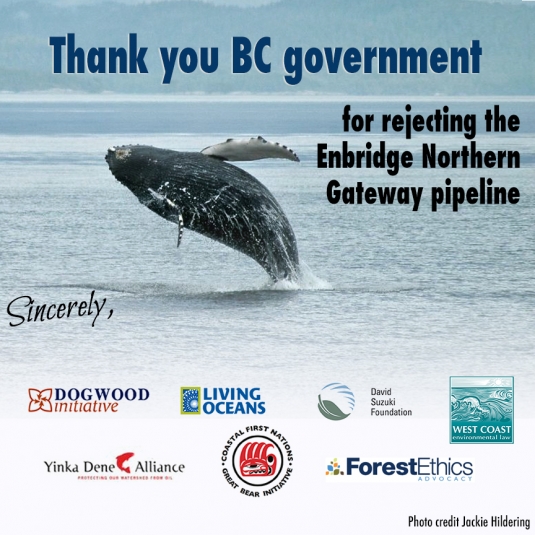
The article and the entire website makes no mention whatever of the attack on Mi’kmaq peoples. Instead, we have this advertisement, addressing Christy Clark:


The reasoning behind the ad? In recent BC provincial politics, more than 4 out of 5 people have stated opposition to the Enbridge Gateway Pipeline, and majorities has been opposed to tar sands-sourced oil coming into BC in general. To avoid taking a pro-industry position that would cost her votes, prior to the May election in BC, Clark’s Liberal Party endorsed “conditions” that “must be met first” for the pipeline. After winning the election, Clark repeated some of those conditions and stated at least temporary opposition to the project.

The provincial government has no final say in the Joint Review Panel; the pipeline in Canadian law is a federal matter. The BC government is “just” another “intervening party.” Stating opposition is free, intelligent public relations for the re-elected Liberal Party, especially while “conditions” exist to be met and a “rethinking” can about face later.

Meanwhile, the BC government was promoting about two dozen disastrous environmental policies– not least of which included the construction of a natural gas corridor that would facilitate larger tar sands developments – instead of being called to account on this, Big Capital approved Big Funding for Big Green for a Big Ad that lauded her with a thank you and a postcard image of a Big Whale. This sent the subtle message that the “Tar Sands Solutions Network is ready to play ball, Premier. Are you listening?”

In the same time frame elsewhere, with another indigenous community struggle against another fracking proposal carried out by another advocating Premier, Big Green has done little or nothing to support the struggles that have now taken on a larger scale impact. And how does the Sun News Network’s great white hope describe this? Again, in Levantine fashion, the description is of indigenous peoples being marched by Big Green, at the behest of Big Capital, to disrupt the Canadian economy. Why big capital would be anti-capitalist is not explained.

The notion that everything was fine months ago, and that conflict is fabricated by shady, American money is casting a white supremacist conspiracy theory. That only white, rich “Americans” would try and prevent fracking in traditional Mi’kmaq Territory of course, is just silly. That this struggle against fracking has developed outside of foundations and Big Green directing struggles in a breath of welcome, fresh air would make Levant’s head explode.

As a result of Big Green ignoring such struggles against fracking, it has taken means such as land defense from Mi’kmaq community members to make fracking a known issue in Canada. It has been, on both coasts, the impacted communities that dared to organize to defend their land and water when there was little to no help coming from Big Green. If such struggles continue, watch for Big Green to take up exactly this issue, after the fact.

Perhaps the only part that is correct about this twist of logic is that movements in environmental circles are often trying to borrow the legitimacy of indigenous land defense. Certainly it is the case that indigenous imagery gets used as a means to lessen the whiteness of environmentalism in the public mind. However, who struggles first and who shows up later to use that for their own purposes is the same as always. Community leads the way, organized institutional groupings– whether “progressive politicians” or “progressive environmental groups”– will attempt to hitch their cart to a running horse.

Big Capital has invested huge sums to try and corner the public perception of what constitutes environmentalism. When struggles break out into open confrontation, it is a community that did not take a deal, cut and run to private boardrooms and the like that is almost always the catalyst. If the struggle built by community has staying power, soon capital through foundations will try to stake their claim within said struggle. The near total silence on fracking from Big Money’s Big Green illustrates this perfectly well in Canada’s indigenous land defender communities.

Inevitably, if one begins to tackle the problems of foundation funding behind the environmental NGO structures in North America, and begins to illustrate it, two related accusations will be levied at your investigation:

1: You are carrying out conspiracy theory—a mirror image of the Ezra Levant types who have been filling up airtime and newspaper columns with tales of the American environmentalist using money to bring down Canada’s economy, despite large public support for the “oil sands.”

2: More specifically, your arguments have much in common with Canada’s would-be Rush Limbaugh or Vivian Krause, ranters and researchers beloved by the growing authoritarian right in Canada who regularly assert a “green conspiracy” that equates environmentalism with something akin to Black Helicopters from the UN turning cows inside out in Kansas, but at the behest of a reinvigorated Kremlin helping the Saudis and Iran.

Despite the fact that for decades Big Green all but ignored the tar sands developments until they became an international issue after the alarm was raised by effected communities in Alberta who tied it to climate justice, Levant posits that people do not actually oppose tar sands developments, but that media have been brainwashed into believing such through the largesse of Obama-loving liberals in the US.

This basic premise by Levant, Krause or any of the other people attacking right wing Big Green groups from even further to the right, always puts the cart before the horse about how big money got involved. The reality is that Big Green came when climate called, that is a campaign with international appeal and therefore the possibility to play a “deciding” role presented itself. But it was community organizing that built up international concern from decades of being overlooked.

Big money liberals have moved to steer what cannot be stopped; Big Green has shaped policy that beckons for solutions in tune with a nascent green bourgeoisie. Of course ‘paranoia’ over such an analysis may be invoked by those who would defend Big Green, actual facts be damned.

That large money crosses the border is about the only point Levant and co. get right; The Tea Party-inspired thought fails to see that this liberal strategy defends capital more effectively than their hardline opposition, just as similar thinking fails to see the bailout as boon for capital and industry. Those who call the Obama regime ‘extreme left’ are incapable of embracing this fundamentally soft right wing, carrot instead of the stick approach. They refuse to join them– and cannot recognize that by instead attempting to beat them they are beating themselves.

The false binary– “The left and the right have similar criticisms of environmentalism. The truth must be somewhere in the middle!”–has been used as a mantra for the liberal Big Green elite to dismiss a discussion of the subversion of real grassroots environmentalism and the choking of community level democracy that gave birth to environmental activism (and many of the Big Green groups) in the first place.

This right-wing ideological contempt for malleable, corporate friendly eNGO’s is the same sort of mentality that attempts to diminish the role of the United Nations, to use government “shutdown” blackmail to prevent modest re-regulation of the private-for profit health insurance sector in the United States, that cheers Canada’s “number one friend” relationship with Israel while eliminating all diplomatic ties with Iran. All of it is more ideologically based than it is rational policy.

The primary critique from the Levant and Krause camps have surface colour, but the thesis– That American environmental money is trying to destroy the Canadian economy– has zero depth. Large capital acts in its best interests, and always has. There is no “American takeover” through a hostile, anti-Canada campaign of US philanthropy; There is a continent wide takeover by capital through the dismantling of an accountable public process.

The problem of free trade deals is the considered increase in deregulation and lack of accountability that results from them. The same is true of taking environmental planning processes out of the public sphere. It matters not whether it is Canadian or American corporations decimating the atmosphere; it matters not whether it is Canadian or American capital that squashes democracy inside a secret negotiation process around tar sands.

There is no Saudi-orchestrated attempt to knock “ethical oil” off the market to the advantage of the monarchs who run the Gulf-Cooperation Council states, either. Nor is the Foundation-led leadership contemptuous of the environment itself, working with personal intent to decimate the biosphere. They are capitalists, some of whom love green spaces and desperately want a false green capitalism to “give it a go.” The problem is not that they insufficiently care about the environment. It is that they love their class privilege too much.

For the most part, while the “invisible to the outside” coalition will not allow for transparency, inside them are vast structural realities in terms of class, race and a complete lack of agency inside the now essentially authoritarian Big Green movement; This causes the policies, direction, media talking points and vital strategies to be so overwhelmingly pro-industry and 100% pro-capital.

Sometimes the capital slant would show in which groups get the largest funding or the most media push; Lawsuits that attempt to “fix” regulatory issues, or ENGO-driven ad campaigns in large newspapers can garner huge chunks of the budget and direction of any such coalition. Organizations that represent indigenous and/or frontline communities or that reject any and all false solutions– such as carbon credits– may get enough money to become reliant and dependent, but not enough to change the over-all trajectory of anti-tar sands “mainstream” policy direction.

And whether it is fracking, tar sands, privatization of river systems or mining on ancestral lands, the actual concerns and sovereign rights of nations in the way of environmental schemes are given the same level of respect as indigenous land is by industry. It is only accommodated when it does not disrupt the agenda, and that agenda is already pre-determined to be within the confines of what the current economic structures abide. A democratic and anti-colonial environmental movement is the only answer; the answers needed immediately cannot come from within structures built by capital and structured for market-based incentive solutions.

Only when community resistance speaks truth to power, as has been witnessed in Elsipogtog for the last several days, can the voice of democracy be heard– and when it is heard, it speaks with more clarity and simple truth than capital can handle.

Macdonald Stainsby is an anti-tar sands and social justice activist, freelance writer and professional hitchhiker looking for a ride to the better world, currently based in Vancouver, Canada. He can be reached at mstainsby@resist.ca

Notes:

1 http://engage.gov.bc.ca/lnginbc/http://tarsandssolutions.org/visuals/thank-you-christie-clark-graphic

Stalking the Spooks: Canadian Rights Watchdog Files Suit Against CSEC


SPYING IN CANADA: Civil Liberties Watchdog Sues Surveillance Agency Over Illegal Spying On Canadians

by BCCLA

Electronic privacy protections and oversight are worse in Canada than in the United States

VANCOUVER, B.C. (October 22, 2013) - The BC Civil Liberties Association (BCCLA) filed a lawsuit today against the Communications Security Establishment Canada (CSEC) claiming that its broad and unchecked surveillance of Canadians is unconstitutional.

The lawsuit argues that two aspects of CSEC’s operations violate the Charter of Rights and Freedoms’ protections against unreasonable search and seizure and infringe on free expression:

1) The interception of the private communications of Canadians;

2) The sweeping collection of metadata information produced by Canadians in their everyday activities online and through phone conversations.

The lawsuit was filed in the B.C. Supreme Court and is the first challenge to the legality of CSEC’s spying activities against Canadians.

CSEC is the Canadian counterpart to the U.S. National Security Agency (NSA), and engages in similar surveillance activities, including those recently revealed through investigative reports based on secret documents leaked by NSA whistleblower, Edward Snowden.

At present, CSEC is permitted to read Canadians’ emails and text messages, and listen to Canadians’ phone calls, when a Canadian communicates with a person outside Canada. When seeking to intercept the content of Canadians’ emails, text messages and phone calls, the agency must seek a ministerial authorization from the Minister of National Defence. The Minister’s authorizations permit for broad collection of Canadians’ personal communications and are entirely secret.

“Unaccountable and unchecked government surveillance presents a grave threat to democratic freedoms,” says Joseph Arvay, Q.C., lawyer for the BCCLA. “We are deeply concerned that CSEC is gaining secret, illegal access to the private communications of ordinary Canadians, and there are no reasonable safeguards in place to monitor its activities. We know from the experiences of other countries that government agencies have a tendency to push and even break the boundaries of spying unless they are checked.”

Unlike the United States, there is no court or committee in Canada that monitors CSEC’s interception of private communications, and there is no judicial oversight of its sweeping powers. This is a serious departure from the safeguards that protect Canadians from domestic spying or police agencies, such as CSIS and the RCMP, which must seek judicial warrants before intercepting the communications of Canadians.

CSEC also operates under a ministerial directive, issued by the Minister of National Defence in 2011, that allows it to collect and analyze the metadata information that is automatically produced each and every time a Canadian uses a mobile phone or accesses the internet. This private metadata includes the exact geographic location of the mobile phone user, records of phone calls and Internet browsing.

“This kind of wholesale surveillance is fundamentally incompatible with Canadian law,” says David J. Martin, lawyer for the BCCLA. “Metadata information can reveal the most intimate details of Canadians’ personal lives, including relationships, and political and personal beliefs. The majority of Canadians use the Internet and telecommunications on a daily basis, and we should be able to do so without the government snooping on our personal information and monitoring our behaviour online.”

OpenMedia.ca has launched a national public outreach campaign calling on all Canadians to show their support for the BCCLA’s case. OpenMedia.ca is Canada’s largest civic engagement organization that works to ensure the Internet is open, affordable, and surveillance-free.

“CSEC spying is secretive, expensive, and out of control,” says OpenMedia.ca Executive Director Steve Anderson. “We’re talking about a secretive agency having the power to spy on the private lives of any resident of Canada, at any time, and we can’t even tell when we’ve been victimized by it. We strongly support the BCCLA’s court challenge, and that’s why today we’re hosting a campaign that calls on all Canadians to stand with the BCCLA and demand a stop to these reckless programs of arbitrary online spying involving law-abiding Canadians.”

The BCCLA’s lawsuit follows on the heels of startling revelations about the interception of Internet and telephone communications of American and British citizens by their respective governments. Recent disclosures have shown that the U.S. government is regularly tracking the calls of almost every ordinary American, and spying on a vast but unknown number of Americans’ international calls, text messages, and emails.

While CSEC claims to “target” its collection efforts on persons outside of Canada, the spy agency is allowed to capture the communications of Canadians at home and abroad if the collection relates to obtaining “foreign intelligence.” CSEC shares this information with foreign intelligence entities in the United States, the United Kingdom, New Zealand and Australia.

“Canada is not a nation of secret laws,” says Caily DiPuma, Counsel for the BCCLA. “It is fundamental to the proper operation of our democracy that Canadians be able to access and understand the laws that impact their rights and freedoms. It is simply not enough for the government to ask Canadians to “trust” their spy agencies. We are not a society of blind faith – we are a society of accountability, transparency and free and open debate.”

The BCCLA is represented by lawyers Joseph Arvay, Q.C. of Arvay Finlay Barristers, David J. Martin of Martin and Associates and Caily DiPuma of the BCCLA.

Read more about the case

Read the Notice of Claim

Read the case backgrounder

Read more about OpenMedia.ca’s public outreach campaign

Contact Information

For more information about the lawsuit or Canadian surveillance issues:
Grace Pastine
grace@bccla.org


For more information regarding the public outreach campaign:

David Christopher

Communications Coordinator, OpenMedia.ca
david@openmedia.ca

Smearing the Competition: "Liberal" Media Response to Glenn Greenwald

Journalist or Activist? Smearing Glenn Greenwald

by David Edwards  - Media Lens

Modern thought control is dependent on subliminal communication. Messages influencing key perceptions are delivered unseen, unnoticed, with minimal public awareness of what is happening or why.

For example, journalists tell us that Hugo Chavez was 'divisive', that Julian Assange and Edward Snowden are 'narcissistic', that George Galloway is 'controversial'. But beneath their literal meaning, these adjectives communicate a hidden message: that these individuals are acceptable targets for negative media judgement; they are fair game.

By contrast, Barack Obama is never described as 'controversial' or 'divisive'. David Cameron is not a 'rightist prime minister'. Why? Because the rules of professional journalism are said to ensure that journalists serve democracy by remaining objective and impartial. Reporters are merely to describe, not to judge, the words and actions of leading politicians.

Crucially, this deference is afforded only to political actors deemed 'mainstream', 'respectable'. By implication, individuals subject to media judgement are presented as outsiders, beyond the democratic pale.

In The Times on October 10, David Aaronovitch compared Guardian editor Alan Rusbridger with Guardian columnist Glenn Greenwald:

'Rusbridger may be a "proper" journalist (and he certainly is), someone like Greenwald is first and foremost an activist. He wants above all to change the world, not just to report it. So while we might trust Rusbridger, what reason do we have for trusting Greenwald with top secret GCHQ information? Or his Brazilian boyfriend who could have been going anywhere and given the stuff on his computer to anybody.'

Aaronovitch thus painted a large, lurid label on Greenwald's back: 'activist'. He is to be seen as a pseudo-journalist, an amateur, a loose cannon. Rusbridger is a 'proper' journalist, Greenwald is not.

The repeated references to Greenwald's 'Brazilian boyfriend', who 'could have been going anywhere', were also intended to depict Greenwald as a shambolic, non-serious figure in journalism. So, too, the attempts to associate Greenwald with the US politician Ron Paul, whose politics 'are way out there' (see Greenwald's response below). For good measure, Aaronovitch described Edward Snowden as a 'fugitive', as though referring to an escaped convict rather than a principled and courageous whistle-blower.

The myth that 'proper' journalism seeks merely to report, not to change, the world is debunked by the mythologist himself.

In 1999, as Nato bombs blitzed Serbia, Aaronovitch wrote in the Independent:

'Is this cause, the cause of the Kosovar Albanians, a cause that is worth suffering for?... Would I fight, or (more realistically) would I countenance the possibility that members of my family might die?'

His answer: 'I think so.' (Aaronovitch, 'My country needs me,' The Independent, April 6, 1999)

The willingness to fight and die as part of a foreign military campaign is the ultimate form of 'activism'. We are not aware that Greenwald has ever threatened to invade a foreign country.

In February 2003, Aaronovitch declared of Saddam Hussein:

'I want him out, for the sake of the region (and therefore, eventually, for our sakes), but most particularly for the sake of the Iraqi people who cannot lift this yoke on their own.' (Aaronovitch, 'Why the Left must tackle the crimes of Saddam: With or without a second UN resolution, I will not oppose action against Iraq,' The Observer, February 2, 2003)

Were these not the words of someone who aspires 'above all to change the world, not just to report it'?

The title of Aaronovitch's Times piece smearing Greenwald was also purest activism:

'Beware: a dangerous new generation of leakers; The threat to security services from tech-savvy young anti-government "libertarians" looks to be serious'

Greenwald commented to us on the article:

'The position he attributed to me about Ron Paul is an outright fabrication, accomplished through an obvious manipulation of quotation marks.

'The Times allowed him to tell readers that I said "Paul was... 'the only major presidential candidate' to say the right things on the questions that really mattered." Not only did I not say that, but I said the opposite.

'I wrote that Paul was better than Obama/Dems on some key issues, but that Obama/Dems were better than Paul on other key issues for progressives. For that reason, I wrote, "it's perfectly rational and reasonable for progressives to decide that the evils of their candidate are outweighed by the evils of the GOP candidate, whether Ron Paul or anyone else."

'He accomplished his fabrication by quoting a small snippet of what I wrote (that Paul was "'the only major presidential candidate'" saying the right things on some issues), and then fabricated something I did not say ("on the questions that really mattered") and lopped it onto the actual quote. That fabrication was all in service of making it appear that I said something that I not only did not say, but explicitly repudiated, including in the first dozen or so paragraphs of the piece he referenced.

'That's to say nothing of the hilarious, inane irony of having someone who publicly cheered for the worst political crime of this generation - the attack on Iraq - trying to deny other people "journalist" status on the ground that they seek to "change the world" rather than simply report.
'Also, did he step out of 1958? What kind of drooling troglodyte still uses the trivializing term "boyfriend" to refer to gay men in an 8-year spousal relationship?
'But all you need to know about this paper's journalistic standards is that it prints rank, idiotic, false speculation such as this: "Presumably [Miranda] was taking [the documents], via intermediaries, from Snowden in Moscow to Greenwald in Rio". If you're beginning a sentence with "presumably" and then following it with a profoundly serious accusation that lacks any evidence, you may be many things. "Journalist" is most definitely not among them.' (Glenn Greenwald to Media Lens, October 11, 2013)

'Changing The Mood Music Of British Politics' – Activism?


The idea that 'proper' journalism is divinely indifferent to human affairs is also mocked by the fact that proprietors are notoriously keen to use their positions, their investment, to influence politics and economics. This is not only understood, it is celebrated, and not just on the right of the 'mainstream'. In the New Statesman last month, Jonn Elledge argued:

'What socially conscious journalism needs, then, is a benefactor: a wealthy left-winger who's willing to step in and support it, not because they think it'll make them any money but because they want to help shape the debate. By buying one of the more poisonous tabloids, this person could refashion its message about, oh I don't know, single mothers and benefit claimants, perhaps?' (Our emphasis)

Clearly, the thought that journalism should be neutral, that proprietors should leave journalism to journalists, has never crossed Elledge's mind. Instead, his plea was precisely that J.K. Rowling - wealthy author of the Harry Potter books - should shape a newspaper to change the world.

Elledge pointed out that 'owning' a newspaper 'is pretty unlikely to bankrupt her. And it would give her a far greater chance of changing the mood music of British politics than the occasional article ever could.

'So, Ms Rowling – how about it?' (Our emphasis)

And consider Elledge's own magazine. In 2009, the Guardian reported:

'Mike Danson has taken full control of the New Statesman, the leftwing political weekly, buying out the Labour MP Geoffrey Robinson's 50% stake in the title.'

Danson made a multimillion-pound fortune when he sold his information business Datamonitor, and 'played a key role in hiring the New Statesman's editor, Jason Cowley... [who] has recruited new writers and plans to extend the scope of the magazine'.

In other words, the owner chooses the editor who chooses the journalists – people like Elledge – giving the boss 'a far greater chance of changing the mood music of British politics'.

This makes a nonsense of freedom-fighting activist Aaronovitch's notion of 'proper' journalism.

On the same theme, the Marxist thinker Ralph Miliband observed that 'Most newspapers' are 'agencies of legitimation and organs of conservative propaganda' operating under key constraints:

'The first and most important of these constraints is that newspapers are part of capitalist enterprise – not only business but big business... [A] second important constraint is that newspapers are part of the world of business in a different sense as well, namely in the sense that they depend on the custom of advertisers.

'Proprietors may or may not choose to exercise direct influence on their newspapers; and the direct influence of advertisers may not in any case be substantial. But the fact that newspapers are an intrinsic part of the world of business fosters a strong climate of orthodoxy for the people who work in them. So does the concern of editors and senior journalists to maintain good relations with government and ministers, civil servants, and other important people in the political and administrative establishment.
'These constraints, however, do no great violence to the people actually in charge of newspapers and occupying influential positions in the journalistic hierarchy, simply because most of them, notwithstanding the unbuttoned and "populist" style which much of the newspaper world affects, share the assumptions and outlook of the world of business and government. The overwhelming chances are that they would not come to occupy the positions they hold if they did not.' (Ralph Miliband, Capitalist Democracy In Britain, Oxford University Press, 1982, republished 1988, pp.84-6).

For espousing views of this kind, Miliband - father of Labour leader, Ed Miliband - was smeared as 'The man who hated Britain' by the Daily Mail. His ideas 'should disturb everyone who loves this country'.

The Mail article generated an awesome level of liberal outrage. Counter-critics pointed out that Daily Mail proprietor Lord Rothermere had written to Adolf Hitler in June 1939:

'My Dear Führer, I have watched with understanding and interest the progress of your great and superhuman work in regenerating your country...'

In reality, the Mail article was a foolish and trivial attempt to smear Ed Miliband with his father's views. The level of liberal outrage mainly demonstrated the ability of the Labourite left to defend its own.

The Lexis media database records 269 hits for UK newspapers mentioning 'Ralph Miliband' and the 'Daily Mail' over the last month, the file of hits extending to some 600 pages in length. We have also seen many hundreds of outraged comments on Twitter from virtually every vaguely left-liberal journalist.

By contrast, Lexis finds zero hits mentioning Aaronovitch's far more serious attack on Greenwald, a courageous, compassionate journalist facing severe threats from US-UK state power, whose partner has already suffered state harassment, whose home has been burgled, and so on.

Contrary to Aaronovitch's version of 'proper' journalism, establishment media are only too willing to intervene to protect their interests in this way. They do, however, regularly respond with serene equanimity when dissidents and Official Enemies are under attack.


Baron Finkelstein – And Other Activist Monsters


Peter Oborne writes in The Spectator that Aaronovitch's colleague at The Times, Lord Finkelstein, 'is close to the Prime Minister':

'Lord Finkelstein is, however, closer by far to George Osborne. One senior Times writer told me three years ago that he spoke "six or seven times a day. probably more" to the Chancellor. Mr Osborne once reportedly remarked that he spoke to Mr Finkelstein more often than he did to his wife.'

Oborne supplies some background:

'One insider told me that "what Danny writes today George thinks tomorrow". This is a reversal of the normal order of precedence, whereby articles by journalists reflect what they have been told by politicians. But Mr Finkelstein is the intellectual and moral superior (and former boss) of the Chancellor, and informed people know that.'

Is Finkelstein, then, a journalist or an activist? Oborne concludes:

'As any newspaperman will recognise, Daniel Finkelstein has never in truth been a journalist at all. At the Times he was an ebullient and cheerful manifestation of what all of us can now recognise as a disastrous collaboration between Britain's most powerful media empire and a morally bankrupt political class.'

This outing of a journalist as an activist is rare indeed.

But the true surrealism of Aaronovitch's criticism of Greenwald was exposed this month when the Public Accountability Initiative (PAI) published a report indicating the extent to which the corporate media habitually pass off gross bias as neutral commentary.

PAI noted how one US media commentator, Stephen Hadley, had 'argued strenuously for military intervention' in Syria in appearances on CNN, MSNBC, Fox News, and Bloomberg TV. He had also authored a Washington Post op-ed headlined, 'To stop Iran, Obama must enforce red lines with Assad.'

PAI supplied some background:

'In each case, Hadley's audience was not informed that he serves as a director of Raytheon, the weapons manufacturer that makes the Tomahawk cruise missiles that were widely cited as a weapon of choice in a potential strike against Syria. Hadley earns $128,500 in annual cash compensation from the company and chairs its public affairs committee. He also owns 11,477 shares of Raytheon stock, which traded at all-time highs during the Syria debate ($77.65 on August 23, making Hadley's share's worth $891,189). Despite this financial stake, Hadley was presented to his audience as an experienced, independent national security expert.'

Hadley was also Assistant to George W. Bush and Deputy National Security Advisor from January 22, 2001. In 2002, Hadley was a member of the discredited White House Iraq Group, set up in August 2002 to sell the Iraq war to the American public.

Corporate media are packed with corporate activists of this kind. Often these commentators are employed by 'think tanks' carefully designed and named to appear impartial. PAI comments:

'The report profiles seven prominent think tanks with significant industry ties that weighed in on intervention in Syria... The Brookings Institution's commentary on intervention in Syria was cited in 31 articles... Brooking's corporate donors include some prominent names in the defense industry.'

These include:

$1 million – 2.5 million: Booz Allen Hamilton
$500,000 – 1 million: Qualcomm Inc.
$50,000 – 100,000: Boeing, General Dynamics, Lockheed Martin, Northrop Grumman, Palantir Technologies.

In January 2012, Shadi Hamid, director of research at the Brookings Doha Centre, wrote in The Atlantic:

'I was an early supporter of military intervention in Libya. I called for a no-fly zone on February 23, just 8 days after protests began.'

He continued:

'The international community must begin considering a variety of military options - the establishment of "safe zones" seems the most plausible - and determine which enjoys the highest likelihood of causing more good than harm. This is now - after nearly a year of waiting and hoping - the right thing to do. It is also the responsible thing to do.'

Finally, we can recognise that BBC grandee and world affairs editor, John Simpson, is certainly deemed a journalist - Aaronovitch would not dream of suggesting otherwise. And yet Simpson commented recently:

'The US is still the world's biggest economic and military power, but it seems to have lost the sense of moral mission that caused it to intervene everywhere from Vietnam to Iraq...'

Was this endorsement of the claim that the US has been on a 'moral mission' a form of activism? It is interesting to consider an alternative formulation:

'The US seems to have retained the sense of ruthless, profit-driven moral indifference that caused it to intervene everywhere from Vietnam to Iraq...'

If this version of history reads like activism, why not Simpson's?


Suggested Action

The goal of Media Lens is to promote rationality, compassion and respect for others. If you do write to journalists, we strongly urge you to maintain a polite, non-aggressive and non-abusive tone.

Write to David Aaronovitch on Twitter: @DAaronovitch

Planet Mars: Red Hot Era of Endless Conflict

Why Washington Can’t Stop: The Coming Era of Tiny Wars and Micro-Conflicts

by Tom Engelhardt  - TomDispatch

In terms of pure projectable power, there’s never been anything like it. 
 
Its military has divided the world -- the whole planet -- into six “commands.” Its fleet, with 11 aircraft carrier battle groups, rules the seas and has done so largely unchallenged for almost seven decades. 
 
Its Air Force has ruled the global skies, and despite being almost continuously in action for years, hasn’t faced an enemy plane since 1991 or been seriously challenged anywhere since the early 1970s. 
 
Its fleet of drone aircraft has proven itself capable of targeting and killing suspected enemies in the backlands of the planet from Afghanistan and Pakistan to Yemen and Somalia with little regard for national boundaries, and none at all for the possibility of being shot down. 
 
It funds and trains proxy armies on several continents and has complex aid and training relationships with militaries across the planet. On hundreds of bases, some tiny and others the size of American towns, its soldiers garrison the globe from Italy to Australia, Honduras to Afghanistan, and on islands from Okinawa in the Pacific Ocean to Diego Garcia in the Indian Ocean. 
 
Its weapons makers are the most advanced on Earth and dominate the global arms market. 
 
Its nuclear weaponry in silos, on bombers, and on its fleet of submarines would be capable of destroying several planets the size of Earth. 
 
Its system of spy satellites is unsurpassed and unchallenged. Its intelligence services can listen in on the phone calls or read the emails of almost anyone in the world from top foreign leaders to obscure insurgents. The CIA and its expanding paramilitary forces are capable of kidnapping people of interest just about anywhere from rural Macedonia to the streets of Rome and Tripoli
 
For its many prisoners, it has set up (and dismantled) secret jails across the planet and on its naval vessels
 
 It spends more on its military than the next most powerful 13 states combined. Add in the spending for its full national security state and it towers over any conceivable group of other nations.

In terms of advanced and unchallenged military power, there has been nothing like the U.S. armed forces since the Mongols swept across Eurasia. No wonder American presidents now regularly use phrases like “the finest fighting force the world has ever known” to describe it. By the logic of the situation, the planet should be a pushover for it. Lesser nations with far lesser forces have, in the past, controlled vast territories. And despite much discussion of American decline and the waning of its power in a “multi-polar” world, its ability to pulverize and destroy, kill and maim, blow up and kick down has only grown in this new century.

No other nation's military comes within a country mile of it. None has more than a handful of foreign bases. None has more than two aircraft carrier battle groups. No potential enemy has such a fleet of robotic planes. None has more than 60,000 special operations forces. Country by country, it’s a hands-down no-contest. The Russian (once “Red”) army is a shadow of its former self. The Europeans have not rearmed significantly. Japan’s “self-defense” forces are powerful and slowly growing, but under the U.S. nuclear “umbrella.” Although China, regularly identified as the next rising imperial state, is involved in a much-ballyhooed military build-up, with its one aircraft carrier (a retread from the days of the Soviet Union), it still remains only a regional power.

Despite this stunning global power equation, for more than a decade we have been given a lesson in what a military, no matter how overwhelming, can and (mostly) can’t do in the twenty-first century, in what a military, no matter how staggeringly advanced, does and (mostly) does not translate into on the current version of planet Earth.

A Destabilization Machine


Let’s start with what the U.S. can do. On this, the recent record is clear: it can destroy and destabilize. In fact, wherever U.S. military power has been applied in recent years, if there has been any lasting effect at all, it has been to destabilize whole regions.

Back in 2004, almost a year and a half after American troops had rolled into a Baghdad looted and in flames, Amr Mussa, the head of the Arab League, commented ominously, “The gates of hell are open in Iraq.” Although for the Bush administration, the situation in that country was already devolving, to the extent that anyone paid attention to Mussa’s description, it seemed over the top, even outrageous, as applied to American-occupied Iraq. Today, with the latest scientific estimate of invasion- and war-caused Iraqi deaths at a staggering 461,000, thousands more a year still dying there, and with Syria in flames, it seems something of an understatement.

It’s now clear that George W. Bush and his top officials, fervent fundamentalists when it came to the power of U.S. military to alter, control, and dominate the Greater Middle East (and possibly the planet), did launch the radical transformation of the region. Their invasion of Iraq punched a hole through the heart of the Middle East, sparking a Sunni-Shiite civil war that has now spread catastrophically to Syria, taking more than 100,000 lives there. They helped turn the region into a churning sea of refugees, gave life and meaning to a previously nonexistent al-Qaeda in Iraq (and now a Syrian version of the same), and left the country drifting in a sea of roadside bombs and suicide bombers, and threatened, like other countries in the region, with the possibility of splitting apart.

And that’s just a thumbnail sketch. It doesn’t matter whether you’re talking about destabilization in Afghanistan, where U.S. troops have been on the ground for almost 12 years and counting; Pakistan, where a CIA-run drone air campaign in its tribal borderlands has gone on for years as the country grew ever shakier and more violent; Yemen (ditto), as an outfit called al-Qaeda in the Arabian Peninsula grew ever stronger; or Somalia, where Washington repeatedly backed proxy armies it had trained and financed, and supported outside incursions as an already destabilized country came apart at the seams and the influence of al-Shabab, an increasingly radical and violent insurgent Islamic group, began to seep across regional borders. The results have always been the same: destabilization.

Consider Libya where, no longer enamored with boots-on-the-ground interventions, President Obama sent in the Air Force and the drones in 2011 in a bloodless intervention (unless, of course, you were on the ground) that helped topple Muammar Qaddafi, the local autocrat and his secret-police-and-prisons regime, and launched a vigorous young democracy... oh, wait a moment, not quite. In fact, the result, which, unbelievably enough, came as a surprise to Washington, was an increasingly damaged country with a desperately weak central government, a territory controlled by a range of militias -- some Islamic extremist in nature -- an insurgency and war across the border in neighboring Mali (thanks to an influx of weaponry looted from Qaddafi’s vast arsenals), a dead American ambassador, a country almost incapable of exporting its oil, and so on.

Libya was, in fact, so thoroughly destabilized, so lacking in central authority that Washington recently felt free to dispatch U.S. Special Operations forces onto the streets of its capital in broad daylight in an operation to snatch up a long-sought terrorist suspect, an act which was as “successful” as the toppling of the Qaddafi regime and, in a similar manner, further destabilized a government that Washington still theoretically backed. (Almost immediately afterward, the prime minister found himself briefly kidnapped by a militia unit as part of what might have been a coup attempt.)

Wonders of the Modern World


If the overwhelming military power at the command of Washington can destabilize whole regions of the planet, what, then, can’t such military power do? On this, the record is no less clear and just as decisive. As every significant U.S. military action of this new century has indicated, the application of military force, no matter in what form, has proven incapable of achieving even Washington’s most minimal goals of the moment.

Consider this one of the wonders of the modern world: pile up the military technology, pour money into your armed forces, outpace the rest of the world, and none of it adds up to a pile of beans when it comes to making that world act as you wish. Yes, in Iraq, to take an example, Saddam Hussein’s regime was quickly “decapitated,” thanks to an overwhelming display of power and muscle by the invading Americans. His state bureaucracy was dismantled, his army dismissed, an occupying authority established backed by foreign troops, soon ensconced on huge multibillion-dollar military bases meant to be garrisoned for generations, and a suitably “friendly” local government installed.

And that’s where the Bush administration’s dreams ended in the rubble created by a set of poorly armed minority insurgencies, terrorism, and a brutal ethnic/religious civil war. In the end, almost nine years after the invasion and despite the fact that the Obama administration and the Pentagon were eager to keep U.S. troops stationed there in some capacity, a relatively weak central government refused, and they departed, the last representatives of the greatest power on the planet slipping away in the dead of night. Left behind among the ruins of historic ziggurats were the “ghost towns” and stripped or looted U.S. bases that were to be our monuments in Iraq.

Today, under even more extraordinary circumstances, a similar process seems to be playing itself out in Afghanistan -- another spectacle of our moment that should amaze us. After almost 12 years there, finding itself incapable of suppressing a minority insurgency, Washington is slowly withdrawing its combat troops, but wants to leave behind on the giant bases we’ve built perhaps 10,000 “trainers” for the Afghan military and some Special Operations forces to continue the hunt for al-Qaeda and other terror types.

For the planet’s sole superpower, this, of all things, should be a slam dunk. At least the Iraqi government had a certain strength of its own (and the country’s oil wealth to back it up). If there is a government on Earth that qualifies for the term “puppet,” it should be the Afghan one of President Hamid Karzai. After all, at least 80% (and possibly 90%) of that government’s expenses are covered by the U.S. and its allies, and its security forces are considered incapable of carrying on the fight against the Taliban and other insurgent outfits without U.S. support and aid. If Washington were to withdraw totally (including its financial support), it’s hard to imagine that any successor to the Karzai government would last long.

How, then, to explain the fact that Karzai has refused to sign a future bilateral security pact long in the process of being hammered out? Instead, he recently denounced U.S. actions in Afghanistan, as he had repeatedly done in the past, claimed that he simply would not ink the agreement, and began bargaining with U.S. officials as if he were the leader of the planet’s other superpower.

A frustrated Washington had to dispatch Secretary of State John Kerry on a sudden mission to Kabul for some top-level face-to-face negotiations. The result, a reported 24-hour marathon of talks and meetings, was hailed as a success: problem(s) solved. Oops, all but one. As it turned out, it was the very same one on which the continued U.S. military presence in Iraq stumbled -- Washington’s demand for legal immunity from local law for its troops. In the end, Kerry flew out without an assured agreement.

Making Sense of War in the Twenty-First Century


Whether the U.S. military does or doesn’t last a few more years in Afghanistan, the blunt fact is this: the president of one of the poorest and weakest countries on the planet, himself relatively powerless, is essentially dictating terms to Washington -- and who’s to say that, in the end, as in Iraq, U.S. troops won’t be forced to leave there as well?

Once again, military strength has not carried the day. Yet military power, advanced weaponry, force, and destruction as tools of policy, as ways to create a world in your own image or to your own taste, have worked plenty well in the past. Ask those Mongols, or the European imperial powers from Spain in the sixteenth century to Britain in the nineteenth century, which took their empires by force and successfully maintained them over long periods.

What planet are we now on? Why is it that military power, the mightiest imaginable, can’t overcome, pacify, or simply destroy weak powers, less than impressive insurgency movements, or the ragged groups of (often tribal) peoples we label as “terrorists”? Why is such military power no longer transformative or even reasonably effective? Is it, to reach for an analogy, like antibiotics? If used for too long in too many situations, does a kind of immunity build up against it?

Let’s be clear here: such a military remains a powerful potential instrument of destruction, death, and destabilization. For all we know -- it’s not something we’ve seen anything of in these years -- it might also be a powerful instrument for genuine defense. But if recent history is any guide, what it clearly cannot be in the twenty-first century is a policymaking instrument, a means of altering the world to fit a scheme developed in Washington. The planet itself and people just about anywhere on it seem increasingly resistant in ways that take the military off the table as an effective superpower instrument of state.

Washington’s military plans and tactics since 9/11 have been a spectacular train wreck. When you look back, counterinsurgency doctrine, resuscitated from the ashes of America’s defeat in Vietnam, is once again on the scrap heap of history. (Who today even remembers its key organizing phrase -- “clear, hold, and build” -- which now looks like the punch line for some malign joke?) “Surges,” once hailed as brilliant military strategy, have already disappeared into the mists. “Nation-building,” once a term of tradecraft in Washington, is in the doghouse. “Boots on the ground,” of which the U.S. had enormous numbers and still has 51,000 in Afghanistan, are now a no-no. The American public is, everyone universally agrees, “exhausted” with war. Major American armies arriving to fight anywhere on the Eurasian continent in the foreseeable future? Don’t count on it.

But lessons learned from the collapse of war policy? Don’t count on that, either. It’s clear enough that Washington still can’t fully absorb what’s happened. Its faith in war remains remarkably unbroken in a century in which military power has become the American political equivalent of a state religion. Our leaders are still high on the counterterrorism wars of the future, even as they drown in their military efforts of the present. Their urge is still to rejigger and reimagine what a deliverable military solution would be.

Now the message is: skip those boots en masse -- in fact, cut down on their numbers in the age of the sequester -- and go for the counterterrorism package. No more spilling of (American) blood. Get the “bad guys,” one or a few at a time, using the president’s private army, the Special Operations forces, or his private air force, the CIA’s drones. Build new barebones micro-bases globally. Move those aircraft carrier battle groups off the coast of whatever country you want to intimidate.

It’s clear we’re entering a new period in terms of American war making. Call it the era of tiny wars, or micro-conflicts, especially in the tribal backlands of the planet.

So something is indeed changing in response to military failure, but what’s not changing is Washington's preference for war as the option of choice, often of first resort. What’s not changing is the thought that, if you can just get your strategy and tactics readjusted correctly, force will work. (Recently, Washington was only saved from plunging into another predictable military disaster in Syria by an offhand comment of Secretary of State John Kerry and the timely intervention of Russian President Vladimir Putin.)

What our leaders don’t get is the most basic, practical fact of our moment: war simply doesn’t work, not big, not micro -- not for Washington. A superpower at war in the distant reaches of this planet is no longer a superpower ascendant but one with problems.

The U.S. military may be a destabilization machine. It may be a blowback machine. What it’s not is a policymaking or enforcement machine.

Tom Engelhardt, co-founder of the American Empire Project and author of The United States of Fear as well as a history of the Cold War, The End of Victory Culture (now also in a Kindle edition), runs the Nation Institute's TomDispatch.com. His latest book, co-authored with Nick Turse, is Terminator Planet: The First History of Drone Warfare, 2001-2050.


[Note: A deep bow of thanks to Nick Turse for his continuing help and, above all, inspiration.]

Follow TomDispatch on Twitter and join us on Facebook or Tumblr. Check out the newest Dispatch book, Nick Turse’s The Changing Face of Empire: Special Ops, Drones, Proxy Fighters, Secret Bases, and Cyberwarfare.

Copyright 2013 Tom Engelhardt
 
Tomgram: Engelhardt, What Planet Are We On?
[Note for TomDispatch Readers: Thought I might recommend a new little book series from the Nation magazine (everyone’s publishing these days!) -- classic essays by some of that mag’s best writers and among my own favorites, including Gore Vidal’s State of the Union, [Kurt] Vonnegut by the Dozen, and an upcoming volume by E.L. Doctorow. Each is a guarantee of pleasure. And here’s a small reminder: if you are an Amazon customer, travel to that site via any TomDispatch book link (or cover image link), and buy books we recommend or anything else whatsoever, book or not, we get a small cut of your purchase at no cost to you. It’s a fine, no-pain-all-gain way to contribute to the site. Tom]