Wednesday, December 11, 2013

Kerry's Mid East Crisis: Palestinians See US Position As Tantamount to Coup

Kerry’s Coup from Mediator to Antagonist

by Nicola Nasser

U.S. Secretary of State John Kerry was scheduled to start his ninth trip of shuttle diplomacy between Palestinian and Israeli leaders on this December 11. However, the bridging “security arrangements,” which he proposed less than a week earlier on his last trip, have backfired and are now snowballing into a major crisis with Palestinian negotiators who view Kerry’s “ideas” as a coup turning the US top diplomat from a mediator into an antagonist.

Kerry’s “ideas” had provoked a “real crisis” and “will drive Kerry's efforts to an impasse and to total failure,” the secretary general of the Executive Committee of the Palestine Liberation Organization (PLO), Yasser Abed Rabbo, said on this December 9.

Resumption of the peace talks and U.S. involvement in the negotiations with Israel were both on record Palestinian demands. Disappointed by the deadlocked negotiations and more by the way Kerry decided finally to get his country involved, the Palestinian presidency expectedly stands now to regret both demands.

Kerry’s shuttle diplomacy during his current trip seems more aimed at controlling the damage his “ideas - proposal” caused than at facilitating the deadlocked Palestinian – Israeli bilateral talks.

On this December 6, Kerry said that (160) American security specialists and diplomats, headed by General John Allen, the former commander of the U.S. forces in Afghanistan, had drafted the “proposal,” believing “that we can contribute ideas that could help both Israelis and Palestinians get to an agreement.”

According to leaks published by mainstream Israeli media, including Israeli Channel 10 news, Haaretz, Maariv, Yedioth Ahronoth and DEBKAfile, as well as by the official Palestinian daily Al-Ayyam, the U.S. “security arrangements” propose:

* Demilitarization of the future State of Palestine.

* U.S. monitoring of its demilitarization.

* To put the border crossings into Jordan under joint Israeli-Palestinian control.

* Maintaining an Israeli military presence deployed along the western side of Jordan River after the establishment of a Palestinian state.

* Installing Israeli early warning stations on the eastward slopes of the West Bank highlands.

* Postponement of arrangements for the final status of Gaza Strip, i.e. severing the strip from the status planned by Kerry’s proposal for the West Bank.

* All of the foregoing are on the background of the U.S. recognition of an understanding that the large Israeli illegal colonial settlements on the West Bank would be annexed to Israel, according to the letter sent by former U.S. President George W. Bush to the comatose former Israeli premier Ariel Sharon in April 2004, to which the incumbent administration of President Barak Obama is still committed.

Kerry and his administration have obviously coordinated a political coup by the adoption of the Israeli preconditions for recognizing a Palestinian state almost to the letter, turning the Palestinian priorities upside down and changing the terms of reference for the Palestinian – Israeli negotiations, which Kerry succeeded to resume and sponsor late last July.

When he announced the resumption of talks on last July 29, Kerry declared that his goal would be to help the Israelis and Palestinians to reach a “final status agreement’” within nine months.

Now, President Barak Obama, speaking at Brookings Institution’s Saban Forum in Washington last Saturday, says there would have to be a “transition process” and that the Palestinians wouldn’t get “everything they want on day one” under an accord, which initially may exclude Gaza, and let the “contiguous Palestinian state,” which he had previously promised, wait. The aim of the negotiations now is to reach a “framework that would not address every single detail,” he added.

And now Kerry, on the same occasion, was speaking about a “basic framework” and establishing “guidelines” for “subsequent negotiations” for a “full-on peace treaty,” i.e., in his game of words, another “road map.”

Kerry moreover hinted that the negotiations might have to extend beyond the agreed upon nine months, thus, from a Palestinian perspective, planning to buy Israel more time to create more colonial facts on the occupied Palestinian ground.

Kerry’s “ideas” alienated the Palestinian “peace camp” and negotiators led by Fatah, which rules the Palestinian Authority (PA) and leads the PLO, who have put “all their eggs in the U.S. basket” for the past two decades, let alone all the other PLO member factions who are against the resumption of the negotiations with Israel for pragmatic reasons, but first of all because they did not trust the U.S. mediator; Kerry has just vindicated their worst fears. Non-member organizations like Hamas and al-Jihad oppose the negotiations as a matter of principle.

On December 8, Palestinian President Mahmoud Abbas, according to The Times of Israel three days later, met with the American consul general in Jerusalem, Michael Ratney, and formally rejected the proposal, saying that the Palestinian position was “unequivocal”: no Israeli presence, though the Palestinians would tolerate a third-party military presence.

On the same day on the occasion of the first 1987 Palestinian Intifada against the 1967 Israeli military occupation of the Palestinian territories, the PLO Executive Committee in a statement said the Palestinian people will not accept Kerry’s proposed plan, which the committee’s secretary general Abed Rabbo described as “extremely vague” and “open-ended.”

On the same day in Qatar, the PLO chief negotiator Saeb Erakat, commenting on Kerry’s proposals, said that the Palestinian leadership “perhaps” committed a “strategic mistake” by agreeing to the resumption of negotiations with Israel instead of seeking first the membership of international organizations to build on the UN General Assembly’s recognition last year of Palestine as a non-member state.

The former second in command in Erakat’s negotiating team, Mohammad Shtayyeh who resigned his mission recently because there was no “serious Israeli partner,” called for replacing the U.S. sponsorship of the negotiations by an international one, on the lines of the Geneva conferences for Iran and Syria, because the U.S. sponsorship is “unbalanced.”

Former negotiator Hassan Asfour wrote that kerry’s plan, which he described as a “conspiracy,” would “liquidate the Palestine Question and end any hope for a Palestinian state,” adding that its rejection is a “necessity and national duty” because it “violates the red national lines.”

Member of the PLO executive committee and former Palestinian chief negotiator, Ahmad Qurei’, said Kerry’s plan replaces the land for peace formula by a security for peace one as the basis for Palestinian – Israeli talks.

Abed Rabbo said last week in Ramallah that if the U.S. accepts that final borders are set according to what Israel determines are its security needs “all hell with break loose.”

Kerry who on his last eighth trip warned Israelis of a Palestinian third Intifada seems himself laying the ground for one. His “ideas” clash head to head with the Palestinian repeated and plain rejection of long or short term interim or transitional arrangements based only on Israel’s security.

He seems obsessed with Israel’s security as “the top priority” for Washington, both in nuclear talks with Iran and peace talks with the Palestinians. In his press availability at Ben Gurion International Airport on December 6 he used the word “security” and “secure” twenty times in relation with Israel, but no words at all about the Israeli “occupation” and “settlements.”

U.S. commitment to Israel’s security is “ironclad,” “spans decades,” “permanent,” “paramount” and a “central issue” in the work of the United States for both final agreements with Iran and Palestinians, he said. President Obama last Saturday said that this commitment is “sacrosanct.”

George Friedman of Stratfor on December 3 reported that “Israel's current strategic position is excellent” and “faces no existential threats.” About “the possibility that Iran will develop a nuclear weapon,” Friedman wrote: “One of the reasons Israel has not attempted an air strike, and one of the reasons the United States has refused to consider it, is that Iran's prospects for developing a nuclear weapon are still remote.”

Despite objections to Kerry’s “security arrangements” by the Israeli defense and foreign cabinet ministers, Moshe Ya’alon and Avigdor Lieberman, the chief Israeli negotiator and justice minister Tzipi Livni admitted that the proposed American security framework addresses a large part of Israel’s security needs.

Obsession with “Israel’s security” could not be interpreted as simply a naïve commitment out of good faith by an old hand veteran of foreign policy like Kerry.

More likely Kerry is dictating to and pressuring the Palestinian presidency with the only option “to take” his proposal or “leave it,” to be doomed either way, by its own people or by the U.S.-led donors to the PA. With friends like Kerry, Palestinian Abbas for sure needs no enemies.

Ironically, Kerry’s “ideas” create a solid political ground for a Palestinian consensus that would be an objective basis for ending the Palestinian divide and reviving the national unity between the PLO in the West Bank and Hamas in the Gaza Strip as a prerequisite to be able to stand up to Kerry’s “coup.”

Such a development however remains hostage to a decision by President Abbas who is still swimming against the national tide because he has made peace making through negotiations only the goal of his life and political career.

Nicola Nasser is a veteran Arab journalist based in Birzeit, West Bank of the Israeli-occupied Palestinian territories. nassernicola@ymail.com


Tuesday, December 10, 2013

Got A Pain in the Neck? Get Senkakus

Should the US Play Solomon and Split the Senkakus?

by Peter Lee - China  Matters


I have grown pretty tired of hearing about the Senkakus. I have a feeling I’m not alone.

Like that red line? Took me less than two minutes.

As far as I can see, Taiwan has the strongest claim to the Senkakus, by geography, geology, history, and propinquity. Japan grabbed the Senkakus in 1895, lost them in World War II, then got them back from the U.S. Occupation as a sloppily-executed, legally dubious afterthought.

But it’s got ‘em.

The PRC, by speaking for Taiwan under the one-China policy, is in OK shape as a matter of logic and equity, but hampered by the fact that nobody wants to see big, bad China get a win at Japan’s expense.

The Senkakus have turned into an American headache.

Japan makes an issue of the Senkakus to goad the PRC and use the ensuing uproar to justify Japan’s emergence as a full-fledged regional military power.

The PRC, IMHO, uses the issue to goad Japan and deepen the wedge between the United States and an increasingly independent Japan, thereby encouraging the United States to shift away from Japan and towards China in order to sustain U.S. clout.

So the United States is on a cleft stick as far as the Senkakus are concerned.

I don’t think the Obama administration, as suggested by Shisaku’s Michael Cucek, is interested in coming down on Japan’s side and confirming Japanese sovereignty over the Senkakus at China’s expense. Beyond the unpleasant prospect of having the PRC really, really mad at us, the PRC will make the United States pay for its decision, probably by punishing Japan in ways that reveal the limits of American power to protect it—like the anti-Japanese economic warfare of 2012—and marginalizes the US in Asia.

My suggestion: the United States, as the responsible hyperpower always sedulously concerned with regional peace and stability, should propose that the Senkakus be split between Japan and the PRC.

There are, to my understanding five uninhabited islands and three barren rocks. Total eight things. I suggest each side get four things on opposite sides of a line. That gives the United States the ability to unambiguously support Japanese sovereignty over here, and Chinese sovereignty over there. Here's one possibility.

Bear in mind that the Japanese government is contemplating a similar 50/50 split in an effort to resolve its endless dispute with Russia over the Northern Islands.

The Japanese would be angry with us, but so would the Chinese. But it’s better to be hated as high-handed imperial lawgivers than resented as handwringing bystanders.

As to the immense fishery and energy resources supposedly contained in the sea surrounding the islands, forget about efficient joint development. What’s on this side of the line is yours, on that side mine. Let each side plunder the resources until the fish are gone, the basins are exhausted, and there is no reason to pretend to be interested in these ridiculous rocks.

I think this initiative is not for the ostentatiously cerebral President Obama. It’s a job for diplomatic blunderbuss Joe Biden or gaffe-guru John Kerry, maybe pontificating at some confab at the Center for a New American Security, standing in front of a big map of the Senkakus and making a sweeping gesture.

Little does he realize he is holding an uncapped marker in his hand, creating a bold and highly suggestive line splitting the eight islets and rocks. The assembled politicians, pundits, and diplomats step back with an involuntary gasp of astonished awe…

2 Million Voices to remember 2 Million Afghan Victims of War

2 Million Voices to remember 2 Million Afghan Victims of War, including Hashim and Zukoom

by Hakim (Dr. Teck Young, Wee - mentor, Afghan Peace Volunteers)

On the 16th of November, 2013, eight-year-old Hashim s/o Abdul Hamid and nine-year-old Zukoom s/o Abdul Majid were on the streets of Kabul polishing boots when a suicide bombing ( in opposition to the U.S./Afghanistan Bilateral Security Agreement ) killed them.

Johnny Barber, a peace activist from New York, and Ronya, an independent, freelance journalist from Germany, accompanied the Afghan Peace Volunteers ( APVs ) to Hashim’s and Zukoom’s funeral in an Internally Displaced Persons ( IDP ) camp two days later. We had a conversation with Hashim and Zukoom’s classmates, Kahar and Naseem, which you can view at “At least 13 Afghan civilians killed, including Hashim & Zukoom”

The daily struggles of ordinary people against elite-driven injustices hovered in the mud-walled room, like a scent. I was swept up by voices both personal and familial. War had not become less cruel with time.

Afghans, like Syrians and many others since time immemorial, are smothered in the cross-fire among the Powers, in declarations and Agreements for more war.

Over the past four decades of war, Afghans have lost at least 2 million loved ones.

Media reported ‘at least 13 killed’, but as Kahar and Nazeem remembered Hashim and Zukoom, these news flashes lost their de-humanizing hold, and the 13 became the two, and the two became us.


Hashim at extreme left with eyes closed, Naseem and Hazrat in front


Zukoom in his tent-school, partially hidden in the middle, looking back

Hashim, 8 years he lived, each year yet another 12 months of war.

“He rejected my rules for playing hide and seek,” Kahar recalled, his instinct to survive, to dodge the bullets and bombs of the Taliban AND the U.S./NATO night and air raids, to play for yet another moment, till last Saturday. “I couldn’t believe it. I cried.”

“Zukoom,” Naseer affirmed, “was a good boy, not a naughty boy” of nine years, finally owning a new school bag, a rucksack! So he went to the tent-school energetically, while polishing boots, till he came to the gates of adults who would rather spend on bases and the methods of brute, competitive force.

Gul Jumma entered the room with her widowed mother. They must have attended the funeral we had been at briefly. Gul Jumma may have been amazed that these ‘foreigners’ were offering comfort when their governments behaved like armed local criminals, busy, target-killing and randomly-shooting, collaterally eliminating farmers irrigating their fields, like they did to her late father.

These sharp, young minds may have remembered ‘experts’ surveying in their home province, Helmand, “Have you heard of September 11th, the two buildings….?”

92% had indicated ‘huh’??

Another occasion in Kandahar, Karzai asked, “Are you happy or unhappy for the operation (offensive  against the Taliban) to be carried out?” “We are not happy,” shouted 1500 tribal elders.

Operation Moshtarak ( Joint ) and Operation Enduring Freedom proceeded anyway, trapping and occupying the 99%

Naseem said, “They wanted to be teachers.” But, conventionally, the special wishes or body bags of commoners aren’t counted in the game plans of the Taliban or the U.S./NATO elite or those signing another ‘bilateral’ war agreement. ‘Stay for tea!”

We thanked everyone, and rose to go. In the eyes of Rahmatullah the camp elder, was a protest, “Billions of dollars later, less security; our women can’t go out at all.”

Maybe, Kahar, Naseem, Hazrat and Gul Jumma, our friends, our humanity, our children, should not have to ply the street economy of polishing boots, mending shoes, collecting trash. They, like Hashim and Zukoom, should be our teachers, re-informing our books, telling their stories after work, of how the streets have always been screaming.


Hazrat, Kahar and Naseem with their new school bags


Zukoom at bottom right with pen & open book, looking at Afghan Peace Volunteer Abdulhai


Naseem, Hazrat, Kahar and Gul Jumma remembering Hashim and Zukoom

Johnny said during the funeral-visit, “I’m really grateful to be here in order just to learn their names, & to learn a little about them because, you know, whenever you read about it in the press, it’s always civilians. You never have a connection to who they were, & what they meant to the community.”

Naseem, Hazrat, Kahar, Gul Jumma and the Afghan Peace Volunteers hope for the global silence to be broken, for 2 Million Voices to resound from around the world in remembering Hashim, Zukoom and the 2 Million Afghan victims of war.

On the 10th of December, the International Day of Human Rights, they launch their ‘2 Million Voices’ campaign, appealing to you and the people of the world: Please Sign our Petition to be One of 2 Million Voices that will say to the Afghan Peace Volunteers ‘We remember them too’.

Text of Petition


Dear People of the World,

Salam! We are the Afghan Peace Volunteers, a nonviolent multi-ethnic community working for peace in our war-stricken country. We wish to hear 2 Million Voices breaking the silence of the 2 Million loved ones Afghans have lost to war.

Every morning in Kabul, like yourselves, we wake up to the same old noise.

The same old rich getting louder and the poor remaining unfed and unheard.

The same old firing of weapons and use of brute force to defend thieves and warlords, both local and foreign.

The same old suffocating of Mother Earth, as her desertified land fills with trash and grey fumes.

We the people of Afghanistan, like yourselves all over the world, are hurting. Because we find hope and healing in friendship, we’d like to hear 2 Million of your Voices remembering our 2 Million loved ones lost to wars.

On signing this petition, please arrange a Skype or phone connection, by sending us the message ‘We remember them too’ in one of these ways:

- borderfree@mail2world.com
- facebook.com/borderfreeworld
- Twitter @afg_borderfree (with the hashtag #2millionvoices)
- http://borderfree.tumblr.com
- Skype name: Afghan Peace Volunteers

We look forward to hearing your voice! We will keep a Tumblr photo-blog on the connections we’ve made.
Whatever our race, religion or politics, under a common borderfree blue sky, we ask you to extend your love to us and to one another.

Keeping our dignity and equality as ordinary folk who seek simple, decent livelihoods, we need to hear from you.

Surely, every voice of friendship is a song for freedom!

Tashakor/thank you.

Love from Afghanistan,
The Afghan Peace Volunteers

Enbridge Joint Review Panel Investigation Disproves Gateway's "National Interest" Claims

'No Enbridge' report: Special delivery to Industry Minister James Moore's office

by ForestEthics Advocacy 


JRP evidence proves Northern Gateway not in national interest, says new ForestEthics Advocacy report 

Vancouver, B.C. As a decision looms from the Joint Review Panel (JRP) reviewing the case for the Enbridge Northern Gateway pipelines, ForestEthics Advocacy released a report today summarizing evidence from the hearings, which makes it abundantly clear that the Northern Gateway pipelines and tanker project is not in the national interest and must be rejected.

The new report will be delivered in person by ForestEthics Advocacy to the office of James Moore, the federal Minister of Industry and Stephen Harper's BC lieutenant. The delivery will take place at Moore's office (2603 St. John's St. in Port Moody) at 12 Noon Tuesday, Dec. 10.

"We are going the extra mile to remind the Harper government that they still have the opportunity to do the right thing. They have a chance to act on the evidence and the overwhelming opposition from everyone from local fishers to the BC government who have all formally come out in opposition to this project,” said Ben West, ForestEthics Advocacy's Tar Sands Campaign Director, who will be on hand Wednesday to deliver the report.

The report, "Case Closed: Enbridge failed to prove Northern Gateway pipelines in national interest," compiles evidence highlighting Enbridge’s failure to prove benefits and address adverse environmental effects.

“Anyone who participated in the hearings repeatedly heard Enbridge say further planning would be done during ‘detailed engineering.’ It deferred the majority of its evidence until after approval, when there would be no opportunity for public scrutiny,” says Nikki Skuce, Senior Energy Campaigner with ForestEthics Advocacy. “Upon closer review of the evidence, it’s undeniable that the JRP should reject this project.”

Gaps in Enbridge evidence highlighted in the report include outlining an oil spill response plan, defining the pipeline’s proposed route, providing adequate baseline studies, assessing impacts to aboriginal culture and a comprehensive study of the unstable coastal terrain the pipeline would cross. As well, the process did not address climate change or environmental impacts in the tar sands , despite accepting economic evidence based on tar sands expansion.

Given the lack of information provided by Enbridge and compelling evidence and arguments against the project from British Columbia residents, the provincial government, First Nations, municipalities, unions and environmental groups, the report concludes that Northern Gateway should never be built.

“We hope that the JRP will conclude, as most participants in the process did, that Enbridge Northern Gateway is not in Canada’s national interest and must be rejected,” Skuce said. “Overwhelmingly in the process, Enbridge proved that their project would be a disaster for the environment and existing economies, that they do not have the competence to build it safely, and that they have no social licence to operate in northern B.C.”

At the Northern Gateway Project hearings, the NEB heard oral statements from 1,239 people. More than 9,000 individuals and groups submitted letters of comment. Over 220 intervenors registered to test Enbridge’s application and evidence, and submit their own evidence. Overwhelmingly, participants came out against Northern Gateway and the risks associated with this proposed tar sands pipeline and tankers on the northwest coast.

Enbridge submitted its application in May 2011, and the JRP hearings took place over 18 months between January 2012 and June 2013. ForestEthics Advocacy was an active intervenor throughout the process, with representation from EcoJustice and in coalition with the Living Oceans Society and the Raincoast Conservation Foundation.

The panel has until Dec. 31, 2013 to make its recommendations to the federal government, who now has the authority to approve or reject the project regardless of the JRP decision.

—30—


For Immediate Release - Tuesday, December 10, 2013

contact: Ben West, Tar Sands Campaign Director, ForestEthics Advocacy

President Scrooge: Lynne Stewart and Obama's Niggardly Pardons Legacy


America’s Gulag: Obama Sentences Political Prisoner Lynne Stewart to Death

by Stephen Lendman  - Information Clearing House 

Lynne’s crime was compassion. She was imprisoned for doing the right thing. She did it honestly, admirably and courageously. She did it defending some of America’s most disadvantaged for 30 years.

She’s dying. She has Stage Four cancer. She was given 12 months to live. She qualifies in all respects for compassionate release. Federal Bureau of Prisons (BOP) authorities denied her. Doing so reflects official Obama administration policy. In Lynne’s words, BOP “stonewall(ed) since August.”

“They know (she’s) fully qualified.” Over 40,000 supporters “signed on to force (BOP) to do the right thing which is to let (her) go home to (her) family and receive the advanced care in New York City, (her) home.”

“Yet they refuse to act. I must say it is entirely within the range of their politics and their cruelty to hold the political prisoners until we have days to live before releasing us,” Lynne stressed.

Indeed so! Longtime political prisoners Herman Wallace and Marilyn Buck were treated this way. On October 1, Wallace was released. On October 3, he died. He was too ill to be saved.

Buck called prisons warehouses to “disappear the unacceptable to deprive their captives of their liberties, their human agency, and to punish (and) stigmatize prisoners through moralistic denunciations and indictment based on bad genes – skin color (ethnicity, or other characteristics) as a crime.”

Many thousands of prisoners aren’t incarcerated because they’re criminals, she said.

They’re locked in cages for their activism and beliefs, she stressed. For advocating peace, not war.

For resisting injustice. For defending freedom, equality and other democratic values. For struggling courageously for beneficial change.

On July 15, 2010, BOP authorities released Buck. On August 3, she died. She served 25 years of an 80 year sentence.

Her crime was opposing racial injustice and US imperialism. In 2009, she was diagnosed with uterine sarcoma.

With proper timely treatment she might have lived. Obama prison authorities wanted her dead.

They kept her imprisoned long enough to kill her. They’re treating Lynne the same way.

She’s one of thousands of wrongfully incarcerated political prisoners. They’re confined in US gulag hell.

It’s bar far the world’s largest. It’s the shame of the nation. It reflects the worst of unconscionable ruthlessness. It’s the American way.

Around 2.4 million prisoners languish in federal and state facilities, local jails, Indian, juvenile, and military ones, US territories, and separate Immigration and Customs Enforcement (ICE) detention facilities.

Many are imprisoned for supporting right over wrong. The Free Dictionary call political prisoners people “imprisoned for holding or advocating dissenting political views for holding, advocating, expressing, or acting in accord with particular political beliefs.”

In the 1960s, Amnesty International (AI) coined the term “prisoner of conscience.”

It denotes anyone incarcerated for their race, religion, ethnicity, language, sexual orientation, beliefs, or lifestyle.

Incarceration is an instrument of social control. Prisoners are denied all rights. They languish under cruel and inhumane conditions. Some die. Others fade slowly.

Many endure punishing years of isolation. Proper medical care is denied. Abuse is commonplace. Perfunctory parole hearings are a travesty of justice.

A November ACLU report is titled “A Living Death: Life Without Parole for Nonviolent Offenses.”

“Ever wonder what could land you in prison for the rest of your life,” asked ACLU?

For thousands it was “shoplifting a few cameras from Wal-Mart, stealing a $159 jacket, or serving as a middleman in the sale of $10 of marijuana.”

Children young as 13 get life sentences without parole for nonviolent crimes, invented ones, or dissenting political beliefs.

“People convicted of their first offense will be permanently denied a second chance,” said ACLU.

“Many young Black and low-income men and women will be locked up until they die. And taxpayers will spend billions to keep them behind bars.”

Dissenting advocacy is considered terrorism. ACLU’s report focused on extreme sentences for minor property and drug-related crimes.

America’s criminal injustice system “reached absurd, tragic and costly heights,” it said.

Locking nonviolent people in cages longterm reflects sentencing them to death slowly. Imprisoning children this way is unconscionable.

So is incarcerating people for their political beliefs and advocacy. ACLU calls life imprisonment without parole (LWOP) “the harshest imaginable punishment.”

Any hope for freedom is denied. LWOP is “grotesquely” unconscionable. It “offends the principle that all people have the right to be treated with humanity and respect for their inherent dignity.”

ACLU documented thousands of ruined lives. Families suffer with loved ones behind bars. Wives are separated from husbands, husbands from wives, children from fathers or mothers, extended families from one of their cherished members.

America spends billions of dollars annually keeping people locked in cages. Decades ago, historian Arnold Toynbee said:

“America is today the leader of a world-wide anti-revolutionary movement in the defence of vested interests.”

“She now stands for what Rome stood for: Rome consistently supported the rich against the poor…and since the poor, so far, have always and everywhere been far more numerous than the rich, Rome’s policy made for inequality, for injustice, and for the least happiness of the greatest number.”

Criminal injustice defines US policy. It’s morally and ethically reprehensible.

America spends more on prisons than education. In the last two decades, prison spending increased around 570%. Education funding grew only one-third.

One year in prison costs more than Harvard’s annual tuition. America has 5% of the world’s population. It incarcerates 25% of world prisoners.

Many thousands are held for their political beliefs and advocacy. HL Menchen once said:

“The most dangerous man to any government (is someone) who is able to think things out for himself, without regard to the prevailing superstitions and taboos.”

“Almost inevitably he comes to the conclusion that the government he lives under is dishonest, insane, and intolerable.”

Attorney/activist Stan Willis said earlier:

“The United States is very, very concerned when its citizens begin to raise (uncomfortable) questions.”
America “prefers to posture itself, including the Obama administration, as the leader of the free world and that they don’t have any human rights violations, and they certainly don’t have any political prisoners, and we have to dispel that notion in the international community.”

US officials want this issue hidden from public view. It preaches democracy at home and abroad.

It practices injustice writ large. It locks thousands in cages unconscionably. It does so for political reasons.

It sentences them to slow death. It violates constitutional law doing so. The Eighth Amendment prohibits “cruel and unusual punishments.”

The First Amendment guarantees free speech. Democratic principles include equal justice under law.

In Griffin v. Illinois (1956), the Supreme Court said “there can be no equal justice where the kind of trial a man gets depends on the amount of money he has.” Nor when core constitutional rights are denied.

Everyone is entitled to constitutional protections. Too few get it. Thousands are denied it for their political beliefs and advocacy. They’re imprisoned for doing the right thing.

Judicial unfairness is US official policy. Guilty by accusation is standard practice. Constitutional scholar Thomas Emerson (1908 – 1981) once said:

The FBI is an instrument of repression. It “jeopardizes the whole system of free expression which is the cornerstone of our society (raising) the specter of a police state.”

“In essence, the FBI conceives of itself as an instrument to prevent radical social change in America. The Bureau’s view of its function leads it beyond data collection into political warfare.”

It protects privilege from beneficial social, political and economic change. Criminal injustice in America denies fundamental constitutional rights.

Society’s most vulnerable are harmed most. So is anyone for dissenting political views and advocacy.

Howard Zinn called dissent “the highest form of patriotism. (It) means being true to the principles for which your country is supposed to stand,” he said.

“(T)he right to dissent is one of those principles. And if we’re exercising that right, (it’s) patriotic.”

“One of the greatest mistakes (about) patriotism (is thinking it) means support(ing) your (government right or wrong).”

“(W)hen governments become destructive (of life, liberty and equality), it is the right of the people to alter or abolish (it).”

Michael Tigar is Washington College of Law Professor Emeritus. He’s a constitutional law expert. He’s one of America’s most respected defense attorneys.

He’s written extensively on litigation, trial practice, criminal law, capital punishment, and the role of criminal defense attorneys. He represented Lynne. He did so at the district court level.

He called it a “great honor” to do it. He represented her struggle for freedom and justice. “The entire legal profession ought to be standing up and shouting about (her) case,” he said.

He called charges against her “an attack on the First Amendment right of free speech, free press and petition.”

Lynne was targeted for “speaking and helping others to speak.” Doing so was fundamentally unconstitutional.

So-called evidence against her “was gathered by wholesale invasion of private conversations, private attorney-client meetings, and private faxes, letters and emails. I have never seen such an abusive use of government power,” said Tigar.

Convicting Lynne was chilling. It warned other defense attorneys. It intimidated them. Representing clients prosecutors want convicted is dangerous. Doing so leaves them vulnerable going forward.

US police state laws are menacing. Anyone can be targeted for supporting right over wrong. America is unfit to live in.

Thousands of political prisoners reflect its harshness. Justice is a four-letter word. It’s systematically denied.


Stephen Lendman lives in Chicago. He can be reached at lendmanstephen@sbcglobal.net. - His new book is titled “Banker Occupation: Waging Financial War on Humanity.” http://www.claritypress.com/LendmanII.html
Visit his blog site at sjlendman.blogspot.com. - Listen to cutting-edge discussions with distinguished guests on the Progressive Radio News Hour on the Progressive Radio Network. It airs Fridays at 10AM US Central time and Saturdays and Sundays at noon. All programs are archived for easy listening.
http://www.progressiveradionetwork.com/the-progressive-news-hour

http://www.dailycensored.com/wp-admin/post.php?post=32848&action=edit&message=6

The War Next Door: Living America's Military Legacy

In the Shadow of War: Life and Fiction in Twenty-First-Century America

by Beverly Gologorsky  - TomDispatch

I’m a voracious reader of American fiction and I’ve noticed something odd in recent years. This country has been eternally “at war” and you just wouldn’t know that -- a small amount of veteran’s fiction aside -- from the novels that are generally published. For at least a decade, Americans have been living in the shadow of war and yet, except in pop fiction of the Tom Clancy variety (where, in the end, we always win), there’s remarkably little evidence of it.

As for myself -- I’m a novelist -- I find that no matter what I chose to write about, I can’t seem to avoid that shadow. 
My first novel was about Vietnam vets coming home and my second is permeated with a shadowy sense of what the Iraq and Afghan wars have done to us. And yet I’ve never been to, or near, a war, and nothing about it attracts me. So why is it always lurking there? Recently, I haven’t been able to stop thinking about just why that might be and I may finally have a very partial answer, very modestly encapsulated in one rather un-American word: class.

Tomgram: Beverly Gologorsky, My Neighbor, War

[Note for TomDispatch Readers: We have a special offer as the holiday season approaches. The author of today’s post, Beverly Gologorsky, the sort of wonderful fiction writer you don’t often encounter at this site, has just had her new novel, Stop Here, published. Set in that classic American institution, the diner, it takes you directly down the rabbit hole of American life via a set of cooks and waitresses, their children, lovers, spouses, and assorted others. I read it and was riveted. It's truly one of a kind. For those who want to offer this website a little extra holiday cheer, a contribution of $100 (or more) will get you a personalized, signed copy of Gologorsky’s remarkable new novel, a book I suspect you’re going to hear a lot more about. If you want a sense of it, check out this striking review at the website Full Stop by Scott Beauchamp (who catches the spirit of the book when he calls it “a literary Hopper painting”) and then rush to our donation page to check out our offer. Tom]

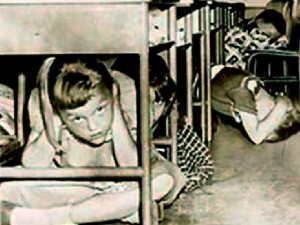
In the years when I was growing up more or less middle class, American war on the childhood front couldn’t have been sunnier. True, American soldiers were fighting a grim new stalemate of a conflict in Korea and we kids often enough found ourselves crouched under our school desks practicing for the nuclear destruction of our neighborhoods, but the culture was still focused on World War II. Enter a movie theater then and as just about any war flick ended, the Air Force arrived in the nick of time, the Marines eternally advanced, and victory was ours, a God-given trait of the American way of life.

In those days, it was still easy to present war sunny-side up. After all, you couldn’t go wrong with the Good War -- not that anyone called it that until Studs Terkel put the phrase into the language and the culture dropped the quote marks with which he carefully encircled it. And if your Dad, who had served in one of the great draft armies of our history, sat beside you silently in that movie theater while John Wayne saved the world, never saying a word about his war (except in rare and sudden outbursts of anger), well, that was no problem. His silence only encouraged you to feel that, given what you’d seen at the movies (not to speak of on TV, in books, in comics, and more or less anywhere else), you already understood his experience and it had been grand indeed.

And then, of course, we boys went into the parks, backyards, or fields and practiced making war the American way, shooting commies, or Ruskies, or Indians, or Japs, or Nazis with toy guns (or sticks). It may not sound pretty anymore, but take my word for it, it was glorious back when.

More than half a century later, those movies are relics of the neolithic era. The toy six-shooters I once holstered and strapped to my waist, along with the green plastic soldiers that I used to storm the beaches of Iwo Jima or Normandy, are somewhere in the trash heap of time. And in the wake of Vietnam, Iraq, and Afghanistan, who believes that America has a God-given right to victory? Still, I have a few relics from that era, lead Civil War and Indian War-style soldiers who, more than half a century ago, fought out elaborate battles on my floor, and I’d be a liar if I didn’t admit that holding one for a moment doesn’t give me some faint wash of emotion from another age. That emotion, so much stronger then, sent thousands of young Americans into Vietnam dreaming of John Wayne.

These days, post-Vietnam, post-9/11, no one rides to the rescue, “victory” is no longer in our possession, and for the first time in memory, a majority of the public thinks Washington should “mind its own business” globally when it comes to war-making. Not surprisingly, in an America that’s lost its appetite for war, such conflicts are far more embattled, so much less onscreen, and as novelist Beverly Gologorsky writes today, unacknowledged in much of American fiction.
There was nothing sunny about war, even in the 1950s, for the young, working-class Gologorsky.  If my childhood was, in a sense, lit by war and by a 24/7 economy in which the same giant corporations built ever larger cars and missiles, television consoles and submarines, hers was shadowed by it.  She sensed, far more than I, the truth of war that lay in our future.  That shadowing is the essence of her deeply moving “Vietnam” novel, The Things We Do to Make It Home, and her just-published second novel, Stop Here, a book that comes to grips in a way both subtle and heart-rending with the Iraq and Afghan wars without ever leaving the environs of a diner in Long Island, New York. Tom


In the Shadow of War: Life and Fiction in Twenty-First-Century America

by Beverly Gologorsky


Going to War in the South Bronx


I come from -- to use an old-fashioned phrase -- a working class immigrant family. The middle child of four siblings, not counting the foster children my mother cared for, I grew up in the post-World War II years in the basement of a building in the South Bronx in New York City. In my neighborhood, war -- or at least the military -- was the norm. Young men (boys, really) generally didn’t make it through life without serving in some military capacity. Soldiers and veterans were ubiquitous. Except to us, to me, none of them were “soldiers” or “veterans.” They were just Ernie, Charlie, Danny, Tommy, Jamal, Vito, Frank. In our neck of the urban woods -- multi-ethnic, diverse, low-income -- it was the way things were and you never thought to question that, in just about every apartment on every floor, there was a young man who had been in, would go into, or was at that moment in the military and, given the conflicts of that era, had often been to war as well.

Many of the boys I knew joined the Marines before they could be drafted for some of the same reasons men and women volunteer now. (Remember that there was still a draft army then, not the all-volunteer force of 2013.) However clichéd they may sound today, they reflected a reality I knew well. Then as now, the military held out the promise of a potentially meaningful future instead of the often depressing adult futures that surrounded us as we grew up.

Then as now, however, too many of those boys returned home with little or nothing to show for the turmoil they endured. And then as now, they often returned filled with an inner chaos, a lost-ness from which many searched in vain for relief.

When I was seven, the Korean War began. I was 18 when our first armed advisers arrived in Vietnam. After that disaster finally ended, a lull ensued, broken by a series of “skirmishes” from Grenada to Panama to Somalia to Bosnia, followed by the First Gulf War, and then, of course, the American invasions of Afghanistan and Iraq.

I dated, worked with, or was related to men who participated in some of these wars and conflicts. One of my earliest memories, in fact -- I must have been three -- is of my anxious 19-year-old sister waiting for her soldier-fiancé to make his way home from World War II. Demobilized, he finally arrived with no outward signs that war had taken a toll on him. Like so many of those “greatest generation” vets, though, he wouldn’t or couldn’t talk about his experiences, and remained hard to reach about most things for years afterwards. His army hat was my first military souvenir.

When I was eight or nine, my brother was drafted into the Korean War and I can still remember my constant worries about his well-being. I wrote my childish letters to him nearly every day. He had been assigned to Camp Breckinridge, Kentucky, given a pair of lace-up boots, and told he’d be training as a paratrooper. He could never get past the anxiety that assignment bestowed on him. Discharged, many pounds thinner and with a bad case of mononucleosis, he came home with a need to have guns around, guns he kept close at hand for the rest of his life.

My first “serious” boyfriend was a sailor on the U.S.S. Warrington. I was 15. Not surprisingly, he was away more than home. He mustered out with an addiction to alcohol.

I was 18 when my second boyfriend was drafted. John F. Kennedy was president and the Vietnam War was, then, just a blip on the American horizon. He didn’t serve overseas, but afterwards he, too, couldn’t figure out what to do with the rest of his life. And so it went.

Today, I no longer live in the South Bronx where, I have no doubt, women as well as men volunteer for the military with similar mindsets to those of my youth, and unfortunately return home with problems similar to those suffered by generations of soldiers before them. Suffice it to say that veterans of whatever war returned having experienced the sharp edge of death and nothing that followed in civilian life could or would be as intense.

Rejecting War


It’s in the nature of militaries to train their soldiers to hate, maim, and kill the enemy, but in the midst of the Vietnam War -- I had, by then, made it out of my neighborhood and my world -- something challenged this trained-to-kill belief system and it began to break down in a way previously unknown in our history. With that mindset suddenly in ruins, many young men refused to fight, while others who had gone to war, ones from neighborhoods like mine, came home feeling like murderers.

In those years, thinking of those boys and many others, I joined the student antiwar movement, though I was often the only one in any group not regularly on campus. (Working class women worked at paying jobs!) As I learned more about that war, my anger grew at the way my country was devastating a land and a people who had done nothing to us. The loss of American and Vietnamese lives, the terrible wounds, all of it felt like both a waste and a tragedy. From 1964 on, ending that war sooner rather than later became my 24/7 job (when, that is, I wasn’t at my paying job).

During those years, two events remain vivid in my memory. I was part of a group that opened an antiwar storefront coffee shop near Fort Dix in New Jersey, a camp where thousands of recruits received basic training before being shipped out to Vietnam. We served up coffee, cake, music, posters, magazines, and antiwar conversation to any soldiers who came in during their off-hours -- and come in they did. I met young men from as far away as Nebraska and Iowa, as close by as Queens and Brooklyn. I have no idea if any of them ever refused to deploy to Vietnam as some soldiers did in those years. However, that coffee house gave me an education in just how vulnerable, scared, excited, unprepared, and uninformed they were about what they would be facing and, above all, about the country they were invading.

Our storefront hours ran from 5 pm to whenever. On the inevitable night bus back to the Port Authority terminal, I would be unable to shake my sadness. Night after night, on that ride home I remember thinking: if only I had the power to do something more to save their lives, for I knew that some of them would come back in body bags and others would return wounded physically or emotionally in ways that I remembered well. And for what? That was why talking with them has remained in my memory as both a burden and a blessing.

The second event that stays with me occurred in May 1971 in Washington, D.C. A large group of Vietnam veterans, men who had been in the thick of it and seen it all, decided they needed to do something that would bring national attention to the goal of ending the war. The method they chose was to act out their repudiation of their previous participation in it. Snaking past the Capitol, an extremely long line of men in uniform threw purple hearts and medals of every sort into a trash bin. Most then made a brief statement about why they hated the war and could no longer bear to keep those medals. I was there and I’ll never forget their faces. One soldier, resisting the visible urge to cry, simply walked off without saying a word, only to collapse on a fellow soldier’s shoulder. Many of us watched, sobbing.

Breathing War


In those years, I penned political articles, but never fiction. Reality overwhelmed me. Only after that war ended did I begin to write my world, the one that was -- always -- shadowed by war, in fiction.

Why doesn’t war appear more often in American novels? Novelist Dorothy Allison once wrote, "Literature is the lie that tells the truth." Yet in a society where war is ever-present, that truth manages to go missing in much of fiction. These days, the novels I come across have many reference points, cultural or political, to mark their stories, but war is generally not among them.

My suspicion: it has something to do with class. If war is all around us and yet, for so many non-working-class Americans, increasingly not part of our everyday lives, if war is the thing that other people do elsewhere in our name and we reflect our world in our fiction, then that thing is somehow not us.

My own urge is to weave war into our world, the way Nadine Gordimer, the South African writer, once wove apartheid into her novels -- without, that is, speechifying or pontificating or even pointing to it. When American fiction ignores the fact of war and its effects remain hidden, without even brief mentions as simple markers of time and place, it also accepts peace as the background for the stories we tell. And that is, in its own way, the lie that denial tells.

That war shadows me is a difficult truth, and for that I have my old neighborhood to thank. If war is the background to my novels about everyday life, it’s because it’s been in the air I breathed, which naturally means my characters breathe it, too.

Beverly Gologorsky is the author the just-published novel Stop Here (“a literary Hopper painting,” Seven Stories Press). Her first novel, The Things We Do to Make it Home, was a New York Times Notable Book and a Los Angeles Times Best Fiction Book. In the Vietnam years, she was an editor of two political journals, Viet-Report and Leviathan and her contribution to feminism is noted in Feminists Who Changed America.

Follow TomDispatch on Twitter and join us on Facebook or Tumblr. Check out the newest Dispatch Book, Ann Jones’s They Were Soldiers: How the Wounded Return From America’s Wars -- The Untold Story.

Copyright 2013 Beverly Gologorsky

Sunday, December 08, 2013

Hedges: A Crisis of Capitalist Belief

Credibility of the Ruling Elite is Being Shredded - Chris Hedges on Reality Asserts Itself pt2

by TRNN

On RAI with Paul Jay, Chris Hedges says that while people are disgusted with the centers of power, unless there is a constructive alternative, any eruption will be nihilistic and could be fascist.

Chris Hedges, whose column is published Mondays on Truthdig , spent nearly two decades as a foreign correspondent in Central America, the Middle East, Africa and the Balkans. He has reported from more than 50 countries and has worked for The Christian Science Monitor, National Public Radio, The Dallas Morning News and The New York Times, for which he was a foreign correspondent for 15 years. He has written nine books, including "Empire of Illusion: The End of Literacy and the Triumph of Spectacle" (2009), "I Don't Believe in Atheists" (2008) and the best-selling "American Fascists: The Christian Right and the War on America" (2008). His book "War Is a Force That Gives Us Meaning" (2003) was a finalist for the National Book Critics Circle Award for Nonfiction.  

Iran/US Agreement: Interim Breakthrough or Historic Breakdown?

Iran-US Interim Agreement: Historic Breakthrough or Historic Sellout?

by James Petras

The recent interim accord between the six world powers and Iran has been hailed as an “historic breakthrough”, a “significant accomplishment” by most leading politicians, editorialists and columnists (Financial Times, (FT) 11/26/13, p. 2), the exceptions being notably Israeli leaders and the Zionist power brokers in North America and Western Europe (FT 11/26/13, p. 3).

What constitutes this “historic breakthrough”? Who got what? Did the agreement provide for symmetrical concessions? Does the interim agreement strengthen or weaken the prospects for peace and prosperity in the Gulf and the Middle East? To address these and other questions, one also has to include the powerful influence wielded by Israel on US and European policymakers (Stephen Lendman

The Historical Record: Past Precedents


For over a decade the major US intelligence agencies have published detailed accounts of Iran’s nuclear program (see especially the National Intelligence Estimate 2007 (NIE)). The common consensus has been that Iran did not have any program for developing nuclear weapons (National Intelligence Estimate 2004, 2007). As a consequence of this ‘absence of evidence’, the entire Western offensive against Iran had to focus on Iran’s “potential capacity” to shift sometime in the future towards a weapons program. The current agreement is directed toward undermining Iran’s potential ‘capacity’ to have a nuclear weapons program: there are no weapons to destroy, no weapon plans exist, no war plans exist and there are no strategic offensive military operations on the Iranian ‘drawing board’. We know this, because repeated US intelligence reports have told us that no weapons programs exist! So the entire current negotiations are really over weakening Iran’s ongoing peaceful, legal nuclear program and undermining any future advance in nuclear technology that might protect Iran from an Israeli or US attack, when they decide to activate their “military option”, as was pulled off in the war to destroy Iraq.

Secondly, Iran’s flexible and accommodating concessions are not new or a reflection of a newly elected President. As Gareth Porter has pointed out: Nearly ten years ago, on Nov. 15, 2004, Iran agreed “on a voluntary basis to continue and extend an existing suspension of enrichment to include all enrichment related and reprocessing activities” (Gareth Porter, Inter Press Service 11/26/13). According to Porter, Iran was ending “all manufacturing, assembly, installation and testing of centrifuges or their components”. Despite these generous concessions, on March 2005, the Europeans and the US refused to negotiate on an Iranian proposal for a comprehensive settlement that would guarantee against enrichment toward weapons grade. Iran ended its voluntary suspension of all enrichment activity. The US, led by Zionists embedded in Treasury, (Stuart Levey) then escalated sanctions. Europe and the UN Security Council followed in kind. The practice of the US and Europe first securing major concessions from Iran and then refusing to reciprocate by pursuing a comprehensive settlement is a well established diplomatic practice. Iran’s flexibility and concessions were apparently interpreted as “signs of weakness” to be exploited in their push toward ‘regime change’ (An Unusual Success for Sanctions Policy, FT 11/27/13, p. 10). Sanctions are seen as “effective” political-diplomatic weapons designed to further weaken the regime. Policy-makers continue to believe that sanctions should be maintained as a tool to divide the Iranian elite, disarm and dismantle the country’s defensive capacity and to prepare for “regime change” or a military confrontation without fear of serious resistance from the Iranians.

The entire charade of Iran’s ‘nuclear weapons as a threat’ has been orchestrated by the Israeli regime and its army of ‘Israel Firsters’ embedded in the US Executive, Congress and mass media. The ‘Big Lie’, promoted by Israel’s propaganda machine and network of agents, has been repeatedly and thoroughly refuted by the sixteen major US Intelligence Estimates or NIE’s, especially in 2004 and 2007. These consensus documents were based on extensive research, inside sources (spies) and highly sophisticated surveillance. The NIEs categorically state that Iran suspended all efforts toward a nuclear weapons program in 2003 and has not made any decision or move to restart that program. However, Israel has actively spread propaganda, based on fabricated intelligence reports, claiming the contrary in order to trick and push the US into a disastrous military confrontation with Israel’s regional rival. And the President of the United States ignores his own intelligence sources in order to repeat Israel’s ‘Big Lie’!

Given the fact that Iran is not a ‘nuclear threat’, now or in the past, and given that the US, European and Israeli leaders know this, why do they continue and even increase the sanctions against Iran? Why do they threaten to destroy Iran with pre-emptive attacks? Why the current demands for even more concessions from Tehran? The current negotiations and ‘agreement’ tell us a great deal about the ‘ultimate’ or final strategic aims of the White House and its European allies.

The ‘Interim Agreement’: A Most Asymmetrical Compromise


Iran’s negotiators conceded to the’ 5 plus 1’ all their major demands while they received the most minimum of concessions, (FT 1/25/13, p. 2).

Iran agreed (1) to stop all enrichment to 20 percent, (2) reduce the existing 20 percent enriched stockpile to zero, (3) convert all low enriched uranium to a form that cannot be enriched to a higher level, (4) halt progress on its enrichment capacity, (5) leave inoperable half of its centrifuges at Natanz and three-quarters of those at Fordow, and (6) freeze all activities at Arak heavy water facility which when built could produce plutonium. Iran also agreed to end any plans to construct a facility capable of reprocessing plutonium from spent fuel. The Iranian negotiators agreed to the most pervasive and intensive “inspections” of its most important strategic defense facilities by the International Atomic Energy Agency, which has been closely allied with the US and its EU counterparts. These “inspections” and data collection will take place on a daily bases and include access to Natanz and Fordow. The strategic military value of these inspections is inestimable because it could provide data, heretofore unavailable, for any future missile strike from the US or Israel when they decide to shift from negotiations to the ‘military option’. In addition, the IAEA inspectors will be allowed to access other strategic facilities, including sites for developing centrifuges, uranium mines and mills. Future “negotiations” may open highly sensitive military defense sites such as Parchin, where conventional missiles and warheads are stored.

Obviously, there will not be any reciprocal inspections of the US missile sites, warships and military bases in the Persian Gulf, which store weapons of mass destruction aimed at Iran! Nor will the IAEA inspect Israel’s nuclear weapons—facilities in Dimona – despite Israeli threats to attack Iran. No comparable diminution of “military capacity” or nuclear weapons, aimed at Iran by some members of the ‘5 plus 1 and Israel’ is included in this “historic breakthrough”.

The ‘5 plus 1’ conceded meager concessions: Unfreezing of 7% of Iranian-owned assets sequestered in Western banks ($7 billion of $100 billion) and ‘allowing’ Iran to enrich uranium to 5 percent --and even that “concession” is conditioned by the proviso that it does not exceed current stockpiles of 5% enriched uranium. While the Iranian negotiators claim they secured (sic) ‘the right’ to enrich uranium, the US refused to even formally acknowledge it!

In effect, Iran has conceded the maximum concessions regarding its strategic national defenses, nuclear facilities and uranium enrichment in what is supposedly the ‘initial’ round of negotiations, while ‘receiving’ the minimum of reciprocal concessions. This highly unfavorable, asymmetrical framework, will lead the US to see Iran as ‘ripe for regime change’ and demand even more decisive concessions designed to further weaken Iran’s defensive capacity. Future concessions will increase Iran’s vulnerability to intelligence gathering and undermine its role as a regional power and strategic ally of the Lebanese Hezbollah, the current beleaguered governments in Syria and Iraq and the Palestinians under Israeli occupation.

The ‘Final Settlement’: Decline and Fall of the Islamic Nationalist Republic?


The real goals of the US sanctions policy and the recent decision to enter into negotiations with Iran have to do with several imperial objectives. The first objective is to facilitate the rise of a neo-liberal regime in Iran, which would be committed to privatizing major oil and gas fields and attracting foreign capital even at the cost of strategic national defense.

President Rohani is seen in Washington as the Islamic version of the former Russian President Mikhail Gorbachev. Rohani, like his ‘model’ Gorbachev, ‘gave away the store’ while expecting Iran’s imperial adversaries to reciprocate.

The ‘5 plus 1’, mostly veterans of the ‘imperial shake down’, will take all of Rohani’s concessions and demand even more! They will “allow” Iran to recover its own frozen assets in slow droplets, which the neo-liberals in Tehran will celebrate as ‘victories’ even while the country stagnates under continued sanctions and the people suffer! The US Administration will retain sanctions in order to accommodate their Israeli-Zionist patrons and to provoke even deeper fissures in the regime. Washington’s logic is that the more concessions Teheran surrenders, the more difficult it will be to reverse the process under public pressure from the Iranian people. This ‘rift’ between the conciliatory government of Rohani and the Iranian people, according to CIA strategists, will lead to greater internal discontent in Iran and will further weaken the regime. A regime under siege will need to rely even more on their Western interlocutors. President Rohani ‘relying on the 5-plus-1’ will be like the condemned leaning into the hangman’s noose.

Rohani and the Neo-Liberal Collaborators


The ascendancy of Rohani to the Presidency brings in its wake an entire new political-economic leadership intent on facilitating large-scale, long-term penetration by Western and Chinese oil and gas companies in the most lucrative sites. Iran’s new oil minister, Bijan Namdar Zangeneh, has made overtures to all the oil majors, and offers to revise and liberalize the terms for investment and provide concessions designed to greatly enhance multinational profits, in the most lucrative fields (FT, 11/27/13, p. 2). Zangeneh has kicked out the nationalists and replaced them with a cohort of liberal economists. He is preparing to eventually lay-off tens of thousands of public sector oil employees as an incentive to attract foreign corporate partners. He is prepared to lower fuel subsidies for the Iranian people and raise energy prices for domestic consumers. The liberals in power have the backing of millionaires, speculators and political power brokers, like Akbar Hashemi Rafsanjani head of the key Expediency Council, which drafts policy. Many of Rafsanjani’s followers have been appointed to key positions in President Rohani’s administration (FT, 11/26/13, p.3).

Central to the ‘Troika’s (Rohani-Rafsanjani-Zangeneh) strategy is securing the collaboration of multi-national energy corporations. However that requires lifting the US-imposed sanctions against Iran in the shortest time possible. This explains the hasty, unseemly and one-sided Iranian concessions to the ‘5-plus-1’. In other words, the driving force behind Iran’s giveaways is not the “success of sanctions” but the ascendancy to power of the Iranian comprador class and its neo-liberal ideology which informs their economic strategy.

Several major obstacles confront the ‘Troika’. The major concessions, initially granted, leave few others to concede, short of dismantling the entire nuclear energy infrastructure and lobotomizing its entire scientific and technical manpower, which would destroy the legitimacy of the regime. Secondly, having easily secured major concessions without lifting the sanctions the ‘5-plus-1’ are free to escalate their demands for further concessions, which in effect will deepen Iran’s vulnerability to Western espionage, terrorism (as in the assassination of Iranian scientists and engineers) and preemptive attack. As the negotiations proceed it will become crystal clear that the US intends to force the ‘Troika’ to open the gates to more overtly pro-western elites in order to eventually polarize Iranian society.

The end-game is a weakened, divided, liberalized regime, vulnerable to internal and external threats and willing to cut-off support to nationalist regimes in the Middle East, including Palestine, Iraq, Syria and Lebanon. The US recognized and seized upon the rise of the new neo-liberal Rohani regime and secured major unilateral concessions as a down payment to move step-by-step toward bloody regime change. Washington’s “end game” is the conversion of Iran to a client petrol-state allied with the Saudi-Israeli axis.

As far-fetched as that appears today, the logic of negotiations is moving in that direction.

The Israeli-US Differences: A Question of Tactics and Timing


Israeli leaders and their Zionist agents, embedded in the US government, howl, pull out their hair and bluster against the ‘5-plus-1’ transitional agreement with Iran. They downplay the enormous one-sided concessions. They rant and rave about “hidden agenda”, “deceit and deception”. They fabricate conspiracies and repeat lies about secret “nuclear weapons programs” beyond the reach (and imagination) of any non-Zionist inspector. But the reality is that the “historic breakthrough” includes the dismantling of a major part of Iran’s nuclear infrastructure, while retaining sanctions – a huge victory of the Zionists! The ‘5-plus-1’ negotiated a deal which has secured deeper and more extensive changes in Iran while strengthening Western power in the Persian Gulf than all of Netanyahu’s decade-long campaign of issuing ‘military threats’.

Netanyahu and his brainwashed Zionist-Jewish defenders in the US insist on new, even harsher sanctions because they want immediate war and regime-change (a puppet regime). Echoing his Israeli boss Netanyahu, New York Senator Chuck “the schmuck” Schumer, commenting on the interim agreement brayed, “The disproportionality of this agreement makes it more likely that Democrats and Republicans will pass additional sanctions” (Barrons 12/2/13 p14) This is the same stupid policy that the embedded Zionists in Washington pursued with Iraq. Under the Bush Presidency, top neo-con Zionists, like Wolfowitz, Ross, Indyk, Feith, Abrams and Libby, implemented Ariel Sharon’s war dictates: (1) murdered Saddam Hussein (regime change) (2) destroyed the Iraq’s economy, society and modern infrastructure, and (3) provoked ethnic fragmentation and religious war – costing the US over 2 trillion dollars on the war, thousands of US lives (millions of Iraqi lives) and at a cost of hundreds of billions in high oil prices to US consumers – further shattering the US domestic economy.

Among the few moderately intelligent and influential Zionist journalists, Gideon Rachman, who realizes the strategic value of the step-by-step approach of the Obama regime, has called for the White House “to take on the Israel lobby over Iran” (FT, 11/26/13, p. 10). Rachman knows that if Israel’s howling stooges in the US Congress drag the country into war, the American people will turn against the Israeli lobby, its fellow travelers and, most likely, Israel. Rachman and a few others with a grain of political sophistication know that the Rohani regime in Tehran has just handed over key levers of power to the US. They know that the negotiations are moving toward greater integration of Iran into the US orbit. They know, in the final instance, that Obama’s step-by-step diplomatic approach will be less costly and more effective than Netanyahu’s military ‘final solution’. And they know that, ultimately, Obama’s and Israel’s goal is the same: a weak neo-liberalized Iran, which cannot challenge Israel’s military dominance, nuclear weapons monopoly, annexation of Palestine and aggression against Lebanon and Syria.

Conclusion


Having secured a “freeze” on Iran’s consequential nuclear research and having on site intelligence on all Iran’s major national defense and security facilities, the US can compile a data base for an offensive military strategy whenever it likes. Iran, on the other hand, receives no information or reports on US, European or Israeli military movement, weapons facilities or offensive regional capabilities. This is despite the fact that the ‘5-plus-1’ countries and Israel have recently launched numerous devastating offensive military operations and wars in the region (Iraq, Afghanistan, Lebanon, Libya and Syria). Having set the agenda for negotiations as one of further unilateral concessions from Iran, the US can at any point, threaten to end negotiations – and follow up with its ‘military option’.

The next step in the unilateral disarmament of Iran will be the US demand to close the strategic Arak heavy water plant. The US will demand that Iran produce a basic minimum amount of uranium and retain a stock pile to cover a few days or weeks for energy, research or medical isotopes. Washington will strip Iran of its capacity to enrich by imposing quantitative and qualitative limits on the centrifuges that Iran can possess and operate. During the next round of negotiations, the US will preclude Iran from undertaking the reprocessing of uranium at Arak or any other site. The US will tell ‘the Troika’ that the “right” (sic) to enrich does not extend to the right to reprocess. The US will demand stringent “transparency” for Iran, while maintaining its own high level secrecy, evasion and ambiguity with regard to its military, diplomatic and economic sanctions policy.

In a word, the US will demand that Iran surrender its sovereignty and subject itself to the colonial oversight of an imperial power, which has yet to make a single move in even reducing economic sanctions. The loss of sovereignty, the continued sanctions and the drive by the US to curtail Iran’s regional influence will certainly lead to popular discontent in Iran – and a response from the nationalist and populist military (Revolutionary Guards) and the working poor. The crisis resulting from the Troika’s adoption of the “Gorbachev Model” will lead to an inevitable confrontation. Overtime the US will seek out an Islamist strongman, an Iranian version of Yeltsin who can savage the nationalists and popular movements and turn over the keys to the state, treasury and oil fields to a “moderate and responsible” pro-Western client regime.

The entire US strategy of degrading Iran’s military defenses and securing major neo-liberal “reforms” depends on President Rohani remaining in power, which can only result from the Obama regime’s compliance in lifting some of the oil and banking sanctions (FT 12/1/13, p. 6). Paradoxically, the greatest obstacle to achieving Washington’s strategic roll-back goal is Netanyahu’s power to block sanction relief – and impose even, harsher sanctions. The result of such an Israel Firster victory in the US would be the end of negotiations, the strengthening of Iran’s nuclear program, the demise of the oil privatization program and added support to regional nationalist movements and governments. President Rohani desperately needs western imperial reassurance of the benefits (sanction relief) of his initial giveaways. Otherwise his credibility at home would be irreparably damaged.

The imperial prize of a militarily weakened and neo-liberalized Iran, collaborating in maintaining the status quo in the Middle East, is enormous but it clashes with the Zionist Power Configuration, which insists on all power to the Jewish state from the Suez to the Persian Gulf!

Police or Policed States: Criminalizing Society as Society's Criminals Go Free

The Over-Policing of America: Police Overkill Has Entered the DNA of Social Policy

by Chase Madar  - TomDispatch

If all you’ve got is a hammer, then everything starts to look like a nail. And if police and prosecutors are your only tool, sooner or later everything and everyone will be treated as criminal. This is increasingly the American way of life, a path that involves “solving” social problems (and even some non-problems) by throwing cops at them, with generally disastrous results. Wall-to-wall criminal law encroaches ever more on everyday life as police power is applied in ways that would have been unthinkable just a generation ago.

By now, the militarization of the police has advanced to the point where "the War on Crime” and “the War on Drugs” are no longer metaphors but bland understatements. There is the proliferation of heavily armed SWAT teams, even in small towns; the use of shock-and-awe tactics to bust small-time bookies; the no-knock raids to recover trace amounts of drugs that often result in the killing of family dogs, if not family members; and in communities where drug treatment programs once were key, the waging of a drug version of counterinsurgency war. (All of this is ably reported on journalist Radley Balko’s blog and in his book, The Rise of the Warrior Cop.) But American over-policing involves far more than the widely reported up-armoring of your local precinct. It’s also the way police power has entered the DNA of social policy, turning just about every sphere of American life into a police matter.
Tomgram: Chase Madar, The Criminalization of Everyday Life

Sometimes a single story has a way of standing in for everything you need to know. In the case of the up-arming, up-armoring, and militarization of police forces across the country, there is such a story. Not the police, mind you, but the campus cops at Ohio State University now possess an MRAP; that is, a $500,000, 18-ton, mine-resistant, ambush-protected armored vehicle of a sort used in the Afghan War and, as Hunter Stuart of the Huffington Post reported, built to withstand "ballistic arms fire, mine fields, IEDs, and nuclear, biological, and chemical environments.” Sounds like just the thing for bouts of binge drinking and post-football-game shenanigans.

That MRAP came, like so much other equipment police departments are stocking up on -- from tactical military vests, assault rifles, and grenade launchers to actual tanks and helicopters -- as a freebie via a Pentagon-organized surplus military equipment program. As it happens, police departments across the country are getting MRAPs like OSU’s, including the Dakota County Sheriff’s Office in Minnesota. It’s received one of 18 such decommissioned military vehicles already being distributed around that state. So has Warren County which, like a number of counties in New York state, some quite rural, is now deploying Afghan War-grade vehicles. (Nationwide, rural counties have received a disproportionate percentage of the billions of dollars worth of surplus military equipment that has gone to the police in these years.)

When questioned on the utility of its new MRAP, Warren County Sheriff Bud York suggested, according to the Post-Star, the local newspaper, that “in an era of terrorist attacks on U.S. soil and mass killings in schools, police agencies need to be ready for whatever comes their way... The vehicle will also serve as a deterrent to drug dealers or others who might be contemplating a show of force.” So, breathe a sigh of relief, Warren County is ready for the next al-Qaeda-style show of force and, for those fretting about how to deal with such things, there are now 165 18-ton “deterrents” in the hands of local law enforcement around the country, with hundreds of requests still pending.

You can imagine just how useful an MRAP is likely to be if the next Adam Lanza busts into a school in Warren County, assault rifle in hand, or takes over a building at Ohio State University. But keep in mind that we all love bargains and that Warren County vehicle cost the department less than $10. (Yes, you read that right!) A cornucopia of such Pentagon “bargains” has, in the post-9/11 years, played its part in transforming the way the police imagine their jobs and in militarizing the very idea of policing in this country.

Just thinking about that MRAP at OSU makes me feel like I grew up in Neolithic America. After all, when I went to college in the early 1960s, campus cops were mooks in suits. Gun-less, they were there to enforce such crucial matters as “parietal hours.” (If you’re too young to know what they were, look it up.) At their worst, they faced what in those still civilianized (and sexist) days were called “panty raids,” but today would undoubtedly be seen as potential manifestations of a terrorist mentality. Now, if there is a sit-in or sit-down on campus, as infamously at the University of California, Davis, during the Occupy movement, expect that the demonstrators will be treated like enemies of the state and pepper-sprayed or perhaps Tased. And if there’s a bona fide student riot in town, the cops will now roll out an armored vehicle (as they did recently in Seattle).

By the way, don’t think it’s just the weaponry that’s militarizing the police. It’s a mentality as well that, like those weapons, is migrating home from our distant wars. It’s a sense that the U.S., too, is a “battlefield” and that, for instance, those highly militarized SWAT teams spreading to just about any community you want to mention are made up of “operators” (a “term of art” from the special operations community) ready to deal with threats to American life.

Embedding itself chillingly in our civilian world, that battlefield is proving mobile indeed. As Chase Madar wrote for TomDispatch the last time around, it leads now to the repeated handcuffing of six- and seven-year-olds in our schools as mini-criminals for offenses that once would have been dealt with by a teacher or principal, not a cop, and at school, not in jail or court. Today, Madar returns to explain just how this particular nightmare is spreading into every crevice of American life. Tom


The Over-Policing of America: Police Overkill Has Entered the DNA of Social Policy

by Chase Madar


The School-to-Prison Pipeline


It starts in our schools, where discipline is increasingly outsourced to police personnel. What not long ago would have been seen as normal childhood misbehavior -- doodling on a desk, farting in class, a kindergartener’s tantrum -- can leave a kid in handcuffs, removed from school, or even booked at the local precinct. Such “criminals” can be as young as seven-year-old Wilson Reyes, a New Yorker who was handcuffed and interrogated under suspicion of stealing five dollars from a classmate. (Turned out he didn’t do it.)

Though it's a national phenomenon, Mississippi currently leads the way in turning school behavior into a police issue. The Hospitality State has imposed felony charges on schoolchildren for “crimes” like throwing peanuts on a bus. Wearing the wrong color belt to school got one child handcuffed to a railing for several hours. All of this goes under the rubric of “zero-tolerance” discipline, which turns out to be just another form of violence legally imported into schools.

Despite a long-term drop in youth crime, the carceral style of education remains in style. Metal detectors -- a horrible way for any child to start the day -- are installed in ever more schools, even those with sterling disciplinary records, despite the demonstrable fact that such scanners provide no guarantee against shootings and stabbings.

Every school shooting, whether in Sandy Hook, Connecticut, or Littleton, Colorado, only leads to more police in schools and more arms as well. It’s the one thing the National Rifle Association and Democratic senators can agree on. There are plenty of successful ways to run an orderly school without criminalizing the classroom, but politicians and much of the media don’t seem to want to know about them. The “school-to-prison pipeline,” a jargon term coined by activists, is entering the vernacular.

Go to Jail, Do Not Pass Go

Even as simple a matter as getting yourself from point A to point B can quickly become a law enforcement matter as travel and public space are ever more aggressively policed. Waiting for a bus? Such loitering just got three Rochester youths arrested. Driving without a seat belt can easily escalate into an arrest, even if the driver is a state judge. (Notably, all four of these men were black.) If the police think you might be carrying drugs, warrantless body cavity searches at the nearest hospital may be in the offing -- you will be sent the bill later.

Air travel entails increasingly intimate pat-downs and arbitrary rules that many experts see as nothing more than “security theater.” As for staying at home, it carries its own risks as Harvard professor Henry Louis Gates found out when a Cambridge police officer mistook him for a burglar and hauled him away -- a case that is hardly unique.

Overcriminalization at Work


Office and retail work might seem like an unpromising growth area for police and prosecutors, but criminal law has found its way into the white-collar workplace, too. Just ask Georgia Thompson, a Wisconsin state employee targeted by a federal prosecutor for the “crime” of incorrectly processing a travel agency’s bid for state business. She spent four months in a federal prison before being sprung by a federal court. Or Judy Wilkinson, hauled away in handcuffs by an undercover cop for serving mimosas without a license to the customers in her bridal shop. Or George Norris, sentenced to 17 months in prison for selling orchids without the proper paperwork to an undercover federal agent.

Increasingly, basic economic transactions are being policed under the purview of criminal law. In Arkansas, for instance, Human Rights Watch reports that a new law funnels delinquent (or allegedly delinquent) rental tenants directly to the criminal courts, where failure to pay up can result in quick arrest and incarceration, even though debtor’s prison as an institution was supposed to have ended in the nineteenth century.

And the mood is spreading. Take the asset bubble collapse of 2008 and the rising cries of progressives for the criminal prosecution of Wall Street perpetrators, as if a fundamentally sound financial system had been abused by a small number of criminals who were running free after the debacle. Instead of pushing a debate about how to restructure our predatory financial system, liberals in their focus on individual prosecution are aping the punitive zeal of the authoritarians. A few high-profile prosecutions for insider trading (which had nothing to do with the last crash) have, of course, not changed Wall Street one bit.

Criminalizing Immigration


The past decade has also seen immigration policy ingested by criminal law. According to another Human Rights Watch report -- their U.S. division is increasingly busy -- federal criminal prosecutions of immigrants for illegal entry have surged from 3,000 in 2002 to 48,000 last year. This novel application of police and prosecutors has broken up families and fueled the expansion of for-profit detention centers, even as it has failed to show any stronger deterrent effect on immigration than the civil law system that preceded it. Thanks to Arizona’s SB 1070 bill, police in that state are now licensed to stop and check the papers of anyone suspected of being undocumented -- that is, who looks Latino.

Meanwhile, significant parts of the US-Mexico border are now militarized (as increasingly is the Canadian border), including what seem to resemble free-fire zones. And if anyone were to leave bottled water for migrants illegally crossing the desert and in danger of death from dehydration, that good Samaritan should expect to face criminal charges, too. Intensified policing with aggressive targets for arrests and deportations are guaranteed to be a part of any future bipartisan deal on immigration reform.

Digital Over-Policing


As for the Internet, for a time it was terra nova and so relatively free of a steroidal law enforcement presence. Not anymore. The late Aaron Swartz, a young Internet genius and activist affiliated with Harvard University, was caught downloading masses of scholarly articles (all publicly subsidized) from an open network on the MIT campus. Swartz was federally prosecuted under the capacious Computer Fraud and Abuse Act for violating a “terms and services agreement” -- a transgression that anyone who has ever disabled a cookie on his or her laptop has also, technically, committed. Swartz committed suicide earlier this year while facing a possible 50-year sentence and up to a million dollars in fines.

Since the summer, thanks to whistleblowing contractor Edward Snowden, we have learned a great deal about the way the NSA stops and frisks our (and apparently everyone else’s) digital communications, both email and telephonic. The security benefits of such indiscriminate policing are far from clear, despite the government’s emphatic but inconsistent assurances otherwise. What comes into sharper focus with every volley of new revelations is the emerging digital infrastructure of what can only be called a police state.

Sex Police


Sex is another zone of police overkill in our post-Puritan land. Getting put on a sex offender registry is alarmingly easy -- as has been done to children as young as 11 for “playing doctor” with a relative, again according to Human Rights Watch. But getting taken off the registry later is extraordinarily difficult. Across the nation, sex offender registries have expanded massively, especially in California, where one in every 380 adults is now a registered sex offender, creating a new pariah class with severe obstacles to employment, housing, or any kind of community life. The proper penalty for, say, an 18-year-old who has sex with a 14-year-old can be debated, but should that 18-year-old's life really be ruined forever?

Equality Before the Cops?


It will surprise no one that Americans are not all treated equally by the police. Law enforcement picks on kids more than adults, the queer more than straight, Muslims more than Methodists -- Muslims a lot more than Methodists -- antiwar activists more than the apolitical. Above all, our punitive state targets the poor more than the wealthy and Blacks and Latinos more than white people.

A case in point: after the 1999 massacre at Columbine High School, a police presence, including surveillance cameras and metal detectors, was ratcheted up at schools around the country, particularly in urban areas with largely working-class black and Latino student bodies. It was all to “protect” the kids, of course. At Columbine itself, however, no metal detector was installed and no heavy police presence intruded. The reason was simple. At that school in the Colorado suburb of Littleton, the mostly well-heeled white families did not want their kids treated like potential felons, and they had the status and political power to get their way. But communities without such clout are less able to push back against the encroachments of police power.

Even Our Prisons Are Over-Policed


The over-criminalization of American life empties out into our vast, overcrowded prison system, which is itself over-policed. The ultimate form of punitive control (and torture) is long-term solitary confinement, in which 80,000 to 100,000 prisoners are encased at any given moment. Is this really necessary? Solitary is no longer reserved for the worst or the worst or most dangerous prisoners but can be inflicted on ones who wear Rastafari dreadlocks, have a copy of Sun Tzu’s Art of War in their cell, or are in any way suspected, no matter how tenuous the grounds, of gang affiliations.

Not every developed nation does things this way. Some 30 years ago, Great Britain shifted from isolating prisoners to, whenever possible, giving them greater responsibility and autonomy -- with less violent results. But don’t even bring the subject up here. It will fall on deaf ears.

Extreme policing is exacerbated by extreme sentencing. For instance, more than 3,000 Americans have been sentenced to life terms without chance of parole for nonviolent offenses. These are mostly but not exclusively drug offenses, including life for a pound of cocaine that a boyfriend stashed in the attic; selling LSD at a Grateful Dead concert; and shoplifting three belts from a department store.

Our incarceration rate is the highest in the world, triple that of the now-defunct East Germany. The incarceration rate for African American men is about five times higher than that of the Soviet Union at the peak of the gulag.

The Destruction of Families


Prison may seem the logical finale for this litany of over-criminalization, but the story doesn’t actually end with those inmates. As prisons warehouse ever more Americans, often hundreds of miles from their local communities, family bonds weaken and disintegrate. In addition, once a parent goes into the criminal justice system, his or her family tends to end up on the radar screens of state agencies. “Being under surveillance by law enforcement makes a family much more vulnerable to Child Protective Services,” says Professor Dorothy Roberts of the University of Pennsylvania Law school. An incarcerated parent, especially an incarcerated mother, means a much stronger likelihood that children will be sent into foster care, where, according to one recent study, they will be twice as likely as war veterans to suffer from PTSD.

In New York State, the Administration for Child Services and the juvenile justice system recently merged, effectively putting thousands of children in a heavily policed, penalty-based environment until they age out. “Being in foster care makes you much more vulnerable to being picked up by the juvenile justice system,” says Roberts. “If you’re in a group home and you get in a fight, that could easily become a police matter.” In every respect, the creeping over-criminalization of everyday life exerts a corrosive effect on American families.

Do We Live in a Police State?


The term “police state” was once brushed off by mainstream intellectuals as the hyperbole of paranoids. Not so much anymore. Even in the tweediest precincts of the legal system, the over-criminalization of American life is remarked upon with greater frequency and intensity. “You’re probably a (federal) criminal” is the accusatory title of a widely read essay co-authored by Judge Alex Kozinski of the 9th Circuit of the U.S. Court of Appeals. A Republican appointee, Kozinski surveys the morass of criminal laws that make virtually every American an easy target for law enforcement. Veteran defense lawyer Harvey Silverglate has written an entire book about how an average American professional could easily commit three felonies in a single day without knowing it.

The daily overkill of police power in the U.S. goes a long way toward explaining why more Americans aren’t outraged by the “excesses” of the war on terror, which, as one law professor has argued, are just our everyday domestic penal habits exported to more exotic venues. It is no less true that the growth of domestic police power is, in this positive feedback loop, the partial result of our distant foreign wars seeping back into the homeland (the “imperial boomerang” that Hannah Arendt warned against).

Many who have long railed against our country’s everyday police overkill have reacted to the revelations of NSA surveillance with detectable exasperation: of course we are over-policed! Some have even responded with peevish resentment: Why so much sympathy for this Snowden kid when the daily grind of our justice system destroys so many lives without comment or scandal? After all, in New York, the police department’s “stop and frisk” tactic, which targets African American and Latino working-class youth for routinized street searches, was until recently uncontroversial among the political and opinion-making class. If “the gloves came off” after September 11, 2001, many Americans were surprised to learn they had ever been on to begin with.

A hammer is necessary to any toolkit. But you don’t use a hammer to turn a screw, chop a tomato, or brush your teeth. And yet the hammer remains our instrument of choice, both in the conduct of our foreign policy and in our domestic order. The result is not peace, justice, or prosperity but rather a state that harasses and imprisons its own people while shouting ever less intelligibly about freedom.

Chase Madar is an attorney, a TomDispatch regular, and the author of The Passion of [Chelsea] Manning: The Story behind the Wikileaks Whistleblower. Chase tweets @ChMadar.

Follow TomDispatch on Twitter and join us on Facebook or Tumblr. Check out the newest Dispatch Book, Ann Jones’s They Were Soldiers: How the Wounded Return From America’s Wars -- The Untold Story.

Copyright 2013 Chase Madar