Tuesday, April 08, 2014

Private Equity, the Rental Market, and the Future


When Predatory Equity Hit the Big Apple: How Private Equity Came to New York’s Rental Market -- and What That Tells Us About the Future

by Laura Gottesdiener  - TomDispatch


Things are heating up inside Wall Street’s new rental empire.

Over the last few years, giant private equity firms have bet big on the housing market, buying up more than 200,000 cheap homes across the country. Their plan is to rent the houses back to families -- sometimes the very same people who were displaced during the foreclosure crisis -- while waiting for the home values to rise.
But it wouldn’t be Wall Street not to have a short-term trick up its sleeve, so the private equity firms are partnering with big banks to bundle the mortgages on these rental homes into a new financial product known as “rental-backed securities.” (Remember that toxic "mortgage-backed securities" are widely blamed for crashing the global economy in 2007-2008.)

All this got me thinking: Have private equity firms gambled with rental housing somewhere else before? If so, what happened?

It turns out that the real estate market in my New York City backyard has been a private equity playground for the last decade, and the result, unsurprisingly, has been a disaster for tenants and the market alike.
Tomgram: Laura Gottesdiener, Fantasy, Greed, and Housing, the Prequel

One simple phrase electrified the financial world this past week: high-frequency trading.

With the publication of his new book, Flash Boys, author Michael Lewis almost singlehandedly transformed the growing practice of high-frequency trading from an obscure form of financial wizardry cooked up in Wall Street's mad laboratories into a fledgling scandal. What's high-frequency trading? It's when lightning-quick computers running complex algorithms race ahead of ordinary human investors -- you know, those guys with the funny jackets waving and yelling on the floor of the New York Stock Exchange -- to gain the slightest advantage in the trading of stocks. For high-frequency traders, speed means getting valuable market information a few hundredths or millionths of a second early, which in turn can mean millions in profit simply by beating the regular guys to the trade. If it sounds complicated, well, that's the point. "The insiders are able to move faster than you," Lewis said on 60 Minutes. "They're able to see your order and play it against other orders in ways that you don't understand. They're able to front run your order."

Lewis's Flash Boys tells the story of a Canadian banker and do-gooder named Brad Katsuyama who, outraged over this "rigged" market, did something about it. Judging by the reaction in some corners of the financial world, you'd think Lewis had declared war on Wall Street itself. (See, for instance, this verbal slug-fest on CNBC involving Lewis, Katsuyama, and the CEO of one of the exchanges Lewis takes to task in his book.)

The opprobrium greeting Flash Boys wouldn't be quite as ridiculous if we didn't already know how dangerous high-frequency trading can be. As Nick Baumann wrote in Mother Jones magazine, high-frequency trading gone haywire can inflict huge damage, as was the case in the so-called flash crash of 2010, which wiped out almost $1 trillion in shareholder value in a few hours. If several flash crashes occur at the same time, former bank regulator Bill Black told Baumann, "financial institutions can begin to fail, even very large ones."

If Wall Street's need for speed doesn't cause the next Great Crash, TomDispatch regular Laura Gottesdiener knows what might. As she wrote in November, massive investment firms are building a "rental empire," buying up foreclosed properties by the thousands, renting them back to working people, and bundling up those properties to sell to Wall Street. It's an ingenious scheme reminiscent of the subprime mortgage machine -- and this scheme, too, has the potential to plunge us back into a crisis. Today, Gottesidener turns her sights to New York City, where the rental racket has been underway for years and the results have been instructively grim. Andy Kroll

When Predatory Equity Hit the Big Apple: How Private Equity Came to New York’s Rental Market -- and What That Tells Us About the Future

by Laura Gottesdiener


“They’re Warm Wherever They Are”


In the Bronx, Benjamin Warren fears that he and other residents could burn to death in a fire because management has blocked both sides of the passageways between buildings designed to offer ways out of the massive apartment complex. (Warren has called the city and management multiple times to complain, but the routes remain shut.) Nearby, Liza Ash found herself intimidated by nearly a dozen hired men when she and other residents of her building, which had heat or hot water only sporadically this past winter, attempted to organize a tenants' meeting in the lobby. A little farther south, Khamoni Cooper and her neighbors receive a constant stream of fake eviction notices ordering them to vacate their apartments within five days, even though all of them have paid their rent.

These three tenants -- and nearly 1,600 more families in 42 buildings -- are living through one of the largest single foreclosures to hit New York City since the financial crisis began seven years ago. But here’s the twist. The owner of these buildings is far from a traditional landlord. It’s actually a conglomerate of private equity firms that bet it would be able to squeeze more money out of these buildings than it ultimately could -- and ended up unable to pay back the $133 million mortgage.

The problem is that, when things go bust, the tenants, far more than these private equity owners, end up shouldering the costs.

“They don’t care if we freeze,” said Khamoni Cooper, speaking of the owners, Normandy Real Estate Partners, Vantage Properties, Westbrook Partners, and Colonial Management, who have consistently failed to pay for even basic necessities, including heat and hot water, throughout the winter. Cooper had just learned from a neighbor that management cut off all the water in her building, a move she and others believed was retaliation for a protest they had helped to organize at City Hall earlier that day. “They’re warm wherever they are,” she added bitterly.

Around 2005, private equity firms began amassing real estate mini-empires across the city, chasing outlandish projections of future profit. And when these deals started to fall apart, it was tenants, public pension funds, or the city that took the hit, while the private equity owners sometimes succeeded in walking away from the financial wreckage with cash in hand. The story of how those private equity players bet so wrong on housing in New York City is one that, despite the quirks of real estate in the Big Apple, is important to understand now that private equity has taken its rental market show on the road nationwide, and may soon be coming to a town near you.

The Buying Frenzy


Today, private equity firms like the Blackstone Group, now the largest owner of single-family rental homes in the nation, believe the money to be made in the housing market lies in snapping up cheap homes in the cities where housing prices crashed most spectacularly. Back in the early 2000s, in the eyes of private equity, New York City’s comparable corner of the market was “affordable housing.”

In that city, hundreds of thousands of apartment units were still designated as “rent regulated,” meaning that landlords were prohibited from dramatically raising the rent. The only significant way around that constraint for a landlord was to wait for a long-time tenant to move out. Then the rent could be raised to whatever the market would bear.

To private equity firms, this dynamic seemed to offer a profit opportunity. All they had to do was buy up rent-regulated buildings and replace the current tenants with higher paying ones. (In industry-speak, this was called “transitioning” the building.) About a decade ago, private equity firms or private equity-backed developers began gobbling up rent-regulated buildings across the city at extraordinarily overvalued prices. One of the most aggressive players in the game was the private equity-backed firm Vantage. Between 2006 and 2007, it spent about $2 billion buying 125 buildings city-wide, including a share of the 42-building portfolio in which Khamoni Cooper, Lisa Warren, and Benjamin Ash live. Within three years, private equity firms or developers backed by private equity money had scarfed up 90,000 rent-regulated apartments, a full 10% of the total stock, according to the Association for Neighborhood and Housing Development.

In their spreadsheets, everything looked good. The buildings were saddled with huge mortgages, but the companies also calculated big rental income increases once they were “transitioned.” In some cases, the projections reported on corporate filings were downright extraordinary. In 2005, for instance, the Rockpoint Group, a private equity real estate firm, bought a complex of apartment buildings in Harlem known as the Riverton Houses. To justify the whopping $225 million mortgage, the company projected that it would be able to more than triple the rental income from $5.2 million to $23.6 million by forcing out half of the rent-regulated tenants within five years.

There was only one big miscalculation, not just in the Riverton deal, but in almost all of them. Inside the apartment buildings were actual, live tenants who didn’t want to be “transitioned” out and fought like hell to stay.

Complete Criminality


Big money and cutthroat landlords have never been strangers to New York’s real estate market. But the descent of private equity firms on the city in the early years of this century was so striking that housing advocates dubbed the practice “predatory equity.” The name refers to the tactics these companies resorted to once it became clear that longtime tenants weren’t going to leave.

Generally, the average turnover rate for rent-regulated apartments is close to 5% a year. Landlords whose business plan depends on tripling that figure soon find themselves orchestrating a host of harassment tactics, some of them quite illegal, to get people to move, including mailing fake eviction notices, cutting off the heat or water, and allowing vermin infestations to take hold.

“You don’t get 30% of tenants to move out without harassing them and committing some type of fraud,” explained Desiree Fields, an assistant professor of urban studies at Queens College. As an example, she points out how Vantage sent out so many fake eviction notices to the tenants at a collection of buildings in Queens that the borough court gave the company its own day on the housing court docket. Vantage was later sued by the New York Attorney General’s office for illegally harassing tenants in what the New York Times called “a systematic effort to force their departure to create vacancies for higher-paying tenants.”

For tenants, these private equity purchases were essentially a lose-lose situation. For the deal to succeed, tenants had to be forced out. If, on the other hand, the deal failed and tenants got to stay, landlords immediately disinvested from the buildings, making the living conditions worse than ever.

The most infamous case of this type of predatory equity abuse was perpetrated by a real estate company named Ocelot Capital Group. In 2007, backed by an Israeli private equity firm, it bought 25 rent-regulated apartments in the Bronx. Deutsche Bank issued the $29 million in financing, later purchased by Fannie Mae. Soon after, the situation started to deteriorate. The buildings had only sporadic heat or hot water. Pipes burst. Ceilings caved in. As Ocelot realized it wasn’t going to make any money, it only withdrew further.

In a 2011 article for Shelter Force magazine, Dina Levy, former director of the Urban Homesteading Assistance Board who now works with the Attorney General’s office, described one visit to the buildings:

“Organizers found a single mother caring for three small children who had been living without a working bathroom for more than three months. Her makeshift toilet consisted of a bucket and a hose she managed to connect to the leaky kitchen sink. She explained that she had not moved out because the local housing authority that provided her monthly rental assistance subsidy would not approve her for a transfer to a new apartment.”

Housing advocates suggest that the aggressive level often employed by private equity players in these years has set the tone for the broader market, especially in neighborhoods where the rents are rising fastest. In February, a landlord of a rent-regulated building in the Brooklyn neighborhood of Bushwick made headlines by hiring construction workers to take sledge hammers into the bathrooms and kitchens of his tenants’ apartments and just start tearing them apart.

“It’s complete criminality,” said Adam Meyers, a lawyer with Brooklyn Legal Services Corporation A who works with the tenants at one of this landlord’s other buildings, where the boiler and pipes in the basement were recently destroyed. As far as Meyers knows, this landlord doesn't have private equity backing, but he is typical in believing that the level of harassment reflects the entry of private equity money and manners into the rental marketplace. “You don’t have to go through many steps to see Wall Street financiers driving this process,” Meyers says.

Fantasy and Greed


As early as 2008, it became clear that there was something seriously wrong with the financial calculations underneath these private equity purchases, not just for the tenants, but for the broader market.

“The entire predatory equity enterprise is a house of cards built on a foundation of fantasy and greed,” Senator Charles Schumer (D-NY) announced in December 2008.

By that time, the private equity owner of Riverton Houses was already in danger of falling into default. Other deals would soon sour. The biggest was the unprecedented $5.4 billion purchase of two Manhattan complexes, Stuyvesant Town and Peter Cooper Village, by private equity giant BlackRock Realty and real estate company Tishman Speyer Properties in 2006. By 2010, BlackRock and Tishman had defaulted on the mortgage and walked away from the properties.

As the financial crisis set in, it became clear how significant the role lenders played in the whole predatory equity scheme had been. None of these overly aggressive deals would have been possible without the easy access private equity firms had to mortgage loans, which in turn was enabled by the process of securitization (the banks’ practice of bundling and selling off these loans to investors in order to reduce their own risk).

Looking back, nothing may be more striking than the fact that when these predatory equity purchases blow up, the private equity firms themselves rarely seemed to lose all that much. In the collapse of the Stuyvesant Town deal, for example, Black Rock lost only $112 million. In other cases, the firms appear to have made money even though the deals failed.

In 2006, Vantage and its financial partner AREA Property Partners bought a complex of seven buildings in Manhattan called Delano Village for $175 million. (Its current name is Savoy Park.) Most of the price was covered by a $128.7 million mortgage. The following year, Vantage refinanced it, securing $367.5 million in new loans. While the bank bundled the majority of this loan into a security and sold it off to investors, Vantage used the financing to pay off the first mortgage, repaid itself for the original investment, and put aside some money for reserves. At the end of the day, however, Vantage and AREA Property Partners were left holding about $105 million in cash, according to the New York Times. What they did with that money, no one is quite sure. By 2010, the loan was delinquent. In 2012, Vantage sold off the complex for enough to pay off the outstanding mortgage.

Writing in the New York Times in 2011, a year before Vantage unloaded the complex to cover the outstanding mortgage, Charles Bagli summarized the Delano Village deal and another similar one: “In each case, they have not exactly suffered: despite plunging the buildings into financial despair, each has been able to take tens of millions of dollars in cash out of the properties.”

But that doesn’t mean some players didn’t lose big, even if these aren’t always the high-flying, risk-taking investors that you might expect. In the Stuyvesant Town deal, for instance, the California public employees’ pension fund lost more than $500 million. The California teacher’s retirement fund lost $100 million, and a Florida pension fund lost $250 million.

To Kerri White, director of organizing and policy at the non-profit housing organization the Urban Homesteading Assistance Board, what’s questionable about public pension funds investing in these types of doomed deals is not just the losses they suffer. It's also the fact that these pension funds are sometimes actively financing deals that will fuel the possible displacement of some of their own members from their apartments.

She remembers the first time she and her co-workers ran across a predatory equity scheme. Tenants were complaining of harassment and abuse at a collection of buildings in upper Manhattan that had long been part of the city’s Mitchell-Lama affordable housing program. In 2007, at the height of the bubble, a management company backed by a Morgan Stanley-created investment firm bought the buildings for $918 million, one of the largest Manhattan real estate deals in history. Following the purchase, the management company sent out a barrage of eviction notices -- 633 in one building alone.

But what really caused controversy was that both the city and state pension funds had money wrapped up in the deal, and city workers were often residents of Mitchell-Lama-designated buildings. “Their own pension funds were going to finance deals that were hoping to push them out,” says White.

Things Fall Apart


Today, private equity firms are playing a different game in the national single-family rental market. But some housing advocates believe that private equity’s disastrous decade in New York can offer a test case of what might happen across the country. In both cases, aggressive Wall Street investors quickly buy up an enormous number of rental properties with projections of short-term profits that, to economists and housing advocates, seem more than a little optimistic. In New York, they assumed that they could flip rent-regulated buildings. Nationally, they're betting that they can profit off buying and renting out homes in cities hardest hit by the housing crisis -- a plan that relies on their ability to repair, manage and lease tens of thousands of houses nationwide and on a scale far larger than anyone or any company has ever attempted in the United States. In both cases, if projected profit margins aren't met, the deals collapse, threatening the stability of tenants' lives and the success of complex financial products that impact the broader market (even if the private equity firms are able to escape with relatively little of their own money lost).

There are already signs of storm clouds on the horizon for these new rental empires. The private equity giant Blackstone, the leader of the new industry, saw its collected rents decrease 7.6% in the last quarter of 2013. As with the predatory equity deals in New York City, the key for Blackstone is being able to collect the necessary amount of rent. Otherwise, the whole plan crumbles.

Back in the Bronx, Khamoni Cooper is continuing to pay her monthly $1,300 rent check, even as her group of private equity owners is being foreclosed on and her building falls apart. Her neighbors say that they can’t drink the tap water because the pipes are so old that the water sometimes comes out black. Others report thick, black mold or mushrooms growing in their bathrooms. Cooper herself is glad to have hers working at all. This winter, management destroyed her bathroom, while tearing up her floors. For two months, she had to use a bathroom in a vacant apartment and greeted her downstairs neighbors each morning by simply waving through the gaps in her kitchen floor.

“They use us like we’re an ATM machine” is how she describes it. Like tens of thousands of other New Yorkers living in rent-regulated buildings controlled by Wall Street investors, she insists that she’d leave if she could, but has found nowhere else to go.

“It feels like I’m being punished,” she says and wonders about her building’s owners: “What did I ever do to you people?”

To Kerim Odekon, who spent seven years working as a policy analyst for New York’s Department for Housing Preservation and Development, Cooper’s is the type of story he heard about inside the agency on almost a daily basis.

“It’s a crisis,” he says. “There should be a truth and reconciliation commission for the tenants of New York.”

TomDispatch regular Laura Gottesdiener is a journalist and the author of A Dream Foreclosed: Black America and the Fight for a Place to Call Home. She is an editor for Waging Nonviolence and has written for Playboy, Al Jazeera America, RollingStone.com, Ms., the Huffington Post, and other publications.


Copyright 2014 Laura Gottesdiener

Monday, April 07, 2014

New Lies for a New Generation: Obama Talks to the Youth

Indoctrinating a New Generation 

by William Blum - The Anti-Empire Report

Is there anyone out there who still believes that Barack Obama, when he’s speaking about American foreign policy, is capable of being anything like an honest man? In a March 26 talk in Belgium to “European youth”, the president fed his audience one falsehood, half-truth, blatant omission, or hypocrisy after another. If George W. Bush had made some of these statements, Obama supporters would not hesitate to shake their head, roll their eyes, or smirk. Here’s a sample:

– “In defending its actions, Russian leaders have further claimed Kosovo as a precedent – an example they say of the West interfering in the affairs of a smaller country, just as they’re doing now. But NATO only intervened after the people of Kosovo were systematically brutalized and killed for years.”

Most people who follow such things are convinced that the 1999 US/NATO bombing of the Serbian province of Kosovo took place only after the Serbian-forced deportation of ethnic Albanians from Kosovo was well underway; which is to say that the bombing was launched to stop this “ethnic cleansing”. In actuality, the systematic deportations of large numbers of people did not begin until a few days after the bombing began, and was clearly a reaction to it, born of Serbia’s extreme anger and powerlessness over the bombing. This is easily verified by looking at a daily newspaper for the few days before the bombing began the night of March 23/24, 1999, and the few days following. Or simply look at the New York Times of March 26, page 1, which reads:

… with the NATO bombing already begun, a deepening sense of fear took hold in Pristina [the main city of Kosovo] that the Serbs would now vent their rage against ethnic Albanian civilians in retaliation. [emphasis added]

On March 27, we find the first reference to a “forced march” or anything of that nature.

But the propaganda version is already set in marble.

– “And Kosovo only left Serbia after a referendum was organized, not outside the boundaries of international law, but in careful cooperation with the United Nations and with Kosovo’s neighbors. None of that even came close to happening in Crimea.”

None of that even came close to happening in Kosovo either. The story is false. The referendum the president speaks of never happened. Did the mainstream media pick up on this or on the previous example? If any reader comes across such I’d appreciate being informed.

Crimea, by the way, did have a referendum. A real one.

– “Workers and engineers gave life to the Marshall Plan … As the Iron Curtain fell here in Europe, the iron fist of apartheid was unclenched, and Nelson Mandela emerged upright, proud, from prison to lead a multiracial democracy. Latin American nations rejected dictatorship and built new democracies … “

The president might have mentioned that the main beneficiary of the Marshall Plan was US corporations , that the United States played an indispensable role in Mandela being caught and imprisoned, and that virtually all the Latin American dictatorships owed their very existence to Washington. Instead, the European youth were fed the same party line that their parents were fed, as were all Americans.

– “Yes, we believe in democracy – with elections that are free and fair.”

In this talk, the main purpose of which was to lambaste the Russians for their actions concerning Ukraine, there was no mention that the government overthrown in that country with the clear support of the United States had been democratically elected.

– “Moreover, Russia has pointed to America’s decision to go into Iraq as an example of Western hypocrisy. … But even in Iraq, America sought to work within the international system. We did not claim or annex Iraq’s territory. We did not grab its resources for our own gain. Instead, we ended our war and left Iraq to its people and a fully sovereign Iraqi state that could make decisions about its own future.”

The US did not get UN Security Council approval for its invasion, the only approval that could legitimize the action. It occupied Iraq from one end of the country to the other for 8 years, forcing the government to privatize the oil industry and accept multinational – largely U.S.-based, oil companies’ – ownership. This endeavor was less than successful because of the violence unleashed by the invasion. The US military finally was forced to leave because the Iraqi government refused to give immunity to American soldiers for their many crimes.

Here is a brief summary of what Barack Obama is attempting to present as America’s moral superiority to the Russians:

The modern, educated, advanced nation of Iraq was reduced to a quasi failed state … the Americans, beginning in 1991, bombed for 12 years, with one dubious excuse or another; then invaded, then occupied, overthrew the government, tortured without inhibition, killed wantonly … the people of that unhappy land lost everything – their homes, their schools, their electricity, their clean water, their environment, their neighborhoods, their mosques, their archaeology, their jobs, their careers, their professionals, their state-run enterprises, their physical health, their mental health, their health care, their welfare state, their women’s rights, their religious tolerance, their safety, their security, their children, their parents, their past, their present, their future, their lives … More than half the population either dead, wounded, traumatized, in prison, internally displaced, or in foreign exile … The air, soil, water, blood, and genes drenched with depleted uranium … the most awful birth defects … unexploded cluster bombs lying in wait for children to pick them up … a river of blood running alongside the Euphrates and Tigris … through a country that may never be put back together again. … “It is a common refrain among war-weary Iraqis that things were better before the U.S.-led invasion in 2003,” reported the Washington Post. (May 5, 2007)

How can all these mistakes, such arrogance, hypocrisy and absurdity find their way into a single international speech by the president of the United States? Is the White House budget not sufficient to hire a decent fact checker? Someone with an intellect and a social conscience? Or does the desire to score propaganda points trump everything else? Is this another symptom of the Banana-Republicization of America?
 

Long live the Cold War


In 1933 US President Franklin D. Roosevelt recognized the Soviet Union after some 15 years of severed relations following the Bolshevik Revolution. On a day in December of that year, a train was passing through Poland carrying the first American diplomats dispatched to Moscow. Amongst their number was a 29 year-old Foreign Service Officer, later to become famous as a diplomat and scholar, George Kennan. Though he was already deemed a government expert on Russia, the train provided Kennan’s first actual exposure to the Soviet Union. As he listened to his group’s escort, Russian Foreign Minister Maxim Litvinov, reminisce about growing up in a village the train was passing close by, and his dreams of becoming a librarian, the Princeton-educated Kennan was astonished: “We suddenly realized, or at least I did, that these people we were dealing with were human beings like ourselves, that they had been born somewhere, that they had their childhood ambitions as we had. It seemed for a brief moment we could break through and embrace these people.”

It hasn’t happened yet.

One would think that the absence in Russia of communism, of socialism, of the basic threat or challenge to the capitalist system, would be sufficient to write finis to the 70-year Cold War mentality. But the United States is virtually as hostile to 21st-century Russia as it was to 20th-century Soviet Union, surrounding Moscow with military bases, missile sites, and NATO members. Why should that be? Ideology is no longer a factor. But power remains one, specifically America’s perpetual lust for world hegemony. Russia is the only nation that (a) is a military powerhouse, and (b) doesn’t believe that the United States has a god-given-American-exceptionalism right to rule the world, and says so. By these criteria, China might qualify as a poor second. But there are no others.

Washington pretends that it doesn’t understand why Moscow should be upset by Western military encroachment, but it has no such problem when roles are reversed. Secretary of State John Kerry recently stated that Russian troops poised near eastern Ukraine are “creating a climate of fear and intimidation in Ukraine” and raising questions about Russia’s next moves and its commitment to diplomacy.

NATO – ever in need of finding a raison d’être – has now issued a declaration of [cold] war, which reads in part:

“NATO foreign ministers on Tuesday [April 1, 2014] reaffirmed their commitment to enhance the Alliance’s collective defence, agreed to further support Ukraine and to suspend NATO’s practical cooperation with Russia. ‘NATO’s greatest responsibility is to protect and defend our territory and our people. And make no mistake, this is what we will do,’ NATO Secretary General Anders Fogh Rasmussen said. … Ministers directed Allied military authorities to develop additional measures to strengthen collective defence and deterrence against any threat of aggression against the Alliance, Mr. Fogh Rasmussen said. ‘We will make sure we have updated military plans, enhanced exercises and appropriate deployments,’ he said. NATO has already reinforced its presence on the eastern border of the Alliance, including surveillance patrols over Poland and Romania and increased numbers of fighter aircraft allocated to the NATO air policing mission in the Baltic States. … NATO Foreign Ministers also agreed to suspend all of NATO’s practical cooperation with Russia.”

Does anyone recall what NATO said in 2003 when the United States bombed and invaded Iraq with “shock and awe”, compared to the Russians now not firing a single known shot at anyone? And neither Russia nor Ukraine is even a member of NATO. Does NATO have a word to say about the right-wing coup in Ukraine, openly supported by the United States, overthrowing the elected government? Did the hypocrisy get any worse during the Cold War? Imagine that NATO had not been created in 1949. Imagine that it has never existed. What reason could one give today for its creation? Other than to provide a multi-national cover for Washington’s interventions.

One of the main differences between now and the Cold War period is that Americans at home are (not yet) persecuted or prosecuted for supporting Russia or things Russian.

But don’t worry, folks, there won’t be a big US-Russian war. For the same reason there wasn’t one during the Cold War. The United States doesn’t pick on any country which can defend itself.

Cuba … Again … Still … Forever


Is there actually a limit? Will the United States ever stop trying to overthrow the Cuban government? Entire books have been written documenting the unrelenting ways Washington has tried to get rid of tiny Cuba’s horrid socialism – from military invasion to repeated assassination attempts to an embargo that President Clinton’s National Security Advisor called “the most pervasive sanctions ever imposed on a nation in the history of mankind”. But nothing has ever come even close to succeeding. The horrid socialism keeps on inspiring people all over the world. It’s the darnedest thing. Can providing people free or remarkably affordable health care, education, housing, food and culture be all that important?

And now it’s “Cuban Twitter” – an elaborately complex system set up by the US Agency for International Development (USAID) to disguise its American origins and financing, aiming to bring about a “Cuban Spring” uprising. USAID sought to first “build a Cuban audience, mostly young people; then the plan was to push them toward dissent”, hoping the messaging network “would reach critical mass so that dissidents could organize ‘smart mobs’ – mass gatherings called at a moment’s notice – that might trigger political demonstrations or ‘renegotiate the balance of power between the state and society’.” It’s too bad it’s now been exposed, because we all know how wonderful the Egyptian, Syrian, Libyan, and other “Arab Springs” have turned out.

Here’s USAID speaking after their scheme was revealed on April 3: “Cubans were able to talk among themselves, and we are proud of that.” We are thus asked to believe that normally the poor downtrodden Cubans have no good or safe way to communicate with each other. Is the US National Security Agency working for the Cuban government now?

The Associated Press, which broke the story, asks us further to believe that the “truth” about most things important in the world is being kept from the Cuban people by the Castro regime, and that the “Cuban Twitter” would have opened people’s eyes. But what information might a Cuban citizen discover online that the government would not want him to know about? I can’t imagine. Cubans are in constant touch with relatives in the US, by mail and in person. They get US television programs from Miami and other southern cities; both CNN and Telesur (Venezuela, covering Latin America) are seen regularly on Cuban television”; international conferences on all manner of political, economic and social issues are held regularly in Cuba. I’ve spoken at more than one myself. What – it must be asked – does USAID, as well as the American media, think are the great dark secrets being kept from the Cuban people by the nasty commie government?

Those who push this line sometimes point to the serious difficulty of using the Internet in Cuba. The problem is that it’s extremely slow, making certain desired usages often impractical. From an American friend living in Havana: “It’s not a question of getting or not getting internet. I get internet here. The problem is downloading something or connecting to a link takes too long on the very slow connection that exists here, so usually I/we get ‘timed out’.” But the USAID’s “Cuban Twitter”, after all, could not have functioned at all without the Internet.

Places like universities, upscale hotels, and Internet cafés get better connections, at least some of the time; however, it’s rather expensive to use at the hotels and cafés.

In any event, this isn’t a government plot to hide dangerous information. It’s a matter of technical availability and prohibitive cost, both things at least partly in the hands of the United States and American corporations. Microsoft, for example, at one point, if not at present, barred Cuba from using its Messenger instant messaging service.

Cuba and Venezuela have jointly built a fiber optic underwater cable connection that they hope will make them less reliant on the gringos; the outcome of this has not yet been reported in much detail.

The grandly named Agency for International Development does not have an honorable history; this can perhaps be captured by a couple of examples: In 1981, the agency’s director, John Gilligan, stated: “At one time, many AID field offices were infiltrated from top to bottom with CIA people. The idea was to plant operatives in every kind of activity we had overseas, government, volunteer, religious, every kind.”

On June 21, 2012, the Bolivarian Alliance for the Peoples of Our America (ALBA) issued a resolution calling for the immediate expulsion of USAID from their nine member countries, “due to the fact that we consider their presence and actions to constitute an interference which threatens the sovereignty and stability of our nations.”

USAID, the CIA, the National Endowment for Democracy (and the latter’s subsidiaries), together or singly, continue to be present at regime changes, or attempts at same, favorable to Washington, from “color revolutions” to “spring” uprisings, producing a large measure of chaos and suffering for our tired old world.


Notes
William Blum, America’s Deadliest Export – Democracy: The Truth About US Foreign Policy and Everything Else, p.22-5
Walter Isaacson & Evan Thomas, The Wise Men (1986), p.158
Washington Post, March 31, 2014
NATO takes measures to reinforce collective defence, agrees on support for Ukraine”, NATO website, April 1, 2014
Sandy Berger, White House press briefing, November 14, 1997, US Newswire transcript
Associated Press, April 3 & 4, 2014
Washington Post, April 4, 2014
Associated Press, June 2, 2009
George Cotter, “Spies, strings and missionaries”, The Christian Century (Chicago), March 25, 1981, p.321

Any part of this report may be disseminated without permission, provided attribution to William Blum as author and a link to this website are given.

The Anti-Empire Report #127

← Issue #126
 

What Really Happened During Israel/Palestine Peace Talks

Distracted by the peace process: What really happened during the talks

by Jonathan Cook in Nazareth

There was a mad scramble by Washington last week to prevent the seemingly inevitable – an implosion of the Middle East peace talks. In a last-ditch effort to stop Israel reneging on a promise to release a final batch of Palestinian prisoners, the US briefly threw in possibly the biggest bargaining chip in its hand: the release of Israeli spy Jonathan Pollard.

With Israel still dragging its feet, an infuriated Palestinian president Mahmoud Abbas submitted applications to join 15 United Nations conventions, thereby reviving a campaign to win international recognition of Palestinian statehood.

Although Washington will continue quietly arm-twisting the two sides a little longer, President Barack Obama is reported to be worried that US diplomacy is starting to appear “desperate”.

The negotiations’ failure could prove an important clarifying moment, signalling the effective demise of the two-state solution.

Both the US and Israel have come to rely on the endless theatrics of the two-decade peace process. Settlement freezes, prisoner releases, rows about Palestinian Authority funding and, of course, intermittent negotiations have served as useful distractions from the main developments on the ground.

As Bassem Khoury, a former Palestinian Authority minister, observed last week: “Israel hasn’t changed. It is the same colonial entity pursuing the same ethnic cleansing policies it did for decades.”

That was also the little-noticed conclusion reached by Richard Falk as he stepped down last month as the UN’s special rapporteur on human rights in the occupied territories. In line with warnings he has issued in his UN post for the past six years, Falk, a professor emeritus in international law at Princeton University, said Israeli policies were designed to ethnically cleanse Palestinians from the occupied territories, and especially East Jerusalem, the expected capital of any Palestinian state.

Falk noted that Israel had cynically exploited the peace process to expand its settlement programme, as it did again during these past nine months of talks.

In his meeting last month with Obama at the White House, Abbas unveiled a map showing that Israel had approved more than 10,000 settler homes since the talks began. That number has grown further, with Israel unveiling 2,000 more, including 700 last week in the East Jerusalem settlement of Gilo.

For every settler home built, Palestinians lose territory needed not only for a state but also to keep individual families living where they are now. The innocuous term “settlements” conceals their true role: as Israel’s primary vehicle for ethnic cleansing Palestinians through dispossession and harassment.

Washington welcomed Falk’s departure, calling him a “noxious” presence. But his warnings have been echoed by others, including Israeli and Palestinian human rights organisations. Falk’s findings were also confirmed by a usually circumspect group: European Union diplomats. A leaked joint report by EU consulates in the occupied territories observed that ethnic cleansing was advancing at an ever-accelerating pace in East Jerusalem.

The diplomats’ immediate concern is a “conflagration” as Israel’s extreme right is allowed ever greater access to the supremely sensitive site of the Al Aqsa mosque compound in Jerusalem’s Old City.

Pushing to be given prayer rights there, the Israeli right hope they can eventually win from their government a partition of the site, as occurred earlier at the Ibrahimi mosque in Hebron. There, the settlers’ control has effectively turned the once-thriving centre of Hebron into a Palestinian ghost town.

In East Jerusalem, Israel’s ethnic cleansing policies are at their most intense. As the EU notes, Palestinians have been starved of municipal funds, deprived of schools and blocked from commercial activity, and are leaving, heading for the greater security of West Bank cities.

In recent weeks, Palestinians in sections of East Jerusalem have even discovered that, despite its claims to treat Jerusalem as its “unified capital”, Israel has stopped supplying them with water.

Official data provide clues to Israel’s real intentions. This year’s first-quarter figures show that Israel sold more land to settlers for house building in the West Bank and East Jerusalem than it did for construction inside Israel itself. West Bank construction has more than doubled over the same period last year.

Last week a Knesset committee effectively stymied efforts to force the government to disclose how much it is spending on settlement construction. Nonetheless, left wing legislators managed to extract partial treasury figures showing that the settlement budget has increased by at least $143 million over the past six months, during the height of talks with the Palestinians.

In another sign of how Israel has been entrenching the settlements while paying lip-service to a peace process, the Israeli media revealed that 24 major infrastructure projects had been approved for the West Bank. They include more than $57 million for new settler roads and the first planned train service linking the settlements to Israel.

Israeli dispossession policies are not limited to the occupied territories. Foreign minister Avigodor Lieberman’s plan to redraw the borders to strip part of Israel’s large Palestinian minority of its citizenship received a major fillip last month. For the first time government lawyers rejected the opinion of international law experts and gave their blessing to what the liberal Haaretz daily called Lieberman’s programme of “ethnic cleansing” of its own citizens.

If negotiations collapse, it should be clear that, while both sides were supposed to be talking, one side – Israel – was vigorously and unilaterally acting to further its goals.

It now seems the Palestinian leadership will respond in kind, by pushing their bid for statehood at the UN. Israel has already threatened “punitive measures”, meaning things are likely to turn yet uglier. But the era of wishful thinking may finally be coming to an end – and that will be progress in itself.

Jonathan Cook won the Martha Gellhorn Special Prize for Journalism. His latest books are “Israel and the Clash of Civilisations: Iraq, Iran and the Plan to Remake the Middle East” (Pluto Press) and “Disappearing Palestine: Israel’s Experiments in Human Despair” (Zed Books). His new website is www.jonathan-cook.net.


A version of this article first appeared in The National, Abu Dhabi.


Esquimalt McLoughlin Point Sewage Plant Decision Monday April 7th

The McLoughlin Decision (Livestream)

by STAG

Sewage Treatment Action Group (STAG) welcomes you to the The RITE Plan's Ustream Channel.

Facebook: http://facebook.com/theriteplan
Website: http://theriteplan.ca/
Videos: http://tinyurl.com/k46pthf
Twitter: http://twitter.com/theriteplan

Sunday, April 06, 2014

Tutu Condemns US Legislation Censuring Palestine Supporters

Tutu Condemns US Efforts to Curb Free Speech on Palestine


by Archbishop Desmond Tutu -  Oryx Media via ICH

Archbishop Emeritus of Cape Town Desmond Tutu, a legendary figure in the struggle against apartheid in South Africa, issued this statement on 2 April 2014 condemning escalating legislative efforts in the United States to curb freedom of speech and ostracize those who support justice in Palestine.

Statement by Archbishop Emeritus Desmond Tutu on US Efforts to Curb Freedom of Speech

I am writing today to express grave concern about a wave of legislative measures in the United States aimed at punishing and intimidating those who speak their conscience and challenge the human rights violations endured by the Palestinian people. In legislatures in Maryland, New York, Illinois, Florida, and even the United States Congress, bills have been proposed that would either bar funding to academic associations or seek to malign those who have taken a stand against the Israeli occupation of Palestine.

These legislative efforts are in response to a growing international initiative, the boycott, divestment, and sanctions (BDS) movement, of which I have long been a supporter. The BDS movement emanates from a call for justice put out by the Palestinian people themselves. It is a Palestinian-led, international nonviolent movement that seeks to force the Israeli government to comply with international law in respect to its treatment of the Palestinian people.

I have supported this movement because it exerts pressure without violence on the State of Israel to create lasting peace for the citizens of Israel and Palestine, peace which most citizens crave. I have witnessed the systematic violence against and humiliation of Palestinian men, women and children by members of the Israeli security forces. Their humiliation and pain is all too familiar to us South Africans.

In South Africa, we could not have achieved our democracy without the help of people around the world, who through the use of non-violent means, such as boycotts and divestment, encouraged their governments and other corporate actors to reverse decades-long support for the Apartheid regime. My conscience compels me to stand with the Palestinians as they seek to use the same tactics of non-violence to further their efforts to end the oppression associated with the Israeli occupation.

The legislations being proposed in the United States would have made participation in a movement like the one that ended Apartheid in South Africa extremely difficult.

I am also deeply troubled by the rhetoric associated with the promulgation of these bills which I understand, in the instance of Maryland, included testimony comparing the boycott to the actions of the Nazis in Germany. The Nazi Holocaust which resulted in the extermination of millions of Jews is a crime of monstrous proportions. To imply that it is in any way comparable to a nonviolent initiative diminishes the horrific nature of that genocidal and tragic era in our world history.

Whether used in South Africa, the US South, or India, boycotts have resulted in a transformative change that not only brought freedom and justice to the victims but also peace and reconciliation for the oppressors. I strongly oppose any piece of legislation meant to punish or deter individuals from pursuing this transformative aspiration. And I remain forever hopeful that, like the nonviolent efforts that have preceded it, the BDS movement will ultimately become a catalyst for honest peace and reconciliation for all our brothers and sisters, both Palestinian and Israeli, in the Holy Land.

Archbishop Emeritus Desmond Tutu


This statement was issued by Oryx Media.

Hersh, Sarin, Syria and the Missing Saudi Connection

Seymour Hersh, Sarin, Syria and, Maybe, a Missing Saudi Arabia Connection?

by Peter Lee - China Matters

Seymour Hersh has an important piece up at the London Review of Books implicating Turkey in the August 2013 sarin gas incident that almost triggered a US attack on Syria. I wonder how much traction it will get.

Specifically, will it get more traction than the recent clandestine Youtube release of the confab between the Turkish foreign minister and the spooks concerning the mechanics of manufacturing a false flag operation in northern Syria to justify a Turkish incursion? In response the Turkish government banned Youtube, a ban that has attracted considerably less attention than its ban on Twitter.

Hersh states that Turkey, as a NATO member, gets special treatment that other Muslim states do not:

Barring a major change in policy by Obama, Turkey’s meddling in the Syrian civil war is likely to go on. ‘I asked my colleagues if there was any way to stop ErdoÄŸan’s continued support for the rebels, especially now that it’s going so wrong,’ the former intelligence official told me. ‘The answer was: “We’re screwed.” We could go public if it was somebody other than ErdoÄŸan, but Turkey is a special case. They’re a Nato ally. The Turks don’t trust the West. They can’t live with us if we take any active role against Turkish interests. If we went public with what we know about ErdoÄŸan’s role with the gas, it’d be disastrous. The Turks would say: “We hate you for telling us what we can and can’t do.”’

The story is highly significant in that it gives the imprimatur of Hersh’s insider sources to what was widely bruited by Bernard at Moon of Alabama, myself, and some other commentators, namely that the sarin gas incident was a false flag operation intended to stampede the US into an Assad-destroying attack.

A couple quibbles.

Hersh reports the Joint Chiefs of Staff opposed the attack because the intel was weak. Are the JCS really so bogus-intel averse after Iraq? The Syria operation, after all, was envisioned as an airpower exercise with no boots on the ground that would presumably weaken if not depose Assad while yielding few if any US casualties. And there’s plenty of war crimes allegations to justify R2P, get Assad to The Hague, and tie up any “good war” loose ends even if the US turned out to be “heroes in error” and thumped Assad on the basis of incorrect intelligence.

The real reason that President Obama has shrunk from taking “all means necessary” to implode the Syrian regime and instead reconciled himself to years of murderous equivocation has yet to be told. Given the Syrian catastrophe of 150,000 deaths, millions of refugees, and the destruction of Syria’s cities and economy, I hope he doesn’t think he’s holding off for humanitarian reasons.

Second, the sarin gas false flag is presented as strictly a Turkish show. I had hypothesized that Saudi Arabia’s Prince Bandar was behind the attack. I wonder if Hersh’s account is complete, not just because I hate to be wrong, but also because it doesn’t make sense that Turkey would execute a murderously risky stunt like this without Saudi foreknowledge and backup.

Given the Turkish dithering over minor false flag exploits revealed in the Youtube audio (like manufacturing a threat to the tomb of a progenitor of the Ottoman empire, Shah Suleyman, which is inside Syria but claimed as sovereign territory by Turkey and protected by Turkish special forces), I tend to think that Saudi Arabia may have been on hand to provide Turkey with a little backbone for the sarin attack.

Saudi Arabia and Turkey are Sunni frenemies, divided about democratically tinged political Islam, support for the Muslim Brotherhood, Egypt, and Erdogan’s addiction to playing footsie with Iran; but they still share a desire to destroy the Assad regime. In 2013 the Saudis under Prince Bandar were pursuing a hyper-aggressive strategy in Syria (remember, Bandar allegedly raised the specter of Chechen attacks against the Sochi Olympics if Putin persisted in his Assad-supporting ways), and the KSA was all-in on a US attack against Assad for crossing the chemical weapons red line. If Turkey indeed executed the false-flag attack and Saudi Arabia instantaneously called for a US attack on Syria in retaliation, this would imply an admittedly rare but not unexpected area of cooperation between Turkey and Saudi Arabia.

Hersh’s story links the sarin false flag attack to Erdogan’s frustration that the US had cut off the “rat line” running arms from Libya through Turkey and into Syria after the Benghazi assault, thereby giving the advantage to Assad and driving Erdogan to consider how to get US power to bear. Again, I wonder if the Turkey’s support for the Syrian insurrection (2000 truckloads of materiel, according to the Youtube release) really relied on a CIA/MI6-managed flow of Libyan weapons. Prince Bandar bragged that he had arranged a large shipment of arms for the insurgents from Croatia, and perhaps Saudi Arabia would have been ready to make up whatever shortfall emerged after the “rat line” was cut.

So maybe Hersh’s sources are shielding Saudi Arabia by leaking half the story, the Turkish half, and hanging Erdogan out to dry. In other words, in the passage above substitute “Saudi Arabia” for “Turkey” and you might have a more persuasive picture of the Muslim power that the US security establishment doesn’t want to embarrass.

I might point out also that Erdogan was responsible for an attempt to procure a Chinese missile defense system (the announcement was made just after the Syria attack fell apart, perhaps as an expression of Turkish pique), a decision that infuriated NATO and apparently caused it to encourage extensive opposition to the deal within Turkey’s defense establishment. So maybe the decision was made to give Erdogan a comeuppance by hanging the sarin false flag fiasco around his neck.

As for the “rat line” from Libya, that had been chugging along even before the CIA's involvement which, according to Hersh's article, was approved in early 2012. What might have cut the “rat line” and forced Bandar to turn to Croatia was the fact that Saudi Arabia pushed Qatar out of the leadership of the GCC anti-Assad initiative and Libya—a close Qatar ally—declined to play ball with Riyadh, and it would have been up to Prince Bandar to work out new supply channels, and a modus vivendi with Erdogan.

I wrote about the Qatari precursor of the “rat line” in November 2011. If I may be excused for patting myself on the back, it is a rather prescient piece, both about the mechanics of outside support for the insurgents, and for its bleak view of the fate of the domestic Syrian revolutionary movement. For bonus points, it also highlights the involvement of an enthusiastic State Department regime-changer, Victoria Nuland, who was very much in the news recently for her encouragement of the ruckus in Ukraine.

The piece in full follows below.


Tuesday, November 29, 2011
The Syrian Revolution Hijacked
The Syrian revolution—a broad-based, non-sectarian, democratic anti-despot national movement—has failed.

Mass demonstrations never materialized in Damascus and Aleppo. The military and security forces didn’t crack. The Alawite on Sunni crackdown (Alawites form the backbone of the army/security forces/irregular goon squads) fomented sectarian divisions, with most non-Sunnis minorities cleaving desperately to the Assad regime. Prosperous Sunnis have presumably been hedging their bets by donating to the anti-government cause in recent days but have not explicitly abandoned the regime.

The Gulf powers and the West would have welcomed a Ba’athist regime collapse at the hand of domestic anti-government demonstrations.

That didn’t happen.

As the peaceful democratic movement has faltered, there has been no move from the Western/Gulf powers to encourage reconciliation and reforms.

Quite the contrary, in fact.

Whenever Assad makes an offer of reform, the Western powers dismiss it as too late and/or insincere.

Victoria Nuland, the State Department spokesperson, counseled Syrian dissidents to defy the Assad regime’s offer of an amnesty in return for handing in illegal weapons, as the LA Times reported:

Syria accused Washington of "inciting sedition, supporting the acts of killing and terrorism," the official Syrian news agency said, quoting an official source at the Foreign Ministry.

The comments came a day after State Department spokeswoman Victoria Nuland declared that she would counsel Syrians to reject the amnesty, in which those the government terms arms violators were asked to turn themselves in with their weapons "to the nearest police station" during a one-week period that began Saturday. Those who surrender and have not killed anyone "will be released soon," the Interior Ministry vowed.

"I wouldn't advise anybody to turn themselves in to regime authorities at the moment," Nuland told reporters in Washington.

Nuland, by the way, is married to PNACer and neocon pundit Robert Kagan. Recalling Dick Cheney's enthusiasm for driving to Damascus post-Iraqi Freedom, maybe we should call the Syria enterprise Clean Break II: The Do-Over.

Anyway, democracy didn't work. Time for Plan B.

The foreign powers interested in Assad’s fall—and stripping Iran of a regional ally--have made the decision to piggyback a foreign-supported, foreign-funded insurrection on the faltering anti-government movement.

More accurately, the democratic revolution is now an uncertain and unwilling passenger on the Gulf-funded military machine rumbling toward Damascus.

Havens for anti-Assad fighters have materialized in Turkey, and arms and money are flooding in from all over the place.

Weapons and money for anti-Assad insurrectionists has been trickling in for months, to the blissful disregard of western news outlets fixated on the images of democracy demonstrators struggling against oppression.

Now that the political option is sliding off the table and it is clear a foreign-funded insurrection is needed to remove the Assad regime, the gusher of arms and cash has become too big to ignore.

But the story doesn’t require old-fashioned reporting anymore.

Just go down to a Turkish foreign ministry presser for tea, cookies, and a targeted backgrounder.
Turkey has positioned itself as the indispensable Western/Gulf proxy on Syria’s northern border.

Iran’s IRNA news agency passed on a report in Turkey’s Millyet tabloid, a major Turkish news outlet. IRNA is sometimes selective and/or inaccurate in its presentation of international news, so I’m passing it on with a caveat, but the report as presented passes the smell test for me:

According to Milliyet, as cited by IRNA, France has sent its military training forces to Turkey and Lebanon to coach the so-called Free Syrian Army -- a group of defectors operating out of Turkey and Lebanon -- in an effort to wage war against Syria's military.

The report added that the French, British, and Turkish authorities “have reached an agreement to send arms into Syria.”

The Turkish daily said that the three have informed the US about training and arming the Syrian opposition.

According to Milliyet, a group of armed rebels are currently stationed in Turkey's Hatay Province near the border with Syria.

The report comes as an earlier report had revealed that the British and French intelligence agencies have reportedly tasked their agents with contacting Syrian dissidents based in the northern Lebanese town of Tripoli in order to help fuel unrest in Syria.

Reports also said that French intelligence agents have been sent to northern Lebanon and Turkey to build the first contingents of the Free Syrian Army out of the deserters who have fled Syria.

For those of you who prefer to get your Turkey/Syria news from a reliable Crusader source, here’s an eyebrow-raising item from the Daily Telegraph, albeit via Hurryet on November 27:

Syrian dissidents held secret talks Nov. 25 with Libya’s new authorities and Turkish authorities in Istanbul with the aim of securing weapons and money for their insurgency against Damascus, the Daily Telegraph has reported.

Syrian opposition group requested “assistance” from the Libyan representatives and were offered arms, and potentially volunteers, during the meeting, the daily reported Nov. 25.

“There is something being planned to send weapons and even Libyan fighters to Syria,” a Libyan source said on condition of anonymity. “There is a military intervention on the way. Within a few weeks you will see.”

Preliminary discussions about arms supplies took place when members of the Syrian National Council (SNC) – the country’s main opposition movement – visited Libya earlier this month, said the daily.

“The Libyans are offering money, training and weapons to the Syrian National Council,” said Wisam Taris, a human rights campaigner with links to the SNC. Last month, Libya’s interim government became the first in the world to recognize Syria’s opposition movement as the country’s “legitimate authority.”

Large shipments of weapons have not yet been sent, said activists, mainly because of logistical difficulties.

But proposals for a “buffer zone” inside Syria, monitored by the Arab League, or the likely emergence of an area inside the country controlled entirely by rebels, could solve this problem. “The [Libyan] council’s offer is serious,” said Taris.

Sources in the Libyan town of Misrata suggested that some weapons may already have been sent. Some smugglers were caught selling small arms to Syrian buyers in Misrata, said a man who trafficked guns to Libya’s rebels during the country’s civil war.

Libyans feel closely aligned to the Syrian cause, said Hameda al-Mageri, from the Tripoli Military Council.

The Tripoli Military Council is the creature of Islamist strongman Abdelhakim Belhadj.

Belhadj is the preferred in-Libya muscle of the Gulf States—“proxy” is perhaps not too strong a term. He recently found it expedient to issue a non-denial denial that Qatar had dispatched nine planeloads of arms to Tripoli for the exclusive use of his forces.

Belhadj was denied a seat in the new Libyan cabinet thanks to Western anxiety over any overtly Islamist tinge to the proceedings. In an inspiring demonstration of the give-and-take of new Libyan democracy, a representative from Zintan was able to leverage his town’s continued and suspiciously prolonged local custody of Saif Qaddafi into a winning bid for the defense slot.

Instead, Belhadj now has the opportunity to pursue profitable mischief in Syria on behalf of the Gulf states and their anti Sh’ia/anti-Iranian counter revolution (and perhaps dissipating the intimidating shadow of Belhadj and a number of his well-trained and hardened fighters from the streets of Tripoli).

In an amusing sideline, Belhadj--presumably on his way to the Istanbul meeting--got a friendly hazing at the airport from his Zintan buddies. The brief detention was noted by the local Libyan press; the thing about the money was apparently glossed by a pro-Gaddafi website (they still exist!):

The battalion of Zintan men has arrested him after the discovery that the passport is registered with the competent authorities and carrying fake name.

After the arrest the rebels received a call from the President of the Council Mustafa Abdul Jalil asking the Alzentan and officials at the airport in Tripoli to allow Hakim Belhaj to leave the country, this has been found on the large sum of money inside the bag Khuwaildi Belhadj.

The democratic revolution ship has sailed. What’s going on today is a foreign-supported insurrection.

The Chinese and the Russians have a clear-eyed understanding of what’s going on.

The PRC is loath to get on the wrong side of Saudi Arabia, its largest energy supplier, by going too far to defend Syria.

Moscow, which has a real stake in its Iran alliance and cares about the fate of Assad’s regime, has shown no such qualms.

A selection of headlines from RIA Novosti gives an idea of what a responsible multi-lateral response on Syria—as opposed to a hurried military ass-kicking enabled by global anti-Iranian forces meant to obscure the failure of a peaceful "color revolution"—would have looked like:

Syria welcomes Russia as intermediary in reconciliation talks

Syrian opposition should not boycott reforms—Russian FM

Moscow calls on Arab League to work for peace in Syria


None of this is happening, of course.

As to where this all ends up, I will outsource the increasingly plausible endgame--Turkey is ready to invade Syria--to the estimable M. Badhrakumar of Asia Times (and his personal blog, Indian Punchline):

Turkey and its western allies are transferring the Libyan fighters whom they trained and armed to depose Muammar Gaddafi to Syria. Around 600 Libyan ‘volunteers’ have entered Syria. Daily Telegraph reported that secret meetings were held on Friday in Istanbul between the Turkish officials and the Syrian opposition representatives and the Libyan fighters. Large-scale infiltration of weapons from Turkey and Jordan have been going on for months to create civil-war conditions in Syria, but this is the first move to introduce ‘volunteers’. 

The move is necessitated by the failure to induce defections form the Syrian armed forces, except a mere handful. Turkey and the western powers are desperate to create the myth of a ‘Syrian resistance’ force without which their blatant aggression will be in full display.

Things seem to be heading for a flash point, indeed. The sure sign is that US V-P Joseph Biden is heading for Ankara in the weekend. It is a major signal of the US giving the go-ahead to Turkey to act on Syria without fear. Again, Jordanian King, Abdullah, travelled to israel. He is Saudi Arabia’s ‘back channel’ to Israel and a key regional ally for the western intelligence.

Turkey is indeed shedding its fear of the unknown and is coming out into the open on the Syrian situation. Turkish FM Ahmet Davitoglu indicated today for the first time that Turkey is all set for invasion of Syria once it gets the green signal from its western allies. He said this before heading for the combined meeting of EU foreign ministers and Arab League representatives (read Saudi Arabia and Qatar).

The day Davutoglu spoke, November 29, will stand out as a notable date in the chronicle of the Turkish Republic that Kemal Ataturk founded. Ataturk’s ‘red line’ used to be that Turkey should never get entangled in the affairs of the Muslim Middle East but should instead concentrate on its own ‘modernization’. Evidently, the Islamist government in power today thinks Turkey is today ‘modern’ enough already and can now go back and reclaim its Ottoman legacy.

A Turkish army moving into an Arab country - it is a historic point. It is a century after the Turks were driven out by the ‘Arab revolt’. The matrix is dripping with irony. The Arab revolt against the Turks was instigated by Great Britain. And Britain, although a far weaker power today, is still playing a seminal role - except, it is encouraging the Turks to return to the Arab world. One hundred years ago, Britain successfully pitted the Arabs against the Turks. Today, Turks join hands with some Arabs who have a grouse against some other Arabs.

The Syrian revolutionaries were too weak to get the nation they wanted.

They’ll have to make do with whatever state that Turkey, the Gulf powers, and the western democracies decide to give them.

Gorilla Radio with Chris Cook, Mazin Qumsiyeh, Ingmar Lee, Janine Bandcroft April 7, 2014

This Week on GR

by C. L. Cook - Gorilla-Radio.com

March 30th marks Land Day in Palestine, a commemoration of Israel's 1976 determination to expropriate thousands of hectares of Palestinian territory. Six were killed by the IDF during demonstrations back then; tens of thousands more have died at the hands of Israel since.

2014 marks the United Nations' International Year of Solidarity with the Palestinian People, and though the UN is not a welcome voice within Israeli circles when speaking on the Palestinian issue, it is respected around a World already grown weary of the Jewish State's serial criminality.

Listen. Hear.

Professor Mazin Qumsiyeh is a Palestinian writer, activist, and scholar who holds a PhD. in biology and is board certified in medicinal genetics.

He also serves as chairman of the board of the Palestinian Center for Rapprochement Between People and coordinator of the Popular Committee Against the Wall and Settlements in Beit Sahour. Mazin is recipient of: the 2011 Social Courage Award from the Peace and Justice Studies Association; the American Arab Anti-discrimination Committee's Alex Odeh award; and has been recognized by the American Friends Service Committee Connecticut chapter. Professor Qumsiyeh left the United States and his teaching position at Yale University to return to Occupied Palestine's Bethlehem and Birzeit Universities.

In addition to his many articles and papers, Mazin Qumsiyeh's book titles include: 'Sharing The Land Of Canaan: Human Rights and the Israeli-Palestinian Struggle,' 'The Bats of Egypt,' 'Mammals of the Holy Land,' and his latest, 'Popular Resistance in Palestine: A History of Hope and Empowerment.' Professor Qumsiyeh was in Victoria last night, at Camosun College as part of his speaking tour: 'Palestine Today and in the Future.' He will be appearing tonight in Vancouver at SFU Downtown, Harbour Centre.

Mazin Qumsiyeh in the first half.

And; before his 2006 ascent to power in Canada, the current prime minister reportedly told an audience at a right wing think tank confab: "You won’t recognize Canada when I’m through with it." Whether that is true or apocryphal, taking a quick, cross-country check up proves the point; from warfare to health care, environmental protection to ecological rejection, 'Stephen Harper's New Government of Canada,' has certainly broken the national mold, and none in either the Canadian parliament, or the nation's corporate dominated media seem inclined to pick up the shattered remnants of what once was this country. But, eight years of unprecedented deregulation, and systematic undoing of national institutions later, Mr. Harper and his considerably more hoary "New Government' cohorts are hardly finished their transformative mission.

Ingmar Lee is a long-time environmental defender, activist, writer, and woodsman. He currently lives with his family in the heart of the 'Great Bear Rainforest,' near Bella Bella, where the forests, wildlife, and marine environment are all threatened by various expansive human activities geared for short-term, and largely offshore profit.

Ingmar Lee in the second half.

And; Victoria Street Newz publisher and CFUV Radio broadcaster, Janine Bandcroft will be here at the bottom of the hour to bring us news from our city's streets and beyond for the coming week. But first, professor Mazin Qumsiyeh and Palestine Today and in the Future.


Chris Cook hosts Gorilla Radio, airing live every Monday, 5-6pm Pacific Time. In Victoria at 101.9FM, and on the internet at: http://cfuv.uvic.ca.  He also serves as a contributing editor to the web news site, http://www.pacificfreepress.com. Check out the GR blog at: http://gorillaradioblog.blogspot.ca/
 G-Radio is dedicated to social justice, the environment, community, and providing a forum for people and issues not covered in the corporate media.

New Reign of the Oligarchs


The Age of the Oligarchs

by Robert Parry - Consortium News

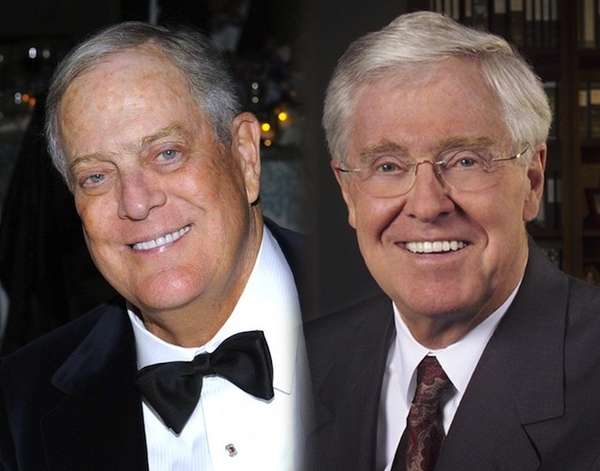
The chaos in Ukraine can be viewed, in part, as what happens when a collection of “oligarchs” – sometimes competing, sometime collaborating – take control of a society, buying most of the politicians and owning the media.

The political/media classes become corrupted by serving their wealthy patrons and society breaks down into warring factions.

Oil billionaires David and Charles Koch

In that sense, Ukraine could be a cautionary tale for the United States and other countries that are veering down a similar path toward vast income inequality, with billionaire “oligarchs” using their money to control politicians and to pay for propaganda through media ventures.

Depending on your point of view, there may be “good oligarchs” and “bad oligarchs,” but the concept of oligarchy is antithetical to democracy, a system in which governance is supposed to be driven by the informed consent of the majority with respect for minority rights. Instead, we’re moving toward a competition among oligarchs with the “people” mostly as bystanders to be manipulated one way or the other.

On Wednesday, a 5-4 majority of the U.S. Supreme Court lifted limits on total amounts that an individual can contribute during a campaign cycle, an extension of the 2010 ruling on Citizens United allowing the rich to spend unlimited sums on political advertising. It was another step toward an American oligarchy where politicians, activists and even journalists compete to satisfy one “oligarch” or another.

Regarding political spending, that can mean the energy tycoon Koch Brothers financing the Tea Party or Americans for Prosperity to tear down government regulations of businesses. Or it can mean casino kingpin Sheldon Adelson staging his own “primary” in which Republican hopefuls compete to show who would do the most for Israel. Or – from a liberal perspective – it can be billionaire investor Tom Steyer pressing for action on man-made climate change.

On the Right, there also have been vast investments in propaganda – from books, magazines and newspapers to talk radio, TV and the Internet – by the likes of Rupert Murdoch and Richard Mellon Scaife, an imbalance countered, in only a relatively small way, by a few liberal “oligarchs” who have started their own big-budget Web sites.

And, despite the appearance of a few “left-of-center” U.S. sites, there continues to be a lock-step consensus – across the nation’s media – regarding most international conflicts, such as the recent crises in Syria and Ukraine. In those cases, these liberal “oligarchic” sites are as likely to go with the conventional wisdom as the right-wing “oligarchic” sites.

So, if you want to find critical reporting on U.S. interference in Ukrainian politics or a challenging analysis of U.S. claims about the Syrian chemical weapons attack, you’re not likely to find them at ProPublica, which is backed by ex-subprime mortgage bankers Herbert and Marion Sandler and is edited by well-paid traditional journalists from the mainstream press, like Stephen Engelberg, formerly of the New York Times. Nor at FirstLook.org funded by eBay founder Pierre Omidyar.

Though both ProPublica and FirstLook do some fine work on certain topics – such as the environment and privacy rights, respectively – they haven’t shown much willingness to get in the way of U.S. foreign-policy stampedes as they run out of control. Presumably, that would make their funders nervous and possibly put their larger business interests at risk.

Another new media “oligarch,” Washington Post owner and Amazon founder Jeff Bezos, has shied away from reining in “the neocons who brought us the Iraq War.” He has left neocons like Fred Hiatt and Jackson Diehl in charge of the opinion section of Official Washington’s hometown newspaper. Their positions on Syria and Ukraine have been predictable.

And, of course, other mainstream outlets – like the New York Times, the Daily Beast and the major TV networks – have completely fallen into line behind the conventional wisdom. Most coverage of the Syrian civil war and the Ukraine crisis couldn’t have been more submissive to the U.S. government’s propaganda themes if the stories had been written by Radio Liberty or the CIA.

Anyone looking for journalistic skepticism about the mainstream U.S. narrative on these touchy issues has had to seek out Internet sites like Consortiumnews.com which relies on mostly small donations from readers.

But the broader problem is the debilitating impact on democracy when the political/media process takes on the form of some super-hero movie in which super-human combatants do battle – crashing from building to building – while the regular humans mostly watch as powerless spectators as the chaos unfolds.

The Ukraine Mess


In Ukraine’s case, this process was telescoped in time because of the break-up of the Soviet Union in 1991, which was followed by the triumphal intervention of Western “free-market” advisers who descended on Kiev – as well as Moscow – with self-confident prescriptions of privatization and deregulation.

Very quickly, well-connected operatives were scoring mind-boggling deals as they gained control of lucrative industries and valuable resources at bargain-basement prices. Billionaires were made overnight even as much of the population descended to near starvation levels of poverty and despair.

In Russia, strong-willed nationalist Vladimir Putin emerged to put some brakes on this process, banishing some oligarchs like Boris Berezovsky into exile and jailing others like Mikhail Khordorkovsky. However, in Ukraine, the oligarchs continued buying politicians and finally created a crisis of confidence in government itself.

Though public resentment of political corruption was a driving force in the large protests that set the stage for the overthrow of elected President Viktor Yanukovych on Feb. 22, the manipulation of that popular anger may end up impoverishing Ukrainians even more by entrenching oligarchic control even further.

Not only has the Washington-based International Monetary Fund moved to impose “macroeconomic reforms” that will slash spending on Ukraine’s already scant social programs, but “oligarchs” are moving to take direct control of the government.

For instance, the coup regime in Kiev appointed billionaire steel magnate Serhiy Taruta as governor of the Donetsk region in eastern Ukraine where many ethnic Russians live. Taruta quickly moved to suppress pro-Russian sentiment.

As part of the crackdown, the Kiev regime arrested Pavel Gubarev, who had called himself the “people’s governor.” Mikhail Dobkin, a pro-Yanukovych former regional governor who indicated he would seek the presidency, was arrested on sedition charges.

Governor Taruta also has called for some of the IMF’s more draconian demands to be put off until after political resistance to the new order in Kiev has faded.

“People are concerned with one thing,” Taruta told the Washington Post in a flattering story about his leadership. “If we show we can provide help and support, we will calm the situation down. Three to four months from now is the time to talk about financial reform in Ukraine.”

That would mean delaying the harshest elements of the IMF plan until after the scheduled presidential election on May 25, meaning that the voters will have already gone to the polls before they get a taste of what’s in store for them. By then, they may have another billionaire industrialist, Petro Poroshenko, as their new president. He is now the leading candidate.

According to Forbes magazine, there are now about 1,600 billionaires in the world, worth a total of around $6.6 trillion. The writing seems to be scribbled on the walls of Ukraine as well as the United States and around the globe that we are entering the Age of the Oligarchs.

Investigative reporter Robert Parry broke many of the Iran-Contra stories for The Associated Press and Newsweek in the 1980s. You can buy his new book, America’s Stolen Narrative, either in print here or as an e-book (from Amazon and barnesandnoble.com). For a limited time, you also can order Robert Parry’s trilogy on the Bush Family and its connections to various right-wing operatives for only $34. The trilogy includes America’s Stolen Narrative. For details on this offer, click here.

Damming Athens: "Israel's War on American Universities"

Chris Hedges on "Israel's War on American Universities"

by TRNN

Excerpts from Chris Hedges talk at Northeastern University in support of its now banned Students for Justice in Palestine chapter.

Chris Hedges, whose column is published Mondays on Truthdig , spent nearly two decades as a foreign correspondent in Central America, the Middle East, Africa and the Balkans. He has reported from more than 50 countries and has worked for The Christian Science Monitor, National Public Radio, The Dallas Morning News and The New York Times, for which he was a foreign correspondent for 15 years. He has written nine books, including "Empire of Illusion: The End of Literacy and the Triumph of Spectacle" (2009), "I Don't Believe in Atheists" (2008) and the best-selling "American Fascists: The Christian Right and the War on America" (2008). His book "War Is a Force That Gives Us Meaning" (2003) was a finalist for the National Book Critics Circle Award for Nonfiction.

Forget Asteroids, Methane the Main Culprit in Earth's Mass Extinctions

The perp in the greatest mass extinction on earth? Methane

by Gaius Publius - AmericaBlog

In the past, when I’ve written about climate and mass extinctions, I generally single out two of them — the one 65 million years ago that ended the dinosaur era, and the one about 250 million years ago that killed off almost everything then alive and made room for the dinosaurs to develop.

The dinosaur-killing extinction is called the “Cretaceous–Paleogene (K–Pg) extinction event” since it occurred between the Cretaceous Period and the Paleogene Period. The earlier extinction, also called the “Great Dying,” is the “Permian–Triassic (P–Tr) extinction event” and occurred between those two geological periods.

But starting from the first explosion of life on earth, some 540 million years ago, all geological periods are grouped into just three “eras” — the era of Old Life (Paleozoic Era), the era of Middle Life (Mesozoic Era, or the age of dinosaurs), and the era of New Life (Cenozoic Era, or the age of mammals and man).

The Paleozoic Era lasted over 290 million years. The Mesozoic Era lasted 185 million years. We’re in the Cenozoic Era now, and it’s lasted 65 million years.

Just three major divisions since life first exploded. And guess what divides these eras? The two mass extinctions I mentioned above. Here’s what that looks like in one handy chart:


Mass Extinctions since the Cambrian Period (about 540 million years ago)

So yes, mass extinctions — certainly mass extinctions of this size — matter. As I argued here and here, we may not using our little climate problem just to exit the Holocene (our current 12,000-year geological division). We may be exiting the entire Cenozoic Era. Now that’s a world-historical event.

The Great Dying was probably caused by atmospheric methane


So the first part of today’s piece to keep in mind is the major geological divisions. And make no mistake, the Great Dying was a great dying, the mother of all great dyings (my emphasis everywhere):

It is the Earth’s most severe known extinction event, with up to 96% of all marine species and 70% of terrestrial vertebrate species becoming extinct. It is the only known mass extinction of insects. Some 57% of all families and 83% of all genera became extinct. Because so much biodiversity was lost, the recovery of life on Earth took significantly longer than after any other extinction event, possibly up to 10 million years. [Other sources say 30 million years.]

Now the second part of this discussion. People have been puzzled about the cause for a long time, and how it managed to be so … effective. Turns out that researchers at MIT may have found the answer — atmospheric methane. It’s the only explanation that fits the facts, and there’s much evidence to support it. Given the factual data that’s been assembled about the event, all of the other, previously-thought-plausible explanations have to be dismissed. Not one of the others could explain the combination of facts now known.

Let’s look at this from two sources, MIT and a separate write-up of their research. The MIT publication is informative, but the other is more clear for the lay reader. First, from the MIT news office:

Methane-producing microbes may be responsible for the largest mass extinction in Earth’s history

Evidence left at the crime scene is abundant and global: Fossil remains show that sometime around 252 million years ago, about 90 percent of all species on Earth were suddenly wiped out — by far the largest of this planet’s five known mass extinctions. But pinpointing the culprit has been difficult, and controversial.

Now, a team of MIT researchers may have found enough evidence to convict the guilty parties — but you’ll need a microscope to see the killers.

The perpetrators, this new work suggests, were not asteroids, volcanoes, or raging coal fires, all of which have been implicated previously. Rather, they were a form of microbes — specifically, methane-producing archaea called Methanosarcina — that suddenly bloomed explosively in the oceans, spewing prodigious amounts of methane into the atmosphere and dramatically changing the climate and the chemistry of the oceans.

Volcanoes are not entirely off the hook, according to this new scenario; they have simply been demoted to accessories to the crime. The reason for the sudden, explosive growth of the microbes, new evidence shows, may have been their novel ability to use a rich source of organic carbon, aided by a sudden influx of a nutrient required for their growth: the element nickel, emitted by massive volcanism at just that time.

The new solution to this mystery is published this week in the Proceedings of the National Academy of Science by MIT professor of geophysics Daniel Rothman, postdoc Gregory Fournier, and five other researchers at MIT and in China.

Now William Costolo at the Guardian Liberty Voice:

"The ocean swarm of micro-organisms was the byproduct of volcanic eruptions which threw off the substance nickel. The nickel from the volcanoes provided the metabolic fuel necessary for the bloom to occur. Scientists previously suspected that the volcano eruptions themselves caused the horrific killing, but the MIT researchers determined that the volcanoes alone would not have created enough atmospheric carbon dioxide to cause the mass extinction. The carbon dioxide must have come from another source.

"Further research indicated to the scientists that the source of the carbon dioxide was derived from a biological source. The carbon dioxide levels would have receded faster if derived only from the volcanoes. The rich source of nickel available from the volcanos was just the right fuel for the tiny methane producing killing machines to consume the carbon in the ocean floors and proliferate in rapid fashion.

"The analysis of genome material provided the necessary clues to the researchers. The Methanosarcina acquired a genetic trait from another microscopic organism which allowed them to quickly produce the poison gas under the right conditions. The vast store of carbon in the oceans together with the volcanic nickel provided the perfect storm of material required for a gigantic methane plume. The tiny organisms followed their genetic programming to reproduce quickly and throw off a massive amount of poison gas."

Except for his use of the term “poison gas” (living things weren’t “poisoned”), this is a clear explanation of the relationship between the massive volcanoes, the nickel, the microbes, and the methane. The killing happened in relatively short order, driven by the massive volcanoes.

The mass kill off, known as the Permian extinction, had its roots in the volcanoes of the Siberian Traps. The lava flows were so large they would have covered a land area larger than the United States. The atmosphere remained poisoned for over 100,000 years. The earth did not regenerate diverse life for another 30,000,000 years. The length of time the atmosphere remained poisoned was a clue to the researchers that the volcanoes alone could not have caused the killing catastrophe.

Why does methane have such a powerful effect? Read on.

Methane is far more powerful than CO2 at trapping heat


Why does methane’s greenhouse effect last so long? Partly because atmospheric methane degrades to CO2 by a fairly simple formula:

CH4 + 2 O2 → CO2 + 2 H2O

So while methane itself produces its own huge greenhouse gas effects (see below for the relative scale), it then disappears and leaves longer-lived CO2 in its place to do further greenhouse damage. CO2 doesn’t break down; it has to be extracted by some process, such as plant activity, dissolving into the ocean, and so on.

Atmospheric methane in sufficient quantity is a real problem, greenhouse-wise. The combined effect of the methane bomb and the resulting CO2 is what the MIT researchers say accounts for both the scale of the Great Dying and the 30-million-year recovery period. To give a sense of relative effects of these two greenhouse gases:

While more than half of the CO2 emitted is removed from the atmosphere within a century, some fraction (about 20%) of emitted CO2 remains in the atmosphere for many thousands of years.

In contrast, methane is more powerful, but shorter lived in the atmosphere:

Methane has an atmospheric lifetime of 12 ± 3 years and a GWP [global warming potential] of 72 over 20 years, 25 over 100 years and 7.6 over 500 years. The decrease in GWP at longer times is because methane is degraded to water and CO2 through chemical reactions in the atmosphere.

In all cases, the GWP number is relative to CO2. That is, CO2 is artifically assigned a GWP of “1″ and the GWP of other greenhouse gases is either a multiple or a fraction of that.

It gets worse. (1) That 20-year methane GWP number is likely low. This site says that the GWP of methane could be 10–40% low when indirect interactions are taken into account. I’ve seen estimates of methane’s 20-year greenhouse effect as high as 100 times that of CO2. And (2) that’s the 20-year effect. Methane lasts for 12 years on average. What do you think its effect is in the first 5–10 years, as a global warming accelerator?

Kind of explains the Great Dying, yes? Boom, the methane bomb goes off, and everything changes.

We’re melting a methane bomb in the Arctic


Which brings us to the fourth part of this discussion. So why do we care? Because we’re sitting on a “methane bomb” in the Arctic region — frozen, sequestered methane locked into the permafrost both on land and in the ocean, and climate change (global warming) is releasing it. NOAA (my emphasis):

[Methane hydrates] have also been proposed as major agents of climate change. Methane is a powerful greenhouse gas, ten times more effective at trapping heat than carbon dioxide. But the volume of this gas now in the atmosphere pales next to that currently sequestered in hydrates, estimated at ten thousand billion tons (about 3,000 times the amount of methane as the atmosphere).

Let that sink in. The methane in the permafrost is 3000 times the amount of methane already in the atmosphere. And don’t let that “ten times as effective at trapping heat” fool you. That’s the average over 100 years. Methane only lasts about 12 years before it’s gone. When it starts out, before it breaks down, it’s likely a hundred times more effective than CO2. Or as the NOAA site above puts it:

A methane build-up will greatly enhance the intensified greenhouse effect that is driving global warming, and could cause the temperature to rise even higher, and to rise quickly.

As we reported earlier, this gives a sense of the scale of the methane melt. Coming off the floor of the ocean, methane reverts to a gas and forms “plumes” — literally torch-shaped structures created by water pressure — that rise to the surface. These plumes have been observed and measured for a fair number of years, and their recent growth in size and number is astonishing:


Vast methane ‘plumes’ seen in Arctic ocean as sea ice retreats

Dramatic and unprecedented plumes of methane – a greenhouse gas 20 times more potent than carbon dioxide [over a 100-year timespan] – have been seen bubbling to the surface of the Arctic Ocean by scientists undertaking an extensive survey of the region.

The scale and volume of the methane release has astonished the head of the Russian research team who has been surveying the seabed of the East Siberian Arctic Shelf off northern Russia for nearly 20 years. …

“Earlier we found torch-like structures like this but they were only tens of metres in diameter. This is the first time that we’ve found continuous, powerful and impressive seeping structures more than 1,000 metres in diameter. It’s amazing,” Dr Semiletov said.

“I was most impressed by the sheer scale and the high density of the plumes. Over a relatively small area we found more than 100, but over a wider area there should be thousands of them,” he said.

Let’s put that “1000 meters” into something Americans understand. These giant plumes are over half a mile wide. Not a half mile high — a half mile wide. Compared to their earlier observations, the plumes are now 100 times larger in just a few years. And yes, he did say there were likely “thousands of them.”

The path of deterioration will contain sudden collapses as well as gradual declines


Which leads to just two final thoughts, and then I’ll close.

First, just because the effects of climate change have been mostly gradual until now, doesn’t mean that gradual is all we’ll get. As I wrote recently:

"But there’s no reason to assume that there won’t be sudden collapses as well, sudden discontinuities, the way a steady dribble of small chunks of ice might fall from a Greenland glacier into the sea, then suddenly a piece the size of Ohio splits and floats away, lost, never to come back. A discontinuity, a break from the gradual.

"Discontinuities work in the social sphere as well, in the sphere of confidence and panic. As I’ll show you shortly, the first major (white) American city to end its life forever following a Haiyan-sized hurricane — Miami, for example — will cause a collapse in American confidence in the future that will never return. That loss of confidence and the panic that will result is a collapse as well, a discontinuity, fear the size of Ohio breaking the population from its safe assumptions and presumed security."

The Great Dying was a collapse, the largest in the history of life on the planet, though a slower paced one, since the volcanoes took a million years to fully erupt. Still, a massive methane proliferation caused it, and the initial effects must have been massive, since microbes grow and proliferate very quickly indeed (think “algae bloom”). If we succeed in getting most of the Arctic methane into the air in, say, 50 years, that will cause a collapse as well, and one at the geologic timescale of a nanosecond. Keep those thousands of half-mile wide plumes, rising through the ocean, in mind. A two-degree jump in warming, say, in only a few decades, would have huge consequences for anyone alive at the time — it would collapse the livability of the planet to a fraction of itself.

Second, all of this means that we really really need to take the timeline seriously, assume that we have far less time than we think we have, and act now. There’s a reason I’m being so aggressive lately about the need for a “Zero Carbon” + energy rationing regime (click for a short description) to get us off of all energy sources that produce greenhouse gases.

I don’t think I’m exaggerating the danger. The sudden ice ages discussed in this video occurred within decades of a warming event — yes, glacial ice just decades after a global warming event. That’s a collapse, and that’s sudden.

My ask of you is this. If you write, write this. We can’t allow our “leaders” — leash-holders might be a better term — to lead us to think the unicorn dream of “carbon neutral” will save us. “Carbon neutral” means the carbon car never stops, it just fails to accelerate. That doesn’t mean the climate itself won’t accelerate in its deterioration. Remember, there will be sudden collapses.

If you don’t write, you still have “reach.” Everyone who reads this has some reach. Please use it. People need to be told now, ahead of the inevitable panic that (1) we need to stop, not slow down; and (2) we can stop. We just have to.

I know many of your friends and associates won’t take you seriously … now. But they will, once the freak-out starts for real. Social panic is like a lynch mob. It starts suddenly and burns like a wildfire. Once the panic starts, people will need to have been already told points (1) and (2) above. After all, Lying Pantsuit Lady (i.e., the Exxon / methane industry spokesperson) is already telling your friends that the choice is carbon or no TV. She’s right, of course, but she’s selling the carbon. We should be messaging just as hard, so when they are ready to listen, they’ll have already heard what the answer is.

One last note — I hear people get depressed when they take this stuff seriously. Don’t. There’s a lot of ball game left, no collapse yet, still time on the clock, and lots of ways to mitigate. I’m personally excited by the idea that we can still get positioned for a chance opening, a good opportunity to make a big change.

Remember — winners know not to give up, just in case god has a gift in hand. Play to the whistle. After all, didn’t lowly Auburn beat Alabama, back when earth was cooler?

GP

Twitter: @Gaius_Publius. Facebook: Gaius Publi.

(Facebook note: To get the most from a Facebook recommendation, be sure to Share what you also Like. Thanks.)