Tuesday, November 25, 2014

Days of Science in Palestine

Days of science 

by Mazine Qumsiyeh  - Popular Resistance

We are in the midst of the “Days of Science Festival” in Palestine (in 18 cities). In Bethlehem District, it is inspiring to watch hundreds of school children learn basics of questioning and basics of knowledge acquisition. Students just need opportunities to learn not to be lectured to.

Unfortunately education is taking a back seat among Israelis and Palestinians to the ongoing daily distorted realities of the governments. For example 43% of the Palestinian authority budget goes to security (for Israel as subcontractors of occupation). Israel spent $8 billion just on the expansion and annexation apartheid wall to steal more Palestinian land. The Oslo and Paris accords ensured expansion of corruption to unprecedented levels (both in NGOs and government level). Glittery buildings and fancy SUVs and hotels ensure the rich in Ramallah and Tel Aviv know little and care less about the marginalized in our society. Thus 25% of Israeli children and >50% of Palestinian children live below the poverty line. Otherwise good people (Palestinian and Israeli) now spend their days begging for aid from Europeans and Americans and writing progress reports and filling in text and pictures on imaginary “development activities”. The Palestinian authority figures and Israeli leaders play games and meet with “dignitaries” in 5-star hotels hoping they could delay the inevitable collapse of the corrupt system they created. Perhaps they think that one more year of the status quo means one more year to accumulate wealth of the hapless people. Meanwhile, the Zionist Knesset passes a racist “basic” law that consecrates Israel as the state of “the Jewish people” (Jewish national anthem, laws based on Jewish mythology etc). I do not know why people complain about the “Islamic State” when Israel has similar racist laws that set it up as a “Jewish state”.

Insightful letter from US President Thomas Jefferson to Mordecai Noah, May 28, 1818: “I thank you for the Discourse on the consecration of the Synagogue in your city, with which you have been pleased to favor me. I have read it with pleasure and instruction, having learnt from it some valuable facts in Jewish history which I did not know before. Your sect by its sufferings has furnished a remarkable proof of the universal spirit of religious intolerance inherent in every sect, disclaimed by all while feeble, and practiced by all when in power. Our laws have applied the only antidote to this vice, protecting our religious, as they do our civil rights, by putting all on an equal footing. But more remains to be done, for although we are free by the law, we are not so in practice."

Colonization activities here in Palestine go unchecked: Jerusalem is being mutated to a Jewish city and its natives removed, and the common people suffer horridly (house demolitions, killing, jailing, ethnic cleansing etc). The rich get richer and the poor get poorer. International law and human rights are not relevant to the racist Zionist “might makes right.” Yet, we do not have the luxury of despair and we must redouble our efforts even in the spheres we can work. That is why we teach students at our universities. That is why over 30 volunteers are working hard every day on the science festival in the Palestine Museum of Natural History (at Bethlehem University). Changing behavior is critical to build the human resources needed to reshape the future. We believe we can make our own future and write our own history. The challenges we face are both external and internal and the internal challenges are far more pressing. We must end the mental colonization before we end the physical one.

I end with a message from a South African who participated in work with the World Council of Churches in Palestine: “Dr Mazin: your article today reads like a discourse from our apartheid South African history. It takes me back to my own childhood & growing up, the displacement of communities, creation of what they called homelands, alienation of family & friends. Tensions flaring, arrests, loved ones leaving the country of their birth, some to never be seen again. Violent killings or imprisonment of those who resisted. All this in the name of religion & the entitlement of one over another. It was legitimized by many countries around the world. That was why I couldn't just walk away in 2004 when I volunteered to heed the call of the Palestinian religious leaders via EAPPI & stayed for 2 years. I later realised why. It was something I knew, grew up with could relate to & also knew it would not, could not last forever. Unfortunately the world is so slow to react to this gross injustice, the same as with apartheid or the holocaust, or ebola, or South Sudan & so I can go on. Evil can only prevail when good man do nothing. My comrade never get tired with what you are doing, this too shall end. Aluta continua!!! In SA we also have another slogan : Amandla - Awethu!!! (Power to the people). Stay strong, I was born under Apartheid & lived & worked to see its end.”

I may add that like with South Africa, help of the international community must be directed at ending apartheid not at making conditions of imprisonment (colonization) a bit more tolerable to the native people. Hence I say encourage BDS (boycott, divestment, sanctions) and encourage real resistance to the apartheid state of Israel. Try to avoid those who claim they are resisting in order to get a few more donor dollars! Try to put your effort (and money) in a direction that produces measurable impact in that direction.

To see pictures of our activities in the science festival and more, look for our facebook page under Palestine Museum of Natural History. Also come visit us anytime.


The battle for Jerusalem
http://www.huffingtonpost.com/david-hearst/the-battle-for-jerusalem_b_6187818.html


Mazin Qumsiyeh
Professor (Bethlehem University) and director PMNH
Bethlehem, Occupied Palestine
http://palestinenature.org
http://qumsiyeh.org

Russell Brand’s Revolution

In praise of Russell Brand’s sharing revolution

by Adam Parsons - Sharing.org

For all of Brand’s joking and braggadocio, a sagacious theme runs through his new book: that a peaceful revolution must bring about a fairer sharing of the world’s resources, which depends upon a revelation about our true spiritual nature.

The political conversation on sharing is growing by the day, sometimes from the unlikeliest of quarters. And at the present time, there is perhaps no-one calling louder for a new society to be based on sharing than Russell Brand, the comedian-cum-activist and revolutionary. It is easy to dismiss much of Brand’s polysyllabic and self-referential meanderings, as do most of the establishment media in the USA and Britain, but this only serves to disregard his flashes of wisdom and the justified reasons for his popularity.

His latest book is clearly not meant to be taken entirely seriously as a roadmap to “systemic change on a global scale”, hence the various crude digressions and contradictions. Yet as pointed out by Evan Davies at the beginning of his second BBC Newsnight interview, Brand has probably engaged more young people in thinking about serious political issues than any politician, despite his infamous disavowal of voting in parliamentary elections. On this basis alone, there’s every reason to take seriously Brand’s call for a revolution based on the principles of sharing, cooperation and love. But what does his idea of a caring, sharing revolution actually mean in practice?

Sharing is fundamental to a fair society


To elucidate, Brand uses a homespun analogy in his book: if 20 school children were in a playground and a couple of them took all the toys, you would “explain to them that sharing is a basic human value and redistribute the toys”. In a similar way, he says that the minority rich who are hoarding resources are misguided in their belief that it can make them happy, and we have to “be the adults” and help them. Which will require somehow dismantling the machinery of deregulated capitalism, winning over the military, and redistributing their excessive wealth.

Admittedly he’s a bit sketchy on the details of how to achieve this, although he does endorse Thomas Piketty’s proposal for greater transparency around the assets of the super-rich—with a modest tax on their wealth as well as their income (see chapter 19 entitled: “Piketty, Licketty, Rollity, Flicketty”). But many other implicit recommendations are scattered throughout the book for how sharing could be institutionalised on a local or national level. He is keen to point out, for example, that the “corporate world in its entirety is a kind of thief of more wholesome values, such as sharing”. And thus the least they can do, he suggests, is to stop exploiting tax loopholes (which is “a kind of social robbery”) and instead pay their fair share of taxes.

In describing how “Jesus is pretty committed to sharing”, he also makes it clear that any British politician who claims to be a Christian should—like Jesus—try to help the poor and heal the sick, and not implement austerity policies and sell off the National Health Service. By implication, the kind of sharing that Brand upholds clearly needs to be systematised through progressive taxation and the universal provision of public services and social security. And this is best exemplified, in no particularly radical way, in the Western European ideal of the welfare or social state: the collective pooling and redistribution of a nation’s financial resources for the benefit of society as a whole.

Brand’s other line of reasoning is a bit more contentious: “Socialism isn’t a dirty word,” he says, “it just means sharing; really it’s just the bureaucratic arm of Christianity”. But do we have to call ourselves a socialist to espouse the human value of sharing? Or could this simple principle help us to better navigate between the divisive ‘isms’ that still drive much of the debate on how governments should guarantee social and economic rights for all people?

It’s pretty clear what Brand is trying to say, though: that the religious faiths have all expounded the importance of sharing wealth and other resources fairly, and it’s high time that this age-old moral value and ethic underpinned the fabric of our societies. As he expressed it here in an interview with SiriusXM Radio:

“They said the problem with socialism is that it placed economics forever at the heart of politics, when what belongs at the heart of politics is spirituality. And socialism in a way is just a Christian principle, just the idea that we're all the same, we're all connected; we should share. We can't be happy if other people are suffering. It's just a sort of logical thing.”

A fairer society, based on sharing, demands radical democracy


Here’s another of Brand’s sure-fire political insights: that a sharing society is dependent on mass civic engagement and truly representative democracy. Drawing on a fleeting interview in his house with David Graeber, he writes: “Democracy means if enough people want a fairer society, with more sharing, well-supported institutions and less exploitation by organisations that do not contribute, then their elected representatives will ensure that it is enacted.” But this will never happen, Brand suggests, so long as we have leaders who have been “conditioned and groomed to compliantly abide by the system that exploits them”, whose only true agenda is “meeting the needs of big business”. Hence there can be no true form of democracy without “a radical decentralisation of power, whether private or state.”

Brand repeatedly returns to this theme of sharing both political power and economic resources more fairly among the populace, which he sees as an obvious prerequisite to any form of true democracy and the creation of a better world. And who can deny that a solution to gross inequality and ecological breakdown will never come from the likes of Barack Obama and David Cameron, who he describes as “all avatars of the same neoliberal concept, part of the problem, not the solution”?

How Brand proposes that power should be “shared, not concentrated” is perhaps a bit vague or outlandish in places, such as when he advocates for “total self-governance” via “small, self-determined communities that are run voluntarily and democratically” and without any leaders, which may eventually require nation states to be somehow “dissolved”. But in other places he’s entirely lucid and practical, as in his endorsement of direct democracy in Switzerland or participatory budgeting in Brazil.

He concludes:

“Generally speaking, when empowered as a community, or a common mind, our common spirit, our common sense, reaches conclusions that are beneficial for our community. Our common unity.”

When it comes to the business world, Brand is also quite cogent in his recommendations for how to “structure corporations more fairly” and redistribute power downwards. One proposal is for Employee Investment Funds, in which a significant percentage of the company’s profits are shared with workers, and controlled by democratically accountable worker management boards that have to use the proceeds for social priorities and in the public interest. Another proposal is for jointly-owned and value-driven enterprises in the guise of co-operatives, which Brand argues provide a model that can democratise the workplace and prevent the proceeds of labour from being poured into the pocket of some “thumb-twiddling plutocrat who by happy accident owns the firm”. He adds simply: “The profits should be shared among the people who do the work”.

Humanity must share the world’s wealth and resources


From the outset, Brand makes it clear that his greatest concern is the “galling inequality” of our world, which is sustained by an economic system that continues to “deplete the earth’s resources so rapidly, violently and irresponsibly that our planet’s ability to support human life is being threatened.” In frequently quoting Oxfam’s “fun bus” statistic – that a bus carrying 85 of the world’s richest people would represent more wealth than that owned by half the earth’s population – he also makes it clear that he is “seriously comfortable with society getting extremely equal.” As he puts it: “the practical, fair allocation of resources, the preservation of the planet must naturally be prioritised.”

Although Brand does not profess to have all the answers for how we can share the world’s wealth and resources more equally between countries as well as within them, he does at least emphasise that it must happen. And very quickly too, because more “important perhaps than this galling inequality is the fact that we have a limited amount of time to resolve it” (that is, unless we “plan to wait until the earth is a scorched husk then blast off to a moon-base.”) He also professes his belief that “all conflicts… are about resources or territory and the theological rhetoric merely a garnish to make it more palatable.” Which clearly means, in Brand’s commonsensical worldview, that sharing land and resources is a prerequisite for peaceful co-existence – an egalitarian approach that he specifically endorses when discussing the economic alternatives long practised within Cuba.

Decrying the fact that profits and wealth are increasingly consolidated within a mere fraction of the world population, Brand’s simple observation about the need for a new economic paradigm is again difficult to disagree with. He actually says this a few times, in so many words:

“There is another way. There is the way. To live in accordance with truth, to accept we are on a planet that has resources and people on it. We have to respect the planet so we can use the resources to nourish the people. Somehow this simple equation has been allowed to become extremely confusing.”

What is being demanded is not whimsical, he adds later, but “pragmatism, systems that function.” Yet none of this happens, and “can’t because they [i.e. rich elites, big corporations and those who serve them in governments] have prioritised a bizarre, selfish and destructive idea over common sense.”

Brand’s light-hearted book may be forgiven for omitting to mention ecological limits or the end of economic growth, which is imperative for any serious discussion about how to achieve greater equality on a planet with finite resources. But he does draw upon the ideas of various progressive thinkers for how to “reapportion money and power” and share the world’s wealth more equitably and sustainably. This includes “the peaceful establishment of a fair global alternative” through the cancellation of unjust debt; the rolling back of corrupt global trade agreements; a return to localised and ecological farming; the revocation of corporate charters “for businesses that have behaved criminally” (or handing over their resources to the workers and turning them into cooperatives); and the incorporation of measures other than GNP to judge a nation’s success.

He is also under no illusions about the international politics that renders these broad proposals somewhat utopian. More than one chapter is devoted to the tenets of America’s ‘Manifest Destiny’ and the Monroe Doctrine, which he describes as the ideological pillar of the U.S. government’s imperialist strategies and perpetual war-mongering. And there is of course nothing new about today’s geopolitical reality of global dominance and control by powerful countries, he suggests, as reflected in the erstwhile vagaries of the British Empire which was built by “vicious thugs using violence to get their way, reneging on deals and nicking the resources of whole nations”. The whole thing was a “swizz”, he says, and deceptively based on a Christian mythology which is in truth about “empathy and sharing”, and not a false authority achieved “through coercion and violence.”

Hence his inevitable conclusion that “real change will not be delivered within the machinery of the current system – it’s against their interests”; so “change has to be imposed from the outside”; and “this change will not come without cohesive, unified resistance. We all need to come together and confront our shared enemy.”

The sharing revolution begins within ourselves


Yet for all of Brand’s braggadocio and posturing about chopping off the Queen’s head, killing corporations and overthrowing the establishment to “take our power back”, he is also passionately convinced that the revolution must be peaceful. He says that all “revolutions require a spiritual creed. It doesn’t matter who is doing violence or to what end. Violence is wrong.” Therefore the only way to end conflict and change society for the benefit of everyone is through a new revelation about our purpose on earth, a revolution in our understanding about who we are as human beings.

Spirituality, he says, is “not some florid garnish” but “part of the double-helix DNA of Revolution. There is a need for Revolution on every level – as individuals, as societies, as a planet, as a consciousness. Unless we address the need for absolute change, unless we agree on a shared story of how we want the world to be, we’ll inertly drift back to the materialistic, individualistic magnetism behind our current systems.”

Perhaps this is a major reason why Brand’s silver-tongued musings are so popular, as he is arguably at his best when describing how social change will never happen without inner, personal change. He also has the courage to share candid insights from his past ignominy and his own spiritual journey, even if it sometimes comes close to proselytising: “My love of God elevates the intention of this book beyond the dry and admirable establishment of collectivised communities.”

Brand is often inspiring when he describes the alienating effects of commercialisation and “the impulse we all have for union” that has been misdirected into our worship of shopping malls, material comfort and possessions. Our longing for revolution, he says, is really “our longing for perfect love.” And our true salvation lies in the “acknowledgement of our unity. That we are one human family. One consciousness. One body.” The last chapter of the book reads like a poetic entreaty to that awareness of the Self which lies behind all form and comprises the true spiritual reality we all share. No doubt purposefully, the last word in the book is “love”.

While such ideas can be easily dismissed as New Age truisms, Brand has a deft ability to weave his spiritual convictions into a case for wholesale political and economic transformation. For instance, in contemplating how it is that humanity can endure the needless poverty and suffering of others, he neatly examines how “an extraordinary attitude [of complacency and indifference] has been incrementally inculcated” in our societies.

He asks plaintively: are we really doing all we can to help those less fortunate than ourselves? And why does the old maxim ‘From each according to his means, to each according to his needs’ still linger in our conscience, even after all the “capitalist lies and communist misadventure” of the past century? By retelling a story about a spontaneous act of goodwill in helping a stranger, Brand points to the obvious answer: because empathy, kindness and sharing is hardwired into our human nature. To share with one another is to be who we really are.

The implications of this simple truth are far more radical than any historical revolution based on ideology or violence, which is arguably the overall message of Brand’s book. “The agricultural Revolution took thousands of years,” he writes, “the industrial Revolution took hundreds, the technological tens. The spiritual Revolution, the Revolution we are about to realise, will be fast because the organisms are in place; all that needs to shift is consciousness, and that moves rapidly.”


A shorter version of this article was originally published by Open Democracy at www.opendemocracy.net/transformation

Through a (Looking) Glass Darkly: Putting the Emperor's Shoe on Another Foot


Russians Invade Afghanistan (Again!), Chinese Fight Iraq War (Again!) - What If It Weren’t Us?

by Tom Engelhardt  - TomDispatch

Let’s play a game, the kind that makes no sense on this single-superpower planet of ours. For a moment, do your best to suspend disbelief and imagine that there’s another superpower, great power, or even regional power somewhere that, between 2001 and 2003, launched two major wars in the Greater Middle East. We’re talking about full-scale invasions, long-term occupations, and nation-building programs, first in Afghanistan and then in Iraq.

In both countries, that power quickly succeeded in its stated objective of “regime change,” only to find itself mired in deadly conflicts with modestly armed minority insurgencies that it simply couldn’t win.

In each country, to the tune of billions and billions of dollars, it built up a humongous army and allied “security” forces, poured money into “reconstruction” projects (most of which proved disasters of corruption and incompetence), and spent trillions of dollars of national treasure.

Having imagined that, ask yourself: How well did all of that turn out for this other power? 
Tomgram: Engelhardt, Iraq War 4.0?

[Note for TomDispatch Readers: Here’s a small suggestion as the holidays approach. If you want to lend a hand to TomDispatch before the year ends, why not make a donation of $100 (or more) for a signed, personalized copy of my new book, Shadow Government: Surveillance, Secret Wars, and a Global Security State in a Single-Superpower World. If you’d like to have it signed for a friend this season, go to our donation page, make the necessary contribution, and email me telling me whom to sign it for. As for the rest of you, don’t forget to pick up a copy of the book for yourself or a friend. It’s a great way to spread the word about TomDispatch. By the way, if you want to read an interview Don Hazen and Jan Frel of Alternet did with me on the new book and our ragged old world, click here.

Note as well that there will be no TomDispatch post on Thanksgiving. Tom

Russians Invade Afghanistan (Again!), Chinese Fight Iraq War (Again!) - What If It Weren’t Us?

by Tom Engelhardt

In Afghanistan, a recent news story highlights something of what was accomplished. Though that country took slot 175 out of 177 on Transparency International’s 2013 Corruption Perceptions Index, though its security forces continue to suffer grievous casualties, and though parts of the country are falling to a strengthening Taliban insurgency, it has for some years proudly held a firm grip on one record: Afghanistan is the leading narco-state on planet Earth.

In 2013, it upped its opium poppy cultivation by 36%, its opium production by almost 50%, and drug profits soared. Preliminary figures for this year, recently released by the U.N., indicate that opium cultivation has risen by another 7% and opium production by 17%, both to historic highs, as Afghanistan itself has become “one of the world’s most addicted societies.”

Meanwhile, where there once was Iraq (171st on that index of kleptocracies), there is now a Shiite government in Baghdad defended by a collapsed army and sectarian militias, a de facto Kurdish state to the north, and, in the third of the country in-between, a newly proclaimed “caliphate” run by a terror movement so brutal it’s establishing records for pure bloodiness. It’s headed by men whose West Point was a military prison run by that same great power and its bloodthirstiness is funded in part by captured oil fields and refineries.

In other words, after 13 years of doing its damnedest, on one side of the Greater Middle East this power has somehow overseen the rise of the dominant narco-state on the planet with monopoly control over 80%-90% of the global opium supply and 75% of the heroin. On the other side of the region, it’s been complicit in the creation of the first terrorist mini-oil state in history, a post-al-Qaeda triumph of extreme jihadism.

A Fraudulent Election and a Collapsed Army


Though I have no doubt that the fantasy of relocating Washington’s deeds to Beijing, Moscow, Tehran, or any other capital crumbled paragraphs ago, take a moment for one more experiment. If this had been the work of any other power we thought less well of than we do of ourselves, imagine the blazing headlines right now. Conjure up -- and it shouldn’t be hard -- what the usual war hawks would be spouting in Congress, what the usual suspects on the Sunday morning talk shows might be saying, and what stories cable news networks from CNN to Fox would be carrying.

You know perfectly well that the denunciations of such global behavior would be blistering, that the assorted pundits and talking heads would be excoriating, that the fear and hysteria over that heroin and those terrorists crossing our border would be somewhere in the stratosphere. You would hear words like “evil” and “barbaric.” It would be implied, or stated outright, that this avalanche of disaster was no happenstance but planned by that same grim power with its hand on the trigger these last 13 years, in part to harm the interests of the United States. We would never hear the end of it.

Instead, the recent reports about Afghanistan’s bumper crop of opium poppies slipped by in the media like a ship on a dark ocean. No blame was laid, no responsibility mentioned. There were neither blazing headlines, nor angry jeremiads, nor blistering comments -- none of the things that would have been commonplace if the Russians, the Chinese, or the Iranians had been responsible.

Just about no one in the mainstream excoriates or blames Washington for the 13 years leading up to this. In fact, to the extent that Washington is blamed at all for the rise of the Islamic State, the focus has been on the Obama administration’s decision not to stay longer in Iraq in 2011 and do even more of the same. (Hence, President Obama's recent decision to extend the U.S. combat role in Afghanistan through at least 2015.)

All in all, we’ve experienced a remarkable performance here when it comes to not connecting the dots or feeling the need to assign responsibility or accountability for what’s happened in these years. In some fashion, we Americans continue to see ourselves, as we have since 9/11, as victims, not destabilizers, of the world we inhabit.

To add to this spectacle, the Obama administration spent endless weeks helping engineer a fraudulent Afghan presidential election -- funded in part by the opium trade -- into a new, extra-constitutional form of government. The actual vote count in that election is now, by mutual agreement of the two presidential candidates, never to be revealed. All of this took place, in part, simply to have an Afghan president in place who could ink a new bilateral security agreement that would leave U.S. troops and bases there for a further decade. If another country had meddled with an election in this fashion, can you imagine the headlines and commentary? While reported here, all of this again passed by without significant comment.

When it comes to a path “forward” in Iraq, it’s been ever deeper into Iraq War 3.0. Since a limited, “humanitarian” bombing campaign began in August, the Obama administration and the Pentagon have been on the up escalator: more air strikes, more advisers, more weaponry, more money.

Two and a half weeks ago, the president doubled the corps of American advisers (plus assorted other U.S. personnel) there to 3,000-plus. Last week, the news came in that they were being hustled into the country faster than expected -- specifically into dangerous, war-torn al-Anbar Province -- to retrain the American-created, now thoroughly sectarian Iraqi army, reportedly in a state of remarkable disarray.

In the meantime, Chairman of the Joint Chiefs of Staff General Martin Dempsey, the Pentagon, and the White House continue to struggle over whether American boots can be put on the ground in a combat capacity, and if so, how many and in what roles in a “war” that essentially may have no legal basis in the American system of government. (Shades of Afghanistan!) Of course, much of this internecine struggle in Washington is likely to be obviated the first time U.S. advisers are attacked in Anbar Province or elsewhere and boots end up hitting the ground fast, weapons firing.

Vietnamizing Iraq, Iraqicizing Vietnam


In the meantime, think about what we would have said if the Russians had acted as Washington did in Afghanistan, or if the Chinese had pursued an Iraq-like path in a country of their choosing for the third time with the same army, the same “unified” government, the same drones and weaponry, and in key cases, the same personnel! (Or, if you want to make the task easier for yourself, just check out U.S. commentary these last months on Ukraine.)

For those of a certain age, the escalatory path the Obama administration has set us on in Iraq has a certain resonance and so, not surprisingly, at the edges of our world, familiar words like “quagmire” are again rising. And who could deny that there’s something eerily familiar about it all? Keep in mind that it took less than three years for the Kennedy administration to transition from the first several hundred American advisers it sent to Vietnam to work with the South Vietnamese Army in 1961 to 16,000 armed “advisers” in November 1963 when the president was assassinated.

The Obama administration seems to be in the grips of a similar escalatory fever and on a somewhat similar schedule, even if ahead of the Vietnam timetable when it comes to loosing air power over Iraq and Syria. However, the comparison is, in a sense, unfair to the Kennedy and Johnson administrations. After all, they were in the dark; they didn’t have a “Vietnam” to refer to.

For a more accurate equivalent, you would have to conjure up a Vietnam scenario that couldn’t have happened. You would have to imagine that, in May 1975, at the time of the Mayaguez Incident (in which the Cambodians seized an American ship), just two weeks after the South Vietnamese capital Saigon fell, or perhaps even more appropriately in terms of the dual chronologies of the two wars, in December 1978 when the Vietnamese invaded Cambodia, President Gerald Ford had decided to send thousands of American troops back into Vietnam.

Inconceivable as that was then, only such an absurd scenario could catch the true eeriness of the escalatory path of our third Iraq war.

Four More Years! Four More Years!


Try to imagine the reaction here, if the Russians were suddenly to send their military back into conflict-ridden Afghanistan to refight the lost war of the 1980s more effectively, bringing old Red Army commanders out of retirement to do so.

As it happens, the present war in Iraq and Syria is so unnervingly déjà vu all over again that an equivalency of any sort is next to impossible to conjure up. However, since in the American imagination terrorism has taken over the bogeyman-like role that Communism once filled, the new Islamic State might in one sense at least be considered the equivalent of the North Vietnamese (and the rebel National Liberation Front, or Vietcong, in South Vietnam). There is, for instance, some similarity in the inflamed fantasies Washington has attached to each: in the way both were conjured up here as larger-than-life phenomena capable of spreading across the globe. (Look up “domino theory” on the meaning of a Communist victory in South Vietnam if you doubt me.)

There is also at least some equivalency in the inability of American leaders and commanders to bring the nature, or even the numbers, of the enemy into sharp focus. Only recently, for instance, General Dempsey, who has played a crucial role in the launching of this latest war, rushed off on just the sort of “surprise visit” to Baghdad that American officials often made to Saigon to proclaim “progress” or “light at the end of the tunnel” in the Vietnam War. He met with American Marines at the massive U.S. embassy in that city and offered an assessment that seemed to capture some of Washington’s confusions about the nature of its newest war.

Keep in mind that, at the moment the war was launched, the Islamic State was being portrayed here as a monster movement engorging itself on the region, one that potentially imperiled just about every American interest on the planet. In Baghdad, Dempsey suddenly insisted that the monster was faltering, that the momentum of battle in Iraq was “starting to turn.” He then labeled the militants of the Islamic State as "a bunch of midgets running around with a really radical ideology" and concluded that, despite the nature of those formerly giant, now-puny fellows and the changing momentum of the war, it might nonetheless take “years” to win. On his return to Washington he became more specific, claiming that the war could last up to four years and adding, “This is my third shot at Iraq, and that's probably a poor choice of words." Undersecretary of Defense for Intelligence Michael Vickers recently offered a similar four-year estimate, but tagged an “or more” onto it. (Four more years! Four more years! Or more! Or more!)

Despite their sudden access to crystal balls some 11-and-a-half years after the initial invasion of Iraq, such estimates should be taken with a grain of salt. They reveal less a serious assessment of the Islamic State than just how shaky America’s top leadership, civilian and military, has become about what the U.S. is capable of achieving in the wake of an era of dismal failure in the Greater Middle East.

In reality, unlike North Vietnam in 1963, the Islamic “State” is a wildly sectarian rebel movement that sits atop what is at best a shaky proto-state (despite recent laughable news reports about claims that it will soon mint gold or silver coins). It is not popular across the region. Its growth is bound to be limited both by its extreme ideology and its Sunni sectarianism. It faces enemies galore. While its skill in puffing itself up -- in Wizard of Oz fashion -- to monstrous size and baiting the U.S. into further involvement may be striking, it is neither a goliath nor a “midget.”

General Dempsey can’t know how long (or short) its lifespan in the region may be. One thing we do know, however: as long as the global giant, the United States, continues to escalate its fight against the Islamic State, it gains a credibility and increasing popularity in the world of jihadism that it would never otherwise garner. As historian Stephen Kinzer wrote recently of the movement’s followers, “To face the mighty United States on Middle Eastern soil, and if possible to kill an American or die at American hands, is their dream. We are giving them a chance to realize it. Through its impressive mastery of social media, the Islamic State is already using our escalation as a recruiting tool.”

Awaiting Iraq War 4.0


Given all this, it should amaze us how seldom the dismal results of America’s actions in the Greater Middle East are mentioned in this country. Think of it this way: Washington entered Iraq War 3.0 with a military that, for 13 years, had proven itself incapable of making its way to victory. It entered the latest battle with an air force that, from the “shock and awe” moment it launched 50 “decapitation” strikes against Saddam Hussein and his top officials and killed none of them but dozens of ordinary Iraqis, has brought none of its engagements to what might be called a positive conclusion. It entered battle with an interlocking set of 17 intelligence agencies that have eaten the better part of a trillion taxpayer dollars in these years and yet, in an area where the U.S. has fought three wars, still manages to be surprised by just about any development, an area that, in the words of an anonymous American official, remains a “black hole” of information. It has entered battle with leaders who, under the strain of fast-moving events, make essentially the same decision again and again to ever worse results.

In the end, the American national security machinery seems incapable of dealing with the single thing it was built to destroy in the 9/11 period: Islamic terrorism. Instead its troops, special ops forces, drones, and intelligence operatives have destabilized and inflamed country after country, while turning a minor phenomenon on the planet into, as recent figures indicate, an increasing force for turmoil across the Greater Middle East and Africa.

Given the history of this last period, even if the Islamic State were to collapse tomorrow under American pressure, there would likely be worse to come. It might not look like that movement or anything else we’ve experienced thus far, but it will predictably shock American officials yet again. Whatever it may be, rest assured that there’s a solution for it brewing in Washington and you already know what it is. Call it Iraq War 4.0.

To put the present escalating disaster in the region in perspective, a final analogy to Vietnam might be in order. If, in 1975, you had suggested to Americans that, almost four decades later, the U.S. and Vietnam would be de facto allies in a new Asia, no one would have believed you, and yet such is the case today.

The Vietnamese decisively won their war against Washington, though much of their country was destroyed and millions died in the process. In the U.S., the bitterness and sense of defeat took years to recede. It’s worth remembering that the first president to launch a war in Iraq in 1990 was convinced that the singularly tonic effect of "victory" there was to “kick the Vietnam Syndrome once and for all.” Now, all of official Washington seems to have a post-modern, twenty-first-century version of the same syndrome.

In the meantime, the world changed in few of the ways anyone expected. Communism did not sweep the Third World and has since disappeared except in Vietnam, now a U.S. ally, tiny Cuba, and that wreck of a country, North Korea, as well as the world’s leading state on the “capitalist road,” China. In other words, none of the inflamed fears of that era panned out.

Whatever the bloody horror, fragmentation, and chaos in the Middle East today, 40 years from now the fears and fantasies that led Washington into such repetitively destructive behavior will look no less foolish than the domino theory does today. If only, in a final thought experiment, we could simply skip those decades and instantly look back upon the present nightmare from the clearer light of a future day, perhaps the next predictable escalatory steps might be avoided. But don't hold your breath, not with Washington chanting "Four more years!," "Four more years!"

Tom Engelhardt is a co-founder of the American Empire Project and the author of The United States of Fear as well as a history of the Cold War, The End of Victory Culture. He runs the Nation Institute's TomDispatch.com. His new book is Shadow Government: Surveillance, Secret Wars, and a Global Security State in a Single-Superpower World (Haymarket Books).

[Note: A deep bow to Nick Turse for help on this piece. His thought experiments sparked my imagination. Tom]

Follow TomDispatch on Twitter and join us on Facebook. Check out the newest Dispatch Book, Rebecca Solnit's Men Explain Things to Me, and Tom Engelhardt's latest book, Shadow Government: Surveillance, Secret Wars, and a Global Security State in a Single-Superpower World.

Copyright 2014 Tom Engelhardt

Gorilla Radio with Chris Cook, Karen Spring, Alison Thompson, Janine Bandcroft Nov. 26, 2014

This Week on GR

by C. L. Cook - Gorilla-Radio.com

In the wee hours of June 28th, 2009, Honduran president Manuel "Mel" Zelaya woke to find his room filled with soldiers, and his presidency finished. Zelaya, a moderately populist leader with a year left on his mandate, would spend the next two years in exile, trying to get back to Honduras and return democracy to his country.

But it was not to be. Thanks in part to the quick recognition of the military junta by Stephen Harper's government in Canada, (and bolstered by a hastily agreed Free Trade agreement) the coup garnered a financial footing, and measure of international legitimacy.

In the mean times since, globally Honduras' murder rate is Numero Uno, and it's now also one of the most dangerous places in the world to be a journalists, union member, or labour organizer. On the bright side; it's a great place for Canadian mining interests to do business.

Listen. Hear.

Karen Spring is a Central America-based human rights activist, working with grassroots organizations on various issues, mostly in Honduras. She's the author of the blog, Aqui Abajo providing, "Opinions, Experiences and Perspectives from the grassroots in Central America." Spring's recent article, 'Aura Minerals Ready to Dig up the Dead in Honduras' reveals just how low Canada's miners are willing to go.

Karen Spring in the first half.

And; the BC Liberals plan to make a decision about the long-contested proposed Site C dam project on the Peace River before Christmas; right before it, if past behaviours are any predictor. The as-yet unscheduled in-Cabinet decision follows a Joint Review Panel process meant to explore all interests in, and effects of, the proposed project.

Alison Thompson is Chair and Managing Director of the Canadian Geothermal Energy Association, or CanGEA. Thompson was in Victoria yesterday to give a press conference for a CanGEA report on a made-in BC alternative to placing a third dam on the river. It's a prospect for the Peace the Joint Review Panel itself admits has been woefully overlooked.

Alison Thompson and a renewable, cost effective alternative to Site C in the second half.

And; Victoria Street Newz publisher emeritus and CFUV Radio broadcaster, Janine Bandcroft will be here at the bottom of the hour to bring us up to speed with some of what's good to do in and around our city, and beyond there too, for the coming week. But first, Karen Spring and the dark, Canadian aura haunting the dead in Honduras.

Chris Cook hosts Gorilla Radio, airing live every Wednesday, 1-2pm Pacific Time. In Victoria at 101.9FM, and on the internet at: http://cfuv.uvic.ca. And now heard at Simon Fraser University's http://www.cjsf.ca . He also serves as a contributing editor to the web news site, http://www.pacificfreepress.com. Check out the GR blog at: http://gorillaradioblog.blogspot.ca/

G-Radio is dedicated to social justice, the environment, community, and providing a forum for people and issues not covered in the corporate media.

Azacualpa: Canadian Mining Interests Brutally Protected in Honduras

Canada-based Aura Minerals Ready to Dig up the Dead in Honduras

by Karen Spring - Aqui Abajo

In April 2014, the community of Azacualpa blocked the entrance of the San Andres mine in La Unión, Copan, in western Honduras. The open-pit gold mine is owned by Minerales de Occidente, a subsidiary of Toronto-based mining company, Aura Minerals who acquired the mine in August 2009.

A few weeks after initiating the blockade, the community was violently evicted by Honduran military and police who beat protesters including minors, shot tear gas, and arrested those that stuck around to fight the eviction, or that lived close to where it took place.

Radio Progreso reports that various people were arrested and 21 community members face charges requiring them to sign before a Honduran judge every month.

According to a community member that asked her name not be revealed because of the delicate security situation in the area:

"A large group from the community and former employees of the mine blocked the entrance of the mine for .. some days, 15 days. The company refused to negotiate, they told us that they had nothing to say to us. The military arrived, beat, and captured some people .. I think 15 people, but I'm not sure, many were injured"

A 20-minute video shot on a community member's cell phone (that is shaky and needs some editing) caught and recorded the eviction:


Upon initiating the blockade, the residents of Azacualpa were protesting the expansion of the mining operation, including a potential threat that operations would expand into the community's cemetery. According to Radio Progreso's report, the Azacualpa residents agreed to be relocated to a new area before the operations expanded, but since the agreement was reached the company's commitment failed to materialized. However, despite the relocation agreement, the community leadership says that they did not want the company to operate in the cemetery, where approximately 400 families lay their loved ones to rest.

As Orlando Rodriguez, the Vice President of the patronato (the community leadership) told Radio Progreso:

"They [the mining company] want to exploit the land of the cemetery but the community is not in agreement, we have our public deed that gives us the power to prevent it. They claim that they have permission to exploit 50 metres from the cemetery, we as the elected community leadership decided to consult the people house-by-house and the majority do not agree that the remains in the cemetery are removed, but they have used force because they have militarized the area and continue to exploit."

Following the eviction, Honduran military remained in the community for approximately three weeks and Aura Minerals continues its operations that a community member described as "very close to the boundaries of the cemetery."

"They put military soldiers in the cemetery, there are only guards now but yes, after that, a lot of time passed, I think three weeks, that the military was patrolling. There were a lot of military cars patrolling the area. They were going to put up a big gate so that people could not enter [the cemetery]."

Ending a seven-year mining moratorium, the law was approved in January 2013. Mining operations - many of which are owned by transnational corporations - are expanding and/or beginning in various parts of Honduras.

Canadian companies like Aura Minerals have directly benefited from the new legal framework that was written with support and assistance from the Canadian government and the Canadian International Development Agency (CIDA).

Since its approval last year, two legal challenges have been presented against the law and various communities and organizations argue that the process in which the law was written and the law itself, completely ignore the demands of communities that have and will be affected by mining operations in their territory.

Recovering the Darkness: Assassination Century Still Dogs Us

Can We Ever Recover from the Murder of John Kennedy?

by Harvey Wasserman - EcoWatch

The images we ingest never cease to shape us. Just 51 years ago, the head of a profoundly gifted young man was blown apart.

A few months earlier he’d given a speech that promised a new dawn. He reached out to our enemies. He talked of going to the moon, of technological breakthrough and human promise.

And he stopped the radioactive madness of atmospheric Bomb testing, a reason many of us are alive today.

It’s easy to idealize John Kennedy. We still debate what he might have done in Vietnam. But since the war did escalate, and we know the horrible costs to us all, then the possibility that he might have gotten us out gnaws at our soul.

So does not being sure about who actually killed him.

And then there’s the horror of the moment itself. A fellow human, blown apart before our eyes.

It hurts to think about it. To write about it. How can sorrow not reign in our hearts over this terrible human image that so deeply defines us?

As a nation, we still feel the murder of Abraham Lincoln. Having won a Constitutional Amendment to end slavery, he was the only one to smooth the transition from civil war to progressive peace. We still pay for losing him.

And for the image of a good man, seated happily in a theater, next to his wife … as a time for healing is unbearably shattered by a bullet to the head.

Russia never really recovered after Alexander II, a rare reformist czar, was murdered in 1881 while moving his nation toward a democratic constitution.

Michael Collins was a violent Irish revolutionary who turned to peace amidst a horrendous civil war.

Could he have ended it? All we know is the Troubles dragged on a ghastly seven decades after he was shot.

Mahatma Gandhi led the world’s first successful nonviolent anti-imperial campaign, then fasted nearly to the death to help halt a Hindu-Muslim civil war.

Then he was shot. And what is the outcome?

Egypt’s Anwar Sadat and Israel’s Yitzhak Rabin were also murdered. And what’s come since?

In America … Medgar Evers and Malcolm X, Martin Luther King and Bobby Kennedy … and then John Lennon.

Around the world, names we don’t know. Faces we haven’t seen. Social movements crushed, freedoms lost, good people killed (too often by our own government) deadening the soul.

And who is next? Does all this mean activists of great heart and artists for social change inevitably court a death sentence?

It’s long been clear, for a wide variety of reasons, that we cannot rely on “great leaders” to save our world for us.

But can our minds and souls ever recover from such horrible images repeatedly rammed into our brains?

Lynn Stuart Parramore has written with brilliance at AlterNet about the traumas we all face in today’s America.

In their wake, we are being poisoned by a ghastly, malignant class of zombie corporations somehow granted human rights and no human responsibilities.

They have gutted the Democratic Party and seized our government.

Their cancer is of injustice, cynicism, pollution and war.

Avoidable poverty, racism for the hell of it, a gutted democracy, eco-suicide for private profit, perpetual war for its own sake … they all metastasize to feed the corporate tumor.

Another election has been bought, rigged, stolen and lynched. The internet is endangered. Likewise our civil liberties.

So do we turn our heads “until the darkness goes”?

Or do we face the unthinkable head-on, and refuse to blink (except momentarily—we all need a break from time to time) at what we see?

Somehow we have survived since John Kennedy was killed. Kids have been born … and so have social movements … along with many surprising twists of fate.

We are winning a culture war barely begun in 1963.

Silent Spring had just been published. An avid sailor, we don’t know how JFK might have interacted with a nascent environmental movement.

But born it was. A half-century later, Solartopian technologies are poised to green-power our economy. We have the means to survive in harmony with our Mother Earth. But can we muster the political power to cure our corporate cancer?

Richard Nixon has come and gone. So have Ronald Reagan and George W. Bush. Now “Hope and Change” join them in the compost of history. They came too cheap. They meant too little.

Apparently we have more lessons to learn, more inner strength to build.

Departed friend, whoever you might have become, whatever you might have done, you have left us no choice. The better angels of our souls now demand that we ask not what our planet can do for us…


Harvey Wasserman's HISTORY OF THE UNITED STATES is at www.solartopia.org, along with SOLARTOPIA! OUR GREEN-POWERED EARTH. In 1960, he saw John Kennedy speak on the steps of the Ohio statehouse.

Castles of Sand: Fracking Boom's Big Winners

Follow The Sand To The Real Fracking Boom

by James Stafford - Oilprice.com

When it takes up to four million pounds of sand to frack a single well, it’s no wonder that demand is outpacing supply and frack sand producers are becoming the biggest behind-the-scenes beneficiaries of the American oil and gas boom.

Demand is exploding for “frac sand”--a durable, high-purity quartz sand used to help produce petroleum fluids and prop up man-made fractures in shale rock formations through which oil and gas flows—turning this segment into the top driver of value in the shale revolution.

“One of the major players in Eagle Ford is saying they’re short 6 million tons of 100 mesh alone in 2014 and they don’t know where to get it. And that’s just one player,” Rasool Mohammad, President and CEO of Select Sands Corporation told Oilprice.com.

Frack sand exponentially increases the return on investment for a well, and oil and gas companies are expected to use some 95 billion pounds of frack sand this year, up nearly 30% from 2013 and up 50% from forecasts made just last year.

Pushing demand up is the trend for wider, shorter fracs, which require twice as much sand. The practice of downspacing—or decreasing the space between wells—means a dramatic increase in the amount of frac sand used. The industry has gone from drilling four wells per square mile to up to 16 using shorter, wider fracs. In the process, they have found that the more tightly spaced wells do not reduce production from surrounding wells.

This all puts frac sand in the drivers’ seat of the next phase of the American oil boom, and it’s a commodity that has already seen its price increase up to 20% over the past year alone.

Frac sand is poised for even more significant gains over the immediate term, with long-term contracts locking in a lucrative future as exploration and production companies experiment with using even more sand per well.

Pioneer Natural Resources Inc. says the output of wells is up to 30% higher when they are blasted with more sand.

Citing RBC Capital Markets, The Wall Street Journal noted that approximately one-fifth of onshore wells are now being fracked with extra sand, while the trend could spread to 80% of all shale wells.

Oilfield services giants such as Halliburton Co. and Baker Hughes Inc. are stockpiling sand now, hoping to shield themselves from rising costs of the high-demand product, according to a recent Reuters report. They’re also buying more sand under contract—a trend that will lead to more long-term contracts and a longer-term boost for frac sand producers.

In this environment, the new game is about quality and location.

Frac sand extraction could spread to a dozen US states that have largely untapped sand deposits, but the biggest winners will be the biggest deposits that are positioned closest to major shale plays such as Eagle Ford, the Permian Basin, Barnett, Haynesville and the Tuscaloosa marine shale play.

The state of Wisconsin has been a major frac sand venue, with over 100 sand mines, loading and processing facilities permitted as of 2013, compared to only five sand mines and five processing plants in 2010.

But with the surge in demand for this product, companies are looking a bit closer to shale center to cut down on transportation costs and improve the bottom line.

One of the hottest new frac sand venues is in Arkansas’ Ozark Mountains, which is not only closer by half to the major shale plays, saving at least 25% per ton on transportation costs, but also allows for year-round production that will fill the gap in shortages when winter prevents mining in northern states.

“In the southern US, we can operate year round, so there is no fear of a polar vortex like that we saw last year with some other producers,” says Mohammad of Select Sands, which has two known producing frac sand mines in northeastern Arkansas, in the Ozark Mountains, and sells the bulk of its frac sand to producers in the Eagle Ford, Barnett and Haynesville shales, as well as in the new marine shale, Tuscaloosa.

Chicago-based consulting company Professional Logistics Group Inc. found in 2012 that transportation represented 58% of the cost of frac sand, while Select Sands estimates the costs between 66-75% today.

The competition is stiff, but this game is still unfolding, while increased demand is reshaping the playing field.

US Silica Holdings Inc. says demand for its own volumes of sand could double or triple in the next five years, and its three publicly-traded rivals—Emerge Energy Services Fairmount Santrol and Hi-Crush Partners have also made strong Wall Street debuts over the past two years.


Source: http://oilprice.com/Energy/Energy-General/Follow-The-Sand-To-The-Real-Fracking-Boom.html


Heroes or Criminals: Framing the Arrested in Burnaby

Canadian Heroes Arrested in Burnaby, B.C.

by Jack Etkin -The Bridge News Service


Citizens Stand Against Pipeline Through Park

Q. Why does The Media call citizens 'protesters' - when they are 'heroes'?

A. Because the Corporations own the media - and the corporations hate heroes.

Hundreds of Canadians are facing arrest in Burnaby B.C., part of the city of Greater Vancouver. American Oil Giant Kinder-Morgan has forced the arrests of dozens of citizens who stand for the planet and against the corporate vandalism of a Burnaby Park. Kinder Morgan wants to put a pipeline through the park - to move TarSands oil from Alberta to the BC coast.

The City Governments of Burnaby and Vancouver oppose Kinder-Morgan. Citizens are being forced into civil disobedience - because Corporate controlled federal and provincial politicians are allowing the company to drill and cut down trees in a city park.

Canada's Corporate Media, as usual, stands with the destroyers of the planet. It's up to us Canadians to hold the media and the politicians accountable for their ongoing betrayal of our country and our planet.

Three Questions for the Corporate Media ...

1. Why do you keep calling these great citizens 'Protesters'? They are protesting the destruction of our planet, and they are heroes, why don't you EVER call them heroes?

2. As usual, our Corporate Politicians pit the citizens against the police. The Media's 'job' is to focus on the violence between people and police, and ignore the real issues of the corporate destruction of our country and our planet. Why won't You Media tell the truth? What's wrong with you?

3. Why are You Media protecting Stephen Harper and Christy Clark. As dozens are arrested, these pathetic politicians are not mentioned, even though they are the ones who are betraying us and who created this trouble. Why are you Media not blaming Stephen Harper and Christy Clark?

Remember: The Corporate Media's job is to protect Corporate Profits and Power. Telling us the truth is NOT a part of their job.

We can all support the Heroes in Burnaby ... contact your politicians and tell them what you think. Contact your 'corporate media' and tell them what you think...


 "When injustice becomes law ... resistance becomes duty" - Thomas Jefferson


The Bridge News Service - Independent Media from Canada

jack etkin jetkin@hotmail.com (to contact - or to get off mailing list)
The Bridge News Service www.thebridgenewsservice.com

Monday, November 24, 2014

What Augers Iran Nuke Agreement Failure and Hagel's Sudden Departure?


Possible Motives for Ousting Hagel

by Robert Parry - Consortium News

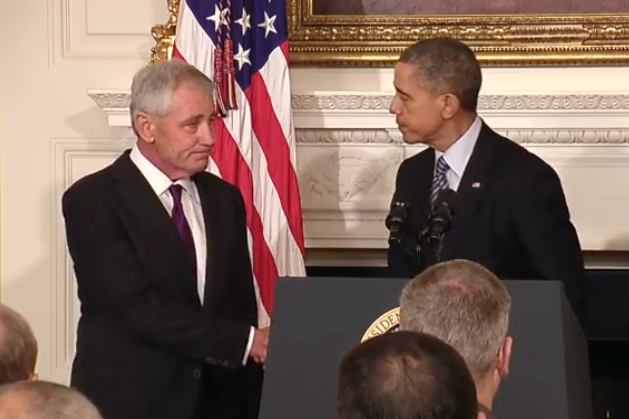
The abrupt resignation of Defense Secretary Chuck Hagel – along with the failure to reach a final agreement on Iran’s nuclear program on the same day – does not augur well for the last quarter of Barack Obama’s presidency, reflecting his continuing tendency to let the neocons have their way.

Defense Secretary Chuck Hagel shakes hands with President Barack Obama at the White House on Nov. 24, 2014, as the President announces that Hagel is resigning. (U.S..government photo)

Not that Hagel had distinguished himself as a sterling leader of the Pentagon – nor has all hope disappeared that a sensible resolution of the impasse with Iran might be achieved before the next “deadline” in June – but Obama still does not appear to have escaped the spell of the neocons who continue to dominate American geopolitical thought despite the bloody disasters that they helped cause in Iraq, Afghanistan and elsewhere.

Six years into his presidency, Obama still doesn’t seem to understand that just because some people have impressive credentials doesn’t mean they know what they’re doing. Indeed, in a profoundly corrupted system – like the one that now controls Official Washington – rewards are handed out to people who serve the corrupt interests or at least don’t get in the way.

In a time of corruption, the countervailing forces of wisdom and courage will never be found among the credentialed, but rather among the outcasts of the establishment, those who were forced to the margins because they objected to the venality, because they stood up against misguided “group think.”

But Obama has been unwilling – or possibly unable – to come to grips with this reality. Despite his personal intelligence and rhetorical skills, Obama never has been willing to challenge people cloaked in credentials – those who went to the best schools, worked at big-name firms, won prestigious awards or held fellowships at famous think tanks.

The tragedy of Obama is that I’m told that he understands the stupidity of the modern U.S. establishment and does sometimes consult with “realists” who offer practical advice for how he can resolve some of the most nettlesome problems facing the United States around the world. But he does so virtually in secret, with what politicians like to call “deniability.”

Obama operates one foreign policy above the table – pounding his fist along with the neocons against Syria, Iran and Russia – and another foreign policy below the table, dealing with adversaries in ways necessary to confront global challenges, such as collaborating with Iran to counter the Islamic State in Iraq and Syria and with Russia to address challenges with Iran, Syria, Libya and elsewhere.

Yet, while keeping such pragmatic overtures under the table, Obama reaches out publicly to neocons who have been implicated in some of the worst disasters in the history of U.S. foreign policy — but who have “credentials.” For instance, earlier this year, Obama was stung by criticism from neocon ideologue Robert Kagan, who had published a long essay in The New Republic promoting the need for more U.S. interventionism around the world.

Obama could have dismissed Kagan’s New Republic article as the pretentious pontifications of a blowhard whose career began as a propagandist for Ronald Reagan’s Central American policies in the 1980s and included, in the 1990s, co-founding the Project for the New American Century, which called for invading Iraq, an illegal war that was launched in 2003, propelling America into the current catastrophes now swirling around the Middle East.

But Obama apparently couldn’t get past all of Kagan’s “credentials,” including his current work at the prestigious Brookings Institution and his writing for the oh-so-impressive New Republic. So, Obama invited Kagan to lunch at the White House, a cozy get-together that one observer described as a “meeting of equals.”

Yes, the twice-elected President of the United States and his “equal,” one of the co-founders of the neocon Project for the New American Century. The New York Times reported that Obama even shaped his foreign policy speech at the West Point graduation in May to address criticism from Kagan’s New Republic essay, “Superpowers Don’t Get to Retire.”

Off to The Hague


You might think that the only reason to invite one of the Iraq War architects to the White House would be as a “sting operation” to arrest him and trundle him off to The Hague for prosecution for war crimes. After all, the justices at the post-World War II Nuremberg Tribunals deemed aggression – starting an unprovoked war – “the supreme international crime differing only from other war crimes in that it contains within itself the accumulated evil of the whole.” And we have certainly seen that “accumulated evil” get unpacked.

Yet, Obama courted Kagan as a respected “equal,” according to one source familiar with the behavior of the two men at lunch. Although as a journalist I try not to react viscerally to what I hear, the phrase “a meeting of equals” brought the taste of vomit to the back of my throat.

I couldn’t help but recall the reported outburst by President Abraham Lincoln after his reelection as he struggled to secure the necessary votes for passing the Thirteenth Amendment to abolish slavery: “I am the President of the United States, clothed with immense power, and I expect you to procure those votes” (as recounted years later by Congressman James Alley).

However, after also winning the presidency a second time, President Obama couldn’t seem to find his inner Lincoln.

In trying to understand what makes Obama tick, I have often been struck by how he seems awed by credentials, perhaps because credentials were the key to his unlikely rise from an obscure and exotic background to edit the Harvard Law Review, to build an academic career, to gain a U.S. Senate seat, and to win the presidency of the United States. Along the way, he got “blessed” by many of the “right” people and never strayed too far from the safety of the “establishment.”

Even as a twice-elected president, Obama seems captive to this high regard for people with credentials, even when the system awarding those credentials daily demonstrates its extraordinary levels of corruption, cruelty and outright stupidity.

Which brings us back to the apparently forced resignation of Chuck Hagel, who earned the enmity of Official Washington because he was an early Republican turning against the Iraq War and because he offered some mild criticism of the Israel Lobby.

On the surface, Obama’s abandonment of Hagel – while retaining the bombastic neocon-approved Secretary of State John Kerry and other war hawks like U.S. Ambassador to the United Nations Samantha Power and Assistant Secretary of State for European Affairs Victoria Nuland (Kagan’s wife) – suggests that Obama may be again bending his foreign policy in directions favored by the neocons and their sidekicks, the “liberal interventionists.”

That could presage further disasters if Obama adopts the neocon strategy of ratcheting up tensions with Iran over its nuclear program and bombing the Syrian military in a move to overthrow President Bashar al-Assad – with both “regime change” goals high on the agenda of Israel’s right-wing government.

Yet, since Iran has been playing a key role in taking on the Islamic State militants in both Iraq and Syria – and since Assad’s army is the only force capable of holding back Islamic extremists inside Syria – the neocon “regime change” plan is reckless in the extreme. A very possible result from such a U.S. intervention against Assad would be a military victory for Al-Qaeda’s Nusra Front or the even more extreme Islamic State.

There’s also the neocon desire for a new Cold War with Russia over Ukraine. It’s possible that Hagel, a Vietnam veteran who understands the ugliness of war and has no fondness for the neocons, is being sidelined because he isn’t willing to throw more young American men and women into the blood and horror of more neocon-inspired adventures, not to mention wasting hundreds of billions of dollars in taxpayers’ money.

But Hagel’s erratic performance as Defense Secretary – often coming across as inarticulate and imprecise – could represent a less consequential reason for the change at the Pentagon. Perhaps, Obama simply wants someone who is more skilled at the job.

[For more on the neocons and U.S. foreign policy, see Consortiumnews.com’s “Delusional US ‘Group Think’ on Syria and Ukaine.”] Investigative reporter

Robert Parry broke many of the Iran-Contra stories for The Associated Press and Newsweek in the 1980s. You can buy his latest book, America’s Stolen Narrative, either in print here or as an e-book (from Amazon and barnesandnoble.com). For a limited time, you also can order Robert Parry’s trilogy on the Bush Family and its connections to various right-wing operatives for only $34. The trilogy includes America’s Stolen Narrative. For details on this offer, click here.

Getting the Make on Ballot Bandits

The Hunt Continues...A personal note from Greg Palast

by Greg Palast

Three weeks ago, we blew the lid off “Interstate Crosscheck”—the 6.9 million voter purge list put together by 27 wannabe Katherine Harrises.

It took us six months of detective work to get our hands on these lists of millions of Americans tagged as 'suspected double-voters' – and the sneaky and sick method used to disenfranchise more voters of color.


But the Purge’n Generals are not done. So far, they’ve only knocked off a few hundred thousand voters. That was enough to flip the Senate; but they’re in the process of removing nearly a million voters by 2016 to get the White House.

We’re not done either: We are still digging, still uncovering more games like Crosscheck—and the billionaires behind the vote swindles.

We need your support to continue the investigation of these ballot bandits – and expose all their tricks.


We are halfway through our production of Billionaires & Ballot Bandits - The Movie, based on my New York Times bestseller.

Let me be blunt: We’ve depleted our funds—but we can’t stop now.

I rarely ask – but I have to ask now...

Help us complete the film by making a tax-deductible donation of $100 or more and you will get an on-screen credit as a Supporter plus the signed DVD once the film has wrapped.

Or make a tax-deductible donation of $50 –– and, once the film has wrapped, you will receive the signed DVD.


Or chip in whatever you can to help us get it done.

For those with deeper pockets, we really need Producers.

For a tax-deductible donation of $1,000 or more you will get an on-screen Producer credit, or a Co-Producer credit for a donation of $500. (You can, of course, choose to remain anonymous.)

Or, for a donation or $40 get a signed DVD of my investigations compendium Vultures and Vote Rustlers (Palast Investigates Vol. 2).

Better yet, get the signed DVD combo of Palast Investigates Vol. 1 & 2 for a donation of $65.

Or donate $50 and get a signed copy of my New York Times bestseller Billionaires & Ballot Bandits.

You can also visit our store and check out our Gift Packs, Books, DVDs and Downloads – or simply support our work by making a no-gift donation for whatever amount you can spare.

Our Crosscheck exposé got big applause and re-telling in the New York Times, LA Times—indeed, media all over the planet.

Esquire wrote: “Palast has been on the voter-caging story ever since people like Pastor Whiting got screwed 14 years ago. And, this week, writing for the Al Jazeera America news site, Palast dropped a bomb into [the Mid-Term] elections that has left credibility shrapnel all over the democratic process, if anyone cares to look for it.”

Thank you. But that don’t pay the bills. “Greg Palast” is not a person but a team of investigators and journalists including the Academy Award nominee Richard Rowley, gonzo photojournalist Zach D. Roberts and the extraordinary Ms. Badpenny and others. They all need food, shelter and memory chips.

[If you haven’t seen the Crosscheck report, watch the Democracy Now replay; and read it here.]

Will you support our efforts? Yes, our TV and print outlets cover some costs. And we are grateful for crucial support from Puffin and Cloud Mountain foundations. But we are, ultimately, citizen funded: without your help there is just no way we can do the unique, deep detective work that makes our reports like no one else’s.

And it’s not just ballot trickery that we expose. We have the investigative skills to crawl into the file drawers of the rich and shameless: the billionaires who fund the ballot-bending shenanigans. (Wait until you hear my Koch Brothers tape.)

Whether it’s exposing disenfranchisement games, the vulture financiers or petroleum porkers behind the poisoning of the body politic, no other news team has produced so many investigative bombshells year after year.

We’re ready to keep digging: please hand us the shovels by donating right now.

And, on behalf of a tired, hungry crew, our true thanks for your years of support.

Yours, with gratitude,


* * * * * *
For 15 years, Greg Palast has been uncovering voter suppression tactics in investigative reports for BBC Television, The Guardian, Harper’s and Rolling Stone.

Greg Palast is the author of several New York Times bestsellers including The Best Democracy Money Can Buy and Billionaires & Ballot Bandits.

Get a signed copy of Palast's latest film Vultures and Vote Rustlers.

Make a tax-deductible donation and support our ongoing investigation into voter suppression.

Subscribe to Palast's Newsletter and podcasts.
Follow Palast on Facebook and Twitter.

www.GregPalast.com