Wednesday, September 07, 2016

Lebanon Past, Present and Future in Brazil

Why Brazil under President Michel Temer risks becoming 'Lebanized'

by Andre Vltchek - RT


September 5, 2016

Btaaboura is a tiny village in the mountains of northern Lebanon. It is connected to the main motorway by a narrow winding road. It could be just anywhere in the Christian part of this country: white stone houses, olive groves, wine grapes, bare hills.

Like elsewhere, the wealth is hardly backed by hard work. It is mainly sustained by remittances flowing from abroad. There are grotesquely luxurious cars everywhere - Audis, BMWs. And there is Western Union office on the main street. All doors are closed; nothing moves.

But this village is actually ‘unique’; different from all others in the area. At the entrance, there is a new park that shows the Brazilian and Lebanese flag fluttering side-by-side.

And across the street, a blue and white sign announces in Portuguese and Arabic: RUA MICHEL TAMER PRESIDENTE DO BRAZIL.

In front of the word PRESIDENTE, there is a patch of blue spray paint. Later, I am told that just a few months ago it read, VICE-PRESIDENTE, but when Michel Temer ousted the legitimate President of Brazil, Dilma Rousseff, the Mayor of Btaaboura personally covered what he considered to be ‘outdated’ – the word VICE (Temer took office on August 31, 2016 after Rousseff's impeachment and removal).

We inquired at a small grocery store, and soon we found the ancestral home of Michel Temer, “Presidente do Brazil’. Nizar Tamer (the local spelling), his cousin, was sitting in the garden, waving at us, inviting us in.

“Come, sit down and rest. Have some figs and grapes: all local produce. You want to talk about Michel? But of course; why not?”

Soon, the seating area begins to fill with other relatives and friends. Fruits are served. Everybody is smiling, joking, happy.

My head is heavy. I hardly slept the night before, shooting endless Tweets, denouncing the coup, ending my long chain of messages with words of unconditional support for Dilma, and with one Tweet depicting a battered Brazilian flag, accompanied by the text: “Here is lesson one in essential Portuguese: FORA TEMER! = TEMER, GET OUT!”

"If only they knew,” I am thinking. And involuntarily, a bitter smile appears on my face.

“Yes, we are cousins,” Nizar, a civil engineer, grins. “His father left for Brazil, my father stayed in Lebanon...”

I am shown another house, right next door, where Michel Temer’s father was born. The house is around 200 years old, and it is totally dilapidated. But there are rumors now that it could soon be converted into a museum in honor of the ‘Presidente’.

“People in Lebanon are very proud of Michel,” explain his relatives.

“When he came here last time, it was in 2011 or 2012, it was a huge event: some 100 security people, Brazilian embassy employees... Michel told us that he would raise economy in both Brazil and here.”

When Temer ‘became President’, the village organized a huge party, with fireworks, belly dancing, traditional music...

And what about the coup, the corruption? Do people here realize how he came to power?

“Here, nobody cares about politics. He is now perhaps facing some problems, but these are his problems. We support him no matter what, because we are Lebanese, and because his roots are in Lebanon.”

We eat figs and grapes. Then coffee is served.

Several women, miserable-looking Syrian refugees, are walking down the street, humble, scared, looking down at the road.

It is just two days before Dilma Rousseff addresses the Senate.

I could stay much longer, listening to slow-flowing stories about the man who is now helping the West to demolish socialist South America. But suddenly I feel nauseated; I want to vomit. Obviously, I had reached the limit, and we have to leave.

Will Brazil get 'Lebanized'?


Lebanon is a total mess - a collapsed country with nothing social or socialist whatsoever. Money, ‘business’, flashing wealth is all that matters here.

While Maserati and Porsche sports cars navigate around the potholes of Beirut, misery and filth are swallowing suburban areas. Garbage collection periodically collapses, the country is burning diesel to generate electricity (blackouts and water shortages are endemic). Less than 40 percent of children attend public (state) schools. Medical care is mostly abandoned to the market. There is virtually no public transportation, no city planning, hardly any parks or green areas.

Those who have money throw it around, proudly and vulgarly. There are obnoxiously rich marinas, while the restaurants in the capital are at least twice more expensive than in Paris.

And there is plenty of cash here: from filthy mining and other investments that are plundering West Africa, from drugs being grown in the Bekaa Valley, from those billions of dollars in remittances, and of course from banking (money laundering). Lebanon produces very little. It consumes excessively.

Its reputation in the Middle East is terrible, mainly thanks to the racism and arrogance of many of its citizens.

Paradoxically, the only social force that stands above all religious and sectarian divides, is Hezbollah. But Hezbollah is closely linked to Syria and Iran’s government, and it fights ISIS in the mountains and across the border, as well as the several Israeli invasions and incursions into Lebanon. Predictably, the West put it on the terrorist list.

I keep imagining Brazil being governed by Mr. Temer and those like him. And I am frightened! What would happen to the majority of the people? Would they again become fully irrelevant and forgotten, like here in Lebanon?

Would the country function only in order to serve big business, the elites? Would the success of the entire nation be judged by the size of marinas and by the size of luxury cars in the parking lots of grossly overpriced restaurants and clubs?

Instead of being an example to the world, would Brazil get brutally Lebanized? The West would definitely like that, as it worked so hard to make it happen in the first place.

But in the name of Brazilian people, the rot, this deadly destruction has to be stopped.

Before leaving Btaaboura village, I stop my car for a few moments. And suddenly I see it: the beautiful and dear Brazilian flag is not waving in the wind. It is torn, dirty and looks like a rag. And there in front of the entrance to the park, garbage lies strewn everywhere.

Andre Vltchek is a philosopher, novelist, filmmaker and investigative journalist. His latest books are: “Exposing Lies Of The Empire” and “Fighting Against Western Imperialism”. Discussion with N. Chomsky: On Western Terrorism. Point of No Return is his critically acclaimed political novel. Andre is making films for teleSUR and Press TV. Vltchek presently resides and works in East Asia and the Middle East.

Passing, Islam Karimov: Ding Dong the...Uzbek Tyrant is Dead!?

What Obama Doesn’t Want You to Know About Uzbekistan

by Ted Rall - CounterPunch


September 7, 2016

Death is usually a sad event. The passing of a world leader, particularly one who brought stability to a tense part of the Muslim world for several decades, is typically cause for concern. The death of Uzbekistani president Islam Karimov is not typical.

For the majority of the long-oppressed citizens of Uzbekistan, the end of one of the world’s bloodiest and most corrupt dictators — and, to our eternal shame, an American ally — is cause for joy and gleeful celebration. The SOB died 82 years too late.

Except for the time Republican presidential candidate Ben Carson called it “a small, insignificant state…Ubeki-beki-beki-beki-stan-stan,” the hell on earth created by Karimov doesn’t get much coverage in the news media.

Few Americans could find this backwater on a map to save their lives. Yet Uzbekistan, once known as the underbelly of the USSR, is incredibly important. Which is why the rich and powerful – military generals, energy company executives, Hillary Clinton – know all about it.

Unfortunately for the Uzbeks, these American elites’ interest in their country has made their lives unspeakably miserable. And unless something radically unexpectedly takes place, that’s likely to continue. Which is why, during this presidential election season, American voters ought to ask the candidates most likely to win (Hillary Clinton and Donald Trump) as well as those who should be most likely to win (Jill Stein and Gary Johnson) how they would change American foreign policy in obscure/important places like Uzbekistan.

American policymakers care about Uzbekistan because it is an energy giant: one of the largest producers of natural gas in the world, a significant supplier of oil, and the fourth-largest source of gold in the world. Sitting smack dab in the middle of Central Asia, the nation has undeniable strategic importance. Uzbekistan has the region’s largest population, its most sophisticated infrastructure and its biggest cities: Tashkent, a city of 2.3 million people, even has a subway. It also has the blockbuster tourist attractions: the Silk Road cities of Khiva, Bukhara and Samarkand should be on any world traveler’s wish list.

Uzbekistan is the only Central Asian republic with common borders with all of the others, as well as with perpetually troubled Afghanistan. Oil and gas pipelines to and from the biggest source of fossil fuels on earth, the Caspian Sea, crisscross this blisteringly hot, dry nation.

Given Uzbekistan’s tremendous oil, gas and mineral wealth and its geographically and geopolitically strategic importance, its citizens ought to enjoy a high standard of living. Instead, the average Uzbek subsists on $3 to $8 per day.

Where does all that energy wealth go? 


Karimov, his family and cronies steal it. Gulnara Karimova, the deceased despot’s flamboyant chanteuse daughter, is accused of raking in over $1 billion in bribes from telecommunications companies seeking permits to do business.

Cultural and ethnic heirs to Genghis Khan’s Golden Horde, Uzbeks are neither stupid nor lazy. It requires and incredibly brutal and ruthless military and police apparatus to prevent them from rising up and overthrowing their oppressors. So this is exactly what the Karimov regime has delivered since the country became independent from the Soviet Union in 1991. (Karimov kept his job as boss of the Uzbek SSR, which he scored from outgoing Soviet Premier Mikhail Gorbachev.)

Another daughter, Lola Karimova-Tillyaeva, is linked to shell companies that own gaudy multimillion dollar estates in the U.S.

Uzbekistan is routinely awarded the world’s “Worst of the Worst” status for its extreme corruption and violations of fundamental human rights. Phones are tapped and militsia goons shake down motorists at innumerable checkpoints. Print and broadcast media are completely state-controlled. There’s a zero tolerance policy toward political opposition.

In 1999, Karimov said: “I am ready to rip off the heads of 200 people, to sacrifice their lives, for the sake of peace and tranquility in the country.”

By which he meant his peace and tranquility.

Four percent of the population are subjected to slavery. At least 10,000 political prisoners are rotting in the nation’s prisons.

Torture is standard and endemic; Team Karimov landed a rare spot in the news for boiling dissidents to death. In 2005, President Karimov asked security forces confronting protesters in the southern city of Andijon to wait for his arrival from the capital of Tashkent so he could personally witness and coordinate their massacre. An estimated 700 to 1200 Uzbeks were slaughtered. “People have less freedom here than under Brezhnev,” a U.S. official admitted.

Every now and then, some naïve US State Department official has issued a toothless tsk-tsk report documenting human rights abuses in Uzbekistan. But the Americans who run the show are obsessed with maintaining the country’s role in the Northern Distribution Network, a crucial aerial and ground supply line between the US and its European allies and the endless war against Afghanistan and Pakistan. They’re willing to do pretty much anything to protect the NDN — including funneling weapons to one of the most disgusting regimes on the planet.

In 2012, the Obama administration quietly lifted a post-Andijon ban on weapon sales. One major shipment included a 2015 delivery of 320 armored personnel vehicles to Karimov – exactly the kind of equipment an authoritarian state uses to crush demonstrations. “Perhaps worse than equipping a government so well-known for abuses against its own people and for its defiance of international norms with such powerful military equipment,” said Steve Swerdlow of Human Rights Watch, “is the message that the Obama administration is sending the people of Uzbekistan: that Islam Karimov has gotten away with it.”

American news accounts of Karimov’s death omitted America’s role propping him up.

It would be nice to hope that the flowers of democracy will sprout in the soil of the dictator’s grave. But years of suppression have destroyed the opposition groups that might have been able to step into power as part of a post-Karimov transition. The post-KGB security forces will continue to protect themselves and their kleptocratic bosses. Acting Uzbek president Nigmatulla Yuldashev will no doubt call for another of the country’s sham elections, which a hand-selected member of the ruling elite is predestined to win. And Obama will keep the military aid flowing.

This is the kind of thing that causes Muslims to hate us. It’s why we are a constant target of terrorism. But nothing is going to change there unless something changes at the top here.

Ted Rall, syndicated writer and the cartoonist for ANewDomain.net, is the author of the book “Snowden,” the biography of the NSA whistleblower.
More articles by:Ted Rall

Tuesday, September 06, 2016

Canada and Ethiopia; Taking Local Protest Seriously

Ottawa should take the recent protests by Ethiopian Canadians seriously

by Yves Engler - Rabble.ca


September 6, 2016

Last Tuesday, members of the Ethiopian community in Winnipeg called on Canada to sanction the North East African country. The protesters are angry about the regime's violent crackdown in the Oromiya and Amhara regions of northern Ethiopia. Hundreds of peaceful protesters have been killed and many more jailed since unrest began over a land dispute 10 months ago.

As protesters called for sanctions in Winnipeg, Parliamentary Secretary to the Minister of International Development Katrina Gould was in Addis Ababa. During a meeting with the Foreign Minister she was quoted saying,

"Ethiopia has managed to be a sea of stability in a hostile region."

Gould's trip follows on the heels of Harjit Sajjan's visit last month. According to an Ethiopian News Agency summary, the defence minister told Prime Minister Hailemariam Dessalegn,

"Canada values Ethiopia's contribution in trying to bring stability to Somalia and the South Sudan."

In 2006, 50,000 Ethiopian troops invaded Somalia, which saw about 6,000 civilians killed and 300,000 flee the country. Washington prodded Addis Ababa into intervening and the U.S. literally fuelled the invasion, providing gasoline, arms and strategic guidance as well as launching air attacks.

The invasion and occupation led to the growth of al Shabab. Since the Ethiopia-U.S. invasion the group has waged a violent campaign against the foreign forces in the country and Somalia's transitional government. During this period al Shabab has grown from being the relatively small youth wing of the Islamic Courts Union to the leading oppositional force in the country. It has also radicalized and has turned from being a national organization towards increasing ties to Al Qaeda.

The Stephen Harper Conservatives government's public comments on Somalia broadly supported Ethiopian -U.S. actions. They made no criticism of U.S. bombings and when prominent Somali-Canadian journalist Ali Iman Sharmarke was assassinated in Mogadishu in August 2007, then-Foreign Minister Peter Mackay only condemned "the violence" in the country. He never mentioned that the assassins were pro-government militia members with ties to Ethiopian troops. The Conservatives backed a February 2007 UN Security Council resolution that called for an international force in Somalia. They also endorsed the Ethiopia-installed Somali government, which had operated in exile.

In what was perhaps the strongest signal of Canadian support for the outside intervention, Ottawa didn't make its aid to Ethiopia contingent on withdrawing from Somalia. Instead they increased assistance to this strategic U.S. ally that borders Sudan, Eritrea and Somalia. In 2009 Ethiopia was selected as a "country of focus" for Canadian aid and this status was reaffirmed in 2014. As one of the top donors, Canada has been spending over $100 million a year in the country.

Providing aid to Ethiopia has been controversial not only because of the invasion and occupation of its neighbor. An October 2010 Globe and Mail headline noted: "Ethiopia using Canadian aid as a political weapon, rights group says."

Human Rights Watch researcher Felix Horne claimed Ottawa contravened its Official Development Assistance Accountability Act by continuing to pump aid into Ethiopia despite its failure to meet international human-rights standards. In addition to arbitrary detentions, widespread torture and attacks on political opponents, the Ethiopian government systematically forced rural inhabitants off their land. This "villagization" program cut many off from food and health services.

Canadian aid to Ethiopia faced another challenge. In February 2012 the family of a Somali-Canadian businessman sued Harper's Conservatives to prevent them from sending aid to Ethiopia until Bashir Makhtal was released from prison. In January 2007 Makhtal was "rendered" illegally from Kenya to Ethiopia, imprisoned without access to a lawyer or consular official for 18 months and then given a life sentence. The lawsuit was a last ditch effort by the Makhtal family to force Ottawa's hand.

Ottawa should take the recent protests by Ethiopian Canadians seriously. It can start by reversing its near total silence about the recent repression, which included dozens of demonstrators shot dead three days before Sajjan's visit. While severing aid to pressure a government is often fraught with complications, Canada's current policy seems to be enabling Ethiopia's repressive, interventionist policies.

"Canada's aid to Ethiopia has been a failed experiment in turning brutal dictators into democrats," Ethiopian-Canadian human-rights activist Yohannes Berhe told the Globe and Mail. Ottawa's policy is "tantamount to encouraging one of the most repressive regimes in Africa."

Hard Truths from Brazil's "Soft" Coup

The Hard Message from Brazil’s ‘Soft Coup’

by Hector Perla Jr., Laura Sholtz and Liliana Muscarella  - Consortium News


September 6, 2016

In a historic vote on Aug. 31, Brazil’s democratically elected President Dilma Rousseff was formally ousted by the Brazilian Senate, surpassing the required two-thirds majority with 61 votes in favor and 20 votes against.

Brazil’s President Dilma Rousseff addressing the United Nations General Assembly. (UN Photo by Marco Castro)

The controversial impeachment formalizes the provisional government of former Vice President Michel Temer and his Partido do Movimento Democrático Brasileiro (Brazilian Democratic Movement Party, PMDB), bringing an end to 13 years of governance by Rousseff’s own Partido dos Trabalhadores (Worker’s Party, PT).

This decision not only signifies a drastic change in Brazil’s government, but it also has major implications for the country’s near-term future. Allegations of corruption continue to hang over Temer’s interim administration, including leaked audio recordings that suggest that Rousseff’s ouster was politically manipulated to halt the charges against congressmen from Temer’s cabinet and party.

Rousseff’s impeachment is a devastating blow to Brazil’s democracy, constituting a “soft coup” — an undemocratic process of regime change tainted by political malfeasance, selective justice, and a non-electoral transfer of power cloaked in the guise of the rule of law.

What Now?


Interim President Temer and former speaker of the House of Representatives Eduardo Cunha are recognized as the primary instigators of Rousseff’s suspension in May of this year. While the two have been accused of various acts of fiscal and electoral corruption, the spotlight has been focused primarily on Rousseff’s alleged fiscal mismanagement.

Following Rousseff’s impeachment, Temer was sworn in as Brazil’s president and, barring a Supreme Court intervention, receives immunity from further investigation of any crimes that took place before he assumed the presidency.

Temer will likely remain in office until the end of 2018. The next presidential elections are scheduled for October 2018 and a new president would take office Jan. 1, 2019. However, with growing discontent from actors along the entire political spectrum, including senators and constituents from Temer’s own PMDB, there has been a good deal of speculation that his presidency may not endure.

Another impeachment, while a remote possibility, is not unthinkable, especially given the lack of support within Temer’s own party and the potential that new allegations of corruption may be brought against him. At that point, the Supreme Court could choose to suspend Temer’s presidential immunity and allow for the initiation of impeachment proceedings against him.

If Temer were to suffer impeachment before the end of 2016, the Brazilian Constitution requires that new national elections be called within 90 days. Otherwise, if he were to be removed after Jan. 1, 2017, indirect elections within the Brazilian Congress would decide which current senator would assume the position. Considering recent strategies by the PMDB, such technicalities could easily be exploited by the Temer administration, further highlighting the murky nature of recent events and calling into question the legitimacy of Brazilian democracy.

Implications for Brazil’s Democracy


Rousseff’s ouster sets a negative precedent for the country in two ways. On the one hand, it institutionalizes the political abuse of power by politicians seeking to avoid corruption charges. On the other, it shamefully obscures the underlying motive for removing the PT from office: a desire to return to conservative rule and neoliberalism. Both of these strategies subvert the democracy that Brazil has worked hard to uphold.


Brazil’s ex-President Luiz Ignacio Lula da Silva, a mentor to ousted 
President Dilma Rousseff.

First, the installation of a new administration with weak democratic standards does not bode well for Brazil, especially given the corruption that has traditionally pervaded its government. The PMDB saw an opportunity to evade charges against its leaders while simultaneously gaining the presidency — an accomplishment that has eluded them at the voting booth for more than 20 years. All they had to do was turn on Rousseff, their electoral coalition partner.

Thus, PMDB’s leaders led the impeachment of the president, even though an independent federal prosecutor found that she had not violated any fiscal laws. This practice, known as pedaladas fiscais, or “accounting tricks,” has been recently employed by more than a dozen state governors without legal repercussions.

Meanwhile, Temer has been convicted of electoral fraud and accused of other acts of corruption, but by assuming the presidency he evades existing investigations, such as Operação Lava Jato, that would have proven his guilt or his innocence. Such hypocrisy and double standards seriously impugn the legitimacy of the impeachment process and the entire democratic institution.

Temer’s interim government almost immediately implemented a far more conservative agenda than the Rousseff Administration with neoliberal ideals that seemed to have been waiting in the wings for an opportunity to be reinstated. Among his first actions was the naming of an all-white, male cabinet, several of whom were under investigation for corruption at the time of their appointment.

Additionally, as a cost-cutting measure, Temer eliminated the ministries of culture, agrarian development, science and technology, women, racial equality, and human rights (although some were since reinstated due to popular pressure). Furthermore, the interim administration wasted no time in rolling back the hallmark of the PT’s government: social programs and policies that Rousseff had fought hard to continue.

Temer immediately slashed funding for programs that benefit the rural and urban poor, women, afro-descendants, the LGBTQ community, and indigenous people. These changes augur how Temer will govern now that he has been sworn into office.

His radical departure from the policies of the platform under which he was elected as Rousseff’s vice president lends further credence to the claim that her ouster is the result of a political witch-hunt rather than a legitimate impeachment process for a criminal offense as required by the Constitution.

It is undoubtable that the non-electoral and undemocratic ouster of Brazil’s first female president constitutes a perilous democratic regression for South America’s largest nation. In fact, the process constitutes a “soft coup” against the Rousseff presidency and a political attack against the PT.

Conservative parties came together to secure what they had been unable to achieve through popular elections: a presidential victory over the PT. By circumventing the electoral process, the impeachment strikes a huge blow to the country’s democracy, especially given the advances it has made since the impunity typical of the military government (1964-1985).

Future of Brazil and Beyond


The PT is not going to accept Dilma’s ouster without a fight. On its Twitter page last Wednesday, it posted a letter from the Frente Brasil Popular (People’s Brazilian Front), which is a coalition of trade unions, progressive and social movement organizations, and political parties.


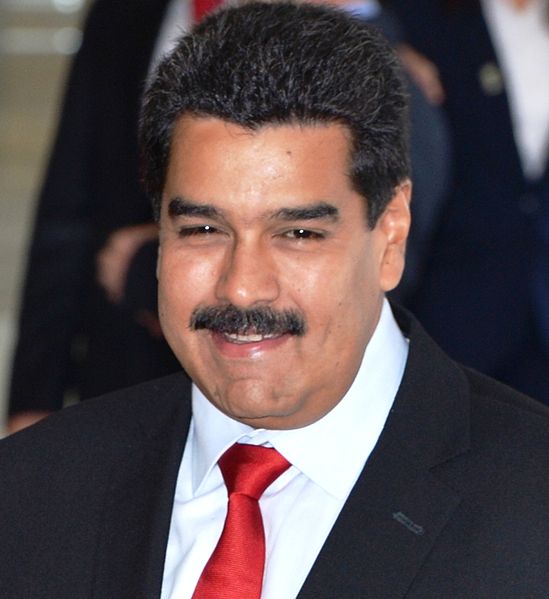
Venezuelan President Nicolas Maduro, whose elected government 
is also under pressure from U.S.-backed right-wing and neoliberal 
elements. (Photo credit: Valter Campanato/ABr)

In the letter, the Front promised that, “Our struggle against the coup government and its program of rolling back our achievements will be relentless.” Protests against the proceedings, which have been ongoing since the impeachment process began, have been increasing and are also likely to intensify in the coming days.

The ramifications of Rousseff’s impeachment are not limited to Brazil. The reverberations throughout the Western Hemisphere, where progressive governments are on the defensive against similar right-wing attacks, began immediately when Bolivia, Ecuador, and Venezuela recalled their ambassadors from Brasília.

Progressive governments of the region see Brazil as the latest example of the epidemic of “soft coups” that have brought down Pink Tide governments that came to power through democratic elections. Increasingly, right-wing forces opposed to progressive governments and discontent with their social and economic programs — but unable to defeat them in popular elections — have turned to judicial and institutional processes to roll back the left’s hold on executive office.

Despite the rhetorical anti-corruption façade that characterized the impeachment proceedings, President Rousseff’s ouster was actually a careful orchestration designed to exploit recent public discontent with her administration’s handling of the economy. Temer is nearly as unpopular as was Rousseff, yet he and the PMDB were able to channel common grievances and direct them against President Rousseff in order to capitalize on them politically.

Moving forward, Brazil is in the hands of a Trojan Horse government — one that has presented itself as one of the few hopes for democracy while subverting the very institutions that the term represents. The Council on Hemispheric Affairs (COHA) stands with Rousseff and echoes the statement she made while on trial: “Today, I only fear the death of democracy.”

Hector Perla Jr. is a Senior Research Fellow and Laura Sholtz & Liliana Muscarella, Research Associates at the Council on Hemispheric Affairs (COHA)., which published this article. For additional news and analysis on Latin America, please go to LatinNews. com and Rights Action.

Does BC Have a Plan B for Resource Communities?

Resource communities and the Plan B question

by Peter Ewart  - 250 News


September 6, 2016

The NEBC Resource Municipalities Coalition based in Northeastern BC has called for the development of a sophisticated natural gas processing industry in the region that could include gas to liquids, methanol production and the manufacture of petrochemical products from natural gas (1).

This comes in the wake of stalled provincial plans to build facilities for exporting huge amounts of Liquid Natural Gas to Asia and other international locations. The provincial government made major promises in the last election regarding LNG production and shipment, including the creation of 100,000 jobs, a billion dollar Prosperity Fund, and $1 trillion in economic activity. However, since then, there has been a major downturn in the oil & gas industry as a whole, as well as corporations ramping up their LNG export capabilities elsewhere and a glut of production on world markets (2).

Towns like Fort Nelson, Dawson Creek, and Fort St. John have been hit hard by this downturn with rising unemployment, municipal revenue problems, and business closures. As Kathleen Connolly, director of the Dawson Creek Chamber of Commerce describes it: “There’s a recognition we have stranded assets here. Our markets are diminishing, so what do we have to do to capitalize on that resource?” (3)

However, some coalition members feel that the province has put too many eggs in the LNG basket. “There is no Plan B in place,” says Bill Streeper, the mayor of Fort Nelson (3).

Certainly, the natural gas resource in northeastern BC has tremendous potential in terms of processing and manufacturing. Literally hundreds of products can be derived from natural gas, including fertilizers, paints, solvents, and plastics (4) (5). Yet, with a few exceptions, this side of the gas resource remains undeveloped in BC.

So, it is positive that northeastern communities have taken on the issue of developing a Plan B, not a small task given the nature of the globalized economy today. In effect, they are tackling one of the greatest problems facing our provincial and national resource economies.

For example, many BC communities depend on resource extraction such as forestry, minerals and metals, natural gas, and energy. Much of this is exported to foreign markets in raw form. There is some processing, especially in forestry, but even that is mostly at the primary or semi-processed level.

However, these local economies have long been plagued by boom and bust cycles which often cause serious economic and social disruption, a recent example being the northeastern region of BC which has a dependence on natural gas extraction and export.

That being said, boom and bust cycles are a component part of capitalist production. However, with the development of a globalized economy, new factors have come into play which are exacerbating the problem further.

The development of a world market has taken place over the last couple of centuries. However, modern day globalization has ramped up the mobility of capital to an enormous degree. Huge amounts of capital from multinational corporations and global financial oligarchs, often fueled these days by central bank liquidity, can swoop around the world at rapid speed in pursuit of the highest return on investment and the highest rate of profit.

But for every action, there is a reaction. Capital that flees one jurisdiction for higher yield somewhere else in the world, often leaves in its wake stranded facilities, unemployed workers and broken communities.

As Charles Hugh Smith points out: “The mobility of capital is an enormous benefit to the owners of the capital, but it creates extraordinary instability for those who are not as mobile.” Or as, Michael Pettis puts it: “If there are imbalances in one country or region, there necessarily must be the opposite imbalances in another” (6) (7).

It also creates a race to the bottom for communities and regions which are forced to compete with others in the world to attract corporate investment by slashing wages, cutting taxes and reducing regulations in their jurisdictions (8).

Even profit-making enterprises can be threatened if multinational corporations can achieve a higher rate of profit elsewhere.

The result of this financialized globalization and pursuit of the highest rate of profit is perpetual instability, aggravated boom and bust cycles, and economic bubbles. No jurisdiction is safe or secure. Even regions that are highly industrialized, like the U.S., Europe and parts of Canada, can have their manufacturing and processing sectors hollowed out, resulting in massive unemployment.

This issue has been brought up again and again in the U.S. presidential race especially by Donald Trump and Bernie Sanders who have repeatedly criticized U.S. based corporations for outsourcing and fleeing the country for other jurisdictions in the world where the rate of profit may be higher.

Their solutions revolve around imposing tariffs of some kind to punish these corporations if they move abroad and then attempt to ship products back into the U.S. market.

At the core of the problem is whether global multinational corporations and the financial oligarchy will be allowed to roam the world like pirates or whether restrictions will be imposed on them which favour the interests of workers, local businesses and communities.

International trade is not a bad thing in itself, nor is the export of raw resources. But in an increasingly globalized world, it becomes imperative to build resilient, well-rounded and diversified local and national economies that are sustainable and have a healthy balance between manufacturing and resource exporting.

That should be the aim, but to achieve it is not easy . Indeed, it is one of the most difficult questions of our time. Imposing tariffs seems like a simple solution, but opens up a whole host of other problems, including possible trade wars.

We need new ways of addressing the issue that are consistent with the times we live in. But, as a first step, we need to discard old dogmas, including the ones that the highest rate of profit must always rule, that multinational corporations should roam the world relatively unrestricted, and that corporate interest should be allowed to trump the national and public interest as in various so-called free trade agreements.

Above all, we need to recognize, as the communities in northeastern BC are doing, that a “Plan B” is not only possible but a necessity, and that we need to have conversations about solutions, not just at the national and provincial levels, but also at the local level.

Peter Ewart is a columnist and writer based in Prince George, British Columbia. He can be reached at: peter.ewart@shaw.ca

“Press Release – NEBC Resource Municipalities Coalition holds meetings with Province.” NEBC Resource Municipalities Coalition website. July 19, 2016. http://www.nebccoalition.com/about/coalition-reports/1747-press-release-nebc-resource-municipalities-coalition-holds-meetings-with-province
Travis, Dermod. “The LNG bubble bursts.” 250 News. July 24, 2016. https://www.250news.com/2016/07/24/the-lng-bubble-bursts/
Bennett, Nelson. “BC has no Plan B for LNG.” Business in Vancouver. Alaska Highway News. August 3, 2016. http://www.alaskahighwaynews.ca/regional-news/lng/b-c-has-no-plan-b-for-lng-1.2315680
Ewart, Peter. “Rejecting dogmas about petroleum and climate change.” April 15, 2016. https://www.250news.com/2016/04/15/rejecting-dogmas-about-petroleum-and-climate-change/
Ewart, Peter. “The role of manufacturing in attaining a renewable-based economy.” 250 News. April 14, 2016. https://www.250news.com/2016/04/14/the-role-of-manufacturing-in-attaining-a-renewable-based-economy/
Smith, Charles Hugh. “Globalization = Permanent instability.” Zero Hedge. October 29, 2014. http://www.zerohedge.com/news/2014-10-29/globalization-permanent-instability
Smith, Charles Hugh. “Forget free trade – Focus on capital flows.” of two minds. com. October 28, 2014. http://www.oftwominds.com/blogoct14/free-trade10-14.html
Parfitt, Ben. “Why BC needs an LNG Plan B.” The Tyee. June 25, 2013. http://thetyee.ca/Opinion/2013/06/25/BC-Needs-LNG-Plan-B/

Kaepernick without Context: San Francisco PD's Conveniently Forgotten Facts

No context is pretext: Excluding Record of Police Abuse Wrongs Proves Kaepernick Right

by Linn Washington Jr.  - This Can't Be Happening


September 6, 2016

A month before the police union in San Francisco sent a blistering letter to NFL officials recently demanding that the professional football league apologize for the “ill-advised” criticisms of police by San Francisco 49ers quarterback Colin Kaepernick that union was the target of scathing criticism for supporting police misconduct.

That criticism of the San Francisco Police Officers’ Association came in a report from a panel that conducted a year-long investigation into policemen in that city caught sending racist, sexist and homophobic text messages.

One member of that blue ribbon panel, a retired judge, blasted the police union for having established an “ugly” tone that infected the entire police department.

The same San Francisco police union that has lambasted civilians for not cooperating with police to solve crimes had directed its members to stiff-arm that panel through refusal to cooperate in the text message investigation. That racist texting scandal has produced the dismissal of over a dozen criminal cases and a reinvestigation of thousands of other cases for possible bias by those texting cops.

Salient facts about the sordid history of abusive policing in San Francisco are generally missing from most of the fevered reactions in the news media over Kaepernick’s actions around America's national anthem.

A 1998 report on police brutality in America conducted by Human Rights Watch stated police officials in San Francisco had failed to hold abusive officers “accountable.” Abusive policing in San Francisco, historically, has ravaged blacks and Latinos disproportionately according to repeated reports.

Three months before Colin Kaepernick’s late August decision not to stand for the national anthem in protest of police brutality and other racism in American society San Francisco’s police chief was forced to resign due to a series of fatal shootings by police under questionable circumstances. One fatal shooting, of a black woman, occurred hours before the chief’s resignation.

Those fatal shootings and a litany of other police abuses in San Francisco had triggered regular protests. This opposition to abusive policing even included a April 2016 hunger strike by protestors outside of a police station demanding the resignation of the city’s police chief and mayor. The chief’s resignation came weeks after the onset of that hunger strike by a five-person group that included a 66-year-old grandmother and pre-school operator who feared danger to her grandson from police.

The media failure to contextualize Kaepernick’s complaint about “bodies in the street…and…people getting away with murder” is a prime example of one festering critique of media coverage: text without context is pretext.

The four San Francisco officers who fatally shot Alex Nieto on March 21, 2014, in a barrage of 59 bullets, did not face criminal charges from prosecutors. The gunfire that killed Nieto in a park as he headed to his job included bullets fired into Nieto while he lay wounded on the ground. Nieto wore a 49ers jacket when felled by police, a counterpoint to fans that have burned Kaepernick’s jersey in protest of Kaepernick’s protest against police brutality.

Kaepernick’s complaints about abusive policing exist on both the levels of macro (nationwide) and micro (San Francisco specific). Placing Kaepernick’s complaints in the proper perspective of squarely within the city limits of San Francisco reveals the validity of his argument that too many indignantly dismiss as inane.

Little known outside the Bay Area is the history of abuse and racism within San Francisco’s police force – the very misconduct driving the complaints of Kaepernick.

A February 1969 editorial in a black owned San Francisco newspaper decried a 25-year failure of officials and residents to assist the “hundreds of nameless black citizens who have been brutalized by a sadistic police department.”

In November 1978 – twenty years before that Human Rights Watch report – the NAACP civil rights organization in San Francisco blasted “a pattern” of brutality by San Francisco police and discriminatory employment practices within that city’s police department.

Police brutality is the 'problem' not the protest of Colin Kaepernick.

Colin Kaepernick continues a coalmine canary tradition warning about toxicity that American society has sidestepped for far too long.

The Children's Story from Syria

A Children’s Story in Syria

by Franklin Lamb - CounterPunch


September 2, 2016

Children’s Orthopedics Ward, Al-Mouwasat Hospital, Damascus

It was about 11 in the morning on Tuesday August 2, 2016 when two sisters, ten year-old Ghina and her eight year-old younger sister Nagham were walking a short distance from their home in the town of Madaya to its “field hospital” in order to acquire serum for their anemic mother Sahar whose body was very deficient in calcium because of 18 months existence with very little food. Sahar explained to this observer a couple of days ago that she and her four babies, lived at times with nothing more than a watery soup made of grass, or sometimes black peppers, but most often made from the pink and white flowers of thistle plants she gather from a nearby field.

For more than a year, after having fled from their own Sunni village of Zabadani due to fighting, the family has been living in surrounded Madaya, a mountain town of 40,000, now with four times its pre-war population, about 30 minutes northwest of Damascus. Military forces encircled Madaya in July of 2015 as part of a broader offensive to recapture the nearby Qalmoun Mountain villages and the town of Zabadani, held by rebels since 2012. Residents of Madaya have been trapped ever since.

Having made their medicine purchase, the girls started their short 60 yard walk home. A claimed eye-witness says that a sniper near al-Asali checkpoint took aim and fired at the youngsters. One explode-on-impact bullet entered Ghina’s upper-left thigh, shattering her leg bone and thigh.

For an instant, not realizing what had happened, Ghina’s younger sister 8 year old Nagham, noticing that Ghina had dropped the small plastic medicine bag to be given to their mother at home, instinctively picked it up and began to scold her big sister for dropping it. The little heroine, by now instantly covered in her sister’s blood, tried to pull badly bleeding and screaming Ghina off the road to a secure location- the roadside ditch. The sniper took aim a second time. This time, shrapnel from the bullet struck Nagham’s right arm and hand. The two young girls lay on the side of the road until minutes later passersby were able to pull them out of the line of fire and transport them to the towns nearby “field hospital”.

Over the past year, snipers have killed seven people in Madaya, according to a report published on 7/13/2016 by Physicians for Human Rights, a US-based organization that has provided medical assistance to thousands in Syria since the civil war erupted in March of 2011. The PHR findings were confirmed in a separate Report from the Madaya Medical Commission published on 7/23/2016. The following week, snipers shot and wounded three more people, a Madaya resident reported last week by telephone to a relative of the girl’s family.

The sniping of civilians continues until today in Madaya as some try to escape the siege imposed on their town. So also do deaths mount from the approximately 6,000 additional landmines recently placed around the southern and eastern sides of the town, by militia in order to further imprison residents inside.

Such indiscriminate use of landmines in a populated civilian area violates international humanitarian law and, as with sniping civilians, constitutes a punishable war crime once the conflict ends and hopefully the global community insists on full accountability under the law for all who have targeted the people of Syria.

Several dozen people have also died from starvation in Madaya, despite surrendering in exchange for relief from the siege. With almost nothing and no one allowed in or out, the town continues slowly dying from the inside.

At Malaya’s “field hospital” whose medical staff consists of two heroic dental students and an animal veterinarian, Ghina was diagnosed with a displaced fracture, a badly shattered leg bone and a severed nerve in her upper left thigh.

Before long, Ghina’s leg and thigh became badly infected and a tentative decision was taken to amputate it. As one of the MDs reported at the time via “What’sUP” to medical colleagues abroad, Madaya’s health workers today are only able to perform emergency surgery, mainly amputations. As Dr. Darwish, a dentistry student and one of three health professional still in Madaya insisted, they did not have the equipment or the training to repair the damage to Ghina’s leg and thigh or most other serious injuries brought to the “Field Hospital.” However, amputation of Ghina’s leg was something they could perform. Time was running out for Ghina shown below shortly after she was evacuated from Madaya to Al-Mouwasat Hospital, Damascus

Madaya’s severely wounded, like Ghina, have only one way to get out of the besieged town and thru the 65 checkpoints, countless landmines and snipers, and to receive the lifesaving treatment they need. It is through a painstakingly negotiated reciprocal agreement between rebel and regime forces, brokered by Iran and the United Nations last year. In theory it provides for the evacuation of some wounded people from Sunni Madaya in exchange for a parallel evacuation from two Idlib Shia towns of Foah, and Kafraya, besieged by rebel forces.

Unfortunately, there are a number of additional bureaucratic hurdles which result in very few in need of urgent medical aid being allowed to leave Madaya through one of the 65 checkpoints which also surround adjacent Zabadani. A major one being that snipers regularly shoot residents if they approach Madaya’s periphery from any direction.

Fortunately in Ghina’s case, as with the case of the conjoined twins from the Damascus suburb of East Ghouta, Nawas and Moaz (the subjects of Part II of this article) a social media campaign led by Amnesty International pressurized the powers that be to allow the Syrian Red Crescent Society (SACRS) to enter Madaya at night, so as not to attract the attention of many other families with severely injured members who surely would demand evacuation for their loved ones in critical condition, and rescue the girls and move them for urgent emergency medical intervention.


(Photo: fplamb 8/27/2016)


The metal rods must remain deep inside Ghina’s leg and thigh for three months and she must stay in a hospital bed for two months. The sniper bullets were designed to explode on impact and they did much nerve and muscle damage.

Until the past few days, there has also been great concern about the risk that Ghina’s muscles in the left leg will be permanently shortened, causing walking abnormalities. That erstwhile grim likelihood is now largely discounted.

Today Ghina and Nagham are recovering at Al-Mouwasat Hospital in Damascus and eating plenty of nutritious food including three pieces of fresh fruit daily for which Syria is blessed and famous, on specific instructions from their new American “uncle”, their mother Sahar and their new “big sisters”, Rima and Raraf, both from Damascus. And the girls can have each have two pieces a day (maximum!) from their growing supply of admittedly less nutritious treats arranged by their new friends. This morning this observer was advised by the girls Dr. that Nagham’s hand and arm stitches can be removed in five days. And then the little one will for sure head to the fine swimming pool at my hotel.


(Photo: Rima Karwan, the new “big sister” of these beauties. 8/28/2016)


On Sunday (the first of the week end) September 18, 2016, the public schools across Syria will open for the next academic year. Arrangements have been made by MSRCL, which also helps specific cases in Syria itself, for 7 year old Nagham, who her mother explained has been an average student last year in Madaya-when classes could even be held- to begin classes. She was lectured today by her American uncle that is was important to start off the school year well, to sit in the first two rows of her classroom (to be separated from the “antics and distractions of the boys in the back of the class!”) and to make eye contact with her teacher and not to be shy about asking questions if there is something she does not understand.

With respect to Ghina, her proud mother Sahar explained today that she is an excellent student but cannot attend school this year for at least two or three months. Arrangements were made today for Ghina to receive home schooling by tutors Alaa and Nadine until she can join the new school year.

MSRCL is still working to get permission to bring Sahar’s two other babies, Manal age 3 and Mohamad-Kamal out of Madaya. The little ones were unfortunately not allowed to leave as part of Ghina’s evacuation. Again, for bureaucratic reasons.

Ghina and Nagham were very lucky to survive the sniper’s bullets last month and are today out of harm’s way. But this is not the case for the 40,000 entrapped residents of Madaya who remain imprisoned by the war in Syria, as do nearly one million other besieged civilians across Syria today.


To provide a meal to a Syrian refugee child in Lebanon: Please visit: http://mealsforsyrianrefugeechildrenlebanon.com
 
Franklin Lamb volunteers with the Lebanon, France, and USA based Meals for Syrian Refugee Children Lebanon (MSRCL) which seeks to provide hot nutritional meals to Syrian and other refugee children in Lebanon. http://mealsforsyrianrefugeechildrenlebanon.com. He is reachable c/o fplamb@gmail.com.
More articles by:Franklin Lamb

Monday, September 05, 2016

TSA, Working for a Thought-Free USA: Ambassador Turned Around at the Border

Thought is Dangerous to the USA 

by Craig Murray


5 Sep, 2016 

I have been refused entry clearance to the USA to chair the presentation of the Sam Adams Award to CIA torture whistleblower John Kiriakou and to speak at the World Beyond War conference in Washington DC. Like millions of British passport holders I have frequently visited the USA before and never been refused entry clearance under the visa waiver programme.


I shall apply for a visa via the State Department as suggested but I must be on a list to be refused under the ESTA system, and in any event it is most unlikely to be completed before the conference.

It is worth noting that despite the highly critical things I have published about Putin, about civil liberties in Russia and the annexation of the Crimea, I have never been refused entry to Russia. The only two countries that have ever refused me entry clearance are Uzbekistan and the USA. What does that tell you?

I have no criminal record, no connection to drugs or terrorism, have a return ticket, hotel booking and sufficient funds. I have a passport from a visa waiver country and have visited the USA frquently before during 38 years and never overstayed. The only possible grounds for this refusal of entry clearance are things I have written against neo-liberalism, attacks on civil liberties and neo-conservative foreign policy. People at the conference in Washington will now not be able to hear me speak.

Plainly ideas can be dangerous. So much for the land of the free!

Impromptu: Hugh Grant's Other Musical Turn

Hugh Grant and the Cult of Bad Singing

by David Yearsley  - CounterPunch


September 2, 2016

If an honest history about classical music on the big screen were to be written, the laurels for greatest performance would go to an actor many would consider undeserving of the honor. In fact, most wouldn’t even think of him at all. I’m talking, of course, about none other than that loveable master of self-effacing charm, bumbling bonhomie, and buoyantly melancholic repartee, Hugh Grant.

This year marks the silver anniversary—now nearly passed, astonishingly!, without comment or commemoration—of his definitive turn as Frederic Chopin in James Lapine’s 1991 comedy Impromptu. The film is set at a house party in the French countryside at which the infamous novelist George Sand (Judy Davis) tries to seduce the great Polish pianist while navigating through a flotilla of her former lovers, including none other than Franz Liszt (Julian Sands).

In his early thirties when he appeared in Impromptu, Grant gave us a pale and haughty genius, seemingly self-assured yet painfully fragile beneath the façade, and not just because of his hacking ill health. As the rigid yet passionate composer-pianist, Grant has never been funnier or truer. He makes Cornel Wilde’s portrayal of Chopin in the 1945 A Song to Remember look like an eager, impetuous skateboarder in frock coat and high-riding breeches.

Ever the self-deprecator, Grant often claims in interviews not to be acting on screen but simply to be playing some version of himself; when forced to resort to theatrical subterfuge he is increasingly beset by panic attacks. His Chopin was back then, four years before his breakout in Four Weddings and a Funeral, and still today, a long way from his home pitch of the cute English schoolboy grown up into sex symbol.

Grant’s musical role might have unsettled him in 1991, too, for the brilliance of his Impromptu is to be gauged by the difficulty one has is in determining whether he’s deliciously overacting with his stilted faux-Polish accent or whether he’s damping down the coals to a low smolder. The answer is that he’s doing both. An austere Grant is a hilarious Grant, as when informs the cross-dressing Sand, who has broken into his bedroom: “Rumor has it that you are a woman and so I must ask you to leave my private chambers.” Or there is the poise of his outrage at an irreverent, hastily arranged farce put on in the chateau’s theater. Chopin provides scene-setting music from the piano, but indignantly stands up from the keyboard as things degenerate on stage, proclaiming with that goofy accent: “I want no further part in this production.” And what of the morose hilarity he squeezes from his stony response to an invitation to join in a game of croquet:

 “I do not really like the sun.”

When the Hugh Grant retrospectives begin to be scheduled at future international film festivals and cinematic institutes, Impromptu will make a winning double-bill with this year’s Florence Forest Jenkins directed by Stephen Frears.

The movie is about an New York society hostess, who in the 1940s accumulated a cult following for her excruciatingly bad singing, and for whom it was apparently unclear whether she realized her fans found her performances ridiculous, or whether she plunged ahead for comic effect, abetted by the belief that any form of adulation, even one based on humiliation, was worth basking in.

Such was the extent of her popularity, and perhaps also the delusional faith in her own abilities, that she booked Carnegie Hall in October of 1944, quickly selling the place out. Up till then, she had controlled the make-up of her audiences at private concerts in her apartment and an annual soirée at the Ritz-Carlton, while also planting the loopily benign reviews (many of which may have been written by her or her loyal coterie). But with her appearance at New York City’s most celebrated venue for classical music open to the general public she could no longer manage the press. The notices were scathing, and she died as the result of a heart attack a month later.

In the lead role, Meryl Streep is a talented singer in her own right with vocal turns in Mamma Mia! and last year’s return-of-the-rock-‘n-roller flick, Ricki and the Flash directed by Jonathan Demme. In Stephen Frear’s movie Streep has to sing badly in nine of Jenkins’s numbers, including the likes of Queen’s of the Night coloratura aria from Mozart’s “Magic Flute.” What is remarkable is how good Streep is at being bad: she seems not only to have learned the original as best she could, but then has master Jenkins’s versions—or at least virtuosically traces the lineaments of her appalling, intensely captivating style. It’s true that imitating someone such as Joan Sutherland, would be a lot harder, indeed impossible: that level of technical achievement cannot be faked. But Jenkins’s sound was unique, exceedingly personal, and Streep’s ability to capture the mix of laughably off-key notes and dire coloratura screeches, with pristine moments of naïve beauty is in itself an impressive feat.

Grant plays the dotty doyenne’s younger husband and manager, St Clair Bayfield. He’s charged with making sure that her bubble is not punctured. He does this not only because she funds his lifestyle (including setting him up in his own apartment which he stocks with much younger mistress), but also because he actually, truly, really loves her.

Twenty-five years on from his Chopin tour-de-force, Grant is a fair piece jowlier and more jaded, rinklier and more rheumy-eyed. Back then he was a perfect fit for the thin Pole, just as now he so naturally inhabits the part of the paunchy British ex-pat. Bayfield is a failed actor, who, like his future wife, sometimes had to have the negative reviews hidden from him. In Florence Grant plays not the artist but the fixer and faker: all is compromise and ambiguity, instead the Romantic’s absolute art.

Forcing one’s self to believe the fiction of one’s life is a metaphor for acting, and there is no more expert practitioner than Grant with his self-professed self-doubts. Within the world of this film, and in accordance with his own image as the non-acting actor, Grant enthralls with his determination not to let uncertainty, and with it despair, overtake him. The task is all-the-more heroic because we see the shadows occasionally pass across his face, as when he watches from the wings as Jenkins makes her fateful Carnegie Hall entrance.

His world, like his wife’s supposed ascent to self-diagnosed high Fs, is always on the verge of collapse. In suavely striding down the parquet precipice of Jenkins’s sumptuous midtown apartment and the other crags of high society with doom yawning to either side, Grant shows us that art hovers between illusion and reality.
 
DAVID YEARSLEY is a long-time contributor to CounterPunch and the Anderson Valley Advertiser. His recording of J. S. Bach’s organ trio sonatas is available from Musica Omnia. He can be reached at dgyearsley@gmail.com
More articles by:David Yearsley

Gorilla Radio with Chris Cook, David Swanson, Cleanse Our Waters, Janine Bandcroft Sept. 7, 2016

This Week on GR

by C. L. Cook - Gorilla-Radio.com


September 7, 2016

America's corporate media is doing its level best to crucify Colin Kaepernick, without making a Spartacus of him. The president and the Clinton camp too are playing it cool, because they, and the thin white line at FOX News, and the networks, know "from small embers, great fires grow." Especially true in a tinder-dry election year like this; one so parched of civic optimism, none alive remember its match. And so for now, Mr. Obama and VP hopeful, Tim Kaine can send backhanded support for the upstart 49ers' "constitutional right" to voice his opposition to a national "shoot first and shoot to kill" policing policy by sitting out the national anthem, but you can bet Great Caesar's ghost, FIX News and the Washington consensus will see Kaepernick and his growing retinue of rebel sports figures line the Via Appia before election day.

Listen. Hear.

David Swanson is a most active peace and political justice activist, journalist, radio host, and author whose book titles include: 'War No More: The Case for Abolition,' 'When the World Outlawed War,' 'War Is a Lie,' and 'The Military Industrial Complex at 50,' among others. He's director of WorldBeyondWar.org, campaign coordinator for RootsAction.org, and blogs at DavidSwanson.org and WarIsACrime.org. He too hosts Talk Nation Radio, and is a 2015 Nobel Peace Prize Nominee.

David Swanson in the first half.

And; last week the Dzawada’enuxw nation united, traveling down the coast of Vancouver Island, linking up with other nations as they went, in their quest to protect the web of life by removing salmon farms from their traditional waters, the place colonists named the Broughton Archipelago. I went down to the demonstration in Victoria Saturday.

Voices of the Musgamagw Dzawada’enuxw raised against fish farms in their territory in the second half.


And; Victoria Street Newz publisher emeritus and CFUV Radio host, Janine Bandcroft enjoins us to bring newz of good goings-on planned for the streets of our city and beyond in the coming week. But first, David Swanson and America's racing pulse in a hotting election season.

Chris Cook hosts Gorilla Radio, airing live every Wednesday, 1-2pm Pacific Time. In Victoria at 101.9FM, and on the internet at: http://cfuv.uvic.ca.  He also serves as a contributing editor to the web news site, http://www.pacificfreepress.com. Check out the GR blog at: http://gorillaradioblog.blogspot.ca/

G-Radio is dedicated to social justice, the environment, community, and providing a forum for people and issues not covered in the corporate media.

Cold Rush: Investing in a New Cold War

US Arms Makers Invest in a New Cold War

by Jonathan Marshall  - Consortium News


September 1, 2016

The U.S. military has won only a single major war since the end of World War II (the Gulf War of 1990-91).

But U.S. military contractors continue to win major budget wars in Congress nearly every year, proving that no force on earth can resist their lobbying prowess and political clout.


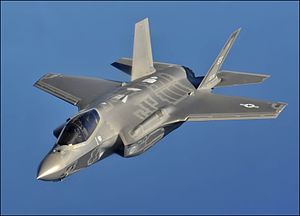
Lockheed-Martin’s F-35 war plane.

Consider the steady march to victory of the biggest single weapons program in history — the planned purchase of advanced Lockheed-Martin F-35 jets by the Air Force, Navy, and Marines at a total projected cost of more than $1 trillion.

The Air Force and Marines have both declared the Joint Strike Fighter ready for combat, and Congress is now forking over billions of dollars a year to acquire what is slated to become a fleet of 2,400 jets.

Yet the world’s most expensive fighter bomber still doesn’t work properly and may never perform as advertised. That’s not “dezinformatsiya” from Russian “information warfare” specialists. That’s the official opinion of the Pentagon’s top weapons evaluator, Michael Gilmore.

In an Aug, 9 memo obtained by Bloomberg News, Gilmore warned senior Pentagon officials that the F-35 program “is actually not on a path toward success but instead on a path toward failing to deliver” the aircraft’s promised capabilities. He said the program “is running out of time and money to complete the planned flight testing and implement the required fixes and modifications.”

The military testing czar reported that complex software problems and testing deficiencies “continue to be discovered at a substantial rate.” As a result, the planes may fail to track moving targets on the ground, warn pilots when enemy radar systems spot them, or make use of a newly designed bomb. Even the F-35’s gun may not function properly.

Devastating Assessments


The internal Pentagon assessment was just the latest in a long list of devastating critical assessments and development setbacks for the plane. They include repeated groundings of the plane due to fires and other safety issues; the discovery of dangerous engine instability; and helmets that can cause fatal whiplash. The plane even got soundly beaten in a mock engagement with a much older (and cheaper) F-16.


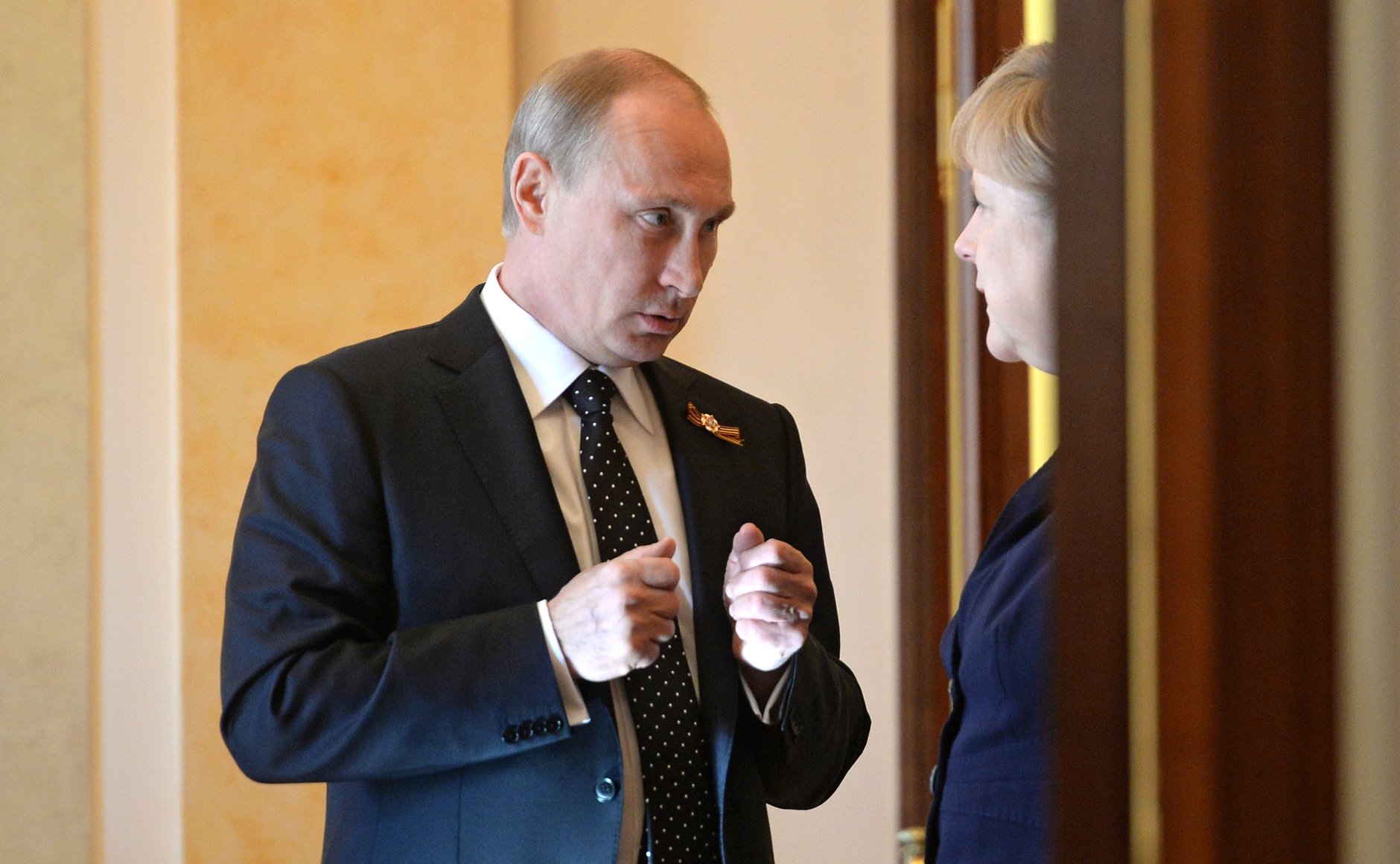
Russian President Vladimir Putin with German Chancellor
Angela Merkel on May 10, 2015, at the Kremlin.
(Photo from Russian government)

Last year, an article in the conservative National Review argued that “the biggest threat the U.S. military faces over the next few decades is not the carrier-killing Chinese anti-ship ballistic missile, or the proliferation of inexpensive quiet diesel-electric attack subs, or even Chinese and Russian anti-satellite programs. The biggest threat comes from the F-35 . . . For this trillion-dollar-plus investment we get a plane far slower than a 1970s F-14 Tomcat, a plane with less than half the range of a 40-year-old A-6 Intruder . . . and a plane that had its head handed to it by an F-16 during a recent dogfight competition.”

Likening the F-35 to a previous failed fighter jet program, retired Air Force Colonel Dan Ward observed last year, “Perhaps the truly best scenario for the Joint Strike Fighter is for it to follow in the footsteps of the F-22 and provide a combat capability that is irrelevant to actual military needs. That way, when the whole fleet gets grounded because of an unsolvable flaw, the impact on our defense posture would be nil.”

Lockheed’s “Pay-to-Play Ad Agency”


Coming to the program’s defense most recently was military analyst Dan Goure, in the blog of the respected magazine, The National Interest. Goure belittled critics in the Pentagon’s Operational Test and Evaluation Office as “green eyeshade people, like the goblins at Gringott’s in the Harry Potter series.”


Describing the F-35 as “a revolutionary platform,” he declared, “Its ability to operate undetected in hostile airspace, gathering information and even targeting data on enemy air and ground targets, before launching surprise attacks demonstrates a decisive advantage over existing threat systems. . . . The Joint Strike Fighter test program is making progress at an accelerated rate. More to the point, even before it has completed the rigid performance template laid out by DOT&E, the F-35 has demonstrated capabilities that far exceed any current Western fighter.”

If that reads a bit like a Lockheed-Martin marketing brochure, consider the source. In his article, Goure identified himself only as a vice president of the Lexington Institute, which bills itself as “a nonprofit public-policy research organization headquartered in Arlington, Virginia.”

What Goure didn’t say — and the Lexington Institute doesn’t generally disclose — is that “it receives contributions from defense giants Lockheed Martin, Boeing, Northrop Grumman and others, which pay Lexington to ‘comment on defense,’” according to a 2010 profile in Politico.

Earlier the same year, Harper’s contributor Ken Silverstein called the widely quoted think tank “the defense industry’s pay-to-play ad agency.” He added, “Outfits like Lexington produce the press conferences, position papers and op-eds that keep military money flowing to defense contractors.”

Goure’s indirect association with Lockheed gives a hint as to why programs like the F-35 continue to thrive despite performance failures, gigantic cost overruns, and schedule delays that would otherwise trigger headline-grabbing congressional investigations and produce streams of indignant rhetoric from Fox News commentators about government failure.

Promoting the New Cold War


Think tanks like the Lexington Institute are prime movers behind the domestic propaganda campaign to revive the Cold War against the diminished Russian state and justify weapons programs like the F-35.

As Lee Fang observed recently in The Intercept, “The escalating anti-Russian rhetoric in the U.S. presidential campaign comes in the midst of a major push by military contractors to position Moscow as a potent enemy that must be countered with a drastic increase in military spending by NATO countries.”

Thus the Lockheed-funded Aerospace Industries Association warns that the Obama administration is failing to spend enough on “aircraft, ship and ground combat systems” to adequately address “Russian aggression on NATO’s doorstep.” The Lockheed- and Pentagon-funded Center for European Policy Analysis issues a stream of alarmist reports about Russian military threats to Eastern Europe.

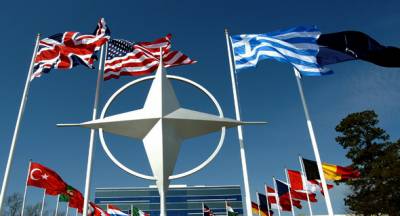
And the highly influential Atlantic Council — funded by Lockheed-Martin, Raytheon, the U.S. Navy, Army, Air Force, Marines, and even the Ukrainian World Congress — promotes articles like “Why Peace is Impossible with Putin” and declares that NATO must “commit to greater military spending” to deal with “a revanchist Russia.”

Origins of NATO’s Expansion


The campaign to portray Russia as a menace, led by contractor-funded pundits and analysts, began soon after the Cold War ended. In 1996, Lockheed executive Bruce Jackson founded the U.S. Committee on NATO, whose motto was “Strengthen America, Secure Europe. Defend Values. Expand NATO.”

Its mission ran directly contrary to promises by the George H.W. Bush administration not to expand the Western military alliance eastward after the fall of the Soviet Union.

Joining Jackson were such neo-conservative hawks as Paul Wolfowitz, Richard Perle and Robert Kagan. One neocon insider called Jackson — who went on to co-found the Committee for the Liberation of Iraq — “the nexus between the defense industry and the neoconservatives. He translates us to them, and them to us.”

The organization’s intense and highly successful lobbying efforts did not go unnoticed. In 1998, the New York Times reported that “American arms manufacturers, who stand to gain billions of dollars in sales of weapons, communication systems and other military equipment if the Senate approves NATO expansion, have made enormous investments in lobbyists and campaign contributions to promote their cause in Washington. . . .

“The four dozen companies whose main business is arms have showered candidates with $32.3 million since the collapse of Communism in Eastern Europe at the beginning of the decade. By comparison, the tobacco lobby spent $26.9 million in that same period, 1991 to 1997.”

A spokesman for Lockheed said, ”We’ve taken the long-term approach to NATO expansion, establishing alliances. When the day arrives and those countries are in a position to buy combat aircraft, we certainly intend on being a competitor.”

The lobbying worked. In 1999, against Russian opposition, NATO absorbed the Czech Republic, Hungary and Poland. In 2004, it added Bulgaria, Estonia, Latvia, Lithuania, Romania, Slovakia and Slovenia. Albania and Croatia joined next in 2009. Most provocatively, in 2008 NATO invited Ukraine to join the Western alliance, setting the stage for the dangerous conflict between NATO and Russia over that country today.

The fortunes of American arms makers soared. “By 2014, the twelve new [NATO] members had purchased close to $17 billion worth of American weapons,” according to Andrew Cockburn, “while . . . Romania celebrated the arrival of Eastern Europe’s first $134 million Lockheed Martin Aegis Ashore missile-defense system.”

Last fall, Washington Business Journal reported that “if anyone is benefitting from the unease between Russia and the rest of the world, it would have to be Bethesda-based Lockheed Martin Corp. (NYSE: LMT). The company is positioned to make large profits off what could very well be an international military spending spree by Russia’s neighbors.”

Citing a big contract to sell missiles to Poland, the newspaper added, “Officials from Lockheed aren’t explicitly declaring that Russian President Vladimir Putin’s adventurism in Ukraine is good for business, but they aren’t shying away from recognizing the opportunity that Poland is presenting them as Warsaw continues to embark on a massive military modernization project — one that has accelerated as tensions grip Eastern Europe.”

Lockheed’s Lobby Machine


Lockheed continues to pump money into the American political system to ensure that it remains the nation’s largest military contractor. From 2008 to 2015, its lobbying expenditures exceeded $13 million in all but one year. The company sprinkled business from the F-35 program into 46 states and claims that it generates tens of thousands of jobs.

Among the 18 states enjoying a claimed economic impact of more than $100 million from the fighter jet is Vermont — which is why the F-35 gets the support even of Sen. Bernie Sanders.

As he told one town hall meeting, “It employs hundreds of people. It provides a college education for hundreds of people. So for me the question is not whether we have the F-35 or not. It is here. The question for me is whether it is located in Burlington, Vermont or whether it is located in Florida.”


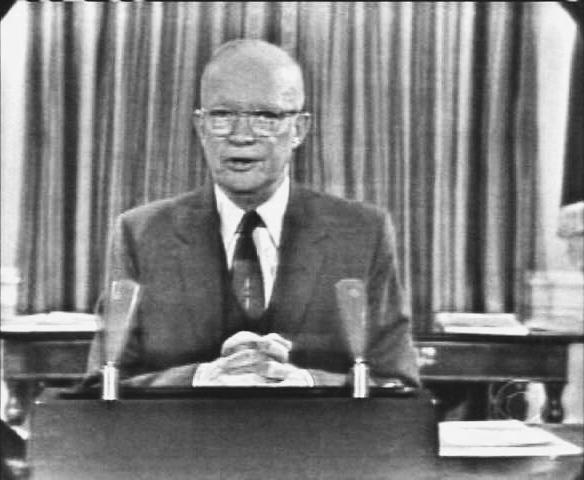
President Dwight Eisenhower delivering his farewell
address on Jan. 17, 1961.

In 1961, President Eisenhower observed that the “conjunction of an immense military establishment and a large arms industry” had begun to influence “every city, every State house, every office of the Federal government.”

In his famous farewell address to the nation, Eisenhower warned that “we must guard against the acquisition of unwarranted influence, whether sought or unsought, by the military-industrial complex. The potential for the disastrous rise of misplaced power exists and will persist.”

How right he was. But not even Ike could have imagined the extravagant costs to the nation of failing to hold that complex at bay — ranging from a trillion-dollar fighter jet program to the needless and far more dangerous resurrection of the Cold War a quarter century after the West achieved victory.

Jonathan Marshall is author or co-author of five books on international affairs, including The Lebanese Connection: Corruption, Civil War and the International Drug Traffic (Stanford University Press, 2012). Some of his previous articles for Consortiumnews were “Risky Blowback from Russian Sanctions”; “Neocons Want Regime Change in Iran”; “Saudi Cash Wins France’s Favor”; “The Saudis’ Hurt Feelings”; “Saudi Arabia’s Nuclear Bluster”; “The US Hand in the Syrian Mess”; and “Hidden Origins of Syria’s Civil War.” ]