Wednesday, February 22, 2017

Iraq Friendships: Staying Human Despite the Cost

Friendship in Defiance of War

by Kathy Kelly - VCNV


February 21, 2017

Before making their home in Damascus, Gabe Huck and Theresa Kubasak had regularly visited Baghdad and other Iraqi cities, where they developed lasting friendships and deepened cultural awareness. Iraq was steadily deteriorating under thirteen years of U.S./UN imposed economic sanctions.

Despite iron clad determination by U.S. policy makers to isolate Iraq, Gabe and Theresa repeatedly challenged the economic sanctions by carrying medicines and medical relief supplies to Iraqi children, families and hospitals.

They also helped organize opportunities for scores of other U.S. and U.K. people to visit Iraq as part of Voices in the Wilderness (VitW).

Voices delegations politely but firmly notified U.S. authorities that they would break the economic sanctions by personally carrying duffel bags filled with children’s vitamins, antibiotics, medical textbooks, surgical kits, first aid material and medical relief supplies, all of which the economic sanctions prohibited.

Evidence for prosecution of one delegation included a bottle of water and a blank video that had been purchased in Baghdad. Punishment ostensibly imposed to force the Iraqi government’s compliance with weapons inspectors had directly contributed towards the deaths of hundreds of thousands of children under age five.

The VitW campaign succeeded in sending 70 delegations to Iraq, all of which prompted greatly needed education and public discussion in cities and towns across the U.S. and the U.K. Leslie Stahl posed the question in a Sixty Minutes segment that aired in May of 1996: Were the deaths of over one half million children under age five an acceptable price to pay for a dubious policy?

“Yes, Leslie,” said Madeline Albright, who was the U.S. Secretary of State.

“I’m a humanitarian person, and it’s a difficult choice to make, but the price, we think the price is worth it.”

Gabe and Theresa begged to differ.

Voices in the Wilderness (VitW) was based in a second floor apartment on Chicago’s north side, a few miles south of Gabe’s and Theresa’s home in Evanston. Eyes lit up inside “the office” whenever Gabe and Theresa came up the stairs. Along with their encouragement and wisdom, they would always bring fresh baked pastries or a loaf of bread. About a dozen young people had poured energy and determination into strengthening VitW efforts to defy the sanctions against Iraq. They in turn drew immense inspiration and guidance from Gabe and Theresa.

“I think I understand,” a young nurse from the U.K. murmured, as he sat at the bedside of a dying child in the pediatric ward of a major hospital in Baghdad. “It’s a death row for infants, isn’t it?” A death row for infants.

Travelers to Iraq encountered brutal, lethal punishment of children. Every hospital visit was nothing less than shocking. By the time the U.S. military had geared up for the 2003 Shock and Awe campaign, Iraqis had already been pummeled, starved, humiliated and bereaved. “You come and you say, you will do, you will do,” said one Iraqi teenager, addressing a delegation of U.S. people visiting her high school class.

“But nothing changes. Me, I am sixteen. Can you tell me, what is the difference between me and someone who is sixteen in your country? I’ll tell you. Our emotions are frozen. We cannot feel!” 

She sat down, suddenly overcome by feelings of anguish.

Many people worldwide may have been tempted, through mainstream media coverage, to think that only one person lived in Iraq, Saddam Hussein. Voices delegation members cultivated a passion to tell people about what they had seen and heard while visiting Baghdad, Basra, Mosul and other Iraqi cities. Gabe and Theresa exemplified a beautiful ability to explore history, culture, complexity, diversity and nuance, wherever they traveled. To this day, they maintain close friendships with people they first met during their visits to Baghdad. Always, their concern for children occupied the forefront of their distress and commitment.

Their research and study, along with their good humor, helped all of us gain needed maturity as we tried to campaign for ending the hideous economic war and prevent a new round of bombing and invasion.

Having watched them in action through many years of Voices witness and work, I wasn’t surprised by their readiness to become rooted in Damascus, intent on finding ways for ordinary U.S. people to begin reparations to Iraqis whose lives have been forever altered and traumatized by successive U.S. military and economic wars. But I often feel mesmerized by their seemingly endless capacity to learn, grow and serve. I remember visiting them in Damascus when they were learning Arabic. Utterly diligent in their studies, they knew they must give immovable priority to daily lessons.

Yet they also managed to invite young people to study with them, sharing with others their remarkable tutor, Mazen. Young people who went to study Arabic in Damascus could count on Gabe and Theresa for help with housing and orientation. What’s more, they would be treated to enlivening trips and boundless encouragement.

Eventually, these two efficient and hospitable teachers began to imagine practical, sustainable ways to help Iraqi youngsters, displaced by war, continue their studies. In September, 2016, a UNHCR report “highlighting education as an overlooked casualty of the global refugee crisis,” (NYT, 9/15/2016) noted that:

Nearly two-thirds of the six million school-age children classified as refugees have no school to attend… Roughly 1.75 million refugee children are not enrolled in primary school and 1.95 million refugee adolescents are not in secondary school, the refugee agency report said.

“It is essential that we think beyond basic survival,” said Filippo Grandi, the United Nations high commissioner for refugees.

Gabe and Theresa had identified one of the most grievous results of war and displacement. A new generation becomes undereducated, less able to care for their families and meet basic needs.

Ever appreciative of challenges and confident in their exceptional capacity to team up, they explored the many strands needed to develop potential for Iraqi youngsters to attend Universities in the U.S. The Iraq Student Project became a growing tapestry.

For Gabe and Theresa, and eventually a stalwart group of supporters who sometimes participated in springtime visits to Syria, Damascus was an idyllic setting in which to pursue a project that put them in touch with resilient and fascinating young people. Never Can I Write of Damascus…celebrates a plethora of sights, sounds, aromas, delicacies and intricacies of the city as experienced over the seven years when Gabe and Theresa resided there. But the Iraqi Student Project also connected them to a staggering array of bureaucratic requirements. With numerous forms to fill out and interviews to face, they doggedly pursued University admission and a U.S. student visa for each student who entered the U.S.

I marveled at their indefatigable, constant attentiveness to so much detail. They look back on those rigors with good humor and a gentle irony. Characteristically, they turn adverse experiences into a means for deepening needed empathy. Gabe recently suggested that I read a novel, The Corpse Washer, by Sinan Antoon. (It’s one of several books discussed in an annotated bibliography at the end of their book). Antoon writes with heart-wrenching sensitivity about how difficult it becomes to cross a divisive border following a war:

(p. 149) "I felt as if we had been struck by an earthquake which had changed everything. For decades to come we would be groping our way around in the rubble it left behind. In the past, there were streams between Sunnis and Shi'ites, or this group and that, which could be easily crossed or were invisible at times. Now, after the earthquake, the earth had all these fissures and the streams had become rivers. The rivers became torrents filled with blood, and whoever tried to cross drowned. The images of those on the other side of the river had been inflated and disfigured...concrete walls rose to seal the tragedy."

Pope Francis exhorts listeners to overcome the fears that drive people to seal themselves off from others. With the walls come weapons and the weapons lead to war. “Why,” Pope Francis asked, when addressing the U.S. Congress in 2015, “would anyone give weapons to people who use them for war?” The answer, he said, was simple.

“The answer is money, and the money is drenched in blood.”

Weapons and bloodshed have wreaked new chaos and havoc, destroying the lives and homes of people throughout Syria and beyond. Gabe and Theresa left Damascus in 2012. Since that time, thousands more have been displaced. The UN estimated in April 2016 that at least 400,000 Syrians have been killed. The rivers have become torrents of blood.

When I last visited with Gabe and Theresa, they shook their heads in silent sorrow, contemplating the ruinous debacle of endless war. Nevertheless, they and their friend Mazen have discovered ways, in Istanbul, to assist young refugees seeking continued education.

When walls arise that would seem to seal the tragedy of war in concrete boundaries, Gabe and Therese find ways to cross the borders. Never Can I Write of Damascus invites us to do the same.

Kathy Kelly (kathy@vcnv.org) co-coordinates Voices for Creative Nonviolence (www.vcnv.org)

Tuesday, February 21, 2017

Gorilla Radio with Chris Cook, David Lavallee, Cyrus Molavi, Christina Nikolic Feb. 22, 2017

This Week on GR

by C. L. Cook - Gorilla-Radio.com


February 22, 2017

Where will it all end? When will we finally turn the corner on the Fossil Fuel Age, and begin the long work of repairing the damage we clever apes have wrought against the environment? No time soon, if the extractive industries have their say; and they’re just about the only ones who have the ear of government at all levels in this country, and abroad.

Seattle’s Sightline Institute reports plans to send more than a million barrels of oil per day through the Pacific Northwest. Oil coming from shale fracking in North Dakota and Alberta’s Tar Sands, and destined for Asia’s Satanic Mills.

So, how far will Big Oil and Gas take the Fossil Fuel Age? To the end of the Earth.

Listen. Hear.

David Lavallee is a Canadian filmmaker whose first documentary, ‘White Water, Black Gold’ garnered awards at numerous film festivals, and was broadcast around the World. He’s a Pull Focus Film School grad, and a product of the Northern Alberta Institute of Technology’s Producer Emergence Program. David is now in the process of producing his next film, ‘To the Ends of the Earth,’ an investigation into the lengths the latter day oil barons will go to keep their energy domination going.

David Lavallee in the first segment.

And; you don't need a street light to see Victoria is rapidly and, some would argue, radically changing. One community here is hoping it can prove a catalyst in changing the way Victorians navigate their way in, through, and around the city.

You've likely seen some of the effects of the Greater Victoria Cycling Coalition's efforts to make our berg better for bikes already. From promoting bike lanes and "sharrows", and the much touted "Biktoria" campaign, to lobbying for infrastructure projects like the Galloping Goose and Lochside Trails the GVCC "works with businesses and city stakeholders to create the conditions for safer, more inclusive cycling infrastructure across Greater Victoria." Cyrus Molavi, a Director on the board of the Greater Victoria Cycling Coalition joins us today.

Cyrus Molavi, pedaling for a more bike-friendly Victoria in the second half.


And; intrepid horticultural innovator and green business entrepreneur, Christina Nikolic will be here with Left Coast News and Events updates at the bottom of the hour.

Chris Cook hosts Gorilla Radio, airing live every Wednesday, 1-2pm Pacific Time. In Victoria at 101.9FM, and on the internet at: http://cfuv.ca.  He also serves as a contributing editor to the web news site, http://www.pacificfreepress.com. Check out the GR blog at: http://gorillaradioblog.blogspot.ca/

Sliding Right: Ecuador Following South American Counter-Revolutionary Trend?

Ecuador Elections Appear Headed Towards Run-off 

by TRNN


February 20, 2017

Despite Rafael Correa's success in improving infrastructure and social spending, the recent recession and attacks by private mass media have dampened enthusiasm for his former vice president Lenin Moreno.


Gregory Wilpert a German-American sociologist who earned a Ph.D. in sociology from Brandeis University in 1994. Between 2000 and 2008 he lived in Venezuela, where he taught at the Central University of Venezuela and then worked as a freelance journalist, writing on Venezuelan politics for a wide range of publications and also founded Venezuelanalysis.com, an English-language website about Venezuela. In 2007 he published the book Changing Venezuela by Taking Power: The History and Policies of the Chavez Government (Verso Books). He moved back to the U.S. in 2008 because his wife was named Consul General of Venezuela in New York and he taught political science at Brooklyn College. Since 2014 he has been living in Quito, Ecuador where he headed up the launch of teleSUR English and his wife took the position of Venezuelan Ambassador to Ecuador. Since early 2016 he has been working as a producer for The Real News.


Back to Shock and Awe

How We Got Here: The Misuse of American Military Power and The Middle East in Chaos

by Danny Sjursen - TomDispatch


February 21, 2017

The United States has already lost -- its war for the Middle East, that is. Having taken my own crack at combat soldiering in both Iraq and Afghanistan, that couldn’t be clearer to me. Unfortunately, it’s evidently still not clear in Washington. Bush’s neo-imperial triumphalism failed. Obama’s quiet shift to drones, Special Forces, and clandestine executive actions didn’t turn the tide either. For all President Trump’s bluster, boasting, and threats, rest assured that, at best, he’ll barely move the needle and, at worst… but why even go there?

At this point, it’s at least reasonable to look back and ask yet again: Why the failure? Explanations abound, of course. Perhaps Americans were simply never tough enough and still need to take off the kid gloves.

Maybe there just weren’t ever enough troops. (Bring back the draft!) 

Maybe all those hundreds of thousands of bombs and missiles just came up short. (So how about lots more of them, maybe even a nuke?)

Lead from the front. Lead from behind. Surge yet again… The list goes on -- and on and on.

And by now all of it, including Donald Trump’s recent tough talk, represents such a familiar set of tunes. But what if the problem is far deeper and more fundamental than any of that? 
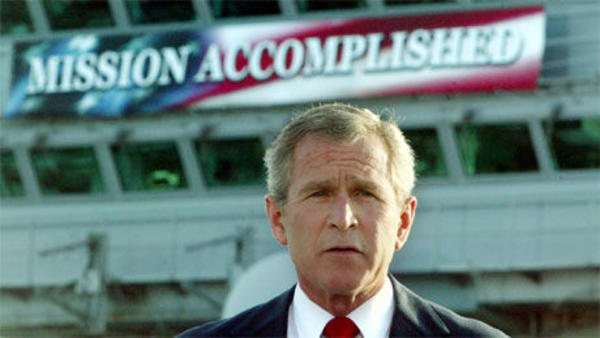
Tomgram: Danny Sjursen, Mission Unaccomplished, 15 Years Later

If you’re going to surround yourself with generals in the Oval Office, as Donald Trump has done, that means one thing in these years: you’re going to appoint men whose careers were made (or unmade) by what was once known as the Global War on Terror. They will be deeply associated with Washington’s 15 years of disastrous wars and conflicts in the Greater Middle East, which have left that region a set of failed or near-failed states and a hotbed of terror outfits, including various branches of al-Qaeda and the Islamic State. Secretary of Defense James “Mad Dog” Mattis, for instance, led troops in the initial post-invasion period in Afghanistan in 2001; in the taking of the Iraqi capital, Baghdad, in 2003; in the fierce fighting for the city of Fallujah in 2004; and then, from 2010 to 2013, he was in charge of U.S. Central Command (CENTCOM), with responsibility for the Greater Middle East. In that post, he cooked up a scheme to take out either an Iranian oil refinery or power plant in the “dead of night,” an act of war meant to pay that country back for supplying mortars to Iraqi insurgents killing American troops. That plan, nixed by the Obama White House, seems to have played a role in his removal from the CENTCOM post five months early.

General John Kelly, head of the Department of Homeland Security, also commanded troops and fought in Iraq. (His son was killed in Afghanistan in 2010.) Former National Security Adviser Michael Flynn held key intelligence positions in both Afghanistan and Iraq, while his temporary replacement (and now National Security Council chief of staff), General Joseph “Keith” Kellogg, retired and working with private contractor Oracle at the time of the invasion of Iraq, was sent to Baghdad as chief operating officer of the Coalition Provisional Authority that the Bush administration set up to run its ill-fated occupation of that country. He lasted only five months as that body began its “reconstruction” of Iraq, after disbanding Saddam’s army and so putting its officers and troops on the unemployment line, which meant at the disposal of the developing insurgency. Army Lieutenant General H.R. McMaster, the new national security adviser, just tapped for the job by Trump, isn't even retired and held command posts in both Iraq and Afghanistan.

On the evidence of these last years, such experiences seem to have tied these men to the war against terror in a deep and visceral way, making any major reconsideration of what they had lived through inconceivable. In the new Trump era, clues to this ongoing reality can already be found in two recent events: the first Trump-ordered action in the Greater Middle East, a thoroughly botched Special Operations raid in Yemen, which did not achieve its objective but got large numbers of civilians and one Navy SEAL killed and which, given the last 15 years of U.S. military action in the region, looked painfully familiar; and the request of the present U.S. Afghan commander, General John Nicholson Jr., for “several thousand” more American military advisers, one that it’s hard to imagine he would have made before the Senate Armed Services Committee without the agreement of Defense Secretary Mattis. It’s also a request that was clearly meant as no more than an opening bid in a potentially far larger surge of American forces into Afghanistan. (Where have you heard that before?)

Under the circumstances, it’s good to know that, even if not at the highest ranks of the U.S. military, there are officers who have been able to take in what they experienced up close and personal in Iraq and Afghanistan and make some new -- not desperately old -- sense of it. U.S. Army Major Danny Sjursen, a former history instructor at West Point and the author of Ghostriders of Baghdad: Soldiers, Civilians, and the Myth of the Surge, who writes his inaugural TomDispatch post today, is obviously one of them and I doubt he’s alone in the American armed forces after all these years. Tom

How We Got Here: The Misuse of American Military Power and The Middle East in Chaos

by Danny Sjursen

Here our nation stands, 15-plus years after 9/11, engaged militarily in half a dozen countries across the Greater Middle East, with no end in sight. Perhaps a more critical, factual reading of our recent past would illuminate the futility of America’s tragic, ongoing project to somehow “destroy” terrorism in the Muslim world.

The standard triumphalist version of the last 100 or so years of our history might go something like this: in the twentieth century, the United States repeatedly intervened, just in the nick of time, to save the feeble Old World from militarism, fascism, and then, in the Cold War, communism. It did indeed save the day in three global wars and might have lived happily ever after as the world’s “sole superpower” if not for the sudden emergence of a new menace. Seemingly out of nowhere, “Islamo-fascists” shattered American complacence with a sneak attack reminiscent of Pearl Harbor. Collectively the people asked: Why do they hate us? Of course, there was no time to really reflect, so the government simply got to work, taking the fight to our new “medieval” enemies on their own turf. It’s admittedly been a long, hard slog, but what choice did our leaders have? Better, after all, to fight them in Baghdad than Brooklyn.

What if, however, this foundational narrative is not just flawed but little short of delusional? Alternative accounts lead to wholly divergent conclusions and are more likely to inform prudent policy in the Middle East.

Let’s reconsider just two key years for the United States in that region: 1979 and 2003. America’s leadership learned all the wrong “lessons” from those pivotal moments and has intervened there ever since on the basis of some perverse version of them with results that have been little short of disastrous. A more honest narrative of those moments would lead to a far more modest, minimalist approach to a messy and tragic region. The problem is that there seems to be something inherently un-American about entertaining such thoughts.

1979 Revisited


Through the first half of the Cold War, the Middle East remained a sideshow. In 1979, however, all that changed radically. First, rising protests against the brutal police state of the American-backed Shah of Iran led to regime collapse, the return of dissident ayatollah Ruhollah Khomeini, and the declaration of an Islamic Republic. Then Iranian students stormed the U.S. embassy in Tehran, holding 52 hostages for more than 400 days. Of course, by then few Americans remembered the CIA-instigated coup of 1953 that had toppled a democratically elected Iranian prime minister, preserved Western oil interests in that country, and started both lands on this path (though Iranians clearly hadn’t forgotten). The shock and duration of the hostage crisis undoubtedly ensured that Jimmy Carter would be a one-term president and -- to make matters worse -- Soviet troops intervened in Afghanistan to shore up a communist government there. It was quite a year.

The alarmist conventional narrative of these events went like this: the radical mullahs running Iran were irrational zealots with an inexplicable loathing for the American way of life. As if in a preview of 9/11, hearing those chants against “the Great Satan,” Americans promptly began asking with true puzzlement: Why do they hate us? The hostage crisis challenged world peace. Carter had to do something. Worse yet, the Soviet invasion of Afghanistan represented blatant conquest and spotlighted the possibility of Red Army hordes pushing through to Iran en route to the Persian Gulf’s vast oil reserves. It might prove the opening act of the long awaited Soviet scheme for world domination or a possible path to World War III.

Misinformed by such a tale that they repeatedly told themselves, Washington officials then made terrible choices in the Middle East. Let’s start with Iran. They mistook a nationalist revolution and subsequent civil war within Islam for a singular attack on the U.S.A. With little consideration of genuine Iranian gripes about the brutal U.S.-backed dynasty of the Shah or the slightest appreciation for the complexity of that country’s internal dynamics, they created a simple-minded but convenient narrative in which the Iranians posed an existential threat to this country. Little has changed in almost four decades.

Then, though few Americans could locate Afghanistan on a map, most accepted that it was indeed a country of vital strategic interest. Of course, with the opening of their archives, it’s clear enough now that the Soviets never sought the worldwide empire we imagined for them, especially not by 1979. The Soviet leadership was, in fact, divided over the Afghan affair and intervened in Kabul in a spirit more defensive than aggressive. Their desire or even ability to drive towards the Persian Gulf was, at best, a fanciful American notion.

Nonetheless, the Iranian revolution and the Soviet invasion of Afghanistan were combined into a tale of horror that would lead to the permanent militarization of U.S. policy in the Middle East. Remembered today as a dove-in-chief, in his 1980 State of the Union address President Carter announced a decidedly hawkish new doctrine that would come to bear his name. From then on, he said, the U.S. would consider any threat to Persian Gulf oil supplies a direct threat to this country and American troops would, if necessary, unilaterally intervene to secure the region.

The results will seem painfully familiar today: almost immediately, Washington policymakers began to seek military solutions to virtually every problem in the Middle East. Within a year, the administration of President Ronald Reagan would, for instance, support Iraqi autocrat Saddam Hussein’s ruthless invasion of Iran, ignoring his more vicious antics and his proclivity for gassing his own people.

Soon after, in 1983, the military created the United States Central Command (headquarters: Tampa, Florida) with specific responsibility for the Greater Middle East. Its early war plans demonstrated just how wildly out of touch with reality American planners already were by then. Operational blueprints, for instance, focused on defeating Soviet armies in Iran before they could reach the Persian Gulf. Planners imagined U.S. Army divisions crossing Iran, itself in the midst of a major war with Iraq, to face off against a Soviet armored juggernaut (just like the one that was always expected to burst through Europe’s Fulda Gap). That such an assault was never coming, or that the fiercely proud Iranians might object to the militaries of either superpower crossing their territories, figured little in such early plans that were monuments to American arrogance and naïveté.

From there, it was but a few short steps to the permanent “defensive” basing of the Navy’s Fifth Fleet in Bahrain or later the stationing of U.S. troops near the holy cities of Mecca and Medina to protect Saudi Arabia from Iraqi attack. Few asked how such forces in the heart of the Middle East would play on the Arab street or corroborate Islamist narratives of “crusader” imperialism.

Worse yet, in those same years the CIA armed and financed a grab bag of Afghan insurgent groups, most of them extreme Islamists. Eager to turn Afghanistan into a Soviet “Vietnam,” no one in Washington bothered to ask whether such guerrilla outfits conformed to our purported principles or what the rebels would do if they won. Of course, the victorious guerrillas contained foreign fighters and various Arab supporters, including one Osama bin Laden. Eventually, the excesses of the well-armed but morally bankrupt insurgents and warlords in Afghanistan triggered the formation and ascension of the Taliban there, and from one of those guerrilla outfits came a new organization that called itself al-Qaeda. The rest, as they say, is history, and thanks to Chalmers Johnson’s appropriation of a classic CIA term of spy craft, we now know it as blowback.

That was a major turning point for the U.S. military. Before 1979, few of its troops had served in the region. In the ensuing decades, America bombed, invaded, raided, sent its drones to kill in, or attacked Iran, Lebanon, Libya, Saudi Arabia, Kuwait, Iraq, Somalia, Afghanistan, Pakistan, Yemen, Iraq again (and again), Somalia (again and again), Libya again, Iraq once more, and now Syria as well. Before 1979, few -- if any -- American military personnel died in the Greater Middle East. Few have died anywhere else since.

2003 and After: Fantasies and Reality


Who wouldn’t agree that the 2003 invasion of Iraq signified a major turning point both in the history of the Greater Middle East and in our own? Nonetheless, its legacy remains highly contested. The standard narrative goes like this: as the sole remaining superpower on the planet after the implosion of the Soviet Union in 1991, our invincible military organized a swift and convincing defeat of Saddam Hussein’s Iraq in the first Gulf War. After 9/11, that same military launched an inventive, swift, and triumphant campaign in Afghanistan. Osama bin Laden escaped, of course, but his al-Qaeda network was shattered and the Taliban all but destroyed.

Naturally, the threat of Islamic terror was never limited to the Hindu Kush, so Washington "had" to take its fight against terror global. Admittedly, the subsequent conquest of Iraq didn’t exactly turn out as planned and perhaps the Arabs weren’t quite ready for American-style democracy anyway. Still, the U.S. was committed, had shed blood, and had to stay the course, rather than cede momentum to the terrorists. Anything less would have dishonored the venerated dead. Luckily, President George W. Bush found an enlightened new commander, General David Petraeus, who, with his famed “surge,” snatched victory, or at least stability, from the jaws of defeat in Iraq. He had the insurgency all but whipped. Then, just a few years later, “spineless” Barack Obama prematurely pulled American forces out of that country, an act of weakness that led directly to the rise of ISIS and the current nightmare in the region. Only a strong, assertive successor to Obama could right such gross errors.

It’s a riveting tale, of course, even if it is misguided in nearly every way imaginable. At each turn, Washington learned the wrong lessons and drew perilous conclusions. At least the first Gulf War -- to George H.W. Bush’s credit -- involved a large multinational coalition and checked actual Iraqi aggression. Instead of cheering Bush the Elder’s limited, prudent strategy, however, surging neoconservatives demanded to know why he had stopped short of taking the Iraqi capital, Baghdad. In these years (and for this we can certainly thank Bush, among others), Americans -- Republicans and Democrats alike -- became enamored with military force and came to believe that it could solve just about any problem in that region, if not the world.

This would prove a grotesque misunderstanding of what had happened. The Gulf War had been an anomaly. Triumphalist conclusions about it rested on the shakiest of foundations. Only if an enemy fought exactly as the U.S. military preferred it to do, as indeed Saddam’s forces did in 1991 -- conventionally, in open desert, with outdated Soviet equipment -- could the U.S. expect such success. Americans drew another conclusion entirely: that their military was unstoppable.

The same faulty assumptions flowed from Afghanistan in 2001. Information technology, Special Forces, CIA dollars (to Afghan warlords), and smart bombs triggered victory with few conventional foot soldiers needed. It seemed a forever formula and influenced both the hasty decision to invade Iraq, and the irresponsibly undersized force structure deployed (not to speak of the complete lack of serious preparation for actually occupying that country). So powerful was the optimism and jingoism of invasion proponents that skeptics were painted as unpatriotic turncoats.

Then things turned ugly fast. This time around, Saddam’s army simply melted away, state institutions broke down, looting was rampant, and the three major communities of Iraq -- Sunni, Shia, and Kurd -- began to battle for power. The invaders never received the jubilant welcome predicted for them by Bush administration officials and supportive neocons. What began as a Sunni-based insurgency to regain power morphed into a nationalist rebellion and then into an Islamist struggle against Westerners.

Nearly a century earlier, Britain had formed Iraq from three separate Ottoman imperial provinces -- Baghdad, Basra, and Mosul. The 2003 invasion blew up that synthetic state, held together first by British overlords and then by Saddam’s brutal dictatorship. American policymakers seemed genuinely surprised by all this.

Those in Washington never adequately understood the essential conundrum of forced regime change in Iraq. “Democracy” there would inevitably result in Shia majority dominance of an artificial state. Empowering the Shia drove the Sunni minority -- long accustomed to power -- into the embrace of armed, motivated Islamists. When societies fracture as Iraq’s did, often enough the worst among us rise to the occasion. As the poet William Butler Yeats so famously put it, “Things fall apart; the center cannot hold; Mere anarchy is loosed upon the world, the blood-dimmed tide is loosed… The best lack all conviction, while the worst are full of passionate intensity.”

Furthermore, the invasion played directly into Osama bin Laden’s hands, fueling his narrative of an American “war on Islam.” In the process, the U.S. also destabilized Iraq’s neighbors and the region, spreading extremists to Syria and elsewhere.

That David Petraeus’s surge “worked” is perhaps the greatest myth of all. It was true that the steps he took resulted in a decrease in violence after 2007, largely because he paid off the Sunni tribes, not because of the modest U.S. troop increase ordered from Washington. By then, the Shia had already won the sectarian civil war for Baghdad, intensifying Sunni-Shia residential segregation there and so temporarily lessening the capacity for carnage.

That post-surge “calm” was, however, no more than a tactical pause in an ongoing regional sectarian war. No fundamental problems had been resolved in post-Saddam Iraq, including the nearly impossible task of integrating Sunni and Kurdish minorities into a coherent national whole. Instead, Washington had left a highly sectarian Shia strongman, Prime Minister Nouri al-Maliki, in control of the government and internal security forces, while al-Qaeda in Iraq, or AQI (nonexistent prior to the invasion), never would be eradicated. Its leadership, further radicalized in U.S. Army prisons, bided its time, waiting for an opportunity to win back Sunni fealty.

Luckily for AQI, as soon as the U.S. military was pulled out of the country, Maliki promptly cracked down hard on peaceful Sunni protests. He even had his Sunni vice president sentenced to death in absentia under the most questionable of circumstances. Maliki’s ineptitude would prove an AQI godsend.

Islamists, including AQI, also took advantage of events in Syria. Autocrat Bashar al-Assad’s brutal repression of his own protesting Sunni majority gave them just the opening they needed. Of course, the revolt there might never have occurred had not the invasion of Iraq destabilized the entire region. In 2014, the former AQI leaders, having absorbed some of Saddam’s cashiered officers into their new forces, triumphantly took a series of Iraqi cities, including Mosul, sending the Iraqi army fleeing. They then declared a caliphate in Iraq and Syria. Many Iraqi Sunnis naturally turned to the newly established “Islamic State” (ISIS) for protection.

Mission (Un)Accomplished!


It’s hardly controversial these days to point out that the 2003 invasion (aka Operation Iraqi Freedom), far from bringing freedom to that country, sowed chaos. Toppling Saddam’s brutal regime tore down the edifice of a regional system that had stood for nearly a century. However inadvertently, the U.S. military lit the fire that burned down the old order.

As it turned out, no matter the efforts of the globe’s greatest military, no easy foreign solution existed when it came to Iraq. It rarely does. Unfortunately, few in Washington were willing to accept such realities. Think of that as the twenty-first-century American Achilles' heel: unwarranted optimism about the efficacy of U.S. power. Policy in these years might best be summarized as: “we” have to do something, and military force is the best -- perhaps the only -- feasible option.

Has it worked? Is anybody, including Americans, safer? Few in power even bother to ask such questions. But the data is there. The Department of State counted just 348 terrorist attacks worldwide in 2001 compared with 11,774 attacks in 2015. That’s right: at best, America’s 15-year “war on terror” failed to significantly reduce international terrorism; at worst, its actions helped make matters 30 times worse.

Recall the Hippocratic oath: “First do no harm.” And remember Osama bin Laden’s stated goal on 9/11: to draw conventional American forces into attritional campaigns in the heart of the Middle East. Mission accomplished!

In today’s world of “alternative facts,” it’s proven remarkably easy to ignore such empirical data and so avoid thorny questions. Recent events and contemporary political discourse even suggest that the country’s political elites now inhabit a post-factual environment; in terms of the Greater Middle East, this has been true for years.

It couldn’t be more obvious that Washington’s officialdom regularly and repeatedly drew erroneous lessons from the recent past and ignored a hard truth staring them in the face: U.S. military action in the Middle East has solved nothing. At all. Only the government cannot seem to accept this. Meanwhile, an American fixation on one unsuitable term -- “isolationism” -- masks a more apt description of American dogma in this period: hyper-interventionism.

As for military leaders, they struggle to admit failure when they -- and their troops -- have sacrificed so much sweat and blood in the region. Senior officers display the soldier’s tendency to confuse performance with effectiveness, staying busy with being successful. Prudent strategy requires differentiating between doing a lot and doing the right things. As Einstein reputedly opined, “Insanity is doing the same thing over and over again and expecting a different result.”

A realistic look at America’s recent past in the Greater Middle East and a humbler perspective on its global role suggest two unsatisfying but vital conclusions. First, false lessons and misbegotten collective assumptions contributed to and created much of today’s regional mess. As a result, it’s long past time to reassess recent history and challenge long-held suppositions. Second, policymakers badly overestimated the efficacy of American power, especially via the military, to shape foreign peoples and cultures to their desires. In all of this, the agency of locals and the inherent contingency of events were conveniently swept aside.

So what now? It should be obvious (but probably isn’t in Washington) that it’s well past time for the U.S. to bring its incessant urge to respond militarily to the crisis of the moment under some kind of control. Policymakers should accept realistic limitations on their ability to shape the world to America’s desired image of it.

Consider the last few decades in Iraq and Syria. In the 1990s, Washington employed economic sanctions against Saddam Hussein and his regime. The result: tragedy to the tune of half a million dead children. Then it tried invasion and democracy promotion. The result: tragedy -- including 4,500-plus dead American soldiers, a few trillion dollars down the drain, more than 200,000 dead Iraqis, and millions more displaced in their own country or in flight as refugees.

In response, in Syria the U.S. tried only limited intervention. Result: tragedy -- upwards of 300,000 dead and close to seven million more turned into refugees.

So will tough talk and escalated military action finally work this time around as the Trump administration faces off against ISIS? Consider what happens even if the U.S achieves a significant rollback of ISIS. Even if, in conjunction with allied Kurdish or Syrian rebel forces, ISIS's “capital,” Raqqa, is taken and the so-called caliphate destroyed, the ideology isn’t going away. Many of its fighters are likely to transition back to an insurgency and there will be no end to international terror in ISIS’s name. In the meantime, none of this will have solved the underlying problems of artificial states now at the edge of collapse or beyond, divided ethno-religious groups, and anti-Western nationalist and religious sentiments. All of it begs the question: What if Americans are incapable of helping (at least in a military sense)?

A real course correction is undoubtedly impossible without at least a willingness to reconsider and reframe our recent historical experiences. If the 2016 election is any indication, however, a Trump administration with the present line-up of national security chiefs (who fought in these very wars) won’t meaningfully alter either the outlook or the policies that led us to this moment. Candidate Trump offered a hollow promise -- to “Make America Great Again” -- conjuring up a mythical era that never was. Meanwhile, Hillary Clinton offered only remarkably dated and stale rhetoric about America as the “indispensable nation.”

In the new Trump era, neither major party seems capable of escaping a shared commitment to the legends rather than the facts of America’s recent past in the Greater Middle East. Both sides remain eerily confident that the answers to contemporary foreign policy woes lie in a mythical version of that past, whether Trump’s imaginary 1950s paradise or Clinton’s fleeting mid-1990s “unipolar moment.”

Both ages are long gone, if they ever really existed at all. Needed is some fresh thinking about our militarized version of foreign policy and just maybe an urge, after all these years, to do so much less. Patriotic fables certainly feel good, but they achieve little. My advice: dare to be discomfited.

Major Danny Sjursen is a U.S. Army strategist and former history instructor at West Point. He served tours with reconnaissance units in Iraq and Afghanistan. He has written a memoir and critical analysis of the Iraq War, Ghostriders of Baghdad: Soldiers, Civilians, and the Myth of the Surge. He lives with his wife and four sons near Fort Leavenworth, Kansas.

[Note: The views expressed in this article are those of the author in an unofficial capacity and do not reflect the official policy or position of the Command and General Staff College, Department of the Army, Department of Defense, or the U.S. government.]

Follow TomDispatch on Twitter and join us on Facebook. Check out the newest Dispatch Book, John Feffer's dystopian novel Splinterlands, as well as Nick Turse’s Next Time They’ll Come to Count the Dead, and Tom Engelhardt's latest book, Shadow Government: Surveillance, Secret Wars, and a Global Security State in a Single-Superpower World.

Copyright 2017 Danny Sjursen

Monday, February 20, 2017

Boots on the Toxic Ground: Syria Like Iraq a Depleted Uranium Dump Site

US Terror-Bombed Syria with Toxic DU Munitions

by Stephen Lendman - sjlendman.blogspot.com


February 19, 2017

America uses banned depleted uranium (DU) weapons in all its wars, ongoing since first developed during the Vietnam era. The 1925 Geneva Protocol and succeeding Geneva Weapons Conventions prohibited use of chemical and biological agents in any form as weapons of war.

Although no Geneva Convention or other treaty specifically bans radioactive uranium weapons, including DU ones, they’re illegal de facto and de jure under the 1907 Hague Convention, prohibiting use of any “poison or poisoned weapons.”

DU munitions are radioactive, chemically toxic and poisonous. America is a signatory to the Hague and Geneva Conventions. Using these weapons in combat is a war crime.

US Code, Title 50, Chapter 40, Section 2302 defines a WMD as "any weapon or device that is intended, or has the capability, to cause death or serious bodily injury to a significant number of people through the release, dissemination, or impact of (A) toxic or poisonous chemicals or their precursors, (B) a disease organism, or (C) radiation or radioactivity.”

Armor-piercing DU munitions enable their ability to penetrate targets, enhancing their destructive capability. On detonation, depleted uranium aerializes, contaminating land, air and water, acting as a miniature dirty bomb.

It caused an epidemic of cancer, numerous other diseases and serious birth defects in Iraq - including children born with two heads, one eye, and legs grown together. Miscarriages are frequent. Hundreds of newborns had cleft pallets, elongated heads, overgrown or short limbs, and other malformed body parts.

Iraq remains a toxic wasteland. So do other US war theaters. The Pentagon admitted using thousands of DU rounds in Syria in 2015, falsely claiming attacks were against ISIS, imperial foot soldiers America created and supports.

Pentagon warplanes began terror-bombing Syria in September 2014, conducting thousands of airstrikes, continuing under Trump against infrastructure and government targets. It’s unknown if DU weapons were used throughout this period, as well as against Iraq since US terror-bombing began in June 2014 - on the phony pretext of combating ISIS. Whatever the Pentagon admitted to is likely a small fraction of what it’s done.

Its high crimes are notoriously whitewashed. In March 2015, US-led coalition spokesman John Moore lied, saying its warplanes “have not been and will not be using depleted uranium munitions in Iraq or Syria…”

Now we know part of the truth. Most of it remains hidden.

Stephen Lendman lives in Chicago. He can be reached at lendmanstephen@sbcglobal.net.
His new book as editor and contributor is titled "Flashpoint in Ukraine: How the US Drive for Hegemony Risks WW III." http://www.claritypress.com/LendmanIII.html
Visit his blog site at sjlendman.blogspot.com.

Listen to cutting-edge discussions with distinguished guests on the Progressive Radio News Hour on the Progressive Radio Network.

Fukushima Lurking: Is There Any Stopping This Global Catastrophe?

Fukushima – A Lurking Global Catastrophe?

by Robert Hunziker - Pacific Free Press


February 19, 2017

Los Angeles - Year over year, ever since 2011, the Fukushima Daiichi nuclear meltdown grows worse and worse, an ugly testimonial to the inherent danger of generating electricity via nuclear fission, which produces isotopes, some of the most deadly poisonous elements on the face of the planet. Fukushima Diiachi has been, and remains, one of the world’s largest experiments, i.e. what to do when all hell breaks loose, aka The China Syndrome.

“Scientists still don’t have all the information they need for a cleanup that the government estimates will take four decades and cost ¥8 trillion. It is not yet known if the fuel melted into or through the containment vessel’s concrete floor, and determining the fuel’s radioactivity and location is crucial to inventing the technology to remove the melted fuel,” (Emi Urabe, Fukushima Fuel-Removal Quest Leaves Trail of Dead Robots, The Japan Times, Feb. 17, 2017).

As it happens, “”inventing technology” is experimental stage stuff. Still, there are several knowledgeable sources that believe the corium, or melted core, will never be recovered. Then what?

According to a recent article, “Potential Global Catastrophe of the Reactor No. 2 at Fukushima Daiichi,” d/d Feb. 11, 2017 by Dr. Shuzo Takemoto, professor, Department of Geophysics, Graduate School of Science, Kyoto University: The Fukushima nuclear facility is a global threat on level of a major catastrophe.

Meanwhile, the Abe administration dresses up Fukushima Prefecture for the Tokyo 2020 Olympics, necessitating a big fat question: Who in their right mind would hold Olympics in the neighborhood of three out-of-control nuclear meltdowns that could get worse, worse, and still worse? After all, that’s the pattern over the past 5 years; it gets worse and worse. Dismally, nobody can possibly know how much worse by 2020. Not knowing is the main concern about holding Olympics in the backyard of a nuclear disaster zone, especially as nobody knows what’s happening. Nevertheless and resolutely, according to PM Abe and the IOC, the games go on.

Along the way, it’s taken Tokyo Electric Power Company (TEPCO) nearly six years to finally get an official reading of radiation levels of the meltdown but in only one unit. Analysis of Unit #2 shows radiation levels off-the-charts at 530 Sieverts, or enough to kill within minutes, illustrative of why it is likely impossible to decommission units 1, 2, and 3. No human can withstand that exposure and given enough time, frizzled robots are as dead as a door nail.

“A short-term, whole-body dose of over 10 sieverts would cause immediate illness and subsequent death within a few weeks, according to the World Nuclear Association” (Emi Urabe, Fukushima Fuel-Removal Quest Leaves Trail of Dead Robots, The Japan Times, Feb. 17, 2017).

Although Fukushima’s similar to Chernobyl Exclusion Zone in some respects, where 1,000 square miles has been permanently sealed off, Fukushima’s different, as the Abe administration is already repopulating portions of Fukushima. If they don’t repopulate, how can the Olympics be held with food served from Fukushima and including events like baseball held in Fukushima Prefecture?

Without question, an old saw - what goes around comes around - rings true when it comes to radiation, and it should admonish (but it doesn’t phase ‘em) strident nuclear proponents, claiming Fukushima is an example of how safe nuclear power is “because there are so few, if any, deaths” (not true). As Chernobyl clearly demonstrates: Over time, radiation cumulates in bodily organs. For a real life example of how radiation devastates human bodies, consider this fact: 453,391 children with bodies ravaged, none born at the time of the Chernobyl meltdown in 1986, today receive special healthcare because of Chernobyl radiation-related medical problems like cancer, digestive, respiratory, musculoskeletal, eye disease, blood disease, congenital malformation, and genetic abnormalities. Their parents were children in the Chernobyl zone in 1986 (Source: Chernobyl’s Legacy: Kids With Bodies Ravaged by Disaster, USA Today, April 17, 2016).

Making matters worse yet, Fukushima Diiachi sets smack dab in the middle of earthquake country, which defines the boundaries of Japan. In that regard, according to Dr. Shuzo Takemoto, professor, Department of Geophysics, Graduate School of Science, Kyoto University: “The problem of Unit 2… If it should encounter a big earth tremor, it will be destroyed and scatter the remaining nuclear fuel and its debris, making the Tokyo metropolitan area uninhabitable. The Tokyo Olympics in 2020 will then be utterly out of the question,” (Shuzo Takemoto, Potential Global Catastrophe of the Reactor No. 2 at Fukushima Daiichi, February 11, 2017).

Accordingly, the greater Tokyo metropolitan area remains threatened for as long as Fukushima Diiachi is out of control, which could be for generations, not years. Not only that, Gee-Whiz, what if the big one hits during the Olympics? After all, earthquakes come unannounced. Regrettably, Japan has had 564 earthquakes the past 365 days. It’s an earthquake-ridden country. Japan sits at the boundary of 4 tectonic plates shot through with faults in zigzag patterns, very lively and of even more concern, the Nankai Trough, the candidate for the big one, sits nearly directly below Tokyo. On a geological time scale, it may be due for action anytime within the next couple of decades. Fukushima Prefecture’s not that far away.

Furthermore, the Fukushima Diiachi nuclear complex is tenuous, at best:

“All four buildings were structurally damaged by the original earthquake some five years ago and by the subsequent hydrogen explosions so should there be an earthquake greater than seven on the Richter scale, it is very possible that one or more of these structures could collapse, leading to a massive release of radiation as the building falls on the molten core beneath.” (Helen Caldicott: The Fukushima Nuclear Meltdown Continues Unabated, Independent Australia, February 13, 2017).

Complicating matters further, the nuclear site is located at the base of a mountain range. Almost daily, water flows from the mountain range beneath the nuclear plant, liquefying the ground, a sure-fire setup for cascading buildings when the next big one hits.

For over five years now, radioactive water flowing out of the power plant into the Pacific carries isotopes like cesium 134 and cesium 137, strontium 90, tritium, plutonium americium and up to 100 more isotopes, none of which are healthy for marine or human life, quite the opposite in fact as those isotopes slowly cumulate, and similar to the Daleks of Doctor Who fame (BBC science fiction series, 1963-present) “Exterminate! Exterminate! Exterminate!”

Isotopes bio-concentrate up the food chain from algae to crustaceans to small fish to big fish to bigger humans. Resultant cancer cells incubate anytime from two years to old age, leading to death. That’s what cancer does; it kills.

Still, the fact remains nobody really knows for sure how directly Fukushima Diiachi radiation affects marine life, but how could it be anything other than bad? After all, it’s a recognized fact that radiation cumulates over time; it’s tasteless, colorless, and odorless as it cumulates in the body, whether in fish or further up the food chain in humans. It travels!

An example is Cesium 137 one of the most poisonous elements on the planet. One gram of Cesium 137 the size of a dime will poison one square mile of land for hundreds of years. That’s what’s at stake at the world’s most rickety nuclear plant, and nobody can do anything about it. In fact, nobody knows what to do. They really don’t.

When faced with the prospect of not knowing what to do, why not bring on the Olympics? That’s pretty good cover for a messy situation, making it appear to hundreds of thousands of attendees, as well as the world community “all is well.” But, is it? Honestly….

The Fukushima nuclear meltdown presents a special problem for the world community. Who knows what to believe after PM Abe lied to the IOC to get the Olympics; see the following headline from Reuters News: “Abe’s Fukushima ‘Under Control’ Pledge to Secure Olympics Was a Lie: Former PM,” Reuters, Sept. 7, 2016.

“Abe gave the assurances about safety at the Fukushima plant in his September 2013 speech to the International Olympic Committee to allay concerns about awarding the Games to Tokyo. The comment met with considerable criticism at the time… Mr. Abe's 'under control remark, that was a lie,’ Koizumi (former PM) now 74 and his unruly mane of hair turned white, told a news conference where he repeated his opposition to nuclear power,” Ibid.

As such, a very big conundrum precedes the 2020 games: How can the world community, as well as Olympians, believe anything the Abe administration says about the safety and integrity of Fukushima?

Still, the world embraces nuclear power more so than ever before as it continues to expand and grow. Sixty reactors are currently under construction in fifteen countries. In all, 160 power reactors are in the planning stage and 300 more have been proposed. Pro-Nuke-Heads claim Fukushima proves how safe nuclear power is because there are so few, if any, deaths, as to be inconsequential. That's a boldfaced lie.

Here’s one of several independent testimonials on deaths because of Fukushima Diiachi radiation exposure (many, many, many more testimonials are highlighted in prior articles, including USS Ronald Reagan sailors on humanitarian rescue missions at the time):

“It’s a real shame that the authorities hide the truth from the whole world, from the UN. We need to admit that actually many people are dying. We are not allowed to say that, but TEPCO employees also are dying. But they keep mum about it,” Katsutaka Idogawa, former mayor of Futaba (Fukushima Prefecture), Fukushima Disaster: Tokyo Hides Truth as Children Die, Become Ill from Radiation – Ex-Mayor, RT News, April 21, 2014.

Sunday, February 19, 2017

Talking with Russians: "Have You Now, Or Have You Ever..."

The Did-You-Talk-to-Russians Witch Hunt

by Robert Parry  - Consortium News


February 18, 2017

In the anti-Russian frenzy sweeping American politics and media, Democrats, liberals and mainstream pundits are calling for an investigative body that could become a new kind of House Un-American Activities Committee to hunt down Americans who have communicated with Russians. The proposed commission would have broad subpoena powers to investigate alleged connections between Trump’s supporters and the Russian government with the apparent goal of asking if they now have or have ever talked to a Russian who might have some tie to the Kremlin or its intelligence agencies.
Senator Joe McCarthy with Roy Cohn

Such an admission apparently would be prima facie evidence of disloyalty, a guilt-by-association “crime” on par with Sen. Joe McCarthy’s Cold War pursuit of “communists” who supposedly had infiltrated the U.S. government, the film industry and other American institutions.

Operating parallel to McCarthy’s Red Scare hearings was the House Un-American Activities Committee (or HUAC), a standing congressional panel from 1945-1975 when it was best known for investigating alleged communist subversion and propaganda. One of its top achievements was the blacklisting of the “Hollywood Ten” whose careers in the movie industry were damaged or destroyed.

Although the Cold War has long been over – and Russia has often cooperated with the U.S. government, especially on national security issues such as supplying U.S. troops in Afghanistan – Democrats and liberals seem ready to force Americans to again prove their loyalty if they engaged in conversations with Russians.

Or perhaps these “witnesses” can be entrapped into perjury charges if their recollections of conversations with Russians don’t match up with transcripts of their intercepted communications, a tactic similar to ones used by Sen. McCarthy and HUAC to trip up and imprison targets over such secondary charges.

Ousted National Security Advisor Michael Flynn has already encountered such a predicament because he couldn’t recall all the details of a phone conversation with Russian Ambassador Sergey Kislyak on Dec. 29, 2016, after Flynn took the call while vacationing in the Dominican Republic.

When Obama administration holdovers at the Justice Department decided to gin up a legal premise to go after Flynn, they cited the Logan Act, a law enacted in 1799 to prohibit private citizens from negotiating with foreign adversaries but never used to convict anyone. The law also is of dubious constitutionality and was surely never intended to apply to a president-elect’s advisers.

However, based on that flimsy pretext, FBI agents – with a transcript of the electronic intercept of the Kislyak-Flynn phone call in hand – tested Flynn’s memory of the conversation and found his recollections incomplete. Gotcha – lying to the FBI!

Under mounting media and political pressure, President Trump fired Flynn, apparently hoping that tossing Flynn overboard to the circling sharks would somehow calm the sharks down. Instead, blood in the water added to the frenzy.

Iran-Contra Comparison


Some prominent Democrats and liberals have compared Trump-connected contacts with Russians to President Richard Nixon’s Watergate scandal or President Reagan’s Iran-Contra Affair, an issue that I know a great deal about having helped expose it as a reporter for The Associated Press in the 1980s.

The key difference is that Iran-Contra was an unconstitutional effort by the Reagan administration to finance an illegal war against Nicaragua’s Sandinista government in defiance of a congressional ban. The Trump-connected communications with Russians – to the degree they have occurred – appear to have been aimed at preventing a new and dangerous Cold War that could lead to a nuclear holocaust.

In other words, Iran-Contra was about enabling a paramilitary force to continue its brutal marauding inside a country that was no threat to the United States while the current “scandal” is about people trying to avoid hostilities between two nuclear superpowers, an existential threat that many mainstream and liberal pundits don’t want to recognize.

Indeed, there is a troubling denial-ism about the risks of an accidental or intentional war with Russia as the U.S. media and much of Official Washington’s establishment have lots of fun demonizing Russian President Vladimir Putin and jabbing the Russians by shoving NATO troops up to their borders and deploying anti-ballistic missiles in Eastern Europe. For some crazy reason, the Russians feel threatened.

False Narratives


This Russia-bashing and Russia-baiting have been accompanied by false narratives presented in the major U.S. newspapers, including The New York Times and The Washington Post, to justify increased tensions.

For instance, the Post’s senior foreign affairs writer Karen DeYoung on Friday described the civil war in Ukraine this way: “That conflict began when Russia invaded and annexed Crimea in 2014, then backed separatists in eastern Ukraine in what has become a grinding war, despite a deal to end it, called the Minsk agreement, negotiated with Putin by the leaders of France and Germany.”

But DeYoung’s synopsis is simply not true. The crisis began in the fall of 2013 when Ukraine’s elected President Viktor Yanukovych backed out of what he regarded as a costly and unacceptable association agreement with the European Union, a move which prompted protests by Ukrainians in Kiev’s Maidan square.

The Obama administration’s State Department, U.S. neocon politicians such as Sen. John McCain, and various U.S.-backed “non-governmental organizations” then stoked those protests against Yanukovych, which grew violent as trained ultra-nationalist and neo-Nazi street fighters poured in from western Ukraine.

In early 2014, a coup to overthrow the democratically elected Yanukovych took shape under the guidance of U.S. Assistant Secretary of State Victoria Nuland and U.S. Ambassador to Ukraine Geoffrey Pyatt who were caught in a phone call in late January or early February 2014 conspiring to impose new leadership inside Ukraine.

Nuland disparaged a less extreme strategy favored by European diplomats with the pithy remark: “Fuck the E.U.” and went on to declare “Yats is the guy,” favoring Arseniy Yatsenyuk as the new leader. Nuland then pondered how to “glue this thing” while Pyatt ruminated about how to “midwife this thing.”

On Feb. 20, 2014, a mysterious sniper apparently firing from a building controlled by the ultranationalist Right Sektor killed both police and protesters, setting off a day of violence that left about 70 people dead including more than a dozen police.

The next day, three European governments struck a deal with Yanukovych in which he agreed to early elections and accepted reduced powers. But that political settlement wasn’t enough for the U.S.-backed militants who stormed government buildings on Feb. 22, forcing Yanukovych and his officials to flee for their lives.

Instead of standing by the Feb. 21 agreement, which the European nations had “guaranteed,” Nuland pushed for and got U.S. allies to accept the new post-coup regime as “legitimate,” with Yatsenyuk becoming prime minister and several top government posts given to the ultranationalists and neo-Nazis.

Spreading Violence


In the ensuing days, the right-wing violence spread beyond Kiev, prompting Crimea’s legislature to propose secession from Ukraine and readmission to Russia, whose relationship to the peninsula dated back to Catherine the Great.

Crimea scheduled a referendum that was opposed by the new regime in Kiev. Russian troops did not “invade” Crimea because some 20,000 were already stationed there as part of a basing agreement at the Black Sea port of Sevastopol. The Russians did provide security for the referendum but there was no evidence of intimidation as the citizens of Crimea voted by 96 percent to leave Ukraine and rejoin Russia, a move that Putin and the Russian duma accepted.

Eastern Ukrainians tried to follow Crimea’s lead with their own referendum, but Putin and Russia rejected their appeals to secede. However, when the Kiev regime launched an “Anti-Terrorism Operation” against the so-called Donbass region – spearheaded by ultra-nationalist and neo-Nazi militias – Russia provided military assistance so these ethnic Russians would not be annihilated.

Karen DeYoung also framed the Minsk agreement as if it were imposed on Putin when he was one of its principal proponents and architects, winning its approval in early 2015 at a time when the Ukrainian military was facing battlefield reversals.

But Assistant Secretary Nuland, working with Prime Minister Yatsenyuk and the Ukrainian parliament, sabotaged the agreement by requiring the Donbass rebels to first surrender which they were unwilling to do, having no faith in the sincerity of the Kiev regime to live up to its commitment to grant limited autonomy to the Donbass.

In other words, Kiev inserted a poison pill to prevent a peaceful resolution, but the Western media and governments always blame the Minsk failure on Putin.

If Karen DeYoung wanted to boil all this history down to one paragraph, it might go: “The Ukraine conflict began when U.S. officials supported the violent overthrow of elected President Viktor Yanukovych, prompting Crimea to rejoin Russia and causing ethnic Russians in the east to rise up against the U.S.-backed coup regime in Kiev, which then sought to crush the rebellion. The Kiev regime later torpedoed a peace deal that had been hammered out by Russian, Ukrainian and European negotiators in Minsk.”

But such a summary would not have the desired propaganda effect on the American people. It would not present the U.S.-backed side as the “white hats” and the pro-Russia side as the “black hats.”

The simple truth is that the story of Ukraine is far more complex and multi-sided than The Washington Post, The New York Times and most mainstream U.S. news outlets want to admit. They simply start the clock at the point of Crimea’s rejection of the post-coup regime and distort those facts to present the situation simply as a “Russian invasion.”

A Whipped-Up Hysteria


The major media’s distortion is so egregious that you could call it a lie, but it is a lie that has proved very useful in whipping up the current anti-Russian hysteria that is sweeping Official Washington and that has given birth to a New Cold War, now accompanied by a New McCarthyism that deems anyone who doesn’t accept the “groupthink” a “Russian apologist” or a “Moscow stooge.”

Since last November’s election, this New McCarthyism has merged with hatred toward Donald Trump, especially after the outgoing Obama administration lodged unproven accusations that Russia undercut Hillary Clinton’s campaign by hacking into the emails of the Democratic National Committee and those of her campaign chairman John Podesta – and slipped that information to WikiLeaks.

Those emails showed how the DNC undercut the rival campaign of Sen. Bernie Sanders and revealed the contents of Clinton’s speeches to Wall Street banks as well as pay-to-play aspects of the Clinton Foundation, information that Clinton wanted to keep from the voters.

But no one thought the emails were a major factor in the Clinton-Trump race; indeed, Clinton blamed her stunning defeat on FBI Director James Comey’s last-minute decision to reopen and then re-close his investigation into security concerns about her use of a private email server as Secretary of State.

But the script on how Clinton lost was flipped during the Trump transition as President Obama’s intelligence agencies floated the Russia-hacked-the-election scenario although presenting no public evidence to support the claims. WikiLeaks representatives also denied getting the material from Russia, suggesting instead that it was leaked by two different American insiders.

A Ministry of Truth


Still, during the post-election period, the anti-Russian hysteria continued to build. In November, The Washington Post highlighted claims by an anonymous group called PropOrNot accusing some 200 Web sites, including Consortiumnews.com and other major independent media outlets, of disseminating Russian “propaganda.”

The New York Times joined in the frenzy by calling for leading technology companies to marginalize Web sites that are deemed to be publishing “fake news,” a vague term that was applied not just to intentionally false stories but to information that questioned official narratives, no matter how dubious those narratives were. The New McCarthyism was morphing into a New Orwellianism.

The movement toward a Ministry of Truth gained further momentum in December when Congress passed and President Obama signed a military authorization bill that included a new $160 million bureaucracy to identify and counter alleged “Russian propaganda.”

The anger of Democrats and liberals toward President Trump in his first month has added more fuel to the Russia-bashing with some Democrats and liberals seeing it as a possible route toward neutralizing or impeaching Trump. Thus, the calls for a full-scale investigation with subpoena power to demand documents and compel testimony.

While the idea of getting to the full truth has a superficial appeal, it also carries dangers of launching a witch hunt that would drag American citizens before inquisitors asking about any contacts – no matter how innocuous – with Russians.

In the late 1940s and early 1950s, HUAC also claimed that all it wanted was the truth about whether some Americans were allied with or sympathetic to Moscow. Sen. Joe McCarthy offered a similar rationale when he was trying to root out “disloyal” Americans with the question, “are you now or have you ever been a communist?”

That Democrats and liberals who hold the McCarthy era in understandable disdain would now seek to rekindle something similar reeks of rank opportunism and gross hypocrisy – doing whatever it takes to “get Trump” and build an activist movement that can revive the Democratic Party’s flagging political hopes.

But this particular opportunism and hypocrisy also carries with it the prospect of blindly ramping up tensions with Russia, diverting more taxpayer money into the Military-Industrial Complex and conceivably sparking – whether planned or unplanned – a nuclear Armageddon that could eliminate life on the planet. Perhaps this anti-Trump strategy should be rethought.

Investigative reporter Robert Parry broke many of the Iran-Contra stories for The Associated Press and Newsweek in the 1980s. You can buy his latest book, America’s Stolen Narrative, either in print here or as an e-book (from Amazon and barnesandnoble.com).

Friday, February 17, 2017

Bigger Than Russia: Trump Revolution Drowns in Asia Pivot Gyre

Blood in the Water: the Trump Revolution Ends in a Whimper

by Mike Whitney - CounterPunch


February 17, 2017

The Flynn fiasco is not about national security advisor Michael Flynn’s conversations with the Russian ambassador. It’s much deeper than that.

It’s about Russia. It’s about Putin. It’s about the explosive rise of China and the world’s biggest free trade zone that will eventually stretch from Lisbon to Vladivostok. 
Photo: woodleywonderworks | CC BY 2.0 

It’s about the one country in the world that is obstructing Washington’s plan for global domination. (Russia) And, it’s about the future; which country will be the key player in the world’s most prosperous and populous region, Asia. That’s what’s at stake, and that’s what the Flynn controversy is really all about.

Many readers are familiar with the expression “pivot to Asia”, but do they know what it means?

It means the United States has embarked on an ambitious plan to extend its military grip and market power over the Eurasian landmass thus securing its position as the world’s only superpower into the next century. The pivot is Washington’s top strategic priority. As Hillary Clinton said in 2011:

“Harnessing Asia’s growth and dynamism is central to American economic and strategic interests… Open markets in Asia provide the United States with unprecedented opportunities for investment, trade, and access to cutting-edge technology…..American firms (need) to tap into the vast and growing consumer base of Asia…

The region already generates more than half of global output and nearly half of global trade…. we are looking for opportunities to do even more business in Asia…and our investment opportunities in Asia’s dynamic markets.”(“America’s Pacific Century”, Secretary of State Hillary Clinton”, Foreign Policy Magazine, 2011)

In other words, it’s pivot or bust. Those are the only two options. Naturally, ruling elites in the US have chosen the former over the latter, which means they are committed to a strategy that will inevitably pit the US against a nuclear-armed adversary, Russia.

Trump’s National Security Advisor, Michael Flynn, wanted to normalize relations with Russia. He rejected the flagrantly hostile approach of the US foreign policy establishment. That’s why he had to be removed. And, that’s why he’s been so viciously attacked in the media and why the threadbare story about his contacts with the Russian ambassador were used to force his resignation.

This isn’t about the law and it isn’t about the truth. It’s about bare-knuckle geopolitics and global hegemony. Flynn got in the way of the pivot, so Flynn had to be eliminated. End of story. Here’s a clip from an article by Robert Parry:

“Flynn’s real “offense” appears to be that he favors détente with Russia rather than escalation of a new and dangerous Cold War. Trump’s idea of a rapprochement with Moscow – and a search for areas of cooperation and compromise – has been driving Official Washington’s foreign policy establishment crazy for months and the neocons, in particular, have been determined to block it.

Though Flynn has pandered to elements of the neocon movement with his own hysterical denunciations of Iran and Islam in general, he emerged as a key architect for Trump’s plans to seek a constructive relationship with Russian President Vladimir Putin, Meanwhile, the neocons and their liberal-interventionist sidekicks have invested heavily in making Putin the all-purpose bête noire to justify a major investment in new military hardware and in pricey propaganda operations.” (“Trump Caves on Flynn’s resignation“, Consortium News)

US foreign policy is not developed willy-nilly. It emerges as the consensus view of various competing factions within the permanent national security state. And, although there are notable differences between the rival factions (either hardline or dovish) there appears to be unanimity on the question of Russia. There is virtually no constituency within the political leadership of either of the two major parties (or their puppetmaster supporters in the deep state) for improving relations with Russia. None. Russia is blocking Washington’s eastward expansion, therefore, Russia must be defeated.

Here’s more from the World Socialist Web Site:

“US imperialism seeks to counter its declining world economic position by exploiting its unchallenged global military dominance. It sees as the principal roadblocks to its hegemonic aims the growing economic and military power of China and the still-considerable strength of Russia, possessor of the world’s second-largest nuclear arsenal, the largest reserves of oil and gas, and a critical geographical position at the center of the Eurasian land mass.

Trump’s opponents within the ruling class insist that US foreign policy must target Russia with the aim of weakening the Putin regime or overthrowing it. This is deemed a prerequisite for taking on the challenge posed by China.

Numerous Washington think tanks have developed scenarios for military conflicts with Russian forces in the Middle East, in Ukraine, in the Baltic States and in cyberspace. The national security elite is not prepared to accept a shift in orientation away from the policy of direct confrontation with Russia along the lines proposed by Trump, who would like for the present to lower tensions with Russia in order to focus first on China.” (“Behind the Flynn resignation and Trump crisis: A bitter conflict over imperialist policy“, WSWS)

Foreign policy elites believe the US and its NATO allies can engage Russia in a shooting war without it expanding into a regional conflict and without an escalation into a nuclear conflagration. It’s a risky calculation but, nevertheless, it is the rationale behind the persistent build up of troops and weaponry on Russia’s western perimeter. Take a look at this from the Independent:

“Thousands of Nato troops have amassed close to the border with Russia as part of the largest build-up of Western troops neighbouring Moscow’s sphere of influence since the Cold War…Tanks and heavy armoured vehicles, plus Bradley fighting vehicles and Paladin howitzers, are also in situ and British Typhoon jets from RAF Conningsby will be deployed to Romania this summer to contribute to Nato’s Southern Air Policing mission…

Kremlin officials claim the build-up is the largest since the Second World War.” (“The map that shows how many Nato troops are deployed along Russia’s border“, The Independent)

Saber-rattling and belligerence have cleared the way for another world war. Washington thinks the conflict can be contained, but we’re not so sure.

The inexperienced Trump– who naively believed that the president sets his own foreign policy–has now learned that that’s not the case. The Flynn slap-down, followed by blistering attacks in the media and threats of impeachment, have left Trump shaken to the core. As a result, he has done a speedy about-face and swung into damage control-mode. On Tuesday, he tried to extend the olive branch by tweeting that “Crimea was taken by Russia” and by offering to replace Flynn with a trusted insider who will not veer from the script prepared by the foreign policy establishment. Check out this blurb on the Foreign Policy magazine website on Wednesday:

“President Donald Trump offered the job of national security advisor to retired Vice Adm. Robert Harward on Monday night…If, as expected, Harward accepts the job today, he is likely to bring in his own team, from deputy on down, with a focus on national security types with some experience under their belts…

Harward also would work well with Defense Secretary James Mattis. When Mattis was chief of Central Command, Harward was his deputy. Mattis trusted him enough to put him in charge of planning for war with Iran. Mattis has urged Harward to take the NSA job.

If Harward becomes NSA, Mattis would emerge from the Flynn mess in a uniquely powerful position: He would have two of his former deputies at the table in some meetings. The other one is John Kelly, now secretary for Homeland Security, who was his number two when Mattis commanded a Marine division early in the invasion of Iraq in 2003.” (“A Mattis protégé poised to take the helm of Trump’s NSC,” Foreign Policy)

In other words, Trump is relinquishing control over foreign policy and returning it to trusted insiders who will comply with pre-set elitist guidelines. Trump’s sudden metamorphosis was apparent in another story that appeared in Wednesday’s news, this time related to Rex Tillerson and General Joseph Dunford. Here’s a clip from CNN:

“Secretary of State Rex Tillerson and Chairman of the Joint Chiefs of Staff Gen. Joseph Dunford meet face to face with their Russian counterparts Thursday, as the Trump administration evaluates the future direction of US-Russian relations….But even as Tillerson’s plane was taking off in Washington, the Pentagon announced the meeting between Dunford and his Russian counterpart Valeriy Gerasimov, which will take place Thursday in Baku, Azerbaijan….

“The military leaders will discuss a variety of issues including the current state of U.S.-Russian military relations …Trump’s envoys have been expressing positions more keeping with previous US policies. …

Ambassador to the United Nations, Nikki Haley, indicated the US would maintain sanctions on Russia for annexing Crimea in 2014. She condemned what she called the “Russian occupation” of the Ukrainian territory…

The US has deployed thousands of troops and tanks to Poland and Romania in recent weeks, while other NATO allies have sent troops to Latvia, Lithuania and Estonia.

“There is a common message from the President, from his security team, the secretary of state, the secretary of defense, that they stay strongly committed to NATO,” he added.

Let’s summarize: The sanctions will remain, the tanks are on the border, the commitment to NATO has been reinforced, and Dunford is going to explain Washington’s strategic objectives to his Russian counterpart in clear, unambiguous language. There will be no room for Tillerson, who is on friendly terms with Putin, to change the existing policy or to normalize relations; Dunford, Haley, and Defense Secretary James Mattis will make sure of that.

As for Trump, it’s clear by the Crimea tweet, the sacking of Flynn and the (prospective) appointment of Harward, that he’s running scared and is doing everything in his power to get out of the hole he’s dug for himself. There’s no way of knowing whether he’ll be allowed to carry on as before or if he’ll be forced to throw other allies, like Bannon or Conway, under the bus. I would expect the purge to continue and to eventually include Trump himself. But that’s just a guess.

The hope that Trump would bring an element of sanity to US foreign policy has now been extinguished. The so called “Trump Revolution” has fizzled out before it ever began.

In contrast, the military buildup along Russia’s western flank continues apace.
 
MIKE WHITNEY lives in Washington state. He is a contributor to Hopeless: Barack Obama and the Politics of Illusion (AK Press). Hopeless is also available in a Kindle edition. He can be reached at fergiewhitney@msn.com.
More articles by:Mike Whitney