Monday, March 20, 2017

Bombardier Fast Tracking Palestinian Dispossession

Bombardier and Israel: A corporation’s complicity in Palestinian dispossession

by Dave Thomas - Briarpatch Magazine


February 13, 2017

In two small Palestinian villages in the West Bank – Beit Iksa and Beit Sourik – residents have struggled against Israeli occupation and annexation of their land for many years.


illustration Amanda Priebe


While the Israeli state has historically confiscated land around these villages to build illegal settlements and the separation wall, the most recent land seizures are for a different purpose – the construction of a high-speed rail line connecting Tel Aviv to Jerusalem, promising to move travellers over the 56 kilometres between the cities in 28 minutes flat.

The route passes through the occupied West Bank in two places and crosses the Green Line – the demarcation line between Israel and its neighbours that was negotiated after the 1948 Arab–Israeli war and held until 1967.

The Beit Sourik Village Council emphatically states:

“We, the people of Beit Surik, do not want the train line to be built on our land. We see as fundamentally important that the people of the world support our right to decide on the use of our own land and help us change the route of this train line.” 

Despite these demands from Palestinians, the proposed train route has remained unchanged, and construction is proceeding as planned.

If you have not heard of these villages, or the A1 rail line in question, you are not alone. Mainstream media in Canada tends to mute dissenting Palestinian voices from villages like Beit Iksa and Beit Sourik, despite the gravity of the situation they face. But the decidedly Canadian connection to this case cannot be ignored. Within one of the most deeply contested geographic spaces on the planet, aerospace giant Bombardier, with the support of the Canadian state, is supplying Israel with the trains that will run on the high-speed line upon completion.

In the face of mounting evidence of the illegality of this project under international law, a long history of dispossession and colonialism for Palestinians, and the growing Boycott, Divestment, Sanctions (BDS) movement against Israel, Bombardier has established a long-term presence in Israel.

A leg up for Bombardier


Bombardier is one of the world’s largest global transportation companies, with revenues of $18.2 billion in the 2015 fiscal year. Headquartered in Montreal, and with shares traded on the Toronto Stock Exchange, Bombardier is a global giant in its two core business divisions: aerospace and rail transportation. It employs almost 71,000 people in more than 28 countries.

The Canadian state has played an important role in encouraging and supporting the success of Bombardier over the decades. Bombardier itself boasts that the government, through the Technology Partnerships Canada program, has invested $142 million in the company’s research and development. Export Development Canada (EDC), Canada’s export credit agency, has also invested heavily in Bombardier, helping it to secure lucrative contracts abroad and providing financing to foreign companies to purchase products and services from Bombardier. The Canada Account, which finances transactions that EDC deems too risky but are still considered to be in the national interest, has dispensed financing at least five times in the past 15 years to support the sale of Bombardier aircraft.

Canadians are also both helping to finance, and profiting from, the work of Bombardier. Many Canadians own Bombardier shares, either through private investments or managed pension funds. As of March 2016, the Canada Pension Plan owned $11 million in Bombardier shares.

Bombardier in Israel


Bombardier began its relationship with the Israeli state and Israel Railways Corporation Ltd. – the state-owned rail corporation that provides passenger and cargo transport – in the late 1990s. Shortly after the Canada-Israel Free Trade Agreement was signed in 1996, executives from Bombardier accompanied dozens of other corporate representatives, Canadian politicians, and Jewish lobby groups on a trade mission to Israel. A second trade mission organized by the Canadian government followed in February 1999, which included two senior sales executives from Bombardier.

The efforts of the Canadian state and Bombardier to enter the Israeli rail market began to bear fruit very quickly. In the summer of 1999, the company received its first contract with Israel Railways to deliver four double-deck train sets. In the intervening years, Bombardier emerged as a major supplier of double-decker coaches for the transit system in and around Tel Aviv. The company has secured several contracts with Israel Railways since 1999, including the most recent deal in 2015, worth $340 million, to supply 62 electric locomotives, with an option for another 32 locomotives in the future.

A1 and international law


Initially scheduled for completion by 2008, the A1 rail line is now planned to officially open in 2018. The train route crosses into the occupied territory of the West Bank in two spots: first, the path dips into the West Bank in order to create the most direct route between Tel Aviv and Jerusalem, and second, it crosses the Green Line to accommodate Israeli citizens who opposed its construction close to their homes. In total, the rail line runs for roughly six kilometres across the Green Line into occupied territory, though most Palestinians living in the occupied territories won’t be able to use the train given Palestinians’ restricted mobility rights in the areas at the ends of the line.

The fact that the train crosses into occupied territory raises significant legal concerns regarding the construction of the A1, most importantly regarding Israel’s commitments under the Fourth Geneva Convention, which was adopted in 1949 and signed by 196 states. The convention outlines humanitarian protections for civilians in a war zone, including the rights of people under occupation. Of these, the most relevant sections for this case are articles 47 and 53.

Article 47 notes that people under occupation cannot be deprived of their rights under the convention due to the annexation of land by the occupying power. Article 53 prohibits the destruction of property by the occupying power, “except where such destruction is rendered absolutely necessary by military operations.” The annexation and subsequent destruction of land to build the A1 rail line in occupied territory arguably constitutes a violation of the Fourth Geneva Convention.

In addition to Israel’s responsibilities as an occupying power under the convention, the United Nations’ Charter, General Assembly Resolution 2625, Security Council Resolution 242, and the International Court of Justice (ICJ)’s 2004 Advisory Opinion on the Legal Consequences of the Construction of a Wall in the Occupied Palestinian Territory, all prohibit the acquisition of territory by force and uphold the self-determination of peoples. But the problem with international law is that it is rarely enforced against powerful actors, especially in this case, where the most powerful state in the world, the U.S., backs Israel.

It should be noted that the Israeli state takes the position that the rules and principles of the Fourth Geneva Convention, along with other aspects of international humanitarian law and human rights law, should not apply to the occupied Palestinian territories. This view is founded on the idea that the territories in question were not previously recognized as part of a sovereign state. This position was contested most clearly by the 2004 advisory opinion of the ICJ, when it ruled on the illegality of Israel’s separation wall.

A report written by a Palestinian organization, the BADIL Resource Center for Palestinian Residency and Refugee Rights, summarizes the legal concerns with the rail line as follows:

“In blatant violation of its obligations under international humanitarian and human rights law, Israel as the occupying power has, without military necessity, expropriated privately owned Palestinian land with the aim of constructing permanent infrastructure, ostensibly to serve the needs of its own civilian population.”

The new A1 infrastructure is situated within historical and contemporary processes of dispossession in the region. After a long process of building the Zionist movement, the colonial project reached a critical point with what Palestinians refer to as the Nakba (“catastrophe”), when over 700,000 Palestinian Arabs were expelled from (or fled) the land in 1948–1949, during the formation of the Israeli state.

After the Six-Day War in 1967, Israel began its occupation of several other territories in the region, including the West Bank. Since then, the Israeli state has gradually expropriated an increasing amount of the West Bank land to build settlements, checkpoints, and the separation wall. Abu Shadi, the head of the local council of Beit Iksa, says,

“[T]he checkpoint, the fence, settlement expansion on our lands, settler attacks, soldiers in the valley. The train is just one part of it all.”

Although the total distance of the rail line running through occupied territory is minimal – roughly six kilometres – Palestinians in the area assert that it will cause damages and obstruct their self-determination. In a letter calling for international support and intervention in 2010, the Village Council of Beit Sourik argues,

“This train line would bring inconvenience and suffering to the village in terms of the lost land and in noise pollution, without any benefits, as the train is to connect areas that village residents, with West Bank ID cards, are not allowed to enter.” 

Beyond the immediate and direct consequences of the rail line for Palestinians in the region, there is an equally important matter of principle regarding the annexation of these small pieces of land. Each small incursion and seizure contributes to a much larger picture of dispossession.

Up against BDS


Bombardier is quick to dismiss any suggestion that its work in Israel is problematic. Asked by a reporter for Mamon, a sister publication of Ynetnews, about the significance of the railway going beyond the Green Line into occupied territory, Dr. Lutz Bertling, former head of Bombardier’s transportation division, replied,

“This is not a problem. What do we provide? Railway systems to all residents, no matter their nationality. There is no apartheid in Israel. Eventually, everyone stands to gain from a good and effective railway, in any area it passes through. As far as we’re concerned there is a green light to participate in all bids in Israel, even in upcoming bids over the Jerusalem light rail. It’s not in our DNA to deal with political issues.”

Bombardier elides any notion that its work in Israel might have political, legal, or ethical complications, but of course, its operations are political. In fact, it is firmly nested within the context of the growing BDS movement directed at the state of Israel. BDS, in its own words, “works to end international support for Israel’s oppression of Palestinians and pressure Israel to comply with international law.” The movement was launched in 2005 by roughly 170 Palestinian civil society organizations as a non-violent mechanism to put pressure on the state of Israel. It is a call for assistance from the international community to boycott Israel’s economic projects, and the academic, cultural, and sporting institutions that are complicit in the violation of Palestinian human rights; to withdraw investments in Israeli companies and international companies involved in Israel; and to pressure all governments and international governance bodies to end governance, military, and trade co-operation with Israel until Israel complies with international law.

In 2010, the Palestinian BDS National Committee unequivocally stated that the A1 rail project violates international and human rights laws. It urged “private businesses to immediately withdraw from the project.” Activists in Germany and Italy picked up the call: the Italian coalition Stop That Train campaigned against the participation of their national firms that were involved with the project.

Although the Italian firm Pizzarotti has continued its work on the project, a subsidiary of German state-owned firm Deutsche Bahn withdrew from the A1 rail line in 2011. Former German transport minister Peter Ramsauer announced at the time, “this Israeli railway project which runs through occupied territory is problematic from a foreign policy standpoint and is potentially against international law.”

For its part, Bombardier is just now beginning to encounter civil society opposition in Canada to its participation in the A1 line. In late 2015, Independent Jewish Voices (IJV) Canada, a national Jewish organization that calls on the Israeli government to comply with international law, posted a letter to Bombardier on its website publicly criticizing the company’s president for his blasé response. It read,

“I am disturbed to have read that Dr. Lutz Bertling of Bombardier stated that he has no problem with Israeli trains going beyond the Green Line, the internationally-recognized [sic] border of Israel.”

Fortunately for Bombardier, Canadian governments appear openly hostile to the BDS movement. In January 2015, John Baird, Conservative foreign affairs minister at the time, issued a press release after his meeting with his Israeli counterpart, which read:

“Canada will fight any efforts internationally to delegitimize the State of Israel, including the disturbing Boycott, Divestment and Sanctions (BDS) Movement.”

The Liberals do not appear to have altered the Canadian government’s position on BDS. In February 2016, almost all Liberal MPs voted in favour of a Conservative motion condemning the BDS movement against Israel.

Shared complicity and the way forward


The legal and ethical implications of Bombardier’s involvement in Palestinian territories extend beyond the scope of Bombardier itself, falling upon both the Canadian government and Canadian citizens at large. Global Affairs Canada’s position that the Fourth Geneva Convention applies to the occupied Palestinian territories is inconsistent with Bombardier’s work in supplying trains for the A1 high-speed line.

The various ways in which Canadians finance, and profit from, the activities of Bombardier overseas should provide reason for further scrutiny of this case.

In an interview with The Intercept’s Glenn Greenwald, BDS co-founder Omar Barghouti noted,

“Many people are realizing that Israel is a regime of occupation, settler colonialism, and apartheid and are therefore taking action to hold it to account to international law. Israel is realizing that companies are abandoning their projects in Israel that violate international law, pension funds are doing the same, major artists are refusing to play Tel Aviv.”

As the BDS movement grows internationally, Canadians can and should play an important role in challenging the Canadian state and corporations like Bombardier. National organizations, such as Canadians for Justice and Peace in the Middle East, IJV Canada, and the Canadian BDS Coalition, along with many other, more localized movements across the country, are already mobilizing Canadians to join the BDS movement.

This activism is crucial in light of the Canadian government’s unwavering support for the Israeli state. According to Palestinian-Canadian activist and artist Rafeef Ziadah,

“Unlike the endless rounds of negotiations, BDS does not rely on the delusional belief in the goodwill of Western governments… As Israel’s actions continue unabated, the task of building a capacity for pressure is more urgent than ever.” 

The Bombardier case must be leveraged to interrogate the Canadian connections to this particular project, while also drawing our attention to what activists are doing to address the broader problems in the region.

Dave Thomas is an associate professor in the department of politics and international relations at Mount Allison University on Mi’kmaq territory. His teaching and research interests focus on the role of Canadian actors abroad, and on international political economy.

Coast to Coast to Coast Lies on Ukraine from Australian and Canadian

Russia Lie Detector Catches Australian Prime Minister, Canadian Foreign Minister - Which Country's Media Conceal the Lie Machine?

by John Helmer - Dances with Bears


March 20, 2017

MoscowOptimists believe that in time the truth always wins out.  Skeptics believe men and women are liars by nature, so machines are necessary to catch them out. Pessimists believe that by the time that happens  it will be too late to make a practical difference.

Politics, the pessimists add, is about gain, not about truth. So is journalism.

Here are two stories about the difference between Australia and Canada in the way in which lying by ministers of state has been caught out recently on the subject of the civil war in Ukraine.

Australia and Canada are former British colonies, whose head of state is still the British monarch, Queen Elizabeth II. They are also parliamentary democracies, and members of US treaty alliances which encourage them to fight in US wars in exchange for US protection if they are attacked. That’s the political practice, if not quite the truth.

The Australian story is of the way in which the government in Canberra conceals from voters the truth about an incident in Ukraine over which Australia’s prime minister planned to send troops to fight on the Russian border. The incident occurred on July 17, 2014. It was the destruction of Malaysian Airlines flight MH17, and the deaths of all 298 people on board; 38 of them Australian. For details of the secret Australian plan to go to war, read this, first reported in July 2016.

Last week it was revealed in Canberra that the Attorney-General and the Prime Minister have acknowledged between themselves, and in an exchange of classified communications,  that the MH17 incident was not (repeat not) the Russian crime, or the crime of President Vladimir Putin, which it is Australian policy to declare in public – in the United Nations, in the local courts, and most often in the Australian media.  For details of the new story, click to read.

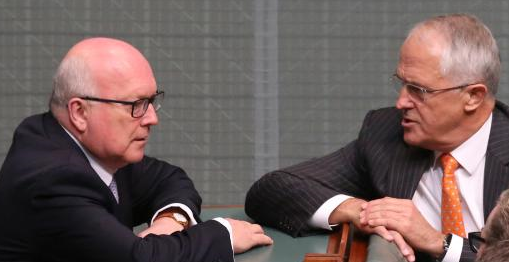
In other words, Attorney-General George Brandis (below, left) and Prime Minister Malcolm Turnbull (lead image, left; below, right) are lying on a matter of life and death to their citizens, and of strategic security for their state.


The lie is being repeated by the Australian media.  They include not only the state and commercial mainstream media, the latter dominated by Rupert Murdoch’s News Corporation. All the alternative media, social media, and universities, think-tanks and non-government organizations which supply them with newsfeed are doing the same. The blackout of the truth is so total in Australia, not a word that the blackout is in force has been reported either.

The only mainstream media report of the Australian government’s reaction to the MH17 incident, when it happened, was published  on September 19, 2014.   This was a story, leaked by insiders, of how none of the intelligence, military and political bureaucrats could agree with each on who should decide what to do.  That meant they couldn’t agree on whether, as then-Prime Minister Tony Abbott wanted and initially decided, a division of Australian troops should be sent to fight in Ukraine, alongside Dutch ground troops and NATO and US air support.

“There was no bureaucratic system for co-ordinating the response to such an emergency. The PM, his staff and ministers had to make decisions with little or no bureaucratic guidance.”

This leak, two months after the MH17 incident, came a month after the troop intervention plan had been kyboshed at NATO headquarters. The leak was a form of bureaucratic in-fighting after details of the secret war scheme had been discussed and stopped. The reporter, a well-known parliament lobby journalist named Laurie Oakes (right), hadn’t the faintest idea of the truth he was helping to conceal. Nor did Oakes prove curious in time.

The only report Brandis has made to parliament on the MH17 incident dates from October 2015.

Brandis had been attorney-general for just a month.  He was asked what the Australian Government assessment was of the MH17 incident following the release of the report by the Dutch Safety Board. (DSB).  Brandis’s answer was carefully worded. The DSB had carried out “a meticulous forensic investigation, and Australia has been closely involved in that investigation through the Australian Transport Safety Bureau. The final report sets out compelling evidence indicating the type of missile and the launch site of the missile which brought down MH17. Its findings are based on a forensic technical analysis of all of the available evidence. It does not attribute responsibility for the incident.”


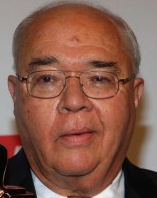
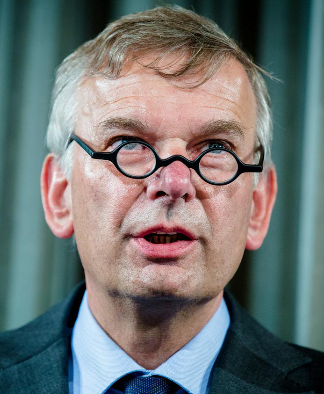
Brandis also acknowledged he and the Dutch were still working on the evidence. “The separate criminal investigation—as opposed to the forensic investigation I have just spoken of—is facilitated through the joint investigation team by a joint arrangement signed by Australia, Belgium, Malaysia, the Netherlands and Ukraine… The investigation is being coordinated by the Dutch prosecution service. The focus of the joint investigation team [JIT] is to ensure that the investigation is thorough and robust. On 20 August I met with the Dutch Prosecutor General, Mr [Herman] Bolhaar [right], when he and officials from the Dutch police and prosecution office came to Canberra to discuss investigations with the government and the Australian Federal Police, and I took the opportunity to assure them of the Australian government’s full cooperation in the investigation.”

Brandis added an innuendo.

“We are deeply disappointed that Russia used its power as one of the five permanent members of the UN Security Council to veto the draft resolution [on the establishment of an ad hoc international criminal tribunal to prosecute crimes connected with the shooting down of MH17]. Those responsible for crimes connected with the shooting down of MH17 will not, however, be able to hide behind the Russian veto.” 

Brandis meant this to sound to parliament as if the Russian government was hiding its culpability in the MH17 incident.

The truth, revealed last week in Brandis’s papers, is that Brandis and Prime Minister Turnbull have been hiding what they, not Russian government officials, know about the incident. A source in Canberra close to these papers emerged following the release of this report last week.   The source identified himself as privy to the classified intelligence on MH17 in the days and weeks which followed the incident.  The source was also privy to the discussion in the National Security Committee of Cabinet (NSC), the topmost decision-making body in Australia for Ukraine and Russia.

According to the new disclosures, the Australian Government believed in 2014 — and Brandis and Turnbull believe still — that in the daylight hours before MH17 was shot down, Ukrainian Government military forces were using the overflight of civilian airlines in eastern Ukraine as shadow and shield for attacks against ground targets in the belief the separatist forces would not return fire for fear of hitting the civilian airliners.


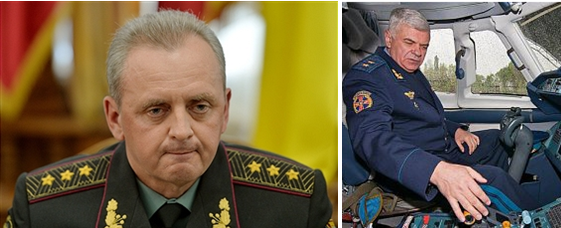
Army Colonel-General Victor Muzhenko (left) has been Chief of the Ukrainian General Staff since July 3, 2014. Two weeks later he was in command when MH17 was shot down. The Ukrainian Air Force commander that day was Lieutenant-General Serhiy Drozdov (right), a career pilot of fighter-bombers. Drozdov was removed from his post after the incident, then reinstated  six months later.  No explanation for Drozdov’s removal has been published. He was formally appointed Air Force commander in July 2015.


The source has also revealed it was the Australian Government’s conclusion that the Kiev regime did not close the airspace in the Donbass region to civilian air traffic above the war zone because of  the operational advantage Malaysian Airlines transit gave to Ukrainian Air Force operations.  The Australian officials recognize this calculation to be a violation of the Geneva Conventions on war crimes. The source is sure the intelligence leading to this finding was American, so the implication is that the US Government also shares the Australian finding – in secret.

The Australian officials concluded — the source has reported — that what had happened to MH17 was an unintentional accident on the part of those who fired the BUK missile. Without intention, there was no crime on the part of those on the ground, whoever they were — if they were the Novorussian separatists,  or  a regular Ukrainian Army missile battery,  or a unit of the irregular forces paid by Igor Kolomoisky and others.
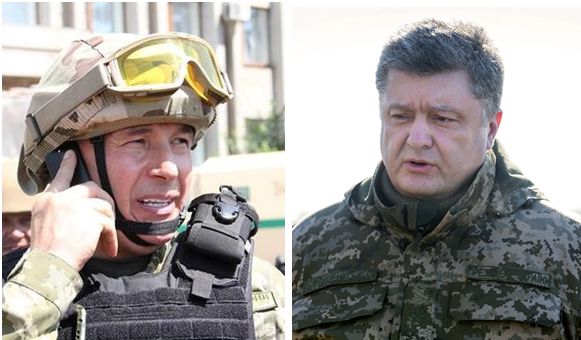
On the other hand, the provable crime in the Australian intelligence papers was that of the Ukrainian government officials responsible for using MH17 as a human shield.  On July 17, 2014, the chain of Ukrainian command and legal responsibility started with Drozdov and Muzhenko; and above them, Defense Minister Colonel-General Valeriy Heletey (below, left).  Heletey was removed from office on October 14, three months after the MH17 incident, and sent to the State Security Service, a bodyguard unit. Above Heletey, there was President Petro Poroshenko (right).


The two parts to the Australian government truth – the accidental destruction of MH17, the intentional use of MH17 as a military shield — can be verified in Australian government papers. For more on human shielding in civil law, counter-targeting in military parlance, read this.  Not a word, however,  nor a suspicion has appeared in the Australian media so far.

Look carefully at the most recent report of the Joint Investigation Team (JIT) in which Brandis and the Dutch Attorney-General and Chief Prosecutor, Herman Bolhaar, command their national representatives; for details of the September 28, 2016, release and press conference, read this.  Re-reading with hindsight, it can be seen that the Dutch are also concealing the human shield evidence.

At the end of last September this is how the JIT summed up its findings.

“The scenario that flight MH17 was shot down by a military aircraft was explored and discounted on the basis of radar data, witness testimonies and forensic research. The JIT has obtained sufficient radar data, both from Russia and Ukraine, which – when viewed in conjunction – provide a full picture of the airspace over eastern Ukraine. This shows that at the time of the crash, no other airplanes were in the vicinity that could have shot down flight MH17. The Russian Federation mentioned last week that they have found ‘new’ primary radar images. Based on those images the Russian Federation concludes also that there was no second airplane that could have shot down MH17.” 

Re-read the phrases: “no other airplanes in the vicinity that could have shot down MH17”;  “no second airplane that could have shot down MH17”.  This is a finding by the governments of Australia, the Netherlands, Belgium, Malaysia and the Ukraine. But it is ambiguous, blank, on the crucial point – were there Ukrainian Air Force planes in the air at the time armed with ground-attack weapons? Was an air-defence missile battery unit on the ground likely to suspect a bomb attack from the air during the last crucial minutes of MH17’s transit?

The more detail the JIT findings spell out,  the more obviously the JIT report avoids answering these questions. Instead, in its most exhaustive assessment of the evidence, the JIT avoids what the Australian Government already has concluded:

“In the investigation so far, we have come to the conclusion that we can also rule out the air-to-air scenario. What follows is the explanation about how we reached that conclusion. If flight MH17 would have been shot down by another airplane, this plane would have been shown on the radar images. There has been quite some discussion about the radar data. The JIT has acquired sufficient and crucial radar images. These images were made available to the JIT by both Ukraine and the Russian Federation. Recently, through intensive investigation, the JIT found another video file containing relevant primary radar data of the area which had been recorded by a mobile radar in Ukraine. At the time, this radar was used to test new software. Although it had a limited range, it still detected flight MH17 and this completes the image further.”

“As far as we are concerned, the discussion about the radar images can be concluded. Today we wish to emphasize that the material that we now have is more than sufficient to draw conclusions in the criminal investigation. For building up a solid criminal file, it will not be necessary to gather more evidentiary material. In addition to the radar images that we have, witnesses have been heard, such as the air traffic controllers who were working at that time; the JIT has an audio file of the conversations between the Ukrainian air traffic controllers and the airplanes that passed through the Ukrainian airspace on 17 July 2014, including flight MH17.”

“All these data together provide a sufficiently complete picture of the air traffic in the direct vicinity of flight MH17 and based on this picture the JIT concludes that there was no other aircraft flying in the vicinity of flight MH17 that could have shot it down. This conclusion in itself can already rule out that scenario. The Russian Federation mentioned last week that they have found ‘new’ primary radar images. Based on those images even the Russian Federation concludes that there was no second airplane that could have shot down MH17.”

Repetition of the same phrases doesn’t make a lie; it does contrive to camouflage the truth. That’s the truth the Australian government is holding in secret, and no public medium or press organ in the country will report.

The Canadian story of the lie of state about the Ukraine war is different in two ways. The first difference is that the liar, Foreign Minister Chrystia Freeland, arranged with a reporter and the management of the Toronto Globe and Mail to plant the lie in a press conference. The second difference is that half the Canadian press, including a fraction of the mainstream media and most of the alt-media, not only didn’t believe Freeland’s lie. They have started investigating and publishing the truth.

For the story of Freeland’s campaign to defend her Ukraine policy, and for links to the mainstream media reporters defending her, click to open here.

The campaign started at a press conference called by Freeland on March 6,  in the lobby of the House of Commons in Ottawa.  The purpose of the presser was to explain the official extension for another two years of Canada’s Operation UNIFIER. That’s the code name for what the Defence Ministry in Ottawa calls   “military training and capacity-building assistance to Ukrainian Forces personnel in support of Ukraine’s efforts to maintain sovereignty, security, and stability.”

At the question-and-answer exchanges on March 6, Freeland did all the talking. The Globe and Mail report of what was said, written by Robert Fife, the newspaper’s Ottawa bureau chief,  ignored the defence minister entirely.


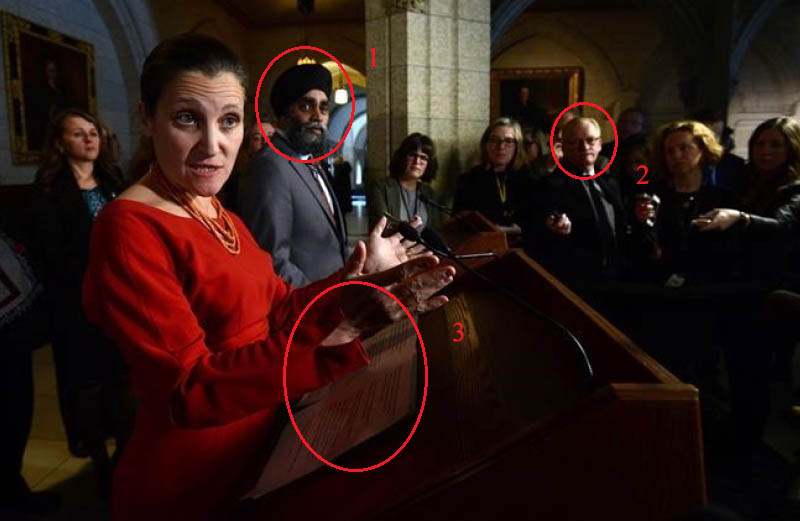
Above is a picture of the two ministers, as Freeland addresses a question from a reporter to her right, who is invisible to the camera.  Sajjan (circle-1) is on Freeland’s left, his mouth shut. At the rear of the picture, in the centre of the row of reporters, the only male among them is Fife (circle-2).  In front of Freeland, on the podium but screened from the reporters present, Freeland’s briefing book is visible (circle-3).  The camera has picked up several script lines which Freeland and her staff had decided in advance that she would answer when asked.

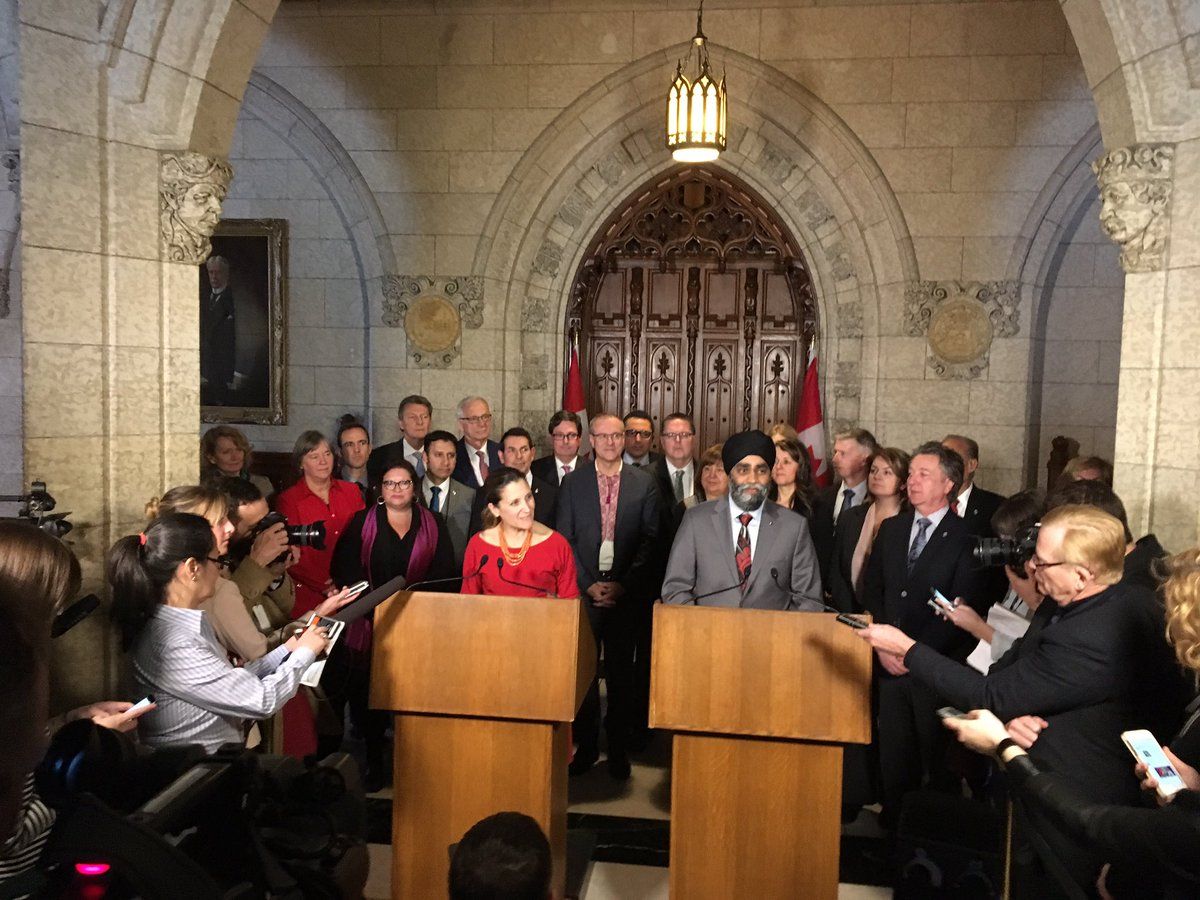
Below is the moment after Fife had asked Freeland his question, according to the newspaper version.  He is tilting his head leftwards, parallel with Freeland’s tilt,  and he has extended his arm with his recorder towards her as she answers. As she does so, Freeland looks directly at Fife. The state radio tape of what Freeland said can be listened to here  in the first 34 seconds.


Another version  from Canadian Broadcasting Corporation reveals exactly what Fife asked Freeland:

“The Russians don’t like you. They’ve banned you from the country. Recently, there has been a series of articles about you and your maternal grandparents making accusations that he was a Nazi collaborator in pro-Russian websites. I’d like to get your view on do you see this as a disinformation campaign by the Russians to try to smear you and discredit you? Which they have to have a tendency to have done.”

This transcript, along with the Huffington Post Canada version,  reveal more than the state radio excerpt aired later. “Let me start, Rob,” Freeland began with a personal note, “by saying that I don’t think all Russians dislike me. I have many close and good Russian friends and I very much enjoyed living and working in Moscow as a foreign correspondent.”

At Fife’s prompting,  Freeland was avoiding the question. Instead, she started her claim that reports of her lying about her family and her policy in Ukraine are part of Russian efforts “to destabilize” the US and Canadian political systems. “I am confident”, Freeland declared, “in our country’s democracy, and I am confident that we can stand up to and see through those efforts.”

Freeland’s claim has triggered a great deal of standing up to and seeing through, though this was not quite the democracy she was confident Fife and the Globe and Mail would reflect. Instead, a succession of stories in the Canadian press has  intensified investigation of what Freeland’s family did during World War II; what Freeland has known about the war record; and what she, her family and their Ukrainian associates all stand for now, as the Canadians renew Operation UNIFIER and the Ukrainian civil war enters its third year.
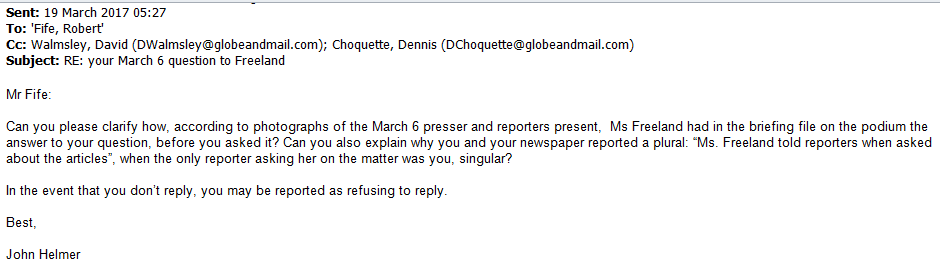
The Canadian media investigations also reveal that it was Freeland herself who arranged for Fife to ask the question, for which her answer was already typed out in front of her.  Is it true that Fife and his newspaper agreed to play Freeland’s patsy?  Fife was asked by email:


CLICK TO ENLARGE

Fife and the Globe’s editor-in-chief David Walmsley aren’t able to black out reporting of what has happened. They are Canadian, not Australian.  But they refuse to answer questions about their role.

Sunday, March 19, 2017

NYTimes Sinks to Conspiracy Theories on Trump

NYT’s ‘Tinfoil Hat’ Conspiracy Theory

by Robert Parry - Consortium News


March 19, 2017

There are real reasons to worry about President Donald Trump’s foreign policy, including his casual belligerence toward Iran and North Korea and his failure to rethink U.S. alliances with Saudi Arabia and Israel, but The New York Times obsesses on Trump’s willingness to work with Russia.

On Saturday, the Times devoted most of its op-ed page to the Times’ favorite conspiracy theory, that Trump is Vladimir Putin’s “Manchurian candidate” though evidence continues to be lacking.
 
The op-ed package combined a “What to Ask About Russian Hacking” article by Louise Mensch, a former Conservative member of the British Parliament who now works for Rupert Murdoch’s News Corporation, and a connect-the-dots graphic that when filled out shows the Kremlin sitting atop the White House.

But the featured article actually revealed how flimsy and wacky the Times’ conspiracy theory is.

Usually, an investigation doesn’t begin until there is specific evidence of a crime. For instance, the investigative articles that I have written over the years have always had information from insiders about how the misconduct had occurred before a single word was published.

In the early 1990s, for the investigation that I conducted for PBS “Frontline” into the so-called “October Surprise” case – whether Ronald Reagan’s campaign colluded with Iranians and others to sabotage President Jimmy Carter’s negotiations to free 52 American hostages in 1980 – we had some two dozen people providing information about those contacts from multiple perspectives – including from the U.S., Iran, Israel and Europe – before we aired the allegations.

We didn’t base our documentary on the suspicious circumstance that the Iranians held back the hostages until after Ronald Reagan was inaugurated President on Jan. 20, 1981, or on the point that Iran and the Republicans had motives to sandbag Carter. We didn’t casually throw out the names of a bunch of people who might have committed treason.

When we broadcast the documentary in April 1991, there was a strong evidentiary case of the Reagan’s campaign guilt – and even then we were highly circumspect in how we presented the story.

Ultimately, the 1980 “October Surprise” case came down to whether you believed the Republican denials or the two dozen or so witnesses who described how this operation was carried out with the help of the Israeli government, French intelligence, and former and current CIA officers – along with former CIA Director George H.W. Bush and future CIA Director William Casey.

In the end, Official Washington was never willing to accept that the beloved Ronald Reagan could have done something as dastardly as conspire with Iranians to delay the release of 52 American hostages. It didn’t matter what the evidence was or that Reagan quickly approved arms shipments to Iran via Israel in 1981, a prequel to the later Iran-Contra arms-for-hostages scandal of 1985-86.

No Direct Evidence


By contrast, what the current “Russia Owns Trump” allegations are completely lacking is an insider who describes any nefarious collusion between the Trump campaign and Russia to arrange the Kremlin’s help in defeating Hillary Clinton and electing Donald Trump.

What we do have is President Barack Obama’s outgoing intelligence chiefs putting out evidence-free “assessments” that Russia was responsible for the “hacking” and the publicizing of two batches of Democratic emails, one from the Democratic National Committee and one from Clinton’s campaign chairman John Podesta.

The DNC emails revealed that top Democratic Party officials had violated their duty to remain neutral during the primaries and instead tilted the playing field in favor of Hillary Clinton and against Sen. Bernie Sanders. The Podesta emails exposed the contents of Clinton’s paid speeches to Wall Street, which she was trying to hide from voters, as well as some pay-to-play features of the Clinton Foundation.

When published by WikiLeaks last year, the emails embarrassed the Clinton campaign but were not regarded as a major factor in her defeat, which she blamed primarily on FBI Director James Comey’s decision to briefly reopen the investigation into whether she endangered national security by using a private email server while Secretary of State.

However, amid the shock of Donald Trump’s election, Clinton supporters looked for reasons to block Trump’s inauguration or to set the stage for his impeachment. That was when Obama’s intelligence chiefs began circulating claims that Russia was behind the leaking of the Democratic emails as part of a scheme to put their favored candidate, Trump, in the White House.

The New York Times and other mainstream news outlets, which were strongly hostile to Trump, seized on the allegations, making them front-page news for the past several months despite the paucity of actual evidence that any collusion occurred or that the Russians were even the ones who obtained and distributed the emails.

WikiLeaks denied getting the material from the Russians, suggesting instead that two different American insiders were the sources.

A Witch Hunt?


How thin the Russia-Trump case is becomes evident in reading the Times’ op-ed by Louise Mensch. After introducing herself as someone who has “followed the Russian hacking story closely,” she lists 25 people by name, including various Trump advisers as well as Internet moguls Mark Zuckerberg and Peter Thiel, who should be hauled before the House Intelligence Committee for interrogation along with unnamed executives of several corporations and banks.

“There are many more who need to be called but these would be a first step,” Mensch wrote. In reviewing the Mensch’s long article, it’s unclear if she’s proposing only a “fishing expedition” or would prefer a full-fledged “witch hunt.”

At one point earlier in this process, I wrote an article warning that the “investigation” could become something of a “did-you-talk-to-a-Russian” inquisition. Some readers probably felt I was going too far, but that now appears to be exactly what is happening.

Many of Mensch’s suggestions pertain to people associated with the Trump campaign who game speeches in Moscow or otherwise communicated with Russians. It appears any contact with a Russian, any discussion of disagreements between the U.S. and Russia, or any political comment that in any way echoes what some Russian may have said becomes “evidence” of collusion and treason.

The extremism of Mensch’s tendentious article is further illustrated by her suggestion that Trump should be impeached if there is any truth to his widely discredited tweet that Obama had ordered wiretaps on Trump Tower. She wrote:

“If … the president tweeted real news, he revealed the existence of intercepts that cover members of his team in a continuing investigation. That would be obstruction of justice, potentially an impeachable offense.”

Most of us who have reported on Trump’s bizarre “tapp” tweet have criticized him for making a serious charge without evidence (as well as his poor spelling), but Mensch seems to believe that the more serious offense would be if Trump somehow were telling the truth. She wants any truth-telling on this issue to be grounds for Trump’s impeachment, even though he may have been referring, in part, to her November article reporting on the FISA warrant that supposedly granted permission for members of Trump’s team to be put under electronic surveillance.

A Tinfoil Hat


To dramatize her arguments further, Mensch then demonstrates a thorough lack of knowledge about recent American history. She claims, “Never in American history has a president been suspected of collaborating with a hostile foreign power to win an election.”

Whatever you want to think about the 1980 October Surprise case – and there is substantial evidence that it was real – it definitely constituted an example in American history when a president was “suspected of collaborating with a hostile foreign power to win an election.”

Another case in 1968, which now even The New York Times grudgingly accepts, involved Richard Nixon colluding with the South Vietnamese government to torpedo President Lyndon Johnson’s Paris peace talks to assure Nixon’s election. Although South Vietnam was then an ally, the allegations about Nixon also included outreach to North Vietnam, although Hanoi ended up sending a delegation to Paris while Saigon did not.

Yet, what is perhaps most shocking about Mensch’s op-ed and its prominent placement by the Times is that the story has all the elements of a “tinfoil-hat” conspiracy. It’s the sort of wild-eyed smearing of American citizens that the Times would normally deride as an offensive fantasy that would be either ignored or mentioned only to mock the conspiracists.

But the Times is now so deep into its campaign to demonize Russia and to destroy Trump that all normal journalistic standards have long ago been tossed out the window.

While there are many valid reasons to protest Trump and his policies, this descent into a New McCarthyism is both grotesque (because it impugns the patriotism of Americans without evidence, only breathless questions) and dangerous (because it escalates the New Cold War with Russia, a confrontation that could stumble into a nuclear holocaust).

At such moments, supposedly serious newspapers like The New York Times should show extraordinary caution and care, not a reckless disregard for truth and fairness. But no one in Official Washington seems willing to play the role of attorney Joseph Welch when he finally stood up to Sen. Joe McCarthy with the famous question, “At long last, have you left no sense of decency?”

Investigative reporter Robert Parry broke many of the Iran-Contra stories for The Associated Press and Newsweek in the 1980s. You can buy his latest book, America’s Stolen Narrative, either in print here or as an e-book (from Amazon and barnesandnoble.com).

Saturday, March 18, 2017

Salute to a Modern Martyr: Bullet-Riddled Resistance Activist Basil Al-Araj Finally Buried in West Bank

A Salute

by Mazin Qumsiyeh - qumsiyeh.org


March 18, 2017


[Israeli occupation forces finally delivered the body of our friend Basil Al-Araj after 10 days and we buried him yesterday evening as fireworks lit the sky and thousands pledged to carry on the work of freedom in his honor. 


His body was riddled with 10 bullets including two to his head and one to his heart! It was the latter that killed him physically but it was the injury to his heart by betrayal that made me think of the Mel Gibson's movie Braveheart. I cried many times during those three hours in Al-Walaja especially when I got a glimpse of Basil's face and when his father saluted the body and when I saw a young girl (a mutual friend) crying in the corner just outside the door of the cemetery and I thought of consoling her and decided it might make things worse for both of us. I only decided to redouble my own efforts and call her later and reconnect with the living activists more.]

I will start this weekly message by saying we need your help. Dozens of volunteers work with us every week at the museum and botanical garden but the work is heavy especially in preparation for our opening ceremony mid April.

In the next three weeks, we are especially short-handed in the following areas which you might be able to help with:

- The botanical garden and agriculture area (this is manual labor but in a really beautiful setting with over 100 species of plants blooming now)
- Carpentry and general handicraft work
- Researching some items
- Graphic design
- Good drivers (valid licence)
- Field work
- Plant work (Herbarium)
- Translation
- Writing and copy-editing
- Video-making (including production/editing)
- Educational exhibit design
- Grant writing or to help us with contacts among people who can help

If you can help in any of these areas (or any others), please contact us at info@palestinenature.org or me personally at mazin@qumsiyeh.org

Help discover ancient ruins — before it's too late: Citizen science platform. passion is contagious
http://www.ted.com/talks/sarah_parcak_help_discover_ancient_ruins_before_it_s_too_late#t-709830

UN official resigns after pressure to withdraw Israel apartheid report
https://electronicintifada.net/blogs/ali-abunimah/un-official-resigns-after-pressure-withdraw-israel-apartheid-report

BDS National Committee response:
https://bdsmovement.net/news/bnc-responds-un-heads-resignation-over-israel-apartheid-report

Vijay Prashad in the Hindu: Crimes of Apartheid
http://www.thehindu.com/opinion/lead/crimes-of-apartheid/article17468143.ece
[The UN may soon become totally irrelevant to world affairs]

Trump budget slashes foreign aid, but not for Israel
https://electronicintifada.net/blogs/ali-abunimah/trump-budget-slashes-foreign-aid-not-israel

Donate: Defense for Children International - Palestine was recently selected by the GlobalGiving Foundation to participate in its Accelerator program, a three-week long crowd-funding campaign for NGOs around the world. Could you help reach our goal to raise at least 10,000 USD by 31 March by making a donation and helping us spread the word?

In particular, we hope that people will make a donation on 22 March, because it is a Bonus Day during which GlobalGiving will match each donation by 20%! that means your gift of, for example, 25 USD turns into 30 USD with the help of GlobalGiving.

Here is a link to the campaign:
https://www.globalgiving.org/projects/legal-aid-for-palestinian-kids/

[DCI provides expert, child-friendly legal services we offer Palestinian children arrested, detained, and prosecuted in the Israeli military court system. As you know, these children face severe ill-treatment and physical violence at the hands of Israeli forces.]

Stay Human

Mazin Qumsiyeh
A bedouin in cyberspace, a villager at home
Professor and (volunteer) Director
Palestine Museum of Natural History
Palestine Institute of Biodiversity and Sustainability
Bethlehem University
Occupied Palestine
http://qumsiyeh.org
http://palestinenature.org
Join me on facebook
https://www.facebook.com/mazin.qumsiyeh.9
_______________________________________________
HumanRights newsletter
http://lists.qumsiyeh.org/listinfo/humanrights
This message was sent to lex@highspeedplus.com. To unsubscribe, visit:
http://lists.qumsiyeh.org/options/humanrights/lex%40highspeedplus.com

Friday, March 17, 2017

Justin's Spanner: Can Freeland Completely Destroy Canada-Russia Relations?

Will Chrystia Freeland Finally Ruin Canadian-Russian Relations?

by Michael Jabara CARLEY - SCF


16.03.2017

On 10 January 2017 Canadian Prime Minister Justin Trudeau fired his minister of external affairs, Stéphane Dion, replacing him with Chrystia Freeland, the then minister of international trade. This cabinet shuffle might not have gotten much public notice except that Dion is a distinguished parliamentarian, former leader of the party and leader of the opposition, and a former key minister in the Liberal government of Jean Chrétien. Freeland, on the other hand, is a well-known Ukrainian ultra-nationalist and self-declared Russophobe and hater of Russian President Vladimir Putin.

The sacking of Dion was also noteworthy because Trudeau had run on an electoral platform in 2015 promising, inter alia, to improve Canadian relations with Russia, spoilt by the government of Stephen Harper.

When Dion became minister of external affairs, he confirmed the Liberal commitment to re-establish more constructive Canadian-Russian relations.

He kept to this line even though Prime Minister Trudeau said that Canada would continue its close relations with the government in Kiev including the maintenance of Canadian military advisors in the Ukraine. Essentially, Trudeau said he intended to continue Tory policy on relations with Russia. No one paid much attention to the contradiction between Trudeau’s affirmation of Harper’s policy, and Dion’s periodic statements to the contrary.

Dion could make little or no progress in improving Canadian-Russian relations, most certainly because the prime minister and Minister Freeland were against it. Nothing much was said publically because Trudeau had promised a different policy during the election campaign. Was he just another fork-tongued politician? Perhaps he is, and wanted to divert attention from un-kept electoral promises. Nor would it have been desirable to publicise a policy split inside the government.


While Dion is a distinguished parliamentarian, former leader of the party and leader of the opposition, Freeland is a well-known Ukrainian ultra-nationalist and self-declared Russophobe

When the news broke that Trudeau had replaced Dion with Freeland, Liberal sources whispered that Dion was not really suited to be a diplomat. He was irritable, they said, and had not mastered the diplomacy of using speech to conceal his thoughts. Radio Sputnik contacted me at the time for an interview. I commented that Freeland’s appointment was «a catastrophe» for Canadian-Russian relations, as indeed it is. Some elements of the Mainstream Media (MSM) in Canada picked up on my comments saying that Russian sources had claimed the sacking of Dion was a catastrophe. I rejoined that it was me, a Canadian citizen, who had so characterised the Freeland appointment, and not Russian sources.

Is Trudeau just another fork-tongued politician?


Why should Canadians care one way or another whether their government supports the Ukraine and sends arms and advisors there to strengthen Ukrainian military forces?

Well, the most important reason is that the present government in Kiev is illegitimate in spite of democratic appearances. It is the spawn of a violent coup d’état in February 2014, brokered and supported by the United States and the European Union, which overthrew the democratically elected president Viktor Yanukovich.

The vanguard of the Kiev coup d’état are neo-Nazi, fascist or ultra nationalist political and paramilitary organisations, notably the political party Svoboda, the paramilitary Pravyi sektor and various other paramilitary forces such as the so-called Azov and Aidar battalions. These paramilitary units were and are used to crush opposition in those parts of the Ukraine controlled by Kiev.

Politicians, journalists, anyone speaking against the putsch government in Kiev could be, or were killed, beaten, jailed or forced to flee. The Ukrainian communist party was declared illegal.

The governing Party of Regions has disappeared, some of its members being charged with criminal offences for having contacts with Russian counterparts. Others abandoned the party because it was neither safe nor practical to remain as members.

Everywhere in the Kiev-controlled Ukraine, Nazi or SS symbols are readily observable


The United States claims that the neo-Nazis are freaks and «a few bad apples». But the signs of fascism can be observed everywhere in the Kiev-controlled Ukraine. Nazi or SS symbols are readily observable. The Nazi swastika can be seen as a frequent tattoo amongst fascist militiamen. Torch light parades redolent of Nazi Germany are often staged in Kiev and other cities to frighten people opposed to the coup d’état.

As with Nazism and Italian fascism, violence, force and atavistic masculinity are exalted to intimidate any opposition.

Nazi collaborators during World War II are now transformed into national heroes, Stepan Bandera, for example, or the Ukrainian Insurgent Army (UPA) which perpetrated mass murders amongst Soviet and Polish civilian populations.

Neo-Nazi violence and intimidation worked in many places, but not in others. In the Crimea, the population united almost to the last man and woman, to toss out the putschist authorities and to vote for reunification with Russia.

In the east, in the Donbass, the anti-fascist resistance repulsed Kiev punitive forces with heavy losses.

These remarkable feats of arms, redolent of so many others in Russian history, were wasted by Moscow, which disregarded a first principle of war that one never lets an enemy withdraw to fight another day. «He who spares the aggressor», Stalin once remarked, «wants another war.»

In Ukraine, Nazi collaborators during World War II are now transformed into national heroes 


It may shock some people to hear Stalin quoted, but Plutarch, Sun Tzu, or Clausewitz might have said the same thing. Moscow supported the so-called Minsk peace accords which were never respected by the Kiev authorities. Ultra-nationalists even boasted that they had agreed to Minsk solely in order to rest and refit their beaten forces. It was only a ruse de guerre.

These are the forces which the Canadian government now supports with the enthusiastic backing of Minister Freeland. For her, it must be a lifelong dream-come-true.

There has been much press comment during the last week or so about Freeland’s Ukrainian grandfather, Mykhailo Chomiak, a Nazi collaborator during World War II.

Freeland claimed that he was only a refugee from Stalinist violence. He might have been, but he also collaborated with Nazi Germany. In many places in Europe, France and Italy, for example, collaborators were summarily shot or imprisoned after the war. In France, more than 5,000 were executed including Pierre Laval, a prominent French politician, who sided with Nazi Germany and vaunted collaboration to oppose the USSR. Another 38,000 French collaborators were jailed. Chomiak was lucky he was not hanged and that he ended up in northern Alberta, to die a well-to-do farmer.


The story about Freeland’s grandfather was first put out by John Helmer, a long-time independent journalist living in Moscow. Freeland claimed a week or so ago that Russia was attempting «to destabilize the Western democracies»; and Canadian Public Safety Minister Ralph Goodale asserted poor Ms. Freeland was a victim of «Russian disinformation tactics».

Should Freeland be held responsible for the sins of her grandfather? Obviously not. What is disturbing about Freeland is her intense hatred of Russia and the Russian government, and her confusion about her own national identity. I am, she has written, «one of Ukraine’s democrats.» If this is so, what is she doing as a minister in the Canadian government? Is she first and foremost a Canadian, or is she a Ukrainian ultra-nationalist whose primary objective is to use her ministerial post to defend the putsch government in Kiev and to exacerbate Canadian relations with Russia?

If Freeland should not be condemned for the sins of her grandfather—although she might not see them as sins—she can be condemned for her own words, publications and deeds. Even by her own proud admission, she has left a long trail of venomous hatred of Russia which can easily be uncovered by internet searching. She defends the putschists in Kiev and overlooks their violence. With more than a hint of Orwellian «newspeak», Freeland asserts that the violent coup d’état in Kiev against the democratically elected president was a defence of «democracy». Is she pursuing the same objectives, twice removed, of dedushka, or Grandpa Chomiak, by supporting the Kiev junta?


That’s the problem with Freeland, who now constitutes a smoking grenade ready to go off at any moment under Canadian-Russian relations. Until now, the virulent, irrational, Russophobia afflicting the United States has not metastasised into Canada. It’s true that the Harper Conservatives were Russophobes, but when they lost power, it was possible to believe that sanity and pragmatism would return to Canadian relations with the Russian Federation. One had only to listen to Dion’s occasional statements on the subject to think that Canada was recovering its common sense. Canadians could breathe a sigh of relief and return the widely held idea that Canada is somehow a more civilised, sensible place to live than the United States.

Unfortunately, Canadian complacency appears premature. On 8 March Macleans, the Canadian equivalent of Time magazine, published a big article as Russophobic and preposterous as any piece of American yellow journalism. The headline reads: «Russia’s Coming Attack on Canada». The subtitle is: «The smear job on Chrystia Freeland is only the start. Why Canada is a logical next target in Moscow’s desperate clandestine war.» The «smear job» is of course the outing of Grandpa Chomiak as a Nazi collaborator. The author spouts one line of rubbish after the next about Russia and then accuses the Russian government of outing Chomiak. In fact, it appears to have been John Helmer, an Australian, who published the first article on Freeland’s forebears.

Further revelations followed from Alex Boykowich, a Ukrainian Canadian, who consulted Chomiak’s personal papers held in the Alberta provincial archives in Edmonton.

«God, why did Grandpa keep those damned papers», Freeland must be thinking: «I should have burned them long ago.» Too late now, Ms. Freeland, the cat’s out of the bag.

«Ravings» (délires), one Montréal journalist called Freeland’s accusations against Russia and Putin. Of course, no one would care about Freeland’s obsessive Russophobia except that she is minister of external affairs. She can encourage the metastasis of Russophobia into Canada, as she indeed has started to do.

Trudeau’s neoliberalism is more American than Canadian 


The psychosis is spreading, as I discovered the other day in casual conversation with a respected colleague. Putin is another Stalin, he said, he’s crushed democracy in Russia, press freedom is dead, and no one dares to speak against him. Anyone who has spent time in Moscow knows that lots of people complain about Putin. He knows too, and tolerates it.

«Sure he does» my interlocutor replied with a smile.

I understood and changed the subject.

People who voted Liberal in the last election thinking Trudeau fils would be like Trudeau père are now waking up to the reality that the son is nothing like the father. He is just another neoliberal pretty face, exploiting identity politics to pursue policy lines little different than those of his predecessor, the hated Stephen Harper.

Trudeau’s neoliberalism is more American than Canadian. Is he part of the movement to sabotage any improvement of US-Russian relations? If so, he’s pursuing a dangerous policy.

His external affairs minister is a fanatical Russophobe, hoist upon the petard of her words going back a long way. Is Freeland pursuing grandpa’s old dreams, collaborating with the ultra-nationalists and neo-Nazis in Kiev, all the while pretending they don’t exist?

What should Canada’s surviving veterans think about the Liberal government sending Canadian advisors to train Kiev’s armed hooligans? 


More than 42,000 Canadian soldiers died during World War II to destroy fascism and Nazism.

Is Freeland kicking sand on their graves by supporting the Kiev authorities and their celebration of Nazi collaboration?

What should Canada’s surviving veterans think about the Liberal government sending Canadian advisors to train Kiev’s armed hooligans? «Against Russian aggression», Freeland would no doubt retort.

But even MSM journalists in Canada, not as venal as their American counterparts, have derided such talk as «delusional». The question is will the majority of Canadians fall for Freeland’s dangerous Russophobia?

Boots on the March: Media Silent on Trump Syria Surge

BEYOND MISSION CREEP: U.S. Planning to Send 1,000 More Ground Troops into Syria 

by Patrick Henningsen - 21st Century Wire


March 17, 2017

Just as 21WIRE reported last week – the US mainstream media are still black-balling any substantial reporting about US boots on the ground in Syria. Instead, America’s media are obsessing over Trump’s tax returns, various Russian conspiracy theories, and Michael Flynn’s Moscow public speaking engagement in 2015.

With this latest Pentagon announcement of an additional 1,000 US troops to Syria, that would bring the total combat deployment to approximately 4,000 inside of Syria.

BREAKING: Israeli jets attack Syria government position, draw return fire.

Considering the amount of media coverage and political debate over the 5,000 US military personnel send to Iraq over the last 3 years – one must ask why the silence in US media about the stealth build-up for a major battle in Raqqa, Syria.

Previously, 21WIRE reported how the United States has sent in combat troops to support YPG fighters (Kurdish People’s Protect Units in Syria) – much to the dismay of Turkey, and to the annoyance of both Russian and Syrian planners. Turkey has been pressing the US to change its strategy for fighting Islamic State in Syria by abandoning the YPG whom it deems as terrorists (in league with the Kurdish PKK in Turkey).

The other aspect of this is being ignored by western media and their legion of panel ‘experts’. There are a number of rival factions and militias being backed by the US besides the Syrian Democratic Forces (comprised of Kurdish YPG). the US-led Coalition have substantial investments in Sunni extremist (terrorist) fighting groups allied under the Al Nusra (al Qaeda in Syria) umbrella. Consider how back in late 2015, the US deployed 5o US Special Forces in Syria as ‘human shields’ – arguably to salvage its ‘rebels’ assets being ravaged by Russian airstrikes. After the Coalition’s epic loss when Al Nusra-led brigades were driven out of terrorist stronghold in East Aleppo, one must ask if there an element of this in US positioning around Manbij and Raqqa?

With so many stakeholders, the margin for error is extremely thin. The situation is fraught with risk for all parties.


NOTE: This is taking place amid a political storm in Washington – as the entire Democratic Party, half the Republican Party and the whole of the US mainstream media are all trying to bring down the Trump Administration. If Raqqa is deemed a success, it will effectively give Trump a win. If it is deemed a disaster, then it will be used to fuel the anti-Trump resistance in the US. If the White House is too desperate for a win, then the prospect of a mistake or miscalculation become riskier. If a major world war is to be triggered – it could very well happen here.

Clearly, the US and others are planning a massive operation to lay siege to Raqqa, the ISIS stronghold in Syria. However, if the other similar allied operation in Mosul, Iraq is anything to go by, then expect massive civilian casualties in this battle too. The civilian carnage has been mostly censored from mainstream in the US and Europe, the ‘Coalition’ are afraid of the negative public relations backlash in the event that western public received too much negative news about the haphazard operation in Mosul. After early reports of massive civilian casualties in late 2016, it seems that the Pentagon have given the order to mainstream editorial desks to back off on negative reporting. How else can we explain how hundreds, and possibly thousands, of civilians killed in this month alone – has managed to escape any and all media scrutiny?

To underline this matter, yesterday, Human Rights Watch issued two new reports accusing Iraqi troops of using indiscriminate shelling into civilian areas in the fight to liberate Mosul from ISIS control.

Based these recent reports, it’s becoming more clear that US-led Coalition is sacrificing civilians in their objective to target ISIS fighters.To make matters worse, ISIS, like Al Nusra terrorists in Aleppo, have been using Mosul civilians as human shields. The only difference in this comparison is that western media were condemning the Syrian and Russian militaries for their anti-terror operations in Aleppo, while giving a free pass to clear US Coalition atrocities against civilians in Mosul.

Forget about any word from the US State Dept. either – as they run point on the cover-up:


.
All indications are that Raqqa could be even worse than Mosul. In addition to the civilian death toll for Raqqa, there is also the certainty of another Mosul repeat – a massive exodus of refugees out of the city, and heading somewhere – possibly towards Turkey.

The other conversation which has been deemed off limits by US and western media – is the fact that this US deployment inside of Syria is completely illegal under every international law, as well as in total violation of the US Constitution. US were not invited by the Syrian government – therefore, like its fellow NATO member Turkey, the US has effectively invaded Syria.

US involvement in Syria is now way past mission creep.

More on more US troops in Syria from the Washington Post….


U.S. military likely to send as many as 1,000 more ground troops into Syria ahead of Raqqa offensive, officials say.


Thomas Gibbons-Neff
Washington Post


The U.S. military has drawn up early plans that would deploy up to 1,000 more troops into northern Syria in the coming weeks, expanding the American presence in the country ahead of the offensive on the Islamic State’s de facto capital of Raqqa, according to U.S. defense officials familiar with the matter.

The deployment, if approved by Defense Secretary Jim Mattis and President Trump, would potentially double the number of U.S. forces in Syria and increase the potential for direct U.S. combat involvement in a conflict that has been characterized by confusion and competing priorities among disparate forces.

Trump, who charged former president Barack Obama with being weak on Syria, gave the Pentagon 30 days to prepare a new plan to counter the Islamic State, and Mattis submitted a broad outline to the White House at the end of February. Gen. Joseph Votel, head of U.S. Central Command, has been filling in more details for that outline, including by how much to increase the U.S. ground presence in Syria. Votel is set to forward his recommendations to Mattis by the end of the month, and the Pentagon secretary is likely to sign off on them, according to a defense official familiar with the deliberations.

While the new contingent of U.S. troops would initially not play a combat role, they would be entering an increasingly complex and dangerous battlefield. In recent weeks, U.S. Army Rangers have been sent to the city of Manbij west of Raqqa to deter Russian, Turkish and Syrian opposition forces all operating in the area, while a Marine artillery battery recently deployed near Raqqa has already come under fire, according to a defense official with direct knowledge of their operations.

The moves would also mark a departure from the Obama administration, which resisted committing more ground troops to Syria.

The implementation of the proposed plan, however, relies on a number of variables that have yet to be determined, including how much to arm Kurdish and Arab troops on the ground, and what part regional actors, such as Turkey, might have in the Raqqa campaign…

Continue this story at The Washington Post

READ MORE SYRIA NEWS AT: 21st Century Wire Syria Files

SUPPORT 21WIRE – SUBSCRIBE & BECOME A MEMBER @21WIRE.TV