Thursday, April 13, 2017

Allan and Amy's Bad Turn: Is Democracy Now Past Progressive Relevance?

Journalistic Integrity: Allan Nairn vs. Julian Assange

by Andrew Stewart - CounterPunch


April 13, 2017

I’ve been really upset since the inauguration and trying to cope with the emotions I am encountering daily. It is pretty obvious that a successful meme has been implanted in the progressive mindset that will have as much impact as the claim Ralph Nader gave the 2000 election to Bush.

By this I mean that people are extremely pissed off at me for having backed the Green Party and Jill Stein and seem to say with almost a psychic vitriol that it is somehow my fault that Trump got elected. Didn’t you throw your vote away on the Greens? Didn’t you say awful things about Hillary?

This was carried to the extreme degree by Allan Nairn on Democracy Now on April 10, 2017 with a piece headlined Did WikiLeaks Inform Voters or Aid Trump’s Right-Wing Revolution?

Nairn began by asking Assange to discuss his sources. If you are a journalist, you understand that confidentiality of sources in this effort is roughly equivalent to attorney-client privilege or the Catholic seal of confession. In November 2004 , Frank Taricani, a local Providence reporter with NBC affiliate WJAR, was found guilty for contempt of court by refusing to name a source in a trial. Nairn knows very well he is doing in trotting out that sort of question, he is publicly shaming a publisher at a news organization for not being a stoolie.

Next he engages with Assange with this sort of banter:

ALLAN NAIRN: OK. Well, my view of this is that during the campaign, WikiLeaks often suggested that Trump would be less dangerous than Clinton.

JULIAN ASSANGE: No, we didn’t.

ALLAN NAIRN: I think you did.

JULIAN ASSANGE: No, we didn’t.

ALLAN NAIRN: I think that concept is wildly, gruesomely mistaken. There was the argument—well, it’s just—

JULIAN ASSANGE: Well, that’s fine—it’s fine for you to say that, but you should understand that, no, we didn’t. In fact, I was asked that question directly on Democracy Now! at the time about what my position was, asked which one I preferred. And my response is, being asked this question is being asked: Do I prefer cholera, or do I prefer gonorrhea?

The interesting point that Nairn conveniently leaves out is that it was not just WikiLeaks who was involved in this. One should remember carefully that John Pilger also was involved in that discussion. On November 5, RT broadcast an interview Pilger had with Assange at the Equadorian embassy in London that included these lines.

JOHN PILGER: You get complaints from people saying, ‘What is WikiLeaks doing? Are they trying to put Trump in the Whitehouse?’

JULIAN ASSANGE: My answer is that Trump would not be permitted to win. Why do I say that? Because he’s had every establishment off side; Trump doesn’t have one establishment, maybe with the exception of the Evangelicals, if you can call them an establishment, but banks, intelligence [agencies], arms companies… big foreign money … are all united behind Hillary Clinton, and the media as well, media owners and even journalists themselves.

Of course if Nairn were to drag Pilger into the mud puddle, it would be quite a different discussion. Why? Because that 25 minute discussion, analyzing and explaining the massive caches of emails released prior to the election not only showed that “Clinton represented a criminal establishment” (Nairn’s words) but that a confrontation with Russia was almost certainly in the cards if Clinton were elected. And that is not even the juiciest morsel of the discussion!

First, there is this wonderful bit:

JOHN PILGER: In terms of the foreign policy of the United States, that’s where the emails are most revealing, where they show the direct connection between Hillary Clinton and the foundation of jihadism, of ISIL, in the Middle East. Can you talk about how the emails demonstrate the connection between those who are meant to be fighting the jihadists of ISIL, are actually those who have helped create it.

JULIAN ASSANGE: There’s an early 2014 email from Hillary Clinton, not so long after she left the State Department, to her campaign manager John Podesta that states ISIL is funded by the governments of Saudi Arabia and Qatar. Now this is the most significant email in the whole collection, and perhaps because Saudi and Qatari money is spread all over the Clinton Foundation. Even the U.S. government agrees that some Saudi figures have been supporting ISIL, or ISIS. But the dodge has always been that, well it’s just some rogue Princes, using their cut of the oil money to do whatever they like, but actually the government disapproves. But that email says that no, it is the governments of Saudi and Qatar that have been funding ISIS.

But it gets even better when they go into the tenure of Clinton in State Department:

JULIAN ASSANGE: Libya, more than anyone else’s war, was Hillary Clinton’s war. Barak Obama initially opposed it. Who was the person championing it? Hillary Clinton. That’s documented throughout her emails. She had put her favoured agent, Sidney Blumenthal, on to that; there’s more than 1700 emails out of the thirty three thousand Hillary Clinton emails that we’ve published, just about Libya. It’s not that Libya has cheap oil. She perceived the removal of Gaddafi and the overthrow of the Libyan state – something that she would use in her run-up to the general election for President. So in late 2011 there is an internal document called the Libya Tick Tock that was produced for Hillary Clinton, and it’s the chronological description of how she was the central figure in the destruction of the Libyan state, which resulted in around 40,000 deaths within Libya; jihadists moved in, ISIS moved in, leading to the European refugee and migrant crisis. Not only did you have people fleeing Libya, people fleeing Syria, the destabilisation of other African countries as a result of arms flows, but the Libyan state itself err was no longer able to control the movement of people through it. Libya faces along to the Mediterranean and had been effectively the cork in the bottle of Africa. So all problems, economic problems and civil war in Africa – previously people fleeing those problems didn’t end up in Europe because Libya policed the Mediterranean. That was said explicitly at the time, back in early 2011 by Gaddafi: ‘What do these Europeans think they’re doing, trying to bomb and destroy the Libyan State? There’s going to be floods of migrants out of Africa and jihadists into Europe’, and this is exactly what happened.

Does the fact Clinton let a band of racist Salafists loose on Black Libyan workers to be lynched mean anything to Nairn? Does the madness wrought by Daesh make any difference to him?

Nairn continues with this moral indignation:

This idea that it was just a choice between the lesser of two evils, well, in politics, in life, you fight like hell to have good choices, to have better choices—in this case, Sanders was a better alternative—but once that is no longer possible, then of course you choose the lesser evil. What do you want, more evil? More killing? More pollution? More abuse of immigrants? More racism? More impunity for corporations? More aid to death squads? More spending for the military? All of that is what you get with Trump, in distinction to the bad—the other bad things you would have gotten with Clinton. And the win of Clinton was not—or, I’m sorry, the victory of Trump was not equally as bad as it would have been if Clinton had lost. It’s a catastrophe. It’s an utter catastrophe. And those who are poorest, those who are already most oppressed and most vulnerable, are the ones who are suffering most as a result.

This is about all I can handle. First, funding Daesh somehow is not funding a death squad? What about the huge revelation, made several days before the Inauguration, that showed Obama did absolutely nothing for the environment? On November 30, 2016, the Guardian carried this important story:

However, an obscure agency within [Obama’s] own administration has quietly spoiled his record by helping fund a steady outpouring of new overseas fossil fuel emissions – effectively erasing gains expected from his headline clean power plan or fuel efficiency standards. Since January 2009, the US Export-Import Bank has signed almost $34bn worth of low-interest loans and guarantees to companies and foreign governments to build, expand and promote fossil fuel projects abroad.

Almost every notion utilized by Democrats and Nairn to argue that Clinton would have been different on climate and pollution is demonstrably untrue. It is beyond any argument that Gulf State influence would have would have been so substantial on a Clinton White House that chimpanzees would have had a sustainable energy grid before America would.

Let’s be absolutely clear here, I am not a complete crazy person. Over the course of the campaign season, I was emphatic (almost to the point of tedium) that people supporting the Greens should follow the lead of Sam Husseini and make Vote Pacts with Trump voters. Hell, I literally made a podcast where I interviewed Husseini and recorded in real time as I made one with my political opposite! The reason was pretty simple, polarization was such that there was no way to convince a Trump voter to vote for Clinton. The only way out of such a Gordian knot was to be found by Husseini’s method.

Anyone who wants to play these crass identity politics games and reduce things to an either/or where everyone had a choice between either A or B is missing out on some pretty basic facts. First, this was a substantially lower voter turnout than over the previous two Obama election cycles. Some can be attributed to voter suppression, yes, but much more can be attributed to option C, which is the fact so many people just stayed home! It bears mentioning that Black and Brown voter turnout was quite low. Omri Ben-Shahar wrote the following at Forbes:

Take Michigan for example. A state that Obama won in 2012 by 350,000 votes, Clinton lost by roughly 10,000. Why? She received 300,000 votes less than Obama did in 2012. Detroit and Wayne County should kick themselves because of the 595,253 votes they gave Obama in 2012, only 518,000 voted for Clinton in 2016. More than 75,000 Motown Obama voters did not bother to vote for Clinton! They did not become Trump voters – Trump received only 10,000 votes more than Romney did in this county. They simply stayed at home. If even a fraction of these lethargic Democrats had turned out to vote, Michigan would have stayed blue. Wisconsin tells the same numbers story, even more dramatically. Trump got no new votes. He received exactly the same number of votes in America’s Dairyland as Romney did in 2012. Both received 1,409,000 votes. But Clinton again could not spark many Obama voters to turn out for her: she tallied 230,000 votes less than Obama did in 2012. This is how a 200,000-vote victory margin for Obama in the Badger State became a 30,000-vote defeat for Clinton.

Prior to the election, the signs were quite obvious. For example, one study of Black voters that was publicized by a New York Times story on September 4 included this quote: ““What am I supposed to do if I don’t like him and I don’t trust her?” a millennial black woman in Ohio asked. “Choose between being stabbed and being shot? No way!””

I don’t know Alan Nairn and I don’t want to say anything about him personally. He certainly has a history of work that is admirable. Furthermore, I frankly find Julian Assange to be tremendously flaky on his own personal politics. Is he still a libertarian? Given his repeated panels with Zizek, is he some sort of communist now?

But what Nairn is doing in this segment, intentionally or not, is not expressing solidarity with colleagues. Instead, he is feeding into a larger narrative, generated by Democracy Now since the election, that amplifies and proliferates an expression of disgust within the segment of the 1% who are offended by Donald Trump’s gaudy, brash repudiation of neoliberal identity politics. I for one find this sacrifice of solidarity with the most besieged news organization of our contemporary times frankly unacceptable.

It is a shame that Nairn did not make a Vote Pact. Then he could have actually stopped Trump from getting a vote or perhaps even more. I know I did.
 
Andrew Stewart is a documentary film maker and reporter who lives outside Providence. His film, AARON BRIGGS AND THE HMS GASPEE, about the historical role of Brown University in the slave trade, is available for purchase on Amazon Instant Video or on DVD.
More articles by:Andrew Stewart

Before the Conflagration: North Korea in Historical Context

The Overlooked Past Behind U.S.-North Korea Tensions & How South Korea Could Forge Peace

by TRNN


April 12, 2017

Christine Hong of UC Santa Cruz and the Korea Policy Institute discusses the overlooked history behind U.S.-North Korea tensions and says the best hope for resolving them is a progressive government in South Korea willing to engage.

Tensions between the U.S. and North Korea are rising. North Korea has warned the U.S. that sending a Navy strike group, including the aircraft carrier Karl Vincent to the Korean Peninsula, could lead to war. North Korea's official newspaper said its, "nuclear sight is focused on U.S. forces and the U.S. mainland."

A new ballistic missile test last week is said to have prompted the Trump administration's move, sending a U.S. Navy force into the area. In a Twitter post President Trump said,

"North Korea is looking for trouble. If China decides to help, that would be great. If not, we will solve the problem without them. USA." 


 Joining us is Christine Hong, Associate Professor at UC Santa Cruz. She is on the executive board of the Korea Policy Institute. Welcome, Professor Hong.


Wednesday, April 12, 2017

Is the Dalai Lama Dying?

How Sick Is the Dalai Lama?

by Peter Lee - China Matters

April 12, 2017

I expect the PRC government has a team of spooks and doctors whose main job is to monitor the Dalai Lama’s public appearances for indications concerning his health. The Dalai Lama’s April 8 visit to Tawang probably gave them something to chew on, because he didn’t look that good to me.

He was mentally acute and spirited, but whenever he walked he was supported by two monks.

Watching him struggle after he got up from the platform after two hours of religious teaching at Tawang makes me think there’s more going on than religious deference with the monk escort.

At the 2:33:00 minute point in this video you can see the Dalai Lama wrap up his talk, tuck his meds away in his little carry bag, and exit with some effort.


Last year the Dalai Lama received treatment at the Mayo Clinic for a month, presumably related to his prostate condition which I’m guessing is more like prostate cancer. It looks to me like his physical condition had deteriorated.

Talking about the Dalai Lama’s health is an unwelcome subject for the Tibetan diaspora and government in exile, since the CCP strategy is clearly to drag out any engagement until the Dalai Lama passes on, and deal with a position of strength in any talks with his successor.

The Dalai Lama has declared he’s going to live to 90 (he’s now 82), when he'll finalize the succession issue. Maybe he’s got some supernatural insight, but you have to wonder.

The Dalai Lama’s successor looks to be an “emanation” chosen during the Dalai Lama’s lifetime to pre-empt Chinese meddling. Although there’s a possibility of an upgrade to “reincarnation” after the current Dalai Lama’s death, I doubt the successor will carry anywhere near the current Dalai Lama’s prestige and authority.

If, as is bruited about, the Dalai Lama chooses the Karmapa of the Karma Kagyu lineage as his successor, the new Dalai Lama’s clout will also be undercut by the fact that he’s not of the Gelugpa lineage that has dominated Tibetan Buddhist religion and politics for generations. The Karmapa had some of the sheen taken off him by an ugly controversy in which it was claimed he was a pretender and a Chinese Communist mole.

The rough edges have been smoothed off the Karmapa controversy by the death of the alternate claimant’s main champion, Shamar Rinpoche, and a change in attitude by the previously suspicious Indian government and intelligence service. On a broader stage, there’s a move to redefine Tibetan Buddhism as an ecumenical movement, rather than a congeries of independent-minded and ferociously contentious and occasionally murderous monasteries and religious leaders.

One sign of this was the festooning of Tawang with Buddhist flags for the Dalai Lama’s visit. The Buddhist flag I am referring to is not the traditional prayer flag but the colorful stripy thing, which is actually a relatively recent innovation. It was announced in Sri Lanka in 1885 with input from an American Buddhist (and Blavatsky Theosophist) enthusiast, Colonel Henry Steele Olcott and is supposed to symbolize the shared essential beliefs and potential for unity for a global Buddhist movement that transcends different traditions and teachings.


As a visual aid:


Traditional Tibetan Buddhist prayer flags at Tawang:


“Buddhist flag” at Tawang:


Buddhist, Tibetan, and Indian flags festooning the exterior of the Tawang monastery on the occasion of the Dalai Lama’s visit, which presumably hacked off the PRC no end:


A sign that the “all Buddhists are brothers and sisters” approach is working is the flourishing of the ecumenically oriented Tibetan Buddhist academy at Larung Gar in Sichuan inside the PRC.

Larung Gar was founded in 1980 by a rinpoche of the Nyingma lineage, but its curriculum also incorporates Gelugpa and other teachings. Perhaps its promise as a unifying, trans-lineage institution for Tibetan Buddhists—and one less susceptible to the divide-and-conquer strategy China has employed for centuries, most conspicuously in the case of its promotion of the Panchen Lama-- is why the PRC government restricts Larung Gar operations and is now tearing down parts of the immense favela of student housing that has grown up around the academy.

Here’s my most recent video for Newsbud, where I discuss the Dalai Lama’s visit to Tawang (and Xi Jinping’s visit to Mar a Lago!) and conclude that the next Dalai Lama will probably turn out to be more of brand ambassador for Tibetan Buddhism, a Dalai Lama Lite, rather than a galvanizing figure like the 14th Dalai Lama.


Note: In my video, I mis-state the dessert that witnessed Donald Trump's announcement to Xi Jinping that he was pasting Syria with cruise missiles as "chocolate sorbet". It was actually "the most beautiful piece of chocolate cake."

Apologies!

The Really Green Games: Olympics Venue Fukushima

Fukushima’s Upcoming Olympics

by Robert Hunziker - Pacific Free Press


April 12, 2017

Los Angeles - Japan will hold soccer and baseball events in Fukushima Prefecture for the Tokyo 2020 Olympics. This is not a spoof. Effective March 2017, the Japan Football Association displaces Tokyo Electric Power Company’s emergency operations center at J-Village, the national soccer training center before the nuclear meltdown occurred.

To naysayers that say this is a joke, the answer is ‘no this is not a joke’. It is absolutely true Olympic events will be held in Fukushima Prefecture, thereby casting aside any and all concerns about the ongoing nuclear meltdown; after all that’s history.

Or, is it?


Here is the announcement as carried in The Japan Times some months ago: “The men’s and women’s national soccer teams for the 2020 Tokyo Olympics will use the J-Village national soccer training center, currently serving as Tokyo Electric Power Co.’s forward base in dealing with the Fukushima nuclear crisis, as their training base, the Japan Football Association revealed Saturday.”

For those who missed the past few classes, Fukushima is home to the worst industrial accident in human history as three nuclear reactors experienced 100% meltdown, the dreaded “China Syndrome.” Molten core, or corium, in all of the reactors, highly radioactive and deadly, frizzles robots. Tokyo Electric Power Company (TEPCO) says it may take 40 years to clean up the disaster zone, but that is a wild guess.

Nobody on planet Earth has any idea where the radioactive molten cores are, within the reactor containment vessels or burrowed into the earth, and/or what happens next, e.g., there’s speculation that Unit #2 is rickety and could collapse from another big earthquake (Japan is riddled with earthquake zones, experiencing an earthquake on average every day) thus collapsing, which leads to an untold, massive disaster, rendering the city of Tokyo uninhabitable.

According to Dr. Shuzo Takemoto, Engr. / Kyoto University, February 2017: “The Fukushima nuclear facility is a global threat on level of a major catastrophe… The problem of Unit 2… If it should encounter a big earth tremor, it will be destroyed and scatter the remaining nuclear fuel and its debris, making the Tokyo metropolitan area uninhabitable.”

Numerous efforts by TEPCO to locate the melted cores have been useless. As of recently: “Some Nuclear Regulation Authority members are skeptical of continuing to send robots into reactors in the crippled Fukushima No. 1 plant to collect vital data on the locations of melted nuclear fuel and radiation levels… investigations utilizing robots controlled remotely generated few findings and were quickly terminated” (Source: Nuke Watchdog Critical as Robot Failures Mount at Fukushima Plant, The Asahi Shimbun, March 24, 2017).

All of which inescapably brings to mind the following question: How could anybody possibly have the audacity to bring Olympic events to the backyard of the worst nuclear meltdown in history whilst it remains totally 100% out of control?

Answer: Japan’s PM Shinzō Abe and the International Olympic Committee (IOC).

According to Naohiro Masuda, the head of decommissioning, TEPCO does not know how to decommission the nuclear facilities. Meanwhile, ongoing radiation is a constant threat to air, soil, food, and water, e.g., state inspectors have discovered deadly high levels of cesium pooling at the base of Fukushima’s 10 big dams that serve as water reservoirs (drinking water and agriculture). For example, Ganbe Dam 27,533 Bq/kg and Mano Dam at 26,859 Bq/kg whereas Japan’s Environment Ministry’s safe limit for “designated waste” is set at 8,000 Bq/kg. That limit is for “waste,” not drinking water. (Source: High Levels of Radioactive Cesium Pooling at Dams Near Fukushima Nuke Plant, The Mainichi – Japan’s National Daily Since 1922, September 26, 2016.)

Japanese officials are ignoring the extraordinarily high levels of cesium at the bottom of the dam reservoirs because the top water levels do meet drinking water standards. The prescribed safe limit of radioactive cesium for drinking water is 200 Bq/kg. A Becquerel (“Bq”) is a gauge of strength of radioactivity in materials such as Iodine-131 and Cesium-137. As it happens, Cesium-137 is one of the most poisonous substances on the face of the planet.

Additionally, open storage and incineration of toxic and radioactive rubble is ongoing throughout the prefecture. In fact, the entire prefecture is a toxic warehouse of radioactive isotopes, especially with 70% of Fukushima consisting of forests never decontaminated, yet the Abe administration is moving people back to restricted zones that Greenpeace Japan says contain radioactive hot spots.

According to Greenpeace Japan, which has conducted 25 extensive surveys for radiation throughout Fukushima Prefecture since 2011: “Unfortunately, the crux of the nuclear contamination issue – from Kyshtym to Chernobyl to Fukushima- is this: When a major radiological disaster happens and impacts vast tracts of land, it cannot be ‘cleaned up’ or ‘fixed’.” (Source: Hanis Maketab, Environmental Impacts of Fukushima Nuclear Disaster Will Last ‘decades to centuries’ – Greenpeace, Asia Correspondent, March 4, 2016).

With the onset of the Fukushima Diiachi meltdown, the Japanese government increased the International Commission on Radiological Protection guidelines for radiation exposure of people from 1 millisievert (mSv) per year up to 20 mSv/yr. As such, according to the standards set by the International Commission on Radiological Protection, ICRP Publication 111, Japan’s Olympics will expose Olympians and visitors to higher than publicly acceptable levels of radiation. After all, the emergency guideline of 20 mSv/yr was never meant to be a long-term solution.

With the onset of Olympic venues in Fukushima, maybe that will open the way for the 2024 Olympics in Chernobyl. But, on second thought that will not work. Chernobyl’s Exclusion Zone is 1,000 square miles (off limits for hundreds, maybe thousands, of years) because of an explosion in one nuclear power plant that is now under control whereas Fukushima has three nuclear meltdowns that remain, to this day and into the unforeseeable future, radically out of control and extremely hazardous.

Mystifying and Confusing?

Yes, it’s mystifying and confusing, but the games go on.

The Stalin Gambit: Putin Playing for Time

Rue, Ruse, or Rule: President Putin's Options Facing the US Military Junta

by John Helmer - Dances with Bears


April 12, 2017

Moscow - How to rule a country which is a target of war by the mad figurehead of a military junta in another country?

This is not a historical question about Joseph Stalin’s options in August 1939, before he and Adolph Hitler decided on the time-buying ruse known as the German–Soviet Non-aggression Pact. Nor is this a current question about Bashar al-Assad and Syria, nor about Kim Jong-un and North Korea.

It’s the question President Vladimir Putin is obliged to ask about Russia’s options facing a US regime in which, as the Kremlin now acknowledges, a military junta has installed itself behind President Donald Trump.

“We have seen this all before”, Putin declared yesterday.

The president went on to say that he himself is in two minds on what is to be done, and rues having to make the decision. On the one hand, according to Putin, the US junta is preparing new operations for the purpose of escalating the war in Syria, as well as the war against Russia.

“We have information from a variety of sources that such provocations (I cannot find another word for this) are being prepared in other parts of Syria, including in southern suburbs of Damascus, where they are planning to plant certain substances and accuse Syrian authorities of using them.”

On the other hand, Putin also said, “we are ready to put up with that for a while in the hope that it will eventually lead us to some positive trend based on interaction. For consumption within America, there are reasons for this. Simply put, political opponents of the incumbent president are still out there, and if anything happens, it will be blamed on him. I have no doubt about that.”

If Putin has no doubt, then why the reluctance to decide what is to be done and the hesitancy to say so? Following the US attack on Syria, the Russian Defence and Foreign Ministries swiftly announced the results of their investigations, and also new policy measures, including the warning that US military deployments in Syria are now Russian targets.

Putin is saying less.

“Things like this should be thoroughly investigated. We plan to officially address the appropriate UN institution in The Hague and call on the international community to thoroughly investigate these matters. A weighted decision can then be taken depending on the findings of the investigation.”

Although they aren’t saying so publicly, the Russian Defence Ministry, the Foreign Ministry, the intelligence agencies and the security services know perfectly well from the case of the downing of Malaysian Airlines Flight MH-17 in Ukraine in 2014 that such an option leads to show trials for Russian culpability at the United Nations and in the international courts of Europe. Their advice to Putin is to stop proposing a ruse or an impossibility. Speaking of “political opponents of the incumbent president” and “international investigations” Putin is opening a door to indecision, retreat, and destruction, so the president has been advised.

To the president this sounds like bad news. Sources who know believe Putin “doesn’t like bad news. He likes it even less when bad news is presented as pressure on him to decide something. So he has cut himself off from the news, and he’s isolated himself from those he once trusted to talk to. Putin has now less of a team he listens to than Stalin had in 1941. Also, Putin doesn’t decide anything.”

The sources of this assessment add that Putin lacks Stalin’s option of understanding Hitler’s intentions and provocations while pretending war could be avoided and delaying as long as possible the day of reckoning. “Stalin didn’t hope that Germany would not attack Russia,” says one of the sources making the comparison.

“Stalin believed that was certain. Putin says he hopes the US can be brought round. He’s anything but certain.”


Left: Foreign Minister Vyacheslav Molotov signs, while standing directly 
behind him is German Foreign Minister Joachim von Ribbentrop, with Stalin to the right. 
Pictured right: Stalin and von Ribbentrop, with Chief of the General Staff 
Boris Shaposhnikov in between.


Whether Putin will decide to shake the hand of Rex Tillerson, the US Secretary of State visiting Moscow today, and to smile as he does so, remains unknown as this goes to print. The current Chief of the Russian General Staff, Valery Gerasimov, will not be included in the group photographs. 

For one thing, the sources say, Russia’s forces are incomparably stronger now than they were in 1939; for another the Americans are incomparably weaker at home and on the war fronts than the Germans were. Finally, Trump can neither understand his generals nor control them. Hitler wasn’t as irrational or as impotent.

So the grand strategy question again: how to rule Russia facing the US junta’s war on multiple fronts? Grand strategy answer – revive the State Defense Committee (GKO), put Russia on a war footing, and as Stalin did in 1941, redistribute the power Putin has so far kept to himself. Military rule, Russian style.

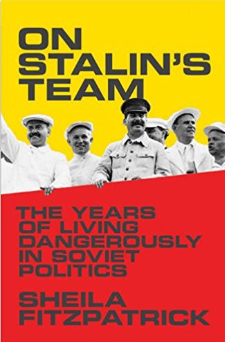
To understand how Stalin’s team worked before, during and after the world war, read this.


The evidence of Stalin’s collective decision-making was gathered from newly released evidence, such as Stalin’s personal correspondence and his office meeting logs. One of the measures of collective decision-making at the top, in Stalin’s time as in Putin’s, is the use of the Russian addresses – the formal vy (Вы) and the informal ty (ты). A core group of five officials around Stalin exchanged ty with him. They were also the men who appear most frequently in the office diaries and the dacha records. After the war they became seven; by Stalin’s death, six.

Nowadays there is the official Kremlin meeting log and the secret one. Subtract the time required for the events reported on the president’s website from the eight to ten hours of the president’s working day, and evidently at least half Putin’s meeting time is concealed.

As for the question, with what officials or friends does Putin exchange ty rather than vy, the number and the names have almost never been reported in print. According to this two-year old publication, the ty count may be fewer for Putin than for Stalin. How many of Putin’s ty intimates are his friends in business – the cronies, according to the US Treasury’s Office of Foreign Assets Control (OFAC) – isn’t known. The one economic policymaker believed by Russian sources to use ty is Alexei Kudrin. Vladimir Yakunin, head of Russian Railways, exchanged ty with Putin until he was fired eighteen months ago. Igor Sechin, the powerful Kremlin advisor on natural resources and now chief executive of Rosneft, is reported to use vy with Putin; Alexei Miller, head of Gazprom, is reported to use ty. Kremlin spokesman, Dmitry Peskov, is reported to be “too afraid of Putin to use anything but vy”.

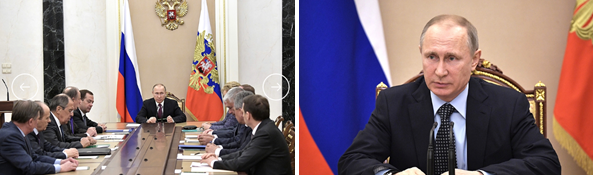
On the morning of April 7, after the US attack on Syria the evening before, the Kremlin press service issued a statement at 0900. The Foreign Ministry followed with its statement at 10:27. The only official meeting Putin had that day, according to the Kremlin website, followed after midday when Putin met with the members of the Security Council. In the routine record-keeping of Security Council meetings, several photographs are usually posted showing officials seated by descending rank on each side of the table, with Putin at the head (pictured below, left) . Last Friday, however, only Putin appears in the photo record (right).


Left: Security Council meeting on March 31 -- 10 attendees. Right: Security Council 
meeting on April 7 – 9 attendees. Foreign Minister Sergei Lavrov, absent from the 
second Moscow meeting, was in Tashkent for a session of CIS foreign ministers.


Of the Security Council attendees only two – Prime Minister Dmitry Medvedev and former presidential chief of staff Sergei Ivanov – have been overheard using ty with Putin. The forms of address between Putin and the other eight remain a state secret. The new head of the Russian desk on the US National Security Council, Fiona Hill, acknowledged in her 2013 report on Putin that she and her sources hadn’t asked, and didn’t know.

While US military threats are now intensifying the internal pressure on Putin to adopt more of the Stalin posture – that’s the collective approach of the war period – and overcome his bouts of isolation and indecision, what would the domestic Russian reaction be if Putin moved in Stalin’s direction, and the Security Council became a war-fighting GKO?

The answer, according to this nationwide poll by the Levada Centre last July, is more positive than negative – and much more positive than the US and its allies in Europe and Asia are calculating. For the Levada poll results, read this.

Tuesday, April 11, 2017

Gorilla Radio with Chris Cook, Stephen Gowans, Susanne Lawson, Christina Nikolic April 12, 2017

This Week on GR

by C. L. Cook - Gorilla-Radio.com


April 12, 2017

The corporate and State news narrative on Donald Trump's cruise missile salvo remains unchanged nearly a week after the fact.

This despite the logical inconsistency of an Assad government poison gas attack, ample reasons to doubt sources of the charge, and growing evidence from within intelligence ranks, and online news outlets questioning the facts as presented.

Regardless of what happened in Khan Shaykun on April 4th, it certainly isn't clear enough now to serve as the casus belli for those wanting a broader American involvement in the six years Syrian conflict.

Listen. Hear.

Stephen Gowans is an Ottawa-based writer, political analyst, and author whose book, 'Washington's Long War on Syria' provides the much needed context behind what we see presented on our nightly newscasts here and his recent article, 'Cruise Missile Attacks: A New Step in Washington’s Long Class War on Syria' appears at his website, What's Left.

Stephen Gowans in the first half.

And; after a century and a half of intensive logging, and massive increase in the human population, very little remains of Vancouver Island's primordial forests. While for years, First Nations and environmental groups have called for the end of both clearcut and old-growth logging, and many still do, now it's municipalities and loggers calling for an end to the practice where some First Nations and enviros are condoning it. Meanwhile, the last of the giant trees are daily being taken down and trucked out of Clayoquot Sound.

It harks back to a still raw rift in B.C.'s environmental movement, one my next guest characterizes succinctly, saying back then,

"Vancouver Island was the sacrifice zone, when the Great Bear Rainforest was established, a compromise made in the same way these groups (Friends of Clayoquot Sound, Sierra Club, Greenpeace, and others) sat down and gave away so much of Clayoquot."

Susanne Lawson is a long-time resident of the island’s wild west coast. The Wickaninnish Island-based artist, environmental activist, and former co-chair of the Canadian Environmental Network has been at the heart of the battles to save Meares Island and Clayoquot Sound from clear-cut logging, fish farming, and a mining industry determined to level mountains if needs be to get at the gold they believe lies beneath the forests of the international recognized UNESCO Biosphere Reserve.

Susanne reminds, the ecological threat posed by continuing to cut down what remains of the old-growth rainforest is greater than ever, saying, "This logging and removal of the blue print of the forest that was inherited by all should be considered a crime against the planet and future generations."

Susanne Lawson and threats old and new in and around Clayoquot in the second half.


And; passionate educator, horticultural innovator, and intrepid green business entrepreneur, Christina Nikolic will be here with the Left Coast News and Events update at the bottom of the hour. But first, Steve Gowans and looking down the long length of Washington's war against Syria.

Chris Cook hosts Gorilla Radio, airing live every Wednesday, 1-2pm Pacific Time. In Victoria at 101.9FM, and on the internet at: http://cfuv.ca.  He also serves as a contributing editor to the web news site, http://www.pacificfreepress.com. Check out the GR blog at: https://gorillaradioblog.blogspot.ca/

G-Radio is dedicated to social justice, the environment, community, and providing a forum for people and issues not covered in the corporate media.

Getting to the Bottom of the Syria Gassing Event

The Gassing Game in Syria

by Chandra Muzaffar - CounterPunch


April 11, 2017 

The use of chemical weapons in Sheikhun, in the Idlib province of Syria on April 4, 2017 was a heinous act. The world has rightly condemned it.

Because it was so cruel and callous, it is vital that the truth about the attack is established as soon as possible.

Syria "Gas Attack:" Casus belli or 
another US False Flag?

The United States of America and a number of its allies are certain that the attack was planned and executed by the Syrian government. 86 people, including 27 children, were killed in the carnage. The US Ambassador to the UN has shown some heart-rending images of some of the children who died from the chemical gas attack.

The Syrian authorities have denied categorically that they were responsible for the tragedy. They claim that a warehouse containing toxic materials may have been hit in the course of the Syrian army’s operations in the area thus releasing lethal gas and causing so many deaths.

Given these conflicting accounts, an independent international inquiry should be conducted to determine what really happened on the 4th of April. The members of the panel should comprise credible experts who are not citizens of any of the five permanent member states of the UN Security Council. The UN Secretary-General should appoint the panel.

It is only after the panel’s findings are made public that action should be taken under the provisions of the UN Charter. By firing a barrage of cruise missiles at a Syrian airbase on the April 7, the US has not only violated international law but has also committed aggression against a sovereign state. The US’s unilateral action has worsened the conflict in Syria.

Establishing the truth about the chemical gas episode is far more important than flexing one’s military muscle. To start with, how could the Syrian army have deployed chemical weapons when a UN affiliated body, the Organisation for the Prohibition of Chemical Weapons confirmed in June 2014 that Syria had complied with a Security Council resolution to destroy its entire stockpile of chemical weapons ?

Besides, it defies logic that the Syrian government that has regained control over almost all the major cities in the country and is clearly winning the war against the militants who are being backed by regional and Western actors should deliberately choose to gas innocent children — an action which it knows would provoke the wrath of the whole world.

A brief survey of gas attacks in Syria in the last five years would convince us that it just does not make sense for the government to consciously plan the 4th April episode. Take the infamous Ghouta sarin gas attack of August 2013. The centres of power in the West and in WANA opposed to Bashar al-Assad through their media channels immediately labelled the Syrian authorities as the culprit and crucified them. But the highly respected American investigative journalist, Seymour Hersh, through meticulous analysis revealed that the attack was actually the work of a militant group carried out with the connivance of elements in the Turkish power structure.

The Houla massacre of 25 May 2012 was another example of a gas attack that finger-pointed the Bashar government. A picture of a large number of dead children “ wrapped in white shrouds with a child jumping over one of them “ was offered as proof of Bashar’s brutality. The picture was actually from the war in Iraq in 2003. The photographer himself, Marco Di Lauro, came out in the open to expose the fabrication. In fact according to the German newspaper, the Frankfurter Allgemeine Zeitung (FAZ), the massacre was “committed by anti-Assad Sunni militants, and the bulk of the victims were members of the Alawi and Shia minorities, which have been largely supportive of Assad.” There was also the case of militants gathering Christian and Alawi hostages in a building in the Khalidya neighbourhood in Homs, blowing it up with dynamite and then putting the blame upon the Syrian army. Numerous other instances of militants committing terrible atrocities but giving the impression that the Syrian army or its allies — Iranian revolutionary guards or Hezbollah fighters or Russian soldiers — were responsible have been documented by journalists and commentators.

Of all the lies and deceptions of this sort in recent memory the most outrageous would the Anglo-American allegation about Saddam Hussein’s “Weapons of Mass Destruction” which was the fig-leaf used to camouflage their invasion and occupation of Iraq in 2003. The Bolivian Ambassador to the UN, Sacha Llorenti, reminded the Security Council of this monstrous lie at its meeting on the 7th of April and warned the world that “After this (Iraqi) invasion there were 1 million deaths and it launched a series of atrocities in that region. Could we talk about ISIS if that invasion had not taken place? Could we be talking about the series of horrendous attacks in various parts of the world had that invasion, this illegal invasion not taken place?”

Lies, manipulation of facts and false-flag operations all serve an overriding goal which is to protect and perpetuate US hegemonic power and the interests of its allies. In Iraq and Syria it is only too obvious that the aim is to secure hegemony through regime-change. Indeed, the US elite, at the behest of Israel, have been seeking to oust Bashar al-Assad for the good part of the last 15 years. For different reasons, the rulers of London and Paris, and those at the helm in Riyadh, Doha and Ankara also want to get rid of Bashar. A convergence of motives explains why these elites have been funding, training, arming and channelling intelligence to militants in Syria from various parts of the world who have sometimes resorted to the most barbaric methods in pursuit of their zealous drive to seize power.

There is perhaps yet another reason — apart from regime change — why some vested interests in Washington have decided to exploit the 4th April gas attack. These interests in the military, the intelligence community, the media, think-tanks, within lobbies and among legislators, are opposed to any rapprochement between Washington and Moscow. Perpetuating an adversarial relationship between the two is integral to their agenda of ensuring that the US remains the world’s sole dominant power. They sense that the new US President, Donald Trump, may try to build a bridge to Russia’a Vladimir Putin which is why they are manipulating the issue of the latter’s alleged attempt to influence the recent US Presidential Election. The suspicion and distrust engendered by this issue has now been aggravated by the US missile attack

US-Russia ties are not the only issue adversely impacted by the US’s 7th April bombardment. If the US escalates its military involvement, it will have far-reaching consequences for the on-going conflict in Syria, politics in WANA and global peace in general.
 

More articles by:Chandra Muzaffar

Cruise Control: The New Gunboat Diplomacy in Syria

Cruise Missile Attacks: A New Step in Washington’s Long Class War on Syria

by Stephen Gowans  - What's Left


April 8, 2017

Washington has added a new dimension to its long war on Syria: direct military intervention.

Since the mid 1950s, the United States has tried to purge Damascus of an Arab nationalist leadership which has zealously guarded Syria’s freedom from US domination and follows an Arab socialist development path which is at odds with the global free enterprise project advanced by Washington on behalf of its Wall Street patron.

Until now, Washington has refrained from directly attacking Syrian forces, though it has intervened manu militari in Syria to hold the Islamic State in check so that the militant group remains strong enough to weaken Syrian forces but not so strong that it captures the Syrian state. [1]

This limited Islamic State-directed US intervention in Syria has involved both airstrikes and an estimated 1,000 boots on the ground. [2] However, the principal modus operandi of Washington’s long war on Syria has been war waged through proxies, both Israel, which annexed Syria’s Golan Heights and has carried out innumerable small-scale attacks since, and Islamist guerrillas, who, from the 1960s, have waged a jihad against what they view as Syria’s heretical government. [3]

The United States contemplated direct military intervention in Syria in 2003, as a follow-up to its invasion of neighbouring Iraq, but found that its resources were strained by efforts to pacify Afghanistan and Iraq and that other means of regime change would have to be pursued. [4]

In place of a muscular boots on the ground strategy, Washington imposed an economic blockade in 2003, which, by 2012, had caused Syria’s economy to buckle, according to the New York Times. [5]

By the spring of 2012, sanctions-induced financial haemorrhaging had “forced Syrian officials to stop providing education, health care and other essential services in some parts of the country.” [6]

By 2016, “US and EU economic sanctions on Syria” were “causing huge suffering among ordinary Syrians and preventing the delivery of humanitarian aid, according to a leaked UN internal report.” [7] The report revealed that aid agencies were unable to obtain drugs and equipment for hospitals because sanctions prevented foreign firms from conducting commerce with Syria.

Veteran foreign correspondent Patrick Cockburn wrote that “the US and EU sanctions” resembled the Iraqi sanctions regime, and were “an economic siege on Syria”—a siege it might be recalled that led to the deaths of more than 500,000 Iraqi children, according to the UN, a death toll greater than that produced by all the weapons of mass destruction in history. [8] Cockburn surmised that the Syrian siege was killing numberless people through illness and malnutrition. [9]

On top of its merciless campaign of economic warfare, Washington enlisted the Arab nationalists’ longstanding foe, the Muslim Brotherhood, to provoke a civil revolt in Syria. The revolt, inaugurated by Islamist-instigated riots in Daraa in mid-March 2011, soon mushroomed into an all-out campaign of guerrilla warfare, fueled by Saudi, Qatari, Turkish, Jordanian and US money. U.S. and Western intelligence services trained thousands of guerrillas in Jordan and Qatar. [10]

In 2012, the US Defense Intelligence Agency reported that the insurgency was Islamist, led by the Muslim Brotherhood and Al-Qaeda in Iraq, Islamic State’s forerunner, and that Western powers and the kings, emirs and sultans who preside tyrannically over Gulf oil states, were the backers. According to the intelligence agency, Turkey’s Reccep Tayyip Erdogan, a man infatuated with dreams of becoming a neo-Ottoman sultan, and himself an Islamist, was also a major backer. [11]

But until Washington ordered cruise missiles to rain down on Shayrat Airfield near Homs on April 6, the United States had relied on proxies and siege to bring about regime change in a country which Moshe Ma’oz had termed “a focus of Arab nationalistic struggle against an American regional presence and interests.” [12]

The Shayrat Airfield attack was presented for world opinion as a response to Syrian forces allegedly gassing civilians at Khan Shaykum on 4 April. The allegations were levelled by blatantly partisan sources.

One source was the White Helmets, which bills itself as a neutral civil defense outfit, but is in reality funded by governments entangled with Washington in its long war on Syria. It is enmeshed, too, or at the very least, cooperates with, al-Qaeda. The Syrian Observatory for Human Rights, a one-person outfit based in the UK which overtly supports the guerrillas, was another source.

Significantly, no one even remotely impartial has investigated the allegations to determine whether (a) chemical agents were indeed used, (b) whether they were used deliberately, and (c) who used them? The Organization for the Prohibition of Chemical Weapons refuses to weigh in on any of these questions until an investigation has been completed, the only sound course of action.

All the same, Washington and its lickspittle allies, exuding colonial arrogance, immediately pronounced in Olympian fashion that the accusations were beyond dispute, an outcome which was hardly surprising given that the Western champions of neo-colonialism share with the White Helmets and Syrian Observatory for Human Rights a common goal of overthrowing Syria’s Arab nationalist government. Washington can always be counted on to publicize any calumny against its Syrian enemy, no matter how untenable.

Despite assurances that a gas attack had been undertaken at Khan Shaykum on 4 April, and that Syrian forces were responsible, the United States, France and Britain, if they, were not themselves implicated, could have had no certain knowledge of this, since these matters take weeks of on the ground investigation to offer sound judgment, and even then the question of attribution—that is, who did it?—is often unanswerable. The reality, of course, is that Western powers have no idea whether the accusation is valid but seized the opportunity to claim it was to establish a pretext for military action in furtherance of the United States’ long war on Syria.

Mainstream journalists also rushed to judgement in advance of even the barest resemblance of an impartial investigation, their assessments aligning with the assessments, sans evidence, of their own governments.

On top of being predicated on an untested allegation by unquestionably partial sources, the US attack was illegal—and on two levels: internationally, because it was undertaken without UN Security Council assent, and domestically, because it represented an unauthorized act of war. The act of war was ordered unilaterally by the White House, notwithstanding the fact that declarations of war are the exclusive remit of Congress, which did not confer—indeed, was not asked for—its authorization.

But the point is academic


The United Sates has already amassed a sizable record of crimes in Syria, and an even more sizeable record in the larger Arab world, not the least of which crimes is the intrusion of US military personnel on Syrian soil, an act of war itself.

As a military colossus, the United States is at liberty to violate international law with impunity, since there exists no higher authority capable of enforcing international law through the threat of a force greater than that which the Pentagon itself can wield. Expecting the United States to yield to international law is naïve and therefore any discussion of whether this or that act of the United States violates international law is a discussion of no consequence.

The White House is able to violate US law without punishment by eliciting at least the passive acceptance of the US public and its representatives for its wars of aggression; accordingly, with the Congress and the US public on side, there’s no one to hold the White House to account before the US constitution.

White House efforts to secure the acquiescence of the public, if not its jingoistic support, are facilitated by the measures the Pentagon takes to limit US troop casualties, so that no matter how devastating US military operations are for the victims, the US public is not inconvenienced or traumatized psychologically by an accumulation of US combat casualties.

Equally helpful from the point of view of mobilizing support for war in violation of US law is the demonization of Washington’s targets, an activity in which the news media, which accept the pronouncements of US officials on foreign policy at face value, engage with enthusiasm. Witness how easily the Bush administration and Blair government were able to dupe the Western mainstream media into believing (or if they weren’t duped, to ardently propagate) fairy tales about Arab nationalist Iraq concealing chemical and biological weapons.

Moreover, witness how easily Washington shapes the intellectual environment. It has persuaded the world that chemical and biological weapons (which can kill tens or at most hundreds of people under ideal conditions, and many fewer under typical ones) belong to the same class of weapons as nuclear arms (which can kill tens or hundreds of thousands.) This false conflation of minor weapons with authentic weapons of mass destruction has proved useful in portraying such military non-threats as Arab nationalist Iraq under Saddam as signal threats whose elimination is imperative for the safety of the world.

Demonizing targets—often by accusing them of having, using, or intending to use either falsely classified or genuine weapons of mass destruction—creates, from the vantage point of the public, a moral obligation for the United States to act. The Leftists who have an insatiable appetite for moral lapidation and florid language about “murderous regimes,” brutal dictators,” and “moral disgrace,” in connection with the leaders of former colonies which the United States is endeavouring to re-colonize, contribute to the mobilization of consent for war and to an international class struggle from above.

Left collaborators see only the completely powerless as occupying morally tenable ground. Any state which pursues emancipatory goals is denounced as brutal, murderous, or a moral disgrace and arguments are mounted that the state’s emancipatory goals are a sham. Only people without formal power, by this way of thinking, engage in class struggle against oppression and exploitation, while those who exercise formal authority are viewed as agents of oppression by definition.

This view is too simple


The Italian philosopher Domenic Losurdo argues for a tripartite model of class struggle linked to the division of labour on (1) an international level, (2) a national level and (3) within the household. [13]

Class struggle on an international level corresponds to the exploitation of the people of one nation by another nation; for example, by the relegation of one country by another to a subordinate role in the international division of labour.

Class struggle on a national level corresponds to the exploitation of labour by the owners of capital within a country, while class struggle within the household pertains to the exploitation of female domestic labour by males.

Class struggle so conceived can be coterminous as when, for example, the people in one country are exploited en masse as a source of labour by the owners of capital of a second.

Washington’s long—and now expanded—war on Syria, is a class struggle on an international level. It is a class struggle in which the United States, as champion of the profit-making interests of corporate America and the class of billionaires who lead it, seeks to permanently relegate Syrians to a subordinate role in the international division of labour, one in which they will be limited to low wage jobs in extractive and basic manufacturing industries, if not subsistence farming.

Washington aspires to sweep away the Arab socialist impediments to the free enterprise, free trade, and free market capitalist nirvana it seeks to establish on a global scale, where US corporations have space to dominate the commanding heights of every country’s economy, and local labour is relegated to low-wage roles, and permanent penury.

Former chief economist of the World Bank Joseph Stiglitz put it this way:

Colonialism left a mixed legacy in the developing world—but one clear result was the view among people there that they had been cruelly exploited…the political independence that came to scores of colonies after World War II did not put an end to economic colonialism. In some regions…the exploitation—the extraction of natural resources and the rape of the environment all in return for a pittance—was obvious. Elsewhere it was more subtle. In many parts of the world, global institutions such as the International Monetary Fund and the World Bank came to be seen as instruments of post-colonial control. These institutions pushed market fundamentalism…a notion idealized by Americans as ‘free and unfettered market.’ … Free-market ideology turned out to be an excuse for new forms of exploitation. [14]

Arab nationalists in Iraq and Libya waged a class war on an international scale, aiming to free the people of their countries from the disadvantages that colonialism had visited upon them and to end their continued economic exploitation by the West. Their struggle, while successful for a time, ultimately ended in failure, as the United States and its allies, through demonization, siege and warfare, overcame these struggles from below. These victories by Washington were victories in favor of exploitation.

The class struggle fought by Arab nationalists in Syria continues, despite the concerted efforts of Washington, its neo-colonial allies, its Arab satraps, apartheid Israel, and Leftist collaborators, to crush it. Concurrently, the Islamic Republic of Iran is conducting its own class struggle against Western efforts of re-colonization, though on a grander scale, with the larger Islamic world as the object of liberation.

The struggle between Iran and the United States is a class struggle on a colossal scale, with Washington seeking to open Iran while keeping the remainder of the Muslim world open to continued exploitation by US financial, industrial, commercial and petrochemical concerns, and Tehran leading a project to build “resistance” economies that prioritize the uplift of the people who live and work in the Muslim world over shareholders of US corporations. This struggle is intertwined with the class struggle at which Syria is the center.

Washington’s expanded war on Syria is, then, an expanded class war from above against an emancipatory struggle from below. Washington’s war-making relies on multiple weapons, from siege, to proxy war, to direct military intervention, and no less to information warfare aimed at demonizing Syria’s Arab nationalists.

Steve Gowans is an Ottawa-based writer and political analyst who blogs at: What's Left
Notes
1. See my Washington’s Long War on Syria. Baraka Books. 2017, chapter 4.
2. Thomas Walkom, “Putting Donald Trump’s strike against Syria in context,” The Toronto Star, April 7, 2017.
3. Washington’s Long War, chapter 2.
4. Ibid.
5. Nada Bakri, “Sanctions pose growing threat to Syria’s Assad”, The York Times, October 10, 2011.
6. Joby Warrick and Alice Fordham, “Syria running out of cash as sanctions take toll, but Assad avoids economic pain,” The Washington Post, April 24, 2012.
7. Patrick Cockburn, “US and EU sanctions are ruining ordinary Syrians’ lives, yet Bashar al-Assad hangs on to power,” The Independent, October 7, 2016.
8. John Mueller and Karl Mueller, “Sanctions of Mass Destruction,” Foreign Affairs, May/June 1999.
9. 60 Minutes, May 12, 1996; Patrick Cockburn, “US and EU sanctions are ruining ordinary Syrians’ lives, yet Bashar al-Assad hangs on to power,” The Independent, October 7, 2016.
10. Washington’s Long War, chapters 2, 3 and 4.
11. http://www.judicialwatch.org/wp-content/uploads/2015/05/Pg.-291-Pgs.-287-293-JW-v-DOD-and-State-14-812-DOD-Release-2015-04-10-final-version11.pdf
12. Moshe Ma’oz, Bruce Cumings, Ervand Abrahamian and Moshe Ma’oz, Inventing the Axis of Evil: The Truth about North Korea, Iran, and Syria, The New Press, 2004, p .207.
13. Domenico Losurdo. Class Struggle: A Political and Philosophical History. Palgrave MacMillan. 2006.
14. Quoted in Graham E. Fuller. A World without Islam. Back Bay Books. 2010. p. 262.

Monday, April 10, 2017

Kaput Afghanistan: Broken After All These Occupations

Afghanistan: “Small” Western Propaganda Lies, Huge Impact

by Andre Vltchek - Dissident Voice


April 8th, 2017 

Ask anyone on the streets of Kabul about the revolutions that in recent years transformed huge parts of Latin America, and the chances are you’ll encounter a blank stare.

Perhaps mentioning Cuba could evoke at least some recognition, but definitely not Venezuela, Ecuador or Bolivia.

I know because I tried on several occasions, and I failed.

Ask in the marvelous historic city of Herat, with its huge minarets and Italian military contingent, about Western imperialism, or about NATO and its murderous campaigns all over the world, and chances are that your question won’t even be understood.

“Chances are that those Afghan people who can speak English or other Western languages, are now actually working for the Westerners; either for their military, or for their ‘defense’ contractors… or for the embassies, the United Nations, or perhaps some NGO”, explained an Asian reporter who is based in Afghanistan for more than two decades. “These people are not going to rock the boat, dwelling on crimes committed by the West, here and all over the world.”

That appears to be the case.

After more than 15 years of brutal Western occupation, Afghanistan appears to be thoroughly ruined. Not only in terms of its infrastructure and standards of living, and not only when it comes to all basic indicators like life expectancy (15th lowest in the world, according to the WHO, 2015) or education: all those things I expected.

But perhaps even more significantly, the country is destroyed morally and intellectually.

The only resistance the West is facing here comes from extremist groups and movements such as the Taliban and Daesh (ISIS). All intellectual and artistic struggles against the occupation have been destroyed, contained, bought, or frightened into near absolute silence.

In fact, the occupation’ is not even called ‘occupation’, anymore. Pragmatic, opportunistic definitions are increasingly taking over those once mainstream narratives. As I was informed by a wealthy family on an outing in the Panjshir Valley:

We are fully dependent on the presence of NATO troops in our country. Only foreigners are offering us well-paid and stable jobs. If they leave, we’d have to follow them; to emigrate to the United States or Europe.

This is far from the once proud and brave Afghanistan, which managed to defeat British invaders, after that delivering a mortal blow to the Soviet Union.

While in the country, I tried to investigate and to analyze; how on earth did Afghanistan end up on its knees? What force, what strategy was applied to break what appeared to be shatterproof?

It was clear that the West has managed to unleash and to uphold a very complex and tremendously successful indoctrination campaign, enslaving the nation by applying various ‘weapons’, which it has used in all corners of the world.

One of those ‘weapons’ is, of course, ‘education’. For instance, the American University of Kabul is literally regurgitating thousands of young sons and daughters of the elites, who are set on staying, after the proper dose of indoctrination and colorful diplomas, permanently loyal to the West. The nation’s curriculum, I was told, has been defined during long meetings at the US Embassy and at the offices of the World Bank.

There is virtually an absolute control of information and media. As in all countries occupied by the West, as well as in all client states, the so-called social media plays a vital role, setting tendencies and directing discussion patterns.

There is rigorous grooming of oppressive local governments, military and police, the institutions that are then always ready to suppress any open criticism of the Western occupation, or even the word ‘occupation’ itself.

Then, naturally, as in all neo-colonies, there is that deadly interdependency between the elites and the West.

An academic Prof Jawid Amin from the Academy of Social Sciences of Afghanistan explained to me, bitterly, during our short encounter in Kabul:

We don’t have anyone openly critical of the US or the West here, because it is simply not allowed by the government. I personally don’t like the Americans, but I can’t tell you anything else… Even I work for the government. My brother and sister, as well as other relatives, are living in the United States. About critical arts: nothing could be exhibited here without permission from the government and since Karzai, the government is controlled by the West…

*****

To discredit the former Soviet Union as well as the present-day Russia, and to smear China by all available indoctrination means, is one of the main goals of the Western propagandists and their local lackeys.

It is because, if unchecked, both China and Russia could steal the hearts and minds of the local people.

China’s impressive plan for virtually all Central Asian countries, called OBOR (“One Belt One Road”), was never allowed to be fully presented for discussion to the local population. It is particularly absurd, even grotesque, considering that China considers Afghanistan to be an extremely important potential partner in the region.

The OBOR puts great accent on supporting local cultures, on true independence of the countries of Central Asia and beyond, and on the massive development of infrastructure, from telecommunication super highways, to real highways, railroads and airports, as well as ‘social infrastructure’, which would include schools, hospitals, public housing and sport facilities.

Implementing OBOR would create millions of new jobs for the local people, something crucial in a country like Afghanistan, where even in the capital Kabul (according to many calculations) the unemployment rate has reached about 50%, and over 80% in many provincial capitals and the countryside.

For the West, smearing China is essential. It has been building huge hospital wings, instead of watchtowers, which means it has been providing the wrong example to Afghan people, raising wrong expectations.

The best example of the toxic anti-Chinese propaganda has been Mes Aynak. This ancient archeological site contains many priceless cultural treasures, some over 5,000 years old.

It is also located in the area of arguably the greatest copper deposits in the region.

Several years ago, a Chinese state-owned company (MCC) signed a MOU with the Afghan government. The company paid for the mining rights, but until now has not extracted one single kilogram of copper, despite pressure from the Afghan Ministry of Mines and Petroleum, which has been pushing for an immediate start to the excavation work. Why? Because the Chinese government gave orders to MCC to wait, so the archeological treasures could be safely excavated and preserved for the sake of Afghanistan and the world.

I was explained by various international experts based in Kabul, that the Chinese President Xi Jinping declared at the Preliminary Session of the UN General Conference in New York, in November 2016, that his idea of OBOR is, in fact, a New Silk Road, and that it is based on the economic cooperation and on the promotion of the cultural preservation in the countries of the former Silk Road. Again, Afghanistan is clearly one of the most significant countries.

The Afghan Ministry of Mines and Petroleum has for years been locked in a dispute with the hopelessly inept and disorganized (according to several of my sources who prefer to remain anonymous) Ministry of Information and Culture.

Corruption also appears to be a serious issue.

Until now, MCC has absolutely not done anything, except for some preliminary geological surveys conducted in 2008 and 2009. The company is losing a substantial amount of money, annually, but the orders from Beijing are clear: first the preservation of cultural treasures, and only then, economic interests.

A similar approach would, of course, be unthinkable from any Western mining company, many of which are murdering and displacing the local population, in such places as Papua or South America. That is why the professional propaganda has to be applied, and all good intentions dragged through dirt. This sort of ideological warfare is actually one of the mightiest weapons of Western imperialism, implemented in virtually all corners of the globe.

In March 2017, the Head of the Culture Unit of UNESCO, Mr. Masanori Nagaoka, told me clearly and frankly:

“The Chinese company (MCC) has not yet commenced any copper exploitation activity at the site … It is because they respect the Afghan government’s wish to preserve the cultural artifacts of Mes Aynak.”

UNESCO is now deeply involved in the process of saving all the valuable finds of the site.

I was shown several up to date photographs, proving that no work has yet begun, and that at Mes Aynak, absolutely no damage has been done to the cultural heritage of Afghanistan.

However, the more evidence there is proving that nothing sinister has happened, the more toxic the eruption of propaganda against China and its presence in Afghanistan, virtually all coming from Western and West-sponsored outlets. Entire ‘documentary films’ have been produced and broadcast, recounting the non-existent ‘crimes’ which have been, or ‘could soon be’, committed by China against Afghan culture.

The most notorious is a documentary film by Brent E. Huffman, which was broadcast, among others, by Al-Jazeera. To quote from its own site, the film is addressing “A race against time to save a 5,000-year-old archaeological site in Afghanistan threatened by a Chinese state-owned copper mine.”

Ms. Hiromi Yasui, a Kyodo News reporter who is based in Afghanistan since 1993, confirmed what I already heard from several independent sources:

At Mes Aynak, there is no digging whatsoever… The Ministry of Mines and Petroleum wants work to commence soon. Therefore, there is a clash between them and the Ministry of Information and Culture. Lots of money disappeared, too… there is corruption… Regarding China, whenever there is a slightest chance that it could be doing something wrong, an anti-Chinese propaganda gets immediately activated.

Now several legendary Chinese institutions of learning, including Renmin University and Northwest University in Xi’an, are getting involved, trying to help with the preservation of the site. This news is, however, hardly ever heard in Afghanistan and abroad.

“The propaganda against China or Soviet Union now Russia, is of course nothing new”, explained a renowned Afghan intellectual, Dr. Omara Khan Masoudi, who used to be, among many other things, the former head of the National Museum:


During the Cold War, the propaganda was truly extreme. Even such publications like ‘Le Monde’; they were writing that some of our greatest treasures were looted and siphoned to Moscow… We knew it was a lie, because we had hidden the treasures ourselves, in the premises of the Presidential Palace, and in the Ministries. And what was our answer to the Western propaganda? We created a small, one-day exhibition of our Afghan treasures, just 50-60 of the most important pieces, displayed for 2-3 hours, demonstrating that they are all still on the territory of our country.

*****

While other countries are trying to build and preserve, the United States and the west could hardly show any coherent strategy for how to help the country they have been persistently ruining for decades and centuries. Despite the huge sums of money spent, almost nothing tangible was constructed here since 2001. That is, if the monstrous air force bases like the one at Bagram do not particularly impress you, or those bizarrely tall concrete walls that could be seen everywhere, or the endless surveillance cameras, towers and drones, as well as the military centers at every corner, stuffed with grotesquely overpaid foreign ‘contractors’.

Andrew J. Bacevich wrote for the New York Times on 14 March 2017, trying to define (in the “Opinion” column) the chaos and perplexity of the ‘longest American war’:

Despite appropriating over three-quarters of a trillion dollars on Afghanistan since 2001, Afghan security forces continue to be plagued by the problem of inflated rolls, with local commanders pocketing American-supplied funds to pay for nonexistent soldiers…

Large-scale corruption persists, with Afghanistan third from the bottom in international rankings… Adjusted for inflation, American spending to reconstruct Afghanistan now exceeds the total expended to rebuild all of Western Europe under the Marshall Plan; yet to have any hope of surviving, the Afghan government will for the foreseeable future remain almost completely dependent on outside support.

And things are getting worse. Although the United States has invested $70 billion in rebuilding Afghan security forces, only 63 percent of the country’s districts are under government control, with significant territory lost to the Taliban over the past year. Though the United States has spent $8.5 billion to battle narcotics in Afghanistan, opium production there has reached an all-time high.

After this, Andrew J. Bacevich makes a dramatic conclusion:

For this, over the past 15 years, nearly 2,400 American soldiers have died, and 20,000 more have been wounded.

Oh, that bad, terrible Afghanistan – money guzzling, ungrateful and corrupt monster-state!

Of course, anyone who has recently visited the country, and who is in possession of at least some ability of thinking objectively, must be rolling on the floor, dying from laughter, after consuming such reports.

Where is ‘over a three-quarters of a trillion dollars’ visible ‘on the ground’? Ask the internally displaced people who are pouring into Kabul from all corners of the country, escaping misery, joblessness and fighting. They have nothing; absolutely nothing!

Let’s do some simple math: three quarters of a trillion is 750 billion. Dollars. Afghanistan has almost 32 million inhabitants (estimate, 2014). Divide 750 billion by 32 million and you get 23,437 dollars and 50 cents, per capita per 15 years. Even a tiny Afghan family of two adults and two children could then count on $93,750! Which would be $6,250 per basic tiny family unit per year, for 15 consecutive years. Lucky, lucky country, Afghanistan!

Just a reminder, that with those mountains of money, since 2001, the United States didn’t build a single mile of a railroad, no large public hospital or a public housing block.

So where did the money go? Could it be possible that the West itself has wasted it on its greatest addiction – a perpetual conflict and chaos? Could it be that the Afghan people are simply being used, even sacrificed – that their nation is sinking into deeper and deeper poverty, their culture changing or disappearing altogether, their hope for recovery and better life now almost gone – just so that this tremendous ‘recycling action’ of three-quarters of a trillion dollars could go on and on?

The Afghanistan war, ‘the longest in the US history’, is yet another ‘secret war’ of the Empire. Everyone knows that it exists, but no one seems to understand what it is all about.

In the meantime, 2,400 American ‘boys and girls’ have already died. If anything, this seems to be the only preoccupation in the West.

I’m wondering how many Afghans have died? How many millions have been forced to become refugees, how many millions are now internally displaced? Do they matter; do they count? Nobody seems to talk about them. How many lives were lost, really; how many were broken, thoroughly ruined?

In the meantime, many Western reports and documentary films are more preoccupied with such issues as a Chinese mining company and the worries that ‘one day it may actually start digging’.


First published by NEO

Andre Vltchek is a philosopher, novelist, filmmaker and investigative journalist. He has covered wars and conflicts in dozens of countries. Three of his latest books are the revolutionary novel Aurora and two bestselling works of political non-fiction: Exposing Lies Of The Empire and Fighting Against Western Imperialism. View his other books here. Watch his Rwanda Gambit, a documentary about Rwanda and DRCongo. He continues to work around the world and can be reached through his website and Twitter.
Read other articles by Andre.