Gorilla Radio is dedicated to social justice, the environment, community, and providing a forum for people and issues not covered in State and Corporate media. The G-Radio can be found at: www.Gorilla-Radio.com, archived at GRadio.Substack.com, and now featuring on Telegram at: Https://t.me/gorillaradio2024. The show's blog is: GorillaRadioBlog.Blogspot.com, and you can check us out on Twitter @Paciffreepress
Now that the Palestinian Islamic Movement, Hamas, has officially changed its Charter, one should not immediately assume that the decision is, in itself, an act of political maturity.
Undoubtedly, Hamas' first Charter, which was released to the public in August 1988, reflected a degree of great intellectual dearth and political naïveté.
"Allah is great, Allah is greater than their army, Allah is greater than their airplanes and their weapons," the original Charter partly read.
It called on Palestinians to take on the Israeli occupation army, seeking "martyrdom, or victory", and derided Arab rulers and armies: "Has your national zealousness died and your pride run out while the Jews daily perpetrate grave and base crimes against the people and the children?"
This may seem foolishly worded now. But back then, the context was rather different.
The document was released a few months after the formation of Hamas, itself created as an outcome of the Palestinian Uprising of December 1987, which saw the killing of thousands of Palestinians, mostly children. At the time, the Hamas leadership was a grassroots composition, consisting of school teachers and local imams and almost entirely made up of Palestinian refugees. While Hamas founders openly attributed their ideology to the Muslim Brotherhood Movement, their politics was, in fact, formulated inside Palestinian refugee camps and Israeli prisons.
Despite their desire to see their movement as a component of a larger regional dynamics, it was mostly the outcome of a unique Palestinian experience. True, the language of their Charter, at the time, reflected serious political immaturity, lack of true vision and an underestimation of their future appeal. However, it also reflected a degree of sincerity, as it accurately depicted a rising popular tide in Palestine that was fed up with Fatah's domination of the Palestine Liberation Organization (PLO).
Fatah, along with other PLO factions, became increasingly disengaged from Palestinian reality after the Israeli invasion of Lebanon in 1982, that saw the dispersal of the Palestinian national movement abroad among various Arab countries, headquartered mostly in Tunisia. In Tunis, Palestinian leaders grew wealthy, but offered nothing new, except for tired clichés of a bygone era.
The 1987 Intifada was a reflection of popular frustration, not only with the Israeli military occupation, but the failure, corruption and irrelevance of the PLO. Thus, the formation of Hamas in that specific period of Palestinian history cannot be understood separate from the Intifada, which introduced a new generation of Palestinian movements, leaders and grassroots organizations.
Due to its emphasis on Islamic (vs. national) identity, Hamas developed in parallel, but rarely converged with other national groups in the West Bank and Gaza. The national movements operated under the umbrella group, the United National Front for the Intifada, representing PLO's affiliates inside Palestine. Hamas operated largely alone.
Towards the end of the Intifada, the factions clashed, and directed much of their violence against fellow Palestinians. Thanks to internal divisions, the Intifada was exhausted from within, as much as it was mercilessly beaten by Israeli occupation soldiers from without.
Yet Hamas continued to grow in popularity.
Part of that was due to the fact that Hamas was the reinvention of an older Islamic movement in Gaza, and parts of the West Bank.
The moment Islamic groups were rebranded as Hamas, the new movement immediately mobilized all of its constituency, its mosques, community and youth centers and large social networks to echo the call of the Intifada, defining it largely as an ‘Islamic awaking’.
Hamas extended its influence to reach the West Bank through its student movements in West Bank universities, among other outlets.
The signing of the Oslo Accords in 1993, but especially the failure of the accords and the so-called 'peace process' to meet the minimum expectations of the Palestinian people, gave Hamas another impetus.
Since the period of 'peace' saw the expansion of illegal Jewish settlements, the doubling of the number of illegal settlers and the loss of more Palestinian land, Hamas’ popularity continued to rise.
Meanwhile, the PLO was sidelined to make room for the Palestinian Authority (PA).
Established in 1994, the PA was a direct outcome of Oslo. Its leaders were not leaders of the Intifada, but mostly wealthy Fatah returnees, who were once based in Tunis and other Arab capitals.
It was only a matter of months before the PA turned against Palestinians, and Hamas activists, in particular.
The late Palestinian leader, Yasser Arafat, understood well the need to maintain a semblance of balance in his treatment of Palestinian opposition forces. Although he was under tremendous Israel-US pressure to crack down on the 'infrastructure of terrorism', he understood that cracking harshly on Hamas and others could hasten his party's eroding popularity.
A year or so after his passing, local Palestinian elections - in which Hamas participated for the first time - changed the political power dynamics in Palestine for the first time in decades. Hamas won the majority of seats in the Palestinian Legislative Council (PLC).
Hamas' election victory in 2006 prompted a western boycott, massive Israeli crackdown on the movement and clashes between Hamas and Fatah. Ultimately, Gaza was placed under siege, and several Israeli wars killed thousands of Palestinians.
During the last ten years Hamas has been forced to seek alternatives. It was forced out of the trenches to govern and economically manage one of the most impoverished regions on earth.
The siege became the status quo. Attempts by some European powers to talk to Hamas were always met by strong Israeli-American-PA rejection.
Hamas' old Charter was often used to silence voices that called for ending Hamas' isolation, along with the Gaza siege. Taken out of its historical context (a popular uprising), Hamas' Charter read like an archaic treatise, devoid of any political wisdom.
On May 1, Hamas introduced a new Charter, entitled: "A Document of General Principles and Policies."
The new Charter makes no reference to the Muslim Brotherhood. Instead, it realigns Hamas' political outlook to fit somewhere between national and Islamic sentiments.
It consents to the idea of establishing a Palestinian state per the June 1967 border, although insists on the Palestinian people's legal and moral claim to all of historic Palestine.
It rejects the Oslo agreements, but speaks of the Palestinian Authority as a fact of life; it supports all forms of resistance, but insists on armed resistance as a right of any occupied nation.
Expectedly, it does not recognize Israel.
Hamas' new Charter seems like a scrupulously cautious attempt at finding political balances within extremely tight political margins.
The outcome is a document that is - although it can be understood in the region's new political context - a frenzied departure from the past.
Hamas of 1988 may have seemed unrefined and lacking savvy, but its creation was a direct expression of a real, existing sentiment of many Palestinians.
Hamas of 2017 is much more stately and careful in both words and actions, yet it is adrift in new space that is governed by Arab money, regional and international politics and the pressure of ten years under siege and war.
Indeed, the future of the movement, and its brand of politics and resistance will be determined by the outcome of this dialectics.
Dr. Ramzy Baroud has been writing about the Middle East for over 20 years. He is an internationally-syndicated columnist, a media consultant, an author of several books and the founder of PalestineChronicle.com. His books include “Searching Jenin”, “The Second Palestinian Intifada” and his latest “My Father Was a Freedom Fighter: Gaza’s Untold Story”. His website is www.ramzybaroud.net.
DAMASCUS – A significant event took place last week, but you wouldn’t know it if you reside in North America or Europe. This past Thursday, a three-page memorandum was signed in Astana, Kazakstan calling for the creation of four “De-escalation Zones” in Syria. This latest proposed peace deal is the latest product of the Astana Process chaired by three nations, Russia, Iran and Turkey, an effort designed to support the previous UN Security Council Resolution 2254.
Destroyed ISIS tank on the road to Palmyra, Syria
(PHOTO: Patrick Henningsen @21WIRE)
This document is controversial to say the least, because it calls for the establishment of “islands of safety,” which are analogous to Washington’s previously called for ‘Safe Zones.’ These four zones include the northwestern province of Idlib, the Al-Rastan Plain just north of the city of Homs, the area of Eastern Ghouta near Damascus, and areas in the Daraa’a and Al Quneitra governorates of southern Syria.
According to the memorandum, the aim of the agreement is to try and end violent clashes between militant groups and the Syrian and Russian military, and to “provide the conditions for the safe, voluntary return of refugees.” The ceasefire will also be used to send humanitarian relief and essential supplies to the four de-escalation zones.
IMAGE: The four Astana De-escalation Zones, or ‘Safe Zones.’
Critics of the plan are opposing it for a number of reasons, including Iran’s involvement and accusations that it will lead to an eventual break-up of the current Syrian nation state.
For the Syrian government and its people, the ceasefire could provide a much-needed window to restore some essential services and repairs to damaged infrastructure. The Syrian government in Damascus is supporting the proposal, although previously President Bashar al-Assad had referred to parts of the plan as “not a realistic idea at all.”
The issue of international peace keeping forces on the ground to enforce ceasefires has not met with benevolence from everyone either. This week, Syrian Foreign Minister Walid al-Moallem dismissed the idea of having international forces in Syria to patrol the four ‘safe zones.’ Al-Moallem told AP, “There will be no presence by any international forces supervised by the United Nations.” He added, “The Russian guarantor has clarified that there will be military police and observation centers.”
Also in attendance at Astana was the UN’s Syria envoy Staffan de Mistura and somewhat surprisingly, the US also sent its Acting Assistant Secretary of State for Near East Affairs Stuart Jones. According to RT International, the US decision to send Jones as an observer was preceded by a “very good” phone call between Russian President Vladimir Putin and US President Donald Trump. For the time being, the US has no choice but to acknowledge, albeit begrudgingly, the Astana Process. US officials have issued a statement which expresses ‘guarded optimism’ but falls short of endorsing the plan, mainly because of Iran’s role as a signatory and military guarantor.
The agreement does not, however, cover any other contested areas where the Syrian government is fighting designated terrorist group Jabat al Nusra (al Qaeda in Syria), or ISIS.
There is the danger that al Nusra fighters will simply rebrand or change their armbands in order to avoid being targeted by Syria and Russia. This has always been a risk, and by now it’s safe to assume that both Russia and Syria understand this dynamic and are studying any possible deviations by groups in question.
For the average Syrian, however, this agreement won’t necessarily change much on the ground in places where a multitude of terrorists led by Jabat al Nusra and ISIS are still active – both groups will remain legitimate targets for the Syrian Arab Army, and for Russian and Syrian air missions. The threat of terrorism is still a day to day reality for Syrians everywhere.
Moscow Sets the Pace, Agenda
To be sure, Washington cannot be too pleased about this agreement. It has no seat at the table in this discussion and, has once again, found itself playing catch-up with Moscow on the diplomatic front.
Russia’s FM Sergei Lavrov
Ever since it entered the Syria battle theatre in autumn of 2015, Russia has been consistent and effective in maintaining pole position in Syria. It gained that position from the moment the Russian General convened a brief meeting at the US Embassy in Baghdad on September 30, 2015, just after Russian President Putin took to the podium some 6,000 miles away at the United Nations General Assembly in New York City. From that moment on, Eurasia’s Grand Chessboard suddenly tilted – eastward. Russia realised one of the fundamental advantages in the Art of War, the element of surprise. Washington was playing catch-up.
Prior to that, Moscow had offered a full range of support items for Syria including equipment, technical support, missile defense systems and most importantly its diplomatic support, particularly by the hand of a canny Sergei Lavrov who seized the initiative in September 2013 by brokering the disarmament of Syria’s chemical weapons stocks, thus diffusing a potential pretext for an impending US-led, all-out attack on Syria following a highly questionable ‘chemical weapons’ incident in East Ghouta in August of that year.
As helpful as this was for Syria, it was not enough to repel a foreign invasion of hundreds of thousands of foreign mercenaries and takfiri terrorist fighters who poured in and out of Syria, through Turkey and Jordan’s giant revolving doors at their borders from 2011 onwards. While the US was busy flying hundreds of innocuous air sorties over Syrian airspace from the summer of 2014 purporting to be ‘fighting ISIS,’ Syria, Iran, and Hezbollah were busy fighting terrorists, and dictating facts on the ground in the process. When Russian airpower legally (key word) arrived by way of the expressed invitation of Damascus in October 2015, it was a game changer for Syria.
Arguably, this was a major factor in the eventual liberation of Aleppo from terrorist occupation in December 2016, which remains one of the pivotal turning points in this long war. Beyond the battlefield in Syria, the move had global implications. Unlike in Iraq and Libya, by taking the initiative, Russia had set the pace, and therefore was setting the agenda for Syria, and the region.
During my travels here in Syria, one remark has often been made. It seems to be widely understood by Syrians that had Russia not arrived when they did, and in dominant fashion, it’s possible that at least half of Aleppo could still be under Al Nusra occupation, and that many other areas around the country, including significant parts of Damascus could have met a similar fate. In fact, it was the liberation of East Aleppo that initiated the current progression of Russian-brokered ceasefire talks which has led to this current series in Astana, Kazakstan.
Presently, most of the populated areas in Syria are already liberated from ‘rebel’ terrorist control, so as far as Russia is concerned a military victory has already been realised, and the Astana agreement is a logical progression forward. Learning from the mistakes of the West, Russia may be keen to avoid the same sort of ‘mission creep’ which has defined the US-NATO quagmire in Afghanistan. For Russia, this next phase may be about coming to grips with some of the wider geopolitical power-plays in and around Syria, rather than proclaiming some comprehensive ‘fix’ to the crisis in Syria.
Eastern Center of Gravity
Another problem is the US, UK and its NATO partners, along with Saudi Arabia, Qatar and others – have been directly arming and bankrolling these extremists, thus prolonging the conflict considerably. Knowing all this (which Russia and its Astana partners do), it is almost physically impossible for East and West to hold any meaningful multilateral negotiations regarding Syria. To borrow a term from former US Secretary of State John Kerry, both sides are inhabiting ‘parallel universes’ when it comes to this crisis – only the US side of that parallel universe is considerably further away from a realistic centre, or its natural centre of geopolitical gravity. This brings us to the second key aspect of the Astana talks, which will never be spoken of in western mainstream media, is that with Astana, the centre of gravity on this issue has shifted away from Washington and Geneva, drifting eastward to Moscow and Astana.
The only thing which needs to happen now, for the sake of Syria and its roughly 20 million citizens and millions of displaced refugees both foreign and domestic, is for Damascus to be more integrated into that geopolitical orbit. In other words, the time needs to come when serious international negotiations have to take place in Damascus, too. However, for the time being, it’s likely better for Syria that Russia is leading the international diplomatic agenda, and not the United States.
21WIRE’s Patrick Henningsen talked to RT International on
Thursday May 4th as the agreement was signed; he discusses
some of the main aspects of the Astana Talks
Sabotaging Ceasefires
Still, ceasefires have proved difficult to enforce on the ground – not because of what Russia or the Syrian government were doing, but because of infighting and even outright sabotage by the various and sundry ‘rebel’ terrorist factions marauding in conflict zones.
Some of this is not new. Back on September 9, 2016, Russia and the US actually agreed on a ceasefire plan with similar objectives to Astana: a cessation of Syrian government airstrikes in certain ‘de-escalation’ areas and for Russia’s Foreign Minister Sergey Lavrov and the US Secretary of State John Kerry to cooperate on joint efforts against terrorists. Lavrov announced this after marathon talks with John Kerry. Like Astana, Russia and US were seeking some mutual recognition of the core obstacle to any multilateral agreement – that Jabat al Nusra was ‘blending’ with the west’s so-called moderate opposition. Kerry even admitted then that, “going on Al-Nusra is not a concession to anybody” but “is profoundly in the interests of the US.”
Incredibly, Kerry also agreed to the establishment of the Russian-US Joint Implementation Centre (JIG) with the “delineation of territories controlled by Al-Nusra and opposition groups in the area of active hostilities.”
Yes, they were nearly on the same page, until…
On September 17th, the US-led a one hour-long airstrike which massacred over 70 Syrian Army soldiers and wounded 100 others near the city of Deir al-Zour. Here the US was in gross violation of any and all ceasefire agreements. Coincidentally (or not), that US attack allowed ISIS forces to advance on the government-held position. Of course, the initial US reaction was to blame Russia, followed by a public meltdown at the UN by then ambassador Samantha Power.
That fragile international pause was plunged into further turmoil on September 20th, following another improbable stroke of luck for the terrorist confabs Jabat al Nusra, Arar al Sham, and Nour al din al-Zenki who were operating near Aleppo and in the nearby Idlib province. Suddenly a UN sponsored international humanitarian aid convoy was attacked and burned in Urm al-Kubra, a village west of Aleppo. Immediately, the US State Department and the UK Foreign Office blamed both the Syrian and Russian airforces for the attack, even before any investigation was carried out. Miraculously (as is always the case) the infamous White Helmets were on the scene with their cameras filming away (while the trucks were still on fire) and claiming the convoy was attacked by Syrian Army ‘barrel bombs’ and Russian jets, although they never could make up their mind which one it was. As it turns out, all available evidence suggests that this incident was staged, but the damage had already been done.
After the UN convoy incident, once again, Samantha Power launched another shrill tirade at the UN which indicated that there might be some US ulterior motive in both of these unlikely incidents. At the time, many analysts believed the State Department was being undermined by the hawks in the Pentagon. All available evidence indicates this was likely the case. That could have been the turning point in Syria’s long war – and would have also helped to repair US-Russia relations with the two powers agreeing to target both ISIS and al Nusra in Syria. That never happened. Perhaps Washington’s Deep State had already ‘priced in’ a Hillary Clinton victory in November. Regardless, the damage was done, and Syria continued to bleed. To be sure, it was this chain of events that spawned the Astana Process.
These two improbable events, Deir al-Zour and the UN Aid Convoy, damaged US-Russian relations and stalled any hope of upholding any multiparty ceasefire. By that time, enough of the western public had come to understand what Syria, Russia and Iran already knew: where ever you found them, Jabat al Nusra dominated all ‘rebel’ fighting groups in Syria. So no multiparty solution was viable unless al Nusra was prioritised alongside ISIS.
In addition, it is a fact terrorist factions and their support groups like the White Helmets are equipped and financed by the US, UK, NATO member states, as well as Gulf monarchies Saudi Arabia and Qatar. One could reasonably conclude that on occasion the US-led Coalition could at any time employ their proxies on the ground in Syria in order to forge facts on the ground, and in doing so dictate the military and diplomatic agenda going forward. It worked, but only temporarily.
It’s important to note that these are the chief highlights of US ‘diplomacy’ in Syria, and its string of screw-ups. Washington and its partners have only themselves and these fabricated crisis situations to blame for being sidelined on any potential diplomatic solution for Syria.
Astana Memorandum was signed last week (Image: Wikicommons)
Redefining the Language of the Conflict
Throughout this long war, the Washington-led coalition has relied on creative language to characterise its clandestine proxies and partners on the ground, by referring to radical militants as either “moderate rebels,” “armed opposition” and even as “political opposition” – rather than calling them what nearly every single Syrian knows them as – which is terrorists. And these terrorists are using local civilian populations as human shields.
This brings us to another key point which is being overlooked by the international media when it comes to the Astana Process. Astana is also redefining the language of the conflict – away from the western terms and definitions. This means that any new terms and conditions of any agreement going forward will be codified by refined definitions. This is extremely important, because by accurately defining and agreeing on who exactly are the extremists or terrorists operating in and around Syria, all the legal stakeholders on the ground, Syria, Russia and Iran, are able to actually track measurable results. This was not possible under the US formulated terms and labels.
Any such results were impossible by relying on intentionally vague, distorted terms like ‘moderate rebel.’ Russia knows this, and of course Damascus and its allies do as well. Contrast this approach to the US-led Geneva process which has, in all practical terms, rendered meaningless, simply by nature of the fact that US and its allies refuse to classify certain extremist fighters in Syria as the radical salafist and Wahabi terrorists that they actually are (including the Free Syrian Army), or acknowledge that their leadership ranks are comprised mainly of foreign commanders and mercenaries.
More powerful than any military campaign, this western propaganda project has helped to sustain the long and dirty war against Syria. Part of the West’s success in carrying on the diplomatic charade for so long has been because of a highly coordinated, multibillion dollar propaganda campaign against Syria, led by TV giants CNN, NBC, FOX, the BBC, Al Jazeera, Channel 4, along with mainstream publications like the New York Times, Washington Post, TIME Magazine and countless others.
Since 2011, the talking points have become institutionalized, namely,
“Assad is a brutal dictator who is slaughtering innocent Arab Spring protesters,” followed by,
“Assad must go, Syria needs a political transition [regime change]” followed by,
“Assad is using chemical weapons against his own people, he must be removed from power,” followed by,
“The West needs to support the rebel freedom fighters,” followed by,
“We, the US [UK, France, etc] need to fight ISIS because Assad and the Russians aren’t doing it,” followed by,
“Assad and Putin are targeting schools and hospitals, killing children,” and finally,
“Sunnis, Shias and Kurds can no longer live together in Syria now, and so the country must be partitioned,” etc.
Due to this program of mass media conditioning, for the most part, people in the West are generally clueless about what has been, and what really is happening in Syria.
This propaganda campaign has also provided a false backdrop to the US-echoed claim the Geneva Process is all about finding a “long term political settlement for Syria” – which is physically impossible if armed militants are allowed to continue terrorizing the population of Syria. Any Syrian will tell you this is what they have been doing over the last 6 years. And that’s the rub: by correctly labeling militants as terrorists it automatically delegitimizes what the West have insisted on calling “rebel opposition” and makes them foreign-backed hostiles instead. That’s why Washington has been fighting tooth and nail all along with its ‘name game’ for extremists operating in Syria, and even going so far as to give political cover and an air of legitimacy to terrorists in Syria.
The other important point of language which is being redefined by the Astana Process is the concept of ‘Safe Zones’ and ‘No Fly Zones.’ In the US-led version of this language, a No Fly Zone is synonymous with Safe Zone and means that no one can fly in the areas except US Coalition aircraft – who we’re told need to do so in order to enforce the no-fly policy. So in reality, a US-led no-fly zone is not really a no fly zone, as we’ve already learned from Yugoslavia, Iraq and Libya. Any US or NATO-administered no-fly zone will ultimately become a Coalition bombing zone, as the West use the overlord status to wipe out any potential adversaries on the ground, as well as government facilities and key infrastructure.
By contrast, according to the terms of this Russian-led proposal, ‘no fly’ means no fly, period. That also means that no US aircraft will be allowed to fly over the four newly designated de-escalation zones. Should militants resume hostilities on the ground, the ‘no-fly’ part of the deal could then be suspended citing interests of both civil and national security. This is a fair proposition, especially considering the incredible volume of violence already perpetrated by ‘rebel’ terrorists against Syrians across the country.
‘Rebel Walk-Out’
Inviting your enemy to the table is not an easy thing, but if it can change the terms of the relationship, then it’s a definite option.
As soon as Thursday’s agreement in Astana was announced, one of the ‘rebel’ leaders, Yasser Abdul Raheem, the representative of rebel “Sham Legion,” exploded in front of conference delegates shouting, ‘Iran is a criminal and we will not accept its signature!’ Perhaps this visible tantrum for the cameras came at the instruction of his US and Gulf sponsors, but his performance only furthers Syria’s extremely valid case that the “rebels” are not actually fit to engage in any real civilized diplomacy, much less lead a nation, or govern over a populace. So much for the ‘revolution.’
Over the course of the Astana Process, opposition groups in attendance have included the likes of the Free Syrian Army (FSA), Jaysh al-Islam, Faylak al-Sham and Jaish al-Mujahideen, under the somewhat inflated and pretentious banner of the “High Negotiation Committee.” Some of the groups have actually sent delegates to the Astana negotiations, while others like known terrorist group and CIA affiliate, Arar al Sham, declined to attend. By attending, militants are entered into the process, and henceforth are automatically defining themselves as a subgroup, nested underneath the nation state members in attendance, and as long as they are there, they are subsequently bound by the terms of the ceasefire process. By not attending, or not agreeing the participate, these groups are simply confirming what Syria, Russia and Iran already knew – that they are rogue militants who have no place the table. Either way, the process places everyone into a hierarchical position.
This is what the Astana Process is: an opportunity to define the playing field, and to allow anyone who believes they are a serious stakeholder an opportunity to come forward and prove that they are. By participating in the process of de-escalation and reaching some ceasefire accord, they will be judged according to their actions, present and future. If they want a seat at any future political table, then they will have to change their program. If they are unrepentant terrorists, then they will not have much to offer the process in the long run, and will eventually disqualify themselves altogether which could very likely be the case with most militant groups.
That said, there are many in Syria who believe this new deal is giving way too much quarter to the militant groups, and will be used by ‘rebel’ terrorists to re-arm and resupply.
Many Syrians might also be wary of any deal reached with Ankara, considering the central role that Turkey has played in harboring extremists and in the destruction of the Syrian economy, particularly in the systematic dismantling and organised theft of Aleppo’s industrial sector. Granted, Syrians may never forgive Turkey for what they’ve done throughout the crisis, but de-escalation is still a higher priority.
The whole process is both risky and unprecedented, but the alternatives might be even worse for Syria. There is no more grand modus operandi or masterplan. After 6 years of violence, the country has had enough of war.
IMAGE: US President Donald Trump went head over heals for the
alleged ‘chemical attack’ in Khan Sheikhun, Idlib on April 4, 2017
Western Miracles
Time will tell how the Astana agreement plays out, but the important point here is that the new eastern coalition comprised of Russia, Iran, Turkey – is spearheading this latest effort, and thus defining the terms of the conflict and any meaningful peace process going forward.
The timing of Astana is important because it preempts the coming Geneva Talks, and for the time being this puts Astana on equal footing with Geneva – and that is extremely significant in the current context because it symbolises a bona fide geopolitical realignment. If Washington, London and Paris are still married to their old imperial ways, they cannot be happy about such a shift, and you can be certain that there are already plans being drawn-up to undermine any progress in Astana, and in Syria… either by way of another miraculous ‘chemical weapons’ event or some other ‘humanitarian outrage’ drama which will be played out for Western media audiences and used to justify increased US-led intervention, followed by predictable calls for regime change in Damascus.
Naturally, Washington and the Trump Administration would like to declare a ‘win’ in Syria, presumably in its assumed epic, existential “fight against ISIS,” and as the US would like to stage-manage this war, it has no real control over events because it is not dictating facts on the ground this time. The Battle for Mosul should be a lesson to the new White House administration that victory is neither quick, nor clear-cut in this multi-layered military theatre.
Another more likely miracle which you can expect to materialise for Washington’s Coalition and used to reverse any gains made in Astana – is that ISIS might magically manifest (as they so often do, and always on cue) in one of the four ‘De-escalation Zones’ designated in the Astana agreement. Again, this would allow the US to then barge in and disrupt the Astana Process and increase its military footprint in and around Syria.
RAQQA & IDLIB: Two terrorist strongholds in Syria, with battles coming soon
(PHOTO: Patrick Henningsen @21WIRE)
Northern Front: Last August, Turkey invaded Syria in what was dubbed “Operation Euphrates Shield,” in an effort to stop Kurdish forces from connecting Afrin in northwestern Syria with the strategic town of Manbij. This was eventually followed by US ground forces in the form of Ranger Units and Marines were deployed to support the newly formed ‘Syrian Democratic Forces’ (SDF), who are essentially Kurdish YPG militias with an additional patch on their arm and more US money and weapons. This is part of the Race to Raqqa, dubbed by the SDF as “Wrath of the Euphrates” – an operation designed to defeat ISIS there, where a very complicated and potentially dangerous conclave has already formed which includes terrorist militants ISIS, FSA, Al Nusra, along with US forces, Russian Special Forces, Kurdish militia, Turkish forces, British Special Forces, French Special Forces, and of course the Syrian Arab Army (let us not forget it’s their country, too).
Kurdish SDF forces are doing the the heavy lifting against ISIS and a number of front lines are forming including Deir ez-Zor, Tal al-Samam and Tabaqa. Aside from Syria, Russia and the Kurdish militias, none of those international deployments inside Syria are legal, but they are being tolerated, and the situation is being managed, in the interests of not triggering a major conflagration between the major powers.
Meanwhile, Turkey has publicly declared the Kurdish militias as ‘terrorists’ and a threat to their national security. This is one reason why Turkey moved to sign the Astana agreement. Immediately after Astana, the US seemed to have seen Turkey’s raise – announcing this week that it will now be arming the Kurdish YPG fighters directly (in “the fight against ISIS”) rather than through middle men and the US confab SDF forces. Washington’s bold move is sure to anger Turkey, and Turkey has warned the US that US assets on the ground could be caught in the crossfire.
As the Race to Raqqa intensifies this month, it will no doubt place additional pressure on resources needed to hold the Astana Process.
Southern Front: The is a second US-led front emerging along the Syrian and Jordanian border, and one which could cause some major problems for Syria should it spill into Syria. Back in 2016, the US released its latest militant construct, the “New Syrian Army” trained in Jordan by NATO member states like the US and Norway, and with the supposed mission of ‘defeating ISIS.’ They were defeated in their first clash with ISIS at the Syrian border town of Bukamal last summer.
Despite their complete failure, the project is still alive in Jordan, where renewed US-led efforts are underway to ‘train and equip’ other US-backed militants including a new FSA brigade. This time, they might be backed by actual US, British and Jordanian forces, as well as French and Polish Special Forces – who have all been gradually amassing on the border inside Jordan under the banner of ‘Operation Eager Lion‘ from May 2016. In theory, any subsequent US-led effort would be used to support the advance to Deir ez-Zor, again under the guise of “defeating ISIS” but in reality this could quickly lead a de facto US-UK-Jordanian occupation of parts of southern Syria.
ISIS will eventually be defeated in Syria. At that point, the question then remains: will the remaining foreign occupying forces remain in Syria and will this lead to a partitioning of Syria?
Israeli Ambitions
If a US-backed invasion from the southern front occurs, you can expect that Israel will use this opportunity to take strategic points in the Syria’s southern Golan Heights region most likely under the guise of ‘stopping Hezbollah.’
Ever since the UN Disengagement Observer Force (UNDOF) was forced to withdraw from the demilitarized zone separating contested Syrian and Israeli positions in the Golan Heights, as if by magic, both ISIS and Jabat al-Nusra terrorists quickly took over the surrounding area. ISIS and Jabat al-Nusra had already infested Daara in the south, as well as key junctions like Quneitra, and also in the Damascus suburb of Yarmouk.
On April 22nd, Israeli rockets were fired from Golan and hit targets in Damascus. No doubt, this was a test salvo from Israel. Tel Aviv knows very well that any move it decides to make against Syria here will be met with no resistance from the West, therefore they are free to act with total impunity against Syria. But Israel will still be cautious on this front, and would need an excuse to make any serious move into the Golan. Most likely, it would have to be for ‘security concerns’ – perhaps even ‘ISIS concerns’ – which would radically change this conflict.
Here we can see ISIS and Al Nusra playing a perfect made-to-order recipe for Israel to achieve its own long-held territorial ambitions.
Partitioning Syria and Irony of ‘Rebel’ Walk-out at Astana
The main reason for the ‘opposition’ walk-out at Astana, punctuated by the public unhinging of Yasser Abdul Raheem from the Sham Legion, is the fact that Iran has been listed as a military guarantor of this stage of the peace process. The ‘rebel’ delegation appears also to be concerned about the potential that this deal might trigger the eventual break-up of Syria proper. What’s interesting about this part of the drama is that since 2011, the so-called ‘rebels’ have been aiding and abetting the apparent US and Israeli long game for Syria – which is to partition or break-up the country, weakening it in the process. Could these ‘rebels’ have been so naive or just plain dumb to not see that the foreign governments like the US, UK, France, Saudi Arabia, Qatar, Israel and others, who have been sponsoring them with cash and arms and giving them political backing for the last 6 years – have used this conflict to weaken the Syrian nation state, before pushing to partition and carve-up Syria? It certainly seems so.
On its surface, this situation may appear to defy conventional logic up to this point, but it’s possible Syria’s unity could actually be helped by the Astana Process. You only have to look at who is opposing the deal – the ‘rebels,’ the US, and the Gulf States – all enemies of Syria from the onset.
There is a risk of partitioning, especially if international peace keepers are inserted into this equation. For both Syria and Russia, once multilateral peacekeepers are inserted, the battle lines are essentially frozen at that point, albeit temporarily. This is a legitimate fear for those opposing federalisation or partitioning in Syria. To be sure, this is why Syrian Foreign Minister Walid al-Moallem has openly opposed such an idea. From a Syrian point of view, and based on the successes it has already achieved with Russia through the reconciliation center, Syria and Russia are capable of administering the four ‘safe zones.’ Beyond that however, this plan may need to be reevaluated, and would require additional international support.
It’s interesting to note also that Turkey may not have signed the Astana Memorandum if it had had serious deep seated fears the signing might lead to decentralisation, or a federalised break-up of Syria into semi-autonomous ‘state lettes.’ From Ankara’s perspective, such a scenario might also encourage similar repercussions for Turkey’s own increasingly centralized state. The idea of an autonomous Kurdish canton in northern Syria could be seen by Turkey as a major threat, in that it would encourage Kurdish autonomy in parts of Turkey, and in neighboring Iraq, too. This scenario is regarded as ‘the ultimate nightmare’ for Ankara.
As much as Washington would like a sectarian Syria, complete with a confessionalist, Lebanese-style government divide based on religion, leading to a weak central government, this simply cannot happen in Syria because the idea of a tolerant, multi-faith society is a central part of the Syrian national identity. Neoconservatives might be slow to grasp this reality, only because many of them are still intoxicated by their success in creating a sectarian nightmare in Iraq with has left that country in ruins, and with a weak central state, completely reliant on various sources of foreign aid.
Surprisingly, the US has had little to say about the structure of the Astana agreement and the terms laid out. As with the ‘opposition,’ the inclusion of Iran seems to be a major deal-breaker. According to US State Department officials, “Iran’s activities in Syria have only contributed to the violence, not stopped it, and Iran’s unquestioning support for the Assad regime has perpetuated the misery of ordinary Syrians.”
US protests against Iran’s involvement in the process should be viewed through an Israeli lens, and no doubt AIPAC has circulated Tel Aviv’s talking points on Capitol Hill in advance of any agreement.
Despite US and ‘rebel’ protests, the reality is that Iran’s contribution of reinforcements to Syria has helped with maintaining overall security and has helped to give stability to many areas liberated from terrorist control, like East Aleppo. Washington and Israel might not like this, but what should really count in any international agreement is what the majority of Syrians see as the benefit of Iran’s involvement to date – which is increased security for liberated, government-controlled areas in Syria. Not surprisingly, this is something that ‘rebel’ groups have shown no genuine interest in since 2011.
Divine Intervention: Home Grown Terror, or Chemical Weapons ‘Intelligence’?
The other scenario for a Western Miracle is divine humanitarian intervention.
When you see statements like this in prominent White Helmet PR vehicles like The Guardian, citing the BBC, it should be a cause for concern:
“America’s initial reluctance to jump behind the Russian safe zone plan is underscored by reports that western intelligence believes it knows the location of three sites where the Syrian government is still making chemical weapons in breach of undertakings given to the UN and the Organisation for the Prohibition of Chemical Weapons.”
“The BBC reported the intelligence documents showed chemical and biological munitions were being produced at three main sites near Damascus and Hama. All three are branches of the Scientific Studies and Research Centre, a government agency. They allege that both Iran and Russia, the Syrian government’s allies, have knowledge of Syria’s activity.”
That’s right – more vague WMD ‘intelligence’ from unnamed ‘sources’… just in case. It’s an endless narrative. Wait, but there’s more:
“The French government last month published an intelligence report claiming: “France considers that Syria, despite the commitment to destroy all its stocks and capacities, has maintained a productive capacity.”
The US, along with the UK and France are looking to re-occupy the center of this discussion and thus dictate the pace and the process, there exists a clear pattern of events and behaviour.
If we look back at past events over recent years, the US has not engaged in any serious all-party diplomacy but instead has relied on increasing its military power in and around Syria to build its hand at the table. The main pretext to re-ignite a US, UK and French intervention is the ultimate prime mover, national security. The trigger for this has always been some random ‘ISIS-inspired’ terrorist attack somewhere in North America or Europe, or a some unlikely ‘chemical weapons’ event. ‘Home-grown’ ISIS attacks are normally well-timed events which open the door for military deployments in the Middle East.
Likewise chemical weapons incidents also seem to be timed to perfection, followed by loud displays of righteous indignation in the West, followed by damning tweets from Ken Roth at Human Rights Watch, and general calls in the West for a humanitarian intervention. Make of that what you will, but it’s a proven pattern of behaviour by now. Before the alleged ‘chemical attack’ at Khan Sheikhun in Idlib, Syria on April 4, 2017, the US and its new President were trailing behind the Astana Process and fighting for foreign policy coherence around the Syria conversation. Then, in “decisive” fashion, the Pentagon fired 59 Tomahawk cruise missiles hitting Shayrat Airbase near Homs, suddenly Washington seemed to be back in the game, sort of. Suddenly, CNN et all (the same mainstream media who were raking him over ‘Russian Influence’ hearings) began gushing over “President” Trump. Even Democrats were flirting because they saw this move as a move against Russian interests.
The reality is that on numerous occasions to date, the ‘rebel’ militants have been caught using chemical weapons and killing civilians. Incidents include chlorine, mustard gas, (crude) sarin, and white phosphorus. A recent report by the OPCW concluded that terrorists in Aleppo used banned chemical weapons against civilian populations. So the body of evidence points to the ‘rebels’ but these findings are conveniently ignored by the western mainstream media, its politicians and bureaucrats.
Doubling Down on Sanctions
This week President Trump renewed economic sanctions on Syria for another year, based on those same alleged ‘war crimes by the Assad Regime’ ie chemical weapons.
To people the US, sanctions are viewed as a fairly sterile affair – freezing the assets of government officials, and banning trade with Syria. The policy reads:
“[In] accordance with section 202(d) of the National Emergencies Act, 50 USC 1622(d), I am continuing for 1 year the national emergency declared with respect to the actions of the Government of Syria.”
We’re told in the West that these are designed to ‘change the behavior of the regime,’ as if collective punishment of the Syrian people will encourage them to rise up and perform another Arab Spring for the cameras. In fact, sanctions are responsible failing economy, shortages of essential supplies including medicine, rapid inflation, mass unemployment, mass migration, crippling infrastructure, and contribute to the recruitment of thousands of young men into extremist militias, including terrorist groups. In other words, they undermine peace and stability on the ground. And that’s not a mistake on the part of Washington and its allies – it’s by design.
Either way, be sure that the War on Terror Troika – Washington, London and Paris, will try to reserve the right to strike at a place and time of its choosing in order to ‘fight ISIS’ wherever ISIS appears – including in any of Astana’s four designated ‘Safe Zones.’
It’s important to note, in case it has been completely forgotten, that any US, Turkey, Israel or other NATO member state deployments on the ground in Syria or over its airspace – is completely illegal by International Law, and also unconstitutional by respective western legal standards.
Since the onset of the conflict, the US, its Coalition – especially Saudi Arabia and Qatar, have conveniently used the chaos they themselves have sown in Syria by arming and financing ‘the rebellion’ – in order to further their own military and geopolitical objectives in the region. In doing so, the US and its Coalition have damaged their own credibility and in doing so have really forfeited any place at any peace negotiations table. How can countries like the US, UK, EU member states, the Gulf states or Jordan, be involved in any accords if they have been directly involved in giving material support to extremists and thus fomenting the violence on the ground and further the war itself?
For this reason, all of the Geneva meetings on Syria cannot be a leading forum, and are effectively another ineffective talking shop, as the US-led Coalition has basically ditched International Law when it comes to Syria. The same argument could be extended to Yemen as well.
Al Nusra fighters were among the evacuees from al-Waer in Homs in April
(PHOTO: Patrick Henningsen @21WIRE)
Syria’s Reconciliation Process
In the background, behind the high-profile scenes in Astana, something truly incredible is taking place – and it’s something that neither the Western mainstream media, nor the politicians want the public to hear about.
One of the most under-reported and most incredible stories talking place right now in Syria is the progress being made through Syria’s reconciliation process. The initial program was launched in 2012, led by Dr. Ali Haidar. The program allowed for a“reconciliation” process for those Syrian ‘rebel’ terrorists who laid down their arms and engaged in the “reconciliation” process. If successful, they could either return to regular life in the community, or they could join the Syrian Arab Army to fight extremist militants on the government side. Then in February 2016, the Russian and Syrian governments ramped-up this program to another level, with Moscow spearheading the Russian Center for Reconciliation in Syria.
Through this joint venture, the Syrian government has managed to secure signed Cessation of Hostilities agreements from numerous militant groups in multiple provinces. The program allows militants and terrorists a clear path to evacuate, with their families, out from what the West refer to as “rebel-held” (and what most Syrians refer to as “terrorist-held”) conflict zones to further afield extremist strongholds in the north like Idlib and Jarablus. These evacuations have already happened in heavy fighting areas like al-Waer near Homs, Daraa, Jabab and more recently this week from Damascus suburbs of Barzeh and Qaboun.
According to the center, the number of populated localities in Syria that have joined this process is now over 1,400, with the number of armed groups signing on so far totaling around 140. Both Russia and Turkey are cooperating to act as guarantors to the ceasefire deals and also to share the responsibility of monitoring violations. Like Astana, this program does not extend to ISIS, although some al Nusra fighters have been among the militants making their way to Idlib.
One amazing thing about this program is that the Syrian and Russian governments have guaranteed safe passage for militants out of areas in order to bring hostilities to an end. From a public relations standpoint, any success here is ultimately bad for the West, the Gulf states and the ‘rebels’, because it flies in the face of everything they have been saying about ‘the brutal regime’ in Damascus. Contrast this to some of the absolute heinous acts perpetrated by ‘rebel’ terrorists – against civilian evacuees, including the mass murder of innocents from the villages of Foua and Kefraya at Rashidine near Aleppo in April.
Overall however, the program is generating some success and reducing fighting in many areas, while extremists are shipped north into areas with high concentrations of extremists, like Idlib (the second ‘Islamic State’ in the making), although numerous reports suggest that some rather well-off terrorists and ‘rebel’ leaders are taking the spoils of their lucrative enterprises (foreign cash, trafficking in weapons, stolen goods, drugs, extortion rackets and other items accumulated over 6 years of war) and settling in Turkey.
This program somewhat reflects the Astana Process, in that it’s a huge calculated risk which brings temporary respite in conflict zones, but doesn’t necessarily eradicate the core problem of the violent extremists. Like Astana, there is no guarantee it will be a complete success, but it is allowing for temporary relief in many areas which is important to the Syrian public.
Astana ‘Compromise’ vs World War III
Just the idea of allowing foreign troops from “observer nations” to be deployed along the various demarcation lines of the four ‘Safe Zones’ appears like a giant red flag to many who believe that the Astana Process is the same as previous Western calls for safe zones in Syria – which will lead to the break-up of the country.
To some skeptical committed supporters of Damascus, this might seem like Russia is ‘selling out’ Damascus in order to realize its own geopolitical ambitions. To reach such a conclusion would require that the Astana terms and conditions are the same as those drawn up by the West – which they clearly are not. Neither are the players involved here or is the intention behind the agreement.
No one knows Syria better than Syrians. Already, the war has broken up into multiple potential geographical disputes. What’s important here, is that all interested parties acknowledge that the situation in Syria has escalated to such a degree and the list of international and regional participants is now so vast, that the wider geopolitical picture may have eclipsed the issue of Syria itself. Put another way, the Russian-led effort could also be viewed as an attempt to avoid a dangerous impasse, at least in the short to near term. After so many years of US and its allies’ efforts to deliberately undermine and destabilize its country, Damascus is well aware that any US-led efforts will not be positive for Syria and will likely disregard any national interests. With that in mind, Damascus is placing a tremendous amount of trust in Russia which is considering the interests of Syria,
If regional cantons are lost in the short term to some internationally recognised, or internationally imposed federal lay-out, this does not necessarily mean that they cannot return into the Syrian national fold. Damascus could very well re-incorporate them a later point in time, although such a future scenario also presents a huge risk for Damascus.
There is no guarantee that this agreement will hold, nor will it guarantee a just settlement for Syrian people in the future. What it does guarantee is a start to a process, led not by the West, but by the East. For that reason, both the Reconciliation Process in Syria and the Astana Process are groundbreaking efforts.
Sometimes peace comes at a price. In the short term, Syria may have but a few viable options, and therefore a calculated risk would seem more attractive than the other alternative – which is a complete collapse of a nation, or World War III breaking out over your homeland.
In matters of state and dealing with empires, Syria has over 6,000 years of experience, which is something the war hawks and nation-builders in Washington may never understand.
Congressional demands for personal and business information from several of Donald Trump’s campaign advisers demonstrate how the Russia-gate investigation continues to spill over into a new breed of McCarthyism infringing on civil liberties, including freedom of speech and freedom of association.
The original thinking had been that congressional and other investigations would concentrate on specific concerns from alleged Russian meddling in the 2016 election, such as whether a Trump intermediary somehow conveyed purloined Democratic emails to WikiLeaks for publication on the Internet.
WikiLeaks denies getting the leaked emails from Russians and the Trump campaign denies colluding with Russians, but President Obama’s intelligence chiefs claimed that Russian agents hacked the emails and then used intermediaries to get the material to WikiLeaks – although no real evidence of that has been presented publicly.
However, instead of zeroing in on that central question, the Senate investigation appears engaged in a fishing expedition looking at virtually every contact between Trump advisers and Russians, who may or may not have ties to the government. The demands are so broad that they could entrap the targets for perceived obstruction of an official investigation if some name or contact is left off, intentionally or by accident.
For instance, the Senate Intelligence Committee has demanded from ex-Trump foreign policy adviser Carter Page, who has extensive business dealings and personal contacts in Russia, the names and details of pretty much anyone he contacted over an 18-month period who could be a Russian official or somehow connected to a Russian business.
In a letter dated April 28, the committee’s top Republican, Richard Burr of North Carolina, and top Democrat, Mark Warner of Virginia, gave Page until May 9 to provide:
“A list of all meetings between you and any Russian official or representative of Russian business interests which took place between June 16, 2015, and January 20, 2017.
Former Trump foreign policy adviser Carter Page
“For each meeting listed, please include the date, location, all individuals present, and complete copies of any notes taken by you or on your behalf.”
Meetings with Campaign
Further, the committee set a deadline of May 19 for Page to also supply:
“A list of all meetings of which you are aware between any individual with the Trump campaign and any Russian official or representative of Russian business interests which took place between June 16, 2015, and January 20, 2017. For each meeting listed please include the date, location, and all individuals present.”
Donald Trump speaking with supporters at a campaignrally at Fountain Park
in Fountain Hills, Arizona. March 19, 2016. (Flickr Gage Skidmore)
By the same deadline, the committee demanded: “All communications records, including electronic communications records such as e-mail or text messages, written correspondence, and phone records of communications which took place between June 16, 2015, and January 20, 2017, to which you and any Russian official or representative of Russian business interests was a party.
“All communications records, including electronic communications records such as e-mail or text message, written correspondence, and phone records, of communications related in any way to Russia, conducted between you and members and advisors of the Trump campaign.
“All information regarding your financial and real estate holdings related to Russia between June 16, 2015, and January 20, 2017, including those financial securities or real estate holdings which you sold or from which you divested in that time period.”
Similar information requests reportedly have been sent to other Trump campaign advisers, including Roger Stone, Paul Manafort and Michael Flynn.
Given the extent of Page’s dealings in Russia, which included having lived there for several years, the broad information demand amounts to a perjury trap because even if Page tried his best to supply all the personal, phone and email contacts, he would be sure to miss something or someone, thus setting him up for prosecution for obstructing an investigation or lying to investigators.
A FISA Warrant
Also, since the Obama administration reportedly obtained a Foreign Intelligence Surveillance Act warrant against Page last summer, the U.S. government may well have more complete records of Page’s contacts and communications than he would, thus putting him into even greater legal jeopardy for an omission.
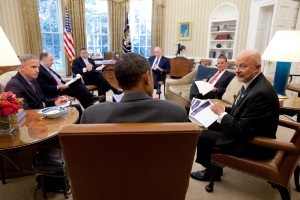
Director of National Intelligence James Clapper (right)
talks with President Barack Obama in the Oval Office,
with John Brennan and other national security aides
present. (Photo: Office of Director of National Intelligence)
The FISA warrant was allegedly obtained, in part, because of a speech that Page delivered in Russia on July 7, 2016, that was mildly critical of U.S. foreign policy toward the countries of the former Soviet Union. Beginning in late July, that FBI investigation then expanded into a much wider probe of people connected to Donald Trump’s presidential campaign with possible links to Russia.
In an article about the origins of the investigation of Page and other Trump advisers, The New York Times characterized Page’s July speech to the New Economic School in Moscow as critical of “American policy toward Russia in terms that echoed the position of President Vladimir V. Putin of Russia.”
The Times then quoted one line from the speech in which Page said, “Washington and other Western capitals have impeded potential progress through their often hypocritical focus on ideas such as democratization, inequality, corruption and regime change.”
The Times article by Scott Shane, Mark Mazzetti and Adam Goldman added:
“His [Page’s] remarks accorded with Mr. Trump’s positive view of the Russian president, which had prompted speculation about what Mr. Trump saw in Mr. Putin — more commonly denounced in the United States as a ruthless, anti-Western autocrat.”
In reality, Page’s speech was much more nuanced than the Times presented. His central point was that the hasty transformation of the former Soviet Union from state-controlled to free market economies led to unintended consequences, including increased corruption.
“As the state remained dominant and new markets were simultaneously established following the breakup of the Soviet Union, members of these societies devised other methods and means of survival through corruption,” Page said, adding that the West was not entirely innocent of similar problems:
“These approaches mirror several corrupt tendencies at times found in Western societies. Some may be clear-cut such as the Bernard Madoff scandal in financial markets and Enron in the energy sector, while others are more subtle such as the perceived societal injustices highlighted by the Occupy Wall Street movement.”
In other words, Page’s comments fell well within a reasonable assessment of the troubles that have occurred within the countries of the former Soviet Union. Page also recognized that the West – despite its sometimes holier-than-thou attitude toward less-developed nations – has its own problems with both criminal corruption and the more subtle variety of Wall Street machinations. After all, the 2008 financial crisis stripped common citizens of both America and Europe of trillions of dollars in lost assets and costs from government bailouts.
Echoing Putin?
But note how The New York Times characterized Page’s remarks as having “echoed the position of President Vladimir V. Putin of Russia,” suggesting that Page, a former U.S. Navy officer, was somehow demonstrating disloyalty.
The Times also suggested that Page’s opinions as expressed in his speech contributed to the Obama administration’s decision to seek and obtain a FISA warrant that allowed the U.S. government to monitor his communications as a suspected foreign agent.
Vladimir Putin, following UN General Assembly address Sept. 28, 2015. (UN Photo)
Normally, such intrusive government action against a citizen for expressing his opinions – whether they “echoed” the views of President Putin or not – would alarm defenders of civil liberties. However, since Page briefly served as a foreign policy adviser to Trump – and much of the civil liberties community has enlisted in the #Resistance to Trump over his presumed threats to civil liberties – there has been extraordinary silence about the McCarthyistic treatment of Page and other Trump advisers.
Retired Lt. Gen. Michael Flynn, who served briefly as President Trump’s national security adviser, has already had a taste of how the U.S. government’s surveillance powers can entrap a citizen in a “process” crime, such as lying to investigators or obstructing justice.
On Dec. 29, 2016, several weeks before Trump’s inauguration, Flynn – while vacationing in the Dominican Republic – took a phone call from Russian Ambassador Sergey Kislyak in which they apparently discussed mounting tensions between Washington and Moscow, as U.S. intelligence officials surreptitiously listened in.
Because Flynn was not officially part of the government at the time of the call, Obama administration appointees at the Justice Department created a pretext for a criminal investigation by citing the Logan Act, a law enacted in 1799 to prohibit private citizens from negotiating with foreign adversaries but never used to convict anyone, ever. The law also is of dubious constitutionality and was surely never intended to apply to a president-elect’s advisers.
However, based on that flimsy pretext, FBI agents – with a transcript of the electronic intercept of the Kislyak-Flynn phone call in hand – tested Flynn’s memory of the conversation and found his recollections incomplete. Flynn also has come under criticism for giving a paid speech in 2015 to a dinner in Moscow honoring the tenth anniversary of the Russian television station, RT. Under mounting media and political pressure, President Trump fired Flynn.
The New McCarthyism
So, while one can legitimately criticize Flynn’s judgment, the larger civil-liberties issue surrounding the Russia-gate investigation is the prospect of criminalizing otherwise innocuous contacts with Russia and punishing American citizens for resisting the New Cold War.
Green Party leader Jill Stein and retired Lt. General
Michael Flynn attending a dinner marking the RT network’s
10-year anniversary in Moscow, December 2015, sitting
at the same table as Russian President Vladimir Putin.
Many Democrats, liberals and even some progressives appear excited over the prospect of wielding this new McCarthyism against Trump’s advisers with the hope that Russia-gate can be built up into a case for Trump’s impeachment.
But the precedents that are being set could be very dangerous for the long term. If Americans can be put under invasive FISA warrants for going abroad and criticizing U.S. policies or if intercepted phone calls can be used to test the memories of citizens during FBI interviews, many of the warnings from civil libertarians about the dangers of “war on terror” surveillance powers being applied more broadly may be coming true.
After receiving the sweeping congressional demands for documents and other data, Carter Page, who is an oil industry consultant with numerous foreign contacts including in Russia, responded by taking note of the reported FISA surveillance of him, writing to Senators Burr and Warner:
“I remain committed to helping the Senate Select Committee on Intelligence in any way that I can. But please note that any records I may have saved as a private citizen with limited technology capabilities will be miniscule in comparison to the full database of information which has already been collected under the direction of the Obama Administration during last year’s completely unjustified FISA warrant that targeted me for exercising my First Amendment rights, both in 2016 as well as in years prior.
“As a starting point for this latest step in the witch hunt which you suggested per the cumbersome chores defined in your … letter, I would request that you please begin by sharing [with me] the same information which you currently have … Based on the database of my personal information already collected during the Obama Administration’s domestic political intelligence operations which reportedly began at some point last year, it seems clear that many of the weighty task[s] you assigned will have already been largely completed.
“As a lone individual, I can assure you that my personal administrative capabilities pale in comparison to the clerical juggernaut represented by the numerous staff in the executive, legislative and judicial branches of the U.S. Government which have heretofore been allegedly involved in this unscrupulous surveillance for many months on end.”
Whether justified or not, the FISA surveillance of Page – and thus likely others whom he contacted – may create the basis for some kind of criminal charges against him. Other Trump advisers may be tripped up on various process crimes, such as failure to report properly under the Foreign Agents Registration Act, another law that gets enforced selectively mostly against people without political pull.
In an interview on Friday, Page told me that he was a small player who was innocent of violating any laws but who became an “obvious” target for the Obama administration’s effort to undermine the Trump campaign.
“I don’t have [political] protection and I have genuine, deep Russian connections,” he said, adding that compliance with the Senate’s demands would require him reviewing
“thousands of emails and hundreds of phone calls. … It defies all logic and common sense.”
But the reality of Official Washington is that once momentum builds up around a “scandal,” someone has to get convicted of something – or all the Important People who have weighed in on the “affair” will look stupid. In Russia-gate, however, important principles about the right to dissent, the right to privacy and the right to associate freely are getting trampled.
Investigative reporter Robert Parry broke many of the Iran-Contra stories for The Associated Press and Newsweek in the 1980s. You can buy his latest book, America’s Stolen Narrative, either in print here or as an e-book (from Amazon and barnesandnoble.com).
Innovations in energy storage, smart grid, and electricity generation technologies will affect every part of the source-to-consumer supply chain for powering the planet. Energy storage tech improves the viability of wind and solar power – two energy sources that remain cost prohibitive due to expenses related to batteries that would store generated energy.
Smart grids will regulate the movement of energy throughout a city or state, insuring the areas from crippling blackouts. Developments in electricity generation make sure we make the most out of fossil fuels and other energy sources to improve efficiency.
What follows is a survey of progress in the development of five different technologies that promise to change the face of the energy industry in the next 20 years.
1. Fuel Cell:
Truck manufacturers Kenworth, Toyota, and UPS have begun investing in fuel cell technologies, which would allow transport vehicles to run on hydrogen and oxygen, releasing only heat and water as emissions. Modern hydrogen production still requires copious fossil fuel use, but the process could soon be powered by renewable energies, making fuel cell vehicles extremely clean alternatives to current trucking solutions.
In Europe, fuel cell production facilities will begin pumping out 50,000 fuel cell stacks by the year 2020, making United Kingdom-based Intelligent Energy the market leader in bringing the green technology to the masses. “Hydrogen fuel cell powered vehicles are available now, but to continue to drive customer adoption, we need to ensure future fuel cell stacks are robustly industrialised and remain cost competitive in the future,” said the company’s Manufacturing Head Richard Peart. Related: Will Hedge Funds Drive Oil Prices Even Lower?
2. Lithium-air batteries:
These storage units, also known as Lithium-oxygen fuel cells, have been gestating in scientific labs all over the world since the beginning of electric vehicles. Science Daily says two instabilities in the technology’s current form have prevented it from hitting mass markets: unpredictable short circuiting and speedy loss of battery power. Cornell University recently tackled the second capacity face problem, meaning we could be just one witty solution away from long-range electric cars.
3. First Generation Smart Grid:
The first step in making a reliable and responsive smart grid system requires the installation of smart meters in every household and building. The new meters will send usage information in real time to your energy provider, allowing adjustments in availability to fluctuate according to the area’s latest needs. So far, countries like the United Kingdom are having trouble adjusting the technology to fit the national infrastructure and business norms. The United States jumped on the smart grid bandwagon in 2007 and set up a taskforce to ensure a synchronized adoption of the new technology. The process has been slow, but small communities have begun “microgrid” projects that will allow consumer demand to drive implementation.
This small company could be one of the biggest winners of the coming gold boom. Backed by a billionaire resource investor and management dream team they could be the next big thing in the space.
4. Tidal turbines:
Much like wind turbines, these underwater pinwheels harness energy from wave movement. This green energy has had small-scale success so far, but objections from fishermen, as well as accidents, have set the technology back in California – tidal energy Ground Zero – in recent months. But the science behind tidal energy continues its march forward.
Scotrenewables Tidal Power announced the launch of a new low-cost turbine off the coast of Scotland. It’s also the “largest and most powerful” turbine of its kind in the world with a power generation capacity of two megawatts, according to its manufacturers. A retractable arm gives the facility a separate transport mode and an operation mode, which allows easy portability and an impermanence that would please local fishing industries.
5. Space-based Solar Power:
Solar power captured from-the-beyond has been a sci-fi concept since the 1970s. The high cost of transporting the panels and other equipment into space has prevented the idea from becoming fruitful for commercial energy production. In addition, the transfer of generated energy back to Earth has been a concern. Solar power panels installed on the ground connect to the local power grid to deliver their harnessed goods, but it is comical to imagine a satellite in space hooked to the planet via cable for efficient energy delivery, prompting scientists to develop wireless energy transfer technologies akin to the iPhone 8’s anticipated wireless charging feature. None of the existing methods have proven to be feasible on a massive scale. Suggestions are welcome.
The advances mentioned above are inter-related: progress in the lithium-air battery efforts will pave the way for the success of electric cars, which could be recharged with energy hardheaded from the tides or space-based solar power. It's one small step for science, one giant leap for green energy-kind.
Zainab Calcuttawala is an American journalist based in Morocco. She
completed her undergraduate coursework at the University of Texas at
Austin (Hook ’em) and reports on international trade, human rights issues
and more.
When Donald Trump wanted to “do something” about the use of chemical weapons on civilians in Syria, he had the U.S. Navy lob 59 cruise missiles at a Syrian airfield (cost: $89 million). The strike was symbolic at best, as the Assad regime ran bombing missions from the same airfield the very next day, but it did underscore one thing: the immense costs of military action of just about any sort in our era.
While $89 million is a rounding error in the Pentagon’s $600 billion budget, it represents real money for other agencies. It’s more than twice the $38 million annual budget of the U.S. Institute of Peace and more than half the $149 million budget of the National Endowment of the Arts, both slated for elimination under Trump’s budget blueprint. If the strikes had somehow made us -- or anyone -- safer, perhaps they would have been worth it, but they did not.
In this century of nonstop military conflict, the American public has never fully confronted the immense costs of the wars being waged in its name. The human costs -- including an estimated 370,000 deaths, more than half of them civilians, and the millions who have been uprooted from their homes and sent into flight, often across national borders -- are surely the most devastating consequences of these conflicts.
But the economic costs of our recent wars should not be ignored, both because they are so massive in their own right and because of the many peaceable opportunities foregone to pay for them.
Tomgram: William Hartung, Ignoring the Costs of War
Wilbur Ross put the matter... well, mouth-wateringly. At a Milken
Institute Global Conference in California, the commerce secretary
recalled how President Trump was hosting a dinner for China’s president,
Xi Jinping, at his Mar-a-Lago club at the moment when a bevy of
Tomahawk missiles were being dispatched against an airfield in Syria.
Ross described
the moment this way: “Just as dessert was being served, the president
explained to Mr. Xi he had something he wanted to tell him, which was
the launching of 59 missiles into Syria. It was in lieu of after-dinner
entertainment.” To laughter from the crowd, he then added, “The thing
was, it didn’t cost the president anything to have that entertainment.”
The president himself recalled
the same moment in an interview with Fox Business: “I was sitting at
the table. We had finished dinner. We're now having dessert. And we had
the most beautiful piece of chocolate cake that you've ever seen, and
President Xi was enjoying it.” (Of course, Donald Trump is hardly the
first person to, in essence, say, “Let them eat cake.”)
In
the end, of course, someone did have to pick up the tab for that
thrillingly militarized dessert and it just happened to be you and me.
As TomDispatch regular William Hartung, author of Prophets of War,
points out today in a piece on the true costs of war, American-style,
the bill for that piece of cake and those Tomahawk missiles was $89
million dollars, admittedly a mere lagniappe by twenty-first-century
U.S. military standards. (The tip for the meal naturally went
to the maker of those Tomahawks, Raytheon). Rest assured that future
desserts will undoubtedly be even more elaborate and expensive. After
all, in a rare bipartisan show of unity, Republicans and Democrats just
polished off a spending bill that will not only keep the government open
through September, but give the Pentagon, an institution that happens
to be historically incapable of even auditing itself, an extra little treat: $15 billion
above and beyond its already vast budget to tide it over in its
never-ending wars in Afghanistan, Iraq, and Syria, and “replenish
equipment and pay for training and maintenance.”
We’re talking
chocolate cake all the way to the bank when it comes to the Pentagon and
the major weapons contractors it regularly offers its tastiest
desserts. Admittedly, that $15 billion wasn’t quite what
President Trump wanted, but call it an mouth-watering appetizer when it
comes to a meal about which, unlike almost everything else on the table
in Washington, Democrats and Republicans always see more or less eye to
eye. And expect one thing: a lot more chocolate cake in President
Trump’s future. After all, the generals are in charge. Tom
The American Way of War Is a Budget-Breaker:
Never Has a Society Spent More for Less
by William D. Hartung
Even on the rare occasions when the costs of American war preparations and war making are actually covered in the media, they never receive the sort of attention that would be commensurate with their importance. Last September, for example, the Costs of War Project at Brown University’s Watson Institute released a paper demonstrating that, since 2001, the U.S. had racked up $4.79 trillion in current and future costs from its wars in Iraq, Afghanistan, Pakistan, and Syria, as well as in the war at home being waged by the Department of Homeland Security. That report was certainly covered in a number of major outlets, including the Boston Globe, the Los Angeles Times, the Atlantic, and U.S. News and World Report. Given its importance, however, it should have been on the front page of every newspaper in America, gone viral on social media, and been the subject of scores of editorials. Not a chance.
Yet the figures should stagger the imagination. Direct war spending accounted for “only” $1.7 trillion of that sum, or less than half of the total costs. The Pentagon disbursed those funds not through its regular budget but via a separate war account called Overseas Contingency Operations (OCO). Then there were the more than $900 billion in indirect war costs paid for from the regular budget and the budget of the Department of Veterans Affairs. And don’t forget to add in the more than half-trillion dollars for the budget of the Department of Homeland Security since 2001, as well as an expected $1 trillion in future costs for taking care of the veterans of this century’s wars throughout their lifetimes. If anyone were truly paying attention, what could more effectively bring home just how perpetual Washington’s post-9/11 war policies are likely to be?
That cost, in fact, deserves special attention. The Veterans Administration has chronic problems in delivering adequate care and paying out benefits in a timely fashion. Its biggest challenge: the sheer volume of veterans generated by Washington’s recent wars. An additional two million former military personnel have entered the VA system since the wars in Afghanistan and Iraq began. Fully half of them have already been awarded lifetime disability benefits. More than one in seven -- 327,000 -- suffer from traumatic brain injury. Not surprisingly, spending for the Veterans Administration has tripled since 2001. It has now reached more than $180 billion annually and yet the VA still can’t catch up with its backlog of cases or hire doctors and nurses fast enough to meet the need.
Now imagine another 15 years of such failing, yet endless wars and the flood of veterans they will produce and then imagine what a Cost of War Project report might look like in 2032. Given all this, you would think that the long-term price tag for caring for veterans would be taken into account when a president decides whether or not to continue to pursue America’s never-ending wars in the Greater Middle East and Africa, but that, of course, is never the case.
What a Military-First World Means in Budgetary Terms
Enter Donald Trump. Even before he launches a major war of his own -- if he does -- he’s loosed his generals to pursue with renewed energy just about all the wars that have been started in the last 15 years. In addition, he’s made it strikingly clear that he’s ready to throw hundreds of billions (eventually, of course, trillions) of additional tax dollars at the Pentagon in the years to come. As he put it in a September 2016 interview on Meet the Press, “I’m gonna build a military that’s so strong... nobody’s gonna mess with us.” As he makes plans to hike the Pentagon budget once more, however, here’s what he seems blissfully unaware of: at roughly $600 billion per year, current Pentagon spending is already close to its post-World War II peak and higher than it was at the height of the massive 1980s military buildup initiated by President Ronald Reagan.
On the dubious theory that more is always better when it comes to Pentagon spending (even if that means less is worse elsewhere in America), Trump is requesting a $54 billion increase in military spending for 2018. No small sum, it’s roughly equal to the entire annual military budget of France, larger than the defense budgets of the United Kingdom, Germany, and Japan, and only $12 billion less than the entire Russian military budget of 2015.
Trump and his budget director, Mick Mulvaney, have pledged to offset this sharp increase in Pentagon funding with corresponding cuts in domestic and State Department spending. (In a military-first world, who even cares about the ancient art of diplomacy?) If the president gets his way, that will mean, for instance, a 31% cut in the Environmental Protection Agency’s budget and a 29% cut in the State Department’s. Eliminated would also be $8 billion worth of block grants that provide services to low-income communities, including subsidies for seniors who can’t afford to heat their homes, as well as any support for 19 separate agencies engaged in purely peaceable activities, including the National Endowment for the Arts, the National Endowment for the Humanities, Legal Services, the Corporation for Public Broadcasting, AmeriCorps, and the Appalachian Regional Commission, which invests in economic development, education, and infrastructure projects in one of the nation’s poorest regions.
Overall, as presently imagined, the Trump budget would hike the Pentagon’s cut of the pie, and related spending on veterans' affairs, homeland security, and nuclear weapons to an astounding 68% of federal discretionary spending. And keep in mind that the discretionary budget includes virtually everything the government does outside of entitlement programs like Social Security, Medicare, and Medicaid. You undoubtedly won’t be surprised to learn that perpetual war and the urge to perpetuate yet more of it leaves little room for spending on the environment, diplomacy, alternative energy, housing, or other domestic investments, not to speak of infrastructure repair.
Put another way, preparations for and the pursuit of war will ensure that any future America is dirtier, sicker, poorer, more rickety, and less safe.
Taking the Gloves Off When It Comes to the Costs of War
The biggest beneficiaries of Pentagon largesse will, as always, be the major defense contractors like Lockheed Martin, which received more than $36 billion in defense-related contracts in fiscal 2015 (the most recent year for which full statistics are available). To put that figure in perspective, Lockheed Martin’s federal contracts are now larger than the budgets of 22 of the 50 states. The top 100 defense contractors received $175 billion from the Pentagon in fiscal year 2015, nearly one-third of the Department of Defense’s entire budget. These numbers will only grow if Trump gets the money he wants to build more ships, planes, tanks, and nuclear weapons.
The Trump administration has yet to reveal precisely what it plans to spend all that new Pentagon money it’s requesting, but the president’s past statements offer some clues. He has called for building up the Navy from its current level of 272 ships to 350 or more. The Congressional Budget Office estimates that the construction costs alone of such an effort would be $800 billion over the next three decades at an annual cost of $26.6 billion, which is 40% higher than the Navy’s present shipbuilding budget.
To put this in perspective, even before Trump’s proposed increases, the Navy was planning major expenditures on items like 12 new ballistic-missile-firing submarines at a development and building cost of more than $10 billion each. As for new surface ships, Trump wants to add two more aircraft carriers to the 10 already in active service. He made this clear in a speech on board the USS Gerald Ford, a new $13 billion carrier that, as with so much Pentagon weaponry, has been plagued with cost overruns and performance problems.
President Trump also wants to double down on the Pentagon’s preexisting program to spend $1 trillion over the next 30 years on a new generation of nuclear-armed bombers, submarines, and land-based missiles. While that plan is politely referred to as a “modernization” of the U.S. nuclear arsenal, it already essentially represents Washington’s bid to launch a new global arms race. So among a host of ill-considered plans for yet more expenditures, this one is a particular ringer, given that the United States already possesses massive nuclear overkill and that current nuclear delivery systems can last decades more with upgrades.
To give all of this a sense of scale, two Air Force strategists determined that the United States needs just 311 nuclear warheads to dissuade any other country from ever attacking it with nuclear weapons. At 4,000 nuclear warheads, the current U.S. stockpile is already more than 13 times that figure -- enough, that is, to destroy several planet Earths.
And don’t forget that Trump also wants to add tens of thousands more soldiers and Marines to the military’s ranks. By the most conservative estimate, the cost of equipping, training, paying, and deploying a single soldier annually is now close to $1 million (even leaving aside those future VA outlays), so every 10,000 additional troops means at least $10 billion more per year.
And don’t forget that the staggering potential costs already mentioned represent just the baseline for military spending -- the costs President Trump will set in motion even if he doesn’t get us into a major war. Not that we’re not at war already. After all, he inherited no less than seven conflicts from Barack Obama: Afghanistan, Iraq, Libya, Pakistan, Somalia, Syria, and Yemen. Each of them involves a different mix of tools, including combat troops, trainers, Special Operations forces, conventional bombing, drone strikes, and the arming of surrogate forces -- but conflicts they already are.
Based on his first 100-plus days in office, the real question isn’t whether Donald Trump will escalate these conflicts -- he will -- but how much more he will do. He’s already allowed his military commanders to “take the gloves off” by loosening the criteria for air attacks in Afghanistan, Syria, Iraq, Yemen, and Somalia, with an almost instant increase in civilian casualties as a result. He has also ceded to his commanders decision-making when it comes to how many troops to deploy in Iraq, Syria, Afghanistan and elsewhere, making it a reasonable probability that more U.S. personnel will be sent into action in the months and years to come.
It still seems unlikely that what must now be considered Trump’s wars will ever blow up into the kind of large-scale conflicts that the Bush administration sparked in Iraq. At the height of that disaster, more than 160,000 U.S. troops and a comparable number of U.S.-funded private contractors were deployed to Iraq (compared to 7,000 troops and more than 7,800 contractors there now). Nor does the talk of increasing the number of U.S. troops in Afghanistan by 3,000 to 5,000 suggest that the 8,400 troops now there will ever be returned to the level of roughly 100,000 of the Obama “surge” era of 2010 and 2011.
But don’t breathe a sigh of relief just yet. Given Trump’s pattern of erratic behavior so far -- one week threatening a preemptive strike on North Korea and the next suggesting talks to curb Pyongyang’s nuclear program -- anything is possible. For example, there could still be a sharp uptick in U.S. military personnel sent into Iraq and Syria when his pledge to “bomb the shit” out of ISIS doesn’t vanquish the group.
And if we learned anything from the Iraq experience (aside from the fact that attempting to use military force to remake another country is a formula for a humanitarian and security disaster), it’s that politicians and military leaders routinely underestimate the costs of war. Before the invasion of Iraq, Bush officials were, for instance, citing figures as low as $50 billion for the entire upcoming operation, beginning to end. According to figures compiled by the Congressional Research Service, however, direct budgetary costs for the Iraq intervention have been at least 16 times larger than that -- well over $800 billion -- and still counting.
One decision that could drive Trump’s already expansive military spending plans through the roof would be an incident that escalated into a full-scale conflict with Iran. If the Trump team -- a remarkable crew of Iranophobes -- were to attack that country, there’s no telling where things might end, or how high the costs might mount. As analyst Ali Vaez of the International Crisis Group has noted, a war with Iran could “make the Afghan and Iraqi conflicts look like a walk in the park.”
So before Congress and the public acquiesce in another military intervention or a sharp escalation of one of the U.S. wars already under way, perhaps it’s time to finally consider the true costs of war, American-style -- in lives lost, dollars spent, and opportunities squandered. It’s a reasonable bet that never in history has a society spent more on war and gotten less bang for its copious bucks.