Friday, June 02, 2017

You a Culpa: Collapsing Hillary's Reality Tunnel

Hillary Clinton’s Deceptive Blame-Shifting

by Robert Parry - Consortium News


June 1, 2017

While complaining about “fake news” that undercut her campaign, Hillary Clinton continued her own “fake news” falsehood about the U.S. intelligence assessment on Russian election “meddling,” reports Robert Parry.


Hillary Clinton has grown even more insistent that she was not at fault for her stunning election defeat last November, claiming that 1,000 Russian “agents” and their American collaborators were a decisive factor, a bizarre twist that further locks the Democrats into their evidence-light “Russia-gate” obsession.


Hillary Clinton at the Code 2017
conference on May 31, 2017

In comments at a California technology conference on Wednesday, Clinton also repeated one of her favorite falsehoods – that all 17 U.S. intelligence agencies unanimously concluded that Russia hacked Democratic emails and ran a covert influence campaign against her.

Referring to a report released by President Obama’s Director of National Intelligence (DNI) on Jan. 6, Clinton asserted that,

“Seventeen agencies, all in agreement, which I know from my experience as a Senator and Secretary of State, is hard to get. They concluded with high confidence that the Russians ran an extensive information war campaign against my campaign, to influence voters in the election. They did it through paid advertising we think; they did it through false news sites; they did it through these thousand agents; they did it through machine learning, which you know, kept spewing out this stuff over and over again. The algorithms that they developed. So that was the conclusion.”

But Clinton’s statement is false regarding the unanimity of the 17 agencies and misleading regarding her other claims. Both former DNI James Clapper and former CIA Director John Brennan acknowledged in sworn testimony last month that the Jan. 6 report alleging Russian “meddling” did not involve all 17 agencies.

Clapper and Brennan stated that the report was actually the work of hand-picked analysts from only three agencies – the Central Intelligence Agency, National Security Agency and Federal Bureau of Investigation – under the oversight of the DNI’s office. In other words, there was no consensus among the 17 agencies, a process that would have involved some form of a National Intelligence Estimate (or NIE), a community-wide effort that would have included footnotes citing any dissenting views.

Instead, as Clapper testified before a Senate Judiciary subcommittee on May 8, the Russia-hacking claim came from a “special intelligence community assessment” (or ICA) produced by selected analysts from the CIA, NSA and FBI, “a coordinated product from three agencies – CIA, NSA, and the FBI – not all 17 components of the intelligence community,” the former DNI said.

And, as Clapper explained, the “ICA” was something of a rush job beginning on President Obama’s instructions “in early December” and completed by Jan. 6. Clapper continued: “The two dozen or so analysts for this task were hand-picked, seasoned experts from each of the contributing agencies.”

However, as any intelligence veteran will tell you, if you hand-pick the analysts, you are really hand-picking the conclusion since the agency chiefs would know who was, say, a hardliner on Russia and who could be trusted to deliver the desired product.

On May 23, in testimony before the House Intelligence Committee, former CIA Director John Brennan confirmed Clapper’s account about the three agencies involved.

“It wasn’t a full inter-agency community assessment that was coordinated among the 17 agencies, and for good reason because of the nature and the sensitivity of the information trying, once again, to keep that tightly compartmented,” Brennan said.

In other words, Clinton’s beloved claim that all 17 intelligence agencies were in agreement on the Russian “hacking” charge – an assertion that the “fact-checking” group Politifact has certified as “true” and that has been repeated endlessly by the mainstream U.S. news media – is not true. It is false. Gee, you might even call it “fake news.”

The Mysterious ‘Agents’


But Clinton’s false claim about the intelligence consensus was not her only dubious assertion. Her reference to the 1,000 Russian “agents” is not contained in the Jan. 6 report, either. It apparently derived from unconfirmed speculation from Sen. Mark Warner, D-Virginia, who mentioned this claim at a news conference on March 30, admitting that he didn’t know if it was true.
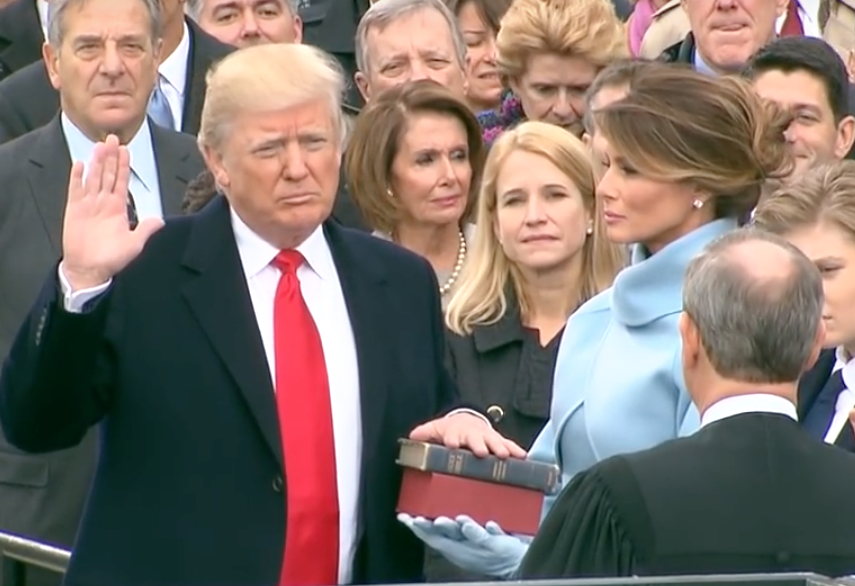

President Donald Trump being sworn in on Jan. 20, 2017.
(Screen shot from Whitehouse.gov)

Warner, the ranking Democrat on the Senate Intelligence Committee, said: “We know about the hacking, and selective leaks, but what really concerns me as a former tech guy is at least some reports – and we’ve got to get to the bottom of this – that there were upwards of a thousand internet trolls working out of a facility in Russia, in effect taking over a series of computers which are then called botnets, that can then generate news down to specific areas.


“It’s been reported to me, and we’ve got to find this out, whether they were able to affect specific areas in Wisconsin, Michigan, Pennsylvania, where you would not have been receiving off of whoever your vendor might have been, Trump versus Clinton, during the waning days of the election, but instead, ‘Clinton is sick’, or ‘Clinton is taking money from whoever for some source’ … fake news.”

Of course, many stories about Clinton being sick or her taking money from special interests weren’t “fake news.” In late 2012, she suffered from a blood clot and – during the 2016 campaign – she was staggered by a bout of pneumonia. She also was paid hundreds of thousands of dollars for speeches to Wall Street and other groups.

Warner didn’t specify where his information about the “trolls” came from but it paralleled a claim by freelance journalist Adam Chen who asserted in a podcast with Longform that Russian “trolls” began writing favorably about Trump in late 2015. (The CIA/FBI/NSA report also apparently alluded to the same report without mentioning the name of the journalist or specifying the number of alleged “trolls.”)

“I created this list of Russian trolls when I was researching,” Chen said, referring to a 2015 reporting project that he turned into a rather thinly sourced New York Times Magazine article accusing a Russian oligarch of funding a professional “troll” operation in St. Petersburg, Russia.

“I check on it once in a while, still. And a lot of them have turned into conservative accounts, like fake conservatives. I don’t know what’s going on, but they’re all tweeting about Donald Trump and stuff.”

Although such “troll” and “hacking” complaints are treated as a one-way street – coming only from the evil Russians – the reality is that U.S. intelligence agencies, their allies and U.S.-government-funded “non-governmental organizations” have mounted similar operations against Russia and other targets.

It is always difficult to nail down precisely where such operations are originating, but the Russians have cited previous cases of malicious hacking aimed at senior officials, including Prime Minister Dmitri Medvedev, whose accounts were hacked in 2013 and 2014 including publication of a false resignation and a confession of wrongdoing.

In 2015, the “Panama Papers,” a vast trove of documents purloined from a Panamanian law firm, became an investigative project that involved a USAID-funded news outlet and led to attacks on President Vladimir Putin for corruption even though his name did not appear in the documents.

So, this high-tech spy-vs.-spy game – if that’s what it is – does not appear to be originating entirely from the Russian side of the street. But the U.S. intelligence community is not going to divulge what it knows about the attacks against Russia, only what it can “assess” about Russia’s possible attacks against Western targets.

No Self-Criticism


Neither, of course, are Hillary Clinton and the Democratic Party eager to engage in a serious self-criticism about how they managed to blow an extremely winnable race against an extraordinarily flawed candidate in Donald Trump. Rather than look at their own missteps and misjudgments, they are presenting themselves as innocent victims.
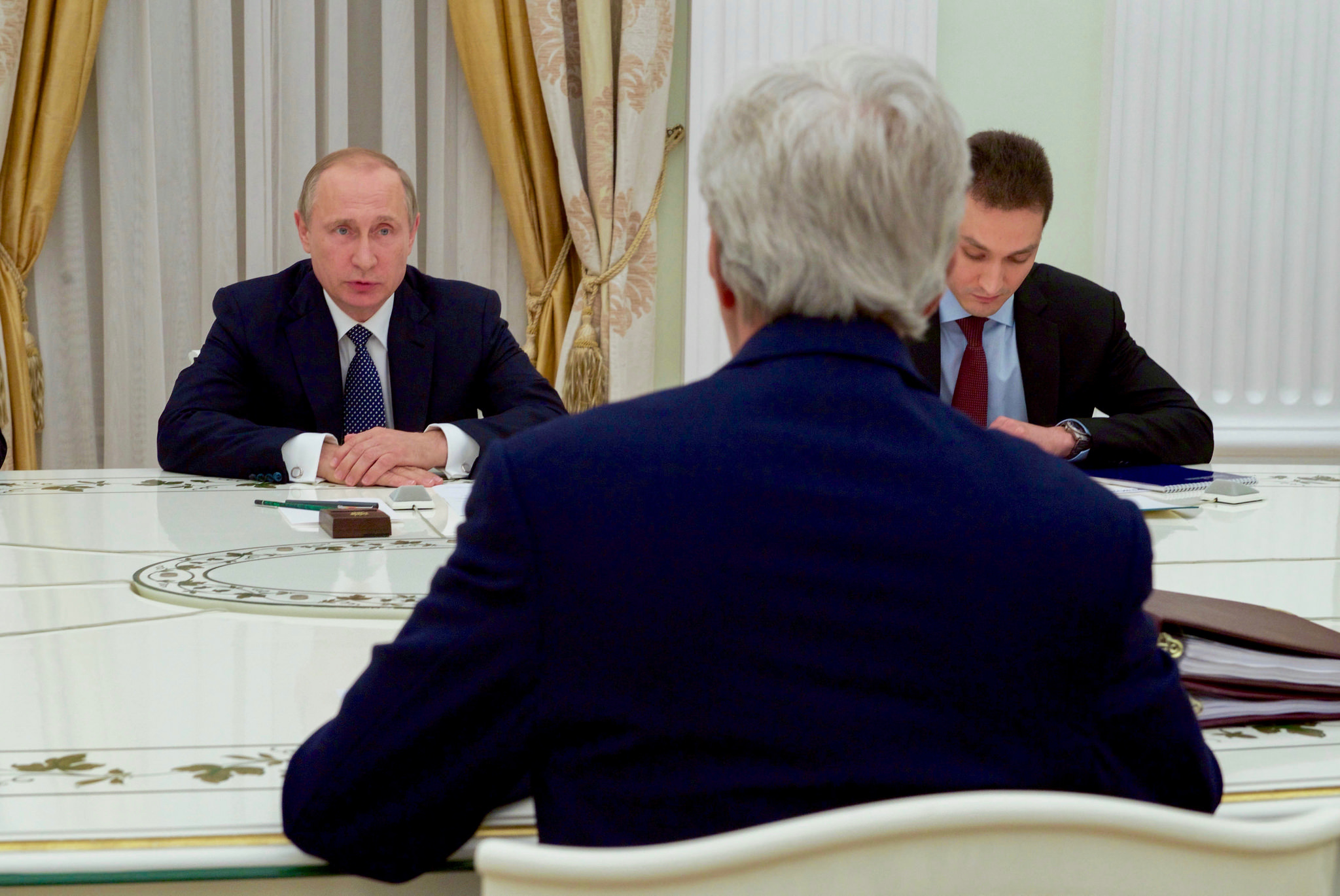

U.S. Secretary of State John Kerry listens to Russian
President Vladimir Putin in a meeting room at the Kremlin
in Moscow, Russia, at the outset of a bilateral meeting on July 14, 2016.
[State Department Photo]

In Wednesday’s interview – after misrepresenting what the Jan. 6 report actually said – Clinton suggested that the Trump campaign must have colluded with the Russians in “weaponizing” the data.

“How did they know what messages to deliver?” Clinton asked.

“Who told them? Who were they coordinating with, or colluding with? … [The Russians] were conveying this weaponized information and the content of it. … So the Russians — in my opinion and based on the intel and the counterintel people I’ve talked to — could not have known how best to weaponize that information unless they had been guided. … Guided by Americans and guided by people who had polling and data information.”

Although Clinton lacked any proof of this convoluted accusation, she cited as her “best example” the fact that “within one hour, one hour of the ‘Access Hollywood’ tapes being leaked [in which Trump was caught boasting about groping women], within one hour, the Russians — let’s say WikiLeaks, something — dumped the John Podesta emails.”

However, if you changed the context of this claim slightly – and made a similar jump in logic – you would surely be labeled a nutty conspiracy theorist, but instead Clinton has drawn nods of agreement for this wholly unsubstantiated speculation.

Yet, besides blaming the Russians and WikiLeaks for her loss, Clinton spread the blame even wider, for instance, to The New York Times for focusing too much on her decision to use a private email server while Secretary of State – “they covered it like it was Pearl Harbor” – and for the Times’ Nate Silver publishing optimistic odds on her chances for victory. “I also think I was the victim of a very broad assumption I was going to win,” she said.

Clinton also placed blame on the Democratic National Committee for lacking money and sophisticated technology. “I get the nomination. So I’m now the nominee of the Democratic Party. I inherit nothing from the Democratic Party,” she said.

“I mean it was bankrupt; it was on the verge of insolvency; its data was mediocre to poor, nonexistent, wrong. I had to inject money into it.”

Yet, when Clinton was asked about some of her own “misjudgments,” she slipped back into the defensive posture that contributed to her troubles as a presidential candidate. For instance, regarding why she gave lucrative speeches to Goldman Sachs between her time leaving the State Department and announcing her White House run, she answered coyly, “They paid me.”

When pressed on the point, Clinton retreated behind the sanctity of the 9/11 terror attack and the issue of women’s rights. Reminded that “you’re not somebody who needed that money for the next week’s shopping, and you knew you might run, so why do it?” – she responded:

“The most common thing that I talked about in all those speeches was the hunt for Bin Laden. You know, that was one of the central missions that I felt from the time the towers fell on 9/11 as a Senator from New York.”

Then, Clinton added, “you know, men got paid for the speeches they made. I got paid for the speeches I made. And it [the paid-speech issue] was used, and I thought it was unfairly used.”

Blocking Witnesses


So, while the Democrats dig themselves deeper into the so-far empty pit of blaming Russia for their electoral disaster, the Russia-gate investigation continues to take on other curious aspects, such as an unwillingness to hear from some of Donald Trump’s advisers who have been named in accusations and who have volunteered to testify publicly.


Former Trump foreign policy adviser Carter Page.

On Wednesday, Carter Page, a Navy veteran and businessman who had lived in Russia, announced that his plans to defend himself in testimony next week before the House Intelligence Committee had been placed on hold by the Democrats.

Rep. Adam Schiff of California, the ranking Democrat on the committee and a major sparkplug powering the investigation, offered a curious denial of Page’s complaint while confirming the truth of it.

The New York Times, which has been another advocate for blaming Russia, phrased the postponement of Page’s testimony as if Page were the unreasonable one, reporting:

“Representative Adam Schiff … dismissed accusations from Carter Page, another Trump adviser who is under scrutiny, that the committee is preventing him from testifying. Mr. Schiff …. said the investigation would first review relevant documents before interviewing witnesses.”

In other words, Page, who has been portrayed via intelligence leaks to the news media as essentially a traitor, won’t be given the opportunity to defend his reputation until Schiff and the other Democrats decide the time is ripe.

Yet, it’s not as if the House Intelligence Committee has not taken public testimony about Russia-gate. For instance, former CIA Director Brennan was allowed to speak indirectly about Page and other possibly treasonous Americans amid media reports naming Page as one of those suspected Russian “agents.”

Normal investigations grant the people under attack at least the opportunity to defend themselves and their reputations in a timely fashion, rather than make them live under the cloud of suspicion without having a chance to state their case.

If their sworn testimony is later undermined by evidence developed by investigators, the witnesses can be called back and called out on possible perjury. So, it’s not as if Schiff and the other Democrats are surrendering prerogatives by letting Page testify now rather than later. Indeed, Page would be putting himself in legal jeopardy if he is caught lying.

Even the Republican-driven “Benghazi investigation,” which also had the look of an over-the-top “witch hunt,” gave Secretary of State Clinton and other Obama administration officials multiple opportunities to explain their response to the Sept. 11, 2012 attack on the U.S. consulate.

But, so far, a similar courtesy has not been extended to the targets of the Russia-gate investigation.

Investigative reporter Robert Parry broke many of the Iran-Contra stories for The Associated Press and Newsweek in the 1980s. You can buy his latest book, America’s Stolen Narrative, either in print here or as an e-book (from Amazon and barnesandnoble.com).
image_pdf

All Hail the Oligarchs! All Hail the American Caesar!

Oligarchs Succeed! Only the People Suffer!

by James Petras


May 31, 2017

On a scale not seen since the ‘great’ world depression of the 1930’s, the US political system is experiencing sharp political attacks, divisions and power grabs. Executive firings, congressional investigations, demands for impeachment, witch hunts, threats of imprisonment for ‘contempt of Congress’ and naked power struggles have shredded the façade of political unity and consensus among competing powerful US oligarchs.


For the first time in US history, the incumbent elected president struggles on a daily basis to wield state power. The opposition-controlled state (National Public Radio) and corporate organs of mass propaganda are pitted against the presidential regime. Factions of the military elite and business oligarchy face off in the domestic and international arena. The oligarchs debate and insult each other.

They falsify charges, plot and deceive. Their political acolytes, who witness these momentous conflicts, are mute, dumb and blind to the real interests at stake.

The struggle between the Presidential oligarch and the Opposition oligarchs has profound consequences for their factions and for the American people.

Wars and markets, pursued by sections of the Oligarchs, have led opposing sections to seek control over the means of political manipulation (media and threats of judicial action).

Intense political competition and open political debate have nothing to do with ‘democracy’ as it now exists in the United States.

In fact, it is the absence of real democracy, which permits the oligarchs to engage in serious intra-elite warfare. The marginalized, de-politicized electorate are incapable of taking advantage of the conflict to advance their own interests.

What the ‘Conflict’ is Not About


The ‘life and death’ inter-oligarchical fight is not about peace!

None of the factions of the oligarchy, engaged in this struggle, is aligned with democratic or independent governments.

Neither side seeks to democratize the American electoral process or to dismantle the grotesque police state apparatus.

Neither side has any commitment to a ‘new deal’ for American workers and employees.

Neither is interested in policy changes needed to address the steady erosion of living standards or the unprecedented increase in ‘premature’ mortality among the working and rural classes.

Despite these similarities in their main focus of maintaining oligarchical power and policies against the interests of the larger population, there are deep divisions over the content and direction of the presidential regime and the permanent state apparatus.

What the Oligarchical Struggle is About


There are profound differences between the oligarch factions on the question of overseas wars and ‘interventions’.

The ‘opposition’ (Democratic Party and some Republican elite) pursues a continuation of their policy of global wars, especially aimed at confronting Russian and China, as well as regional wars in Asia and the Middle East. There is a stubborn refusal to modify military policies, despite the disastrous consequences domestically (economic decline and increased poverty) and internationally with massive ethnic cleansing, terrorism, forced migrations of war refugees to Europe, and famine and epidemics (such as cholera and starvation in Yemen).

The Trump Presidency appears to favor increased military confrontation with Iran and North Korea and intervention in Syria, Venezuela and Yemen.

The ‘Opposition’ supports multilateral economic and trade agreements, (such as TTP and NAFTA), while Trump favors lucrative ‘bilateral’ economic agreements. Trump relies on trade and investment deals with Saudi Arabia and the Gulf Emirates and the formation of an aggressive military ‘axis’ (US-Saudi Arabia-Israel -Gulf Emirates) to eventually overthrow the nationalist regime in Iran and divide the country.

The ‘Opposition’ pursues wars and violent ‘regime change’ to replace disobedient ‘tyrants’ and nationalists and set up ‘client governments’, which will provide bases for the US military empire. Trump’s regime embraces existing dictators, who can invest in his domestic infrastructure agenda.

The ‘opposition’ seeks to maximize the role of Washington’s global military power. President Trump focuses on expanding the US role in the global market.

While both oligarchical factions support US imperialism, they differ in terms of its nature and means.

For the ‘opposition’, every country, large or small, can be a target for military conquest. Trump tends to favor the expansion of lucrative overseas markets, in addition to projecting US military dominance.

Oligarchs: Tactical Similarities


The competition among oligarchs does not preclude similarities in means and tactics. Both factions favor increased military spending, support for the Saudi war on Yemen and intervention in Venezuela. They support trade with China and international sanctions against Russia and Iran. They both display slavish deference to the State of Israel and favor the appointment of openly Zionist agents throughout the political, economic and intelligence apparatus.

These similarities are, however, subject to tactical political propaganda skirmishes. The ‘Opposition’ denounces any deviation in policy toward Russia as ‘treason’, while Trump accuses the ‘Opposition’ of having sacrificed American workers through NAFTA.

Whatever the tactical nuances and similarities, the savage inter-oligarchic struggle is far from a theatrical exercise. Whatever the real and feigned similarities and differences, the oligarchs’ struggle for imperial and domestic power has profound consequence for the political and constitutional order.

Oligarchical Electoral Representation and the Parallel Police State


The ongoing fight between the Trump Administration and the ‘Opposition’ is not the typical skirmish over pieces of legislation or decisions. It is not over control of the nation’s public wealth. The conflict revolves around control of the regime and the exercise of state power.

The opposition has a formidable array of forces, including the national intelligence apparatus (NSA, Homeland Security, FBI, CIA, etc.) and a substantial sector of the Pentagon and defense industry. Moreover, the opposition has created new power centers for ousting President Trump, including the judiciary. This is best seen in the appointment of former FBI Chief Robert Mueller as ‘Special Investigator’ and key members of the Attorney General’s Office, including Deputy Attorney General Rob Rosenstein. It was Rosenstein who appointed Mueller, after the Attorney General ‘Jeff’ Session (a Trump ally) was ‘forced’ to recluse himself for having ‘met’ with Russian diplomats in the course of fulfilling his former Congressional duties as a senior member of the Senate Foreign Relations Committee. This ‘recusal’ took significant discretionary power away from Trump’s most important ally within the Judiciary.

The web of opposition power spreads and includes former police state officials including mega-security impresario, Michael Chertoff (an associate of Robert Mueller), who headed Homeland Security under GW Bush, John Brennan (CIA), James Comey (FBI) and others.

The opposition dominates the principal organs of propaganda -the press (Washington Post, Financial Times, New York Times and Wall Street Journal), television and radio (ABC, NBC, CBS and PBS/ NPR), which breathlessly magnify and prosecute the President and his allies for an ever-expanding web of unsubstantiated ‘crimes and misdemeanors’. Neo-conservative and liberal think tanks and foundations, academic experts and commentators have all joined the ‘hysteria chorus’ and feeding frenzy to oust the President.

The President has an increasingly fragile base of support in his Cabinet, family and closest advisers. He has a minority of supporters in the legislature and possibly in the Supreme Court, despite nominal majorities for the Republican Party.

The President has the passive support of his voters, but they have demonstrated little ability to mobilize in the streets. The electorate has been marginalized.

Outside of politics (the ‘Swamp’ as Trump termed Washington, DC) the President’s trade, investment, taxation and deregulation policies are backed by the majority of investors, who have benefited from the rising stock market. However, ‘money’ does not appear to influence the parallel state.

The divergence between Trumps supporters in the investment community and the political power of the opposition state is one of the most extraordinary changes of our century.

Given the President’s domestic weakness and the imminent threat of a coup d’état, he has turned to securing ‘deals’ with overseas allies, including billion-dollar trade and investment agreements.

The multi-billion arms sales to Saudi Arabia and the Gulf Emirates will delight the military-industrial complex and its hundreds of thousands of workers.

Political and diplomatic ‘kowtowing’ to Israeli Prime Minister Netanyahu should please some American Zionists.

But the meetings with the EU in Brussels and with the G7 in Siciliy failed to neutralize Trump’s overseas opposition.

NATO’s European members did not accept Trump’s demands that they increase their contribution to the alliance and they condemned his reluctance to offer unconditional US military support for new NATO members. They showed no sympathy for domestic problems.

In brief, the President’s overseas supporters, meetings and agreements will have little impact on the domestic correlation of forces.

Moreover, there are long-standing ties among the various state apparatuses and spy agencies in the EU and the US, which strengthen the reach of the opposition in their attacks on Trump.

While substantive issues divide the Presidential and Opposition oligarchs, these issues are vertical, not horizontal, cleavages - a question of ‘their’ wars or ‘ours’.

Trump intensified the ideological war with North Korea and Iran; promised to increase ground troops in Afghanistan and Syria; boosted military and advisory support for the Saudi invasion of Yemen; and increased US backing for violent demonstrations and mob attacks in Venezuela.

The opposition demands more provocations against Russia and its allies; and the continuation of former President Obama’s seven wars.

While both sets of oligarchs support the ongoing wars, the major difference is over who is managing the wars and who can be held responsible for the consequences.

Both conflicting oligarchs are divided over who controls the state apparatus since their power depends on which side directs the spies and generates the fake news.

Currently, both sets of oligarchs wash each other’s ‘dirty linen’ in public, while covering up for their collective illicit practices at home and abroad.

The Trump’s oligarchs want to maximize economic deals through ‘uncritical’ support for known tyrants; the opposition ‘critically’ supports tyrants in exchange for access to US military bases and military support for ‘interventions’.

President Trump pushes for major tax cuts to benefit his oligarch allies while making massive cuts in social programs for his hapless supporters. The Opposition supports milder tax cuts and lesser reductions in social programs.

Conclusion


The battle of the oligarchs has yet to reach a decisive climax. President Trump is still the President of the United States. The Opposition forges ahead with its investigations and lurid media exposés.

The propaganda war is continuous. One day the opposition media focuses on a deported student immigrant and the next day the President features new jobs for American military industries.

The emerging left-neo-conservative academic partnership (e.g. Noam Chomsky-William Kristol) has denounced President Trump’s regime as a national ‘catastrophe’ from the beginning. Meanwhile, Wall Street investors and libertarians join to denounce the Opposition’s resistance to major tax ‘reforms’.

Oligarchs of all stripes and colors are grabbing for total state power and wealth while the majority of citizens are labeled ‘losers’ by Trump or ‘deplorables’ by Madame Clinton.

The ‘peace’ movement, immigrant rights groups and ‘black lives matter’ activists have become mindless lackeys pulling the opposition oligarchs’ wagon, while rust-belt workers, rural poor and downwardly mobile middle class employees are powerless serfs hitched to President Trump’s cart.

Epilogue


After the blood-letting, when and if President Trump is overthrown, the State Security functionaries in their tidy dark suits will return to their nice offices to preside over their ‘normal’ tasks of spying on the citizens and launching clandestine operations abroad.

The media will blow out some charming tid-bits and ‘words of truth’ from the new occupant of the ‘Oval Office’.

The academic left will churn out some criticism against the newest ‘oligarch-in-chief’ or crow about how their heroic ‘resistance’ averted a national catastrophe.

Trump, the ex-President and his oligarch son-in-law Jared Kushner will sign new real estate deals. The Saudis will receive the hundreds of billions of dollars of US arms to re-supply ISIS or its successors and to rust in the ‘vast and howling’ wilderness of US-Middle East intervention. Israel will demand even more frequent ’servicing’ from the new US President.

The triumphant editorialists will claim that ‘our’ unique political system, despite the ‘recent turmoil’, has proven that democracy succeeds . . . only the people suffer!

Long live the Oligarchs!


___________________________

Latest book by James Petras:

The End of the Republic and the Delusion of Empire

ISBN: 978-0-9972870-5-9

$24.95 / 252 pp. / 2016

EBOOK ISBN: 978-0-9972870-6-6

ORDER E-BOOK: $19.00

Thursday, June 01, 2017

After Trump Slump: Riyadh Summit Falls Flat

After Riyadh Summit, Sunni Unity Crumbles

by Sharmine Narwani - RT


June 1, 2017

The glowing orb stunt should have been a sign that all was not what it seems. Theatrics, in the world of politics, usually suggest an illusion needs to be spun for audiences somewhere.

A week after US President Donald Trump’s eyesore of a visit to Riyadh, Saudi Arabia, the pressing question now is “why?” What was the purpose of convening leaders and representatives of 55 Arab and Muslim nations to greet a US head of state amidst so much pomp, ceremony and an excruciating amount of flashing cameras?

The Riyadh summit had several goals, most of which specifically served Saudi and American political interests.

The American leader's potential gains were clear: he would score points at this impressive international showing of Muslim leaders who would help counter his anti-Muslim reputation at home. Trump would also be well-compensated in the form of the largest US arms deal in history, a booty he could claim would boost his home economy. The negotiations would take place in the Middle East, at the heart of his fight against “radical Islamic terrorism.”

Trump would also leave with a blank check for Palestinian-Israel “peace,” bestowed by a Saudi king who has no authority to negotiate anything on behalf of Palestinians. And finally, the US president would piggyback the legitimacy of 55 Arab and Muslim states to craft a Middle East policy that targeted Iran, its allies and the Muslim Brotherhood (MB) – even though no consensus whatsoever was reached at the summit.

In their eyes, the Saudis scored even bigger. The cash-and-credibility-hemorrhaging Saudis are losing ground in their list of international fights – in Syria, Yemen, Iraq and against Iran. Here was an opportunity to convene leaders and representatives from 55 Arab and Muslim nations (only 33 heads of state showed up) to underscore Saudi Arabia’s position as the custodian of Sunni Islam. For the power-mad Saudis, nothing would showcase their primacy better than the presence of a US president on his first official foreign trip. They forgot, however, that legitimacy is derived from one’s own populations, not from a Western head of state sword-dancing next to one’s king. After the summit, Riyadh would go on to unilaterally craft a declaration, unseen and unapproved by the VIP guests, that claimed to outline the gathering’s foreign policy priorities.

But most importantly, this summit would allow the Saudis - who are terrified at the potential repercussions coming their way from decades of funding global terrorism – to very publicly take cover under the Trump presidency. And the US president, who knows very well that the Saudis are the epicenter of global terror, offered up America’s protection and complicity to secure his doggy bag of treasures.

This generous give-and-take between the Saudis and Americans took place on the day of the summit, amidst much back-slapping. Then, a few days later, the fallout began.

First, Saudi vs. Qatar


This past week, a flurry of media headlines alerted us to the first fissure between summit participants. News reports began emerging that Qatari leader Sheikh Tamim bin Hamad al-Thani had deviated from the Saudi talking points by supporting engagement with Iran and defending resistance groups Hezbollah and Hamas.

Saudi Arabia and the UAE retaliated swiftly to this slight by blocking Qatari media outlets, recalling their ambassadors and launching a war of words against Doha.

Why the swift and punishing response toward a fellow member of the six-nation Gulf Cooperation Council (GCC)?

Qatar has long struggled to get out from under the shadow of its much larger Persian Gulf neighbor Saudi Arabia and has spent the past dozen years building up media networks, like Al Jazeera, and investing in major Western corporate, think tank, educational and sports brands to project power well beyond its regional stature. The tiny sheikhdom’s biggest coup, however, was to secure the establishment of the US military’s largest regional base on its territory, which allowed Doha to continue provoking its Saudi competitor with little risk of consequence.

Then in 2011, the Qataris put their full weight behind “Arab Spring” efforts to overthrow a slew of Arab governments. Most of the Qatari-backed incoming regimes and opposition activists, however, were Islamists, mainly of the MB variety, which is reviled by Saudi Arabia and the UAE.

The Saudis were initially caught off-guard by the swift events sweeping the region, but quickly rallied to mount a region-wide counterrevolution to reverse the political gains of the Qatari- and Turkish-backed MB groups. Saudi operatives funneled manpower, money, and weapons to reestablish Riyadh’s influence. They revived their famed jihadi networks to flood Syria and other places with extremist militants that could tip the balance of power back in its direction.

It wasn’t just Qatar and the MB in Saudi sights – the regional uprisings, particularly in Syria, Yemen and Bahrain, threatened to shift the region in a direction that benefited Iran, Saudi Arabia’s biggest regional adversary.

In Riyadh ten days ago, the Saudis thought they had struck gold. After eight years of dealing with a somewhat unsympathetic Obama administration, here was Trump acquiescing to their every whim. The Saudi declaration issued at the end of the summit – as well as speeches delivered during the event – struck out at Iran, the Muslim Brotherhood, Hezbollah and Hamas, and promised American cooperation in isolating them. The Saudis were on a high, but they were also mostly alone.

A broad divergence of interests


Aside from the Saudi-Qatari spat, there are countless other differences among summit participants that will scuttle Riyadh’s ambitions.

The anti-MB UAE has stood firmly by Riyadh’s side in condemning Doha but diverges – even within its own borders - on assuming an aggressive position against Iran. Call it Dubai-versus-Abu Dhabi if you will. Dubai, with its large Iranian expat population and significant trade with the Islamic Republic, is less worried about its Persian neighbor. As a 2009 Wikileaks cable from the US embassy in Abu Dhabi puts it: “While MbZ (Crown Prince of the Emirate of Abu Dhabi Mohammad bin Zayed) is a hardliner on Iran, there are accommodationists within his own system, especially in Dubai, where the ruler, Mohammed bin Rashid Al-Maktoum (Prime Minister of the UAE) takes a position that is much closer to Qatar’s.”

Other GCC states are even more loathe to confront Iran. Oman has repeatedly ignored Saudi demands to toughen its stance against Iran and remains a key Iranian diplomatic partner in the region. The two states participated in joint naval exercises in the Gulf of Oman as recently as April, and it was Muscat that hosted the initial secret US-Iran meetings which kick-started the 2015 Iranian nuclear deal.

GCC member-state Kuwait also remains relatively neutral on Iranian matters. Up to 40 percent of Kuwaitis are Shiites, and the country has avoided much of the sectarian strife that afflicts Saudi Arabia and now Bahrain. It is to Kuwait that Qatar’s emir has now turned to negotiate peace with the Saudis and UAE in the aftermath of last week’s fallout. The Qataris, who have dealt opportunistically and not ideologically in their regional relations, share the world’s largest gas reserve with Iran, a further incentive to maintain a neutral stance on Tehran.

In fact, most of the Sunni states that attended the Riyadh summit are flat-out furious about the violent sectarianism and extremism that has emerged in the past few years. And many of them blame the Saudis for it.

Last August, an unprecedented conference of 200 leading Sunni clerics from around the world was held in Grozny to determine “who is a Sunni.”Excluded from the gathering were representatives of both the Wahhabi sect (Saudi Arabia and Qatar’s official religion) and the Muslim Brotherhood. The Islamic world is looking to tackle the deviance and sectarianism that has borne groups like ISIS and Al-Qaeda – not indulge it, as would be the case if they embraced the Saudi ‘vision’ in Riyadh.

But in an effort to bulldoze through a “Sunni consensus” under the umbrella of “Saudi-American power,” the Saudis ignored every gorilla in that summit room. Not only do many of the meeting’s participants blame the Saudis for unleashing the jihadi genie, but most of them also wouldn't for a minute look to Saudi ‘leadership’ if it weren’t for Saudi cash. Case in point, Sunni regional giants Turkey and Egypt. Turkish President Recep Tayyip Erdogan didn’t even show up to Riyadh, citing other engagements. Egyptian President Abdel Fattah al-Sisi did attend – he was one of three invited to press his palms upon the ‘glowing orb’ to inaugurate the Saudi counterterrorism-something-or-other.

But more than anything, Sisi was invited to Riyadh as an important set extra – to visually demonstrate that the great Arab state of Egypt was passing the mantle of leadership to Saudi Arabia’s King Salman.

Where the Saudis viewed former Egyptian President Hosni Mubarak as a stalwart ally, they see Sisi as nothing of the sort. Sisi may agree with Riyadh on the evils of the Muslim Brotherhood, but he has absolutely no tolerance for Saudi Arabia’s support of terrorist groups throughout the region and has been a right royal pain on the issue of Syria.

Egypt may hanker after the Saudi billions – which it has received in spades for its anti-MB efforts – but Egyptians have little affection for the Saudis and have sparred publicly and privately in recent years and months. Whereas Riyadh could once count on Egyptian troops to support its military incursions, today Cairo has rejected participation in the Saudi-led war against Yemen – alongside another staunch Saudi ally, Pakistan.

The Saudis recently hired Pakistan’s former army chief General Raheel Sharif to head up their 39-nation “Muslim NATO” construct to fight terrorism, but now rumors are rife that he will resign amidst a national uproar over his decision. Pakistanis, like other straight-thinking Muslims, are uncomfortable about the prospect of a military alliance that appears to have been conceived primarily to fight Iran – and Shiites.

Dead On Arrival


On the surface, the purpose of the Riyadh summit was to amass a coalition of like-minded Arab and Muslim partner-states, under a Saudi-American banner, to wage war against terror. In fact, this is a Saudi and American-led initiative created not to tackle terror, but to ‘reframe’ it to encompass political adversaries.

Look out for pundits and politicians spinning these new narratives that Iran, Hezbollah, and the Muslim Brotherhood are equally as dangerous as ISIS and Al-Qaeda – never mind that the former have been around for decades without triggering the global security meltdown spawned by the latter.

In Riyadh, the Americans and Saudis made a great show of jointly announcing two additions to their “terrorism” list – one was a senior Hezbollah official, the other a senior member of ISIS.

This is not the war against terror that the heads of states gathered in Riyadh anticipated. This is a sectarian war, conceived by a sectarian state that has funded, armed and organized the very global terrorism it purports to fight. And every single US administration since the events of 9/11 has acknowledged this direct Saudi role in terror.

In Riyadh, the show went on anyway. But there’s not a person in that room who didn’t understand the game. Forget the ‘Sunni consensus’ after Riyadh. Of the 55 nations represented at the summit, the Saudis will be lucky to retain five.

Sharmine Narwani is a commentator and analyst of Middle East geopolitics. She is a former senior associate at St. Antony's College, Oxford University and has a master’s degree in International Relations from Columbia University. Sharmine has written commentary for a wide array of publications, including Al Akhbar English, the New York Times, the Guardian, Asia Times Online, Salon.com, USA Today, the Huffington Post, Al Jazeera English, BRICS Post and others. You can follow her on Twitter at @snarwani

Pulling Out All the 'Stop Corbyn' Stops, and New Allusions for Antisemitism

"Antisemitism" 

by Mazin Qumsiyeh - qumsiyeh.org


June 1, 2017

All our British colleagues and supporters of Human Rights: There is a strong campaign targeting Jeremy Corbyn using corporate and special interest dominated “mainstream media”.

Theresa May refused to debate him because she is a pawn of such interests including putting personal and Zionist interests ahead of British interests.

We from Palestine after 100 years of the British Balfour and French Cambon declarations, 69 years of ethnic cleansing (since the Nakba of 1948) and 50 years of racist colonial occupation (since the Naksa 1967) urge all of you (in Europe and elsewhere) to get involved, speak out and support freedom and an end to this nightmare.

A bit of news: Apparently Trump shouted at President Mahmoud Abbas in their meeting in Bethlehem. Very revealing. But at least Abbas did not give Trump gifts like the Saudi king did.
http://www.timesofisrael.com/abbas-acknowledges-trump-yelled-at-him-over-incitement/
http://www.jpost.com/Arab-Israeli-Conflict/Report-Abbas-admits-Trump-was-enraged-during-Bethlehem-meeting-494452

Take Action (US citizens) on Jerusalem:
https://uscpr.org/campaigns/jerusalem/

The EU parliament with strong lobby from Zionists throughout Europe and lack of a human rights based lobby violated its own charters and adopted a bizarre definition of “antisemitism” crafted by Zionists. Below are some of the items that they claim constitute "antisemitism" with my notes below them.

“Calling for, aiding, or justifying the killing or harming of Jews in the name of a radical ideology or an extremist view of religion.”


Too vague. What is “radical ideology” and what is "harming" (can resisting occupation be considered harming Jews!). For example what to do as many colonial settlers live by power of gun on stolen land of a native person. Inter national law says natives have a right to resist such colonial thieves. Would the native “ideology” of their right to defend themselves be considered “anti-Semitism.”

“Making mendacious, dehumanizing, demonizing, or stereotypical allegations about Jews as such or the power of Jews as collective — such as, especially but not exclusively, the myth about a world Jewish conspiracy or of Jews controlling the media, economy, government or other societal institutions.”


Bizarre. What if certain Jews (not “the Jews”) do indeed control some aspects of economy, media etc? Many Zionists Jews themselves claim such power. Does that make them “anti-Semitic”? What about in Israel where obviously Jews control every aspect of life BY ISRAELI LAWS passed by the Knesset? Does that make Israel and the Knesset “anti-Semitic”?

“Accusing Jews as a people of being responsible for real or imagined wrongdoing committed by a single Jewish person or group, or even for acts committed by non-Jews.”


Too vague. And also “Jews as a people” is as false as saying “Muslims as a People”. Jews are those who believe in tenets of Judaism, nothing more nothing less. It is not a “people”. Only people are humans.

“Accusing the Jews as a people, or Israel as a state, of inventing or exaggerating the Holocaust.”


See above on people. Yes, no generalizations should be accepted about “the Jews” but Israel is a government and it does exaggerate and use the Jewish holocaust for its own benefit.

“Accusing Jewish citizens of being more loyal to Israel, or to the alleged priorities of Jews worldwide, than to the interests of their own nations.”


This is the most bizarre part. This is a well documented fact. If this was not the case ten the US government is “anti-Semitic” for having tried Jonathan Pollard of espionage and found him guilty (Israeli government gave
him citizenship after he betrayed his country).

“Denying the Jewish people their right to self-determination, e.g., by claiming that the existence of a State of Israel is a racist endeavor.”


Nobody is denying anybody right of self-determination. Polish or Palestinian or US Jews, Christians, and Muslims have a right of self-determination in their own countries per international law. Self-determination does not include deciding to go to someone else's country, claim it by “divine power” and kick the natives out (as European Jews did to us making now 7.2 million refugees). The state of Israel and Zionism are factually racist endeavors.

“Applying double standards by requiring of it a behavior not expected or demanded of any other democratic nation.”


Israel is not a “democratic nation”. See my chapter:
http://qumsiyeh.org/chapter7/

“Using the symbols and images associated with classic antisemitism (e.g., claims of Jews killing Jesus or blood libel) to characterize Israel or Israelis.”


Far too vague and unclear. What would be permissible “characterization”? Would an un-touched photo of the dropping of a one-ton bomb on a refugee camp from an F-16 carrying a symbol of a star of David be considered an “Anti-Semitic” photo. Would stating the fact that an orthodox Jew massacred 29 worshippers including children (125 injured) in the Ibrahimi mosque be “anti-Semitic”

“Drawing comparisons of contemporary Israeli policy to that of the Nazis.” 


 Was Vladimir Jabotinsky anti-Semitic for doing so? Current Israeli policies include collective punishment, mass incarceration, creating “concentration areas” (as the Israeli government called them for Bedouins of the Negev), torture, administrative detentions (without trials or lawyers), home demolitions, extrajudicial executions and more. “that of the Nazis” include many policies shared and many laws copied almost verbatim from Nazi racial laws (again see: http://qumsiyeh.org/chapter7/).

“Holding Jews collectively responsible for actions of the state of Israel.”


Again vague. Which Jews? Many Jews oppose the whole idea of the existence of a “Jewish state” and not merely its actions. Many Jews support ethnic cleansing and genocide (including heads of major Jewish  organizations like the “Conference of Presidents of Major Jewish Organizations”). Calling a spade a spade or the sky blue should not be called “anti-Semitism”.

Finally will Israeli journalists like Gideon Levy and Amira Hass and Israeli human rights organizations like B'Tselem be all lumped under “antisemites”? After all, their words and fact filled reports violate most of these Zionist definitions. Will the UN, Amnesty International, Physicians for Human Rights, the International  Committee of the Red Cross?

Will 12.5 million Palestinians also be labeled “anti-Semites” like blacks in South Africa were labeled “anti-white”?

What a sick Orwellian world we have created by apathy and silence. Time to speak out. I urge all Europeans especially to speak out (shout out). Enough is enough.

Resist, organize and Stay Human

Mazin Qumsiyeh
A bedouin in cyberspace, a villager at home
Professor and (volunteer) Director
Palestine Museum of Natural History
Palestine Institute of Biodiversity and Sustainability
Bethlehem University
Occupied Palestine
http://qumsiyeh.org
http://palestinenature.org
Join me on facebook https://www.facebook.com/mazin.qumsiyeh.9

HumanRights newsletter
http://lists.qumsiyeh.org/listinfo/humanrights

Celebrating Palestinian Resistance at the Jewish National Fund Gala, Vancouver

Protest 50 Years of Israeli Military Occupation at the JNF Gala - Sunday, June 4 

by Canadian Palestine Association


June 1, 2017


2017 marks 50 years of Israel’s military occupation of Gaza and the West Bank, including East Jerusalem, and other Arab territories.

Join global protests on this 50th anniversary to demand an end to Israel’s brutal occupation as part of a commitment to justice for all Palestinians, whether in historic Palestine or in exile.

ENOUGH IS ENOUGH – Israel must end all its oppression of Palestinians. We call for freedom, justice, and equality for Palestine and its people. We also call for an end to Canadian complicity in Palestinian occupation and dispossession. 

Sunday, June 4 

at 4:30 PM – 6:30 PM

Four Seasons Hotel, 

791 West Georgia St. at Howe, Vancouver

Facebook event


  • Protest against 50 Years of Brutal Israeli Military Occupation.
  • Protest against Illegal Israeli annexation and apartheid.
  • Protest against the JNF and its Racist Policies.
  • Protest against Canadian and US complicity in Israeli war crimes.
  • Protest against the JNF tax-deductible status.

Here in Vancouver, we will be protesting at the annual Jewish National Fund (JNF) Gala dinner on June 4, 2017, which boasts it is celebrating “the 50th anniversary of the reunification of…Jerusalem”.

That means celebrating 50 years of illegal Israeli ANNEXATION and WAR CRIMES. And further, celebrating the JNF’s long history of complicity in the 100 years of Zionist SETTLER COLONIALISM and ETHNIC CLEANSING of the Palestinian people.

Enough! Come out and join with us to loudly say

that we demand JUSTICE for all Palestinians!


Sponsored by Canada Palestine Association, Vancouver and BDS Vancouver-Coast Salish Territories. We thank our indigenous brothers and sisters for their consistent support for the Palestinian struggle and we recognize that this event is taking place on their unceded territories.
Please send group endorsements to info@cpavancouver.org

The Unutterable May Connection to Manchester

Terror In Britain: What Did The Prime Minister Know?

by John Pilger


May 31, 2017

The unsayable in Britain’s general election campaign is this. The causes of the Manchester atrocity, in which 22 mostly young people were murdered by a jihadist, are being suppressed to protect the secrets of British foreign policy.

Critical questions – such as why the security service MI5 maintained terrorist “assets” in Manchester and why the government did not warn the public of the threat in their midst – remain unanswered, deflected by the promise of an internal “review”. 


[A triad of interests and treachery] 
Mu’ammar Gadaffi, David Cameron, 
and May

The alleged suicide bomber, Salman Abedi, was part of an extremist group, the Libyan Islamic Fighting Group, that thrived in Manchester and was cultivated and used by MI5 for more than 20 years.

The LIFG is proscribed by Britain as a terrorist organisation which seeks a “hardline Islamic state” in Libya and “is part of the wider global Islamist extremist movement, as inspired by al-Qaida”.

The “smoking gun” is that when Theresa May was Home Secretary, LIFG jihadists were allowed to travel unhindered across Europe and encouraged to engage in “battle”: first to remove Mu’ammar Gadaffi in Libya, then to join al-Qaida affiliated groups in Syria.

Last year, the FBI reportedly placed Abedi on a “terrorist watch list” and warned MI5 that his group was looking for a “political target” in Britain. Why wasn’t he apprehended and the network around him prevented from planning and executing the atrocity on 22 May?

These questions arise because of an FBI leak that demolished the “lone wolf” spin in the wake of the 22 May attack – thus, the panicky, uncharacteristic outrage directed at Washington from London and Donald Trump’s apology.

The Manchester atrocity lifts the rock of British foreign policy to reveal its Faustian alliance with extreme Islam, especially the sect known as Wahhabism or Salafism, whose principal custodian and banker is the oil kingdom of Saudi Arabia, Britain’s biggest weapons customer.

This imperial marriage reaches back to the Second World War and the early days of the Muslim Brotherhood in Egypt. The aim of British policy was to stop pan-Arabism: Arab states developing a modern secularism, asserting their independence from the imperial west and controlling their resources. The creation of a rapacious Israel was meant to expedite this. Pan-Arabism has since been crushed; the goal now is division and conquest.

In 2011, according to Middle East Eye, the LIFG in Manchester were known as the “Manchester boys”. Implacably opposed to Mu’ammar Gadaffi, they were considered high risk and a number were under Home Office control orders – house arrest – when anti-Gadaffi demonstrations broke out in Libya, a country forged from myriad tribal enmities.

Suddenly the control orders were lifted.


“I was allowed to go, no questions asked,” said one LIFG member.

MI5 returned their passports and counter-terrorism police at Heathrow airport were told to let them board their flights.

The overthrow of Gaddafi, who controlled Africa’s largest oil reserves, had been long been planned in Washington and London. According to French intelligence, the LIFG made several assassination attempts on Gadaffi in the 1990s – bank-rolled by British intelligence. In March 2011, France, Britain and the US seized the opportunity of a “humanitarian intervention” and attacked Libya. They were joined by Nato under cover of a UN resolution to “protect civilians”.

Last September, a House of Commons Foreign Affairs Select Committee inquiry concluded that then Prime Minister David Cameron had taken the country to war against Gaddafi on a series of “erroneous assumptions” and that the attack “had led to the rise of Islamic State in North Africa”. The Commons committee quoted what it called Barack Obama’s “pithy” description of Cameron’s role in Libya as a “shit show”.

In fact, Obama was a leading actor in the “shit show”, urged on by his warmongering Secretary of State, Hillary Clinton, and a media accusing Gaddafi of planning “genocide” against his own people.

“We knew… that if we waited one more day,” said Obama, “Benghazi, a city the size of Charlotte, could suffer a massacre that would have reverberated across the region and stained the conscience of the world.”

The massacre story was fabricated by Salafist militias facing defeat by Libyan government forces. They told Reuters there would be,

“a real bloodbath, a massacre like we saw in Rwanda”. The Commons committee reported, “The proposition that Mu’ammar Gaddafi would have ordered the massacre of civilians in Benghazi was not supported by the available evidence”.

Britain, France and the United States effectively destroyed Libya as a modern state. According to its own records, Nato launched 9,700 “strike sorties”, of which more than a third hit civilian targets. They included fragmentation bombs and missiles with uranium warheads. The cities of Misurata and Sirte were carpet-bombed. Unicef, the UN children’s organisation, reported a high proportion of the children killed “were under the age of ten”.

More than “giving rise” to Islamic State — ISIS had already taken root in the ruins of Iraq following the Blair and Bush invasion in 2003 — these ultimate medievalists now had all of north Africa as a base. The attack also triggered a stampede of refugees fleeing to Europe.

Cameron was celebrated in Tripoli as a “liberator”, or imagined he was. The crowds cheering him included those secretly supplied and trained by Britain’s SAS and inspired by Islamic State, such as the “Manchester boys”.

To the Americans and British, Gadaffi’s true crime was his iconoclastic independence and his plan to abandon the petrodollar, a pillar of American imperial power. He had audaciously planned to underwrite a common African currency backed by gold, establish an all-Africa bank and promote economic union among poor countries with prized resources. Whether or not this would have happened, the very notion was intolerable to the US as it prepared to “enter” Africa and bribe African governments with military “partnerships”.

The fallen dictator fled for his life. A Royal Air Force plane spotted his convoy, and in the rubble of Sirte, he was sodomised with a knife by a fanatic described in the news as “a rebel”.

Having plundered Libya’s $30 billion arsenal, the “rebels” advanced south, terrorising towns and villages. Crossing into sub-Saharan Mali, they destroyed that country’s fragile stability. The ever-eager French sent planes and troops to their former colony “to fight al-Qaida”, or the menace they had helped create.

On 14 October, 2011, President Obama announced he was sending special forces troops to Uganda to join the civil war there. In the next few months, US combat troops were sent to South Sudan, Congo and the Central African Republic. With Libya secured, an American invasion of the African continent was under way, largely unreported.

In London, one of the world’s biggest arms fairs was staged by the British government. The buzz in the stands was the “demonstration effect in Libya”. The London Chamber of Commerce and Industry held a preview entitled “Middle East: A vast market for UK defence and security companies”. The host was the Royal Bank of Scotland, a major investor in cluster bombs, which were used extensively against civilian targets in Libya. The blurb for the bank’s arms party lauded the “unprecedented opportunities for UK defence and security companies.”

Last month, Prime Minister Theresa May was in Saudi Arabia, selling more of the £3 billion worth of British arms which the Saudis have used against Yemen. Based in control rooms in Riyadh, British military advisers assist the Saudi bombing raids, which have killed more than 10,000 civilians. There are now clear signs of famine. A Yemeni child dies every 10 minutes from preventable disease, says Unicef.

The Manchester atrocity on 22 May was the product of such unrelenting state violence in faraway places, much of it British sponsored. The lives and names of the victims are almost never known to us.

This truth struggles to be heard, just as it struggled to be heard when the London Underground was bombed on July 7, 2005. Occasionally, a member of the public would break the silence, such as the east Londoner who walked in front of a CNN camera crew and reporter in mid-platitude.

“Iraq!” he said. “We invaded Iraq. What did we expect? Go on, say it.”

At a large media gathering I attended, many of the important guests uttered “Iraq” and “Blair” as a kind of catharsis for that which they dared not say professionally and publicly.

Yet, before he invaded Iraq, Blair was warned by the Joint Intelligence Committee that,

“the threat from al-Qaida will increase at the onset of any military action against Iraq … The worldwide threat from other Islamist terrorist groups and individuals will increase significantly”.

Just as Blair brought home to Britain the violence of his and George W Bush‘s blood-soaked “shit show”, so David Cameron, supported by Theresa May, compounded his crime in Libya and its horrific aftermath, including those killed and maimed in Manchester Arena on 22 May.

The spin is back, not surprisingly. Salman Abedi acted alone. He was a petty criminal, no more. The extensive network revealed last week by the American leak has vanished. But the questions have not.

Why was Abedi able to travel freely through Europe to Libya and back to Manchester only days before he committed his terrible crime? Was Theresa May told by MI5 that the FBI had tracked him as part of an Islamic cell planning to attack a “political target” in Britain?

In the current election campaign, the Labour leader Jeremy Corbyn has made a guarded reference to a “war on terror that has failed”. As he knows, it was never a war on terror but a war of conquest and subjugation. Palestine. Afghanistan. Iraq. Libya. Syria. Iran is said to be next. Before there is another Manchester, who will have the courage to say that?

John Pilger is an Australian journalist and documentary film maker based in the United Kingdom since 1962. http://www.johnpilger.com/

Wednesday, May 31, 2017

Remembering Zbig, and America's Long Russophobic Provenance

The President's Inferiority Complex, His Advisor's Russia-Hating Obsession, and the Putsch Plotter with the Itchy Trigger Finger

by John Helmer - Dances with Bears


May 31, 2017

Moscow - The widow of Cyrus Vance, the only US Secretary of State to resign in protest against his president’s actions in a hundred years, called Zbigniew Brzezinski, President Jimmy Carter’s National Security Advisor and Vance’s rival, “that awful man”. Not a single official of the State Department under Vance during the Carter Administration of 1977 to 1981, thought differently.

Most of them had monosyllabic terms for Brzezinski. Since Brzezinski died last Friday, not a single member of his own White House staff has made a public statement in his honour, memory or defence.

The mute ones include Madeleine Albright, who owed to Brzezinski her career promotion as an academic, then White House staffer, then Secretary of State herself.

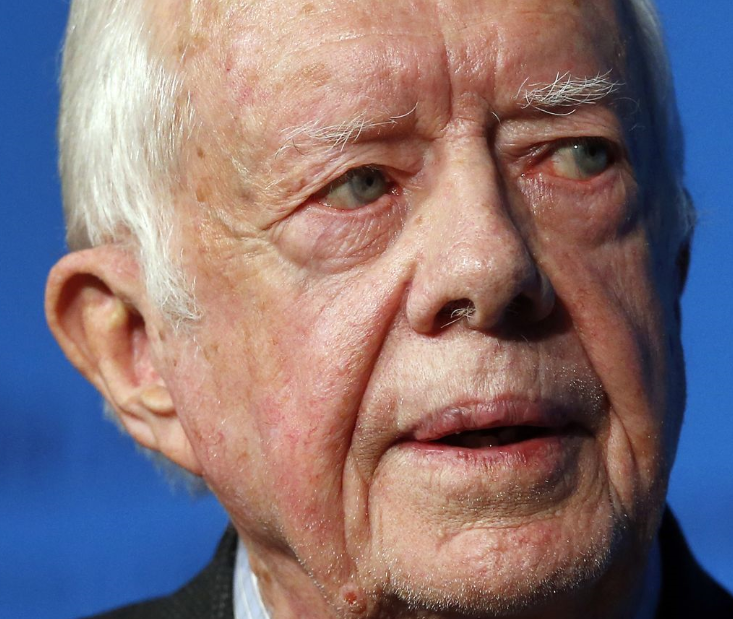
Despite the disloyalty of those closest to him, and the detestation for Bzezinski of those further away, he was, and remained, Carter’s favourite. Between 1977 and 1981, Brzezinski’s time with Carter, according to the White House logs, amounted to more than 20% of the president’s working time. That’s 12 minutes of every hour — no other official came close. On Friday, shortly after Brzezinski’s death was announced by his family, Carter issued a statement extolling him as “a superb public servant…inquisitive, innovative, and a natural choice as my national security advisor …brilliant, dedicated, and loyal. I will miss him.”

What was this bond between them, and why does it matter now? One reason is that what they did together were the freshest American operations studied at KGB schools in Moscow by a recruit in training at the time named Vladimir Putin.

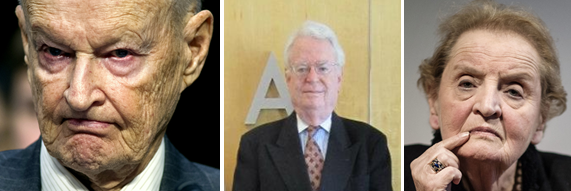
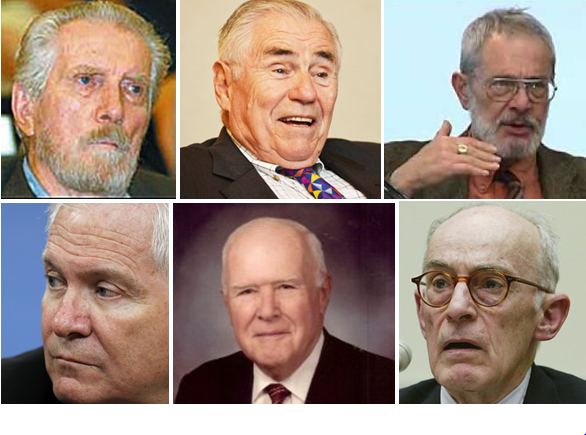
This was the National Security Advisor’s staff during the four years of Carter’s term, 1977-1981.

PRESIDENT CARTER’S RUSSIA-HATING TEAM


Pictured recently: above, Jimmy Carter. Below – 1st row: Zbigniew
Brzezinski (died May 2017); David Aaron; Madeleine Albright.
2nd row: Paul Henze (died July 2011); Donald Gregg; Fritz Ermarth.
3rd row: Robert Gates; Samuel Hoskinson; William Odom (died May 2008). 


A 451-page doctoral dissertation by Mary Sexton examining the relationship between Carter and Brzezinski identifies the evidence, including documents, witnesses, and independent reports which should have driven them apart. She fails to answer why that didn’t happen. She concludes Brzezinski flattered and fawned over Carter; relentlessly conspired to undermine Vance and other rivals for Carter’s attention; postured, manipulated, lied to the press, and faked to the president. Sexton concluded in 2009:

“it is important to recognize that Jimmy Carter was ultimately responsible for the nature of his policymaking system and for the decisions made about who would frame and articulate U.S. foreign policies.”

She quoted Lloyd Butler, Carter’s appointee as the White House lawyer so no Brzezinski underling, as saying he was baffled by Carter’s refusal to address the troubles Brzezinski caused. “I will never understand it”, Butler said in 2002. He died in 2005.

Neither Vance in his memoirs (he died in 2002), nor his wife Grace, nor any of Vance’s deputies at State, nor Carter’s staff at the White House, provide an answer. In research by Betty Glad, published in November 2009, she reported “a few close aides met the emotional needs of the president”, but the aides didn’t tell Glad what they thought Carter’s emotional needs were. Glad acknowledged that in preparing her book she was “above all… indebted to Zbigniew Brzezinski who expeditiously answered my emails and was very open about his interactions with Carter.”

Glad concluded that Carter gave Brzezinski,

“his complete and absolute support… Brzezinski was one of the few people Carter never reprimanded…And Carter dismissed all criticisms of Brzezinski that might come his way.” 

Why?


“Carter needed and admired the strategic skills and the toughness in dealing with others that Brzezinski offered,” Glad summed up, with the latter’s help. The need to be tough was a recurrent theme in Brzezinski’s briefings and memoranda to Carter, she added. Brzezinski made Carter feel he was “doing big things.” Fighting the Russians (Soviets then) was, in the advice Brzezinski presented to Carter and repeated to Glad, was the biggest of the big things. “Brzezinski”, concluded Glad, “appealed to Carter’s desire to do new big things and act quickly”.

The bafflement reported by Carter subordinates and State Department officials under Vance is part truth; part cover-up by the officials; part deceit by Carter. For the answer of what bound Carter and Brzezinski together Glad doesn’t uncover, nor even hint at. This is because it was a conspiracy of proxy wars, terrorism, assassinations, coups d’etat, and other black operations, still classified top secret, rationalized by Brzezinski to Carter and approved by the president, as part of a grand strategy to defeat the Kremlin. These were the acting-tough tactics which convinced Carter in secret, but which the president never admitted to in public. Not then, because the actions made Carter feel he was doing “new big things”. Not since, because all of them have failed, with bloodshed and monumental losses for those whom the president and his strategist targeted, and collateral damage for the rest of the world, not least the US.

“Sure, Brzezinski was a strategic thinker,” one of Sexton’s sources told her. “But he was frequently wrong! Vance’s strategies have withstood the test of time.” According to Sexton, her source was a “public official [with] in-depth familiarity with Vance’s and Brzezinski’s work. He agreed to be interviewed…on the condition he would not be quoted on this subject.”

Paul Henze came to Brzezinski’s staff after serving as the CIA’s station chief in Ethiopia in 1969 to 1972, and then in Turkey between 1974 and 1977. Henze had been one of the plotters of the Turkish invasion of Cyprus in July 1974, which continues to this day.


Cyprus: July 20, 1974

The Somali invasion of Ethiopia which began in July 1977, and was known as the Ogaden war until the Somalis were defeated by the Russian and Cuban-backed Ethiopian military in March 1978, was one of the schemes Henze managed, and Brzezinski persuaded Carter to approve. By the time Henze’s war was defeated, he rationalized the war-fighting strategy’s continuing purpose in a memorandum since declassified and quoted by Sexton. “Much as we want the Soviets out”, Henze briefed Brzezinski and Carter,

“we are not going to get them out soon…We should make their stay as costly as possible and the source of fundamental strain for them. We can do this in many ways, both overtly [and] covertly… The Soviets are the culprits in the Horn and we should never let them or the world forget it.”

Another of the Henze plots – the military putsch in Turkey in September 1980 – was Carter’s and Brzezinski’s scheme too.


Ankara: October 29, 1980.

Henze had started in the CIA as a specialist managing assassination gangs with pretensions to anti-communist ideology. He began with the Iron Guard of Romania, and was still running the Grey Wolves of Turkey when he moved on to the Brzezinski staff. After Carter’s downfall, Henze spent years trying to cover up the role the Grey Wolves had played in the attempted assassination of Pope John-Paul II in May 1981. Henze’s version of the plot was that the Kremlin and KGB had masterminded the scheme through the Bulgarian secret service. The KGB assessment was that Henze, Brzezinski and Carter had all been in on the plot, just as they had been in on the scheme to elect Cardinal Karol Wojtyła, Archbishop of Cracow, as the Pope in October 1978.

Brzezsinski’s euology at Henze’s funeral in Virginia in 2011 provided the cover story that he had engaged Henze in 1977,

“to assume responsibility for oversight of the radios and to coordinate more generally our efforts to prevail in the Cold War without an actual war. Paul was in his element. He mobilized his enthusiasm, his commitment, and his boundless energy not only to protect RFE [Radio Free Europe], but to develop also a broader effort to nourish the hopes of those living in the Soviet bloc, including even the Soviet Union itself, that someday they, too, would be free.”

For their combined record of violent failure, Brzezinski had this to say:

“Paul proved himself to be a ferocious bureaucratic infighter and eventually the winner – though at times he was even impatient with my efforts to pursue – on the President’s behalf — also some accommodation with the Soviet Union in the area of mutual arms control. But that was Paul, my fellow Cold warrior: enthusiastic, fearless, committed, principled, and relentless. A great American, an Eastern European by association, and one of the anonymous architects of the peaceful and victorious end to the Cold War.”

Henze was joined by other CIA men on Brzezinski’s staff including Donald Gregg, Fritz Ermarth, Robert Gates and Samuel Hoskinson. They were all plotters of the putsch which overthrew the President of Pakistan, Zulfiqar ali Bhutto, in July 1977. Bhutto was replaced by Army General Zia ul-Haq, and subsequently hanged. Zia was killed in August 1988, along with the US Ambassador to Pakistan, Arnold Raphel, and General Herbert Wassom, the head of US military aid mission to Pakistan.

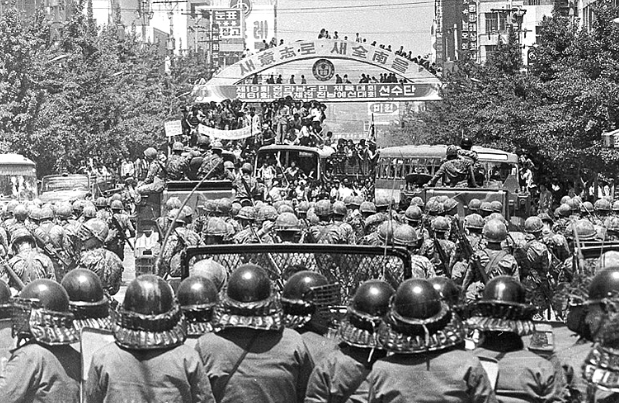
Gregg was one of the plotters of the December 12, 1979, military putsch in South Korea.


For the declassified evidence, including Gregg’s claim “there are no
smoking guns”, read this.

Hoskinson was engaged in Middle Eastern attack and overthrow plots, some he endorsed and assisted, and some he would have done if he judged they had a chance of success.

How many of the putsches which CIA operation histories log in as successful, and how many of the unsuccessful attempts – Ghana and El Salvador (1979), Bolivia, Liberia, Guinea-Bissau, Suriname, Upper Volta (Burkina Faso), Iran (1980) – were engagements in acting tough and doing new big things which Brzezinski got the president to approve are questions Carter is shy to answer.

For them, the war in Afghanistan, which they plotted with alacrity from the start of the Carter Administration, was the culminating case of what Brzezinski described in his address over Henze’s corpse as the “peaceful and victorious end to the Cold War.”


Left: the Red Army enters Afghanistan, December 1979. Right: the
Red Army leaves Afghanistan, February 15, 1989.

These games of liquidating others in the cause of defeating the Kremlin has invigorated Carter, even today when Carter himself is on his last legs. Drawing the Russians on to the field of battle was his and Brzezinski’s aim; Afghanistan, after the Soviet military intervention began in December 1979, was their main chance. Their successors in the White House have the same chance against Russian forces on the battlefields of Syria and Ukraine. Though he has tried, Brzezinski is no longer in a position to advise them that if they don’t dare, they can’t win. Carter is still alive to demonstrate that if they dare, they are likely to lose.

It isn’t sure that’s what KGB trainee Putin scribbled down during his lectures at the Andropov Red Banner Institute in 1984. It’s certain he has noted it down now.

Tuesday, May 30, 2017

Well Pardon Me! Trump's Final Card

Impeachment advocates beware: Trump Holds a Trump Card: The Power to Pardon

by Dave Lindorff  - This Can't Be Happening


May 30, 2017


US Constitution, Article II, Section 2 on pardon power of the president: 
'The President shall...have Power to Grant Reprieves and Pardons for 
Offenses against the United States, except in Cases of Impeachment.'

Whatever the truth regarding Deep State and Democratic Party charges of alleged Russian “meddling” in last year’s election (and I’m definitely in the camp that says there has been no hard evidence presented to show Russia hacked DNC emails), Donald Trump and his administration are now ensnared in a serious investigation by an independent prosecutor, former FBI Director Robert Mueller, into obstruction of justice and other crimes that could technically lead to indictments of Trump aides and to Trump’s impeachment.

But don’t forget: Trump has one unassailable power as president -- the power to pardon -- and I predict he will wield it.

The US Constitution gives a president the almost absolute power to pardon, including to pardon someone before he or she has been convicted of a crime or even indicted. As President Gerald Ford proved, such pardon power can even be used to pardon someone -- in his case the disgraced and resigned ex-President Richard Nixon -- before he had even been charged with a crime.

The only limitation on that presidential pardon power is that it cannot be used if the president is impeached, or to interfere with the impeachment process.

What this means is that as long as there has not been an impeachment of the president, or at least the launching of impeachment hearings in the House of Representatives, there is no constraint on President Trump’s use of his pardon power. He can, according to many legal experts, even pardon himself, though in that case he could still be impeached and removed from office, just not prosecuted for any crimes (impeachment is not a criminal proceeding, but is simply a process for removing a person from office).

I believe it is likely therefore, that Trump, for whom appearances, tradition, propriety, and the good of the country are all meaningless notions, will use his pardon power to block investigations into, and block indictments of former National Security Advisor Michael Flynn and his top advisor and son-in-law Jared Kushner, and anyone else who gets caught up in the investigation into crimes committed by him and his administration, his transition team and his campaign.

While such actions -- even more shocking than Nixon’s abrupt firing of special prosecutor Archibald Cox during the Watergate scandal -- would likely stun the public and would, by most Americans, be viewed an admission of Trump’s guilt, it would effectively eliminate any chance for Mueller to prosecute or even to investigate anyone in the Trump administration. People who are pardoned cannot be pressured by fear of indictment and a promise of immunity into turning state’s evidence.

Trump would no doubt present his pardons as being an appropriate action to kill an investigation that he is already characterizing as a “witch hunt’ based upon lies and “fake news” -- a view shared by most of his ardent backers around the country.

How such a bold stroke would play out at that point is hard to say. Establishment Democrats would likely be encouraged by Trump pardons to push harder for his impeachment, but this approach could work to their own detriment. We’ve already seen in the last election how disenchanted much of white, working-class America is with the Congressional Democrats and their focus on inside-the-beltway fighting as well as their lack of interest in the daily struggles of ordinary people, white and non-white. This sentiment will be all the stronger because most of Americans really aren’t really concerned about Russia as any kind of threat these days.

At the same time, Republicans, who have shown a shameless lack of concern with ethics, morals and basic decency in supporting Trump no matter how obscene, selfish, brutish or narcissistic he behaves, could lose support, particularly among independent voters and erstwhile Democrats, if they were to go along with Trump’s use of pardons to protect his own ass.

It is really a no-win situation for both parties, which benefits Trump, who doesn’t really seem to care much about his place in history.

'The Dickens' You Say: No Safe Houses in the New UK

London’s Horrendous Housing Crisis: Slums, Unfettered Greed and the Unacceptable Exploitation of Workers

by Andy Worthington


May 28, 2017

Please support my work as a reader-funded investigative journalist and commentator.


Regular readers will know that Britain’s housing crisis — and especially the crisis in London — is something that angers and depresses me on an almost permanent basis, and for one unassailable reason — because housing is, essentially, a human right, and yet, during the course of the 21st century, it has become the key commodity in the enrichment of the few at the expense of the many.

See my archive of articles about the housing crisis here, here, here and here.

The saying “safe as houses” came into being because housing was traditionally regarded as stable, somewhere money would neither be gained nor lost, but since Margaret Thatcher’s assault on social housing in the 1980s, and the artificial housing bubble maintained by the government and the banks since the days of New Labour, it is now an unregulated cesspit of astonishing greed and the immoral exploitation of others.

Thatcher’s selling off of council houses, and her refusal to allow councils to build any new housing, started a slowdown in the rate of housebuilding that has never been reversed, and the greed that has grown to dominate the housing market in Britain has also been ramped up due to an increase in demand as the population has increased, and the cynicism of politicians and bankers, who worked out that an ever-growing housing bubble was a seemingly viable substitute for genuine economic growth, as well as delivering free money in extraordinary quantities to those — generally the baby boomers and my generation, those born between the end of the Second World War and the end of the 60s — who were fortunate enough to have got on the property ladder before the frenzy began.

For every economic winner, however, there must be losers, and in terms of housing, this relationship is much more intimate than, say, the profiteering involved in investing in a company that makes money through the exploitation of others in a factory setting, for example. Every day in Britain, landlords take half or more of everything their tenants earn, often leaving them so squeezed in terms of disposable income that their lives are reduced to an endless miserable round of economic servitude. And with rents out of control and the restraints on landlords almost non-existent, we are seeing, for the first time, hard-working people with good jobs unable to afford to stay in London, squeezed out along with the poor and all those creative people who bring so much life to cities but who can no longer afford to live in a place that, increasingly, caters only to the rich and the super-rich.

In London, housing is actually the number one priority for around half the population — almost everyone who is subject to the whims of private landlords, and, for those with mortgages, everyone who didn’t get a mortgage while housing costs were still sensibly related to incomes; in other words, anyone who got on the housing ladder after the first few years of the millennium.

The importance of housing, and the injustice of the current situation, can be seen from Sadiq Khan’s victory in London’s Mayoral election in May 2016, when it was the chief driver of his success, but although he won because of his promises to tackle housing inequality, in reality huge and powerful forces are aligned against the needs of the people, and although the London-wide housing situation is clearly under much more scrutiny now than it was under Boris Johnson (who ended up doing nothing more than, figuratively, turning London into a brothel and being a madam for super-rich developers around the world), and discussions are taking place and policies developed to deal with the current intolerable situation, it seems unlikely that enough will be done, because what is really needed is (a) a quite serious crash in house prices, and (b) a social homebuilding programme on a scale not seen since the aftermath of the Second World War.

Personally, I think what is needed in Britain is the return of morality and ethics as a key element of society, because the dominant theme of life throughout this century has been one of all-consuming greed, where any activity is regarded as praiseworthy if it makes a profit, and I think it is instructive to compare Britain now to that of the Victorians in the 1860s before social reformers began chipping away at gross inequality, when wealth was concentrated the hands of the few, and the rich also blamed the poor for their poverty and spent considerable time working out how to make their lives more wretched.

In the hope of shining a necessary spotlight on the importance of London’s housing crisis, I’m cross-posting below ‘The great London property squeeze’, an important new article in the Guardian by Anna Minton, who wrote the compelling 2009 book, Ground Control: Fear and Happiness in the Twenty-First Century City, about the the creeping privatisation of public space in the UK. The article is from her forthcoming book, Big Capital, out on June 1, and in it she touches on all the major themes that should be of concern to all decent people when it comes to looking at the housing crisis, beginning with the overcrowded slums in London’s poorer boroughs, the lack of protection for tenants, and the lack of means for councils to prosecute terrible landlords.

One of her sources, Southwark councillor Mark Williams, explains how “[w]e think broadly a third of landlords are well-meaning and do a good job, a third are well-meaning and do a bad job, and a third are rogue landlords. At the fringes of that, you have slum landlords and criminal human trafficking.” No one even knows how many people are living in overcrowded and sub-standard conditions, but a 2013 investigation suggested that Ealing alone “may have as many as 60,000 occupants in illegal structures,” meaning that, throughout London, the total number could be a million, and surely cannot be less than half a million.

Minton also examines the damage caused by our leaders’ relentless wooing of the global super-rich, noting,

“There is a direct link between the wealth of those at the top and the capital’s housing crisis – which affects not just those at the bottom but the majority of Londoners who struggle to buy properties, or pay extortionate rents. The 2008 financial crash created a new politics of space, in which people on low incomes are forced out of their homes by rising rent and the wealthy are encouraged to use property for profit.”

As she adds, “This isn’t gentrification, it’s another phenomenon entirely. Global capital is being allowed to reconfigure the country.”

Minton also looks in detail at the decline in social housing, pointing out that, “Since the 1980s, public housing stocks have been steadily eroded, through the combination of right to buy, which saw the sell-off of 2m council homes, and buy to let, which has resulted in 40% of those former council homes now being owned by private landlords, who rent them out for three and four times the amount that council tenants pay for the remaining local-authority-owned properties.”

She also takes aim at the scandal of housing benefit having been deliberately allowed to rise to provide profits to private landlords, explaining that “the amount of housing benefit paid to private landlords doubled from £4.6bn in 2006 to £9.3bn in 2016.”

Minton also looks at the damage greed is causing in the private sector, focusing on the case of Jan, “a university graduate with a good job, who lives in what she describes as ‘middle-class poverty’ despite earning close to £40,000 a year.”

As she states,

“She and her husband don’t have enough money to make ends meet, even though they both work full time.”

She also spoke to Betsy Dillner, the director of Generation Rent, who “would like to see rent controls, a national register of landlords and fully licensed lettings agents – all of which [she] admits are highly unlikely in the current ideological climate.” As she explains,

“There are more requirements to run a cattery than to rent out a home. There should, of course, be regulations to look after pets, but I’d like the same rights to be afforded to the place we call home.”

Another interviewee is Vicky Spratt, “a 28-year-old journalist who worked as a producer of political programmes at the BBC but left because she felt the issues affecting her generation, such as the housing crisis, were not being covered properly.”

As she says, “A lot of issues were dismissed by the older generation – it didn’t affect them. They all owned their own homes.”

As Minton describes it, “She currently pays £1,430 per month, not including bills, for a one-bedroom flat which she can afford because she shares with her boyfriend, but she used to live in a room ‘which was literally the size of a bed’.”

As she puts it,

“The walls were very thin because it had originally been part of one room, which the landlord split into two. I noticed after about six weeks my mental health deteriorated. If I wasn’t in a relationship I would be looking at going back to that.” 

Spratt “earns enough to get a mortgage but, because rents are so high, not enough to save for the 20–30% deposit required,” and as she tells Minton, “The common thread for people my age is that we don’t own our own homes and potentially we never will. The housing crisis is older than me and it shocks me that nobody did anything about this, and I want it on the news agenda. This is structural neglect. The buy-to-let boom and the unregulated market have a lot to answer for.”

As Minton also describes it, “Spratt believes that a key reason for this political failure is that ‘people who don’t experience this issue are in charge’, pointing out that almost a third of MPs are buy-to-let landlords.”

If there are bright points, they are that Spratt successfully led a campaign against letting agents’ fees, and the fact that businesses including the Royal Bank of Scotland and the CBI have set up a campaign group, Fifty Thousand Homes, “to push the housing crisis up the political agenda,” because “[i]ts research shows that on current trends, customer services and sales staff at almost every level are being pushed out of the capital.” However, while these moves are to be welcomed, it is clear that much more needs to be done, and I hope you will agree that getting rid of the Tories and stopping Brexit would be a start, but that there then needs to be a concerted effort to work out how to return sanity, fairness and decency to the housing market for everyone.

The great London property squeeze

by Anna Minton, the Guardian, May 25, 2017


As affordable housing in Britain’s capital is replaced by luxury towers, people on middle incomes are being priced out, while the poor are forced to pay extortionate rents for shocking conditions.

The first time I met Ian Dick, the head of private housing at Newham council in east London, he took me on a walk to look for “beds in sheds”. It was 2011, and alongside criminal levels of overcrowding in private rental properties, there was a growing problem of people living in illegal structures in back gardens. It was not uncommon to find 10 or 20 people living in a room above a fried chicken shop, in a basement, or in ramshackle outbuildings. When we met again, five years later, he was happy to talk to me, not because these problems had disappeared, but because he was proud of the council’s private rented sector licensing regime. Introduced in 2013, it was the first such scheme in the country and had led to 800 prosecutions and 28 landlords being banned from renting property to tenants.

This time we met in Forest Gate, traditionally one of the most deprived parts of Newham. “This is an area undergoing the most dramatic change – the council doesn’t use the term ‘gentrification’, they use the term ‘regeneration’,” he said as we strolled down a pleasant high street in the sunshine, looking up at Victorian facades renovated by the council. Along the road, hipster cafes and pubs were interspersed with clothing retailers, halal butchers and phone shops. To show me the reality in some of the flats above, he took me around the back, where an entire street was accessed by a badly maintained private alleyway, with a huge pile of mattresses dumped at one end.

The mattresses were outside a property where, until the previous week, 20 people had been living in a makeshift structure in the yard outside. “The landlord is under caution, he’s not arrested, he’s been housing people desperate for accommodation – people were paying £400 a month to stay in this,” Dick said. Further down the back alley, the entrances to a large number of flats were up dangerous-looking fire escape stairs, particularly hazardous for small children. In one of the properties a scooter stood at the foot of a rickety open stairway.

At the back of a large Victorian house, we were met with a smell of leaking sewage, and the once-white walls were now filthy and soot-stained. “This must be illegal. That’s the thing about English housing – there’s little that’s illegal but there’ll be breaches here,” Dick explained, telling me that English property law does not target property standards, but that interventions can be made around public health. In this case, the breaches would be drainage and conditions detrimental to health.

“This is the sort of private rented sector that still exists in 2016, even after all we’ve done,” he said, noting details down in his notebook so that his officers could visit. The interior of one of the flats was visible through a grim-looking security gate at the back door. Through the bars I could see a toddler and his mother. This was no place for a child – or anyone – to live, but it was also obvious that once they were evicted, their fortunes would not necessarily improve. There would be nowhere to go, and even if they qualified for social housing, they would most likely enter the world of substandard temporary accommodation.

Walking back down the high street we paused to look at some of the “to let” signs in the newsagents’ windows. One in particular stood out, offering a room share for four people for £160 a month per person: effectively a bed space in what may or may not be legal accommodation. Renting bed spaces, I had already heard from a number of sources, is becoming more common, with bunk beds visible in the front rooms of nearby terraces. While we sat having a coffee, Dick explained this was partly down to the increasingly common – and highly profitable – practice of what is known as “rent to rent”.

“An estate agent will rent a house to an individual who will then let it out to others, who might also sublet. There’s a whole submarket in rent to rent. It’s all done with no documentation, they don’t ask for references, and when we go round we might find 15 people there. “There’s different levels of this going on – everybody has to share because nobody can afford to rent,” he said, adding that sometimes criminal gangs might rent 20 properties, then re-rent them at a 20% higher price. The council had prosecuted 25 agents, he said, and pointed to how to find them through ads in the local papers: “Where you see agents offer ‘guaranteed rent’, there are no controls on lettings agents.”

*****

Adverts on hoardings all over London show a city populated by smart-looking people in luxury balcony apartments. The city is the destination of choice for foreign investors and the oligarchs, billionaires and super-rich who make up the so-called “alpha elites”, all of whom are attracted by the UK’s favourable tax environment. Entire neighbourhoods – St John’s Wood, Highgate, Hampstead, Notting Hill Gate, Kensington – have changed out of all recognition in the past decade. Estate agents refer to these centrally located, “super prime” areas as “golden postcodes”. They have long been wealthy places, but in the past, like most of London, they were also mixed. Now ultra-high-net-worth individuals have displaced even the wealthy from Kensington; they in turn displace others to suburban areas, creating a domino effect that ripples out through the city, with the consequence that average-income earners and the poor move to the periphery or out of the capital altogether, which places pressure on housing and pushes up prices around the country.

London’s skyline is being transformed by one of the greatest waves of new construction seen in the city, with plans for no fewer than 300 luxury residential towers. From Nine Elms up to Vauxhall and along to Southwark and Blackfriars bridges, mile upon mile of apartments in gated complexes have already been built. At Elephant and Castle the Australian property developer Lendlease is working with Southwark council to render the area unrecognisable, replacing the affordable housing that once characterised it with a forest of gleaming towers.

Outside some of these buildings, metal spikes which are already there prevent homeless people from sitting or sleeping on the pavement.

There is a direct link between the wealth of those at the top and the capital’s housing crisis – which affects not just those at the bottom but the majority of Londoners who struggle to buy properties, or pay extortionate rents. The 2008 financial crash created a new politics of space, in which people on low incomes are forced out of their homes by rising rent and the wealthy are encouraged to use property for profit. These trends are not limited to London. The same currents of global capital are also transforming San Francisco, New York and Vancouver, European cities from Berlin to Barcelona and towns and cities in the UK from Bristol and Manchester to Margate and Hastings. This isn’t gentrification, it’s another phenomenon entirely. Global capital is being allowed to reconfigure the country.

Public housing accounted for a huge proportion of British accommodation throughout the 20th century. Since the 1980s, public housing stocks have been steadily eroded, through the combination of right to buy, which saw the sell-off of 2m council homes, and buy to let, which has resulted in 40% of those former council homes now being owned by private landlords, who rent them out for three and four times the amount that council tenants pay for the remaining local-authority-owned properties.

During the 1980s a decision was taken to cease building housing for those on lower incomes and to create instead a system whereby housing benefit would “take the strain”, rising to cover increases in rents. At the time it was predicted that the change in policy might lead to higher rents but nobody believed they would rise to the level they are today. The combination of right to buy and the decision to stop building council housing shifted social tenants into private rented housing. Research from the National Housing Federation shows that the amount of housing benefit paid to private landlords doubled from £4.6bn in 2006 to £9.3bn in 2016.

The shortage of affordable housing has given rise to a range of problems in private rented accommodation, from slum landlords and “beds in sheds” to middle-class Londoners under the age of 45 who can no longer afford to live in the city. A generation is being affected and our essential services, such as hospitals and schools, and the majority of our small and medium-sized businesses, are being undermined.

*****

“We think broadly a third of landlords are well-meaning and do a good job,” said Southwark councillor Mark Williams, “a third are well-meaning and do a bad job, and a third are rogue landlords. At the fringes of that, you have slum landlords and criminal human trafficking.” Southwark, in south-east London, despite increasing areas of high-cost development, still includes large pockets of poverty. Williams told me that the council found a two-bedroom flat on the Aylesbury estate with 20 occupants, who were being bussed down to Bromley, 40 minutes away, every day to work in a sweatshop.

Since Newham introduced its licensing scheme, the council has put a maximum limit on the number of people allowed to share one room and has stipulated that agents must display what that limit is, although some don’t. “Lots of them were non-compliant at the beginning but when we looked at them they started to comply, and then we relaxed and they went back to what they were doing before,” Dick said. It doesn’t surprise him. “Why wouldn’t they? The housing market is broken and the conditions are ripe for exploitation. We’ve got the worst of both worlds – a market which is controlled but not regulated. Most people we’ve prosecuted through the licensing scheme are criminal landlords, although the government prefer the term ‘rogue’.”

Although it is notoriously difficult to get accurate figures, a 2013 report by the Migrants’ Rights Network concluded that Ealing may have as many as 60,000 occupants in illegal structures, and Slough borough council, which deployed planes equipped with thermal imaging equipment in an effort to spot them, may have as many as 6,000 beds in sheds. In 2013 a BBC investigation found estate agents renting out beds in sheds in Willesden Green and Harrow.

Newham’s licensing scheme has been widely praised, and many councils have expressed wishes to emulate it. But in 2015, to the delight of landlords, the government made it clear it did not want to extend the scheme’s use, with then housing minister Brandon Lewis describing licensing as a “tenants’ tax”.

Even though the Department for Communities and Local Government had given Newham £1m to support the licensing scheme, little-known changes to the law have seen some forms of licensing extended, but also made it much harder for councils to introduce licensing in the first place. The new law ensures that councils must now seek permission from the secretary of state for any licensing scheme that would cover more than 20% of their geographical area, or affect more than 20% of privately rented homes.

In Redbridge, north-east London, the council’s application for borough-wide licensing was refused by the secretary of state. As a result, council leader Jas Athwal said it would be “impossible for us to … deal proactively with poor standards of rented accommodation”. It is clear, then, that an effective means of clamping down on rogue landlords has been found – the government just refuses to support it.

*****

Extreme overcrowding is illegal, but poor conditions are also common in the “mainstream” private rented sector. Jan is a university graduate with a good job, who lives in what she describes as “middle-class poverty” despite earning close to £40,000 a year. She and her husband don’t have enough money to make ends meet, even though they both work full time.

The family last moved three years ago after their landlord put their rent up by £450 a month. He wanted to sell to a developer who planned to turn the flats into one luxury home, and needed the tenants out. Conditions where they were living were far from ideal: the heating didn’t work properly and Jan and her partner slept in the front room so that their two children, a 10-year-old boy and seven-year-old girl, could have their own rooms. That isn’t possible in the tiny two-bedroom flat they are in now, so she is thinking of putting a mattress in the alcove in the hallway for her daughter. “I’m going to put a curtain up and have her in that, but when I think about that, it’s Dickensian,” she told me. Revealing how low her expectations have sunk, she added: “We’re in a flat which is substandard accommodation, but what we love about it is that the heating works.”

The other advantage is that the overcrowded, moth-infested flat is cheaper, but it is in the wrong catchment area for the secondary school her son has applied to, which is causing him great anxiety. An estate agent has found Jan’s family a larger flat in West Norwood, where they used to live, but that would, as before, eat up two-thirds of her salary. “We can stay here and clear our overdraft or go back to West Norwood, have a kitchen diner and live totally beyond our means. It’s these ridiculous choices,” she explained. The other option would be moving to Croydon or Mitcham, but prices aren’t much lower there. “We might be able to get a semi with a garden but the kids would not be in the catchment area for their schools, there’s a massive commute and you lose all your networks.”

Jan is paid far above the average salary and her partner works full time as a teaching assistant. But after deducting the cost of childcare, they have nothing left to spare – “it’s second-hand clothes and no holidays. They call it ‘the squeezed middle’ but it’s poverty. It impacts on a whole range of things you can’t begin to anticipate,” she said.

To cap it all, on the day we met she’d had a terrible journey into work with cancelled trains and her Oyster card had charged her an extra £20 by mistake. “I just stood on the platform crying. It’s beyond my capacity to cope with any of it,” she told me as we sat in her office.

For the past 30 years, Britain’s economy and culture have been built on the Conservative ideal of home ownership. But, despite all the rhetoric surrounding this issue, home ownership in Britain has not exceeded the European average of 70% since the early 2000s. In fact, it has fallen to 64% – the lowest level in 30 years. And in 2017 private renting overtook mortgaged home ownership in London.

“This is a middle-class issue now,” Betsy Dillner, director of Generation Rent, the campaign group for better private renting, told me. “People think we represent this middle-class professional group, but if you can find a way of making the private rented sector work for the most vulnerable people in society, then it will work for everyone.” Today, 11 million people in Britain rent privately in an overlapping series of sub-markets, ranging from slums to luxury housing.

As an organisation, Generation Rent would like to see rent controls, a national register of landlords and fully licensed lettings agents – all of which Dillner admits are highly unlikely in the current ideological climate. “There are more requirements to run a cattery than to rent out a home. There should, of course, be regulations to look after pets, but I’d like the same rights to be afforded to the place we call home,” she said.

Like 2.3 million other Londoners, the Green party London Assembly member Sian Berry is a private renter, and has shelled out more than half her pay in rent and lived in six different houses since she moved to London 20 years ago. In 2016, she published the Big Renters Survey of more than 1,000 renters. According to those surveyed, rising rents were the most common problem experienced, and seven in 10 renters suffered from repairs and maintenance not being done. Damp, mould, broken boilers and dangerous electrics feature prominently in the responses, with many reports of landlords who evict tenants rather than pay for repairs.

One said: “After thousands of pounds’ worth of electrical items all broke down at once, an electrician assessed our flat. The wiring was the worst he’d ever seen and was, in his words a ‘death trap’. We were living there with a newborn baby. Our landlord chose to evict us, making us homeless, rather than carry out repairs.”

Another responder reported that they had to wear rubber gloves in the shower to avoid electric shocks and a third wrote: “Once a ceiling of an old house fell on me and all my stuff. I let my landlady send workers into the house to fix it for two months, during which time we still had to pay some rent. Immediately afterwards she put the rent up to a level we could not afford and we had to move out.”

*****

Yet another factor placing great pressure on the private rental market is the growth of companies such as Airbnb. By allowing owners to rent properties on a night-by-night basis to affluent visitors, their business model removes accommodation from the longer-term rental market while keeping purchase prices high. As a result, Airbnb has become a focus for housing activists across Europe and in the US, particularly in cities that attract large numbers of tourists such as New York, Barcelona, Berlin – and London. In New York, Barcelona and Berlin, city governments have restricted owners’ ability to rent out whole properties through Airbnb. But while oversight is being introduced in some places, it is a notoriously hard business to regulate, particularly when there are significant profits to be made.

The bedroom tax, introduced in 2013 for occupants of housing association or council property, presents a mirror image of Airbnb. In a society where the idea of public housing has collapsed, a financial penalty is imposed on people in social housing with a spare room, while those who are lucky enough to own a house with extra space find themselves with an additional source of revenue.

Another feature of the new economy in private renting is property guardianship, where developers offer lower rents to people prepared to live in properties due to be redeveloped. Often these are in edgy locations, such as the Ernő Goldfinger-designed Balfron Tower in east London, where groups of artists move in on a temporary basis, taking advantage of the subsidised accommodation costs and bringing cachet to the area. In the past, artists squatted abandoned buildings in places such as Shoreditch in east London and Brixton in the south, creating communities that have long been credited with maintaining the city’s diversity while also setting in motion a more manageable process of gentrification. In 2013, however, legislation was passed that made squatting residential buildings illegal, with a maximum penalty of six months in jail and a fine of £5,000. Property guardianship can be seen as an attempt to co-opt the “desirable” elements of squatting by young, creative people in a blatant bid to accelerate gentrification. At the same time, it is a highly lucrative, unregulated business, and “guardians”, who have no property rights, often have to put up with poor conditions and can be evicted at short notice.

The major concern for the government and employers in London is that people who do not earn enough to meet extortionate rents will leave, hollowing out the city and threatening its labour market and culture. “We see this with employers saying they’re having a really hard time retaining professional level jobs, let alone cleaners. London is losing teachers – they’re commuting from Luton and they’re giving up – it’s having a massive knock-on effect,” Dilner said.

The vacancy rate for nurses at London’s hospitals is 14-18%, according to a report from the King’s Fund thinktank, and the number of entrants to teacher training has fallen 16% since 2010, according to Ofsted. But it’s not just carers, nurses, teachers, artists and university lecturers who can’t afford to live in London. Fifty Thousand Homes is a business-led campaign group – including the Royal Bank of Scotland, the CBI and scores of London businesses – formed to push the housing crisis up the political agenda. Its research shows that on current trends, customer services and sales staff at almost every level are being pushed out of the capital. Three-quarters of business owners believe that housing costs are a significant risk to London’s economic growth and 70% of Londoners aged 25 to 39 report that the cost of their rent or mortgage makes it difficult to work in the city.

Vicky Spratt is a 28-year-old journalist who worked as a producer of political programmes at the BBC but left because she felt the issues affecting her generation, such as the housing crisis, were not being covered properly. “A lot of issues were dismissed by the older generation – it didn’t affect them. They all owned their own homes,” she told me. Spratt joined the digital lifestyle magazine The Debrief, aimed at twentysomething women, and began an online petition against lettings agents’ fees that gathered more than 250,000 signatures. As a result, Philip Hammond, as chancellor of the exchequer, banned lettings agents’ fees in his 2016 autumn statement – the biggest victory for private renters to date.

Spratt describes herself as a reluctant campaigner, but her circumstances pushed her into it. She currently pays £1,430 per month, not including bills, for a one-bedroom flat which she can afford because she shares with her boyfriend, but she used to live in a room “which was literally the size of a bed”. “The walls were very thin because it had originally been part of one room, which the landlord split into two. I noticed after about six weeks my mental health deteriorated. If I wasn’t in a relationship I would be looking at going back to that,” she said. Spratt earns enough to get a mortgage but, because rents are so high, not enough to save for the 20–30% deposit required.

“The common thread for people my age is that we don’t own our own homes and potentially we never will. The housing crisis is older than me and it shocks me that nobody did anything about this, and I want it on the news agenda,” she said. “This is structural neglect. The buy-to-let boom and the unregulated market have a lot to answer for.”

Spratt believes that a key reason for this political failure is that “people who don’t experience this issue are in charge”, pointing out that almost a third of MPs are buy-to-let landlords. An Oxford graduate who has worked in Westminster, she also suspects that a factor behind the success of her campaign is because “I look and sound like them”.

Betsy Dillner, director of campaign group Generation Rent, said: “This is the neoliberal free market ideology which has been alive and well in the US for a long time and it is certainly taking over here.”

Dillner fears that the outcome will be that the city will become soulless, “a place where you can’t raise families, be young, start up new businesses – all those things that make the city we love – housing costs will suck the soul out of that.”

*****

While population shifts to other towns may seem like a good way of rebalancing the wider British economy, the problem is that with nearly every FTSE 100 company headquartered in the capital, the majority of jobs are there too.

It is not possible to contemplate real solutions to the housing crisis without profound structural economic change. A weak private sector in the regions and public-sector jobs shrinking rapidly as a result of cuts mean that many people still look for work in the capital. And while some will leave the city, others will put up with otherwise unacceptable conditions in order to keep their jobs and family ties. This means that generation rent must pay through the nose to live in an increasingly sterile city – a playground for the rich in the centre, surrounded by gentrifying hipster hinterlands, and substandard housing for cheap labour in places such as Barking, Dagenham and Edmonton.

Expecting people to move each time they are priced out of an area brings its own problems. Moving house is rarely an easy experience, even when the move is voluntary. But it’s incomparably worse when it involves being wrenched away from the support networks, daily routines and the sense of identity that comes with being able to call a place home. Even the threat of being uprooted, known as housing insecurity, is a significant contributor to mental health problems.

A secure and stable place to live is the most important factor in personal wellbeing, according to a study by psychiatrists Ciaran Abbey and TBS Balamurali. The study, titled “Housing the Mind”, cites evidence that prolonged periods in temporary accommodation can adversely affect a person’s mental health – and so can spending more than 30% of income on housing. “When a disproportionate amount of income is spent on housing, this leaves people less able to purchase other necessities such as adequate food, increasing the family’s vulnerability to disease but also the anxiety and sense of helplessness that results when unable to make ends meet,” says Abbey. When individuals lose their homes, they can lose not just physical shelter but their entire world.

This is not just about building more houses, it’s about the kinds of houses that we build and who we build them for. It is also about our priorities as a society. Property is being built in London – for wealthy foreign investors instead of the people who need homes most. As the stock of social and genuinely affordable housing dries up, rents are soaring and the taxpayer is being forced to contribute billions of pounds in housing benefits for poor-quality private lets. So far, the proposed solutions from both main political parties involve only tinkering with the existing situation. Instead, we need a new social contract that ensures housing is once again viewed as a right for all, not just an asset for the few.

This is an edited extract from Big Capital by Anna Minton, which will be published 1 June by Penguin.


Andy Worthington is a freelance investigative journalist, activist, author, photographer, film-maker and singer-songwriter (the lead singer and main songwriter for the London-based band The Four Fathers, whose debut album ‘Love and War’ and EP ‘Fighting Injustice’ are available here to download or on CD via Bandcamp).

He is the co-founder of the Close Guantánamo campaign (and the Countdown to Close Guantánamo initiative, launched in January 2016), the co-director of We Stand With Shaker, which called for the release from Guantánamo of Shaker Aamer, the last British resident in the prison (finally freed on October 30, 2015), and the author of The Guantánamo Files: The Stories of the 774 Detainees in America’s Illegal Prison (published by Pluto Press, distributed by the University of Chicago Press in the US, and available from Amazon, including a Kindle edition — click on the following for the US and the UK) and of two other books: Stonehenge: Celebration and Subversion and The Battle of the Beanfield. He is also the co-director (with Polly Nash) of the documentary film, “Outside the Law: Stories from Guantánamo” (available on DVD here — or here for the US).

To receive new articles in your inbox, please subscribe to Andy’s RSS feed — and he can also be found on Facebook (and here), Twitter, Flickr and YouTube. Also see the six-part definitive Guantánamo prisoner list, and The Complete Guantánamo Files, an ongoing, 70-part, million-word series drawing on files released by WikiLeaks in April 2011. Also see the definitive Guantánamo habeas list, the full military commissions list, and the chronological list of all Andy’s articles.

Please also consider joining the Close Guantánamo campaign, and, if you appreciate Andy’s work, feel free to make a donation.