Tuesday, July 11, 2017

Pilger: Palestine Still the Issue

Palestine Is Still the Issue

by John Pilger


July 7, 2017


This is an abridged version of John Pilger's address 

to the Palestinian Expo 2017 in London. 


When I first went to Palestine as a young reporter in the 1960s, I stayed on a kibbutz. The people I met were hard-working, spirited and called themselves socialists. I liked them. One evening at dinner, I asked about the silhouettes of people in the far distance, beyond our perimeter.

"Arabs", they said, "nomads". The words were almost spat out. Israel, they said, meaning Palestine, had been mostly wasteland and one of the great feats of the Zionist enterprise was to turn the desert green.

They gave as an example their crop of Jaffa oranges, which was exported to the rest of the world. What a triumph against the odds of nature and humanity's neglect.

It was the first lie. Most of the orange groves and vineyards belonged to Palestinians who had been tilling the soil and exporting oranges and grapes to Europe since the eighteenth century. The former Palestinian town of Jaffa was known by its previous inhabitants as "the place of sad oranges".

On the kibbutz, the word "Palestinian" was never used. Why, I asked. The answer was a troubled silence.

All over the colonised world, the true sovereignty of indigenous people is feared by those who can never quite cover the fact, and the crime, that they live on stolen land.

Denying people's humanity is the next step - as the Jewish people know only too well. Defiling people's dignity and culture and pride follows as logically as violence.

In Ramallah, following an invasion of the West Bank by the late Ariel Sharon in 2002, I walked through streets of crushed cars and demolished houses, to the Palestinian Cultural Centre. Until that morning, Israeli soldiers had camped there. I was met by the centre's director, the novelist, Liana Badr, whose original manuscripts lay scattered and torn across the floor. The hard-drive containing her fiction, and a library of plays and poetry had been taken by Israeli soldiers. Almost everything was smashed, and defiled.

Not a single book survived with all its pages; not a single master tape from one of the best collections of Palestinian cinema.

The soldiers had urinated and defecated on the floors, on desks, on embroideries and works of art. They had smeared faeces on children's paintings and written - in shit - "Born to kill". Liana Badr had tears in her eyes, but she was unbowed. She said, "We will make it right again."

What enrages those who colonise and occupy, steal and oppress, vandalise and defile is the victims' refusal to comply. And this is the tribute we all should pay the Palestinians. They refuse to comply. They go on. They wait - until they fight again. And they do so even when those governing them collaborate with their oppressors.

In the midst of the 2014 Israeli bombardment of Gaza, the Palestinian journalist Mohammed Omer never stopped reporting. He and his family were stricken; he queued for food and water and carried it through the rubble. When I phoned him, I could hear the bombs outside his door. He refused to comply.

Mohammed's reports, illustrated by his graphic photographs, were a model of professional journalism that shamed the compliant and craven reporting of the so-called mainstream in Britain and the United States. The BBC notion of objectivity - amplifying the myths and lies of authority, a practice of which it is proud - is shamed every day by the likes of Mohamed Omer.

For more than 40 years, I have recorded the refusal of the people of Palestine to comply with their oppressors: Israel, the United States, Britain, the European Union.

Since 2008, Britain alone has granted licences for export to Israel of arms and missiles, drones and sniper rifles, worth £434 million.

Those who have stood up to this, without weapons, those who have refused to comply, are among Palestinians I have been privileged to know:

My friend, the late Mohammed Jarella, who toiled for the United Nations agency UNRWA, in 1967 showed me a Palestinian refugee camp for the first time. It was a bitter winter's day and schoolchildren shook with the cold. "One day ..." he would say. "One day ..."

Mustafa Barghouti, whose eloquence remains undimmed, who described the tolerance that existed in Palestine among Jews, Muslims and Christians until, as he told me, "the Zionists wanted a state at the expense of the Palestinians."

Dr. Mona El-Farra, a physician in Gaza, whose passion was raising money for plastic surgery for children disfigured by Israeli bullets and shrapnel. Her hospital was flattened by Israeli bombs in 2014.

Dr. Khalid Dahlan, a psychiatrist, whose clinics for children in Gaza - children sent almost mad by Israeli violence - were oases of civilization.

Fatima and Nasser are a couple whose home stood in a village near Jerusalem designated "Zone A and B", meaning that the land was declared for Jews only. Their parents had lived there; their grandparents had lived there. Today, the bulldozers are laying roads for Jews only, protected by laws for Jews only.

It was past midnight when Fatima went into labour with their second child. The baby was premature; and when they arrived at a checkpoint with the hospital in view, the young Israeli soldier said they needed another document.

Fatima was bleeding badly. The soldier laughed and imitated her moans and told them, "Go home". The baby was born there in a truck. It was blue with cold and soon, without care, died from exposure. The baby's name was Sultan.

For Palestinians, these will be familiar stories. The question is: why are they not familiar in London and Washington, Brussels and Sydney?

In Syria, a recent liberal cause - a George Clooney cause - is bankrolled handsomely in Britain and the United States, even though the beneficiaries, the so-called rebels, are dominated by jihadist fanatics, the product of the invasion of Afghanistan and Iraq and the destruction of modern Libya.

And yet, the longest occupation and resistance in modern times is not recognised. When the United Nations suddenly stirs and defines Israel as an apartheid state, as it did this year, there is outrage - not against a state whose "core purpose" is racism but against a UN commission that dared break the silence.

"Palestine," said Nelson Mandela, "is the greatest moral issue of our time."

Why is this truth suppressed, day after day, month after month, year after year?

In Israel - the apartheid state, guilty of a crime against humanity and of more international law-breaking than any other - the silence persists among those who know and whose job it is to keep the record straight.

In Israel, so much journalism is intimidated and controlled by a groupthink that demands silence on Palestine while honourable journalism has become dissidence: a metaphoric underground.

A single word - "conflict" - enables this silence. "The Arab-Israeli conflict", intone the robots at their tele-prompters. When a veteran BBC reporter, a man who knows the truth, refers to "two narratives", the moral contortion is complete.

There is no conflict, no two narratives, with their moral fulcrum. There is a military occupation enforced by a nuclear-armed power backed by the greatest military power on earth; and there is an epic injustice.

The word "occupation" may be banned, deleted from the dictionary. But the memory of historical truth cannot be banned: of the systemic expulsion of Palestinians from their homeland. "Plan D" the Israelis called it in 1948.

The Israeli historian Benny Morris describes how David Ben-Gurion, Israel's first prime minister, was asked by one of his generals: "What shall we do with the Arabs?" The prime minister, wrote Morris, "made a dismissive, energetic gesture with his hand". "Expel them!" he said.

venty years later, this crime is suppressed in the intellectual and political culture of the West. Or it is debatable, or merely controversial. Highly-paid journalists and eagerly accept Israeli government trips, hospitality and flattery, then are truculent in their protestations of independence. The term, "useful idiots", was coined for them.

In 2011, I was struck by the ease with which one of Britain's most acclaimed novelists, Ian McEwan, a man bathed in the glow of bourgeois enlightenment, accepted the Jerusalem Prize for literature in the apartheid state.

Would McEwan have gone to Sun City in apartheid South Africa? They gave prizes there, too, all expenses paid. McEwan justified his action with weasel words about the independence of "civil society".

Propaganda - of the kind McEwan delivered, with its token slap on the wrists for his delighted hosts - is a weapon for the oppressors of Palestine. Like sugar, it insinuates almost everything today.

Understanding and deconstructing state and cultural propaganda is our most critical task. We are being frog-marched into a second cold war, whose eventual aim is to subdue and balkanise Russia and intimidate China.

When Donald Trump and Vladimir Putin spoke privately for more than two hours at the G20 meeting in Hamburg, apparently about the need not to go to war with each other, the most vociferous objectors were those who have commandeered liberalism, such as the Zionist political writer of the Guardian.

"No wonder Putin was smiling in Hamburg," wrote Jonathan Freedland. "He knows he has succeeded in his chief objective: he has made America weak again." Cue the hissing for Evil Vlad.

These propagandists have never known war but they love the imperial game of war. What Ian McEwan calls "civil society" has become a rich source of related propaganda. Take a term often used by the guardians of civil society - "human rights". Like another noble concept, "democracy", "human rights" has been all but emptied of its meaning and purpose.

Like "peace process" and "road map", human rights in Palestine have been hijacked by Western governments and the corporate NGOs they fund and which claim a quixotic moral authority.

So when Israel is called upon by governments and NGOs to "respect human rights" in Palestine, nothing happens, because they all know there is nothing to fear; nothing will change.

Mark the silence of the European Union, which accommodates Israel while refusing to maintain its commitments to the people of Gaza - such as keeping the lifeline of the Rafah border crossing open: a measure it agreed to as part of its role in the cessation of fighting in 2014. A seaport for Gaza - agreed by Brussels in 2014 - has been abandoned.

The UN commission I have referred to - its full name is the UN Economic and Social Commission for Western Asia - described Israel as, and I quote, "designed for the core purpose" of racial discrimination.

Millions understand this. What the governments in London, Washington, Brussels and Tel Aviv cannot control is that humanity at street level is changing perhaps as never before.

People everywhere are stirring and are more aware, in my view, than ever before. Some are already in open revolt. The atrocity of Grenfell Tower in London has brought communities together in a vibrant almost national resistance.

Thanks to a people's campaign, the judiciary is today examining the evidence of a possible prosecution of Tony Blair for war crimes. Even if this fails, it is a crucial development, dismantling yet another barrier between the public and its recognition of the voracious nature of the crimes of state power - the systemic disregard for humanity perpetrated in Iraq, in Grenfell Tower, in Palestine. Those are the dots waiting to be joined.

For most of the 21st century, the fraud of corporate power posing as democracy has depended on the propaganda of distraction: largely on a cult of "me-ism" designed to disorientate our sense of looking out for others, of acting together, of social justice and internationalism.

Class, gender and race were wrenched apart. The personal became the political and the media the message. The promotion of bourgeois privilege was presented as "progressive" politics. It wasn't. It never is. It is the promotion of privilege, and power.

Among young people, internationalism has found a vast new audience. Look at the support for Jeremy Corbyn and the reception the G20 circus in Hamburg received. By understanding the truth and imperatives of internationalism, and rejecting colonialism, we understand the struggle of Palestine.

Mandela put it this way: "We know only too well that our freedom is incomplete without the freedom of the Palestinians."

At the heart of the Middle East is the historic injustice in Palestine. Until that is resolved, and Palestinians have their freedom and homeland, and Israelis are Palestinians equality before the law, there will be no peace in the region, or perhaps anywhere.

What Mandela was saying is that freedom itself is precarious while powerful governments can deny justice to others, terrorise others, imprison and kill others, in our name. Israel certainly understands the threat that one day it might have to be normal.

That is why its ambassador to Britain is Mark Regev, well known to journalists as a professional propagandist, and why the "huge bluff" of charges of anti-Semitism, as Ilan Pappe called it, was allowed to contort the Labour Party and undermine Jeremy Corbyn as leader. The point is, it did not succeed.

Events are moving quickly now. The remarkable Boycott, Disinvestment and Sanctions campaign (BDS) is succeeding, day by day; cities and towns, trade unions and student bodies are endorsing it. The British government's attempt to restrict local councils from enforcing BDS has failed in the courts.

These are not straws in the wind. When the Palestinians rise again, as they will, they may not succeed at first - but they will eventually if we understand that they are us, and we are them.

John Pilger's film, 'Palestine Is Still the Issue', can be viewed on this website.
Follow John Pilger on twitter @johnpilger

What Trial by Media Fire Forgets: Khadr Was Not Guilty

The controversy surrounding Omar Khadr’s reported $10.5-million settlement for Ottawa's complicity in his oppressive detention at Guantanamo Bay obscures a key issue we've never truly explored in Canada.

What if Khadr was innocent of the murder of Sgt. Christopher Speer this whole time, and we didn't lift a finger while he sat in a hell-hole for a decade?

For almost 15 years, Canadian treatment of the Khadr case has been dominated by the presumption of guilt. Yet the evidence tells a different story.

For all the fury boiling up over news of his settlement, there's precious little insight or knowledge about the facts. As a former prosecutor, something has always troubled me about this case, and my deep unease hasn't abated with time.

Any experienced trial lawyer would be troubled to open this file. With the exception of Khadr's "confession," wrung from a traumatized and severely wounded teenager under an abusive interrogation, the evidence against him was remarkably thin.

Examined closely, it appears more consistent with his innocence than guilt.

Khadr's case a 'Canadian tragedy'


What evidence exists appears confused, inconsistent or contradicted elsewhere. Photographs of the attack scene released in 2009 appear to directly conflict with the prosecution's summary of its own case.

Had the events happened under Canadian jurisdiction, they would not have been enough to lay a charge, let alone secure a conviction.

This case represents a Canadian tragedy and failure of moral courage on the part of our government. When Canada should have championed transparency, due process and the rule of law in the Khadr proceedings, we stood mute or actively participated in his abusive interrogation in custody.

Had the Canadian government done so, any criminal trial in open court would most likely have ended in a humiliating defeat for the U.S. government, and public perception would be very different from what it is today.

To any trial lawyer, it's plain that Khadr pled guilty for a very simple reason: his plea deal offered a return to Canada and eventual freedom — clearly a better alternative than a lifetime of suffering in Guantanamo.

That bargain was a successful legal maneuver, but a personal tragedy. It was successful because it returned him to Canada, where his prospects for justice were a vast improvement on Guantanamo Bay and U.S. military tribunals. It was tragic because he will forever wear the stain of pleading guilty to murder.

Today Canadians are paying a hefty price because successive Liberal and Conservative governments sacrificed principle to political expedience, traded away due process, and turned on their own child citizen, a trapped and helpless teenager.

Evaluating the evidence from the prosecution's perspective


Here’s how a prosecutor would look at the evidence against Khadr in a civilian criminal trial. Remember, this was a criminal prosecution subject to evidentiary rules supposedly designed not only to protect the innocent, but the integrity of the justice system itself.

The first step is to ensure the prosecution can prove each element of the charge beyond a reasonable doubt; and that the evidence is probative, consistent, credible, and reliable.

Any obvious defences, such as mistake of identity, self-defence, temporary loss of control or accident, should be anticipated and closed off by cogent evidence before charges are laid.

One more thing: in a circumstantial case, (which this was, because nobody saw Khadr throw the grenade that killed Speer), the evidentiary bar is even higher. In such a case the test is not merely proof beyond a reasonable doubt, but that the evidence pointing to guilt is inconsistent with any other rational conclusion.

First the context. This firefight was no small village confrontation, but an all-out military assault on a small compound.

The suspected Al Qaeda compound was identified by U.S. and Afghan forces in the early morning of July 27, 2002. Two Afghan militia members approached the small compound, estimated at "100 to 120 feet square." They were immediately shot and killed by occupants inside.

Compound bombed and strafed by U.S. air assault for hours


That shooting drew an overwhelming response. More than 100 U.S. troops assembled on the site, and for the next four hours the compound was pounded with cannon, missile, and rocket fire from a coordinated air assault involving Apache helicopters, A-10 warplanes and F-18 fighter jets. Multiple 500-lb. bombs were dropped on the site.

When American forces believed everyone inside had been killed, a U.S. Special Forces team entered the compound.

Whatever happened next took less than a minute, according to reports. At the end of it, Sgt. Christopher Speer, who was not wearing a helmet, was mortally wounded in the head from a grenade, and Khadr was captured alive.

So what was the prosecution’s case against Omar Khadr?

Inconsistent and inaccurate statements from the prosecution


There was lots to choose from. The U.S. military reports and filed statements describe a hodge-podge of confusing and inconsistent positions, including the following range of scenarios:

(1) The assault team entered, encountered and returned enemy fire and killed the shooter. Omar Khadr, positioned behind a crumbling wall, then threw a grenade at a group of soldiers who were talking. He did not consider them a threat to his safety, but just planned to kill as many Americans as he could (U.S. government stipulation of facts, 2010, paragraphs 41-43, agreed to by Khadr in his guilty plea);

(2) The assault team entered, encountered enemy fire, including a thrown grenade. They shot and captured Khadr, who was the only survivor in the compound during the exchange. Being the only survivor, Khadr must have killed Speer (false public position of U.S. military until 2008, as per CBC report);

(3) The assault team entered, encountered enemy fire, including a thrown grenade. They killed the shooter who also threw the grenade. They then captured Khadr, who did not throw the grenade (Report by Maj. Randy Watt, senior U.S. officer at battle, July 28, 2002);

(4) The assault team entered, encountered enemy fire and a witness identified as OC-1 saw a grenade thrown over a wall. Because of the timing of the shooting and grenade, he did not believe one person could have done both. OC-1 killed the shooter. He then found Khadr seated and facing away from the assault team and shot him in the back. According to OC-1, Khadr was the only person who could have killed Speer (Statement by witness OC-1, dated March 17, 2004, almost two years after the event);

(5) The assault team entered, encountered enemy fire and saw a grenade thrown over a wall. They killed the shooter and two Delta Force members confronted Khadr, who was armed and stood facing them. They shot him in the chest (per summary of statements, originally reported by Michelle Shephard in the Toronto Star);

(6) The assault team entered, encountered enemy fire and saw a grenade thrown over a wall. Soldiers outside the compound were also throwing grenades in response to the firefight. U.S. forces first killed the shooter, then shot and captured Khadr (per Los Angeles Times report of statement evidence). This opens the possibility that friendly fire accidentally killed Speer.

OR

(7) The photos:


Left photo taken in Ayub Kheyl in Afghanistan on July 27, 2002, shows scene 
found by the assault team where shooter killed. Khadr lies beneath rubble, 
apparently beneath a collapsed roof. 
Right photo shows Khadr (figure highlighted) after debris has been pulled back. 
Classified photos obtained by the Toronto Star from an 18-page submission 
presented in 2009 by Khadr's former military defence team to an Obama 
administration task force investigating Guantanamo.

Clearly, the multiple positions and reports advanced by the prosecution can't all be true. In all, either the shooter, or Khadr, or possibly American forces threw the grenade that killed Speer. Some of the reports make no sense at all, and some are clearly false.

Consistency, credibility and reliability are essential to a strong prosecution, and this case was on thin ice.

Photo evidence disastrous for the prosecution


Then came the photographs of the combat scene obtained by the Toronto Star in 2009, which can only be seen as disastrous for the prosecution.

The two photos above apparently depict the scene as found by the assault team in the area where the shooter was killed. The first photo on the left shows the body of the shooter killed in the firefight next to what appears to be a pile of rubble and brush. Omar Khadr was found alive beneath that rubble.

According to the Star, military documents indicate that "a soldier stood on top of Khadr's body before realizing someone was buried."

The second photo on the right—enhanced by the Star for clarity—shows the brush and rubble pulled back to expose Khadr, with bullet entry wounds clearly visible on his back.

In the third photo below, which shows Khadr receiving battlefield first aid (the graphic damage of his exit wounds are obscured), clearly visible is the dried blood from the shrapnel wound to his left eye. Khadr's face is coated in dirt, consistent with being buried in rubble.


Khadr receives battlefield first aid after being injured during a fight in 
Ayub Kheyl, Afghanistan July 27, 2002. Graphic exit wounds obscured. 
Photo from Wikimedia Commons, originally obtained by Toronto Star

Khadr could not have thrown the grenade and then completely buried himself under rocks and debris in just a few seconds before the special forces team arrived.

Of all the positions taken by the prosecution above, only (3) and (6) are consistent with the photographs taken in the immediate aftermath of the firefight. Neither version implicates Khadr. Version (3) is the incident report submitted by the senior officer on site the day after the battle, which completely exonerates him.

The only evidence that ties Khadr to the grenade is the statement of OC-1 in version (4), given to investigators almost two years after the event. But OC-1's statement that he found Khadr sitting up and leaning against brush is sharply at variance with photograph 1, in which Khadr lies completely buried under rocks and brush.

That's not a small problem for the prosecution. It's a big one.

If the photograph is an accurate depiction of the scene as the special forces team found it, OC-1's statement can't be true. It's more likely that OC-1 discovered Khadr under the rubble after he shot the other combatant, then shot him in the back as he lay there.

It gets worse. The prosecution's bigger problem is that its official version (1) makes no sense at all when read with the photographs. Below is the relevant text of the U.S. government's stipulation of facts:


A screenshot of the U.S. government's stipulation of facts in 
October 2010 regarding the events that led to Sgt. Christopher 
Speer's death in Afghanistan in 2002, as accepted by Omar Khadr


Clearly, paragraphs 42 and 43 are drafted to defeat any argument that Khadr threw the grenade in self-defence. It's drafted to cast him as the aggressor who, unprovoked, attacked a peaceful group of soldiers clearing up a battle site after a firefight with the other combatant. But that is wholly inconsistent with a photo of Khadr buried in rocks and rubble, lying within inches of his dead compatriot.

Unless the shooter's body had been moved, Khadr was lying under the debris immediately next to him during the firefight. According to OC-1, he shot both the shooter and Khadr within a few seconds of each other.

This doesn't make sense either. Khadr didn't watch his compatriot get killed, throw a grenade, then cover himself in rocks and sticks and wait to be discovered. And what about the Star's account of military documents reporting that a soldier didn't even realize Khadr was there until he stood on him?
Military evidence makes a better case for innocence than guilt

So far, this is all the prosecution's own evidence, and it's a mess before the defence calls a single witness. Without Khadr's confession, obtained essentially by force, there is no compelling evidence that he threw any grenade at all. No one saw him do it, and from all appearances he'd been under that rubble the entire time.

From what’s publicly available at this point, the evidence pointing to guilt is weak and speculative. Taken as a whole, it doesn't really make sense. Multiple statements contradict each other and run all over the map.

These are not small inconsistencies. Something is seriously wrong with the prosecution's account.

Without Khadr's confession, the evidence fails its first and most basic test: that of establishing beyond a reasonable doubt through credible, reliable and consistent evidence that Khadr threw the grenade that struck and killed Sgt. Speer.

So what about that confession?


As is well known today, false confessions are common, especially with malleable young people under duress. The intensity and abusiveness of Khadr's interrogation is unprecedented in law-abiding countries. It's probably fair to say that in 2002 the U.S. military was far more concerned with learning whatever it could about Al Qaeda from Khadr than with getting an admissible voluntary statement for a criminal trial.

The priority was to find and kill Osama bin Laden, and to defeat Al Qaeda and the Taliban.

That interrogators went too far is now common knowledge. But the problem with torturous or abusive questioning isn't just that it violates the prisoner's rights, but that subjects will give false information to escape the agony.

Today, Khadr says that he confessed to false things just to please his interrogators and stop the pain, and there's evidence to back that up. For instance, we know that under pressure Khadr falsely identified Maher Arar as having stayed at terrorist safe houses in Afghanistan, when Arar had never been to the country.

It's far more believable that Khadr confessed to stop the pain than that his confession is true. The photographs and the known chronology make it extremely unlikely that he could have thrown the grenade.

Yet without that confession, the prosecution had no case.

First, freshest and best military report points to innocence


The U.S. military’s first, freshest and probably best report of the incident, based on contemporaneous eye-witness accounts by the soldiers involved, was submitted by Maj. Randy Watt the day after the firefight. That report described scenario (3), in which it was believed that the grenade was thrown by the shooter.

It's also consistent with and corroborated by the photographs taken at the scene, where only the shooter would have been in a position to throw the grenade.

However, according to the CBC (at 15:30 in the video), that report was itself subsequently altered without documentation or explanation.

That first report, which contains the best evidence exonerating Khadr, remains today the most coherent account of the events of that day.

Even if it could be established that Khadr did throw the grenade in the middle of a firefight, given his proximity to the shooter it's impossible to rule out self-defence. The stipulation of facts cannot be true.

After all these years and coverage, it's plain that any competent defence lawyer could run a Mack truck through this case in a conventional criminal court.
It was Canada's job to raise hell about the railroading of a Canadian teen

Know who else should have run a Mack truck through it? The Canadian government.

It was Canada’s job to raise hell about the railroading of a Canadian teen based on a lousy case. It was Canada's job to raise hell about the torture of a Canadian kid in U.S. custody. Instead, we presumed he was guilty.

Successive Liberal and Conservative governments washed their hands of Khadr, only to aid and abet his Kafka-esque ordeal and trial by torture. Precious few stood up to take his side as he was convicted in the court of public opinion without a trial.

We were happy—eager, in fact—to strip him of his rights, judge him without even looking at the facts, and allow the American military and politicians to malign him mercilessly as they took every step to suppress the truth.

And though many reporters distinguished themselves, there was no shortage of media commentators piling on, sneering at the doubters and skeptics as do-gooding sissies.

The American torture program was a disaster. Extraordinary rendition to torture sites was a disaster. Guantanamo is a continuing disaster.

Instead of playing along as America’s trusty lapdog, the Canadian government should have stood squarely on the side of due process, demanding an accounting of the staggering cruelty and appalling ineptitude (or worse) behind this whole affair.

At every turn we should have called for a full, fair, open and transparent proceeding. We should have challenged the bad faith, the secrecy, the doctored reports, the contradictory witnesses, the changing stories, and the procedural bullying.

We should have demanded Khadr’s immediate return to Canada from Guantanamo, pending a full investigation.

If you still think the U.S. wouldn't fudge its reports to get the result it wants, google 'Pat Tillman.' Then consider whether the biggest clue to this whole mystery is the long suppression of reports that American soldiers in the special forces assault team also threw grenades during the firefight.

We had plenty of notice how this would all end, because we've been here before with Maher Arar. The day after Khadr, compelled by fear and abuse, falsely pegged Arar as an Al Qaeda associate, U.S. authorities spirited him to Syria by extraordinary rendition, where he too was tortured and imprisoned for a year.

That lesson cost us a cool $10.5 million in foreshadowing, but didn't teach us a thing. We turned around and did it again. To a kid.

Khadr was left virtually alone and helpless to fight the awesome force of American power from a cell in Guantanamo. He should have had the full weight of the Canadian government behind him pushing for the truth.

Plea deal bought freedom at a high price


Khadr's guilty plea bought his freedom, but at a heavy price. For that freedom Khadr traded, perhaps forever, the chance to clear his name and turn public scrutiny on those who abused him, who doctored records, who changed their stories.

As part of his plea deal, Khadr agreed to a statement of facts admitting to killing Sgt. Speer, and promised never to seek forensic review of the evidence which might one day prove his innocence. He also agreed to permit the U.S. government to destroy all evidence following sentencing.

As a teenager Omar Khadr was betrayed and exploited by every adult who owed him a duty of care, including his father who conscripted him into a terrorist group, and his mother who let it happen. Then he was abandoned by the one government that should have protected his right to a fair trial.

Khadr's ticket out of Guantanamo should never have been a guilty plea extracted by torture, fear and despair. Every other western country was getting its citizens out, while Canada let a teenager rot there.

Khadr's passport out should have been the birthright he was born with—his Canadian citizenship.

Sandy Garossino is a former Crown prosecutor and prominent media commentator. Winner of 'Best Column' in Canada in the 2017 Canadian Online Publishing Association's awards, Garossino used to own three Metro Vancouver taxi companies, which together formed the largest privately held fleet of taxis in Western Canada. She is active in private investments and incubating businesses through global partnerships, primarily in Asia.
Get more great work from Sandy Garossino and support excellent journalism. Subscribe.

Monday, July 10, 2017

Gorilla Radio with Chris Cook, John Lefebvre, Bonny Glambeck, Janine Bandcroft July 12, 2017

This Week on GR

by C. L. Cook - Gorilla-Radio.com


July 12, 2017

Lawyer, busker, internet entrepreneur, felon, and philanthropist king; though the life story of my first guest presents biographers an embarrassment of anecdotal riches, ironically, their telling deepens rather than reveals the enigma of the subject. Better then the man tell his own tale.

In his time, John Lefebvre has been and done all those things and more, so when friends urged he record his extraordinary life story he began, but found he "quickly tired of writing sentences that started with "I" and ended with "me"."

Listen. Hear.

But still, there was a story to tell, and to that end comes Lefebvre's debut book, 'All's Well. Where Thou Art Earth and Why', a biography of the human species through a lens that contends,

"We are the Universe’s vessels of consciousness, of astonishment and of love."

John Lefebvre in the first half.

And; twenty years after Clayoquot Summer '93, arguably the peak of environmental activism not only in the Sound, but on Vancouver Island, kayak guides and naturalists Dan Lewis and Bonny Glambeck shifted oars and founded Clayoquot Action, an organization dedicated to keeping "Clayoquot Sound clean and green for future generations, to preserve the diversity and integrity of the ecosystems, and to maintain and develop community and cultural richness." While they've been educating and activating people living in and visiting to Clayoquot for a long time, this Summer they launched Clayoquot 2.0, an "all-new weekly, multi-media journey through the visually stunning landscape, wildlife and culture of Clayoquot Sound."

Bonny Glambeck and Clayoquot 2.0 in the second half.

And; CFUV Radio broadcaster, Janine Bandcroft will be here with a Left Coast Events update at the bottom of the hour to bring us up to speed with what's good going in and around here in the coming week. But first, John Lefebvre and asking not for whom the Zen bell tolls.

Chris Cook hosts Gorilla Radio, airing live every Wednesday, 1-2pm Pacific Time. In Victoria at 101.9FM, and on the internet at: http://cfuv.ca.  He also serves as a contributing editor to the web news site, http://www.pacificfreepress.com. Check out the GR blog at: https://gorillaradioblog.blogspot.ca/

G-Radio is dedicated to social justice, the environment, community, and providing a forum for people and issues not covered in the corporate media.

A Simpleton, Wrapped in a Know-Nothing, Riddled with Ignorance: Decoding Trump Less Enigmatic than Expected

Melania Trump and SIGABA Allow Putin to Decode Trump = Trump Too Defective and Impotent to Make or Keep Agreements, State Department Working Groups Are Last Hope

by John Helmer - Dances with Bears


July 9, 2017

Moscow - Thousands of years after spies were invented, and thirty years before the digital computer, there was SIGABA (left), an electric motor-powered mechanical apparatus for ciphering and protecting one’s communications from being intercepted or overheard by one’s enemies. Invented by two employees of the US National Security Agency, secretly patented in 1944 but not declassified until 2001, its name was assigned by the US Army which used it throughout World War II.

The Germans called it the American Big Machine, but they couldn’t break its rotor system for coding.

The Germans had their own version of the electric-motor cipher machine called Enigma, but it was broken by the Poles and British. Whether the Soviets had broken SIGABA or Enigma isn’t known for sure; probably not. What is certain is that they were more successful at using spies instead of machines.

So it comes as a surprise that last week in Germany, President Vladimir Putin and President Donald Trump agreed, in front of their respective foreign ministers, to form a working group of their subordinates to devise a scheme for protecting them both from the most modern machines for cracking ciphers. That’s to say, machines operated by their enemies. The working group won’t be allowed to share details of the machines they currently use on each other.

How pointless the working-group agreement will be was revealed unexpectedly for the Russians, halfway into their talks, when the president’s wife, Melania Trump, knocked on the meeting-room door, and came in to make sure her husband hadn’t been cracked by Putin. She suggested it was time for Trump to leave.

This break-in is unprecedented in the history of more than two centuries of American-Russian state negotiations. Unreported by most US media, but corroborated by US Secretary of State Rex Tillerson, Melania Trump cracked her husband’s code in front of America’s enemies. This is what Putin meant when he told the press that at the meeting with Trump, he had discovered “Mr Trump’s television image is very different from the real person.”

Several SIGABA machines are still preserved in working order. Combined with the cipher keys revealed by Tillerson and Mrs Trump, SIGABA allows the text of Putin’s description of the meeting with Trump to be decoded. Tillerson also admitted publicly that “several times” he tried himself to stop the meeting and remove Trump from the room. According to Tillerson, “they [sic] even sent in the First Lady at one point to see if she could get us out of there…We went another hour, so clearly she failed.”


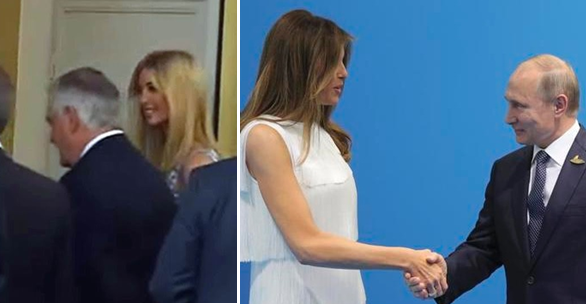
Left: Tillerson, escorted by the President’s daughter Ivanka Trump, 
arriving at the US delegation’s hotel in Hamburg on July 6. 
Right: Melania Trump meets Putin, July 7.

Tillerson’s briefing lasted for 24 minutes; it is available only in audio recording, without pictures. For more, open to listen. The disclosure of the Melania break-in starts at Minute 21.

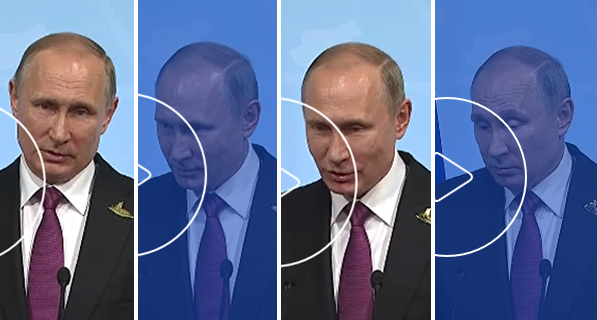
Putin’s briefing of the press lasted a little longer, 32 minutes. There were no crossovers of reporters attending both press conferences, although at least one US reporter did ask Putin questions. The Kremlin recording allowed release of both audio and video, plus an official English-language transcript; click to read. As he reported his personal impression of Trump at the meeting, Putin’s face and body movements are less revealing than his words. That’s because he was controlling himself, shoulders locked behind hands gripping the lectern, feet planted to the floor. He was speaking in code.


Source: The Kremlin videotape, minute 0925 to 10:00English text
The President is showing red patches on either side of his face. 
Dermatologists call this rosacea, a condition that may be caused by stress, 
heavy exertion, the banya, or damp weather. Humidity in Hamburg last 
Thursday and Friday averaged 75%.

This is what Putin said:

“As regards personal relations [with Trump], I believe that they have been established. This is how I see it: Mr Trump’s television image is very different from the real person; he is a very down to earth and direct person, and he has an absolutely adequate attitude towards the person he is talking with; he analyses things pretty fast and answers the questions he is asked or new ones that arise in the course of the discussion. So I think that if we build our relations in the vein of our yesterday’s meeting, there are good reasons to believe that we will be able to revive, at least partially, the level of interaction that we need.”

SIGABA decodes these remarks sentence by sentence. These are the results:

In cipher: “as regards personal relations, I believe that they have been established.”

SIGABA: “I’m obliged to state the obvious for in over two hours of conversation there was no basis to detect that Trump has qualities which can be predicted, let alone trusted.”

In cipher: “Mr Trump’s television image is very different from the real person”.

SIGABA: “Familiarity with such an individual is impossible so I cannot refer to him by his first name. He has demonstrated he uses a slightly smaller vocabulary than his television scripts have allowed, awkward as they have been for Trump to read them from his prompter….”

In cipher: “he is a very down to earth and direct person.”

SIGABA: “The man is a simpleton.”

In cipher: “he has an absolutely adequate attitude towards the person he is talking with.”

SIGABA: “His attention span and cognitive capacity are so limited, he prefers bluff and bluster, but this all-or-nothing approach isn’t capable of reciprocal understanding, let alone negotiating. Tillerson tried to extricate him several times. The problem is so serious, his wife was despatched to save him from exposing himself to us, as he did. His impulse control is poor. He trusts only women – he thinks they are simple enough for him to manage.”

In cipher: “he analyses things pretty fast…”

SIGABA: “His comprehension is slow, and works by breaking down complex topics into simple slogans. Then he has trouble sequencing. He can’t remember what he has said or thought before, so he isn’t capable of consistency. He tweets so he can look up what he’s just said.”

In cipher: “he answers the questions he is asked or new ones that arise in the course of the discussion.”

SIGABA: “He has one-line statements for North Korea, Syria, Ukraine, cyber security, nuclear arms, missile systems, elections, sanctions. These are neither consistent nor negotiable. He is incapable of either.”

In cipher: “So I think that if we build our relations in the vein of our yesterday’s meeting…”

SIGABA: “If is the operative word – there’s no telling what will happen next because Trump is in charge of nothing, not even of his wife, and nothing he says can be relied on. Tillerson is as impotent as his boss.”

In cipher: “there are good reasons to believe that we will be able to revive, at least partially, the level of interaction that we need.”

SIGABA: “The best that can be hoped for is that Tillerson can control the working groups to which he’s persuaded Trump to delegate everything of substance. So everything with the Americans is partial. I have gained nothing I need.”

The Kremlin publicity version isn’t divulging the state secrets revealed by the SIGABA machine.

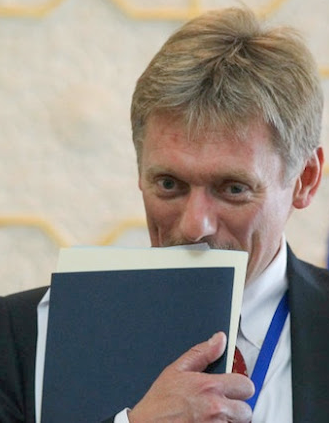
One reason is that the decrypts confirm Russian intelligence assessments Putin has been receiving on Trump. This secret also means another one — the briefings Putin gets from press arranged by his spokesman, Dmitry Peskov (right), have proved false.

Peskov’s version of the success of the meeting can be read in RT here.

“Accusations that Trump is somewhat incompetent or that he is a novice, can be classified as delusional trash,” Peskov told Russian state television, intimating he was addressing western media, not the General Staff or SVR.

“He has expert knowledge, he is a very determined negotiator and skilful at using his knowledge to put his position across.”

Kremlin insiders acknowledge that Peskov tried to order the omission from the Russian press of details of Tillerson’s and Mrs Trump’s attempts to stop the meeting before the 60-minute mark. Instead, Peskov has announced that “a ‘certain affection’ had developed between the Russian leader and Trump’s wife, Melania, who sat next to the Russian president at the official G20 dinner, revealing that the two discussed several issues on the summit agenda, including gender equality and women’s economic participation.”

Peskov in cipher: “We can now confidently declare that this was a win-win encounter.”

SIGABA: “There is no confidence. This was a lose-lose encounter — for Peskov.”

Trump, Putin, G20, and the Syria Ceasefire Deal

Trump, Putin and Russiagate Collide at G20 

by TRNN


July 8, 2017

Max Blumenthal and Aaron Mate discuss the long-awaited first meeting between Donald Trump and Vladimir Putin, where Syria and Russiagate topped the agenda.


Max Blumenthal is an award-winning journalist and bestselling author whose articles and video documentaries have appeared in The New York Times, The Los Angeles Times, The Daily Beast, The Nation, The Guardian, The Independent Film Channel, The Huffington Post, Salon.com, Al Jazeera English and many other publications. His most recent book is Goliath: Life and Loathing in Greater Israel. His other book, Republican Gomorrah: Inside The Movement That Shattered The Party, is a New York Times and Los Angeles Times bestseller.

Max Blumenthal on How the Media Covers Syria

by TRNN

As the U.S. and Russia reach a new ceasefire in Syria, Max Blumenthal of Alternet's Grayzone Project and TRNN's Aaron Mate discuss foreign involvement in the Syrian war and how Western media across the political spectrum has covered it.


Saturday, July 08, 2017

Using "Antisemitism" Cudgel to Quell Left Criticism of Israel's Systemic Criminality

Attacking the Left to Shut Down Criticism of Israeli Crimes

by Yves Engler - Dissident Voice


July 7th, 2017

Most progressives would agree that opposing all forms of racism is a key element of what makes them left wing. But it is not always straightforward how best to confront white privilege, avoid cultural appropriation, tackle colonial attitudes towards indigenous peoples or avoid being labelled anti-Jewish when working for Palestinian human rights. And in the later case, accusations of Left anti-Semitism actually mask a more significant racism problem on the Left.

In response to the recent controversy at Chicago’s Dyke March Toronto activist Alex Hundert tweeted “And to think ppl keep tryna ridicule me for calling out #antisemitism on the Left… #leftfail.” The self-declared radical linked to a Ha’aretz story headlined “Chicago ‘Dyke March’ Bans Jewish Pride Flags: ‘They Made People Feel Unsafe’”. But according to march organizers, Jewish Voices for Peace and Electronic Intifada the whole thing was a set-up and part of an orchestrated attack by a pro-Israel queer group.

In one of many efforts to turn the Dyke March incident against critics of Israel and the left more generally, New York Times opinion section editor Bari Weiss opined that by echoing criticism of Israeli policy in recent years left Jews have opened the door to pogroms or genocide (“if history has taught the Jews anything it’s that this kind of contortion never ends well”), concluding that “anti-Semitism remains as much a problem on the far-left as it is on the alt-right.”

The Dyke March incident is not the first time Hundert has taken up this criticism of Left political movements. “Everytime I’m almost ready to start organizing again,” the former Upper Canada College student tweeted a couple months ago, “I see some stupid left antisemitism that reminds me I’m glad I switched to advocacy.”

Hundert is echoing an increasingly common refrain. Last year, at the liberal end of the dominant media the CBC’s Neil MacDonald asked, “Has the activist left decided anti-Semitism doesn’t exist?” while the far right Rebel denounced “Tom Mulcair, Olivia Chow and the NDP’s huge anti-Semitic problem”. For its part, B’nai Brith has specifically cited “far-left-wing groups”, alongside “anti-Israel agitators”, as a major source of anti-Semitic incidents in its annual audit. During the 2012 Québec student strike B’nai B’rith condemned protesters’ purported “hate …that has outraged the Jewish community.” A Canadian Jewish News editorial and front page cover about the NDP supporting the Leap Manifesto in 2016 suggests the Jewish community’s leading organ would likely cry “anti-Semitism” if the NDP elects a left-wing leader.

Internationally Zionist groups, media commentators and Blairites in the British Labour Party whipped up an “anti-Semitism” crisis last year to undermine Jeremy Corbyn’s leadership. Similar accusations were levelled earlier this year at leftist French presidential candidate Jean-Luc Melenchon and previously against Venezuela’s Hugo Chavez.

Let me be clear: Anti-Jewish prejudice exists on the Left. Many who bemoan “Zionist controlled governments” and other such formulations are referencing stereotypical tropes about Jewish control. Some ‘Jews as Jesus killers’ prejudice also lingers in a country with Christian (colonial) roots. Anti-Semitism should be condemned since all forms of ethnic/religious discrimination are wrong. Additionally, simplistic ethnic/religious explanations of power do a disservice to movements seeking to make the world better a place.

But, while it exists, left anti-Jewish prejudice should be put in context. Is there more anti-Jewish prejudice on the Left than anti-black, indigenous, south Asian, Chinese, etc. racism? Or how about patriarchal attitudes? Or even class bias against “unskilled” workers? But, unlike indigenous or black people or women, Jews are not underrepresented in positions of influence on the Canadian Left, just as they are not underrepresented in the structures of power in this country.

So, what is going on with this focus on the Left’s anti-Semitism? The answer is obvious. It is a way for supporters of Israel to shut down criticism of that country.

While one hears a great deal about the relatively marginal problem of left anti-Semitism, explicit Jewish/Israeli supremacism passes with little comment. NDP officials, for instance, continue to promote the openly racist Jewish National Fund. Five months after speaking at the annual American Israel Public Affairs Committee (AIPAC) conference in Washington D.C., Hélène Laverdière participated in a November 2016 JNF tree planting ceremony in Jerusalem.

During a visit to Israel with Canada’s Governor General the NDP’s foreign critic attended a ceremony with JNF World Chairman Danny Atar. In 2011 Nova Scotia NDP Premier Darrell Dexter donned a JNF hat as he planted a tree at a JNF garden. Manitoba NDP Premier Gary Doer was honoured at a 2006 JNF Negev Dinner in Winnipeg and cabinet minister Christine Melnick received the same honour in 2011. During a 2010 trip to Israel subsequent Manitoba NDP Premier Greg Selinger signed an accord with the JNF while water stewardship minister Melnick spoke at the opening ceremony for a park built in Jaffa by the JNF, Tel Aviv Foundation and Manitoba-Israel Shared Values Roundtable. (In May Melnick won a B’nai Brith Zionist action figures prize for writing a piece about a friend who helped conquer East Jerusalem and then later joined the JNF).

In 2013 Green Party leader Elizabeth May attended a JNF Ottawa fundraiser, even lauding “the greatwork that’s [the JNF] done in making the desert bloom.” May’s comment erased the existence of the indigenous Palestinians and promoted an explicitly racist institution that has Judaized historically Arab areas and continues to discriminate against Palestinian citizens of Israel in its land use policies, as the UN, US State Department and the organization’s own website make clear.

While less flagrantly supremacist than supporting the JNF, most left politicians, representatives and commentators express support for a “Jewish state”. From a Palestinian, or internationalist, perspective this is a decidedly racist characterization and goes against hundreds of years of left support for a secular state.

In an effort to appease critics, some left organizations have even stated formally that opposing a Jewish supremacist state is itself a form of discrimination. After being raked over the coals for refusing a politicized resolution calling on it to align with a pro-Israel group in promoting Holocaust Education Week, the Ryerson Student Union recently adopted the spurious “Ottawa Protocol on Combating Anti-Semitism” as part of its definition of anti-Jewish prejudice.

The Protocol conflates opposition to political Zionism with anti-Jewish prejudice or, in other words, it says it is anti-Semitic to oppose a “Jewish state”. Promoted by Students Supporting Israel and Stand With Us Canada, the student union’s move was immediately applauded by staunch Israeli nationalist National Post columnist Barbara Kay.

Even individuals and groups focused on challenging racism often provide an exemption for explicit Jewish/Israeli racism. In January one of Toronto’s leading anti-racist writers, Desmond Cole, spoke at a forum on “increased racist and xenophobic attacks” in the time of Trump with three individuals (Bernie Farber, Karen Mock and Warren Kinsella) who have ties to the only (to my knowledge) explicitly racist institution sanctioned by the Canadian state to give tax write-offs: the JNF.

After I recently wrote about Warren Kinsella speaking at a Jewish Defense League meeting in 2009, it came to light that a moderator made the former Canada-Israel Committee board member part of a private Toronto Facebook group set up to oppose overtly racist groups like the JDL. In a sign he still condones explicit racism, last year Kinsella condemned a Green Party of Canada resolution calling on the Canada Revenue Agency to rescind the JNF’s charitable status because of its “discrimination against non-Jews in Israel.” (Imagine someone who spoke at a KKK meeting or defended them being invited to a private antiracist Facebook group.) The sober reality is that large swaths of the left still accept, even promote, explicit Jewish/Israeli racism.

When Hundert, Macdonald, B’nai Brith etc. attack the left for being anti-Jewish they reinforce an ideological climate that still sees many labour leaders, NGO representatives, left politicians etc. remaining silent in the face of substantial Canadian support for the most aggressive ongoing European settler colonialism, precisely because they fear being labeled “anti-Semitic”. Whatever one’s motives in launching these attacks on anti-Semitism, their effect is to deter Canadians from condemning our foreign minister for calling Israel a “close friend”, opposing Palestinian rights at the UN, delivering aid to prop up Israel’s illegal occupation and subsidizing charities that channel tens of millions of dollars to projects supporting Israel’s powerful military, racist institutions and illegal settlements.

Yves Engler is the author of A Propaganda System: How Canada’s Government, Corporations, Media and Academia Sell War and Canada in Africa: 300 years of aid and exploitation. Read other articles by Yves.

Friday, July 07, 2017

Maintaining the Libya Myth

Hiding US Lies About Libyan Invasion

by Joe Lauria  - Consortium News


July 7, 2017

Exclusive: In 2016, when a British parliamentary report demolished the excuse for the U.S. and its allies invading Libya in 2011, it should have been big news, but the U.S. mainstream media looked the other way, reports Joe Lauria.

In George Orwell’s 1949 dystopian novel 1984, the protagonist Winston Smith’s job was to delve into The Times of London archive and rewrite stories that could cause trouble for the totalitarian government ruling Britain.

For instance, if the government made a prediction of wheat or automobile production in their five-year plan and that prediction did not come true, Winston would go into the archives and “correct” the numbers in the article on record.


Secretary of State Clinton

In writing a response the other day to a critic of my recently published book on Hillary Clinton’s electoral defeat, I was researching how the U.S. corporate media covered a 2016 British parliamentary report on Libya that showed how then Secretary of State Clinton and other Western leaders lied about an impending genocide in Libya to justify their 2011 attack on that country.

I first searched The New York Times archives to find that the paper never did a staff-written story on this explosive parliamentary report. It only ran an Associated Press article. But when you click on the link for the AP article you get a message saying that it is no longer available on nytimes.com.

Using a combination of different keywords, a search of The Washington Post archives was even worse. I could find no story on the parliamentary report at all. A search of The Los Angeles Times archives likewise comes up empty.

Protecting Policy


Ignoring or downplaying a story is one way U.S. corporate media deliberately buries news critical of American foreign policy. It is often news vital for Americans to understand their government’s actions abroad, actions which could mean death or life for U.S. soldiers and countless civilians of other lands.

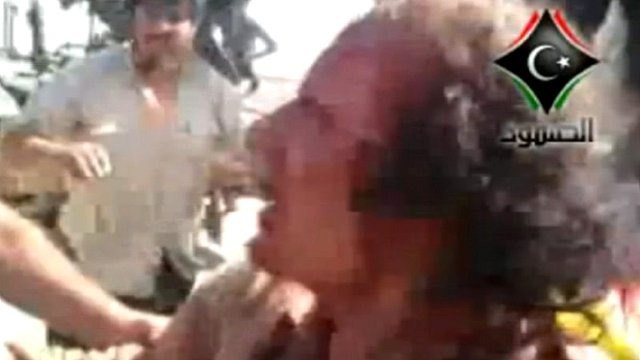
Ousted Libyan leader Muammar Gaddafi shortly before his murder Oct. 20, 2011.

British newspapers widely covered the story. As did the International Edition of CNN, which has separate editors from CNN’s U.S. website. An online search found no domestic CNN story.

There’s also no video online indicating that CNN domestic or CNN International television reported the story.

The Asia edition of The Wall Street Journal had a story. It’s not clear if it appeared in the U.S. edition. Newsweek ran a story online. But it does not mention the United States even once. It laid the blame entirely on the British and French governments, as if the U.S. had nothing to do with the devastation of Libya on false pretenses. The U.S. gave the same false war rationale as the British and French did.

It is as black mark on the Congress’ two foreign affairs committees that neither undertook a similar inquiry (although congressional Republicans did obsess over the Sept. 11, 2012 attack on the U.S. consulate in Benghazi, which occurred about a year after the Obama administration facilitated the military overthrow and brutal murder of Libyan leader Muammar Gaddafi).

Voice of America, which broadcasts outside the United States, ran a story on its website about the British parliamentary report, though the article confined criticism of the U.S. to not being prepared for the aftermath, not for the intervention itself.

A thorough online search shows that The Nation magazine and several alternative news sites, including ConsortiumNews and Salon, appear to be the only U.S.-based media that accurately covered the blockbuster story that undermined the entire U.S. narrative for leaving Libya a failed state.

Rationale for an Attack


The United States peddled its false story of a coming genocide in Libya under the doctrine of Responsibility to Protect to justify military intervention. On its face R2P appears to be a rare instance of morality in foreign and military policy: a coalition of nations with U.N. Security Council authorization would take military action to stop an impending massacre. It would have been hard to argue against such a policy in Libya if indeed its genuine purpose was to stop a massacre, after which the military operation would withdraw.

But that is not where it ended. While arguing that intervention was necessary to stop a massacre in Libya, the real intent, as the British report says, was regime change. That’s not what American officials said at the outset and what corporate media reported.

“In the face of the world’s condemnation, [Libyan leader Moammar] Qadhafi chose to escalate his attacks, launching a military campaign against the Libyan people,” President Barack Obama told the nation on March 28, 2011.

“Innocent people were targeted for killing. Hospitals and ambulances were attacked. Journalists were arrested, sexually assaulted and killed. … Cities and towns were shelled, mosques were destroyed, and apartment buildings reduced to rubble. Military jets and helicopter gunships were unleashed upon people who had no means to defend themselves against assaults from the air.”

Hillary Clinton, who according to leaked emails was the architect of the attack on Libya, said four days earlier: “When the Libyan people sought to realize their democratic aspirations, they were met by extreme violence from their own government.”

Sen. John Kerry, at the time chairman of the Senate Foreign Relations Committee, chimed in: “Time is running out for the Libyan people. The world needs to respond immediately.”

Mustafa Abdul Jalil, head of a transitional council that the U.S., U.K. and France recognized as the legitimate Libyan government, pleaded for a no-fly zone. The University of Pittsburgh–educated Jalil was playing the same game as Ahmed Chalabi had in Iraq. They both sought U.S. military might to bring them to power. He said that if Gaddafi’s forces reached Benghazi they would kill “half a million” people. “If there is no no-fly zone imposed on Qadhafi’s regime, and his ships are not checked, we will have a catastrophe in Libya.”

Report Tells a Different Story


And yet the summary of the September 2016 Foreign Affairs Committee report says: “We have seen no evidence that the UK Government carried out a proper analysis of the nature of the rebellion in Libya. … UK strategy was founded on erroneous assumptions and an incomplete understanding of the evidence.”

The report further said:

“Despite his rhetoric, the proposition that Muammar Qadhafi would have ordered the massacre of civilians in Benghazi was not supported by the available evidence. While [he] certainly threatened violence against those who took up arms against his rule, this did not necessarily translate into a threat to everyone in Benghazi. In short, the scale of the threat to civilians was presented with unjustified certainty.”

The committee pointed out that Gaddafi’s forces had taken towns from rebels without attacking civilians. On March 17, two days before NATO’s assault began, Gaddafi told rebels in Benghazi to “throw away your weapons, exactly like your brothers in Ajdabiya and other places did. They laid down their arms and they are safe. We never pursued them at all.” The Libyan leader “also attempted to appease protesters in Benghazi with an offer of development aid before finally deploying troops,” the report said.

In another example, the report indicates that, after fighting in February and March in the city of Misrata, just one percent of people killed by the Libyan government were women or children. “The disparity between male and female casualties suggested that Qadhafi regime forces targeted male combatants in a civil war and did not indiscriminately attack civilians,” the report said.

How then could The New York Times and The Washington Post, the most influential American newspapers, refuse to cover a story of such magnitude, a story that should have been front page news for days? It was a story that undermined the U.S. government’s entire rationale for an unjustified attack that devastated a sovereign nation.

There can be only one reason the story was ignored: precisely because the report exposed a U.S. policy that led to a horrible crime that had to be covered up.

History Spiked


Defending U.S. policy appears to be the underlying motive of U.S. news coverage of the world. The Libya story is just one example. I’ve had personal experience of editors rejecting or changing stories because it would undermine U.S. foreign policy goals.

I twice pitched a story about a now declassified Defense Intelligence Agency document warning of the rise of a U.S.-backed Salafist principality in eastern Syria, intended to pressure Syrian President Bashar al-Assad, that could join with Iraqi extremists to become an “Islamic State,” two years before it happened. My story was twice rejected. It would have undermined the entire American narrative on the War on Terror.

On another occasion, I wrote several articles about the lead-up to a U.N. vote to grant Palestine Observer State status. In each article I mentioned that 130 countries already recognized Palestine as a state and many had diplomatic relations, including Palestinian embassies in their capitals. That essential fact in the story kept getting cut out.

Another story I wrote was spiked about the position Russia, Syria and Iran took on who was responsible for the chemical weapons attack outside Damascus in August 2013. The story also included an interview with a Congressman who demanded to see U.S. intelligence backing its accusation against Assad.

Telling both sides of a story is Journalism 101. But not evidently when the other side is a perceived enemy of the United States. There are only interests in international affairs, not morality. A journalist should not take sides. But American journalists routinely do in international reporting. They take the “American side” rather than neutrally laying out for the reader the complex clash of interests of nations involved in an international dispute.

Downplaying or omitting the adversary’s side of the story is a classic case of Americans explaining a foreign people to other Americans without giving a voice to those people, whether they be Russians, Palestinians, Syrians, Serbs, Iranians or North Koreans. Depriving a people of their voice dehumanizes them, making it easier to go to war against them.

One can only conclude that U.S. corporate media’s mission is not to tell all sides of an international story, or report news critical of U.S. foreign policy, but instead to push an agenda supporting U.S. interests abroad. That’s not journalism. That’s instead the job Winston Smith did.

Joe Lauria is a veteran foreign-affairs journalist. He has written for the Boston Globe, the Sunday Times of London and the Wall Street Journal among other newspapers. He is the author of “How I Lost By Hillary Clinton” published by OR Books, from which part of this article was adapted. He can be reached at joelauria@gmail.com and followed on Twitter at @unjoe.

"Welcome to Hell" - Hamburg Authorities' G20 Blitzkrieg

Dystopian Nightmare: Eyewitness Decries Police Repression at G20 Summit as 100,000 Take to Streets

by DemocracyNow


July 07, 2017

Mass demonstrations have erupted across Hamburg, Germany, as world leaders gather for the G20 summit, where President Donald Trump is meeting with other world leaders. About 100,000 protesters took to the streets and have staged sit-ins in an attempt to disrupt the first day of the summit. Police fired water cannons, pepper spray and stun grenades to disperse protesters.

Key issues on the G20 agenda include climate change, trade and North Korea. Protesters who gathered say the G20 has failed to solve many issues, including climate change and global economic disparities.

We speak with philosopher Srecko Horvat, who is taking part in the G20 alternative summit, known as the Global Solidarity Summit. He is the co-founder of the Democracy in Europe Movement, also known as DiEM25.


SREĆKO HORVAT: Hello, Amy. I am really glad to be here, from the streets of Hamburg. And welcome to Hamburg, as well. Well, I’ve been to many protests all around the world, from Occupy Wall Street at Zuccotti Park—you remember that times—to Tahrir Square, Syntagma Square, where we’re with 50,000 people during the OXI referendum. But I’ve never seen such a big amount of heavily armed police, drones, helicopters, water cannon and so on, as I have seen on the streets of Hamburg yesterday, today and probably also tomorrow. This summit costs around 50 million euros, and it’s happening in one of the biggest cities in Germany. What we could have seen in the—during the last days is that this is really turning into something what the German legal philosopher Carl Schmitt would call Ausnahmezustand—namely, state of exception—which means that civil liberties, even peaceful protests, are approached by violent police actions and so on. This is the reason why I call it a dystopia.

Watch Part 2 || Srecko Horvat on 'Democracy in Europe Movement' & Uniting Leftists Against Failed Policies of G20


Watch Full Show

Who Destabilized Ukraine: Pomp and Propaganda at G20

Trump Tells Russia to Stop 'Destabilizing' Ukraine, But What's Really Going On?

by TRNN


July 7, 2017

Western powers fuel the Ukrainian conflict -- and wider tensions with Russia -- by treating Ukraine as a strategic prize, says Nicolai Petro, Silvia-Chandley professor of Peace Studies and Nonviolence at the University of Rhode Island.


Nicolai N. Petro is the Silvia-Chandley Professor of Peace Studies and Nonviolence at the University of Rhode Island. He is currently joining us from Odessa, Ukraine. He served as special assistant for policy toward the Soviet Union in the U.S. Department of State from 1989 to 1990. He has received many fellowships, including two Fulbright awards (one to Russia and one to Ukraine). He comments frequently about Russia and Ukraine, and his latest book, Ukraine in Crisis, was published this month by Routledge. 

Bezos' Booming Laugh Last

The Destructive Power Trips of Amazon’s Boss 

by Ralph Nader - CounterPunch


July 7, 2017

For his smallish stature, Amazon Boss Jeff Bezos has a booming, uproarious laugh. Unleashed during workdays, its sonic burst startles people, given it comes from as harsh and driven a taskmaster as exists on the stage of corporate giantism.

Is Bezos’s outward giddiness a worrisome reflection of what Bezos is feeling on the inside? Is he laughing at all of us?

Is Bezos laughing at the tax collectors, having avoided paying most states’ sales taxes for years on all the billions of books he sold online, thereby giving him an immediate 6 to 9 percent price advantage over brick-and-mortar bookstores, that also paid property taxes to support local schools and public facilities?

That, and being an early online bookseller, gave Bezos his crucial foothold, along with other forms of tax avoidance that big companies utilize.

Is Bezos laughing at the bureaucratic labor unions, that somehow can’t get a new handle on organizing the tens of thousands of exploited blue collar workers crying for help in Amazon warehouses and other stress-driven installations? With a net-worth over $80 billion, why should he worry?

Is Bezos laughing at the giant retailers, who are closing hundreds of stores because their thin margins cannot withstand Amazon’s predatory pricing?

Is Bezos laughing at the Justice Department’s Antitrust Division which, before Trump, was studying how old antitrust laws could be used to challenge monopolizing Molochs such as Amazon in the 21st century? It is time for antitrust officials to explore new regulatory actions and modern legislation to deal with today’s conglomerates.

Is Bezos laughing at Main Street, USA which he is in the process of hollowing out; along with nearby shopping malls who can’t figure out how to supersede the convenience of online shopping with convivial ground shopping experience?

Is Bezos laughing at Walmart, bestirring itself, which is starting to feel like giant Sears Roebuck did before Walmart’s relentless practices caught up and crushed what is now a shrunken, fragile Sears?

Is Bezos laughing at the United States Postal Service, to which he has given – for the time being – much business for shipping Amazon’s packages? Bezos has no intention of this being a long term arrangement. Imagine Amazon with its own fleet of driverless vehicles and drones. Amazon is already using part-time workers to deliver its wares.

Is Bezos laughing at the Washington Post, which he bought for a song in 2014 while he was holding down a large contract with the CIA and other government agencies?

Is Bezos laughing at Alibaba, the huge (bigger than Amazon) Chinese online seller that is trying but failing to get a toehold in the US market? It is hard to match Amazon’s ruthlessness on its home turf. Is Bezos laughing at people’s manipulated susceptibility for convenience, hooking them with $99 a year for free shipping? Ordering from their computer or cell phone for speedy delivery to sedentary living, Amazon’s customers are robbed of the experience of actively going to local businesses where they can personally engage with others, get offered on the spot bargains and build relationships for all kinds of social, civic and charitable activities.

Is Bezos laughing at many millions of Amazon customers who think temporary discounts and minor shipping convenience can make up for the billions of tax dollars Amazon has learned to avoid and the thousands of small business competitors whose closures shrink the local property tax base that supports schools and other essential public services?

As Amazon spreads around the world selling everything and squeezing other businesses that use its platform, is Bezos laughing at humanity? His ultimate objective seems to preside over a mega-trillion dollar global juggernaut that is largely automated, except for that man at the top with the booming laugh who rules over the means by which we consume everything from goods, to media, to groceries. Crushing competitors, history shows, is leads to raising prices by monopolizers.

Consumers, workers and retailers alike must be on higher alert and address this growing threat. You have nothing to lose except Bezos’s tightening algorithmic chains. To start the conversation, you can wait for Franklin Foer’s new book out this September, titled World Without a Mind: The Existential Threat of Big Tech. Until then, a good substitute is his 2014 article in The New Republic, Amazon Must be Stopped.     

Ralph Nader is a consumer advocate, lawyer and author of Only the Super-Rich Can Save Us!
More articles by:Ralph Nader 

Pop Go the Pingos! Globalized Warming's Existential Agents of Doom

The Pingo Evidence: Global Warming is a Threat to Humanity

by Robert Hunziker - CounterPunch


July 6, 2017

Pingos may sound cute, but they are not cute, even though they start out as small, kinda cute, mounds of earth. Rather, they are monsters from the depths.

Whether pingos are threatening is a stimulating question scientists are still trying to figure out; they're suddenly popping up in the darnedest places!

Photo by Ian D. Keating | CC BY 2.0 

Pingos are one more solid piece of evidence global warming is a real threat to humanity. Global warming is quintessentially part of the Great Acceleration.

Is the world ready?


Already, Russian scientists have identified 7,000 “alternative pingos” in Siberia. According to The Washington Post, “Russian Scientists Find 7,000 Siberian Hills Possibly Filled with Explosive Gas,” March 27, 2017, Vladimir E. Romanovsky, geophysicist at the University of Alaska in Fairbanks claims:

“This is really a new thing to permafrost science. It has not been reported in the literature before,” Ibid.

Romanovsky estimates there could be as many as 100,000 “alternative pingos” (smaller than regular pingos) across the entire Arctic permafrost. Scientists have little doubt that human-caused global warming is the culprit behind sudden eruptions of pingos, what else could possibly account for the extreme rapid melting of permafrost: “It’s definitely related to warming,” Romanovsky said.

If these solid chunks warm up and decompose — and the Arctic region is heating up at a rate double the rest of the planet — the methane gas within the alternative pingo builds up.” Ibid.

The National Academy of Sciences carried an article about pingos Postglacial Response of Arctic Ocean Gas Hydrates to Climatic Amelioration, Proceedings of the National Academy of Sciences, vol. 114, No. 24, Pavel Serov.

The referenced National Academy article, upon conversion into plain English, reads as follows:

Massive Underwater Domes of Methane Look Set to Blow at Any Moment, ScienceAlert, June 6, 2017
“… Methane look set to blow at any moment” is a powerful sounding statement. The ultimate risk factor (only guessing because it is too early to know for sure) is obliteration of global agriculture. Then, people starve, get angry, and fight… viciously. But, first they migrate. No surprise there as migration has already started in the Middle East and along the southern coastline of the Mediterranean. Why migration? The Middle East carries the distinction as the “fastest drying region of the world” global warming at work.

Here are some snips from articles about drying up Middle East nations (350 million people) and northern Africa… Iran’s Lake Urmia is Drying Up Fast… Portions of Iraq Drying Up Completely… NASA Study Shows Alarming Water Loss in the Middle East… Dead Sea Drying… One-Half of the World’s Most Water-Stressed Countries in the Middle East and north Africa region. Global warming is likely the most deadly crisis to ever hit humanity. It could be “lights out.”

Syria’s worst drought in 900-years lasted 5 years just prior to the onset of armed conflict, driving 1.5 million farmers and herders off their parched land into the cities, migrating/searching for sustenance. Ever since war started, they’ve been re-migrating out of the cities to Turkey, Mediterranean states, and all across Europe, except for Poland, Hungary, and Czech Republic, which refuse. Global warming/armed conflicts cause people to do crazy things.

What of pingos? Do they pose a threat to humanity? Maybe yes, maybe no, it’s too early to know for certain. After all, the sudden eruptions of weird perfectly round, smooth craters in the northernmost latitudes has only recently popped-up, exploding upwards from within Earth, forming craters that make people scratch their heads in disbelief whilst reflecting, hmm!

If we did not have anthropogenic (human-caused) global warming, pingos would not suddenly be ubiquitous, and there would be no reason to write this article. However, thousands of earthen hills have been popping-up in the lower Arctic regions. The operative question therefore is whether pingos, by releasing methane, will accelerate global warming, leading to way too much heat, and runaway global warming, resulting in burnout of agriculture. Then, starvation sets in for millions, maybe billions. Thereafter, global warfare reigns supreme. Life turns sour. No Hollywood film has ever captured the essence of the shockingly appalling scenario that unfolds, but the TV series The Walking Dead sure seems close. Do films reflect future society?

Methane (CH4) is much worse than carbon dioxide (CO2). There’s no comparison. CH4 cooks the climate at least 10 times faster (actually much faster during its initial years) than CO2. The fact is that when too much carbon (oil, gas, and coal) is removed from the ground and emitted into the atmosphere, e.g., gasoline-powered cars, the planet turns into an oven, like our sister planet Venus where surface temperatures can hit up to 1300°F.

That’s hot! Why so hot? The answer is that 95% of Venus’s atmosphere consists of greenhouse gases which acts like a blanket, trapping heat on the planet, whereas Mercury, which is closer to the sun, is cooler. Its atmosphere is not loaded up with carbon.

Hello Earthlings, you’ve got incipient global warming. It’s not fake! Alarmingly, it’s probably progressed beyond “incipient” at certain latitudes. Batten down the hatches.
 
Robert Hunziker lives in Los Angeles and can be reached at roberthunziker@icloud.com
More articles by:Robert Hunziker