Monday, October 30, 2017

Climate Change Alien to Trump Environmental Appointee

Trump Picks Infamous Climate Change Denier for Top Environmental Job 

by TRNN


October 30, 2017

Southern California is sizzling in a record setting heat wave with temperatures soaring across Los Angeles and other cities this week.

The opening game of the 2017 World Series on Tuesday was the hottest World Series on record with the first pitch being thrown at 103 degrees Fahrenheit.

According to weather historian, Christopher Burke, this is likely the hottest single temperatures recorded anywhere in the United States so late into the year.

The increased temperatures due to human caused climate change, have also been linked to the increase in drought and forest fires across California and the US.

As if all this is not enough, in the midst of dealing with fallout from the worst hurricanes in the US history also linked to climate change, President Trump has named a prominent climate denier, Kathleen Hartnett-White (pictured above) to head up the White House Environmental Council.


Investigative Journalist Steve Horn discusses President Trump's pick to head up the powerful White House Council: former Texas Commissioner on Environmental Quality, Kathleen Hartnett White, who has links to ExxonMobil, the Koch Brothers, and Big Coal.

Sunday, October 29, 2017

Tomorrow's Battlefields Today: A “Persistent Presence” on Russia’s Doorstep

From America With Love - U.S. Commandos Are a “Persistent Presence” on Russia’s Doorstep

by Nick Turse - TomDispatch


October 29, 2017   

They are very concerned about their adversary next door,” said General Raymond Thomas, the head of U.S. Special Operations Command (SOCOM), at a national security conference in Aspen, Colorado, in July. “They make no bones about it.”

The “they” in question were various Eastern European and Baltic nations. “Their adversary”? Vladimir Putin’s Russia.

Thomas, the commander of America’s most elite troops -- Navy SEALs and Army Green Berets among them -- went on to raise fears about an upcoming Russian military training event, a wargame, known as “Zapad” or “West,” involving 10 Russian Navy ships, 70 jets and helicopters, and 250 tanks. 


Tomgram: Nick Turse, A Red Scare in the Gray Zone

Memo to Senator John McCain: Senator, the other day I noticed that, as chairman of the Armed Services Committee, you threatened to subpoena the Trump administration for information about the recent attack in Niger that killed four American soldiers. “There’s a mindset over there that they’re a unicameral government,” you said. “It was easier under Obama... We are coequal branches of government; we should be informed at all times. We’re just not getting the information in the timely fashion that we need.”

How true! But let me make one small suggestion. If you really want to know what led to those deaths in Niger, the first place you might consider looking -- no subpoena needed -- is this very website, TomDispatch. Or, to be more specific, Nick Turse’s coverage of the way U.S. Africa Command and American Special Operations forces have, with a certain stealth but also without significant coverage in the mainstream media, extended the war on terror deep into Africa. He alone has covered this story and the secret bases, widespread “training missions” (like the one in Niger), and barely noticed wars being fought there since at least 2012, when I was already writing this of his work:

“So here’s another question: Who decided in 2007 that a U.S. Africa Command should be set up to begin a process of turning that continent into a web of U.S. bases and other operations? Who decided that every Islamist rebel group in Africa, no matter how local or locally focused, was a threat to the U.S., calling for a military response? Certainly not the American people, who know nothing about this, who were never asked if expanding the U.S. global military mission to Africa was something they favored, who never heard the slightest debate, or even a single peep from Washington on the subject.”

By 2013, in a passage that sounds eerily up to date as we read of ISIS-allied militants on the lawless Niger-Mali border, he was already reporting that

“while correlation doesn’t equal causation, there is ample evidence to suggest the United States has facilitated a terror diaspora, imperiling nations and endangering peoples across Africa. In the wake of 9/11, Pentagon officials were hard-pressed to show evidence of a major African terror threat. Today, the continent is thick with militant groups that are increasingly crossing borders, sowing insecurity, and throwing the limits of U.S. power into broad relief. After 10 years of U.S. operations to promote stability by military means, the results have been the opposite. Africa has become blowback central.”

Four years later, when the Niger events occurred, nothing had changed, except that the U.S. military had moved, again with little attention (except from Turse), even deeper into the heart of Africa, setting up a remarkable array of bases and outposts of every sort (including two drone bases in Niger).

So here’s another tip for you, Senator McCain, when it comes to a completely different area of the world. Please understand. I’m just trying to save you the need for yet more subpoenas in, say, 2020. Instead, check out Turse’s piece today on the way in which U.S. Special Operations forces have quietly moved not into Africa this time, but into Europe, in country after country in the former borderlands of the Soviet Union. It’s a story that -- I give you my guarantee on this, Senator -- will make the news one of these days, just as the war on terror in Africa has done recently and, if you keep up with Turse, you’ll be among the few in the know ahead of time. Tom

From America With Love - U.S. Commandos Are a “Persistent Presence” on Russia’s Doorstep

by Nick Turse

 
“The point of concern for most of these eastern Europeans right now is they're about to do an exercise in Belarus... that's going to entail up to 100,000 Russian troops moving into that country.” And he added, “The great concern is they're not going to leave, and... that's not paranoia...”

Over the last two decades, relations between the United States and Russia have increasingly soured, with Moscow casting blame on the United States for encouraging the Rose Revolution in Georgia in 2003 and the Orange Revolution in Ukraine a year later. Washington has, in turn, expressed its anger over the occupation of Abkhazia and South Ossetia following the Russo-Georgian War of 2008; the annexation of Crimea from Ukraine after pro-Moscow president Viktor Yanukovych was chased from power; and interference in the 2016 U.S. presidential election. There have been recriminations on both sides over the other nation’s military adventurism in Syria, the sanctions Washington imposed on Moscow in reaction to Crimea, Ukraine, and human rights issues, and tit-for-tat diplomatic penalties that have repeatedly ramped up tensions.

While Zapad, which took place last month, is an annual strategic exercise that rotates among four regions, American officials nonetheless viewed this year’s event as provocative. 

“People are worried this is a Trojan horse,” Lieutenant General Ben Hodges, who commands U.S. Army forces in Europe, told Reuters.
“[The Russians] say, ‘We’re just doing an exercise,’ and then all of a sudden they’ve moved all these people and capabilities somewhere.”

Russia is not, however, the only military power with “people and capabilities” in the region. In passing, SOCOM’s Thomas also mentioned the presence of other forces; troops that he readily admitted the public might not be aware of. Those soldiers were -- just as he feared of the Russian troops involved in Zapad -- not going anywhere. And it wasn’t just a matter of speculation. After all, they wear the same uniform he does.

For the past two years, the U.S. has maintained a special operations contingent in almost every nation on Russia’s western border. “[W]e've had persistent presence in every country -- every NATO country and others on the border with Russia doing phenomenal things with our allies, helping them prepare for their threats,” said Thomas, mentioning the Baltics as well as Romania, Poland, Ukraine, and Georgia by name.

Commandos and Their Comrades


Since 9/11, U.S. Special Operations forces (SOF) have grown in every conceivable way from funding to manpower, the pace of operations to geographic sweep. On any given day, about 8,000 special operators -- from a command numbering roughly 70,000 in total -- are deployed in around 80 countries. Over the course of a year, they operate in about 70% of the world’s nations.

According to Major Michael Weisman, a spokesman for U.S. Special Operations Command Europe, elite U.S. forces have deployed to 21 European countries in 2017 and conducted exercises with an even larger number of nations. “Outside of Russia and Belarus we train with virtually every country in Europe either bilaterally or through various multinational events,” he told TomDispatch.

The number of commandos in Europe has also expanded exponentially in recent years. In 2006, 3% of special operators deployed overseas were sent to the continent. Last year, the number topped 12% -- a jump of more than 300%. Only Africa has seen a larger increase in deployments over the same time span.

This special-ops surge is also reflected in the Joint Combined Exchange Training (JCET) program, overseas missions designed to prepare American commandos in a variety of warfighting skills while also strengthening relations with foreign forces. In 2012, special operators conducted 29 JCETs on that continent.

Last year, the number reached 37, including six in Bulgaria, three in Estonia, three in Latvia, three in Poland, and three in Moldova.

The United States has devoted significant resources to building and bolstering allied special ops forces across the region.

“Our current focus consists of assuring our allies through building partner capacity efforts to counter and resist various types of Russian aggression, as well as enhance their resilience,” SOCOM’s Thomas told members of the House Armed Services Committee earlier this year. 
“We are working relentlessly with our partners and the Department of State to build potency in eastern and northern Europe to counter Russia’s approach to unconventional warfare, including developing mature and sustainable Special Operations capabilities across the region.”

This year, U.S. commandos could be found in nations all along Russia’s borders. In March, for example, Green Berets took to snowmobiles for a cold-weather JCET alongside local troops in Lapland, Finland. In May, Navy SEALs teamed up with Lithuanian forces as part of Flaming Sword 17, a training exercise in that country. In June, members of the U.S. 10th Special Forces Group and Polish commandos carried out air assault and casualty evacuation training near Lubliniec, Poland. In July, Naval Special Warfare operators took part in Sea Breeze, a two decade-old annual military exercise in Ukraine. In August, airmen from the 321st Special Tactics Squadron transformed a rural highway in Jägala, Estonia, into an airstrip for tank-killing A-10 Thunderbolts as part of a military drill. That same month, U.S. special operators advised host-nation commandos taking part in Exercise Noble Partner in the Republic of Georgia.

“Working with the GSOF [Republic of Georgia’s Special Operations forces] was awesome,” said Captain Christopher Pulliam, the commander of the Georgia Army National Guard’s Company H (Long-Range Surveillance), 121st Infantry Regiment. (That, of course, is a unit from the American state of Georgia.) 
“Our mission set requires that we work in small teams that gather specific intel in the area of operations. The GSOF understand this and can use our intel to create a better understanding of the situation on the ground and react accordingly.”

Special Warriors and Special Warfare


The United States isn’t alone in fielding a large contingent of special operations forces. The U.S. Defense Intelligence Agency estimates that Russia’s Spetsnaz (“special purpose”) troops number around 30,000, a sizeable force, although less than half the size of America’s contingent of commandos. Russia, SOCOM’s Thomas told members of the Senate Armed Services Committee earlier this year, is “particularly adept at leveraging unconventional approaches to advancing their interests and it is clear they are pursuing a wide range of audacious approaches to competition -- SOF [special operations forces] often present a very natural unconventional response.”

Indeed, just like the United States and myriad militaries around the world, Russia has devoted significant resources to developing its doctrine and capabilities in covert, clandestine, and unconventional forms of warfare. In a seminal 2013 article in the Russian Academy of Military Science’s journal Military-Industrial Courier, Chief of the General Staff Valery Gerasimov explained the nature of modern hybrid warfare, including the use of elite troops, this way:

“In the twenty-first century we have seen a tendency toward blurring the lines between the states of war and peace. Wars are no longer declared and, having begun, proceed according to an unfamiliar template... The role of nonmilitary means of achieving political and strategic goals has grown, and in many cases, they have exceeded the power of force of weapons in their effectiveness... [t]he broad use of political, economic, informational, humanitarian, and other nonmilitary measures... is supplemented by military means of a concealed character, including carrying out actions of informational conflict and the actions of special operations forces.”

Spetsnaz troops have indeed played a role in all of Russia’s armed interventions since 2001, including in Chechnya and the North Caucasus, Georgia, Ukraine, and Syria. During that same span, U.S. Special Operations forces have been employed in combat in Afghanistan, Iraq, Pakistan, Yemen, Somalia, Libya, Syria, Niger, and the Central African Republic. They have also had a presence in Jordan, Kenya, Djibouti, and Cameroon, among other countries to which, according to President Trump, U.S. combat-equipped forces are currently deployed.

In an interview late last year, retired Lieutenant General Charles Cleveland, chief of U.S. Army Special Operations Command from 2012 to 2015 and now the Senior Mentor to the Army War College, discussed the shortcomings of the senior military leadership in regard to the wars in Iraq and Afghanistan, the “bad national policy decisions... that shaped U.S. campaigns in those theaters,” and a reliance on a brand of conventional war-fighting with limited effectiveness in achieving political goals. 
“[I]t is important to understand why SOF has risen from footnote and supporting player to main effort,” he added, “because its use also highlights why the U.S. continues to have difficulty in its most recent campaigns -- Afghanistan, Iraq, against ISIS and AQ [al-Qaeda] and its affiliates, Libya, Yemen, etc. and in the undeclared campaigns in the Baltics, Poland, and Ukraine -- none of which fits the U.S. model for traditional war.”

U.S. Special Operations Command Europe‎ failed to answer TomDispatch’s questions about those “undeclared campaigns” on Russia’s doorstep, but more public and conventional efforts have been in wide evidence. In January, for example, tanks, trucks, and other equipment began arriving in Germany, before being sent on to Poland, to support Operation Atlantic Resolve. That effort, “designed to reassure NATO allies and partners... in light of the Russian intervention in Ukraine,” according to the Congressional Research Service, began with a nine-month rotation of about 3,500 soldiers from the 3rd Armored Brigade Combat Team, 4th Infantry Division, who were replaced in September by 3,300 personnel and 1,500 vehicles from the 2nd Armored Brigade Combat Team, 1st Infantry Division, which would be deployed to five countries. Earlier this month, Russia’s Defense Ministry complained that the size of the U.S. contingent in the Baltics violates a Russian-NATO agreement.

Red Dawn in the Gray Zone


Late last year, a group of active-duty and retired senior military officers, former ambassadors, academics, and researchers gathered for a symposium at the National Defense University (NDU) in Washington, D.C., titled “Russian Engagement in the Gray Zone.” Conducted via Chatham House rules -- that is, in accounts of the meeting, statements could not be attributed to any specific speaker -- the Americans proceeded to vilify Russia both for its bellicosity and its underhanded methods. Among the assessments: “Russia is always at a natural state of war and it prioritizes contactless war”; “Russia de-emphasizes kinetic activities and emphasizes the indirect/non-lethal approach”; and “Russia places a priority on subversion.”

The experts at NDU called for a comprehensive campaign to undermine Russia through sanctions, by courting “disenfranchised personnel” and “alienated persons” within that country, by developing enhanced cyber-capabilities, by utilizing psychological operations and “strategic messaging” to enhance “tactical actions,” and by conducting a special ops shadow war -- which General Charles Cleveland seems to suggest might be already underway. “[T]he United States should learn from the Chechnya rebels’ reaction. The rebels used decentralized operations and started building pockets of resistance (to include solo jihadists),” reads a synopsis of the symposium.

“SOCOM actions will need,” the NDU experts asserted, “to be unconventional and irregular in order to compete with Russian modern warfare tactics.”

In other words, they were advocating an anti-Russian campaign that seemed to emphasize the very approach they were excoriating Russia for -- the “indirect/non-lethal approach” with a “priority on subversion.” 

In the end, Russia’s much-feared “West” war game, in which Spetsnaz troops did participate, concluded with a whimper, not a bang. “After all the anxiety, Russia's Zapad exercise ends without provocation,” read the headline in the military newspaper Stars and Stripes on September 20th.

For months, while Russia insisted its war game would involve fewer than 13,000 soldiers, the U.S. and its allies had warned that, in reality, up to 100,000 troops would flood into Belarus. Of those Russian troop levels, Lieutenant Colonel Thomas Möller, a Swedish military observer who attended Zapad, said, “We reported about 12,400.” Of such exercises, he added, 

 “This is normal military business as we do in all countries with armed forces. This is not training for attacking anyone. You meet the enemy, you stop the enemy, you defeat the enemy with a counterattack. We are doing the same thing in Sweden.”

Indeed, just as Möller suggested, more than 20,000 troops -- including U.S. Special Operations forces and soldiers from Denmark, Estonia, Finland, France, Lithuania, Latvia, Norway, and Sweden -- had gathered in his country during the Zapad exercise for Aurora 2017. And Sweden was hardly unique. At the same time, troops from the U.S., Bulgaria, Canada, Estonia, Georgia, Italy, Lithuania, Moldova, Norway, Poland, Romania, Turkey, Ukraine, and the United Kingdom were carrying out Rapid Trident, an annual military exercise, in neighboring Ukraine.

What message was the U.S. sending to Russia by conducting training exercises on its borders, Catherine Herridge of Fox News asked General Raymond Thomas in Aspen? “That's a fascinating question because I am -- I try to appreciate the adversary's optic to -- I realize that a way to gauge a metric if you will for how well we're doing,” the SOCOM chief replied somewhat incoherently.

Herridge was, of course, asking Thomas to view the world through the eyes of his adversary, to imagine something akin to Russia and its ally Syria conducting war games in Mexico or Canada or in both countries; to contemplate Spetsnaz troops spread throughout the Western hemisphere on an enduring basis just as America’s elite troops are now a fixture in the Baltics and elsewhere in Eastern Europe.

In the end, Thomas’s take was understated in a way that undoubtedly wouldn’t have been the case had the roles been reversed. 
“I am curious what Putin and his leadership are thinking,” the special ops chief mused.
 “I think it was a little unnerving.”

Nick Turse is the managing editor of TomDispatch, a fellow at the Nation Institute, and a contributing writer for the Intercept. He recently covered ethnic cleansing by government forces in South Sudan for Harper’s Magazine and the Columbia Journalism Review. His latest book is Next Time They’ll Come to Count the Dead: War and Survival in South Sudan. His website is NickTurse.com.

Copyright Nick Turse 2017

Saturday, October 28, 2017

Desperately Seeking Reason: Canadian Forces Search for a Role in Empire's Asia Play

The Canadian Military’s Search for “Gravitas” in Asia

by Yves Engler - Dissident Voice


October 28th, 2017

Canadian leaders search for “gravitas” and “respect” from their US counterparts is adding to friction in the Asia-Pacific.

Amidst tension on the Korean Peninsula, the Canadian Navy has joined Washington’s “pivot” towards Asia.

Recently departed, HMCS Chicoutimi is expected to be in the Asia-Pacific until March.

While they refused to offer CBC News much detail, a military spokesperson said the first ever Victoria-class submarine deployed to the region will,

...provide the government with defence and security options should a timely Canadian response be necessary.”

Chicoutimi’s deployment follows on the heels of a six-month tour of Asia by HMCS Ottawa and Winnipeg, which included “freedom of navigation” operations and exercises alongside US, Japanese, Australian and other countries’ warships. When the two Canadian gunboats travelled through the South China Sea with their allies, Chinese vessels came within three nautical miles and “shadowed” them for 36 hours. On another occasion a Chinese intelligence vessel monitored HMCS Winnipeg and Ottawa while they exercised with a South Korean ship.

After visiting HMCS Ottawa and Winnipeg in Singapore Chief of Defence Staff Jon Vance declared,

If one wants to have any respect or gravitas you have to be in that region.”

During the past decade the US and its principle Asian economic ally Japan have lost their economic hegemony over the region. With Chinese power growing and the Obama administration’s “pivot” designed to contain it, Washington has sought to stoke longstanding territorial and maritime boundary disputes in the South China Sea between China and the Philippines, Malaysia, Vietnam and other nations. As part of efforts to rally regional opposition to China, the US Navy engages in regular “freedom of navigation” operations, which see warships travel through or near disputed waters — kind of like the logic employed by street gangs defending “their” territory.

The Canadian Navy has supported Washington’s aggressive posture. They’ve increased participation in patrols and exercises in the region. In 2012 it came to light the military was seeking a small base or “hub” in southeast Asia – probably in Singapore – with a port facility.

Unfortunately, exerting naval power in the region is nothing new for this country. For two decades the Canadian navy has made regular port visits to Asia and since its 1971 inception Canada has participated in every Rim of the Pacific Exercise, which is a massive US-led maritime warfare training every two years.

Immediately after US forces invaded Korea in 1950, Ottawa sent three gunboats to the region. Ultimately eight Canadian warships with 3,600 soldiers were deployed to the country during the conflict (a total of 27,000 Canadians fought in the three-year war that left millions dead). Canadian ships transported troops and bombed the North.


According to a Canadian War Museum exhibit,

During the war, Canadians became especially good at ‘train busting’. This meant running in close to shore, usually at night, and risking damage from Chinese and North Korean artillery in order to destroy trains or tunnels on Korea’s coastal railway. Of the 28 trains destroyed by United Nations warships in Korea, Canadian vessels claimed eight.”

Before the outbreak of the Korean War the Canadian Navy sought to exert itself in the region. In a bizarre move, Ottawa sent a naval vessel to China in 1949 as the Communists were on the verge of victory. According to Canadian Gunboat Diplomacy, the boat was sent too late to stop the Kuomintang’s defeat by Mao’s forces and was not needed to evacuate Canadians since British boats could remove them. The objective, it seems, was to demonstrate to the US and UK “that Canada was a willing partner”, particularly in light of the emerging north Atlantic alliance.

And like the smaller, weaker kid in a street gang our “leaders” are trying to prove how tough we are. Need someone to attack a house? Sure, we’ll do it. Show them our firepower? We’re in.

Canadian military planners’ search for “gravitas” is akin to gang logic. But, let’s hope our behaviour in Asia doesn’t lead to where gang warfare has taken many North American cities.

Yves Engler is the author of A Propaganda System: How Canada’s Government, Corporations, Media and Academia Sell War and Canada in Africa: 300 years of aid and exploitation.
Read other articles by Yves.

Hillary's Last Laugh: The Real Russia-Gate Story

What Did Hillary Clinton Know?

by Robert Parry  - Consortium News


October 25, 2017

Exclusive: With the disclosure that Hillary Clinton’s campaign helped pay for the original Russia-gate allegations against Donald Trump, a new question arises: what did Clinton know and when did she know it, reports Robert Parry.

The revelation that Hillary Clinton’s campaign and the Democratic National Committee helped pay for the notorious “Steele Dossier” of hearsay claims about Donald Trump’s relations with Russia is not surprising but is noteworthy given how long the mystery about the funding was allowed to linger.

Another mild surprise is that the Clinton campaign would have had a direct hand in the financing rather than maintaining an arm’s length relationship to the dossier by having some “friend of the campaign” make the payments and giving Clinton more deniability.

Instead, the campaign appears to have relied on its lawyer, Marc E. Elias of Perkins Coie, and a confidentiality agreement to provide some insulation between Clinton and the dossier’s startling claims which presumably helped inform Clinton’s charge in the final presidential debate that Trump was Russian President Vladimir Putin’s “puppet.”

Former Secretary of State Hillary Clinton.

Indeed, how much Clinton personally knew about the dossier and its financing remains an intriguing question for investigators.

Ultimately, the facts about who commissioned the dossier were forced out by a congressional Republican subpoena seeking the bank records of Fusion GPS, the opposition research firm that hired former British intelligence operative Christopher Steele to compile the opposition research, known as “oppo,” against Trump.

As part of the legal wrangling over that subpoena, the Clinton/DNC law firm, Perkins Coie, wrote a letter releasing Fusion GPS from its confidentiality agreement.

After that letter, The Washington Post reported on Tuesday night that the Clinton campaign and the DNC had helped fund the Steele effort with attorney Elias retaining Fusion GPS in April 2016 and with Fusion GPS then hiring Steele.

The Post reported that “people familiar with the matter” disclosed that outline of the arrangement but still would not divulge how much the Clinton campaign and the DNC paid to Fusion GPS. One source told me that the total amount came to about $1 million.

‘Trash for Cash’


An irony about Hillary Clinton’s role in funding allegations about Trump’s connection to the Russians, including claims that he cavorted with prostitutes in a five-star Moscow hotel while Russian intelligence operatives secretly filmed him, is that the Clinton camp bristled when Bill Clinton was the subject of Republican “oppo” that surfaced salacious charges against him. The Clintons dismissed such accusations as “cash for trash.”

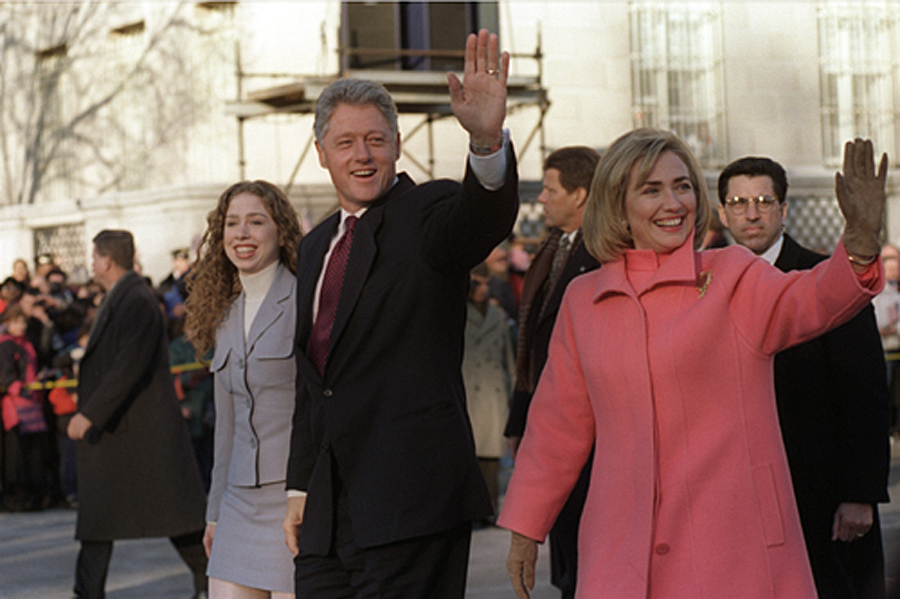
President Bill Clinton, First Lady Hillary Clinton and
daughter Chelsea parade down Pennsylvania Avenue on Inauguration Day, Jan. 20, 1997. (White House photo)

Nevertheless, just as conspiratorial accusations about the Clintons gave rise to the Whitewater investigation and a rash of other alleged “scandals,” which bedeviled Bill Clinton’s presidency, the Steele Dossier — also known as the “Dirty Dossier” — provided a map that investigators have followed for the ongoing Russia-gate investigation into President Trump.

Much like those Clinton allegations, Steele’s accusations have had a dubious track record for accuracy, with U.S. government investigators unable to corroborate some key claims but, I’m told, believing that some are true nonetheless.

In the 1990s, even though the core allegations of wrongdoing about the Clintons and their Whitewater land deal collapsed, the drawn-out investigation eventually unearthed Bill Clinton’s sexual relationship with White House intern Monica Lewinsky and led to his impeachment in the House although he was acquitted in a Senate trial.

Some Democrats have openly hoped for the impeachment of President Trump, too, and they have hitched many of those hopes to the Russia-gate bandwagon.

There is also no doubt about the significance of the Steele Dossier in spurring the Russia-gate scandal forward.

When Rep. Adam Schiff, the ranking Democratic member of the House Intelligence Committee, offered what amounted to a prosecutor’s opening statement in March, his seamless 15-minute narrative of the Trump campaign’s alleged collaboration with Russia followed the trail blazed by Steele, who had worked for Britain’s MI-6 in Russia and tapped into ex-colleagues and unnamed sources inside Russia, including supposedly leadership figures in the Kremlin.

Steele’s Methods


Since Steele could not reenter Russia himself, he based his reports on multiple hearsay from these anonymous Russians who claim to have heard some information from their government contacts before passing it on to Steele’s associates who then gave it to Steele who compiled this mix of rumors and alleged inside dope into “raw” intelligence reports.

Besides the anonymous sourcing and the sources’ financial incentives to dig up dirt, Steele’s reports had other problems, including the inability of FBI investigators to confirm key elements, such as the claim that several years ago Russian intelligence operatives secretly videotaped Trump having prostitutes urinate on him while he lay in the same bed at Moscow’s Ritz-Carlton used by President Obama and First Lady Michelle Obama.

The luxury Ritz-Carlton Hotel in Moscow

That tantalizing tidbit was included in Steele’s opening report to his new clients, dated June 20, 2016. Apparently, it proved irresistible in whetting the appetite of Clinton insiders. Also in that first report were the basic outlines of Russia-gate.

But Steele’s June report also reflected the telephone-tag aspects of these allegations: “Speaking to a trusted compatriot in June 2016 sources A and B, a senior Russian Foreign Ministry figure and a former top level Russian intelligence officer still active inside the Kremlin respectively, the Russian authorities had been cultivating and supporting US Republican presidential candidate, Donald TRUMP for a least 5 years.

“Source B asserted that the TRUMP operation was both supported and directed by Russian President Vladimir PUTIN. Its aim was to sow discord and disunity both within the US itself, but more especially within the Transatlantic alliance which was viewed as inimical to Russia’s interests. … In terms of specifics, Source A confided that the Kremlin had been feeding TRUMP and his team valuable intelligence on his opponents, including Democratic presidential candidate Hillary CLINTON, for several years. …
“The Kremlin’s cultivation operation on TRUMP also had comprised offering him various lucrative real estate development business deals in Russia, especially in relation to the ongoing 2018 World Cup soccer tournament. However, so far, for reasons unknown, TRUMP had not taken up any of these.”

Besides the anonymous and hearsay quality of the allegations, there are obvious logical problems, especially the point that five years before the 2016 campaign, virtually no one would have thought that Trump had any chance of becoming President of the United States.

There also may have been a more mundane reason why Trump’s hotel deal fell through. A source familiar with those negotiations told me that Trump had hoped to get a half interest in the $2 billion project but that Russian-Israeli investor Mikhail Fridman, a founder of Russia’s Alfa Bank, balked because Trump was unwilling to commit a significant investment beyond the branding value of the Trump name.

Yet, one would assume that if the supposedly all-powerful Putin wanted to give a $1 billion or so payoff to his golden boy, Donald Trump, whom Putin anticipated would become President in five years, the deal would have happened, but it didn’t.

Despite the dubious quality of Steele’s second- and third-hand information, the June 2016 report appears to have impressed Team Clinton. And once the bait was taken, Steele continued to produce his conspiracy-laden reports, totaling at least 17 through Dec. 13, 2016.

Framing the Investigation


The reports not only captivated the Clinton political operatives but influenced the assessments of President Obama’s appointees in the U.S. intelligence community regarding alleged Russian “meddling” in the presidential election.


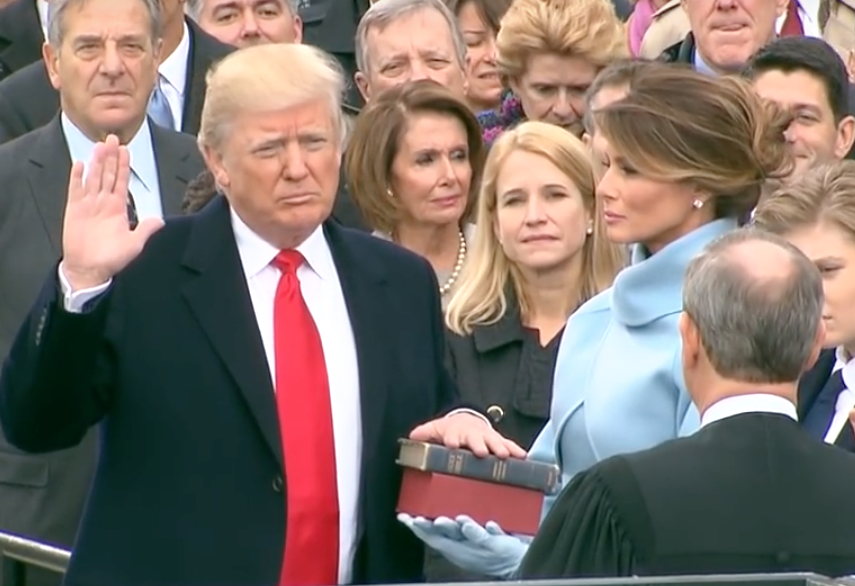
President Donald Trump being sworn in on Jan. 20, 2017. (Screen shot from Whitehouse.gov)

Still, a careful analysis of Steele’s reports would have discovered not only apparent factual inaccuracies, such as putting Trump lawyer Michael Cohen at a meeting with a Russian official in Prague (when Cohen says he’s never been to Prague), but also the sort of broad conspiracy-mongering that the mainstream U.S. news media usually loves to ridicule.

For instance, Steele’s reports pin a range of U.S. political attitudes on Russian manipulation rather than the notion that Americans can reach reasonable conclusions on their own. In one report dated Sept. 14, 2016, Steele claimed that an unnamed senior official in Putin’s Presidential Administration (or PA) explained how Putin used the alleged Russian influence operation to generate opposition to Obama’s Pacific trade deals.

Steele wrote that Putin’s intention was “pushing candidate CLINTON away from President OBAMA’s policies. The best example of this was that both candidates [Clinton and Trump] now openly opposed the draft trade agreements, TPP and TTIP, which were assessed by Moscow as detrimental to Russian interests.”

In other words, the Russians supposedly intervened in the U.S. presidential campaign to turn the leading candidates against Obama’s trade deals. But how credible is that? Are we to believe that American politicians – running the gamut from Senators Bernie Sanders and Elizabeth Warren through former Secretary of State Hillary Clinton to President Donald Trump – have all been tricked by the Kremlin to oppose those controversial trade deals, which are also broadly unpopular with the American people who are sick and tired of trade agreements that cost them jobs?

Of course, the disclosure that the Clinton campaign and the DNC helped pay for Steele’s opposition research doesn’t necessarily discredit the information, but it does suggest a possible financial incentive for Steele and his collaborators to sex-up the reports to keep Clinton’s camp coming back for more.

Investigative reporter Robert Parry broke many of the Iran-Contra stories for The Associated Press and Newsweek in the 1980s. You can buy his latest book, America’s Stolen Narrative, either in print here or as an e-book (from Amazon and barnesandnoble.com).

Intercept Drops Ball on Leaked Syria Docs: Revelation May Have Altered Course of the War

The Intercept Withheld NSA Doc That May Have Altered Course Of Syrian War

by Whitney Webb - MintPress News


October 28, 2017

If this document had been published sooner, it could have dramatically changed the course of the war by exposing the true face of the “moderate rebels” — and potentially saved tens of thousands of lives. That didn’t happen, and no reason has been given by the Intercept for its delay.

On Tuesday, October 24, 2017 the Intercept published a hitherto unknown document from the trove of National Security Administration (NSA) documents leaked by Edward Snowden over three years ago.

The document was notable as it shed light on the early days of the Syrian conflict and the fact that, for the past six years, so-called “revolutionary” groups aimed at toppling Syrian President Bashar al-Assad have largely acted as proxies for foreign governments pushing regime change.

The document explicitly reveals that an attack led by the Free Syrian Army (FSA), which was intended to mark the anniversary of the 2011 “uprising” that sparked the Syrian conflict, was directed by a Saudi prince.

The document proves, in essence, that the armed opposition in Syria – from the earliest years of the conflict – was under the direct command of foreign governments pushing for regime change.


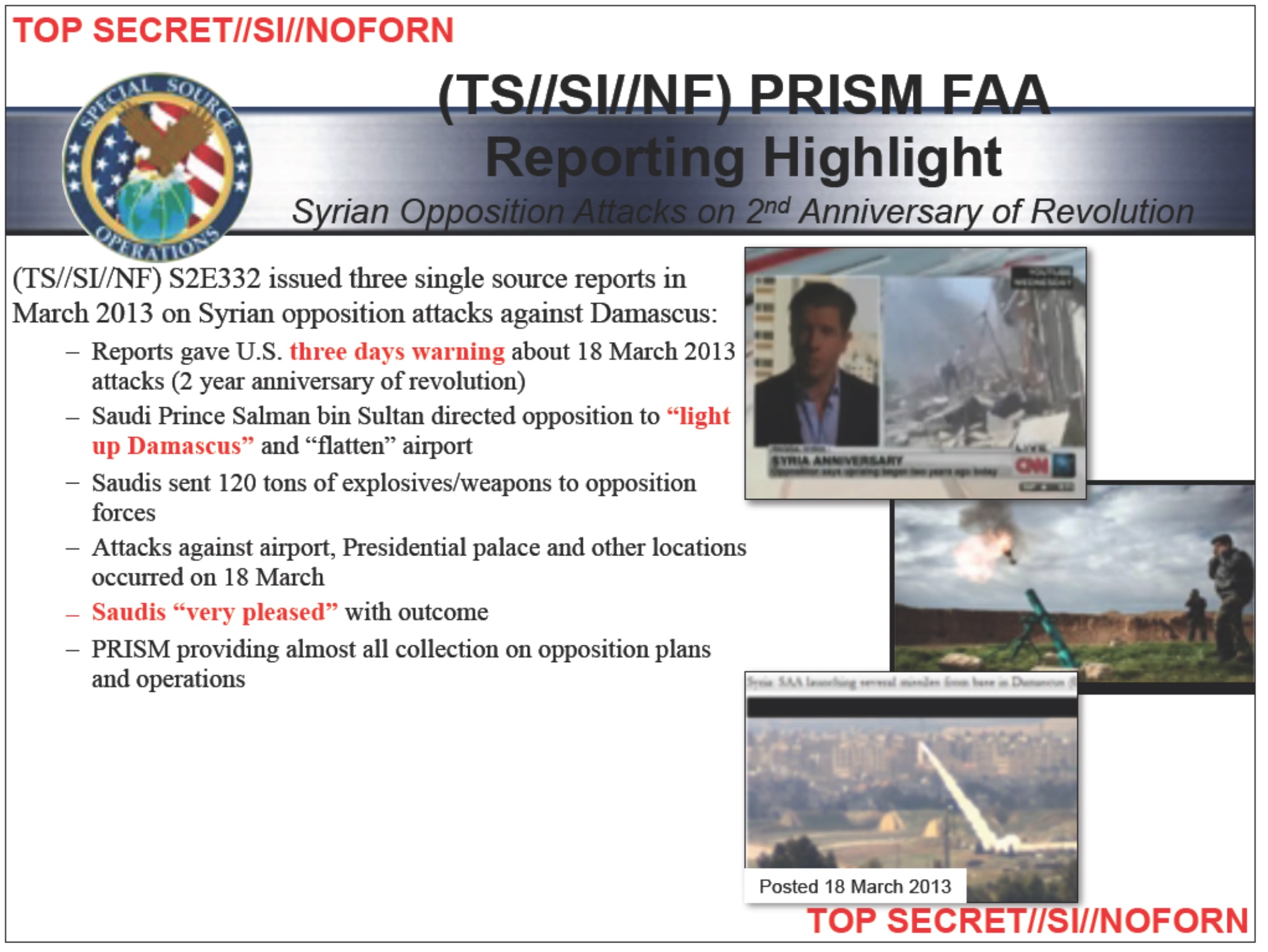
An NSA graphic released by The Intercept outlines Saudi involvement
in organizing and supplying Syrian opposition forces for attacks on
Syria’s civilian infrastructure.


According to the document, Saudi Prince Salman bin Sultan had ordered the FSA to “light up Damascus” and “flatten” the city’s civilian airport. The Saudis had also “sent 120 tons of explosives/weapons to opposition forces” for the operation. The Saudis, as the document notes, were “very pleased” with the outcome, which claimed at least 60 lives.

The implications of the NSA document are significant. It offers the clearest proof, in the form of official U.S. government documents, detailing the direct relationship between the armed Syrian opposition and foreign governments, and exposing the fact that this relationship existed much earlier than the mainstream narrative on the conflict had previously suggested. 

However, the Intercept article regarding the document is unusual for several reasons. First, the report inaccurately claims that the attack launched at the Saudis’ behest did not result in any confirmed casualties. Second, it states that the 2011 uprising in Syria was an organic, “peaceful” movement that led the Syrian government to wage “an open war against their own people” — a narrative that has since been debunked.

Yet, the largest oversight of all is the article’s failure to mention the U.S.’ role in funding the Free Syrian Army, as well as the CIA’s well-documented role in training the FSA and pumping tons of weapons into Syria in order to foment and exacerbate the conflict in its early days. In light of the NSA document’s revelation that the U.S. had been given advance notice of the planned FSA attack – on a civilian target, no less – Washington’s decision to let it proceed clearly suggests that the U.S. was involved in and well aware of the Saudi directives to the FSA. However, the Intercept piece chooses not to mention this crucial context.


Intercept’s three-plus year delay in releasing document


Perhaps even more troubling than the article’s failure to mention the CIA’s well-documented role in backing the Free Syrian Army, now exposed as a proxy force following orders from the Saudi royal family, is the fact that the Intercept had access to this document for nearly three-and-a-half years – deciding to publish only now that the Syrian conflict is effectively over and those pushing for regime change have lost. If this document had been published sooner, it could have dramatically changed the course of the war by exposing the true face of the “moderate rebels” — and potentially saved tens of thousands of lives.

That didn’t happen, however, and no reason has been given by the publication for its notable delay. The Intercept has exclusive publishing rights and an exclusive hold on the content of the Snowden leaks, of which this newly released document is a part. Indeed, the Intercept was founded after the Snowden leaks were made public and its first hires were Glenn Greenwald and Lauren Poitras, the only journalists possessing the full Snowden cache. Those documents now belong to the Intercept’s founder — billionaire eBay founder, — and his for-profit media company, First Look Media.

Examining Omidyar’s connections to the U.S. political establishment offers a plausible reason for the Intercept’s delay in publishing documents so crucial to understanding the situation in Syria. Omidyar was a frequent guest of the Obama White House from 2009 to 2013, garnering more face-to-face visits with Obama during his two terms than did Google’s Eric Schmidt, Facebook’s Mark Zuckerberg, New York Times owner Arthur Sulzberger and even fellow tech billionaire turned major media owner, Jeff Bezos.

Omidyar also directly co-invested with the U.S. State Department, via USAID and the National Endowment for Democracy (NED), in opposition groups that played a key role in overthrowing Ukraine’s democratically elected government in 2014 – a U.S.-brokered regime-change operation that shares some notable similarities with the Syrian conflict. His investments with USAID have continued since the Intercept’s founding, helping fund the NGO’s more recent overseas programs aimed at “advancing U.S. national security interests” abroad.

Also worth noting is the fact that PayPal, of which Omidyar is a major owner, has allegedly been implicated in several of the still-withheld NSA documents for its business relationship with the NSA and its role in the agency’s mass spying program. In addition, former Intercept writers have asserted that Omidyar was “shockingly disinterested in the actual journalism” of the paper, suggesting that the Intercept was created explicitly to delay the release of damaging documents from the Snowden cache until deemed acceptable to the U.S. political establishment and others who stood to lose face were the entire cache to have been made public.

Indeed, another interesting coincidence supporting this thesis is the fact that the Intercept published this latest piece only after the U.S. State Department itself began to report more honestly on the nature of these so-called “rebels.” A day before the Intercept’s story on Syrian “rebels” and the Saudis, the U.S. State Department – for the first time – admitted that “moderate” rebels in Syria had previously used chemical weapons, a charge it had categorically denied for years in order to facilitate laying the blame for any and all chemical weapons attacks in Syria on the Syrian government.

In other words, the Intercept released the document, which effectively destroys Washington’s “moderate rebels” narrative with its own internal documents, only after the U.S. government itself began to unravel that very same narrative.

The Intercept did not respond to MintPress News’ request for comment regarding the timing of the document’s release.

Founder’s connections shape Intercept’s journalism 


Omidyar’s connection to U.S. regime-change efforts abroad may also explain why the Intercept – until now, that is – has consistently given voice to journalists who have echoed the U.S. establishment regarding the Syrian conflict.

Billionare Pierre Omidyar, Richard Branson photo: Pierre Omidyar - Flickr, CC BY 2.0  

For instance, Murtaza Hussain – the author of this latest Intercept piece – has written numerous stories downplaying the terrorist and Wahhabist elements of the Syrian “rebels.”

In the last two years, Hussain has written pieces portraying known Al-Qaeda propagandists, such as Bilal Abdul Kareem, and Al-Qaeda-linked organizations, such as the White Helmets, in an overwhelmingly positive light, failing to mention in both cases the significant evidence tying these entities to known terrorist groups. In another piece, published last August, Hussain gave voice to al-Nusra Front leadership in a lengthy interview that largely whitewashed the group’s Wahhabist leanings and links to terrorist acts in Syria.

Last September, on Twitter, Hussain asserted that Saudi Arabia’s funding of armed factions was not necessarily “good” but that “there is little to indicate they contribute to terrorism.” That last statement has been thoroughly debunked for years, but most recently by Hussain’s own piece on the newly released NSA document.

Hussain is by no means the only Intercept writer who has taken such a pro-opposition stance regarding Syria. A recent Intercept piece on Syria, published in September, committed glaring factual errors on basic facts about the war, while also mistranslating a speech given by Assad so as to link him to American white nationalists. In addition, the paper recently hired Maryam Saleh, a journalist who has called Shia Muslims “dogs” and has taken to Twitter in recent months to downplay the role of the U.S. coalition in airstrikes in Syria. She also has ties to the U.S.-financed propaganda group Kafranbel Media Center, which has close relations with the terrorist group Ahrar al-Sham.

For a paper ostensibly dedicated to “fearless, adversarial” journalism, it is strange that the Intercept gives voice to journalists who echo the U.S. position regarding the Syrian war while rarely publishing the work of journalists who have challenged prevailing Western narratives on that war — journalists who, as the Intercept itself recently revealed, have been right all along regarding the myth of the Syrian “moderate rebel.” Yet, given Omidyar’s political connections and the paper’s handling of the Snowden cache, this unfortunate decision is unsurprising.


Republish our stories! MintPress News is licensed under a Creative Commons Attribution-NonCommercial-ShareAlike 3.0 International License.


Thursday, October 26, 2017

How "Canada's" Oil Companies Get Away With Paying Less

Oil giants pay billions less tax in Canada than abroad

by News UBC


October 26, 2017

The Guardian interviewed Philippe Le Billon, a UBC geography professor, after it was revealed that Canadian oil companies made much higher tax payments to developing countries in 2016 than to Canadian, provincial and municipal governments.

“Companies in Canada will point to the jobs they are creating rather than acknowledge they could be sharing more of their profits, which mostly goes to shareholders who are not even in the country,” he said.

The story also appeared on Yahoo U.K.

Wednesday, October 25, 2017

Gorilla Radio with Chris Cook, Pablo Ouziel, Robert Hunziker, Janine Bandcroft October 26, 2017

This Week on GR

by C. L. Cook - Gorilla-Radio.com


October 26, 2017

Right now, as night falls in Spain the future of the country is shrouded in uncertainty. The referendum on independence that began October, and deemed "illegal" by the federal government, has predictably proven divisive, with each of the main players involved, Spanish prime minister Mariano Rajoy, and Catalonia's regional president, Carles Puigdemont showing little appetite for compromise.

Rajoy promises to dissolve Catalonia's parliament, and reschedule elections, while unilateral secession is Puigdemont's only arrow in the quiver.

Listen. Hear.

Dr. Pablo Ouziel is a Post-Doctoral fellow at UVic whose project in progress is, ‘Towards Democratic Responses to the Crisis of Democracy in Spain: Forms of Participatory and Representative Civic Engagement.’

Pablo Ouziel in the first half.

And; beyond the partisan barbs, it's safe to say Donald Trump is no ecology defender. Surrounded already by climate change deniers and petroleum industry insiders in hiring Scott Pruitt as head of the EPA however, the former real estate tycoon and media phenomenon sent a particularly loud and clear message to businesses big and small: "Damn the enviros, full speed ahead!"

Robert Hunziker is an environmental journalist whose climate clarion calls appear in numerous journals and multiple languages around the World and across the internet. He’s also appeared in a variety of electronic media to talk about global climate change, written extensively about the ongoing aftermath of the Fukushima nuclear disaster, and penned numerous articles on the ever-quickening polar ice melt.

In his recent article, 'Mr. Toxicity Zaps America' Hunziker reports Environmental Protection Agency head, Scott Pruitt "nixed his own agency’s proposal of 2015 to ban the toxic chemical chlorpyrifos, an insecticide that attacks the nervous system of pesky insects, as well as pesky and non-pesky people..."

Robert Hunziker and the EPA's number one "toxics defender" in the second half.

And; Victoria-based activist and CFUV Radio broadcaster at-large, Janine Bandcroft will bring us the Left Coast Events bulletin at the bottom of the hour. But first, Pablo Ouziel, perched atop the peak of Spain's tipping point.

Chris Cook hosts Gorilla Radio, airing live every Wednesday, 1-2pm Pacific Time. In Victoria at 101.9FM, and on the internet at: http://cfuv.ca.  He also serves as a contributing editor to the web news site, http://www.pacificfreepress.com. Check out the GR blog at: https://gorillaradioblog.blogspot.ca/

G-Radio is dedicated to social justice, the environment, community, and providing a forum for people and issues not covered in the corporate media.

American Phoenix: CIA Death Squad Program Back with a Vengeance in Afghanistan

Phoenix 2.0 - CIA To Unleash Vietnam Era Terror Campaign On Afghanistan 

by Moon of Alabama


October 25, 2017

Last week the new head of the CIA Mike Pompeo publicly threatened to make the CIA a "much more vicious agency". His first step towards that is to unleash CIA sponsored killer gangs onto the people of Afghanistan:

"The C.I.A. is expanding its covert operations in Afghanistan, sending small teams of highly experienced officers and contractors alongside Afghan forces to hunt and kill Taliban militants across the country ...
...
The C.I.A.’s expanded role will augment missions carried out by military units, meaning more of the United States’ combat role in Afghanistan will be hidden from public view."

This will be mass murder campaign. People will be pulled from their houses at night and vanish - 'eliminated'. That has been happening in Afghanistan for years, but on a relatively small scale. So far the targets were 'al-Qaeda', a small terrorist group, not the local insurgency. The new campaign will target the Taliban, a mass insurgency against the U.S. occupation. Thus is will be a mass campaign and cause mass casualties.

It is not going to be a counter-insurgency campaign, even though some will assert it is. A counter-insurgency campaign combines political, security, economic, and informational components. It can only be successful in support of a legitimate authority.

The current Afghan government has little legitimacy. It was cobbled and bribed together by the U.S. embassy after wide and open election fraud threatened to devolve into total chaos. In August CIA director Pompeo met the Afghan president Ashraf Ghani and likely discussed the new plan. But the now announced campaign has neither a political nor an economic component. Solely centered on "security" it will end up as a random torture and killing expedition without the necessary context and with no positive results for the occupation.

The campaign will be a boon for the Taliban. While it will likely kill Taliban aligned insurgents here and there, it will also alienate many more Afghan people. Some 75% of the Taliban fighters are locals fighting near their homes. Killing them creates new local recruits for the insurgency. It will also give the Taliban a more sympathetic population which it can use to cover its future operations.

A similar campaign during the Vietnam war was known as Operation Phoenix. Then some 50,000-100,000 South-Vietnamese, all 'suspected communists', were killed by the CIA's roving gangs. The polished Wikipedia version:

"[Phoenix] was designed to identify and "neutralize" (via infiltration, capture, counter-terrorism, interrogation, and assassination) the infrastructure of the National Liberation Front of South Vietnam (NLF or Viet Cong). The CIA described it as "a set of programs that sought to attack and destroy the political infrastructure of the Viet Cong". The major two components of the program were Provincial Reconnaissance Units (PRUs) and regional interrogation centers. PRUs would kill or capture suspected NLF members, as well as civilians who were thought to have information on NLF activities. Many of these people were then taken to interrogation centers where many were allegedly tortured in an attempt to gain intelligence on VC activities in the area. The information extracted at the centers was then given to military commanders, who would use it to task the PRU with further capture and assassination missions."

The Phoenix program was embedded into a larger civil political and economic development program known as Civil Operations and Revolutionary Development Support. The civil part of CORDS partially failed over bribery and incompetence. It was too expensive and not sustainable. The accepted historical judgement is that the 'security' part, Phoenix, failed to achieve its purpose despite its wide conceptualization. Its utter brutality alienated the people. The passive support for the Viet Cong increased due to the campaign.

In recent years there have been revisionists efforts by the Pentagon's RAND Corporation to change that view. They claim that the campaign went well and was successful. But those who took part in Phoenix (Video: Part 1, part 2) paint a very different picture. The brutality of Phoenix, which enraged the public, was one of the reason that forced the U.S. government to end the war.

The now announced campaign looks similar to Phoenix but lacks any political component. It is not designed to pacify insurgents but to 'eliminate' any and all resistance:

"The new effort will be led by small units known as counterterrorism pursuit teams. They are managed by C.I.A. paramilitary officers from the agency’s Special Activities Division and operatives from the National Directorate of Security, Afghanistan’s intelligence arm, and include elite American troops from the Joint Special Operations Command. The majority of the forces, however, are Afghan militia members."

There are only a few dozen officers in the CIA Special Activities Division that can support such a campaign. The lede to the article suggests that 'contractors' will have a significant role. In August the former head of the mercenary outlet Blackwater, Eric Prince, lobbied the Trump administration for a contractor led war in Afghanistan. We can safely assume that Prince and some Blackwater offspring will be involved in the new CIA campaign. The major intelligence groundwork though will have to be done by the NDS.

The Afghan National Directorate of Security was build by the CIA from elements of the former Northern Alliance, the opponents of the original Taliban. In the late 1990s the Northern Alliance under Ahmed Shah Massoud was financed by the CIA. Shah Massoud's intelligence chief Amrullah Saleh, a dual citizen, received CIA training. After the U.S. invasion of Afghanistan Saleh headed the new intelligence service, the NDS. Then President Hamid Karzai fired Saleh in 2010 when he resisted Karzai's efforts to reconcile with the Taliban. In March 2017 the current President Ashraf Ghani appointed Saleh as State Minister for Security Reforms. Saleh resigned(?) in June after Ghani reached a peace agreement with the anti-government warlord and former Taliban ally Gulbuddin Hekmatyar.

Saleh is an ethnic Tajik and an unforgiving hardliner. He is wary of Pashtun who are the most populous ethnic group in Afghanistan and the base population for the Taliban. Saleh recently founded his own political party. He obviously has further ambitions. He always had excellent relations with the CIA and especially its hardline counter-terrorism center. I find it highly likely that he was involved in the planning of this new campaign.

In the ethnically mixed north of Afghanistan the involvement of NDS led local militia will probably cause large scale ethnic cleansing. In the Pashtun south and east it will lack all local support as such NDS militia have terrorized the country for quite some time:

"For years, the primary job of the C.I.A.’s paramilitary officers in the country has been training the Afghan militias. The C.I.A. has also used members of these indigenous militias to develop informant networks and collect intelligence.
...
"The American commandos — part of the Pentagon’s Omega program, which lends Special Operations forces to the C.I.A. — allow the Afghan militias to work together with conventional troops by calling in airstrikes and medical evacuations.
...
"The units have long had a wide run of the battlefield and have been accused of indiscriminately killing Afghan civilians in raids and with airstrikes."

It is utterly predictable how the intensified campaign will end up. The CIA itself has few, if any, independent sources in the country. It will depend on the NDS, stuffed with Saleh's Tajik kinsmen, as well as on ethnic and tribal militia. Each of these will have their own agenda. A 'security' campaign as the planned one depends on reliable intelligence. Who, in this or that hamlet, is a member of the Taliban? For lack of trusted local sources the militia, under CIA or contractor command, will resort to extremely brutal torture. They will squeeze 'informants' and 'suspects' with the most brutal torture until these come up with names of a new rounds of 'suspects'. Rinse-repeat - in the end all of the 'suspects' will have been killed.

The new plan was intentionally 'leaked' to the New York Times by "two senior American officials". It is set into a positive light:

"[T]he mission is a tacit acknowledgment that to bring the Taliban to the negotiating table — a key component of Mr. Trump’s strategy for the country — the United States will need to aggressively fight the insurgents."

That claim is of course utter nonsense. The U.S. already has for 16+ years "aggressively fought the insurgents". The insurgency grew during that time. The Taliban were always willing to negotiate. Their main condition for a peace agreement is that U.S. forces end their occupation end and leave the country. The U.S. is simply not willing to do so. Killing more 'suspect' Taliban sympathizers will not change the Taliban's demand nor will it make serious negotiations more likely.

Five years from now, when the utter brutality and uselessness of the campaign will come into full light, the NYT will be shocked, SHOCKED, that such a campaign could ever have happened.

Let Them Eat...!? Brazil's "Human Pet Food" Project for Poor Children

Brazil Considers Plan To Feed Low-Income Children “Human Pet Food”

by Whitney Webb - MintPress News


October 25, 2017

Having rejected measures to make real food affordable to Sao Paulo’s poor, Mayor Joao Doria is now rushing forward with a plan that would incentivize companies to donate unsaleable food products for conversion into “farinata,” food pellets of questionable safety and nutritional value.

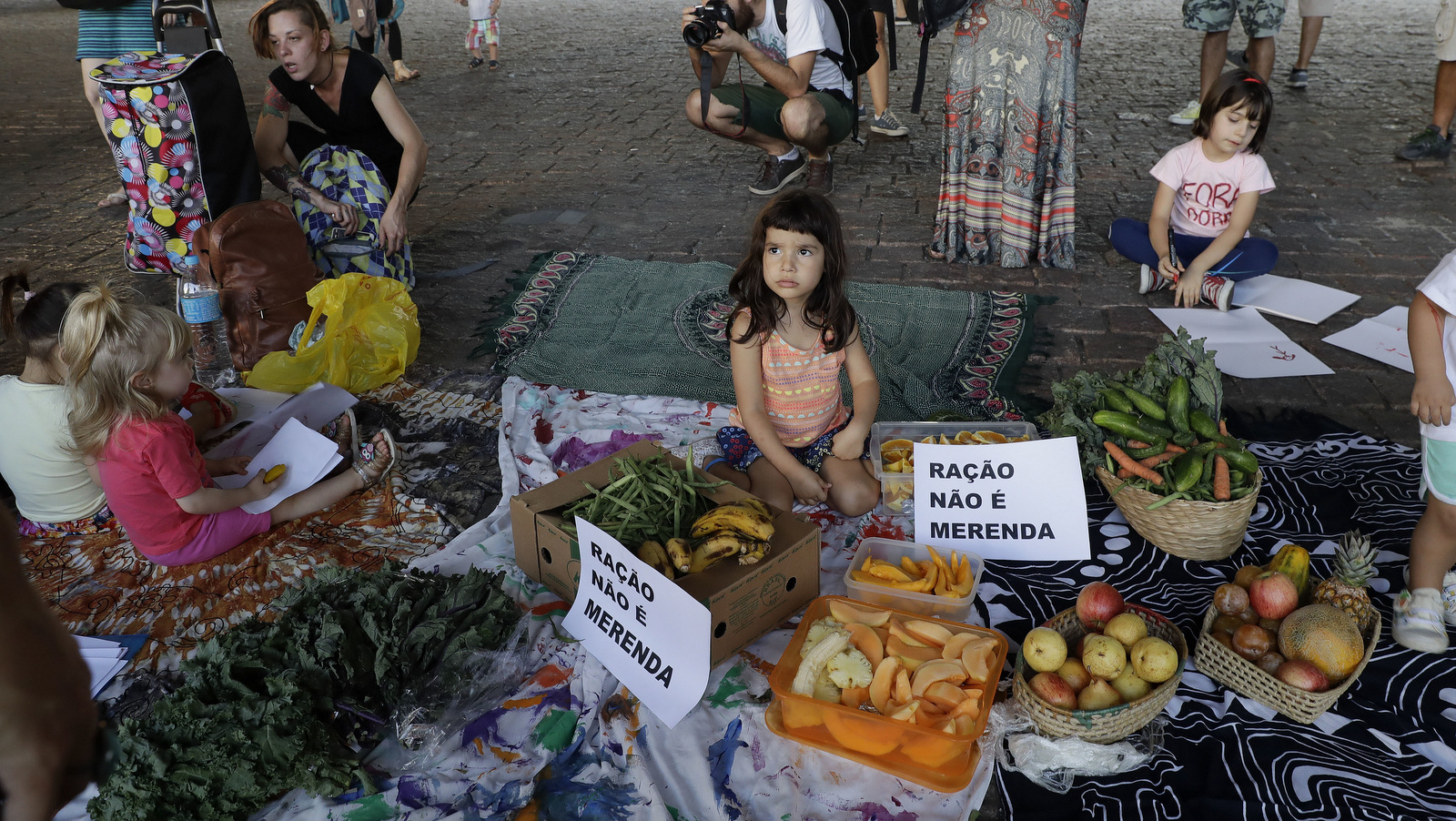
SÃO PAULOA new, controversial plan to feed low-income children and adults in São Paulo with powder pellets made from nearly expired food has drawn the ire of critics, who have called the product “human pet food.” The pellets have been proposed as a solution to feeding hungry schoolchildren in Sao Paolo, but the plan has faced widespread condemnation from parents and critics.

Reprocessed leftover food turned into pellets by Brazilian
company Plataforma Sinergia. (Photo: Plataforma Sinergia/handout) 

The plan was first announced last Wednesday by , the “Donald Trump of Brazil” and mayor of Brazil’s largest city, who compared the pellets – called “farinata” — to “astronaut food” and asserted that their incorporation into the diets of low-income citizens and schoolchildren would alleviate hunger within the city at no cost to the municipal government.

As many as 1.5 million people in São Paulo do not have enough food to eat on a regular basis.

Doria’s assertions about the pellets’ benefits have failed to assuage the concerns of state prosecutors who are now probing the plan, which is set to be implemented later this month. Chief among their concerns regarding the pellets is the lack of available information regarding the food’s nutritional value. As José Bonilha, a state prosecutor working in connection with the case, told the Guardian,

“There is an uncertainty over the nutritional value of this food. What were the tests and the documents that authorized the announcement of its introduction?” 

Yet the Brazilian Ministry of Education had no problem approving the plan — which it did last week, despite the lack of information as well as the fact that the pellets have not undergone the legal, safety, and nutritional tests required for inclusion in school meals.

The pellets have been resoundingly criticized by nutritionists who argue that the lack of information regarding the product’s composition is a red flag that must be addressed.

“It is not food, it is an ultra-processed product. You don’t know what’s in it,” argued Marly Cardoso, professor of public health and nutrition at the Federal University of São Paulo. 

There is also concern among nutritionists that the pellets could worsen Brazil’s growing obesity crisis, which has largely resulted from the aggressive marketing of highly processed fast-food to the country’s urban poor. 

Critics also pointed to the fact that Doria, a political ally of Brazil’s deeply unpopular president, Michel Temer, had rejected a plan earlier this year that would have sought to improve the city’s diet by giving small-scale farmers increased space to sell fruit and vegetables on city streets and by creating price controls on fruits and vegetables to keep them affordable.

Doria’s rejection of this measure, critics argue, suggests that he is less interested in improving the city’s diet and eradicating hunger than in offering incentives to companies who donate food products they are unable to sell to become pellets.

Doria recently offered tax breaks to companies who donate food towards his hunger eradication policy.


Doria (above) and the pellets’ manufacturer,
Plataforma Sinergia, assert that “farinata” is
totally safe and offers excellent nutrition. 

According to Plataforma Sinergia’s website, the organization is associated with the Catholic Church and is a partner of the UN’s “Save Food” program. However, when pressed for comment by the Guardian regarding the product’s nutritional composition, Plataforma Sinergia did not respond.

City officials also did not respond to requests for information regarding whether the pellets had been properly tested.


Republish our stories! MintPress News is licensed under a Creative Commons Attribution-NonCommercial-ShareAlike 3.0 International License.