Wednesday, January 31, 2018

How the Government Allows Rio Tinto Rip-Off Canadians

Mining Giant Rio Tinto’s Tax Haven Scheme Costs Canada and Mongolia Nearly $700 Million in Lost Tax Revenue

by MiningWatch Canada


January 31, 2018

(Ulanbaataar/Amsterdam/Ottawa) The Dutch Centre for Research on Multinational Corporations (SOMO) and Oyu Tolgoi Watch (Mongolia) published a report today showing how tax planning by Australian mining giant Rio Tinto has led to nearly US$700 million in tax losses for the Canadian and Mongolian governments, related to one of the world’s largest copper and gold mines, the Oyu Tolgoi mine, located in southern Mongolia.

On the 15th of January 2018, Oyu Tolgoi’s owners received a US$155 million tax claim from the Mongolian government. It is just the latest effort by the Mongolian government to claim greater benefits from the project.

This report explains how the Australian mining giant Rio Tinto, and its Canadian subsidiary Turquoise Hill Resources, avoided nearly $470 million in Canadian taxes by using mailbox companies in two tax havens, Luxembourg and the Netherlands. The publication also shows how an abusive investment agreement covering the Oyu Tolgoi copper and gold mine has resulted in a $230 million tax revenue loss for Mongolia.

“Instead of providing finance for the Oyu Tolgoi mine from Canada, where its owner is registered, they have chosen to shift the mine’s profits to a subsidiary in Luxembourg called Movele, which manages billion dollar loans but has zero employees – a textbook case of treaty shopping, setting up subsidiaries solely to take advantage of international tax or investment agreements,” said SOMO researcher Vincent Kiezebrink.

This mailbox subsidiary has enjoyed a very low average effective tax rate of 4.19 per cent, likely due to a beneficial tax ruling with Luxembourg’s tax authorities. As a result of this tax scheme, Rio Tinto’s subsidiary Movele has paid US$89 million in taxes in Luxembourg, which is US$470 million less than what would have been paid in Canada if no tax avoidance scheme had been employed. The company reports that this arrangement was approved by Canadian authorities.

“This is an astonishing subsidy from Canadian taxpayers,” said Jamie Kneen, Communications and Outreach Coordinator for MiningWatch Canada.
 “The public needs to know how and why this approval was granted.”

Canada has signed a range of tax treaties and investment agreements, including as part of free trade agreements that provide legal protection for what can be unfair and exploitative actions.

“The Canadian government is an enthusiastic supporter of international tax, trade, and investment agreements, but it needs to review its international agreements and introduce legal requirements to prevent abusive practices,” said Dennis Howlett, Executive Director of Canadians for Tax Fairness.

Canadian development aid to Mongolia is about $1 million annually, and is focused partly on supporting extractive sector development. Commented David Bruer, spokesperson for Inter Pares,

“Mongolia is a poor country that deserves development assistance, but it makes little sense for Canada to be sending aid at the same time as we are facilitating the hemorrhaging of huge amounts of money from the mining sector, which could be helping build badly-needed basic services.”

In addition, Rio Tinto and the other corporate investors behind Oyu Tolgoi achieved far-reaching concessions from the Mongolian government which severely limit the tax revenues Mongolia can hope to receive from the mine. Under pressure, the government of Mongolia facilitated Rio Tinto’s use of benefits enshrined in tax treaties with Luxembourg and the Netherlands — tax treaties which Mongolia unilaterally rescinded in 2013 due to concerns that they facilitated tax avoidance. Rio Tinto was able to negotiate an even lower tax rate in 2015, after a dispute over the distribution of Oyu Tolgoi’s revenues. As a result, the Mongolian government has missed out on approximately US$230 million in taxes over a five-year period.

“By agreeing to this arrangement, the government of Mongolia has failed to protect the interests of its people,” stated Sukhgerel Dugersuren, director of OT Watch.
“Given current austerity reforms in Mongolia, this tax revenue is much needed and could have allowed the government to nearly double its spending on education or healthcare in recent years.”

SOMO and OT Watch are joined by ActionAid Australia, MiningWatch Canada, Inter Pares, and Canadians for Tax Fairness in urging the governments of Mongolia, Luxembourg, Canada, the Netherlands, and Australia, as well as Rio Tinto and other stakeholders involved with Oyu Tolgoi, to work towards reviewing and revising the mine’s investment arrangement and the tax avoidance scheme. Action must be taken to ensure that mining in Mongolia serves the interests of the Mongolian people, not just corporate profits.

The report, "Mining taxes" is available here, along with Rio Tinto's rebuttal.

Recommendations The Government of Canada should:

  • Review the tax ruling provided to Turquoise Hill Resources for the financing of Oyu Tolgoi and provide transparency on the content of the ruling. If this or any other Canadian ruling allows for double non-taxation of corporate income, the Government should revise its practice.
  • Review and amend its corporate tax and fiscal policies (including dual taxation agreements, free trade agreements and bilateral investment treaties) to ensure that they do not allow multinational corporations to enjoy double non-taxation, and legal protection for abusive fiscal arrangements. Canada should refrain from negotiating a reduction of withholding tax rates for royalty and interest payments in any future dual taxation agreements. Canada should also introduce substance requirements for Canadian corporations and their subsidiaries, to ensure that legal entities in Canada, or that are using Canadian legal protection, have real economic substance.
  • Ensure that its overseas development assistance and official support for extractive sector development, including EDC support, is oriented and delivered according to principles of providing the greatest benefit to host countries and affected communities, and meets all applicable environmental and social impact standards. In particular Canada should assist Southern countries to strengthen their capacity to negotiate equitable tax agreements and to collect taxes from resource extraction projects for domestic revenue generation.

Trump Goes Nuclear with SOTU

Trump's SOTU Calls for More Spending on Nuclear Weapons and Galvanizes Extremism

by TRNN


January 31, 2018

Max Blumenthal, Phyllis Bennis, and Norman Solomon discuss President Trump's State of the Union. Rather than deliver a serious address, they say Trump offered a simplistic narrative designed to galvanize extremism.


Tuesday, January 30, 2018

Gorilla Radio with Chris Cook, Dave Lindorff, Charles Officer, Shawna Green, Christina Nikolic Feb. 1, 2018

This Week on GR

by C. L. Cook - Gorilla-Radio.com


February 1, 2018

Americans can congratulate themselves, and the rest of the planet can celebrate, Donald Trump's first year in the White House has finished without Global immolation. Even so, there's no denying it's been a bumpy ride.

From circumventing the traditional isolation of the Oval Office and upending political sacred cows, to undermining strategic alliances and trade relationships like NAFTA, Trump has reveled in his World stage role as Washington's wild card.

But, the madness to his method carries real risks; none more immediately dire than the worst case scenarios attendant escalating provocations against nuclear-armed North Korea.

None know this better than those on the other side of the 38th parallel; but will America allow Koreans make their own deal?

Listen. Hear.

Dave Lindorff is an award-winning journalist, author, broadcaster, and founder of the award-winning web news site, This Can’t Be Happening.net. His book titles include: ‘This Can’t Be Happening! Resisting the Disintegration of American Democracy,’ ‘Marketplace Medicine: The Rise of the For Profit Hospital Chains,’ ‘Killing Time: An Investigation into the Death Row Case of Mumia Abu-Jamal,’ And, you can also tune in Dave’s This Can’t Be Happening radio program Wednesdays at the Progressive Radio Network.

Dave Lindorff in the first half.

And; the Victoria Film Festival begins February 2nd, and a film sure to get noticed this year is British-Canadian, multi-award-winning director, Charles Officer's 'Unarmed Verses'. Officer's past credits include the documentaries: 'Mighty Jerome' and 'The Skin We’re In', and the ten-time Genie nominated feature film, 'Nurse.Fighter.Boy' among others.

Unarmed Verses chronicles the imposed relocation of residents of Villaways, a low-income Toronto neighbourhood, through the eyes of aspiring poet, Francine Valentine. It's already received a string of awards, including: Best Canadian Feature Documentary at Hot Docs, The People's Choice Award at the Toronto Film Festival, and the Vancouver International Film Festival's choice as Best Canadian Documentary of 2017. Unarmed Verses screens on the first day of the festival, Friday night at 6:30pm at the Capitol 6, and in a matinee on the VFF's final day, Sunday February 11th at the Vic Theatre.

Charles Officer and poetry and motion with Unarmed Verses in the second segment.

And; Shawna Green is one of two women calling the sidewalk in front of premier John Horgan's office home. She and Tsastilqualus Ambers are determined to have fish farms removed from their territory. Green addressed attendees at last week's Site C Action & Accountability Summit in Victoria.

Shawna Green getting real with direct action in the final segment.

And; Victoria-based greentrepreneur and horticulturalist extraordinaire, Christina Nikolic will be here with the Left Coast Events Bulletin at the bottom of the hour. But first, Dave Lindorff and South Korea slipping empire's leash.

Chris Cook hosts Gorilla Radio, airing live every Thursday between 11-Noon Pacific Time. In Victoria at 101.9FM, and on the internet at: http://cfuv.uvic.ca.  He also serves as a contributing editor to the web news site, http://www.pacificfreepress.com. Check out the GR blog at: http://gorillaradioblog.blogspot.ca/

CAATSA and the Case of the Barkless Dogs

US Government Riddle: Why Are So Many Dogs Not Barking? Because the CAATSA Got Their Tongues

by John Helmer - Dances with Bears


January 30, 2018

Moscow - As midnight tolled in Washington, DC, and January 29 slid into January 30, the deadline for the US Government to produce a report to the Congress listing Russian oligarchs close to President Vladimir Putin slipped by in the darkness.

No dog barked.*

Required by the Countering America’s Adversaries Through Sanctions Act (CAATSA), enacted with President Donald Trump’s signature last August, the oligarch report was not produced on time.

Nor were three other reports – one on sanctions for Russian sovereign debt issues, one on sanctions for business with the Russian defense sector, and one on the extent to which Russian state banks and state asset holdings have re-nationalized key sectors of the Russian economy, such as banking, insurance, real estate, and ports.

There was no press release from the White House, the US Treasury, or the State Department. The House Foreign Affairs Committee and the Senate Foreign Relations Committee, which are responsible for administering CAATSA, made no announcement of what had happened, and not happened. Despite a media blitz in advance of the deadline, anticipating the release of dozens of Russian oligarch names as potential targets for fresh US sanctions, not a single mainstream US newspaper or broadcaster reported the failure of the list to materialize.

On Monday morning in Moscow, Putin’s spokesman Dmitry Peskov announced the Kremlin was expecting the oligarchs’ list, but if the US economic war is taken to them now, Putin would fight back. “The publishing of this list means nothing per se. As you know, this is not another wave of sanctions. However, we should definitely analyze the actions that may follow the release of this report. These actions will be analyzed by Moscow in order to give maximum protection to our interests, the interests of our companies, in any case.”

On Monday morning in Washington, CNN reported:

“’The Department of Treasury does plan to act today to issue a report and take this process the next step forward,’ White House principal deputy press secretary Raj Shah told CNN’s New Day… A White House official told CNN later Monday morning that their expectation is that the report will list individuals who might be in violation.”

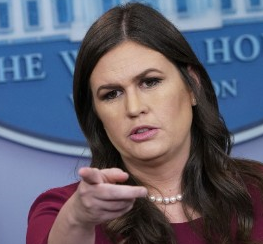
After lunch at the White House, Sarah Sanders (right), the Press Secretary, was asked by a reporter:

“Can you tell us whether that’s actually going to happen today, and whether the names on the oligarchs list will be public? And on the impact on sanctioning, will portions of that be public also?”

Sanders replied:

“We do expect the reports today. And I would refer you to the Department of Treasury for any specifics on that as that happens… We’re coordinating, and I’m telling you that they’re taking the lead. And for questions specific to it, you should reach out to the Department of Treasury in terms of timing.”

Some dogs of war appeared to be getting ready to bark on cue, as four senators and congressmen belonging to the Democratic Party (war against Russia, war against Trump) had insisted. In a letter to Trump,

“we note an impending January 29th deadline with respect to three areas mandated in the [CAATSA] legislation: imposition of sanctions on the defense and intelligence sectors; a report from the Department of the Treasury on the implications of sanctions on the Russian Federation’s sovereign debt; and a report from the Department of Treasury on oligarchs and parastatal entities of the Russian Federation…While we understand the need to provide a classified annex to the report, we trust that you [Trump] will make the report itself unclassified, as the law requires, so that the American public might gain a better understanding of how the Russian Federation’s system operates.”

Instead, the White House, Treasury and State remained silent. A State Department press officer told a reporter for the Politico.com website that following hours of negotiations between officials and congressmen, a covering document had been filed with the Congress, together with an attachment. This has been classified so strictly, its contents cannot be quoted or published.

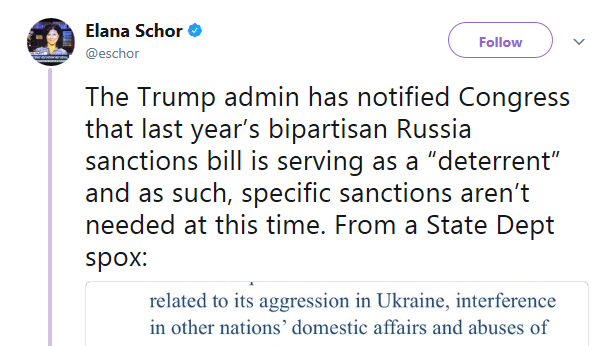
The website reported an unnamed State spokesperson as writing in an email that the Trump administration is “using this legislation as Congress intended to press Russia to address our concerns related to its aggression in Ukraine, interference in other nations’ domestic affairs and abuses of human rights.” Potential targets of future penalties, including non-Russian governments, militaries, and other arms-buyers “have been put on notice, both publicly and privately, including by the highest-level State Department and other U.S. government officials where appropriate, that significant transactions with listed Russian entities will result in sanctions…Given the long time frames generally associated with major defense deals, the results of this effort are only beginning to become apparent. From that perspective, if the law is working, sanctions on specific entities or individuals will not need to be imposed because the legislation is, in fact, serving as a deterrent.”

This email appears to have been the unclassified report to Congress excerpted in a series of tweets from Politico; the twitter feed can be followed here.


State was also quoted as telling Congress that “as you know, we don’t preview our sanctions actions. When and if we have sanctions to announce, we will do so.” Politico’s text failed to mention the reports on oligarchs, Russian sovereign debt, and re-nationalization, all the work of the Treasury.

Last Friday the Treasury had announced sanctions on Russian and Novorussian targets in relation to the Ukrainian conflict, and the Syrian war. The press release reporting them can be read here. Nothing more followed from the Treasury on Monday.


Politico wasn’t told; didn’t ask; and didn’t know from leakers whether the oligarch list or assessment of sanctions on Russian sovereign debt have been produced to Congress, according to CAATSA. “It remains unclear [read DON’T KNOW] whether the administration has already released or plans to release the oligarchs or sovereign debt reports that were due Monday, both of which are likely to contain classified information…Further details are contained in a classified report we have submitted to Congress.”

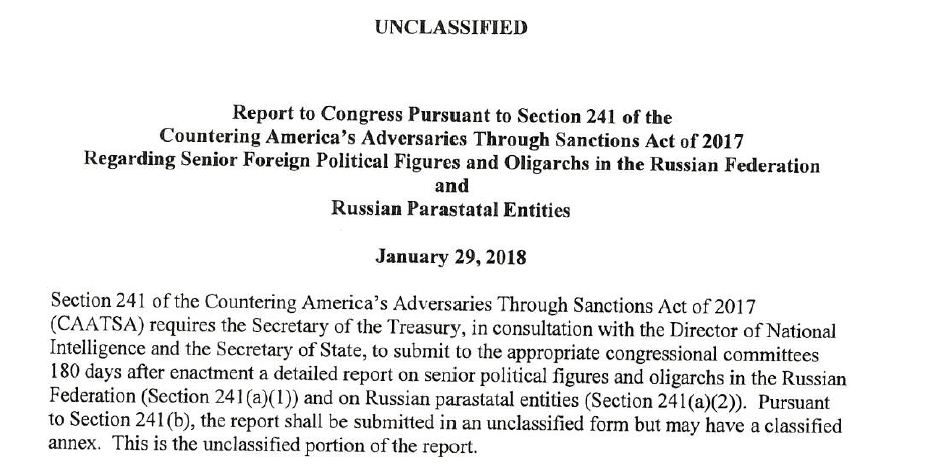
A 2-page Treasury document was released to selected reporters in the early hours of Tuesday; it is unclassified, and can be read in full here. A 7-page, unclassified list of names is attached.


According to this purported Treasury paper, the listing of officials close to Putin was carried out by straightforward transcription from Russian government and state corporation manuals. A total of 94 names have been noted.

Three names are missing from the state officials’ list – Anatoly Chubais, head of Rusnano, the state technology holding; Alexei Kudrin of the Kremlin Expert Council; and Mikhail Abyzov, Minister of Open Government. For the record of their closeness to US plans for regime change in Moscow, start here.

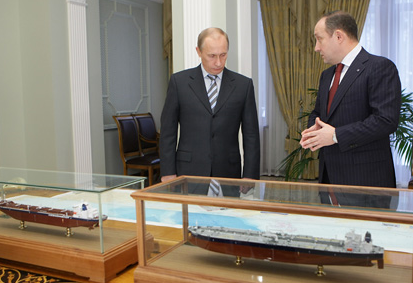
A fourth name missing from the state officials’ list is Sergei Frank, head of the state shipping company Sovcomflot; his corrupt closeness to the Kremlin has been testified to in a decade of court cases in the UK. For Frank’s record, including his relationship with the US oil company Chevron, click to read. The omission of Frank on the Treasury listing is odd because his counterparts at the head of Aeroflot, the state airline; the state aerospace manufacturer, United Aircraft Corporation; Russian Railways; and Transneft, the state oil pipeline company are all included by name.


Vladimir Putin with Sergei Frank discussing Sovcomflot 

The identification of the oligarchs, the Treasury document claims, was carried out on the basis of “reliable public sources [to] have an estimated net worth of $1 billion or more”. There are 96 names on the oligarch list.

The sources of the US Government’s intelligence have not been identified. They appear to include Forbes and other published Russian Rich Lists; as well as the Kremlin guest-lists for the annual oligarchs’ Christmas dinner. Several names listed by the Treasury are of individuals who have been blackballed for years by the Kremlin; they include Yelena Baturina, Andrei Skoch, Dmitry Rybolovlev, Yury Shefler, the Ananiev brothers, Kirill Shamalov, and Vladimir Yakunin.

These names reveal how dated and obsolete the US intelligence is on these targets. Shamalov, the second last of these names, is widely understood to have lost most of his assets after the collapse of his marriage with Putin’s daughter, Katerina. The last name, the former head of Russian Railways, was once very close to Putin; the story of his expulsion from the inner circle can be read here. The US Government’s intelligence services apparently failed to read it. They also cannot get his first name right, as he is listed at No. 94 as “Vadim Yakunin.”

The Treasury paper claims to report “net worth”. That means the intelligence agents and their Russian informants who provided the raw material for the Treasury report do not know how much their list of oligarchs owe to Russian and foreign banks; how many of their assets are pledged to cover their debts; and whether their net worth is positive or negative.

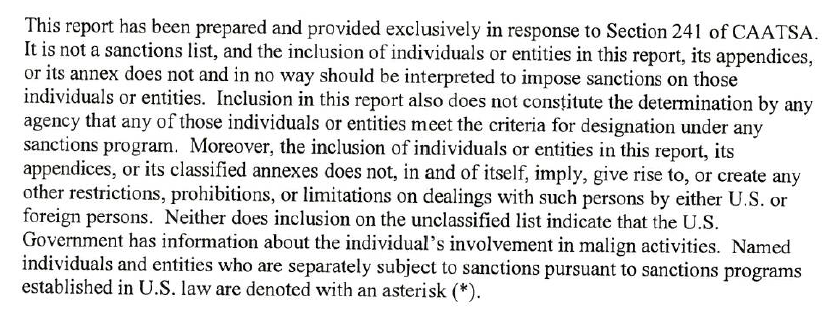
There is also this disclaimer which is intended as the green light for the US investment banks to continue business with the oligarchs as if there is no US war against Russia at all:


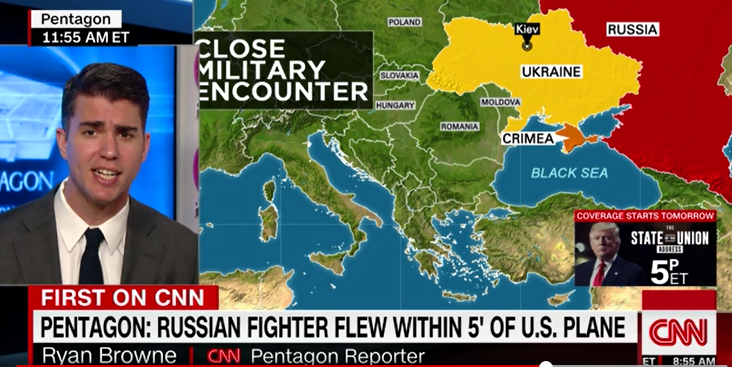
The State Department’s only press release on Russia during Monday was a complaint that a Russian Air Force interception of a US espionage aircraft in the Black Sea manoeuvered within two metres, and generated such air turbulence, it constituted an “unsafe Russian military practice.”

“This is but the latest example of Russian military activities disregarding international norms and agreements. We call on Russia to cease these unsafe actions that increase the risk of miscalculation, danger to aircrew on both sides, and midair collisions.” 


In the Pentagon version of the interception, the US Navy aircraft was 
reported to have been “actually forced to end its mission prematurely.”

According to the consensus of Russian officials in Moscow, the display of counter-force is also what has persuaded State and Treasury to end the CAATSA mission by neutralizing the required January 29 reports.

“The oligarchs didn’t win the engagement,” according to a source in a position to know, “but Putin didn’t lose it. The rules of engagement for the economic war are still being tested.”

[*] The dog which didn’t bark is the famous clue to the identity of the horse thief and the cause of his death in the Sherlock Holmes mystery, “The Adventure of Silver Blaze” (1892). Holmes understood that watchdogs on guard bark at intruders; they don’t bark at those they recognize as master or friend.

Shale's Big Fail: Explaining the Persistence of a Profitless Industry

Why Is The Shale Industry Still Not Profitable?

by Nick Cunningham - Oilprice.com 


January 30, 2018

Echoing the criticism of too much hype surrounding U.S. shale from the Saudi oil minister last week, a new report finds that shale drilling is still largely not profitable. Not only that, but costs are on the rise and drillers are pursuing "irrational production."

Riyadh-based Al Rajhi Capital dug into the financials of a long list of U.S. shale companies, and found that "despite rising prices most firms under our study are still in losses with no signs of improvement." The average return on asset for U.S. shale companies "is still a measly 0.8 percent," the financial services company wrote in its report.

Moreover, the widely-publicized efficiency gains could be overstated, at least according to Al Rajhi Capital.

The firm said that in the third quarter of 2017, the "average operating cost per barrel has broadly remained the same without any efficiency gains."

Not only that, but the cost of producing a barrel of oil, after factoring in the cost of spending and higher debt levels, has actually been rising quite a bit.

Shale companies often tout their rock-bottom breakeven prices, and they often use a narrowly defined metric that only includes the cost of drilling and production, leaving out all other costs. But because there are a lot of other expenses, only focusing on operating costs can be a bit misleading.

The Al Rajhi Capital report concludes that operating costs have indeed edged down over the past several years. However, a broader measure of the "cash required per barrel," which includes other costs such as depreciation, interest expense, tax expense, and spending on drilling and exploration, reveals a more damning picture. Al Rajhi finds that this "cash required per barrel" metric has been rising for several consecutive quarters, hitting an average $64 per barrel in the third quarter of 2017. That was a period of time in which WTI traded much lower, which essentially means that the average shale player was not profitable.

Not everyone is posting poor figures. Diamondback Energy and Continental Resources had breakeven prices at about $52 and $37 per barrel in the third quarter, respectively, according to the Al Rajhi report. Parsley Energy, on the other hand, saw its "cash required per barrel" price rise to nearly $100 per barrel in the third quarter.

A long list of shale companies have promised a more cautious approach this year, with an emphasis on profits. It remains to be seen if that will happen, especially given the recent run up in prices.

But Al Rajhi questions whether spending cuts will even result in a better financial position.

"Even when capex declines, we are unlikely to see any sustained drop in cash flow required per barrel due to the nature of shale production and rising interest expenses," the Al Rajhi report concluded. 

In other words, cutting spending only leads to lower production, and the resulting decline in revenues will offset the benefit of lower spending. All the while, interest payments need to be made, which could be on the rise if debt levels are climbing.

One factor that has worked against some shale drillers is that the advantage of hedging future production has all but disappeared. In FY15 and FY16, the companies surveyed realized revenue gains on the order of $15 and $9 per barrel, respectively, by locking in future production at higher prices than what ended up prevailing in the market. But, that advantage has vanished.

In the third quarter of 2017, the same companies only earned an extra $1 per barrel on average by hedging.

Part of the reason for that is rising oil prices, as well as a flattening of the futures curve. Indeed, recently WTI and Brent have showed a strong trend toward backwardation in which longer-dated prices trade lower than near-term. That makes it much less attractive to lock in future production.

Al Rajhi Capital notes that more recently, shale companies ended up locking in hedges at prices that could end up being quite a bit lower than the market price, which could limit their upside exposure should prices continue to rise.

In short, the report needs to be offered as a retort against aggressive forecasts for shale production growth. Drilling is clearly on the rise and U.S. oil production is expected to increase for the foreseeable future. But the lack of profitability remains a significant problem for the shale industry.

Treachery at Sea: A Desperate Crossing to Yemen

A Treacherous Crossing

by Kathy Kelly - VCNV.org


January 30, 2018

On January 23rd an overcrowded smuggling boat capsized off the coast of Aden in Southern Yemen. Smugglers packed 152 passengers from Somalia and Ethiopia in the boat and then, while at sea, reportedly pulled guns on the migrants to extort additional money from them.

The boat capsized, according to The Guardian, after the shooting prompted panic. The death toll, currently 30, is expected to rise. Dozens of children were on board.

The passengers had already risked the perilous journey from African shores to Yemen, a dangerous crossing that leaves people vulnerable to false promises, predatory captors, arbitrary detention and tortuous human rights violations.

Sheer desperation for basic needs has driven hundreds of thousands of African migrants to Yemen.

Many hope, upon arrival, they can eventually travel to prosperous Gulf countries further north where they might find work and some measure of security. But the desperation and fighting in southern Yemen were horrible enough to convince most migrants that boarded the smuggling boat on January 23rd to try and return to Africa.

Referring to those who drowned when the boat capsized, Amnesty International’s Lynn Maalouf said:

“This heart-breaking tragedy underscores, yet again, just how devastating Yemen’s conflict continues to be for civilians. Amid ongoing hostilities and crushing restrictions imposed by the Saudi Arabia-led coalition, many people who came to Yemen to flee conflict and repression elsewhere are now being forced yet again to flee in search of safety. Some are dying in the process.”

In 2017, more than 55,000 African migrants arrived in Yemen, many of them teenagers from Somalia and Ethiopia where there are few jobs and severe drought is pushing people to the verge of famine. It’s difficult to arrange or afford transit beyond Yemen. Migrants become trapped in the poorest country in the Arab peninsula, which now, along with several drought-stricken North African countries, faces the worst humanitarian disaster since World War II.

In Yemen, eight million people are on the brink of starvation as conflict-driven near-famine conditions leave millions without food and safe drinking water. Over one million people have suffered from cholera over the past year and more recent reports add a diphtheria outbreak to the horror. Civil war has exacerbated and prolonged the misery while, since March of 2015, a Saudi-led coalition, joined and supported by the U.S., has regularly bombed civilians and infrastructure in Yemen while also maintaining a blockade that prevented transport of desperately needed food, fuel and medicines.

Maalouf called on the international community to “halt arms transfers that could be used in the conflict.” To heed Maalouf’s call, the international community must finally thwart the greed of transnational military contractors that profit from selling billions of dollars of weapons to Saudi Arabia, the United Arab Emirates (UAE), Bahrain and other countries in the Saudi-led coalition.

For instance, a November, 2017 Reuters report said that Saudi Arabia has agreed to buy about $7 billion worth of precision guided munitions from U.S. defense contractors. The UAE also has purchased billions in American armaments.

Raytheon and Boeing are the companies that will primarily benefit from a deal that was part of a $110 billion weapons agreement coinciding with President Donald Trump’s visit to Saudi Arabia in May.

Another dangerous crossing happened in the region last week. U.S. Speaker of the House Paul Ryan (R-WI) arrived in Saudi Arabia, along with a congressional delegation, to meet with the monarchy’s King Salman and subsequently with Saudi Crown Prince Mohammed bin Salman who has orchestrated the Saudi-led coalition’s war in Yemen.

Following that visit, Ryan and the delegation met with royals from the UAE.

“So rest assured”, said Ryan, speaking to a gathering of young diplomats in the UAE, “we will not stop until ISIS, al-Qaeda, and their affiliates are defeated and no longer a threat to the United States and our allies.
“Secondly, and perhaps most importantly, we are focused on the Iranian threat to regional stability.”

Beyond the simple well-recorded fact of lavish Saudi financial support for Islamist terrorism, Ryan’s remarks overlook the Saudi-led coalition military assaults and “special operations” in Yemen, which the U.S. supports and joins. The war there is arguably undermining effort to combat jihadist groups, which have flourished in the chaos of the war, particularly in the south which is nominally under the control of the government allied to Saudi Arabia.

The Iranian government Ryan denounced does have allies in Yemen and may be smuggling weapons into Iran, but no one has accused them of supplying the Houthi rebels with cluster bombs, laser-guided missiles and littoral (near-coastal) combat ships to blockade ports vital to famine relief. Iran does not provide in-air refueling for warplanes used in daily bombing runs over Yemen. The U.S. has sold all of these to countries in the Saudi-led coalition which have, in turn, used these weapons to destroy Yemen’s infrastructure as well as create chaos and exacerbate suffering among civilians in Yemen.


Ryan omitted any mention of the starvation, disease, and displacement afflicting people in Yemen. He neglected to mention documented human rights abuses in a network of clandestine prisons operated by the UAE in Yemen's south. Ryan and the delegation essentially created a smokescreen of concern for human life that conceals the very real terror into which U.S. policies have thrust the people of Yemen and the surrounding region.

Potential starvation of their children terrifies people who can’t acquire food for their families. Those who can’t obtain safe drinking water face nightmarish prospects of dehydration or disease. Persons fleeing bombers, snipers, and armed militias who might arbitrarily detain them shudder in fear as they try to devise escape routes.

Paul Ryan, and the congressional delegation traveling with him, had an extraordinary opportunity to support humanitarian appeals made by UN officials and human rights organizers.

Instead, Ryan implied the only security concerns worth mentioning are those that threaten people in the U.S. He pledged cooperation with brutally repressive dictators known for egregious human rights violations in their own countries, and in beleaguered Yemen. He blamed the government of Iran for meddling in the affairs of other countries and supplying militias with funds and weapons. U.S. foreign policy is foolishly reduced to “the good guys,” the U.S. and its allies, versus “the bad guy,” – Iran.

The “good guys” shaping and selling U.S. foreign policy and weapon sales exemplify the heartless indifference of the smugglers who gamble human life in exceedingly dangerous crossings.

Kathy Kelly (kathy@vcnv.org) co-coordinates Voices for Creative Nonviolence (www.vcnv.org)

Israel's Alleged Torture Agency

Israel's Shin Bet to face first-ever torture probe

by Jonathan Cook - Al Jazeera


January 30, 2018

For the first time in its history, an interrogator from Israel's secret police agency, the Shin Bet, is to face a criminal investigation over allegations of torture.

It will be the first probe of the Shin Bet since Israel's supreme court issued a landmark ruling nearly two decades ago prohibiting, except in extraordinary circumstances, the use of what it termed "special methods" of interrogation.

Before the ruling, physical abuse of Palestinians had been routine and resulted in several deaths in custody. According to human rights groups, however, the supreme court ban has had a limited impact. The Shin Bet, formally known as the Israel Security Agency, has simply been more careful about hiding its use of torture, they say.

More than 1,000 complaints from Palestinians have been submitted to a government watchdog body over the past 18 years, but this is the first time one has led to a criminal investigation.

Many Palestinians are jailed based on confessions either they or other Palestinians make during Shin Bet questioning. Israeli military courts almost never examine how such confessions were obtained or whether they are reliable, say lawyers, contributing to a 99.7 percent conviction rate.

Last month, in freeing a Palestinian man who was jailed based on a false confession, an Israeli court accused the Shin Bet of using techniques that were "liable to induce innocent people to admit to acts that they did not commit".

'Exception that proves the rule'


But rights groups have told Al Jazeera the current investigation of the Shin Bet agent is unlikely to bring an end to the long-standing impunity of interrogators, or a change in its practices.

Instead, they noted, an updated decision last month on torture from the Israeli supreme court, revising the 1999 landmark ruling, had moved the goalposts significantly in the Shin Bet's favour.

Hassan Jabareen, director of Adalah, a legal rights group representing Israel's large Palestinian minority, said: "This case is the exception that proves the rule - one investigation after many hundreds of complaints have been ignored.

"It will be promoted to suggest - wrongly - that the system has limits, that it respects the rule of law."

That view was shared by Rachel Stroumsa, head of the Public Committee Against Torture in Israel, which has submitted many of the 1,100 complaints of torture filed against the Shin Bet.

She told Al Jazeera that Israel was "highly unusual" in making legal justifications for interrogation practices that clearly violated the United Nations Convention Against Torture, which Israel ratified in 1991.

The convention forbids intentionally inflicting "severe pain or suffering, whether physical or mental" on those in detention to gain information.

The 1999 ruling by the Israeli supreme court banned torture except in extremely rare cases of "necessity", or what it termed "ticking bombs" – suspects from whom it was essential to gain information quickly.

But Stroumsa said the large number of complaints from Palestinians submitted to Mivtan, a watchdog body in the justice ministry, indicated that the Shin Bet had never stopped using torture.

The justice ministry has refused to divulge details of the criminal investigation, apart from saying it refers to "a field interrogation" in 2015. Field interrogations are usually conducted moments after a Palestinian has been seized by security forces.

Mivtan's consistent failure


Speaking of the case at the weekend, Emi Palmor, director general of the justice ministry, said that this was "the first case that will be translated, presumably, into an indictment".

Stroumsa said the investigation was not in response to a complaint her committee had filed. Israeli media have speculated that the case may have progressed only because it was supported by testimony from another Israeli intelligence agent.

Rights groups have been harshly critical of Mivtan over its consistent failure to investigate Palestinian complaints of torture.

For most of its history, the unit was part of the Shin Bet and employed only one investigator.

But following criticism in 2013 from a state inquiry, conducted by the Turkel Commission, Mivtan was transferred to the justice ministry. Last year it recruited a second investigator, who reportedly speaks Arabic.

Before the 1999 ruling, the Shin Bet was regularly accused of violently shaking prisoners and beating them, including by banging their heads against a wall.

According to testimonies, the Shin Bet still uses physical violence, though less routinely, including choking, forcing victims into stress positions that cause intense pain, and tightly cuffing their hands to prevent blood flow.

But the Shin Bet is reported now to prioritise mental torture that does not leave tell-tale signs doctors could identify. These include threats of physical and sexual violence, including against family members, interrogation lasting for days, sleep deprivation, and prolonged exposure to loud music.

Palestinians are often denied access to daylight, sometimes for weeks, so they become disoriented.

"They are completely isolated – they feel buried. They don't know when their interrogation will end or how it will end," Anat Litvin, a researcher for Physicians for Human Rights – Israel told Al Jazeera.

She added that it was often hard to prove torture because the Shin Bet denied requests for doctors to inspect prisoners.

"That creates a vicious circle – those who are tortured cannot prove they were because there is no documentation."

Even so, she said, doctors usually only recorded bumps and bruises without noting claims from Palestinians that their injuries were inflicted by their interrogators.

Last year an unnamed senior interrogator confirmed that the agency uses torture to the Haaretz newspaper. He said agents were required to record details of how many blows they inflicted and what painful positions they used on detainees. Interrogators concentrated on sensitive regions such as the nose, ears and lips.

In an indication of high-level support for torture in Israel, he said logs were sent afterwards to the attorney general, Israel's chief law officer.

"Israel is a torturing society," said Litvin.
"It requires that all levels of the system turn a blind eye – the Shin Bet, investigators, government officials, the courts, and doctors. There has to be a climate that allows this to happen."

A global survey by the International Red Cross in 2016 found more support for torture in Israel than any other country apart from Nigeria. Half of Israelis backed its use, with only a quarter opposed.
Ticking bomb 'loophole'

Stroumsa said: "The fact is many Israelis can live with these things as long as they are being done in the dark, out of view, without any documentation. They assume all cases of torture are 'ticking bombs'."

Efforts to prove torture have also been hampered by an emergency order passed in 2002, in the wake of the supreme court ruling, that exempts Shin Bet interrogations from being recorded on video.

In 2015 the cabinet justified the exemption on the grounds that video recording "could cause real damage to the quality of the interrogation and the ability to investigate security offenses".

Stroumsa noted that, aside from the moral problem, research has shown that torture is ineffective. A US Senate report, published in 2014, concluded that it was "not an effective means of obtaining accurate information".

Nonetheless, the signs are that the Israeli courts are rolling back the restrictions on torture they put in place at the end of the 1990s.

Last month the supreme court issued a ruling in the case of Assad Abu Ghosh, a Hamas activist who, the Israeli state admits, was subjected to "special methods" of interrogation in 2007.

According to a petition to the court from the Public Committee, he was beaten and repeatedly slammed against a wall, and forced into the "banana position", putting extreme pressure on his back. Abu Ghosh was left with neurological damage as a result.

Human rights groups had hoped the court would close the ticking bomb "loophole", which has allowed the Shin Bet to carry on torturing prisoners, or at least more tightly control the kinds of methods they use.

Instead, said Jabareen, of Adalah, the ruling appeared to give greater licence to the Shin Bet to use torture.

"It is now enough that the [Shin Bet] agent believes subjectively that the prisoner is a 'ticking bomb', even in the absence of objective facts to support that belief," he said.
"His actions will not be treated as criminal in nature because they are assumed to be done in good faith."

Stroumsa said she found the judges' ruling in the Abu Ghosh case "astonishing", given the injunction in international law against torture.

"The court ruled that, even if technically in international law interrogation methods were considered torture, in Israel they were not regarded as such. The judges effectively gave the Shin Bet a green light to continue with torture."


SOURCE: Al Jazeera News

Monday, January 29, 2018

Will Kabul Fall?

Hotel Intercontinental Siege: Is Kabul Falling?

by Andre Vltchek - Dissident Voice


January 27th, 2018

Afghanistan is now facing mortal danger. It has to survive, but it is not clear how it can manage.

The Hotel Intercontinental in Kabul, which was attacked by gunmen last Saturday, used to fit like a glove, like a grandmother’s couch.

Outside, the war has been raging.


My room in Hotel Intercontinental

Millions of Afghan lives were aimlessly broken, hundreds of thousands lost. The price of more than 16 years of NATO occupation has exceeded $1 trillion, but instead of bringing peace and prosperity, it has reduced Afghanistan to rubble.

All that is still functioning in the country are structures and infrastructure built before and during the Soviet era, like irrigation ducts, canals and bread factories. Other tangible assistance came recently from China and India, but almost nothing was provided by the NATO occupation countries, except countless fences, wires and military installations.


Soviet water pipe in the village, Nargarhar Province

Even before the siege at the Intercontinental Hotel, which left more than 20 people dead, Afghanistan’s President Ashraf Ghani confessed to 60 Minutes correspondent Lara Logan that he is unable to protect his own capital.

But it is not only the capital, of course. The entire country is spiraling into chaos. It is clear that it will soon be impossible to control it anymore, at least as one entity, from Kabul.

It can be heard more and more often on the streets of Kabul, Jalalabad and Herat that reducing this country to perpetual conflict and chaos may be the exact plan of the occupation forces.


Reception at Intercontinental

I used to joke about Hotel Intercontinental – ‘This place feels like a Soviet three-star hotel in some provincial Siberian town. Bent shower bars, stained but otherwise clean carpets, indifferent but somehow friendly staff – you could wave as much as you wanted, but the waitress in the hotel’s cafe would only move after you’d come to her personally, smiled broadly, and pointed your finger at some particular item from the limited assortment of sweets.’


Stunning view from hotel

Despite everything, Hotel Intercontinental Kabul was always there, standing. It was crumbling, but still somehow majestic, full of history and old-fashioned charm. Its lobby was decorated with traditional Afghan landscapes and portraits. The vistas from the hotel rooms and balconies were breathtaking: the old Bagh-e Bala Palace with its vast public park, then the entire capital city down below as though sitting in a crater, and the great mountain range rising towards the sky right behind that urban sprawl.

During breakfast hours, a few tables near the window in the hotel restaurant were almost always occupied by Russian-speaking pilots and crew members from an Afghan passenger airline, Kam Air. I don’t know whether these people were Russian or Ukrainian, but they spoke Russian among themselves, and also to me. They were tall and muscular, as pilots operating in a war zone are expected to be.

We always exchanged greetings, as well as one or two jokes. No deep discussions, just that – a few jokes and a few very warm smiles.

Some time ago, I had to fly to the ancient city of Herat, and was traveling early in the morning with Kam Air on the same flight as the crew. My driver was late and I approached the airline minivan, which was just about to depart for the airport.

“Would you please take me with you to the airport, boys?” I asked.

“Yes, of course, of course – just jump in!” they grinned.

We were all part of a big family. Foreigners staying at Intercontinental – not rich and not poor, not part of any ‘government initiative’ or wealthy NGO. This hotel was for ‘working people’ – journalists, filmmakers, pilots. Those who required ‘special protection’ were staying behind the enormous concrete walls of their embassies, or in the only truly luxury hotel in the country – Serena.

Two hours later, we were flying over tremendous Afghan mountains and tiny ancient villages made of mud, miles below the wing. I was taking photographs, while imagining that insane US “mother of all bombs” that was dropped just a few days earlier on an identical hamlet, killing who knows how many innocent people.

The two powerful engines of an old but reliable MD-82 were purring reassuringly at the rear of the plane. Then, at some point, I closed my eyes and fell asleep. The next thing I experienced was a gentle pat on my shoulder, followed by friendly whisper: “Kofeiku ne khotite? Rebyata tut tol’ko cto svezii svarili” (“Would you like some coffee? The guys here just brewed a fresh one…”)

I drank the aromatic brew, looking down at those stunning, enormous mountains covered by snow. Russian-speaking pilots were in the cockpit, steering the plane with great experience and confidence.

I thought: “If there is one crew in the world that is qualified to fly over this beautiful but complex and dangerous terrain, then it is this one.”

It was one of those moments when I felt totally happy and alive, drunk with passion for what I had been doing: working in Afghanistan, exposing crimes committed there by the Western countries, falling head over heels in love with this ancient and proud nation, flying over its peaks into one of the most interesting cities of Central Asia – Herat.

On January 20, 2018, in the intensive care unit of Tokyo’s St. Luke’s Hospital, I was fighting for my life, months after my year-old foot wound reopened in Afghanistan, and had since refused to heal.

Through the fog of fever and IV, I observed coverage from Kabul on a television screen that was hanging above my bed. ‘My’ Intercontinental Hotel had been attacked. In fact, it was overrun by what was allegedly one of the most vicious branches of the Taliban, known as the Haqqani Network. At least that is what was tweeted by Javid Faisal, a spokesman for the Afghan government’s chief executive.

At least 21 people lost their lives during the 14-hour standoff. Almost immediately, several pilots and crew members from Kam Air were murdered in cold blood. So were two Venezuelan pilots. None of these people were ‘supporters of the government,’ nor were they collaborators with the invading NATO force.

They were simply a group of romantics, a group of rugged, brave but also very kind and gentle men who adored flying and who, like myself, fell in love with Afghanistan. I know this because they told me, and because it was just so obvious!

In case anyone is wondering, ‘my hotel in Kabul’ has nothing to do with the luxury US chain of the same name. It used to be part of the ‘real’ Intercontinental, but only from 1969, when its doors first opened, until 1980 (shortly after the Soviet Union intervention in Afghanistan). Now, it is a state-owned property, described as ‘luxury’ only by outsiders who are covering Afghanistan from afar. You can get a room there for a mere $50 if you negotiate very hard, and for $60 if your bargaining skills are somewhat limited.


Classical musicians at hotel

The hotel had already been damaged on several occasions, particularly during the civil war of the 1990s, when it is said that at one point only 85 out its 200 rooms were inhabitable. As recently as 2011, 21 people died here during an attack for which the Taliban claimed responsibility.

Despite its macabre history, however, Intercontinental is still the favorite property of many locals and some foreigners in Kabul. This is where many conferences are held, and – during the fasting month of Ramadan – fast is broken here by members of local elites, close to the swimming pool overlooking the city. And there is music here almost every night: true Afghan traditional music, with local instruments and singers trained by renowned masters.


Guard posts around the hotel

Security is, of course, everywhere. To return to this property from the city, I always have to go through three full security posts with my car. After all, Afghanistan is now considered to be one of the most dangerous countries on Earth for foreigners.

In just one week, three deadly attacks shook Afghanistan: one in Kabul, another outside Herat, and a third inside the city of Jalalabad, in which ISIS targeted the NGO, Save the Children.

Last year, I traveled to many corners of this scarred, ancient land. I spoke to people, including those in the villages that were at least partially taken over by Taliban. People are increasingly realizing that they are living in perpetual conflict. Refugees (or internally displaced persons) from the east are talking about the carnage that comes with the arrival of ISIS.

Hard drugs and poppy seeds are everywhere in the center of Kabul, right under the nose of the US occupiers – poppy fields literally surround Bagram Airforce Base.

Soviets and Russians are now remembered with love and great nostalgia; something that I already described in my previous essays from the country.

Very soon, no foreigners will be left in Afghanistan. That may be the main goal of the latest attacks. No witnesses, no alternatives, no solutions.

Who will benefit? Definitely not the devastated Afghan people. Perhaps the warlords, the extremist mullahs, and the occupiers.

Kam Air crew, flying passenger jets all over the country, and the dilapidated Intercontinental were some of the last symbols of normality – a weak promise that one can still come and see what is really happening in this country.

From now on, there will be hardly any foreigners in the country. It will be only us – war correspondents, as well as foreign soldiers and mercenaries.


Internally displaced woman shares her pain

Afghanistan is now facing mortal danger. It has to survive, but it is not clear how it could manage. Those who love it should return, no matter what risk we’d be facing. A news blockade should be prevented. Alternative (non-Western) information has to flow. By all means, at any price.


• Photos by Andre Vltchek

• Article first published as an Op-Ed by RT


Andre Vltchek is a philosopher, novelist, filmmaker and investigative journalist. He has covered wars and conflicts in dozens of countries. Three of his latest books are his tribute to The Great October Socialist Revolution, a revolutionary novel Aurora, and a bestselling work of political non-fiction: Exposing Lies Of The Empire. View his other books here. Watch Rwanda Gambit, his groundbreaking documentary about Rwanda and DRCongo and his film/dialogue with Noam Chomsky On Western Terrorism. Vltchek presently resides in East Asia and the Middle East, and continues to work around the world. He can be reached through his website.
Read other articles by Andre.

January 30th - International Free Ahed, Free Palestine Day

International Free Ahed, Free Palestine Day

by Free the Tamimi Women


January 30, 2018

On the eve of Ahed's 17th birthday and beginning of her military court trial, join us to demand her release and freedom for all of Palestine. Hold a birthday protest in your city in solidarity.


International Day of Action to #FreeAhed


Polluter's Play: Western Media Disappearing Climate Change

How the ‘free’ media dupe us on climate change 

by Jonathan Cook


29 January 2018

Below is a fascinating segment of Al Jazeera’s programme The Listening Post on why climate scepticism persists only in what it terms the Anglosphere media – those in the US, UK, Australia and Canada.

Paradoxically, media in other big polluters, such as China and India, offer climate change deniers no houseroom.

In China, media follows the party line, which is to accept scientific evidence for approaching climate meltdown. In India, corporations are so dominant, and political accountability so weak, big business need not expend energy and waste money manufacturing popular consent for its policies of rape and pillage of the planet.

In the Anglosphere, on the other hand, far more is at stake for the corporations.


The answer, the programme concludes, relates primarily to where political and economic power resides in each system.


Ordinary people hold potentially more power, if they ever chose to exercise it. Science-based debates about climate change are, therefore, dangerous. So the corporate media seek to sow doubt, confusion and apathy by downplaying the science and conferring credibility on the deniers.

The issue of climate change is revealing about the key role of the media – and why I keep banging on about it. Given the science, there really should be zero room for doubt about imminent climate meltdown. Our confusion and apathy exist only because they have been manufactured by the media in the face of the overwhelming factual and scientific evidence.

So if we are being duped by the Anglosphere’s “free” media on climate change, where the facts are known and the consequences devastating for all of us, imagine how much easier it is to deceive us on other, less scientific matters – ones that occur far away and rarely touch directly on our own lives.

How reliable then is that same western corporate media likely to be in covering, for example, the endless resource wars that have been packaged and sold to us as wars on terrorism and instances of humanitarian intervention?

The stakes, after all, are just as high for the corporations – the plunder of other countries’ resources and the maintenance of sky-high profits for their military industries.

Sunday, January 28, 2018

Framing Lulu: Brazilian Justice's Pre-emptive Coup

Lula's Prosecution in Brazil a Travesty of Justice 

by TRNN


January 28, 2018

Brazil's political elite is going after Lula and the Workers Party to stop them from running in this year's presidential election, says CEPR co-director Mark Weisbrot.


Mark Weisbrot is Co-Director of the Center for Economic and Policy Research in Washington, D.C. He received his Ph.D. in economics from the University of Michigan. He is author of the book Failed: What the "Experts" Got Wrong About the Global Economy (Oxford University Press, 2015), co-author, with Dean Baker, of Social Security: The Phony Crisis (University of Chicago Press, 2000), and has written numerous research papers on economic policy. He writes a column on economic and policy issues that is distributed to over 550 newspapers by the Tribune Content Agency. His opinion pieces have appeared in The Guardian, New York Times, the Washington Post, the Los Angeles Times and most major U.S. newspapers, as well as in Brazil's largest newspaper, Folha de Sao Paulo. He appears regularly on national and local television and radio programs. He is also president of Just Foreign Policy. 

Passing: Robert Parry, Newspaper Man, Real On-line Journalism Pioneer

Robert Parry’s Legacy and the Future of Consortiumnews

by Nat Parry - ConsortiumNews


January 28, 2018

[Saddened here at Gorilla Radio to hear the news today of Robert Parry's passing. Bob kindly appeared at GR many times over the last decade or so, and our interviews can be heard at the link below. - Ape http://www.gorilla-radio.com/?s=robert+parry ]


Robert Parry, 1949-2018


Robert Parry, editor and publisher of Consortiumnews.com, died peacefully Saturday evening. In this tribute, his son Nat Parry describes Robert’s unwavering commitment to independent journalism.

It is with a heavy heart that we inform Consortiumnews readers that Editor Robert Parry has passed away. As regular readers know, Robert (or Bob, as he was known to friends and family) suffered a stroke in December, which – despite his own speculation that it may have been brought on by the stress of covering Washington politics – was the result of undiagnosed pancreatic cancer that he had been unknowingly living with for the past 4-5 years.

He unfortunately suffered two more debilitating strokes in recent weeks and after the last one, was moved to hospice care on Tuesday. He passed away peacefully Saturday evening. He was 68.

Those of us close to him wish to sincerely thank readers for the kind comments and words of support posted on recent articles regarding Bob’s health issues. We read aloud many of these comments to him during his final days to let him know how much his work has meant to so many people and how much concern there was for his well-being.

I am sure that these kindnesses meant a lot to him. They also mean a lot to us as family members, as we all know how devoted he was to the mission of independent journalism and this website which has been publishing articles since the earliest days of the internet, launching all the way back in 1995.

With my dad, professional work has always been deeply personal, and his career as a journalist was thoroughly intertwined with his family life. I can recall kitchen table conversations in my early childhood that focused on the U.S.-backed wars in Central America and complaints about how his editors at The Associated Press were too timid to run articles of his that – no matter how well-documented – cast the Reagan administration in a bad light.

One of my earliest memories in fact was of my dad about to leave on assignment in the early 1980s to the war zones of El Salvador, Nicaragua and Guatemala, and the heartfelt good-bye that he wished to me and my siblings. He warned us that he was going to a very dangerous place and that there was a possibility that he might not come back.

I remember asking him why he had to go, why he couldn’t just stay at home with us. He replied that it was important to go to these places and tell the truth about what was happening there. He mentioned that children my age were being killed in these wars and that somebody had to tell their stories. I remember asking, “Kids like me?” He replied, “Yes, kids just like you.”

Bob was deeply impacted by the dirty wars of Central America in the 1980s and in many ways these conflicts – and the U.S. involvement in them – came to define the rest of his life and career. With grisly stories emerging from Nicaragua (thanks partly to journalists like him), Congress passed the Boland Amendments from 1982 to 1984, which placed limits on U.S. military assistance to the contras who were attempting to overthrow the Sandinista government through a variety of terrorist tactics.

The Reagan administration immediately began exploring ways to circumvent those legal restrictions, which led to a scheme to send secret arms shipments to the revolutionary and vehemently anti-American government of Iran and divert the profits to the contras. In 1985, Bob wrote the first stories describing this operation, which later became known as the Iran-Contra Affair.

Contra-Cocaine and October Surprise
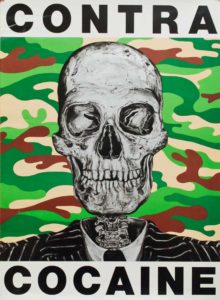


Parallel to the illegal arms shipments to Iran during those days was a cocaine trafficking operation by the Nicaraguan contras and a willingness by the Reagan administration and the CIA to turn a blind eye to these activities. This, despite the fact that cocaine was flooding into the United States while Ronald Reagan was proclaiming a “war on drugs,” and a crack cocaine epidemic was devastating communities across the country.

Bob and his colleague Brian Barger were the first journalists to report on this story in late 1985, which became known as the contra-cocaine scandal and became the subject of a congressional investigation led by then-Senator John Kerry (D-Mass.) in 1986.

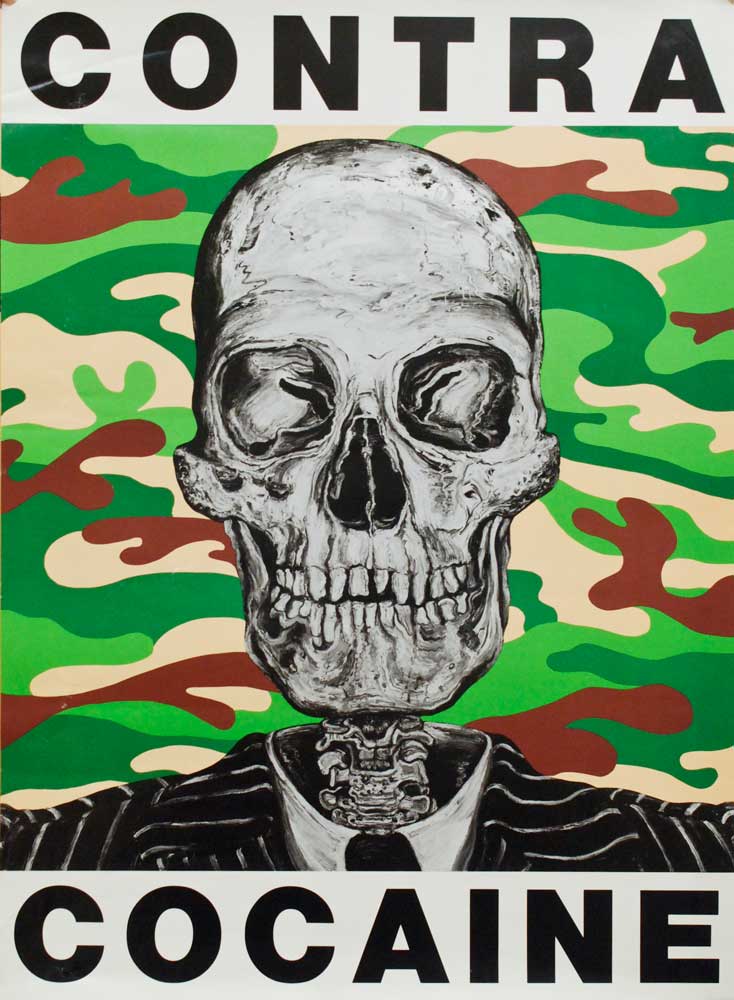
Poster by street artist and friend of Bob, 
Robbie Conal 

Continuing to pursue leads relating to Iran-Contra during a period in the late 80s when most of Washington was moving on from the scandal, Bob discovered that there was more to the story than commonly understood. He learned that the roots of the illegal arm shipments to Iran stretched back further than previously known – all the way back to the 1980 presidential campaign.

That electoral contest between incumbent Jimmy Carter and challenger Ronald Reagan had come to be largely dominated by the hostage crisis in Iran, with 52 Americans being held at the U.S. embassy in Tehran since the 1979 Iranian Revolution. The Iranian hostage crisis, along with the ailing economy, came to define a perception of an America in decline, with former Hollywood actor Ronald Reagan promising a new start for the country, a restoration of its status as a “shining city on a hill.”

The hostages were released in Tehran moments after Reagan was sworn in as president in Washington on January 20, 1981. Despite suspicions for years that there had been some sort of quid pro quo between the Reagan campaign and the Iranians, it wasn’t until Bob uncovered a trove of documents in a House office building basement in 1994 that the evidence became overwhelming that the Reagan campaign had interfered with the Carter administration’s efforts to free the hostages prior to the 1980 election. Their release sooner – what Carter hoped would be his “October Surprise” – could have given him the boost needed to win.

Examining these documents and being already well-versed on this story – having previously travelled three continents pursuing the investigation for a PBS Frontline documentary – Bob became increasingly convinced that the Reagan campaign had in fact sabotaged Carter’s hostage negotiations, possibly committing an act of treason in an effort to make sure that 52 American citizens continued to be held in a harrowing hostage situation until after Reagan secured the election.

Needless to say, this was an inconvenient story at a time – in the mid-1990s – when the national media had long since moved on from the Reagan scandals and were obsessing over new scandals, mostly related to President Bill Clinton’s sex life and failed real estate deals. Washington also wasn’t particularly interested in challenging the Reagan legacy, which at that time was beginning to solidify into a kind of mythology, with campaigns underway to name buildings and airports after the former president.

At times, Bob had doubts about his career decisions and the stories he was pursuing. As he wrote in Trick or Treason, a book outlining his investigation into the October Surprise Mystery, this search for historical truth can be painful and seemingly thankless.

“Many times,” he wrote, “I had regretted accepting Frontline’s assignment in 1990. I faulted myself for risking my future in mainstream journalism. After all, that is where the decent-paying jobs are. I had jeopardized my ability to support my four children out of an old-fashioned sense of duty, a regard for an unwritten code that expects reporters to take almost any assignment.”

Nevertheless, Bob continued his efforts to tell the full story behind both the Iran-Contra scandal and the origins of the Reagan-Bush era, ultimately leading to two things: him being pushed out of the mainstream media, and the launching of Consortiumnews.com.

I remember when he started the website, together with my older brother Sam, back in 1995. At the time, in spite of talk we were all hearing about something called “the information superhighway” and “electronic mail,” I had never visited a website and didn’t even know how to get “on line.” My dad called me in Richmond, where I was a sophomore at Virginia Commonwealth University, and told me I should check out this new “Internet site” he and Sam had just launched.

He explained over the phone how to open a browser and instructed me how to type in the URL, starting, he said, with “http,” then a colon and two forward slashes, then “www,” then “dot,” then this long address with one or two more forward slashes if I recall. (It wasn’t until years later that the website got its own domain and a simpler address.)

I went to the computer lab at the university and asked for some assistance on how to get online, dutifully typed in the URL, and opened this website – the first one I had ever visited. It was interesting, but a bit hard to read on the computer screen, so I printed out some articles to read back in my dorm room.

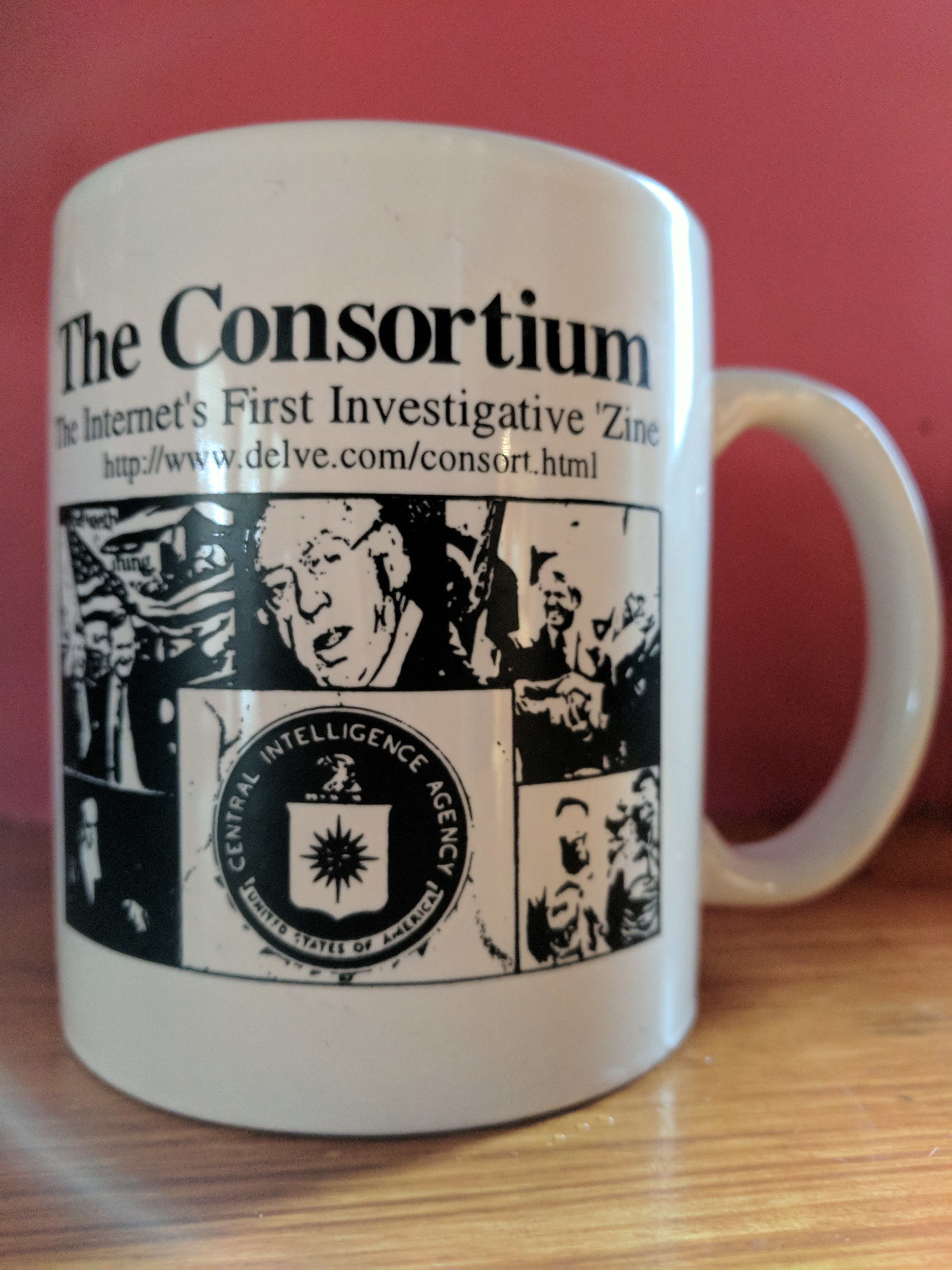
I quickly became a fan of “The Consortium,” as it was called back then, and continued reading articles on the October Surprise Mystery as Bob and Sam posted them on this new and exciting tool called “the Internet.” Sam had to learn HTML coding from scratch to launch this online news service, billed as “the Internet’s First Investigative ‘Zine.” For his efforts, Sam was honored with the Consortium for Independent Journalism’s first Gary Webb Freedom of the Press Award in 2015.

X-Files and Contra-Crack


At some point along the way, Bob decided that in addition to the website, where he was not only posting original articles but also providing the source documents that he had uncovered in the House office building basement, he would also take a stab at traditional publishing. He compiled the “October Surprise X-Files” into a booklet and self-published it in January 1996.


 Original Consortium merchandise, 1996


He was also publishing a newsletter to complement the website, knowing that at that time, there were still plenty of people who didn’t know how to turn a computer on, much less navigate the World Wide Web. I transferred from Virginia Commonwealth University to George Mason University in the DC suburbs and started working part-time with my dad and Sam on the newsletter and website.

We worked together on the content, editing and laying it out with graphics often culled from books at our local library. We built a subscriber base through networking and purchasing mailing lists from progressive magazines. Every two weeks we would get a thousand copies printed from Sir Speedy and would spend Friday evening collating these newsletters and sending them out to our subscribers.

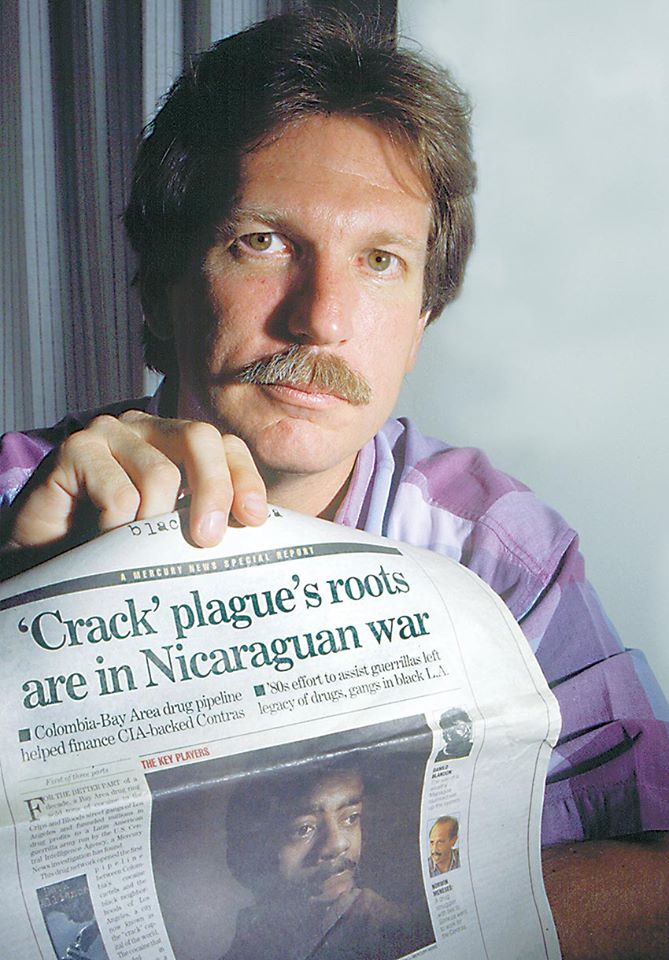
The launching of the website and newsletter, and later an even-more ambitious project called I.F. Magazine, happened to coincide with the publication in 1996 of Gary Webb’s “Dark Alliance” series at the San Jose Mercury-News. Webb’s series reopened the contra-cocaine controversy with a detailed examination of the drug trafficking networks in Nicaragua and Los Angeles that had helped to spread highly addictive crack cocaine across the United States.

The African-American community, in particular, was rightly outraged over this story, which offered confirmation of many long-standing suspicions that the government was complicit in the drug trade devastating their communities. African Americans had been deeply and disproportionately affected by the crack epidemic, both in terms of the direct impact of the drug and the draconian drug laws and mandatory minimum sentences that came to define the government’s approach to “the war on drugs.”

For a moment in the summer of 1996, it appeared that the renewed interest in the contra-cocaine story might offer an opportunity to revisit the crimes and misdeeds of the Reagan-Bush era, but those hopes were dashed when the “the Big Media” decided to double down on its earlier failures to cover this story properly.

Big Papers Pile On


The Los Angeles Times launched the attack on Gary Webb and his reporting at the San Jose Mercury-News, followed by equally dismissive stories at the Washington Post and New York Times. The piling on from these newspapers eventually led Mercury-News editor Jerry Ceppos to denounce Webb’s reporting and offer a mea culpa for publishing the articles.

The onslaught of hostile reporting from the big papers failed to address the basic premises of Webb’s series and did not debunk the underlying allegations of contra-cocaine smuggling or the fact that much of this cocaine ended up on American streets in the form of crack. Instead, it raised doubts by poking holes in certain details and casting the story as a “conspiracy theory.” Some of the reporting attempted to debunk claims that Webb never actually made – such as the idea that the contra-cocaine trafficking was part of a government plot to intentionally decimate the African-American community.
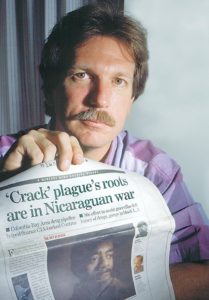

Gary Webb and Bob were in close contact during those days. Bob offered him professional and personal support, having spent his time also on the receiving end of attacks by journalistic colleagues and editors who rejected certain stories – no matter how factual – as fanciful conspiracy theories.

Articles at The Consortium website and newsletter, as well as I.F. Magazine, offered details on the historical context for the “Dark Alliance” series and pushed back against the mainstream media’s onslaught of hostile and disingenuous reporting.

Gary Webb holds up a copy of the San Jose Mercury-News with his front-page story.

Bob also published the book Lost History which provided extensive details on the background for the “Dark Alliance” series, explaining that far from a baseless “conspiracy theory,” the facts and evidence strongly supported the conclusion that the Reagan-Bush administrations had colluded with drug traffickers to fund their illegal war against Nicaragua.

But sadly, the damage to Gary Webb was done. With his professional and personal life in tatters because of his courageous reporting on the contra-cocaine story, he committed suicide in 2004 at the age of 49. Speaking about this suicide later on Democracy Now, Bob noted how painful it is to be ridiculed and unfairly criticized by colleagues, as his friend had experienced.

“There’s a special pain when your colleagues in your profession turn on you, especially when you’ve done something that they should admire and should understand,” he said.

“To do all that work and then have the New York Times and the Washington Post and the Los Angeles Times attack you and try to destroy your life, there’s a special pain in that.”

In consultation with his family, Bob and the Board of Directors for the Consortium for Independent Journalism launched the Gary Webb Freedom of the Press Award in 2015.

The Disastrous Presidency of George W. Bush


The presidency of George W. Bush was surreal for many of us, and no one more so than my dad.

In covering Washington politics for decades, Bob had traced many stories to “Dubya’s” father, George H.W. Bush, who had been implicated in a variety of questionable activities, including the October Surprise Mystery and Iran-Contra. He had also launched a war against Iraq in 1991 that seemed to be motivated, at least in part, to help kick “the Vietnam Syndrome,” i.e. the reluctance that the American people had felt since the Vietnam War to support military action abroad.

As Bob noted in his 1992 book Fooling America, after U.S. forces routed the Iraqi military in 1991, President Bush’s first public comment about the victory expressed his delight that it would finally put to rest the American reflex against committing troops to far-off conflicts.

“By God, we’ve kicked the Vietnam Syndrome once and for all,” he exulted.

The fact that Bush-41’s son could run for president largely on name recognition confirmed to Bob the failure of the mainstream media to cover important stories properly and the need to continue building an independent media infrastructure. This conviction solidified through Campaign 2000 and the election’s ultimate outcome, when Bush assumed the White House as the first popular-vote loser in more than a century.

Despite the fact that the U.S. Supreme Court had halted the counting of votes in Florida, thus preventing an accurate determination of the rightful winner, most of the national media moved on from the story after Bush was sworn in on Jan. 20, 2001. Consortiumnews.com continued to examine the documentary record, however, and ultimately concluded that Al Gore would have been declared the winner of that election if all the legally cast ballots were counted.

At Consortiumnews, there was an unwritten editorial policy that the title “President” should never precede George W. Bush’s name, based on our view that he was not legitimately elected. But beyond those editorial decisions, we also understood the gravity of the fact that had Election 2000 been allowed to play out with all votes counted, many of the disasters of the Bush years – notably the 9/11 tragedy and the Iraq War, as well as decisions to withdraw from international agreements on arms control and climate change – might have been averted.

As all of us who lived through the post-9/11 era will recall, it was a challenging time all around, especially if you were someone critical of George W. Bush. The atmosphere in that period did not allow for much dissent. Those who stood up against the juggernaut for war – such as Phil Donahue at MSNBC, Chris Hedges at the New York Times, or even the Dixie Chicks – had their careers damaged and found themselves on the receiving end of death threats and hate mail.

While Bob’s magazine and newsletter projects had been discontinued, the website was still publishing articles, providing a home for dissenting voices that questioned the case for invading Iraq in late 2002 and early 2003. Around this time, former CIA analyst Ray McGovern and some of his colleagues founded Veteran Intelligence Professionals for Sanity and a long-running relationship with Consortiumnews was established. Several former intelligence veterans began contributing to the website, motivated by the same independent spirit of truth-telling that compelled Bob to invest so much in this project.

At a time when almost the entire mainstream media was going along with the Bush administration’s dubious case for war, this and a few other like-minded websites pushed back with well-researched articles calling into question the rationale. Although at times it might have felt as though we were just voices in the wilderness, a major groundswell of opposition to war emerged in the country, with historic marches of hundreds of thousands taking place to reject Bush’s push for war.

Of course, these antiwar voices were ultimately vindicated by the failure to find weapons of mass destruction in Iraq and the fact that the war and occupation proved to be a far costlier and deadlier enterprise than we had been told that it would be. Earlier assurances that it would be a “cakewalk” proved as false as the WMD claims, but as had been so often the case in Washington, there was little to no accountability from the mainstream media, the think tanks or government officials for being so spectacularly wrong.

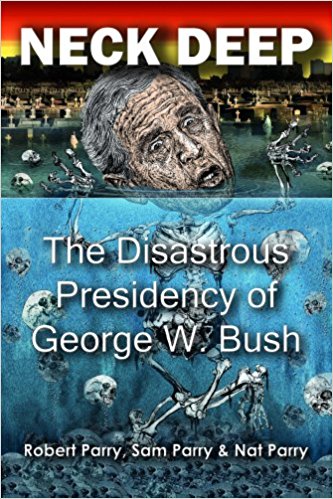
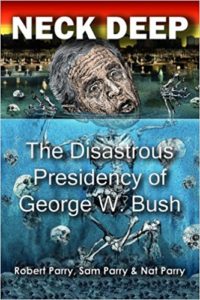
Neck Deep was published by the Media Consortium in 2007. 

In an effort to document the true history of that era, Bob, Sam and I co-wrote the book Neck Deep: The Disastrous Presidency of George W. Bush, which was published in late 2007. The book traced the work of Consortiumnews, juxtaposing it against the backdrop of mainstream media coverage during the Bush era, in an effort to not only correct the record, but also demonstrate that not all of us got things so wrong.

We felt it was important to remind readers – as well as future historians – that some of us knew and reported in real time the mistakes that were being made on everything from withdrawing from the Kyoto Protocol to invading Iraq to implementing a policy of torture to bungling the response to Hurricane Katrina.

Obama Era


By the time Barack Obama was elected the 44th president, Consortiumnews.com had become a home to a growing number of writers who brought new perspectives to the website’s content. While for years, the writing staff had been limited primarily to Bob, Sam and me, suddenly, Consortiumnews was receiving contributions from journalists, activists and former intelligence analysts who offered a wide range of expertise – on international law, economics, human rights, foreign policy, national security, and even religion and philosophy.

One recurring theme of articles at the website during the Obama era was the enduring effect of unchallenged narratives, how they shaped national politics and dictated government policy. Bob observed that even a supposedly left-of-center president like Obama seemed beholden to the false narratives and national mythologies dating back to the Reagan era. He pointed out that this could be at least partially attributed to the failure to establish a strong foundation for independent journalism.

In a 2010 piece called “Obama’s Fear of the Reagan Narrative,” Bob noted that Obama had defended his deal with Republicans on tax cuts for the rich because there was such a strong lingering effect of Reagan’s messaging from 30 years earlier.

“He felt handcuffed by the Right’s ability to rally Americans on behalf of Reagan’s ‘government-is-the-problem’ message,” Bob wrote.

He traced Obama’s complaints about his powerlessness in the face of this dynamic to the reluctance of American progressives to invest sufficiently in media and think tanks, as conservatives had been doing for decades in waging their “the war of ideas.” As he had been arguing since the early 1990s, Robert insisted that the limits that had been placed on Obama – whether real or perceived – continued to demonstrate the power of propaganda and the need for greater investment in alternative media.

He also observed that much of the nuttiness surrounding the so-called Tea Party movement resulted from fundamental misunderstandings of American history and constitutional principles. “Democrats and progressives should be under no illusion about the new flood of know-nothingism that is about to inundate the United States in the guise of a return to ‘first principles’ and a deep respect for the U.S. Constitution,” Bob warned.

He pointed out that despite the Tea Partiers’ claimed reverence for the Constitution, they actually had very little understanding of the document, as revealed by their ahistorical claims that federal taxes are unconstitutional. In fact, as Bob observed, the Constitution represented “a major power grab by the federal government, when compared to the loosely drawn Articles of Confederation, which lacked federal taxing authority and other national powers.”

Motivated by a desire to correct falsified historical narratives spanning more than two centuries, Bob published his sixth and final book, America’s Stolen Narrative: From Washington and Madison to Nixon, Reagan and the Bushes to Obama, in 2012.

Along with revenues from book sales, growing donations from readers enabled Bob to not only pay writers but also to hire an assistant, Chelsea Gilmour, who began working for Consortiumnews in 2014. In addition to providing invaluable administrative support, Chelsea also performed duties including research, writing and fact-checking.

Political Realignment and the New McCarthyism


Although at the beginning of the Obama era – and indeed since the 1980s – the name Robert Parry had been closely associated with exposing wrongdoing by Republicans, and hence had a strong following among Democratic Party loyalists, by the end of Obama’s presidency there seemed to be a realignment taking place among some of Consortiumnews.com’s readership, which reflected more generally the shifting politics of the country.

In particular, the U.S. media’s approach to Russia and related issues, such as the violent ouster in 2014 of Ukrainian President Viktor Yanukovych, became “virtually 100 percent propaganda,” Bob said.

He noted that the full story was never told when it came to issues such as the Sergei Magnitsky case, which led to the first round of U.S. sanctions against Russia, nor the inconvenient facts related to the Euromaidan protests that led to Yanukovych’s ouster – including the reality of strong neo-Nazi influence in those protests – nor the subsequent conflict in the Donbass region of Ukraine.

Bob’s stories on Ukraine were widely cited and disseminated, and he became an important voice in presenting a fuller picture of the conflict than was possible by reading and watching only mainstream news outlets. Bob was featured prominently in Oliver Stone’s 2016 documentary “Ukraine on Fire,” where he explained how U.S.-funded political NGOs and media companies have worked with the CIA and foreign policy establishment since the 1980s to promote the U.S. geopolitical agenda.

Bob regretted that, increasingly, “the American people and the West in general are carefully shielded from hearing the ‘other side of the story.’” Indeed, he said that to even suggest that there might be another side to the story is enough to get someone branded as an apologist for Vladimir Putin or a “Kremlin stooge.”


This culminated in late 2016 in the blacklisting of Consortiumnews.com on a dubious website called “PropOrNot,” which was claiming to serve as a watchdog against undue “Russian influence” in the United States. The PropOrNot blacklist, including Consortiumnews and about 200 other websites deemed “Russian propaganda,” was elevated by the Washington Post as a credible source, despite the fact that the neo-McCarthyites who published the list hid behind a cloak of anonymity.


The PropOrNot logo

“The Post’s article by Craig Timberg,” Bob wrote on Nov. 27, 2016, “described PropOrNot simply as ‘a nonpartisan collection of researchers with foreign policy, military and technology backgrounds [who] planned to release its own findings Friday showing the startling reach and effectiveness of Russian propaganda campaigns.’”

As Bob explained in an article called “Washington Post’s Fake News Guilt,” the paper granted PropOrNot anonymity “to smear journalists who don’t march in lockstep with official pronouncements from the State Department or some other impeccable fount of never-to-be-questioned truth.”

The Post even provided an unattributed quote from the head of the shadowy website. “The way that this propaganda apparatus supported [Donald] Trump was equivalent to some massive amount of a media buy,” the anonymous smear merchant said. The Post claimed that the PropOrNot “executive director” had spoken on the condition of anonymity “to avoid being targeted by Russia’s legions of skilled hackers.”

To be clear, neither Consortiumnews nor Robert Parry ever “supported Trump,” as the above anonymous quote claims. Something interesting, however, did seem to be happening in terms of Consortiumnews’ readership in the early days of the Trump presidency, as could be gleaned from some of the comments left on articles and social media activity.

It did appear for some time at least that a good number of Trump supporters were reading Consortiumnews, which could probably attributed to the fact that the website was one of the few outlets pushing back against both the “New Cold War” with Russia and the related story of “Russiagate,” which Bob didn’t even like referring to as a “scandal.” (As an editor, he preferred to use the word “controversy” on the website, because as far as he was concerned, the allegations against Trump and his supposed “collusion” with Russia did not rise to the level of actual scandals such as Watergate or Iran-Contra.)

In his view, the perhaps understandable hatred of Trump felt by many Americans – both inside and outside the Beltway – had led to an abandonment of old-fashioned rules of journalism and standards of fairness, which should be applied even to someone like Donald Trump.

“On a personal note, I faced harsh criticism even from friends of many years for refusing to enlist in the anti-Trump ‘Resistance,’” Bob wrote in his final article for Consortiumnews.

“The argument was that Trump was such a unique threat to America and the world that I should join in finding any justification for his ouster,” he said.
“Some people saw my insistence on the same journalistic standards that I had always employed somehow a betrayal.”

He marveled that even senior editors in the mainstream media treated the unproven Russiagate allegations as flat fact.

“No skepticism was tolerated and mentioning the obvious bias among the never-Trumpers inside the FBI, Justice Department and intelligence community was decried as an attack on the integrity of the U.S. government’s institutions,” Bob wrote.

“Anti-Trump ‘progressives’ were posturing as the true patriots because of their now unquestioning acceptance of the evidence-free proclamations of the U.S. intelligence and law enforcement agencies.”

An Untimely End and the Future of Consortiumnews


My dad’s untimely passing has come as a shock to us all, especially since up until a month ago, there was no indication whatsoever that he was sick in any way. He took good care of himself, never smoked, got regular check-ups, exercised, and ate well. The unexpected health issues starting with a mild stroke Christmas Eve and culminating with his admission into hospice care several days ago offer a stark reminder that nothing should be taken for granted.

And as many Consortiumnews readers have eloquently pointed out in comments left on recent articles regarding Bob’s health, it also reminds us that his brand of journalism is needed today more than ever.

“We need free will thinkers like you who value the truth based on the evidence and look past the group think in Washington to report on the real reasons for our government’s and our media’s actions which attempt to deceive us all,” wrote, for example, “FreeThinker.”

“Common sense and integrity are the hallmarks of Robert Parry’s journalism. May you get better soon for you are needed more now then ever before,” wrote “T.J.”

“We need a new generation of reporters, journalists, writers, and someone always being tenacious to follow up on the story,” added “Tina.”

As someone who has been involved with this website since its inception – as a writer, an editor and a reader – I concur with these sentiments. Readers should rest assured that despite my dad’s death, every effort will be made to ensure that the website will continue going strong.

Indeed, I think that everyone involved with this project wants to uphold the same commitment to truth telling without fear or favor that inspired Bob and his heroes like George Seldes, I.F. Stone, and Thomas Paine.

That commitment can be seen in my dad’s pursuit of stories such as those mentioned above, but also so many others – including his investigations into the financial relationship of the influential Washington Times with the Unification Church cult of Rev. Sun Myung Moon, the truth behind the Nixon campaign’s alleged efforts to sabotage President Lyndon Johnson’s Paris peace talks with Vietnamese leaders in 1968, the reality of the chemical attack in Syria in 2013, and even detailed examinations of the evidence behind the so-called “Deflategate” controversy that he felt unfairly branded his favorite football team, the New England Patriots, as cheaters.


Reviewing these journalistic achievements, it becomes clear that there are few stories that have slipped under Consortiumnews.com’s radar, and that the historical record is far more complete thanks to this website and Bob’s old-fashioned approach to journalism.

But besides this deeply held commitment to independent journalism, it should also be recalled that, ultimately, Bob was motivated by a concern over the future of life on Earth. As someone who grew up at the height of the Cold War, he understood the dangers of allowing tensions and hysteria to spiral out of control, especially in a world such as ours with enough nuclear weapons to wipe out all life on the planet many times over.

As the United States continues down the path of a New Cold War, my dad would be pleased to know that he has such committed contributors who will enable the site to remain the indispensable home for independent journalism that it has become, and continue to push back on false narratives that threaten our very survival.

Thank you all for your support.


In lieu of flowers, Bob’s family asks you to please consider making a tax-deductible donation to the Consortium for Independent Journalism.

image_pdf