Tuesday, March 06, 2018

Not In Its Stars: Israel's Corruption and Netanyahu

Netanyahu or Not, Israel is Corrupted (1/2) 

by TRNN


March 6, 2018

Israeli society "lives in denial" more than any other society, says Haaretz columnist Gideon Levy, referring to the suffering the occupation of Palestine causes.


Gideon Levy is a columnist for the Israeli daily Haaretz, which he joined in 1982. He spent four years as the newspaper's deputy editor and is currently a member of its editorial board. He is widely considered the "dean of Israeli journalism" as well as "the most hated man in Israel." His columns about politics, money, how Israel's military occupation is changing Israeli society and about U.S.-Israel relations are widely read and discussed around the world. 

Kidding a Kidder: Who's Joking Who?

Light It Up 

by James Howard Kunstler - Clusterfuck Nation


March 5, 2018

It must be hard on The New York Times editors to set their hair on fire day after day in their effort to start World War Three. Today’s lead story, Russian Threat on Two Fronts Meets Strategic Void in the U.S., aims to keep ramping up twin hysterias over a new missile gap and fear of Russian “meddling” in the 2018 midterm elections.

The Times’s world-view begins to look like the script of a Batman sequel with Vlad Putin cast in The Joker role of the cackling psychopath who must be stopped at all costs! America’s generals have switched on the Batman signal beacon, but Donald Trump in the role of the Caped Crusader, merely dithers and broods in the splendid isolation of his 1600 Penn Avenue Bat Cave, suffering yet another of his endless bipolar identity crises.

For God’s sake, The Times shrieks, do something! The Russians are coming! (Gotham City’s Chief of Police Hillary said exactly that last week in a Tweet!)

I think they misunderstood Mr. Putin’s recent message when he announced a new hypersonic missile technology that would, supposedly, cut through any imaginable US missile defense. The actual message, for the non mental defectives left in this drooling idiocracy of a republic, was as follows: Nuclear war remains unthinkable, so kindly stop thinking about it.

Mr. Putin’s other strategic position is also misrepresented — actually, not even acknowledged — in Monday’s NYT propaganda blast, namely, to discourage the USA’s decades-long policy of regime change here, there, and everywhere on the planet, creating a debris trail of one failed state after another. As a true-blue American, I must say these are two admirable propositions.

Is it fatuous to add that atomic war is unlikely to benefit anyone? Or that the world has had enough of US military “meddling” in foreign lands?

Of course the shopworn trope of Russian “meddling” in the 2016 election still occupies the center ring of the American political circus. Today’s Times story includes another clumsy attempt to set up expectations that the 2018 midterm elections will be hacked by Russia, in order to keep the hysteria at code-red level.

As usual, the proposition assumes that the alleged 2016 hacking is both proven and significant when, going on two years, there is no evidence of hacking besides the obviously amateurish Facebook troll farm. (And, by the way, how does that compare to the USA’s 2014 covert toppling of Ukraine’s president Viktor Yanukovych? Talk about “meddling!”)

"…[I]n public statements in recent weeks, Mr. Trump’s top intelligence officials have conceded that the president has yet to discuss strategies with them to prevent the Russians from interfering in the midterm elections this year. Mr. Trump has expressed severe doubts that the Russians meddled in 2016, contradicting the conclusions of his intelligence officials."

By inference, The New York Times has no doubts that the 2016 election was fatally hacked to defeat its preferred candidate — though there is plenty of reason to suppose that the entire Russian “meddling” story was a mendacious psyops product of John O. Brennan’s CIA.

It was only a few months ago that The Times and the cable news networks were shrieking about the White House National Security Advisor (General Flynn) being caught speaking with the Russian Ambassador — as if foreign ambassadors come here for some reason other than to keep open communication lines with American officials.

What’s going on here makes the Red Scare of 1920 and the McCarthy episode of the early 1950s look sedate in comparison. It’s reasonable to suppose that officials in any foreign country watching the dismal ongoing spectacle here would conclude that the United States has lost its mind. Somebody please take us to the hydrotherapy chamber!

The Real Climate Disaster: A Human Failure to Appreciate Exponentiality

The Arctic Heats Up in the Dead of Winter

by Robert Hunziker - CounterPunch


March 6, 2018

Every once in a while a climatic event hits that forces people to sit down to catch their breath. Along those lines, abnormal Arctic heat waves in the dead of winter may force scientists to revaluate downwards (or maybe upwards, depending) their most pessimistic of forecasts.

By the end of February 2018, large portions of the Arctic Ocean north of Greenland were open blue water, meaning no ice. But, it’s wintertime, no daylight 24/7, yet no ice in areas where it’s usually some meters thick!

In a remarkable, mindboggling turn of events, thick ice in early February by month’s end turned into wide open blue water.

Photo: NOAA Photo Library | CC BY 2.0 

It's metaphorically equivalent to an airline passenger at 35,000 feet watching rivets pop off the fuselage.

The sea ice north of Greenland is historically the thickest, most solid ice of the North Pole. But, it’s gone all of a sudden! Egads, what’s happening and is it a danger signal? Answer: Probably, depending upon which scientist is consulted. Assuredly, nobody predicted loss of ice north of Greenland in the midst of winter.

Wide open blue seas in the Arctic expose all of humanity to risks of Runaway Global Warming (“RGW”) as, over time, massive amounts of methane erupts with ancillary sizzling of agricultural crops, and as the Arctic heats up much faster than the rest of the planet, this also throws a curve ball at weather patterns all across the Northern Hemisphere, radical weather patterns ensue, like snow on the French Riviera only recently.

According to Ruth Mottram, a climate scientist at the Danish Meteorological Institute in Copenhagen, February was the warmest (hottest) on record in the Arctic, which includes 10 days of temps above freezing. As for Arctic temps in February, that’s hot!

“We’ve actually got open water at the top of Greenland right now, which is incredibly unusual,” (Mottram – Source: Europe’s Cold Blast, Arctic’s Heat Wave are ‘Two Sides of the Same Coin,” Public Radio International, March 2, 2018).
“This is an anomaly among anomalies. It is far enough outside the historical range that it is worrying – it is a suggestion that there are further surprises in store as we continue to poke the angry beast that is our climate,” said Michael Mann, director of the Earth System Science Center at Pennsylvania State University. (Source: Jonathan Watts, Global Environmental Editor, Arctic Warming: Scientists Alarmed by ‘Crazy Temperature Rise’, The Guardian, Feb. 27, 2018).

During February the world’s most northerly weather station at Cape Morris Jesup on the tip of Greenland registered temps warmer than London and Zurich for days on end. The Cape Morris Jesup weather station is only 440 miles away from the North Pole.

When analyzing or writing about the complexities of ecosystem events, like loss of Arctic sea ice, it is easy to overstate negatives, if only because there is no evidence of a similar event in recent climate history. Furthermore, the scientific community is widely split on likely consequences, running the gamut from “no worries for at least 100 years” to “the world will incinerate within 10 years,” meaning Runaway Global Warming (RGW”), as a result of massive release of methane (“CH4”) trapped in frozen waters for millennia, causing temps to crank up by 10 °F-to-15 °F, which will pretty much wipe out a lot of agricultural crops.

In turn, the world turns into a dystopian hellhole and reverts to caveman/cavewoman lifestyle.

Indeed, the dangers that arise with loss of Arctic ice are multifold, including loss of the Arctic as the planet’s biggest reflector/air conditioner. When covered with white reflective ice, it reflects up to 90% of solar radiation back into outer space. Without ice, that same 90% is absorbed within a dark blue background, potentially heating up tons upon tons, and more tons yet, of frozen methane, metaphorically similar to throwing kindling onto a hot fire, as global warming heats up big time and sizzles agricultural crops down to blackened stubs throughout the mid latitudes, driving humanity into the farthest northern latitudes for survival, a crowded scenario indeed.

Generally speaking, people shrug their shoulders with a signal of “so what” when confronted with the risks of global warming/climate change. After all, nothing horrible will happen until well into the latter part of this century, or beyond, right? Well, yes and no, as the real issue that comes into play is timing.

How fast is climate change/global warming happening?


And that’s the rub because, across the board, scientists agree ecosystem changes today are exponential, which could be problematic. As explained by one scientist, linear versus exponential means that a person can take 30 linear steps to the water cooler across the room but if exponential, the 30 steps takes him/her around the world, more than once. That’s exponential, and that’s the rate of change in ecosystems, like the Arctic. Therein lies the unknown risk factor of how soon temps mushroom upwards? Nobody knows for sure, but they do know that ecosystems are changing exponentially, especially in the ocean.

Here’s the ultimate risk: 55 million years ago global temps spiked during the Palaeocene-Eocene Thermal Maximum (“PETM”). The temp surge by 6 °C (11 °F) happened in just 13 years, which if repeated today, would be unbelievably devastating, but the science is controversial as to the timing of the surge 55 millions ago.

Some scientists say 13 years; some scientists that look at the same data say 1500 years. Hopefully, it’s the latter. But unfortunately, with exponential change already underway, that wish does not look very promising.

Postscript: “The greatest shortcoming of the human race is our inability to understand the exponential function.” (Albert A. Bartlett 1923-2013, American Physicist)

Robert Hunziker lives in Los Angeles and can be reached at rlhunziker@gmail.com.
More articles by:Robert Hunziker

Tipping Point: The Current Onset of Climate Upset

The current onset of climate tipping points

by Andrew Glikson


March 1, 2018 


As extreme temperatures, the rate of sea ice melt, the collapse of Greenland glaciers, the thawing of Siberian and Canadian permafrost and increased evaporation in the Arctic drive cold snow storms into Europe and North America, and as hurricanes and wild fires affect tropical and semi-tropical parts of the globe, it is becoming clear Earth is entering a shift in state of the atmosphere-ocean system associated with destructive climate tipping points.

As Arctic permafrost is thawing an analogy with geological methane-release events such as the 56 million years-old Paleocene-Eocene boundary thermal maximum (PETM) event is becoming more likely.

As is well known to students of the history of the climate, once a temperature threshold is breached, abrupt weather events ensue amplified by feedbacks such as decreased reflectivity of the Earth surface and enhanced release of greenhouse gases, often within short time frames.

Arctic ice melt


NASA Land-Ocean: Global Means J-D


Figure 1. 1880-2018 annual mean temperatures and 5-years smoothing. 


Such abrupt changes are occurring at present. As mean global temperature has exceeded 1.2 degrees Celsius above 1880 temperatures (Figure 1), sharp reductions occur in Arctic sea ice from 45 percent in 1985 to 21 percent in 2017, when the ice cover was 8.5 percent lower than the average of 1981-2010.

As the ice melts the near-total reflection (high albedo) of solar radiation from the ice is replaced by absorption of infrared radiation by open water; The flow of ice-melt water from the Greenland glaciers creates a large pool of cold water in the North Atlantic Ocean. The cold water region south of Greenland slows-down to aborts northward flow of the thermohaline Atlantic Meridional Ocean Circulation (AMOC), leading to cooling of the North Atlantic and adjacent North America and Europe.

Rising temperature and evaporation over the warming Arctic Ocean results in build-up of masses of cold vapor-laden air, intermittently penetrating into lower latitudes through the weakened undulating boundary of the high-altitude polar vortex, which allows penetration of snow storms southward through Siberia and North America (Figure 2).

Average daily temperature north of the 80th parallel in 2018


Figure 2. Arctic air temperatures in January 2018 in degrees 
Celsius relative to the average (Arctic sea – 3-9 degrees, yellow to red; 
Greenland and Siberia (-1 to -3 degrees C, blue to magenta) 
Credit: NSIDC courtesy NOAA/ESRL Physical Sciences Division


In 2006 the Greenland and Antarctic ice sheets experienced a combined mass loss of 475±158 Gt/yr (billion ton/year), equivalent to 1.3±0.4 mm/year sea level rise. The acceleration in ice sheet loss over the last 18 years was 21.9±1 Gt/year2 for Greenland and 14.5 ± 2 Gt/year2.

The slow-down to collapse of the northward flow of warm water from tropical regions, namely the Atlantic Meridional Ocean Circulation (AMOC), originating from the Gulf of Mexico, and further warming of the tropical ocean pools, produce in temperature polarities with cool northern ocean regions. This ensues in storms and hurricanes in regions such as the Caribbean islands. Warming of the west Pacific Ocean leads to cyclones such as have affected the Philippines, Fiji and Samoa.

Polar warming is leading to the release of large amounts of methane from frozen organic matter stored in the permafrost and from methane hydrates in lakes, the sea and sediments. This has already raised atmospheric methane levels during 1960-2017 from ~1600 parts per billion to 1860 ppb. The bubbling of methane is locally leading to collapse and cratering of the permafrost.

The total mass of methane on land of ~2050 GtC (billion tons) and methane hydrates at sea of ~16,000 GtC (Global Carbon Project) is some 30 times greater than the >600 GtC which has been produced by anthropogenic emissions since the onset of the industrial age. Even a release of 10 percent of Arctic-stored carbon would raise atmospheric greenhouse levels by a factor of about three.

The current warming of Earth manifest in the Arctic Sea, the melting of polar ice sheets, penetration of snow storms into mid-latitudes, permafrost thaw, hurricanes and wildfires and the rise in extreme weather events, manifesting a shift in state of the atmosphere-ocean system, constitutes an existential threat to humanity and much of nature.

Apart from sharp reduction in carbon emissions, there appears to be one chance to save the biosphere as we know it, namely CO2 down-draw using every available method (cf. basalt dust application of soils, carbon cultivation of soils (biochar), CO2 removal by air streaming through basalt, extensive sea weed farms, ‘sodium trees’ sequestering CO2 using sodium hydroxide in pipe systems). This would require funds on the $trillions-scale currently allocated for the military and for wars, humanity’s choice being between ongoing wars and defense of the Planet.

Andrew Glikson is an Earth and paleoclimate scientist at Australian National University

Monday, March 05, 2018

Racing the Virus: How a Government Tried to Hide an Epidemic

Racing a Virus – is the BC salmon farming industry spreading disease?

by Alexander Morton


March 5, 2018 

Vancouver - March 1 independent biologist Alexandra Morton released a 6-minute film documenting the government cover-up that released millions of Atlantic salmon infected with a virus that appears to be Norwegian into pens along the BC coast. 48,000 people have viewed the video on facebook and Vimeo.

The coverup – in 2008, a BC provincial government scientist in charge of farm salmon health audits discovered the signature heart damage caused by the Norwegian salmon farming virus, piscine reovirus (PRV), but he never reported it.

Instead, Dr. Gary Marty, BC provincial scientist in charge of farm salmon health, consulted with industry and they assured him that their fish did not have this disease. 


LINK TO VIDEO https://vimeo.com/258135790


As a result of not reporting the discovery of Heart and Skeletal Muscle Inflammation (HSMI) the virus was never assigned “disease agent” status and so was not captured by section 56 of the Fishery (General) Regulation which prohibits transfer of fish infected with a disease agent into marine waters.


The Minister of Fisheries signed permits for transfer of millions of potentially infected farm salmon into wild salmon habitat.


Alexandra Morton, the first to publish on PRV in BC in 2013, took the Minister of Fisheries to court for not screening farm salmon for this virus. She won the case, but the minister still refuses to screen farm salmon for piscine reovirus. When she sued him again Marine Harvest revealed that the industry would be “severely” impacted if they were prohibited from farming with fish infected with PRV.

“Essentially they don’t have fish to farm, if piscine reovirus is recognized as a “disease agent,” says Morton.

Salmon farming giant Marine Harvest rapidly co-published 3 scientific papers with provincial and federal scientists suggesting that piscine reovirus is natural to BC and harmless. This shored up the Minister’s position that the virus was not a “disease agent.” However, these publications have been refuted.

The reveal 


Federal Department of Fisheries & Oceans scientist Kristi Miller was given brief access to farm salmon and in 2016 she reported that PRV is in fact causing the highly contagious fish heart disease HSMI. This prompted a surprising response from Dr. Marty, who wanted to lay claim to the discovery of HSMI in  2008, which he had never reported.

“This is exactly what everyone was afraid of when the salmon farming industry began importing Atlantic salmon in the 1990s” says Morton, 
 “that a virus no one had heard of would hitch a ride into BC and spread before anyone even knew it existed.”

Dr. Marty’s lab is currently under investigation but the province.

“The salmon farming industry says they can't get rid of piscine reovirus, the law says they can't operate with it and the science suggests wild salmon may not survive the epidemic” says independent biologist Morton.
“This is the moment in history when we decide whether we want wild salmon or not.”


FOR IMMEDIATE RELEASE

For more information:
http://alexandramorton.typepad.com/racing_a_virus

A More Militant Putin Fights from the Corner in His Presidency's Final Round

When Vladimir Putin Coughs, the Grippe is Infectious - Kremlin Succession Showdown Start

by John Helmer - Dances with Bears


March 4, 2018

Moscow - Still coughing from the effects of the influenza which has infected most of Europe this winter, President Vladimir Putin has declared that for his last term in office, Russia is at war with the United States.

In his Federal Assembly speech on March 1, Putin also made sure that for his succession, he intends the Russian military-industrial complex to prevail over the oligarchs on whom Kremlin rule has depended since 1996.

 Politically, this means the rise of Dmitry Rogozin, currently deputy prime minister in charge of the defence sector, and Sergei Shoigu, the defence minister. Putin has signalled he intends the defeat of the pro-American business faction in Moscow, which US sanctions have been attempting to promote since 2014.

For the first time in the 25-year history of the Assembly address, Putin added 40 minutes, an extra third, to his standard one-hour delivery. The additional time he spent describing Russian military technology as the leading force for innovation and growth in the country. For seventy minutes Putin repeated domestic policy clichés and election-campaign promises, gesturing from stiff shoulders with his left hand. For the last third of his speech, Putin relaxed his shoulders, thrusting with his right hand and raising his right index finger.

The full text of the speech (in English) can be read here. For the coughing, body language and the audience response, watch the video.

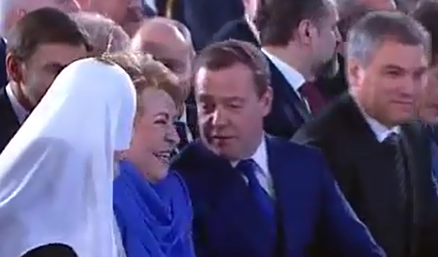
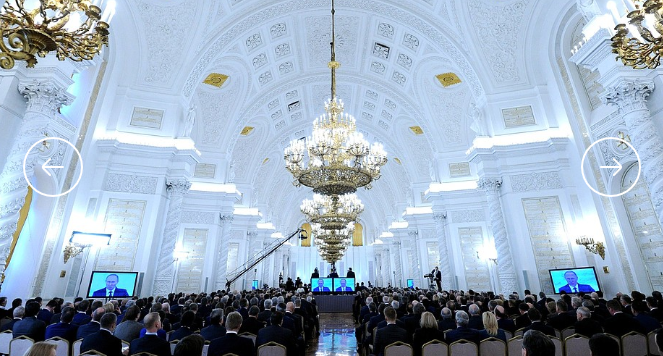
From multiple camera positions the Kremlin propaganda unit displayed the political elite of the country; Vladimir Zhirinovsky, the only presidential runner present apart from Putin; and many smiling young women. Patriarch Kirill of the Russian Church was seated in the first row, beside and to the right of Valentina Matvienko, Speaker of the Federation Council, and Prime Minister Dmitry Medvedev. The representatives of the Moslem and Jewish religions were seated behind.


Left to right: Kirill; Matvienko; Medvedev; and Vyacheslav Volodin, 
Speaker of the State Duma. 


Left to right in the second row: Metropolitan Varsonofy of St. Petersburg, 
the administrator of the Church; Metropolitan Vladimir of Moldova;  in green turban 
the grand mufti Talgat Tajuddin; in white turban Ravil Gainutdin, chief mufti of the 
Central Spiritual Board of Muslims; and Berel Lazar, chief rabbi. In front of them, 
at centre, Vladimir Surkov, Kremlin assistant for negotiations on the Ukraine front.


The Federal Assembly address by the president is a constitutional requirement. It ought to be given each year. In fact, in 2017 none was given. That’s because Putin gave the 2016 speech at the end of the year – on December 1, 2016. Article 84 of the Constitution enacted by Boris Yeltsin in December 1993 says:

“The President of the Russian Federation shall address the Federal Assembly with annual messages on the situation in the country, on the guidelines of the internal and foreign policy of the State”. 

The date of the presidential address is not fixed in law; neither is the composition of the audience.

The 2015 address was also given in December of that year: Putin spoke for a fraction less than 60 minutes. He devoted a few seconds to war:

“The Russian Army and Navy,” he said, “have convincingly demonstrated their combat readiness and their increased capabilities. Modern Russian weapons have proved to be effective, and the invaluable practice of using them in combat conditions is being analysed and will be used to further improve our weapons and military equipment. We are grateful to our engineers, workers and all other personnel of our defence companies.” 


Putin addresses the Federal Assembly on December 3, 2015. The front-row 
seating protocol placed Sergei Ivanov, then chief of the Kremlin staff, on the right 
of the prime minister, in the seat which Patriarch Kirill was to take last week. 
In 2015 Kirill was relegated to the prime minister’s left. 


By name in 2015, the enemy of Russia, according to Putin, was terrorism and “a certain part of the current ruling establishment of Turkey.”

“We know who are stuffing pockets in Turkey and letting terrorists prosper from the sale of oil they stole in Syria. The terrorists are using these receipts to recruit mercenaries, buy weapons and plan inhuman terrorist attacks against Russian citizens and against people in France, Lebanon, Mali and other states. We remember that the militants who operated in the North Caucasus in the 1990s and 2000s found refuge and received moral and material assistance in Turkey. We still find them there.”

Putin attacked Turkey’s President Recep Tayyip Erdogan.

“The Turkish people are kind, hardworking and talented. We have many good and reliable friends in Turkey. Allow me to emphasise that they should know that we do not equate them with the certain part of the current ruling establishment that is directly responsible for the deaths of our servicemen in Syria.” 


Putin meeting Erdogan at the Kremlin on September 25, 2015. Two 
months later, on November 24, the Turkish Air Force shot down a 
Russian Su-25 over Syria, resulting in the death of one of the Russian pilots, 
and the imposition of Russian economic sanctions against Turkey on November 28.


A year later, in Putin’s Assembly address on December 1, 2016, he spoke for roughly the same hour. The military industrial complex was mentioned in passing; war not at all. “We have carried out far-reaching modernisation at our defence industry enterprises,” Putin said, following Rogozin’s script but cutting it to a fraction.

“This has resulted in increased production and, particularly important, in a significant increase in labour productivity. The defence industry has posted very good results and gives a good example. In 2016, we expect growth in the defence industry to reach 10.1 percent, and a labour productivity increase of 9.8 percent.”

This was beating swords into ploughshares, Putin tried to reassure.

“We must direct the defence industry to produce up-to-date competitive civilian products for healthcare, energy, aviation and shipbuilding, space exploration and other high-tech industries. The share of civilian products must increase to at least one-third of the defence industry’s total output within the next 10 years.”

The US was still Putin’s hope:

“I certainly count on joining efforts with the United States in the fight against real rather than fictional threats, international terrorism being one of them. That is the task our servicemen are fulfilling in Syria. Terrorists have suffered significant losses. The Russian Army and Navy have shown convincingly that they are capable of operating effectively away from their permanent deployment sites.”

Last week’s address was double all previous lengths, with an unprecedented reason. Putin has never before spent so much of his speech on warfare — and on the US as Russia’s arch enemy.


Putin began with a domestic policy agenda which isn’t new, and isn’t likely.

“What should be our priority? Let me reiterate that I believe that the main, key development factor is the well-being of the people and the prosperity of Russian families.” 

He proposed a GDP growth rate of 7% per annum; a health care budget equal to 4% of GDP; an increase of life expectancy to more than 80 years by 2030; higher incomes, lower mortgage interest rates, more affordable housing.

There were also promises to the oligarchs. The sanctioned Rotenberg brothers were promised the doubling of spending on regional and local road-building to Rb11 trillion (about $200 billion) over the next six years. German Gref and other oligarchs investing in private schools were promised a federally financed “shift to completely new education methods, including personalised learning, in order to cultivate in our children a readiness for change and creative curiosity, and teach them to work in teams, which is very important in the modern world, and other life skills applicable to the digital era.”

Anatoly Chubais was promised an extension of his job at Rusnano with “our duty to support high-technology companies, offer start-ups a favourable environment and introduce new industrial solutions.” Igor Zyuzin, owner of the Mechel steel, coal and coke group and principal polluter of Chelyabinsk city, was let off with delay until 2021 to “convert to the best available environmentally friendly technology.” Oleg Deripaska, polluter of Lake Baikal, was let go with a passing and indefinite promise to “launch conservation projects for the unique natural systems of Lake Baikal and Lake Teletskoye.” Alexei Kudrin, former finance minister and candidate prime minister opposed to welfare and defence spending, was reduced to Putin’s 5-word pledge to “guarantee entrepreneurial freedom and competition.”

The corrupt collapse of Russia’s major commercial banks, and their equally corrupt Central Bank bailout by Governor Elvira Nabiullina, was reported by Putin this way:

“The state has taken over a number of financial assets in an effort to revive the banking sector. These initiatives are headed in the right direction and have my support. That said, these assets should be put on the market and sold without delay.”

How to pay for all of this Putin dismissed in a line:

“The future Government will have to establish new taxation rules as soon as possible. They should be stable and fixed for the next few years.” 

As for corruption, Putin’s emphasis was on catching those accepting bribes, relieving thereby those paying them.

“We need to get rid of everything that enables corrupt officials and law enforcement officers to pressure businesses.”

Putin’s domestic policy presentation reflected his conviction that he can stay one step ahead of the revolution of rising expectations by promising the opportunity for small businessmen to start businesses with easier interest rates, lighter regulation, and fewer asset raids. He did not mention the word “equality”, nor the word “wealth”, nor the word “oligarch”. He avoided reminding the national audience of what all Russians acknowledge.


For Putin’s contribution to the growth of Russian inequality, read this.


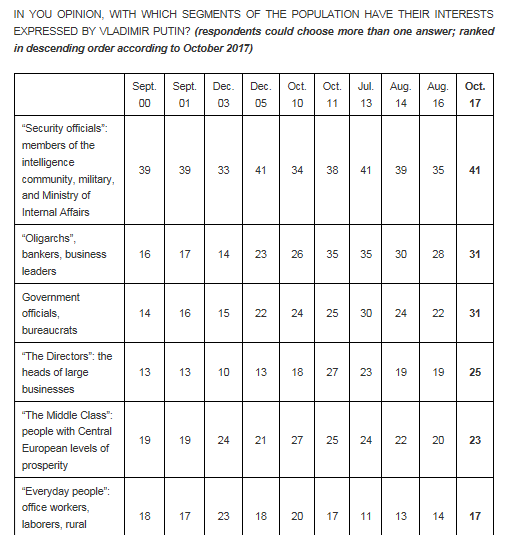
Putin also refused to address the prevailing opinion among Russian voters of what interests he and his government stand for, and who benefits most from his policies.


Click for the full story.


At Minute 1:15:26, Putin became a changed man. 


“I will speak about the newest systems of Russian strategic weapons that we are creating in response to the unilateral withdrawal of the United States of America from the Anti-Ballistic Missile Treaty and the practical deployment of their missile defence systems both in the US and beyond their national borders.”

A decade ago, Putin said, “nobody really wanted to talk to us about the core of the problem, and nobody wanted to listen to us. So listen now.” This produced the only standing ovation of the address.


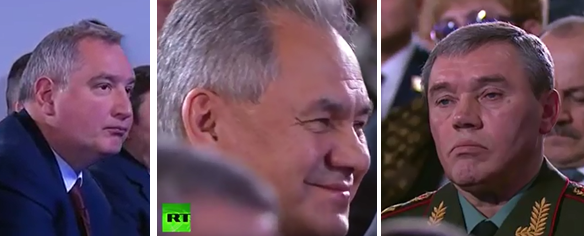
This was followed by Putin’s only attempts in two hours to joke, as he told the television audience some of the newly developed weapons haven’t been named yet. He invited them to send in their ideas to the Defence Ministry. The audience camera crews focused on the military leadership:


Left to right: Rogozin, Shoigu, and General Valery Gerasimov, 
Chief of the General Staff.

Putin’s analysis of the new weapons, and their targeting on US territory, is succinct. For further analysis, read Alexander Mercouris’s report. The usually careful Bulletin of the [American] Atomic Scientists claimed Putin “provided no proof that the new nuclear platforms actually exist” and attempted to dismiss the “video animations of the alleged weapons”. Putin anticipated the reaction.

“Be sure that everything I have said today is not a bluff ‒ and it is not a bluff, believe me.”

Rogozin, Shoigu and Gerasimov wrote the text; for the first time Putin said it with enthusiasm, and without qualifying himself.

“To those who in the past 15 years have tried to accelerate an arms race and seek unilateral advantage against Russia, have introduced restrictions and sanctions that are illegal from the standpoint of international law aiming to restrain our nation’s development, including in the military area, I will say this: everything you have tried to prevent through such a policy has already happened. No one has managed to restrain Russia.”

As a statement of Russian strategy, Putin is turning the US theory of Russian regime change on its head, reinforcing the president instead of isolating and toppling him. In practice, Russian sources in a position to know believe his performance reveals the new power of the military-industrial complex and the General Staff to fight the business oligarchs for influence over Putin, and for winning the succession.

They predict Putin’s successor will be more military-minded, more anti-American than Putin thought safe for himself until now.

Sunday, March 04, 2018

Israel Deeper into Syrian Big Muddy

Israel's Deepening Involvement in the Syrian War 

by TRNN


March 4, 2018

Israel has recently been intensifying air strikes and the arming of anti-government forces in Syria, some of which are close to Al Qaeda. Professor As'ad AbuKhalil explains how Israel's activity in Syria is part of a larger pattern of its overall foreign policy engagement around the world.


As'ad AbuKhalil is a leading expert on Middle East politics. He's also a professor of political science at California State University, Stanislaus, and he regularly writes at his website The Angry Arab News Service.

By Lies and Self-Deception: Israel's 'Moral Army' Mythos

The lies and self-deceptions at work within Israel's 'moral' army

by Jonathan Cook - The National ae


March 4, 2018

It is has been a very bad week for those claiming Israel has the most moral army in the world.

In the early 2000s, at the dawn of the social media revolution, Israelis used to dismiss filmed evidence of brutality by their soldiers as fakery. It was what they called “Pallywood” – a conflation of Palestinian and Hollywood.

In truth, however, it was the Israeli military, not the Palestinians, that needed to manufacture a more convenient version of reality.

Here’s a small sample of abuses of Palestinians in recent days in which the Israeli army was caught lying:

  • a child horrifically injured by soldiers was arrested and terrified into signing a false confession that he was hurt in a bicycle accident. 
  • A man who, it was claimed, had died of tear-gas inhalation was actually shot at point-blank range, then savagely beaten by a mob of soldiers and left to die. 
  • Soldiers threw a tear gas canister at a Palestinian couple, baby in arms, as they fled for safety during a military invasion of their village. 

Last week, it emerged, Israeli officials had conceded to a military court that the army had beaten and locked up a group of Palestinian reporters as part of an explicit policy of stopping journalists from covering abuses by its soldiers.

Israel’s deceptions have a long history. Back in the 1970s, a young Juliano Meir-Khamis, later to become one of Israel’s most celebrated actors, was assigned the job of carrying a weapons bag on operations in the Jenin refugee camp in the West Bank. When Palestinian women or children were killed, he placed a weapon next to the body.

In one incident, when soldiers playing around with a shoulder-launcher fired a missile at a donkey, and the 12-year-old girl riding it, Meir-Khamis was ordered to put explosives on their remains.

That occurred before the Palestinians’ first mass uprising against the occupation erupted in the late 1980s. Then, the defence minister Yitzhak Rabin – later given a Hollywood-style makeover himself as a peacemaker – urged troops to “break the bones” of Palestinians to stop their liberation struggle.

The desperate, and sometimes self-sabotaging, lengths Israel takes to try to salvage its image were underscored last week when 15-year-old Mohammed Tamimi was grabbed from his bed in a night raid.

Back in December he was shot in the face by soldiers during an invasion of his village of Nabi Saleh. Doctors saved his life, but he was left with a misshapen head and a section of skull missing.

Mohammed’s suffering made headlines because he was a bit-player in a larger drama. Shortly after he was shot, a video recorded his cousin, 16-year-old Ahed Tamimi, slapping a soldier nearby after he entered her home.

Ahed, who is in jail awaiting trial, was already a Palestinian resistance icon. Now she has become a symbol too of Israel’s victimisation of children.

So, Israel began work on recrafting the narrative: of Ahed as a terrorist and provocateur.

It emerged that a government minister, Michael Oren, had even set up a secret committee to try to prove that Ahed and her family were really paid actors, not Palestinians, there to “make Israel look bad”. The Pallywood delusion had gone into overdrive.

Last week events took a new turn as Mohammed and other relatives were seized, even though he is still gravely ill. Dragged off to an interrogation cell, he was denied access to a lawyer or parent.

Shortly afterwards, Israel produced a signed confession stating that Mohammed’s horrific injuries were not Israel’s responsibility but wounds inflicted in a bicycle crash.

Yoav Mordechai, the occupation’s top official, trumpeted proof of a Palestinian “culture of lies and incitement”. Mohammed’s injuries were “fake news”, the Israeli media dutifully reported.

Deprived of a justification for slapping an occupation soldier, Ahed can now be locked away by military judges. Except that witnesses, phone records and hospital documentation, including brain scans, all prove that Mohammed was shot.

This was simply another of Israellywood’s endless productions to automatically confer guilt on Palestinians. The hundreds of children on Israel’s incarceration production line each year have to sign confessions – or plea bargains – to win jail-sentence reductions from courts with near-100% conviction rates.


It is more Franz Kafka than Hollywood


A second army narrative unravelled last week. CCTV showed Yasin Saradih, 35, being shot at point-blank range during an invasion of Jericho, then savagely beaten by soldiers as he lay wounded, and left to bleed to death.

It was an unexceptional incident. A report by Amnesty International last month noted that many of the dozens of Palestinians killed in 2017 appeared to be victims of extra-judicial executions.

Before footage of Saradih’s killing surfaced, the army issued a series of false statements, including that he died from tear-gas inhalation, received first-aid treatment and was armed with a knife. The video disproves all of that.

Over the past two years, dozens of Palestinians, including women and children, have been shot in similarly suspicious circumstances. Invariably the army concludes that they were killed while attacking soldiers with a knife – Israel even named this period of unrest a “knife intifada”.

A half-century of occupation has not only corrupted generations of teenage Israeli soldiers who have been allowed to lord it over Palestinians. It has also created an industry of lies and self-deceptions to ensure that the consciences of Israelis are never clouded by a moment of doubt that maybe their army is not so moral after all.

Saturday, March 03, 2018

The Two Koreas - Real and Imagined

Empire Files: War With North Korea - Propaganda vs. Reality 

by TRNN


March 2, 2018

On top of overtly genocidal threats, the Trump Administration has announced new terms: that they "will never accept a nuclear North Korea." But, the Democratic Peoples' Republic of Korea already has nuclear weapons. Does that mean a war is imminent?


Abby Martin is the creator and director of "The Empire Files" on teleSUR English. Previously she hosted "Breaking the Set" on Russia Today. She founded the independent media site Media Roots and is a board member of Project Censored.

Follow her on Twitter @AbbyMartin.

From Kabul to Parkland: Teen to Teen 'Peace Zones'

Teen Solidarity Against the Merchants of Death

by Kathy Kelly - VCNV


March 1, 2018

Here in Kabul, as the rising sun begins to warm our chilly rooms, I hear excited laughter from downstairs.

Rosemary Morrow, a renowned Australian permaculture expert, has begun teaching thirty-five young students in a month-long course on low-resource farming.

In war-torn Afghanistan, there's a desperate need to rebuild agricultural infrastructure and help people grow their own food. People verging on despair feel encouraged by possibilities of replenishing and repairing their soil.

The night before, over dinner, one of the students discussed news from his home town in Afghanistan's Wardak province about U.S. aerial attacks.

"The blasts have become so frequent," he said,
"that people can't find spaces to bury their dead."

During breaks in the class, I tell some of the Afghan Peace Volunteer students about the school shootings in the United States, and the remarkable determination of teenagers from Florida to demand that lawmakers take action on gun control.

These Afghan students have also heard about Black Lives Matter activists who have been tear gassed and beaten when they've demonstrated against police brutality. The Afghan teens identify with the activists facing danger, but still standing up to insist on change.

I asked if they thought that the U.S. media and government would heed Afghan young people raising their voices asserting their anguish and fear regarding U.S. aerial attacks and drone assassinations.

"You're dreaming," said Hamid. He flashed me a warm smile and shook his head, saying,
"no one will ever listen to us."

The outrage now directed toward the National Rifle Association should also challenge all assaults made by the U.S. military.

Nasir, a third-year university student who majors in mapping technology, tells me he thinks teens in the United States have a chance to be heard. Like Habib, he doubts that the same is true for Afghan voices seeking to end the sixteen-year-old war.

But Zainab, a high schooler in the permaculture class, added that she thinks it would be great to record a vigil of teenagers in Kabul sending their support for U.S. teenagers who've survived school shootings in the U.S. and who've begun shaming the adult world into action on the issue of gun violence.

The outrage now directed toward the National Rifle Association should also challenge all assaults made by the U.S. military.

People often tell me they believe the U.S. military remains in Afghanistan because it wants to eventually control mineral wealth and other resources. But right now, weapon manufacturers like General Atomics and Boeing -- which supply the U.S. base in Kandahar with drones, missiles and bombs -- are profiting from the perpetuation of war. This profit gives them common cause with arms manufacturers like Sturm Ruger and Sig Sauer earning millions from equipping U.S. police forces as well as deranged killers in U.S. classrooms.

Yesterday, I read about U.S. aviation brigades training in Colorado's Fort Carson for possible Afghan deployment: 2,000 troops, part of an exercise called "Eagle Strike," are preparing for attacks with ground-pounding weapons.

The Kandahar base in Afghanistan now has three squadron's worth of MQ-9 Reaper drones. Costing $65 million each, these drones are outfitted to carry 560-pound GPS laser-guided bombs as well as Hellfire missiles.

Why fill the landscape of any country with craters and graves? What could we possibly hope to harvest?

Zainab tells me she thinks the teenage generation is changing and that more young people believe in training individuals and nations to avoid killing.

"Why can't we devise sustainable ways to bring about peace?" she asks.

I consider the idea that international teen solidarity could challenge both the U.S. military and the National Rifle Association to end assaults on human life.

"Our goal must be to demand that every person around the world agree to stop producing and using weapons," says Nasir.

I sit with them, and reflect on these courageous, clear-eyed Afghan and U.S. youth working in both countries to sow seeds that bear needed fruit, hoping they can change the adults as well.

Kathy Kelly (kathy@vcnv.org) co-coordinates Voices for Creative Nonviolence (www.vcnv.org) While in Kabul, she is a guest of the Afghan Peace Volunteers (ourjourneytosmile.org).

This article first appeared in The Progressive magazine.

Canada's Liberal Military Spending Budget

An Austerity and Militaristic Government Budget in Canada

by Roger Annis - A Socialist In Canada


March 2, 2018

Two years and four months ago, the Liberal Party was elected to national government in Canada on a platform of increasing government spending and tackling some of the country’s most glaring social injustices. On February 27, 2018, the government presented a national budget to Parliament. The budget provides a useful measure of the 2015 election promises, which, it turns out, very much resemble mirages. It also provides a forward look of the rhetorical themes which the Liberals will bring to the next national election, 20 months away.

Canadian Prime Minister Justin Trudeau and
Finance Minister Bill Morneau present a national
budget on Feb 27, 2018 (photo by CBC)

An austerity budget by any other name


The budget continues some 25 years of economic austerity waged by successive Liberal and Conservative party governments. The federal government’s budgetary balance as a percentage of GDP is projected to decline significantly from 2018 to 2023 (see the accompanying chart). The two large social program promises made by the Liberals during the 2015 election—a national pharmacare program (covering the cost of prescription drugs) and a national child care program have been left high and dry.

A writer in the Globe and Mail daily described the budget as, “social justice spending on a Liberal shoestring”.

In the October 2015 national election, the Liberals cleverly outmaneuvered the social democratic New Democratic Party by trumpeting child care and prescription drug coverage (‘pharmacare’), promising more spending to improve the status of Canada’s First Nations, and sweeping away the economic dogma saying government budget deficits are very bad.

Concerning pharmacare, the budget committed to ‘do something’ about it. The government has appointed an Advisory Council on the Implementation of National Pharmacare, the operative word being ‘implementation’. But Finance Minister Bill Morneau told a business crowd in Ottawa one day after his budget speech that he opposes universal prescription drug coverage. “We need a strategy to deal with the fact not everyone has access, and we need to do it in a way that’s responsible, that deals with the gaps, but doesn’t throw out the system that we currently have,” he said.

Morneau is playing with words, saying he favours a “national pharmacare strategy” but not a “national pharmacare plan”.

The cost of medications while in hospital is covered by Canada’s public hospital system. But once an individual leaves the hospital, he or she becomes responsible. The patchwork of provincial medical services covers most costs for poor people and for retirees, though not for many catastrophic drug treatments. Drug costs are escalating fast in Canada’s mixed for-profit/for-salaries health care system. In 2016, they accounted for 16.5 per cent of all medical expenses (hospitals ate up 28 per cent).

Work-based medical plans only cover some 36 per cent of drug costs, according to the Canadian Medical Association. The CMA reports on February 26 that a national pharmacare plan would significantly reduce overall spending on prescription drugs.

Way back in 2002, former NDP premier of Saskatchewan Roy Romanow issued a landmark study on health care in Canada. The report was commissioned by the Liberal Party government of Prime Minister Jean Chretien. Romanow’s report also declined to recommend a full pharmacare program. It made suggestions similar to Morneau’s musings 17 years later.

The Canadian Federation of Nurses, Canadian Doctors for Medicare and the Canadian Labour Congress have issued an open letter to Prime Minister Justin Trudeau calling for Morneau to be kept away from the deliberations of the pharmacare advisory council.

Concerning child care, Globe and Mail columnist Gloria Galloway explained on February 27,

“The Liberal government’s new economic plan extols the need to create more space for women in the Canadian work force but offers little financial assistance to make that happen…

“The biggest incentive the government could have offered to help women enter and stay in the work force – increased availability to affordable child care – was not in this budget.”

The glitter


Budget glitter consists of two sets of modest increases in social spending.

One set aims to facilitate women entering the work force (though not including a national daycare program). The government proudly calls its budget a ‘feminist’ document. But a writer on the state-run broadcaster the CBC writes,

“As per usual with this government, what we get is a lot of showy prayer, but no piety. It all sounds lovely, and focus grouped to appeal to the targeted voting demographic.

“But if anyone suffered the illusion that the Liberals were here to provide some kind of transformative government — one that will substantially improve the lives of women between the ages of 18-45 who are voting decision-makers in key suburban ridings — well, at least this budget will make us feel better, right?”

The other set is spending to alleviate some of the harsh social conditions in which most of Canada’s estimated population of 1.5 million Indigenous people live. The spending is supposed to improve access to clean drinking water, fund housing construction, and provide improved child welfare.

In June 2017, some 153 First Nations communities in Canada, out of the total of more than 600, were obliged to boil water before drinking it. According to Canada’s national census in 2016, 19.4 per cent of Aboriginal people lived in a dwelling that was in need of major repairs while 18.3 per cent of Aboriginal people lived in housing deemed overcrowded. (See the appendix of this article for further social indicators of Canada’s First Nations people.

Another ignored social right: housing


A vital area of social rights that was entirely absent from the budget was provision of housing.

Canada is undergoing a severe house price escalation, caused by capitalist market speculation and the abandonment decades ago by federal and provincial governments of the responsibility to build and manage quality social housing. Under pressure, a few provincial governments, notably British Columbia, have begun to tinker with taxation measures in order to bring down the price of some houses for home buyers. But there is nothing on the horizon that would see either level of government undertake the most meaningful measures by far to alleviate the country’s housing crisis and its poverty-level wages for millions of minimum wage or low wage earners—build and manage quality social housing.

In October 2017, the Liberal government announced a ‘national housing strategy’ that would see it spend $40 billion over the next ten years. Two housing rights activists in Vancouver–Jean Swanson and Sara Sagaii—released a six-point critique of that strategy, writing, 

“To get us out of the housing crisis and to implement a ‘housing as a right’ policy, we should be using government money to get land and housing out of the private market where it is a commodity, not help developers get control of more land and market housing.” (Read the two-page statement here: Six points on Canadian gov’t housing strategy, by Swanson and Sigalii, Nov 25, 2017.)

Military? What military?


Disturbingly, there is nary a word of reporting or commentary across the media spectrum–including in left wing media–on Canadian government plans to massively increase military spending.

Those plans were announced in June 2017. Defence Minister Harjit Sajjan said military spending would jump by 73 per cent in the coming ten years, from C$18.9 billion in 2016 to C$32.7 billion by 2027.

The new Liberal budget adds to those figures by projecting spending in the coming years of hundreds of millions of dollars, maybe billions, on what is called ‘cybersecurity’. That’s the new buzzword to describe domestic and international spying and disruption. And incredibly, the government says it plans to spend $600 million (!) to host a summit meeting of the G7 group of imperialist countries in Ottawa in June of this year.

Such are the times and such is the decline of antiwar protest in Canada that military spending is going largely unchallenged. It seems it is not even up for discussion any longer.

The reasons for the antiwar decline are complex. Trade unions have bought into the military-industrial-fossil fuel complex in the name of ‘jobs’ (see Arms sales to Saudi Arabia: The blood on Canada’s hands, news compilation by New Cold War.org, Jan 3, 2016). The mainstream media’s pro-war barrage concerning the points of conflict in Ukraine, Syria and Korea confuses and disorients many.

Much of the decline is due to the political left’s reluctance to face up to the new cold war being waged by imperialism against Russia and increasingly against China. Leftists succumb to superficial theories holding that Russia and China are ‘imperialist’; there no good side to choose when it comes to NATO’s military threats and arms escalation.[1]

Canadian military and political interventions abroad go unchallenged for these reasons. And while President Obama and now Donald Trump are escalating nuclear war threats with massive increases in nuclear spending, action in favour of nuclear disarmament is at a low ebb.

Canada and most other developed capitalist countries abstained in the historic vote of the UN General Assembly on July 7, 2017 in favour of the abolition of nuclear weapons. The shameful vote by Canada’s self-declared ‘feminist’ government was barely reported and not at all protested.

It’s difficult to pinpoint which of the many transgressions of the Liberal Party government of Canada ranks highest on the scale of danger and folly. Perhaps top prize goes to its continued commitment to policies that are warming the planet and threatening a sixth mass extinction of species (including the humans). Canada possesses the third-largest proven reserves of fossil fuels in the form of the tar sands of Alberta. The Liberal government in Ottawa and its best-of-friends NDP government ally in Alberta all hell bent to tear up and sell those reserves to the highest bidder.

Last year, in a groundbreaking study, Oil Change International estimated that Canada provides some $3 billion in annual tax breaks and other subsidies to keep the tar sands extraction machine running. For its part, the Alberta government has just announced $1 billion in loans and grants to the industry as part of the government’s stated intent to foster a 50 per cent expansion in tar sands production in the coming years.

New left-wing ideas and strategies needed


Canada desperately needs genuine parties of the political left which can offer alternatives to the country’s downward spiral. But for a host of reasons, the left refuses to embark on that path. Much of it is hoping against hope that the moribund NDP will somehow spring to life.

But nothing in the party’s history or present-day actions suggests this will happen. The recent national party convention which took place in Ottawa from February 16 to 18 saw the party’s conservative establishment firmly retain control and push back against any and all left-wing challenges.

Notwithstanding, left-wing writer Nora Loreto wrote hopefully in the February 23 Globe and Mail daily,

“The [NDP] establishment has to figure out how to decentralize their operations and strategy to make space for them [young, left-wing activists joining the NDP], too. Critically, to make space for dissent and to do things a different way.”

Rabble.ca columnist Karl Nerenburg described the convention in these words:

“Delegates listened to NDP leader Jagmeet Singh’s speech at the party’s biannual convention on Saturday [February 17] and felt inspired in a way they haven’t in a long time.” 

But then he contradicted that claim with,
 
“… By contrast, on other matters such as climate change, the NDP leader seemed almost deliberately non-specific. On global warming, he promised only to do better than the Liberals, without telling us what he would do. The word pipeline did not pass his lips.

“Similarly, the NDP leader evoked the situation of Indigenous Canadians, anti-Black racism, equal pay for equal work, universal internet connectivity and the need to make the wealthiest pay their fair share without enunciating any specific policy proposals.

“The speech represents more of a shift in tone and rhetoric for New Democrats than a lurch leftward in political ideology…”

In other words, the NDP remains mired in the same conservative and right-wing polices (on the social-democratic spectrum) which lost it the 2015 election. Meanwhile, and since that time, the pro-fossil fuel and timid social policy records of two provincial NDP governments–in Alberta and British Columbia–underline the point.

What is needed in Canada is much more than ‘dissent’. A new vision of a society founded on social and environmental justice is needed. Forms of political organization are needed to achieve a government that can lead societal transformation. How much longer can we afford not to act?

Roger Annis publishes his writings on his website ‘A Socialist In Canada’, along with selections of writings by others. The website also contains daily news notifications in three subject pages: World news, Canada newsroll, and Ecology newsroll. He can be reached at rogerannis@hotmail.com.

Note:

[1] Western media is expressing dismay at Vladimir Putin’s announcement on March 1, 2018 that Russia is successfully keeping pace with the new generations of weapons that the U.S. has been researching and developing, including ‘hyper-sonic’ missiles and drone submarines. See: In interview with NBC, Vladimir Putin says new arms race began in 2002 when U.S. pulled out of 1972 Anti-Ballistic Missile Treaty, RT.com, March 2, 2018. For background on the U.S.-driven nuclear arms race, see: The new nuclear race: Why North Korea isn’t the real story, by Debora MacKenzie, New Scientist, Sept 20, 2017, plus related materials, published on New Cold War.org, September 2017.

Appendix: Grim social indicators for First Nations people in Canada

From a report in the Globe and Mail on Jan 24, 2018 (additional sources indicated)

  • Forty four per cent of children from First Nations reserves graduate from high school, compared with 88 per cent of other young Canadians
  • Life expectancy of Indigenous people is 15 years shorter than the Canadian average
  • Inuit people [in Canada’s far north] are 270 times as likely to have tuberculosis
  • About seven per cent of Canadian children under 14 are Indigenous, but about 52 per cent of those in foster care are Indigenous.
  • In June 2017, there were some 153 First Nations communities with boil water advisories [there are more than 600 First Nations communities in Canada]. Some of those advisories were several decades old. The Liberal Party government in Ottawa has lifted 40 boil-water advisories since it was elected in October 2015, but 26 more have been added.
  • Suicide rates are six-to-seven times the rates of non-Indigenous people (see chart, source CTV News, April 2016)
  • Indigenous people make up approximately five per cent of the population of Canada. Indigenous men comprise 25.2 per cent of all in-custody males in prison, while Indigenous women comprise 36.1 per cent of all females behind bars (source: CBC News, Sept 15, 2017). The Indigenous incarceration rate is ten times higher than the non-Indigenous population. In the U.S. Black people are six times more likely to be imprisoned compared to those of Caucasians decent (source: Canada’s prisons are the ‘new residential schools’ for First Nations people, by Nancy Macdonald, MacLean’s Magazine, Feb 18, 2016).

Friday, March 02, 2018

Coming Soon: Battle Plan Lebanon

Israel Seeks US Ammunition, Support for Planned Attack on Lebanese Civilian Targets

by Whitney Webb - MintPress News


March 2, 2018

 Sen. Graham stated that the Israeli government was requesting “ammunition, ammunition, ammunition” from the U.S., as well as U.S. diplomatic support for when Israel strikes civilian targets — such as apartment buildings, hospitals, and schools — because Hezbollah has become “integrated” into these structures.


BEIRUT Just a few weeks ago, it seemed that Israel was on the brink of starting a war with Syria. However, Senator Lindsey Graham (R-SC), known for his neo-conservative tendencies, is now warning that it is Israel’s other northern neighbor, Lebanon, that is in the crosshairs.

At a press conference on Tuesday, Graham – who visited the Middle East with Senator Chris Coons (D-DE) – told reporters that “Southern Lebanon is where the next war is coming.”

Even though he has regularly supported Israeli military aggression and has long championed tearing up the Iran nuclear accord (JCPOA), Graham struck a grim tone, calling the trip “unnerving” and warning that the war for which the Israelis are planning is “going to be really bloody.”

According to Graham, who has received more than $380,000 from the Israel lobby over the past two election cycles, the Israeli government is preparing for war owing to the alleged presence of a rocket factory in Lebanon.

The factory is said to be connected to Hezbollah, a Lebanese political party originally formed to counter Israel’s illegal occupation of Lebanon in the 1980s. It is also a major military power in the country and has helped the Lebanese Army – a beneficiary of U.S. military aid – defend the country in past wars with Israel in 2000 and 2006. It has also spent the last several years successfully fighting terrorist groups like Daesh (ISIS) in Syria.

In addition, Marwa Osman, a political analyst and commentator living in Beirut, asserts that Israel’s claim that Hezbollah has a rocket factory in South Lebanon would be “laughable” if the threats built around this assertion didn’t threaten so many civilian lives. In an interview with MintPress News, Osman noted that Hezbollah’s armaments come from abroad, making the Israeli government’s claims unreasonable:

"Why would the Islamic resistance Hezbollah need a ‘factory’ when all the missiles and weapons they need are delivered as needed by the Islamic Republic of Iran? … Any sane person with just a map of Lebanon can see that it is practically impossible to have any sort of ammunition or weapons factory in the areas that Israel has as targets, namely the suburbs of Beirut known as Dahye."

Despite no concrete evidence showing the existence of the rocket factory, Israeli officials told the U.S. senators that, if the factory continues to operate, “they are going to have to go in,” as Graham put it. Stated differently, Israel is planning to invade Lebanon because Hezbollah – a major player in the Lebanese government – is allegedly making armaments that could be used against Israel at some point in the future. In other words, Israel is planning for a “preventative” war based on scant evidence.

To Osman, Israel’s lack of evidence did not come as a surprise:

Israel has never needed an excuse to invade or bomb any place. It has always situated itself at an offensive position with the same old excuse that it is defending its existence. What defense strategy are they talking about when they own the war planes and they invade the Lebanese and Syrian airspaces?”

Looking for ammo and diplomatic cover


According to other recent reports, Israel has no intention of losing against Hezbollah, as it did in 2006, and is instead aiming for a “decisive victory.” When asked what constituted a “decisive victory,” Maj. Gen. Yaakov Barak of the Israeli Defense Forces (IDF) responded,

"If we manage to kill [Hezbollah leader] Nasrallah in the next war, I would see that as reaching a decisive victory."

Lebanese President Michel Aoun, a Christian and a supporter of Hezbollah, condemned the threats of war — stating, during a meeting with the Under-Secretary-General of the United Nations, that,

"Lebanon is keen on maintaining stability and calm in South Lebanon, but it is also ready to defend itself [should] Israel carry out an assault."

However, Graham’s own statements cast doubt on the official narrative for the impending war. Graham stated that the Israeli government was requesting “ammunition, ammunition, ammunition” from the U.S. government, as well as diplomatic support for when Israel strikes civilian targets — such as “civilian apartment buildings, hospitals, and schools”– because Hezbollah has become “integrated” into these structures.

This request from the Israeli government builds on past statements from Israeli officials, such as those made by Israeli Education Minister Naftali Bennett. Bennett told Israeli newspaper Haaretz last year that civilians “must” be targeted the next time Israel and Lebanon go to war:

"The Lebanese institutions, its infrastructure, airport, power stations, traffic junctions, Lebanese Army bases – they should all be legitimate targets if a war breaks out. … This will mean sending Lebanon back to the Middle Ages."

As Osman noted, Israel has frequently targeted civilian targets in its military incursions into Lebanon:

"Isn’t bombing hospitals and schools and apartment buildings the same exact strategy that Israel uses each time it bombards Lebanese targets?"

Given these requests, Israel is not planning to just bomb the rocket factory it claims to be existentially threatened by. Instead, it is actively preparing to bomb “civilian” targets because the supporters and members of a Lebanese political party live there. Making preparations for a war that will intentionally target civilians can hardly be called a war of “self-defense,” especially given that Israel receives over $10 million in military aid from the United States every single day. Instead, this has all the markings of a war of aggression targeting innocent people.

Self-defense or another resource war?


While Israel is framing this impending war as defensive, recent evidence suggests that defeating Hezbollah is likely a war intended to claim critical resources and secure geopolitical dominance in the Middle East. For example, Israel and Lebanon have recently taken part in heated exchanges regarding control over the natural gas fields in the Levant basin, which, in total, are estimated to contain 1.7 billion barrels of recoverable oil and 122 trillion cubic feet of gas.

Two of the blocks assigned to Lebanon soon after the discovery of gas in the area in 2009 were recently auctioned off in late January to a consortium of European and Russian energy companies. However, one of those blocks is disputed by Israel, leading Israeli Defense Minister Avigdor Lieberman to call the move “very, very challenging and provocative conduct,” fueling speculation that Israeli military action is not far behind.

In addition, Israel – currently in the midst of a historic drought – has a renewed interest in the rich freshwater resources in Southern Lebanon. Even prior to Israel’s official founding, Zionist strategic planners had originally sought to incorporate the Litani river, Lebanon’s largest, as its northern border, but met resistance from the French who, at the time, were the colonial power in control of Lebanese territory. However, Israel never gave up on its ambitions.

For instance, several experts have asserted that Israel’s occupations of Lebanese territory in 1978 and 1982 were a direct result of Israel’s desire to obtain the water resources of southern Lebanon. In 1982, Israeli plans to siphon off as much as 60 percent of the Litani’s flow into Israel were made public. Since Hezbollah expelled Israel from South Lebanon in 2000, water has also been a major factor in subsequent conflicts.

While resources are a contributing factor, Osman asserts that the main factor driving Israel’s aggression is “the readiness and power of the resistance [Hezbollah].”

Osman continued:

"The Lebanese Resistance Hezbollah has gained a lot of new experiences and enhanced its missile capabilities to a point where they might even have their hands on an air-defense system. This means that now Israel is at risk of even flying into Lebanese airspace."

These “new experiences” have come courtesy of Hezbollah’s involvement in Syria — where it has successfully assisted the Syrian government in the fight against terrorist groups supported by Western governments, the Gulf monarchies, and Israel — which has strengthened Hezbollah’s military component.

According to Osman, Hezbollah’s increased capabilities resulting from its involvement in Syria have caused great concern within the Israeli government:

"The fact that for the past three years the joint and coordinated efforts between the SAA [Syrian Arab Army] and Hezbollah have resulted in the liberation of approximately 70 percent of the Syrian territory from Western backed takfiris (keeping in mind that the amount of land liberated equals three to four times the size of Palestinian occupied territories) puts Israel in a very paranoid position."

Israel had supported the Syrian opposition forces with the hopes of not only toppling the Syrian government but also weakening Hezbollah. Having failed to weaken Hezbollah through a proxy conflict in Syria, Israel is now making a desperate bid to do so by funding seven different rebel factions in southern Syria while also threatening the civilian population in southern Lebanon. Not wanting to be outmatched by its resilient and resourceful enemy again, the threat of war that Israeli officials are making appears to be a plan to go straight at the source — i.e., Hezbollah’s civilian supporters — in a desperate bid to counter Hezbollah.

Whitney Webb is a staff writer for MintPress News who has written for several news organizations in both English and Spanish; her stories have been featured on ZeroHedge, the Anti-Media, and 21st Century Wire among others. She currently lives in Southern Chile. 


Republish our stories! MintPress News is licensed under a Creative Commons Attribution-NonCommercial-ShareAlike 3.0 International License.