Wednesday, June 19, 2019

Advocate in Chief: UN's Special Rapporteur on Torture, Nils Melzer Assange Champion

UN Rapporteur on Torture Nils Melzer Becomes One of Assange’s Most Vocal Advocates

by Jimmysllama - MintPress News


June 19, 2019 

“Here [in Assange’s case] we are not speaking of prosecution but of persecution. That means that judicial power, institutions and proceedings are being deliberately abused for ulterior motives.”Nils Melzer, UN Rapporteur on Torture

On May 9, UN Rapporteur on Torture Nils Melzer, visited WikiLeaks founder and journalist Julian Assange at Belmarsh Prison, where he is currently serving a 50-week prison sentence for a minor bail violation. Melzer was accompanied by two medical experts who specialize in the examination of possible victims of torture as well as the documentation of symptoms, both physical and psychological.

The team was able to speak with Assange and conduct a medical assessment following a set of guidelines known as “The Istanbul Protocol,” a tool designed to help UN workers and others investigate, document, and report incidents of torture and ill-treatment.

The results were shocking.


According to Melzer, the evidence is overwhelming that Assange has been “deliberately exposed, for a period of several years, to progressively [more] severe forms of cruel, inhuman or degrading treatment or punishment,” the effects of which he described as psychological torture. Melzer also found that Assange has been exposed to:

“persistent, progressively [more] severe abuse ranging from systematic judicial persecution and arbitrary confinement in the Ecuadorian embassy, to his oppressive isolation, harassment and surveillance inside the embassy; and from deliberate collective ridicule, insults and humiliation, to open instigation of violence and even repeated calls for his assassination.”

The UN Rapporteur admitted that he had been reluctant to investigate Assange’s case, not because he felt that Assange was a “bad actor” but rather because he had been “affected by the same misguided smear campaign as everybody else.” But as he delved deeper into the case he found that Assange had been subjected to a “relentless and unrestrained campaign of public mobbing, intimidation and defamation,” during which time no government involved tried to intervene or protect him.

“In 20 years of work with victims of war, violence and political persecution I have never seen a group of democratic States ganging up to deliberately isolate, demonise and abuse a single individual for such a long time and with so little regard for human dignity and the rule of law.” (UN release)

As a result of the limited number of outside influences to which Assange was exposed, as well as his confinement to a small, controlled environment within the Ecuadorian Embassy in London for more than seven years, Melzer believes that it’s possible to determine the causes of Assange’s symptoms with a high degree of certainty. He found that four nations have “contributed to medical effects” that Melzer and his team observed: Sweden, the U.K., Ecuador, and the U.S.

A UN statement about Melzer’s findings was released on May 31, and since that time Melzer has become one of Assange’s most active and vocal advocates, taking part in well over a dozen interviews about his health, legal difficulties, judicial bias, and more. Below is a summary of 12 different interviews he has given over approximately the last three weeks.

Sweden


Melzer has frequently spoken about the “elephant in the room,” which he describes as the United States’ attempts to have Assange extradited in order to make an example out of him. Essentially every judicial proceeding Assange has faced since 2010 has revolved around this threat.

His legal troubles began in August 2010, when Sweden opened an investigation into allegations of sexual misconduct, including rape and molestation. However, rather than contact Assange directly for questioning, Swedish authorities publicized the case despite the fact that Swedish law strictly prohibited them from doing so. Upon learning about the investigation, Assange immediately went to the police and made a statement, after which the case was closed owing to a lack of evidence.

Days later the case was reopened by a different prosecutor and Assange remained in Sweden until the end of September in order to assist with their investigation. On September 15, 2010, Swedish prosecutor Marianne Ny granted Assange permission to leave the country; so, despite an almost decade-old narrative that Assange “fled” Swedish charges (he was never charged) by hiding out in the Ecuadorian Embassy in London, that is absolutely and categorically not true.

It’s also important to note that, when Assange left Sweden, authorities seized his belongings at the airport, including a laptop and other electronics; at which point, had the Swedish prosecutor been so inclined to keep him in the country for questioning, they could have seized him right then and there. Instead, they allowed him to leave.

Once Assange was in the U.K., Sweden requested that he return for questioning, which aroused suspicion owing to the fact that, as Melzer pointed out, the country has a history of cooperating with the U.S. government and turning people over to it without due process, some of whom were rendered and later tortured. Assange feared, correctly, that the “elephant in the room” lay hidden behind Sweden’s request.

He offered to cooperate with Swedish officials if they would guarantee no extradition but they refused to do so, a disingenuous move that not only prevented Assange from defending himself but made clear how little Swedish authorities respected or, perhaps, believed the alleged victims’ stories. Assange also offered to be questioned by video link but they declined.

After the U.K. Supreme Court upheld a Swedish extradition request (over questioning in the case, not charges) in May 2012, Assange, again, under the credible fear that Sweden would extradite him to the U.S., entered the Ecuadorian Embassy in London, where he sought asylum for political persecution.

He continued to try to assist Swedish officials and offered to be questioned at the Embassy but Sweden refused, despite having previously questioned at least 44 other individuals by video link or traveling for in-person interviews. The Swedish government’s outlandish refusals only fueled speculation that it was working on behalf of the United States. The investigation was finally closed in 2017, but was resurrected by Swedish officials last month.

Melzer points out that the reopened case is not about a violent and/or forced sexual encounter but rather the allegation that Assange purposely tore a condom during consensual sexual relations. The condom was later examined by authorities, who were unable to detect any DNA on it, including Assange’s. This is what Sweden describes as “rape,” and what it has used repeatedly to publicly characterize Assange as a rapist.

Emails between the U.K.’s Crown Prosecution Services (CPS) and Sweden also show that the U.K. pressured Marianne Ny to keep the investigation going despite the fact that there have never been any charges or evidence, leading Melzer to suggest that there are alternative motives behind the case.

Sweden made it impossible for Assange to cooperate without risking being extradited to the U.S., while his reputation, credibility, and human dignity have been “gravely affected by these allegations,” reported Melzer. As stated earlier, the case was reopened last month, making it virtually impossible to believe that this isn’t about the “elephant in the room.”

Almost 10 years of judicial and public abuse


Since WikiLeaks published “Collateral Murder” and the Iraq and Afghanistan War Logs in 2010, Melzer reported that there has been a “sustained and concerted effort by several States” to get Assange extradited to the U.S., and an “endless stream of humiliating, debasing and threatening statements in the press and on social media.” Inappropriate statements have also been made by “senior political figures and even by judicial magistrates involved in proceedings against Assange.”

Reuters reported that Melzer “declined to identify judges or senior politicians whom he accused of defaming Assange,” but you don’t have to look very far to find them:


According to Melzer, all of this has led up to a level of stress that would be unbearable for anyone and, as he put it:

“Here we are not speaking of prosecution but of persecution. That means that judicial power, institutions and proceedings are being deliberately abused for ulterior motives.”

The UN Rapporteur repeatedly condemned Assange’s treatment in various interviews, stating that he is “appalled at the sustained and concerted abuse this man has been exposed to at the hand of several democratic States over a period of almost a decade.” Although Ecuador’s abuse of Assange didn’t start until Lenin Moreno came to power in 2017, since that time government officials deliberately harassed him in an attempt to get him to leave the embassy or to “trigger a health crisis that would justify his expulsion” from the embassy and into British hands.

Neither of those things occurred but President Moreno did expel him from the embassy and suspend his Ecuadorian citizenship without due process of law on April 11, 2019.

The torture of Julian Assange


According to Melzer, Assange has been gravely affected “by the extremely hostile and arbitrary environment he’s been exposed to” over a long period of time and the “evidence is overwhelming and clear” that he is being psychologically tortured, confirming what many already believed or reported.

Melzer and his team determined that Assange is also suffering from severe post-traumatic stress disorder, with symptoms of “chronic anxiety, permanent severe stress and agitation” (no relaxation or satisfactory sleep for months, possibly years).

During Melzer’s meeting with Assange, the UN Rapporteur found him to be “agitated, under severe stress, and unable to cope with his complex legal cases,” and since his imprisonment, his ability to focus has been compromised. He was also “extremely jumpy,” and Melzer found it difficult to have a “structured” conversation with him.

Assange’s concern was that he couldn’t rely on fair judicial proceedings in either the U.S. or Sweden and that he had no means or time to prepare for the “multiple, complex legal proceedings that are expanding as we speak,” Melzer said. This — accompanied by the hostile, degrading, and humiliating treatment he’s been subjected to, consistently, for almost a decade — has led to “severe stress…and psychological trauma.”

The psychiatrists that accompanied Melzer to the prison noted that Assange needs access to a psychiatrist who isn’t part of the prison system — someone he can trust — and that “if he doesn’t get that and if the pressure on him is not alleviated rapidly,” further deterioration could occur and prolonged effects could result in permanent damage such as irreversible cardiovascular damage — or worse.

Assange’s condition is extremely serious and when he was asked whether Assange could actually die in prison if his calls are ignored, Melzer responded:

“Absolutely. Yes, that’s a fear that I think is very real…it has to stop here and it has to stop now.”

The concept of (dis)proportional treatment


During Melzer’s interview with Going Underground, he explained the concept of proportional treatment and how it has factored into Assange’s case. Proportionality is best described as the idea that the severity of the punishment should fit the seriousness of the crime, a concept that has not been applied throughout Assange’s judicial proceedings.

Take, for instance, Sweden’s reopening of its investigation of Assange. As previously stated, he was accused of ripping a condom during a consensual sexual encounter, yet no DNA was ever found on the condom and no evidence suggests this happened. This is what Sweden has used to cast him as a rapist in the public’s eye, despite the presumption of innocence and Swedish law forbidding the government to expose details about the case, such as the accused’s identity.

The UN Rapporteur — a Swiss academic and law professor at the University of Glasgow who has authored several books on international law — explained that any prosecutor confronted with this case would likely conclude that the condom looked planted, owing to the absence of any witnesses (except Assange and the woman), any evidence of physical harm, any DNA, and any transfer of STDs. Melzer stated:

“There is no evidence and the prosecutor will know from the beginning, it’s predictable that Julian Assange will have to be acquitted because of presumption of innocence…In these circumstances it is disproportionate to pursue this preliminary investigation for almost a decade.”

Meanwhile, as noted above, Sweden refused to guarantee that it wouldn’t extradite Assange; refused to question him in such a manner that would guarantee his safety, such as by video link or in person at the embassy in London; and refused to do so despite having conducted similar interviews with individuals under investigation in the same manner. Sweden also refused without explanation.

Then, on April 11, 2019, Ecuador’s President Lenin Moreno expelled Assange from the Ecuadorian Embassy with no due process, while he was “unconstitutionally stripped of his citizenship.” Moreno’s decision led to Assange’s arrest by British authorities and Melzer questioned, “What country can [deny you] asylum and citizenship without due process?”

Within three hours of his arrest, Assange was brought to court for a hearing, for which he was granted a mere 15 minutes to prepare with his attorneys, the same amount of time that the hearing lasted. While in front of the judge, his lawyer tried to object based on the “strong conflict of interest” on the part of the judge, who had previously upheld Sweden’s arrest warrant (culminating in the bail violation) and would be overseeing Assange’s extradition case. They asked that the conflict be investigated.

In an extraordinary display of bias and unprofessionalism — perhaps even judicial misconduct — the judge refused to take into account the conflict of interest as well as Assange’s credible fear of being extradited and the fact that Ecuador had given him political asylum, which it contravenes the UNHCR Cessation Clauses to revoke while the threat that gave rise to it remains. Instead, he called Assange a “narcissist” and sentenced him to 50 weeks in a high-security prison for a minor bail violation — and that is the epitome of disproportionality.

Melzer believes that:

“We all have to take a step back and ask if all of these proceedings are fair…we also have to take a step back and ask if the narrative is right — rapist, narcissist, selfish, ungrateful, hacker — and scratch the surface a bit and see what’s underneath there.”

U.K. complicity in Assange’s torture


Melzer noted, as we all have, that Assange’s extradition case is being handled by Emma Arbuthnot, the same judge who refused to withdraw Sweden’s 2010 arrest warrant last year despite the fact that the investigation had already been closed. She’s also married to Lord Arbuthnot — the former U.K. minister of defense; former chairman of the defense committee; director of SC Strategy, which is owned by the former head of MI6; and a member of the advisory board for Thales, one of the largest arms manufacturers and dealers in the world.

What makes this situation even more questionable is the fact that Lord Arbuthnot was exposed in WikiLeaks’ publications and that alone — the fact that a judge with such a gross conflict of interest as this has been allowed to sit for not one, but two of Assange’s cases — contributes to the psychological torture, intense stress, and anxiety he’s already experiencing, explained Melzer.

Melzer’s belief is that the U.K. government has “failed to show impartiality and objectivity towards Mr. Assange that is required under the rule of law,” and his concern is that if the government fails to investigate “inappropriate statements, conflicts of interest,” or other sources of bias, his extradition hearing will be nothing more than a “fig leaf for his already pre-judged refoulement [the forced transfer of refugees to a country that is likely to persecute them] to the United States.”

Besides judicial bias and persecution, the U.K. is currently limiting Assange’s access to case documents, as well as to his lawyers, which obstructs his ability to prepare a proper defense. Apparently, he’s not even allowed to have legal documents in his prison cell, nor a computer to work on so he can stay in contact with his attorneys and draft statements.

Multiple legal proceedings that are “piling up” add to Assange’s stress and inability to cope with the demands of his proceedings, stated Melzer, who concluded: “Human Rights law requires that the defendant get enough time to prepare his defense.”

Extradition to the United States


Melzer’s greatest concern about Assange being extradited to the United States is that he will not receive a fair trial and that he’ll be “exposed to a real risk of serious violations of his human rights,” including but not limited to torture and cruel and unusual punishment. He believes that Assange would likely be “subjected to prolonged solitary confinement, to very harsh detention conditions, and to a psychological environment which would break him eventually.”

Assange is currently facing 18 charges in the United States, 17 of which fall under the Espionage Act for doing what journalists do everyday. Melzer believes that “the main narrative in this affair really is the United States wanting to make an example of Mr. Assange in order to deter other people from following his example.”

Subjecting Assange to a harsh sentence, severe prison conditions, and solitary confinement for journalism “amounts to cruel and unusual punishment and [is] in violation of international law as well as the Eighth Amendment of the Constitution,” said Melzer. And prosecuting him for doing what every good investigative journalist and publisher does would be a gross violation of the First Amendment.

The meaning of a fair trial


During his interview with Chris Hedges on RT’s program On Contact, Melzer explained what is meant by a “fair trial” and why he doesn’t think Assange will get one in the United States. First, a fair trial requires that the accused is presumed innocent until proven guilty, but Melzer argues that both public and political opinion has been so tainted against him that it seems absurd to think that Assange would be afforded due process, that his rights would be protected, or that he would face an unbiased judge and jury.

Second, a fair trial requires equality before the law but when the government fails to prosecute those who commit war crimes while prosecuting those who expose them, there is no equality before the law.

As Melzer pointed out, no U.S. officials or military soldiers have ever been charged for gunning down innocent Iraqis, including children, and two Reuters journalists during a 2007 Baghdad airstrike, a crime that was exposed in WikiLeaks’ “Collateral Murder” video. Additionally, no one has been charged for the CIA’s torture program despite the U.S. government’s obligations under the Convention Against Torture. It’s hardly surprising then that the United States has a dismal track record when it comes to enforcing the prohibition of torture. “The only person being prosecuted here seems to be the one that actually exposed all of these crimes,” stated Melzer:

“The government really loses any credibility…that’s where — why I say prosecution then becomes persecution because there is no longer the rule of law… These are proceedings that are fundamentally skewed against the defendant.”

As an example of equality under the law, Melzer pointed to two Reuters journalists who had been imprisoned in Myanmar for exposing the massacre of 10 Muslims by Myanmar’s military. Although they were sentenced to 10 years in prison, the soldiers were also prosecuted and sentenced. Both were also later pardoned. But in Assange’s case, one needs only to look at the treatment (torture) and sentencing (35 years in prison) of Chelsea Manning, the whistleblower who leaked U.S. government crimes — and the fact that no one has ever been charged for those crimes — to realize that it’s “utterly unrealistic” to think Assange might be given a fair trial, acquitted, or given a light sentence.

When asked if he thought Assange had committed a crime, Melzer responded that he didn’t think so: although one could try and build a case against him for trying to help someone (unsuccessfully) break a code, “it’s a bit like charging someone for trying to exceed the speed limit but not succeeding because the car is too weak.”

Australia


Even Australia isn’t off the hook, according to Melzer, who believes that they have been a “glaring absentee” in Assange’s case. He stated that they have failed to “take steps to protect their national — certainly not from justified criminal prosecution — but to protect him from this kind of excessive, almost persecution that he’s experiencing currently.”

Media culpability and the threat to a free press


Melzer admits that he was reluctant to investigate Assange’s case because he had been affected by media propaganda and that it wasn’t until he started to “scratch the surface” of it that he realized how little substance there was to the stories — but how much spin and manipulation lay beneath.

He urged everyone to look deeper into the case and warned us that we have been deliberately misled about Assange. From The Canary:

“The predominant image of the shady ‘hacker,’ ‘sex offender,’ and selfish ‘narcissist’ has been carefully constructed, disseminated and recycled in order to divert attention from the extremely powerful truths he exposed…”

It can’t be emphasized enough how insightful Melzer’s interview with The Canary was in terms of the media’s accountability and how Assange’s case will affect a free and protected press:

“In today’s information age, the media have an extraordinary power to shape public opinion…The media are a veritable ‘fourth power’ in the state next to the traditional branches of government, controlling not only what is said and shown, but also what is not disseminated…media outlets and individual journalists…have contributed significantly to spreading abusive and deliberately distorted narratives about Mr. Assange.”

Melzer went on to say that the media has failed to challenge governments or hold officials accountable for criminality and corruption and that they have created conditions that are ripe for violating Assange’s “most fundamental rights without provoking public outrage.”

He warned against Assange’s extradition in the UN’s released statement because it would raise concerns over the criminalization of investigative journalism, and in The Canary interview he stated that it would “establish a dangerous precedent of impunity threatening freedom of press and opinion worldwide.”

Melzer’s recommendations


Since his medical assessment of Assange, Melzer has sent out four official letters to Sweden, the U.K., Ecuador, and the United States urging them to “refrain from further disseminating, instigating or tolerating statements or other activities prejudicial to Assange’s human rights and dignity.” He also asked that they take measures to provide Assange redress and rehabilitation and that he not be extradited to the U.S. or any country that refuses to guarantee no extradition.

All our countries have violated the Convention on Torture and are directly involved in the “sustained and concerted abuse” inflicted on Assange. Melzer believes that if Assange has really committed a crime, he has the right to develop a defense with his attorneys and a guarantee that his rights will be protected. The UN Rapporteur would also like to see an “independent observation” on how Assange’s judicial proceedings are handled, as well as his health stabilized, and that he be given time to recover before having to face the monumental court proceedings ahead of him.

Melzer’s personal belief is that Assange should be released, compensated, and rehabilitated by the four involved States because he has suffered enough.
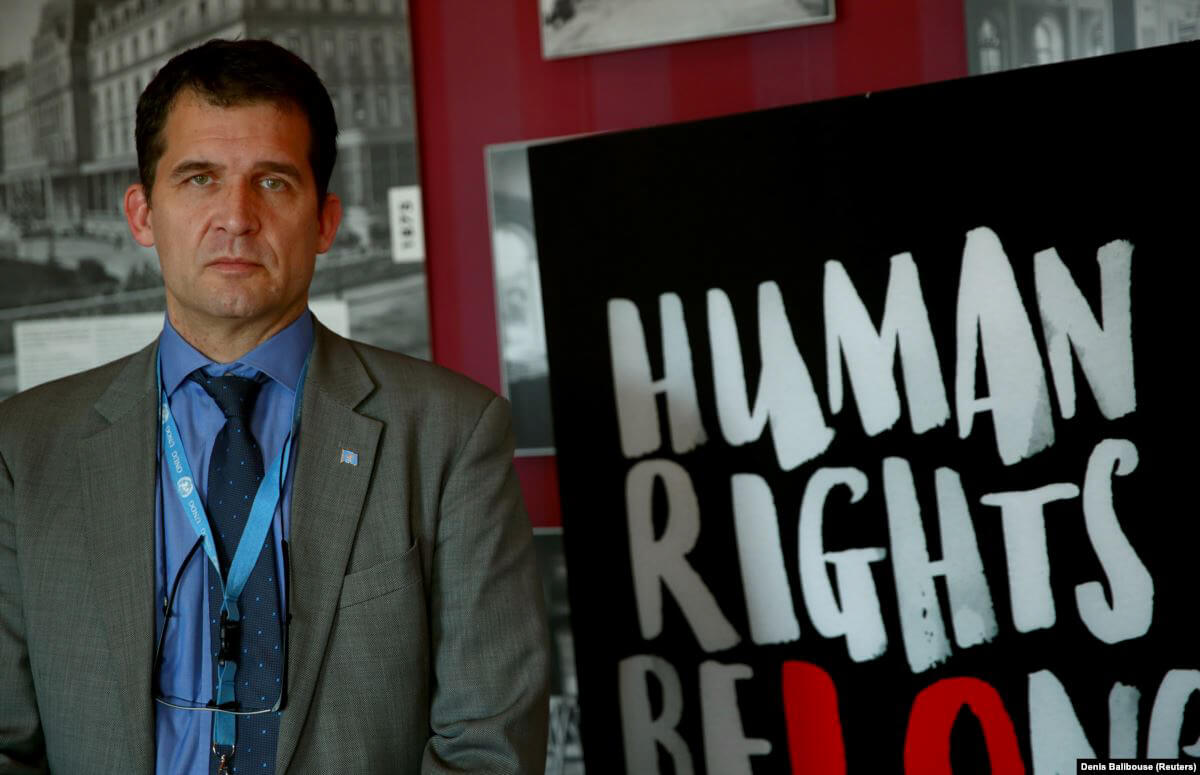

Nils Melzer after visit with Julian Assange May 31, 2019. 
Photo | Denis Balibouse

The opinions of Melzer, whether personal or professional, should not be taken lightly. In addition to being appointed UN Special Rapporteur on Torture and Other Cruel, Inhuman or Degrading Treatment or Punishment in 2016, he is the current human rights chair of the Geneva Academy of International Humanitarian Law and Human Rights, and served as a legal adviser, delegate and deputy head of delegation with the Red Cross for 12 years, during which time he worked in conflict zones.

He has an extensive background in humanitarian work and, according to the European Parliament, he specializes in “targeting and the use of force, cyber-conflict and the regulation of private military and security companies.” His focus also includes work on “international legal challenges arising in the contemporary security environment,” and he has authored several books — such as Target Killing In International Law, which examines the legality of targeted killing — as well as academic papers like “Cyberwarfare and International Law,” which discusses the humanitarian aspects of cyberwarfare as well as how international law pertains to it.

To say that Melzer is qualified in his field would be an understatement and his report on Julian Assange and the role that Sweden, the U.K., Ecuador, and the United States have played in the psychological torture and deteriorating condition of Julian Assange should be taken with the seriousness it deserves.

In summary


The UN Rapporteur on Torture, Nils Melzer, concluded that Julian Assange is and has been for years psychologically tortured and that available evidence strongly suggests Sweden, the U.K., Ecuador, and the United States are responsible for the “sustained and concerted abuse inflicted” upon him. Each of these countries have failed to protect the Australian publisher from “serious abuse, insult, and intimidation by media and other private actors within their jurisdiction.”

“By displaying an attitude of complacency at best, and of complicity at worst, these governments have created an atmosphere of impunity encouraging Mr. Assange’s uninhibited vilification and abuse.”

Additionally, Assange is being denied the right to fair judicial proceedings and due process — including the U.S. secret grand jury indictment; the Swedish government’s continued investigation and dissemination of “Assange is a rapist” propaganda; U.K. judges’ overt bias and conflicts of interest; and lastly, Ecuador’s termination of his asylum status and citizenship. Melzer recently wrote on Twitter:

“In U.K. courts #Assange is insulted a ‘narcissist’; jailed for seeking asylum; facing US extradition for journalism’ prosecuted by CPS known to have instigated his persecution; under a judge with known conflict of interest; under a Govt having prejudged him.”

As of now, Melzer believes that the most logical explanation for the “sustained systematic failure of the judiciary” under which Assange has suffered is that the U.S. is trying to make an example of him in an effort to deter others from doing what it is that WikiLeaks and Assange do: publishing the truth.

For Melzer, it’s almost inconceivable that there are “so many layers of so profoundly skewed and bias[ed] steps in the judicial proceedings” for this to be a coincidence. He doesn’t believe Assange would receive a fair and impartial trial in the U.S. and the case raises serious concerns about a free press.

“The collective persecution of Julian Assange must end here and now!” declared Melzer.

A full extradition hearing has been set for February 2020.

Feature photo | Menyalastudio | Shutterstock

Jimmysllama is an independent researcher and writer who provides balanced, critical analysis with a focus on the Boston bombings, Magnitsky Act, and WikiLeaks. She is currently trying to stay warm in the Midwest. You can read more of her work at jimmysllama.com and find her on Twitter at @jimmysllama

Republish our stories! MintPress News is licensed under a Creative Commons Attribution-NonCommercial-ShareAlike 3.0 International License.

Remembering the Vincennes: Culprits We KNOW Shot Down Civilian Airliners

Remember the Vincennes? The US’s Long History of Provoking Iran 

by Linn Washington Jr. - CounterPunch


June 17, 2019   

Remember the Vincennes? That’s the name of the U.S. Navy warship that shot down an Iranian airliner with missiles in 1988, killing all 290 people aboard that airplane. That shootdown, where 60 children perished, was an accident, according to the U.S. Navy’s official report. However, many, including military personnel, considered that report a whitewash.

That U.S. military attack on a civilian airliner occurred during a time when the administration of then U.S. President Ronald Reagan was all but openly supporting Iraqi dictator Saddam Hussein, who had launched a war of aggression against Iran – the nation now in the crosshairs of the President Donald Trump Administration.

The Vincennes incident is instructive as the Trump Administration is seemingly searching for a ripe moment to launch a war against Iran, an action long sought by right-wing forces in the United States along with U.S. Middle East allies Israel and Saudi Arabia.

Similar to U.S. anti-Iran stances in the 1980s when the U.S. pressured Iran as part of its tilt toward the invading but quickly battered Iraqis, the Trump Administration is waging an economic war against Iran through economy-crippling sanctions. The goal is to bludgeon Iran after Trump unilaterally withdrew from a nuclear non-proliferation treaty that had Iran’s full compliance.

The July 3, 1988 Vincennes incident is also instructive because it vividly displayed of how things can go horribly wrong really quick and how the U.S. government will brazenly lie to evade liability for its criminal misconduct.

With the U.S. playing a ‘Top Cop’ role in the Persian Gulf – today as in the 1980s ostensibly to contain Iran – it’s interesting that the U.S. Navy’s defense of that indefensible 1988 airliner shootdown contained components of excuses utter persistently by American police in instances of fatal shootings of unarmed civilians.

In the cases of those murdered by American cops, the offending officer immediately declares he or she fired because they feared for their life. The captain of the Vincennes declared he ordered the airliner to be shot down because he feared for his life…the life of his ship and crew allegedly endangered by an unarmed civilian airliner.

Like the standard cop defense of supposedly seeing a gun in the hand of the unarmed suspect, Vincennes Captain Will Rogers claimed he saw a jet fighter descending in fast attack approach not a widebody airliner ascending after taking off from an airport.

Like the physical evidence in too many cop shootings that contradict cop claims, data from the sophisticated combat control computer system onboard the Vincennes contradicted the contentions of its captain. Top Navy and Reagan Administration officials later accepted that captain’s claims as valid.

Another parallel between cop shootings and the airliner shootdown is the blame-the-victim reflex.

The Vincennes captain, Navy brass, top Reagan Administration officials (along with much of the American mainstream news media) blamed Iran for allowing its airliner to fly outside the corridor for commercial airliners, allowing that airliner to operate without using identification signals for civilian airplanes and allowing the airliner to fly over a skirmish where lightly armed Iranian military motorboats were allegedly harassing the Vincennes, a heavily armed cruiser larger in size than any U.S. naval vessel except an aircraft carrier.
Photograph Source: Navy Camera Operator:
PH3 RONALD W. ERDRICH, USN – Public Domain

As in the case of American cop shootings of unarmed civilians, that blame-the-victim reflex quickly fell apart. Yet, those discredited blame remain in the Navy’s official report [white-wash] of the incident.

Here’s the truth about that horrible incident:

  • The Iranian airliner flew in the proper corridor for civilian aircraft.
  • The Iranian airliner used the proper civilian identification signals.
  • And neither the airliner pilot or Iranian air traffic controllers could have known that the Vincennes had entered Iranian territorial waters to attack non-menacing motorboats minutes before the airliner’s take-off.

(Other Navy personnel in the area had dubbed the Vincennes ‘Robo Cruiser’ for Captain Rogers’ aggressive behavior toward Iranian assets. Many police involved in fatal shootings are likewise known for their aggressiveness.)

Similar to cop shootings, Navy officials concocted an explanation to rationalize the irrational, criminal action of the Vincennes captain and his crew.

Navy officials asserted that the reason why Captain Rogers misinterpreted data from the Vincennes advanced Aegis Combat System was “scenario fulfillment” –- a situation where available evidence is rejected through an unconscious attempt to accept a preconceived notion…another twist on the old: I-think-I’m-in-danger-so-I-gotta-shoot excuse.

A few weeks before the arguable war crime airliner shootdown by the Vincennes, the U.S. Navy destroyed half of Iran’s Navy after Reagan officials blamed Iran for planting a sea mine that damaged a U.S. warship.

Recently, the Trump Administration quickly blamed Iran for attacks on two oil tankers in the Gulf of Oman. Trump officials claimed Iranian forces attacked the ships with naval mines and/or torpedoes.

But the Japanese company that owned one of the tankers said crew members saw flying objects coming toward that ship before explosions rocked that vessel.

Damage to that tanker is above that ship’s waterline – improbable damage from a mine or torpedo that would occur below the waterline. (Japan’s Prime Minister was on an official visit in Iran at the very time of the attack on the Japanese tanker, leading some to wonder why Iran would execute such an act at that time.)

A double-standard element in the Vincennes incident is that while American officials condemned Iran for the Vincennes destruction of Iran Flight 655, months earlier those same officials coddled an aggressor for an act that killed American sailors and badly damaged a U.S. warship.

On May 17, 1987 an Iraqi fighter jet fired missiles into the U.S.S. Stark, killing 37 sailors.

American officials accepted assertions from its then erstwhile ally Saddam Hussein that the Iraqi jet attack on the Stark was an accident where the pilot mistook the Stark for an Iranian warship.

While Navy brass bashed Stark commanders for failures, the confirmed failures of the Vincennes captain and crew were brushed off. Navy officials who sunk the career of the Stark’s captain, on the other hand, issued the Vincennes captain and crew medals and combat ribbons.

Linn Washington, Jr. is a founder of This Can’t Be Happening and a contributor to Hopeless: Barack Obama and the Politics of Illusion, (AK Press). He lives in Philadelphia.
More articles by:Linn Washington Jr.

Wisdom and Power: Remembering Hugo Chavez' Mission

The Immense Fatigue

by Reinaldo Iturriza - Saver y Poder

via VenezuelAnalysis

June 18, 2019


Chavez in the 1998 presidential campaign. (saber y poder) 

In part III of his series, Reinaldo Iturriza recalls how Chavez drew strength from what appeared to be a political defeat for him.

When one decides to dedicate one’s life to the gigantic mission of national liberation, social revolution, emancipation of the human species, one must learn how to deal with triumph and failure: with triumph to avoid becoming vain, and, eventually, adapting to new circumstances, putting away the flags and with failure, which happens recurrently, to gather strength to continue fighting.

We should understand that such a task implies swimming against the current all the time or, as Walter Benjamin would put it, brushing history against the grain, having to deal with a common sense tailor-made by the order or things one wishes to radically change. It also supposes a will to assume the consequences of going against criminal powers, moved above all by the drive for profit, and who are willing to do what it takes so as not to retreat one millimeter.

These powers do, of course, retreat in those shining moments of history when the peoples move forward through struggle, breathtaking episodes in which time stands still, only to then jump decades or centuries in a matter of days or years. But when these powers manage to retake the initiative, recover some of the lost ground, even go on the offensive, trampling over everything in their path, the peoples are stuck in the thickness of times that seem endless, labyrinthine, with no way out.

Now that the Bolivarian Revolution is going through such a difficult and exhausting moment, it’s timely to recall one of the many episodes in which Hugo Chávez was close to surrendering and stepping aside.

In 1997, both Chávez and a small part of the Bolivarian Revolutionary Movement 200 (MBR-200) were convinced that it was impossible to take power via armed struggle, meaning that the idea to take part in the 1998 presidential elections should begin to be considered.

After leaving prison in 1994, and while he criss-crossed the country several times, Chávez recounted,

“I dedicated myself to making contact with our military cadres who were still in the armed forces. They were under heavy surveillance, and had been dispersed towards the border. Talking and analyzing with them, I reached the conclusion that a new military movement was not viable. We lacked any actual military strength, and the element of surprise had vanished” (1).
In contrast, “I understood directly in the streets, having travelled to towns and cities, that the impact of 4-F [attempted military uprising on February 4, 1992] was still alive and had a solid backing throughout the country.” (2)

Chávez describes what happened when he proposed the electoral path for the first time, in a meeting in Cumaná with the leadership of the MBR-200 of Sucre State:

“When we later adjourned to our quarters, my own bodyguards, who carried a pistol or an old rifle from the guerrilla times, came to talk to me. There were eight of them. They told me: ‘Commander, we love you, but for elections count us out’.” (3)

In Zulia State something similar happened:

“I remember one night, in Maracaibo, when I made the proposal and we were about to begin discussing the issue… They opposed it, I don’t remember a single person being in favor. I’m talking about regional cadres. In the national leadership there was more or less a split in opinions, but in most of the regions the opinion was that this [running in the election] meant betraying the movement and the people.” (4)

The overall picture was truly disheartening:

“Many comrades accused me of betraying the MBR-200, of falling prey to electoralism. They said the system was going to swallow us… I felt like I was sitting in the dock. I went through some dark days. After having created the MBR-200 and helping it grow throughout the country, the movement started radicalizing towards not taking part in elections. Voices that carried a lot of weight supported this. This current was gaining strength, repeating that running in elections was betraying the people, sinking the movement and letting down people’s expectations.” (5)

After meeting the movement’s leadership in Táchira State, Chávez felt he could not go on:

“We went to San Cristóbal to another meeting, and the verdict was worse for me. I was tired, beat, disheartened. I told myself: ‘Well, if that’s the way it is, I’m out’ […] I remember talking to two comrades, founders of the movement […] after finishing that meeting in San Cristóbal, deep into the night, I asked them:
‘Please take me to my father’s farm.’
Barinas is some three hours away. They agreed. I laid down in the car, I was sleepy, I was tired, my soul was tired. I asked myself: ‘What have we created? What do these people want? Another military uprising? With what? For what?’ No chance of success. I couldn’t sway them! […] I was tired above all. I felt an immense fatigue. I needed a solitary retreat… I spent about a week there, meditating, walking on the river banks… I was alone. Like Jesus in the desert. I didn’t let anybody else come.” (6)

There, in that remote location,

“in that week of solitude and meditation I reached the conclusion that my analysis was correct. An inner voice told me to fulfill my duty and embrace that mission. I convinced myself that I should lead the country if I wanted to change it, and my first task was to convince my comrades. I went back into battle. I’m not one to surrender at the first hurdle […] As Heraclitus used to say: ‘Character is destiny’.” (7)

Straight away, Chávez explains,

“I convened a national congress of the MBR-200 to debate over several days. These were tough debates. I reminded them that, sometimes, if we don’t want politics to be worse than it is, we need to act. And that, in some cases, implies – as Max Weber used to say – making a pact with the devil. Politics is not always for the pure of heart. It is human in the worst sense of the term. The only ones who believe perfection is possible in politics are the fanatics.
In the end, a decision was made to have a widespread consultation. Some […] did not accept it and left. But still, what mattered, beyond the feelings of the cadres, was the opinion of the people […] Finally, in Valencia, on April 19, 1997, two decisions were made: first, to create a political electoral instrument; and second, to launch my pre-candidacy.” (8)

This recounting has great meaning: what would have happened if Chávez could not have overcome the immense fatigue and opted to definitively step aside?

Nowadays it’s fairly straightforward to take historical stock, and draw a line of continuity between the theoretical revolution that the Bolivarians, led by Chávez, engendered in the early 90s, when they discovered the strength of participatory, protagonist democracy; the emergence of Chavismo as a political subject, once the rebel military officers joined the popular classes, especially after 1994; the electoral victory in 1998; the successive popular victories in the early XXI century; and the death of Chávez in 2013, having led a revolution that for the majority represented the best moment in their history. But this trajectory could have been truncated as early as 1997, as Chávez himself explained.

Defeats can also be fuel for upcoming victories. They can even drive us to solitude. Forging character consists of, among other things, finding out that even in the worst of circumstances, when we struggle for the cause of the peoples, we are never truly alone.

Notes

(1) Ignacio Ramonet. Hugo Chávez. Mi primera vida. Vadell Hermanos Editores. Caracas, Venezuela. Page 684.

(2) Ignacio Ramonet. Hugo Chávez. Mi primera vida. Page 685.

(3) Ignacio Ramonet. Hugo Chávez. Mi primera vida. Page 687.

(4) Ignacio Ramonet. Hugo Chávez. Mi primera vida. Page 686.

(5) Ignacio Ramonet. Hugo Chávez. Mi primera vida. Page 687.

(6) Ignacio Ramonet. Hugo Chávez. Mi primera vida. Page 687-688.

(7) Ignacio Ramonet. Hugo Chávez. Mi primera vida. Page 688.

(8) Ignacio Ramonet. Hugo Chávez. Mi primera vida. Page 690.

This is the third installment of a series of texts by Venezuelan writer and theorist Reinaldo Iturriza. Follow the links for the previous texts: part I, part II.

Translated by Ricardo Vaz for Venezuelanalysis.com.

Source: El Otro Saber y Poder

The BoJoker Is Wild

Rake’s Progress: The unstoppable rise of Boris Johnson 

by George Galloway - RT


June 19, 2019

The first time I ever spoke to Boris Johnson, almost certainly Britain's next prime minister, was when my phone rang in London's Soho back in 2002 and a now familiar voice boomed “I want to interview Saddam Hussein.”

At the time I was the only British politician still traveling to sanctions-stricken Iraq and the only one who met regularly with the Iraqi leadership in the run-up to the war.

As a sweetener, Boris, for it was he, threw in that he didn't “believe all that stuff” about weapons of mass destruction. Not that such disbelief was ever enunciated publicly of course. I passed on his request but the Iraqis, never having heard of him, turned down the request.

His call and its follow-up pressure taught me several things about the future foreign secretary and soon-to-be prime minister.

The first and most banal was his extraordinary presumptuousness. I was then a more senior parliamentarian than he – I had been elected in 1987 he only in 2001 – we had never been introduced (still a ‘thing’ in parliamentary terms) and he didn't bother even introducing himself, merely an announcement followed by a request for access which sounded awfully like a demand.

The second was, like the young Churchill – his idol – his thirst to be where the action was even at personal (not inconsiderable) and definitely political damage. I wasn't known then by my enemies as the MP for Baghdad Central for nothing!

And thirdly, his willingness to affect any political position which suited his purpose at any particular time.

This would come back, rather more significantly, when the referendum on Brexit was announced and the question of where Boris (then a considerable figure and twice-elected Mayor of London) would make his stand – Leave or Remain?

His answer was both, or either, in that he penned two lengthy (and well-remunerated) pieces for the Daily Telegraph (which pays him £275,00 per year for a weekly column) one arguing the case for Leave and the other for Remain.

It is said that it was only at that point he plumped for Brexit, which from my point of view was a mixed-blessing. Because between my first encounter and 2016, Boris Johnson had insulted half the planet and rumbled from one race-row to another, one piece of crass classism to another.

As the editor of the right-wing Spectator he had traduced the entire city of Liverpool (his then leader Michael Howard dispatched him to the city to apologize), spoken about black “piccaninnies” with their “water-melon smiles,” traduced Turkish people and generally boorishly displayed all the prejudices of the English upper-class. This was all an act of projection of course as no British parliamentarian has a more exotic lineage than Alexander Boris de Pfeffel Johnson.

His great grandfather, the Circassian Ali Kemal was a political asylum seeker from, er, Turkey. Boris was born in New York City (and was a dual citizen until the US tax authorities tried to get their hands on half the profits he made from a house-sale). His great-grandmother was a Russian-Jewish immigrant to the United States. Indeed the name Boris came from a Russian émigré his parents had befriended. A “one man melting-pot” with Jewish, Muslim and Christian great-grandparents. Yet still he felt the need to play the English public-schoolboy straight out of Tom Brown's Schooldays (crossed with Billy Bunter) – right up to and including his brief tenure as Britain's senior diplomat – the foreign secretary.

His Turkishness was repaid by an obscene poem he wrote insulting the Turkish President Erdogan and by extension his people. His Russianness – by a Cold War Iron Curtain hawkishness to make John Bolton blush. His Muslimness – by his description of Muslim women in traditional dress as “looking like letter boxes.” And so on, and on.

But it is all an act. Boris can be anything you want him to be. Like Groucho Marx he has principles, but if you don't like them, he has others. He is an ideological Indian rubber-man, “bend me, shape me anyway you want me.”

Thus the man who wasn't sure whether we should Leave or Remain in the European Union, became Mr Brexit, inseparably linked forever with empty Brexit slogans on the side of a bus. The man who once called for an alliance with Russia against ISIS, was just as capable of demanding “Assad must go” at the point of western bayonets – thus leaving ISIS in charge of Damascus (whilst also describing his sublime happiness at the Syrian recapture of Palmyra from the terrorists the rest of his politics was supporting). He might reset relations with Russia or go to the brink of war with her. It all depends...

Boris Johnson will become the new Tory PM because though the odds remain against him (the Tory Party is currently fourth in the national opinion polls) he is the only card the party has with any possibility of clawing their way back into public affections. He is the ultimate wild-card. It might all go wrong but on the other hand it might go right. His rivals are sure-fire losers, that's for sure.

Boris Johnson might not thrive – or even survive – in any other polity in the world, but he has what he would call in perfect French, a certain “Je ne sais Quoi.” A certain something. Intangible, difficult to define, but like the camel easy to recognise. Boris can stop the traffic. If he entered a shopping mall you were in, you'd certainly know he was there. Though you would be wise to lock up your daughters – and your wife – if he did.

George Galloway was a member of the British Parliament for nearly 30 years. He presents TV and radio shows (including on RT). He is a film-maker, writer and a renowned orator. 

Strategies to Criminalize "Bad" News: The Sri Lanka Model

Sri Lankan government moves to criminalise “fake news”

by Naveen Dewage - WSWS


19 June 2019  

The Sri Lankan cabinet recently approved two proposals to amend the country’s Penal Code and the Criminal Procedure Code in order to criminalise “false news” and “hatred statements.”

Tabled by the acting Minister of Justice and Prison Reforms Ranjith Maddumabandara, (left) one of the proposals calls for fines of up to 1 million rupees ($US5,715) or a five-year prison sentence, or both, for anyone found guilty of “false news distribution.”

The other change would impose as yet unspecified fines or imprisonment for “hatred statements.”

Maddumabandara presented the planned measures following requests from parliament’s Sectoral Oversight Committee on National Security, which includes MPs from all political parties in the ruling coalition and the official opposition.

The request underscores the unanimity and determination of all factions of Sri Lanka’s political establishment to censor the internet and social media as well as print and broadcasting outlets.

The terms “false news” and “hatred statements,” which are not defined in the proposed measures, will be used to persecute all perceived political opponents, including, in particular, socialists, workers and youth challenging the government and the state apparatus.

Attempting to justify the laws, the government information department declared: “Law and order authorities as well as civil society leaders have been increasingly concerned about the rising social tensions and worsening ‘hate speech’ messaging both on the internet as well as in public statements by various groups in recent weeks following the shock suicide bombing attacks on Easter Sunday, April 21st.”

The so-called civil leaders and law-and-order authorities raising these concerns are none other than President Maithripala Sirisena, Prime Minister Ranil Wickremesinghe, parliamentary opposition leaders and the military and police top brass.

Sirisena responded to last April’s Easter Sunday terrorist attacks by reactivating the draconian Prevention of Terrorism Act (PTA), which grants wide-ranging powers to the police and the military, and by extending the draconian measures for a second month.

A total ban on social media was lifted only after users were warned “to act in a responsible manner.” Two weeks after the terror attacks the ban was re-imposed for two days when government and opposition-instigated racist thugs went on a rampage against Muslims. One person was killed, many others were injured, and widespread destruction of property took place. Police and security forces turned a blind eye to the attacks.

A year ago, in March 2018, Sirisena totally banned social media for about two weeks when Sinhala-Buddhist racist groups launched violent anti-Muslim attacks at Digana in the central hills district.

The “concerns” of Sirisena, Wickremesinghe and the parliamentary opposition about “false news” and “hatred statements” are as fraudulent as their claims that emergency laws and mass deployment of the military are needed to stop terrorist attacks. Key government and opposition leaders as well as the defence hierarchy were warned in advance of the Easter Sunday bombing attacks and have exploited the tragic death of hundreds of innocent people to introduce police-state measures.

Sri Lanka’s criminalisation of so-called false news and hate speech is a direct attack on freedom of expression and part of a broad-ranging international assault on the internet, social media and investigative journalism.

In the US, the Trump administration is collaborating with the giant Google and Facebook corporations to censor socialist and anti-war content on the internet. Similar restrictions are in place in the UK, Germany, France, India and other countries.

The escalating attacks on investigative journalism and freedom of the press are highlighted by the arrest and jailing of WikiLeaks founder Julian Assange in Britain and the Trump administration’s attempt to extradite him to the US on espionage charges.

Early this month Australian Federal Police launched unprecedented raids on the Sydney office of the state-funded Australian Broadcasting Corporation, a national network, and the home of a senior journalist for News Corp. The police seized hundreds of digital files in the raids, claiming the journalists had published secret government documents.

Underlying the determination of the ruling classes to censor and control the internet is their fear of the resurgence of working-class struggles internationally and growing interest in socialism. Internet and social media platforms are being widely used by workers and youth to organise their struggles and fight for their social and democratic rights.

Social media usage is widespread in Sri Lanka. According to recent reports, Sri Lanka, which has a population of just 21 million, has active social media usage by 6 million people, or almost a third of the country’s citizens.

As Colombo moves to criminalise “false news,” it is also seeking new methods to intensify its control of the internet.


The Sri Lankan president’s media division has reported that Chinese President Xi Jinping told Sirisena during his recent visit to Beijing that he would send technical experts and equipment to Sri Lanka to help “trace individuals who propagate false information through social media.” Xi’s offer was in response to requests from Sirisena.

China uses high-powered Internet surveillance techniques to clamp down on the growing opposition of workers, students and intelligentsia to the repressive bureaucratic regime.

Colombo systematically blocked websites during its 26-year communal war against the Liberation Tigers of Tamil Eelam. The war ended in 2009 but the blockades continued. Like its predecessor, the Sirisena-Wickremesinghe government has targetted social media and websites, and maintains its special Internet military intelligence unit established during the war.

Last November, the Telecom Regulatory Commission, which is under the control of President Sirisena, blocked lankaenews.com, and demanded the extradition of its editor-in-chief from the UK, after the publication began criticising him.

Shakthika Sathkumara, a writer, has been held in remand since April after being falsely accused of spreading hatred and disrupting communal harmony after he posted a short story in his Facebook account. He has been repeatedly remanded in violation of the International Covenant on Civil and Political Rights .

Sathkumara was taken into custody following a complaint by extreme-right Buddhist monks who are in the forefront of whipping up anti-Muslim sentiment.

Colombo’s planned new measures to censor and control the Internet and social media are clear moves towards the establishment of dictatorial forms of rule. Workers and youth must vehemently oppose this crackdown.

The author also recommends:

Sri Lankan prime minister threatens increased internet and social media censorship
[10 September 2018]

Facebook deletes WSWS post on Sri Lanka
[14 November 2018]

Moscow Done Gone: Pictures to Capture a Time of Capitulation

We Are Building Capitulationism: Picture-Book to Remember Moscow By

by John Helmer - Dances with Bears


June 16, 2019

Harry Lime, the Third Man, was the character invented by British novelist and one-time intelligence officer Graham Greene, who understood how investment bankers operate when the breakdown of government makes the black market the only source of supply, trade, and profit.

Lime’s racket in post-war 1948 Vienna, then occupied by the allied armies, was to steal penicillin from military hospitals; adulterate it by half; then sell it back at double the official price.

In the famous Ferris wheel conversation, high above the Vienna fairground, Lime is asked by his American journalist friend about the morality of making a profit this way. Pointing to people on the ground, Lime responds:

 “Victims? Don’t be melodramatic. Look down there. Would you really feel any pity if one of those dots stops moving — forever? If I offered you twenty thousand for every dot that stops, would you really, old man, tell me to keep my money or would you calculate how many dots you could afford to spare? Free of income tax, old man. Free of income tax. The only way you can save money nowadays.”

Down on the ground in Moscow, in the ruins of the country led by Boris Yeltsin in the 1990s, who cared if the dots stopped moving? And in the moral order created then by the US and British governments and their media, acting prime minister Yegor Gaidar and privatization chief Anatoly Chubais, what loss was there to the future of Russia when, like dots, about ten million people and about twenty million animals stopped moving?

That’s the count of the Russians who would have survived to the average life expectancy of the Soviet welfare state, if Yeltsin and his associates hadn’t destroyed the health care system, their bank savings, employment wages, pensions, and food supplies. It’s also the count of farm livestock slaughtered when the costs of operating collective agriculture outstripped the state budget to pay them, and cattle were killed for immediate cash in the market place.

Robert Stephenson’s newly published book of photographs are of Moscow during the revolution between 1991, when Yeltsin took power from Mikhail Gorbachev, and 1996, when Yeltsin rigged his re-election as president. It’s a combination of bird’s eye view, Graham Greene and Harry Lime-style, with close-ups of the dots. That’s to say, the destruction and the casualties.

Stephenson (right) was head of IT strategy at the British Government’s Employment Service in 1992 when he was sent to Moscow to provide his expertise in the establishment of the new Russian government agency for dealing with unemployment; then it was called the Federal Employment Service. Stephenson acknowledges that on his British civil service salary he was well off in the conditions to which most Muscovites had been reduced. He stayed five years, 1972 to 1997; midway he married a Russian.

There were many British and American experts inside the Russian government at the time; they were either intelligent agents or Harry Lime types, usually both at the same time.

Their orders were to demolish the Soviet system as swiftly as possible; their motive was to transfer the profits to their governments and themselves. The cases of the British operatives aren’t well-known; American agents Andrei Shleifer, Nancy Zimmerman and Jonathan Hay have been better investigated here and here.

Stephenson wasn’t one of those. “Fascinated by the changes happening around me,” he writes in his preface,

“I made a point of walking daily around the streets of the capital, camera always in hand…recording how the city and the life within it was being transformed…But looking back through them a quarter of a century later they already portray a different epoch, like a telescopic snapshot of a new planet forming.”

The title Stephenson has given to his book, “We Are Building Capitalism!”, has been adapted from the wall mural he photographed at 2 Zhitnaya Street: “We are building Communism!” The publisher is Glagoslav, a unique establishment based in London and Tilburg (Netherlands) which aims to publish “works that are uniquely Slavic in nature and facilitate a dialogue between East and West.”

For Stephenson’s book, click to buy and read. For Glagoslav and its catalogue, click here.

Left, the mural at 2, Zhitnaya Street, before it was covered over with advertising; 
this has now been removed. Right, Stephenson’s book; for more about the author 
photographer, follow his website: https://bobstephensonphoto.com/

Stephenson has organized his photographs in ten chapters with brief texts of his retrospective reflections. He records the major Soviet monuments (Stalin, Lenin, Sverdlov, Dzerzhinsky, Kalinin, Khrushchev) which were taken down and dumped, some in pieces, in the park beside the Central House of Artists (TsDKh). He also reports they have been repaired now and restored to their plinths.

(He doesn’t know how carefully, if secretly, they were guarded in those years from foreign art dealers and political fanciers. Asked once by Malcolm Turnbull, a banker then and more recently an unsuccessful prime minister of Australia, if I could buy for him a fallen statue of one of the Soviet greats, I reported that no fallen Moscow city monument was legally available for foreign sale or export. Turnbull had wanted the monument to install in the paddock of his hobby farm. Instead, I gave him a desk-size Lenin head, finely and naturalistically carved in wood; and a large memorial medallion of Dzerzhinsky. Turnbull didn’t say where he has displayed them.)

Stephenson is neutral towards Chubais; positive towards small businesses like the restaurant Kropotkinskaya 36 and the Lavash Bakery, near the Peking Hotel; negative towards the “time when all of life’s certainties disappeared and an often modest but stable Soviet existence was suddenly replaced by the spectre of poverty, rising crime and violence.”

There are illustrations of “Inflation, Speculation and Accumulation”, including a shot of street touts for the MMM pyramid racket. He depicts many street demonstrations and translates protester placards he spotted, like the one a babushka had tied to her back, “No! To Capitalism, Zionism and Yeltsinism”; and another held by an elderly war veteran with a picture of Stalin and the inscription, “Thanks for saving the USSR and the Jews from fascism”.

For those like me, who preferred the great city swimming pool to the church which preceded and followed it, Stephenson provides a winter shot, without water. Here it is in spring once upon a time – count the dots.


As Stephenson remembers and reproduces Moscow, it was a spacious city, unusually empty of both pedestrians and cars. Even in the disrepair and decay which he shows in the photographs, those spaces were free of the new junk which he has also reproduced — the many, too many sculptures of Zurab Tsereteli, for example: he was a minor talent of the Soviet era whom his friend, ex-Mayor Yury Luzhkov, made a very rich man with commissions; they await another revolution and another vacant park for their removal.

Stephenson also remembers the grace of public entertainments, such as dances to pre-war tunes played by rotunda bands in city parks during summer; they were eliminated by the deaths of the dancers, the decline of the radio, and the importation of commercial pop. In Stephenson’s pictures, the dancers are all over the age of 50. He is discreet in describing, without illustration, “Night Flight”, which he calls a popular nightclub.

He didn’t miss, though, the gathering of the young at the wall for Victor Tsoi, off Arbat. If you remember Tsoi’s concerts with Kino, and their songs these days, you aren’t alone or even elderly. To follow and listen to the revival of taste in Russian pop music, click on this.

If you are nostalgic for the Zhiguli car, the common city get-about at the start of the revolution, Stephenson’s street shots show them in all colours. Mine, a 1986 model, was orange (right). In those days it was excellent camouflage for investigative journalists: it deterred traffic policemen from batoning it down for the usual bribe to find a foreigner driving. Mine was vandalized – the upholstery of the back seat slashed to ribbons — by teenagers on a bender.

A colleague’s was trashed after Bill Browder had warned us off asking questions he didn’t want to answer; he still doesn’t.

It is a virtue of Stephenson’s book that, as he says at the end, “I have avoided the temptation in this book to compare the old with the new.” 

Thus has he avoided propaganda, and also cheap nostalgia. Ergo, this is a book is for all Muscovites who lived through that terrible time. It’s a reminder of the duty those who survived owe to those who didn’t.

NOTE: the lead photograph is of Russian President Vladimir Putin entertaining US President George W. Bush for a ride in Putin's restored 1956 Volga, outside Moscow in May 2005.

John Helmer, Moscow
  @bears_with

Canada Stands Firm on Huawei Exec's Extradition

Canada rules out overture to China, vows to extradite Huawei CFO to US

by Roger Jordan - WSWS


19 June 2019  


Canada’s Justin Trudeau-led Liberal government has rejected out of hand a plan to defuse tensions between Canada and China by using its powers under Canadian law to block extradition to the US of Meng Wanzhou, the chief financial officer of Chinese tech giant Huawei.

Relations between Ottawa and Beijing have dramatically deteriorated since Canadian authorities, acting at Washington’s behest, seized Meng while she was changing planes in Vancouver last December 1.

Daughter of Huawei’s founder and principal shareholder, Meng is currently under house arrest awaiting the outcome of a hearing on a US request she be extradited to face charges of circumventing US sanctions against Iran.

Last week, the Globe and Mail revealed that former Liberal Prime Minister Jean Chrétien, (above) was advocating in discussions with business leaders that Ottawa seek to mend fences with China by using its legal prerogative to shut down the Meng case and send her home.

Foreign Minister Chrystia Freeland hastened to shoot the idea down, reiterating the government’s phony claims that global geopolitics played no role in Meng’s “lawful” arrest.

In the preceding weeks Chrétien had been widely touted in establishment circles as a possible special emissary to Beijing. Canada’s prime minister from 1993 to 2004, Chrétien has numerous contacts in China’s oligarchy and capitalist restorationist political elite due to his role in spearheading Canadian-Chinese business ties in the wake of the 1989 Tiananmen Square massacre and his family connections to the Desmarais clan. The billionaire Desmarais family were among the earliest western investors in China.

Those supporting dispatching Chrétien to Beijing had argued he would be well-positioned to plead for a reset in Canada-Chinese relations. Beijing has responded to Meng’s arrest, and to Ottawa’s initiation—again at Washington’s urging—of an inquiry into Huawei’s possible exclusion from the country’s 5G network, by arresting former Canadian diplomat Michael Kovrig and businesman Michael Spavor on charges of undermining state security. Beijing has also restricted imports of Canadian canola and pork.

Speaking in Washington last Thursday after meeting with US Secretary of State Mike Pompeo, Freeland declared that any talk of releasing Meng would set a “very dangerous precedent.” Canada, she insisted, must not “alter its behavior when it comes to honouring an extradition treaty in response to external pressure.

“We could easily find ourselves in a situation where, by acting in a single specific case, we could actually make all Canadians around the world less safe,” Freeland continued.
“And that is a responsibility I take very seriously.”

Freeland’s argumentation is absurd, given that Canada initiated “external pressure” on China when it chose to arrest Meng on Washington’s behalf, knowing full well that her effective kidnapping could only be viewed by Beijing as a calculated provocation.

In reality, it is the aggressive policies pursued by the Trudeau government, including in multi-billion dollar modernization of Canada’s armed forces, and the deepening of Canada’s partnership with US imperialism in its aggressive policies around the world—including in its reckless military-strategic offensives against Russia and China and its drive for regime-change in Venezuela—that represent the chief danger to Canadian citizens, wherever they may be.

Freeland also repeated the government’s lying claim that there has been “no political interference” in the Meng case.


In reality, Trudeau was informed about the plans to detain Meng at Vancouver airport several days ahead of time. She was seized on the very day that US President Donald Trump met Chinese President Xi Jinping on the sidelines of the Buenos Aires G20 summit with the aim of bullying Beijing into accepting US trade demands or face the imposition of tariffs on hundreds of billions of dollars worth of goods and services.

Moreover in the half-year since her arrest, it has become ever more apparent that Huawei is in Washington’s cross-hairs as part of an economic, diplomatic and military offensive aimed at thwarting China’s ambitions to become a major player in cutting-edge high tech industries.

Trudeau and Freeland’s determination to support the US in its confrontation with China is bound up with Canadian imperialism’s dependence on American economic and military power in advancing its own predatory global interests. Since 2013, the Canadian Armed Forces has been party to a secret pact with the American military that allows personnel and information sharing as part of a military build-up in the Asia-Pacific region aimed at isolating and preparing for war with China. Canadian warships and submarines have participated in provocative US “freedom of navigation” exercises in and around the South China Sea.

Freeland’s firm rejection of any rapprochement with China sets the stage for Trudeau to meet with Trump at the White House tomorrow. During their talks, Canada’s prime minister is expected to urge the US president to publicly pressure Beijing to release Kovrig and Spavor. Trudeau and Freeland are thus providing Trump with yet another pretext to escalate his reckless trade war with China, which threatens to plunge the world economy into a deep crisis and is laying the basis for a global military conflict.

Trudeau is also expected to confer with Trump about speedy passage of the renegotiated North American Free Trade Agreement, which goes even further than its predecessor in transforming the North American continent into a protectionist trade bloc, from which US and Canadian imperialism can vie with their rivals around the world for markets and profits. Rebranded by Trump as UMSCA, the new agreement gives Washington a veto over any free trade deal that Canada or Mexico might strike with China.

None of this means that those in the capitalist establishment like Chrétien and former Business Council of Canada head John Manley who advocate Canada defy the US in the Meng affair represent any sort of progressive alternative. Their differences are simply over how best to advance the rapacious interests of Canadian imperialism.

Their efforts to avert the further unraveling of Canada-Chinese ties are driven by their fears that Canadian big business is too reliant on the US economy, and thus highly vulnerable to Washington’s turn to “America First” protectionism and unilateralism.

When the Trudeau government came to office in the fall of 2015, there was widespread support within ruling class circles for its objective of significantly expanding economic ties with China. Reversing the policy of the previous Conservative government, Canada joined the Chinese-led Asia Infrastructure Investment Bank (AIIB) and announced exploratory talks with Beijing on a Canada-China free trade pact.

But long before Washington, to use Chrétien’s words, “trapped” Canada into arresting Meng, this had begun to unravel as a result of the intensifying conflict between Washington and Beijing.

The Trudeau government effectively abandoned its free trade initiative some 18 months ago, and the corporate media, spearheaded by the Globe and Mail and National Post, initiated an increasingly shrill campaign to portray China as a strategic threat and menace to “Canadian democracy.”

The Meng arrest and Beijing’s retaliatory moves have been used to effect a further shift in Canada’s foreign policy.


While under Trudeau and Freeland Canada has become ever more deeply integrated with US aggression and intrigue the world over, important sections of the ruling elite are pressing for Canada to tack even closer to the US in its anti-China drive.

The Globe and Mail has published numerous editorials denouncing China as the aggressor and portraying Canada as an innocent victim of Chinese bullying. It has also regularly turned over its columns to US political leaders like Democratic Senator Mark Warner and Republican Marco Rubio, so they can rant against the threat Huawei purportedly represents to US and western security. Last week, the Globe trumpeted the results of a poll it had commissioned and which it claimed shows that a majority of Canadians want Huawei banned from the country’s 5G network.

With Canada’s federal election only four months away, Conservative Party leader Andrew Scheer is staking out an even more hardline position vis-à-vis China than Trudeau. In a foreign policy speech last month, Scheer vowed to launch a complaint against Chinese trading practices at the World Trade Organization, restrict Chinese state-owned companies’ access to the Canadian market, and pull Canada out of the AIIB.

Underscoring the incendiary implications of such steps, Scheer also denounced China as a threat to Canada’s “security and prosperity in the 21st century,” and promised to open negotiations with Trump on joining the US-led ballistic missile defence shield, which is aimed at making a nuclear war “winnable.”

For their part, the trade union-backed New Democrats have endorsed Meng’s detention, claiming they have confidence in the “rule of law” in Canada, and have signaled their support for banning Huawei from the country’s 5G network.

While remaining conspicuously silent on Canada’s military alignment with Washington against Beijing, the NDP and their union backers have championed economic nationalist and protectionist measures aimed at China. The most prominent example of this was the role played by leading union officials, like Canadian Labour Congress (CLC) President Hassan Yussuf and Unifor’s Jerry Dias, in supporting the Trudeau government during the NAFTA renegotiations.

The CLC and United Steelworkers opposed Trump’s tariffs on Canadian steel and aluminum imports with the argument that Canadian-produced steel and aluminum is needed for US warplanes and other weaponry.