Monday, August 05, 2013

North Korea Celebrates Sixty Years of Victory


North Korea Celebrates 60th Anniversary of Victory

by Andre Vltchek - CounterPunch

As the plane – Russian-built Tupolev-204 – was taking off from Pyongyang Airport, I felt nothing, absolutely nothing. The morning fog was at first covering the runway, and then it began to lift. The engines roared. Right after the takeoff I could clearly distinguish green fields, neat villages and ribbons of ample and lazy rivers below the wing. It was undeniably a beautiful sight: melancholic, poetic, and truly dramatic. And yet I felt numb. I was feeling nothing, absolutely nothing.

Overhead monitors were beaming endless images of one parade after another, of endless celebrations and bombastic concerts. The volume was up, women and men on the screen were singing enthusiastically, soldiers were marching; roaring jets and helicopters were penetrating the blue sky. The conductor was waving his hands. The standing crowd was applauding. Emotions were brought to an absolute extreme; watering the eyes of the people, and omnipresent pride on their faces.

Suddenly I felt empty, scared of something.

After seeing more than 150 countries, all over the world, after covering wars and conflicts, some of unimaginable intensity and brutality, I was suddenly longing for some rest, even for total silence.

60 years ago North Korea won the war. But some 4 million people died many of them, civilians. Maybe it was more than 4 million, nobody knows exactly. The capital city Pyongyang was totally leveled to the ground. I did not want to hear loud music and long speeches. I wanted to pay tribute to those who lost their lives, by sitting quietly by the river covered by mist, listening to the tall grass. But during my 8 days in North Korea, I had very few moments of silence, almost no opportunity to reflect.

What have I seen in those 8 days in DPRK – in North Korea? I saw an enormous futuristic city, Pyongyang, the capital, built from the ashes. I saw enormous theatres and stadiums, a metro system deep below the ground (public transportation doubling as nuclear shelter, in case the city came under attack). I saw trolley buses and double-decker buses, wide avenues, unimaginably ample sidewalks, roller-skating rinks and playgrounds for children.

Statues and monuments were everywhere. The size of some boulevards and buildings were simply overwhelming. For more than a decade I lived in Manhattan, but this was very different grandeur. New York was growing towards the sky, while Pyongyang consisted of tremendous open spaces and massive eclectic buildings.

Outside the capital I saw green fields, and farmers walking home deep in the countryside. Clearly, there was no malnutrition among children, and despite the embargo, everyone was decently dressed.

I saw packed squares, with tens of thousands of people shouting slogans from the top of their lungs. I saw thousands of women in colorful traditional dresses waving their flags and ribbons, cheering when the command was given, welcoming us – international delegates. Marching next to me for peace, was a former US Attorney General, Ramsey Clark, and at my other side, the leader of one of the Indian Communist Parties. There were human rights lawyers from the United States and from all over the world, Turkish revolutionaries, and, for hard to understand reasons, several heads of the Ugandan military.
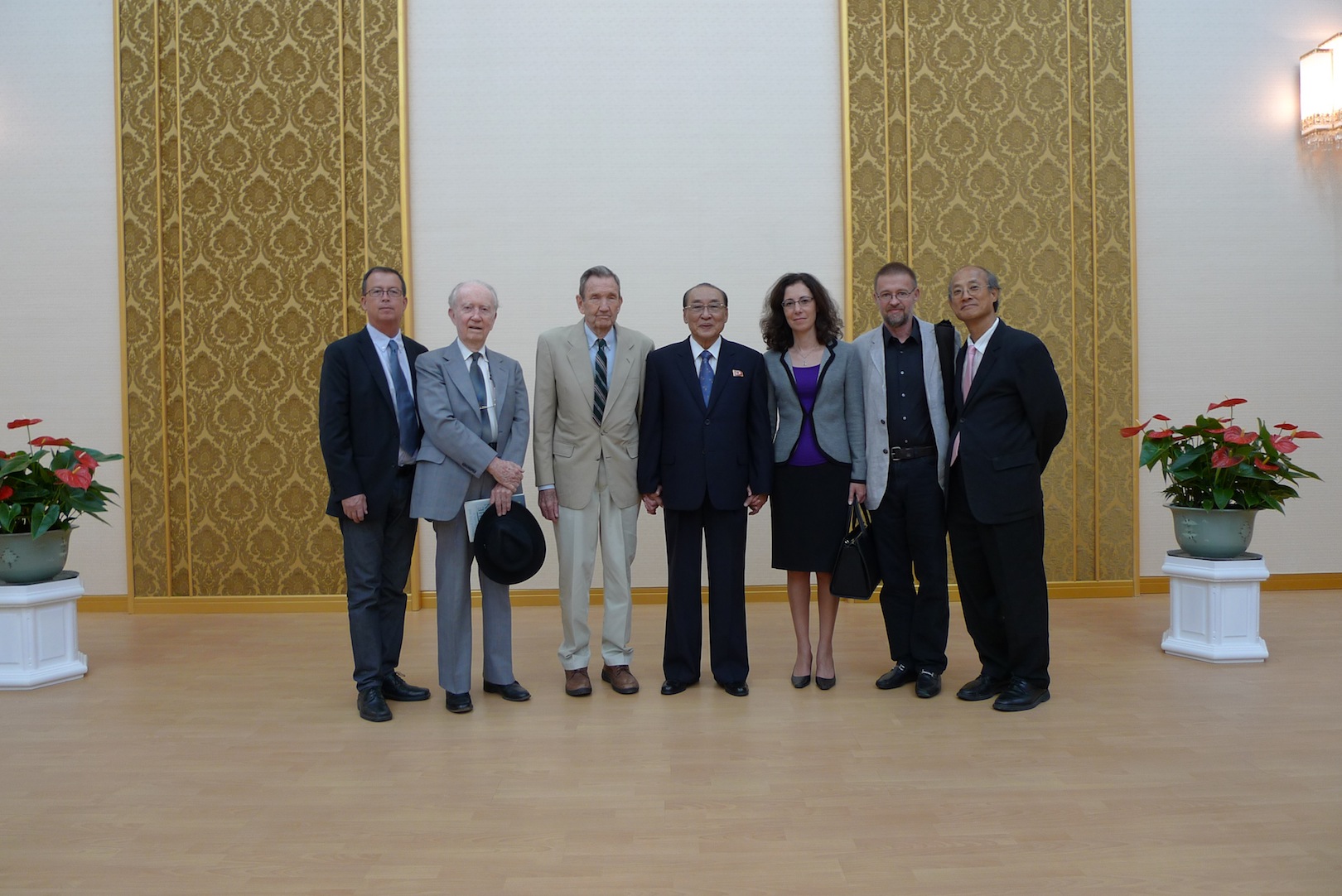


Ramsey Clark Delegation.

But I did not come here to march. I came here to film and to photograph, to see the faces of local people, to read what was written on those faces, to feel, to sense, and to try to understand.

Instead of loud cheers, I came to listen to the whispers, hoping to catch understated facial expressions, tiny signs of fear, of joy, of love and even of existentialist confusion.

The West, its policy makers and mass media, succeeded in creating an image of a dehumanized North Korea. They did it by blurring the faces. For decades North Koreans were being portrayed as inhabitants of some monstrous hermit empire where men, women and children all look alike, dress the same, behave like robots, never smile and do not look into each other’s eyes.

Before I came here, before I agreed to come, I explained to the organizers that I was not interested in all those elaborate fireworks and packed stadiums. I wanted to see a mom taking her child to school. I was longing to capture the faces of lovers at dusk, sitting side by side on some remote bench, whispering to each other those urgent words, those pledges that make life worth living; the same words, the same pledges, uttered all over the world.



South Korean kids on the street.

Paradoxically, I was discouraged to do so. Instead I was asked to march. From a storyteller and a man who is used to document the world, I was converted into a delegate. And whenever the crowd spotted me, it cheered, and then I felt embarrassed, I was longing desperately to become invisible, or to at least find some hiding place. Not because I was doing something wrong, but simply because I was unaccustomed to such naked outbursts of enthusiasm directed at me.

And so I marched, for peace and for the re-unification of the Korean nation. And while I marched, I kept filming and photographing. It must have looked awkward, I have to admit: a delegate who was filming a bunch of women who were dressed in their colorful traditional dresses, cheering him with their paper ribbons, and shouting at top of their lungs.

I soon discovered that I was fighting for every glimpse of reality, of common life. Instead I had been fed with an extravaganza.
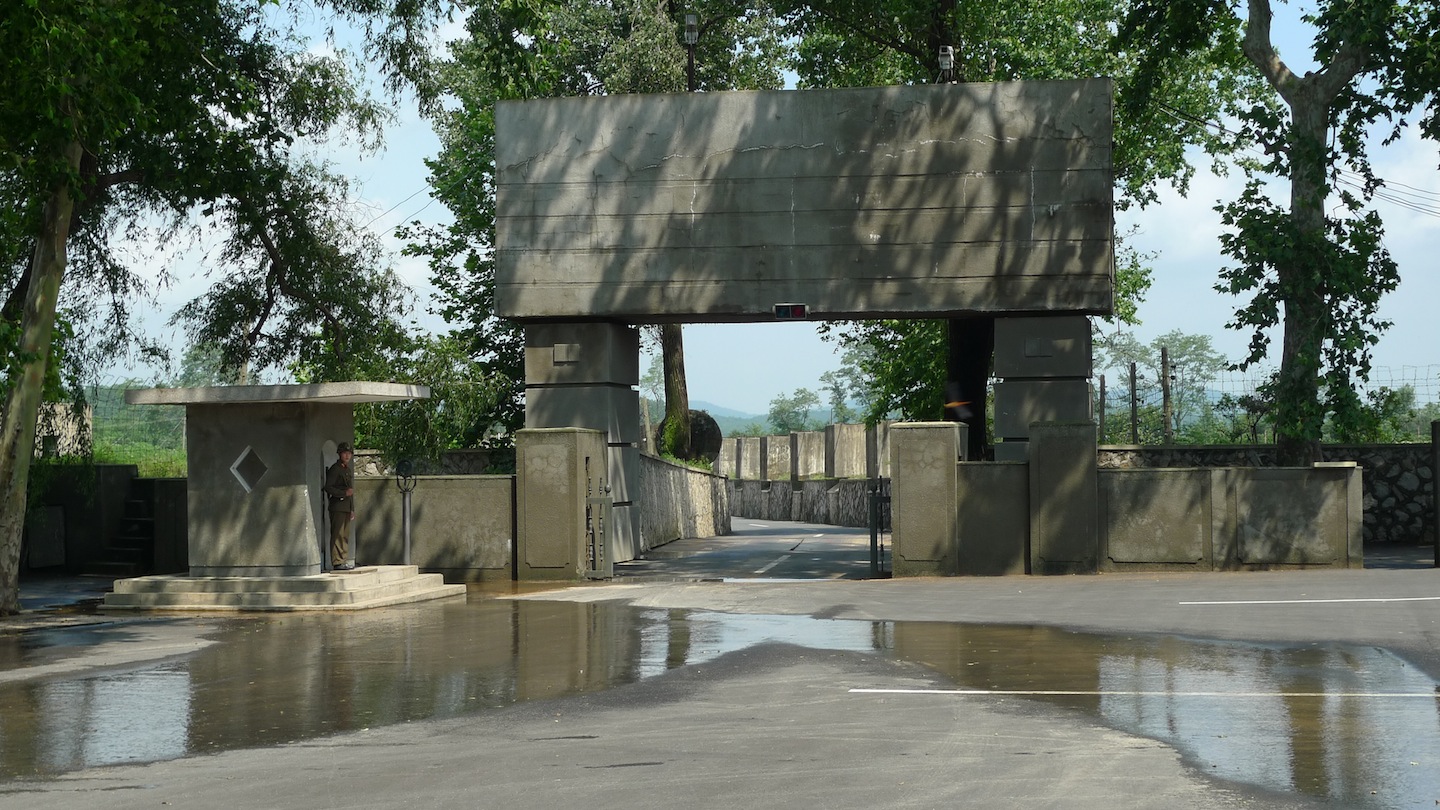


The border.

I was taken to those stadiums with 100,000 people, where children change positions of their boards periodically, and the entire side of the tribune suddenly becomes like some colorful, living storyboard. I was witnessing huge events, with thousands of dancers, with fireworks and multiple bands.

Yet what impressed me the most was an ancient and tiny stone bridge in Kaesong City, near the Demilitarized Zone. And the scene around the bridge: a tiny girl, perhaps three years old, her sock torn, crying, while her mother caressed her hair in the most tender, warmest way imaginable.

My hosts, they did not seem to understand. I explained to them, again and again, but my words sounded too foreign to them.
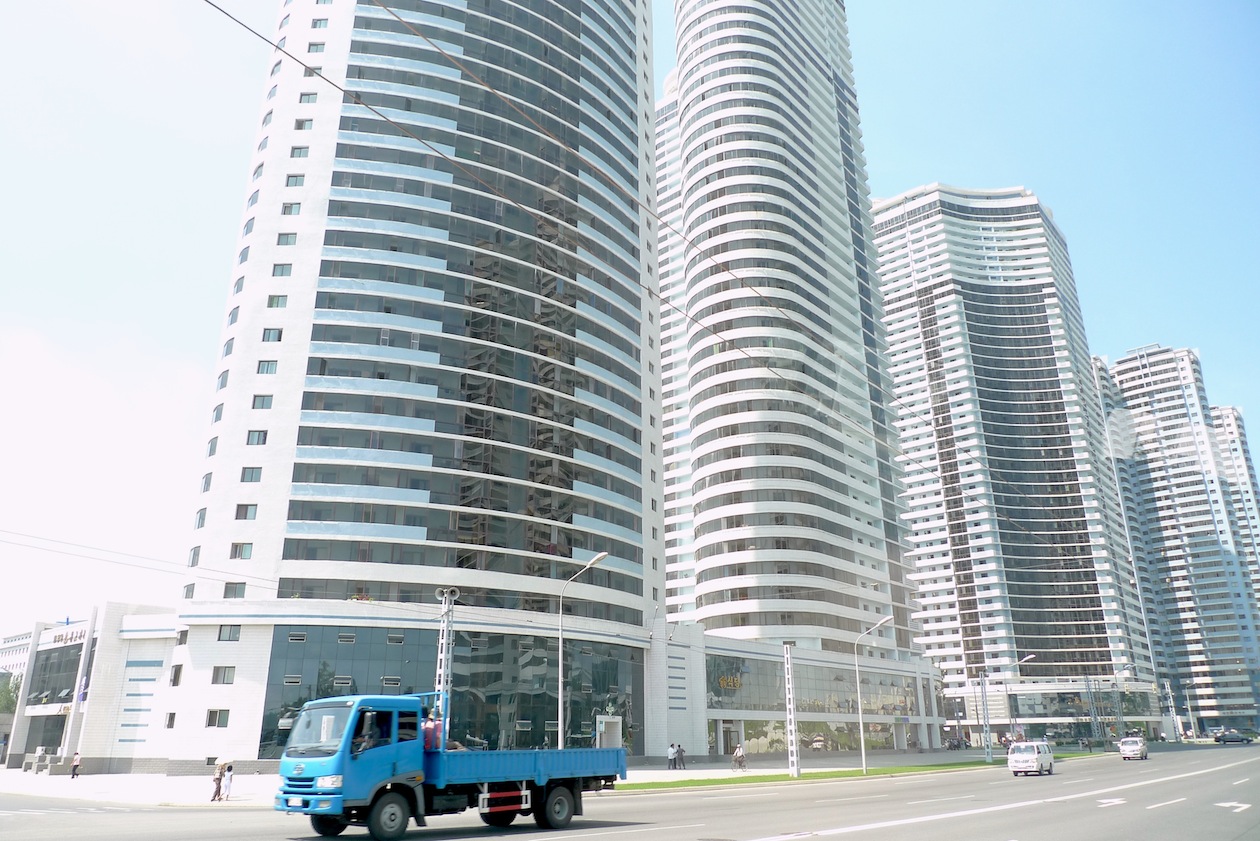


Free and public housing.

As far as they were concerned, I was just ‘some famous writer, filmmaker, and journalist’. They needed me to show great support for their revolution, and deep reverence for their suffering during the Western onslaught more than 60 years ago.

Naturally I felt reverence and grief, but that was all that I was expected to feel. I felt much more.

But I fell in love, instantly with the North Korean countryside, and the faces of North Korean farmers and city dwellers. These were pure faces, honest and expressive. What could I do? Love is subjective; it is irrational. The exaggerated greenery of the fields, children playing at the roadside, soldiers returning home to their villages for a short home-leave, women facing the sun at dusk: it was overwhelming; love at first sight, as I said.

I was photographing through the windshield; I was annoying the organizers, demanding that they stop in the middle of the road.

Then on July 26th I met, together with Ramsey Clark and few other delegates, Mr.Yang Hyong Sob, the Vice President of the Standing Committee of the Supreme People’s Committee. He looked like a very kind man, and I was given a chance to exchange some ideas with him. I explained that the best way to combat Western propaganda is to show to the world the faces of North Korean people.
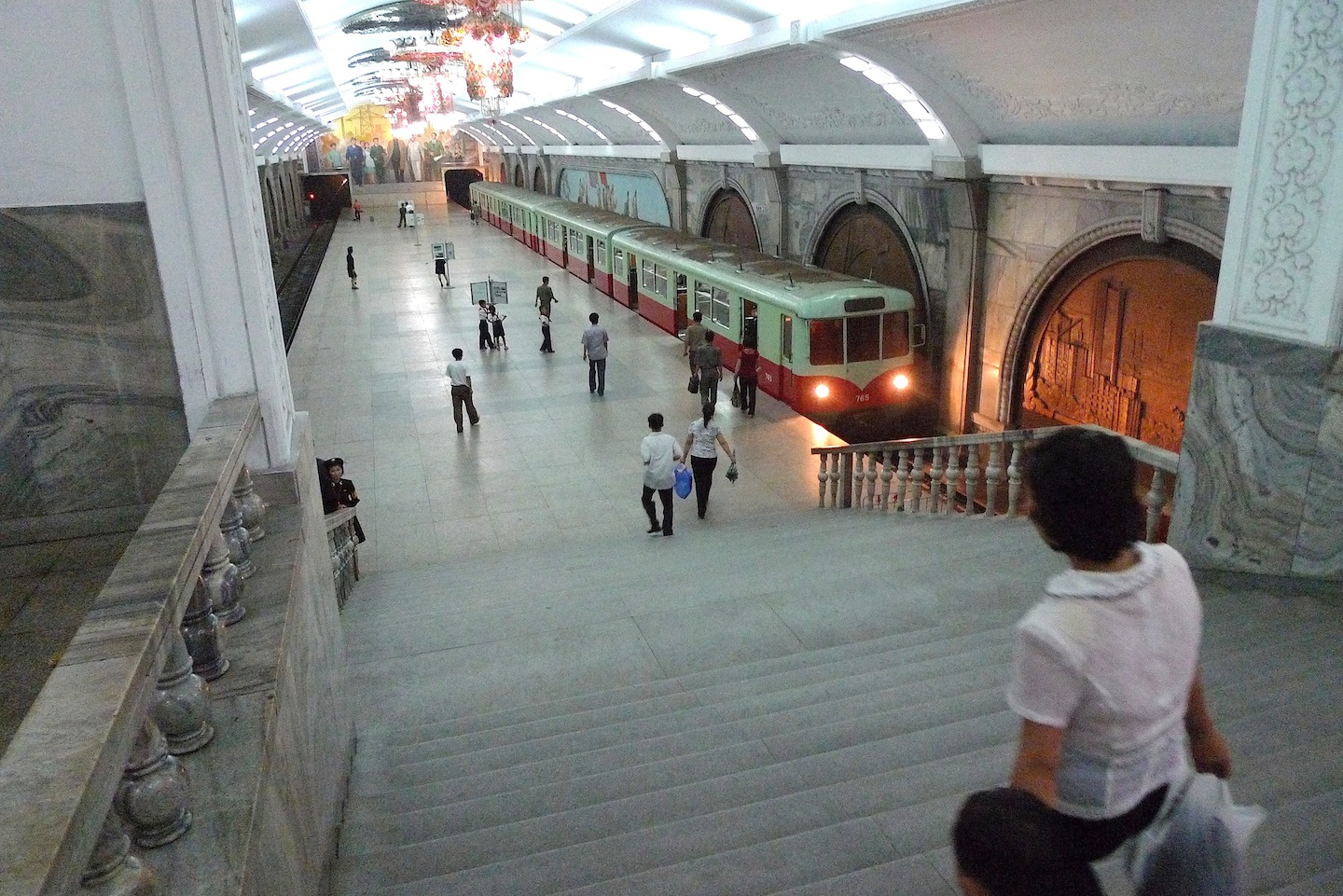


The metro.

“It is their common tactic”, I said. “They portray people of China, Cuba, Venezuela, Russia, Iraq, Afghanistan, Serbia, as heartless, as if they were some plastic androids. Then, subconsciously, compassion for the people of those nations vanishes from the hearts of the Western public. Suddenly it is fine to starve them, to bomb them, to murder thousands, even millions of those androids. But once the faces are shown, the Western public gets confused; many refuse to support mass murder.“

The Vice-President nodded. He smiled at me. As we were leaving, he locked me in a bear hug, and said simply “Please come back!”

But even after that meaningful exchange, I was still marching. And the simplest images were continuously out of my reach. “For this trip only, as we are celebrating the 60th Anniversary”, I was told. But I lived for now and now, I wanted to work.

I saw the Demilitarized zone, DMZ, and the South Korean border post at Panmunjom. Twice in the past I had visited the same place, only from the opposite side. The DMZ is supposed to be the most fortified border in the world, as the two Koreas are still technically at war. The two armies are grudgingly facing each other, armed to the teeth, while the US forces are holed up somewhere underground on the southern side.

Yet The DMZ is like some eye of the storm, sitting in between all those nukes, tanks and rocket launchers, quietly and pristinely. Rivers are lazily flowing, and farmers are growing ginseng, arguably the best in the world.

I endured endless security measures, and at the end I was facing the empty South Korean visitor’s terrace. There were obviously expectations of some hostilities on both sides of the line, and no ‘ordinary’ visitors were allowed to travel here.
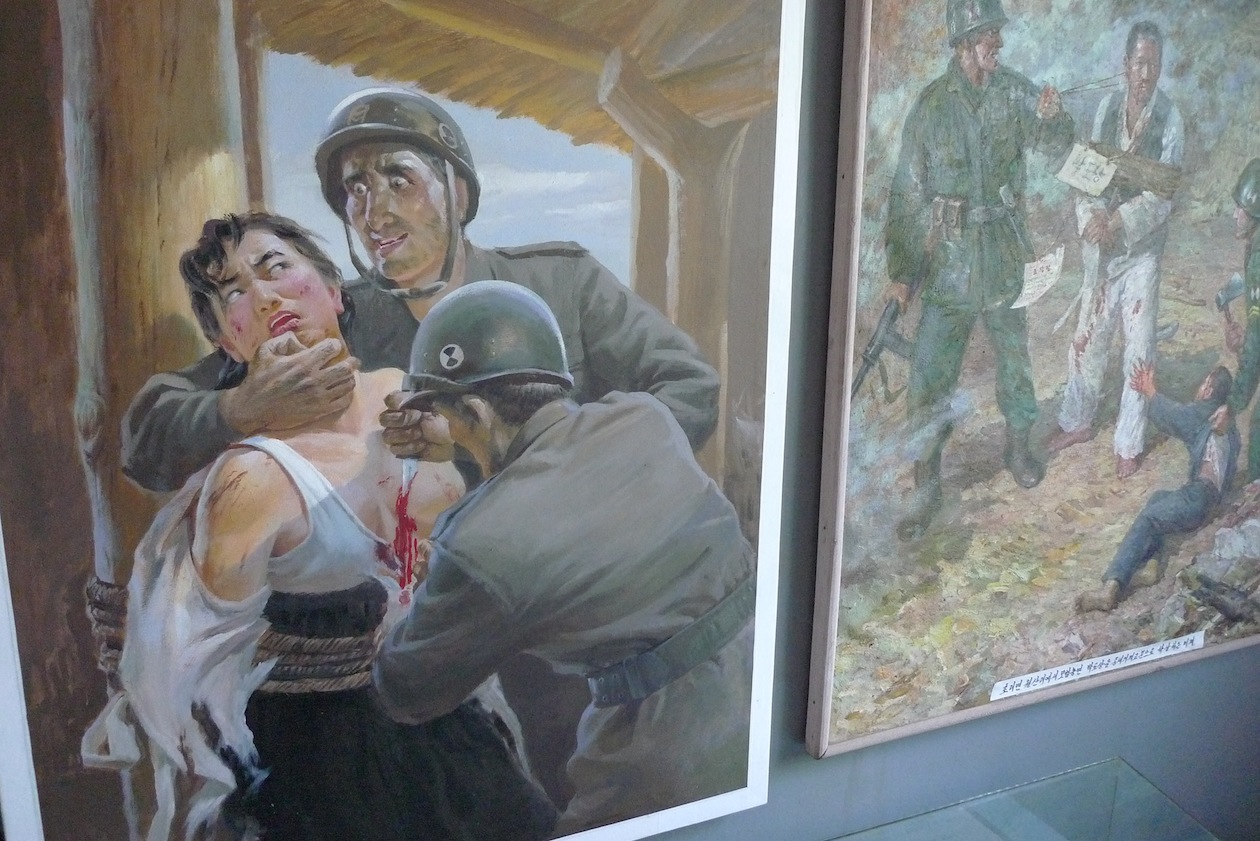


Occupation.

It was all a big mess, and a never-ending drama. A divided nation; millions of deaths. I saw it all in the city of Sinchon. The tunnels where the US troops massacred thousands of civilians during the war, old veterans and survivors of the massacres spoke; recalling those gruesome events.

In 1950, at the beginning of the war, the city of Sinch’ŏn was the site of a massacre of civilians by occupying U.S forces. The number of civilians killed over the 52-day period was allegedly over 35,000 people, the equivalent of a quarter of the city’s population at the time.

It all looked chillingly familiar. I used to photograph the craters left behind after the carpet bombings of Cambodia, Laos and Vietnam. Brutality, brutality, brutality… Millions of faceless victims burned alive by napalm, ‘bomb-lets’ that explode decades later when children or water buffaloes are playing on the fields.

Ramsey Clark spoke about the horrors of the past, and about the brutality of the US actions. An old man, one of the survivors of the mass killings of civilians in the tunnels, spoke about horrors he witnessed as a child. The artwork in the local museum depicted the brutal torture and rape of Korean women by US troops, their bodies mutilated; with nipples penetrated by metal hooks.
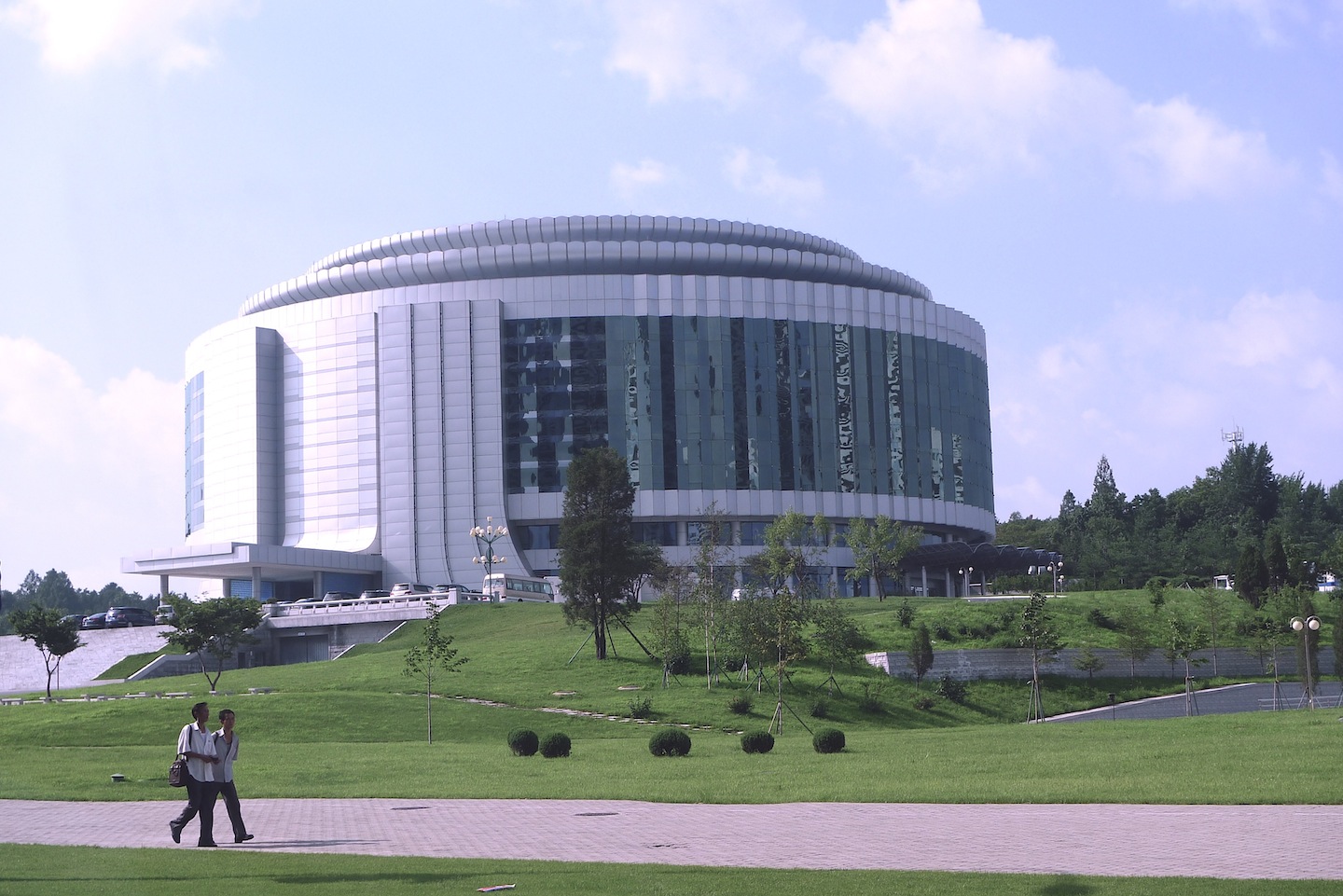


One of many Pyongyang theatres.

In the West, the topic remains almost totally taboo. One of the greatest journalists of the 20th century, Wilfred Burchett, even lost his citizenship and became ‘an enemy of the Australian people’, partially because he dared to describe the suffering of the North Korean people, a few years after he had described the aftermath of Hiroshima bombing in his 1945 iconic report, “I Write This As a Warning To the World”.
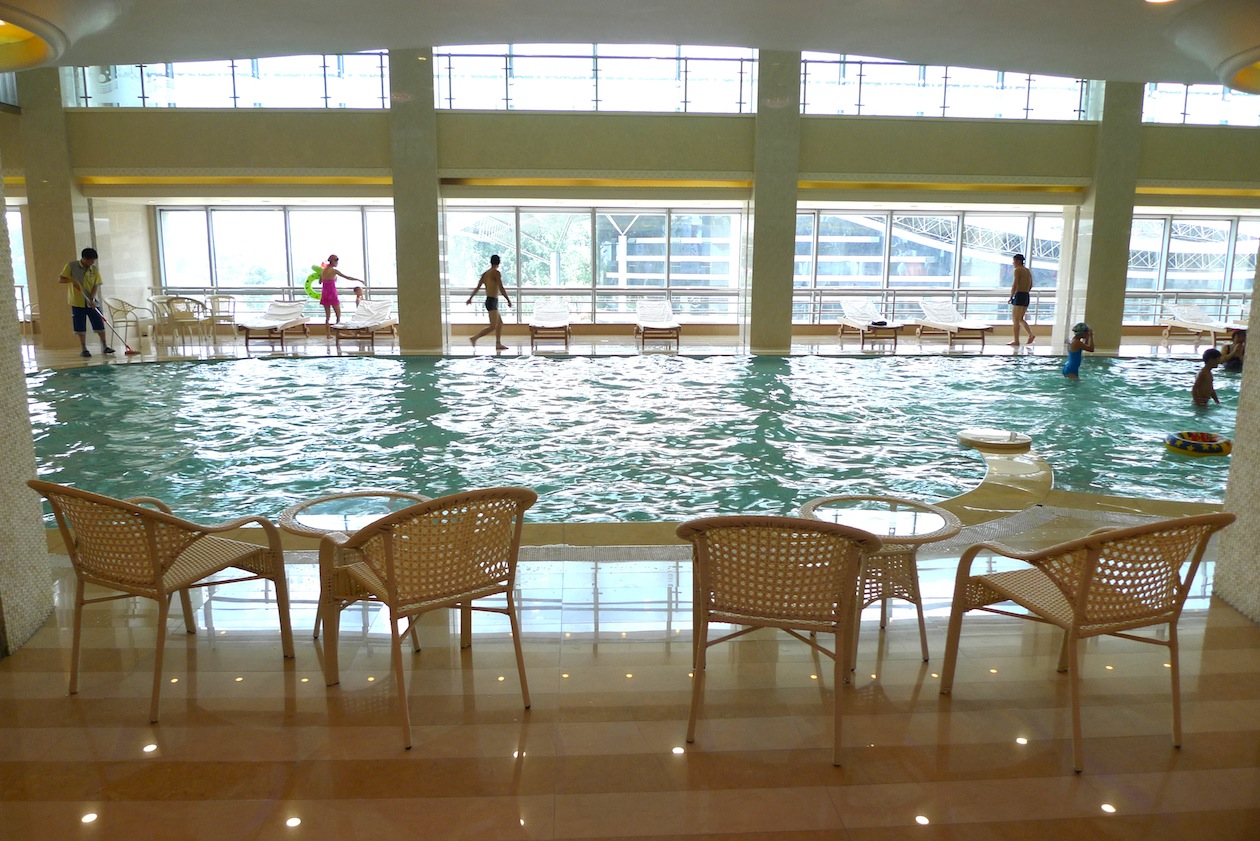


Public pool.

The brass band begins to play yet another military tune. I zoom on an old lady, her chest decorated with medals. As I get ready to press the shutter, two large tears begin rolling down her cheeks. And suddenly I realize that I cannot photograph her. I really cannot. Her face is all wrinkled, and yet it is both youthful and endlessly tender. Here is my face, I think, the face I was looking for all those days. And yet I cannot even press the shutter of my Leica.

Then something squeezes my throat and I have to search in my equipment bag for some tissue, as my glasses get foggy, and for a short time I cannot see anything at all. I sob loudly, just once. Nobody can hear, because of the loud playing of the band.

Later I get closer to her, and I bow, and she reciprocated. We make our separate peace in the middle of the boiling-hot main square. I am suddenly happy to be here. We have both lost something. She lost more. I was certain she lost at least half of her loved-ones in the carnage of those bygone years. I lost something too: I lost all respect and belonging, to the culture that is still ruling the world; the culture that was once mine, but a culture that is still robbing people of their faces, and then burns their bodies with napalm and flames.


One of survivors of Sinchon massacre.

It is the 60th Anniversary of Victory Day in the DPRK. An anniversary marked by tears, grey hair, tremendous fireworks, parades, and by the memories of fire.

That evening, after returning to the capital, I finally made it to the river. It was covered by a gentle but impenetrable fog. There were two lovers sitting by the shore, motionless, in silent embrace. The woman’s hair was gently falling on her lover’s shoulder. He was holding her hand, reverently. I was going to lift my big professional camera, but then I stopped, abruptly, all of a sudden too afraid that what my eyes were seeing or my brain imagining, would not be reflected in the viewfinder.

Andre Vltchek is a novelist, filmmaker and investigative journalist. He covered wars and conflicts in dozens of countries. His critically acclaimed political revolutionary novel Point of No Return is now re-edited and available. Oceania is his book on Western imperialism in South Pacific. His provocative book about post-Suharto Indonesia and market-fundamentalist model is called “Indonesia – The Archipelago of Fear” (Pluto). He just completed feature documentary “Rwanda Gambit” about Rwandan history and the plunder of DR Congo. After living for many years in Latin America and Oceania, Vltchek presently resides and works in East Asia and Africa. He can be reached through his website.

Sunday, August 04, 2013

Welcome Back, Soldier: Coming Home to a Post-Constitutional America

Welcome to Post-Constitution America: What If Your Country Begins to Change and No One Notices?

by Peter Van Buren - TomDispatch

On July 30, 1778, the Continental Congress created the first whistleblower protection law, stating “that it is the duty of all persons in the service of the United States to give the earliest information to Congress or other proper authority of any misconduct, frauds, or misdemeanors committed by any officers or persons in the service of these states.”

Two hundred thirty-five years later, on July 30, 2013, Bradley Manning was found guilty on 20 of the 22 charges for which he was prosecuted, specifically for “espionage” and for videos of war atrocities he released, but not for “aiding the enemy.”

Days after the verdict, with sentencing hearings in which Manning could receive 136 years of prison time ongoing, the pundits have had their say. The problem is that they missed the most chilling aspect of the Manning case: the way it ushered us, almost unnoticed, into post-Constitutional America.

Tomgram: Peter Van Buren, The Manning Trial Began on 9/11

Close your eyes for a moment, think about recent events, and you could easily believe yourself in a Seinfeldian Bizarro World. Now, open them and, for a second, everything looks almost familiar... and then you notice that a dissident is fleeing a harsh and draconian power, known for its global surveillance practices, use of torture, assassination campaigns, and secret prisons, and has found a haven in a heartless world in... hmmm... Russia. That dissident, of course, is Edward Snowden, just granted a year’s temporary asylum in Russia, a.k.a. the defender of human rights and freedom 2013, and so has been released from a Washington-imposed imprisonment in Moscow’s international air terminal and the threat of far worse.

Now, close your eyes, open them again, and for just a moment, doesn’t the world look a little more orderly? After all, a draconian imperial power has taken one of its own dissidents, who wanted to reveal the truth about its cruel war practices and global diplomatic maneuverings, thrown him in prison without charges, abused and mistreated him, brought him before a drumhead military court and, on essentially trumped up charges of “espionage,” convicted him of just what its leaders wanted to convict him of. That power, of course, must be Russia and all’s right with the world... oops, I mean, that’s U.S. Army Private First Class Bradley Manning and the “evil empire” that mistreated him is... gulp... the United States.

Think about it for a moment: if Vladimir Putin’s Russia is a place of asylum for American dissidents and the U.S. is doing a reasonable job of imitating aspects of the old USSR, we are on Bizarro Earth, aren't we?

Today, former State Department whistleblower Peter Van Buren, author of We Meant Well: How I Helped Lose the Battle for the Hearts and Minds of the Iraqi People, considers how America’s distant wars have come home and how, under that pressure, this country is morphing into something unrecognizable. Worse yet, it’s quite possible that we’re only at the beginning of that transformation. To give but a small example of what the future might hold, psychiatrist and author Jonathan Shay, famous for his work with traumatized Vietnam veterans, suggested in Daedalus in 2011 that no one knows what it means for similarly traumatized employees of our Warrior corporations, the rent-a-gun “veterans” of our recent war zones to come home to no health care and no support system. And he offered an eerie, if provocative, comparison to the footloose German veterans of World War I who, in the 1920s, joined the Freikorps and played their part in the radicalization and then Nazification of that country.

“I am not saying,” he wrote, “that I know that the Weimar Republic would still exist today, with all that implies about a different course to history, if Germany had had Vet Centers and VA Mental Health Clinics. But historians generally agree that the Freikorps contributed to the weakening of the new German political fabric in the immediate aftermath of World War I.” His is a chilling reminder that, wherever we are now, it might just be a rest stop on some bizarro road to hell. Tom

Welcome to Post-Constitution America: What If Your Country Begins to Change and No One Notices?

by Peter Van Buren


The Weapons of War Come Home


Even before the Manning trial began, the emerging look of that new America was coming into view. In recent years, weapons, tactics, and techniques developed in Iraq and Afghanistan as well as in the war on terror have begun arriving in “the homeland.”

Consider, for instance, the rise of the warrior cop, of increasingly up-armored police departments across the country often filled with former military personnel encouraged to use the sort of rough tactics they once wielded in combat zones. Supporting them are the kinds of weaponry that once would have been inconceivable in police departments, including armored vehicles, typically bought with Department of Homeland Security grants. Recently, the director of the FBI informed a Senate committee that the Bureau was deploying its first drones over the United States. Meanwhile, Customs and Border Protection, part of the Department of Homeland Security and already flying an expanding fleet of Predator drones, the very ones used in America’s war zones, is eager to arm them with “non-lethal” weaponry to “immobilize targets of interest.”

Above all, surveillance technology has been coming home from our distant war zones. The National Security Agency (NSA), for instance, pioneered the use of cell phones to track potential enemy movements in Iraq and Afghanistan. The NSA did this in one of several ways. With the aim of remotely turning on cell phones as audio monitoring or GPS devices, rogue signals could be sent out through an existing network, or NSA software could be implanted on phones disguised as downloads of porn or games.

Using fake cell phone towers that actually intercept phone signals en route to real towers, the U.S. could harvest hardware information in Iraq and Afghanistan that would forever label a phone and allow the NSA to always uniquely identify it, even if the SIM card was changed. The fake cell towers also allowed the NSA to gather precise location data for the phone, vacuum up metadata, and monitor what was being said.

At one point, more than 100 NSA teams had been scouring Iraq for snippets of electronic data that might be useful to military planners. The agency’s director, General Keith Alexander, changed that: he devised a strategy called Real Time Regional Gateway to grab every Iraqi text, phone call, email, and social media interaction. “Rather than look for a single needle in the haystack, his approach was, ‘Let’s collect the whole haystack,’” said one former senior U.S. intelligence official. “Collect it all, tag it, store it, and whatever it is you want, you go searching for it.”

Sound familiar, Mr. Snowden?

Welcome Home, Soldier (Part I)


Thanks to Edward Snowden, we now know that the “collect it all” technique employed by the NSA in Iraq would soon enough be used to collect American metadata and other electronically available information, including credit card transactions, air ticket purchases, and financial records. At the vast new $2 billion data center it is building in Bluffdale, Utah, and at other locations, the NSA is following its Iraq script of saving everything, so that once an American became a target, his or her whole history can be combed through. Such searches do not require approval by a court, or even an NSA supervisor. As it happened, however, the job was easier to accomplish in the U.S. than in Iraq, as internet companies and telephone service providers are required by secret law to hand over the required data, neatly formatted, with no messy spying required.

When the U.S. wanted something in Iraq or Afghanistan, they sent guys to kick down doors and take it. This, too, may be beginning to happen here at home. Recently, despite other valuable and easily portable objects lying nearby, computers, and only computers, were stolen from the law offices representing State Department whistleblower Aurelia Fedenisn. Similarly, a Washington law firm representing NSA whistleblower Tom Drake had computers, and only computers, stolen from its office.

In these years, the FBI has brought two other NSA wartime tools home. The Bureau now uses a device called Stingray to recreate those battlefield fake cell phone towers and track people in the U.S. without their knowledge. Stingray offers some unique advantages: it bypasses the phone company entirely, which is, of course, handy in a war zone in which a phone company may be controlled by less than cooperative types, or if phone companies no longer cooperate with the government, or simply if you don't want the phone company or anyone else to know you're snooping. American phone companies seem to have been quite cooperative. Verizon, for instance, admits hacking its own cellular modems (“air cards”) to facilitate FBI intrusion.

The FBI is also following NSA's lead implanting spyware and other hacker software developed for our war zones secretly and remotely in American computers and cell phones. The Bureau can then remotely turn on phone and laptop microphones, even webcams, to monitor citizens, while files can be pulled from a computer or implanted onto a computer.

Among the latest examples of war technology making the trip back to the homeland is the aerostat, a tethered medium-sized blimp. Anyone who served in Iraq or Afghanistan will recognize the thing, as one or more of them flew over nearly every military base of any size or importance. The Army recently announced plans to operate two such blimps over Washington, D.C., starting in 2014. Allegedly they are only to serve as anti-missile defenses, though in our war zones they were used as massive surveillance platforms. As a taste of the sorts of surveillance systems the aerostats were equipped with abroad but the Army says they won’t have here at home, consider Gorgon Stare, a system that can transmit live images of an entire town. And unlike drones, an aerostat never needs to land. Ever.

Welcome Home, Soldier (Part II)


And so to Bradley Manning.

As the weaponry and technology of war came home, so did a new, increasingly Guantanamo-ized definition of justice. This is one thing the Manning case has made clear.

As a start, Manning was treated no differently than America’s war-on-terror prisoners at Guantanamo and the black sites that the Bush administration set up around the world. Picked up on the “battlefield,” Manning was first kept incommunicado in a cage in Kuwait for two months with no access to a lawyer. Then, despite being an active duty member of the Army, he was handed over to the Marines, who also guard Guantanamo, to be held in a military prison in Quantico, Virginia.

What followed were three years of cruel detainment, where, as might well have happened at Gitmo, Manning, kept in isolation, was deprived of clothing, communications, legal advice, and sleep. The sleep deprivation regime imposed on him certainly met any standard, other than Washington’s and possibly Pyongyang’s, for torture. In return for such abuse, even after a judge had formally ruled that he was subjected to excessively harsh treatment, Manning will only get a 112-day reduction in his eventual sentence.

Eventually the Obama administration decided Manning was to be tried as a soldier before a military court. In the courtroom, itself inside a military facility that also houses NSA headquarters, there was a strikingly gulag-like atmosphere. His trial was built around secret witnesses and secret evidence; severe restrictions were put on the press -- the Army denied press passes to 270 of the 350 media organizations that applied; and there was a clear appearance of injustice. Among other things, the judge ruled against nearly every defense motion.

During the months of the trial, the U.S. military refused to release official transcripts of the proceedings. Even a private courtroom sketch artist was barred from the room. Independent journalist and activist Alexa O’Brien then took it upon herself to attend the trial daily, defy the Army, and make an unofficial record of the proceedings by hand. Later in the trial, armed military police were stationed behind reporters listening to testimony. Above all, the feeling that Manning’s fate was predetermined could hardly be avoided. After all, President Obama, the former Constitutional law professor, essentially proclaimed him guilty back in 2011 and the Department of Defense didn’t hesitate to state more generally that “leaking is tantamount to aiding the enemies of the United States.”

As at Guantanamo, rules of evidence reaching back to early English common law were turned upside down. In Manning’s case, he was convicted of espionage, even though the prosecution did not have to prove either his intent to help another government or that harm was caused; a civilian court had already paved the way for such a ruling in another whistleblower case. In addition, the government was allowed to label Manning a “traitor” and an “anarchist” in open court, though he was on trial for neither treason nor anarchy. His Army supervisor in the U.S. and Iraq was allowed to testify against him despite having made biased and homophobic statements about him in a movie built around portraying Manning as a sad, sexually-confused, attention-seeking young man mesmerized by WikiLeaks founder Julian Assange. Finally, the same judge who essentially harassed the press throughout Manning’s trial issued a 24-hour advance notice of her verdict to ensure maximum coverage only of the denouement, not the process.

Given all this, it is small comfort to know that Manning, nailed on the Espionage Act after multiple failures in other cases by the Obama administration, was not convicted of the extreme charge of “aiding the enemy.”

Not Manning Alone


Someday, Manning’s case may be seen as a bitter landmark on the road to a post-Constitutional America, but it won’t be seen as the first case in the development of the post-Constitutional system. Immediately following 9/11, top officials in the Bush administration decided to “take the gloves off.” Soon after, a wounded John Walker Lindh, the so-called American Taliban, was captured on an Afghan battlefield, held in a windowless shipping container, refused access to a lawyer even after he demanded one as an American citizen, and interrogated against his will by the FBI. Access to medical care was used as a bribe to solicit information from him. “Evidence” obtained by such means was then used to convict him in court.

Jose Padilla, a U.S. citizen who clumsily plotted to detonate a nonexistent “dirty bomb,” was held incommunicado for more three years, over a year of which was in a South Carolina military jail. He was arrested only as a material witness and was not formally charged with a crime until years later. He was given no means to challenge his detention under habeas corpus, as President Bush designated him an “enemy combatant.” Pictures of Padilla being moved wearing sound-proof and light-proof gear strongly suggest he was subjected to the same psychosis-inducing sensory deprivation used as “white torture” against America’s foreign enemies in Guantanamo.

Certainly, the most egregious case of pre-Manning post-Constitutional justice was the execution of American citizen Anwar al-Awlaki by drone in Yemen, without due process or trial, for being an al-Qaeda propagandist. In this, President Obama and his top counterterrorism advisors quite literally took on the role of judge, jury, and executioner. In a similar fashion, again in Yemen, the U.S. killed al-Awlaki’s American teenage son, a boy no one claimed was connected to terrorism. Obama administration lawyers went on to claim the legal right to execute U.S. citizens without trial or due process and have admitted to killing four Americans. Attorney General Eric Holder declared that “United States citizenship alone does not make such individuals immune from being targeted.”

Then-FBI Director Robert Mueller, asked in a Congressional hearing if the FBI could assassinate an American citizen in the United States, replied that he simply did not know. “I have to go back. Uh, I’m not certain whether that was addressed or not.” He added, “I’m going to defer that to others in the Department of Justice.” As if competing for an Orwellian prize, an unnamed Obama administration official told the Washington Post, “What constitutes due process in this case is a due process in war.”

Post-Constitutional America


So welcome to post-Constitutional America. Its shape is, ominously enough, beginning to come into view.

Orwell’s famed dystopian novel 1984 was not intended as an instruction manual, but just days before the Manning verdict, the Obama administration essentially buried its now-ironic-campaign promise to protect whistleblowers, sending it down Washington’s version of the memory hole. Post-9/11, torture famously stopped being torture if an American did it, and its users were not prosecutable by the Justice Department.

Similarly, full-spectrum spying is not considered to violate the Fourth Amendment and does not even require probable cause. Low-level NSA analysts have desktop access to the private emails and phone calls of Americans. The Post Office photographs the envelopes of every one of the 160 billion pieces of mail it handles, collecting the metadata of "to:" and "from:" addresses. An Obama administration Insider Threat Program requires federal employees (including the Peace Corps) to report on the suspicious behavior of coworkers.

Government officials concerned over possible wrongdoing in their departments or agencies who “go through proper channels” are fired or prosecuted. Government whistleblowers are commanded to return to face justice, while law-breakers in the service of the government are allowed to flee justice. CIA officers who destroy evidence of torture go free, while a CIA agent who blew the whistle on torture is locked up.

Secret laws and secret courts can create secret law you can’t know about for “crimes” you don’t even know exist. You can nonetheless be arrested for committing them. Thanks to the PATRIOT Act, citizens, even librarians, can be served by the FBI with a National Security Letter (not requiring a court order) demanding records and other information, and gagging them from revealing to anyone that such information has been demanded or such a letter delivered. Citizens may be held without trial, and denied their Constitutional rights as soon as they are designated “terrorists.” Lawyers and habeas corpus are available only when the government allows.

In the last decade, 10 times as many employers turned to FBI criminal databases to screen job applicants. The press is restricted when it comes to covering “open trials.” The war on whistleblowers is metastasizing into a war on the First Amendment. People may now be convicted based on secret testimony by unnamed persons. Military courts and jails can replace civilian ones. Justice can be twisted and tangled into an almost unrecognizable form and then used to send a young man to prison for decades. Claiming its actions lawful while shielding the “legal” opinions cited, often even from Congress, the government can send its drones to assassinate its own citizens.

One by one, the tools and attitudes of the war on terror, of a world in which the “gloves” are eternally off, have come home. The comic strip character Pogo’s classic warning -- “We have met the enemy and he is us” -- seems ever less like a metaphor. According to the government, increasingly we are now indeed their enemy.

Peter Van Buren blew the whistle on State Department waste and mismanagement during Iraq Reconstruction in his first book, We Meant Well: How I Helped Lose the Battle for the Hearts and Minds of the Iraqi People. A TomDispatch regular, he writes about current events at his blog, We Meant Well. Van Buren’s next book, Ghosts of Tom Joad: A Story of the #99Percent, will be available March 2014.

Copyright 2013 Peter Van Buren

Armed and American: US Cops Patrolling in Canada

American Cops Don't Belong in Canada

by Sean Casey MP - Huffington Post

A few years ago, Stephen Harper told us that by the time he was done in office, we wouldn't recognize Canada. How true, and troubling, those words have become.

In Harper's relatively short seven years running the country, we have seen the Americanization of our parliamentary democracy. We have an enemies list, fact free attack ads, and constant negativity and division.

We've also seen the Americanization of our justice system where facts and evidence are replaced by "gut feelings", and an obsession with retribution.

Now we are now witnessing the Americanization of our law enforcement. Armed American police officers will now operate on Canadian soil.

Bit by bit, agreement by agreement, Canada is giving away more and more in the name of trade. To Conservatives, none of this is a threat to our sovereignty, as if the very act of stating so makes it so.

But let us consider this fantasy scenario: RCMP officers stopping American citizens on the Buffalo side of their border. Picture the horrified expression of those resilient New Yorkers as they are forced to slow down on their Interstate highway so as to be greeted by a smiling RCMP officer who is to inspect their property, ask questions about where they live, where they've come from, and the like -- all part of a so called "pre-clearing" program.

Of course, this scene would never occur. The United States protects, obsessively, their sovereignty. But here in Canada, armed American police officers will now be able to stop Canadians, in Canada, inspecting, checking and asking questions.

Again, the Conservatives will tell us that an armed American cop in Canada is all about trade, jobs and security, not sovereignty. If this is true, then can we not expect to see Mounties stopping Americans on the Buffalo side?

I don't believe Canadians want American police operating and carrying guns in Canada. It's just not right.

Harper did promise though that when he's done, we won't recognize Canada. Perhaps we can all reminiscence about that when stopped and questioned by an American police officer, in our own country.

Gorilla Radio with Chris Cook, Howard Garrett, Derek Matthews, Janine Bandcroft Aug. 5, 2013

This Week on GR

by C. L. Cook - Gorilla-Radio.com

Human/Whale interaction has a perfidious history here. Certainly, the indigenous populations hunted the whales, but since their arrival the white whalers, fishers, and exhibitionists have killed uncounted numbers in an orgy of greed and stupidity.

Of all the many species of cetaceans, both native and migrating through these waters, none has fired the imagination, nor fueled the fears of the newcomers like the "Killer Whale." Orcinus orca, or simply Orca, is the dazzlingly adept ocean carnivore hunter that survives yet both the ignorant malice and ill-executed good intentions of human intervention in the Salish Sea.

But, their continued survival is no sure thing.

Listen. Hear.


Howard Garrett is Board president and co-founder of the Orca Network, a Washington State based organization dedicated to the protection of wild Orca, and repatriation of captured whales.

Whether the burgeoning whale-watching industry, or the belated recognition of the Orca’s perilous proximity to extinction by marine agencies on both sides of the border, people are beginning to talk up the survival and well-being of local Orca populations.

Howard Garrett in the first half.

And; pollution, habitat degradation, causal predation, and the immense ignorance of the human animal is too responsible for the near extinction of another of nature's totemic species. The common Swallow is less so today. In fact, it is fast becoming more than uncommon, it is flirting with extinction. The bird that has featured in song and adorned human culture the world over could soon become just a memory; and if it should come to pass, it is we who will carry the mantle of blame.

Derek Matthews is Director of the Vancouver Avian Research Centre and is a passionate ornithologist, avian researcher, conservationist, and Master bird bander. He is reaching out to Vancouverites, and all city dwellers in North America, to begin now mitigation efforts to help save the Swallow before it's too late.

Derek Matthews needing more than a wing and a prayer for urban bird populations in the second half.

And; Victoria Street Newz publisher and CFUV Radio broadcaster, Janine Bandcroft will join us at the bottom of the hour to bring us news of the coming week for the streets of our city and beyond. But first, Howard Garrett and harrowing straits for the Orca of, and transiting the Salish Sea.


Chris Cook hosts Gorilla Radio, airing live every Monday, 5-6pm Pacific Time. In Victoria at 101.9FM, and on the internet at: http://cfuv.uvic.ca.  He also serves as a contributing editor to the web news site, http://www.pacificfreepress.com. Check out the GR blog at: http://gorillaradioblog.blogspot.ca/
G-Radio is dedicated to social justice, the environment, community, and providing a forum for people and issues not covered in the corporate media.

Some past guests include: M. Junaid Alam, M. Shahid Alam, Gilad Atzmon, Joel Bakan, Maude Barlow, Ramzy Baroud, William Blum, Luciana Bohne, William Bowles, Mordecai Briemberg, Helen Caldicott, Noam Chomsky, Michel Chossudovsky, Diane Christian, Paul Cienfuegos, David Cromwell, Ezili Danto, Jon Elmer, Yves Engler, Laura Flanders, Amy Goodman, Denis Halliday, Chris Hedges, Julia Butterfly Hill, Robert Jensen, Dahr Jamail, Diana Johnstone, Malalai Joya, Kathy Kelly, Naomi Klein, Frances Moore Lappe, Ingmar Lee, Dave Lindorff, Alexandra Morton, Loretta Napoleoni, Andrew Nikiforuk, Ken O'Keefe, Greg Palast, Michael Parenti, Robert Parry, John Pilger, Kevin Pina, Paul Craig Roberts, David Rovics, Danny Schechter, David Schindler, Vandana Shiva, Tim Shorrock, Norman Solomon, Jean Saint-Vil, Harvey Wasserman, Paul Watson, Bernard Weiner, Andy Worthington, Mickey Z., Howard Zinn and many others.

GR Archive: Orca Network letter to Secretary of the Navy Hansford Johnson

U.S. Navy Sonar Tests in Dire for Straits Mammals

by Orca Network • Sunday August 03, 2003

June 12, 2003
Hon. Hansford T. Johnson
Acting Secretary of the Navy
1000 Navy Pentagon
Washington, DC 20350-1000

Dear Secretary Johnson:

I am writing in reference to the May 5, 2003 incident in which the USS Shoup operated mid-frequency sonar at volumes that visibly distressed and possibly killed cetaceans in Haro Strait. At least six porpoises washed up dead around the position of the Shoup within days following the sonar exercises. Necropsy examinations may soon reveal the cause of those deaths.

At least one minke whale was seen fleeing from the Shoup at extremely high speeds.Video and audio tapes clearly show attempts by the 22 members of J pod of the Southern Resident orca community, ranging in age from one month to over 90 years, to avoid the life-threatening noise. Their movements were extremely agitated as they moved north, then south, then became separated while trying to lift their heads out of the water.

They could not escape however, as they were held against the 20 mile long coastline along the west side of San Juan Island, just a few miles from the Shoup's location in mid Haro Strait. A naturalist on board one of the whale watch vessels also reported feeling pain, nausea and dizziness during the sonar exercises, and continued to suffer from constant ringing in her ears two weeks after the incident.

The average person on the street in western Washington is aware that whales are often found along the west side of San Juan Island. Most people know that in the months of April, May and June Orcas are consistently found in this area year after year. The Center for Whale Research, The Whale Museum, Orca Network and any whale watch operator could have provided even more precise information on the movements of J pod in these waters on a daily basis in the days and weeks leading up to 5 May. Whale watch boats were in fact near the whales in clear visible range while the Shoup was testing sonar on 5 May.

In the weeks leading up to the 5 May event acoustic recordings were made of other sonar incidents coincident with rare sightings of porpoises fleeing close to the surface. On 21 March, 2002, while extremely loud sonar was recorded from at least two hydrophone stations on the west side of San Juan Island, a group of 30-40 whales, determined to be Offshore Orcas, swam at high speed deep into Port Townsend harbor, a sight seldom if ever before witnessed. The pod was observed in the harbor until the Navy boats approached Admiralty Inlet, at which time the pod took off at a high rate of speed out the Strait of Juan de Fuca.

Orca Network joins with many other governmental, environmental and whale advocacy groups and individuals in questioning the value of testing sonar in a well-known vital habitat for several cetacean species. Unless there is some kind of real underwater enemy threat, we can only wonder at the lack of judgment that could have led to such harmful and potentially lethal disruptions of marine life.

In March of 2000 Navy sonar exercises in the Bahamas killed seven and probably at least 16 rare, deep diving beaked whales. That incident created a firestorm of negative international publicity for the Navy. This and other incidents of naval sonar testing coincident with cetacean deaths in Greece and the Canary Islands have created an image of Navy sonar carelessly killing whales. In Press Release # 14-00, 21 April 2000, the Public Affairs Office of the Commander in Chief of the U.S. Atlantic Fleet stated: "The U.S. Navy takes its role as a steward of the seas very seriously. Navy peacetime operations and training events are designed to fully comply with U.S. environmental laws and regulations."

In June, 2000 the Navy announced it was assisting in determining the cause of the stranding of whales. The Office of Naval Research (ONR) said it was "the leading organization, worldwide, in funding research into the effects of sound on marine mammals. That research is conducted to ensure that essential naval operations and systems - such as sonar - are operated with minimal impacts upon marine mammals. This year the Navy increased its research budget on this topic by over 50 percent (to over 3 million dollars, annually).

"If, either as a result of the investigation into the Bahamas stranding or future research, it is determined that naval sonars can produce barotrauma in beaked whales or any other marine life, the Navy will reassess its use of sonars in the course of peacetime training and implement measures to minimize the risk to beaked whales."

In December, 2001, a joint study by the Navy and U.S. National Marine Fisheries Service admitted that Navy sonar likely caused 16 whales to beach themselves in the Bahamas. In the report, the Navy said it will work to decrease the chance of causing whales to beach themselves as long as national security is not compromised.

Our question to you sir, is: Why did your office not issue directives, as publicly promised, to take precautions to avoid such incidents? Further, we are very interested to know what kind of sonar exercises the Navy is conducting at sea, beyond the range of non-military acoustic listening devices or visual observers?

It is germane to question whether there is a correlation between sonar activity and the increased mortality rates in the Southern Residents in the past eight years. Legitimate questions have also been raised about whether Navy sonars were involved in the unprecedented separation of two Orca calves from their families in 2001.

The Southern Resident Orca community is currently under Federal protection by designation as "Depleted" under the MMPA. The State of Washington is in the process of declaring the Southern Residents an endangered population. Canada has declared the Southern Residents endangered under the Species At Risk Act.

It is difficult to believe that the Navy could be unaware of the presence of this group of Orcas directly in the path of the Shoup. It is also difficult to comprehend how the Navy could be uninformed that the Southern Residents are widely recognized as highly endangered.

Once again the Navy is seen as oblivious to the need to protect marine life, especially the much-loved resident Orca populations consistently found in the area of the sonar exercises. We respectfully request an explanation for this latest episode and some credible assurance that such events will not occur again.

Sincerely,

Howard Garrett
Board President

Swallowed by Metro: Vancouver Swallow Populations Plummet

Swallow Populations Plummeting in Metro Vancouver: Some Swallow Populations Have Declined Up to 98% Since 1970 Around Vancouver

by CBC.ca


A B.C. ornithologist is warning that swallow populations are declining at an alarming rate and the expert insect hunters could cease to fly over Metro Vancouver’s skies in the coming years.

Derek Matthews, chair of the Vancouver Avian Research Centre, says that populations of barn and bank swallows in particular have fallen by up to 98 per cent in Greater Vancouver since 1970 and the decline seems to be speeding up.

Matthews characterized the situation as “desperate, really desperate,” and says his research team has noticed a particularly fierce drop off in the last three to five years.

Similar patterns are emerging for other species too, like tree, cliff and northern rough-winged swallows, according to data from the North American Breeding Bird survey.
Combination of causes

According to Matthews, a combination of factors has contributed to declines in swallow populations.

Losses of natural and artificial nesting habitat, widespread use of pesticides on agricultural land and an increase in light pollution throughout Metro Vancouver have all played a role.

Swallows make clever use of barns, garages and other structures that provide shelter similar to their preferred wild nesting habitat.
 
A lack of suitable nesting habitat is a key cause of barn swallow declines. People can help swallows by keeping barns and garages open or putting up wooden ledges around their homes. (Derek Matthews)

Today barns and similar artificial nesting sites, are being made out of materials like steel, which is better at keeping swallows out and is less than ideal for their needs, says Matthews.

There has also been a corresponding reduction in populations of many flying insects, a primary food source for swallows. Pesticide use and light pollution are driving insects away from populated areas like Vancouver, he says.

A helping hand

Matthews thinks that a “massive research effort should be considered” to understand how swallows might thrive once again in Metro Vancouver.

Bird studies take patience and manpower, though. In the meantime, there are simple things residents can do to help swallows out.
“Put up swallow ledges, open barns, garages, carports and other important nesting sites,” Matthews says.

“Even a simple wooden ledge” can provide enough suitable habitat for swallows to breed and rear their young successfully.

Apocalypse Now for Peace in the Great Bear Rainforest

Helicopter Apocalypse Now Ongoing in Great Bear Rainforest

by Ingmar Lee, Denny Island

Helijet Helicopters is now running two twin-engine Sikorsky S-76 helicopters out of Denny Island BC. The giant choppers are flying sports fishermen out to opulent floating fishing lodges in Whale Channel and Camaano Sound.

The majestic Sikorsky S-76 in flight

Here in the heart of the Great Bear Rainforest we've seen a marked annual increase in helicopter traffic, but these Helijet choppers are, by far, the loudest and most disturbing we have encountered.

Every morning the 2 Sikorsky's start up, take off and fly low past our community, often right over our houses. Our peace and quiet is then totally interrupted for about 15 minutes. After dropping the clients off to their "wilderness" fishing experience, the helicopters then return back to Shearwater, presumably for coffee, and then take off again, back and forth all day.

Every single pass by these unbelievably loud machines takes more of the wild out of this wonderful place.


Helijet just showed up here unannounced one day and started their business without any notice or community consultation. They offer nothing whatsoever to the community, or the wilderness in compensation for a massive disturbance of the peace.

I believe that helicopter fishing, where rich folk can jet off from Vancouver to Bella Bella in the morning, where they are picked up and helicoptered out to the lodges and are fishing by 11 am, is not only disturbing to our community and the magnificent primaeval wilderness of the Great Bear Rainforest, but spewing exhaust and noise is too an outrageous, unacceptable assault on the area.

The company made its fortune flying Gordo Campbell back and forth to his Vancouver luncheon meetings from their base near the BC legislature bothering the peace-loving neighbourhoods of James Bay and Fairfield for years, and as a result have become experts at Noise PR. Whenever noise complaints reach a crescendo, their solution is to add another few feet to their sound berm.

What kind of "fisherman" needs a giant screaming helicopter ride to "get away" for their wilderness fishing experience!? 
May the price of jet fuel quadruple; and may this totally unacceptable business venture fail, as soon as possible!

"Getting Over" Canada's Indigenous Holocaust


A Brief Message for Canadians: Get Over It!

by Andrew Gavin Marshall - See the World Through a Different Lens

CANADIANS: Be ashamed that this newspaper column is what passes for the “public discourse” in this country: a raving, ignorant, arrogant, idiotic and racist rant telling Indigenous people to “get over it” – referring to the state-sanctioned racism, genocide, and imperialism – all of which is still taking place.

Naomi Lakritz wrote a syndicated column for the Calgary Herald on July 31, that First Nations people “need to quit blaming the past” for the circumstances in which they live, because they “have nobody to blame but themselves.”

Naomi (‘no history’) Lakritz

First Nations people, suggested Lakritz, need to drop “the victimization mantle” and instead, start “with the concept of individual responsibility.” In other words: get over it!

No, instead of Canadians acknowledging our history as a nation – the violent destruction, exploitation, domination, murder and discrimination exerted against the indigenous peoples of the land we invaded and occupied – this “journalist” thinks that Indigenous people should “stop blaming their history.”

They are not blaming their history: they are pointing to their history so that we may learn our own. We have a ‘shared’ history, and it has led us to the present. If we – as Canadians – actually looked at our history, and traced its evolution up to the present, we would realize that our ‘colonial’ history has now evolved into a modern state-capitalist imperial present. Our historical injustices imposed upon Indigenous peoples have modern incarnations: the system of domination, exploitation, segregation, discrimination and – yes(!) – genocide, continues today.

If we learned about all that, we might want to change it. We might develop something called ‘empathy’ which can lead to something called ‘solidarity.’ These are very human characteristics, so I understand that they seem challenging to relate to in a deeply dehumanizing society; but remember, we have a shared history and we share the present. Our histories are intertwined and interdependent, and so too is our future.

We might look out at the fact that Indigenous people, not only in Canada but around the world, are rising up in rebellion against the rampant and accelerating destruction of the environment, which will lead the species to extinction. Indigenous people are on the front lines of the global struggle against human extinction and the preservation of the environment and earth we live on. If we looked at all that… we might join them.

Instead, we read articles like this gutter trash, intellectual abortion, which has been published in the Calgary Herald, The Province, Victoria Times-Colonist, and the Edmonton Journal. Interesting how in the two provinces of BC and Alberta where the Indigenous struggle against environmental destruction is currently very active, are the same provinces where this ‘article’ is published in the main newspapers for the four largest population centres… just in case you might get the ‘right’ idea.

Canada’s corporate-owned media wouldn’t want that, would it? Not when the corporation that owns all these newspapers – the largest newspaper company in Canada, Postmedia Network – has a board of directors who are reaping profits and power off of the destruction of the environment, sitting on multiple other corporate boards for banks, energy and oil companies.

Take Jane Peverett, on the board of Postmedia. Jane also sits on the boards of CIBC, the Northwest Natural Gas Company, and Encana, a major energy company. As recently as November, an Indigenous group in BC was taking action against the construction of a major pipeline project partly owned by Encana.

I’m not blaming Jane for this article; I think the author deserves the blame. But Jane – and her compatriots who sit on the boards of Canada’s highly concentrated media system – maintain and wield significant influence over a media institution which promotes articles like this as contributing to the ‘public discourse,’ when all it does is promote ignorance, propaganda, passivity, and protects the interests of the powerful who own it. It’s an institutional function. Jane is merely a cog in a much larger wheel, while Naomi Lakritz can barely be said to be cognizant.

It’s institutional propaganda. Just as the discrimination, exploitation, domination and destruction of Indigenous people is institutional to our society. For a population currently struggling against the rapacious ravaging of the environment, let alone for survival, being told to “get over it,” is another way of saying: “just die, already.” And because the struggle is against the extinction of our species if we continue along our current path, saying, “get over it,” is also like saying, “we’re all going to die, but I don’t want to do anything about it… and neither should you.”

So for those Canadians who think the article above presented a ‘reasonable’ argument (and I KNOW you exist), and for those Canadians who think Indigenous people should stop “blaming history,” take a piece of your own advice: get over it. Learn your history, know your world, find your brothers and sisters and join them in the struggle to save the species and the planet we live on.

When it comes to having people like Naomi Lakritz of the Calgary Herald lower the public discourse – or rather, maintain the public discourse at painful lows – it’s really time that we get beyond this. Naomi Lakritz also thinks pot is a “dangerous drug” and legalization a “bad idea” (because once again, “get over” history, don’t learn, just delude!), and who (shockingly) has problems with immigrants, and it’s too perfect: she wants them to “leave [their] history at home” when they come to Canada… the nation with no history, apparently.

The deranged attempts by Lakritz to support the status quo when it comes to matters of injustice cannot be left as the level of discourse in a country which boasts the title of “the most educated country in the world.” It’s time to start acting like it. So it’s time to stop listening to Lakritz and other ‘rebels against rationality’, and START listening to Indigenous people, who have a great deal that they are trying to teach us about our country, and are showing us ways that we can help change it for the better.

It’s only our fate as a people, species, and planet that is at stake… Get over it.


Andrew Gavin Marshall is a 26-year old researcher and writer based in Montreal, Canada. He is Project Manager of The People’s Book Project, chair of the Geopolitics Division of The Hampton Institute, research director for Occupy.com‘s Global Power Project, and hosts a weekly podcast show with BoilingFrogsPost.

Vampires, Monsanto, and Green Deserts: Why the Honey Bees Dying

Why are the bees dying?

by TRNN

With a third of food production dependent on bees, a new study finds out the reason behind the sharp decline in their population.

Dennis van Engelsdorp is a research scientist at the University of Maryland, College Park, and he's a honeybee expert that recently released a new study all about bees.

Friday, August 02, 2013

A Future of Mobile Nuclear Power Generation


Hooking up the Grid: Power Ships and Floating Nuclear Plants 

by James Stafford - Oilprice.com

How do you overcome chronic power shortages in developing countries or in remote areas? “Power ships” and floating nuclear platforms.

First, we’ve got a massive new Turkish-owned vessel docked 100 meters off the coast of Beirut and hooked up to Lebanon’s electricity grid, delivering 188 megawatts of electricity daily.

A second Turkish ship is scheduled to arrive in Lebanon in August, which should bump it to 270 megawatts daily.


Akademik Lomonosov will be docked in Russia’s Far East 
Kamchatka region, off the Arctic town of Vilyuchink

Second, we’ve got a much bigger endeavor—Russia’s plans for floating nuclear reactors to dock in the remote Arctic. This floating nuclear power plant—the first ever in the world--will have two 35-megawatt generators that will be able to supply power to remote Arctic communities directly from the ship. It’s the Akademik Lomonosov, and it’s slated for completion by 2016. Once it’s finished, the Russians—courtesy of Rosatom State Nuclear Energy Corporation--plan to build 4-6 more. The Akademik Lomonosov differs from the Turkish vessels in that it is not self-propelled; rather it must be towed to its destination.

The Akademik Lomonosov is an autonomous power facility, manufactured as non-self-propelled vessel. It is 140m long, 30m wide and 10m high. It has a draught of 5.56m. Its displacement is 21,500t with a crew of 70 people.

Once it’s docked, it will be able to provide electric power through two light-water reactors, heat, and fresh water through a desalination plant that operates on the excess heat produced by the reactors. Specifically, the floating nuclear ship will be able to produce about 70 megawatts of electricity and over 60 gallons of fresh water.

For Lebanon, it’s about lessening chronic power shortages and keeping the peace as tension from Syria seeps over the border, not to mention the squeeze on energy with the addition of hundreds of thousands of Syrian refugees. But for the Arctic, it’s about oil and gas exploration and production in the end. It’s about ensuring remote communities critical to oil and gas exploration are powered up.

Floating Power Ships—Lebanon and Beyond


The ship docked off Beirut, the Fatmagül Sultan, is a $370 million, three-year agreement between the government and Lebanon and the ship’s operator, Turkish energy company Karadeniz Holding--and it’s only one of a fleet of seven that came online in 2007. Five more are in the construction phase. These Turkish vessels have operated in Iraq and Pakistan, and Karadeniz has had its eye on other energy-crisis destinations in Africa, including Libya.

It’s certainly not a long-term solution, but because it’s roving power, it will almost always be in demand—somewhere.

For Lebanon, the Fatmagül Sultan provides an additional two hours of electricity a day, which is most important in the summer months when demand spikes. The ship is meant to be only a temporary solution—buying the government three years to re-haul its power plants.

The Turkish endeavor in Lebanon is a brilliant idea, but it hasn’t been without its hiccups. The second Turkish power ship was supposed to arrive in June, but has been delayed until August due to technical issues. Also the first power ship halted electricity production in April and only resume in early June during which time it awaited new fuel shipments and conducted repairs. Lebanon is entitled to $82,000 a day in delay fees.

Powering the Arctic


The Akademik Lomonosov will be docked in Russia’s Far East Kamchatka region, off the Arctic town of Vilyuchink, where there is already a new pier waiting for it. The nuclear reactors are designed to operate similar to traditional small nuclear reactors, and the ship has a 40-year lifespan, with fuel recycled every dozen years or so. But the question on everyone’s mind is “are they safe”? Well, no one can answer that with any accuracy, but surely things are steadier on land than at sea.

Rosatom says the vessels can withstand any load and are impervious to extreme weather conditions, including tsunamis, collisions with other vessels, or running aground. And Kamchatka is no stranger to extreme marine weather conditions. Kamchatka is also home to frequent seismic activity, which has the area’s residents a bit concerned about the implications of floating nuclear power plant nearby. The greatest concern is that the floating plant will be expelling radioactive steam, and environmental groups aren’t buying declarations that the ship is tsunami-proof. The general consensus among environmental groups is that floating is more dangerous than stationary because there are more weather variables that could cause an accident.

Rosatom likes the idea of a floating, mobile nuclear power plant, but detractors say they don’t see the cost-effectiveness here. Bellona, the Russian nuclear watchdog group, argues that it costs at least five times more to launch a low-capacity floating nuclear power plant than it does to build a stationary 1,000-megawat power plant. (See the full Bellona report here.)

During the Vietnam war, the US Department of Defense also operated a 10-megawat floating nuclear power plant, the Sturgis. But applications for anything but military use never really got off the ground. The US tried out its own floating nuclear power plant project in 1974—in the Atlantic Ocean, just offshore Atlantic City, New Jersey—but abandoned the project because it was too expensive and the public was pressuring the government over safety concerns.

Bottom Line: We like the Turkish initiative because we see commercial viability and real demand for this, though only as a roving temporary power solution for developing countries or for situations of temporary severe energy shortage. We’re not thrilled with Rosatom’s floating nuclear power plant, mostly because we don’t see any economic sense in it, and history has demonstrated this. Certainly, it’s nothing that should attract private investment.

New Prosperity Proposal Old Wine in a Busted Environmental Bottle


Federal and Provincial Departments Refute Proponent's Claims Mine Bid is Environmentally Sound

by Friends of the Nemaiah Valley

Williams Lake, B.C. August 1, 2013 - Evidence from federal and provincial mining, environment and fisheries officials has raised serious concerns about Taseko Mines Ltd's revised submission for a massive open pit low-grade ore mine at Teztan Biny, Fish Lake.

As the Federal Review Panel’s technical hearings for the proposed New Prosperity Mine wrap up today, the evidence (see examples below) is piling up that not only is this mine economically unfeasible and a burden to future generations and governments, but that Taseko Mines Ltd.’s claims to have ‘saved’ Teztan Biny (Fish Lake), are baseless.
“The Friends of Nemaiah Valley have been active participants in both the general and technical hearings and we are increasingly concerned about why we are even at the hearing stage of this process,” said David Williams. “What we now have before us is a stark picture of a mine plan that in fact does not contemplate ‘saving’ anything, and still plans to completely destroy large portions of Fish Creek, Little Fish Lake, and offers an unproven and entirely experimental recirculation life-support scheme for Teztan Biny.

“This is not just our assessment,” Mr. Williams said. “We have now heard from the BC Ministry of Energy and Mines, Environment Canada and the Department of Fisheries and Oceans, who have all confirmed the entirely unproven nature of this kind of mine proposal”

“This has not been done anywhere ever in history and there is no evidence that it can be done now.”

Here are just some of the facts.

BC Ministry of Energy and Mines (MEM):
“The water quality monitoring and effects assessment results indicate that significant adverse changes to water quality in Fish Lake and its tributaries will occur in the future, even if an effective groundwater capture system could be implemented (which is uncertain …)” ( Written Submission, July 30, 2013, p. 3 ).

“….MEM believes that the project presents significant environmental risk … MEM concludes that it is unlikely that the project can be developed as currently designed without adverse effects to the water quality of Fish Lake and its tributaries from [Tailings Storage Facility] seepage …” ( Written Submission, July 30, 2013, p. 6 ).

Environment Canada:
“The Proponent’s modelling suggests water quality in Fish Lake may be marginal for the protection of aquatic life.” ( Written Submission, July 25, 2013, p.10 )

“There are few, if any, examples of lake recirculation at the scale proposed by the Proponent” ( Written Submission, July 25, 2013, p. 11 ).

“Environment Canada is concerned that the recirculation mitigation measure proposed to manage water quality and the biological productivity of Fish Lake is unproven at this scale…the high level of uncertainty regarding the Proponent’s recirculation scheme is a particular concern given the stated goal of preserving Fish Lake.” ( Written Submission, July 25, 2013, p. 12 ).

“Environment Canada is concerned that the Proponent may have underestimated the potential impacts of the Project on water quality in Wasp Lake, Little Onion Lake and Big Onion Lake. Given that these lakes drain to the Taseko River, Environment Canada is also concerned that the Proponent may have underestimated impacts on water quality in the Taseko River.” ( Written Submission, July 25, 2013, p. 19 ).
Department of Fisheries and Oceans:
“Natural Resources Canada recently expressed concern that Taseko’s seepage rate estimates for the TSF [Tailings Storage Facility] may be 11 times higher than those modeled in the EIS [Environmental Impact Statement] … as a result, groundwater seepage estimates that were modeled in the EIS may be underestimated. If actual baseline groundwater seepage contributions into Taseko River are significantly higher than those modeled, then development of the Project could result in impacts to Taseko River that have not been considered by the Proponent.” ( Written Submission, July 23, 2013, p. 13 ).

“The Proponent’s mitigation and adaptive management plan to preserve the functioning of Fish Lake using a recirculated closed system uses unprecedented and untested technology … DFO is not aware of any examples of wilderness lakes or watersheds that have been subject to a recirculation program.” ( Written Submission, July 23, 2013, p. 14 ).

Xeni Gwet'in Chief Roger William said:
“We call on the Proponent to acknowledge the real environmental impacts of increased seepage, of destroying wetlands, of destroying Little Fish Lake, and the unproven disaster that lake recirculation presents for the lands and waters of the Tsilhqot’in people.”


Hello All Friends of Friends of the Nemaiah Valley; We have issued the following News Release today after following the week of technical hearings before the Panel re the New Prosperity mine hearings.For more, please see: fonv.ca

Lac Megantic Culprit Company Says It Can't Pay for Clean Up/Recovery

Company Responsible for Deadly Oil Train Crash Says It Won't Pay, TransCanada Pushes Pipeline Deal

by TRNN

Yves Engler: Tragedy in Canadian town turns into an opportunity for some to argue that pipeline transport is safer, when the real argument should be against an oil-driven economy.


Yves Engler is a Canadian commentator and author. His most recent book is The Ugly Canadian - Stephen Harper's Foreign Policy, and previously he published The Black Book of Canadian Foreign Policy and Canada in Haiti: Waging War on The Poor Majority
 

Thursday, August 01, 2013

US Continues "Double Tap" Missile Attacks Against First Responders


Bureau Investigation Finds Fresh Evidence of CIA Drone Strikes on Rescuers

by Chris Woods with Mushtaq Yusufzai  - Bureau of Investigative Journalism


If proved, US targeting of rescuers who respond to scene of earlier explosions are clearly "war crimes" 


The Bureau’s field researcher found five double-tap strikes took place in mid-2012, one of which also struck a mosqueA field investigation by the Bureau of Investigative Journalism in Pakistan’s tribal areas appears to confirm that the Central Intelligence Agency (CIA) last year briefly revived the controversial tactic of deliberately targeting rescuers at the scene of a previous drone strike. The tactic has previously been labelled a possible war crime by two UN investigators.

The Bureau’s new study focused mainly on strikes around a single village in North Waziristan – attacks that were aimed at one of al Qaeda’s few remaining senior figures, Yahya al-Libi. He was finally killed by a CIA drone strike on June 4 2012.

The Bureau’s field researcher found five double-tap strikes took place in mid-2012, one of which also struck a mosque

Congressional aides have previously been reported as describing to the Los Angeles Times reviewing a CIA video showing Yahya al-Libi alone being killed. But the Bureau’s field research appears to confirm what others reported at the time – that al-Libi’s death was part of a sequence of strikes on the same location that killed up to 16 people.

If correct, that would indicate that Congressional aides were not shown crucial additional video material.

The CIA has robustly rejected the charge. Spokesman Edward Price told the Bureau: ‘The CIA takes its commitment to Congressional oversight with the utmost seriousness. The Agency provides accurate and timely information consistent with our obligation to the oversight Committees. Any accusation alleging otherwise is baseless.’

Tactic revived

The Bureau first broke the story of the CIA’s deliberate targeting of rescuers in a February 2012 investigation for the Sunday Times. It found evidence of 11 attacks on rescuers - so-called ‘double-tap’ strikes – in Pakistan’s tribal areas between 2009 and 2011, along with a drone strike deliberately targeting a funeral, causing mass casualties.

Reports of these controversial tactics ended by July 2011. But credible news reports emerged a year later indicating that double-tap strikes had been revived.

International media including the BBC, CNN and news agency AFP variously reported that rescuers had been targeted on five occasions between May 24 and July 23 2012, with a mosque and prayers for the dead also reportedly bombed.

The Bureau commissioned a report into the alleged attacks from Mushtaq Yusufzai, a respected journalist based in Peshawar, who reports regularly for NBC and for local paper The News.

Over a period of months, Yusufzai – who has extensive government, Taliban and civilian contacts throughout Waziristan – built up a detailed understanding of the attacks through his sources.

His findings indicate that five double-tap strikes did indeed take place again in mid-2012, one of which also struck a mosque. In total 53 people were killed in these attacks with 57 injured, the report suggests.

Yusufzai could find no evidence to support media claims that rescuers had been targeted on two further occasions.

No confirmed civilian deaths were reported by local communities in any of the strikes. A woman and three children were reportedly injured in one of the attacks. Yusufzai says: ‘It is possible some civilians were killed, but we don’t know’.

However a parallel investigation by legal charity Reprieve reports that eight civilians died in a double-tap strike on July 6 2012 (see below), with the possibility of further civilian deaths in a July 23 attack.

Islamabad-based lawyer Shahzad Akbar says Reprieve’s findings are based on interviews with villagers from affected areas.

‘On both occasions [in July] our independent investigation showed a high number of civilians who were rescuers were killed in the strikes,’ says Akbar.

While some 2012 double-tap strikes appear to have been aimed at al Qaeda’s Yahya al-Libi, Reprieve believes both July attacks were focused on killing another senior militant, Sadiq Noor.

Noor is deputy to militant leader Hafiz Gul Bahadur. Both men are long-time targets for the CIA because of their support for the Taliban’s Afghan insurgency. Noor had falsely been reported killed on at least two previous occasions. It is not known whether he survived either of the strikes.

Summary of the Bureau’s new findings

The Bureau’s field research finds that – as widely reported at the time – on May 24 2012 a CIA-controlled armed drone hit a mosque in the village of Hasukhel in North Waziristan, killing some worshippers. Six further people were killed in a second drone strike shortly afterwards as they took part in rescue work, according to Yusufzai’s sources.

On June 3 2012, two Taliban commanders and their men were targeted as they visited the village of Gangi Khel in South Waziristan to attend funeral prayers for a relative killed in an earlier drone strike. Despite reports that the two commanders were killed, the Bureau’s research finds both men survived and there were no fatalities.

An attack on June 4 2012 ultimately killed al Qaeda second-in-command Yahya al-Libi. Despite US claims that al-Libi alone died, Bureau research appears to corroborate multiple accounts indicating that at least 16 people, all alleged militants, died in a series of missile strikes. This reportedly included the deliberate targeting of rescuers. Congressional oversight committee staffers reportedly told the LA Times they had seen video showing only al-Libi’s death. They may have been unaware of additional strikes. The CIA told the Bureau it ‘provides accurate and timely information consistent with our obligation to the oversight Committees. Any accusation alleging otherwise is baseless.'

On July 6 2012, a group of alleged militants were targeted and killed as they ate dinner with local tribesmen. Another nearby mixed group who were praying were not attacked. After waiting 30 minutes rescue work began. CIA drones then returned, killing 12 others including three brothers. Legal charity Reprieve reports eyewitnesses as identifying eight civilians killed in the attack, who it names as Salay Khan; Mir Jahan Gul; Allah Mir Khan; Noor Bhadshah Khan; Mir Gull Jan; Batkai Jan; Gallop Haji Jan and Gull Saeed Khan.

An initial attack on a house in Dre Nishtar in the Shawal valley on July 23 2012 killed five alleged militants. Local villagers refused to assist in aid work because they feared a fresh attack. Alleged militants involved in the rescue were then targeted in a second strike, with a further seven killed and eight injured. Reprieve believes civilians may also have died in this attack, and is continuing to investigate.

No evidence could be found for a claimed attack on rescuers on May 28 2012. Instead, Yusufzai’s sources said two separate linked strikes took place. An initial 4am attack failed to destroy a truck. The vehicle was pursued and destroyed 10 minutes later as it passed through Hasukhel village, killing seven alleged militants. Four civilians including three children were also injured when a nearby house was damaged.

Similarly, the Bureau can find no evidence to support a claimed double-tap attack on June 14 2012 in Miranshah. Instead, one individual died on the building’s roof, in what Yusufzai’s sources describe as a highly precise attack causing minimal structural damage.

Special rules?


The rescuer strikes examined by Yusufzai all appear to have been aimed at very senior militants – so-called High Value Targets. Under international humanitarian law, the greater the threat a target represents, and the more imminent that threat is deemed to be, the greater the leeway for targeting. The Bureau’s findings suggest that strikes on rescuers are still permitted in certain circumstances, such as in the pursuit of a high value target such as Yahya al-Libi.

The Bureau’s original investigation into the deliberate targeting of rescuers found that a significant number of civilians had been reported killed, alongside Taliban rescuers.

It was the presence of civilians amid groups of rescuers which meant the US may have committed war crimes, according to the UN’s special rapporteur on extrajudicial executions. Christof Heyns noted in June 2012:
If civilian ‘rescuers’ are indeed being intentionally targeted, there is no doubt about the law: those strikes are a war crime.

Heyns’ colleague Ben Emmerson QC, UN special rapporteur on torture, also told reporters in October 2012: ‘The Bureau has alleged that since President Obama took office at least 50 civilians were killed in follow-up strikes when they had gone to help victims and more than 20 civilians have also been attacked in deliberate strikes on funerals and mourners. Christof Heyns… has described such attacks, if they prove to have happened, as war crimes. I would endorse that view.’

The Bureau understands that Emmerson’s ongoing UN investigation into drone strikes is likely to engage with the issue of targeting first responders.

Bureau field researcher Mushtaq Yusufzai notes that civilians now rarely appear to take part in rescue operations, and are often prevented from doing so by militants. They also fear further CIA attacks, he says.

As Bureau field researcher Mushtaq Yusufzai notes, civilians now rarely appear to take part in rescue operations’

Sarah Knuckey is an international lawyer at the Center for Human Rights and Global Justice, based at New York University’s School of Law. An adviser to UN rapporteur Christof Heyns, Knuckey also co-authored the 2012 report Living Under Drones, which gathered substantial testimony in Pakistan about strikes on rescuers.
‘The threat of the “double tap” reportedly deters not only the spontaneous humanitarian instinct of neighbours and bystanders in the immediate vicinity of strikes, but also professional humanitarian workers providing emergency medical relief to the wounded,’ the report noted.

Commenting on the Bureau’s latest findings, Knuckey says civilians cannot be targeted under the laws of war.
But she adds: ‘Secondary strikes are not necessarily unlawful. If, for example, secondary strikes are carried out on additional military targets who come to the area of a first strike, the strikes might comply with the laws of war. And the Bureau’s findings of no evidence of civilian harm from the 2012 strikes they investigated suggest that proper precautions in attack may have been taken for those strikes.

‘The key question around the legality of secondary strikes is: On what basis is the US making the assessment that the ‘rescuers’ are legitimate military targets? Is the US assuming that anyone coming to a second strike is also a militant, or does it have – for each rescuer – intelligence on that person’s militant status? If secondary strikes take place within 10-20 minutes of a first strike, is that sufficient time to determine militancy?’

Stark contrast


The US has not generally responded to the issue of double-tap strikes. But three months after the 2012 attacks, a senior diplomat denied that civilian rescuers were ever ‘deliberately’ targeted by the CIA.

A group of US peace activists visiting Pakistan in October 2012 were told by acting US ambassador Richard E Hoagland: ’For at least the last several years that I have been here in Pakistan and more intimately associated with the knowledge of this [drone campaign], there was never any deliberate strikes against civilian rescuers.’

The US Senate and House intelligence committees are charged with overseeing the CIA’s drone targeted killing project. But there is an unexplained disparity between an account of what committee members were shown by the CIA on a particular strike, and what other sources report.

Is the US assuming that anyone coming to a second strike is also a militant, or does it have – for each rescuer – intelligence on that person’s militant status?’
Sarah Knuckey, New York University

Yahya al-Libi, al Qaeda’s second-in-command, was killed by the CIA on June 4 2012 in a strike on the village of Hassokhel in North Waziristan.

Almost all media reports at the time placed the death toll at 15-18. Sources including the Washington Post said rescuers were targeted and killed at the scene.

But the US has consistently denied this. ‘American officials said that Mr Libi was the only person who died in the attack, although others were present in the compound,’ the New York Times noted.

In July 2012, the Los Angeles Times published a detailed account of the workings of the Senate and House Intelligence Committees. According to reporter Ken Dilanian, staffers from both committees visit CIA headquarters once a month, where they watch video and review other evidence relating to drone strikes.

‘The BBC and other news organisations quoted local officials saying that 15 “suspected militants” were killed in the June 4 Pakistan strike that killed al Libi,’ Dilanian reports. ‘But the [CIA] video shows that he alone was killed, congressional aides say.'

The Bureau’s findings are in stark contrast, appearing to confirm original news reports that rescuers were indeed targeted at the time and that many more died.

According to Yusufzai’s sources, an initial 4am attack on a small house in the village of Hassokhel killed five. A dozen people ‘including Arabs, Turkmen and local tribesmen’ then started rescue work.

But as they were removing bodies, the CIA’s drones reportedly struck again – killing 10 more, including Yahya al-Libi, ‘who was observing the rescue operation when he too came under missile attack,’ the source said.

Neither the House nor Senate intelligence committees were prepared to comment on the disparity between these reports.

The Bureau approached the CIA for comment on the latest sequence of rescuer strikes. While declining to comment on most questions, spokesman Edward Price robustly denied the suggestion that the oversight committees may have been misled.


This work is licensed under a Creative Commons License