Tuesday, February 18, 2014

Memory Wars: Misremembering Vietnam


Misremembering America’s Wars, 2003-2053: The Pentagon’s Latest “Mission Accomplished” Moment

by Nick Turse  - TomDispatch

It’s 2053 -- 20 years since you needed a computer, tablet, or smart phone to go online. At least, that’s true in the developed world: you know, China, India, Brazil, and even some parts of the United States. Cybernetic eye implants allow you to see everything with a digital overlay. And once facial recognition software was linked to high-speed records searches, you had the lowdown on every person standing around you. Of course, in polite society you still introduce yourself as if you don’t instantly know another person’s net worth, arrest record, and Amazooglebook search history. (Yes, the fading old-tech firms Amazon, Google, and Facebook merged in 2033.) 
You also get a tax break these days if you log into one of the government’s immersive propaganda portals. (Nope, “propaganda” doesn’t have negative connotations anymore.) So you choose the Iraq War 50th Anniversary Commemoration Experience and take a stroll through the virtual interactive timeline.

Tomgram: Nick Turse, The Pentagon Makes History the First Casualty

[Note for TomDispatch Readers: The paperback version of Nick Turse’s bestselling book, Kill Anything That Moves: The Real American War in Vietnam (with a new afterword), has just been published and for a $100 donation to this site -- the sort of contribution which, believe it or not, helps keeps us afloat, doing useful, provocative work -- you can get a personalized, signed copy for yourself with our eternal thanks! Just check out this new offer at our website by clicking here. And let me remind those of you who are Amazon customers: if you want to buy Nick’s new paperback or anything else, book or otherwise, at that site and arrive there via a TomDispatch book link like this one for Kill Anything That Moves, or the via the linked book cover image in any article, we get a modest cut of your purchase at no cost to you. It’s a great way for Amazon buyers to support this site regularly. Either signed or unsigned, by the way, Nick’s book should really be on your bookshelf. Tom]

Call me human. It turns out that I’m no better at predicting the future than the rest of humanity. If as a species we were any good at it, right now I would undoubtedly be zipping through the gloriously spired skies over my hometown, New York City, my jet pack strapped to my back, just as I was promised by those imagining the future in my youth. I’ve been an editor in the book business for almost four decades and I still wouldn’t put a buck at decent odds on my predictions about which books will make it. When it came to Kill Anything That Moves: The Real American War in Vietnam, whose focus is American war crimes in Vietnam, I spent years assuring its author, Nick Turse, that in the America we both knew, the odds were it would promptly fall into the abyss where unnoticed books go to die. Mind you, I never had a second’s doubt that it would be a great book -- but a great, ignored book was my best guess. Of course, as most readers of TomDispatch know, it hit the New York Times bestseller list.

It was published in January 2013 and it’s fair to say that my predictive inadequacies have been brought home to me in the most literal way every single day since. I’ve never had an experience like it. Because Nick is the managing editor of TomDispatch.com and, as today, often publishes his work at this site, it’s natural that people would often write him about his book care of TomDispatch. Nonetheless, in the last year plus I doubt a single day has passed without at least one such email, and often a slew of them, arriving at the site. Thirteen months and still going.

Sometimes book editors work their whole lives on manuscripts they think the universe needs to read and never quite see how the books they’ve shepherded into existence settle into our world, how reading them touches, affects, changes lives. It’s been a rare honor to be a sideline witness to exactly that through those emails. My role since publication has fallen somewhere between messenger boy and peeping Tom. I always at least glance at them, since from the subject lines it’s seldom initially clear what they are, and I have to say that they have been eye-opening. Many come from Vietnam vets, who want to thank Nick for documenting their war, for confirming their own experiences or those of their buddies. Some want to tell him stories -- horrors, really -- they witnessed, experienced, or committed more than 40 years ago as exceedingly young men in “Nam” and have been living with ever since. Often, by their own accounts, until writing Nick they have been incapable of confiding in a soul, including their own wives and children. There were also letters from those children, letting Nick know that, thanks to his book, they finally understood what their silent, unnerved, disturbed dads had gone through in lives shadowed by, or even cut short by, the pain of memories that remained unbearable and acts, witnessed or committed, that were worse.

If I didn’t admit that these have been moving private accounts to read, I’d be a liar. I’ve never quite seen anything like them, nor while working on the book did it ever cross my mind that such a thing might happen. The new afterword to the just published paperback of Kill Anything That Moves focuses on the emails, letters, and encounters that followed publication of the hardcover. Nick writes: “I had spent years painstakingly tracking down witnesses, victims, and perpetrators. Now, people with stories to tell were finding me.”

In his book, Nick has created a one-man Grand Guignol of the real American war in Vietnam. Admittedly, it’s not the sort of thing that countries like to commemorate when they hand out medals, pump up their populaces, or “remember” their wars. A series of visits Nick paid to a website billed by the Pentagon as a 50th anniversary commemoration of Vietnam makes the point well. (And by the way, 1962, the year chosen for the beginning of that commemoration, ludicrously enough, was the anniversary of nothing, neither of the end of the war and a staggering defeat nor of its beginning and the sad path ahead.) Tom

Misremembering America’s Wars, 2003-2053: The Pentagon’s Latest “Mission Accomplished” Moment

by Nick Turse

Look to your right, and you see happy Iraqis pulling down Saddam’s statue and showering U.S. Marines with flowers and candy. Was that exactly how it happened? Who really remembers? Now, you’re walking on the flight deck of what they used to call an aircraft carrier behind a flight-suit-clad President George W. Bush. He turns and shoots you a thumbs-up under a “mission accomplished” banner. A voice beamed into your head says that Bush proclaimed victory that day, but that for years afterward, valiant U.S. troops would have to re-win the war again and again. Sounds a little strange, but okay.

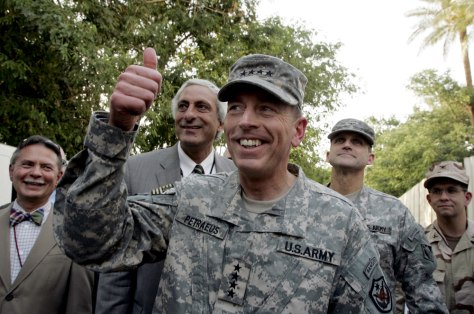
A few more paces down the digital road and you encounter a sullen looking woman holding a dog leash, the collar attached to a man lying nude on the floor of a prison. Your digital tour guide explains: “An unfortunate picture was taken. Luckily, the bad apple was punished and military honor was restored.” Fair enough. Soon, a digital General David Petraeus strides forward and shoots you another thumbs-up. (It looks as if they just put a new cyber-skin over the President Bush avatar to save money.) “He surged his way to victory and the mission was accomplished again,” you hear over strains of the National Anthem and a chorus of “hooahs.”

Past is Prologue


Admittedly, we humans are lousy at predicting the future, so don’t count on any of this coming to pass: no eye implants, no voices beamed into your head, no Amazooglebook. None of it. Except, maybe, that Iraq War timeline. If the present is any guide, government-sanctioned, counterfeit history is in your future.

Let me explain…

In 2012, the Pentagon kicked off a 13-year program to commemorate the 50th anniversary of the Vietnam War, complete with a sprawling website that includes a “history and education” component. Billed as a “public service” provided by the Department of Defense, the United States of America Vietnam War Commemoration site boasts of its “resources for teachers and students in the grades 7-12” and includes a selection of official government documents, all of them produced from 1943-1954; that is, only during the earliest stages of modern U.S. involvement in what was then called Indochina.

The Vietnam War Commemoration’s educational aspirations, however, extend beyond students. “The goal of the History and Education effort,” according to the site, “is to provide the American public with historically accurate materials and interactive experiences that will help Americans better understand and appreciate the service of our Vietnam War veterans and the history of U.S. involvement in the Vietnam War.” To that end, the United States of America Vietnam War Commemoration offers an interactive historical timeline.

By far the largest and most impressive offering on the site, the timeline spans 70 interactive pages with 830 individual entries that take a viewer from 1833 to 1976. The entries run the gamut from tales of daring and sacrifice from the official citations of Medal of Honor recipients to short offerings about changes of command. There are even couple-of-sentence accounts of relatively minor operations -- like a December 20, 1969, sweep in Binh Duong Province by elements of the 1st Infantry Division, which captured 12 of 18 members of a North Vietnamese intelligence unit and 2,000 documents that “proved how much information the enemy had about American operations.”

It’s an eclectic mix, but give credit where it’s due: the digital chronology does mention casualties from the oft-forgotten first U.S. attack on Vietnam (an 1845 naval shelling of the city we now know as Danang). For the next 131 years, however, mention of Vietnamese dead and wounded is, to put the matter as politely as possible, in short supply. Flawed history, though, isn’t.

History is Bunk


Take the August 2, 1964, “Gulf of Tonkin Incident.” It was a key moment of American escalation and, by the looks of the Pentagon’s historical timeline, just what President Lyndon Johnson made it out to be when he went on television to inform the American people of “open aggression” on the part of North Vietnam. “The USS Maddox was attacked by North Vietnamese gunboats in the Gulf of Tonkin,” reads the entry. A later one mentions “U.S. Naval Vessels being fired upon by North Vietnamese on two separate occassions [sic].” Case closed. Or is it?

Click here to see a larger version


The official story, the one that kicked off a cycle of U.S. military escalations that led to millions of casualties in Indochina, went like this: the USS Maddox, a destroyer, was innocently sailing through the Gulf of Tonkin when it was attacked by North Vietnamese torpedo boats on August 2, 1964. President Lyndon Johnson, showing great restraint, refused to respond militarily. Two nights later, the North Vietnamese attacked again, targeting the Maddox and the USS Turner Joy and prompting the president to take to the airways to announce that "renewed hostile actions against United States ships on the high seas in the Gulf of Tonkin have today required me to order the military forces of the United States to take action in reply." Johnson sought and Congress quickly passed the Gulf of Tonkin Resolution -- giving the president carte blanche to repeatedly intensify the war in the years to come.

But as it turned out, there was nothing innocent about those U.S. ships in the Gulf of Tonkin (as the President had implied). A claim of two separate attacks on U.S. Navy ships turned out to be untrue and the congressional resolution had not been drafted in the wake of the supposed attacks, but had been written months before, in anticipation of an opportune incident. In addition, the single attack by those torpedo boats occurred in the wake of a maritime raid on the North Vietnamese coast -- part of a covert program of attacks that Johnson had approved months earlier.

After reviewing the history of the incident, it seemed to me that the timeline was on distinctly shaky ground, but I decided to get a second opinion and went to the man who wrote the book on the subject, Edwin Moïse, author of Tonkin Gulf and the Escalation of the Vietnam War. He did me not one, but two better. He also pointed out apparent errors in the July 11, 1964, entry, “Joint Chiefs of Staff Unveiled ‘94 Target List,’” and criticized the August 4, 1964, entry, which offers nothing more than a title: “Two U.S. Aircraft Downed.”

“I think this is simply false,” he told me by email. “I am not aware of any U.S. aircraft downed that day and I think I would know.” These planes, he suspected, were actually lost the following day while flying missions “in retaliation for the (imaginary) second Tonkin Gulf Incident on August 4th.” The August 2nd Tonkin Gulf entry, he added, was “not quite accurate” either and was only “marginally useful” insofar as it was “close enough to the truth to allow readers to go looking for more information.”

With that in mind, I turned to Fredrik Logevall, winner of the 2013 Pulitzer Prize for History for his book Embers of War: The Fall of an Empire and the Making of America's Vietnam and author of Choosing War: The Lost Chance for Peace and the Escalation of War in Vietnam, a landmark study of American policymaking on Vietnam from 1963 to 1965. When it came to the Commemoration’s take on the Gulf of Tonkin Incident, he told me that “some context for this entry is sorely needed.”

“There's little doubt in my mind that the administration entered the month of August [1964] looking for a pretext to flex a little muscle in Vietnam,” he added. “Finally, it should be said the administration misrepresented what occurred in the Gulf, particularly with respect to the alleged second attack on August 4th, which evidence even at the time showed almost certainly never happened.”

None of this essential context can, of course, be found anywhere in the timeline. Still, everyone makes mistakes, so I meandered through the Pentagon’s chronology looking at other key entries.

Soon, I found the one dealing with My Lai.

On March 15, 1968, members of the 23rd Infantry Division’s Charlie Company, 1st Battalion, 20th Infantry, were briefed by their commanding officer, Captain Ernest Medina, ahead of an operation in an area they knew as “Pinkville.” As unit member Harry Stanley recalled, Medina “ordered us to ‘kill everything in the village.’” Infantryman Salvatore LaMartina remembered Medina’s words only slightly differently: they were to “kill everything that breathed.” What stuck in artillery forward observer James Flynn’s mind was a question one of the other soldiers asked: “Are we supposed to kill women and children?” And Medina’s reply: “Kill everything that moves.”

The next morning, roughly 100 soldiers were flown by helicopter to the outskirts of a small Vietnamese hamlet called My Lai in South Vietnam’s Quang Ngai Province and followed Medina’s orders to a T. Over a period of four hours, the Americans methodically slaughtered more than 500 Vietnamese civilians. Along the way, they also raped women and young girls, mutilated the dead, systematically burned homes, and fouled the area’s drinking water. It took a year and a half for a cover-up that extended from soldiers in the field to generals at the top of the division to unravel -- thanks in large measure to veterans Ron Ridenhour and Ron Haberle and crack investigative reporter Seymour Hersh.

Click here to see a larger version


The military took great pains to contain the fallout from the My Lai revelations, offering basement-level estimates of the death toll and focusing its attention on Lieutenant William Calley, the lowest ranking officer who could conceivably shoulder the blame, while also burying other atrocity allegations, deep-sixing inquiries, classifying documents, and obstructing investigations in order to cast My Lai as a one-off aberration. In their meticulously researched 1992 book Four Hours at My Lai, Michael Bilton and Kevin Sim write:

“What was first a ‘massacre’ quickly became a ‘tragedy’ and was then referred to as an ‘incident.’ General [William R.] Peers, whose exhaustive inquiry into the events at My Lai remains the best source for what really happened there, was warned by his superiors not to use the word ‘massacre’ at the press conference held on the publication of his report [in 1970].”

More than 40 years later, the Department of Defense is still operating from the same playbook. The Vietnam War Commemoration’s interactive timeline refers to My Lai as an “incident” not a massacre, the death toll is listed at “more than 200” instead of more than 500, and it singles out only Lieutenant Calley (who certainly had plenty of blood on his hands) as if the deaths of all those Vietnamese civilians, carried out by dozens of men at the behest of higher command, could be the fault of just one junior officer.

Given the Pentagon’s take on the My Lai massacre, I was hardly surprised by the one-sentence timeline entry on Operation Speedy Express, which says little more than that the six-month operation in the Mekong Delta “yield[ed] an enemy body count of 11,000.” This has long been the military’s official position, but the Defense Department knows full well that it isn’t the whole story.

Click here to see a larger version


In the early 1970s, a veteran who served in that operation sent a letter to the Pentagon (and then followed up with letters to other top Army generals) blowing the whistle on the systematic use of heavy firepower on populated areas which resulted in what he called a “My Lai each month.” His allegations were bolstered by those of U.S. advisors and Vietnamese sources, as well as by an internal report commissioned by the Army's acting general counsel, endorsing the whistleblower’s contention that an obsession with what was called “the body count” likely led to civilian deaths. The veteran’s shocking allegations were, however, kept secret for decades and a nascent inquiry into them was suppressed.

A later Newsweek investigation would conclude that as many as 5,000 civilians were killed during Operation Speedy Express. And a hush-hush internal military report, commissioned in the wake of the Newsweek story, suggested that the magazine had offered a low-end estimate. The document -- also kept secret and then buried for decades -- concluded:

“While there appears to be no means of determining the precise number of civilian casualties incurred by U.S. forces during Operation Speedy Express, it would appear that the extent of these casualties was in fact substantial, and that a fairly solid case can be constructed to show that civilian casualties may have amounted to several thousand (between 5,000 and 7,000).”

Despite these findings, which have -- in recent years -- been aired in publications from the Nation to the Washington Post, the Vietnam War Commemoration ignores even the military’s own estimate that as many as 60% of those killed in the operation may have been innocents.

Keep scrolling through the timeline and additional examples of dubious history regularly present themselves. Take March 15, 1969: “President Nixon ordered a B-52 strike on enemy bases in Cambodia. The first strike was made on 17 March and initiated a fourteen month bombing campaign labeled Operation Menu,” reads the entry. Next to it, there’s a picture of Nixon holding a press conference to announce the missions and point out the targets. Pretty cut and dried, right? Maybe not.

Click here to see a larger version


Operation Menu was a coldly titled collection of B-52 bomber raids against suspected Vietnamese enemy “base areas” -- given the codenames "Breakfast," "Lunch," "Snack," "Dinner," "Dessert," and "Supper." As William Shawcross demonstrated in Sideshow: Kissinger, Nixon, and the Destruction of Cambodia, it was kept secret from the American people, Congress, and even some top military brass via a conspiracy of silence, phony cover stories, the burning of documents, coded messages, and a dual bookkeeping system that logged the strikes as occurring in South Vietnam, not Cambodia. Not exactly the kind of thing presidents tend to talk about on TV. (Even the Nixon Presidential Library and Museum’s timeline describes the attacks as “secret bombings.”) The image in the Commemoration timeline is actually from an April 30, 1970 press conference in which Nixon announced the “incursion” of U.S. and South Vietnamese forces into Cambodia. It would take until August 1973, more than four years after it began, for the president to admit to the clandestine bombing campaign.

The covert attacks on Cambodia eventually became the basis for the first motion to impeach Nixon, and a resulting investigation revealed documents that proved the president himself had ordered its cover-up. The motion was voted down due to political considerations -- in favor of articles of impeachment for the Watergate crimes and abuse of power, including wiretaps that resulted from the cover-up of the secret bombing -- but 10 members of Congress who backed the motion filed a dissenting view that read, in part:

“It is difficult to imagine Presidential misconduct more dangerously in violation of our constitutional form of government than Mr. Nixon’s decision secretly and unilaterally to order the use of American military power against another nation, and to deceive and mislead the Congress about this action."

Given all of this, it’s reasonable to ask whether the timeline entry didn’t warrant a few additional facts, slightly more context, and, perhaps, a photo that doesn’t deceive the audience.

So I did just that.

In August 2013, I tried contacting the Vietnam War Commemoration Office to get some answers about the timeline. When asked about the entries for My Lai and Speedy Express, a spokesperson from the office said that they were written by an individual who no longer worked there, so no one could address specific questions. Next, I aired my concerns about the timeline to M.J. Jadick, chief of strategic communications for the U.S. Vietnam War Commemoration, and then followed up by email. I asked eight pointed questions about the entries on the Gulf of Tonkin Incident, My Lai, Speedy Express, Operation Menu, and other problematic information as well, and I didn’t exactly pull punches. “It seems to me,” I wrote her, “that some timeline entries are lacking pertinent information, are watered-down, misleading, and in some cases grossly disingenuous... The sheer number of examples suggests that this is something more than accidental.”

Jadick answered none of my questions. “Our timeline is a work in progress and will continue to be reviewed accordingly,” she responded. “I have forwarded your concerns to our Branch Chief for History and Education for review.” When I checked back four months later on the results of that review, new procedures were indeed in place -- for media queries! Now, all of them were being forwarded to Lieutenant Colonel Tom Crosson at the Office of the Secretary of Defense.

Crosson? The name rang a bell.

In August, while writing an article for the BBC, I had contacted Lieutenant Colonel Crosson for comment about evidence of U.S. atrocities and Vietnamese civilian suffering -- much of it from long-classified U.S. military records -- that I present in my book, Kill Anything That Moves: The Real American War in Vietnam. Although decades had passed since the end of the conflict, he expressed doubt that it was possible for the military to provide an official statement in “a timely manner.”

Not much has changed since then.

My follow-up request for answers to months-old questions was forwarded to Crosson in early December. A couple weeks later, I contacted him looking for a comment. More than a month has passed and I’m still waiting for an answer to any of the questions I first posed in August.

Welcome to 2053


In a presidential proclamation kicking off the 50th anniversary commemoration of the Vietnam War, President Barack Obama distilled the conflict down to troops slogging “through jungles and rice paddies... fighting heroically to protect the ideals we hold dear as Americans.” He talked of “patriots” and “heroes,” “courage” and “valor.” He said the war was “a chapter in our nation's history that must never be forgotten.”

A few days later, in a speech at the Vietnam War Memorial in Washington, D.C., Obama continued praising Vietnam veterans, lauding their “sacrifices” and “courage,” their “valor,” “patriotism,” and “honor.” He welcomed them home and commended them for helping “build the America that we love and that we cherish.” He told the veterans present, “You earned your place among the greatest generations.” Obama even gave a passing nod to the civilian toll “not just in Vietnam, but in all wars,” even if he then followed it up with some eyebrow-raising lines. “We hate war,” he intoned, though a history of almost constant warfare and overseas military interventions suggests otherwise. “When we fight,” he continued, “we do so to protect ourselves because it's necessary.” The tacit suggestion being that, somehow, barefoot Vietnamese guerrillas seeking national reunification also had designs on the United States.

“The task of telling your story continues,” Obama told the Vietnam veterans present on the National Mall. “[A] central part of this 50th anniversary will be to tell your story as it should have been told all along. It’s another chance to set the record straight.”

Setting the record straight seems, however, to be the last intention of the United States of America Vietnam War Commemoration. When I called with my questions last August, the Commemoration’s M.J. Jadick said, “This is something you should be able to get an answer for.” Yet for six months, government officials have failed to provide me with any answers about the creation of their timeline, about its seeming lack of adequate context, about entries that are at best insufficient and, at worst, dishonest, or just plain wrong. And in that same period, none of the obvious errors and obfuscations I pointed out has been changed in any way.

The United States of America Vietnam War Commemoration website asserts that its “content will not contain misleading information or unsubstantiated claims,” but instead be “evaluated for fairness and acceptability as being in the best interest of the public.” The site goes on to claim that it will “provide the American public with historically accurate materials and interactive experiences,” but the timeline suggests other motives at play.

You don’t need cybernetic eye implants and immersive propaganda portals to alter history. You don’t need a digital David Petraeus or a President Bush avatar to distract you from the truth. You don’t need to wait decades to have disinformation beamed into your head. You just need a constant stream of misleading information, half truths, and fictions to be promoted, pushed, and peddled until they are accepted as fact.

Welcome to 2053. Mission accomplished.

Nick Turse is the managing editor of TomDispatch.com and a fellow at the Nation Institute. An award-winning journalist, his work has appeared in the New York Times, the Los Angeles Times, the Nation, on the BBC, and regularly at TomDispatch. He is the author most recently of the New York Times bestseller Kill Anything That Moves: The Real American War in Vietnam (just out in paperback). You can catch his conversation with Bill Moyers about that book by clicking here.

Follow TomDispatch on Twitter and join us on Facebook or Tumblr. Check out the newest Dispatch Book, Ann Jones’s They Were Soldiers: How the Wounded Return From America’s Wars -- The Untold Story.

Copyright 2014 Nick Turse

Monday, February 17, 2014

Debating the Sinister State of Our Union

Our Sinister Dual State

by Chris Hedges - Truthdig

On Thursday the former National Security Agency official and whistle-blower William E. Binney and I will debate Stewart A. Baker, a former general counsel for the NSA, P.J. Crowley, a former State Department spokesman, and the media pundit Jeffrey Toobin. The debate, at Oxford University, will center on whether Edward Snowden’s leaks helped or harmed the public good.

The proposition asks:

“Is Edward Snowden a Hero?” But, on a deeper level, the debate will revolve around our nation’s loss of liberty.

The government officials who, along with their courtiers in the press, castigate Snowden insist that congressional and judicial oversight, the right to privacy, the rule of law, freedom of the press and the right to express dissent remain inviolate. They use the old words and the old phrases, old laws and old constitutional guarantees to give our corporate totalitarianism a democratic veneer. They insist that the system works. They tell us we are still protected by the Fourth Amendment: “The right of the people to be secure in their persons, houses, papers, and effects, against unreasonable searches and seizures, shall not be violated, and no Warrants shall issue, but upon probable cause, supported by Oath or affirmation, and particularly describing the place to be searched, and the persons or things to be seized.” Yet the promise of that sentence in the Bill of Rights is pitted against the fact that every telephone call we make, every email or text we send or receive, every website we visit and many of our travels are tracked, recorded and stored in government computers. The Fourth Amendment was written in 1789 in direct response to the arbitrary and unchecked search powers that the British had exercised through general warrants called writs of assistance, which played a significant part in fomenting the American Revolution. A technical system of surveillance designed to monitor those considered to be a danger to the state has, in the words of Binney, been “turned against you.”

We live in what the German political scientist Ernst Fraenkel called “the dual state.” Totalitarian states are always dual states. In the dual state civil liberties are abolished in the name of national security. The political sphere becomes a vacuum “as far as the law is concerned,” Fraenkel wrote. There is no legal check on power. Official bodies operate with impunity outside the law. In the dual state the government can convict citizens on secret evidence in secret courts. It can strip citizens of due process and detain, torture or assassinate them, serving as judge, jury and executioner. It rules according to its own arbitrary whims and prerogatives. The outward forms of democratic participation—voting, competing political parties, judicial oversight and legislation—are hollow, political stagecraft. Fraenkel called those who wield this unchecked power over the citizenry “the prerogative state.”

The masses in a totalitarian structure live in what Fraenkel termed “the normative state.” The normative state, he said, is defenseless against the abuses of the prerogative state. Citizens are subjected to draconian laws and regulations, as well as arbitrary searches and arrests. The police and internal security are omnipotent. The internal workings of power are secret. Free expression and opposition political activity are pushed to the fringes of society or shut down. Those who challenge the abuses of power by the prerogative state, those who, like Snowden, expose the crimes carried out by government, are made into criminals. Totalitarian states always invert the moral order. It is the wicked who rule. It is the just who are damned.

Snowden, we are told, could have reformed from the inside. He could have gone to his superiors or Congress or the courts. But Snowden had numerous examples—including the persecution of the whistle-blower Thomas Drake, who originally tried to go through so-called proper channels—to remind him that working within the system is fatal. He had watched as senior officials including Barack Obama lied to the public about internal surveillance. He knew that the president was dishonest when he assured Americans that the Foreign Intelligence Surveillance Court, which meets in secret and hears only from the government, is “transparent.” He knew that the president’s statement that Congress was “overseeing the entire program” was false. He knew that everything Director of National Intelligence James Clapper told the press, the Congress and the public about the surveillance of Americans was a lie. And he knew that if this information was to be made available to the public he would have to do so through a few journalists whose integrity he could trust.

I was a plaintiff before the Supreme Court in Clapper v. Amnesty International, which challenged the FISA Amendments Act of 2008. This act authorizes surveillance without a showing, or probable cause, that a targeted person is an agent of a foreign power. The court dismissed our lawsuit because, it said, the idea that we were targets of surveillance was “based too much on speculation.” That Supreme Court ruling was then used by the 2nd Circuit Court of Appeals to deny the credibility, or standing, of the other plaintiffs and me when it heard the Obama administration’s appeal of our successful challenge to Section 1021 of the National Defense Authorization Act (NDAA), a provision that permits the U.S. military to detain citizens in military facilities, strip them of due process and hold them indefinitely. The government, in both court cases, did not attempt to defend the surveillance and detention programs as constitutional. It said that I and the other plaintiffs had no right to bring the cases to court. And the courts agreed.

This deadly impasse, the tightening of the corporate totalitarian noose, would have continued if Snowden had not jolted the nation awake by disclosing the crimes of the prerogative state. Snowden’s revelations triggered, for the first time, a genuine public debate about mass surveillance. Since the disclosures, three judges have ruled on the NSA’s surveillance program, one defending it as legal and two accusing the NSA of violating the Constitution. A presidential panel has criticized the agency’s blanket surveillance and called for reform. Some members of Congress—although that body authorized the Patriot Act and its Section 215, which ostensibly permitted this wholesale surveillance of the public—have expressed dismay at the extent of the NSA’s activities and the weakness of its promised reforms. Maybe they are lying. Maybe they are not. Maybe reforms will produce improvements or maybe they will be merely cosmetic. But before Snowden we had nothing. Snowden’s revelations made us conscious. And as George Orwell wrote in his dystopian novel “1984”: “Until they become conscious they will never rebel. ...”

“Now, we’re all familiar with Congress’ most dramatic oversight failure,” said Ben Wizner, the director of the American Civil Liberties Union Speech, Privacy & Technology Project and a legal adviser to Snowden, in a recent debate over Snowden with R. James Woolsey, a former director of the Central Intelligence Agency.

“And this was in the notorious exchange between Sen. Ron Wyden and Director of National Intelligence James Clapper. Wyden had asked, did the NSA collect any type of data on millions or hundreds of millions of Americans? Clapper’s answer was, ‘No, sir.’ Now, this brazen falsehood is most often described as Clapper’s lie to Congress, but that’s not what it was. Wyden knew that Clapper was lying. Only we didn’t know. And Congress lacked the courage to correct the record—allowed us to be deceived by the director of national intelligence.”

Societies that once had democratic traditions, or periods when openness was possible, are often seduced into totalitarian systems because those who rule continue to pay outward fealty to the ideals, practices and forms of the old systems. This was true when the Emperor Augustus dismantled the Roman Republic. It was true when Lenin and the Bolsheviks seized control of the autonomous soviets and ruthlessly centralized power. It was true following the collapse of the Weimar Republic and the rise of Nazi fascism. Thomas Paine described despotic government as a fungus growing out of a corrupt civil society. And this is what has happened to us.

No one who lives under constant surveillance, who is subject to detention anywhere at any time, whose conversations, messages, meetings, proclivities and habits are recorded, stored and analyzed, can be described as free. The relationship between the U.S. government and the U.S. citizen is now one of master and slave. Yet the prerogative state assures us that our rights are sacred, that it abides by the will of the people and the consent of the governed.

The defense of liberty, which Snowden exhibited when he cast his fortune, his safety and his life aside to inform the public of the forces arrayed against constitutional rights, entails grave risks in dual states. It demands personal sacrifice. Snowden has called us to this sacrifice. He has allowed us to see who we are and what we have become. He has given us a chance. He has also shown us the heavy cost of defiance. It is up to us to seize this chance and dismantle the prerogative state. This means removing from power those who stole our liberty and lied to us. It means refusing to naively trust in their promised reform—for reform will never come from those who are complicit in such crimes. It will come through Americans’ construction of mass movements and alternative centers of power that can mount sustained pressure.

If we fail to sever these chains we will become, like many who did not rise up in time to save their civil societies, human chattel.

Playing at Peace: Decades of Deceit in Palestine

The Do Nothing Peace Machine

by William A. Cook - CounterPunch

In 2010 I edited The Plight of the Palestinians: a Long History of Destruction, a collection of articles by world renowned writers who unveil the genocide taking place in Palestine by the occupying power in this “advanced” civilization of 2014, a slow water torture of constant humiliation, destruction and death as the world watches and nothing is done to bring justice to the people of Palestine.
In that text, Dr. Jeff Halper details the quest for “peace” that has been crippled by the state of Israel, the intentional, calculated and indifferent response to the conditions facing the Palestinian people every day.
He offers this reality:  
"Israel’s strategy until today is to bypass and encircle them, making deals with governments that isolate and, unsuccessfully so far, neutralize the Palestinians as players. This was most tellingly shown in the Madrid peace talks, when Israel only allowed Palestinian participation as part of the Jordanian delegation. But it includes the Oslo “peace process” as well. While Israel insisted on a letter from Arafat explicitly recognizing Israel as a “legitimate construct” in the Middle East, and later demanded a specific statement recognizing Israel as a Jewish state (both of which it got), no Israeli government ever recognized the collective rights of the Palestinian people to self-determination. Rabin was forthright as to the reason: If Israel recognizes the Palestinians’ right to self-determination, it means that a Palestinian state must by definition emerge – and Israel did not want to promise that.4 So except for vague pronouncements about not wanting to rule over another people and “our hand outstretched in peace,” Israel has never allowed the framework for genuine negotiations. The Palestinians must be taken into account, they may be asked to react to one or another of our proposals, but they are certainly not equal partners with claims to the country rivaling ours." (“The Problem with Israel,” Jeff Halper, 2007).

Seven years ago, November 22, 2007, I wrote an article about George W. Bush’s plan to bring peace to the mid-east, a plan that used the city of Annapolis as its label with Condoleeza Rice acting as emissary from the American government meeting with Israeli and Palestinian officials. That article tracked the reality of the failed peace process from before the Mandate to 2007. It is now 2014 and there is no peace—but there is once again a “peace” initiative under way, an initiative every American President seems obliged to give lip service to knowing beforehand no peace will be affected. Why? Why go through a process all know will not result in peace? Why exercise an illusion? For whose benefit? To what end?

Resting on my bookshelf is a cunning little device, an object I’ve had in my office for decades, a curiosity piece that grabs the attention of children and adults, a strange unfamiliar gadget that appears to have a purpose since it has a handle, two gears fastened to small rounded cylinders that crisscross each other as one turns the handle, it’s called a do-nothing machine. Someone conceptualized it and someone created it and someone turns that handle to do nothing. Why? Why go through a process all know will not accomplish anything? Why spend time on an illusion? For whose benefit? To what end?

* * *

There it sits next to The Plight of the Palestinians and it seems to me Obama and Kerry must have one just like it since they initiated a process that they know will accomplish nothing, inspired no doubtby the do-nothing machine. Why? Perhaps it’s to pretend that they are not owned by the Israeli state or perhaps to defend themselves against the perception that they have abandoned any thought of a peaceful two state solution in Palestine or perhaps to extend time once again so Israel can steal more land and create more settlements allowing the slow motion genocide to continue. Perhaps an illusion is better than nothing at all.

But what of the Israeli government; why would they join this farce? That’s puzzling to me since I know from their own words and actions that they have no intention of recognizing the rights of Palestinians to a state much less create one. Indeed they have for 65 years denied even the idea of a Palestinian state, and as Halper has made clear they have torpedoed more than 19 times any attempt to create such a state. Indeed, there is no logic, no rational explanation of Israeli insistence that they want a two state solution, that peace is their desire, that the United States must be the interlocutor to bring the two parties together without pre-conditions and then raise conditions that could not be met and maintain this ruse for 65 years while absconding with all but 11% of Palestine (Israel has used a complex legal and bureaucratic mechanism to take control of more than fifty percent of the land in the West Bank. This land has been used mainly to establish settlements and create reserves of land for the future expansion of the settlements” [see Ifamericansknew.com] during that same period). There must be a deeper explanation that drives the Israeli governments to deceive the world year after year, something we have not yet addressed yet could be an explanation.

Perhaps once again it’s necessary to seek wisdom in fiction, to explore the unknown in narratives that dig deep into the subconscious mind, to burrow inside the human innards, to seek beyond the intestines and muscles and sinews and bones where the true being resides, where heartfelt yearnings reside, where the spring of emotions pours forth its latent reactions to self, where needles and surgical knives cannot go if understanding is to be sought, where self responds to urgings that drive the impulses to desperate acts that self itself does not comprehend, where the inner self is encrusted with the fears of generations pounded into the small child from inception, and identity is an accumulation of accepted hatred that seeps into the being in a collective response that determines all acts as self-survival against any outside of the tribal clan that has indelibly marked each member with a new source of pulsating blood, no longer a heart that throbs in rhythm to the hearts of all humankind, but emanates from a somatic fear that seeks only its own security, its own purpose, its own distinction as its hallmark at the expense of all who threaten its existence.

Franz Kafka, in “A Fragment,” tells a story told to him by his father who heard the story from a strange boatman. “A great wall is going to be built to protect the Emperor. As you may know, the infidel nations, with demons among them too, often gather in front of the imperial palace and shoot their black arrows at the Emperor.” A cryptic fragment certainly, about an emperor, an imperial palace, and a wall to protect the emperor and his people; unfortunately there are infidel nations who gather around the palace and shoot the emperor. Ultimately there is no protection, there is only on-going fear that any action to protect is doomed, and if, as Kafka also maintained “Guilt is never to be doubted,” fear exists inside the wall, always fear inside and out, of self and all others. Curiously, the Zionists have found reason for a wall thinking that it could serve as protection against their manifest enemies oblivious to Kafka’s admonition. In 2004 I wrote about Sharon’s wall of fear.

I would suggest that Sharon’s “Wall of Fear” walls in both the Palestinians and the Jews, that it gives offense to those on both sides, and it offends the moral sensibilities of any civilized person anywhere in the world. Sharon prepared for the building of the wall by laying its foundation in the guts of his people, fear of four million terrorists and fear that the future offered no hope for peace. Having bulldozed the Palestinian Authority out of relevance, he removed the possibility of negotiations, and, by that act, left the Jews without hope for peace, leaving him free to force the erection of the “Wall.”

Consider how the Wall walls in the Israeli people: it looms on the horizon a daily reminder that they have failed to achieve their primary goal, a peaceful assimilation of Jews from around the world into a haven, given to them by a remorseful Europe and America, where all could live in dignity and respect, without rancor or fear of racism, hatred and oppression; a daily reminder that they have walled in a poor and deprived people behind barriers that isolate them from the community of nations, from their fields and shops, from relatives and families, not unlike the Pogroms suffered by the Jews in Poland, Austria, Russia, Hungary, and Czechoslovakia; a daily and fearful reminder that someday, somewhere, someone will scale or circumnavigate the Wall as people have done from time immemorial – as the Huns did when they mocked the efforts of the Chinese to keep them at bay on their side of the Great Wall, or the Germans when they laughingly skirted the Maginot Line – to make absurd the efforts of one people to subdue the will of another; a daily reminder that their purported Democracy mocks itself as it seals off an entire population in full sight of the world community despite the vocal objection of that community, indeed, in complete and utter disbelief that the Jews of all peoples could undertake such a heinous act; a daily reminder that they have created a monstrous gray monument to the harm they have inflicted on another people, a monument that in time will have the same effect as the march around Jericho, “And they utterly destroyed all that was in the city, both man and woman, young and old, and ox, and sheep, and ass, with the edge of their sword”; a daily reminder that visible or no each and every name of an incarcerated Palestinian is carved into that cement just as the names of the fallen Jews, victims of Nazi atrocities, are carved into the marble slabs at the Holocaust Memorial in Florida; and, finally, a daily reminder that this Wall is but the beginning of a Wall that must stretch north and south along the Jordanian border, further north along the Syrian line, west along Lebanon’s southern coast, and south along the Sinai, thus completing the incarceration of the Jews once again” (Cook, “Fence, Barrier, Wall: What’s in a Name?,” 2004).

Could we not ask here as we did of the “Do Nothing Machine” why? What drives the mind to destroy what it claims it must protect? Why build more walls except to keep those not of the tribe out and those within the tribe clean of contamination lest their inner self lose its distinction, its hallmark and find release from the fear that pulses inside threatening its existence by purging it of all that could or would destroy it because it is not of them. The Zionists in forcing the existence of the State of Israel on its people did so by capitalizing on this fear. The world desires to destroy the Jews. There is no protection for the Jews anywhere in the world except in Palestine where their historic rights to the land will prevail and where the Jews will protect themselves from all their enemies; they need only ensure that protection by linking their survival to those nations that have the power and the will to ensure security. This requires control of such umbilical linked “friends,” the United States, England, France, Germany, Canada, Australia who become their “protector” as Rabbi Loew’s Golem protected the Ghetto of Prague in the 16th century (see “A Nation of Golems,” Cook, 2009). It also requires that their protection is sealed by law, hence restrictions on “those who criticize the Zionist state” as H.R. 4009(113th Congress, 2nd Session, 2014) demonstrates, a “Bill to amend the Higher Education Act of 1965 to prohibit an institution that participates in a boycott of Israeli academic institutions or scholars from being eligible for certain funds under that Act” (proposed by Mr. Roskam and Mr. Lipinski as sent to the Committee on Education and the Workforce).

There exists a mindset here driven by forces beyond the reasoning mind. Kafka offers a depiction of this phenomenon in “Metamorphosis,” a tale of surrealistic quality where the protagonist wakes one morning to find himself transformed into a gigantic insect. Yet his mental faculties appeared to be stable, his concerns those of a man prevented from getting to his train on time, on how to deal with the problems of those outside his bedroom door who would be repulsed by his demeanor; fear of confrontations followed, fear of his domineering father rose swiftly, loss of his job, loss of the money he provided for his family, the potential upheaval of his life made by his visible transformation into a loathsome insect roused innate fears both of expulsion and death, his words were not understandable, the imminent awareness by all outside that he was different, driven by different realities, unfit to be welcomed into the community, ultimately to be driven out or destroyed. Such is the inner fear that pulses in Gregor’s being and comes to fruition in the night, a nightmare perhaps but presented as true.

Kafka once stated, “I consist of literature and am unable to be anything else.” The house he (Gregor Samsa aka Franz Kafka) lived in, the town that surrounds it, the wall that surrounds the town metaphorically mirror the inner identity of the narrator, walled within walls, wakening inside a room where now, in this night where he, as he did virtually every night, writes the real world within which he lives, a world of fiction where explanations evoke symbols and depictions that convey truth in images and unleash through dreams the latent fears that energize those forced to exist in isolation from all others for their identity is encased in a tribal mind dependent for its meaning and its understanding of self on those who control their reasoning and determine for them not only who they are but why they are and in that vice how they will act. Thus did Kafka’s narrow world of the Judengassen encompass his entire life, one of Europe’s oldest ghettos, what he called “my prison cell-my fortress.” But in the dream of Samsa transformed into a hideous insect, there comes a release from that control as he can scale now the walls of his room and the very ceiling above, a freedom made possible by his release from his “Penal Colony,” an escape from “The Judgment,” an avoidance of “The Trial” and find a new life, perhaps, in “Amerika.”

“The Metamorphosis” captures the condition of the tribal member caught within the society he must accommodate and assimilate into despite the impossibility of that probability, not because the society consciously refuses the assimilation but because the individual fears those not members of the tribe and because he fears they find him odious as the hideous insect depicts. Crushed inside these twin fears, there is no escape for the tribe but the destruction of the perceived enemies regardless of their passivity to the condition of the tribes’ fears.

But Kafka’s brilliant and penetrating analysis of the tribal mind and its insidious control of its members does not end with “The Metamorphosis,” it is extended and brutalized in “The Penal Colony.” This narrative captures the incapacity of the individual mind to control its own destiny. There is an Officer who is both controller and judge, guided by a simple rule, “guilt is never in doubt,” a rule that applies to those not of the tribe but to tribal members as well; all are guilty, all threaten the security and control of the Zionist entity, hence the epithet “self-hating Jew.” As the Officer describes the penal colony’s procedures for determining guilt, the condemned are totally submissive to the authorities, they do not expect due rights under the law, they understand that those in control have full authority to arrest, imprison and condemn to death whomever they will thus making legal arrest without due process, incarceration indefinitely and execution as well as extrajudicial assassination.

When questioned by an outside Traveler who comes to interview the Officer, the obvious questions seek obvious answers that the Officer finds incomprehensible, how can anyone question the authorities to inflict what they must to ensure the safety of the people? To justify his position the Officer releases the prisoner who was scheduled for execution and gets on the torture machine that he designed to prove that the judgment of the authorities is justified for all because it stipulates that the judgment must “Be Just.” Ironically, Kafka narrates that the machine goes berserk, and the designer of the hideous machine becomes its last victim as it disintegrates into an uncontrollable monster.

What Kafka envisioned is prophetic; when a state imposes its will on all its sister states, it becomes a monster, a metallic Golem perhaps that destroys at will but creates its own grave in the process, as Kafka’s Officer becomes pinned to the needles that were supposed to inscribe on the prisoner’s back the judgment of the authorities but instead leave his body suspended, bleeding and shredded, hanging above the grave into which he was to have been tossed. There it must remain isolated, condemned, and forever abhorred as an atrocity of insanity and arrogance.

Consider the actions of the Zionist State that from its inception under the control of the Jewish Agency, the eleven controllers in the Red House making their determinations for all Jews arriving in Palestine, as described by Dr. Ilan Pappe in The Ethnic Cleansing of Palestine, to use terror against the British Mandate Government in Palestine, to coerce the members of Parliament in London to overlook their crimes against the British people, to massacre the citizens of Deir Yassin and over 30 other massacres in areas belonging to the indigenous peoples of Palestine, to control by threat and intimidation the new immigrants arriving in Palestine from Europe as depicted by documents seized by the Mandate Police, and available now from the files of Sir Richard C. Catling in the Rhodes House Archives, and one has a clear picture of Zionist power over the Jewish people escaping Germany and elsewhere as they imposed their will on the helpless, both Jew and Palestinian, during the late 1930s and through 1948.

When complicity in crime is imposed on innocent people through coercion and fear, we have an understanding of the truth embedded in Kafka’s narratives and that gives us pause to realize why this state can attack Iraq to destroy its nuclear plant construction and that of Syria and attempt to force the western world to attack Iran; it makes one realize that invading Lebanon without justified reason, its invasion and retention of the Golan Heights and its invasion and destruction of Gaza happens despite the international laws that should determine the behavior of member nations, and it should make obvious that this state will go to any lengths to control the United Nations by controlling the American Government by controlling its elected officials regardless of the desires of the citizens of the United States.

We need only reflect on the 2008 Christmas invasion of Gaza to understand the irrationality of attacking a defenseless people surrounded by the military power of the IDF with its use of extensive missile force from the air, the eastern borders under Israeli control and from the sea; add to that the needless use of white phosphorus that is both illegal and causes catastrophic pain for those unable to escape its searing pain. Why such brutality against a people incarcerated on all sides without military capability to defend their homes or even the ability to flee the terror of the Jewish invasion? Why inflict such barbaric force when those surrounded had no means to destroy the Zionist state? What irrational behavior erupts in a purported civilized state unless it is itself an irrational fear of self-destruction if perceived enemies are not eradicated as insurance against security (read survival instinct) for the people of Israel? Listen to the voices of those in positions of power and influence that justify the attempted destruction of the Gazan people:

*The son of Sharon :’Flatten Gaza, send it back to Middle Ages, they need to die!’

*Interior Minister Eli Yishai said Operation Pillar of Defense would continue and likely be expanded, The war in Gaza “must be so painful and difficult that the terror groups will not think twice but a hundred times before they fire missiles against Israel again…The goal of the operation is to send Gaza back to the Middle Ages, only then will Israel be calm for the next 40 years.”

*The National Unity Party, Michael Ben-Ari, called for Israeli soldiers to kill Gazans without thought or mercy.“There are no innocents in Gaza, don’t let any diplomats who want to look good in the world endanger your lives – mow them down!”

*A prominent Israeli rabbi, Yaakov Yosef, the son of former chief rabbi, Ovadia Yosef, in a sermon at the Cave of the Patriarchs in Hebron blessed IDF soldiers while urging them “to learn from the Syrians how to slaughter the enemy.”

How explain these cries of inhumane hate against a place and its people that have never attacked the Zionist state except out of absolute desperation, hopelessness, and despair, the last resort of those who have the right to attack unlawful occupiers of their land and homes? This is the voice of insanity that cannot exist in a sane world where concern, compassion and love should guide our endeavors and foster the drive toward true peace, not a “peace” (shalom) that justifies its rights by demanding absolute control of all that threatens its security as it denies the very thing it claims as its right. This world in this time is not tribal anymore; it is guided by international laws that all peoples of the earth have designed and mutually accept. That should be true of the Israeli State since it has signed acceptance of the Universal Declaration of Human Rights and the Geneva Accords that have defined genocide, a definition resulting from the catastrophic incarceration and deaths inflicted on the Jews in Nazi Germany. Yet today this definition is disgraced and defied by the Zionist State as it commits genocide in Palestine as the voices in the book that opened this article testifies, and the world watches and does nothing.

Perhaps now we might understand that fiction can enlighten us more than the silent voices of the intimidated and the damned; Kafka has looked inside the human breast and unveiled the true force that gives life to the horrors inflicted on the people of Palestine and the peoples of Lebanon and Syria and Jordan and Gaza as the Zionist power used the teachings of Judaism to control those seeking security and comfort in what could have been a homeland for the Jewish people but has become instead a lawless and ruthless occupation power and destroyer of the true owners of the land from the time they were offered solace to live with the people of Palestine.

And this brings us to the “Do Nothing Machine” that the Zionists use to deceive the people of the world that it desires a peaceful solution to the crisis by a mutually negotiated two state determination when in reality they desire only the eradication of the Arabs in Israel and all other Arabs that inhabit their land in Judea and Samaria; this has been their goal since they first arrived in Palestine and that “peace Machine” they use will ensure that neither peace nor a Palestinian state will ever exist. Let’s end with the unfortunate prophetic words of Israel’s most ardent exponent and the most vocal of its true face, a terrorist of extraordinary visibility and one accepted by the Israeli people as their Prime Minister, Menachem Begin, head of one of the Jewish terrorist groups, who described Deir Yassin as “splendid,” and stated: “As in Deir Yassin, so everywhere, we will attack and smite the enemy. God, God, Thou has chosen us for conquest.”

There remains only this horrifying possibility: to fill their new state, the Jewish State, the Zionists have utilized the services of “Settlers,” people who think like their ancestors did 3500 years ago, tribally, as those who respond to day to day living instinctively, in fear, always with the tiger lurking in the rocks, always with their enemy tribes anxious to destroy them, always with the mindset that they alone must preempt another lest they become the victim, and always with the rationale that all are potential destroyers and that gives them the right to kill at will by whatever means necessary; yet in bringing this ancient mindset into their midst, the Zionists have created a fearsome and loathsome nightmare not unlike Kafka’s “Burrow” where “unseen enemies crawl through the dark tunnels” and the narrator, Kafka’s only first person tale of horror, feels “threatened not only by outside enemies, but enemies within, in the earth’s entrails,” and they are legendary, and “I believe in them.”

William A. Cook’s latest book is Decade of Deceit.

Sunday, February 16, 2014

After Law: America's Constitutional Degeneration

Drone Killing the Fifth Amendment: How to Build a Post-Constitutional America One Death at a Time

by Peter Van Buren  - TomDispatch

  • Terrorism (ter-ror-ism; see also terror) n. 1. When a foreign organization kills an American for political reasons.
  • Justice (jus-tice) n. 1. When the United States Government uses a drone to kill an American for political reasons.

How's that morning coffee treating you? Nice and warming? Mmmm.

While you're savoring your cup o' joe, imagine the president of the United States hunched over his own coffee, considering the murder of another American citizen. Now, if you were plotting to kill an American over coffee, you could end up in jail on a whole range of charges including -- depending on the situation -- terrorism. However, if the president’s doing the killing, it's all nice and -- let’s put those quote marks around it -- "legal." How do we know? We’re assured that the Justice Department tells him so. And that’s justice enough in post-Constitutional America.

Through what seems to have been an Obama administration leak to the Associated Press, we recently learned that the president and his top officials believe a U.S. citizen -- name unknown to us out here -- probably somewhere in the tribal backlands of Pakistan, is reputedly planning attacks against Americans abroad. As a result, the White House has, for the last several months, been considering whether or not to assassinate him by drone without trial or due process.

Supposedly, the one thing that’s held up sending in the drones is the administration’s desire to make sure the kill is "legal." (Those quotes again.)

Last May, Obama gave a speech on the subject. It was, in part, a response to growing anger in Pakistan, Yemen, and elsewhere over the CIA’s ongoing drone assassination campaigns with all their “collateral damage,” and to the White House’s reported “kill list.” In it, he insisted that any target of the drones must pose "a continuing and imminent threat to the American people." At the time, the White House also issued a fact sheet that stated: "Lethal force must only be used to prevent or stop attacks against U.S. persons, and even then, only when capture is not feasible and no other reasonable alternatives exist to address the threat effectively." While that sounds like a pretty imposing set of hurdles to leap, all of the "legal" criteria are determined in secret by the White House with advice from the Justice Department, but with no oversight or accountability.
 Tomgram: Peter Van Buren, The Divine Right of President Obama?
 Imagine this: a president and his top officials as self-professed assassins -- and proud of it, even attempting to gain political capital from it. It’s not that American presidents have never been associated with assassination attempts before. At a National Security Council meeting, Dwight D. Eisenhower personally ordered the CIA to “eliminate” Congolese Prime Minister Patrice Lumumba, then feared as a future “Castro of Africa.” “After a dead silence of fifteen seconds,” Tim Weiner tells us in Legacy of Ashes, his history of the CIA, “the meeting went on.” And the Kennedy brothers were evidently involved in at least one attempt to kill Fidel Castro, while the CIA of Lyndon Johnson’s era mounted a massive assassination program in Vietnam. Still, in those days, something dark and distasteful clung to the idea and presidents preferred to maintain what was called “plausible deniability” when it came to such efforts. (In 1981, by Executive Order, President Ronald Reagan actually banned assassination by the U.S. government.)
Now, top officials connected to the White House proudly leak details about their ongoing efforts to use drones to assassinate obscure suspected terrorists in the backlands of the planet. They take pride in comparing their activities to a religious calling. They want the public to know that they and the president spend significant time and effort on such “targeted killings.” The most recent case to see the light of day is the prospective assassination of an American citizen and suspected “al-Qaeda facilitator,” evidently in the tribal borderlands of Pakistan. When it comes to this possible future assassination, they seem eager to emphasize via leaks the care they are taking in preparing the way.

In the process, they have produced legalistic documents so secret that they can’t be shown to the public, though their existence and import can indeed be publicized. These justify to their satisfaction the killing of Americans without what once would have been considered “due process” or any role whatsoever for the actual legal system. The president and his top officials are ready at a moment’s notice to discuss in public, with a legalistic turn of mind and a finicky attention to bureaucratic detail, whether such killings can properly be carried out in the U.S. as they are abroad, or whether the angels of death should be the U.S. military or the CIA -- as if this were of any legally binding import. (Congress, in turn, has been balking at appropriating money for the military to take over more of the CIA's drone killings.) No less striking, the media is by now almost instantly bored with such reports, which prove, at best, to be minor one-day ripples in the vast tide of the news.

And in the face of all this, Americans seem to exhibit a remarkable lack of interest. The transformation of the White House into a killing machine? Whether any of this has anything to do with legality? More than 12 years after the 9/11 attacks, it's evidently just everyday life in America. That the president is our assassin-in-chief and that drones are acceptable weapons of choice in such killings are givens. It's also a given that, in the name of American security, anything goes as long as it's wrapped in an exculpatory, feel-good legalistic package, even if it bears no actual relationship to what Americans might once have called legality. Today, Peter Van Buren, ex-State Department whistleblower, TomDispatch regular, and author of We Meant Well: How I Helped Lose the Battle for the Hearts and Minds of the Iraqi People, explores the deep derangement of all this and what it means in the building of a “post-Constitutional America.” Tom

Drone Killing the Fifth Amendment: How to Build a Post-Constitutional America One Death at a Time

by Peter Van Buren


E
ven then, it turns out that the supposedly tortured deliberations of the administration are not really necessary. Despite the president’s criteria, according to an unnamed administration official quoted by the Associated Press, Obama could make an exception to his policy and authorize the CIA to strike on a one-time basis, no matter what the circumstances. One way or another, it is Obama who decides who to kill and when.

Short-Term Questions


At this point, it’s unclear just why the Obama administration leaked its plans in reference to this errant American abroad. After all, official after official has insisted that Edward Snowden’s revelations of secret NSA documents have caused terrorists to change their communication tactics, yet the one American up to no good somewhere in the terrorist world apparently has not done so in response to the leak about his potential fate, and will remain locatable whenever needed as a target. And yet giving notice of a possible attack in advance in the media would, on the face of it, seem both counterproductive and an invitation to the very barrage of criticisms leveled by key officials at Snowden. After all, under the circumstances, an American connected with al-Qaeda wouldn’t exactly have to be a Bond villain to decide to change his behavior and his location, stay indoors or outdoors more, keep off his phone for a while or trade it in for another.

Could the administration leak have been a trick to flush the bad guy out, causing him to panic and run? Was it an elaborate ruse designed to induce widespread concern in al-Qaeda about the liabilities of having American compatriots? Was it a bone thrown to Republicans otherwise eager to paint the president as weak? Could it have been some kind of geopolitical muscle tussle with once compliant but now more assertively anti-drone Pakistan? Or could the leak have been a PSYOP on the American people, an attempt to manipulate us into feeling better about government decisions to kill American citizens by revealing the deliberative and heart-wrenching process Obama goes through? Or could it simply have been an attempt to normalize such acts for us, to make them part of the understandable everyday background noise of a dangerous world?

The answer is: we don’t know. Not yet anyway.

Not the First Time


The Obama administration admits to killing four Americans as part of its war on (or is it “war of”?) terror. We'll pause here a moment for you to contemplate whether there could have been other, undocumented killings of the same sort awaiting the revelations of some future Edward Snowden or Chelsea Manning.

On May 7, 2011, a U.S. drone fired a missile in Yemen aimed at American citizen and key terror suspect Anwar al-Awlaki. The missile blew up a car with two other people in it, quickly labeled “al-Qaeda operatives” after we killed them.

Such collateral killings should be no surprise. The inaugural article by Glenn Greenwald and Jeremy Scahill at their new media venture notes that the National Security Agency regularly identifies targets for CIA assassinations based on metadata analysis and cell-phone tracking. Rather than confirming that target’s identity, the CIA is evidently ready and willing to blow a suspect away based on the location of a mobile phone he assumedly is using. In other words, people can be killed because they borrowed the wrong cell phone. (So much for a deliberative process.)

The U.S. had tried to kill al-Awlaki before, including in the Bush years -- and missed. In justifying one of these assassination attempts, Obama’s counterterrorism chief, Michael Leiter, claimed that al-Awlaki actually posed a bigger threat to the U.S. "homeland" than Osama bin Laden, albeit without explanation. No matter, they finally got their man. A follow-up strike killed al-Awlaki, and another soon after obliterated his teenage son, also in Yemen. Though no one argues that the boy was in any way linked to terrorism and no administration official has bothered to explain just why he was targeted, former White House press secretary Robert Gibbs did comment that the killing was justified as he "should have had a more responsible father."

Couldn’t Happen Here?


Though the president and his officials go to great pains to indicate that such assassinations are only going to happen abroad, there is nothing in the carefully worded distinctions made by the White House to preclude them at home. As a start, in his criteria for killing someone extrajudicially, the president claims there is no difference between an American citizen terrorist and a foreign terrorist. A careful look back at the statements of two government officials makes it clear that thought has already gone into the question of bringing the killings home.

Remember the testimony then-FBI Director Robert Mueller gave before a House subcommittee in 2012? When asked point-blank if the president could order the killing of an American in the United States, he replied “Uh, I’m not certain whether that was addressed or not... I’m going to defer that to others in the Department of Justice.” Mueller, of course, had the option of saying flat-out, “No, no, of course the president can’t order a hit on an American here in the U.S. where the full judicial system, Constitution, and due process protections exist! Are you mad?”

The truth emerged only in 2013 when Senator Rand Paul asked point-blank whether the president could authorize lethal force, such as a drone strike, against an American citizen in the United States. Attorney General Eric Holder fired back that while the question was "hypothetical," the real-world answer was yes. Holder said he could imagine "an extraordinary circumstance in which it would be necessary and appropriate under the Constitution and applicable laws of the United States for the president to authorize the military to use lethal force within the territory of the United States."

It’s easy enough, in fact, to imagine the sort of scenarios that might lend themselves to such an act: a ticking time bomb, a killer believed to have anthrax and on the loose, a suspected dirty-bomb maker in a desolate location, terrorists with a bus full of children on a mountain top. Imagine a slippery slope and... presto! You’re there.

They've thought about it. They've set up the legal manipulations necessary to justify it. The broad, open-ended criteria the president laid out for killing suspected terrorists exposes the post-Constitutional stance our government has already prepared for. All that's left to do is pull the trigger.

Nostalgia for the Fifth Amendment


It’s still possible to remember, almost nostalgically, how the Fifth Amendment used to guarantee Americans due process. The key phrase was indeed that "due process." It meant the government could not take away your property or imprison or execute you without first allowing you a chance to defend yourself. You would have your day in court with a lawyer and a jury of your peers to make the final decision. This would all be quite public and the people involved would be held accountable for their actions. The Fifth was meant by those who wrote it as a check on the ultimate in government excess: the purposeful taking of citizens’ lives. Today, it increasingly seems an artifact of a quaint past, as seemingly lost to history as the corded phone or manual typewriter.

Attorney General Eric Holder publicly rewrote the Fifth Amendment in 2012, declaring, in a veiled reference to al-Awlaki, “that a careful and thorough executive branch review of the facts in a case amounts to ‘due process’ and that the Constitution’s Fifth Amendment protection against depriving a citizen of his or her life without due process of law does not mandate a ‘judicial process.’” In other words, in a pinch, skip the courts. In this way, Holder gave us a peak behind the White House curtain, making clear that the president's personal and secret decision to kill an American, perhaps made over morning coffee, was, in his opinion, good enough to make everything legal.

The due process question Holder dismissed so casually still looms large over al-Awlaki's murder. Prior to the killing, attorneys for his father tried to persuade a U.S. District Court to issue an injunction preventing the government from killing him in Yemen. A judge dismissed the case, ruling that the father did not have “standing” to sue and that government officials themselves were immune from lawsuits for actions carried out as part of their official duties.

This was the first time a father had sought to sue the U.S. government to prevent it from killing a son without trial. The judge did call the suit “unique and extraordinary,” but ultimately passed on getting involved. He wrote instead that it was up to the elected branches of government, not the courts, to determine if the United States has the authority to extrajudicially murder its own citizens.

The judge’s position was revealing of our moment. The extrajudicial killing of an American citizen seemed to him to be nothing but a political question to be argued out in Congress and the White House, not something intimately woven into the founding documents of our nation. The judge was not alone in his characterization of the problem. Mike Rogers, chair of the House Intelligence Committee, complained that the killing of more terror suspects in a similar manner has been held back by “self-imposed red tape.”

There are, however, no footnotes in the Fifth Amendment, no caveats, no secret memos, no exceptions for terrorism, mass rape, child torture, or any other horror the U.S. has confronted in its 238 years of existence. Such addendums to the Fifth were unnecessary, because in the beautiful preciseness of Lincoln’s phrasing at Gettysburg, ours is “a government of the people, by the people, for the people,” one made up of us, beholden to us, and whose purpose is to serve us.

Such a government would be incapable of killing its own citizens without due care, debate, and open trial. Those actions would violate the sacred convent of trust between a people and their government in a democracy, the "consent of the governed," and delegitimize the government itself.

That last point is worth a closer look, because it makes clear what murder-by-decree really represents in post-Constitutional America. The phrase "consent of the governed" first appears in the Declaration of Independence, the document by which the United States declared itself no longer under the governance of the British king. The Declaration makes clear that a government's moral right to use state power is only justified and legal when derived from the people over which that power is exercised. Such consent is the opposite of the divine right of kings, the philosophy under which the British ruled colonial Americans. Its foundational principle was obedience to government and its edicts and decisions, even on issues of life and death, as a religious and moral obligation.

Following the more philosophical Declaration of Independence, the Bill of Rights was a practical exercise written to address directly the specific injustices of rule by royal decree. By turning its back on key elements of our founding, Washington, it seems, has brought us full circle.

Life in Post-Constitutional America


These days in the pseudo-debates about drone killings in the mainstream media, such changes are treated as matters of no great significance. On the day that the president’s latest plans for the murder of a fellow citizen in the distant tribal backlands of Pakistan first appeared, they caused little stir. The headlines were instead dominated by Olympic gossip and an impending ice storm in Atlanta. Killings extrajudicially mandated by the White House? The Fifth Amendment? Maybe if the target were Shaun White in Sochi, more people would have cared.

At the moment, we are threatened with a return to a pre-Constitutional situation that Americans would once have dismissed out of hand, a society in which the head of state can take a citizen’s life on his own say-so. If it’s the model for the building of post-Constitutional America, we’re in trouble. Indeed the stakes are high, whether we notice or not.

The question is: How far will post-Constitutional America stray from the nation so conceived in the Declaration of Independence and the Bill of Rights? Because in the twenty-first century, the midnight knock on the door may come not from the King’s men, but from the sky.

Peter Van Buren, a TomDispatch regular, blew the whistle on State Department waste and mismanagement during Iraqi reconstruction in his first book, We Meant Well: How I Helped Lose the Battle for the Hearts and Minds of the Iraqi People. A TomDispatch regular, he writes about current events at his blog, We Meant Well. His next book is Ghosts of Tom Joad: A Story of the #99Percent.

Follow TomDispatch on Twitter and join us on Facebook or Tumblr. Check out the newest Dispatch Book, Ann Jones’s They Were Soldiers: How the Wounded Return From America’s Wars -- The Untold Story.

Copyright 2014 Peter Van Buren

Gorilla Radio with Chris Cook, Dave Lindorff, Don Staniford, Janine Bandcroft Feb. 17, 2014

This Week on GR

by C. L. Cook - Gorilla-Radio.com

Though we here in the Garden City have become well-used to spending February counting daffodil blooms, (and gleefully rubbing that pursuit in the faces of Canada's still winter-bound eastern denizens) the weather outside in Victoria lately is pretty frightful. But, looking around the World, we can still count ourselves lucky.

A hundred years' flood in Britain, an unprecedented number of snow and ice storms along the eastern seaboard, and what is shaping up to perhaps be a millennial drought in California and other parts of America's South West must finally confirm to even the most obdurate Climate Change deniers: the times they are truly a-changin'. Right?   

Dave Lindorff is an award-winning investigative reporter, long-time muckraker, and founder of the online news site, ThisCan'tBeHappening.net.

Listen. Hear.

Dave's writing regularly appears online at Counterpunch.org and has also appeared in mainstream interests like BusinessWeek, the Nation, Extra! and Rolling Stone magazine. Lindorff is author of the books, 'This Can't Be Happening! Resisting the Disintegration of American Democracy,' 'Marketplace Medicine: The Rise of the For Profit Hospital Chains,' 'Killing Time: An Investigation into the Death Row Case of Mumia Abu-Jamal,' and co-authored with Barbara Olshansky 'The Case for Impeachment: Legal Arguments for Removing President George W. Bush'.

Dave Lindorff is now collaborating with one of America's preeminent online investigative journalism sites, WhoWhatWhy, the latest fruits of that collaboration being a three-part series on Climate Change.

Dave Lindorff in the first half.


And; last week, Canada's Supreme Court "dismissed with costs" Don Staniford et al's leave for appeal of the BC Court of Appeal decision in their defense against Mainstream Canada (a division of EWOS Canada Limited.

Don Staniford is the award winning author and environmental campaigner who has taken on Norway's fish farm industry, and led a boisterous on-line crusade against its subsidiaries here in British Columbia. Staniford is a recipient of the Roderick Haig Brown regional prize for co-authoring, with Alexandra Morton and Stephen Hume, 'A Stain Upon the Sea,' and won too the British Environmental Media Award in 2002. He's founder of the websites, Global Alliance Against Industrial Aquaculture, or GAAIA and SalmonFarmingKills.com.

Don Staniford and something smelling rotten in Canada's highest courts in the second half.


And; Victoria Street Newz publisher and CFUV Radio broadcaster, Janine Bandcroft will join us at the bottom of the hour to bring us up to speed with some of what's good to do in and around Victoria, and beyond. But first, Dave Lindorff and sometimes needing a weatherman to know which way the wind is blowing.


Chris Cook hosts Gorilla Radio, airing live every Monday, 5-6pm Pacific Time. In Victoria at 101.9FM, and on the internet at: http://cfuv.uvic.ca.  He also serves as a contributing editor to the web news site, http://www.pacificfreepress.com. Check out the GR blog at: http://gorillaradioblog.blogspot.ca/
G-Radio is dedicated to social justice, the environment, community, and providing a forum for people and issues not covered in the corporate media.

The Strange Case of Cecily McMillan: NYPD Take Police Harassment to New Low

Exclusive: OWS Activist Cecily McMillan Describes Seizure, Bodily Injuries in Arrest by NYPD

by  DemocracyNow!

 Friday, March 23, 2012

Occupy Wall Street activist Cecily McMillan suffered a seizure when New York City police officers pulled her from the crowd and arrested her as hundreds attempted to re-occupy Zuccotti Park on Saturday to mark six months since the launch of the movement.

In her first interview since her arrest, McMillan says she has decided to speak out because of an outpouring of public support.


"I have received so many emails and twitters and messages and phone calls, and people [are] just really horrified about what happened to me." McMillan has a black eye, and her body is covered in bruises, at least one in the shape of a handprint. 

She says she was not allowed to contact an attorney while she was taken to the hospital and transferred to a jail cell along with some of the 72 other detained protesters. Facing charges of police assault and obstructing governmental administration, she was released Monday after a judge denied a request that her bail be set at $20,000. McMillan is Northeast regional organizer for Young Democratic Socialists of America and a graduate student at the New School for Social Research.

We’re also joined by Meghan Maurus, McMillan’s attorney and mass defense coordinator at the New York City chapter of the National Lawyers Guild.


Case Update: http://t.co/fLlXofym4u

Children as Cause for Ethnic Cleansing Campaign: An Appeal to International Journalists in the Hares Boys Case

Appeal to International Journalists in Palestine 

by ISM

As you may know, court proceedings are underway against the five Hares boys. The five children are accused of causing a car accident (of a settler) near Hares, by throwing stones. What at first seemed like a normal car accident has become another incident in Israel's ethnic cleansing of the Palestinian people.

After repeated raids by the Israeli army on the village of Hares, taking the children, detaining and torturing them, and still not finding any new evidence, the Hares boys have been in prison for almost a year.

During the hearings, the Israeli Military Court's success in convicting these children is their main goal. Court hearings have been repeatedly postponed, translators have not been provided, and this was all started behind closed doors.

All this is of course illegal.

We therefore appeal to you and ask that you be present at Salem Military Court for the next hearing in order to witness what is happening. We ask that you disclose to the media the truth about this case. We believe that your support of these five children at this time is very important and we remind you that they face a life sentence in Israel if convicted.

The next hearing is on Monday, February 17th for Ammar Souf. The following hearing, for Mohammad Suleiman one has been postponed until the 9th of March.


For more information: http://haresboys.wordpress.com/

Contact: International Solidarity Movement

059 740 6401  palreports@gmail.com

The International Solidarity Movement (ISM) is a Palestinian-led non-violent resistance movement committed to ending Israel's illegal occupation of Palestinian land. We call for full compliance with all relevant UN resolutions and international law.
For specific media inquires such as interview requests, photo usage, etc. please email the ISM Media Office at media@palsolidarity.org

Kerry's Climate Change About Face

A Man of Many Convictions: The Shape-Shifting Secretary of State John Kerry

by Dave Lindorff  - This Can't Be Happening

US Secretary of State John Kerry is a man of many convictions--many of them in open conflict with one another.

Recall that back in 2004, while trying to unseat President George W. Bush, he famously told students at Marshall University who wanted to know his stand on the US invasion of Iraq, that he “actually did vote for” a bill funding the war “before I voted against it.”

Now he’s doing the same thing on climate change, trying to say he’s both in favor of taking actions to prevent or slow the earth’s rapid warming, while he’s also in favor of actions that will make the crisis much worse.

Specifically, Kerry just warned a group of students in Indonesia [1] that climate change could threaten their “entire way of life” and also warned that “big companies and special interests” should not be allowed to “hijack” the climate debate.

This was just days after word that his own State Department did exactly that, allowing oil industry lobbyists to micro-manage an environmental impact study for his State Department of the Keystone XL pipeline that Canada wants to build to bring tar sands oil slurry down from northern Alberta for sale to the US.

That industry-corrupted “study” concluded that if the US approved the controversial pipeline, it would be “unlikely to alter” the amount of carbon put into the atmosphere, because the tar sands would be developed whether a pipeline to the US was approved or not [2].

That kind of “logic,” of course, could be used to justify just about any kind of crazed energy development project. For example, a new coal-fired power plant being planned in California opposed by environmentalists could be supported with an argument that if it weren’t built in California, it would be built in Nevada anyhow, or a controversial drilling permit for offshore oil drilling in the Arctic Ocean off Alaska could be supported with an argument that if it were not permitted there, it would be allowed to operate off Canada.


The wasteland of Alberta's tar sands -- an ecological disaster to mine bitumen that will 
produce far more atmospheric CO2 than even bunker oil, and that requires massive 
burning of gas simply to extract from the sand it is mined with.


The no-harm argument is also belied by the reality that the Keystone pipeline, if approved by Kerry and by President Obama (another man with a surfeit of conflicting “convictions”), will be bringing over 800,000 barrels of high-carbon-producing heavy bitumen slurry into the US every day--a quantity of CO2-producing fuel that NASA climate expert James Hansen has warned would mean "game over" in the fight to prevent climate disaster.

The environmental impact study fails to note that the pipeline's oil volume would represent fully a third of the potential production of Canada’s tar sands, and fails to consider that without that export capability, the dangerous exploitation of the Alberta tar sands would be greatly slowed, and perhaps even rendered economically unfeasible.

In any case, internal State Department documents obtained through a Freedom of Information Act request [3] and released by two environmental organizations, Friends of the Earth and the Sierra Club, show that the absurdly flawed environmental impact study was in fact the product of close secret cooperation between the State Department under both former Secretary Hillary Clinton and current Secretary Kerry, and TransCanada, the company seeking the Keystone XL pipeline permit.

The documents show that the environmental impact study was produced by Environmental Resource Management (ERM), a company recommended to the State Department by TransCanada. Friends of the Earth and the Sierra Club note that the State Department, in handing the task to ERM, conducted no independent inquiry into the company’s potential conflicts of interest, even ignoring previous concerns about the company raised by its own Office of the Inspector General, which noted that ERM had earlier “made false and/or misleading statements to State Department regarding potential bias and conflicts of interest.”

The two environment groups report that ERM has “extensive ties to the oil industry including membership in multiple oil and gas trade organizations that support Keystone XL.” They say that “ERM worked on another TransCanada project during the period covered by their conflict of interest disclosure statement,” and add that the firm “has an extensive list of additional clients that stand to benefit from approval of the proposed pipeline.”

None of these issues and industry links were disclosed by ERM to the State Department, they allege.

So we can say at this point that Secretary of State Kerry is for action on climate change, but if he approves a permit for the pipeline to cross the border into the US, he will also be, in a very concrete way, against any action on climate change.

Secretary Kerry’s comments to the Indonesian students and the FOIA documents released by FOE and the Sierra Club already make it clear that Kerry is both for preventing “big companies and special interests” from “hijacking” the climate debate, and against preventing them from doing just that in his own State Department.

But then, what can we expect from a man who was once, as a combat veteran from Vietnam, an ardent opponent of the Vietnam War, but who later tried to run for president based on his criminal exploits in that war, who once eloquently spoke against sending more young men to fight in a war against a country, Vietnam, that posed no threat to the US, but then enthusiastically endorsed sending more of them to fight against another country, Iraq, that also posed no threat to the US?

It would appear that the only thing Secretary of State John Kerry is consistently for is his own career, and that the only thing he is consistently against is taking a principled stand on anything.


Source URL: http://thiscantbehappening.net/node/2149

Links:

[1] http://news.yahoo.com/climate-change-threatens-indonesians-39-way-life-kerry-130052630.html
[2] http://ens-newswire.com/2013/04/16/keystone-xl-pipeline-would-hasten-climate-change-report/
[3] http://www.opednews.com/articles/Keystone-XL-Document-Dump-by-Eric-Zuesse-Climate-Change_Climate-Change_Global-Warming_Hillary-Clinton-140214-303.html