Wednesday, August 10, 2016

Erdogan's Pffft in Petersburg

Erdogan's Wet Fireworks

by John Helmer - Dances with Bears


August 10, 2016

Moscow.

All law students in England, meeting the law of torts for the first time, used to study Scott v Shepherd. That was a case decided in 1773 in which a man in a marketplace was struck in the face by a lit firework that put out his eye. The legal rule was — if you toss fireworks, you are liable for blinding a man, even if you didn’t mean to.

In the preliminaries to this week’s meeting in St. Petersburg, the Turkish President, Tayyip Recep Erdogan, has been playing games with fireworks.

The President of Russia, Vladimir Putin, wasn’t closing his eyes. At the conclusion of their meeting in St. Petersburg on Tuesday afternoon, Putin’s eyes revealed more than his mouth about Erdogan’s incendiaries.


Officials on the Russian and Turkish sides, and their staffs, have already made clear there are four strategic points on the agenda of Russian-Turkish negotiations; one political corollary; and several commercial payoffs.

The priority is the commitment from Turkey to stop attempts at regime change in Syria, the Russian Caucasus, and the CIS states, including Armenia and Tajikistan. This means the expulsion of Chechen fighters from their havens in Turkey and areas under Turkish control; closure of the Turkish-Syrian border for ISIS and other jihadis; and an end to Turkish support for the Azeri war against Armenia and for Islamic oppositionists in Tajikistan, Uzbekistan, and Crimea.

In return, the Turks want a Russian commitment not to support Kurdish groups to establish territorial autonomies or statelets along Turkey’s borders with Syria and Iraq, nor encourage the Kurds to fight their way back into Turkey to establish an independent Kurdistan.

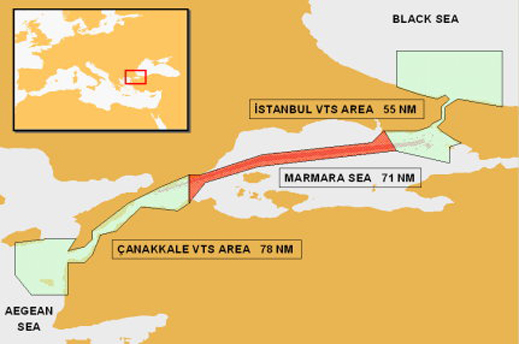
Another Russian priority – the key to the wars which the Kremlin fought against the Ottomans for more than two centuries — is Turkey’s undertaking not to violate the limits of the treaties governing the straits between the Black Sea and the Mediterranean, and allow a permanent NATO naval deployment of Aegis missile systems, targeted against Russia in the Black Sea.


For details of vessel operating conditions in the so-called Turkish Straits, read this.

The political corollary is that Russia and Turkey will not allow the US and NATO to establish and arm Turkish forces under a NATO flag on the territory of Cyprus.

The payoffs include revival of plans to increase Gazprom’s flow of gas to and through Turkey, in either the Turkish Stream or South Stream variants; resumption of Russian tourism to Turkey; removal of mutual restrictions on construction projects on both sides, including the Russian nuclear reactor at Akkuyu; and an end to Russian sanctions banning Turkish fruit and vegetable exports to the Russian market.


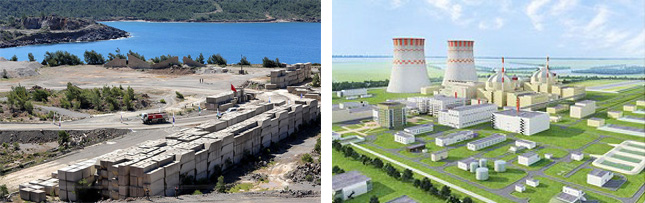
Left: the nuclear reactor site at Akkuyu; right, the 2011 plan of the reactor layout; for details, click.

Just before Erdogan’s arrival in St. Petrersburg, he and the Kremlin agreed to stage a television interview in which Erdogan mixed several metaphors to ingratiate himself with the Russian audience. The meeting with Putin, Erdogan claimed, is “a new landmark in bilateral relations, a clean slate from which to start anew.” Erdogan referred to the Russian president as his “dear friend Vladimir” every four minutes of the interview. Read the Tass version in English.


Erdogan did more than apologize for the shooting-down of the Russian Su-24 fighter-bomber last November. He admitted the aircraft was in Syrian airspace, not Turkish, when it was attacked. “The culprits in what happened in Syrian territory have been detained and brought to justice already. The investigation is continuing. In fact, I conveyed that in my message [to President Putin]. As for the pilots, I ordered a probe into the circumstances that occurred beyond the bounds of our customary rules of response. You also know that the man who caused the Russian pilot’s death, who killed the Russian pilot, is now in custody. He is standing trial. I would like to emphasize that.”

Erdogan was also fed the question reported widely in western media – had Russian intelligence provided Erdogan with a warning of the coup plot? Erdogan overdid his cue: “This is the first time that I have heard such a thing. Even if it had really been so, those concerned would have been obliged to inform me first thing. I received no such information, not from intelligence, nor through any other channels. We don’t know who said what and to whom. I believe that this is a groundless rumor.”

Erdogan also claimed the Russian and Turkish peoples are as close as he and Putin. “If I cry out someone will hear my voice in Sochi,” Erdogan appealed to Russian sentiment. “while if one calls out to me from Sochi I will hear it. This is how close we’re to each other.”

Erdogan’s responses on the real agenda were as far apart as ever. He put a stop to press hints that he is suspending his campaign to overthrow the Syrian president, Bashar Al-Assad. “We don’t want Syria’s disintegration, but the departure of Bashar Assad who is guilty for the deaths of 600,000 people. This is the condition for preventing this scenario. Syria’s unity cannot be kept with Assad. And we cannot support a murderer who has committed acts of state terror.”

He denied any role in the financing , oil trade, weapons and other supplies for ISIS forces in Syria and Iraq. He repeated Turkish backing for the Crimean tatars fighting Moscow with support from Kiev and Washington.

On the future of the Gazprom projects and the Akkuyu reactor, he offered more talks, no commitments. Vegetables and fruit weren’t mentioned. As for tourism, Erdogan declared that no tourist had been killed in last month’s military putsch, and that “currently the beaches are safe.”

The Tass interviewer, deputy director-general of the news agency Mikhail Gusman, carefully avoided mentioning the Chechens, the Straits, NATO, Cyprus, Crimea, or the Azeri-Armenia war.

“Erdogan used the Tass interview to take off the table what the Russians had been hoping might be a breakthrough,” a Moscow observer noted.

“He used Tass to out-manoeuvre Putin – it’s clear from the St. Petersburg record Putin wasn’t happy. Putin is the big loser from the Turkish hype – and the Russian propaganda organs, especially the English language ones, are also covering up.”

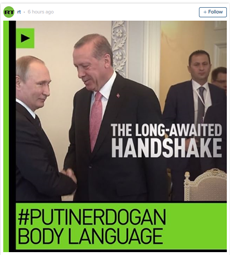
“Let’s see how the western main stream media spins the latest, in what is becoming a long list of Putin victories, over the teleprompter President [Barack Obama]”, claimed an English-language website funded by the Kremlin. RT tweeted in celebration (right), claiming “the two leaders were effusive in their praise for each other”. Sputnik News called the meeting a “reset” adverse to the US and the European Union.

The official record of the delegation talks, which started at 1 in the afternoon, and ended after three hours, reported no discussion and no agreement on a single Russian political or security priority. The presidential press conference revealed that despite declarations of best intentions, nothing of importance to either side was agreed. The Russian Foreign Ministry has reported nothing on Foreign Minister Sergei Lavrov’s meeting with his counterpart, Mevlüt Çavuşoğlu, hours after it concluded.

There was no discussion of Syria between the presidents. According to Erdogan, “during the negotiations which took place we didn’t discuss this question yet. After a press conference we intend to discuss it…Therefore, so far I can’t tell anything as we didn’t discuss this subject.” Putin added: “I confirm what now has been told by our guest, dear President of Turkey. Everybody knows that our views on settlement have not always coincided on the Syrian direction. We have agreed that after this part we will gather separately with Ministers of Foreign Affairs, with representatives of the special services, we will communicate and we will look for a decision.”

Although Kremlin officials had earlier announced the Turks would be asked to pay compensation for the Turkish killing of the Su-24 pilot, Oleg Peshkov, there was no discussion of this issue.

Russian media reports identified as participating in the talks General Valery Gerasimov (below, left), head of the Russian General Staff, and Alexander Lavrentiev (centre), the intelligence officer who is the Kremlin negotiator for the Syrian war. There was no officer from the rebellious Turkish military in Erdogan’s delegation. Instead, he brought Hakan Fidan (right), the US-educated chief of the Turkish intelligence agency, MIT.


Putin made no mention of Russia’s security concerns during the press conference. He made it appear his talks with Erdogan had been limited to economic policy, and he reported no agreement on any issue, except to continue talking. “As for recovery of the relations in full,” Putin said, “yes, we want. And we will do it. Life very quickly develops. And after certain restrictions have been brought to bear, within these restrictions in life certain transformations have begun to happen. We need to consider these transformations in the event of implementation of plans for recovery of our trade and economic relations.”


“In this regard we have made the decision at the ministerial level to prepare medium-term programs, I spoke only about that — trade and economic, scientific and technical and cultural cooperation now for 2016-2019. I very much calculate that this program will be adopted in the nearest future.” 

Putin refused to agree to a Turkish demand for lifting visa restrictions on Turkish workers in Russia; he offered to “consider all this to unblock questions of economic interaction.”

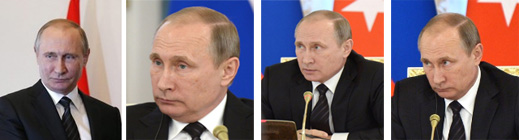
Putin’s demeanour throughout the press conference was grim.


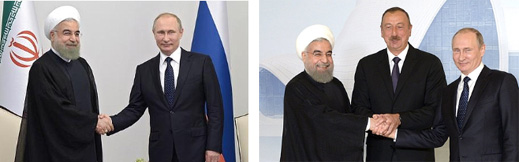
Not since his press conference in June 2013 with US President Barack Obama has Putin’s body language been as demonstratively hostile to his counterpart; click to open. Putin was much more relaxed and affable during his meetings two days ago with the Presidents of Iran and Azerbaijan, Hassan Rouhani (below, left) and Ilham Aliyev (centre).


Source: http://en.kremlin.ru/events/president/news/52666

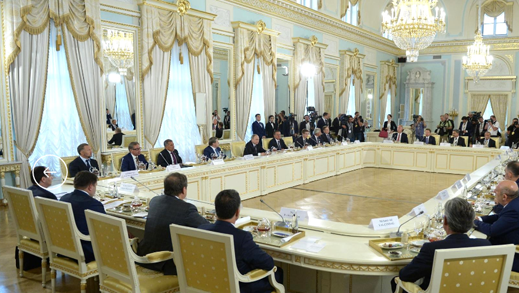
The Kremlin issued a videotape and several large photographs of Tuesday’s session of Russian and Turkish businessmen over which Putin and Erdogan presided.

Source: http://kremlin.ru/events/president/news/52675/photos/45193

The published text of the session reiterated conditionals. “From you, businessmen,” Erdogan passed the buck, “we wait for serious steps in respect of the embodiment of projects which will make a contribution to economic development between our two countries…If we remove all obstacles before our trade relations and we will create new areas for cooperation, I think, we can achieve these objectives. Therefore the serious weight of this freight falls also on your shoulders, our dear businessmen.” He referred once to the Bosphorus Straits only to mention that he is about to start building a tunnel underneath. Putin was referred to as “dear friend” only once in his six-and-a-half -minute speech. Putin grimaced and fidgeted.

The two presidents recited the trade statistics confirming the extent of the financial losses Turkey has suffered since the start of sanctions last December. Trade turnover in the first five months of this year has fallen from $10.7 billion to $6.1 billion, a loss of $4.6 billion. The Turkish share of Russia’s global trade has dropped from 4.8% to 3.6%.

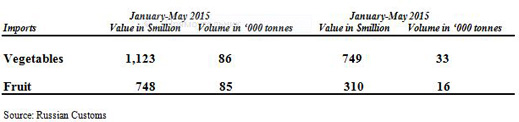
RUSSIAN IMPORTS OF TURKISH VEGETABLES AND FRUIT, JANUARY TO MAY 2015, 2016


The table shows Erdogan’s farm and food trade constituents have suffered losses to May 31 of $812 million; more than $1 billion by the time Erdogan arrived yesterday. The losses are concentrated in several segments of the Russian food market.

The Russian Customs Agency has reported that Turkish tomatoes, which held 57% of the import market in value before the Su-24 was shot down in November, have been wiped out. Turkish apricots, strawberries, peaches, onions, and cucumbers have also occupied large shares of the Russian market, but have been hit hard since January. Alexander Khorev of APK-Inform, a leading Moscow consultancy on the food trade, says that last year — before the Turkish conflict but after sanctions cut supplies of vegetables and fruit from the European Union — Russia purchased a total of 665,000 tonnes of tomatoes, of which the Turkish share was 52% in volume. The imported cucumber supply totalled 545,000 tonnes; 23% of them from Turkey; and 264,000 tonnes of onions, 14% of them Turkish.

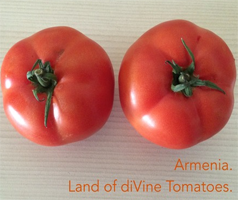
One of the curiosities revealed in the customs figures is the apparent leap in the volume and value of Armenian tomatoes. Moscow sources say the volume of Armenian tomatoes  imported to Russia this year exceeds the capacity of Armenian growers to ship them. The suspicion in the Moscow trade is that the Turks have been smuggling tomatoes into Russia disguised as coming from their arch-enemy, Armenia.

One reason Putin said nothing about reviving this trade is that Russian growers have invested swiftly in greenhouses, subsidized in part by state banks, in order to produce import substitutes. They are relying on keeping the market share and price point which the Turks enjoyed nine months ago. Alternative sources of imported supply—Syria, Tunisia, South Africa, Uzbekistan, Iran and Armenia – have also gained at the Turks’ expense. Philip Owen of Volga Traders comments that it is costly to set up logistics, payment and marketing arrangements for imported foodstuffs, and so the Russian market may not return to Turkish suppliers. Erdogan provided no political reason for the Kremlin to revive Turkey’s food trade; Russian growers say there is now good reason not to do so.

At the press conference in St. Petersburg yesterday, Erdogan said:

“If you remember, we had a purpose – to reach a business volume of 100 billion dollars, and we will resolutely aim at achieving these objectives. As of today, I can say, we again begin the process, we begin to go towards this aim.” 

A Russian business source responds: “Erdogan can tell his exporters whatever he likes. The Russian market will never be the same for them.”

Greek and Cypriot observers comment that Erdogan performed predictably and that nothing new has been gained or learned from his visit to Russia. “His real audience was in Washington, Berlin, and Brussels. Who can be fooled by this? ” An influential Cypriot figure added:

“Putin allowed Erdogan to make public Turkey’s support for the Crimean tatars. Why didn’t Putin mention that? Why didn’t Putin condemn the Turkish occupation of Cyprus?”

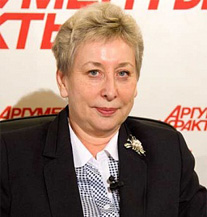
“I don’t believe in the emergence of new political triangles,” comments Irina Zvyagelskaya (right) of the Arab and Islamic Research Centre in Moscow.

“I don’t think any strategic changes will follow overnight to bring about changes to the configuration of alliances. A number of steps we’ve seen taken by our friends and partners, and those we are not on very friendly terms with, are tactical. They stem from the current situation.”

The Russian assessment, openly reflected in Cyprus and Greece, and more discreetly in Washington, is that the Turkish coup isn’t over yet. A Russian analyst asked quizzically.

“No member of the General Staff and no intelligence officer can have given President Putin reason to expect any better of Erdogan, and the Tass interview proved it. What benefit Putin calculated he was gaining by playing along in the charade is not clear. Putin is playing for time, and if Erdogan runs out of it, the Russian side haven’t made up their minds to be sorry.”

Tuesday, August 09, 2016

Pivoting on ASEAN: UNCLOS Sealing the Far East Deal

ASEAN as UNCLOS Collateral Damage

by Peter Lee - China Matters


August 98, 2016

Things fall apart. Especially with a helping push from the United States. The world’s easier for America to manage if it’s broken into smaller, weaker, and more vulnerable and manageable pieces. That, I think, is one of the lessons of the post Cold War era.

The USSR fell apart. Yugoslavia fell apart. So did Sudan. Iraq and Syria are both deemed partition-worthy. The dissolution of Pakistan is now a serious topic for hardliners. So is the disintegration of the People’s Republic of China.

So it’s not a big surprise that, after less than a decade of deep US engagement, (the first US Ambassador to ASEAN was designated in 2008), the ASEAN bloc is looking rather shaky.

That’s the context for my most recent piece for Asia Times, Does TPP Matter? Does Singapore Matter?

It takes as its point of departure Singapore PM Lee Hsien Loong and President Obama’s joint unwillingness (apparently abetted by a cooperative press corps) not to acknowledge the elephant in the East Asian parlor-- the UNCLOS arbitration decision against China--and instead focus their remarks on the relatively boring issue of the TPP.

Fact is, I think Singapore’s hopes of using TPP as an integration mechanism that boosted the “centrality” of ASEAN and the role of Singapore as indispensable honest broker are collateral damage of the US push to impose the rules of the international liberal order on the East Asian region.

The Philippines, with the discreet encouragement of the United States, provided a big shove to the ASEAN structure by taking its dispute with the PRC over maritime rights in the South China Sea to UNCLOS and an arbitration commission.

The diplomatic environment in East Asia has, shall we say, gracefully degraded from multi-lateralism (ASEAN) to bilateralism (the pre-2011 Philippine-PRC approach) to unilateralism (the Philippines taking their case to UNCLOS & the PRC refusing to participate).

With the local regime for diplomatic integration in ruins, the coast is clear for the US to declare a security vacuum and fill it with a coalition of the willing centered on the United States, Japan, and Australia.

In this context, support of TPP no longer looks like a gambit to affirm the centrality of ASEAN, and more like the giveaway to multinationals its critics claim it is.

The conventional narrative, of course, is that ASEAN couldn’t satisfy the Philippines, and it had to go elsewhere to slake its lust for justice.

Not quite true. As the leaked memorandum of the Philippines’ back channel envoy to China, Antonio Trillanes, indicates, the Philippines’ move to arbitration was a rejection of bilateral talks with China, not a reaction to ASEAN dysfunction.

The PRC and Philippines were deep in bilateral talks on the Scarborough Shoal issue and the PRC had put the Philippines on notice not to internationalize the issue at ASEAN. The Philippine team under foreign minister Alberto del Rosario decided to blow up the PRC talks—and abandon Scarborough Shoal, the purported focus of Philippine concerns—by taking the matter to ASEAN.


According to Trillanes, he recommended in an executive Cabinet meeting on July 5 that Aquino adopt a bilateral approach to resolving the territorial dispute with China, especially that over the Scarborough Shoal.

…Trillanes told Aquino that the Chinese made the commitment to pull out the remaining three CMS vessels if the Philippines does not internationalize it by raising the issue to the Asean Regional Forum scheduled for July 12. The Chinese, he said, also assured him that they would not put up any structure around the shoal.
Del Rosario, however, pushed for internationalizing the dispute. Trilllanes narrated:
 “I clearly remember … Henry Bensurto with a PowerPoint presentation telling everybody in the meeting that the annexation of Scarborough Shoal by China would be used as a springboard to claim Western Luzon. Sec. del Rosario proceeded to present that China had almost 100 vessels in and around the shoal… 

According to Trillanes, there were actually only three Chinese vessels in the shoal.

Del Rosario carried the day with his rather dubious case with the background support, I’m guessing, of Aquino.

So del Rosario knew that if he raised the issue at ASEAN a) the PRC would block it and b) the bilateral talks would collapse. For maximum rancor, Del Rosario invoked the appeasement of Hitler analogy, and the Philippines washed its hands of both ASEAN and bilateral talks and filed its case under UNCLOS.

Ironically, the one thing UNCLOS won’t do is remove the PRC from Scarborough Shoal, the purported dagger at the heart of Luzon, the intolerable threat less than 200 miles from the Philippines, and the supposed inspiration for ditching ASEAN and going the UNCLOS route.

It’s an above-high-tide-elevation out of UNCLOS jurisdiction, the PRC occupies it, is staying there and, if they really want to get d*ckish about it, the PRC can islandbuild it into a ginormous airbase and UNCLOS and the Philippines can’t say boo.

Victory! 


Victory, unironically, I think for the United States, which wanted to see the terms of engagement with the PRC switch from the economic track—on which the PRC enjoys an advantage—to the military/security track (USA! USA!).

Gorilla Radio with Chris Cook, John Helmer, Lynn Perrin, Janine Bandcroft August 10, 2016

This Week on GR

by C. L. Cook - Gorilla-Radio.com


August 10, 2016

In an example perhaps of the accelerated times we live in, Turkey's recent "Seven Days in May" ran its course in as many hours; but what has followed the Ides of July military coup wasn't covered in John Frankenheimer's classic 1964 film.

Since the failed attempt to oust him, President Recep Erdogan has conducted a wide-ranging purge of civil and military institutions, and moved with great speed to strengthen and enhance relations with Turkey's neighbours; neighbours like Russia, Iran, and Syria.

Listen. Hear.

Ostensibly, yesterday's meeting in St. Petersburg between Erdogan and Russian President Vladimir Putin focused on repairing the rift caused by last Spring's downing of a Russia warplane over Syria, but according to my first guest, there's much more behind this link up.

John Helmer is a long-time, Moscow-based journalist, author, and essayist; the only one, his site, Dances with Bears informs "to direct his own bureau independent of single national or commercial ties." He's been working from the Russian capital since 1989, thus making him the "doyen of the foreign press corps in Russia."

The Harvard educated Helmer is a former political science professor who has served as an advisor to the governments of Greece, the United States, and in Asia. He regularly lectures on Russian topics in China, Europe, and the US, and his book titles include: 'Uncovering Russia,' 'Urbanman: The Psychology of Urban Survival,' 'Bringing the War Home: The American Soldier in Vietnam and After,' and 'Drugs and Minority Oppression.'

John Helmer in the first half.

And; to assuage public concerns following the National Energy Board's controversial greenlighting of energy giant, Kinder Morgan's TransMountain pipeline expansion project, that would "twin" an existing pipeline, facilitating the transfer of Tar Sands bitumen from Alberta to Burnaby, the federal government struck a panel to conduct "public consultations" across British Columbia, where opposition to the plan is varied, organized, and vociferous. Now, the panel itself has become the focus of conflict of interest charges and protest.

Lynn Perrin is a Fraser Valley-based public policy analyst, environmental activist, and board member with the Pipe Up Network, an organization of "pro-information, pro-environment united people." She got involved with the proposed Kinder Morgan expansion plan when KM contractors showed up to clearcut greenspace in her neighbourhood.

Lynn Perrin and bumps in the NEB's plan to build public confidence in the TransMountain Pipeline Expansion environmental assessment process in the second half.

And; Victoria Street Newz publisher emeritus and CFUV Radio broadcaster, Janine Bandcroft will join us at the bottom of the hour to bring us news of good things planned in the coming week for the streets of our town, and beyond there too. But first, John Helmer and a New Byzantine Alliance on the Bosporus rocks a rollicking world order chess board.

Chris Cook hosts Gorilla Radio, airing live every Wednesday, 1-2pm Pacific Time. In Victoria at 101.9FM, and on the internet at: http://cfuv.uvic.ca.  He also serves as a contributing editor to the web news site, http://www.pacificfreepress.com. Check out the GR blog at: http://gorillaradioblog.blogspot.ca/

G-Radio is dedicated to social justice, the environment, community, and providing a forum for people and issues not covered in the corporate media.

Monday, August 08, 2016

Letting Turkey Slip: The "Indispensable State" Turns Eastward

Washington Slapdown: Turkey Turns to Moscow for Help

by Mike Whitney - CounterPunch


August  8, 2016

“Turkey is slowly leaving the Atlantic system. That is the reason behind this coup. That is the reason why NATO is panicking. This is much broader and much bigger than Erdogan. This is a tectonic movement. This will affect Turkish-Syrian relations, Turkish-Chinese relations, Turkish-Russian relations and Turkish-Iranian relations. This will change the world.”


“It is becoming clear that the attempted putsch was not just the work of a small clique of dissatisfied officers inside the armed forces; it was rather the product of a vast conspiracy to take over the Turkish state that was decades in the making and might well have succeeded.”

— Patrick Cockburn, CounterPunch

On August 9, Turkish President Recep Tayyip Erdogan will meet with Russian President Vladimir Putin in Saint Petersburg The two leaders will discuss political developments following the recent coup-attempt in Turkey, tourism, and the launching of Turkstream, the natural gas pipeline that will transform Turkey into southern Europe’s biggest energy hub.

They are also expected to explore options for ending the fighting in Syria. Putin will insist that Erdogan make a concerted effort to stop Islamic militants from crossing back-and-forth into Syria, while Erdogan will demand that Putin do everything in his power to prevent the emergence of an independent Kurdish state on Turkey’s southern border.

The meeting will end with the typical smiles and handshakes accompanied by a joint statement pledging to work together peacefully to resolve regional issues and to put an end to the proxy war that has left Syria in tatters.

All in all, the confab will seem like another public relations charade devoid of any larger meaning, but that’s certainly not the case. The fact is, the normalizing of relations between Russia and Turkey will foreshadow a bigger geopolitical shift that will link Ankara to Tehran, Damascus and other Russian allies across Eurasia. The alliance will alter the global chessboard in a way that eviscerates the imperial plan to control the flow of energy from Qatar to Europe, redraw the map of the Middle East and pivot to Asia.

That strategy will either be decimated or suffer a severe setback.

The reasons for this should be fairly obvious to anyone who can read a map. Turkey’s location makes it the indispensable state, the land-bridge that connects the wealth and modernity of the EU with the vast resources and growing population of Asia. That vital connecting piece of the geopolitical puzzle is gradually slipping out of Washington’s orbit and into enemy territory. The July 15 coup is likely the final nail in the NWO coffin for reasons we will discuss later.

Here’s a clip from Eric Draitser’s insightful piece titled “Erdogan’s Checkmate: CIA-Backed Coup in Turkey Fails, Upsets Global Chessboard” that summarizes what’s going on:

“Ultimately, the failed 2016 coup in Turkey will have lasting ramifications that will impact the years and decades ahead. With Turkey now clearly breaking with the US-NATO-EU axis, it is rather predictable that it will seek to not only mend fences with both Russia and China, but to place itself into the non-western camp typified by BRICS, the Shanghai Cooperation Organization, China’s One Belt One Road strategy, the Asian Infrastructure Investment Bank, etc.” (“Erdogan’s Checkmate: CIA-Backed Coup in Turkey Fails, Upsets Global Chessboard“, Global Research)

In an earlier part of the article, Draitser correctly identifies the followers of Fethullah Gulen as the perpetrators of the coup. As he and others have pointed out, Gulen’s agents have penetrated all levels of the Turkish state and military acting as a shadow government (aka- “parallel state”) that poses a direct threat to Turkey’s national security.

Here’s journalist Patrick Cockburn making the same point in a recent article in CounterPunch:

“There is little question left that the followers of Fethullah Gulen were behind the coup attempt, despite his repeated denials. “I don’t have any doubt that the brain and backbone of the coup were the Gulenists,” says Kadri Gursel, usually a critic of the government. He adds that he is astonished by the degree to which the Gulenists were able to infiltrate and subvert the armed forces, judiciary and civil service. ….

…it is difficult to find anybody on the left or right who does not suspect that at some level the US was complicit in the coup attempt. Erdogan is probably convinced of this himself, despite US denials, and this will shape his foreign policy in future….

…if the coup had more successful, Turkey would have faced a full-blown military dictatorship or a civil war, or both. Erdogan said in an interview that foreign leaders who now counsel moderation would have danced for joy if he had been killed by the conspirators….” (“After the Coup, Turkey is Being Torn Apart“, Patrick Cockburn, CounterPunch)

If the coup had succeeded, then it is quite likely that Erdogan would have been savagely murdered like Gadhafi while the state was plunged into a long-term civil war. This is why Erdogan has removed tens of thousands of Gulen sympathizers or operatives from their positions in the state, the media, the military and the universities. These prisoners will now be charged with supporting the coup (treason?) and could face the death penalty. Critics in the Obama administration and western media have lambasted Erdogan for violating civil liberties in his effort to rid the country of fifth columnists and traitors, but the Turkish President will have none of it. He has angrily responded saying that Washington was “taking the side of the coup leaders.”

“Now I ask”, said Erdogan, “does the West give support to terror or not? Is the West on the side of democracy or on the side of coups and terror? Unfortunately, the West gives support to terror and stands on the side of coups….We have not received the support we were expecting from our friends, neither during nor after the coup attempt.”

Erdoğan lamented that no Western leader had come to Turkey to express condolences and show solidarity with the Turkish people.” (Hurriyet, Turkish Daily)

He has a point, doesn’t he? While I am no fan of the autocratic and narcissistic Erdogan, it’s very suspicious that Washington is so eager to criticize and so reluctant to help. After all, the two countries are allies, right?

And what does Erdogan want?


He wants the US to extradite Gulen (who currently lives in exile in Pennsylvania) so he can face charges of treason in Turkey.. According to Erdogan, “Documents have been sent to the U.S.” establishing Gulen’s guilt. But the Obama administration remains unmoved, even though Turkey has handed over terrorists to the US in the past without evidence. Apparently, sauce for the goose is not sauce for the gander.

It’s worth repeating what Cockburn said in the excerpt above. He said: “it is difficult to find anybody on the left or right who does not suspect that at some level the US was complicit in the coup attempt.”

Why is that? Why does everyone in Turkey –regardless of their politics or ethnicity–think the US had a hand in the coup?

Take a look at this clip from an article at the World Socialist Web Site which helps to explain:

“US claims that Washington had no advance warning of the coup are simply not credible. Turkey’s Incirlik Air Base, which hosts more than 5,000 American soldiers and is the main base for the US-led bombing campaign against Syria and Iraq, was the organizing center of the putsch. Pro-coup fighter jets flew in and out of Incirlik as the coup unfolded. Shortly after the coup failed, the base commander, General Bekir Ercan Van, was arrested along with other pro-coup soldiers at the base.

Given that Incirlik is the site of dozens of US nuclear weapons, no credibility can be given to claims that US intelligence was unaware that a coup against Erdogan was being organized from there. Were that truly the case, it would represent a CIA intelligence breakdown of stunning proportions….

A pro-coup officer captured by the Turkish government, Lieutenant Colonel Murat Bolat, told the conservative Yeni Savak newspaper that his unit was designated to detain and possibly murder Erdogan after receiving precise information on Erdogan’s location from US sources.

“A person in the meeting, whom I guess was an officer from the Special Forces, said, ‘Nobody will be allowed to rescue the president from our hands,’” he said, indicating that this meant Erdogan was to be shot after he was captured if the forces who had arrested him faced any counterattack.” (“Erdogan accuses US of supporting failed coup in Turkey“, World Socialist Web Site)

While the information is not conclusive, it is suspicious. At the very least, Washington knew a coup was being planned and looked the other way. This except from a post by Harvard professor, Dani Rodrik seems like a very plausible explanation of US involvement to me. Here’s a brief clip:

“The U.S. government may not have had a direct hand in Gulen’s activities, but it is more difficult to dismiss the argument that it provided tacit support – or that some parts of the U.S. administration prevailed on other parts who were less keen on Gulen.

…As the Wikileaks cables I referred to above make clear, the State Department, at least, has been well aware of Gulenist infiltration of the Turkish military for quite some time. The Gulenists’s role in Sledgehammer, which led to the discharge of many of the most Kemalist/secularist officers in the military is equally clear. Beyond Sledgehammer, the Gulenists’ wide range of clandestine operations against opponents in Turkey must be well known to American intelligence…..

…the head of the Turkish military, who was held hostage by the putschists during the coup attempt, has said that one of his captors offered to put him in touch with Gulen directly. This, on its own, is prima facie evidence of Gulen’s involvement, and likely passes the “probable cause” test that is required for extradition. Incredibly, administration officials are still quoted as saying “there is no credible evidence of Mr. Gulen’s personal involvement.” In other words, these officials must think that the army chief of their NATO ally is lying.” (“Is the U.S. behind Fethullah Gulen?“, Dani Rodrik’s Blog)

The Obama administration’s support for the Kurds in Syria as well as its behavior following the coup of July 15, has led to a dramatic deterioration in US-Turkey relations. This will undoubtedly effect Erdogan’s willingness to allow the US to use its airbases for conducting bombing raids in Syria in the future. It’s also bound to accelerate the pace at which Turkey strengthens relations with Russia, Iran and others as it will need the protection of new allies to better defend itself against threats from the west.

The Obama administration is still uncertain of how to proceed mainly because no one had expected that Erdogan would break with Washington, purge his enemies, pursue rapprochement with Moscow, Tehran and Damascus, and throw a wrench in Uncle Sam’s plan for redrawing the map of the Middle East. At present, the administration is trying to ease tensions by dispatching one high-ranking official after the other to persuade Erdogan that the US was not involved in the coup. Chairman of the Joint Chiefs of Staff, General Joseph Dunford visited Ankara just this week while Secretary of State John Kerry and Vice President Joe Biden are scheduled for later in the month. Eventually, even Obama will be asked to make the trek. No effort will be spared to bring Erdogan back into the fold.

If, however, the charm offensive fails, as I expect it will, Erdogan will be crucified in the western media (Hitler Erdogan) while covert operatives and NGOs try to foment political instability. At least, that’s the way things normally play out.
 
MIKE WHITNEY lives in Washington state. He is a contributor to Hopeless: Barack Obama and the Politics of Illusion (AK Press). Hopeless is also available in a Kindle edition. He can be reached at fergiewhitney@msn.com.
More articles by:Mike Whitney

A New Byzantine Alliance: Moving the Centre of the Old World

The New Byzantine Alliance: The Kremlin and the Porte Revolutionize the Centre of the Old World

by John Helmer - Dances with Bears


July 26, 2016

Moscow. 
 
On August 9, in St. Petersburg, Russia’s President Vladimir Putin will meet Turkey’s President Recep Tayyip Erdogan. The moment is revolutionary. There has not been a comparable political turning-point in the 67 years since the establishment of the North Atlantic Treaty Organization (NATO); not in the century since the Ottoman Empire sided with Germany against Russia in World War I; nor in the two centuries since Ottoman Sultan Mahmud II and the Russian Tsar Alexander I aligned against Napoleon and the British.

Russian sources say they are sure the Russian secret services did not warn Erdogan or help his forces prevail in the July 15-16 coup against him. After Erdogan began his counter-coup, and in the fight still continuing between Erdogan’s Islamic forces and the regular Turkish military, the sources add, there has been, and there will be, Russian help. It is more for the future, they explain, than for last week’s outcome that Turkish deputy prime minister Mehmet Şimşek told his counterpart Arkady Dvorkovich in Moscow on Tuesday: “I would like to thank you for support regarding recent events in Turkey, for supporting democracy and the Turkish government.”

The Russian sources say it is already agreed the two sides will pay a soon-to-be settled price in two-way trade; gas, nuclear and other energy projects; plus tourism. Much more is at stake, though, one of the sources adds.

“Putin and his advisors believe Erdogan is still in danger. They support him now for the opportunity to reorganize the relationship with Turkey. They mean to secure Russia from encirclement on the southern frontier and the Black Sea, dismemberment of the Caucasus, and attack on the Kremlin by its enemies. Right now, as Europe collapses, the enemy is the US with NATO in support. If Turkey breaks with the US, NATO is a paraplegic. We shall see how Putin and Erdogan choose to portray the new Rome*, the new Byzantium* next Tuesday.”


The new alliance agenda was formalized at a Security Council meeting on Monday afternoon. The Kremlin announced:

“The President briefed the permanent members of the Security Council on his recent telephone conversations with President of Turkey Recep Tayyip Erdogan and Prime Minister of Israel Benjamin Netanyahu in the context of preparations for the visit by the President of Turkey to Russia scheduled for early August.”

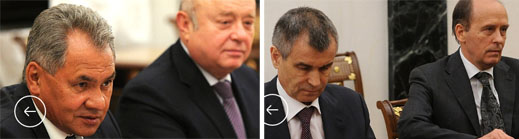
Omitted were the military and intelligence briefings Putin received from Defense Minister Sergei Shoigu and Foreign Intelligence Service (SVR) chief, Mikhail Fradkov; the deputy director of the council, Rashid Nurgaliyev; and the head of the Federal Security Service (FSB), Alexander Bortnikov.


Left to right: Shoigu, Fradkov, Nurgaliyev, and Bortnikov.
Source: http://en.kremlin.ru/events/president/news/52583


Russian sources dismiss the foreign press narrative of last week’s military coup attempt suggesting Arab and Israeli foreknowledge of the coup. “Plotting, bribing, and wishful thinking there were,” one of the sources comments. “But knowing and participating – that’s not what happened.”

In an analysis of the military operations in Istanbul and Ankara, Yevgeny Krutikov, correspondent of Vzglyad in Moscow, has reported there was no coordination between the Turkish Army, Navy and Air Force; poor command and control within each of the services; and inadequate troops and firepower on the streets to combat the turnout in Erdogan’s favour.

“There were simply not enough rebels. There was no chain of command. The ‘capture units’ for important facilities consisted of a maximum of 10 people under the command of officers from captain’s rank to lieutenant colonel. Among the insurgency leadership there wasn’t anyone above the rank of colonel. The entire ‘[rebel] company’ has done what it could. To try to seize power in a highly militarized country’s forces [you need] more than a tank battalion and a pair of helicopters. For bigger divisions they [rebels] just could not give any orders — without bumping into the requirement they answer a reasonable question: who are you anyway?”

Did the Russian intelligence services help Erdogan? “That’s unreal,”according to Krutikov.

“There was no agreement at all between the Russian and Turkish intelligence services. Besides, all contacts were frozen after the downing of the Russian aircraft [SU-24]. Radio signals of the manoeuvres of the coup’s armed forces were monitored by our military troops. There is a little likelihood this information was transmitted to the Turkish special services.”

Russian sources are non-committal on what role US military and intelligence agencies played during the July 15 events at the Incirlik airbase and elsewhere to encourage, or not to discourage, the attempt at overthrowing Erdogan. What is certain now, as Erdogan tries to mop up, according to Greek and Cypriot analysts, is that Turkey has turned against the US and the NATO alliance.

“Turkey is now moving away from western dependence,” says a well-informed region source who asks not to be identified.

“This makes sense geopolitically because the west has lost control in the Middle East. Other close western allies in the region, like Egypt, Saudi Arabia, and Israel, are becoming autonomous, in the sense that they don’t obey the US. This is because the US can no longer act as a hegemon. Washington can’t dictate, or even recommend solutions to conflicts or rivalries, like Iraq, Syria, Libya, or Palestine. Now, with or without direct US involvement in the Turkish coup, Erdogan sees his chance to make Turkey more autonomous, so he is taking it.”

Russian sources agree. Referring to Assistant Secretary of State Victoria Nuland (right), whose plan of attack against Russia in Ukraine, Turkey, Syria, and Cyprus have been reported here and here, a Moscow source concludes:


“The Nuland plots have all failed. The US can no longer talk to the Turks. Losing Turkey to Erdogan and his Islamists also means the US can dictate no longer in the region. You can’t expect the Americans will take it lying down. There’s no government in Washington right now. But if Clinton wins, there will be a US fight-back. It will be too late.”

As French princesses and Nuland have publicly suggested, revolutions require cakes, or at least cookies. The short-term payoffs to Erdogan’s business constituents, and Putin’s, were tabled swiftly at the July 26 meeting between Dvorkovich and Simsek (below,left, right); and at the following meeting between Russian Energy Minister Alexander Novak and Turkish Economic and Energy Ministers, Nihat Zeybekci and Berat Albayrak. Details of their talks can be read here.


Dvorkovich at extreme left; Simsek at right. 


Military sources believe Erdogan’s position is still far from assured. “The numbers and the spread of the purges tell you this is a continuous coup, which could turn into ethnic or communal revolts at any time, or civil war. Russia is positioning itself, as it did in the past, in favour of the stability of the Turkish state – right now this means Erdogan. The Kremlin is against breakup. In the 19th and early 20th centuries, a weak Turkey meant to Moscow that Russia’s enemies gained control of the vital Russian interests of the time, such as the Straits.”

Greek, Cypriot and Russian sources questioned about the current course of events say the principal Russian objectives are obvious. Erdogan should stop the export of jihadis, ISIS, and sedition towards the Russian Caucasus in the form of the Chechens. He must also stop his regime-changing tactics in Syria, and not less in the Balkans and in Central Asia. The sources believe that in his current predicament Erogan is a better bet for the Kremlin than the Turkish military, or the so-called Kemalist or Gulenist political groups, encouraged by the US. If the pro-American or NATO elements can be uprooted and destroyed, Russia is bound to feel more secure — so long as Erdogan’s Sunni Islamic orientation will make its peace with Russia, as the Shiites of Iran and Iraq are doing.

According to a Russian military historian, “Putin today can’t be different from the Tsar [Nicholas II] in 1914. Unpredictability and instability in Turkey are threats to Russia, because they let more powerful enemies in.” For a western historian’s conclusion on the same point, read this.

Political economists in Moscow see the reciprocal benefit for Moscow and Ankara if the South Stream (aka Turkish Stream) gas pipeline project can be revived. Gazprom will assure the sale of larger volumes of gas south and westwards; Turkey can benefit from becoming an energy hub, not only for Russian gas, but also for new flows from Israel, perhaps Lebanon, potentially even Cyprus.

A well-known Cypriot analyst observes:

“Yes, Cyprus is better off, though the situation around us is tragic. At least, hegemony, western hegemony, is finished. This is good because a large part of the [Cyprus] problem came from that [Anglo-American] hegemony and its efforts to maintain itself. Their subversion of Arab modernization has been the greatest crime of the end of the 20th and the beginning of the 21st century.”


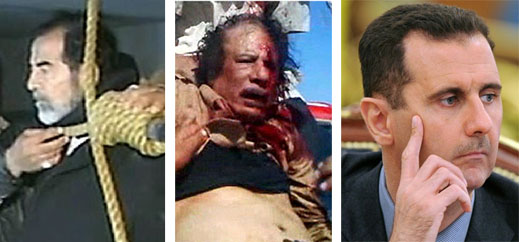
Saddam Hussein, Dec. 30, 2006; Muammar Qaddafi, Oct. 20, 2011; Bashar Assad.


“Back to Cyprus — with multiple guarantees, not only from the west, and with Turkey more autonomous, and no longer the pawn of anybody, the guarantees for [reunified] Cyprus will be more realistic. They will reflect the real balance of power geographically, and also of the future.”

There is regional support for Putin’s rapprochement with Erdogan, even among the bitterest historical enemies of the Turks. They view the Kremlin as a more reliable curb on Turkish military adventures and expansion than the Americans, British or NATO have proved to be. Says the Cypriot analyst:

“Natural gas is the future of Cyprus for all political wings. But moving the economy right now are tourism, and the increasing role of Russian capital, and also the small but growing Russian community. Russia has multiple roles to play in Cyprus. It is probably the force that appeals to the broadest cross-section of the people — to the masses on the left; lately to the centre, and to a section of the religious right, after almost a century, though they aren’t an autonomous force themselves yet. If now Russia becomes friends with Turkey, then we may even have Turkish Cypriot friends.” 


[*] Footnote: The doctrine of the new or third Rome refers to the Russian Orthodox idea that Moscow has succeeded, or will in God’s due course, succeed ancient Rome and Byzantine Constantinople as the centre of true Christianity and its empire.

Resistance Still Fertile in Palestine: Hiroshima and More

Hiroshima and More...

by Mazin Qumsiyeh  - PalestineNature.org


Aug 7, 2016

Yesterday we had the honor of receiving seeds from Japan that we planted in a ceremony at a stage in the Bet Lahem Live festival (http://www.betlahemlive.com/) on the anniversary of the bombing of Hiroshima.

In my brief note I reflected on a visit and on my speech at Hiroshima on the anniversary of the nuclear bombing. Three days later I had also spoken at Nagazaki with a similar message.

It was the first time a Palestinian spoke in those cities on the anniversaries of those catastrophic events.

30 Japanese peace activists visited our Palestine Museum of Natural History and the botanical garden at Bethlehem University and showed their full support. One brought us a water filtration unit (reverse osmosis). International volunteers are also working at the museum. We get empowered and all we do here are forms
of resistance.

We just harvested our honey (not as good a year as last year but still, there is life and productivity from our bee hives, from the green house, aquaponics etc.). We hope you can join us for fun and productive time as we grow plants and consciousness and knowledge.

Please read my 2013 message at Hiroshima here:
http://popular-resistance.blogspot.com/2013/08/palestinian-in-hiroshima.html

Our friend and Nobel Prize winner Mairead Maguire shot and gassed by Israeli occupation forces https://youtu.be/Qnu5qPXEmkc

“In this video, important passages from our interview with Mazin Qumsiyeh, an important voice from Palestine. Palestine, Free Palestine!”
https://youtu.be/bq4IyveLjh4

U.S. Rep. Hank Johnson went out on a limb for Palestinians NOW HE NEEDS OUR HELP http://www.ampalestine.org/action-alerts/u-s-rep-hank-johnson-went-out-on-a-limb-for-palestinians-now-he-needs-our-help

The corruption of the Clinton’s https://youtu.be/-UiNcsdDFJg

Mazin Qumsiyeh
Professor and (volunteer) Director
Palestine Museum of Natural History
Palestine Institute of Biodiversity and Sustainability
Bethlehem University
Occupied Palestine
http://qumsiyeh.org
http://palestinenature.org

Sunday, August 07, 2016

Can the Electoral Circus Survive without Its Elephant Show?

The Greatest Show on Earth: How Billions of Words, Tweets, Insults, and Polls Blot Out Reality in Campaign 2016

by Tom Engelhardt - TomDispatch


August 7, 2016

Yep, it finally happened. In early May, after a long, long run, the elephants of the Ringling Bros. and Barnum & Bailey Circus were ushered into retirement in Florida where they will finish their days aiding cancer research. The Greatest Show on Earth was done with its pachyderms.

The same might be said about the Republicans after Donald Trump’s version of a GOP convention. Many of them had also been sent, far less gracefully than those circus elephants, into a kind of enforced retirement (without even cancer research as an excuse).

Their former party remained in the none-too-gentle hands of the eternally aggrieved Trump, while the Democrats were left to happily chant “USA! USA!,” march a barking retired four-star general and a former CIA director on stage to invoke the indispensable “greatness” of America, and otherwise exhibit the kind of super-patriotism and worship of the military usually associated with... no question about it... the GOP (whose delegates instead spent their time chanting “lock her up!”).

And that’s just to take the tiniest of peeks at a passing moment in what continues to be, without the slightest doubt, the Greatest Show on Earth in 2016.

My small suggestion: don’t even try to think your way through all this. It’s the media equivalent of entering King Minos’s labyrinth. You’ll never get out. I’m talking about -- what else? -- the phenomenon we still call an “election campaign,” though it bears remarkably little resemblance to anything Americans might once have bestowed that label on.

Still, look on the bright side: the Republican and Democratic conventions are in the rearview mirror and a mere three months of endless yakking are left until Election Day.

In the last year, untold billions of words have been expended on this “election” and the outsized histories, flaws, and baggage the two personalities now running for president bring with them. Has there ever been this sort of coverage -- close to a year of it already -- hour after hour, day after day, night after night? Has the New York Times ever featured stories about the same candidate and his cronies, two at a time, on its front page daily the way it’s recently been highlighting the antics of The Donald? Have there ever been so many “experts” of every stripe jawing away about a single subject on cable TV from the crack of dawn to the witching hour? Has there ever been such a mass of pundits churning out opinions by the hour, or so many polls about the American people’s electoral desires steamrollering each other from dawn to dusk? And, of course, those polls are then covered, discussed, and analyzed endlessly. Years ago, Jonathan Schell suggested that we no longer had an election, but (thanks to those polls) “serial elections.” He wrote that back in the Neolithic Age and we’ve come an awful long way since then. There are now websites, after all, that seem to do little more than produce mega-polls from all the polls spewing out.

And don’t forget the completely self-referential nature of this “campaign.” If ever there was an event that was about itself and focused only on itself, this is it. Donald Trump, for instance, has taken possession of Twitter and his furious -- in every sense, since he’s the thinnest-skinned candidate ever -- tweets rapidly pile up, are absorbed into “news” articles about the campaign that are, in turn, tweeted out for The Donald to potentially tweet about in a Möbius strip of blather.

What You Can’t Blame Donald Trump For


And yet, despite all the words expended and polls stumbling over each other to illuminate next to nothing, can’t you feel that there’s something unsaid, something unpolled, something missing?

As the previous world of American politics melts and the electoral seas continue to rise, those of us in the coastal outlands of domestic politics find ourselves, like so many climate refugees, fleeing the tides of spectacle, insult, propaganda, and the rest. We’re talking about a phenomenon that’s engulfing us. We’re drowning in a sea of words and images called “Election 2016.” We have no more accurate name for it, no real way to step back and describe the waters we’re drowning in. And if you expect me to tell you what to call it, think again. I’m drowning, too.

You can blame Donald Trump for many things in this bizarre season of political theater, but don’t blame him for the phenomenon itself. He may have been made for this moment with his uncanny knack for turning himself into a never-ending news cycle of one and scarfing up billions of dollars of free publicity, but he was a Johnny-come-lately to the process itself. After all, he wasn’t one of the Supreme Court justices who, in their 2010 Citizens United decision, green-lighted the flooding of American politics with the dollars of the ultra-wealthy in the name of free speech and in amounts that boggle the imagination (even as that same court has gone ever easier on the definition of political “corruption”). As a certified tightwad, Trump wasn’t the one who made it possible to more or less directly purchase a range of politicians and so ensure that we would have our first 1% elections. Nor was he the one who made American politics a perfect arena for a rogue billionaire with enough money (and chutzpah) to buy himself.

It’s true that no political figure has ever had The Donald’s TV sense. Still, before he was even a gleam in his own presidential eye, the owners of cable news and other TV outlets had already grasped that an election season extending from here to Hell might morph into a cornucopia of profits. He wasn’t the one who realized that such an ever-expanding campaign season would not only bring in billions of dollars in political ads (thank you, again, Supreme Court for helping to loose super PACs on the world), but billions more from advertisers for prime spots in the ongoing spectacle itself. He wasn’t the one who realized that a cable news channel with a limited staff could put every ounce of energy, every talking head around, into such an election campaign, and glue eyeballs in remarkable ways, solving endless problems for a year or more. This was all apparent by the 2012 election, as debates spread across the calendar, ad money poured in, and the yakking never stopped. Donald Trump didn’t create this version of an eternal reality show. He’s just become its temporary host and Hillary Clinton, his quick-to-learn apprentice.

And yet be certain of one thing: neither those Supreme Court justices, nor the owners of TV outlets, nor the pundits, politicians, pollsters, and the rest of the crew knew what exactly they were creating. Think of them as the American equivalent of the blind men and the elephant (and my apologies if I can’t keep pachyderms out of this piece).

In this riot of confusion that passes for an election, with one candidate who’s a walking Ponzi scheme and the other who (with her husband) has shamelessly pocketed staggering millions of dollars from the financial and tech sectors, what are we to make of “our” strange new world? Certainly, this is no longer just an election campaign. It’s more like a way of life and, despite all its debates (that now garner National Football League-sized audiences), it’s also the tao of confusion.

Missing in Action This Election Season


Let’s start with this: The spectacle of our moment is so overwhelming, dominating every screen of our lives and focused on just two outsized individuals in a country of 300 million-plus on a planet of billions, that it blocks our view of reality. Whatever this “election” may be, it blots out much of the rest of the world. As far as I can see, the only story sure to break through it is when someone picks up that assault rifle, revs up that truck, gets his hands on that machete, builds that bomb, declares loyalty to ISIS (whatever his disturbed thoughts may have been 30 seconds earlier), and slaughters as many people as he can in the U.S. or Europe. (Far grimmer, and more repetitive slaughters in Iraq, Turkey, Afghanistan, and other such places have no similar value and are generally ignored.)

Of course, such slaughters, when they do break through the election frenzy, only feed the growth of the campaign. It’s a reasonable suspicion, though, that somewhere at the heart of Election 2016 is a deepening sense of fear about American life that seems to exhibit itself front and center only in relation to one of the lesser dangers (Islamic terrorism) of life in this country. Much as this election campaign offers a strife-riven playing field for two, it also seems to minimize the actual strife and danger in our world by focusing so totally on ISIS and its lone wolf admirers. It might, in that sense, be considered a strange propaganda exercise in the limits of reality.

Let’s take, for instance, America’s wars. Yes, the decision to invade Iraq has been discussed (and criticized) during the campaign and the urge of the two remaining candidates and everyone else previously involved to defeat and destroy the Islamic State is little short of overwhelming. In addition, Trump at least has pointed to the lack of any military victories in all these years and the disaster of Clinton’s interventionist urge in Libya, among other things. In addition, in an obvious exercise of super-patriotic fervor of the sort that once would have been strange in this country and now has become second nature, both conventions trotted out retired generals and national security officials to lecture the American public like so many rabid drill sergeants. Then there were the usual rites, especially at the Democratic convention, dedicated to the temple of the “fallen” in our wars, and endless obeisance to the “warriors” and the U.S. military generally -- as well as the prolonged Trumpian controversy over the family of one dead Muslim-American Marine. One of the two candidates has made a habit of praising to the heavens “the world’s greatest military” (and you know just which one she means) while swearing fealty to our generals and admirals; the other has decried that military as a “disaster” area, a “depleted” force “in horrible shape.” For both, however, this adds up to the same thing: yet more money and support for that force.

Here’s the strange thing, though. Largely missing in action in campaign 2016 are the actual wars being fought by the U.S. military or any serious assessment of, or real debate or discussion about, how they’ve been going or what the national security state has or hasn’t accomplished in these years. Almost a decade and a half after the invasion of Afghanistan, the longest war in American history is still underway with no end in sight and it's going badly, as American air power has once again been let loose in that country and Afghan government forces continue to lose ground to the Taliban. Think of it as the war that time forgot in this election campaign, even though its failed generals are trotted out amid hosannas of praise to tell us what to do in the future and who to vote for. Meanwhile, a new, open-ended campaign of bombing has been launched in Libya, this time against ISIS adherents. The last time around left that country a basket case. What’s this one likely to do?

Such questions are largely missing in action in campaign speeches, debates, and discussions; nor is the real war and massive destruction in Iraq or Syria a subject of any genuine interest; nor what it’s meant for the “world’s greatest military” to unleash its air power from Afghanistan to Libya, send out its drones on assassination missions from Pakistan to Somalia, launch special operations raids across the Greater Middle East and Africa, occupy two countries, and have nothing to show for it but the spread of ever more viral and brutal terror movements and the collapse or near-collapse of many of the states in which it’s fought its wars.

At the moment, such results just lead to “debates” over how much further to build up American forces, how much more money to pour into them, how much freer the generals should be to act in the usual repetitive fashion, and how much more fervently we should worship those “warriors” as our saviors. Back in 2009, Leon Panetta, then head of the CIA, talked up America’s drone assassination campaign in Pakistan as “the only game in town” when it came to stopping al-Qaeda. Seven years later, you could say that in Washington the only game in town is failure.

Similarly, the U.S. taxpayer pours nearly $70 billion annually into the 16 major and various minor outfits in its vast “intelligence” apparatus, and yet, as with the recent coup in Turkey, the U.S. intelligence community seldom seems to have a clue about what’s going on.

Failed intelligence and failed wars in an increasingly failed world is a formula for anxiety and even fear. But all of this has been absorbed into and deflected by the unparalleled bread-and-circus spectacle of Election 2016, which has become a kind of addictive habit for “the people.” Even fear has been transformed into another form of entertainment. In the process, the electorate has been turned into so many spectators, playing their small parts in a demobilizing show of the first order.

And speaking about realities that went MIA, you wouldn’t know it from Election 2016, but much of the U.S. was sweltering under a “heat dome” the week of the Democratic convention. It wasn’t a phrase that had previously been in popular use and yet almost the whole country was living through record or near-record summer temperatures in a year in which, globally, each of the first six months had broken all previous heat records (as, in fact, had the last eight months of 2015). Even pre-heat dome conditions in the lower 48 had been setting records for warmth (and don’t even ask about Alaska). It might almost look like there was a pattern here.

Unfortunately, as the world careens toward “an environment never experienced before,” according to the National Oceanic and Atmospheric Administration, one of the two parties to the American spectacle continues to insist that climate change is a hoax. Its politicians are almost uniformly in thrall to Big Energy, and its presidential candidate tops the charts when it comes to climate denialism. ("The concept of global warming," he's claimed, "was created by and for the Chinese in order to make U.S. manufacturing non-competitive.") Meanwhile, the other party, the one theoretically promoting much-needed responses to climate change, wasn't even willing to highlight the subject in prime time on any of the last three days of its convention.

In other words, the deepest, most unnerving realities of our world are, in essence, missing in action in election 2016.

You want to be afraid? Be afraid of that!

The Shrinking Election Phenomenon


So you tell me: What is this spectacle of ours? Certainly, as a show it catches many of our fears, sweeping them up in its whirlwind and then burying them in unreality. It can rouse audiences to a fever pitch and seems to act like a Rorschach test in which you read whatever you’re inclined to see into its most recent developments. Think of it, in a sense, as an anti-election campaign. In its presence, there’s no way to sort out the issues that face this country or its citizens in a world in which the personalities on stage grow ever larger and more bizarre, while what Americans have any say over is shrinking fast.

So much of American “democracy” and so many of the funds that we pony up to govern ourselves now go into strengthening the power of essentially anti-democratic structures: a military with a budget larger than that of the next seven or eight countries combined and the rest of a national security state of a size unimaginable in the pre-9/11 era. Each is now deeply embedded in Washington and at least as grotesque in its bloat as the election campaign itself. We’re talking about structures that have remarkably little to do with self-governance or We the People (even though it’s constantly drummed into our heads that they are there to protect us, the people). In these years, even as they have proved capable of winning next to nothing and detecting little, they've grown ever larger, more imperial, and powerful, becoming essentially the post-Constitutional fourth branch of government to which the other three branches pay obeisance.

No matter. We’re all under the heat dome now and when, on November 8th, tens of millions of us troop to the polls, who knows what we’re really doing anymore, except of course paving the way for the next super-spectacle of our political age, Election 2020. Count on it: speculation about the candidates will begin in the media within days after the results of this one are in. And it’s a guarantee: there will be nothing like it. It will dazzle, entrance, amaze. It’s going to be... the Greatest Show on Earth. It will cause billions of dollars to change hands. It will electrify, shock, amuse, entertain, appall, and...

I leave it to you to finish that sentence, while I head off to check out the latest on The Donald and Hillary. (Include a reference to elephants and you’ll get extra credit!)

Tom Engelhardt is a co-founder of the American Empire Project and the author of The United States of Fear as well as a history of the Cold War, The End of Victory Culture. He is a fellow of the Nation Institute and runs TomDispatch.com. His latest book is Shadow Government: Surveillance, Secret Wars, and a Global Security State in a Single-Superpower World.

Follow TomDispatch on Twitter and join us on Facebook. Check out the newest Dispatch Book, Nick Turse’s Next Time They’ll Come to Count the Dead, and Tom Engelhardt's latest book, Shadow Government: Surveillance, Secret Wars, and a Global Security State in a Single-Superpower World.

Copyright 2016 Tom Engelhardt

Brexit Through the Gift Shop: Explaining Trump and Other Popular Eccentricities

Explaining Trump and Brexit

by Ray Grigg - Shades of Green


August 7, 2016

Things are never quite as they seem. As political pundits and commentators try to explain the extraordinary decision of Great Britain to leave the European Union and the bizarre rise of Donald Trump as the Republican's candidate for the US presidency, they consider only the surface issues.

The gist of their conclusions is that a growing distance between the rulers and the ruled has allowed the empty space to be filled by the unusual and eccentric.

In essence, they contend, the political elite are not communicating with the common people, so strange positions and characters have an appeal that would otherwise be dismissed as irrelevant or fringe.

But this is only the surface explanation. Beneath it are far more profound and disturbing issues that are much more uncomfortable to confront and articulate — issues that politicians are reluctant to explore lest they be deemed radicals. And, perhaps, many voters may not be clearly aware that the actual source of their discontent is the system itself.

The stunning events occurring lately have been a vote of non-confidence for the whole socio-economic structure that is the foundation of our modern materialistic culture, a collective reaction against a way of thinking and behaving that is usually unquestioned.

Put succinctly, the system is not delivering and distributing its promised benefits, the frustrated and disillusioned citizens are searching for change, and the best they can do is to reject the status quo.

The only way to understand their collective psychology of protest is from a distance that gives perspective to the cumulative effects of the system's many failures. Local communities everywhere are haunted by the sorry necessity for food banks, by the sad plight of the homeless, and by the rising rates of poverty.

If the system is so successful, what explains these social injustices? Profound income inequities are shrinking the middle class and bifurcating society into isolated classes of the odiously rich and the struggling poor. These are not the signs of a just and viable system.

Free-trade agreements and the corporate forces of globalization are crippling the autonomy of governments, destroying employment security and disenfranchising voters.

The methodical collapse of a reasonably compassionate social structure into an impersonal economic machine of engineered winners and losers makes for a disquieting place to live.

Then add to this corrosive pall the demoralizing effects of ubiquitous pollution, a world-wide energy structure in upheaval, the intractable malaise of the Great Recession, the insanity of terrorism, record numbers of refugees, and a rising human population that is crowding into cities, more places which are becoming progressively more difficult to organize as convenient, comfortable and affordable locations to inhabit.

And hovering over these shadows is a warming planet with all the concomitant threats that come with it. So the optimism that fuels public contentment is becoming increasingly scarce. The total social effect is an immense anxiety and uncertainty that expresses itself in unpredictable and aberrant ways.

Perhaps many people haven't carefully analyzed the litany of circumstances that are making them uneasy, or they can't clearly articulate exactly what is amiss. But they know how they feel. And they want change — although the change they get may not be what they want.

Erdoğan’s Purge Splurge

Erdoğan’s Coup: Purging Domestic Critics, Gaining External Allies

by James Petras  -  ICH


August 07, 2016

“President Recep Tayyip Erdoğan prepared a list of targets for arrest even before the coup (sic) was launched” - European Commission official on Turkey (FT 7/19/2016).

For the past decade, US intelligence agencies operating in Turkey have worked closely with the increasingly influential parallel government of Fethullah Gulen. Their approach to power was, until recently, a permeationist strategy of covertly taking over political, economic, administrative, judicial, media, military and cultural positions gradually without resort to elections or military coups.

They adopted flexible tactics, supporting and shedding different allies to eliminate rivals.

In 2010 in support of Erdogan, they played a major role in arresting and purging 300 Kemalist – military officials. Subsequently the Gulenists moved to prosecute and weaken the Erdogan regime via revelations of family corruption uncovered by their intelligence officials and publicized by its mass media outlets.

The Gulenists shared several important policies with Washington which favored “the convergence” that led up to the July 15, 2016 coup.

The Gulenists backed US-Israeli policies in the Middle East; opposed the ‘independent’ and erratic power projections of Erdogan; favored pro-Western free market policies; accepted US relations with the Kurds; rejected any accommodation with the Russians.

In other words, the Gulenists were far more reliable, dependent and subject to the dictates of EU-NATO-US policy throughout the Middle East than the Erdogan regime.

Erdogan was aware of the growing power of the Gulenists and their growing links to Washington. Erdogan moved decisively and successfully, to pre-empt the Gulenist power grab by forcing a premature coup.

Erdogan Power Bloc Defeats Gulenist Presence


The Gulenists were a powerful force in the Turkish state and civil society. They had a strong presence in the civil bureaucracy; among sectors of the military, the mass media and educational installations; and among technocrats in the financial agencies. Yet they were defeated in less than twenty-four hours, because Erdogan had several undeniable strengths.

First and foremost, Erdogan was an unmatched political leader with a strategy to retain power and a powerful active mass popular base. The Gulenists had nothing comparable.

Erdogan had a superior intelligence and military command which infiltrated and undermined the Gulenists who were totally unprepared for a violent confrontation.

The Gulenists ‘permeationist’ strategy was unprepared and totally incapable of seizing power and mobilizing ‘the street’.

They lacked the cadres and organized grass roots support which Erdogan had built from the bottom-up over the previous two decades.

Erdogan’s insider and outside Islamic-Nationalist strategy was far superior to the Gulenist insider-pro-US liberal strategy.

US Miscalculations in the Coup


The Gulenists depended on US support, which totally miscalculated the relations of power and misread Erdogan’s capacity to preempt the coup.

The major flaw among the US advisers was their ignorance of the Turkish political equation: they underestimated Erdogan’s overwhelming party, electoral and mass support. The CIA overestimated the Gulenists support in their institutional elite structures and underestimated their political isolation in Turkish society.

Moreover, the US military had no sense of the specifications of Turkish political culture – the general popular opposition to a military-bureaucratic takeover. They failed to recognize that the anti-coup forces included political parties and social movements critical of Erdogan.

The US strategists based the coup on their misreading of the military coups in Egypt, Libya, Iraq and Yemen which ousted nationalist and Islamic civilian regimes.

Erdogan was not vulnerable in the same way as President Mohamed Morsi (June 30, 2012 – July 3, 2013) was in Egypt – he controlled intelligence, military and mass supporters.

The US-Gulenists military intelligence strategy was unplanned, uncoordinated and precipitous – Erdogan’s counter-coup forced their hand and struck decisive, sweeping blows that demoralized the entire Gulenist super-structure. Thousands of supporters fell like clay pigeons.

The US was put on the defensive – the rapid dissolution of their followers forced them to disown their allies and fall back on general, unconvincing ‘humanitarian’ and ‘security’ criticisms of Erdogan. Their claims that the Erdogan purge would weaken the fight against ISIS had no influence in Turkey. Washington’s charges that the arrests were ‘mistreating and abusing’ prisoners had no impact.

The key political fact is that the US backed an uprising which had taken up arms and killed Erdogan loyalist military personnel and innocent unarmed civilians opposed to the coup undermined Washington’s feeble protests.

In the end the US even refused refugee status and abandoned their Gulenist General’s to Erdogan’s fate. Only Fethullah Gulen himself was protected from extradition by his State Department handlers.

Consequences of the US-Gulen Coup


Washington’s failure to bring down Erdogan could have enormous repercussions throughout the Middle East, Western Europe and the United States.

Erdogan ordered seven thousand troops to encircle the strategic NATO airbase in Incirlik, Turkey, an act of intimidation threatening to undermine NATO’s major nuclear facility and operational base against Syria, Iraq and Russia.

Turkish intelligence and cabinet officials have called into question ongoing political alliances, openly accusing the US military of treason for its role in the coup.

Erdogan has moved to reconcile relations with Russia and has distanced his ties with the European Union.

If Turkey downgrades its ties with NATO, the US would lose its strategic ally on the Southern flank of Russia and undermine its capacity to dominate Syria and Iraq.

Washington’s leverage in Turkey has been dramatically reduced with the decimation of the Gulenist power base in the civilian and military organizations.

Washington may have to rely on the anemic, unstable and servile Syriza – Tsipras regime in Greece to ‘anchor’ its policies in the region.

The failed coup means a major retreat for Washington in the region – and a possible advance for Syria, Iran, Lebanon and Russia.

There are two caveats to this proposition. After Erdogan ‘completes’ the purge of Gulenists’ and condemns Washington, will he be willing and able to pursue a new independent policy or will he simply tighten internal control and ‘renegotiate’ a NATO agreement?

Will Erdogan consolidate political control over the army or will the defeat of the Gulenists be a temporary outcome which will unleash new military factions which will destabilize the political regime?

Finally, Erdogan depends on Western finance and investment which is highly resistant to backing a regime critical of the US, the EU and NATO. If Erdogan faces economic pressures from the West can he turn elsewhere or will he, in the face of capitalist ‘realities’ retreat and submit?

Erdogan, temporarily may have defeated a US coup, but history teaches us that new military, political and economic interventions are on Washington’s agenda.

James Petras is a Bartle Professor (Emeritus) of Sociology at Binghamton University, New York.