Tuesday, March 28, 2017

American Booty: A Century of Carnage

An American Century of Carnage: Measuring Violence in a Single Superpower World

by John W. Dower - TomDispatch

 
March 28, 2017
 
[This essay is adapted from “Measuring Violence,” the first chapter of John Dower’s new book, The Violent American Century: War and Terror Since World War Two.]  

On February 17, 1941, almost 10 months before Japan’s attack on Pearl Harbor, Life magazine carried a lengthy essay by its publisher, Henry Luce, entitled “The American Century.” The son of Presbyterian missionaries, born in China in 1898 and raised there until the age of 15, Luce essentially transposed the certainty of religious dogma into the certainty of a nationalistic mission couched in the name of internationalism.

Luce acknowledged that the United States could not police the whole world or attempt to impose democratic institutions on all of mankind. Nonetheless, “the world of the 20th Century,” he wrote, “if it is to come to life in any nobility of health and vigor, must be to a significant degree an American Century.” 
 
The essay called on all Americans “to accept wholeheartedly our duty and our opportunity as the most powerful and vital nation in the world and in consequence to exert upon the world the full impact of our influence, for such purposes as we see fit and by such measures as we see fit.”

Tomgram: John Dower, Body Count for the American Century
 
[Note for TomDispatch Readers: With some pride, I’m announcing today the newest Dispatch Book. It’s also the capstone on eminent historian John Dower’s work on America’s wars, including his National Book Critics Circle Award-winning War Without Mercy and his Pulitzer Prize-winning Embracing Defeat. His new book, The Violent American Century: War and Terror Since World War Two, is about to be published. Given the deluge of “news” that is the Trump era and everyone’s sudden lack of reading time, it’s a mercifully short, sharp, timely, and definitive look at what “the American Century” has really meant in terms of violence. I consider it a true must-read for our moment. And I’m not alone.

Among a crowd of people who have praised the book, Noam Chomsky says: “John Dower ends this grim recounting of 75 years of constant war, intervention, assassination, and other crimes by calling for ‘serious consideration’ of why the most powerful nation in world history is so dedicated to these practices while ignoring the nature of its actions and their consequences -- an injunction that could hardly be more timely or necessary as the Pentagon’s ‘arc of instability’ expands to an ‘ocean of instability’ and even an 'atomic arc of instability' in Dower’s perceptive reflections on today’s frightening world." Andrew Bacevich adds: “A timely, compact, and utterly compelling exposé of the myriad contradictions besetting U.S. national security policy... a powerful book.” And Seymour Hersh writes: “No historian understands the human cost of war, with its paranoia, madness, and violence, as does John Dower, and in this deeply researched volume he tells how America, since the end of World War II, has turned away from its ideals and goodness to become a match setting the world on fire.”

I hope all TomDispatch readers will pick-up a copy. You can go to Amazon.com and pre-order one now (and make TD a few cents at no cost to you) by clicking on this link or you can order a copy directly from Haymarket Books at an exclusive discount for TD readers of 50%, simply by clicking on this link and following the checkout instructions you’ll see there. However you do it, buy The Violent American Century and support our new book publishing program! Tom]

Recently, the historian Marilyn Young, an old friend, died. She spent her life writing about America’s wars and a country at war. Her New York Times obituary quoted this telling passage from a speech she gave to the Society for Historians of American Foreign Relations:
 
“I find that I have spent most of my life as a teacher and scholar thinking and writing about war. I moved from war to war, from the War of 1898 and U.S. participation in the Boxer Expedition and the Chinese civil war, to the Vietnam War, back to the Korean War, then further back to World War II and forward to the wars of the twentieth and early twenty-first centuries. Initially, I wrote about all these as if war and peace were discrete: prewar, war, peace, or postwar. Over time, this progression of wars has looked to me less like a progression than a continuation: as if between one war and the next, the country was on hold.”

Curiously enough, with the exception of World War II and Vietnam (for quite different reasons), Americans have lived through our many wars of the last century, years drenched in blood and suffering when this country became the most dominant power on the planet, in a state of relative obliviousness. Nonetheless, peaceable as the United States seemed in those decades domestically, its wars did come home in all sorts of ways or you would have a hard time explaining the militarization of this country, the growth of the Pentagon budget to staggering proportions, and the rise of the national security state (and its surveillance systems).

That’s why John Dower’s new book, The Violent American Century: War and Terror Since World War Two, arrives at such an opportune moment, just as the era of Donald Trump begins with a visible ramping up (yet again) of America’s wars across the Greater Middle East. It offers a rare assessment of what that century’s human toll actually looks like and of our country’s involvement in it. In his article today, adapted from that book’s first chapter, Dower offers some striking thoughts on how to begin to measure the toll of the last 75 years of global war and conflict. And I must admit that, under the circumstances, it seems particularly fitting to me that Marilyn Young gave what must have been the last blurb of her life to his book, writing, “In The Violent American Century, John Dower has produced a sharply eloquent account of the use of U.S. military power since World War II. From ‘hot’ Cold War conflicts to drone strikes, Dower examines the machinery of American violence and its staggering toll. This is an indispensable book.” Tom
 

An American Century of Carnage: Measuring Violence in a Single Superpower World

by John W. Dower


Japan’s attack on Pearl Harbor propelled the United States wholeheartedly onto the international stage Luce believed it was destined to dominate, and the ringing title of his cri de coeur became a staple of patriotic Cold War and post-Cold War rhetoric. Central to this appeal was the affirmation of a virtuous calling. Luce’s essay singled out almost every professed ideal that would become a staple of wartime and Cold War propaganda: freedom, democracy, equality of opportunity, self-reliance and independence, cooperation, justice, charity -- all coupled with a vision of economic abundance inspired by “our magnificent industrial products, our technical skills.” In present-day patriotic incantations, this is referred to as “American exceptionalism.”

The other, harder side of America’s manifest destiny was, of course, muscularity. Power. Possessing absolute and never-ending superiority in developing and deploying the world’s most advanced and destructive arsenal of war. Luce did not dwell on this dimension of “internationalism” in his famous essay, but once the world war had been entered and won, he became its fervent apostle -- an outspoken advocate of “liberating” China from its new communist rulers, taking over from the beleaguered French colonial military in Vietnam, turning both the Korean and Vietnam conflicts from “limited wars” into opportunities for a wider virtuous war against and in China, and pursuing the rollback of the Iron Curtain with “tactical atomic weapons.” As Luce’s incisive biographer Alan Brinkley documents, at one point Luce even mulled the possibility of “plastering Russia with 500 (or 1,000) A bombs” -- a terrifying scenario, but one that the keepers of the U.S. nuclear arsenal actually mapped out in expansive and appalling detail in the 1950s and 1960s, before Luce’s death in 1967.

The “American Century” catchphrase is hyperbole, the slogan never more than a myth, a fantasy, a delusion. Military victory in any traditional sense was largely a chimera after World War II. The so-called Pax Americana itself was riddled with conflict and oppression and egregious betrayals of the professed catechism of American values. At the same time, postwar U.S. hegemony obviously never extended to more than a portion of the globe. Much that took place in the world, including disorder and mayhem, was beyond America’s control.

Yet, not unreasonably, Luce’s catchphrase persists. The twenty-first-century world may be chaotic, with violence erupting from innumerable sources and causes, but the United States does remain the planet’s “sole superpower.” The myth of exceptionalism still holds most Americans in its thrall. U.S. hegemony, however frayed at the edges, continues to be taken for granted in ruling circles, and not only in Washington. And Pentagon planners still emphatically define their mission as “full-spectrum dominance” globally.

Washington’s commitment to modernizing its nuclear arsenal rather than focusing on achieving the thoroughgoing abolition of nuclear weapons has proven unshakable. So has the country’s almost religious devotion to leading the way in developing and deploying ever more “smart” and sophisticated conventional weapons of mass destruction.

Welcome to Henry Luce’s -- and America’s -- violent century, even if thus far it’s lasted only 75 years. The question is just what to make of it these days.

Counting the Dead


We live in times of bewildering violence. In 2013, the chairman of the Joint Chiefs of Staff told a Senate committee that the world is “more dangerous than it has ever been.” Statisticians, however, tell a different story: that war and lethal conflict have declined steadily, significantly, even precipitously since World War II.

Much mainstream scholarship now endorses the declinists. In his influential 2011 book, The Better Angels of Our Nature: Why Violence Has Declined, Harvard psychologist Steven Pinker adopted the labels “the Long Peace” for the four-plus decades of the Cold War (1945-1991), and “the New Peace” for the post-Cold War years to the present. In that book, as well as in post-publication articles, postings, and interviews, he has taken the doomsayers to task. The statistics suggest, he declares, that “today we may be living in the most peaceable era in our species’s existence.”

Clearly, the number and deadliness of global conflicts have indeed declined since World War II. This so-called postwar peace was, and still is, however, saturated in blood and wracked with suffering.

It is reasonable to argue that total war-related fatalities during the Cold War decades were lower than in the six years of World War II (1939–1945) and certainly far less than the toll for the twentieth century’s two world wars combined. It is also undeniable that overall death tolls have declined further since then. The five most devastating intrastate or interstate conflicts of the postwar decades -- in China, Korea, Vietnam, Afghanistan, and between Iran and Iraq -- took place during the Cold War. So did a majority of the most deadly politicides, or political mass killings, and genocides: in the Soviet Union, China (again), Yugoslavia, North Korea, North Vietnam, Sudan, Nigeria, Indonesia, Pakistan/Bangladesh, Ethiopia, Angola, Mozambique, and Cambodia, among other countries. The end of the Cold War certainly did not signal the end of such atrocities (as witness Rwanda, the Congo, and the implosion of Syria). As with major wars, however, the trajectory has been downward.

Unsurprisingly, the declinist argument celebrates the Cold War as less violent than the global conflicts that preceded it, and the decades that followed as statistically less violent than the Cold War. But what motivates the sanitizing of these years, now amounting to three-quarters of a century, with the label “peace”? The answer lies largely in a fixation on major powers. The great Cold War antagonists, the United States and the Soviet Union, bristling with their nuclear arsenals, never came to blows. Indeed, wars between major powers or developed states have become (in Pinker’s words) “all but obsolete.” There has been no World War III, nor is there likely to be.

Such upbeat quantification invites complacent forms of self-congratulation. (How comparatively virtuous we mortals have become!) In the United States, where we-won-the-Cold-War sentiment still runs strong, the relative decline in global violence after 1945 is commonly attributed to the wisdom, virtue, and firepower of U.S. “peacekeeping.” In hawkish circles, nuclear deterrence -- the Cold War’s MAD (mutually assured destruction) doctrine that was described early on as a “delicate balance of terror” -- is still canonized as an enlightened policy that prevented catastrophic global conflict.

What Doesn’t Get Counted


Branding the long postwar era as an epoch of relative peace is disingenuous, and not just because it deflects attention from the significant death and agony that actually did occur and still does. It also obscures the degree to which the United States bears responsibility for contributing to, rather than impeding, militarization and mayhem after 1945. Ceaseless U.S.-led transformations of the instruments of mass destruction -- and the provocative global impact of this technological obsession -- are by and large ignored.

Continuities in American-style “warfighting” (a popular Pentagon word) such as heavy reliance on airpower and other forms of brute force are downplayed. So is U.S. support for repressive foreign regimes, as well as the destabilizing impact of many of the nation’s overt and covert overseas interventions. The more subtle and insidious dimension of postwar U.S. militarization -- namely, the violence done to civil society by funneling resources into a gargantuan, intrusive, and ever-expanding national security state -- goes largely unaddressed in arguments fixated on numerical declines in violence since World War II.

Beyond this, trying to quantify war, conflict, and devastation poses daunting methodological challenges. Data advanced in support of the decline-of-violence argument is dense and often compelling, and derives from a range of respectable sources. Still, it must be kept in mind that the precise quantification of death and violence is almost always impossible. When a source offers fairly exact estimates of something like “war-related excess deaths,” you usually are dealing with investigators deficient in humility and imagination.

Take, for example, World War II, about which countless tens of thousands of studies have been written. Estimates of total “war-related” deaths from that global conflict range from roughly 50 million to more than 80 million. One explanation for such variation is the sheer chaos of armed violence. Another is what the counters choose to count and how they count it. Battle deaths of uniformed combatants are easiest to determine, especially on the winning side. Military bureaucrats can be relied upon to keep careful records of their own killed-in-action -- but not, of course, of the enemy they kill. War-related civilian fatalities are even more difficult to assess, although -- as in World War II -- they commonly are far greater than deaths in combat.

Does the data source go beyond so-called battle-related collateral damage to include deaths caused by war-related famine and disease? Does it take into account deaths that may have occurred long after the conflict itself was over (as from radiation poisoning after Hiroshima and Nagasaki, or from the U.S. use of Agent Orange in the Vietnam War)? The difficulty of assessing the toll of civil, tribal, ethnic, and religious conflicts with any exactitude is obvious.

Concentrating on fatalities and their averred downward trajectory also draws attention away from broader humanitarian catastrophes. In mid-2015, for instance, the Office of the United Nations High Commissioner for Refugees reported that the number of individuals “forcibly displaced worldwide as a result of persecution, conflict, generalized violence, or human rights violations” had surpassed 60 million and was the highest level recorded since World War II and its immediate aftermath. Roughly two-thirds of these men, women, and children were displaced inside their own countries. The remainder were refugees, and over half of these refugees were children.

Here, then, is a trend line intimately connected to global violence that is not heading downward. In 1996, the U.N.’s estimate was that there were 37.3 million forcibly displaced individuals on the planet. Twenty years later, as 2015 ended, this had risen to 65.3 million -- a 75% increase over the last two post-Cold War decades that the declinist literature refers to as the “new peace.”

Other disasters inflicted on civilians are less visible than uprooted populations. Harsh conflict-related economic sanctions, which often cripple hygiene and health-care systems and may precipitate a sharp spike in infant mortality, usually do not find a place in itemizations of military violence. U.S.-led U.N. sanctions imposed against Iraq for 13 years beginning in 1990 in conjunction with the first Gulf War are a stark example of this. An account published in the New York Times Magazine in July 2003 accepted the fact that “at least several hundred thousand children who could reasonably have been expected to live died before their fifth birthday.” And after all-out wars, who counts the maimed, or the orphans and widows, or those the Japanese in the wake of World War II referred to as the “elderly orphaned” -- parents bereft of their children?

Figures and tables, moreover, can only hint at the psychological and social violence suffered by combatants and noncombatants alike. It has been suggested, for instance, that one in six people in areas afflicted by war may suffer from mental disorder (as opposed to one in ten in normal times). Even where American military personnel are concerned, trauma did not become a serious focus of concern until 1980, seven years after the U.S. retreat from Vietnam, when post-traumatic stress disorder (PTSD) was officially recognized as a mental-health issue.

In 2008, a massive sampling study of 1.64 million U.S. troops deployed to Afghanistan and Iraq between October 2001 and October 2007 estimated “that approximately 300,000 individuals currently suffer from PTSD or major depression and that 320,000 individuals experienced a probable TBI [traumatic brain injury] during deployment.” As these wars dragged on, the numbers naturally increased. To extend the ramifications of such data to wider circles of family and community -- or, indeed, to populations traumatized by violence worldwide -- defies statistical enumeration.

Terror Counts and Terror Fears


Largely unmeasurable, too, is violence in a different register: the damage that war, conflict, militarization, and plain existential fear inflict upon civil society and democratic practice. This is true everywhere but has been especially conspicuous in the United States since Washington launched its “global war on terror” in response to the attacks of September 11, 2001.

Here, numbers are perversely provocative, for the lives claimed in twenty-first-century terrorist incidents can be interpreted as confirming the decline-in-violence argument. From 2000 through 2014, according to the widely cited Global Terrorism Index, “more than 61,000 incidents of terrorism claiming over 140,000 lives have been recorded.” Including September 11th, countries in the West experienced less than 5% of these incidents and 3% of the deaths. The Chicago Project on Security and Terrorism, another minutely documented tabulation based on combing global media reports in many languages, puts the number of suicide bombings from 2000 through 2015 at 4,787 attacks in more than 40 countries, resulting in 47,274 deaths.

These atrocities are incontestably horrendous and alarming. Grim as they are, however, the numbers themselves are comparatively low when set against earlier conflicts. For specialists in World War II, the “140,000 lives” estimate carries an almost eerie resonance, since this is the rough figure usually accepted for the death toll from a single act of terror bombing, the atomic bomb dropped on Hiroshima. The tally is also low compared to contemporary deaths from other causes. Globally, for example, more than 400,000 people are murdered annually. In the United States, the danger of being killed by falling objects or lightning is at least as great as the threat from Islamist militants.

This leaves us with a perplexing question: If the overall incidence of violence, including twenty-first-century terrorism, is relatively low compared to earlier global threats and conflicts, why has the United States responded by becoming an increasingly militarized, secretive, unaccountable, and intrusive “national security state”? Is it really possible that a patchwork of non-state adversaries that do not possess massive firepower or follow traditional rules of engagement has, as the chairman of the Joint Chiefs of Staff declared in 2013, made the world more threatening than ever?

For those who do not believe this to be the case, possible explanations for the accelerating militarization of the United States come from many directions. Paranoia may be part of the American DNA -- or, indeed, hardwired into the human species. Or perhaps the anticommunist hysteria of the Cold War simply metastasized into a post-9/11 pathological fear of terrorism. Machiavellian fear-mongering certainly enters the picture, led by conservative and neoconservative civilian and military officials of the national security state, along with opportunistic politicians and war profiteers of the usual sort. Cultural critics predictably point an accusing finger as well at the mass media’s addiction to sensationalism and catastrophe, now intensified by the proliferation of digital social media.

To all this must be added the peculiar psychological burden of being a “superpower” and, from the 1990s on, the planet’s “sole superpower” -- a situation in which “credibility” is measured mainly in terms of massive cutting-edge military might. It might be argued that this mindset helped “contain Communism” during the Cold War and provides a sense of security to U.S. allies. What it has not done is ensure victory in actual war, although not for want of trying. With some exceptions (Grenada, Panama, the brief 1991 Gulf War, and the Balkans), the U.S. military has not tasted victory since World War II -- Korea, Vietnam, and recent and current conflicts in the Greater Middle East being boldface examples of this failure. This, however, has had no impact on the hubris attached to superpower status. Brute force remains the ultimate measure of credibility.

The traditional American way of war has tended to emphasize the “three Ds” (defeat, destroy, devastate). Since 1996, the Pentagon’s proclaimed mission is to maintain “full-spectrum dominance” in every domain (land, sea, air, space, and information) and, in practice, in every accessible part of the world. The Air Force Global Strike Command, activated in 2009 and responsible for managing two-thirds of the U.S. nuclear arsenal, typically publicizes its readiness for “Global Strike... Any Target, Any Time.”

In 2015, the Department of Defense acknowledged maintaining 4,855 physical “sites” -- meaning bases ranging in size from huge contained communities to tiny installations -- of which 587 were located overseas in 42 foreign countries. An unofficial investigation that includes small and sometimes impermanent facilities puts the number at around 800 in 80 countries. Over the course of 2015, to cite yet another example of the overwhelming nature of America’s global presence, elite U.S. special operations forces were deployed to around 150 countries, and Washington provided assistance in arming and training security forces in an even larger number of nations.

America’s overseas bases reflect, in part, an enduring inheritance from World War II and the Korean War. The majority of these sites are located in Germany (181), Japan (122), and South Korea (83) and were retained after their original mission of containing communism disappeared with the end of the Cold War. Deployment of elite special operations forces is also a Cold War legacy (exemplified most famously by the Army’s “Green Berets” in Vietnam) that expanded after the demise of the Soviet Union. Dispatching covert missions to three-quarters of the world’s nations, however, is largely a product of the war on terror.

Many of these present-day undertakings require maintaining overseas “lily pad” facilities that are small, temporary, and unpublicized. And many, moreover, are integrated with covert CIA “black operations.” Combating terror involves practicing terror -- including, since 2002, an expanding campaign of targeted assassinations by unmanned drones. For the moment, this latest mode of killing remains dominated by the CIA and the U.S. military (with the United Kingdom and Israel following some distance behind).

Counting Nukes


The “delicate balance of terror” that characterized nuclear strategy during the Cold War has not disappeared. Rather, it has been reconfigured. The U.S. and Soviet arsenals that reached a peak of insanity in the 1980s have been reduced by about two-thirds -- a praiseworthy accomplishment but one that still leaves the world with around 15,400 nuclear weapons as of January 2016, 93% of them in U.S. and Russian hands. Close to two thousand of the latter on each side are still actively deployed on missiles or at bases with operational forces.

This downsizing, in other words, has not removed the wherewithal to destroy the Earth as we know it many times over. Such destruction could come about indirectly as well as directly, with even a relatively “modest” nuclear exchange between, say, India and Pakistan triggering a cataclysmic climate shift -- a “nuclear winter” -- that could result in massive global starvation and death. Nor does the fact that seven additional nations now possess nuclear weapons (and more than 40 others are deemed “nuclear weapons capable”) mean that “deterrence” has been enhanced. The future use of nuclear weapons, whether by deliberate decision or by accident, remains an ominous possibility. That threat is intensified by the possibility that nonstate terrorists may somehow obtain and use nuclear devices.

What is striking at this moment in history is that paranoia couched as strategic realism continues to guide U.S. nuclear policy and, following America’s lead, that of the other nuclear powers. As announced by the Obama administration in 2014, the potential for nuclear violence is to be “modernized.” In concrete terms, this translates as a 30-year project that will cost the United States an estimated $1 trillion (not including the usual future cost overruns for producing such weapons), perfect a new arsenal of “smart” and smaller nuclear weapons, and extensively refurbish the existing delivery “triad” of long-range manned bombers, nuclear-armed submarines, and land-based intercontinental ballistic missiles carrying nuclear warheads.

Nuclear modernization, of course, is but a small portion of the full spectrum of American might -- a military machine so massive that it inspired President Obama to speak with unusual emphasis in his State of the Union address in January 2016. “The United States of America is the most powerful nation on Earth,” he declared. “Period. Period. It’s not even close. It’s not even close. It’s not even close. We spend more on our military than the next eight nations combined.”

Official budgetary expenditures and projections provide a snapshot of this enormous military machine, but here again numbers can be misleading. Thus, the “base budget” for defense announced in early 2016 for fiscal year 2017 amounts to roughly $600 billion, but this falls far short of what the actual outlay will be. When all other discretionary military- and defense-related costs are taken into account -- nuclear maintenance and modernization, the “war budget” that pays for so-called overseas contingency operations like military engagements in the Greater Middle East, “black budgets” that fund intelligence operations by agencies including the CIA and the National Security Agency, appropriations for secret high-tech military activities, “veterans affairs” costs (including disability payments), military aid to other countries, huge interest costs on the military-related part of the national debt, and so on -- the actual total annual expenditure is close to $1 trillion.

Such stratospheric numbers defy easy comprehension, but one does not need training in statistics to bring them closer to home. Simple arithmetic suffices. The projected bill for just the 30-year nuclear modernization agenda comes to over $90 million a day, or almost $4 million an hour. The $1 trillion price tag for maintaining the nation’s status as “the most powerful nation on Earth” for a single year amounts to roughly $2.74 billion a day, over $114 million an hour.

Creating a capacity for violence greater than the world has ever seen is costly -- and remunerative.

So an era of a “new peace”? Think again. We’re only three quarters of the way through America’s violent century and there’s more to come.

John W. Dower is professor emeritus of history at Massachusetts Institute of Technology. He is the author of the National Book Critics Circle Award-winning War Without Mercy and the Pulitzer Prize-winning Embracing Defeat. His new book, The Violent American Century: War and Terror Since World War Two (Dispatch Books), has just been published. This essay is adapted from chapter one of that densely annotated book. (Sources for the information above appear in the footnotes in that book.)

Follow TomDispatch on Twitter and join us on Facebook. Check out the newest Dispatch Book, John Feffer's dystopian novel Splinterlands, as well as Nick Turse’s Next Time They’ll Come to Count the Dead, and Tom Engelhardt's latest book, Shadow Government: Surveillance, Secret Wars, and a Global Security State in a Single-Superpower World.

Copyright 2017 John W. Dower

Monday, March 27, 2017

How American Warfighting Prospers Putin

The US War Had Been Good for President Vladimir Putin, and the Russian Economy Looks Stable Through the Presidential Election. So If You Are a US Warfighter, What Is the Regime Change Opportunity Now?

by John Helmer - Dances with Bears


March 22, 2017


Moscow - The Russian economic recovery went sharply into reverse in February, according to the latest report from Rosstat, the federal state statistics service. But voter approval for President Vladimir Putin remains super-stable at a level unknown in Europe or the rest the world.

So if you are bent on fighting Russia, as the generals now in charge of US policy in Washington say and do, what opportunity is there for toppling Putin before the presidential election due in March 2018? One veteran of high-level Russian policy in Europe predicts:

“The trouble for Putin will come when the World Cup starts in June of next year. But that’s after he is elected in March. No-one realizes, not yet, how much trouble the football competition will cause, with thousands of visa-free foreign agitators in the country calling themselves fans, and half a billion people watching on TV.”

An analysis just released by Uralsib Bank analyst, Alexei Devyatov, of the latest economic results shows that for most Russians real income growth has not only stalled — the indicator has started to fall again from positive 8.1% in January to minus 4.1% in February.

THE SITUATION IN THE ECONOMY HAS WORSENED IN FEBRUARY
Growth rates of key indicators, percent change compared to the same period of 2016

KEY: Row 1=GDP; row 2=industrial production; row 3=mining sector; row 4=processing sector; row-12=real salaries.
Source: Uralsib Bank, report of March 22, 2017, by Alexei Devyatov: devyatovae@uralsib.ru


The current income data for January and February, writes Devyatov, show that January’s growth was driven by the Finance Ministry’s large lump-sum payment of pensions. Gross Domestic Product (GDP) was boosted by 1.3%, compared to January 2016, by this payment. The statistic helped reinforce most Moscow analyst forecasts for GDP growth this year of between 1% and 2%.

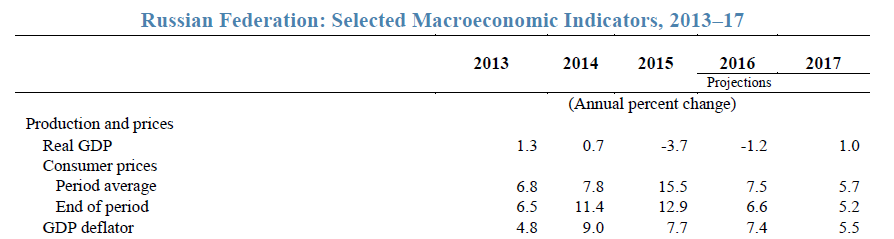
The last staff report on the Russian economy from the International Monetary Fund (IMF) summarized the bad news since 2014, and also the modestly good news predicted for this year.


A month ago Russian analysts were reporting to clients that they are anticipating this year’s recovery rate will accelerate faster than the IMF’s 1% forecast.


The Gaidar Institute of St. Petersburg, which is generally hostile to Putin, is reporting “the early phase of a cyclical upturn in the economy from the bottom point of the business cycle”. Before the February statistics were out, the institute was predicting GDP growth this year of 1.4%, accelerating next year to between 1.7% to 2.2%.

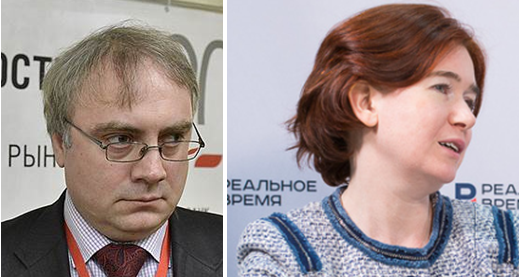
Devyatov (pictured below left) warns: “it is necessary to recognize that the economy still cannot reach a trajectory of sustainable development. We confirm our forecast of growth of real GDP at the level of 1.9% in 2017, but we see the risk that actual growth in the current year will turn out to be slightly less.”


Natalia Orlova (above right), Alfa Bank’s chief economist, is pessimistic, but for the period after the presidential election, not before. “The main risk for real income is the state budget policy. Before sanctions in 2014 the salaries of employees of state-owned organizations had been raised regularly. But after 2014 they were frozen. In 2018 there will be the election of the president in Russia and if the government raises the salaries of state employees, the companies will have to do it too, in order to compete for employees with the state as the unemployment level is low now. That will have a positive effect for people in the short run, but after that it will cause inflation to increase.”


Russian wage-earners are apprehensive. The most sensitive indicator of their expectations of growth, or worse, is the monthly release of the wage arrears statistic. This measures the salary amounts owed to workers but unpaid by the state, and by private or commercial employers.

Wage arrears were invented in the 1990s by the Yeltsin administration as a confiscatory tax. The wage arrears trend indicates loss of confidence on the part of domestic investors, who have stopped paying their employees, as well as their suppliers and the tax authorities. A rising wage arrears figure triggers apprehension throughout the electorate. Two years ago, 96.6% of the wage arrears were owed by private, commercial and non-government enterprises. Though government at the federal, regional and municipal or local levels generally pays on time, here is how to calculate that a 1% increase in wage arrears owed by business turns into a 0.5% decline in the approval ratings of the president and prime minister.

DYNAMICS OF WAGE PAYMENT ARREARS
In millions of roubles on the first day of the month


A year later, in March 2016, wage arrears were heading above the Rb4 billion level; the story looked like this.

Consider what the latest wage arrears chart shows for January 1, February 1, and March 1 of this year. The sharp decline in January below the Rb3 billion mark pulled the indicator back to where it was at the start of 2015. The government proportion of the arrears total is now even smaller than earlier measurements; 99.6% of the arrears aggregate is now owed by the private sector. Since January, however, the total figure has been rising back up again. In comparative terms, the arrears indicator for January turns out to be no harbinger of accelerating economic recovery – more a flash in the pan.

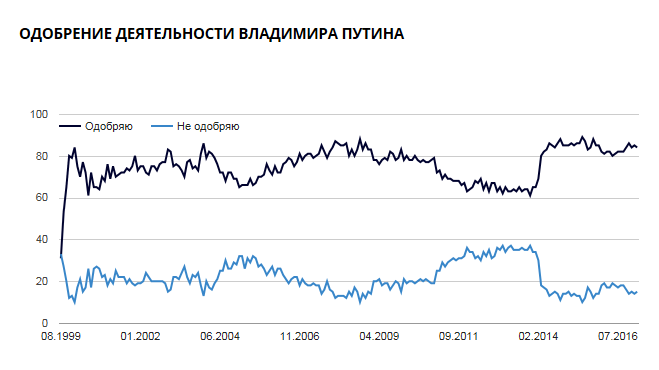
Public approval of Putin’s performance as president went up in January, but not by as much as the November score of 86%. A year ago, the Levada Centre in Moscow measured public approval and disapproval of Putin at 82% positive, 17% negative. The current measures are 84% positive, 15% negative. This means public disapproval has been shrinking as wartime conditions get worse, while approval is stable within the margin for statistical error.

IN GENERAL DO YOU APPROVE OR DISAPPROVE OF VLADIMIR PUTIN’S PERFORMANCE AS PRESIDENT?


The line chart (below) illustrates how Putin’s ratings have been moving since February 2014, when the US started the war in Ukraine. It is clear the approval line has stabilized above 80% and disapproval below 20%.


TRAJECTORY OF PRESIDENT PUTIN’S RATINGS

KEY: Black=approval; blue=disapproval


Putin’s achievement cannot be exaggerated — no political leader of a major country in the world is recording such durably high approval ratings. But the achievement is qualified. Without the US war in Ukraine, then US and European Union (EU) sanctions, the approval line for Putin would have continued downwards as the collapse of the oil price and the rouble tipped the economy into recession, and as Russian voters lost trust in their future.


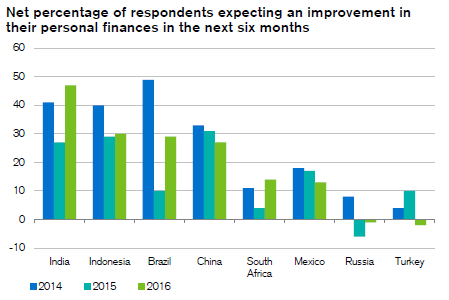
The Credit Suisse consumer confidence report for 2017 illustrates what has happened:


In 2014, before war, oil price collapse, devaluation and US-EU sanctions were felt in earnest, Russian consumers were optimistic, though not quite as much so as their emerging market (EM) peers. The subsequent impact in 2015 was more negative than for the other EM countries; although the impact softened in 2016, it remains negative.


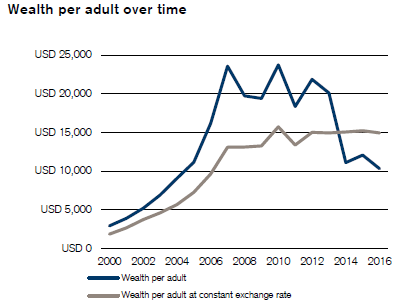
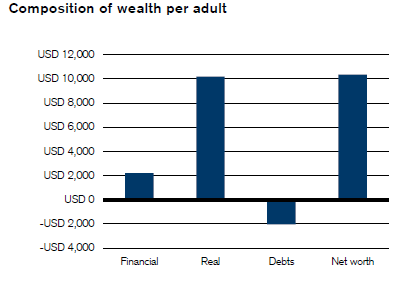
From the domestic point of view, Credit Suisse’s chart of real wealth growth in Russia reveals the driver of voter approval for Putin administration since 2000 has been rising income, rising savings, rising net worth:


Most of the asset value in this figure has been contributed by the Russian real estate bubble. Devaluation has done more than prick this bubble, flattening the grey line and driving it downwards this year. Devaluation, accompanied by cutbacks in corporate investment and state budget outlays, are also driving the cash element of wealth downwards, and thus the net worth figure for Russians. 


Early this month Credit Suisse finalized a fresh report on consumer expectations in Russia and other emerging markets. The Swiss bank’s forecast for Russia is a two-way bet. “The potential turnaround point will still depend on the direction of oil prices, the Central Bank of Russia’s stance on monetary policy and the government’s potential decision to increase pensions and public sector employee salaries as the elections approach. A further strengthening of the ruble would pave the way for increased purchasing of consumer electronics and other durable items, although we expect a lag between macroeconomic stabilization and a sustainable recovery of consumption until wage inflation improves more robustly.”


Russian analysts interviewed this week say approval for Putin does not translate into either consumer confidence, or expectation of growth in real income. Russian consumers don’t run up bigger bills in cash or on credit at smartphone outlets or car dealers as a consequence of their view that Putin is the country’s best hope in present and foreseeable circumstances.

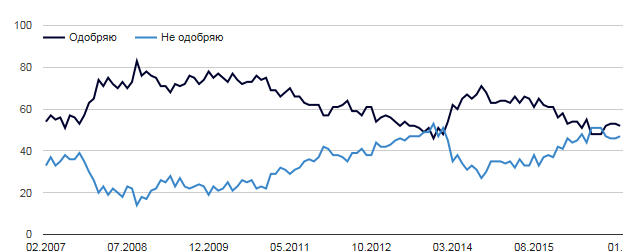
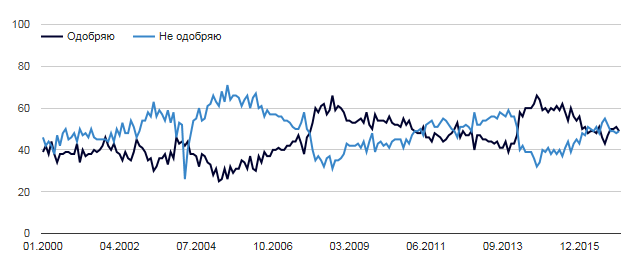
On the other hand, there is consensus among the analysts that deterioration of income, living standards, and real income does turn into voter disapproval of the performance of Prime Minister Dmitry Medvedev and also of government ministries:

TRAJECTORY OF PRIME MINISTER DMITRY MEDVEDEV’S RATINGS

KEY: Black=approval; blue=disapproval


TRAJECTORY OF THE GOVERNMENT’S RATINGS

KEY: Black=approval; blue=disapproval


As can be seen from the charts, the Medvedev rating at the moment is net positive, 52% to 47%, while the government rating is equally divided, 49% and 49%. The payment of the lump-sum pension in January, and the subsequent indexation of pensions, have neutralized the negative approval trend for Medvedev and the government. But not by much, and not for long.


The reason Putin isn’t blamed for the reversals in the economy, but Medvedev and the government are, is the regime change strategy of the US and EU. If the Americans hadn’t been trying so hard to overthrow him, as Russians perceive this, domestic public opinion would have moved against the president. Instead, Putin has been able to wrap himself in the flag. Opposition to him inside the country, and criticism outside the country, make no obvious dent, because the rating is, in practice, approval of the country itself

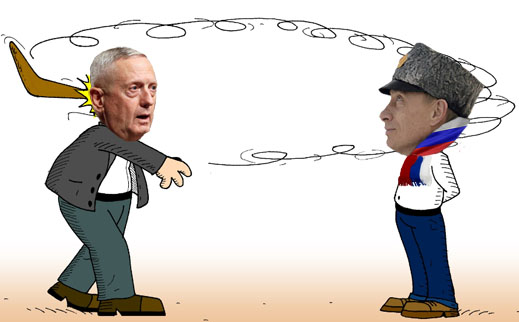
So, is there an opportunity for US warfighters like General James ‘Mad Dog’ Mattis, the new Secretary of Defense (below, left), to upset Putin?


By intervening in the domestic economy, the consensus of Russian analysts is no. Among the political opposition, no. What about fresh US military moves on the Ukrainian and Syrian fronts, in the Black and Baltic Seas, or in cyber warfare? It is already clear that US military tactics turn out to be a boomerang – they trigger more, not less support for Putin.

Talking Turkey: Erdogan Rants in the Face of Europe's Terror Fears

Erdogan’s War of Words Inciting Terror in Europe

by Finian Cunningham - SCF


March 26, 2017

Only hours after Turkish President Recep Tayyip Erdogan issued a bloodcurdling warning about terror attacks against European citizens, four people lay dead on the streets of London. That death toll may rise further because several of those injured in the attack this week in the British capital are in critical condition, fighting for their lives.

Erdogan was speaking Wednesday in what was yet another diatribe in his ongoing war of words with the European Union. The Turkish leader has been enraged by European governments refusing ministers from Ankara holding political rallies in Germany, Netherlands and Austria among other countries. As a result of the injunctions, he has accused the EU of displaying Islamophobia and hostility towards Turkey.

In his latest barrage earlier this week, Erdogan warned that there would be dire repercussions for EU citizens owing to the perceived stance of their governments.

«If you continue to behave like this, tomorrow in no part of the world, no European, no Westerner will be able to take steps on the street safely and peacefully», Erdogan said.

Tragically, within hours of announcing these very words, a British-born man plowed his speeding car into pedestrians on London’s Westminster Bridge, killing several of them and seriously wounding dozens more. The assailant then got out of his crashed vehicle and ran into the grounds of the British parliament where he stabbed a police officer to death, before being fatally shot by another officer.

The attacker was named as 52-year-old Khalid Masood, a British citizen. It is not clear yet what his precise motives were, but the deadly attack was subsequently claimed by the Islamic State terror group.

Turkey’s Erdogan was reportedly one of many world leaders who quickly phoned British premier Theresa May to offer his condolences. Later on Wednesday night, Erdogan released a statement on social media, saying:

«We stand in solidarity with the UK, our friend and ally, against terrorism, the greatest threat to global peace and security».

There is a sense here that the Turkish leader was reeling from his own earlier warnings of would-be terror consequences for European citizens, and how his tirades against the EU might be implicated in inciting violence.

Certainly, the EU, in short-order, seemed to find Erdogan’s forecasting of acts of terrorism against European citizens and how «they would not be safe on streets around the world» to be lamentable.

Turkey’s envoy in Brussels was promptly summoned to «explain» the president’s doom-laden words. The day after the London killings, the EU foreign affairs spokeswoman Maja Kocijancic reportedly said:

«We have asked the Turkish permanent delegate to the EU to come... as we would like to receive an explanation with regard to the comments by President Erdogan concerning the safety of Europeans on the streets of the world».

At best, Erdogan’s chilling warnings against European citizens are grossly insensitive. Apart from the carnage in London, on the very day that he issued his grim forecast of violence, the date was also the first anniversary of the terror attacks in Brussels when more than 30 people were killed by suicide bombers in the Belgian capital on March 22 last year.

Over the past year, there have been several other terror attacks on the streets of European cities, including the carnage in Nice when a would-be jihadist drove an articulated lorry into a pedestrians last July, killing over 80.

There was also an horrific attack in Berlin when an assailant drove a lorry into a crowded Christmas market.

In all these incidents, there appears to be an Islamist connection. The perpetrators may be acting in some sort of «lone wolf» capacity, without the organizational support of the al Qaeda terror network. But that’s beside the point. The attacks appear to be motivated by some level of Islamist grievance. Perhaps acts of revenge against European governments and citizens who are perceived as being complicit in illegal wars on, or persecution of, Muslim majority countries in the Middle East.

This is where Turkish President Erdogan bears more responsibility than merely just «bad timing» or being «insensitive» remarks.

In recent weeks, Erdogan and senior government ministers in Ankara have been engaging in a reckless war of words with the EU, which can be viewed as bordering on incitement.

Erdogan has repeatedly accused Germany and The Netherlands of acting like «Nazis and fascists». He has condemned the whole of the EU as being «racist» and «anti-Islam».

Just last week, Erdogan claimed that Dutch UN peacekeeping troops were responsible for the Srebrenica massacre in 1995, when up to 8,000 Muslim men were killed by Serb forces. Erdogan said the Dutch had the blood of Muslims «on their hands».

Ankara’s fit of rage stems from European governments blocking political rallies being held in their cities by Erdogan’s ruling Justice and Development Party. Those rallies are aimed at mobilizing Turkish expatriates to vote in Turkey’s referendum next month, which is being held to endorse increasing constitutional powers for Erdogan’s presidency.

Erdogan’s grip on power has already become increasingly autocratic since the attempted coup against his rule failed last July.

In order to push Turkish voters to back his sought-after constitutional changes, Erdogan is evidently whipping up patriotic fervor and in particular Islamist fervor by indulging in a war of words with the EU.

Denouncing European states as «anti-Islamic» and «racist» may gain Erdogan votes. But such incitement has consequences. This war of words is not an abstract phenomenon. It risks inflicting real human casualties, as Europe has all-too often witnessed over the past year.

If EU governments had any spine, they would hold Erdogan legally to account over his potentially seditious behavior.

But the supine EU is too busy trying to keep the Turkish sultan sweet so that he doesn’t open the refugee floodgates from the wars that European governments have been stoking across the Middle East and North Africa.

Finian Cunningham, former editor and writer for major news media organizations, writes extensively on international affairs, with articles published in several languages

Accelerant: The Trump Climate Effect

As Trump's Denialists Get to Work, the Climate Is Changing 170 Times Faster 

by Dahr Jamail - Truthout 


March 27, 2017

You can feel it, can't you?

You already know what is happening to the planet. To Gaia. To Earth. To the only planet humankind will ever "permanently" inhabit. We've nowhere else to go but here ... this incredible, majestic, beautiful Garden of Eden that has held us, and carried us, this far.

We have ignored the fact that we are, at best, mere stewards. We have forsaken the Earth by fantasizing that the planet was ours to control. To exploit. To manipulate. To drill, mine and desecrate. To gain riches from.

The balance is upset, the die is cast, now we reap the consequences of a whirlwind of forces so vast we cannot comprehend them.

We needn't look far to see how very far off the climate precipice we have already fallen, as our pace accelerates by the day.

A recent study, Extinction Risk from Climate Change, published in the prestigious journal Nature, shows that half the species on Earth today will likely disappear by the middle of the century -- within 33 years. Although this information is devastating, perhaps we should not be surprised, since we've known for years now that we have already entered the Earth's sixth mass extinction event.

Last month, a paper titled The Anthropocene Equation revealed that anthropogenic climate disruption (ACD) is causing the climate to change 170 times faster than it would if only natural forces were affecting it. "The human magnitude of climate change looks more like a meteorite strike than a gradual change," one of the authors of the study said.

Both NASA and NOAA data showed that this January was the third hottest January ever recorded, with the brunt of the warming extremes occurring, distressingly, in the Arctic. Some anomalies were as high as 50 degrees Fahrenheit above normal over the winter.

The amount of dissolved oxygen in Earth's oceans is currently declining, according to a recently published paper in the journal Nature. This will assuredly have severe consequences for all marine organisms.

For perspective on where we are in relation to what has happened in Earth's history, National Geographic recently published a piece that shows how sudden and dramatic changes in the planet's climate have historically been catastrophic for humans, bringing plagues, famines and heat waves. The article highlights the importance of not only the extreme change that is predicted over the next 100 years (4° to 6° Celsius, which could be an extremely conservative estimate), but also the rate of change, as it far exceeds nature's ability to adapt in order to sustain most life forms. National Geographic goes on to point out that this exceptional rate of change will test adaptability by all global species, including humans, and that over the long term, all of our survival is far from certain.

In 2015, NASA launched a massive mission to study how quickly the oceans are melting Greenland, and the findings that are now coming in are disturbing. While we don't yet have all of the results, the study has already enabled the lead researchers to provide some broad brushstrokes on what they are finding. "Overall, together I think these papers suggest that the glaciers as a whole are more vulnerable than we thought they were," Josh Willis, a researcher at NASA's Jet Propulsion Laboratory and the principal investigator on the mission told the Washington Post. "We could be in for more sea level rise than we thought," he added. "And we're not alone; the fact is that almost every time some new results come out of Greenland or Antarctica, we find these glaciers are more vulnerable than we thought."

At roughly the same time Willis was making those comments, US satellite data from Antarctica showed that sea ice around that continent had hit a record low. That means that the sea ice around Antarctica has shrunk to its smallest annual extent on record, after having been at its record high just a few years earlier. It's also worth noting that in mid-February, the Larsen C ice shelf there shed a Manhattan-sized chunk of ice into the sea.

On February 22 Truthout reported that the next major bleaching event to hit the Great Barrier Reef in Australia had begun. A little over two weeks later, the first survey for this year was conducted by the Great Barrier Reef Marine Park Authority (GBRMPA), and the survey confirmed that another mass bleaching event had occurred and was ongoing. "In total, those extreme weather events and the overall impact of climate change is a major threat to the future of the reef," the GBRMPA's David Wachenfeld said grimly to the media of his findings.

Closer to home in the US, on February 12 the tallest dam in the country, the Oroville dam, was at risk of disintegrating due to an onslaught of torrential flooding that prompted the evacuation of more than 200,000 people living downstream. The crisis underscored how infrastructure mechanisms like dams are in no way built to withstand the impacts that ACD is already causing, let alone future impacts.

Truthout published an article that contained an interview with Deborah Moore, who was a commissioner with the World Commission on Dams, an international body that investigated the performance of dam projects across the world. Moore was asked what experts like herself should be looking at in terms of incorporating climate science into engineering design. Her response?

"We can no longer use historic data in order to plan these projects because it's no longer relevant."

Earth


The evidence of runaway ACD across the land sectors of the planet is glaring.

A recent State of the Environment Report for Australia has warned that ACD could be "irreversible," and that ACD's impact to ecosystems continues to increase. "It [ACD] is altering the structure and function of natural ecosystems, and affecting heritage, economic activity and human wellbeing," the report's summary said.

"Evidence shows that the impacts of climate change are increasing, and some of these impacts may be irreversible."

As if to underscore this point, another report from Australia emerged recently, which showed that country's wheat productivity has "flatlined" as a direct result of ACD.

Lastly in this section, spring has arrived nearly a full month early for many plants in the Arctic. Scientists have warned of ominous consequences from this, as the change marks the greatest shifting of the spring plant emergence that they have ever observed in the Arctic.

"As a climate scientist who studies the start of spring, I struggle to answer the question, 'What is spring?'" 

Heidi Steltzer, a professor at Fort Lewis College and author of the recent scientific paper, told the New York Times. "A longer spring opens up the potential for gaps -- points in time when it would be spring with no spring-like events occurring. Would this still be spring?"

Water


As is usually the case in these dispatches, the watery realms are where runaway ACD is the most visible.

Major droughts, which are looking more permanent with each passing year, are persisting around the globe. In Somalia, a country that has had to grow accustomed to drought, words like "unprecedented" and "record-breaking" have begun to lose their meaning. The drought there is now so bad that hyenas won't even eat the carcasses of goats, sheep and camels that have died, as there isn't enough meat on their bones to make it worth their while. In early March, in one 48-hour period, at least 110 people died in Somalia from famine and diarrhea resulting from the ongoing drought conditions.

Famine warnings have now been issued for Rwanda, Kenya, Ethiopia, South Sudan and Somalia, all of which are experiencing their worst droughts in decades, with no end in sight.

By February, it became clear that the climate in the Arctic was, and had been for several months, already well advanced into abrupt ACD. Temperatures in many areas, including the North Pole, were clocking in between 30°-40°F above normal for extended periods of time, and the Arctic sea ice was hitting record minimum extent levels. In January, what is normally one of the colder months of the year there, sea ice extent was nearly half a million miles below the January 1981-2010 long-term average, an average that was already well below what a healthy preindustrial age sea-ice level would have looked like.

A recent study showed that as Arctic warming continues to ramp up, Canadian glaciers are paying for it dearly; the melt-off from them has risen by a staggering 900 percent. This has now caused them to become a major contributor to sea level rise. Another recent study revealed that of all the permafrost that exists in the global Arctic, at least 10 percent is already melted out.

Anchorage, Alaska will lose its drinking water source before 2100, according to another recent study. The city's water comes from the Eklutna Glacier, in the Chugach Mountains above Anchorage, which is in the process of melting away, according to United States Geological Survey (USGS) Scientist Louis Sass, the lead author of the study.

"Eklutna looks like it's going to more or less disappear," he said, adding that the only question is how long that will take. According to Sass, who this writer accompanied on a USGS glacial survey of another Alaskan glacier twice during 2016, if the climate remains as it was between 2008 and 2015, the Eklutna will be gone by 2100. But, he said recently, if the climate warms more, which of course it will, the timeline could be half that long. To give you an idea of how fast the glacier's melt rate is increasing: Between 1957-2010, the rate of melting ice there was 5 percent per year. Between 2010-2015, that rate had risen to 7 percent. And during that same period, during hotter years like 2013 and 2015, the rate even reached 13 percent. Farewell, Eklutna.

Meanwhile, sea level rise continues, and coastal regions are paying a price. A recently published study showed that US coastal cities could be flooding three times every single week by 2045. That means, if you buy a home in those areas now, before you finish paying off your 30-year mortgage, you would have a little trouble selling your constantly flooding real estate.

Lastly in this section, even life in the deepest seas is being impacted negatively by runaway ACD. A recently published study has shown that creatures living in the deep ocean are facing major food shortages, rapidly changing temperatures and other human-caused problems. The deep ocean plays an essential role in the sustenance of commercial fishing and also removes major amounts of CO2 from the atmosphere, but the study notes that food supply in the deeper areas of the oceans could fall by a stunning 55 percent by 2100, which will of course starve the animals and microbes that live there.

Fire


So much for fire season being in the summer.

In early March, within just a few days, wildfires had torched a 1.5 million acre swath across the Central US, incinerating at least six people. The area, ripe for burning due to ACD-warmed temperatures and an ongoing drought, detonated into fires that spread across Texas, Oklahoma and Kansas. In addition to the deaths, the fires caused vast amounts of damage: Thousands of people were forced to evacuate, much livestock was burned to death, vast expanses of cropland were lost, and numerous structures went up in flames.

In Kansas, one wildfire burned more than 1,000 square miles, breaking the record for that state's largest-ever fire. These fires were ongoing in all three states at the time of this writing.

Air


In February near the North Pole, temperatures were 50 degrees warmer than normal, yet again. In one area of Greenland, temperatures surged upwards of 43 degrees in a mere 12 hours as scientists continue to watch in amazement and shock as the Arctic literally goes into meltdown.

Moreover, these dramatic temperatures were simply one of many major heat waves sweeping the planet in February. Temperatures in North Texas reached into the mid-90s by mid-February, and one area in Oklahoma nearly reached 100. At the same time, parts of Australia were baking in 115-degree heat.

February was so hot across much of the US that the Great Lakes' already weak ice cover was cut down to nearly nothing and ski conditions across the Northeast looked more like they usually do in April. To give you an idea of how hot things have been in the US, according to Climate Central, "There have been 3,146 record highs set for the month-to-date compared to only 27 record lows, ensuring February will go down as the 27th month in a row with more highs than lows. The astonishing 116-to-1 ratio of highs to lows would easily set a record for the most lopsided monthly ratio in history. There have also been 248 monthly record highs and no monthly record lows."

Evidence of abrupt ACD abounds, including torrential downpours following record-setting drought. This sequence is precisely what we saw in California last month, when an extreme weather event that was referred to as a "bombogenesis" or "weather bomb" brought torrential rains and floods, killed four people, swallowed cars, disrupted flights, and knocked out power for more than 150,000 people.

Additionally, it seems that a previously unforeseen nightmare scenario may have already begun.

The Intergovernmental Panel on Climate Change (IPCC), in its most recent summary, includes the fact that the carbon equivalent contained in Arctic permafrost is 1,400-1,700 gigatons, and the IPCC estimates that by 2100, between 800-1,400 gigatons of carbon will be released into the atmosphere. Currently, humans are emitting roughly 40 Gigatons of CO2 into the atmosphere on an annual basis.

Amazingly, while the IPCC does note these amounts of terrestrial carbon in the Arctic from the melting permafrost, they do not include their release and the implications thereof into their modeling predictions. The release of all this extra carbon from melting permafrost represents yet another ACD-driven positive feedback loop: The carbon released from the permafrost will add to atmospheric warming, which will only accelerate the feedback loop by melting more permafrost.

Denial and Reality


Given that we are in the country of Trumpistan, we can now safely assume we will be fed a steady diet of ACD denialism.

With the Trump administration full of ACD deniers, climate scientists are already facing threats, harassment and a very real fear of "McCarthyist attacks." Abusive and vulgar verbal attacks, and even death threats, have already become the norm.

In just the two months since he entered office, Trump has already undertaken the most ambitious regulatory rollback since the Reagan era and, of course, some of the most dramatic acts of deregulation have been happening on the environmental front. Trump's frontrunner for the role of science advisor is William Happer, a man who has described climate scientists as a "glassy-eyed cult." Also in Trump's denial cabal is Scott Pruitt, the new head of the EPA (which means he's the person in charge of destroying that particular agency), who recently publicly questioned whether the EPA is even empowered to regulate greenhouse gas emissions.

During a recent interview Pruitt was questioned as to whether he believed ACD was caused by humans, to which he replied: "I think that measuring with precision human activity on the climate is something very challenging to do, and there's tremendous disagreement about the degree of impact, so, no, I would not agree that it's a primary contributor to the global warming that we see."

At this moment, it is worth harkening back to a 1991 film produced by the oil giant Shell, which warned that the climate was already changing "at a faster rate than at any time since the end of the ice age."

The film, titled Climate of Concern, went on to state that the rate of ACD even at that time, more than a quarter of a century ago, was "changing too fast perhaps for life to adapt, without severe dislocation."

It minced no words, stating that the world was warming and serious consequences could result. "Tropical islands barely afloat even now, first made inhabitable, and then obliterated beneath the waves … coastal lowlands everywhere suffering pollution of precious groundwater, on which so much farming and so many cities depend," the film narrates. "In a crowded world subject to such adverse shifts of climate, who would take care of such greenhouse refugees?"

Like Exxon, which knew, early on, of the dire consequences of runaway ACD and then covered up the facts, Shell is currently immersed in an elaborate charade, acting for the benefit of its bottom line. Whether the denialists in Trump's cabinet are engaged in their own charade -- or whether they really believe their bizarre rhetoric -- no one truly knows, but there's no doubt that they are acting in the interest of the fossil fuel industry.

Once again, the oil giants have realized profits beyond their wildest dreams, while the consequences continue to be thrust upon every living being on Earth.

Dahr Jamail, a Truthout staff reporter, is the author of The Will to Resist: Soldiers Who Refuse to Fight in Iraq and Afghanistan (Haymarket Books, 2009), and Beyond the Green Zone: Dispatches From an Unembedded Journalist in Occupied Iraq (Haymarket Books, 2007). Jamail reported from Iraq for more than a year, as well as from Lebanon, Syria, Jordan and Turkey over the last 10 years, and has won the Martha Gellhorn Award for Investigative Journalism, among other awards.
His third book, The Mass Destruction of Iraq: Why It Is Happening, and Who Is Responsible, co-written with William Rivers Pitt, is available now on Amazon.

Dahr Jamail is the author of the book, The End of Ice, forthcoming from The New Press. He lives and works in Washington State.

Copyright, Truthout. May not be reprinted without permission.  

This story was published thanks to readers like you. Donate now to support Truthout's fearless, independent coverage.

Buddha Storm

Buddhism in the Storm 

by Christopher Ketcham  - CounterPunch


March 27, 2017  


The storm is coming. Out the door the winds rage. The weather service predicts two feet around my house in the mountains, and I’ve been stockpiling wood all day, and food, and batteries, preparing for the place to go dark.

My two daughters are with me, the night is galvanized, and it keeps them awake.

And the storm,” says the little one, nearly five, “it comes with bears and the giants in the sky and we’ll dance.”

This is why kids should write weather reports.

To which I answer, “It has bears as big as the sky, tall as the trees, and then we’ll go sledding.”

Five year-olds are poets at heart. They live in enchantment.

I head out with snowshoes after she’s asleep, floating on the cresting white waves blown by the relentless wind. I’m like Charlie Brown with tongue out tasting the purpose of each flake. The house is being consumed. The full moon rages behind the clouds. The crappy flashlight made in China goes out due to the cold, and I’m wandering around the woods in the moon-white dark. Though there is light enough to see, I am a little afraid.

I break out my back-up lamp, illuminate the woods. The snow is a rich heavy precious substance. I find a scooped-out trampled snow-bed from a week ago where deer slept. It disappears under the storm. All traces of animal or man are going.

I look back in the light and my steps in the snow are wiped clean. The blizzard turns us humans in circles trying to find home, till we sit perplexed, frozen.

It’s the reminder that my life in such a storm, in such a forest, is not worth much – worth much less than, say, the deer hunkering in the tempest, who provide food for the hungry coyotes that keep the deer in check, which frees the understory from too much browsing from the overpopulous ungulates.

You could kill me, all my children, my relations, the people I know, dozens of people, and it probably wouldn’t make a difference in the ecological balance in this particular stretch of woods.

Further into the forest at the top of a ridge there is an old oak, wide-trunked, deity-like, that I’ve visited for the last decade in every season. When I reach it, all is silence, as the snow seems to pause, and my sweat is as heavy as a blanket after the long hike. There is a cadence of branches laden with snow giving up their load. A ripe wall of drift collapses. The bending hardwoods, heavy and creaking, shatter their snow arms at the least suggestion of the wind.

There is no wind, not a sound, not a snowflake. It seems I’m in the storm eye, an immense center of calm. Beyond my seat the ridge drops off into a chasm where the storm roils, apart, so that I’m watching it from a perch of peace. I think of Coleridge’s “Kubla Khan”, the caverns measureless to man, the ceaseless turmoil seething, the caves of ice.

I read somewhere that Coleridge wrote Kubla Khan in a dream-state that was broken by a banging at his door – I think it was a postman, probably bringing a bill – and that afterward, when he returned to his writing table, he found he could not complete the poem. He called it, in his title, a “Fragment.” The hikes we take in the woods are fragments of a view into the real world, which is the enchanted world.

What’s my ecological purpose here in the Catskills…except that I might die and rot my body into the woods, and give back the nutrients I’ve taken from mother earth. That’s my enchantment.

A soil biologist tells me that the only way to truly complete the nutrient cycle in the age of modern man, whose crops are fed by industrial nitrogen and whose waste never makes it back to the land, is to plant our dead bodies in a green ring outside the cities. Thereby to replenish the soil. Add our feces too, and you have the sustainable organic garden: ringed with the dead and a lot of shit.

I sit for a long while thinking about human shit-and-corpse agronomy. I like the idea not because it’s a rational use of resources. I like it because I want my energy to return to the land. I think of my children returning thus, which I hope they will, and I am at once horrified at the idea of their death, and accepting. I know it will come. The snow falls without cease. My path home is gone. My two daughters sleep. In the morning I’ll make them breakfast, and we’ll go sledding.
 

Christopher Ketcham is a freelance writer. You can write him at cketcham99@mindspring.com or see more of his work at christopherketcham.com.
More articles by:Christopher Ketcham

Sunday, March 26, 2017

41 Ways to Leave Your Premier: Christy Clark's Trumpian Record

Does BC Premier Christy Clark have a sketchy reputation?

by PressProgress (Broadbent Institute)


March 21, 2017

The Victoria Times-Colonist's editorial board recently suggested Clark's "ethical standards" do not reflect "the values British Columbians should expect from political parties."

Meanwhile, the Globe and Mail's editorial board said Clark's BC Liberal government is "addicted to money" and added that "the perception that corporate money is influencing government decisions is impossible to avoid."

From sketchy donations to dodgy expenses to unethical conduct to straight-up scandals, here are 41 times Clark's BC Liberal government showed that after all these years in power, they might not have a lot of integrity:


1) Alleging her rivals hacked her party's website with no evidence

Without any evidence whatsoever, Clark claimed the opposition NDP had launched a cyber attack against the BC Liberal website. While that might sound like the dictionary definition of "lying" to you, Clark later clarified she had merely "jumped to conclusions."


2) Making tens of thousands with disabilities pay $579 more for bus passes

Showing their compassionate side, the Clark government clawed back discounted bus passes for 55,000 disabled British Columbians – a group already more likely to face unemployment and poverty.


3) Picking an ex-Fraser Institute director to implement BC's climate change plan

Nothing screams serious about climate change like tapping a former director from a right-wing think tank that doubts the science behind climate change, right?


4) Getting her climate change plan ripped apart by her own experts

Late on a Friday afternoon in August, the Premier quietly released her so-called "climate leadership plan" – a plan so ineffective at dealing with climate change it was dismissed by one expert as "pathetic and cowardly".


5) Getting lobbied more than 10,000 times by her own oil and gas donors

An investigation by the Canadian Centre for Policy Alternatives identified nearly ten thousand contacts between officials at BC government ministries and agencies between 2010 and 2016.


6) Skipping an important vote on transgender rights to attend a partisan fundraiser

Of course Clark somehow found time to go to the photo op.


7) All the donations from other provinces

If all the donations from oil lobbyists wasn't bad enough, it turns out only a small percentage even comes from BC in the first place – most comes from companies headquartered next door in Alberta.


8) All the donations from other countries

It's illegal most places in Canada, but not in Christy Clark's BC – a recent investigation by the Globe and Mail showed Clark's BC Liberals are taking "cash from offshore oil and gas companies, European pharmaceutical companies and Beijing investment firms."


9) All the donors getting public sector contracts

As of October 2016, three-quarters of companies awarded with plumb, sole-sourced contracts by Clark's government are also Liberal party donors. But that's just a coincidence, surely?


10) Selling public land to BC Liberal donors for a cheap price

Of course that actually happened too.


11) Spending millions on partisan ads

Spending $15 million on cynical partisan ads while cutting public services and asking everyone to tighten their belts?


12) Hiring a staffer facing criminal charges

In 2013, the BC Liberals hired former Ontario Liberal staffer Laura Miller as its Executive Director. Not long after, Miller was charged with breach of trust, mischief and misuse of a computer system to commit mischief alongside Dalton McGuinty’s former chief of staff David Livingston.


13) Rehiring the same staffer facing criminal charges

Despite briefly stepping out of the picture, Miller was subsequently rehired as the BC Liberal Party Executive Director. She has since been appointed the party's campaign chief.


14) Spending more than $500,000 on private flights

Why take a commercial flight when a private one will do?


15) Billing taxpayers for a private flight to a fundraising dinner

In April 2016, Clark billed the public $6,054 for a Learjet to fly to Prince George. The reason? A photo op and a visit to the BC Liberals' annual northern fundraising dinner.


16) Triple-deleting all those emails

Back in 2015, BC's Information Commissioner found that the practice of triple deleting e-mails – shielding the government from Freedom of Information requests – was a "routine practice" among Clark government staffers.


17) Billing taxpayers $3,000 for dinner

Oysters: $3,267.66.


18) Leaking a "secret strategy document"

The BC Liberals claimed they obtained the NDP's "secret strategy document" which actually turned out to be a Microsoft Word document highlighting the party's plan to boost living standards for working and middle class families and fight climate change – very sinister sounding stuff!


19) Taking salary top ups from the BC Liberal Party

Clark already earns a six figure salary as the Premier of BC. So a lot of people were surprised to learn Clark was also paid between $30,000 and $50,000 each year by her own party for fundraising work.


20) Yogagate

In one of BC's weirdest scandals, Clark's government decided to celebrate International Yoga Day instead of National Aboriginal Day and shut down a major Vancouver bridge at a cost of $150,000 for a yoga event.


21) Spending nearly $1 million on government photos

It turns out all those smiling photos of Christy Clark and her cabinet ministers don't come cheap!


22) That time a Liberal MLA claimed the LGBT community is 'dominating' Christians

During debate on Bill 27, legislation to add "gender identity or expression" to the human rights code BC Liberal MLA Laurie Throness argued that recognizing gender identity as a human right is akin to discrimination against those whose views on gender are "rooted in Christian faith." Seriously.


23) Sending a staffer to spy on an NDP meeting with youth

Well, that's pretty desperate.


24) Insulting whistle-blowers

When a former staffer blew the whistle on the "widespread" and "most likely systemic" destruction of e-mail records by Clark's government to avoid FOI requests, Clark's government responded by painting him as a bad employee.


25) Spending $1 million to upgrade the church Clark goes to

The BC government gave a downtown Vancouver church a massive upgrade worth $1 million. By some coincidence, it also happened to be the same one Clark says she regularly attends.


26) Promoting a company Clark once chaired

According to leaked documents, Clark once served as chairwoman of a company she has regularly touted on official government business since becoming Premier.


27) Allegedly interfering in a local election to help her brother

After announcing a $150,000 community grant, Clark faced accusations she was helping a candidate in a local band election who supported her brother's $10 million wind farm project.


28) Not telling the truth about BC's job creation numbers

In 2012, Clark claimed BC was number one in job creation. That was not true.


29) Getting investigated by Elections BC over donations from lobbyists

Last week, Elections BC announced it had launched an investigation into reports that some lobbyists may have had their personal donations to the BC Liberal party reimbursed by third parties.


30) Also, getting investigated by the RCMP for those same reimbursements

Only five days after Elections BC announced its investigation, the RCMP announced its Sensitive Investigations Unit – a unit often tasked with fighting organized crime – is now looking into the alleged "cleansing" of political donations.


31) Giving a $39 million mortgage to a condo developer

Why did BC Housing lend $39 million to the developer of condo project that had nothing to do with social housing?


32) Releasing a jobs ad full of false claims

The ad's claims completely fell apart.


33) Declaring victory after losing a Supreme Court battle to avoid investing in schools

The Supreme Court dealt a monumental defeat to Clark and her government ending their 14 year battle with BC's teachers. But despite having fought against the teachers and their demands in court, the Premier suddenly started singing the praises of the court-ordered investments as if they were her own idea.


34) Apologizing to "ethnic" voters

Widespread outrage followed a leaked document showed the Clark government planned to apologize for historic injustices as a "quick win" designed to "improve our chances of winning swing ridings by better engaging supporters from ethnic communities."


35) Mysteriously firing health researchers

Eight researchers and contractors at the BC Ministry of Health were unceremoniously fired in 2012. The government claimed they breached the privacy of patient files and the police are investigating. The dismissed researchers suggested the real reason they were fired had to do with the influence of pharmaceutical companies, who also happen to be big BC Liberal donors. In the meantime, the researchers are unable to work and one committed suicide.

It later turned out there's a problem with the BC government's claims about a police investigation – the investigation never actually existed.


36) Making stuff up about the government's record

During a 2013 radio interview, Clark made a series of claims about her government's record on deficits, debt, and the province's credit rating. None of Clark's claims were true.


37) Getting sued because of partisan advertising

The Clark government's partisan ads are so over-the-top, two Vancouver criminal lawyers are now suing the government of BC in an attempt to stop the government's pre-election advertising.


38) Universities hiring Liberal lobbyists to lobby the BC Liberal government

In 2009, Kwantlen Polytechnic University spent $177,000 to hire a Liberal insider to lobby provincial cabinet ministers and MLAs. At the time Amrik Virk, who was then the minister of technology, innovation and citizen's services, also sat on KPU's board.


39) Approving a polluted-soil dump upstream from 12,000 people

Heavy metals, petroleum, and nitrite-contaminated soil and groundwater relied upon by a Vancouver Island community of 12,000 residents.


40) Taking millions from developers

In 2016 most of the BC Liberal Party's top donors came from either developers or the construction industry. Just eight donors contributed nearly $1.5 million of the $12.5 million total collected by the Liberals that year. Maybe that has something to do with Clark's awful record on housing affordability?


41) All those cash-for-access scandals

Can't forget all those BC Liberal donors who are also doing business with the BC government.

As the Globe and Mail's editorial board recently described this "world-class conflict-of-interest":


It's "a situation where companies seeking government contracts, approvals or tax breaks can give unlimited sums of money to the governing party. Lobbyists in the province have told The Globe and Mail they feel they need to donate, or their entreaties on behalf of their clients will be ignored."

Mind you, most of this stuff wouldn't fly in virtually any other Canadian province – only in Christy Clark's British Columbia.

Photo: BC Gov Photos. Used under Creative Commons license.

Ding Dong: Celebrating the Final Demise of D. Rockefeller

D. Rockefeller’s Gruesome Legacy

by F. William Engdahl


26 March 2017


The death of David Rockefeller, the de facto Patriarch of the American establishment, at age 101, is being greeted by establishment media with praise for his alleged philanthropy.

I would like to contribute to a more honest picture of the person.


The Rockefeller American Century


In 1939, along with his four brothers–Nelson, John D. III, Laurance and Winthrop–David Rockefeller and their Rockefeller Foundation financed the top secret War & Peace Studies at the New York Council on Foreign Relations, the most influential private US foreign policy think-tank which also was controlled by the Rockefellers. A collection of American academics gathered even before outbreak of World War II to plan a postwar world empire, what Time-Life insider Henry Luce later called The American Century. They made a blueprint for taking over a global empire from the bankrupt British, but carefully decided to call it not an empire. Rather they called it “spreading democracy, freedom, the American way of free enterprise.”

Their project looked at the geopolitical map of the world and planned how the USA would replace the British Empire as de facto the dominant empire. The creation of the United Nations was a key part. The Rockefeller brothers donated the land in Manhattan for the UN Headquarters (and in the process made billions in the increased prices of the adjoining real estate that they also owned). This is the Rockefeller “philanthropy” method. Every grant donated is calculated to increase family wealth and power.

After the War David Rockefeller dominated US foreign policy and the countless wars in Africa, Latin America, Asia. The Rockefeller faction created the Cold War against the Soviet Union, and NATO in order to keep a reviving Western Europe under American vassal status. How they did so I documented in detail in my book, The Gods of Money. Here I consider several examples of David Rockefeller’s crimes against humanity.

Rockefeller Biology Research: ‘Control the people…’


In the 1950’s the Rockefeller brothers founded the Population Council to advance eugenics, disguised as population research into birth control. The Rockefeller brothers were responsible in the 1970’s for a US Government Top Secret project directed by Rockefeller National Security Adviser Kissinger, NSSM-200 titled, “Implications of Worldwide Population Growth for US Security and Overseas Interests.” It argued high population growth in developing nations with strategic raw materials like oil or minerals were a US “national security threat” as more population demands national economic growth, using those resources internally (sic!). NSSM-200 made developing world population reduction programs a precondition of US aid.

If philanthropy should be motivated by love of our fellow man, the grants of the Rockefeller Foundation are not. Take medical research. During the period until 1939 and the War, the Rockefeller Foundation financed biological research at the Kaiser Wilhelm Institute in Berlin. It was Nazi eugenics—how to breed a superior race and how to kill off or sterilize those they deemed “inferior.” Rockefeller financed Nazi eugenics. Rockefeller’s Standard Oil also violated US law to secretly supply the Nazi Air Force with scarce fuel during the War.

After the War the Rockefeller brothers arranged for leading Nazi scientists involved in ghastly human experiments to be brought to the USA and Canada under sanitized identities to continue their eugenics research. Many worked in the CIA top secret MK-Ultra project.

In the 1970s David Rockefeller’s Rockefeller Foundation also financed together with WHO development of a special tetanus vaccine that limited population by making a woman incapable of maintaining a pregnancy, literally going after the human reproductive process itself.

The Rockefeller Foundation created the entire field of genetic manipulation through its ownership of Monsanto Corporation and financing of university biology research to create the “gene cannon” and other techniques to artificially alter gene expression of a given plant. The aim of GMO, since Rockefeller sponsored the disastrous Philippine Golden Rice project, has been to use GMO to control the human and animal food chain. Today more than 90% of all soybeans grown in USA are GMO and more than 80% all corn and cotton. Yet it is not labelled.

‘Control the oil…’


The Oil Shock of 1973-74 was orchestrated by a secretive organization David Rockefeller created in the 1950s known as Bilderberg Group. In May 1973 David Rockefeller and the heads of the major US and UK oil majors met in Saltsjoebaden, Sweden at the annual Bilderberg Meeting to plan the oil shock. It would be blamed on “greedy Arab oil sheikhs.” It saved the falling US dollar, and made Wall Street banks, including David Rockefeller’s Chase Manhattan, into the world’s largest banks.

This author has the “confidential” protocol of that meeting where the price increase strategy is described six months before the Arab-Israeli war. Please see my book, A Century of War, for documentation. In the 1970’s Kissinger summed up David Rockefeller’s world strategy: “If you control the oil, you control entire nations; if you control food, you control the people; if you control money, you control the entire world.”

The Rockefeller fortune is based on oil around companies such as ExxonMobil, Chevron and others. Henry Kissinger, David Rockefeller’s political adviser since 1954, was involved in every major Rockefeller project. Kissinger secretly manipulated Middle East diplomacy in 1973 to trigger an Arab OPEC oil embargo.

‘Control the money…’


David Rockefeller was chairman of Chase Manhattan Bank, the family bank. He was responsible for getting Chase Vice President, Paul Volcker, to become President Carter’s Federal Reserve chairman to make the Volcker interest rate shock that again, like the oil shock, saved the falling US dollar and Wall Street bank profits, including Chase Manhattan, at the expense of the world economy.

Volcker’s October 1979 interest rate ‘shock therapy’, backed by Rockefeller, created the 1980’s “Third World Debt Crisis.” Rockefeller and Wall Street used that debt crisis to force state privatizations and drastic national currency devaluations in countries such as Argentina, Brazil, Mexico. Rockefeller and friends such as George Soros then grabbed the crown jewels of Argentina, Brazil, Mexico at dirt cheap prices.

Through organizations such as his Trilateral Commission, Rockefeller was the foremost architect of the destruction of national economies and advancing so-called Globalization, a policy that mainly benefits the largest banks of Wall Street and City of London and select global corporations—the same who are invited members of his Trilateral Commission. Rockefeller created the Trilateral Commission in 1974 and gave his close friend Zbigniew Brzezinski the job of choosing its members in North America, Japan and Europe.

If we speak of an unseen, powerful network some call the Deep State, we might say David Rockefeller saw himself as Patriarch of that Deep State. His true acts deserve to be honestly seen for what they were—misanthropic and not philanthropic.

The model was much like the British banks used in the Ottoman Empire after 1881 when they de facto took control of the finances of the Sultan by controlling all tax revenues through the Ottoman Public Debt Administration (OPDA). Rockefeller interests used the 1980s debt crisis to loot much of the indebted Latin America and African countries, using the IMF as their policeman.

David Rockefeller was personal friends to some of the more savage military dictators in Latin America including General Jorge Videla in Argentine or Pinochet in Chile, both of whom owed their jobs to CIA coups arranged by then-Secretary of State Henry Kissinger on behalf of Rockefeller family interests in Latin America.

F. William Engdahl is strategic risk consultant and lecturer, he holds a degree in politics from Princeton University and is a best-selling author on oil and geopolitics, exclusively for the online magazine “New Eastern Outlook”