Gorilla Radio is dedicated to social justice, the environment, community, and providing a forum for people and issues not covered in State and Corporate media. The G-Radio can be found at: www.Gorilla-Radio.com, archived at GRadio.Substack.com, and now featuring on Telegram at: Https://t.me/gorillaradio2024. The show's blog is: GorillaRadioBlog.Blogspot.com, and you can check us out on Twitter @Paciffreepress
The new movie, War Machine, on Netflix starring Brad Pitt begins as a hilarious and satisfying mockery of General Stanley McChrystal, circa 2009, as well as of militarism in general. Hilarious because of the deadpan sincere idiocy.
Satisfying at least to those of us who have been screaming “What are you idiots doing?” for the past fifteen-and-a-half years.
Should we be glad that a Hollywood movie can still be made mocking the murderous malevolence of true believers in militarism, or should we be disturbed that theaters won’t show such movies and they have to end up on Netflix?
Should we be glad that a war satire set in Afghanistan didn’t have to wait decades for a different war, in the manner of M*A*S*H, or should we be disturbed that most viewers will not know a current war is being mocked because they either believe the war on Afghanistan has ended or they simply can’t keep up with the proliferation of wars?
Regardless, I recommend making sure every movie-lover, Brad Pitt fan, young person, and old person watch this movie. Watch a sincere true-believing military commander and his sycophants consciously choose to win an unwinnable war, proposing straight-faced to work on protecting people while not killing them — or killing them less, or something.
The basic truth that people don’t want armed foreigners in their towns and would rather not be bombed is presented here in straightforward dialogue as well as comedic exchange. And Brad Pitt’s character, based on Stanley McChrystal, and on Michael Hastings’ account of McChrystal, is depicted as having turned himself into a human hammer, unable to see any problem as anything other than a nail — his ambition to “win” a war driving his blindness to the absolute unwinnability of foreign occupations or “counter-insurgency” or “counter-terrorism,” also known as terrorism.
The whole thing stops being funny three-quarters of the way into the movie, when the protests of troops that they cannot distinguish civilians from enemies becomes an actual demonstration of that inability. When we get to watch the General in charge articulate all of his usual platitudes and nonsensical pep-rally lies (even if lies to himself, still lies) to a man whose child has just been murdered by U.S. troops, the laughter is gone.
Even when we see a village leader ask the General to “please leave now,” there’s little satisfaction in this plea of the Afghan people for the past decade and a half finally making it into U.S. ears, because we know that the U.S. military will not ever listen.
We also know that this movie constitutes the extent of the punishment that the real Stanley McChrystal will ever receive for his crimes. There will be no trial, no legal judgment.
Speculation as to the cause of death of Michael Hastings continues, but speculation as to whether the individuals crashing the U.S. war machine into Afghanistan year after year have committed murder in a futile and criminal attempt to advance their personal interests should end. There is no doubt that they have done and are doing just that on a massive scale. They are, as this movie points out, and as no U.S. newspaper or television station dares to state, endangering the United States under the banner of slogans claiming they are defending and protecting it.
Here’s part of an open letter to President Donald Trump that anyone can sign here:
The United States is spending $4 million an hour on planes, drones, bombs, guns, and over-priced contractors in a country that needs food and agricultural equipment, much of which could be provided by U.S. businesses. Thus far, the United States has spent an outrageous $783 billion with virtually nothing to show for it except the death of thousands of U.S. soldiers , and the death, injury and displacement of millions of Afghans. The Afghanistan War has been and will continue to be, as long as it lasts, a steady source of scandalous stories of fraud and waste. Even as an investment in the U.S. economy this war has been a bust.
But the war has had a substantial impact on our security: it has endangered us. Before Faisal Shahzad tried to blow up a car in Times Square, he had tried to join the war against the United States in Afghanistan. In numerous other incidents, terrorists targeting the United States have stated their motives as including revenge for the U.S. war in Afghanistan, along with other U.S. wars in the region. There is no reason to imagine this will change.
In addition, Afghanistan is the one nation where the United States is engaged in major warfare with a country that is a member of the International Criminal Court. That body has now announced that it is investigating possible prosecutions for U.S. crimes in Afghanistan. Over the past 15 years, we have been treated to an almost routine repetition of scandals: hunting children from helicopters, blowing up hospitals with drones, urinating on corpses — all fueling anti-U.S. propaganda, all brutalizing and shaming the United States.
Ordering young American men and women into a kill-or-die mission that was accomplished 15 years ago is a lot to ask. Expecting them to believe in that mission is too much. That fact may help explain this one: the top killer of U.S. troops in Afghanistan is suicide. The second highest killer of American military is green on blue, or the Afghan youth who the U.S. is training are turning their weapons on their trainers! You yourself recognized this, saying: “Let’s get out of Afghanistan. Our troops are being killed by the Afghans we train and we waste billions there. Nonsense! Rebuild the USA.”
The withdrawal of U.S. troops would also be good for the Afghan people, as the presence of foreign soldiers has been an obstacle to peace talks. The Afghans themselves have to determine their future, and will only be able to do so once there is an end to foreign intervention.
We urge you to turn the page on this catastrophic military intervention. Bring all U.S. troops home from Afghanistan. Cease U.S. airstrikes and instead, for a fraction of the cost, help the Afghans with food, shelter, and agricultural equipment.
A key function of BBC propaganda is to present the perspective of 'the West' on the wars and conflicts of the world. Thus, in a recent online report, BBC News once again gave prominence to the Pentagon propaganda version of yet more US killings in Yemen. The headline stated:
'US forces kill seven al-Qaeda militants in Yemen, says Pentagon'
Seven 'militants' killed is the stark message. A veneer of 'impartiality' is provided by the weasel words, 'says Pentagon'. BBC News then notes blandly, and without quotation marks:
'The primary objective of the operation was to gather intelligence.'
Nowhere in the short article was there any attempt to provide an alternative view of who had been killed and why. Were they really all 'militants'? How is a 'militant' distinguished from a 'civilian', or from a soldier defending his country against foreign invaders? There was not even a cautious statement to the effect that the Pentagon's claims could not be verified, as one might expect of responsible journalism.
Instead, we have to turn to Reprieve, an international human rights organisation founded in 1999 by the British lawyer Clive Stafford Smith. The group reports that five of the 'militants' were civilians, including a partially blind 70-year-old man who was shot when he tried to greet the US Navy Seals, mistaking them for guests arriving in his village.
But their civilians are mere 'collateral damage' in war. Since January 2017, the US has launched 90 or more drone strikes in Yemen, killing around 100 people, according to the Bureau of Investigative Journalism. This death toll includes 25 civilians, among whom were 10 children, killed in the village of al Ghayil in the Yemeni highlands during a US raid that was described by President Trump as 'highly successful'.
Mentions of such atrocities were notable by their absence in 'mainstream' media coverage of Trump's recent trip to Saudi Arabia where he signed trade deals worth around $350 billion. This included an arms deal of $110 billion which the White House described as 'the single biggest in US history.'
It would not do for the corporate media, including BBC News, to dwell on the implications for Yemen where at least 10,000 people have been killed since the start of the Saudi-led bombing campaign in 2015. 14 million Yemenis, more than half the population, are facing hunger with the Saudis deliberately targeting food production.
The World Health Organisation recently warned of the rising numbers of deaths in Yemen due to cholera, saying that it was 'unprecedented'. Save the Children says that at the current rate, more than 65,000 cases of cholera are expected by the end of June. The cholera outbreak could well become 'a full blown-epidemic'. Moreover:
'The upsurge comes as the health system, sanitation facilities and civil infrastructure have reached breaking point because of the ongoing war.'
As US investigative journalist Gareth Porter observes via Twitter:
'World leaders are silent as #Yemen faces horrible cholera epidemic linked to #Saudi War & famine. Politics as usual.'
Iona Craig, formerly a Yemen-based correspondent for The Times, notes that 'more than 58 hospitals now have been bombed by the coalition airstrikes, and people just do not have access to medical care in a way that they did before the war.' As if the bombing was not already brutal, Saudi Arabia has imposed a cruel blockade on Yemen that is delaying, or even preventing, vital commodities from getting into the country. Grant Pritchard, interim country director for Save the Children in Yemen, says:
'These delays are killing children. Our teams are dealing with outbreaks of cholera, and children suffering from diarrhoea, measles, malaria and malnutrition.
'With the right medicines these are all completely treatable — but the Saudi-led coalition is stopping them getting in. They are turning aid and commercial supplies into weapons of war.'
As one doctor at the Republic teaching hospital in Sanaa commented:
'We are unable to get medical supplies. Anaesthetics. Medicines for kidneys. There are babies dying in incubators because we can't get supplies to treat them.'
The doctor estimated that 25 people were dying every day at the hospital because of the blockade. He continued:
'They call it natural death. But it's not. If we had the medicines they wouldn't be dead.
'I consider them killed as if they were killed by an air strike, because if we had the medicines they would still be alive.'
None of this grim reality was deemed relevant to Trump's signing of the massive new arms deal with Saudi Arabia. BBC News focused instead on inanities such as Trump 'to soften his rhetoric', 'joins Saudi sword dance' and 'no scarf for Melania'. But then, it is standard practice for the BBC to absolve the West of any blame for the Yemen war and humanitarian disaster.
British historian Mark Curtis poses a vital question that journalists fear to raise, not least those at the BBC: is there, in effect, collusion between the BBC and UK arms manufacturer BAE Systems not to report on UK support for the Saudi bombing of Yemen, and not to make it an election issue? Curtis also notes that the BBC has not published any online article about UK arms being sold to the Saudis for use in Yemen since as far back as January. This, he says, is 'misinforming the public, a disgrace'.
He also rightly points out that the BAE Systems Chairman, Sir Roger Carr, was also Vice-Chair of the BBC Trust until April 2017 (when the Trust was wound up at the end of its 10-year tenure). The BBC Trust's role was to ensure the BBC lived up to its statutory obligations to the public, including news 'balance' and 'impartiality'. How could Sir Roger's dual role not suggest a major potential conflict of interest?
On the wider issue of 'mainstream' media coverage of foreign policy, the political journalist Peter Oborne notes that:
'Needless to say, the British media (and in particular the BBC, which has a constitutional duty to ensure fair play during general elections) has practically ignored Corbyn's foreign policy manifesto.'
Oborne writes that the manifesto:
'is radical and morally courageous.'
He explains that, pre-Corbyn:
'Foreign policy on both sides was literally identical. The leadership of both Labour and the Conservatives backed the wars in Iraq, Libya and Afghanistan, the alliance with Saudi Arabia and the Sunni states in the Gulf.
'London did what it was told by Washington. [...] This cross-party consensus has been smashed, thanks to Jeremy Corbyn, the current Labour leader. Whatever one thinks of Corbyn's political views (and I disagree with many of them), British democracy owes him a colossal debt of gratitude for restoring genuine political debate to Britain.
'And of course his extremely brave and radical decision to break with the foreign policy analysis of Blair and his successors explains why he is viewed with such hatred and contempt across so much of the media and within the Westminster political establishment.'
But, as Oborne notes, this important change has not been fairly represented in media coverage. In particular, on Yemen and Saudi Arabia:
'it is deeply upsetting that the BBC has betrayed its own rules of impartiality and ignored Corbyn's brave stand on this issue.'
We challenged Andrew Roy, the BBC News Foreign Editor, to respond to Oborne's observations. He ignored us (here and here). Roy's silence is especially noteworthy given that he had once promised:
'If there is a considered detailed complaint to something we've done, I will always respond to it personally.'
Perhaps Oborne's challenge to the BBC was not deemed sufficiently 'considered' or 'detailed' by the senior BBC News editor. Likewise, our own challenges over many years in numerous media alerts addressing BBC foreign coverage have been ignored or, at best, brushed away.
It was noteworthy that Corbyn's considered response to the most recent terrorist attack in London was selectively reported, arguably censored, by BBC News. Corbyn said:
'We need to have some difficult conversations, starting with Saudi Arabia and other Gulf states that have funded and fuelled extremist ideology.
'It is no good Theresa May suppressing a report into the foreign funding of terrorist groups. We have to get serious about cutting off the funding to these terror networks, including Isis here and in the Middle East.'
Sky News broadcast Corbyn's comments, but they do not appear to have been covered by BBC News. Certainly, as far as we can see, there is no mention of them in their 'Live' blog on the London attack or in Laura Kuenssberg's analysis, 'Election 2017: Impact of London terror attack on campaign'. And nothing about the Saudi link with terrorism appears in the BBC's online report on Corbyn's speech, focusing instead on the issue of May's cuts to police numbers while Home Secretary.
Even this issue alone, if properly and fully addressed by the media, should be a resigning matter for May as Prime Minister. Responding to the London attacks, Peter Kirkham, a former Senior Investigating Officer with the Metropolitan police, accused the government of lying over police numbers on UK streets. And a serving firearms officer says that:
'the Government is wrong to claim police cuts have nothing to do with recent attacks.
Despite her denials, Theresa May's cuts to police numbers have made attacks like London and Manchester much more likely.'
Kuenssberg's piece included passing mention of 'the Tories' record on squeezing money for the police'. But she gave no figures showing a reduction in the number of armed police; crucial statistics which she could have easily found from the Home Office.
Mark Curtis gives a damning assessment of BBC reporting on foreign affairs, particularly during the general election campaign. Noting first that:
'One aspect of a free and fair election is "nonpartisan" coverage by state media.'
He continues:
'Yet BBC reporting on Britain's foreign policy is simply amplifying state priorities and burying its complicity in human rights abuses. The BBC is unable to report even that Britain is at war – in Yemen, where the UK is arming the Saudis to conduct mass bombing, having supplied them with aircraft and £1 billion worth of bombs, while training their pilots.'
Curtis then provides some telling statistics:
'From 4 April to 15 May, the BBC website carried only 10 articles on Yemen but 97 on Syria: focusing on the crimes of an official enemy rather than our own. Almost no BBC articles on Yemen mention British arms exports. Theresa May's government is complicit in mass civilian deaths in Yemen and pushing millions of people to the brink of starvation; that this is not an election issue is a stupendous propaganda achievement.'
Indeed, our newspaper database searches reveal that, since the election was called on April 18, there has been no significant journalistic scrutiny of May's support of Saudi Arabia's bombing campaign in Yemen. The subject was even deemed radioactive during a public meeting in Rye, Sussex, when Amber Rudd, standing for re-election, appeared to shut down discussion of arms sales to Saudi Arabia. Electoral candidate Nicholas Wilson explains what happened:
'At a hustings in Rye on 3 June, where I am standing as an independent anti-corruption parliamentary candidate, a question was asked about law & order. Home Secretary Amber Rudd, in answering it referred to the Manchester terrorist attack. I took up the theme and referred to UK arms sales to Saudi Arabia & HSBC business there. She spoke to and handed a note to the chairman who removed the mic from me.'
The footage of this shameful censorship deserves to be widely seen. If a similar event had happened in Russia or North Korea, it would have received intensive media scrutiny here. Once again, we note the arms connection with the BBC through BAE Systems Chairman, Sir Roger Carr. Wilson has also pointed out a potential conflict of interest between HSBC and the BBC through Rona Fairhead who was a non-executive director of HSBC while serving as Chair of the BBC Trust.
These links, and Theresa May's support for the Saudi regime, have gone essentially unexamined by the BBC. And yet, when BBC political editor Laura Kuenssberg responded to Corbyn's manifesto launch, her subtle use of insidious language betrayed an inherent bias against Corbyn and his policies on foreign affairs. She wrote: 'rather than scramble to cover up his past views for fear they would be unpopular', he would 'double down...proudly'. Kuenssberg's use of pejorative language - 'scramble', 'cover up', 'unpopular' – delivered a powerful negative spin against Corbyn policies that, in fact, as Oborne argues, are hugely to his credit.
When has Kuenssberg ever pressed May over her appalling voting record on Afghanistan, Iraq, Libya, Syria and Yemen? In fact, there is no need for May to 'scramble' to 'cover up' her past views. Why not? Because the 'mainstream' media rarely, if ever, seriously challenge her about being consistently and disastrously wrong in her foreign policy choices; not least, on decisions to go to war.
Diplomatic relations between NATO members Germany and Turkey hit rock bottom on Monday when Germany's foreign minister Sigmar Gabriel said his country has no choice but to begin the process of pulling its forces out of Turkey's Incirlik air force base as the Turkish government will not allow all German lawmakers to visit troops there.
"Turkey has made clear that, for domestic political reasons, it cannot approve visits of all lawmakers," Gabriel told a news conference after meeting Turkish Foreign Minister Mevlut Cavusoglu in Ankara.
The scandal erupted last Thursday, when Turkey's foreign minister said it is not possible to allow German lawmakers to visit troops stationed at Turkey's Incirlik air base now, although he said Ankara may reconsider if it sees "positive steps" from Berlin. It was not immediately clear just what Turkey's "demands" or expectations, monetary or otherwise, were from Merkel for it to change its view. Ties between the NATO allies deteriorated sharply in the run-up to Turkey's April 16 referendum that handed President Tayyip Erdogan stronger presidential powers.
"We see that Germany supports everything that is against Turkey," Mevlut Cavusoglu told a news conference in Ankara last week.
"Under these circumstances it is not possible for us to open Incirlik to German lawmakers right now ... If they take positive steps in the future we can reconsider."
The recent deterioration in relations between Germany and Turkey developed when Germany, citing security concerns, banned some Turkish politicians from addressing rallies of expatriate Turks ahead of the referendum, infuriating Erdogan. Ankara responded by accusing Berlin of "Nazi-like" tactics.
Germany also expressed concern about the widespread security crackdown that followed last year's failed coup in Turkey as a result of which more than 100,000 people have been sacked or suspended from their jobs and more than 40,000 people jailed.
* * *
Fast forward to Monday morning, when cracks in NATO's unity, if not its brand new steel-and-glass headquarters emerged, when speaking in a press conference in Ankara with German Foreign Minister Sigmar Gabriel, Turkish Foreign Minister Mevlut Cavusoglu said German lawmakers can visit a military base in Konya, but not the main NATO base, Incirlik, in southern Turkey. Cavusoglu said Turkey-Germany ties are in a distressed period, blaming PKK activity in Germany and saying the presence of followers of Gulen movement are harming relations.
Cavusoglu also said secret services have started to "use journalists" in Turkey and added that journalist Deniz Yucel was arrested on terrorism charges, not due to his reporting.
In comments via live translation to Turkish, Gabriel said German military can’t constitutionally remain at a base abroad if lawmakers cannot visit them and said that since its operations are approved by parliament, German lawmakers must be able to visit the Bundeswehr, Gabriel added.
"Turkey must understand that in this situation, we must transfer German soldiers out of Incirlik," he said.
"In this situation, the Bundestag (parliament) will ask the government to find another location for the German soldiers in Incirlik."
In the last week of May, Angela Merkel gave her strongest signal yet that she’ll pull German troops out of Turkey unless President Recep Tayyip Erdogan lets lawmakers in Berlin visit them, further cracking a show of unity at a NATO summit.
At the North Atlantic Treaty Organization meeting where U.S. President Donald Trump hectored European allies to pay more for defense, Merkel confronted Erdogan about access to the soldiers at the NATO base in Incirlik where Germany stations reconnaissance jets that fly missions over Iraq and Syria.
“I’ll make very clear in my discussion with the Turkish president that it’s essential for us, because we have a parliamentary army, that our soldiers can be visited by members of the German parliament,” Merkel told reporters before the bilateral meeting.
“Otherwise, we’ll have to leave Incirlik."
Earlier this month, Merkel called Turkey’s stance on visits to Incirlik “deplorable” and said Germany may move the warplanes based there to a location outside Turkey, possibly Jordan.
It appears that in addition to its Trump-related headaches, NATO may be splintering on its own as Turkey increasingly defies the most powerful nation in Europe.
It was not immediately clear if and when Germany would follow through on its threat and begin the withdrawal of troops from Incirlik; it was also not clear if other NATO members would join Germany and pull their forces from the strategic airbase in sympathy.
Where one Canadian mining company goes in the Congo violence seems to follow.
Last week a police officer and soldier were killed at a Banro Corporation run mine in the east of the country. One “assailant” was also killed at the Toronto-based company’s Namoya mine.
In February three police were killed at another Banro mine about 200 km to the southwest.
An “assailant” was also killed at Twangiza in what the gold mining firm labeled an attempted robbery.
In March five Banro employees from Tanzania, France and the Congo were kidnapped at Namoya. Four of them were released over the weekend by a militia that had apparently been threatening the company for months. Claiming Banro expropriated their lands, the population near its Namoya mine want restitution so they can continue small-scale mining.
A 2013 Jesuit European Social Center report pointed out that local communities have not been allowed to see the environmental impact study or community plan for the mine and said the company paid the central government a million dollars for a tax exemption.
Banro operates in a region that’s seen incredible violence over the past two decades and the secretive company has been accused of fueling the conflict. In 1996 Banro paid $3.5 million for 47 mining concessions that covered more than one million hectares of land in Congo’s North and South Kivu provinces.
At the time over one million refugees were in eastern Congo and in September 1996 Rwandan (and Ugandan) forces invaded the area.
Resources fueled the Rwandan/Ugandan invasion.
Prominent Belgian Great Lakes journalist Colette Brackman produced a map showing that the zigzag progression of the Rwandan-backed rebels was based on the location of minerals. Multinationals signed deals worth billions of dollars with Laurent Kabila’s rebels before he took office. In an article headlined “Mining Firms Want a Piece Of Zaire’s Vast Mineral Wealth” the Wall Street Journal explained:
At a time when rebel forces are threatening to topple dictator Mobutu Sese Seko, Zaire’s vast mineral resources are beckoning foreign companies, prompting a scramble that recalls the grab for wealth 120 years ago in this vast land, once known as the Congo. American, Canadian and South African mining companies are negotiating deals with the rebels controlling eastern Zaire. These companies hope to take advantage of the turmoil and win a piece of what is widely considered Africa’s richest geological prize — and one of the richest in the world.
Ultimately, the Rwandan forces marched 1,500 km to topple the regime in Kinshasa. After the Congolese government installed by Kigali expelled Rwandan troops they re-invaded, leading to an eight-country war between 1998 and 2003, which left millions dead. Since then Rwanda and its proxies have repeatedly invaded the eastern Congo.
At the end of 2012 the Globe and Mail’s Geoffrey York described how “Rwandan sponsored” M23 rebels “hold power by terror and violence” in the mineral rich east. The rebel group added “a [new] layer of administrators, informers, police and other operatives” in and around Goma, the capital of North Kivu province, in part to “bolster” its “grip on the trade in ‘blood minerals’.”
As one of the only western mining companies operating in the border provinces of North and South Kivu, Banro reportedly worked closely with the Rwandan government. Keith Harmon Snow claims that:
Canadian Banro Corporation is one of the most secretive corporations operating in Congo, and they have established and maintained their control through very tight relations with the Kagame regime. Banro has taken over thousands of hectares of South Kivu province by manipulating the local mwamis (chiefs), by bribing officials and by infiltrating officials into power who are friendly to Banro and Kagame’s interests.
Upon expelling Rwandan troops from the Congo in 1998, Laurent Kabila revoked Banro’s concessions. With all of its business activity in eastern Congo, the company responded by filing a $1 billion “unlawful” expropriation claim at the International Centre for Settlement of Investment Disputes in Washington. In “Digging Deeper: How the DR Congo’s Mining Policy is Failing the Country”, Dominic Johnson and Aloys Tegera explain:
On 29 July 1998, just before war again started in Congo, President Laurent-Désiré Kabila annulled the Banro deal and gave ex-Sominki to a newly created Congolese state company called Somico (Société Minière du Congo) led by a Kivu traditional leader. Much of the subsequent fighting around Eastern Congo’s mining pitted Banro supporters, mostly supporting the [Rwandan backed] RCD rebels and backed by business interests, against Somico supporters, mostly consisting of Mai-Mai and supported by the Kabila government.
Alongside the regional peace accord that officially ended the eight-country war in the Congo, Joseph Kabila (who took over after his father was assassinated) returned the concession to Banro in 2003.
Canadians have heard almost nothing from the dominant media about Banro’s violent quest for billions of dollars in minerals. The little that has been reported is mostly the company justifying its operations. But where are the voices of ordinary Congolese? Don’t they deserve to be heard?
Canadians need to know what this country’s mining companies are doing around the world.
Hillary Clinton continues to at least partly blame alleged Russian meddling for her loss to Donald Trump. This week she said, "Russia didn't just target her campaign, but the entire country."
The claim Russia is influencing US politics with White House help won't go away. But a rarely asked question is why there is such an adversarial US relationship with Russia in the first place. Well a new book explores this question. It's called "The Plot to Scapegoat Russia: How the CIA and the Deep State have Conspired to Vilify Putin." The book's author is Dan Kovalik, human rights and labor attorney.
As Hillary Clinton blames the Kremlin for her election loss, author and attorney Dan Kovalik argues that anti-Russia sentiment is deeply embedded in the U.S. political establishment. Kovalik's new book is "The Plot to Scapegoat Russia: How the CIA and the Deep State Have Conspired to Vilify Russia."
Hillary Clinton said:
"Look,
I take responsibility for every decision I made, but that's not why I
lost. So I think it's important that we learn the real lessons from this
last campaign because the forces that we are up against are not just
interested in influencing our elections and our politics. They are going
after our economy and they're going after our unity as a nation."
Dan Kovalik graduated from Columbia University School of Law in 1993, and has served as a labor and human rights lawyer ever since. He has taught International Human Rights at the University of Pittsburgh School of Law since 2012.
Moscow - The late Zbigniew Brzezinski, who died on May 26 near Washington, DC, was another of the Russia-hating Galicians who grew up in safe haven in Canada. Like Chrystia Freeland’s maternal grandfather, Michael Chomiak, though the late Chomiak may have murdered the late Brzezinski if he had managed to get his hands on him during World War II. Brzezinski, Chomiak, and Freeland blamed not Germany, but Russia, imperial and Soviet Russia, for taking away their Galician birthright; they spent lifetimes advocating war against the Russians in revenge.
Chomiak also spent 1939 to 1945 on the German side, liquidating the Poles of Galicia, as well as the Jews and the Russians. Brzezinski was safe in Canada by then, where his father Tadeusz Brzezinski, a professional diplomat, was Poland’s consul-general to Montreal. He remained there, employed by the Polish government in exile, after the German invasion occupied Poland and set up a special administrative zone for Galicia, incorporating southeastern Poland and northwestern Ukraine; Lvov (Lwow, Lviv) where the Chomiak family was living; and the Tarnopol (Ternopil) district where Zbigniew Brzezinski claims his nobility had its origin.
Brzezinski didn’t think much of Canada. From the age of 10 until he graduated from McGill University at the age of 22, he lived in Westmount, the upper-class district of Montreal, and at a summer dacha 80 kilometres north of the city.
He considered Montreal “provincial”. He also resented being blocked in his ambition for a career in the Canadian foreign ministry on account of his nationality.
In his only reference to Canada in The Grand Chessboard, Brzezinski’s 1997 master plan for what he subtitled “American primacy and its geostrategic imperatives”, Brzezinski makes just one passing reference to his second homeland. He calls Canada “a state that is respected for the constructive use of its wealth and power but one that is neither feared nor resented.” What Brzezinski meant was that if a country is neither feared nor resented, it has no power worth the term. Brzezinski wanted power and to be feared and resented himself. For that Canada was too small and insignificant to suit his ambitions and purposes.
So was Galicia, and Poland too; although according to Radoslaw Sikorski, a Polish and British citizen, foreign minister of Poland, speaker of the Polish parliament, and Russia-hater, “during the decades when Poland was stuck against her will behind the Iron Curtain, he [Brzezinski] and the Polish pope were the two most important voices for a free Poland abroad.” Ousted from Polish government and politics, Sikorski is at the moment an employee of the Brzezinski Institute on Geostrategy at the Center for Strategic and International Studies (CSIS) in Washington.
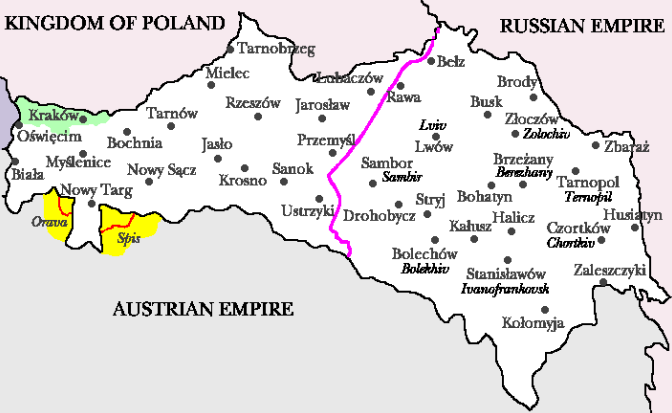
Brzezinski’s family name identifies its origin in Brzezany (Бережани), though Tadeusz was born in Zloczow (Zolochiv), Zbigniew in Warsaw. Brzezany is 90 kilometres southeast of Lviv in territory on the Russian empire side of the line dividing the older Polish empire. Zolochiv is equidistant from Lviv but due east, about 50 kilometres north of Brzezany.
Brezinski allowed himself and his family to be reported as having aristocratic or noble origins. He didn’t elaborate. The archive of the szlachta, the Polish warlords whose armed gangs got them large estates and aristocratic status in the Kingdom of Poland from the 15th century, is bare of any reference to the Brzezinskis among the major aristos, or the even minor ones. By the standard of the princes of the house of Radziwiłł, and of Princess Radziwiłł, President John Kennedy’s sister-in-law Lee Bouvier, Brzezinski was a nobody.
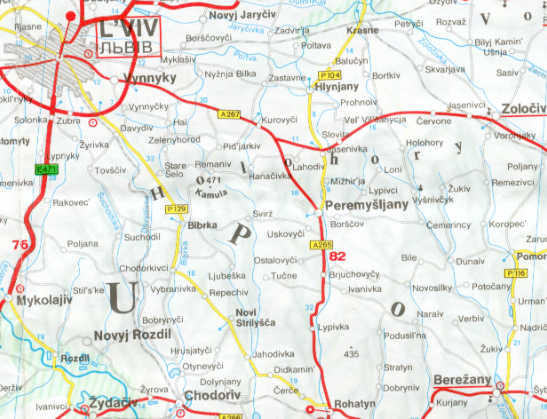
Brzezany (Berezany) on the map of Ukraine today;
Zloczow, where Brzezinski’s father was born, is Zolochiv
(Ukrainian: Золочів), is 60 kilometres to the north.
During World War II Brzezany was occupied by the Germany Army, and administered by Galicians like Michael Chomiak; that’s Chrystia Freeland’s grandfather and proponent of the idea that Brzezany should be liberated, er liquidated of Poles, Jews, Russians, gypsies, communists. For that purpose the Germans set up the Bełżec death camp nearby, and later Majdanek. Lucky Brzezinski, who would have been rounded up and shipped to one or the other as a member of the Polish-speaking majority of Brzezany. But by then Brzezinski and his family were safe in Montreal.
As the Chomiak (Freeland) family fled to Bavaria with the German forces, and then signed up with US intelligence agencies running sabotage and propaganda operations in Soviet Ukraine, Tadeusz Brzezinski remained a Polish state employee until 1945. He then joined the Quebec culture ministry to manage French-speaking centres around the province. While the Lviv University graduate Chomiak spent the rest of his life mobilizing Ukrainian-Canadians from a home in Alberta (he died in 1984), the Lviv University graduate Tadeusz Brzezinski was doing something similar from Montreal at the Polish Canadian Congress, then the World Polish Congress. He died in 1990.
Left: Tadeusz Brzezinski. Right: Zbigniew Brzezinski, with
President Ronald Reagan in 1981. Brzezinski claims (posthumously)
that Reagan asked him to continue as his National Security Advisor,
after President Jimmy Carter was replaced at the start of that year;
Brzezinski claims he turned Reagan down.
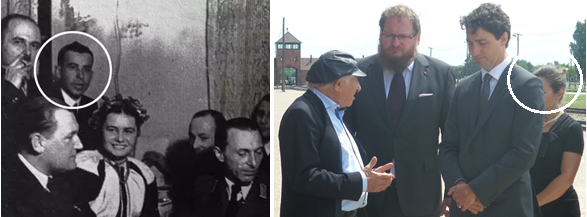
Left: Michael Chomiak with German military administrators in Cracow, 1943.
Right: Chrystia Freeland behind Prime Minister Justin Trudeau at Auschwitz in 2016.
Michael Chomiak and Tadeusz Brzezinski may have bumped, non-violently, into each other without recording the event for Canadian, Polish or Ukrainian posterity. Chrystia Freeland hasn’t said she was acquainted with Zbigniew Brzezinski, or inspired by his “voice for free Poland”; that’s to say, Galicia is Poland, not Galicia is Ukraine, the Chomiak-Freeland idea.
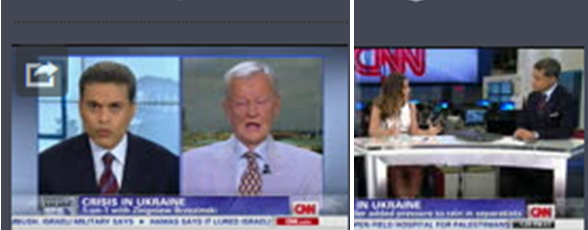
Freeland was once a junior afternoon panellist at a CSIS global security talkshow in April 2012, when Brzezinski was a senior panellist in the prime morning spot. In July 2014 they appeared together on a CNN talkshow to blame President Vladimir Putin for the destruction of Malaysia Airlines flight MH17, which had been shot out of the air over eastern Ukraine three days earlier.
According to Brzezinski, “this is truly a historically defining moment… We are, in fact, facing the first use of force over territorial issues in Europe since the outbreak of World War II. Putin is doing it.” Brzezinski recommended setting up a war crimes tribunal to indict and punish those responsible for the killing of all on board MH17. Brzezinski’s idea was that either Putin should put on trial those of his underlings whom Brzezinski already believed were guilty; or if Putin refused, that would prove to Brzezinski’s satisfaction that Putin was guilty of the crime himself.
The CNN videotape reveals that Freeland (right) was in the studio,
“[Putin]”, Brzezinski went on, “can still say that the actions that were taken to shoot down that plane by his thugs with the arms he provided went far beyond anything he intended and that this was an illegal criminal act and the people responsible for it would be handed over to the international tribunal. And he can suspend the military intervention in Ukraine itself, which is a cause of possible conflict between the east and the west as a whole. These are the actions he can undertake. If he fails to undertake them, he is actually challenging the cohesion of the international system and the security of Europe at the same time.”
Freeland played Little Miss Echo.
“This is a fight entirely created, organized and armed by the Kremlin. This is not a Ukrainian civil war. The separatists, many of them are led by Russian nationals, openly Russian nationals who have worked for the Russian security forces. They are using weapons which have come from Russia. There is one person who could stop this tomorrow and that is Vladimir Putin….One thing, though, that I think is really important that’s Zbig [sic] talked about is this could be an exit moment for Kremlin — for the Kremlin and for Putin. Putin can now say, if he is smart — you know, this is a disaster for him, it has gone completely wrong and if he is smart, he can separate himself from these guys and the world community can move on.”
Putin’s “exit moment” hasn’t come. Brzezinski’s came on May 26. Although Brzezinski became a US citizen in 1958, it isn’t known whether he retained his Polish citizenship or ever held Canadian citizenship. In its death notice for him, the Canadian Broadcasting Corporation (CBC) omitted to mention that Brzezinski had grown up and been schooled in Montreal. A Canadian member of CBC’s audience commented: “Sad the CBC can’t report the formidable Canadian connection.”
McGill University hasn’t mentioned Brzezinski since 2001 when he was identified as a past Polish visitor of note (not a graduate), trailing Pope John Paul II (then Cardinal Karol Wojtyla) and the poet Czeslaw Milosz.
Freeland’s tweet file is voluminous, but the only death she mentioned on May 26 was a terrorist attack in Egypt. Freeland hasn’t mentioned Brzezinski before, or since.
The Canadian media have stuck to US press reports for Brzezinski, except for the Global Radio News Hour, produced and presented from Manitoba by Michael Welch. Listen to the full hour on Brzezinski’s record with Jay Dyer, Andrew Korybko, John Helmer (min. 36.30-43.40), and Filip Kovacevic. Click to listen.
In Canada, the Global Radio News Hour is broadcast by nine radio stations in British Columbia, Manitoba, Ontario and New Brunswick, including Simon Fraser University, University of Victoria, University of Winnipeg, campus and community radio stations in Ontario, and the University of New Brunswick St Johns.
In the US, the Global Radio News Hour airs from Boston College, Massachusetts, and the Progressive Radio Network. For more details, call-signs and listening times, click.
As Donald Trump axes America’s commitment to the Paris Climate Accord, the Kingdom of Bhutan’s Prime Minister Tshering Tobgay finalizes Bhutan for Life, a fund that will give the country the funding required, meeting its commitment to remain carbon neutral forever.
As such, the Kingdom of Bhutan is making America look like a tired old retread jalopy/bucket of bolts that sputters and coughs along the roadway to doomsday.
By ignoring the pressing issue of climate change/global warming, America looks insignificant, undignified, and very weak whereas Bhutan’s carbon neutral commitment looks relevant, sophisticated, and very strong.
In point of fact, Bhutan is a carbon sink, meaning it absorbs some of America’s and everybody’s CO2 for free. Bhutan cleanses the planet because its government demands it do so, clashing with Mr. Trump’s radical contorted vision of a dog-eat-dog world.
The Kingdom of Bhutan is located deep in the Himalayas nestled between China and India. The kingdom’s prime minister discusses a world standard for environmental preservation, aka: Earth for Life, in a TED talk widely praised as “powerful” and “fascinating” and “moving.” It is a brilliant speech:
In his speech the PM explains Bhutan’s commitment to remain carbon neutral. Correspondingly and initiated in 1970s, the country declares its commitment to GNH or Gross National Happiness as a substitute for GNP or Gross National Product. Effectively, Bhutan’s people have turned economic progress into a planet friendly endeavor. All development in Bhutan is driven by GNH. Education is free. Health care is free. Economic activity is based upon “development with value” for the environment. This is the antithesis of America as well as much of the world. Futurists much prefer using Bhutan as a model rather than America when writing about a livable world in the decades ahead.
The Constitution of the Kingdom of Bhutan, Article 5, Section 3 declares a minimum 60% of Bhutan’s total land shall be maintained under forest cover for all time. Singularly, Bhutan is one of the few global biodiversity hot spots in the world.
Bhutan’s economy generates 2.2 million tons of CO2 annually. However, its forests sequester more than 3xs that amount. Notably, Bhutan is a net carbon sink.
Additionally, the country exports clean renewable hydropower electricity. This offsets an additional 6 million tons of CO2. By 2020, Bhutan will be exporting enough clean renewable electricity to offset 17 million tons of CO2. If they were to harvest one-half of their hydropower potential, they could offset 50 million tons of CO2 per year, and that is Bhutan’s goal. That is more CO2 than NYC generates in one year.
Wistfully, climate change brutally impacts Bhutan. The Himalayan glaciers are melting fast, causing flash floods and landslides. Years ago a glacial lake broke lose and flooded the country. Now, Bhutan has to contend with the looming danger of 2,700 glacial lakes that did not exist 20 years ago because global warming is melting Himalayan glaciers to the bone, 2,700 xs so far. Yet, Bhutan has done nothing to contribute to global warming but the country is bearing the brunt of the consequences of New York City’s congested traffic spewing CO2 like there is no tomorrow.
Worldwide, the drastic sudden loss of glaciers, happening way beyond natural variability, over time, will impact more than one billion people in Asia alone as they lose a major source for irrigation and drinking water. In South America, the World Bank issued a warning a couple of years ago of impending loss of irrigation and drinking water for inhabited areas surrounding the Andes Mountains. Thereby, ecological migrants, already a major problem in the Middle East, will become the norm in the world community, but to where?
Based upon the World Bank study:
“If warming trends continue, the study concluded, many of the Andes’ tropical glaciers will disappear within 20 years, not only threatening the water supplies of 77 million people in the region, but also reducing hydropower production, which accounts for roughly half of the electricity generated in Bolivia, Peru, and Ecuador,” (Source: Retreat of Andean Glaciers Foretells Global Water Woes, YaleEnvironment360, April 9, 2009).
The climate change denial camp claims glacial melt is natures’ way, but it has been scientifically established that anthropogenic (human caused) global warming is hitting glaciers hard. A landmark study of 200,000 glaciers in the world ruled out natural causes behind the rapidity of melt:
“In our data we find unambiguous evidence of anthropogenic contribution to glacier mass loss. What is happening in recent decades is not explicable by natural climate effects such as variations in solar radiation or volcanic activity,” (Source: Marzeion, B.; Cogley, J.G.; Richter, K.; Parkes, D., 2014, Attribution of global glacier mass loss to anthropogenic and natural causes, Science, 345, 919-921, DOI: 10.1126/science.1254702).
Problematically, glacial melt is accelerating ever faster and recklessly faster yet. For example, Mengke Glacier, one of China’s largest, retreated an average of 26’ annually from 1993-2005 but from 2005 to 2014 it averaged 54’ per year. Anthropogenic global warming, which Mr. Trump denies, has cranked up glacial melt by more than 100% since a little over one decade ago. That rate of change is well beyond the impact of natural variability. It’s huge acceleration with a cherry on top.
If the world does not hurry up installation of renewables, it risks suffering massive loss of sources for agriculture and drinking water and power generation. And, that likely guarantees worldwide chaos as angry mobs of distraught edgy people roam the planet in search of sustenance. This is already underway throughout the Middle East and southern Mediterranean region, which are drying up.
One obvious answer is carbon neutral policies using Bhutan as the archetype versus America as the deviant, odd, peculiar, really strange abnormality. How to do it? Bhutan provides free electricity to farmers so they will no longer have to use firewood to cook their food. The country subsidizes the purchase of electric vehicles. The government is going paperless. All of those efforts, and many more, are part of Clean Bhutan, a national program. They also plant trees throughout the country via Green Bhutan, another national program. Bhutan also has protected areas that are at the core of their carbon neutral strategy. These protected areas serve as carbon sinks or as explained by the PM “our lungs” wildlife sanctuaries, national parks and nature reserves.
The World Wildlife Fund is Bhutan’s principal partner in its journey of Bhutan for Life, a commitment to remain carbon neutral forever. Beyond those stupendous terrific spectacular efforts, Bhutan’s PM has a dream of Earth for Life, encompassing all nations. Well, almost all nations….
He’s likely not holding his breath for America’s participation. As far as that goes, Mr. Trump is villain number one to the spectacular majestic Himalayan glaciers. He and President Bashar al-Assad of Syria share a loathsome, and lonely, title: Global Warming Deniers, Par Excellence.
One has to wonder where the Philippines callous President Rodrigo Duterte stands since he and Mr. Trump are so much like two peas in a pod (footnote: Duterte signed the Paris pact on February 28, 2017 stating in a letter to the Senate: “After examining the text thereof, I find it advisable to accede to the Paris Agreement and seek the Senate’s concurrence thereto.”) Wow, he read it!
[Theresa May has lost her snap election, even if
she wins it. Sunday 4 June: this updates an article originally written
on Friday 2nd.]
When it was called, it looked like the greatest foregone conclusion in election history. Prime Minister May’s standing among the public could hardly have been higher while Labour under Jeremy Corbyn appeared divided and archaic.
The unassailable would crush the unelectable as the Conservatives were set to sweep to a majority of even 200.
Theresa May had called her ‘snap’ election deceitfully. Her true aim was to cover up the EU’s confounding of her plans for Brexit, as I explained immediately she made her announcement in Why is she Frit?
Despite this, even the Labour leadership thought the outcome was a foregone conclusion. Tory domination was confirmed in the local election results on 4th of May. It was not just that Labour did badly and the Tory polling lead was humongous. UKIP collapsed. Should most of its 4 million Brexit-lovers swing behind Theresa May, as seemed inevitable, a tremendous victory for May was assured, thanks to Britain’s winner-takes-all electoral system. Eventually, it would turn out badly for her, I predicted, but her immediate triumph seemed certain.
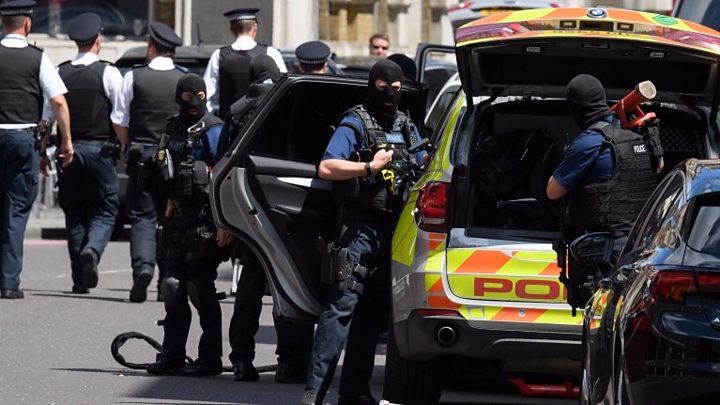
How deep does the ‘known wolf’ rabbit hole go in the case of the London Bridge attacks? In our first report regarding the London Bridge Attacks we discussed the distinct possibility that the those linked to this latest terror event might be well-known to authorities – it turns out, in at least one case, that’s already true.
(Photo Illustration 21WIRE’s Shawn Helton)
NOTE: We’ve already outlined many of the questions surrounding this latest ‘act of terror’ in the West in our first report…
The identity of the attacker has not yet been officially released at the request of Met Police.
Although PM Theresa May refused to say whether London authorities knew any of the attackers during a speech where she effectively declared war on so-called ‘online extremism’ (dovetailing the Bilderberg own planned war on information) it seems that additional information about the London Bridge attacks is slowly being drip fed to the public via the media.
While authorities and officials continue to play coy regarding the release of attacker information, the NY Times reported the following details below:
Ken Chigbo, a resident of the neighborhood on King’s Road in Barking where the apartment was raided, said he knew the man who lived in the apartment. He said the neighbor lived with his wife and two young children, looked to be in his mid-20s and was known in the community by his nickname, “Abs.”
“He would always be in a religious gown to his shins, with tracksuit bottoms and trainers underneath,” Mr. Chigbo, 26, said about his neighbor, with whom he played table tennis.
“I trusted him. We got on.”
Another family relation told the Mail Online that: ‘In 2015, I heard that he tried to go to Syria saying he was going for jihad. But the family rallied around and as his wife was pregnant they managed to stop him.’
Interestingly, one of the alleged London Bridge attackers appears to have also been featured in a Channel 4 documentary released in 2016, entitled, ‘The Jihadist Next Door’:
With the revelation of this unnamed ‘celebrity jihadist’, one could ask who were the Channel 4 producers of this film and how did they go about casting for the subjects used in this film? Did Channel 4 producers work with a ‘fixer’ tied to, or working for the British Intelligence services or counter-terrorism police units? How well known was this actor to intelligence and security agencies?
Watch the Channel 4 documentary here:
Another deeply disturbing development to consider, was the recent “government-sponsored inquiry into the sources of funding for Islamist militant groups operating in the UK.” The true nature of the findings, particularly those involving Saudi Arabia, may be hidden forever according to UK’s Home Office due to the ‘sensitive’ information they contain.
London terrorist had twice been referred to police over his extremist views
Martin Evans, Nicola Harley, Harry Yorke - The Telegrapgh
One of the three jihadists who murdered revellers in central London on Saturday had been reported to the anti-terror police on at least two occasions, it has been claimed.
A former friend of the terrorist, who was shot dead by police along with two accomplices, claimed he had been radicalised while watching YouTube videos and said he contacted the authorities after becoming concerned over his friend’s extremist views. A neighbour also claimed she had contacted police in Barking, east London, after the suspect tried to convert her children to Islam and radicalise them. The man is not being named at the request of the police…
In response to the attack that reportedly killed seven people in the London Bridge area, Prime Minister Theresa May repeated her frequent calls for a crackdown on internet freedom. Blaming the internet for providing a “safe space” for terrorist and extremist ideologies, she called for other countries to come together and produce agreements to regulate the internet and internet content.
Theresa May speaking at the Royal
Institute of International Affairs,
also known as Chatham House
(Photo: Wikicommons)
May said:
“We cannot allow this ideology the safe space it needs to breed. Yet that is precisely what the internet, and the big companies that provide internet-based services provide. We need to work with allied democratic governments to reach international agreements that regulate cyberspace to prevent the spread of extremist and terrorism planning. And we need to do everything we can at home to reduce the risks of extremism online.”
The latest attack came less than two weeks after the Manchester bombing of a sold-out Ariana Grande concert with 20,000 people in attendance that killed 22. After that attack, Prime Minister May said:
“Make no mistake, the fight is moving from the battlefield to the internet. In the UK, we are already working with social media companies to halt the spread of extremist material and hateful propaganda that is warping young minds. I am clear that corporations can do more. Indeed they have a social responsibility to now step up their efforts to remove harmful content from their networks. Today, I called on leaders to do more. We agreed a range of steps the G7 could take to strengthen its work with tech companies on this vital agenda. We want companies to develop tools to identify and remove harmful materials automatically.”
Again, she is not just calling for a crackdown on the internet but also for other countries to join with her to block internet content internationally. One wonders why this should be necessary. Online social networks can already take down content they deem inappropriate, and do so with increasing frequency. There are countless instances of Facebook, YouTube and Twitter removing content; they even have reporting systems built into their platforms expressly for that purpose.
So why is a crackdown necessary?
It is well known that the UK government is fighting a war on encryption, with various figures within the government – especially Theresa May – repeatedly stating that terrorists should have no place to hide and/or communicate out of sight of authorities. But blocking certain technologies, while related, is different to blocking users’ content and censoring their opinions.
And there is another very important nuance in May’s speeches. While she uses both the words ‘terrorism’ and ‘extremism’, these words are far from interchangeable. ‘Terrorism’ is the use of violence or the threat of violence to achieve political ends, and is a very serious crime. ‘Extremism’ on the other hand may be a universal characteristic of terrorists, but may also be applied to any number of other opinions, statements, acts or beliefs, and does not necessarily indicate criminal, unlawful or violent acts.
This is very, very dangerous ground. The words ‘terrorism’ and ‘extremism’ are used in conjunction with each other so often, that many people will believe that they are in fact interchangeable. And after hearing them used together so much, one word does connote the other. But in actuality the police, intelligence services, government departments and politicians could call anything ‘extremism’, even opinions that they simply disagree with, and even when no crime has been committed.
While very few people would defend terrorists using the internet to communicate, what Theresa May is saying about extremism (and calling for international agreement on) could apply not only to terrorists but to anyone with a dissenting opinion. Free speech – including speech that holds governments to account – is under very, very grave threat. In fact, all types of freedom are.
“For too long, we have been a passively tolerant society, saying to our citizens: as long as you obey the law, we will leave you alone. It’s often meant we have stood neutral between different values. And that’s helped foster a narrative of extremism and grievance. This Government will conclusively turn the page on this failed approach.”
In other words, even if you obey the law, we could still consider you a problem and interfere with your life. Ironically, David Cameron and Theresa May both like to talk about the importance of the Rule of Law.
And watch this clip of Cameron addressing the UN General Assembly:
Like Theresa May after him, David Cameron implicitly warned that British authorities would be coming after law-abiding citizens simply because their beliefs could be labelled ‘extremist’. And he explicitly included in that category anyone who questions 9/11 or 7/7, even if they are not violent or have not committed any crime.
New international agreements should be introduced to regulate the internet in the light of the London Bridge terror attack, Theresa May has said.
The Prime Minister said introducing new rules for cyberspace would “deprive the extremists of their safe spaces online” and that technology firms were not currently doing enough.
The Prime Minister made the comments outside Downing Street on Sunday morning in the aftermath of the van and knife attack that saw seven people killed and dozens injured.
“We cannot allow this ideology the safe space it needs to breed – yet that is precisely what the internet, and the big companies that provide internet-based services provide,” Ms May said.
One has to ask why terrorists like those who struck last night in London, and earlier in Manchester, launched their attacks now. It is difficult not to infer that their violence was timed to influence the UK election on Thursday.
Those behind the attack – whether those carrying it out or those dispatching the terrorists – want to have an effect. Terrorism is the use of indiscriminate violence for political ends. It has a logic, even if it is one we mostly do not care to understand.
So what do these terrorists hope to achieve?
Based on prior experience, they will assume that by striking now they can increase fear and anger among the British population – intensifying anti-Muslim rhetoric, justifying harsher “security” responses from the British state and shifting political support towards the right. That is good for their cause because it radicalises other disillusioned Muslim youth. In short, it brings recruits.
Islam is not exceptional in this regard. This is not a problem specifically of religion. As experts have repeatedly pointed out, disillusioned, frustrated, angry (and mainly male) youth adopt existing ideologies relevant to them and then search for the parts that can be twisted to justify their violence. The violent impulse exists and they seek an ideology to rationalise it.
Once Christianity – the religion of turning the other cheek – was used to justify pogroms and inquisitions. In the US, white supremacists – in the Ku Klux Klan, for example – used the Bible to justify spreading terror among the black population of the Deep South. White supremacists continue sporadically to use terror in the US, most notably Timothy McVeigh, who was responsible for the Oklahoma City bombing in 1995.
Terrorists can exploit secular ideologies too, on either the far-right or far-left. Just think of the Baader Meinhof Gang and the Symbionese Liberation Army, back in the 1970s. The latter famously made a convert of Patty Hearst, granddaughter of publishing empire magnate William Randolph Hearst (aka Citizen Kane). After she was taken hostage, she quickly adopted the group’s thinking and its violence as her own.
The Islamic terrorists of our time believe in a violent, zero-sum clash of civilisations. That should not be surprising, as their ideology mirrors the dominant ideology – neo-conservatism – of western foreign policy establishments. Both sides are locked in a terrifying dance of death.
Both believe that two “civilisations” exist and are incompatible, that they are in a fight to the death, and that any measures are justified to achieve victory because the struggle is existential.
We use drones and “humanitarian intervention” to destabilise their societies; they use cars, guns, knives and bombs to destabilise ours.
The dance chiefly takes place because both sides continue it. And it will not be easy to break free of it. Our meddling in the Middle East dates back more than a century – and especially since the region became a giant oil spigot for us. The tentacles of western interference did not emerge in 2003, whatever we may choose to believe.
Conversely, a globalised world inevitably entails one where a century-long colonial battlefield can easily come back to haunt us on our doorsteps.
The solution, complex as it will need to be, certainly cannot include the use by us of similarly indiscriminate violence, more “intervention” in the Middle East, or more scapegoating of Muslims. It will require taking a step back and considering how and why we too are addicted to this dance of death.
Jonathan Cook is an award-winning British journalist based in Nazareth, Israel, since 2001. He is the author of three books on the Israeli-Palestinian conflict. In 2011 Jonathan was awarded the Martha Gellhorn Special Prize for Journalism. His reports and commentaries have appeared in the Guardian, the Observer, the Times and the New Statesman (London); The International Herald Tribune and Le Monde diplomatique (Paris); Al-Ahram Weekly (Cairo); The National (Abu Dhabi); The Daily Star (Beirut); The Middle East Report and Washington Report on Middle East Affairs (Washington); and The Irish Times (Dublin). He has contributed to many online sites, such as CounterPunch, Israeli Occupation Archive, Al-Jazeera.com and Electronic Intifada.

 We also know that this movie constitutes the extent of the punishment that the real Stanley McChrystal will ever receive for his crimes. There will be no trial, no legal judgment.