Tuesday, August 22, 2017

Gorilla Radio with Chris Cook, Heather Lindsay, John LaForge, Christina Nikolic August 23, 2017

This Week on GR

by C. L. Cook - Gorilla-Radio.com


August 23, 2017

If anything can take the sting out of waning Summer's shortening days and cooling nights, it's The Fringe. The last week of August always provides a cornucopia of theatre events, all over Victoria, and this year is no different - or, very different if your idea of theatre is playing in Nora's Doll House, or a late summer's evening with Uncle Vanya.

No ills to Ibsen or Anton Chekov, but if you're gonna Fringe, better get ready to tread wider the boards of the living stage.

Heather Lindsay is Executive Director of Intrepid Theatre, Victoria's own bold theatre company, and primary presenter of the Fringe from day one. She's a multiple Leo Award-winning filmmaker and theatre vet, who joined Intrepid in 2012.

Heather Lindsay in the first half.

Listen. Hear.

And; while promising Americans to make its "allies" spend as much on armies and munitions as they themselves do, in his first televised speech before the nation this year, president Trump also lauded the especially heroic cast of the soldiery gathered in his background, and the U-S-A's "better than anybody's" conventional and nuclear war-making capabilities. Then he confirmed more war for Afghanistan, that benighted graveyard of presidential promises.

Trump campaigned to end that war, nearly as old now as the century itself, knowing the American people had tired of the Long War. And, that weariness is not confined to the Homeland. In Germany, outside just one of the hundreds of US bases of all sorts, all around the World, near the town of Büchel, a peace camp has shared the summers with the jets screaming overhead, making a protest against them, (and the American nuclear bombs beneath the ground, just beyond the base's fence).

John LaForge is a long-time staffer at Nukewatch, the Wisconsin-based nuclear watchdog and environmental justice group, whose countless articles on the topic have appeared in Nukewatch’s quarterly and at online sites like: New Internationalist, Z Magazine, The Progressive, Earth Island Journal and at CounterPunch.org. He’s also co-editor, with Arianne S. Peterson, of the revised edition of the book, ‘Nuclear Heartland: A Guide to the 450 Land-Based Missiles of the the United States.’ His latest article at CounterPunch.org, 'Peace Camp and War Games at Harvest Time' tells the story of Büchel.

John LaForge and “Büchel is Everywhere,” in the second half.

And; Victoria gardening guru and green entrepreneur, Christina Nikolic will join us at the bottom of the hour with Left Coast Events highlights for the coming week. But first, Heather Lindsay and setting the table for a veritable Fringe feast!

Chris Cook hosts Gorilla Radio, airing live every Wednesday, 1-2pm Pacific Time. In Victoria at 101.9FM, and on the internet at: http://cfuv.ca.  He also serves as a contributing editor to the web news site, http://www.pacificfreepress.com. Check out the GR blog at: https://gorillaradioblog.blogspot.ca/

G-Radio is dedicated to social justice, the environment, community, and providing a forum for people and issues not covered in the corporate media.

Afghan Surge 2.0 Has War Profiteers Rubbing Hands

Trump's New Afghanistan Strategy: Windfall for the Military-Industrial Complex​ 

by TRNN


August 22, 2017

After 16 years and over a trillion dollars' worth ​of fighting, the U.S. has accomplished none of its stated goals--except the goal of​ enriching the ​flourishing military-industrial complex.


Matthew Hoh is a senior fellow at the Center for International Policy and is the former Director of the Afghanistan Study Group. Matthew is also a former Marine Corps officer who took part in the Iraq War. In 2009, he resigned his State Department position in Afghanistan in opposition to the escalation of the Afghan War. He is now a member of Veterans For Peace. 

Forest for the Cars

Curbing an Onslaught of 2 Billion Cars

by William Laurance - bioGraphic


June 2016

Nature could soon be imperiled by twice as many vehicles and enough new roads to encircle the planet more than 600 times.


By 2010, our planet had reached a remarkable milestone: one billion cars—or, to be precise, one billion motorized vehicles, including cars, trucks, buses, and motorcycles but excluding off-road vehicles such as tractors and bulldozers. Of course, the overwhelming majority of these vehicles are powered by fossil fuels. And if that figure isn’t troubling enough, by 2030, it’s projected that we will have double that number: 2 billion cars. Should we reach this ominous milestone, what will it mean for our planet, our environment, and our biodiversity?

Greenhouse Gases 


At the Paris climate conference this past winter, global leaders committed to measures that would limit global warming to 2 degrees C, with a stated aspiration to limit the increase to 1.5 degrees C. As optimistic as I’d like to be about this historic agreement, it’s a bit difficult to see how we’re going to get there in a world with 2 billion smoke-belching vehicles.

In the car-mad U.S., the transportation sector (which is dominated by motorized vehicles but also includes planes, trains, and ships) accounts for 28% of all greenhouse gas emissions, second in significance only to energy generation (34%). As developing nations rapidly expand their use of motorized vehicles, their greenhouse gas profiles will increasingly resemble that of the U.S.

Until recently, diesel engines, which generally burn fuel more efficiently than gasoline engines, have been pushed hard in many nations. However, it’s now understood that, unless operating under optimal conditions, diesels produce large amounts of heat-absorbing soot and toxic nitrogen oxides.

In what has evolved into a spectacular global scandal, German manufacturer Volkswagen even tweaked its software to falsely produce low emissions readings for its diesel cars under test conditions, while belching away on the road.

Highway Holocaust 


There will also be a lot more road-kill on a planet with 2 billion cars. Even now, the numbers are staggering. It has been estimated that roughly 1 million vertebrates (birds, mammals, reptiles, and amphibians) are killed by vehicles in the U.S. each day. In Brazil, the estimate is 1.3 million vertebrates per day. In Europe, as many as 27 million birds are killed along roadways annually. Vehicles also take a massive toll on insects. A study in the Netherlands estimated that 1.6 trillion insects are killed there each year. The total would approach 33 trillion insects, if that same figure were extrapolated to the U.S.

Vehicles can be particularly threatening to species with small populations. According to the Federal Highway Administration, road-kill is a serious threat to 21 endangered or threatened species in the U.S., including Key deer, bighorn sheep, ocelots, red wolves, desert tortoises, American crocodiles, and Florida panthers. Only 100 to 160 Florida panthers survive today, and fully half of all panther deaths are caused by collisions with vehicles. In Australia, vehicles take a heavy toll on echidnas, quolls, wallabies, kangaroos, and the endangered cassowary, among other species. One study estimated that a turtle would have only a 2% chance of surviving a traverse across a busy, multi-lane highway.

Road Pollution 


Vehicles can also be a serious source of chemical and noise pollution. High levels of dust, heavy metals, nutrients, ozone, and organic molecules can extend up to 200 meters from road surfaces. De-icing salts can alter soil and aquatic chemistry and harm roadside vegetation. Effects of chemical pollutants are particularly serious for streams and wetlands near roads, which see major influxes of waterborne pollutants and nutrients entering aquatic ecosystems whenever heavy rains fall. Such contaminants can have wide-ranging impacts, from algae blooms to adverse health effects for aquatic organisms that live in these waterways.

Vehicle noise can also negatively impact wildlife. Many studies have shown that a variety of wildlife species—ranging from grouse to wolves to elk—tend to avoid roads, most likely because of road noise. One study found that migrating birds, which need quality habitats to rest, forage, and rebuild their energy supplies, were disrupted by vehicle noise. Birds near roads spent less time foraging, more time being vigilant, and were in poorer body condition than were individuals that foraged farther away from roads. Low-frequency noises travel much farther away from roads than do higher-pitched sounds and might be particularly disruptive for species that communicate via infrasound, such as elephants and cassowaries. Hence, noisy roads could be invisibly degrading habitats for noise-sensitive wildlife.

Roads as Barriers 


For some species, roads can act as impermeable barriers, effectively fragmenting and reducing their populations. Strictly arboreal species are one obvious example. For instance, my doctoral research showed that movements of lemuroid ringtail possums, which are endemic to the rainforests of northeastern Australia, are completely restricted by roads unless the road clearing is so narrow that branches or vines provide arboreal walkways overhead. Rainforests are rife with such strictly arboreal species.

Even birds can be affected. My wife, Susan Laurance, studied the impacts of roads on specialized rainforest birds in the Amazon. In one insightful experiment, she captured individuals of bird species that are both highly faithful to their territory and to their mate, with whom they pair for life. She could move a bird up to 2 kilometers away in the rainforest and it rapidly returned to its territory and mate, often within the same day. But if she moved the bird across a 250 meter-wide highway clearing, it wouldn’t go home. It moved up and down the forest edge, trying to find a route back, but it never returned.

Roads Everywhere? 


Possibly the worst impact of all those additional vehicles will be the new roads they spawn. It’s currently projected that, by 2050, the world will have another 25 million kilometers of paved roads—enough to encircle the planet more than 600 times.

Today, new roads are being constructed virtually everywhere, including many of the world’s last surviving wild places. We build roads to log forests, to extract fossil fuels and minerals, to increase economic growth and trade, to defend our borders, and to integrate our economies. Around 90% of new roads will be constructed in developing nations, home to the majority of the world’s tropical and subtropical forests—the most biologically rich real estate on the planet.

It would be one thing if we’d just build the roads, but they also open up wild areas to a Pandora’s box of environmental ills—ranging from increased wildlife poaching and forest destruction to wildfires, illegal mining, and land speculation. For example, my research team showed that in the Brazilian Amazon, there are nearly three kilometers of illegal roads for every one kilometer of legal road. Once you map all those roads, you find that 95% of all deforestation in the Brazilian Amazon occurs within 5.5 kilometers of a legal or illegal road.

In many parts of the world, roads are opening up the last surviving stretches of wilderness like a flayed fish. In the Congo Basin, the construction of more than 50,000 kilometers of logging roads has allowed poachers, armed with rifles and cable snares, to conduct a systematic slaughter of wildlife. In the last decade, two-thirds of all forest elephants have been killed. In sub-Saharan Africa, our analyses suggest that a scheme to construct 33 major "development corridors"—spanning some 53,000 kilometers in total—could imperil more than 2,000 parks and protected areas, either by bisecting them or by promoting increased development and poaching around the park.

Globally, the frenetic expansion of roads is probably the single greatest threat to nature. Climate change is eroding ecosystems like an acid, but the proliferation of roads, and the massive environmental perils they bring, are battering away at them like a sledgehammer.

What Are We to Do? 


How can we add another billion cars and not cost the Earth? There are few easy answers, but here are three suggestions.

First, we need to drive smaller, more fuel-efficient vehicles. In Europe, for instance, small and even tiny cars are increasingly becoming the norm. There’s enormous scope for the U.S. and many other industrial and developing nations to move in this direction.

Second, we need to become a lot smarter about where we put roads. Roads should be avoided whenever possible in remaining wilderness areas, sites with high biodiversity and endangered species, and protected ecosystems. In 2014, I led an effort to devise a global roadmap that indicates where roads should and should not go, to maximize their social benefits while limiting their environmental costs.

Finally, we need to raise taxes on petroleum and add surcharges for gas-guzzling vehicles, and use those proceeds to improve public transportation and amenities such as bicycle lanes. There’s simply no sound reason that a single human requires a heavy-duty pickup truck simply to drive around town.

The bottom line is, unless we start thinking hard, and quickly, about ways to curb this vehicular onslaught, we’ll soon be living in an increasingly noisy, polluted, and nature-deprived world where the din of 2 billion cars seems far more like a curse than a blessing.

William Laurance is a distinguished research professor and Australian Laureate at James Cook University in Cairns, Australia. He is the director of the Centre for Tropical Environmental and Sustainability Science, and founder and director of ALERT—the Alliance of Leading Environmental Researchers & Thinkers.

Monday, August 21, 2017

Keeping Yemen Vigil in New York

Weekly Vigil for Yemen in New York’s Union Square 

by Carmen Trotta - NY Catholic Worker


August 18, 2017

Dear Friends, You may have noticed that the conflict and catastrophe in Yemen has received a significant up-tick in attention recently, and this is not simply because of the growing cholera epidemic. There is now a hopeful cause to be engaged.

Members of the NY Catholic Worker will be out protesting the ongoing US/Saudi bombing of Yemen in Union Sq. Pk. each Saturday, from 11AM until 1PM.

We meet at the top of the steps at the south-end of the park, near the statue of George Washington on horseback. In the past few weeks we have been joined by several other groups, including Veterans for Peace, the 15th St. Quakers, the Campaign for Freedom and Democracy, the War Resisters League, the Benincasa Community, the Kairos Community, Grannies Peace Brigade and the Democratic Socialists of America. Please come out and join us as the humanitarian crisis worsens and voices of hope are being raised.

In March of this year, Human Rights Watch issued a report detailing 81 documented cases of unlawful attacks on the part of the US/Saudi/UAE bombing campaign in Yemen. In 24 of these attacks US supplied weapons were used. HRW has warned repeatedly that the duration and persistence of attacks on civilians and civilian infrastructure would entail that weapon suppliers have knowledge of, and are thus complicit in, war crimes.

On the basis of these and other reports, in June, a bi-partisan group of US Senators, among them Rand Paul (Rep. KY) and Chris Murphy (Dem. Conn.) – put forward a resolution in the Senate to curtail arms shipments to Saudi Arabia. In response Senate Majority leader Mitch McConnell organized a top secret briefing urging the Senate to OK the $500 million arms sale.

The resolution was very narrowly defeated, 53 to 47, and was thus a sort of victory, suggesting that concern for human rights and the rule of law were not yet dead.

Shortly thereafter we were told that the Saudi’s have agreed to purchase a $750 million, multi-year, training program to help prevent unlawful attacks – a sardonically cynical response – followed shortly thereafter by the bombing of another market in Saada, killing 25 civilians. So, we have perhaps been slapped awake, but we are still being slapped around. Notably, mid-air refueling of the Saudi coalition’s bombers has increased by a third under President Trump.

Currently, some 17 million – of Yemen’s 28 million – people are food insecure. Half a million children below the age of 5 already suffer severe acute malnutrition, which means that, if they survive they are still likely to suffer life long developmental difficulties. Meantime, 7 million Yemenis are on the brink of starvation and more than 3 million are internally displaced. All of this is very much a consequence of the Saudi/US bombing, which for more than two years now has targeted civilian infrastructure: Hospitals, schools, factories, markets, funerals, sea ports, electrical power stations and water treatment facilities. More than half of the hospitals in the country on not functioning. Thus, while the armed conflict has directly taken the lives of some 12,000 people, last year alone more than 60.000 children died from a combination of malnutrition and otherwise easily preventable ailments and diseases like respiratory infections, measles, and cholera.

Over the past five months, malnutrition and compromised immune systems have been joined by their deadly counterpart, plague. A vast cholera epidemic has engulfed Yemen. Indeed, Yemen now has the distinction of hosting the largest cholera epidemic to occur in one year in recorded history. Currently, over 500,000 Yemeni people have been stricken. More than 2000 have died as a result.

Notably, 99% of those who receive medical attention survive. But as half of the hospitals in the country have been bombed and ports blockaded – severely restricting the supply of food, fuel and medicines – less than half of the country’s people have any access to medical care. Yemen is being strangled!

As you may know, cholera is a water borne disease and the rainy season is just beginning.

I hesitate to mention that several news reports have sited a sudden uptick in meningitis cases.

Yes, voices are being raised, but the great powers are staying the course: Yemen suffered more air strikes in the first half of 2017 than in all of 2016. Recently the US/Saudi coalition bombed a small caravan of fleeing civilians in the Taiz province. 20 were killed. Ten children. Just two weeks ago another dozen were killed when a house in Saada province was entirely obliterated. Half of the fatalities were children. At the end of last month the Saudi’s refused to allow 4 oil tankers, carrying the equivalent of 10% of Yemen’s monthly fuel needs, to off load at the port of Hodeidah. That fuel is necessary to run hospitals, refrigeration units, water treatment facilities, etc. Then last week, in what appears to be a related development, the Saudi’s have begun blocking jet fuel deliveries to the airport in the Nation’s capitol, Sana’a, effectively reneging on an agreement to allow two humanitarian aid flights in each day.

Yes, Yemen is being strangled. But voices are being raised! The humanitarian organizations Save the Children and Watchlist have begun campaigning to have Saudi Arabia be put on a United Nations blacklist of nations that are committing grave offenses against children. This was attempted once before. Last year in fact. But Ban Ki Moon, then UN Sec. Gen., backed down in the face of Saudi threats to pull out all of its financial assistance to the UN. Now the current head of the UN, Antonio Guterres will face the same dilemma. Pray that he hear the cry of the poor, the cry of justice – and not back down!

And come join us and raise a public outcry.

Hope to see you all!

Carmen

Carmen Trotta

Official Neglect and Assessing the National Climate

The National Climate Assessment and National Park Neglect

by Robert Hunziker  - CounterPunch


August 21, 2017

Every four years the federal government issues its National Climate Assessment, a comprehensive study compiled by 13 federal agencies. This year’s report is the most eventful of all time for two primary reasons:

(1) the congressionally mandated report is filled with powerful evidence that climate change is already significantly impacting lives. In short, anthropogenic (human-caused) climate change is really for real;

(2) the report requires approval by the office of the president of the United States, which is kinda like asking OJ if he did it.


Photo by Esther Lee | CC BY 2.0 

When Forbes magazine, the bastion of capitalism, runs this headline: “Leaked Government Report Points To Dire Impact Of Climate Change On US,” even conservatives take notice that climate change is real. After all, Forbes magazine is an elementary feature on tabletops in every U.S. corporate foyer. If it is missing from a tabletop, it’s only because somebody lifted it.

The referenced Forbes’ article d/d August 8th includes a photo caption of Trump wearing a very long red tie and standing next to Scott Pruitt of EPA fame, speaking at the presidential podium. Trump looks grouchy, mean-spirited, and acerbic. Pruitt appears elfin and about to whimper under the piercing gaze of his big orange overseer. It’s not presidential in the slightest. Which is probably good because it’s the moment when EPA’er Scott Pruitt announces US withdrawal from the Paris accord of 2015.

From that point forward, the United States of America loses its worldwide leadership role. China has already filled the climate change void. Ersatz Communists, assuming a few thousand multi-millionaires are really/truly Communists leaders, now lead the charge against the destructive forces of global warming.

Meanwhile, America must grapple with a National Climate Assessment Report that is law by Congress pending approvement by the president, leading to an astute hedging of one’s bets by an unknown source that leaked the government report to The New York Times, upstaging backstairs cut and paste parties at the West Wing.

Ultimately, as well as truly unfortunately, the climate assessment report usage turns political. After all, politics, not science, rules America’s posture on climate change/global warming. In that regard, and the reason for concern and the subsequent covert release to the NYT, the current National Climate Assessment Report is a political diatribe of horrible judgment (to put it kindly) by climate deniers aka: Congress. Well, in point of fact, it scathingly hits hard at America’s political posturing of climate change/global warming, right between the eyes, POW!

The upshot of the 600-page report is that only a shortsighted dimwit can ignore powerful conclusive evidence of the harmful effects of anthropogenic or human-caused global warming. Here’s part of the Executive Summary, crystal clear:

Thousands of studies conducted by tens of thousands of scientists around the world have documented changes in surface, atmospheric and oceanic temperatures; melting glaciers; disappearing snow cover; shrinking sea ice; rising sea level; and an increase in atmospheric water vapor. … The last few years have also seen record-breaking, climate-related weather extremes, as well as the warmest years on record for the globe.

The key to that bold assessment is natural variability missing from the calculations of current climate change. If natural variability was the cause, nothing could be done. However, it is clear that anthropogenic or human-caused CO2 from cars, planes, factories, livestock farming, cement production, and deforestation is the deadly force. The proof is found in paleoclimatology, or the history of climate change, which shows climate change/global warming happening at lightning speed compared to any time in the past. That’s not natural variability.

Repercussions are far and wide. For the first time ever, climate refugees from rising water limits or drought-stricken land populates the world in large numbers, e.g., refugees overwhelm Europe from the southern coast of the Mediterranean and the Middle East, both areas drying out as fast as or faster than anywhere else on the planet. American taxpayers have already paid, via federal grants, to move climate refugees to higher grounds along the Gulf Coast and some urban areas along Florida’s east coast are raising streets by 2-to-3 feet. Climate change is palpable.

Human-caused climate change today is more pronounced than ever before, yet ignored by America’s Congress. That is strike one against America’s shortsighted politicians. Strike two is in the works as National Parks are soon to be added to that same mix of mean-spirited politics. Along the way, hopefully, the American public gets off its fat lazy butt and strikes back with ferocity, hitting the streets. Thankfully, this has already started in America, people striking back at senseless mean-spirited politics.

America’s National Parks Under Attack


The same political nitwit mentality that denies climate change/global warming is preparing to wreck America’s precious national parks, Yellowstone, Yosemite, and the Grand Canyon. The National Parks are under fire with drastic cutbacks whilst opening land up to speculators, similar to the Wild West days of the 19th century. Say goodbye to America’s national parks because you may not recognize them in a few years.

The Ralph Nader Radio Hour, August 19th, guest Terry Tempest Williams, naturalist author (The Hour of Land, Sarah Crichton Books/Farrar, Straus & Giroux, 2017) explained how over 300 million citizens and foreign tourists visited 417 national park units, including monuments, trails, historical monuments, and points of interest in 2016. But, according to Ms. Williams, paradoxically the Trump administration has a very rudimentary understanding of hospitality.

According to Ms. Williams, the budget for national parks, which is already underfunded, will be slashed by another 17% by Trump. “What that means is it is underemployed; it’s understaffed; to use the word undernourished is an understatement.” There are 22,000 employees in the national park service and 200,000 volunteers. According to Ms. Williams, the Trump budget plan will let our national parks and park service “bleed to death.”

The National Parks’ budget is about $3B per year, but “that is a pittance compared to what we spend on our military, and yet Trump is cutting it… Not only that they are slashing and burning regulations in order to drill baby drill. We now have 40 of our national parks that are poised for oil and gas development; thirty of those national parks are already pending for oil and gas development; 15 of our national park units already have oil and gas development inside them.”

The National Park Service, in an article by Center for Western Priorities entitled “In Their Own Words,” explains the impact of the proposed crippling cuts of President Trump’s budget. According to the article written by Jesse Prentice-Dunn, Advocacy Director/Center for Western Priorities, Denver: “The proposed budget would increase funding for energy development on public lands while cutting virtually everything else, including the National Park Service.”

“This budget makes clear that the Trump administration’s priority is driving the crown jewel of our public lands, the National Park Service, into the ground while freeing up funds for oil, gas and coal development,” Ibid.

It is well beyond upper levels of insanity and mean-spiritedness when, on the one hand, funding is cut for national parks as public lands open up to oil and gas drilling whilst, on the other hand, preaching “Make America Great Again”… again and again and again and again and again, loud, yelling, screaming, yelping, and screeching like a foaming-at-the-mouth maddened dog, Make America Great Again!

Does somebody with authority have a readily available straitjacket?

 
Robert Hunziker lives in Los Angeles and can be reached at roberthunziker@icloud.com
More articles by:Robert Hunziker

Sunday, August 20, 2017

Will Chemtrails Eclipse Victoria's Solar Phenomenon?

Will Chemtrails Eclipse Victoria's Solar Phenomenon?

by C. L. Cook - GorillaRadioBlog.Blogspot.ca


August 20, 2019

Heavy chemtrail action over Victoria this weekend has me wondering...


Nuclear Harvest: Autumn at the Büchel Peace Camp

Peace Camp and War Games at Harvest Time

by John LaForge - CounterPunch


August 18, 2017 
 
BÜCHEL AIR BASE, Germany - The juxtaposition of nuclear weapons and ordinary farms is the same here as at home in the United States. Just outside this jet fighter base — where a peace camp focused on ridding the site of its 20 US nuclear bombs has been set since March 26 — farmers plant oats, corn and wheat right up to the fences.

Likewise in “the states,” nuclear submarine bases, bomber bases, and land-based missiles are placed in farmland too, where the hard-scrabble struggle to produce food is mirrored against the gargantuan waste of limitless military spending — in this case maintaining an arsenal that can never be legally put to use.

Photo by Public.Resource.Org | CC BY 2.0 

This week, local farmers are harvesting oats, cutting swaths 4 to 6 meters wide with their groaning, screeching combines that look something like giant hammerhead sharks, or long-extinct dinosaurs.

Just like at home, the combines are followed, if the weather holds, by heavy balers that bind up the straw; just like in the Midwest, jet fighters overhead practice war fighting in the same sky that warms and waters the crops. On the edge of camp, Guernsey cows meander near the paved bike path, ignoring the spray-painted warning:

“Attention! Here Begins the Atomic War Zone.”

The noise of heavy farm machinery is a relief from the howling roar of the German Tornado jet fighter-bombers that scream off the runway most weekdays. The jets shriek like rockets all day long and well past dusk. They reportedly burn through €50,000 ($59,000) every hour they’re airborne. Farmers can rightfully cringe. How many of them can expect to make that much in a year — even though they work harder, longer hours and actually produce something?

The peace camp, with its theme “Büchel is Everywhere,” reflects and teaches these stark contrasts and lost chances every moment of every day. The modest camp has a large cook tent, a kitchen run on bottle gas, tables, chairs and cookware for 40, a makeshift shower, chemical toilets, and a wood fire for evening gatherings. This summer’s climate is just like Wisconsin’s or Minnesota’s — although the local weather includes the “heat” of 20 US Air Force B61 hydrogen bombs deployed in bunkers across right down road. The Bombs make for a sort of raised temperature that permeates the consciousness — unless you’re in denial. Farm machines chug across the fields at a mile-an-hour; the jets howl across the sky at 921 mph — 1,490 mph when up high.

Political, ethical, and practical opposition to US nuclear weapons in Germany goes back decades. In 1997, peace researchers discovered the deployment of 20 Cold War era B61s here and began raising hell. Legally, the bombs are a clear violation of the 1968 Nuclear Non-proliferation Treaty (NPT) — which is binds both Germany and the United States. Article I prohibits nuclear weapons from being transferred to or the accepted by any other state. The NPT, and Germany’s post-war constitution, have been the legal foundation of anti-nuclear civil resistance actions at Büchel because German law is especially keen about the horrifying results of obeying unlawful orders.

Condemnation of the US H-bombs and Germany’s part in the Tornado’s “nuclear mission” — German pilots train to “deliver” the US Bombs — is nearly universal, crossing party lines and cultural divides. Even skin-head neo-Nazis offered (unsuccessfully) to be part of the “US Nukes Out!” campaign. So hot a potato is the status of illegal US nukes here that the base commander himself, “Oberstleutnant” Gregor Schlemmer, chose to leave his office and come out to an active blockade of his base’s main entrance July 18 to greet members of our US delegation. NATO ministers, former heads of state, and dozens of retired military officials have all called the US B61s “Cold War relics” that no longer serve any purpose. Almost 90 percent of German adults want them gone. Perhaps commander Schlemmer feels the weight too, and looks forward to retiring and maybe doing some farming.

Peace camp participants watch the grain being brought in under the harvest moon and recall the hundreds of activists, dozens of nonviolent actions, and scores of news reports that were brought together by the 20 weeks from March to August. Blockades, vigils, concerts, “go-in” actions, and marches have forced the reluctant media to take note of US nukes in Germany.

Of course nuclear weapons are the last thing people want to contemplate, especially in summer, so it takes some focused inventiveness to get the media to face the Bomb. A final blockade is planned for August 9, the anniversary of the US atomic attack on Nagasaki, Japan. Beyond that dreadful consideration, and the close of camp, German abolitionists plan to focus on pushing the ouster of US nukes as an issue in September’s national elections.

And from both sides of the Atlantic, organizers are working to cancel US plans to deploy a new B61 in Europe, and to spend $1 trillion over 30 years making new Bombs, rather than retiring them all permanently and getting on with joining the new international treaty ban.

From inside and outside the air base gates, farmers and nuclear war gamers alike, oberstleutnants and agronomists, may agree that ploughshares are needed more today than illegal bombs.

John LaForge is a Co-director of Nukewatch, a peace and environmental justice group in Wisconsin, and edits its newsletter.
More articles by:John Laforge

Hell and Our Better Angels

Dark Matter: Surrendering Our Secrets to Malevolent Forces

by Chris Floyd  - Empire Burlesque


12 August 2017

“And if my thought-dreams could be seen
They’d probably stick my head in a guillotine.”

(This is my latest column for the print version of CounterPunch, edited slightly.) 


Thus quoth the Bard, more than half a century ago. At the time, these lines were an electrifying insight into human nature, lighting up dark corners of the psyche not usually explored in popular music. They were also a jolting reversal of the usual protest song dynamic: a righteous hero denouncing evil from a position of moral purity. Here, at the end of a long, incandescent jeremiad against a sick society, we see the “prophet” suddenly subjecting himself to the harsh judgment he had just rendered. “Yeah, this place is Hieronymus Bosch on stilts — but you should see what’s howling in my head!’

We all have a night mind, we all have thought-dreams which, if exposed, perhaps might not get us guillotined but could well kill the image we present to others — and to ourselves. And this is true even for the most liberated, hip or “woke” among us. (Like Dylan’s own sheepish confession in his memoir, Chronicles, that back in the day he’d harbored a secret liking for Barry Goldwater because the politician reminded him of Tom Mix, the movie cowboy. Now that’s perverse!)

So imagine if there were a magic machine that let us explore our own guillotinable notions — or indeed, to range through the night-mind of the whole human race, encountering lurid thought-dreams beyond our previous imagining. A magic machine where every forbidden thought or fear or desire, even things abhorrent to our own daylight mind, could be approached, encountered, explored — and this in deepest privacy, in the safe confines of our homes, our normal daily reality. Who could resist dipping — or plunging — into such a dream-world? Yes, of course, we speak of the internet.

And these explorations need not be anything aberrant, illegal or immoral in themselves, but simply retrograde to what we think of as our truest, essential self. A gentle kindergarten teacher who finds herself looking with lurid fascination at beheadings on YouTube. A kind and loving social activist who is inexplicably drawn to the revolting racist bile she sees on Reddit. A married, smalltown bank manager who peruses gay porn or transgender websites, idly dreaming of alternative lives that in reality he would never pursue. An obsessive haunted by irrational, humiliating fears who seeks comfort – or exacerbation – down the digital alleyways of half-baked data and feverish need. The permutations are endless. Every dark impulse, every passing fantasy, every perverse or unsettling notion thrown up by the imp of the mind: all of this available, in endless profusion, 24/7, all over the world.

Now imagine if all of these self-exposing thought-dreams were being recorded by the magic machine. Imagine if this compromising material could be made instantly available to the security organs of an overweening nation-state or the overlords of a rapacious corporate power. What you would have then is an apparatus of repression, blackmail and control beyond the wildest dreams of the most tyrannical regimes, religions and ideologies in all of human history. Any dissident, any heretic speaking out against the power structure could be undermined politically, if not destroyed psychologically, by the exposure of their night-mind, their guillotine-worthy thought-dreams, by those who hold the keys to the magic machine.

And this need not apply only to those who had roused themselves to denounce publicly the crimes and rapine of the powers that be. No, even that quiet bank manager, that suffering obsessive, might draw back from making waves – or supporting any wave-makers – in the knowledge that their personal strangeness could potentially be exposed. This fearful but not unreasonable assumption is, in part, the fruit of the many whistleblowing revelations about the surveillance state and the incredibly pervasive reach of our hi-tech behemoths (Google, Facebook, Amazon, etc.) in recent years.

We have all been taught to assume that everything we do and say and show on-line is being watched, stored and laid open to state and corporate scrutiny. And we are right to do so.

Yet because this magic machine has tapped into our of most primal impulses, because it offers the ever-alluring but ever-elusive promise of filling the holes torn in our psyches by our individual upbringings and by the cruelties, chaos and contradictions in any and every social, political and cultural milieu we find ourselves caught up in, we keep exploring – and recording – our thought-dreams with it. We can't stop feeding it with kompromat against ourselves, can't stop giving malevolent forces – who care nothing for us beyond what they can wring from us for their own power and profit – the key to the inner sanctum of our souls.

There is also the fact these malevolent forces have made it virtually impossible to carry out your daily life without giving them access to your lives and thoughts. Increasingly, in order simply to function in the modern world, you must tell them who you are, where you are, what you are buying, reading, watching, listening to.

So the Laureate's lyrics are no longer metaphorical lights cast into our secret darkness. They are now the literal truth: our thought-dreams can be seen. And they can be used, should the powerful wish it, to put our heads in a guillotine.

Saturday, August 19, 2017

Canadian Slave: "Foreign Workers" Charge Abuse and Systemic Injustice

Temporary Foreign Workers are Victims of Systemic Racism and Government Politics 

by Fil de Presse MNW


August 19, 2017

Amid the escalating anti-immigrant racism and fascism occurring in Quebec, Canada and other parts of the world, we denounce all the injustices and abuses committed through the temporary foreign worker program.

We are workers of the earth and the earth has no borders!

10 years of the hypocritical Festival of Cultures organized by the Municipality of Saint-Remi and the Guatemalan, Honduran and Mexican consulates.

A recent article that appeared in the New York Times on August 14th, 2017 entitled Foreign Farmworkers in Canada Fear Deportation if They Complain highlights systemic issues faced by temporary foreign workers, such as the dangerous conditions under which they live and work, as well as the lack of an adequately government response to complaints of fraud or abuse by employers.

According to Noe Arteaga, former temporary foreign worker at the company Savoura, this is nothing new for workers who have been coming to work in Canada for decades.

Arteaga considers the temporary foreign worker program as modern slavery. At the Immigrant Workers Centre (IWC) where Arteaga volunteers, they receive calls from workers reporting different forms of abuse on a daily basis.

One recent example is the case of 18 Guatemalan workers who were victims of fraud by the employment agency Les Progrès Inc.

They have made a complaint with Revenu Canada, Revenu Quebec, Labour Standards, *Equity*, Health and Safety *Commission (CNESST in french)*, *Human Rights* and Youth Rights *Commission (*CDPDJ in french) and Immigration Canada.

The temporary foreign worker program and its labour conditions are not on government's agendas as they renegotiate the North American Free Trade Agreement (NAFTA), according to Vivian Media, an organizer at the IWC. For that matter, temporary foreign workers are not even consulted in the renegotiation of NAFTA.

With regards to the 18 Guatemalan temporary foreign workers, we continue to demand justice. We demand that the deportation order for the 18 Guatemalan workers be revoked. In order for the workers to see the complaints that they have made with various government institutions through, it's important for them to remain on Canadian soil.


-30-

PRESS RELEASE
Journalists are invited to a press point at:
*Where: *25 Rue St-Sauveur, St-Rémi,
QC J0L 2L0, Canada
*When: **August 19, *2017 at 1pm
Contact:
phone: (438) 404-4458


https://www.nytimes.com/2017/08/13/world/canada/canada-migrants-temporary-farmworkers-program.html
https://photo.humanrights.ca/photocontest/detail/inclusion-and-diversity/agriculture-for-all/

This is the English-language newswire for social justice groups in Montreal. newswiremtl.info

Follow us https://twitter.com/FildepresseMNW

Friday, August 18, 2017

Norway Seizes Arctic Sunset, Greenpeace Arctic Drilling Campaign Undeterred

The Arctic Sunrise has been seized

by Greenpeace US


18 August, 2017

The message is clear:  

"Norway, it’s time to choose people over oil."

35 activists from 25 countries are in the Barents Sea demanding an end to Arctic drilling.

Today, activists from the Arctic Sunrise in inflatable boats and kayaks entered the exclusion zone of Statoil’s Korpfjell well, Norway’s northernmost oil-drilling site, and attached a giant globe to the rig Songa Enabler.

The globe carried written statements from people from all over the world, with a message to the Norwegian government to stop the oil drilling.


The activists halted the operation of the rig, and after several hours of demanding an end to the drilling in the Arctic, the Norwegian Coast Guard interfered with the peaceful protest, arresting the Arctic Sunrise ship, the activists and crew members.


Just 10 days before ratifying the Paris Agreement, in June 2016, the “environmentally friendly” Norwegian government granted new oil licenses. Now, a year later, Statoil has just started to drill for oil in the northernmost area ever licensed by Norway.


But this won’t stop us. It’s time to get ready for our new battleground: the courtroom—where Greenpeace Nordic, together with Nature and Youth, will face Arctic Oil this November.

With your witness statements we will achieve it. Add your name to the more than 350.000 others and become part of the evidence that the people know a better world is possible.

Diego Gonzaga is a content editor for Greenpeace US.

Thursday, August 17, 2017

NDP Hopefuls on the Israel-Palestine Highwire

NDP Leadership Candidate Jagmeet Singh’s Trip to Israel

by Yves Engler - Dissident Voice


August 17th, 2017

Like bears attracted to spawning salmon, politicians seek out power. The former needs to build stores of fat to survive the winter, while the latter must attract the resources and support necessary for successful electoral campaigns. Given the survival imperative, neither bear nor politician should be criticized too harshly for what comes naturally.

But, the two best ways to judge politicians are by taking a look at whom they choose to gather resources from and what they are prepared to do to get them.

At worst politicians pander to society’s wealthiest and reactionary social forces, further solidifying their grip on the economic and political system. At best they seek out progressive grassroots and labour organizations, collecting the necessary resources from ordinary people while amplifying their influence.

It’s within this context that one should understand Ontario MPP Jagmeet Singh’s trip to Israel with the Centre for Israel and Jewish Affairs. At the start of the year the current NDP leadership candidate took an organized trip there and met to discuss it with Galit Baram, Israel’s consul general in Toronto.

The trip and meeting were most likely aimed at allaying particular concerns since in early December Singh was the only member of the Ontario legislature to speak out against a provincial vote to condemn the Boycott, Divestment and Sanctions movement. He criticized a CIJA-backed motion supporting the spurious “Ottawa Protocol on Combating Anti-Semitism” and rejecting “the differential treatment of Israel, including the boycott, divestment and sanctions movement.”

When speaking to NDP members recently Singh has repeatedly highlighted that move rather than the CIJA trip or consular visit. Similarly, Singh published eleven tweets about Palestine on July 16. In the best of the lot he stated:

“3 yrs ago today the 2014 Gaza War made headlines when 4 Palestinian boys were killed by an Israeli military strike while playing on a beach” and
“I stand for Palestinians’ right to freely determine their political status & pursue their economic, social & cultural development.” 

In response to two questions Independent Jewish Voices and Canadians for Justice and Peace in the Middle East submitted to NDP leadership candidates Singh said,

I would consider supporting the use of targeted sanctions against Israel” and
“I would support mandatory labeling of products originating from Israel’s colonies, and excluding these products from the benefits of CIFTA [Canada Israel Free Trade Agreement]. I am also open to considering a ban.”

(In assessing Singh’s responses to their Middle East policy questionnaire IJV gave him a B for third place while CJPME ranked him second with an –A. Niki Ashton received an A+ from both IJV and CJPME.)

Singh clearly wants average NDP members to think he’s opposed to Israeli violence and supportive of Palestinian solidarity activism. Simultaneously, however, he wants to signal to CIJA and Israeli officials that he’ll play ball.

The Palestinian question is particularly tricky for the Brampton-based politician. With some claiming that his open (Sikh) religiosity is a liability in Québec, Singh’s path to becoming leader is largely contingent on convincing members he’s best positioned to expand NDP support among the young and communities of colour. But, younger and darker NDP members/sympathizers largely oppose the current NDP leadership’s de facto support for Israeli expansionism/belligerence.

A February poll found that only 17 per cent of Canadian millennials had a positive opinion of the Israeli government versus 37 per cent of those 65 plus. I’m not aware of any Canadian polling by ethnicity on the subject, but US polling provides a window into attitudes there. According to a July Newsweek headline: “Young, Black and Latino Americans Don’t Like Israel” (after the invariable push back the headline was changed to “Why More Young, Black and Latino Americans Than Ever Before Don’t Like Israel”).

To the extent that Singh can rally younger and ethnically diverse folks to the party it would tend to push the NDP towards Palestinian solidarity. On the other hand, Singh is the preferred candidate of much of the party establishment and his candidacy is heavily media-driven. The dominant media and NDP hierarchy are generally hostile to discussing Canada’s complicity in Palestinian dispossession.

At the first six leadership debates there wasn’t a single question related to the NDP’s position on Palestine. While the party hierarchy refuses to debate it, the NDP actually devotes significant energy to the subject. During the 2015 federal election the NDP ousted as many as eight individuals from running or contesting nominations because they defended Palestinian rights on social media.

Last year NDP foreign critic Hélène Laverdière (right) spoke at the American Israel Public Affairs Committee’s (AIPAC) annual conference in Washington and traveled to Israel with Canada’s Governor General where she attended a ceremony put on by the explicitly racist Jewish National Fund (Laverdière is backing Singh for NDP leader).

Many party officials – 20 federal NDP MPs, according to a 2014 iPolitics calculation – have gone on all-expense paid trips to that country with an Israeli nationalist organization.

So, party representatives can travel halfway across the globe to investigate the conflict and individuals chosen by local riding associations can be removed for their opinions on the issue, but the subject doesn’t warrant debate.

If Singh wins the leadership will he expend the energy needed to shake up the established order on this issue?

Yves Engler is the author of A Propaganda System: How Canada’s Government, Corporations, Media and Academia Sell War and Canada in Africa: 300 years of aid and exploitation.
Read other articles by Yves.

Grumpy at 70, India Shows Its Intolerance

India at 70: bigotry rules

by N. Jayaram  - OpenDemocracy


15 August 2017

"Hyper-nationalism and the closing of the mind is also ‘a manifestation of insecurity about one’s place in the world.’”

As India marks 70 years of independence today (August 15), two events of the past week illustrate the predicament a country that often preens itself as the world’s largest democracy finds itself in.

One was a vitriolic and graceless speech by Prime Minister Narendra Modi at a farewell ceremony for Mohammad Hamid Ansari, (pictured) who was stepping down after two terms as Vice-President.

The other a prominent television anchor declaring that a panelist’s mention of the deaths of dozens of children in a hospital in Uttar Pradesh state was an attempt to divert attention from the real issue, which in her opinion was the rectitude of the state government’s order to Muslim schools to celebrate Independence Day with the recitation of a nationalist song entitled Vande Mataram (salute the motherland).

Modi said in his speech in Hindi (translation taken from thewire.in) addressing Ansari in the Rajya Sabha, the Indian parliament’s upper house which the Vice-President chairs:

“Your life was that of a career diplomat. I understood what being a career diplomat means only after becoming prime minister. Because the way they smile, the way they shake their hands has a meaning which a novice may not understand immediately. They are trained to do that. But that skill must have been useful for you in the last 10 years. Your skill must have benefitted the house in trying to manage contrarian voices within it.
“In your career as a diplomat, you spent most of your time in West Asia. You spent most of your life in that single circle, that environment, that way of thinking, among those people. Even after retirement, your work was similar, whether it be in the minorities commission or Aligarh Muslim University. More or less, your circle remained the same.
“But in the last 10 years, you had a different responsibility. Every minute, you had to work within the limitations of the constitution. And you worked to the best of your abilities. It is possible that you must have encountered restlessness in the process. But after today, you will not have to face even that dilemma. You will experience freedom and will be able to work, speak, and think according to what you really feel.”

By West Asia, the area generally referred to in western media as ‘the Middle East’, Modi meant Muslim countries. He neglected noting that Ansari had also served in other places such as Australia and that he had been a very active Permanent Representative of India in the United Nations before retiring as a diplomat. Modi also failed to mention that Ansari has served as ceremonial president of the Indian Institute of Public Administration, the Indian Council of World Affairs and other such bodies.

Modi’s clear attempt to depict the much respected former diplomat and scholar as someone steeped in a Muslim “circle” was breath-taking in its venality rarely matched by heads of governments or states.

Then again, Modi was clearly waiting to tick Ansari off for thinly veiled criticism of his government. Asked in an interview whether he had shared concerns over growing intolerance in India, Ansari said he had and when pressed as to whether he was satisfied with the response, said obliquely

“Well, there is always an explanation and there is always a reason. Now it is a matter of judgment, whether you accept the explanation, you accept the reasoning and its rationale.”

A few days earlier, in a convocation speech at the National Law School of India University in Bangalore, Ansari said:

“For many decades after independence, a pluralist view of nationalism and Indianness reflective of the widest possible circle of inclusiveness and a ‘salad bowl’ approach, characterised our thinking. More recently an alternate viewpoint of ‘purifying exclusivism’ has tended to intrude into and take over the political and cultural landscape. One manifestation of it is ‘an increasingly fragile national ego’ that threatens to rule out any dissent however innocent. Hyper-nationalism and the closing of the mind is also ‘a manifestation of insecurity about one’s place in the world.’”

This was an unmistakable dig at the kind of polity ushered in by Modi since his Hindu chauvinist Bharatiya Janata Party came to head the central government in New Delhi in mid-2014. Of a piece with this style of governance, Modi chose as Chief Minister of the most populous state, a Hindu supremacist politician named Adityanath who has headed a militia named Hindu Yuva Vahini (youth brigade) that has been implicated in incidents of violence against Muslims.

It was Adityanath’s order for Muslim schools known as madrasas to celebrate Independence Day and provide proof thereof by video-recording the events that Times Now television channel anchor Navika Kumar was dealing with. She objected, during a panel discussion on prime time she was chairing, to the raising of the deaths of children in Adityanath’s own parliamentary constituency, Gorakhpur.

About 70 deaths from encephalitis have occurred in a hospital there. A reference to these deaths on the leading television channel – a hyper-nationalist and Hindu supremacist version of Fox News – was what its anchor was objecting to.

It encapsulated in a few moments, along with Modi’s venom-filled speech, all that has gone wrong with India over the past 70 years. Instead of emerging as a vibrant, modern democracy, it is being led down an antediluvian path towards medieval bigotry.

Solidarity But No Redress for Communities of the Mount Polley Disaster

No penalties for Mount Polley disaster

by Dan Lewis - Clayoquot Action


August 15, 2017

As we gathered under blue skies in Tofino on the third anniversary of the Mount Polley mining disaster, it was easy to feel connected with the T’exelc and Xaastull First Nations in whose territories Mount Polley lies.

The air was hazy with smoke from the wildfires which had forced both Nations to evacuate from their homes. The haze obscured the view of Catface Mountain, 10 kilometres north of Tofino in Ahousaht First Nations territories, where Imperial Metals is currently pursuing plans to remove the mountaintop to build an open-pit copper mine.

It’s been 3 years since the disaster at the Mount Polley Mine near Williams Lake changed everything for First Nations in the region. When the earthen dam of Imperial Metals’ tailings storage facility burst in the wee hours of August 4th, 25 million cubic metres of toxic sludge and slurry spilled out and ran down into Quesnel Lake, home to one quarter of the Fraser River’s sockeye population. Residents of nearby Likely woke to a sound like a roaring jet engine.

To this day people do not trust the water quality of the lake they used to drink from, and expensive water filters clog up within days. It’s stunning to think that three years later, those toxic tailings have not been cleaned up—there are still tonnes of solids lining Hazeltine Creek, and lying on the bottom of Quesnel Lake.

Largest mining disaster in Canadian history


No penalties have been laid for the largest mining disaster in Canadian history. There have been several investigations and review panels, but no-one has been held responsible—not the company, nor Bill Bennett, who was the Liberal government’s minister of mining. Private prosecution was brought forward by Mining Watch Canada, but quashed when the crown prosecutor argued for a stay of proceedings, and the judge refused to hear evidence that harm had been caused to fish habitat.

The independent review panel which examined the aftermath of Mount Polley declared the disaster meant “the end of business as usual”. Yet within months, Mount Polley was allowed to resume operations—before the tailings dam was even repaired.

The third anniversary marked the deadline for laying charges under provincial laws. The BC Conservation Office spent 3 years investigating Mount Polley, raiding Imperial Metals’ offices after the disaster. However, days before the deadline they announced the investigation had not been completed in time. The federal department of fisheries was part of that investigation, and they have another two years to lay charges under the Fisheries Act.

Meanwhile Bev Sellars filed 15 private charges against Imperial on the third anniversary, under both the provincial Environmental Act and the Mines Act, saying

“I could not bear to witness BC simply stepping aside and giving-up on its own responsibility to protect our shared environment and waters.” 

Her legal action is being by supported by MiningWatch Canada, West Coast Environmental Law, the Wilderness Committee and First Nations Women Advocating Responsible Mining. She was chief councillor of the Xaastull First Nation at the time of the disaster.

New BC government must take action


Many people are counting on the new government to take action to clean up BC’s mining industry. With Imperial Metals considering two mines in the Clayoquot Sound UNESCO Biosphere Reserve despite opposition from Tla-o-qui-aht and Ahousaht First Nations, we’ll be watching closely.

It felt good to gather on the third anniversary, knowing that people across Canada were also acting in solidarity with First Nations Women Advocating Responsible Mining. During the water ceremony led by Tla-o-qui-aht First Nations elder Levi Martin in Tofino, we passed a bowl of water around the circle, and spoke about why we appreciate water. As Levi said

“We do not want Imperial Metals in Tla-o-qui-aht territory, because all the land the water and the resources belong to our children, and great-great-grandchildren. It is our responsibility to live with care, honour, respect and humility for the sake of our children and great-great-grandchildren.”

Dan Lewis is Executive Director of Clayoquot Action.
Check out Dan’s latest Mount Polley post on Huffington Post.

Douglas Magazine in Victoria just published a story about Imperial Metals’ plans for Clayoquot Sound. Begins on page 32.

Likely Ukraine Link to North Korea's "Accelerated" Rocket Program

A Ukraine Link to North Korea’s Missiles?

by Robert Parry - Consortium News


August 15, 2017  


U.S. intelligence analysts reportedly have traced North Korea’s leap forward in creating an intercontinental ballistic missile capable of striking U.S. territory to a decaying Ukrainian rocket-engine factory whose alleged role could lift the cover off other suppressed mysteries related to the U.S.-backed coup in Kiev.
North Korean missile launch on March 6, 2017

Because the 2014 coup – overthrowing elected President Viktor Yanukovych – was partly orchestrated by the U.S. government’s influential neoconservatives and warmly embraced by the West’s mainstream media, many of the ugly features of the Kiev regime have been downplayed or ignored, including the fact that corrupt oligarch Igor Kolomoisky was put in charge of the area where the implicated factory was located.

As the region’s governor, the thuggish Kolomoisky founded armed militias of Ukrainian extremists, including neo-Nazis, who spearheaded the violence against ethnic Russians in eastern provinces, which had voted heavily for Yanukovych and tried to resist his violent overthrow.

Kolomoisky, who has triple citizenship from Ukraine, Cyprus and Israel, was eventually ousted as governor of Dnipropetrovsk (now called Dnipro) on March 25, 2015, after a showdown with Ukraine’s current President Petro Poroshenko over control of the state-owned energy company, but by then Kolomoisky’s team had put its corrupt mark on the region.

At the time of the Kolomoisky-Poroshenko showdown, Valentyn Nalyvaychenko, chief of the State Security Service, accused Dnipropetrovsk officials of financing armed gangs and threatening investigators, Bloomberg News reported, while noting that Ukraine had sunk to 142nd place out of 175 countries in Transparency International’s Corruptions Perception Index, the worst in Europe.

Even earlier in Kolomoisky’s brutal reign, Dnipropetrovsk had become the center for the violent intrigue that has plagued Ukraine for the past several years, including the dispatch of neo-Nazi militias to kill ethnic Russians who then turned to Russia for support.

Tolerating Nazis


Yet, protected by the waves of anti-Russian propaganda sweeping across the West, Kolomoisky’s crowd saw few reasons for restraint. So, among the Kolomoisky-backed militias was the Azov battalion whose members marched with Swastikas and other Nazi insignias.


Nazi symbols on helmets worn by members of Ukraine’s 
Azov battalion. (As filmed by a Norwegian film crew and shown on German TV)

Ironically, the same Western media which heartily has condemned neo-Nazi and white-nationalist violence in Charlottesville, Virginia, adopted a much more tolerant attitude toward Ukraine’s neo-Nazism even as those militants murdered scores of ethnic Russians in Odessa in May 2014 and attacked ethnic Russian communities in the east where thousands more died.

When it came to Ukraine, The New York Times and other mainstream outlets were so dedicated to their anti-Russian propaganda that they veered between minimizing the significance of the neo-Nazi militias and treating them as bulwarks of Western civilization.

For instance, on Feb. 11, 2015, the Times published a long article by Rick Lyman that presented the situation in the port city of Mariupol as if the advance by ethnic Russian rebels amounted to the arrival of barbarians at the gate while the inhabitants were being bravely defended by the forces of civilization. But then the article cited the key role in that defense played by the Azov battalion.

Though the article provided much color and detail and quoted an Azov leader prominently, it left out the fact that the Azov battalion was composed of neo-Nazis.

This inconvenient truth that neo-Nazis were central to Ukraine’s “self-defense forces” would have disrupted the desired propaganda message about “Russian aggression.” After all, wouldn’t many Americans and Europeans understand why Russia, which suffered some 27 million dead in World War II, might be sensitive to neo-Nazis killing ethnic Russians on Russia’s border?

So, in Lyman’s article, the Times ignored Azov’s well-known neo-Nazism and referred to it simply as a “volunteer unit.”

In other cases, the Times casually brushed past the key role of fascist militants. In July 2015, the Times published a curiously upbeat story about the good news that Islamic militants had joined with far-right and neo-Nazi battalions to kill ethnic Russian rebels.

The article by Andrew E. Kramer reported that there were three Islamic battalions “deployed to the hottest zones,” such as around Mariupol. One of the battalions was headed by a former Chechen warlord who went by the name “Muslim,” Kramer wrote, adding:


“The Chechen commands the Sheikh Mansur group, named for an 18th-century Chechen resistance figure. It is subordinate to the nationalist Right Sector, a Ukrainian militia. Right Sector formed during last year’s street protests in Kiev from a half-dozen fringe Ukrainian nationalist groups like White Hammer and the Trident of Stepan Bandera.

“Another, the Azov group, is openly neo-Nazi, using the ‘Wolf’s Hook’ symbol associated with the [Nazi] SS. Without addressing the issue of the Nazi symbol, the Chechen said he got along well with the nationalists because, like him, they loved their homeland and hated the Russians.”

Rockets for North Korea


The Times encountered another discomforting reality on Monday when correspondents William J. Broad and David E. Sanger described U.S. intelligence assessments pointing to North Korea’s likely source of its new and more powerful rocket engines as a Ukrainian factory in Dnipro.


North Korean leader Kim Jong Un

Of course, the Times bent over backward to suggest that the blame might still fall on Russia even though Dnipro is a stronghold of some of Ukraine’s most militantly anti-Russian politicians and although U.S. intelligence analysts have centered their suspicions on a Ukrainian-government-owned factory there, known as Yuzhmash.

So, it would seem clear that corrupt Ukrainian officials, possibly in cahoots with financially pressed executives or employees of Yuzhmash, are the likeliest suspects in the smuggling of these rocket engines to North Korea.

Even the Times couldn’t dodge that reality, saying: “Government investigators and experts have focused their inquiries on a missile factory in Dnipro, Ukraine.” But the Times added that Dnipro is “on the edge of the territory where Russia is fighting a low-level war to break off part of Ukraine” – to suggest that the Russians somehow might have snuck into the factory, stolen the engines and smuggled them to North Korea.

But the Times also cited the view of missile expert Michael Elleman, who addressed North Korea’s sudden access to more powerful engines in a study issued this week by the International Institute for Strategic Studies.

“It’s likely that these engines came from Ukraine — probably illicitly,” Elleman said in an interview with the Times.
“The big question is how many they have and whether the Ukrainians are helping them now. I’m very worried.”

Yet, always looking for a chance to shift the blame to Russia, the Times quickly inserted that “Mr. Elleman was unable to rule out the possibility that a large Russian missile enterprise, Energomash, which has strong ties to the Ukrainian complex, had a role in the transfer of the RD-250 engine technology to North Korea.”

Of course by that standard – “unable to rule out the possibility” – almost anyone could be put under suspicion. One source familiar with the U.S. intelligence assessments said there is even suspicion that some operatives in Israel played a role in transferring the rocket engines to North Korea. The source cited Israel’s historic arms-trade with North Korea dating back to Israel’s covert arms pipeline to Iran during the Iran-Iraq War of the 1980s.

Israel, a rogue nuclear-weapons state itself, also has a history of collaborating with other “pariah” states on nuclear proliferation, including apartheid South Africa which joined Israel in nuclear tests before the democratic election of Nelson Mandela.

Kolomoisky cultivated close ties between Israel and Dnipro by helping to construct one of the largest Jewish centers in the world in the Ukrainian city, which has fallen on hard times since the 2014 coup shattered economic ties with Russia and left the Yuzhmash factory with little work.


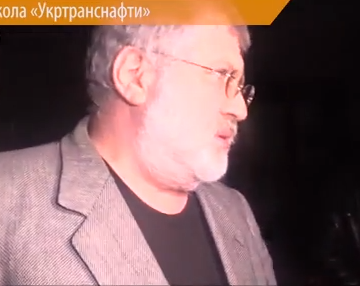
Ukrainian oligarch Igor Kolomoisky confronting journalists 
after he led an armed team in raid at the government-owned 
energy company March 19, 2015. (Screen shot from YouTube)

Yet, while the Ukraine crisis may have reduced living standards for average Ukrainians, it was an important catalyst in the creation of the New Cold War between Washington and Moscow, which offers lucrative opportunities for U.S. military contractors and their many think-tank apologists despite increasing the risk of nuclear war for the rest of us.

In particular, U.S. neoconservatives have viewed heightened tensions between the West and Russia as valuable both in driving up military spending and laying the groundwork for a possible “regime change” in Moscow. The neocons have wanted to retaliate against Russian President Vladimir Putin’s role in frustrating neocon (and Israeli-Saudi) desires to overthrow Syrian President Bashar al-Assad and to bomb Iran, which Israel and Saudi Arabia now view as their principal regional adversary.

The neocon/Israeli-Saudi interests have produced many strange bedfellows with weapons flowing to Al Qaeda’s affiliate in Syria, and – because of Putin’s assistance to Syria and Iran – the tolerance of neo-Nazis and Islamic militants in Ukraine.

The MH-17 Case


Kolomoisky’s operation in Dnipro also has come under suspicion for a possible role in the shoot-down of Malaysia Airlines Flight 17 on July 17, 2014. According to a source briefed by U.S. intelligence analysts, Dnipro was the center of a plot to use a powerful anti-aircraft missile to shoot down Putin’s official plane on a return flight from South America, but instead – after Putin’s plane took a more northerly route – the missile brought down MH-17, killing all 298 people aboard.


Quinn Schansman, dual U.S.-Dutch citizen killed aboard 
Malaysia Airlines Flight 17 July 17, 2014. (Photo from Facebook)

For reasons that have still not been explained, the Obama administration suppressed U.S. intelligence reports on the MH-17 tragedy and instead joined in pinning the shoot-down on ethnic Russian rebels and, by implication, Putin and his government.

In the West, the MH-17 shoot-down became a cause celebre, generating a powerful propaganda campaign to demonize Putin and Russia – and push Europe into joining sanctions against Moscow. Few people dared question Russia alleged guilt even though the Russia-did-it arguments were full of holes. [See here and here.]

Now this North Korean case forces the issue of Ukraine’s reckless behavior to the fore again: Did an inept or corrupt Ukrainian bureaucracy participate in or tolerate a scheme to sell powerful rocket engines to North Korea and enable a nuclear threat to U.S. territory?

In response to the reports of possible Ukrainian collusion in North Korea’s missile program, Oleksandr Turchynov, secretary of the Ukrainian national security and defense council, issued a bizarre denial suggesting that The New York Times and U.S. intelligence agencies were pawns of Russia.


“This information [about North Korea possibly obtaining rocket engines from Ukraine] is not based on any grounds, provocative by its content, and most likely provoked by Russian secret services to cover their own crimes,” Turchynov said.

Press reports about Turchynov’s statement left out two salient facts: that as the interim President following the February 2014 coup, Turchynov ordered Right Sektor militants to begin the bloody siege of rebel-held Sloviansk, a key escalation in the conflict, and that Turchynov was the one who appointed Kolomoisky to be the ruler of Dnipropetrovsk.

Investigative reporter Robert Parry broke many of the Iran-Contra stories for The Associated Press and Newsweek in the 1980s. You can buy his latest book, America’s Stolen Narrative, either in print here or as an e-book (from Amazon and barnesandnoble.com).