Tuesday, May 08, 2018

Defending the Defenders: Radio Progreso Under Fire in Honduras

Radio Progreso - Defending Human Rights in Honduras

by Sean Hawkey (with revisions by WACC)


March 12, 2018

Radio Progreso is a Jesuit radio station based in El Progreso, Honduras. The station is internationally recognized for its role advancing human rights, promoting peace, supporting community-based communication initiative, and advocating for environmental protection across Honduras. Radio Progreso has been broadcasting since the 1980’s and has been involved in numerous community mobilization efforts in support of Indigenous people, Afro-descendants, peasants, women, and youth, both in Honduras and across Central America.

Honduras has been mired in a series of human rights and democratic governance crises since 2009, when then-president Manuel Zelaya was ousted in widely denounced coup. High profile corruption cases, weakening institutions, and impunity followed.


Fr Ismael Moreno, affectionately known as Melo, 
is a Jesuit priest, human rights campaigner and the 
Director of Radio Progreso. He is pictured leading prayers at 
an ecumenical vigil outside the US embassy in Tegucigalpa, Honduras.

 The country is presently one of the most dangerous places in the world for journalists, human rights defenders, LGBTQ activists, and environmentalists[i]. Latent discontent in the country erupted in late 2017 following a disputed and highly controversial presidential election that ultimately saw Juan Orlando Hernandez, the incumbent president, elected. The situation sparked mass demonstrations and violent state repression[ii][iii][iv].

Radio Progreso has been at the forefront of the post-election movement to call for transparency, accountability, and respect for human rights in Honduras. Fr Ismael Moreno, Director of Radio Progreso, spoke with Sean Hawkey during his most recent visit to the country.

Sean Hawkey: How do you assess the current human rights situation in Honduras?

Fr Moreno: ‘We need to have a firm understanding of what’s behind the current moment, [behind] this situation. There are systemic issues [to be addressed]. The institutions of this government do not guarantee human rights. The rule of law is subject to arbitrary decisions of a small group led by Juan Orlando Hernandez who have control over the three powers of the state (the executive, legislative, and judicial branches). [That means that the protection of] human rights depends on the will of the government team, and not on the institutional [and legal] order that should protect human rights.

The precariousness of human rights here is that it is [ultimately up] to the people in charge of the Honduran regime. The defence of our human rights depends on how much the President’s team likes us, or rejects us.

For example, if the Department of State of the United States, warns Juan Orlando Hernández that the human rights of particular people should be protected, their rights [will be] protected, temporarily. However, the human rights situation is still precarious [because there is no system in place to protect people’s rights]. It doesn’t depend on the rule of law.

I was talking to a representative of the UN High Commission for Human Rights, and she told me that she spoke to the President, and [to] the Minister for Security, and asked for my human rights to be respected. That means that my human rights will be respected, but not because human rights per se are respected here, but because the current situation is one where there is arbitrary protection of people’s rights because of political pressure.

The situation for us, human rights defenders, while Juan Orlando Hernandez is in power, is [one of] permanent and growing danger.


César Silva, reporter for UNE TV, has recently been attacked by armed 
forces and prevented from working. Silva is famous for breaking a huge story 
on a multi-million dollar theft of money from the social security by 
members of the current government. 

UNE TV is the last TV station to report from the perspective of the opposition and is facing daily difficulties including having their cable signal, internet and electricity cut off. The police behind César stopped him from approaching Congress, where he is authorised to work.

Sean Hawkey: What is the role of the media in the current crisis?

Fr Moreno: Media in Honduras is intimately linked to the groups who have power. In fact, power in Honduras is ultimately expressed through the capacity to control the media. The well-established national media in the country are associated with the five [most] powerful groups that exist in the country. Those are Grupo FICOHSA, Grupo Atlántida, Grupo Dinant, Grupo Terra and Grupo Karim. These groups bring together the 17 most powerful groups in Honduras, the 17 most powerful surnames in Honduras.

The media - TV, radio and the printed press- normally follow the script [set by these powerful interests] that [says] that they shouldn’t [get anywhere near the interests] of those groups. [The media in Honduras] ultimately expresses the interests of these powerful groups.

So, the media in Honduras is extremely conditioned by the owners, who are part of these economic groups, and who have more power than any government. They are the real government, and they have the ability to veto any sort of candidacy that could affect their interests. These are the five groups that were behind the coup of 2009, these are the five groups that are behind the re-election of Juan Orlando Hernandez, and these are the five groups that have the power of veto over any candidate that [even remotely resembles] Manuel Zelaya. Manuel Zelaya represents a threat to these five powerful groups.

These five groups are tightly linked to the embassy of the United States of America. For the government of the United States, Honduras is of geopolitical [importance], though they have no interest for what life is like in the country. They are wary of political instability. They prefer alliances with [established] politicians, even if they are tainted by corruption and are responsible for human rights abuses.

The media here, in many different ways, try to hide the reality that people live, try to hide the extreme differences between wealth and poverty in Honduras, and that the wealth is in so few hands. And they try to hide the repudiation of this [inequality] by the majority. And they try to maintain a situation that favours investments by the five groups and the United States.

The media here, in essence, abuse freedom of expression. They work against the role of the media, which is to inform, generate informed opinion and generate a culture of participation and coexistence and peace.

Sean Hawkey: How does the media and the powerful groups behind it exercise this power?

Fr Moreno: The big media are the property of these sectors of power. So, for media that aren’t following the script- the ones that have relationships with human rights defenders and with the opposition, and that are [beyond] the control of the government and these five powerful groups- there is a five step process that is sharply adhered to.

The first step is to ignore them. For us [at Radio Progreso], who have a different point of view than the government’s, or who question the government, we’ll never be invited to a TV station to give express our view. They’ll never run a story on who we are and what we do. We are ignored.

When, for different reasons, we can’t be ignored, they will twist information about us, on what we do, they will stigmatise us, they will discredit us. For example, they won’t talk about what we do or say, but they will call us rebels, revolutionaries. They’ll say that we stand in the way of development, or they’ll say that we are linked to organised crime, or that we have old ideas that [are incompatible] with modernity. They stigmatise us, they discredit us.

If that doesn’t work, they’ll try to co-opt us, to bribe us in many different ways. It can be with money, but not necessarily with money. It might be through recognitions, invitations to participate in bodies or events that deal with human rights, to go to five-star hotels. All of this is to make journalists [linked] with the opposition feel like they belong there.

When that doesn’t work then they try to criminalise us, which is the fourth step. When discrediting us doesn’t work, trying to buy us off doesn’t work, and we can’t be ignored, then they criminalise independent media. That’s why the Penal Code has been reformed, to enable accusations of terrorism and treason.

If none of that works, then they go to the fifth step which is assassination.

Sean Hawkey: How has this affected Radio Progreso?

Fr Moreno: We’ve been ignored, but they can’t ignore us completely. They’ve tried to co-opt us and buy us off. Last year they tried to give me the government prize for human rights, I would have been part of their game if I’d accepted it. That hasn’t worked. They’ve tried to stigmatise us, they’ve produced posters [with supposed links to organised crime for example]. Attempts have been made to criminalise us. They have sabotaged our transmission tower in Tegucigalpa. And now we are trying to avoid that last step.


Photos by Sean Hawkey https://www.hawkey.co.uk/index

[i] Human Rights Watch. 2018. World Report 2018: Honduras. https://www.hrw.org/world-report/2018/country-chapters/honduras

[ii] DW. 2018. “Honduras military clashes with protesters over president’s re-election”
http://www.dw.com/en/honduras-military-clashes-with-protesters-over-presidents-re-election/a-42241116

[iii] Reuters. 2018. “Honduran president sworn in amid protests after election chaos” https://www.reuters.com/article/us-honduras-election/honduran-president-sworn-in-amid-protests-after-election-chaos-idUSKBN1FG0NL

[iv]Sandra Cuffe. 2018. ”US-trained police are hunting down and arresting protesters amid post-election crisis in Honduras”. The Intercept. https://theintercept.com/2018/02/20/honduras-election-protest-tigres/

Eff Facebook: The Five Eyes Threat to Your Privacy

Forget Facebook, Five Eyes is bigger threat to our privacy, security

by Yves Engler


May 8, 2018

While the media has been full of news about information-gathering by Facebook and other Internet giants, other secretive organizations that are a major threat to our personal privacy and public security are seldom mentioned. And when they are, it has most often been because politicians are praising them and offering up more money for them to spy.

For example, Justin Trudeau recently promoted the “Anglosphere’s” intelligence sharing arrangement.

Two weeks ago, in a rare move, the PM revealed a meeting with his “Five Eyes” counterparts. After the meeting in London Trudeau labelled the 2,000 employee Communications Security Establishment, Canada’s main contributor to the “Five Eyes” arrangement, “an extraordinary institution”.

Last year Trudeau said that “collaboration and co-operation between allies, friends and partners has saved lives and keeps all of our citizens safe.”

The praise comes as the government is seeking to substantially expand CSE’s powers and two months ago put up $500 million to create a federal “cybersecurity” centre. This money is on top of CSE’s $600 million annual budget and a massive new $1.2 billion complex.

Since its creation CSE has been part of the “Five Eyes” intelligence-sharing framework. The main contributors to the accord are the US National Security Agency (NSA), Australian Defence Signals Directorate (DFS), New Zealand’s Government Communications Security Bureau (GCSB), British Government Communications Headquarters (GCHQ) and CSE. A series of post-World War II accords, beginning with the 1946 UKUSA intelligence agreement, createdthe “AUS/CAN/NZ/UK/US EYES ONLY” arrangement.

Writing prior to the Internet, author of Target Nation: Canada and the Western Intelligence Network James Littleton notes, “almost the entire globe is monitored by the SIGINT [signals intelligence] agencies of the UKUSA countries.” With major technological advancements in recent decades, the Five Eyes now monitor billions of private communications worldwide.

The Five Eyes accords are ultra-secretive and operate with little oversight. NSA whistleblower Edward Snowden labeled it a “supra-national intelligence organisation that doesn’t answer to the known laws of its own countries.”

In addition to sharing information they’ve intercepted, collected, analysed and decrypted, the five SIGINT agencies exchange technologies and tactics. They also cooperate on targeting and “standardize their terminology, codewords, intercept–handling procedures, and indoctrination oaths, for efficiency as well as security.”

CSE Special Liaison Officers are embedded with Five Eyes counterparts while colleagues from the US, Britain, Australia and New Zealand are inserted in CSE. NSA has had many long-term guest detachments at CSE facilities. An NSA document Snowden released described how the US and Canadian agencies’ “co-operative efforts include the exchange of liaison officers and integrees.”

NSA has trained CSE cryptanalysts and in the 1960s the US agency paid part of the cost of modernizing Canadian communications interception facilities. With CSE lacking capacity, intelligence collected at interception posts set up in Canadian embassies in Cuba, Jamaica, Russia, etc. was often remitted to NSA for deciphering and analysis.

In his 1986 book Littleton writes, “much of the SIGINT material collected by Canada is transmitted directly to the U.S. National Security Agency, where it is interpreted, stored, and retained. Much of it is not first processed and analyzed in Canada.”

Five Eyes agencies have helped each other skirt restrictions on spying on their own citizenry. Former Solicitor-General Wayne Easter told the Toronto Starthat it was “common” for NSA “to pass on information about Canadians” to CSE. Conversely, former CSE officer Michael Frost says NSA asked the agency to spy on US citizens.

In Spyworld: Inside the Canadian and American Intelligence Establishments Frost reveals that on the eve of the 1983 British election Prime Minister Margaret Thatcher asked GCHQ to spy on two cabinet ministers “to find out not what they were saying, but what they were thinking.”

Reflecting the two agencies close ties, GCHQ requested CSE’s help on this highly sensitive matter. Frost notes that CSE wasn’t particularly worried about being caught because GCHQ was the agency tasked with protecting Britain from foreign spying.

In the lead-up to the US-British invasion of Iraq NSA asked Canada and the rest of the Five Eyes to spy on UN Security Council members. On January 31, 2003, NSA SIGINT Department Deputy Chief of Staff for regional targets wrote alliance counterparts:

As you’ve likely heard by now, the agency is mounting a surge particularly directed at the UN Security Council (UNSC) members (minus US and GBR [Great Britain] of course) for insights as to how membership is reacting to the ongoing debate RE: Iraq, plans to vote on any related resolutions, what related policies/negotiating positions they may be considering, alliances/dependencies, etc. – the whole gamut of information that could give US policymakers an edge in obtaining results favorable to US goals or to head off surprises.”

While CSE reportedly rejected this NSA request, a number of commentators suggest CSE has shown greater allegiance to its Five Eyes partners than most Canadians would like. Littleton writes,

“[T]he agreements may not explicitly say that the United States, through its SIGINT organization, the National Security Agency (NSA) dominates and controls the SIGINT organizations of the other member nations, but that is clearly what the agreements mean.”

An NSA history of the US–Canada SIGINT relationship released by Snowden labelled Canada a “highly valued second party partner”, which offers “resources for advanced collection, processing and analysis, and has opened covert sites at the request of NSA. CSE shares with NSA their unique geographic access to areas unavailable to the US.”

The Five Eyes arrangement has made Canada complicit in belligerent US foreign policy. It’s time for a debate about Canadian participation in the “Anglosphere’s” intelligence sharing agreement.

Gorilla Radio with Chris Cook, Roger Annis, Nozomi Hayase, Janine Bandcroft May 10, 2018

This Week on GR

by C. L. Cook - Gorilla-Radio.com


May 10th, 2018

Last week, the United States delivered more than 200 Javelin missiles to the coup regime in Ukraine. Following four years of rule from Kyiv, Petro Poroshenko's government is plagued by corruption, and is still fighting separatists in the eastern region of the country where his illegal seizure of power was never accepted.

Though the Western press routinely dismisses Ukrainian resistance to Poroshenko as "pro-Russian", portraying the military conflict in the country as Putin's proxy war of annexation, less mentioned is the role the United States and its European allies played in both the overthrow of the democratically elected Yanukovych government or their continued support of ongoing hostilities.

Listen. Hear. 

Roger Annis is a longtime socialist and trade union activist. He's a prolific essayist, whose website, A Socialist in Canada covers a broad swath of topics and issues from a social justice and peace perspective. He's followed events in Ukraine since 2014, and visited both Eastern Ukraine and Crimea to see firsthand what the coup has meant for the people there.

Roger Annis in the first half.

And; last weekend, another UN General Assembly declared World Press Freedom Day passed without a word being spoken in that august body in favour of the release of journalist/prisoner, Julian Assange. The co-founder and face of WikiLeaks has missed seven World Press Freedom Days confined on pain of arrest and imprisonment should he venture out the door of Ecuador's London embassy; and though the UN says Britain's promise of imprisonment against him is arbitrary and has no standing in international law, Julian languishes still. Notably absent too these last years is support from Assange's fourth estate colleagues; perhaps because Julian Assange and WikiLeaks don't fit neatly into traditional media's mold.

Dr. Nozomi Hayase is a columnist, essayist, and author whose writing and activism she says is, "dedicated to liberation of all people". Her articles on free speech, transparency, and the vital role of whistleblowers in global society appear at Counterpunch, CommonDreams, Dissident Voice, and Antiwar.com among other places. Nozomi's new book, 'WikiLeaks, the Global Fourth Estate: History Is Happening', a compendium of her many articles on the topic, is available now online at her website, nozomihayase.com.

Nozomi Hayase and dispelling the distortions of what WikiLeaks is and does in the second half.

And; Victoria-based activist and CFUV Radio broadcaster at-large, Janine Bandcroft will be here at the bottom of the hour with the Left Coast Events Bulletin of some of the good things going on in and around our town in the coming week. But first, Roger Annis and the papering over of western complicity in Kyiv's war against eastern Ukraine. 

Chris Cook hosts Gorilla Radio, airing live every Thursday between 11-Noon Pacific Time. In Victoria at 101.9FM, and on the internet at: http://cfuv.uvic.ca.  He also serves as a contributing editor to the web news site, http://www.pacificfreepress.com. Check out the GR blog at: http://gorillaradioblog.blogspot.ca/

Monday, May 07, 2018

Making Latin America American Again

US Interventions in Latin America Continue and Intensify

by TRNN


May 6, 2018

Most US citizens don’t realize it, but the US government has continued and even intensified its regime change agenda in Latin America and successfully helped reverse the so-called “pink tide” of left-of-center governments over the past ten years, says CEPR’s Mark Weisbrot.


Mark Weisbrot is the co-director of the Center for Economic and Policy Research, and is the author of the book “Failed: What the Experts Got Wrong About the Global Economy.” He’s also the president of the organization Just Foreign Policy.

Gil Scott-Heron Remembered: Gotta Work for Peace

The Revolution Will Not Be Televised: Homage to Gil Scott-Heron 

by Jonah Raskin - CounterPunch


May 7, 2018   

The performance artist and jazz poet Gil Scott-Heron was wrong when he said in 1970, “The Revolution will not be televised.” But perhaps he was only wishful thinking and expressing what he wanted and not what he actually saw and heard around him.

More likely, he was being ironical and commenting on the wacky world of mass communication.

You can still appreciate Scott-Heron’s irony in lines like “The revolution will be brought to you by the Schaefer Award Theatre and/ will not star Natalie Wood and Steve McQueen or Bullwinkle and Julia/ The revolution will not give your mouth sex appeal.

Scott-Heron died seven years ago at the age of 62. His many fans still revere him and appreciate his unique artistry on albums such as Pieces of a Man and Winter in America.

Photo: altemark | CC BY 2.0

In fact, the cultural and political upheavals of the 1960s and 1970s, from Selma, Alabama to Woodstock, New York, were taped, filmed, recorded and broadcast. Those who were alive in 1968 and who were glued to their TV screens saw the “police riot” in the streets of Chicago. They also heard the demonstrators chat, “The whole world is watching.”

That was an exaggeration. The whole world wasn’t only or just watching Chicago. It was also watching Prague and Paris and other hot spots of rebellion around the globe. But Americans often like to think that they are at the center of the world and that everyone in the world watches the U.S. Just how fallacious that notion is, is apparent to anyone who travels in Europe, Asia and South America and sees that the news isn’t only or just about Donald Trump and the White House.

In 1789, revolutionary Parisians stormed the Bastille because it had guns and ammunition. In 2014, pro-Russian forces seized the TV station in Donetsk, turned off Ukrainian TV and replaced it with TV channels from Moscow. They knew that TV today is far more potent than a tank or a jet plane.

Yippies such as Abbie Hoffman, Jerry Rubin and Paul Krassner had that insight 50-years ago.

It wasn’t just the major television networks that captured scenes of the revolution in the 1960s and 1970s. The rebels photographed themselves. Newsreel, the radical filmmakers’ collective, documented the protests of the 1960s, and distributed their movies around the country.

In Santa Barbara, after a screening of The Columbia Revolt protesters burned down a branch of the Bank of America. No doubt about it, film and TV helped to ignite riots and rebellions. That’s why the Yippies, also known as the Youth International Party, staged irreverent events at the N.Y. Stock Market and elsewhere for the purpose of being filmed and then aired on TV. To Abbie Hoffman images alone, without words, conveyed powerful messages.

To the Yippies, Chicago in the summer of 1968 was a scenario in which everyone played a part in accord with an unwritten script that followed a logical sequence. Indeed, Chicago in 1968 was the culmination of the Theater of the Absurd.

The TV networks and the politicians learned from Chicago in 1968, and from televised images from Vietnam. They got smarter, and learned not to broadcast atrocities of war that helped to generate anti-war protests.

Fifty years after Chicago, everyone with a cell phone is a cinematographer. Citizens routinely capture on film police officers beating, shooting and killing unarmed black men. Phones and their photos have educated millions, and not just in the U.S. but in Egypt, China and Russia. No wonder the powers that be want to control the Internet and to censor words and images.

Of course, images alone won’t stop the police from lawlessness, though they can save lives.

If you have not heard Gil Scott-Heron perform “The Revolution Will Not Be Televised,” or if you want to hear it (and see it) again, you can find it on online. It still works as satire and as a brilliant piece of the spoken word that inspired a generation or two of rappers and hip-hoppers.

The names have changed since the 1970s when Scott-Heron sang, “The revolution will not show you pictures of Nixon/

Blowing a bugle and leading a charge by John Mitchell/ General Abrams and Spiro Agnew to eat/ Hog maws confiscated from a Harlem sanctuary.” But his sense of moral outrage still rings loud and clear. Substitute new names and the piece is as relevant as ever before.

Televised or not, revolutions will not be denied.
 
Jonah Raskin is the author of For The Hell of It: The Life and Times of Abbie Hoffman and American Scream: Allen Ginsberg’s ‘Howl’ and the Making of the Beat Generation.
More articles by:Jonah Raskin 

Saturday, May 05, 2018

Snatching Victory from Defeat: UK's Media Election Results Deniers

Freedom No More  

by Craig Murray


4 May, 2018

As I write, with over 75% of all yesterday’s English local election results in, Labour has a net gain of 55 councillors compared to the high water mark of the 2014 result in these wards, while the Tories have a net gain of one seat against a 2014 result which was regarded at the time as disastrous for them, and led the Daily Telegraph to editoralise “David Cameron Must Now Assuage the Voters’ Rage”.

Yet both the BBC and Sky News, have all night and this morning, treated these results, in which the Labour Party has increased by 3% an already record number of councillors in this election cycle, as a disaster.

What is more, they have used that false analysis to plug again and again the “anti-Semitism in the Labour Party” witch-hunt.

It was of course the continuous exacerbation of this mostly false accusation by Blairite MP’s which – deliberately on their part – stopped the Labour Party doing still better. The Blairites are all over the airwaves plugging this meme again today.

What is more this Labour result has been achieved despite the complete collapse of the UKIP vote, which collapse had been expected to boost the Tory Party. In fact the net loss of over 100 UKIP seats has not resulted in overall net gains for the Tory Party, even though those ex-UKIP voters demonstrably did mostly split to Tory. The very substantial UKIP voter reinforcements simply saved the Tories from doing still worse. The Liberal Democrats are showing some signs of life.

Yesterday was World Press Freedom Day, and the tendentious media misrepresentation of the election results reminds me why I could not get excited about it. A media with the extremely concentrated ownership we see in the UK can never be free, and certainly does not represent a wide spread of political opinions. Even the views of the official Leader of the Opposition are almost entirely deemed to be outside the Overton window. In Scotland the Scottish government is subject to unreasoning media attack, day in and day out, which contrasts strikingly with the treatment of Westminster ministers and issues.

There is a seriously worrying example from Leeds of the decline of free speech, where disgracefully a meeting discussing the bias of the corporate and state media has now been banned by Leeds City Council because of its content. We are not allowed even to get together to discuss media bias. Retired Ambassador Peter Ford, Professors Piers Robinson and Tim Hayward, Vanessa Beeley and Robert Stuart were to address the meeting at Leeds City Museum entitled “Media on Trial”. I cannot sufficiently express my outrage that Leeds City Council feels it is right to ban a meeting with very distinguished speakers, because it is questioning the government and establishment line on Syria. Freedom of speech really is dead.

British society truly has changed fundamentally if a former British Ambassador to Syria is banned from speaking in public premises on his area of expertise. What is still worse is the tone of this sneering report from Huffington Post, now firmly a part of corporate media, in which Chris York libels the speakers as “Assad supporters”, interviews none of the speakers and nobody to make the argument for free speech, but does manage to interview the “founder” of the jihadist “White Helmets.” In terms of banning dissent while simultaneously ramping up the official narrative, York has won himself top establishment brownie points. The man – and I use the term loosely – is unfit for polite company.

Carnage Again in Israel's Gaza Shooting Gallery

Sixth Consecutive Week of Friday Gaza Protests Leaves Over 160 Wounded 

by TRNN


May 4, 2018

It is the fifth Friday of the Great March of Return protests here in the Gaza Strip. And as you can see behind me, thousands of Palestinians are participating in the protest today, close to the border line between Gaza and Israel.


Report from Gaza: For the sixth consecutive week Palestinians in Gaza headed to the Israeli border to demonstrate the "Great March of Return." Israeli soldiers continued their attacks on the protesters, wounding over 160. Special correspondent Noor Harazeen reports from Gaza

Remember to Maim: Cutting the Legs from Under the Great March of Return

As IDF Uses Gaza Protesters for Shoot-to-Maim Target Practice, Israel Argues Human Rights Don’t Apply to this “War”

by Elliott Gabriel  - MintPress News


May 04th, 2018

The manner in which protesters, including children, have been injured – live ammunition fired at the groin, neck, limbs, and abdomen – suggests that Israeli troops intentionally aim to inflict maximum physical harm on the civilian participants in the marches.

GAZA CITY, PALESTINE Israeli officials have deemed peaceful protests by Palestinian refugees in the Gaza Strip to be tantamount to a “state of war,” arguing that soldiers were well within their rights firing live ammunition at unarmed protesters participating in ongoing mass mobilizations at the eastern fence enclosing the besieged territory.

In response to a High Court petition by human rights advocates, authorities in Tel Aviv noted that “the state opposes the applying of human rights law during an armed conflict,” arguing that even the Red Cross deemed human rights law inapplicable during wartime.

According to the Gaza Health Ministry, 50 Palestinians have been killed in the protests while over 6,200 protesters have sustained injuries at the hands of Israeli forces deploying live ammunition or rubber-coated steel rounds and other less-lethal munitions.

The state attorneys’ argument attempts to give international and domestic legal status to the military suppression of peaceful protest and the suspension of international human rights law enforcement, allowing occupation forces the right to use lethal force against unarmed demonstrators.

Since March 30, residents of the captive region have held large-scale demonstrations to draw attention to the continuing dispossession of the people of Palestine and theft of their ancestral land by the Tel Aviv government, with the support of the U.S. government.

Organizers hope to continue the rallies until May 15, when Israelis will celebrate the 70th anniversary of the establishment of the State of Israel. The date is mourned by Palestinians as Nakba Day, or “The Day of Catastrophe,” when the ongoing process of ethnic cleansing and expansionism was commenced by the extremist Zionist militia, which later united as the “Israeli Defense Forces” or Israeli military. From 1947 to 1949, around 750,000 Palestinians out of a total population of nearly 1.9 million were expelled from the land of Palestine.

Around two-thirds of Gaza’s 2 million Palestinians are war refugees, or their descendants, who are confined to what is tantamount to a large-scale, open-air prison camp. Speaking to Reuters, 24-year-old protester Ahmed said:

“If it wasn’t for the occupation we would have lived as free as people like in other countries … If they don’t allow us back, at least they should give us a state.”

Grim facts reveal intentional abuse


The manner in which protesters, including children, have been injured – live ammunition fired at the groin, neck, limbs, and abdomen – suggests that Israeli troops intentionally aim to inflict maximum harm that could result in life-altering disabilities, paralysis, amputation or the sterilization of civilian participants in the marches.

Many are struck by a new explosive type of ammunition known as the “butterfly” bullet, which causes massive deformities and creates exit wounds as large as a fist. The bullet expands upon hitting targets, decimating human flesh and bone or “pulverizing” internal organs, according to local health officials.

According to Marie-Elisabeth Ingres, the head of the Doctors Without Borders mission in the Occupied Palestinian Territories:

“Half of the more than 500 patients we have admitted in our clinics have injuries where the bullet has literally destroyed tissue after having pulverized the bone … These patients will need to have very complex surgical operations, and most of them will have disabilities for life.”

The Israelis, however, cite the law when justifying their use of deadly force. In a statement to Al Jazeera, an Israeli military official said:

“The IDF only employs means that are lawful under international law. No new bullets or gas have been employed during the recent events in the Gaza Strip.”

Cold-blooded mass murder and repression


While Israeli authorities claim that the peaceful protests in Gaza constitute a state of war, videos captured of Israeli soldiers show them casually discussing how best to inflict harm on unarmed Palestinians while facing little to no danger from protesters.

In a video released in April, a sniper can be seen expressing elation after shooting a protester who was allegedly throwing rocks, exclaiming “Yes!”

According to a new survey by the Israel Democracy Institute and Tel Aviv University, 83 percent of Israeli respondents “strongly support” the open-fire policy while around 71 percent of Israelis reject the easing of a crippling blockade imposed on Gaza for the past 11 years.

Israeli authorities consistently claim that the protests are organized by Islamist Palestinian resistance group Hamas, which has ruled the Strip since winning elections in 2007, and that the protest aims to provide cover for alleged “terrorist attacks” using stones and Molotov cocktails.

Various factions and civil-society groups have endorsed the march, however, and deny that Hamas has a monopoly on leading the mass actions or that the protests have any ulterior motives beyond the stated demands for the right to return to their former homes in historic Palestine.

Palestinian academic Rashid Khalidi noted that the methods used by the Israeli army indicate a fear of peaceful protest as well as an inherently racist attitude toward the people of Palestine:

“So, heavily armored Israeli soldiers with sniper rifles at hundreds of meters are picking off, systematically, Palestinian protesters or people who try to approach the fence or whatever. And that this is a policy that the government is proud of … I think it tells us a lot about Israel’s attitude towards Palestinians, that they are subhuman.

“… [A]t the rate at which things are going, unfortunately, we’re probably likely to see even more savage, vicious, brutal, murderous repression.”

Elliott Gabriel is a former staff writer for teleSUR English and a MintPress News contributor based in Quito, Ecuador. He has taken extensive part in advocacy and organizing in the pro-labor, migrant justice and police accountability movements of Southern California and the state’s Central Coast.


Republish our stories! MintPress News is licensed under a Creative Commons Attribution-NonCommercial-ShareAlike 3.0 International License.


Friday, May 04, 2018

Fish Farm Salmon Lice Outbreak Threatens Clayoquot's Wild Salmon

Salmon lice outbreak could devastate Clayoquot salmon

by Clayoquot Action


May 3, 2018
 
Tofino A massive salmon lice outbreak in the Clayoquot Sound UNESCO Biosphere Reserve threatens to wipe out this year’s salmon run.

Cermaq’s documentation on the lice for April show that the numbers of salmon lice on seven of their fourteen Clayoquot farm sites are up to ten times higher than the threshold requiring treatment.

The regulatory threshold is three motile salmon lice per farm fish.

There are 20 open net-pen salmon farms in Clayoquot Sound, all located on wild salmon migration routes. The salmon lice outbreak is occurring as wild salmon smolts are leaving Clayoquot’s rivers to begin their life at sea.

Salmon lice are small parasitic crustaceans that feed on the skin and mucous of fish. Research shows wild salmon populations are at risk from salmon lice coming from farms. Open net-pen farms are crowded with up to half a million salmon, making an ideal breeding ground for disease and parasites such as salmon lice. This drastically increases the number of lice in surrounding waters.

Without salmon farms, wild salmon would not encounter salmon lice until they are adults, big enough to handle them. Juvenile salmon can only carry a load of one louse per gram of body weight—even two lice per smolt is a lethal load.

“This outbreak is an environmental disaster—we are seeing wild juvenile salmon carrying lethal loads of salmon lice”, said Clayoquot Action Campaigns Director Bonny Glambeck.
“These fish have been given a death sentence—studies show there is no way these fish will survive to spawn and reproduce”.

Cermaq recently received a controversial permit to use a new pesticide to control salmon lice in Clayoquot Sound. The treatment—Paramove 50—is known to suppress the immune system of the farm fish and trigger outbreaks of viruses such as Piscine Reovirus (PRV).

Salmon lice continue to plague the salmon farming industry globally. The chemical treatments Cermaq plans have not solved the salmon lice problem anywhere in the world. Salmon lice quickly become resistance to new treatment methods.

“This is a band-aid solution for a serious problem that the salmon farming industry is unable to solve. Clearly a new approach is needed, which is why we’re seeing a global shift to land-based salmon farming”, said Ms. Glambeck.
“Why are we sacrificing local food security, the wild salmon economy, and the iconic ecosystems of Clayoquot Sound, when the writing is clearly on the wall?”

The Clayoquot Sound UNESCO Biosphere Reserve is renowned for its pristine rainforest valleys which provide prime salmon habitat. However, in recent years the salmon of the region have been in drastic decline. For example, the Kennedy River saw no sockeye spawners return last fall.

Clayoquot Action continues to advocate for the removal of open-net pen salmon farms from BC waters.

-30-


FOR IMMEDIATE RELEASE:
Bonny Glambeck, Clayoquot Action Campaigns Director,

bonny@clayoquotaction.org

High res photos of Clayoquot May 2018 juvenile salmon with lice and Cermaq salmon lice graphs available here:
https://drive.google.com/drive/folders/1ps-GumjM4j7RmsYT-kVu1GjJR2ojltqz?usp=sharing

Cermaq’s public reporting webpage:
https://www.cermaq.com/wps/wcm/connect/cermaq-ca/cermaq-canada/our-promise/public-reporting/

Journalism and Journalists Living and Dying in Honduras

Honduran journalists face increasing threats and intimidation

by Heather Gies - AJE


May 3, 2018

Honduras is the most dangerous country in the Americas for journalists and they say things are getting worse.
 
Harassment, suspicious phone calls, and restricted access to government sources have become routine for Honduran journalist and human rights defender Dina Meza, who says she is one of many media workers threatened for challenging authorities in her country.

Honduras is one of the most dangerous countries in the world for journalists, according to Reporters Without Borders.

The group ranked Honduras 141 out of 180 countries on the 2018 World Press Freedom Index.

Dangers for journalists include physical attacks, threats, and abusive legal proceedings, Reporters Without Borders said.

Meza, the founding editor of alternative digital magazine Pasos de Animal Grande, which specialises in investigative coverage of human rights issues, knows these threats firsthand.

She has repeatedly suffered threats of sexual violence and against her life, as well as surveillance and other forms of intimidation, such as unusual late-night phone calls.

The threats forced her to spend months outside the country in 2013.

As a safety precaution, Meza often is flanked by a pair of international human rights observers provided by Peace Brigades International when she works in the field on investigations or reporting outside of the capital, Tegucigalpa.

Sharp increase


Violence against journalists has spiked in the wake of the 2009 US-backed military coup that removed former president Manuel Zelaya and paved the way for current President Juan Orlando Hernandez, who is often criticised for prioritising the interests of multinational corporations over the Honduran people.

At least 62 journalists have been killed in the country between 2006 and 2017, according to data from the Commission for Investigation of Attacks on Journalists of the Latin American Federation of Journalists.

Only two of those killings happened before 2009.

In the same period, murders of land and environmental defenders, human rights activists, LGBTQ people, and other vulnerable groups have also increased.

The statistics make Honduras the most deadly country for journalists in the Americas per capita. Only Mexico rivals Honduras with 165 journalists killed from 2006 to 2017, according to the federation.

Meza also heads a project with the Association for Democracy and Human Rights (Asopodehu), which supports at-risk media workers and offers training to young journalists.

She told Al Jazeera that Honduran authorities use the climate of fear caused by violence against journalists to their advantage.

"This violence against journalists creates a lot of self-censorship," Meza said.

This self-censorship accompanies de facto bans by Congress and other official spaces for adversarial journalists, Meza who considers herself banned, said.

"Unfortunately, in Honduras, [state] institutions impose the news agenda." 

'Masks off'


During the 2009 coup, the government suspended constitutional guarantees and imposed a media blackout.

Cesar Silva, a television reporter with UNE TV, a two-year-old channel that has been critical of Hernandez' government, said the coup was a defining moment for journalists.

As Honduran media glossed over Zelaya's removal as a "constitutional substitution", a tiny minority of journalists reported on the popular uprising and violent military crackdown on the streets.

"The masks all came off," Silva told Al Jazeera, saying the vast majority of established journalists in the country followed the money and supported the coup. "Everyone took a stance."

Months later, Silva was abducted and tortured for two days after releasing footage of post-coup repression. He was forced to flee the country but returned several months later to continue reporting, despite the dangers.

"From the time we wake up, begin our work, leave our houses - there's a risk," he said of his UNE TV team.

Like Meza, Silva has been denied access to Congress and other state institutions.
He said press freedom continues to worsen.


Last year, Hernandez won a second term despite widespread allegations of fraud and controversy around his re-election bid. Honduras plunged into its worst political crisis since the coup.

Silva's UNE TV was the only local television channel that broadcast the police and military crackdown on the anti-fraud protests that shook the country for weeks following the November 26, 2017 election.

During a live broadcast in January, soldiers beat Silva and his colleagues and smashed their camera equipment. In February, a man attempted to stab Silva while he was on the air.

"The conditions are more difficult every day," Silva said, decrying the targeting of independent journalists in both physical attacks and smear campaigns by mainstream media.

"What motivates us is that we are on the right path. Our beacon is the truth," Silva said.
Continuing restrictions

Last year, Congress reformed the penal code to punish journalists with four to eight years in jail for "apologising for terrorism".

Critics slammed the reform, known as Article 335-B, for targeting reporters who refuse to toe the government line or be "bought off".


A separate reform broadly redefined "terrorism" in a way opponents said could criminalise social protests at judges' discretion.

The public prosecutor's office shot down Article 335-B as unconstitutional, but its future hinges on the Supreme Court.

More recently, Hernandez' allies in Congress promoted a cyber-security bill aimed at regulating "acts of hatred and discrimination" on the internet. Civil society organisations blasted the bill as a "gag law".

Ismael Moreno, a Jesuit priest and director of Radio Progreso, told Al Jazeera legislation like Article 335-B epitomises the "extreme use of law" to "exercise power over the weak".

He added that freedom of expression in Honduras is "extremely precarious" and "conditioned by the arbitrary decisions" of a government he claimed "is the product of fraud and illegal re-election".

After last year's election, Radio Progreso's signal went off the air in the capital in what Moreno said was an act of government-sanctioned sabotage.

Moreno has not received death threats, but anonymous smear campaigns have accused him of drug trafficking, vandalism, and other crimes. He claims to have sources confirming his daily activities are surveilled by military intelligence.

Like Meza and Silva, Moreno has received protective measures, in his case provided by the Inter-American Commission on Human Rights. He takes practical precautions to protect his safety, recognising his entire team is vulnerable.

"It is a challenge and a responsibility to continue exercising freedom of expression despite enormous difficulties," he said, linking restricted press freedom to attacks on other basic rights.

"We cannot allow a small elite with links to multinational companies to continue controlling [society]," Moreno said.
"We have to fight to transform Honduran society with the goal of having the rule of law where freedom of expression is respected."

Reading the Guardian, Watching Big Brother

2018: When Orwell’s 1984 stopped being fiction 

by Jonathan Cook


May 4, 2018

This is the moment when a newspaper claiming to uphold that most essential function in a liberal democracy – acting as a watchdog on power – formally abandons the task.

This is the moment when it positively embraces the role of serving as a mouthpiece for the government.

The tell is in one small word in a headline on today’s Guardian’s front page: “Revealed”.

When I trained as a journalist, we reserved a “Revealed” or an “Exposed” for those special occasions when we were able to bring to the reader information those in power did not want known. These were the rare moments when as journalists we could hold our heads high and claim to be monitoring the centres of power, to be fulfilling our sacred duty as the fourth estate.

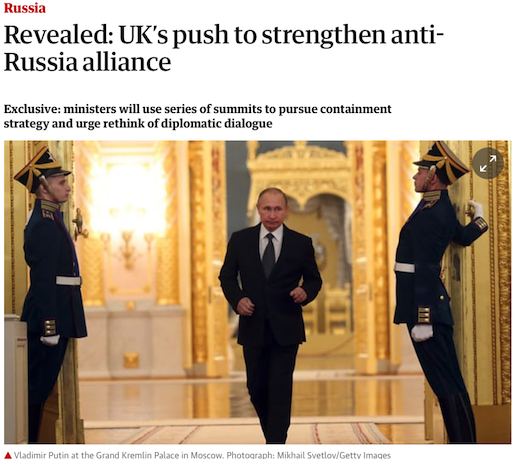
But today’s Guardian’s “exclusive” story “Revealed: UK’s push to strengthen anti-Russia alliance” is doing none of this. Nothing the powerful would want hidden from us is being “revealed”. No one had to seek out classified documents or speak to a whistleblower to bring us this “revelation”. Everyone in this story – the journalist Patrick Wintour, an anonymous “Whitehall official”, and the named politicians and think-tank wonks – is safely in the same self-congratulatory club, promoting a barely veiled government policy: to renew the Cold War against Russia.

It is no accident that the government chose the Guardian as the place to publish this “exclusive” press release. That single word “Revealed” in the headline serves two functions that reverse the very rationale for liberal, watchdog-style journalism.

First, it is designed to disorientate the reader in Orwellian – or maybe Lewis Caroll – fashion, inverting the world of reality. The reader is primed for a disclosure, a secret, and then is spoonfed familiar government propaganda: that the tentacles of a Russian octopus are everywhere, that the Reds are again under our beds – or at least, poisoning our door handles.

“British diplomats plan to use four major summits this year – the G7, the G20, Nato and the European Union – to try to deepen the alliance against Russia hastily built by the Foreign Office after the poisoning of the former Russian double agent Sergei Skripal in Salisbury in March.”

This – and thousands of similar examples we are exposed to every day in the discourse of our politicians and media – is the way our defences are gradually lowered, our critical thinking weakened, in ways that assist those in power to launch their assault on democratic norms.

Through such journalistic fraud, liberal media like the Guardian and BBC – because they claim to be watchdogs on power, to defend the interests of the ruled, not the rulers – serve a vital role in preparing the ground for the coming changes that will restrict dissent, tighten controls on social media, impose harsher laws.

The threat is set out repeatedly in the Guardian’s framing of the story: there is a self-evident need for “a more comprehensive approach to Russian disinformation”; Moscow is determined “systematically to divide western electorates and sow doubt”; “the west finds itself arguing with Russia not just about ideology, or interests, but Moscow’s simple denial, or questioning, of what the western governments perceive as unchallengeable facts.”

Tom Tugendhat, son a High Court judge, a former army officer who was honoured with an MBE by the Queen in his thirties, and was appointed chair of the Commons’ important foreign affairs select committee after two years in parliament, sets out the thinking of the British establishment – and hints at the likely solutions. He tells the Guardian:

“Putin is waging an information war designed to turn our strongest asset – freedom of speech – against us. Russia is trying to fix us through deception.

Second, there is a remedy for the disorientation created by that small word “Revealed”. It subtly forces the reader to submit to the inversion.

For the reasons set out above, a rational response to this front-page story is to doubt that Wintour, his editors, and the Guardian newspaper itself are quite as liberal as they claim to be, that they take seriously the task of holding power to account. It is to abandon the consoling assumption that we, the 99 per cent, have our own army – those journalists in the bastions of liberal media like the Guardian and the BBC – there to protect us. It is to realise that we are utterly alone against the might of the corporate world. That is a truly disturbing, terrifying even, conclusion.

But that sense of abandonment and dread can be overcome. The world can be set to rights again – and it requires only one small leap of faith. If Russian president Vladimir Putin truly is an evil mastermind, if Russia is an octopus with tentacles reaching out to every corner of the globe, if there are Russian agents hiding in the ethers ready to deceive you every time you open your laptop, and Russian cells preparing to fix your elections so that the Muscovian candidate (Donald Trump, Jeremy Corbyn?) wins, then the use of that “Revealed” is not only justified but obligatory. The Guardian isn’t spouting British and US government propaganda, it is holding to account the supremely powerful and malevolent Russian state.

Once you have stepped through this looking glass, once you have accepted that you are living in Oceania and in desperate need of protection from Eurasia, or is it Eastasia?, then the Guardian is acting as a vital watchdog – because the enemy is within. Our foe is not those who rule us, those who have all the wealth, those who store their assets offshore so they don’t have to pay taxes, those who ignore devastating climate breakdown because reforms would be bad for business. No, the real enemy are the sceptics, the social media “warriors”, the political activists, even the leader of the British Labour party. They may sound and look harmless, but they are not who or what they seem. There are evil forces standing behind them.

In this inverse world, the coming draconian changes are not a loss but a gain. You are not losing the rights you enjoy now, or rights you might need in the future when things get even more repressive. The restrictions are pre-emptive, there to protect you before Putin and his bots have not only taken over cyberspace but have entered your living space. Like the aggressive wars of “humanitarian intervention” the west is waging across the oil-rich areas of the Middle East, the cruelty is actually kindness. Those who object, those who demur, do so only because they are in the financial or ideological grip of the mastermind Putin.

This is the moment when war becomes peace, freedom becomes slavery, ignorance becomes strength.

No one pays me to write these blog posts. If you appreciated it, or any of the others, please consider hitting the donate button.

Wednesday, May 02, 2018

Gorilla Radio with Chris Cook, Dan Kovalik, CAIA's Great March Solidarity Protest, Janine Bandcroft, Christina Nikolic May 3, 2018

This Week on GR

by C. L. Cook - Gorilla-Radio.com


May 3, 2018

As Honduran refugees squeezed between street gangsters and the immovably corrupt government of President Juan Orlando Hernandez hang fire in Tijuana, protests by the little people in the capital reportedly "turned violent" Tuesday. That's the neutral "turn of phrase" the professional western media uses when the monied interests, friends of the bankers and resource barons of El Norte, are challenged by those they rob daily.

The truth is plainer: Social order in Honduras has been brought to the breaking point by the thieves who stole the government, (with the blessing of Canada and the United States) and the failure of the capitalist system - at least as practiced by Hernandez and his cohorts.

And, the evidence of that failure is both bleeding in the streets of Tegucigalpa, and banging on America's doors at Mexican crossings and elsewhere.

Listen. Hear.

Contrast the reportage of the growing riots in Honduras, (that followed years of peaceful pro-democracy demonstrations) with the recent eruption of "Arab Spring-like" manifestations in neighbouring Nicaragua. There, a leftist government long a thorn in the imperial paw touched off a tax revolt after announcing changes to the state pension plan, changes Sandinista President, Manuel Ortega was quick to reverse. But, to listen to the BBC, CBC, and US corporate press, it sounds as though Satan himself had risen in Managua.

Daniel Kovalik is a human rights lawyer, essayist, and author who’s book, ‘The Plot to Scapegoat Russia: How the CIA and the Deep State Have Conspired to Vilify Putin’ is still fresh a year after publication. He teaches international human rights law at the University of Pittsburgh School of Law, is Senior Associate General Counsel for the United Steel Workers union, and is a long-time peace and justice activist, focused especially on Colombia and Central America, where he serves as an attorney for Colombian plaintiffs in cases alleging corporate human rights violations. Dan is too a co-recipient of a Project Censored Award for chronicling the murder of trade unionists in Colombia.

Dan Kovalik in the first half.

And; while Palestinians continue to press for their rights in the homeland they've watched being stolen for three generations and more, their 'Great March of Return' in it's fifth week now, has highlighted the brutality of the Netanyahu regime. Every Friday hundreds of demonstrators have been injured, many shot in the legs by snipers with high velocity, live rounds. At least fifty are confirmed to have been shot dead. Tomorrow is another Friday, and the desperately determined people of Gaza will again go to the wall, emblem of their suffering, and challenge Israel's conscience.

In cities around the World, others have demonstrated in solidarity for the Palestinian cause. I went down to where the Victoria chapter of CAIA, Canadians Against Israeli Apartheid hold their weekly vigil downtown after the second week of killings and talked to both CAIA and pro-Israel counter-demonstrators.

Gaza and the Great March seen from a great distance in the second half.

And; Victoria-based activist and CFUV Radio broadcaster at-large, Janine Bandcroft, and greentrepreneur extraordinaire, Christina Nikolic will be here in studio at the bottom of the hour with the Left Coast Events Bulletin to bring us up to speed with some of the good things to get up to in and around our town in the coming week. But first, Dan Kovalik and troubling times bubbling over in Central America.

Chris Cook hosts Gorilla Radio, airing live every Thursday between 11-Noon Pacific Time. In Victoria at 101.9FM, and on the internet at: http://cfuv.uvic.ca.  He also serves as a contributing editor to the web news site, http://www.pacificfreepress.com. Check out the GR blog at: http://gorillaradioblog.blogspot.ca/

Tuesday, May 01, 2018

The Fault in Our Stars: Requiem for a Hollywood Fat Cat

The Fault in Our Stars: Requiem for a Hollywood Fat Cat

by C. L. Cook - Pacific Free Press


May Day 2018

Let's all give it up for the #MeToo movement. Sexual assault and abuse is a scourge older than Methuselah. Since the beginning of recorded time, Patriarchy has made a Hell on Earth for women and girls.

It continues to do so, and the fact Harvey Weinstein's career immolation served to spark awareness and activism going far beyond California is the singlemost hopeful development in human development in our still-young century; and perhaps it will prove even more profound should the roots of its promising initiation take a deeper societal hold.

But, there's something disquieting about the whole l'affaire Weinstein; something more disturbing than the ill-making mental image of a bloated Harvey the Hutt tonguing hapless starlets chained by their ambition before his gilded throne.

The unease goes beyond the casual aplomb shown by the perp sanguinely waving off accountability with a leer and shrug. It's more bothersome even than his half-hearted apologia, made as if revelations of his grotesque predatory behaviour were nothing new, nothing to get so worked up about, nothing like revelatory really at all.

The problem is he actually, honestly could not get it; couldn't see where he'd crossed the line.

Reviewing the footage, I believe his performance. His surprise, shock, and outrage expressed then look genuine. Why, Harvey seems to ask, should I be singled out? "Why only Weinstein?" And, (with due recognition to Kevin Spacey and the handfuls of lesser luminaries similarly outed for the boorish obviousness of their abuses) he has a point.

Is it fair to pillory a token few bad apples for the sins of an entire industry?

More importantly though, for those concerned with the ill treatment of workers in tinsel town and every town, does throwing up human sacrifices to paper over endemic and systemic problems merely add insult to the injuries suffered past and current victims of workplace abuse? Isn't the real villain in this piece bigger and by magnitudes more odious than the self-important Mr. Weinstein; bigger even than Hollywood itself?

Full disclosure: I'm a veteran of 'The Biz', and still suffering industry induced PTVSD. So, you can dismiss what follows as sour grapes, or accept it as a valuable insight into the workings of the glamour business distilled from thousands of hours on scores of shows and hundreds of sets.

I left the business entirely around 2001, but the bonfire of my own career had effectively burned to embers nearly a decade earlier. I never thought to go back to it until recently when due either to cognitive memory failure or desperation borne of hitting that awkward age between the faded marketability of ones skills and utter retirement I thought taking a job on set could be fun.

When a prominent television company swooped into my neck of the backwater recently I answered their call for a "driver". I remembered set drivers as old guys who spent most of their time sitting in minivans reading novels while waiting to ferry cast and production crew around. Sure, it's a lowly position in the filmmaking hierarchy, but also one largely out of the firing line. That is to say, sheltered from the shit storm of production department squabbling and petty pecking order politicking.

How well I remember watching the figurative floggings of production assistants from my union protected film tech. perch with pity and disgust back in the day. Anyone familiar with the workings of a set will tell you, next to extras PA's are the universal whipping posts of the film world, subject to every manner of debasement, diminishment and general degradation of spirit their betters can devise. And all done with near complete impunity. I recall we used to call it, "brutal".

During my recent experience, I noticed a subtle shift in demeanor from the old days. The blatancy of abuse was absent, but its essence, that default attitude of disrespect I remembered remained; unmistakable, distinct, and as vile as ever. Masked now behind a veil of faux collegiality, the tone may have changed but not the tenor.

Gone where the open-handed insults and denigration by screaming set tyrants of yore, replaced now by woke next-gen set minders who smiled reassuringly, calling underlings "babe" and "dude" and "hon" while driving them like day-hire slaves.

Has Hollywood peered in its own black mirror and seeing Harvey Weinstein staring back found itself unable to bear things remain the same any longer? Do we have him to thank for at least that? Or is the new understanding merely a set piece, designed to assure itself and the rest of us there can be meaningful changes made?

It would be nice to think things have changed in Hollywood, and a new era of respect and good regard for neighbours and colleagues based not on status or earning power but on the inherent value of beingness is begun and will emanate outward through the media lens to imbue the social fabric, ultimately enriching all of our working experiences. I'd like to believe too the burning of effigies like Harvey and Kevin and Bill Cosby would prove the spark of a renewed enlightenment; but I'm skeptical.

I walked away from the movie set shivering in the eleventh hour, after standing in the rain, (employed as it turned out not as driver but a radio relay, a cog in a daisy chain of broken communication) with not so much as an umbrella or cup of coffee, and a sunset away from hypothermia.

The woman from production was surprised to see me, and all the one who had called me "babe" earlier wanted to know now was, "Who released you?"

Me babe? I released myself.

Watching the Becoming of Vegan Round the World

Creating A Vegan Documentary: A Director Shares His Journey

by James Hoot


April 2018

Let's face it; the vegan movement needs a new PR campaign. We all want to think that we're perceived as animal saviors and environmental benefactors, but that's often not the case.

So many people just don't like vegans or the perceived ideals behind veganism. They still think we're weird. We're on a mission to change that.

Vegan Round the World: The Series is the first time a documentary series has highlighted the human side of the vegan movement.


A filmmaker talks about when inspiration strikes...


Gaza and the West's Mute Liberal Class

Gazan Gandhis: Gaza Bleeds Alone as ‘Liberals’ and ‘Progressives’ Go Mute

by Ramzy Baroud


May 1, 2018

Three more Palestinians were killed and 611 wounded last Friday, when tens of thousands of Gazans continued their largely non-violent protests at the Gaza-Israel border.

Yet as the casualty count keeps climbing - nearly 45 dead and over 5,500 wounded – the deafening silence also continues. Tellingly, many of those who long chastised Palestinians for using armed resistance against the Israeli occupation are nowhere to be found, while children, journalists, women and men are all targeted by hundreds of Israeli snipers who dot the Gaza border.

Israeli officials are adamant. The likes of Defense Minister, Avigdor Lieberman, perceives his war against the unarmed protesters as a war on terrorists. He believes that “there are no innocents in Gaza.”

While the Israeli mindset is not in the least surprising, it is emboldened by the lack of meaningful action, or outright international silence to the atrocities taking place at the border.

The International Criminal Court (ICC), aside from frequent statements laced with ambiguous legal jargon, has been quite useless thus far. Its Chief Prosecutor, Fatou Bensouda, derided Israel's killings in a recent statement, but also distorted facts in her attempt at ‘even-handed language’, to the delight of Israeli media.

“Violence against civilians – in a situation such as the one prevailing in Gaza – could constitute crimes under the Rome Statute of the International Criminal Court ... as could the use of civilian presence for the purpose of shielding military activities," she said.

Encouraged by Bensouda's statement, Israel is exploiting the opportunity to deflect from its own crimes. On April 25, an Israeli law group, Shurat Hadin, is seeking to indict three Hamas leaders at the ICC, accusing Hamas of using children as human shields at the border protests.

It is tragic that many still find it difficult to grasp the notion that the Palestinian people are capable of mobilizing, resisting and making decisions independent from Palestinian factions.

Indeed, for the nearly decade-long Hamas-Fatah feud, the Israeli siege on Gaza and throughout the various destructive wars, Gazans have been sidelined, often seen as hapless victims of war and factionalism, and lacking any human agency.

Shurat Hadin, like Bensouda, are all feeding into that dehumanizing discourse.

By insisting that Palestinians are not capable of operating outside the confines of political factions, few feel the sense of political responsibility or moral accountability to come to the aid of the Palestinians.

This is reminiscent of former US President Barack Obama's unsolicited lecture to Palestinians during his Cairo speech to the Muslim world in 2009.

"Palestinians must abandon violence," he said.
"Resistance through violence and killing is wrong and does not succeed."

He then offered his own questionable version of history of how all nations, including ‘black people in America’, the nations of South Africa, South East Asia, Eastern Europe and Indonesia fought and won their freedom by peaceful means only.

This demeaning approach – of comparing supposed Palestinian failures to others’ successes - is always meant to highlight that Palestinians are different, lesser beings who are incapable of being like the rest of humanity. Interestingly, this is very much the core of the Zionist narrative about the Palestinians.

That very notion is often presented in the question "where is the Palestinian Gandhi?" The inquiry, often asked by so-called liberals and progressives, is not an inquiry at all, but is a judgement - and an unfair one at that.

Addressing the question soon after the last Israeli war on Gaza in 2014, Jeff Stein wrote in Newsweek, "The answer has been blown away in the smoke and rubble of Gaza, where the idea of non-violent protest seems as quaint as Peter, Paul and Mary. The Palestinians who preached non-violence and led peaceful marches, boycotts, mass sit-downs and the like are mostly dead, in jail, marginalized or in exile."

Yet, astonishingly, it is being resurrected again, despite the numerous odds, the unfathomable anger and unrelenting pain.

Tens of thousands of protesters, raising Palestinian flags continue to hold their massive rallies across the Gaza border. Despite the high death toll and the thousands maimed, they return everyday with the same commitment to popular resistance that is predicated on collective unity, beyond factionalism and politics.

But why are they still being largely ignored?


Why isn't Obama tweeting in solidarity with Gazans? Why isn't Hillary Clinton taking the podium to address the unremitting Israeli violence?

It is politically convenient to criticize Palestinians as a matter of course, and utterly inconvenient to credit them, even when they display such courage, prowess and commitment to peaceful change.

The likes of famed author, J.K. Rowling, had much to say in criticism of the peaceful Palestinian boycott movement, which aims at holding Israel accountable for its military occupation and violations of human rights. But she became mute when Israeli snipers killed children in Gaza, while cheering whenever a child falls.

The singer Bono of the band U2 dedicated a song to the late Israeli President Shimon Peres, accused of numerous war crimes, but his voice seems to have grown hoarse as the Gaza boy, Mohammed Ibrahim Ayoub, 15 was shot by an Israeli sniper while protesting peacefully at the border.

However, there is a lesson in all of this. The Palestinian people should have no expectations of those who have constantly failed them. Chastising Palestinians for failing at this or that is an old habit, meant to simply hold Palestinians responsible for their own suffering, and to absolve Israel from any wrong doing. Not even Israel's 'incremental genocide' in Gaza will change that paradigm.

Instead, Palestinians must continue to count on themselves; to stay focused on formulating a proper strategy that will serve their own interests in the long run, the kind of strategy that transcends factionalism and offer all Palestinians a true roadmap to the coveted freedom.

The popular resistance in Gaza is just the beginning; it must serve as a foundation for a new outlook, a vision that will ensure that the blood of Mohammed Ibrahim Ayoub is not spilled in vain.
Ramzy Baroud is a journalist, author and editor of Palestine Chronicle. His latest book is ‘The Last Earth: A Palestinian Story’ (Pluto Press, London, 2018). Baroud has a Ph.D. in Palestine Studies from the University of Exeter and is a Non-Resident Scholar at Orfalea Center for Global and International Studies, University of California Santa Barbara. His website is www.ramzybaroud.net

Monday, April 30, 2018

Poking Out Iran's Eyes in Syria: Israel's Latest Underreported Attacks

Israeli Military Attacks Iranian Backed Syrian Bases 

by TRNN


April 30, 2018

Haaretz, the Israeli newspaper, reported that some 200 missiles were destroyed and 11 Iranians were killed in the process, which Iran denies at this time. In the meantime, Netanyahu has been granted war powers authority in extreme situations by the Knesset, with only the defense minister's approval. This in spite of the fact that the Joint Committee of Foreign Affairs and Defense Committee, as well as the Constitution, Law, and Justice Committee all rejected Netanyahu's request for such powers.

On to discuss all of this with me is Larry Wilkerson. Col. Wilkerson is former chief of staff to the Secretary of State Colin Powell, and now a distinguished professor at the College of William and Mary. Thank you so much for joining me, Larry.


 Col. Larry Wilkerson: Israel does not want to end the war in Syria, it is in their interest to keep this war going, and to keep the Iran Nuclear Deal from succeeding