Friday, July 13, 2018

US Kills Estimated 54 Civilians in Latest Syria Bombing

US Airstrike Kills 54 Civilians Near Abu Kamal in Push to Control Syrian Border 

by Whitney Webb - MintPress News


July 13, 2018

With the U.S. now unable to prevent Syrian government control of the Syria-Jordan border, Friday’s strikes are a sign that the U.S. effort to oust the Syrian government from Abu Kamal is likely to only grow stronger as its occupation of Syrian territory faces an uncertain future.

Around midnight on Friday, U.S.-led coalition warplanes in Syria conducted intensive airstrikes near Abu Kamal in the Deir ez-Zor province, with estimates of civilian casualties ranging from 30 to 54.

Syrian state media agency SANA has claimed that at least 30 were killed and that most of the dead were women and children. The Syrian Observatory for Human Rights (SOHR), often cited by international and particularly Western media, has asserted that 54 were killed.

According to local reports, the U.S.-led coalition strikes targeted the towns of al-Souseh and al-Baghouz Fowqani, east of the Euphrates river in the countryside around Abu Kamal. The bombings resulted in dozens of houses in the towns collapsing, resulting in numerous civilian deaths, as whole families were crushed by the rubble while they were sleeping.

The U.S. coalition did not confirm or deny its role in the strike, stating only that it “may have” been responsible. However, the bombing comes after the coalition announced in early May it would intensify airstrikes targeting Daesh (ISIS), particularly in Eastern Syria along the Syria-Iraq border.

Abu Kamal, where last night’s strikes took place, is a strategic border town on the Syria-Iraq border and is the only Syria-Iraq border crossing currently controlled by Syrian government forces.

Western media reports have claimed that Daesh militants were among the dead, but survivors of the attack contest this claim, instead suggesting that they had been targeted for their unwillingness to cooperate with local U.S.-backed militias.

Locals told SANA that U.S. claims that the strikes were intended to target Daesh were false and instead suggested that two towns had been targeted for refusing the entry of the U.S.-backed opposition militias, particularly the Qasad militia.

Reports in Arabic media from earlier this year (English translation) have claimed to provide evidence that many former Daesh members have joined the Qasad militia, both in the province of Deir Ez-Zor and al-Hasakah.

Such reports are consistent with U.S. support for other militia groups, such as the Deir Ez-Zor Military Council (DMC), that also include significant numbers of former Daesh fighters who had surrendered to the Syrian Democratic Forces (SDF), the proxy force of the coalition, over the course of the past year.

Losing influence elsewhere in Syria, the U.S. sets sights on Abu Kamal


The strike comes at a delicate time for the U.S. coalition in Syria, as its most important alliances, which enable its occupation of more than 30 percent of Syrian territory, threaten to dissolve while local resistance to the presence of foreign troops continues to grow.

MintPress has recently reported on these developments — regarding first the rise of local resistance to the U.S. presence from Arab and Kurdish tribes in U.S.-occupied Syria, and then the agreement between the Syrian government and factions of the Kurdish People’s Protection Units (YPG, the backbone of the U.S. proxy force, the SDF) behind the back of the U.S. coalition. Both developments threaten to make the U.S. occupation of Syrian territory not only ultimately unsustainable but indeed short-lived.

The U.S. has also lost influence elsewhere in Syria, particularly in Syria’s south owing to the Syrian government’s recent, highly successful campaign in the area. The offensive has seen the Syrian government reclaim nearly all of the Syrian-Jordan border and is likely to result in the U.S. abandoning its long-standing presence in al-Tanf, the strategic area where the borders of Syria, Jordan and Iraq meet.

The U.S. has maintained a military base at al-Tanf, where it has trained proxy fighters for the past several years, and has occupied a 34-mile zone surrounding that facility. Losing that location is a blow to U.S. influence in Syria and would mean a consolidation of U.S. occupation forces in the Eastern portion of Syria nominally controlled by the SDF.

For that reason, the recent strikes on Abu Kamal are notable, as they build on other recent coalition strikes in the area. Indeed, there is no Daesh presence in Abu Kamal aside from the pockets of Daesh that intermittently attack the Syrian government-held city from the area of Syria occupied by the U.S.

In addition, recent coalition bombings in and around Abu Kamal have shown that these strikes have nothing to do with wiping out Daesh. For instance, another recent coalition strike in the Abu Kamal area, which took place last month, did not target Daesh at all but instead Syrian government forces and allied Iraqi militias.

Though the U.S. never publicly admitted responsibility for the attack and an anonymous U.S. official had blamed the strike on Israel, forensic evidence analyzed and collected by Iraqi forces showed that the U.S. was indeed responsible.

The U.S. interest in Abu Kamal is aimed at wresting the strategic outpost from the control of the Syrian government, which would result in the Syrian government losing its only road access to both Iraq and Iran. Cutting off this supply line, particularly the connection between Syria and Iran, has long been acknowledged as an important U.S. goal in its occupation of Northeastern Syria.

With the U.S. now unable to prevent Syrian government control of the Syria-Jordan border, Friday’s strikes are a sign that the U.S. effort to oust the Syrian government from Abu Kamal is likely to only grow stronger as its occupation of Syrian territory faces an uncertain future.

If the high death tolls from the recent strike are any indication, the U.S. seems to have few qualms about killing scores of civilians in pursuit of its geopolitical goals in Syria.

Whitney Webb is a staff writer for MintPress News and a contributor to Ben Swann’s Truth in Media. Her work has appeared on Global Research, the Ron Paul Institute and 21st Century Wire, among others. She has also made radio and TV appearances on RT and Sputnik. She currently lives with her family in southern Chile.


Republish our stories! MintPress News is licensed under a Creative Commons Attribution-NonCommercial-ShareAlike 3.0 International License.

Facebook's Information Tar Sands

Mark Zuckerberg and his empire of oily rags

by Cory Doctorow - Boing Boing


July 13, 2018

Surveillance capitalism sucks: it improves the scattershot, low-performance success-rate of untargeted advertising (well below 1 percent) and doubles or triples it (to well below 1 percent!).

But surveillance captialism is still dangerous: all those dossiers on the personal lives of whole populations can be used for blackmail, identity theft and political manipulation.

As I explain in my new Locus column, Cory Doctorow: Zuck’s Empire of Oily Rags, Facebook's secret is that they've found a way to turn a profit on an incredibly low-yield resource -- like figuring out how to make low-grade crude out of the oil left over from oily rags.


Image: Jason McELweenie, CC-BY; Ppari, CC-BY-SA

But because the margins on surveillance data are so poor, the business is only sustainable if it fails to take the kinds of prudent precautions that would make it safe to warehouse these unimaginably gigantic piles of oily rags.

It’s as though Mark Zuckerberg woke up one morning and realized that the oily rags he’d been accumulating in his garage could be refined for an extremely low-grade, low-value crude oil. No one would pay very much for this oil, but there were a lot of oily rags, and provided no one asked him to pay for the inevitable horrific fires that would result from filling the world’s garages with oily rags, he could turn a tidy profit.

A decade later, everything is on fire and we’re trying to tell Zuck and his friends that they’re going to need to pay for the damage and install the kinds of fire-suppression gear that anyone storing oily rags should have invested in from the beginning, and the commercial surveillance industry is absolutely unwilling to contemplate anything of the sort.

That’s because dossiers on billions of people hold the power to wreak almost unimaginable harm, and yet, each dossier brings in just a few dollars a year. For commercial surveillance to be cost effective, it has to socialize all the risks associated with mass surveillance and privatize all the gains.

There’s an old-fashioned word for this: corruption. In corrupt systems, a few bad actors cost everyone else billions in order to bring in millions – the savings a factory can realize from dumping pollution in the water supply are much smaller than the costs we all bear from being poisoned by effluent. But the costs are widely diffused while the gains are tightly concentrated, so the beneficiaries of corruption can always outspend their victims to stay clear.

Facebook doesn’t have a mind-control problem, it has a corruption problem. Cambridge Analytica didn’t convince decent people to become racists; they convinced racists to become voters. - Cory Doctorow: Zuck’s Empire of Oily Rags [Cory Doctorow/Locus]

Reviving Europe’s Ugly Ethno-Nationalism

How Israel helped to revive Europe’s ugly ethnic nationalisms 

by Jonathan Cook - Middle East Eye


13 July 2018

Israel preserved a tribal idea of citizenship that followers of Trump and Europe’s far-right now seek to emulate

Polarisation within western societies on issues relating to migration and human rights has been intensifying over recent weeks and months. To many observers, it looks suspiciously as if an international order in place since the end of the second world – one that emphasised universal rights as a way to prevent dehumanisation and conflict – is rapidly unravelling in Europe and the United States.

In the past few weeks in Donald Trump’s America, it has emerged that thousands of migrant children have been snatched from their parents while trying to enter at the southern border, with some held in cages; the US Supreme Court has upheld the right of border officials to bar entry to Muslims from proscribed countries; and the Trump administration has quit the United Nations’ Human Rights Council, a key institution for monitoring human rights violations.

Meanwhile, far-right parties across Europe have ridden to electoral success on the back of mounting fears at a wave of migrants displaced from North Africa and the Middle East by wars and famines.

Joining the trenchant anti-immigration stances of governments in Hungary and Poland, Italy’s interior minister Matteo Salvini has turned away boatloads of migrants from his country’s ports. He called last month for the European Union to “defend its border” and deny access to human rights groups, while also threatening to cut his country’s budget to Europe unless action was taken against migrants. Salvini is among the Italian politicians demanding the expulsion of the Roma minority.

Other European governments led by Germany, fearful of internal political instability that might undermine their continuing rule, called a hasty summit to consider options for dealing with the “migrant crisis”.

And casting a long shadow over the proceedings is Britain’s efforts to negotiate its exit from the EU, a blow that might eventually lead to the whole edifice of the European project crumbling.

Two ideas of citizenship


These are not random events. They are part of a quickening trend, and one that signals how an international order built up over the past 70 years and represented by pan-national institutions like the United Nations and the EU is gradually breaking down.

While the evidence suggests that there is no particular migration crisis at the moment, there are long-term factors that readily provoke populist fears and can be readily exploited, especially over the depletion of key global resources like oil, and environmental changes caused by climate breakdown. Together they have stoked resource conflicts and begun to shrink world economies. The effects are ideological and political shockwaves that have put a system of long-standing international agreements and norms under unprecedented strain.

The emerging struggle faced today is one that was fought out a century ago in western Europe, and relates to differing conceptions of citizenship. In the early 20th century, Europe was riven by ethnic nationalisms: each state was seen as representing a separate biological people – or in the terminology of the time, a race or Volk. And each believed it needed territory in which to express its distinct heritage, identity, language and culture. In the space of a few decades, these antagonistic nationalisms tore Europe apart in two “world wars”.

At the time, ethnic nationalism was pitted against an alternative vision of citizenship: civic nationalism. It is worth briefly outlining how the two differed.

Civic nationalists draw on long-standing liberal ideas that prioritise a shared political identity based on citizenship inside the stable territorial unit of a democratic state. The state should aspire – at least in theory – to be neutral towards ethnic minorities, and their languages and cultures.

Civic nationalism is premised on individual rights, social equality and tolerance. Its downside is an inherent tendency to atomise societies into individuals, and cultivate consumption over other social values. That has made it easier for powerful corporations to capture the political system, leading to the emergence of neoliberal capitalist economies.

Minorities scapegoated


Ethnic nationalists, by contrast, believe in distinct peoples, with a shared heritage and ancestry. Such nationalists not only resist the idea that other groups can integrate or assimilate, but fear that they might weaken or dissolve the ties binding the nation together.

Ethnic nationalists therefore accentuate an imagined collective will belonging to the dominant ethnic group that guides its destiny; emphasise threats from external enemies and subversion from within by those opposed to the values of the core group; encourage the militarisation of the society to cope with such threats; and anxiously guard existing territory and aggressively seek to expand borders to increase the nation’s resilience.

Even before Europe’s two great wars, most western states were a hybrid of civic and ethnic nationalist impulses. But in a political climate of competition over resources and paranoid vigilance against rivals that prevailed before the second world war, especially fears among western elites about how best to counter the growing threat of Soviet Communism, ideas associated with ethnic nationalism tended to dominate.

It was for this reason that ethnic minorities – especially those, such as Jews and Roma, whose loyalties to the core nation were considered suspect – found themselves scapegoated and faced rampant discrimination. This took different forms.

In Britain, ethnic nationalism contributed to the Balfour Declaration of 1917, a document proposing that British Jews be transplanted to the Middle East. In part this was a colonial project to create an outpost of Jews in the Middle East dependent on British favour for their security. But as noted by Edwin Montagu, the only Jew in the British cabinet at the time, the Balfour Declaration had strong anti-semitic overtones, reinforcing the idea that Jews did not belong and should be relocated elsewhere.

Ethnic nationalism in France was evidenced by the notorious Dreyfus Affair. A Jewish captain in the French army, Alfred Dreyfus, was convicted of treason in 1894 for leaking military secrets to Germany. In fact, as it later emerged, another French officer was responsible for the leak, but the military preferred to falsify documents to ensure that blame rested with Dreyfus.

And in Germany, racism towards minorities like Jews and Roma culminated in the Nazi concentration camps of the 1930s and a short time later a policy of mass extermination that claimed the lives of many millions.

Rebuilding a post-war Europe


After the devastation of the second world war, western Europe had to be rebuilt, both physically and ideologically. With the dangers of ethnic nationalisms now apparent, greater emphasis was placed on civic nationalism.

This trend was encouraged by the US through its Marshall Plan, an economic recovery programme to reconstruct western Europe. The US wanted a united, peaceful Europe – its ethnic antagonisms a thing of the past – so that a culture of individualism and consumerism could be fostered, guaranteeing an export market for American goods. A US-dependent Europe could also be relied on as a bulwark against Washington’s chief ideological rival, Soviet communism.

By the end of the 20th century, these developments would lead to the emergence of a common market, later the European Union, a single currency and the dropping of border controls.

At the same time, in the immediate post-war period, it was decided to put safeguards in place against the recent slaughter. The Nuremberg Trials helped to define the rules of war, and classed their violations as war crimes, while the UN’s 1948 Declaration of Human Rights and the Geneva Conventions began the process of formalising international law and the concept of universal human rights.

All of that post-war order is now unravelling.

Bucking the trend


Israel was established in 1948, the year of the UN’s Declaration of Human Rights, which was itself intended to prevent any return to the horrors of the Holocaust. Israel was presented as a sanctuary for Jews from a depraved Europe that had been overrun by aggressive racial ideologies. And Israel was extolled as a “light unto the nations”, the political fruit of the new international legal order to promote the rights of minorities.

But paradoxically, the “western” state that most visibly bucked the trend towards civic nationalism in the post-war period was Israel. It stuck rigidly with a political model of ethnic nationalism that had just been discredited in Europe. Today Israel embodies a political alternative to civic nationalism – one that is slowly and increasingly helping to rehabilitate ethnic nationalism.

From the outset, Israel was not what it appeared to most outsiders. It had been sponsored as a colonial settler project by western patrons that variously included Britain, the Soviet Union, France and, latterly, the US. Set up to be an explicitly “Jewish state”, it was built on the ruins of the native Palestinian people’s homeland after a campaign of expulsions historians have characterised as “ethnic cleansing”.

Israel was not the liberal democracy claimed in its campaigns of self-promotion, known as hasbara. In fact, far from being an antidote to ethnic nationalism, Israel was decisively a product – or more specifically, a mirroring – of this form of nationalism.

Israel’s tribal ideology


Its founding ideology, Zionism, was deeply opposed to civic nationalism and attendant ideas of a common political identity. Rather, it was a tribal ideology – one based on blood ties and religious heritage – that spoke the same language as Europe’s earlier ethnic nationalisms. It agreed with the racists of Europe that “the Jews” could not be assimilated or integrated because they were a people apart.

It was this shared ground with the ethnic nationalists that made the Zionist movement deeply unpopular among the vast majority of European Jews until the rise of Hitler in the 1930s. After the horrors of the Nazis, however, growing numbers of Jews concluded that, if you could not beat the ethnic nationalists, it was better to join them. A highly militarised, nuclear-armed Israel – sponsored by Europe and belligerent towards its new, relatively weak Arab neighbours – appeared the best solution available.

It is that shared ground that today makes Israel an ally and friend to Trump and his political constituency in the US and to Europe’s far-right parties.

In fact, Israel is revered by a new breed of white supremacists and anti-semites in the US known as the alt-right. Their leader, Richard Spencer, has termed himself a “white Zionist”, saying he wants the US to become a “secure homeland” to prevent “the demographic dispossession of white people in the United States and around the world” in the same way Israel achieved for Jews.

Making racism respectable


Israel preserved the model of ethnic nationalism and is now seeking to help make it respectable again among sections of western public opinion.

Just as historically there were different varieties of ethnic nationalisms in Europe, so there are among the popular and political movements in Israel.

At the most disturbing extreme of the spectrum are the religious settlers who have actively taken up the task of once again uprooting the native Palestinian population, this time in the occupied territories. Such settlers now dominate the middle ranks of the Israeli army.

In a handbook for further dispossession known as the King’s Torah, influential settler rabbis have justified the pre-emptive killing of Palestinians as terrorists, and their babies as “future terrorists”. This worldview explains why settlers massed outside a court in Israel last month taunting a Palestinian, Hussein Dawabshe, whose 18-month-old grandson, Ali, was among family members burnt alive by settlers in 2015. As the grandfather arrived, the settlers jeered “Where is Ali, Ali’s dead” and “Ali’s on the grill.”

Even more common, to the extent that it passes almost unnoticed in Israel, is the structural racism that keeps the fifth of the population belonging to a Palestinian minority apart from the Jewish majority. For decades, for example, Israeli hospitals have been separating women in maternity wards based on their ethnicity. Last month, in a familiar pattern, it was revealed that a municipal swimming pool in the Negev was quietly segregating Jewish and Palestinian bathers – all citizens of the same state – by offering different hours.

At least the pool accepted Palestinian citizens. Almost all communities in Israel are segregated, with many hundreds using admissions committees to ensure they bar Palestinian citizens and remain exclusively Jewish.

There have been weeks of angry protests among Jewish residents of the northern city of Afula, after the first Palestinian family managed to buy a home in a neighbourhood. Deputy mayor Shlomo Malihi observed:

“I hope that the house sale will be cancelled so that this city won’t begin to be mixed.” 


The ‘danger’ of intermarriage


Last month Miki Zohar, a legislator in the ruling Likud party, observed not only that there is a “Jewish race”, but that it represents “the highest human capital, the smartest, the most comprehending”.

At the same time, the government’s education minister, Naftali Bennett, noted that the future of the Jewish people in countries like the US kept him awake at night. “If we don’t act urgently, we’re going to be losing millions of Jews to assimilation,” he told a conference in Jerusalem.

This is a common refrain on the Israeli left too. Isaac Herzog, the former leader of the supposedly socialist Labour party and the new chair of the Jewish Agency, shares Bennett’s tribal impulse. Last month he warned that Jews outside Israel were falling victim to a “plague” of intermarriage with non-Jews. He bewailed that on a visit to the US last year:

“I saw the children of my friends marrying or living with non-Jewish partners”.
He concluded:
“We have to rack our brains over how to solve this great challenge.” 

An ethnic fortress


But the problem is not restricted to the prejudices of individuals and communities. It has state sanction, just as in Europe a century ago.

That can be seen not only in rampant institutional racism in Israel – some 70 laws that explicitly discriminate based on ethnic belonging – but in Israel’s obsession with wall-building. There are walls sealing off Gaza, and the densely Palestinian-populated parts of occupied East Jerusalem and the West Bank.

In another indication of the ethnic fortress mentality, Israel has built a wall to block the entry of African asylum seekers through the Sinai peninsula as they flee wars. Israel has been deporting these refugees back to Africa – in violation of international conventions it has ratified – putting their lives in danger.

And while western liberals have grown exercised at the separation of children from their parents by the Trump administration, they have ignored decades of similarly brutal Israeli policies. In that time, thousands of Palestinian children have been seized from their homes, often in night-time raids, and jailed in trials with a near-100 per cent conviction rate.

Extrajudicial violence


Throughout its history, Israel has glorified in its military prowess and brazenly celebrated a tradition of extrajudicial violence against opponents. That has included practices such as torture and political assassinations that international law seeks to prohibit. The sophistry used by Israel to defend these actions has been enthusiastically taken up in Washington – in particular, when the US began its own programmes of torture and extrajudicial murder after the Iraq invasion of 2003.

Israel has readymade rationalisations and specious soundbites that have made it much easier to sell to western publics the dismantling of international norms.

The upending of international law – and, with it, a reversal of the trend towards civic nationalism – has intensified with Israel’s repeated attacks on Gaza over the past decade. Israel has subverted the key principles of international law – proportionality, distinction and necessity – by hugely widening the circle of potential targets of military action to include swaths of civilians, and using massive force beyond any possible justification.

That has been graphically illustrated of late in its maiming and killing of thousands of unarmed Palestinian protesters for being supposedly too close to the perimeter fence Israel has built to encage Gaza. That fence simply delimits the Palestinian land occupied by Israel. But in another success for Israeli hasbara, western reporting has almost universally suggested that the fence is a border Israel is entitled to defend.
Israeli expertise in demand

Israel’s expertise is increasingly in demand in a west where ethnic nationalisms are again taking root. Israel’s weapons have been tested on the battlefield, against Palestinians. Its homeland security systems have proven they can surveill and control Palestinian populations, just as western elites think about their own protection inside gated communities.

Israel’s paramilitary police train and militarise western police forces needed to repress internal dissent. Israel has developed sophisticated cyberwarfare techniques based on its efforts to remain a regional superpower that now satisfy the west’s politically paranoid atmosphere.

With an abiding aversion to the Communist ideology of their former Soviet rulers, central and east European states have led the move towards a renewal of ethnic nationalism. Civic nationalism, by contrast, is seen as dangerously exposing the nation to outside influences.

Hungary’s prime minister, Viktor Orban, is among the new brand of eastern European leader brazenly stoking an ethnic politics at home through anti-semitism. He has targeted the Hungarian Jewish billionaire and philanthropist George Soros for promoting a civic nationalism, suggesting Soros represents a wider Jewish threat to Hungary. Under a recent law, popularly known as “STOP Soros”, anyone helping migrants enter Hungary risks a prison sentence. Orban has lauded Miklos Horthy, a long-time Hungarian leader who was a close ally of Hitler’s.

Nonetheless, Orban is being feted by Benjamin Netanyahu, in the same way the Israeli prime minister has closely identified with Trump. Netanyahu called to congratulate Orban shortly after he was re-elected in April, and will welcome him in a state visit this month. Ultimately, Netanyahu is angling to host the next meeting of the Visegrad group, four central European countries in the grip of far-right ethnic politics Israel wishes to develop closer ties with.

For leaders like Orban, Israel has led the way. It has shown that ethnic politics is not discredited after all, that it can work. For Europe and America’s new ethnic nationalists, Israel has proven that some peoples are destined for greatness, if they are allowed to triumph over those who stand in their way.

It will be a darker, far more divided and frightening world if this logic prevails. It is time to recognise what Israel represents, and how it does not offer solutions – only far greater problems.

Thursday, July 12, 2018

Who NATO Serves

NATO Shields U.S. From Its Military Adventures

by TRNN


July 11, 2018

President Donald Trump arrived in Brussels on Wednesday, where he is attending a summit of NATO member countries. This is a part of a three-country trip to Europe, and he will be heading to Britain next for a state visit with Prime Minister Theresa May, followed by a trip to Helsinki, Finland, where he will meet with Russia’s President Vladimir Putin. In the lead up to Trump’s visit, Donald Tusk, the president of the European Council, tried to warn Trump about the importance of the NATO alliance.


It is the U.S. that needs NATO, which allows the US to bypass the UN Security Council and engage in military adventures abroad, while keeping a safe distance across the Atlantic, says Eirik Vold of the Red Party of Norway.

US Media Craft a Consensus on Mexico's AMLO Victory

In Wake of AMLO Victory, US Media Fear Chavismo and Hope for ‘Business-Friendly’ Change

by Gregory Shupak - FAIR


July 11, 2018

Neoliberal capitalist dogma pervades mainstream media. A case in point is coverage of Andrés Manuel López Obrador’s resounding victory in Mexico’s presidential election.

Referring to the president-elect by his commonly used acronym, the New York Times’ Azam Ahmed and Paulina Villegas (7/1/18) claimed that,

"[O]ne of AMLO’s biggest challenges will be to convince foreign investors that Mexico will remain open for business. If he fails to convince the markets that he is committed to continuity, or makes abrupt changes to the current economic policy, the country could find itself struggling to achieve even the modest growth of prior administrations."

According to the authors, keeping Mexico “open for business” for “foreign investors” should be a priority, a call for maintaining the economic status quo in a country where nearly half the population lives below the poverty line. Ahmed and Villegas suggest that “continuity” is necessary, even as they themselves say earlier in the article “that the nation’s desire for change outweighed any of the misgivings the candidate inspired”; evidently pleasing “the markets” matters more than carrying out the will of the populace.

The authors note López Obrador’s “sense of economic nationalism,” which “some fear could reverse important gains of the last 25 years.” Which gains these are and who made them is unspecified; economist Mark Weisbrot of the Center for Economic and Policy Research (7/1/18) pointed out:

"Poverty is worse than a quarter century ago, real wages are lower than in 1980, inequality is worsening, and Mexico ranks 18th of 20 Latin American countries in terms of income growth per person in the 21st century."

Another New York Times article (7/2/18), this one by Ahmed and Kirk Semple, said that López Obrador “must still convince investors that his policies will be business friendly.” Ensuring that “investors” are happy is apparently a nonnegotiable imperative.

Revealingly, the authors failed to consider how this supposed essential can co-exist with another necessity they describe, which is that “Mr. López Obrador will also have to deliver on his promises to address widespread poverty and yawning inequality.”

Ahmed and Semple decline to point out the contradiction here: “Investors” rarely deem policies that “address widespread poverty and yawning inequality”—say, a higher minimum wage and the redistribution of wealth through social programs—to be “business friendly.”

By glossing over such inconsistencies, and proffering magical thinking according to which capital can be appeased while poverty and inequality are successfully fought, the authors performed a service for advocates of neoliberal capitalist scripture.


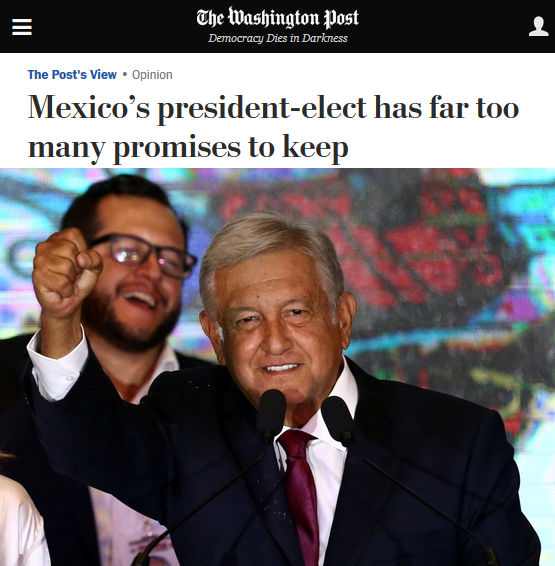
The Washington Post (7/2/18) fears Lopez Obrador “reversing the hard-won 
progress of his predecessors in shifting the statist, autocratic Mexico of the 
20th century toward a modernizing liberal democracy.”

The Washington Post (7/2/18) editorialized on AMLO’s win:

"It may be that Mr. López Obrador’s promise of radical reform will amount to reversing the hard-won progress of his predecessors in shifting the statist, autocratic Mexico of the 20th century toward a modernizing liberal democracy. The new president…is likely to slow a partial privatization of the oil industry."

According to this perspective, privatization is synonymous with “progress.” A society advances, it would seem, when profits from and control of its resources are taken from the public and turned over to a small number of wealthy, unaccountable people.

A reference Ahmed and Semple (New York Times, 7/2/18) made to US/Mexico relations illustrates the same servile attitude to ruling-class interests:

"Mr. Trump has badgered Mexico since he announced his candidacy, criticizing its migrants, threatening to abandon the North American Free Trade Agreement and promising to build a wall between the two countries."

The ideology of pro-corporate trade deals runs so deep that the possibility of ending NAFTA is presented as being as dangerous and as contemptible as racist slurs against migrants and plans to further militarize the US/Mexico border.

Bad comparisons


Neoliberal capitalist orthodoxy bifurcates the world between believers and unbelievers, often without parsing the differences among the heretics. Thus, as I wrote for FAIR (6/26/18) shortly before Mexico’s election, Trump and López Obrador are lumped together, even though the former is a racist warmonger who has given the rich $5 trillion and has boasted of sexually assaulting women, while the latter has a record of solidarity with campesinos and indigenous people, subsidizing transit, and providing stipends to seniors and single mothers.

The Post wrote that AMLO,

"[I]s a product of the political left, but his victory is part of the global story of rising populist leaders. Like many of them, including President Trump, Mr. López Obrador promises to overturn the reigning political establishment, says he alone is capable of delivering on his far-fetched promises, and assails the media, courts, civil society groups and all others who might check his personal power.
"Like other populists, the incoming Mexican leader also has been vague and occasionally contradictory about the specific policies he may pursue, even while insisting he will bring about a “transformation” comparable to Mexico’s achievement of independence. In that, he is sure to fail; the question is how much damage he may do to the democratic system that enabled him to gain power."

Saying that AMLO is like Trump because both are “populists” in a vague, vacuous sense, is akin to putting pet food and rat poison in the same category because both are intended to be eaten by animals. While Trump calls for strict voter ID laws that will undermine democracy by disenfranchising the poor and minorities, there is a dearth of compelling evidence that López Obrador’s will do “damage…to the democratic system.”

Ahmed and Villegas claimed that,

"[T]he allure of López Obrador message is steeped in the language of nostalgia for a better time...In this way, and others, the parallels between Mr. López Obrador and President Trump are hard to ignore.
"Both men are tempestuous leaders, who are loath to concede a political fight. Both men lash out at enemies, and view the media with suspicion."

These comparisons between the two politicians are ankle-deep, overlooking as they do that Trump has sought a massive increase to the hundreds of billions of dollars that the US spends killing people around the world, while López Obrador has promised to launch a public-works program to employ 2.3 million young people and to raise pensions for the elderly.


The New York Times (7/2/18) hopes Lopez Obrador won’t be 
“a radical leftist in the mold of Venezuela’s Hugo Chávez who will send 
swarms of migrants across the border.”

The neoliberal capitalist catechism also manifests itself by maligning those who have challenged its doctrines with any degree of success. This is evident in coverage of AMLO’s win that considers the commonplace comparison between him and the late Venezuelan President Hugo Chávez. When corporate media outlets examine this analogy, they do so on the assumption that it will be bad for Mexico if López Obrador adopts policies similar to Chávez’s.

A New York Times editorial (7/2/18) asked whether López Obrador was like Chávez or Trump or both, and concludes that “unlike Mr. Chávez and Mr. Trump, the president-elect is a lifelong politician with firm faith in democracy.” The accusation that Chávez was undemocratic is false. Every election he won was certified free and fair.

When Chávez was president, the Venezuelan government launched a program called Barrio Adentro (“Inside the Neighborhood”), designed to foster mass political participation and improve public health, that proved to be “especially popular with the poorer sections of the society” (Globalizations, 1/3/13).

Ahmed and Semple write that “for as long as Mr. López Obrador has been running for president, accusations that he will sink the economy have chased him. He was likened in the news media to Hugo Chávez, the former socialist leader of Venezuela,” a comparison that the authors describe as “overblown.”

Ahmed and Semple take for granted that Chavez “[sunk] the economy,” but when Chávez was leader, Venezuela’s rates of poverty, inequality, illiteracy, child mortality and malnutrition sharply declined. If that’s what it means to “sink the economy,” one could be forgiven for hoping AMLO’s nautical skills are in line with Chávez’s.

Breaking the Siege of Gaza

Freedom Flotilla to Break Siege of Gaza

by Mazin Qumsiyeh


July 12, 2018

Love and self-sacrifice characterize the team of the ships comprising the freedom flotilla - true heroism and working against all odds.

Dozens of the local organizers in host cities like Napoli, many ground crew working on things like logistics.

Many of the ship crew who work hard to make sure the ship is always running, passengers who are joining to try to break the horrific siege on Gaza, committed reporters, donors, and friends from all over the world.

The passengers include high profile individuals from parliamentarians to doctors to authors.

Napoli Welcomes Freedom Flotilla

You can help by making sure that we get good media and social media coverage. One million children in Gaza are being poisoned by polluted waters (97% of Gaza aquifer water is polluted).

We should all speak out. We should not allow the super rich to keep getting richer by destroying the lives of millions of people.

Gaza and the rest of Palestine under colonial occupation and siege exposes the hypocrisy of governments that speak about "democracy". We ask - nay we demand - action from EVERYONE IS NEEDED NOW to help lift the siege on Gaza and to free Palestine. Action from Palestinians, from Israelis, from Internationals of all walks of life can be done now to pressure the media and governments to stop ignoring slow genocide.

To follow us and follow what is happening go to the links below and then ACT:

https://jfp.freedomflotilla.org/ (website of flotiilla)

https://www.facebook.com/FreedomFlotillaCoalition/ (facebook page of flotilla)

https://www.facebook.com/freedomflotilla.italia/ (Italia facebook page)

https://www.facebook.com/mazin.qumsiyeh.9 (my own facebook page)

We For Gaza statement http://we4gaza.org/

https://www.globalresearch.ca/freedom-flotilla-a-humanitarian-journey-to-gaza/5647095

(statement from Dr. Swee who is joining the boats)

https://www.ilmattino.it/napoli/politica/freedom_flotilla_napoli_insieme_diritti_umani-3850256.html

(La Freedom Flotilla sbarca a Napoli: «Insieme per i diritti umani»)


Stay Human


Mazin Qumsiyeh
A bedouin in cyberspace, a villager at home
Professor, Founder, and (volunteer) Director
Palestine Museum of Natural History
Palestine Institute of Biodiversity and Sustainability
Bethlehem University
Occupied Palestine
http://qumsiyeh.org
http://palestinenature.org
Join me on facebook https://www.facebook.com/mazin.qumsiyeh.9
_______________________________________________
HumanRights newsletter
http://lists.qumsiyeh.org/listinfo/humanrights

Tuesday, July 10, 2018

Bulldozing the "Two-state Solution"

Israel is bulldozing Khan Al Ahmar and with it the Two-state Solution

by Jonathan Cook - Dissident Voice


July 9th, 2018

Israel finally built an access road to the West Bank village of Khan Al Ahmar last week, after half a century of delays. But the only vehicles allowed along it are the bulldozers scheduled to sweep away its 200 inhabitants’ homes.

If one community has come to symbolise the demise of the two-state solution, it is Khan Al Ahmar.

It was for that reason that a posse of European diplomats left their air-conditioned offices late last week to trudge through the hot, dusty hills outside Jerusalem and witness for themselves the preparations for the village’s destruction. That included the Israeli police viciously beating residents and supporters as they tried to block the advance of heavy machinery.

Photo: Maan News

Britain, France, Germany, Italy and Spain have submitted a formal protest. Their denunciations echoed those of more than 70 Democratic lawmakers in Washington in May – a rare example of US politicians showing solidarity with Palestinians.

It would be gratifying to believe that Western governments care about the inhabitants of Khan Al Ahmar – or the thousands of other Palestinians who are being incrementally cleansed by Israel from nearby lands but whose plight has drawn far less attention.

After all, the razing of Khan Al Ahmar and the forcible transfer of its population are war crimes.

But in truth Western politicians are more concerned about propping up the illusion of a peace process that expired many years ago than the long-running abuse of Palestinians under Israeli occupation.

Western capitals understand what is at stake. Israel wants Khan Al Ahmar gone so that Jewish settlements can be built in its place, on land it has designated as “E1”.

That would put the final piece in place for Israel to build a substantial bloc of new settler homes to sever the West Bank in two. Those same settlements would also seal off West Bank Palestinians from East Jerusalem, the expected capital of a future Palestinian state, making a mockery of any peace agreement.

The erasure of Khan Al Ahmar has not arrived out of nowhere. Israel has trampled on international law for decades, conducting a form of creeping annexation that has provoked little more than uncomfortable shifting in chairs from Western politicians.

Khan Al Ahmar’s Bedouin inhabitants, from the Jahalin tribe, have been ethnically cleansed twice before by Israel, but these war crimes went unnoticed.

The first time was in the 1950s, a few years after Israel’s creation, when 80 per cent of Palestinians had been driven from their homes to clear the path for the creation of a Jewish state.

Although they should have enjoyed the protection of Israeli citizenship, the Jahalin were forced out of the Negev and into the West Bank, then controlled by Jordan, to make way for new Jewish immigrants.

A generation later in 1967, when they had barely re-established themselves, the Jahalin were again under attack from Israeli soldiers occupying the West Bank. The grazing lands the Jahalin had relocated to with their goats and sheep were seized to build a settlement for Jews only, Kfar Adumim, in violation of the laws of war.

Ever since, the Jahalin have dwelt in a twilight zone of Israeli-defined “illegality”. Like other Palestinians in the 60 per cent of the West Bank declared under Israeli control by the Oslo peace process, they have been denied building permits, forcing three generations to live in tin shacks and tents.

Israel has also refused to connect the village to the water, electricity and sewage grids, in an attempt to make life so unbearable the Jahalin would opt to leave.

When an Italian charity helped in 2009 to establish Khan Al Ahmar’s first school – made from mud and tyres – Israel stepped up its legal battle to demolish the village.

Now, the Jahalin are about to be driven from their lands again. This time they are to be forcibly re-settled next to a waste dump by the Palestinian town of Abu Dis, hemmed in on all sides by Israeli walls and settlements.

In the new location they will be forced to abandon their pastoral way of life. As resident Ibrahim Abu Dawoud observed: “For us, leaving the desert is death.”

In another indication of the Palestinians’ dire predicament, the Trump administration is expected to propose in its long-awaited peace plan that the slum-like Abu Dis, rather than East Jerusalem, serve as the capital of a future pseudo-Palestinian state – if Israel ever chooses to recognise one.

Khan Al Ahmar’s destruction would be the first demolition of a complete Palestinian community since the 1990s, when Israel ostensibly committed to the Oslo process.

Now emboldened by Washington’s unstinting support, Benjamin Netanyahu’s government is racing ahead to realise its vision of a Greater Israel. It wants to annex the lands on which villages like Khan Al Ahmar stand and remove their Palestinian populations.

There is a minor hurdle. Last Thursday, the Israeli supreme court tried to calm the storm clouds gathering in Europe by issuing a temporary injunction on the demolition works.

The reprieve is likely to be short-lived. A few weeks ago the same court – in a panel dominated by judges identified with the settler movement – backed Khan Al Ahmar’s destruction.

The Supreme Court has also been moving towards accepting the Israeli government’s argument that decades of land grabs by settlers should be retroactively sanctioned – even though they violate Israeli and international law – if carried out in “good faith”.

Whatever the judges believe, there is nothing “good faith” about the behaviour of either the settlers or Israel’s government towards communities like Khan Al Ahmar.

Saeb Erekat, the Palestinians’ veteran peace negotiator, recently warned that Israel and the US were close to “liquidating” the project of Palestinian statehood.

Sounding more desperate than usual, the Europe Union reaffirmed this month its commitment to a two-state solution, while urging that the “obstacles” to its realisation be more clearly identifed.

The elephant in the room is Israel itself – and its enduring bad faith. As Khan Al Ahmar demonstrates all too clearly, there will be no end to the slow-motion erasure of Palestinian communities until western governments find the nerve to impose biting sanctions on Israel.

• First published in The National

 
Jonathan Cook, based in Nazareth, Israel is a winner of the Martha Gellhorn Special Prize for Journalism. His latest books are Israel and the Clash of Civilisations: Iraq, Iran and the Plan to Remake the Middle East (Pluto Press) and Disappearing Palestine: Israel's Experiments in Human Despair (Zed Books).
Read other articles by Jonathan, or visit Jonathan's website.

A Crisis of Worsening Proportions: Refugees Hitting Europe's 'Iron Curtain'

Europe’s Iron Curtain: The Refugee Crisis is about to Worsen

by Ramzy Baroud - ramzybaroud.net


July 10, 2018

A recent European Council summit in Brussels was meant to articulate a united policy on the burgeoning refugees and migrant crisis. Instead, it served to highlight the bitter divisions among various European countries. Considering the gravity of the matter, Europe’s self-serving policies are set to worsen an already tragic situation.

True, several European leaders, including Italy’s Prime Minister Giuseppe Conte, went home to speak triumphantly of a ‘great victory’, achieved through a supposedly united European position.

Italy’s Interior Minister, Matteo Salvini, used more derogatory terms in explaining his country’s new policy on refugees and migrants.

“They will only see Italy on a postcard”, he said, referring to refugees who have been arriving in Italy with the help of humanitarian rescue boats.

The first of these boats, carrying over 600 refugees and economic migrants, the Aquarius, was sent back on June 11, followed by another, carrying over 200 refugees. When Italy carried out what then seemed like excessive action, the decision erupted into a massive political controversy between Italy, France, Spain, Malta and others.

However, the pandemonium has subsided since then, as Italy’s Conte declared that, following the Brussels summit, his country ‘is no longer alone.’

What Conte, who presides over a populist, right-wing government, meant is that his country’s unwelcoming attitude towards refugees is now gathering greater European consensus.

The debate over refugees and migrants has reached the point that it has become a source of political instability in countries like Germany. The latter is not considered a ‘frontline state’, as in countries that are likely to be the first destination for refugees escaping war or poverty at home.

Austria and other countries are also caught up in the crisis, each with its own angry constituency to appease.

On paper, representatives of European countries did, in fact, reach an agreement. The real problem ensued as soon as delegations returned to their respective countries.

Despite opposition from Poland and Hungary, and Italian threats to ‘veto’ any text that is not consistent with Italian priorities, the Council agreed on four main points:

First, the establishment of disembarkation centers outside European territories, to be stationed mostly in North Africa. At that early stage, economic migrants would be separated from political asylum seekers.

This first stipulation is made hollow simply because, as the Guardian reports, “no North African country has agreed to host migrant centers to process refugee claims,” in the first place.

Second, Europeans agreed to strengthen borders control through the Frontex system.

Aside from the questionable tactics of this pan-European border police, this system has been in use for years and it is difficult to imagine how ‘strengthening’ it will translate into a more efficient or humane border control system.

Third, the Council called for the creation of ‘controlled’ refugee and migrant processing centers within Europe itself, like the North African non-existing centers, to quickly separate between refugees fleeing strife and economic migrants.

This clause was offered as a ‘voluntary’ step to be exercised by any state as it sees fit, which, again, will hardly contribute to a united European policy on the issue. Yet, despite the voluntary nature of this provision, it still stirred a political controversy in Germany.

Soon after the Council issued its final statement, Horst Lorenz Seehofer, Germany’s Interior Minister, threatened to quit Angela Merkel’s coalition government.

The German Chancellor is now under dual pressure, from within her fractious coalition, but also from without, a massive political campaign championed by the far-right party, the ‘Alternative for Germany’. In fact, the latter group’s popularity is largely attributed to its anti-immigrant sentiment.

A compromise was reached, calling for the establishment of migrant ‘transit centers’ at the German-Austrian border. However, instead of resolving a problem, the decision created another one, propelling a new controversy in Austria itself.

Austria, which also has its own populist, anti-immigrant constituency to placate, fears that the proximity of the German ‘transit centers’ would force it to receive Germany’s unwanted refugees.

"If Berlin introduced national measures, which would have a chain reaction, it could mean that Austria would have to react," Austrian Chancellor Sebastian Kurz commented in a press conference. 

The magnitude of this ‘reaction’ is, of course, to be determined later, depending on the nature of counter-pressure emanating from Austria itself.

Austria has, in fact, already threatened to shut down the Brenner Pass, connecting Italy and Austria.

The fourth, and last, decision by the European Council called for the boosting of North African economies and offering training for Libya’s coastguard.

As altruistic as the last stipulation may sound, it is, indeed, the most ridiculous, especially since it was placed on the agenda with French enthusiasm. Even if one is to ignore France’s colonial history in Africa - grounded in the notion of usurping African resources under military threat - one can hardly ignore the current role that Emmanuel Macron is playing in the current Libyan conflict.

Various media reports suggest that Macron’s government is carrying on with the legacy of intervention, initiated by the government of Nicolas Sarkozy, most notably in the military intervention of March 2011.

Libya, a failed state par excellence, is now fighting proxy wars in which France and Italy are the main players.

Bearing that in mind, it would be absurd to suggest that Macron is keen on respecting the sovereignty and supporting the economies of Libya and other North African nations.

Considering Europe’s past failures and foot dragging on the issue of refugees, it is hard to imagine that one of Europe’s greatest challenges is to be resolved as a result of the Brussels summit and its lackluster ‘agreement’.

Europe continues to view the refugee crisis in terms of security, populist pressures and national identity, as opposed to it being a global humanitarian crisis invited by wars, political strife and economic inequality. of which Europe is hardly innocent.

As long as Europe continues to operate with a skewed definition of the crisis, the crisis will continue to grow, leading to far dire consequences for all of those involved.

Ramzy Baroud is a journalist, author and editor of Palestine Chronicle. His latest book is ‘The Last Earth: A Palestinian Story’ (Pluto Press, London). Baroud has a Ph.D. in Palestine Studies from the University of Exeter and is a Non-Resident Scholar at Orfalea Center for Global and International Studies, University of California Santa Barbara. His website is www.ramzybaroud.net.
(Romana Rubeo, an Italian writer contributed to this article) 

Ramzy Baroud, Ph.D, University of Exeter, UK. Non-Resident Scholar at Orfalea Center for International Studies, UCSB.

Learn about his latest book: The Last Earth (Pluto Press, London)

Gorilla Radio with Chris Cook, Gregory Shupak, Site C Action & Accountability, Janine Bandcroft July 12, 2018

This Week on GR

by C. L. Cook - Gorilla-Radio.com


July 12th, 2018

Israel announced Monday it will seal the Kerem Shalom commercial border crossing between Gaza and Egypt.

This means Gazans, already suffering a health emergency due to the dozen years-long siege of the refugee enclave, will be subject to even greater privations.

Israel's actions fly in the face of World opinion, and repeated rulings by the United Nations, who released a report last year saying conditions in Gaza are degrading at a rate to make the Strip "unlivable" by 2020.

Listen. Hear.

Benjamin Netanyahu's proclamation comes following four months of weekly Palestinian protest at the barbed wire and earthen berm barrier near Khan Younis, where Israel has responded with a live bullet, open fire policy killing so far more than a hundred and fifty people, (including children, medics, and journalists) and maiming thousands.

The Israeli prime minister said the Kerem Shalom closure was part of a promise to redouble his efforts to "deal with Hamas with a heavier hand."

Professor Gregory Shupak is an educator, author, and essayist. Holding a doctorate in Literary Studies, Greg teaches Media Studies at the University of Guelph in Toronto. His analyses of politics and media appear across a variety of outlets online, including: Jacobin Magazine, Electronic Intifada, In These Times, Middle East Eye, TeleSUR, and at Fairness and Accuracy in Reporting among other places.

His first book, 'The Wrong Story: Palestine, Israel, and the Media' is newly released by OR books, who say it, "[L]ays bare the flaws in the way large media organizations present the Palestine–Israel issue... [revealing] ...major fallacies in the fundamental conceptions that underpin their coverage..."

Greg Shupak in the first half.

And; as British Columbia's Site C Dam project bungles along, critics who fought against it, and who's hopes the incoming government would kill it were cruelly dashed by John Horgan's NDP, have not yet begun to give up fighting. They are legion, and their arguments against Site C cite its environmental, economic, constitutional, and geological failures.

Site C Action & Accountability for a dam site too far in the second half.


And; Victoria-based activist and CFUV Radio broadcaster at-large, Janine Bandcroft will be here at the bottom of the hour with the Left Coast Events Bulletin of some of the good things to be gotten up to in and around our town in the coming week. But first, Greg Shupak and getting the Wrong Story on Palestine right.

Chris Cook hosts Gorilla Radio, airing live every Thursday between 11-Noon Pacific Time. In Victoria at 101.9FM, and on the internet at: http://cfuv.uvic.ca.  He also serves as a contributing editor to the web news site, http://www.pacificfreepress.com. Check out the GR blog at: http://gorillaradioblog.blogspot.ca/

A Crisis of Humanity Fueled by War and Injustice

Immigration Crisis Fueled by Wars and Economic Injustice

by PressTV


July 7, 2018

Interview with Voices for Creative Nonviolence co-coordinator Brian Terrell, aired on Press TV, Iranian international news network, on July 7.


“If we really want to end this refugee crisis we need to stop bombing and robbing people around the globe. There simply isn’t any other solution. More important than any immigration reform, we need to end these wars, end these economic policies and allow the people of Central America, Iraq, Syria, Afghanistan and Mexico to live and raise their families in peace.”

This interview with Voices for Creative Nonviolence co-coordinator Brian Terrell was aired on Press TV, Iranian international news network, on July 7.

Gaza As Bell Jar: Israel Seals Last Access to Besieged Enclave

Israel Shuts Vital Crossing, But Gazans Will Not ‘Die in Silence’

by TRNN


July 10, 2018

Israel has intensified its crippling blockade of the Gaza Strip by closing the only crossing for commercial goods. As mass Palestinian protests enter their fourth month, Israel is intensifying its already-crippling blockade of the Gaza Strip. Prime Minister Benjamin Netanyahu says Israel will close Kerem Shalom, the only crossing for commercial goods into Gaza. This will ban all imports and exports on top of the sweeping besiegement already in place.

Israel is also reducing the fishing zone for Gazans off the Mediterranean coast to just six miles out, down from nine. More actions are said to be coming. This comes as Israeli forces continue to open fire on Palestinians taking part in the Great March of Return.

The Gaza Health Ministry says that overall, 136 Palestinians have been killed, and more than 15600 injured. Israeli forces killed at least one Palestinian and wounded nearly 400 on Friday. The blockade and casualties have overwhelmed Gaza’s crippled healthcare system, which the UN warns is already at a breaking point.


Former Gaza health minister Dr. Basem Naim discusses the impact on a devastated health system and says that Palestinians will continue their weekly protests for freedom

Sunday, July 08, 2018

Addressing Hatred: An Open Letter to the People of Britain

An Open Letter to the People of Britain

by Vasily Livanov, MBE - Off Guardian


July 6, 2018

This open letter, from iconic Russsian actor Vasily Livanov MBE, was first sent to The Guardian. They declined to publish it, we did not. 

As with many of my compatriots, there are many things about Britain and the British people that I admire. As someone whose whole life has been linked with literature, cinema and theatre, I have the greatest appreciation for English literature and the arts, for its writers and playwrights, actors and directors.

As someone who had the good fortune to have played the iconic Englishman Sherlock Holmes in a very successful Soviet film series, I was honoured to have been awarded an MBE by Her Majesty Queen Elizabeth II. I am grateful for a chance to have been part of the mutually enriching cultural kinship and synergy of our two countries.

As someone who has lived a long life, I vividly remember the years of WWII when the Soviet Union and Britain were staunch and proud allies in the fight against Nazism.

Many Russians feel an affinity with many things English – from pubs and gardens to Scotch whisky and Welsh singing and luscious valleys. Ascot races, Chelsea flower shows, London museums and Stonehenge – many will have been or at least seen them on TV. Perhaps surprisingly, many entertain a lively interest in the British monarchy and the Royal family, Russian television and papers carry stories about the Queen and her grandchildren and great-grandchildren. Flattering stereotypes of Britain still abide. But more and more this idyllic picture is being marred by the political developments of recent years.

Today, as many of my compatriots, I am sad to see the state to which the relationship between our two countries has been reduced. While conflict situations can seldom be blamed on one party alone, I am convinced that the current deplorable and deepening crisis is primarily of London’s making.

Please do not make the mistake of writing this view off as a casualty of devious Kremlin propaganda. On the contrary, the view I hold and share with the vast majority of Russians has been shaped and honed, paradoxically, by incessant anti-Russian propaganda emanating from London’s corridors of power and the media that seems to have lost all capacity for independent reasoning, at least for anything Russian. Many in Britain may be surprised that Russian audiences are kept well informed of the international media coverage, certainly insofar as it concerns their country.

I do not intend to dwell on the long list of geostrategic and political differences between Moscow and London. Surely, each of side has its own interests and reasons for acting the way it does. Understanding these reasons is the job of respective governments and their foreign policy thinktanks. Manifestly refusing to understand those reasons is an abject failure of government. And that, I am sad to say, is exactly what I am seeing at the top of the British government and in much of the British press.

What we have been witnessing is London’s – and, more generally, Western – consistent refusal to treat post-Soviet Russia as an equal partner in international affairs.

The more hawkish Western capitals – notably, London – have been trying to condemn Russia to be the defeated party in the Cold War, and to behave like one.

Mind you, this is a view taken by most Russians who are also increasingly convinced that the West’s attacks are not directed at Putin or the Kremlin, but at their country as such, at the people and state of Russia.

Many will point to Crimea as proof of Russia’s aggressiveness and threat to world peace. But they should consider that Crimea, rather than being the cause, is a consequence of the total collapse of East-West dialogue in which London has played a significant role and often been the cheerleader.

More importantly, it is, in the final count, down to the people of Crimea to decide where they want to be, certainly not to London or Washington.

The accusations London has been flinging at Russia’s door fly in the face of every complimentary stereotype that Russians have of Britain and its allegedly gentlemanly culture. People at the top of the British government have been talking down to Russians as some kind of ‘lesser people’ in a language that invokes the less flattering pages of the not so distant British imperial history.

PM Theresa May accusing Russia in the Skripals poisoning without any serious evidence was downright shameless. Foreign Secretary Boris Johnson likening Russia’s upcoming World Cup to Hitler’s 1936 Olympics was the ultimate insult – not only to Russia, but to Britain itself and the rest of the anti-Hitler coalition. Defence Secretary Gavin Williamson telling Russia to ‘shut up and go away’- does he even realise whom he is trying to bully? You can criticise Moscow all you want but it has never stooped to this level in talking to sovereign nations, big or small. Is an acute crisis in British education the reason for this excuse for statesmanship? What sort of policy do they think they are pursuing, what kind of world they are shaping? I feel genuinely sorry for Her Majesty the Queen that she has to call this government her own.

The current explosion of Russophobia and anti-Russian hysteria in Britain has no precedent in living memory. Not even the Cold War saw such blatant disregard for the norms and conventions of inter-state diplomacy. Anyone who calls for a meaningful engagement with Russia is branded a dangerous radical or traitor. People who even agree to talk to the Russian media are ostracised and side-lined. Anyone who simply calls for restraint or caution is vilified as a Putin puppet. Is there a name for it already? Un-British activities? A curious yet deeply troubling throwback to the McCarthy era in modern-day enlightened Britain.

It’s hard to escape the timing of this latest chapter in London’s lengthy anti-Russian saga with a crucial stage of the North Stream 2 project, the football World Cup and of course the recent presidential election in Russia. Which only goes to show that the instigators are quite ignorant of what the Russian people are like. Any hostile moves from the outside will unite us, we come together and find a response. They wouldn’t have attempted it if they knew the first thing about what makes Russia tick. They have to realise that in their poisonous campaign they are engaging not just the Kremlin or Putin, they are taking on the whole of the Russian people, including its political class and business elite.

We have no beef with the people of Britain. From what we can glimpse, more and more of them are sceptical of the anti-Russian propaganda spewed by the hawks in government and much of the media. The current cold winds will die down and our two countries will revert to a civilised and respectful relationship which has so much to offer. As a proud recipient of the Most Excellent Order of the British Empire I aspire to wise and dignified British statesmanship that will make it possible.

Vasily Livanov, is a legendary Russian actor, director and novelist, born in 1935. He was awarded an MBE by Queen Elizabeth in 2006 for his exceptional portrayal of Sir Arthur Conan Doyle’s Sherlock Holmes in the hugely successful Russian film series The Adventures of Sherlock Holmes and Dr Watson.

Mazin Qumsiyeh's Dispatches from Palestine: Italy, Action, and More

Italy, Action, and More

by Mazin Qumsiyeh


July 7, 2018

Dear friends; I will be in Napoli and South Italy July 10-20 to give talks (on various topics) and support the Gaza freedom flotilla. If you are in Italy, please let me know if you can help with logistics (like arranging talk, hosting, etc).

I would like also to build relationships with museums and with universities especially on issues of biodiversity and environmental justice and human rights. Please forward this to any colleagues you know in Italy (especially south).

Israeli apartheid regime forces try to evict a Palestinian town. The Bedouins of Khan Al-Ahmar are being forcefully relocated to make way for new Israeli colonies on stolen Palestinian lands:
https://youtu.be/cq-KcushaaU

http://www.palestinechronicle.com/israeli-forces-beat-drag-woman-defending-her-village-from-demolition-videos/

Mazin Qumsiyeh speaks at homecoming of Tree Of Life


https://www.youtube.com/watch?v=LfjVdkbpyYE


Ariel Gold of Code Pink has a piece in The Forward writing about Israel's refusal to allow her entry:
https://forward.com/opinion/404719/israel-banned-me-for-documenting-the-occupation/

A no man's land: Travelling around the West Bank after nine years:
https://www.alaraby.co.uk/english/blog/2018/7/3/travelling-around-the-west-bank-after-nine-years

An Initiative to End Division and Regain National Unity:
http://masarat.ps/ar/content/initiative-end-division-and-regain-national-unity

A "plague” of intermarriage or plague of racism that is embedded in Zionism:
http://mondoweiss.net/2018/06/american-intermarriage-reflection

Ten years have passed since boats landed in Gaza August 23, 2008. What happened to those brave souls since then? Five people who have died since 2008: Hedy Epstein, Darlene Wallach, Scott Kennedy, Sister Anne Montgomery and Vittorio Arrigoni:
https://www.freegaza.org/Celebrating-Our-Ten-Year-Anniversary/
https://www.freegaza.org/Honoring-Our-Fallen-Members-Hedy-Epstein/

Walter Brueggemann: Jesus Acted Out the Alternative to Empire:
https://sojo.net/articles/walter-brueggemann-jesus-acted-out-alternative-empire

EU to supply electricity to Israeli settlements:
https://electronicintifada.net/blogs/ali-abunimah/eu-supply-electricity-israeli-settlements

Gas that rightfully belongs to the indigenous people and is stolen by the Israeli colonizers (e.g. off the coast of Gaza) will now be burned to create electricity for Cyprus and other EU countries as needed while keeping Gaza in the dark.

ACT FOR PEACE WITH JUSTICE TODAY
http://qumsiyeh.org/whatyoucando/

Stay Human

Mazin Qumsiyeh
A bedouin in cyberspace, a villager at home
Professor, Founder, and (volunteer) Director
Palestine Museum of Natural History
Palestine Institute of Biodiversity and Sustainability
Bethlehem University
Occupied Palestine
http://qumsiyeh.org
http://palestinenature.org
Join me on facebook https://www.facebook.com/mazin.qumsiyeh.9

Dances with Daggers: Assange, Russia, and the CIA

Waldman Sequel: Assange Offered to Help the CIA and the CIA Offered to Help Assange Prevent Russian Espionage

by John Helmer - Dances with Bears


June 25, 2018

Moscow - Adam Waldman, a Washington lobbyist, was authorized by Julian Assange in March of 2017 to set up a trip to Washington for Assange, and broad terms of discussion there between Assange and US Government officials of highly sensitive intelligence information, including US offers of assistance to protect Assange from “foreign espionage risks”. By that, Waldman meant Russia.

Waldman refused last week to discuss the details of his meetings with Assange and subsequent negotiations on Assange’s behalf in Washington. Late on Monday afternoon, Washington time, Waldman was reported as telling a US reporter:

“Mr. Assange offered to provide technical evidence and discussion regarding who did not engage in the DNC releases. Finally, he offered his technical expertise to the U.S. government to help address what he perceived as clear flaws in security systems that led to the loss of the U.S. cyber weapons program.” 

By “clear flaws” Assange appears to have meant flaws clear to Russia.

For Sunday’s story of the four tenors and the songs they were singing, read this.


L-R: Adam Waldman; Julian Assange; Oleg Deripaska; Luke Harding

The four stuck to stonewalling through Monday. However, at 5:45 pm Washington time, John Solomon, a journalist at TheHill.com, a specialist publication on the US Government and Congress, published a report in which Waldman revealed the extent of the disclosures Assange was offering and the rewards the US Department of Justice was considering in return. Waldman gave Solomon an interview, and also provided his emails with Justice Department officials covering the negotiations with Assange. Read the story here.

Waldman’s new tale makes it appear that although he was the go-between for Assange in London and US Government officials in Washington, the initiative may have been one which Waldman and Justice Department officials discussed before Waldman began meeting Assange in January 2017. Waldman told TheHill.com “in January 2017… Assange’s legal team approached Waldman.”

Waldman is now claiming in print that these were the terms of disclosure which Assange, the Justice Department and the Central Intelligence Agency (CIA) had agreed by March 28, 2017:

“Subject to adequate and binding protections, including but not limited to an acceptable immunity and safe passage agreement, Mr Assange welcomes the opportunity to discuss with the US government risk mitigation approaches relating to CIA documents in Wikileaks’ possession or control, such as the redaction of agency personnel in hostile jurisdictions and foreign espionage risks to Wikileaks staff.
Derived directly from this discussion of risk mitigation, Mr Assange is also prepared to discuss (within the source protection boundaries expected of a journalist and publisher operating at the highest level of integrity) (i) a description of CIA information in the possession or control of Wikileaks; (ii) the risks of third parties who may have obtained access to such information (not withstanding the foregoing, for the avoidance of doubt this category specifically and others generally will not include any information that may effect [sic] Wikileaks obligations to protect its sources) and (iii) information regarding the timing of further publications in so far they relate to the risk mitigation approaches developed”.

Waldman now says also that a Justice Department official he was working with “played to Assange’s belief that he was a publisher… he put an offer on the table from the intelligence community to help Assange assess how some hostile foreign powers might be infiltrating or harming WikiLeaks staff.”

According to Waldman on Monday,

“Mr. Assange offered to provide technical evidence and discussion regarding who did not engage in the DNC releases. Finally, he offered his technical expertise to the U.S. government to help address what he perceived as clear flaws in security systems that led to the loss of the U.S. cyber weapons program.”

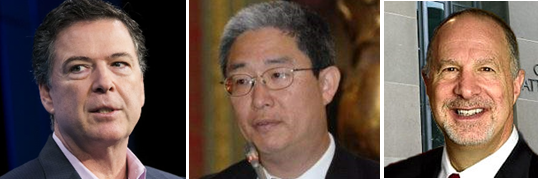
TheHill.com claims that an attempt was made by James Comey, then head of the Federal Bureau of Investigation (FBI), to “end the discussions”. This was in mid-February 2017. Waldman does not say what Comey’s reason was.


L-R: James Comey; Bruce Ohr; David Laufman

According to Waldman, Comey was overruled by lower-ranking Justice Department officials who called Comey’s attempt “bullshit”. They told Waldman, according to Waldman, to keep negotiating with Assange. The Justice Department officials whom Waldman names this week as his counterparts in the Assange deal – Bruce Ohr, David Laufman – have been reported as linked to the production of materials alleging Russian collusion in the Trump presidential campaign.

Jennifer Robinson, Assange’s London lawyer, declined to comment on Waldman’s new disclosures.