Friday, November 30, 2018

Trump Trip: Playing Politics with War and Putin

Trump cancels G20 meeting with Putin amid rising tensions

by Andre Damon - WSWS


30 November 2018
 
As world leaders head to the G20 Summit, the United States is poised to intensify its conflicts with Russia, China and Europe.

Commenting on the fast-approaching event, the German weekly Der Spiegel called American President Donald Trump the “terror” of the assembled world leaders.

No one, perhaps least of all Trump, knows the outcome of the summit in advance, or which part of the world will be the main target of US threats.

Russia


The explosive and unpredictable character of the summit was demonstrated by Trump’s hairpin turn Thursday on a planned meeting with Russian President Vladimir Putin.

“I probably will be meeting with President Putin,” Trump told reporters as he was leaving the White House for Buenos Aires.
“I think it’s a very good time to have the meeting.”

Just an hour later, Trump took to Twitter to declare that he would not meet Putin, allegedly in protest over the Russian coast guard’s seizure of three Ukrainian Navy ships after they entered and refused to leave Russian-claimed waters for 12 hours.

In the hour between the statements, Trump spoke with Secretary of State Mike Pompeo and John F. Kelly, the White House chief of staff, who were on the plane, and by telephone with National Security Adviser John Bolton.

Over that hour, another event had transpired. Michael Cohen, Trump’s former personal lawyer pled guilty to lying to Congress and declared that Trump had, in the words of the New York Times, “negotiated to build a tower in Moscow much later during the 2016 presidential election than previously acknowledged.”

Figures both inside and outside the White House made clear the connection between Trump’s trip and the latest stage in the investigation by Special Counsel Robert Mueller.

Trump lawyer Rudy Giuliani said it “is hardly coincidental” that Mueller “once again” filed charges against Cohen “just as the president is leaving for a meeting with world leaders” at the annual summit.

“The special counsel did the very same thing as the president was leaving for a world summit in Helsinki,” Giuliani noted.

A former Pentagon official under Obama drew the same connection.

“It’s all about the political optics in light of the Trump Tower Moscow news and the fact that Trump simply can’t bring himself to ever confront Putin in public,” he told the Times.

Trump’s last meeting with Putin took place in Helsinki, Finland last summer, just days after Special Counsel Mueller had indicted 12 Russian intelligence officers related to the unproven charges of Russian hacking of the Democratic Party during the 2016 election. Trump’s refusal to “confront” Putin regarding the bogus accusations was declared by most of the American and European media to be the “low point” of his administration.

Since then, Trump has substantially intensified the United States’ bellicose actions against Russia, initiating a major new round of sanctions and announcing last month that the United States would leave the Intermediate-Range Nuclear Forces (INF) treaty.

There can be little doubt that the acceleration of Mueller’s investigation and Ukraine’s triggering of a crisis in the Azov Sea were closely coordinated with sections of the US political establishment seeking a more confrontational posture by Trump against Russia.

Shockingly reckless actions are being proposed in response to the crisis. The Atlantic Council, for example, advised Ukraine to,

“invite the United States and NATO to send a fleet of armed ships to visit Mariupol, the main city on the Sea of Azov coast and defy Russia to fire on or block NATO from exercising the right to visit Ukraine’s ports. Those ships should be armed and have air cover but be instructed not to fire unless fired upon.”

China


Prior to Ukraine’s provocation, Trump’s central focus was to have been trade negotiations with China. The United States is scheduled to massively expand tariffs on Chinese goods, from the current level of 10 percent to 25 percent, on January 1.

The summit will be the first Trump has attended since US Vice President Mike Pence announced a China policy that the American press has dubbed a “new cold war,” in which the United States is actively working to block China’s development of high-value manufacturing as a strategic and military priority.

The G20 summit has been preceded by a furious anti-Chinese campaign in the American media. The New York Times this month published a scaremongering five-part series on the rise of Chinese economic influence, while, on Thursday, the Washington Post published a hysterical op-ed declaiming “China’s ominous plan to ‘penetrate and sway’ the United States.”

Even as Trump was shooting immigrant children with tear gas and rubber bullets, both newspapers ran editorials denouncing alleged Chinese human rights violations against the Uighur population of Western China.

While sections of the American press have speculated that Trump might pull back from escalating the tariffs, Trump said Monday that the prospect of any accommodations was “highly unlikely.”

Europe


Given Trump’s past behavior at international summits, further clashes with the United States’ NATO allies are entirely possible. Trump is scheduled to meet with German Chancellor Angela Merkel, who he will pressure to increase military spending, while threatening the European Union with auto tariffs.

No one can predict the exact contours of the G20 Summit and who Trump will target for military aggression, trade war, threats and intimidation. What is clear, however, is that Trump, while representing a definite faction of the US political establishment, channels the sentiments of the whole spectrum of American politics for an escalation of “great-power competition,” whether against Russia, China, Europe or all three.

Thursday, November 29, 2018

An Open Letter to Senator Sanders Re: Suspending U.S. Troop Involvement in the War on Yemen

To defeat racism and economic exploitation requires an explicit stance against militarism

by David Swanson et al - World Beyond War


November 29, 2018

David Swanson of World Beyond War sent out this open letter today in advance of a Senate vote on Senator Sanders’ bill to suspend direct U.S. troop involvement in the war on Yemen. People wishing to sign the letter can go to worldbeyondwar.org/bernie. (http://worldbeyondwar.org/bernie)

Open Letter to Bernie Sanders


We write to you as U.S. residents with great respect for your domestic policies.

We support the position of more than 25,000 people who signed a petition during your presidential campaign urging you to take on militarism.

We believe that Dr. King was correct to assert that racism, extreme materialism, and militarism needed to be challenged together rather than separately, and that this remains true.

We believe this is not only practical advice, but a moral imperative, and — not coincidentally — good electoral politics.


During your presidential campaign, you were asked repeatedly how you would pay for human and environmental needs that could be paid for with small fractions of military spending. Your answer was consistently complicated and involved raising taxes. We believe it would be more effective to more often mention the existence of the military and its price tag.

“I would cut 4% of spending on the never-audited Pentagon” is a superior answer in every way to any explanation of any tax plan.

Much of the case that we believe ought to be made is made in a video posted on your Facebook page in early 2018. But it is generally absent from your public comments and policy proposals.

Your recent 10-point plan omits any mention of foreign policy whatsoever.

We believe this omission is not just a shortcoming. We believe it renders what does get included incoherent. Military spending is well over 60% of discretionary spending. A public policy that avoids mentioning its existence is not a public policy at all. Should military spending go up or down or remain unchanged? This is the very first question. We are dealing here with an amount of money at least comparable to what could be obtained by taxing the wealthy and corporations (something we are certainly in favor of as well).

A tiny fraction of U.S. military spending could end starvation, the lack of clean water, and various diseases worldwide. No humanitarian policy can avoid the existence of the military. No discussion of free college or clean energy or public transit should omit mention of the place where a trillion dollars a year is going.

War and preparations for war are among the top destroyers, if not the top destroyer, of our natural environment. No environmental policy can ignore them.

Militarism is the top source of the erosion of liberties, and top justification for government secrecy, top creator of refugees, top saboteur of the rule of law, top facilitator of xenophobia and bigotry, and top reason we are at risk of nuclear apocalypse. There is no area of our social life that is untouched by what Eisenhower called the military industrial complex.

The U.S. public favors cutting military spending.


Even candidate Trump declared the wars since 2001 to have been counterproductive, a statement that appears not to have hurt him on election day.

A December 2014 Gallup poll of 65 nations found the United States to be far and away the country considered the largest threat to peace in the world, and a Pew poll in 2017 found majorities in most countries polled viewing the United States as a threat. A United States responsible for providing clean drinking water, schools, medicine, and solar panels to others would be more secure and face far less hostility around the world; that result would cost a fraction of what is invested in making the United States resented and disliked.

Economists at the University of Massachusetts at Amherst have documented that military spending is an economic drain rather than a jobs program.

We compliment you on your domestic policies. We recognize that the presidential primaries were rigged against you, and we do not wish to advance the baseless idea that you were fairly defeated. We offer our advice in a spirit of friendship. Some of us worked in support of your presidential campaign. Others of us would have worked, and worked hard, for your nomination had you been a candidate for peace.

SIGNED BY

Elliott Adams, Chair, Meta Peace Team, Training Team, and former President, Veterans For Peace

Christine Ahn, International Coordinator, Women Cross DMZ

Shireen Al-Adeimi, Assistant Professor, Michigan State University

Hisham Ashur, Amnesty International of Charlottesville, VA

Medea Benjamin, Cofounder, CODEPINK for Peace

Karen Bernal, Chair, Progressive Caucus, California Democratic Party

Leah Bolger, Chair of Coordinating Committee, World BEYOND War; former President, Veterans For Peace

Philip Brenner, Professor, American University

Jacqueline Cabasso, Executive Director, Western States Legal Foundation; National Co-convener, United for Peace and Justice

Leslie Cagan, peace and justice organizer

James Carroll, author of House of War

Noam Chomsky, Professor, University of Arizona; Professor (emeritus), MIT

Helena Cobban, President, Just World Educational

Jeff Cohen, Founder of FAIR and co-founder of RootsAction.org

Marjorie Cohn, activist scholar; former President, National Lawyers Guild

Gerry Condon, President, Veterans For Peace

Nicolas J.S. Davies, author, journalist

John Dear, author, Campaign Nonviolence

Roxanne Dunbar Ortiz, author

Mel Duncan, Founding Director, Nonviolent Peaceforce

Carolyn Eisenberg, Professor of History and American Foreign Policy, Hofstra University

Michael Eisenscher, National Coordinator Emeritus, U.S. Labor Against the War (USLAW)

Pat Elder, Member of Coordinating Committee, World BEYOND War

Daniel Ellsberg, author, whistleblower

Jodie Evans, co-founder CODEPINK

Rory Fanning, author

Robert Fantina, Member of Coordinating Committee, World BEYOND War

Mike Ferner, Former President, Veterans For Peace

Margaret Flowers, Co-Director, Popular Resistance

Carolyn Forché, University Professor, Georgetown University

Bruce K. Gagnon, Coordinator, Global Network Against Weapons & Nuclear Power in Space

Pia Gallegos, Former Chair, Adelante Progressive Caucus of the Democratic Party of New Mexico

Joseph Gerson (PhD), President, Campaign for Peace Disarmament and Common Security

Chip Gibbons, Journalist; Policy & Legislative Counsel, Defending Rights & Dissent

Charles Glass, author of They Fought Alone: The True Story of the Starr Brothers, British Secret Agents in Nazi-Occupied France

Van Gosse, Professor, Franklin & Marshall College

Arun Gupta, Independent Journalist

Hugh Gusterson, Professor of anthropology and international affairs, George Washington University

David Hartsough, Co-Founder, World BEYOND War

Matthew Hoh, Senior Fellow, Center for International Policy

Odile Hugonot Haber, Member of Coordinating Committee, World BEYOND War

Sam Husseini, Senior Analyst, Institute for Public Accuracy

Helen Jaccard, member, Veterans For Peace

Dahr Jamail, author, journalist

Tony Jenkins, Education Director, World BEYOND War

Jeff Johnson, President, Washington State Labor Council

Steven Jonas, M.D., M.P.H., columnist, author of The 15% Solution

Rob Kall, host, Bottom-Up Radio; publisher, OpEdnews.com

Tarak Kauff, member, Veterans For Peace; Managing Editor, Peace in Our Times

Kathy Kelly, Co-Coordinator, Voices for Creative Nonviolence

John Kiriakou, CIA torture whistleblower and former senior investigator, U.S. Senate Committee on Foreign Relations

Michael D. Knox, PhD, Chair, U.S. Peace Memorial Foundation

David Krieger, President, Nuclear Age Peace Foundation

Jeremy Kuzmarov, lecturer, Tulsa Community College; author of The Russians Are Coming Again

Peter Kuznick, Professor, American University

George Lakey, author; Co-Founder, Earth Quaker Action Team (EQAT)

Sarah Lanzman, activist

Joe Lauria, Editor-in-Chief, Consortium News

Hyun Lee, U.S. National Organizer, Women Cross DMZ

Bruce E. Levine, psychologist; author of Resisting Illegitimate Authority

Nelson Lichtenstein, Professor, UC Santa Barbara

Dave Lindorff, journalist

John Lindsay-Poland, Coordinator, Project to Stop U.S. Arms to Mexico

David Lotto, Psychoanalyst, Editor of the Journal of Psychohistory

Chase Madar, author and journalist

Eli McCarthy, Professor of Justice and Peace Studies, Georgetown University

Ray McGovern, former CIA analyst and presidential briefer

Myra MacPherson, author and journalist

Bill Moyer, Executive Director, Backbone Campaign

Elizabeth Murray, member, Veteran Intelligence Professionals for Sanity

Michael Nagler, Founder and President, the Metta Center for Nonviolence

Dave Norris, Former Mayor, Charlottesville, VA

Carol A. Paris, MD, Immediate Past President, Physicians for a National Health Program

Miko Peled, author of The General’s Son: Journey of an Israeli in Palestine

Gareth Porter, author, journalist, historian

Margaret Power, Professor, Illinois Tech

Steve Rabson, Professor Emeritus, Brown University; Veteran, United States Army

Ted Rall, cartoonist, author of Bernie

Betty Reardon, Founder, International Institute on Peace Education

John Reuwer, Member of Coordinating Committee, World BEYOND War

Mark Selden, Senior Researcher, Cornell University

Martin J. Sherwin, University Professor of History, George Mason University

Tim Shorrock, author and journalist

Alice Slater, Member of Coordinating Committee, World BEYOND War; UN NGO Rep., Nuclear Age Peace Fdn

Donna Smith, National Advisory Board Chair, Progressive Democrats of America

Gar Smith, Director, Environmentalists Against War

Norman Solomon, National Coordinator, RootsAction.org; Executive Director, Institute for Public Accuracy

Jeffrey St. Clair, Co-author, The Big Heat: Earth on the Brink

Rick Sterling, activist and journalist

Oliver Stone, filmmaker

Rivera Sun, Author and Nonviolence Strategy Trainer

David Swanson, Director, World BEYOND War; Advisory Board Member, Veterans For Peace; author of War Is A Lie

Brian Terrell, Co-Coordinator, Voices for Creative Nonviolence

Brian Trautman, National Board Member, Veterans For Peace

Sue Udry, Executive Director, Defending Rights & Dissent

David Vine, Professor, Department of Anthropology, American University

Donnal Walter, Member of Coordinating Committee, World BEYOND War

Rick Wayman, Deputy Director, Nuclear Age Peace Foundation

Barbara Wien, Professor, American University

Ann Wright, Retired U.S. Army Colonel and former U.S. diplomat who resigned in opposition to U.S. war on Iraq

Greta Zarro, Organizing Director, World BEYOND War

Kevin Zeese, Co-Director, Popular Resistance Stephen Zunes, Professor of Politics, University of San Francisco

More names are being added: https://worldbeyondwar.org/bernie

Add yours!


A Brutal War on the Children of the Middle East

The Long, Brutal U.S. War on Children in the Middle East

by Kathy Kelly - The Progressive


November 29, 2018

When children waste away to literally nothing while fourteen million people face conflict driven famine, a hue and cry—yes, a caterwaul —most certainly should be raised, worldwide.

On November 28, sixty-three U.S. Senators voted in favor of holding a floor debate on a resolution calling for an end to direct U.S. Armed Forces involvement in the Saudi-UAE coalition-led war on Yemen.

Describing the vote as a rebuke to Saudi Arabia and the Trump Administration, AP reported on Senate dissatisfaction over the administration’s response to Saudi Arabia’s brutal killing of Jamal Khashoggi last month.

Just before the Senate vote, Secretary of State Mike Pompeo called current objections to U.S. relations with Saudi Arabia “Capitol Hill caterwauling and media pile-on.”
photo: Felton Davis

The “caterwaul” on Capitol Hill reflects years of determined effort by grassroots groups to end U.S. involvement in war on Yemen, fed by mounting international outrage at the last three years of war that have caused the deaths of an estimated 85,000 Yemeni children under age five.

When children waste away to literally nothing while fourteen million people endure conflict-driven famine, a hue and cry—yes, a caterwaul —most certainly should be raised, worldwide.

How might we understand what it would mean in the United States for fourteen million people in our country to starve?

How might we understand what it would mean in the United States for fourteen million people in our country to starve? You would have to combine the populations of New York, Chicago, and Los Angeles, and imagine these cities empty of all but the painfully and slowly dying, to get a glimpse into the suffering in Yemen, where one of every two persons faces starvation.

Antiwar activists have persistently challenged elected representatives to acknowledge and end the horrible consequences of modern warfare in Yemen where entire neighborhoods have been bombed, displacing millions of people; daily aerial attacks have directly targeted Yemen’s infrastructure, preventing delivery of food, safe water, fuel, and funds. The war crushes people through aerial bombing and on-the-ground fighting as well as an insidious economic war.

Yemenis are strangled by import restrictions and blockades, causing non-payment of government salaries, inflation, job losses, and declining or disappearing incomes. Even when food is available, ordinary Yemenis cannot afford it.

Starvation is being used as a weapon of war—by Saudi Arabia, by the United Arab Emirates, and by the superpower patrons including the United States that arm and manipulate both countries.

During the thirteen years of economic sanctions against Iraq— those years between the Gulf War and the devastating U.S.-led “Shock and Awe” war that followed—I joined U.S. and U.K. activists traveling to Iraq in public defiance of the economic sanctions.

We aimed to resist U.S.- and U.K.-driven policies that weakened the Iraqi regime’s opposition more than they weakened Saddam Hussein. Ostensibly democratic leaders were ready to achieve their aims by brutally sacrificing children under age five. The children died first by the hundreds, then by the thousands and eventually by the hundreds of thousands. Sitting in a Baghdad pediatric ward, I heard a delegation member, a young nurse from the U.K., begin to absorb the cruelty inflicted on mothers and children.

“I think I understand,” murmured Martin Thomas, “It’s a death row for infants.” Children gasped their last breaths while their parents suffered a pile-up of anguish, wave after wave. We should remain haunted by those children’s short lives.

Iraq's children died amid an eerie and menacing silence on the part of mainstream media and most elected U.S. officials. No caterwauling was heard on Capitol Hill.

The Iraq children died amid an eerie and menacing silence on the part of mainstream media and most elected U.S. officials. No caterwauling was heard on Capitol Hill. But, worldwide, people began to know that children were paying the price of abysmally failed policies, and millions of people opposed the 2003 Shock and Awe war.

Still the abusive and greedy policies continue. The U.S. and its allies built up permanent warfare states to secure consistent exploitation of resources outside their own territories.

During and after the Arab Spring, numerous Yemenis resisted dangerously unfair austerity measures that the Gulf Cooperation Council and the U.S. insisted they must accept. Professor Isa Blumi, who notes that generations of Yemeni fighters have refused to acquiesce to foreign invasion and intervention, presents evidence that Saudi Arabia and the UAE now orchestrate war on Yemen to advance their own financial interests.

In the case of Saudi Arabia, Blumi states that although Crown Prince Mohammad bin Salman wants to author an IPO (International Public Offering), for the Saudi state oil company, Aramco, no major investors would likely participate. Investment firms know the Saudis pay cash for their imports, including billions of dollars’ worth of weaponry, because they are depleting resources within their own territory. This, in part, explains the desperate efforts to take over Yemen’s offshore oil reserves and other strategic assets.

Recent polls indicate that most Americans don’t favor U.S. war on Yemen. Surely, our security is not enhanced if the U.S. continues to structure its foreign policy on fear, prejudice, greed, and overwhelming military force. The movements that pressured the U.S. Senate to reject current U.S. foreign policy regarding Saudi Arabia and its war on Yemen will continue raising voices. Collectively, we’ll work toward raising the lament, pressuring the media and civil society to insist that slaughtering children will never solve problems.


Kathy Kelly is co-coordinater of Voices for Creative Nonviolence  
Read more by Kathy Kelly

Approaching Russia with Hostile Intent

Force Talks - An Approach with Hostile Intent to the Russian Frontier, Aircraft, Ships at Sea, or Troops in the Field Will Be Shot

by John Helmer - Dances with Bears


November 29, 2018

Moscow - Toward foreign enemies, for the first time in a generation, Russian officials have suspended talk of warnings, serious consequences, gravest consequences, red lines, cross-hairs, and proportionate response; they have allowed force to speak instead.

This supersedes the evidence of position, manoeuvre, prior communication, and international law, details of which are still being debated over the incidents of last Sunday off the Crimean coast between Russian and Ukrainian forces.

The message of the Russian armed forces command – Defence Minister Sergei Shoigu, the General Staff, the Defence Ministry, the Border Force of the Federal Security Service (FSB); in short, the Stavka – is clear and unequivocal: anyone approaching Russian territory with hostile intent will be shot. There is an important corollary: the Russian side reserves the right to decide unilaterally what is hostile intent.

President Vladimir Putin kept silent for three days. There had been an “invasion”, Putin told a Moscow conference on Wednesday, of “Russian territorial waters”. It had been contrived by Ukrainian president Petro Poroshenko to boost his presidential election prospects with domestic voters, and “to sell anti-Russian sentiments” to the US and European Union. “If [the Ukrainians] want babies for breakfast, they’ll probably get babies too.”

Russia’s enemies in the western media have personalized Russian policy in the figure of Putin for so long, the significance of his reticence this time is being missed. “As we’ve seen repeatedly before, from the Crimea incidents of March 2014 to the Il-20 downing in September,” a Moscow source in the position to know comments, “the force of circumstances has overwhelmed Putin’s reluctance. He’s not speaking here of ‘understanding’, as he did recently of the Israeli Air Force. When Russian force talks, it’s no longer Putin.”

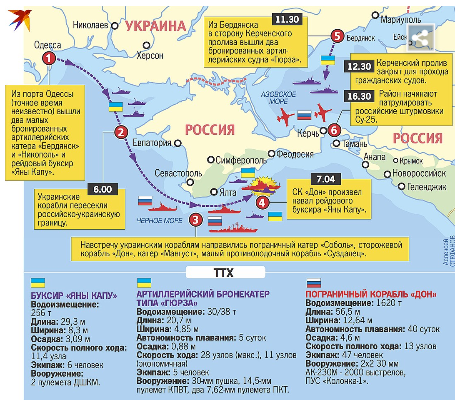
The FSB has issued a detailed chronology, with map coordinates, of the interaction between the Ukrainian Navy vessels enroute between Odessa and Mariupol, and the Russian Border Service. The sequence in time and space, and the locations, can be followed on this map, composed and published by Komsomolskaya Pravda.


Map source: https://www.kp.ru/

The FSB public bulletins can be read in the original Russian; the FSB does not translate into English. The chronology was reported on Monday, the day after the Sunday incidents. An English translation has been published here.

As the Ukrainian vessels moved towards the Crimea Bridge across the Kerch Strait, Ukrainian officers on board two of the vessels were recorded as arguing between themselves whether they should proceed into the Sea of Azov without Russian permission. When they continued on course, the Russian Border Service reports more than twelve hours of warnings – from 0720 to 2055 – during which time Ukrainian ship commanders decided to run the gauntlet of the Russian escorts, breaking out of contact and their gun range. The first Russian warning shots were fired at 2045; when they were ignored, lethally targeted shots were fired ten minutes later. The Ukrainians surrendered and were boarded by the Russians by 2115. The three vessels and crews were then disarmed and escorted to Kerch port.


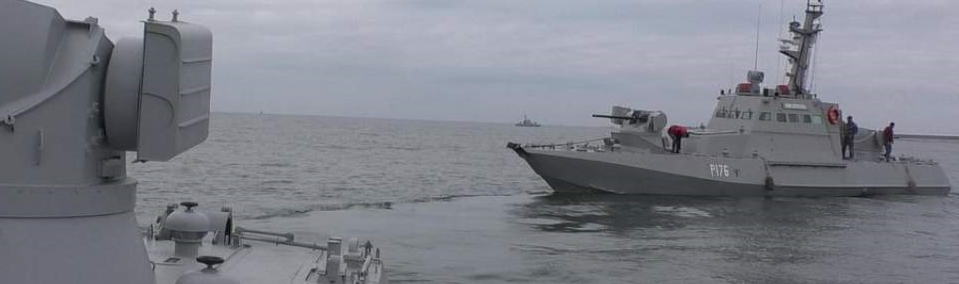
Above: The Ukrainian Navy’s Gurza-M type shallow-draught patrol boats, at sea trials in in 2016; U174 (foreground) is the Akkerman, U175 (rear) the Berdyansk; note the angle of the ship guns. Source: https://defence.pk/

Below: the Berdyansk on Sunday after Russians boarded and disarmed her. According to the FSB chronology, after ignoring Russian radio warnings to stop, the Berdyansk and U176 Nikopol had raised their main gun barrels to 45 degrees and swivelled to point them at the Russian interception vessels.


The twelve-hour interval confirms for Russian analysts that both presidents, Putin and Poroshenko, and their command staffs were directly engaged. In March 2014, Putin had warned the Ukraine and the US that militarizing Ukrainian frontier installations targeted on Russia was a red line. He repeated the warning last March.

“There are some boundaries, you know, the red line [cannot] be crossed. Let’s also respect our interests.”

The FSB’s version of the bilateral treaties and Law of the Sea provisions applying to the sequence of Sunday’s events is included in the chronology. For a German and Ukrainian academic review of the legal provisions, read this. While allowing the possibility for Ukraine to claim rights of “transit passage” or “innocent passage”, the study does not address Ukrainian Navy movements or military operations.

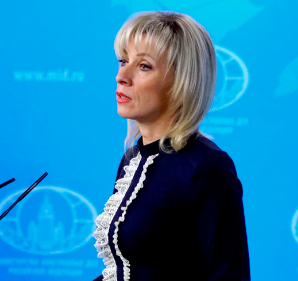
The Russian Foreign Ministry position on the recent history of Azov Sea incidents, including the capture of the Russian fishing vessel Nord eight months ago, was spelled out in detail by spokesman Maria Zakharova (right) last week, on November 22.

Zakharova also provided this official interpretation of the intentions of the Ukrainian government.

“Kiev has declared the intention to create a naval base in Berdyansk and to unilaterally delineate a new state border in the Sea of Azov in violation of international law. There is speculation about attracting NATO forces to the region. Our EU partners, who have refused to comment on this situation, should know that these activities by Ukraine have a negative effect on the situation in the region and, consequently, lead to our reply measures taken to protect the safety of Russian citizens and strategic infrastructure, including the Crimean Bridge, especially considering the threats that have been expressed not only by Ukrainian radicals and fringe groups but also by Ukrainian politicians.”

For “reply measures” the spokesman was warning Kiev of military force.

Following the Sunday incidents and the FSB’s chronology, the Foreign Ministry extended the warning to the US and the European Union:

“We are hereby issuing a warning to Ukraine that Kiev’s policy, pursued in coordination with the United States and the EU, that seeks to provoke a conflict with Russia in the waters of the Sea of Azov and the Black Sea is fraught with serious consequences. The Russian Federation will firmly curb any attempts to encroach on its sovereignty and security.” 

For “serious measures” and “curb attempts to encroach” the Ministry meant military force.

Foreign Minister Sergei Lavrov then subordinated his ministry in the chain of command to the force ministry, the FSB.

“Everything that needs to be said about it,” Lavrov said,
“is in the statements of the border service of the Federal Security Service of Russia [FSB].”

Lavrov also emphasized the hostile intention of the Ukrainian government.

“When Ukrainian officials directly, openly, and publicly called to blow up the Crimean Bridge, for some reason I did not hear Brussels urging them to restrain their representatives and stop calling for terrorist acts…”

The Defence Minister, General Staff, and the Navy have issued no press releases, although the FSB’s chronology confirms there has been coordination of operations with all the services, including the Navy and the Air Force. The Kremlin was not exactly silent about what collectively had been decided in the operations room during Sunday. On Monday evening, the Kremlin reported that German Chancellor Angela Merkel had telephoned Putin.

During the conversation, according to the communiqué, Putin “expressed the hope that Berlin would use its influence on Kiev to stop it from taking further reckless steps. It was noted that the service personnel of the Russian Coast Guard were ready to provide additional explanations of the developments in the Kerch Strait.” For “explanations of the developments” the Kremlin meant military force.

The American response so far has been wishful thinking.

“We should remember that the United States went to war with Great Britain in 1812 because of such incidents,” thundered Stephen Blank in an Atlantic Council publication titled: 'Russia’s Provocations in the Sea of Azov: What Should Be Done?'

The Kyiv Post has republished it.

According to Blank, (below) the Kiev government,

“does have options. It can undertake operations to break the blockade, though they would likely be fruitless given the forces Moscow has sent there.
Nevertheless, it cannot accept this attack on its sovereignty and integrity passively. Ukraine should give careful consideration to a special operation that might disrupt the bridge that Moscow built over the Kerch Strait that joins Crimea to Russia.
But that’s not all. Ukraine should invite the United States and NATO to send a fleet of armed ships to visit Mariupol, the main city on the Sea of Azov coast and defy Russia to fire on or block NATO from exercising the right to visit Ukraine’s ports. Those ships should be armed and have air cover but be instructed not to fire unless fired upon.”

Blank has never served in the US armed forces, nor held command posts at the Pentagon. Instead, he has made a career of fighting Russia from an armchair at the US Army’s War College, the Air Force University, and a consultancy at the CIA. Blank proposes doing what the US military, and some White House officials, contemplate doing if only they had the firepower to get away with it unscathed. But they don’t.

“This is mad”, a Russian source comments, “not blank.”

Wednesday, November 28, 2018

The Rake's Progress: Forest Service Not Planning to Follow Trump Advice

No, We Won’t be Raking Our National Forests 

by George Ochenski - CounterPunch


November 28, 2018

By now the worst wildfire in California has been extensively covered, even as rains drown the ashes and bones during the grim search for the missing.

Despite their best attempts to deceive the American public and push their commercial deforestation agenda for the timber industry, both President Trump and Interior Secretary Ryan Zinke’s comments about managing our national forests have been widely rebutted by firefighters and scientists who correctly assessed the disaster for what it was — a climate change-fueled urban fire that started in chaparral causing homes, not forests, to burn.

And no, the blame can’t credibly be laid on failures by federal forest management agencies or “environmental extremists.”

By now most Americans — and the rest of the world’s citizens — are all-too-well acquainted with Donald Trump’s propensity to lie about issues large and small. But he may have set a new low with his false claim that the president of Finland told him that they have fewer forest fires because they rake their forest floors.

To quote our very stable genius president:

“I was with the president of Finland, he said ‘We have a much different — we’re a forest nation.’ He called it a forest nation. And they spent a lot of time on raking and cleaning and doing things, and they don’t have any problem. And when it is, it’s a very small problem. So I know everybody’s looking at that to that end. And it’s going to work out, it’s going to work out well.”

It was such a blatant misrepresentation that the Finnish president himself had to clarify that he never told Trump any such thing and that, no, the Finnish people do not rake their forest floors.

To anyone with even elementary knowledge of an actual forest, the entire idea of raking the forest is ludicrous. That, of course, would exclude Trump since he’s spent most of his life in high-rise New York penthouses or on manicured golf courses.

His understanding of nature and functioning ecosystems is about on par with his claim that he has a “natural instinct” for science. Uh yeah, science is definitely an instinct — unless you’ve actually studied organic and inorganic chemistry, biology, physics and the host of other intellectually demanding disciplines that form the basis for real, not imagined, science.

If Trump had any understanding of the world he may have realized that Finland isn’t California, that a quarter of Finland lies north of the Arctic Circle where the sun never rises for 51 days during winter, that the average summer temperature hovers in the 60s, and their sub-arctic forests are blanketed in snow during the long winter months.

In truth, the forest floor is where the mycelium lives and performs its vital function of turning rotting vegetation into nutrients to return to the ecosystem, where new growth begins and sustains the vast array of flora and fauna necessary to functioning ecosystems.

That Ryan Zinke, who was raised in Montana, went along with Trump’s balderdash is even harder to take because he should know better. Then again, the way to keep a job in the Trump administration is to be, above all, “loyal” — and Zinke will obviously now say anything to keep his job.

But for the rest of us it’s another day, another Trump lie, and another ignorant mandate to “Make America Rake Again” from the bumbling and embarrassing occupant of the White House. Thanks for the great wisdom, Mr. Trump and Mr. Zinke, but no, we shouldn’t and won’t be raking the forest floors in Montana any time soon.
 
George Ochenski is a columnist for the Missoulian, where this essay originally appeared. 
More articles by:George Ochenski

The Conspiracy to "Deliver" Assange

U.K. and Ecuador Conspire to Deliver Julian Assange to U.S. Authorities

by Gareth Porter - Truthdig


November 26, 2018

The accidental revelation in mid-November that U.S. federal prosecutors had secretly filed charges against WikiLeaks founder Julian Assange underlines the determination of the Trump administration to end Assange’s asylum in the Ecuadorian Embassy in London, where he has been staying since 2012.

Behind the revelation of those secret charges for supposedly threatening U.S. national security is a murky story of a political ploy by the Ecuadorian and British governments to create a phony rationale for ousting Assange from the embassy.

The two regimes agreed to base their plan on the claim that Assange was conspiring to flee to Russia.

Trump and his aides applauded Assange and WikiLeaks during the 2016 election campaign for spreading embarrassing revelations about Hillary Clinton’s campaign via leaked DNC emails. But all that changed abruptly in March 2017 when WikiLeaks released thousands of pages of CIA documents describing the CIA’s hacking tools and techniques. The batch of documents published by WikiLeaks did not release the actual “armed” malware deployed by the CIA. But the “Vault 7” leak, as WikiLeaks dubbed it, did show how those tools allowed the agency to break into smartphones, computers and internet-connected televisions anywhere in the world—and even to make it look like those hacks were done by another intelligence service.

The CIA and the national security state reacted to the Vault 7 release by targeting Assange for arrest and prosecution. On March 9, 2017, Vice President Mike Pence called the leak tantamount to “trafficking in national security information” and threatened to “use the full force of the law and resources of the United States to hold all of those to account that were involved.”

Then came a significant change of government in Ecuador—an April 2, 2017, runoff election that brought centrist Lenin Moreno to power. Moreno’s win brought to an end the 10-year tenure of the popular leftist President Rafael Correa, who had granted Assange political asylum. For his part, Moreno is eager to join the neoliberal economic system, making his government highly vulnerable to U.S. economic and political influence.

Eleven days after Moreno’s election, CIA Director Mike Pompeo resumed the attack on Assange. He accused WikiLeaks of being a “hostile non-state intelligence service.” That was the first indication that the U.S. national security state intends to seek a conviction of Assange under the authoritarian Espionage Act of 1917, which would require the government to show that WikiLeaks did more than merely publish material.

A week later, then-Attorney General Jeff Sessions announced that arresting Julian Assange was a “priority.” The Justice Department was reportedly working on a memo detailing possible charges against WikiLeaks and Assange, including accusations that he had violated the Espionage Act.

On Oct. 20, 2017, Pompeo lumped WikiLeaks together with al-Qaida and Islamic State, arguing that all of them “look and feel like very good intelligence organizations.” Pompeo said, “[W]e are working to take down that threat to the United States.”

Moreno’s Government Under Pressure


During this time, the Ecuadorian foreign ministry was negotiating with Assange on a plan in which he would be granted Ecuadorian citizenship and diplomatic credentials, so that he could be sent to another Ecuadorian embassy in a country friendly to Assange. The Ecuadorian government reached formal agreement with Assange to that effect, and Assange was granted citizenship on Dec. 12, 2017.

But the U.K. Foreign and Commonwealth Office, which was responsive to U.S. wishes, refused to recognize Assange’s diplomatic credentials. The foreign office stated that Ecuador “knows that the way to resolve this issue is for Julian Assange to leave the embassy to face justice.” On Dec. 29, 2017, the Ecuadorian government withdrew Assange’s diplomatic credentials.

The Trump administration then took a more aggressive stance toward Assange and the policy of the Moreno government. Under Secretary of State for Political Affairs Thomas A. Shannon Jr. visited Ecuador in late February 2018, and he was followed in March by the deputy commander of the U.S. Southern Command, Gen. Joseph DiSalvo, whose task was to discuss security cooperation with the Ecuadorian military leadership.

The day after DiSalvo’s visit, the Ecuadorian government took its first major action to curtail Assange’s freedom in the London embassy. Claiming that Assange had violated a written commitment, reached in December 2017, that he not “issue messages that implied interference in relation to other states,” Ecuadorian officials cut off his access to the internet and imposed a ban on virtually all visitors. The government’s statement alluded to Assange’s meeting with two leaders of the Catalan independence movement and his public statement of support for the movement in November 2017, which had provoked the anger of the Spanish government.

Ecuador’s economic situation offered further opportunity for U.S. leverage at that time. The steep drop in the price of Ecuador’s oil exports had caused the South American nation’s politically sensitive domestic fiscal deficit to increase rapidly. In mid-June of 2018 an International Monetary Fund delegation made the organization’s first trip to Quito in many years in an effort to review the problem. A report by J.P. Morgan released immediately after the IMF’s mission suggested that it was now likely that the Moreno government would seek a loan from the IMF. The regime had previously sought to avoid such a move, because it would create potential domestic political difficulties. Seeking an IMF loan would make Ecuador more dependent than before on political support from the United States.

On the heels of that IMF visit, Vice President Pence traveled to Ecuador in June and delivered a blunt political message. An unnamed White House official issued a statement confirming that Pence had “raised the issue of Mr. Assange” with Moreno and that the two governments had “agreed to remain in close coordination on potential next steps going forward.”

In late July 2018, Moreno, then in Madrid, confirmed that he was involved in negotiations with the U.K. government on the issue of Assange’s status. The Intercept’s Glenn Greenwald reported that a source close to the Ecuadorian foreign ministry and the president’s office had warned privately that the two administrations were close to an agreement that would hand Assange over to the U.K. government. He reported further that it would depend on unidentified assurances from the United States.

The Tale of a Secret Plot Linking Assange With Russia


On Sept. 21, 2018, The Guardian published an article titled “Revealed: Russia’s secret plan to help Julian Assange escape from the UK.” In that story, Guardian reporters Stephanie Kirchgaessner, Dan Collyns and Luke Harding asserted that Russia had devised a plot to “smuggle” Assange out of the embassy in a diplomatic car and then whisk him out of the U.K. The authors also claimed that Moscow had negotiated the alleged plot with a close Ecuadorian confidant of Assange and suggested that the scheme raised “new questions about Assange’s ties to the Kremlin.”

But the story was an obvious fabrication, intended to justify the agreement to deprive Assange of his asylum in the embassy by linking him with the Kremlin. The only alleged evidence it offered was the claim by unidentified sources that the former Ecuadorian consul on London and confidant of Assange, Fidel Narvaez, had “served as a point of contact with Moscow” on the escape plan—a claim that the Narvaez had flatly denied.

A second Guardian piece published five days later implicitly acknowledged the fictitious nature of the first. It failed to even mention the earlier article’s claim that the Russians had concocted a plan to get Assange out of the embassy secretly. Instead the article, by Dan Collyns, cited a “classified document signed by Ecuador’s then-Deputy Foreign Minister Jose Luis Jacome” that showed the foreign ministry had assigned Assange to serve in the embassy in Moscow. But the author acknowledged that he had not seen the document, relying instead on a claim by Ecuadorian opposition politician Paola Vintimilla that she had seen it.

In a Sept. 28, 2018, story for ABC News, reporters James Gordon Meek, Sean Langan and Aicha El Hammar Castano reported that ABC had “reviewed and authenticated” Ecuadorian documents, including a Dec. 19, 2017, directive from the foreign ministry on posting Assange in Moscow. They noted, however, that the documents “did not indicate whether Assange knew of the Ecuadorean directive at the time.” The ABC story relied on unnamed Ecuadorian officials who, the reporters said, had “confirmed” the authenticity of those documents.

Former U.K. Ambassador Craig Murray, who had been forced out of the British diplomatic corps in 2004 for having having refused to recant his reporting about rampant torture by the Karimov regime in Uzbekistan that was then supplying the United States with military bases, was a close friend of Assange and was helping him during the negotiations on a diplomatic post.

“I was asked to undertake negotiations with a number of governments on receiving [Assange], which I did intensively from December to February last year,” Murray recalled in an email.
“Julian instructed me which governments to approach and specifically and definitively stated he did not wish to go to Russia.”

Although Murray would not identify the countries with which he had conversations about Assange, his blog and social media postings between December 2017 and March 2018 show that he had traveled to Turkey, Canada, Cuba, Jordan and Qatar.

Murray also said that, to his knowledge, Assange had never been informed of any proposed assignment in Moscow. “Neither the Ecuadorian Embassy, with whom I was working closely, nor Julian ever mentioned to me that Ecuador was organizing a diplomatic appointment to Russia,” Murray said. According to the former ambassador, the Ecuadorian Embassy correspondence with the British Foreign Office, which the embassy shared with him, did not mention a posting to Russia.

Murray believes that there are only two possible explanations for those reported documents. The first is the Ecuadorian government was working on its own plan for Assange to go to Russia without telling him, and “intended to present it as a fait accompli.” But the more likely explanation, Murray said, “is that the documents have been retrospectively faked by the Moreno government to try and discredit Julian and prepare for his expulsion, as part of Moreno’s widespread moves to ingratiate himself with the USA and UK.”

On Oct. 12, the Moreno government took a further step toward stripping Assange of asylum status by issuing a “Special Protocol” that prohibits him from any activities that could be “considered as political or interfering with the internal affairs of other states.” It further required all journalists, lawyers and anyone else who wanted to meet with Assange to disclose social media usernames and the serial number and IMEI codes of their cellphones and tablets. And it stated that that personal information could be shared with “other agencies,” according to the memorandum reported by The Guardian.

In response, Assange’s lawyers initiated a suit against the Ecuadorian foreign minister, Jose Valencia, for “isolating and muzzling him.” But it was yet another sign of the efforts by both the British and Ecuadorian governments to justify a possible move to take away Assange’s protection from extradition to the United States.

When and whether that will happen remains unclear. What is not in doubt, however, is that the Ecuadorian and British governments, working on behalf of the Trump administration, are trying to make it as difficult as possible for Julian Assange to avoid extradition by staying in the Ecuadorian Embassy.

Epstein Going Down: Billionaire Pal to Billionaire Perverts in the Spotlight

Bringing Down Jeffrey Epstein

by Derrick Broze - The Conscious Resistance


(2018 Documentary)

[The Miami Herald today, (November 28, 2018) broke a major story on Jeffrey Epstein, billionaire friend and pimp to the establishment. 'Perversion of Justice' details how Epstein uses his connections and wealth to avoid paying for his many years of criminality. - Ape]


Corruption. It comes in many forms. Theft. Bribery. Lies. Sometimes this corruption can lead to powerful people getting away with crimes. Unfortunately, the American people have grown accustomed to seeing politicians and the wealthy get away with all sorts of criminal and immoral acts.

Where the average person might suffer a loss of reputation, monetary fines, or even jail time, the well-connected class are often able to weasel their way out

A perfect example of this corruption can be found in the disturbing tale of Jeffrey Epstein, a convicted sex offender and billionaire who thus far has escaped any major consequences for performing sexual acts on teenage girls.

Despite facing criminal charges a decade ago, Epstein was able to dodge any major repercussions and prison time. Now, with a federal lawsuit looming on the horizon, the truth about Epstein may finally see the light of day. To date, this lawsuit, and the chance to publicize the truth, offers the best chance at Bringing Down Jeffrey Epstein.

The Conscious Resistance Networks presents:

Bringing Down Jeffrey Epstein


Written by Derrick Broze, Edited and Produced by Jeremy Martin

 Sources and Transcript: http://theconsciousresistance.com/201... 

 Find more videos like this at: www.theconsciousresistance.com


The Conscious Resistance Network is an independent media organization focused on empowering individuals through education, philosophy, health, and community organizing.

We work to create a world where corporate and state power does not rule over the lives of free human beings.

Our work is supported by SmartCash, the business focused, user-friendly & decentralized crypto-currency. www.smartcash.cc

Support our work: Patreon.com/DerrickBroze

Guardian Lays Groundwork for Assange Assault

Guardian ups its vilification of Julian Assange 

by Jonathan Cook


28 November 2018

It is welcome that finally there has been a little pushback, including from leading journalists, to the Guardian’s long-running vilification of Julian Assange, the founder of Wikileaks.

Reporter Luke Harding’s latest article, claiming that Donald Trump’s disgraced former campaign manager Paul Manafort secretly visited Assange in Ecuador’s embassy in London on three occasions, is so full of holes that even hardened opponents of Assange in the corporate media are struggling to stand by it.

Faced with the backlash, the Guardian quickly – and very quietly – rowed back its initial certainty that its story was based on verified facts. Instead, it amended the text, without acknowledging it had done so, to attribute the claims to unnamed, and uncheckable, “sources”.

The propaganda function of the piece is patent. It is intended to provide evidence for long-standing allegations that Assange conspired with Trump, and Trump’s supposed backers in the Kremlin, to damage Hillary Clinton during the 2016 presidential race.

The Guardian’s latest story provides a supposedly stronger foundation for an existing narrative: that Assange and Wikileaks knowingly published emails hacked by Russia from the Democratic party’s servers. In truth, there is no public evidence that the emails were hacked, or that Russia was involved. Central actors have suggested instead that the emails were leaked from within the Democratic party.

Nonetheless, this unverified allegation has been aggressively exploited by the Democratic leadership because it shifts attention away both from its failure to mount an effective electoral challenge to Trump and from the damaging contents of the emails. These show that party bureaucrats sought to rig the primaries to make sure Clinton’s challenger for the Democratic nomination, Bernie Sanders, lost.

To underscore the intended effect of the Guardian’s new claims, Harding even throws in a casual and unsubstantiated reference to “Russians” joining Manafort in supposedly meeting Assange.

Manafort has denied the Guardian’s claims, while Assange has threatened to sue the Guardian for libel.

‘Responsible for Trump’


The emotional impact of the Guardian story is to suggest that Assange is responsible for four years or more of Trump rule. But more significantly, it bolsters the otherwise risible claim that Assange is not a publisher – and thereby entitled to the protections of a free press, as enjoyed by the Guardian or the New York Times – but the head of an organisation engaged in espionage for a foreign power.

The intention is to deeply discredit Assange, and by extension the Wikileaks organisation, in the eyes of right-thinking liberals. That, in turn, will make it much easier to silence Assange and the vital cause he represents: the use of new media to hold to account the old, corporate media and political elites through the imposition of far greater transparency.

The Guardian story will prepare public opinion for the moment when Ecuador’s rightwing government under President Lenin Moreno forces Assange out of the embassy, having already withdrawn most of his rights to use digital media.

It will soften opposition when the UK moves to arrest Assange on self-serving bail violation charges and extradites him to the US. And it will pave the way for the US legal system to lock Assange up for a very long time.

For the best part of a decade, any claims by Assange’s supporters that avoiding this fate was the reason Assange originally sought asylum in the embassy was ridiculed by corporate journalists, not least at the Guardian.

Even when a United Nations panel of experts in international law ruled in 2016 that Assange was being arbitrarily – and unlawfully – detained by the UK, Guardian writers led efforts to discredit the UN report. See here and here.

Now Assange and his supporters have been proved right once again. An administrative error this month revealed that the US justice department had secretly filed criminal charges against Assange.

Heavy surveillance


The problem for the Guardian, which should have been obvious to its editors from the outset, is that any visits by Manafort would be easily verifiable without relying on unnamed “sources”.

Glenn Greenwald is far from alone in noting that London is possibly the most surveilled city in the world, with CCTV cameras everywhere. The environs of the Ecuadorian embassy are monitored especially heavily, with continuous filming by the UK and Ecuadorian authorities and most likely by the US and other actors with an interest in Assange’s fate.

The idea that Manafort or “Russians” could have wandered into the embassy to meet Assange even once without their trail, entry and meeting being intimately scrutinised and recorded is simply preposterous.

According to Greenwald:

“If Paul Manafort … visited Assange at the Embassy, there would be ample amounts of video and other photographic proof demonstrating that this happened. The Guardian provides none of that.”

Former British ambassador Craig Murray also points out the extensive security checks insisted on by the embassy to which any visitor to Assange must submit. Any visits by Manafort would have been logged.

In fact, the Guardian obtained the embassy’s logs in May, and has never made any mention of either Manafort or “Russians” being identified in them. It did not refer to the logs in its latest story.

Murray:

“The problem with this latest fabrication is that [Ecuador’s President] Moreno had already released the visitor logs to the Mueller inquiry. Neither Manafort nor these “Russians” are in the visitor logs …
What possible motive would the Ecuadorean government have for facilitating secret unrecorded visits by Paul Manafort? Furthermore it is impossible that the intelligence agency – who were in charge of the security – would not know the identity of these alleged “Russians”.

No fact-checking


It is worth noting it should be vitally important for a serious publication like the Guardian to ensure its claims are unassailably true – both because Assange’s personal fate rests on their veracity, and because, even more importantly, a fundamental right, the freedom of the press, is at stake.

Given this, one would have expected the Guardian’s editors to have insisted on the most stringent checks imaginable before going to press with Harding’s story. At a very minimum, they should have sought out a response from Assange and Manafort before publication. Neither precaution was taken.

I worked for the Guardian for a number of years, and know well the layers of checks that any highly sensitive story has to go through before publication. In that lengthy process, a variety of commissioning editors, lawyers, backbench editors and the editor herself, Kath Viner, would normally insist on cuts to anything that could not be rigorously defended and corroborated.

And yet this piece seems to have been casually waved through, given a green light even though its profound shortcomings were evident to a range of well-placed analysts and journalists from the outset.

That at the very least hints that the Guardian thought they had “insurance” on this story. And the only people who could have promised that kind of insurance are the security and intelligence services – presumably of Britain, the United States and/or Ecuador.

It appears the Guardian has simply taken this story, provided by spooks, at face value. Even if it later turns out that Manafort did visit Assange, the Guardian clearly had no compelling evidence for its claims when it published them. That is profoundly irresponsible journalism – fake news – that should be of the gravest concern to readers.

A pattern, not an aberration


Despite all this, even analysts critical of the Guardian’s behaviour have shown a glaring failure to understand that its latest coverage represents not an aberration by the paper but decisively fits with a pattern.

Glenn Greenwald, who once had an influential column in the Guardian until an apparent, though unacknowledged, falling out with his employer over the Edward Snowden revelations, wrote a series of baffling observations about the Guardian’s latest story.

First, he suggested it was simply evidence of the Guardian’s long-standing (and well-documented) hostility towards Assange.

“The Guardian, an otherwise solid and reliable paper, has such a pervasive and unprofessionally personal hatred for Julian Assange that it has frequently dispensed with all journalistic standards in order to malign him.”

It was also apparently evidence of the paper’s clickbait tendencies:

“They [Guardian editors] knew that publishing this story would cause partisan warriors to excitedly spread the story, and that cable news outlets would hyperventilate over it, and that they’d reap the rewards regardless of whether the story turned out to be true or false.”

And finally, in a bizarre tweet, Greenwald opined, “I hope the story [maligning Assange] turns out true” – apparently because maintenance of the Guardian’s reputation is more important than Assange’s fate and the right of journalists to dig up embarrassing secrets without fear of being imprisoned.


Glenn Greenwald
The reason it will be so devastating to the Guardian if this story turns out false is because the Guardian has an institutional hatred for Assange. They've proven they'll dispense with journalistic standards for it. And factions within Ecuador's government know they can use them.

Glenn Greenwald
I think the Guardian is an important paper with great journalists. I hope the story turns out true. But the skepticism over this story is very widespread, including among Assange's most devoted haters, because it's so sketchy. If Manafort went there, there's video. Let's see it.

Deeper malaise


What this misses is that the Guardian’s attacks on Assange are not exceptional or motivated solely by personal animosity. They are entirely predictable and systematic. Rather than being the reason for the Guardian violating basic journalistic standards and ethics, the paper’s hatred of Assange is a symptom of a deeper malaise in the Guardian and the wider corporate media.

Even aside from its decade-long campaign against Assange, the Guardian is far from “solid and reliable”, as Greenwald claims. It has been at the forefront of the relentless, and unhinged, attacks on Labour leader Jeremy Corbyn for prioritising the rights of Palestinians over Israel’s right to continue its belligerent occupation. Over the past three years, the Guardian has injected credibility into the Israel lobby’s desperate efforts to tar Corbyn as an anti-semite. See here, here and here.

Similarly, the Guardian worked tirelessly to promote Clinton and undermine Sanders in the 2016 Democratic nomination process – another reason the paper has been so assiduous in promoting the idea that Assange, aided by Russia, was determined to promote Trump over Clinton for the presidency.

The Guardian’s coverage of Latin America, especially of populist leftwing governments that have rebelled against traditional and oppressive US hegemony in the region, has long grated with analysts and experts. Its especial venom has been reserved for leftwing figures like Venezuela’s Hugo Chavez, democratically elected but official enemies of the US, rather than the region’s rightwing authoritarians beloved of Washington.

The Guardian has been vocal in the so-called “fake news” hysteria, decrying the influence of social media, the only place where leftwing dissidents have managed to find a small foothold to promote their politics and counter the corporate media narrative.

The Guardian has painted social media chiefly as a platform overrun by Russian trolls, arguing that this should justify ever-tighter restrictions that have so far curbed critical voices of the dissident left more than the right.

Heroes of the neoliberal order


Equally, the Guardian has made clear who its true heroes are. Certainly not Corbyn or Assange, who threaten to disrupt the entrenched neoliberal order that is hurtling us towards climate breakdown and economic collapse.

Its pages, however, are readily available to the latest effort to prop up the status quo from Tony Blair, the man who led Britain, on false pretences, into the largest crime against humanity in living memory – the attack on Iraq.

That “humanitarian intervention” cost the lives of many hundreds of thousands of Iraqis and created a vacuum that destabilised much of the Middle East, sucked in Islamic jihadists like al-Qaeda and ISIS, and contributed to the migrant crisis in Europe that has fuelled the resurgence of the far-right. None of that is discussed in the Guardian or considered grounds for disqualifying Blair as an arbiter of what is good for Britain and the world’s future.

The Guardian also has an especial soft spot for blogger Elliot Higgins, who, aided by the Guardian, has shot to unlikely prominence as a self-styled “weapons expert”. Like Luke Harding, Higgins invariably seems ready to echo whatever the British and American security services need verifying “independently”.

Higgins and his well-staffed website Bellingcat have taken on for themselves the role of arbiters of truth on many foreign affairs issues, taking a prominent role in advocating for narratives that promote US and NATO hegemony while demonising Russia, especially in highly contested arenas such as Syria.

That clear partisanship should be no surprise, given that Higgins now enjoys an “academic” position at, and funding from, the Atlantic Council, a high-level, Washington-based think-tank founded to drum up support for NATO and justify its imperialist agenda.

Improbably, the Guardian has adopted Higgins as the poster-boy for a supposed citizen journalism it has sought to undermine as “fake news” whenever it occurs on social media without the endorsement of state-backed organisations.

The truth is that the Guardian has not erred in this latest story attacking Assange, or in its much longer-running campaign to vilify him. With this story, it has done what it regularly does when supposedly vital western foreign policy interests are at stake – it simply regurgitates an elite-serving, western narrative.

Its job is to shore up a consensus on the left for attacks on leading threats to the existing, neoliberal order: whether they are a platform like Wikileaks promoting whistle-blowing against a corrupt western elite; or a politician like Jeremy Corbyn seeking to break apart the status quo on the rapacious financial industries or Israel-Palestine; or a radical leader like Hugo Chavez who threatened to overturn a damaging and exploitative US dominance of “America’s backyard”; or social media dissidents who have started to chip away at the elite-friendly narratives of corporate media, including the Guardian.

The Guardian did not make a mistake in vilifying Assange without a shred of evidence. It did what it is designed to do.

No one pays me to write these blog posts. If you appreciated it, or any of the others, please consider hitting the donate button.

Place-Making as Radical Urbanism - A City Talk with Mark Lakeman

Place-Making as Radical Urbanism - A City Talk with Mark Lakeman

by The City Talks


November 29th, 2018

UVic's Distinguished Downtown Lecture Series


Mark Lakeman, Co-Founder and Creative Director of the City Repair Project in Portland, OR, joins us at The City Talks.

Legacy Art Gallery and Cafe (630 Yates), Victoria.

November 29, at 7:30pm. 

This presentation will describe how placeless practices and landscapes that characterize modern urban planning are being actively and aggressively retrofitted through place-based citizen engagement.

Lakeman will discuss the transformation of Portland's Pioneer Courthouse Square and the movement to transform public space all over North America and Europe.

Listen. Hear.

Lakeman’s presentation will outline the practical means and technical support that is needed to transform our own urban spaces, here in Victoria.


Listen. Hear. Mark Lakeman speaks to Gorilla Radio.