Friday, April 05, 2019

Surf Before the Flood

Before the Flood

by David Rovics - Dissident Voice


April 4, 2019

I am, it might reasonably be said, a climate refugee – though a very comfortable one. Escaping the forest fires to run a little cafe in Denmark is hardly a sacrifice. But if the cafe might be a good retirement plan for me, it won’t be for my children – far too soon, the whole country in which Cafe Hellebaek is located will likely be underwater.


There is something so powerful about gazing into the distance over a large body of water. Especially when you know that water is connected to all the other water in the world’s oceans. It’s a most thought-provoking experience.

This little village on Oresund, the inlet separating Denmark from Sweden, is a place I keep coming back to. The reason is because my friends here, people I’ve now known for many years, live here, in a bit of an unconventional situation. Where they live, and where I stay most of the time when I’m in Denmark, used to be a castle. The castle burned down and was replaced by a police training academy.

When that later closed, it was purchased by my friends, who ran a school there for many years.

Now there’s no more school, and the buildings are used for many other purposes, mostly involving the act of caring for others in one form or another — whether it’s looking after troubled youth, leasing space for the local municipality to house refugees, or training volunteers to do development work in Angola and other countries around the world.

One of the aspects of touring in places where I don’t live, but visit often, is I see reality in snapshot form. I meet the baby who is a toddler only a couple visits later. I see a woman who used to come to my gigs anytime I’d play in Copenhagen when she was a teenager. Now she’s in her thirties and is a member of the Danish parliament. A lot happens in between visits.

One thing that happens is the middle-aged people get old, and the old people die. It’s very systematic, I’ve noticed over the years, and there are no exceptions to this rule. The middle-aged people who stay healthy often become very active old people, as active as ever, until they’re not, anymore, and they slow down, and eventually die.

Such was the case with my friend Lars-Peter. I met Lars-Peter and Mette when they came to a concert I was part of, a tribute to Pete Seeger in Copenhagen. Lars-Peter was a founding member of the particular strain of the folk school movement that became known as Tvind in the 1960’s. Mette came in later, as a teenage windmill-builder in the 1970’s.

I’ve mentioned the story of the windmill in a previous weekly missive, as well as in a song I wrote about it. It’s an incredible story.

When Mette was a teenager and Lars-Peter was a young man, they and hundreds of others, with the support in one form or another of thousands more, built the biggest windmill that had ever been built, and then proceeded to give away the patents for it so others could do the same. It’s a story not only of scientific breakthroughs and engineering brilliance, but of collective action of the most profound and impactful sort.

The windmill they built, Tvindkraft, is still running and providing electricity in the town of Ulfborg, in western Denmark. Far more significantly, though, this windmill became the model for industrial-scale windmills, and essentially gave birth to one of the biggest industries in Denmark — windmill-building.

Lars-Peter was one of the best storytellers I ever met. I wish I had recorded any of his stories. He died of leukemia, and in his last couple years had very little energy. But when he could get out of bed, he could still be in great storytelling form until close to the end. In his role as headmaster of a school that educated kids by taking them in buses from Denmark to India and back on a regular basis, Lars-Peter saw the world in ways that very, very few people get to do.

And when he did most of his traveling, it was in countries that were experiencing massive popular movements and, in several cases, revolutions.

Pick a country in Africa or the Middle East, Lars-Peter had lived there and seen or participated in world-historic events in it. (It’s me saying this, not him — he was far too humble a person to make such claims himself.)

Of course there are others of Lars-Peter’s generation still going strong, but the writing is on the wall. As I sit here in this little cafe beside the water that I’ll be helping to run this weekend and for most of this summer, which is part of the property the old school is on, I often think of Lars-Peter’s stories of the 1960’s around the world, and also of Mette’s wonderful tales of her experiences a bit later in the evolution of the Tvind folk school movement, when in the 1970’s she and others decided to build the windmill that changed the world. (There’s a crash course in mechanical engineering, if ever there was one.)

And then, unavoidably, my thoughts drift back to the present — and to the future. A couple Fridays ago I was hearing a news story about Greta Thunberg, about how she and other students have been skipping school every Friday to protest against their government and other governments failing to address the climate crisis with the level of commitment that would be required to actually really do something about it.

I texted my 13-year-old daughter, Leila, asking her what she was up to. I don’t normally text Leila on a Friday morning, since she usually has her phone off while she’s in school, but I had a hunch. What are you up to, I asked. She wrote me back right away with a picture of herself and some of her friends as they were marching across the Burnside Bridge, walking the two miles or so from their middle school to the other side of the river, downtown, where City Hall is located.

Hundreds of kids skipped school that day in Portland, and in many countries in Europe the numbers were much higher. On this visit to Denmark — my first since last autumn — I have discovered that the Extinction Rebellion meme has taken root among many young people here. I gave a couple young folks a ride from Odense to Copenhagen recently. One of them has spent a lot of time in the struggle against the giant coal mine devouring the Hambach Forest in Germany. The other one was often making statements along the lines of, it seems so hard to feel engaged with this topic — whatever the topic may be, as long as it doesn’t relate to the climate crisis — when in our lifetimes this whole country will be underwater.

Every time he said something like that it was obvious he really meant it — this was not an intellectual exercise for him at all. I tend to get really animated whenever I’m talking about anything that I’m remotely interested in, whether it’s related to war and peace, rent control, worker’s cooperatives, collective action, music, food, sex or whatever. But in the face of the coming flood, it’s easy to see how such passion about things other than the climate crisis can seem a bit misplaced. It can seem, even, like a form of denial.

I dropped my riders off in Copenhagen, where I was meeting up with a couple of friends — Elona, who was moving from one apartment to another, and Ask, who was helping her move, along with me and my unexpectedly gigantic rental car. Ask builds boats of the most wild description, the kinds of structures that you’ve never seen before and will always remember, if you see one in the water. He’s an expert welder and designer, but what motivates him the most is the desire to do something about the climate crisis, using his boat projects as educational tools in various ways.

He was telling me about his latest efforts, and I was telling him about my plans to run this cafe. You’re a climate refugee, he informed me. I hadn’t thought of it quite like that before. I pay rent in an apartment in Portland, Oregon, I support my family, I have work, no one is threatening my life as far as I know, the city I live in has a low crime rate, and Trump has not yet started rounding up the Left and sending us to camps. But, as I told Ask, one of the reasons I’m so keen to run this cafe is not only because I love Denmark, which I do, but because in recent years Portland has been home to the world’s worst air, on some days beating Beijing and New Delhi in that grim competition.

The main cause is the forest fires, which are getting bigger every summer, occasionally destroying whole cities, burning hotter than ever, with faster winds than ever — all climate crisis stuff, though there are many other factors involved.

I mentioned Ask’s climate refugee comment to my friend, Kamala. I’m not sure the term refugee is appropriate, I said. Temporarily displaced person, perhaps? she suggested. Thinking more about it I realized the term “climate refugee” is perfectly appropriate. As anyone knows who has followed the refugee crises in the Middle East or Latin America today, the first people to get out of a bad situation are those with the most ability to do so — the ones with friends and relatives in other countries, who are usually also the ones with good jobs, dual citizenship, and very useful things like that. We don’t think of these people as refugees as readily as we think of those who had no options but to board leaky boats in the Mediterranean or walk across the Sonoran Desert. But they’re all refugees, regardless of whether they were able to escape by means of a commercial flight, a valid passport, and a nice apartment in Denmark, or by raft or on foot, with only the shirts on their backs.

Either way, being a climate refugee in Denmark is profoundly ironic. Why? Because according to more and more widely accepted projections of what is likely to happen over the course of the next several decades, after all of the ice melts, there will be no more Denmark. The entire country will be submerged, along with the Netherlands, northern Germany, most of the eastern seaboard of the US, and so many other parts of the world. If I do end up moving with my family to Denmark to escape the world’s most toxic air, we can be fairly certain that we will become refugees again, running next time not from fire, but from flood.

Welcome to Cafe Hellebaek. Come let me make you a drink, before the flood that will likely destroy it sooner or later. The generation that built the world’s biggest windmill might not be around to see the country sink, but Ask’s generation likely will. My hope is that those who will be living through this century’s impending global cataclysms might have some brilliant new ideas for how we might navigate the waters that are rising around us, after the windmill-builders are all gone.

My hope is that people like Ask, my children and others likely to still be around at the other end of this century will still be able to sit in a cafe, sipping a hot drink and looking out at the water — wherever that cafe or that water may be, however much the flood line rises.

David Rovics is a singer-songwriter who tours regularly throughout North America, Europe, and occasionally elsewhere. Read other articles by David, or visit David's website.

Canada's "New" "Democrats" Ally with Lima Group Regime Change Gang

New Democrats Condemn the Lifting of Parliamentary Immunity for Mr. Guaido

by NDP 


April 4, 2019

NDP Foreign Affairs Critic, Guy Caron, issued the following statement:


"The NDP strongly deplores the Venezuelan constituent assembly’s decision to remove parliamentary immunity for Juan Guaido.
New Democrats are deeply concerned about politicizing judicial systems, the reversal of democratically-made decisions and the deterioration of human rights.
Only free and fair elections can bring a sustainable resolution to this political crisis, which is seriously impacting everyday life for people in Venezuela.

The Canadian government must work with its counterparts and partners to provide unconditional humanitarian aid, and ensure that available aid can enter the country and bring help to civilian populations.
The NDP reiterates its opposition to the use of force and military interventions in Venezuela; they will never be an appropriate response and will not foster political, social or economic stability.

We call on the Canadian government to show leadership and arrive at a diplomatic and peaceful solution."

Thursday, April 04, 2019

Necessary Lies of the Liberal Bourgeoisie

Muellergate and the Discreet Lies of the Bourgeoisie

by Craig Murray


April 1, 2019

This cartoon seems to me very apposite. The capacity of the mainstream media repeatedly to promote the myth that Russia caused Clinton’s defeat, while never mentioning what the information was that had been so damaging to Hillary, should be alarming to anybody under the illusion that we have a working “free media”. There are literally hundreds of thousands of mainstream media articles and broadcasts, from every single one of the very biggest names in the Western media, which were predicated on the complete nonsense that Russia had conspired to install Donald Trump as President of the United States.

I genuinely have never quite understood whether the journalists who wrote this guff believed it, whether they were cynically pumping out propaganda and taking their pay cheque, or whether they just did their “job” and chose to avoid asking themselves whether they were producing truth or lies.

I suspect the answer varies from journalist to journalist. At the Guardian, for example, I get the impression that Carole Cadwalladr is sufficiently divorced from reality to believe all that she writes. Having done a very good job in investigating the nasty right wing British Establishment tool that was Cambridge Analytica, Cadwalladr became deluded by her own fame and self-importance and decided that her discovery was the key to understanding all of world politics. In her head it explained all the disappointments of Clintonites and Blairites everywhere. She is not so high-minded however as to have refused the blandishments of the Integrity Initiative.

Luke Harding is in a different category. Harding has become so malleable a tool of the security services it is impossible to believe he is not willingly being used. It would be embarrassing to have written a bestseller called “Collusion”, the entire premiss for which has now been disproven, had Harding not made so much money out of it.


Harding’s interview with Aaron Mate of The Real News was a truly enlightening moment. The august elite of the mainstream media virtually never meet anybody who subjects their narrative to critical intellectual scrutiny. Harding’s utter inability to deal with unanticipated scepticism descends from hilarious to toe-curlingly embarrassing.


In general, since the Mueller report confirmed that $50 million worth of investigation had been unable to uncover any evidence of Russiagate collusion, the media has been astonishingly unrepentant about the absolute rubbish they have been churning out for years.

Harding and the Guardian’s story about Manafort repeatedly calling on Assange in the Ecuador Embassy is one of the most blatant and malicious fabrications in modern media history. It has been widely ridiculed, no evidence of any kind has ever been produced to substantiate it, and the story has been repeatedly edited on the Guardian website to introduce further qualifications and acknowledgements of dubious attribution, not present as originally published. But still neither Editor Katherine Viner nor author Luke Harding has either retracted or apologised, something which calls the fundamental honesty of both into question.

Manafort is now in prison, because as with many others interviewed, the Mueller investigation found he had been involved in several incidences of wrongdoing. Right up until Mueller finalised his report, media articles and broadcasts repeatedly, again and again and again every single day, presented these convictions as proving that there had been collusion with Russia.

The media very seldom pointed out that none of the convictions related to collusion. In fact for the most part they related to totally extraneous events, like unrelated tax frauds or Trump’s hush-money to (very All-American) prostitutes. The “Russians” that Manafort was convicted of lobbying for without declaration, were Ukrainian and the offences occurred ten years ago and had no connection to Trump of any kind. Rather similarly the lies of which Roger Stone stands accused relate to his invention, for personal gain, of a non-existent relationship with Wikileaks.

The truth is that, if proper and detailed investigation were done into any group of wealthy politicos in Washington, numerous crimes would be uncovered, especially in the fields of tax and lobbying. Rich political operatives are very sleazy. This is hardly news, and if those around Clinton had been investigated there would be just as many convictions and of similar kinds. it is a pity there is not more of this type of work, all the time. But the Russophobic motive behind the Mueller Inquiry was not forwarded by any of the evidence obtained.

My analysis of the Steele dossier, written before I was aware that Sergei Skripal probably had a hand in it, has stood the test of time very well. It is a confection of fantasy concocted for money by a charlatan.

We should not forget at this stage to mention the unfortunate political prisoner Maria Butina, whose offence is to be Russian and very marginally involved in American politics at the moment when there was a massive witchhunt for Russian spies in progress, that makes The Crucible look like a study in calm rationality. Ms Butina was attempting to make her way in the US political world, no doubt, and she had at least one patron in Moscow who was assisting her with a view to increasing their own political influence. But nothing Butina did was covert or sinister. Her efforts to win favour within the NRA were notable chiefly because of the irony that the NRA has been historically responsible for many more American deaths than Russia.

Any narrative of which the Establishment does not approve is decried as conspiracy theory. Yet the “Russiagate” conspiracy theory – which truly is Fake News – has been promoted massively by the entire weight of western corporate and state media. “Russiagate”, a breathtaking plot in which Russia and a high profile US TV personality collude together to take control of the most militarily powerful country in the world, knocks “The Manchurian Candidate” into a cocked hat. A Google “news search” restricts results to mainstream media outlets. Such a search for the term “Russiagate” brings 230,000 results. That is almost a quarter of a million incidents of the mainstream media not only reporting the fake “Russiagate” story, but specifically using that term to describe it.

Compare that with a story which is not an outlandish fake conspiracy theory, but a very real conspiracy.

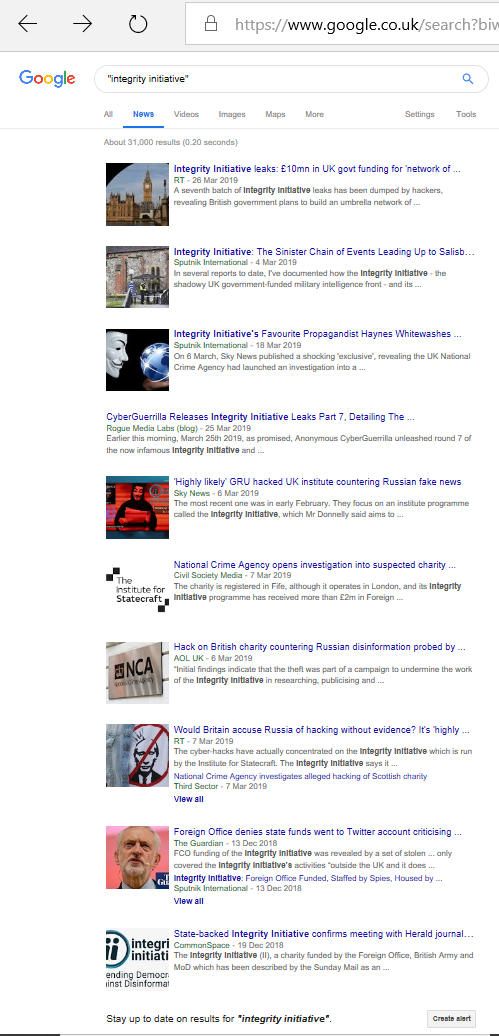
If, by contrast, you do a Google “news search” for the term “Integrity Initiative”, the UK government’s covert multi million pound programme to pay senior mainstream media journalists to pump out anti-Russian propaganda worldwide, you only get one eighth of the results you get for “Russiagate”. Because the mainstream media have been enthusiastically promoting the fake conspiracy story, and deliberately suppressing the very real conspiracy in which many of their own luminaries are personally implicated.


Furthermore – and this is a truly tremendous irony, which relates back to the cartoon at the start – only two of the top ten news results for “Integrity Initiative” come from the Western corporate media.

And this next fact comes nearly into the “too good to be true” category for my argument. Those two MSM mentions, from Sky News and the Guardian, do not complain of the covert anti-Russian propaganda campaign that is the Integrity Initiative. They rather complain that it was an alleged “Russian hack” that made the wrongdoing public!! You could not make it up, you really could not.

According to the mainstream media, it is not Hillary Clinton’s fault for conspiring with the DNC to cheat Bernie out of the nomination, it is Russia’s fault for allegedly helping to reveal it. It is not the British government’s, or their media collaborators’, fault for running a covert propaganda scheme to dupe the public of the UK and many other countries, it is the Russians’ fault for allegedly helping to reveal it!

Which brings us full circle to the DNC leak that sparked Muellergate and the claims that it was the Russians who lost Hillary the election. Robert Mueller repeats the assertion from the US security services that it was Russian hackers who obtained the DNC emails and passed them on to Wikileaks. I am telling you from my personal knowledge that this is not true.

Neither Mueller’s team, not the FBI, nor the NSA, nor any US Intelligence agency, has ever carried out any forensic analysis on the DNC’s servers. The DNC consistently refused to make them available. The allegation against Russia is based purely on information from the DNC’s own consultants, Crowdstrike.

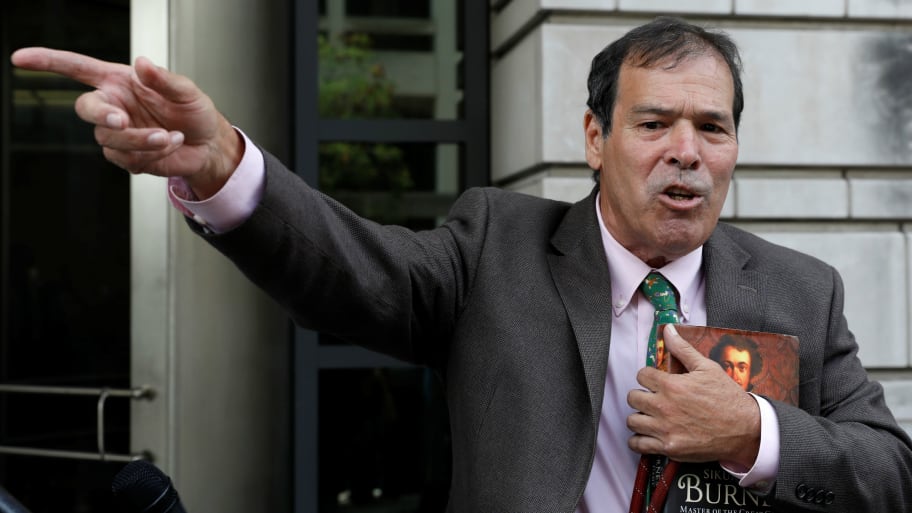
William Binney, former Technical Director of the NSA (America’s US$40 billion a year communications intercept organisation), has proven beyond argument that it is a technical impossibility for the DNC emails to have been transmitted by an external hack – they were rather downloaded locally, probably on to a memory stick. Binney’s analysis is fully endorsed by former NSA systems expert Ed Loomis. There simply are no two people on the planet more technically qualified to make this judgement. Yet, astonishingly, Mueller refused to call Binney or Loomis (or me) to testify. Compare this, for example, with his calling to testify my friend Randy Credico, who had no involvement whatsoever in the matter, but Mueller’s team hoped to finger as a Trump/Assange link.


Randy Emerges From His Evidence Session Displaying 
A Great Taste in Reading Material

The DNC servers have never been examined by intelligence agencies, law enforcement or by Mueller’s team. Binney and Loomis have written that it is impossible this was an external hack. Wikileaks have consistently stressed no state actor was involved. No evidence whatsoever has been produced of the transfer of the material from the “Russians” to Wikileaks. Wikileaks Vault 7 release of CIA documents shows that the planting of false Russian hacking “fingerprints” is an established CIA practice. Yet none of this is reflected at all by Mueller nor by the mainstream media.

“Collusion” may be dead, but the “Russiagate” false narrative limps on.


I should add it seems to me very probable Russia did make some efforts to influence the US election. I worked a a British diplomat for 20 years and spent a lot of time trying to influence political outcomes in the country in which I was posted, in Eastern Europe and in Africa. It is part of the geopolitical game. The United States is of course the world leader by a long way in attempting to influence elections abroad, spending hundreds of millions of dollars to that effect in countries including Ukraine, Georgia, Ecuador and Venezuela recently, and pretty well everywhere in Africa. It is a part of normal diplomatic life.

Mueller uncovered some high level influence-broking meetings. This is what states do. He uncovered some sleazy deals. This is what rich people do. He uncovered some US $110,000 of Facebook ad spending from Russia targeted on the USA, some of which promoted sex toys, some of which was post-election, but some of which was apparently trying to assist Trump against Clinton. Compared to the amount the USA pumps into similar arms length assistance to Putin opponents in Russia alone, it was negligible. That this tiny bit of Facebook advertising crucially impacted the US $13,000,000,000 PR campaigns of the candidates is a ludicrous proposition.

That every country stay out of every other country’s politics is arguably desirable. It is not however the status quo, and the United States is in the worst position of all to complain.

—————————————————

Unlike our adversaries including the Integrity Initiative, the 77th Brigade, Bellingcat, the Atlantic Council and hundreds of other warmongering propaganda operations, this blog has no source of state, corporate or institutional finance whatsoever. It runs entirely on voluntary subscriptions from its readers – many of whom do not necessarily agree with the articles, but welcome the alternative voice, insider information and debate.

Subscriptions to keep this blog going are gratefully received.

Canadian Law Rules For Chevron: Ecuador's "Amazonian Chernobyl"

Canadian Supreme Court denies justice to Indigenous Ecuadorians

by Common Frontiers


April 4, 2019

Today the Supreme Court of Canada dismissed the appeal in the historic case of the Indigenous people of Ecuador versus Chevron, which has become known as the “Amazonian Chernobyl” due to its devastating impact on the region.

The Ecuadorian plaintiffs seek to enforce a judgment by Ecuador’s highest court ordering Chevron to pay more than $9.5 billion dollars for clean-up of the pollution caused by deliberately negligent operation of oil fields.

The ruling represents a step backward for the Union of People Affected by Chevron-Texaco (UDAPT) of Ecuador and victims of corporate crimes around the world.

The Supreme Court of Canada could have adopted an innovative forward-looking approach with respect to corporate responsibility, justice and equity by ensuring Indigenous communities have access to justice and reparations. By denying the appeal, the Supreme court chose to continue with the interpretation of the current laws which favour corporate impunity.

“It’s regrettable that legal technicalities and the lack of money pose obstacles to access to justice for people who are victims of corporate crimes.
In spite of the decision in Canada, our quest for justice will continue, and we will initiate legal proceedings in other countries” said Willian Lucitante, Coordinator of UDAPT.

The Supreme Court of Canada previously recognized this lawsuit as public interest litigation. But the judges of the Ontario lower court declared that “[t]here is a difference between economic reality and legal reality”, so the laws in force should not be modified. If the laws are changed, the Ecuadorian lawsuit could affect Canadian companies and force them to prioritize human rights above their business interests.

Pablo Fajardo, the lawyer for the indigenous people and peasants affected by Chevron said,

“Once again, a country demonstrates that justice is structured to protect and guarantee impunity for transnational corporations. The Supreme Court of Canada did not get a chance to hear the merits of the Ecuadorian case and only resolved not to accept the appeal.
Our lawyers did not get the opportunity to explain the ramifications of Chevron's legal structure, which protects it from lawsuits by those impacted by their negligent operations. This is a disastrous precedent for social struggles, for rights and justice”.

The communities’ lawsuit for justice and reparation has been advancing through the courts for over 25 years. This trial has become an emblematic demonstration of impunity that allows transnational corporations to suffer no consequences when they violate Indigenous and human rights.

The UDAPT is a grassroots organization made up of six Indigenous Nations and more than 80 peasant communities, representing over 30,000 people affected by the oil company Texaco and their irresponsible activities in the Ecuadorian Amazon. Texaco, acquired by Chevron in 2001, contaminated more than 450.000 hectares of virgin forest.

The oil company dumped crude oil, toxic waters and polluting gases that affected ecosystems, the population’s health and cultural systems, security and food sovereignty, which increased poverty and exclusion. This contamination has had a serious impact on the health of the UDAPT community; causing the highest rates of childhood leukemia in Ecuador. Cancer deaths are one hundred and thirty percent more frequent and the mortality risk is two hundred and sixty percent higher than in other parts of Ecuador.

Cancer accounts for thirty two percent of total deaths, 3 times more than the national average. Chevron uses all means to obstruct the communities’ access to justice while the contamination of the soil and rivers of the Ecuadorian Amazon continues. Every year people die without hope of reparation for future generations.

During the past years, UDAPT along with hundreds of non-profit organizations that stand for human rights has joined with international efforts, whose aim is to lobby for the creation of a binding treaty on transnational corporations and human rights at the United Nations.

The emblematic battle of the Ecuadorians against Chevron has unveiled the structure of impunity that allows transnational corporations to get away with gross human rights violations and environmental damage.

The Dude Abides: Why Maduro Remains

Venezuela: Why Is Maduro Still In Power?

by Federico Fuentes - Venezuelanalysis


April 3, 2019

Green Left Weekly’s Federico Fuentes analyses why Maduro remains in power after recently visiting Venezuela.

For many, it is impossible to understand how, despite presiding over the country’s worst economic crisis and facing such intense international and domestic opposition, Maduro remains in the presidential palace.

The answer lies in the enduring strength of Chavismo, a political movement of the working classes that, despite predating former president Hugo Chávez, continues to take his name and political project as its own.

The refusal by Maduro’s opponents, inside and outside Venezuela, to acknowledge its existence also goes a long way to explaining why they have remained in opposition for more than two decades.

Chávez


Walking down the main street of San Fernando, capital of the border state of Apure, it did not take long for someone to come up and start talking politics. Within minutes, a group discussion had formed.

I asked them about Chávez. One responded: “Chávez didn’t come to power just because he wanted a job. He came to power because we were dying of hunger; Venezuelans were dying of hunger in the ’80s and ’90s.

“That’s why, in ’89 the barrios [poor neighbourhoods] came down the hills and looted stores to get food,” he said, referring to the February 27 Caracazo uprising, ultimately put down by brutal repression which, according to reports, left thousands dead.

Another said: “The Chávez era was the most beautiful time in Venezuelan history. Everyone was able to improve their living conditions, not just the poor but even the rich.”

“Thanks to Hugo Chávez, we have the opportunity to study, to do a postgraduate [course],” explains another.

“Universities were basically privatised. Unless you were rich you had no chance of being able to go to university.

“Chávez opened up education and started to give students uniforms, shoes, food, computers; kids are given laptops, tablets…”

A young man interrupts: “University students also get a tablet. I have one. I had never seen one before, but now I have one.”

Identity


The depth of support for Chávez among working people, however, cannot be simply explained by his association with better times.

Andreina Pino, a local activist with the Bolivar and Zamora Revolutionary Current in the rural state of Barinas, where Chávez was born, says this identification is due to Chávez’s ability to “decipher the code of the people.”

“Chávez was able to do this,” Pino explains “because he came from the people.”

“Generally, politicians in this country came from rich families and didn’t have that contact with working people.

“Chávez was able to connect with the sentiment, culture and spirituality of the Venezuelan people… He came to synthesise all of that culture, that spirituality, that history.

“Chávez not only identified with that history, he taught us history. Chávez talked about [Simón] Bolívar and our struggle for independence.

“He also began to build hope in us that we, the people, could construct our own history.

“Chávez awoke something within the people.”

Political subject


Caracas-based Argentine sociologist Marco Teruggi believes the opposition’s inability to accept or comprehend this phenomenon is why it “has been making the same error in their analysis for twenty years”.

“They don’t incorporate the existence of Chavismo as a political subject into their analysis.”

Teruggi explained that to understand Chavismo, it is important to look beyond the government and view this political movement in all its complexity.

Emerging from within the popular classes, Chavismo incorporates a gamut of political parties, social movements and organisations, and penetrates deep into the barrios and military barracks.

“We cannot begin to understand how, for instance, the economic crisis has not led to a popular explosion, if we don’t understand the deep roots that Chavismo has in the barrios, where it has generated a whole network of organisations that are very strong and that allows it to contain the situation,” said Teruggi.

“Importantly, Chavismo has its own political identity. We could say that Chavismo is an identity of a part of the popular classes”.

“Under Chavismo, the popular classes were not only able to improve their economic situation but to participate in politics, have a public voice, be protagonists.

“Only Chavismo has offered them this.

“They are defending a process that today has been dealt blows but continues to be the only project that has offered the popular classes in Venezuela a different destiny to the one they had always been condemned to — one of poverty, unemployment, exclusion and marginalisation.”

“The people are not defending Maduro; they are defending the possibility of being able to continue improving not just their economic situation but their lives in general.”

Pino agrees: “The people who continue to support Maduro understand that it’s Maduro [in these] circumstances … who is the current leader of the civic-military process.

“The right doesn’t understand this; they don’t understand that what is in dispute here is not Maduro but a project.”

No blank check


Teruggi points out, however, that “Chavismo is not a blank check. It’s not something that can be used and abused for an indefinite amount of time.”

Earlier this year, there were clear signs of this.

Atenea Jiménez, from the National Network of Comuneros, which unites people involved in numerous communes across the country, explained that, in January, between Maduro’s inauguration and Guaidó’s self-proclamation, “there were many protests … but these protests were different as they were in popular sectors, including some that have historically been very Chavista.

“These were not in middle class sectors, at least here in Caracas; they were protests by people from the barrios who do not agree with Maduro; people who are not with the opposition but who are fed up with having had to deal with this economic situation for so many years.”

Jiménez noted that the politics of the protest were, like everything in Venezuela, very complex and contradictory. Some of them “were tied to the actions of armed gangs”, while in other cases, members of the police and Bolivarian National Guard were involved.

“These protests did not have a clear leadership, they were not planned or organised by a political sector, although there were right-wing opposition sectors who tried to promote the protests because they saw them as functional to their aims of removing Maduro by any means.”

Beyond these complexities, “they were protests about the very real situations that people are facing … and in some places, where Chavistas are very angry with the difficulties of everyday life, the protests were huge.”

“Many of the people who protested feel that the government has not been capable of resolving their problems.

“They said: ‘We have given [the government] all of our votes, for the National Constituent Assembly, for governors, for mayors, all of them. So what excuse do they have for not resolving our everyday problems such as food and medicine?’.”

Teruggi notes that the current situation “cannot last forever. There needs to be responses by the government to these demands, otherwise it will lose the support it needs to stay in power.”

However, Teruggi believes Venezuelans are still some time away from reaching breaking point. “I think this is why the US is attempting to accelerate its actions against Maduro.

“Rather than continuing to … wear down support for the government through economic attacks, the US is instead promoting a parallel government…

“Even if the attacks on the economy are generating a lot of damage and Chavismo has been unable to respond … and even contributed to problems through its own errors, the overall balance of forces has maintained itself.” 

Anti-imperialism


Jiménez notes that “in other circumstances, under neoliberal governments, we would have turned this country upside down.”

“But these mass protests dissipated once Guaidó entered the political scene, because that popular force, which is discontent, that has criticism towards the government … retreated as a new variable entered into the fray.

“That new variable is imperialism.”

Guaidó’s US-backed self-proclamation, his appeals for foreign intervention and more sanctions meant that, “those spontaneous protests stopped as people began to say that this is not the way to solve our problems.

“Among the people there is a very strong anti-imperialist sentiment, independently of the position that people may have towards the government.

“Any threat of foreign intervention immediately generates within our people a spirit of struggle … people recognise that we can have our criticisms, but that this has nothing to do with [US President Donald] Trump being able to decide who our president should be.

“The roughshod manner in which the opposition has acted and its open calls for US intervention, together with the almost daily statements coming from Trump’s spokespeople, has generated a patriotic sentiment, a conviction that we will resolve this in the way that we want to resolve it.”

These sentiments were expressed by many, including one of the women who joined the discussion in San Fernando:

“We don’t want the Yankees or anyone else to get involved here. We are determined to be free. We don’t want any more interference in our country.”

“What we want is to be independent, to be sovereign and for us to be able to decide what happens to our wealth. No one else can tell us what to do with our resources.”

Another adds: “We want to resolve our problems ourselves. We are happy to accept suggestions, but good suggestions.

“Any country can come and make suggestions, but no one can impose themselves on us like the US is trying to. That’s not the way it works here. That’s not the way to help.”

“If the US wants to help us then get rid of the sanctions,” says another.

Ecuador's Assange Problem: Moreno's Mealy-Mouthed Asylum Perpetrations

Terms of Asylum and Distraction: Ecuador’s President Moreno’s “Assange Problem”

by Dr. Binoy Kampmark - Global Research


April 03, 2019

Political asylum is an accepted if often ignored right. It is also at the mercy of those interests that grant it. Ecuador’s repeated insistence on conditioning Julian Assange’s stay in its London abode is tantamount to corroding the idea of asylum to vacuity. You are granted asylum as a political dissident, but political dissident you shall not be, especially when it comes to exposing the secrets of your landlord.

Assange has ventured to test the onerous limits on his conduct that have been imposed by embassy protocols, taking the matter to the Inter-American Commission on Human Rights.

His argument has been that the strict rules applied to his stay, entailing a monitoring of visits, control of medical bills, communications, expenses and pet care were a violation of “fundamental rights and freedoms”. The Commission, as it transpired, did not bite.

The Ecuadorean response was a crowing one, arguing that the state’s treatment of Assange was in accordance with international law, and that their guest’s situation “cannot be extended indefinitely and (Ecuador) expects it to be resolved as soon as possible.”

Ecuador’s Attorney General Íñigo Salvador, summed it up in smug fashion.

“The decision was based on the fact that the request filed by Assange did not comply with the requirements of gravity, urgency and irreparable harm provided for in Article 25 of the Rules of Procedure of the IACHR.”

The peculiar twist to this, however, was that such impositions could be justified as protecting, not impairing, Assange’s rights.

“With this decision [by the Commission], the Special Protocol of Visits, Communications and Medical Care remains in force, which guarantees the rights of the asylee.”

Assange has been accused of muddying the stables throughout his stay, but the calls have become more strident over the last eighteen months. A year of muzzling and limiting Assange’s conduct has become both cruel and comical. President Lenín Moreno seems to be waiting for the moment where a final stroke of agitation will release him from any sense of restraint.

On Tuesday, that moment might have come. Moreno insisted that Assange had been a serial violator of his terms of asylum.


“We should ensure Mr Assange’s life is not at risk but he’s violated the agreement we have with him so many times.”

The Ecuadorean president, in pained tones, claimed that “photos of my bedroom, what I eat and how my wife and daughters and friends dance” had been doing the buzzing rounds on social media. While Moreno did not explicitly accuse Assange of being behind that spray of material, the accusing voice was unmistakable.

The Vice President Otto Sonnenholzner confirmed it, loudly proclaiming that what WikiLeaks had done was “repugnant”. The Minister for Foreign Affairs, José Valencia, focused on Assange’s means of communication, arguing that he had been biting the hand that had fed him.

The office of the President has also made a formal, if risible complaint to Joseph Cannataci, the special rapporteur for the right to privacy based at the UN Human Rights Council, accusing WikiLeaks and other “possible authors” of disseminating private photos and personal information obtained from Moreno’s, (right) own computers, tablets and a miscellany of devices.

Cannataci’s good offices are being used, in turn, to deal with claims by WikiLeaks that Ecuador is spying on him. The dark face continues.

The entire show of puffed indignation seemed an enormous distraction. Last week, the Ecuadorean National Assembly passed a resolution calling for a corruption probe into Moreno’s affairs regarding the INA Papers.

The INA Investment Corp of Panama fame specialises in minimising (dare one say evading?) tax, and it took a publication by digital news platform La Fuente on February 19 to suggest a link between Moreno, his family and the company. From that particular haven, it is alleged, ample funds were used from an offshore account to make an assortment of payments covering gifts, furniture purchases, and an apartment in Spain.

In the words of an official statement,

“With 74 votes, the National Assembly approved a resolution that requires the Inspection Commission to carry out an analysis of the publication dated Feb. 19, 2018, in a digital platform called ‘The Offshore Labyrinth Of The Presidential Circle.’”

A close reading of the resolution hardly suggests that Moreno is going to be in much trouble; the focus, as María José Carrión of Moreno’s own party, Alianza Pais, has explained, will involve “an analysis of this journalistic publication. It won’t be an investigation, as it’s not possible for the President to be summoned because the law is clear and for that to happen it must be within the framework of a political trial, which is not the case.”

Fidel Narváez, former consul at the Ecuador embassy in London, has a working and plausible hypothesis: the entire spectacle is being engineered to throw the curious and vigilant off the scent, one that is becoming rather piquant. Not a single document connected with the INA Papers matter has ever been personally leaked or published by Assange or WikiLeaks. The Assembly, he charges, has become a place of ludicrous activity in attempting to investigate Assange in the name of protecting “national interests”.

While the increasingly crotchety approach from the Moreno government suggests an imminent decision on his fate, Assange has not been left without some legal ammunition. The Inter-American Court of Human Rights, in a ruling issued on May 30 last year, made it clear that Assange should not only be released but granted safe passage to Ecuador as part of the right to asylum. The advisory opinion considered the right to seek and receive asylum in a foreign country pursuant to the American Convention on Human Rights (Article 22(7)) and Article XXVII of the American Declaration on the Rights and Duties of Man.

The protection against refoulement, in which a person’s life, integrity, security and/or liberty might be at risk, was held to bind States extraterritorially “whenever authorities exercise their authority or effective control over such persons, as may happen in legations, and that, by their own nature, may be in the territory of another State with that State’s consent and authorization.” But Moreno, and his colleagues are a desperate bunch, and their latest efforts suggest that scapegoating Assange and readying him for the fall might offer some measure of therapeutic relief, however brief.


Dr. Binoy Kampmark was a Commonwealth Scholar at Selwyn College, Cambridge. He lectures at RMIT University, Melbourne. He is a frequent contributor to Global Research and Asia-Pacific Research. Email: bkampmark@gmail.com

Wednesday, April 03, 2019

NATO Celebrates 70 Years of Global Domination & Democracy Suppression

The Anti-Democratic Roots of NATO

by TRNN


April 2, 2019

NATO, the North Atlantic Treaty Organization’s 70th anniversary is this week and it was met with anti-NATO protests across the world, including right here in Washington D.C. where the alliance is expected to meet this week with all the foreign ministers. On April 4th 1949, the alliance’s treaty was signed by twelve organizations and today it has grown to 29 members.


The North Atlantic Treaty Organization (NATO) must be understood from its roots, which is anti-democratic says Yves Engler, while discussing his four part print series on The Real News.

Trump's Apparatchiks: How to Steal 2020 for Dummies

Trump May Name Kris Kobach New Immigration Czar: Their Real Agenda - 2020 Vote Suppression

by Greg Palast for Nation of Change


April 3, 2019

Investigative reporter Greg Palast investigated Kris Kobach for Rolling Stone and Al Jazeera. Palast is the author of the New York Times bestseller, The Best Democracy Money Can Buy, now a feature documentary, on his investigation of Kobach and vote suppression.

When the young Kris Kobach created a computer system for the Department of Homeland Security that secretly tracked visiting Muslims, President George W. Bush was so offended that Bush personally ordered the racially offensive program shut down.

And now Kobach may have power over that Department and all others dealing with immigrants – including Justice and Defense, and the Census – if the AP report that President Donald Trump is considering making Kobach his “Immigration Czar” becomes reality.

It’s an especially cute move by Trump, as this newly crafted position, unlike an appointment to other cabinet level posts, will not require Senate approval, not even a hearing.

I’ve been investigating Kobach for six years for Al Jazeera and Rolling Stone.

Kobach is the guy who…

  • drafted Arizona’s notorious “SB 1070” law which the ACLU dubbed the, “Driving While Brown law” – found unconstitutional by Federal Courts.
  • lost another federal suit for unconstitutionally requiring proof-of-citizenship to vote. Kobach admitted, the Kansas rule did not stop even one alien from registering, but did block 36,000 citizens from voting in 2016 including two US Air Force officers. Kobach, then Kansas Secretary of State, was found in contempt of court for deliberately defying Court orders to restore voters’ rights.
  • directed the infamous Interstate Crosscheck vote purge system for 30 states. Our investigation for Rolling Stone determined that at least 1.1 million Americans, mostly voters of colors, were wrongly purged from the voter rolls before the 2016 election.
  • wrote local laws, all struck down by courts, which made it a crime to conduct business with an “illegal alien.” Kobach bamboozled towns, such as Farmers Branch, Texas, into hiring him for a failed legal defense of these racially poisonous statutes. But lawyer Kobach made out fine, racking up fees subsidized by $100,000 which the Palast investigations team traced back to the Koch brothers.

The list goes on. It was Kobach who suggested the Census include a question about non-citizens living in your home.

Trying to get straight answers from Kobach about his racially poisoned vote-purging shenanigans has not been easy. After several refusals to speak with me about our findings, in 2016, I finally tracked him down in Wichita, with my crew pretending to be from a local TV station. (We were indeed with Channel 4 … Channel 4 of London.)

Kobach, cornered, spewed out a series of flat-out lies. For example, he denied that he targeted clearly innocent voters in Kansas and Georgia as suspected “double registered” who could vote twice in one election. I showed him the computer files from his own office with the Kansas-Georgia secret hit list – and he decided to run for it – literally – while shoveling vanilla ice-cream into his mouth, yelling “Liar! Liar!” between mouthfuls.

We could dismiss Kobach as just another slap-stick huckster if he weren’t the author of mass purges of legitimate voters and laws that make anyone with brown skin a criminal suspect.

If Trump goes through with the appointment, Kobach will go well beyond ordering cruelties on families at the border. Kobach has made clear his big goal has been to remove alien voters from rolls nationwide—which he claims number over one million! Indeed, he believes that these sneaky aliens from south of the border account for much of Hillary Clinton’s popular vote victory in 2016.

Kobach, worried I’d report on his fibbing, did call me. When questioned, he could not name me two aliens who cast ballots (punishable by years of imprisonment and deportation), let alone a million, despite his years of hunting for these fantastical creatures.

But that won’t stop him from pushing for a national requirement to prove citizenship when voting. His Kansas law, which mainly blocked young – i.e. Democratic – voters, was struck down by a district court judge. But the Roberts Supreme Court, with its horrid record on voting rights, may be just what Kobach has been waiting for.

Worse, with access to Homeland Security and Census records, Kobach could give deportation lists and “non-citizen” Census files to GOP state voting officials. They could then require Americans with names like “José Garcia” to prove they are citizens.

In 2012, Florida did a test run of this purge operation, identifying some 181,000 “potential” aliens on their voter rolls. They found and convicted just one (an Austrian registered as a Republican), but scared untold numbers of Hispanics away from voting. Many lost their registration because they could not take a day to go to court to prove they are Americans.

And that’s the real danger in this “Immigration Czar” appointment: Kobach could organize the purge of young voters and voters of color by the hundreds of thousands just before the 2020 election.

For all his antics, don’t underestimate Kobach, a graduate of Harvard, Yale and Oxford. The wily lawyer and political hit-man knows that the lawsuits by voter victims wouldn’t bite until after the steal of the 2020 election.


Rolling Stone reporter Greg Palast confronts Kris Kobach with Kobach’s 
own internal files: a list of clearly innocent "duplicate voters" wrongly targeted 
for purge from voter rolls. To get close to Kobach, Palast posed as a local TV reporter. 
Wichita KS, 2016. From The Best Democracy Money Can Buy (GregPalast.com)

Greg Palast (Rolling Stone, Guardian, BBC) is the author of The New York Times bestsellers, The Best Democracy Money Can Buy and Billionaires & Ballot Bandits, now out as major motion non-fiction movie: The Best Democracy Money Can Buy: The Case of the Stolen Election, now available on Amazon and Amazon Prime. 
 

Remembering Belgrade: "A Crime Which Only Grows in Significance"

In 1999, it was Yugoslavia in the crosshairs of the imperialists, now it’s Venezuela

by Neil Clark  - RT


April 02, 2019

To mark the 20th anniversary of the start of NATO’s illegal 78-day bombardment of Yugoslavia, over 200 distinguished guests from all over the world gathered for a conference of the Belgrade Forum of the World of Equals. 

The gathering titled “Never to Forget: Peace and Progress instead of Wars and Poverty” promoted genuine internationalism. Participants came from Israel and Palestine.

From Iran and Japan. From Britain, Germany, Italy, France and other NATO countries which had taken part in the bombing. From Venezuela, Cuba, Bulgaria, Greece, Brazil, Croatia, Canada and South Africa. India and Nepal, Austria and Switzerland, Ireland, Portugal, Turkey and Lebanon. From the US and Russia. This was the real ‘international community’ on display.

Speaker after speaker denounced NATO’s unlawful aggression, and stressed the wider significance of the military action of 20 years ago, which not only lacked a mandate from the United Nations Security Council, but was also in breach of NATO’s own charter.

Eva-Maria Follmer-Mueller, president of the Mut zur Ethik Association in Switzerland, described it as “a historic turning point.”

´We were just children’ Memorial to the child victims
of the NATO bombing, in Tasmajdan Park, Belgrade. ©  Neil Clark

Momir Bulatovic, the prime minister of Yugoslavia in March 1999, called the bombing “a crime which only grows in significance”. He pointed out that it was the first step in a still ongoing war against other countries. He and subsequent speakers, (myself included), noted that since 1999 we’ve had US-led attacks on a series of independently-minded, strategically important and resource-rich sovereign states, including Afghanistan, Iraq, Libya and Syria, while others, such as Iran and Venezuela have been subject to intense economic warfare.

Each time we’re encouraged to see these conflicts as ‘stand-alones’ with the leader of the target state demonized, usually as the ‘New Hitler,’ and someone who ‘must be stopped’, but actually they are all part of the same war. A war for empire and the global hegemony of the US and rapacious international finance capital.

From Brazil, Socorro Gomes, the president of the World Peace Council, reminded delegates that Yugoslavia was a peaceful country that had not invaded anyone. To get round this, Kosovo was referred to in the US and depicted on maps on the television as if it was a separate country, not as a part of Yugoslavia. The media war on Yugoslavia began long before the bombing.

According to HRW, around 500 civilians were killed in the NATO air strikes. The Russian Foreign Ministry puts the toll much higher, at around 2,000.

In Belgrade’s Tasmajdan Park, there’s a very poignant memorial to the 89 children killed in the bombing, entitled ‘We were just children.’ Among the victims was a brilliant 15-year-old maths prodigy called Sanja Milenkovic, who died along with eight others, when the bridge in Varvarin was bombed at Pentecost. Marina Colic read out a very moving tribute to Sanja from the German politician Willy Wimmer. Sanja’s last words were “Don’t be crazy Mum, who’s going to drop bombs on a small town”.

Answer: NATO. That’s who.

An exhibition outside the main hall in the Serbian Army House graphically illustrated the horrors of the bombing. Anyone seeing the pictures of dismembered, blood-spattered people being pulled out from debris following a NATO air-raid would ask the same question that I did: How on earth could any of this be justified as a ‘humanitarian’ action?

The line that “there was no alternative” is simply not true. Had Western powers been genuinely concerned over resolving differences between Pristina and Belgrade they could have brokered a deal between Rugova, the Kosovo Albanian leader, and Milosevic, the leader of Yugoslavia, which would have allowed international peacekeepers (but not NATO forces) into Kosovo to protect ALL of its citizens, and at the same time disarm the KLA. But they deliberately chose to bomb.

Speakers recalled that at the Rambouillet Conference Milosevic was presented with an ultimatum to which he could not possibly consent. This is backed up by the testimony of the late Lord Gilbert, a British Minister of State for Defence Procurement, who, in 2000, admitted, “I think certain people were spoiling for a fight in NATO at that time. I think the terms put to Milosevic at Rambouillet were absolutely intolerable: how could he possibly accept them? It was quite deliberate.”

NATO got its war and the direct material damage to Yugoslavia resulting from it has been put at $100 billion. The country’s infrastructure was targeted for destruction and you can still see the ruins from some attacks, such as the one on RTS (Serbian television), which killed 16 people, in Belgrade today. One of the most shocking aspects of the NATO ‘humanitarianism’ was its widespread use of depleted uranium. Slobodan Petkovic, a member of the Serbian government’s commission for determining the consequences of the use of D.U., stressed there was no military need for NATO to use it. So why did they?

In a really powerful oration, Liz Payne of the British Peace Council, said the bombing of Yugoslavia was a ‘deadly experiment’ and a blueprint for further aggressions across the world. “We recall with horror the orchestrated terror and devastation inflicted purposefully and mercilessly on the people of Serbia by the US and its allies, including by the right-wing Labour government of Britain and the neoliberal Establishment in whose interests it acted”. She finished with the words “While imperialism continues there can be no world of equals.”

Linking the events of 1999 with today, Professor Zahari Zahariev from Bulgaria said that the whole continent of Europe is ready for a new Helsinki process, a reference to the 1975 accords which were the high-water mark of post-war detente between East and West.

In a thought-provoking address, he distinguished between globalization, which is a technical process, and globalism, which he called “the ideology of imperialism”and it was this ideology which was behind the attack on Yugoslavia and the other wars. While many speakers lambasted the EU, Zahariev said the idea of European unity is not imperialistic per se and that what we really need is to emancipate the EU from neoliberal capitalism.

The question is: is this really feasible given the strong links the EU has to corporate power and finance capital?

Some of the loudest applause at the entire conference came after Dia Nader de El-Andari, the Charge d’Affaires of the Embassy of the Bolivarian Republic of Venezuela in Serbia, declared “No pasaran!” after a stirring address. In 1999, it was Yugoslavia in the crosshairs of the imperialists, now it’s Venezuela, with the US having the temerity to warn Russia, Venezuela’s ally, to get out.

Cross-continent solidarity was also expressed by Chris Matlhako, of the South African Communist Party. He called for the dismantling of US military bases, NATO and their allies in Africa and elsewhere on the globe, and detailed the disastrous impact of the NATO assault on Libya, which has been a big boon to terrorist groups. “We must work hard to block the US and its allies unilateralism in the world today,” he declared.

President of the Serbian Generals and Admirals Club, Milomir Miladinovic, reminded delegates that despite the 78-days of bombing, Yugoslavia was not defeated militarily in 1999. “We fought a glorious victory against the aggressor, these were heroic days in the face of the much bigger enemy”, he said.

According to Miladinovic, the JNA (Yugoslav National Army), lost just 17 tanks and 30 artillery pieces and withdrew from Kosovo practically intact. And the aggression from NATO didn’t come cost-free with the Yugoslav forces and their “obsolete” equipment successfully taking down a US F-117 Nighthawk stealth bomber, appropriately enough called ‘Something Wicked’. That was a great moment for those who always support David against Goliath and love it when the underdog lands a blow. In a nice postscript, the retired army officer whose unit shot down the plane is now friends with the US pilot.

The conference ended with me reading out the Belgrade Declaration. “The history will note the fact that in 1999, blindly following alien geopolitical interests, Europe fought itself.” Never forget the great crime NATO committed twenty years ago, and what it led to.

Neil Clark is a journalist, writer, broadcaster and blogger. He has written for many newspapers and magazines in the UK and other countries including The Guardian, Morning Star, Daily and Sunday Express, Mail on Sunday, Daily Mail, Daily Telegraph, New Statesman, The Spectator, The Week, and The American Conservative. He is a regular pundit on RT and has also appeared on BBC TV and radio, Sky News, Press TV and the Voice of Russia. He is the co-founder of the Campaign For Public Ownership @PublicOwnership. His award winning blog can be found at www.neilclark66.blogspot.com. He tweets on politics and world affairs @NeilClark66

This article was originally published by "RT
 

Macron Channels His Inner Little Corporal

Yellow Vest protesters oppose Macron’s mobilization of the army against demonstrations

by Our Reporters - WSWS


3 April 2019 

Tens of thousands of “yellow vests” demonstrators took part in the 20th weekend of protests across France last Saturday, following the announcement one week before that Operation Sentinel army soldiers had been authorized to shoot at them. They denounced Macron’s threats and the refusal of the government to respond to any of their demands against social inequality and the militarized police state. The Yellow Number Facebook page reported 102,000 protesters, while the government claimed only 34,000 demonstrated.

In Bordeaux, 5,000 protested, defying the police prefect’s ban and the declaration by the town hall that Bordeaux would be a “ghost town.” They marched to Place de la Victoire, where police fired upon them with tear gas. Several other cities saw large groups of “yellow vests”: 5,000 in Toulouse, 3,500 in Saint-Etienne, 2,000 in Epinal, and 1,000 in Lyon.

In Avignon, the police took control of the gates of the old city walls to limit access to the town center.

Several hundred “yellow vests” rallied in Nice to protest against the violent attack on the 73-year-old Geneviève Legay by security forces the previous week.

In Paris the police counted 4,000 protesters. Following the threats by the military and amid an ongoing struggle by the Algerian working class and youth to overthrow the hated military-backed regime, WSWS reporters noted an increasingly thoughtful and determined atmosphere among many demonstrators, aware of the historical stakes of these struggles.

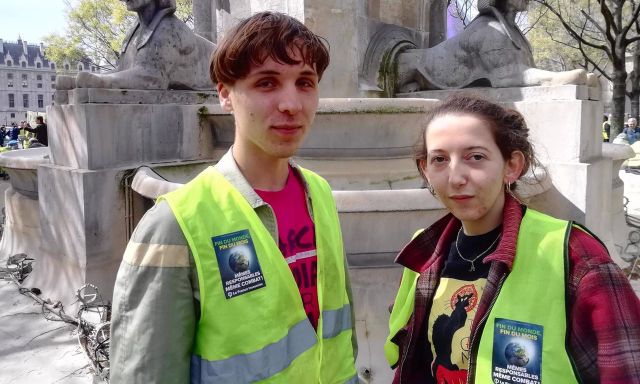
Beatrice spoke about the development of the protests since the first mobilizations against Macron’s planned regressive petrol taxes.

“We realized that it was not only the problems of taxation. We saw a lot of things that were wrong. There is a problem of purchasing power in every profession. We saw all the money squandered by the government.” 

She expressed the hope that “we will finally restructure France. Our governors have been failing for more than 40 years.”

She expressed her solidarity with protests in Algeria and said she hoped soldiers would disobey orders to fire on protesters in France:

“If it comes to civil war it would be horrible. But in any case, democracy in France already has already greatly deteriorated.”

While noting that some police wear yellow badges and show their solidarity with the movement when protesters question them, she also opposed the violence carried out by the police: “There are some who love to hit,” she said.

“You see me. I am not violent. I am nothing at all. But there are some [police] who are crazy, and I will say, among the Anti-Criminal Brigade (BAC) some that one would think are in militia. ... We see people arrested, handcuffed and then they are beaten on the ground. Once you have taken control of someone, you stop. After that it becomes a form of torture.”

Beatrice, who works as a secretary, also expressed her deep distrust for the trade unions, which broke the truckers’ strike as the “yellow vests” movement began. She explained,

“We know the unions are bought… There was the heavy truck strike at the beginning of the movement. The government immediately brought in the unions and right away, it was: ‘Shut up, take what you are given.’ After that the truckers were bound hand and foot. They told us, ‘we no longer have to strike because the union negotiated.’”

Beatrice also spoke about her grandparents, who were members of the French Communist Party (PCF) during the Second World War and knew deportees. Asked about the role of the PCF today, she said,

“They do nothing, that is clear. When I was young, I was involved... But I do not see any party fighting against capitalism.” As for a fight today against capitalism, she added, “that remains the goal.” 

 Bastien and Agnes

The WSWS also spoke to Bastien and Agnès, both members of Unsubmissive France, the party of Jean-luc Melenchon. Bastien called for a Citizens’ Initiative Referendum (RIC) and pointed to “the strong demand for social equality. For example, we can see that the fortune tax and the cuts to housing subsidies and the lowering of housing subsidies have not been passed.” Referring to the struggle of workers and young people to bring down the Algerian military dictatorship, he added: “I think it is beautiful. The young people are committed to defending democracy.”

Asked about Macron’s decision to authorize the army to fire on “yellow vests,” Bastien said,

“The bourgeoisie has always been more with Hitler than the Popular Front. We can see that even in Brazil: Bolsonaro was elected with the support of the liberals. In the end, the bourgeois liberals accommodate themselves very quickly with restrictions on public liberties and an authoritarian capitalism.”

He also noted the discrediting of the trade unions and established political parties of their role in defeats of workers’ struggles.

“There are party interests or unions that take precedence over the interests of workers. They are there to win elections, and put the struggles afterwards.” Asked about the financing of the union apparatus by employers and the state, he reacted: “It’s clear there is a significant risk when the government is funding them.” 

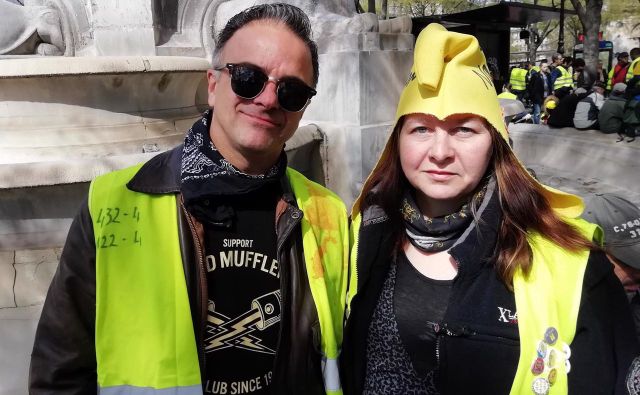
 Victor and Delphine

Victor expressed his support for the protests:

“We want greater purchasing power. I’ve been unemployed for a year. I’m a printer and was making 1,900 euros per month after taxes. For the same job now I’ll be offered 1,400 to 1,500. The fall in wages has been huge. I’m 56. I’ve committed to buying a home, and now find myself needing 300-400 euros extra by the 10th of the month because I have to pay my bills.”

Victor said workers can no longer rely on unions to defend themselves. “I do not have a very high opinion of them, since they are subsidized by the government,” he said.

“They’re not the unions of before… The general secretary [Philippe Martinez] of the CGT labelled the Yellow Vest protests as a fascist movement.”

“Being subsidized [by the government] means a lot,” he added.
“I don’t think it’s healthy. They say they defend workers but they are paid by the state or the employers.”

He said that Macron’s threats would not intimidate the movement:

“He’s playing on fear. The armored cars have not stopped us. All the names we’ve been called: fascists, anti-Semites, maybe soon pedophiles as well… Although the latest trend is the label of a terrorist. I saw a riot police officer armed with a military-grade weapon. I asked him why he had it. He pointed to a young man who had dismantled the scaffolding from a roadblock on a Paris street, and said: ‘He is a terrorist.’ I really do not have the same vision of terrorism.”

Responding to Macron’s declaration last year that the fascist dictator Petain, who headed the Vichy regime under Nazi occupation, was a great soldier, Victor drew parallels with the present day.

“Where are we going today? When there were wars in the past, political opponents were slaughtered in the streets or were simply imprisoned or disappeared... The Vichy police deported the Jews and political opponents. What interests me is that at that time, the Resistance fighters were also labelled ‘terrorists’ at the time.”

Tuesday, April 02, 2019

Gorilla Radio with Chris Cook, Tosca Lee, Steve Stewart, Janine Bandcroft April 4th, 2019

This Week on GR

by C. L. Cook - Gorilla-Radio.com


April 4, 2019

Floods, heatwaves, drought and forest fires; extreme weather events, spiraling in ever-tightening cycles of vicious, relentless destruction; food systems frayed, and vital infrastructure battered beyond operational capacity; war, famine, pestilence, and death; O! is it The End Times come at last?

Nope, just the six o'clock news.

But seriously folks; Monday a new government of Canada collaborative project between scientists from Environment and Climate Change Canada, Fisheries and Oceans Canada, Natural Resources Canada, and a hodgepodge of university experts released the first Canada's Changing Climate Report. And the news ain't good for those thinking about the future.

Listen. Hear.

Tosca Lee is an award-winning, New York Times bestselling author, global traveler, and International Studies degree holder. Her tenth novel, 'The Line Between' is newly released from Howard Books and tries through fiction to address the increasingly strange reality of our pre-apocalyptic times.

Tosca Lee in the first half.


And; Canada's prime minister has made his position, and that of most of his government clear, Nicolás Maduro, the democratically elected president of Venezuela is merely pretender to that oil-rich South American nation's throne, illegitimate, and according to Justin Trudeau, a dictator in fact. It's an opinion commonly held among the Anglo-American Axis and its coalition of fifty-odd colluding countries. For the rest of the World however, national sovereignty is the accepted rule of law, and leadership still dependent on the will of the people.

Steve Stewart is Executive Director of CoDevelopment Canada, a Vancouver-based NGO working to build partnerships between organizations in Canada and throughout Latin America in support of women's, workers', and human rights. CoDev also supports and promotes sustainable economic development.

Stewart is too a former journalist who's covered civil wars and the land, labour, and human rights struggles in Mexico, Guatemala, and El Salvador for the CERIGUA news agency, and he's active with BC CASA/Cafe Justicia and the Mining Justice Alliance. Steve was in Victoria last week presenting, 'Canadian Foreign Policy in Latin America with Venezuela, Honduras and Beyond' at the Central America Support Committee's monthly, Cafe Simpatico.

Steve Stewart and Canada's "Back Yard" policies in the second half.


And; Victoria-based activist, and long-time Gorilla Radio contributor, Janine Bandcroft will be here at the bottom of the hour with the Left Coast Events Bulletin of some of the good things to be gotten up to in and around our town in the coming week. But first, Tosca Lee and The Line Between.

Chris Cook hosts Gorilla Radio, airing live every Thursday between 11-Noon Pacific Time. In Victoria at 101.9FM, and on the internet at: http://cfuv.uvic.ca.  He also serves as a contributing editor to the web news site, http://www.pacificfreepress.com. Check out the GR blog at: http://gorillaradioblog.blogspot.ca/