Thursday, November 15, 2012

Harman: Israel's Candidate for CIA Top Spot


Jane Harman and Israeli Spying

by ALISON WEIR


It is astounding to find that one of the handful of prospects being floated to become CIA director following the fall of General David Petraeus is a person reportedly implicated in a 2005 Israeli spy scandal.

CNN, Politico, and others have all listed former Congresswoman Jane Harman as a potential new CIA head. Oddly, however, none have mentioned reports in 2006 and again in 2009 that an NSA wiretap in 2005 had picked up Harman promising a suspected Israeli agent that she would aid people indicted for espionage on behalf of Israel.

According to reports, Harman allegedly told the Israeli agent that she would lobby the Justice Department to reduce espionage-related charges against two top officials for the powerful Israel lobby organization, the American Israel Public Affairs Committee (AIPAC).

In return, the suspected Israeli agent (who may have been a dual-citizen American) reportedly pledged to help lobby for Harman to become chair of the House Intelligence Committee. Harman was already the ranking Democrat on the committee.

At the end of the conversation, Harman reportedly said: “This conversation doesn’t exist.”

The two AIPAC officials had been indicted for illegally obtaining classified documents about Iran and passing these on to Israel. They also gave them to prominent Washington Post journalist Glenn Kessler, whose speaker bio lists three topics: “Global Affairs, Jewish Interest, Middle East Issues.”

One of the indicted AIPAC officials has since defended himself by stating that his actions were routine for AIPAC – that AIPAC staffers regularly obtain and hand on classified U.S. information to Israel and others.

AIPAC, worried at public exposure caused by the indictments, fired the two men. Subsequent lawsuits over their firing provided considerable information, from sleazy details about AIPAC high officials to the fact that dozens of AIPAC donors had provided monetary assistance to the two men, despite evidence that they had leaked classified U.S. documents to a foreign country.

Among these donors were Slim-Fast billionaire Daniel Abraham, philanthropist Lynn Schusterman, and Haim Saban, an Israeli-American who is one of the major donors to Democratic candidates. Saban, who is close to Harman, says his “greatest concern is to protect Israel.” (His wife was recently nominated to be US ambassador to the UN.)

Harman, who frequently speaks at AIPAC events, is widely known for her strong advocacy for Israel and of Middle East wars on behalf of it.

She backed the attack on Iraq and now similarly maintains that Iran is a threat to Americans, despite the fact that Iraq quickly turned into a tragic, unnecessary, and disastrously costly debacle; that Iraq had none of the weapons of mass destruction that had been claimed; and that current claims against Iran are similarly tenuous.

The Jewish Forward calls her a “pro-Israel stalwart,” and the Jewish Telegraphic Agency (JTA) reports, “Harman is beloved by the pro-Israel lobby and is a sure-bet appearance at the American Israel Public Affairs Committee’s annual policy conference.”

According to Open Secrets, Harman was one of the top recipients of pro-Israel campaign donations.

JTA reported that her departure from Congress in 2011, “earned her an unusually effusive statement of regret from AIPAC director Howard Kohr.”

Like AIPAC, Harman currently pushes the alleged need, often promoted by flawed media reports, for the U.S. to address what she claims is Iran’s development of nuclear weapons, despite the fact that U.S. intelligence agencies continue to find that Iran is actually not developing them. (She also neglects to mention that Israel has a stockpile of nuclear weapons and has refused to sign the nonproliferation treaty).

In her nine terms in Congress, Harman focused on military and security affairs and served on all the major security committees: six years on Armed Services, eight years on Intelligence, and four on Homeland Security.

Harman, who was married to billionaire Sidney Harman, owner of Newsweek, until his death last year, was listed as the second-richest member in congress.

Harman resigned from Congress in 20011 to head up the Washington DC Woodrow Wilson Center, part of theSmithsonian. The Wilson Center is listed as the 16th most powerful think tank in the world.

Like Harman, the longtime chair of the Wilson Center, Joseph B. Gildenhorn, is extremely close to Israel. He endowed theInstitute for Israel Studies at the University of Maryland and may at one point have been an AIPAC board member. Wilson Co-chair Sander R. Gerber has been an AIPAC board member for many years.

In explaining her decision to leave Congress in order to direct the Wilson Center, Harman said: “Serving at its helm provides unique opportunities to involve the House and Senate, top experts and world leaders in ‘great debates’ about the most pressing foreign and domestic policy matters.”

While Congressional Quarterly’s Roll Call contains an article in which Harman denies the espionage-related reports, the publication seems to have taken down the report to which Harman was responding and to which numerous other articleslink: “Sources: Wiretap Recorded Rep. Harman Promising to Intervene for AIPAC,” by Jeff Stein, Congressional Quarterly, April 19, 2009. (It’s unclear whether the removal of Stein’s article is related to the fact that three months after the story broke, Congressional Quarterly was bought by the Economist Group.)

In the report, investigative journalist Jeff Stein provided additional details about the incident and explained that whether or not Harman delivered on her promise (she did not attain her desired chairmanship), the making of the promise was sufficient to constitute, in legal terms, a “completed crime.”

Despite considerable outcry and calls for a Justice Department investigation, Harman eluded prosecution, the expected full investigation of the powerful southern California Democrat never happened, and Harman’s allegedly subversive actions seem to have dropped from sight.

While former Petraeus deputy (and currently acting director) Michael J. Morell seems to be the current frontrunner for CIA head, Harman and others are reported to still be in the running. Also, Morell could prove to be a temporary choice to prevent a lapse in leadership while the long-term director is chosen.

If Harman does becomes CIA director, her appointment would no doubt be greeted with glee by the Israeli government. Whether or not Harman made treasonous promises to an Israeli agent, there is no doubt that she is a committed advocate for the Israeli regime.

Americans, on the other hand, might have less reason for joy.

* * *

For more information on the incident, see TPM, Salon, Time, Stephen Walt, the New York Times, Antiwar.com and C&L.

For more information on the AIPAC case, see the investigative work by Grant Smith at the Institute for Research: Middle Eastern Policy – IRmep.

For more information on the pro-Israel lobby, see Introduction to the Israel Lobby by the Council for the National Interest.

#

Alison Weir is executive director of If Americans Knew and president of the Council for the National Interest.

Haitians Fight Army's Recreation


Haiti's Excluded Majority Opposes Army's Recreation

by Jeb Sprague - Upside Down World


Following the devastating earthquake that hit Haiti in January 2010, the country's small right wing has had a political comeback. As with the shocking return of former dictator Jean Claude “Baby Doc” Duvalier in early-2011 (who remains unaccountable for his crimes), through a controversial and very poorly attended election, musician Michel Martelly, a longtime Duvalierist, was able to woo a small part of the population as an “outsider” candidate.

Since the 2004 coup d’état in Haiti, there has been a clear rollback of the slow but positive reforms that had been undertaken by Haiti's popularly elected governments. Judicial rulings that had held accountable some of the country's most violent criminals were overturned. As we now know through WikiLeaks, 400 paramilitaries were integrated into Haiti's revamped post-coup police force. A UN force has also remained in the country since mid-2004.

The most stunning achievement of Haiti's democratic period, though, has been more difficult to undo: this was the disbandment of Haiti's brutal military and rural section chiefs. The forces had been built up to support the US occupation in the early 20th century and by the 1960s a symbiotic relationship had formed between the forces and a cold war paramilitary apparatus set up in the country.

The Tonton Macoute paramilitary force, set up under François “Papa Doc” Duvalier (and responsible for the deaths of tens of thousands), eventually would become even more reliant on Haiti's military following the fall of Papa Doc's son, Jean Claude. Working attached to the military throughout the later 1980s, and then again from 1991-1994, paramilitary and army forces would conduct waves of massacres — targeting Haiti's pro-democracy movement.

Today, with a UN occupation and hard-line right-wing government in power, the victory of Haiti's grass-roots pro-democracy movement in disbanding the military, is being put to the test. In recent months Haiti's government formed a ministry of defence, which has already begun rebuilding the army. Even the ministry's emblem, coloured red and black, reminds one of the red and black flag of the Duvalier dynasty.

Vocal opponents of the army, such as famed Haitian attorney Mario Joseph, have received death threats. Contrary to the press releases of Martelly's administration, Haiti's population is widely opposed to the army's reformation.

Robert Muggah, former research director of the Geneva-based Small Arms Survey, has presented scientific polling data from 2011 showing that: “Between 96 per cent and 97 per cent of the entire (Haitian) population, whether you've been a victim of crime, whether you’re living in an IDP camp, or whether you’re general population, strongly or very strongly disagree that the Haitian army should be brought back.”*

According to Muggah and others behind the research, they are conducting the most scientific polling available in Haiti by routinely surveying close to 3,000 households using a proportional to population size (PPS) approach.

While these polling numbers do appear high (after more than a year of propaganda by Haiti's government promoting the recreation of the military), Muggah, an hour into a policy talk in Ottawa, added that anti-military sentiment “suggests the legacy of the armed forces has been a fairly long one”.

The average age of Haiti's population is only 26. Muggah notes therefore that “most Haitians were teenagers or younger when the armed forces were in existence” but he argues that the poll reveals “both the very strong oral tradition in Haitian families but I think also the very persistent legacy of the armed forces in their lives”. As Haitians well know, the country's paramilitary and former military forces working with some of the country's wealthiest families have time and again been used to assault the country's poor majority, long excluded from the country's political arena. Unable to win by free and fair elections, elites have sought to placate or manipulate the country's voters, yet they have still required periodic doses of political violence.

Muggah fears that with the reforming of Haiti's army now being promoted by some, “there is a danger, that history could very well repeat itself in Haiti”. Whereas France has offered to help rebuild the force, Ecuador and Brazil are reportedly moving forward to help train it. As of now, officials from the Canadian government and US Department of State have said the force would be a waste of resources. However, agencies within these governments often carry out contradictory policies. What is clear is that citizens from all of these countries need to hold their officials accountable for their activities in Haiti.


Jeb Sprague is a PhD candidate in sociology at the University of California-Santa Barbara USA, and is the author of the new book Paramilitarism and the Assault on Democracy in Haiti.


*To hear more on the polling data showing overwhelmingly the Haitian population’s opposition to recreating the ex-army see Muggah’s presentation (at around 59 minutes into his talk) here.

ROPE-ing the Radicals: Canada's Preventive Arrest Mania


Ann Hansen's Statement On Her Recent Arrest, Imprisonment and Release

by Ann Hansen - Media Coop


On August 3, I was at my home near Kingston, Ontario, sitting in a lawn chair after supper when out of the corner of my eye I saw a line of black SUVs speeding towards our driveway. With a sinking feeling, I realized one of my reoccurring fears as a parolee was becoming a reality. Four SUVs turned into our driveway, slammed on their brakes and out hopped about six to eight cops from the Ontario Provincial Police dressed in full Darth Vader gear with a couple of them brandishing automatic weapons for full dramatic effect. As I struggled to stay calm, I noticed the acronym ROPE (Re-Offenders and Parole Enforcement Squad) in bright yellow blazoned across their bullet proof vests.

They parked askew all over the driveway, and while a couple of them with their fully automatic rifles took positions at the top of our property, the rest walked rapidly up to where I was and handcuffed me without saying a word. I asked the one female cop what this was all about and she said my parole was being suspended.

I spent a few days at the local remand center, Quinte Detention Centre, before a new parole officer (my regular parole officer was suddenly replaced) and a Security Intelligence Officer (SIO) from Correctional Service Canada (CSC) came to see me for a post suspension interview. They spent an hour and a half interrogating me and trying to intimidate me into giving them the names of anyone involved in EPIC (End the Prison Industrial Complex) or any other anti-prison activists, as well as information about any possible “bombings and arsons” which the SIO warned me I would be responsible for “if it all went sideways.” Needless to say, they were not satisfied when I told them I didn’t have names for them. The interview would have made a hilarious Monty Python script with the SIO comparing me at times to Ghandi and then in the next breath to James Holmes, the “joker” who killed twelve people during the Batman film in Colorado. The outcome of the interview wasn’t quite so hilarious.

On August 13, I was transferred to the maximum security unit at Grand Valley Prison for Women in Kitchener. Ten days earlier I had been lounging in my slippers in a lawn chair after supper, and here I was suddenly transformed into a high security federal prisoner who had to be put in leg irons and handcuffs just to be led from the admitting area into one of the pods of the maximum security unit. It was so funny, I felt like crying.

A few weeks later I received parole papers stating that the CSC parole office was “strongly recommending” that my parole be revoked with a long list of reasons why. As I suspected, the library was the scene of the ‘crime;’ I was not charged with any actual crime. The ROPE squad had arrived the day after I had screened a film about Prisoners’ Justice Day (PJD) at the Kingston Public Library. The film was followed by a ‘direct action workshop’ conducted by a lawyer who explained what to expect at a blockade/picket, which was to be held at the entrance to Collins Bay Penitentiary on PJD. These ‘direct action workshops’ have become commonplace globally as training workshops for large scale demonstrations or civil disobedience actions in order to familiarize people with the legality of different kinds of activities. They also teach people how to participate in large consensus decision-making processes, how to interact with the media, what to do if one is arrested and other skills necessary for protests.

The planned Prisoners’ Justice Day blockade/picket of Collins Bay was the most obvious reason why my parole was suspended, but there were many other ‘reasons’ listed based on paranoid suspicions that are not worth the time and effort of explaining. It is worth noting, however, the political context in Ontario, which provides the most logical reasons for my parole suspension. I believe that the reasons for my parole suspension are similar to the G20 Main Conspiracy Group prosecution; that is, ‘preventative security measures’ aimed at arresting people before any ‘illegal act’ is even committed. These kinds of measures are used not only to disrupt political actions but also to have a chilling effect on political resistance in general. They put us on the defensive and force us to fight for our basic rights, which are supposedly entrenched in the Canadian Charter of Rights and Freedoms.

It could be viewed as a sad day indeed when we are reduced to fight for our basic human rights, but I think it is actually a sign of the strength of our resistance. In the minds of the authorities, they are so threatened by the potential of our movements that they are reduced to trying to pre-empt our organizing efforts by arresting us for going to meetings, speaking out, and demonstrating, which are supposed to be legal activities even in a capitalist society.

I think the back story to the latest rounds of preemptive arrests in Ontario begins in the year leading up to the Toronto G20 Summit in 2010 when undercover cops were embedded in the Guelph and Kitchener/Waterloo anarchist communities. Billions of dollars were spent on police security and intelligence gathering in the year leading up to and including the actual days of demonstrations against the G20 Summit. We see similar police preparations occurring now to counter organizing against the Alberta tar sands and the line nine pipeline reversal in Ontario.

In Kingston, local police forces were no doubt taken by surprise by the sudden emergence of a relatively large and diverse movement to stop the closure of the prison farms in 2009. Prison abolitionists saw this as an opening move to free up land and money at Collins Bay Penitentiary to construct a regional superprison, as outlined in the government’s “Roadmap to Strengthening Public Safety.” In August 2010, hundreds of people in Kingston participated in a two-day blockade of the entrance to Collins Bay and Frontenac Institutions to prevent the removal of the prison farm cattle herd. The local cops were not prepared for the size of the movement and had to call in provincial police reinforcements on the second day. There were twenty-four arrests. Local prison abolitionists had also begun organizing against the plans for a massive prison expansion, which by 2012 has translated into the construction of six new prison units in the Kingston area alone.

In the months leading up to August 10, 2012, local prison abolitionists and some people involved in the prison farms campaign worked to organize for Prisoners’ Justice Day. Across the city, posters invited people to participate in an early morning blockade/picket of Collins Bay to halt construction on the new prisons as an act of solidarity with the prisoners fasting and refusing to work inside the walls. In the minds of the cops and CSC, visions of hordes of anarchists and outraged locals danced in their heads. Based on the ludicrous expectations for PJD expressed by the CSC during my Quinte interrogation, I don’t think it would have surprised them if ‘what to their wondering eyes should appear, but a miniature sleigh and eight tiny reindeer.’

For three months I waited for my revocation hearing with the Parole Board. It’s hard to be optimistic inside the maximum security unit where Ashley Smith died, and Nyki Kish waits for her appeal after being convicted of a murder she did not commit. It’s always easier to do time when you have nothing to lose, but in my case I live with two others on a small self-sufficient farm and work with a great community of comrades locally, so I have a lot to lose. In the end the Parole Board released me with stricter conditions on October 30, 2012.

There is no doubt in my mind that I would have spent many more years in prison without the tireless support of a network of friends, family, anarchist allies and a good lawyer. It becomes clear in prison, that all the efforts of the CSC are directed towards isolating the prisoner from their networks of support both inside and outside the walls. I owe my ‘freedom’ to all those who supported me throughout this episode of my life, and I just hope I can reciprocate through my solidarity and by continuing the joyous lifestyle of resistance!!


See also:

In the context of the 30th anniversary : Direct Action and the Wimmin's Fire Brigade in the history of anarchism in so-called ''British Columbia''

"Du profilage racial au profilage social?"


CKUT's Off The Hour: Radio Chez Pops, October 19th Edition
  

Guernica on the Levantine: IDF Bombing of Gaza Continues


Breaking Truce, Israeli Strikes Kill "Moderate" Hamas Military Chief, Palestinian Civilians in Gaza


by Democracy Now!

Israel is threatening to launch a ground invasion of the Gaza Strip after breaking an informal ceasefire with an ongoing series of deadly attacks. At least 13 Palestinian civilians have been killed, including a baby and a mother pregnant with twins, in addition to more than 100 wounded. Israel says it has launched the strikes to prevent Palestinian rocket fire, but the latest round of violence began last week when Israeli troops killed a young boy in Gaza.


The situation has escalated since Saturday, when Palestinian militants fired at an Israeli military vehicle near the Israel-Gaza border. After Palestinian militant groups agreed to an informal truce on Monday, Israel broke two days of quiet with Wednesday’s attack. Israel’s attack on Gaza marks its largest since the U.S.-backed operation that killed more than 1,300 Palestinians nearly four years ago. We go to Gaza City to speak with Palestinian journalist Mohammed Omer.

Immigration Policy a Brick in the Wall of Racist State


No One Is Illegal Takes on Jason Kenney, Architect of a Racist State

by No One Is Illegal

Citizenship and Immigration Minister Jason Kenney was in Burnaby, B.C. this week. The minister told the crowd gathered at the Executive Hotel that his immigration crackdown -- from marriage fraud to human smuggling and what he called the "abuse of Canada's generosity" -- is not driven by ideology or racism.

"One thing that is unique about Canada is that this is the only developed democracy in the world in which there is no serious or organized anti-immigrant or xenophobic sentiment in our public discourse," he told a crowd hosted by the Burnaby Board of Trade and the Immigrant Employment Council of BC. "I want to keep it that way.


For one of the activists outside the speech, Kenney's claims of no serious xenophobia in Canada were hard to stomach. Citing the case of refugee claimant Veronica Castro, who was beaten to death in Mexico this April five weeks after her deportation from Canada, Lee Williams said Kenney is hypocritical.

"We're talking about immigrants coming here, people of colour exploited for labour, being sent out of the country, denied status, who cannot have their spouses come over, who can't have access to health care. I'm curious to know how that's not xenophobic," said Williams, a member of the migrant justice organization No One Is Illegal.

Williams claimed she was inexplicably blocked from attending the event, despite having registered for the $35 reception on Wednesday. The Burnaby Board of Trade insisted it had no record of her registration, leading some activists to suggest attendees were being politically screened by Kenney's office. Another activist was dragged out of the hotel lobby by her arms and legs after she was denied entry to the talk and refused to leave the building.

www.nooneisillegal.org

Netanyahu's Sick-Making Politically Motivated Murders


Israel’s Goebbels at work over Gaza provocation 

by Alan Hart 

I imagine I am not the only one who feels the need to vomit (dictionary definition: “to throw up the contents of the stomach through the mouth”) when Israel’s Goebbels justifies the Zionist state’s ferocious and monstrously disproportionate attacks by air and sea on the Israeli-blockaded Gaza Strip, the prison camp which is home to 1.5 million besieged and mainly impoverished Palestinians.

The Israeli to whom I am referring is, of course, Australian-born Mark Regev, the prime minister’s spokesman, for which read spin doctor. The more I see and hear him in action, the more it seems to me that he makes Nazi Germany’s propaganda chief look like an amateur.

In a piece for the Observer on 6 June 2010, Ruth Sutherland wrote the following.

If the men from Mars ever wanted to manufacture a PR man, they would model their robot on Regev. No matter how formidable the interviewer, or how aggressive the questioning, he never buckles under pressure. His disarming Aussie accent and unfailing politeness – he calls interviewers “Sir” and uses phrases like “I beg to disagree” – almost lulls listeners into overlooking his aggression. He is always regretful about death and horror – he regrets that the non-Israeli victims brought their fate on themselves. Viewers are reduced to a trance of slack-jawed amazement at what he is prepared to say with a straight face. He is unlikely to win sceptics to Israel’s cause, but as a PR performer he is horribly compelling.

Compelling he certainly is but, as Sutherland indicated (I will be more explicit), only to Westerners and Americans in particular who have been conditioned for decades by Zionist propaganda and, as a consequence, know nothing or little worth knowing about the truth of history as it relates to the making and sustaining of the conflict in and over Palestine that became Israel.

In the immediate aftermath of Israel’s targeted assassination of Hamas’s military commander, Ahmed Jabari, Regev was at his best. His main message to the Western nations, conveyed via the BBC and many other networks, was that Israel is just like them – democratic and civilized.

“I would ask them all,” he said, “how would you act?” (respond to rocket fire from “terrorists”). By obvious implication, he was saying something very like, “You would take all necessary action against the terrorists to defend and protect your people, and that’s why I am sure you will understand and support what we are doing.”

The flaw in that presentation is that Israel is not like the Western nations. It is a brutal occupying power, and the cause of the incoming rockets is its occupation and on-going colonization and ethnic cleansing of the West Bank, including East Jerusalem, and its blockade of the Gaza Strip. That plus the fact that Israel’s leaders have no interest in peace on terms the Palestinians could accept.

Regev also appealed for Western understanding and support on the grounds that “they” (Hamas) say my country should be wiped off the map”.

That’s one of the many big, fat Zionist propaganda lies. The truth is that Hamas is firmly on the record with the statement that while it will never recognize Israel’s right to exist, it is prepared to live in peace with an Israel inside its 1967 borders.

Regev’s master, Binyamin Netanyahu, was also up to his old tricks – diverting attention. He played the Iranian nuclear threat card to get Palestine off the international community’s agenda. With Israel’s next election less than 70 days away, one of his reasons for authorizing Operation Pillar of Defence was, as a report in The Times of Israel put it, “to divert public discourse from social justice to security issues and silence the government’s critics”.

The Mossad’s motto is “By way of deception, thou shall do war.”

Netanyahu obviously believes that by way of deception he can not only retain power but emerge from Israel’s next election with more power than ever. (Enough to tell Obama to go to hell if that ever becomes necessary).

The support (by default if not design) of Western governments for Israel’s latest ferocious and monstrously disproportionate attacks also makes me want to vomit.

Israel's Moral Bankruptcy Plays a Reprise in Gaza


Gaza: The Gates of Wrath and Sorrow Swing Open Once Again

by Chris Floyd - Empire Burlesque


How about this child, then? Is he dead enough for you?


The gates of wrath and sorrow open wide again in Gaza, clanging on their rusty, bloodstained hinges.

***

A report, via Facebook, from Gaza:

From Dr. Mona Al-Farra in Gaza City, an urgent message on Facebook: Dear Friends, Gaza is under extensive Israeli military attack ,in less than 2 hours , 14 military attacks against different targets in different parts of Gaza Strip , 6 were killed including 2 young girls age 4 and 7, 11 were injured, the hospitals are already lacking essential emergency medications, and citizens were called for blood donation, we do not have power , iam using UBS ,the first stage of this operation has been accomplished , we expect more escalation. your solidarity means a lot at this difficult times, pass the word, this aggression, should stop now.
(UPDATE 1 BELOW)
(UPDATE 2 BELOW)
(UPDATE 3 BELOW)
***
The 20th paragraph -- the 20th paragraph -- of the New York Times story on the attack notes, very obliquely, that the recent rocket firing was in response to "deadly Israeli airstrikes":

"Since then Hamas has mostly adhered to an informal, if shaky, cease-fire and at times tried to enforce the smaller militant groups to stick to it. But in recent months, under pressure from some of the Gaza population for not avenging deadly Israeli airstrikes, it has claimed responsibility for participating in the firing of rockets. Last week, it also claimed credit for detonating a tunnel packed with explosives along the Israel-Gaza border while Israeli soldiers were working nearby."

But elsewhere in the story, and everywhere in the media, the attack is clearly presented as righteous retaliation for unprovoked attacks: not as collective punishment on a captive people for themselves retaliating against airstrikes against them.

(UPDATE 1: In the latest online version of the constantly updated NYT story, the mention of the rocket attacks as retaliation for "deadly Israeli airstrikes" is now in the 32nd paragraph. Most of the new material is taken up with the Peace Laureate's firm support for Israel's right to "self-defense" -- a right which obviously does not extend to the Palestinians at any time, in any form. Like "good injuns," they're supposed to lay down and die on the cracked, caged earth of the reservation.)

***
In responding to the current attack, Arthur Silber also points to this this deeper look (from the 2009 slaughter in Gaza) at the template behind these spasms of atrocity -- a template much used not only by the "light unto the nations" but also "the shining city on the hill":

"For a very long time, the United States government has specialized in the pattern pursued by Israel. The vastly more powerful nation wishes to act on a certain policy -- almost always territorial expansion, for purposes of access to resources, or to force itself into new markets, or to pursue the evil notion that economic and ideological success depend on brutality and conquest -- but a specifically moral justification for its planned actions does not lie easily to hand.

"So the powerful nation embarks on a course designed to make life intolerable for the country and/or those people that stand in its way. The more powerful nation is confident that, given sufficient time and sufficient provocation, the weaker country and people will finally do something that the actual aggressor can seize on as a pretext for the policy upon which it had already decided. In this way, what then unfolds becomes the victim's fault."

***
And so it goes, and on it goes: the curse of violence, hatred, estrangement, fear. Madness snaking in and out of the only place where the universe is: in the electrics of our brains. So many sharp and painful endings to the world and all that's in it.

CULPRIT BLUES by Chris Floyd


UPDATE 2: I was remiss in failing to give the name of the dead child in the picture above. His name is Omar Misharawi. He is the son of Jihad Misharawi -- a journalist for the BBC's Arabic news service. Misharawi's house was hit by the pinpoint, carefully targeted, hi-tech, only-kill-the-bad-guys missiles being hurled into the heavily packed residential areas of Gaza by the Israeli military.

Below is a picture of what Omar looked like before he became "collateral damage." Strange; he looks almost like an actual, fully-fledged human being, doesn't he? Almost like one of us, like one of our children. Good thing he's just a "savage," right? One of them. For as our own Nobel Laureate has shown us, their lives have no value, no meaning. They're just so much "bug splat" on a screen.


UPDATE 3: Another great triumph for Western values was also reported today (Thursday): the first confirmed death of a child due to the draconian sanctions imposed on Iran by the Peace Laureate -- who celebrated his electoral triumph last week by tightening even further his ongoing strangulation of Iran.

 The Guardian reports:

A teenage Iranian boy suffering from haemophilia has died due to a shortage of medicine in the country. It is the first civilian death said to be directly linked to the impact that western economic sanctions are having on the Islamic republic.

Manouchehr Esmaili-Liousi was a 15-year-old from a nomadic tribe based in the mountains near the city of Dezful, in Iran's south-western province of Khuzestan. He died in hospital after his family failed to find the vital medicine he desperately needed for his disease, Iran's state news agencies reported on Wednesday …

Although sanctions are not directly targeting Iranian pharmacies and medical sectors, measures imposed on Iranian banks and trade restrictions have made life extremely difficult for patients across the country, who are facing difficulties in finding medicines made outside Iran. …

According to Ghavidel, 75% of the medicines for the treatment of haemophilia are made in the US and the EU, making Iranian patients heavily dependent on their imports. He said haemophilia medicines available in Iranian markets had been reduced to a third of former supply levels….

Earlier this month, the New York Times published a detailed report on how sanctions were taking an unexpected toll on medical imports, including medicines such as Herceptin, which is made in the US. Among other medicines said to be scarce in Iranian pharmacies is the tetanus vaccine.

Baby milk is another imported product affected. Iran produces its own powdered milk, which is abundant in the market, but cannot produce certain diet milk types or those suitable for children with allergies. These are imported from outside. There have been instances of children hospitalised as a result of the milk shortages, but no reports of deaths as yet.

One down, 499,000 to go before Obama matches the good ole Big Dawg in the noble -- and Nobel -- pursuit of mass murder by sanctions. But no doubt he and his secretary of state -- the Big Dawg's own wife! -- will, like the Big Dawg's own secretary of state, believe the murders "are worth it."

Quebec Fracking Ban Gets $250 Million NAFTA Challenge


NAFTA challenge launched over Quebec fracking ban

by Joan Russow - Global Compliance Research Project

There should be a fracking ban all across Canada. There is sufficient and mounting evidence that the practice of fraking is harmful to human health and the environment to justify invoking the precautionary principle. Under the Convention on Biological Diversity is the following enunciation of the precautionary principle

It is vital to anticipate, prevent and attack the causes of significant or loss of biological diversity at source and that where there is a threat of significant biological diversity, the lack of full scientific certainty should not be used as a reason for postponing measures to avoid such a threat ( a paraphrase)

Under Chapter 11 , Under article 1106 d 6

of NAFTA, each party can end a practice for environmental reasons; if Canada undertook to ban fracking across Canada and cited sections under the Convention on Biological Diversity then then Lone Pine Resources Inc. would have no case.

In 1993, there was an environmental assessment review of Nafta, and Canada made a statement that all international instruments would supersede NAFTA. Thus the Canadian government could support the Quebec ban by banning the practice of fracking across Canada and citing Canada’s obligations under the legally binding Convention on Biological Diversity. Canada ratified the Convention in 1992. The US has signed the Convention but not ratified it.


NAFTA challenge launched over Quebec fracking ban
The Globe and Mail

Energy firm Lone Pine Resources Inc. is taking on Quebec’s fracking moratorium, saying it violates the firm’s rights under the North American free-trade agreement and demanding more than $250-million in compensation.

The company disclosed in a filing with the U.S. Securities and Exchange Commission this week that it has filed a notice of intent to sue the Canadian government under NAFTA’s controversial Chapter 11.

British Columbia's War on Wolves Accelerates


British Columbia's War on Wolves Continues with Newly Released Draft Management Plan

by PacificWild.org

Yesterday, the B.C. government unveiled its Draft Wolf Management Plan. Beginning with a misspelled scientific name Canis lupis (Lupis is an incurable human disease) rather than lupus in the title, this wolf plan goes on to outline a barbaric and grim future for B.C. wolves that amounts to a government sponsored kill program.

Sifting through the document it is generally difficult to ascertain the objective of the plan but it becomes clear closer to the end under section 7: Current Management Framework. Here the future direction of B.C. wolf
management policy is split into two zones. One zone, (where livestock predation is an issue) is to encourage extermination of wolves by all means and "includes year-round open seasons and/or no bag limits, and in some cases targeted removal of individuals or packs." The second zone describes wolf management as ³primarily concerned with providing hunting and trapping opportunities with controls on harvest through specified season lengths and bag limits².

The plan is full of discussion on the "harvesting" of wolves, as if they are some kind of crop like wheat or barley. It further states the lofty objective to "ensure self-sustaining populations throughout the species range." But what does this mean for wolves in this province when the government reports that more than 34% of a wolf population can be harvested "sustainably."

There is no discussion of quality of life for wolves and of what it actually means to disrupt the social bond of a pack or extended family with trapping, hunting, poisoning, aerial killing and other means legally employed to kill wolves in B.C., The evolutionary impact of reduced genetic diversity in wolf populations that are forced to suffer such high levels of human caused mortality is also not discussed in this plan.

Under section 7.1.1 titled Harvest Management, the plan refers to: "ethics such as fair chase and humane treatment are recognized." Recognized? How about enforced, but then it would be pretty difficult to have an ethical leg hold trap or a bait station laced with poison. Killing wolves by helicopter is cited as the most humane alternative. It appears the B.C. government would rather ³recognize² ethics but not actually enforce such a policy.

The plan goes on to recognize that B.C. already has the most relaxed policies when it comes to humans killing wolves. "Hunting seasons are long and there is no species license required for residents to hunt  wolves."

Note: B.C. resident hunters have to purchase a special license to hunt deer, geese and many other species - wolves require no mandatory reporting and no special license. Under section 7.1.1, it goes on to state that "There is no age/sex restriction for hunting wolves..." This means that any B.C. resident can legally kill pups, pregnant females with out mandatory reporting. Already, the B.C. government has opened up huge parts of the province to open season, year-round hunting without any limit to the amount of wolves killed. 2009 recorded a province-wide record for the amount of wolves killed by hunting and trapping.

The way this draft plan is structured, unless significant public opposition is mobilized in the coming weeks, the B.C. government will further relax and liberalize wolf hunting, trapping and other kill programs for years to come.

Pacific Wild will be following this issue and speaking out for wolves as what is clearly shaping up to be a renewed government-sanctioned assault on B.C.'s wolves.

Ian McAllister
Pacific Wild


Public comments on the draft plan are being accepted until Dec 5th, 2012.
http://www.env.gov.bc.ca/fw/public-consultation/grey-wolf/

Please write to:
Hon. Terry Lake
BC Minister of Environment
PO Box 9047 STN Prov Govt
Victoria, BC V8W 9E2
env.minister@gov.bc


PS. Cc your letters to media outlets and to Pacific Wild.


Ian McAllister
Pacific Wild
PO Box 26
Denny Island, BC
VOT 1BO
Canada
Email;,ian@pacificwild.org

Gaza Attack: Pillar of Cloud as Cast Lead Redux


Israel Escalates Assault On Gaza Strip after Assassination Of Top Hamas Commander 

by TRNN


Jihan Hafiz reports on the on-going military action in Gaza

Watch full multipart The Humanitarian Crisis in Gaza

The Pentagon's Mideast Building Boom


America Begins Nation-Building at Home

(Provided Your Home is the Middle East)

By Nick Turse


A
billion dollars from the federal government: that kind of money could go a long way toward revitalizing a country’s aging infrastructure. It could provide housing or better water and sewer systems. It could enhance a transportation network or develop an urban waterfront. It could provide local jobs. It could do any or all of these things. And, in fact, it did. It just happened to be in the Middle East, not the United States.

The Pentagon awarded $667.2 million in contracts in 2012, and more than $1 billion during Barack Obama’s first term in office for construction projects in largely autocratic Middle Eastern nations, according to figures provided to TomDispatch by the U.S. Army Corps of Engineers Middle East District (USACE-MED). More than $178 million in similar funding is already anticipated for 2013. These contracts represent a mix of projects, including expanding and upgrading military bases used by U.S. troops in the region, building facilities for indigenous security forces, and launching infrastructure projects meant to improve the lives of local populations.

The figures are telling, but far from complete. They do not, for example, cover any of the billions spent on work at the more than 1,000 U.S. and coalition bases, outposts, and other facilities in Afghanistan or the thousands more manned by local forces. They also leave out construction projects undertaken in the region by other military services like the U.S. Air Force, as well as money spent at an unspecified number of bases in the Middle East that the Corps of Engineers “has no involvement with,” according to Joan Kibler, chief of the Middle East District’s public affairs office.

How many of these projects are obscured by a thick veil of secrecy is unknown, with U.S. Central Command (CENTCOM) refusing to name or even offer a full count of all U.S. bases in the region. On the record, CENTCOM will acknowledge only 10 bases as in its area of operations outside of Afghanistan, even though there are more than two dozen, according to a CENTCOM official who spoke to TomDispatch on the condition of anonymity. Exactly how many more and just where all U.S. construction work in the region is taking place continues to be kept under tight wraps. Still, Army Corps of Engineers data, other official documents, and publicly available contract information offer a baseline indication of the way the Pentagon is garrisoning the Greater Middle East and which countries are becoming ever more integral allies.


Nation Building: Public Talk, Secret Action

In the final days of the presidential campaign, President Obama repeatedly assured Americans that it was time to reap a peace dividend as America’s wars wind down. Nation-building here at home should, he insisted, be put on the agenda: “What we can now do is free up some resources, to, for example, put Americans back to work, especially our veterans, rebuilding our roads, our bridges.”

Setting aside just how slipshod or even downright disastrous Washington’s last decade of nation-building projects in Iraq and Afghanistan have been, the president’s proposal to rebuild roads, upgrade bridges, and retrofit the country’s electrical grid sounds eminently sensible. After all, the American Society of Civil Engineers (ASCE) gives America’s infrastructure a grade of “D.” If, in the era of the $800 billion stimulus package, $1 billion at first sounds paltry, ask the mayors of Detroit, Belmar, New Jersey, or even New York City what that money would mean to their municipalities. America may need $2.2 trillion in repairs and maintenance according to ASCE, but $1 billion could radically change the fortunes of many a city.

Instead, that money is flowing into the oil-rich Middle East. Unknown to most Americans, thousands of State Department personnel, military advisors, and hired contractors remain at several large civilian bases in Iraq where nation-building projects are ongoing; hundreds of millions of taxpayer dollars have been flowing into military construction projects in repressive Persian Gulf states like Bahrain and Qatar; and the Pentagon is expanding its construction program in Central Asia. All of this adds up to a multifaceted project that seems at odds with the president’s rhetoric. (The White House did not respond to TomDispatch’s repeated requests for comment.)

Increasing the Power of Airpower in Qatar

The tiny oil-rich emirate of Qatar has been the preeminent site of the Pentagon’s Middle Eastern building boom in the Obama years. A significant percentage of its population is made up of migrant workers who, according to Human Rights Watch, are “vulnerable to exploitation and abuse,” while “forced labor and human trafficking remain serious problems.” The country even received a failing grade (“not free”) from the U.S. State Department-funded human rights organization Freedom House. Still, between 2009 and 2012, the U.S. pumped nearly $400 million into Pentagon projects in the country, including troop barracks, munitions storage areas, a communications center, a training range, an aircraft operations center, an aircraft maintenance hangar, an aviation maintenance shop, a warehouse facility, and a vehicle maintenance shop, according to a list provided by the Corps of Engineers.

The Obama administration has continued a build-up in the country that accelerated after 9/11. In September 2001, U.S. aircraft began to operate out of Qatar’s Al Udeid Air Base. By 2002, the U.S. had tanks, armored vehicles, dozens of warehouses, communications and computing equipment, and thousands of troops at and around the base. The next year, the U.S. moved its major regional combat air operations center out of Saudi Arabia and into Al Udeid. Since then, it has served as a major command and logistics hub for U.S. regional operations, including the wars in Iraq and Afghanistan.

According to figures provided to TomDispatch by USACE, at least 10 contracts for construction at Al Udeid, worth nearly $87 million, are anticipated in 2013. A review of official U.S. government documents reveals a host of upcoming projects there, including a fuels laboratory, a cryogenics facility, a new center for the Air Force’s Office of Special Investigations, an air defense maintenance facility, more parking space for fuel trucks, new roadways, and a precision measurement equipment laboratory where technicians will calibrate the sophisticated gear used in vehicle and weapons maintenance.

Waterfront Development in Bahrain

Despite a brutal crackdown on pro-democracy protesters in 2011, which continues to this day, the oil-rich kingdom of Bahrain (also “not free” according to Freedom House) is a top U.S. ally. In fact, over the last year, the Corps of Engineers awarded contracts for construction in the country worth more than $232 million, the most for any nation in any year of the Obama presidency so far. Since 2009, Bahrain has seen almost $326 million in USACE contract awards.

In 2010, the U.S. Navy broke ground on a mega-construction project to develop 70 acres of waterfront at the port at Mina Salman. Scheduled for completion in 2015, the complex is slated to include new port facilities, barracks for troops, administrative buildings, a dining facility, and a recreation center, among other amenities. Total price tag: $580 million.

In September, USACE awarded a $15 million contract for the expansion of a wastewater treatment plant and the construction of a climate-controlled warehouse, as well as an irrigation pump building, among other facilities at Mina Salman. That same month, the Corps of Engineers also awarded a $42 million contract for a multistory “bachelor enlisted quarters” in the capital, Manama. It will contain at least 241 two-bedroom apartments for Navy personnel, as well as administrative offices, laundry facilities, multipurpose rooms, and lounges.

Taking Flight in Oman

In February and March of 2011, protests demanding political reform in Oman led to assaults on and the killing of protesters by the nation’s security forces. Despite marked restrictions on freedom of expression and freedom of the press, this sultanate (also ranked “not free” by Freedom House) has been a favorite site of military expansion in the Obama years. Between 2009 and 2012, the Corps of Engineers awarded $144 million in contracts for work there, more than half this year.

During the 1930s, the British Royal Air Force operated an airfield on Oman’s Masirah Island. Today, the U.S. uses Masirah and USACE is carrying out construction there as well as at the country’s Thumrait and Al Musannah Air Bases.

The Un-Withdrawal from Iraq

The Corps’s contract data do not include figures for construction in Iraq prior to August 2011. In the 15 months since, according to information provided by USACE, it has awarded $113 million in contracts for State Department nation-building-style projects like a wastewater treatment plant in the city of Fallujah and a courthouse in Rusafa.

The Iraqi government is paying USACE to carry out these projects in order to increase its defense capabilities, according to the Middle East District’s Joan Kibler. These include a counterterrorism center, consisting of a headquarters facility, barracks, a warehouse, and a power plant in eastern Baghdad; a military training complex at Al Harthiya; a military security school in Taji; and administrative, security, and dining facilities at Hawk and Tikrit Air Bases.

At the height of the American occupation of Iraq, the United States had 505 bases there, ranging from small outposts to mega-sized air bases. Of them, some have been stripped clean by Iraqis, others became ghost towns, and one -- Camp Bucca -- a hotel. What remains open today are State Department facilities, most notably the U.S. Embassy in Baghdad. Earlier this year, the Washington Post reported that the Department of State was planning to spend up to $115 million to upgrade the massive embassy compound, which it characterized as already the “biggest and most expensive in the world.”

State Department documents issued last month and examined by TomDispatch offer a snapshot of the civilian “bases” currently being maintained in Iraq. The Baghdad embassy site in the “international zone” consists of two compounds, Camp Condor and the Chancery Compound, as well as the embassy heliport. With two dining halls, two gyms, two firehouses, a large post office, a PX, and contractor housing, the site presently hosts about 3,600 personnel.

Another 1,250 persons are currently deployed to the Baghdad Diplomatic Support Center near Baghdad International Airport. This location boasts a hospital, large dining hall, fire station, post office, contractor housing, and a medical waste incineration facility. In Basrah, in the south of the country, the U.S. maintains two sites: Consulate General Basrah and Basrah Air Ops. The dual facility boasts an airfield, a hospital, a fully-equipped recreation center with a gym and a pastry shop, a large laundry facility, a sizeable dining hall, a warehouse and other storage areas, and contractor housing. There is even shuttle bus service. About 1,000 people are located at the site.

Close to 1,000 more personnel are also stationed at the Erbil Diplomatic Support Center and Erbil Air Ops in the north of the country. In addition to an airfield, the site also boasts contractor housing, a main dining hall, a sandwich shop and snack bar, laundry facilities, warehouses, fuel storage tanks, and a fire station. According to CENTCOM, personnel from the U.S. Office of Security Cooperation-Iraq -- military advisors working with that country’s armed forces -- also operate out of Umm Qasar Naval Base in the south of the country, the Taji National Logistics Depot just north of Baghdad, and the nearby Besmaya Combined Training Center.

Today, the Corps of Engineers has essentially ended work on America’s civilian bases in Iraq. “Anything that we are doing for Department of State at this stage would be very minor,” Kibler told TomDispatch. While the State Department is now in charge of carrying out the building boom at the embassy compound, the Corps of Engineers continues to support nation-building-type projects for the Iraqis that it carried out from 2004 to 2011, with another four contracts worth $2.3 million anticipated in 2013.

What, Me Pivot?


During the Obama years, the Corps of Engineers’ Middle East District has also awarded contracts for work in Pakistan ($1.1 million), Jordan ($4.7 million), Saudi Arabia ($5.3 million), the United Arab Emirates ($6.6 million), Kuwait ($33.7 million) and Kyrgyzstan ($58.2 million). In addition, it anticipates awarding at least another $5.9 million in construction contracts in Kuwait in 2013, while contracting documents indicate that the Air Force plans to install two 20,000-gallon water storage tanks at that country’s Ali Al Salem Air Base in the near future. The Corps reported no anticipated contracts in the United Arab Emirates for 2013, but documents examined by TomDispatch suggest that the Army is currently planning to build new armory facilities at that country’s Al Minhad Base.

When asked why funding is on the rise for work in Oman, Qatar, and Bahrain -- total expenditures between 2011 and 2012 rose from $2.4 million to $91 million, $41.7 million to $203.4 million, and zero to $232.4 million, respectively -- CENTCOM played down its significance. This massive jump in construction dollars, the command's spokesman Oscar Seára claimed, represented nothing more than past funding requests winding their way through the Pentagon’s bureaucracy. “It doesn't signal a pivot or strategic shift.”

The former Central Asian Soviet “socialist republics” of Kyrgyzstan, Kazakhstan, and Tajikistan (“partly free,” “not free,” and “not free,” respectively, according to Freedom House) are prime sites for new construction as well. Ten contracts were awarded as fiscal 2012 ended for projects there. Carried out under the auspices of CENTCOM and USACE, they include a string of border checkpoints, customs facilities, and training complexes, in addition to multiple canine training centers and “drug control” offices, for those countries’ security forces. “Everything that we’re doing there is aimed at helping these countries monitor their borders and helping keep the flow of anything illegal from going in or out of their countries,” says Kibler.

While the flow of construction money into Central Asia may look like part of the Obama administration’s announced “pivot to Asia,” a “rebalancing” of Pentagon resources eastward, CENTCOM dismisses the notion. “What you are seeing is the natural progression of assisting with border-security development where the funding has finally caught up to previous proposals and requests for support,” Seára told TomDispatch. “It takes time for funding to flow, and what you’re seeing is indicative of nothing beyond that.”

Pivot or not, the Obama administration shows little sign of slowing its Middle Eastern building boom, despite the recent rhetoric about a similar pivot from military interventions abroad to nation-building at home. For the last four years, even while drawing down U.S. forces in Afghanistan, the Pentagon has pumped more than a billion dollars into entrenching and expanding its presence in the Greater Middle East.

In 2012, with American cities in desperate need of reconstruction dollars, the U.S. military out of Iraq, and the war in Afghanistan winding down, Mideast construction contracts ballooned to new Obama-era heights. Even as the president talks about lessening America’s footprint abroad, the Pentagon is quietly digging in and expanding out. While countless municipalities affected by superstorm Sandy ask for reconstruction funds, taxpayer dollars dedicated to building transportation infrastructure and water treatment plants are headed halfway around the world.

Just as the Pentagon’s refusal to offer an accurate count of regional bases built with taxpayer dollars doesn’t mean they don’t exist, so, too, the White House's no-comment on Washington’s stimulus package in the Greater Middle East can’t erase reality. Despite the rhetoric about domestic nation-building, there’s a more conflicted narrative playing out in the region, and it won’t remain hidden forever.

Nick Turse is the managing editor of TomDispatch.com and a fellow at the Nation Institute. An award-winning journalist, his work has appeared in the Los Angeles Times, the Nation, and regularly at TomDispatch. He is the author/editor of several books, including the just published The Changing Face of Empire: Special Ops, Drones, Spies, Proxy Fighters, Secret Bases, and Cyber Warfare (Haymarket Books). His website is NickTurse.com. You can follow him on Tumblr.

Follow TomDispatch on Twitter @TomDispatch and join us on Facebook. Copyright 2012 Nick Turse

Wednesday, November 14, 2012

Another Blow to Haiti


Hurricane Sandy is another blow to Haiti

by Roger Annis - CHAN  [first published on Rabble.ca, Nov 11, 2012 ]

Hurricane Sandy struck another heavy blow to Haiti on October 23, 24. At least 54 people died and several dozen more are missing. Several tens of thousands of people were flooded out of their homes or camps. There are some 370,000 people stuck in appalling conditions in earthquake survivor camps while hundreds of thousands more have gone back to damaged homes or whatever ramshackle shelter they can find.

Canada's media reports, and doesn't report, on Sandy in Haiti

The Montreal daily La Presse assigned Gabrielle Duchaine to report from Haiti in the aftermath of Hurricane Sandy, which struck Haiti on October 23-24. Hers was the most substantive reporting to appear in Canada. She wrote two informative articles on the difficult conditions she observed, including the blow to food production that the storm delivered.

According to preliminary estimations by Haitian government officials, 70 percent of the crop that was ready to be harvested in the south of the country was destroyed, including bananas, beans, rice, avocado and corn. Cattle were also killed. The losses amount to more than $100 million.

Areas in the north of Haiti experienced drought conditions earlier this year and the drought in the U.S. Midwest this year has sent prices of corn, soy and other staples soaring in Haiti. United Nations officials say that one million people are now threatened by food insecurity.

Here is the translated introduction to one of the articles by Duchaine:

When Hurricane Sandy descended on the U.S. east coast, all eyes were turned to New York and the huge reserves of emergency assistance that were deployed. Yet, some 2,500 km from there in Haiti, the population was left to its own means to deal with the full force of the elements. The result: an unceasingly heavy outcome with more than 100 deaths, tens of thousands of affected people, new outbreaks of cholera, and, especially, the destruction of some 70 percent of the country's food harvests in the south of the country. Now that the waters have receded, the grumbling is growing louder in communities where people are still waiting for assistance...

Protests were already on the rise in Haiti over rising food prices and an ineffective national government seen to have little sympathy or plan to get the country out of its downward economic and social spiral.

The Globe and Mail published several short reports from Haiti on Oct. 30 and Nov. 2 reporting on the damage to food production caused by the hurricane. Radio Canada (French CBC) broadcast a brief radio news report from an AFP journalist in Haiti.

The website of Montreal's English language daily The Gazette (one cog in Canada's largest newspaper chain, Postmedia) contains several short, perfunctory news reports on Sandy's aftermath in Haiti. Meanwhile, the site features dozens of substantive articles on Sandy's impact on the United States.

Cholera rise and UN denial


A Nov. 1 feature article in the Toronto Star, Canada's largest circulation daily, reported tangentially on the hurricane. The article was a personal profile of Nigel Fisher, the Canadian west coast resident who is the UN's humanitarian coordinator in Haiti.

The article reported Fisher's typical upbeat message on Haiti, which says, 'Yes, things are bad, but they could be worse.' Titled Nigel Fisher, caretaker of the world's children, the article reports:

Fisher was at his Port-au-Prince office on Wednesday (Oct 31) at 6:30 a.m., juggling yet another set of crisis logistics in the hard-luck country, where he has overseen earthquake relief and recovery since 2010.

A call to the Haitian prime minister was on his agenda because, in addition to handling the newest human casualties from Sandy, a food shortage now looms. A drought early in the year stunted crops before they had a chance to mature. Then, a damaging summer storm reduced harvest estimates by about 40 per cent - a worrisome situation even before the massive hurricane struck last week.


"Sandy just about finished it off," Fisher says. "So on top of everything else that this poor country faces, now we're facing a real problem of food security throughout the winter."

The article concludes:

"I feel so much of the news that comes out about Haiti is all about disaster and hopeless and yet, I've been here almost three years now and I've seen a lot of change."

He believes it's vital to tell donors in wealthy countries such as Canada about progress in tough places, not just stories about sadness and hardship. He cites the fact that, while the number of Haitians remaining in camps, 350,000, seems "a heck of a lot," about 2 million were displaced by the earthquake. "That means 80 per cent have gone home." *

After a year, the worst of cholera's infectious surge is over, with Haiti and its island neighbour, the Dominican Republic, working together on disease-eradication plans. Fisher reports that more children are in school than before the earthquake. Vaccination rates for kids are up too. "There are always points of light."

The UN's moral standing among the Haitian people is at an all-time low, not only because its soldiers recklessly introduced the cholera bacteria into the country but also because the agency has since denied responsibility and, to this day, refuses to undertake rapid and meaningful redress, notably in building clean water delivery systems.

In May 2011, a scientific panel convened by Ban Ki-moon five months earlier published its findings, saying that the cholera bacteria likely originated at a UN military base at Mirebalais, Haiti that was staffed by recently-arrived soldiers from Nepal. The strain of cholera was identified as the one prevalent in cholera-endemic Nepal. But the report then went on to say that the spread of the bacteria (the epidemic) was caused by a "confluence of circumstances."

One of the UN's point men on the cholera file is Fisher himself. He has insisted that the agency's culpability is unproven. He says finding the source of the epidemic is secondary; what's important is to treat the victims. But as the evidence has mounted and become incontrovertible, the UN response has shifted.

One of the world's leading cholera experts, Daniele Lantagne of Harvard University, was a member of the 2011 panel and he recently said after studying new scientific data that the "most likely" source of the outbreak was the UN base at Mirebalais. His was only the latest in a string of epidemiological studies to pinpoint the source of the epidemic as being UN soldiers.

Fisher voiced the new response of the UN to cholera accusations to the BBC's Mark Doyle recently: "I know there's new information there," Mr. Fisher said. "But the investigation is still with the [UN's New York] legal office, so I'm not able to say anything at this time until that's gone through the due process."

But two years after legal action was undertaken on behalf of the past and future victims of cholera, Secretary General Ban Ki-moon has yet to issue a statement as to how it intends to deal with the legal action. Thus, in addition to denial mode, the UN is by all appearance in 'stall' mode.

A resurgence of cholera infections is feared after Hurricane Sandy. La Presse's Duchaine reported from Les Cayes in the south of Haiti that the local hospital received dozens of infected patients following the storm that brought four days of intense rain.

Doctor Joseph Yves Domercant, director of the hospital, told Duchaine that he expects many more victims.

Jonathan Watts reports in The Guardian recently that Haiti has more cholera cases than the rest of the world combined. According to World Health Organization, Haiti was recording increasing cholera cases even before the latest hurricane. Six hundred thousand people have been infected and more than 7,500 have died since the start of the epidemic in 2010.

Showcasing sweatshop labour


One week before Hurricane Sandy struck, Bill and Hillary Clinton were in Caracol, northern Haiti to showcase the recent opening of a clothing factory complex by south Korea's SAE-A. The complex is touted to eventually employ tens of thousands of workers. It was built on prime agricultural land and is located on the opposite side of the country from the earthquake zone.

The land was provided by the Haitian government. Most of the installations-factory buildings, electricity supply, housing for workers-were paid through grants from the U.S. government or the Inter-American Development Bank. The U.S. and Canada say that "Open For Business," which is a polished-up version of the failed, sweatshop labour model of the declining years of the Duvalier tyranny in Haiti, is key to the country's economic future.

The Caracol park was built on prime agricultural land on the opposite side of the country from the earthquake zone. The land was provided by the Haitian government. The installations–factory buildings, electricity supply, housing for workers–were paid through grants from the U.S. government and the Inter-American Development Bank.

SAE-A has shifted production to Haiti from a factory it closed in Guatemala where workers were seeking to form a union in the face of stiff opposition by the company.

A report by the Better Work international agency was released in October showing that 21 of the 22 sweatshop factories surveyed in Haiti were failing to pay the country's minimum wage of $5 per day.

What you can do


One of the most effective ways to express solidarity with Haiti is to support the Under Tents housing rights campaign. If you haven't already done so, please sign the international petition demanding action on housing from the Haitian government and its international backers, including Canada. You can also read about other ways to support the campaign.

The Institute for Justice and Democracy in Haiti and its partner office in Haiti is spearheading the legal action on behalf of cholera victims. Find out more about that case and how you can support it, here.

Partners In Health Canada has recently launched an awareness and action campaign for global health called 'Prove what is possible.' Check out the campaign here.

For complete information on Haiti: www.canadahaitiaction.ca.


* Nearly half of the structures in Port au Prince were rendered unsafe to inhabit by the 2010 earthquake. Many of the people who left earthquake survivor camps moved back into these damaged homes. UN agencies do not track what happens to those who have left camps.


Postscript: On November 13, 2012, the Boston Globe print daily published an editorial, 'UN must make amends for cholera that organization brought to Haiti.' The editorial criticizes the UN for "foot dragging" on the legal action against it that seeks measures to halt the spread of cholera. The Boston Globe and its writers are winners of 21 Pulitzer prizes.

Victoria Social Justice Film Night: Haiti: Call of the Conch for Battle/Baseball in a Time of Cholera

Social Justice Film Night Presents 2 films

Sponsored by Victoria Friends of Cuba & Haiti Solidarity B.C.


7pm Thurs. Nov. 15 at 2994 Douglas (BCGEU Hall)


"HAITI: CALL OF THE CONCH FOR BATTLE" - This 42 min film by Belgian director Anne Delstanche, tells the story of Haiti’s devastating 2010 earthquake and aftermath through the voices of Haitians and the Cuban medical teams serving the country. The earthquake crushed an already devastated country but also saw the expansion of a large international solidarity movement. What forms of cooperation are developing now and with what results?

"BASEBALL IN THE TIME OF CHOLERA" - Directed by American filmmakers David Darg and Bryn Mooser, depicts the devastating cholera epidemic that broke out in Haiti in October 2010. It describes the effects of the epidemic on the lives of a group of baseball-loving children. The film is dedicated to the legal action by Haitians to win accountability from the United Nations for its role in the reckless introduction of cholera to the country.


Roger Annis from Haiti Solidarity B.C. will present the films and answer any questions that may arise from the showings.


Admission by donation. All donations received will go towards the "Cuba for Haiti" Campaign (Cuban doctors working in Haiti).

'Pillar of Cloud' Israel Bibilical Assault


Pillar of Biblical Cloud


by Gilad Atzmon 

Once again we've learned today that in the Jewish State, Goyim's blood translates into political power. In order to win the Israeli election, Benjamin Netanyahu feels the need to present the Israeli voter with a substantial pile of Palestinian corpses.

Like in the case of previous IDF's genocidal operations, the current Israeli Pillar of Cloud also has a Biblical connotation. In Exodus 13:21-22, you will find the following:

“By day the Lord went ahead of them in a pillar of cloud to guide them on their way and by night in a pillar of fire to give them light,”
Seemingly, the current Israel murderous assault against civilians is consistent with the Zionist secular interpretation of the Old Testament. " …then you must destroy them totally. Make no treaty with them and show them no mercy.” (Deuteronomy 7:1-2).

However, this time it isn’t God who guides his chosen people. It is actually a democratically elected war criminal that was chosen by God’s favourite people.

Some ‘progressive’ minds amongst us insist that we should never refer to the Jewishness of the 'Jewish State'. But I am afraid that considering the emerging level of Israeli barbarism and some clear Biblical connotations, such a critical tendency is inevitable.


The Wandering Who? A Study Of Jewish Identity Politics, Jewish political interest and Israeli barbarism in the context of Biblical Jewish secular interpretations.

Chomsky from Gaza


Noam Chomsky on Gaza, and the 2 Positives of Election 2012 - The worst didn't happen - and it's over

 by Democracy Now!


World-renowned political dissident, linguist, author and MIT professor Noam Chomsky joins us to discuss his recent trip to the Gaza Strip, where he publicly called on Israel to put an end to the blockade on the Hamas-ruled coastal enclave. "[Gaza] is a lesson for people from the West," Chomsky says. "If they can struggle on under really harsh and brutal conditions, [it] tells us we ought to be doing a lot more." Chomsky also comments on President Obama’s re-election, saying: "There are two good things about it. One is, the worst didn’t happen, and it might have. The second is, it’s over. So we can put it behind us and get back to work."


Noam Chomsky, world-renowned political dissident, linguist, author and MIT professor. His most recent book is Making the Future: Occupations, Interventions, Empire and Resistance.

Updates from Gaza Under Attack


Updates from Gaza under Zionist attacks

by In Gaza


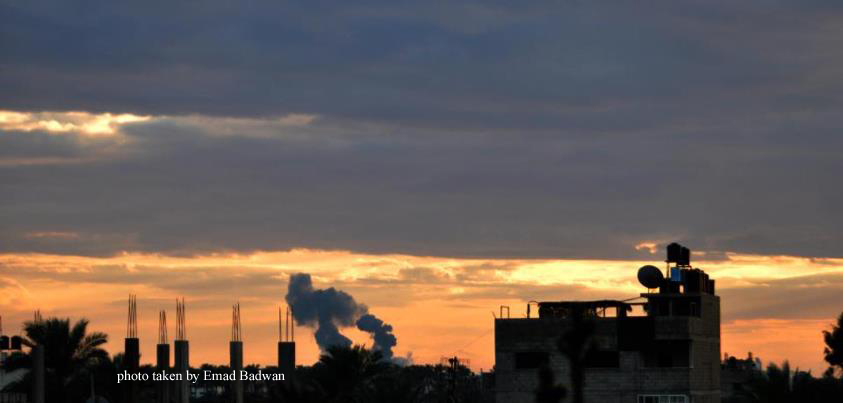
*photo of Khan Younis bombing, taken hours ago by Emad Badwan in Deir al Balah

   
*photo on left: Hussein Amody; photo on right “Samar”

UPDATE: please check RT Gaza under Israeli attack: LIVE UPDATES
I spoke with Joe Catron (@jncatron), who is in Gaza City and gave a summary of what has been happening in the last week and just how these Zionist attacks on Palestinian civilian and children began.

Joe: Israel is talking about a protracted operation, primarily airial. I’ve heard anywhere from 6 to 9 casualties in the last hour alone.
Bombs are falling everywhere, at least 20 targets have been hit since around 4 pm (said at 6:40 pm).  I heard the first airstrike today, which was an assassination of Ahmed Al Jabari, (the leader of Hamas’ military wing) somewhere up the coast… I heard it very distinctly from here.
Ranan Arafat, a 4 year old girl was killed, that’s confirmed, also heard possibly a 7 year old but don’t know if that is confirmed or the same girl.
It’s worth remembering that this exchange began over a week ago with the (Zionist army’s) murder of a 13 year old boy who was playing football, and continued with murder of 2 more children playing football and 2 men who came to their rescue
Now after every major resistance faction in Gaza has offered a ceasefire, the occupying power has decided instead to escalate things.

British activist, Adie Mormech, wrote this: Dear All. I am calling on all your support for the besieged people of the Gaza Strip.
Here in Gaza, more than 10 people have been killed so far in the Israeli operation named “Pillar of Defence” within the last 7 hours, including countless children such as 7-year-old child Ranan Arafat and an 11 month old baby. We’ve seen charred bodies of dead and injured children  pouring in to Al Shifa hospital of Gaza City and the other depleted hospitals around the Gaza Strip. 50 airstrikes all over the Gaza Strip so far. Deafening explosions shook us all as bombs landed close to us in the streets near the Universities. Huge explosions are landing all around us in Gaza City now as I write, some entire families have been injured. We can also hear the shelling of Israeli Gunships. Announcement of possible Israeli land invasion very soon.
More than 330 children were killed in the last bloody operation like this in operation Cast Lead, killing over 1400 in total the vast majority civilians. We are reporting from hospitals, streets and bombed areas. How many, terrified in there homes will have their lives shortened by tomorrow, or after the days of airstrikes, tank shellings and Gunship missiles Israel has announced. YOU CAN MAKE A DIFFERENCE. MOVE. ACT NOW TO STOP ANOTHER GAZA BLOODBATH. INACTION AROUND THE WORLD HAS LEAD US TO THIS POINT. ACT NOW.
Adie
I can be reached on +970592280943 also for media
But expecting electricity and phones to be out

Scanning Facebook updates from Palestinians throughout the Gaza Strip, updates report bombings all over Gaza:
Hussien Amody
2 minutes ago
at least 10 injures after targeting a house in Tal Al-hawa ..
Hussien Amody
5 minutes ago
This is gaza now .. 11 months old kid killed
 
Photo: This is gaza now .. 11 months old kid killed
Fadi F. Hamada
12 minutes ago
SHIT SHIT SHIT
F16s warplane jet just lunched 2 heave missiles to the west of my neighborhood.O Aallah save my family and all Gazans
Via @Muhammad Omer “Israeli F16s are bombing the hell out of Gaza now. Seeing smoke and burned cars. Ambulances rushing, people panic, but I applause to the policemen for keeping strong abs helping people despite the falling missiles aiming to hit their flesh…”
10 minutes ago ·
Hussien Amody:
Another huge airstrike on Nusirat camp just now
Sami AbuSalem
bombing continues, explosions shake our house, my kids screaming, I am trying to lull them, but infact I am so scared !
Hussien Amody
28 minutes ago
at 6:45 – Gaza : 9 martyrs more than 25 injures 15 of them seirously injured ,the total numbers in the attacks on Gaza Strip ..
Hussien Amody
about an hour ago
another attack just now near Star factory in Salah al-deen street
Hussien Amody
2 hours ago
the last airstrikes :
A car in Shoekh Radwan
airstrike on Shajaaya.
Abo Jarad military site in central Gaza strip
Alqadisia site west khanuones
A car in Rafah
a house in Biet Lahyia
a car in /zaytoon area
Hussien Amody
8 minutes ago
Gaza Today ..!
 
Photo: Gaza Today ..!
Hussien Amody: this is from the TV
The Guardian’s Gaza Live blog notes: We now are seeing multiple reports that Israeli warships are firing from the Mediterranean into Gaza, which has a densely packed population of about 1.5m people living inside 140 square miles.

The IDF confirms the Israeli Navy is striking Gaza.

As many commenters have noted, the latest assault on Gaza coincides with early campaigning for Israel’s parliamentary elections, planned for 22 January.

The IDF says the current assault was provoked by hundreds of missile strikes out of Gaza. Political observers note the attack reflects on Prime Minister Binyamin Netanyahu, who was to meet with his senior security cabinet “after sundown” tonight, as a strong leader.
John Glaser wrote a comprehensive account of the latest Zionist attacks on Gaza and Palestinian resistance’s response to them: Israel’s Latest Assault on Gaza: The Lie of Who Started It
 
Israel has again attacked Gaza. In its aerial and ground assault that began on Saturday, November 10th, at least 7 Palestinians have been killed, 5 of them civilians, 3 of whom were children. Up to 52 others, including 6 women and 12 children, have been wounded.


One of the wounded is carried into a hospital in Gaza City following Israel’s shelling (Reuters/Mohammed Salem)

As in every vicious military offensive Israel carries out in Gaza, the dominant narrative is that it is a response to rocket fire from Gaza into southern Israel. This is how it’s being reported in the US, and this is how virtually every American understands it.

And it’s a lie.

It’s true that on Saturday, prior to the expanded Israeli bombardment, the military wing of the Popular Front For the Liberation of Palestine shot an anti-tank missile at an Israeli Defense Forces vehicle near the Gaza border, wounding four Israeli soldiers. But what prompted the firing of the anti-tank missile?

First, on Monday, November 5th, Israeli forces shot and killed 23 year old Ahmad Nabhani when he “approached the border fence with Israel.” According to at least one account, Nabhani was mentally challenged.

Then, on Thursday, November 8th, the Israeli Occupation Forces – eight tanks and four bulldozers, to be exact – invaded southern Gaza, shooting and killing a 13-year old boy. Palestinian Centre for Human Rights (via):
According to investigations conducted by PCHR, at approximately 16:30 on Thursday, as a result of the indiscriminate shooting by IOF military vehicles that had moved into the ‘Abassan village, 13-year-old Ahmed Younis Khader Abu Daqqa was seriously wounded by a bullet to the abdomen. At the time he was shot, Ahmed had been playing football with his friends in front of his family’s house, located nearly 1,200 meters away from the area where the IOF were present.


So, even if honest observers brush to the side the cruel and inhumane Israeli blockade on Gaza and refuse to let it influence the equation of exactly which side started this flare up of violence, it is clear Israel started this latest clash. And in response to the response, Israel has waged a harsh, disproportionate military assault.

This would be a simple thing to understand if, for example, Western media bothered to ask the other side what happened. Palestinian news media immediately reported that the anti-tank missile Israel was supposedly responding to was admitted to by the Popular Resistance Committees, who described it as “revenge” for preceding Israeli violence on Gaza. But that basic task of honest journalism is apparently out of the question.

Every single Israeli incursion or attack on Gaza is accompanied by the same narrative: Israel fairly responded to unprovoked Palestinian rocket fire. The last major war on Gaza, Operation Cast Lead in December ’08-January ’09, also carried this narrative. Israel committed war crimes in that one-sided conflict, targeting and killing hundreds of civilians, using indiscriminate weapons, and intentionally destroying civilian infrastructure. It has become an accepted fact – even among critics of Israel – that the offensive was a response to Hamas rocket fire. The rocket fire did indeed occur immediately before the assault, but it was in response to Israel’s breaking of the six-month cease-fire, which even Israeli officials in WikiLeaks cables admitted Hamas had kept to.see also:

#GazaUnderAttack | Israel warns of major retaliatory operation on Gaza

‘Israeli crimes against Palestinians have gone unpunished due to Western cover’
Al Jazeera’s Gaza Live Blog

The Israeli “#StopTheRockets from Gaza Myth” – Photography

THERE COMES A ROCKET FROM GAZA ?!

Half the story: What @IDFSpokesperson leaves out about #Gaza