Wednesday, September 19, 2018

Gorilla Radio with Chris Cook, Terry Wolfwood, Jon Valentine, Christina Nikolic September 20, 2018

This Week on Gorilla Radio

by C. L. Cook - Gorilla-Radio.com


September 20, 2018

With neo-colonialism's second wave currently rolling across Africa, it serves well to remember, for one People the first wave never crested.

Western Sahara is home to the Saharawi, who have fought, and continue to fight for their independence, first from Spanish, then Moroccan occupiers.

Their self-declared Saharawi Arab Democratic Republic is recognized by more than fifty of nations, and yet they still suffer the most extreme deprivations, unable to profit from the wealth stolen from their ancestral lands.

Listen. Hear.

Sirocco: Winds of Resistance is a Canadian-made film about the role Canada plays in the colonization of Western Sahara and how that effects the lives of two Saharawi women and their grandmothers. The BC premier will screen next Friday, September 28th at Cafe Simpatico, 1923 Fernwood Rd.

Terry Wolfwood is Director and co-founder of the Barnard-Boecker Centre Foundation, and a writer, photographer, and long-time activist who has traveled to Western Sahara, and documented the plight of the people there. Her articles and pictures have appeared at Briarpatch, Peace News, and Third World Resurgence among other places, and at the BBCF.ca website.

Terry Wolfwood in the first half.


And; whether the Panic of 1907, Wall Street Crash of 1929, or the recently remembered, Financial Crisis of 2008, Autumn has historically been unkind to market capitalists. While those cyclical reversals, or "haircuts", visited through the vagaries of the stock market on investors may be mere "bumps in the road" for the monied class, for the rest of us those crashes can mean life-altering disaster. So why then do we abide this financial catastrophe creating system continue; is there no other way!?

The folk behind the 13th Annual Victoria Anarchist Bookfair think there is, and as ever their Bookfair presents workshops and speakers on a wide range of topics. The collective says, "We seek to challenge colonial attitudes, introduce anarchism to the public, foster dialogue between various political traditions, and create radical, inclusive, anti-oppressive spaces."

Jon Valentine is a long-time volunteer with the Victoria chapter of Food Not Bombs, members of the 13th Anarchist Bookfair collective, kicking off this weekend in Fernwood at 1240 Gladstone. Jon is too a dedicated social activist and two-time Victoria candidate for City Council.

Jon Valentine and a festival of anarchy in Fernwood in the second half.

And; Victoria horticulturalist and greentrepreneur extraordinaire, Christina Nikolic at the bottom of the hour with the Left Coast Events Bulletin of some of the good things to get up to in and around our town in the coming week. But first, Terry Wolfwood and Western Sahara's winds of resistance.

Chris Cook hosts Gorilla Radio, airing live every Thursday between 11-Noon Pacific Time. In Victoria at 101.9FM, and on the internet at: http://cfuv.uvic.ca.  He also serves as a contributing editor to the web news site, http://www.pacificfreepress.com. Check out the GR blog at: http://gorillaradioblog.blogspot.ca/

Camp Namegans II Eviction at Regina Park in Saanich

Camp Namegans II Eviction at Regina Park in Saanich

by C. L. Cook - Gorilla Radio


September 18, 2018

For the second time in less than a week, the residents of ‘Camp Namegans’ have been uprooted and moved along from their latest “home” in Regina Park.

Pro bono lawyer for the residents, John Heaney said the BC provincial government ordered Saanich Police clear ‘Namegans Nation’ from the B.C.’s transportation ministry land.

The ministry insists the eviction is a safety issue, and argued that before a judge when seeking a ruling for an interim injunction to be put in place while the status of the encampment was argued in a separate case.


Photo: Pete Rockwell

The judge allowed a ten month injunction, making a provision that the point of Charter rights in the case could be argued further at that time.

Heaney says,

“An injunction of this type…is essentially a final order, because once you’ve dispersed people, you don’t anticipate that they’re gonna wait for the time it takes to have a court case, and if they’re victorious, come back to the same place; they need somewhere to live now.”

[Listen to lawyer, John Heaney here.]


Heaney called the decision an “unfortunate contrast” to how the courts had handled similar requests for injunctions against the so-called, ‘Super Intent City’ behind the Provincial Court a few years ago. In that instance, he says,

“The court initially denied the injunction, and said, ‘We’re gonna go to trial on these issues.’ Including: Is your constitutional right a defense to being trespassers? Or said, ‘We’re gonna have a trial of whether there’s a Section 7 right to be encamped in the daytime.’

It’s not clear just where the 40+ campers at Namegans Nation, many who consider themselves a community, are to go to next. Victoria CBC radio quotes camp resident and homelessness activist, Chrissy Brett saying,

“At the end of the day, there weren’t housing options that were made available to people who were at [the previous site].”

The original Namegans provided a sheltering place for more than 100 people.

The housing situation in Greater Victoria mirrors that of other Canadian and North American cities, where booming real estate and building markets by turns raise rents, while renovating and demolishing affordable housing spaces across regions.

Brett says,

“This is a provincial problem, this is a national problem and people really need to start changing the way that they look at one-size-fits all model of housing.”

13th Annual Victoria Anarchist Bookfair

13th Annual Victoria Anarchist Bookfair

by Bookfair Collective 


September 19, 2018

We are pleased to announce the thirteenth annual Victoria Anarchist Bookfair, located on unceded Coast Salish Territory in Victoria, British Columbia.

The Bookfair is for anarchists and non-anarchists, with participants from all over North America and beyond. Events include book and information tables, workshops, readings, films, presentations, and much more!


Tuesday, September 18, 2018

Answering MH17 Claimes: Russia Provides Counter Narrative to Jet Liner Shootdown

The MH17 Missile Goes Home to Ukraine

by Max van der Werff via Dances with Bears


September 18, 2018

Amsterdam*  - Today was a remarkable day. For the first time the Ministry of Defence of the Russian Federation held a press conference about the MH17 case in which it took a pro-active stance, instead of responding, as it has before, to challenges from its “partners” in the west.

Two of my previous articles discussed studies which pretended to dissect trolls disrupting the honest flow of information in the MH17 debate.

In “Weaponizing info about MH17” I dissected a study published by Chatham House; “Dutch journos trolling Russia” gave the lie to outlandish claims by the Dutch weekly De Groene Amsterdammer.

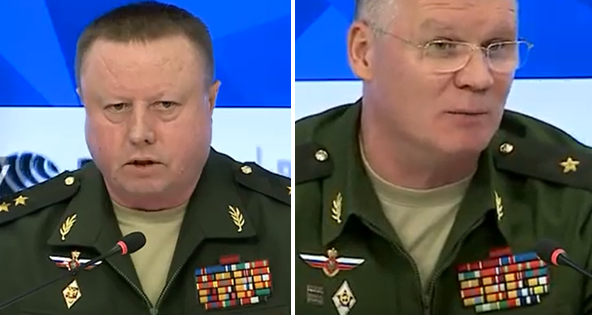
I mention these two articles about the trolling phenomenon on purpose. Let me explain why while you watch the Defence Ministry press conference given on September 17 by Lieutenant General Nikolai Parshin and Major General Igor Konashenkov; Parshin (pictured below, left) is head of the Ministry’s Missile and Artillery Directorate; Konashenkov (right) is chief spokesman of the Ministry.


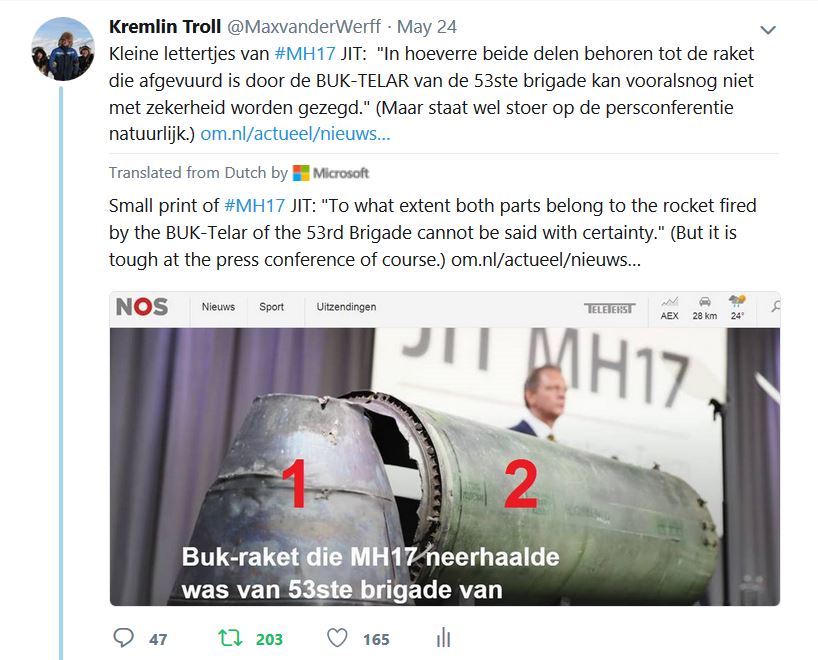
From the start Parshin spends no less than a staggering twelve minutes to explain that the Buk missile casing and the venturi, the exhaust nozzle, presented at the Joint Investigation Team’s MH17 press conference of 24 May 2018 were delivered by rail on 29 December 1986 to military unit 20152 of the Ukrainian Army and never sent back to Russia.

Click to view the video film of the press conference, which runs for almost 37 minutes and includes English voiceover.


One of my tweets about the 24 May 2018 presser of the Joint Investigation Team.

Twitter exploded and following claims initially dominated social media from euphoric:

Kiev is doubtlessly guilty of MH17 tragedy.

to neutral:

Russia’s MOD claims that the missile that shot down Mh17 had been produced in 1986 and was owned by Ukrainian authorities.

to bitter:

Russia has cited its own documents to claim the missile that downed MH17 was delivered to Ukraine in 1986 & never left. Also did some incomprehensible “analysis” of videos of the Buk coming from Russia to Ukraine to claim they’re falsified.

Actually, all three are wrong.

The first twelve minutes of the press conference today were no less than major league Russian trolling against the MH17 JIT. Here’s why, JIT now has these three options:

1) Admit a Ukrainian Buk missile shot down the Malaysian Boeing. (not gonna happen)
2) Admit the items presented at the 24 May presser were just props. (Oops, why?)
3) Let the crickets do the talking or come with a lame excuse.

Konashenkov moves to the next subject and claims that videos submitted to the Joint Investigation Team are falsified. [12min40secs]. In this section of the presser the talk is about incompatible perspective lines and incorrect lighting, which most people will not fully understand. Clearly an opportunity for tea leaf readers to make some Russia-lies-again-claims.

This dissecting of SBU fakeries goes on until [18min26secs] and is well worth watching. From my own visits to the crash site area, interviews and observations, in the long read MH17 – 1,000 Days I explain in detail why all data about photos and videos presented by JIT is highly suspect to put it mildly.

Audio between Ukrainian servicemen and top ranking army officials


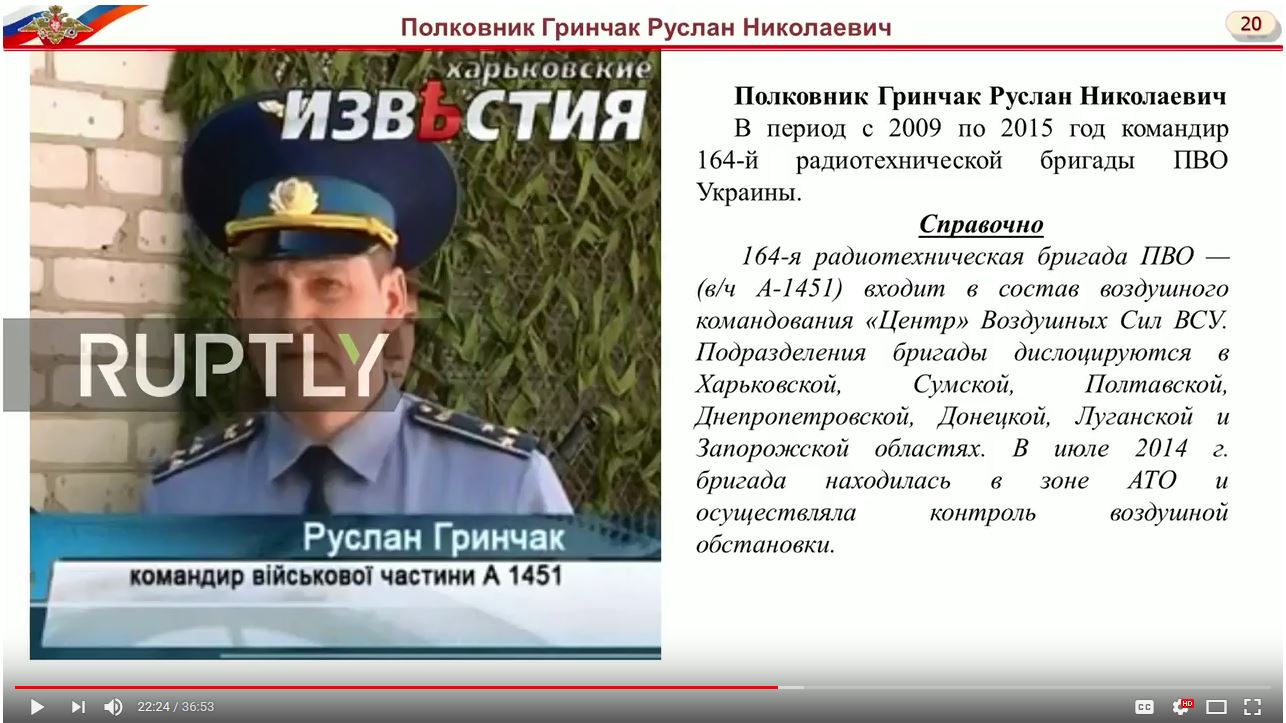
The Ministry of Defence further played an audio fragment allegedly of Ukrainian Armed Forces Colonel Ruslan Grinchak telling the person at the other side of the line:

“If this goes on we’ll take down another Malaysian Boeing and everything will be great again. That’s what we will tell them”.

According to Konashenkov this conversation took place in 2016 near Odessa and that Russian experts did a forensic audio analysis and established without any doubt this is the voice of Ruslan Grinchak.


Then in an important part of the presser a map is shown with positions of Ukrainian army units responsible for monitoring of the air space. Konashenkov states:

“It is worth noting that July 2014 he was the commander of the 164th radio technical brigade, nr A1451 of the Ukrainian Air Force. […] In other words Grinchak knew exactly what was happening in the air over Donbass, because it was his job.”

Without mentioning it, Konashenkov’s words imply the Russians have overwhelming evidence Ukrainian radars were functioning on 17 July 2014. This contradicts the Ukrainian claim that all its primary radars were switched off for maintenance.

Konashev continues:

“Ukraine has not given any information about the positions of its Buk units on the day of the crash. It has not responded to questions regarding the increased activity of its Kupol radar stations, nor has it published the records of conversations between Air Traffic Controllers. This clearly proves that Ukraine is abusing its position as a member of the Joint Investigation Team, seeking to manipulate the investigation.”
“Why the international investigation team tolerates this is a separate issue.”

“Russia has repeatedly expressed its doubts as to whether the JIT did the right thing to allow Ukraine to participate in the investigation and trust it to be a valid partner in JIT’s process.”

Instead of transcribing Koneshenkov’s final words, I suggest you listen and look for yourself.

Wrap up


– Today it became very clear Russia has a lot more evidence than it is willing to show for now.
– Malaysia already indicated there is no conclusive evidence to blame Russia.
– The pseudocide of the Babchenko ‘stunt’ by the Ukrainian SBU must have sent shivers down the spines of the Dutch and Australian JIT investigators and made them very insecure about what other disasters are still to be expected from this JIT member.

I agree with Russia that the official MH17 investigation is fundamentally flawed.

To be continued.


[*]NOTE: This has been republished from Max van der Werff’s website, Kremlin Troll. Clarification of errors in the Defense Ministry presentation will follow from van der Werff shortly. For a comprehensive examination of the fabrications of evidence which the Dutch-led Joint Investigation Team (JIT) has relied on for its allegations of cause and culpability, as well as the faking by NATO outlet Bellingcat, read this. For the concealment of US and NATO intelligence evidence and public lying by the JIT’s Australian delegation, led by ex-Prime Minister Malcolm Turnbull and ex-Attorney-General George Brandis, click to open.

Monday, September 17, 2018

Wrapping the IWC 67: What Next for the World's Whales?

IWC 67 Day Five: Going for Broke

by Paul Spong - Orcalab


September 14, 2018

Florianopolis, Brazil  - There was a slightly unreal feeling in the room at the start of today’s final session of IWC 67. Everyone knew that Japan was laying everything on the table but no-one including me was totally sure of the outcome.

The day started off tidying up unfinished business from the days before. The Sub Committee on Special Permit whaling had run into a road-block and its report had not been adopted. The obstacle came in the form of a report from a specially convened group of experts who were tasked with evaluating Japan’s “research” whaling programs.

The experts had given Japan a thumbs down on pretty much every element of the program, which unsurprisingly upset Japan. For a while there was a bit of a log jam that stalled the meeting, but Chairman Morishita solved it by proposing to list countries supporting Japan’s objection in his report of the meeting.

Here they are: Norway, Marshall Islands, St. Lucia, Nicaragua, Iceland, Solomon Islands, St. Vincent, Senegal, Kiribati, Tuvalu, Côte d’Ivoire, Antigua and Barbuda, Cambodia, Liberia, Surinam, Togo, Palau, St. Kitts and Nevis, Grenada, Laos. No surprise that it was precisely the same list that has supported Japan regardless of topic throughout the meeting.

The Chair then got down to the real business of the day.

Those of us in the room on the whales’ side felt confident but weren’t sure. At the outset Japan tabled an amendment to it’s proposal, in essence saying that if the requested Schedule amendment failed to achieve a simple majority the accompanying resolution would not be put to a separate vote. Given the slim chance the Schedule amendment would achieve the required ¾ majority I took this as a good sign. Just the same there was tension in the room as the vote proceeded.

It was relieved when Mexico answered “Si” to the question put by the Secretary. There was a chorus of “What?” accompanied by disbelief and then laughter as the Secretary asked Mexico again. This time Mexico did as expected and answered NO. A ripple of chuckles continued for a few more moments.

The rest of the vote went pretty much in the manner of previous votes in the meeting, so in the end Japan lost. The vote was 27 in favour, 41 against with 2 abstentions. Because Japan achieved only 40% support its entire reform package was lost. Phew. I was glad to see Switzerland and South Africa rejoining the majority. The abstentions were again interesting, this time Korea and Russia. In explaining its vote, Russia said it didn’t like the split in the Commission so had abstained.

I think there was a collective sigh of relief in the room after that vote because things got a lot lighter after the coffee break. The Chair quickly got through the rest of the agenda, approving reports, appointing officers and committee chairs, approving venues for the next meetings of the Commission and Scientific Committee, and generally wrapping things up.

There was even a touch of levity from Japan. It came during voting in a contest organized by Luxembourg for the best cetacean jewelry. Two years ago the contest was for the best whale tie and Japan won. The pieces were displayed on the screen one by one. When the image of a small dolphin appeared Japan raised a point of order, saying small cetaceans were outside the competence of the Commission. The room broke up.

It was difficult to know Japan’s thinking coming into this meeting. It brought such a huge delegation, which I gather included 9 Diet members and at least one senior government official. It was hard to avoid the feeling something was up. Sport and gambling terms come to mind. Japan is not alone in this forum but it might as well be. Meeting after meeting it fails to achieve its core objectives. Japan lost at virtually every turn at IWC 67.

I’m not alone in wondering what comes next.


IWC 67 Postscript: Two Dolphins  

by Paul Spong  - OrcaLab


September 16, 2018

The morning after IWC 67 ended Helena and I decided to take a last walk on the lovely long sandy beach that fronts the resort where the conference was held.

We got to the path leading down to the beach and decided to turn right towards the etchings in stone that had been left by former inhabitants of the area 6,000 or more years ago.

The ocean was still energetic, producing waves that hit the rocky shore and flung fountains of spray almost to our feet. Suddenly Helena exclaimed “I think I saw something!”

We stopped walking and looked out over the ocean, as we’d often done hoping to see a right whale without having the luck of some at the conference. Moments later two dolphins surfaced then disappeared and surfaced again. The sight was a total thrill. They were swimming quietly along parallel to the shore between big rolling waves. At one point I thought they were going to catch a wave and surf, though they didn’t and kept swimming quietly along. We headed further up the path hoping to see more of them and encountered other people, in couples and clumps staring out to sea like us, enjoying the presence of the dolphins. It was a marvelous affirmation of what had happened inside the meeting as it tilted towards enjoying rather than exploiting cetaceans.

Looking back on IWC 67 I have to characterize it as the best run and most interesting with the most agreeable outcomes of any I’ve attended in the last couple of decades. For sure everything didn’t go perfectly but it seldom does in life and at this stage in human relations with whales that would be asking too much. Among noteworthy details was a Secretariat that operated smoothly, making bits like registration and security easy and uncomplicated, a technical team that not only made following what was happening possible, but with the aid of a group of great interpreters seamless in four languages, and rapporteurs who managed to follow everything that was said regardless of language or accent.

For NGOs there were tables to sit at and microphones for requesting the floor, both unheard of previously. The performance of Chairman Morishita was masterful. Being Japanese there was some concern that he would be biased but he was not – rather, he was scrupulously fair. His command of English was impressive and impeccable, even down to idioms and jokes. He kept the complicated agenda to its schedule, adding just a couple of hours at the end of day four when he got concerned about finishing on time. He need not have worried.

For me, the highlights of the meeting were choosing the Florianopolis Declaration over Japan’s attempt to overturn the Moratorium, and the rejection in so many ways of Japan’s agenda – from the harsh scientific judgment of its “research whaling” to it’s proposal to solve the problems of the Commission by bringing high level diplomats into the picture. As I said previously, that last was my biggest worry, but for the moment at least it’s gone. It’s difficult to know what Japan will do in the face of such clarity. Achieving even a simple majority vote in the future will be difficult to impossible. Gone are the days when a bag of cash delivered at the last moment could add a voice and vote, and though the current pattern of voting causes suspicion about votes for aid there is no proof. If that has been Japan’s approach, quite clearly it has failed. So the big question now is, what will Japan do next?

I first went to Japan in 1974 hoping to convince it to stop killing whales because of what we were learning about them. Obviously I failed, but in the process I was told that the way the Japanese mind works is to carefully consider a complicated issue from all sides over whatever time it takes and then finally make a decision. Could now be the time?

When I put this question to Chairman Morishita after the meeting, he looked me in the eye and calmly said:

“No comment”.

A MEMO From Henry Kissinger to Vladimir Putin

MEMO From Henry Kissinger to Vladimir Putin on Idlib - A Reminder of How the Turks and Americans Do Things Together

by John Helmer - Dances with Bears


September 17, 2018

Moscow - Greek investigative journalist Michalis Ignatiou revealed on Sunday the classified White House document of August 13, 1974, in which Henry Kissinger persuaded then-US President Gerald Ford that Turkey should be supported by the US in their two-wave invasion of Cyprus, seizing and occupying over a third of the island, deterring the Greek defence of Cyprus, and encouraging the Turks to ignore United Nations (UN) condemnation.

According to Kissinger,

“the Turkish tactics are right — grab what they want and then negotiate on the basis of possession. But if the Turks run loose on Cyprus, the Greeks could come unglued. We certainly do not want a war between the two, but if it carne to that, Turkey is more important to us and they have a political structure which could produce a Qadhafi.”

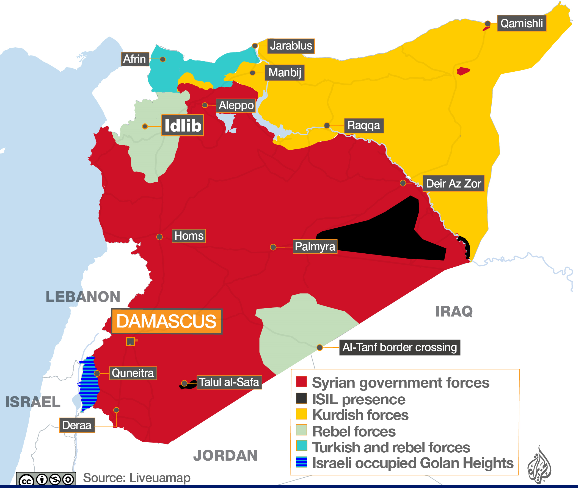
This month the Kissinger scheme is being revived by the US, with support from Germany, France and the UK, to support Turkey in its seizure of the city and governorate of Idlib, in northwest Syria. Threats of US and NATO missile attacks have deterred the Syrian Army from attempting to reclaim its own territory. President Vladimir Putin has been pressured by the Turks, the US and NATO to delay Russian military support for the recovery of Idlib.

“There is no American reason why the Turks should not have one-third of Cyprus,” Kissinger told Ford in the Oval Office forty-four years ago. Substitute Idlib for Cyprus today, and there is no American reason why the Turks should not have Idlib, no matter what UN resolutions on Syrian sovereignty require and the Kremlin supports.

Today, as Putin meets the Turkish leader Recep Tayyip Erdogan in Sochi, the question to be decided is whether the Kissinger scheme will prevail again.

The Kissinger-Ford briefing, kept classified for thirty years and then redacted by the Ford presidential library until now, took place at 9 in the Washington morning, 4 in the Cyprus afternoon, on August 13. That was between the two waves of the Turkish invasion of Cyprus, known as Operation Attila.

The first wave, Attila-1, involving 40,000 Turkish ground troops, air and naval forces, took place on July 20, 1974. The second wave, Attila-2, with another 40,000 invaders, commenced on August 14. That was fifteen hours after Kissinger and Ford had agreed to give the Turks their go-ahead; at the same time ordering the British not to defend Cyprus by engaging the Turkish attackers; Cyprus had been a British colony and by the 1960 treaty of guarantee Cyprus remained a protectorate of the British who kept two military bases on the island. For a brief account of Attila, read this. The outcome of the US-backed invasion was Turkish occupation of more than 36% of the island.

For continuing US attempts to compel the Republic of Cyprus and the Greek Cypriots to capitulate and accept Turkish occupation under Turkish and NATO flags, and at the same time preserve the British bases on the island, read this archive of President Nikos Anastasiades’s negotiations with the Assistant Secretary of State Victoria Nuland.


Left: Kremlin record of Henry Kissinger at the Kremlin with Vladimir Putin, 
February 3, 2016. They met again at the Kremlin on June 29, 2017
Right: President Erdogan last met Kissinger in New York, September 23, 2016.

Read the document in full, including the hand-written notes on which the typescript of the conversation was based. Kissinger, then Secretary of State and Ford’s national security advisor, did most of the talking; General Brent Scowcroft, the deputy national security advisor, came in late, managing to squeeze in only nine words during the hour.

NODIS, the classification designation at top and bottom of every page, meant that the secrecy Kissinger intended for his discussion with Ford should be preserved by not distributing the document to any other US Government official. XGDS in the US Government’s classification manual meant the Kissinger-Ford document was exempt from the general declassification schedule. Secret forever, almost.

Kissinger assured Ford the Soviet Union would react against the Turks with angry words at the UN, but pose no military risk.

“We have been trying to bail the Cyprus situation out after it got out of control. The British have made a mess of it. If the Turks move to take what they want, they will be condemned in the Security Council and the Soviet Union will beat them over the head with it. Some of my colleagues want to cut off assistance to Turkey — that would be a disaster. There is no American reason why the Turks should not have one-third of Cyprus.”

The clock, Kissinger told Ford, should be allowed to run because it was running to the Turkish advantage. “Let’s wait a bit. If we come out of the Cyprus thing all rlght, we will have more leverage.” Kissinger already knew that Attila-2 was about to be launched, but he didn’t reveal that to Ford.

On August 13, 1974, Ford had been president for just four days, following the forced resignation of Richard Nixon on August 9. Ford had also had no time to decide whether to separate the Secretary of State and National Security Advisor posts and promote another official to rival Kissinger’s power; in time Ford decided against doing that.

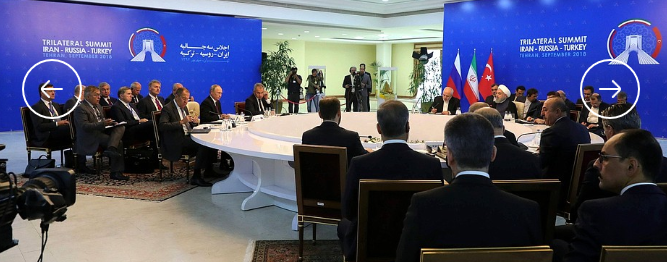
On September 7, 2018, at the summit conference on Syria held in Tehran with the Iranian and Turkish presidents, Putin sought to keep the record of direct negotiations secret. The Iranians decided to broadcast the proceedings.


Kremlin photo of the Tehran summit meeting, September 7, 2018
Note the Russian seating arrangements – the President was flanked by 
Foreign Minister Sergei Lavrov on his right; Defence Minister Sergei Shoigu 
on his left. Immediately behind Putin sat Dmitry Peskov. Officially the President’s 
spokesman, Peskov is a Turkish speaker and the most prominent pro-Turk in the 
Kremlin; Peskov’s daughter Elizabeth (Liza) is a lobbyist for Turkish clients; for details, read this.

Putin’s remarks at the subsequent press conference emphasized the gradualism of his plan for Idlib, and played down disagreement with Erdogan on the timetable for restoration of Syrian sovereignty and the planned offensive of the Syrian Army.

“We discussed specific measures for gradual stabilisation in the Idlib de-escalation zone, which, among other things, provide opportunities for the conciliation of those who are ready for dialogue. As President of Turkey, Mr Erdogan, has said, we call on all conflicting parties to cease fire and stop the violence. At the same time, we consider unacceptable any attempts to spare terrorists or inflict damage on Syrian government troops under the pretext of protecting the civilian population. This seems to be the objective of the attempts to fabricate chemical attacks allegedly perpetrated by the Syrian government. We have irrefutable proof of militants preparing such operations and such provocations.”

AL-JAZEERA MAP OF CONTROL ZONES OF SYRIA, SEPTEMBER 2018 


On the issue of whether Idlib should be liberated by the Syrian Army now or later, gradually or without delay, Foreign Minister Lavrov has been accused in the press of changing his position. Last month Lavrov was in favour of speed. “This is the last hotbed of terrorists who are trying to speculate on the region’s status as a de-escalation zone, who are trying to hold the civilian population hostage as human shields and bend to their will those armed groups ready to engage in dialogue with the government. So from all points of view, this festering abscess needs to be liquidated.”

On September 3 Lavrov said delay in the Syrian operation could not be tolerated “indefinitely”.

In Berlin on September 14 Lavrov said a great many things on Idlib, some of which have been interpreted as a Russian concession to delay the Syrian offensive in Idlib because of the threats of military retaliation by US and NATO forces.

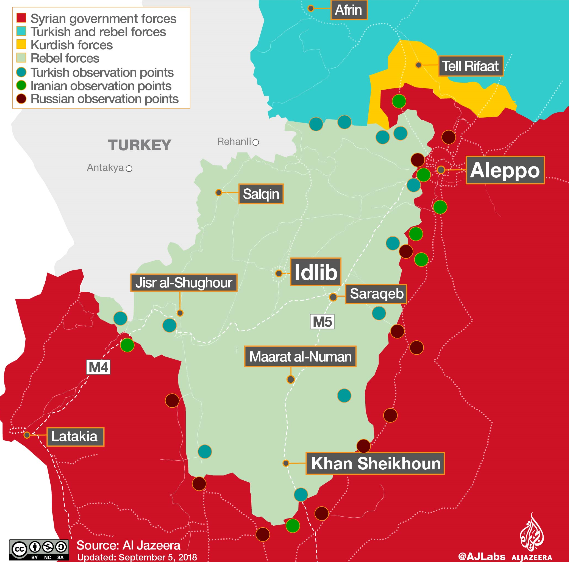
In his Berlin speech on Friday what Lavrov did was to illustrate the differences between Russia’s military and security policymakers on the one hand, and the pro-Turkish lobby led by Dmitry Peskov in the Kremlin and major Russian business figures. Lavrov warned the Turks against adding forces and extending their occupation of Idlib beyond the mutual agreement on “observation posts”. “We speak with our Turkish colleagues who know that their territory sometimes is used by bad people to complicate situations in Syria. They provide additional control measures on the border. Now in Idlib twelve observation posts have been established by Turkey by the agreement which we have reached. This calms the situation a little. Turkey has undertaken obligations to try to achieve differentiation between that armed opposition which is ready to have dialogue with the [Syrian] Government and the terrorists who have tried to crush under themselves those armed groups which aren’t extremist.”

AL-JAZEERA MAP OF CONTROL ZONES IN IDLIB GOVERNORATE 


Lavrov tried explaining what the military implications of this “differentiation” mean to the Russian command.

“It is necessary to understand what has been agreed in all cases of the creation of de-escalation zones. There the truce …doesn’t extend to terrorists. Oppositional groups are called to separate themselves from terrorists and to make contact with the government forces with our mediation, with the mediation of Turkey or Iran, and to agree [terms] for local reconciliation. Certainly, we will do everything that we are doing now, taking into full consideration the problems of the civilian population. Besides, by efforts for the organization of local arrangements with these or those groups which are in the Idlib area, a humanitarian corridor [has been established] for those who wish to leave [the area] just as we did in the zones in the south — in the province of Homs and the creation of the East Guta zone”.

Lavrov described the discussion in Tehran as one to “solve the problems in the Idlib zone to minimize risks for the civilian population. Now between us and the Turks there is a dialogue in the area of diplomats and the military. Next Monday [September 16] the presidents will consider this situation.”

Lavrov also claimed that western and Turkish press charges that Russia intends to give full air and ground support for the Syrian operation to retake Idlib is “an unfair representation of the facts.” Russian operations were limited, he told his Berlin audience on Friday, to defensive responses to the drone attacks launched from within Idlib against the Russian base at Khmeimim, south of Latakia.

“As soon as we obtain such information [on drone production and deployment], we suppress the underground factories making the lethal weapons. I assure you that we will approach most precisely these questions, to create humanitarian corridors, to encourage so-called local conciliation, to do everything to ensure the civilian population will not suffer.
We won’t act as the [Anglo-American] coalition did in Iraqi Mosul or Syrian Raqqa when there were no negotiations on local truces with the armed opposition; no humanitarian corridors were created. Raqqa is roughly comparable in size to Idlib city. It was razed to the ground … we are waiting for information from the UN on what is evolving there…”

So what is Russian strategy towards the Turks and other NATO forces in Syria?

[Let us] not divide the Syrian territory into ‘good’ and ‘bad’. Now our western colleagues, for example from the EU and, the US, say they will provide only humanitarian aid (and not too much to the [Syrian] government). As for restoration of [Syria’s] infrastructure and the economy, that [the EU and US say] can be only after the so-called political transition begins and when they are convinced that this transition goes in the ‘correct’ direction. And here in the territory which is illegally occupied now by the US, together with opposition groups under their control and the Kurds, on the eastern bank of the Euphrates, they invest millions and tens of millions of dollars doing exactly what the West refuses to do in other parts of the Syrian territory. In other words… it is a plan which at its root contradicts the sworn assurances of our western colleagues that they will respect the territorial integrity of the SAR [Syrian Arab Republic].”

In the old Kissinger formula it was accepted that Turkish territorial expansion by military means was in line with US strategy. For the moment Lavrov is leaving it to Putin to make clear with Erdogan if that’s still so – and if it is, whether Russia will do more about it than Kissinger expected at the UN.

Sunday, September 16, 2018

Venezuela and China: Finding Allies Across the Sea

Maduro’s Beijing Visit Spooks a US Plotting Venezuela’s Isolation

by Elliott Gabriel  - MintPress News


September 14, 2018

Given the humble goal of Caracas to free itself from the domineering whims of a U.S. imperialism keen on reviving the notorious Monroe Doctrine, it is obvious why the U.S. would see sinister motives in the fraternal reception Beijing has offered to the Venezuelan head of state.
BEIJINGVenezuelan President Nicolas Maduro received a rare yet exceedingly warm welcome Thursday as he landed in Beijing, where the oft-maligned leader and target of U.S.-spearheaded regime-change efforts will discuss new ways in which his government and the People’s Republic of China can deepen their relations and strengthen their long-running ties. The state visit, which came at the invitation of Chinese President Xi Jinping, gives the elected leader of the Bolivarian Republic of Venezuela an important opportunity to break from the imposed isolation his government has suffered amid the concerted economic, diplomatic, and propaganda war being waged on the South American nation.
Chinese President Xi holds welcome ceremony
for Venezuelan counterpart Nicolas Maduro before
talks in Beijing, Sept. 14, 2018. Yao Dawei | Xinhua

Maduro departed his home country vowing “great expectations” and promising “big achievements” by the end of the trip. In a televised address Wednesday, Maduro said:

“We are leaving under better conditions, having activated a program of economic recovery, growth and prosperity. We are going to improve, broaden and deepen relations with this great world power.”

In the past several years, Venezuelan finances have been on the rocks amid plummeting commodity prices that have shaken oil-exporting nations across the globe. The country has approximately $8.3 billion in foreign exchange reserves and its ability to access external financing has been hobbled by an unceasing flow of sanctions from Washington.

Venezuela has seen the intense opposition protests from last year fade, only to be replaced by a massive migratory crisis and increased fears of U.S.-led military interventions or U.S.-supported coups. Last month, Maduro was the subject of an assassination attempt when an explosives-laden drone targeted him during a military parade.

Axis of Evil 2.0 or simple shared interests?


Bloomberg reported Thursday that China had agreed to extend a $5 billion line of credit to Venezuela, which would be repayable in either cash or oil. The two countries will also likely sign a strategic accord on gold mining, Venezuelan Finance Minister Simon Zerpa told Bloomberg News. “Venezuela has a great alliance with China,” the minister stressed.

Beijing, for its part, has expressed glowing confidence in Venezuela’s ability to rebound from a thoroughgoing economic crisis that has shaken the foundations of the left-wing government.

Chinese Foreign Ministry spokesman Geng Shuang told reporters Thursday that the state visit by Maduro would serve to benefit “ both sides’ mutual trust, to push forward cooperation, to expand ties between the two countries, and to promote Venezuela’s development.”

For over a decade, China – a top oil-importing nation – has agreed to $50 billion in loans to Venezuela as a means to secure oil from a country with the largest oil reserves in the world. Since August, China has largely halted its oil imports from the U.S. amid the raging trade war between the two countries, largely in fear of the possibility that U.S. crude – which takes months to ship by sea to China – would be added to Beijing’s tariffs list.

China’s relations with Venezuela have also granted Caracas a crucial means by which it can weather a storm of pressure from Washington, which sees any sign of defiance as an unforgivable sign of misconduct in its so-called “backyard.”

However, Beijing has recoiled at the accusation that it is simply interested in a geopolitical chess game with Washington, whereby the growing Asian giant is purely motivated by the goal of reducing its strategic partners to the level of pawns.

In a Thursday editorial, China’s state-owned Global Times newspaper pointedly remarked:

“President Maduro’s China tour will give rise to many conjectures from Western media. But they should be more realistic.”

In recent years, China has assisted Venezuela in social projects meant to renovate the country’s poor barrios and build over ten thousand fully-furnished housing projects; helped launch satellites to bring telecommunications and internet services to poor regions in the country; and assisted in the upkeep and modernization of the country’s oil-production infrastructure.

The two countries have formed joint ventures for the production of automobiles, mobile phones, passenger vehicles and computers, and Venezuela also provides a crucial market for various Chinese consumer goods. Caracas has also taken a great interest in Beijing’s Belt and Road initiative and its expansion to Latin America, a region China sees as a natural extension of its 21st-Century Maritime Silk Road trade and development plan.

By continuing to show its support for the beleaguered government of President Maduro, Beijing is hoping to champion what it sees as an innovative model of South-South cooperation with a state that still enjoys a broad and significant level of popular support in spite of its detractors.

In essence, China is also hoping to throw its weight behind those countries that are struggling to pursue an independent development path in a region that has, throughout its entire modern history, been subject to the whims of foreign powers.

Given the humble goal of Caracas to simply free itself from the domineering whims of a U.S. imperialism keen on reviving the notorious Monroe Doctrine, it is obvious why the United States would see sinister motives in the fraternal reception Beijing has offered to the Venezuelan head of state.

Elliott Gabriel is a former staff writer for teleSUR English and a MintPress News contributor based in Quito, Ecuador. He has taken extensive part in advocacy and organizing in the pro-labor, migrant justice and police accountability movements of Southern California and the state’s Central Coast. 
 
Republish our stories! MintPress News is licensed under a Creative Commons Attribution-NonCommercial-ShareAlike 3.0 International License.

Teach Your Children War: UK Opens Classrooms to Military-Industrial "Educators"

Arms Manufacturers In UK Classrooms

by TRNN


September 16, 2018

Andrew Smith discusses how schools in the UK involve the arms industry to teach school children about weapons manufacture and trade. BAE Systems invests tens of millions of pounds in order to improve its image in the eyes of school children.


Andrew Smith is a spokesperson for the Campaign Against Arms Trade, or CAAT, and he has written for a range of political magazines and national newspapers. 

Saturday, September 15, 2018

Al Qaeda Goes Hollywood

Presenting The Syria Deception: Al Qaeda Goes to Hollywood

by Dan Cohen - The GrayZone Project


September 15, 2018

An exclusive Grayzone investigative documentary rips the cover off of the most sophisticated and expensive campaign of humanitarian interventionist propaganda in modern history.   

For decades, Western governments, corporate media and Hollywood have engaged in a project of mass deception to manufacture consent for military interventions. Waged in the name of lofty ideals like freedom, human rights and democracy, US-led wars in Iraq, Afghanistan and Libya wound up bringing death, destruction and even the return of slavery to the African continent.

As the wounds from those catastrophes festered, Washington embarked on its most ambitious project yet, marketing another war of regime change, this time in Syria.


This investigative mini-doc exposes the cynical deceptions and faux humanitarianism behind the campaign to sell the dirty war on Syria. It will also demonstrate the lengths that the US and its allies have gone to develop new ploys to tug at Western heartstrings and convince even liberal minded skeptics of war that a US intervention was necessary — even if it meant empowering Al Qaeda’s largest franchise since 9/11 and its theocratic allies among the insurgency.

Big lies and little children have formed the heart of what is perhaps the most expensive, sophisticated, and shameless propaganda blitz ever conducted.

Welcome to the Syria Deception.

NATO: A Spreading War-Making Virus

The NATO Virus is Spreading

by George Galloway - SOTT


June 7, 2018

 Like a geographical virus the spread of the North Atlantic Treaty Organization has broken all natural boundaries. It is immune to any antibiotic of logic and poses a deadly threat to the health, peace and stability of the world.

For decades in the West, NATO was believed to have been a defensive response to the creation of the Warsaw Pact - despite the fact that it was formed long before the treaty, which has in turn been nearly 30 years dead.


NATO Secretary-General 
Jens Stoltenberg poses next to a 
world map, Brussels, Belgium, May 7, 2018

Nonetheless, like death and taxes, membership of NATO has been assumed to be one of life's few certainties with an increasing share of national wealth going to pay for it.

This might have gone on unquestioned but for the multiple East-West crises of the last few years and the bizarre inclusion of, brothers-in-arms and non-North Atlantic states, Colombia and Israel in recent NATO activity.

Almost overnight, interest in my long-quiescent No2NATO campaign has picked up as public opinion has switched on like a light to the fact that there is little that is defensive about NATO and even less that is North Atlantic.

When the Colombian President announced a Co-operation Agreement with NATO in 2013 and expressed hope that his country would eventually join the US-led alliance, it was met with opposition in his own country and embarrassed chortles at NATO HQ. Jungle fighting against the FARC guerrillas or a confrontation with the Chavez revolution in neighboring Venezuela were clearly "out of area" - even for the mission-creepers in Brussels.

But with the sharpening of US hostilities towards Venezuela, holder of the world's largest proven oil reserves, and now officially an enemy of Washington subject to the usual spectrum of regime-change bombardment, NATO-Colombian relations have suddenly been cranked up dramatically.

It is likely that the US will soon turn to a Contra-style physical confrontation with the tenacious Chavistas in Venezuela, in which case a maritime and even ground force presence for the US will be necessary. When the Venezuelans fight back, this could be deemed to be an attack on a "NATO-partner and candidate member". Vietnam 2 could then be fought by, not only the US, but Britain, France, Belgium and Uncle Tom Cobley.

Although not European, Israel has long participated in such cultural highlights as the Eurovision Song Contest - and has often won it! They ply their less-successful football trade in the UEFA Champions League too. The ever advancing NATO encroachment towards the border with Russia has, until now, kept Israel out of NATO. It had to make do with being a "Mediterranean Partner" alongside the likes of Egypt and Morocco.

Israel's complex relations with Russia pose a dilemma for Benjamin Netanyahu. After all, it is only weeks ago that the Israeli premier shouldered his way to President Vladimir Putin's side on the Victory day parade in Moscow.

Huge numbers of Russian Jews are also citizens of Israel - including, virtually overnight last week, Roman Abramovich. There is visa-free travel between the countries and significant economic relations.

Being on opposing sides in the long-war in Syria has tested relations between Moscow and Tel Aviv but it has not broken them. So when 18,000 NATO soldiers just invaded the Baltic States and Poland for the eighth Saber Strike military maneuvers aimed at Russia, nobody expected the Israeli Parachute Regiment to turn up. But they did.

The "exercises" are designed to cast a shadow over the World Cup in Russia, and to act tough - as a bolster to the spectrum of sanctions on Russia at a time when they are beginning to fray as Putin's visit to Austria just demonstrated.

The message is, our soft power might be tissue-thin but our guns still pack a punch. And now we've got the Israelis on the front-line too. Together with the recent reckless bombing in Syria, which came uncomfortably close to vital Russian interests, and the increasingly bellicose threats of war by Israel against Iran, sabers may begin to be sharpened on both sides after the World Cup is won.

NATO's value to its US overlord is that it can bypass individual nuances on policy in member states. So, while Germany, Italy and France are chafing somewhat against endless economic sanctions on Russia, and where virtually everyone is against Trump on Iran, NATO's independent institutional power and its elaborate trip-wire system can plummet everyone into a crisis - irrespective of member-state nuances never mind hostile public opinion.

It may be hoped that NATO membership assumes consent to US orders as a kind of default position. That when a trip wire is allegedly crossed, the alliance itself will move into action before European public opinion can even begin to get its boots on.

A couple of years ago I shared a platform at an important festival of ideas in Hay-on-Wye, on the Welsh-English borders, with a freshly retired English general who had just been serving with NATO High Command.

The general bluntly stated that "British mothers have to realize that their sons may have to give their life's blood on the streets of Vilnius" in defense of NATO's positions there.

My own protestations, that Russia posed no threat whatsoever to the Baltic States and that, in any case, British mothers had never heard of Vilnius and would never agree to spend their children's blood there, were met with a contemptuous wave of the hand. It signaled that no anti-war agitation from the likes of me would be allowed to be of any consequence whatsoever.

I believe that NATO and its partner organizations, far from being a defensive shield, are an aggressive, ever wider broadsword. Far from keeping the peace they represent a clear and present danger of war. Far from representing 'the democracies', NATO poses a real threat to democratic control of foreign and defense policy in member countries. It is for these reasons I will shortly relaunch my No2NATO campaign. Before it is too late to do so.

The Greening of Brown

Hundreds Disrupt Global Climate Action Summit, Demand Climate Justice

by TRNN


September 14, 2018

Civic and business leaders convened at California Governor Jerry Brown’s Global Climate Action Summit, but protestors decried their “false solutions” to the climate crisis.


Preparing the Public Mind for the 'Libyanization' of Syria

The Bluffer's Guide to Bombing Syria

by Peter Ford - 21st Century Wire


September 14, 2018 

 Peter Ford, former British Ambassador to Syria, with a rather useful media guide, aptly described as, “The Dirty Dozen: 12 lies they tell you to anaesthetise you for the upcoming bombing of Syria.”

The propaganda mills of the British and American governments – spokespersons, media, think tanks – are working overtime churning out ‘talking points’ to justify the upcoming large scale bombing of Syria on the pretext of use of prohibited weapons.

Here is a guide from a former insider to the top dozen of these lies.


1. There are more babies than jihadis in Idlib. As it happens this gem of moral blackmail is untrue. There are twice as many jihadis (about 100,000) as babies (0-1 year) (55,000). What is this factoid meant to say anyway? Don’t try to free an area of jihadis because you might harm a lot of children? The Western coalition scarcely heeded that consideration in razing Mosul and Raqqa in order to crush ISIS. They are still pulling babies out of the rubble in Raqqa.

2. The reports [of the imminent chemical weapons ‘attack’] must be true because Assad has done it before. False. Since 2013 when Asad gave up chemical weapons under supervision of the Organisation for the Prohibition of Chemical Weapons (OPCW) the OPCW have not visited the sites of alleged attacks in jihadi-controlled areas but have accepted at face value ‘reports’ from pro-jihadi organisations like the White Helmets and the Syrian American Medical Society, along with ‘evidence’ from hostile intelligence agencies. In the case of the one site the OPCW did visit, Douma, their report said they found no evidence of sarin, no untoward traces in any of the blood samples taken from ‘alleged victims’ (their term), no bodies and only ambiguous evidence of use of chlorine.

3. The OPCW report on Douma was flawed because the Russians and Syrians caused delay. False. As documented in the OPCW report, delay was caused by UN bureaucracy and jihadi snipers. The inspectors do not say their findings were to any significant degree invalidated by the delay.

4. Assad uses chemical weapons because they frighten large numbers of people into fleeing. False. They don’t. This desperate argument is trotted out to counter the fact that Assad would have to be stupid to use chemical weapons knowing what the result would be and that he would derive minimal military benefit. To date, not one of the alleged chemical attacks has precipitated an exodus any greater than flight caused by the legendary ‘barrel bombs’. The inhabitants of Douma by their own testimonies given to Western journalists were even unaware there might have been an attack until they heard about it in the media.

5. The OPCW won’t be able to investigate because it won’t be safe. A feeble excuse to preempt calls for establishing facts before bombing. The Turks escort Western journalists into Idlib. They have hundreds of troops there and the jihadis kowtow to them because they control all logistics. The Turks could escort OPCW. And wouldn’t the jihadis be keener than anybody for the inspectors to visit if their claims were true?

6. The upcoming strikes are not aimed at regime change. False. The plan is to decapitate the Syrian state with attacks on the presidency. Failing that the aim is to make Idlib a quagmire for the Russians. Anything to deprive Asad and Putin of victory, regardless of whether it prolongs the war.

7. It’s all Russian disinformation. Yeah, like the arms inspectors before the Iraq war who said no WMD in Iraq. Reality: the Russians have got great intelligence on what Western powers with their jihadi clients are up to and are calling out the phoney moves.

8. There won’t be enough time for parliamentary debate. Pull the other one. Reality: the government are terrified of a rerun of 2013 when Labour and 30 brave Tory MPs voted against bombing, causing Cameron and then Obama to back off.

9. MPs can’t be told what is planned because it would jeopardise the safety of service personnel. How low can you stoop? Feigning concern for flyers when it’s really just about keeping the people in ignorance of how big the strikes are going to be.

10. There are going to be massacres, a bloodbath, or ‘genocide’. False. We heard all this hysteria before Aleppo, before Eastern Ghouta and before the campaign in the South. All vastly exaggerated. The Syrian Arab Army has not been responsible for a single massacre, while the jihadis have been responsible for many (source: quarterly reports of the UN Independent Commission of Inquiry on Syria).

11. People have nowhere to go. False. The Russians have opened safe corridors but the jihadis are not allowing people to leave. They can still leave for the northern border strip which Turkey controls, where there are camps, and many (including jihadi fighters) will be able to cross temporarily into Turkey.

12. We can’t tell you which armed groups we support because it would make them targets for Assad. Really? You think he doesn’t know? Isn’t it because you are terrified it will come out that we have been supporting some real head-choppers?

Author Peter Ford is a retired British Diplomat who was Ambassador to Bahrain from 1999-2003 and Syria from 2003-2006.


READ MORE SYRIA NEWS AT: 21st Century Wire Syria Files

SUPPORT 21WIRE – SUBSCRIBE & BECOME A MEMBER @21WIRE.TV

IWC 67 Day Three - Two Solitudes

IWC 67 Day Three - Two Solitudes  

by Paul Spong - orcalab


September 12, 2018

Florianopolis Brazil - This morning began with a presentation by the USA of the revised ASW (aboriginal and subsistence whaling) Bundle.

The most controversial details (carry over and automatic renewal) provisions had been massaged sufficiently to satisfy many of the objections that had been raised yesterday, or at least satisfy many of the countries which were uneasy or inclined to oppose it yesterday.

The changes were insufficient to satisfy the BAG (Buenos Aires Group) which consists of the Latin American countries who are the whales’ greatest defenders. So a vote was held.

I’m quite sure the USA was holding its breath as the vote proceeded, but in the end when the Secretary announced the result there was an audible sigh of relief in the room. The USA had achieved predictability and stability for the Alaskan families and communities which depend on Bowheads for food and cultural continuity.

There was an instant celebration in the room and beyond. Nothing was noticed or said about the side consequences of the decision. Greenland gets to kill more whales than ever and so does Russia.

Changes like removing length and time of year restrictions on killing fin whales near Greenland must have consequences but they are unknown and certainly in this forum unnoticed. While the decision was a victory for the USA, at the same time it was a defeat for whales and their defenders.

There are so many side effects to the decision that will resonate for years, even decades to come. For me the ugliest consequence is the permission St. Vincent now has for the whalers of Bequia to go on killing humpbacks whenever they come close. The quota is 4 per year and includes a “carry over” provision. Within 7 years 28 humpbacks could be killed.

The decision flies in the face of a whale watching economy that is growing in the Caribbean and based on identified individuals. Go figure. The only sense I can make of it is that the USA was so desperate to achieve its objective for far north Alaskan communities that it was willing to give everything else away.

Poor humpbacks.

The ASW decision engendered such a feeling of bonhomie in the room that several whale friendly decisions were taken with only token opposition. A resolution on advancing understanding of the role of whales in ecosystem functioning was passed after a vote with 63% support. It was so interesting to hear virtually the same objections repeated time after time by Japan’s allies – irrelevant, outside the scope of the Convention, etc.

Possibly as a result of this defeat, two more resolutions were passed by consensus after the chair of the Finance and Administration Committee assured the audience they would not have financial consequences. These resolutions, on anthropogenic noise and ghost gear for a while produced an aura of cooperation during the afternoon session. For me, the highlight of the feel good phase was Belgium’s comment that “protecting whales and dolphins means protecting ourselves”. Yes! Unfortunately though predictably the cozy feeling didn’t last.

Following the afternoon coffee break chairman Morishita introduced Agenda item 12, Future of the IWC. It seems he did so because the meeting was falling behind schedule and he wanted to catch up. I’m not sure if it was a mistake but it did open a can of worms.

There are two visions of the future. One is described in the Florianopolis Declaration which sees a future in which whales are respected and valued, only treated in non-harmful ways. Naturally this is anathema to Japan, so suddenly we were hearing comments about how some members had been so nice to others they deserved reciprocal gestures such as recognizing the validity if killing whales sustainably.

Unsurprisingly the appeals didn’t fly. After more than an hour of overtime the meeting ended for the day.

Quite clearly we are back to normal:


Two solitudes.


IWC 67 Day Four - The great divide 

by Paul Spong - orcalab


 September 13, 2018

Florianopolis Brazil - This morning began with a vote on the Florianopolis Declaration proposed by Brazil which essentially looks forward to a future for whales and the oceans they inhabit in which most whales live free from the threat of death by harpoon, and via their spirit and beauty contribute to the economies of their human neighbours.

It’s a wonderful vision in which the inhabitants of our planet share its bounty and live in harmony.

A pipe dream to be sure, but in this forum one that was accepted by 60% of those present and able to vote at this meeting.

Japan and it’s bloc voted predictably but the vote was interesting in some of its other details. Switzerland, South Africa, Kenya and Nicaragua all abstained. The latter two had already been showing signs of sitting on the fence or dropping to the other side during the meeting but I had thought Switzerland and South Africa to be pretty solidly pro whale.

I may have to revise that opinion tomorrow which is the last and possibly most dramatic day of IWC 67. 
Many big decisions have already been made but the one that could take the IWC back to pre-history has been put off until tomorrow, the last day. It’s Japan’s proposal to start commercial whaling again and redraw the rules under which the IWC operates. Given the way things have mostly been tilting in the whales’ favour so far, it’s a little unsettling to see how pleased some of the people who should be worried are looking. 

A rumor has been going around that the USA wants or needs to give Japan something so it doesn’t go home totally bruised. I haven’t had a feeling nor have any evidence to confirm that but the rumour is a bit unsettling. Almost at the end of this day a concession was made to Antigua and Barbuda regarding proposed annual meetings of the Conservation Committee that I felt totally unnecessary but it happened. Whether it’s a harbinger of a strange day tomorrow I don’t know but I do know we need to be vigilant.

The tricky shape of things here showed up in several ways today, most particularly in Japan’s response to an NGO comment about its whaling under “special permit”. EIA (Environmental Investigations Agency) on behalf of a dozen NGOs made a statement calling on the Commission to reject Japan’s proposal to overturn the moratorium in which it referred to commercial whaling by Iceland Norway and Japan.

The reference outraged Japan which demanded an apology, presumably because the hundreds of whales it kills annually are for research not commerce. Chairman Morishita seemed a bit taken aback by the charge and suggested the parties get together to talk.

It hasn’t happened yet and probably won’t but given the International Court of Justice’s characterisation of Japan’s research whaling as commerce I don’t think Japan has a leg to stand on. Quite possibly Japan might quietly let the matter drop, which would be the most sensible course, but the way things are going here it might want to go another round.

There’s no question things are heating up. We might see fireworks in the morning.


Thursday, September 13, 2018

Guardian Leads Media Misinformation Campaign on Nicaragua

The Guardian continues its shameless misinformation campaign against Nicaragua and its people 

by Camilo Mejia


September 9, 2018

On its September 7 article, the once progressive newspaper reports that Nicaragua was brought to a standstill by a general strike called by the Civic Alliance, one of the main opposition coalitions behind the attempted soft-coup, citing how banks and upscale shopping malls in Managua are all closed in support of the strike.

What The Guardian fails to mention is that those upscale businesses only represent a small portion within the Nicaraguan sector, which is mostly driven by micro, small, and mid-size businesses that are part of the country’s popular market economy, which in turn employs about 90 percent of the country’s workers.

In truth, commerce was business as usual throughout Nicaragua, as these images show.


Roberto Huembes Market, Managua,
September 7, 2018

The paper then quotes Ana Margarita Vigil, calling her the ‘national director of the outlawed Sandinista Renovation Movement (MRS).”


Market in Matagalpa, September 7, 2018  
Market in Granada, September 7, 2018

What they omit is that the MRS was not arbitrarily “outlawed,” it simply lacks the legal status of a political party because its leaders have not been able to obtain more than 1.3 percent of the popular vote, which isn’t enough to qualify them to run in elections.

“With 200 political prisoners and [new] murders every day,” Vigil is quoted.
“This strike is just one more sign that nothing is normal here in Nicaragua.” 

Here, again, The Guardian leaves out vital information. First, since the roadblocks were removed, the only people who have died as a result of political turmoil have been Sandinistas, including Lenin Mendiola, who died as a result of gunshots fired directly from an opposition march in Matagalpa on August 11 of this year.


Lenin Mendiola, Sandinista assassinated earlier this year by right-
wing protesters who shot him from a march in Matagalpa.

Another Sandinista, Bismarck Martinez Sanchez, is presumed dead after video evidence of his capture and torture was found on the cell phones of opposition operatives; he was kidnapped at a tranque (or roadblock) on June 29 of this year. Several of the perpetrators of these crimes have been arrested. They are the kind of criminals being called “political prisoners,” by people in the opposition, such as Vigil.

“Last week, Ortega expelled a UN human rights mission after it published a report denouncing government repression and describing a “climate of fear” in the Central American country,” continues the article, giving the impression the Nicaraguan government punished the UN for publishing its report.

In reality, it was the Nicaraguan government that invited the UN mission, at a time when political violence still prevailed in many parts of the country, but that violence has largely ended, and since the UN already conducted its investigation and issued its report, there was no longer a need for their continued presence. The team was not ‘expelled’ from Nicaragua, as was the case in Guatemala, where President Jimmy Morales, with police and military leaders in tow, asked the UN mission to initiate its transfer out of the country.

The paper portrays the opposition as a strong and unified movement that represents the sentiment and interest of the Nicaraguan people against a repressive dictatorship, but the reality is almost the exact opposite.

For starters, the opposition not only lacks a well-defined and unified leadership, but the different actors within it are constantly at odds with one another. On the day the Civic Alliance issued its call for a national strike, a leader from the so-called Azul y Blanco Movement asked its members not to follow the Alliance on social media, and continued to promote a change.org petition asking the Alliance to become more belligerent.


Conflict between opposition members 
“Movimiento Azul y Blanco” and Alianza Civica.

Differences also exist between pro-choice civil society organizations and the fervidly pro-life, homophobic, and deeply misogynist Catholic Church, which has perhaps been the strongest pillar in the anti-Sandinista charge, a role the church has played historically.

Other differences exist between student groups that have openly advocated for a prolonged general strike, and wealthy business groups who would lose a lot of money from such a measure. Lastly, there are those within the opposition who consider themselves leftists, and those who have traveled to the US, where they have met with extreme right wing republicans who are co-sponsors of the NICA Act in the US Congress, a measure that would effectively amount to an economic embargo.

In the case of Vigil and other MRS leaders, they have met with Representative Ileana Ros-Lehtinen, who is trying to re-arm the contras.


Nicaraguan students meet with right-wing Republican lawmakers 
Marco Rubio and Ileana Ros-Lehtinen to seek their help.

In contrast to everything The Guardian would have its readers believe, and with the disarticulation in leadership of the right-wing opposition, the Sandinista government and its base are stronger than ever.


Sandinista Nicaraguans march for Peace and Justice for their dead, 
wounded, and disappeared. Managua, September 8, 2018.

Despite western media claims that protests have continued, the only significant marches taking place in Nicaragua are led by pro-government people, clamoring for justice for those who were wounded, tortured, disappeared, killed, burned, and for those who are still being persecuted and hunted, for the simple crime of being Sandinista.