Thursday, December 06, 2018

Parallel Paths: Propagating False Narratives About Lockerbie and MH17

STATE SPYING FOR STATE LYING – What the Lockerbie Files Reveal About the MH17 Lies

by John Helmer - Dances with Bears


December 6, 2018

Moscow - It will be thirty years later this month since a bomb exploded on board Pan American Flight PA 103 (far left), en route from London to New York.

The false narrative of the British and US governments, contrived then to blame Libya and warrant the overthrow of Libyan leader Muammar Qaddafi, required falsification of evidence and conviction in a rigged court proceeding of the wrong man.

It has also required spying to disrupt the efforts of the families of those killed to uncover the truth.

The extent of that operation was exposed last week in a partial release of British Government documents from the UK’s National Archives. Among the spy operations revealed were telephone taps, hacking into computers, and interference with emails.

The archive disclosures also show that the same modus operandi has been under way since 2014 to fabricate blame for the destruction of Malaysia Airlines Flight MH17 (lead image, right) over Ukraine, and justify global sanctions against Russia, plus operations to overthrow President Vladimir Putin.

But thirty years of state secrets to warrant state lying aren’t long enough to hold those responsible for the lies to account, or for the truth to prevail against them.

PA 103 was destroyed over Lockerbie, Scotland, on December 21, 1988. It had taken off from London and was at cruising altitude one hour into its flight to New York, when a bomb in the cargo hold exploded. All 259 passengers on board were killed, together with 11 people on the ground.
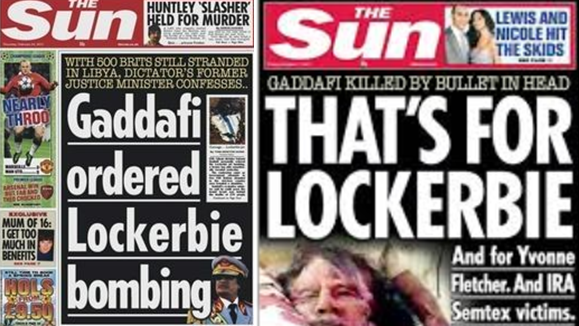

Murdoch newspaper covers: left, February 24, 2011; 
right, October 20, 2011.

The 30-year rule for withholding state documents on the case is now expiring at the National Archives. A preliminary report by a Murdoch newspaper claimed last week to have “seen” the documents, but it is not publishing them directly or in full. The report of the files appears in the Scotland section of Friday’s Times newspaper. The same story also appears in the Scottish Sun.

The report reveals that officials of then-Prime Minister Margaret Thatcher’s government agreed on special, secret measures “for careful watching” of the relatives of the dead passengers in their attempts to investigate the evidence of what had happened. The newspaper report does not identify by name the Foreign Office officials whose correspondence to the Scottish Lord Advocate (Scotland’s state prosecutor) and to Thatcher was seen. Nor are details of the surveillance and hacking operations revealed, nor the role which the mainstream media and their reporters played in the official deception.
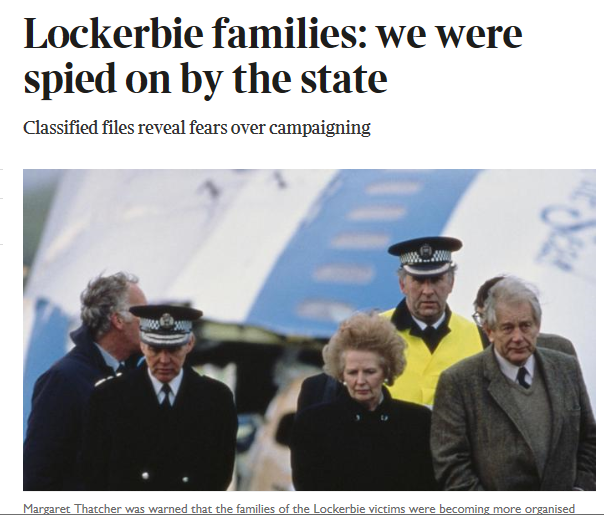


The newspaper report appears to confirm that most of the British government’s files on the Lockerbie case continue to be withheld; the most sensitive of them may have been destroyed to prevent public disclosure, victim representatives believe. The Murdoch media, which have led the public falsification, are unrepentant.

(In the US the principal prosecutor of the Libyan culpability case was Robert Mueller, now the special prosecutor of indictments of alleged Russian meddling in US politics. Three years after the Lockerbie attack, Mueller was acting deputy attorney general in charge of the November 1991 indictment of Abdelbaset al-Megrahi, the Libyan later convicted of the attack. )

The Foreign Office told reporters last week: “We will not be commenting on the contents of our archive files.”

Additional reporting in Scotland and by Channel Four television in London quotes Aamer Anwar, a lawyer for al-Megrahi, as saying:

“’It comes as no surprise that the security services were instructed to spy on those British relatives who to date have never given up in their pursuit of the truth’…
Anwar said it was shocking that the British state still refused to release documents, while destroying some as legal proceedings continued: ‘My clients see this as an attempt to pervert the course of justice … I have written to the Lord Advocate seeking full disclosure of all relevant material found by the police.’”

In the case of MH17, the British courts have refused to open government files or allow lawyers for the next of kin to determine the cause of death for the ten British nationals killed on board the aircraft. The decision to suppress coroner’s court hearings in Britain was taken by the Home Secretary in July 2014, now Prime Minister Theresa May. For details of how this was done, read this. The Australian Government has gone further, suppressing the secret intelligence and legal memoranda exchanged between the Attorney-General and Prime Minister which conclude that the case for Russian culpability is unsustainable; for the details, read this.

The same operations for planting fabricated evidence in the Murdoch press and other mainstream media, suppression of contrary evidence, and surveillance, computer hacking, and discrediting of alternative sources continue to be implemented by the Dutch and Australian secret services. One difference, though. The organizations of relatives of victims of the Lockerbie attack – mostly British and Americans – have proved to be better organized and more tenacious over the years, and far more hostile towards the state versions of what had happened. For a selection of the books making their case, click to open.

The shooting-down of MH17 killed 298 passengers and crew. Not one family member has publicly challenged the Russian culpability story.

Dutch sources say they believe that Dutch Foreign Ministry and secret services have combined to keep the families of the MH17 victims under constant surveillance. They have been encouraged to instruct lawyers promoting cases against Russian targets in local, European and US courts. They have been deterred from speaking to reporters known to be critical of the official version of what caused the destruction of the aircraft.

Australian, and possibly US, secret service agents were visible during a coroner’s court hearing in Melbourne, Australia, in December 2015. That was the first of only two coroner’s court proceedings to have taken place worldwide; the other took place in Sydney in May 2016. The coroners were required by Australian law to investigate the deaths of the 28 Australian citizens or permanent residents on board MH17. For the manipulation of evidence during the Sydney court proceeding, click to read.
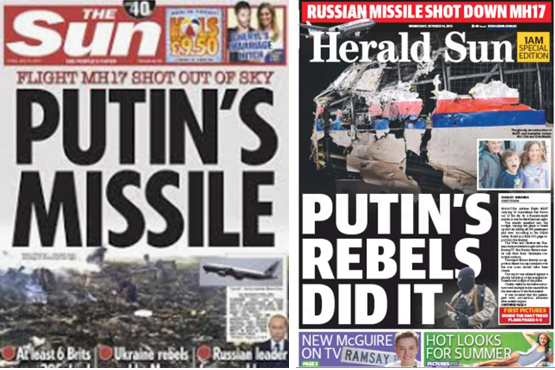

Murdoch newspaper covers: left, the London Sun, July 18, 2014; 
right, the Melbourne Herald Sun, October 14, 2015.

In the Melbourne proceeding I was in court and watched as a group of government agents, men and women, worked to shield families of the victims from being approached and questioned by journalists. A row of reporters sat together at the rear of the courtroom; the families in the main rows of seats in the well of the court. I sat directly behind one of the families. As soon as I started asking questions of a family member, a woman in her mid-30s tried to stop me by claiming I was speaking too loudly; the coroner was not present and the proceeding was not under way at the time. The agent then whispered to other family members, and my conversation was stopped.

I reported at the time: “In court, in addition to members of the Coroner’s staff, there was one government intelligence agent who kept his official identification tag inside his coat, and refused to say whether he was an Australian or American national. That agent, a man in his thirties, was visible during a break in the proceedings in the court lobby. He appeared to be an American.”

Also: “The court heard that the survivors of the crash victims have been regularly briefed and counselled by Australian Government officials. They have also been coached not to answer press questions, although one admitted his family had been allowed to meet lawyers. Three statements were given in evidence at the inquest by representatives of the victims. One from members of the Van Den Hende family — Shaliza Dewal, her husband Hans Van Den Hende and their three children Piers, 15, Marnix, 12, and daughter Margaux, 8, were killed – said media reports of the crash were unreliable and unconvincing: “we are unsure who or what to believe.”

That remark was never repeated.

Tuesday, December 04, 2018

The Refugee Conspiracy: From Middle Americas to Middle East

From Central America to Syria: The Conspiracy Against Refugees

by Ramzy Baroud - Palestine Chronicle


December 4, 2018

Watching the ongoing debate between US liberal and right-wing pundits on US mainstream media, one rarely gets the impression that Washington is responsible for the unfolding crisis in Central America.

In fact, no other country is as accountable as the United States for the Central American bedlam and resulting refugee crisis.

So why, despite the seemingly substantial ideological and political differences between right-wing Fox News and liberal CNN, both media outlets are working hard to safeguard their country’s dirty little secret?

In recent years, state and gang violence - coupled with extreme poverty - have forced hundreds of thousands of people to flee El Salvador, Guatemala, Nicaragua and Honduras, among other countries in Central and South America.

US mainstream media, however, is rarely interested in the root cause of that reality.

Fox News is tirelessly peddling the offensive language used by President Donald Trump, which perceives the refugees as criminals and terrorists, who pose a threat to US national security.

At a press conference last October, Trump urged a reporter to take his camera into ''the middle'' of a caravan of migrants on the treacherous journey through Mexico, to locate ''Middle Eastern'' people that have infiltrated the crowd. In Trump’s thinking, ‘Middle Eastern people’ is synonymous with terrorists.

CNN has, on the other hand, labored to counter the growing anti-immigrant official and media sentiments that have plagued the US, a discourse that is constantly prodded and manipulated by Trump and his supporters.

However, few in the liberal media have the courage to probe the story beyond convenient political rivalry, persisting in their hypocritical and insincere humanitarianism that is divorced from any meaningful political context.

The fact is the Central American refugee crisis is similar to the plethora of Middle East and Central Asian refugee crises of recent years. Mass migration is almost always the direct outcome of political meddling and military interventions.

From Afghanistan, to Iraq, Libya, Syria, millions of refugees were forced, by circumstances beyond their control, to seek safety in some other country.

Millions of Iraqis and Syrians found themselves in Lebanon, Jordan, Turkey, while a far smaller number trickled to Europe, all seeking safety from the grinding wars.

Political opportunists in Europe are no different from their American counterparts. While the former has seized on the tragedy of the refugees to sow seeds of fear and hate-mongering, Americans, too, have blamed the refugees for their own misery.

Blaming the victim is nothing new 


Iraqis were once blamed for failing to appreciate Western democracy, Libyans for their failed state, Syrians for taking the wrong side of a protracted war, and so on.

Yet, the ongoing conflicts in Iraq, Libya and Syria are all, in varied degrees, outcomes of military interventions, a truth that does not seem to register in the self-absorbed minds of both right-wing and liberal intellectuals.

The irony is that the hapless refugees, whether those escaping to Europe or to the United States, are perceived to be the aggressors, the invaders, as opposed to the US and allies that had, in fact, invaded these once stable and sovereign homelands.

Trump has often referred to the Central American migrants’ caravan as an ‘invasion’.  Fox News parroted that claim, and injected the possibility of having the refugees shot upon arrival.

If Fox News lacked the decency to treat refugees as human beings deserving of sympathy and respect, CNN lacked the courage to expand the discussion beyond Trump’s horrid language and inhumane policies.

To expand the parameters of the conversation would expose a policy that was not introduced by Trump, but by Bill Clinton and applied in earnest by George W. Bush and Barack Obama.

Media grandstanding aside, both Democrats and Republicans are responsible for the current refugee crisis.

In 1996, Democratic President Clinton unleashed a war on refugees when he passed two consecutive legislations: the Illegal Immigration Reform and Immigrant Responsibility Act, and the Anti-Terrorism and Effective Death Penalty Act.

Millions of people - who had escaped US-instigated wars and military coups - were deported back to Central and South America. While 2 million people were deported during the Bush terms, 2.5 million were deported under Obama.

A terrible situation was exacerbated. Violence and want flared even more


To rally his angry and radicalized constituency, Trump waved the migrant card once more, threatening to build a “great wall” and to close "loopholes" in the US immigration law.

Like his predecessors, he offered little by way of redressing an unjust reality that is constantly fomented by destructive US foreign policy, stretching decades.

But the refugees kept on coming, mostly from Central America's Northern Triangle region. Without proper political context, they, too, were duly blamed for their hardship.

Considering Fox News and CNN’s lack of quality coverage, this is not surprising. Few Americans know of the sordid history of their country in that region, starting with the CIA-engineered coup d’état in Guatemala in 1954, or the US support of the coup against the democratically-elected President of Honduras, Manuel Zelaya, in 2009, or of everything else that happened in between these dates.

The unhealthy relationship between the US and its southern neighbors goes back as early as 1904, when President Theodore Roosevelt declared the ‘right’ of his country to hold "international police power" in Latin America. Since then, the entire region has been Washington's business.

The free trade agreement (CAFTA-DR) signed between Central American countries and the US has done its own share of damage. It "restructured the region’s economy and guaranteed economic dependence on the United States through massive trade imbalances and the influx of American agricultural and industrial goods that weakened domestic industries," wrote Mark Tseng-Putterman in Medium.

Acknowledging all of this is threatening. If US mainstream pundits accept their country’s destructive role in Central and South America, they will be forced to abandon the role of the victim (embraced by the right) or the savior (embraced by the left), which has served them well.

The same stifling political and intellectual routine is witnessed in Europe, too.

But this denial of moral responsibility will only contribute to the problem, not to its resolution. No amount of racism on the part of the right, or crocodile tears of the liberals, will ever rectify this skewed paradigm.

This is as true in Central America as it is in the Middle East.

Ramzy Baroud is a journalist, author and editor of Palestine Chronicle. His latest book is The Last Earth: A Palestinian Story (Pluto Press, London, 2018). He earned a Ph.D. in Palestine Studies from the University of Exeter and is a Non-Resident Scholar at Orfalea Center for Global and International Studies, UCSB.

Gorilla Radio with Chris Cook, John Helmer, J.B. MacKinnon, Janine Bandcroft December 6, 2018

This Week on GR

by C. L. Cook - Gorilla-Radio.com


December 6, 2018

Little noticed in a Western press obsessed with personalizing geopolitics, last week that media's favourite bête noire, Vladimir Putin, the man who's bent over backwards conciliating NATO's relentless encirclement of and constant intriguing against his country, was superseded by Russia's military command. And it is not in an accommodating mood; tersely stating,

"[A]nyone approaching Russian territory with hostile intent will be shot."

John Helmer is a long-time, Moscow-based journalist, author, and essayist whose website, Dances with Bears is the only Russian-based news bureau “independent of single national or commercial ties.”

Listen. Hear.

He’s also a former political science professor and his book titles include: ‘Uncovering Russia,’ ‘Urbanman: The Psychology of Urban Survival,’ ‘Bringing the War Home: The American Soldier in Vietnam and After,’ and ‘Drugs and Minority Oppression’, among others.

His latest article, ‘Force Talks - An Approach with Hostile Intent to the Russian Frontier, Aircraft, Ships at Sea, or Troops in the Field Will Be Shot' should serve as stark reminder of our precarious proximity to another global war.

John Helmer in the first half.


And Canadian journalist, author, and interactive documentarian J.B. MacKinnon's first book, 'The 100-Mile Diet', (co-written with Alisa Smith) was an international sensation and catalyst to a whole new "loca"-lexicon. The myriad award-winning, Vancouver-based UBC journalism prof's next, (national best-selling) book, 'The Once and Future World' examines Nature's past, parlous anthropocene present, and possible futures.

J.B. MacKinnon and The Once and Future World: Nature As It Was, As It Is, As It Could Be in the second half.

And; Victoria-based activist and CFUV Radio broadcaster at-large, Janine Bandcroft will be here at the bottom of the hour with the Left Coast Events Bulletin of some of the good things going on in and around our town in the coming week. But first, John Helmer and stalking Russia with hostile intent.

Chris Cook hosts Gorilla Radio, airing live every Thursday between 11-Noon Pacific Time. In Victoria at 101.9FM, and on the internet at: http://cfuv.uvic.ca.  He also serves as a contributing editor to the web news site, http://www.pacificfreepress.com. Check out the GR blog at: http://gorillaradioblog.blogspot.ca/

Yemen's Diaspora Reaches Jeju Island

Seeing Yemen from Jeju

by Kathy Kelly - VCNV.org


December 4, 2018

Several days ago, I joined an unusual Skype call originated by young South Korean founders of “The Hope School.” Located on Jeju Island, the school aims to build a supportive community between island residents and newly arrived Yemenis who seek asylum in South Korea.

Jeju, a visa-free port, has been an entry point for close to 500 Yemenis who have traveled nearly 5000 miles in search of safety. Traumatized by consistent bombing, threats of imprisonment and torture, and the horrors of starvation, recent migrants to South Korea, including children, yearn for refuge.

Like many thousands of others who’ve fled Yemen, they miss their families, their neighborhoods, and the future they once might have imagined. But returning to Yemen now would be awfully dangerous for them.

Whether to welcome or reject Yemenis seeking asylum in South Korea has been a very difficult question for many who live on Jeju Island.

Based in Gangjeong, a city long renowned for brave and tenacious peace activism, the founders of “The Hope School” want to show newly arrived Yemenis a respectful welcome by creating settings in which young people from both countries can get to know one another and better understand each other’s history, culture and language.

They regularly gather for exchanges and lessons. Their curriculum suggests solving problems without relying on weapons, threats, and force. In the “Seeing Yemen from Jeju” seminar, I was asked to speak about grass roots efforts in the U.S. to stop the war in Yemen. I mentioned Voices has helped arrange demonstrations against war on Yemen in many U.S. cities and that, relative to other antiwar campaigns we’ve participated in, we’ve seen some willingness within the mainstream media to cover the suffering and starvation caused by the war on Yemen.

One Yemeni participant, himself a journalist, voiced exasperated frustration. Did I understand how trapped he and his companions are? In Yemen, Houthi fighters could persecute him. He could be bombed by Saudi and UAE warplanes; mercenary fighters, funded and organized by the Saudis or the UAE might attack him; he would be equally vulnerable to Special Operations forces organized by western countries, such as the U.S. or Australia. What’s more, his homeland is subject to exploitation by major powers greedily seeking to control its resources.

“We are caught in a big game,” he said.

Another young man from Yemen said he envisions an army of Yemenis that would defend all people living there from all the groups now at war in Yemen.

Hearing this, I remembered how adamantly our young South Korean friends have opposed armed struggle and the militarization of their island. Through demonstrations, fasts, civil disobedience, imprisonments, walks, and intensive campaigns designed to build solidarity, they’ve struggled, for years, to resist the onslaughts of South Korean and U.S. militarism. They understand well how war and ensuing chaos divides people, leaving them ever more vulnerable to exploitation and plunder. And yet, they clearly want everyone in the school to have a voice, to be heard, and to experience respectful dialogue.

How do we, in the U.S., develop grass roots communities dedicated to both understand the complex realities Yemenis face and work to end U.S. participation in the war on Yemen? Actions taken by our young friends who organized “The Hope School” set a valuable example. Even so, we must urgently call on all the warring parties to enact immediate cease-fires, open all ports and roads so desperately needed distribution of food, medicine and fuel can take place, and help restore Yemen’s devastated infrastructure and economy.

In numerous U.S. locations, activists have displayed 40 backpacks to remember the forty children killed by a 500-pound Lockheed Martin missile that targeted their school bus on August 9, 2018.

In the days before August 9th, each child had received a UNICEF-issued blue backpack filled with vaccines and other valuable resources to help their families survive.

When classes resumed some weeks ago, children who had survived the terrible bombing returned to school carrying bookbags still stained by spattered blood.

Those children desperately need reparations in the form of practical care and generous “no-strings attached” investments to help them find a better future. They need “The Hope School” too.

Killing people, through war or starvation, never solves problems. I strongly believe this. And I believe heavily armed elites, intending to increase their personal wealth, have regularly and deliberately sown seeds of division in Iraq, Afghanistan, Syria, Gaza and other lands wherein they desire to control precious resources. A divided Yemen would allow Saudi Arabia, the United Arab Emirates, their coalition partners, and the U.S. to exploit Yemen’s rich resources for their own benefit.

As wars rage on, every voice crying out in affliction should be heard. Following “The Hope School” seminar, I imagine we could all agree that an excruciatingly crucial voice wasn’t present in the room: that of a child, in Yemen, too hungry to cry.

Kathy Kelly (kathy@vcnv.org) co-coordinates Voices for Creative Nonviolence (www.vcnv.org)

Saudi Exceptionalism Waning as OPEC Feels the Pain

The Saudi Dilemma: To Cut Or Not To Cut 

by Irina Slav - Oilprice.com


December 4, 2018

To cut and push up prices or not to cut and preserve market share, this is the question that Saudi Arabia is facing ahead of this year's December OPEC meeting.

It seems like just yesterday when OPEC met in 2016 and decided to cut production by 1.8 million barrels daily, including from Russia, to reverse the free fall of oil prices.

At the time, it worked because everyone was desperate. Now, many OPEC members are both desperate while not yet recovered from the 2014 blow.

Saudi Arabia is not an exception. A recent report from Capital Economics said Saudi Arabia has its problems but it could withstand lower oil prices without feeling too much of a pinch.

"Even if [Brent] prices fall further to $40-$50 a barrel, immediate balance of payments strains are unlikely to emerge," the report said, with its authors adding the Kingdom would be able to finance its trade deficit from its foreign exchange reserves "for at least a decade."

This suggestion is not universally accepted. Reuters' John Kemp this week offered a different perspective in his regular column on oil, noting Saudi Arabia's foreign exchange reserves currently stand at US$500 billion, down from nearly US$750 billion in 2014 when the oil prices slumped under the weight of U.S. shale oil. At the same time, Saudi Arabia is in a major push to diversify its revenue streams and has committed a lot of money to it.

Kemp writes, "The kingdom probably needs to keep several hundred billion dollars' worth of reserve assets on hand to maintain confidence in its fixed exchange-rate peg to the U.S. dollar and prevent a run on the currency."

It's a classic rock and a hard place situation for the Saudis. On the one hand, they could continue pumping at the current record rate or close to it, pressuring prices further, which is what they did in 2014. That strategy hurt U.S. shale substantially, but the attempted assault did not go quite as planned. Now, it will once again hurt U.S. shale, but again, it won't beat the resilience of the US shale patch. That much should have become clear in the past three years.

On the other hand, Saudi Arabia could start cutting, but it will need to convince all other OPEC members to join the cuts and, more importantly, Russia. Reuters earlier today reported, quoting unnamed sources, that Russia had "accepted the need to cut production" and prices immediately jumped, once again highlighting how important the Russia-Saudi Arabia cooperation has become for oil markets, if it even needs highlighting.

For now, it seems like a cut is the more likely outcome. In spite of reservations expressed by Nigeria and Libya, if Saudi Arabia managed to convince everyone to cut amid the major tensions with Iran ahead of the U.S. sanctions, then it could probably convince them again, if only on the grounds that if they don't start cutting all will suffer.

Kemp agrees. "Saudi Arabia cannot afford another slump in oil prices," he warns. "It needs to keep revenues high to help its economy climb out of recession and finance ambitious social and economic transformation programs."

Yet the Kingdom is preparing. Kpler reported this week loadings of Saudi crude since the start of November had reached new highs of 8.14 million bpd, which was 770,000 bpd more than the average daily loadings rate for October and much higher than the last 2018 high of 7.766 million bpd booked for June.

The bulk of the increase comes from China, with shipments in that direction up by more than half a million barrels daily in November from October. Production is also at record highs, like Russia's was ahead of the first cuts in 2016. Perhaps we are seeing a lesson learned there or perhaps the Kingdom is out of options besides cutting.

Irina Slav is a writer for the U.S.-based Divergente LLC consulting firm with over a decade of experience writing on the oil and gas industry.

Monday, December 03, 2018

Luke Harding and the Guardian's Text Book Example of Journalistic Malpractice

Misreporting Manafort: A Case Study in Journalistic Malpractice

by Alan MacLeod  - FAIR


December 3, 2018

In what has been described as potentially the biggest story of the year, the Guardian’s Luke Harding (11/27/18) reported last week that Donald Trump’s former campaign manager, Paul Manafort, held a series of secret talks with WikiLeaks editor Julian Assange.

These meetings were said to have occurred inside the Ecuadorian embassy between 2013 and 2016. The report also mentions that unspecified “Russians” were also among Assange’s visitors.

The scoop, according to the newspaper, could “shed new light” on the role of WikiLeaks’ release of Democratic Party emails in the 2016 presidential election.


The Guardian (11/27/18) added “sources say”
to the headline after publication.

The story was picked up across the US, including by USA Today (11/27/18), the Washington Post (11/27/18), Bloomberg (11/27/18), Yahoo! News (27/11/18), The Hill (11/27/18) and Rolling Stone (11/27/18). One CNN analyst (11/27/18) analyst excitedly commented that the news was “hugely significant” and “could be one of the two missing links to show real interference and knowledge of Russian involvement” in the election.

However, there were serious problems with the report. Firstly, the entire story was based upon anonymous intelligence sources, sources that could not tell the newspaper exactly when the meetings took place.

Furthermore, the Ecuadorian embassy is one of the most surveilled buildings in the most surveilled city in the world, and was under 24-hour police guard and monitoring, costing the UK government over £11 million between 2012 and 2015. The embassy also had very tight internal security, with all visitors thoroughly vetted, required to sign in and leave all their electronic devices with security. Is it really possible any figure, let alone Donald Trump’s campaign manager, could walk in for a series of secret meetings without leaving record with Ecuador, or being seen by the media or police?

For their part, both Manafort and WikiLeaks have strenuously denied the accusation, with the latter announcing, “This is going to be one of the most infamous news disasters since Stern published the Hitler Diaries.” It also declared it was planning to sue the Guardian, setting up a Go Fund Me appeal to help with legal costs.

The Guardian immediately started to walk back its claims, editing the article a number of times, changing its headline from “Manafort Held Secret Talks With Assange in Ecuadorian Embassy” to “Manafort Held Secret Talks With Assange in Ecuadorian Embassy, Sources Say.” It inserted qualifiers, denials and words like “hoax” into the text, quietly changing much of the tense of the report to the conditional.

Thus, the passage “It is unclear why Manafort wanted to see Assange and what was discussed. But the last meeting is likely to come under scrutiny” was changed to (emphasis added) “It is unclear why Manafort would have wanted to see Assange and what was discussed. But the last apparent meeting is likely to come under scrutiny.” Thus a piece that started as a factual news report was transformed into an allegation—after it went viral and was picked up across international media.

The story that threatened to become the political news event of the winter was quickly dropped by the media, with search interest for terms such as “Manafort” and “Assange” dropping by around 90 percent in one day.

‘The Most Logical Explanation’ 


 Politico (11/28/18) puts forward a corporate 
media version of the “false flag” theory.


As the story crumbled, Politico (11/28/18) put forward a bizarre explanation for the event, written by an anonymous ex-CIA officer, who argued that Russian intelligence had likely planted the story as a means to discredit Harding and the Guardian, noting that, if it is all false, “the most logical explanation is that it is an attempt to make Harding look bad.” Thus, Trump, WikiLeaks and Russia’s vast “disinformation network” would be able to deride the press as purveyors of “fake news.” It appears not to have occurred to the CIA alum that the story could have been planted to discredit WikiLeaks, Russia or Manafort (and by extension, Trump).

The anonymous spy ended by stating he “finds it hard to believe Harding would not go to great lengths to confirm his story.” Russia certainly would have an interest in discrediting the Guardian and Harding, who has a long history of criticizing Putinism and was refused re-entry to the country in 2011. But the newspaper appears not to have done even basic diligence over what must have been multiple new, unknown sources by checking with the embassy or with the police, if this was indeed the case. It also ignores that one source appears to have been Ecuadorian intelligence itself, not Russian.

State officials have a long history of using a pliant media to manipulate public discourse around international struggles by introducing false information. A central part of the drive to the invasion of Iraq was the false claim that Saddam Hussein was just 45 minutes from attacking the US and UK with WMDs. Officials urged that we could not wait for the mushroom cloud and had to act now. In 2016 US officials planted a false story in the Washington Post (12/31/16) that Russia had hacked into the US electric grid.

That these claims were demonstrably incorrect did not delegitimize or scupper the interests of the state, or dampen the dominant narrative. There is rarely, if ever, any price to pay for official sources lying to journalists. This was why “the most logical explanation” was certainly not that Iraqi or Russian intelligence had fed the media fake information as to discredit Western reporting. The Manafort story went viral, while the retraction of some of its claims received, in comparison, scant attention.

Harding also has an ongoing and bitter feud with Assange. (He wrote a highly critical biography of the WikiLeaks editor that was subsequently turned into the movie, The Fifth Estate, which Assange described as a “massive propaganda attack” on him.)

He also has a history of publishing deeply inflammatory claims without being able to back them up. His book, Collusion, on alleged Russian interference in the 2016 election was a New York Times No. 1 bestseller, and yet he could not give any evidence of collusion when asked in a now-infamous interview with Aaron Maté of The Real News, unable to defend even the title of his book, let alone his thesis. After being pressed harder by Maté, he simply disconnected the interview prematurely.

Therefore, Occam’s razor suggests the most logical explanation is likely that the Guardian published anonymous official sources without checking their claims’ validity.

‘Sources Say’


It is standard journalistic practice to name and check sources. Without a name to match to a quote, its credibility (and therefore that of the story) immediately drops, as there are no repercussions for that individual if they are untruthful. Sources (or journalists themselves) could simply make up anything they wanted with no consequences. Therefore, using anonymous sources is strongly discouraged, except in rare circumstances, generally when sources would face retaliation for revealing information of vital public interest. The Society of Professional Journalists’ code of ethics insists journalists “identify sources whenever feasible” and that journalists must “always question sources’ motives before promising anonymity.”

Unfortunately, the use of anonymous officials in reporting is increasing, and is a worrying trend in modern journalism, as the veteran reporter Robert Fisk once explained:

I’m just looking at a copy of the Toronto Globe and Mail. It’s a story about Al Qaeda in Algeria. And what is the sourcing?
“US intelligence officials said,” “a senior US intelligence official said,” “US officials said,” ‘the intelligence official said,” “Algerian officials say,” “national security sources considered,” “European security sources said”….

Robert Fisk (cc photo: Mohamed Nanabhay/Wikimedia)

We might as well name our newspapers “Officials Say.” This is the cancer at the bottom of modern journalism, that we do not challenge power anymore. Why are Americans tolerating these garbage stories with no real sourcing except for very dodgy characters indeed, who won’t give their names?"

In this way, anonymous state officials can influence and drive media narratives without even needed to have their name associated with a claim. However, we appear to be entering a new era where unnamed state officials not only influence, but actually write the news themselves, as demonstrated by the Politico article.

Furthermore, as FAIR (8/22/18, 9/25/18) has already cataloged, media giants such as Facebook are already working with governmental organizations like the Atlantic Council to control what we see online, under the guise of battling Russian-sponsored fake news. The Atlantic Council is a NATO offshoot whose board of directors includes neo-conservative hawks like Condoleezza Rice, Colin Powell, Henry Kissinger and James Baker; CIA directors like Robert Gates, Leon Panetta and Michael Hayden; as well as retired generals like Wesley Clark and David Petraeus.

Leave alone that much of the most sensational reporting and claims about Russian influence comes from the Atlantic Council’s reports in the first place, thus creating a perfect feedback loop justifying more active measures. Therefore, much of the coverage Russian state propaganda is itself state propaganda!

The Utility of Misreporting


Why was a highly questionable report from a foreign media outlet based upon anonymous sources picked up far and wide, sometimes without even a basic follow-up, such as asking for comment from the Ecuadorian embassy, Assange or Manafort (again, standard journalistic practice)?

As I argued previously (FAIR.org, 7/27/18), there is great utility for the establishment in promoting the idea of foreign interference in American domestic issues. For one, it helps develop a conspiratorial mindset among the public, encouraging them to be less critical of the state when the United States is “under attack.” Liberals’ trust in the FBI has markedly increased since Trump’s election and the focus on Russia.

Kremlin-sponsored “fake news” also serves as a pretext for mainstream media monopolies to re-tighten their grip over the means of communication. Media giants such as Google, Facebook, Bing and YouTube have changed their algorithms, supposedly to fight fake news. However, the consequence has been to strangle alternative media that challenged the mainstream narrative. Since Google changed its algorithm, WikiLeaks’ search traffic dropped 30 per cent, AlterNet by 63 per cent, Democracy Now! 36 per cent and Common Dreams by 37 per cent.

Finally, for the political establishment, the Russian fake news story gives them a convenient excuse as to why Trump was able to win the Republican nomination and defeat Hillary Clinton and to why new movements, from the alt-right to Black Lives Matter and the Bernie Sanders phenomenon on the left, have occurred. They are not responses to the decay of the political and economic system, but examples of foreign interference.

Adam Johnson’s “North Korea Law of Journalism” states that journalistic standards “are inversely proportional to a country’s enemy status,” meaning that the more antagonistic the US is to a country, the more lackadaisical journalists can be with the truth while reporting on said state. FAIR has consistently cataloged misreporting of enemy states, such as Iran (9/9/15; 7/25/17) North Korea (5/9/17; 3/22/17) Venezuela ( 5/16/17; 3/2/07), Cuba or Syria (10/21/15), where their supposed threat to the world or their human rights violations are ramped up, while downplaying crimes of friendly states (2/1/09).

The same can equally be said of enemy political figures like Assange, Sanders or Jill Stein. When it serves a political function, stories about official enemies too good to be true are also too good not to publish.

Adrift Media Attacks Assange, While Rallying to Defend CNN's White House Flack

As CNN, Media Cry Over Acosta, Trump is Free to Prosecute Assange for Airing US War Crimes

by Patrick Henningsen - 21st Century Wire 


November 10, 2018 

If you’ve been following the travails of WikiLeaks’ founder Julian Assange recently, you’ll know that moves are afoot by the US and Ecuadorian governments to try and draw a line under this eight year standoff.

What’s essential to know about this situation is the very point which our bought-and-paid-for corrupt mainstream media industry are not telling us – that Assange is caught at a crossroads in the history, holding the line for real press freedom.

Whichever way this story goes will be a defining moment for the concept of the Fourth Estate.
IMAGE: Julian Assange pictured in 2010

Rather disingenuously, US officials are repeatedly referring to WikiLeaks as “a non-state hostile intelligence service” (as if saying it enough times will make it real). Like most statements coming out of the mouth of US Secretary of State Mike Pompeo, this too is a bold-faced lie.

US officials, along with their legion of constitutional lawyers, know very well that Wikileaks is in fact a publisher, which means the organization falls squarely under basic press freedom protections. What the corrupt wing of US Establishment and its syndicate partners are cynically attempting to do is to rewrite the law, effectively amputating a key provision of their own constitution. To allow such an affront to America’s founding principles to stand unchallenged will surely hasten the demise of the United States as a Constitutional Republic, and aid it steadily along the path of an embryonic fascist technocracy where any dissent or challenge to the authority of the state is no longer allowed, much less protected by prima facie law.

It’s beyond ironic that WikiLeaks’ former fan Donald Trump could now be weapons-free to prosecute Julian Assange for exposing among other things, US war crimes in Iraq. Naturally, the media are aloof to this development. Based on their own laissez-faire treatment of this important issue, it would appear that CNN and other apologists at the New York Times and the Washington Post, are more than happy to nudge America and Europe further down this dystopian path.

Anyone with a hint of sobriety on this issue will have already noticed how the increasingly cozy ‘working relationship’ between media corporations and the state (and deep state) are indicative of the res publica embodied in the orthodox definition of fascism as corporatism as first illustrated at Mussolini’s concept of “corporativismo,” a syndicate of corporate monopolies facilitating the merger of state and corporate interests, each working in unison towards mutual corporate outcomes, and at the expense of the public interest. In this way, the US media are the real fascist enablers in today’s America.

Besides the obvious issue of the freedom of the press to publish, it all comes down to this fundamental question asked by US State Dept. whistleblower Peter Van Buren this past summer:

"[A]t what point does the right of the people to know outweigh the right of the government to keep information from view?"

There’s another important realpolitik point to consider here. It would appear that Julian Assange also holds key to the infamous DNC email scandal, which is a foundational pillar propping-up the Establishment’s disjointed #Russiagate narrative. Assange has openly stated that the DNC emails were in fact leaked and not ‘hacked by the Russians’ as the mainstream pundits dutifully repeat ad nauseam, hence, his testimony might help to prove that the DNC was not ‘hacked by the Russians and given to Assange’ as the US media incessantly repeat as an a priori assumption. For this reason, the vaunted Mueller investigation has purposefully not asked either Assange nor his associate Craig Murray who has made no secret of this, to speak or provide an affidavit regarding this important detail in the story. To do so would likely upend the entire two-year charade of the “Special Counsel” in search of that unicorn called Russian Collusion. More than that, it could effectively delegitimize and collapse a large section of the US political and media power structure, although this seems to already be happening as their house of cards continues to fold under the cumulative weight of decades of lies and malfeasance.

Meanwhile, dubious mainstream media outlets like CNN are seizing every opportunity to virtue signal about the ‘free press under attack,’ supposedly via Trump’s ongoing spat with CNN’s self-promoting reporter Jim Acosta, and Trump’s comments that dishonest media outlets are an “enemy of the people.”

Trump’s bombast aside, CNN and their ilk should know that when a news organization promotes fake dossiers as articles of fact, or is trafficking politically-motivated lies and suppositions on a daily basis, misinforming the public, obfuscating hard facts on Iraq, Libya, Syria, Yemen, and Iran in order to promote illegal wars – then their wing of the “free press” no longer serves the interests of the public, and therefore can rightly be regarded as malignant.

We can contrast this with WikiLeaks who has an unblemished record having provided nothing less than hard facts and solid data for over a decade. The irony for the legacy media is, by denying and covering for their own corrupt nature and institutional malaise, they are only hastening their own inevitable demise. Any thinking person gets it, and yet it’s almost comical to watch many high-profile media operatives pretend as if they are selfless champions of free speech and expression. The idea of it is simply beyond the pale now.

Through all the milieux, the media have conveniently omitted Assange’s grave plight from their news cycles, and are instead running a long campaign to demonize and criminalize him, apparently in revenge to their belief that Assange and Wikileaks are responsible for the failing presidential run of Democrat Hillary Clinton and Trump’s surprise victory over their pre-annointed candidate. This aspect alone speaks volumes of the petty and myopic mindset which dominates the western corporate media at present. It’s pretty clear that CNN and others members of the media syndicate either have no concept of what the Fourth Estate really means in constitutional terms, or they do know this perfectly well but still choose to side with mutual interests of the deep state and corporation. Either way, it’s an extremely disturbing folly to witness.

Onlookers should be under no illusion as to what’s at stake. It is not out of the realm of possibility then to speculate that the US Establishment or its allies, would lay a scheme to remove Assange from the equation. Last week, Julian’s mother, Christine Assange, issued the following warning and plea for help for her son who is being arbitrarily detained for 7 years now in the Ecuadorian Embassy in London.

Listen:


Despite the willful ignorance and obfuscation of this story by CNN and the mainstream gaggle, there are some mainline publications at least beginning to acknowledge the gravity of his exigent predicament, although it’s still far from adequate considering the severity of the situation.

The Economist reports…

"The hypocrisy is breathtaking. But it looks as if the Trump administration really is going after WikiLeaks and Julian Assange, the self-styled transparency campaigner who runs it from the Ecuadorean embassy in London, where he has been holed up for five years evading extradition to Sweden to face a rape allegation.

"As a candidate, Donald Trump said he loved WikiLeaks for helping his campaign by publishing embarrassing e-mails from the Democratic National Committee, hacked by the Russians. Now he is in the White House, he views leaks less indulgently. On April 20th the attorney-general, Jeff Sessions, declared that the arrest of Mr Assange had become “a priority”. He added: “We are going to step up our efforts, and are already stepping up our efforts, on all leaks.” The Department of Justice is said to be preparing charges against Mr Assange.

"In a speech made a few days before Mr Sessions’s announcement, the director of the CIA, Mike Pompeo, excoriated WikiLeaks as “a non-state hostile intelligence service often abetted by state actors like Russia”. Mr Pompeo’s wrath had been incurred after the release by Mr Assange’s outfit of information about some of the CIA’s surveillance tools. Mr Pompeo, like his boss, had previously been a WikiLeaks fan, regularly tweeting its revelations last summer to attack Hillary Clinton…"
All of this leads us back to the initial categorical imperative. Is right to allow the US Establishment use the Assange case in order to rewrite freedom of the press laws in the West? It’s possible that they may not have to, as they will simply achieve this by fiat, under a regime of state intimidation which will effectively hang over the Assange narrative should they achieve their goal of incarcerating him in an US federal penitentiary, or God forbid any tragic outcome which might befall him by way of his current predicament.

Know that anyone could be (and has in the past been) Julian Assange; any publisher, any journalist, any writer, any poet, any professor, any artist, or any citizen. In that sense, we are all Julian Assange.

For these reasons, we should all be concerned with the plight of Julian Assange, and should speak out now in support of his own human rights. In doing so, you’ll also be advancing the right to free speech and press freedom.

That is, the right to publish and be damned.

***
Author Patrick Henningsen is an American writer and global affairs analyst and founder of independent news and analysis site 21st Century Wire, and is host of the SUNDAY WIRE weekly radio show broadcast globally over the Alternate Current Radio Network (ACR). He has written for a number of international publications and has done extensive on-the-ground reporting in the Middle East including work in Syria and Iraq.

READ MORE JULIAN ASSANGE NEWS AT: 21st Century Wire Assange Files

SUPPORT 21WIRE – SUBSCRIBE & BECOME A MEMBER @21WIRE.TV

Oui, Paris Is Burning!

The People Of France Reject Macron's Policies - How Long Can He Survive? 

by Moon of Alabama


December 3, 2018

The current wave of protests in France, which started two weeks ago, is growing in impact and applied violence.

On Saturday some 120,000 people took part in demonstrations around the country.

The movement was initiated from the political right but many other parties also support it.

Most of the participants seem to take part spontaneously. The movement is supposedly leaderless. But it is too early to exclude that there is some larger organizing power behind it.

In short: The Arab spring arrived in Europe.

Like the 1968 May protests that started in Paris this new movement will have echos in other countries.


While mostly peaceful protest were held in all parts of France the situation in Paris caught the most attention. On Saturday the protesters stormed the Arc de Triomphe. They rearranged the interior, damaged a statue of Marianne, and redecorated the outside.


When the riot police tried to intervene it came under a hail of cobble stones (vid) and had to retreat. Graffiti left behind by the protesters read: 'We’ve chopped off heads for less than this', 'Topple the Bougeoisie', 'May 1968 December 2018'.

The immediate reason for the protests are an increase of the fuel tax that President Marcron defends as a step to fight climate change. But the fuel tax is only the last drop of a steady stream of price increases for the poor and middle class while their income stagnates. Meanwhile the rich are receiving one tax cut after the other. The fuel price is important for anyone who needs to drive to work. Public transport may work well within the Paris ring-road but most people live beyond the view of the Elysées and do need a car.

On Saturday the peaceful protesters in Paris were accompanied by 'moderate rebels'. They left behind the usual trail but are still waiting for foreign powers to arm them.


Trump does not get along with Macron. How long will it take for him to suggests a no-fly zone?

The use of yellow warning vests, gilets jaunes in french, give the protester a smell of an arranged 'color revolution'. Then again - it is always helpful in demonstrations to distinguish one's side. These warning vests are mandatory emergency equipment in each car, they are readily available and sell for as little as €0.65.

After seeing the same neoliberal policies executed under the presidencies of Sarkozy and Hollande, the French people despised both the conservative party as well as the 'socialists'. But they well still not ready to move to a more radical parties on the right or left side.

The powers that be put up a former Rothschild banker as an alternative to the established parties and the media pushed him over the finish line. But Macron is even more neoliberal that Sarkozy or Hollande ever were and he is way more aloof and arrogant than both of them. He resembles a modern Marie Antoinette: 'If they don't like my fuel taxes let them buy electric cars.'

Macrons next projects are a pension reform and changes in the unemployment insurance. Both will cause more protests. Polls show that the French public overwhelmingly supports the yellow vests protests and their demands while Macron's popularity has fallen from 55% in May 2017 to some 27% now.

Some commentators blame the EU for Macron's policies. But that excuse is false. The EU did not demand the elimination of the wealth tax in France. Moreover - the EU implements the policy guidelines the large EU countries set out. Macron could surely change those if he wanted to.

On Saturday both sides were violent. But Macron and his police are far from innocent in the escalation. On May 1 Macron's top security aide Alexandre Benalla was filmed beating up protesters. In July a scandal ensued when Macron attempted to cover up the case. He sees violence as an appropriate way to handle resistance against his polices.

On Saturday the police even deployed sniper teams on roofs.


One clip purports to show a protester going down after being hit by a bullet, followed by a light streak that seems to be from a tracer round fired from above. Another clip shows some ten heavily protected policemen using their tonfa sticks to beat the shit out of one lone unarmed protester. As usual it is difficult to verify these videos.

Today an 80 year old lady in Marseille got killed when a police tear gas canister hit her face.

Anthropologist and demographer Emmanuel Todd commentated (vid, french) on the riots on a French TV show. Sophia translated his main points:

"The violence comes from Macron. He seems to take pleasure in humiliating ordinary people. With the Benalla affair, we saw the violence coming out directly, not only from the Elysées, but from the mind of the president.
"By refusing to enact a moratorium on the taxes that provoked the protests, the govt is enacting the strategy of chaos whereby if these protests, which are popular now, continue, a layer of the population will rise against them."

Macron might enact a state of emergency but that would only fuel the protests. It is doubtful that Macron's plan of a 'strategy of chaos' will work. The French president gets elected for 5 years. Only 18 month in Macron managed to move a large majority against him. It is unlikely that he will serve out his full term.

This is a Moon of Alabama fundraiser week. 

 No one pays me to write these blog posts. 

If you appreciated this one, or any of the 7,000+ others, 

please consider a donation.

John Pilger Versus Gormless Cyphers of the Propaganda of War

John Pilger discusses his “The Power of Documentary” film festival

by Richard Phillips - WSWS


3 December 2018

“Well-paid journalists have become gormless cyphers of the propaganda of war”


Veteran investigative journalist, documentary filmmaker and author, John Pilger, is currently hosting a special film festival in Australia. Entitled The Power of the Documentary: Breaking the Silence, the festival is on at Riverside Theatres in the western-Sydney suburb of Parramatta and at the Museum of Contemporary Art at Circular Quay in central Sydney.

It will run until December 9.

Curated by Pilger, the festival is screening 26 films, including a number of his own documentaries, several significant works by Australian filmmakers and three foundational films from the US and Britain.


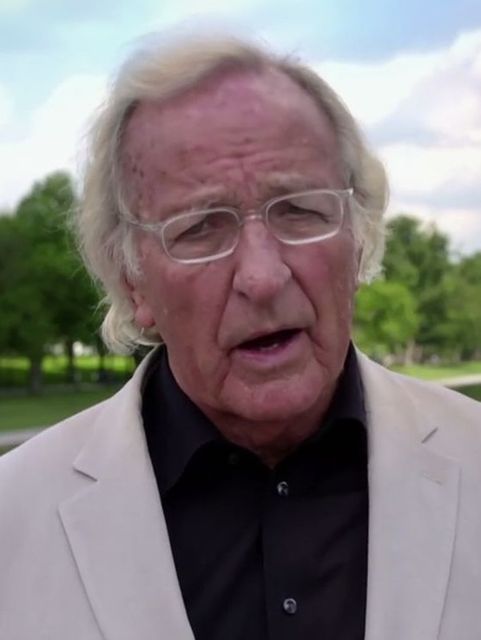
John Pilger


Pilger, who has made 62 documentaries since 1970, is one of a handful of journalists internationally who vigorously defends WikiLeaks founder Julian Assange. On June 17, he addressed a rally in Sydney organised by the Socialist Equality Party (Australia) to demand Assange’s immediate release.

Some of the early Pilger films to be screened include: The Quiet Mutiny, his first documentary for British television; The Outsiders, which features interviews with war correspondents, such as Wilfred Burchett and Martha Gellhorn, and other individuals in 1983; and The Last Dream: Other People’s Wars (1988), about the history of Australian military involvement in British and American imperialist interventions.

Recent Pilger documentaries to be shown, some of which have been reviewed by the World Socialist Web Site, include Palestine is Still the Issue (2002), Breaking the Silence: Truth and Lies in the War on Terror (2003), The War You Don’t See (2010), Utopia (2013) and The Coming War on China (2016).


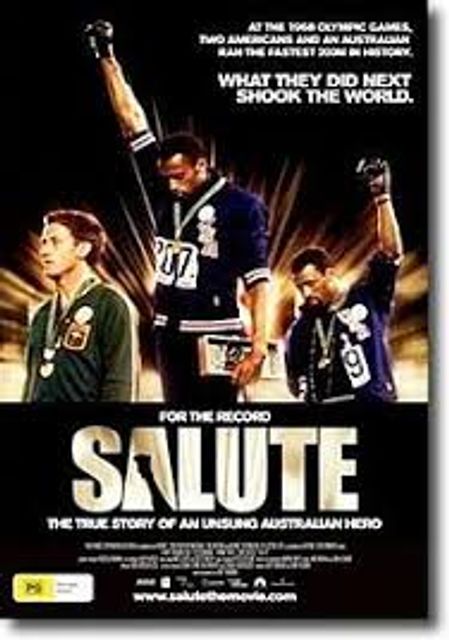
 Salute

Other important films to be shown are Curtis Levy’s The President vs David Hicks (2004) and Matt Norman’s Salute (2009), about track athlete Peter Norman and his victimisation by Australian authorities after he supported US athletes who gave a “black power” salute during the 1968 Olympics in Mexico.

Finally, “The Power of Documentary” festival includes three classic works: Edward R. Murrow’s Harvest of Shame (1960), an exposure of the slave-like working conditions of farm workers in the US; Peter Watkins’ long-banned War Game (1965), one of the first docudramas which recreates the horrific impact of a nuclear attack on Britain; and Peter Davis’s Hearts and Minds (1974), the first mainstream American documentary opposing the US intervention in Vietnam to secure a theatrical release. Full details of the festival program can be accessed here.

Pilger conducted the following email interview with the WSWS last week, just before the festival began.

Richard Phillips: Can you explain why you decided to organise this festival? What do you mean by “Breaking the Silence” in the title and why is this necessary?

John Pilger: By silence I mean the exclusion of ideas that might change the way we see our world, or help us make sense of it. There are 26 films and each one pushes back a screen of propaganda—not just the propaganda of governments but of a powerful groupthink of special interests designed to distract and intimidate us and which often takes its cue from social media and is the enemy of the arts and political freedom.

A documentary is not reality TV. Political documentary is not the consensual game played by politicians and journalists called “current affairs.” Great documentaries frighten the powerful, unnerve the compliant, expose the hypocritical. Great documentaries make us think, and think again, and speak out, and even take action…

Well-paid journalists have become gormless cyphers of the propaganda of war: lies known these days as fake news and spread by the intelligence agencies. Why do we allow governments, our governments, to commit great crimes, and why do so many of us remain silent?

These are questions for those of us privileged to be allowed into people’s lives and be their voice and seek their support. It is a question for filmmakers, journalists, artists, arts administrators, editors, publishers. We can no longer claim to be innocent bystanders. Our responsibility is urgent; as Tom Paine impatiently wrote: “The time is now.”

RP: You began making documentaries in 1970 with The Quiet Mutiny, about the Vietnam War. Can you speak about the filmmakers that influenced you in the early years and the most important thing you learnt in that formative period?

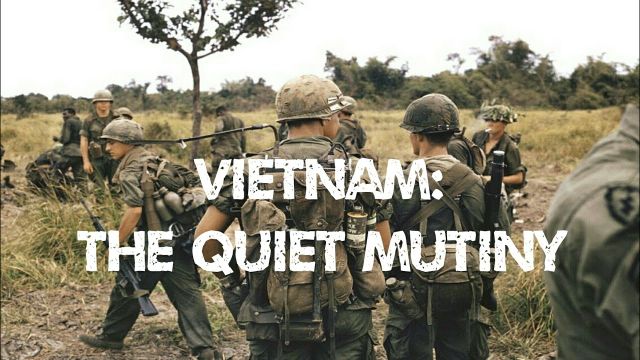
JP: My formative period as a documentary filmmaker was as a journalist. For me, the two crafts complement each other; the most expressive journalism is often cinematic. As a young war reporter in South East Asia, I was struck by the surreal spectacle of the American invasion and its atrocious consequences. The Quiet Mutiny is a factual, political film that uses irony and satire bordering on black farce, together with the music of the time, much of it political.

I was influenced by many I worked with; in the beginning by my producer Charles Denton, who encouraged me to depart from the formula of “current affairs.” When The Quiet Mutiny was broadcast, the then Director General of the Independent Television Authority in Britain (a pompous fellow Australian with a knighthood) called me “a dangerous subversive.” It was the highest honour I have received, and I am grateful to him.


 The Quiet Mutiny

RP: Since then you’ve made scores of documentaries. These include exposing US war crimes in Vietnam, Iraq and many other countries, the danger of nuclear war, state brutality against the working class and the poor, ongoing oppression and social mistreatment of Aborigines.
Your second documentary was shot in West Yorkshire and was entitled Conversations with a Working Man and broadcast on British television. It’s difficult to imagine anything with a title like that being screened on the celebrity obsessed television networks today.

JP: I agree. But as with almost every film I have made, I had my struggles. The executive producer decreed that my use of “the people” was unacceptable because it was a “Marxist term.” He refused to allow me to use “working class”; if you listen carefully, you will hear me say “working heritage.” This nonsense made not a blind bit of difference; the viewers understood and a record audience watched the film.

RP: Why do you think there are so few of these sorts of exposures today? Is it because of financial and distribution problems, or a question of self-censorship and/or lack of political perspective?

JP: It is all those things. I would put lack of political perspective at the top, alongside an enthusiasm to join the system of elite power. Many on the BBC believe that once they join that institution they rise to a Nirvana of purest impartiality and objectivity when, in truth, they have become part of the most refined propaganda system on earth.

RP: The festival is showing Edward R. Murrow’s Harvest of Shame, Peter Watkins’ The War Game and Hearts and Minds by Peter Davis. Could you speak briefly about their importance?

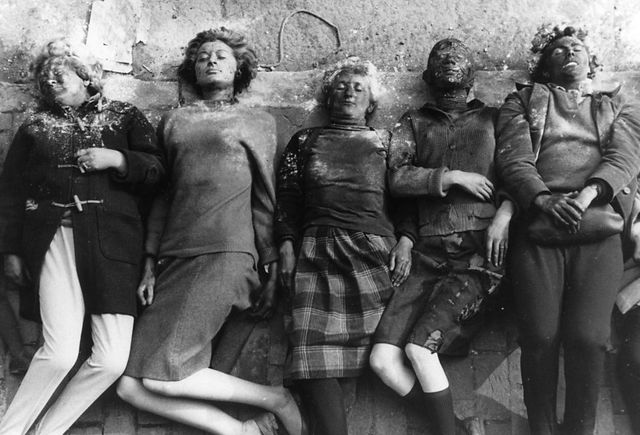
JP: Each of these films is truth-telling in its highest form, especially The War Game. No film-maker has matched Peter Watkins’ astonishing achievement in recreating a town in England devastated by nuclear war. He did it all with official documents, which was why his film was banned by the BBC for 23 years.

Unknown to the British people, their governments were planning precisely that which Watkins reconstructed in The War Game. His film was profoundly threatening because it would possibly change the minds of millions of Britons towards Cold War policies, even war itself.


 The War Game

I’ve read the declassified documents of Harold Wilson’s cabinet secretary, Sir Burke Trend; the government was horrified by Watkins’ film because it was true. I admire him enormously for the same reasons I admire Julian Assange.

Harvest of Shame was a very different film, yet its bracing journalism was also committed to the truth. The regression today means none of these films would be made.

RP: You’ve also selected some films by Mark Davis, Curtis Levy and other Australian documentarians. Do you see any parallels between The President vs David Hicks, which follows the courageous fight waged by David’s father Terry to secure his son’s freedom from Guantanamo Bay prison and the situation facing Julian Assange?

JP: Yes, they are similar; Terry Hicks is a supporter of Julian. For their moral courage, both Terry and Julian are the best kind of Australians.


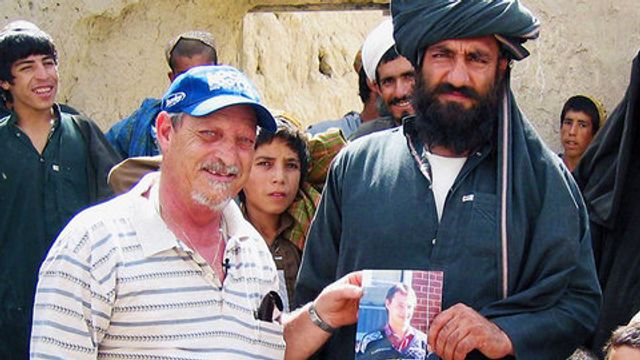
Terry Hicks in Afghanistan

RP: You’ve coined the phrase “Vichy journalism” to describe journalists who have joined the campaign of slander, lies and frame-ups against Assange and WikiLeaks. Why has this occurred and what are the consequences for Assange and investigative journalism? What is the current situation facing Assange?

JP: Most “mainstream” journalism has been integrated into corporate and so-called national security systems that rule the West, especially in the United States and Britain. When I was working in what was known as “Fleet Street,” the press was conservative but there were spaces for different, dissenting work, and a certain range of views. This was even encouraged. Today the spaces have closed, and the best journalists write online, or in foreign publications, or in a new samizdat, or not at all.

WikiLeaks and Julian Assange are the counter to this oppression, and, of course, he is subjected to a smear campaign. The greater his impact and symbolism the more vicious the campaign against him.

The Guardian’s sordid role as a platform for the scuttlebutt of spooks is shocking. Those involved are no different, morally, from those who collaborated under the Vichy government in France during the Second World War.

Julian’s situation is serious. The person contracted to bring his food to the Ecuadorean embassy has been told she is no long wanted. This does not mean he will go hungry, but it demonstrates the depth of his struggle. That said, he is a very strong character with an abiding moral purpose and a dark sense of humour. He needs, as Martha Gellhorn wrote about those who stand up to rapacious power, “the alliance of us all ... the support of decency.”

RP: Can you speak about your last documentary The Coming War on China and what prompted you to make it? What will be the consequences of such a war? Can you comment on Australia’s involvement in these preparations and the mounting anti-China hysteria in the Australian media?

JP: China is surrounded by more than 400 American military bases that reach from Australia, through the Pacific to Asia and across Eurasia. A State Department official described it as “actually a noose.” Low-draught US warships probe the waters of southern China and US drones overfly Chinese territory. This has been a fact, mostly unreported, for many years and was inverted during the Obama presidency to propaganda, the falsehood, that China was threatening the US, Asia, the Pacific.

As expected, Australian politicians, “experts” and journalists have echoed this. It has become a chorus. The Chinese—like the Russians—are becoming the enemy of Australia, which in reality has no enemies, apart from its own forces of institutionalised paranoia. I grew up during the first Cold War and it is all familiar: perhaps worse in its inventions and deceptions.

RP: Finally, what’s your advice to young people who want to become documentary filmmakers and investigative journalists today?

JP: My advice is always follow your star. By that I mean: never abandon your commitment and idealism and keep in mind that journalists and film-makers are truly credible as the agents of people, never of power.

Fighting for Oil Markets at the G20

World Leaders Fight Over Turbulent Oil Market at G20 Summit 

by TRNN


December 3, 2018

World leaders representing the largest economies are meeting in Argentina this weekend for the annual G20 summit. This year’s summit is marked by a few major issues and controversies, including the fight over oil prices, the aftermath of Saudi Arabia’s brutal killing of royalist Jamal Khashoggi, the trade war between the United States and China, and new relations over oil between India, China, Saudi Arabia, and other countries.

CNN noted this year that oil is one of the key topics at the summit. CNN pointed out that the price of U.S. crude has dropped around 20 percent just in this month of November, and some countries are complaining about oversupply. At the G20 this year, the leaders of Russia and Saudi Arabia, two of the largest oil producers, will be meeting to discuss oil.


As world leaders gather for the G20 summit, oil is at the top of the list of issues. Scholar Vijay Prashad discusses the fight between the US, Russia, China, and Saudi Arabia over price and production, and notes India is in talks with Crown Prince MBS.

Passing: Shawna Green, Warrior

In Memory of Shawna Green, Wild Salmon Warrior

by WildCoast.ca and Forest Action Network


December 3, 2018

Today we honour Shawna Green, taken from us by cancer in late November. Shawna is one of the indigenous women who occupied fish farms on the Central Coast.

With heavy hearts, the wild salmon people are carrying on, and so are we.

For over a year, indigenous grandmothers, chiefs, young people, and allies peacefully occupied fish farms in the Broughton Archipelago to document the damage they cause to wild species.

We support and honour the warriors, now and always.

WildCoast.ca and Forest Action Network

100% home-grown, grassroots. feminist, and fierce in defense of the land.


Thank you for keeping the spirit


[Editor's addendum - Ape]

Shawna Green of Fish Farms Out Now Gets Real with Site C Summit Jan. 26, 2018

by Chris Cook


I was down at the Site C Summit the other day, and was fortunate enough to catch Shawna Green get real with the crowd.

This brave and dedicated woman stopped them in their tracks with a cri de coeur, imploring we “incredible people” forget letters to MLA’s and good manners, and employ direct action to stop the fish farms, and other outrages imposed by the “gross society” we have saddled ourselves with – for now.


Listen. Hear.