Wednesday, January 02, 2019

Bibi's Gambit

Early Elections: Who Will Dethrone ‘The King of Israel’?

by Ramzy Baroud - The Palestine Chronicle


January 2, 2019

“A historic mistake” is how Israeli Prime Minister, Benjamin Netanyahu responded to calls for early elections last November. A few weeks later, he spoke, in exaggerated confidence of the “unanimous” agreement of his right-wing coalition that early elections must be held next April.

So why the change of heart?

Netanyahu may not be a good leader, but he is certainly a cunning politician. The fact that he is gearing up for a fifth term at the helm of Israel’s fractious political scene speaks volumes of his ability to survive against many odds.

But it is not all about Netanyahu and his clever ways. Israeli politics are truly dismal. The Left, if it ever earned such a title, is marginal, if not entirely irrelevant. The Center lacks any real political identity or decipherable discourse concerning, for example, foreign policy or true vision for peace and coexistence.

The Right, which now defines Israeli society as a whole, has moved further to the right, and is saturated in religious zeal, ultra-nationalism, while some of its parties are flirting with outright fascism.

As strange as this may sound, in the company of Education Minister, Naftali Bennett, Justice Minister, Ayelet Shaked, and the recently-resigned Defense Minister, Avigdor Lieberman, Netanyahu is not the most extreme.

Indeed, per Israel’s Orwellian politics, nothing is what it seems.

Netanyahu is now paying the price for his overconfidence. The right-wing creature that he has so diligently created to quash his enemies, has grown so powerful and unhinged, that even the prime minister himself could no longer control political outcomes.

The once unchallenged Israeli leader has himself grown too comfortable with power. His family too has become too accustomed to the good life. His wife is now standing trial for corruption and misuse of public funds.

As of early December, the police have recommended, and for third time, that Netanyahu be charged with fraud, accepting bribes and breach of trust. Between direct involvement in the massive corruption racket that his office has espoused, and the dirty dealings of his own circle of aides and profiteers, the Israeli leader is no longer untouchable.

Netanyahu’s sense of safety has always been buttressed by his good standing in opinion polls.

Even now, his numbers are still relatively high. His Likud party would still win an easy election - 30 seats in the Knesset’s 120 seats - if the vote was to be held today.

In fact, this is precisely why Netanyahu had the change of heart and succumbed to mounting pressure from Bennett, among other dissatisfied right-wingers.

His hands are getting tied in Syria, thanks to Russia’s strong rejection of Israel’s incessant bombing of the war-torn country. His movement in Gaza has too become restricted due to the botched attack on the besieged Strip on November 11.

Gaza was a place where Israeli politicians could freely flex their muscles, punished the trapped population of that tiny region, either with a customary war or a routine bombardment.

But Netanyahu has failed on that front as well, where the Gaza Resistance recently repelled an Israeli commando attack and forced the Israeli government into an Egyptian-sponsored truce.

A mere 48 hours later, Lieberman resigned in protest, further contributing to the growing stigma among Israeli officials from all parties that their leader is ‘weak’ and was ‘defeated’ by Hamas.

Still, his coalition survived, but not for much longer. A razor-thin majority of a single Knesset member kept the once powerful coalition alive in Parliament. Bennett and others suddenly had the key to the Likud-led coalition’s survival and to Netanyahu’s own political fate.

Thus, Netanyahu opted for early elections, hoping for an easy victory and for yet another right-wing coalition, where he would have greater maneuverability and command greater respect.

Since Center and Left parties have already proved worthless, Netanyahu is now counting on their ongoing failure to appeal to Israeli society.

Elections will be held on April 9, as announced on December 24, by speaker of the Knesset, Yuli-Yoel Edelstein; nearly 8 months before they were originally scheduled.

Considering Netanyahu’s increasing misfortunes, 8 months would be too long to maintain his electability. In fact, most Israelis already see him as a corrupt leader.

According to the same calculations, early elections in April is not long enough for a capable contender to emerge from neither the Right, nor the political wreckage of the Center and Left to, finally, dethrone the king of Israel.

However, this, too, might prove to be wishful thinking.

Within days of Edelstein’s announcement, Bennett and Shaked declared the formation of their own new party. The leaders of the ‘Jewish Home’ are now the leaders of the ‘New Right’. While this is seen as a major challenge to Netanyahu within his right-wing constituency, it is also an early sign of the fragmentation of the Right itself.

But that’s not all. Another Benjamin - Benjamin “Benny” Gantz - is hoping to change the Israeli political paradigm entirely.

The ex-general has served in several wars against Gaza, at the Israel-Syria front and was the country’s 20th Chief of General Staff.

With an unclear, thus untainted, political outlook, and a bloody war record, it would be tough for Netanyahu to diminish Gantz’s reputation among Israelis. In Israel, ‘killing Arabs’ is always an incentive at the polls.

Although the army man-turned politician is being perceived as a Center-Leftist, he clearly wants to start anew. On December 27, Gantz launched his own political party: Hosen Yisrael - Resilience of Israel.

With little, if any political campaigning, the new party would win 15 seats in the Knesset if elections were held today.

This says much about Israelis lack of faith in the existing Center-Left political elites, but also about the serious challenge that the Right, with all of its strands - should expect if the pendulum continues to swing.

For now, Netanyahu’s strategy is likely to focus on gaining as much new political capital as possible while taking as little risks as possible.

But with his enemies gaining momentum, police investigations closing in, the fracturing of the Right and the rise of an electable Centrist, Netanyahu, the survivalist might become a liability to his own party, which could, at last, usher in the end of his political career.

Ramzy Baroud is a journalist, author and editor of Palestine Chronicle. His latest book is The Last Earth: A Palestinian Story (Pluto Press, London, 2018). He earned a Ph.D. in Palestine Studies from the University of Exeter and is a Non-Resident Scholar at Orfalea Center for Global and International Studies.

Canada: Paragon of the Rule of Law?

Canada and the Rule of Law

by Kim Petersen - Dissident Voice


January 2nd, 2019 

Canada’s fealty to the rule of law is much spoken of nowadays by Liberal politicians in regards to a current pending extradition request made by the United States to Canada.

Canada became embroiled in the international trade spat between the US and China when it arrested Meng Wanzhou, the chief financial officer of telecommunications giant Huawei at the behest of the US government.

Indeed, some more critical types would characterize it as nothing short of a kidnapping.

Meng has been alleged to have broken US sanctions against business dealings with Iran. The charges against Meng, however, are not considered to violate any Canadian laws — nor, according to China’s embassy in Canada, any US laws.

As a justification for the high-profile arrest, a repeating media chorus is heard in the Canadian political scene: 

Former foreign minister Peter McKay said, “… we are following our rule of law.”
Current foreign affairs minister Chrystia Freeland intoned, “Canadians expect me to stand up for the rules.”

Prime minister Justin Trudeau asserted, “Canada is and always will remain a country of the rule of law.”

Trudeau emphasized that “all through this and through whatever happens in the world Canada stays consistent with the rule of law and applying our judicial system and we always will.”

Mind you, these words about adherence to the rule of law are spoken by Canada’s first prime minister found to have broken federal ethics laws.

China, however, was having none of this. China’s Ministry of Foreign Affairs spokeswoman Hua Chunying forcefully stated,

The United States and Canada can’t continue to boast that they are abiding by the rule of law. But in my opinion this is simply a modern version of the emperor’s new clothes.
No matter what excuse they use, they are displaying ignorance of the fact and contempt for the rule of law. They have become laughingstocks of the world.”

What underpins the Rule of Law?


1. Accountability: all are accountable under the law.

2. Laws are Just: the laws are clear, publicized, stable, and just; are applied evenly; and protect fundamental rights, including the security of persons and property and certain core human rights.

3. Open Government: enacts and applies laws that are accessible, fair, and efficient.

4. Accessible & Impartial Dispute Resolution1 

*****

It is in-one’s-face obvious that the US sanctions law against Iran is unjust. What became an international agreement under president Barack Obama, the Joint Comprehensive Plan of Action aka the Iran nuclear deal, was shunted aside early into the Donald Trump presidency, this despite Iran always being found in compliance with the agreement. Thus it is the US which violates the terms of the agreement by its withdrawal and sanctioning Iran and other actors who deal with Iran.

Moreover, the legality of unilateral sanctions is questionable and they are considered to violate the tenets of the United Nations Charter.2

Seldom one to hold back, Trump bumbled into the legal proceeding and commented that he might intervene in the case of Meng, thereby politicizing the process. Nevertheless, given all these circumstances, Canadian officials continue to parrot the following-the-rule-of-law line

But does Canada really have a reverence for the rule of law?


In Part 2: what does the record indicate about Canada’s adherence to the rule of law. 


Notes

“What is the Rule of Law?” World justice Project. [1]
Rahmat Mohamad, “Unilateral Sanctions in International Law: A Quest for Legality,” in Marossi A., Bassett M. (eds) Economic Sanctions under International Law (The Hague: TMC Asser Press, 2015.) [2]

Kim Petersen is a former co-editor of the Dissident Voice newsletter. He can be reached at: kimohp@gmail.com. Twitter: @kimpetersen. Read other articles by Kim.

Gorilla Radio with Chris Cook, Ted Smith, Peter Spong, Janine Bandcroft January 3, 2019

This Week on GR

by C. L. Cook - Gorilla-Radio.com


January 3, 2019

Welcome to a New Year; MMXIX as Caesar would have it. In MMXVIII, Canada finally moved towards sensible marijuana laws. For decades, Canadians were harried, fined, and even thrown into prisons for the act of smoking or otherwise ingesting an entirely naturally occurring herb, which even its harshest detractors admit is not too terribly harmful. In fact, weed has been used in a variety of World cultures for uncounted centuries as both curative and spiritual aid.

So how's the nation's belated enlightenment going?

Ted Smith is a long-time justice activist and co-founder of the Victoria Cannabis Buyer’s Club, which provides cannabis-based products to people with terminal and incurable medical conditions.

Listen. Hear.

Ted broke the tundra-like, frozen legal trail of the Canadian medical marijuana struggle, persevering repeated harassment and arrest, and taking the case all the way to the country's Supreme Court – and winning!

Ted Smith in the first half.

And; last week Japan announced it would be leaving the International Whaling Commission, the body set up to oversee that odious practice, incredibly still conducted by numerous nations. The Japanese say they will forego their controversial "scientific" whaling in the Southern Ocean off Antarctica, but continue commercial hunt/harvesting activities in territorial waters, or what it terms, the Japanese Exclusive Economic Zone (EEZ).

The news has been hailed as good news by the Sea Shepherd Conservation Society, who say the absence of Japan from the commission will, quote "allow the IWC to pass the motion to establish the South Atlantic Whale Sanctuary thus effectively ending whaling in the Southern Hemisphere." Others fear the move is bad for whales in other ways.

Dr. Paul Spong is marine researcher, one of the World’s foremost authorities on the Orca, and founder of OrcaLab, a land-based observatory located on Hanson Island. Spong has tracked whale and other marine mammals from the idyllic location since 1970. He attended and sent dispatches out from last Fall's IWC 67 in Florianopolis, Brazil.

Paul Spong and what Japan's new policy means for whales in the new year in the second half.


And; Victoria-based activist and long-time Gorilla Radio contributor, Janine Bandcroft will be here at the bottom of the hour with the Left Coast Events Bulletin on some of the good things to be gotten up to in and around our town in the coming week. But first, Ted Smith and the ongoing effort to norml-ize marijuana policy in Canada.

Chris Cook hosts Gorilla Radio, airing live every Thursday between 11-Noon Pacific Time. In Victoria at 101.9FM, and on the internet at: http://cfuv.uvic.ca.  He also serves as a contributing editor to the web news site, http://www.pacificfreepress.com. Check out the GR blog at: http://gorillaradioblog.blogspot.ca/

Tuesday, January 01, 2019

Letting the Mask Slip: StratCom's New Year's Eve Bomb

US Military Apologizes For Posting Uncomfortably Honest Tweet

by Caitlin Johnstone - Rogue Journalist


January 1st, 2019

US Strategic Command (or “Stratcom” if you’re trying to make a nuclear-capable arm of the US Defense Department sound cool) has issued an apology for a poorly received New Year’s Eve tweet which has since been deleted.

“#TimesSquare tradition rings in the #NewYear by dropping the big ball…if ever needed, we are #ready to drop something much, much bigger,” the offending tweet read, with an attached video featuring B-2 stealth bombers flying all stealth bombery and causing gigantic explosions with bunker buster bombs while words like “STEALTH”, “READY”, and “LETHAL” flashed across the screen.

The tweet concluded with the ostensibly unironic hashtag “#PeaceIsOurProfession”.

“Our previous NYE tweet was in poor taste & does not reflect our values,” Strategic Command tweeted.
“We apologize. We are dedicated to the security of America & allies.”

This statement is, obviously, a lie. The part about “security” of course, because dominating the globe with nonstop military violence and aggression has nothing to do with security, but also the “does not reflect our values” part. The US military deleted the post and apologized for it because it received an angry backlash from hundreds of commenters and was circulated virally on Twitter for its jarringly creepy message, not because it did not reflect their values. It reflected their values perfectly.

The only way you could possibly encapsulate the US military’s values in a 42-second video clip more perfectly than cramming it full of footage of $2,000,000,000 war planes cruising around dropping $3,500,000 GBU-57 bombs would be to also show the human bodies they land on being ripped to pieces. Inflicting death and destruction using unfathomably expensive machinery is the US military’s whole job. Of course it reflects their values.

The real issue here was not values but perception. The US war machine pours an immense amount of energy into perception management, making sure that ordinary Americans either (A) ignore the horrific things that are being done in their name or (B) think that those things are awesome and patriotic. The offending post was clearly attempting to accomplish (B). A team of paid social media propagandists simply did not understand that ordinary human beings wouldn’t resonate with a message that amounts to “Hey I see you’re all preparing to bring in the new year, so watch how good we are at killing large numbers of people!”, and some damage control became necessary when everyone got freaked out. Can’t have people opening their eyes to how insane America’s relentless military expansionism has gotten, after all.

Watching the propaganda arm of the US-centralized war machine is a lot like watching a manipulative sociopath learning how to function in normal society. Sometimes they’ll slip up and fail to react the way someone with a healthy sense of empathy would respond to the death of a pet or someone’s emotions or whatever, and they risk alienating whoever’s around them and losing access to the resources they could exploit them for if they can’t manipulate them out of the creeped-out feeling people get when they’re around someone who doesn’t empathize like a normal human being.

I suspect many of the commenters who flooded in telling Stratcom to delete its tweet were not so much interested in eliminating a violent social media post from the internet, but in eliminating that creeped-out feeling you get when the sociopath’s mask slips a bit.


Deven_Intel
I'm so glad I had decided to download this video from the StratCom Tweet earlier.
Here's the video the StratCom had released earlier today. They took down the tweet.
Here's the video for any of you looking for it.

And that’s understandable. One of the biggest obstacles in getting people to realize how deeply propagandized they are is the cognitive dissonance which comes rushing in when one considers the implications of viewing the world free from the lens of military psychological manipulations. Without the lies about how beneficent and necessary and awesome the military is, all you’ve got is trillions of dollars worth of instruments of death circling the globe to facilitate the daily slaughter of men, women and children to advance agendas of power and profit while ordinary people struggle just to get by in your own country.

It can be deeply psychologically uncomfortable to grapple with the reality of what that means for your beliefs about your nation, your society and your very identity, in much the same way realizing you married a manipulative sociopath can be an uncomfortable truth one might feel tempted to compartmentalize away from.

A lot of people got upset about that tweet, but they really shouldn’t have. The tweet was not the problem; it was just a few perception managers for the US military being more honest and straightforward than usual. The problem is that money is being stolen from ordinary Americans to murder strangers on the other side of the planet to advance agendas of power and profit, and everyone’s being propagandized into accepting that as normal. The sociopathic propaganda engine slipping up and stirring the populace from their slumber a bit is nothing to complain about, the actual reality of our actual situation is.

_______________

The best way to get around the internet censors and make sure you see the stuff I publish is to subscribe to the mailing list for my website, which will get you an email notification for everything I publish. My articles are entirely reader-supported, so if you enjoyed this piece please consider sharing it around, liking me on Facebook, following my antics on Twitter, throwing some money into my hat on Patreon or Paypal, purchasing some of my sweet new merchandise, buying my new book Rogue Nation: Psychonautical Adventures With Caitlin Johnstone, or my previous book Woke: A Field Guide for Utopia Preppers.


Bitcoin donations:1Ac7PCQXoQoLA9Sh8fhAgiU3PHA2EX5Zm2

Margin Call! America's "Casey" Moment?

Forecast 2019: Ding Ding! Margin Call USA

by James Kunstler - Clusterfuck Nation


December 31, 2018

Welcome to the American hall of mirrors… and mind the broken glass all over the floor. That’s Nature’s way of saying the country has run out room to punk itself. 2018 was the consolidation of bad faith in everything we do: politics, the news media, economics & finance, show biz, regular biz, jurisprudence, medicine, education, and relations between men and women — the year of peak dishonesty and self-deception.

Of course, the trouble with dishonesty is that it doesn’t comport with Reality, and Reality being Mother Nature’s husband, bats in the cleanup position. Entering 2019, the bases are loaded with delusions, misdirections, and turpitudes.

I shall get right to it without further throat-clearing.
Illustration, Albert Dorne

Trumpology


The nation’s focus remains clamped to the mercurial character in the White House. If you subscribe to Strauss and Howe’s theories about The Fourth Turning, then you might see president Donald J. Trump playing the archetypal role they call “The Gray Champion,” an elder figure of the “transcendental” Boomer generation sent by fate to rescue a floundering society at a grave moment in the seasons of history. Yes, I know: we might have been better off calling Ghostbusters. A cardinal precept at this blog is that fate is a trickster. You order a Gray Champion and room service sends up a Golden Golem of Greatness.

To put it mildly, Mr. Trump has failed to charm at least half the country. They are embarrassed at his physical presence: his lumbering gait, like unto a behemoth land mammal of the Oligocene; that swaying bay window stomach half-concealed by the flaps of his suit-jacket and bisected by the oddly elongated necktie; the pained smile he puts on for the photo-ops; his man-spreading when seated with the world’s poohbahs, and that strange confection of sculpted hair, like the spun sugar on a Croquembouche, or the pouf on some horrifying plastic dashboard figurine. His manner of speech, the weird, palindromic repetitions, the childish artlessness of his casual utterances, the absence of Beltway focus-group cant, and of course the reviled Tweets — drive his opponents up a tree. The gilt-plastic trappings he surrounds himself with also offend them. For all I know, they hate his cologne, too.

His adversaries say he is “undermining institutions.” By this perhaps they mean the beloved DC gravy-train of regular institutionalized grift divvied up between elected officials, Wall Street, the War-and-Intel matrix, and the unholy infestation of lawyer-lobbyists slithering around the Swamp. Just look what happened when Mr. Trump threatened to end US military operations in Syria: apoplexy among the Neocons and Progs-for War — though none of them could coherently state what our strategy is there (is it to overthrow Assad so we can have another failed state in the Middle East?). Whatever Trump proposes in the way of policy is inadmissible because, according to the Resistance, Mr. Trump should not be allowed to propose policy, or order it, or direct it. Because he is… Trump….

Whatever you think of his agenda, Mr. Trump made the fateful mistake of bragging on the bubble economy that is now collapsing, and it will probably un-do him more effectively than all of the attempts to pin some actual crime on him by Robert Mueller. The Special Prosecutor has spent two years and has come up with little more than a handful of rinky-dink “process crimes” — mainly lying under oath, engineered by Mr. Mueller’s legal team and old friends in the FBI and DOJ after-the-fact. The Mueller investigation started with a false predicate — collusion with Russia — and entailed loads of prosecutorial mischief. We approach the climax of all that in early 2019. Mr. Mueller will issue his report before March. Maybe it will contain surprises, but the investigatory process involves so many people that it’s hard to believe no hints of any “bombshells” have leaked to the papers and cable news outfits. Rather, Mr. Mueller will depict a whole lot of nothing in the darkest possible light for the convenience of a house impeachment process, the holy grail of the Resistance, though the exercise is likely to fail if it gets to a senate trial.

But before that, there is the question of Mr. Mueller himself. My view is that Mr. Mueller has run a colossal cover-your-ass operation for the many documented misdeeds among the FBI and DOJ in cooking up this mess starting in the spring of 2016. His appointment in the first place was a gross error, considering his mentor relationship with James Comey and prior association with his putative supervisor, Deputy Attorney General Rod Rosenstein. RR remains in that position despite being a witness in matters pending before Mr. Mueller (and other regulators such as federal prosecutor John Huber and DOJ Inspector General Michael Horowitz), including the FISA warrant scandal, the Uranium One deal, and the tortured doings of the Hillary Clinton and her foundation.

January will kick off with the congressional extravaganza I’ll call Investi-Gate, as committees headed by Democratic chairs Gerald Nadler (Judiciary), Elijah Cummings (Oversight), and Adam Schiff (Intelligence) swarm the President and his associates like army ants on a drove of peccaries. They’ll haul in everybody and his uncle to keep the show going for their pals in the media. The star attraction will be Trump ex-lawyer Michael Cohen, though he will appear as a convicted liar. He may even defy the committee by not answering their subpoena before he has to report to federal prison in March. After all, Rod Rosenstein successfully defied more than one summons to congress for months on end. What will the House committee chairs do to Cohen? — threaten him with jail?

The house committee Investi-Gate circus is a sure thing, though, don’t forget, minority members can also call witnesses, and there is room for blowback on the venture. Republicans still chair the senate committees, and there may be a mud-fight between the two houses. Otherwise, expect a whole lot of grandstanding at the expense of paying attention to any of the nation’s serious business. Mr. Huber and Mr. Horowitz will also release reports in early 2019. Much of the recent criminal misbehavior in FBI / DOJ / Mueller orbit lies within their commissions. Abundant evidence has already been published concerning the conspiracy to defeat Mr. Trump by subterfuge in the 2016 election, and further illegal attempts to injure him in the years following. Some of the characters in this horror show have already testified to grand juries.

Gen. Flynn was sent to the doghouse by Judge Emmet Sullivan at his December sentencing hearing for the purpose of rethinking his guilty plea. The idea is to persuade him to go to trial and force Mr. Mueller to go through a discovery process (of evidence) that could easily derail Mr. Mueller’s case and reflect poorly on the Special Counsel, perhaps even lead to legal problems for him in the way of malicious prosecution. Gen Flynn’s case also resolves one way or another in March.

Finally, Mr. Trump will be free to declassify a trove of documents in all these matters after Mr. Mueller reports. Doing so prior to that might set up the president on an obstruction of justice charge. If there’s anything germane in those docs, they could change the whole dramatic arc of the story that took over two years to develop. There’s plenty of chatter across the web about Mr. Trump invoking martial law or declaring some kinds of national emergency, plus loose talk about military tribunals and “thousands of sealed indictments,” but I’m not persuaded that there’s any reality to that.

Politics That Maybe Matter


This country faces a lot of practical problems that are not likely to be addressed if congress is preoccupied with Investi-Gate, and depending on how ferocious the action gets in bear markets, currencies, and banking, which could alter the entire picture (more below).

The crisis in medicine is obvious. Whatever else you can say about ObamaCare, it just didn’t do enough and is now crippled by court decisions. Health Care is simply unaffordable for a growing demographic of the sinking middle class. Much of that is due to plain old racketeering, and I propose that it could be mitigated to some degree if a simple law were passed that required doctors, surgeons, hospitals, labs, and other players to publicly post prices for their services — to eliminate this ridiculous business of providers “negotiating” the price of every transaction in secret, according to deliberately incomprehensible guidelines. It may be too late to “solve” the health care problem in the way that much of the Left wishes: a single-payer system run by the government. True, other advanced nations ran single-payer systems with apparent success for decades, and still do, but they started these programs in an era of reliable economic growth based on industrial production and that era is over for reasons mostly having to do with dwindling cheap energy. The National Health Service in Britain is a shambles. France’s system still functions, but the high taxation needed to keep funding it is, ironically, a main beef of the Yellow Vest protesters. The deflating financial bubble will underscore a new order of austerity in the USA, and may usher in graver problems with the value of the dollar. One way or the other, congress will be stymied over health care reform in 2019.

The eventual result will be the disintegration of the current health care system and its eventual reorganization into local, clinic-based medicine at a much lower level of complexity and treatment. It was a tremendous blunder to consolidate hospitals and medical practices into gigantically-scaled conglomerates. The hallmark of The Long Emergency is that everything organized at the gigantic scale will fail one way or another. Get your mind right for that outcome and take care of yourself in the meantime.

The Left especially has no inclination to address immigration reform. As long as they mendaciously refuse to even make a distinction between legal and illegal immigration, nothing can be done. The Right is also dishonest and cowardly about it, fearing to alienate the ballooning Hispanic voter bloc. Still there is a better chance that some immigration reform may be possible because it doesn’t require the sort of titanic fiscal outlays that Health Care does — Mr. Trump’s wall aside. More likely, though, the current immigration impasse will continue and may provoke vigilante action along the border in 2019 that could be part of greater civil violence prompted by increasing economic disparities.

Markets and Money


The jig is really up. The big bad bear market is already underway, even if it rallies in January. The debt bubble engineered by the Federal Reserve is blowing up and thundering through the system. The epic market instability of December 2018 on the heels of persistent Fed rate hikes points to major credit problems and especially an inability to roll over old debt into new loans at higher interest rates — in particular loans to zombie enterprises that need to borrow to keep paying interest on previous loans (a lot of that among the shale oil companies). The US government can’t take higher interest rates either. It’s already paying about as much in annual interest on US debt as we pay for our war machine. There are only two ways out, both of them nasty. Either suck up debt defaults, which will induce an impoverishing disappearance of money; or provoke high inflation, by injecting more Central Bank QE “money” into the system, which can destroy the value of money. Inflation is typically the choice of governments because it reduces the face value of debts while it allows government to pretend that it is taking action. In the end, you may have plenty of worthless money, which is no different from having not enough money that retains value. The latter was the main feature of the Great Depression.

So, inflation is the usual choice, but it also typically leads to incendiary resentment among the citizenry when they realize they’ve been played and it takes a wheelbarrow full of cash to buy a loaf of bread and a jar of peanut butter. I suppose that Fed chief Jerome Powell knows all too well he’s popped the Mother-of-All-Bubbles. He can blame it on Mr. Trump. Everybody else will, of course. Sometime in the second quarter of 2019, the Fed will resume the money-for-nothing gambit of “quantitative easing” in the hope of arresting the damage, but this time the dollar will lose value uncontrollably and catastrophically. Many people will be ruined, especially retirees at the mercy of insolvent pension funds.

Before 2019 is out, the US could find itself in a situation worse than the Great Depression. Supply lines are much longer now than they were then. If suppliers can’t get paid because trust has collapsed in the short-term corporate paper system, they won’t deliver supplies, which means you may not eat, or fill your gas tank, or heat your house, or get whatever else you need. Also, the USA in 1931 had not yet transformed itself into the fiasco-waiting-to-happen called suburban sprawl. How is Dallas going to work for people who spend a substantial chunk of their income on mandatory motoring (if there’s little or no income)?

Stock market activity may appear to stabilize in January, but it will go south again later on in the first quarter and the Bear will growl louder for the rest of the year.

Civil Disorder


Be prepared for it in 2019. There are going to be a lot of pissed-off people around the country. They are liable to attack Federal property and their fellow citizens (and their property). The hungrier they are, the worse it will be. They will not understand the forces that are destroying the money system. There are a gazillion small arms out there and the government will not be able to control them or confiscate them. Any attempt to do that will only inflame the situation. A major principle of The Long Emergency is that government becomes increasingly impotent and ineffectual as it rolls out. We’re already seeing that in Washington, and it is not at all just because Mr. Trump has inspired such an impasse between the branches. The states, too, will be hard-pressed to do anything useful. Many of them, like Illinois, New Jersey, Connecticut, and California, are already technically insolvent. The federal government may have to pretend to rescue them financially, which will only make the national predicament worse.

Oil


The shale oil “miracle” was an impressive stunt. For a while, it goosed US production way above the former all-time production peak of 1970, and it achieved that with astounding speed — about a decade. But this is oil that is very expensive and complex to produce. It was made possible by massive borrowing at artificial low interest rates, which are now rising. Something like three-quarters of the shale operators never made a red cent in net profit, and many of these companies will find it hard or impossible to roll over their existing debt, especially with oil under $50-a-barrel. But the price is a deceptive metric. If it zoomed up to $100-a-barrel tomorrow, the effect would only be to crush economic activity, because industry requires cheaper oil to pencil out its operations and citizens can barely afford to drive when gasoline hits $4-a-gallon at the pump. At the lower $45-a-barrel, the price crushes the oil producers. Take your pick. There’s no “Goldilocks” price.

The other problems with shale oil have to do with the nature of the shale plays. The Permian Basin in Texas is very large, but the best plays are developed in the so-called “sweet spots” and there’s a limited amount of them. They are the places that the producers developed first, and when they are played out, the next round of plays will be in spots not-so-sweet (or productive) — possibly not worth drilling. The character of the shale oil wells is also way different from the old conventional classic oil wells. The old wells cost about $400,000 (in current dollars). It involved just sinking a pipe into the permeable source rock. The oil came out under its own pressure at the rate of thousands of barrels a day. Eventually, you put a simple pump-jack on the well (the “nodding donkey”) and it produced for decades, like running a cash register. Shale oil wells cost between $6- 12 million. They require technically demanding horizontal drilling and fracking, with additional costs in highly technical labor, water for fracking, sand to hold open the fracks, chemicals to aid the process, and a gazillion truck trips to deliver all the water and sand (and take the oil away). Shale wells produce maybe a few hundred barrels a day for one year, after which they typically deplete by over 60 percent. After four years, they’re done. The oil is also different. Shale oil is typically ultra-light. It contains little-to-none of the heavier diesel, kerosene, jet fuel, and heating oil distillates, making it less valuable.

Trouble in the credit markets could shut down shale production for a period of time and create dire problems for the American economy. That could happen in 2019 as poorer-performing companies fail to get new financing. As mighty as it seems to be, the industry is fraught with fragility. Meanwhile, discovery of new, producible oil has fallen to the lowest level since the 1940s, after three recent previous record low years. Current low oil prices at around $45-a-barrel may give Americans a false sense of security. Low prices are mostly indicative of the collapse of the demand for oil at the global margins and among the large US demographic that cannot afford it anymore — that is, the impoverished former middle class. As the damage becomes more obvious, we could hear calls to nationalize the oil industry. The attempt to do that would collide with the aforementioned trend for government to become more strapped for revenue, more impotent, and more incompetent.

Geopolitical


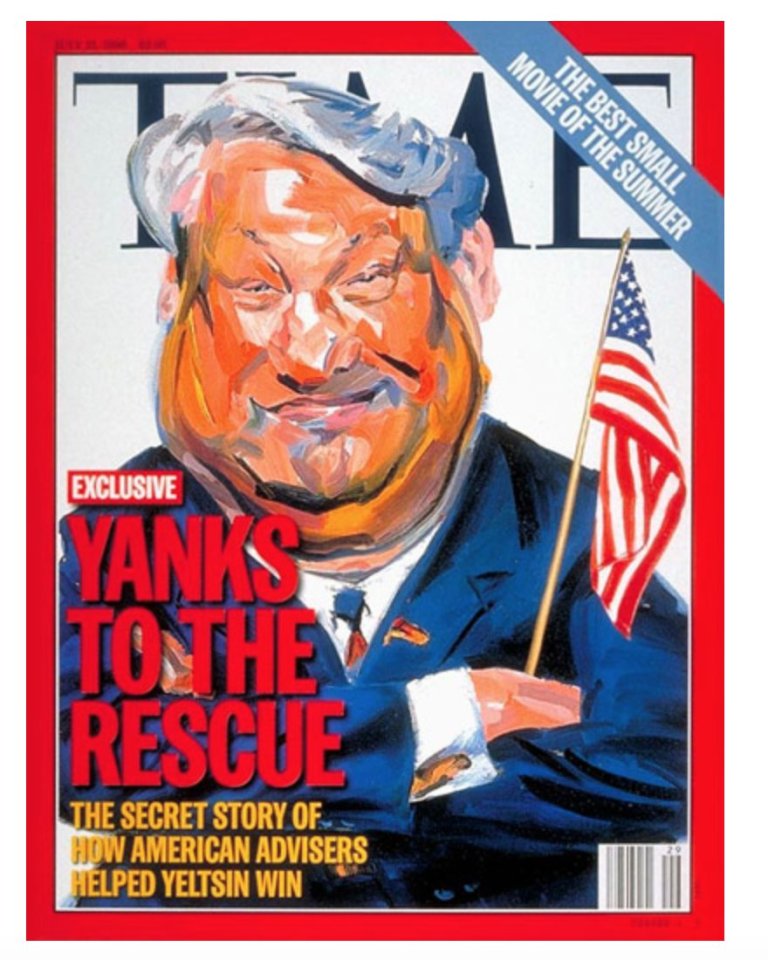
The Golden Golem has gone an extra mile to antagonize Russia the past two years. Is it to demonstrate how not Putin’s puppet he is? If so, it’s pathetic. For instance, heaping ever more sanctions on Russia, tossing Russian diplomatic staff out of the country because of the laughable Novichok poisoning of the Skripal father-and-daughter in Britain. Nobody believed that set up — who recovers from the world’s supposedly most potent, high-tech military toxin? The larger Russia hysteria, ginned up by the US “Intel Community” to cover the embarrassment of Hillary Clinton’s election loss, has destroyed the brains of thousands of Washington insiders and infected whole sectors of the educated coastal elites who really ought to know better. Meddling in elections? Is that something the US has never entertained? Recall that 1996 Time Magazine cover with the headline that bragged, “Yanks to the Rescue: the Secret Story of How American Advisors Helped Yeltsin Win.” And now we’re wetting our pants over a baker’s dozen Russian Internet trolls on Facebook? Yes, this is what the brightest people in the room have been doing for two years. The net result is a new cold war, pushing Russia into the arms of China, giving both of those countries an incentive to construct a new framework for global relations that excludes the toxic US as much as possible.


That new framework, by the way, will not be the same as the late, unwinding Globalism Release 2.0 (Release 1.0 was 1870 – 1914) that allowed America to exchange IOUs for flatscreen TVs lo these many years. Let’s call that Tom Friedman Globalism, after the pundit who said it would last forever. The world will become a wider place again as the Great Powers are increasingly bound to their own regions for trade relations in a world growing short of energy and capital resources. The exception to that is in weaponry, now that Russia has demonstrated its ability to launch hypersonic rockets that can reach the US in little more than a few Noo Yawk minutes. Do we have anything like that? I suppose we wish we did. The media is not even talking about it, the implications are so dreadful.

Has Mr. Trump actually accomplished anything with his deal-seeking in China while beating it on the snout with his tariff stick? Well, he got a lot of US companies loading up on inventory of goods they feared will carry costly duties a year hence, so they’re all stocked up just in time for a vicious bear market and the recession / depression that it entails. A lot of that stuff may end up being distributed by the bankruptcy judges.

How does our antagonism against China work with the campaign to “normalize” the behavior of North Korea. I doubt it helps. In 2019, North Korea will be the whoopie cushion that China places under America’s seat at the negotiating table. Mr. Trump defied the conventional State Department wisdom by meeting face-to-face with Kim. It got the two Koreas actually speaking with each other for the first time in 60 years, with some concrete steps toward ending the de facto state-of-war. Will Li’l Kim play the role China assigns to him? I think so. They can squash him like bug. And, of course, everything that the US congress and Mr. Mueller do to injure and weaken Mr. Trump will make further progress in Korea unlikely.

How about the second greatest economy in the world? That would be the European Union. The EU’s financial system is way more dysfunctional than even ours, with no mechanism or provision for regulating each country’s spending vis-à-vis the debt generation of the Union as a whole. There’s no way it can continue and no prospect for debugging the set-up. What’s more, decades-long shenanigans of the European Central Bank have created imbalances that will never be corrected. Even the attempt to normalize operations — as the ECB ceases its debt monetization routines staring in the first quarter of 2019 — is guaranteed to crack up the EU economy, which is a horror show of zombie companies and zombie banks. They will suffer particularly in the recession / depression to come. The next domino to fall, theoretically Italy, will take the EU down, whatever happens with the dithering over Brexit. Without the ECB vacuuming up unwanted EU paper, nothing really pencils out over there. In 2019, expect a substantial fall in the value of the Euro, and possibly its demise as a currency.

In fact, expect wholesale disintegration of many structural arrangements all over Europe beginning in 2019, along with more political violence that exceeds the simple street actions of the Yellow Vests in France. NATO has been staging war games on Russia’s border for two years, apparently with no awareness that the NATO members are deeply dependent on Russian oil and natural gas to remain advanced nations with comforts and conveniences, like heating their homes. Perhaps that recognition will hit in 2019. But there will be plenty of noise for that signal to cut through.

Climate Change


Something’s going on ‘out there’ though the picture is deeply non-linear and is being confused for the moment by an extraordinary low level of cyclical sunspot activity. Not being a scientist, I have only two salient points worth considering about the issue:

The first is, we’re not going to do anything about it — because nothing can be done about it. Whatever’s happening, we’re going to have to roll with it. I’m also not persuaded that many of the proposed mitigations — carbon taxes, seeding the upper atmosphere with reflective particles — will accomplish anything.

The second thought is this: the civilized world has experienced many many instances of climate change over the past several thousand years. Civilizations rise and fall with these changes, but the human project as a more general matter continues, with periods of history that appear to be restful time-outs. The Roman Optimum (warming period) segued into the Dark Age Cooling, and then the Medieval Warming (viniculture in England!), and eventually the Little Ice Age comes along with Isaac Newton and skaters on the Dutch canals. The difference this time is that our civilization is so deeply complex that successful adaptation to new conditions is a low percentage outcome, at least in the form of salvaging many of our current arrangements. In other climate disruptions, people adapted, sometimes with very severe changes in customs, practices, political arrangements, and life-styles.

It will be especially stark this time, and the broad pop culture of Collapse suggests that we intuit this — everything from Game of Thrones to The Road, to my own World Made By Hand novels. It begins with the wobbling of the most abstract and fragile of our systemic arrangements, finance, which is mostly based on ephemeral trust (that the other fellow will pay you). From there, the trouble proceeds to politics and culture. A few concluding words on the latter:

Culture


2018 was a low point for American culture, such as it is. The idiotic drivel emanating from the university campuses has infected the entire nation like a toxic shock disease. Most damaging, of course is the umbrella ideology of “multiculture” in a society that formerly thrived precisely because of the opposite of that: a common culture composed of ethics, customs, norms, and standards of decent behavior that people not insane could subscribe to. Remove the common culture of a nation and you will not have a nation — it’s that simple. Hence Americans are divided foolishly into battling identity groups who do not believe in a common culture and are doing everything possible to defeat it. They have no idea what E Pluribus Unum used to mean and they have no desire or intention to rediscover it. I return to the cardinal theme of The Long Emergency: that we can’t construct a coherent consensus about what is happening to us, and therefore we can’t make any coherent plans about what to do.

The financial hardships of 2019 provide an opportunity for some overdue mind-cleaning on these matters. There may even be a significant number of survivors among the brain-damaged former thinking classes who refuse to go along with the emperors-new-clothes ideas of recent years any longer. The main thing to understand about the so-called Progressive Left behind this toxic shock is that the whole crusade has been less about ideas of justice or fairness than the sheer joy of coercing others, of pushing people around and punishing them because its fun! The ideologies around that behavior are just window dressing.

The response to it so far has been surprisingly mild. If the financial unwind shapes up as harshly as it looks from here, the response will get more severe. The universities themselves will suffer hugely as their budgets crash through the floor and all, of a sudden, they have to issue pink slips to a half dozen Diversity deans on six-figure salaries. Many colleges will begin the process of shutting down in 2019 as their student loan racket disintegrates.

Well, you’ve suffered long enough for today, and I’ll leave it at that.

Happy 2019 everybody!


Clusterfuck Nation
For your reading pleasure Mondays and Friday
Support this blog by visiting Jim’s Patreon Page

Monday, December 31, 2018

Think Tank Stink: New Knowledge's Alabama False Flag

US intelligence think tank conducted “false flag” operation impersonating Russian election interference

by Will Morrow  - WSWS


31 December 2018


A series of articles published in the past week have revealed the New Knowledge think tank conducted a “false flag” operation to influence the 2017 Alabama state election and make it appear Russia was conducting a Twitter campaign to back its preferred candidate.

New Knowledge is closely connected to US intelligence agencies and has been widely cited as an impartial investigator of “Russian meddling” in US politics.

The story was first reported by the Washington Post December 18 and the New York Times on December 19. Only a day earlier, both papers had carried lead front-page articles based largely on a New Knowledge report claiming to provide new evidence of Russian social media operations to influence American politics.

As per well-established procedure, the report was presented by the Times and Post as “independent” and scientific. Their articles were then made the basis for countless other articles and television reports breathlessly reporting the latest nefarious activities of the Kremlin as established fact.

The New Knowledge report, “The Tactics & Tropes of the Internet Research Agency,” cited hundreds of predominantly left-wing social media posts on Facebook, including on police violence and government spying, to argue that Russian activities were sowing political divisions in the United States. It amounted to a brief for mass internet censorship directed against working-class political opposition. (See: “The disinformation campaign behind the allegations of Russian ‘disinformation’”)

In its December 19 article, the Times admits that New Knowledge CEO Johnathon Morgan was involved in an effort to promote the election of Democrat Doug Jones against Republican rival Roy Moore in the 2017 Alabama Senate election. The operation, code-named “Project Birmingham,” included creating fake Facebook pages to attract conservative voters and promote an obscure write-in conservative Republican candidate likely to draw votes away from Moore. The operation also sought to artificially inflate click rates on anti-Moore news stories in order to encourage more such articles. Moore ultimately lost the election.

Most significantly, the Times report includes the admission that the project “involved a scheme to link the Moore campaign to thousands of Russian accounts that suddenly began following the Republican candidate on Twitter, a development that drew national media attention.”

The Times goes on to quote an internal report by New Knowledge, summarizing Project Birmingham: “We orchestrated an elaborate ‘false flag’ operation that planted the idea that the Moore campaign was amplified on social media by a Russian botnet.” Moore’s Twitter account was followed by numerous accounts with an obviously fake and Russian appearance, featuring profile pictures of celebrities and Russian cyrillic characters.

In other words, the very body cited as an impartial expert on unsubstantiated allegations of Russian “disinformation” itself carries out actual disinformation fabricating evidence of Russian meddling.

The Times article is itself an exercise in damage control aimed at preserving the credibility of New Knowledge and the intelligence agencies’ anti-Russia campaign, for which the Times and the Post have been leading voices.

As is suggested by the headline, “Secret Experiment in Alabama Senate Race Imitated Russian Tactics,” it argues that New Knowledge and Morgan’s actions were a small-scale “experiment” aimed at testing the impact of Russian-style tactics. It further warns that New Knowledge’s actions were a sign that Russian tactics are being copied by other political groups, and that a further intensification of government censorship of social media is required.

It has since been revealed that the project went beyond the Times’ initial report—and that the Times knew of New Knowledge’s role long in advance but did not mention it even as it promoted New Knowledge’s own report. An article by Buzzfeed on December 27 reveals that Scott Shane, the Times national security correspondent who wrote a December 17 article based on New Knowledge’s report on Russian meddling, was one of a handful of speakers at a September meeting in Washington that discussed “Project Birmingham.”

The Project also involved another organization, American Engagement Technologies, which is run by Mikey Dickerson, a former Obama administration official and Google engineer. The organization received $750,000 from Reid Hoffman, the billionaire CEO of LinkedIn, and spent approximately $100,000 on Project Birmingham. The collaboration of New Knowledge in this operation underscores the close nexus between the intelligence agencies, the Democratic Party, and the technology companies that are leading the campaign for censorship.

New Knowledge and its CEO, Johnathon Morgan, epitomize the collection of state propaganda outlets, staffed by former intelligence agents and advisors, who are trotted out in media television panels and featured in news articles as sources for unsubstantiated allegations of Russian interference. New Knowledge’s co-founder, Ryan Fox, was an NSA agent for 15 years, and previously worked as an analyst for the US Joint Special Operation Command in the military.

Morgan himself was an advisor to the US State Department and helped create the Hamilton 68 “dashboard,” a project run by the German Marshall Fund, ostensibly tasked with tracking Russian disinformation activities, that is headed by Clint Watts, a former FBI agent and advocate of internet censorship.

Even if the allegations of a Russian social media operation since 2016, involving approximately $100,000 of paid Facebook ads, are true, they would pale in comparison with the actions of the US intelligence agencies, which are responsible for overthrowing governments, sponsoring coups, destabilizing governments and providing fake intelligence (“weapons of mass destruction”) for illegal US wars.

If the Washington Post and the New York Times, the so-called “newspaper of record” of what previously passed for American liberal journalism, were operating with a shred of journalistic integrity, the revelation of such compromising actions by New Knowledge would compel them to issue an immediate retraction of their previous promotion of New Knowledge’s investigations.

Neither will do so, because they do not function as houses of genuine journalism, but rather of government propaganda. The campaign over Russian-backed “fake news” is not based on actual facts but is itself the greatest fake news story of all. Its purpose is to justify mass censorship of the internet. Its target is not Russia, but political opposition among workers and young people inside the US, and their determination to obtain information outside of the control of the corporate media, and to organize struggles against social inequality on social media.

Sunday, December 30, 2018

Moderate Rebels Dissect Integrity Initiative with Propaganda Expert, David Miller

Inside the Integrity Initiative, the UK Gov's Information War on the Public

by Max Blumenthal & Ben Norton - Moderate Rebels


December 30, 2018

We address the scandal surrounding this UK government-funded think tank, which has attacked Jeremy Corbyn and the anti-war left and laundered disinformation through the corporate media under the guise of countering Russia.


Journalists Max Blumenthal and Ben Norton discuss Britain's Integrity Initiative and the information war it is waging on the public, with propaganda expert Professor David Miller.

Optimism and Resolution in Bethlehem

Optimism & New Year's Resolutions from Bethlehem

by Mazin Qumsiyeh - PalestineNature.org


December 30, 2018

This is the last weekly message of 2018, a year with good and bad points but we here in the birthplace of Jesus remain optimistic about the future.

I will not bore you by recapping the big geopolitical good points like the beginning of the demise of the US/Zionist “Saudi” puppet regime, or the withdrawal of the ISIS main  enabler and funder in Syria, (the USA government and its tails) or the growing realization that those who serve US and Israeli colonial interests will eventually be abandoned.

Neither will I saddle you with the details of the negative things that happened geopolitically, such as the political gains of right-wing anti-human and anti-environment politicians in places like Latin America and Europe.

Nor remind of the unilateral moves by Mahmoud Abbas (whose term expired nine years ago) to become a dictator in the West Bank thus facilitating the boldness of colonial Jewish settlers demolishing homes and murdering civilians now almost daily.

So what can we say about 2018?


We can relay to you from my village (Beit Sahor, The Shepherds’ Field) a march “for peace on earth and justice for the people” that had over 2000 participants more than half of them children. It was awe inspiring.

We can relay to you he fact that 3 million tourists came to Bethlehem (about 3000 came by our Palestine Museum of Natural History, www.palestinenature.org ) to glorify a prince of peace even as colonial settlers were spitting on Christians, taking over church properties, and ethnically cleansing Christians and Muslims from Jerusalem (which I am denied entry to like most fellow Palestinians).

We can tell you Santas get arrested here!

We can tell you that hundreds gathered on the 9th anniversary of the Kairos document renewed a call increasingly being heard around the world for boycotts, divestment and sanctions (BDS) on Apartheid “Israel”.

See: http://kairospalestine.ps/index.php/kairos-palestine-blog/267-kairos-palestine-9th-anniversary-conference-statement

I can tell you that my second country (the USA) is run by war-mongering “democrats” and “republicans” but both occupied by Zionism like we are here in Palestine. But even there (the biggest purveyorof violence in the world according to Martin Luther King Jr) there are also good signs. A Palestinian-American woman elected to Congress, people organizing, and young Jews increasingly moving away from the cult of Zionism (see https://mondoweiss.net/2018/11/nationalism-crabapple-intellectual/ ).

We can tell you that we got abundant rain so far and plants are growing everywhere (including in our own botanical garden) and that our research productivity has increased (26 publications in 2018!). We can tell you that our team has grown to 18 employees at the museum (creating jobs while serving the environment, people, and sustainability) plus many volunteers.

We can tell you that a Christmas spirit of giving is all around us. Even nature is giving up its secrets (today alone we collected over 15 species of mushrooms as we enjoyed nature!).

We can also say that a people movement for justice, for human rights, and for the environment is growing around the world. We may not have political power yet but there are some good signs this is coming. We should not wait for it though: we need to work for it and we need in the meantime to also reduce or carbon footprint, grow more vegetables, give more opportunities to children to grow loving and nurturing other living beings. As the Buddhists say: we have "joyful participation in the sorrows of this world".

You can help grow this movement for sustainable future! Organize and give of your time and money! To help those of us here in Palestine, please visit: www.palestinenature.org

“You give but little when you give of your possessions; it is when you give of yourself that you truly give. For what are your possessions but things you keep and guard for fear you may need them tomorrow? And what is fear of need but need itself.” Khalil Gibran ~ The Prophet, 1923

My 2019 Resolutions


  1. Stay positive and create positive focus amidst the difficulties and never give-up and thus have “joyful participation in the sorrows of this word".
  2. Do things methodically (also scientifically) and work smart encouraging others to do the same (efficiency) in a transition period to ensure institutionalizing museum operations by June (aim for administrative aspects decreasing by half in the second half of year). (& be careful not to be taken advantage of).
  3. Research and Writing: Minimum one research manuscript (MS) per month (my responsibility) and another where I am coauthor/helper (thus 24 MS). Also publish two books. (aim to increase time allocated to those tasks by 40%)
  4. Fundraising: Increase substantially (40%) next four months and aim for a minimum one project proposal submitted AND one solicitation from wealth individuals or companies every month.
  5. Take care of family and friends and work more with educating youth (increase time allocation to those by 40%)
  6. Finish infrastructure and public opening of our botanical garden (also community garden, medicinal and herbal plants, children garden and agricultural experimental station).
  7. Fundraising for the green building for the museum and institute (costing about $1.5 million of which we have received kind donation of $400,000) 
  8. Have Joyful Participation in the Sorrows of this world and give more of yourself.

To help please visit www.palestinenature.org

Stay Human and come visit us in Palestine


Mazin Qumsiyeh
A bedouin in cyberspace, a villager at home
Professor, Founder, and (volunteer) Director
Palestine Museum of Natural History
Palestine Institute of Biodiversity and Sustainability
Bethlehem University
Occupied Palestine
http://qumsiyeh.org
http://palestinenature.org

facebook pages
Personal
https://www.facebook.com/mazin.qumsiyeh.9
Museum
https://www.facebook.com/Palestine-Museum-of-Natural-History-1454309858180882/

Saturday, December 29, 2018

Syria: Has Trump Out-manoeuvred the Generals?

Trump Scores, Breaks Generals’ 50-Year War Record

by Gareth Porter - The American Conservative


December 28, 2018

His national security team had been trying to box him in like every other president. But he called their bluff. 

The mainstream media has attacked President Donald Trump’s decision to withdraw U.S. troops from Syria as impulsive, blindsiding his own national security team.

But detailed, published accounts of the policy process over the course of the year tell a very different story.

They show that senior national security officials and self-interested institutions have been playing a complicated political game for months aimed at keeping Trump from wavering on our indefinite presence on the ground in Syria.

The entire episode thus represents a new variant of a familiar pattern dating back to Vietnam in which national security advisors put pressure on reluctant presidents to go along with existing or proposed military deployments in a war zone.

The difference here is that Trump, by publicly choosing a different policy, has blown up their transparent schemes and offered the country a new course, one that does not involve a permanent war state.

The relationship between Trump and his national security team has been tense since the beginning of his administration. By mid-summer 2017, Defense Secretary James Mattis and Chairman of the Joint Chiefs General Joseph Dunford had become so alarmed at Trump’s negative responses to their briefings justifying global U.S. military deployments that they decided to do a formal briefing in “the tank,” used by the Joint Chiefs for meetings at the Pentagon.

But when Mattis and Dunford sang the praises of the “rules-based, international democratic order” that has “kept the peace for 70 years,” Trump simply shook his head in disbelief.

By the end of that year, however, Mattis, Dunford, and Secretary of State Mike Pompeo believed they’d succeeded in getting Trump to use U.S. troops not only to defeat Islamic State but to “stabilize” the entire northeast sector of Syria and balance Russian and Iranian-sponsored forces. Yet they ignored warning signs of Trump’s continuing displeasure with their vision of a more or less permanent American military presence in Syria.

In a March rally in Ohio ostensibly about health care reform, Trump suddenly blurted out,

“We’re coming out of Syria, like, very soon. Let the other people take care of it now. Very soon—very soon we’re coming out.”

Then in early April 2018, Trump’s impatience with his advisors on Syria boiled over into a major confrontation at a National Security Council meeting, where he ordered them unequivocally to accept a fundamentally different Syria deployment policy.

Trump opened the meeting with his public stance that the United States must end its intervention in Syria and the Middle East more broadly. He argued repeatedly that the U.S. had gotten “nothing” for its efforts, according to an account published by the Associated Press based on interviews with administration officials who had been briefed on the meeting. When Dunford asked him to state exactly what he wanted, Trump answered that he favored an immediate withdrawal of U.S. forces and an end to the “stabilization” program in Syria.

Mattis responded that an immediate withdrawal from Syria was impossible to carry out responsibly, would risk the return of Islamic State, and would play into the hands of Russia, Iran, and Turkey, whose interests ran counter to those of the United States.

Trump reportedly then relented and said they have could five or six months to destroy the Islamic State. But he also made it clear that he did not want them to come back to him in October and say that they had been unable to defeat ISIS and had to remain in Syria. When his advisors reiterated that they didn’t think America could withdraw responsibly, Trump told them to “just get it done.”

Trump’s national security team had prepared carefully for the meeting in order to steer him away from an explicit timetable for withdrawal. They had brought papers that omitted any specific options for withdrawal timetables. Instead, as the detailed AP account shows, they framed the options as a binary choice—either an immediate pullout or an indefinite presence in order to ensure the complete and permanent defeat of Islamic State. The leave option was described as risking a return of ISIS and leaving a power vacuum for Russia and Iran to fill.

Such a binary strategy had worked in the past, according to administration sources. That would account for Trump’s long public silence on Syria during the early months of 2018 while then-secretary of state Rex Tillerson and Mattis were articulating detailed arguments for a long-term military commitment.

Another reason the approach had been so successful, however, was that Trump had made such a big issue out of Barack Obama giving the Pentagon a timetable for withdrawal from Afghanistan. As a result, he was hesitant to go public with a similar request for a Syria timetable. As CNN reported, a DoD official who had been briefed on the meeting “rejected that any sort of timeline was discussed.” Furthermore the official asserted that Mattis “was not asked to draw up withdrawal options….”

Lieutenant General Kenneth McKenzie, the director of the Joint Chiefs, also told reporters,

“The president has actually been very good in not giving us a specific timeline.”

Nevertheless, without referring to a timeline, the White House issued a short statement saying that the U.S. role in Syria was coming to a “rapid end.”

Mattis and Dunford were consciously exploiting Trump’s defensiveness about a timeline to press ahead with their own strategy unless and until Trump publicly called them on it. That is what finally happened some weeks after Trump’s six month deadline had passed. The claim by Trump advisors that they were taken by surprise was indeed disingenuous. What happened last week was that Trump followed up on the clear policy he had laid down in April.

The Syria withdrawal affair is a dramatic illustration of the fundamental quandary of the Trump presidency in regard to ending the state of permanent war that previous administrations created. Although a solid majority of Americans want to rein in U.S. military deployments in the Middle East and Africa, Trump’s national security team is committed to doing the opposite.

Trump is now well aware that it is virtually impossible to carry out the foreign policy that he wants without advisors who are committed to the same objective. That means that he must find people who have remained outside the system during the permanent war years while being highly critical of its whole ideology and culture. If he can fill key positions with truly dissident figures, the last two years of this term in office could decisively clip the wings of the bureaucrats and generals who have created the permanent war state we find ourselves in today.

Gareth Porter is an investigative reporter and regular contributor to The American Conservative. He is also the author of Manufactured Crisis: The Untold Story of the Iran Nuclear Scare.

Can Canada Post Workers Get Fair Representation from Government Appointed Arbitrators?

Government-named arbitrator to dictate Canada Post workers’ contract

by Louis Girard  - WSWS


29 December 2018

Following the stipulations of the strikebreaking legislation the federal Liberal government rammed through parliament in late November, a government-appointed “mediator-arbitrator” has now been tasked with dictating the labor contracts for 50,000 Canada Post letter carriers, mail sorters, truck drivers, and post office clerks.

The arbitrator, former Canadian Industrial Relations Board (CIRB) Chair Elizabeth MacPherson, acted as mediator between Canada Post and the Canadian Union of Postal Workers (CUPW) for seven days ending December 17. Under the Liberals’ anti-strike law, this mediation process could have been extended for a further seven days. But all parties to the talks agreed this was pointless.

Through months of negotiations, government-owned Canada Post refused to even begin to address postal workers’ key concerns.

These include a spike in injuries, forced overtime, two-tier wages, and precarious employment.

Instead, Canada Post management relied, as it has for decades, on the readiness of the government of the day, whether Liberal or Conservative, to illegalize postal workers’ job action.

CUPW has praised MacPherson as “very knowledgeable” and touted her decades of experience in labour negotiations. In fact, as a federal mediator and later CIRB chair, she has worked to contain and suppress the class struggle and police Canada’s anti-worker labour laws. Named by the previous Harper Conservative government in 2011 to arbitrate a dispute between Air Canada and its 6,800 flight attendants, MacPherson imposed a concessionary contract on the workers they had twice rejected.

The criminalization of the postal workers’ five-week campaign of rotating strikes and the impending imposition on them of contracts dictated by an appointee of the big business Liberal government constitute an attack on the entire working class.

The “right” to strike is increasingly a legal fiction not just for postal workers, but for all workers across Canada. Federal and provincial governments—including union-backed, ostensibly “progressive” Liberal, NDP and Parti Quebecois governments—routinely adopt “emergency” laws illegalizing strikes. And for every law adopted, at least two or three are threatened, with the aim of browbeating workers into “voluntarily” abandoning job action and selling themselves short in contract negotiations.

Quebec construction workers, CP Rail workers, Nova Scotia and Ontario public school teachers, and Ontario college instructors have all been targets of recent anti-strike laws. Earlier this month, the Ontario Conservative government adopted an emergency law outlawing a threatened strike by six thousand Ontario Power Generation workers.

Second and no less importantly, the issues at the core of the dispute between postal workers and Canada Post are those that face workers, both in the public and private sectors, across Canada and internationally: declining real wages; employer demands for cuts in pensions and benefits; the proliferation of two-tier and precarious employment; the dismantling of public services; and the use of technological change to slash jobs and increase the pace and regimentation of work.

Canada Post’s push to exploit the growth in online shopping and compete with private sector parcel-delivery giants like UPS has resulted in a soaring accident rate. Postal workers suffer disabling injuries more than five times the average in federally-regulated industries, making work at Canada Post even more dangerous than mining or longshoring.

If postal workers were to defy the Liberals’ anti-strike law and appeal for support from workers across Canada in opposing the criminalization of workers’ struggles, two-tier wages and other concessions, and the dismantling of public services, there is no question that they could and would win mass support.

But from the get-go, the CUPW leadership has done everything to limit and isolate the postal workers’ struggle. In doing so, they have reprised the ruinous strategy that CUPW pursued in 2011 and which culminated in the union accepting sweeping concessions, including pension cuts and the further expansion of two-tier wages.

As in 2011, and despite being armed with a massive strike mandate, CUPW limited job action to a campaign of rotating local strikes and with the publicly stated goal of “not harming the public,” i.e., having as little impact as possible on Canada Post’s operations.

Although it was obvious the post office viewed government intervention as its trump card, CUPW President Mike Palacek and the rest of the union officialdom kept studiously silent on the threat of a back-to-work law, even after Trudeau publicly signaled such action was imminent.

And when the government introduced its Bill C-89 in parliament, the union continued to keep postal workers on a tight leash, refusing to call a national strike or even mass membership meetings so workers could discuss the way forward.

Instead, behind a bluster of hot air about “all options being on the table,” Palecek, a former leader of the pseudo-left Fightback group, prepared to order postal workers to submit to the Liberals’ strikebreaking law, just as his rightwing predecessors in the CUPW leadership had instructed them to obey Harper’s law in 2011.

This was underscored by Palecek’s claims that the union would defeat the Liberal law in the courts and his boasts that the Canadian Labour Congress (CLC), a staunch Liberal ally, stood with the postal workers.

To provide CUPW with some cover for its abject surrender to the Liberals’ back-to-work law and abandonment of postal workers’ demands, Palecek’s CLC “allies” subsequently organized a series of sparsely attended “community pickets.”

When several of these “community pickets” briefly disrupted the entry and exit of mail delivery trucks at postal sorting plants, Canada Post responded with court injunctions.

This only underscores that a real struggle against management and the Liberal government will entail a clash with the apparatus of state repression, and thus requires the mobilization of the entire working class in mass actions and political struggle. Such a course is directly the opposite of that pursued by CUPW, the CLC and unions around the world. Their response to the class-war assault on the working class has been to lurch ever-further right, integrating themselves evermore completely with management and the state.

As for overturning the Liberals’ strikebreaking law in the capitalist courts, such claims have been a standard union justification for bowing to back-to-work legislation for years. Time and again, the courts have upheld anti-worker laws. But even when they haven’t, it has made little to no difference for workers. In 2016, a judge ruled the law Harper had used to criminalize the 2011 postal strike—legislation which, unlike the Liberals’ Bill C-89, made no pretense to “fairness”—was unconstitutional. But he ordered no changes to the concessionary contract that was subsequently imposed on postal workers or any other form of redress.

Under the Liberals’ back-to-work law, as under the one the Conservatives’ adopted in 2011, CUPW and Canada Post can continue negotiating while the arbitrator drafts new contracts. In 2012, the union ultimately reached a settlement with Canada Post, accepting a contract imposing historic concessions. It defended this betrayal with the claim that a “negotiated settlement” was preferable to one dictated from start-to-finish by a Conservative-named arbitrator.

It appears Palecek, who won the union presidency in 2015 by appealing to rank-and-file anger against the previous leadership, will adopt a different tack. So as not to have to take direct responsibility for imposing concessions, the CUPW leadership will choose to let MacPherson dictate postal workers’ wages and working conditions.

Either way, the results for postal workers will be the same. Their just demands will remain unfulfilled, and additional rollbacks will be imposed, further emboldening Canada Post, the Liberal government and big business as a whole.

If their struggle is not to be suppressed, postal workers must seize leadership of it from the CUPW apparatus. At every workplace, postal workers should establish rank-and-file action committees independent of CUPW to mobilize support among all sections of postal workers and the working class for a national strike in defiance of the Liberals’ Bill C-89. Such a strike should be conceived of as the spearhead of a working-class counter-offensive against capitalist austerity and the criminalization of worker resistance.