Saturday, January 17, 2015

Charting the Imaginary World of the Neocon Elite

Neocons: The ‘Anti-Realists’

by Robert Parry - Consortium News

 January 17, 2015

Historically, one of the main threads of U.S. foreign policy was called “realism,” that is the measured application of American power on behalf of definable national interests, with U.S. principles preached to others but not imposed.

This approach traced back to the early days of the Republic when the first presidents warned of foreign “entangling alliances” – and President John Quincy Adams, who was with his father at the nation’s dawning, explained in 1821 that while America speaks on behalf of liberty, “she has abstained from interference in the concerns of others, even when conflict has been for principles to which she clings, as to the last vital drop that visits the heart. …

“Wherever the standard of freedom and independence has been or shall be unfurled, there will her heart, her benedictions and her prayers be. But she goes not abroad, in search of monsters to destroy.”
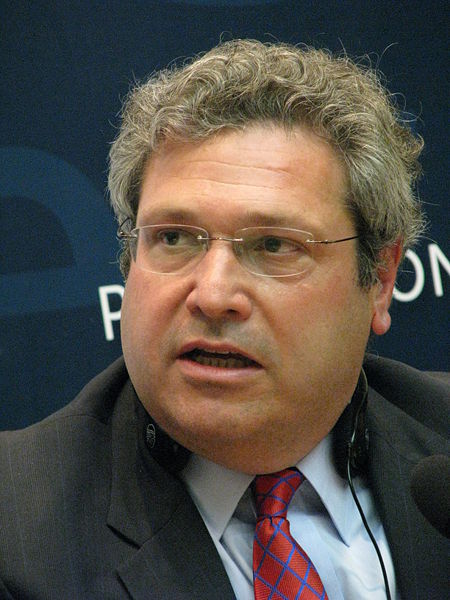

Prominent neocon intellectual Robert Kagan.  
(Photo: Mariusz Kubik, www.mariuszkubik.pl)


However, in modern times, foreign policy “realism” slid into an association with a cold calculation of power, no longer a defense of the Republic and broader national interests but of narrow, well-connected economic interests. The language of freedom was woven into a banner for greed and plunder. Liberty justified the imposition of dictatorships on troublesome populations. Instead of searching for monsters to destroy, U.S. policy often searched for monsters to install.

In the wake of such heartless actions – like imposing pliable “pro-business” dictatorships on countries such as Iran, Guatemala, Congo, Indonesia, Chile and engaging in the bloodbath of Vietnam – “realism” developed a deservedly negative reputation as other supposedly more idealistic foreign policy strategies gained preeminence.

Some of those approaches essentially turned John Quincy Adams’s admonition on its head by asserting that it is America’s duty to search out foreign monsters to destroy. Whether called “neoconservatism” or “liberal interventionism,” this approach openly advocated U.S. interference in the affairs of other nations and took the sides of people who at least presented themselves as “pro-democracy.”

In recent years, as the ranks of the “realists” – the likes of George Kennan, Henry Kissinger and Brent Scowcroft – have aged and thinned, the ranks of the neocons and their junior partners, the liberal interventionists, swelled. Indeed, these “anti-realists” have now grown dominant, touting themselves as morally superior because they don’t just call for human rights, they take out governments that don’t measure up.

The primary distinction between the neocons and the liberal interventionists has been the centrality of Israel in the neocons’ thinking while their liberal sidekicks put “humanitarianism” at the core of their world view. But these differences are insignificant, in practice, since the liberal hawks are politically savvy enough not to hold Israel accountable for its human rights crimes and clever enough to join with the neocons in easy-to-sell “regime change” strategies toward targeted countries with weak lobbies in Washington.

In those “regime change” cases, there is also a consensus on how to handle the targeted countries: start with “soft power” – from anti-regime propaganda to funding internal opposition groups to economic sanctions to political destabilization campaigns – and, then if operationally necessary and politically feasible, move to overt military interventions, applying America’s extraordinary military clout.

Moral Crusades


These interventions are always dressed up as moral crusades – the need to free some population from the clutches of a U.S.-defined “monster.” There usually is some “crisis” in which the “monster” is threatening “innocent life” and triggering a “responsibility to protect” with the catchy acronym, “R2P.”

But the reality about these “anti-realists” is that their actions, in real life, almost always inflict severe harm on the country being “rescued.” The crusade kills many people – innocent and guilty – and the resulting disorder can spread far and wide, like some contagion that cannot be contained. The neocons and the liberal interventionists have become, in effect, carriers of the deadly disease called chaos.

And, it has become a very lucrative chaos for the well-connected by advancing the “dark side” of U.S. foreign policy where lots of money can be made while government secrecy prevents public scrutiny.

As author James Risen describes in his new book, Pay Any Price, a new caste of “oligarchs” has emerged from the 9/11 “war on terror” — and the various regional wars that it has unpacked — to amass vast fortunes. He writes: “There is an entire class of wealthy company owners, corporate executives, and investors who have gotten rich by enabling the American government to turn to the dark side. … The new quiet oligarchs just keep making money. They are the beneficiaries of one of the largest transfers of wealth from public to private hands in American history.” [p. 56]

And the consolidation of this wealth has further cemented the political/media influence of the “anti-realists,” as the new “oligarchs” kick back portions of their taxpayer largesse into think tanks, political campaigns and media outlets. The neocons and their liberal interventionist pals now fully dominate the U.S. opinion centers, from the right-wing media to the editorial pages (and the foreign desks) of many establishment publications, including the Washington Post and the New York Times.

By contrast, the voices of the remaining “realists” and their current unlikely allies, the anti-war activists, are rarely heard in the mainstream U.S. media anymore. To the extent that these dissidents do get to criticize U.S. meddling abroad, they are dismissed as “apologists” for whatever “monster” is currently in line for the slaughter. And, to the extent they criticize Israel, they are smeared as “anti-Semitic” and thus banished from respectable society.

Thus, being a “realist” in today’s Official Washington requires hiding one’s true feelings, much as was once the case if you were a gay man and you had little choice but to keep your sexual orientation in the closet by behaving publicly like a heterosexual and surrounding yourself with straight friends.

In many ways, that’s what President Barack Obama has done. Though arguably a “closet realist,” Obama staffed his original administration with foreign policy officials acceptable to the neocons and the liberal interventionists, such as Robert Gates at Defense, Hillary Clinton at State, Gen. David Petraeus as a top commander in the field.

Even in his second term, the foreign-policy hawks have remained dominant, with people like neocon Assistant Secretary of State for European Affairs Victoria Nuland enflaming the crisis in Ukraine and UN Ambassador Samantha Power, an R2Per, pushing U.S. military intervention in Syria.

A Slow-Motion Catastrophe


I have personally watched today’s foreign-policy pattern evolve during my 37 years in Washington — and it began innocently enough. After the Vietnam War and the disclosures about bloody CIA coups around the globe, President Jimmy Carter called for human rights to be put at the center of U.S. foreign policy. His successor, Ronald Reagan, then hijacked the human rights rhetoric while adapting to it to his anticommunist cause.

Because Reagan’s usurpation of human rights language involved support for brutal right-wing forces, such as the Guatemalan military and the Nicaraguan Contra rebels, the process required an Orwellian change in what words meant. “Pro-democracy” had to become synonymous with the rights and profits of business owners, not its traditional meaning of making government work for the common people.

But this perversion of language was not as much meant to fool the average Guatemalan or Nicaraguan, who was more likely to grasp the reality behind the word games since he or she saw the cruel facts up close; it was mostly to control the American people who, in the lexicon of Reagan’s propagandists, needed to have their perceptions managed. [See Consortiumnews.com’s “The Victory of Perception Management.“]

The goal of the young neocons inside the Reagan administration – the likes of Elliott Abrams and Robert Kagan (now Victoria Nuland’s husband) – was to line up the American public behind Reagan’s aggressive foreign policy, or as the phrase of that time went, to “kick the Vietnam Syndrome,” meaning to end the popular post-Vietnam resistance to more foreign wars.

President George H.W. Bush pronounced this mission accomplished in 1991 after the end of the well-sold Persian Gulf War, declaring “we’ve kicked the Vietnam Syndrome once and for all.”

By then, the propaganda process had fallen into a predictable pattern. You pick out a target country; you demonize its leadership; you develop some “themes” that are sure to push American hot buttons, maybe fictional stories about “throwing babies out of incubators” or the terrifying prospect of “a mushroom cloud”; and it’s always smart to highlight a leader’s personal corruption, maybe his “designer glasses” or “a sauna in his palace.”

The point is not that the targeted leader may not be an unsavory character. Frankly, most political leaders are. Many Western leaders and their Third World allies – both historically and currently – have much more blood on their hands than some of the designated “monsters” that the U.S. government has detected around the world. The key is the image-making.

What makes the process work is the application and amplification of double standards through the propaganda organs available to the U.S. government. The compliant mainstream American media can be counted on to look harshly at the behavior of some U.S. “enemy” in Venezuela, Iran, Russia or eastern Ukraine, but to take a much more kindly view of a U.S.-favored leader from Colombia, Saudi Arabia, Georgia or western Ukraine.

While it’s easy – and safe career-wise – for a mainstream journalist to accuse a Chavez, an Ahmadinejad, a Putin or a Yanukovych of pretty much anything, the levels of proof get ratcheted up when it’s a Uribe, a Saudi King Abdullah, a Saakashvili or a Yatsenyuk – not to mention a Netanyahu.

The True Dark Side


But here is the dark truth about this “humanitarian” interventionism: it is spinning the world into an endless cycle of violence. Rather than improving the prospects for human rights and democracy, it is destroying those goals. While the interventionist strategies have made huge fortunes for well-connected government contractors and well-placed speculators who profit off chaos, the neocons and their “human rights” buddies are creating a hell on earth for billions of others, spreading death and destitution.

Take, for example, the beginnings of the Afghan War in the 1980s – after the Soviet Union invaded to protect a communist-led regime that had sought to pull Afghanistan out of the middle ages, including granting equal rights to women. The United States responded by encouraging Islamic fundamentalism and arming the barbaric mujahedeen.

At the time, that was considered the smart play because Islamic fundamentalism was seen as a force that could counter atheistic communism. So, starting with the Carter administration but getting dramatically ramped up by the Reagan administration, the United States threw in its lot with the extremist Wahhabis of Saudi Arabia to invest billions of dollars in supporting these Islamist militants who included one wealthy Saudi named Osama bin Laden.

At the time, with Great Communicator Ronald Reagan leading the way, virtually the entire U.S. mainstream media and nearly every national politician hailed the mujahedeen as noble “freedom fighters” but the reality was always much different. [See, for instance, Consortiumnews.com’s “How US Hubris Baited Afghan Trap.”]

By the end of the 1980s, the U.S.-Saudi “covert operation” had “succeeded” in driving the Soviet army out of Afghanistan with Kabul’s communist regime ultimately overthrown and replaced by the fundamentalist Taliban, who stripped women of their rights. The Taliban also provided safe haven for bin Laden and his al-Qaeda terrorist band, which – by the 1990s – had shifted its sights from Moscow to Washington and New York.

Even though the Saudis officially broke with bin Laden after he declared his intentions to attack the United States, some wealthy Saudis and other Persian Gulf billionaires, who shared bin Laden’s violent form of Islamic fundamentalism, continued to fund him and his terrorists right up to – and beyond – al-Qaeda’s attacks on 9/11.

Then, America’s fear and fury over 9/11 opened the path for the neocons to activate one of their longstanding plans, to invade and occupy Iraq, though it had nothing to do with 9/11. The propaganda machinery was cranked up and again all the “smart” people fell in line. Dissenters were dismissed as “Saddam apologists” or called “traitors.” [See Consortiumnews.com’s “The Mysterious Why of the Iraq War.“]

By fall 2002, the idea of invading Iraq – and removing “monster” Saddam Hussein – was not just a neocon goal, it was embraced by nearly ever prominent “liberal interventionist” in the United States, including editors and columnists of the New Yorker, the New York Times and virtually every major news outlet.

At this point, the “realists” were in near total eclipse, left to grumble futilely or grasp onto some remaining “relevance” by joining the pack, as Henry Kissinger did. The illegal U.S.-led invasion of Iraq also brushed aside the “legal internationalists” who believed that global agreements, especially prohibitions on aggressive war, were vital to building a less violent planet.

An Expanding Bloodbath


In the rush to war in Iraq, the neocons and the liberal interventionists won hands down in 2002-2003 but ended up causing a bloodbath for the people of Iraq, with estimates of those killed ranging from hundreds of thousands to more than a million. But the U.S. invaders did more than that. They destabilized the entire Middle East by disturbing the fragile fault lines between Sunni and Shiite.

With Sunni dictator Saddam Hussein ousted and hanged, Iraq’s vengeful Shiite politicians established their own authoritarian state under the military wing of the U.S. and British armies. Neocon hubris made matters worse when many former Sunni officials and officers were cashiered and marginalized, creating fertile ground for al-Qaeda to put down roots among Iraqi Sunnis, planting a particularly brutal strain nourished by Jordanian terrorist Abu Musab al-Zarqawi.

Zarqawi’s Al-Qaeda in Iraq attracted thousands of foreign Sunni jihadists eager to fight both the Westerners and the Shiites. Others went to Yemen to join Al-Qaeda in the Arabian Peninsula. Trained in the brutal methods of these Iraqi and Yemeni insurgencies, hardened jihadists returned to their homes in Libya, Syria, Europe and elsewhere.

Though the disaster in Iraq should have been a powerful cautionary tale, the neocons and the liberal interventionists proved to be much more adept at playing the political-propaganda games of Washington than in prevailing in the complex societies of the Middle East.

Instead of being purge en masse, the Iraq War instigators faced minimal career accountability. They managed to spin the Iraq “surge” as “victory at last” and maintained their influence over Washington even under President Obama, who may have been a “closet realist” but who kept neocons in key posts and surrounded himself with liberal interventionists. [See Consortiumnews.com’s “The Surge Myth’s Deadly Result.”]

Thus, Obama grudgingly was enlisted into the next neocon-liberal-interventionist crusades in 2011: the military intervention to overthrow Libya’s Muammar Gaddafi and the covert operation to remove Syria’s Bashar al-Assad. In both cases, the propaganda was ramped up again, presenting the opposition groups as “pro-democracy moderates” who were peacefully facing down brutal dictators.

In reality, the oppositions were more a mixed bag of some actual moderates and Islamist extremists. When Gaddafi and Assad – emphasizing the presence of terrorists – struck back brutally, the “R2P” crowd demanded U.S. military intervention, either directly in Libya or indirectly in Syria. With the U.S. mainstream media onboard, nearly every occurrence was put through the propaganda filter that made the regimes all dark and the oppositions bathed in a rosy glow.

After the U.S.-led air war destroyed Gaddafi’s military and opened the way for an opposition victory, Gaddafi was captured and brutally murdered. Secretary of State Hillary Clinton, who might be called a “neocon-lite,” joked: “We came, we saw, he died.”

But the chaos that followed Gaddafi’s death was not so funny, contributing to the killing of U.S. Ambassador Christopher Stevens and three other American diplomatic personnel in Benghazi on Sept. 11, 2012, and to the spreading of terrorism and violence across northern Africa. By July 2014, the U.S. and other Western nations had abandoned their embassies in Tripoli as all political order broke down.

Syrian Madness


In Syria, which had long been near the top of the neocon/Israeli hit list for “regime change,” U.S., Western and Sunni support for another “moderate opposition” led to a civil war. Soon, what “moderates” there were blended into the ranks of Islamic extremists, either the Nusra Front, the al-Qaeda affiliate, or the Islamic State of Iraq and Syria or simply the Islamic State, which evolved from Zarqawi’s Al-Qaeda in Iraq, continuing Zarqawi’s hyper-brutality even after his death.

Though the mainstream U.S. media blamed almost everything on Syrian President Assad, many Syrians recognized that the Sunni extremists who emerged as the power behind the opposition were a grave threat to other Syrian religious groups, including the Shiites, Alawites and Christians — and that Assad’s authoritarian but secular regime represented their best hope for survival. [See Consortiumnews.com’s “Syrian Rebels Embrace al-Qaeda.“]

But instead of looking for a realistic political solution, the neocons and the liberal interventionists insisted on a U.S. military intervention, either covertly by arming the opposition or overtly by mounting a Libyan-style bombing campaign to destroy Assad’s armed forces and open the gates of Damascus to the rebels. Under pressure from the likes of Ambassador Power and Secretary of State Clinton, Obama bowed to the demand to ship weapons to the rebels, although the CIA later discovered that many U.S. weapons ended up in extremist hands.

Still, with Obama dragging his feet on a larger-scale commitment, the neocon/liberal-interventionist coalition saw a great chance to push Obama into a bombing campaign after a Sarin gas attack outside Damascus on Aug. 21, 2013. The war hawks and the U.S. media immediately blamed Assad despite doubts among some U.S. intelligence analysts who suspected a provocation by the rebels.

Those doubts and Obama’s fear of an extremist victory led him to call off the planned bombing at the last minute, and he accepted a deal brokered by Russian President Vladimir Putin to arrange for Assad to surrender all Syria’s chemical weapons, while Assad continued to deny any role in the Sarin attack. The neocons and liberal interventionists were furious at both Obama and Putin.

Alarmed about this “realist” Obama-Putin collaboration, the “anti-realists” turned to demonizing the Russian president and driving a wedge between him and Obama. The place to splinter that relationship turned out to be Ukraine, where neocon Assistant Secretary of State Nuland was perfectly positioned to push for the ouster of elected pro-Russian President Viktor Yanukovych.

As Nuland noted in one speech, the U.S. government had invested $5 billion in the “European aspirations” of the western Ukrainians, including funding for political activists, journalists and various business groups. The time to collect on that investment came in February 2014 when violent demonstrations in Kiev, with well-organized neo-Nazi militias supplying the muscle, drove Yanukovych from power. [See Consortiumnews.com’s “Neocons’ Ukraine-Syria-Iran Gambit.“]

The Ukraine coup played out along another historic fault line, between European-oriented western Ukraine, where Adolf Hitler’s SS had gained significant support during World War II, and eastern Ukraine with its ethnic Russian population and close business ties to Russia.

After the U.S. State Department rushed to embrace the coup regime as “legitimate” and as the U.S. media dished out anti-Yanukvych propaganda, such as citing a sauna in his home , Obama tagged along, falling into the neocon trap, again. U.S.-Russian relations spiraled into a hostility not seen since the Cold War. [See Consortiumnews.com’s “Obama’s True Foreign Policy Weakness.”]

Shattering Ukraine


Yet, while the neocons and their liberal allies had “won” again, what did that winning mean for the people of Ukraine? Their country, already teetering on the status of failed state, slid into deeper economic chaos and civil war. With neo-Nazis and other extremists appointed to key national security positions, the new regime began lashing out at ethnic Russians who were resisting Yanukovych’s ouster.

Crimea voted overwhelmingly to secede from Ukraine and rejoin Russia, a move that Western government’s denounced as an illegal “annexation” and the major U.S. media termed an “invasion,” although the Russian troops involved were already stationed in Crimea under an agreement to maintain the Russian naval base at Sevastopol.

Ukraine’s eastern provinces also sought secession, prompting military clashes that inflicted some of the worst bloodshed seen on the European continent in decades. Thousands died and millions fled.

Of course, the standard line in the U.S. media was that it was all Putin’s fault, even as the Kiev regime shelled eastern cities and unleashed brutal neo-Nazi militias to engage in street fighting, the first time storm troopers emblazoned with Nazi insignias had been deployed in Europe since World War II. Yet, buoyed by how easily the anti-Putin propaganda had prevailed, some neocons even began fantasizing about “regime change” in Moscow.

Yet, if you were to step back for a minute and look at the history of the past 35 years – from the Afghan covert op through the Iraq War and the U.S. interventions in Libya, Syria, Ukraine and elsewhere – what you would see is the neocons and their liberal sidekicks behaving like the Sorcerer’s Apprentice, stirring up troubles that soon spun out of control.

Just look at the chaos that has been unleashed by these reckless neocon and liberal interventionist policies – from encouraging the rise of Islamic fundamentalism and facilitating the formation of al-Qaeda via the covert war in Afghanistan, from creating a hotbed for attracting and training jihadists during the Iraq War, from undermining regimes in Libya and Syria that – for all their faults – were trying to contain this spread of terrorism, and from provoking a new Cold War in Ukraine that risks bringing nuclear weapons into play in a showdown with Russia.

The latest outgrowth of all this trouble was the terror attack in Paris this month, with some European hotheads now calling for another neocon favorite idea, “a war of civilizations,” pitting Christian societies against Islam in some modern version of the actual Crusades.

Yes, I know we’re not supposed to talk about root causes of this chaos “at a time like this,” and we are surely not supposed to blame the neocons and their liberal interventionist chums. Instead, we’re supposed to escalate the conflicts and the chaos.

We’re supposed to continue the neocon “tough-guy-ism” — by repressing Muslims in the West, by ousting Assad in Syria, by crushing the ethnic Russian resistance in Ukraine, by destabilizing Russia, and by forsaking negotiations with Iran over its nuclear facilities in favor of more sanctions and maybe more bombing. All somehow in the name of “democracy” and “human rights” and “security.”

As we gaze out upon this mad house built by the neocons, we are witnessing on a grand scale the old adage about the inmates running the asylum, except that this asylum possesses the world’s most sophisticated weapons including a massive nuclear arsenal.

What the neocons have constructed through their skilled propaganda is a grim wonderland where no one foresees the dangers of encouraging Islamist fundamentalism as a geopolitical ploy, where no one takes heed of the historic hatreds of Sunni and Shiite, where no one suspects that the U.S. military slaughtering thousands upon thousands of Muslims might provoke a backlash, where no one thinks about the consequences of overthrowing regimes in unstable regions, where no one bothers to study the bitter history of a place like Ukraine, and where no one worries about spreading turmoil to nuclear-armed Russia.

Yet, this neocon madness – this “anti-realism” – has been playing out in the real world on a grand scale, destroying real lives and endangering the real future of the planet.

Investigative reporter Robert Parry broke many of the Iran-Contra stories for The Associated Press and Newsweek in the 1980s. You can buy his latest book, America’s Stolen Narrative, either in print here or as an e-book (from Amazon and barnesandnoble.com). You also can order Robert Parry’s trilogy on the Bush Family and its connections to various right-wing operatives for only $34. The trilogy includes America’s Stolen Narrative. For details on this offer, click here.

Corporate Slavery in America

Prison State America: Inmates Becoming Corporate Slaves In For-profit Facilities

by RT

Inmates work eight hours per day for major corporations such as Chevron, Motorola, Nordstrom’s and Target, yet only have the possibility of making up $1.25 an hour.

In addition, companies that provide services like phone calls overcharge prisoners on even the most basic services, making hundreds of millions in profits annually.


For-profit prisons have created a “neo-slavery” in the US, according to award-winning journalist Chris Hedges.

Friday, January 16, 2015

Credit Suisse: Crime Is Business; Big Business

Credit Suisse: Big Crimes Become Big Business

by Ralph Nader - Dissident Voice

In May of 2014, financial firm Credit Suisse AG pled guilty to serious criminal charges. The giant bank aided and assisted approximately 22,000 wealthy U.S. taxpayers (whose names Credit Suisse AG escaped having to send to the Justice Department for law enforcement) for over a decade in filing false income tax returns and other documents with the Internal Revenue Service (IRS).

The full extent of these crimes, according to a Department of Justice news release, are as follows:

“assisting clients in using sham entities to hide undeclared accounts;” “soliciting IRS forms that falsely stated, under penalties of perjury, that the sham entities were the beneficial owners of the assets in the accounts;” “failing to maintain in the United States records related to the accounts;” “destroying account records sent to the United States for client review;” “using Credit Suisse managers and employees as unregistered investment advisors on undeclared accounts;” “facilitating withdrawals of funds from the undeclared accounts by either providing hand-delivered cash in the United States or using Credit Suisse’s correspondent bank accounts in the United States;” “structuring transfers of funds to evade currency transaction reporting requirements;” and “providing offshore credit and debit cards to repatriate funds in the undeclared accounts.”

These elaborate illegal acts over many years are quite revealing. They show a deliberate willingness by Credit Suisse AG officials to knowingly engage in profitable activities that defrauded the United States Treasury and burdened honest taxpayers. Credit Suisse paid a $2.6 billion fine—small compared to the size of the crimes and the company’s large revenues. These crimes were yet another sordid chapter in the ever-burgeoning tax-evading business that makes its waves with wealthy Americans and massive corporate entities. But the Credit Suisse story does not end there.

The Employee Retirement Income Security Act of 1974, or ERISA, was enacted to protect the retirement savings of retirement plan participants. The law, in theory, automatically disqualifies institutions like Credit Suisse AG who have committed serious crimes or pled guilty to serious crimes from serving as a “qualified professional asset manager” (QPAM) of ERISA assets or pension plans.

Unfortunately, the Department of Labor has not adequately enforced this law or its regulations in this area. Since waivers started being granted in 1997, 23 culpable firms have been granted exemptions from this disqualification rule and been allowed to continue their business of advising pension and other investment funds. Six of these waivers were granted to QPAMs that, like Credit Suisse AG, violated serious laws either in the United States or abroad. Remarkably, no waivers formally demanded by their corporate law firms have been rejected.

The Department of Labor (DOL) already has granted Credit Suisse a temporary waiver to continue conducting their pension management business. On January 15th, the DOL held a public hearing—where I testified— to discuss whether Credit Suisse and its affiliates can continue this troubling trend of avoiding the consequences of their actions indefinitely. Credit Suisse AG is hoping to completely sidestep the mechanisms of justice for their admittedly serious crimes and carry on business as usual—a result that in itself is, unfortunately, business as usual. Is it not astounding to think a company, which knowingly engaged in such illegal activities, would not be deterred from engaging in activities that could be harmful to retirees as well?

Public Citizen’s Bartlett Naylor wrote in a public comment to the Department of Labor:

Firms that engage in criminal activity should face real consequences. Where those consequences are excused, the firm is invited to become a repeat offender; and the deterrence effect for other firms is nullified. Pension fund beneficiaries are especially vulnerable to Wall Street abuse because their savings may be managed by firms they do not even choose, let alone control. As overseer of the nation’s ERISA-governed funds, the Department of Labor bears the heavy responsibility of policing the integrity of the pension fund management industry. The DOL must apply all its tools to achieve this lofty goal. They should be used, not routinely discarded.

This routine ability to evade proper punishment is the root of the issue of so much corporate and Wall Street crime—a slap on the wrist leads to a perpetual cycle of wrongdoing with no end in sight. Their corporate lawyers turn laws into “no-law” laws. Corporate crime pays.

James Henry, former chief economist at McKinsey & Co. and current chair of the Global Alliance for Tax Justice, estimates that the United States loses between $170 billion to $200 billion a year in tax revenue through offshore tax havens. He told the Corporate Crime Reporter in 2013:


The idea that you would actually permit big ticket tax dodgers to walk off of the stage with a slap on the wrist — like the proposed [Credit] Swiss settlement — or that you would let companies like Apple and Microsoft, General Electric and Google — shift their most valuable corporate assets to places where they have almost no activity and evade corporate income taxes at a time when we are slashing aid to kids in schools, money for seniors — this is outrageous.

The Department of Labor, which exists to defend workers, now has a unique opportunity to stand proudly at its post and to send a clear message—a firm signal—to other Qualified Professional Asset Managers that if they commit unthinkable criminal violations, they lose the ability to handle pension funds. On the other hand, allowing these institutions to continue to receive permanent waivers would be a clear signal that the DOL will tolerate cutting corners and criminal wrongdoing by powerful financial institutions at the expense of workers, complying taxpayers, democracy, and the rule of law.

Now is the time for advocates and citizens alike to speak out strongly against this manner of blatantly averting justice and fostering a culture of continual corporate criminality. Contact the Office of Exemption Determinations at the Department of Labor and let them know.

Ralph Nader is a leading consumer advocate, the author of Unstoppable: The Emerging Left-Right Alliance to Dismantle the Corporate State (2014), among many other books, and a four-time candidate for US President. Read other articles by Ralph, or visit Ralph's website.

If You Knew Charlie...

Dying 'Good Career Move' for French Hate-Mag

by Finian Cunningham - PressTV

The French so-called satirical magazine Charlie Hebdo – more accurately a hate-inciting, racist rag - has published its first post-massacre edition this week, with print sales going through the roof.

Which just goes to prove the hoary old showbiz observation that “dying can be a good career move.” That dictum describes how washed-up artists and other celebrities are often rescued from obscurity following their death, with sales of old records or biographies benefiting from a surge in renewed public interest.

The same would appear to be true for the previously obscure French political weekly magazine where 12 people, including senior editorial staff, were shot dead last week allegedly by gunmen claiming to be affiliated with the Al Qaeda/Takfiri terrorist network.

(The network instigated and spawned by Western military intelligence for all sorts of covert operations, including regime change in Arab and Muslim countries.)

The remaining staff at the Paris-based publication have this week produced an edition despite the trauma of the past seven days. But instead of the usual 60,000 copies, the publication has hit a record print run of 3 million. Some Paris news agents were reportedly sold out within minutes of opening.

Online editions have also been translated into several languages in addition to the normal French version. And the magazine has reportedly been inundated with new subscriptions and donations from around the world amounting to over $1 million.

Moreover, French newspapers and other international media have reprinted the front page of the magazine, although many major outlets, including American news channels CNN and ABC, as well as the New York Times, declined to print it (more on that in a moment).

So, from a financially struggling magazine that catered for a minority of readers, many of whom were reactionary bigots, Charlie Hebdo has become an international sensation. On the back of its slain cartoonists, the publication can look forward to lucrative sales and a global readership.

A good career move indeed. And presumably that cynical conclusion won’t be objected to by our Western satirists given their supposed commitment to freedom of expression.

The stellar outcome for the French hate-rag is unfortunate. That’s because this magazine is not the paragon of free speech and intelligent political satire that has been made out by Western governments and the mainstream media since the killings last week by two gunmen, who by the way were well known to French state security services for their terror links.

Charlie Hebdo is more accurately described as a publication that excels in inciting hatred and dehumanizing stereotypes of Muslims in particular. Apologists for the rag, claim that it is an “equal opportunity” exponent of satire, ridiculing all political and religious organisations. That is not true. A review of its past contents show that the publication is not the fearless champion of free speech that all the weeping millions of “Nous Sommes Charlie” supporters would have us and themselves believe. It has never, for example, given deserved criticism of Western-sponsored Zionist terrorism towards Palestinian civilians, human rights defenders, medical aid workers and journalists.

The magazine has abused the principle of free speech as a cynical cover to promote hate speech and in particular to foment prejudice against the Muslim population of France and Europe more generally.

Muslims have become the most vulnerable community in Europe and around the world for persecution by Western state and non-state bigots. Over the past week, Muslim communities and places of worship have been attacked by mobs in Germany and France amid the climate of hatred that the likes of Charlie Hebdo and its state benefactors have been responsible for.

The French government might claim this week that it is “at war with terrorism, not Islam.” But that is disgraceful cop-out of responsibility by the French authorities. All Western governments are responsible for fuelling a nefarious climate of Islamophobia and negative stereotyping of “Muslims as terrorists” over the past several years. It is absurd for these governments to try now to disclaim responsibility while they continue to bomb Muslim countries in a fictitious “war on terror” against extremist groups that Western states have created in the first place to advance their imperialist agendas. Added to this are Western state police powers directed towards the Muslim community and legions of unlawful imprisonments and other miscarriages of justice.

The French government has not merely allowed the hate-inciting Charlie Hebdo to spew its anti-Muslim bigotry every week. By doing so gives the publication’s nauseating contents a tacit seal of official state approval. A privilege that is not extended to viewpoints that criticise Zionism, even though the latter is deserved and legitimate under principles of free speech.

Astoundingly, over the past week, the Charlie Hebdo hate-rag has been transformed by the French authorities into some of kind of heroic standard bearer and model of Western democratic enlightenment. The names of its deceased cartoonists have been cited with honours and cherished like saintly figures. French national narcissism has gone into self-serving overdrive, and we are all supposed to murmur with touching respect.

The French and international public are being manipulated as never before to rally behind dangerous reactionary anti-Muslim prejudices - and all this is presented as a virtue so beautiful that tears are to be shed!

The latest edition of the hate-filled French magazine features on its front page yet another cartoon of the Prophet Mohammed (PBUH). As noted above, several Western mainstream media outlets have refused to re-print the cover, meekly saying that it may be “construed as provocative.” Provocative is an understatement.

This rag has poisoned societies with its bigotry that has culminated in fuelling violence - violence that is felt mainly by Muslims. And yet shamelessly it peddles another gratuitous insult against Muslims and claiming it as a self-vindication.

As ever, the Muslim world is responding with restraint and dignity to the latest vile conduct by Western so-called free-speech secularism.

All humanists must find ways of defeating Western state-sponsored hostility and violence by peaceful means. Further violence and death is only a boon for the bigots and the authors of conflict. For them, death, violence and terrorism are always a “good career move.”


Finian Cunningham (born 1963) has written extensively on international affairs, with articles published in several languages. He is a Master’s graduate in Agricultural Chemistry and worked as a scientific editor for the Royal Society of Chemistry, Cambridge, England, before pursuing a career in newspaper journalism. He is also a musician and songwriter.

For nearly 20 years, he worked as an editor and writer in major news media organisations, including The Mirror, Irish Times and Independent. Originally from Belfast, Ireland, he is now located in East Africa working as a freelance columnist for Press TV and Strategic Culture Foundation (Moscow).

Thursday, January 15, 2015

Jury for the Prosecution: CIA Whistleblower Stirling in Tough in Court

CIA-Friendly Jury Seen in Sterling Trial

by Norman Solomon - Consortium News

When the trial of former CIA officer Jeffrey Sterling got underway Tuesday in Northern Virginia, prospective jurors made routine references to “three-letter agencies” and alphabet-soup categories of security clearances.

In an area where vast partnerships between intelligence agencies and private contractors saturate everyday life, the jury pool was bound to please the prosecution.

Former CIA officer Jeffrey Sterling

In a U.S. District Court that boasts a “rocket docket,” the selection of 14 jurors was swift, with the process lasting under three hours. Along the way, Judge Leonie M. Brinkema asked more than a dozen possible jurors whether their personal connections to the CIA or other intel agencies would interfere with her announced quest for an “absolutely open mind.”

From what I could tell, none of those with direct connections to intelligence agencies ended up in the jury box. But affinities with agencies like the CIA seemed implicit in the courtroom. Throughout the jury selection, there was scarcely a hint that activities of those agencies might merit disapproval.

Just how familiar was the jury pool with critiques of the CIA? Hard to say, but here’s one indicator: When Brinkema asked for a show of hands among the prospective jurors — nearly 100 in the room — to indicate how many had read James Risen’s bestselling book State of War: The Secret History of the CIA and the Bush Administration, a grand total of zero hands went up.

That book, with its tough investigative reporting that exposed malfeasance, incompetence, cruelty and mendacity in the CIA’s leadership, is at the core of the case against Sterling. He’s charged with giving the author classified information — about the CIA’s Operation Merlin, a dangerous maneuver that provided flawed nuclear weapon blueprints to the Iranian government in 2000.

Sterling was one of the few African American case officers to work for the CIA. He is now faced with a jury of his ostensible peers that includes no African Americans. (Twelve of the jurors are white. Two others appear to be of Asian and Middle Eastern ancestry.)

From the outset, in January 2011, when the Department of Justice announced an indictment against Sterling with ten counts — seven under the Espionage Act — the official attack on his character was classic defamation of a whistleblower. The government denounced Sterling for “underlying selfish and vindictive motivations,” and unsuccessfully tried to persuade a judge that he should be jailed pending trial because it was “incomprehensible to believe that [Sterling] will not retaliate in the same deliberate, methodical, vindictive manner.”

Fast forward four years, to Tuesday afternoon, when prosecuting attorney James Trump told the jury in the government’s opening statement that Sterling had committed crimes of betrayal due to his “anger, bitterness, selfishness.”

The Obama Justice Department’s theory of the case is that Sterling became vengeful against the agency when he failed to win a legal complaint against it for racial discrimination.

A lot of smoke will be blowing through the U.S. District Court in Alexandria during the next few weeks. The Obama administration remains in overdrive, tanked up to send Jeffrey Sterling to prison for a long time. The CIA hierarchy, now operating with enormous impunity, is clearly eager to see him punished in a big way.

The CIA’s allies in the Justice Department are insisting in the courtroom that Sterling could not possibly have had valid concerns when he blew the whistle on Operation Merlin by going to the Senate Intelligence Committee about it in 2003. Along the way, the government is eager to throw mud at Risen’s reporting, which concluded that Merlin “may have been one of the most reckless operations in the modern history of the CIA.”

Norman Solomon is the executive director of the Institute for Public Accuracy and the author of War Made Easy: How Presidents and Pundits Keep Spinning Us to Death. He is a co-founder of RootsAction.org.
This article was originally published at ExposeFacts.org.

Wednesday, January 14, 2015

Fighting Whose Battles, Soldier? Why the War on Terror Isn't Your War

Letter to a Young Army Ranger (From an Old One) - Why the War on Terror Shouldn’t Be Your Battle

Dear Aspiring Ranger, You’ve probably just graduated from high school and you’ve undoubtedly already signed an Option 40 contract guaranteeing you a shot at the Ranger indoctrination program (R.I.P.). If you make it through R.I.P. you’ll surely be sent off to fight in the Global War on Terror. You’ll be part of what I often heard called “the tip of the spear.”

The war you’re heading into has been going on for a remarkably long time. Imagine this: you were five years old when I was first deployed to Afghanistan in 2002. Now I’m graying a bit, losing a little up top, and I have a family. Believe me, it goes faster than you expect.

Once you get to a certain age, you can’t help thinking about the decisions you made (or that, in a sense, were made for you) when you were younger. I do that and someday you will, too. 
Tomgram: Rory Fanning, Unpacking the War on Terror

[Note for TomDispatch Readers: Today’s post features Rory Fanning, author of Worth Fighting For: An Army Ranger’s Journey Out of the Military and Across America, and is introduced by Nick Turse, whose book Kill Anything That Moves: The Real American War in Vietnam was a New York Times bestseller. For a contribution of $100 (or more), you can still get a personalized, signed copy of either book at our donation page. Check it out. Tom]

About a year ago, I hit the road for a couple of months. I went to Albany and Albuquerque, Berkeley and Boston, Chapel Hill and Chicago, Seattle and Schenectady. I wasn’t reporting. I wasn’t writing. I sure wasn’t vacationing. No, I was out on a book tour in support of the paperback edition of my book Kill Anything That Moves: The Real American War in Vietnam. I went to colleges and universities, bookstores and radio stations, churches, a writer’s institute, and even a senior center. I spoke in classrooms and hotel conference centers, auditoriums and theaters, before students and retirees, to veterans and life-long civilians.

After offering a brief overview of my decade-plus journey into the subject of American war crimes in Vietnam, I would open the floor to questions, and that generally lasted as long as the powers that be allowed. Once, it went on for almost two hours. People would ask about my discovery of long-secret U.S. investigations into atrocities in Vietnam, or what it was like tracking down survivors there, or what Vietnamese thought of Americans all these years later, or how American boys could do such horrendous things. I’d often answer that last one by talking about command policies -- free-fire zones, lax rules of engagement, the body count -- that made it inevitable that large numbers of innocent Vietnamese would be killed.

But that’s not what people really wanted to know. They wanted to know what I learned looking into the eyes of mass murderers, what insights I gleaned by talking to torturers. They wanted to know what makes a man kill a defenseless woman he’s never laid eyes on before. Or gun down a child. Or mow down the elderly in a hail of gunfire. How could seemingly ordinary American men commit such extraordinarily horrific acts?

There is, in fact, no easy answer to any of those questions. The best I could do was offer a few insights about an environment that made such acts possible. Sometimes, I mentioned the racism that suffused the military from a soldier’s first days of basic training through his 12 months in Vietnam. Sometimes, I might have talked about the bloodthirsty ethos -- the chants of “kill, kill, kill” -- in which they were immersed during boot camp. In the end, I would often offer a caveat: that those troops were often little more than boys, that they were naïve and politically unsophisticated, that they were thrown into a dangerous environment in which they expected bullets to start flying at any moment, that they were sent out to act as bait for enemy forces. Then someone would almost invariably ask: Haven’t things changed since the Vietnam era? It’s not the same for today’s troops, right? And I’d stand there and try to figure out how, exactly, to answer that one.

All of this came back to me as I read the latest piece by TomDispatch regular Rory Fanning, author of Worth Fighting For: An Army Ranger’s Journey Out of the Military and Across America. It's a letter from a Ranger of the first post-9/11 war to a Ranger from the next one, a deeply personal note in which he mentions the racism that suffused his training, the bloodthirsty ethos in which he was immersed, his youth and naïveté. You get the picture.

Today’s prospective Ranger, Fanning notes, was heading to kindergarten when he marched out on his first patrol in Afghanistan. Think about that for a minute. And then consider that, despite drawdowns and pledges to end wars, despite rhetoric about today’s U.S. military being the greatest fighting force in history, despite trillions of dollars, endless high-tech tools, and fighting some of the feeblest, least popular, under-armed, rag-tag militants imaginable, the results have been dismal. There appears to be no end in sight for an Afghan War raging since the 1970s, interventions in Libya that started in the 1980s, Iraq wars flaring up since the 1990s, a simmering conflict in Somalia that began that same decade, a quasi-war in Yemen kicked off in 2002 and in Pakistan shortly thereafter, and a more recent military effort in Syria. Invasions and interventions and drone campaigns and black ops missions sold as ridding the planet of terrorists, of ushering in freedom and democracy, of transforming the world for the better, have consistently done the opposite. It’s all-important information to pass on to a generation of teens, especially the would-be Rangers among them, who have never known an America that wasn’t engaged in endless war. Nick Turse  

Letter to a Young Army Ranger (From an Old One) - Why the War on Terror Shouldn’t Be Your Battle

by Rory Fanning

Reflecting on my own years in the 75th Ranger regiment, at a moment when the war you’ll find yourself immersed in was just beginning, I’ve tried to jot down a few of the things they don’t tell you at the recruiting office or in the pro-military Hollywood movies that may have influenced your decision to join. Maybe my experience will give you a perspective you haven’t considered.

I imagine you’re entering the military for the same reason just about everyone volunteers: it felt like your only option. Maybe it was money, or a judge, or a need for a rite of passage, or the end of athletic stardom. Maybe you still believe that the U.S. is fighting for freedom and democracy around the world and in existential danger from “the terrorists.” Maybe it seems like the only reasonable thing to do: defend our country against terrorism.

The media has been a powerful propaganda tool when it comes to promoting that image, despite the fact that, as a civilian, you were more likely to be killed by a toddler than a terrorist. I trust you don’t want regrets when you’re older and that you commendably want to do something meaningful with your life. I’m sure you hope to be the best at something. That’s why you signed up to be a Ranger.

Make no mistake: whatever the news may say about the changing cast of characters the U.S. is fighting and the changing motivations behind the changing names of our military “operations” around the world, you and I will have fought in the same war. It’s hard to believe that you will be taking us into the 14th year of the Global War on Terror (whatever they may be calling it now). I wonder which one of the 668 U.S. military bases worldwide you’ll be sent to.

In its basics, our global war is less complicated to understand than you might think, despite the difficult-to-keep-track-of enemies you will be sent after -- whether al-Qaeda (“central,” al-Qaeda in the Arabian Peninsula, in the Magreb, etc.), or the Taliban, or al-Shabab in Somalia, or ISIS (aka ISIL, or the Islamic State), or Iran, or the al-Nusra Front, or Bashar al-Assad’s regime in Syria. Admittedly, it’s a little hard to keep a reasonable scorecard. Are the Shia or the Sunnis our allies? Is it Islam we’re at war with? Are we against ISIS or the Assad regime or both of them?

Just who these groups are matters, but there’s an underlying point that it’s been too easy to overlook in recent years: ever since this country’s first Afghan War in the 1980s (that spurred the formation of the original al-Qaeda), our foreign and military policies have played a crucial role in creating those you will be sent to fight. Once you are in one of the three battalions of the 75th Ranger Regiment, the chain-of-command will do its best to reduce global politics and the long-term good of the planet to the smallest of matters and replace them with the largest of tasks: boot polishing, perfectly made beds, tight shot groupings at the firing range, and your bonds with the Rangers to your right and left.

In such circumstances, it’s difficult -- I know that well -- but not impossible to keep in mind that your actions in the military involve far more than whatever’s in front of you or in your gun sights at any given moment. Our military operations around the world -- and soon that will mean you -- have produced all kinds of blowback. Thought about a certain way, I was being sent out in 2002 to respond to the blowback created by the first Afghan War and you’re about to be sent out to deal with the blowback created by my version of the second one.

I’m writing this letter in the hope that offering you a little of my own story might help frame the bigger picture for you.

Let me start with my first day “on the job.” I remember dropping my canvas duffle bag at the foot of my bunk in Charlie Company, and almost immediately being called into my platoon sergeant's office. I sprinted down a well-buffed hallway, shadowed by the platoon’s “mascot”: a Grim-Reaper-style figure with the battalion’s red and black scroll beneath it. It hovered like something you’d see in a haunted house on the cinder block wall adjoining the sergeant’s office. It seemed to be watching me as I snapped to attention in his doorway, beads of sweat on my forehead. “At ease... Why are you here, Fanning? Why do you think you should be a Ranger?” All this he said with an air of suspicion.

Shaken, after being screamed out of a bus with all my gear, across an expansive lawn in front of the company’s barracks, and up three flights of stairs to my new home, I responded hesitantly, “Umm, I want to help prevent another 9/11, First Sergeant.” It must have sounded almost like a question.

“There is only one answer to what I just asked you, son. That is: you want to feel the warm red blood of your enemy run down your knife blade.”

Taking in his military awards, the multiple tall stacks of manila folders on his desk, and the photos of what turned out to be his platoon in Afghanistan, I said in a loud voice that rang remarkably hollowly, at least to me, “Roger, First Sergeant!”

He dropped his head and started filling out a form. “We’re done here,” he said without even bothering to look up again.

The platoon sergeant’s answer had a distinct hint of lust in it but, surrounded by all those folders, he also looked to me like a bureaucrat. Surely such a question deserved something more than the few impersonal and sociopathic seconds I spent in that doorway.

Nonetheless, I spun around and ran back to my bunk to unpack, not just my gear but also his disturbing answer to his own question and my sheepish, “Roger, First Sergeant!” reply. Until that moment, I hadn’t thought of killing in such an intimate way. I had indeed signed on with the idea of preventing another 9/11. Killing was still an abstract idea to me, something I didn’t look forward to. He undoubtedly knew this. So what was he doing?

As you head into your new life, let me try to unpack his answer and my experience as a Ranger for you.

Let’s start that unpacking process with racism: That was the first and one of the last times I heard the word “enemy” in battalion. The usual word in my unit was “Hajji.” Now, Hajji is a word of honor among Muslims, referring to someone who has successfully completed a pilgrimage to the Holy Site of Mecca in Saudi Arabia. In the U.S. military, however, it was a slur that implied something so much bigger.

The soldiers in my unit just assumed that the mission of the small band of people who took down the Twin Towers and put a hole in the Pentagon could be applied to any religious person among the more than 1.6 billion Muslims on this planet. The platoon sergeant would soon help usher me into group-blame mode with that “enemy.” I was to be taught instrumental aggression. The pain caused by 9/11 was to be tied to the everyday group dynamics of our unit. This is how they would get me to fight effectively. I was about to be cut off from my previous life and psychological manipulation of a radical sort would be involved. This is something you should prepare yourself for.

When you start hearing the same type of language from your chain-of-command in its attempt to dehumanize the people you are off to fight, remember that 93% of all Muslims condemned the attacks on 9/11. And those who sympathized claimed they feared a U.S. occupation and cited political not religious reasons for their support.

But, to be blunt, as George W. Bush said early on (and then never repeated), the war on terror was indeed imagined in the highest of places as a “crusade.” When I was in the Rangers, that was a given. The formula was simple enough: al-Qaeda and the Taliban represented all of Islam, which was our enemy. Now, in that group-blame game, ISIS, with its mini-terror state in Iraq and Syria, has taken over the role. Be clear again that nearly all Muslims reject its tactics. Even Sunnis in the region where ISIS is operating are increasingly rejecting the group. And it is those Sunnis who may indeed take down ISIS when the time is right.

If you want to be true to yourself, don’t be swept up in the racism of the moment. Your job should be to end war, not perpetuate it. Never forget that.

The second stop in that unpacking process should be poverty: After a few months, I was finally shipped off to Afghanistan. We landed in the middle of the night. As the doors on our C-5 opened, the smell of dust, clay, and old fruit rolled into the belly of that transport plane. I was expecting the bullets to start whizzing by me as I left it, but we were at Bagram Air Base, a largely secure place in 2002.

Jump ahead two weeks and a three-hour helicopter ride and we were at our forward operating base. The morning after we arrived I noticed an Afghan woman pounding at the hard yellow dirt with a shovel, trying to dig up a gaunt little shrub just outside the stone walls of the base. Through the eye-slit of her burqa I could just catch a hint of her aged face. My unit took off from that base, marching along a road, hoping (I suspect) to stir up a little trouble. We were presenting ourselves as bait, but there were no bites.

When we returned a few hours later, that woman was still digging and gathering firewood, undoubtedly to cook her family’s dinner that night. We had our grenade launchers, our M242 machine guns that fired 200 rounds a minute, our night-vision goggles, and plenty of food -- all vacuum-sealed and all of it tasting the same. We were so much better equipped to deal with the mountains of Afghanistan than that woman -- or so it seemed to us then. But it was, of course, her country, not ours, and its poverty, like that of so many places you may find yourself in, will, I assure you, be unlike anything you have ever seen. You will be part of the most technologically advanced military on Earth and you will be greeted by the poorest of the poor. Your weaponry in such an impoverished society will feel obscene on many levels. Personally, I felt like a bully much of my time in Afghanistan.

Now, it’s the moment to unpack “the enemy”: Most of my time in Afghanistan was quiet and calm. Yes, rockets occasionally landed in our bases, but most of the Taliban had surrendered by the time I entered the country. I didn’t know it then, but as Anand Gopal has reported in his groundbreaking book, No Good Men Among the Living, our war on terror warriors weren’t satisfied with reports of the unconditional surrender of the Taliban. So units like mine were sent out looking for “the enemy.” Our job was to draw the Taliban -- or anyone really -- back into the fight.

Believe me, it was ugly. We were often enough targeting innocent people based on bad intelligence and in some cases even seizing Afghans who had actually pledged allegiance to the U.S. mission. For many former Taliban members, it became an obvious choice: fight or starve, take up arms again or be randomly seized and possibly killed anyway. Eventually the Taliban did regroup and today they are resurgent. I know now that if our country’s leadership had truly had peace on its mind, it could have all been over in Afghanistan in early 2002.

If you are shipped off to Iraq for our latest war there, remember that the Sunni population you will be targeting is reacting to a U.S.-backed Shia regime in Baghdad that’s done them dirty for years. ISIS exists to a significant degree because the largely secular members of Saddam Hussein’s Ba’ath party were labeled the enemy as they tried to surrender after the U.S. invasion of 2003. Many of them had the urge to be reincorporated into a functioning society, but no such luck; and then, of course, the key official the Bush administration sent to Baghdad simply disbanded Saddam Hussein’s army and tossed its 400,000 troops out onto the streets at a time of mass unemployment.

It was a remarkable formula for creating resistance in another country where surrender wasn’t good enough. The Americans of that moment wanted to control Iraq (and its oil reserves). To this end, in 2006, they backed the Shia autocrat Nouri al-Maliki for prime minister in a situation where Shia militias were increasingly intent on ethnically cleansing the Sunni population of the Iraqi capital.

Given the reign of terror that followed, it’s hardly surprising to find former Baathist army officers in key positions in ISIS and the Sunnis choosing that grim outfit as the lesser of the two evils in its world. Again, the enemy you are being shipped off to fight is, at least in part, a product of your chain-of-command’s meddling in a sovereign country. And remember that, whatever its grim acts, this enemy presents no existential threat to American security, at least so says Vice President Joe Biden. Let that sink in for a while and then ask yourself whether you really can take your marching orders seriously.

Next, in that unpacking process, consider noncombatants: When unidentified Afghans would shoot at our tents with old Russian rocket launchers, we would guesstimate where the rockets had come from and then call in air strikes. You’re talking 500-pound bombs. And so civilians would die. Believe me, that’s really what’s at the heart of our ongoing war. Any American like you heading into a war zone in any of these years was likely to witness what we call “collateral damage.” That’s dead civilians.

The number of non-combatants killed since 9/11 across the Greater Middle East in our ongoing war has been breathtaking and horrifying. Be prepared, when you fight, to take out more civilians than actual gun-toting or bomb-wielding “militants.” At the least, an estimated 174,000 civilians died violent deaths as a result of U.S. wars in Iraq, Afghanistan, and Pakistan between 2001 and April 2014. In Iraq, over 70% of those who died are estimated to have been civilians. So get ready to contend with needless deaths and think about all those who have lost friends and family members in these wars, and themselves are now scarred for life. A lot of people who once would never have thought about fighting any type of war or attacking Americans now entertain the idea. In other words, you will be perpetuating war, handing it off to the future.

Finally, there’s freedom and democracy to unpack, if we’re really going to empty that duffel bag: Here’s an interesting fact that you might consider, if spreading freedom and democracy around the world was on your mind. Though records are incomplete on the subject, the police have killed something like 5,000 people in this country since 9/11 -- more, in other words, than the number of American soldiers killed by “insurgents” in the same period. In those same years, outfits like the Rangers and the rest of the U.S. military have killed countless numbers of people worldwide, targeting the poorest people on the planet. And are there fewer terrorists around? Does all this really make a lot of sense to you?

When I signed up for the military, I was hoping to make a better world. Instead I helped make it more dangerous. I had recently graduated from college. I was also hoping that, in volunteering, I would get some of my student loans paid for. Like you, I was looking for practical help, but also for meaning. I wanted to do right by my family and my country. Looking back, it’s clear enough to me that my lack of knowledge about the actual mission we were undertaking betrayed me -- and you and us.

I’m writing to you especially because I just want you to know that it’s not too late to change your mind. I did. I became a war resister after my second deployment in Afghanistan for all the reasons I mention above. I finally unpacked, so to speak. Leaving the military was one of the most difficult but rewarding experiences of my life. My own goal is to take what I learned in the military and bring it to high school and college students as a kind of counter-recruiter. There’s so much work to be done, given the 10,000 military recruiters in the U.S. working with an almost $700 million advertising budget. After all, kids do need to hear both sides.

I hope this letter is a jumping off point for you. And if, by any chance, you haven’t signed that Option 40 contract yet, you don’t have to. You can be an effective counter-recruiter without being an ex-military guy. Young people across this country desperately need your energy, your desire to be the best, your pursuit of meaning. Don’t waste it in Iraq or Afghanistan or Yemen or Somalia or anywhere else the Global War on Terror is likely to send you.

As we used to say in the Rangers…

Lead the Way,

Rory Fanning

Rory Fanning, a TomDispatch regular, walked across the United States for the Pat Tillman Foundation in 2008-2009, following two deployments to Afghanistan with the 2nd Army Ranger Battalion. Fanning became a conscientious objector after his second tour. He is the author of Worth Fighting For: An Army Ranger’s Journey Out of the Military and Across America (Haymarket, 2014).


Follow TomDispatch on Twitter and join us on Facebook. Check out the newest Dispatch Book, Rebecca Solnit's Men Explain Things to Me, and Tom Engelhardt's latest book, Shadow Government: Surveillance, Secret Wars, and a Global Security State in a Single-Superpower World.

Copyright 2015 Rory Fanning

Unedited Paris Shooting Video Prompts Questions (for some)

What Hebdo Execution Video Really Shows

by Jonathan Cook

I am well aware that I’m stepping into a hornet’s nest by posting this video, which is going viral. Those who wish to silence all debate have an easy card to play here, accusing me of buying into a conspiracy theory. There’s only one problem: unlike the video-maker, I have few conclusions to draw about what the significance of this video is in relation to the official story. That is not why I am posting it.

 
But it does, at least to my mind and obviously a lot of other people’s, judging by how quickly it’s spreading, suggest that Ahmed Merabet, the policeman outside the Charlie Hebdo office, was not shot in the head, as all the media have been stating.

That said, it does not prove much more. It doesn’t prove that Merabet did not die at the scene. Maybe he bled to death there on the pavement from his earlier wound. It certainly doesn’t prove that the Kouachi brothers were not the gunmen or that the one who fired missed on purpose. Maybe he just missed.

Nor does the video’s removal from most websites prove that there is some sort of massive cover-up going on. Ideas of good taste, especially in the immediate aftermath of a massacre close to home (ie here in the West), can lead to a media consensus that a video is too upsetting. That can occur even if it does not show blood and gore, simply because of what it implies. Herd instinct in these instances is very strong.

But the unedited video clip does leave a sour taste: because unless someone has a good rebuttal, it does indeed seem impossible that an AK-47 bullet fired from close range would not have done something pretty dramatic to that policeman’s head. And if the video is real – and there doesn’t seem much doubt that it is – it clearly shows nothing significant happened to his head either as or after the bullet was fired.

So what points am I making?

The first one is more tentative. It seems – though I suppose there could be an explanation I have overlooked – that the authorities have lied about the cause of the policeman’s death. That could be for several probably unknowable reasons, including that his being executed was a simpler, neater story than that he bled to death on the pavement because of official incompetence (there already seems to have been plenty of that in this case).

The second point is even more troubling. Most of the senior editors of our mainstream media have watched the unedited video just as you now have. And either not one of them saw the problem raised here – that the video does not show what it is supposed to show – or some of them did see it but did not care. Either way, they simpy regurgitated an official story that does not seem to fit the available evidence.

That is a cause for deep concern. Because if the media are acting as a collective mouth-piece for a dubious official narrative on this occasion, on a story of huge significance that one assumes is being carefully scrutinised for news angles, what are they doing the rest of the time?

The lesson is that we as news consumers must create our own critical distance from the “news” because we cannot trust our corporate media to do that work for us. They are far too close to power. In fact, they are power.

Official narratives are inherently suspect because power always looks out for itself. This appears to be a good example – whether what it shows is relatively harmless or sinister – to remind us of that fact.


UPDATE:


I’m still trying to imagine a plausible explanation for the video. I’m no ballistics expert, so I’m firmly in the land of conjecture. But I wonder whether, if the bullet hit the pavement close to Merabet’s head, it might have been possible for bullet fragments to hit him, possibly killing him.

This possibility (assuming it is one) does not invalidate the point of my post. If it was indeed the case, certainly no media outlet has suggested that the guman missed Merabet and that he died from the exploding fragments.

This isn’t meant to raise technical, or gruesome, details of the case. It is to suggest that western journalists do not report fearlessly and independently when they examine events being narrated by official sources. They mostly regurgitate information on trust, because they trust the authorities to be telling the truth. They do the same when the acts of official enemies are being examined – they again turn to official sources on their side. In short, most journalists have no critical distance from the events they are reporting on our behalf.

What interests me about this video is this: As journalists we’re too often loath to examine the available evidence, especially if it questions official sources. We repeat what we are told by the authorities. From the viewing figures, it seems millions of ordinary people are watching this clip and wondering what it shows. If history is any guide, their need for a plausible explanation (and there may, of course, be one) will be ignored. We are treated simply as consumers – passive ones – of news. In that sense, journalism is not accountable to the people it is supposed to serve. It is deferential to power.

That leaves us, ordinary news consumers, in a position of either blindly trusting our own officials too or trying to work things out for ourselves. You would hope that the issues raised by this video get aired by journalists as part of establishing greater trust in our profession and proof of our independence. Instead, I expect it will simply be consigned to the “conspiracy theory” bin.

UPDATE 2:


When I post an update, it is always a sign that I have failed to make my argument clear enough. So a second update is a sign of a double failure.

As I warned from the outset, I knew there would be some readers who would try to silence the issues I’m raising by crying “conspiracy theorist”. This, even though I am not actually positing a conspiracy, or even a theory (well, at least not one about the events shown in the video).

I am not actually suggesting that I know anything positive about what took place outside Charlie Hebdo. Rather, I am suggesting that no one else who has watched the unedited video, apart presumably from a few ballistics experts, does either. That includes the journalists.

The journalists have taken the authorities’ word for it that Merabet was shot in the head, and we in turn are taking the journalists’ word for it. It’s all an act of faith. And it’s the basis of how most news is created and disseminated most of the time. We have to trust that the officials haven’t lied to the journalists, and that the journalists haven’t misled us.

And yet there are no grounds for that trust apart from blind faith that our officials are honest and not self-interested, and that our journalists are competent and independent-minded.

Among the millions of people who watch this video, a significant proportion will be suddenly stripped of that trust. The official narrative does not look right, though, as I concede, it may be. People want answers. And now that the video is going viral, the journalists even have an excuse to raise these questions and possibly find plausible answers by interviewing experts like those trained in ballistics.

And yet what invariably happens in such cases is the authorities and the journalists close ranks. The incident is sealed away, like a body in a morgue, and anyone who tries to open it up again for public inspection is immediately dismissed as a conspiracy theorist.

This refusal to be accountable to the public in even a most basic sense contributes to distrust in official sources (which is healthy) but it also means, denied a convincing official narrative, we become all too ready to accept any analysis (which is unhealthy). If there are lots of explanations of the seemingly inexplicable, we are left clueless about what is true and what is false, what happened and what didn’t. We are without a compass.

The reason I raise this is because as social media makes it faster and easier than ever before to raise questions about news events, one would expect “professional” journalism to respond by engaging with these concerns. Or one would if it was really a public service dedicated to fearlessly examining what really happens. But it precisely isn’t. It is there to create and uphold official narratives for us whether they are true or not. And the choices available to us as news consumers – unless we choose to become critical thinkers – is to remain passive and subdued or cynical and directionless. Both approaches work in the interests of the powerful.

Jonathan Cook is a Nazareth- based journalist and winner of the Martha Gellhorn Special Prize for Journalism http://www.jonathan-cook.net

Tuesday, January 13, 2015

Five Ways to Ride the Oil Plunge

5 Ways To Play The Oil Price Plunge

by Andrew Topf  - Oilprice.com

The collapse of the oil price has created losers and winners, and like every major movement in a commodity sector, the trick for investors is figuring out which side of the trade to be on. The most obvious victim of the slide in Brent and WTI prices over the last 6 months has been the major oil producers.

Holders of these equities have seen price slides up to 33 percent.

The question for oil company investors now is how to determine which of these companies are prepared to weather a sustained period of oil prices around $50 a barrel, or worse.

Inevitably, those companies with high debt levels combined with high operating costs will be the first to get washed away. In contrast, low-leveraged companies with attractive cost structures are likely to survive. These companies will gain when the oil price comes back, and are the ones that investors should be eyeing right now.

But stock picking isn't the only way to make money out of the butchered oil price. Here are 5 ways to position yourself for either a recovery or a further deterioration of the oil market, depending on where you place your bet.

1. Buy low-cost, low-debt producers


Oil production is, to say the least, a costly business. The cost of finding and "lifting" a barrel of oil out the ground varies between $16.88 in the Middle East to $51.60 offshore in the United States, according to the US Energy Information Administration. An analysis by Citi published by Business Insider shows that a significant amount of US shale oil production will be challenged if Brent prices move below $60 (Brent is currently at $49), and that companies are canceling projects that require prices above $80 a barrel to break even.

In this difficult price environment, investors want to buy companies that can produce at a lower rate than their competitors and do not have significant debts they need to service while having to accept lower commodity prices. Here are three possibilities:

Crescent Point Energy (NYSE, TSX:CPG): A conventional oil and gas producer with assets in Canada and the United States, Crescent Point can pull oil out of the ground at a cheaper rate than its Canadian oil sands rivals. Despite cutting spending by 28 percent in 2015 compared to last year, the Saskatchewan-focused firm is still planning to increase average daily production to 152,000 barrels. Crescent Point has a solid balance sheet, with net debt totaling $2.8 billion as of Sept. 30, against a market value of $11.55 billion. CPG also offers a very attractive 10.64% dividend at its current share price, leading to the speculation that its dividend could be cut if low oil prices persist. However, Crescent Point has stated that it will only cut its dividend as a last resort and has other levers at its disposal, including borrowing through one of its credit facilities or further reducing its capital budget later this year.

Husky Energy (TSX:HSE): Having gotten clobbered 25 percent over the last six months, partly due to cost overruns at its Sunrise oil sands project, upstream and downstream behemoth Husky now offers a respectable 4.69% dividend for buy and hold investors. Husky is pulling in the reins on spending, trimming $1.7 billion off its capital budget in 2015, mostly at its Western Canadian oil and gas operations. A third of Husky's production in 2015 was natural gas, which has held up better than oil, and should provide smooth earnings going forward. The company will also get a bump in cash flow from its Liwan project in the South China Sea. This joint venture with Chinese company CNOOC is in its second phase and Husky will receive a 50 percent price premium on the gas compared to North American prices.

Suncor Energy (NYSE, TSX:SU): The Canadian oil sands giant has been a lean machine since scrapping its $11.6-billion upgrading plant back in 2013. As The Motley Fool pointed out in a recent piece, Suncor has dropped its operating costs from $37 per barrel in 2013 to $31.10 in the last quarter. The company is not being strangled by a high debt load as it contends with lower margins. SU had about $6.6 billion in debt compared to nearly $42-billion in shareholder equity as of Sept. 30, one of the lowest debt ratios in the industry, notes Motley Fool. Lastly, investors with a long view can take comfort from Suncor's respectable 3.17% dividend.

2. Shift your individual stock holdings to an energy ETF


Picking energy stocks is tough at the best of times, let alone during this volatile, catch-a-falling-knife environment. Shifting to an energy ETF might be a better way to hedge oil risk right now. One possibility is the iShares S&P TSX Capped Energy Index Fund (XEG). The index includes energy stocks listed on the TSX, with the weight of any one company capped at 25 percent of the market cap of the index. Owning the ETF may be a good way to capture a short-term bounce in the energy market if momentum swings to the upside.

3. Short the oil price.


The time to begin shorting oil would have been 6 months ago, but those who believe crude has further to fall could still earn some gains if they time a short correctly. One way to do that is to purchase an inverse oil ETF. Zacks has a good article on 4 possibilities, including the popular ProShares Ultrashort DJ-UBS Crude Oil ETF (SCO). Another is the Horizon BetaPro NYMEX Crude Oil Bear Plus ETF (HOD). This derivative-based fund resets its leverage daily, making it a complex instrument that should only be used by experienced traders. An investor who bought HOD back in June would have realized a 6-month gain of 264.5%.

4. Short the service companies.


Oil producers have revenue coming in even though the price of oil is down. Oilfield service companies are beholden to producers to drill and service new and existing wells, making them especially vulnerable to falling prices. When the majors cut their capex budgets, oilfield service companies feel the pain. Hedge funds started shorting oilfield service companies in November, with CGG, Fugro and Seadrill among the most shorted stocks in Europe, according to Markit data quoted by Reuters. US-based short candidates include Schlumberger (NYSE:SLB), Halliburton (NYSE:HAL), Baker Hughes (NYSE:BHI) and National Oilwell Varco Inc. (NYSE:NOV).

5. Buy transportation stocks.


Lower prices for gasoline, bunker fuel and jet fuel have made winners out of airlines, shipping and trucking companies. Two examples are Delta Airlines, up 27.2% since June, and Canadian regional carrier WestJet (TSX:WJA), which has gained 19.2% in the same period. Transportation logistics companies such as TransForce Inc. (TSX:TFI), Saia (NASDAQ:SAIA), Echo Global Logistics (NASDAQ:ECHO) and J.B. Hunt Transport Services (NASDAQ:JBHT) may also be worth a look, although the dividend payouts on these companies tends to be meager or non-existent compared to the oil majors. The author does not hold positions in any of the above-mentioned equities. Due diligence is recommended before making any investment decisions.

Monday, January 12, 2015

Gorilla Radio with Chris Cook, David Rovics, Kim Ives, Janine Bandcroft Jan. 14, 2015

This Week on GR

by C. L. Cook - Gorilla-Radio.com

Though the 2016 election in the US is still a long ways off, it's never too soon to start campaigning. In fact, some would argue campaigning has all but replaced the grinding, tedious task of actually governing altogether. With an eye firmly fixed on the electoral horizon, America's next president-elect will be holding forth next week, bringing his message right here to Victoria!

That's correct, inveterate American activist singer/songwriter in the tradition of Woody Guthrie and Pete Seeger David Rovics is breaking new electoral ground by taking the highly unusual, (and strategically questionable) step of beginning his run for president in a foreign country. Top that Obama!!!

Listen. Hear.

Over the years, David has played at demos too numerous to count for myriad issues both universal and circumstantial, and he'll be at the famed Norway House a week Friday playing his stump speech and other current samplings from his considerable songbook.


Troubadour and presidential hopeful, David Rovics in the first half.

And; Monday marked the fifth anniversary of the earthquake that devastated much of Haiti. This week, the people are in the streets, facing the guns and batons of both the thuggish, RCMP-trained police, and the infamous UN Blue Helmets, remembered locally for shooting up Cite Soleil and aiding the equally thuggish "dictator" president Michel "Sweet Micky" Martelly.

If the January 12th, 2010 7.0 magnitude quake was disastrous, worse was in store for the Haitian people; and their suffering continues yet. Five years later, thousands have died due to disease and exposure, while hundreds of thousands more remain essentially homeless, and the entire population exists beneath the shadow of a foreign occupier whose soldiers are responsible for an ongoing litany of crimes committed with effective impunity.

Kim Ives is founder of, and contributing editor to, Haiti Liberté, a newspaper with offices in Haiti and New York, has more than twenty years experience reporting with the paper, Haiti Progrès and hosts the weekly WBAI New York radio program, 'Haiti: The Struggle Continues.' Ives is also a filmmaker who has collaborated on many films documenting human rights abuses, trade struggle, and conflicts between the island's peasant farmers and corrupt State enterprises, and has contributed to the books, 'Dangerous Crossroads,' 'The Haiti Files,' and Haiti: A Slave Revolution.' Kim has appeared on international news programs promoting the cause of Haiti's disenfranchised, and traveled Canada and the U.S delivering lectures on the situation there. He flew out of Haiti just this morning.

Kim Ives fresh out of Haiti and live from Miami in the second half.

And; Victoria Street Newz publisher emeritus and CFUV Radio broadcaster, Janine Bandcroft will join us at the bottom of the hour to bring us news of some of the good things going on in and around our city in the coming week and beyond. But first, Running with the next president of the United States, David Rovics.

Chris Cook hosts Gorilla Radio, airing live every Wednesday, 1-2pm Pacific Time. In Victoria at 101.9FM, and on the internet at: http://cfuv.uvic.ca. And now heard at Simon Fraser University's http://www.cjsf.ca . He also serves as a contributing editor to the web news site, http://www.pacificfreepress.com. Check out the GR blog at: http://gorillaradioblog.blogspot.ca/

G-Radio is dedicated to social justice, the environment, community, and providing a forum for people and issues not covered in the corporate media.

Sunday, January 11, 2015

Squeezing Gaza into the Sea

Already Crowded Gazans Are Now Being Jammed Into a Much Smaller Area

by Washington Blog via Global Research

Daily Beast reports (hat tip Wall Street Journal reporter Tom Gara):

This narrow strip of land that used to be called “the Gaza Strip,” already one of the more densely populated places on earth, is growing dramatically smaller.

This map shows the area Israel is seizing, courtesy of the United Nations Office for the Coordination of Humanitarian Affairs.

The Israeli military, relentlessly and methodically, is driving people out of the three-kilometer (1.8 mile) buffer zone it says it needs to protect against Hamas rockets and tunnels. According to the United Nations Office for the Coordination of Humanitarian Affairs, the buffer zone eats up about 44 percent of Gaza’s territory.

What that means on the ground is scenes of extraordinary devastation in places like the Al Shajaya district approaching Gaza’s eastern frontier, and Beit Hanoun in the north. These were crowded neighborhoods less than three weeks ago. Now they have been literally depopulated, the residents joining more than 160,000 internally displaced people in refuges and makeshift shelters. Apartment blocks are fields of rubble, and as I move through this hostile landscape the phrase that keeps ringing in my head is “scorched earth.”

It’s not like Israel didn’t plan this. It told tens of thousands of Palestinians to flee so its air force, artillery and tanks could create this uninhabitable no-man’s land of half standing, burned-out buildings, broken concrete and twisted metal. During a brief humanitarian ceasefire some Gazans were able to come back to get their first glimpse of the destruction this war has brought to their communities, and to sift through their demolished homes to gather clothes or other scattered bits of their past lives. But many were not even able to do that.


Postscript: In related news, Lisa Goldman tweets:

IDF is calling now for evacuation of Jabalyah Camp in Gaza. That means 110K people.
Per @galberger https://twitter.com/galberger/status/493818637460180992 

NATO Plays Nice with "Russian Aggressor"

NATO Trips on Own Lies with U-Turn on ‘Russian Aggressor’

by Finian Cunningham - SCF

NATO’s civilian figurehead Jens Stoltenberg this week urged Russia to be a partner against terrorism. He was speaking the day after the deadly gun attack on a magazine in Paris where 12 people, including three police officers, were killed by assailants purporting to be affiliated with radical Islamists.

During a visit to Germany, the NATO general secretary called upon Moscow to be “an ally in the fight against terrorism” – adding: “We think it is important that Russia, which is our biggest neighbour in Europe, and NATO are working together on important issues like fighting terror.”

Well, how about that for a screeching U-turn? After all, has it not become NATO policy, since the Ukraine crisis blew up last year, to terminate all security co-operation with Russia in a bid to ostracise the latter?

Only a few weeks ago, Stoltenberg and other NATO officials were accusing Russia of being the biggest threat to security in Europe, asserting without evidence that Moscow has aggressive designs on Ukraine, the Baltic states and other eastern European countries.According to NATO, Russian leader Vladimir Putin is on a revanchist revamp of the Soviet Empire, casting a sinister spectre over the entire continent.

The former Norwegian premier has been banging the war drum against Russia in perfect timing with the same hostile beat as his predecessor, the insufferable Danish robot Anders Fogh Rasmussen. When Stoltenberg took over the NATO role last mid-year his first official visit was to rush to Poland in a pointed show of solidarity with eastern European members of the US-led military alliance, who he claimed were living under the shadow of Russian “expansionism”.

Stoltenberg’s military counterpart in NATO, four-star American General Philip Breedlove has for months been sounding like a broken record, reiterating over and over that Russian forces have invaded Ukraine to subvert the Western-backed Kiev regime. Breedlove has never produced any verifiable evidence to support his wild assertions that are posited as “top intelligence”. These tiresome incendiary claims have strangely become muted recently, suggesting more than a hint of disingenuousness from the General. How can Russia be launching military invasions month after month with no cumulative evidence to that effect, and then, lo and behold, all is quiet on the eastern front, as must be gleaned from Breedlove’s recent insouciance on the matter.

Nevertheless, such shrill alarmism from Breedlove and Stoltenberg has been used to justify NATO warplanes multiplying their patrols over the Baltic Sea and eastern Europe; as well as NATO warships streaming into the Black Sea; and an inordinate increase in US military hardware, including missiles, tanks and troops, in the region under Washington’s so-called Atlantic Resolve initiative. All this to allegedly protect the European damsel-in-distress from drooling Russian aggression.

This war-footing by NATO and its tendentious accusations against Moscow have formed the basis for unprecedented American and European economic sanctions on Russia. The Western sanctions have been met with Russian counter-measures, which together have led to the worse deterioration in relations since the formal end of the Cold War. The toll on European farmers and the EU’s economic power house Germany have been particularly severe, threatening to plunge the bloc into deeper recession.

That alarming context makes Stoltenberg’s appeal to Russia this week – to be a partner with NATO in the fight against terrorism – all the more spectacularly incongruous.

On the one hand, NATO has been vilifying Russia for behaving like a tyrant threatening European borders and freedom, waging a “hybrid war” against small defenceless nations to snuff out their dreams of Western democracy; then on the other hand, simultaneously, NATO is appealing to this same Russian tyrant in order to help defeat terrorism. This breath-taking contradiction involves a stupendous feat of double think that reveals more than it was supposed to.

Recall, too, that US President Barack Obama has on at least two high-profile occasions publicly equated Russia with international terrorism. When he addressed the UN General Assembly in New York and the G20 forum in Brisbane, Australia, at the end of last year, Obama explicitly framed Russia’s alleged aggression in Europe along with the terrorism of radical Islamists as the top threat to world peace.

Obama’s Secretary of State John Kerry, America’s supposed urbane diplomat, has waxed lyrical with faux historical analogies comparing Russia’s President Putin to fascist European dictators during the darkest episodes of the 20th Century, accusing the Kremlin of trying to change the borders of countries “down the barrel of gun”. (The Americans have some cheek to bandy about that particular complaint given their track record of destroying countries and killing millions of civilians that do not comply with their strategic interests.)

However, with the flip of a coin, it seems, all this grave anti-Russian bombast is suddenly redundant, with the US-led NATO alliance, through its European civilian cypher Stoltenberg, apparently stretching out the hand of co-operation to Russia.

No doubt, the Norwegian NATO clerk has by now received a sharp phone call from his American bosses for this week daring, or being stupid enough, to waver from the official narrative of Russia being the consummate menace to Western values and world peace. One can imagine the consternation in the Pentagon and White House: “Who the hell does that Norwegian puppet think he is blabbing about Russian partnership?”

What to make of Stoltenberg’s U-turn and the hilariously mixed messages from NATO? Is Russia a menacing threat to world peace or is it a partner in safeguarding world peace? Or is NATO suffering from degenerative schizophrenia?

One deduction is that the NATO general secretary evidently does not believe the propaganda claims of his own organisation and his own previous words, which have sought to denigrate and criminalise Russia over the Ukraine crisis. How could he mouth such arrant contradictions otherwise?

If Stoltenberg is not convinced about the narrative of Russia as “the aggressor” that’s simply because the claims made by NATO, and further politicised by Washington and Brussels, are groundless. They are concoction, fabrication, fiction, lies, you name it, all used for nefarious political reasons to serve elite power interests in Washington and Europe. Those interests revolve around driving a geopolitical wedge between Europe and Russia and to undermine the latter as new pole in a multipolar global economy, thus shoring up the decrepit US dollar as reserve currency and the hegemony of Western finance capital – which, by the way, is crucifying millions of Western citizens.

Despicably, this baseless propaganda is driving the global economy into deeper difficulties, inflicting misery on millions of workers and their families, including American, European and Russian. Not only that but NATO’s anti-Russian propaganda has led to a dangerous militarisation in Europe on Russia’s borders, leading Moscow to belatedly change its defence doctrine to define NATO as its main threat. NATO’s reckless posturing against Russia is heightening the risk of all-out war – all for the sake of satisfying elite Western power interests.

Yet in the blink of an eye, Jens Stoltenberg, the most senior civilian representative of NATO, lets us know the truth with his conspicuous U-turn this week inveigling Russia as a partner against terrorism. The truth being that Russian is evidently not a threat to world peace. The real threat to world peace, by deduction, is NATO and its political masters in Washington and Brussels.