Gorilla Radio is dedicated to social justice, the environment, community, and providing a forum for people and issues not covered in State and Corporate media. The G-Radio can be found at: www.Gorilla-Radio.com, archived at GRadio.Substack.com, and now featuring on Telegram at: Https://t.me/gorillaradio2024. The show's blog is: GorillaRadioBlog.Blogspot.com, and you can check us out on Twitter @Paciffreepress
I had intended to put up a new thread for people who want to continue commenting on the Salisbury and Amesbury cases, as the last piece I did on it has reached an unmanageable 1,500+ comments.
The gist of the piece is as follows. Back in April 2018, the Washington Post published an article about the decision taken by the United States to expel 60 Russian diplomats in the wake of the Salisbury poisoning. According to the authors, the day after the decision was made, President Trump reacted in anger when he found out that the French and the Germans were expelling just four diplomats each:
“The next day, when the expulsions were announced publicly, Trump erupted, officials said. To his shock and dismay, France and Germany were each expelling only four Russian officials — far fewer than the 60 his administration had decided on. The President, who seemed to believe that other individual countries would largely equal the United States, was furious that his administration was being portrayed in the media as taking by far the toughest stance on Russia.”
Mr Trump, it seems, believed that he had been misled by officials, as the piece goes on to say:
“Growing angrier, Trump insisted that his aides had misled him about the magnitude of the expulsions. ‘There were curse words,’ the official said, ‘a lot of curse words.'”
Whether Mr Trump was misled about the magnitude of the expulsions is impossible to say without a transcript of that meeting. What does seem certain, however, is that he was misled in another, far more important way, as Moon of Alabama goes on to point out.
In an article in today’s New York Times about the head of the CIA, Gina Haspel, an extraordinary piece of information is revealed — albeit unwittingly, it would seem, by authors who probably have no idea of its significance. Pointing to that same meeting mentioned in the Washington Post article, in which Mr Trump was persuaded to expel 60 diplomats, here is the NYT’s account of what took place:
“During the discussion, Ms. Haspel, then deputy C.I.A. director, turned toward Mr. Trump. She outlined possible responses in a quiet but firm voice, then leaned forward and told the president that the “strong option” was to expel 60 diplomats.
To persuade Mr. Trump, according to people briefed on the conversation, officials including Ms. Haspel also tried to show him that Mr. Skripal and his daughter were not the only victims of Russia’s attack.
Ms. Haspel showed pictures the British government had supplied her of young children hospitalized after being sickened by the Novichok nerve agent that poisoned the Skripals. She then showed a photograph of ducks that British officials said were inadvertently killed by the sloppy work of the Russian operatives.” [my emphasis]
If you’re late joining the party, and don’t understand what is so extraordinary about this, let me spell it out plainly and unambiguously:
Firstly, there were no dead ducks as a result of poisoning. None. Zilch. Nada!
Secondly, there were no children sickened by nerve agent. None. Zilch. Nada!
Yet even though there were no dead ducks, and no sick children, Mr Trump was apparently persuaded by the head of the CIA to expel 60 diplomats after being shown pictures of dead ducks and sick children.
In addition to the extraordinary nature of this revelation, there is also a huge irony here. Along with many others, I have long felt that the duck feed is one of the many achilles heels of the whole story we’ve been presented with about what happened in Salisbury on 4th March 2018. And the reason for this is precisely because if it were true, there would indeed have been dead ducks and sick children.
According to the official story, Mr Skripal and his daughter became contaminated with “Novichok” by touching the handle of his front door at some point between 13:00 and 13:30 that afternoon. A few minutes later (13:45), they were filmed on CCTV camera feeding ducks, and handing bread to three local boys, one of whom ate a piece. After this they went to Zizzis, where they apparently so contaminated the table they sat at, that it had to be incinerated.
You see the problem? According to the official story, ducks should have died. According to the official story children should have become contaminated and ended up in hospital. Yet as it happens, no ducks died, and no boys got sick (all that happened was that the boys’ parents were contacted two weeks later by police, the boys were sent for tests, and they were given the all clear).
And yet despite the fact that no ducks died and no children were made sick, the director of the CIA (a.k.a. the Canard Invention Association), allegedly using information given to her agency by the British Government, showed the President of the United States pictures of dead ducks and sick children, apparently from Salisbury, to persuade him to take extreme action (Note: You can read more about the duck feed and all the other holes in the official story here). In other words, Mr Trump was lied to, and in a big way, and with potentially huge consequences.
I have no reason to doubt the authenticity of the claims made in the New York Times piece, since the purpose of inserting the bit about the ducks and the children was to cast Gina Haspel as a strong leader, rather than to cast doubt on the Skripal story. My guess is that Mr Trump might be quite interested to know that he was misled, either by the director of the CIA and/or the British Government. It might even make him wonder this: if no less a person than the President of the United States was given a false version of events, what are the chances that the rest of the story stacks up?
As ever, someone got some ‘splaining to do. Discuss among yourselves.
PS. An aside. The Independent, which is apparently a publisher of news, has picked up on this story here. In their piece, they basically repeat what was said in the New York Times about how Gina Haspel persuaded Mr Trump using the dead ducks and sick children pics. But here’s the thing. Whilst it doesn’t surprise me that writers in the likes of the Washington Post or New York Times might not know too many details regarding the Salisbury case, the Independent knows full well that there were no dead ducks and no sick children. And so since they are writing about it, they must know that either the CIA director or the British Government, or both, knowingly misled the US President. Yet they say nothing about this in their piece. Why? Simply because they are not journalists, but stenographers, and they have no intention of informing their readers of what is true and what is real. I’m not sure how they live with themselves, but somehow they manage.
Among mainstream US media, there’s a consensus that China is depriving its population, and possibly others, of the internet’s full capacities.
The New York Times invoked this trope last summer (8/6/18) when it fretted that “a generation” was coming of age without access to such US-founded internet companies as Twitter, Facebook, Instagram (a Facebook property) and Google, whose availability is restricted in China. Instead, Chinese youth were using Chinese-founded platforms, including social-media service Weibo, search engine Baidu and shortform-video application Tik Tok.
The New York Times (8/6/18) invites us to pity
the Chinese teens who are deprived of US tech giants.
By dint of their internet options, according to the Times, teenagers and 20-somethings living in China are excluded from the “Western liberal democracy” embodied on US platforms. The internet to which they’re exposed is censored, the Times contended—without elaboration of the forms said censorship took—and thus stripped of the values of free speech and expression employed on, say, Twitter or Google. The argument garnered an endorsement from Columbia Journalism Review (8/8/18) two days later.
The Washington Post (2/20/19) similarly wrung its hands via a February opinion piece. Written by a member of the historically US-aligned nonprofit Human Rights Watch, the op-ed expressed apprehension over the popularity of Chinese social-media platform WeChat, which it claimed censored posts containing “‘sensitive words’—such as Tiananmen Square, Liu Xiaobo and Occupy Central.”
A Washington Post op-ed (2/20/19) warned against “the Chinese
government’s use of WeChat as a surveillance tool”—ignoring
Edward Snowden’s revelation that “the National Security Agency
has obtained direct access to the systems of Google, Facebook,
Apple and other US internet giants” (Guardian, 6/7/13).
A month prior, the New York Times (1/23/19) warned that censorship was intensifying as China “appear[ed] to block Microsoft’s Bing,” and that “the Chinese internet was developing into a series of walled gardens, rather than the sprawling forum for ideas that makes online life appealing to many.” (Service resumed two days later; Reuters—1/27/19—indicated that this wasn’t an intentional block, but rather the product of a technical error.)
Corporate US media, it would seem, are ready to decry apparent censorship when it originates in what’s deemed an enemy state. Yet when US tech companies demonstrate clear patterns of restricting information—particularly from figures and outlets with adversarial positions on US policy—the mainstream press fails to sound the same alarm.
A number of left-leaning activists, media organizations, and governments have seen their presences flagged and minimized on US tech platforms. In one example, in 2017, a number of publications often critical of Western policy—AlterNet, Black Agenda Report, Democracy Now!, Common Dreams, Global Research and Truthout, among others—claimed that their Google-directed traffic sank as much as 63 percent in the wake of a Google algorithm change designed to bust the ill-defined specter of “fake news.” Simultaneously, many of corporate media’s heavy hitters—namely, the New York Times, Washington Post and CNN—appeared to have been spared.
Accordingly, and in contrast to their extensive consternation about China, these publications remained mostly mum on the issue. While the New York Times (9/26/17) published one story on these claims of left-media censorship, neither the Washington Post nor CNN appears to have reported on the matter.
Other examples abound. Last year, YouTube prevented videos rebuking Israeli militarism from being broadcast in such countries as the United Kingdom, France and Italy. Last month, Twitter temporarily restricted the account of TeleSur English, which has opposed the US’s attempted coup in Venezuela and US foreign policy more generally.
In February, Facebook suspended the account of digital video production company In the Now for its indirect connection to RT, a private media organization funded by the Russian government; Facebook eventually reinstated the account, contingent on In the Now disclosing its funding. (As Jim Naureckas observed for FAIR—3/1/19—such US and UK government-subsidized outlets as NPR, the BBC and Radio Free Europe/Radio Liberty aren’t required to disclose funding.)
The US corporate press not only fails to condemn this marginalization, but also actively enables it. In July 2018, Facebook announced that, in response to panic over Russian election meddling, it had “removed 32 pages and accounts from Facebook and Instagram because they were involved in coordinated inauthentic behavior.” Multiple pages related to anti-colonialist subjects, and at least one of those pages was that of an anti-fascist coalition—Shut It Down DC—raising a red flag regarding Facebook’s shadowy vetting procedures. Publications including the New York Times, Washington Post, Vox and Mother Jones parroted Facebook’s narrative (In These Times, 8/2/18), providing no evidence of a connection between these groups and Russia.
Another Washington Post op-ed (2/25/19) complained not just
about China’s censorship but about its “onerous privacy rules,”
which discriminate against US companies whose business models
depend upon invasion of privacy.
This skewed coverage stems from a sense of chauvinism; outlets like the Times and Post imply that the freest, most democratic internet paradigm is the one developed and used by Westerners. Exemplifying this point, a February Washington Post op-ed (2/25/19) maintained that China was putting the “future of the global internet at risk.” The piece went on to suggest that, in prioritizing the development of its own tech platforms over Western ones, China was further instituting a policy of “censorship” and “digital authoritarianism.” Further, it cited the NATO-championing Council on Foreign Relations to portray China’s tech sector as an impediment to “foreign competitors”—i.e., the US.
A similar sentiment appeared in a New York Times editorial (10/25/18) that warned that, in the future, “America’s [internet] won’t necessarily be the best.” In the wake of news that Google may be developing a Chinese search engine known as Dragonfly—a move Vox called “bad for humanity” (8/17/18)—the board bemoaned the notion that “American companies that once implicitly pushed democratic values abroad” may want to do business with the Chinese government.
US media have demonstrated an inveterate double standard for the concept of “censorship,” applying far more stringent criteria to countries that are the targets of US aggression than to the US and its allies. Corporate outlets’ insistence that the US’s configuration of the internet is “free” is a justification for homegrown platforms’ bolstering of Washington’s empire. Moreover, these outlets’ trepidation that China’s technological development poses a global threat is a condescending, thinly veiled avowal of Western supremacy. US media aren’t making useful prescriptions for a free internet; they’re merely stoking the flames of the new Cold War.
Julianne Tveten’s work has appeared in In These Times, The Nation, The New Republic, Pacifica Radio and elsewhere.
With the surrendering of Julian Assange by Ecuador to London's Metropolitan police, the WikiLeaks publisher's long embassy asylum ends, and a new phase of his persecution begins.
But is that a bad thing? Assange is in poor health, and his erstwhile "protectors" proved unable, or unwilling, to provide proper medical attention. The British prison system should be capable of better.
Moreover, his arrest pushes the case so far made against Assange past the pages of a curiously unsympathetic press and into the English courts, where claims of fact must meet the test of proof.
Some of John Helmer’s book titles include: ‘The Deadly Simple Mechanics of Society’, ‘Drugs and Minority Oppression’, (with Claudia Wright) ‘The Jackal’s Wedding – American Power, Arab Revolt’, ‘Grand Strategy for Small Countries, Case Studies in Transforming Weakness into Power,’ and his latest is the newly out political and personal memoir, ‘The Man Who Knows Too Much About Russia’.
John Helmer in the first half.
And; murderous criminality is not the sole purview of the American state; its friends and allies are remorseless killers too. In the 1990's, details of Operation Gladio emerged from the testimony of former Italian prime minister, Giulio Andreotti during a special investigation into the 1980's terrorist bombings initially blamed on that country's infamous Red Brigades.
Antony C. Black is a long-time freelance essayist devoted to, among other topics, "debunking one aspect or another of US and Western imperialism". His efforts have found purchase in print in the past at the Toronto Star, Hamilton Spectator, and Canadian Dimension Magazine, as well as online at Z Mag, Swans, ICH, and Global Research. Antony's latest, a review of Williams' Operation Gladio, 'Operation Gladio: The Unholy Alliance' I found at Off-Guardian.org. Black is too a former steelworker, psychotherapist, and retired school teacher.
Antony C. Black and the "far-right figures in the intelligence, military, government, media, Church and corporate sectors ... [and] motley assortment of unreconstructed WW2 fascists, psychopaths and criminal underworld types" also known as, "Gladio" in the second half.
And; Victoria-based activist and long-time Gorilla Radio contributor, Janine Bandcroft will join us at the bottom of the hour with the Left Coast Events Bulletin of some of the good things to be gotten up to in and around our town in the coming week. But first, John Helmer and putting the United States in a British dock, courtesy of... Julian Assange.
This is an excerpt from the beginning of the upcoming mega-article “Debunking All The Assange Smears”, which is still under construction. I’m putting together a comprehensive list of all the major smears and disinfo that’s being circulated about Julian Assange, and refuting those arguments with the help of information brought to me by my readers and social media followers.
Keep a lookout for the full article; it should be out in a few days, and it’s gonna be good. If you have any articles, tweets or short videos you’ve found which do a good job of refuting any Assange smears, please send them to me at admin@caitlinjohnstone.com, along with any smears you”d like to have more help addressing.
____________
Before we get into refuting the specific points of disinformation, I’d like to share a few tips which I’ve found useful in my own experience with engaging people online who are circulating smears against Julian Assange.
1 – Be clear that your goal is to fight against a disinformation campaign, not to “win” or to change the mind of the person you’re arguing with.
If our interest is in advancing the cause of truth, we’re not trying to get into arguments with people for egoic gratification, nor are we trying to change the mind of the smearer. Our first and foremost goal is to spread the truth to the people who are witnessing the interaction, who are always the target audience for the smear. Doesn’t matter if it’s an argument at the Thanksgiving dinner table or a Twitter thread witnessed by thousands: your goal is to disinfect the smear with truth and solid argumentation so everyone witnessing is inoculated from infection.
So perform for that audience like a lawyer for the jury. When the smearer refuses to respond to your challenges, when they share false information, when they use a logical fallacy, when they are intellectually dishonest, call it out and draw attention to what they’re doing. When it comes to other subjects there are a wide range of opinions that may be considered right or wrong depending on how you look at them, but when it comes to the Assange case you can feel confident that you’ll always have truth on your side. So use facts and good argumentation to make the smearer look worse than they’re trying to make Assange look, thereby letting everyone know that this person isn’t an honest and trustworthy source of information.
2 – Remember that whoever you’re debating probably doesn’t really know much about the claim they’re making.
Last night I had a guy confidently assuring me that Assange and Chelsea Manning had teamed up to get Donald Trump elected in 2016. Most people just bleat whatever they’ve heard people they trust and people around them saying; when they make a claim about Assange, it’s not usually because they’ve done a ton of research on the subject and examined possible counter-arguments, it’s because it’s an established doctrine within their echo chamber and it may never have even occurred to them that someone might question it.
For a perfect example of this, check out the New York Times’ Bari Weiss experiencing an existential meltdown on The Joe Rogan Experience when the host simply asked her to substantiate her claim that Tulsi Gabbard is an “Assad toadie”. Weiss only ever operates within a tight establishment echo chamber, so when challenged on a claim she’d clearly only picked up secondhand from other people, she turned into a sputtering mess.
Most people you’ll encounter who smear Assange online are pulling a Bari Weiss to some extent, so point out the obvious gaps in their knowledge for the audience when they make nonsensical claims, and make it clear to everyone that they have no idea what they’re talking about.
3 – Remember that they’re only ever running from their own cognitive dissonance.
Cognitive dissonance is the psychological discomfort we experience when we try to hold two strongly contradictory ideas as true at the same time, like the idea that we live in a free liberal democracy and the idea that a journalist is being imprisoned for publishing facts about the US government right in front of us.
Rank-and-file citizens generally help the mass media propagandists smear Assange not to help protect the world from the influence of a dangerous individual, but to protect themselves from cognitive dissonance. People find themselves eager to believe smears about Assange because the raw facts revealed by WikiLeaks publications punch giant holes in the stories about the kind of world, nation and society that most people have been taught to believe they live in since school age. These kinds of beliefs are interwoven with people’s entire egoic structures, with their sense of self and who they are as a person, so narratives which threaten to tear them apart can feel the same as a personal attack. This is why you’ll hear ordinary citizens talking about Assange with extreme emotion as though he’d attacked them personally; all he did was publish facts about the powerful, but since those facts conflict with tightly held identity constructs, the cognitive dissonance that was caused to them can be interpreted as feeling like he’d slapped them in the face.
Ordinary citizens often find themselves eager to believe the smear campaigns against Assange because it’s easier than believing that their government would participate in the deliberate silencing and imprisoning of a journalist for publishing facts. The fact that Assange’s persecution is now exposing the ugly face of imperial tyranny presents them with even more to defend.
It might look like they’re playing offense, but they’re playing defense. They’re attacking Assange because they feel the need to defend themselves from cognitive dissonance.
If people are acting strangely emotional and triggered when it comes to the issue of imprisoning Assange, it’s got very little to do with facts and everything to do with the dynamics of psychological identity structures. There’s not necessarily any benefit in pointing this out during a debate, but it helps to understand where people are coming from and why they’re acting that way. Keep pointing out that people’s feelings have no bearing on the threats that are posed to all of us by Assange’s prosecution.
4 – Remember that the burden of proof is on the one making the claim.
“Prove your claim.” Use this phrase early and often. It’s amazing how often I see people blurting out assertions about Assange that I know for a fact they have no way of proving; that he’s a Russian agent, that he’s a rapist, that he’s a CIA asset, etc, which ties in with Point B above. The burden of proof is always on the party making the claim, so if they refuse to do this you can publicly dismiss their argument. If someone comes in making a specific claim about Assange, make them present the specific information they’re basing their claim on so that you can refute it. If they refuse, call them out on it publicly. Never let them get away with the fallacious tactic of shifting the burden of proof onto you, and remember that anything which has been asserted without evidence may be dismissed without evidence.
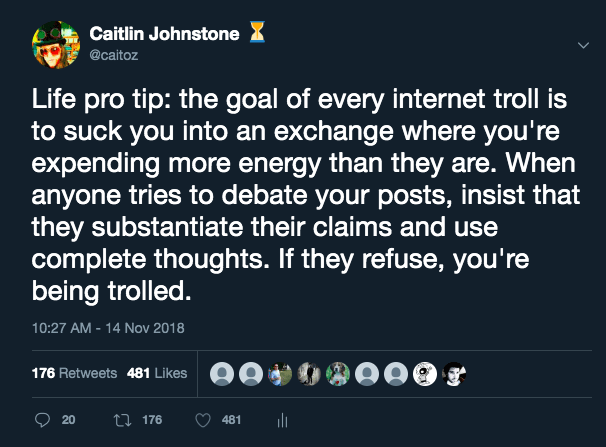
5 – Never let them trick you into expending more energy than they’re expending.
This one’s important. The internet is full of genuinely trollish individuals who spend their time acting out their inner pain by trying to suck the life out of other people, and political discussion is certainly no exception to this. A common tactic is to use short phrases, half-thoughts, or word salads which don’t contain any facts or actual arguments, but contain just enough of a jab to suck you into wasting energy making thorough, well-sourced arguments while they just lean back and continue making weak, low-energy responses to keep you going. This enables them to waste your time and frustrate you while expending little energy themselves, while also not having to reveal the fact that they don’t know much about the subject at hand and don’t really have an argument.
Don’t let them lean back. Force them to lean in. If someone makes an unsubstantiated assertion, a brief quip, or a vague insinuation, tell them “Make an actual argument using complete thoughts or go away.” If they throw an unintelligible word salad at you (a tactic that is also common in abusers with narcissistic personality disorder because it tricks the abusee into falling all over themselves to guess what’s being communicated, thereby giving the abuser power), tell them “That’s gibberish. Articulate yourself using clear arguments or go away.”
This often enrages them, partly because they’ve generally been getting away with this tactic their entire lives so they feel entitled to demand compliance with it from you, and partly because you’re forcing a very unconscious and unattractive part of themselves into attention and consciousness. But if they’re interested in having a real and intellectually honest debate they’ll do it; if they’re not they won’t. If they refuse to provide you with lucid, complete arguments that meet their burden of proof, make a show of dismissing them for their refusal to do so, and say you’re doing it because they’re too dishonest to have a real debate.
Never chase them. Make them chase you. Force them to either extend themselves into the light where their arguments can be properly scrutinized, or to disqualify themselves by refusing to.
6 – When attacking disinformation on Twitter, use this tactic.
If you see a high-profile Twitter account sharing disinformation about Assange, debunk their disinfo as clearly and concisely as possible, then retweet your response to your followers. Your followers will like and retweet your response, sending it further up the thread so that casual viewers of the disinfo tweet will often also see your response debunking it. If your response is text-only, include the URL of the tweet you’re responding to before retweeting your response so that your followers can see the awful post you’re responding to. It comes out looking like this:
There are many cultists on this site, but the Assange cultists are the worst. Assange was the agent of a proto fascist state, Russia, to undermine democracy. That is fascist behavior. Anyone on the left should abhor what he did. Not celebrate it.
His arrest has nothing to do with this Russia nonsense you've been shrieking about, you horrible, disgusting woman. He's been arrested by the UK due to a known agenda to extradite him to the US for his 2010 exposure of US war crimes. This is a fact.https://twitter.com/neeratanden/status/1116287237354852352 …
Neera Tanden✔@neeratanden
There are many cultists on this site, but the Assange cultists are the worst. Assange was the agent of a proto fascist state, Russia, to undermine democracy. That is fascist behavior. Anyone on the left should abhor what he did. Not celebrate it.
This serves the dual function of offsetting the damage done by their smear and alerting your followers to come and help fight the disinfo.
7 – Point out at every opportunity that they are advancing a smear.
Never miss an opportunity to point out to everyone witnessing the exchange that the other party is advancing a smear that is being promulgated by the mass media to manufacture consent for the imprisonment of a journalist who exposed US war crimes. Keep the conversation in context for everyone: this isn’t just two people having a difference of opinion, this is one person circulating disinformation which facilitates the agendas of the most powerful people in the world (including the Trump administration, which you should always point out repeatedly if you know they hate Trump), and another person trying to stop the flow of disinfo. Every time you expose a hole in one of their arguments, add in the fact that this is a dishonest smear designed to benefit the powerful, and that they are helping to advance it.
8 – Make it about Assange’s imprisonment and extradition.
One of the very few advantages to Assange being behind bars in the UK’s version of Guantanamo Bay instead of holed up in the Ecuadorian embassy is that the arguments are so much clearer and more honest now. You can no longer get away with claiming that Assange is just a coward hiding from justice who can “leave whenever he wants” and present yourself as merely a casual observer who just happens to want to share his opinion that the WikiLeaks founder is a fascist Russian spy rapist who smells bad and mistreats his cat, because you will always be entering a discussion involving the fact that Assange is in prison awaiting extradition to the United States. You are therefore always necessarily either supporting the extradition or distracting from the conversation about it.
So make that clear to everyone watching. Make them own it. They either support the imprisonment and extradition of Assange for his role in the Manning leaks, or they’re interrupting grown-ups who are trying to have an adult conversation about it. If they support Assange’s imprisonment and extradition to the United States, that clarifies your line of argumentation, and it makes them look like the bootlicking empire sycophants they are. Keep the fact that they support the extradition and imprisonment of a journalist for publishing facts on the front burner of the conversation, and keep making them own it.
9 – Familiarize yourself with common logical fallacies.
It’s fascinating how often people resort to fallacious debate tactics when arguing about Assange. One of the most interesting things to me right now is how the unconscious behaviors of our civilization is mirrored in the unconsciousness of the individuals who support those behaviors. Those who support Assange’s persecution are generally very adverse to an intellectually honest relationship with their own position, and with the arguments against their position that they encounter.
So get familiar with basic fallacious debate tactics like straw man arguments (claiming that you have a position that is different from the one you’ve actually put forth and then attacking that fake position they invented), red herrings (bringing up an unrelated point because it’s easier to debate than the current point of contention), and appeals to emotion (using emotionally charged statements as a substitute for facts and reason). These will give you a conceptual framework for those situations where it feels like the person you’re arguing with is being squirmy and disingenuous, but you can’t really put your finger on how.
10 – Rely as much on fact and as little on opinion as possible.
Don’t get sucked into emotional exchanges about opinions. Facts are what matter here, and, as you will see throughout the rest of this article, the facts are on your side. Make sure you’re familiar with them.
_________________________
To be continued! Keep a lookout for the full mega-article, “Debunking All The Assange Smears”, which I’m working on furiously and which will be out in a few days.
_________________________
Everyone has my unconditional permission to republish or use any part of this work (or anything else I’ve written) in any way they like free of charge. My work is entirely reader-supported, so if you enjoyed this piece please consider sharing it around, liking me on Facebook, following my antics on Twitter, throwing some money into my hat on Patreon or Paypal, purchasing some of my sweet merchandise, buying my new book Rogue Nation: Psychonautical Adventures With Caitlin Johnstone, or my previous book Woke: A Field Guide for Utopia Preppers. The best way to get around the internet censors and make sure you see the stuff I publish is to subscribe to the mailing list for my website, which will get you an email notification for everything I publish. For more info on who I am, where I stand, and what I’m trying to do with this platform, click here.
North Africa is in turmoil again and the cause of it can be found in the plots of the Europeans and Americans to break nations states into pieces in order to control the oil and gas producing areas of the region and in the plots of against each other.
In Libya the CIA trained General Haftar, (left) has begun yet another offensive against the weak UN imposed government based in Tripoli, the Government of National Accord, whose forces are weak, which has little support among the people and which has not succeeded in restoring any of the public services, from electric power and water supply to transportation to medical, education, or other administrative systems that existed under the government of the Jamarahiya Republic destroyed by the NATO aggression of 2011.
Haftar, who was sent in to Libya in 2011 from Langley, Virginia to join in the US aggression against his own country, is backed by Egypt which wants stability on its border with Libya as well as France, Saudi Arabia and Russia which see him, connected to the CIA as he is, to be the only man with the ability to unite the country under one government, for ill or for good.
Hafttar’s offensive against Tripoli which seems to have bogged down or slowed down in the past few days, it is difficult to determine which, also worries the Americans, or so they claim. They express fears that it could lead to a wider conflict, another civil war in Libya. Laughably, the Americans, who destroyed the country, claim that only they can stop the violence and bring heaven to the hell they have created.
The American intrigues are exposed by their official position opposing Haftar’s offensive while US forces, whose presence was not widely known, made very public announcements that they were withdrawing in face of Haftar’s attacks. This can only be understood as meaning they are getting out of his way so he can conduct his attack. Where they will withdraw to has not been revealed, nor the real reason for their presence in Libya in the first place. The American Africa Command stated,
“Due to increased unrest in Libya, a contingent of U.S. forces supporting U.S. Africa Command temporarily relocated in response to security conditions on the ground,”
“The command did not elaborate on the size of the troop contingent or where they were moved to, “We will continue to monitor conditions on the ground and assess the feasibility for renewed U.S. military presence, as appropriate.”
The American pretext for having occupation forces in Libya is claimed to be a campaign to dislodge Islamic State elements in the country and to “maintained a special operations mission inside Libya that assists the government in counterterrorism efforts’ which is the language they use to justify all their illegal occupations of foreign countries.
Yet, as the US does nothing to oppose the offensive, it continues to state it supports the government Haftar is attacking in Tripoli and continues to claim that Haftar’s actions could strengthen Islamic State in Libya. Just how Islamic State got from Iraq and Syria to Libya is a question to be asked, as is their presence in Afghanistan.
The answer is that it is composed of the remnants of the forces sent in to Libya by the US and its allies to attack Ghaddafi as well as locals recruited in Libya that the US sent into to Syria to attack the government there. Their defeat by the combined forces of the Syrian Army, Iran, and Russia, the defeat of the US war against Syria, forced them to return Libya, or be sent to Afghanistan to further destabilise the situation there.
Now it is claimed by the US and its Libyan puppets that certain armed groups are ISIS affiliates, but whatever the reality, once again the claim gives the Americans another pretext to keep their bayonets at the throats of the Libyan people.
Libya has the largest oil reserves in Africa and its production is important in keeping prices low especially when the US is trying to shut down shipments of Iranian and Venezuelan oil to world markets. Haftar was successful last year in securing control of oil facilities in the central and southern regions of the country and for increasing output there as well as securing port facilities on the Mediterranean so it can be shipped to world markets.
Nevertheless, the UN, that is the Security Council of which the US is a member of course, has asked the US to put stronger pressure on Haftar to support the weak government in Tripoli, a strange game, which, of course the US has not done. Instead the US got Haftar to agree to the establishment of a CIA base in Benghazi, a city which Haftar controls.
It is claimed that Libyans see Haftar as a needed strongman capable of bringing the order the Tripoli government so far has been unable to provide, but it is really the US and EU and Russia that see him as such each for their own reasons.
So now, 8 years after NATO thugs labelled Ghaddafi a strongman and dictator and then murdered him, the sane actors are calling for their strongman to take power, to be their dictator, and as for the Libyan people and the people that want the Jamarihiya back, well, who cares about them.
There are conflicting reports as to whether Haftar’s forces have captured Tripoli airport and the US seems to have doubts whether the man they flew in from Langley to help overthrow the Libyan Republic in 2011 can do the job. His army depends on support from local militias, which lack discipline and are notorious for war crimes, and though Haftar claims to be against Islamists he is supported by Salafist groups.
On the other hand, like all the unsavoury characters working for the USA he is no democrat. He stated that Libya is not ready for democracy, echoing the US propaganda that Libya is a “failed state” instead of a NATO destroyed state, and, if the USA has its way Libya never will be a democracy, at least not the socialist democracy that was destroyed by NATO bombs and missiles.
But to cover themselves, the New York Times, the mouthpiece of the US state, editorialised that sanctions should be placed on Haftar for “subverting a peaceful settlement of Libya’s problems and violating Security Council resolutions supporting the rump government he is attacking.”
One has to wonder how loudly the writers laugh among themselves when they write this stuff since they were one of the big voices calling for the NATO attack on Libya and for Ghaddafi’s murder in 2011; for using war instead of peace. As for UN resolutions, since when has the United States adhered to them when it didn’t want to? They might as well call for sanctions on themselves.
Meanwhile there is unrest in Algeria, unrest in Sudan and everywhere we see the dirty games of the French, British, Americans Italians, resurrecting the scramble for control of Africa’s resources that first took place in the 19th century.
We have seen what their wars have brought to Africans from Rwanda to Congo, from Mozambique to Angola. There were the “colour” uprisings in Egypt, Tunisia, and now, in Algeria, there are protests against the ruling National Liberation Front (FLN) and claims of corruption and failure to deal with unemployment and rising prices.
The protestors in Algeria are demanding that all the old heroes of the fight for liberation against the French in the 1950’s and 60’s be swept away. The army and political leaders have acceded to the demands. The president, Bouteflika, has stepped down, more opposition parties have formed and new elections scheduled for July. However the army chief of staff warned that foreign actors are behind the protests, meaning France and the USA, and that the problems of Algeria cannot be solved by violence and the destruction of the independence they fought for all those years ago.
But with the forces of the US Africa Command and the French Foreign Legion positioned in a belt across the Sahel from the Atlantic to the Red Sea, and with Chines forces entering Somali and Russian elements also becoming active and the British playing games in their former colonies, we can expect nothing but more turmoil and violence as these nations fight against the peoples of the Africa and fight among themselves for the spoils of war as the scramble for Africa is renewed.
Christopher Black is an international criminal lawyer based in Toronto. He is known for a number of high-profile war crimes cases and recently published his novel “Beneath the Clouds. He writes essays on international law, politics and world events, especially for the online magazine “New Eastern Outlook.”
The case for and against Julian Assange will keep him in the UK for at least eighteen months, probably two years, possibly three, according to leading London lawyers. The UK will have a new government by then; the US too.
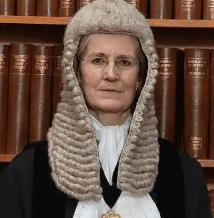
In the interval, Assange’s lawyers are preparing to prove the US indictment for conspiracy to commit computer hacking will be superseded by espionage charges. That, they will argue, requires the Westminster Magistrates’ Court to throw the US extradition application out. In addition, their evidence for American political motivation in the prosecution of Assange, (lead image, 3rd from left) and of US violations of the UK and European standards for a fair trial in an independent and impartial court, will be presented. The Chief Magistrate, Emma Arbuthnot, is likely to preside. The hearing is unlikely to start before December of this year.
The more UK and US Government officials take sides in public against Assange and support the allegations in the indictment, the stronger his case will be in court. The announcement by public letter to the Home Secretary last week that seventy-one members of the British parliament oppose Assange’s extradition to the US cuts even more of the ground from under UK prosecutors and the lawyers who will appear in court for the US.
Reversing their campaign to block the Swedish extradition warrant between 2010 and 2012, Assange’s lawyers are also mobilizing to have the Swedish prosecutors return to London with a new warrant, so that this can stretch out the legal wrangling in London for long enough to reach a new British election. If won by Jeremy Corbyn and the Labour Party forms a new government, Assange may benefit from a decision to move Assange’s prosecution to the UK courts, and then to release him.
“The anger for and against this man is extraordinary”, explains a leading London lawyer on extradition cases.
“You need very technical lawyering now, and Assange will have to pay for it. But in parallel there will be the PR campaign amplifying the political issue, principally for the Labour Party. The Assange case will stand for every British voter’s idea of what [President Donald] Trump and the Americans are doing to the world.
“ [Chief Magistrate Emma] Arbuthnot is not afraid to make decisions that would be unpopular. But as independent as she is, the pressure on her will be huge not to rule against the US.”
“And so it is for the British court system. Either the courts are bending to the US or to the anti-American movement. It’s going to take a bloody long time and a bloody waste of public money”
It was Assange’s defeat in the Supreme Court, the highest of the British courts, on May 30, 2012, which triggered within days his move to the Ecuador Embassy in London and his asylum there, which ended last week. Read the judgement in full here.
That case turned on the technical legal issue of “judicial authority”; that was whether the Swedish prosecutors’ warrant of arrest for Assange on sexual molestation and rape charges was lawful in the UK. The court decided it was, but it was a split decision. Two of the seven judges ruled in Assange’s favour.
The Swedish charges were based on allegations by two women for events which took place in Sweden in August 2010. The timing was five months after Assange began the process of publishing the US military files obtained by Chelsea Manning; the most important of these was the secret US film of a US Army helicopter attack on Iraqi civilians, killing 18 – evidence of a war crime.
The US indictment of Assange, released last week, identifies the dates of his alleged offences with Manning between March 2 and 10, 2010.
This timing will prove to be important later in the British courts because Assange’s whereabouts in March of 2010 aren’t mentioned in the US indictment. New York Times reporting indicates he was in London.
If he was in the UK when the alleged offences took place, and if he was publishing from the UK, then his lawyers will make the case that the appropriate forum for a trial on the US charges is in a British court, not an American one. “The forum argument”, says a London legal source, “has prevailed recently but so far only for British citizens operating in the UK.”
The source says that if Assange were able to win the forum argument, requiring the prosecution on the American charges to be moved to the UK, it would be up to the Director of Public Prosecutions (DPP) to decide whether to do so, or not. If the Conservative Government has been replaced by Labour, by the time the DPP would face a decision on Assange, Prime Minister Corbyn would have the authority to stop the proceeding.
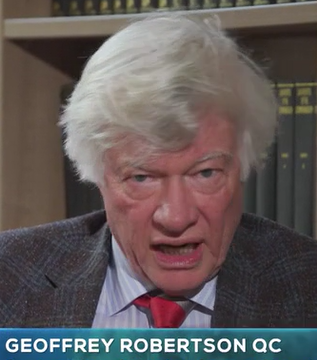
“He’s not facing justice in the UK,” Assange’s principal London advocate, Geoffrey Robinson QC said (minute 19:40)on Saturday
“He’s facing justice in the UK. The justice he is facing is justice, or injustice, in America… I would hope the British judges would have enough belief in freedom of information to throw out the extradition request… I have faith in them. But whether I have faith in the US Supreme Court in another matter.”
Robertson means that the first line of defence for Assange will be to put the US on trial in the magistrates’ court for politically motivated persecution, torture (of Chelsea Manning), and multiple abuses by US courts in national security cases. In short, the Article 6 argument. This refers to Article 6 of the European Union Human Rights Convention; this is incorporated in the UK’s Human Rights Act of 1998.
Justice Arbuthnot (right) has been clear in two judgements last year that the Russian Government fails a key test on this standard. In the case of a Russian warrant for fraud and embezzlement by a Rosneft executive and one-time board director, Andrei Votinov, Arbuthnot concluded “this is one of those exceptional cases where the defendant [Votinov] has shown there is a real risk that he will suffer a flagrant denial of justice if he were to be extradited to the Russian Federation.”
Although Arbuthnot ruled against experts testifying that there was political motivation in the case against Votinov, she dismissed the warrant.
“There is evidence in this case of a close tie between big business and politics,” Arbuthnot decided.
“Professor Sakwa says Mr Votinov was resisting Mr Sechin’s political machinations and that is why he is being prosecuted.
“In the Russian Federation it is often hard to distinguish between politics and business and therefore I find that the circumstances set out by the Professor if proved might fall within the definition of section 81 [of the Extradition Act]. I find no evidence however, sufficient to support the bar [to extradition].”
In the case of alleged Russian bank fraudster Ilya Yurov, Arbuthnot accepted expert evidence on the conditions of Russian prisons. She also accepted that Russian courts are susceptible to government pressure in high-profile cases.
“I cannot see how [Yurov] could not be prejudiced… there is a real risk he will suffer a flagrant denial of justice. His would be a very high-profile prosecution of particular interest to the [Russian state] and these are very exceptional circumstances.”
Yurov was released from his bail and the Russian extradition application dismissed. Read the story here.
For the first time ever in an international court, Assange’s lawyers will be arguing that in this case US prosecutors and US courts are no better than the Russians; in the prosecution of Assange and Manning they will argue the Americans are worse. “The US will come into court very well prepared”, according to a London lawyer.
“It’s a rarity for any British court to rule against the US, though this has happened recently on different grounds. Arbuthnot has been tightening the definition of what is ‘political’ in these cases. I can’t see [Assange] winning on the US prejudice argument.”
Baltasar Garzon, the former Spanish magistrate now representing Assange in Ecuador, has foreshadowed the presentation of evidence of US Government manipulation in Ecuador to force Assange’s expulsion from the embassy.
“The threats against Julian Assange for political motives and the persecution by the United States,” he said, “are more alive than ever. Recently, Wikileaks has been branded a terrorist organization.”
Extradition and human right lawyers who are not engaged for Assange are certain his case will continue in the British courts for a long time – years for all the arguments to play out in the Magistrates’ Court, the High Court, and the Supreme Court. They are divided on what they believe the outcome will be for Assange. Few are confident that a British judge will rule that the US prosecutors and courts are no better than their Russian counterparts, and dismiss the extradition case against Assange.
There is more confidence, however, that on a narrower issue the lawyers call the specialty rule argument, the British judges may decide in Assange’s favour. According to the UK-US extradition treaty of 1972, a 2003 Act of Parliament, and decisions of the British courts, it is unlawful for the US to indict, try and punish an individual for an offence that is different from the one for which he was extradited from the UK. “Special arrangements” or “special rules” must therefore apply to the Assange case, the lawyers agree.
They point to a High Court case in 2006, when two men were sought for extradition from the UK on US fraud charges. “The US contends,” the court reported,
“that it observes the specialty rule, as a rule of international law and comity, in its trial and punishment of those who are extradited to it. That is hotly contested in this appeal…
“[the defendants argued that] the US habitually violated the spirit and purpose of the specialty rule…
“The gravest of the particular charges… was that the US Government would seek and the US Courts would uphold a conviction based on a superseding indictment which alleged offences for which extradition had actually been refused by the UK Government.”
The judges in that case decided there was insufficient evidence for the specialty argument, and agreed to the US extradition. He also ruled that a superseding indictment would not be legally acceptable in a US or UK court “if there were evidence that the UK Government had objected or would object to it.”
Sources in London are critical of media speculation that the current US indictment against Assange is a fake, and will be replaced by a new charge of espionage once he is in US hands.
Robertson for Assange is more guarded. He has conceded that the US prosecutors may intend to supersede the current indictment, but he signals that this suspicion will be tested in court. His argument will then be that the Americans cannot be trusted to seek the permission required for a new charge.
On proof of that point rests Assange’s best chance of release.
In the avalanche of news reports that have washed over the globe since the abduction of Julian Assange, this conversation struck me as containing numerous points of importance. It seemed worthwhile to have some of these points transcribed and listed here.
If you have seen it, then the select transcriptions beneath the video might serve as useful reminders; however, if you missed it, watch the video instead (or listen to the podcast below).
This comes from CrossTalk with Peter Lavelle, and it was titled “Assange in custody” (April 11, 2016).
“From my perspective…this is one of the darkest days of journalism in my lifetime, and I’m going to remember this day for the rest of my life…This is a crushing move against a profession that has already been crushed so much over the last few years”.
Not the Fake News Media
“WikiLeaks…is a publisher—but unlike other publishers, it was never proven to be peddling fake news”.
The weak national security state
“We saw this ‘show of force,’ of dragging Julian Assange out of the Ecuadorian Embassy—but it told me something that they don’t want me to think: it shows me that the national security state is actually quite weak and timid in its ability to communicate its position of why it (illegitimately) has power…
“The powers that be show themselves to be weaker and weaker because they’re unable to engage in discussion and in debate, and maybe argument. They deny the other side. They are only right, and people must follow because ‘look at what they did to Julian Assange, we can do it to you’. That’s the message they’re sending, but that’s power at its weakest point, because it relies on coercion”.
Violating International Law
“This is the ultimate chilling effect and it was done in broad daylight—they didn’t hide it, they’re actually quite proud of marching in to a sovereign territory of another country…I suppose Ecuador relinquished that—shame on them—and breaking international law and of an asylum agreement. There’s no asylum agreement in the world…that limits one’s speech, not in the European Union and not in the United States, that’s for sure”.
Joe Lauria:
A dark day for everyone
“I think it’s a dark day, not just for journalism but for everyone else, for the entire world really, for all of the populations of all countries that depend on a vibrant media, a critical media, that can bring them information about what their governments are really up to that will challenge them.
“And that’s of course what WikiLeaks did: they provided the information that the governments did not want the public to know, particularly about crimes and corruption, and this is why they got him arrested today. All the other stuff about bail skipping, and previously about the sexual allegations in Sweden, all of that was to lead up to get him to go to this courtroom in Alexandria, Virginia, so he could stand trial for exposing the secrets of governments”.
“It was indeed a very stark and nightmarish image, of seeing Julian taken out of the front door of the embassy, with the Ruptly camera there. This is what we call here in the US a ‘perp walk’: they wanted us to see him being pulled out”.
Authoritarianism on display—media serve the governors
“That’s authoritarianism right there…when we saw Julian Assange dragged out of that embassy, and the public being shut out. The corporate media…does not inform and takes the wrong side: they take the side of the state and not the side of the people. It’s the governed they’re supposed to serve, not the governors”.
The corporate media ruined themselves
“It’s the press that has destroyed itself in many ways, in this story, because they have turned on this man that they once profited from when it served their partisan interests when he exposed crimes of the Bush administration—when he exposed corruption with Hillary Clinton, they turned on him on a dime. They’re still pushing this rubbish story that he ‘helped Trump’ get into the White House, that he’s somehow a ‘Russian stooge,’ a ‘Kremlin agent,’ all this nonsense even though the collusion story has collapsed. So it’s the press that has failed the public here…the corporate media, they have already destroyed themselves, in many ways. To vilify this man and to be cheering today, because of his arrest, is quite disturbing”.
The media are part of the national security state
In response to Lavelle’s question, “Why does mainstream media worship the intelligence community so much?”—Lauria:
“There’s a big reason and a little reason. The big reason is they are giving legitimacy to an establishment that is losing legitimacy—they are weak, and the corporate media props them up, they’re an essential ingredient…to keep people believing that these are legitimate rulers. The second, little reason, is careerism: ...
“reporters want to be close to power; they live vicariously through these powerful people; they want to be part of the elite; they don’t understand their role is to be amongst the people, to challenge, to vet, to criticize the powerful. That is exactly what Julian Assange did, and they are trying to abolish that and have full control over information”.
Julian Assange is a publisher and journalist
“Corporate media reporters continually say he [Julian Assange] is not a journalist, he’s something else. Well, he’s publishing documents, but he’s written three or four books, he writes articles, he’s a great strategic analyst, this man isn’t just some kind of clerk accepting the documents and putting them out there. He understands what they mean and he tries to explain what they mean—and they cannot tolerate this: they need these lackey reporters to prop up their legitimacy that is weakened by the truth, in this case by Assange”.
Sara Flounders:
Refocusing on US war crimes
“They [the corporate media] reported on it [the leaks] and exposed some of those crimes, because it was already out to the whole world. Really what was exposed are the dark crimes that the US has committed in its wars; 200,000 cables, video footage, images—that should be the response of anyone who is challenging right now this brutal…arrest of Assange.
“Let’s go back and revive, bring forward again what it was that WikiLeaks exposed. What was in those cables? Let’s show again those videos. Let’s show again the torture. Let’s show again Guantánamo…
“Let’s show again all of their crimes… Remind people what Julian Assange’s contribution is”.
The media serve an empire in decline
“If we accept the secrecy—that’s what they want to bring back: complete secrecy, control of the media. They’re demanding that the corporate media, who is already totally house-broken, who is already defending in every way an empire that is declining, that’s in decay, that no longer has credibility, the corporate media is…in the US…absolutely part of that secrecy”.
“We should not look to media that already play a role of conspiracy in an empire that is based on crime and that is based on secrecy”.
The corporate media are losing
“The media today, the big corporate media, is absolutely losing its legitimacy in terms of its [sic] hold on people’s minds, on people’s consciousness. I think we should take confidence in our own ability, because human consciousness is more powerful in terms of historic, big change, than repression and even the technology, the ability of technology to try and enforce repression, it [consciousness] breaks through in unexpected ways”.
Ray McGovern:
We the people are the press
“The bottom line is: there’s only us. There never has been any other. We are the press, we are the media. The Fourth Estate is dead….No more regard for the Magna Carta, or the Bill of Rights in the Constitution, there is no press freedom. So it’s up to us, the alternative media, to make sure that this doesn’t go down lightly”.
“There’s no counter-argument to revealing war crimes”.
The Collateral Murder Video and David Finkel’s Cover-up
“The Collateral Murder video…is very damning. It shows the brutalization not only of journalists, two from Reuters and 10 other people, in plain sight. It shows the brutalization of the pilots: the US pilots that had been taught to be so brutal. What most people don’t know is that David Finkel, a big Washington Post type, was with that unit. He knew about that tape, he watched it, and he wrote a book called The Good Soldiers, about that specific unit that did this kind of brutality…
“That puts it in bas-relief: there’s the Washington Post there, fully cognizant…and no one would have known about it were it not for Chelsea Manning giving that tape to Julian Assange”.
Manning offered his information to the media, and was turned away
“The important point here…is that Assange didn’t ‘solicit’ this information from…Chelsea Manning. Manning offered it to The New York Times, offered it to The Washington Post, and they didn’t want it. So what was…Manning going to do?”
Conclusion
How do we tie all of this together into one coherent explanation? Let’s start with the largest frame of reference, and the biggest actor within that frame, and then move down. In the broadest terms we are dealing with empire, specifically imperialism. The prime actor in that field is the United States. The problem is how to enforce rule, both at home and abroad. It is now clearer than ever—indeed, it was put on display in broad daylight, as they said above—that the imperial state is unable to convince any longer. Persuasion is dead, because the imperial state has lost legitimacy. That means the state resorts to its dangerous last resort—coercion, and outright violence.
Assange is an individual actor, often a lone if not lonely one, whose work ruptured the ability of the imperial state to communicate within itself, and to communicate with the public. The accounts the imperial state—its military and diplomats—told themselves, differed radically from what they told the public. The ranks of the imperial state needed to feel that they could communicate among themselves, without fear of surveillance by the public, by citizens. Their deeds required non-accountability. In addition, the ranks of the imperial state needed to convince the public of their state’s authorized, preferred version of reality. Assange steps in and disrupts those two key lines of communication—the internal one and the public one. For once, the imperial state begins to fear the masses (I think the imperial state always feared them)—it can no longer count on “democracy” delivering consent. Things might get out of control, hence the reaction. The last available resort, before everything falls apart, is coercion. We are nearing the end.
The majority of the media—the so-called mainstream, corporate media—are part of the very system that they are supposed to report about, and to question. Instead of questioning the powerful, the media have sided with the powerful. The media are the last bastion of non-state support for the imperial state, and they are decaying in line with, and along with, a declining empire. This maximizes the relevance and importance of citizen journalists like Julian Assange.
Thus in an effort to shore up their own crumbling legitimacy, the media vilify and demonize Julian Assange constantly. Even in the last 24 hours the refrain has been repeated: Assange is a spy; Assange is a Russian stooge; Assange is an activist, not a journalist (particularly rich coming from CNN of all places), and so forth. Of the few left listening to them, most are laughing at them.
What we now see is that any laws that might protect the public, at home and around the world, are being trounced at every level. International law, as it governs asylum, and national laws in the UK and Ecuador governing fair trials and citizenship—are simply being either torn up or twisted beyond recognition. Then the powerful say “no one is above the law”. Which law do they mean? This is The Jungle.
What is particularly striking to me is the role of the corporate media, as in the figure of David Finkel of The Washington Post, playing an active and direct role in a covering up war crimes, and crimes against humanity, by the imperialist state of the US and its military occupation forces in Iraq. If there was ever a more damning vignette of the media serving power and enforcing secrecy, I don’t know of it. Manning as a whistleblower tested her faith by turning to these same media, only to be turned away—teaching her this very same lesson.
 Well this is interesting.
 “During the discussion, Ms. Haspel, then deputy C.I.A. director, turned toward Mr. Trump. She outlined possible responses in a quiet but firm voice, then leaned forward and told the president that the “strong option” was to expel 60 diplomats.