Thursday, April 11, 2019

Unholy: Operation Gladio and the Knights of the New World Order

Operation Gladio: The Unholy Alliance

by Antony C. Black - OFFGuardian


April 06, 2019

Operation Gladio: The Unholy Alliance: Between the Vatican, the CIA and the Mafia: Overview of the book by Paul L. Williams

On the hot summer morning of Aug. 2, 1980 a massive explosion ripped apart the main waiting room of the Bologna railway station. Eighty-five people were killed and hundreds more injured. Though at first blamed on Italy’s legendary urban guerrillas, The Red Brigades, it soon emerged that the attack had, in fact, originated from within the ‘deep state’ of the Italian government itself.

The full nature of this secret parallel state would only come to light a decade later when the Italian premier, Giulio Andreotti, under questioning from a special commission of inquiry, revealed the existence of arms caches stashed all around the country and which were at the disposal of an organization which later came to be identified as ‘Gladio’.

The members of this group turned out to include not only hundreds of far-right figures in the intelligence, military, government, media, Church and corporate sectors, but a motley assortment of unreconstructed WW2 fascists, psychopaths and criminal underworld types to boot. And despite Andreotti’s attempts to airbrush the group as ‘patriots’ it appeared evident to much of the rest of the Italian polity that these seemed rather more like pretty bad folk indeed. Little did they know.

Follow-up research by the likes of Daniele Ganser, Claudio Celani, Jurgen Roth and Henrik Kruger traced connections to similar groups spread throughout Europe of which all were found to be deep state terrorist organizations, and all of which were found, ultimately, to be subservient unto the highest levels of the CIA and NATO command structures.

The moniker ‘Gladio’ (after the two-edged sword used in classical Rome) was eventually broadened to include a bewildering host of related deep state terrorist structures including: ‘P2’ In Italy, ‘P26’ in Switzerland, ‘Sveaborg’ in Sweden, ‘Counter-Guerrilla’ in Turkey and ‘Sheepskin’ in Greece. This (hardly definitive) European list was then found to have connections not only to virtually every US sponsored secret state terrorist organization the world over (including the likes of Operation Condor in Latin America), but also to many of the global drug cartels that provided the secretive wealth needed to fund and otherwise lubricate the whole rotting, corrupt shebang.

If all this sounds sinister enough, it pales in light of the detailed structure of the dazzlingly diabolical Gladio edifice. And it is to those details we now repair vis a vis an overview of the remarkable, if otherwise unheralded, 2015 work by journalist Paul L. Williams entitled, ‘Operation Gladio: The Unholy Alliance Between the Vatican, the CIA and the Mafia’. Though there are other books on the subject worthy of honourable mention (including Daniele Ganser’s seminal tome, ‘NATO’s Secret Armies’, and Richard Cottrell’s recent and stylishly written, ‘Gladio: NATO’s Dagger at the Heart of Europe’), it is to Williams that I believe we owe a particular debt of gratitude in having provided a more or less fully integrated portrait of the global machinations of Operation Gladio.

Before embarking on our grim, if yet fascinating, journey it is worth first noting that whilst ‘Gladio’ was officially acknowledged and condemned by the European Parliament (in Nov., 1990; Washington and NATO having ever after refused ‘comment’ on the matter), and its multifarious organs and factions ordered dismantled, it is hardly likely that the latter was ever fully enacted. The historical context of ‘Gladio’, then, is really the quintessential backdrop to understanding the trademark false flag events of the modern era.

Of Spooks and Made Men


The general origins of this labyrinthine network of deep state actors lay in the so-called ‘stay-behind-armies’ set up at the end of WW2 by the Allied powers (principally the US) ostensibly to act as resistance forces should the Soviets ever decide to invade Europe. Quickly, however, the raison d’etre of the ‘armies’ transmogrified into a mission to counteract, not external invasion, but ‘internal subversion’. Such would eventually result in the undermining not just of post-war European socialism, but of Italian, Greek – and later global – democracy itself.

But we get ahead of ourselves...

The primal author of the ‘stay-behind-armies’, Williams informs us, was General Reinhard Gehlen, the head of German military intelligence during the Second World War. Having foreseen early on that the Reich was doomed to defeat, Gehlen had “concocted the idea of forming clandestine guerilla squads composed of Hitler youth and die-hard fascist fanatics” ostensibly to fend off the inevitable Soviet invasion. These guerilla units he referred to as ‘werewolves’.

Not ones to miss a fascist opportunity when they saw it, the US Office of Strategic Services (the OSS, and the forerunner of the CIA), under the leadership of William ‘Wild Bill’ Donovan, quickly enlisted both Gehlen and SS General Karl Wolff (in 1945) in forming the Gehlen Organization (later to transform into the present-day German BND) and which received its initial funding from US Army G-2 intelligence resources.

The American point-man on this was Allen Dulles, the first president (in 1927) of the Council on Foreign Relations, and later the first head of the CIA. Duly incorporated into the American fold, the ‘werewolves’ were, given that their initial meddling took place in Italy, rebranded as ‘gladiators’. Operation Gladio was born.

In 1947 the CIA (having, that year, superseded the OSS) was faced with its first daunting task, i.e. how to prevent the Italian Communist Party (PCI) from forming the next government. Elections were scheduled for 1948 and the PCI was a virtual shoe-in not just in Italy proper, but in Sicily as well. Fortunately, ‘Gladio’ was ready and waiting. The gladiators had been training in a special camp set up in Sardinia under the local command of the former WW2 Italian fascist leader, Prince Junio Valerio Borghese.

In addition, hundreds of American mafioso began to arrive on the shores of Italy to lend a hand with the communist ‘problem’. The arrival of the ‘made men’ was the result of Donovan’s efforts from 1943 onward in working with American mobsters Charles ‘Lucky’ Luciano and Vito Genovese to conger new (drug) funding for the OSS’s off-books’ operations, and to reinstall the Sicilian mafia on the island in the leadup to Operation Husky (the Allied invasion of Sicily). These forces were now unleashed on the Italian electorate, and through 1948 an average of five people a week were murdered by the CIA-backed terrorist units. The results were grimly predictable. Hallelujah, the PCI were defeated and the Christian Democrats returned to power.

Still, the threat remained. Fully half the Italian electorate were communist sympathizers and, moreover, leftist politics pervaded much of the rest of the diseased European body. More would have to be done. The problem, however, was money. There simply wasn’t enough of it. Thus, the initial $200 million in funding for Gladio (which had come from the Rockefeller and Mellon foundations) was quickly exhausted. And though the National Security Act of 1947 had provided the loophole that allowed for the CIA’s covert operations, it had not allowed for their overt Congressional funding. There lay the rub. Thankfully, Paul Helliwell knew how to salve the itch.

Paul Helliwell was an inner member of the original OSS (along with key scions of the Morgan, Mellon, Vanderbilt, Carnegie, DuPont and Ryan families) and, according to Williams, likely the greatest unsung hero of the nicknamed ‘Oh-So-Social’ club. It was he, who having cut his teeth in the drugs-for-arms trade by shepherding opium deals with the Kuomintang (KMT, the Chinese National Army fighting against Mao Zedung), conjured the brilliant inspiration to do the very same thing – in the United States itself.

Thus, it was at his suggestion that Donovan elected to forge the deep bond (and that exists to this day) between the nation’s intelligence services and organized crime. Enter stage left such notables as ‘Lucky’ Luciano, Vito Genovese, Meyer Lansky and the Trafficante and Gambino crime clans. Quickly the streets of, first, New York, and later many an American metropolis, were flooded with heroin. These early, halcyon days would soon lead to the infamous ‘French Connection’, thence to the ‘Golden Triangle’ (where the CIA’s very own ‘Air America’ transported drugs out of South East Asia during the Vietnam War) and, later, to the Balkan, Mexican, and Colombian drug cartels.

All very well and good. But, to begin with, there was yet a fly in the whole drugs-for-arms-for-terror ointment. To wit: how to pay off the mafioso without anyone noticing; indeed, how to stash, launder and hide all of this financial derring-do from the prying eyes of the authorities; you know, the real-enough authorities, the Treasury cops and so forth. How do you do that?

The Vatican Connection


Article 2 of the Lateran Treaty of 1929 was clear and unequivocal. The Article, which served to regulate matters between the Holy See and the Italian state, expressly forbade any interference of the latter in the affairs of the former. It is hardly conceivable, of course, that the framers of the Treaty ever foresaw what such immunity could actually mean in practice. But then they probably hadn’t reckoned on the fiendish formation of the Institute for Works of Religion (IOR), or more colloquially, the Vatican Bank.

Established by Pope Pius XII and Bernardino Nogara in 1942, the Bank would quickly come to serve as the principal repository post-war both for the Sicilian Mafia and for the OSS/CIA wherein all of the monies and documents relating to drug trafficking and to Gladio would be stored and laundered. Already in 1945 the pope had held private audiences with Donovan to discuss the implementation of Gladio and where, as Williams reports, Donovan was knighted as an anti-Communist crusader with the Grand Cross of the Order of Sylvester.

Prior to this time Pius XII had proven himself a loyal ally in working with Dulles and the OSS to establish the ratlines used to help prominent Nazis escape Europe.

Now, new horizons beckoned. The first duty at hand, of course, was to destroy the communist menace in respect of the 1948 elections. To this end the pope authorized his own terror squads (under Monsignor Bicchierai) to assist the gladiators and the ‘made men’ in intimidating the Italian electorate. Task accomplished.

The second duty at hand, however, was longer term. Communism, socialism and, indeed, any Godless form of progressive government, anywhere, had to be stamped out at source. For this money would be needed. Lots of money. Untraceable money. Drug money. Now in the months before the 1948 election the CIA deposited some $65 million into the Vatican Bank. The source of these monies came from heroin produced by the Italian pharmaceutical giant, Schiaparelli, and which was then transported by the Sicilian mob into Cuba where it was cut and then distributed to New Orleans, Miami and New York by the Santo Trafficante family. Lucrative though this trade was, it was not nearly enough to suit the needs of the CIA and ‘Gladio’. More would be required. More drug networks and more banks. Gladio was about to go global.

To start with a new alliance was forged with the Corsican mafia. Unlike the Sicilian mob, the Corsicans had extensive experience in processing heroin, a skill they had picked up through years of working with Laotian, Cambodian and Vietnamese technicians in French Indochina. A supply route then emerged running from Burma through Turkey to Beirut and thence to Marseille. Alas, there was a slight hitch when the leftist dockworkers in Marseille, being sympathetic to the rebel army under Ho Chi Minh, refused to load and unload the boats from Indochina. No worries. A deft bit of terror administered by the Corsican boys (and funded by the CIA), and problem solved. By 1951, then, Marseille had become the center of the Western heroin industry. Voila, the ‘French Connection’.

Meanwhile, Wild Bill Donovan had ‘resigned’ from the CIA to form the World Commerce Corporation (WCC) whose primary function was to facilitate the arms-for-drugs deals with the KMT. Paul Helliwell lent a needed hand at the helm by heading up Sea Supply, Inc., a CIA front company gainfully employed in shipping heroin from Bangkok. By 1958 the whole operation was so successful that a second supply route was established running through Saigon. Here, the help of Ngo Dinh Diem, the US installed despot of South Vietnam, proved invaluable.

Still, there was a potential cloud on the horizon, i.e. word of all these shenanigans was bound to leak out. What to do? The first reflex, naturally, was to pin the blame for the West’s growing heroin problem on the Communist Chinese under Mao Zedung. Check. The second, more considered response, was to organize an ongoing campaign to deflect attention away from, and burnish the image of, the CIA. And to this end, in 1953, did the CIA establish ‘Operation Mockingbird’. Under ‘Mockingbird’ the Agency recruited hundreds of American journalists to spread false stories and propaganda about the Company’s ‘benign’ activities. Eventually, this depraved fabric of anti-journalism enlisted entire news networks including ABC, NBC, Newsweek, Associated Press, and The Saturday Evening Post.

Now the guys and gals at Langley could relax. Henceforth, American (and global) eyes were dutifully prismed through the rose-coloured lens of ‘Mockingbird’.

But back to the Vatican. The IOR, solid banking pillar of the Gladio community that it was, could hardly be expected to do all the heavy lifting itself. After all, the global heroin industry would, by 1980, be pulling in a cool $400 billion annually. En route an extensive and orchestrated financial network would be required to supplement God’s Bank. As with any fine orchestra it helps to have a maestro of exquisite genius to run the show. A nice round of applause, then, for one Michele Sindona.

The biography of Sindona begins, humbly enough, with his degree in tax law from the University of Messina in 1942 after which, in quick succession, he rockets to stardom as a leading financial adviser to the Sicilian mafia, an agent for the CIA, and, thereafter, a financial intimate of the Holy See. By the late 1950s Sindona had become the lynch-pin in a nexus between the mob, the CIA and the Vatican that would eventually, as Williams chillingly puts it, “result in the toppling of governments, wholesale slaughter and financial devastation.”

Though a full elaboration of this bewilderingly complex financial system is best left to the author, it is worth briefly savouring a few highlights. To begin with Sindona purchased Fasco AG, a Liechtenstein holding company and through which he purchased his first bank – the Banca Privata Finanziaria (BPF). The BPF then became, by way of a Chicago-based intermediary bank, Continental Illinois, a principal conduit for transferring drug money from the IOR for the purposes of Gladio. In fact, it was this banking pipeline in particular which provided the filthy lucre that fueled the 1967 coup d’etat in Greece.

But more on this heady stuff in a bit...

It was through his Chicago contacts that Sindona first met Monsignor Paul Marcinkus, (left) popularly known as ‘the Gorilla’. The Gorilla was six foot four, “a gifted street fighter…and a lover of bourbon, fine cigars and young women”.

Under Sindona’s patronage Marcinkus would soon rise to become both Pope Paul VI’s personal body guard and the head of the IOR. A third musketeer in the person of Roberto Calvi (the assistant – and later full – director of the famous, Milan-based Banco Ambrosiano) came to complete the three Vatican amigos.

Together they would cut a dramatic, collective figure in the global banking underworld all through the ‘anni di Piombo’ (the Gladio ‘years of lead’ in Italy from 1969 to 1987). Exactly how dramatic is illustrated, par excellence, by Calvi’s eventual dark demise. Who among us, old enough to remember, can forget the macabre spectacle (June, 1982) of Calvi’s body hanging from Blackfriars Bridge, his feet dangling in the Thames and pockets stuffed with five masonry bricks. Sindona would also later be murdered (1986) by means of a cyanide-laced cup of coffee whilst in jail and under ‘maximum protective custody’.

Calvi was a key figure in establishing a series of eight shell companies (six in Panama, two in Europe) through which drug lords like Pablo Escobar in South America were encouraged to deposit their ill-gotten loot. (The CIA put shoulder to wheel by helping ferry the Escobar cocaine in a fleet of planes operating out of Scranton airport in Pennsylvania). The monies were then transferred via Banco Ambrosiano to the IOR which took a 15 to 20 percent processing fee. From there funds were distributed to a host of European banks set up by Sindona for use by Gladio units spread throughout the continent. In addition to the flow of cash from the cartels, funds were bled from Banco Ambrosiano into the eight shell companies – again for use by the CIA in funding its covert operations.

This points up a general operating procedure of the entire Gladio ‘banking’ system, i.e. the system, far from being designed to turn a profit, was expressly designed to ‘lose’ money; that is, to have it siphoned off into covert ops. Such explains the regular and spectacular failure of a host of CIA-related banks including: Franklin National Bank (purchased by Sindona), Castle Bank & Trust, Mercantile Bank & Trust (both set up by the ubiquitous Paul Helliwell), Nugan Hand Bank (in Australia, and from which funds were diverted to undermine Prime Minister Gough Whitlam during the Vietnam War), and the infamous Bank of Credit and Commerce International (based in Karachi in aid, primarily, of the Southeast Asian heroin trade). Indeed, it was precisely the collapse of Banco Ambrosiano itself that brought both Calvi and Sindona to their untimely ends.

Finally, it is worth noting here that these august institutions were linked in a tight criminal embrace with many of the most prestigious financial firms in America including Citibank, the Bank of New York, and the Bank of Boston. The base of the iceberg, in short, extended far and wide. But then, what was all this money really doing?

The Terror


Following the thwarting of Italian democracy in 1948 the Gladio ‘secret armies’ entered into a period of what one might characterize as pregnant incubation. Thus, it was during the 1950s that the various drug supply routes and financial networks were being created, as were some of the principal political organizations. Probably the most important of the latter was ‘Propaganda Due’ otherwise known as ‘P2’.

Created in 1877 as a Freemasonry lodge for the Piedmont nobility, it was banned by Mussolini in 1924 only to be resurrected post-war with the approval of Allen Dulles, (right) himself a thirty-third degree Mason. The lodge, though at first dominated mainly by spooks, spies, military and mafia figures, would soon encompass a who’s who of Italian political, corporate, banking and media supremos to boot.

Indeed, the organization would eventually spread shoots throughout Europe as well as North and South America, and its members would come to include such luminaries as Henry Kissinger and General Alexander Haig.

A ‘P2’ denizen of especial significance was Licio Gelli. The latter’s pedigree was impressive: a former volunteer in the 735th Black Shirts Battalion, a former member of the elite SS Division under Field Marshall Goering and, thereafter, a chummy employee of the US Counter Intelligence Corps of the Fifth Army.

Working with William Colby, the OSS agent in France, and Allen Dulles, the OSS director, Gelli soon gained entry to the Vatican where he helped set up the Nazi escape routes to Argentina. His ties with Argentina would later prove critical in facilitating Operation Condor (the US-backed mass assassination program in 1970s and ‘80s South America). Moreover, in 1972, Gelli would emerge as P2’s supreme ‘Worshipful Master’ under whose leadership the lodge would reach its full, horrific flowering. Finally, it is worth mentioning at this juncture that it was as a result of a police raid on Gelli’s villa in 1981 that the full, tentacled structure of Gladio would come to light.

But we digress...

One of the first substantive actions of Gladio was the Turkish coup of 1960. Here the incumbent Prime Minister, Adnan Menderes, made the fatal mistake of believing he was really in charge and thereafter initiating a visit to Moscow to secure economic aid. The ‘stay-behind-army’ in Turkey known as Counter-Guerilla, in alliance with the Turkish military, quickly disabused him of any such delusions by arresting and executing him. Throughout the 1970s both Counter-Guerilla and its youth wing, the Grey Wolves, would stage “ongoing terror attacks…that resulted in the deaths of over five thousand students, teachers, trade union leaders, booksellers and politicians”.

Counter-Guerilla would also figure in the Turkish coup of 1980 when its commander, General Kenan Evren, toppled the moderate government of Bulent Ecevit. According to Williams, US President Jimmy Carter phoned in his approval to the CIA station-chief in Ankara, Paul Henze, with a jubilant, ‘Your boys have done it!’ What they had done, of course, was set up a tyranny in which thousands more would be tortured while incarcerated. The Turkish Gladio boys would also be unleashed in the 1980s upon the PKK – the Kurdistan Workers Party. All of this was in keeping with Zbigniew Brzezinski’s (Carter’s national security advisor) core vision of the importance of controlling Central Asia to which Turkey was both a vital portal and, thus, a key NATO ally.

Alas, Gladio would prove something of a disappointment in France, where, after having backed a series of assassination attempts against the regrettably too independent President Charles de Gaulle, it found itself on the receiving end of de Gaulle’s boot. Actually, it was NATO itself – at the time, headquartered in Paris – that was unceremoniously kicked out of France (in 1966, whence it took up its present cozy and famously corrupt abode in Brussels). But, of course, de Gaulle was ahead of the curve and understood all too well who was really behind the mayhem and murder.

Greece, unfortunately, did not fare as well. In 1967 the ‘Hellenic Raiding Force’, a franchise of Gladio and playing to a NATO authored script entitled Operation Prometheus, overthrew the left-leaning government of George Papandreou. The ensuing military dictatorship would last until 1974 though this would hardly signal the end of Greece’s tribulations. From 1980 until near the turn of the millennium, the nation would suffer under a reign of terror and political assassinations nominally attributed to ‘November 17’, an alleged Marxist revolutionary group, but which in fact (and here I briefly tag-team with authors Cottrell and Ganser) was yet another faction of Greek-Gladio known as ‘Sheepskin’.

This illustrates a point originally brought home by Ganser’s research to the effect that virtually every alleged ‘leftist revolutionary’ group said to have been operating in Europe throughout the post-war years was, in truth, either a Gladio ‘secret army’ unit or else had been completely infiltrated by state intelligence services, and was subsequently being steered by them for Gladio-style state-terrorist ends. Such is well documented for the ‘Red Brigades’ in Italy and the ‘Baader-Meinhof Gang’ in Germany (the ‘gang’ being conveniently and cold-bloodedly exterminated on the ‘night of the long knives’, Oct.18, 1977, whilst under custody in Stammheim prison). It also, just by the by, speaks to the universally attested prior association of many a modern-day ‘terrorist’ and their police and intelligence handlers.

In Spain, during the early ‘70s, Stefano delle Chiaie and fellow Gladio agents from Italy provided their consulting expertise to General Francisco Franco’s secret police who conducted over a thousand violent acts and some fifty murders. Following Franco’s death in 1975, delle Chiaie moved to Chile to lend a fatherly hand in helping the CIA-backed Augusto Pinochet set up his death squads. In later years the Spanish Gladio unit would find gainful employment hunting down and assassinating the leaders of the Basque separatist movement.

Of Italy we have already mentioned the ‘years of lead’, but just to capture a few highlights. The ‘strategy of tension’ unleashed in 1969 in Italy – the same year ‘Condor’ was unleashed in Latin America – was in response to the renewed popularity of Communism throughout the country and which, itself, was partly in response to the uptick in revolutionary sentiment globally as a result of antipathy towards the US war on Vietnam. The antidote, naturally, to this woeful state of progressive affairs was a healthy dose of terror.

According to Williams, “Henry Kissinger, Nixon’s National Security Advisor, issued orders to Licio Gelli through his deputy, General Alexander Haig, (left with Kissinger) for the implementation of terror attacks and coup attempts.”

The terror attacks began on December 12, 1969 when a bomb exploded in the crowded lobby of a bank in Milan’s Piazza Fontana in which seventeen people were killed and eighty-eight injured. Over the ensuing years (from 1969 to 1987) there followed more than ‘14,000 acts of violence with a political motivation’.

The most infamous of these was, of course, the Bologna bombing in August of 1980 and which led to the initial exposure of Gladio in Italy.

Of the many attempted coups and related high-level political machinations engineered by Gladio forces in Italy (1963, 1970, 1976) and Sicily (more or less continually on tap throughout the decade), the kidnapping on March 16, 1978 – and murder a month or so later – of Prime Minister Aldo Moro was likely the most sensational. Moro had dared to include communists in his new coalition government. At first blamed on the usual suspects, i.e. the Red Brigades, further investigation (to begin with by journalist Carmine ‘Mino’ Pecorelli who paid with his life) led to the real usual suspects including CIA operative Mario Moretti (eventually convicted of the killing) and thence up the line to Gelli, then to Italy’s interior minister Francesco Cossiga and onwards to Zbigniew Brzezinski.

The high-level intrigue did not stop at the murder of a prime minister however. At least two Popes felt the sharp end of the Gladio sword as well. In August of 1978, Pope Paul VI died. His successor, the preternaturally timid John Paul I, soon gave his handlers a very real shock when, after looking at the IOR accounts, he issued a ‘call for reform’. The very next day the otherwise fastidiously health-conscious pontiff – in office barely a month – was dead. Not just dead but expired with the telltale bulging eyes and horrific grimace of acute poisoning. His autopsy was definitively thwarted by an illegal and hastily contrived embalming, and his personal papers disappeared without a trace. Archbishop Marcinkus, having been temporarily removed prior, was returned to office whilst Calvi and Sindona, also under scrutiny at the time, breathed a (temporary) sigh of relief.

Having been (almost) burned once the overseers of Gladio made sure to engineer the follow-up Papal succession. Thus did Cardinal Karol Wojtyla shuffle onto the historical proscenium as Pope John Paul II. Now, at first, John Paul worked seamlessly with the CIA and Gladio. Together they oversaw the destruction of Liberation Theology in Latin America, the continued undermining of Italian democracy, and the dispensing of black funds for Solidarity in Poland. Ah, but how the best laid plans do oft go astray. By the spring of 1981 not only were events spinning out of control for Gladio itself, but so too were they for Banco Ambrosiano, and by extension, the IOR. The Pope, inexplicably, refused to act. Compounding this lapse was an unaccountable trifecta of moral turpitude that witnessed the Holy Father suddenly breaking into treasonous song singing the benefits of rapprochement with the Soviets; recognition of the Palestine Liberation Organization; and, egads, nuclear disarmament. The order from on high was given: ‘Kill the Pope’.

But best blame it on the Soviets. So issued the ‘Bulgarian Thesis’ wherein a lowly Bulgarian airline employee (Sergei Antonov) was set up as the patsy.

In truth, the key actors in the Papal plot came straight from Gladio central casting. The starring role in the drama fell to General Giuseppe Santovito, the head of Italy’s military intelligence (SISMI) and the commander of the Italian Gladio units. His co-star, Theodore Shackley, was the infamous CIA mastermind who had already served as executive producer on such epics as Operation Phoenix (involving the murder of some 40,000 non-combatants in Vietnam), Operation Condor, the setting up of Nugan Hand Bank, and, along with delle Chiaie, the murder of Salvador Allende.

West Germany’s BND (the national security services) garnered a significant credit by harbouring and financing the two actual assassins, Mehmet Agca, (right) and Abdullah Cath (both from Turkish Gladio).

And, of course, the Mighty Wurlitzer, i.e. Operation Mockingbird, figured prominently in the aftermath grinding out endless tunes on the ‘Bulgarian Thesis’ – despite the fact of Agca’s eventual (lone) conviction in the shooting.

The production ended all somewhat anticlimactically when the Pope (on May 13, 1981) was only seriously wounded. In a fascinating denouement, however, on Christmas Day 1983, the Pope opted to publicly forgive Agca. Italian state television was allowed to record the moment when John Paul asked his assassin from whom he had received his orders. Leaning forward to hear Agca’s response the Pope appeared momentarily frozen, then clasped his hands to his face. Though the Pontiff kept it secret, there was little need to guess at the answer.

The adventures of both Agca and Cath are the stuff of legend. Indeed, Cath figures in events well beyond the time line of Gladio proper, enough to suggest that Gladio never really shut down at all. But that, as they say, is a whole other story – and one I leave to the author to take up.
*

Paul Williams has made a fine contribution here. Certainly, if the day ever comes when, seated across from some smug establishment interlocutor, you are taken to task for being a ‘conspiracy monger’ – well, you need only lean back, smile gently, and utter but two words….’Operation Gladio’.

Antony C. Black is a Canadian freelance writer specializing in international affairs. He has written for numerous mainstream and independent media (of the latter, principally Canadian Dimension and Global Research) over three decades.

Assange Legal Team Comments on Arrest in London

“A Dark Day for Journalism”: WikiLeaks Vows to Fight Julian Assange’s Extradition to U.S.

by DemocracyNow!


April 11, 2019

The United States is seeking the extradition of WikiLeaks founder Julian Assange following his arrest this morning in London. Assange is now being held in a London jail.

His attorney, Jennifer Robinson, and Kristinn Hrafnsson, editor-in-chief of WikiLeaks, briefly spoke to reporters today in London. 

"Since 2010, we’ve warned that Julian Assange would face prosecution and extradition to the United States for his publishing activities with WikiLeaks. 

"Unfortunately, today, we’ve been proven right. Mr. Assange was arrested this morning at about 10:00 at the Ecuadorean Embassy, after the ambassador formally notified him that his asylum had been revoked, and he was arrested by British police." 


JENNIFER ROBINSON: We’ve today received a warrant and a provisional extradition request from the United States alleging that he has conspired with Chelsea Manning in relation to the materials published by WikiLeaks in 2010.

Trump Completes War on Whistleblowers: Assange and Manning Imprisoned

Assange and Manning Under Arrest: Trump Admin Goes All Out Against Whistleblowers

by TRNN

(Pt 1/2)

April 11, 2019

Shortly before Assange's arrest in London Thursday morning, we spoke to former National Lawyers Guild president Marjorie Cohn about Manning's refusal to testify against Assange and the precarious situation Assange is in.


After 28 days in solitary confinement, or what the system terms administrative segregation, Chelsea Manning was finally moved to a general population area two days ago. She is being held at Truesdale Detention Center in Alexandria, Virginia. All this is according to her own Twitter handle, which is obviously being managed for her; she has a whistleblower support group called Chelsea Resists. It’s been two years since Chelsea Manning was first released after she served seven years for exposing U.S. war crimes in Iraq and Afghanistan. Chelsea Manning was jailed once more for refusing to answer questions before a grand jury investigating WikiLeaks and its founder, Julian Assange.


Marjorie Cohn is an emerita Professor of Law at Thomas Jefferson School of Law in San Diego, California, and a former president of the National Lawyers Guild. Marjorie, good to have you here with us.

Wednesday, April 10, 2019

Brazilians Coming Out for Lula

Protests Across Brazil and the World for the Release of Lula, “Political Prisoner”

by TRNN


April 8, 2019

Thousands rallied across Brazil on Sunday, and in many cities around the world, in solidarity with former president Luiz Inacio Lula da Silva. The commemorations came exactly one year after Lula’s imprisonment.

Some of the largest demonstrations were held in Sao Paulo and in Curitiba, where organizers said 10,000 people turned out. They traveled here from around the country and rallied outside the federal police prison where Lula is held.


The anniversary of the imprisonment of former Workers Party president Lula da Silva, tens of thousands protested in Brazil and around the world demanded his release. Mike Fox reports from Curitiba, Brazil

Netanyahu's Attacks on Israel's Prisoner Population

The Unfinished Gaza War: What Netanyahu Hopes to Gain from Attacking Palestinian Prisoners

by Ramzy Baroud - PalestineChronicle.com


April 10, 2019
 

The current violence targeting Palestinian prisoners in Israeli jails dates back to January 2. It was then that Israel’s Public Security Minister, Gilad Erdan declared that the “party is over.”

“Every so often, infuriating pictures appear of cooking in the terrorist wings. This party is coming to an end,” Erdan was quoted in the Jerusalem Post.

Then, the so-called Erdan’s Committee recommended various measures aimed at ending the alleged “party”, which included placing limits on prisoners’ use of water, banning food preparations in cells, and installing jamming devices to block the alleged use of smuggled cell phones.

The last measure, in particular caused outrage among prisoners, for such devices have been linked to severe headaches, fainting and other long-term ailments.

Erdan followed his decision with a promise of the "use of all means in (Israel's) disposal” to control any prisoners' protests in response to the new restrictions.

The Israel Prison Service (IPS) "will continue to act with full force" against prison "riots", he said, as reported by the Times of Israel.

That "full force" was carried out on January 20 at the Ofer Military Prison near Ramallah, in the West Bank, where a series of Israeli raids resulted in the wounding of more than 100 prisoners, many of whom sustaining bullet wounds.

The Nafha and Gilboa prisons were also targeted with the same violent pattern.


The raids continued, leading to more violence in the Naqab Prison on March 24, this time conducted by the IPS force, known as the Metzada unit.

Metzada is IPS’ ‘hostage rescue special operation’ force and is known for its very violent tactics against prisoners. Its attack on Naqab resulted in the wounding of many prisoners, leaving two in critical condition. Palestinian prisoners fought back, reportedly stabbing two prison guards with sharp objects.

On March 25, more such raids were conducted, also by Metzada, which targeted Ramon, Gilboa, Nafha and Eshel prisons.

In response, the leadership of Palestinian prisoners adopted several measures including the dismantling of the regulatory committees and any other form of representation of prisoners inside Israeli jails.

The decentralization of Palestinian action inside Israeli prisons would make it much more difficult for Israel to control the situation and would allow prisoners to use whichever form of resistance they may deem fit.

But why is Israel provoking such confrontations when Palestinian prisoners are already subjected to a most horrid existence and numerous violations of international law?

Equally important, why now?

On December 24, embattled Prime Minister, Benjamin Netanyahu and other leaders of Israel’s right-wing government dissolved the Knesset (parliament) and declared early elections on April 9.

A most winning strategy for Israeli politicians during such times is usually increasing their hostility against Palestinians in the Occupied Territories, including the besieged Gaza Strip.

Indeed, a hate-fest, involving many of Israel’s top candidates kicked in, some calling for war on Gaza, others for teaching Palestinians a lesson, annexing the West Bank, and so on.

Merely a week after the election date announcement was made, raids of prisons began in earnest.

For Israel, it seemed like a fairly safe and controlled political experiment. Video footage of Israeli forces beating up hapless prisoners, accompanied by angry statements made by top Israeli officials captured the imaginations of a decidedly right-wing, militant society.

And that’s precisely what took place, at first. However, on March 25, a flare in violence in Gaza led to a limited, undeclared war.

A full-fledged Israeli war on Gaza would be a big gamble during an election season, especially as recent events suggest that the time of easy wars is over. While Netanyahu adopted the role of the decisive leader, so determined to crush the Gaza resistance, his options on the ground are actually quite limited.

Even after Israel accepted Egyptian-mediated ceasefire terms with the Gaza factions, Netanyahu continued to talk tough.


“I can tell you we are prepared to do a lot more,” Netanyahu said in reference to the Israeli attack on Gaza during a video speech beamed to his supporters in Washington on March 26.

But, for once, he couldn't, and that failure, from an Israeli viewpoint, intensified verbal attacks by his political rivals.

Netanyahu has “lost his grip on security,” the Blue and White party leader, Benny Gantz proclaimed.

Gantz’s accusation was just another insult in an edifice of similar blistering attacks questioning Netanyahu’s ability to control Gaza.

In fact, a poll, conducted by the Israeli TV channel, Kan on March 27, found that 53% of Israelis believe that Netanyahu’s response to the Gaza resistance is “too weak.”

Unable to counter with more violence, at least for now, the Netanyahu government responded by opening another battlefront, this time in Israeli prisons.

By targeting prisoners, especially those affiliated with certain Gaza factions, Netanyahu is hoping to send a message of strength, and to assure his nervous constituency of his prowess.

Aware of the Israeli strategy, Hamas’ political leader, Ismail Haniyeh linked the ceasefire to the issue of prisoners.

We “are ready for all scenarios,” Haniyeh said in a statement.

In truth, the Netanyahu-Erdan war on Palestinian prisoners is foolish and unwinnable. It has been launched with the assumption that a war of this nature will have limited risks, since prisoners are, by definition, isolated and unable to fight back.

To the contrary, Palestinian prisoners have, without question, demonstrated their tenacity and ability to devise ways to resist the Israeli occupier throughout the years. But more importantly, these prisoners are far from being isolated.

In fact, the nearly 6,000 Palestinian prisoners in Israeli jails represent whatever semblance of unity among Palestinians that transcends factions, politics and ideology.

Considering the direct impact of the situation in Israeli prisons on the collective psyche of all Palestinians, any more reckless steps by Netanyahu, Erdan and their IPS goons will soon result in greater collective resistance, a struggle that Israel cannot easily suppress.

Ramzy Baroud is a journalist, author and editor of Palestine Chronicle. His forthcoming book is ‘The Last Earth: A Palestinian Story’ (Pluto Press, London). Baroud has a Ph.D. in Palestine Studies from the University of Exeter (2015) and was a Non-Resident Scholar at Orfalea Center for Global and International Studies, University of California Santa Barbara. His website is www.ramzybaroud.net

Can China Beat Bitcoin?

China to Ban Bitcoin Mining?

by Richard Kastelein - Blockchain News


April 9, 2019 

Reuters is reporting that the government of China wants to eliminate bitcoin mining in the country. According to a draft list of industrial activities, The National Development and Reform Commission (NDRC) is seeking to stop which is a clear shot across the bow of the cryptocurrency industry.

China, home to the world’s biggest cryptocurrency mining farms (between 40 percent to 70 percent of the world’s mining power is still in China), is now considering banning them.

Again?
 
On the other hand… if it does happen.

“We have already seen the Chinese government is clamping down on the use of Bitcoin as a currency, competing with the Yuan, but this has had limited impact thus far. However, if local authorities begin targeting mining farms, this could have a substantial impact on Bitcoin’s global infrastructure. People talk a lot about the risks of a 51% attack, but the problem with accumulating so much centralised hash power in areas such as China is that – should it be turned off – the Bitcoin network’s performance will be harmed,” stated Matt Hawkins, CEO of Cudo Miner.

“The current status of Bitmain and its Chinese counterparts is significant to miners and the Bitcoin ecosystem. In the latest Antminer product, Bitmain will substantially reduce the global electricity use of Bitcoin, but only if the company is in a position to ship its products and if mining farm operators in China, and other regions throughout the world, take the risk of investing.

“Other networks, such as Monero and GRIN, are working hard to deploy ASIC-resistant Proof of Work algorithms that help keep GPU miners on the network. Ethereum will soon deploy Progressive Proof of Work to favour GPU characteristics, although you can argue it is already centralised through GPU farms.
It’s one of the biggest challenges of distributed computing – without central coordination, computing resources are decided by the market and are at the whim of regional policies throughout the world.”

The NDRC added cryptocurrency mining to a list of about 450 industries that it proposes to eliminate. If the move is finalized, local governments in China would be prohibited from supporting makers of Bitcoin and other digital currencies through subsidies or other benefits.

The commission said it would seek public comment until May 7 before making a final decision.

Richard Kastelein - Vancouver native Richard Kastelein is an award-winning publisher, innovation executive and entrepreneur. He sits on the advisory boards of some two dozen Blockchain startups and has written over 1500 articles on Blockchain technology and startups at Blockchain News and has also published pioneering articles on ICOs in Harvard Business Review and Venturebeat.  Irish Tech News put him in the top 10 Token Architects in Europe. Kastelein has an Ad Honorem - Honorary Ph.D. and is Chair Professor of Blockchain at China's first Blockchain University in Nanchang at the Jiangxi Ahead Institute of Software and Technology.

Hassan al Kortan: Man @ The Airport

Hassan al Kortan: Man @ The Airport; One Man's Story, A Nation's Tragedy

by ICA


April 11, 2019

David Lam Auditorium,

University of Victoria 

Thursday April 11th 

5pm


Gorilla Radio with Chris Cook, Stephanie Glanzmann, Molly Wickham, Janine Bandcroft April 11, 2019

This Week on GR 

by C. L. Cook - Gorilla-Radio.com


April 11, 2019

Last month, the provincial NDP sent for second reading its bill that would provide subsidies of some six billion dollars for a proposed LNG mega-project in B.C.'s north.

The proffered subsidies are on top of provincial sales tax breaks and "preferred industrial electricity rates" already doled over.

Though BC Premier, John Horgan says the province can have this massive fossil fuel project and keep its climate target commitments too, the BC Greens disagree, saying the bill amounts to "subsidization of climate change."

Listen. Hear.

Likewise, First Nations along the proposed pipeline route for the "largest private sector investment in Canada’s history" say it would be disastrous for their communities, destroying any hopes of maintaining traditional livelihoods, and ruining the environment.

April 1st, UVic hosted 'Voices from the Sacrifice Zone: Fracking in BC’s North'. LNG means fracking, and the "ushering in [of] dramatic changes to the health of ... lands, waters and peoples" that necessarily entails. Residents effected by the industry went on a province-wide tour, telling their experiences of fracking, and warning about the consequences to come should Mr. Horgan's bill be passed.

Molly Wickham is spokesperson of Gidimt’en Clan of Wet’suwet’en Nation, and she talked about the massive and myriad negative effects of the fracking industry.

Molly Wickham in the first half.


And; from the #Enough gun control demonstrations and demands for an economic paradigm shift in the United States, to Greta Thunberg's devastating J'accuse at last year's COP24 UN Climate Conference, and school strikes for climate everywhere, it's clear; global leadership is being challenged in ways unseen since the 1960's. A new generational divide is becoming increasingly evident, as so-called Millennials, (and their children) sharpen the focus of the political debate from the uncertainty of our times to the future viability of human civilization and survival of the biosphere itself.

Stephanie Glanzmann is Campus Organizer for Future Majority, a newly formed "national nonpartisan non-profit" organization, grassroots mobilizing young Canadians ahead of the October federal elections here. Steph's a UBC grad who's been organizing around climate justice issues and fossil fuel divestment campaigning for the past 5 years on unceded Coast Salish territory.

Steph Glanzmann and entraining the next generation of social change leaders for their future majority in the second half.

And; Victoria-based activist and long-time Gorilla Radio contributor, Janine Bandcroft will be here at the bottom of the hour with the Left Coast Event Bulletin of some of the good things to be gotten up to in and around our town in the coming week. But first, voice from the Sacrifice Zone, Molly Wickham and opposition to fracking and the proposed Coastal GasLink fracked gas pipeline. 

Chris Cook hosts Gorilla Radio, airing live every Thursday between 11-Noon Pacific Time. In Victoria at 101.9FM, and on the internet at: http://cfuv.uvic.ca.  He also serves as a contributing editor to the web news site, http://www.pacificfreepress.com. Check out the GR blog at: http://gorillaradioblog.blogspot.ca/

Tuesday, April 09, 2019

Global Climate Instability Precursor: What Happens in the Arctic, Doesn't Stay in the Arctic

Researchers Warn Arctic Has Entered 'Unprecedented State' That Threatens Global Climate Stability

by Jon Queally - Common Dreams


April 8, 2019

"Never have so many Arctic indicators been brought together in a single paper." And the findings spell trouble for the entire planet."

A new research paper by American and European climate scientists focused on Arctic warming published Monday reveals, the "smoking gun" when it comes to changes in the world's northern polar region is rapidly warming air temperatures that are having — and will continue to have — massive and negative impacts across the globe.

"Key Indicators of Arctic Climate Change: 1971–2017" is the work of scientists at the International Arctic Research Center at the University of Alaska Fairbanks and the Geological Survey of Denmark and Greenland in Copenhagen (GUES).

"The Arctic system is trending away from its 20th century state and into an unprecedented state, with implications not only within but beyond the Arctic." said lead author Jason Box.

Yukon River winds through western interior
Alaska in early April. (Photo: UAF/Todd Paris)

"Because the Arctic atmosphere is warming faster than the rest of the world, weather patterns across Europe, North America, and Asia are becoming more persistent, leading to extreme weather conditions.
"Another example is the disruption of the ocean circulation that can further destabilize climate: for example, cooling across northwestern Europe and strengthening of storms."

John Walsh, chief scientist at AUF's research center, was the one who called arctic air temperatures the "smoking gun" discovered during the research—a finding the team did not necessarily anticipate.

"I didn't expect the tie-in with temperature to be as strong as it was," Walsh said.
"All the variables are connected with temperature. All components of the Arctic system are involved in this change."

The study, published Monday as the flagship piece in a special issue on Arctic climate change indicators published by the journal Environmental Research Letters, is the first of its kind to combine observations of physical climate indicators—such as snow cover, rainfall, and seasonal measurements of sea ice extent—with biological impacts, such as a mismatch in the timing of flowers blooming and pollinators working. According to Walsh, "Never have so many Arctic indicators been brought together in a single paper."


This three-and-a-half minute video put together by the research team, explains its methodology and findings in detail.


The new study comes as temperature records in the polar regions continue to break record after record. Last week, climatologists said Alaska experienced the highest March temperatures ever recorded.

Statewide temperatures averaged 27°F degrees last month, a full 4 degrees higher than the record set in 1965. Brian Brettschneider, a climatologist with the International Arctic Research Center at University of Alaska Fairbanks, told the Anchorage Daily News, "We're not just eking past records. This is obliterating records."

Also last month, as Common Dreams reported, the UN Environment Programme (ENUP) warned in a far-reaching report that winter temperatures in the Arctic are already "locked in" in such a way that significant sea level increases are now inevitable this century.

Rising temperatures, along with ocean acidification, pollution, and thawing permafrost threaten the Arctic and the more than four million people who inhabit it, including 10 percent who are Indigenous. But, as UNEP acting executive director Joyce Msuya noted at the time,

"What happens in the Arctic does not stay in the Arctic."

That warning was echoed by the researchers behind the new study out Monday. Their hope, they said, is that the findings about air temperatures and the delicate interconnections between the climate and other natural systems in the Artic will "provide a foundation for a more integrated understanding of the Arctic and its role in the dynamics of the Earth's biogeophysical systems."

Have No Doubt, Nothing Certain in le Carré's World

If Everything John le Carré Wrote Since 1961 on British Spying Against Moscow Was True - It Was - Why Read the New le Carré Book Now?

by John Helmer - Dances with Bears


April 8, 2019

Moscow - “Always George’s problem,” John le Carré (lead image, left) has written in his latest resurrection of his best-known MI6 officer, George Smiley (right), “seeing both sides of everything. Wore him out.” “Breathtaking”, claimed an Irish novelist with no government experience, in a London newspaper review. “Gripping”, chimed a BBC journalist whose only official secret was an affair with another journalist he tried to stop other journalists reporting.

“An unexpected treat”, blurbed one of Rupert Murdoch’s newspaper employees. “A nostalgic comparison between espionage then and now”, blurbed another. The Los Angeles Times was religious about le Carré’s theme — “the toll eaxcted on the individual’s [spy] soul by serving institutions that fail to live up to their professed values will resonate as [readers] consider past and present covert actions of British and US governments.” This is a bite-back for the virulent hatred for the US and its intelligence services le Carré has written into his story, including disclosure of the MI6 document handling code, GUARD, which is so secret the British Government doesn’t mention it in its classification guidelines. It means keep secret from Americans.

David Ignatius, a career-long mouthpiece for the US services at the Washington Post, warns his readers. Le Carré “is at his worst describing characters he doesn’t like (in his recent books, many of the heavy-handed, unconvincing figures are American intelligence officers).”

Since the majority of le Carré’s readers are Americans, le Carré is asking them to pay money and wear themselves out seeing both sides of everything. Only le Carré’s intelligence officers never see the Russian side of anything. What they do see – le Carré makes the point repeatedly in A Legacy of Spies, now in its fifth printing – is the pointlessness of the intelligence they target, and the worthlessness of their methods for going about it.

Jonathan Haslam, a British historian of the Anglo-American side of Russian espionage, isn’t sure which is stupider in spy stories – the derring-do of undercover agents or “the grubby reality immortalised by the former MI5/MI6 officer David Cornwall (John le Carré).” So Haslam recommends his own published inquiries into “the back rooms where the pencil has proven infinitely mightier than the sword.” Haslam can’t spell David Cornwell’s name correctly; he also can’t spell the Russian word, dacha. These are childish mistakes; the adult ones are documented here.

Haslam, like Ignatius (right) and the other blurb writers, doesn’t believe le Carré’s point about pointlessness and worthlessness. They see no irony in recommending the believability of their own propaganda over le Carré’s fiction. They refuse to concede what British and Russian professionals have been warning in parallel with le Carré’s MI6 stories.

Sir John Keegan, the British military historian and Defence Ministry adviser (dec. 2012), opens his book Intelligence in War with the reminder:

“In almost none of John le Carré’s brilliantly convincing constructions of spy and counter-spy life does he show an objective outcome for what his characters do…
They were playing a game, and the point was to keep the game going, not to win.”

Intelligence isn’t really produced by spies, Keegan concludes after analyzing cases of intelligence in warfare from the Napoleonic Wars through the American Civil War to several battles in the wars against Germany and Japan, the Cold War with the Soviet Union, and ending with the British-Argentine war over the Falkland Islands.
 
“Intelligence, however good, is not necessarily the means to victory…ultimately it is force, not fraud or forethought, that counts.”

The KGB’s success in recruiting British double agents, Keegan reflected, came out of little, and ended up in next to nothing. Double agents like Kim Philby “had been seduced by the warped logic of Marxism,” in Keegan’s opinion. They caused “in retrospect damage [that] was superficial rather than substantial.”

Philby, Keegan adds, “was a classic example of a spy spying on spies, and the atmosphere of his world is perfectly caught in the novels of John le Carré, which almost exclusively concern the operations of espionage services against each other.”

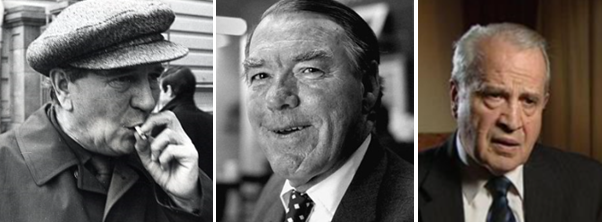
Left to right: Kim Philby (in Moscow after he defected in 1963); 
John Keegan; Victor Cherkashin.

Victor Cherkashin, the KGB’s most successful counter-intelligence officer and American department chief, retired in 1991; then in 2004, after some of his US spies were caught, he published his memoirs. “While the general public clamours for plots about vital issues of national security,” Cherkashin wrote, “most spying has actually made little difference.” Summing up for his side in the last years of the Cold War, Cherkashin said: “intelligence became a game of penetrating the adversary’s service. It was expensive and superfluous.”

The new le Carré tale is forced by a group of MI6 lawyers out of Peter Guillam, one of George Smiley’s old agents, summoned from retirement on his Breton farm and required to pay £50 per day out of his own pension for a London bedsit during his interrogations. There is only one joke in the story, and that’s an inside one. As he sits in a waiting-room at headquarters, Guillam says to himself: “I thumb a grimy copy of Private Eye and wonder which of us has lost our sense of humour.”

The lawyers are trying to assemble the government’s defence against a wrongful death compensation lawsuit by the surviving children of two agents. One of them, the Smiley agent Alec Leamas, had been shot by East German border guards at the Berlin Wall; the other, an East German woman code-named Tulip, was murdered by a Stasi agent inside the compound of an MI6 safe house near Salisbury (yes, it’s Skripal country where enemy assassins still roam free).

Both of them had been betrayed by one of Smiley’s British colleagues. The details were covered up, and the files removed from the MI6 archive, in order to protect the Stasi assassin. In return, he betrayed his German and Russian agents until the KGB tumbled to him, and he got his deserts.

“What follows is a truthful account , as best I am able to provide it,” Guillam and le Carré open the book, “of my role in the British deception operation, codenamed Windfall.”

Truthfulness is Guillam’s French side; deception is British. Possibly the only leg up which the British services still think they have over their partners against their common adversary.

Le Carré condemns the idea, and he’s been doing that in the Smiley series since 1961. He gives Smiley the semi-final word.

“We were not pitiless, Peter. We were never pitiless. We had the larger pity. Arguably, it was misplaced. Certainly it was futile. We know that now. We did not know it then.”

Le Carré then lets Smiley lower the Union Jack. “Why did I do them?… was it all in the great name of capitalism? God forbid. Christendom? God forbid again…So was it all for England There was a time, of course there was. But whose England?… I’m a European, Peter. If I had a mission—if I was ever aware of one beyond our business with the enemy, it was to Europe. If I was heartless, I was heartless for Europe. If I had an unattainable ideal, it was of leading Europe out of her darkness towards a new age of reason.”

To make sure readers know that Smiley isn’t running a deception operation for Brexit (or is it Remain?), le Carré starts the book himself with an epigraph from one of the foggiest Germans of them all. “Every man is born as many men and dies as a single one – Heidegger (attrib).” By (attrib) le Carré is admitting he doesn’t know for certain. Le Carré readers appear to need the reassurance of doubt repeated over and over again.

Killing Palestine's Future: The Death of Teen Medic, Sajed Mizher

Al-Haq Refutes Israeli Army and Media Claims on the Killing of Volunteer First Responder Sajed Mizher in Dheisheh Refugee Camp

by Al-Haq


April 8,2019
 
On 27 March 2019, the Israeli occupying forces killed 17-year-old Palestinian citizen, Sajed Abd Al-Hakim Hilmi Mizher, a volunteer first responder with the Palestinian Medical Relief Society (PMRS).

Sajed Mizher was fatally shot by the Israeli occupying forces while he was on duty tending to the injured during confrontations between Palestinian youth and Israeli soldiers in Dheisheh Refugee Camp, south of Bethlehem, in the occupied West Bank.

Since Wednesday, 27 March 2019, Al-Haq has carried out comprehensive field investigations into the killing of Sajed Mizher, having collected sworn affidavits from eyewitnesses, prepared a field report of the incident, and collected images and other relevant documents on the case.

This report outlines the facts of the killing, as documented by Al-Haq, and provides contextual information collected in relation to the victim, while it further details the distortion of the truth by the Israeli occupying authorities in relation to alleged footage of the killing distributed by the Israeli army and media, and sheds light on Al-Haq’s conclusions as a result of its detailed documentation and follow-up.

To read Al-Haq's full special report, please click here.


Monday, April 08, 2019

Protecting WikiLeaks' Messenger

Protecting Julian Assange: A Must for People Of Conscience

by Kim Petersen, Dissident Voice 

via Popular Resistance

April 7, 2019

A high-level source within the Ecuadorian state has told Wikileaks that Julian Assange will be expelled within ‘hours to days.’  — WikiLeaks on Twitter.

The Mueller investigation of an alleged collusion between Donald Trump and Russia to influence the outcome of the 2016 presidential election has come to its drawn-out end — or not. US monopoly media reported incessantly on the affair, dubbed Russiagate, despite the paucity of evidence.

The monopoly media has apparently learned little from its misreporting of the possession of WMD by the Saddam Hussein government in Iraq. The wording “alleged” was absent from the reporting as were the WMD in Iraq. Nonetheless, such monopoly media reporting of alleged acts as though they were facts has continued over the use of poison gas by the Assad government in Syria and an assassination attempt on the Skripals in England, attributed to Russian agents. Having not learned, the New York Times and Washington Post seek to perpetuate the Mueller “Witch Hunt,” as Trump has ridiculed it.

In an age when educational institutions call for sharpening critical thinking skills, the corporate and state media scribes show a paucity of critical thinking. It should be apparent that when a journalist, anchor, reporter reports on a claim s/he has an immediate first duty to verify factuality by demanding evidence to back any claims. Do these media people purchase bridges in Brooklyn without checking the deed of ownership?

This media disinformation can have serious consequences, even criminal or genocidal consequences. The monopoly media was heavily complicit in bolstering the US government rush-to-war, basing its reporting on false stories and dubious sources. The war which claimed perhaps upwards of a million Iraqi lives1 was argued to be a genocide by Abdul Haq al-Ani and Tarik al-Ani in their legal tour de force: Genocide in Iraq: The Case against the UN Security Council and Member States (Clarity Press).

In their book, the authors make known the destruction of critical infrastructure (e.g., Iraqi power systems, roads, railroads, and domestic petroleum production) and the commission of war crimes (e.g., bombing civilian defense shelters) by the US and its collaborators.2

Wikileaks published evidence of the war crimes carried out in Iraq when it released the “Collateral Murder” video of US military in an Apache helicopter shooting an unarmed group of adults and children. Julian Assange is the founder of Wikileaks, and as such has been identified as an enemy of the governmental-media-military industrial complex. Sexual allegations were raised against Assange in Sweden, but he was never charged, and the case was closed by Sweden. Assange was on record as willing to go to Sweden and face the allegations, but he could not receive a guarantee that he would not be turned over to the United States. Britain keeps him confined to the Ecuadorian Embassy, what a United Nations panel calls “arbitrary detention,” with the threat of arrest and likely extradition.

I wrote an article last summer that cited reports that Ecuador’s president Lenín Moreno was about to renege on asylum that the government of previous Ecuadorian president Rafael Correa had granted Assange.

Now the specter of Assange being evicted from the Ecuadorian embassy is again at the forefront of the news. The Associated Press wrote that Moreno complained that WikiLeaks was intercepting his communications and invading his privacy. Importantly, AP noted that Moreno provided no evidence for his claims.

WikiLeaks
BREAKING: A high level source within the Ecuadorian state has told @WikiLeaks that Julian Assange will be expelled within "hours to days" using the offshore scandal as a pretext--and that it already has an agreement with the UK for his arrest.https://defend.wikileaks.org/2019/04/03/ecuador-twists-embarrassing-ina-papers-into-pretext-to-oust-assange/ 
9,050

Ecuador twists embarrassing INA Papers into pretext to oust Assange - Defend WikiLeaks

Ecuador twists embarrassing INA Papers into pretext to oust Assange On 26 March, WikiLeaks’ Twitter account announced that President Moreno is being investigated by Ecuador’s Congress for corruption,...
defend.wikileaks.org

Wikileaks issued a tweet: “BREAKING: A high level source within the Ecuadorian state has told @WikiLeaks that Julian Assange will be expelled within “hours to days” using the #INAPapers offshore scandal as a pretext–and that it already has an agreement with the UK for his arrest.”

Assange’s “great crime” is revealing the crimes of the US empire. War is peace. And revealing the crimes of the Empire is deemed criminal by Empire.

Others, not beholden to Empire, but followers-of-conscience are indebted to Assange who as a publisher, performed a massive service to humanity by informing people about acts their governments are involved in, support, or are silent about. WikiLeaks respects “our” right to know. It allows us to know of corruption and criminality in our governments so that society can organize to denounce and put an end to such corruption and criminality.

Nobel Peace Prize laureate Mairead Maguire recognized such service when she wrote the Nobel Peace Committee to nominate Assange:

"Julian Assange and his colleagues in Wikileaks have shown on numerous occasions that they are one of the last outlets of true democracy and their work for our freedom and speech. Their work for true peace by making public our governments’ actions at home and abroad has enlightened us to their atrocities carried out in the name of so-called democracy around the world.
"This included footage of inhumanity carried out by NATO/Military, the release of email correspondence revealing the plotting of regime change in Eastern Middle countries, and the parts our elected officials paid in deceiving the public. This is a huge step in our work for disarmament and nonviolence worldwide."

After criticism for awarding the prize to dubious types such as Barack Obama, the Norwegian Nobel Committee is being pressured from Nobel Peace Prize Watch to adhere to Alfred Nobel’s testament and his anti-militarism. Such an award may be the Nobel committee’s greatest opening to celebrate Alfred Nobel’s legacy and garner new luster for the Nobel Peace Prize’s tarnished reputation.

A Nobel Peace Prize should confer some kind of protection and immunity from further political persecution should Assange leave or be forced to vacate the Ecuadorian embassy — should it not? What kind of embassy would kick out a Nobel Peace Prize winner? And would Britain arrest a current Nobel Peace Prize winner? And would the Trump administration seek to persecute a Nobel Peace Prize winner given that Trump has been pining for his own Nobel, risible as that sounds.

Despite Assange’s sacrifice to humanity, he has ruffled the feathers of the power structure. Again, it is clear that Assange must be protected. The Nobel committee must come through for humanity and for peace.

People power needs to mobilize. If people care deeply about their right to be informed, to be apprised of their government partaking in war crimes, then millions must take to the streets and squares, especially in Norway and Britain.


Notes:
John Hopkins University epidemiologists corroborated an initial study and in the second study reported “654,965 additional deaths in Iraq between March 2003 and July 2006.” [1]
See review. [2]

Kim Petersen is a former co-editor of the Dissident Voice newsletter. He can be reached at: kimohp@gmail.com. Twitter: @kimpetersen.
Read other articles by Kim.