Wednesday, January 16, 2019

Mort ou Vif: Can French Democracy Survive Macron?


French Democracy Dead or Alive?

by Diana Johnstone - UNZ Review


9 January 2019  

Paris, France - French Democracy Dead or Alive? Or perhaps one should say, buried or revived? Because for the mass of ordinary people, far from the political, financial, media centers of power in Paris, democracy is already moribund, and their movement is an effort to save it.

Ever since Margaret Thatcher decreed that “there is no alternative”, Western economic policy is made by technocrats for the benefit of financial markets, claiming that such benefits will trickle down to the populace.

The trickle has largely dried up, and people are tired of having their needs and wishes totally ignored by an elite who “know best”.

President Emmanuel Macron’s New Year’s Eve address to the nation made it perfectly clear that after one unconvincing stab at throwing a few crumbs to the Gilets Jaunes (Yellow Vests) protest movement, he has determined to get tough

France is entering a period of turmoil. The situation is very complex, but here are a few points to help grasp what this is all about. 

The METHODS


The Yellow Vests gather in conspicuous places where they can be seen: the Champs-Elysées in Paris, main squares in other cities towns, and the numerous traffic circles on the edge of small towns. Unlike traditional demonstrations, the Paris marches were very loose and spontaneous, people just walking around and talking to each other, with no leaders and no speeches.

The absence of leaders is inherent in the movement. All politicians, even friendly ones, are mistrusted and no one is looking for a new leader.

People are organizing their own meetings to develop their lists of grievances and demands.

In the village of Commercy, Lorraine, a half hour drive from Domrémy where Jeanne d’Arc was born, inhabitants gather to read their proclamation. Six of them read in turns, a paragraph each, making it quite clear that they want no leaders, no special spokesperson. They sometimes stumble over a word, they are not used to speaking in public like the TV talking heads. Their “Second appeal of the Gilets Jaunes de Commercy invites others to come to Commercy on January 26-27 for an “assembly of assemblies”.


The DEMANDS


The people who first went out in the streets wearing Yellow Vests last November 17 were ostensibly protesting against a hike in gasoline and diesel taxes that would hit people in rural France the hardest. Obsessed with favoring “world cities”, the French government has taken one measure after another at the expense of small towns and villages and the people who live there. That was just the last straw. The movement rapidly moved on to the basic issue: the right of the people to have a say in measures taken that affect their lives. Democracy, in a word.

For decades, parties of the left and of the right, whatever their campaign speeches, once in office pursue policies dictated by “the markets”. For this reason, people have lost confidence in all parties and all politicians and are demanding new ways to get their wishes heard.

The fuel tax was soon forgotten as the list of demands grew longer. Critics of the movement note that achieving so many demands is quite impossible. It’s no use paying attention to popular demands, because the silly people ask for everything and its opposite.

That objection is answered by what has quickly emerged as the single overriding demand of the movement: the Citizens’ Initiative Referendum (CIR). 

The REFERENDUM


This demand illustrates the good sense of the movement. Rather than making a “must” list, the GJ merely ask that the people be allowed to choose, and the referendum is the way to choose. The demand is for a certain number of signatories – perhaps 700,000, perhaps more – to gain the right to call a referendum on an issue of their choice. The right to a CIR exists in Switzerland, Italy and California. The idea horrifies all those whose profession it is to know best. If the people vote, they will vote for all sorts of absurd things, the better-knowers observe with a shudder.

A modest teacher in a junior college in Marseilles, Etienne Chouard, has been developing for decades ideas on how to organize direct democracy, with the referendum at its center. His hour has come with the Yellow Vests. He insists that a referendum must always be held after a long debate and time for reflection, to avoid emotional spur-of-the-moment decisions. Such a referendum requires honest, independent media which are not all owned by special interests. It requires making sure that politicians who make the laws follow the popular will expressed in the referendum. All this suggests the need for a people’s constitutional convention.

The referendum is a bitter point in France, a powerful silent underlying cause of the whole Gilets Jaunes movement. In 2005, President Chirac (unwisely from his point of view) called for a popular referendum on ratification of the proposed Constitution of the European Union, certain it would be approved. The political class, with a few exceptions, went into full rhetoric, claiming a prosperous future as a new world power under the new Constitution and warning that otherwise Europe might be plunged back into World Wars I and II.

However, ordinary citizens organized an extraordinary movement of popular self-education, as groups met to pour through the daunting legalistic documents, elucidating what they meant and what they implied. On May 29, 2005, with a turnout of 68%, the French voted 55% to reject the Constitution. Only Paris voted heavily in favor.

Three years later, the National Assembly – that is, politicians off all parties – voted to adopt virtually the same text, which in 2009 became the Treaty of Lisbon.

That blow to the clearly expressed popular will produced such disillusion that many backed helplessly away from politics. Now they are coming back. 

The VIOLENCE


From the start, the government has reacted with violence, in an apparent desire to provoke responding violence in order to condemn the movement as violent.


An army of police, dressed like robots, have surrounded and blocked 
groups of peaceful Yellow Vests, drowning them in clouds of teargas and 
firing flash balls directly at protesters, seriously wounding hundreds 
(no official figures). A number of people have lost an eye or a hand. 
The government has nothing to say about this.

On the third Saturday of protest, this army of police was unable to stop – or under orders to allow – a large number of hoodlums or Black Blocs (who knows?) to infiltrate the movement and smash property, vandalize shops, set fire to trash cans and parked cars, providing the world media with images proving that the Yellow Vests are dangerously violent.

Despite all this provocation, the Gilets Jaunes have remained remarkably calm and determined. But there are bound to be a few people who lose their tempers and try to fight back. 

The BOXER


On the 8th Saturday, January 5, a squad of plexiglass-protected police were violently attacking Gilets Jaunes on a bridge over the Seine when a big guy lost his temper, emerged from the crowd and went on the attack. With his fists, he beat down one policeman and caused the others to retreat. This amazing scene was filmed. You could see Yellow Vests trying to hold him back, but Rambo was unstoppable.

It turned out that this was Christophe Dettinger, a French Rom, former light heavyweight boxing champion of France. His nickname is “the Gypsy of Massy”. He got away from the scene, but made a video before turning himself in. “I reacted badly”, he said, when he saw police attacking women and other defenseless people. He urged the movement to go ahead peacefully.


Dettinger faces seven years in prison. Within a day, his defense fund 
had gathered 116,433 euros. The government shut it down – 
on what legal pretext I don’t know. Now a petition circulates on his behalf. 


The SLANDER


In his New Year’s Eve address, Macron patronizingly scolded his people telling them that “you can’t work less and earn more” – as if they all aspired to spending their lives lounging on a yacht and watching stock prices rise and fall.

Then he issued his declaration of war:

“These days I have seen unthinkable things and heard the unacceptable.”
Apparently alluding to the few opposition politicians who dare sympathize with the protesters, he chastised those who pretend to “speak for the people”, but are only the “spokesmen for a hateful mob going after elected representatives, police, journalists, Jews, foreigners and homosexuals. It is simply the negation of France.”

The Gilets Jaunes haven’t been “going after” anybody. The police have been “going after” them. People have indeed spoken up vigorously against camera crews of channels that systematically distort the movement. Not a word has been heard from the movement against foreigners or homosexuals. The key word is Jews.

Qui veut noyer son chien l’accuse de la rage. (French proverb).


As the French saying goes, whoever wants to drown his dog claims he has rabies. Today whoever wants to ruin a career, take vengeance on a rival, disgrace an individual or destroy a movement accuses her, him, or it of antisemitism.

So, faced with a rising democratic movement, playing the “antisemitism” card was inevitable. It was almost a sure thing statistically. In almost any random batch of hundreds of thousands of people, you might find one or two who have something negative to say about a Jew. That’ll do it. The media hawks are on the outlook. The slightest incident can be used to suggest that the real motive of the movement is to revive the Holocaust.

This gently ironic little song, performed on one of France’s traffic circles, contrasts the “nice” establishment with the “bad” ordinary folk. It is a huge hit on YouTube. It gives the tone of the movement. Les Gentils et les Méchants.


It didn’t take long for this merry number to be accused of antisemitism. Why? Because it was ironically dedicated to two of the very most virulent critics of the Gilets Jaunes: May ’68 star Daniel Cohn-Bendit and old “new philosopher” Bernard-Henri Lévy. The new generation can’t stand them. But wait, they happen to be Jewish. Aha! Anti-Semitism! 


The REPRESSION


Faced with what government spokesman Benjamin Griveaux described as “agitators” and “insurrectionists” who want to “overthrow the government”, Prime Minister Edouard Philippe announced a new “law to better protect the right to demonstrate”. Its main measure: heavily punish organizers of a demonstration whose time and place have not had official approval.

In fact, the police had already arrested 33-year-old truck driver Eric Drouet for organizing a small candle ceremony in honor of the movement’s casualties. There have been many other arrests, with no information coming out about them. (Incidentally, over the holidays, hoodlums in the banlieues of several cities carried out their ritual burning of parked cars, with no particular publicity or crackdown. Those were cars of working class people who need them to go to work, not the precious cars in the rich section of Paris whose destruction caused such scandal.)

On January 7, Luc Ferry, a “philosopher” and former Minister of Youth, Education and Research, gave a radio interview on the very respectable Radio Classique in which he declared:

“The police are not given the means to end this violence. It’s unbearable. Listen, frankly, when you see guys kick a poor policemen when he’s down, that’s enough! Let them use their arms once and for all, basta! […] As I recall, we have the world’s fourth army, capable of putting an end to this garbage.”

Ferry called on Macron to make a coalition with the Republicans in order to push through his “reforms”.

Last month, in a column against the Citizens’ Initiative Referendum, Ferry wrote that “the current disparaging of experts and criticism of elitism is the worst calamity of our times.” 

The ANTIFA


Wherever people gather, Antifa groups may pursue their indiscriminate search to root out “fascists”. In Bordeaux last Saturday, Yellow Vests had to fight off an attack by Antifa.

It is now completely clear (as indeed it always has been) that the self-styled “Antifascists” are the watch dogs of the status quo. In their tireless search for “fascists”, the Antifa attack anything that moves. In effect, they protect stagnation. And curiously enough, Antifa violence is tolerated by the same State and the same police who insult, attack and arrest more peaceful demonstrators. In short, the Antifa are the storm troopers of the current system. 

The MEDIA


Be skeptical. At least in France, mainstream media are solidly on the side of “order”, meaning Macron, and foreign media tend to echo what national media write and say. Also, as a general rule, when it comes to France, the Anglophone media often get it wrong. 

The END


It is not in sight. This may not be a revolution, but it is a revelation of the real nature of “the system”. Power lies with a technocracy in the service of “the Markets”, meaning the power of finance capital. This technocracy aspires to remake human society, our own societies and those all over the planet, in the interests of a certain capitalism. It uses economic sanctions, overwhelming propaganda and military force (NATO) in a “globalization” project that shapes people’s lives without their consent.

Macron is the very embodiment of this system. He was chosen by that famous elite to carry through the measures dictated by “the Markets”, enforced by the European Union. He cannot give in. But now that people are awake to what is going on, they won’t stop either. For all the lamented decline in the school system, the French people today are as well-educated and reasonable as any population can be expected to be. If they are incapable of democracy, then democracy is impossible.

To be continued…

Gorilla Radio with Chris Cook, Dave Lindorff, David Swanson, Janine Bandcroft January 17, 2019

This Week on GR

by C. L. Cook - Gorilla-Radio.com


January 17, 2019

Last month, Philadelphia Judge Leon Tucker ruled, in part, favourably in a two year-old plea by Mumia Abu-Jamal's legal team. They had argued, a U.S. Supreme Court Justice presiding over a previous appeal should have recused himself.

Abu-Jamal has spent nearly 40 years in prison for the 1981 murder of Philly police officer, Daniel Faulkner; a charge he has always denied. The case has, from the beginning, been politically charged and fraught with procedural irregularities.

Further to those, just days after Judge Tucker's ruling, the Philadelphia District Attorney's office "discovered" six crates of evidence that has for years, they say, lay hidden in the back of a disused storeroom.

Listen. Hear.

Lawyers and activists are excited now by the possibility those crates may contain material that could see Mumia freed.

Dave Lindorff is a Philadelphia-based investigative journalist and author. Lindorff's covered the Abu-Jamal case extensively, and wrote the book, 'Killing Time: An Investigation into the Death Row Case of Mumia Abu-Jamal. Lindorff is too founder of the multi-award-winning news website, This Can't Be Happening, where his latest article on the Abu-Jamal case, 'A Potentially Tectonic Event Shakes up the Mumia Abu-Jamal Case' appears.

Dave Lindorff in the first half.

And; does the World really need another celebration of war and warmakers? The good folks over at NATO think so, and they're busy making preparation for just such an event. April 4th, 2019 marks the 70th anniversary of the multi-nation military alliance. The North Atlantic Treaty Organization has, since its Cold War inception, seen a massive expansion in both its membership and mission statement. Nothing if not resilient, NATO has not only survived, despite losing its raison d'etre rival, the USSR and its Warsaw Pact alliance, but thrived, no longer limiting activities to its titular region but creating "facts on the ground" across the globe.

David Swanson is an author, activist, tireless promoter of pro-peace networks and websites, and co-founder of World Beyond War, an organization making the case for the abolition at last of that ultimate expression of human destructiveness. His book titles include: 'Curing Exceptionalism', 'A Global Security System', 'War Is Never Just', 'War Is a Lie', 'Killing Is Not a Way of Life', 'War No More: The Case for Abolition', and many more.

Swanson is also host of Talk Nation Radio, linked through his website, Let's Try Democracy, where a recent article dissects the myths and reveals the realities behind the organization that would have your anniversary cheers.

David Swanson and the 'Top 10 Reasons Not to Love NATO' in the second half.

And; Victoria-based activist and long-time Gorilla Radio contributor, Janine Bandcroft will be here at the bottom of the hour with the Left Coast Events Bulletin of some of the good things to be gotten up to in and around our town in the coming week. But first, Dave Lindorff and can the beginning of the end of Mumia Abu-Jamal's long imprisonment be happening?

Chris Cook hosts Gorilla Radio, airing live every Thursday between 11-Noon Pacific Time. In Victoria at 101.9FM, and on the internet at: http://cfuv.uvic.ca.  He also serves as a contributing editor to the web news site, http://www.pacificfreepress.com. Check out the GR blog at: http://gorillaradioblog.blogspot.ca/

Tuesday, January 15, 2019

Say No to NATO: Ten Steps to Leaving War Alliance

Top 10 Reasons Not to Love NATO

by David Swanson - Let's Try Democracy


January 15, 2019

The New York Times loves NATO, but should you? 

Judging by comments in social media and the real world, millions of people in the United States have gone from having little or no opinion on NATO, or from opposing NATO as the world’s biggest military force responsible for disastrous wars in places like Afghanistan (for Democrats) or Libya (for Republicans), to believing NATO to be a tremendous force for good in the world.

I believe this notion to be propped up by a series of misconceptions that stand in dire need of correction.


1. NATO is not a war-legalizing body, quite the opposite


NATO, like the United Nations, is an international institution that has something or other to do with war, but transferring the UN’s claimed authority to legalize a war to NATO has no support whatsoever in reality. The crime of attacking another nation maintains an absolutely unaltered legal status whether or not NATO is involved. Yet NATO is used within the U.S. and by other NATO members as cover to wage wars under the pretense that they are somehow more legal or acceptable. This misconception is not the only way in which NATO works against the rule of law. Placing a primarily-U.S. war under the banner of NATO also helps to prevent Congressional oversight of that war. Placing nuclear weapons in “non-nuclear” nations, in violation of the Nonproliferation Treaty, is also excused with the claim that the nations are NATO members (so what?). And NATO, of course, assigns nations the responsibility to go to war if other nations go to war — a responsibility that requires them to be prepared for war, with all the damage such preparation does.

2. NATO is not a defensive institution


According to the New York Times, NATO has “deterred Soviet and Russian aggression for 70 years.” This is an article of faith, based on the unsubstantiated belief that Soviet and Russian aggression toward NATO members has existed for 70 years and that NATO has deterred it rather than provoked it. In violation of a promise made, NATO has expanded eastward, right up to the border of Russia, and installed missiles there. Russia has not done the reverse. The Soviet Union has, of course, ended. NATO has waged aggressive wars far from the North Atlantic, bombing Bosnia and Herzegovina, Kosovo, Serbia, Afghanistan, Pakistan, and Libya. NATO has added a partnership with Colombia, abandoning all pretense of its purpose being in the North Atlantic. No NATO member has been attacked or credibly threatened with attack, apart from small-scale non-state blowback from NATO’s wars of aggression.

3. Trump is not trying to destroy NATO


Donald Trump, as a candidate and as U.S. President, has wondered aloud and even promised all kinds of things and, in many cases, the exact opposite as well. When it comes to actions, Trump has not taken any actions to limit or end or withdraw from NATO. He has demanded that NATO members buy more weapons, which is of course a horrible idea. Even in the realm of rhetoric, when European officials have discussed creating a European military, independent of the United States, Trump has replied by demanding that they instead support NATO.

4. If Trump were trying to destroy NATO, that would tell us nothing about NATO


Trump has claimed to want to destroy lots of things, good and bad. Should I support NAFTA or corporate media or the Cold War or the F35 or anything at all, simply because some negative comment about it escapes Trump’s mouth? Should I cheer for every abuse ever committed by the CIA or the FBI because they investigate Trump? Should I long for hostility between nuclear-armed governments because Democrats claim Trump is a Russian agent? When Trump defies Russia to expand NATO, or to withdraw from a disarmament treaty or from an agreement with Iran, or to ship weapons to Ukraine, or to try to block Russian energy deals in Europe, or to oppose Russian initiatives on banning cyber-war or weapons in space, should I cheer for such consistent defiance of Trump’s Russian master, and do so simply because Russia is, so implausibly, his so-inept master? Or should I form my own opinion of things, including of NATO?

5. Trump is not working for, and was not elected by, Russia


According to the New York Times, “Russia’s meddling in American elections and its efforts to prevent former satellite states from joining the alliance have aimed to weaken what it views as an enemy next door, the American officials said.” But are anonymous “American officials” really needed to acquire Russia’s openly expressed opinion that NATO is a threatening military alliance that has moved weapons and troops to states on Russia’s border? And has anyone produced the slightest documentation of the Russian government’s aims in an activity it has never admitted to, namely “meddling in American elections,” — an activity the United States has of course openly admitted to in regard to Russian elections? We have yet to see any evidence that Russia stole or otherwise acquired any of the Democratic Party emails that documented that party’s rigging of its primary elections in favor of Clinton over Sanders, or even any claim that the tiny amount of weird Facebook ads purchased by Russians could possibly have influenced the outcome of anything. Supposedly Trump is even serving Russia by demanding that Turkey not attack Kurds. But is using non-military means to discourage Turkish war-making necessarily the worst thing? Would it be if your favorite party or politician did it? If Trump encouraged a Turkish war, would that also be a bad thing because Trump did it, or would it be a bad thing for substantive reasons?

6. If Trump were elected by and working for Russia, that would tell us nothing about NATO


Imagine if Boris Yeltsin were indebted to the United States and ended the Soviet Union. Would that tell us whether ending the Soviet Union was a good thing, or whether the Soviet Union was obsolete for serious reasons? If Trump were a Russian pawn and began reversing all of his policies on Russia to match that status, including restoring his support for the INF Treaty and engaging in major disarmament negotiations, and we ended up with a world of dramatically reduced military spending and nuclear armaments, with the possibility of all dying in a nuclear apocalypse significantly lowered, would that too simply be a bad thing because Trump?

7. Russia is not a military threat to the world


That Russia would cheer NATO’s demise tells us nothing about whether we should cheer too. Numerous individuals and entities who indisputably helped to put Trump in the White House would dramatically oppose and others support NATO’s demise. We can’t go by their opinions either, since they don’t all agree. We really are obliged to think for ourselves. Russia is a heavily armed militarized nation that commits the crime of war not infrequently. Russia is a top weapons supplier to the world. All of that should be denounced for what it is, not because of who Russia is or who Trump is. But Russia spends a tiny fraction of what the United States does on militarism. Russia has been reducing its military spending each year, while the United States has been increasing its military spending. U.S. annual increases have sometimes exceeded Russia’s entire military budget. The United States has bombed nine nations in the past year, Russia one. The United States has troops in 175 nations, Russia in 3. Gallup and Pew find populations around the world viewing the United States, not Russia, as the top threat to peace in the world. Russia has asked to join NATO and the EU and been rejected, NATO members placing more value on Russia as an enemy. Anonymous U.S. military officials describe the current cold war as driven by weapons profits. Those profits are massive, and NATO now accounts for about three-quarters of military spending and weapons dealing on the globe.

8. Crimea has not been seized


According to the New York Times, “American national security officials believe that Russia has largely focused on undermining solidarity between the United States and Europe after it annexed Crimea in 2014. Its goal was to upend NATO, which Moscow views as a threat.” Again we have an anonymous claim as to a goal of a government in committing an action that never occurred. We can be fairly certain such things are simply made up. The vote by the people of Crimea to re-join Russia is commonly called the Seizure of Crimea. This infamous seizure is hard to grasp. It involved a grand total of zero casualties. The vote itself has never been re-done. In fact, to my knowledge, not a single believer in the Seizure of Crimea has ever advocated for re-doing the vote. Coincidentally, polling has repeatedly found the people of Crimea to be happy with their vote. I’ve not seen any written or oral statement from Russia threatening war or violence in Crimea. If the threat was implicit, there remains the problem of being unable to find Crimeans who say they felt threatened. (Although I have seen reports of discrimination against Tartars during the past 4 years.) If the vote was influenced by the implicit threat, there remains the problem that polls consistently get the same result. Of course, a U.S.-backed coup had just occurred in Kiev, meaning that Crimea — just like a Honduran immigrant — was voting to secede from a coup government, by no means an action consistently frowned upon by the United States.

9. NATO is not an engaged alternative to isolationism


The notion that supporting NATO is a way to cooperate with the world ignores superior non-deadly ways to cooperate with the world. A nonviolent, cooperative, treaty-joining, law-enforcing alternative to the imperialism-or-isolationism trap is no more difficult to think of or to act on than treating drug addiction or crime or poverty as reason to help people rather than to punish them. The opposite of bombing people is not ignoring them. The opposite of bombing people is embracing them. By the standards of the U.S. communications corporations Switzerland must be the most isolationist land because it doesn’t join in bombing anyone. The fact that it supports the rule of law and global cooperation, and hosts gatherings of nations seeking to work together is simply not relevant.

10. April 4 belongs to Martin Luther King, Jr., not militarism


War is a leading contributor to the growing global refugee and climate crises, the basis for the militarization of the police, a top cause of the erosion of civil liberties, and a catalyst for racism and bigotry. A growing coalition is calling for the abolition of NATO, the promotion of peace, the redirection of resources to human and environmental needs, and the demilitarization of our cultures.

Instead of celebrating NATO’s 70th anniversary, we’re celebrating peace on April 4, in commemoration of Martin Luther King Jr.’s speech against war on April 4, 1967, as well as his assassination on April 4, 1968.

Mumia Abu Jamal's Enduring Appeal

Court Decision Likely Win for Mumia, Says his Former Lawyer

by TRNN

Mumia’s former lawyer Rachel Wolkenstein gives clarity to new events in Mumia Abu-Jamal’s case, whereby Mumia has been granted appeal rights.

Maddow to the Fore: Facts First to Fall in Memory War

Don’t Speak, Memory: Resistance Apes Trump in Weaponizing Amnesia

by Chris Floyd - Empire Burlesque


05 January 2019

Making the social media rounds at the moment is a transcription of Rachel Maddow’s “utterly terrifying” and “deeply chilling” take on one tidbit from Trump’s surreal and probably drug-addled rambling in front of his Cabinet this week.

At one point, Trump said the Soviet Union invaded Afghanistan in order to fight Islamic terrorism.

But Maddow assures us, in great detail, that no one, anywhere — not even among Trump’s most rabid supporters, not even the bug-eyed goobers on Fox and Friends — has ever advanced the notion that the Soviet incursion had anything to do with terrorism.

In fact, the only place in the history of the world in which this notion has ever been bruited is — of course — Putin’s Kremlin, which is planning an official “reassessment” of the Afghan invasion. (Which, rest assured, is not at all like the “reassessment” being done by our stalwart Resisters today of the murderously criminal regime of George W. Bush.)

Maddow says plainly that this idea does not exist anywhere "in nature" except within the bowels of Putin’s United Russia party. (Though how Maddow herself found out about the proposed resolution when no one else in nature could have ever even heard of it outside of Putin’s party circles is not explained.)

This notion cannot be found anywhere “in American politics, in American media, in American academia, in American fantasy football chat rooms.” Not even “among weird, conservative fringe media figures that you might not know about, but the President might love.” No one has ever written, spoken or heard anything remotely like this until it was cooked up by Putin’s party hacks. And you should be absolutely, utterly, deeply terrified that Trump has somehow got hold of a mangled, drug-addled version of this idea, because he could have only gotten it from Putin’s own party members. Because, again the idea does not exist in nature anywhere else. And Maddow knows this, people, because she spent one whole day looking to find some trace of this non-existent in nature idea! And if you aren’t absolutely chilled to the bone, to the marrow, chilled all the way down to your quantum particles by this, then God help you. You must be a Kremlin dupe, like those Black Lives Matter rubes or those Dakota Pipeline saps. Or a paid Kremlin stooge.

Yet if I may paraphrase the great Ronald Reagan — whom that fightin’ progressive Nancy Pelosi favourably cited in her first speech as Speaker this week — facts are stubborn things. They exist, and persist, whether anyone notices them or not. And the fact that Afghanistan's jihadi extremists were sowing chaos with acts of violence (which in our day we call terrorism but back then were called "freedom fighting"), and that this chaos was exacerbating the turmoil in the faction-ridden Soviet-backed secular government and was a factor in the Kremlin’s tortured decision to intervene, was once considered rather standard fare back in the distant days before history was displaced by hysteria.

When the Soviets went in, their claim that the US was backing Islamic terrorists was widely dismissed as empty propaganda. But it was later confirmed, cheerfully, by the very architect of that policy, Zbigniew Brzezinski, who told Le Nouvel Observateur in 1998 that he persuaded Jimmy Carter to secretly arm and support the jihadis precisely in hopes of provoking a Soviet incursion. Here's what Brzezinski had to say:

Question: The former director of the CIA, Robert Gates, stated in his memoirs that the American intelligence services began to aid the Mujahiddin in Afghanistan six months before the Soviet intervention. Is this period, you were the national security advisor to President Carter. You therefore played a key role in this affair. Is this correct?

Brzezinski: Yes. According to the official version of history, CIA aid to the Mujahiddin began during 1980, that is to say, after the Soviet army invaded Afghanistan on December 24, 1979. But the reality, closely guarded until now, is completely otherwise: Indeed, it was July 3, 1979 that President Carter signed the first directive for secret aid to the opponents of the pro-Soviet regime in Kabul. And that very day, I wrote a note to the president in which I explained to him that in my opinion this aid was going to induce a Soviet military intervention.

Q: Despite this risk, you were an advocate of this covert action. But perhaps you yourself desired this Soviet entry into the war and looked for a way to provoke it?

B: It wasn’t quite like that. We didn’t push the Russians to intervene, but we knowingly increased the probability that they would.

Q: When the Soviets justified their intervention by asserting that they intended to fight against secret US involvement in Afghanistan, nobody believed them. However, there was an element of truth in this. You don’t regret any of this today?

B: Regret what? That secret operation was an excellent idea. It had the effect of drawing the Russians into the Afghan trap and you want me to regret it? The day that the Soviets officially crossed the border, I wrote to President Carter, essentially: “We now have the opportunity of giving to the USSR its Vietnam war." Indeed, for almost 10 years, Moscow had to carry on a war that was unsustainable for the regime, a conflict that bought about the demoralization and finally the breakup of the Soviet empire.

Q: And neither do you regret having supported Islamic fundamentalism, which has given arms and advice to future terrorists?

B: What is more important in world history? The Taliban or the collapse of the Soviet empire? Some agitated Moslems or the liberation of Central Europe and the end of the cold war?

This is not to say that the Soviets should have intervened in Afghanistan, as Trump was ignorantly asserting the other day. Indeed, the intervention was fiercely contested inside the Kremlin itself, by future leader Andropov among others, but the opponents were overruled by more hardline militarists. (The Politburo PNAC, you might say.) Nor would any knowledgeable person say that the sole reason the Soviets went in was to “fight terrorism" (which is what Putin's party is apparently getting ready to claim.) But the notion Maddow is pushing here -- that Putin’s Kremlin is the only place anyone has ever mentioned anything remotely resembling the idea that Islamic terrorism was a factor in the Soviet invasion is, to put it mildly, ignorant nonsense.

Of course, Trump is ignorant too, but I’m not concerned here with his obvious incapacities. No, what troubles me most about this episode is the increasing historical amnesia of the “Resistance,” which is reducing complex issues – with long, detailed, nuanced histories – to fearmongering simplicities. How is this going to help us move forward with any kind of informed, substantive wisdom and insight? How is this “progressive”? Why does every single evil in the world — and every single thing that’s wrong with American politics and society — have to be attributed to a conniving little mastermind cackling in the Kremlin? It’s a childish, cartoonish and dangerous way to look at the world — yet increasingly it is the only take that’s given any space in our “liberal” media.

I’ll say again what I’ve said many times: you don’t have to prove that Trump is a puppet dancing on Putin’s strings to get rid of him. Right down the street from the White House is a hotel. Trump owns the hotel and profits directly from it. Every single day of his presidency, he has been corruptly pocketing personal gains from foreign governments and companies who use his hotel. This alone is an impeachable offense. It’s cut and dried. The Democrats now in control of the House could immediately begin impeachment hearings on this basis alone -- if they wanted to.

I’m not saying Russian skullduggery should be ignored, but if even one-tenth of the media energy spent in the last two years trying to prove Trump is getting orders from Putin had been directed at exposing Trump's open, manifest, plainly impeachable corruption (the hotel is just one example), then we might have built a great public groundswell of outrage and disgust that, at the very least, would have taken us much further down the road to impeachment than we are today.

(And as a side issue: if another one-tenth of that energy had been spent building support for abolishing or reforming the Electoral College system, then we would be well on our way to avoiding yet another presidency by vicious right-wing vote-losers like George W. Bush and Trump.)

Anyway, pace Maddow, there were Islamic terrorist groups in Afghanistan (although they were called “freedom fighters” when they were later invited to Reagan’s White House.) They were engaged in wholesale violence that further destabilized an already unstable, badly governed state. The Soviets did point to this as a factor in their disastrous decision to intervene. The United States did covertly support this jihadi uprising before the Soviets moved in, and continued this support throughout the conflict (including, as the Washington Post reported, providing training manuals for terrorist tactics and even schoolbooks for children that promoted jihad against the secular infidels).

All of these facts have been discussed and debated openly and freely in the US media and academia for years. Whole books about the complexities of the Soviet invasion, including these facts, have been written by reputable academics, diplomats and historians. Perhaps Maddow spent too long doing her serious journalistic research in “American fantasy football chat rooms” to avail herself of any of this information. I learned these things from reading readily available mainstream books and articles — some of them published even before Putin was elevated to the Russian presidency by America’s favourite dipsomaniac, Boris Yeltsin. I didn’t get them from Putin party insiders or encrypted Kremlin text messages or even from Facebook memes.

Trump shows us over and over, day after day, that historical facts don’t matter anymore. You say whatever you need to say on any given day to scare and outrage people into turning their brains off. But it’s sad to see the “Resistance” adopting this same attitude and, like Trump, continually reducing the world to a frenzied, fearful cartoon, one which distracts us from the complexities of reality and carries us further away from any kind of genuine change in our woeful situation.

The Hague's Just Findings for Gbagbo

The Hague Comes of Age

by Craig Murray


January 15, 2019

I am delighted by the acquittal of Laurent Gbagbo at the International Criminal Court. As I explained at the time in a series of articles, Gbagbo was ousted as President of Ivory Coast by a corrupt election and an armed insurgency, both funded by Western oil interests, chiefly but not solely by Trafigura plc.

Gbagbo was guilty in western eyes of failing to do what left wing African leaders are supposed to do, allow himself to be quickly butchered and his supporters massacred.

So Gbagbo ended up at the International Criminal Court as a war criminal, while Big Oil’s puppet, Alassane Ouattara, is now comfortably ensconced in the Presidential Palace of Ivory Coast, and getting very rich indeed.

So the acquittal of Gbagbo today – which comes as something of a shock – represents a very important coming of age for the Hague. I have always, as an internationalist, supported the International Criminal Court, but its failure to be pro-active in prosecuting Tony Blair on the Nuremburg aggressive war precedent, and its serial record of convicting only the Western powers’ designated enemies, made it very difficult to defend.

The media, insofar as they have noticed the Gbagbo acquittal, portray it as a failure and an embarrassment for the court, as though the role of a court is simply to declare guilty and bang up everyone before it. In fact this may be the occasion on which the ICC finally came of age and discovered a nodding acquaintance with the concept of justice.

The number of foreign correspondents employed by British newspapers has fallen by over 90% in 20 years. One purpose of this blog is to supply information on countries and situations which I know personally, to which the MSM simply do not pay attention.

It is worth noting that this blog has been campaigning against Chinese persecution of the Uighurs for 12 years before it became the latest fashionable cause or pretext for neo-cons to pretend concern about. Indeed when I started writing about the Uighurs in 2005, I am willing to bet not one of the MSM so-called journalists who have recently churned out copy and paste articles on the subject, had ever heard of them.

In a fortnight’s time I am heading for other areas where the FCO travel advice strongly advises British citizens not to venture.

Remember tonight, there is a world beyond the Brexit debate and the crass and sordid mess of Westminster politics.

Bitter Green: Why Japan Hates China

Why is Japan So Bitter About Unstoppable Rise of China

by Andre Vltchek - Dissident Voice


January 14th, 2019

There used to be a pair of beautiful swings for children, not far from an old rural temple in Mie Prefecture, where I used to frequently power walk, when searching for inspiration for my novels.

Two years ago, I noticed that the swings had gotten rusty, abandoned, and unkempt.

Yesterday, I spotted a yellow ribbon, encircling and therefore closing the structure down. It appears that the decision had already been made to get rid of the playground, irreversibly.

One day earlier, I observed an old homeless man sleeping right under a big sign which was advertising a cluster of luxury eateries at the lavish Nagoya train station.


Abandoned swings Mie Perfecture

And in the city of Yokkaichi, which counts some 350,000 inhabitants, almost all but very few bus lines had disappeared. What had also disappeared was an elegant and unique, shining zodiac, which used to be engraved into the marble promenade right in front of the Kintetsu Line train station, the very center of the city.

The fast ferry across the bay, connecting Yokkaichi with Centrair International Airport that serves Nagoya and in fact almost the entire area of Central Japan, stopped operating, as the municipal subsidies dried up.


Homeless man at Nagoya Station

Now people have to drive some seventy kilometers, all around the bay, burning fuel and paying exorbitant highway tolls and airport parking fees, to make it to their flight. What used to constitute public spaces, or even just rice fields, is rapidly being converted into depressing parking lots. It is happening in Central Japan, but also as far southwest as the city of Nagasaki, and as north as Nemuro.


No more public spaces just parking lots

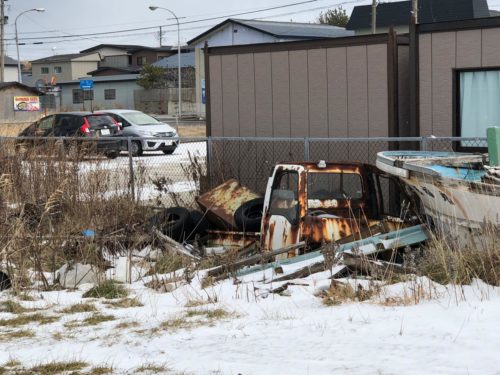
Homeless people are everywhere. Cars (Japan now has more cars per capita than the United States) are rotting in the middle of rice fields and at the edges of once pristine forests, as they lose value rapidly, and it costs a lot of money to get rid of them properly. Entire rural villages are being depopulated, in fact turning into ghost towns. There is rust, bad planning and an acute lack of anything public, all over the country.


Abandoned houses South Mie

Japan is in decay. For many years, it was possible, with half-closed eyes, to ignore it, as the country was due to inertia hanging on to the top spot of the richest nations on Earth. But not anymore: the deterioration is now just too visible.


Oma , Aomori Prefecture

The decay is not as drastic as one can observe in some parts of France, the United States, or the UK. But decay it is. The optimistic, heady days of nation-building are over. The Automobile industry and other corporations are literally cannibalizing the country, dictating its lifestyle. In smaller cities, motorists do not yield on pedestrian crossings anymore.

Cars are prioritized by urban planners, and some urban planners are paid, bribery by the car industry. Many areas can now only be reached by cars. There are hardly any public exercise machines, and almost no new parks. Japan, which prides itself on producing some of the most refined food, is now fully overwhelmed by several chains of convenience stores, which are full of unhealthy foodstuff.


Suburban decay all over Japan

For generations, people were sacrificing their lives in order to build a prosperous, powerful and socially balanced Japan. Now, there is no doubt that the citizens are there mainly to support powerful corporations or in short: big business. Japanese used to have its own and distinct model, but now the lifestyle is not too different from one that could be observed in North America or Europe.

For the second time in its history, Japan has been forced to ‘open to the world’ (read: to Western interests and to the global capitalist economy), and to accept the concepts that used to be thoroughly alien to the Asian culture. The consequences were quick to arrive, and in summary, they have been thoroughly disastrous.

*****

After WWII, Japan had to accept occupation. The Constitution was written by the US. Defeated but determined to rebuild and join the ranks of the richest countries on earth, Japan began collaborating with the West, first supporting the brutal invasion to Korea (the so-called “Korean War”). It totally gave up on its independence, fully surrendering its foreign policy, which gradually became indistinct from that of the United States in particular, and the West in general.

The mass media has been, since the end of the war to now, controlled and censored by the regime in Tokyo. Major Japanese newspapers, as well as the Japanese national broadcaster NHK, would never dare to broadcast or publish any important international news, unless at least one major US or British mainstream media outlet had set the tone and example of how the story should be covered by the mass media in the ‘client’ states. In this respect, the Japanese media is not different from its counterparts in countries such as Indonesia or Kenya.

Japan is also definitely not a ‘democracy’, if ‘democracy’ simply means the rule of the people. Traditionally, Japanese people used to live mainly in order to serve the nation, which was perhaps not such a bad concept. It used to work, at least for the majority. However, now, they are expected to sacrifice their lives solely for the profits of corporations.

People in Japan do not rebel, even when they are robbed by their rulers. They are shockingly submissive.

Japan is not only in decay. It tries to spread its failure like an epidemic. It is actually spreading, and glorifying its submissive, subservient foreign and domestic policies. Through scholarships, it is continuously indoctrinating, and effectively intellectually castrating tens of thousands of willing students from the poor Southeast Asian nations, and other parts of the world.

*****

In the meantime, China, which is literally ‘next door’, is leading in scientific research, in urban planning, and in social policies. With ‘Ecological Civilization’ now part of its Constitution, it is way ahead of Japan in developing alternative sources of energy, public transportation, as well as organic food production. By 2020, there will be no more pockets of extreme poverty on the entire huge territory of China.

And in China, it is all done under the red Communist banners, which the Japanese public has been taught to despise and reject.

Tremendous Chinese determination, zeal, genius and socialist spirit are evidently superior, compared to the sclerotic, conservative and revanchist spirit of modern Japan and of its handlers in the West.The contrast is truly shocking and very clearly detectable even with unarmed eyes.

And on the international stage: while Japanese corporations are plundering countries, and corrupting governments, China is helping to put entire continents back on their feet, using good old Communist internationalist ideals. The West does its best to smear China and its great efforts, and Japan is doing the same, even inventing new insults, but the truth is more and more difficult to hide. One speaks to Africans, and he or she finds out quickly what goes on. One travels to China, and everything becomes even clearer. Unless one is paid very well not to see.

*****

Instead of learning and deciding to totally change its economic and social system, Japan is turning into a sore loser. It hates China for succeeding under its independent policies, and under its Communist placards. It hates China for building new and beautiful cities designed for the people. It hates China even for doing its best to save the environment, as well as the countryside. And it hates China for being fully independent, politically and socially, even academically.

China tried ‘playing’ footsies with the Western academia, but the game almost turned deadly, leading to ideological infiltration and the near collapse of China’s intellectual independence. But at least the danger was identified, and the Western subversion was quickly stopped, just 5 minutes to midnight so to speak — before it was too late.

In Japan, submission and collaboration with the Western global imperialist regime is worn as some code of honor. Japanese graduates of various US and UK universities frame their university diplomas and hang them on the wall, as if they’d symbolize great proof of their success, instead of collaboration with the system which is ruining almost entire planet.

*****

I remember, some fifteen years ago, Chinese tourists would stand on the bullet train platforms all over Japan, with their cameras ready, dreaming. When train would pass, they’d sigh.

Now, China has the most extensive and the fastest bullet train network in the world. Their trains are also more comfortable and incomparably cheaper than the Japanese or French ones; priced so everyone can afford to travel.

Chinese women used to eye, sadly, the offerings of Japanese department stores. iPhones were what the middle class was dreaming of possessing. Now Chinese visitors to Japan are dressed as elegantly as the locals, iPhones are not considered a luxury, and actually, Huawei and other Chinese manufacturers are now producing better phones than Apple.

I also remember how impressed Chinese tourists to Japan were with the modern architecture, international concert halls, and elegant cafes and boutiques.

Now, the cultural life of Beijing and Shanghai is incomparably richer than that of Tokyo or Osaka. Modern architecture in China is much more impressive, and there are innovations in both the urban and rural life of China, that are still far from being implemented in Japan.

While public playgrounds in Japan are being abandoned or converted into parking lots, China is building new parks, huge and small, recovering river and lake areas, turning them into public spaces.

Instead of omnipresent Japanese advertisements, China is placing witty and educative cartoons speaking about socialist virtues, solidarity, compassion and equality, at many arteries, even at the metro trains. Ecological civilization is ‘advertised’ basically everywhere.

Japanese people are increasingly gloomy, but in China, confident smiles are seen at each and every step.

China is rising. It is unstoppable. Not because its economic growth (government is actually not interested in it, too much, anymore), but because the quality of life of the Chinese citizens is going steadily up.

And that is all that really matters, isn’t it? We can clearly improve the life of people under a tolerant, modern Communist system. As long as people smile, as long they are educated, healthy and happy, we are clearly winning!

*****

Some individuals are still chasing those magic images of pristine Japanese forests and lakes. Yes, they are still there, if you search very hard. Tea rooms and trees, lovely creeks. But you have to work very hard, you have to edit and search for the perfect shots, as Japanese cities and countryside are dotted with rotten cars and weird metal beams, with unkempt public spaces, with ugly electric wires hanging everywhere. As long as money can be saved, as long as there is profit, anything goes.

Japanese people find it hard to formulate their feelings on the subject. But in summary: they feel frustrated that the country they used to occupy and torture, is doing much better than their own. To Japanese imperialists, the Chinese were simply ‘sub-humans’. It is never pronounced, but Japan has only been respecting Western culture and Western power. And now, the Chinese ‘sub-humans’ are exploring the bottoms of the oceans, building airplanes, running the fastest trains on earth, and making wonderful art films. And they are set on liberating the oppressed world, through its ‘Belt and Road Initiative’, and through other incredible ideas.

And what is Japan doing? 


Selfies and video games, idiotic meaningless nihilist cartoons, brainless social media, an enormous avalanche of uninventive pornography, of decorative ‘arts’, pop music and mass-produced cars. Its people are depressed. I have three decades of history with Japan, I know it intimately, still love it; love many things about it, but I also clearly see that it is changing, in fact collapsing. And it is refusing to admit it, and to change.

I work with China, because I love where it is going. I like its modern Communist model (I was never a great supporter of the “Gang of Four”and their cult and glorification of poverty) – let all Chinese people be rich soon, and let the entire oppressed world be wealthy as well!

But that is not what Japan wants. For some time, it felt ‘unique’. It was the only rich Asian country. The only Asian country allowed to be rich, by the West. During apartheid, in South Africa, the Japanese people were defined as “honorary whites”. It is because they had embraced Western culture. Because they opted to plunder the world, together with the Europeans and North Americans, instead of helping the subjugated nations. In many ways, it was a form of political and moral prostitution, but it paid well — extremely well, so its morality was simply not discussed.

Now China is getting ahead simply because of its courage, hard work, the genius of its people, and all this, under the wise leadership of the Communist Party and its central planning. Precisely under things that the Japanese people were brainwashed into hating.

This is frustrating. It is scary. So, all that submission, humiliation and bowing to the empire was for nothing? In the end, it is China, it is Communism which will win, and which will be doing the greatest service to humanity.

Yes, Japan is frustrated. These days, polls speak of some 80% of the Japanese disliking the Chinese.

As I interact with people from all corners of Japan, I am getting convinced that the Japanese public subconsciously feels that, for decades, it has been betting on the ‘wrong horse’. It is too proud to verbalize it. It is too scared to fully reflect on it. But life in Japan, at least for many, is clearly becoming meaningless, gloomy and depressing. And there is no revolution on the horizon, as the country was successfully de-politicized.

China is building, inventing, struggling and marching forward, confidently, surrounded by friends, but independently.

Japan is tied up and restrained. It cannot move. It doesn’t even know how to move, how to resist, anymore.

And that is why Japan hates China!


Andre Vltchek is a philosopher, novelist, filmmaker and investigative journalist. He has covered wars and conflicts in dozens of countries. Three of his latest books are Revolutionary Optimism, Western Nihilism, a revolutionary novel Aurora and a bestselling work of political non-fiction: Exposing Lies of the Empire. View his other books here. Watch Rwanda Gambit, his groundbreaking documentary about Rwanda and DRCongo and his film/dialogue with Noam Chomsky On Western Terrorism.
He can be reached through his website and his Twitter.
Read other articles by Andre.

Canada: Violating First Nation Sovereignty Over Pipeline

Canada Violently Violates First Nation Sovereignty Over Pipeline

by Margaret Flowers and Kevin Zeese - Clearing the FOG


January 14, 2019

The Wet’suwet’en Nation, which has never ceded its territory, has worked to stop pipelines Canada wants to build through its territory for the past ten years. The struggle came to a head last week when police violated their agreement with the Gidumt’en Clan, using violence to remove a blockade and arrest fourteen members.

We speak with Jennifer Wickham, member of the Gidumt’en Clan, about what is happening in this pivotal fight to protect the land, water and earth, and what can be done to support the Wet’suwet’en People.


Guest: Jennifer Wickham is a member of the Gidimt’en clan of the Wet’suwet’en First Nation who serves as a spokesperson for the Gidemt’en checkpoint.

Subscribe to our show on iTunes, SoundCloud, MixCloud or Stitcher. Review us on iTunes! Click here … Then click on “View in iTunes … Then click “Ratings and Reviews.”

Subscribe to Clearing the FOG on Patreon and receive our bonus show, Thinking it Through, plus Clearing the FOG totes, water bottles and T shirts. Visit Patreon.com/ClearingtheFOG.

And visit the new Popular Resistance Podcast Network at www.PopularResistance.org/prpn/

Withdraw This! Pompeo Counters President's Syria Move, Upping Ante on Iran/Turkey

US ratchets up threats against Iran, Turkey amid Syria withdrawal plans

by Bill Van Auken - WSWS


15 January 2019  


In the midst of a tour by Secretary of State Mike Pompeo, ostensibly aimed at reassuring Washington’s Middle East allies in the wake of President Donald Trump’s announced decision to withdraw US troops from Syria, a series of US actions have escalated tensions, posing the threat of a far wider war in the region.

Pompeo has used his trip to eight countries—seven monarchies and the police-state dictatorship of Gen. Sisi in Egypt—to make clear, as he put it over the weekend, that the Syria withdrawal is merely a change in tactics, while US strategy for asserting imperialist domination over the Middle East remains unchanged.

“The fact that a couple thousand uniformed personnel in Syria will be withdrawing is a tactical change. It doesn’t materially alter our capacity to perform military actions we need to perform,” Pompeo told reporters traveling with him during a stop in the United Arab Emirates on Sunday.

In an interview with CBS’s “Face the Nation,” Pompeo insisted that the absence of US troops in Syria would halt neither the US attacks on ISIS nor its military pressure on Iran.

“Those are the real missions,” he said.
“The tactical changes we’ve made and the withdrawal of those 2,000 troops is just that—a tactical change. Mission remains the same.”

It is apparent that the strategic focus remains US imperialism’s drive to curtail Iranian and Russian influence in the region, including by means of military force.

The US government has developed plans for military strikes against Iran, according to media reports. Monday, The Wall Street Journal cited current and former US official who said that the National Security Council, headed by National Security Adviser John Bolton, had asked the Pentagon last fall for military options for attacking Iran.

The pretext for the attack plans was an incident last September in Iraq in which a Shia militia had fired mortar rounds into an open lot near the US embassy, harming no one and inflicting zero damage. There is no evidence whatsoever that the shelling was carried out on instructions from Tehran.

Nonetheless, Bolton led a series of meetings aimed at preparing plans for a military attack on Iran.

“People were shocked,” a former senior administration official told the Journal.
“It was mind-boggling how cavalier they were about hitting Iran.”

Bolton has been a longtime and fervent advocate of regime change in Iran, writing a column for the New York Times in 2015 titled, “To stop Iran’s bomb, bomb Iran,” and becoming the most aggressive proponent within the US administration of Trump’s decision to abrogate the Iran nuclear deal last May and impose a series of escalating economic sanctions that are tantamount to an act of war.

Bolton has repeatedly indicated that US policy in Syria is still aimed at driving out Iranian advisers, who are present in the country at the invitation of the government in Damascus. This posture was echoed by Pompeo in his jingoistic speech in Cairo on Thursday, in which he vowed that the US would continue its intervention in Syria “to expel every last Iranian boot” from the country.

Meanwhile, Axios reported on Monday that Trump had repeatedly asked then-Defense Secretary James Mattis and other aides why the US Navy could not simply blow up Iranian boats in the Persian Gulf.

In response to Pompeo’s statement and the reports of US military threats, Iran’s Foreign Ministry issued a statement Monday insisting that,

“The US must learn lessons from the defeat of its numerous warmongering policies in the region over the past decades and know that the Islamic Republic of Iran does not value such US threats and will not be swayed by them.”

Even as it escalated its confrontation with Iran, Washington also heightened tensions with its ostensible NATO ally, Turkey.

Trump tweeted on Sunday that the United States was starting the military pull-out he announced on December 19, while the Pentagon clarified that it had only begun withdrawing some equipment—no troops—and that their pullout would “not be subject to an arbitrary timeline.”

“Will attack again from existing nearby base if it [ISIS] reforms,” Trump tweeted.
“Will devastate Turkey economically if they hit Kurds. Create 20-mile safe zone ... Likewise, do not want the Kurds to provoke Turkey.”

Asked in Saudi Arabia what Trump meant by devastating Turkey, Secretary of State Pompeo replied, “You’ll have to ask the president.”

The semi-incoherence of the US president’s tweet—not to mention the threatened eruption of a wider war—is driven in large measure by the centrifugal forces unleashed by the US regime change operation in Syria, which relied initially on Al Qaeda-linked militias—funneling in billions of dollars’ worth of arms and money as well as Islamist “foreign fighters” that ultimately strengthened the Islamic State of Iraq and Syria (ISIS), allowing it to overrun much of Iraq.

Having failed in the protracted and bloody campaign to oust the government of President Bashar al-Assad, Washington shifted to a military campaign to defeat ISIS—all under the Obama administration—utilizing the Syrian Kurdish YPG militia as its principal proxy ground force, backed by devastating US airstrikes.

Turkey, which Trump had indicated will replace the US as the main anti-ISIS force in northeastern Syria, regards the YPG as a branch of the Turkish Kurdish PKK (Kurdistan Workers Party), which Ankara defines as a “terrorist” group and has combatted militarily for decades. The right-wing government of President Recep Tayyip Erdogan sees rolling back the YPG from its border as its first priority, and the campaign against ISIS as a distant second.

US attempts to square the circle between its NATO ally Turkey and its Kurdish proxies in Syria have thus far proven unsuccessful. Bolton, on a mission to walk back Trump’s announcement that US troops were going to quickly abandon Syria in 30 days, was snubbed in Ankara last week, relegated to meeting with a government spokesman and deputy ministers, after he demanded that Turkey lay off “the Kurds.”

Trump and Erdogan held a telephone conversation on Monday in an apparent bid to smooth over the friction caused by the US president’s tweet.

White House Press Secretary Sarah Sanders said Trump “expressed the desire to work together to address Turkey’s security concerns in northeast Syria while stressing the importance to the United States that Turkey does not mistreat the Kurds and other Syrian Democratic Forces with whom we have fought to defeat ISIS.”

Turkish officials said that Erdogan had reiterated his support for the US withdrawal and that he had discussed with Trump the potential creation of a “safe zone” carved out of a 20-mile-wide swath of Syrian territory. The two also reportedly spoke of the situation in Manbij, a Syrian town on the western side of the Euphrates River that had previously been held by the YPG together with US “advisers.”

Turkey has threatened to send its forces into Manbij and has continued to build up troops and armor on its border with Syria. Meanwhile, an Islamist militia backed by Turkey has said that its forces are prepared to attack the area. For its part, the YPG appealed to the Syrian government, which has sent troops into the area around Manbij as the Kurdish militia has withdrawn. The threat of the town turning into a flashpoint involving a clash between the major powers involved in the Syrian conflict remains acute.

Trump’s political opponents within the Democratic Party and the military-intelligence apparatus continue to attack the Syria withdrawal proposal from the right, accusing the administration of bowing to Moscow and Tehran.

The New York Times published an editorial statement along these lines Saturday titled, “John Bolton’s Wars,” expressing sympathy for “bomb Iran” Bolton for his mission of trying “to explain, or even undo, the president’s more impulsive and erratic foreign policy decisions.”

The piece praised Bolton and Pompeo—the two leading advocates of an escalation of US militarism in the Middle East—for “trying to at least mitigate the damage caused by some of Mr. Trump’s surprise pronouncements.”

Under conditions in which the Trump White House may well be tempted to provoke a major military conflict with Iran or Russia in order to divert public attention from the crisis conditions created by the government shutdown, the multiple investigations surrounding so-called “Russian meddling” and “collusion,” and the growth of the class struggle in the US itself, the supposed Democratic opposition is only pressing for an escalation of American militarism.

A 'Baked In' Planet Crisis: The Heat Is On

A Planet in Crisis: The Heat’s On Us

by Dahr Jamail - TomDispatch


January 15, 2019

I’m standing atop Rush Hill on Alaska's remote St. Paul Island. While only 665 feet high, it provides a 360-degree view of this tundra-covered, 13-mile-long, seven-mile-wide part of the Pribilof Islands.

While the hood of my rain jacket flaps in the cold wind, I gaze in wonder at the silvery waters of the Bering Sea. The ever-present wind whips the surface into a chaos of whitecaps, scudding mist, and foam.

The ancient cinder cone I’m perched on reminds me that St. Paul, was, oh so long ago, one of the last places woolly mammoths could be found in North America.

I’m here doing research for my book The End of Ice.

And that, in turn, brings me back to the new reality in these far northern waters: as cold as they still are, human-caused climate disruption is warming them enough to threaten a possible collapse of the food web that sustains this island’s Unangan, its Aleut inhabitants, also known as “the people of the seal.”

Tomgram: Dahr Jamail, "We Can't Undo This"

[Note for TomDispatch Readers: Here’s our first special offer of 2019 -- and it is indeed a special one. For a donation of $100 ($125 if you live outside the U.S.), you can get a signed, personalized copy of Dahr Jamail’s just-published book, The End of Ice. Its focus is a subject -- perhaps the subject -- on which we all have to become better informed: climate change. His new book, which I’ve just read, couldn’t be a better place to start. TomDispatch author and naturalist William DeBuys has this to say about it: “In a sane world The End of Ice would be the end of lame excuses that climate change is too abstract to get worked up about. From the Arctic to the Amazon, from doomed Miami to the Great Barrier Reef, Dahr Jamail brings every frontier in our ongoing calamity into close focus. The losses are tangible. And so is the grief. This is more than a good book. It is a wise one.” Note that the offer will only last about a week, so visit our donation page soon to check out the details. Tom]

Dahr Jamail, a TomDispatch regular, reported strikingly from Iraq in the years after the 2003 American invasion of that country. Since then, he’s refocused the skills he learned as a war reporter on covering a fossil-fuelized war against the planet (and humanity itself). It goes by the mild name of climate change or global warming and, while a Trump tirade about the border or just about anything else gets staggering attention, the true crisis this planet faces, the one that our children and grandchildren will have to grimly deal with, remains distinctly a secondary matter not just in the news but in American consciousness. Yes, opinions are slowly changing on the subject, but not nearly fast enough. Something about the time scale of this developing crisis -- no less that it could, in the end, take out human civilization and so much else -- makes it hard to absorb. It’s increasingly evident that we are already living on a climate-changed planet whose weather is grimly intensifying. If you doubt this, just ask the inhabitants of Puerto Rico, Houston, or Paradise (California, that is). Its most devastating consequences will, however, be left to a future that still seems remarkably hard to absorb in an era of the endless Trump Twitch and in a time when we’re becoming ever more oriented to the social media moment.

In 2013, as Dahr Jamail mentions in his piece today, he penned a dispatch for this website on climate change. In my introduction to it, I wrote, “Still, despite ever more powerful weather disruptions -- what the news now likes to call ‘extreme weather’ events, including monster typhoons, hurricanes, and winter storms, wildfires, heat waves, drought, and global temperature records -- disaster has still seemed far enough off. Despite a drumbeat of news about startling environmental changes -- massive ice melts in Arctic waters, glaciers shrinking worldwide, the Greenland ice shield beginning to melt, as well as the growing acidification of ocean waters -- none of this, not even Superstorm Sandy smashing into that iconic global capital, New York, and drowning part of its subway system, has broken through as a climate change 9/11. Not in the United States anyway. We’ve gone, that is, from no motion to slow motion to a kind of denial of motion.”

Sadly, with different and more severe examples of every one of the phenomena mentioned above -- four of the years since have, for instance, set new heat highs -- that paragraph could stand essentially unchanged. In those same years, however, Jamail did anything but stand still. He traveled the planet, producing a remarkable new book, The End of Ice, which is being published today. It holds within its pages the most dramatic (and well-reported) of stories about what both the present and future will mean for us in climate-change terms. If it were up to him, we would all feel the desperate immediacy of our situation as we face the single greatest crisis since that ancestor of ours, Lucy, walked the edge of a lake in Ethiopia so many millions of years ago. I only hope that the passion in his piece today (and in the book it describes) carries a few of us into the new world we now inhabit, whether we care to know about it or not. Tom

A Planet in Crisis: The Heat’s On Us

by Dahr Jamail


Given how deeply their culture is tied to a subsistence lifestyle coupled with the new reality that the numbers of fur seals, seabirds, and other marine life they hunt or fish are dwindling, how could this crisis not be affecting them?

While on St. Paul, I spoke with many tribal elders who told me stories about fewer fish and sea birds, harsher storms and warming temperatures, but what struck me most deeply were their accounts of plummeting fur seal populations. Seal mothers, they said, had to swim so much farther to find food for their pups that the babies were starving to death before they could make it back.

And the plight of those dramatically declining fur seals could well become the plight of the Unangan themselves, which in the decades to come, as climate turbulence increases, could very well become the plight of all of us.


During breeding season, three-quarters of the Northern Fur Seal population 
can be found on the Pribilof Islands. They can dive to depths of 600 feet 
searching for small fish and squid. (Photo: Dahr Jamail)

Just before flying to St. Paul, I met with Bruce Wright in Anchorage, Alaska. He’s a senior scientist with the Aleutian Pribilof Islands Association, has worked for the National Marine Fisheries Service, and was a section chief for the National Oceanic and Atmospheric Administration for 11 years. "We're not going to stop this train wreck," he assures me grimly.

"We are not even trying to slow down the production of CO2 [carbon dioxide], and there is already enough CO2 in the atmosphere.”

While describing the warming, ever more acidic waters around Alaska and the harm being caused to the marine food web, he recalled a moment approximately 250 million years ago when the oceans underwent similar changes and the planet experienced mass extinction events “driven by ocean acidity. The Permian mass extinction where 90% of the species were wiped out, that is what we are looking at now."

I wrap up the interview with a heavy heart, place my laptop in my satchel, put on my jacket, and shake his hand. Knowing I’m about to fly to St. Paul, Wright has one final thing to tell me as he walks me out:

"The Pribilofs were the last place mammoths survived because there weren’t any people out there to hunt them. We’ve never experienced this, where we are headed. Maybe the islands will become a refuge for a population of humans."

The Loss Upon Us


For at least two decades, I've found my solace in the mountains. I lived in Alaska from 1996 to 2006 and more than a year of my life has been spent climbing on the glaciers of Denali and other peaks in the Alaska Range. Yet that was a bittersweet time for me as the dramatic impacts of climate change were quickly becoming apparent, including quickly receding glaciers and warmer winter temperatures.

After years of war and then climate-change reporting, I regularly withdrew to the mountains to catch my breath. As I filled my lungs with alpine air, my heart would settle down and I could feel myself root back into the Earth. 


The Gulkana Glacier in the Alaska Range, like most glaciers globally,
 is losing mass rapidly. Some experts predict that every alpine glacier 
in the world will be gone by 2100. (Photo: Dahr Jamail)

Later, my book research would take me back onto Denali's fast-shrinking glaciers and also to Glacier National Park in Montana. There I met Dr. Dan Fagre, a U.S. Geological Survey research ecologist and director of the Climate Change in Mountain Ecosystems Project.

"This is an explosion," he assured me, "a nuclear explosion of geologic change. This... exceeds the ability for normal adaptation. We've shoved it into overdrive and taken our hands off the wheel." 

Despite its name, the park he studies is essentially guaranteed not to have any active glaciers by 2030, only 11 years from now.

My research also took me to the University of Miami, Coral Gables, where I met the chair of the Department of Geological Science, Harold Wanless, an expert in sea-level rise.

I asked him what he would say to people who think we still have time to mitigate the impacts of runaway climate change. "We can't undo this," he replied.

"How are you going to cool down the ocean? We're already there."

As if to underscore the point, Wanless told me that, in the past, carbon dioxide had varied from roughly 180 to 280 parts per million (ppm) in the atmosphere as the Earth shifted from glacial to interglacial periods. Linked to this 100-ppm fluctuation was about a 100-foot change in sea level.

"Every 100-ppm CO2 increase in the atmosphere gives us 100 feet of sea level rise," he told me. "This happened when we went in and out of the Ice Age."

As I knew, since the industrial revolution began, atmospheric CO2 has already increased from 280 to 410 ppm. "That’s 130 ppm in just the last 200 years," I pointed out to him.

"That’s 130 feet of sea level rise that’s already baked into Earth's climate system."

He looked at me and nodded grimly. I couldn’t help thinking of that as a nod goodbye to coastal cities from Miami to Shanghai.

In July 2017, I traveled to Camp 41 in the heart of the Brazilian Amazon rainforest, part of a project founded four decades ago by Thomas Lovejoy, known to many as the "godfather of biodiversity." While visiting him, I also met Vitek Jirinec, an ornithologist from the Czech Republic who had held 11 different wildlife positions from Alaska to Jamaica. In the process, he became all too well acquainted with the signs of biological collapse among the birds he was studying. 

He'd watched as some Amazon populations like that of the black-tailed leaftosser declined by 95%; he'd observed how mosquitoes in Hawaii were killing off native bird populations; he'd explored how saltwater intrusion into Alaska's permafrost was changing bird habitats there. 


Orinthologist Vitek Jirinec at Camp 41. 
Some bird species in the Amazon have already 
declined by 95% since the 1980s. (Photo: Dahr Jamail)

His tone turned somber as we discussed his research and a note of anger slowly crept into his voice. "The problem of animal and plant populations left marooned within various fragments [of their habitat] under circumstances that are untenable for the long term has begun showing up all over the land surface of the planet.

The familiar questions recur: How many mountain gorillas inhabit the forested slopes of the Virunga volcanoes, along the shared borders of the Democratic Republic of the Congo, Uganda, and Rwanda? How many tigers live in the Sariska Tiger Reserve of northwestern India? How many are left? How long can they survive?"

As he continued, the anger in his voice became palpable, especially when he began discussing how “island biogeography” had come to the mainland and what was happening to animal populations marooned by human development on fragments of land in places like the Amazon.

"How many grizzly bears occupy the North Cascades ecosystem, a discrete patch of mountain forest along the northern border of the state of Washington? Not enough. How many European brown bears are there in Italy's Abruzzo National Park? Not enough. How many Florida panthers in Big Cypress Swamp? Not enough. How many Asiatic lions in the Forest of Gir? Not enough... The world is broken in pieces now.”

"A Terrifying 12 Years"


In October 2018, 15 months after Jirinec's words brought me to tears in the Amazon, the world's leading climate scientists authored a report for the U.N. Intergovernmental Panel on Climate Change (IPCC) warning us that we have just a dozen years left to limit the catastrophic impacts of climate change. The gist of it is this: we’ve already warmed the planet one degree Celsius. If we fail to limit that warming process to 1.5 degrees, even a half-degree more than that will significantly worsen extreme heat, flooding, widespread droughts, and sea level increases, among other grim phenomena.

The report has become a key talking point of political progressives in the U.S., who, like journalist and activist Naomi Klein, are now speaking of "a terrifying 12 years" left in which to cut fossil fuel emissions.

There is, however, a problem with even this approach. It assumes that the scientific conclusions in the IPCC report are completely sound. It’s well known, however, that there’s been a political element built into the IPCC’s scientific process, based on the urge to get as many countries as possible on board the Paris climate agreement and other attempts to rein in climate change. To do that, such reports tend to use the lowest common denominator in their projections, which makes their science overly conservative (that is, overly optimistic).

In addition, new data suggest that the possibility of political will coalescing across the planet to shift the global economy completely off fossil fuels in the reasonably near future is essentially a fantasy. And that’s even if we could remove enough of the hundreds of billions of tons of CO2 already in our overburdened atmosphere to make a difference (not to speak of the heat similarly already lodged in the oceans).

"It's extraordinarily challenging to get to the 1.5 degree Celsius target and we are nowhere near on track to doing that," Drew Shindell, a Duke University climate scientist and a co-author of the IPCC report, told the Guardian just weeks before it was released.

"While it's technically possible, it’s extremely improbable, absent a real sea change in the way we evaluate risk. We are nowhere near that."

In fact, even best-case scenarios show us heading for at least a three-degree warming and, realistically speaking, we are undoubtedly on track for far worse than that by 2100, if not much sooner. Perhaps that’s why Shindell was so pessimistic.

For example, a study published in Nature magazine, also released in October, showed that over the last quarter-century, the oceans have absorbed 60% more heat annually than estimated in the 2014 IPCC report. The study underscored that the globe’s oceans have, in fact, already absorbed 93% of all the heat humans have added to the atmosphere, that the climate system's sensitivity to greenhouse gases is far higher than thought and that planetary warming is far more advanced than had previously been grasped.

To give you an idea of how much heat the oceans have absorbed: if that heat had instead gone into the atmosphere, the global temperature would be 97 degrees Fahrenheit hotter than it is today. For those who think that there are still 12 years left to change things, the question posed by Wanless seems painfully apt: How do we remove all the heat that’s already been absorbed by the oceans?

Two weeks after that Nature article came out, a study in Scientific Reports warned that the extinction of animal and plant species thanks to climate change could lead to a "domino effect" that might, in the end, annihilate life on the planet. It suggested that organisms will die out at increasingly rapid rates because they depend on other species that are also on their way out. It’s a process the study calls "co-extinction." According to its authors, a five to six degree Celsius rise in average global temperatures might be enough to annihilate most of Earth’s living creatures.

To put this in perspective: just a two degree rise will leave dozens of the world's coastal mega-cities flooded, thanks primarily to melting ice sheets in Greenland and Antarctica, as well as the thermal expansion of the oceans as they warm. There will be 32 times as many heat waves in India and nearly half a billion more people will suffer water scarcity. At three degrees, southern Europe will be in permanent drought and the area burned annually by wildfires in the U.S. will sextuple.

These impacts, it’s worth noting, may already be baked into the system, even if every country that signed the Paris climate accord were to fully honor its commitments, which most of them are not currently doing.

At four degrees, global grain yields could drop by half, most likely resulting in annual worldwide food crises (along with far more war, general conflict, and migration than at present).

The International Energy Agency has already shown that maintaining our current fossil-fueled economic system would virtually guarantee a six-degree rise in the Earth’s temperature before 2050. To add insult to injury, a 2017 analysis from oil giants BP and Shell indicated that they expected the planet to be five degrees warmer by mid-century.

In late 2013, I wrote a piece for TomDispatch titled "Are We Falling Off the Climate Precipice?" Even then, it was already clear enough that we were indeed heading off that cliff. More than five years later, a sober reading of the latest climate change science indicates that we are now genuinely in free fall.

The question is no longer whether or not we are going to fail, but how are we going to comport ourselves in the era of failure?

Listening While Saying Goodbye


It’s been estimated that between 150 and 200 plant, insect, bird, and mammal species are already going extinct every day. In other words, during the two and a half years I worked on my book 136,800 species may have gone extinct.

We have a finite amount of time left to coexist with significant parts of the biosphere, including glaciers, coral, and thousands of species of plants, animals, and insects. We’re going to have to learn how to say goodbye to them, part of which should involve doing everything we humanly can to save whatever is left, even knowing that the odds are stacked against us.

For me, my goodbyes will involve spending as much time as I can on the glaciers in Washington State’s Olympic National Park and North Cascades National Park near where I live, or far more modestly taking in the trees around my home on a daily basis. It’s unclear, after all, how much longer such forest areas are likely to remain fully intact.

I often visit a small natural altar I’ve created amid a circle of cedar trees growing around a decomposing mother tree. In this magical spot, I grieve and express my gratitude for the life that is still here. I also go to listen.

Where do you go to listen? And what are you hearing?


For me, these days, it all begins and ends with doing my best to listen to the Earth, with trying my hardest to understand how best to serve, how to devote myself to doing everything possible for the planet, no matter the increasingly bleak prognosis for this time in human history.

Perhaps if we listen deeply enough and regularly enough, we ourselves will become the song this planet needs to hear.

Dahr Jamail, a TomDispatch regular, is a recipient of numerous honors, including the Martha Gellhorn Award for Journalism for his work in Iraq and the Izzy Award for Outstanding Achievement in Independent Media in 2018. His newest book, The End of Ice: Bearing Witness and Finding Meaning in the Path of Climate Disruption (The New Press), has just been published. He is also the author of Beyond the Green Zone and The Will to Resist. He is a staff reporter for Truthout.
Copyright 2019 Dahr Jamail