Gorilla Radio is dedicated to social justice, the environment, community, and providing a forum for people and issues not covered in State and Corporate media. The G-Radio can be found at: www.Gorilla-Radio.com, archived at GRadio.Substack.com, and now featuring on Telegram at: Https://t.me/gorillaradio2024. The show's blog is: GorillaRadioBlog.Blogspot.com, and you can check us out on Twitter @Paciffreepress
Uncle Sam has a problem in his South American “backyard” with those uppity Venezuelans who insisted on democratically electing Nicolás Maduro as their president instead of by-passing the electoral process and installing the unelected US asset Juan Guaidó.
No matter, Amnesty International has come to the rescue with a full-throated defense of US imperialism:
“Faced with grave human rights violations, shortages of medicines and food and generalized violence in Venezuela, there is an urgent hunger for justice. The crimes against humanity probably committed by the authorities must not go unpunished.” (Erika Guevara-Rosas, Americas director at Amnesty International)
Amnesty International fails in its broadside to put its claims against the Maduro government in the context of a concerted regime-change campaign, which amounts to war, by the bully from the north. The US is waging an illegal war against Venezuela and Amnesty International’s broadside leaves out this inconvenient fact, egregiously even omitting any mention of sanctions.
As human rights activist Chuck Kaufman of the Alliance for Global Justice noted about Amnesty International (AI): “They don’t seem to even care about their credibility anymore.” A more credible and honest account of what is unfolding in Venezuela, than the hatchet job presented in AI’s May 14th Venezuela: Crimes against humanity require a vigorous response from the international justice system, would have also noted along with the alleged transgressions of the Maduro government:
Grave human rights violations. Economists Mark Weisbrot of the Center for Economic and Policy Research and Jeffrey Sachs of Columbia University recently reported that US sanctions on Venezuela are responsible for tens of thousands of deaths. This is the price being exacted on Venezuela, with a prediction for worse to come, for the regime change that AI is implicitly promoting.
Shortages of medicines and food. Since 2015, when US President Obama first instituted them, the US has been imposing ever more crippling illegal sanctions on Venezuela expressly to create misery for the population in the hope that it would then turn against their own democratically elected government.
The sanctions are specifically designed to suffocate the economy so that Venezuela cannot address its problems. The US government boasts about the impacts of sanctions. Playing the good cop to the US role as bad cop, AI laments the very conditions they are tacitly promoting in asking for ever increasing “punishments.” New US sanctions on Venezuela were imposed on May 10th.
Generalized violence. The US government has repeatedly and unapologetically threatened military intervention in Venezuela if the elected government doesn’t abdicate. Short of attacking militarily, the US has waged war against Venezuela by economic and diplomatic means, not to mention low-intensity warfare such as cyber attacks.
The extreme rightwing opposition has called for the extra-legal overthrow of the government and has eschewed electoral means for effecting political change. AI is correct in noting that since 2017 new violence has been inflicted on the Venezuelan people but fails to note the role of the opposition in provoking that violence with their guarimbas and other actions.
Meanwhile Guaidó, whose popular support in Venezuela is bottoming out, is reported sending his envoy to meet with the US Southern Command to “coordinate.”
How is it possible that an organization purporting to stand for human rights and global justice can so blithely ignore facts that do not fit into their narrative and so obsequiously parrot the Trump-Pompeo-Bolton-Abrams talking points? Why would AI go so far as to meet with the self-appointed Guaidó and then within days issue a report condemning the Maduro government, without also investigating the other side in the conflict?
Unfortunately, this is not the first time AI has shown an imperial bias as it has regarding US-backed regime-change projects in Iraq, Libya, Syria, and Nicaragua.
Objectively deconstructing the many allegations (e.g., “more than 8,000 extrajudicial executions by the security forces”) made against Venezuela in the AI broadside and its accompanying report remains to be done. Unfortunately, the Empire has a surfeit of resources to churn out propaganda compared to the ability to counter it by genuine humanitarian groups.
To conclude, AI’s broadside calls for justice about as often as it calls for punishment with the subtext that punishment of the Empire’s victims is justice. Were AI truly concerned about justice, rather than justifying another US regime-change operation, they would champion the following:
+ Ending the unilateral sanctions by the US on Venezuela, which are illegal under the charters of the United Nations and the Organization of American States.
+ Supporting dialogue between the elected government and the opposition as has been promoted by Mexico, Uruguay, Pope Francis, and most recently by Norway.
+ Condemning regime-change activities and interference in Venezuela’s internal affairs and actively rejecting the US government’s aggressive stance as articulated by US VP Pence: “This is no time for dialogue. This is time for action.”
+ Respecting the sovereignty of Venezuela and restoring normal diplomatic relations between the US and Venezuela.
Roger Harris is on the board of the Task Force on the Americas, a 32-year-old anti-imperialist human rights organization.
Rim Banna, a famous Palestinian singer who translated Palestine’s most moving poetry to song passed away on March 24, 2018, at the age of 51.
Rim captured the struggle for Palestinian freedom in the most dignified and melodious ways. If we could imagine angels singing, they would sound like Rim.
When Rim died, all Palestinians mourned her death. Although a few international outlets carried the news of her passing at a relatively young age, her succumbing to cancer did not receive much coverage or discussion.
Sadly, a Palestinian icon of cultural resistance who had inspired a whole generation, starting with the First Palestinian Intifada in 1987, hardly registered as an event worthy of remembrance and reflection, even among those who purport to champion the Palestinian cause.
Compare Rim to Madonna, an ‘artiste’ who has stood for self-aggrandizing personal fame and money-making. She has championed the most debased moral values, utilizing cheap entertainment while catering to the lowest common denominator to remain relevant in the music world for as long as possible.
While Rim had a cause, Madonna has none. And while Rim symbolized cultural resistance, Madonna symbolizes globalized cultural hegemony - in this case, the imposition of consumerist western cultures on the rest of the world.
Cultural hegemony defines the US and other Western cultures’ relationship to the rest of the world. It is not culture as in the collective intellectual and artistic achievements of these societies, but as a set of ideological and cultural tools used by ruling classes to maintain domination over the disadvantaged, colonized and oppressed.
Madonna, along with Michael Jordan, the Beatles and Coca Cola represent far more than mere performers and fizzy drinks, but also serve as tools used to secure cultural, thus economic and political dominance, as well. The fact that in some cities around the world, especially in the Southern hemisphere, Coca Cola “flows more freely than water” speaks volumes about the economic toll and political dimension of cultural hegemony.
This issue becomes critical when a pro-Israel Madonna decides to perform in Israel, as she has done repeatedly in the past, as part of the Eurovision contest. Knowing who she is and what she stands for, her decision should not come as a surprise; after all, in her September 2009 Tel Aviv concert, she sang while wrapped in an Israeli flag.
Of course, it is essential that artistes of her caliber and the contestants representing 41 different countries, are reminded of their moral responsibilities towards occupied and oppressed Palestinians. It is also important that Israel is confronted regarding its unrelenting efforts to mask its apartheid and war crimes in Palestine.
Indeed, the whitewashing of Israeli human rights violations using art - also known as “art washing” - should not be allowed to continue when Gaza is under siege, where Palestinian children are shot and killed daily without remorse and without the least legal accountability.
This is why such artistic events are important for the Israeli government and society. Israel has used Eurovision as a distraction from the blood and gore that has been taking place not far from that venue. Those who labored to ensure the success of the event, knowing fully how Israel is using the brand as an opportunity to normalize its war against Palestinians, should be thoroughly ashamed of themselves.
But, on the other hand, should we be the least surprised? Aren’t such global music events, as Eurovision, at the heart of the western-centric globalization scheme of cultural hegemony, which sole purpose is to enforce a capitalist view of the world, where western culture is consumed as a commodity, no different from a McDonald’s sandwich or a pair of Levi jeans?
Calling on 60-year-old Madonna to refrain from entertaining apartheid Israel can be considered beneficial as a media strategy, for it helped highlight, although momentarily, an issue that would have been otherwise absent from news headlines.
However, by placing so much focus on Madonna, and whatever human rights’ values she supposedly stands for, we also take the risk of inadvertently validating her and the consumerist values she represents. More, in this Madonna-driven trajectory, we are also neglecting Palestine’s cultural resistance, the core drive behind Palestinian ‘somoud’ - steadfastness - over the course of a century.
In response to her critics, Madonna answered, “I’ll never stop playing music to suit someone’s political agenda nor will I stop speaking out against violations of human rights wherever in the world they may be.” In the eyes of many who are ignorant of the facts, such an answer may appear as if an ‘empowered’ response to those who are trying to sway a genuine, pure artiste from following her calling.
In fact, Madonna is an expert in appearing as if morally-guided, yet never translating such morality to anything meaningful in reality. In a speech described as “powerful” by the Rolling Stone Magazine, Madonna declared during a Women's March in Washington D.C. in 2017 “to the rebellion, to our refusal as women to accept this new age of tyranny. Where not just women are in danger, but all marginalized people.”
Of course, Palestinian, Lebanese and Syrian women - who have paid a heavy price for Israeli Occupation, war and marginalization - are not to be included in Madonna’s false revolution. And the chances are, shortly after she sings and dances in a jubilant, apartheid Israel, she will once more take on many platforms as if the Rosa Parks of revolutionary art.
While it is important that we keep the pressure on those who engage and validate Israel politically, economically and culturally, these efforts should come secondary to embracing Palestine’s culture of resistance. Behaving as if Madonna’s stage shenanigans represent true culture, while ignoring Palestinian culture altogether, is similar to academics addressing decolonization from the point of view of the colonizer, not the colonized. The truth is, nations cannot truly rid themselves from the colonial mindset without having their narratives take the center-stage of politics, culture and every other aspects of knowledge.
“The intellectual’s error consists in believing that one can know without understanding and, even more, without feeling and being impassioned,” wrote Italian anti-fascist intellectual, Antonio Gramsci. This entails the intellectual and the artist to feel “the elementary passions of the people, understanding them and, therefore, explaining and justifying them.”
The truth is that appealing to Madonna’s moral sense without immersing ourselves passionately in the art of Rim Banna will, in the long run, do Palestinians no good. Only embracing Palestine’s culture of resistance will, ultimately, keep the self-serving, hegemonic and cheap cultural messages of the Madonnas of this world at bay.
Ramzy Baroud is a journalist, author and editor of Palestine Chronicle. His latest book is The Last Earth: A Palestinian Story (Pluto Press, 2018). He earned a Ph.D. in Palestine Studies from the University of Exeter, and is a former Non-Resident Scholar at Orfalea Center for Global and International Studies, UCSB.
What have been billed as momentous EU Parliament elections are taking place this week (May 23–26), and it seemed like the right time to review some Brexit films—one is entertainment, the other is a documentary.
As expected, long lists of injunctions against the left retaking ground ceded to the right are coming out in The Guardian, chief purveyor of wishes for doing everything wrong again and never learning from mistakes.
Also as expected, Russia is being blamed in advance—because the right thing to do with a really bad conspiracy theory is to keep it alive.
The first movie being reviewed for our Brexit mini-series is Brexit: The Uncivil War (2019), produced by House Productions and shown on HBO and the UK’s Channel 4. It was directed by Toby Haynes, written by James Graham, and stars Benedict Cumberbatch. The plot synopsis is available here, and the official trailer is below.
The movie opens with these words on the screen: “This drama is based on real events and interviews with key people who were there. Some aspects of dialogue, character and scenes have been devised for the purpose of dramatisation”.
The second sentence effectively negates the first. In fact, not only were “some aspects” merely “devised,” they were completely invented, including not just dialogue but also some of the “real events” with “key people” shown in the film. This movie is a mixture of comedy and docudrama, a tepid attempt at reproducing and combining The Big Short and In the Loop, both of which are immeasurably superior films (and probably less insulting to the intelligence of viewers).
The movie opens with Dominic Cummings (played by Benedict Cumberbatch), the manager of the Leave campaign. Cummings is immediately shown as eccentric—or perhaps a little of an idiot savant. He opens the film with the line, “Britain makes a noise” (only I heard, “Pudding makes a noise”—perhaps the script should have chosen what I heard, to really emphasize how weird the main character is meant to be, for us).
In one of his fragmented opening monologues, the Cummings character makes some indisputably wise points:
“as a global society we are entering a series of profound economic, cultural, social and political transitions, the like of which the world has never seen…. Massive increase in resource requirements…. A rising tide of religious extremism…. A synthesis of…inter-generational inequality in the West on an historic level”.
At other times, as discussed below, he is a mere puppet for the filmmakers’ polemic against Brexit.
Insight into Elite Myth-Making
The movie can serve as a useful insight into the minds of elite, establishment Remainers, and their ability to dedicate time, energy, and resources into orchestrating a collective international wailing. As has been said repeatedly on this site: those in power would love for us to feel their pain as if it were our own, to make a loss for the transnational capitalist class appear to be our loss, so that we may then rise up and strike out to defend their interests (while annihilating our own).
The movie references the fall of the Berlin wall—with Brexit being the biggest political upset since then. That is a “problem”: the thing about Berlin walls is that they are only supposed to fall in other countries, never in our own. “We” have suffered a basic transgression, a violation of our entitlement to eternal continuity, in spite of the contradictions and conflicts we create and multiply. In other words, it shows you just how deranged our ruling classes have become.
The Ugly Face of Conspiracy
The opening’s main point is to prepare us for the revelation of yet another alleged grand conspiracy, almost like the mythical Russiagate conspiracy theory. We hear forgettable technocrats droning on about UK law and asking Cummings if his actions were within electoral law, or were a threat to democracy. Then the Cummings character, facing the camera, states:
“Everyone knows who won. But not everyone knows how”—and that is the point of this movie. And what a miserable little point it is.
In the end, what the filmmakers achieve is another reminder to us that the only real conspiracy we face is the conspiracy of enforced unanimity by state and corporate media—unanimous in their contempt for voters, and for the will of the voters. Abolish the “will” of the voter, by making it appear to be merely the by-product of a sinisterly-devised algorithm and data mining operation, and you thus abolish the voter. No agency, thus no agent. The only real people are the members of the ruling elite.
Appropriate for a conspiracy movie, Douglas Carswell (laughable troglodyte), holds a secret meeting with Matthew Elliott (nervous nerd), in a portrait gallery. I foolishly hoped this would be the end of the silly caricatures, forgetting this is a commercial entertainment product and not a documentary.
Had I prayed for more caricatures, I would have been immediately
satisfied—meet Arron Banks (snarling pig). Only the Boris Johnson
character is a softer version of the real thing, the actual Boris
Johnson being abundantly self-caricaturing already.
The usual inflation of grotesque features that one finds in British films, is a simplistic equivalent of bold print, only it is applied to faces. The face is meant to convey meaning—and the meaning here is: villainous conspiracy.
Thus we are shown the faces “behind the [imagined] scenes,” with the hatching of a conspiracy in the UK Independence Party (UKIP, the notorious villain in all establishment narratives second only to “Russia”). “Gunpowder, treason, and plot,” mutters the Cummings character, thus evoking the 1605 Gunpowder plot.
What follows is a lesson from the arch conspirator, Cummings: “How to Change the Course of History. Lesson One: Kill conventional wisdom”. The aim here is to learn from the “true disruptors of Europe”: Napoleon, Otto von Bismarck, and Alexander the Great.
The film hurries through the reasons for voter discontent—there were many, and they were diverse—so that we instead come away with the impression that mere “talking points” are being generated by conspirators: the EU seems abstract; immigration is a problem—but what kind of problem? Is it about race? Integration? The levels of immigration?; “people are feeling angrier, left out, ignored”; “don’t think our kids will have a better future than us”; “we spend more time than ever online, but we feel more alone”; “we’re not getting married as much”; “less of us have faith”; “we’re not saving as much”; “we trust less the institutions and people our parents trusted”.
Had the movie drawn this out longer, it would have been a service to the Remainers who seem particularly thick when it comes to trying to understand the opposition and the groundswell of support for Brexit. No luck.
Instead, we are shown the conspiracy, boiling it all down to core talking points: “Loss of national identity. Clear. Sovereignty. Digestible. Loss of community. Simple. Independence. Message repeated over, and over, and over”.
The point is to, “tap into all these little wells of resentment, all these little pressures that have been building up, ignored, over time. We could make this about something more than Europe. Europe just becomes a symbol, a cypher, for everything: every bad thing that is happening, has happened…”.
One reviewer noted a basic contradiction in the movie’s polemic, which involves its magnification of the role of Dominic Cummings. The movie has Cambridge Analytica, Robert Mercer, foreign data firms, big private donors, and every theory possible thrown at the screen as to why Brexit won. Then why did Cummings matter at all?
“Post-Truth”: The Anti-Anthropological Message
The movie also shows us what “post-truth” is meant to mean. Truth is where one appeals to voters’ heads, by using “facts”. The other thing, which has no name other than “post-truth,” appeals to voters’ hearts, using “emotions”. What a poor anthropology this is, where human emotions are divorced from the facts of being human. Any anthropologist who uses the phrase, “post-truth,” does not deserve to be called an anthropologist at all, because they have essentially abolished anthropology. A truth that denies that humans often understand facts emotionally, and that emotions can generate facts, is no truth at all. The real “post-truth” then lies among those who coined the phrase “post-truth” in the first place.
This movie makes no bones about which side owns “the truth”: the Remainers. The movie shows the Remain campaign desperate to counter Brexit with, in their own words, “the truth”. The truth is not shared, equally accessible to all—it is the special preserve of an equally special class, the class that has the Nobel prize-winning economists on their side. The Remainers are shown complaining about the media giving any air time to opponents—there is a deep yearning for censorship. It is all about virtue against democracy.
The Remainers own “expertise”—and the other side owns the ignorant ingrates who forgot their duty was to obey by believing the experts, regardless of their many mounting failures. This is precisely the kind of movie that is not needed now (or ever); it merely invites more scorn and can only validate the resentment of Brexit supporters (and judging from reviews posted online, it has).
The voice of the establishment—Craig Oliver, communications director for Prime Minister David Cameron—describes Cummings as “basically mental”—“just an egotist with a wrecking ball”. And the voters are Frankenstein: “There’s the danger…of having unleashed something which we can’t then control”.
The voters, shown in focus groups, are cast as either ignorant and bumbling fools, or overly opinionated extremists. We are meant to see voters as a pathetic, troubling mass. If we cannot abolish the vote, and the voters, then we should at least try to do so. If moviegoers thought that, then the movie would have succeeded in achieving one of its aims.
One needs to be familiar with the conventions of British entertainment television and the movie industry, obviously in the hands of elites with an axe to grind, to understand how working class voters are shown. This is the same industry that produces things like Coronation Street and The East Enders, or My Name is Lenny (2017), which portray working class people as freakish, mutant rogues. They are either malicious with contorted expressions, or simple dopes who look like they are permanently suffering a stroke. Lacking truth, so they lack goodness and beauty too. We are thus back at “post-truth,” the cherished trope of a neo-Aristotelian class that claims a monopoly on virtue, that tolerates vast inequalities and produces a teleology to justify them.
Does History Need a Sock Puppet?
The filmmakers also resort to using the Cummings character as their sock puppet, having him mouth lines critical of the referendum as “a really dumb idea”—which is what the filmmakers think, and what they want us to think. Here is fake Cummings:
“Referendums are quite literally the worst way to decide anything. They’re divisive. They pretend that complex choices are simple binaries…and we know there are more nuanced and sophisticated ways out there to make political change and reform, not that we live in a nuanced or political age, do we?
“Political discourse has become utterly moronic, thanks to the morons who run it...But there it is. If that is the way it is to be, then I will get us across the line, in whatever way I can”.
This is meant to be the honest, hidden, inside appraisal said in secret—so we think that it’s the truth.
The Cummings character then styles himself as a political “hacker,” entering the “back door,” to “re-program the political system”. It’s all covert, dishonest, and there is a sense of illegality. Meetings are always secret, surreptitious, cloaked—classic conspiracy stuff. Having abolished the will of the voter, the film now abolishes the vote. It’s an expression of a deep desire: for Brexit to have never happened, for the vote to never have been allowed. That’s all. It’s crude, and transparently obvious to even a half-awake viewer.
It was not the only time the filmmakers used Cummings in a contradictory role, that made no sense for the movie. They had this supposed algorithmic genius of online data mining look all disturbed and scared as an American explained to him the new politics of data. He turns and looks at people walking by, using smart phones and tablets, as if they were alien invaders. The final act of sock puppetry was when the filmmakers had Cummings mutter that Nigel Farage is, “a moronic little cunt”—their script, their view. Keeping it classy.
All About Trump?
Of course, there had to be a Trump angle—there is a Trump angle to everything now. We are thus presented with some whispering conspirators from America, in the figures of Robert Mercer (financier), and the Dark Lord himself, Steve Bannon of Breitbart, shown entering the UK to intervene on the side of Brexit. Then we hear “Cambridge Analytica”—the British, not Russian firm that allegedly masterminded Trump’s online campaign. Of course, none of this is true: Robert Mercer never went to offer help with Leave; and, Zack Massingham, the Canadian whose company boasted having a cutting edge date-modeling program, never provided it to the Leave campaign. It’s too bad Joseph Cotten and Orson Welles were not alive to act in this film—their presence could have vastly dignified this poor attempt at film noir. Albert R. Broccoli would have made a more believable film, with more credible villains.
How to Abuse One’s Viewers with Misdirection and Mystification
This movie works by building a chain of misplaced concerns and misidentified problems. That is how mystification works. The “problem” (fake) is with the fear-driven, resentful working class—not their exploitation, marginalization, and even vilification by the privileged. The “problem” (fake) is with nostalgia—not with the current climate being so bad it makes everyday people miss the past. The “problem” (fake) is with hatred—because the problem is always with the response to what has been provoked by those who hold the power.
The “problem” (fake) is with xenophobia—not with a system that taught them pride in being British in the first place, that colonized the world, and for centuries looked down on others with contempt. The fact that huge numbers of refugees were entering Europe—fleeing the regime change wars that Europe helped to manufacture by participating in NATO—only added to the sense of an urgent crisis. Engineering a massive influx of immigrants when locals are locked out of the labour market is a recipe for social peace—exactly nowhere.
The “problem” (not fake, just misleading) was that Jo Cox, Member of Parliament, was assassinated in the lead up to Brexit—the problem was never that Cox herself backed ever escalating violence in Syria to promote catastrophic regime change in the name of “humanitarianism”.
The “problem” (fake) is with the previously apathetic being marshalled to come out and vote—not the fact that they were previously ignored, impeded, and so generally turned off by the dominant politics.
The “problem” (fake) is with crafty data miners who know their business—not with the asymmetry in access to information that props up the political system, or the fact that every political campaign exploits data.
The “problem” (fake) is with the lying politicians on their side—not the lying politicians on all sides, who get away with lying because the system refuses any corrective mechanism to ensure accountability.
And on it goes. When you opt for ideology instead of analysis, you get garbage.
Lessons Not Worth Teaching
So what are the “lessons” of the film? One is “data is power”—actually, data is just data, but anyway. The idea here is that Britain was a “lab experiment” for a new politics based on data mining. Is it bad to gather data about voters? But then why would it be bad? Should one not try to understand voters and what they want?
In a system that bars ordinary people from making decisions even about the basic, immediate, day-to-day aspects of their lives, and that permanently distances and silences them except for a few seconds at a ballot box every few years—how many other ways does the system allow itself to hear from them? Does it matter even, if you can effectively criminalize the mere act of gaining knowledge about voters? Even this movie itself repeats the fact that one side—Remain—had access to the national voter database, while the other side had Cummings try to build an alternative from scratch. If there was a conspiracy, it was here, in this lopsided and unfair distribution of advantages, which the Brexit side overcame. Was Brexit wrong to overcome this data disadvantage?
Did only one side mine online data? Was only one side guilty of “spin”? How much did the Remain campaign spend, compared to the Leave campaign? In fact, the Remain campaign outspent the Leave side by millions of pounds. The movie makes no mention of that fact, nor of the private investors backing Remain, and has little to say about their key influencers. The people with the most votes, spent less money (and won), and they came under investigation for campaign finance violations.
If viewers were truly shocked, chilled, appalled, etc., by what they saw in this movie, then what has stopped them from militating for the total abolition of the advertising industry? Advertisers and PR firms have been doing what this movie shows for generations now. Why the sudden raising of a hue and cry? Why is the outrage so selectively focused on a pinpoint example? Because it’s a dishonest pseudo-critique. That’s one of the things you get when ideology substitutes for analysis.
A second lesson of the film appears to be that the Brexit side was backed by shady financiers—with agendas that are not made clear to us. So who backed the other side? Is there an innocent and pure party here, which the filmmakers neglected to present? Was it the Brexit side that invented the structure of private financing of public political campaigns?
A third lesson has something to do with voter apathy, and the ability of one side to tap into the huge mass of people that regularly refuse to vote in elections in our societies (which would include myself). The crime here appears to have been Brexit’s ability to bring out such persons to vote—as if they found a secret list of dead persons and padded voter rolls. Reducing voter apathy thus becomes something like rigging an election. Yet the quest for the non-voter seems to have failed altogether with Trump: a plurality of eligible voters refused to actually vote. The real winners of the popular vote in the 2016 US presidential elections were precisely those who refused to come out and vote.
The final lesson, with which the movie closes, is that the real problem with the referendum was that it had two sides to it, when ideally it should have had only one: stay. A “crime” was committed by the other side working as if they actually wanted to win. Indeed, the movie closes with the statement that, “in 2018, the Electoral Commission found the Vote Leave campaign guilty of breaking Electoral Law. Leave.EU were subsequently referred to the National Crime Agency for investigation into breaches of Electoral Law”.
Had the country in question been Venezuela, the headlines would have read: “Authoritarian regime cracks down on opponents”. In fact, the investigations had not opened by the time the film was made and, more importantly, the movie itself shows absolutely nothing about how the Leave campaign violated said law. One would think that is a major omission.
Accidentally Intelligent
“We’re asking voters not to reject the status quo, but to return to it”. The only really intelligent point the movie made, was one done quickly and only in passing—it seems to have been by accident, so it may be wrong to ascribe “intelligence” to the filmmakers. The point was this: the real contest in 2016 was not between the status quo and a “disruptive” insurgency, but between two status quos: the present status quo versus those preferring the status quo ante.
In other words, it was effectively a conservative vs. conservative fight. Neither side proposed any revolutionary transformation, of anything really. It was a clash between those clinging to what was known and tried—the only difference being where their preferences fell on an historical timeline. In other words, the Remain vs. Brexit fight was between preservation and restoration, both of which are conservative positions. Now the two sides have been reversed: the pro-Brexit side is struggling to ensure that Britain remains on track to leave, while the pro-Remain side imagines the EU in utopian terms and occupies itself with, “lament, regret, and nostalgia for an imagined arcadian past in which the EU was a land of milk and honey”.
Similarly, in the US Trump was cast as the candidate nostalgically pining away for the lost days of American glory. However today he is campaigning with a new slogan: “Keep America Great”. Joe Biden instead presents himself as driven by the nostalgic need to restore the old order. Just wait until Biden delivers a blistering speech about life in America under Trump—Fox News is certain to denounce him as the “doom and gloom” candidate who offers a picture of “Midnight in America” (just as the others did with Trump).
The best “lesson” of the movie was the one that was unintended, and it is revealed by how the movie backfires on its makers. This movie is a reminder of why dominant interests so richly deserved to lose—and not necessarily that the other side deserved victory. Brexit has been very “profitable” in at least one sense: it has revealed a dysfunctional UK, quasi-governed by inept, visionless elites, incapable of containing a crisis of their own making.
Remember: these are the same elites that turn around and lecture other countries about democracy and good governance, and that bomb other nations in the name of human rights. If anything, Brexit was not a mean enough defeat: much more is needed.
Isolated from one other by walls made of media-induced mistrust, rather than considering the issues of the day in nuanced terms political discourse has increasingly become an identitarian, black and white battle between entrenched camps. From our sheltered thought silos, it's possible to forgo the difficult task of thinking through problems, choosing instead to hurl abusive missives, (and more substantive missiles) at one another.
Despite this spreading plague of self-satisfied, diametric certitude, there still exists a middle ground. It's shaky, dangerous territory few would choose to make a stand on, but between the derision and scorn suffered from both extremities, it's in the grey zone between our only hope of collective salvation lay.
Brian Davey is an economist who's spent most of his working life in the community and voluntary sector in Nottingham, England, particularly in health promotion, mental health and environmental fields. He is a co-founder of Ecoworks, a community garden and environmental project for people with mental health problems, member of the Feasta Climate Working Group, and former co-ordinator of the Cap and Share Campaign.
And; last week, officers of the US Secret Service Uniformed Division assisted US Department of State Diplomatic Security Service Special Agents in extracting from the Venezuelan embassy in Washington, four remaining protesters, barricaded inside. It was the culmination of a six weeks-long stand-off, seeing noisome, and sometimes violent, confrontation between pro-government and counter-government supporters of Juan Guaido, the man recognized by the United States and some of its allies as the legitimate representative of democracy in that country.
Jeb Sprague is an educator, author, essayist and journalist whose articles can be found at the Grayzone Project, and The Canary, among other places. He lectures at the University of Virginia and is author of the books: 'Globalizing the Caribbean: Political Economy, Social Change, and the Transnational Capitalist Class', and 'Paramilitarism and the Assault on Democracy in Haiti'. Sprague is also editor of the book, 'Globalization and Transnational Capitalism in Asia and Oceania', and is a founding member of the Network for Critical Studies of Global Capitalism (NCSGC).
Jeb Sprague and the death of diplomacy in DC in the second half.
And; Victoria-based activist and long-time Gorilla Radio contributor, Janine Bandcroft will be here at the bottom of the hour to bring us up to speed with some of what's good going on in and around our town in the coming week. But first, Brian Davey and finding the middle ground in the middle of a climate emergency.
The back of Australian journalist John Helmer’s memoir The Man Who Knows Too Much About Russia contains an endorsement from Euromaidan Press describing him as one of a group of ‘Pro Kremlin leftists and liberals … who echo the Kremlin’s anti-Ukrainian propaganda’.
I take it that Helmer, who reported from Russia for about 30 years, considers being insulted by Euromaidan Press a sort of compliment. The charge that he’s a ‘pro-Kremlin’ propagandist is not, however, unusual.
A couple of years ago, Helmer hit the headlines here in Canada when he used his blog Dancing with Bears to spread the story of the Nazi connections of Canadian foreign minister Chrystia Freeland’s grandfather.
This was rapidly denounced by Freeland and Prime Minister Trudeau as ‘Russian disinformation’, as if Helmer was simply doing the bidding of the Russian government.
A report by the Ottawa-based Macdonald-Laurier Institution about Russian disinformation similarly remarked that ‘Recent articles on Helmer’s blog also promote other Kremlin positions’, and commented that, ‘John Helmer is also a regular contributor to a well-known anti-Semitic, pro-Kremlin media platform called Russia Insider.’ (I suspect this isn’t true and Russian Insider has just republished stuff from Dancing with Bears). Suffice it to say that Helmer is not much loved by the Russophobic wing of the Western political spectrum.
You’d think, then, that The Man Who Knows Too Much About Russia would be full of pro-Kremlin propaganda, painting Russia in glorious colours as a land of milk of honey. If so, you’ll be very surprised. This isn’t a book which makes Russians – or anybody else for that matter – look good at all. The first half is primarily an account of Helmer’s near-fatal dealings with the Russian aluminum company Rusal and its owner Oleg Deripaska.
Helmer recounts how two Rusal agents attempted to bribe him to write a positive review of Rusal prior to the company’s attempt to sell shares on the Hong Kong Stock Exchange. When Helmer refused to do so, but instead published articles indicating that Rusal was in financial trouble, three armed goons turned up at his apartment and attempted to gain entry.
Wisely, Helmer and his wife refused to let them in, but instead called the police, who soon arrested them and found in their possession not only weapons but also incriminating documents linking them to Rusal. It seemed like a pretty clear case of attempted murder, and the police, according to Helmer, were keen to press charges.
At that point, however, things changed. Somebody somewhere called some bigwig, and the initial policemen were taken off the case and replaced by new ones, who declared that the whole episode was just a misunderstanding and then let the goons off scot-free. Helmer subsequently persuaded a court to order the police to reopen the case, but they never did anything more.
That wasn’t the end of Helmer’s problems. A few months later he was stripped of his official accreditation as a journalist, and so forced to leave the country. Subsequent attempts to obtain a Russian visa have all failed. He is, in effect, persona non grata and banned from Russia. His crime – stepping on the toes of the people with power and influence.
The second half of Helmer’s book covers a different story: accusations made by a washed-out former KGB agent Yury Shvets that Helmer and his wife had been Soviet spies. The story continued to circulate for years despite the fact that various newspapers had been forced to recant it and admit that there was no evidence to support it. Helmer uses the episode as a means of lambasting the journalistic ethics of some of his colleagues, who don’t let such awkward things as the truth get in the way of a good headline.
He ends his book with what may be said to an overall comment on the state of Western journalism:
"Repeat a lie often enough and it will erase the truth as if it never existed. So long as the subject is a Russian one, this is the rule for all conmen and reporters to get away scot-free, with the cash."
The Man Who Knows Too Much About Russia is replete with conspiracy, shady characters, and murky goings-on. The picture it paints of Russia is hardly a positive one. Rather, it’s portrayed as a country in which oligarchs are happy to murder journalists, and use their influence to subvert the judicial process and to persuade the government to have those they fail to kill expelled from the country.
Helmer doesn’t even let Vladimir Putin off the hook. It is surprising, he says, that Western observers ascribe such power to a man ‘of such smallness’, ‘who does what the oligarchs’ interests dictate’. Overall, Helmer concludes, Russia is ruled ‘by small men scheming at crimes, and defeating their enemies, domestic and foreign, who are not less small and criminal themselves.’
It’s somewhat surprising, therefore, that the more Russophobic elements of the Western commentariat are so keen to portray Helmer as a Russian propagandist. He is clearly nothing of the sort. But the last part of the phrase quoted above provides a clue. He lambasts the Russians. But he portrays Westerners as no less corrupt. He complains at length, for instance, that the Australian authorities failed to protect him when warned that his life was in danger because they didn’t want to alienate Deripaska and Rusal, who were investing large sums of money into the Australian economy.
Helmer is an equal opportunity critic. And in the current political climate that is unacceptable. One is either with us or against us. Any signs of whataboutism, or any criticisms of the prevailing Western narrative which indicate that you’re not 100% on our side, are proof positive that you must be a fully paid up Kremlin agent.
It is, of course, absurd, but alas it seems that that’s the way it is.
Overall, then, I’d say that if you’re the sort of person who likes moral clarity, and is looking for a black and white tale with good guys and bad guys, this book isn’t going to be to your liking. There aren’t any good guys here. But if you’re of a more cynical frame of mind, relish stories of conspiracy and all-round corruption, and tend to think ‘A plague on all your houses,’ then The Man Who Knows Too Much About Russia will probably be right up your alley.
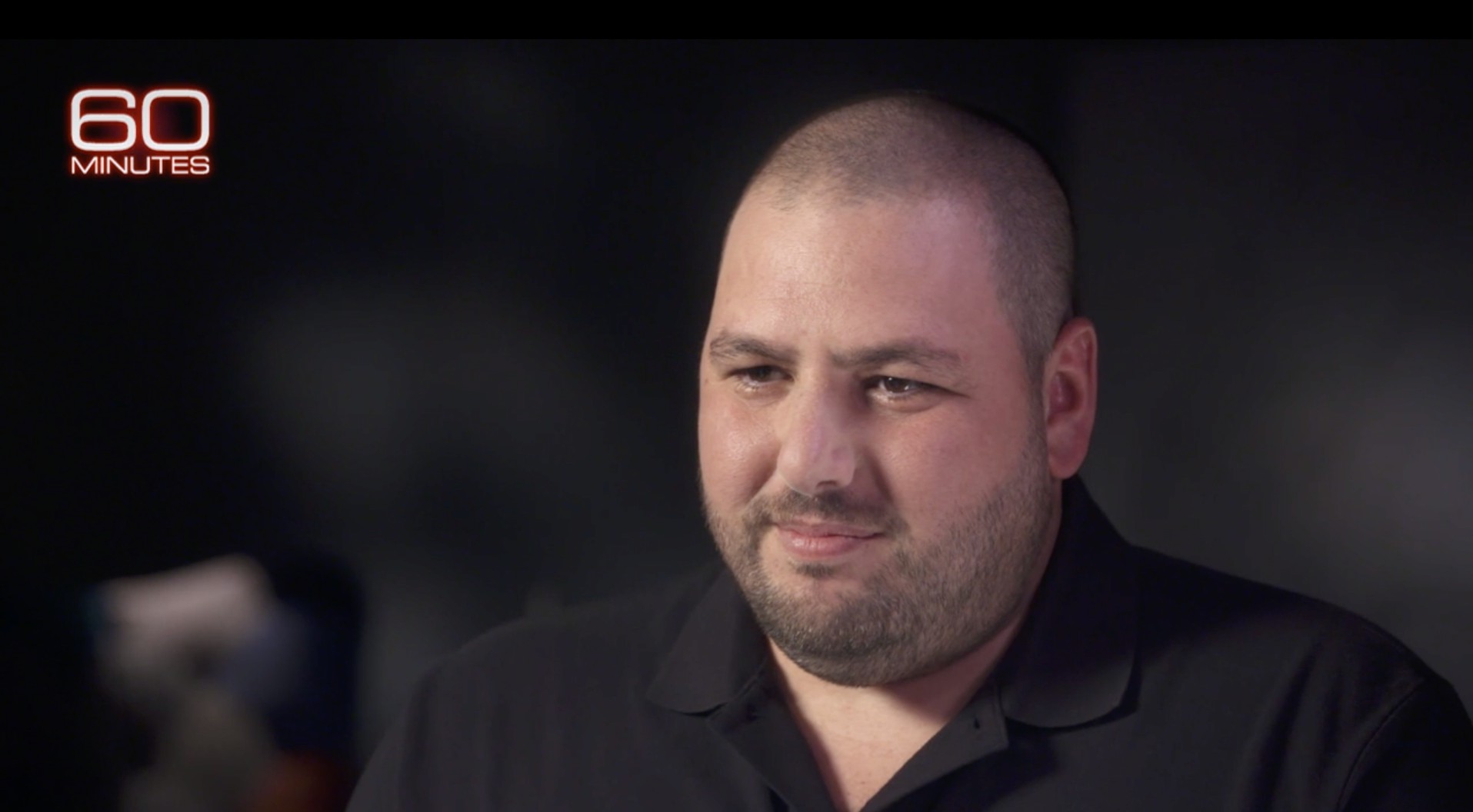
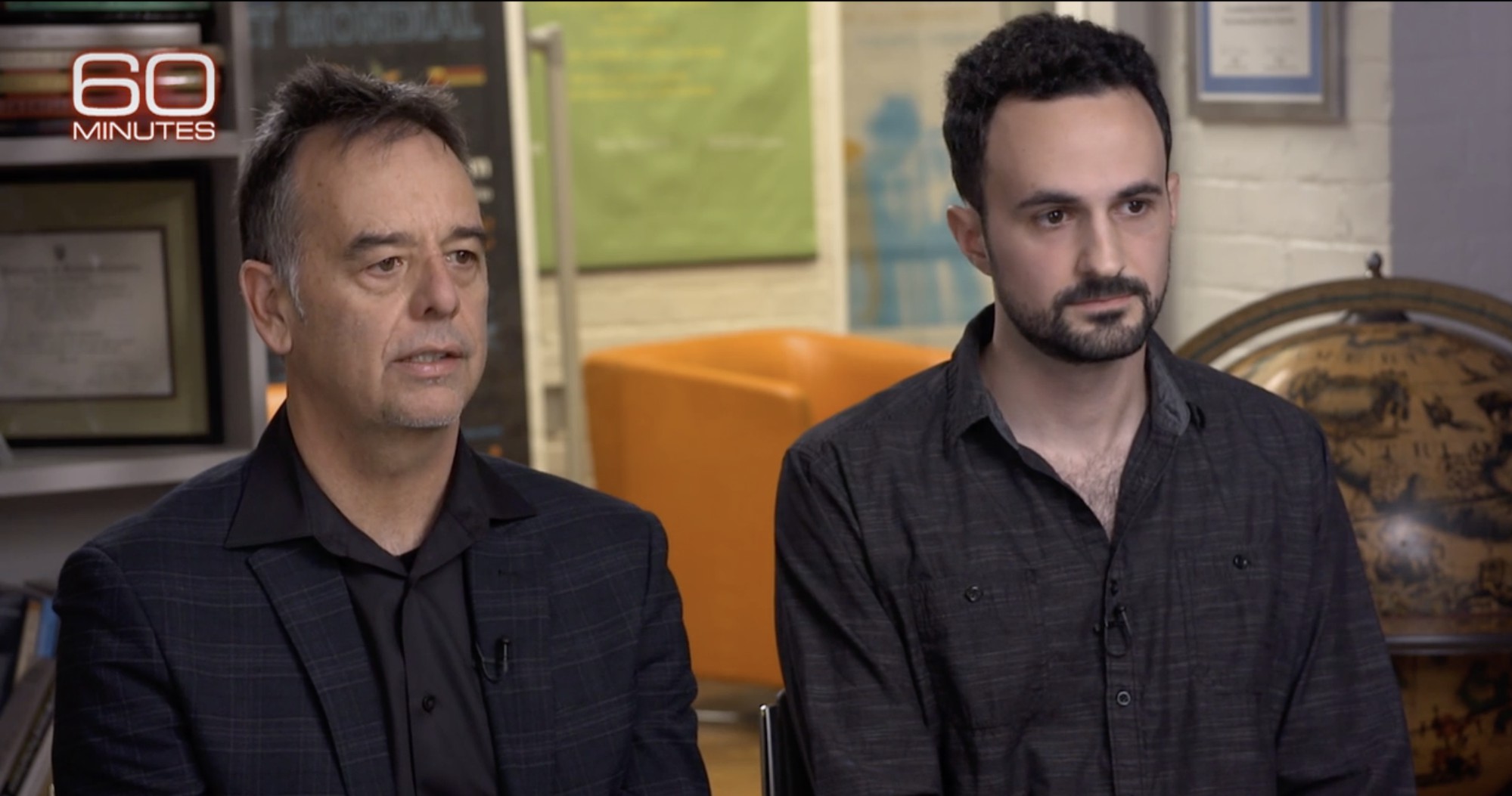
This pattern of denial was repeated in a recent 60 Minutes investigation, which gives a rare look into NSO Group’s management.
60 Minutes correspondent Lesley Stahl got scripted spin and unsubstantiated denials when she confronted NSO Group’s CEO Shalev Hulio and co-president Tami Shachar with cases of abuse drawn from the evidence-based research of Citizen Lab, Amnesty International, and others.
Despite the misdirection, Stahl and 60 Minutes did extract some insights about the company:
When questioned about the more than 29 publicly identified cases of abuse, NSO admits to only three
NSO Group does not deny that it sold its Pegasus spyware to Saudi Arabia and will not explicitly deny that Jamal Khashoggi’s confidants were targeted with Pegasus
NSO Group continues to spin and misdirect questions about abuses, particularly concerning the critical issue of allowing clients to define what constitutes “terrorism” and “crime.
As a reminder, Citizen Lab, Amnesty International, security companies, Google’s security team, and journalists have all contributed to building a picture of NSO Group’s powerful but abuse-prone technology. Pegasus, their signature spyware, is designed to infect and remotely monitor mobile phones. Once inside, operators have complete control of and access to everything in the phone, including encrypted messages, location data, and its microphone and camera.
Evidence Says at Least 30 Cases of Abuse; NSO Group Admits Three
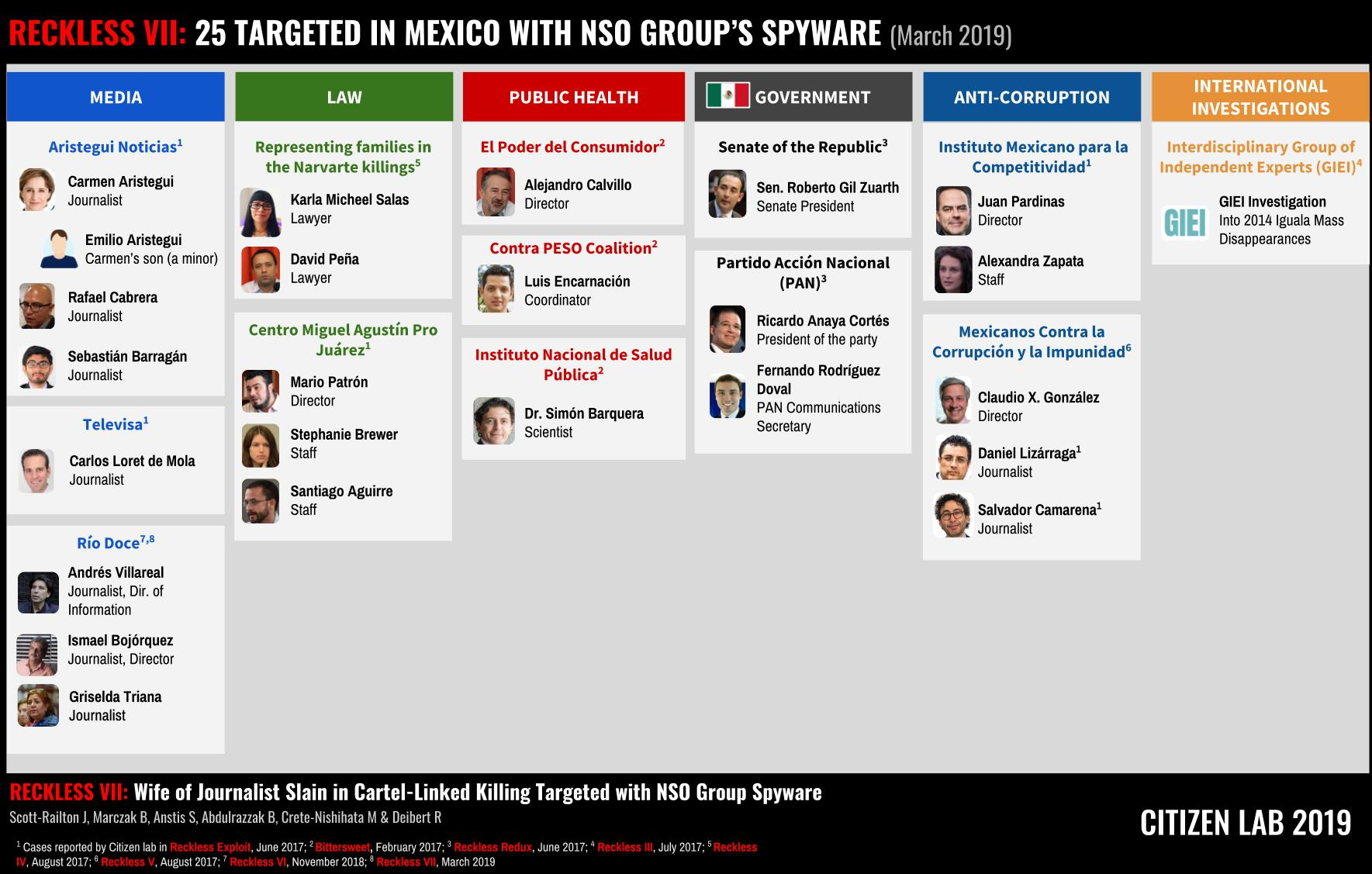
NSO’s CEO claims that there have been exactly three cases of abuse in the company’s history. But in Mexico alone, our research has identified more than 25 infection attempts against members of civil society. These targets include the phones of:
A prominent Mexican investigative journalist who exposed a presidential corruption scandal and her minor child who was attending boarding school in the United States when he was targeted
Other research groups have identified even more cases of targeting with Pegasus, namely against an Amnesty International staff member and Yahya Assiri, and Ghanem al-Dosari, a Saudi comedian and government critic. None of these targets fit within the definition of a terrorist that Hulio says his customers adopt, namely “bad guys doing bad things in order to kill innocent people, in order to change the political agenda.”
Scripted Spin versus Facts on the Sale of Pegasus to Saudi Arabia
NSO Group CEO Hulio refused to provide an answer as to whether or not NSO Group sold Pegasus to Saudi Arabia, a country with a notoriously poor human rights record and for whom terrorist offences include insulting the reputation of the state.
When pressed by Stahl as to whether the sale happened, Hulio repeatedly deflected, stating that he did not want to speak about a “specific customer,” that NSO Group was “selling Pegasus in order to prevent crime and terror,” and that one should not believe news reports describing a trip Hulio took to Riyadh to sell Pegasus to the Saudis for $55 million. This seemingly scripted language has been oft-repeated by Hulio and the failure to actually deny a sale to Saudi Arabia is resounding.
Recently, journalist David Ignatius disclosed that, in fact, NSO Group has restricted its Saudi client’s use of Pegasus after an internal investigation determined that its spyware was not “directly” involved in the murder of Jamal Khashoggi. Such a finding is entirely consistent with Citizen Lab and others’ determinations that the Saudis were using Pegasus to spy on several of Khashoggi’s colleagues. In particular, Omar Abdulaziz (whose iPhone Citizen Lab determined was targeted with NSO Group spyware) and Jamal Khashoggi were exchanging what they thought were private WhatsApp messages about their plans for social media activism against Saudi autocracy.
Evidence of Abuses versus NSO Group’s Dubious Denials
Despite NSO Group’s pattern of questionable denials, research by Citizen Lab and peer organizations continues to surface new abuse cases and be replicated by additional research groups which arrive at the same conclusions. In an attempt to get a clear answer from NSO Group regarding their position on our research, we have sent numerous communications to the company and its investors (previously Francisco Partners, and, more recently, Novalpina Capital).
To date, NSO Group has failed to show that our research is flawed or erroneous in some way. Rather, the company continues to resort to outright denials without evidentiary support.
Citizen Lab and partner organizations R3D, SocialTic, and Article 19.
Ahmed Mansoor’s Targeting: Where It All Began
The 60 Minutes episode mentions our discovery that UAE dissident Ahmed Mansoor was a target of NSO spyware. In August 2016, Ahmed Mansoor sent us suspicious links in SMSs he received on his iPhone purporting to show evidence of torture in Emirati prisons. We infected a device in a laboratory setting and were able to acquire a copy of NSO Group’s Pegasus spyware.
With the assistance of the security company Lookout Inc, we reverse engineered the spyware and verified that it exploited three separate unpatched software flaws in the iPhone product.
We responsibly disclosed our findings to Apple Inc., who in turn pushed out security patches, securing about a billion users of Apple products worldwide. The “Million Dollar Dissident” report was the first ever published on NSO Group and is concrete evidence of the abuse of NSO Group spyware.
We would not have been able to get a copy of NSO Group’s Pegasus if Mansoor had not been targeted and Mansoor is neither a terrorist or a criminal. He is an award winning human rights defender. Sadly, Mansoor was recently sentenced to 10 years in prison and fined approximately $270,000 USD for criticisms of the regime he posted on social media.
From Spin to Spooks? Private Spies Targeting Citizen Lab, Litigants Against NSO Group
While NSO Group has made extensive attempts to paint themselves as concerned about accountability and abuses, we note two recent attempts to infiltrate the Citizen Lab and target our researchers by individuals with reported links to the Israeli-based private intelligence firm Black Cube.
We note that that the same operation targeted four other individuals all of whom happen to be involved in litigation relating to NSO Group.
The New York Times report on the case of a retired Israeli security
official linked to spy-for-hire firm Black Cube caught in a sting after
setting up a meeting under a false identity with a Citizen Lab researcher
While it is not publicly known who hired these spies, their activities were focused on (unsuccessful) efforts to trick our researchers into providing sensitive information about our investigations into NSO Group and making statements that could be used to discredit our work.
Sometimes really really famous people share my stuff and a deluge of haters rush in to admonish them for doing so because I am evil. I am still not used to either of these things.
I took a couple of days off for my wedding anniversary and during that time Susan Sarandon shared my last article, demanding to know why we’re not discussing the important fact that a document from the OPCW’s investigation contradicting the official OPCW findings on an alleged chemical attack in Douma, Syria was not shared with the public.
Just as when Roger Waters promoted me on his Twitter account, any time I checked Twitter I saw a bunch of people arguing about whether or not I’m a secret Nazi or a plagiarist or an Assad lover or a racist, all in response to the sharing of an article that questioned a narrative used to support western imperialism. It’s a weird experience.
This whole job has been weird, really, and with some days off I’ve had time to reflect on that. I’ll write a proper article shortly, but I just wanted to tap out a few thoughts on this strange journey I’ve been on while they’re still on my mind.
This is really important. Why aren’t we talking about it?
"We may have just discovered a major piece of the puzzle explaining how seemingly independent international organizations help deceive us into consenting to wars and regime change interventionism around the world." https://t.co/yH8mfU9eBC
This whole gig has been a glorious accident. Back in 2016 I needed a job and saw an advertisement on Facebook for a self-publishing news aggregate called Inquisitr, and I figured maybe I could finally put my journalism degree to some use. Whenever I wrote hard news stories they tended to flop, but when I wrote opinion pieces about the Sanders campaign and the fraud of the DNC they shared really well. People told me I was giving a voice to things that needed saying, and I started building up an audience. After the election everyone started freaking out about “fake news” and Inquisitr asked me to move back to hard news stories, but by then I had a lot to say so I made the transition to becoming crowdfunded.
Moving from narrow discussions about presidential candidates to general commentary on world politics was like suddenly jumping into a deep ocean full of strange creatures and mystery. I could see that the system was corrupt, I had my intuition and I knew a few hard facts, but the following I was gaining quickly put me on the same turf as people who’ve been studying this stuff for many years and it was intimidating. Because I can make jokes and write prolifically about things in a fresh and interesting way, my audience grew a lot faster than that of other alternative media writers, and it made people suspicious of me.
Unlike the indie journos who I tend to get lumped in with, I didn’t spend my first years working my way up through media outlets mostly unseen under the guidance of editors and senior staff; I just got tossed into the mix and had to build my own system for navigating this strange new ocean by myself. I had to learn everything on the fly while in full visibility. The first part of my career was basically just me telling readers “Hey, that thing over there looks suspicious!” and “No, you’re not crazy, I see the corruption too” while simultaneously trying to figure out exactly what the hell’s going on here and sorting out quality sources of information from crap. I had no coach or adviser for any of this besides my husband I’d only just married, who was even more new to it all than I was.
During those early days I pissed a lot of people off, saying things you’re not supposed to say and advancing ideas you’re not supposed to advance. I mean, I still piss people off all the time today, but I feel like I would navigate that whole scene a lot more gracefully if I had it all to do over again. The nature of being new to something is to not be very graceful at it, though; if I would have let fear of my own clumsiness and inexperience stand in the way, I never would have begun this journey. So no regrets.
Some Common Criticisms Of My Work Addressed, By Caitlin Johnstone
"I thought it might be good to just tap out a few responses to common criticisms of the writing I’ve been doing since I started this gig two and a half years ago."https://t.co/yzL7ddcCVf
So my whole political commentary career has basically just been me learning about the world and sharing what I’ve learned with my readers. It started out as crude crayon drawings of what’s going on, but as my knowledge and experience has increased those drawings have been getting more and more refined. I now feel like I have a solid understanding of what’s going on in the world and why things are fucked in the way that they are fucked, and I’m always adding more tools to my toolbox for describing it.
Along the way I had to sort out a whole heap of self-esteem issues too. It’s not easy being a forty-something mum of two who hardly even had much of a social life, let alone found herself in the spotlight. Like many women my age, I have a lot of shame about my body and my looks and I certainly had no intention of ever putting either of those things out there for scrutiny, let alone scrutinized by people who are heavily invested in hating me. That part has been really scary for me in an eerily primal way.
I’ve come to realize that my sexuality and my creativity are the same thing. I need confidence in myself in order to write well. Men who hate you seem to know that; they instinctively reach for insults and threats that specifically target my sexuality. So having every horrible thing I’ve ever feared or I’ve ever secretly thought about myself be tweeted and shared and laughed at and liked is not something I’ve enjoyed. The thought “This is why women don’t do this” has come up more than once, but I keep going because yes, this is why women don’t do this but dammit if I’ll let it stop me.
I also have a secret weapon in my husband Tim who not only works with me full time but who can very quickly make me feel like the sexiest goddamn bitch that ever stalked the earth. So there’s that. I struggle to convey how important Tim is to this thing and how there is no way I could do it without him. My whole prolific output is because of the stability of our fusion. I say this because I don’t want anyone comparing themselves to me and feeling bummed out by their output. You need to know that you’re looking at two people in a very tight, stable collaboration and if you’re working alone then you shouldn’t compare your output to mine. Keep going, we need you more than ever!
So anyway, now here I am trying to shove healthy ideas into mainstream consciousness with an acute awareness that every time I get anywhere near the mainstream I get a bunch of angry people telling everyone that I’m all sorts of horrible things. And it’s weird. I see the ideas I share as valuable enough that the periodic hate brigade isn’t enough to silence me, but I can certainly understand how people are pressured by manipulators and groupthink bullies into staying invisible and making a small target of themselves.
The usual regime change characters swarmed Sarandon for amplifying what they want buried about Syria and her responses are so good and satisfying https://t.co/THvhOzeeqP
And Sarandon actually did do a great job of staving off the war propagandists who tried to attack her for sharing my work rather than addressing the information in the article. Journalist Rania Khalek tweeted, “The usual regime change characters swarmed Sarandon for amplifying what they want buried about Syria and her responses are so good and satisfying.”
Which is good. The fact that I was able to throw an important idea over the wall of the establishment narrative managers into a wider audience without my name poisoning it is encouraging. That’s a major shift. Hopefully I’ll be able to get more and more ideas over that wall going forward.
So that’s my challenge: getting dissident ideas past the goalkeeping of the narrative managers and into the bloodstream of public consciousness. I don’t care if those ideas get there through me or if someone else picks them up and carries them over the edge themselves; the important thing is waking up the mainstream public to what’s going on in their world so that they can cast off the propaganda manipulations that have been keeping them sedated and start making society work for them instead of for a few sociopathic oligarchs.
Keeping these ideas in the fringe (while egoically pleasing to a certain subset of political dissidents who enjoy keeping their stuff marginal for the same reason a hipster enjoys boasting that they liked a band before they were popular) is not going to save the world. Keeping anti-establishment ideas on the fringe is exactly what the narrative managers want, and we mustn’t allow it to continue.
So I intend to keep plugging away at this thing, keep learning, keep coming up with new ideas and approaches, and keep writing the most sizzling hot articles I possibly can. Maybe I’ll help move the needle enough to shift public consciousness to where it needs to be, maybe I won’t, but god dammit I’ll be able to tell my kids that I tried.
Thanks for coming along for the ride.
_________________
Everyone has my unconditional permission to republish or use any part of this work (or anything else I’ve written) in any way they like free of charge. My work is entirely reader-supported, so if you enjoyed this piece please consider sharing it around, liking me on Facebook, following my antics on Twitter, throwing some money into my hat on Patreon or Paypal, purchasing some of my sweet merchandise, buying my new book Rogue Nation: Psychonautical Adventures With Caitlin Johnstone, or my previous book Woke: A Field Guide for Utopia Preppers. The best way to get around the internet censors and make sure you see the stuff I publish is to subscribe to the mailing list for my website, which will get you an email notification for everything I publish. For more info on who I am, where I stand, and what I’m trying to do with this platform, click here.
This week, US-Iran tensions escalated to new heights. The United States deployed the [Abraham] Lincoln carrier strike group and a bomber task force the region, claiming there was a credible threat by the Iranians in the Persian Gulf. Then two Saudi tankers and Norwegian ships were apparently attacked near the Persian Gulf, which some say was a false flag operation.
Adding fuel to the fire, Iran has announced that it will stop complying with parts of the landmark 2015 nuclear deal, and resume high-level enrichment of uranium in 60 days if other signatories to the deal do not take action to shield Iran’s oil and banking sector from U.S. sanctions.
Vijay Prashad is the director of the Tricontinental Institute, and he’s also the editor-in-chief of LeftWord Books. Vijay, good to have you here.
The Organisation for the Prohibition of Chemical Weapons is supposed to be a neutral international body, without political or national affiliation. It is meant to go where the facts lead it, regardless of any pressures from powerful people and countries to produce reports that might favour their cause and exonerate their actions.
I have long suspected that it has ceased to be such an organisation. There has been an increasingly obvious pattern to alleged chemical weapons attacks, whereby an incident occurs, the Western powers — chiefly the United States, United Kingdom and France — respond, and then the OPCW later produces a report that essentially backs up their claims, but in very dubious ways.
For example, on 4th April 2017, an alleged chemical incident took place in Khan Sheikhoun in Syria.
“The United States is confident that the Syrian regime conducted a chemical weapons attack, using the nerve agent sarin, against its own people in the town of Khan Shaykhun in southern Idlib Province on April 4, 2017. According to observers at the scene, the attack resulted in at least 50 and up to 100 fatalities (including many children), with hundreds of additional injuries.
We have confidence in our assessment because we have signals intelligence and geospatial intelligence, laboratory analysis of physiological samples collected from multiple victims, as well as a significant body of credible open source reporting, that tells a clear and consistent story.”
What they didn’t state is that they had no direct intelligence on the ground, but relied on hearsay, much of it from that “open source” reporting (i.e. internet speculation). And of course there’s a very good reason why they did not have intelligence on the ground, namely that the area was (and still is) controlled by jihadist organisations.
Nevertheless, despite the fact that the case against the Assad Government was at that time entirely dependent on information coming from Islamist terrorist organisations, it was apparently enough for the United States to bomb the country, which it did on 7th April 2017, just three days after the incident. Thankfully, there were few casualties as most of the 59 Tomahawk missiles fired didn’t make it to their intended targets, either being shot down or — very probably — taken off course by advanced Russian military electronic jamming equipment.
So the order of things was incident, accusations, bombing, and then release of “intelligence” based on the internet and information released by jihadists. All that was then needed to justify these actions retrospectively was the OPCW report, and this was subsequently released on 29th June 2017.
Peter Hitchens has dealt very thoroughly with that report (here), and the most crucial point about it is that it essentially broke the OPCW’s own rules by failing to establish chain of custody. Instead, the alleged evidence, rather than being gathered from the scene of the incident by the OPCW, was passed to them 2nd or perhaps even 3rd hand.
And of course the reason for this is that its investigators were not able to enter the area where the incident was said to have taken place, because it was occupied by al-Qaeda affiliated organisations — the same people who presumably passed on the evidence which ended up in the OPCW’s hands.
Interestingly enough, the OPCW’s inspectors were invited by the Syrian Government to the al Shayrat airbase where the planes, which allegedly dropped chemical munitions, had taken off. But they didn’t take them up on that offer. Make of that what you will.
It is vital to the OPCW’s whole remit and credibility that they visit the sites of alleged attacks in order to secure evidence under full chain of custody. Where they are unable to do this, they should simply say so and refuse to pronounce confidently on what happened.
Yet despite not having visited either Khan Sheikhoun, or the al Sharyat airbase, and despite not having full chain of custody, a subsequent report released in October 2017 did indeed pronounce confidently:
“Based on the foregoing, the Leadership Panel is confident that the Syrian Arab Republic is responsible for the release of sarin at Khan Shaykhun on 4 April 2017.”
Ignoring its own guidelines to produce such a confident conclusion is enough by itself to call into question the organisation’s impartiality and credibility. But whatever credibility the organisation still possessed after this has now been torn to shreds by the recent leak of a Fact Finding Mission (FFM) Engineering Assessment in the case of another alleged chemical attack, this time in Douma last year.
As you will hopefully recall, the town of Douma was about to be retaken by the Syrian Government from the jihadists who controlled it. Shortly before it was retaken, an alleged chemical incident occurred, in which some 35 civilians were said to have died.
The Western powers immediately jumped on it, accusing the Syrian Government of responsibility, and photographs of two canisters allegedly containing a toxic substance, which it was said were dropped from Syrian aircraft, were shown around the world as if supporting the claim.
We can now be confident that the claim is false. What is more, it appears that the OPCW has known full well that the claim is false, but has said nothing publicly about it. According to the FFM Engineering Assessment dated February 2019, the scenario of the canisters being dropped by aircraft is implausible:
“At this stage the FFM engineering sub-team cannot be certain that the cylinders at either location arrived there as a result of being dropped from an aircraft. The dimensions, characteristics and appearances of the cylinders and the surrounding scene of the incidents, were inconsistent with what would have been expected in the case of either cylinder having been delivered from an aircraft. In each case the alternative hypothesis produced the only plausible explanation for observations at the scene.
In summary, observations at the scene of the two locations, together with subsequent analysis, suggest that there is a higher probability that both cylinders were manually placed at those two locations rather than being delivered from aircraft [my emphasis].”
You can read more about this by going to the site of the group to whom this report was leaked (here) and also to Peter Hitchens’s blog, where he reports on his interactions with the OPCW, which unwittingly confirm the authenticity of the FFM report (here).
The OPCW’s final report on the Douma incident makes no reference to this FFM Engineering report. Why not? The only reasonable conclusion is that it was omitted because its inclusion would have totally undermined the narrative tirelessly propagated by the Governments of the United States, United Kingdom and France, as well as the entirety of the Western mainstream media (Global Pravda), and so would have shown the actions of those countries to be utterly immoral, illegal and reckless.
And so one cannot help but think that:
A) The OPCW has been utterly compromised and/or pressurised by those same Governments and
B) A certain individual or individuals in the organisation has been disturbed enough by this to take the risk of leaking information to expose the truth.
It is a solemn and sobering fact that the reaction to the Douma incident could very well have led to a conflict between the United States and Russia. In the aftermath, when the Unites States, the United Kingdom and France were all releasing statements of their intentions, the Russian military warned in no uncertain terms that if the missiles were targeted towards their servicemen, they would not only destroy the missiles but the carriers from which they were fired. They were deadly serious. I have heard unconfirmed rumours that they had MiG-31s loaded with the new hypersonic Kinzhal missiles in the area, ready to sink the vessels firing the missiles should they feel that their military personnel were under threat.
Thankfully there are still some minds left in the Pentagon that are not intoxicated by power, and — so I hear — General James “Mad Dog” Mattis, (right) in particular, the then Secretary of Defense, was instrumental in turning what looked like it would be a massive bombardment, possibly targeting areas where Russian servicemen were located, to a much smaller 100-odd missiles, mostly token shots into non-strategic sites, the majority of which were shot down.
In other words, Mattis and co may well have averted World War III, but did so in a way that allowed the warmongering leadership of the three nations to save face in their illegal action.
The OPCW’s credibility as an impartial international organisation now lies in tatters. Both the Khan Sheikhoun report with its conclusions without chain of custody, and now even more so the Douma report, which failed to include expert evidence that contradicted its public conclusions, now stand as testimony against the trustworthiness of the organisation. It hardly needs to be said that this is a great shame, not just for international relations in general, but also for those many people who work for it who are undoubtedly still committed to scientific enquiry and impartial judgement.
I cannot leave this piece without asking questions about the other major cases of late involving the OPCW, namely the Salisbury and Amesbury poisonings. In both incidents, the OPCW did not release final reports to the public, but a summary of their findings, which you can find here and here. I must say I have never been particularly convinced by these documents. In both cases, the language always struck me as being somewhat evasive.
For instance, neither Summary actually names the substance involved. In fact, in neither case does it confirm the use of a nerve agent. Point one in the summary of the Salisbury case states the following:
“The United Kingdom of Great Britain and Northern Ireland requested technical assistance from the OPCW Technical Secretariat (hereinafter “the Secretariat”) under subparagraph 38(e) of Article VIII of the Chemical Weapons Convention in relation to an incident in Salisbury on 4 March 2018 involving a toxic chemical — allegedly a nerve agent — and the poisoning and hospitalisation of three individuals. The Director-General decided to dispatch a team to the United Kingdom for a technical assistance visit (TAV).”
Allegedly a nerve agent? Which one? Do we find out? Not a bit of it. Point number 10 states the following:
“The results of analysis by the OPCW designated laboratories of environmental and biomedical samples collected by the OPCW team confirm the findings of the United Kingdom relating to the identity of the toxic chemical that was used in Salisbury and severely injured three people.”
Confirm the findings of the United Kingdom? Which United Kingdom? The Government of the United Kingdom? The intelligence agencies of the United Kingdom? The scientists at Porton Down in the United Kingdom? This is important. The fact is that none of these entities has ever stated what that substance actually is.
Instead, they have continued to use the slippery word “Novichok”, but since this is simply a word meaning “newcomer”, and since it doesn’t refer to a substance but rather a group of substances, and since the group of substances falling under the “Novichok” umbrella has never been properly defined and is elastic enough to include pretty much anything and everything the accusing authorities want it to mean, it is, to all intents and purposes, meaningless.
Which is almost certainly why the OPCW not only avoids referring to it in its Summary as “Novichok”, and also why they also fail to confirm it was actually a nerve agent, referring to it throughout as a “toxic chemical”.
And whilst they say that it was the same “toxic chemical” identified by the United Kingdom, because the United Kingdom has never publicly identified the substance, this is essentially circular argumentation. Indeed, it reads more like obfuscation than scientific precision.
In the summary of the Amesbury case, things get even more suspect. Again, the phrase “toxic chemical” is used throughout, and again there is no mention of “Novichok” much less the precise type. Like Salisbury, there is only one mention of the word “nerve agent”, but this time it is very odd:
“The toxic chemical compound, which displays the toxic properties of a nerve agent, is the same toxic chemical that was found in the biomedical and environmental samples relating to the poisoning of Sergei and Yulia Skripal and Mr Nicholas Bailey on 4 March 2018 in Salisbury(S/1612/2018, dated 12 April 2018) [my emphasis].”
Which displays the toxic properties of a nerve agent? What is that supposed to mean? Isn’t this a mighty strange way of referring to an apparently identified nerve agent?
Think about it. If you tested a substance in a laboratory and found it to be sulphuric acid, and if you were then writing a report about it, would you say that “it is an acid” or that it “displays the properties of an acid?” If you were to write that the substance you had found “displays the properties of acid,” and you never actually gave it a name, my reaction would be to assume that it was something a bit like acid, but not actually acid itself.
It might be argued that since the substance was not on the OPCW database, they simply refer to it as “displaying the properties of a nerve agent.” But this won’t do. The United Kingdom assured the world that it was a nerve agent, and despite inferring that only one country possessed it, they somehow managed to identify it within a day of the initial incident in Salisbury.
So why does the OPCW appear to hedge its bets and only say that it “displays the properties of a nerve agent?”, rather than “it is a nerve agent”? I may be wrong, but it seems to me that this statement is more likely the result of compromise between factions in the OPCW, than it is a statement of scientific certainty.
Another very suspect issue in the Summary of the Salisbury report is the fact that it does not mention where the OPCW team conducted its sampling. It is extremely vague, simply stating:
“The team was able to conduct on-site sampling of environmental samples under full chain of custody at sites identified as possible hot-spots of residual contamination. Samples were returned to the OPCW Laboratory for subsequent analysis by OPCW designated laboratories.”
Sites identified as possible hotspots? Such as? We aren’t told, which is very odd, because you might assume that a vital part of the mission would include establishing where the poison was located, and where it was initially placed. But for this we have to turn to the letter sent to the Secretary General of NATO by the UK’s head of national security, Sir Mark Sedwill. Here’s what he said:
“DSTL [Defence Science and Technology Laboratory at Porton Down] scientific analysis found that Sergey and Yulia Skripal were poisoned using a specific Novichok nerve agent. OPCW’s analysis confirmed the findings of the United Kingdom relating to the identity of the toxic chemical. This was found in environmental samples taken at the scene and in biomedical samples from both Skripals and police sergeant Nick Bailey, the first responder.
DSTL established that the highest concentrations were found on the handle of Mr Skripal’s front door. These are matters of fact. But, of course, the DSTL analysis does not identify the country or laboratory of origin of the agent used in this attack.”
According to Mr Sedwill, the highest concentrations of the toxic chemical were found on the handle of Mr Skripal’s front door. But crucially he states that this was established by DSTL, and he does not mention that this was confirmed by the OPCW.
So did the OPCW visit the house and swab the door? If not, why not? Surely if the DSTL had already established the door handle as the place with the highest concentration of the substance, then you’d expect the OPCW to have visited the house, and that they would have included a mention of the door handle as being the place with the highest concentrations of the “toxic chemical” in their Summary. But they do not, talking instead about “possible hotspots”.
On the other hand, if they did visit it, is it credible that they would have asked no serious questions about why the house had not been sealed off in the aftermath of the incident, and whether anyone had been in and out of the house after the alleged poisoning?
Had they asked that question, the honest answer would have been of course be yes, people did go in and out, and they did so unprotected. Here’s what Karen Gardner, a reporter for BBC Radio Wiltshire, said in her broadcast from outside Mr Skripal’s house on 6th March 2018 (two days after the incident):
“It’s a well-kept house, it’s got a horse shoe on the front door, beautifully presented bay trees in pots in the side of the windows. At the moment there’s quite a lot of activity. When I arrived, there were six or seven police officers and PCSOs coming out of the door. Some of those have left, a couple more have arrived. There is a visible presence outside the house, and severe frowning when I walk too close. A lot of the windows are open and I did see coffee flasks and provisions and empty boxes and things brought out, so it looks like there was a lot of activity late last night overnight [my emphasis].”
In a follow up report to mark the one year anniversary of the case, she had this to say:
“When I was here a year ago, I watched Wiltshire police officers with no or minimal protective clothing going in and out that front door. They were carrying coffee flasks. They appeared to have had refreshments in the house overnight. That was two days after the Skripals had collapsed, at the point the Met had taken over the investigation, shouldn’t those officers have been better protected?”
That last question is the wrong one. It is not “shouldn’t they have been better protected”, but rather “given that they weren’t protected, how on earth did they not become contaminated by the substance which was apparently on the door handle and which, according to the OPCW, was high purity, persistent and resistant to weather?”
Let’s not beat about the bush here. Unless the laws of science were suspended in Salisbury during the month of March 2018, the idea that a toxic chemical was placed on the door handle on 4th March, that police officers entered the house after that time, and then weeks later the substance was found at the door in high purity, persistent and weather resistant form, as the OPCW claimed, is fairyland.
Perhaps this is why the OPCW report fails to mention where the samples were taken, much less that the highest quantities of the substance were apparently on the door handle and door. But it seems to me that as an organisation with a remit to investigate such incidents, it has failed to ask even the most basic questions about the aftermath, and it has failed to use precise language about the substance and the locations where it was found. One can’t help but ask why this is.
As an aside, the BBC has announced that it is to make a drama about the case fairly soon. Quite apart from anything, this is plain wrong, since the investigation into the case is still ongoing. But I must say I look forward to that bit where the unprotected officers with their coffees and takeaway pizzas manage to get into the house via the door, but without using the door handle, which as you will be aware is normally a necessary part of getting in and out of houses.
In summary, suspicions that the OPCW has now been fatally compromised, utterly politicised and cannot be relied upon to be impartial, which surfaced during the Khan Sheikhoun incident, have now been shown to be absolutely true by the Douma case.
Given that this is so, and given the wishy-washy, round the houses language used in their reports into Salisbury and Amesbury, why should anyone believe that this organisation has been impartial and thorough in these cases, or that they will be so in any future cases?