Gorilla Radio is dedicated to social justice, the environment, community, and providing a forum for people and issues not covered in State and Corporate media. The G-Radio can be found at: www.Gorilla-Radio.com, archived at GRadio.Substack.com, and now featuring on Telegram at: Https://t.me/gorillaradio2024. The show's blog is: GorillaRadioBlog.Blogspot.com, and you can check us out on Twitter @Paciffreepress
This year marks the end of the second decade of the 21st-century, and as we enter the third decade one prediction seems to be warranted: the 2020s will see the most marked and unambiguous signs of the final decline of the US empire, with multipolarity rising to its greatest height yet.
This will not be the same thing as the end of capitalism, especially as
state-capitalism appears to be renewed as the dominant form of economic
and political development worldwide. In order to stave off or stall the
US’ inevitable decline, the US will do everything in its power (as it is
already doing).
Good investigative journalism doesn’t only reveal hidden mechanisms of our time; it also exposes those who refuse to confront the mechanisms.
Remember when the late Bruce Dixon courageously and cogently called Bernie Sanders “a sheep dog candidate”? Remember when Eva Bartlett, Vanessa Beeley and others truly stood with Syrian people in opposing the western intervention? I do.
Those who could not face the reality came up with all sorts of profanities and ill conceived theories to demonize the messengers.
Cory Morningstar has been a dedicated environmental activist with a sound track record, who has closely worked with various NGOs.
Hiroyuki Hamada is an artist. Exhibiting widely
in gallery and non-commercial settings alike
Cotler’s campaigns for foreign regime change or intervention almost always march in lock-step with neoconservative U.S. foreign policy. His “humanitarian” branding is but a thin veneer of hypocrisy to conceal his establishment policies — policies that almost always serve the interests of Israel.
On July 22, 2018, Israel organized and facilitated an exceptional evacuation of White Helmet operatives from southern Syria, claiming the operatives were at risk from an advancing Syrian Arab Army. A number of NATO member states backed the move, calling on Israel to bring their intelligence assets to safety.
This journalist’s extensive work has shown that the U.K. Intelligence-manufactured group of pseudo “humanitarians” — financed by the majority of member states within the U.S.-led interventionist alliance waging war against Syria — is nothing more than an auxiliary of the Al Qaeda generic offshoots in Syria. The White Helmet image has been professionally polished by a vast network of PR agencies, billionaire philanthropists, and media outlets aligned with their respective government objectives to overthrow the Syrian government and reduce Syria to a “failed state,” as they succeeded in doing with Libya.
Israel has a history of supporting terrorism in Syria since the start of the U.S. coalition war against the nation officially began in 2011. Israel has offered medical treatment to the various militant groups previously occupying areas of southern Syria. Stories abound of Israeli troops providing covering fire for groups dominated by Al Qaeda affiliates or rebrands as they came under attack from the Syrian Arab Army legitimately reclaiming territory lost to internationally-backed armed groups.
Dear David and David, sounding the alarm so
that "real change" happens? As you say Cory Morningstar is well
intentioned and she has a message too - she tells us what the elite
agenda is. Their agenda would be "real change" all right - in the
completely wrong direction.
So Cory Morningstar has done us a favour. She might not express it as carefully as she might but we ought to try and understand what her message is too... I think you have only partly understood it.
I write as as a retired social ecological economist (if you ever retire) I broadly agree with her description. I've been involved in the climate movement for over 2 decades and despaired. Extinction Rebellion have done a tremendous job of releasing the passion - but what are its political aims? What kind of "real change"? My attitude to XR is ambivalent. I am impressed by their militancy and commitment. By their spirit of self sacrifice. But I am unimpressed by an absence of an idea what "real change" for them would be. And you too.
Tell us the truth about climate change? What is that and how is it different from the debate among climate scientists and at the IPCC period reports? Decarbonisation by 2025 = 4 times as fast as the call to halve emissions by 2030.
Since 80% of the UK energy supply is fossil fuel based it's not possible. I wish it was possible, but it isn't. Just constructing a wind farm can take 4 years.You would have to increase the rate at which renewables are constructed and installed by an order of magnitude. You could not do that without training more engineers and that takes 3 years and more.
All of this would take a lot of fossil fuels to achieve...
Declare a climate emergency?
You make a big thing about this...in my years I've seen plenty of declarations. Starting with Rio championing the rights of future generations - while the police in Rio were organised in squads to kill street children.
As I recently wrote:
"If this was a REAL declaration of a Climate Emergency I would have expected a lot more happening or in prospect. I would be more convinced if it was associated with BANNING fracking. I would be more convinced if there were pledges to end the burning of wood at power stations as a phony way of “reducing carbon”. I would be more convinced if the reliance on “offsets” was being phased out.
"I would be convinced that this was being treated as a real climate emergency if the sale of fossil fuels were BANNED without a permit – and the permits were limited and rapidly reduced over the next few years (while making sure that the burden does not fall on the poor through a policy like cap and share ).
I would be convinced if the government or Labour Party announced a programme of measures like BANNING the use of private motor vehicles except by disabled people and if people want to travel they have to use public transport or get on their bikes. Also BANNING air travel except for emergencies.
Or getting everyone to turn their thermostats down and wearing jumpers and thermal underwear if they are cold.
Or which insisted that farmers adopt regenerative agriculture techniques to sequester atmospheric carbon down into soil carbon.
Or I would believe that this was being treated as a real Climate Emergency if there were swinging tax increases on the rich to decrease their consumption because it is their consumption that is leading the the largest amount of emissions.
IF policies like these were being adopted THEN I would believe that it was being treated as a REAL CLIMATE EMERGENCY – instead of Greenwash for an elite agenda for growth."
As it is what I see is a group of growth junkies salivating at the (delusionary) idea that a "Green New Deal" will rekindle economic growth – when Britain and the world has already overshot the carrying capacity of the planet. In this regard ecological footprint analysis tells us that, measured as an area, biocapacity cannot be more than 1.2 hectares per person for sustainable use. Yet the UK consumes 4.7 hectares per person. We are living as if we had access to the resources of nearly 4 extra planets – yet the “green growth” junkies tell us we can have more still.
So let's be perfectly clear – the vote for a Climate Emergency was an empty gesture. Without tangible policies to address the emergency it is vacuous – and Labour's policy as expressed here is: (a) not enough and (b) puts the stress on the wrong things. The only serious approach is to reduce resource use – while trying to make sure that people are looked after and safe during this process and trying to ensure that the people who consume most give up the most - but not increase!
Yes, the elite actors who are playing a PR game to change the political climate have done a good job in helping to mobilise people to express their fears and worries – but if, as appears to be the case, this mass activity is being used to promote an agenda that will fail without degrowth then it will turn out to be counter-productive.
Here is a XR business leader
You write that you think that the propaganda model of Chomsky and Herman might break down in a situation like this. I don't. You are talking about the corporate elite and mainstream politicians abandoning their religion, their faith - and that is growth.
Here is a quote from Lord Nicholas Stern before the Paris COP meeting. It shows what he thinks is important. At the time a lobbying document was written and used called "Better Growth. The New Climate Economy" on page 9 tit says "In the long run if climate change is not tackled growth itself will be at risk."
That's the elite agenda at the moment and unless there are tangible alternative ideas for what real change is - which would mean degrowth - that is what you will get - and elite agenda to try to revive flagging economic growth by a raid on pension funds and state financing for a phony green new deal. It's there in the XR website.
Yes, a GND will be "real change" but it won't bloody work as I show on two recent articles:
It won't work because renewable energies can only support an economy that is much smaller in size – and what they can provide power for will have to be prioritised - rather than assuming that renewable energy will be abundant and can be the basis for a continuance of a growing consumer society. (eg. Local renewables should be prioritised to things like keeping local hospitals running, like keeping water supplies functioning ).
At this point I should also draw attention to other aspects of their "real agenda" - as opposed to the non existent XR alternative "real agenda". To financialise nature, to make a grab for the money in the pension industry. Neither will work as envisaged. The point here is that the “fourth industrial revolution” that these growth junkies are aiming for will be unaffordable. The material resources are not there for a fourth industrial revolution – neither energy resources and nor mineral resources.
Depleted resources are expensive to extract so the shiny new world of renewable energy and electric cars will be expensive to construct. Few will be able to afford this brave new world and the future of the innovators is likely to include a large number of bankruptcies.
We can already see what is going to happen with this strategy in broad outlines. If the pension industry provides the capital it will only happen if backed by policies and on state guarantees that cannot be withdrawn without them collapsing - the idea will be that the losses will be paid by the tax payer.
And there will likely be losses for the same reason that for ten years fracking has made a loss – the fracking industry has been unable to cover its costs. It can only keep going by suckering investors. The same will be true for the renewable energy systems.
The cost of this new energy system will be too great for the rest of the economy to afford – and that will show up in a gulf between costs and what the shiny new infrastructure will get back in revenues.
I can already hear the engineers and economists saying that costs are falling and will fall further so that I am wrong. The mantra is the cheapness comes with learning how to make things more efficiently and with scale. That's what Stern said would happen in he famous Report.
Yes, when production of solar panels and wind turbines switched to China costs fell because Chinese wages and Chinese coal power was cheap. But energy costs are creeping up in China now coal and oil is in depletion there too. As energy costs rise the costs of making solar and wind turbines will rise too.
Even more so when the very scarce minerals necessary to their functioning runs out in just a few years. Depletion means extraction of minerals and energy costs more – we are seeing that with shale and that will have a knock on effect on the things made with the remaining energy and minerals – like wind, wave and solar energy harvesting equipment. Things do not always get cheaper – they sometimes get more expensive.
Additionally there's the extra cost of buffering intermittency, of extending grids. “Smart grids” sound fabulous – until you realise that the micro chips in them are highly energy intensive to manufacture – not to mention that these smart technologies will be a vehicle to bring in a health catastrophe called 5G, the internet of things and an living environment saturated with toxic microwaves….
In conclusion – as Tad Patzek explains there are simply not enough resources left for the kind of mobilisation that is being proposed:
“To compare the WWII industrial effort with the global dislocation necessary to ameliorate some of the effects of climate change is surprisingly naïve… This comparison also neglects to account for the human population that has almost quadrupled between the 1940s and now, and the resource consumption that has increased almost 10-fold. The world today cannot grow its industrial production the way we did during WWII. There is simply not enough of the planet Earth left to be devoured.” (quoted in an article by Tim Watkins )
I understand the emotional wish not to criticise a a child and now young woman who has done so much. No one is criticising her - it is the people behind her, Yes she has criticised them too - unfortunately that doesn't get reported as much. Above all what is their agenda for "Real change"? She has criticised a growth agenda too. Would it not show more respect to her to focus on that part of her message, rather than focus on the messenger?
If you are going to launch a rebellion you better have an idea what it is trying to achieve - or the "real change" will be made by others.
The feeling is often there at night, of course, in the wee small hours. But it can arise at almost any time – looking at someone we care about, listening to birdsong on an unusually warm spring morning, shopping.
It is like being trapped on a sinking ship, with the captain and crew refusing to admit that anything is wrong. The passengers are mostly oblivious, planning their journeys and lives ahead. Everything seems 'normal', but we know that everything will soon be at the bottom of the sea. Everything seems ordinary, familiar, permanent, but will soon be gone. It feels as if our happiness, our every moment spent with the people and places we love, is irradiated by the fear of impending climate collapse.
Last month, the Extinction Rebellion protests in London (and globally) finally challenged some aspects of this waking nightmare – at last, a sense that human beings are not completely insane, that we are capable of responding with some rationality and dignity. In the end, 1,100 people allowed themselves to be arrested, with 70 charged, for all our sakes.
While many people thrill to the prospect of pouring milkshake over political opponents, Extinction Rebellion proved, conclusively, once and for all, that non-violent protest is the superpower of democratic change. And this was not just non-violent protest; it was non-hating, rooted in love of the planet, love of people, love of life. The mystic Lao-Tzu wrote:
'Nothing in the world is as soft and yielding as water. Yet for dissolving the hard and inflexible, nothing can surpass it.
'The soft overcomes the hard; the gentle overcomes the rigid.'
The special forces in this compassionate revolution are the 83-year-old grandfather who spoke so eloquently atop a blocked train in Canary Wharf. They are the little children sitting quietly in the middle of Oxford Street, the mums with toddlers, and of course the extraordinary Greta Thunberg whose insight and intelligence have stunned many veteran climate activists.
Where the adults have been cautioning for years that we should not be too 'alarmist', too 'pessimistic' for fear of upsetting a lily-livered public, Thunberg has said simply:
'I want you to panic. I want you to act as if the house was on fire... To panic, unless you have to, is a terrible idea. But when your house is on fire and you want to keep your house from burning to the ground then that does require some level of panic.'
She is exactly right. In his recent BBC documentary, 'Climate Change: The Facts', 93-year-old David Attenborough missed 16-year-old Thunberg's point. The first half of Attenborough's film did an excellent job of drawing attention to the threats, but the second half was much too positive on the prospects for individual and collective action. It ended on a hopeful, reassuring note. It should have ended on a note of deep alarm and, yes, panic.
When governments seek to mobilise the public for action, they terrify us with tales of Huns bayonetting babies, of weapons of mass destruction ready to destroy us within 45 minutes. They do this because it works – people are willing to kill and be killed, if they think their own lives and those of the people they love are at stake.
We have always argued that climate scientists and activists should also emphasise the terrifying prospects – not in the dishonest, hyped way of state cynics, but honestly, sticking to the facts. When the science is punching great holes in the blind conceit of industrial 'progress' we should not pull our punches. Again, the Extinction Rebellion protests – the name makes the point - have powerfully vindicated this strategy. An opinion poll after the protests found:
'Two-thirds of people in the UK recognise there is a climate emergency and 76% say that they would cast their vote differently to protect the planet.'
John Sauven, executive director of Greenpeace UK, said the debate around environmentalism had been fundamentally altered:
'Climate activists, young and old, have put the UK government under enormous pressure to officially recognise the climate emergency we are facing. There is a real feeling of hope in the air that after several decades of climate campaigning the message is beginning to sink in. What we need now is to translate that feeling into action.'
As a result of this pressure, the UK last week became the first parliament to declare a climate emergency – previously unthinkable. Leading climate scientist, Professor Michael Mann, tweeted of the declaration:
'Yeah, there's a lot going on in the current news cycle. But this is undoubtedly the most important development of all'
Light-years beyond his Conservative opponents on this issue, Labour leader Jeremy Corbyn commented:
'We have no time to waste. We are living in a climate crisis that will spiral dangerously out of control unless we take rapid and dramatic action now.
'This is no longer about a distant future we're talking about nothing less than the irreversible destruction of the environment within our lifetimes of members of this house. Young people know this. They have the most to lose.'
By contrast, the voting record of Michael Gove, Secretary of State for Environment, Food and Rural Affairs, indicates that he 'Generally voted against measures to prevent climate change.' Prime Minister Theresa May has maintained a studied, shameful silence, clearly hoping the issue and the protests will go away. Action is clearly not on her agenda.
As if the climate crisis was not bad enough, a new UN report reveals that one million animal and plant species are now threatened with extinction. The world is experiencing a rate of destruction tens to hundreds of times higher than the average over the past 10 million years. Dr Kate Brauman, from the University of Minnesota, a lead author of the assessment, commented:
'We have documented a really unprecedented decline in biodiversity and nature, this is completely different than anything we've seen in human history in terms of the rate of decline and the scale of the threat.'
The following day, only two UK newspapers, (Guardian and i) led with the UN report on species extinction, most preferring to focus on a royal birth. The BBC News website featured no less than six stories about the royal baby before the headline, 'Humans "threaten 1m species with extinction".' This was a classic example of why Erich Fromm warned in his book 'The Sane Society', that it truly is possible for an entire society to be, in effect, insane.
Manufactured Dissent?
Without a sense of alarm, we will likely continue to be stifled by the huge campaign of corporate disinformation and outright lies designed to prevent profit-unfriendly actions. The key to the strategy to maintain public indifference was explained by Phil Lesley, author of a handbook on public relations:
'People generally do not favour action on a non-alarming situation when arguments seem to be balanced on both sides and there is a clear doubt. The weight of impressions on the public must be balanced so people will have doubts and lack motivation to take action. Accordingly, means are needed to get balancing information into the stream from sources that the public will find credible. There is no need for a clear-cut "victory". ... Nurturing public doubts by demonstrating that this is not a clear-cut situation in support of the opponents usually is all that is necessary.' (Lesly, 'Coping with Opposition Groups', Public Relations Review 18, 1992, p.331)
Given the need for a very clear alarm to counter this propaganda, it is disturbing, but not surprising, that critics on the left have joined with the likes of Lesly to attack the messengers trying to raise the alarm (unsurprising because the left has an extremely poor record on climate change. See our Cogitation.)
In her article, 'The Manufacturing of Greta Thunberg – for Consent: The Political Economy of the Non-Profit Industrial Complex' - which is intended to remind of Edward Herman and Noam Chomsky's classic work, 'Manufacturing Consent – The Political Economy of the Mass Media' – independent investigative journalist and environmental activist Cory Morningstar headlines a key claim at the top of the piece and throughout the very long, almost impenetrable mixture of text and screenshots that follows:
'In ACT I, I disclose that Greta Thunberg, the current child prodigy and face of the youth movement to combat climate change, serves as special youth advisor and trustee to the burgeoning mainstream tech start-up We Don't Have Time.'
The claim is that Thunberg was involved in launching new business opportunities to capitalise on green concerns. Morningstar mentions the 'We Don't Have Time' organisation involved in 'tech start-up' dozens of times in Act I of her piece alone. And yet, as Thunberg responded on Facebook in February:
'I was briefly a youth advisor for the board of the non profit foundation "We don't have time". It turns out they used my name as part of another branch of their organisation that is a start up business. They have admitted clearly that they did so without the knowledge of me or my family[Our emphasis]. I no longer have any connection to "We don't have time". Nor does anyone in my family. They have deeply apologised for what has happened and I have accepted their apology.'
Thunberg did not, in fact, 'serve as a trustee' for the start-up business branch; her name was added without her knowledge or permission and she no longer has any links to the organisation. Three months after they were published on Facebook, Morningstar has still not added an addendum to her article responding and linking to Thunberg's comments.
Morningstar wrote:
'Greta Thunberg and [teenage climate activist] Jamie Margolin who both have lucrative futures in the branding of "sustainable" industries and products, if they wish to pursue this path in utilizing their present celebrity for personal gain (a hallmark of the "grassroots" NGO movement).'
Thunberg again:
'I am not part of any organization. I sometimes support and cooperate with several NGOs that work with the climate and environment. But I am absolutely independent and I only represent myself. And I do what I do completely for free, I have not received any money or any promise of future payments in any form at all. And nor has anyone linked to me or my family done so.
'And of course it will stay this way. I have not met one single climate activist who is fighting for the climate for money. That idea is completely absurd.
'Furthermore I only travel with permission from my school and my parents pay for tickets and accommodations.'
Everything we have seen suggests that Thunberg is completely sincere and not at all minded to exploit her celebrity for money. Considering her age, the suggestion, in the absence of evidence, is ugly indeed.
Morningstar's basic theme is that climate activists are being exploited by the same old cynical interests who will decide who and what will 'save the planet' in a way that makes them rich. And who will these people be?
'we know full well the answer: the same Western white male saviours and the capitalist economic system they have implemented globally that has been the cause of our planetary ecological nightmare. This crisis continues unabated as they appoint themselves (yet again) as the saviours for all humanity – a recurring problem for centuries'.
On Twitter, 'polirealm' commented on Morningstar's piece:
'It looks at the establishment bodies, NGOs, their main characters, their connections, their main influences, networks, but it doesn't look at the actual people on the ground at all, except as defenseless victims of social engineering.'
'The truth is, many of the activists are 100% aware of the goal of their usurpation, they're aware that capitalism has nothing to lose and will take no prisoners in this fight, in fact, many are remarkably well informed.'
Indeed, the protests are being joined and supported by literally millions of intelligent, motivated, frightened people around the world, who will absolutely not be content with yet more corporate dissembling, profiteering and greenwash. Not only that, as evidence continues to mount of approaching disaster - and it will increase, dramatically - corporate executives, journalists and political executives will themselves increasingly reject these cynical machinations. 'Polirealm's' concluding point:
'So whoever believes the agenda and outcome of the climate movement are predetermined today simply has no idea what they're talking about. The organizational structures are still quite chaotic, but there are many very motivated people with very good ideas, who've only just started.'
Morningstar is clearly sincere and well-intentioned, and her argument of course has some merit. We have been documenting for decades, in media alerts, articles and books, how corporate interests have been working all-out to co-opt Green concern. The problem with Morningstar's focus is that it plays into the hands of corporate climate deniers and delayers whose strategy we have already described:
'The weight of impressions on the public must be balanced so people will have doubts and lack motivation to take action.'
After thirty years of mortifying indifference and inaction, now is not the time to promote the belief that the crucial alarm that is at last being raised by Thunberg and Extinction Rebellion has been cynically 'manufactured'. It is our job to ring the alarm and ensure that something is done. But first we must ring the alarm!
Even if corporate interests were crazed enough to think they could promote mass public dissent on this scale in the cause of profit, they would have no way of controlling the outcome. In the spring of 1968, with more than half a million troops in Vietnam, with military leaders asking for 200,000 more, President Johnson was advised by a Pentagon study group not to escalate the war, making this comment:
'The growing disaffection accompanied, as it certainly will be, by increased defiance of the draft and growing unrest in the cities because of the belief that we are neglecting domestic problems, runs great risks of provoking a domestic crisis of unprecedented proportions.' (Quoted, Howard Zinn, 'The Zinn Reader', Seven Stories Press, 1997, p.401)
If that was true of mere anti-war sentiment based on concern for human rights, how much more is it true of sentiment based on concern for literal human survival - the prospect that we, and every last person we love, may soon be dead?
The Propaganda Model – Going Extinct?
Herman and Chomsky's 'propaganda model' describes how state-corporate priorities – power and profit – tend to shape media performance in a way that supports the status quo. During the Extinction Rebellion protests, there was a clear sense that fewer and fewer commentators could think of good reasons for opposing what was happening. Even 'mainstream' politicians lined up to give their support; even 'centrist' liberal journalists, reflexively opposed to all progressive politics, applauded. Guardian columnist George Monbiot went much further than he ever has before in scorning the media:
'If you asked me: "which industry presents the greatest environmental threat, oil or media?", I would say "the media". Every day it misdirects us. Every day it tells us that issues of mind-numbing irrelevance are more important than the collapse of our life support systems.'
If we like, we can interpret all of this as a sign that the protests are viewed as harmless, or as evidence that they have been captured by corporate interests pulling the strings behind the scenes. But there is an alternative interpretation, which we favour.
When famously sober, conservative, anti-alarmist climate scientists are warning that human beings will become extinct unless drastic action is taken within the next decade, so that even prime-time BBC TV features the venerable David Attenborough warning that 'the collapse of our civilisations and the extinction of much of the natural world is on the horizon', then we have entered unknown territory. As Attenborough said:
'The world's people have spoken, their message is clear – time is running out. They want you, the decision-makers, to act now.'
Herman and Chomsky's 'propaganda model' was not designed for this scenario. When individual corporate media editors, journalists, advertising and political executives realise that they and their families are genuinely facing death, it is not at all certain that they will continue to support the subordination of people and planet to profit to no purpose. At this point – the point where the mortally-threatened corporate lions lie down with the mortally-threatened activist lambs - the propaganda model may start to break down. Either way, it is our job to continue pressuring corporate media and, more importantly, replacing them with honest, non-corporate alternatives pushing for real change.
The protests must continue, must escalate, and governments must be made to adopt a kind of war-footing subordinating everything – especially profit – to the survival of our own and all other species.
I came across a linked series of articles
one of which is mentioned on the Moon of Alabama website. They are
titled “The Manufacturing of Greta Thunberg – for Consent” and written
by an investigative journalist by the name of “Cory Morningstar”. When I
started reading them I was at first suspicious that this was another ad
hominem attack on Greta Thunberg. However as I read further, to use the
Biblical expression, “the scales fell from my eyes”.
30 March 2019, Berlin: The Swedish environmental activist Greta Thunberg gives autographs to the waiting fans when she arrives at the Golden Camera award ceremony. The award ceremony will take place at Berlin’s disused Tempelhof Airport. Photo: Christoph Soeder/dpa
Preliminary remarks – Some notes on terminology:
Climate Emergency – a human-induced increase in atmospheric greenhouse gases like CO2 and CH4 leading to rising global temperatures with impacts such as droughts, floods and heatwaves, crop failures, rising sea levels etc
“Climate Emergency” (in inverted commas) – a declaration by politicians that they are taking the climate emergency seriously and that we can trust them to do something effective about it (which can be judged as being for real or as empty rhetoric depending on what happens.)
Because of comments about the first edition of this article I wish to make clear that I am not opposed to wind, solar and renewable energy generation. What I am opposed to is the illusion that wind, solar and other forms of renewable energy can sustain a growth economy and the continuance of the consumer lifestyle in rich countries.
Renewable energy can have a limited place in the future but the priority is degrowth – with energy and materials conservation by sharing more – because the global economy of the rich world has overshot the carrying capacity of the planet and this is very dangerous. In any case there are currently no affordable ways to buffer fluctuations in renewable energy generation between seasons and nor are these likely for a long time, if ever. I am also very opposed to the financialisation of nature for the reasons that I describe here briefly, and at more length in my book Credo which is available for free download (see the references).
Finally, I learned a lot from the articles by Cory Morningstar but my politics and hers should not be taken as identical.
Brian
Greta Thunberg, PR and the “Climate Emergency”
This is by far the best overview of global environmental and climate politics at this time – or what is behind the appearance that you will get if you only read and watch the mainstream media.
The articles show the main actors in the drama, how they are connected to, or part of, major factions of the global corporate elite – and how they are pursuing what is in effect a global public relations campaign to “lead the public into emergency mode” – an emergency where the public will call for action and this part of the global elite will then have a mass backing and be able to deliver.
But deliver what, exactly?
In fact the agenda is to sell the need for a fourth industrial revolution...
I repeat that again – part of the global elite will deliver a green new deal or, as it is sometimes described, “a fourth industrial revolution”. This group of people are networked in organisations like the World Economic Forum, the Bill and Melinda Gates Foundation, the Rockefeller Institute as well as 20 not for profit NGOs who are backing the idea like the World Resources Institute, Avaaz and its offshoot Team B, Greenpeace…and others.
To these should be added other organisations and movements like 350.org which are part of the influencing environment for the people who set up Extinction Rebellion, influencing XR’s limited statement of its aims.
At first sight all of this seems great, really encouraging – but only if the way that this network intends to follow through to address “the emergency” would actually work.
Yet there are good reasons to believe that their approach won’t work – although they will be an enormously generous gift to the corporate aristocracy and some NGOs – they won’t solve the emergency. They will make it worse.
This is because they want to address the global climate and environmental crisis to “save nature” by turning it into a huge money spinner. The policies that have been developed are intended to be an engine for re-kindling failing economic growth by “financialisating nature”. Natural processes are to be designated as “natural capital” and natural capital is to be priced and tradable on financial markets.
The key idea here is that, in order to protect nature, you must incentivise nature protection with money. You must pay to protect so called “eco-system services”. The idea is that if we want to prevent extinction we need a system that makes it pay in money terms and we will need a system that will bring about a whole new set of technologies – so called “clean tech”.
What’s wrong with financialising nature?
Indigenous people often regard nature as kin – for example, people in the Andes refer to ‘mother earth’. They protect mother earth just as they would protect their own mother because it gave them life, because they came from it. They know how nature works where they live because that is handed down to them from their ancestors and they hold it in trust for their children and descendants. They don’t expect cash payments – it is a duty not to overuse the earth and that is an ethic they live by. That ethic has been maintained by people living and working on natural commons over centuries before they were stolen by an elite during the enclosures. In commons there is a collective responsibility not to over-use resources – or not to harm the lived in environment to which people feel loyalty and attachment.
Our society lives by different ethics. If we want something doing we must pay money – including not driving the entire ecological system to collective death. That’s mainstream economics for you. In our society the rich see nature as a store of resources – trees are timber which has a money value but the untouched forests do not. If we want to protect the forest then the money junkies tell us that the forest must be given a money value too. Then if someone wishes to cut down trees for timber they have to pay for the loss of the forest too – the eco-system services that would be lost, like absorbing CO2, like the role of the forest in rainfall and the water cycle. Indeed, the new argument is that whoever owns the eco-system services of the forest should get a payment for protecting.
If we are going to think of nature as being like your mother then think of it like this. Say your mother is under threat, the key thing is how much is she worth and how much money can you pull together to protect her? Well it’s like that with nature. If your mother’s not worth tuppence and you’ve got no money anyway, you might as well sell her into slavery. It’s the same with nature. In this regard you sell into the financial markets, because banks can create any amount of money as loans to people who want to buy bits of nature, while other bits of the financial markets can make money organising the exchanges to trade on.
But there are problems with this. For example think of the protection of forests. Forest peoples have been protecting forests for centuries, only harvesting sustainably. They never had to be paid to do this – they understood how to live sustainably in the forests and were not greedy, so stopped forest resources being over-used. These kind of people will now be turfed out. They don’t have certificates of ownership purchased on the financial markets. The new owners will be the people in the financial markets who make money decisions about ecological issues. Will they protect the forests better from their offices? This is the doubtful logic of this new kind of green colonialism.
This is the way the money junkies think. There is a reversal of means and ends in their minds. The ends of the players on the natural capital markets is to make money – and, supposedly, making money is achieved by means of protecting nature.
Yet the experience of schemes like this is that money-making wins over nature because there is no obvious price for eco-system services, or for biodiversity loss or for carbon emitted. There is far too much uncertainty and a real ethical and conceptual question about whether you can or should value the carbon emissions, or the lives of people, species or eco-systems (eco-system services). What’s more there are all sorts of practical problems with coming up with prices – for example people are keen to protect pandas with a high price but less keen to pay a high price to protect creepy crawlers, snakes and spiders, even though they are an integral part of the ecosystem. Most people haven’t a clue how eco-systems work, how the climate works – and nor could they have. So how can they “value them”?
Decisions about climate, vital ecosystem functions and species should not be market decisions, they should be political ones – taken democratically by those affected.
In any case, we know that what happens in such markets is that the actors game the systems to make as much money as possible by scams and frauds. That has already happened on a massive scale during carbon trading. Everyone involved in carbon trading knew it was one massive scam. Nevertheless the religion of the modern world is economics, in the service of the great God money and so:
“The development of the Natural Capital Protocol Project was made possible with generous funding from the Gordon and Betty Moore Foundation, International Finance Corporation (World Bank) with the support of the Swiss State Secretariat for Economic Affairs (SECO) and the Ministry of Foreign Affairs of the Government of Netherlands, The Rockefeller Foundation, United Nations Environment Programme (UNEP), and the UK Department for the Environment, Food and Rural Affairs (DEFRA). The Coalition is hosted by The Institute of Chartered Accountants in England and Wales (ICAEW). Other funders include; World Wildlife Fund, The Nature Conservancy, the Google Foundation, the Inter-American Development Bank, Unilever, The David and Lucile Packard Foundation, U.S. Department of Defense and the World Bank.”
“World Resources Institute provided the technical insights and review for the Natural Capital Protocol. The protocol was developed by Conservation International, The B Team, PricewaterhouseCoopers, Sustain Value, ACTS, Management (ERM), Imperial College, ISS, Natural Capital Project, Synergiz, WWF, Accenture, Arcadis, eftec, Environmental Resources CDSB, Deloitte, Dow, eni, GIST Advisory, Kering, LafargeHolcim, Natura, Nestlé, Roche, Shell, and The Nature Conservancy. The protocol was led by the World Business Council for Sustainable Development (WBCSD) consortium.”
. …but back to Greta Thunberg. How did she become an eco-star?
How the Greta Thunberg phenomenon was fostered – the “We Don’t have time” consultancy
Please note that although the title of these articles is “The Manufacturing of Greta Thunberg”, they are not saying that Greta Thunberg is a simple puppet doing what she is told. She’s obviously a smart young woman. But she would not have got a place in the World Economic Forum and at the United Nations FCC COP in Katowice, had she not been very well connected and had her rise to eco-stardom not been stage-managed from early on. Her mother had an award from the corporate friendly environmentalists in the World Wide Fund for Nature and she was promoted by an organisation that works with Al Gore and important parts of the Silicon Valley elite.
Greta Thunberg was an adviser to a foundation established by a Swedish business called “We don’t have time”. So what is this business “We don’t have time”?
“We Don’t Have Time is mainly active in three markets: social media, digital advertising and carbon offsets. [“In the US alone estimated market for carbon offsetting amount to over 82 billion USD of which voluntary carbon offset represents 191 million USD. The market is expected to increase in the future, in 2019 estimated 15% of all greenhouse gas emissions to be associated with any kind of cost for offsetting.”] As the company is a niche organization, social networks are able to provide services tailored to platform users. The startup has identified such an opportunity by offering its users the ability to purchase carbon offsets through the platform’s own certification. This option applies to both the individual user of the platform, as well as whole organizations/companies on the platform.
“One incentive of many identified in the start-up investment section is that users will be encouraged to “communicate jointly and powerfully with influential actors.” Such influencers are Greta Thunberg and Jamie Margolin who both have lucrative futures in the branding of “sustainable” industries and products, if they wish to pursue this path in utilizing their present celebrity for personal gain (a hallmark of the “grassroots” NGO movement).” (Further reading here.)
A nice little earner then…and that’s the philosophy of the people at the top who are leading this process. In their world view you have to make it pay to protect nature.
If you are not paying attention this looks like a child doing it all herself and getting a fantastic amount of attention – starting a snowball. Indeed the process is snowballing with big support. That was the idea and it was very successful – but what actually is the agenda of the elite faction behind all of this?
Here’s a quote from Cory Morningstar about how it started:
“The ‘one kid immediately got twenty supporters’ – from a Swedish network for sustainable business. What is going on is the launch of a global campaign to usher in a required consensus for the Paris Agreement, the New Green Deal and all climate related policies and legislation written by the power elite – for the power elite. This is necessary in order to unlock the trillions of dollars in funding by way of massive public demand.”
The industrial agenda
“These agreements and policies include carbon capture storage (CCS), enhanced oil recovery (EOR), bio-energy with carbon capture and storage (BECCS), rapid total decarbonisation, payments for ecosystem services (referred to as “natural capital”), nuclear energy and fission, and a host of other “solutions” that are hostile to an already devastated planet. What is going on – is a rebooting of a stagnant capitalist economy, that needs new markets – new growth – in order to save itself. What is being created is a mechanism to unlock approximately 90 trillion dollars for new investments and infrastructure. What is going on is the creation of, and investment in, perhaps the biggest behavioural change experiment yet attempted, global in scale.
“And what are the deciding factors in what behaviours global society should adhere to? And more importantly, who decides? This is a rhetorical question as we know full well the answer: the same Western white male saviours and the capitalist economic system they have implemented globally that has been the cause of our planetary ecological nightmare. This crisis continues unabated as they appoint themselves (yet again) as the saviours for all humanity – a recurring problem for centuries…”
When Thunberg goes off message
That does not mean that Greta Thunberg necessarily understands or believes the entire elite agenda. At Katowice she made a speech part of which was off-message – perhaps she got the ideas from Professor Kevin Anderson whom she met there. Anderson is a climate scientist who argues that the economy must contract to meet climate goals. He also argues that it is the rich who must bear most of the burden of this.
Here is a part of Thunberg’s speech:
“You only speak of the green eternal economic growth because you are too scared of being unpopular. You only talk about moving forward with the same bad ideas that got us into this mess, even when the only sensible thing to do is pull the emergency brake.”
“But I don’t care about being popular. I care about climate justice and the living planet. Our civilisation is being sacrificed for the opportunity of a very small number of people to continue making enormous amounts of money.”
Thunberg talked about making enormous amounts of money and she talked about growth – but this is the part of the message that Avaaz cut from their reporting of Thunberg. Cory Morningstar comments: “It is not surprising Avaaz would strike Greta’s comments considering a primary function of Avaaz is to promote market solutions that accelerate “green” economic growth – in servitude to “a very small number of people to continue making enormous amounts of money.””
In conclusion
The series of articles linked to below shows how elite environmentalists want to revive the Paris Climate Agreement and how the Green New Deal in the USA is supposed to become a global process brought about by having the public clamouring to declare climate emergencies and that to achieve all of this strategic NGOS and campaign movements and new emerging celebrities like Greta Thunberg and Extinction Rebellion have been supported and their leaders partially co-opted.
By writing this piece I do not mean here to deny that there is an ecological crisis, and nor that there is a climate emergency and that urgent action is needed. Rather it is to show that there is a sophisticated PR campaign behind what is happening and the agenda is that of a major faction in the global elite. This agenda will not work – indeed it will complete the destruction of nature and the eco-system.
How can I claim that with complete conviction and certainty? Because this is an expansionary programme and ecological footprint analysis has already established that the biosphere is being consumed as if there were 1.7 planets. All serious approaches to resolving the ecological crisis recognise that the global economy must contract back to a one planet level. The economy must degrow.
What’s more it is richest 5% of the planet that consume 50% of planetary carbon – so the very people who are promoting this campaign must cut back the most. Instead they want to expand the economy. But how is this to be made compatible with reducing carbon emissions?
It isn’t – but a careful looks at the language of nature financialisation refers to carbon neutrality, not zero carbon. This is “convenient language when one of the main pillars of the business model is the sale of carbon offsets – rationalizing a continuance of the same carbon based lifestyle by constructing a faux fantasy one, that anyone with monetary wealth, can buy into.”
To conclude this story with another quote from Cory Morningstar: in the quote below, she makes reference to Edward Bernays, the master of Public Relations and Marketing. In the 1920s he helped the tobacco industry achieve a massive new market – women.
Sensing the mood of many young women, Bernays got photos of young women smoking in prominent publications as an expression of their liberation and as an act of defiance and cultural rebellion. It was a fantastic success – for the tobacco industry, though not for women’s health. By engineering a feeling of emergency and rebellion – and channelling public concern and anger to what is an elite agenda for the environment long in preparation, it is hoped to pull off support for a massive policy coup for a section of the elite.
“The ten-year social engineering effort also led to a transition from environmentalism into full-blown yet undetected anthropocentrism. Over a ten year span, “environmentalism ” moved from that of protecting nature, to demanding a roll-out of green technology, industrial in scale, that would further plunder nature. The natural world became irrelevant as the desire for green technology superceded environmental protection. Wind turbines and solar panels replaced images of trees and insects as the new symbols of our natural world. Saving the industrial civilization that is killing off all life became paramount to saving the ecosystems that all life depends on.
“These ideologies slowly took hold until “movements” become nothing more than lobby groups for green energy. Volunteers marching for capital, global in scale. To suggest that Edward Bernays would be impressed would be an understatement. Such is the beauty of social engineering and behavioural change.”
Afterword
After finishing writing this article I read a very interesting article on the same blog – about the appearance of an “XR Business Blog” which revealed some of the business interests behind Extinction Rebellion. Given the controversy it caused this part of the XR blog rapidly disappeared. Several of the named individuals are venture capitalist funders – looking to make money from what they claim to be “sustainability” and very much within the green growth camp. I doubt that many of the companies named, including Unilever for example, would embrace degrowth, the revival of the commons, co-operatives or other types of institutions for sharing so needed for economies which contracting back to the point of one planet living. Above all it seems to bear out the suspicion that for some of its leaders and initiators the XR Rebellion was seen as part of the planned PR offensive to build support for the phony Green New Deal….
Featured image: ‘finance growth’. Source: https://www.freeimages.com/photo/finance-growth-concept-3-1236227
Note: Feasta is a forum for exchanging ideas. By posting on its site Feasta agrees that the ideas expressed by authors are worthy of consideration. However, there is no one ‘Feasta line’. The views of the article do not necessarily represent the views of all Feasta members.
Brian Davey trained as an economist but, aside from a brief spell working in eastern Germany showing how to do community development work, has spent most of his life working in the community and voluntary sector in Nottingham particularly in health promotion, mental health and environmental fields. He helped form Ecoworks, a community garden and environmental project for people with mental health problems. He is a member of Feasta Climate Working Group and former co-ordinator of the Cap and Share Campaign. He is editor of the Feasta book Sharing for Survival: Restoring the Climate, the Commons and Society, and the author of Credo: Economic Beliefs in a World in Crisis.
[UPDATE. WEDNESDAY APRIL 24 2019. FOLLOWING WIDESPREAD GRASSROOTS DISQUIET OVER THE XR BUSINESS WEBSITE, IT HAS BEEN TAKEN DOWN. WHAT THIS MEANS FOR XR AND ITS POSITION ON CAPITALISM IS NOT YET CLEAR. WE WILL PUBLISH FURTHER REPORTS AS INFORMATION COMES IN]
When Extinction Rebellion first burst into action in the UK last November, it felt as if something was finally going to change.
Their high-profile arrival on the political scene had a noticeable effect on awareness of environmental issues and gave people permission to speak more freely than before about our society and its relationship to nature.
But when this month’s big week of action in London got underway, with Waterloo Bridge and Oxford Circus blocked and Marble Arch occupied, it felt as if something important and radical was happening.
And perhaps it was, because, presumably, the vast majority of those who turned out, including the nearly 1,000 who were arrested, genuinely believe that our civilization needs to change course if life on this earth is to survive.
But the integrity of XR as an organisation was dealt a fatal blow on Easter Monday, when its Twitter account started plugging links to a new website called XR Business, which had been announced in a letter to The Times.
Among the signatories was Gail Bradbrook, director and shareholder of Compassionate Revolution Ltd and Holding Group member of XR. This is just not some separate support group, but an intrinsic part of the XR apparatus.
The very existence of the site was bad enough, but the home page was (and is) hideous. A corporate satellite view of Europe lit up like a Christmas tree. What sort of environmental movement would choose such imagery?
We should have seen this coming. We had, after all, already read investigative journalist Cory Morningstar’sexcellent digging into the “climate change” industry on her Wrong Kind of Green blog.
But somehow we wanted to give XR the benefit of the doubt and even naively plugged the London protests in our last bulletin.
The XR Business site, however, is a declaration of Rebellion Extinction. This is now officially an ex-Rebellion, shorn of all pretence of radicalism.
Instead, what we find is a list of “business leaders” who have identified environmental catastrophe as yet another get-rich opportunity.
And they are prepared to hijack and exploit people’s real love for life and nature in order to push their profiteering agenda.
First name on the list of these so-called “leaders” is Seb Beloe, partner at WHEB
Seb Beloe
WHEB describes itself as “a positive impact investor focused on the opportunities created by the transition to a low carbon and sustainable global economy”.
It adds: “We focus on nine sustainable investment themes with strong growth characteristics, derived from providing solutions to major social and environmental challenges”.
On a page headed “thought leadership” WHEB announces that it is “actively involved” in organisations “at the leading edge of sustainable and responsible investment”.
These include the Global Impact Investing Network, which explains in turn on its website that it brings together “impact investors and intermediaries who have the capacity to invest and intervene at scale, making multi-million dollar investments and aggregating funds large enough to access institutional capital”.
Another XR “business leader” is Amy Clarke, co-founder of Tribe Impact Capital LLP, which boasts the snappy tagline “A New Wealth Order”.
Needless to say, Tribe Impact Capital shows little interest in challenging capitalism (the clue is in the name!) or in calling for degrowth. Its goal is, rather, “long-term positive impact and growth for everyone”.
XR “business leaders” John Elkington and Louise Kjellerup Roper, come from Volans Ventures Ltd.
They are involved in the Tomorrow’s Capitalism Inquiry backed by companies like Aviva Investors, The Body Shop International, Covestro, and Unilever, the massive transnational consumer goods company.
Paul Polman
Paul Polman, until recently CEO of Unilever plc, is also on the XR roll of honour, in fact.
And Jeremy Leggett, very active in promoting XR Business online, is founder and director of Solarcentury Ltd, which names Unilever as one of its “partners”.
Another XR business groupie is Jake Hayman, whose Ten Years’ Time programme “is tailored for the next generation of high-net worth families who are looking to invest capital into ambitious new ideas rather than following the crowd to safe ground”.
It’s that c-word word again!
Another XR Business enthusiast for “green” technology is Samer Salty, co-founder and managing partner of the infrastructure and private equity fund manager, Zouk Capital LLP.
Its site tells us: “Zouk’s infrastructure strategy capitalises on the global shift to greater sustainability.
Samer Salty
“The fund targets a diverse range of sectors across Europe, including emerging utility-scale battery storage projects as well as wind, solar, waste-to-energy, electric vehicles and geothermal”.
It was announced in February 2019 that Zouk is entering into exclusive negotiations to manage the UK Government’s £400m CIIF investment fund aimed at helping to increase the uptake of electric vehicles in the UK.
No vested interests involved there, then, nor with XR supporter Michael F. H. Bonte-Friedheim, CEO and founding partner of NextEnergy Capital, “the leading international solar investment and asset manager”.
XR Business also boasts the support of Tomas Carruthers, CEO of Project Heather: “We’re building a stock exchange for the 21st century. It’s time to add ‘impact’ to ‘risk and reward’”.
The key to understanding the XR phenomenon comes perhaps from its business backers Charmian Love and Amanda Feldman.
They are co-founders of Heliotropy Ltd, terming themselves “Builders of a brighter future”.
On the surface everything seems yummy and wholesome. Explaining its name, the site says: “Heliotropy is a phenomenon in nature where certain plants (or parts, like flowers) grow in response to the stimulus of sunlight, so that they turn to face the sun.
“We believe humans are similarly motivated by the power of heliotropy. We will grow taller, faster and stronger when motivated by light, warmth and positivity, rather than fear and despair”.
Heliotropy says it is all about “Mobilising Movements”. It declares:
“Today’s problems are interconnected, and movements must join forces to solve them. We are convening emerging leaders from global movements to imagine new ways of collaborating”.
But Heliotropy is a microcosm for the world of XR as a whole. Beneath the nicey-nicey surface lurks something rather nasty-nasty.
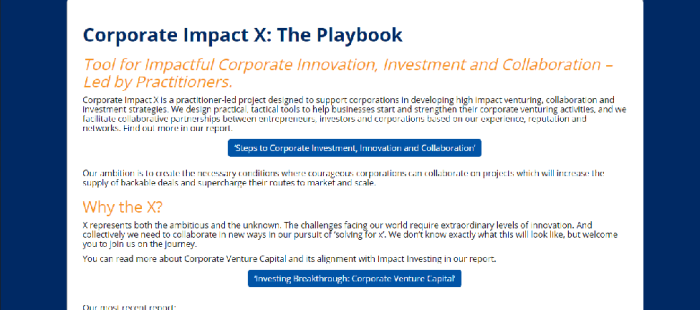
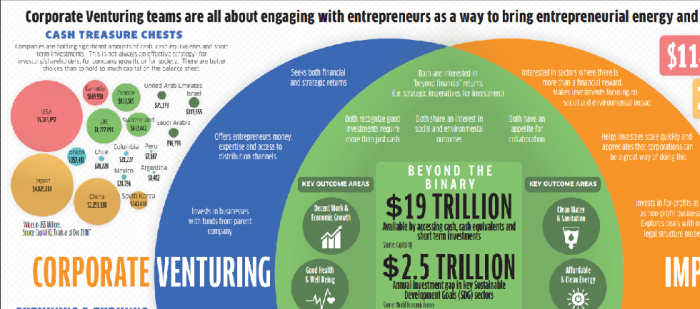
If you click on the section entitled “Reimagining Corporate Capital” you are taken to a site called Corporate Impact X.
This explains: “Corporate Impact X is a practitioner-led project designed to
support corporations in developing high impact venturing, collaboration and investment strategies”.
It offers a report called “Investing Breakthrough: Corporate Venture Capital”. Sadly the link does not work properly, though it does point the would-be investor towards Volans, the aforementioned buddies of XR, Tomorrow’s Capitalism and Unilever.
The “Thank You for Reading” section here is extremely revealing:
“Thank you to Elizabeth Boggs Davidsen of the Multilateral Investment Fund (MIF), of the Inter-American Development Bank Group, for managing this project and to the Inclusive Business Action Network (IBAN), a global partnership implemented by the Deutsche Gesellschaft für Internationale Zusammenarbeit (GIZ) for providing the funding. We are grateful for the support of Global Corporate Venturing and Saïd Business School, Oxford University”.
It adds that the project was developed and delivered by Charmian Love (CorporateImpactX), whose email is given as charmian@corporteimpactx.com
Just to be clear, this is Charmian Love of the fluffy-sounding Heliotropy Ltd, who is one of XR’s select band of business leaders.
This Corporate Venturing project was developed and delivered by
Extinction Rebellion’s Charmian Love. Well done Charmian!
It should be clear to anyone who has taken a look at the snarling capitalist agenda behind XR’s smiley eco-mask that they are not to be trusted.
If the movement is as democratic as it claims to be, it may still be possible for genuine environmentalists to wrest control of XR. Who knows?
Otherwise, decent people should get out as fast as they can and form new networks of resistance which fight to bring down the ecocidal industrial capitalist system, rather than to prop it up.
As the eco-activist Judi Bari put it: “There is no such thing as green capitalism. Serious ecologists must be revolutionaries”.
"Unlike the Latin American left, the pathetic European version has lost all sense of what it means to do politics. It does not try to propose concrete solutions to problems, and is only able to take moral stances, in particular denouncing dictators and human rights violations in grandiloquent tones. The social democratic left follows the right with at best a few years delay and has no ideas of its own. The “radical” left often manages both to denounce Western governments in every possible way and to demand that those same governments intervene militarily around the globe to defend democracy. Their lack of political reflection makes them highly vulnerable to disinformation campaigns and to becoming passive cheerleaders of US-NATO wars. That left has no coherent program and would not know what to do even if a god put them into power." - Jean Bricmont
“What’s infuriating about manipulations by Non Profit Industrial Complex is that they harvest good will of the people, especially young people. They target those who were not given skills and knowledge to truly think for themselves by institutions which are designed to serve the ruling class. Capitalism operates systematically and structurally like a cage to raise domesticated animals. Those organizations and their projects which operate under false slogans of humanity in order to prop up the hierarchy of money and violence are fast becoming some of the most crucial elements of the invisible cage of corporatism, colonialism and militarism.” — Hiroyuki Hamada, artist
“17-year-old Bianca Passarge of Hamburg dresses up as a cat, complete
with furry tail, and dances on wine bottles. Her performance was based
on a dream and she practised for eight hours every day in order to
perfect her dance.” - 1958
The Manufacturing of Greta Thunberg – for Consent has been written in six acts. [ACT I • ACT II • ACT III • ACT IV • ACT V • ACT VI] [Addenda: I]
In ACT I, I disclose that Greta Thunberg, the current child prodigy and face of the youth movement to combat climate change, serves as special youth advisor and trustee to the burgeoning mainstream tech start-up, We Don’t Have Time. I then explore the ambitions behind the tech company We Don’t Have Time.
In ACT II, I illustrate how today’s youth are the sacrificial lambs for the ruling elite. Also in this act I introduce the board members and advisors to We Don’t Have Time. I explore the leadership in the nascent We Don’t Have Time and the partnerships between the well-established corporate environmental entities: Al Gore’s Climate Reality Project, 350.org, Avaaz, Global Utmaning (Global Challenge), the World Bank, and the World Economic Forum (WEF).
In ACT III, I deconstruct how Al Gore and the Planet’s most powerful capitalists are behind today’s manufactured youth movements and why. I explore the We Don’t Have Time/Thunberg connections to Our Revolution, the Sanders Institute, This Is Zero Hour, the Sunrise Movement and the Green New Deal. I also touch upon Thunberg’s famous family. In particular, Thunberg’s celebrity mother, Malena Ernman (WWF Environmental Hero of the Year 2017) and her August 2018 book launch. I then explore the generous media attention afforded to Thunberg in both May and April of 2018 by SvD, one of Sweden’s largest newspapers.
In ACT IV, I examine the current campaign, now unfolding, in “leading the public into emergency mode”. More importantly, I summarize who and what this mode is to serve.
In ACT V, I take a closer look at the Green New Deal. I explore Data for Progress and the targeting of female youth as a key “femographic”. I connect the primary architect and authors of the “Green New Deal” data to the World Resources Institute. From there, I walk you through the interlocking Business & Sustainable Development Commission and the New Climate Economy – a project of the World Resources Institute. I disclose the common thread between these groups and the assignment of money to nature, represented by the Natural Capital Coalition and the non-profit industrial complex as an entity. Finally, I reveal how this has culminated in the implementation of payments for ecosystem services (the financialization and privatization of nature, global in scale) which is “expected to be adopted during the fifteenth meeting in Beijing in 2020.”
In the final act, ACT VI [Crescendo], I wrap up the series by divulging that the very foundations which have financed the climate “movement” over the past decade are the same foundations now partnered with the Climate Finance Partnership looking to unlock 100 trillion dollars from pension funds. I reveal the identities of individuals and groups at the helm of this interlocking matrix, controlling both the medium and the message. I take a step back in time to briefly demonstrate the ten years of strategic social engineering that have brought us to this very precipice. I look at the relationship between WWF, Stockholm Institute and World Resources Institute as key instruments in the creation of the financialization of nature. I also take a look at the first public campaigns for the financialization of nature (“natural capital”) that are slowly being brought into the public realm by WWF. I reflect upon how mainstream NGOs are attempting to safeguard their influence and further manipulate the populace by going underground through Extinction Rebellion groups being organized in the US and across the world.
With the smoke now cleared, the weak and essentially non-existent demands reminiscent of the 2009 TckTckTck “demands” can now be fully understood.
Some of these topics, in addition to others, will be released and discussed in further detail as addenda built on the large volume of research. This includes stepping through the looking glass, with an exploration of what the real “Green New Deal” under the Fourth Industrial Revolution will look like. Also forthcoming is a look at the power of celebrity – and how it has become a key tool for both capital and conformity.
[*Note: This series contains information and quotes translated from Swedish to English via Google Translator.]
A C T O N E
“How is it possible for you to be so easily tricked by something so simple as a story, because you are tricked? Well, it all comes down to one core thing and that is emotional investment. The more emotionally invested you are in anything in your life, the less critical and the less objectively observant you become.” — David JP Phillips, We Don’t Have Time board of directors, “The Magical Science of Storytelling”
As this term is quickly becoming the quote du jour as a collective mantra to address the ongoing environmental disaster that can best be described as a nod to the obvious, it’s true that we don’t have time. We don’t have time to stop imperialist wars – wars being the greatest contributor to climate change and environmental degradation by far – but we must do so. Of course this is an impossible feat under the crushing weight of the capitalist system, a US war economy, and the push for a fourth industrial revolution founded on renewable energy. Yet, inconvenience has nothing to do with necessity in regards to addressing a particular situation. What is never discussed in regard to the so-called “clean energy revolution” is that its existence is wholly dependent on “green” imperialism – the latter term being synonymous with blood.
But that’s not what this series is about.
This series is about new financial markets in a world where global economic growth is experiencing stagnation. The threat and subsequent response is not so much about climate change as it is about the collapse of the capitalist economic system. This series is about the climate wealth opportunity of unprecedented growth, profits, and the measures our elite classes will take in order to achieve it – including the exploitation of the youth.
What is We Don’t Have Time?
“Our goal is to become among the biggest players on the internet.” — Ingmar Rentzhog, We Don’t Have Time, December 22, 2017, Nordic Business Insider
On August 20, 2018 a tweet featuring a photo of “a Swedish girl” sitting on a sidewalk was released by the tech company, We Don’t Have Time, founded by its CEO Ingmar Rentzhog:
“One 15 year old girl in front of the Swedish parliament is striking from School until Election Day in 3 weeks[.] Imagine how lonely she must feel in this picture. People where [sic] just walking by. Continuing with the business as usual thing. But the truth is. We can’t and she knows it!”
Rentzhog’s tweet, via the We Don’t Have Time twitter account, would be the very first exposure of Thunberg’s now famous school strike.
Tagged in Rentzhog’s “lonely girl” tweet were five twitter accounts: Greta Thunberg, Zero Hour (youth movement), Jamie Margolin (the teenage founder of Zero Hour), Al Gore’s Climate Reality Project, and the People’s Climate Strike twitter account (in the identical font and aesthetics as 350.org). [These groups will be touched upon briefly later in this series.]
Rentzhog is the founder of Laika (a prominent Swedish communications consultancy firm providing services to the financial industry, recently acquired by FundByMe). He was appointed as chair of the think tank Global Utmaning (Global Challenge in English) on May 24, 2018, and serves on the board of FundedByMe. Rentzhog is a member of Al Gore’s Climate Reality Organization Leaders, where he is part of the European Climate Policy Task Force. He received his training in March 2017 by former US Vice President Al Gore in Denver, USA, and again in June 2018, in Berlin.
Founded in 2006, Al Gore’s Climate Reality Project is a partner of We Don’t Have Time.
The We Don’t Have Time Foundation cites two special youth advisors and trustees:
Mårten Thorslund, chief marketing and sustainability officer of We Don’t Have Time took many of the very first photos of Thunberg following the launch of her school strike on August 20, 2018. In the following instance, photos taken by Thorslund accompany the article written by David Olsson, chief operating officer of We Don’t Have Time, This 15-year-old Girl Breaks Swedish Law for the Climate, published August 23, 2018:
“Greta became a climate champion and tried to influence those closest to her. Her father now writes articles and gives lectures on the climate crisis, whereas her mother, a famous Swedish opera singer, has stopped flying. All thanks to Greta.
And clearly, she has stepped up her game, influencing the national conversation on the climate crisis—two weeks before the election. We Don’t Have Time reported on Greta’s strike on its first day and in less than 24 hours our Facebook posts and tweets received over twenty thousand likes, shares and comments. It didn’t take long for national media to catch on. As of the first week of the strike, at least six major daily newspapers, as well as Swedish and Danish national TV, [1] have interviewed Greta. Two Swedish party leaders have stopped by to talk to her as well.” [Emphasis added]
The article continues:
“Is there something big going on here? This one kid immediately got twenty supporters who now sit next to her. This one kid created numerous news stories in national newspapers and on TV. This one kid has received thousands of messages of love and support on social media…. Movements by young people, such as Jaime Margolin’s #ThisIsZeroHour that #WeDontHaveTime interviewed earlier, speaks with a much needed urgency that grown-ups should pay attention to…” [Emphasis in original]
Yes – there was, and still is, something going on.
It’s called marketing and branding.
“Yesterday I sat completely by myself, today there is one other here too. There are none [that] I know.” — Greta Thunberg, August 21, 2018, Nyheter newspaper, Sweden [Translation via Google]
The “one kid immediately got twenty supporters” – from a Swedish network for sustainable business. What is going on – is the launch of a global campaign to usher in a required consensus for the Paris Agreement, the New Green Deal and all climate related policies and legislation written by the power elite – for the power elite. This is necessary in order to unlock the trillions of dollars in funding by way of massive public demand.
These agreements and policies include carbon capture storage (CCS), enhanced oil recovery (EOR), bio-energy with carbon capture and storage (BECCS), rapid total decarbonisation, payments for ecosystem services (referred to as “natural capital”), nuclear energy and fission, and a host of other “solutions” that are hostile to an already devastated planet. What is going on – is a rebooting of a stagnant capitalist economy, that needs new markets – new growth – in order to save itself. What is being created is a mechanism to unlock approximately 90 trillion dollars for new investments and infrastructure. What is going on is the creation of, and investment in, perhaps the biggest behavioural change experiment yet attempted, global in scale. And what are the deciding factors in what behaviours global society should adhere to? And more importantly, who decides? This is a rhetorical question as we know full well the answer: the same Western white male saviours and the capitalist economic system they have implemented globally that has been the cause of our planetary ecological nightmare. This crisis continues unabated as they appoint themselves (yet again) as the saviours for all humanity – a recurring problem for centuries.
Source: WWF
“Our goal is to become at least 100 million users. It is an eighth of all who have climbed on social media. Only last month we managed to reach 18 million social media accounts according to a media survey that Meltwater news made for us. At Facebook, we are currently seven times the number of followers among the world’s all climate organizations. We are growing with 10,000 new global followers per day on Facebook.” — Ingmar Rentzhog interview with Miljö & Utveckling, October 15, 2018
We Don’t Have Time identifies itself as a movement and tech startup that is currently developing “the world’s largest social network for climate action”. The “movement” component was launched on April 22, 2018. The web platform is still in the progress of being built, but is to launch on April 22, 2019 (coinciding with Earth Day). “Through our platform, millions of members will unite to put pressure on leaders, politicians and corporations to act for the climate.” The start-up’s goal to rapidly achieve 100 million users has thus far attracted 435 investors (74.52% of the company’s shares) via the web platform FundedByMe.
The startup intends to offer partnerships, digital advertising and services related to climate change, sustainability and the growing green, circular economy to “a large audience of engaged consumers and ambassadors.”
We Don’t Have Time is mainly active in three markets: social media, digital advertising and carbon offsets. [“In the US alone estimated market for carbon offsetting amount to over 82 billion USD of which voluntary carbon offset represents 191 million USD. The market is expected to increase in the future, in 2019 estimated 15% of all greenhouse gas emissions to be associated with any kind of cost for offsetting.”] As the company is a niche organization, social networks are able to provide services tailored to platform users. The startup has identified such an opportunity by offering its users the ability to purchase carbon offsets through the platform’s own certification. This option applies to both the individual user of the platform, as well as whole organizations/companies on the platform.
One incentive of many identified in the start-up investment section is that users will be encouraged to “communicate jointly and powerfully with influential actors.” Such influencers are Greta Thunberg and Jamie Margolin who both have lucrative futures in the branding of “sustainable” industries and products, if they wish to pursue this path in utilizing their present celebrity for personal gain (a hallmark of the “grassroots” NGO movement). [Further reading: The Increasing Vogue for Capitalist-Friendly Climate Discourse]
The tech company is banking on creating a massive member base of “conscious users” that will enable “profitable commercial collaborations, for example, advertising”:
“Decision makers – politicians, companies, organizations, states – get a climate rating based on their ability to live up to the users’ initiative. Knowledge and opinion gather in one place and users put pressure on decision makers to drive a faster change.”
“The main sources of revenue come from commercial players who have received high climate rating and confidence in the We Don’t Have Times member base.[2] … The revenue model will resemble the social platform of TripAdvisor.com’s business model, which with its 390 million users annually generates over $ 1 billion in good profitability…We will work with strategic partners such as Climate Reality leaders, climate organizations, bloggers, influencers and leading experts in the field.”
Video: We Don’t Have Time promotional video, published April 6, 2018 [Running time: 1m:38s]
A “state of conscious and permanent visibility assures the automatic functioning of power.” — Michel Foucault’s Discipline and Punish
Comparable to other social media endeavors where “likes”, “followers”, and unfathomable amounts of metadata determine financial success, the fact that the business is virtual enables high profit margins. The return on investment, best described as mainstream acquiescence and desirability by way of exposure, will be obtained through future dividends. In anticipation of this projected success, the tech company plans to take its business to the stock exchange in the near future. (Think Facebook and Instagram.) The most critical component to the success of this startup (like its predecessors) is achieving a massive member base. Therefore, according to the company it “will work actively with both enlisting influencers and creating content for various campaigns linked to the hashtag #WeDontHaveTime.”
On April 18, 2018 the crowdfunding platform FundedByMe (utilized by We Don’t Have Time to enlist investors) acquired Ingmar Rentzhog’s Laika Consulting. Excerpts from the press release are as follows:
“FundedByMe today announced that they acquire 100% of the shares in the established financial company Laika Consulting AB, a leading communications agency in financial communications. As a result, the company doubles its investment network to close to 250,000 members, making it the largest in the Nordic region. The acquisition is a strategic step to further strengthen FundedByMe’s range of financial services…
[Ingmar Rentzhog] will continue to work on strategic client projects for FundedByMe and Laika Consulting in part-time. Moreover he takes a role in the company’s board. The majority of his time he will focus on climate change through the newly established company, “We Don’t Have Time”, as a CEO and founder.” [Emphasis added] [Source] [3]
We Don’t Have Time Software App: The Latest Wave of Western & Corporate Ideology at Your Fingertips
In October 2016, Netflix aired the third season of Black Mirror, “a Twilight Zone–esque anthology TV series about technological anxieties and possible futures.” The first episode “Nosedive” posits a shallow and hypocritical populace in which “social platforms, self-curation and validation-seeking” have become the underpinning of a future society. [Black Mirror’s third season opens with a vicious take on social media]. The disturbing episode shares parallels to the concept behind We Don’t Have Time. The difference being instead of rating people exclusively, we will be rating brands, products, corporations and everything else climate related.
The not unintended results will be tenfold. The corporations with the best advertising executives and largest budgets will be the winners. Greenwashing will become an unprecedented method of advertising as will the art of “storytelling” (no one ever said a story has to be true). Small or local businesses with little financial means will more than often be the losers. Especially hit, will be migrant entrepreneurs whose cultures differ from ours in the West – where “Western democracy” is the only democracy that is valid.
Adding to the conversation as to who is ultimately benefiting from this endeavor from a cultural, social, geographical and ethnic perspective is the fact that “subconscious biases about race or gender, is a proven problem on many crowdsourced platforms.” [Source] Ultimately, this means that in order to acquire the needed support as a multimedia platform, the self-interest of the Western world must be at the fore with no concern for the Global South – other than what we can continue to steal from her. The inconvenient truth is that all roads lead to the same collective (if even subconscious) goal: the preservation of whiteness.
Rentzhog assures his audience that “our core, though, will remain, namely to empower our users to put pressure on world leaders so that they move faster towards an emission-free world and environmentally sustainable solutions and policies.” [Acquisition International Magazine Issue 10, 2018]
An “emission-free world” sounds enticing – yet there are no plans whatsoever to retract our growth economies. “Environmentally sustainable solutions” … according to who? According to a tribal elder who upholds the principles of “the seventh generation” (the Indigenous belief that humans must properly provide for its descendants by ensuring that our actions in the present allow the Earthly survival of seven succeeding generations – not to be confused with Unilever’s Seventh Generation acquisition) – or according to the World Bank? (We all know the answer to this rhetorical question.)
Another inconvenient truth, regarding the above premise, is that there is growing pressure on governments to increase Federal research and development funding to develop and deploy “deep decarbonization” technologies as one of the primary “solutions” to climate change. This was proposed at the Paris Climate Accord with Bill Gates’ “Mission Innovation” initiative which committed to doubling government investment in energy technology.
“We want it to cost more, in terms of revenue, public support and reputation, to not work on lowering emissions and improve environmental sustainability, whereas those that lead the way should be recognized for this. Our vision is to create a race towards environmental sustainability and CO2 neutrality, making it the core priority for businesses, politicians and organizations worldwide.” — Acquisition International Magazine Issue 10, 2018
Here again, we must look closely at language and framing. Who are “those that lead the way”? Are they referring to Western citizens who can fit all their belongings in a duffle bag? [Here it must be said that the environmental heroes in the West are NOT the Richard Bransons or Leonardo DiCaprios of the world. The real heroes for the environment, due to their almost non-existent environmental footprint, are the homeless – despite the scorn they receive from society as a whole.] Are they referring to the African Maasai who to this day, literally leave no trace? Or are “those that lead the way” Unilever and Ikea (represented on the We Don’t Have time board). This is another rhetorical question we all know the answer to. Notice the mention of CO2 “neutrality” rather than a drastic reduction of CO2 emissions. Convenient language when one of the main pillars of the business model is the sale of carbon offsets – rationalizing a continuance of the same carbon based lifestyle by constructing a faux fantasy one, that anyone with monetary wealth, can buy into.
As online reviews and ratings systems have become a Western staple of determining the worthiness of a person, group or corporation, the internet presently is a primary source of determining the quality of an entity. One example of this type of system is the online site Trip Advisor, which utilizes user feedback as a measuring stick of a hotel, airline, car rental, etc. As the Trip Advisor rating system is the revenue model We Don’t Have Time seeks to emulate, we will explore this particular rating system.
Whereas a reputable and established website such as Trip Advisor is based on an actual experience – We Don’t Have Time evaluations are more geared toward promises into the future regarding a green technology revolution and/or the effectiveness of advertising in making people believe the veracity of these promises. By utilizing fake accounts (think Twitter and Facebook), strategically orchestrated campaigns will effectively allow the app to break political careers and demonize people and countries based on the numbers of ratings (“climate bombs”). These bombs can be administered against any foe that does not embrace the technologies (sought by the West to benefit the West) of this so-called revolution, regardless if the reason for doing so is justifiable or not.
The word “bomb” itself will become reframed. Rather than associating bombs with militarism (never touched upon by We Don’t Have Time) the word bomb will eventually become first and foremost associated with ratings, bad products, bad ideas and bad people. Such is the power of language and framing when combined with social engineering. Here, the behavioural economics of hatred can be weaponized – a virtual new form of soft power. The Nicaraguan Sandinista government who did not sign onto the Paris Agreement because it is too weak (and serves only Western interests) could quickly become a pariah on the global stage- as the West controls the stage. Already a target for destabilization, the soft power app would be applied as the ruling class sees fit.
When one contemplates the non-profit industrial complex, it must be considered the most powerful army in the world. Employing billions of staff, all inter-connected, today’s campaigns, financed by our ruling oligarchs can become viral in a matter of hours just by the interlocking directorate working together in unity toward a common goal to instil uniform thoughts and opinions, which gradually create a desired ideology. This is the art of social engineering. Conformity and emotive content as tools of manipulation has been and always will be the most powerful weapons in the Mad Men’s toolbox. If 300, 000 people have already voted with “climate hearts” on a “trending” topic in under 48 hours – it must be a great idea.
“Nobody wants to be bottom of the class.” Ingmar Retzhog, We Don’t Have Time, December 22, 2017, Nordic Business Insider
To be clear, the West is in no position to “teach” (nudge/engineer) the “correct” value system regarding sustainability to the world, when the biggest polluters on the planet are manufactured into “climate leaders” and “climate heroes”. This is reality turned on its head. A reality we are conditioned to accept. Institutions such as the United Nations in tandem with the media, spoon-feed this insanity (that defies all logic) to the global populace, in servitude to the ruling classes.
“Nudging”: Acquisition International Magazine Issue 10, 2018
Finally, this behavioral science platform lends itself to the continued devolvement of critical thinking. With virtually everything and everyone to rate all day long – who has time to look in depth at any given policy or product that after all, sounds, looks and feels simply amazing due to sophisticated marketing coupled with behavioural change tactics? It is vital to keep in mind that social engineering – and massive profit – are the key merits and purpose of this application.
End Notes:
[1] TV 2 Danmark Danish public service, SVT Swedish public service, TV 4 News, Metro TV, Dagens Nyheter, Aftonbladet (August 20, 2018), Sydsvenskan, Stockholm Direkt, Expressen (August 20, 2018) , ETC, WWF, Effekt Magazin, GöteborgsPosten,Helsingborgs Dagblad, Folkbladet, Uppsala Nya tidning, Vimmerby Tidning, Piteå Tidningen, Borås Tidning, Duggan, VT, NT, Corren, OMNI, WeDontHaveTime CEO viral FaceBook post that mention it first. [Source]
[2] Click-based advertising based on highly rated companies that want to drive traffic to their websites; Targeted web advertising for companies that want to reach out to environmentally aware users in different segments; Business subscriptions where companies and organizations have the opportunity to interact with the members and get the right to use the We Don’t Have Times brand and the company’s rating in their marketing [Source]
[3] “Laika Consulting was one of the first companies in Sweden to work with crowdfunding when we established the brand in 2004. I look forward to follow the company’s growth closely. A combination of Laika’s expertise in listed companies, together with FundedByMe with its international and digital presence, can create new opportunities for growth.”says Laika’s CEO, Ingmar Rentzhog.” [Source]
[Cory Morningstar is an independent investigative journalist, writer and environmental activist, focusing on global ecological collapse and political analysis of the non-profit industrial complex. She resides in Canada. Her recent writings can be found on Wrong Kind of Green, The Art of Annihilation and Counterpunch. Her writing has also been published by Bolivia Rising and Cambio, the official newspaper of the Plurinational State of Bolivia. You can support her independent journalism via Patreon.]
Edited with Forrest Palmer, Wrong Kind of Green Collective.