Monday, November 25, 2013

Bernard Henri Levy, France's Sham Libya Liberator and Faux Champion of Muslims Everywhere

France’s Sham Philosopher: Bernard Henri Levy and the Destruction of Libya

by Ramzy Baroud  - PalestineChronicle.com

While Israeli Prime Minister Benjamin Netanyahu is “the world’s most influential Jew”, Bernard Henri Levy is number 45, according to an article published in the Israeli rightwing newspaper the Jerusalem Post, on May 21, 2010.

Levy, per the Post’s standards, came only two spots behind Irving Moskowitz, a “Florida-based tycoon (who) is considered the leading supporter of Jewish construction in east Jerusalem and hands out a prize for Zionism to settler leaders.”

To claim that at best Levy is an intellectual fraud is to miss a clear logic that seems to unite much of the man’s activities, work and writings. He seems to be obsessed with ‘liberating’ Muslims from Bosnia to Pakistan, to Libya and elsewhere. However, it is not the kind that one could qualify as a healthy obsession, stemming from for instance, overt love and fascination of their religion, culture and myriad ways of life. It is unhealthy obsession. Throughout his oddly defined career, he has done so much harm, as he at times served the role of lackey for those in power, and at others, seemed to lead his own crusades. He is a big fan of military intervention, and his profile is dotted with references to Muslim countries and military intervention from Afghanistan to Sudan ... and finally to Libya.

Writing in the New York Magazine on Dec 26, 2011, Benjamin Wallace-Wells spoke of the French ‘philosopher’ as if he were referencing a messiah that was not afraid to promote violence for the greater good of mankind. In “European Superhero Quashes Libyan Dictator,” Wallace-Wells wrote of the “philosopher (who) managed to goad the world into vanquishing an evil villain.” The ‘evil villain’ in question is, of course, Muammar Qaddafi, the Libyan leader who was ousted and brutally murdered after reportedly being sodomized by rebels following his capture in October 2011. The detailed analysis by Global Post of the sexual assault of the leader of one of Africa’s most prominent countries was published in CBS news and other media. Cases of rape have sharply increased in Libya as 1,700 militia (per BBC estimation) groups now operate in that shattered Arab country.

Levy, who at times appeared to be the West’s most visible war-on-Libya advocate, has largely disappeared from view within the Libyan context. He is perhaps off stirring trouble in some other place in the name of his dubious philosophy. His mission in Libya, which is now in a much worse state it has ever reached during the reign of Qaddafi, has been accomplished. ‘The evil dictator’ has been defeated, and that’s that. Never mind that the country is now divided between tribes and militias, and that the ‘post-democracy’ Prime Minister Ali Zeidan was recently kidnapped by one unruly militia to be freed by another.

In March 2011, Levy took it upon himself to fly to Benghazi to ‘engage’ Libya’s insurgents. It was a defining moment, for it was that type of mediation that empowered armed groups to transform a regional uprising into an all-out war involving NATO. Armed with what was a willful misinterpretation of UN resolution 1973, of March 17, 2011, NATO lead a major military offensive on a country armed with primitive air-defensives and a poorly equipped army. Western countries channeled massive shipments of weapons to Libyan groups in the name of preventing massacres allegedly about to be carried out by Qaddafi’s loyalists. Massacres were indeed carried out but not in the way western ‘humanitarian interventionists’ suggested. The last of which was merely days ago (Nov 15) when 31 people were reportedly killed and 235 were wounded as trigger happy militiamen opened fire at peaceful protesters in Tripoli that were simply demanding Misrata militants leave their city.

These are the very people that Levy and his ilk spent numerous hours lobbying in their support. One of Levy’s greatest achievements in Libya was to muster international recognition of the National Transitional Council (NTC). France and other countries lead a campaign to promote the NTC as an alternative to Qaddafi’s state institution, which NATO had systematically destroyed.

In his New York Magazine interview, Levy was quoted as saying “sometimes you are inhabited by intuitions that are not clear to you.” The statement was sourced in reference to the supposed epiphany the ‘philosopher’ had on Feb 23, 2011, watching TV images of Qaddafi’s forces threatening to drown Benghazi with ‘rivers of blood.’

Far from unclear intuitions, Levy’s agenda is that of the calculated politician-ideologue, more like a French version of the US’s neoconservatives who packaged their country’s devastating war on Iraq with all sorts of moral, philosophical and other fraudulent reasoning. For them, it was first and foremost a war for Israel’s ‘security’, with supposed other practical perks, little of which has actualized. Levy’s legacy is indeed loaded with unmistakable references to that same agenda.

Israel’s right-wingers are fascinated with Levy. The Post’s celebration of his global influence was summed up in this quote: “A French philosopher and one of the leaders of the Nouvelle Philosophie movement who said that Jews ought to provide a unique moral voice in the world.” But morality has nothing to do with it. The man's philosophical exploits seem to exclusively target Muslims and their cultures. "The veil is an invitation to rape", he told the Jewish Chronicle in 2006.

Philosophy for Levy seems to be perfectly tailored to fit a political agenda promoting military interventions. His advocacy helped destroy Libya, but still didn’t stop him from writing a book on Libya’s ‘spring.’ He spoke of the veil as an invitation for rape, while saying nothing of the numerous cases of rape reported in Libya after the NATO war. In May 2011, he was one of few people who defended IMF chief Dominique Strauss-Kahn, when the latter was accused of raping a chambermaid in New York City. It was a ‘conspiracy’ he said, in which the maid was taking part.

One could perhaps understand Levy’s hate for dictators and war criminals; after all, Qaddafi was no human rights champion. But Levy is no philosopher. A fundamental element of any genuine philosophy is moral consistency. Levy has none. A week after the Jerusalem Post celebrated Levy’s world influence, the Israeli daily Haaretz wrote of his support of the Israeli army.

“Bernard Henri Levy: I have never seen an army as democratic as the IDF” was the title of an article on May 30, 2010, reporting on the “Democracy and Its Challenges” Conference in Tel Aviv. “I have never seen such a democratic army, which asks itself so many moral questions. There is something unusually vital about Israeli democracy.” Considering the wars and massacres conducted by the Israeli army against Gaza in 2008-9 and 2012, one cannot find appropriate phrases to describe Levy’s moral blindness and misguided philosophy. In fact, it is safe to argue that neither morality nor philosophy has much to do with Levy and his unending quest for war.

Ramzy Baroud (www.ramzybaroud.net) is a media consultant, an internationally-syndicated columnist and the editor of PalestineChronicle.com. His latest book is: My Father was A Freedom Fighter: Gaza's Untold Story (Pluto Press).

Ever Beneficiaries and the Misery Profiteers

The Decline of the US (and Everyone Else)

by James Petras - Dissident Voice

The world political economy is a mosaic of cross currents: Domestic decay and elite enrichment, new sources for greater profits and deepening political disenchantment, declining living standards for many and extravagant luxury for a few, military losses in some regions with imperial recovery in others. There are claims of a unipolar, a multi-polar and even a non-polar configuration of world power. Where, when, to what extent and under what contingencies do these claims have validity?

Bubbles and busts come and go, but let us talk of ‘beneficiaries’: Those who cause crashes, reap the greatest rewards while their victims have no say. The swindle economy and the criminal state prosper by promoting the perversion of culture and literacy. ‘Investigatory journalism’, or peephole reportage, is all the rage. The world of power spins out of control: As they decline, the leading powers declare “it’s our rule or everyone’s ruin!”

Global Configurations of Power


Power is a relationship between classes, states and military and ideological institutions. Any configuration of power is contingent on past and present struggles reflecting shifting correlations of forces. Structures and physical resources, concentrations of wealth, arms and the media matter greatly; they set the framework in which the principle power wielders are embedded. But strategies for retaining or gaining power depend on securing alliances, engaging in wars and negotiating peace. Above all, world power depends on the strength of domestic foundations. This requires a dynamic productive economy, an independent state free from prejudicial foreign entanglements and a leading class capable of harnessing global resources to ‘buy off’ domestic consent of the majority.

To examine the position of the United States in the global configuration of power it is necessary to analyze its changing economic and political relations on two levels: by region and by sphere of power. History does not move in a linear pattern or according to recurring cycles: military and political defeats in some regions may be accompanied by significant victories in others. Economic decline in some spheres and regions may be compensated by sharp advances in other economic sectors and regions.

In the final analysis, the question is not ‘keeping a scorecard’ or adding wins and subtracting losses, but translating regional and sectorial outcomes into an understanding of the direction and emerging structures of the global power configuration. We start by examining the legacy of recent wars on the global economic, military and political power of the United States.

Sustaining the US Empire: Defeats, Retreat, Advances, and Victories


The dominant view of most critical analysts is that over the past decade US empire-building has suffered a series of military defeats, experienced economic decline, and now faces severe competition and the prospect of further military losses. The evidence cited is impressive: the US was forced to withdraw troops from Iraq, after an extremely costly decade-long military occupation, leaving in place a regime more closely allied to Iran, the US’ regional adversary. The Iraq war depleted the economy, deprived American corporations of oil wealth, greatly enlarged Washington’s budget and trade deficits and reduced the living standards of US citizens. The Afghanistan war had a similar outcome, with high external costs, military retreat, fragile clients, domestic disaffection and no short or medium term transfers of wealth (imperial pillage) to the US Treasury or private corporations. The Libyan war led to the total destruction of a modern, oil-rich economy in North Africa, the total dissolution of state and civil society and the emergence of armed tribal, fundamentalist militias opposed to US and EU client regimes in North and sub-Sahara Africa and beyond. Instead of continuing to profit from lucrative oil and gas agreements with the conciliatory Gaddafi regime, Washington decided on ‘regime change’, engaging in a war which ruined Libya and destroyed any viable central state. The current Syrian “proxy war” has strengthened radical Islamist warlords, destroyed Damascus’ economy and added massive refugee pressure to the already uprooted millions from wars in Iraq and Libya. US imperial wars have resulted in economic losses, regional political instability and military gains for Islamist adversaries.

Latin America has overwhelmingly rejected US efforts to overthrow the Venezuelan government. The entire world — minus Israel and Washington — rejects the blockade of Cuba. Regional integration organizations, which exclude the US, have proliferated. US trade shares have declined, as Asia is replacing the US in the Latin American market.

In Asia, China deepens and extends its economic links with all the key countries, while the US ‘pivot’ is mostly an effort at military base encirclement involving Japan, Australia and the Philippines. In other words, China is more important than the US for Asian economic expansion, while Chinese financing of US trade imbalances props up the US economy.

In Africa, US military command operations mainly promote armed conflicts and lead to greater instability. Meanwhile Asian capitalists, deeply invested in strategic African countries, are reaping the benefits of its commodity boom, expanding markets and the outflow of profits.

The exposure of the US National Security Agency’s global spy network has seriously undermined global intelligence and clandestine operations. While it may have helped privileged private corporations, the massive US investment in cyber-imperialism appears to have generated negative diplomatic and operational returns for the imperial state.

In sum, the current global overview paints a picture of severe military and diplomatic setbacks in imperial policies, substantial losses to the US Treasury and the erosion of public support. Nevertheless this perspective has serious flaws, especially with regard to other regions, relations and spheres of economic activity. The fundamental structures of empire remain intact.

NATO, the major military alliance headed by the US Pentagon, is expanding its membership and escalating its field of operations. The Baltic States, especially Estonia, are the site of huge military exercises held just minutes from the principle Russian cities. Central and Eastern Europe provide missile sites all aimed at Russia. Until very recently, the Ukraine had been moving toward membership in the European Union and a step toward NATO membership.

The US-led Trans-Pacific Partnership has expanded membership among the Andean countries, Chile, Peru and Colombia. It serves as a springboard to weaken regional trading blocs like MERCOSUR and ALBA, which exclude Washington. Meanwhile, the CIA, the State Department and their NGO conduits are engaged in an all-out economic sabotage and political destabilization campaign to weaken Venezuela’s nationalist government. US-backed bankers and capitalists have worked to sabotage the economy, provoking inflation (50%), shortages of essential items of consumption and rolling power blackouts. Their control over most of Venezuela’s mass media has allowed them to exploit popular discontent by blaming the economic dislocation on ‘government inefficiency’.

Overall, the US offensive in Latin America has focused on a military coup in Honduras, ongoing economic sabotage in Venezuela, electoral and media campaigns in Argentina, and cyber warfare in Brazil, while developing closer ties with recently elected compliant neo-liberal regimes in Mexico, Colombia, Chile, Panama, Guatemala and the Dominican Republic. While Washington lost influence in Latin America during the first decade of the 21st century, it has since partially recovered its clients and partners. The relative recovery of US influence illustrates the fact that ‘regime changes’ and a decline in market shares, have not lessened the financial and corporate ties linking even the progressive countries to powerful US interests. The continued presence of powerful political allies — even those ‘out of government’ — provides a trampoline for regaining US influence. Nationalist policies and emerging regional integration projects remain vulnerable to US counter-attacks.

While the US has lost influence among some oil producing countries, it lessened its dependence on oil and gas imports as a result of a vast increase in domestic energy production via fracking and other intense extractive technologies. Greater local self-sufficiency means lower energy costs for domestic producers and increases their competitiveness in world markets, raising the possibility that the US could regain market shares for its exports.

The seeming decline of US imperial influence in the Arab world following the popular ‘Arab Spring’ uprisings has halted and even been reversed. The military coup in Egypt and the installation and consolidation of the military dictatorship in Cairo suppressed the mass national-popular mobilizations. Egypt is back in the US-Israel orbit. In Algeria, Morocco and Tunisia the old and new rulers are clamping down on any anti-imperial protests. In Libya, the US-NATO air force destroyed the nationalist-populist Gaddafi regime, eliminating an alternative welfare model to neo-colonial pillage – but has so far failed to consolidate a neo-liberal client regime in Tripoli. Instead rival armed Islamist gangs, monarchists and ethnic thugs pillage and ravage the country. Destroying an anti-imperialist regime has not produced a pro-imperialist client.

In the Middle East, Israel continues to dispossess the Palestinians of their land and water. The US continues to escalate military maneuvers and impose more economic sanctions against Iran – weakening Teheran but also decreasing US wealth and influence due to the loss of the lucrative Iranian market. Likewise in Syria, the US and its NATO allies have destroyed Syria’s economy and shredded its complex society, but they will not be the main beneficiaries. Islamist mercenaries have gained bases of operations while Hezbollah has consolidated its position as a significant regional actor. Current negotiations with Iran open possibilities for the US to cut its losses and reduce the regional threat of a costly new war but these talks are being blocked by an ‘alliance’ of Zionist-militarist Israel, monarchist Saudi Arabia and ‘Socialist’ France.

Washington has lost economic influence in Asia to China but it is mounting a regional counter-offensive, based on its network of military bases in Japan, the Philippines and Australia. It is promoting a new Pan Pacific economic agreement that excludes China. This demonstrates the US capacity to intervene and project imperial interests. However announcing new policies and organizations is not the same as implementing and providing them with dynamic content. Washington’s military encirclement of China is off-set by the US Treasury’s multi-trillion dollar debt to Beijing. An aggressive US military encirclement of China could result in a massive Chinese sell-off of US Treasury notes and five hundred leading US multi-nationals finding their investments in jeopardy!

Power-sharing between an emerging and established global power, such as China and the US, cannot be ‘negotiated’ via US military superiority. Threats, bluster and diplomatic chicanery score mere propaganda victories but only long-term economic advances can create the domestic Trojan Horses need to erode China’s dynamic growth. Even today, the Chinese elite spend hefty sums to educate their children in “prestigious” US and British universities where free market economic doctrines and imperial-centered narratives are taught. For the past decade, leading Chinese politicians and the corporate rich have sent tens of billions of dollars in licit and illicit funds to overseas bank accounts, investing in high end real estate in North America and Europe and dispatching billions to money laundering havens. Today, there is a powerful faction of economists and elite financial advisers in China pushing for greater ‘financial liberalization’, i.e. penetration by the leading Wall Street and City of London speculative houses. While Chinese industries may be winning the competition for overseas markets, the US has gained and is gaining powerful levers over China’s financial structure.

The US share of Latin American trade may be declining, but the absolute dollar worth of trade has increased several-fold over the past decade.

The US may have lost right-wing regime clients in Latin America, but the new center-left regimes are actively collaborating with most of the major US and Canadian mining and agro-business corporations and commodity trading houses. The Pentagon has not been able to engineer military coups, with the pathetic exception of Honduras, but it still retains its close working relations with the Latin American military in the form of (1) its regional policing of ‘terrorism’, ‘narcotics’ and ‘migration’, (2) providing technical training and political indoctrination via overseas military ‘educational’ programs and (3) engaging in joint military exercises.

In sum, the structures of the US empire, corporate, financial, military and political-cultural, all remain in place and ready to regain dominance if and when political opportunities arise. For example, a sharp decline in commodity prices would likely provoke a deep crisis and intensify class conflicts among center-left regimes, which are dependent on agro-mining exports to fund their social programs. In any ensuing confrontation, the US would work with and through its agents among the economic and military elite to oust the incumbent regime and re-impose pliant neo-liberal clients. The current phase of post-neo-liberal policies and power configurations are vulnerable. The relative ‘decline of US influence and power’ can be reversed even if it is not returned to its former configuration. The theoretical point is that while imperialist structures remain in place and while their collaborator counterparts abroad retain strategic positions, the US can re-establish its primacy in the global configuration of power.

Imperial ‘roll-back’ does not require the ‘same old faces’. New political figures, especially with progressive credentials and faint overtones of a ‘social inclusionary’ ideology are already playing a major role in the new imperial-centered trade networks. In Chile, newly elected “Socialist” President Michelle Bachelet and the Peruvian ex-nationalist, President Ollanta Humala, are major proponents of Washington’s Tran-Pacific Partnership, a trading bloc which competes with the nationalist MERCOSUR and ALBA, and excludes China. In Mexico, US client President Enrique Peña Nieto is privatizing the ‘jewel’ of the Mexican economy, PEMEX, the giant public oil company – strengthening the Washington’s hold over regional energy resources and increasing US independence from Mid-East oil. Colombian President Santos, the ‘peace president’, is actively negotiating an end to guerrilla warfare in order to expand multinational exploitation of mineral and energy resources located in guerrilla-contested regions, a prospect which will primarily benefit US oil companies. In Argentina, the state oil company, Yacimientos Petroliferos Fiscales (YPF) has signed a joint venture agreement with the oil giant, Chevron, to exploit an enormous gas and oil field, known as Vaca Muerte (Dead Cow). This will expand the US presence in Argentina in energy production alongside the major inroads made by Monsanto in the powerful agro-business sector.

No doubt Latin America has diversified its trade and the US share has relatively declined. Latin American rulers no longer eagerly seek ‘certification’ from the US Ambassador before announcing their political candidacy. The US is totally alone in its boycott of Cuba. The Organization of American States is no longer a US haven. But there are counter-tendencies, reflected in new pacts like the TPP. New sites of economic exploitation, which are not exclusively US controlled, now serve as springboards to greater imperial power.

Conclusion


The US economy is stagnant and has failed to re-gain momentum because of its pursuit of ‘serial’ imperial wars. But in the Middle East, the US decline, relative to its past, has not been accompanied by the ascent of its old rivals. Europe is in deeper crisis, with a vast army of unemployed, chronic negative growth and few signs of recovery for the visible future. Even China, the new emerging global power, is slowing down with its growth falling from over 11% to 7% in the current decade. Beijing faces growing domestic discontent. India, as well as China, are liberalizing their financial systems, opening them up to penetration and influence by US finance capital.

The main anti-imperialist forces in Asia and Africa are not composed of progressive, secular, democratic and socialist movements. Instead, the empire is confronted by religious, ethnic, misogynist and authoritarian movements with irredentist tendencies. The old secular, socialist voices have lost their bearings, and provide perverse ‘justifications’ for the imperialist wars of aggression in Libya, Mali and Syria. The French Socialists, who had opposed the Iraq war in 2003, now find their President Francoise Hollande parroting the brutal militarism of the Israeli warlord, Netanyahu.

The point is that the thesis of the ‘decline of the US empire’ and its corollary, the ‘crises of the US’ are overstated, time bound and lack specificity. In reality, there is no alternative imperial or modern anti-imperial tendency on the immediate horizon. While it is true that Western capitalism is in crisis, the recently ascending Asian capitalism of China and India face a different crisis resulting from their savage class exploitation and murderous caste relations. If objective conditions are ‘ripe for socialism’, the socialists – at least those retaining any political presence- are comfortably embedded with their respective imperial regimes. The Marxists and Socialists in Egypt joined with the military to overthrow an elected conservative Islamist regime, leading to the restoration of imperialist clientelism in Cairo. The French and English ‘Marxists’ have supported NATO’s destruction of Libya and Syria. Numerous progressives and socialists, in Europe and North America, support Israel’s warlords and/or remain silent in the face of domestic Zionist power in the executive branches and legislatures.

If imperialism is declining, so is anti-imperialism. If capitalism is in crisis, the existing anti-capitalists are in retreat. If capitalists look for new faces and ideologues to revive their fortunes, isn’t it time the anti-imperialists and anti-capitalists did likewise?

James Petras, a former Professor of Sociology at Binghamton University, New York, owns a 50-year membership in the class struggle, is an adviser to the landless and jobless in Brazil and Argentina, and is co-author of Globalization Unmasked (Zed Books). Petras’ most recent book is The Arab Revolt and the Imperialist Counterattack. He can be reached at: jpetras@binghamton.edu. Read other articles by James, or visit James's website.

Sunday, November 24, 2013

Gorilla Radio with Chris Cook, Eva Bartlett, Deer Safe Victoria, Janine Bandcroft Nov. 25, 2013

This Week on GR

by C. L. Cook - Gorilla-Radio.com


November 25, 2013 

To say Gaza City and the Gaza Strip, that thin slice of remnant Palestine walled on three sides by Israel and Egypt, patrolled with deadly seriousness from the sea, and whose airspace is entirely controlled by Israel's air force, is in crisis is labouring the obvious.

Targeted by a ruthless campaign of managed starvation by Israel, the so-called "Gaza Diet" has ensured an entire generation of children will be stunted physically and intellectually, while deliberate and repeated attacks by Israel's military guarantee emotional trauma.

But, things in Gaza have taken a dramatic turn for the worse since political turmoil in neighbouring Egypt closed the Rafah border, and the military Junta there began a program of systematic destruction of the tunnels that had supplied Gaza with the necessities of life Israel's illegal embargo routinely denies.

Listen. Hear.

Eva Bartlett landed in Gaza with one of the only Gaza Boats able to break Israel's blockade in 2008. She stayed on with the International Solidarity Movement, or ISM, as an accompanier in time to suffer the horrific Cast Lead bombardment, and to bear witness daily to Gazans' tribulations in their homes and streets, in the farmers' fields, and on the fishers' boats, subject to the caprices of Israel's naval forces. Eva will be speaking here this Wednesday November 27th at the University of Victoria as part of 'Gaza in Crisis: Eyewitness Reports'.

Eva Bartlett in the first half.

And; Oak Bay council recently decided to launch an "experimental" deer culling program aimed at "controlling" urban deer. Predictably, the decision is controversial, and one group opposed to the scheme held demonstrations in Oak Bay over the weekend. DeerSafeVictoria says the cull plan is cruel, and will ultimately prove ineffective. I went down to the demonstration to talk to some of the people involved.

Deer hunting behind the tweed curtain in the second half.

And; Victoria Street Newz publisher and CFUV Radio broadcaster, Janine Bandcroft will join us at the bottom of the hour to bring us up to speed with some of what's good to do in and around our city's streets, and beyond too.

But first, Eva Bartlett and an escalating crisis in Gaza.

Chris Cook hosts Gorilla Radio, airing live every Monday, 5-6pm Pacific Time. In Victoria at 101.9FM, and on the internet at: http://cfuv.uvic.ca.  He also serves as a contributing editor to the web news site, http://www.pacificfreepress.com. Check out the GR blog at: http://gorillaradioblog.blogspot.ca/
G-Radio is dedicated to social justice, the environment, community, and providing a forum for people and issues not covered in the corporate media.

Petrified We in the Land of Freaked

Scared to Death: My Safety ‘Tis of Thee, Sweet Land of Security

by Tom Engelhardt  - TomDispatch

From the time I was little, I went to the movies. They were my escape, with one exception from which I invariably had to escape. I couldn’t sit through any movie where something or someone threatened to jump out at me with the intent to harm. In such situations, I was incapable of enjoying being scared and there seemed to be no remedy for it. 
 
When Jaws came out in 1975, I decided that, at age 31, having avoided such movies for years, I was old enough to take it. One tag line in ads for that film was: “Don’t go in the water.” 
 
Of the millions who watched Jaws and outlasted the voracious great white shark until the lights came back on, I was that rarity: I didn’t. I really couldn’t go back in the ocean -- not for several years.
 
Tomgram: Engelhardt, Boo!

[Note to TomDispatch Readers: While she was in this country, Ann Jones received a remarkable amount of attention for her new Dispatch book, They Were Soldiers: How the Wounded Return From America’s Wars -- The Untold Story, including appearances on Democracy Now! and Huffington Post Live. Excerpts from the book appeared at Alternet, Truthout, and this site -- and there’s much more to come, as I’ll note above future TD pieces. In the meantime, a small reminder: please help support our new publishing imprint by picking up a copy of this first original offering from what we hope will be a powerful series over the years. Believe me, selling this volume truly matters. (It’s also a powerful, stunningly written account of the cost of war, up close and personal.) If you are an Amazon customer, click here, and buy a copy, we get a small cut of your purchase at no cost to you. If not, make your local independent bookstore stock it! Many thanks -- especially to those of you who contributed to this site in return for signed copies of They Were Soldiers. Tom] 


Scared to Death: 

My Safety ‘Tis of Thee, Sweet Land of Security

by Tom Engelhardt


I don’t want you to think for a second that this represents some kind of elevated moral position on violence or horror; it’s a visceral reaction. I actually wanted to see the baby monster in Alien burst out of that human stomach. I just knew I couldn’t take it. In all my years of viewing (and avoidance), only once did I find a solution to the problem. In the early 1990s, a period when I wrote on children’s culture, Michael Crichton’s novel Jurassic Park sparked a dinosaur fad. I had been a dino-nerd of the 1950s and so promised Harper’s Magazine a piece on the craze and the then-being-remodeled dino-wing of New York’s American Museum of Natural History. (Don’t ask me why that essay never appeared. I took scads of notes, interviewed copious scientists at the museum, spent time alone with an Allosaurus skull, did just about everything a writer should do to produce such a piece -- except write it. Call it my one memorable case of writer’s block.)

My problem was never scaring myself to death on the page. I read Crichton’s novel without a blink. The question was how to see it when, in 1993, it arrived onscreen. My solution was to let my kids go first, then take them back with me. That way, my son could lean over and whisper, “Dad, in maybe 30 seconds the Velociraptor is going to leap out of the grass.” My heart would already be pounding, my eyes half shut, but somehow, cued that way, I became a Crichton vet.

Of course, gazillions of movie viewers have seen similar films with the usual array of sharks, dinosaurs, anacondas, axe murderers, mutants, zombies, vampires, aliens, or serial killers, and done so with remarkable pleasure. They didn’t bolt. They didn’t imagine having heart attacks on the spot. They didn’t find it unbearable. In some way, they liked it, ensuring that such films remain pots of gold for Hollywood to this day. Which means that they -- you -- are an alien race to me.

The Sharks, Aliens, and Snakes of Our World


This came to mind recently because I started wondering why, when we step out of those movie theaters, our American world doesn’t scare us more. Why doesn’t it make more of us want to jump out of our skins? These days, our screen lives seem an apocalyptic tinge to them, with all those zombie war movies and the like. I'm curious, though: Does what should be deeply disturbing, even apocalyptically terrifying, in the present moment strike many of us as the equivalent of so many movie-made terrors -- shivers and fears produced in a world so far beyond us that we can do nothing about them?

I’m not talking, of course, about the things that reach directly for your throat and, in their immediacy, scare the hell out of you -- not the sharks who took millions of homes in the foreclosure crisis or the aliens who ate so many jobs in recent years or even the snakes who snatched food stamps from needy Americans. It’s the overarching dystopian picture I’m wondering about. The question is: Are most Americans still in that movie house just waiting for the lights to come back on?

I mean, we’re living in a country that my parents would barely recognize. It has a frozen, riven, shutdown-driven Congress, professionally gerrymandered into incumbency, endlessly lobbied, and seemingly incapable of actually governing. It has a leader whose presidency appears to be imploding before our eyes and whose single accomplishment (according to most pundits), like the website that goes with it, has been unraveling as we watch. Its 1% elections, with their multi-billion dollar campaign seasons and staggering infusions of money from the upper reaches of wealth and corporate life, are less and less anybody’s definition of “democratic.”

And while Washington fiddles, inequality is on the rise, with so much money floating around in the 1% world that millions of dollars are left over to drive the prices of pieces of art into the stratosphere, even as poverty grows and the army of the poor multiplies. And don’t forget that the national infrastructure -- all those highways, bridges, sewer systems, and tunnels that were once the unspoken pride of the country -- is visibly fraying.

Up-Armoring America


Meanwhile, to the tune of a trillion dollars or more a year, our national treasure has been squandered on the maintenance of a war state, the garrisoning of the planet, and the eternal upgrading of “homeland security.” Think about it: so far in the twenty-first century, the U.S. is the only nation to invade a country not on its border. In fact, it invaded two such countries, launching failed wars in which, when all the costs are in, trillions of dollars will have gone down the drain and hundreds of thousands of Iraqis and Afghans, as well as thousands of Americans, will have died. This country has also led the way in creating the rules of the road for global drone assassination campaigns (no small thing now that up to 87 countries are into drone technology); it has turned significant parts of the planet into free-fire zones and, whenever it seemed convenient, obliterated the idea that other countries have something called “national sovereignty”; it has built up its Special Operations forces, tens of thousands of highly trained troops that constitute a secret military within the U.S. military, which are now operational in more than 100 countries and sent into action whenever the White House desires, again with little regard for the sovereignty of other states; it has launched the first set of cyber wars in history (against Iran and its nuclear program), has specialized in kidnapping terror suspects off city streets and in rural backlands globally, and has a near-monopolistic grip on the world arms trade (a 78% market share according to the latest figures available); its military expenditures are greater than the next 13 nations combined; and it continues to build military bases across the planet in a historically unprecedented way.

In the twenty-first century, the power to make war has gravitated ever more decisively into the White House, where the president has a private air force of drones, and two private armies of his own -- those special operations types and CIA paramilitaries -- to order into battle just about anywhere on the planet. Meanwhile, the real power center in Washington has increasingly come to be located in the national security state (and the allied corporate “complexes” linked to it by that famed “revolving door” somewhere in the nation’s capital). That state within a state has gone through boom times even as many Americans busted. It has experienced a multi-billion-dollar construction bonanza, including the raising of elaborate new headquarters, scores of building complexes, massive storage facilities, and the like, while the private housing market went to hell. With its share of that trillion-dollar national security budget, its many agencies and outfits have been bolstered even as the general economy descended into a seemingly permanent slump.

As everyone is now aware, the security state’s intelligence wing has embedded eyes and ears almost everywhere, online and off, here and around the world. The NSA, the CIA, and other agencies are scooping up just about every imaginable form of human communication, no matter where or in what form it takes place. In the process, American intelligence has “weaponized” the Internet and functionally banished the idea of privacy to some other planet.

Meanwhile, the “Defense” Department has grown ever larger as Washington morphed into a war capital for an unending planetary conflict originally labeled the Global War on Terror. In these years, the “all-volunteer” military has been transformed into something like a foreign legion, another 1% separated from the rest of society. At the same time, the American way of war has been turned into a profit center for a range of warrior corporations and rent-a-gun outfits that enter combat zones with the military, building bases, delivering the mail, and providing food and guard services, among other things.

Domestically, the U.S. has grown more militarized as “security” concerns have been woven into every form of travel, terror fears and alerts have become part and parcel of daily life, and everything around us has up-armored. Police forces across the land, heavily invested in highly militarized SWAT teams, have donned more military-style uniforms, and acquired armored cars, tanks, MRAPS, drones, helicopters, drone submarines, and other military-style weaponry (often surplus equipment donated by the Pentagon). Even campus cops have up-armored.

In a parallel development, Americans have themselves become more heavily armed and in a more military style. Among the 300,000,000 firearms of all sorts estimated to be floating around the U.S., there are now reportedly three to four million AR-15 military-style assault rifles. And with all of this has gone a certain unhinged quality, both for those SWAT teams that seem to have a nasty habit of breaking into homes armed to the teeth and wounding or killing people accused of nonviolent crimes, and for ordinary citizens who have made random or mass killings regular news events.

On August 1, 1966, a former Marine sniper took to the 28th floor of a tower on the campus of the University of Texas with an M-1 carbine and an automatic shotgun, killing 17, while wounding 32. It was an act that staggered the American imagination, shook the media, led to a commission being formed, and put those SWAT teams in our future. But no one then could have guessed how, from Columbine high school (13 dead, 24 wounded) and Virginia Tech university (32 dead, 17 wounded) to Sandy Hook Elementary School (26 dead, 20 of them children), the unhinged of our heavily armed nation would make slaughters, as well as random killings even by children, all-too-common in schools, workplaces, movie theaters, supermarket parking lots, airports, houses of worship, navy yards, and so on.

And don’t even get me started on imprisonment, a category in which we qualify as the world’s leader with 2.2 million people behind bars, a 500% increase over the last three decades, or the rise of the punitive spirit in this country. That would include the handcuffing of remarkably young children at their schools for minor infractions and a fierce government war on whistleblowers -- those, that is, who want to tell us something about what’s going on inside the increasingly secret state that runs our American world and that, in 2011, considered 92 million of the documents it generated so potentially dangerous to outside eyes that it classified them.

A Nameless State (of Mind)


Still, don’t call this America a “police state,” not given what that came to mean in the previous century, nor a “totalitarian” state, given what that meant back then. The truth is that we have no appropriate name, label, or descriptive term for ourselves. Consider that a small sign of just how little we’ve come to grips with what we’re becoming. But you don’t really need a name, do you, not if you’re living it? However nameless it may be, tell me the truth: Doesn’t the direction we're heading in leave you with the urge to jump out of your skin?

And by the way, what I’ve been describing so far isn’t the apocalyptic part of the story, just the everyday framework for American life in 2013. For your basic apocalypse, you need to turn to a subject that, on the whole, doesn’t much interest Washington or the mainstream media. I’m talking, of course, about climate change or what the nightly news loves to call “extreme weather,” a subject we generally prefer to put on the back burner while we’re hailing the “good news” that the U.S. may prove to be the Saudi Arabia of the twenty-first century -- that is, hopped up on fossil fuels for the next 50 years; or that green energy really isn’t worth an Apollo-style program of investment and R&D; or that Arctic waters should be opened to drilling; or that it’s reasonable to bury on the inside pages of the paper with confusing headlines the latest figures on the record levels of carbon dioxide going into the atmosphere and the way the use of coal, the dirtiest of the major fossil fuels, is actually expanding globally; or... but you get the idea. Rising sea levels (see ya, Florida; so long, Boston), spreading disease, intense droughts, wild floods, extreme storms, record fire seasons -- I mean, you already know the tune.

You still wanna be scared? Imagine that someone offered you a wager, and let’s be conservative here: continue on your present path and there will be a 10%-20% chance that this planet becomes virtually uninhabitable a century or two from now. Not bad odds, right? Still, I think just about anyone would admit that only a maniac would take such a bet, no matter the odds. Actually, let me amend that: only a maniac or the people who run the planet’s major energy companies, and the governments (our own included) that help fund and advance their activities, and those governments like Russia and Saudi Arabia that are essentially giant energy companies.

Because, hey, realistically speaking, that’s the bet that all of us on planet Earth have taken on.

And just in case you were wondering whether you were still at the movies, you’re not, and the lights aren’t coming back on either.

Now, if that isn’t scary, what is?

Boo!

Tom Engelhardt, co-founder of the American Empire Project and author of The United States of Fear as well as a history of the Cold War, The End of Victory Culture (now also in a Kindle edition), runs the Nation Institute's TomDispatch.com. His latest book, co-authored with Nick Turse, is Terminator Planet: The First History of Drone Warfare, 2001-2050.

Follow TomDispatch on Twitter and join us on Facebook or Tumblr. Check out the newest Dispatch Book, Ann Jones’s They Were Soldiers: How the Wounded Return From America’s Wars -- The Untold Story.

Copyright 2013 Tom Engelhardt

Saturday, November 23, 2013

Arts of War vs Peace: Chile Rises from the Fascist Ashes

Chilean Socialism 1: Indonesian Fascism 0

by Andre Vltchek - CounterPunch

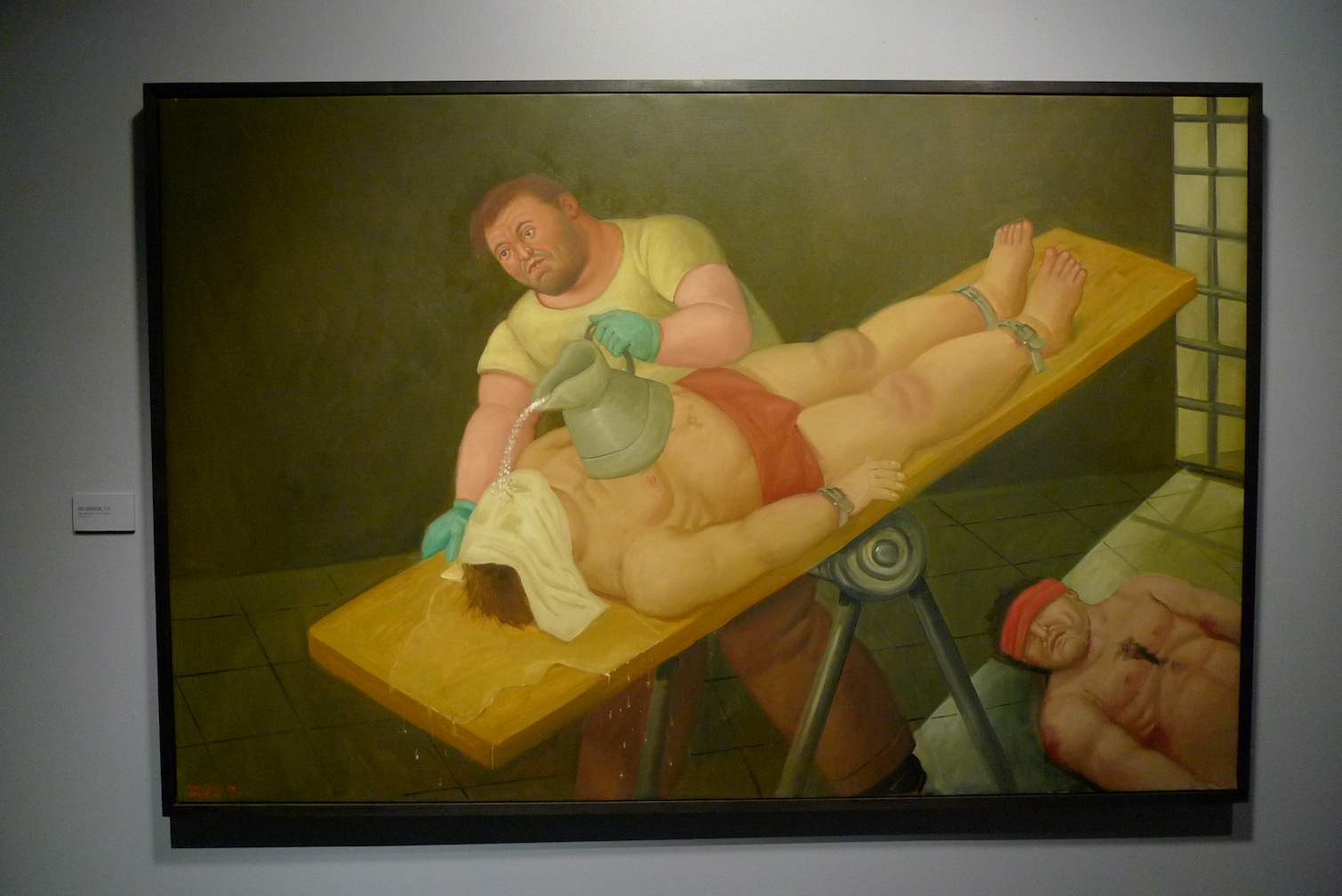
Botero – Guantanamo, exhibition in Santiago

 Several years ago, I spoke to two members of Allende’s government. Two who managed to survive. One of them recalled: “They used to threaten us, before the coup, before that terrible September 11, 1973: ‘Watch out, comrades, Jakarta is coming!’”

“We did not know much about Jakarta then,” he confessed. “Only that it was the capital of a far-away country called Indonesia… But very soon we found out…”

‘Jakarta’ is not just the capital of the fourth most populous country on earth; it is also the ‘least habitable major city in Asia Pacific’. Jakarta is also a concept, an enormous experiment on human beings, which was quickly turned into a blueprint that has later been implemented by the West all over the developing world.

The experiment was about trying to figure out this: What happens to a poor country that is hit by a brutal military coup, then thrown to religious zealots, and forced to live under the heel of extreme capitalism and fascism? And what happens if almost its entire culture gets destroyed, and instead of education, some brainwashing mechanism perfected abroad, gets implemented?

What if you kill 2-3 million people, and then you ban entire languages and cultures, theatres, art films, atheism, everything that is to the left of center?

And what if you use thugs, paramilitaries, archaic family and religious structures and a ridiculously toothless media, to maintain ‘the new order’?

The answer is this: You get your Indonesian model! Which means – almost no production, a ruined environment, collapsed infrastructure, endemic corruption, not even one sound intellectual of international caliber, and frankly speaking, a ‘functionally illiterate’ population, ignorant about the world, about its own history, and about its own position in the world.

But the most important conclusion of this ‘research’ is that after the orgy of terror in 1965 and 1966, after the millions that were killed, millions that were raped, tens of millions beaten and tortured, the result is the entire archipelago that is wholly silenced, and unable to organize any resistance. You get the archipelago that is unable to think, and which constantly repeats religious, pop and television slogans, instead of thinking about the past, present and the future.

If you are a corrupt and treasonous local ruler, or if you are the puppeteer that controls such a country from abroad, what you get is easy access to all its natural resources, a population unable to organize itself and fight for its rights, and voters indifferent to reality and unfamiliar with concepts such as dignity, and therefore ready to cast their ballot simply for a fee.

You get all this and more, and all you have to do is to make sure you butcher some 2-3% of the population, 40% of teachers, and that you rape millions of women and children, then terrify and silence all the minorities.


Indonesian fascist art.

The West hailed this as a splendid success! It congratulated “Our Man – Suharto” (In 1995, a senior Clinton administration official, commenting on the Indonesian President, Suharto, then on a state visit to Washington, referred to him as “our kind of guy.”). Murdering millions of ‘Communists’, was after all, the best way of gaining the admiration and respect of the US White House and Congress. And “selling” the country to Western companies was the most honorable and sensible path to gaining political and financial rewards from the ‘free world’.

To terrify the country, to paralyze it by fear… To strip it of all real opposition, that was exactly what was needed! Suharto and his military cronies, his generals (one of them is presently the President of Indonesia), his thugs that murdered intellectuals, teachers, writers and union leaders, all became our ‘buddies’, our ‘mates’, our ‘jolly good fellows’.


Indonesian modern art – that will really save the country.

Like those guys, who dutifully cut people to pieces, raped 14-year old girls and terrorized those people who were still willing to think and to speak, everything was shown in detail in the award winning film by Joshua Oppenheimer: “The Act of Killing”.

And what did the Indonesian viewers and TV hosts do when the thugs confessed to kill hundreds? They laughed, and cheered, and applauded!


Magnificent Museum of Memory and Human Rights in Santiago.

In 1998, Suharto fell, but the ‘model’ survived, and it is still being promoted, and pushed down the throats of many countries all over the world. It is marketed as ‘tolerant and democratic’ by European and US government officials and certain NGO’s. This I was told, recently, by members of the diplomatic community in Cairo, Egypt, the place where the revolution was successfully derailed and destroyed, mainly from abroad.

And why should it not be promoted? This is the masterpiece of Western domination: an enormous country, fully screwed and thoroughly ruined, plundered, abandoned to the market, robbed of everything… And the people here are so conditioned, so badly educated, so uninformed, that they are thoroughly unaware of how grotesque the state of their subsistence is.

In Indonesia, for years and decades, I have been interviewing hundreds of poor men and women who are living in a gutter, then shitting into filthy canals in cities like Surabaya, Medan and Jakarta, using the same water to wash their dishes and themselves… People who barely survive on a less than $1 a day, were proudly declaring on camera that they are not poor, that they are doing well, and that their country is just fine.


Praying in front of Suharto tomb.

A few streets away, the newly rich, sit in their luxury SUV’s in epic traffic jams, watching television, going nowhere, but proud that they have moved up the rungs on their class ladder.

What a success! What an absolute success of fascist, neo-colonial demagogy and the ‘market economy’!

This ‘success’ was, of course, studied and analyzed in Washington, Canberra, London and elsewhere. It has been implemented all over the world, in different forms and variations, but with the same essence: strike and murder every thinking being, shock and brainwash… then rob the poor and reward a few criminals… from Chile to Argentina, Yeltsin’s Russia and Rwanda, now again in Egypt.

It has worked almost everywhere. “Jakarta was coming”, and it has been spreading its filth, its ignorance, brutality and compassionless way of ‘thinking’ all over the planet!


Santiago Metro – huge public art gallery.

It seemed to be the most perfect ‘treatment’ for dissent and the dreams of freedom, all over the world. And the US has been busy administering it all over the Western hemisphere, but also in Asia, Africa, and everywhere. Death squads were trained in the North American military facilities, and then sent back to operate in Honduras, Guatemala, El Salvador, and the Dominican Republic and in many other unfortunate places.

Of course they could not fully compete with the insane sadism of the Indonesian butchers, but they did their best; they worked quite well, really… Blowing the brains out of rebellious priests during their sermons, raping teenage daughters in front of their parents, cutting people to pieces… slightly watered-down versions of the Jakarta scenario, but with some local ‘cultural’ flavors.

In Chile, in one of the oldest democracies on earth, the 9-11-1973 military takeover, brought new innovations to the established routine of horrors: women prisoners raped by dogs, prisoners with their hands tied, thrown alive into the sea from helicopters, while some were delivered to those old German Nazis inhabiting the so called “Colonia Dignidad” in the south of the country, for medical experiments.

It appeared that Western terror; its colonial tactics perfected and refined over centuries, will finally triumph, globally. It looked almost certain that no antidote would work: An antidote to the sadism and fear that has been paralyzing most of the subjects in the client states.

The Chilean military junta began with the same zeal as its Indonesian counterpart of eight years earlier. In Jakarta, religious Muslim cadres almost immediately joined the killing and torture, while in Santiago; it was conservative Christendom, particularly Opus Dei, which threw its support behind the murderers and rapists of General Pinochet. In both places ‘conservative family values’ were evoked, to justify the most appalling atrocities.

The streets of Santiago and other Chilean cities fell silent. Horror was omnipresent. Doors were kicked open by military boots and people dragged to dungeons, tortured, raped, murdered.

The National Stadium was filled with men and women. Like in Jakarta, noble, educated people were tortured and beaten, even killed with absolutely no scruples.

At one point, the soldiers came and arrested a bard; one of the most beloved singers of Latin America, Victor Jara. They broke his hands. Then they threw his guitar at him and shouted: “Now you can sing!”


Student protest – demanding free education all the way to university.

This was the most significant moment – I would insist, the crucial moment. The moment when Santiago and Jakarta parted! The moment when in South America, an extremely long and difficult process began: the process, which could be described as the fight for freedom, for true freedom, not for that empty fake slogan that has been repeated over and over again by Western propaganda.

Because at that moment, Victor Jara stood up, in terrible pain but undefeated, full of spite, and sang to his tormentors, straight at their filthy muzzles, “Venceremos!”

He sang loud, and after a while, they were overwhelmed by his voice and the lyrics, they aimed at him and shot him dead.

But he did not die, instead he became the symbol of resistance, of the struggle against fascism and imperialism. He became the symbol of the struggle that is still continuing and gaining momentum in so many parts of the world!

In 1965, in Jakarta, there was no struggle. The victims allowed themselves to be slaughtered. They were begging for mercy as they were strangled, stabbed, shot to death. They called their tormentors, their murderers, their rapists, ‘pak’ and ‘mas’ (respectful form of addressing a man). They cried and begged for mercy.

In 1973, in Santiago de Chile, young men and women went to the mountains, to fight fascism, under the banner of MIR; some 10,000 of them. It was a clean and proud fight, as MIR decisively rejected all forms of terrorism, and concentrated on military targets.

Hundreds of thousands of Chilean people left the country, scattering to all corners of the globe, from Mexico to Sweden, Canada to New Zealand. Wherever they went, they relentlessly worked on bringing down Pinochet and his US-backed junta. They wrote theatre and radio plays, made powerful films, wrote novels, arranged meetings and demonstrations in literally every major capital of the world. They never gave up. They dedicated their lives to the struggle. The millions at home and the hundreds of thousands of those forced to live abroad.

Eventually, Augusto Pinochet became a symbol of degenerate military power, of treason, of colonialism, of modern fascism.

In Indonesia, the victims accepted their ‘fate’ and with it, they accepted the most disgusting type of market fundamentalism. They accepted the fascist political system that stripped the poor (really the great majority) of all their rights. They accepted the thuggish, mafia-style arrangement for their country. They accepted a system where women are treated as the property of their fathers and later as the property of their husbands, while those who work and hold important positions are treated like whores, by their bosses, co-workers and even by their fellow Parliamentarians.

In Chile, nothing was really ‘accepted’. Nothing was forgotten and nothing was forgiven. Instead of looking at the ruling ‘elites’ as heroes, the majority of Chileans saw them as a bunch of bandits. Instead of looking at their parents with servile submissiveness ‘Indonesian-style’, a great number of Chilean youth held them responsible for creating or at least tolerating this monstrous system.

While Indonesia became the second (after Nigeria) most religious country on Earth (despite the fact that Muslim and Hindu cadres were directly responsible for some of the most appalling atrocities, while Christians are lately professing the outrageous belief that God loves the rich, and hates the poor, participating in the segregation of society, and even in open racism), Chile reformed its laws, modernized its education, and sent Christianity where it belongs – to its churches and very far away from public eyes.

In Indonesia, Suharto stepped down, but the system survived; it even hardened itself. One of Suharto’s generals is now serving as President of the country. And decades ago he was one of the leading military figures in occupied East Timor, during the most horrible massacres, during the genocide, in which some 30% of the local population lost their lives. The father of his wife was another general, who boasted that during the 1965 coup, they, the military, managed to kill around 3 million people.

In Chile, as in Argentina, most of those military leaders who committed crimes against humanity are now imprisoned, disgraced and despised.

Both armies, Indonesian and Chilean, of course, committed high treason, by selling their services to foreign powers, and instead of defending their citizens, fought for a fee, against their own defenseless women and children.

In Indonesia, many consider one of the worst butchers of the 20th century, and the most corrupt ruler of all times, General Suharto, a national hero! In Chile, General Augusto Pinochet is now clearly identified as a criminal, by a great majority of the people.

In Indonesia, between 2 and 3 million died in 1965/66. In Chile, the number was 3 to 4 thousand. Even adjusted to the dissimilar size of the population, the difference is overwhelming. Still, in Chile, there are hundreds of books written on the topic, dozens of powerful films made, and the topic is constantly addressed in newspapers, magazines and television programs – it is an essential part of the national memory. Without it, there seems to be a consensus – there is no way forward.

In Indonesia, there is an absolute blackout and silence.

The Indonesian population is fully loyal to the propaganda it has been fed for many decades. It is telling that at a recent attempt to resurrect the topic, at a screening of the documentary (unfortunately quite mediocre) called “15 Years After” (referring to numbers of years since Suharto’s stepped down), there were only 5 people in one of the major cinemas in Jakarta… And it was a Saturday afternoon.


Bandung – City of Learning.

Saturday afternoon in Santiago de Chile and the entire city is getting ready for an extremely long night. Dozens of theatres offer everything from classical performances to avant-garde plays. Nightclubs are preparing for the latest bands that come from all over Latin America. The music ranges from opera and symphonies, to ballads, salsa and cumbia. Cinemas in all corners of the city are showing the latest releases, as well as Asian, Latin American and European art films.

There is some ‘art for art’, but plenty of it is deeply political; it is shaping the nation, addressing every important issue, including the past.

The same obsession with culture and knowledge is the norm in other cities of the ‘Southern Cone’, including Buenos Aires, Sao Paulo and Montevideo. To know is to exist. To understand the world is to be free, independent, and to be alive. Knowledge is valued; it is deeply respected.

Some 15 thousand kilometers West of Chile, in the Indonesian cities of Jakarta, Surabaya or Medan, there is close to nothing one can do on Saturday nights. There are restaurants, of course, and several cinemas showing the lowest grade of Hollywood films. But there are no art cinemas, no theatres (only maybe one theatre performance a month, in a city like Jakarta, with 12 million inhabitants). The only random concerts are those organized by the European cultural centers, and those very few ones for the ‘elites’ in some hard to get into private hall.

Life is extremely boring in Indonesia, with no variety and no intellectual inspiration. And that’s how it was intended.

To get to the theaters, many citizens of Santiago opt for the metro system, one of the best and most efficient on earth. Each station is dedicated to local artists, many are equipped with public libraries, and one even has a free art cinema, where one can sit for the entire day for the price of one metro token, watching the greatest world classics.

In Jakarta, there is no metro at all, and almost no sidewalks, and there are only very few public parks. To cross the street, one often has to take a taxi. The city is approaching, and some people say it has already reached, a permanent gridlock.

Chile is embracing knowledge and everything that is ‘public’. Indonesia is stuck in uncool, totally cheap pop, buried in depressing individualism, forced to admire all in ‘private’.

The countries of South America that suffered from brutal dictatorships imposed by the West are now free and run by Socialist governments.

Indonesia is run by thugs, old generals and by a gloomy, degenerate, capitalist clique.

Women govern Brazil, Argentina and Chile, while a man who was in charge of a military unit in East Timor, during the genocide, runs Indonesia.

Michelle Bachelet who is poised to win in the second round and return as the President of Chile (after being a head of UNIFEM) is a doctor, pediatrician, single mother of 3 and an atheist. Her father, an army general during Allende’s administration, was murdered by Pinochet’s regime, and Ms Bachelet herself was brutally tortured in detention. She left the country and was trained as a doctor in East Germany, before returning back home.

While Camila Vallejo (25 years old), and her fellow student leaders are ready to become MP’s in Chile, many for the Communist Party. Indonesian women MP’s face sexual harassment from their fellow People’s Representatives, right on the floor of Parliament. And the Communist Party is flatly banned in Indonesia, just to make sure that nobody pushes for land reforms and social justice, anymore.

Chileans are now fighting for free education and for free medical care, and it is expected that their demands will be satisfied during the Presidency of Ms. Bachelet.

Indonesia is living with fully collapsed medical care and education systems, and everyone who can afford it, is leaving for hospitals in Singapore or Malaysia, and as far as possible for education.

There are countless private schools all over Indonesia, most of them religious. They specialize; it appears, in producing masses of young people unable to excel in anything at all, except in serving capitalist and religious dogmas, and in stealing for the sake of their family clans.

While Chile is fighting against poverty on all fronts, including by building high quality social housing, Indonesia has some of the most appalling inequalities on earth, and it even lies about the number of its inhabitants (it has over 300 million citizens, but only around 247 million are accounted for), just in case someone may demand, one day, that the poorest of the poor be housed, educated and healed.

Chile is one of the least corrupt nations on earth, while corruption in Indonesia is one of the highest on earth, with the former ‘our kind of guy’ Suharto entering the record books as the most corrupt ruler of all times.

Indonesia and Chile are two countries that went through a fascist hell; but there are two totally different stories, at the end of that hell.

One country – Indonesia – submitted itself, collaborated and in the end failed, collapsed, became much like some of those unfortunate nations of sub-Saharan Africa.

The other fought, proudly, consistently, and won, becoming one of the most habitable nations on earth, with a quality of life comparable to that of the European Union.

One is not able to produce one single decent novel after its great Communist writer – Pramoedya Ananta Toer (a former prisoner of conscience, whose books and manuscripts were burned by Suharto’s clique) – passed away. It produces nothing of intellectual value: no quality music or films, no scientific research, no ground-breaking educational concepts.

The other one – Chile – gave birth to some of the greatest modern writers, poets, filmmakers and architects. And some of the best wine!

The Indonesian model is frightening, but it can be defeated. It succeeds only when the people refuse to fight, when they submit to terror.

Indonesia, individuals are expected to surrender to brutal family and religious control. From birth, people here are conditioned: they live with fear, which is confused with ‘love’. First it is the potent fear of father, then of the priest, of the teacher. And then it progresses to fear of the military and capitalist dictatorship. In the end it becomes a paralyzing fear of ‘everything’, which stops every rebellion at the embryonic stage.

It is pathetic and depressing. It is working. But definitely not everywhere!

Rebelliousness works better. It has been working all over Latin America, including Chile. ‘Jakarta came’, but was fought, and thrown to the dogs.

But, as a result of the joint efforts of local and Western propaganda, the success of Latin America is absolutely unknown in Indonesia. And there is no one screaming in Jakarta at those brutal faces of the elites: “Watch out, bandits, Santiago is coming!”

Andre Vltchek is a novelist, filmmaker and investigative journalist. He has covered wars and conflicts in dozens of countries. His discussion with Noam Chomsky On Western Terrorism is now going to print. His critically acclaimed political novel Point of No Return is now re-edited and available. Oceania is his book on Western imperialism in the South Pacific. His provocative book about post-Suharto Indonesia and the market-fundamentalist model is called “Indonesia – The Archipelago of Fear”. He has just completed the feature documentary, “Rwanda Gambit” about Rwandan history and the plunder of DR Congo. After living for many years in Latin America and Oceania, Vltchek presently resides and works in East Asia and Africa. He can be reached through his website or his Twitter.

Finding Sense and Sensibility Among Syria's Palestinian Disaspora


Inside Emergency Damascene Shelters

by Franklin Lamb - CounterPunch

Al Zahera neighborhood, south Damascus  - This brief update is not focused on the ever deteriorating grave conditions of Palestinians and Syrians displaced and often trapped inside dangerous areas on Damascus, where this observer had been visiting some of the 24 former Damascus public schools currently being used as shelters.

Rather it seeks to highlight the esprit de corps, solidarity, resistance, and good will among Palestinians here is Damascus who were forced from Yarmouk and other camps and how they are huddled and preparing for a harsh winter which one senses these frigid nights it not far off.

This is not to gainsay that every shelter is a very fragile social existence for Internally Displaced Persons (IDP’s) as aid agencies here refer to them. In the former schools there is no mazot (fuel oil) currently available to fire-up the furnaces and the among the needs at all the shelters are for “high-thermal” blankets, food, medicines winters clothe and shoes and knitted caps for the kids trekking early in the morning to government schools in the neighborhoods.

Thanks to the continuing cooperation between the Syrian government, particularly the Ministry of Education (MOE), and the United Nations Relief and Works Agency for Palestine Refugees in the Near East (UNRWA) many former public schools have been made available as emergency shelters. Additionally, the MOE has created double shift in many schools offering youngster a 7 a.m. to noon shift followed by a noon to 5 p.m. shift.

Prior to the armed conflict in Syria, Yarmouk, a suburb just south of Damascus city, was home to over 160,000 Palestine refugees. In December 2012 and in the months since, armed conflict has caused at least 140,000 Palestine refugees to flee their homes in Yarmouk, as armed opposition groups established a presence in the area, with government forces controlling the periphery. Between December 2012 and June 2013, civilians could still access UNRWA assistance at the Zahera entrance to Yarmouk. However, from mid-July 2013, Palestine thousands of refugees have been trapped in the area, with little or no access to shops or freedom of movement.

At among the 4 school-shelters in south Damascus near Yarmouk camp and the 8 in the nearby neighbored of al-Vvahra, some of which this observer visited, “The Fayadeen” elementary public school currently houses 56 families- half of them Palestinians totaling 260 people. At “Fayadeen” there is a clean large make-shift kitchen where approximately half a dozen families use at one time based on a schedule.

The Syrian government and some NGO often deliver emergency food packages—most designed to feed a family of five for 15 days. “Fayadeeen” school also has a heavy duty Italian electric washing machine donated by a Palestinian businessman and which is shared by all. There is a high level of sanitation and sheds housing toilet are clean. Three times a week medical teams arrive to administer free government health care.

US sanctions have cut off some urgently needed medicines, particularly for cancer patients and cases where weekly doses of medicines are required but often only monthly doses are now available. Shelter rules are enforced. For example, if a family does not enroll their 6-15 year old children in local public schools they are evicted. This observer was briefed at length and shown around by two Syrian professions basketball players on the National team, Hani and Mohamad who have placed their careers and family life on hold to manage four school shelters in a south Damascus.

Several Palestinians in the school shelters have been asking this observer if he has news about their countrymen still trapped inside Yarmouk. There is of increasing concern because their families report that desperately needed humanitarian assistance is still not able to be not delivered nor have repeatedly promised “humanitarian corridors” opened; this despite UNRWA’s numerous appeals and efforts, and despite 32,000 Palestinian civilians and others who remain trapped in Yarmouk have had little or no freedom of movement or access to humanitarian assistance and in addition to facing death and serious injury from the armed conflict. Yarmouk’s civilian residents are exposed to psychological trauma, malnutrition and a lack of health care. The UN Security Council’s Presidential Statement on the humanitarian situation on Syria adopted on 2 October, 2013, among other stipulations, called on all parties to grant full humanitarian access and “to comply with their obligations under international humanitarian law.”

Hope among the more than 100,000 refugees displaced from Yarmouk camp rises and sinks with on again off again announcements that militia will leave the camp to civilian Palestinian administration. Just this week a claimed settlement involving intense negotiation mediated by the Palestine Liberation Organization (PLO) to end the fighting in Yarmouk camp suffered collapsed, after opposition fighters close to Hamas insisted that they be included among the groups that will subsequently manage the affairs of the camp. PLO officials had recently arrived at a preliminary agreement with the various Palestinian factions and opposition armed groups that would lead to a ceasefire but excluded Hamas and the PFLP-General Command led by Ahmed Jabril. Within 72 hours another and still showing life signs, another proposal was announced on 11/22/13. Under the terms of this “agreement”

Palestinian Popular Struggle Front Khaled Abdul Majid , that “the armed groups in the Yarmouk camp aka the“Palestinian Resistance Alliance factions” would be withdrawing from the camp “very soon”. In statements to Al-Watan, Abdul Majid said:

“What is happening in Yarmouk is that most of the armed factions have reestablished contact with the Popular Front for the Liberation of Palestine – The General Command, as well as the factions of the Palestine Resistance Alliance, after the initiative of the Palestine Liberation Organization (to solve the camp’s crisis) failed. These factions thus expressed their willingness to regulate their situation, handle the issue and withdraw from the camp.”

He continued that the discussions with these groups were conducted via mediators, or in some cases through contacts with some of them.

This observer has witnessed the fact that since 11/17/13 almost complete calm has been prevailing over Yarmouk. Services teams from the Palestine Aid Committee have been cleaning the camp’s streets and removing the dirt mounds. This observer has been invited inside Yarmouk to witness this process. Government permission is required and date of entrance is not fixed.

Some refugees from Yarmouk are hopeful but during interviews the past two days most expressed doubt that this latest initiative will succeed any more than the previous dozen. The coming few days will provide the answer.

Palpable fear is also evident because of the fast approaching winter with rumors of severe cold this year, A condition that will be much more severe among the 250 camps in the nearby Lebanese Bekaa valley particularly for the 25 plastic wall and roof make-shift tents in 25 emergency refugee camps that are particularly flood-prone and shared by Syrian and Palestinian refugees.

Our brother and sisters keeper…


Hopefully subsequent updates on the Palestinian condition in Syra will allow for rather more detail regarding many examples of Palestinians helping Palestinians regarding community assistance to their sisters and brothers. But a brief example about a wonderful family is fixed in this observers mind.

It relates to the Khalid al Jrahi family from Haifa now living in “Taher al Jazari” public school shelter. Mr. al Jrahi granted permission to this observer to use his name publicly because he wants friends and relatives with whom he has lost contact since the events of December 17, 2013 which leveled some of his neighborhood in Yarmouk, to know that his family is alive and relatively well.

What a spectacular family. Including five teen-aged and early 20’s girls and two boys. What deeply impressed this observer is the esprit among these sisters, their charisma, charm and dedication to helping others among the approximately 260 refugees sharing the school while eschewing complaints about the own plight. The Al Jrahi family lives in a space probably ten feet wide and 20 feet long. Foam mattresses are neatly stacked along the walls and pillows and clothing stacked in the corners. A clothes line runs along one side of the room which is walled by an UNHCR white and blue lettered plastic tarp separating their neighbors. Shocking? Yes, but inspiring certainly.

The girls, whose English is quite good explained why and how they set up a school for pre-K’s in this and one other shelter. How organized it is. They showed me the ‘teaching manual’ they wrote and explained how they run their schools with occasionally donated pencils and crayons and notebooks for the tots donated by Palestinian NGO’s or even foreign visitors.

We did not discuss politics but two of the sisters reminded me of Hala, Jane Austen’s character Eleanor, in Sense and Sensibility. Hala is the sensible and reserved eldest of al Jrahi family daughters. She is in charge of the lesson plans for the informal ‘sisters schools’ in the shelter and carefully instructs her younger impetuous Zeina on school rules for the children, trying to keep her attention and her younger sister focused. Hala showed this observer her English grammar notes that she is learning from a tattered UNWRA grammar book. She points to her perfect cursive hand written notes and asks me about “present participles”, “dangling modifiers” and “past perfect tense”! When I last even heard these terms it was half a century ago and I have no idea what they even mean– if I ever did, which is questionable.

Her younger sister Zeina is all Austen’s character Marianne, and refuses to check her emotions and dramatically insists that she is ready to return to Yarmouk “despite the dangers even if I am killed going back home!” Her mother Fatima grimaces and Hala is disapproving when Zeina insists that she should teach the children dancing in the street outside the closed in-shelter as well as tree climbing so they “can properly express themselves under the sky.”

Rather wistful and not wanting to leave this family or the shelter, this observer and his companion left the wonderful Al Jrahi family wondering if Ms. Sense or Ms. Sensibility would triumph or if these two remarkable sisters in fact constituted a good balance to one another as they serve their fellow countrymen in emergency shelters.

Franklin Lamb volunteers with the Sabra-Shatila Scholarship Program (SSSP) in Shatila Camp (www.sssp-lb.com) and is reachable c/o fplamb@gmail.com

Enbridge Numbered Company Floats Plan to Dam the Clore River


Enbridge plan to dam Clore River near Terrace uncovered

by Friends of Wild Salmon


November 22, 2013

Enbridge is behind a controversial plan for a 120-megawatt hydro project that would dam the Clore River.

The project is being proposed by a numbered company, which local residents traced to the same Calgary address as Enbridge.

The Clore, located 60 kilometres southeast of Terrace, B.C., is the main tributary of the Copper River, which flows into the Skeena. The Copper-Clore watershed supports strong runs of wild salmon and steelhead and is critically important to First Nations’ food security, a world-class sport fishery and BC’s coastal commercial salmon fishery. It is also considered world class by kayakers and heavily used by hunters.

“This application shows Enbridge has absolutely no respect for the values we hold dear. If Enbridge thinks Northwest residents will let them dam our salmon rivers, they are even more delusional than we thought,” said Friends of Wild Salmon chair Gerald Amos.
“Hiding behind a numbered company is dishonest and shows Enbridge’s continued unwillingness to communicate openly with our communities. Enbridge might paint a pretty picture in their television ads but behind the scenes is threatening our most precious resources.”

Excerpts from the proponent’s scoping report:

“A headworks structure consisting of a weir and intake will divert a portion of flow from the Clore River first through a 6,400m tunnel and then through a penstock (water pipeline) for the remaining 1160m to a powerhouse.”

“In order to provide adequate intake submergence and to divert flows, a spillway control weir will be constructed across the stream. This will increase the water level behind the weir and provide adequate intake submergence. The depth and extent of the headpond is expected to provide sufficient time for larger sediment to settle out of the flow.”

“When flow is less than that required for maximum output, production is derived from the total stream flow less the minimum release.”

“This application illustrates the risk Enbridge poses to our rivers, coast and our region goes far beyond oil spills. Damming the Clore would have severe negative impacts and should be soundly rejected by local residents – just like Northern Gateway,” said Amos.

Numbered company 8056587 Canada Ltd. submitted water license application No. 6001392 for the Clore project. A web search shows 8056587 Canada Inc. was registered on December 22, 2011 at 3000 425 1st Street in Calgary – Enbridge’s address.

In 2009, the company C-Free Power withdrew a water license application for a similar project on the Clore due to environmental and community concerns surrounding their proposal.


NEWS RELEASE
November 22, 2013

Contact: Gerald Amos, Friends of Wild Salmon

Download Clore River Project Scoping report (1.9Mb PDF)

Friday, November 22, 2013

Walking On COP 19

Poor Countries and Civil Society Walk Out of COP 19 Over Inaction over Climage Change

by TRNN

Patrick Bond: Developing countries and green groups must evaluate if walkouts are the best way to get rich countries to address climate change.

Patrick Bond is the Director of the Center for Civil Society and Professor at the University of KwaZulu-Natal in South Africa. Bond is the author and editor of the recently released books, Politics of Climate Justice and Durban’s Climate Gamble.