Wednesday, December 11, 2013

Palestine's Mandela: Future President Barghouti Languishing Still in an Israeli Prison

Where is Palestine’s Mandela?

by Alan Hart

The answer to my headline question is that he, Marwan Barghouti, is in an Israeli jail where he has been since his arrest in Ramallah by an IDF unit in 2002, after which, in 2004, he was sentenced to five life terms in prison. Some months before his arrest one of Israel’s security agencies tried and failed to assassinate him. A missile was fired at his bodyguard’s car and killed the bodyguard. (If the attempt on Barghouti’s life had succeeded, his killers would not have been brought to justice because as well as bulldozing Palestinian homes and stealing Palestinian land and water, Israel kills, murders, with impunity).

Regular readers of my occasional thoughts and analysis will know that I am in favour of the dissolution of the impotent, corrupt and discredited Palestine National Authority (PNA) and handing back to Israel complete and full responsibility for the occupation. As I have previously said, this could make calling and holding the Zionist monster to account for its crimes something less than a mission impossible. But...

If putting the PNA out of its misery is not an option, what the Palestinians of the occupied West Bank and the besieged Gaza Strip need, urgently, are elections to give them the opportunity to bring on a new and credible leadership. If there were elections, and if Barghouti was pardoned, released and allowed to run for the office of “President of Palestine”, he would almost certainly win.

I’m also happy to speculate that in office he would do what collaborator Abbas, more or less under orders from the U.S., has failed to do - unite Fatah and Hamas, to enable the occupied and oppressed Palestinians to speak with one voice.

As I have written and said in the past, it bears repeating, there is no secret about Hamas’s real position. While it is not prepared to recognise Israel’s “right” to exist, nor should it do so, it is prepared, with Arafat-like pragmatism, to recognise and live with the actual existence of an Israel inside the pre-1967 war borders with, probably, mutually agreed minor border changes, and Jerusalem an open, undivided city and the capital of two states. Assertions about Hamas’s real position to the contrary by Greater Israel’s hardliners and the neo-fascists to the extreme right of them are Zionist propaganda “bs” (President Carter’s code for bullshit), out of the same stable as Netanyahu’s nonsense about Iran representing a threat to Israel’s existence.

Now 54, and fully fluent in Hebrew, Barghouti joined Fatah at the age of 15. He co-founded the Fatah Youth Movement on the West Bank and became Secretary General of Fatah in that territory. He is widely believed to have been the leader on the ground of the first and second intifadas. (Once it was underway the oversight director of the first intifada was actually Arafat’s number two, Abu Jihad, from the bedroom of his home in Tunis; and that’s why Israel assassinated him, in his bedroom, on 16 April 1988. If he had not been assassinated, Abu Jihad would have succeeded Arafat and the Palestinian cause would have been in the best possible hands at leadership level).

At about the time of his arrest Barghouti’s position on ending the conflict was in this statement:

"I, and the Fatah movement to which I belong, strongly oppose attacks and the targeting of civilians inside Israel, our future neighbour. I reserve the right to protect myself, to resist the Israeli occupation of my country and to fight for my freedom. I still seek peaceful coexistence between the equal and independent countries of Israel and Palestine based on full withdrawal from Palestinian territories occupied in 1967."

In jail Barghouti has continued to condemn attacks on civilians in Israel but also stressed that he supported armed resistance to Israeli occupation. (In international law all occupied peoples have the right to resist occupation by all means including armed struggle).

Even in Israeli political and media circles there has been some debate about pardoning and releasing Barghouti. Following his January 2006 re-election to the Palestinian Legislative Council (he was first elected to it in 1996), Yossi Beilin, a foreign policy specialist and former Israeli government minister, and a voice of some sanity, called for Barghouti to be pardoned. And it was probably on advice from Beilin that in January 2007 Shimon Peres, then deputy prime minister, declared that if elected to the presidency he would sign a pardon for Barghouti. He has not yet done so and I think it’s reasonable to assume that Netanyahu said to him something like, “Don’t even think about it!”

The last thing Netanyahu wants is a Palestinian leader who commands the respect of his people and will not accept crumbs from Zionism’s table.

In his tribute to Nelson Mandela at the memorial service in Soweto’s FNB stadium, President Obama said that he, Mandela, “understood that ideas cannot be contained by prison walls, or extinguished by a sniper’s bullet.” Barghouti understands that, too.

What a real peace process needs is an Israeli leader who understands that an acceptable amount of justice for the Palestinians is an idea that can’t be destroyed by military might and oppression of all kinds. Such a leader would pardon and free Marwan Barghouti.

To the Zionist argument that he can’t be freed because he is a terrorist, there can be only one response.

Whether Barghouti was or was not a terrorist is an irrelevance. Mandela was described as a “terrorist”, and so were many of those who became prime ministers and presidents of Britain’s former colonies when they gained their independence. And what about Zionism’s own, Menachem Begin for example, arguably the most successful terrorist of modern times if not all of human history? (Begin had a leading role in driving out of Palestine by terrorism first the occupying British and then three-quarters of its indigenous Arab inhabitants).

To that response could be added the fact that Israel sometimes resorts to state terrorism.

There is good reason to believe that if Barghouti was pardoned and freed and became the president of Palestine, he would pursue a Mandela-like path of reconciliation to the extent that he would be committed to the wellbeing and security of Jews in a state of Israel inside more or less its borders as they were on the eve of the 1967 war. So there is a case for saying that Israel needs Barghouti as much as the Palestinians do.

There is now one thing (apart from Netanyahu!) that neither Israel nor the occupied and oppressed Palestinians need. It was drawn to my attention in an article by Abdel Bari Atwan, the former editor-in-chief of Al Quds, the only Arab newspaper while Abdel Bari was in charge of it that was required reading in the foreign offices of the Western world. Abdel Bari is no longer with the paper because its principal Gulf Arab funders were not prepared to tolerate his truth-telling any longer and demanded his departure. That didn’t come as a surprise to me because when three years ago I interviewed him for my Heart of the Matter series for Press TV (which can be found on my web site www.alanhart.net), he told me that the chair in which I was sitting opposite him at his desk had been occupied some weeks previously by a Saudi royal who offered him a vast amount of money to take his leave of the paper.

Abdel Bari’s article which commanded my full attention was headlined Al-Qaeda Arrives In The West Bank. It included this:

When I met Sheikh Osama bin-Laden in Tora Bora caves in the 1996, I conveyed to him people’s criticism that the organization focuses on fighting in Afghanistan, Southeast Asia (Thailand and southern Philippines), Bosnia-Herzegovina, Chechnya, Daghistan, and elsewhere and that it did not carry out any operations against Israeli targets in and outside Palestinian territories. He told me the reason was the difficulty in crossing the border and the vicious security measures that the Arab security agencies adopted against his organization... It appears (mainly because of the mayhem in Iraq and Syria) things have now changed, at least partially.

About how things are changing Abdel Bari wrote this:

The Mujahedeen Shura Council, which is affiliated with al-Qaeda, yesterday announced in a statement that the three young men killed by the Israeli army in Hebron on Tuesday were members of one of its cells. The statement, posted on the internet, said: “As we announce the martyrdom of this group, we bring to the Muslim nation the glad tidings that, praise be to God, global jihad now has a foothold in the proud West Bank after everyone tried to foil every seed planted there.” Shin Bet (Israeli internal security) officials said the extremist network had established a safe haven in the West Bank, stored weapons, and planned attacks against Israeli targets and against the PNA.
If this information is true - and it appears to be true - it will shock both the PNA and Israel because al-Qaeda’s arrival in the occupied West Bank is a very serious security breach that will have repercussions because, judging from al-Qaeda’s activities in other regions, it means martyrdom-seeking operations and booby-trapped cars.
I personally do not rule out such a breach. Hamas has not carried out any military attacks against Israeli targets and settlements in the West Bank because it has a sort of “truce” with both the Israelis and the PNA in the West Bank and Gaza, and with it refraining from launching any systematic operations in order to evade an Israeli incursion into Gaza, which it rules, I believe it is inevitable that al-Qaeda and its supporters will try to find a foothold; and that they will likely succeed in recruiting enthusiastic young men dismayed at the state of deadlock and influenced by the Arab revolutions.

If al-Qaeda (and/or affiliates) did succeed in establishing enough of a foothold on the occupied West Bank from which to launch attacks to kill Israeli Jews, that could trigger a final Zionist ethnic cleansing.

It also could be that a credible Palestinian leadership headed by Marwan Barghouti after elections would represent the very last chance for stopping the countdown to catastrophe for all.

My plea to all who campaign for justice for the Palestinians is - give a priority to calling and lobbying for the release of Marwan Barghouti, the man who could become the Palestinian Mandela in terms of the reconciliation needed if the two-state solution is to be resurrected from its grave.

If it was, my guess is that that Barghouti would entertain the same hope as Arafat - that one or two generations of a two-state peace would lead by mutual consent to a one state with equal rights for all.

Footnote

James Robbins, the BBC’s diplomatic correspondent, made what I thought was a most perceptive comment a few days ago. He said words to the effect that maybe it was not Mandela who had been in jail for 27 years but most of South Africa’s whites - in the jail of apartheid ideology. In the case of Marwan Barghouti, I say maybe it’s not him who is in jail but most Israeli Jews - in the jail of Zionism’s ideology.

Alan Hart has been engaged with events in the Middle East and their global consequences and terrifying implications – the possibility of a Clash of Civilisations, Judeo-Christian v Islamic, and, along the way, another great turning against the Jews – for nearly 40 years…
As a correspondent for ITN’s News At Ten and the BBC’s Panorama programme (covering wars and conflicts wherever they were taking place in the world).

As a researcher and author.

As a participant at leadership level, working to a Security Council background briefing, in the covert diplomacy of the search for peace.

www.alanhart.net

Prawer Play: Palestine Peace Hopes Pinned to Negev Bedouin's Fate

As Bedouin villages are destroyed, so too are hopes for Palestinian peace deal - See more at: http://www.jonathan-cook.net/2013-12-10/as-bedouin-villages-are-destroyed-so-too-are-hopes-for-palestinian-peace-deal/#sthash.mcaHPLcc.dpuf
As Bedouin villages are destroyed, so too are hopes for Palestinian peace deal - See more at: http://www.jonathan-cook.net/2013-12-10/as-bedouin-villages-are-destroyed-so-too-are-hopes-for-palestinian-peace-deal/#sthash.mcaHPLcc.dpufAs

As Bedouin Villages Are Destroyed, So Too Are Hopes for Palestinian Peace Deal

by Jonathan Cook

As United States envoys shuttle back and forth in search of a peace formula to end the Israeli-Palestinian conflict, a matter supposedly settled decades ago is smouldering back into life.

In what was billed as a “day of rage” last month, thousands of Palestinians took to the streets to protest against a plan to uproot tens of thousands of Bedouin from their ancestral lands inside Israel, in the Negev (Naqab).

The clashes were the worst between Israeli police and the country’s large Palestinian minority since the outbreak of the second intifada 13 years ago, with police using batons, stun grenades, water cannon and arrests to deter future protests.

Things are only likely to get more heated. The so-called Prawer Plan, being hurried through parliament, will authorise the destruction of more than 30 Bedouin villages, forcibly relocating the inhabitants to deprived, overcrowded townships. Built decades ago, these urban reservations languish at the bottom of every social and economic index.

Bedouin leaders, who were ignored in the plan’s drafting, say they will oppose it to the bitter end. The villages, though treated as illegal by the state, are the last places where the Bedouin cling to their land and a traditional pastoral life.

But the Israeli government is equally insistent that the Bedouin must be “concentrated” – a revealing term employed by Benny Begin, a former minister who helped to formulate the plan. In the place of the villages, a handful of Jewish towns will be erected.

The stakes are high, not least because Israel views this battle as a continuation of the 1948 war that established a Jewish state on the ruins of Palestine.

Avigdor Lieberman, the foreign minister, argued last week that the fight over the Negev proves “nothing has changed since the days of the tower and stockade” – a reference to heavily fortified outposts the Zionists aggressively built in the 1930s to evict Palestinians from the land they had farmed for centuries.

These outposts later became land-hungry farming communities, such as the kibbutz, that gave the Jewish state its territorial backbone.

Mr Lieberman’s view reflects that of the government: “We are fighting for the lands of the Jewish people, against those who intentionally try to rob and seize them.”

The labelling of the Bedouin as “squatters” and “trespassers” reveals much about the intractability of the wider conflict – and why the Americans have no hope of ending it as long as they seek solutions that address only the injustices caused by the occupation that began in 1967.

Doron Almog, who is in charge of implementing the Prawer Plan, observed last week that the Bedouin were not resisting it to save their communities but “to create territorial contiguity between Hebron and the Gaza Strip”. In other words, in Almog’s paranoid thinking, the Bedouin’s struggle for rights is really a cover for their ambition to serve as a bridgehead between the West Bank and Gaza.

In truth, both Israel and the Palestinians understand that the war of 1948 never really finished.

Suhad Bishara, a lawyer specialising in Israeli land issues for the Adalah legal centre, has called the Prawer Plan a “second nakba”, in reference to the catastrophic events of 1948 that stripped the Palestinians of their homeland.

Israel, meanwhile, continues to conceive of its 1.5 million Palestinian citizens – however peaceable – as just as alien and threatening to its interests as the Palestinians in the occupied territories.

The roots of the Prawer Plan can be traced to one of Zionism’s earliest principles: “Judaisation”. There are cities across Israel, including Upper Nazareth, Karmiel and Migdal Haemek, founded as Judaisation communities next to large Palestinian populations with the official goal of “making the land Jewish”.

Judaisation’s faulty premise, in the pre-state years, was the fantasy that Palestine was “a land without a people for a people without a land”. Its sinister flip side was the cheery injunction to Zionism’s pioneers to “make the desert bloom”, chiefly by driving out Palestinians.

Nowadays, the term “Judaisation”, with its unpleasant overtones, has been discarded in favour of “development”. There is even a minister for “developing the Negev and the Galilee” – Israel’s two areas with large concentrations of Palestinians. But officials are interested only in Jewish development.

Last week, in the wake of the clashes, the Israeli Haaretz daily published leaked documents showing that the World Zionist Organisation – an unofficial arm of the government – has been quietly reviving the Judaisation programme in the Galilee.

In an effort to bring another 100,000 Jews to the region, several new towns are to be built, for Jews only, dispersed as widely as possible in contravention of Israel’s own national master plan, which requires denser building inside existing communities to protect scarce land resources.

All this generosity towards Israel’s Jewish population is at the expense of the country’s Palestinian citizens. They have not been allowed a single new community since Israel’s founding more than six decades ago. And the new Jewish towns, as Arab mayors complained last week, are being built intentionally to box them in.

For officials, the renewed Judaisation drive is about asserting “Israeli sovereignty” and “strengthening our hold” over the Galilee, as if the current inhabitants – Israeli citizens who are Palestinian – were a group of hostile foreigners. Haaretz more honestly characterised the policy as “racism”.

Judaisation casts the conflict between Israelis and Palestinians in zero-sum terms, and thereby makes it unresolvable. In considering its Palestinian citizens, Israel speaks not of integration, or even assimilation, but of their enduring status as a “fifth column” and the Jewish state’s “Achilles heel”.

That is because, were principles of justice and equality ever to be enforced, Palestinians in Israel could serve as a gateway by which millions of exiled Palestinians might find their way back home.

With the policy of Judaisation revoked, the Palestinian minority could end the conflict without violence simply by pulling down the scaffolding of racist laws that have blocked any return for the Palestinians since their expulsion 65 years ago.

This is why Israeli prime minister Benjamin Netanyahu demands as part of the current peace negotiations that the Palestinians sanctify the Judaisation principle by recognising Israel as a Jewish state. It is also why the talks are doomed to failure.


Jonathan Cook won the Martha Gellhorn Special Prize for Journalism. His latest books are “Israel and the Clash of Civilisations: Iraq, Iran and the Plan to Remake the Middle East” (Pluto Press) and “Disappearing Palestine: Israel’s Experiments in Human Despair” (Zed Books). His new website is www.jonathan-cook.net.


A version of this article first appeared in The National, Abu Dhabi.

Kerry's Mid East Crisis: Palestinians See US Position As Tantamount to Coup

Kerry’s Coup from Mediator to Antagonist

by Nicola Nasser

U.S. Secretary of State John Kerry was scheduled to start his ninth trip of shuttle diplomacy between Palestinian and Israeli leaders on this December 11. However, the bridging “security arrangements,” which he proposed less than a week earlier on his last trip, have backfired and are now snowballing into a major crisis with Palestinian negotiators who view Kerry’s “ideas” as a coup turning the US top diplomat from a mediator into an antagonist.

Kerry’s “ideas” had provoked a “real crisis” and “will drive Kerry's efforts to an impasse and to total failure,” the secretary general of the Executive Committee of the Palestine Liberation Organization (PLO), Yasser Abed Rabbo, said on this December 9.

Resumption of the peace talks and U.S. involvement in the negotiations with Israel were both on record Palestinian demands. Disappointed by the deadlocked negotiations and more by the way Kerry decided finally to get his country involved, the Palestinian presidency expectedly stands now to regret both demands.

Kerry’s shuttle diplomacy during his current trip seems more aimed at controlling the damage his “ideas - proposal” caused than at facilitating the deadlocked Palestinian – Israeli bilateral talks.

On this December 6, Kerry said that (160) American security specialists and diplomats, headed by General John Allen, the former commander of the U.S. forces in Afghanistan, had drafted the “proposal,” believing “that we can contribute ideas that could help both Israelis and Palestinians get to an agreement.”

According to leaks published by mainstream Israeli media, including Israeli Channel 10 news, Haaretz, Maariv, Yedioth Ahronoth and DEBKAfile, as well as by the official Palestinian daily Al-Ayyam, the U.S. “security arrangements” propose:

* Demilitarization of the future State of Palestine.

* U.S. monitoring of its demilitarization.

* To put the border crossings into Jordan under joint Israeli-Palestinian control.

* Maintaining an Israeli military presence deployed along the western side of Jordan River after the establishment of a Palestinian state.

* Installing Israeli early warning stations on the eastward slopes of the West Bank highlands.

* Postponement of arrangements for the final status of Gaza Strip, i.e. severing the strip from the status planned by Kerry’s proposal for the West Bank.

* All of the foregoing are on the background of the U.S. recognition of an understanding that the large Israeli illegal colonial settlements on the West Bank would be annexed to Israel, according to the letter sent by former U.S. President George W. Bush to the comatose former Israeli premier Ariel Sharon in April 2004, to which the incumbent administration of President Barak Obama is still committed.

Kerry and his administration have obviously coordinated a political coup by the adoption of the Israeli preconditions for recognizing a Palestinian state almost to the letter, turning the Palestinian priorities upside down and changing the terms of reference for the Palestinian – Israeli negotiations, which Kerry succeeded to resume and sponsor late last July.

When he announced the resumption of talks on last July 29, Kerry declared that his goal would be to help the Israelis and Palestinians to reach a “final status agreement’” within nine months.

Now, President Barak Obama, speaking at Brookings Institution’s Saban Forum in Washington last Saturday, says there would have to be a “transition process” and that the Palestinians wouldn’t get “everything they want on day one” under an accord, which initially may exclude Gaza, and let the “contiguous Palestinian state,” which he had previously promised, wait. The aim of the negotiations now is to reach a “framework that would not address every single detail,” he added.

And now Kerry, on the same occasion, was speaking about a “basic framework” and establishing “guidelines” for “subsequent negotiations” for a “full-on peace treaty,” i.e., in his game of words, another “road map.”

Kerry moreover hinted that the negotiations might have to extend beyond the agreed upon nine months, thus, from a Palestinian perspective, planning to buy Israel more time to create more colonial facts on the occupied Palestinian ground.

Kerry’s “ideas” alienated the Palestinian “peace camp” and negotiators led by Fatah, which rules the Palestinian Authority (PA) and leads the PLO, who have put “all their eggs in the U.S. basket” for the past two decades, let alone all the other PLO member factions who are against the resumption of the negotiations with Israel for pragmatic reasons, but first of all because they did not trust the U.S. mediator; Kerry has just vindicated their worst fears. Non-member organizations like Hamas and al-Jihad oppose the negotiations as a matter of principle.

On December 8, Palestinian President Mahmoud Abbas, according to The Times of Israel three days later, met with the American consul general in Jerusalem, Michael Ratney, and formally rejected the proposal, saying that the Palestinian position was “unequivocal”: no Israeli presence, though the Palestinians would tolerate a third-party military presence.

On the same day on the occasion of the first 1987 Palestinian Intifada against the 1967 Israeli military occupation of the Palestinian territories, the PLO Executive Committee in a statement said the Palestinian people will not accept Kerry’s proposed plan, which the committee’s secretary general Abed Rabbo described as “extremely vague” and “open-ended.”

On the same day in Qatar, the PLO chief negotiator Saeb Erakat, commenting on Kerry’s proposals, said that the Palestinian leadership “perhaps” committed a “strategic mistake” by agreeing to the resumption of negotiations with Israel instead of seeking first the membership of international organizations to build on the UN General Assembly’s recognition last year of Palestine as a non-member state.

The former second in command in Erakat’s negotiating team, Mohammad Shtayyeh who resigned his mission recently because there was no “serious Israeli partner,” called for replacing the U.S. sponsorship of the negotiations by an international one, on the lines of the Geneva conferences for Iran and Syria, because the U.S. sponsorship is “unbalanced.”

Former negotiator Hassan Asfour wrote that kerry’s plan, which he described as a “conspiracy,” would “liquidate the Palestine Question and end any hope for a Palestinian state,” adding that its rejection is a “necessity and national duty” because it “violates the red national lines.”

Member of the PLO executive committee and former Palestinian chief negotiator, Ahmad Qurei’, said Kerry’s plan replaces the land for peace formula by a security for peace one as the basis for Palestinian – Israeli talks.

Abed Rabbo said last week in Ramallah that if the U.S. accepts that final borders are set according to what Israel determines are its security needs “all hell with break loose.”

Kerry who on his last eighth trip warned Israelis of a Palestinian third Intifada seems himself laying the ground for one. His “ideas” clash head to head with the Palestinian repeated and plain rejection of long or short term interim or transitional arrangements based only on Israel’s security.

He seems obsessed with Israel’s security as “the top priority” for Washington, both in nuclear talks with Iran and peace talks with the Palestinians. In his press availability at Ben Gurion International Airport on December 6 he used the word “security” and “secure” twenty times in relation with Israel, but no words at all about the Israeli “occupation” and “settlements.”

U.S. commitment to Israel’s security is “ironclad,” “spans decades,” “permanent,” “paramount” and a “central issue” in the work of the United States for both final agreements with Iran and Palestinians, he said. President Obama last Saturday said that this commitment is “sacrosanct.”

George Friedman of Stratfor on December 3 reported that “Israel's current strategic position is excellent” and “faces no existential threats.” About “the possibility that Iran will develop a nuclear weapon,” Friedman wrote: “One of the reasons Israel has not attempted an air strike, and one of the reasons the United States has refused to consider it, is that Iran's prospects for developing a nuclear weapon are still remote.”

Despite objections to Kerry’s “security arrangements” by the Israeli defense and foreign cabinet ministers, Moshe Ya’alon and Avigdor Lieberman, the chief Israeli negotiator and justice minister Tzipi Livni admitted that the proposed American security framework addresses a large part of Israel’s security needs.

Obsession with “Israel’s security” could not be interpreted as simply a naïve commitment out of good faith by an old hand veteran of foreign policy like Kerry.

More likely Kerry is dictating to and pressuring the Palestinian presidency with the only option “to take” his proposal or “leave it,” to be doomed either way, by its own people or by the U.S.-led donors to the PA. With friends like Kerry, Palestinian Abbas for sure needs no enemies.

Ironically, Kerry’s “ideas” create a solid political ground for a Palestinian consensus that would be an objective basis for ending the Palestinian divide and reviving the national unity between the PLO in the West Bank and Hamas in the Gaza Strip as a prerequisite to be able to stand up to Kerry’s “coup.”

Such a development however remains hostage to a decision by President Abbas who is still swimming against the national tide because he has made peace making through negotiations only the goal of his life and political career.

Nicola Nasser is a veteran Arab journalist based in Birzeit, West Bank of the Israeli-occupied Palestinian territories. nassernicola@ymail.com


Tuesday, December 10, 2013

Got A Pain in the Neck? Get Senkakus

Should the US Play Solomon and Split the Senkakus?

by Peter Lee - China  Matters


I have grown pretty tired of hearing about the Senkakus. I have a feeling I’m not alone.

Like that red line? Took me less than two minutes.

As far as I can see, Taiwan has the strongest claim to the Senkakus, by geography, geology, history, and propinquity. Japan grabbed the Senkakus in 1895, lost them in World War II, then got them back from the U.S. Occupation as a sloppily-executed, legally dubious afterthought.

But it’s got ‘em.

The PRC, by speaking for Taiwan under the one-China policy, is in OK shape as a matter of logic and equity, but hampered by the fact that nobody wants to see big, bad China get a win at Japan’s expense.

The Senkakus have turned into an American headache.

Japan makes an issue of the Senkakus to goad the PRC and use the ensuing uproar to justify Japan’s emergence as a full-fledged regional military power.

The PRC, IMHO, uses the issue to goad Japan and deepen the wedge between the United States and an increasingly independent Japan, thereby encouraging the United States to shift away from Japan and towards China in order to sustain U.S. clout.

So the United States is on a cleft stick as far as the Senkakus are concerned.

I don’t think the Obama administration, as suggested by Shisaku’s Michael Cucek, is interested in coming down on Japan’s side and confirming Japanese sovereignty over the Senkakus at China’s expense. Beyond the unpleasant prospect of having the PRC really, really mad at us, the PRC will make the United States pay for its decision, probably by punishing Japan in ways that reveal the limits of American power to protect it—like the anti-Japanese economic warfare of 2012—and marginalizes the US in Asia.

My suggestion: the United States, as the responsible hyperpower always sedulously concerned with regional peace and stability, should propose that the Senkakus be split between Japan and the PRC.

There are, to my understanding five uninhabited islands and three barren rocks. Total eight things. I suggest each side get four things on opposite sides of a line. That gives the United States the ability to unambiguously support Japanese sovereignty over here, and Chinese sovereignty over there. Here's one possibility.

Bear in mind that the Japanese government is contemplating a similar 50/50 split in an effort to resolve its endless dispute with Russia over the Northern Islands.

The Japanese would be angry with us, but so would the Chinese. But it’s better to be hated as high-handed imperial lawgivers than resented as handwringing bystanders.

As to the immense fishery and energy resources supposedly contained in the sea surrounding the islands, forget about efficient joint development. What’s on this side of the line is yours, on that side mine. Let each side plunder the resources until the fish are gone, the basins are exhausted, and there is no reason to pretend to be interested in these ridiculous rocks.

I think this initiative is not for the ostentatiously cerebral President Obama. It’s a job for diplomatic blunderbuss Joe Biden or gaffe-guru John Kerry, maybe pontificating at some confab at the Center for a New American Security, standing in front of a big map of the Senkakus and making a sweeping gesture.

Little does he realize he is holding an uncapped marker in his hand, creating a bold and highly suggestive line splitting the eight islets and rocks. The assembled politicians, pundits, and diplomats step back with an involuntary gasp of astonished awe…

2 Million Voices to remember 2 Million Afghan Victims of War

2 Million Voices to remember 2 Million Afghan Victims of War, including Hashim and Zukoom

by Hakim (Dr. Teck Young, Wee - mentor, Afghan Peace Volunteers)

On the 16th of November, 2013, eight-year-old Hashim s/o Abdul Hamid and nine-year-old Zukoom s/o Abdul Majid were on the streets of Kabul polishing boots when a suicide bombing ( in opposition to the U.S./Afghanistan Bilateral Security Agreement ) killed them.

Johnny Barber, a peace activist from New York, and Ronya, an independent, freelance journalist from Germany, accompanied the Afghan Peace Volunteers ( APVs ) to Hashim’s and Zukoom’s funeral in an Internally Displaced Persons ( IDP ) camp two days later. We had a conversation with Hashim and Zukoom’s classmates, Kahar and Naseem, which you can view at “At least 13 Afghan civilians killed, including Hashim & Zukoom”

The daily struggles of ordinary people against elite-driven injustices hovered in the mud-walled room, like a scent. I was swept up by voices both personal and familial. War had not become less cruel with time.

Afghans, like Syrians and many others since time immemorial, are smothered in the cross-fire among the Powers, in declarations and Agreements for more war.

Over the past four decades of war, Afghans have lost at least 2 million loved ones.

Media reported ‘at least 13 killed’, but as Kahar and Nazeem remembered Hashim and Zukoom, these news flashes lost their de-humanizing hold, and the 13 became the two, and the two became us.


Hashim at extreme left with eyes closed, Naseem and Hazrat in front


Zukoom in his tent-school, partially hidden in the middle, looking back

Hashim, 8 years he lived, each year yet another 12 months of war.

“He rejected my rules for playing hide and seek,” Kahar recalled, his instinct to survive, to dodge the bullets and bombs of the Taliban AND the U.S./NATO night and air raids, to play for yet another moment, till last Saturday. “I couldn’t believe it. I cried.”

“Zukoom,” Naseer affirmed, “was a good boy, not a naughty boy” of nine years, finally owning a new school bag, a rucksack! So he went to the tent-school energetically, while polishing boots, till he came to the gates of adults who would rather spend on bases and the methods of brute, competitive force.

Gul Jumma entered the room with her widowed mother. They must have attended the funeral we had been at briefly. Gul Jumma may have been amazed that these ‘foreigners’ were offering comfort when their governments behaved like armed local criminals, busy, target-killing and randomly-shooting, collaterally eliminating farmers irrigating their fields, like they did to her late father.

These sharp, young minds may have remembered ‘experts’ surveying in their home province, Helmand, “Have you heard of September 11th, the two buildings….?”

92% had indicated ‘huh’??

Another occasion in Kandahar, Karzai asked, “Are you happy or unhappy for the operation (offensive  against the Taliban) to be carried out?” “We are not happy,” shouted 1500 tribal elders.

Operation Moshtarak ( Joint ) and Operation Enduring Freedom proceeded anyway, trapping and occupying the 99%

Naseem said, “They wanted to be teachers.” But, conventionally, the special wishes or body bags of commoners aren’t counted in the game plans of the Taliban or the U.S./NATO elite or those signing another ‘bilateral’ war agreement. ‘Stay for tea!”

We thanked everyone, and rose to go. In the eyes of Rahmatullah the camp elder, was a protest, “Billions of dollars later, less security; our women can’t go out at all.”

Maybe, Kahar, Naseem, Hazrat and Gul Jumma, our friends, our humanity, our children, should not have to ply the street economy of polishing boots, mending shoes, collecting trash. They, like Hashim and Zukoom, should be our teachers, re-informing our books, telling their stories after work, of how the streets have always been screaming.


Hazrat, Kahar and Naseem with their new school bags


Zukoom at bottom right with pen & open book, looking at Afghan Peace Volunteer Abdulhai


Naseem, Hazrat, Kahar and Gul Jumma remembering Hashim and Zukoom

Johnny said during the funeral-visit, “I’m really grateful to be here in order just to learn their names, & to learn a little about them because, you know, whenever you read about it in the press, it’s always civilians. You never have a connection to who they were, & what they meant to the community.”

Naseem, Hazrat, Kahar, Gul Jumma and the Afghan Peace Volunteers hope for the global silence to be broken, for 2 Million Voices to resound from around the world in remembering Hashim, Zukoom and the 2 Million Afghan victims of war.

On the 10th of December, the International Day of Human Rights, they launch their ‘2 Million Voices’ campaign, appealing to you and the people of the world: Please Sign our Petition to be One of 2 Million Voices that will say to the Afghan Peace Volunteers ‘We remember them too’.

Text of Petition


Dear People of the World,

Salam! We are the Afghan Peace Volunteers, a nonviolent multi-ethnic community working for peace in our war-stricken country. We wish to hear 2 Million Voices breaking the silence of the 2 Million loved ones Afghans have lost to war.

Every morning in Kabul, like yourselves, we wake up to the same old noise.

The same old rich getting louder and the poor remaining unfed and unheard.

The same old firing of weapons and use of brute force to defend thieves and warlords, both local and foreign.

The same old suffocating of Mother Earth, as her desertified land fills with trash and grey fumes.

We the people of Afghanistan, like yourselves all over the world, are hurting. Because we find hope and healing in friendship, we’d like to hear 2 Million of your Voices remembering our 2 Million loved ones lost to wars.

On signing this petition, please arrange a Skype or phone connection, by sending us the message ‘We remember them too’ in one of these ways:

- borderfree@mail2world.com
- facebook.com/borderfreeworld
- Twitter @afg_borderfree (with the hashtag #2millionvoices)
- http://borderfree.tumblr.com
- Skype name: Afghan Peace Volunteers

We look forward to hearing your voice! We will keep a Tumblr photo-blog on the connections we’ve made.
Whatever our race, religion or politics, under a common borderfree blue sky, we ask you to extend your love to us and to one another.

Keeping our dignity and equality as ordinary folk who seek simple, decent livelihoods, we need to hear from you.

Surely, every voice of friendship is a song for freedom!

Tashakor/thank you.

Love from Afghanistan,
The Afghan Peace Volunteers

Enbridge Joint Review Panel Investigation Disproves Gateway's "National Interest" Claims

'No Enbridge' report: Special delivery to Industry Minister James Moore's office

by ForestEthics Advocacy 


JRP evidence proves Northern Gateway not in national interest, says new ForestEthics Advocacy report 

Vancouver, B.C.  – As a decision looms from the Joint Review Panel (JRP) reviewing the case for the Enbridge Northern Gateway pipelines, ForestEthics Advocacy released a report today summarizing evidence from the hearings, which makes it abundantly clear that the Northern Gateway pipelines and tanker project is not in the national interest and must be rejected.

The new report will be delivered in person by ForestEthics Advocacy to the office of James Moore, the federal Minister of Industry and Stephen Harper's BC lieutenant. The delivery will take place at Moore's office (2603 St. John's St. in Port Moody) at 12 Noon Tuesday, Dec. 10.

"We are going the extra mile to remind the Harper government that they still have the opportunity to do the right thing. They have a chance to act on the evidence and the overwhelming opposition from everyone from local fishers to the BC government who have all formally come out in opposition to this project,” said Ben West, ForestEthics Advocacy's Tar Sands Campaign Director, who will be on hand Wednesday to deliver the report.

The report, "Case Closed: Enbridge failed to prove Northern Gateway pipelines in national interest," compiles evidence highlighting Enbridge’s failure to prove benefits and address adverse environmental effects.

“Anyone who participated in the hearings repeatedly heard Enbridge say further planning would be done during ‘detailed engineering.’ It deferred the majority of its evidence until after approval, when there would be no opportunity for public scrutiny,” says Nikki Skuce, Senior Energy Campaigner with ForestEthics Advocacy. “Upon closer review of the evidence, it’s undeniable that the JRP should reject this project.”

Gaps in Enbridge evidence highlighted in the report include outlining an oil spill response plan, defining the pipeline’s proposed route, providing adequate baseline studies, assessing impacts to aboriginal culture and a comprehensive study of the unstable coastal terrain the pipeline would cross. As well, the process did not address climate change or environmental impacts in the tar sands , despite accepting economic evidence based on tar sands expansion.

Given the lack of information provided by Enbridge and compelling evidence and arguments against the project from British Columbia residents, the provincial government, First Nations, municipalities, unions and environmental groups, the report concludes that Northern Gateway should never be built.

“We hope that the JRP will conclude, as most participants in the process did, that Enbridge Northern Gateway is not in Canada’s national interest and must be rejected,” Skuce said. “Overwhelmingly in the process, Enbridge proved that their project would be a disaster for the environment and existing economies, that they do not have the competence to build it safely, and that they have no social licence to operate in northern B.C.”

At the Northern Gateway Project hearings, the NEB heard oral statements from 1,239 people. More than 9,000 individuals and groups submitted letters of comment. Over 220 intervenors registered to test Enbridge’s application and evidence, and submit their own evidence. Overwhelmingly, participants came out against Northern Gateway and the risks associated with this proposed tar sands pipeline and tankers on the northwest coast.

Enbridge submitted its application in May 2011, and the JRP hearings took place over 18 months between January 2012 and June 2013. ForestEthics Advocacy was an active intervenor throughout the process, with representation from EcoJustice and in coalition with the Living Oceans Society and the Raincoast Conservation Foundation.

The panel has until Dec. 31, 2013 to make its recommendations to the federal government, who now has the authority to approve or reject the project regardless of the JRP decision.

—30—


For Immediate Release - Tuesday, December 10, 2013

contact: Ben West, Tar Sands Campaign Director, ForestEthics Advocacy

President Scrooge: Lynne Stewart and Obama's Niggardly Pardons Legacy


America’s Gulag: Obama Sentences Political Prisoner Lynne Stewart to Death

by Stephen Lendman  - Information Clearing House 

Lynne’s crime was compassion. She was imprisoned for doing the right thing. She did it honestly, admirably and courageously. She did it defending some of America’s most disadvantaged for 30 years.

She’s dying. She has Stage Four cancer. She was given 12 months to live. She qualifies in all respects for compassionate release. Federal Bureau of Prisons (BOP) authorities denied her. Doing so reflects official Obama administration policy. In Lynne’s words, BOP “stonewall(ed) since August.”

“They know (she’s) fully qualified.” Over 40,000 supporters “signed on to force (BOP) to do the right thing which is to let (her) go home to (her) family and receive the advanced care in New York City, (her) home.”

“Yet they refuse to act. I must say it is entirely within the range of their politics and their cruelty to hold the political prisoners until we have days to live before releasing us,” Lynne stressed.

Indeed so! Longtime political prisoners Herman Wallace and Marilyn Buck were treated this way. On October 1, Wallace was released. On October 3, he died. He was too ill to be saved.

Buck called prisons warehouses to “disappear the unacceptable to deprive their captives of their liberties, their human agency, and to punish (and) stigmatize prisoners through moralistic denunciations and indictment based on bad genes – skin color (ethnicity, or other characteristics) as a crime.”

Many thousands of prisoners aren’t incarcerated because they’re criminals, she said.

They’re locked in cages for their activism and beliefs, she stressed. For advocating peace, not war.

For resisting injustice. For defending freedom, equality and other democratic values. For struggling courageously for beneficial change.

On July 15, 2010, BOP authorities released Buck. On August 3, she died. She served 25 years of an 80 year sentence.

Her crime was opposing racial injustice and US imperialism. In 2009, she was diagnosed with uterine sarcoma.

With proper timely treatment she might have lived. Obama prison authorities wanted her dead.

They kept her imprisoned long enough to kill her. They’re treating Lynne the same way.

She’s one of thousands of wrongfully incarcerated political prisoners. They’re confined in US gulag hell.

It’s bar far the world’s largest. It’s the shame of the nation. It reflects the worst of unconscionable ruthlessness. It’s the American way.

Around 2.4 million prisoners languish in federal and state facilities, local jails, Indian, juvenile, and military ones, US territories, and separate Immigration and Customs Enforcement (ICE) detention facilities.

Many are imprisoned for supporting right over wrong. The Free Dictionary call political prisoners people “imprisoned for holding or advocating dissenting political views for holding, advocating, expressing, or acting in accord with particular political beliefs.”

In the 1960s, Amnesty International (AI) coined the term “prisoner of conscience.”

It denotes anyone incarcerated for their race, religion, ethnicity, language, sexual orientation, beliefs, or lifestyle.

Incarceration is an instrument of social control. Prisoners are denied all rights. They languish under cruel and inhumane conditions. Some die. Others fade slowly.

Many endure punishing years of isolation. Proper medical care is denied. Abuse is commonplace. Perfunctory parole hearings are a travesty of justice.

A November ACLU report is titled “A Living Death: Life Without Parole for Nonviolent Offenses.”

“Ever wonder what could land you in prison for the rest of your life,” asked ACLU?

For thousands it was “shoplifting a few cameras from Wal-Mart, stealing a $159 jacket, or serving as a middleman in the sale of $10 of marijuana.”

Children young as 13 get life sentences without parole for nonviolent crimes, invented ones, or dissenting political beliefs.

“People convicted of their first offense will be permanently denied a second chance,” said ACLU.

“Many young Black and low-income men and women will be locked up until they die. And taxpayers will spend billions to keep them behind bars.”

Dissenting advocacy is considered terrorism. ACLU’s report focused on extreme sentences for minor property and drug-related crimes.

America’s criminal injustice system “reached absurd, tragic and costly heights,” it said.

Locking nonviolent people in cages longterm reflects sentencing them to death slowly. Imprisoning children this way is unconscionable.

So is incarcerating people for their political beliefs and advocacy. ACLU calls life imprisonment without parole (LWOP) “the harshest imaginable punishment.”

Any hope for freedom is denied. LWOP is “grotesquely” unconscionable. It “offends the principle that all people have the right to be treated with humanity and respect for their inherent dignity.”

ACLU documented thousands of ruined lives. Families suffer with loved ones behind bars. Wives are separated from husbands, husbands from wives, children from fathers or mothers, extended families from one of their cherished members.

America spends billions of dollars annually keeping people locked in cages. Decades ago, historian Arnold Toynbee said:

“America is today the leader of a world-wide anti-revolutionary movement in the defence of vested interests.”

“She now stands for what Rome stood for: Rome consistently supported the rich against the poor…and since the poor, so far, have always and everywhere been far more numerous than the rich, Rome’s policy made for inequality, for injustice, and for the least happiness of the greatest number.”

Criminal injustice defines US policy. It’s morally and ethically reprehensible.

America spends more on prisons than education. In the last two decades, prison spending increased around 570%. Education funding grew only one-third.

One year in prison costs more than Harvard’s annual tuition. America has 5% of the world’s population. It incarcerates 25% of world prisoners.

Many thousands are held for their political beliefs and advocacy. HL Menchen once said:

“The most dangerous man to any government (is someone) who is able to think things out for himself, without regard to the prevailing superstitions and taboos.”

“Almost inevitably he comes to the conclusion that the government he lives under is dishonest, insane, and intolerable.”

Attorney/activist Stan Willis said earlier:

“The United States is very, very concerned when its citizens begin to raise (uncomfortable) questions.”
America “prefers to posture itself, including the Obama administration, as the leader of the free world and that they don’t have any human rights violations, and they certainly don’t have any political prisoners, and we have to dispel that notion in the international community.”

US officials want this issue hidden from public view. It preaches democracy at home and abroad.

It practices injustice writ large. It locks thousands in cages unconscionably. It does so for political reasons.

It sentences them to slow death. It violates constitutional law doing so. The Eighth Amendment prohibits “cruel and unusual punishments.”

The First Amendment guarantees free speech. Democratic principles include equal justice under law.

In Griffin v. Illinois (1956), the Supreme Court said “there can be no equal justice where the kind of trial a man gets depends on the amount of money he has.” Nor when core constitutional rights are denied.

Everyone is entitled to constitutional protections. Too few get it. Thousands are denied it for their political beliefs and advocacy. They’re imprisoned for doing the right thing.

Judicial unfairness is US official policy. Guilty by accusation is standard practice. Constitutional scholar Thomas Emerson (1908 – 1981) once said:

The FBI is an instrument of repression. It “jeopardizes the whole system of free expression which is the cornerstone of our society (raising) the specter of a police state.”

“In essence, the FBI conceives of itself as an instrument to prevent radical social change in America. The Bureau’s view of its function leads it beyond data collection into political warfare.”

It protects privilege from beneficial social, political and economic change. Criminal injustice in America denies fundamental constitutional rights.

Society’s most vulnerable are harmed most. So is anyone for dissenting political views and advocacy.

Howard Zinn called dissent “the highest form of patriotism. (It) means being true to the principles for which your country is supposed to stand,” he said.

“(T)he right to dissent is one of those principles. And if we’re exercising that right, (it’s) patriotic.”

“One of the greatest mistakes (about) patriotism (is thinking it) means support(ing) your (government right or wrong).”

“(W)hen governments become destructive (of life, liberty and equality), it is the right of the people to alter or abolish (it).”

Michael Tigar is Washington College of Law Professor Emeritus. He’s a constitutional law expert. He’s one of America’s most respected defense attorneys.

He’s written extensively on litigation, trial practice, criminal law, capital punishment, and the role of criminal defense attorneys. He represented Lynne. He did so at the district court level.

He called it a “great honor” to do it. He represented her struggle for freedom and justice. “The entire legal profession ought to be standing up and shouting about (her) case,” he said.

He called charges against her “an attack on the First Amendment right of free speech, free press and petition.”

Lynne was targeted for “speaking and helping others to speak.” Doing so was fundamentally unconstitutional.

So-called evidence against her “was gathered by wholesale invasion of private conversations, private attorney-client meetings, and private faxes, letters and emails. I have never seen such an abusive use of government power,” said Tigar.

Convicting Lynne was chilling. It warned other defense attorneys. It intimidated them. Representing clients prosecutors want convicted is dangerous. Doing so leaves them vulnerable going forward.

US police state laws are menacing. Anyone can be targeted for supporting right over wrong. America is unfit to live in.

Thousands of political prisoners reflect its harshness. Justice is a four-letter word. It’s systematically denied.


Stephen Lendman lives in Chicago. He can be reached at lendmanstephen@sbcglobal.net. - His new book is titled “Banker Occupation: Waging Financial War on Humanity.” http://www.claritypress.com/LendmanII.html
Visit his blog site at sjlendman.blogspot.com. - Listen to cutting-edge discussions with distinguished guests on the Progressive Radio News Hour on the Progressive Radio Network. It airs Fridays at 10AM US Central time and Saturdays and Sundays at noon. All programs are archived for easy listening.
http://www.progressiveradionetwork.com/the-progressive-news-hour

http://www.dailycensored.com/wp-admin/post.php?post=32848&action=edit&message=6

The War Next Door: Living America's Military Legacy

In the Shadow of War: Life and Fiction in Twenty-First-Century America

by Beverly Gologorsky  - TomDispatch

I’m a voracious reader of American fiction and I’ve noticed something odd in recent years. This country has been eternally “at war” and you just wouldn’t know that -- a small amount of veteran’s fiction aside -- from the novels that are generally published. For at least a decade, Americans have been living in the shadow of war and yet, except in pop fiction of the Tom Clancy variety (where, in the end, we always win), there’s remarkably little evidence of it.

As for myself -- I’m a novelist -- I find that no matter what I chose to write about, I can’t seem to avoid that shadow. 
My first novel was about Vietnam vets coming home and my second is permeated with a shadowy sense of what the Iraq and Afghan wars have done to us. And yet I’ve never been to, or near, a war, and nothing about it attracts me. So why is it always lurking there? Recently, I haven’t been able to stop thinking about just why that might be and I may finally have a very partial answer, very modestly encapsulated in one rather un-American word: class.

Tomgram: Beverly Gologorsky, My Neighbor, War

[Note for TomDispatch Readers: We have a special offer as the holiday season approaches. The author of today’s post, Beverly Gologorsky, the sort of wonderful fiction writer you don’t often encounter at this site, has just had her new novel, Stop Here, published. Set in that classic American institution, the diner, it takes you directly down the rabbit hole of American life via a set of cooks and waitresses, their children, lovers, spouses, and assorted others. I read it and was riveted. It's truly one of a kind. For those who want to offer this website a little extra holiday cheer, a contribution of $100 (or more) will get you a personalized, signed copy of Gologorsky’s remarkable new novel, a book I suspect you’re going to hear a lot more about. If you want a sense of it, check out this striking review at the website Full Stop by Scott Beauchamp (who catches the spirit of the book when he calls it “a literary Hopper painting”) and then rush to our donation page to check out our offer. Tom]

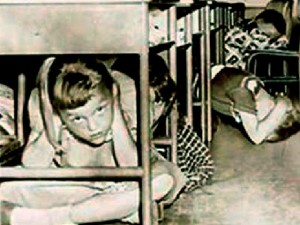
In the years when I was growing up more or less middle class, American war on the childhood front couldn’t have been sunnier. True, American soldiers were fighting a grim new stalemate of a conflict in Korea and we kids often enough found ourselves crouched under our school desks practicing for the nuclear destruction of our neighborhoods, but the culture was still focused on World War II. Enter a movie theater then and as just about any war flick ended, the Air Force arrived in the nick of time, the Marines eternally advanced, and victory was ours, a God-given trait of the American way of life.

In those days, it was still easy to present war sunny-side up. After all, you couldn’t go wrong with the Good War -- not that anyone called it that until Studs Terkel put the phrase into the language and the culture dropped the quote marks with which he carefully encircled it. And if your Dad, who had served in one of the great draft armies of our history, sat beside you silently in that movie theater while John Wayne saved the world, never saying a word about his war (except in rare and sudden outbursts of anger), well, that was no problem. His silence only encouraged you to feel that, given what you’d seen at the movies (not to speak of on TV, in books, in comics, and more or less anywhere else), you already understood his experience and it had been grand indeed.

And then, of course, we boys went into the parks, backyards, or fields and practiced making war the American way, shooting commies, or Ruskies, or Indians, or Japs, or Nazis with toy guns (or sticks). It may not sound pretty anymore, but take my word for it, it was glorious back when.

More than half a century later, those movies are relics of the neolithic era. The toy six-shooters I once holstered and strapped to my waist, along with the green plastic soldiers that I used to storm the beaches of Iwo Jima or Normandy, are somewhere in the trash heap of time. And in the wake of Vietnam, Iraq, and Afghanistan, who believes that America has a God-given right to victory? Still, I have a few relics from that era, lead Civil War and Indian War-style soldiers who, more than half a century ago, fought out elaborate battles on my floor, and I’d be a liar if I didn’t admit that holding one for a moment doesn’t give me some faint wash of emotion from another age. That emotion, so much stronger then, sent thousands of young Americans into Vietnam dreaming of John Wayne.

These days, post-Vietnam, post-9/11, no one rides to the rescue, “victory” is no longer in our possession, and for the first time in memory, a majority of the public thinks Washington should “mind its own business” globally when it comes to war-making. Not surprisingly, in an America that’s lost its appetite for war, such conflicts are far more embattled, so much less onscreen, and as novelist Beverly Gologorsky writes today, unacknowledged in much of American fiction.
There was nothing sunny about war, even in the 1950s, for the young, working-class Gologorsky.  If my childhood was, in a sense, lit by war and by a 24/7 economy in which the same giant corporations built ever larger cars and missiles, television consoles and submarines, hers was shadowed by it.  She sensed, far more than I, the truth of war that lay in our future.  That shadowing is the essence of her deeply moving “Vietnam” novel, The Things We Do to Make It Home, and her just-published second novel, Stop Here, a book that comes to grips in a way both subtle and heart-rending with the Iraq and Afghan wars without ever leaving the environs of a diner in Long Island, New York. Tom


In the Shadow of War: Life and Fiction in Twenty-First-Century America

by Beverly Gologorsky


Going to War in the South Bronx


I come from -- to use an old-fashioned phrase -- a working class immigrant family. The middle child of four siblings, not counting the foster children my mother cared for, I grew up in the post-World War II years in the basement of a building in the South Bronx in New York City. In my neighborhood, war -- or at least the military -- was the norm. Young men (boys, really) generally didn’t make it through life without serving in some military capacity. Soldiers and veterans were ubiquitous. Except to us, to me, none of them were “soldiers” or “veterans.” They were just Ernie, Charlie, Danny, Tommy, Jamal, Vito, Frank. In our neck of the urban woods -- multi-ethnic, diverse, low-income -- it was the way things were and you never thought to question that, in just about every apartment on every floor, there was a young man who had been in, would go into, or was at that moment in the military and, given the conflicts of that era, had often been to war as well.

Many of the boys I knew joined the Marines before they could be drafted for some of the same reasons men and women volunteer now. (Remember that there was still a draft army then, not the all-volunteer force of 2013.) However clichéd they may sound today, they reflected a reality I knew well. Then as now, the military held out the promise of a potentially meaningful future instead of the often depressing adult futures that surrounded us as we grew up.

Then as now, however, too many of those boys returned home with little or nothing to show for the turmoil they endured. And then as now, they often returned filled with an inner chaos, a lost-ness from which many searched in vain for relief.

When I was seven, the Korean War began. I was 18 when our first armed advisers arrived in Vietnam. After that disaster finally ended, a lull ensued, broken by a series of “skirmishes” from Grenada to Panama to Somalia to Bosnia, followed by the First Gulf War, and then, of course, the American invasions of Afghanistan and Iraq.

I dated, worked with, or was related to men who participated in some of these wars and conflicts. One of my earliest memories, in fact -- I must have been three -- is of my anxious 19-year-old sister waiting for her soldier-fiancé to make his way home from World War II. Demobilized, he finally arrived with no outward signs that war had taken a toll on him. Like so many of those “greatest generation” vets, though, he wouldn’t or couldn’t talk about his experiences, and remained hard to reach about most things for years afterwards. His army hat was my first military souvenir.

When I was eight or nine, my brother was drafted into the Korean War and I can still remember my constant worries about his well-being. I wrote my childish letters to him nearly every day. He had been assigned to Camp Breckinridge, Kentucky, given a pair of lace-up boots, and told he’d be training as a paratrooper. He could never get past the anxiety that assignment bestowed on him. Discharged, many pounds thinner and with a bad case of mononucleosis, he came home with a need to have guns around, guns he kept close at hand for the rest of his life.

My first “serious” boyfriend was a sailor on the U.S.S. Warrington. I was 15. Not surprisingly, he was away more than home. He mustered out with an addiction to alcohol.

I was 18 when my second boyfriend was drafted. John F. Kennedy was president and the Vietnam War was, then, just a blip on the American horizon. He didn’t serve overseas, but afterwards he, too, couldn’t figure out what to do with the rest of his life. And so it went.

Today, I no longer live in the South Bronx where, I have no doubt, women as well as men volunteer for the military with similar mindsets to those of my youth, and unfortunately return home with problems similar to those suffered by generations of soldiers before them. Suffice it to say that veterans of whatever war returned having experienced the sharp edge of death and nothing that followed in civilian life could or would be as intense.

Rejecting War


It’s in the nature of militaries to train their soldiers to hate, maim, and kill the enemy, but in the midst of the Vietnam War -- I had, by then, made it out of my neighborhood and my world -- something challenged this trained-to-kill belief system and it began to break down in a way previously unknown in our history. With that mindset suddenly in ruins, many young men refused to fight, while others who had gone to war, ones from neighborhoods like mine, came home feeling like murderers.

In those years, thinking of those boys and many others, I joined the student antiwar movement, though I was often the only one in any group not regularly on campus. (Working class women worked at paying jobs!) As I learned more about that war, my anger grew at the way my country was devastating a land and a people who had done nothing to us. The loss of American and Vietnamese lives, the terrible wounds, all of it felt like both a waste and a tragedy. From 1964 on, ending that war sooner rather than later became my 24/7 job (when, that is, I wasn’t at my paying job).

During those years, two events remain vivid in my memory. I was part of a group that opened an antiwar storefront coffee shop near Fort Dix in New Jersey, a camp where thousands of recruits received basic training before being shipped out to Vietnam. We served up coffee, cake, music, posters, magazines, and antiwar conversation to any soldiers who came in during their off-hours -- and come in they did. I met young men from as far away as Nebraska and Iowa, as close by as Queens and Brooklyn. I have no idea if any of them ever refused to deploy to Vietnam as some soldiers did in those years. However, that coffee house gave me an education in just how vulnerable, scared, excited, unprepared, and uninformed they were about what they would be facing and, above all, about the country they were invading.

Our storefront hours ran from 5 pm to whenever. On the inevitable night bus back to the Port Authority terminal, I would be unable to shake my sadness. Night after night, on that ride home I remember thinking: if only I had the power to do something more to save their lives, for I knew that some of them would come back in body bags and others would return wounded physically or emotionally in ways that I remembered well. And for what? That was why talking with them has remained in my memory as both a burden and a blessing.

The second event that stays with me occurred in May 1971 in Washington, D.C. A large group of Vietnam veterans, men who had been in the thick of it and seen it all, decided they needed to do something that would bring national attention to the goal of ending the war. The method they chose was to act out their repudiation of their previous participation in it. Snaking past the Capitol, an extremely long line of men in uniform threw purple hearts and medals of every sort into a trash bin. Most then made a brief statement about why they hated the war and could no longer bear to keep those medals. I was there and I’ll never forget their faces. One soldier, resisting the visible urge to cry, simply walked off without saying a word, only to collapse on a fellow soldier’s shoulder. Many of us watched, sobbing.

Breathing War


In those years, I penned political articles, but never fiction. Reality overwhelmed me. Only after that war ended did I begin to write my world, the one that was -- always -- shadowed by war, in fiction.

Why doesn’t war appear more often in American novels? Novelist Dorothy Allison once wrote, "Literature is the lie that tells the truth." Yet in a society where war is ever-present, that truth manages to go missing in much of fiction. These days, the novels I come across have many reference points, cultural or political, to mark their stories, but war is generally not among them.

My suspicion: it has something to do with class. If war is all around us and yet, for so many non-working-class Americans, increasingly not part of our everyday lives, if war is the thing that other people do elsewhere in our name and we reflect our world in our fiction, then that thing is somehow not us.

My own urge is to weave war into our world, the way Nadine Gordimer, the South African writer, once wove apartheid into her novels -- without, that is, speechifying or pontificating or even pointing to it. When American fiction ignores the fact of war and its effects remain hidden, without even brief mentions as simple markers of time and place, it also accepts peace as the background for the stories we tell. And that is, in its own way, the lie that denial tells.

That war shadows me is a difficult truth, and for that I have my old neighborhood to thank. If war is the background to my novels about everyday life, it’s because it’s been in the air I breathed, which naturally means my characters breathe it, too.

Beverly Gologorsky is the author the just-published novel Stop Here (“a literary Hopper painting,” Seven Stories Press). Her first novel, The Things We Do to Make it Home, was a New York Times Notable Book and a Los Angeles Times Best Fiction Book. In the Vietnam years, she was an editor of two political journals, Viet-Report and Leviathan and her contribution to feminism is noted in Feminists Who Changed America.

Follow TomDispatch on Twitter and join us on Facebook or Tumblr. Check out the newest Dispatch Book, Ann Jones’s They Were Soldiers: How the Wounded Return From America’s Wars -- The Untold Story.

Copyright 2013 Beverly Gologorsky

Sunday, December 08, 2013

Hedges: A Crisis of Capitalist Belief

Credibility of the Ruling Elite is Being Shredded - Chris Hedges on Reality Asserts Itself pt2

by TRNN

On RAI with Paul Jay, Chris Hedges says that while people are disgusted with the centers of power, unless there is a constructive alternative, any eruption will be nihilistic and could be fascist.

Chris Hedges, whose column is published Mondays on Truthdig , spent nearly two decades as a foreign correspondent in Central America, the Middle East, Africa and the Balkans. He has reported from more than 50 countries and has worked for The Christian Science Monitor, National Public Radio, The Dallas Morning News and The New York Times, for which he was a foreign correspondent for 15 years. He has written nine books, including "Empire of Illusion: The End of Literacy and the Triumph of Spectacle" (2009), "I Don't Believe in Atheists" (2008) and the best-selling "American Fascists: The Christian Right and the War on America" (2008). His book "War Is a Force That Gives Us Meaning" (2003) was a finalist for the National Book Critics Circle Award for Nonfiction.  

Iran/US Agreement: Interim Breakthrough or Historic Breakdown?

Iran-US Interim Agreement: Historic Breakthrough or Historic Sellout?

by James Petras

The recent interim accord between the six world powers and Iran has been hailed as an “historic breakthrough”, a “significant accomplishment” by most leading politicians, editorialists and columnists (Financial Times, (FT) 11/26/13, p. 2), the exceptions being notably Israeli leaders and the Zionist power brokers in North America and Western Europe (FT 11/26/13, p. 3).

What constitutes this “historic breakthrough”? Who got what? Did the agreement provide for symmetrical concessions? Does the interim agreement strengthen or weaken the prospects for peace and prosperity in the Gulf and the Middle East? To address these and other questions, one also has to include the powerful influence wielded by Israel on US and European policymakers (Stephen Lendman

The Historical Record: Past Precedents


For over a decade the major US intelligence agencies have published detailed accounts of Iran’s nuclear program (see especially the National Intelligence Estimate 2007 (NIE)). The common consensus has been that Iran did not have any program for developing nuclear weapons (National Intelligence Estimate 2004, 2007). As a consequence of this ‘absence of evidence’, the entire Western offensive against Iran had to focus on Iran’s “potential capacity” to shift sometime in the future towards a weapons program. The current agreement is directed toward undermining Iran’s potential ‘capacity’ to have a nuclear weapons program: there are no weapons to destroy, no weapon plans exist, no war plans exist and there are no strategic offensive military operations on the Iranian ‘drawing board’. We know this, because repeated US intelligence reports have told us that no weapons programs exist! So the entire current negotiations are really over weakening Iran’s ongoing peaceful, legal nuclear program and undermining any future advance in nuclear technology that might protect Iran from an Israeli or US attack, when they decide to activate their “military option”, as was pulled off in the war to destroy Iraq.

Secondly, Iran’s flexible and accommodating concessions are not new or a reflection of a newly elected President. As Gareth Porter has pointed out: Nearly ten years ago, on Nov. 15, 2004, Iran agreed “on a voluntary basis to continue and extend an existing suspension of enrichment to include all enrichment related and reprocessing activities” (Gareth Porter, Inter Press Service 11/26/13). According to Porter, Iran was ending “all manufacturing, assembly, installation and testing of centrifuges or their components”. Despite these generous concessions, on March 2005, the Europeans and the US refused to negotiate on an Iranian proposal for a comprehensive settlement that would guarantee against enrichment toward weapons grade. Iran ended its voluntary suspension of all enrichment activity. The US, led by Zionists embedded in Treasury, (Stuart Levey) then escalated sanctions. Europe and the UN Security Council followed in kind. The practice of the US and Europe first securing major concessions from Iran and then refusing to reciprocate by pursuing a comprehensive settlement is a well established diplomatic practice. Iran’s flexibility and concessions were apparently interpreted as “signs of weakness” to be exploited in their push toward ‘regime change’ (An Unusual Success for Sanctions Policy, FT 11/27/13, p. 10). Sanctions are seen as “effective” political-diplomatic weapons designed to further weaken the regime. Policy-makers continue to believe that sanctions should be maintained as a tool to divide the Iranian elite, disarm and dismantle the country’s defensive capacity and to prepare for “regime change” or a military confrontation without fear of serious resistance from the Iranians.

The entire charade of Iran’s ‘nuclear weapons as a threat’ has been orchestrated by the Israeli regime and its army of ‘Israel Firsters’ embedded in the US Executive, Congress and mass media. The ‘Big Lie’, promoted by Israel’s propaganda machine and network of agents, has been repeatedly and thoroughly refuted by the sixteen major US Intelligence Estimates or NIE’s, especially in 2004 and 2007. These consensus documents were based on extensive research, inside sources (spies) and highly sophisticated surveillance. The NIEs categorically state that Iran suspended all efforts toward a nuclear weapons program in 2003 and has not made any decision or move to restart that program. However, Israel has actively spread propaganda, based on fabricated intelligence reports, claiming the contrary in order to trick and push the US into a disastrous military confrontation with Israel’s regional rival. And the President of the United States ignores his own intelligence sources in order to repeat Israel’s ‘Big Lie’!

Given the fact that Iran is not a ‘nuclear threat’, now or in the past, and given that the US, European and Israeli leaders know this, why do they continue and even increase the sanctions against Iran? Why do they threaten to destroy Iran with pre-emptive attacks? Why the current demands for even more concessions from Tehran? The current negotiations and ‘agreement’ tell us a great deal about the ‘ultimate’ or final strategic aims of the White House and its European allies.

The ‘Interim Agreement’: A Most Asymmetrical Compromise


Iran’s negotiators conceded to the’ 5 plus 1’ all their major demands while they received the most minimum of concessions, (FT 1/25/13, p. 2).

Iran agreed (1) to stop all enrichment to 20 percent, (2) reduce the existing 20 percent enriched stockpile to zero, (3) convert all low enriched uranium to a form that cannot be enriched to a higher level, (4) halt progress on its enrichment capacity, (5) leave inoperable half of its centrifuges at Natanz and three-quarters of those at Fordow, and (6) freeze all activities at Arak heavy water facility which when built could produce plutonium. Iran also agreed to end any plans to construct a facility capable of reprocessing plutonium from spent fuel. The Iranian negotiators agreed to the most pervasive and intensive “inspections” of its most important strategic defense facilities by the International Atomic Energy Agency, which has been closely allied with the US and its EU counterparts. These “inspections” and data collection will take place on a daily bases and include access to Natanz and Fordow. The strategic military value of these inspections is inestimable because it could provide data, heretofore unavailable, for any future missile strike from the US or Israel when they decide to shift from negotiations to the ‘military option’. In addition, the IAEA inspectors will be allowed to access other strategic facilities, including sites for developing centrifuges, uranium mines and mills. Future “negotiations” may open highly sensitive military defense sites such as Parchin, where conventional missiles and warheads are stored.

Obviously, there will not be any reciprocal inspections of the US missile sites, warships and military bases in the Persian Gulf, which store weapons of mass destruction aimed at Iran! Nor will the IAEA inspect Israel’s nuclear weapons—facilities in Dimona – despite Israeli threats to attack Iran. No comparable diminution of “military capacity” or nuclear weapons, aimed at Iran by some members of the ‘5 plus 1 and Israel’ is included in this “historic breakthrough”.

The ‘5 plus 1’ conceded meager concessions: Unfreezing of 7% of Iranian-owned assets sequestered in Western banks ($7 billion of $100 billion) and ‘allowing’ Iran to enrich uranium to 5 percent --and even that “concession” is conditioned by the proviso that it does not exceed current stockpiles of 5% enriched uranium. While the Iranian negotiators claim they secured (sic) ‘the right’ to enrich uranium, the US refused to even formally acknowledge it!

In effect, Iran has conceded the maximum concessions regarding its strategic national defenses, nuclear facilities and uranium enrichment in what is supposedly the ‘initial’ round of negotiations, while ‘receiving’ the minimum of reciprocal concessions. This highly unfavorable, asymmetrical framework, will lead the US to see Iran as ‘ripe for regime change’ and demand even more decisive concessions designed to further weaken Iran’s defensive capacity. Future concessions will increase Iran’s vulnerability to intelligence gathering and undermine its role as a regional power and strategic ally of the Lebanese Hezbollah, the current beleaguered governments in Syria and Iraq and the Palestinians under Israeli occupation.

The ‘Final Settlement’: Decline and Fall of the Islamic Nationalist Republic?


The real goals of the US sanctions policy and the recent decision to enter into negotiations with Iran have to do with several imperial objectives. The first objective is to facilitate the rise of a neo-liberal regime in Iran, which would be committed to privatizing major oil and gas fields and attracting foreign capital even at the cost of strategic national defense.

President Rohani is seen in Washington as the Islamic version of the former Russian President Mikhail Gorbachev. Rohani, like his ‘model’ Gorbachev, ‘gave away the store’ while expecting Iran’s imperial adversaries to reciprocate.

The ‘5 plus 1’, mostly veterans of the ‘imperial shake down’, will take all of Rohani’s concessions and demand even more! They will “allow” Iran to recover its own frozen assets in slow droplets, which the neo-liberals in Tehran will celebrate as ‘victories’ even while the country stagnates under continued sanctions and the people suffer! The US Administration will retain sanctions in order to accommodate their Israeli-Zionist patrons and to provoke even deeper fissures in the regime. Washington’s logic is that the more concessions Teheran surrenders, the more difficult it will be to reverse the process under public pressure from the Iranian people. This ‘rift’ between the conciliatory government of Rohani and the Iranian people, according to CIA strategists, will lead to greater internal discontent in Iran and will further weaken the regime. A regime under siege will need to rely even more on their Western interlocutors. President Rohani ‘relying on the 5-plus-1’ will be like the condemned leaning into the hangman’s noose.

Rohani and the Neo-Liberal Collaborators


The ascendancy of Rohani to the Presidency brings in its wake an entire new political-economic leadership intent on facilitating large-scale, long-term penetration by Western and Chinese oil and gas companies in the most lucrative sites. Iran’s new oil minister, Bijan Namdar Zangeneh, has made overtures to all the oil majors, and offers to revise and liberalize the terms for investment and provide concessions designed to greatly enhance multinational profits, in the most lucrative fields (FT, 11/27/13, p. 2). Zangeneh has kicked out the nationalists and replaced them with a cohort of liberal economists. He is preparing to eventually lay-off tens of thousands of public sector oil employees as an incentive to attract foreign corporate partners. He is prepared to lower fuel subsidies for the Iranian people and raise energy prices for domestic consumers. The liberals in power have the backing of millionaires, speculators and political power brokers, like Akbar Hashemi Rafsanjani head of the key Expediency Council, which drafts policy. Many of Rafsanjani’s followers have been appointed to key positions in President Rohani’s administration (FT, 11/26/13, p.3).

Central to the ‘Troika’s (Rohani-Rafsanjani-Zangeneh) strategy is securing the collaboration of multi-national energy corporations. However that requires lifting the US-imposed sanctions against Iran in the shortest time possible. This explains the hasty, unseemly and one-sided Iranian concessions to the ‘5-plus-1’. In other words, the driving force behind Iran’s giveaways is not the “success of sanctions” but the ascendancy to power of the Iranian comprador class and its neo-liberal ideology which informs their economic strategy.

Several major obstacles confront the ‘Troika’. The major concessions, initially granted, leave few others to concede, short of dismantling the entire nuclear energy infrastructure and lobotomizing its entire scientific and technical manpower, which would destroy the legitimacy of the regime. Secondly, having easily secured major concessions without lifting the sanctions the ‘5-plus-1’ are free to escalate their demands for further concessions, which in effect will deepen Iran’s vulnerability to Western espionage, terrorism (as in the assassination of Iranian scientists and engineers) and preemptive attack. As the negotiations proceed it will become crystal clear that the US intends to force the ‘Troika’ to open the gates to more overtly pro-western elites in order to eventually polarize Iranian society.

The end-game is a weakened, divided, liberalized regime, vulnerable to internal and external threats and willing to cut-off support to nationalist regimes in the Middle East, including Palestine, Iraq, Syria and Lebanon. The US recognized and seized upon the rise of the new neo-liberal Rohani regime and secured major unilateral concessions as a down payment to move step-by-step toward bloody regime change. Washington’s “end game” is the conversion of Iran to a client petrol-state allied with the Saudi-Israeli axis.

As far-fetched as that appears today, the logic of negotiations is moving in that direction.

The Israeli-US Differences: A Question of Tactics and Timing


Israeli leaders and their Zionist agents, embedded in the US government, howl, pull out their hair and bluster against the ‘5-plus-1’ transitional agreement with Iran. They downplay the enormous one-sided concessions. They rant and rave about “hidden agenda”, “deceit and deception”. They fabricate conspiracies and repeat lies about secret “nuclear weapons programs” beyond the reach (and imagination) of any non-Zionist inspector. But the reality is that the “historic breakthrough” includes the dismantling of a major part of Iran’s nuclear infrastructure, while retaining sanctions – a huge victory of the Zionists! The ‘5-plus-1’ negotiated a deal which has secured deeper and more extensive changes in Iran while strengthening Western power in the Persian Gulf than all of Netanyahu’s decade-long campaign of issuing ‘military threats’.

Netanyahu and his brainwashed Zionist-Jewish defenders in the US insist on new, even harsher sanctions because they want immediate war and regime-change (a puppet regime). Echoing his Israeli boss Netanyahu, New York Senator Chuck “the schmuck” Schumer, commenting on the interim agreement brayed, “The disproportionality of this agreement makes it more likely that Democrats and Republicans will pass additional sanctions” (Barrons 12/2/13 p14) This is the same stupid policy that the embedded Zionists in Washington pursued with Iraq. Under the Bush Presidency, top neo-con Zionists, like Wolfowitz, Ross, Indyk, Feith, Abrams and Libby, implemented Ariel Sharon’s war dictates: (1) murdered Saddam Hussein (regime change) (2) destroyed the Iraq’s economy, society and modern infrastructure, and (3) provoked ethnic fragmentation and religious war – costing the US over 2 trillion dollars on the war, thousands of US lives (millions of Iraqi lives) and at a cost of hundreds of billions in high oil prices to US consumers – further shattering the US domestic economy.

Among the few moderately intelligent and influential Zionist journalists, Gideon Rachman, who realizes the strategic value of the step-by-step approach of the Obama regime, has called for the White House “to take on the Israel lobby over Iran” (FT, 11/26/13, p. 10). Rachman knows that if Israel’s howling stooges in the US Congress drag the country into war, the American people will turn against the Israeli lobby, its fellow travelers and, most likely, Israel. Rachman and a few others with a grain of political sophistication know that the Rohani regime in Tehran has just handed over key levers of power to the US. They know that the negotiations are moving toward greater integration of Iran into the US orbit. They know, in the final instance, that Obama’s step-by-step diplomatic approach will be less costly and more effective than Netanyahu’s military ‘final solution’. And they know that, ultimately, Obama’s and Israel’s goal is the same: a weak neo-liberalized Iran, which cannot challenge Israel’s military dominance, nuclear weapons monopoly, annexation of Palestine and aggression against Lebanon and Syria.

Conclusion


Having secured a “freeze” on Iran’s consequential nuclear research and having on site intelligence on all Iran’s major national defense and security facilities, the US can compile a data base for an offensive military strategy whenever it likes. Iran, on the other hand, receives no information or reports on US, European or Israeli military movement, weapons facilities or offensive regional capabilities. This is despite the fact that the ‘5-plus-1’ countries and Israel have recently launched numerous devastating offensive military operations and wars in the region (Iraq, Afghanistan, Lebanon, Libya and Syria). Having set the agenda for negotiations as one of further unilateral concessions from Iran, the US can at any point, threaten to end negotiations – and follow up with its ‘military option’.

The next step in the unilateral disarmament of Iran will be the US demand to close the strategic Arak heavy water plant. The US will demand that Iran produce a basic minimum amount of uranium and retain a stock pile to cover a few days or weeks for energy, research or medical isotopes. Washington will strip Iran of its capacity to enrich by imposing quantitative and qualitative limits on the centrifuges that Iran can possess and operate. During the next round of negotiations, the US will preclude Iran from undertaking the reprocessing of uranium at Arak or any other site. The US will tell ‘the Troika’ that the “right” (sic) to enrich does not extend to the right to reprocess. The US will demand stringent “transparency” for Iran, while maintaining its own high level secrecy, evasion and ambiguity with regard to its military, diplomatic and economic sanctions policy.

In a word, the US will demand that Iran surrender its sovereignty and subject itself to the colonial oversight of an imperial power, which has yet to make a single move in even reducing economic sanctions. The loss of sovereignty, the continued sanctions and the drive by the US to curtail Iran’s regional influence will certainly lead to popular discontent in Iran – and a response from the nationalist and populist military (Revolutionary Guards) and the working poor. The crisis resulting from the Troika’s adoption of the “Gorbachev Model” will lead to an inevitable confrontation. Overtime the US will seek out an Islamist strongman, an Iranian version of Yeltsin who can savage the nationalists and popular movements and turn over the keys to the state, treasury and oil fields to a “moderate and responsible” pro-Western client regime.

The entire US strategy of degrading Iran’s military defenses and securing major neo-liberal “reforms” depends on President Rohani remaining in power, which can only result from the Obama regime’s compliance in lifting some of the oil and banking sanctions (FT 12/1/13, p. 6). Paradoxically, the greatest obstacle to achieving Washington’s strategic roll-back goal is Netanyahu’s power to block sanction relief – and impose even, harsher sanctions. The result of such an Israel Firster victory in the US would be the end of negotiations, the strengthening of Iran’s nuclear program, the demise of the oil privatization program and added support to regional nationalist movements and governments. President Rohani desperately needs western imperial reassurance of the benefits (sanction relief) of his initial giveaways. Otherwise his credibility at home would be irreparably damaged.

The imperial prize of a militarily weakened and neo-liberalized Iran, collaborating in maintaining the status quo in the Middle East, is enormous but it clashes with the Zionist Power Configuration, which insists on all power to the Jewish state from the Suez to the Persian Gulf!