Monday, September 14, 2015

Rivera Revealed: Change the World or Go Home

Diego Rivera murals in San Francisco—Mostly hidden and obscured: Change the World or Go Home by Alejandro Almanza Pereda

by Jeff Lusanne  - WSWS

14 September 2015  
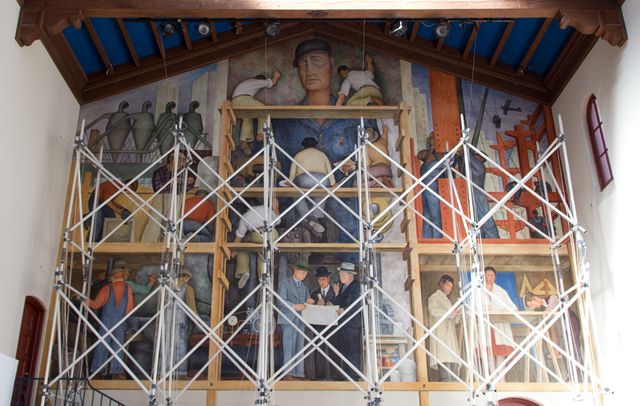
In May 1931, during his extended stay in the United States, Mexican artist Diego Rivera painted a mural, The Making of a Fresco Showing the Building of a City, now located in a gallery named after him at the San Francisco Institute of Art (SFAI).


Alejandro Almanza Pereda's installation Change the World or Go Home in front of Diego Rivera's The Making of a Fresco Showing the Building of a City

Change the World or Go Home, an installation by Mexico City-based artist Alejandro Almanza Pereda at the SFAI, is a piece that obscures Rivera’s mural celebrating labor. Almanza’s visually minimal work seems to be making the complaint that other Mexican artists are unfairly hampererd by the enduring popularity of Rivera’s socially-themed murals.

Pereda’s choice to obstruct Rivera’s piece with his scaffolding seems to highlight some of the present cultural difficulties, both in terms of the ability of the American public to have access to the Mexican muralist’s work and the generally poor and socially indifferent environment in global art circles.

Rivera’s murals were a pioneering example of public art on social themes in the 20th century. Rivera studied in Europe and learned the traditional Italian technique of fresco, where paint is applied into freshly laid plaster and effectively becomes the wall. He returned to Mexico with this technique and gradually incorporated traditional indigenous imagery into his own unique style.

His first murals in Mexico in the 1920s represented complex themes from Mexican history, social life and revolution. The Mexican, and especially the Russian, Revolutions were major, life-shaping events for him. Rivera became a member of the Mexican Communist Party, and eventually a supporter of Leon Trotsky’s struggle against Stalinism. Despite his well-known views, he was highly sought after by certain prominent business figures in the United States, as well as museum officials, for the overwhelming beauty and power of his murals.

He encountered numerous obstacles and difficulties in the United States in the early 1930s. Most notoriously, his monumental 1933 mural Man at the Crossroads, at New York City’s Rockefeller Center, was destroyed by Nelson Rockefeller when Rivera and his assistants refused to remove an image of Lenin. Yet his work directly influenced a range of American artists in the 1930s, inspiring both murals and paintings.

With so few examples of Rivera’s work in the US, finding oneself in a city with one of his murals is a rare pleasure. Detroit is most fortunate in this regard, because Rivera’s monumental Detroit Industry murals at the Detroit Institute of Arts (DIA) are on public display and easily accessible. In 1931, Rivera made six portable fresco murals for the Museum of Modern Art in New York City. These were stored or dispersed, hidden from public view for 80 years, before a MoMA exhibit in 2011 presented them again. Yet in that show, only five panels were presented because the sixth has been lost, and with the close of the exhibition the works again partially disappeared from public view.

The aforementioned Rockefeller Center mural in New York City was destroyed, resulting in Rivera losing a commission in Chicago. The reportedly remarkable “Portrait of America” mural painted at the New Workers’ School in New York City in 1933 is no longer on view.


San Francisco is home to three intact Rivera murals (a fourth, smaller work is at the University of California, Berkeley), but at present, those works are all, to one degree or another, less than easily accessible to the public. In the financial district, Rivera painted his first mural in the US, The Allegory of California, at the City Club of San Francisco, an elite social club. Information online indicates that the mural can be viewed from 3 to 5 p.m. daily, with permission obtainable from the security desk. However, arriving on a Saturday and requesting permission to see the mural, this reviewer was told that a wedding was being set up in the club space and access was not possible. Such events at the City Club can prevent access at any time. Pan American Unity, a typically varied and complex composition treating life, economy and politics throughout the continent, is located at the City College of San Francisco. Viewing hours for the public are limited to just a few per day, Monday through Thursday only. For a weekend visit, the mural is out of view.

The third mural, The Making of a Fresco Showing the Building of a City, is at the SFAI, a private art school with many notable instructors and alumni. William Gerstle, the president of the school in 1930-1931, was instrumental in getting Rivera permission to enter the US for the first time.


Entering the gallery, one confronts a large structure of fluorescent lighting located directly in front of the work, Change the World or Go Home is by Alejandro Almanza Pereda, an artist in residence at SFAI. His piece resembles building scaffolding, with light tubes taking the place of wood and steel. Each tube has wiring for power, which falls loosely and accumulates into a tangle of wires toward the bottom of the structure. In a daytime viewing, the lights were not on.

To the extent that the viewer can peer through the tubes and wiring, the Rivera mural reveals warm, nuanced, transparent brushstrokes of tempera paint that follow his own unique style of beautifully contoured lines. That is, the flowing, curvaceous definition of his human forms is not only defined by a contour line around a figure, but by every stroke of the brush that makes up the form, and we can see the record of those marks. His images are arresting from afar, and reward the viewer up close.

The most striking difference between Almanza’s piece and the Rivera it partially obscures is the strong visual imbalance between a painted image and a ready-made structure.

Even if we are to accept the validity or purpose of deliberately constructing a structure in front of a mural, Almanza’s piece does a poor job of integrating itself. Rivera’s work depicts mural painters on scaffolding that forms a grid containing nine squares, with four prominent vertical lines, which organizes the mural. Almanza places in front of that a structure with six vertical lines that do not relate to the lines in Rivera’s piece, and also have x-bracing to further obscure the painted image.

That structure is not especially appealing or interesting. The tubes are ready-made and unvarying; they are cold and easy to overlook. If light is supposed to be a part of the piece, it was not apparent, as the lights are often turned off since the gallery is mostly open during daytime hours. The visual metaphor of using lighting to re-examine or look through another work is obvious, but through this material and composition, what exactly has Almanza prompted us to re-examine?

His ironic lament, based on the title, seems to be that contemporary Mexican artists are constrained to creating socially conscious work because of Rivera’s influence. Meanwhile, the SFAI’s description of the installation is filled with the jargon-filled phrases, cynicism and narcissism that is a feature of the present-day official art world.


It states that “we have been looking at Diego Rivera’s ass for 84 years,” saying it is “closest to our eye” and that “of course, this was the artist’s intention.” The sheer stupidity of this statement is proven by the fact that Rivera’s self-portrait within the mural places him high on the scaffold, some 20 feet above any viewers eye. The entire lower level, showing planners, architects, and workers is closer and the center group of architects is the natural focal point.


The statement concludes that “for Almanza, Rivera is a catalyst for the ongoing instrumentation of Latin American identity and artistic practice” and that “if Rivera is a limiting screen through which we understand Latin American art, this is an opportunity to add a new screen.”

The complaint here seems to be that Rivera remains the towering figure of Mexican art. In the smug and apparently bitter view, Rivera’s work is about himself, not the world around him. The SFAI gallery text even refers to him as “the imperious Rivera.”

This is turning things upside down. In fact, so much contemporary art work, including Almanza’s piece, is narrowly (and tediously) focused on art processes themselves, or, ironically, on the status of the artist. Rivera’s work is powerful because it often captures the grand drama of human events in a way that is both widely appealing visually, accessible and yet not a caricature.

An artist who is troubled by the “limiting” factor of Rivera’s art, and aims to tear it down, is demanding the right to be as self-absorbed and trivial as his contemporary counterparts elsewhere! Almanza is clearly not interested in making work that could speak to broader themes of modern life and the public. He is a representative of the aspiring Mexican upper-middle class, desirous to take its place in the world, free from the heritage of anything connected with revolution or socialism.

This isn’t simply a question of form: i.e., that Rivera used representation while Almanza or other Mexican artists would like to be conceptual, abstract or more experimental. Nothing is to say those forms cannot speak to the wider world—the question remains, does that even interest the artist? (That said, a bulk order from the lighting department at Home Depot placed in front of a compelling painting is probably not a means of winning most people over.)

What other cases are there of an artist deliberately interfering or obscuring another’s work? And, if so, is Rivera the artist with a body of work to disrupt?


The author also recommends:

Diego Rivera at the Museum of Modern Art: Then and now—revolutionary art for revolutionary times
[21 December 2011]

Eighty years of the Diego Rivera murals at the Detroit Institute of Arts
[5 September 2013]

Sunday, September 13, 2015

Garrison Nation: Policing the World While Undermining Global Security

Garrisoning the Globe: How U.S. Military Bases Abroad Undermine National Security and Harm Us All

by David Vine - TomDispatch


With the U.S. military having withdrawn many of its forces from Iraq and Afghanistan, most Americans would be forgiven for being unaware that hundreds of U.S. bases and hundreds of thousands of U.S. troops still encircle the globe. Although few know it, the United States garrisons the planet unlike any country in history, and the evidence is on view from Honduras to Oman, Japan to Germany, Singapore to Djibouti.

Like most Americans, for most of my life, I rarely thought about military bases. Scholar and former CIA consultant Chalmers Johnson described me well when he wrote in 2004, 
“As distinct from other peoples, most Americans do not recognize -- or do not want to recognize -- that the United States dominates the world through its military power. Due to government secrecy, our citizens are often ignorant of the fact that our garrisons encircle the planet.”

To the extent that Americans think about these bases at all, we generally assume they’re essential to national security and global peace. Our leaders have claimed as much since most of them were established during World War II and the early days of the Cold War. As a result, we consider the situation normal and accept that U.S. military installations exist in staggering numbers in other countries, on other peoples’ land. On the other hand, the idea that there would be foreign bases on U.S. soil is unthinkable.

Tomgram: David Vine, Our Base Nation

[Note for TomDispatch Readers: This morning we have a special offer for you. TomDispatch regular David Vine will send any of you willing to donate $100 (or more) to this website a signed, personalized copy of his groundbreaking new book, Base Nation: How U.S. Military Bases Abroad Harm America and the World, a genuine successor volume to the late Chalmers Johnson’s Blowback Trilogy. Of it, Andrew Bacevich has says, “Base Nation offers a devastating critique, and no doubt Washington will try to ignore it. Citizens should refuse to let that happen.” Vine’s is a must-read book on a subject -- the U.S. garrisoning of the planet -- that, ever since Johnson himself wrote about it at this website, we’ve considered of primary importance. Check out our donation page for the details and many thanks, as ever, for your generosity. Tom]

It’s not that I knew nothing about U.S. military bases before I met Chalmers Johnson. In certain ways, my idea of the good life had been strongly shaped by such a base. Admittedly, it wasn’t in Germany or Japan or South Korea or some other distant land, but on Governor’s Island, an Army base just off the southern tip of New York City. In the 1950s, my father ran a gas station there. On Saturday mornings, I would often accompany him to work on a ferry from downtown Manhattan and spend a dreamy suburban-style day there amid zipping Jeeps and marching troops and military kids, playing ball, wandering freely, catching cowboy or war flicks at the island’s only movie house, and imagining that this was the best of all possible worlds. And yet between that moment and the moment in September 1998 when Johnson’s proposal for a book to be called Blowback: The Costs and Consequences of American Empire fell into my editorial hands, I probably never gave our country’s bases another thought.

In that, I was like millions of Americans who, as soldiers or civilians, had cycled through such bases at home and around the world and never considered them again. And we were hardly alone when it came to the hundreds and hundreds of foreign garrisons that made up what Johnson termed our “empire of bases.” Historians, political scientists, and journalists, among many others, paid them little mind. Our overseas garrisons were seldom discussed or debated or covered in the media in any significant way. No one in Congress challenged their existence. No president gave a speech about them. Though I hesitate to use the term, there was something like a conspiracy of silence around them -- or perhaps a sense of discomfort that they even existed led everyone to act as if they didn’t. And yet they were the face of this country to significant parts of the world. In their profusion and their reach, they represented a staggering reality for which there was no historical precedent. Billions and billions of dollars poured into them. Hundreds of thousands of troops and their dependents were stationed on them. It should have told us all something that they were quite so unremarked upon, but until Johnson came along, they were, in essence, not so much our little secret as a secret we kept even from ourselves. As he wrote with a certain wonder in the second book in his Blowback Trilogy, The Sorrows of Empire: Militarism, Secrecy, and the End of the Republic, “The landscape of this military empire is as unfamiliar and fantastic to most Americans today as Tibet or Timbuktu were to nineteenth-century Europeans.”

Johnson broke the silence around them -- repeatedly. And yet, in an era in which such bases, still being built, have played a crucial role in our various wars, conflicts, bombing and drone assassination campaigns, and other interventions in the Greater Middle East, they remain a barely acknowledged aspect of American life. Why this is so should be considered both a curiosity and a mystery. Is it that a genuine acknowledgement of the existence of a vast network of global garrisons would lead to uncomfortable conclusions about the imperial nature of this country? I’m not sure myself. That they remain largely surrounded by an accepted and acceptable silence, however, continues to be an American reality.

Thank heavens, then, that, almost five years after Chalmers Johnson’s death, TomDispatch regular David Vine has produced a groundbreaking new book, Base Nation: How U.S. Military Bases Abroad Harm America and the World, which should once again bring that empire of bases back into the national discussion. Today, Vine offers an overview of what it means for this country to continue to garrison the planet 24/7. Tom
 
[* Chalmers Johnson described America's burgeoning 
garrison network in a 2007 interview on Gorilla Radio here.]

Garrisoning the Globe: How U.S. Military Bases Abroad Undermine National Security and Harm Us All

by David Vine

While there are no freestanding foreign bases permanently located in the United States, there are now around 800 U.S. bases in foreign countries. Seventy years after World War II and 62 years after the Korean War, there are still 174 U.S. “base sites” in Germany, 113 in Japan, and 83 in South Korea, according to the Pentagon. Hundreds more dot the planet in around 80 countries, including Aruba and Australia, Bahrain and Bulgaria, Colombia, Kenya, and Qatar, among many other places. Although few Americans realize it, the United States likely has more bases in foreign lands than any other people, nation, or empire in history.

Oddly enough, however, the mainstream media rarely report or comment on the issue. For years, during debates over the closure of the prison at the base in Guantánamo Bay, Cuba, nary a pundit or politician wondered why the United States has a base on Cuban territory in the first place or questioned whether we should have one there at all. Rarely does anyone ask if we need hundreds of bases overseas or if, at an estimated annual cost of perhaps $156 billion or more, the U.S. can afford them. Rarely does anyone wonder how we would feel if China, Russia, or Iran built even a single base anywhere near our borders, let alone in the United States.

“Without grasping the dimensions of this globe-girdling Baseworld,” Chalmers Johnson insisted, “one can’t begin to understand the size and nature of our imperial aspirations or the degree to which a new kind of militarism is undermining our constitutional order.” 
Alarmed and inspired by his work and aware that relatively few have heeded his warnings, I’ve spent years trying to track and understand what he called our “empire of bases.” While logic might seem to suggest that these bases make us safer, I’ve come to the opposite conclusion: in a range of ways our overseas bases have made us all less secure, harming everyone from U.S. military personnel and their families to locals living near the bases to those of us whose taxes pay for the way our government garrisons the globe.

We are now, as we’ve been for the last seven decades, a Base Nation that extends around the world, and it’s long past time that we faced that fact.

The Base Nation’s Scale


Our 800 bases outside the 50 states and Washington, D.C., come in all sizes and shapes. Some are city-sized “Little Americas” -- places like Ramstein Air Base in Germany, Kadena Air Base in Okinawa, and the little known Navy and Air Force base on Diego Garcia in the Indian Ocean. These support a remarkable infrastructure, including schools, hospitals, power plants, housing complexes, and an array of amenities often referred to as “Burger Kings and bowling alleys.” Among the smallest U.S. installations globally are “lily pad” bases (also known as “cooperative security locations”), which tend to house drones, surveillance aircraft, or pre-positioned weaponry and supplies. These are increasingly found in parts of Africa and Eastern Europe that had previously lacked much of a U.S. military presence.

Other facilities scattered across the planet include ports and airfields, repair complexes, training areas, nuclear weapons installations, missile testing sites, arsenals, warehouses, barracks, military schools, listening and communications posts, and a growing array of drone bases. Military hospitals and prisons, rehab facilities, CIA paramilitary bases, and intelligence facilities (including former CIA “black site” prisons) must also be considered part of our Base Nation because of their military functions. Even U.S. military resorts and recreation areas in places like the Bavarian Alps and Seoul, South Korea, are bases of a kind. Worldwide, the military runs more than 170 golf courses.

The Pentagon’s overseas presence is actually even larger. There are U.S. troops or other military personnel in about 160 foreign countries and territories, including small numbers of marines guarding embassies and larger deployments of trainers and advisors like the roughly 3,500 now working with the Iraqi Army. And don’t forget the Navy’s 11 aircraft carriers. Each should be considered a kind of floating base, or as the Navy tellingly refers to them, “four and a half acres of sovereign U.S. territory.” Finally, above the seas, one finds a growing military presence in space.

The United States isn’t, however, the only country to control military bases outside its territory. Great Britain still has about seven bases and France five in former colonies. Russia has around eight in former Soviet republics. For the first time since World War II, Japan’s “Self-Defense Forces” have a foreign base in Djibouti in the Horn of Africa, alongside U.S. and French bases there. South Korea, India, Chile, Turkey, and Israel each reportedly have at least one foreign base. There are also reports that China may be seeking its first base overseas. In total, these countries probably have about 30 installations abroad, meaning that the United States has approximately 95% of the world’s foreign bases.

“Forward” Forever?


Although the United States has had bases in foreign lands since shortly after it gained its independence, nothing like today’s massive global deployment of military force was imaginable until World War II. In 1940, with the flash of a pen, President Franklin D. Roosevelt signed a “destroyers-for-bases” deal with Great Britain that instantly gave the United States 99-year leases to installations in British colonies worldwide. Base acquisition and construction accelerated rapidly once the country entered the war. By 1945, the U.S. military was building base facilities at a rate of 112 a month. By war’s end, the global total topped 2,000 sites. In only five years, the United States had developed history’s first truly global network of bases, vastly overshadowing that of the British Empire upon which “the sun never set.”

After the war, the military returned about half the installations but maintained what historian George Stambuk termed a “permanent institution” of bases abroad. Their number spiked during the wars in Korea and Vietnam, declining after each of them. By the time the Soviet Union imploded in 1991, there were about 1,600 U.S. bases abroad, with some 300,000 U.S. troops stationed on those in Europe alone.

Although the military vacated about 60% of its foreign garrisons in the 1990s, the overall base infrastructure stayed relatively intact. Despite additional base closures in Europe and to a lesser extent in East Asia over the last decade and despite the absence of a superpower adversary, nearly 250,000 troops are still deployed on installations worldwide. Although there are about half as many bases as there were in 1989, the number of countries with U.S. bases has roughly doubled from 40 to 80. In recent years, President Obama’s “Pacific pivot” has meant billions of dollars in profligate spending in Asia, where the military already had hundreds of bases and tens of thousands of troops. Billions more have been sunk into building an unparalleled permanent base infrastructure in every Persian Gulf country save Iran. In Europe, the Pentagon has been spending billions more erecting expensive new bases at the same time that it has been closing others.

Since the start of the Cold War, the idea that our country should have a large collection of bases and hundreds of thousands of troops permanently stationed overseas has remained a quasi-religious dictum of foreign and national security policy. The nearly 70-year-old idea underlying this deeply held belief is known as the “forward strategy.” Originally, the strategy held that the United States should maintain large concentrations of military forces and bases as close as possible to the Soviet Union to hem in and “contain” its supposed urge to expand.

But the disappearance of another superpower to contain made remarkably little difference to the forward strategy. Chalmers Johnson first grew concerned about our empire of bases when he recognized that the structure of the “American Raj” remained largely unchanged despite the collapse of the supposed enemy.

Two decades after the Soviet Union’s demise, people across the political spectrum still unquestioningly assume that overseas bases and forward-deployed forces are essential to protect the country. George W. Bush’s administration was typical in insisting that bases abroad “maintained the peace” and were “symbols of… U.S. commitments to allies and friends.” The Obama administration has similarly declared that protecting the American people and international security “requires a global security posture.”

Support for the forward strategy has remained the consensus among politicians of both parties, national security experts, military officials, journalists, and almost everyone else in Washington’s power structure. Opposition of any sort to maintaining large numbers of overseas bases and troops has long been pilloried as peacenik idealism or the sort of isolationism that allowed Hitler to conquer Europe.

The Costs of Garrisoning the World


As Johnson showed us, there are many reasons to question the overseas base status quo. The most obvious one is economic. Garrisons overseas are very expensive. According to the RAND Corporation, even when host countries like Japan and Germany cover some of the costs, U.S. taxpayers still pay an annual average of $10,000 to $40,000 more per year to station a member of the military abroad than in the United States. The expense of transportation, the higher cost of living in some host countries, and the need to provide schools, hospitals, housing, and other support to family members of military personnel mean that the dollars add up quickly -- especially with more than half a million troops, family members, and civilian employees on bases overseas at any time.

By my very conservative calculations, maintaining installations and troops overseas cost at least $85 billion in 2014 -- more than the discretionary budget of every government agency except the Defense Department itself. If the U.S. presence in Afghanistan and Iraq is included, that bill reaches $156 billion or more.

While bases may be costly for taxpayers, they are extremely profitable for the country’s privateers of twenty-first-century war like DynCorp International and former Halliburton subsidiary KBR. As Chalmers Johnson noted, “Our installations abroad bring profits to civilian industries,” which win billions in contracts annually to “build and maintain our far-flung outposts.”

Meanwhile, many of the communities hosting bases overseas never see the economic windfalls that U.S. and local leaders regularly promise. Some areas, especially in poor rural communities, have seen short-term economic booms touched off by base construction. In the long-term, however, most bases rarely create sustainable, healthy local economies. Compared with other forms of economic activity, they represent unproductive uses of land, employ relatively few people for the expanses occupied, and contribute little to local economic growth. Research has consistently shown that when bases finally close, the economic impact is generally limited and in some cases actually positive -- that is, local communities can end up better off when they trade bases for housing, schools, shopping complexes, and other forms of economic development.

Meanwhile for the United States, investing taxpayer dollars in the construction and maintenance of overseas bases means forgoing investments in areas like education, transportation, housing, and healthcare, despite the fact that these industries are more of a boon to overall economic productivity and create more jobs compared to equivalent military spending. Think about what $85 billion per year would mean in terms of rebuilding the country’s crumbling civilian infrastructure.

The Human Toll


Beyond the financial costs are the human ones. The families of military personnel are among those who suffer from the spread of overseas bases given the strain of distant deployments, family separations, and frequent moves. Overseas bases also contribute to the shocking rates of sexual assault in the military: an estimated 30% of servicewomen are victimized during their time in the military and a disproportionate number of these crimes happen at bases abroad. Outside the base gates, in places like South Korea, one often finds exploitative prostitution industries geared to U.S. military personnel.

Worldwide, bases have caused widespread environmental damage because of toxic leaks, accidents, and in some cases the deliberate dumping of hazardous materials. GI crime has long angered locals. In Okinawa and elsewhere, U.S. troops have repeatedly committed horrific acts of rape against local women. From Greenland to the tropical island of Diego Garcia, the military has displaced local peoples from their lands to build its bases.

In contrast to frequently invoked rhetoric about spreading democracy, the military has shown a preference for establishing bases in undemocratic and often despotic states like Qatar and Bahrain. In Iraq, Afghanistan, and Saudi Arabia, U.S. bases have created fertile breeding grounds for radicalism and anti-Americanism. The presence of bases near Muslim holy sites in Saudi Arabia was a major recruiting tool for al-Qaeda and part of Osama bin Laden’s professed motivation for the September 11, 2001, attacks.

Although this kind of perpetual turmoil is little noticed at home, bases abroad have all too often generate grievances, protest, and antagonistic relationships. Although few here recognize it, our bases are a major part of the image the United States presents to the world -- and they often show us in an extremely unflattering light.

Creating a New Cold War, Base by Base


It is also not at all clear that bases enhance national security and global peace in any way. In the absence of a superpower enemy, the argument that bases many thousands of miles from U.S. shores are necessary to defend the United States -- or even its allies -- is a hard argument to make. On the contrary, the global collection of bases has generally enabled the launching of military interventions, drone strikes, and wars of choice that have resulted in repeated disasters, costing millions of lives and untold destruction from Vietnam to Iraq.

By making it easier to wage foreign wars, bases overseas have ensured that military action is an ever more attractive option -- often the only imaginable option -- for U.S. policymakers. As the anthropologist Catherine Lutz has said, when all you have in your foreign policy toolbox is a hammer, everything starts to look like a nail. Ultimately, bases abroad have frequently made war more likely rather than less.

Proponents of the long-outdated forward strategy will reply that overseas bases “deter” enemies and help keep the global peace. As supporters of the status quo, they have been proclaiming such security benefits as self-evident truths for decades. Few have provided anything of substance to support their claims. While there is some evidence that military forces can indeed deter imminent threats, little if any research suggests that overseas bases are an effective form of long-term deterrence. Studies by both the Bush administration and the RAND Corporation -- not exactly left-wing peaceniks -- indicate that advances in transportation technology have largely erased the advantage of stationing troops abroad. In the case of a legitimate defensive war or peacekeeping operation, the military could generally deploy troops just as quickly from domestic bases as from most bases abroad. Rapid sealift and airlift capabilities coupled with agreements allowing the use of bases in allied nations and, potentially, pre-positioned supplies are a dramatically less expensive and less inflammatory alternative to maintaining permanent bases overseas.

It is also questionable whether such bases actually increase the security of host nations. The presence of U.S. bases can turn a country into an explicit target for foreign powers or militants -- just as U.S. installations have endangered Americans overseas.

Similarly, rather than stabilizing dangerous regions, foreign bases frequently heighten military tensions and discourage diplomatic solutions to conflicts. Placing U.S. bases near the borders of countries like China, Russia, and Iran, for example, increases threats to their security and encourages them to respond by boosting their own military spending and activity. Imagine how U.S. leaders would respond if China were to build even a single small base in Mexico, Canada, or the Caribbean. Notably, the most dangerous moment during the Cold War -- the 1962 Cuban missile crisis -- revolved around the construction of Soviet nuclear missile facilities in Cuba, roughly 90 miles from the U.S. border.

The creation and maintenance of so many U.S. bases overseas likewise encourages other nations to build their own foreign bases in what could rapidly become an escalating “base race.” Bases near the borders of China and Russia, in particular, threaten to fuel new cold wars. U.S. officials may insist that building yet more bases in East Asia is a defensive act meant to ensure peace in the Pacific, but tell that to the Chinese. That country’s leaders are undoubtedly not “reassured” by the creation of yet more bases encircling their borders. Contrary to the claim that such installations increase global security, they tend to ratchet up regional tensions, increasing the risk of future military confrontation.

In this way, just as the war on terror has become a global conflict that only seems to spread terror, the creation of new U.S. bases to protect against imagined future Chinese or Russian threats runs the risk of becoming a self-fulfilling prophecy. These bases may ultimately help create the very threat they are supposedly designed to protect against. In other words, far from making the world a safer place, U.S. bases can actually make war more likely and the country less secure.

Behind the Wire


In his farewell address to the nation upon leaving the White House in 1961, President Dwight D. Eisenhower famously warned the nation about the insidious economic, political, and even spiritual effects of what he dubbed “the military-industrial-congressional complex,” the vast interlocking national security state born out of World War II. As Chalmers Johnson’s work reminded us in this new century, our 70-year-old collection of bases is evidence of how, despite Ike’s warning, the United States has entered a permanent state of war with an economy, a government, and a global system of power enmeshed in preparations for future conflicts.

America’s overseas bases offer a window onto our military’s impact in the world and in our own daily lives. The history of these hulking “Little Americas” of concrete, fast food, and weaponry provides a living chronicle of the United States in the post-World War II era. In a certain sense, in these last seven decades, whether we realize it or not, we’ve all come to live “behind the wire,” as military personnel like to say.

We may think such bases have made us safer. In reality, they’ve helped lock us inside a permanently militarized society that has made all of us -- everyone on this planet -- less secure, damaging lives at home and abroad.

David Vine, a TomDispatch regular, is associate professor of anthropology at American University in Washington, D.C. His book, Base Nation: How U.S. Military Bases Abroad Harm America and the World, has just been published as part of the American Empire Project (Metropolitan Books). He has written for the New York Times, the Washington Post, the Guardian, and Mother Jones, among other publications. For more information and additional articles, visit www.basenation.us and www.davidvine.net.

Follow TomDispatch on Twitter and join us on Facebook. Check out the newest Dispatch Book, Nick Turse’s Tomorrow’s Battlefield: U.S. Proxy Wars and Secret Ops in Africa, and Tom Engelhardt's latest book, Shadow Government: Surveillance, Secret Wars, and a Global Security State in a Single-Superpower World.

Copyright 2015 David Vine

Thug City, USA: Apartheid Denial No Longer Supportable in Out of Control Police State

Apartheid law enforcement in the US : Standing While Black in New York Can Get You Attacked by NYPD Thugs


by Dave Lindorff  - This Can't Be Happening

If tennis great James Blake had done the obvious thing and resisted being tackled by an apparent thug on a New York sidewalk who didn’t identify himself as a cop before attacking him, he would probably be dead today like Eric Garner, or at least seriously injured or tased.

Blake, 35, a well-known black athlete who not too long ago was the fourth-ranked tennis player in the world, was just leaning against the front of the Grand Hyatt where he was staying in midtown Manhattan when five undercover cops, who claim they “mistook” him for the suspect in a cellphone theft case, walked towards him, whereupon one of them, James Frascatore, suddenly jumped him, threw him violently to the ground face first, climbed on top of him, yanked his arms behind his back and cuffed him, in the process causing minor injuries to an elbow and eye (injuries that are no small matter for an athlete!).

There is so much wrong with what happened to Blake it’s hard to know where to begin. In a surveillance video [1], Blake can be seen just resting there on the sidewalk and actually smiling at the men approaching him, he says, because he assumed, as a celebrity, that they were fans who had recognized him and were coming to greet him. Blake, a Harvard grad, was calm and relaxed, not armed, and not at all acting like someone who planned to flee. There was, in other words, absolutely no reason for the officers not to simply identify themselves and ask politely to see his identification. Even then, if at that point they still suspected him, they could have taken him peacefully to the station for questioning, as they would ordinarily do had he been a well-dressed white guy, instead of a well-dressed black guy.

NYPD Chief Bill Bratton has apologized to Blake for the outrageous incident, as has Mayor Bill DeBlasio. At least Frascatore, who was particularly brutal on the video that captured the assault, has been pulled off the street and put on “administrative duties” by the chief, who said he was “disturbed” by the video. But Bratton insists that Blake is wrong to think that what happened to him had anything to do with his race, despite the fact that his assailants were all white. And there's the matter of Frascatore's four partners, who apparently have not been disciplined at all, though clearly they should have stopped Frascatone's unprovoked assault on Blake and instead did nothing. Why aren't they being pulled off duty, too?

Bratton certainly realizes the role of racism in this incident and that his assertion that race wasn’t involved is laughable. He also knows full well that Frascatore, the cop who tackled Blake instead of just identifying himself as a cop and asking politely for Blake’s identification, has a four-year history of complaints about abusive behavior -- behavior that has led to two lawsuits, and for which neither the Frascatone nor Bratton has ever apologized. Want to guess the race of the victims of that abuse?

How many white bankers or stockbrokers get thrown to the ground and cuffed when they are busted for their crimes? Was Bernie Madoff tackled and pushed face down on the sidewalk while he was cuffed? Think about it -- have you ever seen a well-heeled white guy of Blake’s stature and appearance get treated that way when police need to question, or even arrest him? Even mobster John Gotti, known as the Dapper Don, wasn't tackled like that when he was busted!

It just doesn’t happen. In fact, well-heeled white guys, if they’re cuffed at all during an arrest, generally don’t even have their hands cuffed behind their backs, where they become vulnerable to falls. While police always claim that painful and dangerous procedure is “regulation procedure,” the tonier white suspects always seem to get to keep their hands cuffed in front of them, where they can discretely drape a jacket over them to hide the embarrassing-looking cuffs from any lurking paparazzi camera.


[1] Images of NYPD thug undercover cop attacking tennis star
James Blake without warning, throwing him to the ground and cuffing him

There is, in other words, an incredible double standard in NY and American policing, and Bratton and DeBlasio both know it. In fact, this dichotomy should properly be called apartheid.

Just recently, in a powerful essay, Bradley Burton, an editor of Ha’aretz, a leading Israeli newspaper, wrote that after years of denial, he felt he had to accuse his country, Israel, of being an apartheid nation. He wrote:

I used to be one of those people who took issue with the label of apartheid as applied to Israel. I was one of those people who could be counted on to argue that, while the country’s settlement and occupation policies were anti-democratic and brutal and slow-dose suicidal, the word apartheid did not apply.
I’m not one of those people any more. Not after the last few weeks.

Not after terrorists firebombed a West Bank Palestinian home, annihilating a family, murdering an 18-month-old boy and his father, burning his mother over 90 percent of her body – only to have Israel’s government rule the family ineligible for the financial support and compensation automatically granted Israeli victims of terrorism, settlers included.

I can’t pretend anymore. Not after Israel’s Justice Minister Ayelet Shaked, explicitly declaring stone-throwing to be terrorism, drove the passage of a bill holding stone-throwers liable to up to 20 years in prison.

The law did not specify that it targeted only Palestinian stone-throwers. It didn’t have to.

Just one week later, pro-settlement Jews hurled rocks, furniture, and bottles of urine at Israeli soldiers and police at a West Bank settlement, and in response, Benjamin Netanyahu immediately rewarded the Jewish stone-throwers with a pledge to build hundreds of new settlement homes.

This is what has become of the rule of law. Two sets of books. One for Us, and one to throw at Them. Apartheid.

Writing that kind of article in Israel, where right-wing nuts can be pretty threatening to people who take even a modest pro-Palestinian stand, took a lot of guts. A lot more guts than it takes to call out official racism in the US.

So where are the editors in the US willing to write that the same thing is true of “justice” and law-enforcement here in America, and that incidents like the killing of a black boy by a Cincinnati cop, or the shooting of a Latino with his hands up in Texas, are not isolated problems but systemic ones?

One can take the analogy with Israel too far. There is no such thing as a Palestinian celebrity in Israel -- no Palestinian actors or sports stars who, for example, might be treated with respect and kid gloves by Israeli law enforcement officers the way black celebrities often are in the US. In Israel, all Palestinians are potential victims, with even those who are Israeli citizens legally remain in a second-class status and are viewed with suspicion and animosity. But in the US, where supposedly blacks are fully US citizens as much as any white person, they just aren’t treated equally by the law, which tends to assume they are guilty from the get-go, and are viewed as presumptive threats by police, who act accordingly.

Blake, who said his initial thought was to stay quiet about his scary run-in with New York’s Not-So-Fine, after talking about it with his wife, decided to go public and to demand an apology in view of the huge national uproar over an epidemic of police killings of unarmed blacks and other people of color. He decided that making an issue over this incident would help to expose the truth about racist law enforcement in America.

He showed, in doing that, that we too, like Israel, are an apartheid society.

Black Americans, and Latinos as well -- really anyone with dark skin as an elderly man visiting from India discovered in Alabama last year when he was thrown to the ground by a cop for the crime of taking a walk in broad daylight in his immigrant son’s suburban neighborhood and ended up with a serious neck injury that left him unable to walk -- have to worry for their safety and indeed their life in any situation involving a police officer. Violence is not only the operative response of police when dealing with people of color. It is condoned and excused both by police higher-ups, and by prosecutors and the courts, except in rare exceptions where photographic or video evidence of criminality is overwhelming, and even then not always. (All too often it is also condoned by the corporate media.)

But it’s not just the cops. Prosecutors and the courts are justice-free apartheid zones in their own right, where people who are supposed to be presumed innocent are, simply based upon the color of their skin, are terrorized into copping guilty pleas even when they’re innocent because of threats made to lock them up on far more serious charges for which they could serve lengthy or even life sentences if convicted. This is why America has become a prison nation with more people in jail or out of jail after having served time than any other country in the world, including China. And police, prosecutorial and judicial apartheid is the only explanation for why, despite being only 13% of the US population, blacks account for a staggering 60% of the 2.1 million men and women locked up in US jails and prisons.

Blake, as he has said, will not be one of those people because he’s wealthy and famous, but he, at least, knows that he could easily have been one of them had he not had money and celebrity.

As he said of his decision to go public and to demand an apology from the NYPD and the City of New York, “I have resources to get to the bottom of this. I have a voice. But what about someone who doesn't have those resources and doesn’t have a voice?"

Well, ask Eric Garner’s family: killed by a white cop for being uncooperative, though hardly violent, when being arrested for selling loose single cigarettes on the street to support his family.

Or ask any of those hundreds of thousands of black, Latino, Native American and other men and women of color languishing in prison, most of them for minor or non-violent crimes that white people usually manage to get off for, or at least avoid doing jail for.

Apartheid justice and out-of-control police. That’s what we’re dealing with in the United States.

A good place to start fixing this would be for Mayor DeBlasio and NYPD Commissioner Bratton to do what Blake is calling for: fire Officer Frascatore. The surveillence video is enough to justify that action. Either he was violating police procedures, and he should be sacked immediately, or he was following procedures, and those procedures need to be scrapped and replaced immediately. But also fire Frascatore's accomplices -- the four other cops who stood by and let him assault Blake. Until cops start getting punished for covering up for and abetting the crimes of their colleagues, this kind of behavior will be the norm it is today.

But that's just the beginning. What Blake experienced, and has demanded action over, is apartheid justice, and it's not just in New York. It's a cancer infecting law enforcement and the so-called justice system across this country. We need to admit it, and we need to put an immediate end to it.


Links:
[1] http://sports.yahoo.com/news/claims-force-dog-officer-ex-tennis-pros-nyc-163233973--spt.html

The Aquarium Documentary "They" Don't Want Shown Will Be Shown Tonight in Vancouver

They don't want you to see this documentary

by Evotion Inc.


An attempt was made to thwart our pre-screening in July with over 80 seats falsely reserved.

And now, our posters have been targeted and ripped down.


Join us for this exciting evening and hear from the expert panel: 

Sarah Blyth Former Park Board Commissioner
Rebeka Breder Animal Law Lawyer
Dr. Lawrence Dill Biologist/Professor SFU
Dr. Jeff Matthews Conservationist/Writer
-We've been blocked by media.


Watch the Trailer


Come and see what this film exposes!

**ONLY A FEW SEATS LEFT FOR TONIGHT'S SCREENING**
CLICK HERE TO RESERVE
bit.ly/sept13VAU

Screening is TONIGHT at
the Vancouver Public Library.

Admission is $10.00
7:30-8:30pm, Q&A session to follow
Doors open at 7pm

A must see movie exposing the truth about dolphins and whales in captivity.


Your help is needed.

Please help continue this momentum by donating to our crowdfunding campaign. Even $10 towards this non-profit endeavour would be greatly appreciated. Just click this button and become part of the movement.


CROWDFUNDING

Thanks again for supporting our cause!

Sincerely,
Gary Charbonneau


SPREAD THE WORD
Know someone who would be interested in this documentary?


Billions for Canadian Gunboat Diplomacy: Is There a Better Way?

Canada's Navy and the $40 Billion Question

by Yves Engler - CounterPunch


Former Prime Minister Kim Campbell once said “an election is no time to discuss important issues.” But surely the opportunity to free up $40 billion while making the world a safer place ought to spark a discussion about the Canadian Navy’s role in the world.

Four years ago the Conservatives announced the National Shipbuilding Procurement Strategy, a $30-$40 billion effort to expand the combat fleet over three decades.

But, the initiative is stalled and this is a perfect time to consider other priorities, such as putting the money into a national daycare program, building co-op/public housing, investing it in light rail or using it to make higher education more affordable.

Let’s have a debate and let Canadians choose.

The first step is understanding how the Canadian Navy uses it warships.

People seldom think of Canadian foreign policy when the term “gunboat diplomacy” is used, but they should. It is not just the USA, Great Britain, France or other better-known imperial powers that have used naval force as a “diplomatic” tool.

Nearly a century ago the Royal Bank loaned $200,000 to unpopular Costa Rican dictator Federico Tinoco just as he was about to flee the country. A new government refused to repay the money, saying the Canadian bank knew the public despised Tinoco and that he was likely to steal it. “In 1921,” Canadian Gunboat Diplomacy notes, “in Costa Rica, [Canadian vessels] Aurora, Patriot and Patrician helped the Royal Bank of Canada satisfactorily settle an outstanding claim with the government of that country.”

In another chapter of the 2000 book titled “Maple Leaf Over the Caribbean: Gunboat Diplomacy Canadian Style” Royal Military College historian Sean Maloney writes: “Since 1960, Canada has used its military forces at least 26 times in the Caribbean to support Canadian foreign policy. In addition, Canada planned three additional operations, including two unilateral interventions into Caribbean states.”

While the Canadian Navy has long flexed its muscles in the Western hemisphere, over the past decade the Canadian Navy has played a greater role in Africa. In the summer of 2008 Canada took command of NATO’s Task Force 150 that worked off the coast of Somalia. Between the start of 2013 and fall of 2015 Canadian warships HMCS Regina and HMCS Toronto participated in a 28-nation Combined Maritime Forces operation in the Arabian Sea and Indian Ocean. At the start of 2015 twenty-six Canadian Armed Forces members participated in the multinational maritime security exercise Cutlass Express 2015. Sponsored by the US Africa Command (AFRICOM), it took place off the East African coast.

As part of what’s been dubbed Africa’s “encirclement by U.S. and NATO warships”, HMCS Athabaskan led Operation Steadfast Jaguar 2006 in the Gulf of Guinea. A dozen warships and 7,000 troops participated in the exercise, the first ever carried out by NATO’s Rapid Response Force.

The following year HMCS Toronto participated in a six-ship task group of the Standing Naval Maritime Group 1 of NATO that traveled 23,000 kilometres around the continent. The trip took five months and was the first NATO fleet to circumnavigate Africa. HMCS Toronto spent a year preparing for this trip, a journey costing Canadian taxpayers $8 million.

Oil largely motivated operations off Nigeria’s coast. Nigeria’s Business Day described NATO’s presence as “a show of force and a demonstration that the world powers are closely monitoring the worsening security situation in the [oil-rich] Niger Delta.” A Canadian spokesperson gave credence to this interpretation of their activities in a region long dominated by Shell and other Western oil corporations. When the Standing Naval Maritime Group 1 warships patrolled the area Canadian Lieutenant Commander Angus Topshee told the CBC that “it’s a critical area of the world because Nigeria produces a large amount of the world’s light crude oil, and so when anything happens to that area that interrupts that flow of oil, it can have repercussions for the entire global economy.”

More broadly, the objective of circumnavigating the continent was to develop situational knowledge of the various territorial waters, especially Nigeria and Somalia. How knowledge of countries’ coastlines was to be used was not made entirely clear, but it certainly wasn’t to strengthen their sovereignty. “During the voyage,” according to a story in Embassy, “the fleet sailed at a distance of 12 to 15 miles off the African coast, just beyond the limits of sovereign national waters. The NATO fleet did not inform African nations it would soon be on the horizon. This, Lt.-Cmdr. Topshee says, was an intentional move meant to ‘keep options open.’ ‘International law is built on precedent,’ he says. ‘So if NATO creates a precedent where we’re going to inform countries, we’re going to operate off their coastline, over time that precedent actually becomes a requirement’.” To help with the legal side of the operations a lawyer circumnavigated the continent with HMCS Toronto.

Reportedly, the Nigerians did not appreciate NATO’s aggressive tactics. Topshee described the Nigerians as “downright irate” when the fleet approached. “There was real concern they might take action against us.”

For HMCS Toronto’s Captain Stephen Virgin, the circumnavigation was largely about preparing NATO forces for a future invasion. “These are areas that the force might have to go back to some day and we need to operate over there to get an understanding of everything from shipping patterns to how our sensors work in those climates.”

In early 2011, 15 days before the UN Security Council authorized a no-fly zone over Libya, HMCS Charlottetown left Halifax for the North African country. Two rotations of Canadian warships enforced a naval blockade of Libya for six months with about 250 soldiers aboard each vessel.

Later that year, on May 19, HMCS Charlottetown joined an operation that destroyed eight Libyan naval vessels. The ship also repelled a number of fast, small boats and escaped unscathed after a dozen missiles were fired towards it from the port city of Misrata. After the hostilities the head of Canada’s navy, Paul Maddison, told Ottawa defence contractors that HMCS Charlottetown “played a key role in keeping the Port of Misrata open as a critical enabler of the anti-Gaddafi forces.”

On one occasion a Canadian warship, part of a 20-ship NATO flotilla purportedly enforcing the UN arms embargo on Libya, boarded a rebel vessel filled with ammunition. “There are loads of weapons and munitions, more than I thought,” a Canadian officer radioed HMCS Charlottetown commander Craig Skjerpen. “From small ammunition to 105 howitzer rounds and lots of explosives.” The commander’s response, reported the Ottawa Citizen, was to allow the rebel ship to sail through.

The National Shipbuilding Procurement Strategy will give Canadian officials greater means to bully weaker countries. Surely, one of the opposition parties sees a better way to spend $40 billion dollars.

Yves Engler is the author of The Ugly Canadian: Stephen Harper’s Foreign Policy

Provoking the Next Intifada: Extremist Settlers and Police Invade Al-Aqsa Mosque

Clashes Continue As Israeli Minister Participates In Al-Aqsa Mosque Invasion

by IMEMC

 
Israeli Minister of Agriculture, Uri Ariel, joined dozens of Israeli extremists who stormed the Al-Aqsa Mosque in occupied East Jerusalem, Sunday, under extensive military and police presence, leading to clashes and dozens of injuries among the worshipers.

The soldiers attacked the guards of the Al-Aqsa Mosque, and dozens of worshipers and students, including many children, and forced them out.

The Palestinian TV said the army used excessive force against the Palestinian Muslim worshipers, fired gas bombs and concussion grenades on them, and occupied the rooftop of the Al-Qibli Mosque of Al-Aqsa.

The soldiers also chased dozens of residents in the mosque, and engaged in fistfights with many young Palestinians.

The Palestinian Waqf and Islamic Endowment Department said the soldiers imposed a strict siege on the Al-Aqsa Mosque and the Old City, since late night hours, and installed iron barriers to prevent the Palestinians from entering.

Dozens of Palestinians have also been injured after the soldiers sprayed them with pepper-spray, in addition to throwing concussion grenades and sound bombs the Palestinians, while many others have been injured by Israeli rubber-coated metal bullets, in addition to scores who were beaten by the soldiers.

The Palestinian TV said dozens of Palestinians were also injured, not only in the Al-Aqsa Mosque, but also in various Palestinian neighborhoods in the occupied Old City, after the soldiers used excessive force against them, while allowing Israeli fanatics to continue their provocative tours and invasions into the Al-Aqsa courtyards.

Many wounded Palestinians received first aid by the medics of the local clinic in the Al-Aqsa Mosque, as the army prevented Palestinian medics and ambulances even from approaching it.


Arab Member of Knesset, Dr. Ahmad Tibi, who was in the mosque compound during the attack, said Israel is implementing its recent decision to divide the Al-Aqsa Mosque.

He added this division is done physically, and by allotting certain hours every day only specified for Jewish settlers , after removing all Palestinian worshipers from the entire area.

Dr. Tibi also stated that he and many other Arab members of Knesset, social and religious figures, personally witnessed how the Palestinians were completely removed from the mosque and its courtyards, before the police started allowing dozens of Israeli fanatics into it.

The official said the Palestinians would continue to protest and reject all Israeli assaults against the mosque, and will continue their protests to defend the holy sites in Palestine.


All Palestinian worshipers have been forcibly removed from the mosque and its surrounding areas, amidst escalating provocative tours and attacks by Israeli fanatics and officials, causing more tension and clashes.

In addition, Dr. Tibi said the Palestinians reject the Israeli decision to divide of the Al-Aqsa Mosque, and will continue to resist it.

The official stated the decision came as a result of years of planning by consecutive Israeli government, the same way they divided the Ibrahimi mosque in Hebron.

He added that the current right-wing Israeli government of Benjamin Netanyahu has one of the most fanatic and extremist elements, and wants to prove to all right-wing parties it was successful in dividing the mosque.

Dozens Of Soldiers Invade Al-Aqsa Mosque

A Pernicious Toxicity: PNAC's Living 9/11 Legacy

Living in a PNAC World: The Toxic Legacy of 9/11

by Chris Floyd - Empire Burlesque


In September 2000, an advocacy group called "Project for New American Century," led by Jeb Bush, Dick Cheney, Donald Rumsfeld, Paul Wolfowitz and others -- published a "blueprint" for "transforming" America's future. PNAC acknowledged that the "revolutionary" changes it envisaged could take decades to bring about -- unless, they said, the United States was struck by "some catastrophic and catalyzing event – like a new Pearl Harbor."

One year later, after the disputed election of George W. Bush, came the "catalyzing" event of the 9/11 attacks -- which indeed "transformed" America's future in many "revolutionary" ways.

Here are some of the changes PNAC called for in 2000, all of which came about after the "new Pearl Harbor" they had hoped for: An attack on Iraq. Vast increases in military spending. Planting new American bases all over the world. Embracing the concept of "pre-emptive war" and unilateral action as cornerstones of national strategy. Developing sophisticated new technologies to "control the global commons of cyberspace" by closely monitoring communications and transactions on the Internet. Pursuing the development of "new methods of attack – electronic, 'non-lethal, biological…in new dimensions, in space, cyberspace and perhaps the world of microbes."

Oddly enough, although "regime change" in Iraq was clearly a priority for PNAC, it had little to do with Saddam Hussein and his brutal rule. Instead, removing Saddam was tied to the larger goal of establishing a permanent U.S. military presence in the Persian Gulf in order to "secure energy supplies" and preclude any other power from dominating the vital oil regions of the Middle East and Central Asia. The PNAC report puts it quite plainly:


"The United States has for decades sought to play a more permanent role in Gulf regional security. While the unresolved conflict with Iraq provides the immediate justification, the need for a substantial American force presence in the Gulf transcends the issue of the regime of Saddam Hussein."

This is why the Bush Administration offered a constantly shifting menu of rationales for the impending attack on Iraq: because the decision to remove Saddam was taken long ago, as part of a larger strategic plan, and had little to do with any imminent threat from the broken-backed Iraqi regime, which at that time was constantly bombed, partially occupied (with U.S. forces already working in the autonomous Kurdish territories) and swarming with UN inspectors. If the strategic need for the attack "transcends the issue of the regime of Saddam Hussein," then almost any rationale will do.

The same desire to "secure energy supplies" and prevent any other power from gaining dominance in the oil regions also underlies current and recent US policies in Libya, Syria, Yemen and elsewhere. That's why we see the same shifting rationales, see policies that on the surface seem to make no sense: we fight al Qaeda in Iraq, we support al Qaeda in Yemen and Syria; we say defeating ISIS is of supreme global importance, but we prevent other countries (Iran, Russia) from joining the fight; we push "regime change" to "liberate" Libya and Syria while partnering with one of most repressive, extremists nations on earth, Saudi Arabia, and arming other dictators like Sisi in Egypt. We are "fighting" terrorism while turning whole nations (Iraq, Libya, Syria) into swamps of ruin and violence where terrorism can breed. None of these contradictory rationales make sense on the surface. But viewed as part of an ongoing, bipartisan agenda of securing American dominance of economically strategic lands -- and of "discouraging advanced industrial nations from challenging our leadership or even aspiring to a larger regional or global role" (as an earlier Cheney-Wolfowitz document put it) -- it becomes easier to see a pattern in today's howling chaos.

This is not "conspiracy theory." These motives and agendas are out in the open, and always have been. Our bipartisan leaders eagerly trumpet them, and declare that it is our right and our duty to dominate the world in this way. What's more, any actions we take to accomplish this -- wars, regime change, intrusive surveillance, drone campaigns, death squads, torture, killing thousands of innocent people (mere "collateral damage"), fomenting more hatred and extremism, breaking our own laws, turning our own people into fearful cowards ready to throw away their liberties to "stay safe," etc. -- are automatically just and righteous, because we are "exceptional."

So yes, the "transformations" wrought in American policy -- and the American psyche -- since that "new Pearl Harbor" have indeed been "revolutionary." Post-9/11, we are all living in a PNAC world.

[Note: The above post was adapted (and updated) from a much more detailed piece originally written in 2002, which can be found here.]

PIIGS at the Polls: Europe's Coming Elections Tsunami

Europe's Elections: A Coming Storm?

by Conn Hallinan - CounterPunch


Between now and next April, four members of the European Union (EU) will hold national elections that will go a long ways toward determining whether the 28-member organization will continue to follow an economic model that has generated vast wealth for a few, widespread misery for many, and growing income inequality.

Pablo Igesias, leader of Spain’s 
left-leaning Podemos party. 

The choice is between an almost religious focus on the “sin” of debt and the “redemption” of austerity, as opposed to a re-calibration toward economic stimulus and social welfare.

The backdrop for elections in Greece, Portugal, Spain and Ireland is one of deep economic crisis originally ignited by the American financial collapse of 2007-08. That meltdown burst real estate bubbles all over Europe—particularly in Spain and Ireland—and economies from the Baltic to the Mediterranean went off the rails. Countries like Ireland, Greece, Spain and Portugal saw their GDPs plummet, their banks implode and their unemployment rates reach levels not seen since the Great Depression of the 1930s. Debt levels went through the ceiling.

The response of the EU to the crisis was a carbon copy of the so-called “Washington consensus” that the International Monetary Fund (IMF) applied to indebted Latin American countries during the 1990s: massive cutbacks in government spending, widespread layoffs and double digit tax raises on consumers.

Instead of lower debt levels and jumpstarting economies, however, the IMF strictures for Latin America did exactly the opposite. Cutbacks, layoffs, and high taxes impoverished the majority, which in turn tanked economies and raised debt levels. The formula was a catastrophe that Latin America is still digging itself out from.

But the strategy was very good for a narrow stratum, led by banks, speculators, and multinational corporations. U.S, British, German, Dutch and French banks helped inflate real estate bubbles by pouring low interest money into building binges. The banks certainly knew they were feeding a bubble—land prices in Spain and Ireland jumped 500 percent.

However, as economist Joseph Stiglitz points out, the banks had a trick: their private debts would be paid for by the public. Taxpayers did pick up the tab, but only by borrowing money from the Troika—the IMF, the European Central Bank, and the European Commission—and accepting the same conditions that tanked Latin American in the 1990s. Needless to say, history was replicated on another continent.

The upcoming elections will pit the policies of the Troika against anti-austerity movements in Portugal, Greece, Spain and Ireland. If these movements are to succeed, they will first have to confront the mythology that the current economic crisis springs from avaricious pensioners, entitled trade unionists, and free spending bureaucracies, rather than irresponsible speculation by banks and financiers. And they will have to do so in a political arena in which their opponents control virtually all of the mass media.

Never have so few controlled so much that informs so many.

The election terrain is enormously complex, and, while resistance to austerity gives these movements a common goal, the political geography is different in each country. Plus the Left essentially has to fight on two fronts: one, against the policies of the Troika, and two, against a rising tide of racist, xenophobic and increasingly violent right-wing movements that have opportunistically adopted anti-austerity rhetoric. The openly Nazi Golden Dawn in Greece and the fascist National Front in France may attack the policies of the EU, but their programs have nothing in common with organizations like Greece’s Syriza, Ireland’s Sinn Fein, Spain’s Podemos, or Portugal’s Left Bloc.

Size counts in this coming battle. Because Greece makes up only 1.3 percent of the EU’s GDP, the Troika could force Greece to make a choice between, in the words of former Syriza economic minister Yanis Varoufakis, “suicide or execution”—suicide if Syriza accepted another round of austerity, execution of the country’s banks and financial structure if it did not. Because it is small, Greece’s death would scarcely cause a ripple in the EU. A similar situation exists for Ireland and Portugal.

But not for Spain. Spain is the 14th largest economy in the world and the fifth largest economy in the EU. Bankrupting it or driving it out of the Eurozone—the 19 countries that use the euro instead of a national currency—would cause more than a ripple, it could sink the entire enterprise. That is why the austerity measures the Troika impressed on Spain were severe, but not as onerous as those inflicted on Ireland, Portugal and Greece.

Besides trying to ameliorate the worst aspects of the Troika program, the anti-austerity Left faces an existential question: should their indebted countries remain in the Eurozone, or should they call for withdrawal and a return to national currencies?

The Eurozone has been a disaster for most its members, except Germany, and, to a certain extent, Austria and the Netherlands. While the currency is common, there is no shared responsibility for the results of economic unevenness. In the U.S., big economies like California help pay the way for Mississippi, under the assumption that a common interstate market is a good thing and why shouldn’t the wealthier states help the less fortunate? In the Eurozone, it is every man for himself, and if you’re in trouble, talk to the Troika loan sharks.

Since the euro is controlled by the European Central Bank—read Germany—countries can’t manipulate their currencies to help get themselves out of trouble the way the U.S., China, Russia, India, Brazil, Great Britain, and others do. A currency union doesn’t work without a political union, and such a union is a bad idea when it puts countries like Germany and Greece on the same playing field. In the end, the big dogs dominate.

While the issues throughout the Eurozone may be similar, each country is different. A short scorecard:

Greece-Sept. 20


Syriza, the leftwing party that won the last election, has split with 25 former Syriza deputies who formed the Popular Union Party and called for full resistance to the Troika’s demands. Despite retreating from his previous opposition to any new austerity, polls show Syriza’s former prime minister, Alexis Tsipras, is popular. The parties that formerly dominated Greece—the right-wing New Democracy and center-left PSAOK—have been badly discredited, and the centrist Potami Party doesn’t have a clear program, except none of the above. The Left should do well, but it will be divided. Division in the face of the Troika is perilous, but this battle is a long way from over, and there are creative ways to resist the Troika without taking it head on. A civil war within the Left, however, could be disastrous.

Portugal-Oct. 4


The country is currently dominated by the conservative Popular Party/Social Democratic Party coalition that holds 132 seats in the 230-seat assembly. But polls show the opposition is running neck and neck with the Socialists (74 seats), The Socialists put in the austerity program, but have since turned against it. The leftwing United Democratic Coalition (16 seats), an alliance of the Communist Party and the Greens, and the Left Bloc (8 seats), looks like they will pick up deputies. There is a strong possibility that the conservatives will fall, and that the center-left and left opposition will form a coalition government. The Left already controls 98 seats. It will need 116 to form a government.

Spain, December, 2015


The political situation in Spain is fluid. The rightwing ruling Popular Party is in trouble because of several major corruption scandals and its enthusiastic support for austerity. The Socialist Party has recently increased its popularity but it was the Socialists that instituted the austerity policies. Support for the leftwing anti-austerity Podemos Party appears to have stalled, but it has elected, or helped to elect, the mayors of Madrid, Barcelona, Cadiz and Zaragoza. Unlike Syriza, which is a coalition of left parties, Podemos is a grassroots organization that knows how to get the voters out.

There is also the center-right Ciudadanos Party that did well in spring elections, but is anti-immigrant and anti-abortion, and whose economic program is at best opaque. Those things are not likely to translate into major electoral gains. Whatever happens, Spain is no longer a two party country, and the Left will play a key role in any coalition building to form a government.

There is a wildcard in this election: the newly minted Citizens Security Law, which the Popular Party rammed through Parliament and is aimed at suppressing demonstrations, criticism of the government, and free speech. It is clearly aimed at shutting down Podemos.

Ireland, April 2016


“Volatile” is the only way one can describe the Irish Republic, where the polls shift from month to month. The economy is growing, but the Troika’s austerity regime is still raw. Over 100,000 mortgages are under water and since 2008, some 400,00—mostly young professionals—have fled to Britain, Canada, Australia, New Zealand and the U.S., inflicting a crippling brain drain on the island.

The centrist coalition of Fine Gael and Labor currently rules, but that is likely to change after the election. Polls show Fine Gael at 28 percent, and Labor at 7 percent. At 21 percent, the leftwing, anti-austerity Sinn Fein Party is in the number two post, although its support has fallen off slightly since last year. However, the popularity of its leader, Gerry Adams, has been climbing. Lastly, there is a mix of independent parties, ranging from Greens to socialists, supported by 24 percent of the voters. Most are anti-austerity and potential coalition partners if the ruling parties fall. The conservative Fianna Fail Party is polling about 20 percent.

In these upcoming elections, the Left will have to confront the enormous power of the Troika on the one hand, and on the other, deliver services and jobs. It will also have to clearly differentiate itself from the racism of the right on the immigration crisis and challenge the unwillingness of their own governments to find a humane solution to the problem. Since of the bulk of the refugees are generated by the irresponsible policies of countries like France, Britain, Italy and Germany in Afghanistan, Libya, and Syria, the Left must clearly link the foreign adventurism of their elites to the flood of people now seeking safety from the storms those elites help generate.

None of this will be easy and disunity will make it harder. The Left elsewhere in the world cannot expect small countries like Greece, Portugal and Ireland to take on the power of international capital by themselves. Not since the rise of Nazism has there been such a pressing need for international solidarity. In a very real way, we are all Greeks, Spanish, Portuguese and Irish. These elections are as much about the U.S. as they are about the parties and movements that have decided to resist a species of capitalism that is particularly red of tooth and claw.

Conn Hallinan can be read at dispatchesfromtheedgeblog.wordpress.com