Wednesday, June 14, 2017

Trudeau's Unutterable Doctrine

Justin Trudeau deploys the politics of hype. Jeremy Corbyn offers politics of hope

by Martin Lukacs - The Guardian


June 12, 2017  

Canada’s PM is a counterfeit progressive who champions war-planes, pipelines and privatization - look across the pond for economic and environmental justice
 
Their depiction in the international media couldn’t be more different.

You know Justin Trudeau from the Buzzfeed photo-spread or the BBC viral video: the feminist Prime Minister of Canada who hugs refugees, pandas, and his yoga-mat.

He looks like he canoed straight from the lake to the stage of the nearest TED Talk — an inclusive, nature-loving do-gooder who must assuredly be loved by his people.

Then there’s what the columns of trans-Atlantic punditry told you about Jeremy Corbyn: the rumpled, charmless leader of UK’s Labour party whose supporters are fringe lunatics and his stances out-of-date utopianism. If he dared run an election with his political program, he would just as assuredly be rejected by the electorate.

But last week Corbyn pulled off the biggest political upset in modern British history. The Labour party, rather than undergoing a widely-advertised demise, is within striking distance of forming government. Millions, it turns out, are ready to embrace radical policies that take on vested interests, put services back into public hands, and spend massively on education, clean energy and healthcare.

Now that Corbyn has upended the rules that govern electoral life in the west, it will help us see Trudeau in proper perspective: as a smooth-talking centrist who has put the most coiffed gloss yet on the bankrupt and besieged neoliberalism of the age.

Trudeau’s coronation as a champion of everything fair and decent, after all, has much to do with shrewd and calculated public relations. I call it the Trudeau two-step.

First, he makes a sweeping proclamation pitched abroad — a bold pledge to tackle austerity or climate change, or to ensure the rights of refugees or Indigenous peoples. The fawning international coverage bolsters his domestic credibility.
Advertisement

What follows next are not policies to ambitiously fulfill these pledges: it is ploys to quietly evacuate them of any meaning. The success of this maneuver – as well as its sheer cynicism – has been astonishing.

In this manner, Trudeau has basically continued, and in some cases exceeded, the economic agenda of Conservative Stephen Harper:


Out of breath? 


He has also broken an electoral reform promise, initiated a privatization scheme that is a massive corporate handout, left un-repealed a Tory political spy bill, launched air strikes in Iraq and Syria despite pledging a withdrawal, and inked the largest-ever weapons deal with the brutal, misogynistic Saudi Arabian regime.

Not exactly what those who voted for “real change” were expecting? Before you answer, here’s something titillating to distract and disarm you: Justin and Barack Obama rekindling their progressive bromance at an uber-cool Montreal diner. Jeremy Corbyn has shown us the meaning of a politics of genuine hope: what Trudeau has deployed has only ever been a politics of hype.

Trudeau’s latest progressive posturing is over foreign policy. Last week his government announced, to wide-spread acclaim, a brave course for their military that is independent of the reviled US administration. Except they will boost wasteful military spending by more than $60bn, a shocking seventy percent budgetary increase, and are already entertaining new NATO missions — exactly as Donald Trump has demanded. The doublespeak seems to have escaped the navel-gazing pundits: this is utter deference masquerading as defiance.

Jeremy Corbyn has shown what real courage looks like: he called for Trump’s visit to the UK to be canceled; and he has been a consistent critic of the UK’s disastrous, illegal wars of intervention in Iraq, Afghanistan, Libya — many of which Canada directly participated in and Trudeau supported.

In the aftermath of the recent terrorist attacks in London, Corbyn dared to connect foreign wars to the inevitable blowback on civilians at home. Such truths are considered heresies as much in the political and media bubble on Ottawa’s Parliament Hill as in London’s Westminster. They are common sense to majorities in both countries.

But the gap between Justin and Jeremy, between symbolism and substance, is perhaps greatest on the environmental front. Labour’s platform laid out an industrial revolution that matches the scale of the climate crisis: an investment of £250bn over ten years to create renewable energy and green jobs, insulate millions of homes, and lower energy bills as well as carbon emissions. The energy system would be pried back from private vultures to public, decentralized control. Fracking would be banned. Trudeau’s method, on the other hand, has been to style himself a proud climate champion, while brazenly selling Canada’s enormous deposits of oil and gas to any willing buyer.

Justin Trudeau is a counterfeit, while Jeremy Corbyn is the progressive. Their way of doing politics is the difference between real change™ and transformation: not an empty spectacle orchestrated by elite technocrats beholden to bankers and oil barons, but an electoral program, pushed for and shaped by a mass movement, that would concretely improve the lives of millions of people.

The election of Trudeau, despite the illusory facade, shows that in Canada as much as in the UK there is a huge appetite for a genuinely activist government. Just as young people in droves voted for Bernie Sanders and Corbyn, they turned to Trudeau. As his shine wears off, they should not merely be disappointed or angry: they should be fighting for a real, radical alternative.

In Canada, the closest parallel to Corbyn’s positive program, as well as its media vilification, has been the Leap Manifesto. Canada’s elite opinion-makers wheezed that this broad coalition’s agenda – public ownership of key sectors, taxing corporations and the wealthy, and respecting Indigenous rights as a way to combat climate change - was electoral hemlock, beyond the shade of reasonable opinion. Polls showed the opposite: that a majority of people support it. Now Corbyn’s success proves beyond a doubt that, in these volatile political times, it can form the basis for a winning electoral program.

For that to happen, this political vision will have to be accompanied by face-to-face grassroots organizing on a massive scale, which is what propelled Corbyn to PM-in-waiting. Whether that’s the Leap’s new organizing initiatives, the New Democratic Party drawing bold lessons from its UK cousin, or a flowering of campaigns like the successful fight for a $15 minimum wage, the broader left must seize the moment: it must activate and connect and embolden, as the movement has in England, tens of thousands of people.

Nothing else will fully and truly puncture Trudeau’s progressive image. Even if the international press never catches on, people in Canada are surely ready.

Twitter: @Martin_Lukacs

Tuesday, June 13, 2017

Lately a Snake in the Garden: Team Trump Lands on Bali

Trump’s Claws Penetrating Bali

by Andre Vltchek - New Eastern Outlook


June 13, 2017

“America first” and “to hell with the rest of the world”!

One single stroke of hand, one signature, and over 1,000 hardworking people in Bali, Indonesia, suddenly ended up on the pavement. No second thoughts, no mercy.

American savage capitalist ways met and embraced that fabled Indonesian feudalism, which was implanted into this country several decades ago, precisely after the 1965 military coup sponsored by the West.

U.S. President Donald Trump, always on the lookout for some great business opportunities, finally found one in Bali (and one more in West Java), a tropical, once paradise-like Indonesian island.

Tanah Lot temple from still existing 
Pan Pacific hotel. (Photo: Andre Vltchek)

 And not just somewhere in Bali, but right next to the holiest and the most spectacular Hindu temple in the country, Tanah Lot.

It is true that he was not the first one determined to destroy the area. An enormous hotel and golf resort, Le Meridien teamed up with several Indonesian businesses, and perpetrated a land grab, forcing out thousands of local people. That was a long time ago. Then the Pan Pacific hotel chain moved in, purchased the property, and is running it to this day.

However, Mr. Trump is now planning something truly monumental here, in the middle of the iconic rice fields and dormant rural countryside: a shout of hedonism, a 6-star opulent, a concrete monstrosity, which will certainly and irreversibly dwarf the local culture and the traditional Balinese aesthetics.

Mr. Trump teamed up with Hary Tanoesoedibjo, an unsavory and ruthless Indonesian businessman. It is actually feared by many that Mr. Tanoesoedibjo (and others around him) are now manipulating Indonesian politics, on behalf of the West, trying to eliminate progressive elements that have managed to enter (some say ‘miraculously’) the Indonesian government. It is also no secret that Mr. Tanoesoedibjo himself has high political ambitions, and will most likely be running for the post of president.

The US geopolitical interests, as well as the interests of the local business “elites”, have always been directly antagonistic to the interests of the Indonesian poor (still the great majority of the country’s population).

I spoke to Ms. Ni Luh, working in the Guest Relations Department of the Pan Pacific Hotel:

“I have been employed by this property for more than 20 years. First it was Le Meridien, now it is Pan Pacific. Soon the hotel will be closing down. I was told this on the February 14, 2017, on Valentine’s Day. I was devastated. I just took a bank loan of Rp. 60 million (US$4.000), for the education of my child, and I had only managed to pay one single installment, before hearing ‘the news’. How will I be able to repay that loan if I lose my job in July? I feel very scared and very sad. I am a single mother; my child is still in junior high school. I cannot rely on anybody else.”
“I heard that we would only get severance pay of Rp. 40 millions (US$3.000). And that is after 20 years of service. Our union here is still trying to negotiate to get at least Rp. 100 millions, but I’m not sure they will succeed.”

“This land is now owned by Hary Tanoe and Donald Trump. It is big – 103 hectares. I heard that they want to expand, to acquire more land that is still owned by the villagers. This new hotel will be huge, with 125 suites. They call it a 6 star property. And they’ll create a totally new golf course here.”

There was a deal, between the first owners and the employees. I checked. This deal will be now fully ignored by the new owners: Trump/Tanoe. I went to the surrounding villages, where everyone appears to be in total distress.

Ms. Ketut, who works at a small eatery, Warung Bu Dini, on the main road leading to the Tanah Lot temple, appears to be angry and desperate:

“The biggest problem with the change of ownership of the Nirwana Bali Resorts is that there will be more than 800 villagers who will lose their jobs.”

Some say over one thousand.

Ms. Ketut continues:

“When Nirwana Bali acquired our lands, we signed agreements that said: with each ‘ownership of land certificate’, the owners will provide 2-4 jobs to the families of the certificate holders. The new owners, Hary Tanoe and Donald Trump, simply do not intend to honor those agreements anymore. There is obviously nothing we can do about it.”
“Our ‘warung’ will also suffer, when they close the hotel in July 2017. Some golfers are actually our customers. Now, for 3 years almost no one will be eating here.”

To put things into perspective: to protest or to defend one’s rights in Indonesia is extremely dangerous. People who dare to go against the ‘big interests’, often get beaten, they disappear, their houses are burned, wives and daughters raped.

Three years is a long period of time, especially in a country where many are living from day to day, with no ‘reserves’ and no savings.

Mr. Trump must know it, and of course he doesn’t care.

Ms. Ni Luh concludes:

“They are not going to re-hire us, at least not people they will consider to be already ‘too old’ (I’m 43 years old now). They don’t care that we have worked here for 20 years and that this is in a way our second home. I’ll have to find another job. How, I don’t know, but I have to: I have a child to feed.”

Ms. Indra, her colleague at the Pan Pacific Hotel, seems to be in a same boat:


“We are all very sad and feel very uncertain. My son will go to university this year, but I am losing my job very soon.”

In the meantime, Bali is collapsing, like the rest of Indonesia. It is already ruined environmentally; it is infested by notorious traffic jams, pollution and lack of public spaces. During and after the Financial Crises of 1997-98, most of the Balinese families in the tourist areas were forced to sell their land. Instead of running their own businesses as before, local people are now mostly employed by big companies, either Javanese or foreign. Living conditions are tough.

Idyllic, artistic and sensual Bali is basically gone. In a predominantly Muslim country, it still functions as some sort of a duty-free island, where alcohol and pork are widely available, and where clubs are open until the wee hours. There are also a few beautiful rice fields between the terrible urban sprawls with no sidewalks and no public transportation to speak of (still a norm for most of the cities in Indonesia).

Instead of artists, writers and dreamers, Bali is now catering to mass tourism.

One chain 5-star hotel after another is opening its doors, on the beaches and in the spectacular ravines. Instead of integrating themselves into the cultural and traditional landscape, these hotels are creating huge luxury “bubbles”, fully separated from the rest of the island.

Now Donald Trump has found his niche.

Confidently, the Trump International Hotel & Tower Bali site declares:

“Trump Hotels has exciting plans to open the collection’s first resort in Asia as Trump International Hotel & Tower Bali. When completed, the luxurious resort will be the largest and most integrated lifestyle resort destination in Bali.”

But what about the island, what about the villages and what about the people? All that, obviously, matters nothing!

The site further boasts:

“Built atop a sheer cliff along a sweeping coastline, the development will offer breathtaking views of the Indian Ocean and Tanah Lot, the most popular tourist and cultural icon of Bali.”

What will soon come up will be an enormous golf resort, next to the iconic temple, which is totally unique, in fact it is an island during high tide, accessible only during those times of the day when the tide is low. But even the temple is already damaged; it is reinforced by badly poured concrete. It is surrounded by horrible eateries on the ‘shore’. Right before the sunset, hundreds of huge buses are bringing thousands of indifferent tourists for a quick glimpse. Nothing is serene in Bali, anymore.

Paradoxically (but in a way logically by turbo-capitalist Indonesian standards), the greatest views of the temple will be ‘reserved’ for the richest of the rich, for those who will be able to afford to stay and to play at the luxury hotel and golf course owned by Mr. Trump.

Somehow, at least to me, the advertisements of the future hotel look more like a requiem for the island of Bali.

My history with Bali is long. I used to come here, periodically, to shut myself off from the world, and to write. Even when I used to live in my beloved Chile, I would fly to Bali, to the other side of the world, via Buenos Aires, Cape Town, Johannesburg and Kuala Lumpur.

Bali used to be serene. It used to have soul – capricious, unpredictable, but soul nevertheless.

I wrote my revolutionary novel, Point of No Return, in Ubud. Exile or Terasing! Di negeri sendiri, a book with Pramoedya Ananta Toer, the greatest Indonesian writer, and with Ms. Rossie Indira, was actually edited in Tanah Lot.

I avoid the island now; I have done so for many years. I only come when some calamity occurs, or something truly significant.

This time, the symbolism is clear: what is happening in Tanah Lot is indicating, brutally, although on a small scale, how the world and Indonesia will be governed from Washington, in the upcoming years.

Andre Vltchek is philosopher, novelist, filmmaker and investigative journalist. He’s a creator of Vltchek’s World in Word and Images, a writer of revolutionary novel Aurora and several other books. He writes especially for the online magazine “New Eastern Outlook.”

Stone Turn: Putin Revealed

Oliver Stone Reveals a Vulnerable Putin

by Robert Parry  - Consortium News


June 12, 2017

Before we stumble into a nuclear war and end life on the planet, the American people might want to watch Oliver Stone’s four-part series of interviews with Russian President Vladimir Putin on “Showtime.” Stone accomplishes what Western journalists should do but don’t, by penetrating deeply into the personality of this historic figure.
Director Oliver Stone interviewing
Russian President Vladimir Putin for
Showtime’s “The Putin Interviews.”


The U.S. political/media demonization of Russia’s Putin is unrelenting, but an interview series with director Oliver Stone poses tough questions to Putin while also letting Americans see the real person, writes Robert Parry.

 Typically these days, American TV news personalities use interviews with a demonized foreign leader, like Putin, to demonstrate their own “toughness” on air, hurling insulting questions at the target and pretending that this preening behavior proves their courage.

In reality, it is bad journalism for a wide variety of reasons: The interview subject will normally retreat into canned talking points, so nothing is really learned; the TV viewer will get to see some theatrics but no insights into what makes the foreign leader tick; and – most importantly – chances of going to war with the despised leader’s country increase.

Yet, it’s not all bad: the “confrontation” will boost the career prospects of the self-aggrandizing “journalist” who will add the highlights of the insult-fest to his or her video résumé.

Stone does something quite different and, in today’s modern world, quite remarkable. As you go deeper into the four segments of “The Putin Interviews,” you begin to realize that Stone, the award-winning movie director, is using his directorial skills to peel back the layers of self-consciousness that can inhibit an actor from reaching his or her full potential, but, in this case, Stone is using those same techniques to get Putin to reveal more of his true self.

By coming across as unthreatening and personable – almost like the TV detective Columbo – Stone strips away many of Putin’s defenses, creating a dynamic in which the Russian president struggles between his characteristic cautiousness and a willingness to be more candid.

Putin seems to like Stone while sensing that Stone is playing him. In one of the early interviews, in July 2015, Stone asks Putin about the “ambiguity” of Josef Stalin’s legacy, obviously a sensitive and complex question for a Russian who may admire Stalin’s determination during World War II but abhor Stalin’s excesses in annihilating political enemies.

“I think you are a cunning person,” Putin tells Stone.

Stone Directs Putin


At the start of a late interview in February 2017, Stone even acts like a director, dispatching Putin down a hallway so his entrance can be more dramatically filmed. “Pretend we haven’t seen each other in months,” Stone tells Putin.


Director Oliver Stone

After Putin has retreated down the hallway, Stone yells, “Action! Action!”  but when nothing happens, he tells the official interpreter, 

“Tell him ‘action’ in Russian.”

Then, after more delay, Stone seeks out his assistant director: “Where’s my A.D.? Come on! Where’s my A.D.?” before worrying that maybe Putin “went into another meeting.”

But Putin finally strolls down the hallway, carrying two cups of coffee, offering one to Stone in English, “Coffee, sir?”

Yet, perhaps the climatic scene in this tension between “director” and “actor” comes at the end of the four-part series when Putin seems to recognize that Stone may have gotten the better of him in this friendly competition spread out in conversations from July 2015 to February 2017.

After finishing what was meant to be the last interview (though a later one was tacked on), Putin turns to Stone and voices concern for the risks that the director is taking by undertaking this series of interviews which Putin knows – because the interviews are not openly antagonistic to Putin – will draw a hostile reaction from the mainstream U.S. media.

At that moment, the roles get reversed. Putin, the wary subject of Stone’s interviews, is being solicitous of Stone, throwing the director off-balance.

“Thank you for your time and your questions,” Putin tells Stone.
“Thank you for being so thorough.”
Putin then adds: “Have you ever been beaten?”

Caught off guard, Stone replies: “Beaten? Oh, yes.”

Putin: “So it’s not going to be something new, because you are going to suffer for what you are doing.”

Stone: “Oh, sure, yeah. I know but it’s worth it if it brings some more peace and cautiousness to the world.”

Putin: “Thank you.”

What the savvy Putin understands is that Stone will face recriminations in the United States for treating the Russian president with any degree of respect and empathy.

In modern America – the so-called “land of the free, home of the brave” – a new media paradigm has taken hold, in which only the official U.S. side of a story can be told; any suggestion that there might be another side of the Russia story, for instance, makes you a “Putin apologist,” a “Moscow stooge” or a disseminator of “propaganda” and “fake news.”

Harsh Reviews


And Putin was not mistaken. The early mainstream media’s reaction to Stone’s interview series has concentrated on attacking Stone for not being tougher on Putin, just as Putin expected.

For instance, The New York Times headlines its review in its print editions, “Letting Vladimir Putin Talk, Unchallenged,” and begins with a swipe at Stone for his “well-established revisionist views on American history and institutions.” Stone is also mocked for questioning the current elite groupthink that Russia helped make “Donald J. Trump president of the United States.”

The Washington Post column by Ann Hornaday was even snarkier, entitled in print editions: “Stone drops cred to give a Russian bear hug.” Although only seeing the first two segments of the four-part series, Hornaday clearly wanted Stone to perform one of those self-righteous confrontations, like all the “star journalists” do, beating their breasts and repeating the usual litany of unsubstantiated charges against Putin that pervade the major U.S. media.

Hornaday writes:

“But what might have once promised to be an explosive on-screen matching-of-wits instead arrives just in time to be colossally irrelevant: an erstwhile scoop made instantly negligible by the breaking news it’s been engulfed by, and the imaginative and ideological limits of its director.”

The truth, however, is that Stone asks pretty much all the tough questions that one would pose to Putin and succeeds in drawing Putin out from his protective shell. In so doing, Stone sheds more light on the potentially existential conflict between the two nuclear-armed superpowers than anything else that I have seen.

While the series makes some genuine news, it also allows Putin to explain his thinking regarding some of the key controversies that have stoked the New Cold War, including his reaction to the Ukraine crisis. While Putin has offered these explanations before, they will be news to many Americans because Putin’s side of the story has been essentially blacked out by the major U.S. newspapers and networks.

A Vulnerable Character


Personally, I came away from watching “The Putin Interviews” both more and less impressed with the Russian leader. What I saw was a more vulnerable personality than I had expected, but I was impressed by Putin’s grasp of global issues, including a sophisticated understanding of American power.


Russian President Vladimir Putin in Showtime’s “The Putin Interviews.”

Putin surely does not appear to be the diabolical monster that current American propaganda presents, which may be the greatest accomplishment of Stone’s series, revealing Putin as a multi-dimensional and complex figure. You may go into the series expecting a cartoonish villain, but that is not what you’ll find.

Putin comes across as a politician and bureaucrat who found himself, somewhat unwittingly and unwillingly, thrust into a historical role at an extraordinarily challenging time for Russia.


In the 90s, Russians were reeling from the devastating impact of U.S.-prescribed economic “shock therapy” after the collapse of the Soviet Union in 1991.

The nation’s riches were sold off to well-connected thieves who became known as the “oligarchs,” overnight billionaires who used their riches to gain control of the political and media levers of power.

Meanwhile, average Russians fell into poverty and saw their life expectancy drop at unparalleled rates for a country not at war.

Time magazine cover recounting how the U.S. enabled Boris Yeltsin’s reelection as Russian president in 1996.

Boris Yeltsin, the Russian Federation’s first president and a corrupt drunkard, kept in power by American manipulation of the 1996 Russian election, picked Putin, a former KGB intelligence officer and security bureaucrat, prime minister in August 1999.


To Stone, Putin explains his hesitancy to accept the promotion:

“When Yeltsin offered me the job for the first time, I refused. … He invited me into his office and told me he wanted to appoint me Prime Minister, and that he wanted me to run for President. I told him that was a great responsibility, and that meant I would have to change my life, and I wasn’t sure I wanted to do that. …
“It’s one thing when you are a bureaucrat, even a high-level one, you can almost live an ordinary life. You can see your friends, go to the cinema and the theater, and not assume personal responsibility for the fate of millions of people and for everything that is going on in the country. And to assume responsibility for Russia back then was a very difficult thing to do.”

Family Fears


Putin continues: “Frankly speaking, I didn’t know what President Yeltsin’s final plans were with regard to me. And I didn’t know how long I would be there. Because at any moment the President could tell me, ‘You are fired.’ And there was only one thing I was thinking about, ‘Where to hide my children?’ …

“Just imagine, if I were dismissed, I didn’t have any bodyguards. Nothing. And what would I do? How would I live? How would I secure my family? And back then I decided if that was my fate, then I had to go to the end. And I didn’t know beforehand that I would become President. There were no guarantees of that.”

However, at the dawn of the new Millennium, Yeltsin surprisingly announced his resignation, making Putin his heir apparent. It was a time of extraordinary crisis for Russia and Russians.

When Stone compares the challenges that President Ronald Reagan faced in the 1980s to those that Putin confronted when he took power in 2000, Putin replied, with classic Russia whimsy, “Almost being broke and actually being broke are two entirely different things.”

Once assuming office, however, Putin set about reining in many of the oligarchs and rebuilding the Russian economy and social safety net. His success in achieving an economic turnaround and a marked improvement in the social metrics explain much of his enduring popularity with the Russian people.

But Putin does not come off as a natural politician. When you see Putin up close for the several hours of these interviews, you can’t miss his unease in the spotlight, a tight control, even a shyness. Yet, there is a winning quality from that vulnerability which seems to have further endeared him to the Russian people.

Compared to many Western politicians, Putin also has retained a common touch. One scene shows Stone interviewing Putin as the Russian president drives his own car, something you would never see an American president doing.

Putin also takes Stone along for a hockey match in which the now 64-year-old Putin dons a uniform and laces up skates for a wobbly performance on the ice. By his own admission, he just began skating a few years earlier and he takes a couple of falls or stumbles. Putin doesn’t come across as the all-powerful autocrat of U.S. propaganda.


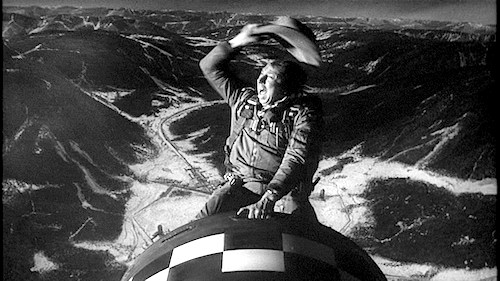
A scene from “Dr. Strangelove,” in which the bomber pilot (played by 
actor Slim Pickens) rides a nuclear bomb to its target in the Soviet Union.

At the end of part two of “The Putin Interviews,” Stone even gets Putin to watch Stanley Kubrick’s 1964 Cold War classic “Dr. Strangelove or How I Learned to Stop Worrying and Love the Bomb,” a very dark comedy about the U.S. and the Soviet Union bumbling into a nuclear conflagration, a film that Putin hadn’t seen before.

After watching the movie with Stone, Putin reflects on its enduring message. “The thing is that since that time little has changed,” Putin says. “The only difference is that the modern weapon systems have become more sophisticated, more complex. But this idea of retaliatory weapons, and the inability to control such weapon systems still hold true to this day. It has become even more difficult, more dangerous.”

Stone then gives Putin the movie’s DVD case, which Putin carries into an adjoining office before realizing that it is empty. He reemerges, holding the empty case with the quip, “Typical American gift.” An aide then rushes up to hand him the DVD.

[More about the substance of “The Putin Interviews” to come.]

Investigative reporter Robert Parry broke many of the Iran-Contra stories for The Associated Press and Newsweek in the 1980s. You can buy his latest book, America’s Stolen Narrative, either in print here or as an e-book (from Amazon and barnesandnoble.com).

image_pdf

Terrible Things to Come: Obligations from a Stolen Future Due

Things to Come

by James Kunstler - Clusterfuck Nation


June 12, 2017

As our politicos creep deeper into a legalistic wilderness hunting for phantoms of Russian collusion, nobody pays attention to the most dangerous force in American life: the unraveling financialization of the economy.

Financialization is what happens when the people-in-charge “create” colossal sums of “money” out of nothing — by issuing loans, a.k.a. debt — and then cream off stupendous profits from the asset bubbles, interest rate arbitrages, and other opportunities for swindling that the artificial wealth presents.

It was a kind of magic trick that produced monuments of concentrated personal wealth for a few and left the rest of the population drowning in obligations from a stolen future. The future is now upon us.

Financialization expressed itself in other interesting ways, for instance the amazing renovation of New York City (Brooklyn especially). It didn’t happen just because Generation X was repulsed by the boring suburbs it grew up in and longed for a life of artisanal cocktails. It happened because financialization concentrated immense wealth geographically in the very few places where its activities took place — not just New York but San Francisco, Washington, and Boston — and could support luxuries like craft food and brews.

Quite a bit of that wealth was extracted from asset-stripping the rest of America where financialization was absent, kind of a national distress sale of the fly-over places and the people in them. That dynamic, of course, produced the phenomenon of President Donald Trump, the distilled essence of all the economic distress “out there” and the rage it entailed. The people of Ohio, Indiana, and Wisconsin were left holding a big bag of nothing and they certainly noticed what had been done to them, though they had no idea what to do about it, except maybe try to escape the moment-by-moment pain of their ruined lives with powerful drugs.

And then, a champion presented himself, and promised to bring back the dimly remembered wonder years of post-war well-being — even though the world had changed utterly — and the poor suckers fell for it. Not to mention the fact that his opponent — the avaricious Hillary, with her hundreds of millions in ill-gotten wealth — was a very avatar of the financialization that had turned their lives to shit. And then the woman called them “a basket of deplorables” for noticing what had happened to them.

And now the rather pathetic false promises of President Trump, the whole MAGA thing, is unraveling at exactly the same time that the financialized economy is entering its moment of final catastrophic phase-change. The monuments to wealth — especially the stock and bond portfolios and the presumed value of real estate investments — will surrender to a process you might call price-discovery-from-Hell, revealing their worth to be somewhere between little and nothing. The accumulated monstrous debts of persons, corporations, and sovereign societies, will be suddenly, shockingly, absolutely, and self-evidently unpayable, and the securities represented by them will be sucked into the kind of vortices of time/space depicted in movies about mummies and astronauts. And all of a sudden the avatars of that wealth will see their lives turn to shit just like the moiling, Budweiser-gulping, oxycontin-addled deplorables in the flat, boring, parking lot wastelands of our ruined drive-in Utopia saw their lives rendered into a brown-and-yellow slurry draining clockwise down the toilet of history.

Nobody in power in this country is paying attention to how close we are to that epic moment — at least, they’re not talking about it. If the possibility of all that even occupies some remote corner of their brains, they surely don’t know how to prepare the citizenry for it, or what to do about it.

The truth is that societies respond emergently to major crises like the imminent unraveling of our financialized economy, often in disorderly and surprising ways. I suppose we’ll just have to watch the nauseating spectacle play out, and in the meantime enjoy the Russian collusion melodrama for whatever it’s worth — probably more than a ticket to Wonder Woman or the new Tom Cruise Mummy movie.

Clusterfuck Nation
Now appearing Mondays and Fridays
Support this blog by visiting Jim’s Patreon Page!

Gorilla Radio with Chris Cook, Tyler Shipley, Peggy Mason, Christina Nikolic June 14, 2017

This Week on GR

by C. L. Cook - Gorilla-Radio.com


June 14, 2017

Nearly eight years have passed since the sweltering summer's night commandos of the Honduran armed forces bent on treason stormed the presidential residence in Tegucigalpa, seizing a pajama-clad President, before whisking him to a waiting plane.

It was, according to conspirator, Colonel Bayardo,

"A fast operation...over in minutes." And one, he reassures, with "no injuries, no deaths." 

Listen. Hear.

That may have been true for the operation to abduct Manuel "Mel" Zelaya, but injuries perpetrated and deaths suffered at the hands of the coupsters since have proven grievous and numerous.

Tyler Shipley is Professor of Culture, Society and Commerce at Humber College's Institute of Technology and Advanced Learning, and Associate Fellow at the Centre for Research on Latin American and the Caribbean, or CERLAC. His first book, 'Ottawa and Empire: Canada and the Military Coup in Honduras' is fresh off the Between the Lines presses.

Tyler Shipley in the first half.

And; last week, in conjunction with the government's release of the Defence Policy Review, Canada's Minister of Foreign Affairs, Chrystia Freeland addressed both the House of Parliament, and Canadian households on CBC's flagship news program, The National, explaining the planned direction of the country's foreign policy in the foreseeable future. Neither performance was well received by Ceasefire.ca.

The Ottawa-based public policy research and advocacy offshoot of the Rideau Institute blasted the government's announcement of significant increases in military spending, saying their budget lacks credibility and is not affordable. They also accuse, the move to dramatically increase military spending succumbs to recent statements by, and pressure tactics of, US President, Donald Trump.

Peggy Mason is President of the Rideau Institute, an independent think tank that focuses on bringing a progressive voice to Canada's foreign and defence policies. Issues of interest for the Institute range from nuclear disarmament to the centrality of UN conflict resolution.

Peggy Mason and a more muscular understanding of Canada's place in the World in the second half.

And; horticultural guru and intrepid green entrepreneur, Christina Nikolic will join us at the bottom of the hour with the Left Coast Events update, bringing us up to speed with some of the good things planned in and around our town for the coming week. But first, Tyler Shipley and the Ottawa and Empire: Canada and the Military Coup in Honduras.

Chris Cook hosts Gorilla Radio, airing live every Wednesday, 1-2pm Pacific Time. In Victoria at 101.9FM, and on the internet at: http://cfuv.ca.  He also serves as a contributing editor to the web news site, http://www.pacificfreepress.com. Check out the GR blog at: https://gorillaradioblog.blogspot.ca/

G-Radio is dedicated to social justice, the environment, community, and providing a forum for people and issues not covered in the corporate media.

Reviewing Tyler Shipley's 'Ottawa and Empire: Canada and the Military Coup in Honduras'

Tyler A. Shipley: Ottawa and Empire

by Sam Popowich - RedLibrarian


May 26, 2016


The crux of Shipley’s argument can, I think, be summarized by saying that, at some point in the late 1980s, Canadian foreign policy turned towards an open imperialism, despite the maintenance by Canadian politicians and the culture industry of an image of Canada as ‘the good guys’.

Shipley argues that, having slowly emerged into at least a sort of relative autonomy with respect to both Britain and the US, having subjugated and consolidated its hold on Indigenous land, Canada turned first towards making itself a competitive capitalist nation, and then towards an imperial project of its own.

The ignominious collapse of Canada’s Peacekeeping operations transformed into a glorious military adventure in Afghanistan. In the meantime, Canadian politicians were greasing the wheels for Canadian capital throughout the world, with heavy interference in politics as a means for increasing and maintaining corporate profitability, notably in Central and South America.

Honduras is a case in point, as Shipley forensically uncovers the interlocking interests and maneuvers of the various parties involved in carrying out, legitimating, and maintaining the coup and its leaders. Honduran politicians, linked with drug traffickers and both public and private police forces, the Canadian corporations who are taking and ruining Honduran land through both quasi-legal and openly illegal methods, and the Canadian politicians who both interfere in local Honduran politics and legislation, and at the same time present the bright and shining, innocent face of Canadian “do gooderism” at home, representing the corrupt and rapacious Honduran state as good for Canadian business.

They will also benefit from contact with Canada’s record of human rights, democracy, rule of law, and good governance, etc - the collective Tooth Fairy of Canadian culture.


It was interesting to read Ottawa and Empire so soon after Nick Dyer-Witheford’s Cyber-Proletariat. In many ways, Shipley’s book read like a “zooming in” to a detailed part of Dyer-Witheford’s global survey. The processes and mechanisms Dyer-Witherford describes at a global level, Shipley digs into in minute detail, fleshing out what can sometimes seem too high-level a view in Dyer-Witheford’s work.

On the other hand, Cyber-Proletariat allows us to situate the Honduran case within a global network of money and productivity (and profitability) flows.

The two books share a concern with exposing how both first-world leisure and comfort (Dyer-Witheford) and national self-identity are predicated, founded, on a material substratum of exploitation and violence.

The iPhone requires not only the rare-earth mines, but the political and corporate ecosystem for the transformation of minerals into the technology that has become so ubiquitous as to be invisible. Similarly, the docility of the Canadian populace and their willingness to go (or be sent) to fight foreign wars, is predicated on the increased (and increasing) profitability of Canadian corporations on foreign soil: all of which are resumed in the name of Imperialism.

Despite being an academically rigorous work, Shipley’s book has two main advantages over the usual academic fare. On the one hand, it is exceedingly clearly written, something Shipley mentioned in an interview is vital to getting the book actually read, rather than simply sitting on a library shelf. On the other hand, Shipley was actually present for many of the things he describes. One expects this in a book of reportage, journalism or memoir, but in a work of recent history the effect of this can be quite shocking, as in the following passage:

In addition to the 12,000 police and 11,000 soldiers on duty on election day, the coup regime called up 5,000 reservists on November 13, 2009, and brought on an estimated 15,000 private security agents from fourteen different companies, temporarily granted military fatigues, weapons, and powers. These heavily armed commandos patrolled the streets, the voting stations, and the highway checkpoints across the country. As I travelle with Honduran human rights observers through different cities and towns in the southern departments on electiond day, and in the days leading up to it, we were subjected to almost constant stops and searchers, and as we sat in community meetings, we heard story after story of intimidation and violence. (62)

The immediacy of this kind of writing is impressive, and cumulatively adds to the urgency of the work and its message. The 2016 murder of activist Berta Càseres provides a focus for Shipley’s anger, as it does for the popular movements within Honduras. The book ends with an exhortation:

An embattled social movement in Honduras has declared that ‘Berta did not die, she multiplied.’ It is imperative that her spirit live on, not just in Honduras, but in the activist networks of the North as well. The Canadian government is on the wrong side of history, but individual Canadians need not be. It is my sincere hope that this book will compel greater collaboration and solidarity between the social movements and organizations confronting imperialism in Honduras and those in Canada. The need has never been greater. (173)

This is an important book, especially right now, when the left in Canada seems to be at an impasse, caught between a completely bankrupt party system and (in my opinion) a directionless movementism. I really like the idea that the left in Canada might learn from the popular movement in Honduras by focusing on immediate issues and needs. How we decide what those needs are is a difficult question, but one that I think is vital to address right now.

Highest on the agenda must, I think, be Indigenous rights (whatever that looks like) and real movement on climate change. The hard part will be getting people to recognize, given the success of the Canadian propaganda machine, that these are even issues at all.


Tyler A. Shipley, Ottawa and Empire: Canada and the Military Coup in Honduras, Toronto: Between the Lines, 2017. 
(Disclosure: I’ve known Tyler since we were both in a Russian history seminar taught by Oleh Gerus at University of Manitoba, sometime in the late 1990s).
NOTE: This is a pretty hot take, as I just finished the book last night. I’m hoping to revisit and write something more in depth in the near future, either here or in another venue.

Canada's Latvian Boondoggle: $350 Million to Make Safe a Country Under No Threat

First Canadian troops arrive to start NATO mission in Latvia

by Chris Brown -  CBC News

June 10, 2017

Trudeau government expects mission to cost around $350M over next 3 years

Canada’s newest overseas military mission got underway on June 10 as the first planeload of soldiers arrived at their new home near the Latvian capital of Riga.

For their commander, Canadian Lt-Col. Wade Rutland, success at his high-profile military assignment to deter Russian aggression in the region will be relatively straightforward to measure. “It’s a funny mission success criteria, that if nothing happens, we’ll all go home happy, but that’s it,” said Rutland as he met the new arrivals on the airport tarmac.

The Canadian CC-150 Polaris touched down under a warm Baltic sun carrying 100 soldiers from an Edmonton-based mechanized brigade. They’re the first of 450 troops who will arrive over the next several days as part of a bolstered NATO force.

The battle group will be made up of troops and heavy equipment from several countries, including Italy, Spain, Albania, Poland and Slovenia, but it will be led by Canada.

Company commander Maj. John Hagemeyer was among the first off the plane carrying his kit bag. “It’s good to finally be here,” he told CBC News.

“We want to be here. Latvia wants us here.”

Russia’s takeover of Crimea [sic] in 2014 and its continued support of pro-Russian separatists [sic] in Eastern Ukraine has rattled many in the tiny Baltic republic who worry they could be targeted next.

Canada offered to lead what the military terms the “enhanced forward presence” battle group in Latvia to deter any aggression.

Latvia has been hosting NATO troops ever since it was admitted to the alliance in 2004, but Canadians have always come and gone on short-term exercises. This time they’re here to stay as part of an open-ended mission with no expiry date.

The troops’ new home will be at a Soviet-era military base about 45 minutes from the capital Riga. Under the USSR, the base served as the army’s main presence in the region.

Latvia’s government is contributing $13 million to help with the refurbishments. The facility is badly rundown and the Canadians are building most of what they need from scratch.

Lt.-Col Hugo Delisle, commanding officer of the theatre opening team, has had up to 185 personnel preparing the site to get ready, which he says has gone well.

“The soldiers right now have only had two days off in the last 45 days. They’re working 10 hours a day to arrive at this point, ” said Delisle as he took CBC News on a tour of the Canadian compound.

The troops will be sleeping in tent-like temporary shelters until August when new, permanent barracks are completed. Plans also call for sports facilities including a gym and track, as well as restaurants and social areas.

In a heavily protected parking lot a short distance from the living area, crews have parked several dozen nearly new LAV6 armored personnel carriers for the battle group. Other countries, such as Poland and Italy, are providing tanks.

The Canadian soldiers who arrived Saturday will likely stay until Christmas when they’ll be rotated out.

The Trudeau government expects the mission will cost 348.5 million over the next three years.

NATO is beefing up its presence in the Baltic by sending a total of 4,000 troops to other countries in the region.

That number pales in comparison to the estimated 50,000 to 70,000 troops on the other side of the border that are part of Russia’s western force.

Tactical simulations have suggested [sic] the tiny Baltic country of two million people could be completely overrun by Russian troops within two or three days.

Hagemeyer says those odds don’t bother him. “That’s not our concern,” he said.

“We are fully prepared for the highest levels of threat.”

Canadian troops newly arrived in Latvia encounter skepticism

by Chris Brown - CBC News

June 12, 2017

As Canadian troops in Latvia unpack and get to know their new surroundings, they’re also dealing with some skepticism from Latvians about how necessary it is to have them there.

The first wave of more than 450 Canadian military personnel has arrived in the tiny Baltic nation as part of a NATO mission to deter any potential aggression from Russia. The Canadian deployment is open-ended and could last for years.

“Our position here is entirely defensive and proportionate in response to Russian actions,” said Lt.-Col. Wade Rutland, the commander of the Canadian battle group that’s at the centre of the Latvia deployment, which also includes soldiers from six other countries.

In response to Russia’s takeover [sic] of Crimea in 2014 and an ongoing conflict with Russian-backed rebels in eastern Ukraine, NATO ordered several thousand multinational troops to Latvia, Estonia and Lithuania, as well as eastern Poland.

Latvia’s government has enthusiastically welcomed the Canadians, including giving them red and white friendship ribbons for their uniforms. However, many Latvians are doubtful that NATO’s “enhanced forward presence”, as it’s known, will alter the dynamics of the region in any significant way.

“The fear is minimal,” said Rimants Māceikis, who was shopping Sunday at Riga’s central market.
“We are part of NATO and I don’t think Russia would dare hurt us.”

Nonetheless, he told CBC News, the deployment adds a measure of reassurance. Under Article Five of the NATO agreement, an attack on a member state compels other members of the military alliance to come to its aid, regardless of whether alliance troops are stationed there.

Other Latvians view the arrival of NATO battle group as unnecessarily provocative. “I don’t think it’s necessary to annoy the Russians,” said Kaspars Cabulis, who was out shopping with his wife and baby.

“They’re going to do their exercises; we’re doing our exercises. This [deployment is] not necessary. This is all normal.”

Latvia has the largest Russian speaking population of any the three Baltic countries, with over a third of the country speaking Russian. There are many close family and cultural ties between the countries, so in places there’s resistance to the idea that Russia is a country that needs to be defended against.

“I don’t think there’s any kind of threat,” said Olga Silo, a Russian speaker, who sells cucumbers at the market.

“I think Russia gave Latvia its freedom so it won’t take Latvia back now,” she explained, referring to the peaceful break-up of the former Soviet Union when Latvia regained its independence in 1991.

Canadian commanders agree the likelihood of a shooting war here is very remote, but insist their presence is part of the reason why.

“I would say that the threat of a conventional ground force invasion, I would say is not high largely because with NATO deciding at the Warsaw summit to put actual soldiers on the ground, it sends a really strong message of deterrence,” said Lt.-Col. Rutland.

Rutland says one of the key goals of the Canadian mission is to engage Latvians through things like community events, training with their troops, and working closely with the country’s government.

“I guess I would say that if there are some Latvians who are not for our presence here, we are here to defend all Latvians regardless of what you think of us.”

Meanwhile, at the Canadian military compound about 45 minutes northeast of Riga, newly arrived troops continue to fight jetlag and acclimatize to their new surroundings. Most will start off sleeping in windhavens, or heavy-duty tents, until permanent dwellings are completed later in the summer.

Sgt. Anna MacAoidh, who’s originally from Winnipeg, says she’s been waiting for most of her 11 year military career to practice her telecommunication skills on an overseas assignment.

“For me this mission is important,” she told CBC News, as she set up her bed and gear.

“I wanted to contribute something to Canada, and I think this mission is worthwhile and I’m really excited to be in Latvia.”

Monday, June 12, 2017

Not Welcome in Whatcom: Washington State County's Kinder Morgan Kibosh

NW Washington State Blocks Kinder Morgan Exports

by Sven Biggs - Stand.Earth


June 12, 2017 

Whatcom County (population 200,000) is located in the northwest corner of Washington State, just below the Canada-US border. And their local council just made a major win for the climate.

Whatcom might seem like an odd place for a major victory in the fight against multinational fossil fuel corporations, but that is exactly what happened.

The Whatcom County Council voted 6-1 to effectively block a cluster of projects that would have exported coal, oil, natural gas, and propane — enough fossil fuels to emit the equivalent of 200 million tons of climate pollution. To put that in context that is twice the size of Washington State’s annual carbon footprint!

The impact of this decision will be felt here in Canada too. Kinder Morgan’s pipeline has a leg that runs to two refineries in Washington State. In documents filed for their recent IPO, the company suggested that they could double the amount of oil going to that leg of the pipeline. This decision should close the door to that possibility.

This decision is probably also a fatal blow for the Steelhead LNG proposal on Vancouver Island, which saw their plans for an underwater natural pipeline rejected. It also means that we will not see a huge increase to the amount of fossil fuel shipping from US ports on the Salish Sea. That, in combination with the 400 additional oil tankers a year that Kinder Morgan plans to add to these busy waters, would have almost certainly meant death for this vital shared ecosystem.

So what can we learn from this victory?


Organizing works. This didn’t happen on its own, it's the result of hundreds of local residents and volunteers working with environmental groups—including my colleagues at Stand.earth’s Bellingham office—to pack hearings, make phone calls, and write letters to their local representatives.

(Help sustain Stand's work with a $5 monthly donation)

Empowered communities make good decisions for the planet. At a time when President Trump is walking away from America’s commitments to fight climate change, Whatcom is just one of many local governments that are stepping up to fill the gap that Trump has created.

It also underlines why Canadian cities need more power to make decisions about fossil fuel infrastructure. If the cities of Vancouver or Burnaby had the kind of local decision-making power that our neighbours in Whatcom have, the Kinder Morgan pipeline would have been shelved years ago.

The people of Whatcom County have won a victory for the climate and the West coast. Now it is up to us to back them up by making sure oil from one of Kinder Morgan’s oil tankers never washes up on their beaches.


Yours,
Sven Biggs

[It also helps when you have the Executive Director of the Pipeline Safety Trust on Whatcom County Council.] https://theplanetmagazine.net/pipeline-watchdog-1ff0acd10e85

Sunday, June 11, 2017

Who Are N. Ireland's DUP?

So, who are the DUP?

by Adam Ramsay  - OpenDemocracy


9 June 2017

The most likely coalition partners for a floundering Conservative party sit on the hard right fringe of British politics. The Democratic Unionist Party now look like the Tories preferred coalition partners. The DUP, biggest Unionist (ie pro-UK) party in Northern Ireland, are often treated as though they are just the same as the other Unionist party they have essentially replaced – the Ulster Unionists.

Former DUP leader Peter Robinson
(left) in paramilitary uniform, 1986

But while the UUP have a long running relationship with the Tories, and are a centre right party, the DUP are another thing entirely. The idea that they are near power in Westminster should worry us all. Here are some things you need to know.

Theresa May's new partners in government have strong historical links with Loyalist paramilitary groups. Specifically, the terrorist group Ulster Resistance was founded by a collection of people who went on to be prominent DUP politicians. Peter Robinson, for example, who was DUP leader and Northern Ireland’s first minister until last year, was an active member of Ulster Resistance. One of the things the group did was collaborate with other terrorist organisations such as the Ulster Volunteer Force to smuggle arms into the UK, including RPG rocket launchers.

Of course, Northern Ireland has moved towards peace, and the DUP, like their opponents in Sinn Fein, have rescinded violence. As part of that normalisation, the fact that parties which include people who have abandoned civil war can be brought into the democratic process is a good thing. But for the Tories to end an election campaign which they spent attacking Corbyn for his alleged links to former Northern Irish terrorists by going into coalition with a party founded by former Northern Irish terrorists would be a deep irony.

It’s also important to know their politics. When Enoch Powell was expelled from the Tory party after his fascist turn, he moved to Northern Ireland. There, his campaign manager was a young man named Jeffrey Donaldson, who says on his website:

“I worked alongside two of the greatest names in Unionism in the 20th century. Between 1982 and 1984 I worked as Enoch Powell’s constituency agent, successfully spearheading Mr. Powell’s election campaigns of 1983 and 1986 when the South Down seat was retained despite the fact the constituency contained a natural ‘nationalist’ majority.”

Donaldson is now the longest serving of the DUP’s MPs.

The DUP also fights hard against women’s right to choose to have an abortion, making them the biggest pro-forced pregnancy party in the UK. The results in Northern Ireland are utterly grim for the many women each year who need an abortion.

Despite being climate change deniers, they used their role in government in Northern Ireland to set up a subsidy scheme for biofuels, which gave those who bought into it more money than they had to pay out. The Northern Irish exchequer ended up paying out around half a billion pounds to those who knew about the scheme, leading to a scandal known as ‘cash for ash’, and a major investigation into whether DUP staff and supporters personally benefitted.

The DUP have fought to stop equal marriage, making Northern Ireland the only part of this archipelago without equal relationship rights. Last year, DUP MP Sammy Wilson was caught up in a scandal when a member of the public said that Northern Ireland ought to “get the ethnics out”, and he appeared to reply “you are absolutely right”.

The party backed Brexit, and as openDemocracy exposed earlier in the year, accepted a donation of £435,000 to pay for campaign materials across the UK. Under pressure, they admitted that the cash came from a shady group called the Constitutional Research Council, which is chaired by Scottish Tory Richard Cook. openDemocracy research showed that Cook founded a company in 2013 with the former head of the Saudi intelligence service, and a man who admitted to us that he was involved in a notorious incident in which hundreds of Kalashnikovs were flown to Hindu terrorists in West Bengal in 1995.

The DUP told us that the Constitutional Research Council’s chair’s surprising links with Saudi intelligence “aren’t a problem for us”.

We don’t know what the DUP will demand from the Tories in exchange for supporting them – perhaps just more cash for Northern Ireland, which would be no bad thing. But the idea of a government involving the DUP should worry us all, and the failure to ask any questions about their involvement during the BBC’s coverage last night was fairly astonishing.

You can donate to our investigations into the DUP here.

Canada's New Democrats Support Expanded National Militarism

New Democrats Support Expanded Canadian Military Spending

by Randall Garrison - NDP


June 9, 2017

Randall Garrison, Member of Parliament for Esquimalt - Saanich - Sooke and the NDP Critic for National Defence, rose in the House of Commons today to speak in support of Canada's continuing participation in the NATO Alliance and called on the Government of Canada to allocate additional capital funding for National Defence in the upcoming Federal Budget.


"Only with a well-trained and well-equipped military can Canada continue to play an independent role in promoting peace and security."

Media on Trial

Media on Trial

by 21st Century Wire


June 11, 2017

A ground breaking event has been organised by UK’s Frome Stop War on the 11th June 2017. #FakeNews has become the catch-all for the corporate media battle against the swelling ranks of independent journalists and media outlets who threaten to dismantle their well constructed tower of lies surrounding international and domestic events.

“What should we expect from the mainstream media? Accurate reporting? Impartial analysis? Speaking truth to power? At times of proposed war or foreign intervention, especially, the public has a right to expect all these. So what about the now discredited establishment media claims that have led to the 21st century wars of intervention?

Establishment media tends to be dismissive of independent journalism. Due to its greater size and influence the mainstream media (msm) has avoided critical questions about its own reporting and journalistic standards and deflects calls for corroboration, verification and independent analysis.

The leviathan that is the mainstream media has formed the narrative and stifled dissent but that’s going to change. That’s why, with the help of its panel of five experts – two professors and three investigative journalists, Frome Stop War will be hosting an event entitled ‘Media on Trial’. Our experts will be applying the scrutiny to mainstream media reporting which we should all demand, given its power to sway opinion when our government is seeking consent for war.


Read 21st Century Wire’s article on Channel 4: Channel 4 Joins CNN in Normalising Terrorism then Removes Their Own Video

Specific instances of falsehoods which have led to disastrous and deadly campaigns will be highlighted with fact based evidence, and insidious propagandist reporting for war analysed.

It’s time to hear ‘the other side’ – the one that the mainstream media blocks from the airwaves and print media, it’s time to place the burden of proof on the accuser and it’s time to hear from the little guy – the one who not only recognised that the Emperor was wearing no clothes, but had the strength and honesty to declare it.” ~ Sheila Coombes, Frome Stop War.

The Curious Saudi Connection to Theresa May's Troublesome New Bedfellows

What connects Brexit, the DUP, dark money and a Saudi prince?

by Fintan O'Toole - The Irish Times


May 16, 2017

The story of a massive donation to the DUP is like a John le Carré novel – but voters need facts, not fiction


If Northern Ireland were a normal democracy, the election campaign would be dominated by a single question: how did the Democratic Unionist Party end up advancing the cause of a united Ireland through its support for Brexit? More specifically: what role did dark money play in that extraordinary decision?

This story has all the makings of a John le Carré thriller but democracy on this island needs facts, not fiction.

To recap briefly: two days before the Brexit referendum last June, the Metro freesheet in London and other British cities came wrapped in a four-page glossy propaganda supplement urging readers to vote Leave. Bizarrely, it was paid for by the DUP, even though Metro does not circulate in Northern Ireland.

At the time, the DUP refused to say what the ads cost or where the money came from.

We’ve since learned that the Metro wraparound cost a staggering £282,000 (€330,000) – surely the biggest single campaign expense in the history of Irish politics. For context, the DUP had spent about £90,000 (€106,000) on its entire campaign for the previous month’s assembly elections.

But this was not all: the DUP eventually admitted that this spending came from a much larger donation of £425,622 (€530,000) from a mysterious organisation, the Constitutional Research Council.

Mystery


The mystery is not why someone seeking to influence the Brexit vote would want to do so through the DUP. Disgracefully, Northern Ireland is exempt from the UK’s requirements for the sources of large donations to be declared. The mystery, rather, is who were the ultimate sources of this money and why was it so important to keep their identities secret.

The Constitutional Research Council is headed by a Scottish conservative activist of apparently modest means, Richard Cook. It has no legal status, membership list or public presence and there is no reason to believe that Cook himself had half a million euro to throw around.

But the DUP has been remarkably incurious about where the money ultimately came from. Peter Geoghegan (sometimes of this parish) and Adam Ramsay of the excellent openDemocracy website did some digging and what they’ve come up with is, to put it mildly, intriguing.

What they found is that Richard Cook has a history of involvement with a very senior and powerful member of the Saudi royal family, who also happens to have been a former director of the Saudi intelligence agency.

In April 2013, Cook jointly founded a company called Five Star Investments with Prince Nawwaf bin Abdul Aziz al Saud. The prince, whose address is given as a royal palace in Jeddah, is listed on the company’s initial registration as the holder of 75 per cent of the shares. Cook had 5 per cent. The other 20 per cent of the shares belonged to a man called Peter Haestrup, a Danish national with an address in Wiltshire, whose own colourful history we must leave aside for reasons of space.

No casual investor 


Prince Nawwaf, who died in 2015, was no casual investor. He had been Saudi minister for finance, government spokesman and diplomatic fixer before becoming head of intelligence. His son, Mohammed bin Nawwaf, has, moreover, been the Saudi ambassador to both the UK and Ireland since 2005.

When Five Star was set up in 2013, Prince Nawwaf was 80, had suffered a stroke and used a wheelchair. It seems rather remarkable that he was going into business with a very minor and obscure Scottish conservative activist. But we have no idea what that business was.

Five Star never filed accounts. In August 2014, the Companies Office in Edinburgh threatened to strike it off and in December it was indeed dissolved.

It may be entirely co-incidental that the man who channelled £425,622 to the DUP had such extremely high level Saudi connections. We simply don’t know. We also don’t know whether the current Saudi ambassador had any knowledge of his father’s connection to Richard Cook. But here’s the thing: the DUP claims not to know either. And that is at best reckless and at worst illegal.

Arlene Foster told the BBC in late February that she did not even know how much the mystery donor had given the party. Then the party, under pressure, revealed the amount, but insisted that ascribing the donation to Cook’s Constitutional Research Council was enough and people should stop asking questions. Then, in early March, Jeffrey Donaldson told openDemocracy that the DUP did not need to know the true source of the money.

But this is simply untrue. The UK electoral commission is clear: “a donation of more than £500 cannot be accepted… if the donation is from a source that cannot be identified”. The legal onus is on the DUP to establish that the real donor was entitled to put money into a UK political campaign. If it can’t do that, it has to repay the £425,622. Since it has not done so, we have to assume it knows the true source is not, for example, a foreign government – which would be illegal.

The DUP has harmed Northern Ireland and endangered the union it exists to protect. How much did the lure of dark money influence that crazy decision? Any self-respecting voter would want to know.

Media Blind-Eyes Venezuelan Violence

Abby Martin: World Ignores Opposition Violence at Venezuela Protests

by TRNN

June 11, 2017

Violent protests between opposition demonstrators and police forces in Venezuela have been going on for over two months now with an average of almost one dead per day. Most of the international press portrays it as being the result of police state repression. However, a detailed breakdown from the Attorney General's Office, which has recently been increasingly at odds with the government of President Maduro, shows that of the 73 people that died, 11 were the responsibility of state security forces, 21 of them has been attributed to the opposition, 13 due to looting, and two due to government civilian protests, and 26 are still under investigation.

Joining us to discuss the latest developments in Venezuela is Abby Martin. Abby is the host of the teleSUR English documentary program Empire Files that Abby and Mike Prysner independently produce, and they recently returned from a trip to Venezuela, and they were caught up in the midst of opposition demonstrations.


Empire Files host Abby Martin just returned from Venezuela where she saw first hand how violent opposition protesters attempt to intimidate reporters and thereby give a false impression of what is happening 

 Abby Martin is the creator and director of "The Empire Files" on teleSUR English. Previously she hosted "Breaking the Set" on Russia Today. She founded the independent media site Media Roots and is a board member of Project Censored.
Follow her on Twitter @AbbyMartin.