Thursday, July 13, 2017

Shelter-In-Place: Return to Doomsday Mountain

Preparing for Doomsday: A Shelter-in-Place Mentality Is the New American Normal

by William J. Astore - TomDispatch


July 13, 2017

Has there ever been a nation as dedicated to preparing for doomsday as the United States? If that’s a thought that hasn’t crossed your mind, maybe it’s because you didn’t spend part of your life inside Cheyenne Mountain. 

That's a tale I’ll get to soon, but first let me mention America’s “doomsday planes.”

Last month, troubling news emerged from U.S. Strategic Command (STRATCOM) that two of those aircraft, also known as E-4B National Airborne Operations Centers, were temporarily disabled by a tornado, leaving only two of them operational. And that, not surprisingly, caught my attention.

Maybe you don’t have the world’s end on your mind, not with Donald Trump’s tweets coming fast and furious, but I do. It’s a kind of occupational hazard for me. As a young officer in the U.S. Air Force in the waning years of the Cold War, the end of the world was very much on my mind. So think of this piece as the manifestation of a disturbing and recurring memory.

In any case, the reason for those doomsday planes is simple enough: in a national emergency, nuclear or otherwise, at least one E-4B will always be airborne, presumably above the fray and the fallout, ensuring what the military calls “command and control connectivity.” 
 
Tomgram: William Astore, Returning to Cheyenne Mountain
[Note for TomDispatch Readers: If you’re already a TD subscriber, then yesterday you got my biannual email importuning you for money (my least favorite part of the TomDispatch year and undoubtedly yours, too). But since this site doesn’t take advertising and doesn’t have a secret stream of funds, you’re the ones who really do keep it going. So a million thanks to those of you who have already sent in contributions! As for those of you who are regular readers but don’t get our pieces by email, take just a moment, if you can, to read my message and consider donating by clicking here. Much appreciated. Tom]

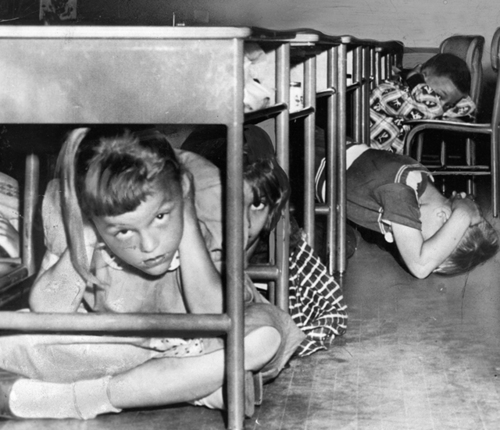
My childhood was a nuclear one and I’m not talking about the nuclear family. I’m thinking of those duck-and-cover moments when, with air raid sirens screaming outside, we went under our school desks, hands over head, to test out our readiness for a Cold War nuclear exchange and the coming of the end of the world. Even at that young age, I suspect, we understood just how pathetic those desks and our hands were as defenses against an atomic blast, but that mattered little. It was so in the spirit of the era -- and not just when it came to children either.

I’ve never, for instance, forgotten an illustration from Paul Boyer’s classic book, By the Bomb’s Early Light, on the American nuclear fallout (of a cultural sort) that followed the atomic bombings of Hiroshima and Nagasaki as World War II ended and the subsequent Cold War nuclear arms race began. Boyer found that illustration in How to Survive an Atomic Bomb, a 1950 book that caught the spirit of its moment. It showed a natty-looking man wearing one of the signature fedoras of that time, its brim partially over his eyes. The caption for it went: “If you are caught outdoors in a sudden attack, a hat will give you at least some protection from the ‘heat flash.’” Women were similarly urged to wear stockings and long-sleeved dresses just in case their day happened to be interrupted by a Russian nuclear strike.

Think of these as 1950s fashion tips for the apocalypse as American fears of a nuclear conflagration grew in those years. As a Federal Civil Defense Agency pamphlet of the time typically suggested, if a nuclear blast occurred, you could “jump in any handy ditch or gutter... drop flat on ground or floor... to lessen the chances of being struck by falling and flying objects, flatten out at the base of a wall, or at the bottom of a bank.” Or you could simply “bury your face in your arms.” Whatever you did, however, the one thing you weren’t to do, the agency suggested, was “lose your head” -- and whatever bureaucrat offered that pungent advice undoubtedly didn't mean it literally.

In those years, when it came to the apocalypse, you might say that this country did indeed lose its head. One witness to that was retired Air Force lieutenant colonel and TomDispatch regular William Astore. He spent significant parts of his military career in the late 1980s locked inside a mountain (so much better than a ditch or gutter if you were seriously thinking about making it through the end of life as we knew it). He’s never forgotten his professional experience of the nuclear mindset in this country and, in a later lockdown moment filled with rising apocalyptic fears, he naturally finds himself thinking about it again.

One small note, however, on Americans and doomsday: when it comes to the apocalypse, we turn out not to be equal-opportunity employers. Against nuclear war and the apocalyptic terror attacks of our national fantasy life, we’ve been all too ready to lock ourselves down over the years in stunning ways. Against another potential kind of apocalypse, however, we’re not even willing to take the simplest actions. Quite the opposite, when it comes to climate change -- what we used to call “the weather” and now “extreme weather” -- our new president and his crew are unlocking doors everywhere and welcoming doomsday to take up residence in our land, our streets, our houses. Tom  

Preparing for Doomsday: 

A Shelter-in-Place Mentality Is the New American Normal

by William J. Astore


The E-4B and its crew of up to 112 stand ready, as STRATCOM puts it, to enable America’s leaders to “employ” its “global strike forces” because... well, “peace is our profession.” Yes, STRATCOM still references that old SAC motto from the glory days of former Strategic Air Commander Curtis LeMay who was so memorably satirized by director Stanley Kubrick in his nuclear disaster film, Dr. Strangelove.

The Pentagon reassuringly noted that, despite those two disabled planes, the E-4B’s mission -- including perhaps the implementation of a devastating nuclear strike or counter-strike that might kill tens of millions and even cause a “nuclear winter” (a global nightmare leading to a billion deaths or more) -- could be accomplished with just two of them operational. Still, relieved as I was to hear that, it did get me thinking about the other 190 or so nations on this planet. Do any of them have even one “doomsday” plane to launch? And if not, how will they coordinate, no less survive, the doomsday the U.S. government is so willing to contemplate and ready to fund?

When it comes to nuclear weapons and what once was called “thinking about the unthinkable,” no other nation has as varied, accurate, powerful, deadly, or (again a word from the past) “survivable” an arsenal as the United States. Put bluntly, the nation that is most capable of inflicting a genuine doomsday scenario on the world is also the one best prepared to ride out such an event (whatever that may turn out to mean). In this sense, America truly is the exceptional nation on planet Earth. It’s exceptional in the combination of its triad of nuclear weapons, its holy trinity of sorts -- nuclear missile-carrying Trident submarines, land-based intercontinental ballistic missiles, and strategic bombers still flown by pilots -- in the thoroughness of its Armageddon plans, and especially in the propagation of a lockdown, shelter-in-place mentality that fits such thinking to a T.

My Lockdown, Shelter-in-place, Cold War Moment


Once upon a time, I thought I was exceptional, or at least exceptionally well protected. My job as an Air Force software engineer granted me regular access to the innards of the Cheyenne Mountain Complex, America’s nuclear command center. In the 1960s, the complex had been tunneled out of granite at the southern edge of the Front Range of mountains, dominated by Pike’s Peak, near Colorado Springs, Colorado.

I can still remember military exercises in which the mountain would be “buttoned up.” That meant the command center’s huge blast doors -- think of bank vault doors on steroids -- would be swung shut, isolating the post from the outside world. I don’t recall hearing the word “lockdown” in those days (perhaps because back then it was a term generally applied to prisons), but that was certainly our reality. We sheltered in place in that mountain redoubt, the most literal possible version of a Fortress USA. We were then cut off (we hoped) from the titanic blasts and radioactive fallout that would accompany any nuclear attack, most likely by that Evil Empire, the Soviet Union. In a sense, we were a version of a doomsday plane, even if our mountain couldn’t be sent aloft.

My tour of duty lasted three years (1985-1988), the specifics of which I’ve mostly forgotten. But what you don’t forget -- believe me, you can’t -- is the odd feeling of having 2,000 feet of granite towering over you; of seeing buildings mounted on huge springs intended to dampen the shock and swaying caused by a nuclear detonation; of looking at those huge blast doors that cut you and the command center off from the rest of humanity (and nature, too), theoretically allowing us the option both of orchestrating and surviving doomsday.

I sometimes think the decision in the 1960s to bury a command center for nuclear war under megatons of solid granite was America’s original lockdown moment. Then I remember the craze for building small, personal, backyard bomb shelters in the 1950s. There was a memorable Twilight Zone episode from 1961 in which neighbors fight bitterly over who will take refuge in just such a shelter as the threat of nuclear war looms. Indeed, the idea of a mountain of a bomb shelter to keep out nuclear war was no more anomalous in those years than Donald Trump’s “big, fat, beautiful wall” to keep out Mexicans is today. Both capture a certain era of fear, whether of exploding nukes or rampaging immigrants, and an approach to that fear -- controlling it by locking it out and us in -- that was folly then and is folly now.

For soon after Cheyenne Mountain was completed, the Soviets developed improved missiles sufficiently accurate and powerful to obliterate the command center. Assuming Trump’s dream wall was ever completed, immigrants would assuredly develop the means to subvert its intent as well. But no matter: Cheyenne Mountain became a symbol of American resolve as well as fear, the ultimate shelter, just as Trump’s wall has become a symbol of a different sort of resolve and fear. (Keep “those people” out!)

Eventually decommissioned, Cheyenne Mountain lives on as a manifestation of an American bunker mentality in the age of doomsday that’s suddenly back in vogue. Or rather what’s in vogue now is not the militarized mountain I remember, which was dark, dank, and depressing, or those crude, tiny, private backyard nuclear shelters of the 1950s, but a craze that fits a 1% era with a bizarre billionaire as president. A new urge is growing among the ultra-wealthy for what are, in essence, privatized mini-Cheyenne Mountains for the super-rich. Think: billionaire bunkers with all the perks of “home,” including a pet kennel, a gun safe, and a small gym, as well as “12-and-a-half-foot ceilings, sumptuous black leather couches, wall art featuring cheerful Parisian street scenes, towering faux ferns, and plush carpets.” Surviving doomsday never looked so good.

And who can blame the richest among us for planning to outlast doomsday or a Trumpocalypse in the style to which they are already accustomed? With the world’s “doomsday clock” ticking ever closer to midnight, seeking (high-priced) shelter from the storm has a certain logic to it. If it’s not full-scale nuclear war that beckons, then perhaps major climate catastrophe and social collapse. As Naomi Klein recently put it at The Intercept, “high-end survivalists” from Silicon Valley to Wall Street are “buying space in custom-built underground bunkers in Kansas (protected by heavily armed mercenaries) and building escape homes on high ground in New Zealand.” I don’t normally pity the Kiwis, but I will if legions of doomsday-fleeing uber-rich start hunkering down there like so many jealous dragons guarding what’s left of their gold.

The Department of Homeland Security Card: Don’t Leave Home


Remember those old American Express card commercials with the tag line “Don’t leave home without it”? If America’s Department of Homeland Security had its own card, its tag would be: “Don’t leave home.”

Consider the words of retired General John Kelly, the head of that department, who recently suggested that if Americans knew what he knew about the nasty terror threats facing this country, they’d “never leave the house.” General Kelly, a big bad Marine, is a man who -- one would think -- does not frighten easily. It’s unclear, however, whether he considers it best for us to "shelter in place" just for now (until he sends the all-clear signal) or for all eternity.

One thing is clear, however: Islamic terrorism, an exceedingly modest danger to Americans, has in these years become the excuse for the endless construction and funding of an increasingly powerful national security state (the Department of Homeland Security included), complete with a global surveillance system for the ages. And with that, of course, goes the urge to demobilize the American people and put them in an eternal lockdown mode, while the warrior pros go about the business of keeping them “safe” and “secure.”

I have a few questions for General Kelly: Is closing our personal blast doors the answer to keeping our enemies and especially our fears at bay? What does security really mean? With respect to nuclear Armageddon, should the rich among us indeed start building personal bomb shelters again, while our government continues to perfect our nuclear arsenal by endlessly updating and “modernizing” it? (Think: smart nukes and next generation delivery systems.) Or should we work toward locking down and in the end eliminating our doomsday weaponry? With respect to both terrorism and immigration, should we really hunker down in Homeland U.S.A., slamming shut our Trumpian blast door with Mexico (actually long under construction) and our immigration system, or should we be working to reduce the tensions of poverty and violence that generate both desperate immigrants and terrorist acts?

President Trump and “his” generals are plainly in favor of you and yours just hunkering down, even as they continue to lash out militarily around the globe. The result so far: the worst of both worlds -- a fortress America mentality of fear and passivity domestically and a kinetic, manic urge to surge, weapons in hand, across significant parts of the planet.

Call it a passive-aggressive policy. We the people are told to remain passive, huddling in our respective home bunkers, sheltering in place, even as America’s finest aggressively strike out at those we fear most. The common denominator of such a project is fear -- a fear that breeds compliance at home and passivity before uniformed, if often uninformed, experts, even as it generates repetitive, seemingly endless, violence abroad. In short, it’s the doomsday mentality applied every day in every way.

Returning to Cheyenne Mountain


Thirty years ago, as a young Air Force officer, Cheyenne Mountain played a memorable role in my life. In 1988 I left that mountain redoubt behind, though I carried with me a small slab of granite from it with a souvenir pen attached. Today, with greying hair and my very own time machine (my memories), I find myself returning regularly to Cheyenne Mountain, thinking over where we went wrong as a country in allowing a doomsday-lockdown mentality to get such a hold on us.

Amazingly, Barack Obama, the president who made high-minded pleas to put an end to nuclear weapons (and won a Nobel Prize for them), pleas supported by hard-headed realists like former Secretaries of State Henry Kissinger and George Shultz, gave his approval to a trillion-dollar renovation of America’s nuclear triad before leaving office. That military-industrial boondoggle will now be carried forward by the Trump administration. Though revealing complete ignorance about America’s nuclear triad during the 2016 election campaign, President Trump has nevertheless boasted that the U.S. will always be “at the top of the pack” when it comes to doomsday weaponry. And whether with Iran or North Korea, he foolishly favors policies that rattle the nuclear saber.

In addition, recent reports indicate that America’s nuclear arsenal may be less than secure. In fact, as of this March, inspection results for nuclear weapons safety and security, which had been shared freely with the American public, are now classified in what the Associated Press calls a “lockdown of information.” Naturally, the Pentagon claims greater secrecy is needed to protect us against terrorism, but it serves another purpose: shielding incompetence and failing grades. Given the U.S. military’s nightmarish history of major accidents with nuclear weapons, more secrecy and less accountability doesn’t exactly inspire greater confidence.

Today, the Cheyenne complex sits deactivated, buried inside its mountain, awaiting fresh purpose. And I have one. Let’s bring our collective fears there, America. Let’s bury them under all that granite. Let’s close the blast doors behind us as we walk out of that dark tunnel toward the light. For sheltering in place shouldn’t be the American way. Nor should we lock ourselves down for life. It would be so much better to lockdown instead what should be truly unthinkable: doomsday itself, the mass murder of ourselves and the destruction of our planet.

A retired lieutenant colonel (USAF) and history professor, William Astore is a TomDispatch regular. He blogs at Bracing Views.

Follow TomDispatch on Twitter and join us on Facebook. Check out the newest Dispatch Book, John Dower's The Violent American Century: War and Terror Since World War II, as well as John Feffer's dystopian novel Splinterlands, Nick Turse’s Next Time They’ll Come to Count the Dead, and Tom Engelhardt's Shadow Government: Surveillance, Secret Wars, and a Global Security State in a Single-Superpower World.

Copyright 2017 William J. Astore

Wednesday, July 12, 2017

Majority Wrongs: A Canadian Media Lynching of Omar Khadr

Omar Khadr: The majority isn’t always right

by Toula Drimonis, The Rule of Law - The Ricochet


July 12, 2017  

So what if 71 per cent of Canadians don’t support the Khadr settlement?

 
According to those who oppose it, the government’s decision to settle out of court was wrong and hasty. The image of our Prime Minister “handing out” a significant “payout” to a “terrorist” circulated in a few editorial cartoons and was evoked by more than a few politicians and pundits. The truth is far from those damaging optics. The Canadian government didn’t willingly “hand out” anything. Omar Khadr, who as a child had been left to rot in a jail cell in Guantanamo, subjected to torture and the whims of a U.S. kangaroo court, deserved better.

Regardless of his guilt or innocence (this National Observer op-ed by former prosecutor Sandy Garossino lays out how flimsy the military evidence and the prosecution case against Khadr actually was), regardless of people’s personal feelings or discomfort with the decision, he was a Canadian citizen who was owed protection and extradition back home.

The results of an Angus Reid poll released this past Monday, showing that 71 per cent of Canadians feel the federal government made the wrong decision in settling the lawsuit and compensating him financially, have been somehow touted as irrefutable proof that this majority opinion is right.

It isn’t.

The Canadian government didn't “hand over” $10 million to Khadr. It was sued and it lost. Repeatedly. Canada had a moral and legal obligation to defend the human rights of a Canadian (a child soldier and a minor, might I remind you) and it repeatedly failed. This boy was abandoned in a prison for a decade with very little evidence of his guilt and a confession obtained by torture, yet our government did nothing. On the contrary, it was complicit in the repeated violation of his human rights.

In 2004, Khadr sued the federal government for $20 million for wrongful imprisonment and in 2010 the Supreme Court of Canada unanimously ruled that our government had acted unconstitutionally by allowing the most basic Canadian standards about the treatment of detained youth suspects to be violated. The Supreme Court would rule in his favour a total of three times. Even the International Criminal Court in the Hague, recognizing the limited culpability of children as combatants, concluded that the U.S. (and Canada by doing nothing to protect Khadr) had violated international law and the Geneva Conventions.

In short, the writing was on the wall and it had become obvious that Khadr was going to win, and would likely get the $20 million he had sued for. Settling out of court for $10 million was the right thing to do. Delaying this case further would continue to drag it out at taxpayer’s expense, and at great risk. As it stands, a significant amount of the money awarded to Khadr will go to his lawyers.

Despite the facts being crystal clear as to why he was awarded compensation, the Angus Reid results have reignited a debate about whether a majority of Canadians somehow know better than the Supreme Court justices, whose ruling the government relied on for their decision.

This appeal to the majority is a fallacious argument. It implies that just because something enjoys popular support it must be legally or morally correct precisely because it enjoys popular support. An argumentum ad populum falsely gives ammunition to populism and to people who have decided to focus on and respond to bad optics, politically motivated arguments, or the simple notion that someone’s feelings about a decision should override facts and the laws of the land.

If nothing else, history has taught us that the correct conclusion cannot always be arrived at by popular sentiment, which can often be manipulated by propaganda, populist opinion, and/or intimidation. In fact, the opposite has often proven to be quite true. If not for court rulings, women and black citizens would have never been allowed to vote when they were granted the franchise. Do you know what else a majority of Canadians currently support? The death penalty, a values test for immigrants, and all three major pipelines currently being debated. Do you still think the majority of Canadians are right?

The Khadr case was a complex one that made headlines in this country for over a decade. In many instances, however, Canadians haven’t read past the headlines. Supreme Court rulings aren’t the stuff of light reading and attention spans are short these days. Throw in emotionally charged words like “terrorism,” “radicalization,” and “military vets,” stir in populism and a prisoner with an Arabic name who was recruited by Al Qaeda and you’ve got a story where the optics don’t work for many people and public sympathy is hard to come by.

But Supreme Court judges don’t rule on optics or their personal feelings about a case. They rule on the letter of the law. And the law is very clear. Children are protected by international law in situations of armed conflict. To date, no international tribunal has prosecuted an individual for warlike acts committed when that individual was still a minor. All Canadians are protected by the Charter of Rights and Freedoms. No exceptions. It’s either all Canadians or none. Keeping these two things in mind it’s easy to understand why the decision by the SCC was unanimous. There isn’t anything to dispute. Given their past rulings, the Trudeau government had no choice but to apologize and compensate him.

A majority of Canadians not agreeing with the ruling offers no proof of moral superiority or legal legitimacy. Not all opinions are created equal, particularly in such a complex legal case. What a layperson feels shouldn’t offer proof of anything. Seventy-one per cent of Canadians might disagree with compensating Khadr, but let’s remember that 100 per cent of Supreme Court justices ruled in his favour. That needs to count for something, otherwise what’s the point of deferring to an expert on any subject matter; particularly one so convoluted and complex and easily manipulated for political advantage?

Codifying Genocide: UK Courts Allow Saudi Arms Sales Continue

UK Court Allows Saudi Arms Sales as May Suppresses Damning Report

by TRNN


July 11, 2017

The U.K. High Court has dismissed a challenge to the British government's arms sales to Saudi Arabia. The Campaign Against Arms Trade filed a court challenge that argued selling weapons to Saudi Arabia violates international law and Britain's own export licenses. Britain and the U.S. are supporting the devastating Saudi war on Yemen.


Andrew Smith of the Campaign Against Arms Trade, which brought the case, says the arms deal makes Britain complicit in Saudi Arabia's devastating bombing of Yemen.

When Peace, Compassion and Understanding for West Asia?

Peace and Compassion

by Mazin Qumsiyeh - palestinenature.org 


July 12, 2017

US envoy Jason Greenblat and US Ambassador to Israel Friedman (both racist Jews who support ethnic cleansing and colonialism and have more loyalty to Israel than the US) meet Palestinian rulers in Ramallah. The same day Israeli occupation forces invade Jenin and murder 17 year-old Aws Salameh and 20 year-old Saad Salah. Israeli forces also injure many more throughout illegally occupied Palestinian areas, including 13 year old Jerusalemite Nour Hamdan who lost his eye to an Israeli sniper.

Same day as Mr. Netanyahu pushed a bill for the Knesset that want to emphasize Israel as the state of the Jewish people (not a state of its citizens) and thus increase discrimination against the indigenous people of Palestine.

I finally have my luggage after returning from the USA a week ago through Jordan. We find it deplorable that we natives of this land are forbidden from using the only international airports in Palestine (renamed Israel) since 1948. When will this injustice be rectified?

When will Palestinian refugees be allowed to return to their homes and lands? When will "Israel" be held to account for its crimes against humanity (so well documented)? When will the world understand that Israel/USA attempts to create havoc in Western Asia (the news of Syria, Qatar, Yemen etc) will not help hide the centrality of the Palestinian question?

Peace in Jerusalem/Palestine is central to Peace in the world. Oppression and greed eventually come to a dead end. International law, democracy, justice, and human rights must be more than words uttered by hypocritical "leaders". But ultimately it is us the people who need to get our act together to have peace in our heart and compassion for others less fortunate than we are.

We must have RESPECT for ourselves, others, and the environment (the motto of the Palestine Museum of Natural History at Bethlehem University, PalestineNature.org).

Two samples of my lectures which speak of diagnosis, therapy, and prognosis
https://youtu.be/ucMuzohFGTY
https://youtu.be/ZDHVfK5u-B4

Israel shuts down beaches polluted by sewage from besieged Gaza Strip
https://www.maannews.com/Content.aspx?id=777970

Brace Yourselves for Costly Palestinian Solidarity
http://www.patheos.com/blogs/writingfromtheedge/2017/07/brace-costly-palestinian-solidarity/

This Palestinian village had solar power — until Israeli soldiers took it away
https://www.washingtonpost.com/world/middle_east/this-palestinian-village-had-solar-power--until-israeli-soldiers-took-it-away/2017/07/05/d4b8a5fc-6036-11e7-a4f7-af34fc1d9d39_story.html

Why Palestine is Still the Issue
https://www.counterpunch.org/2017/07/11/why-palestine-is-still-the-issue/

Stay Human

Mazin Qumsiyeh
A bedouin in cyberspace, a villager at home
Professor and (volunteer) Director
Palestine Museum of Natural History
Palestine Institute of Biodiversity and Sustainability
Bethlehem University
Occupied Palestine
http://qumsiyeh.org
http://palestinenature.org
Join me on facebook https://www.facebook.com/mazin.qumsiyeh.9

Tuesday, July 11, 2017

Sins of the Son: Trump Saga's Second Chapter

Forgetting the ‘Dirty Dossier’ on Trump

by Robert Parry - Consortium News


July 10, 2017

Exclusive: The new Russia-gate furor is over Donald Trump Jr. meeting a Russian who claimed to have dirt on Hillary Clinton, but the Clinton team’s Russian cash-for-trash search against Trump Sr. is all but forgotten, writes Robert Parry.


Yes, I realize that the editors of The New York Times long ago cast aside any journalistic professionalism to become charter members of the #Resistance against Donald Trump. But the latest frenzy over a meeting between Donald Trump Jr. and a Russian lawyer who was dangling the possibility of information about the Democrats receiving money from Russians represents one of the more remarkable moments of the entire Russia-gate hysteria.

Essentially, Trump’s oldest son is being accused of taking a meeting with a foreign national who claimed to have knowledge of potentially illegal activities by Trump’s Democratic rivals, although the promised information apparently turned out to be a dud.

Yet, on Monday, the Times led its newspaper with a story about this meeting – and commentators on MSNBC and elsewhere are labeling Trump Jr. a criminal if not a traitor for hearing out this lawyer.

Yet, no one seems to remember that Hillary Clinton supporters paid large sums of money, reportedly about $1 million, to have ex-British spy Christopher Steele use his Russian connections to dig up dirt on Trump inside Russia, resulting in a salacious dossier that Clinton backers eagerly hawked to the news media.

Also, the two events – Trump Jr.’s meeting with the Russian lawyer and the Clinton camp’s commissioning of Steele’s Russia dossier – both occurred in June 2016, so you might have thought it would be a journalistic imperative to incorporate a reference or two to the dossier.

But the closest the Times came to that was noting: “Political campaigns collect opposition research from many quarters but rarely from sources linked to foreign governments.” That would have been an opportune point to slide in a paragraph about the Steele dossier, but nothing.

The Times doesn’t seem to have much historical memory either. There actually have been a number of cases in which American presidential campaigns have ventured overseas to seek out “opposition research” about rivals.

For instance, in 1992, President George H.W. Bush took a personal role in trying to obtain derogatory information about Bill Clinton’s 1970 student trip to Eastern Europe, including to Moscow.

That effort started out by having senior State Department officials rifle through the passport files of Clinton and his mother, looking for a purported letter in which some Republican operatives thought Clinton might have renounced his U.S. citizenship.

Bush and his team were called out on that caper, which became known as “Passport-gate.” During the Oct. 11, 1992 debate, Clinton even compared Bush’s tactics to Joe McCarthy’s during the 1950s Red Scare. But the Bush campaign didn’t let the issue entirely go.

Czech-ing on Bill


In the days after the debate, phone records revealed a flurry of calls from Bush’s campaign headquarters to Czechoslovakia, another stop on Clinton’s student tour. There were also fax transmissions on Oct. 14 and 15, 1992, according to a later official investigation.


 Arkansas Gov. Bill Clinton debating with 
President George H.W. Bush in 1992.

On Oct. 16, what appears to have been a return call was placed from the U.S. Embassy in Prague to the office of ad man Sig Rogich, who was handling anti-Clinton themes for the Bush campaign.

Following those exchanges, stories about Clinton’s Prague trip began popping up in Czech newspapers. On Oct. 24, 1992, three Czech newspapers ran similar stories about Clinton’s Czech hosts. The Cesky Denik story had an especially nasty headline: “Bill Was With Communists.”

The Czech articles soon blew back to the United States. Reuters distributed a summary, and The Washington Times, over three consecutive days, ran articles about Clinton’s Czech trip. The Clinton campaign responded that Clinton had entered Czechoslovakia under normal procedures for a student and stayed with the family of an Oxford friend.

Despite those last-minute efforts to revive Clinton’s loyalty issue, the Democrat held on to defeat Bush in a three-way race (with Ross Perot).

You also could go back to Republican contacts with South Vietnamese officials to sabotage President Lyndon Johnson’s Vietnam peace talks in 1968 and similar meetings with Iranian emissaries to frustrate President Jimmy Carter’s Iran hostage negotiations in 1980, including a curious meeting involving senior Ronald Reagan campaign aides at the L’Enfant Plaza Hotel in Washington, D.C.

But the Steele dossier is a more immediate and direct example of close Hillary Clinton supporters going outside the United States for dirt on Trump and collaborating with foreign nationals to dig it up – allegedly from Kremlin insiders. Although it is still not clear exactly who footed the bill for the Steele dossier and how much money was spread around to the Russian contacts, it is clear that Clinton supporters paid for the opposition research and then flacked the material to American journalists.

The Mystery Dossier


As I wrote on March 29, “An irony of the escalating hysteria about the Trump camp’s contacts with Russians is that one presidential campaign in 2016 did exploit political dirt that supposedly came from the Kremlin and other Russian sources. Friends of that political campaign paid for this anonymous hearsay material, shared it with American journalists and urged them to publish it to gain an electoral advantage. But this campaign was not Donald Trump’s; it was Hillary Clinton’s. 


The luxury Ritz-Carlton Hotel in Moscow


“And, awareness of this activity doesn’t require you to spin conspiracy theories about what may or may not have been said during some seemingly innocuous conversation. In this case, you have open admissions about how these Russian/Kremlin claims were used.

“Indeed, you have the words of Rep. Adam Schiff, the ranking Democratic member of the House Intelligence Committee, in his opening statement at [a] public hearing on so-called ‘Russia-gate.’ Schiff’s seamless 15-minute narrative of the Trump campaign’s alleged collaboration with Russia followed the script prepared by former British intelligence officer Christopher Steele who was hired as an opposition researcher last June [2016] to dig up derogatory information on Donald Trump.
“Steele, who had worked for Britain’s MI-6 in Russia, said he tapped into ex-colleagues and unnamed sources inside Russia, including leadership figures in the Kremlin, to piece together a series of sensational reports that became the basis of the current congressional and FBI investigations into Trump’s alleged ties to Moscow.

“Since he was not able to go to Russia himself, Steele based his reports mostly on multiple hearsay from anonymous Russians who claim to have heard some information from their government contacts before passing it on to Steele’s associates who then gave it to Steele who compiled this mix of rumors and alleged inside dope into ‘raw’ intelligence reports.

“Besides the anonymous sourcing and the sources’ financial incentives to dig up dirt, Steele’s reports had numerous other problems, including the inability of a variety of investigators to confirm key elements, such as the salacious claim that several years ago Russian intelligence operatives secretly videotaped Trump having prostitutes urinate on him while he lay in the same bed in Moscow’s Ritz-Carlton used by President Obama and First Lady Michelle Obama.

“That tantalizing tidbit was included in Steele’s opening report to his new clients, dated June 20, 2016. Apparently, it proved irresistible in whetting the appetite of Clinton’s mysterious benefactors who were financing Steele’s dirt digging and who have kept their identities (and the amounts paid) hidden. Also in that first report were the basic outlines of what has become the scandal that is now threatening the survival of Trump’s embattled presidency.”

The Trump Jr. Meeting


So, compare that with what we know about the June 9, 2016 meeting at Trump Tower in New York City, which Donald J. Trump Jr. says he agreed to because someone was claiming knowledge about Russian payments helping Hillary Clinton.


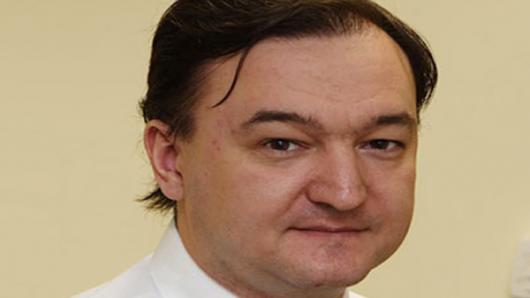
Sergei Magnitsky


Trump Jr. said Russian lawyer Natalie Veselnitskaya “stated that she had information that individuals connected to Russia were funding the Democratic National Committee and supporting Mrs. Clinton. Her statements were vague, ambiguous and made no sense. No details or supporting information was provided or even offered. It quickly became clear that she had no meaningful information.”

According to Trump Jr.’s account, Veselnitskaya then turned the conversation to President Vladimir Putin’s cancellation of an adoption program which had sent Russian children to American parents, a move he took in reaction to the so-called Magnitsky Act, a 2012 punitive law passed by the U.S. Congress in retaliation for the 2009 death of Sergei Magnitsky in a Russian jail.

The death became a Western cause célèbre with Magnitsky, the accountant for hedge-fund executive William Browder, hailed as a martyr in the cause of whistleblowing against a profoundly corrupt Russian government. After Magnitsky’s death from a heart attack, Browder claimed that his “lawyer” Magnitsky had been tortured and murdered to cover up official complicity in a $230 million tax-fraud scheme involving companies ostensibly under Browder’s control.

Because of Browder’s wealth and political influence, he succeeded in getting the European Parliament and the U.S. Congress to buy into his narrative and move to punish the presumed villains in the tax fraud and in Magnitsky’s death. The U.S.-enacted Magnitsky Act in 2012 was an opening salvo in what has become a new Cold War between Washington and Moscow.

Only One Side Heard


The Magnitsky narrative has now become so engrained in Western geopolitical mythology that the storyline apparently can no longer be questioned or challenged. The New York Times reports Browder’s narrative as flat fact, and The Washington Post took pleasure in denouncing a 2016 documentary that turned Browder’s version of events on its head.


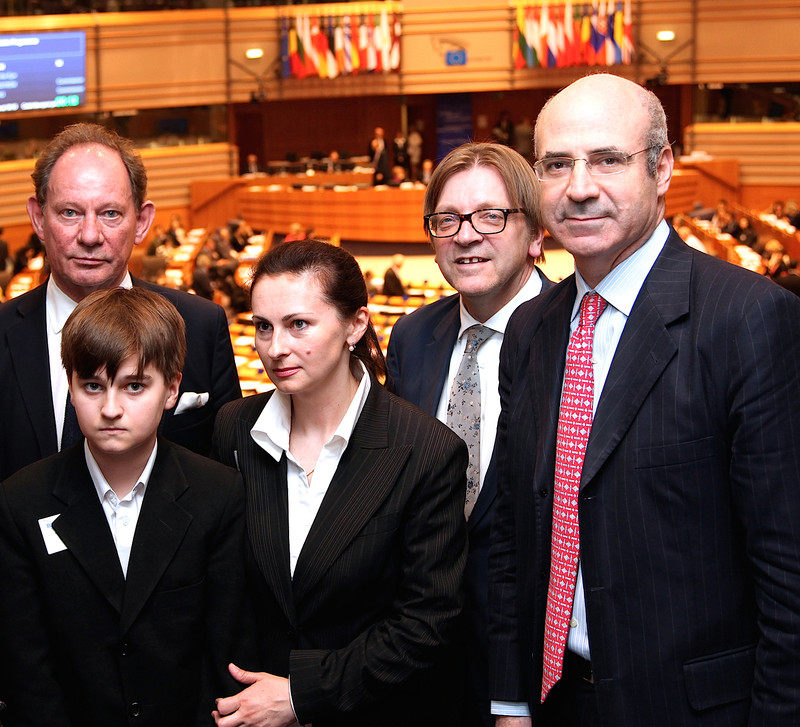
Financier William Browder (right) with Magnitsky’s 
widow and son, along with European parliamentarians.


The documentary, entitled “The Magnitsky Act. Behind the Scenes,” was essentially blocked for distribution in the West, with the European Parliament pulling the plug on its planned premiere in Brussels shortly before it was scheduled for showing.

When the documentary got a single showing at the Newseum in Washington, a Washington Post editorial branded the documentary Russian “agit-prop.”

The Post sought to discredit the filmmaker, Andrei Nekrasov, without addressing his avalanche of documented examples of Browder’s misrepresenting both big and small facts in the case. Instead, the Post accused Nekrasov of using “facts highly selectively” and insinuated that he was merely a pawn in the Kremlin’s “campaign to discredit Mr. Browder and the Magnitsky Act.”

The Post concluded smugly:

“The film won’t grab a wide audience, but it offers yet another example of the Kremlin’s increasingly sophisticated efforts to spread its illiberal values and mind-set abroad. In the European Parliament and on French and German television networks, showings were put off recently after questions were raised about the accuracy of the film, including by Magnitsky’s family.
“We don’t worry that Mr. Nekrasov’s film was screened here, in an open society. But it is important that such slick spin be fully exposed for its twisted story and sly deceptions.”

Given the fact that virtually no one in the West was allowed to see the film, the Post’s gleeful editorial had the feel of something you might read in a totalitarian society where the public only hears about dissent when the Official Organs of the State denounce some almost unknown person for saying something that almost no one heard.

What the Post didn’t want you to know was that Nekrasov started off his project with the goal of producing a docu-drama that accepted Browder’s self-serving narrative. However, during the research, Nekrasov uncovered evidence that revealed that Magnitsky was neither a “lawyer” nor a whistleblower; that the scam involving Browder’s companies had been exposed by a woman employee; and that Magnitsky, an accountant for Browder, was arrested as a conspirator in the fraud.

As the documentary unfolds, you see Nekrasov struggling with his dilemma as Browder grows increasingly abusive toward his erstwhile ally. Nekrasov painfully concludes that Browder had deceived him.

But, don’t worry, as a citizen in the Free World, you probably will never have to worry about viewing this documentary, since it has been effectively flushed down the memory hole. Official references to Magnitsky are back in the proper form, treating him as a Martyr for Truth and a victim of the Evil Russians.

Plus, if you rely on The New York Times, The Washington Post, MSNBC, CNN and the rest of the U.S. mainstream media for your news, you won’t have to think about the far more substantive case of the Steele Dossier in which Hillary Clinton’s allies spent gobs of money seeking out sources in Russia to serve up dirt on Donald Trump.

Investigative reporter Robert Parry broke many of the Iran-Contra stories for The Associated Press and Newsweek in the 1980s. You can buy his latest book, America’s Stolen Narrative, either in print here or as an e-book (from Amazon and barnesandnoble.com).

Pilger: Palestine Still the Issue

Palestine Is Still the Issue

by John Pilger


July 7, 2017


This is an abridged version of John Pilger's address 

to the Palestinian Expo 2017 in London. 


When I first went to Palestine as a young reporter in the 1960s, I stayed on a kibbutz. The people I met were hard-working, spirited and called themselves socialists. I liked them. One evening at dinner, I asked about the silhouettes of people in the far distance, beyond our perimeter.

"Arabs", they said, "nomads". The words were almost spat out. Israel, they said, meaning Palestine, had been mostly wasteland and one of the great feats of the Zionist enterprise was to turn the desert green.

They gave as an example their crop of Jaffa oranges, which was exported to the rest of the world. What a triumph against the odds of nature and humanity's neglect.

It was the first lie. Most of the orange groves and vineyards belonged to Palestinians who had been tilling the soil and exporting oranges and grapes to Europe since the eighteenth century. The former Palestinian town of Jaffa was known by its previous inhabitants as "the place of sad oranges".

On the kibbutz, the word "Palestinian" was never used. Why, I asked. The answer was a troubled silence.

All over the colonised world, the true sovereignty of indigenous people is feared by those who can never quite cover the fact, and the crime, that they live on stolen land.

Denying people's humanity is the next step - as the Jewish people know only too well. Defiling people's dignity and culture and pride follows as logically as violence.

In Ramallah, following an invasion of the West Bank by the late Ariel Sharon in 2002, I walked through streets of crushed cars and demolished houses, to the Palestinian Cultural Centre. Until that morning, Israeli soldiers had camped there. I was met by the centre's director, the novelist, Liana Badr, whose original manuscripts lay scattered and torn across the floor. The hard-drive containing her fiction, and a library of plays and poetry had been taken by Israeli soldiers. Almost everything was smashed, and defiled.

Not a single book survived with all its pages; not a single master tape from one of the best collections of Palestinian cinema.

The soldiers had urinated and defecated on the floors, on desks, on embroideries and works of art. They had smeared faeces on children's paintings and written - in shit - "Born to kill". Liana Badr had tears in her eyes, but she was unbowed. She said, "We will make it right again."

What enrages those who colonise and occupy, steal and oppress, vandalise and defile is the victims' refusal to comply. And this is the tribute we all should pay the Palestinians. They refuse to comply. They go on. They wait - until they fight again. And they do so even when those governing them collaborate with their oppressors.

In the midst of the 2014 Israeli bombardment of Gaza, the Palestinian journalist Mohammed Omer never stopped reporting. He and his family were stricken; he queued for food and water and carried it through the rubble. When I phoned him, I could hear the bombs outside his door. He refused to comply.

Mohammed's reports, illustrated by his graphic photographs, were a model of professional journalism that shamed the compliant and craven reporting of the so-called mainstream in Britain and the United States. The BBC notion of objectivity - amplifying the myths and lies of authority, a practice of which it is proud - is shamed every day by the likes of Mohamed Omer.

For more than 40 years, I have recorded the refusal of the people of Palestine to comply with their oppressors: Israel, the United States, Britain, the European Union.

Since 2008, Britain alone has granted licences for export to Israel of arms and missiles, drones and sniper rifles, worth £434 million.

Those who have stood up to this, without weapons, those who have refused to comply, are among Palestinians I have been privileged to know:

My friend, the late Mohammed Jarella, who toiled for the United Nations agency UNRWA, in 1967 showed me a Palestinian refugee camp for the first time. It was a bitter winter's day and schoolchildren shook with the cold. "One day ..." he would say. "One day ..."

Mustafa Barghouti, whose eloquence remains undimmed, who described the tolerance that existed in Palestine among Jews, Muslims and Christians until, as he told me, "the Zionists wanted a state at the expense of the Palestinians."

Dr. Mona El-Farra, a physician in Gaza, whose passion was raising money for plastic surgery for children disfigured by Israeli bullets and shrapnel. Her hospital was flattened by Israeli bombs in 2014.

Dr. Khalid Dahlan, a psychiatrist, whose clinics for children in Gaza - children sent almost mad by Israeli violence - were oases of civilization.

Fatima and Nasser are a couple whose home stood in a village near Jerusalem designated "Zone A and B", meaning that the land was declared for Jews only. Their parents had lived there; their grandparents had lived there. Today, the bulldozers are laying roads for Jews only, protected by laws for Jews only.

It was past midnight when Fatima went into labour with their second child. The baby was premature; and when they arrived at a checkpoint with the hospital in view, the young Israeli soldier said they needed another document.

Fatima was bleeding badly. The soldier laughed and imitated her moans and told them, "Go home". The baby was born there in a truck. It was blue with cold and soon, without care, died from exposure. The baby's name was Sultan.

For Palestinians, these will be familiar stories. The question is: why are they not familiar in London and Washington, Brussels and Sydney?

In Syria, a recent liberal cause - a George Clooney cause - is bankrolled handsomely in Britain and the United States, even though the beneficiaries, the so-called rebels, are dominated by jihadist fanatics, the product of the invasion of Afghanistan and Iraq and the destruction of modern Libya.

And yet, the longest occupation and resistance in modern times is not recognised. When the United Nations suddenly stirs and defines Israel as an apartheid state, as it did this year, there is outrage - not against a state whose "core purpose" is racism but against a UN commission that dared break the silence.

"Palestine," said Nelson Mandela, "is the greatest moral issue of our time."

Why is this truth suppressed, day after day, month after month, year after year?

In Israel - the apartheid state, guilty of a crime against humanity and of more international law-breaking than any other - the silence persists among those who know and whose job it is to keep the record straight.

In Israel, so much journalism is intimidated and controlled by a groupthink that demands silence on Palestine while honourable journalism has become dissidence: a metaphoric underground.

A single word - "conflict" - enables this silence. "The Arab-Israeli conflict", intone the robots at their tele-prompters. When a veteran BBC reporter, a man who knows the truth, refers to "two narratives", the moral contortion is complete.

There is no conflict, no two narratives, with their moral fulcrum. There is a military occupation enforced by a nuclear-armed power backed by the greatest military power on earth; and there is an epic injustice.

The word "occupation" may be banned, deleted from the dictionary. But the memory of historical truth cannot be banned: of the systemic expulsion of Palestinians from their homeland. "Plan D" the Israelis called it in 1948.

The Israeli historian Benny Morris describes how David Ben-Gurion, Israel's first prime minister, was asked by one of his generals: "What shall we do with the Arabs?" The prime minister, wrote Morris, "made a dismissive, energetic gesture with his hand". "Expel them!" he said.

venty years later, this crime is suppressed in the intellectual and political culture of the West. Or it is debatable, or merely controversial. Highly-paid journalists and eagerly accept Israeli government trips, hospitality and flattery, then are truculent in their protestations of independence. The term, "useful idiots", was coined for them.

In 2011, I was struck by the ease with which one of Britain's most acclaimed novelists, Ian McEwan, a man bathed in the glow of bourgeois enlightenment, accepted the Jerusalem Prize for literature in the apartheid state.

Would McEwan have gone to Sun City in apartheid South Africa? They gave prizes there, too, all expenses paid. McEwan justified his action with weasel words about the independence of "civil society".

Propaganda - of the kind McEwan delivered, with its token slap on the wrists for his delighted hosts - is a weapon for the oppressors of Palestine. Like sugar, it insinuates almost everything today.

Understanding and deconstructing state and cultural propaganda is our most critical task. We are being frog-marched into a second cold war, whose eventual aim is to subdue and balkanise Russia and intimidate China.

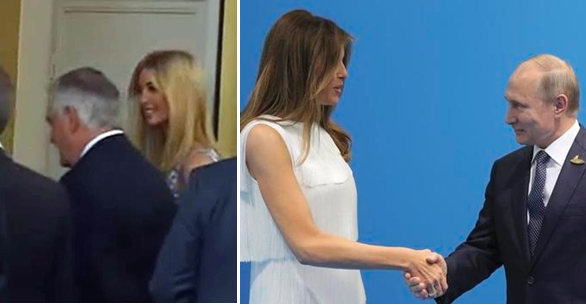
When Donald Trump and Vladimir Putin spoke privately for more than two hours at the G20 meeting in Hamburg, apparently about the need not to go to war with each other, the most vociferous objectors were those who have commandeered liberalism, such as the Zionist political writer of the Guardian.

"No wonder Putin was smiling in Hamburg," wrote Jonathan Freedland. "He knows he has succeeded in his chief objective: he has made America weak again." Cue the hissing for Evil Vlad.

These propagandists have never known war but they love the imperial game of war. What Ian McEwan calls "civil society" has become a rich source of related propaganda. Take a term often used by the guardians of civil society - "human rights". Like another noble concept, "democracy", "human rights" has been all but emptied of its meaning and purpose.

Like "peace process" and "road map", human rights in Palestine have been hijacked by Western governments and the corporate NGOs they fund and which claim a quixotic moral authority.

So when Israel is called upon by governments and NGOs to "respect human rights" in Palestine, nothing happens, because they all know there is nothing to fear; nothing will change.

Mark the silence of the European Union, which accommodates Israel while refusing to maintain its commitments to the people of Gaza - such as keeping the lifeline of the Rafah border crossing open: a measure it agreed to as part of its role in the cessation of fighting in 2014. A seaport for Gaza - agreed by Brussels in 2014 - has been abandoned.

The UN commission I have referred to - its full name is the UN Economic and Social Commission for Western Asia - described Israel as, and I quote, "designed for the core purpose" of racial discrimination.

Millions understand this. What the governments in London, Washington, Brussels and Tel Aviv cannot control is that humanity at street level is changing perhaps as never before.

People everywhere are stirring and are more aware, in my view, than ever before. Some are already in open revolt. The atrocity of Grenfell Tower in London has brought communities together in a vibrant almost national resistance.

Thanks to a people's campaign, the judiciary is today examining the evidence of a possible prosecution of Tony Blair for war crimes. Even if this fails, it is a crucial development, dismantling yet another barrier between the public and its recognition of the voracious nature of the crimes of state power - the systemic disregard for humanity perpetrated in Iraq, in Grenfell Tower, in Palestine. Those are the dots waiting to be joined.

For most of the 21st century, the fraud of corporate power posing as democracy has depended on the propaganda of distraction: largely on a cult of "me-ism" designed to disorientate our sense of looking out for others, of acting together, of social justice and internationalism.

Class, gender and race were wrenched apart. The personal became the political and the media the message. The promotion of bourgeois privilege was presented as "progressive" politics. It wasn't. It never is. It is the promotion of privilege, and power.

Among young people, internationalism has found a vast new audience. Look at the support for Jeremy Corbyn and the reception the G20 circus in Hamburg received. By understanding the truth and imperatives of internationalism, and rejecting colonialism, we understand the struggle of Palestine.

Mandela put it this way: "We know only too well that our freedom is incomplete without the freedom of the Palestinians."

At the heart of the Middle East is the historic injustice in Palestine. Until that is resolved, and Palestinians have their freedom and homeland, and Israelis are Palestinians equality before the law, there will be no peace in the region, or perhaps anywhere.

What Mandela was saying is that freedom itself is precarious while powerful governments can deny justice to others, terrorise others, imprison and kill others, in our name. Israel certainly understands the threat that one day it might have to be normal.

That is why its ambassador to Britain is Mark Regev, well known to journalists as a professional propagandist, and why the "huge bluff" of charges of anti-Semitism, as Ilan Pappe called it, was allowed to contort the Labour Party and undermine Jeremy Corbyn as leader. The point is, it did not succeed.

Events are moving quickly now. The remarkable Boycott, Disinvestment and Sanctions campaign (BDS) is succeeding, day by day; cities and towns, trade unions and student bodies are endorsing it. The British government's attempt to restrict local councils from enforcing BDS has failed in the courts.

These are not straws in the wind. When the Palestinians rise again, as they will, they may not succeed at first - but they will eventually if we understand that they are us, and we are them.

John Pilger's film, 'Palestine Is Still the Issue', can be viewed on this website.
Follow John Pilger on twitter @johnpilger

What Trial by Media Fire Forgets: Khadr Was Not Guilty

The controversy surrounding Omar Khadr’s reported $10.5-million settlement for Ottawa's complicity in his oppressive detention at Guantanamo Bay obscures a key issue we've never truly explored in Canada.

What if Khadr was innocent of the murder of Sgt. Christopher Speer this whole time, and we didn't lift a finger while he sat in a hell-hole for a decade?

For almost 15 years, Canadian treatment of the Khadr case has been dominated by the presumption of guilt. Yet the evidence tells a different story.

For all the fury boiling up over news of his settlement, there's precious little insight or knowledge about the facts. As a former prosecutor, something has always troubled me about this case, and my deep unease hasn't abated with time.

Any experienced trial lawyer would be troubled to open this file. With the exception of Khadr's "confession," wrung from a traumatized and severely wounded teenager under an abusive interrogation, the evidence against him was remarkably thin.

Examined closely, it appears more consistent with his innocence than guilt.

Khadr's case a 'Canadian tragedy'


What evidence exists appears confused, inconsistent or contradicted elsewhere. Photographs of the attack scene released in 2009 appear to directly conflict with the prosecution's summary of its own case.

Had the events happened under Canadian jurisdiction, they would not have been enough to lay a charge, let alone secure a conviction.

This case represents a Canadian tragedy and failure of moral courage on the part of our government. When Canada should have championed transparency, due process and the rule of law in the Khadr proceedings, we stood mute or actively participated in his abusive interrogation in custody.

Had the Canadian government done so, any criminal trial in open court would most likely have ended in a humiliating defeat for the U.S. government, and public perception would be very different from what it is today.

To any trial lawyer, it's plain that Khadr pled guilty for a very simple reason: his plea deal offered a return to Canada and eventual freedom — clearly a better alternative than a lifetime of suffering in Guantanamo.

That bargain was a successful legal maneuver, but a personal tragedy. It was successful because it returned him to Canada, where his prospects for justice were a vast improvement on Guantanamo Bay and U.S. military tribunals. It was tragic because he will forever wear the stain of pleading guilty to murder.

Today Canadians are paying a hefty price because successive Liberal and Conservative governments sacrificed principle to political expedience, traded away due process, and turned on their own child citizen, a trapped and helpless teenager.

Evaluating the evidence from the prosecution's perspective


Here’s how a prosecutor would look at the evidence against Khadr in a civilian criminal trial. Remember, this was a criminal prosecution subject to evidentiary rules supposedly designed not only to protect the innocent, but the integrity of the justice system itself.

The first step is to ensure the prosecution can prove each element of the charge beyond a reasonable doubt; and that the evidence is probative, consistent, credible, and reliable.

Any obvious defences, such as mistake of identity, self-defence, temporary loss of control or accident, should be anticipated and closed off by cogent evidence before charges are laid.

One more thing: in a circumstantial case, (which this was, because nobody saw Khadr throw the grenade that killed Speer), the evidentiary bar is even higher. In such a case the test is not merely proof beyond a reasonable doubt, but that the evidence pointing to guilt is inconsistent with any other rational conclusion.

First the context. This firefight was no small village confrontation, but an all-out military assault on a small compound.

The suspected Al Qaeda compound was identified by U.S. and Afghan forces in the early morning of July 27, 2002. Two Afghan militia members approached the small compound, estimated at "100 to 120 feet square." They were immediately shot and killed by occupants inside.

Compound bombed and strafed by U.S. air assault for hours


That shooting drew an overwhelming response. More than 100 U.S. troops assembled on the site, and for the next four hours the compound was pounded with cannon, missile, and rocket fire from a coordinated air assault involving Apache helicopters, A-10 warplanes and F-18 fighter jets. Multiple 500-lb. bombs were dropped on the site.

When American forces believed everyone inside had been killed, a U.S. Special Forces team entered the compound.

Whatever happened next took less than a minute, according to reports. At the end of it, Sgt. Christopher Speer, who was not wearing a helmet, was mortally wounded in the head from a grenade, and Khadr was captured alive.

So what was the prosecution’s case against Omar Khadr?

Inconsistent and inaccurate statements from the prosecution


There was lots to choose from. The U.S. military reports and filed statements describe a hodge-podge of confusing and inconsistent positions, including the following range of scenarios:

(1) The assault team entered, encountered and returned enemy fire and killed the shooter. Omar Khadr, positioned behind a crumbling wall, then threw a grenade at a group of soldiers who were talking. He did not consider them a threat to his safety, but just planned to kill as many Americans as he could (U.S. government stipulation of facts, 2010, paragraphs 41-43, agreed to by Khadr in his guilty plea);

(2) The assault team entered, encountered enemy fire, including a thrown grenade. They shot and captured Khadr, who was the only survivor in the compound during the exchange. Being the only survivor, Khadr must have killed Speer (false public position of U.S. military until 2008, as per CBC report);

(3) The assault team entered, encountered enemy fire, including a thrown grenade. They killed the shooter who also threw the grenade. They then captured Khadr, who did not throw the grenade (Report by Maj. Randy Watt, senior U.S. officer at battle, July 28, 2002);

(4) The assault team entered, encountered enemy fire and a witness identified as OC-1 saw a grenade thrown over a wall. Because of the timing of the shooting and grenade, he did not believe one person could have done both. OC-1 killed the shooter. He then found Khadr seated and facing away from the assault team and shot him in the back. According to OC-1, Khadr was the only person who could have killed Speer (Statement by witness OC-1, dated March 17, 2004, almost two years after the event);

(5) The assault team entered, encountered enemy fire and saw a grenade thrown over a wall. They killed the shooter and two Delta Force members confronted Khadr, who was armed and stood facing them. They shot him in the chest (per summary of statements, originally reported by Michelle Shephard in the Toronto Star);

(6) The assault team entered, encountered enemy fire and saw a grenade thrown over a wall. Soldiers outside the compound were also throwing grenades in response to the firefight. U.S. forces first killed the shooter, then shot and captured Khadr (per Los Angeles Times report of statement evidence). This opens the possibility that friendly fire accidentally killed Speer.

OR

(7) The photos:


Left photo taken in Ayub Kheyl in Afghanistan on July 27, 2002, shows scene 
found by the assault team where shooter killed. Khadr lies beneath rubble, 
apparently beneath a collapsed roof. 
Right photo shows Khadr (figure highlighted) after debris has been pulled back. 
Classified photos obtained by the Toronto Star from an 18-page submission 
presented in 2009 by Khadr's former military defence team to an Obama 
administration task force investigating Guantanamo.

Clearly, the multiple positions and reports advanced by the prosecution can't all be true. In all, either the shooter, or Khadr, or possibly American forces threw the grenade that killed Speer. Some of the reports make no sense at all, and some are clearly false.

Consistency, credibility and reliability are essential to a strong prosecution, and this case was on thin ice.

Photo evidence disastrous for the prosecution


Then came the photographs of the combat scene obtained by the Toronto Star in 2009, which can only be seen as disastrous for the prosecution.

The two photos above apparently depict the scene as found by the assault team in the area where the shooter was killed. The first photo on the left shows the body of the shooter killed in the firefight next to what appears to be a pile of rubble and brush. Omar Khadr was found alive beneath that rubble.

According to the Star, military documents indicate that "a soldier stood on top of Khadr's body before realizing someone was buried."

The second photo on the right—enhanced by the Star for clarity—shows the brush and rubble pulled back to expose Khadr, with bullet entry wounds clearly visible on his back.

In the third photo below, which shows Khadr receiving battlefield first aid (the graphic damage of his exit wounds are obscured), clearly visible is the dried blood from the shrapnel wound to his left eye. Khadr's face is coated in dirt, consistent with being buried in rubble.


Khadr receives battlefield first aid after being injured during a fight in 
Ayub Kheyl, Afghanistan July 27, 2002. Graphic exit wounds obscured. 
Photo from Wikimedia Commons, originally obtained by Toronto Star

Khadr could not have thrown the grenade and then completely buried himself under rocks and debris in just a few seconds before the special forces team arrived.

Of all the positions taken by the prosecution above, only (3) and (6) are consistent with the photographs taken in the immediate aftermath of the firefight. Neither version implicates Khadr. Version (3) is the incident report submitted by the senior officer on site the day after the battle, which completely exonerates him.

The only evidence that ties Khadr to the grenade is the statement of OC-1 in version (4), given to investigators almost two years after the event. But OC-1's statement that he found Khadr sitting up and leaning against brush is sharply at variance with photograph 1, in which Khadr lies completely buried under rocks and brush.

That's not a small problem for the prosecution. It's a big one.

If the photograph is an accurate depiction of the scene as the special forces team found it, OC-1's statement can't be true. It's more likely that OC-1 discovered Khadr under the rubble after he shot the other combatant, then shot him in the back as he lay there.

It gets worse. The prosecution's bigger problem is that its official version (1) makes no sense at all when read with the photographs. Below is the relevant text of the U.S. government's stipulation of facts:


A screenshot of the U.S. government's stipulation of facts in 
October 2010 regarding the events that led to Sgt. Christopher 
Speer's death in Afghanistan in 2002, as accepted by Omar Khadr


Clearly, paragraphs 42 and 43 are drafted to defeat any argument that Khadr threw the grenade in self-defence. It's drafted to cast him as the aggressor who, unprovoked, attacked a peaceful group of soldiers clearing up a battle site after a firefight with the other combatant. But that is wholly inconsistent with a photo of Khadr buried in rocks and rubble, lying within inches of his dead compatriot.

Unless the shooter's body had been moved, Khadr was lying under the debris immediately next to him during the firefight. According to OC-1, he shot both the shooter and Khadr within a few seconds of each other.

This doesn't make sense either. Khadr didn't watch his compatriot get killed, throw a grenade, then cover himself in rocks and sticks and wait to be discovered. And what about the Star's account of military documents reporting that a soldier didn't even realize Khadr was there until he stood on him?
Military evidence makes a better case for innocence than guilt

So far, this is all the prosecution's own evidence, and it's a mess before the defence calls a single witness. Without Khadr's confession, obtained essentially by force, there is no compelling evidence that he threw any grenade at all. No one saw him do it, and from all appearances he'd been under that rubble the entire time.

From what’s publicly available at this point, the evidence pointing to guilt is weak and speculative. Taken as a whole, it doesn't really make sense. Multiple statements contradict each other and run all over the map.

These are not small inconsistencies. Something is seriously wrong with the prosecution's account.

Without Khadr's confession, the evidence fails its first and most basic test: that of establishing beyond a reasonable doubt through credible, reliable and consistent evidence that Khadr threw the grenade that struck and killed Sgt. Speer.

So what about that confession?


As is well known today, false confessions are common, especially with malleable young people under duress. The intensity and abusiveness of Khadr's interrogation is unprecedented in law-abiding countries. It's probably fair to say that in 2002 the U.S. military was far more concerned with learning whatever it could about Al Qaeda from Khadr than with getting an admissible voluntary statement for a criminal trial.

The priority was to find and kill Osama bin Laden, and to defeat Al Qaeda and the Taliban.

That interrogators went too far is now common knowledge. But the problem with torturous or abusive questioning isn't just that it violates the prisoner's rights, but that subjects will give false information to escape the agony.

Today, Khadr says that he confessed to false things just to please his interrogators and stop the pain, and there's evidence to back that up. For instance, we know that under pressure Khadr falsely identified Maher Arar as having stayed at terrorist safe houses in Afghanistan, when Arar had never been to the country.

It's far more believable that Khadr confessed to stop the pain than that his confession is true. The photographs and the known chronology make it extremely unlikely that he could have thrown the grenade.

Yet without that confession, the prosecution had no case.

First, freshest and best military report points to innocence


The U.S. military’s first, freshest and probably best report of the incident, based on contemporaneous eye-witness accounts by the soldiers involved, was submitted by Maj. Randy Watt the day after the firefight. That report described scenario (3), in which it was believed that the grenade was thrown by the shooter.

It's also consistent with and corroborated by the photographs taken at the scene, where only the shooter would have been in a position to throw the grenade.

However, according to the CBC (at 15:30 in the video), that report was itself subsequently altered without documentation or explanation.

That first report, which contains the best evidence exonerating Khadr, remains today the most coherent account of the events of that day.

Even if it could be established that Khadr did throw the grenade in the middle of a firefight, given his proximity to the shooter it's impossible to rule out self-defence. The stipulation of facts cannot be true.

After all these years and coverage, it's plain that any competent defence lawyer could run a Mack truck through this case in a conventional criminal court.
It was Canada's job to raise hell about the railroading of a Canadian teen

Know who else should have run a Mack truck through it? The Canadian government.

It was Canada’s job to raise hell about the railroading of a Canadian teen based on a lousy case. It was Canada's job to raise hell about the torture of a Canadian kid in U.S. custody. Instead, we presumed he was guilty.

Successive Liberal and Conservative governments washed their hands of Khadr, only to aid and abet his Kafka-esque ordeal and trial by torture. Precious few stood up to take his side as he was convicted in the court of public opinion without a trial.

We were happy—eager, in fact—to strip him of his rights, judge him without even looking at the facts, and allow the American military and politicians to malign him mercilessly as they took every step to suppress the truth.

And though many reporters distinguished themselves, there was no shortage of media commentators piling on, sneering at the doubters and skeptics as do-gooding sissies.

The American torture program was a disaster. Extraordinary rendition to torture sites was a disaster. Guantanamo is a continuing disaster.

Instead of playing along as America’s trusty lapdog, the Canadian government should have stood squarely on the side of due process, demanding an accounting of the staggering cruelty and appalling ineptitude (or worse) behind this whole affair.

At every turn we should have called for a full, fair, open and transparent proceeding. We should have challenged the bad faith, the secrecy, the doctored reports, the contradictory witnesses, the changing stories, and the procedural bullying.

We should have demanded Khadr’s immediate return to Canada from Guantanamo, pending a full investigation.

If you still think the U.S. wouldn't fudge its reports to get the result it wants, google 'Pat Tillman.' Then consider whether the biggest clue to this whole mystery is the long suppression of reports that American soldiers in the special forces assault team also threw grenades during the firefight.

We had plenty of notice how this would all end, because we've been here before with Maher Arar. The day after Khadr, compelled by fear and abuse, falsely pegged Arar as an Al Qaeda associate, U.S. authorities spirited him to Syria by extraordinary rendition, where he too was tortured and imprisoned for a year.

That lesson cost us a cool $10.5 million in foreshadowing, but didn't teach us a thing. We turned around and did it again. To a kid.

Khadr was left virtually alone and helpless to fight the awesome force of American power from a cell in Guantanamo. He should have had the full weight of the Canadian government behind him pushing for the truth.

Plea deal bought freedom at a high price


Khadr's guilty plea bought his freedom, but at a heavy price. For that freedom Khadr traded, perhaps forever, the chance to clear his name and turn public scrutiny on those who abused him, who doctored records, who changed their stories.

As part of his plea deal, Khadr agreed to a statement of facts admitting to killing Sgt. Speer, and promised never to seek forensic review of the evidence which might one day prove his innocence. He also agreed to permit the U.S. government to destroy all evidence following sentencing.

As a teenager Omar Khadr was betrayed and exploited by every adult who owed him a duty of care, including his father who conscripted him into a terrorist group, and his mother who let it happen. Then he was abandoned by the one government that should have protected his right to a fair trial.

Khadr's ticket out of Guantanamo should never have been a guilty plea extracted by torture, fear and despair. Every other western country was getting its citizens out, while Canada let a teenager rot there.

Khadr's passport out should have been the birthright he was born with—his Canadian citizenship.

Sandy Garossino is a former Crown prosecutor and prominent media commentator. Winner of 'Best Column' in Canada in the 2017 Canadian Online Publishing Association's awards, Garossino used to own three Metro Vancouver taxi companies, which together formed the largest privately held fleet of taxis in Western Canada. She is active in private investments and incubating businesses through global partnerships, primarily in Asia.
Get more great work from Sandy Garossino and support excellent journalism. Subscribe.

Monday, July 10, 2017

Gorilla Radio with Chris Cook, John Lefebvre, Bonny Glambeck, Janine Bandcroft July 12, 2017

This Week on GR

by C. L. Cook - Gorilla-Radio.com


July 12, 2017

Lawyer, busker, internet entrepreneur, felon, and philanthropist king; though the life story of my first guest presents biographers an embarrassment of anecdotal riches, ironically, their telling deepens rather than reveals the enigma of the subject. Better then the man tell his own tale.

In his time, John Lefebvre has been and done all those things and more, so when friends urged he record his extraordinary life story he began, but found he "quickly tired of writing sentences that started with "I" and ended with "me"."

Listen. Hear.

But still, there was a story to tell, and to that end comes Lefebvre's debut book, 'All's Well. Where Thou Art Earth and Why', a biography of the human species through a lens that contends,

"We are the Universe’s vessels of consciousness, of astonishment and of love."

John Lefebvre in the first half.

And; twenty years after Clayoquot Summer '93, arguably the peak of environmental activism not only in the Sound, but on Vancouver Island, kayak guides and naturalists Dan Lewis and Bonny Glambeck shifted oars and founded Clayoquot Action, an organization dedicated to keeping "Clayoquot Sound clean and green for future generations, to preserve the diversity and integrity of the ecosystems, and to maintain and develop community and cultural richness." While they've been educating and activating people living in and visiting to Clayoquot for a long time, this Summer they launched Clayoquot 2.0, an "all-new weekly, multi-media journey through the visually stunning landscape, wildlife and culture of Clayoquot Sound."

Bonny Glambeck and Clayoquot 2.0 in the second half.

And; CFUV Radio broadcaster, Janine Bandcroft will be here with a Left Coast Events update at the bottom of the hour to bring us up to speed with what's good going in and around here in the coming week. But first, John Lefebvre and asking not for whom the Zen bell tolls.

Chris Cook hosts Gorilla Radio, airing live every Wednesday, 1-2pm Pacific Time. In Victoria at 101.9FM, and on the internet at: http://cfuv.ca.  He also serves as a contributing editor to the web news site, http://www.pacificfreepress.com. Check out the GR blog at: https://gorillaradioblog.blogspot.ca/

G-Radio is dedicated to social justice, the environment, community, and providing a forum for people and issues not covered in the corporate media.

A Simpleton, Wrapped in a Know-Nothing, Riddled with Ignorance: Decoding Trump Less Enigmatic than Expected

Melania Trump and SIGABA Allow Putin to Decode Trump = Trump Too Defective and Impotent to Make or Keep Agreements, State Department Working Groups Are Last Hope

by John Helmer - Dances with Bears


July 9, 2017

Moscow - Thousands of years after spies were invented, and thirty years before the digital computer, there was SIGABA (left), an electric motor-powered mechanical apparatus for ciphering and protecting one’s communications from being intercepted or overheard by one’s enemies. Invented by two employees of the US National Security Agency, secretly patented in 1944 but not declassified until 2001, its name was assigned by the US Army which used it throughout World War II.

The Germans called it the American Big Machine, but they couldn’t break its rotor system for coding.

The Germans had their own version of the electric-motor cipher machine called Enigma, but it was broken by the Poles and British. Whether the Soviets had broken SIGABA or Enigma isn’t known for sure; probably not. What is certain is that they were more successful at using spies instead of machines.

So it comes as a surprise that last week in Germany, President Vladimir Putin and President Donald Trump agreed, in front of their respective foreign ministers, to form a working group of their subordinates to devise a scheme for protecting them both from the most modern machines for cracking ciphers. That’s to say, machines operated by their enemies. The working group won’t be allowed to share details of the machines they currently use on each other.

How pointless the working-group agreement will be was revealed unexpectedly for the Russians, halfway into their talks, when the president’s wife, Melania Trump, knocked on the meeting-room door, and came in to make sure her husband hadn’t been cracked by Putin. She suggested it was time for Trump to leave.

This break-in is unprecedented in the history of more than two centuries of American-Russian state negotiations. Unreported by most US media, but corroborated by US Secretary of State Rex Tillerson, Melania Trump cracked her husband’s code in front of America’s enemies. This is what Putin meant when he told the press that at the meeting with Trump, he had discovered “Mr Trump’s television image is very different from the real person.”

Several SIGABA machines are still preserved in working order. Combined with the cipher keys revealed by Tillerson and Mrs Trump, SIGABA allows the text of Putin’s description of the meeting with Trump to be decoded. Tillerson also admitted publicly that “several times” he tried himself to stop the meeting and remove Trump from the room. According to Tillerson, “they [sic] even sent in the First Lady at one point to see if she could get us out of there…We went another hour, so clearly she failed.”


Left: Tillerson, escorted by the President’s daughter Ivanka Trump, 
arriving at the US delegation’s hotel in Hamburg on July 6. 
Right: Melania Trump meets Putin, July 7.

Tillerson’s briefing lasted for 24 minutes; it is available only in audio recording, without pictures. For more, open to listen. The disclosure of the Melania break-in starts at Minute 21.

Putin’s briefing of the press lasted a little longer, 32 minutes. There were no crossovers of reporters attending both press conferences, although at least one US reporter did ask Putin questions. The Kremlin recording allowed release of both audio and video, plus an official English-language transcript; click to read. As he reported his personal impression of Trump at the meeting, Putin’s face and body movements are less revealing than his words. That’s because he was controlling himself, shoulders locked behind hands gripping the lectern, feet planted to the floor. He was speaking in code.


Source: The Kremlin videotape, minute 0925 to 10:00English text. 
The President is showing red patches on either side of his face. 
Dermatologists call this rosacea, a condition that may be caused by stress, 
heavy exertion, the banya, or damp weather. Humidity in Hamburg last 
Thursday and Friday averaged 75%.

This is what Putin said:

“As regards personal relations [with Trump], I believe that they have been established. This is how I see it: Mr Trump’s television image is very different from the real person; he is a very down to earth and direct person, and he has an absolutely adequate attitude towards the person he is talking with; he analyses things pretty fast and answers the questions he is asked or new ones that arise in the course of the discussion. So I think that if we build our relations in the vein of our yesterday’s meeting, there are good reasons to believe that we will be able to revive, at least partially, the level of interaction that we need.”

SIGABA decodes these remarks sentence by sentence. These are the results:

In cipher: “as regards personal relations, I believe that they have been established.”

SIGABA: “I’m obliged to state the obvious for in over two hours of conversation there was no basis to detect that Trump has qualities which can be predicted, let alone trusted.”

In cipher: “Mr Trump’s television image is very different from the real person”.

SIGABA: “Familiarity with such an individual is impossible so I cannot refer to him by his first name. He has demonstrated he uses a slightly smaller vocabulary than his television scripts have allowed, awkward as they have been for Trump to read them from his prompter….”

In cipher: “he is a very down to earth and direct person.”

SIGABA: “The man is a simpleton.”

In cipher: “he has an absolutely adequate attitude towards the person he is talking with.”

SIGABA: “His attention span and cognitive capacity are so limited, he prefers bluff and bluster, but this all-or-nothing approach isn’t capable of reciprocal understanding, let alone negotiating. Tillerson tried to extricate him several times. The problem is so serious, his wife was despatched to save him from exposing himself to us, as he did. His impulse control is poor. He trusts only women – he thinks they are simple enough for him to manage.”

In cipher: “he analyses things pretty fast…”

SIGABA: “His comprehension is slow, and works by breaking down complex topics into simple slogans. Then he has trouble sequencing. He can’t remember what he has said or thought before, so he isn’t capable of consistency. He tweets so he can look up what he’s just said.”

In cipher: “he answers the questions he is asked or new ones that arise in the course of the discussion.”

SIGABA: “He has one-line statements for North Korea, Syria, Ukraine, cyber security, nuclear arms, missile systems, elections, sanctions. These are neither consistent nor negotiable. He is incapable of either.”

In cipher: “So I think that if we build our relations in the vein of our yesterday’s meeting…”

SIGABA: “If is the operative word – there’s no telling what will happen next because Trump is in charge of nothing, not even of his wife, and nothing he says can be relied on. Tillerson is as impotent as his boss.”

In cipher: “there are good reasons to believe that we will be able to revive, at least partially, the level of interaction that we need.”

SIGABA: “The best that can be hoped for is that Tillerson can control the working groups to which he’s persuaded Trump to delegate everything of substance. So everything with the Americans is partial. I have gained nothing I need.”

The Kremlin publicity version isn’t divulging the state secrets revealed by the SIGABA machine.

One reason is that the decrypts confirm Russian intelligence assessments Putin has been receiving on Trump. This secret also means another one — the briefings Putin gets from press arranged by his spokesman, Dmitry Peskov (right), have proved false.

Peskov’s version of the success of the meeting can be read in RT here.

“Accusations that Trump is somewhat incompetent or that he is a novice, can be classified as delusional trash,” Peskov told Russian state television, intimating he was addressing western media, not the General Staff or SVR.

“He has expert knowledge, he is a very determined negotiator and skilful at using his knowledge to put his position across.”

Kremlin insiders acknowledge that Peskov tried to order the omission from the Russian press of details of Tillerson’s and Mrs Trump’s attempts to stop the meeting before the 60-minute mark. Instead, Peskov has announced that “a ‘certain affection’ had developed between the Russian leader and Trump’s wife, Melania, who sat next to the Russian president at the official G20 dinner, revealing that the two discussed several issues on the summit agenda, including gender equality and women’s economic participation.”

Peskov in cipher: “We can now confidently declare that this was a win-win encounter.”

SIGABA: “There is no confidence. This was a lose-lose encounter — for Peskov.”

Trump, Putin, G20, and the Syria Ceasefire Deal

Trump, Putin and Russiagate Collide at G20 

by TRNN


July 8, 2017

Max Blumenthal and Aaron Mate discuss the long-awaited first meeting between Donald Trump and Vladimir Putin, where Syria and Russiagate topped the agenda.


Max Blumenthal is an award-winning journalist and bestselling author whose articles and video documentaries have appeared in The New York Times, The Los Angeles Times, The Daily Beast, The Nation, The Guardian, The Independent Film Channel, The Huffington Post, Salon.com, Al Jazeera English and many other publications. His most recent book is Goliath: Life and Loathing in Greater Israel. His other book, Republican Gomorrah: Inside The Movement That Shattered The Party, is a New York Times and Los Angeles Times bestseller.

Max Blumenthal on How the Media Covers Syria

by TRNN

As the U.S. and Russia reach a new ceasefire in Syria, Max Blumenthal of Alternet's Grayzone Project and TRNN's Aaron Mate discuss foreign involvement in the Syrian war and how Western media across the political spectrum has covered it.