Thursday, November 23, 2017

Anti-Semitism, the Jewish National Fund, and McGill University

McGill University and the Jewish National Fund (JNF)

by Yves Engler - Dissident Voice


November 22nd, 2017  


While accusations of student anti-Semitism at McGill draw international headlines, the university administration’s open association with a Jewish supremacist organization has been ignored.

In the latest iteration of a multi-year smear campaign against Palestine solidarity activists at the university, Canadian Jewish Political Affairs Committee activist Noah Lew cried “anti-Semitism” after he wasn’t voted on to the Board of Directors of the Students’ Society of McGill University (SSMU).

At a General Assembly last month Democratize SSMU sought to impeach the student union’s president Muna Tojiboeva.

The ad-hoc student group was angry over her role in suspending an SSMU vice president and adopting a Judicial Board decision that declared a Boycott, Divestment and Sanctions resolution unconstitutional.

(After two close votes, in February 2016 a motion mandating the student union support some BDS demands passed the union’s largest ever General Assembly, but failed an online confirmation vote after the university administration, Montreal’s English media and pro-Israel Jewish groups blitzed students. The resolution’s constitutionality was subsequently challenged.)


At the recent General Assembly Democratize SSMU’s effort to impeach the president failed. While they couldn’t muster the two thirds of votes required to oust the non-Jewish president of the student union, Democratize SSMU succeeded in blocking the re-election of two Board of Directors’ candidates who supported the effort to outlaw BDS resolutions.

After failing to be re-elected to the Board of Directors Noah Lew claimed he was,

“[B]locked from participating in student government because of my Jewish identity and my affiliations with Jewish organizations.” 

His claim was reported on by the National Post, Montreal Gazette, Global Television, as well as Israeli and Jewish press outlets. McGill Principal Suzanne Fortier sent out two emails to all students and faculty concerning the matter while the SSMU Board of Directors established a committee to investigate anti-Semitism. The affair was even mentioned in the House of Commons.

While a great deal has been written about alleged student anti-Jewish attitudes, the McGill administration’s open association with an explicitly Jewish supremacist organization passes with nary a comment. On November 28 McGill’s Associate Vice-Principal Innovation Angelique Mannella is scheduled to participate in a Jewish National Fund networking event called Tech Shuk, which connects Jewish capitalists with Montreal start-ups in a “Dragon’s Den” style competition. But, the JNF is an explicitly racist organization.

Owner of 13% of Israel’s land, it systematically discriminates against Palestinian citizens of Israel, who make up a fifth of the population. According to a UN report, Jewish National Fund lands are “chartered to benefit Jews exclusively,” which has led to an “institutionalized form of discrimination.” The JNF oversees discriminatory land use policies in Israel outlawed in this country 60 years ago.

In 2004 long-time McGill Principal Bernard Shapiro was the honoured guest at JNF Montréal’s annual fundraising dinner (two years later the then former University Principal was master of ceremonies at the event).

The current president of JNF Montréal, Michael Goodman, was a member of the advisory board of McGill ASD (Autism spectrum disorder).

In 2014 McGill gave an honorary degree to Marvin Corber. The University’s press release announcing its two honorary degree recipients cited an award Corber received from the JNF. Corber has been a JNF Montréal campaign advisor and chair of its annual fundraising dinner.

While the university administration’s ties to the JNF are a stark example of its racial bias, McGill is also entangled in other more subtle forms of anti-Palestinianism. The Montréal university has a memorandum of understanding with Tel Aviv University, which claims to be on “the front line of the critical work to maintain Israel’s military and technological edge.” McGill also has a partnership with Technion, which conducts “research and development into military technology that Israel relies on to sustain its occupation of Palestinian land.”

In 2012 the estate of Simon and Ethel Flegg contributed $1 million to McGill’s Jewish Studies department partly for an “education initiative in conjunction with McGill Hillel.” But, the cultural organization turned Israel lobby group refuses to associate with Jews (or others) who “delegitimize, demonize, or apply a double standard to Israel; support boycott of, divestment from, or sanctions against the state of Israel.”

Imagine the outcry if a McGill department accepted a large donation to work with an organization that openly excluded Jews and others who “delegitimize, demonize, or apply a double standard to Palestine and fail to recognize Palestinians’ UN enshrined rights.”

It’s time to discuss the McGill administration’s support for Jewish/white supremacy in the Middle East.

Yves Engler is the author of A Propaganda System: How Canada’s Government, Corporations, Media and Academia Sell War and Canada in Africa: 300 years of aid and exploitation.
Read other articles by Yves.

Beginning of the End, End of Beginning, or Just End to Syria War?

Did The Putin/Assad Meeting Cement The End Of America's Mid-East Dominance?

by Tom Luongo - Gold, Goats, 'n Guns

via ZeroHedge
  
Nov 23, 2017

I’m not a terribly religious man. But, I’d like to believe there is a special corner in Hell reserved for those that fomented the Syrian Civil War.

From its beginnings in Libya with gun-funneling through the U.S. embassy in Benghazi to yesterday’s meeting between Russian President Vladimir Putin and Syrian President Bashar al-Assad, this entire affair will be remembered as one of the most cynical and abusive periods of history.

The Syrian ‘Civil War’ was meant to be the crowning achievement of U.S./Israeli/Saudi policy in the Middle East, the apotheosis of neoconservatism.

Had it succeeded it would have transformed the world into a living hell governed by the likes of Hillary Clinton, George Soros, Angela Merkel and the U.S./U.K. banking cartel.

Syria was to be the wedge that blew open not only the Middle East but Central Asia as well. It would stop the resurgence of Russia as a world power, subjugate Europe to an endless nightmare of forced cultural assimilation and completed bankrupting the United States to bring it in line with the a failing European integration project.

Supranational treaties like the TPP, TTIP and the Paris Accord were designed to create a superstructure that would supplant national sovereignty without any input from the people who were most affected by it.

Putin’s Turning Point


With Vladimir Putin’s pivotal speech at the United Nations on September 28th, 2015, opposition to this vision was expressed in the most forceful, and frankly, humanist terms one could imagine. I’m going to remind you of the most important passage as it relates to Syria.

"In these circumstances, it is hypocritical and irresponsible to make loud declarations about the threat of international terrorism while turning a blind eye to the channels of financing and supporting terrorists, including the process of trafficking and illicit trade in oil and arms. It would be equally irresponsible to try to manipulate extremist groups and place them at one’s service in order to achieve one’s own political goals in the hope of later dealing with them or, in other words, liquidating them.
"To those who do so, I would like to say — dear sirs, no doubt you are dealing with rough and cruel people, but they’re in no way primitive or silly. They are just as clever as you are, and you never know who is manipulating whom. And the recent data on arms transferred to this most moderate opposition is the best proof of it.

"We believe that any attempts to play games with terrorists, let alone to arm them, are not just short-sighted, but fire hazardous (ph). This may result in the global terrorist threat increasing dramatically and engulfing new regions, especially given that Islamic State camps train militants from many countries, including the European countries."

In truth, the whole speech is worth revisiting. It is a stark reminder that Putin, normally very reserved in his words, laid all of his cards on the table and directly accused the United States of declaring war on the world.

And within 48 hours Sukhois were flying over Syria, bombing targets opposed to Syria’s government, allowing one military victory after another for the beleaguered Syrian Arab Army. Shortly thereafter a coalition formed around Assad’s government including Iran’s Republican Guard, Hezbollah’s military wing and China’s tacit financial and moral support.

Putin told everyone, “Enough is enough” at the U.N. Then he backed up his words with actions. War is always regrettable. It is almost never justified. But, when faced with an implacable enemy, there was little else to be done.

And I submit that the neoconservative forces driving the anti-Assad policy decisions are that implacable enemy.

The End of ‘Assad Must Go’


That action began the process of unraveling the carefully constructed narrative that was the Syrian Civil War.

But, enough history.

Yesterday Putin introduced Assad to the military commanders who are most responsible for the stabilization of his country. Syria as a political unit has survived.

Saudi Arabia’s old guard are imprisoned, impoverished and losing influence around the world by the minute. Israel’s neoconservative government, led by madman Benjamin Netanyahu, is fulminating impotently at the turn of events, and, of course, ISIS has all but been wiped out in both Syria and Iraq.

The U.S. continues to talk out of both sides of its mouth, allowing some ISIS members cover to escape to be used again another day, presumably against Iran and/or Lebanon, while taking credit for ISIS’s collapse and the capture of Raqqa.

This reflects the deep-seated issues within the vast U.S. diplomatic, military and intelligence communities and the difficulties President Trump is having bringing these disparate groups to heel while not appearing weak and ineffectual.

You need only look at the odd event over the weekend of military helicopters arriving at the CIA’s headquarters at Langley to know that, at a minimum, there is an internal war occurring within the U.S. government.

The best explanation I’ve heard (and this is by no means a corroborated fact) is that the U.S. military put on a show of force against Obama administration hold-overs in the CIA still operating its terrorist proxies in Syria. And that these operations are in direct conflict with U.S. military goals there.

If that is the case then Putin is right to simply ignore the Americans and move policy talks forward at an accelerated rate, ignoring the talks in Geneva and giving Assad all the support he needs to continue on as Syria’s leader, if that is what the Syrian people want.

Given Assad’s open support of his military and the way the war against ISIS and other separatist groups was led by Syrian forces on the ground, there is little doubt that Assad will win that support in any upcoming elections.

Putin Won’t Gloat


The big question is, however, what price will be extracted from the U.S. for their part in all of this. Putin will not put Trump in a bad position. The loss of face for the U.S. has already occurred internationally.

The Obama administration’s complicity in this sorry chapter of Middle East history has been mostly laid bare for anyone with eyes open enough to see.

Putin will offer Trump a way to save face for the U.S. while laying all the blame on Obama, Clinton, McCain and the rest of them. If you don’t think this ties into Robert Mueller’s ‘Russia-Gate’ investigation run amok, you aren’t paying attention.

Mueller is trying to desperately save everyone implicated here from treason charges. But, I expect, everything about the U.S. political scene is about to change radically.

Once Judge Roy Moore enters the Senate (the odds of that not happening are close to zero), Trump has an impeachment-proof majority in the House and the Senate and can shut down Mueller or get him to play ball.

Trump has the opportunity to play peace-maker here. He can solidify his position as the handler of Saudi Arabia’s and Israel’s worst actors and keep them on a short leash.

In fact, one could make a credible argument that is what the purge in Saudi Arabia was all about. Mohammed bin Salman’s counter-coup was done with Trump’s blessing.

Putin can act similarly to allay suspicions of Iran’s and Hezbollah’s intentions. He can also restrain Assad from retaliating against his enemies, though rightly deserved, in order to build a lasting peace. And once the talks are over and the threat of Kurdish independence is over, Turkey will withdraw its troops from Syria.

Putin called Trump earlier in the week to update him on what comes next. It’s obvious that the two have been in contact about how things are progressing in Syria. And, Trump, for his part has smartly left the clean-up work to Putin while he deals with his domestic neoconservative problems.

Whatever happens after this - framework for long-term peace or an uneasy ceasefire with Russia playing the go-between for the time being - the U.S. has lost all credibility in the region outside of Riyadh and Tel Aviv.

And we have no one to blame except ourselves.

Wednesday, November 22, 2017

Gorilla Radio with Chris Cook, Ken Boon, Whitney Webb, Janine Bandcroft November 23, 2017

This Week on GR

by C. L. Cook - Gorilla-Radio.com


November 23, 2017

The clock is winding down, the moment of truth drawing nearer for the contentious Site C dam mega project in BC's Peace country. Billions in the hole, and billions more promised to go down it too should it proceed, or be cancelled; now the new government in Victoria has to decide which way it will go.

Ken Boon is a farmer and president of the Peace Valley Landowners Association. His has been nothing short of an epic battle against crown corporation, BC Hydro and the former BC Liberal government.

But, the battle is not his alone, all British Columbians have a stake in what John Horgan and his NDP decide, as do their yet unborn children, and the generations that follow them.

Listen. Hear.

Ken Boon in the first half.


And; perhaps no other entity embodies better all that is wrong and tragic with the corporate dominance of the world today than Monsanto. The "life science" company specializes in creating cancer causing poisons currently killing unknown millions, and yet none seem able to stop the Leviathan's inexorable progress. As glyphosate, one of the key toxic ingredients of its Roundup weed killer faces a possible ban in Europe, due to a growing body of scientific evidence of carcinogenic effects, the company is pivoting to its newly "improved" product, Dicamba. Problem solved, right? Not quite.

Whitney Webb is a South America-based journalist writing about environmental, political, and economic issues in English and Spanish. She’s a staff writer at MintPress News.com, and her articles have featured at ZeroHedge, the Anti-Media, and 21st Century Wire, among other places. Her recent work for MintPressNews includes the article, ‘With Roundup On The Rocks, Monsanto Hatches New Seeds And A Dangerous New Plan'.

Whitney Webb in the second half.

And; Victoria-based activist and CFUV Radio broadcaster at-large, Janine Bandcroft will be here at the bottom of the hour with the Left Coast Events bulletin, bringing us up to speed with some of the good things to get up to around here in the coming week. But first, Ken Boon and the last dinosaur, the Site C dam.

Chris Cook hosts Gorilla Radio, airing live every Thursday between 11-Noon Pacific Time. In Victoria at 101.9FM, and on the internet at: http://cfuv.uvic.ca.  He also serves as a contributing editor to the web news site, http://www.pacificfreepress.com. Check out the GR blog at: http://gorillaradioblog.blogspot.ca/

Journey Back to Darkness: The End of Internet's Too Brief Era of Enlightment

From an open internet, back to the dark ages

by Jonathan Cook


November 22, 2017

Can anyone still doubt that access to a relatively free and open internet is rapidly coming to an end in the west? In China and other autocratic regimes, leaders have simply bent the internet to their will, censoring content that threatens their rule. But in the “democratic” west, it is being done differently. The state does not have to interfere directly – it outsources its dirty work to corporations.

As soon as next month, the net could become the exclusive plaything of the biggest such corporations, determined to squeeze as much profit as possible out of bandwith. Meanwhile, the tools to help us engage in critical thinking, dissent and social mobilisation will be taken away as “net neutrality” becomes a historical footnote, a teething phase, in the “maturing” of the internet.

In December the US Federal Communications Commission (FCC) plans to repeal already compromised regulations that are in place to maintain a semblance of “net neutrality”. Its chairman, Ajit Pai, and the corporations that are internet service providers want to sweep away these rules, just like the banking sector got rid of financial regulations so it could inflate our economies into giant ponzi schemes.

That could serve as the final blow to the left and its ability to make its voice heard in the public square.

It was political leaders – aided by the corporate media – who paved the way to this with their fomenting of a self-serving moral panic about “fake news”. Fake news, they argued, appeared only online, not in the pages of the corporate media – the same media that sold us the myth of WMD in Iraq, and has so effectively preserved a single party system with two faces. The public, it seems, needs to be protected only from bloggers and websites.

The social media giants soon responded. It is becoming ever clearer that Facebook is interfering as a platform for the dissemination of information for progressive activists. It is already shutting down accounts, and limiting their reach. These trends will only accelerate.

Google has changed its algorithms in ways that have ensured the search engine rankings of prominent leftwing sites are falling through the floor. It is becoming harder and harder to find alternative sources of news because they are being actively hidden from view.

Google stepped up that process this week by “deranking” RT and Sputnik, two Russian news sites that provide an important counterweight – even if one skewed in its pro-Russia agenda – to the anti-Russia propaganda spouted by western corporate media. The two sites will be as good as censored on the internet for the vast majority of users.

RT is far from a perfect source of news – no state or corporate media is – but it is a vital voice to have online. It has become a sanctuary for many seeking alternative, and often far more honest, critiques both of western domestic policy and of western interference in far-off lands. It has its own political agenda, of course, but, despite the assumption of many western liberals, it provides a far more accurate picture of the world than the western corporate media on a vast range of issues.

That is for good reason. Western corporate media is there to shore up prejudices that have been inculcated in western audiences over a lifetime – the chief one being that western states rightfully act as well-meaning, if occasionally bumbling, policemen trying to keep order among other, unruly or outright evil states around the globe.

The media and political class can easily tap into these prejudices to persuade us of all sorts of untruths that advance western interests. To take just one example – Iraq. We were told Saddam Hussein had ties to al-Qaeda (he didn’t and could not have had); that Iraq was armed with WMD (it wasn’t, as UN arms inspectors tried to tell us); and that the US and UK wanted to promote democracy in Iraq (but not before they had stolen its oil). There may have been opposition in the west to the invasion of Iraq, but little of it was driven by an appreciation that these elements of the official narrative were all easily verified as lies.

RT and other non-western news sources in English provide a different lens through which we can view such important events, perspectives unclouded by a western patrician agenda.

They and progressive sites are being gradually silenced and blacklisted, herding us back into the arms of the corporate propagandists. Few liberals have been prepared to raise their voices on behalf of RT, forgetting warnings from history, such as Martin Niemoller’s anti-Nazi poem “First they came for the socialists”.

The existing rules of “net neutrality” are already failing progressives and dissidents, as the developments I have outlined above make clear. But without them, things will get even worse. If the changes are approved next month, internet service providers (ISPs), the corporations that plug us into the internet, will also be able to decide what we should see and what will be out of reach.

Much of the debate has focused on the impact of ending the rules on online commercial ventures. That is why Amazon and porn sites like Pornhub have been leading the opposition. But that is overshadowing the more significant threat to progressive sites and already-embattled principles of free speech.

ISPs will be given a much freer hand to determine the content we can can get online. They will be able to slow down the access speeds of sites that are not profitable – which is true for activist sites, by definition. But they may also be empowered to impose Chinese-style censorship, either on their own initiative or under political pressure. The fact that this may be justified on commercial, not political, grounds will offer little succour.

Those committed to finding real news may be able to find workarounds. But this is little consolation. The vast majority of people will use the services they are provided with, and be oblivious to what is no longer available.

If it takes an age to access a website, they will simply click elsewhere. If a Google search shows them only corporately approved results, they will read what is on offer. If their Facebook feed declines to supply them with “non-profitable” or “fake” content, they will be none the wiser. But all of us who care about the future will be the poorer.

Straining Mercy? An End to the Forever Wars

The Quality of Mercy

by Kathy Kelly - VCNV.org


November 22, 2017

During the spring of 1999, as part of Voices in the Wilderness’s campaign to end indiscriminately lethal U.S./U.N. economic sanctions against Iraq, the Fellowship of Reconciliation arranged for two Nobel Peace laureates, Adolfo Perez Esquivel and Mairead Maguire, to visit the country. Before their travel, Voices activists helped organize meetings for them with a range of ordinary Iraqis affected by an economic warfare targeting the most vulnerable: the elderly, the sick, and most tragically of all, the children.
In Baghdad, 1999, Layla, at the Dijla
Secondary School for Girls, speaks for her class
Photo: Alan Pogue

Perez Esquivel studied the itinerary. His voice and face showed clear disappointment. “Yes,” he said, shaking his head, “but when do we meet with the teenagers?” He advised to always learn from a region's young people, and seek clear, inquisitive views not yet hardened by propaganda. We quickly arranged for Maguire and Perez Esquivel to meet with young women at Baghdad's Dijla Secondary School for Girls.

It was the spring of 1999. After eight years of deadly economic sanctions, the 2003 U.S. invasion was still the haziest of looming future threats. I was there with them at the school, and I remember Layla standing up and raising her voice. “You come and you say, you will do, you will do. But nothing changes. Me, I am sixteen. Can you tell me, what is the difference between me, I am sixteen, and someone who is sixteen in your country? I’ll tell you. Our emotions are frozen. We cannot feel.” But then she sat down and cried.
Other Iraqi students wondered what their country had done to deserve this treatment. What would happen to them if the UN said Iraq’s foreign policy directly contributed to the deaths of hundreds of thousands of children, in another country, under age five? “Who are the criminals?” they asked.

In 1999, young Layla’s voice was both pleading and accusing when she said, “Nothing changes.” A change did occur in 2003. The 13-year economic war turned into a fierce bombing and invasion called “Shock and Awe.” U.S.-led foreign troops battered the nation. With its cities and reservoirs wrecked, its power lines downed, and its police and economy abolished, chaos broke out. Occupying troops watched the country convulse into escalating violence, replicable anywhere. The long smother of the sanctions was lifted from the crushed windpipe of a nation struggling even harder to breathe, its desperate flailing summoning ever more violent responses. The young people’s question, then, should persist: “Who are the criminals?”

As they do each month, my young friends in Kabul, Afghanistan, hosted a three-hour international internet call on November 21st, 2017, focused on ways to survive the psychological traumas inflicted on people living in a war zone. They spoke about how war causes mistrust, fear and a constant anxiety because there is no safe space. They said what they most need are relationships. Trauma destroys connections, makes people feel alone and isolated. Healing involves connection.

Through self-education, they’ve learned to connect and care deeply about people in Yemen where seven million people, according to CBS’s Sixty Minutes, face famine. Meanwhile, a Saudi-led coalition, backed and joined by the U.S., continues blockading and bombing civilians. Despite their own destitution, the Afghan Peace Volunteers collected what they could for relief efforts in Yemen, raising about $48.00.

“The quality of mercy is strained in the Middle East,” reads a New York Times op-ed from mid-November, 2017, turning to literature to point out the unspeakably brutal throttling of Yemen where, according to the NYT op-ed,

“Saudi Arabia closed off the highways, sea routes and airports in war-torn Yemen, forbidding humanitarian groups from even shipping chlorine tablets for the Yemenis suffering from a cholera epidemic…The International Red Cross expects about a million people to be infected by cholera in Yemen by December.” 

The op-ed clearly links the epidemic to U.S. policy and emphasizes the Saudi-led campaign's dependence on military assistance from the U.S.

Mark Weisbrot, an analyst with the Center for Economic and Policy Research, urges ordinary U.S. people to speak up about Yemen, “because this is the world’s best chance of ending what UN aid chief Mark Lowcock called “the largest famine the world has seen for many decades with millions of victims.” Last week, 120,000 people watched a brief video of Code Pink’s Medea Benjamin risking arrest to protest U.S. participation in Saudi war crimes. Now, as local groups in the U.S. and other countries plan vigils, legislative action, civil disobedience and education campaigns, we have a chance to end the nightmare fears of Yemenis facing starvation, disease, and war.

As I watched in 1999, Layla stood before her class to ask two renowned peacemakers what difference there was between her and a sixteen-year-old living in a more secure part of the world. The answer, in terms of her basic human rights and her irreplaceable human value, should be manifestly clear: there is no difference whatsoever. And yet, while U.S. warlords and military contractors collude with their counterparts in other lands, they earn former president Dwight Eisenhower’s blistering evaluation. This world in arms “is spending the sweat of its laborers, the genius of its scientists and the hopes of its children.” Among the most vulnerable children sacrificed are those forced into poverty by military blockade and military occupation, who steel themselves as the bombs tear through their towns and their neighborhoods and their neighbors, through their traumatized memories, and through their prospective futures when they dare to hope for one.

The comfortable nations often authorize the worst atrocities overseas through fear for their own safety, imagining themselves the victims to be protected from crime at all costs. Such attitudes entitle people in Iraq, Afghanistan and Yemen to look in our direction when they ask, “Who are the criminals?” They will be looking at us when they ask that, until we at last exert our historically unprecedented economic and political ability to turn our imperial nations away from ruinous war, and earn our talk of mercy.

Kathy Kelly (kathy@vcnv.org) co-coordinates Voices for Creative Nonviolence (www.vcnv.org), a campaign to end U.S. military and economic wars.

Fukushima Night Shift

Fukushima Darkness

by Robert Hunziker - CounterPunch


November 22, 2017  

The radiation effects of the Fukushima Daiichi Nuclear Power Plant triple meltdowns are felt worldwide, whether lodged in sea life or in humans, it accumulates over time. The impact is now slowly grinding away only to show its true colors at some unpredictable date in the future. That’s how radiation works, slow but assuredly destructive, which serves to identify its risks, meaning, one nuke meltdown has the impact, over decades, of 1,000 regular industrial accidents, maybe more.

It’s been six years since the triple 100% nuke meltdowns occurred at Fukushima Daiichi d/d March 11th, 2011, nowadays referred to as “3/11”. Over time, it’s easy for the world at large to lose track of the serious implications of the world’s largest-ever industrial disaster; out of sight out of mind works that way.


Photo by thierry ehrmann | CC BY 2.0

According to Japanese government and TEPCO (Tokyo Electric Power Company) estimates, decommissioning is a decade-by-decade work-in-progress, most likely four decades at a cost of up to ¥21 trillion ($189B). However, that’s the simple part to understanding the Fukushima nuclear disaster story.

The difficult painful part is largely hidden from pubic view via a highly restrictive harsh national secrecy law (Act on the Protection of Specially Designated Secrets, Act No. 108/2013), political pressure galore, and fear of exposing the truth about the inherent dangers of nuclear reactor meltdowns. Powerful vested interests want it concealed.

Following passage of the 2013 government secrecy act, which says that civil servants or others who “leak secrets” will face up to 10 years in prison, and those who “instigate leaks,” especially journalists, will be subject to a prison term of up to 5 years, Japan fell below Serbia and Botswana in the Reporters Without Borders 2014 World Press Freedom Index. The secrecy act, sharply criticized by the Japanese Federation of Bar Associations, is a shameless act of buttoned-up totalitarianism at the very moment when citizens need and in fact require transparency.

The current status, according to Mr. Okamura, a TEPCO manager, as of November 2017:

“We’re struggling with four problems: (1) reducing the radiation at the site (2) stopping the influx of groundwater (3) retrieving the spent fuel rods and (4) removing the molten nuclear fuel.” (Source: Martin Fritz, The Illusion of Normality at Fukushima, Deutsche Welle–Asia, Nov. 3, 2017)

In short, nothing much has changed in nearly seven years at the plant facilities, even though tens of thousands of workers have combed the Fukushima countryside, washing down structures, removing topsoil and storing it in large black plastic bags, which end-to-end would extend from Tokyo to Denver and back.

As it happens, sorrowfully, complete nuclear meltdowns are nearly impossible to fix because, in part, nobody knows what to do next. That’s why Chernobyl sealed off the greater area surrounding its meltdown of 1986. Along those same lines, according to Fukushima Daiichi plant manager Shunji Uchida:

“Robots and cameras have already provided us with valuable pictures. But it is still unclear what is really going on inside,” Ibid.

Seven years and they do not know what’s going on inside. Is it the China Syndrome dilemma of molten hot radioactive corium burrowing into Earth? Is it contaminating aquifers? Nobody knows, nobody can possibly know, which is one of the major risks of nuclear meltdowns, nobody knows what to do. There is no playbook for 100% meltdowns. Fukushima Daiichi proves the point.

“When a major radiological disaster happens and impacts vast tracts of land, it cannot be ‘cleaned up’ or ‘fixed’.” (Source: Hanis Maketab, Environmental Impacts of Fukushima Nuclear Disaster Will Last ‘decades to centuries’ – Greenpeace, Asia Correspondent, March 4, 2016)

Meanwhile, the world nuclear industry has ambitious growth plans, 50-60 reactors currently under construction, mostly in Asia, with up to 400 more on drawing boards. Nuke advocates claim Fukushima is well along in the cleanup phase so not to worry as the Olympics are coming in a couple of years, including events held smack dab in the heart of Fukushima, where the agricultural economy will provide fresh foodstuff.

The Olympics are PM Abe’s major PR punch to prove to the world that all-is-well at the world’s most dangerous, and out of control, industrial accident site. And, yes it is still out of control. Nevertheless, the Abe government is not concerned. Be that as it may, the risks are multi-fold and likely not well understood.

For example, what if another earthquake causes further damage to already-damaged nuclear facilities that are precariously held together with hopes and prayers, subject to massive radiation explosions? Then what? After all, Japan is earthquake country, which defines the boundaries of the country. Japan typically has 400-500 earthquakes in 365 days, or nearly 1.5 quakes per day.

According to Dr. Shuzo Takemoto, professor, Department of Geophysics, Graduate School of Science, Kyoto University:

“The problem of Unit 2… If it should encounter a big earth tremor, it will be destroyed and scatter the remaining nuclear fuel and its debris, making the Tokyo metropolitan area uninhabitable. The Tokyo Olympics in 2020 will then be utterly out of the question,” (Shuzo Takemoto, Potential Global Catastrophe of the Reactor No. 2 at Fukushima Daiichi, February 11, 2017).

Since the Olympics will be held not far from the Fukushima Daiichi nuclear accident site, it’s worthwhile knowing what to expect, i.e., repercussions hidden from public view. After all, it’s highly improbable that the Japan Olympic Committee will address the radiation-risk factors for upcoming athletes and spectators. Which prompts a question: What criteria did the International Olympic Committee (IOC) follow in selecting Japan for the 2020 Summer Olympics in the face of three 100% nuclear meltdowns totally out of control? On its face, it seems reckless.

This article, in part, is based upon an academic study that brings to light serious concerns about overall transparency, TEPCO workforce health & sudden deaths, as well as upcoming Olympians, bringing to mind the proposition: Is the decision to hold the Olympics in Japan in 2020 a foolish act of insanity and a crude attempt to help cover up the ravages of radiation?

Thus therefore, a preview of what’s happening behind, as well as within, the scenes researched by Adam Broinowski, PhD (author of 25 major academic publications and Post Doctoral Research Fellow, Australian National University): “Informal Labour, Local Citizens and the Tokyo Electric Fukushima Daiichi Nuclear Crisis: Responses to Neoliberal Disaster Management,” Australian National University, 2017.

The title of Dr. Broinowski’s study provides a hint of the inherent conflict, as well as opportunism, that arises with neoliberal capitalism applied to “disaster management” principles. (Naomi Klein explored a similar concept in The Shock Doctrine: The Rise of Disaster Capitalism, Knopf Canada, 2007).

Dr. Broinowski’s research is detailed, thorough, and complex. His study begins by delving into the impact of neoliberal capitalism, bringing to the fore an equivalence of slave labor to the Japanese economy, especially in regards to what he references as “informal labour.” He preeminently describes the onslaught of supply side/neoliberal tendencies throughout the economy of Japan. The Fukushima nuke meltdowns simply bring to surface all of the warts and blemishes endemic to the neoliberal brand of capitalism.

According to Professor Broinowski:

“The ongoing disaster at the Fukushima Daiichi nuclear power station (FDNPS), operated by Tokyo Electric Power Company (TEPCO), since 11 March 2011 can be recognised as part of a global phenomenon that has been in development over some time. This disaster occurred within a social and political shift that began in the mid-1970s (ed. supply-side economics, which is strongly reflected in America’s current tax bill under consideration) and that became more acute in the early 1990s in Japan with the downturn of economic growth and greater deregulation and financialisation in the global economy. After 40 years of corporate fealty in return for lifetime contracts guaranteed by corporate unions, as tariff protections were lifted further and the workforce was increasingly casualised, those most acutely affected by a weakening welfare regime were irregular day labourers, or what we might call ‘informal labour.”

In short, the 45,000-60,000 workers recruited to deconstruct decontaminate Fukushima Daiichi and the surrounding prefecture mostly came off the streets, castoffs of neoliberalism’s impact on,

“… independent unions, rendered powerless, growing numbers of unemployed, unskilled and precarious youths (freeters) alongside older, vulnerable and homeless day labourers (these groups together comprising roughly 38 per cent of the workforce in 2015) found themselves not only (a) lacking insurance or (b) industrial protection but also in many cases (c) basic living needs. With increasing deindustrialisation and capital flight, regular public outbursts of frustration and anger from these groups have manifested since the Osaka riots of 1992.” (Broinowski)

The Osaka Riots of 25 years ago depict the breakdown of modern society’s working class, a problem that has spilled over into national political elections worldwide as populism/nationalism dictate winners/losers. In Osaka 1,500 rampaging laborers besieged a police station (somewhat similar to John Carpenter’s 1976 iconic film Assault on Precinct 13) over outrage of interconnecting links between police and Japan’s powerful “Yakuza” or gangsters that bribe police to turn a blind eye to gangster syndicates that get paid to recruit, often forcibly, workers for low-paying manual jobs for industry.

That’s how TEPCO gets workers to work in radiation-sensitive high risks jobs. Along the way, subcontractors rake off most of the money allocated for workers, resulting in a subhuman lifestyle for the riskiest most life-threatening jobs in Japan, maybe the riskiest most life-threatening in the world.

Japan has a long history of assembling and recruiting unskilled labor pools at cheap rates, which is typical of nearly all large-scale modern industrial projects. Labor is simply one more commodity to be used and discarded. Tokyo Electric Power Company (“TEPCO”) of Fukushima Daiichi fame adheres to those long-standing feudalistic employment practices. They hire workers via layers of subcontractors in order to avoid liabilities, i.e. accidents, health insurance, safety standards, by penetrating into the bottom social layers that have no voice in society.

As such, TEPCO is not legally obligated to report industrial accidents when workers are hired through complex webs or networks of subcontractors; there are approximately 733 subcontractors for TEPCO. Here’s the process: TEPCO employs a subcontractor “shita-uke,” which in turn employs another subcontractor “mago-uke” that relies upon labor brokers “tehaishilninpu-dashi.” At the end of the day, who’s responsible for the health and safety of workers? Who’s responsible for reporting cases of radiation sickness and/or death caused by radiation exposure?

Based upon anecdotal evidence from reliable sources in Japan, there is good reason to believe TEPCO, as well as the Japanese government, suppress public knowledge of worker radiation sickness and death, as well as the civilian population of Fukushima. Thereby, essentially hoodwinking worldwide public opinion, for example, pro-nuke enthusiasts/advocates point to the safety of nuclear power generation because of so few reported deaths in Japan. But, then again, who’s responsible for reporting worker deaths? Answer: Other than an occasional token death report by official sources, nobody!

Furthermore, TEPCO does not report worker deaths that occur outside of the workplace even though the death is a direct result of excessive radiation exposure at the workplace. For example, if a worker with radiation sickness becomes too ill to go to work, they’ll obviously die at home and therefore not be reported as a work-related death. As a result, pro-nuke advocates claim Fukushima proves how safe nuclear power is, even when it goes haywire, because there are so few, if any, deaths, as to be inconsequential. That’s a boldfaced lie that is discussed in the sequel: Fukushima Darkness – Part 2.

“As one labourer stated re Fukushima Daiichi: ‘TEPCO is God. The main contractors are kings, and we are slaves’. In short, Fukushima Daiichi clearly illustrates the social reproduction, exploitation and disposability of informal labour, in the state protection of capital, corporations and their assets.” (Broinowski)

Indeed, Japan is a totalitarian corporate state where corporate interests are protected from liability by layers of subcontractors and by vested interests of powerful political bodies and extremely harsh state secrecy laws. As such, it is believed that nuclear safety and health issues, including deaths, are underreported and likely not reported at all in most cases. Therefore, the worldview of nuclear power, as represented in Japan at Fukushima Daiichi, is horribly distorted in favor of nuclear power advocacy.


Fukushima Darkness, Part Two


The impact of Fukushima Daiichi’s nuclear meltdown extends far and wide, as the hemispheric ecosystem gets hit by tons of radioactive water. Additionally, surreptitiousness surrounds untold death and illness, yet it remains one of the least understood and deceitfully reported episodes of journalism in modern history.

At the same time as Japan passed its totalitarian secrecy act in December 2013, it passed an obstructive Cancer Registration Law, which made it illegal to share medical data or information on radiation-related issues, denying public access to medical records, with violators subject to fines of two million Yen or 5-10 years in prison, a pretty stiff penalty for peeking into medical records, giving the appearance of somebody running scared.

Furthermore, and more egregiously yet, a confidentiality agreement to control medical information about radiation exposure was signed in January 2014 by IAEA, UNSCEAR, and Fukushima Prefecture and Fukushima Medical University. Thereafter, all info of illness from radiation is reported to a central repository run by Fukushima Medical Centre and IAEA. In turn, the Fukushima Centre for Environmental Creation was created in 2015 to communicate “accurate information on radiation to the public and dispel anxiety.” Ahem!

Well now, isn’t that convenient, a central depository controlled by the International Atomic Energy Agency –IAEA- to report on Fukushima Daiichi radiation exposure and medical illness. It’s not hard to figure that’s rotten to the core, sounding a lot like words lifted directly off the pages of George Orwell’s Nineteen Eighty-Four (1949).

Meanwhile, much, but not all, mainstream media reports about radiation-induced illnesses and deaths at Fukushima are feeble grossly incompetent journalism, as follows: “The latest update (in April) by the World Nuclear Association re the Fukushima disaster: There have been no deaths or cases of radiation sickness from the nuclear accident…” (Source: Michael W. Chapman, 5 Years Later, Deaths Caused by Radiation Leak at Fukushima -O-, CNS News, May 11, 2016).

According to The World Nuclear Association, as of October 2017: “There have been no deaths or cases of radiation sickness from the nuclear accident, but over 100,000 people were evacuated from their homes to ensure this. Government nervousness delays the return of many.”

Here’s one more statement of zero deaths at Fukushima, by Hannah Ritchie, published in Our World in Data, July 24, 2017: “In the case of Fukushima, although 40-50 people experienced physical injury or radiation burns at the nuclear facility, the number of direct deaths from the incident are quoted to be zero.”

And one more, an article in Forbes by Dr. James Conca, an expert on energy, nuclear and dirty bombs, “After Five Years, What Is The Cost Of Fukushima?” d/d March 10, 2016:

“Strangely, the costs that never materialized were the most feared, those of radiation-induced cancer and death… No one received enough dose, even the 20,000 workers who have worked tirelessly to recover form this event.”

Au contraire, it is believed that official reports of Fukushima radiation-induced sicknesses and deaths are horribly underreported and/or intentionally manipulated to show few, if any, cases. Based upon numerous testimonials obtained by independent journalists and researchers in Japan and U.S, attorneys, there is considerable evidence of radiation-induced deaths and sicknesses.

Seemingly, somebody is dead wrong on the issue of radiation-induced deaths, whether it’s (1) official sources via mainstream news or (2) independent researchers/journalists/U.S. attorneys that claim to personally know of deaths. One of those two sources is dead wrong and seriously misleading the world, which, in and of itself, should be classified as a criminal act, like the Nazi Nuremberg trials (1945-49). In point of fact, if it can be proven that people are covering up and/or lying about Fukushima radiation-induced illness and death, they should be tried and imprisoned, similar to Nazi war criminals. The implications of widespread radiation are not a trifle.

When it comes to uncontrollable radiation, there’s an ecumenical obligation for full transparency as a basic right for all humanity, worldwide.

“It’s a real shame that the authorities hide the truth from the whole world, from the UN. We need to admit that actually many people are dying. We are not allowed to say that, but TEPCO employees also are dying. But they keep mum about it,” Katsutaka Idogawa, former mayor of Futaba (Fukushima Prefecture), Fukushima Disaster: Tokyo Hides Truth as Children Die, Become Ill from Radiation – Ex-Mayor, RT News, April 21, 2014.

Individual medical doctors in Japan have reported serious radiation-related problems, for example: “In April 2014, Dr Tsuda Toshihide, an epidemiologist at Okayama University, declared this a ‘thyroid cancer epidemic’ and predicted multiple illnesses from long-term internal radiation below 100 mSv/y and advocated for a program of outbreak (emergency or rapid) epidemiology in and outside Fukushima.” (Source: Adam Broinowski, PhD (author of 25 major academic publications and Post Doctoral Research Fellow, Australian National University): “Informal Labour, Local Citizens and the Tokyo Electric Fukushima Daiichi Nuclear Crisis: Responses to Neoliberal Disaster Management,” Australian National University, 2017.

“Similarly, a Tokyo-based physician, Dr Mita Shigeru, circulated a public statement notifying his colleagues of his intention to relocate his practice to Okayama due to overwhelming evidence of unusual symptoms in his patients (roughly 2,000). Given that soil in Tokyo post-Fukushima returned between 1,000 and 4,000 Bq/kg, as compared to an average of 500 Bq/kg (Cs 137 only) in Kiev soil, Mita pointed to a correlation between these symptoms and the significant radiation contamination in Tōhoku and metropolitan Tokyo.” (Broinowski)

“The ashes of half a dozen unidentified laborers ended up at a Buddhist temple in a town just north of the crippled Fukushima nuclear plant. Some of the dead men had no papers; others left no emergency contacts. Their names could not be confirmed and no family members had been tracked down to claim their remains. They were simply labeled “decontamination troops” — unknown soldiers in Japan’s massive cleanup campaign to make Fukushima livable again five years after radiation poisoned the fertile countryside,” (Source: Mari Yamaguchi, Fukushima ‘Decontamination Troops’ Often Exploited, Shunned, AP & ABC News, Minamisona, Japan, March 10, 2016).

Mako Oshidori, director of Free Press Corporation/Japan, investigated several unreported worker deaths, and interviewed a former nurse who quit TEPCO:

“I would like to talk about my interview of a nurse who used to work at the Fukushima Daiichi Nuclear Power Plant (NPP) after the accident… He quit his job with TEPCO, and that’s when I interviewed him… As of now, there are multiple NPP workers that have died, but only the ones who died on the job are reported publicly. Some of them have died suddenly while off work, for instance, during the weekend or in their sleep, but none of their deaths are reported.” (Source: The Hidden Truth about Fukushima by Mako Oshidori, delivered at the International Conference, Effects of Nuclear Disasters on Natural Environment and Human Health held in Germany, 2014 co-organized by International Physicians for Prevention of Nuclear War).

“They are not included in the worker death count. For example, there are some workers who quit the job after a lot of radiation exposure… and end up dying a month later, but none of these deaths are either reported, or included in the death toll. This is the reality of the NPP workers,” Ibid.

Greenpeace has been conducting radiation readings throughout Fukushima ever since 311. Accordingly, Greenpeace/Japan Press Release -Tokyo, 21 February 2017:

“The Japanese government will soon lift evacuation orders for 6,000 citizens of Iitate village in Fukushima Prefecture where radiation levels in nearby forests are comparable to the current levels within the Chernobyl 30km exclusion zone – an area that more than 30 years after the accident remains formally closed to habitation. Seventy-five percent (75%) of Iitate is contaminated forested mountains.”

Over time, high levels of radiation from the mountains leach onto cleaned up areas down below. In point of fact, based upon several Greenpeace analyses throughout Fukushima Prefecture, former inhabitants of several communities are returning to towns and villages where spot checks show unacceptable levels of radiation.

“Faced with the post-311 reality of government (and corporate) policy that protects economic and security interests over public health and well-being, the majority of the 2 million inhabitants of Fukushima Prefecture are either unconscious of or have been encouraged to accept living with radioactive contamination. People dry their clothes outside, drink local tap water and consume local food, swim in outdoor pools and the ocean, consume and sell their own produce or catches. Financial pressure after 311 as well as the persistent danger of social marginalisation has made it more difficult to take precautionary measures (i.e. permanent relocation, dual accommodation, importing food and water) and develop and share counter-narratives to the official message. Nevertheless, some continue to conceal their anxiety beneath a mask of superficial calm.” (Broinowski)
“As Fukushima city resident Shiina Chieko observed, the majority of people seem to have adopted denial as a way to excise the present danger from their consciousness. Her sister-in-law, for example, ignored her son’s ‘continuous nosebleeds’; while her mother had decided that the community must endure by pretending that things were no different from pre-311 conditions.” (Broinowski)

Radiation exposure shows up years later as one of several illnesses. This gives the nuclear industry an advantage of time lapses in its position statements about the safety of nuclear energy. After all when enough time lapses, who knows for sure the cause of death?

However, Chernobyl provides a perfect case study of radiation-caused deaths of workers with a direct link, “liquidators,” exposed to Chernobly radiation (1986), keeping in mind that radiation takes several years to show up as cancer and other severe ailments:

“By 2001, of 800,000 healthy Russian and Ukrainian liquidators (with an average age of 33 years) sent to decontaminate, isolate and stabilise the reactor, 10 per cent had died and 30 per cent were disabled. By 2009, 120,000 liquidators had died, and an epidemic of chronic illness and genetic and perigenetic damage in nuclear workers’ descendants appeared (this is predicted to increase over subsequent generations). The full extent of the damage will not be understood until the fifth generation of descendants. By the mid-2000s, 985,000 additional deaths between 1986 and 2004 across Europe were estimated as a direct result from radiation exposure from Chernobyl.” (Broinowski)

Chernobyl likely foreshadows a dismal future for those exposed to Fukushima radiation whether residents, workers, or untold recipients throughout the extent of flowing seas, which is universal.

As Chernobyl clearly demonstrates: Over time, radiation cumulates in bodily organs. For an example of how radiation devastates human bodies generation by generation, consider: According to USA Today, Chernobyl’s Legacy: Kids With Bodies Ravaged by Disaster, April 17, 2016:

“There are 2,397,863 people registered with Ukraine’s health ministry to receive ongoing Chernobyl-related health care. Of these, 453,391 are children — none born at the time of the accident. Their parents were children in 1986. These children have a range of illnesses: respiratory, digestive, musculoskeletal, eye diseases, blood diseases, cancer, congenital malformations, genetic abnormalities, trauma.”

As for Fukushima’s direct impact on Americans that helped at the time of the meltdowns, former Senator John Edwards is representing cancer-ridden sailors who interceded on a humanitarian basis aboard the USS Ronald Reagan. According to Edwards:

“We have all these sailors. Sailors whose case is now five years old, who have died or are in the process of dying right now.” 

Edwards noted that some of his sailor clients have children born with birth defects. (Source: Bianca Bruno, Dying Navy Sailors Push for Trial on Fukushima Meltdown, Courthouse News.com, September 1, 2017).

Attorney Charles Bonner, representing US service members exposed to Fukushima fallout, Jul 21, 2015 (at 10:45 in on YouTube): We now have a 250+ young sailors with all kinds of illnesses, we’ve had three die. We had one of the sailors who came home and impregnated his wife. They gave birth to a little baby born with brain cancer and cancer down the spine, lived for two years, and just died in March of this year. (Source: https://www.youtube.com/watch?v=V0zGbG2dTvo&feature=youtu.be&t=645)

TEPCO’s attorney Gregory Stone claims his client accepts responsibility for the radiation released but maintains the amount sailors were exposed to was negligible. Stone: “People get sick at different times of their lives for different reasons.”

As people unceremoniously, more times than not anonymously, die from radiation exposure, the Abe administration keeps a tight lid on the reality and the potency of Fukushima Daiichi radiation. And, when faced with the prospect of not knowing what to do, bring on the Olympics! That’s pretty good cover for a messy situation, making it appear to hundreds of thousands of attendees, as well as to the world community “all is well.”

But, is it really?


Postscript: “These sailors are supposed to be very healthy. It’s not a normal situation. It is unbelievable that just in four or five years that these healthy sailors would become sick… I think that both the U.S. and Japanese government have something to hide.” Former Prime Minister Junichiro Koizumi of Japan 2001-06 quoted in New York Times 12/31/2016. 


Robert Hunziker lives in Los Angeles and can be reached at rlhunziker@gmail.com.
More articles by Robert Hunziker

Tuesday, November 21, 2017

Guardians of Orthodoxy: Maintaining the Syria Fiction

Monbiot Still Burying his Head in Sands of Syria

by Jonathan Cook - Dissident Voice


November 21st, 2017

Investigative journalist Gareth Porter has published two exclusives whose import is far greater than may be immediately apparent. They concern Israel’s bombing in 2007 of a supposed nuclear plant secretly built, according to a self-serving US and Israeli narrative, by Syrian leader Bashar Assad.

Although the attack on the “nuclear reactor” occurred a decade ago, there are pressing lessons to be learnt for those analysing current events in Syria.

Porter’s research indicates very strongly that the building that was bombed could not have been a nuclear reactor – and that was clear to experts at the International Atomic Energy Agency (IAEA) even as the story was being promoted uncritically across the western media.

But – and this is the critical information Porter conveys – the IAEA failed to disclose the fact that it was certain the building was not a nuclear plant, allowing the fabricated narrative to be spread unchallenged. It abandoned science to bow instead to political expediency.

The promotion of the bogus story of a nuclear reactor by Israel and key figures in the Bush administration was designed to provide the pretext for an attack on Assad. That, it was hoped, would bring an end to his presidency and drag into the fray the main target – Iran. The Syrian “nuclear reactor” was supposed to be a re-run of the WMD deception, used in 2003 to oust another enemy of the US and Israel’s – Saddam Hussein of Iraq.

It is noteworthy that the fabricated evidence for a nuclear reactor occurred in 2007, a year after Israel’s failure to defeat Hizbullah in Lebanon. The 2006 Lebanon war was itself intended to spread to Syria and lead to Assad’s overthrow, as I explained in my book Israel and the Clash of Civilisations.

It is important to remember that this Israeli-neocon plot against Syria long predated – in fact, in many ways prefigured – the civil war in 2011 that quickly morphed into a proxy war in which the US became a key, if mostly covert, actor.

The left’s Witchfinder General


The relevance of the nuclear reactor deception can be understood in relation to the latest efforts by Guardian columnist George Monbiot (and many others) to discredit prominent figures on the left, including Noam Chomsky and John Pilger, for their caution in making assessments of much more recent events in Syria. Monbiot has attacked them for not joining him in simply assuming that Assad was responsible for a sarin gas attack last April on Khan Sheikhoun, an al-Qaeda stronghold in Idlib province.

Understandably, many on the left have been instinctively wary of rushing to judgment about individual incidents in the Syrian war, and the narratives presented in the western media. The claim that Assad’s government used chemical weapons in Khan Sheikhoun, and earlier in Ghouta, was an obvious boon to those who have spent more than a decade trying to achieve regime change in Syria.

In what has become an ugly habit with Monbiot, and one I have noted before, he has enthusiastically adopted the role of Witchfinder General. Any questioning of evidence, scepticism or simply signs of open-mindedness are enough apparently to justify accusations that one is an Assadist or conspiracy theorist.

Giving house room to the doubts of a ballistics expert like Ted Postol of MIT, or an experienced international arms expert like Scott Ritter, or a famous investigative journalist like Seymour Hersh, or a former CIA analyst like Ray McGovern, is apparently proof that one is an atrocity denier or worse.

Inconvenient facts buried


Monbiot’s latest attack was launched at a moment when he obviously felt he was on solid ground.

A UN agency, the Organisation for the Prohibition of Chemical Weapons (OPCW), issued a report last month concluding that the 100 people killed and 200 injured in Khan Sheikhoun last April were exposed to sarin.

Monbiot argues that the proof is now incontrovertible that Assad was responsible – a position that he, of course, adopted at the outset – and that all other theories have now been decisively discounted by the OPCW.

There are reasons to think that Monbiot is seriously misrepresenting the strength of the OPCW’s findings, as several commentators have observed. Most notably, Robert Parry, another leading investigative journalist, points out that evidence in the report’s annex – the place where inconvenient facts are often buried – appears to blow a large hole in the official story.

Parry notes that the time recorded by the UN of the photo of the chemical weapons attack is more than half an hour *after* some 100 victims had already been admitted to five different hospitals, some of them lengthy drives from the alleged impact site.

But potentially more significant than such troubling inconsistencies are the conclusions of Gareth Porter’s separate investigation into Israel’s bombing of the non-existent Syrian nuclear reactor. That gets to the heart of where Monbiot and many others have gone badly wrong in their certainty about events in Syria.

Extreme naivety


Monbiot has been only too willing to promote as indisputable fact claims made both by highly compromised and unreliable western sources and by supposedly reputable and independent organisations, such as international human rights groups and UN agencies. He, like many others, assumes that the latter can always be relied upon to stand apart from western interests and can therefore be implicitly trusted.

That indicates an extreme naivety or possibly the lack of any experience covering on the ground highly charged conflicts in which western interests are paramount.

I have been based in Israel for nearly two decades and have on several occasions taken to task Human Rights Watch (HRW), one of the world’s most esteemed human rights organisations. I have shown that assessments it has made were patently not rooted in evidence or even credible interpretations of international law but in geopolitical considerations. That was especially true in the case of the month-long fighting between Israel and Hizbullah in 2006. (See here and here.) My concerns about HRW’s work, I later learnt from insiders, were shared in its New York head office, but were silenced by the organisation’s most senior staff.

Nuclear plant deception


But Porter helps shine a light on how even the most reputable international agencies can end up similarly following a script written in Washington and one that rides roughshod over evidence, especially when the interests of the world’s only superpower are at stake. In this case, the deceptions were perpetuated by one of the world’s leading scientific organisations: the International Atomic Energy Agency, which monitors states’ nuclear activities.

Porter reveals that Yousry Abushady, the IAEA’s foremost expert on North Korean nuclear reactors, was able immediately to discount the aerial photographic evidence that the building Israel bombed in 2007 was a nuclear reactor. (Most likely it was a disused missile storage depot.)

The Syrian “nuclear plant”, he noted, could not have been built using North Korean know-how, as was claimed by the US. It lacked all the main features of a North Korean gas-cooled reactor. The photos produced by the Israelis showed a building that, among other things, covered too small an area and was not anywhere near high enough, it had none of the necessary supporting structures, and there was no cooling tower.

Abushady’s assessment was buried by the IAEA, which preferred to let the CIA and the Israelis promote their narrative unchallenged.

Atomic agency’s silence


This was not a one-off failure. In summer 2008, the IAEA visited the area to collect samples. Had the site been a nuclear plant, they could have expected to find nuclear-grade graphite particles everywhere. They found none.

Nonetheless, the IAEA again perpetrated a deception to try to prop up the fictitious US-Israeli narrative.

As was routine, they sent the samples to a variety of laboratories for analysis. None found evidence of any nuclear contamination – apart from one. It identified particles of man-made uranium. The IAEA issued a report giving prominence to this anomalous sample, even though in doing so it violated its own protocols, reports Parry.

It could draw such a conclusion only if the results of all the samples matched.

In fact, as one of the three IAEA inspectors who had been present at the site later reported, the sample of uranium did not come from the plant itself, which was clean, but from a changing room nearby. A former IAEA senior inspector, Robert Kelley, told Parry that a “very likely explanation” was that the uranium particles derived from “cross contamination” from clothing worn by the inspectors. This is a problem that had been previously noted by the IAEA in other contexts.

Meanwhile, the IAEA remained silent about its failure to find nuclear-grade graphite in a further nine reports over two years. It referred to this critical issue for the first time in 2011.

Chance for war with Iran


In other words, the IAEA knowingly conspired in a fictitious, entirely non-scientific assessment of the Syrian “nuclear reactor” story, one that neatly served US-Israeli geopolitical interests.

Porter notes that vice-president Dick Cheney “hoped to use the alleged reactor to get President George W Bush to initiate US airstrikes in Syria in the hope of shaking the Syrian-Iranian alliance”.

In fact, Cheney wanted far more sites in Syria hit than the bogus nuclear plant. In his memoirs, the then-secretary of defence, Robert Gates, observed that Cheney was “looking for an opportunity to provoke a war with Iran”.

The Bush administration wanted to find a way to unseat Assad, crush Hizbullah in Lebanon, and isolate and weaken Iran as a way to destroy the so-called “Shia crescent”.

That goal is being actively pursued again by the US today, with Israel and Saudi Arabia leading the way. A former US ambassador to Israel, Dan Shapiro, recently warned that, after their failure to bring down Assad, the Saudis have been trying to switch battlefields to Lebanon, hoping to foment a confrontation between Israel and Hizbullah that would drag in Iran.

Abandoning science


Back in 2007, the IAEA, an agency of scientists, did its bit to assist – or at least not obstruct – US efforts to foster a political case, an entirely unjustified one, for military action against Syria and, very possibly by extension, Iran.

If the IAEA could so abandon its remit and the cause of science to help play politics on behalf of the US, what leads Monbiot to assume that the OPCW, an even more politicised body, is doing any better today?

That is not to say Assad, or at least sections of the Syrian government, could not have carried out the attack on Khan Sheikhoun. But it is to argue that in a matter like this one, where so much is at stake, the evidence must be subjected to rigorous scrutiny, and that critics, especially experts who offer counter-evidence, must be given a fair hearing by the left. It is to argue that, when the case against Assad fits so neatly a long-standing and self-serving western narrative, a default position of scepticism is fully justified. It is to argue that facts, strong as they may seem, can be manipulated even by expert bodies, and therefore due weight needs also to be given to context – including an assessment of motives.

This is not “denialism”, as Monbiot claims. It is a rational strategy adopted by those who object to being railroaded once again – as they were in Iraq and Libya – into catastrophic regime change operations.

Meanwhile, the decision by Monbiot and others to bury their heads in the sands of an official narrative, all the while denouncing anyone who seeks to lift theirs out for a better view, should be understood for what it is: an abnegation of intellectual and moral responsibility for those around the globe who continue to be the victims of western military supremacism.

Jonathan Cook, based in Nazareth, Israel is a winner of the Martha Gellhorn Special Prize for Journalism. His latest books are Israel and the Clash of Civilisations: Iraq, Iran and the Plan to Remake the Middle East (Pluto Press) and Disappearing Palestine: Israel's Experiments in Human Despair (Zed Books).
Read other articles by Jonathan, or visit Jonathan's website.

Fighting Words on the Fight for a Free, Fair and Open Internet

The Fight for a Free, Fair and Open Internet

by Cory Doctorow - Bioneers 2017


According to journalist, blogger, “creative commons” advocate, Electronic Frontier Foundation Fellow, and award-winning science fiction author Cory Doctorow, the fight for a free, fair and open Internet isn’t the most important fight on the planet, but you can’t win any of the other major battles without it.

Although the Net is the nervous system of the 21st century, so far we have misunderstood and mismanaged it and made it susceptible to capture by the powerful and corrupt. Cory will share his strategies to reclaim the global lifeline that should belong to all of us.


Introduction by Joshua Fouts, Bioneers Executive Director.

This speech was given at the 2017 National Bioneers Conference

After Roundup: Monsanto's Next Hatching

With Roundup On The Rocks, Monsanto Hatches New Seeds And A Dangerous New Plan

by Whitney Webb - MintPress News


November 3, 2017

Monsanto’s promises of a safe, “drift-free” dicamba have failed to materialize, as complaints have flooded into state agricultural departments across the country. So far this year, regulators have received nearly four years’ worth of complaints regarding dicamba-related crop damage.

So far, this year has not been very kind to Monsanto. First, collusion between Monsanto and the Environmental Protection Agency (EPA) was revealed, whereby the company worked in tandem with the federal agency to discredit independent research conducted by the World Health Organization’s International Agency for Research on Cancer (IARC). The IARC, in 2015, found that glyphosate – the key ingredient in Monsanto’s best-known product, Roundup — most likely causes cancer, a reality that Monsanto had secretly known for decades.

Furthermore, Monsanto’s own head toxicologist, Donna Farmer, admitted that she “cannot say that Roundup does not cause cancer” as “we [Monsanto] have not done the carcinogenicity studies with Roundup.” With their lobbyists now banned from the EU parliament amid the body’s deliberations over whether to ban glyphosate entirely, Monsanto seems to be betting on the chemical it hopes will solve its glyphosate troubles — a herbicide known as dicamba.

While dicamba has existed for decades, Monsanto has been busy retooling the herbicide, hoping to use it to replace glyphosate – not in response to concerns about glyphosate’s dangerous effects on human health but in order to tackle the development of widespread resistance to glyphosate among weeds in the United States and elsewhere.

Monsanto has aggressively marketed its genetically modified, dicamba-tolerant seeds along with its associated herbicide, hoping to capture half of the entire U.S. soybean market by 2019. Monsanto even began pushing dicamba-tolerant seeds on farmers before its new dicamba herbicide was approved by the U.S. government, forcing farmers who bought the seeds to use older and illegal dicamba-based herbicides. Growing dicamba-tolerant seeds would preclude farmers from using any other but the dicamba-based herbicide during growing season, and create the risk of having their crops overrun by weeds, including so-called “superweeds.” 

Many farmers who bought the dicamba-tolerant seeds, however, were unaware that the herbicide’s use was illegal or problematic — as Monsanto, in addition to other aggressive marketing tactics, only offered a warning regarding dicamba’s use slipped in well below its advertisement for dicamba-tolerant seeds.

These out-of-date herbicides were banned years ago for use during the growing season due to their propensity to “drift,” or contaminate areas miles away from where they are sprayed. Given that dicamba is highly toxic to all plant life, the result was widespread crop damage. Last year, in Missouri alone, over 40,000 acres of farmland were damaged by dicamba drift. Despite the obvious problem, Monsanto’s newly reformulated dicamba herbicide was approved by the EPA last year, as the new product was ostensibly not as drift-prone as its predecessors. However, due to lingering concern over the drift, the EPA’s approval is set to expire in November of next year, when it will be subject to reapproval.


Dicamba-drift, mounting crop damage, and overflowing gov’t complaint boxes 


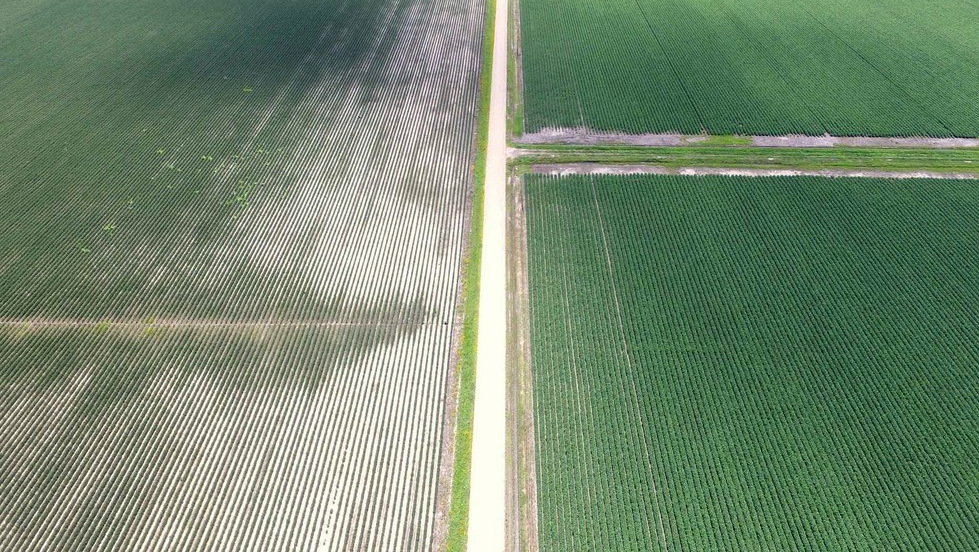
Aerial photo shows drift damage on non-dicamba resistant soybean field 
next to a dicamba resistant soybean field. (Kade McBroom via EcoWatch)

Less than a year in, however, Monsanto’s promises of a “drift-free” dicamba have failed to materialize, as complaints have flooded into state agricultural departments across the country. So far this year, regulators in major soybean-growing states in the U.S. have received nearly four years’ worth of complaints regarding dicamba-related crop damage. The issue has been especially pronounced in Arkansas, where 985 complaints have been filed over dicamba-related damage, representing the vast majority of the approximately 1,200 total cases currently being handled by the state.

The situation is so bad that Arkansas and Missouri, another hard-hit state, agreed on a 120-day ban on dicamba use within each state earlier this year in July. Arkansas is currently considering banning the herbicide entirely, effective April of next year. Monsanto, of course, is fighting back against the proposed ban.

Though the most drastically affected, Arkansas is hardly alone. As of mid-October, the number of state investigations nationwide examining dicamba-related complaints totaled 2,708.

Many state agricultural agencies are unable to cope with the increased load and have delayed other functions in attempts to address as many complaints as possible. “We don’t have the staff to be able to handle 400 investigations in a year plus do all the other required work,” Paul Bailey, director of the Plant Industries division of the Missouri Department of Agriculture, told Reuters.

Despite the clear problem presented by the herbicide, Monsanto’s net sales have suffered no decline — climbing 8 percent, or $1.1 billion, in 2017, in part due to increased sales of dicamba products. However, Monsanto has failed to address the issue, only hazily acknowledging the existence of farmer complaints.

“With significant adoption and a lot of interest in this new technology, we recognize that many states have received a number of reports of potential off-target application of dicamba in 2017,” Monsanto spokeswoman Charla Lord said last month, according to Reuters.

Monsanto bet big on paired herbicide and seeds


East Arkansas soybean farmer Reed Storey said half of his soybean crop has shown damage from dicamba, an herbicide that has drifted onto unprotected fields and spawned hundreds of complaints from farmers.
Given Monsanto’s lack of response to the growing problem of dicamba drift, and its aggressive marketing approach prior to the herbicide’s approval, critics have asserted that Monsanto likely released the dicamba-tolerant seeds ahead of time in order to increase the chances of the herbicide’s approval by artificially creating an urgent need for the weed killer.

Monsanto’s $1 billion investment in dicamba production before it was federally approved has also been cited as further evidence that the corporation sought to create dependency on its newest herbicide. Indeed now, with dicamba drift a major problem following the herbicide’s approval, some soybean farmers have chosen to purchase the dicamba-tolerant seeds from Monsanto as opposed to facing the risk of losing their entire crop to dicamba drift.

Monsanto is gambling on dicamba for several reasons, partly because there exists little scientific evidence linking it to adverse health effects in humans, though weak correlations between its use and increased incidence of lung and colon cancer have been found.

While it is set to replace the now increasingly ineffective and controversial glyphosate, the massive amount of damage dicamba has allegedly caused in just its first year may present an even greater problem to Monsanto’s profits than glyphosate ever did. It is already drastically affecting the bottom line of the national agricultural industry and pushing state regulators to their limits. Yet, if history is any indication, Monsanto will not part ways with its newly approved product without a fight.


Republish our stories! MintPress News is licensed under a Creative Commons Attribution -NonCommercial-ShareAlike 3.0 International License.