Friday, December 08, 2017

From Strength to Weakness: Russia Brokers End of Syria War, While Washington Fades into Background

Mideast Peacemaking is No Longer Made-in-America

by Sharmine Narwani - The American Conservative


December 8, 2017

The U.S. lost the military gamble in Syria; now it appears to be ceding its diplomatic edge, too.

As 2017 comes to a close, the warring parties in Syria are moving towards reconciliation—but the U.S. is not among them. The Islamic State is all but defeated, the Syrian Arab Army (SAA) and its allies are now closing in on the few remaining pockets occupied by other extremists, and Iranians, Russians, and Turks are mapping out the peace to come.


Iranian President Hassan Rouhani (L),
Russian President Vladimir Putin (C) and
Turkish President Recep Tayyip Erdogan (R)
shake hands prior to the Syria talks in Sochi.
Credit: CreartiveCommons/www.kremlin.ru.

Then there’s America. Donald Trump may have hinted at changes up his sleeve, but he’s treading the same tired path as his predecessor on Syria.

Determined to oust Syrian President Bashar al-Assad as a means to weaken Iran and re-establish U.S. regional hegemony, Barack Obama’s White House placed its bets on two pathways to this goal: 1) a military strategy to wrest control over Syria from the regime, and 2) a UN-sponsored and U.S.-backed mediation in Geneva to transition Assad out.

Washington lost its military gamble when the Russian air force entered the battle in September 2015, providing both game-changing air cover and international clout to Assad’s efforts.

So the U.S. turned its hand to resuscitating a limp Geneva peace process that might have delivered a Syrian political settlement sans Assad.

Instead, two years on, the tables have turned in this sphere, too. Today, it is the Iranians, Turks, and Russians leading reconciliation efforts in Syria through a process established in Astana and continued last week in Sochi—not Geneva. The three states have transformed the ground war by isolating key extremists, carving out ceasefire zones, and negotiating deals to keep the peace.

To nobody’s surprise, the Americans are neither part of this new initiative, nor have they offered any constructive counters. Meanwhile, the UN’s Geneva framework, after eight rounds of talks, has not once been able to bring the two Syrian sides face-to-face at the Big Table.

To illustrate, UN Special Envoy for Syria Staffan de Mistura, who leads these talks, now says things like this with a straight face: “We have started very close proximity parallel meetings. In fact, I have been shuttling between two rooms at a distance of five meters from each other.”

In short, the U.S.’s Syrian efforts have hit a brick wall, while new regional and international power brokers have stepped in to pick up the slack.

Geneva: A process designed to fail


Just one week ago, with great media fanfare, we were promised a fresh start and new twists in Syria. For the first time since the Geneva I conference launched in June 2012, we were told the opposition was “unified” and there were no “pre-conditions” that might hold up talks.

Those expectations were shattered almost immediately when various Syrian opposition members went off-message and insisted that “Assad must go” at some point during a future transition period. Unified they were not. And the Syrian government didn’t hide their disgust. They arrived a day late and scurried back to Damascus just as quickly.

And here is why Geneva negotiations will never, ever get off the ground.

Firstly, the “Syrian opposition” do not actually represent “the Syrian people.” Most of these individuals have been selected by foreign governments—until recently, mainly by U.S. allies in Riyadh, Doha, Ankara—to do their bidding in Geneva, and have been “elected” by no more than a few dozen other Syrians in foreign capitals.

UN envoy de Mistura didn’t bother to hide that fact last week when he thanked the Saudis for facilitating “the establishment of a unified opposition delegation.”

The UN-led process—like the U.S. administration—has created conditions that exclude Syria’s more independent and nationalistic domestic opposition from negotiations. These are people who have largely rejected foreign intervention and the militarization of the conflict, rail against Western-imposed sanctions, and signal actual readiness to talk to Assad’s government about the reforms they desire.

The Russians and Iranians have kept open channels to these individuals and groups, and many of them have beaten a path to Moscow over the years to strike compromises and seek solutions. A few even made the cut, for the first time, at this eighth round of Geneva talks.

Secondly, the Syrian opposition have lost the war—victors decide the peace, not the vanquished. The team sitting in Geneva seems oblivious to the fact that the Syrian government and its allies have now gained an almost-irreversible military advantage on the battlefield. These are not two parties on equal footing—and no great-power mentors in the world can change that fact.

Assad’s government has said on numerous occasions that it is willing to sit with any Syrian who comes without preconditions and negotiates in good faith. Years of “reconciliations” on the ground between the government, local citizens, NGOs, friendly foreign state-guarantors, and rebel fighters lend a proven track record to those claims. This is the format for future negotiations—it is a tested, homegrown Syrian solution, not one made-in-America-or-Riyadh.

“Ceasefires” struck in Astana


The breakthrough came in late 2016. Turkey, the main adversary state through which weapons and jihadists flowed into Syria, made a U-turn on its Syria strategy, driven by U.S. military support for Kurdish fighters in northern Syria, which Ankara views as a national security threat. Turkey’s President Recep Tayyip Erdogan began a tactical engagement with Russia and Iran, and pulled Qatar and its respective Syrian rebel allies along with him. These moves tipped the balance on the battlefield, allowing the SAA and its allies to liberate Aleppo (a turning point in the war) and launch their ultimately successful campaign against ISIS.

Shortly afterward, delegations consisting of the Syrian government and a dozen opposition rebel factions convened in Astana, Kazakhstan, for indirect talks sponsored by Turkey, Iran, and Russia.

By early May, the three countries had signed a memorandum to establish four “de-escalation zones” in rebel-occupied areas in Syria. The zones cover key hotspots in northern Homs, southern Syria, eastern Ghouta, and Idlib province, and are renewable at six-month intervals. While some armed groups have rejected the concept, the de-escalation zones have largely succeeded at halting hostilities and, importantly, have helped create separation between extremists and rebels willing to participate in ceasefires.

Furthermore, for the more than two million people believed to reside in these zones, the Astana process also guarantees humanitarian and medical access, the return of displaced persons to their towns and homes, the reconstruction of vital infrastructure, and other benefits.

In July, the U.S. and Jordan joined Russia to broker the details of the southern Syrian de-escalation zone, with a joint command established in Jordan. And in September, Iran, Russia, and Turkey agreed to implement the fourth and final de-escalation zone in Idlib, a stronghold of the al-Qaeda-affiliated al-Nusra terrorist group.

In short, within eight months, four key areas of Syria demilitarized under the watch of three countries: Turkey, a major supporter of Syrian opposition militants, and Iran and Russia, both close allies of the Syrian government.

A “political solution” in Sochi next?


Ceasefires are, incidentally, one of the two primary objectives of the Geneva process. They are the military part of a Syrian solution.

The other objective is the political settlement of the Syrian conflict, envisioned by Geneva’s architects as the establishment of a transitional government that would generate a revised constitution, prepare elections, and the like.

Last week, on the eve of Geneva-8, the three Astana sponsors convened in Sochi after an unexpected meeting there between Syrian President Bashar al-Assad and Russian President Vladimir Putin that appeared to signal an official Syrian approval for what came next.

In a joint statement, the presidents of Iran, Russia, and Turkey called for a “Syrian National Dialogue Congress” to be held in Sochi in the near future, consisting of the Syrian government and “the opposition that are committed to the sovereignty, independence, unity, territorial integrity and non-fractional character of the Syrian state.”

While they were careful to point out that the initiative is intended to “complement” Geneva, not act as an “alternative,” the statement also made clear that “Iran, Russia and Turkey will consult and agree on participants of the Congress.”

Will this be another rubber-stamped opposition directed by foreign mentors? An informed source says no, “any Syrian who does not exclude him or herself can participate.”

It is highly likely that hardliners and extremists will exclude themselves from the Sochi talks—they have consistently rejected direct interactions with the Syrian government and will never accept a future with Assad at the helm. Instead, Sochi is likely to draw interest from a larger cross-section of Syrian society closer to the views of Syria’s traditional domestic opposition, who were never given a chance in Geneva.

In the end, it is altogether conceivable that a final Syrian political solution will look very similar to the reforms Assad offered up in 2011 and 2012. His proposals were never given the time or space to mature and were, at the time, rejected outright by foreign governments and their Syrian allies.

But most importantly, if Sochi can finish what Geneva could never start, we will be thrust into a genuine post-American era where alternative regional actors will be able to broker globally significant peace deals.

The resolution of a conflict of this magnitude largely outside the umbrella of a UN- or U.S.-led framework breaks with the assumption that major geopolitical solutions need be made-in-America.

The most common refrain in a disgruntled Middle East today is that “Americans don’t solve conflicts, they manage them.”

Trump this week forever dispelled the notion that America is an honest mediator in Middle East peace efforts when he unilaterally recognized Jerusalem as Israel’s capital. It is not surprising that the Saudis, Jordanians, Qataris, Sudanese, Egyptians, and others are now beating a path to Moscow for some fresh thinking.

Sharmine Narwani is a commentator and analyst of Mideast geopolitics based in Beirut.

Disgrace: The Unlamented Demise and Departure of Frankenfingers

Franken Goes Down

by Manuel Garcia Jr. - Dissident Voice


December 8th, 2017

I find Al Franken’s greatest transgression to be his vote as a superdelegate (in the Dems’ July 2016 national convention) for H. Clinton (and thus for Wall Street and the neocons), instead of Bernie Sanders, who was favored by the voters of Franken’s state (Minnesota) in their Democratic Primary. When questioned about it he arrogantly stated that he knew better than the voters he was supposed to represent.

This was an anti-democratic transgression, a misuse of power he had over the regular citizens.

Entertaining troops (during the Iraq War) and pontificating over the radio waves (on Air America) could be transgressions against the public interest, in the sense of propaganda: efforts to influence the decisions of actual policymakers (pro Iraq War), and to influence support for those policies by a duped public. But, his collusion in Hillary’s anti-democratic, pro-corporate, anti-Bernie scheme was by use of actual political power, a procedural power he had because of his government office (senator, thus a Dem superdelegate).

That and his evident careerism evaporated any interest and sympathy I might have had for him.

I’m sure the Dems are dumping Franken solely out of concern to keep him from contaminating them with the “masher plague” now being so vociferously attacked by the #metoo crusaders. Aside from the usual cover-your-ass concern of any political hack, part of the Dems publicly moral indignation against surreptitious male sexist exploitation is undoubtedly an emotional outlet for the disappointed Hillary cultists who didn’t get their “first female president,” as well as a tactic by the party managers to maintain a sharply contrasting image for the Dem Party from that of the Republican Party, which is poised to elect an open pedophile to the Senate, from Alabama: Roy Moore, a real positive showcase for Southern hospitality and charm!

Even if Franken is replaced by a Republican, it won’t matter much since the Dems are in the minority anyway. The Democrats can never outdo the Republicans for being Neo-Nazi, Klanner, sexist (against women), homophobic, and pedophile-friendly, so the Dems will never gain political majorities by aping the Republicans in the appeal to the bigot legions. So, they will make a show of being “inclusive” and of displaying a moralistic politically correct intolerance, to attract the audiences repelled by the Republicans’ flagrant lack of morals.


Clearly, for both major parties, power is everything, and neither is concerned about appearing either “moral” or abysmally crude and base, if such a display helps them accumulate power by getting their partisans into political office.

Hillary never had a problem with defending Bill’s sexual predations (and persecuting his sexual victims), and winking at the exploits of Bill’s pervy pals (like Jeremy Epstein, and Donald Trump), nor hanging out with Harvey Weinstein, so long as the money came in to her “campaign fund;” and about 99% of the Republicans are now salivating on the floor in anticipation of Roy Moore swinging his dick around the Malls of Washington, D.C., and helping them gut Social Security, Medicare, Medicaid, so as to further punish the poor for being impoverished, and increase the ranks of the impoverished in order to satisfy the insatiable greed of the wealth-obsessed.

If the Dems had a one vote majority in the Senate I’ll bet Franken would have been scolded, sent to a plush rehab center for a month, and then declared rehabilitated and fit for duty. Power, money, career, with focus on one, and loyalty to none.

Manuel Garcia, Jr. is an occasional writer who is always independent. His e-mail address is: mangogarcia@att.net.
Read other articles by Manuel, or visit Manuel's website.

The previous comments were prompted by the following: Al Franken (comments on his resignation from the Senate) by William Blum

Ultimately, US Embassy Move Is About Palestinian Displacement

Unlike US Embassy, Palestinians Will Not Be Moved

by TRNN


December 7, 2017

As protests erupt over the US recognition of Jerusalem as Israel's capital, Dr. Mustafa Barghouti says Trump and Netanyahu won't succeed in displacing Palestinians from their homeland.


Mustafa Barghouti was born in Jerusalem, 1954. He is a leader of the Palestinian National Initiative, founded in 2002 and a member of Palestinian Legislative Council, former Minister of Information, unity government, March-June 2007. 

War By Other Memes: America's South Korean Sports Front

War Against Russia on the South Korean Front

by John Helmer - Dances with Bears


December 8, 2017

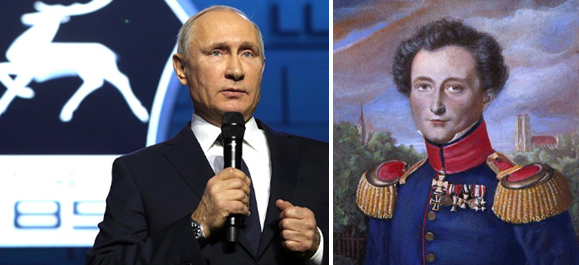
Moscow - Carl von Clausewitz, the 19th century German soldier and military strategist, famously remarked that war is the continuation of policy (politics) by other means.

By war, von Clausewitz meant the old-fashioned idea of running people through or making them run away, so they give up their territory, treasure, and women. By war these days there are fresh ways of running people through and grabbing treasure and women. There’s cyber warfare, which strikes at the enemy’s minds, not their bodies; sanctions, which are the modern form of siege warfare, starving the enemy of cash for food; and sports warfare, which means killing the most popular entertainment in the world. Olympic Games and World Cup football have replaced rape and rapine of olden times, at least in countries which regard themselves as civilized.

Since the US has been at war with Russia from 2014, the military junta in Washington has lost its campaign on the Syrian front. On the Ukraine front it has been so bogged down that Kiev has lost more treasure than it can hope to recover in a generation, or two. The US is also losing its military campaigns in Afghanistan, Iraq, Yemen and Libya. The escalation of military operations and sanctions war on the Korean front has achieved no American policy goals. Quite the opposite.

The first US sports war targeted the Sochi Winter Olympics in February 2014 – and that failed. The second sports war will be to disrupt the World Cup football, due in Russia between June 14 and July 15. The third offensive is the ban on the Russian team participating under their national flag at the Winter Olympics at Pyeongchang (pronounce “pong-chung”), South Korea. This ban, which also excludes officials of the state sports administration, was announced by the Executive Board of the International Olympic Committee (IOC) in Lausanne on December 5.

Read the OC announcement here. For the evidence on which the IOC Executive Board says it based its ban, click to open.

Since the Korean Winter Games are scheduled for February 9 to 25 next, the political impact in Russia will come before the World Cup. It will also come before the Russian presidential election, due on March 18. The Russian evidence indicates the IOC ban will backfire. The only Russian opinion poll to have been reported so far – a nationwide survey done on November 25-26, just before the IOC announcement — found that more half the population believes there has been a state programme for doping in sports; roughly equal numbers believe the government has done enough to stop it as believe that not enough has been done. But the popular Russian reaction to the IOC ban is as political as the ban itself. Almost 60% of Russians say they think Russian athletes should not compete without the Russian flag. For a summary, read this. For the detailed questions and answers, click.

Russian public opinion, like the views reported in the press from Russian Olympic athletes, believes that Russia has been singled out by the US and its European allies. They believe state doping programmes are conducted by other governments, including China. In the US Russians think that government support for sports is paid through universities, working hand in hand with the big corporations and media networks which pay for programmes of performance enhancement.

The IOC claims that it, “is a not-for-profit independent international organisation made up of volunteers, which is committed to building a better world through sport. It redistributes more than 90 per cent of its income to the wider sporting movement, which means that every day the equivalent of 3.4 million US dollars goes to help athletes and sports organisations at all levels around the world.”

In fact, and in the belief of most Russians, the IOC directs a multi-billion dollar business whose management is dominated by Americans and Europeans. That management operates in secret. So when the IOC board voted for the Russian ban at Pyeongchang, the discussion of the evidence, and of fitting the punishment to the crime, was conducted behind closed doors. The voting has been concealed.

Putin’s reaction to the Tuesday announcement from the IOC was to turn von Clausewitz on his head by playing politics as the continuation of war by other means.


Left: President Putin speaking on December 6 to workers at GAZ, 
a property owned by Oleg Deripaska. Right, General von Clausewitz.

Speaking to a meeting of autoworkers at their factory in Nizhny Novgorod, Putin said of the IOC ban:

“All of this looks like an absolutely staged and politically motivated decision. We can see it, and for me there is no doubt about it. We will certainly not declare any boycott. We will not prevent our Olympians from competing if they want to take part as individuals.” 

He means the Russian television audience will be able to watch the traditional Russian dominance of winter sports minus the national anthem and the flag.

The South Korean Government also issued a statement yesterday to mitigate the impact of the IOC decision by inviting Russian athletes to participate. “South Korea has called on Russian athletes to participate in the Winter Olympic Games in Pyeongchang under a neutral flag,” the state media reported from an announcement by the Ministry of Culture, Sports and Tourism in Seoul. The Ministry added that the Games should “be a good opportunity to further strengthen the traditional friendly relations between South Korea and Russia…We urge to take an active part [in the Games] athletes in winter sports from all over the world, including the Russian athletes.”

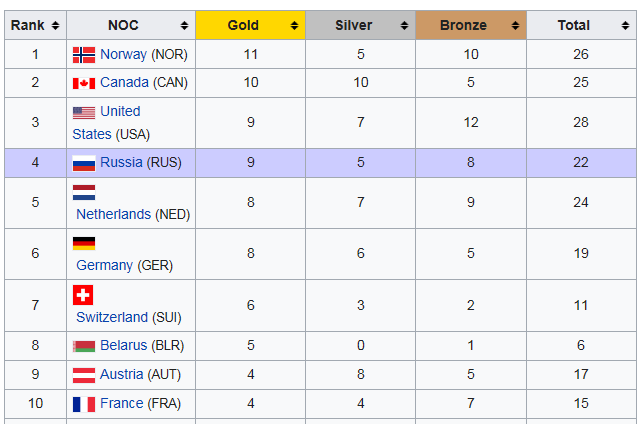
The IOC has also been re-examining doping control tests of Russian medal winners at Sochi. The focus has been less on finding evidence of banned performance-enhancing substances as evidence of tampering with doping control tests. The offences alleged against the Russians include raising salt levels to alter urine composition results, and scratches on the inside of urine sample bottles to indicate tampering. Through last month, a total of 11 Russian medals have been cancelled and their winners banned from future competitions. In the original Sochi results table, Russia ranked fourth after Norway, Canada and the US. Following the latest IOC disqualifications, Russia has dropped to seventh, equal with Switzerland.


The IOC’s proposal that Russians can still compete at the Korean games is a qualified one. According to the IOC announcement, “the IOC, at its absolute discretion, will ultimately determine the athletes to be invited from the list.” Exclusion of individual Russian athletes from the invitation list will not be explained, nor will those excluded have the right to examine the evidence against them, test it in court, or appeal.


The IOC Executive Board reported its decision against Russia here. 
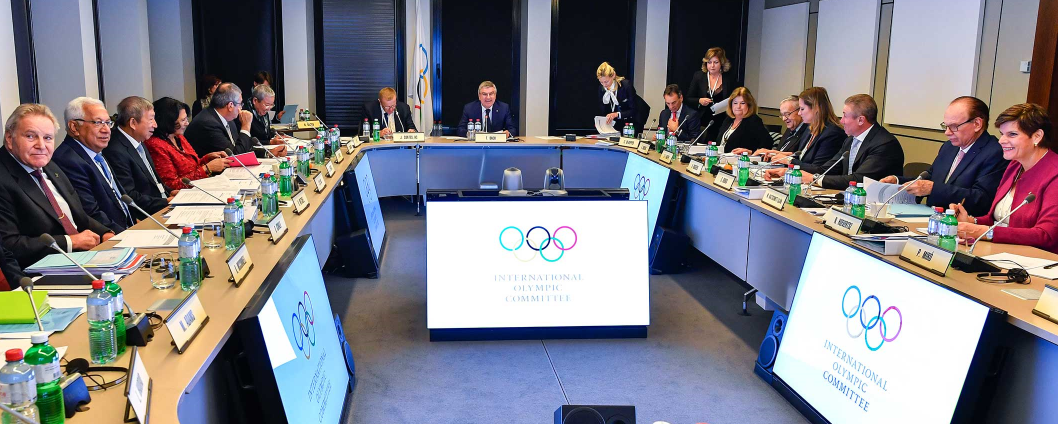
The organization does not report how the members present at the 
December 5 session voted.

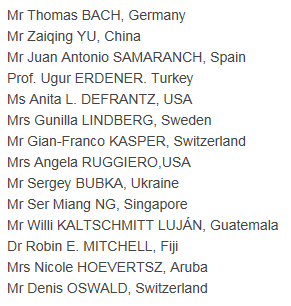
The 14 members of the IOC Executive Board are listed here. There are two Americans; five representing NATO member states, six if the Aruba member is regarded as a substitute for The Netherlands, the former colonial ruler of the Caribbean island. Counting the representatives from Singapore, Guatemala and Ukraine as members of US military defence and arms supply pacts, and the two Swiss and one Swede as representing countries taking Kiev’s side in the present war against Moscow, the IOC board is stacked 12 to 2 against Russia – 12 to 1 if Fiji follows US direction, as it usually does.

EXECUTIVE BOARD OF THE INTERNATIONAL OLYMPIC COMMITTEE

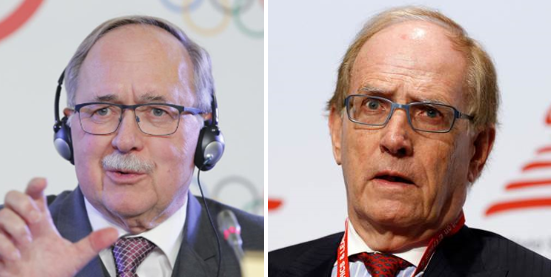
The board members are also not obliged to pass bodily samples into sealed bottles in order be tested for political prejudice. Instead, they announced that they voted in reliance on a report by former Swiss President Samuel Schmid. Schmid makes the claim that his investigation of the Russians provided the athletes and state officials with “due process”. In fact, he concedes “it was decided to reverse the rule of ‘presumption of innocence’ for the Russian athletes.” That meant they were obliged to prove to the IOC they were not guilty of doping or tampering offences.

The evidence accepted by the IOC including computer simulations of sample tampering, as well as hearsay reported in the press. The report of one of the IOC’s expert consultants, Richard McLaren, was qualified in the Schmid report as not “evidence of a level [of] being able to stand legal challenges in Court.”


Left, Samuel Schmid; right, Richard McClaren.

According to Schmid, his group “has no investigation power similar to the one of the Law Enforcement Agencies. Thus it is dependent on the information available in the public domain, the elements published by the IP [Independent Person appointed by the World Anti-Doping Agency, Richard McClaren] and the information shared voluntarily by the persons concerned.”

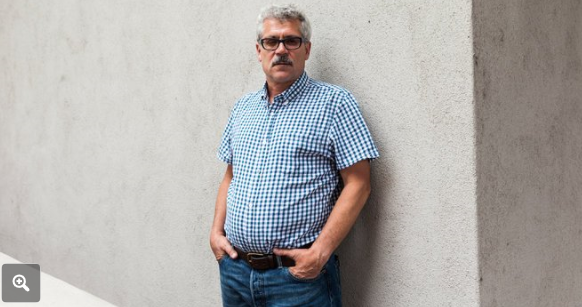
The most important of these “persons concerned” was Grigory Rodchenkov, the former head of a Moscow testing laboratory, who defected to the US in November 2015, and has been testifying as a salaried US Government source in a witness protection programme operated by the Federal Bureau of Investigation. Most of the email evidence on which Schmid relied for substantiating Russian government participation in the doping programmes came from emails Rodchenkov provided from his computer.

Rodchenkov’s importance was identified by the World Anti-Doping Agency (WADA) report issued in November 2015. Repeated in the Schmid report, when it was handed to the IOC Executive Board this month, WADA said “one of the major actors identified was Dr Grigory Rodchenkov, director of the Moscow Laboratory; he was at the heart of doping activities and of the positive drug tests cover-up; he had direct access within the Ministry of Sport to request funds for the laboratory equipment. The [WADA] Report showed that in his position he was not only accepting but also requesting money in order to execute the concealment of positive tests of Russian athletics athletes.”

A year after he became a US Government informant, Rodchenkov was reported in the New York Times as making detailed allegations of doping and doping concealment by the Russian government.


Grigory Rodchenkov in the New York Times, May 12, 2016:  

The newspaper reported that after Rodchenkov had been named as culpable in doping by the WADA report of November 2015,

“Russian officials forced him to resign. Fearing for his safety, he moved to Los Angeles…In his six months in Los Angeles, Dr. Rodchenkov has taken on a more active role in that documentary, ‘Icarus,’ to be released in September. He has otherwise spent his time gardening, making borscht and writing in his diary. Reflecting on his career, he said he was unapologetic about his role in Russia’s doping program, considering it a condition of his employment. To receive funding and support for his lab, he said, he had to do the Kremlin’s bidding.”

There was no reference by the New York Times to US Government payments to Rodchenkov, or to his place in the FBI’s witness protection programme.

According to the Schmid report, on May 19, 2016, WADA appointed “Prof Richard McClaren as an Independent Person (IP) to analyse these new [New York Times] allegations, as well as the evidence provided by Dr Grigory Rodchenkov.” McClaren is a Canadian law professor. Russian prosecutors later reported their investigations did not substantiate McClaren’s and Rodchenkov’s claims.

The Schmid report quoted Putin as saying in March of this year:

“In Russia there has never been, and, I hope, will never be a State-doping support system. On the contrary, there will only be anti-doping actions.” 


Schmid reported that Putin had also said “our anti-doping system failed, it is our fault, and we should admit it.” Schmid conceded that his recommendations to the IOC board followed after the Kremlin-ordered clean-up of the state sports administration was well under way.

The IOC has acted several times in the past to ban countries from sending teams to the Olympic Games; for this history, click to read. The extent to which Russia has been the target of anti-doping investigations in the past three years is unprecedented, however. No other country has been investigated to the same extent, and no other country charged with state-supported doping violations and manipulation of test results. Without the defection of Rodchenkov to the US, this would not have been possible. No comparable defector from another country has turned up.


“We must come right out and say that we’re partly to blame here, because we gave them the pretext for this,” Putin admitted this week, addressing the IOC ban.

But the punishment doesn’t fit the crime, he added. The IOC had “used this pretext in not the most honest way [because] no legal system in the world practices collective punishment.”

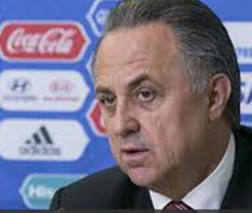
In the State Duma, a Communist Party deputy announced that he has filed suit in a Moscow court charging Deputy Prime Minister and Minister of Sports, Vitaly Mutko (above), for failing in his duties.

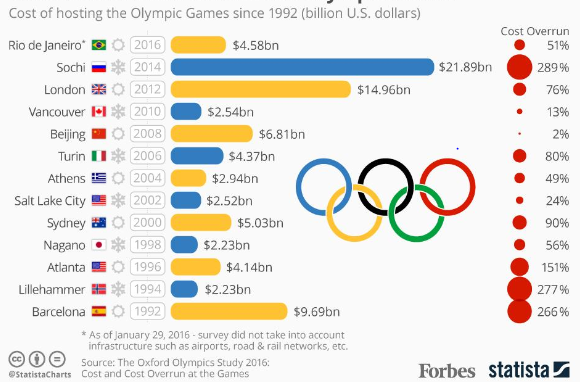
Russian analysis of corruption in sports has followed western investigations of the ballooning of costs for the Olympic Games, the largest of which, so far, has been the Sochi Winter Games of February 2014.


According to the Russian interpretations, and also to reports from Greece, the financial incentives driving the selection of Olympics Games sites and the doping programmes to assure victory in events started with the US Government’s efforts to assure that Atlanta won the Summer Games of 1996. The money spent on the Atlanta bid, led by the Coca Cola corporation, prevented Greece from hosting the centennial Olympic Games, as it had the first Games in 1896. At the time of the contest for IOC votes, the US Government was also aiming to topple the Greek government of Andreas Papandreou.

For more discussion of the politics behind the IOC ban, listen to today’s (Dec. 7, 2017) interview on Gorilla Radio from Victoria, British Columbia, here.


Gorilla Radio is broadcast every Thursday by Chris Cook on CFUV 101.9 FM from the University of Victoria, British Columbia. The radio station can be heard here. The Gorilla Radio transcripts are also published by the Pacific Free Press. For Chris Cook’s broadcast archive, click to open.

Thursday, December 07, 2017

Getting Past the Gatekeepers: Municipal Networks Point Way to Connectivity Paradise

Net Neutrality is just for starters: municipal networks are the path to paradise: North Carolina's Gigabit City

by Cory Doctorow - BoingBoing.net


November 29, 2017

We just bought a house here in Burbank and I was delighted to learn that my new home office -- part of a business incorporated in the state of California -- would be sitting directly on one of the scorching-fast fiber optic lines that the city of Burbank maintains to wire up Disney, Warner's and the other major businesses in town.

Finally, an end to my long nightmare of slow, balky internet from Charter/Spectrum, my local cable monopolist!

Then I called up the city and my dreams were smashed. The city's agreement with the cable monopoly prohibits them from connecting me to that fat, gigabit pipe, because my incorporated business is sited in a property that is zoned for residential use, and every residence in Burbank has four internet choices: Charter, AT&T, wireless, or two Dixie cups and a piece of string.

Writing in Wired, Net Neutrality superhero Susan Crawford tells the tale of those rare, Utopic American towns where the city government has not sold the populace's digital future to an incumbent. Towns like Wilson, North Carolina, where the city's fiber system offers symmetrical 50mbps service for $40/month. If you move to a house that's not currently on the fiber loop, the city pulls a piece of fiber to you.

Wilson's network is available to all comers. If you have bad credit or no credit, you just leave $10 on deposit and they'll give you access for $1.15/day. To unlimited, unfiltered, 50mbps service. People who live in housing projects get their service for $10/month. 50mbps, symmetrical.

To sign up, you make a phone call. To switch plans, you call the same automated system. No hard sells, no upsells, no legendary "Comcast customer service excellence."

Wilson did this to make life easier for new customers, or for customers who want to avoid signing up for a full month of service.

“It removes barriers to access and puts the customer in control,” says Will Aycock, the manager of Wilson’s Greenlight fiber service. 

The $1.15 is the prorated, per-day amount for Wilson’s regular monthly service—$39.95 for internet access alone. No data caps. When I asked Aycock why other internet access companies don’t provide an equivalent product, he was stumped. “I have no idea,” he said.

Wilson’s prepay program isn’t the only step Wilson has taken to reach more of its citizens with fiber. Though the city’s Greenlight fiber service is already connected to about 40 percent of the units in the town, it hasn’t—like the unregulated private fiber providers in the US—decided to deny fiber to some parts of the city. If you move to a place in Wilson that doesn’t have fiber, all you have to do is call and ask for service. Greenlight will install it for you for free.

Even more dramatically, if you’re in public housing or an apartment building in Wilson, in exchange for $10 per month added to your rent check you can get 50 Mbps symmetrical fiber internet access service. Wilson does this because it is in the city’s interest to provide service to the most people it can at the most reasonable cost. And about 50 percent of public housing residents are signing up.

AJIT PAI'S SHELL GAME [Susan Crawford/Wired]

Cold War II: Still Chilly After All These Years

Cold War Number One: 70 Years of Daily National Stupidity; Cold War Number Two: Still in Its Youth, But Just as Stupid

by William Blum - CounterPunch

 
December 7, 2017  

“He said he absolutely did not meddle in our election. He did not do what they are saying he did.”
– President Trump, re Vladimir Putin after their meeting in Vietnam. 


Putin later added that he knew “absolutely nothing” about Russian contacts with Trump campaign officials. “They can do what they want, looking for some sensation. But there are no sensations.”

Numerous US intelligence agencies have said otherwise. Former Director of National Intelligence, James Clapper, responded to Trump’s remarks by declaring:

“The president was given clear and indisputable evidence that Russia interfered in the election.”

Photo by Nathaniel St. Clair

As we’ll see below, there isn’t too much of the “clear and indisputable” stuff. And this of course is the same James Clapper who made an admittedly false statement to Congress in March 2013, when he responded, “No, sir” and “not wittingly” to a question about whether the National Security Agency was collecting “any type of data at all” on millions of Americans. Lies don’t usually come in any size larger than that.

Virtually every member of Congress who has publicly stated a position on the issue has criticized Russia for interfering in the 2016 American presidential election. And it would be very difficult to find a member of the mainstream media which has questioned this thesis.

What is the poor consumer of news to make of these gross contradictions? Here are some things to keep in mind:

How do we know that the tweets and advertisements “sent by Russians” -– those presented as attempts to sway the vote -– were actually sent by Russians? The Veteran Intelligence Professionals for Sanity (VIPS), composed of National Security Agency and CIA veterans, recently declared that the CIA knows how to disguise the origin of emails and tweets. The Washington Post has as well reported that Twitter “makes it easy for users to hide their true identities.” Even if these communications were actually sent from Russia, how do we know that they came from the Russian government, and not from any of the other 144.3 million residents of Russia?

Even if they were sent by the Russian government, we have to ask: Why would they do that? Do the Russians think the United States is a Third World, under-developed, backward Banana Republic easily influenced and moved by a bunch of simple condemnations of the plight of blacks in America and the Clinton “dynasty”? Or clichéd statements about other controversial issues, such as gun rights and immigration? If so, many Democratic and Republican officials would love to know the secret of the Russians’ method. Consider also that Facebook has stated that 90 percent of the alleged-Russian-bought content that ran on its network did not even mention Trump or Clinton.

On top of all this is the complete absence of even the charge, much less with any supporting evidence, of Russian interference in the actual voting or counting of votes.

After his remark suggesting he believed Putin’s assertion that there had been no Russian meddling in the election, Trump – of course, as usual – attempted to backtrack and distant himself from his words after drawing criticism at home; while James Clapper declared:

“The fact the president of the United States would take Putin at his word over that of the intelligence community is quite simply unconscionable.”

Given Clapper’s large-size lie referred to above, can Trump be faulted for being skeptical of the intelligence community’s Holy Writ? Purposeful lies of the intelligence community during the first Cold War were legendary, many hailed as brilliant tactics when later revealed. The CIA, for example, had phony articles and editorials planted in foreign newspapers (real Fake News), made sex films of target subjects caught in flagrante delicto who had been lured to Agency safe houses by female agents, had Communist embassy personnel expelled because of phony CIA documents, and much more.

The Post recently published an article entitled “How did Russian trolls get into your Facebook feed? Silicon Valley made it easy.” In the midst of this “exposé,” The Post stated: “There’s no way to tell if you personally saw a Russian post or tweet.” So … Do the Cold Warriors have a case to make or do they not? Or do they just want us to remember that the Russkis are bad? So it goes.

An organization in Czechoslovakia with the self-appointed name of European Values has produced a lengthy report entitled “The Kremlin’s Platform for ‘Useful Idiots’ in the West: An Overview of RT’s Editorial Strategy and Evidence of Impact”. It includes a long list of people who have appeared on the Russian-owned TV station RT (formerly Russia Today), which can be seen in the US, the UK and other countries. Those who’ve been guests on RT are the “idiots” useful to Moscow. (The list is not complete. I’ve been on RT about five times, but I’m not listed. Where is my Idiot Badge?)

RT’s YouTube channel has more than two million followers and claims to be the “most-watched news network” on the video site. Its Facebook page has more than 4 million likes and followers. Can this explain why the powers-that-be forget about a thing called freedom-of-speech and treat the station like an enemy? The US government recently forced RT America to register as a foreign agent and has cut off the station’s Congressional press credentials.

The Cold War strategist, George Kennan, wrote prophetically:

“Were the Soviet Union to sink tomorrow under the waters of the ocean, the American military-industrial establishment would have to go on, substantially unchanged, until some other adversary could be invented. Anything else would be an unacceptable shock to the American economy.”

Writer John Wight has described the new Cold War as being “in response to Russia’s recovery from the demise of the Soviet Union and the failed attempt to turn the country into a wholly owned subsidiary of Washington via the imposition of free market economic shock treatment thereafter.”

So let’s see what other brilliance the New Cold War brings us. … Ah yes, another headline in the Post (November 18, 2017):

“British alarm rising over possible Russian meddling in Brexit”.
Of course, why else would the British people have voted to leave the European Union? But wait a moment, again, one of the British researchers behind the report “said that the accounts they analyzed – which claimed Russian as their language when they were set up but tweeted in English – posted a mixture of pro-‘leave’ and pro-‘remain’ messages regarding Brexit. Commentators have said that the goal may simply have been to sow discord and division in society.”

Was there ever a time when the Post would have been embarrassed to be so openly, amateurishly biased about Russia? Perhaps during the few years between the two Cold Wars.

In case you don’t remember how stupid Cold War Number One was …

+ 1948: ThePittsburgh Press published the names, addresses, and places of employment of about 1,000 citizens who had signed presidential-nominating petitions for former Vice President Henry Wallace, running under the Progressive Party. This, and a number of other lists of “communists”, published in the mainstream media, resulted in people losing their jobs, being expelled from unions, having their children abused, being denied state welfare benefits, and suffering various other punishments.

+ Around 1950: The House Committee on Un-American Activities published a pamphlet, “100 Things You Should Know About Communism in the U.S.A.” This included information about what a communist takeover of the United States would mean:

Q: What would happen to my insurance?

A: It would go to the Communists.

Q: Would communism give me something better than I have now?

A: Not unless you are in a penitentiary serving a life sentence at hard labor.

+ 1950s: Mrs. Ada White, member of the Indiana State Textbook Commission, believed that Robin Hood was a Communist and urged that books that told the Robin Hood story be banned from Indiana schools.

+ As evidence that anti-communist mania was not limited to the lunatic fringe or conservative newspaper publishers, here is Clark Kerr, president of the University of California at Berkeley in a 1959 speech: “Perhaps 2 or even 20 million people have been killed in China by the new [communist] regime.” One person wrote to Kerr: “I am wondering how you would judge a person who estimates the age of a passerby on the street as being ‘perhaps 2 or even 20 years old.’ Or what would you think of a physician who tells you to take ‘perhaps 2 or even twenty teaspoonsful of a remedy’?”

+ Throughout the cold war, traffic in phony Lenin quotes was brisk, each one passed around from one publication or speaker to another for years. Here’s U. S. News and World Report in 1958 demonstrating communist duplicity by quoting Lenin: “Promises are like pie crusts, made to be broken.” Secretary of State John Foster Dulles used it in a speech shortly afterward, one of many to do so during the cold war. Lenin actually did use a very similar line, but he explicitly stated that he was quoting an English proverb (it comes from Jonathan Swift) and his purpose was to show the unreliability of the bourgeoisie, not of communists.

“First we will take Eastern Europe, then the masses of Asia, then we will encircle the United States, which will be the last bastion of capitalism. We will not have to attack. It will fall like an overripe fruit into our hands.”  

This Lenin “quotation” had the usual wide circulation, even winding up in the Congressional Record in 1962. This was not simply a careless attribution; this was an out-and-out fabrication; an extensive search, including by the Library of Congress and the United States Information Agency failed to find its origin.

+ A favorite theme of the anti-communists was that a principal force behind drug trafficking was a communist plot to demoralize the United States. Here’s a small sample:

Don Keller, District Attorney for San Diego County, California in 1953: “We know that more heroin is being produced south of the border than ever before and we are beginning to hear stories of financial backing by big shot Communists operating out of Mexico City.”

Henry Giordano, Commissioner of the Federal Bureau of Narcotics, 1964, interviewed in the American

Legion Magazine: Interviewer: “I’ve been told that the communists are trying to flood our country with narcotics to weaken our moral and physical stamina. Is that true?”

Giordano: “As far as the drugs are concerned, it’s true. There’s a terrific flow of drugs coming out of Yunnan Province of China. … There’s no question that in that particular area this is the aim of the Red Chinese. It should be apparent that if you could addict a population you would degrade a nation’s moral fiber.”

Fulton Lewis, Jr., prominent conservative radio broadcaster and newspaper columnist, 1965: “Narcotics of Cuban origin – marijuana, cocaine, opium, and heroin – are now peddled in big cities and tiny hamlets throughout this country. Several Cubans arrested by the Los Angeles police have boasted they are communists.”

We were also told that along with drugs another tool of the commies to undermine America’s spirit was fluoridation of the water.

+ Mickey Spillane was one of the most successful writers of the 1950s, selling millions of his anti-communist thriller mysteries. Here is his hero, Mike Hammer, in “One Lonely Night”, boasting of his delight in the grisly murders he commits, all in the name of destroying a communist plot to steal atomic secrets. After a night of carnage, the triumphant Hammer gloats, “I shot them in cold blood and enjoyed every minute of it. I pumped slugs into the nastiest bunch of bastards you ever saw. … They were Commies. … Pretty soon what’s left of Russia and the slime that breeds there won’t be worth mentioning and I’m glad because I had a part in the killing. God, but it was fun!”

+ 1952: A campaign against the United Nations Educational, Scientific and Cultural Organization (UNESCO) because it was tainted with “atheism and communism”, and was “subversive” because it preached internationalism. Any attempt to introduce an international point of view in the schools was seen as undermining patriotism and loyalty to the United States. A bill in the US Senate, clearly aimed at UNESCO, called for a ban on the funding of “any international agency that directly or indirectly promoted one-world government or world citizenship.” There was also opposition to UNESCO’s association with the UN Declaration of Human Rights on the grounds that it was trying to replace the American Bill of Rights with a less liberty-giving covenant of human rights.

+ 1955: A US Army 6-page pamphlet, “How to Spot a Communist”, informed us that a communist could be spotted by his predisposition to discuss civil rights, racial and religious discrimination, the immigration laws, anti-subversive legislation, curbs on unions, and peace. Good Americans were advised to keep their ears stretched for such give-away terms as “chauvinism”, “book-burning”, “colonialism”, “demagogy”, “witch hunt”, “reactionary”, “progressive”, and “exploitation”. Another “distinguishing mark” of “Communist language” was a “preference for long sentences.” After some ridicule, the Army rescinded the pamphlet.

+ 1958: The noted sportscaster Bill Stern (one of the heroes of my innocent youth) observed on the radio that the lack of interest in “big time” football at New York University, City College of New York, Chicago, and Harvard “is due to the widespread acceptance of Communism at the universities.”

+ 1960: US General Thomas Power speaking about nuclear war or a first strike by the US: “The whole idea is tokill the bastards! At the end of the war, if there are two Americans and one Russian, we win!” The response from one of those present was: “Well, you’d better make sure that they’re a man and a woman.”

+ 1966: The Boys Club of America is of course wholesome and patriotic. Imagine their horror when they were confused with the Dubois Clubs. (W.E.B. Du Bois had been a very prominent civil rights activist.) When the Justice Department required the DuBois Clubs to register as a Communist front group, good loyal Americans knew what to do. They called up the Boys Club to announce that they would no longer contribute any money, or to threaten violence against them; and sure enough an explosion damaged the national headquarters of the youth group in San Francisco. Then former Vice President Richard Nixon, who was national board chairman of the Boys Club, declared: “This is an almost classic example of Communist deception and duplicity. The ‘DuBois Clubs’ are not unaware of the confusion they are causing among our supporters and among many other good citizens.”

+ 1966: “Rhythm, Riots and Revolution: An Analysis of the Communist Use of Music, The Communist Master Music Plan”, by David A. Noebel, published by Christian Crusade Publications, (expanded version of 1965 pamphlet: “Communism, Hypnotism and the Beatles”). Some chapters: Communist Use of Mind Warfare … Nature of Red Record Companies … Destructive Nature of Beatle Music … Communist Subversion of Folk Music … Folk Music and the Negro Revolution … Folk Music and the College Revolution

+ 1968: William Calley, US Army Lieutenant, charged with overseeing the massacre of more than 100 Vietnamese civilians in My Lai in 1968, said some years later: “In all my years in the Army I was never taught that communists were human beings. We were there to kill ideology carried by – I don’t know – pawns, blobs, pieces of flesh. I was there to destroy communism. We never conceived of old people, men, women, children, babies.”

+ 1977: Scientists theorized that the earth’s protective ozone layer was being damaged by synthetic chemicals called chlorofluorocarbons. The manufacturers and users of CFCs were not happy. They made life difficult for the lead scientist. The president of one aerosol manufacturing firm suggested that criticism of CFCs was “orchestrated by the Ministry of Disinformation of the KGB.”

+ 1978: Life inside a California youth camp of the ultra anti-communist John Birch Society: Five hours each day of lectures on communism, Americanism and “The Conspiracy”; campers learned that the Soviet government had created a famine and spread a virus to kill a large number of citizens and make the rest of them more manageable; the famine led starving adults to eat their children; communist guerrillas in Southeast Asia jammed chopsticks into children’s ears, piercing their eardrums; American movies are all under the control of the Communists; the theme is always that capitalism is no better than communism; you can’t find a dictionary now that isn’t under communist influence; the communists are also taking over the Bibles.

+ The Reagan administration declared that the Russians were spraying toxic chemicals over Laos, Cambodia and Afghanistan – the so-called “yellow rain” – and had caused more than ten thousand deaths by 1982 alone, (including, in Afghanistan, 3,042 deaths attributed to 47 separate incidents between the summer of 1979 and the summer of 1981, so precise was the information). Secretary of State Alexander Haig was a prime dispenser of such stories, and President Reagan himself denounced the Soviet Union thusly more than 15 times in documents and speeches. The “yellow rain”, it turned out, was pollen-laden feces dropped by huge swarms of honeybees flying far overhead.

+ 1982: In commenting about sexual harassment in the Army, General John Crosby stated that the Army doesn’t care about soldiers’ social lives – “The basic purpose of the United States Army is to kill Russians,” he said.

+ 1983: The US invasion of Grenada, the home of the Cuban ambassador is damaged and looted by American soldiers; on one wall is written “AA”, symbol of the 82nd Airborne Division; beside it the message: “Eat shit, commie faggot.” … “I want to fuck communism out of this little island,” says a marine, “and fuck it right back to Moscow.”

+ 1984: During a sound check just before his weekly broadcast, President Reagan spoke these words into the microphone: “My fellow Americans, I am pleased to tell you I have signed legislation to outlaw Russia, forever. We begin bombing in five minutes.” His words were picked up by at least two radio networks.

+ 1985: October 29 BBC interview with Ronald Reagan: asked about the differences he saw between the US and Russia, the president replied: “I’m no linguist, but I’ve been told that in the Russian language there isn’t even a word for freedom.” (The word is “svoboda”.)

+ 1986: Soviet artists and cultural officials criticized Rambo-like American films as an expression of “anti-Russian phobia even more pathological than in the days of McCarthyism”. Russian film-maker Stanislav Rostofsky claimed that on one visit to an American school “a young girl trembled with fury when she heard I was from the Soviet Union, and said she hated Russians.”

+ 1986: Roy Cohn, who achieved considerable fame and notoriety in the 1950s as an assistant to the communist-witch-hunting Senator Joseph McCarthy, died, reportedly of AIDS. Cohn, though homosexual, had denied that he was and had denounced such rumors as communist smears.

+1986: After American journalist Nicholas Daniloff was arrested in Moscow for “spying” and held in custody for two weeks, New York Mayor Edward Koch sent a group of 10 visiting Soviet students storming out of City Hall in fury. “The Soviet government is the pits,” said Koch, visibly shocking the students, ranging in age from 10 to 18 years. One 14-year-old student was so outraged he declared: “I don’t want to stay in this house. I want to go to the bus and go far away from this place. The mayor is very rude. We never had a worse welcome anywhere.” As matters turned out, it appeared that Daniloff had not been completely pure when it came to his news gathering.

+ 1989: After the infamous Chinese crackdown on dissenters in Tiananmen Square in June, the US news media was replete with reports that the governments of Nicaragua, Vietnam and Cuba had expressed their support of the Chinese leadership. Said the Wall Street Journal: “Nicaragua, with Cuba and Vietnam, constituted the only countries in the world to approve the Chinese Communists’ slaughter of the students in Tiananmen Square.” But it was all someone’s fabrication; no such support had been expressed by any of the three governments. At that time, as now, there were few, if any, organizations other than the CIA which could manipulate major Western media in such a manner.

NOTE: It should be remembered that the worst consequences of anti-communism were not those discussed above. The worst consequences, the ultra-criminal consequences, were the abominable death, destruction, and violation of human rights that we know under various names: Vietnam, Chile, Korea, Guatemala, Cambodia, Indonesia, Brazil, Greece, Afghanistan, El Salvador, and many others.
  
William Blum is the author of Killing Hope: U.S. Military and CIA Interventions Since World War II, Rogue State: a guide to the World’s Only Super Power . His latest book is: America’s Deadliest Export: Democracy. He can be reached at: BBlum6@aol.com
More articles by:William Blum

Brexit? Obviously the Russians!

Brexit? Obviously the Russians!

by bbc


SuperChill: 'The Force'

The Force

via BoingBoing.net

December 7, 2017

John D. Boswell, aka melodysheep, is using the force for good in The Force, his musical tribute to Princess Leia. 


A superchill tribute to Carrie Fisher, the galaxy's favorite princess. Rest in Peace.

Previously: Remix master Melodysheep's latest visits the Wizard of Oz

Tuesday, December 05, 2017

Gorilla Radio with Chris Cook, John Helmer, Cory Doctorow, Janine Bandcroft Dec. 7, 2017

This Week on GR

by C. L. Cook - Gorilla-Radio.com


December 7, 2017

It became official this week; the International Olympic Committee says Russia will not be welcome at the upcoming Winter Games.

This ostensibly due to what the IOC says was a widespread, and official, policy of performance enhancing drugs using, or doping.

But, is that all there is to this story?

The Russian government denies any such policy, saying the IOC is being used as an extension of Western efforts to isolate it, and to embarrass President Putin in the run-up to March elections.

But is there still more going on here?


Listen. Hear.

John Helmer is a long-time, Moscow-based journalist, author, and essayist whose website, Dances with Bears is the only news bureau “independent of single national or commercial ties.” He’s also a former political science professor who has served as an advisor to governments on three continents and regularly lectures on Russian topics. Helmer’s book titles include: ‘Uncovering Russia,’ ‘Urbanman: The Psychology of Urban Survival,’ ‘Bringing the War Home: The American Soldier in Vietnam and After,’ and ‘Drugs and Minority Oppression’ among others.

John Helmer in the first half.


And; the clock is ticking on efforts in the United States to stop again the once-defeated attempt to kill Net Neutrality, the principle deeming Internet service providers treat all data equally. Next week, the Federal Communications Commission is scheduled to vote whether or not to end the rules protecting that neutrality.

Despite broad-based opposition to the move from public interest advocacy groups, and some of the Internet's most prominent corporate players, *FCC chairman, Ajit Pai is standing pat on his declaration the rules are not necessary to protect users from what critics charge are the monopolistic tendencies of Big Data broadband providers.

Cory Doctorow is a science fiction author, activist, journalist, blogger, co-editor of BoingBoing.net, and former European director of the Electronic Frontier Foundation. While still working with EFF, he's also a MIT Media Lab Research Affiliate, and Visiting Professor of Computer Science at Open University. The Canadian-born Doctorow co-founded the UK Open Rights Group, and currently resides in the United States.

Some of his book titles include: 'Walkaway', a novel for adults, the graphic novel, 'In Real Life', and 'Information Doesn't Want to be Free', a book about earning a living in the Internet age. His Young Adult novels, 'Little Brother' and it's sequel 'Homeland' were New York Times Bestsellers, and join 'Pirate Cinema', 'Rapture of the Nerds', and 'Makers'.

Cory Doctorow and once again into the breach for Net Neutrality in the second half.


And; Victoria-based activist and CFUV Radio broadcaster at-large, Janine Bandcroft will join us at the bottom of the hour with the Left Coast Events bulletin of good things to do in and around our town in the coming week. But first, John Helmer and stone cold political Olympic games.

Chris Cook hosts Gorilla Radio, airing live every Thursday between 11-Noon Pacific Time. In Victoria at 101.9FM, and on the internet at: http://cfuv.uvic.ca.  He also serves as a contributing editor to the web news site, http://www.pacificfreepress.com. Check out the GR blog at: http://gorillaradioblog.blogspot.ca/

*Ajit Pai addressed the exclusive Telecommunications and Media Forum put on by the London-based International Institute of Communications Tuesday December 5th, controversially held at a Verizon, Pai's former employer, building. His comments were held secret, as per the Forum's invocation of the so-called 'Chatham House Rules' until outrage forced the FCC to release a transcript of his remarks. Republished here at Inverse Culture. 

Monday, December 04, 2017

Kushner Moving Trump Towards Jerusalem Recognition

Kushner Sets Stage for Trump's Jerusalem Decision

by AFP


December 4, 2017

US President Donald Trump is close to a decision on whether to recognise Jerusalem as Israel's capital, his son-in-law and Middle East peace envoy Jared Kushner said yesterday.

Palestinian leaders are lobbying desperately against such a move, which the Arab League chief Ahmed Abul Gheit said would boost fanaticism and violence while sinking hopes for peace.

But Kushner, the 36-year-old head of a small and tight-knit White House negotiating team, made a rare public appearance to put an optimistic face on his efforts.


Photo: EPA

"The president's going to make his decision," Kushner told the Saban Forum, choosing not to deny reports Trump will declare Jerusalem Israel's capital on Wednesday.

"He's still looking at a lot of different facts and when he makes his decision, he'll be the one who wants to tell you. So he'll make sure he does that at the right time."

Today, Trump must decide whether to sign a legal waiver that would delay plans to move the US embassy from Tel Aviv to Jerusalem for another six months.

[See AFP source for full article here.]

Honduras: Election Embarrassment for OAS

Honduras Election: One of the Worst Elections in Recent Memory

by TRNN


December 1, 2017

Evidence is mounting that the Honduran presidential election is being stolen so that the conservative incumbent, President Juan Orlando Hernandez, remains in office. According to CEPR's Mark Weisbrot, the lack of credible elections in Honduras is a direct result of the 2009 military coup, which was aided by the US government, that put the National Party in power.


Mark Weisbrot is Co-Director of the Center for Economic and Policy Research in Washington, D.C. He received his Ph.D. in economics from the University of Michigan. He is author of the book Failed: What the "Experts" Got Wrong About the Global Economy (Oxford University Press, 2015), co-author, with Dean Baker, of Social Security: The Phony Crisis (University of Chicago Press, 2000), and has written numerous research papers on economic policy. He writes a column on economic and policy issues that is distributed to over 550 newspapers by the Tribune Content Agency. His opinion pieces have appeared in The Guardian, New York Times, the Washington Post, the Los Angeles Times and most major U.S. newspapers, as well as in Brazil's largest newspaper, Folha de Sao Paulo. He appears regularly on national and local television and radio programs. He is also president of Just Foreign Policy.

Sunday, December 03, 2017

Counting Down the Days of Free & Open Internet

It May Be the Final Days of Free & Open Internet

by Lee Camp - Redacted Tonight


Dec. 3, 3027

The murder of Net Neutrality could totally kill grassroots activism in the US. The corporations that control TV + radio (who coincidentally control our politicians) and nothing to gain and EVERYTHING to lose from a free and open internet.


Free Tickets to taping in DC - http://LeeCamp.com/rsvp

Stand Up Comedy Tour - http://LeeCamp.net/schedule/


Podcast - http://j.mp/MOCrev

BC NDP: Getting Sucked In, And Sucked Under by Site C

Why Approving Site C Could Sink NDP

by Damien Gillis - The Commonsense Canadian


November 29, 2017

It’s getting down to the wire for the NDP-led government to announce its decision on Site C Dam. The corporate media and a some big guns for labour have been making a sales push to throw the beleaguered project a lifeline, and many fear they could succeed.

That would be the biggest mistake the NDP could make. They didn’t create this monster, but they will own the consequences if they keep it alive. There are three reasons given for carrying on with Site C:

1. We’d be throwing away $4 Billion if we killed it; 2. We’ll eventually need the power; 3. The jobs!!!

All of these are bogus – and the cost of getting this wrong, for ratepayers and taxpayers (YOU), is astronomical.

A bottomless hole


Even if you buy the overstated remediation costs for the project, even if you accept the far-fetched premise of $4 Billion lost (experts like the head of the Site C Joint Review Panel peg it closer to $3 Billion), you’d have to consider the cost of not cancelling Site C. For once, let’s be frank. Even the BC Utilities Commission, when it found the project could easily exceed $10 Billion, even go as high as $12.5 Billion (up from Hydro’s estimate of $5 Billion-6.6 Billion in 2007), wasn’t fully appreciating how bad this could get.

Just look at Newfoundland’s yet unfinished Muskrat Falls project, estimates for which have more than doubled from $6.2 Billion to $12.7 Billion. At $6.7 Billion spent, many there say it’s past the point of no return (familiar), but Site C isn’t nearly that far along, so it should be viewed differently. The net result for Newfoundlanders will be an additional $150 a month in electrical costs per homeowner…forever! Newfoundland has a smaller population to absorb its cost overruns, but we’ve got our own share of problems to compound the damage from Site C. Think of the lawsuits from First Nations whose treaty rights are being undeniably violated (while both the provincial and federal governments tout UNDRIP – i.e. they know better).

But the biggest issue is the shaky ground on which the project is being built – literally. Way back in 2009, I interviewed a longtime farmer in the region, Dick Ardill. His family has been in the Peace going back as far as mine, the Beatties, who lost their ranch to the first big dam there, WAC Bennett. Dick must have been well into his eighties when I spoke to him, with a lifetime of practical knowledge of the soil and slope stability in the valley. He told me then the biggest reason not to build the project was the unstable land. He’d seen firsthand the Attachie slide of 1973 and many others over the years. The mixture of shale, clay, and alluvial soils made for an awful place to put an earthen dam.


Slumping around the Williston Reservoir, circa 2008

The 80 km section of the valley – from Hudson’s Hope to the foot of Fort St. John – where Site C was proposed was in some ways worse in this respect than where the Bennett Dam and Williston Reservoir were built (the Williston gobbled up far more land than originally contemplated, due to slumping, including my grandfather’s property above the planned reservoir). Granted, the Williston Reservoir behaves differently than would Site C, which is more a massive run-of-river project than a storage reservoir with large swings in water levels, but a 1991 report by geologist Norm Catto for the Ministry of Energy and Mines had this to say about the eastern Peace Valley, which includes the area where the dam itself is proposed:

“Thus, all of the major terrain units present in the eastern Peace River region are subject to slope failure. Extreme caution should therefore be observed in any effort to exploit or utilize river valley slopes.”

This report appears to have been ignored by Hydro in evaluating Site C.

Cracks in the dam 


Site C Dam construction site with tension 
cracks highlighted (PVEA)

Flash forward to the tension cracks formed around the dam site and the hundreds of millions of dollars of cost overruns already attributable to these very stability issues and you see that old Dick knew what he was talking about. And here’s the thing: There’s no bottom to this problem. Like a highly leveraged 2008 stock deal, we have no idea how deep this hole gets. Ten billion? How about fifteen? Or twenty?

If everything went perfectly according to plan (the opposite of what has happened thus far), Hydro intended to have the dam paid off by 2094! That’s now blown, so what are we talking? 2120? 2150? How many generations of your descendants will be paying for this mistake? And what’s the interest on $20 Billion amortized over a century, at much higher interest rates than we currently enjoy? (The BCUC rightly chastised BC Hydro for assuming low rates in perpetuity).

In other words, what’s the real cost of this project? I could take a stab and say $60-80 Billion, and you could say that’s just a wild-eyed guess. Then I would reply,

“Exactly – I’m using BC Hydro’s methods.” (For the sake of argument, though, at a rate of 5%, $20 Billion, paid off over 100 years, comes to roughly $100 Billion in principal and interest. Just sayin’).

Oh, and remember that the NDP wants to do all this while freezing Hydro rates. LOL! If they’re serious, they’ll have to raise taxes or make massive cuts to social services. They can’t have their cake and eat it too.

According to Moody’s, the single biggest threat to our Triple-A credit rating is BC Hydro-related debt. In other words, Site C – piled atop all the sweetheart private power contracts and financial blunders the crown corp committed under the Liberals’ direction – will cost us our rating. Then up goes the province’s cost of borrowing – for all our debt – and the house of cards comes tumbling down. We’re worried about (at most) $4 Billion in sunk costs, remediation and cancellation fees? Chump change!

But that’s not the worst of it. Dr. Vern Ruskin (PhD, MCom, BSc, Retired PEng [BC]) warned the BCUC of serious safety concerns, partly due to the above stability issues around the dam site. Dr. Ruskin is no less than the former Director of BC Hydro’s Planning Division, responsible for planning, designing, budgeting and contracting more than ten dams in BC, including WAC Bennett, Peace Canyon and Site C in its early stages. Among other things, Dr. Ruskin warned that changes made in 2011 to the original dam design pose increased risk of dam failure, as do these recent tension cracks and the instability they suggest.

The BCUC did not consider these concerns of Dr. Ruskin because dam safety was outside of the terms of reference for its review. But there is no reason the NDP-led government should ignore Dr. Ruskin. The enormous consequences of a dam failure – potential human injury and loss of life, widespread property damage – would make these financial concerns seem trivial by comparison.

“We’ll eventually need the power”


Here’s a thought: For the last decade, our population has been growing, we’ve been building bigger houses and acquiring more gadgets, but our power consumption has remained flat. Is it so wild a concept that ten or twenty years from now the same thing could be true? Our gadgets are getting more efficient, our building codes more stringent, and we’ve seen an exodus of heavy industry, which once consumed a third of our total electricity. Wait, are we stopping raw log exports tomorrow? Did I miss the memo about a whole bunch of pulp mills reopening? Are there dozens of new mines breaking ground this year? Will BC defy global economics and magically produce an LNG industry after all the years of failure?

But let’s play this out, for sake of argument. Say in 20 years we do need more electricity. We sure as heck wouldn’t be building Site C to supply it. At the rate renewables of all stripes are dropping in cost, we’d avail ourselves of the latest, best technology – which wouldn’t be a 70-year-old idea for a mega-dam. No less than the head of the Site C Joint Review Panel, Harry Swain, the BCUC itself, and other eminent energy experts not tied to Site C, Hydro or the government, have come to the same conclusion. We won’t need the power for a very long time and if and when we do, Site C will not be the best option, either environmentally or in terms of cost.

One final point that connects to the cost issue: Since we don’t need this power, it will have to go into our grid and across our borders to customers in Washington State and Alberta. In real terms, it will cost over $110/megawatt hour (MWh) to produce, yet the going rate to sell this power has been hovering around $35/MWh for years. You do the math. Every megawatt produced carries a loss to the ratepayer.

But the jaaaawwwbs!!!


A few quick notes:

1. BC’s big unions aren’t getting these jobs – a different, quasi-union called the Christian Labour Association of Canada, already has the lion’s share of this gig. It is also noteworthy that one of BC’s biggest unions, the BCGEU, has come out against the project, so there is a divide within labour on the issue.

2. We keep hearing 2,000 jobs – balderdash. With a series of layoffs and a significant decline in vehicles and visible work on the property – much of that related to these tension crack issues – local sources suggest the real number of workers is far lower than Hydro and the government claim, pegging the number at 500 or less. These jobs are temporary and have come under criticism for allegedly unsafe conditions.

3. If we’re prepared to spend large quantities of tax dollars and hydro fees simply for a make-work project, there are far better ways to employ far more British Columbians for far less money, as a new analysis from UBC’s Program on Water Governance underscores.

This jobs argument is the weakest link of the pro-Site C camp and the NDP should treat it as such.

NDP deciding its own future


If Site C proceeds, this could be the one and only time John Horgan
and his NDP cabinet are sworn in by the Lieutenant Governor 
(Photo: Province of BC / Flickr)

The costs to ratepayers and taxpayers – along with all the other impacts on farmland, First Nations and the environment – are impacts Site C would have on British Columbians, fauna and flora. But the NDP would be wise to consider the impacts the project would have on them, politically. Had the BCUC come out with rosy outlook for the project, that would perhaps have given them some cover to continue forward. It didn’t. Now, the ball is in the current government’s court and it is not only deciding the future of Site C, but its own future.

Many in the environmental community appreciate the moves the NDP has made thus far – (partially) banning the grizzly hunt, (sort of) taking a stand against Kinder Morgan, reviewing professional reliance, reviewing Site C. Yet, I have spoken with many colleagues and seen scores of comments on social media to the effect that if the NDP proceeds with Site C, they will abandon the party.

On the flip side, if the NDP kills Site C, will it lose labour votes? Will union lobbyists Bill Tieleman or Jim Quail turn their backs on the party? Hardly. It’s unclear what the Greens will do in the short term, but this delicate, temporary arrangement will be severely strained and, in the long run, Site C will further drive a wedge through the Left, causing the NDP to lose votes in the next election. This will all be compounded by the fiscal woes that will accompany this inevitable boondoggle. Just look to Ontario and Newfoundland to see the political fallout from poorly made decisions on large-scale energy projects.

Green MLA Sonia Furstenau said it best in the legislature last week:

“Up until now, this has been a BC Liberal boondoggle. The cost overruns, the ballooning debt, the questionable need for such a costly project: this is the Liberals’ mistake alone. But if the government decides to continue with Site C, they will become responsible for the impacts. It will be on the shoulders of this government.”

Indeed, if this government chooses to flood the Peace Valley (again), we may look back in years, drowning in unbearable power bills and debt, and realize that 2017 was the NDP’s high watermark. Then came the flood.

Damien Gillis is a Vancouver-based documentary filmmaker with a focus on environmental and social justice issues - especially relating to water, energy, and saving Canada's wild salmon - working with many environmental organizations in BC and around the world. He is the co-founder, along with Rafe Mair, of The Common Sense Canadian, and a board member of both the BC Environmental Network and the Haig-Brown Institute.
More articles by Damien Gillis

Roger Waters and the Occupation of the Canadian Mind

Roger Waters Confronts the Occupation of the Canadian Mind 

by TRNN


December 3, 2017

Rock Musician and Palestinian Rights Advocate Roger Waters discusses his recent concert tour in Canada.