Wednesday, February 07, 2018

Nuclear Shell Game: Is Reviving 'Atoms for Peace' Environmental Progress?

Exposing the misinformation of Michael Shellenberger and 'Environmental Progress'

by Jim Green  - Nuclear Monitor Issue: #853


30/10/2017

Michael Shellenberger's pro-nuclear lobby group 'Environmental Progress' (EP) is celebrating the decision to proceed with two partially-built reactors in South Korea. A citizens jury appointed by the government voted almost 60% in favor of completing the reactors.

President Moon Jae-in said the government would allow construction of the reactors to proceed but "we will completely stop all plans for the construction of new nuclear reactors."1

It's doubtful that Shellenberger's California-based organization could have significantly swayed the citizens jury in South Korea, but EP was very active in the debate and presumably had some effect in shifting opinions.

Here is a summary of the work EP carried out in South Korea this year:

  • EP published a 62-page pro-nuclear report ‒ 'The High Cost of Fear: Understanding the Costs and Causes of South Korea's Proposed Nuclear Energy Phase-Out'.3
  • Shellenberger visited South Korea four times between April and October 2017, giving speeches, holding press conferences on collaborating with nuclear advocates. He claims that dozens of media outlets reported on EP's visits, that a press conference in Seoul was "packed"4, and that he enjoyed "a crush of media attention".5
  • EP sent a sign-on letter to South Korean President Moon Jae-in in July 2017 and another in August 2017.
  • In October, EP wrote to the citizens jury tasked with deciding the fate of the two partially-built reactors (Shin Kori 5 and 6).6
  • EP produced a video promoting nuclear power in South Korea.
  • Shellenberger has been talking and writing about his bizarre plan to bring peace to the Korean Peninsula by supporting the development of nuclear power in North Korea.
  • And, according to Shellenberger, EP countered the "lies" of Friends of the Earth (FOE) and Greenpeace in "two investigative pieces and three separate open letters to President Moon and the citizens jury that were signed by climate scientists and environmentalists from around the world."6

EP's campaign has involved a blizzard of misinformation and relentless, dishonest attacks against environment groups, particularly Friends of the Earth (FOE) and Greenpeace. Shellenberger claims4 that the "greatest coup" of the two groups was the "Hollywood-style anti-nuclear disaster movie" called Pandora7 which was released last year and has been watched by millions, mostly on Netflix. But FOE and Greenpeace had nothing to do with the production of the Pandora film!

Shellenberger states:

"After it was accused of secretly financing the film, Greenpeace insisted it had merely funded the screenings ..."8  

To translate and correct Shellenberger's misinformation: Greenpeace was falsely accused of secretly financing the film (it isn't clear why funding an anti-nuclear film would be objectionable, any more than EP's funding of a pro-nuclear film). The source of the accusation isn't named ‒ perhaps it was Shellenberger himself! Greenpeace merely hosted a screening of the film (or at most a few screenings) and spoke at Q&A sessions at a few film screenings.9

Shellenberger claims the Pandora film must have cost tens of millions of dollars to make (although the film-makers say the budget was half a million) but that "amount is peanuts to an organization like Greenpeace International and natural gas interests".8 He seems to be insinuating that Greenpeace and/or natural gas interests funded the film but provides no evidence in support of his claims.

The funding of the Pandora film isn't an important issue but it neatly illustrates Shellenberger's M.O. of relentless repetition of falsehoods in the hope that some mud sticks.

The Pandora film "propelled to the presidency an anti-nuclear candidate, Moon Jae-in", Shellenberger claims.4 Seriously? Moon Jae-in would not have been elected if not for a Netflix film?!

Shellenberger himself featured in the dishonest and wildly inaccurate 'Pandora's Promise' film a few years ago.10,11

South Korea's 'nuclear mafia'


Arguably the main reason Moon Jae-in was elected to the presidency in May 2017 was to clean up widespread corruption ‒ including corruption in the nuclear industry.12

EP describes the nuclear corruption scandal as a "paperwork scandal".3 But it wasn't just a "paperwork scandal" ‒ it involved serious incidents such as a power failure in May 2012 which led to a rapid rise in the Kori-1 reactor core temperature, and a cover-up up of that incident.13 That was followed by revelations of an industry-wide scandal involving fake safety certificates ("paperwork") for reactor parts, sub-standard reactor parts, and bribery.13 The sub-standard reactor parts included safety-critical components such as defective control cabling that triggered shutdowns at two nuclear plants.14

According to a whistleblower, equipment failed under Loss-Of-Coolant-Accident conditions during at least one concealed test.15 Another whistleblower revealed that control cables supplied to four reactors with faked certificates had failed safety tests.16

EP argues that the nuclear corruption scandal "demonstrated the independence of the Korean safety regulator". But the corruption dated back to 200414 and possibly earlier and went undetected for at least seven years. Public revelation of the scandal was a triumph for a small number of whistleblowers; it was deeply embarrassing for the regulator.

EP asserts that "suppliers as well as senior executives were held accountable" for their corruption. But a 2014 parliamentary audit revealed that some officials fired from KEPCO Engineering and Construction were rehired.17 And the New York Times reported that despite the government's pledge to impose a 10-year ban on suppliers found to have falsified documents, KHNP imposed a six-month ban.18 The New York Times continued: "And nuclear opponents say that more fundamental changes are needed in the regulatory system, pointing out that one of the government's main regulating arms, the Korea Institute of Nuclear Safety, gets 60 percent of its annual budget from Korea Hydro [& Nuclear]."18

The scandal was still on the boil in 2014. Korea Times noted in June 2014 that more fake quality certificates had been uncovered and that government testing facilities were found to have failed to conduct adequate tests before issuing certificates.19

Korea Times editorialized:

"Most disheartening in the latest revelation of irregularities is that the state-run certifiers failed to detect fabrications by skipping the required double-testing. ... Given the magnitude of corruption in the nuclear industry arising from its intrinsic nature of being closed, the first step toward safety should be to break the deep-seated food chain created by the so-called nuclear mafia, which will help enhance transparency ultimately. With the prosecution set to investigate the suppliers, the certifiers will face business suspension. But it's imperative to toughen penalties for them, considering that light punitive measures have stood behind the lingering corruption in the nuclear industry."19

South Korea's energy mix


The Moon Jae-in government plans to reduce reliance on coal (from 43% of electricity generation to 25% by 203020) and nuclear (from 30% to 18% by 203020, with long-term ambitions to phase-out nuclear power) in favour of gas (from 20% to 37% by 203020) and renewables (from 1.8%21 to 20% by 203020).

In an August 2017 report, EP plugs in a bunch of false and arbitrary assumptions to concoct a scare-story in which the proposed changes to the power-generation mix cost a minimum of US$10 billion per year (to import gas and to build gas-fired power plants ... there is no costing for the replacement of aging reactors, apparently they will operate forever), result in thousands of avoidable deaths from air pollution, and increase carbon emissions by an amount equivalent to adding 15‒27 million cars.3

Among other arbitrary, inexplicable assumptions is the assumption that gas replaces nuclear power.3 (That assumption is part of a broader EP propaganda campaign to convince people of the falsehood that "every time nuclear plants close they are replaced almost entirely by fossil fuels".22) If EP wants to arbitrarily assume that gas replaces nuclear under the 2030 targets, then it ought to assume that the planned 18% reduction in coal is replaced by the planned 18% increase in renewables ‒ but no such assumption is made.

Instead, the EP report asserts that "replacing the nation's nuclear plants would require a significant increase in coal and/or natural gas".3 But the 2030 targets have the growth in renewable electricity generation comfortably ahead of the reduction in nuclear power.

And the EP report falsely asserts that the "removal of nuclear plants from the grid would extend the life of coal plants"3 even though the government clearly plans to reduce reliance on coal plants and has already taken steps in that direction since the May 2017 election.

The EP report asserts that replacing "South Korea's remaining nuclear plants with natural gas would produce carbon pollution the equivalent of adding 27 million U.S. cars to the road."3 But ... again ... the South Korean government isn't planning to replace nuclear with gas; it is planning to reduce reliance on coal and nuclear in favour of gas and renewables. The planned increase in gas nearly matches the decline in more carbon-intensive coal, and the growth of renewables more than compensates for the loss of nuclear.

A sign-on letter organized by EP warns that a "significant expansion of natural gas could pose a significant threat to public safety" and cites two accidents in South Korea resulting in 83 deaths and 181 injuries.23 But it is silent about the costs, ill-health and deaths arising from nuclear disasters such as the Fukushima fires, meltdowns and hydrogen explosions. And it is silent about the myriad benefits of expanding renewable power generation.

Peace on the Korean peninsula


Shellenberger thinks that supporting the development of nuclear power in North Korea is the key to peace on the Korean peninsula. He claims that "a nuclear phase-out in South Korea would destroy one of the best means of creating peace with North Korea" because it would compromise South Korea's ability to promote the development of nuclear power in North Korea.4

A sign-on letter initiated by EP advocates a new framework agreement involving US and South Korean support for the development of nuclear power in North Korea, in return for North Korea accepting IAEA inspections of its nuclear program, ending its missile tests and limiting its nuclear arsenal.24

The "new framework" is much the same as the old 1994 Agreed Framework, which was a complete failure. If the power reactors proposed under the 1994 agreement had been completed before North Korea terminated IAEA safeguards during the collapse of the Agreed Framework, those reactors might now be used for weapons production in addition to North Korea's small 'experimental power reactor' and its enrichment program.

There is no reason to believe the North Korean regime would limit let alone abandon its nuclear weapons program if other nations helped the regime develop nuclear power plants (or other types of power plants). Nor is there any reason to believe that the US and other nations would consider a "limiting" of the regime's nuclear arsenal (whatever that means) to be adequate.

Another reason to be skeptical about the "new framework" is the possibility that reactors in both North and South Korea could be deliberately or inadvertently struck in the event of military conflict. According to Yonhap News, a report by South Korean energy utility KHNP noted that South Korea's power reactors have not been designed to deal with military attacks ‒ the outer protective walls were not designed to withstand a missile strike or other forms of concerted attacks.25

Kim Jong-hoon, a parliamentarian representing the conservative Liberty Korea Party, said earlier this year that Seoul was several years behind the US in coming up with safety measures to deal with military and terrorist attacks.

"The fact that the country has not taken action in the past is a serious lapse, especially with North Korea's evolving missile threats," Kim said.25

Nuclear power and weapons proliferation


Shellenberger states: 

 "One of FOE-Greenpeace's biggest lies about nuclear energy is that it leads to weapons. Korea demonstrates that the opposite is true: North Korea has a nuclear bomb and no nuclear energy, while South Korea has nuclear energy and no bomb."4

In fact, the connections between nuclear power (and associated industries such as enrichment and reprocessing) and weapons proliferation are well understood and there are countless real-world examples demonstrating the risks.26

Prominent nuclear lobbyists are now openly talking about the connections between nuclear power (and related industries) and weapons production in order to boost the case for further subsidies to support the 'civil' nuclear industry, particularly in the US.27

It seems Shellenberger didn't get the memo.

As for Shellenberger's claims about proliferation on the Korean peninsula, he ignores the fact that North Korea uses what is calls an 'experimental power reactor' (based on the UK Magnox power reactor design) to produce plutonium for weapons.28 He ignores the fact that North Korea acquired enrichment technology from Pakistan's A.Q. Khan network, who stole the blueprints from URENCO, the consortium that provides enrichment services for the nuclear power industry.28

He ignores the fact that North Korea's reprocessing plant is based on the design of the Eurochemic plant in Belgium, which provided reprocessing services for the nuclear power industry.28

And Shellenberger ignores South Korea's history of covertly pursuing nuclear weapons, a history entwined with the country's development of nuclear power. For example, the nuclear power program provided a rationale for South Korea's pursuit of dual-use reprocessing technology.

Chernobyl and Fukushima


Shellenberger says that at a recent talk in Berlin:

"Many Germans simply could not believe how few people died and will die from the Chernobyl accident (under 200) and that nobody died or will die from the meltdowns at Fukushima. How could it be that everything we were told is not only wrong, but often the opposite of the truth?"4

There's a simple reason that Germans didn't believe Shellenberger's claims about Chernobyl and Fukushima ‒ they are false.

Shellenberger claims that "under 200" people have died and will die from the Chernobyl disaster. In fact, the lowest of the estimates of the Chernobyl cancer death toll is the World Health Organization's estimate of "up to 9,000 excess cancer deaths" in the most contaminated parts of the former Soviet Union.29 And of course there are higher estimates for the death toll across Europe.30,31

Shellenberger claims that the Fukushima meltdowns "killed precisely no one" and that "nobody died or will die from the meltdowns at Fukushima".4 An EP report has this to say about Fukushima:

"[T]he science is unequivocal: nobody has gotten sick much less died from the radiation that escaped from three meltdowns followed by three hydrogen gas explosions. And there will be no increase in cancer rates."3

In support of those assertions, EP cites a World Health Organization report that directly contradicts EP's claims. The WHO report concluded that for people in the most contaminated areas in Fukushima Prefecture, the estimated increased risk for all solid cancers will be around 4% in females exposed as infants; a 6% increased risk of breast cancer for females exposed as infants; a 7% increased risk of leukaemia for males exposed as infants; and for thyroid cancer among females exposed as infants, an increased risk of up to 70% (from a 0.75% lifetime risk up to 1.25%).32

Applying a linear-no threshold (LNT) risk factor to the estimated collective radiation dose from Fukushima fallout gives an estimated long-term cancer death toll of around 5,000 people.33 Nuclear lobbyists are quick to point out that LNT may overestimate risks from low dose and low dose-rate exposure. But LNT may also underestimate the risks. The 2006 report of the US National Academy of Sciences' Committee on the Biological Effects of Ionizing Radiation (BEIR) states:

"The committee recognizes that its risk estimates become more uncertain when applied to very low doses. Departures from a linear model at low doses, however, could either increase or decrease the risk per unit dose.34
 "And the BEIR report states that "combined analyses are compatible with a range of possibilities, from a reduction of risk at low doses to risks twice those upon which current radiation protection recommendations are based."34

Fukushima evacuation


Shellenberger claims that the Fukushima evacuation was "entirely unnecessary and indeed counterproductive" and it was the "outcome of the kind of fear-mongering engaged in by Moon, FOE, and Greenpeace."4 But of course Moon Jae-in, FOE and Greenpeace had nothing to do with the evacuation of 160,000 people in the aftermath of the Fukushima disaster. Evacuations were ordered not on the basis of fear-mongering by nuclear critics; they were ordered on the basis of multiple fires, hydrogen explosions and presumed meltdowns.

EP states:

"In 2013, the United Nations Scientific Committee on the Effects of Atomic Radiation (UNSCEAR) concluded that the vast majority of the Fukushima evacuation zone is safe and nearly all residents could have returned long ago ‒ indeed, most should never have left."3

 But the UNSCEAR report didn't conclude that the vast majority of the Fukushima evacuation zone is safe or that nearly all residents could have returned long ago, and it didn't state that most evacuees should never have left.35

The UNSCEAR report states: 

"The actions taken to protect the public significantly reduced the radiation exposures that could have been received. This was particularly the case for settlements within the 20-km evacuation zone and the deliberate evacuation zones, where the protective measures reduced the potential exposures in the first year by up to a factor of 10."35

An EP report berates the Japanese government for failing to follow "normal protocols" by ordering Fukushima residents to evacuate instead of sheltering in place.3 EP cites a 2015 IAEA report36 in support of that argument, but nowhere in the IAEA report (or any IAEA report) is there a proscription against evacuation in response to nuclear accidents. No IAEA report states that sheltering in place should be the "normal protocol" in the event of a nuclear accident ‒ the appropriate response depends entirely on the circumstances. A 2011 IAEA report points to the impracticality of sheltering in place as a long-term response to elevated radiation levels following nuclear accidents:

"Lesson 12: The use of long term sheltering is not an effective approach and has been abandoned and concepts of 'deliberate evacuation' and 'evacuation-prepared area' were introduced for effective long term countermeasures using guidelines of the ICRP [International Commission on Radiological Protection] and IAEA."37

The 2015 IAEA report notes that radiation levels were astronomical in some areas in the days after the Fukushima disaster ‒ even in some locations beyond the 20 km exclusion zone, dose rates of the order of a few hundred microsieverts per hour were measured from 15 March 2011 onward.36 Thus the annual public limit of 1 millisievert from anthropogenic sources would be reached in just a few hours, and the Japanese government's new limit of 20 millisieverts in Fukushima-contaminated regions would be reached in just a few days.

Fake scientists and radiation quackery


EP's UK director John Lindberg is described as an "expert on radiation" on the EP website.38 In fact, he has no scientific qualifications whatsoever let alone specialist qualifications regarding the health effects of ionizing radiation. Likewise, a South Korean article39 reposted on the EP website (without correction) falsely claims that Shellenberger is a scientist; in fact, he has a degree in cultural anthropology.

Lindberg is an 'Associate Member' of Scientists for Accurate Radiation Information (SARI)40, a group comprised mostly of quacks, cranks, non-scientists and conspiracy theorists whose views are directly at odds with those of scientific associations such as UNSCEAR.

SARI is at war with the linear, no-threshold (LNT) model ‒ the group's short 'Charter & Mission' insists three times that LNT is "misinformation".41 Yet LNT enjoys heavy-hitting scientific support. For example the 2006 report of the US National Academy of Sciences' Committee on the Biological Effects of Ionizing Radiation states that "the risk of cancer proceeds in a linear fashion at lower doses without a threshold and … the smallest dose has the potential to cause a small increase in risk to humans."34

Likewise, a report in the Proceedings of the National Academy of Sciences states:

"Given that it is supported by experimentally grounded, quantifiable, biophysical arguments, a linear extrapolation of cancer risks from intermediate to very low doses currently appears to be the most appropriate methodology."42

A 2010 UNSCEAR report isn't sold on the linear part of LNT but it is at odds with SARI (and EP) on the question of a threshold. The UNSCEAR report states that "the current balance of available evidence tends to favour a non-threshold response for the mutational component of radiation-associated cancer induction at low doses and low dose rates."43 By contrast, SARI promotes hormesis ‒ the discredited view that low-dose radiation exposure is beneficial to human health.44

Attacking environment groups


Shellenberger reduces the complexities of environmental opposition to nuclear power to the claim that in the 1960s, an "influential group of conservationists within Sierra Club feared that cheap, abundant electricity from nuclear would result in overpopulation and resource depletion" and therefore decided to campaign against nuclear power.4

If such views had any currency in the 1960s, they certainly don't now. Yet EP asserts that Greenpeace and FOE "oppose cheap and abundant energy"3 and Shellenberger asserts that "the FOE-Greenpeace agenda has never been to protect humankind but rather to punish us for our supposed transgressions."4 And Shellenberger suggests that such views are still current by asserting that the anti-nuclear movement has a "long history of Malthusian anti-humanism aimed at preventing "overpopulation" and "overconsumption" by keeping poor countries poor."8

Again we see Shellenberger's M.O. of relentless repetition of falsehoods in the hope that mud will stick.

In an 'investigative piece' ‒ titled 'Enemies of the Earth: Unmasking the Dirty War Against Clean Energy in South Korea by Friends of the Earth (FOE) and Greenpeace' ‒ Shellenberger lists three groups which he claims have accepted donations "from fossil fuel and renewable energy investors, as well as others who stand to benefit from killing nuclear plants".4 FOE and Greenpeace don't feature among the three groups even though the 'investigative piece' is aimed squarely at them.

Undeterred by his failure to present any evidence of FOE and Greenpeace accepting fossil fuel funding (they don't), Shellenberger asserts that the donors and board members of FOE and Greenpeace "are the ones who win the government contracts to build solar and wind farms, burn dirty "renewable" biomass, and import natural gas from the United States and Russia."4 Really? Where's the evidence? There's none in Shellenberger's 'investigative piece'.

In an article for a South Korean newspaper, Shellenberger states:

"Should we be surprised that natural gas companies fund many of the anti-nuclear groups that spread misinformation about nuclear? The anti-nuclear group Friends of the Earth ‒ which has representatives in South Korea ‒ received its initial funding from a wealthy oil man ..."45  

He fails to note that the donation was in 1969! And he fails to substantiate his false insinuation that FOE accepts funding from natural gas companies, or his false claim that natural gas companies fund "many of the anti-nuclear groups".

Shellenberger's 'investigative piece' falsely claims4 that FOE keeps its donors secret, and in support of that falsehood he cites an article8 (written by Shellenberger) that doesn't even mention FOE. EP falsely claims that FOE has hundreds of millions of dollars in its bank and stock accounts.3

EP has an annual budget of US$1.5 million, Shellenberger claims, and he asks how EP "can possibly succeed against the anti-nuclear Goliath with 500 times the resources."8

An anti-nuclear Goliath with 500 times EP's budget of US$1.5 million, or US$750 million in annual expenditure on anti-nuclear campaigns? Shellenberger claims that Greenpeace has annual income of US$400 million to finance its work in 55 nations8 ‒ but he doesn't note that only a small fraction of that funding is directed to anti-nuclear campaigns. FOE's worldwide budget is US$12 million according to EP3 ‒ but only a small fraction is directed to anti-nuclear campaigns.

References:

1. Christine Kim, 22 oct 2017, 'South Korea's president says will continue phasing out nuclear power', www.reuters.com/article/us-southkorea-nuclear-moon/south-koreas-presiden...

2. Environmental Progress, 'South Korea', http://environmentalprogress.org/south-korea/

3. Michael Shellenberger, Mark Nelson, Madi Czerwinski, Michael Light, John Lindberg, and Minshu Deng / Environmental Progress, Aug 2017, 'The High Cost of Fear: Understanding the Costs and Causes of South Korea's Proposed Nuclear Energy Phase-Out', http://environmentalprogress.org/big-news/2017/8/22/the-high-cost-of-fear

Direct download: https://static1.squarespace.com/static/56a45d683b0be33df885def6/t/59a48e...

4. Michael Shellenberger, 16 Oct 2017, 'Enemies of the Earth: Unmasking the Dirty War Against Clean Energy in South Korea by Friends of the Earth (FOE) and Greenpeace', http://environmentalprogress.org/big-news/2017/10/16/enemies-of-the-eart...

5. Michael Shellenberger, 28 Aug 2017, 'High Cost of Fear in South Korea ‒ Investigating Nuclear Fear in Europe', http://environmentalprogress.org/big-news/2017/8/28/high-cost-of-fear-in...

6. Michael Shellenberger / Environmental Progress, 19 Oct 2017, 'Victory! Pro-Nuclear Win in South Korea Gives Momentum to Atomic Humanists Everywhere', http://environmentalprogress.org/big-news/2017/10/19/victory-pro-nuclear...

7. www.youtube.com/watch?v=GVKM_En9saE

8. Michael Shellenberger, 25 July 2017, 'Greenpeace's Dirty War on Clean Energy, Part I: South Korean Version', http://environmentalprogress.org/big-news/2017/7/25/greenpeaces-dirty-wa...

9. www.greenpeace.org/korea/news/feature-story/3/2017/nuke-pandora-gv/

10. 'Pandora's Promise Propaganda', Nuclear Monitor #764, 28 June 2013, www.wiseinternational.org/nuclear-monitor/764/pandoras-promise-propaganda

11. 'Pandora's Propaganda', Nuclear Monitor #773, 21 Nov 2013, www.wiseinternational.org/nuclear-monitor/773/pandoras-propaganda

12. Japan Times, 10 May 2017, 'The pendulum swings in South Korea', www.japantimes.co.jp/opinion/2017/05/10/editorials/pendulum-swings-south...

13. Nuclear Monitor #844, 25 May 2017, 'South Korea's 'nuclear mafia'', www.wiseinternational.org/nuclear-monitor/844/south-koreas-nuclear-mafia

14. Will Davis, 6 Feb 2014, 'South Korea nuclear power: Are the dark times over?', http://ansnuclearcafe.org/2014/02/06/south-korea-nuclear-power-are-the-d...

15. Mycle Schneider, Antony Froggatt et al., 2016, World Nuclear Industry Status Report 2016, www.worldnuclearreport.org or direct download: www.worldnuclearreport.org/IMG/pdf/20160713MSC-WNISR2016V2-HR.pdf

16. Choe Sang-Hun, 28 May 2013, 'South Korea Shuts 2 Reactors Over Faked Certificates', www.nytimes.com/2013/05/29/world/asia/south-korea-turns-off-nuclear-reac...

17. Se Young Jang, 8 Oct 2015, 'The Repercussions of South Korea's Pro-Nuclear Energy Policy', http://thediplomat.com/2015/10/the-repercussions-of-south-koreas-pro-nuc...

18. Choe Sang-hun, 3 Aug 2013, 'Scandal in South Korea Over Nuclear Revelations', www.nytimes.com/2013/08/04/world/asia/scandal-in-south-korea-over-nuclea...

19. Korea Times, 25 June 2014, 'Fake certificates again', http://koreatimes.co.kr/www/news/opinon/2014/06/137_159789.html

20. Jane Chung / Reuters, 18 May 2017, 'S.Korea coal, nuclear power targeted for cuts by presidential candidates', http://in.reuters.com/article/southkorea-election-energy-idINL3N1HI02P

21. World Nuclear Association, Feb. 2017, 'Nuclear Power in South Korea', www.world-nuclear.org/information-library/country-profiles/countries-o-s...

22. 5 July 2017, 'South Korea Letter', http://environmentalprogress.org/south-korea-letter

23. 6 Oct 2017, 'SK Citizen Jury Letter', http://environmentalprogress.org/sk-citizen-jury-letter

24. 1 June 2017, 'US-Korea Letter', www.environmentalprogress.org/us-korea-letter

25. Yonhap News, 16 April 2017, 'S. Korea's nuclear power reactors not designed to deal with military attacks', http://english.yonhapnews.co.kr/news/2017/04/16/0200000000AEN20170416002...

26. Nuclear Monitor #804, 28 May 2015, 'The myth of the peaceful atom', www.wiseinternational.org/nuclear-monitor/804/myth-peaceful-atom

27. Jim Green, 13 Sept 2017, 'Nuclear power, weapons and national security', http://energypost.eu/nuclear-power-weapons-and-national-security/

28. David Lowry, 26 July 2016, 'What Theresa May forgot: North Korea used British technology to build its nuclear bombs', www.theecologist.org/News/news_analysis/2987935/what_theresa_may_forgot_...

29. WHO, 13 April 2006, 'World Health Organization report explains the health impacts of the world's worst-ever civil nuclear accident', www.who.int/mediacentre/news/releases/2006/pr20/en/

30. Nuclear Monitor #785, 24 April 2014, 'The Chernobyl death toll', www.wiseinternational.org/nuclear-monitor/785/chernobyl-death-toll

31. Nuclear Monitor #820, 16 March 2016, 'TORCH: The other Chernobyl report', www.wiseinternational.org/nuclear-monitor/820/torch-other-chernobyl-report

32. WHO, 28 Feb 2013, 'Global report on Fukushima nuclear accident details health risks', www.who.int/mediacentre/news/releases/2013/fukushima_report_20130228/en/

Full report: WHO, 2013, 'Health risk assessment from the nuclear accident after the 2011 Great East Japan Earthquake and Tsunami based on a preliminary dose estimation', http://apps.who.int/iris/bitstream/10665/78218/1/9789241505130_eng.pdf?ua=1

33. Ian Fairlie, 2 April 2014, 'New UNSCEAR Report on Fukushima: Collective Doses', www.ianfairlie.org/news/new-unscear-report-on-fukushima-collective-doses/

34. National Research Council of the U.S. National Academy of Sciences, Board on Radiation Research Effects, 2006, "Health Risks from Exposure to Low Levels of Ionizing Radiation (BEIR VII – Phase 2)", www.nap.edu/catalog/11340.html or www.nap.edu/catalog/11340/health-risks-from-exposure-to-low-levels-of-io...

35. UNSCEAR, 2014, "Sources, Effects and Risks of Ionizing Radiation. UNSCEAR 2013 Report. Volume I. Report to the General Assembly Scientific Annex A: Levels and Effects of Radiation Exposure Due to the Nuclear Accident After the 2011 Great East-Japan Earthquake and Tsunami", www.unscear.org/docs/publications/2013/UNSCEAR_2013_Report_Vol.I.pdf

36. International Atomic Energy Agency, 2015, The Fukushima Daiichi Accident: Report by the Director General, www-pub.iaea.org/MTCD/Publications/PDF/Pub1710-ReportByTheDG-Web.pdf

37. IAEA (Division of Nuclear Installation Safety and Department of Nuclear Safety and Security), 2011, 'Mission Report: The Great East Japan Earthquake Expert Mission. IAEA International Fact Finding Expert Mission of the Fukushima Dai-Ichi NPP Accident Following the Great East Japan Earthquake and Tsunami', www-pub.iaea.org/MTCD/meetings/PDFplus/2011/cn200/documentation/cn200_Final-Fukushima-Mission_Report.pdf

38. http://environmentalprogress.org/who-we-are/

39. 12 July 2017, 'Chosun Biz Interview with Michael Shellenberger', http://environmentalprogress.org/big-news/2017/7/12/chosun-biz-interview...

40. http://radiationeffects.org/

41. http://radiationeffects.org/charter-mission/

42. David Brenner et al., 2003, 'Cancer risks attributable to low doses of ionizing radiation: Assessing what we really know', Proceedings of the National Academy of Sciences, November 25, 2003, vol.100, no.24, pp.13761–13766, www.ncbi.nlm.nih.gov/pubmed/14610281

43. UNSCEAR, 2011, 'Report of the United Nations Scientific Committee on the Effects of Ionising Radiation 2010', www.unscear.org/docs/reports/2010/UNSCEAR_2010_Report_M.pdf

44. For a critique of hormesis, see Appendix D in the BEIR report, www.nap.edu/catalog/11340.html

45. Michael Shellenberger, July 2017, 'Why the World Needs South Korea's Nuclear', http://environmentalprogress.org/big-news/2017/7/24/chosun-op-ed-why-the...

Jim Green ‒ Nuclear Monitor editor, and national nuclear campaigner with Friends of the Earth Australia

How American "Oligarch List" Could Help Putin

Far From Hurting Putin, US 'Oligarch' List Could Help 

by TRNN


February 6, 2018

The Trump administration has admitted a new report about Russian oligarchs is based on a Forbes list. Stephen F. Cohen, professor emeritus at New York University and Princeton University, says the report could ultimately help Putin force wealthy Russians to bring their overseas money back home. Cohen also discusses Russia's upcoming election.


Stephen F. Cohen is professor emeritus of Russian studies, history, and politics at NYU and Princeton University. His books include, Soviet Fates and Lost Alternatives: From Stalinism to the New Cold War. 

Tuesday, February 06, 2018

Gorilla Radio with Chris Cook, John Helmer, Stephen Campanelli, Christina Nikolic Feb. 8th, 2018

This Week on GR

by C. L. Cook - Gorilla-Radio.com


February 8, 2018

The downing of a Russian warplane over Syria is further proof, if any were still needed, that news of the end of the protracted war there is premature. It also underscores the changing nature of the conflict, and its turn in a dangerous new direction.

It's been confirmed, Major Roman Filipov's Su-25 fighter was brought down by a MANPAD, or portable anti-aircraft missile system, reportedly fired by members of Jabhat al-Nusra. It's a sophisticated piece of equipment not easily gotten, so just where it came from, and how al-Nusra ended up with it are the burning questions of the moment.

Listen. Hear.

John Helmer is a long-time, Moscow-based journalist, author, and essayist whose website, Dances with Bears is the only Russian-based news bureau “independent of single national or commercial ties.” He’s also a former political science professor who's served as an advisor to governments on three continents, and regularly lectures on Russian topics. Helmer’s book titles include: ‘Uncovering Russia,’ ‘Urbanman: The Psychology of Urban Survival,’ ‘Bringing the War Home: The American Soldier in Vietnam and After,’ and ‘Drugs and Minority Oppression’, among others.

John Helmer in the first half.

And; the Victoria Film Festival continues this week through Sunday, when it will feature Canadian director, Stephen Campanelli's 'Indian Horse'. The full-length feature recently took the Calgary Film Festival's Audience Award for Narrative Feature, and was named the People's Choice winner at last year's Vancouver International Film Festival. It's an adaptation of the Richard Wagamese's widely acclaimed novel about Ojibway boy, Saul Indian Horse's abduction into Canada's residential school system.

Campanelli is a long-time Hollywood camera operator, working within legendary actor/director and producer, Clint Eastwood's rarefied filmmaking circle. Among others, he's collaborated with Eastwood on the films: 'Million Dollar Baby'. 'Gran Torino', 'Sully', and their latest, and 21st collaboration, '15:17 to Paris'. Indian Horse is his second film in the director's chair, following 2015's 'Momentum'.

Stephen Campanelli and breaking the tormented silence of Canada's residential school survivors.


And; Victoria-based greentrepreneur and horticulturalist extraordinaire, Christina Nikolic will be here at the bottom of the hour with the Left Coast Events Bulletin bringing us up to speed with some of the good things going on in and around our town in the coming week.

But first, John Helmer and the deadly consequences of America's anti-Russia campaigns.

Chris Cook hosts Gorilla Radio, airing live every Thursday between 11-Noon Pacific Time. In Victoria at 101.9FM, and on the internet at: http://cfuv.uvic.ca.  He also serves as a contributing editor to the web news site, http://www.pacificfreepress.com. Check out the GR blog at: http://gorillaradioblog.blogspot.ca/

Monday, February 05, 2018

Usurping Ares: Ten Ways of Waging Peace

Our Enemy, Ourselves: Ten Commonsense Suggestions for Making Peace, Not War

by William J. Astore - TomDispatch


February 5, 2018

Whether the rationale is the need to wage a war on terror involving 76 countries or renewed preparations for a struggle against peer competitors Russia and China (as Defense Secretary James Mattis suggested recently while introducing America’s new National Defense Strategy), the U.S. military is engaged globally. A network of 800 military bases spread across 172 countries helps enable its wars and interventions.

By the count of the Pentagon, at the end of the last fiscal year about 291,000 personnel (including reserves and Department of Defense civilians) were deployed in 183 countries worldwide, which is the functional definition of a military uncontained.

 Lady Liberty may temporarily close when the U.S. government grinds to a halt, but the country’s foreign military commitments, especially its wars, just keep humming along.

As a student of history, I was warned to avoid the notion of inevitability. Still, given such data points and others like them, is there anything more predictable in this country’s future than incessant warfare without a true victory in sight? Indeed, the last clear-cut American victory, the last true “mission accomplished” moment in a war of any significance, came in 1945 with the end of World War II. Yet the lack of clear victories since then seems to faze no one in Washington.

Tomgram: William Astore, Taking War Off Its Pedestal

The groundwork is already laid for America’s next war(s) in the Middle East and, in the process, one of the last relatively undamaged areas of Syria (at least before the Turkish military began to pound it with air strikes and artillery, then moving in tanks) is about to be added to the rubble of the region. The damage that began with the U.S. invasion of Iraq in 2003 could now spread to yet another country, Turkey, already filled with Syrian refugees but relatively unscathed so far. At the moment, an autocratic Turkish president, angry over American backing for Kurdish forces in northern Syria and jockeying for popularity in his own country, is potentially repeating on a small scale the American blunder of 2003. He’s blithely invading Kurdish-controlled parts of northern Syria, assuming that all will go splendidly, while President Trump’s military finds itself, as it has so many times in these years, between a rock and a hard place.

The U.S. has approximately 2,000 troops in northern Syria and, as Secretary of State Rex Tillerson only recently announced, they are slated to stay there not just until the last ISIS fighter is wiped off the face of the Earth, but possibly until the end of time (a decision for which the Trump administration naturally has no congressional sanction). Washington's latest stated goal: to support Kurdish fighters in the region and play a role in undermining both Bashar al-Assad’s regime in Syria and its Iranian backers. (Good luck with that!) Those troops now find themselves caught between NATO ally Turkey (which has let Washington use a key military base against ISIS) and American-trained and -armed leftist Syrian Kurds, who have done most of the hard fighting (and dying) against the Islamic State “caliphate.” The Turks, who consider those Kurds “terrorists” (and backers of longtime Kurdish insurgents in Turkey), are angrily demanding that all U.S. troops immediately and unconditionally leave the Kurdish-controlled Syrian city of Manbij before they move in militarily (a demand already rejected by the head of U.S. Central Command). And oh, yes, the remnants of ISIS, driven back and no longer a “caliphate” or much of anything else, are still fighting.

So much for Donald Trump's “victory” in Syria. While no one can possibly know what will come of all this, as with so much else in American war-making over these last 17 years, it’s reasonable to assume that it won’t be good, or peaceable, or end particularly well, or possibly at all. Count on one thing: you won’t soon read about an American military unchallenged and victorious in a Syria brought to order. Quite the opposite: if recent years are any indication, the damage will only spread, more civilians will die, more homes will be destroyed, more populations will be uprooted, and embittered locals, angry at the U.S. among other participants in this mayhem, will be primed to join yet newer terror groups.

TomDispatch regular and retired Air Force lieutenant colonel William Astore looks at this now eerily familiar process of American war-making, twenty-first-century style, and suggests what kinds of damage it’s already done, not just in distant lands, but here at home and what we, the people (formerly, "We, the People"), might consider doing about it. Tom 

Our Enemy, Ourselves: Ten Commonsense Suggestions for Making Peace, Not War

by William J. Astore


In this century, presidents have regularly boasted that the U.S. military is the finest fighting force in human history, while no less regularly demanding that the most powerful military in today’s world be “rebuilt” and funded at ever more staggering levels. Indeed, while on the campaign trail, Donald Trump promised he’d invest so much in the military that it would become "so big and so strong and so great, and it will be so powerful that I don't think we're ever going to have to use it."

As soon as he took office, however, he promptly appointed a set of generals to key positions in his government, stored the mothballs, and went back to war. Here, then, is a brief rundown of the first year of his presidency in war terms.

In 2017, Afghanistan saw a mini-surge of roughly 4,000 additional U.S. troops (with more to come), a major spike in air strikes, and an onslaught of munitions of all sorts, including MOAB (the mother of all bombs), the never-before-used largest non-nuclear bomb in the U.S. arsenal, as well as precision weapons fired by B-52s against suspected Taliban drug laboratories. By the Air Force’s own count, 4,361 weapons were “released” in Afghanistan in 2017 compared to 1,337 in 2016. Despite this commitment of warriors and weapons, the Afghan war remains -- according to American commanders putting the best possible light on the situation -- “stalemated,” with that country’s capital Kabul currently under siege.

How about Operation Inherent Resolve against the Islamic State? U.S.-led coalition forces have launched more than 10,000 airstrikes in Iraq and Syria since Donald Trump became president, unleashing 39,577 weapons in 2017. (The figure for 2016 was 30,743.) The “caliphate” is now gone and ISIS deflated but not defeated, since you can’t extinguish an ideology solely with bombs. Meanwhile, along the Syrian-Turkish border a new conflict seems to be heating up between American-backed Kurdish forces and NATO ally Turkey.

Yet another strife-riven country, Yemen, witnessed a sixfold increase in U.S. airstrikes against al-Qaeda on the Arabian Peninsula (from 21 in 2016 to more than 131 in 2017). In Somalia, which has also seen a rise in such strikes against al-Shabaab militants, U.S. forces on the ground have reached numbers not seen since the Black Hawk Down incident of 1993. In each of these countries, there are yet more ruins, yet more civilian casualties, and yet more displaced people.

Finally, we come to North Korea. Though no real shots have yet been fired, rhetorical shots by two less-than-stable leaders, “Little Rocket Man” Kim Jong-un and “dotard” Donald Trump, raise the possibility of a regional bloodbath. Trump, seemingly favoring military solutions to North Korea’s nuclear program even as his administration touts a new generation of more usable nuclear warheads, has been remarkably successful in moving the world’s doomsday clock ever closer to midnight.

Clearly, his “great” and “powerful” military has hardly been standing idly on the sidelines looking “big” and “strong.” More than ever, in fact, it seems to be lashing out across the Greater Middle East and Africa. Seventeen years after the 9/11 attacks began the Global War on Terror, all of this represents an eerily familiar attempt by the U.S. military to kill its way to victory, whether against the Taliban, ISIS, or other terrorist organizations.

This kinetic reality should surprise no one. Once you invest so much in your military -- not just financially but also culturally (by continually celebrating it in a fashion which has come to seem like a quasi-faith) -- it’s natural to want to put it to use. This has been true of all recent administrations, Democratic and Republican alike, as reflected in the infamous question Madeleine Albright posed to Chairman of the Joint Chiefs Colin Powell in 1992: 
“What's the point of having this superb military you're always talking about if we can't use it?”

With the very word “peace” rarely in Washington’s political vocabulary, America’s never-ending version of war seems as inevitable as anything is likely to be in history. Significant contingents of U.S. troops and contractors remain an enduring presence in Iraq and there are now 2,000 U.S. Special Operations forces and other personnel in Syria for the long haul. They are ostensibly engaged in training and stability operations. In Washington, however, the urge for regime change in both Syria and Iran remains strong -- in the case of Iran implacably so. If past is prologue, then considering previous regime-change operations in Afghanistan, Iraq, and Libya, the future looks grim indeed.

Despite the dismal record of the last decade and a half, our civilian leaders continue to insist that this country must have a military not only second to none but globally dominant. And few here wonder what such a quest for total dominance, the desire for absolute power, could do to this country. Two centuries ago, however, writing to Thomas Jefferson, John Adams couldn’t have been clearer on the subject. Power, he said, “must never be trusted without a check.”

The question today for the American people: How is the dominant military power of which U.S. leaders so casually boast to be checked? How is the country’s almost total reliance on the military in foreign affairs to be reined in? How can the plans of the profiteers and arms makers to keep the good times rolling be brought under control?

As a start, consider one of Donald Trump’s favorite generals, Douglas MacArthur, speaking to the Sperry Rand Corporation in 1957:

“Our swollen budgets constantly have been misrepresented to the public. Our government has kept us in a perpetual state of fear -- kept us in a continuous stampede of patriotic fervor -- with the cry of grave national emergency. Always there has been some terrible evil at home or some monstrous foreign power that was going to gobble us up if we did not blindly rally behind it by furnishing the exorbitant funds demanded. Yet, in retrospect, these disasters seem never to have happened, seem never to have been quite real.”

No peacenik MacArthur. Other famed generals like Smedley Butler and Dwight D. Eisenhower spoke out with far more vigor against the corruptions of war and the perils to a democracy of an ever more powerful military, though such sentiments are seldom heard in this country today. Instead, America’s leaders insist that other people judge us by our words, our stated good intentions, not our murderous deeds and their results.

Perpetual Warfare Whistles Through Washington


Whether in Iraq, Afghanistan, or elsewhere in the war on terror, the U.S. is now engaged in generational conflicts that are costing us trillions of dollars, driving up the national debt while weakening the underpinnings of our democracy. They have led to foreign casualties by the hundreds of thousands and created refugees in the millions, while turning cities like Iraq’s Mosul into wastelands.

In today’s climate of budget-busting “defense” appropriations, isn’t it finally time for Americans to apply a little commonsense to our disastrous pattern of war-making? To prime the pump for such a conversation, here are 10 suggestions for ways to focus on, limit, or possibly change Washington’s now eternal war-making and profligate war spending:

1. Abandon the notion of perfect security. You can’t have it. It doesn’t exist. And abandon as well the idea that a huge military establishment translates into national safety. James Madison didn’t think so and neither did Dwight D. Eisenhower.

2. Who could have anything against calling the Pentagon a “defense” department, if defense were truly its focus? But let’s face it: the Pentagon is actually a war department. So let’s label it what it really is. After all, how can you deal with a problem if you can’t even name it accurately?

3. Isn’t it about time to start following the Constitution when it comes to our “wars”? Isn’t it time for Congress to finally step up to its constitutional duties? Whatever the Pentagon is called, this country should no longer be able to pursue its many conflicts without a formal congressional declaration of war. If we had followed that rule, the U.S. wouldn’t have fought any of its wars since the end of World War II.

4. Generational wars -- ones, that is, that never end -- should not be considered a measure of American resolve, but of American stupidity. If you wage war long, you wage it wrong, especially if you want to protect democratic institutions in this country.

5. Generals generally like to wage war. Don’t blame them. It’s their profession. But for heaven’s sake, don’t put them in charge of the Department of “Defense” (James Mattis) or the National Security Council (H.R. McMaster) either -- and above all, don’t let one of them (John Kelly) become the gatekeeper for a volatile, vain president. In our country, civilians should be in charge of the war makers, end of story.

6. You can’t win wars you never should have begun in the first place. America’s leaders failed to learn that lesson from Vietnam. Since then they have continued to wage wars for less-than-vital interests with predictably dismal results. Following the Vietnam example, America will only truly win its Afghan War when it chooses to rein in its pride and vanity -- and leave.

7. The serious people in Washington snickered when, as a presidential candidate in 2004 and 2008, Congressman Dennis Kucinich called for a Department of Peace. Remind me, though, 17 years into our latest set of wars, what was so funny about that suggestion? Isn’t it better to wage peace than war? If you don’t believe me, ask a wounded veteran or a Gold Star family.

8. Want to invest in American jobs? Good idea! But stop making the military-industrial complex the preferred path to job creation. That’s a loser of a way to go. It’s proven that investments in “butter” create double or triple the number of jobs as those in “guns.” In other words, invest in education, health care, and civilian infrastructure, not more weaponry.

9. Get rid of the very idea behind the infamous Pottery Barn rule -- the warning Secretary of State Colin Powell offered George W. Bush before the invasion of Iraq that if the U.S. military “breaks” a country, somehow we’ve “bought” it and so have to take ownership of the resulting mess. Whether stated or not, it’s continued to be the basis for this century’s unending wars. Honestly, if somebody broke something valuable you owned, would you trust that person to put it back together? Folly doesn’t decrease by persisting in it.

10. I was an officer in the Air Force. When I entered that service, the ideal of the citizen-soldier still held sway. But during my career I witnessed a slow, insidious change. A citizen-soldier military morphed into a professional ethos of “warriors” and “warfighters,” a military that saw itself as better than the rest of us. It’s time to think about how to return to that citizen-soldier tradition, which made it harder to fight those generational wars.

Consider retired General John Kelly, who, while defending the president in a controversy over the president’s words to the mother of a dead Green Beret, refused to take questions from reporters unless they had a personal connection to fallen troops or to a Gold Star family. Consider as well the way that U.S. politicians like Vice President Mike Pence are always so keen to exalt those in uniform, to speak of them as above the citizenry. (“You are the best of us.”)

Isn’t it time to stop praising our troops to the rooftops and thanking them endlessly for what they’ve done for us -- for fighting those wars without end -- and to start listening to them instead? Isn’t it time to try to understand them not as “heroes” in another universe, but as people like us in all their frailty and complexity? We’re never encouraged to see them as our neighbors, or as teenagers who struggled through high school, or as harried moms and dads.

Our troops are, of course, human and vulnerable and imperfect. We don’t help them when we put them on pedestals, give them flags to hold in the breeze, and salute them as icons of a feel-good brand of patriotism. Talk of warrior-heroes is worse than cheap: it enables our state of permanent war, elevates the Pentagon, ennobles the national security state, and silences dissent. That's why it's both dangerous and universally supported in rare bipartisan fashion by politicians in Washington.

So here’s my final point. Think of it as a bonus 11th suggestion: don’t make our troops into heroes, even when they’re in harm's way. It would be so much better to make ourselves into heroes by getting them out of harm’s way.

Be exceptional, America. Make peace, not war.


William Astore, a retired lieutenant colonel (USAF) and history professor, is a TomDispatch regular. He blogs at Bracing Views.

Follow TomDispatch on Twitter and join us on Facebook. Check out the newest Dispatch Book, Alfred McCoy's In the Shadows of the American Century: The Rise and Decline of U.S. Global Power, as well as John Dower's The Violent American Century: War and Terror Since World War II, John Feffer's dystopian novel Splinterlands, Nick Turse's Next Time They’ll Come to Count the Dead, and Tom Engelhardt's Shadow Government: Surveillance, Secret Wars, and a Global Security State in a Single-Superpower World.

Copyright 2018 William J. Astore

Mnuchin's Gamble: Treasury Play to Corner Russian Sovereign Debt

The Mnuchin Racket - US Treasury Bluff on Sanctions Against Russian Sovereign Debt

by John Helmer - Dances with Bears


February 4, 2018

Moscow

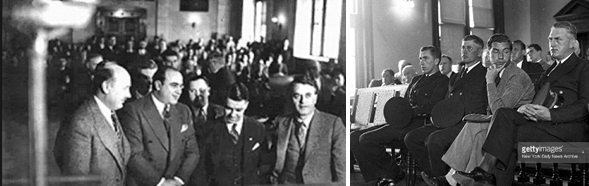
Steven (Steve) Mnuchin (right), New York banker who's spent a year being Secretary of the US Treasury, is worse at dissembling his racket than better-known racketeering peers, Alphonse (Al) Capone of the Chicago Outfit (left) or Charles (Lucky) Luciano of the New York Commission (centre).

Mnuchin’s racket is billions of dollars bigger, but in legal principle and method, the fraud and extortion are much the same as the Outfit’s and the Commission’s. Mnuchin’s muscle is bigger too, though that requires warfare, which the Outfit and the Commission were established to do without.

Last week Mnuchin issued a Treasury report to Congress on the impact of US sanctions on Russian sovereign debt, which isn’t a report at all. It’s a leak to a news wire, so sloppily arranged that one of the seven pages is a duplicate of the first, though the leaker didn’t notice he had slapped the same page on to the copier screen twice. The US Treasury didn’t realize, Bloomberg, the newswire, didn’t check. In the 228-year history of US Government reports to the US Congress, such a goof has never happened before.

The fraud in Mnuchin’s report is to claim in public that he is attacking Russian financial operations and the future of the Russian economy when he is doing something quite different in private, protecting advantages for the leading US investment banks in which Mnuchin has had a life-long family interest. The extortion is what Mnuchin’s agents abroad are privately saying to persuade major foreign institutions competing with American ones not to buy or trade in Russian sovereign debt, when in public there is no legal authority for the US to do this.

At the same time, Mnuchin is threatening to do to Russian sovereign debt what the US has never done to a country with which it was in a Congressionally-declared war – not Spain, Germany, Austria-Hungary, Italy, Japan. He also omits to identify what the consequences would be when China, the leading foreign holder of US sovereign debt, understands it will be next. China (including Hong Kong) currently holds $1.37 trillion in US sovereign debt, and the figure has been relatively stable since 2010. Russia holds one-tenth of that amount — just $105.7 billion; and it has been declining steadily over the same time.

Mnuchin’s name, pronounced MIN-OO-CHIN — a contraction of the Hebrew name, Menachem — was required to report to Congress by the Countering America’s Adversaries Through Sanctions Act (CAATSA), enacted last August. Read the law in full here. For Mnuchin’s purported report on Section 241, the oligarch sanctions report and list, read this.

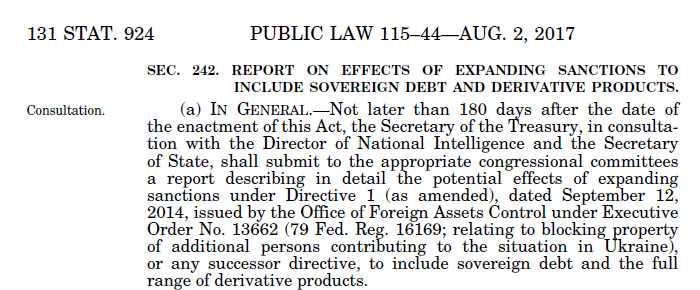
Section 242 of CAATSA requires Mnuchin to “describ[e] in detail the potential effects of expanding sanctions…to include sovereign debt and the full range of derivative products”. Sovereign debt isn’t defined in the statute or by Mnuchin in his 6-page paper. He does say the Treasury has imposed sanctions on all debt issued by the “financial services sector of the Russian Federation economy”, forbidding dealing by “non-US persons” for maturities of longer than 14 days, by “any transaction processed to or through the United States.” That means any US-dollar denominated bond or security, or a “derivative product”, such as a currency or interest rate hedge linked to the bond or security. “Currently,” according to the Treasury paper, “these prohibitions do not apply to the sovereign debt of the Russian Federation.”.


A press release, issued by Mnuchin’s office, was dated January 29, the deadline for submitting the congressional reports, but not posted until the following day. This claims the Treasury has “delivered the following five reports to appropriate Congressional committees”; one of them was identified as “Section 242: Report on Effects of Expanding Sanctions to Include Sovereign Debt and Derivative Products.”

Although apparently public reports, the Treasury release doesn’t say so, and doesn’t issue official versions of the reports.

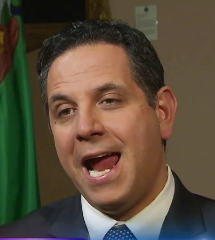
Instead, on February 1, Mnuchin’s spokesman Tony Sayegh issued a “statement” claiming the press has been misreporting the Section 241 report on the oligarchs.

Sayegh (right), a Republican campaign consultant and publicist for Fox media, didn’t mention the sovereign debt report.

He did claim:

“Treasury is in compliance with both the requirements and spirit of the law. CAATSA requires Treasury to submit these reports, not to sanction the individuals and entities named in them. As the Secretary indicated during his testimony, Treasury is utilizing this information to inform future targeted sanctions… the classified index to the report entails an ‘extremely thorough analysis.’” 

Sayegh fumbled his words, mistaking index for annex. He didn’t reveal whether the sovereign debt “report” has a secret annex attached. The leaked paper doesn’t say so either.

Mnuchin claims in his first footnote: “This report is explanatory only, does not have the force of law, and is not a legally binding interpretation of the provisions of CAATSA.” Either the “report” complies with the statute or it doesn’t. Mnuchin tries to have it both ways.

US corporate lawyers have been advising their clients for months that, in practice and in law, Mnuchin has been trying to sanction Russian sovereign debt, probably before last October when the Treasury issued an advisory paper implying as much. This provides a definition of “the term debt” to include “bonds, loans, extensions of credit, loan guarantees, letters of credit, drafts, bankers acceptances, discount notes or bills, or commercial paper.” Sovereign debt, meaning issues by the state through a ministry or the Central Bank of Russia, isn’t mentioned, so the hint that it is included in sanctioned Russian debt is allowed to appear, but not to appear at the same time.

A paper by the Steptoe and Johnson law firm in December reported this vagueness was cutting in both directions. “U.S. law does not prohibit involvement in the issuance or trading of Russian sovereign debt. But there are legal risks that market participants are seemingly only beginning to come to terms with.” In short, although the prohibition against buying Russian treasury bonds wasn’t legal, the risk that it might be was having the same practical effect.


“The real game-changer for this market,” according to Steptoe’s lawyers, “is expected to be Section 242 of CAATSA, which requires the Treasury Department to issue a report by February 2018 ‘describing in detail the potential effects’ of expanding existing U.S. sanctions prohibiting transactions or dealings by U.S. persons in ‘new debt’ of longer than 14 days maturity of sanctioned Russian financial institutions ‘to include sovereign debt and the full range of derivative products.’ The fear – not at all unfounded – is that this report could lead to the imposition of U.S. legal prohibitions on any and all dealings in Russian sovereign debt.”

Mnuchin’s leaked paper is the report the market has been expecting. But it isn’t what the CAATSA statute required. That leaves fear in place, and thus the risk of sanctions against Russian sovereigns, but without the legality. If Al or Lucky had tried what Steve is doing, they would have been accused of fraud and extortion. The court cases which put both men in prison were notorious fit-ups by US prosecutors.


Left: Capone (centre) on trial in Chicago June 1931. 
Right: Luciano on trial in Plattsburgh, New York, August 1936.

In addition to his footnote disclaimer of not doing anything illegal, Mnuchin’s defence is this disclaimer in larger type at paragraph 3:


Lawyers and bankers comparing Mnuchin’s claims to the statute say there are only two ways of reading his report as neither “public guidance” nor a “change in sanctions policy”, but at the same time as compliant with the CAATSA requirement for a “descript[ion] in detail of the potential effects of expanding sanctions…to include sovereign debt”. One way is for Mnuchin to lie in his disclaimers; another is for him is to ignore the statute. “The only way he can do both,” reports a London banker, “is for [Mnuchin] to lie in public that he isn’t sanctioning Russian sovereigns, but do so in private. That makes him more than a liar. For the bankers on the receiving end, these sanctions are criminal.”

Mnuchin’s admissions are almost as damaging as his omissions. “The Russian economy rebounded in 2017”, the report says, because of “prudent Russian government monetary and fiscal policies…while managing a low level of public debt.” Only in future, if US sanctions are kept in place – hint, expanded to sovereign debt – can Russia’s economic recovery be restricted. The Treasury projection, cribbed from analysis by the International Monetary Fund, is for sub-2% annual growth, based on an oil price averaging $50.80 for the next five years.


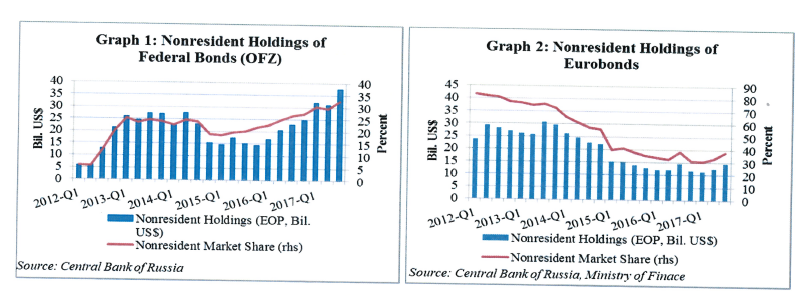
The Treasury also reveals that the foreign holdings of Russian sovereign debt, including American purchases of Russian finance ministry obligations, declined to 15% of the aggregate in 2014 and 2015. But in 2016, they started rising again, and now foreign holdings of Russian sovereigns are at an all-time high of almost 40%.

The corresponding US Treasury data showing American holdings of Russian state and corporate debt issues currently amount to a total of $65.6 billion, of which Russian corporate issues comprise almost 80%. Russian sovereign debt in US hands amounts at the moment to just $12.5 billion. This was not the peak value for US holders of Russian debt. In October 2013 the total US holdings reached $73.1 billion; peak US holdings of Russian sovereign debt then amounted to $14.7 billion. The numbers have declined since then, but today they remain significantly above the $49.5 billion total first reported in 2011.

This is how the Treasury report tabulates the figures. The presentation is tipped downwards to the right on the page, indicating the Treasury leaker was in such a hurry, the pages weren’t properly aligned in his copier.


More importantly, the tables show the revival in major foreign holdings of Russian debt has not come from the US. US Treasury figures reveal that US buying of Russian sovereigns rose until 2013; they have been in steady but slow decline since then. Mnuchin may intend to accelerate the speed at which Americans divest from their existing Russian sovereign holdings, and are dissuaded from buying new ones. But unless he can twist the arms of all other foreign buyers, the effect on the Russian state’s finances has so far been, and will be, negligible.

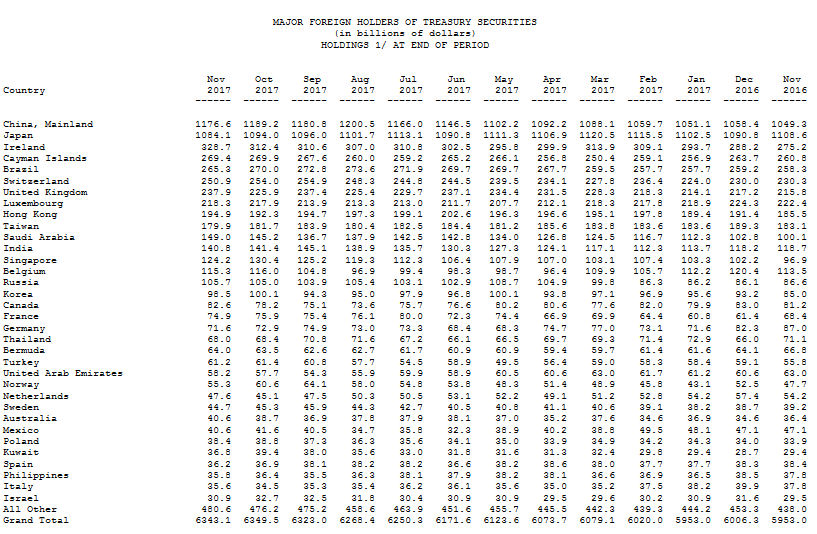
The US Treasury reports monthly on the country of origin of the major foreign holders (MFH) of US sovereigns. These are official reports from the government website, not leaks to a wire service; they are also correctly aligned on the page.


CLICK TO ENLARGE


This table shows that Russia held $105.7 billion worth of US treasuries as of November 2017. That places Russia 15th on the country list, with just 1.7% of the total foreign holdings.

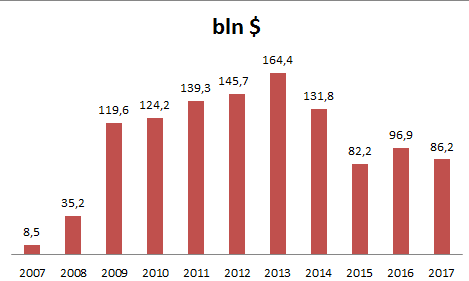
Going back in time, Russia wasn’t a big enough buyer to be separately identified on the MFH charts until January 2007; that’s when Alexei Kudrin was Minister of Finance. He initiated significant purchasing of US treasuries that year for an outlay of $8.5 billion; for more on Kudrin, one of the Kremlin officials omitted from the US Treasury’s list last week, read this. The aggregate rose sharply, hitting an all-time high at $176.3 billion in October 2010; Kudrin was still finance minister. In that month, Russian holdings of US sovereign debt came to the 8th largest on the country list, comprising 4% of the total of foreign-held US debt. This is how the Russian holdings changed over time.


RUSSIAN HOLDINGS OF US TREASURY SECURITIES, 2007-2017
(in billions of US dollars at January of each year) 


Mnuchin’s paper admits that Russian “need” for new sovereign debt issues is “limit[ed]” – a concession that threats of sanctions to stop US purchases of Russian sovereigns have so far had “limited” impact. It is also a concession that if Mnuchin is about to turn last year’s threats into fresh legal prohibitions, the impact on Russia is likely to be the same.

But what if the Kremlin decides to retaliate, either by selling off its stock of US sovereigns, or by replacing the US dollar with the Euro or the yuan for denominating Russia’s foreign bonds? Mnuchin’s report to Congress doesn’t address either Russian option. Instead, he claims “future external debt issuances [by Russia] will continue to be primarily denominated in US dollars.”

The MFH table indicates why Mnuchin is confident that the Russian stock of treasuries is too small to make a difference to Washington if the Kremlin retaliated by selling out. But what if there is a domino effect on larger foreign-government holders, particularly China and Hong Kong, India, and on those financial havens where cash is hidden from taxation at origin – Ireland, Cayman, Switzerland, Luxembourg and Bermuda? Altogether, their holdings – some of them Russian — amounted to $2.6 trillion as of last November. That’s 42% of the MFH total.

Anxiety was expressed during the Obama Administration that escalation of US economic warfare against China may trigger retaliation with a decision by Beijing to sell down the Chinese stock of US treasuries. A report by the Congressional Research Service (CRS) in mid-2013 minimized the risk, so long as the Chinese action isn’t a sudden one, followed by a domino effect on other foreign buyers of US debt.

“A potentially serious short-term problem would emerge,” warned the CRS, “if China decided to suddenly reduce their liquid U.S. financial assets significantly. The effect could be compounded if this action triggered a more general financial reaction (or panic), in which all foreigners responded by reducing their holdings of U.S. assets. The initial effect could be a sudden and large depreciation in the value of the dollar, as the supply of dollars on the foreign exchange market increased, and a sudden and large increase in U.S. interest rates, as an important funding source for investment and the budget deficit was withdrawn from the financial markets.”

A Forbes commentary, published a few weeks later, claimed:

“now we know what happens if China stops buying Treasuries. Nothing will happen. It has, in fact, already stopped adding to its stockpile.”

Mnuchin leaves just one paragraph, the last in his leaked paper, to address this risk; on the face of it, he isn’t so sanguine. He concedes the Kremlin is likely to retaliate. Making the sanction against Russian sovereigns formal, Mnuchin claims, would hurt the Russians,

“put downward pressure on Russian economic growth; destabilize financial markets…increase strain on Russia’s banking sector, and lead to Russia’s retaliation against US interests.”

Missing is Mnuchin’s acknowledgement of what the US Treasury and intelligence agencies calculate to be the retaliation options, either in unclassified or classified form. Instead, Mnuchin claims Russian retaliation “could hinder the competitiveness of large US asset managers and potentially have potentially negative spillover effects into global financial markets and businesses…”

How much would these “spillover effects” cost the “large US asset managers”, compared with what they would cost the Russians, Mnuchin doesn’t hazard a guess. He admits the current efforts to jawbone financial sanctions without legal enactment is producing “over-compliance by global firms”. But by going legal, Mnuchin concludes he doesn’t know whose interests would suffer most, American or Russian.

In London an international banker warns the Russians have the option to declare a default on their US treasuries.

“The Kremlin could announce that if the US Treasury imposes this sanction on their sovereign debt, they are going to stop repayments on US-helf Russian sovereigns. That’s what can happen when people like Mnuchin play the extra-legal game. A Russian threat to default may be a bluff. It’s not one Mnuchin and his Wall Street friends dare to call right now.”

“The magnitude and scope of consequences from expanding sanctions to sovereign debt and derivatives is uncertain,” Mnuchin concluded his report to Congress. “[The] effects could be borne by both the Russian Federation and US investors and businesses.”

“Every day, every minute,” comments the London banker, “the Americans aim to punish Russia. The problem is that the Americans think they can bring everyone down. But they are making a mistake if they believe sanctions threats against the Russian oligarchs or against Russian finance will achieve that. War can do that – arms, not money. But the Americans cannot fight a war against Russia, and imagine they will survive, let alone win. Who does?”

Sunday, February 04, 2018

The Search for "WMD" Moves to Syria: A Worrisome Escalation

WMD Claims in Syria Raise Concerns over U.S. Escalation

by Rick Sterling  - ConsortiumNews


February 4, 2018

Following a well-established script, anonymous U.S. officials are making unsubstantiated claims about weapons of mass destruction – this time in Syria – while the media fails to ask tough questions, reports Rick Sterling.

It’s the WMD story all over again.

Not unlike the spurious claims that paved the way to war with Iraq 15 years ago, anonymous “U.S. officials” are once again accusing a targeted “regime” of using “weapons of mass destruction” and issuing threats that the U.S. military may have to “hold it accountable.” Once again, Western media is broadcasting these accusations and threats without skepticism or investigation.

The Washington Post story is titled “Trump administration: Syria probably continuing to make, use chemical weapons.” The Reuters story, which was carried by the New York Times, says,

“U.S. officials have said the Syrian government may be developing new types of chemical weapons, and President Donald Trump is prepared to consider further military action. President Bashar al Assad is believed to have secretly kept part of Syria’s chemical weapons stockpile.”

Jerusalem Online says,

“A U.S. official says Syrian President Assad’s forces may be developing new types of chemical weapons, which could reach as far as the U.S.” Jane’s Defence Weekly quotes a U.S. official saying, “They clearly think they can get away with this.”

The accusations follow a long-established pattern of officials making anonymous claims and then ratcheting up tensions and issuing calls for retaliatory action – while the media repeats the claims without the slightest amount of skepticism. The Washington Post article, for example, includes the following statement by an anonymous official:

“If the international community does not take action now … we will see more chemical weapons use, not just by Syria but by non-state actors such as ISIS and beyond. And that use will spread to U.S. shores.”

Yet, based on a review of recent history, there is plenty of reason to believe that the story is false and is being broadcast to deceive the public in preparation for new military aggression.

The invasion of Vietnam with over 500,000 U.S. soldiers was preceded by the phony Gulf of Tonkin incident where a U.S. ship was supposedly attacked by a North Vietnamese vessel. It wasn’t true and President Lyndon Johnson knew it. The resolution was passed unanimously (416-0) in the House and only Wayne Morse and Ernest Gruening had the integrity and insight to oppose it in the Senate. Was anyone ever held accountable for the lie that led to the deaths of more than 58,000 U.S. soldiers and millions of Vietnamese? No.

The 1991 attack on Iraq and subsequent massacre of Iraqi soldiers and civilians was preceded by the fabricated testimony of the Kuwaiti Ambassador’s daughter pretending to be a nurse who had witnessed Iraqi soldiers stealing incubators and leaving Kuwaiti babies on the floor. Were the marketing officials Hill & Knowlton and politicians such as Tom Lantos who managed this deceit ever held accountable? No.

In 2003 the U.S. launched the invasion of Iraq leading to the deaths of over a million Iraqis based on the false and fabricated evidence provided by the CIA and uncritically promoted by the mainstream media. For example, Michael Gordon and Thomas Friedman promoted and lauded the invasion at the New York Times. Were they held to account? No, they carry right on to today.

In 2011 the U.S. led NATO attacks on Libya with the stated purpose of “protecting civilians” from a possible massacre. This was explained and encouraged by journalists and pundits such as Nicholas Kristof and Juan Cole. NATO officials bragged about their operation. After the brief Western euphoria, it became clear that the campaign was based on lies and the real result was an explosion of extremism, massacres and chaos which continues to today. Accountability? None. One rarely hears about Libya today. Out of sight, out of mind.

In August 2013 we heard about a massive sarin gas attack on the outskirts of Damascus. Human Rights Watch and others promoting a western attack quickly accused the Syrian government. They asserted that Assad had crossed Obama’s “red line” and the U.S. needed to intervene directly. Subsequent investigations revealed the gas attack was not carried out by the Syrian government. It was more likely to have been perpetrated by a Turkish supported terrorist faction with the goal of pressuring the Obama administration to directly attack Syria. Two Turkish parliamentarians presented evidence of Turkey’s involvement in the transfer of sarin.

Some of the best U.S. investigative journalists, including the late Robert Parry and Seymour Hersh, researched the issue and uncovered evidence pointing to Turkish-supported “rebels” not Syria. Despite the factual evidence exposing the “junk heap” of false claims, mainstream media and their followers continue to assert that Assad committed the crime.

In April 2017 it was the same thing: U.S. and allies made accusations which were never proven and ultimately discredited. The UN’s team of investigators from the Organization for the Prohibition of Chemical Weapons never visited the scene of the crime. They discovered the curious fact that dozens of victims in multiple locations showed up at hospitals with symptoms of chemical injuries before the attack happened. This is strong evidence of fraud but that line of investigation was not pursued.

With or without awareness of the deceit, Trump ordered missile strikes on a Syrian air base which killed 13 people including four children. Accountability? None.

Now, despite their earlier failures to investigate properly, anonymous officials at the OPCW are reviving the story of the Syrian chemical attacks with claims that laboratory tests have linked the Syrian government’s chemical weapon stockpile to those attacks, supporting Western claims that Assad was behind the atrocity.

Taken together, these recent developments indicate that forces in the U.S. government intend to continue trying to destroy Syria. Despite contradictory claims by the Trump administration, a core fact is that the U.S. is training and supplying a sectarian military militia inside northern Syria against the wishes of the Syrian government. The U.S. previously said they were in Syria to get rid of ISIS but now that ISIS is largely gone, the U.S. military says it is not leaving. On the contrary, the U.S. military helped escort ISIS fighters from Raqqa to al Bukamal and the U.S. is now training ISIS fighters to be reincarnated as yet another anti-Assad “rebel” force.

Regarding the latest accusations, the following is noteworthy:


Secretary of Defense Mattis acknowledges they do not have independent evidence.

The accusations come from “NGOs, fighters on the ground,” according to Mattis. In other words, the accusations come from the armed opposition and “White Helmets”.

In contrast with their media image, the “White Helmets” are neither independent nor neutral. The organization is a creation of the U.S. and U.K. governments and Western military contractors. It’s a well-funded and highly successful deception. The U.S. and U.K. train, supply and pay “volunteers” to provide them with accusations that can then be used to justify the desired aggression.

Behind the scenes, anonymous “U.S. officials” are feeding the media evidence-free claims that the Syrian government is rebuilding a chemical weapons program and “developing new munitions to deliver chemical weapons.” They claim the program is “evolving” and using a mix of sarin and chlorine.

Finally, there is the issue of timing. It is a curious fact that each time there are scheduled negotiations involving the Syrian government and opposition, there is an outburst of atrocity claims. This time the accusations come at the same time as the Syrian National Dialogue in Sochi, Russia. An objective investigation would consider who benefits from actions which distract from or sabotage negotiations. In February 2014 when Geneva negotiations were undermined by sensational claims of photos showing torture in Syria, the Christian Science Monitor broke ranks with mainstream media by suggesting it was a “well timed propaganda exercise.”

Journalists supposed to critically question, investigate the facts, and expose contradictions and falsehoods. When the media fails to do that, they have some responsibility, especially when it leads to wars, death and destruction. As indicated above, there are many horrible and bloody examples of mainstream media failure. There should be some accountability. When is that going to happen?

Rick Sterling is an investigative journalist based in the San Francisco Bay Area. He can be reached at rsterling1@gmail.com.