Wednesday, October 03, 2018

Gorilla Radio with Chris Cook, Jonathan Kuttab, Alison Bodine, Janine Bandcroft October 4, 2018

This Week on GR

by C. L. Cook - Gorilla-Radio.com


October 4, 2018

The meagre Western media coverage afforded The Great March of Return's beginnings in March has now all but disappeared, so those in Canada relying on the CBC and other corporate-interested news sources may be surprised to learn, the Great March trudges on; just as does the wanton murder of its defenseless, civilian participants.

Over the weekend, Israel's military killed seven more Palestinians, while injuring hundreds; at least 90 of those being wounded by live-bullet fire.

Ashraf al-Qedra, spokesman for the Gaza Health Ministry says, 163 Gazans have died, with more than 20,000 being treated for injuries in Gaza's threadbare hospitals.

Listen. Hear.

But, it's not only the Canadian media derelict in its duty when it comes to Gaza, Canada's government, including opposition parties in the House of Commons, remains almost entirely silent.

Jonathan Kuttab is a human rights lawyer practicing in East Jerusalem. He is the co-founder of the organizations: Al Haq, the first international human rights legal organization in Palestine; The Palestinian Center for the Study of Non-Violence (now Non-Violence International); and The Mandela Institute for Prisoners. He is also a founding director of Just Peace Advocates/Mouvement pour une Paix Juste, a Canadian-based international law/human rights not-for-profit organization.

Jonathan is currently on a cross-Canada speaking tour. He spoke last night in Comox, and will be in Victoria tonight at 7pm presenting, 'The future of Jerusalem in the time of Trump' at UVic's David Turpin Building.

Jonathan Kuttab in the first half.

And; though Canada daily abrogates its international treaty-mandated duty to protect the human rights of Gazans, it has not exited the World stage altogether. The country boasting, "a consistently strong voice for the protection of human rights and the advancement of democratic values..." has adopted, along with its trade partners, the modern siege method, imposing economic sanctions against the democratically elected government of Venezuela.

Most Canadians would doubtless blanch at the hypocrisy of their nation's position, if only they knew the depth of its profundity. But, there again is where the CBC and its corporate media cohorts come in - or fail to do so.

Alison Bodine is Coordinator of the Fire This Time Movement for Social Justice's Venezuela Solidarity Campaign. The long-time antiwar and social justice activist is too a researcher and writer for the Fire This Time! monthly newspaper.

Alison Bodine and Canada as democracy's arsonist in Venezuela in the second half.

And; Victoria-based activist and CFUV Radio broadcaster at-large, Janine Bandcroft will be here at the bottom of the hour with the Left Coast Events Bulletin for some of the good things to be gotten up to in and around our town in the coming week. But first, Jonathan Kuttab and the future of Palestine at a crossroads.

Chris Cook hosts Gorilla Radio, airing live every Thursday between 11-Noon Pacific Time. In Victoria at 101.9FM, and on the internet at: http://cfuv.uvic.ca.  He also serves as a contributing editor to the web news site, http://www.pacificfreepress.com. Check out the GR blog at: http://gorillaradioblog.blogspot.ca/

Sunday, September 30, 2018

Resisting Militarism from the Inside

Army Capt. Brittany DeBarros Under Scrutiny For Tweeting Facts

by Staff - Couragetoresist.org 


September 29, 2018

US Army Capt. Brittany DeBarros has taken to social media to share some basic facts about our country’s endless wars, and the impact those are having both abroad and at home.

The July 20th edition of the Army Times declared, “An Army Reserve psychological operations officer is on day seven of 14-orders, according to her Twitter account, and she’s taking the opportunity to let the internet know she does not approve of the Defense Department.”

Brittany hasn’t stopped speaking out since, despite pressure from the Pentagon.


Photo: popularresistance.org

Brittany started posting a series of simple graphic messages on July 14. The first one read,

“I’m on Army Orders for the next 14 Days and there’s not much I can do about that. WHAT I CAN DO is schedule daily posts in my absence with facts about the horror being carried out by our war machine for profit.” 

It was accompanied by a graphic with the text “At the current rate, the US drops a bomb every 12 minutes.”

A couple of days later, she declared, “For years the executive branch has run wild warmongering while congress stands by. Greed fueled violence. Racist, Islamophobic fueled SILENCE. It’s on us to dismantle and our own liberation depends on it.”

After the Army announced that they were investigating her, she shared, “In case anyone is confused, these are my personal views and I don’t speak in an official capacity for the DOD.”

Brittany addressed her motivations on social media, explaining, “Two headlines within the last week: ‘White House: U.S. Can’t Afford Veterans’ Health Care Without Cuts.’ and ‘House Passes $717 Billion Defense Bill.’ So tell me again how it’s against the Army Values for me to point out this charade? And how I’m hurting my soldiers by refusing to be quiet about the fact that we have endless dollars to send them to war but suddenly are broke when they need care? I call b.s.”

This is the second time that she has caught the Pentagon’s attention. Brittany was also threatened with reprisal after giving a speech at the Poor People’s Campaign rally in Washington DC in June. At that time, she responded:

In the Army, we are taught that our core values must be Loyalty. Duty. Respect. Selfless service. Honor. Integrity. Personal courage.

So, you tell me…

Am I LOYAL if I say nothing while a wealthy few pay our politicians to disregard the Constitution I swore to protect so they can make a killing off of killing?

Am I a DUTIFUL leader if I stand by while the young soldiers for whose lives I’m responsible are sent to kill and die in illegal wars based on lies?

Am I RESPECTFUL of this uniform we wear if I am silent about the atrocities it’s being used to carry out?

Am I SELFLESS in my SERVICE if I fall in line and stay quiet simply to avoid risk to myself and my career?

Am I HONORABLE if I’m more concerned about what’s popular or acceptable than about what’s right?

Am I living with INTEGRITY if I say ‘I’ll do the right thing later when it won’t cost me so much’?

And where is my PERSONAL COURAGE if, in the face of repression and threats, I cower and back down, especially when so many before me have sacrificed so much for the very freedom I am exercising?
So if what I’ve been saying is somehow doing wrong by the military, the mistake they made was commissioning a leader that takes these values seriously. Leaders of conscience have a moral obligation to speak up #GIResistance #CourageToResist

About Face: Veterans Against the War (formerly IVAW) is hosting a gofundme drive to cover Brittany’s legal representation costs. Please help us and About Face reach our $3,000 goal to support Brittany by contributing at: 

gofundme.com/fund-war-resister-cpt-debarros


Bolton's Administration: Putting the World on Notice

U.S. Punishes Iranians and Threatens Nations That Disobey

by TRNN


September 30, 2018

As the Trump administration and its Israeli government ally continue their destabilization campaign against Iran, the EU, Russia, and China have reached a deal with Tehran that would shield financial transactions from newly reimposed U.S. sanctions.

The U.S. has warned of “terrible consequences” for those defying its sanctions. Can Iran and the remaining nuclear deal partners withstand U.S. pressure?


We speak to Col. Lawrence Wilkerson Distinguished Adjunct Professor of Government and Public Policy Lawrence Wilkerson’s last positions in government were as Secretary of State Colin Powell’s Chief of Staff

Friday, September 28, 2018

Peskov's Curious Comments: Losing His Head, Or Getting Ahead of Putin?

DMITRY PESKOV LOSES HIS FOOTING, DEPARTS THIS LIFE

by John Helmer - Dances with Bears


September 28, 2018

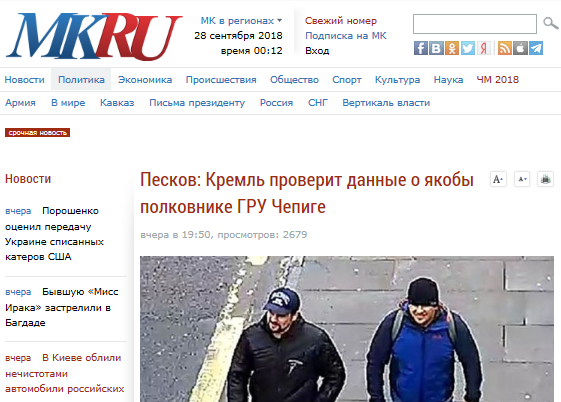
Moscow - At 19:50 on Thursday evening Moskovsky Komsomolets (MK), one of the largest circulation newspapers in Russia, published an announcement from Dmitry Peskov, spokesman for the Kremlin.

“The Russian President’s Press Secretary Dmitry Peskov has said that the Kremlin will check information from the investigation of Bellingcat and The Insider on suspects of the Salisbury poisoning of the Skripals where it is claimed that Ruslan Boshirov, accused by London of involvement, is a member of GRU, Hero of Russia, Colonel Anatoly Chepiga.
In the words of Peskov, in the Kremlin [officials] intend to check the lists of recipients from the President of this title. He added that the official position is still unchanged. And it was announced by the President, and the suspects themselves.”

When Peskov claimed the Kremlin “will [sic] check information from the investigation of Bellingcat”, more than twenty-four hours had already passed since he had first seen the Bellingcat report on Boshirov and Chepiga. That Peskov did not already have the GRU file on Chepiga, the Hero of Russia list, and the relationship between Chepiga and Boshirov is impossible.

The statement has stunned Moscow political sources. Their assessment is that the man who says these things because he believes them to be true, or because he believes Russians and others will believe he is telling the truth, has lost contact with reality.

“I have not seen such unprofessional conduct at any time throughout Putin’s presidency,” commented a veteran Moscow publisher.
“This means they are making things up as they go along.” 
“Peskov’s last line is the most extraordinary of all. He is saying Putin is running this show and he is doing a bad job of it. Peskov put responsibility for the entire Skripal affair on to Putin, and implied he should deal with it himself. Peskov just threw Putin under the bus.”

On Thursday Putin was travelling. He stopped in Baku, Azerbaijan, to attend a world judo championship and to meet Azerbaijan’s President, Ilham Aliyev. He then flew to Tajikistan where he had dinner with government leaders from Azerbaijan, Belarus, Kyrgyzstan, Kazakhstan, Moldova, Uzbekistan, Armenia, and Turkmenistan. On Friday they plan a summit conference together.

The Kremlin photographs indicate that for this trip Putin left Peskov at home. Putin was still eating in Dushanbe when MK posted its report from Peskov.


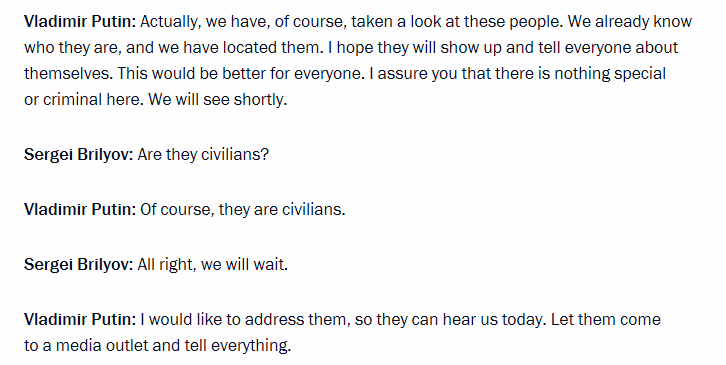
The last paragraph refers to the President’s impromptu statement on September 12 in Vladivostok. Putin was asked about British identification of the two suspects in the Skripal case, named in London as Ruslan Boshirov and Alexander Petrov. For that story, read this. This is how Putin responded.


“Of course they are civilians” – Putin may not have been expecting the question from Sergei Brilyov, a reliable interviewer of high state officials and anchor of Vesti V Subbotu (News on Saturday) broadcast on Rossiya TV Channel. Businessmen engaged in importing vitamin pills, energy drinks and health powders was also what Boshirov and Petrov said they were on the next day, September 13, in a televised interview on RT.

In the two weeks which elapsed since then, Russian media investigations of Boshirov and Petrov have picked apart what the duo claimed for themselves, and also the allegations by the Metropolitan Police in London. There is still no Interpol Red Notice for either man, although the British announced they had applied to Interpol more than three weeks ago.

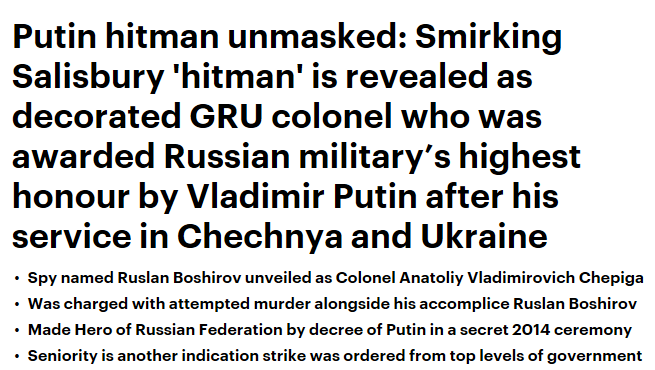
On Thursday morning the entire London press opened the file on Colonel Chepiga. Here is one of the versions.


There was a single source for the fresh name: “The disclosure, uncovered by investigative journalist organisation Bellingcat,” reported the Daily Mail, “exposes as lies Putin’s claims that the Skripals’ would-be killers were innocent ‘civilians’.”

According to the Mail,

“the Metropolitan Police, who are investigating the poisoning, and the Foreign Office declined to comment on the Bellingcat/Telegraph report. But British defence minister Gavin Williamson appeared to confirm its veracity on Twitter.” The newspaper added the correction: “Gavin Williamson tweeted spy’s identity was ‘confirmed’ then deleted message.”

The Guardian was unable to report what its check of the Bellingcat story with the police or any other British government agency had turned up. “British investigators,” claimed the Guardian, “also believe one of the pair is Chepiga, the Guardian understands.”

The Telegraph declared through its “chief reporter” that Bellingcat was an “investigative journalist organisation”, and that its sourcing for the Chpegia identification had come from Bellingcat “in conjunction with The Telegraph”. Other British media ignored that selfie.

The Telegraph followed later in the day with the claim that in addition to Petrov and Boshirov aka Chepiga, “a third Russian military intelligence officer who carried out a reconnaissance mission before the poisoning of Sergei Skripal has been identified by counter terrorism police and the security services, the Telegraph understands.” As the passive reflexive tense used for sourcing has spread across the London media, no fresh name has been reported, nor a government official to put his or her name to the charge.

Read the Bellingcat report on identification of Boshirov with Chepiga.


There has been no Metropolitan Police statement or tweet of this name allegation nor confirmation from the Office of Public Prosecutions; they are the government organs responsible for investigation of the Salisbury poisonings, and for issuing indictments, arrest warrants, and the papers required for a criminal court proceeding. To date, no evidence and no charges have been presented in a British court. The New York Times reported: “The police in Britain would not comment on the report”.

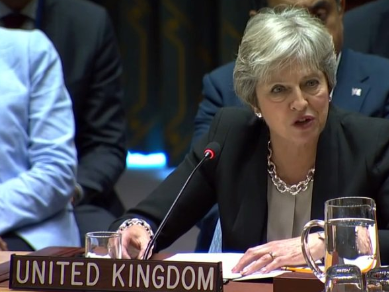
Prime Minister Theresa May, who spoke twice at the United Nations on Thursday, has also avoided making the Chepiga allegation.


Instead, May repeated what she had already announced at the beginning of this month:

“The United Kingdom,” she told the UN Security Council yesterday, “has presented detailed evidence, clearly laid out in charges of attempted murder and the use and possession of a chemical weapon against two agents of the Russian state. We have taken appropriate action, with our allies, and we will continue to take the necessary steps to ensure our collective security. Russia has only sought to obfuscate through desperate fabrication.”

The state media broadcaster BBC acknowledged its sole source was the “investigative website”, and provided internet readers with a direct link to the Bellingcat story. The BBC added more passive reflexive understanding:

“British officials have not commented, but the BBC understands there is no dispute over the identification.”

Russian sources say that for Peskov to mention Bellingcat was a mistake. “Bellingcat isn’t an individual journalist, nor is it an investigative publication”, according to one of the sources. “It’s an information warfare unit paid by NATO to leak intelligence from MI6, CIA and other agencies in the form of narratives constructed to look authentic, though no state official will claim them to be true. Hasn’t Peskov understood by now this is propaganda war?”

The first British analysis of the photo identification by Craig Murray used facial recognition software to test the Bellingcat photographs; he reported a probability of less than 3% for the identification match. From Moscow press reports Murray concluded:

“Chepiga definitely exists… the identification of ‘Boshirov’ with ‘Colonel Chepiga’ is a nonsense.”

Murray also reported that the accumulating evidence from Russian press investigation is “that Russia is not telling the truth about ‘Boshirov’ and ‘Petrov’. If those were real identities, they would have been substantiated in depth by now.”

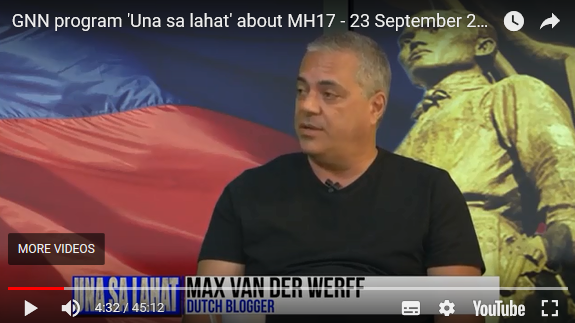
Max van der Werff, the independent Dutch investigator of the Malaysian Airlines MH17 case, has spent years in detailed examination of similar Bellingcat allegations based on social media, video clips, photographs and identity matches, in order to accuse named Russian soldiers of shooting down the aircraft in July 2014. For details of van der Werff’s work on that case, start here and here.


Max van der Werff on Philippines television this week discussing the 
evidence of the MH17. Three Filipinos were killed on board the aircraft.

Bellingcat produces “not so many fakeries,” van der Werff commented on the Chepiga claims.

“Bellingcat works more cleverly than that. It extrapolates ‘facts’ based on data which do not support the conclusions at all. In essence, the Bellingcat method goes like this: Bellingcat gathers lots of information from ‘open sources’.
Bellingcat claims it has verified those sources, but we cannot independently verify them. Bcat publishes a narrative based on osint [open-source intelligence] which it claims is trustworthy. If parts of this narrative are debunked, Bcat never admits it produced a false narrative. Instead, the narrative is altered slightly.
The entire corrupt western media copy/paste Bcat stuff. Conspiracy thinkers think they need to prove Bcat’s narrative is false. These thinkers get stuck, however, because they don’t have the underlying data which Bcat uses. This is the mechanism which happens over and over again. I can dissect this trademark method for once and for all — without the illusion it really would make a difference.”

"Dual Purpose" Anthropology and The Nicaragua Project

How an American Anthropologist Tied to US Regime-Change Proxies Became the MSM’s Man in Nicaragua

by Max Blumenthal via MintPress News


September 26, 2018

It might seem cavalier for an academically credentialed anthropologist to assert political influence on the population he is supposed to be studying; however, Goette-Luciak’s activities fit within a long tradition.
MANAGUA, NICARAGUA — (Investigation) The Guardian, The Washington Post, the BBC and NPR have assigned an American anthropologist with no previous journalistic experience to cover the crisis in Nicaragua. The novice reporter, named Carl David Goette-Luciak, has published pieces littered with falsehoods that reinforce the opposition’s narrative promoting regime change while relying almost entirely on anti-Sandinista sources.

An investigation for MintPress reveals that Goette-Luciak has forged intimate ties to the opposition, and has essentially functioned as its publicist under journalistic cover.

Having claimed to work in the past as an anthropologist and “human rights defender,” Goette-Luciak operated side-by-side with activists from a U.S.-backed opposition party known as the Sandinista Renovation Movement, or MRS.

As we will see in this investigation, U.S. government-funded organizations have supplied the MRS with millions of dollars worth of election assistance, and continue to fund its activists by funding their NGO’s and social media training.

Goette-Luciak now lists himself as “director of investigations” for an obscure outlet called Radio Ciudadana that was founded a month before the chaos erupted last April. That outlet’s founder, Azucena “Chena” Castillo, is an outspoken member of the MRS party who has devoted herself to the government’s overthrow. Goette-Luciak’s social-media profile reveals intimate ties to numerous MRS leaders and, in a recently deleted podcast interview, he has described his own work to encourage indigenous opposition to the Sandinista front.

Media outlets like the Guardian, NPR and The Washington Post feign objectivity before their readers, presenting themselves as arbiters of truth in an era of fake news. However, in countries where Washington is pushing regime change, these same outlets have dispatched a corps of writers to embed with U.S.-backed opposition elements, provide them with publicity, and sell their goals back to the American public.

Goette-Luciak is one of clearest embodiments of the disturbing trend.

Western media versus the Sandinistas


Goette-Luciak vaulted suddenly into the world of journalism after student-led protests erupted last April 18 in Nicaragua. President Daniel Ortega had announced a set of tax increases to keep the public pension system solvent, triggering mass protests that quickly transformed into a full-scale attempt at regime change.

Within days, violent elements had taken over university campuses and were setting up roadblocks around the country to paralyze its economy.

While American officials condemned killings and abuses by the Nicaraguan government, scores of Sandinista members and national police officers were murdered by opposition gunmen; hundreds more were kidnapped, tortured and abused; and institutions affiliated with the government were destroyed.

Almost as soon as the Sandinista-led government defeated the coup attempt in July, it became the target of a sustained campaign of attacks in Western media. A raft of articles portrayed Ortega, the former guerrilla leader, as a reincarnation of the bloodthirsty, U.S.-backed dictator he had deposed, Anastasio Somoza. The opposition, meanwhile, was painted as a collection of peaceful protesters gunned down for supposedly demanding democracy.

The death and suffering experienced by average Sandinista members was whitewashed across the board, and the role the U.S. played in laying the groundwork for the coup was dismissed as “fake news.” In Washington, the media campaign propelled a push in Congress for crushing sanctions targeting Nicaragua’s previously productive economy.

Many Western reporters have embarked on short regime-change fishing expeditions guided by opposition activists from one anti-Sandinista source to the next. But Goette-Luciak had been in the country all along, and he stayed after the violence subsided. This provided him with special value to publications like the Guardian, which were apparently hungry for more on-the-ground reporting painting the Sandinistas as uniquely evil and unqualified to govern.

Misinformation in the service of the opposition


On September 7, Goette-Luciak published an article in the Guardian claiming that the country had been brought to a virtual halt by a general strike by the anti-government Civic Alliance umbrella group. His co-author was Caroline Houck, a staff correspondent for the website Defense One, which leverages ad revenue from the arms industry to “provide news, analysis and ideas for national security leaders and stakeholders.”

The Nicaraguan-born activist Camilo Mejia highlighted several pieces of misinformation contained in the article. Contrary to the claim that the Civic Alliance interrupted the country’s economy with its general strike, Managuan marketplaces were bustling that day and commerce proceeded as usual. As Mejia noted, the opposition had only managed to close the high-end businesses that supported its regime-change agenda.


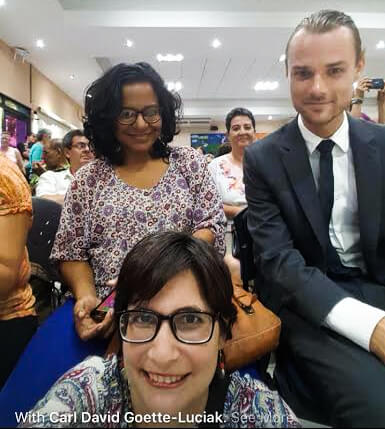
 Goette-Luciak and MRS leader Ana Margarita Vijil, pictured center. 
Photo | Facebook

Goette-Luciak and Houck published extensive quotes from Ana Margarita Vijil, falsely describing her as “national director of the outlawed Sandinista Renovation Movement (MRS).” In fact, the marginal MRS had not been “outlawed;” its candidates had garnered a pitiful 1.3 percent of the popular vote in the last election, which is below the legal threshold to qualify to run as a political party.

The authors then quoted Vijil claiming that, “[w]ith 200 political prisoners and [new] murders every day, this strike is just one more sign that nothing is normal here in Nicaragua.” What Goette-Luciak and his co-author failed to mention was that those recent murders have consisted largely of Sandinista supporters. The recent murder victims include Lenin Mendiola, an FSLN militant and son of two revered Sandinista historical figures, Benigna Mendiola and Bernardino Díaz Ochoa.

But the most striking omission by Goette-Luciak was of his relationship with his source and her party, which has enjoyed direct support from the U.S. government. Below, the two can be seen together at a conference in an image that highlights their mutual affinity.

Vijil is the former president of the MRS, or the Sandinista Renewal Movement. She has served as a fellow of the Central American Leadership Initiative at the Aspen Institute, a hub of neoliberal thought funded by the Ford Foundation and Rockefeller Brothers Fund, among others.

Just before the coup erupted in April, Vijil was in Washington for a “high level executive meeting,” according to Yaser Morazan, an MRS activist whose “Agente de Cambio” initiative and social-media training have been sponsored by USAID — an arm of the U.S. State Department — and the U.S.-funded Instituto de Estudios Estratégicos y Políticas Públicas (IEEPP). Three weeks before the coup, Morazan posted a selfie outside IEEPP’s office promising a series of “surprises” and pledging his secrecy about them.

For his part, Goette-Luciak has been connected with the MRS most directly through Azucena Castillo, a prominent party activist whom he lists as his employer at Radio Ciudadana.

Goette-Luciak did not respond to an emailed request for an interview.

The best ex-Sandinistas the U.S. could buy


Goette-Luciak appears to have inherited his affinity for the MRS party from his father, Ilja Luciak, an academic who focused his research on Central America and served for several years as the chair of political science at Virginia Tech.

In an interview with an obscure travel website called the Edge of Adventure, Goette-Luciak credited his father with inspiring his interest in Nicaragua. He described him as a “Marxist” who was inspired by the Sandinista revolution that unfolded during the 1980’s. But according to his academic CV, Luciak’s work on Nicaragua has been backed by European foundations, the European Commission, and USAID.

In his book After the Revolution: Gender and Democracy in Nicaragua, El Salvador, and Guatemala, Luciak wrote sympathetically about the female former Sandinistas who helped lead the MRS party’s crusade against Ortega.

His son, Goette-Luciak, channeled the purist sensibility of the MRS in his interview with Edge of Adventure:

“As a leftist, I was intrigued by where the Sandinista revolution — which to me was a very utopian idealistic revolution and a great example of potential social change for Latin America — where it had gone awry.”

The MRS was established to expose and exacerbate the supposed failings of the Sandinista front. Founded in 1994 by ex-Vice President Sergio Ramirez and a collection of ex-FSLN militants — most of them from more affluent, educated backgrounds than common Sandinistas — the party’s disruptive agenda made it a natural candidate for assistance from Washington.

In 2006, the MRS and the U.S. government plotted to prevent Ortega’s election. A September 6, 2006 U.S. embassy cable — revealingly entitled, “MRS: We Want To Bring Ortega Down” — laid out some of those plans. Authored by U.S. Ambassador Paul Trivelli, the cable described a meeting between the ambassador and Israel Lewites, the nephew of MRS presidential candidate Herty Lewites, who had just died from a heart attack.

Trivelli confirmed direct U.S. government support for the MRS election campaign, noting that 30 percent of its election observers had been trained by the International Republican Institute, a U.S.-funded, Republican Party-run soft-power organization overseen by then-Sen. John McCain.

“The MRS intends to have at least two people per voting table […] on election day, but they need funds to feed and transport the fiscales and other helpers,” Trivelli stated.

In all, the U.S. government contributed a whopping $12 million in 2006 towards “election technical assistance, outreach, and observation” in Nicaragua’s 2006 election. In other words, it spent two dollars for every Nicaraguan citizen to defeat Ortega.

A separate leaked diplomatic cable detailed a meeting during that election campaign between MRS co-founder Dora Maria Tellez and the ambassador, Trivelli. Foreshadowing the coup that unfolded this year, Tellez told U.S. embassy officials that “the MRS will warn the FSLN that if it steals the election, the MRS will ‘take to the streets,’ opining that this is the ‘only kind of message Ortega understands.'”

The MRS ultimately failed to prevent Ortega’s victory and wound up reaching out to the U.S. again as its domestic support base collapsed. In 2016, the MRS’s Vijil joined a delegation to lobby in Washington for the Nica Act, a bill proposing crushing sanctions on her country.

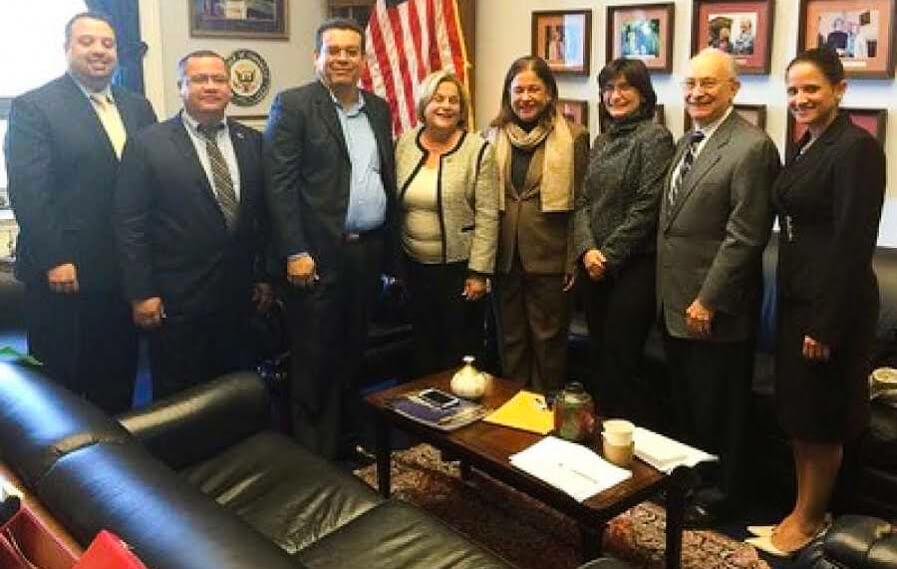
On Capitol Hill, Vigil posed alongside a cast of U.S.-backed activists and Rep. Ileana Ros-Lehtinen, a neoconservative Cuban-American Republican who was the main author of the sanctions bill.


A beaming Ana Margarita Vigil (third from right) beside US Rep. Ileana 
Ros-Lehtinen and a collection of U.S.-backed Nicaraguan opposition 
figures in 2016 
Photo | Office of leana Ros-Lehtinen

Two years later, MRS activists were at the forefront of the coup attempt that sought Ortega’s removal. Several participants in the protests this April who later turned against the opposition described witnessing MRS leaders providing truck loads of supplies for opposition forces occupying university campuses.

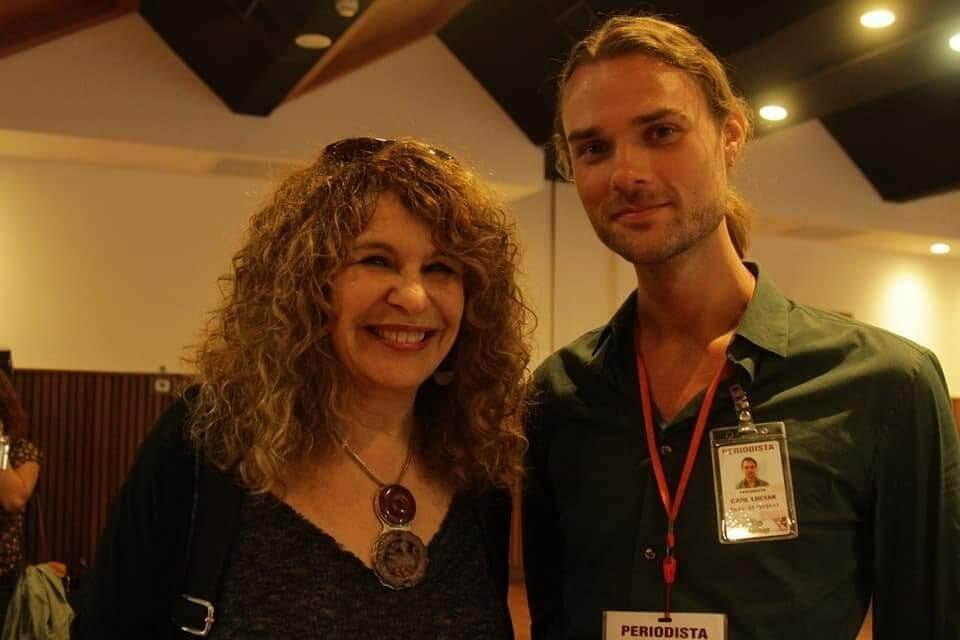
While the MRS performed its historic role as the knife in the FSLN’s back, it supplied Western media with a cast of English-speaking voices demanding regime change in the name of supposedly progressive values. Its most prominent voice was Gioconda Belli, an affluent U.S.-based poet and professional former Sandinista, who took to mainstream U.S. outlets to paint Ortega as a murderous dictator, as she has done for years. (Belli’s brother, Humberto, is a Catholic priest affiliated with the far-right Opus Dei cult and a client of the militantly anti-abortion American tycoon Tom Monaghan).


 Carl David Goette-Luciak and MRS figurehead Gioconda Belli. 
Photo | Facebook

Then there was Goette-Luciak (seen above with Belli), who functioned on the ground as the MRS party’s publicist in photo-journalistic attire.

A “dual use” anthropologist


Prior to the unrest that swept across Nicaragua last April, there was little record of Goette-Luciak’s presence as a writer or journalist. He had written one piece for NPR on how Nicaraguans were not as happy as the World Happiness Report said they were.

His co-author, Carlos Salinas Maldonado, was a writer for the opposition magazine Confidencial, which is funded by the U.S. government’s regime-change arm, the National Endowment for Democracy, and the Open Society Foundation.

In his byline, Goette-Luciak described himself as “an anthropologist in Managua.” He was listed in conference papers as a graduate student at the University of Virginia around that time, focusing his work on the Rama-Kriol and Miskito populations of Nicaragua’s eastern coast.

These indigenous groups have been at loggerheads with the Sandinista movement since the civil war in the 1980’s, when the CIA cultivated them as U.S. allies. Ronald Reagan made the relationship a centerpiece of his administration’s Cold War crusade when he declared in a 1985 speech, “I am … a Miskito Indian. I too, am a potential victim of totalitarianism.”

The indigenous North Atlantic Autonomous Region of Nicaragua remains a key target for U.S. influence, as Washington seeks to exploit the simmering conflict between its local population and the leftist government in Managua. Leaked diplomatic cables demonstrate efforts by the U.S. embassy to cultivate anti-Sandinista sentiment in the area by working to facilitate human-rights complaints by former CIA-backed Contra fighters against FSLN leadership.

In 2013, the Ortega government announced plans by a Chinese magnate to construct a canal through his country, presenting a direct threat to U.S. control over shipping lines in the western hemisphere and prompting an outcry from the U.S. embassy. Soon, an anti-canal movement emerged in the countryside as one of the main drivers of anti-Sandinista sentiment. The campaign against the canal poured fuel on the fire of the coastal indigenous population’s long-simmering conflict with the government.

Though Goette-Luciak described himself in his bio as an “anthropologist in Managua,” he later revealed that he was working among the Miskito population and with the Rama-Kriol communal government to stimulate opposition to the Sandinistas.

“I worked on informing the indigenous community of their rights at a time of crisis, when the government was attempting to depict to the international audience consent among the indigenous population for the sale of their land,” Goette-Luciak said in an interview this year with The Edge of Adventure.

It might seem cavalier for an academically credentialed anthropologist to assert political influence on the population he is supposed to be studying; however, Goette-Luciak’s activities fit within a long tradition. As author David Price illustrated in several book-length studies on what he called “dual use anthropology,” many American anthropologists were supported during the Cold War by private foundations and even the CIA to conduct activities on behalf of their government. More recently, the Pentagon weaponized the field of study through programs like its Human Terrain System, which lured newly graduated anthropologists with lucrative salaries to assist U.S. military counterinsurgency campaigns in Iraq and Afghanistan.

There is no evidence that Goette-Luciak is an asset of the CIA or any other U.S. agency. However, his advancement of Washington’s divisive political objectives during the course of his ethnographic fieldwork represented a fairly clear example of dual-use anthropology.

Selective stories from the front lines


In his interview with Edge of Adventure, Goette-Luciak cited the killing of Angel Gahona — a reporter he described as his “neighbor” in the city of Bluefields in southeastern Nicaragua — as his inspiration for moving into the field of journalism.

Gahona was killed while delivering a Facebook live report during an anti-government protest. He was shot while filming a bank that had been looted, and unidentified men could be seen in the shadows of the bank moments before Gahona was hit. This prompted some observers to allege that he was killed by professional criminals for filming them while they took advantage of the chaos to rob a bank.

Though the government arrested two suspects in the killing, Gahona’s family blamed the national police for deliberately targeting him in retaliation for his coverage of alleged police abuse. Goette-Luciak presented these allegations and accusing the government of a cover-up in his first article for the Guardian on May 29.

Goette-Luciak also described to the Edge of Adventure having witnessed the so-called Mother’s Day Massacre, where several demonstrators commemorating those who had already died in the unrest were killed on May 30.

The bloodshed that took place that day remains a source of heated contention. Violence had erupted across the country, with the opposition opening fire on a Sandinista caravan in the city of Esteli, killing one and wounding dozens. Opposition vandals burned the leftist Radio Ya station for the third time as well as parts of Managua’s Metrocentro complex. Videos show opposition gunmen opening fire that day on the streets of Managua and toting weapons near the Mother’s Day march.

The opposition and Western media placed the blame squarely on Sandinista-affiliated elements for sniping into the crowd of marchers, but have yet to produce clear evidence proving their case.

Speaking to the Edge of Adventure, Goette-Luciak conceded that he had left the march and was several blocks away drinking a beer when the shooting began. He said he returned after he heard shooting and described the deaths as the result of targeting killings by Sandinista paramilitaries.

“I witnessed two deaths…” he told Edge of Adventure.
“A young man standing a few yards from me was hit by a bullet in the head, and standing behind him, what I saw was the back of his head explode like a watermelon that got dropped.”

Hours after the violence, a ferociously anti-government network known as “100% Noticias” published a grisly photo of a man supposedly killed by government forces whose brain was spilling out of his skull. The image was soon exposed as a fake and has since been deleted. In fact, it depicted a death from a separate conflict and had been taken years before.

Though Goette-Luciak said he had taken photos of the march, he has yet to publish any of the killings he said he witnessed.

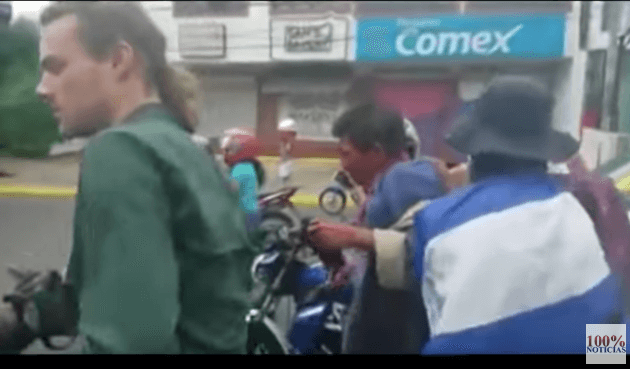
In a separate incident this June, Goette-Luciak appeared momentarily in a highly disturbing video filmed by 100% Noticias. He could be seen taking photos of a mob of opposition thugs in the act of kidnapping and beating an aging Sandinista member they had found squatting on a local oligarch’s abandoned property. Oddly, Goette-Luciak published no photos of the incident and did not report on it.


Goette-Luciak (left) appears briefly in a video photographing an opposition mob 
as it kidnaps and beats a man it mistook for a Sandinista paramilitary member. 
He has not published photos of the abuse or reported on it. 
Screenshot | YouTube

The Radio La Ciudadana outlet where Goette-Luciak is listed as “director of investigations” contains sparse evidence of journalistic production: a section on the site marked as “investigations” is empty; the photos section contains 15 images Goette-Luciak captured on Mother’s Day, where he claimed to have witnessed two murders: a grand total of three news stories are featured on the site. Radio La Ciudadana was founded by Azucena “Chena” Castillo, an MRS party activist who has also worked as director of the USAID-funded outlet Radio Universidad.


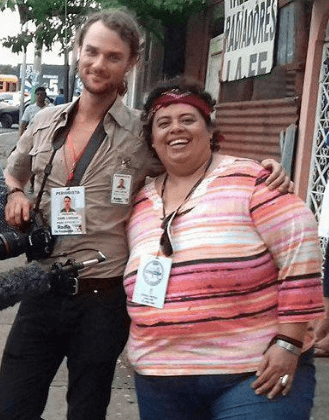
Goette-Luciak and his colleague, MRS party activist “Chena” Castillo. 
Photo | Twitter

The only other record of Goette-Luciak’s photojournalism existed at the Edge of Adventure website, which had published about 20 images he captured — one of which depicted him posing with an opposition gunman. The Edge of Adventure is a little-known media site founded by Adam Asher Wattenbarger, a self-styled travel journalist who is listed as an executive at the right-wing, Christian-oriented Salem Media Group.

This month, Goette-Luciak fell under sustained criticism from Sandinista supporters on Facebook for his one-sided coverage of the country’s political crisis. Many accused him of operating as a U.S. intelligence asset. The Edge of Adventure promptly deleted its podcast interview with him and scrubbed most of his photos from the site.

Goette-Luciak then began cleaning up his own Facebook page, deleting his selfies with MRS party leaders.

Objective journalistic promoters of the “resistance”


Earlier this summer, Goette-Luciak was in the thick of the most intense fighting between opposition gunmen and Sandinista-aligned forces. It was in Masaya, a city where the opposition had seized and cordoned off entire neighborhoods in an attempt to declare a junta.

As I found when I visited Masaya a month later, the opposition had waged a campaign of terror against Sandinista supporters, burning their homes, kidnapping, beating, torturing and even killing them, while laying siege to the local police station. In one of the most gruesome incidents, an unarmed community police officer named Gabriel Vado was kidnapped by opposition gunmen, dragged to death from the back of a truck, and torched on camera while slumped before a roadblock.

There was virtually no mention of the opposition’s ongoing campaign of terror in Goette-Luciak’s June 23 report for The Washington Post, which he co-authored with Houck of the arms industry-funded Defense One. Instead, Goette-Luciak painted the gunmen as valiant resistance fighters and promoted their call for the U.S. to send them heavy weapons:

“Several asked a reporter whether President Trump would send support to the resistance,” he wrote. 


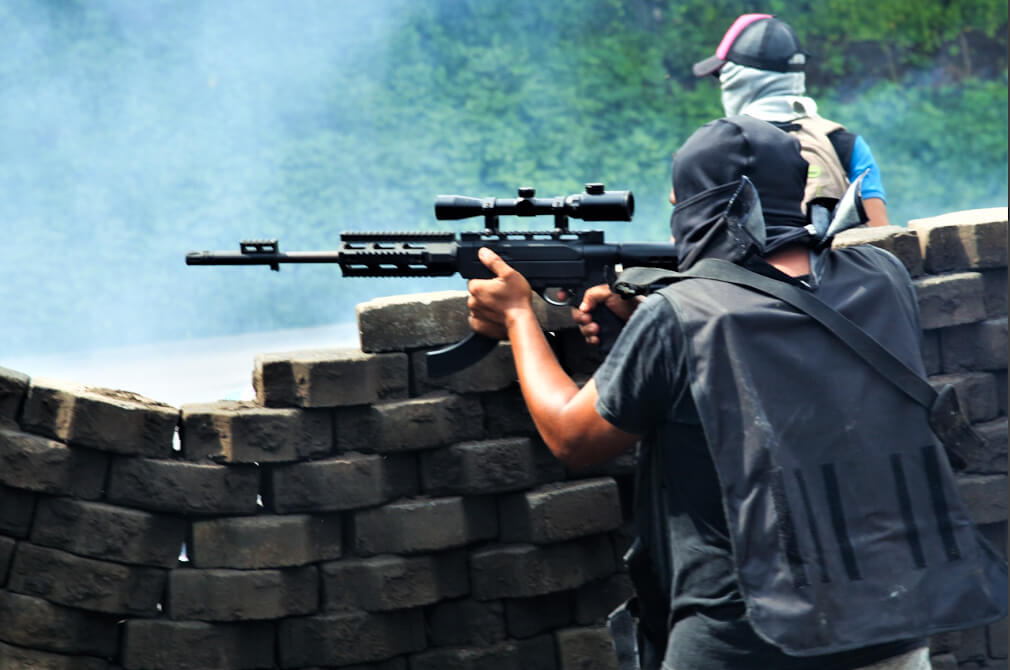
This photo by Goette-Luciak depicting a well-armed opposition gunman at 
a Masaya roadblock was recently deleted from the Edge of Adventure website.

To be sure, Goette-Luciak was far from the only Western media figure to embed with the armed opposition in Masaya and trumpet its gallantry. Some of the most overtly pro-opposition messaging arrived courtesy of a reporter named Tim Rogers. An American who spent years publishing news of interest to the local emigre and tourist population, Rogers emerged this year as a ferocious promoter of the armed opposition.

In Masaya, Rogers seemed to throb with admiration for the masked gunmen manning the barricades.

While characterizing the opposition as “an unarmed population,” Rogers glorified the lethal weaponry they deployed from behind the roadblocks. Goette-Luciak’s now-deleted photo gallery at the Edge of Adventure demonstrated that the gunmen not only toted homemade mortars, but assault weapons and handguns as well.

Like Goette-Luciak, Rogers’ cheerleading for the armed opposition was rewarded with bylines in mainstream publications from Public Radio International and The Atlantic, where he claimed Nicaragua was a “failed state” that was undergoing “democratic renewal” thanks to the push for regime change. He was ultimately hired as the Latin American editor of Fusion, a website owned by the Israel-American oligarch and Democratic Party mega-donor Haim Saban. There, Rogers produced a viral propaganda video likening the Sandinista movement to ISIS.

The out-of-the-blue emergence of figures like Goette-Luciak and Rogers as correspondents for legacy Western publications can not be viewed as an aberration or mistake. In Nicaragua, as in so many other countries targeted with regime-change operations, outlets like the Guardian, New York Times and Washington Post seem to demand on-the-ground coverage that reinforces the regime-change agenda.

And so they credentialed opposition publicists as journalists, instilling in them the illusion of their own professionalism. “I think I’ve come to realize the value of objective and impartial journalism,” Goette-Luciak said in his Edge of Adventure interview, “and I no longer consider myself as an activist for or against any particular cause.”

Max Blumenthal is the founder and editor of GrayzoneProject.com, the co-host of the podcast Moderate Rebels, the author of several books and producer of full-length documentaries including the recently released Killing Gaza. Follow him on Twitter at @MaxBlumenthal.

Republish our stories! MintPress News is licensed under a Creative Commons Attribution-NonCommercial-ShareAlike 3.0 International License. 

Thursday, September 27, 2018

Behind Washington’s War on UNRWA

The Real Reasons Behind Washington’s War on UNRWA

by Ramzy Baroud - The Palestine Chronicle


September 27, 2018

The US government’s decision to slash funds provided to the United Nations agency that cares for Palestinian refugees, UNRWA, is part of a new American-Israeli strategy aimed at redefining the rules of the game altogether.

As a result, UNRWA is experiencing its worst financial crisis. The gap in its budget is estimated at around $217 million, and is rapidly increasing.

Aside from future catastrophic events that would result in discontinuing services and urgent humanitarian aid to five million refugees registered with UNRWA, the impact of the US callous decision is already reverberating in many refugee camps across the region. Currently, UNRWA has downgraded many of its services: laying off many teachers, reducing staff and working hours at various clinics.

Nearly 40 percent of all Palestinian refugees live in Jordan, a country that is already overwhelmed by a million Syrian refugees who sought shelter there because of the grinding and deadly war in their own country.

Aware of Jordan’s vulnerability, American emissaries attempted to barter with the country to heed the US demand of revoking the status of the two million Palestinian refugees. Instead of funding UNRWA, Washington offered to re-channel the funds directly to the Jordanian government. Thus, the US hopes that the Palestinian refugee status would no longer be applicable. Unsurprisingly, Jordan refused the American offer.

News of this failed barter resurfaced last August. It was reported that US President Donald Trump's special envoy, Jared Kushner, tried to sway the Jordanian government during his visit to Amman in June.

Washington and Israel are seeking to simply remove the ‘Right of Return’ for Palestinian refugees, as enshrined in international law, from the political agenda altogether.

Coupled with Washington's strategy to “remove Jerusalem from the table," the American strategy is neither random nor impulsive.

"It is important to have an honest and sincere effort to disrupt UNRWA," Kushner wrote to the US Middle East envoy, Jason Greenblatt, in an email last January.

The email, among others, was later leaked to Foreign Policy magazine.

 “This (agency) perpetuates a status quo,” he also wrote, referring to UNRWA as “corrupt, inefficient and doesn't help peace."

This notion that UNRWA sustains the status quo - meaning the political rights of Palestinians refugees - is the main reason behind the American war on the Organization, a fact that is confirmed through statements made by top Israeli officials, too.

Israel’s ambassador to the United Nations, Danny Danon, echoed the American sentiment. UNRWA "has proven itself an impediment to resolving the conflict by keeping the Palestinians in perpetual refugee status," he said.

Certainly, the US cutting of funds to UNRWA coincides with the defunding of all programs that provide any kind of aid to the Palestinian people. But the targeting of UNRWA is mostly concerned with the status of Palestinian refugees, a status that has irked Tel Aviv for 70 years.

Why does Israel want to place Palestinian refugees in a status-less category?


The refugee status is already a precarious one. To be a Palestinian refugee means living perpetually in limbo - unable to reclaim what has been lost, and unable to fashion an alternative future and a life of freedom and dignity.

How are Palestinians to reconstruct their identity that has been shattered by decades of exile, when Israel has constantly hinged its own existence as a ‘Jewish state’ on opposing the return and repatriation of Palestinian refugees? Per Israel’s logic, the mere Palestinian demand for the implementation of the internationally-sanctioned Right of Return is equivalent to a call for “genocide”.

 According to that same faulty logic, the fact that the Palestinian people live and multiply is a “demographic threat” to Israel.

Much can be said about the circumstances behind the creation of UNRWA by the United Nations General Assembly in December 1949 - its operations, efficiency and the effectiveness of its work. But for most Palestinians, UNRWA is not a relief organization, per se - being registered as a refugee with UNRWA provides Palestinians with a temporary identity, the same identity that allowed four generations of refugees to navigate decades of exile.

UNRWA’s stamp of “refugee” on every certificate that millions of Palestinians possess - birth, death and everything else in between - has served as a compass, pointing back to the places those refugees come from - not the refugee camps scattered in Palestine and across the region, but the 600 towns and villages that were destroyed during the Zionist assault on Palestine.

These villages may have been erased, as a whole new country was established upon their ruins, but the Palestinian refugee remained - subsisted, resisted and plotted her return home. The UNRWA refugee status is the international recognition of this inalienable right.

Therefore, the current US-Israeli war does not target UNRWA as a UN body, but as an organization that allows millions of Palestinians to maintain their identity as refugees with non-negotiable rights until their return to their ancestral homeland. Nearly 70 years after its founding, UNRWA remains essential and irreplaceable.

The founders of Israel envisioned a future where Palestinian refugees would eventually disappear into the larger population of the Middle East. Seventy years on, the Israelis still entertain that same illusion.

Now, with the help of the Trump administration, they are orchestrating yet more sinister campaigns to make Palestinian refugees vanish, wished away through the destruction of UNRWA and the redefining of the refugee status of millions of Palestinians.

The fate of Palestinian refugees seems to be of no relevance to Trump, Kushner and other US officials. The Americans are now hoping that their strategy will finally bring Palestinians to their knees so that they will ultimately submit to the Israeli government’s dictates.

The latest US-Israeli folly will prove futile. Successive US administrations have done everything in their power to support Israel and to punish the supposedly intransigent Palestinians. The Right of Return, however, remained the driving force behind Palestinian resistance, as the Gaza Great March of Return, ongoing since March, continues to demonstrate.

The truth is that all the money in Washington’s coffers will not reverse what is now a deeply embedded belief in the hearts and minds of millions of refugees throughout Palestine, the Middle East and the world.

Ramzy Baroud is a journalist, author and editor of Palestine Chronicle. His latest book is ‘The Last Earth: A Palestinian Story’ (Pluto Press, London, 2018). He earned a Ph.D. in Palestine Studies from the University of Exeter and is a Non-Resident Scholar at Orfalea Center for Global and International Studies, UCSB.

Pillar to Post: Namegan Nation Seeking a Home

Chrissy Brett Interview

by Treeline


Sept 26 2018

Namegan Nation (a homeless community in and around Victoria BC) had been occupied and displaced by various police forces three times in a week. Exhausted by being forced into the street, the community sought a little R&R at Goldstream Provincial Campground.

The Province responded by kicking everyone already there out and closing the campground down, vaguely citing health and safety concerns. I went there in hopes of documenting the dangers that are so grave that a Provincial campground had to be closed and the shelter seekers essentially quarantined.


Wednesday, September 26, 2018

Target Venezuela: Trump's Opens Western Front at UN

Trump Sets Sights on Venezuela with New Sanctions and 'Regime Change' Threats

by VenezuelAnalysis.com


September 26, 2018

Speaking on the sidelines of the UN General Assembly, President Trump said the Maduro government could be "toppled very quickly."

Pays de Gex, France,  – US President Donald Trump took aim at Venezuela at the United Nations Tuesday, hitting Caracas with a fresh round of sanctions and openly talking about the military overthrow of President Nicolas Maduro.

Trump’s speech at the 73rd UN General Assembly (UNGA) dedicated special attention to Venezuela, with the US President claiming that “the socialist dictatorship of Nicolas Maduro has inflicted terrible pain” on the Venezuelan people and vowing “further action” against the South American country. The statements coincided with a new round of sanctions unveiled by the US Treasury Department’s Office of Foreign Assets Control (OFAC) Tuesday, targeting high-ranking Venezuelan figures. 

These included the first lady, Cilia Flores, the Vice-President, Delcy Rodriguez, and other members of the cabinet. Assets were also seized from Rafael Sarria, who OFAC claim works as a frontman for Diosdado Cabello, the current President of the National Constituent Assembly.

Besides individual sanctions, which have included President Maduro himself, US actions have put up hurdles for all Venezuelan financial transactions and targeted the ability to service and re-finance debt issued by the Venezuelan government and state oil company PDVSA. 

Torino Capital Chief Economist Francisco Rodriguez has argued that US financial sanctions may have played an important role in the collapse of the oil-dependent country’s crude production and consequent worsening of its economic crisis.

While attending the UNGA, Trump also held a press conference with recently elected hard-right Colombian President Ivan Duque in which the US leader claimed that a military coup would succeed easily in Venezuela.

“It’s a regime that, frankly, could be toppled very quickly by the military if the military decides to do that,” said the US President in reply to a journalist. 

Trump reiterated on Wednesday that “all options are on the table” with regard to Venezuela.

Earlier this month, the New York Times revealed that US diplomats met repeatedly with dissident Venezuelan military officers who solicited Washington’s support in executing a coup against President Maduro.

The Trump administration has, nonetheless, downplayed the possibility of a direct US military intervention in Venezuela, despite concerns by Chicago Mayor Rahm Emanuel that an “October surprise” may be in the works.

For his part, Navy Vice Admiral Craig Faller indicated during his Senate confirmation hearings to lead US Southern Command that while there were no plans to intervene militarily in the Caribbean nation, normal preparations for “a range of contingencies” were underway.

Trump’s hawkish stance vis-a-vis Caracas was mirrored by regional US allies at the UNGA, with Argentine President Mauricio Macri expressing “concern” for the human rights situation in Venezuela. His Brazilian counterpart Michel Temer, who came to power after what is widely considered a parliamentary coup that ousted former President Dilma Rousseff, echoed those concerns and added that in South America there is “no more room for alternatives to democracy.”

Colombian President Ivan Duque went even further in his speech on Wednesday, stating that “putting an end to the Venezuelan dictatorship is a global challenge” and even claiming that Venezuela is experiencing “the worst humanitarian and migratory crisis in history.”

According to the UN’s International Organization for Migration, an estimated 2.3 million Venezuelans were living abroad as of July 2018. Approximately five million Colombian citizens currently reside in Venezuela, many of whom refugees of Colombia’s over half-century long civil war. 

Venezuelan reaction


Venezuelan leaders were quick to react to the heated rhetoric and fresh actions coming out of New York.

Speaking at a ceremony in Caracas in which Venezuelan citizenship was granted to more than eight thousand immigrants, President Nicolas Maduro welcomed the latest sanctions as a badge of honor.

“The sanctions, besides being illegal and useless, are a medal, an award that shows that we are brave and on the right track,” he stated.

The Venezuelan President is due to address the UN General Assembly himself on Wednesday afternoon.

For his part, Foreign Minister Jorge Arreaza, who is in New York for the UNGA, also condemned Trump’s threats when speaking to the press.

“It is worrying that President Trump is once more raising the banners of the anachronistic Monroe Doctrine, which is against international law, the UN charter, and multilateralism […]. We have to defend the continent from these unilateral threats,” he said.

Arreaza went on to warn that a foreign military intervention would cause an actual migration crisis and numerous deaths, stressing that the Venezuelan people and armed forces know how to defend themselves.


This work is licensed under a Attribution Non-commercial 
No Derivatives Creative Commons license.

Tuesday, September 25, 2018

Gorilla Radio with Chris Cook, Yves Engler, Michael J. Carpenter, Janine Bandcroft September 27th, 2018

This Week on GR

by C. L. Cook - Gorilla-Radio.com


September 27, 2018

When Canada became a war-making nation, its elite worried about public reaction. They fretted a cover story; something clever and convincing, along the lines of a national mythos to quiet the conscience of citizens made uncomfortable by the truth of horrors and suffering being inflicted on distant others. As it turned out, those troubled nights were wasted.

It seems no damning deed done can shake Canadians' indomitable self-congratulation, nor dim their ineffably lofty self-regard. Though the richest nation in Africa be destroyed, creating a chaos the likes of which has not been writ since the time of Pharaoh, Canada and its paragons bray of their part played - as if heroes.


Listen. Hear.

Yves Engler is a Montréal-based activist, essayist, and author. His articles appear at Dissident Voice, The Palestine Chronicle, Rabble.ca, and Pacific Free Press among other places. Some of his ten book titles include: 'A Propaganda System—How Canada’s Government, Corporations, Media and Academia Sell War and Exploitation', 'Canada in Africa — 300 Years of Aid and Exploitation', and 'The Ugly Canadian — Stephen Harper’s Foreign Policy'.

Yves’ new book, 'Left, Right: Marching to the Beat of Imperial Canada' is freshly off the press and tries, as reviewer David Swanson notes, "to provide 10% of the explanation for why many Canadians suffer under the delusion that their nation’s government is a benevolent force in the world..."

Yves Engler in the first half.

And; Canada's complicity in international criminality is not limited to the destruction, with NATO compatriots, of countries like Libya or the Former Yugoslavia, it too works diligently to undermine democracy in countries like Haiti, Nicaragua, Venezuela, and Honduras. And, even as it vociferously champions human rights best practices, Canada tacitly supports the oppressive military occupations conducted by friends America, Britain, and Israel.

Michael J. Carpenter is a post-doctoral fellow with the Borders in Globalization project at the Department of Political Science at the University of Victoria whose dissertation explored the theory and practice of civic struggle - struggle also known as "nonviolent direct action", "civil resistance", and "people power." His work is focused especially in the context of the Middle East, and Palestine in particular.

He recently presented, with retired trial lawyer, William Geimer and Adrian Fine of Independent Jewish Voices 'Israel: Canada's Human Rights Exception' to audiences in Comox, Duncan, and Victoria.

Micheal J. Carpenter and taking exception to human rights exceptionalism in the second half.

And; Victoria-based activist and CFUV Radio broadcaster at-large, Janine Bandcroft will be here at the bottom of the hour with the Left Coast Events Bulletin of some of the good things to be gotten up to in and around our town in the coming week. But first, Yves Engler and the dark underside of the Great White North.

Chris Cook hosts Gorilla Radio, airing live every Thursday between 11-Noon Pacific Time. In Victoria at 101.9FM, and on the internet at: http://cfuv.uvic.ca.  He also serves as a contributing editor to the web news site, http://www.pacificfreepress.com. Check out the GR blog at: http://gorillaradioblog.blogspot.ca/

Canada Waves Bye, Bye to Sunny Ways: Support of Venezuelan Regime Change Reveals An Ugly National Underside

Does Canada support an invasion of Venezuela? 

by Yves Engler


September 24, 2018

In their obsession for regime change, Ottawa is backing talk of an invasion of Venezuela. And the NDP is enabling Canada’s interventionist policy. Last week 11 of the 14 member states of the anti-Venezuelan “Lima Group” backed a statement distancing the alliance from “any type of action or declaration that implies military intervention” after Organization of American States chief Luis Almagro stated:

As for military intervention to overthrow the Nicolas Maduro regime, I think we should not rule out any option … diplomacy remains the first option but we can’t exclude any action.”

Canada, Guyana and Colombia refused to criticize the head of the OAS’ musings about an invasion of Venezuela.

In recent weeks there has been growing tension on the border between Colombia and Venezuela. Some believe Washington is pushing for a conflict via Colombia, which recently joined NATO.

Last summer Donald Trump threatened to invade Venezuela. “We have many options for Venezuela including a possible military option if necessary,” the US President said.

Talk of an invasion encourages those seeking regime change. At the start of August drones armed with explosives flew toward Maduro during a military parade in what was probably an attempt to assassinate the Venezuelan president. Two weeks ago the New York Times reported that US officials recently met members of Venezuela’s military planning to oust Maduro. US Secretary of State Rex Tillerson called for the military to oust Maduro in February and other leading Republican Party officials have made similar statements.

Alongside these aggressive measures, Canada has sought to weaken the Venezuelan government. Since last September Ottawa has imposed three rounds of sanctions on Venezuelan officials. In March the United Nations Human Rights Council condemned the economic sanctions the US, Canada and EU have adopted against Venezuela while Caracas called Canada’s move a “blatant violation of the most fundamental rules of International Law.”

Over the past year and a half Canadian officials have campaigned aggressively against the Venezuelan government. Foreign Minister Chrystia Freeland has prodded Caribbean countries to join the Lima Group’s anti-Venezuela efforts and made frequent statements critical of Caracas’ democratic legitimacy and human rights record. In June Freeland told the OAS General Assembly, “we must act immediately on the situation in Venezuela to force the exit of the dictatorship.”

Ottawa has encouraged its diplomats to play up human rights violations and supported opposition groups inside Venezuela. A 27-page Global Affairs report uncovered by the Globe and Mail noted, “Canada should maintain the embassy’s prominent position as a champion of human-rights defenders.”

Alluding to the hostility engendered by its interference in that country’s affairs, the partially redacted 2017 report recommended that Canadian officials also “develop and implement strategies to minimize the impact of attacks by the government in response to Canada’s human rights statements and activities.”

As part of its campaign against the elected government, Ottawa has amplified oppositional voices inside Venezuela. Over the past decade, for instance, the embassy has co-sponsored an annual Human Rights Award with the Centro para la Paz y los Derechos Humanos whose director, Raúl Herrera, has repeatedly denounced the Venezuelan government.

In July the recipient of the 2018 prize, Francisco Valencia, spoke in Ottawa and was profiled by the Globe and Mail. “Canada actually is, in my view, the country that denounced the most the violation of human rights in Venezuela … and was the most helpful with financing towards humanitarian issues,” explained Valencia, who also told that paper he was “the target of threats from the government.”

In another example of anti-government figures invited to Ottawa, the former mayor of metropolitan Caracas, Antonio Ledezma, called for “humanitarian intervention” before the Subcommittee on International Human Rights of the Standing Committee on Foreign Affairs and International Development last week.

He said:

If the international community does not urgently activate the principle of humanitarian intervention for Venezuela — which developed the concept of the responsibility to protect — they will have to settle for sending Venezuelans a resolution of condolence with which we will not revive the thousands of human beings who will lose their lives in the middle of this genocide sponsored by Maduro.”

In November Ledezma escaped house arrest and fled the country.

The NDP’s foreign critic has stayed quiet regarding the US/Canadian campaign against Venezuela’s elected government. I found no criticism by Hélène Laverdière of US/OAS leaders’ musing about invading or the August assassination attempt on Maduro. Nor did I find any disapproval from the NDP’s foreign critic of Canadian sanctions or Ottawa’s role in the Lima Group of anti-Venezuelan foreign ministers.

Laverdière has also failed to challenge Canada’s expulsion of Venezuelan diplomats and role in directly financing an often-unsavoury Venezuelan opposition. Worse still, Laverdière has openly supported asphyxiating the left-wing government through other means. The 15-year Foreign Affairs diplomat has repeatedly found cause to criticize Venezuela and has called on Ottawa to do more to undermine Maduro’s government.

Is Canadian political culture so deformed that no party represented in the House of Commons will oppose talk of invading Venezuela? If so its not another country’s democracy that we should be concerned about.