Tuesday, November 12, 2013

Untold Story of America's War in Afghanistan Pt.2

The Untold Story of America's War in Afghanistan Pt.2

by TRNN

Part two of our discussion with journalist Ann Jones on her new book: "How the Wounded Return from America's Wars -- The Untold Story"


Ann Jones is a journalist, photographer (Getty Images), and the author of eight books of nonfiction, including Women Who Kill, Next Time She’ll Be Dead, Kabul in Winter, and War Is Not Over When It’s Over. She has reported on the impact of war in the Middle East, Asia, and Africa, and embedded with American forces in Afghanistan. She regularly writes for The Nation and TomDispatch.com. Her new book is They Were Soldiers: How the Wounded Return from America's Wars—The Untold Story (Haymarket Books).

Lebanon's Diaspora Palestinians Vow to Liberate Compatriots Caught in Syria War

Palestinian College Students in Lebanon Vow to Aid Their Countrymen from Syria

by Franklin Lamb - Al Manar

Ein el Helwe camp, Saida - The Syrian conflict continues prising apart Palestinian refugees from that beleaguered country’s ten official and three unofficial Palestinian camps forcing the majority to flee to Lebanon despite the latter outlawing for Palestinians, illegally expelled from their homes during the 1948 Nakba, of even the most elementary civil right to work or to own a home.

Palestinian refugees make up the second most massive scale displacement from the Syria crisis with an estimated 65% of the 500,000 Palestinians in Syria having been displaced, along with 7 million Syrians as it becomes ever more difficult for Palestinians to flee as they are increasingly harassed or abused in neighboring countries while totally barred from seeking refuge in their own country, Palestine.

Approximately 255,000 Palestinian refugees are displaced in Syria with over 200,000 in Damascus, around 6,600 in Aleppo, 4,500 in Latakia, 3,050 in Hama, 6,450 in Homs and 13,100 in Dera’a. 9,657 PR from Syria have registered with UNRWA for assistance in Jordan and 49,000 in Lebanon.

UNRWA reports approximately 6,000 Palestinian refugees in Egypt, 1,100 in Libya, 1,000 in Gaza and more than 1000 fled to Malaysia, Thailand and Indonesia.

Intermittent and sporadic hostilities including airstrikes, shelling and mortars continue and during the past two months around the camps of Yarmouk, Husseiniyah, Sbeineh, Barzeh, Jobar, Qaboun, Khan Eshieh and Dera’a. a total 125 PR were reportedly killed as a result of the hostilities: 22 in Yarmouk, 18 in Dera’a, 13 in Husseiniyah and 12 in Khan Eshieh among others. This is the highest number of reported Palestinians deaths for months. Yarmouk and Sbeineh are currently sealed off with UNRWA increasingly concerned about the well-being of those trapped.

Approximately 65,000 Palestinian refugees from Syrian camps are currently in Lebanon. The majority, 32% are in Saida, 19% are in Tyre, 17% in central Lebanon and 16% each in north Lebanon and Beqaa according to data given this observer during visits to UNWRA HQ in Damascus.

Arriving Palestinian students report, as UNWRA has documented, that schools partially hosting displaced Palestinians and Syrians and also operating as shelters and that three shifts for students are not uncommon nor are shifts for sleeping. The high number of school closures, many schools damaged, parents unwilling to send their children to school for security reasons and a large percentage of the population constantly on the move. There is uncertainty whether even emergency education provisions are sustainable for the coming winter months, as well as shortages of food, decreasing housing availability and limited access, if at all, to school supplies and whether Palestinians in Lebanon and neighboring countries, like large number of their Syrian hosts, will have access to education at all.

Through no fault of its own, UNWRA’s delivery of education to the overwhelming majority of Palestinian refugee children in Syria has been severely impaired and in Lebanon there are additional problem.

Recently compiled data with respect to Palestinian refugees education crisis is contained in a joint UNWRA-EU, publication entitled “Back to School, Syria Emergency: Palestine Refugee Children”. Among its findings are that two-thirds of Palestinian refugee youngsters in Syria have been affected by school closures. Of the 118 UNWRA schools in Syria, 68 are closed due to war damage, 10 are being used as emergency shelters for displaced persons, 40 are operational as of 11/11/13. In addition UNWRA and the Syrian Ministry of Education have cooperated to set up schools in shared buildings.

UNRWA is operating 694 elementary and preparatory schools across its five fields of operation, as well as eight secondary schools in Lebanon, providing free basic education for around 550,000 Palestinian refugee children but they do not have the classroom space for the thousands of arriving Syrian youngsters in Lebanon where fewer than 35% of Palestinian children from Syria have been enrolled in schools. In addition, UNWRA’s program budget for 2012-13 projects a financial situation where the disparity between budget, income and expenditure has become chronic. Palestinians in Lebanon and Syria bear the burden in diminished health care and compromised education.

Despite being a resolute advocate for UNWRA, this observer is aware of that its budget warrants scrutinizing. Almost 75 percent of UNWRA’s budget, or $675 million, between 2010-13 was locked in to pay staff salaries. Salary expenditure has gone up from $400 million in 2008 to more than $502 million in 2013. Yet its spending on medical supplies in 2013 is approximately the same as it was in 2009.

As American University of Beirut Professor Rosemay Sayigh reminds us, before we blame Lebanon totally for their harsh policies towards Palestinian refugees, we should remember that if the “Great Powers” had insisted on Israel repatriating the refugees after the 1948 Nakba according to UN General Assembly Resolution 194 (December 1948), the refugee problem would not exist today, and the Arab states would not have to deal with it.

Against this disturbing backdrop is the fact that local NGO’s have few available resources to assist with refugee education. Yet, there are a few ad hoc bright spots and encouragements to Palestinian students coming mainly from the Palestinian community itself in Lebanon and some friends of Palestine abroad.

One example is this year’s establishment of the Sabra-Shatila Scholarship Program (sssp-lb.com) made possible by tuition grants for Palestinian refugees in Lebanon from a remarkable American patriot and humanitarians.

Since the few months of its existence, the SSSP has awarded 99 tuition grants in Shatila and Burj al Barajeneh camps and plans for 150 more Palestinian scholarships for spring semester in Ein el Helwe camp. According to Zeinab el-Hajj, Executive Director of the SSSP, each tuition grant recipients is committed to giving back to her or his community especially in the field of education.

Already many scholarship grantees have committed to tutoring their countrymen arriving from Syria or in the harshest camps including the three noted above where dropout rates are highest and graduations’ are lowest. “We at SSSP do not seek out only the youngsters with the highest GPA’s we want to help those who without our tuition grants otherwise may well not even go to college or if they do, are likely to drop out.”

An American friend of Palestine urged the assembled scholarship recipients in the slums of Burg al Barajeh camp last month, when 80 Palestinians youngest received tuition grants: “To pursue your dreams of a better life for yourselves and your families pending your return to Palestine.” He reminded the cheering students that, ““An education is forever and its purpose is to enjoy a more productive lifetime while seeking to fulfill all of what each of you is capable as you give back to your respective communities. Pursuing higher education is a quintessential and noble act of Resistance against oppression and occupation everywhere. Education cannot be ethnically cleansed, stolen, tortured, jailed, uprooted, bulldozed, massacred, murdered, bombed or burned down. Rather, staying in school and pursuing ones dream is what your cherished for-bearers, who were forced from their homes and lands into Lebanon and trekked from Palestine- approximately 130,000- in the summer and fall of 1948, would want for you, and expect of you.”

As one on one tutoring by SSSP scholarship recipients increases from within the camps of Lebanon in tutoring support of their countrymen from Syria, all people of good will cannot but be inspired by the idealism, energy and commitment of Palestinians pursuing higher education in Lebanon who support their community as was the norm in history when Palestinians were considered at the vanguard of education in this region.

Franklin P. Lamb, LLM,PhD
Legal Advisor, The Sabra-Shatila Scholarship Program, Shatila Camp www.SSSP-lb.com
Board Member, The Sabra Shatila Foundation and the Palestine Civil Rights Campaign, Beirut-Washington DC

Power Grid "War Game" Tests UK/US Power Infrastructures

Cyber attack 'war game' to test London banks prior to big US powergrid drill

by Lori Price - Citizens for Legitimate Government

11 Nov 2013

All links are here:http://www.legitgov.org/#breaking_news

Cyber attack 'war game' to test London banks prior to big US power grid drill --London's financial firms to be put through 'war game' scenario 12 Nov 2013 Thousands of staff across dozens of London's financial firms will be put through a "war game" scenario on Tuesday to test how well they can handle a major cyber attack. In one of the largest exercises of its kind in the world, the test dubbed "Waking Shark II" [LOL!] will bombard firms with a series of announcements and scenarios, such as a major attack on computer systems hitting stock exchanges and unfolding on social media. It will be co-ordinated from a single room housing regulators, government officials and staff from banks and other financial firms, people familiar with the matter said. [See: Huge Electric Grid Failure Drill Scheduled for 13 -14 November 2013.]

DHS, FEMA to participate in power grid drill on Nov. 13-14 07 Nov 2013 National Grid will be among the participants in North American Electric Reliability Corp.'s second Grid Security Exercise, which is being referred to as Grid Ex II by those participating. Many of the specifics of the drill have not been made known to utilities and agencies involved, according to a National Grid spokesman... In addition to National Grid and other utilities, the Department of Homeland Security, the Federal Emergency Management Agency and the National Institute of Standards and Technology will be involved.

Monday, November 11, 2013

Resisting Genetic Roulette: Forsaking the GMO Gamble

Achieving a Non-GMO Tipping Point: Genetic Roulette – The Gamble of Our Lives 

by Kim Petersen - Dissident Voice

People should oppose GMOs for a myriad of reasons based on:

1) the precautionary principle

Before a product is released to the market, it should be independently tested and verified to the utmost standards as posing no untoward risks to the public, in particular, the elderly, children, and pregnant mothers. This would seem a no-brainer. The precautionary principle requires, however, that one must look beyond immediate consumption by humans. For example, what effect will GMO crops have on the soil? On the water? What effect on creatures that feed on the crops? On pests and creatures that feed on the pests? In other words, how will the ecosystem, of which humans are a part, be affected by GMOs? Genes do not code in isolation; therefore, genetic modification may pose risks beyond the one trait desired.

2) the right-to-know

This is also a no-brainer. People have a right to know what they are buying, what is in the food that they are eating. Nonetheless, voters defeated Proposition 31 in California and Initiative 522 in Washington state, and the immediate conclusion would be that people don’t think the right to know is paramount. Multinationals poured money into what became one-sided plebiscites and the monopoly media obliged to propagandize a segment of the public. Is this democratic?

3) food security

Should life be patentable? The genetic code does not belong to companies. Genetic engineering is research that initially was publicly funded in universities and research centers. Corporations like Monsanto have tweaked the genome. GMO seeds are now patented, which means that food is now owned by a corporation. Corporations operate to produce a profit for the shareholders. Therefore, food production will be based on producing enough food to produce the biggest profit margin; the purpose is not to feed as many people as possible.

4) maintaining the integrity of academia and research journals

Not a rigorous academic journal, but Scientific American has come out in favor of GMOs and, curiously (because a science magazine is supposedly about promulgating knowledge) is in opposition to mandatory GMO labeling. Governments are, reportedly, also pressuring academic journals not to publish negative findings about GMOs. The peer review system for publication is becoming laughable. Said the Independent Science News:

Richard Smith, former editor of the British Medical Journal, has jested that instead of scientific peer review, its rival The Lancet had a system of throwing a pile of papers down the stairs and publishing those that reached the bottom. On another occasion, Smith was challenged to publish an issue of the BMJ exclusively comprising papers that had failed peer review and see if anybody noticed. He replied, “How do you know I haven’t already done it?”

5) classism

When seeds are owned, farmers are at the behest of the seed providers, and ultimately, so are consumers. Terminator seeds are a GMO development to ensure that farmers do not — and cannot — save seeds for the next planting season. Farmers will not control their own growing destiny. Once farmers become reliant upon patented seeds, the patent owner (a monopolist) has more flexibility to manipulate the pricing.

The outcome is that profits accrue increasingly to a corporation relative to the farmers. This inequality is passed along to the unwary consumers.

What is the solution?


Inform, educate, and take appropriate action. If GMOs will not label, then GMO-free food can label themselves as such, although this is being opposed by the Food and Drug Administration in the USA. Seriously! Nevertheless, the people need to agitate for their right-to-know and the right for non-GMO food producers to label themselves as such. In the end, the power of the consumer will determine what foods are produced for the market.

The film Genetic Roulette – The Gamble of Our Lives (2012) is a great way to inform oneself and spread the word on the risks associated with GMOs.
Kim Petersen is co-editor of Dissident Voice. He can be reached at: kim@dissidentvoice.org. Read other articles by Kim.

Fasting for Fukushima: Eleventh Day Movement to Save the Future

FAST FOR FUKUSHIMA

by Harvey Wasserman - Solartopia.org

 Today, Monday, November 11, many of us will begin our first "Eleventh Day Fast for Fukushima". Along with so many others, I won't be eating from dawn to dusk. I will do liquids. But the fast will be meant to honor the victims of this horrible disaster, and to focus our efforts on finding ways to survive it.

The fast comes exactly 32 months after the disaster began. Many of us will fast again each 11th day of the month until Fukushima ceases to threaten the health of the planet, which will almost certainly take a long long time. Hopefully the fasts will be good for the planet's health as well as our own.

NEW PETITION: Many of you wrote noting I omitted the link for the new petition from Arnie Gundersen, asking Tepco be removed from Fukushima. Here it is:

http://www.nukefree.org/new-fuku-petition-remove-tepco-you-remove-fuel

We already have 715 signers, and hope for many many more.

Please note that we continue to gather signatures for our main petition. We have turned an initial 114,000-plus from this petition and 40,000 more from www.rootsaction.org plus many more individual and organizational signatures from the Green Shadow Cabinet.

But we cannot and will not stop until a global team of scientists and engineers takes over at Fukushima with the full faith and credit of the world behind them. Only then might we have a chance to survive on this planet.

So please keep sending this petition around, gathering signatures and talking to all who'll listen about what we must do to save our planet and ourselves from the horrific mistake that is atomic energy.

TODAY'S PIECE: PANDORA'S ATOMIC BOX SCORE: Thanks to Stefanie Spear and www.Ecowatch.com for publishing this:

http://ecowatch.com/2013/11/10/pandoras-atomic-box-score/

The website of the photographer who did the CNN/Fukushima graphic is www.abbiesophia.com

WE HAVE MADE A DIFFERENCE

Today's NYTimes carried a big story on the fuel rod bring-down at Unit Four. Serious Fukushima coverage is finally surfacing at other corporate media throughout the world, most notably Reuters.

Little or none of this would be happening without our movement's tireless efforts to wake up the world about this devastating disaster.

So let's keep up! We are making a huge difference!! Together, we just might save this planet. See you in Solartopia, HarveyW

Ann Jones on How the Wounded Return from America's Wars


The Untold Story of American Soldiers Wounded in Afghanistan


by TRNN

Journalist Ann Jones discusses her new book: "How the Wounded Return from America's Wars - The Untold Story"

Ann Jones is a journalist, photographer (Getty Images), and the author of eight books of nonfiction, including Women Who Kill, Next Time She’ll Be Dead, Kabul in Winter, and War Is Not Over When It’s Over. She has reported on the impact of war in the Middle East, Asia, and Africa, and embedded with American forces in Afghanistan. She regularly writes for The Nation and TomDispatch.com.  Her new book is They Were Soldiers: How the Wounded Return from America's Wars—The Untold Story (Haymarket Books).

Sunday, November 10, 2013

War's Enduring Folly

Veterans Day, 95 Years On: The Enduring Folly of the Battle of the Somme

by Adam Hochschild  Illustrations by Joe Sacco - TomDispatch

[The illustrations in this piece come from Joe Sacco’s The Great War: July 1, 1916: The First Day of the Battle of the Somme with the kind permission of its publisher, W.W. Norton, and the slightly adapted text, which also appears in that book, comes originally from Adam Hochschild’s To End All Wars: A Story of Loyalty and Rebellion, 1914-1918 and is used with the kind permission of its publisher, Houghton Mifflin Harcourt.]

In a country that uses every possible occasion to celebrate its “warriors,” many have forgotten that today’s holiday originally marked a peace agreement. Veterans Day in the United States originally was called Armistice Day and commemorated the ceasefire which, at 11 a.m. on November 11, 1918, ended the First World War.

Up to that point, it had been the most destructive war in history, with a total civilian and military death toll of roughly 20 million. Millions more had been wounded, many of them missing arms, legs, eyes, genitals; and because of an Allied naval blockade of the Central Powers, millions more were near starvation: the average German civilian lost 20% of his or her body weight during the war.

A stunned world had never experienced anything like this. In some countries for years afterward, on November 11th, traffic, assembly lines, even underground mining machinery came to a halt at 11 a.m. for two minutes of silence, a silence often broken, witnesses from the 1920s reported, by the sound of women sobbing.

Like most wars, the war of 1914-1918 was begun with the expectation of quick victory, created more problems than it solved, and was punctuated by moments of tragic folly. As the years have passed, one point that has come to symbolize the illusions, the destructiveness, the hubris, the needless deaths of the entire war -- and of other wars since then -- has been the first day of the Battle of the Somme.

Tomgram: Adam Hochschild, The War to Begin All Wars


[Note for TomDispatch Readers: Ann Jones dedicates They Were Soldiers: How the Wounded Return From America’s Wars -- The Untold Story, the first original offering from Dispatch Books, to Lieutenant Oscar Trygve Slagsvol, her father, a decorated veteran of the Western Front in World War I. She writes, “My father used to say that wars are made by men who have never been to war, men who don’t know that war, once started, never ends.” We tend to forget about the lineage of our wars. Today, Veterans Day, TomDispatch offers a vivid reminder of where they come from. I especially wanted to thank all of you who bought Jones’s book the moment it was published last Thursday. It’s a deeply appreciated sign of your support for our new publishing venture. Her book, on the journey of America’s grievously war-wounded from the battlefield in Afghanistan to other kinds of battlefields in this country, is as stunning an account as it's possible to imagine of the true costs of the “little” wars that are still, in many ways, the legacy of “the Great War.” If there is a day for you to think about this subject and perhaps buy her book, this is certainly it. Just a small reminder as well that, for any of you who want to support this site with a donation of $100 (or more), the offer of a personalized, signed copy of They Were Soldiers remains open this week while Jones is still close at hand to sign them. Check out the offer at our donation page. Tom]

It was exactly 95 years ago: the 11th hour of the 11th day of the 11th month of 1918, the moment when major hostilities in the charnel house that was World War I ended. In 1919, November 11th officially became “Armistice Day” in the United States. As it happened, though, major hostilities were suspended for just two brief decades before an even more devastating global war began. In 1954, nine years after World War II ended, with the previous “great” conflict having proved anything but -- as once advertised -- the war to end all wars, and the memory of its armistice fading, the holiday was officially relabeled Veterans Day. And so it has remained as, in the second half of the last century and the first 13 years of this one, those veterans piled up. There were the ones from Korea, Vietnam, and too many American brushfire interventions to mention, as well as -- in our no-longer-so-new century -- from the disastrous counterinsurgency wars in Iraq and Afghanistan. (In Washington’s conflicts in Pakistan, Somalia, and Yemen, where the “soldiers” or “airmen” are generally robots, there really are no veterans.)

Everyone knows how World War I was advertised. In retrospect, however, it could more accurately be thought of as the war that began all wars. Admittedly, trench warfare seems a thing of the past, last seen in the Iran-Iraq War of the 1980s. But World War I launched the age of mass industrial warfare, with the marriage of science, academia, the corporation, and the military leading to everything from nuclear proliferation to drone warfare. Without it, a military-industrial complex would have been inconceivable. While the First World War soaked the earth in blood, as soldiers dug ever deeper into their trenches, it also prepared the way for future wars in which “collateral damage” moved ever closer to the center of any conflict, in which uprooted populations and dead civilians became the essence of war. And after all these years, it’s left one wonder behind: that, given all the blood and horror since World War I began, we somehow still manage to celebrate those wars, whatever we think of them, through those we like to call our “warriors” or “wounded warriors.”

With yet another Veterans Day rolling around, and no armistice in the perpetual war that Washington has been fighting at least since that other 11th, the one that occurred in September 2001, TomDispatch is returning to the origin of modern war, the almost inconceivable bloodletting of World War I. The remarkable cartoonist Joe Sacco, in an obvious labor of, if not love, then devotion to remembering the nightmare of our last century, has done something almost unimaginable: he’s created The Great War: July 1, 1916: The First Day of the Battle of the Somme, a 24-foot foldout diorama of an illustrated book focused only on the initial day -- with its tens of thousands of deaths -- of one of the true catastrophes of that war. As part of his book package, he’s included TomDispatch regular Adam Hochschild’s account of that first day of battle from his bestselling, award-winning recent book To End All Wars: A Story of Loyalty and Rebellion, 1914–1918. With some pride, this website’s way of not “celebrating” Veterans Day is to offer that text and three of Sacco’s illustrations.

Ninety-five years later, after so much has indeed been forgotten, denied, ignored, left in the dust, it seems almost wrong to say that we must never forget. But... Tom

 Veterans Day, 95 Years On: The Enduring Folly of the Battle of the Somme

by Adam Hochschild  Illustrations by Joe Sacco

The preparations for that battle went on for months: generals and their staffs drew up plans in their châteaux headquarters; horses, tractors, and sweating soldiers maneuvered thousands of big 13-ton guns into position; reconnaissance planes swooped above the German lines; endless trains of horse-drawn supply wagons carried artillery shells and machine gun ammunition up to the front; hundreds of thousands of soldiers from across the British Empire, from the Orkney Islands to the Punjab, filled frontline trenches, reserve trenches, and support bases in the rear. All was in preparation for the grand attack that seemed certain to change the course of the war. And then finally on the first day of July 1916, preceded by the most massive bombardment British artillery had ever fired, the battle began.

Click here to see a larger version


You can see the results of the battle’s first day in dozens of military cemeteries spread out across this corner of France, but perhaps the most striking is one of the smallest, on a hillside, screened by a grove of trees. Each gravestone has a name, rank, and serial number; 162 have crosses and one a Star of David. When known, a man’s age is engraved on the stone as well: 19, 22, 23, 26, 21, 20, 34. Ten of the graves simply say, “A Soldier of the Great War, Known unto God.”

Almost all the dead are from Britain’s Devonshire Regiment, the date on their gravestones July 1, 1916. Most were casualties of a single German machine gun several hundred yards from this spot, and were buried here in a section of the frontline trench they had climbed out of that morning. Captain Duncan Martin, 30, a company commander and an artist in civilian life, had made a clay model of the battlefield across which the British planned to attack. He predicted the exact place at which he and his men would come under fire from the machine gun as they emerged onto an exposed hillside. He, too, is here, one of some 21,000 British soldiers killed or fatally wounded on the day of greatest bloodshed in the history of their country’s military, before or since.

Dreams of Swift Victory


In almost every war, it seems, the next planned offensive is seen as the big breakthrough, the smashing, decisive blow that will pave the way to swift victory. Midway through the First World War, troops from both sides had been bogged down for the better part of two years in lines of trenches that ran across northern France and a corner of Belgium. Barbed wire and the machine gun had made impossible the war of dramatic advances and glorious cavalry charges that the generals on both sides had dreamed of.

To end this frustrating stalemate, the British army planned an enormous assault for a point near where the River Somme meandered its slow and weed-filled way through French wheat and sugar-beet fields. A torrent of supplies began pouring into the area to equip the half million British Empire troops involved, of whom 120,000 would attack on the first day alone. This was to be the “Big Push,” a concentration of manpower and artillery so massive and in such a small space that the German defenses would burst open as if hit by floodwaters.

After the overwhelmed Germans had been bayoneted in their trenches, it would be a matter of what General Douglas Haig, the British commander in chief, called “fighting the Enemy in the open,” and so battalions were trained intensively in maneuvering across trenchless meadows. Finally, of course, streaming through the gap in the lines would come the cavalry, three divisions’ worth. After all, hadn’t glorious charges by men on horseback been a decisive element in warfare for millennia?

Troops unrolled 70,000 miles of telephone cable. Thousands more unloaded and piled ammunition in huge dumps; stripped to the waist and sweltering in the summer heat, they dug endlessly to construct special roads to speed supplies to the front. Fifty-five miles of new standard-gauge railway line were built. With as many British soldiers crammed into the launching area as the population of a good-sized city, new wells had to be drilled and dozens of miles of water pipe laid. No detail was forgotten.

Click here to see a larger version


British troops, the plan went, would move forward across no-man’s-land in successive waves. Everything was precise: each wave would advance in a continuous line 100 yards in front of the next, at a steady pace of 100 yards a minute. How were they to be safe from German machine gun fire? Simple: the pre-attack artillery bombardment would destroy not just the Germans’ barbed wire but the bunkers that sheltered their machine guns. How could this not be when there was one artillery piece for every 17 yards of front line, all of which would rain a total of a million and a half shells down on the German trenches? And if that weren’t enough, once British troops climbed out of their trenches, a final “creeping barrage” of bursting shells would precede them, a moving curtain of fire riddling with shrapnel any surviving Germans who emerged from underground shelters to try to fight.

The plan for the first day’s attack on July 1, 1916, was 31 pages long and its map included the British names with which the German trenches had already been rechristened. Preparations this thorough were hard to conceal, and there were occasional unnerving signs that the German troops knew almost as much about them as the British. When one unit moved into position, it found a sign held up from the German trenches: WELCOME TO THE 29TH DIVISION.

Several weeks before the attack, 168 officers who were graduates of Eton met for an Old Etonian dinner at the Hotel Godbert in Amiens, a French city behind the lines. In Latin, they toasted their alma mater -- “Floreat Etona!” -- and raised their voices in the school song, “Carmen Etonense.” Enlisted men entertained themselves in other ways. A haunting piece of documentary film footage from these months, taken from a Red Cross barge moving down a canal behind the lines, shows hundreds of Allied soldiers stripped completely bare, wading, bathing, or sunning themselves on the canal bank, smiling and waving at the camera. Without helmets and uniforms, it is impossible to tell their nationality; their naked bodies mark them only as human beings.

Riding a black horse and with his usual escort of lancers, General Haig inspected his divisions as they rehearsed their attacks on practice fields where white tapes on the ground stood for the German trenches. On June 20th, the commander in chief wrote to his wife, “The situation is becoming more favourable to us.” On June 22nd he added, “I feel that every step in my plan has been taken with the Divine help.” On June 30th, as the great artillery barrage had been thundering for five days, Haig wrote in his diary, “The men are in splendid spirits.... The wire has never been so well cut, nor the Artillery preparation so thorough.” For good measure, the British released clouds of deadly chlorine gas toward the German lines.

Click here to see a larger version


As it grew close to zero hour, 7:30 a.m. on July 1st, men detonated 10 enormous mines planted by British miners tunneling deep beneath the German trenches. Near the village of La Boisselle, the crater from one remains, a stark, gaping indentation in the surrounding farmland; even partly filled in by a century of erosion, it is still 55 feet deep and 220 feet across.

When the artillery barrage reached its crescendo, 224,221 shells in the last sixty-five minutes, the rumble could be heard as far away as Hampstead Heath in London. More shells were fired by the British this week than they had used in the entire first 12 months of the war; some gunners bled from the ears after seven days of nonstop firing. At a forest near Gommecourt, entire trees were uprooted and tossed in the air by the shelling and the forest itself set on fire.

Soldiers of the First Somerset Light Infantry sat on the parapet of their trench, cheering at the tremendous explosions. Officers issued a strong ration of rum to the men about to head into no-man’s-land. Captain W.P. Nevill of the Eighth East Surrey Battalion gave each of his four platoons a soccer ball and promised a prize to whichever one first managed to kick a ball into the German trench. One platoon painted its ball with the legend:

THE GREAT EUROPEAN CUP
THE FINAL
EAST SURREYS V. BAVARIANS

Throughout the British Isles, millions of people knew a great attack was to begin. “The hospital received orders to clear out all convalescents and prepare for a great rush of wounded,” remembered the writer Vera Brittain, working as a nurse’s aide in London. “We knew that already a tremendous bombardment had begun, for we could feel the vibration of the guns... Hour after hour, as the convalescents departed, we added to the long rows of waiting beds, so sinister in their white, expectant emptiness.”

“God, God, Where’s the Rest of the Boys?”


Haig waited anxiously in his forward headquarters at the Château de Beauquesne, 10 miles behind the battlefield. Then, after a full week of continual fire, the British guns abruptly fell silent.

When whistles blew at 7:30 a.m., the successive waves of troops began their planned 100-yards-a-minute advance. Each man moved slowly under more than 60 pounds of supplies -- 200 bullets, grenades, shovel, two days’ food and water, and more. But when those soldiers actually clambered up the trench ladders and over the parapet, they quickly discovered something appalling. The multiple belts of barbed wire in front of the German trenches and the well-fortified machine gun emplacements were still largely intact.

Officers looking through binocular-periscopes had already suspected as much. Plans for any attack, however, have tremendous momentum; rare is the commander willing to recognize that something is awry. To call off an offensive requires bravery, for the general who does so risks being thought a coward. Haig was not such a man. Whistles blew, men cheered, Captain Nevill’s company of East Surreys kicked off its four soccer balls. The soldiers hoped to stay alive -- and sometimes for something more: troops of the First Newfoundland Regiment knew that a prominent young society woman back home had promised to marry the first man in the regiment to win the Empire’s highest medal, the Victoria Cross.

The week-long bombardment, it turned out, had been impressive mainly for its noise. More than one out of four British shells were duds that buried themselves in the earth, exploding, if at all, only when struck by some unlucky French farmer’s plow years or decades later. Two-thirds of the shells fired were shrapnel, virtually useless in destroying machine gun emplacements made of steel and reinforced concrete or stone. Nor could shrapnel shells, which scattered light steel balls, destroy the dense belts of German barbed wire, many yards thick, unless they burst at just the right height. But their fuses were wildly unreliable, and usually they exploded only after they had already plummeted into the earth, destroying little and embedding so much metal in the ground that soldiers trying to navigate through darkness or smoke sometimes found their compasses had ceased to work.

The remaining British shells were high-explosive ones, which could indeed destroy a German machine gun bunker, but only if they hit it with pinpoint accuracy. When guns were firing from several miles away, this was almost impossible. German machine gun teams had waited out the bombardment in dugouts as deep as 40 feet below the surface and supplied with electricity, water, and ventilation. In one of the few places where British troops did reach the German front line on July 1, they found the electric light in a dugout still on.

Unaccountably, an underground mine had exploded beneath the German lines 10 minutes before zero hour, a clear signal that the attack was about to begin. Then, like a final warning, the remaining mines went off at 7:28 a.m., followed by a two-minute wait to allow the debris -- blown thousands of feet into the air -- to fall back to earth before British troops climbed out of their trenches to advance. Those two minutes gave German machine gunners time to run up the ladders and stairways from their dugouts and man their fortified posts, of which there were roughly a thousand in the sector of the line under attack. During the two minutes, the British could hear bugles summoning German riflemen and machine gunners to their positions.

“They came on at a steady easy pace as if expecting to find nothing alive in our front trenches,” recalled a German soldier of the British advance. “...When the leading British line was within 100 yards, the rattle of [German] machine guns and rifle fire broke out from along the whole line... Red rockets sped up into the blue sky as a signal to the artillery, and immediately afterwards a mass of shells from the German batteries in [the] rear tore through the air and burst among the advancing lines.”

The Germans, like the British, had plenty of artillery pieces; these were under camouflage netting and had simply not been used during the preceding weeks, so as not to reveal their positions to British aircraft. Now they fired their deadly shrapnel, whose effects the Germans could see: “All along the line men could be seen throwing their arms into the air and collapsing never to move again. Badly wounded rolled about in their agony... with... cries for help and the last screams of death.”

Plans for the orderly march forward in line abreast were quickly abandoned as men separated into small groups and sought the shelter of hillocks and shell holes. But there was no question of the hard-hit British troops turning back, for each battalion had soldiers designated as “battle police,” herding any stragglers forward. “When we got to the German wire I was absolutely amazed to see it intact, after what we had been told,” remembered one British private. “The colonel and I took cover behind a small bank but after a bit the colonel raised himself on his hands and knees to see better. Immediately he was hit on the forehead by a single bullet.”

Because the artillery bombardment had destroyed so little of the barbed wire, British soldiers had to bunch up to get through the few gaps they could find -- making themselves an even more conspicuous target. Many soldiers died when their clothing, especially the loose kilts of the Scotsmen, caught on the wire. “Only three out of our company got past there,” recalled a private of the Fourth Tyneside Scottish Battalion. “There was my lieutenant, a sergeant and myself.... The officer said, ‘God, God, where’s the rest of the boys?’”

The vaunted “creeping barrage” crept forward according to the timetable -- and then continued to creep off uselessly into the far distance long after British troops who were supposed to be following behind its protective cover had been pinned down by the tangles of uncut German wire. The cavalry waited behind the British lines, but in vain. Some of those who had survived in no-man’s-land tried, after dark, to crawl back to their own trenches, but even then the continual traversing of German machine gun fire sent up showers of sparks as bullets hit the British barbed wire.

Of the 120,000 British troops who went into battle on July 1, 1916, more than 57,000 were dead or wounded before the day was over -- nearly two casualties for every yard of the front; 19,000 were killed, most of them within the first disastrous hour, and some 2,000 more would die in aid stations or hospitals later. There were an estimated 8,000 German casualties. Because they led their troops out of the trenches, the toll was heaviest among the officers who took part in the attack, three-quarters of whom were killed or wounded. These included many who had attended the Old Etonian dinner a few weeks before: more than 30 Eton men lost their lives on July 1st. Captain Nevill of the East Surreys, who had distributed the soccer balls, was fatally shot through the head in the first few minutes.

The First Newfoundland Regiment, awaiting its Victoria Cross winner and the young woman who had promised herself as his reward, was virtually wiped out. There were 752 men who climbed out of their trenches to advance toward the skeletal ruins of an apple orchard covered by German machine gun fire; by the day’s end 684 were dead, wounded, or missing, including every single officer. The German troops the Newfoundlanders attacked did not suffer a single casualty.

Attacking soldiers had been ordered not to tend injured comrades, but to leave them for stretcher bearers who would follow. The dead and wounded, however, included hundreds of stretcher bearers themselves, and there were nowhere near enough men to carry the critically injured to first aid posts in time. Stretchers ran out; some wounded were carried off two to a stretcher or on sheets of corrugated iron whose edges ravaged the bearers’ fingers. Many wounded who lived through the first day never made it off the battlefield. For weeks afterward their fellow soldiers came upon them in shell holes, where they had crawled for shelter, taken out their pocket Bibles, and wrapped themselves in their waterproof groundsheets to die, in pain and alone.

In other ways as well, the terrible day took its toll after the fact. One battalion commander, Lieutenant Colonel E.T.F. Sandys, having seen more than 500 of his men killed or wounded during that day, wrote to a fellow officer two months later, “I have never had a moment’s peace since July 1st.” Then, in a London hotel room, he shot himself.

A Quiet Trench


Engraved on a stone plaque in the small cemetery holding the Devonshire Regiment’s casualties from this day are the words survivors carved on a wooden sign when they first buried their dead:

The Devonshires held this trench
The Devonshires hold it still

In the cemetery’s visitors’ book, on a few pages the ink of the names and remarks has been smeared by raindrops -- or was it tears? “Paid our respects to 3 of our townsfolk.” “Sleep on, boys.” “Lest we forget.” “Thanks, lads.” “Gt. Uncle thanks, rest in peace.”

Only one visitor strikes a different note: “Never again.”

Joe Sacco, one of America’s foremost political cartoonists, is author of the new book The Great War: July 1, 1916: The First Day of the Battle of the Somme, from which the illustrations in this piece are taken. His books include Palestine, winner of the American Book Award, Footnotes in Gaza, winner of the Ridenhour Book Prize, and Days of Destruction, Days of Revolt, co-authored with Chris Hedges. His Safe Area GoraÃ…¾de was named best comic book of the year by Time magazine. His drawings are reproduced by permission of W. W. Norton & Co.

Adam Hochschild is the author of To End All Wars: A Story of Loyalty and Rebellion, 1914–1918, from which this text, used in Sacco’s book, is drawn. It won the Dayton Literary Peace Prize. His previous books include Half the Way Home: A Memoir of Father and Son, and Bury the Chains: Prophets and Rebels in the Fight to Free an Empire’s Slaves, a finalist for the National Book Award. This text is reprinted by permission of Houghton Mifflin Harcourt.

Illustrations reprinted from The Great War: July 1, 1916: The First Day of the Battle of the Somme by Joe Sacco. Copyright © 2013 by Joe Sacco. With permission of the publisher, W.W. Norton & Company, Inc.

Copyright 2013 Joe Sacco and Adam Hochschild

Gorilla Radio with Chris Cook, Ann Jones, Dave Lindorff, Janine Bandcroft Nov. 11, 2013

This Week on GR

by C. L. Cook - Gorilla-Radio.com

Happy Armistice Day! Today is of course the day named to celebrate the end of a terrible war. It is now a day to remember not only the millions killed during The Great War ended in 1918, but the many more millions killed in wars since.

Before it was numbered, that war was billed as "the war to end all wars," but ending wars and War is, as our recent history attests, not anywhere as simple as beginning, or continuing them.

Listen. Hear.

We here in Canada, and those in the other nations who joined America's invasion of Afghanistan in 2001, have been given several dates for the cessation of hostilities there - the latest promising an end sometime in 2014; but even if true this time, as one of my first guest's book titles reminds: War is not over when it's over.

Ann Jones is an independent journalist and photographer, educator, and human rights advocate. She has authored eight books, contributed to fifteen more, and written articles too numerous to recount. Some of her book titles include: ‘Uncle Tom’s Campus,’ ‘When Love Goes Wrong,’ ‘Women Who Kill,’ ‘Next Time, She’ll Be Dead,’ ‘Looking for Lovedu,’ ‘Kabul in Winter: Life Without Peace in Afghanistan,’ ‘War is Not Over When It's Over,’ and her latest is the just released, ‘They Were Soldiers: How the Wounded Return from America’s Wars -- the Untold Story.’

Ann Jones in the first half.

And; nearly seven months after the Boston Marathon bombing few are aware of the efforts still being made by the FBI, ostensibly to uncover possible accomplices, especially amongst a group of emigres from Russia's Chechen region. One such investigation culminated in the death in custody of Ibragim Todashev, who was allegedly killed during a solo interrogation by an FBI agent. The circumstance of Todashev's final conversation is still a mystery, and the FBI seems determined it should remain that way.

Dave Lindorff is an award-winning investigative reporter, long-time muckraker, and founder of the online news site, ThisCan'tBeHappening.net. His writing regularly appears online at Counterpunch.org, and he's now collaborating with one of America's preeminent online investigative journalism sites, WhoWhatWhy. Dave's work has also appeared in mainstream interests like BusinessWeek, the Nation, Extra! and Rolling Stone magazine.

Lindorff is author of the books, 'This Can't Be Happening! Resisting the Disintegration of American Democracy,' 'Marketplace Medicine: The Rise of the For Profit Hospital Chains,' 'Killing Time: An Investigation into the Death Row Case of Mumia Abu-Jamal,' and 'The Case for Impeachment: Legal Arguments for Removing President George W. Bush' co-authored with Barbara Olshansky. Dave is also now .

Dave Lindorff and the FBI harassment of friends, and friends of friends in the second half.

And; Victoria Street Newz publisher and CFUV Radio broadcaster, Janine Bandcroft will join us at the bottom of the hour to bring us up to speed with some of what's going on on our city's streets and beyond. But first, Ann Jones and the soldier's return.


Chris Cook hosts Gorilla Radio, airing live every Monday, 5-6pm Pacific Time. In Victoria at 101.9FM, and on the internet at: http://cfuv.uvic.ca.  He also serves as a contributing editor to the web news site, http://www.pacificfreepress.com. Check out the GR blog at: http://gorillaradioblog.blogspot.ca/
G-Radio is dedicated to social justice, the environment, community, and providing a forum for people and issues not covered in the corporate media.

Tales from the Crypto: Revealing Cyberspace's Long War

The Dark Road from the Clipper Chip to PRISM Reveals 'Crypto Wars' Never Ended

by Tom Burghardt - Antifascist Calling…

Back in the 1990s, security researchers and privacy watchdogs were alarmed by government demands that hardware and software firms build "backdoors" into their products, the millions of personal computers and cell phones propelling communication flows along the now-quaint "information superhighway."

Never mind that the same factory-installed kit that allowed secret state agencies to troll through private communications also served as a discrete portal for criminal gangs to loot your bank account or steal your identity.

To make matters worse, instead of the accountability promised the American people by Congress in the wake of the Watergate scandal, successive US administrations have worked assiduously to erect an impenetrable secrecy regime backstopped by secret laws overseen by secret courts which operate on the basis of secret administrative subpoenas, latter day lettres de cachet.

But now that all their dirty secrets are popping out of Edward Snowden's "bottomless briefcase," we also know the "Crypto Wars" of the 1990s never ended.

Documents published by The Guardian and The New York Times revealed that the National Security Agency "actively engages the US and IT industries" and has "broadly compromised the guarantees that internet companies have given consumers to reassure them that their communications, online banking and medical records would be indecipherable to criminals or governments."

"Those methods include covert measures to ensure NSA control over setting of international encryption standards," The Guardian disclosed, along with "the use of supercomputers to break encryption with 'brute force', and--the most closely guarded secret of all--collaboration with technology companies and internet service providers themselves."

According to The New York Times, NSA "had found ways inside some of the encryption chips that scramble information for businesses and governments, either by working with chipmakers to insert back doors or by surreptitiously exploiting existing security flaws, according to the documents."

In fact, "vulnerabilities" inserted "into commercial encryption systems" would be known to NSA alone. Everyone else, including commercial customers, are referred to in the documents as "adversaries."

The cover name for this program is Project BULLRUN. An agency classification guide asserts that "Project BULLRUN deals with NSA's abilities to defeat the encryption used in specific network communication technologies. BULLRUN involves multiple sources, all of which are extremely sensitive. They include CNE [computer network exploitation], interdiction, industry relationships, collaboration with other IC entities, and advanced mathematical techniques."

In furtherance of those goals, the agency created a "Commercial Solutions Center (NCSC) to leverage sensitive, cooperative relationships with industry partners" that will "further NSA/CSS capabilities against encryption used in network communications technologies," and already "has some capabilities against the encryption used in TLS/SSL. HTTPS, SSH, VPNs, VoIP, WEBMAIL, and other network communications technologies."

Time and again, beginning in the 1970s with the publication of perhaps the earliest NSA exposé by Ramparts Magazine, we learned that when agency schemes came to light, if they couldn't convince they resorted to threats, bribery or the outright subversion of the standard setting process itself, which destroyed trust and rendered all our electronic interactions far less safe.

Tunneling underground, NSA, telcos and corporate tech giants worked hand-in-glove to sabotage what could have been a free and open system of global communications, creating instead the Frankenstein monster which AT&T whistleblower Mark Klein denounced as a "Big Brother machine."

The Secret State and the Internet


Five years after British engineer Tim Berners-Lee, Belgian computer scientist Robert Cailliau and their team at CERN developed a system for assembling, and sharing, hypertext documents via the internet, which they dubbed the World Wide Web, in 1994 the Clinton administration announced it would compel software and hardware developers to install what came to known as the "Clipper Chip" into their products.

The veritable explosion of networked communication systems spawned by the mass marketing of easy-to-use personal computers equipped with newly-invented internet browsers, set off a panic amongst political elites.

How to control these seemingly anarchic information flows operating outside "normal" channels?

In theory at least, those doing the communicating--academics, dissidents, journalists, economic rivals, even other spies, hackers or "terrorists" (a fungible term generally meaning outsider groups not on board with America's imperial goals)--were the least amenable users of the new technology and would not look kindly on state efforts to corral them.

As new communication systems spread like wildfire, especially among the great unwashed mass of "little people," so too came a stream of dire pronouncements that the internet was now a "critical national asset" which required close attention and guidance.

President Clinton's Commission on Critical Infrastructure Protection released a report that called for a vast increase in funding to protect US infrastructure along with one of the first of many "cyberwar" tropes that would come to dominate the media landscape.

"In the cyber dimension," the report breathlessly averred, "there are no boundaries. Our infrastructures are exposed to new vulnerabilities--cyber vulnerabilities--and new threats--cyber threats. And perhaps most difficult of all, the defenses that served us so well in the past offer little protection from the cyber threat. Our infrastructures can now be struck directly by a variety of malicious tools."

And when a commercial market for cheap, accessible encryption software was added to the mix, security mandarins at Ft. Meade and Cheltenham realized the genie would soon be out of the bottle.

After all they reasoned, NSA and GCHQ were the undisputed masters of military-grade cryptography who had cracked secret Soviet codes which helped "win" the Cold War. Were they to be out maneuvered by some geeks in a garage who did not share or were perhaps even hostile to the "post-communist" triumphalism which had decreed America was now the world's "indispensable nation"?

Technological advances were leveling the playing field, creating new democratic space in the realm of knowledge creation accessible to everyone; a new mode for communicating which threatened to bypass entrenched power centers, especially in government and media circles accustomed to a monopoly over the Official Story.

US spies faced a dilemma. The same technology which created a new business model worth hundreds of billions of dollars for US tech corporations also offered the public and pesky political outliers across the political spectrum, the means to do the same.

How to stay ahead of the curve? Why not control the tempo of product development by crafting regulations, along with steep penalties for noncompliance, that all communications be accessible to our guardians, strictly for "law enforcement" purposes mind you, by including backdoors into commercially available encryption products.

Total Information Awareness 1.0


Who to turn to? Certainly such hush-hush work needed to be in safe hands.

The Clinton administration, in keeping with their goal to "reinvent government" by privatizing everything, turned to Mykotronx, Inc., a California-based company founded in 1983 by former NSA engineers, Robert E. Gottfried and Kikuo Ogawa, mining gold in the emerging information security market.

Indeed, one of the firm's top players was Ralph O'Connell, was described in a 1993 document published by Computer Professionals for Social Responsibility (CPSR) as "the father of COMSEC" and the "Principle NSA Technical Contact" on Clipper and related cryptography projects.

A 1993 Business Wire release quoted the firm's president, Leonard J. Baker, as saying that Clipper was "a good example of the transfer of military technology to the commercial and general government fields with handsome cost benefits. This technology should now pay big dividends to US taxpayers."

It would certainly pay "big dividends" to Mykotronx's owners.

Acquired by Rainbow Technologies in 1995, and eventually by Military-Industrial-Surveillance Complex powerhouse Raytheon in 2012, at the time the Los Angeles Times reported that "Mykotronx had been privately held, and its owners will receive 1.82 million shares of Rainbow stock--making the deal worth $37.9 million."

The Clipper chip was touted by the administration as a simple device that would protect the private communications of users while also allowing government agents to obtain the keys that unlocked those communications, an early manifestation of what has since become know as law enforcement's alleged "going dark" problem.

Under color of a vague "legal authorization" that flew in the face of the 1987 Computer Security Act (CSA), which sought to limit the role of the National Security Agency in developing standards for civilian communications systems, the administration tried an end-run around the law through an export ban on Clipper-free encryption devices overseen by the Commerce Department.

This wasn't the first time that NSA was mired in controversy over the watering down of encryption standards. During the development of the Data Encryption Standard (DES) by IBM in the 1970s, the agency was accused of forcing developers to implement changes in the design of its basic cipher. There were strong suspicions these changes had weakened the algorithm to such a degree that one critical component, the S-box, had been altered and that a backdoor was inserted by NSA.

Early on, the agency grasped CSA's significance and sought to limit damage to global surveillance and economic espionage programs such as ECHELON, exposed by British and New Zealand investigative journalists Duncan Campbell and Nicky Hager.

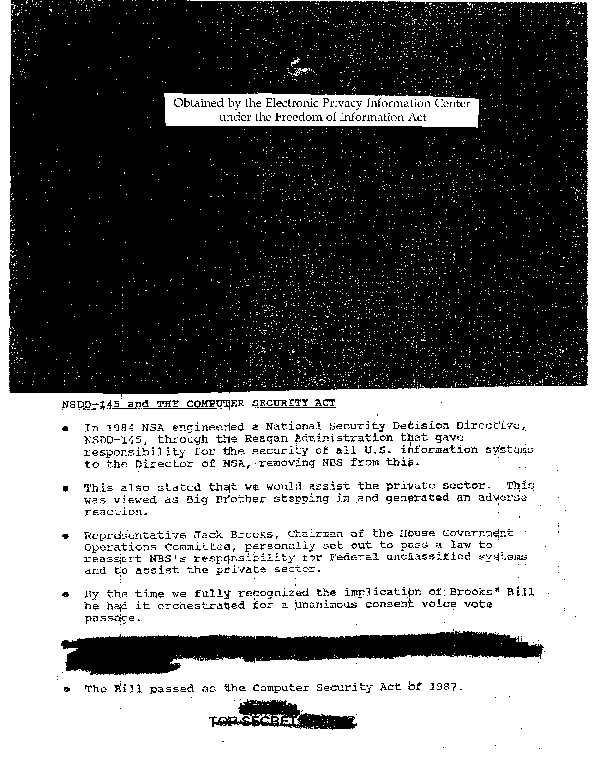
Before the 1987 law was passed however, Clinton Brooks, a Special Assistant to NSA Director Lieutenant General William Odom, wrote a Top Secret Memorandum which stated:

"In 1984 NSA engineered a National Security Decision Directive, NSDD-145, through the Reagan Administration that gave responsibility for the security of all US information systems to the Director of NSA, removing NBS [National Bureau of Standards] from this."

Conceived as a follow-on to the Reagan administration's infamous 1981 Executive Order 12333, which trashed anemic congressional efforts to rein-in America's out-of-control spy agencies, NSDD-145 handed power back to the National Security Agency and did so to the detriment of civilian communication networks.

Scarcely a decade after Senator Frank Church warned during post-Watergate hearings into government surveillance abuses, that NSA's "capability at any time could be turned around on the American people, and no American would have any privacy left, such is the capability to monitor everything: telephone conversations, telegrams, it doesn't matter . . . there would be no place to hide," the agency was at it with a vengeance.

"This [NSDD-145] also stated," Brooks wrote, "that we would assist the private sector. This was viewed as Big Brother stepping in and generated an adverse reaction" in Congress that helped facilitate passage of the Act.

Engineered by future Iran-Contra felon, Admiral John Poindexter, President Reagan's National Security Adviser who would later serve as President George W. Bush's Director of DARPA's Information Awareness Office, the Pentagon satrapy that brought us the Total Information Awareness program, NSDD-145 stated that the "Director, National Security Agency is designated the National Manager for Telecommunications and Automated Information Systems Security."

NSA's new mandate meant that the agency would "act as the government focal point for cryptography, telecommunications systems security, and automated information systems security."

Additionally, NSA would "conduct, approve, or endorse research and development of techniques and equipment for telecommunications and automated information systems security for national security information."

But it also authorized the agency to do more than that, granting it exclusive authority to "review and approve all standards, techniques, systems and equipments for telecommunications and automated information systems security." As well, NSA was directed to "enter into agreements for the procurement of technical security material and other equipment, and their provision to government agencies, where appropriate, to private organizations, including government contractors, and foreign governments."

In other words, NSA was the final arbiter when it came to setting standards for all government and private information systems; quite a coup for the agency responsible for standing-up Project MINARET, the Cold War-era program that spied on thousands of antiwar protesters, civil rights leaders, journalists and members of Congress, as recently declassified documents published by the National Security Archive disclosed.

NSA Games the System


Although the Computer Security Act passed unanimously by voice vote in both Houses of Congress, NSA immediately set-out to undercut the law and did so by suborning the National Bureau of Standards, now the National Institute of Standards and Technology (NIST).

The battle over the Clipper Chip would be the template for future incursions by the agency for the control, through covert infiltration, of regulatory bodies overseeing civilian communications.

According to the Clinton White House, Clipper "would provide Americans with secure telecommunications without compromising the ability of law enforcement agencies to carry out legally authorized wiretaps."

Neither safe nor secure, Clipper instead would have handed government security agencies the means to monitor all communications while giving criminal networks a leg up to do the same.

In fact, as the Electronic Privacy Information Center (EPIC) discovered in documents unearthed through the Freedom of Information Act, the underlying algorithm deployed in Clipper, Skipjack, had been developed by NSA.

Cryptography expert Matt Blaze wrote a now famous 1994 paper on the subject before the algorithm was declassified, Protocol Failure in the Escrowed Encryption Standard:

"The EES cipher algorithm, called 'Skipjack', is itself classified, and implementations of the cipher are available to the private sector only within tamper-resistant modules supplied by government-approved vendors. Software implementations of the cipher will not be possible. Although Skipjack, which was designed by the US National Security Agency (NSA), was reviewed by a small panel of civilian experts who were granted access to the algorithm, the cipher cannot be subjected to the degree of civilian scrutiny ordinarily given to new encryption systems."

This was precisely as NSA and the Clinton administration intended.

A partially declassified 1993 NSA memo noted that "there will be vocal public doubts expressed about having a classified algorithm in the device we propose for the US law enforcement problem, the CLIPPER chip, we recommend the following to address this." We don't know what those agency recommendations were, however; more than 20 years after the memo was written they remain secret.

The memo continued: "If such people agree to this clearance and non disclosure process, we could go over the algorithm with them to let them develop confidence in its security, and we could also let them examine the detail design of the CLIPPER chip made for the US law enforcement problem to assure themselves that there were no trapdoors or other techniques built in. This would likely require crypto-mathematicians for the algorithm examination and microelectronics chip design engineers for the chip examination."

But the extreme secrecy surrounding Skipjack's proposed deployment in commercial products was the problem. Even if researchers learned that Clipper was indeed the government-mandated backdoor they feared, non-disclosure of these facts, backed-up by the threat of steep fines or imprisonment would hardly assure anyone of the integrity of this so-called review process.

"By far, the most controversial aspect of the EES system," Blaze wrote, "is key escrow."

"As part of the crypto-synchronization process," Blaze noted, "EES devices generate and exchange a 'Law Enforcement Access Field' (LEAF). This field contains a copy of the current session key and is intended to enable a government eavesdropper to recover the cleartext."

"The LEAF copy of the session key is encrypted with a device-unique key called the 'unit key,' assigned at the time the EES device is manufactured. Copies of the unit keys for all EES devices are to be held in 'escrow' jointly by two federal agencies that will be charged with releasing the keys to law enforcement under certain conditions."

What those conditions were however, was far from clear. In fact, as we've since learned from Snowden's cache of secret documents, even when the government seeks surveillance authorization from the FISA court, the court must rely on government assurances that dragnet spying is critical to the nation's security. Such assurances, FISA court judge Reggie B. Walton noted, were systematically "misrepresented" by secret state agencies.

That's rather rich considering that Walton presided over the farcical "trial" that upheld Bush administration demands to silence FBI whistleblower Sibel Edmonds under the state secrets privilege. Edmonds, a former contract linguist with the Bureau charged that top FBI officials had systematically covered-up wrongdoing at its language division and had obstructed agents' attempts to roll-up terrorist networks before and after the 9/11 provocation, facts attested to by FBI whistleblower Coleen Rowley in her 2002 Memo to then-FBI Director Robert Mueller.

In 2009, Walton wrote that "The minimization procedures proposed by the government in each successive application and approved and adopted as binding by the orders of the FISC have been so frequently and systemically violated that it can fairly be said that this critical element of the overall BR regime has never functioned effectively."

"The Court," Walton averred, "must have every confidence that the government is doing its utmost to ensure that those responsible for implementation fully comply with the Court's orders. The Court no longer has such confidence."

Predating those critical remarks, a heavily-redacted 1993 Memo to then-Special Assistant to the President and future CIA chief, George Tenet, from FBI Director William Sessions noted that NSA "has developed a new encryption methodology and computer chip which affords encryption strength vastly superior to DES [Digital Encryption Standard], yet which allows for real time decryption by law enforcement, acting pursuant to legal process. It is referred to as 'Clipper'."

[Two redacted paragraphs] "if the devices are modified to include the 'Clipper' chip, they would be of great value to the Federal, state and local law enforcement community, especially in the area of counter narcotics, investigations, where there is a requirement to routinely communicate in a secure fashion."

But even at the time Sessions' memo was written, we now know that AT&T provided the Drug Enforcement Administration "routine access" to "an enormous AT&T database that contains the records of decades of Americans' phone calls," The New York Times reported, and had done so since 1987 under the auspices of DEA's Hemisphere Project.

Furthermore, in the wake of Snowden revelations we also learned that listening in on the conversations of drug capos is low on NSA's list of priorities. However, programs like X-KEYSCORE and TEMPORA, which copies all data flowing along fiber optic cables, encrypted and unencrypted alike, at petabyte scales, is supremely useful when it comes to building profiles of internet users by intelligence agencies.

This was an implicit goal of Clinton administration maneuvers to compel developers to insert Clipper into their product designs.

According to Sessions, "the 'Clipper' methodology envisions the participation of three distinct types of parties." [Redacted] It is proposed that the second party, the two custodians of the 'split' key infostructure [sic], be comprised of two disinterested and trustworthy non law enforcement Government agencies or entities. Although, such decision and selection are left for the Administration, a list of reccommended [sic] agencies and entities has been prepared (and included in the text), [redacted]. This party would administer and oversee all facets of the 'Clipper' program and methodology."

Based on NSDD-145's mandate, one can assume "this party" would be NSA, the agency that designed the underlying algorithm that powered Clipper.

The Sessions memo averred:

"The Clipper chip provides law enforcement access by using a special chip key, unique to each device. In the AT&T TSD 3600, a unique session key is generated, external to the Clipper chip for each call."

"This session key," the memo explained, "is given to the chip to control the encryption algorithm. A device unique 'chip key' is programmed into each Clipper at the time of manufacture. When two TSD 3600s go to secure operation, the device gives out its identification (ID) number and the session key encrypted in its chip key."

Underlining a key problem with Clipper technology Sessions noted, "Anyone with access to the chip key for that identified device will be able to recover the session key and listen to the transmission simultaneously with the intended receiver. This design means that the list of chip keys associated with the chip ID number provides access to all Clipper secured devices, and thus the list must be carefully generated and protected. Loss of the list would preclude legitmate [sic] access to the encrypted information and compromise of the list could allow unauthorized access."

In fact, that "anyone" could include fabulously wealthy drug gangs or bent corporations with the wherewithal to buy chip keys from suborned government key escrow agents!

Its ubiquity would be a key selling-point for universal deployment. The memo explained, "the NSA developed chip based 'Clipper' solution works with hardware encryption applications, such as those which might be used with regard to certain telecommunications and computers devices," which of course would allow unlimited spying by "law enforcement."

Such vulnerabilities built into EES chip keys by design not only enabled widespread government monitoring of internet and voice traffic, but with a few tweaks by encryption-savvy "rogues" could be exploited by criminal organizations.

In his 1994 paper Blaze wrote that "a rogue system can be constructed with little more than a software modification to a legal system. Furthermore, while some expertise may be required to install and operate a rogue version of an existing system, it is likely that little or no special skill would be required to install and operate the modified software."

"In particular," Blaze noted, "one can imagine 'patches' to defeat key escrow in EES-based systems being distributed over networks such as the Internet in much the same way that other software is distributed today."

In the intervening years since Blaze observed how easy it would be to compromise key escrow systems by various bad actors, governments or criminals take your pick, the proliferation of malware powered botnets that infect hundreds of thousands of computers and smart phones every day--for blanket surveillance, fraud, or both--is a fact of life.

It didn't help matters when it emerged that "escrow agents" empowered to unlock encrypted communications would be drawn from the National Institute of Standards and Technology and the Automated Services Division of the Treasury Department, government outposts riddled with "No Such Agency" moles.

As EPIC pointed out, "Since the enactment of the Computer Security Act, the NSA has sought to undercut NIST's authority. In 1989, NSA signed a Memorandum of Understanding (MOU) which purported to transfer back to NSA the authority given to NIST."

The MOU required that NIST request NSA's "assistance" on all matters related to civilian cryptography. In fact, were NIST and NSA representatives on the Technical Working Group to disagree on standards, the ultimate authority for resolving disputes would rest solely with the Executive Branch acting through the President, the Secretary of Defense and the National Security Council, thus undercutting the clear intent of Congress when they passed the 1987 Computer Security Act.

EPIC noted: "The memorandum effectively returned to NSA many of the powers rejected by the Computer Security Act. The MOU contained several key goals that were to NSA's benefit, including: NSA providing NIST with 'technical security guidelines in trusted technology, telecommunications security, and personal identification that may be used in cost-effective systems for protecting sensitive computer data;' NSA 'initiating research and development programs in trusted technology, telecommunications security, cryptographic techniques and personal identification methods'; and NSA being responsive to NIST 'in all matters related to cryptographic algorithms and cryptographic techniques including but not limited to research, development, evaluation, or endorsement'."

A critique of the Memorandum in 1989 congressional testimony by the General Accounting Office (GAO) emphasized:

"At issue is the degree to which responsibilities vested in NIST under the act are being subverted by the role assigned to NSA under the memorandum. The Congress, as a fundamental purpose in passing the act, sought to clearly place responsibility for the computer security of sensitive, unclassified information in a civil agency rather than in the Department of Defense. As we read the MOU, it would appear that NIST has granted NSA more than the consultative role envisioned in the act."

Five years after the GAO's critical appraisal, NSA's coup was complete.

"In 1994," EPIC noted, "President Clinton issued Presidential Decision Directive (PDD-29). This directive created the Security Policy Board, which has recommended that all computer security functions for the government be merged under NSA control."

Since PDD-29 was issued matters have only gotten worse. In fact, NIST is the same outfit exposed in Snowden documents published by The Guardian and The New York Times that allowed NSA to water down encryption and build backdoors into the Dual EC DRBG standard adopted by the Institute in 2006.

"Eventually, NSA became the sole editor."

Besieged by widespread opposition, the Clinton administration was out maneuvered in the court of public opinion and by 1996 had abandoned Clipper. However, this proved to be a pyrrhic victory for security-minded researchers and civil libertarians as we have since learned from Edward Snowden's revelations.

Befitting a military-intelligence agency, the dark core of America's deep state, NSA was fighting a long war--and they were playing for keeps.

Tom Burghardt is a researcher and activist based in the San Francisco Bay Area. In addition to publishing in Covert Action Quarterly and Global Research, an independent research and media group of writers, scholars, journalists and activists based in Montreal, he is a Contributing Editor with Cyrano's Journal Today. His articles can be read on Dissident Voice, Pacific Free Press, Uncommon Thought Journal, and the whistleblowing website WikiLeaks. He is the editor of Police State America: U.S. Military "Civil Disturbance" Planning, distributed by AK Press and has contributed to the new book from Global Research, The Global Economic Crisis: The Great Depression of the XXI Century.

Harrison and Hammond Heroes the People Must Support

Sarah Harrison and Jeremy Hammond: People Have A Right to the Truth

by TRNN

Michael Ratner: Jeremy Hammond faces ten years in prison Nov. 15 for major act of civil disobedience hacking global intelligence.

Michael Ratner is President Emeritus of the Center for Constitutional Rights (CCR) in New York and Chair of the European Center for Constitutional and Human Rights in Berlin. He is currently a legal adviser to Wikileaks and Julian Assange. He and CCR brought the first case challenging the Guantanamo detentions and continue in their efforts to close Guantanamo. He taught at Yale Law School, and Columbia Law School, and was President of the National Lawyers Guild. His current books include "Hell No: Your Right to Dissent in the Twenty-First Century America," and “ Who Killed Che? How the CIA Got Away With Murder.” NOTE: Mr. Ratner speaks on his own behalf and not for any organization with which he is affiliated. 

Saturday, November 09, 2013

A Pipeline Too Far: Enbridge Opposition Prep Rally

Street canvassing blitz one week before “critical No Enbridge rally”

by ForestEthics Advocacy

VANCOUVER - Concerned Canadians are hitting the streets, one week before a mass rally against the proposed Enbridge Northern Gateway pipeline. ForestEthics Advocacy will be holding a canvassing blitz outside Science World on Saturday, Nov. 9, beginning at 1:30pm, to spread the word about a planned rally Nov. 16 at the same location.

"With the recent ‘agreement’ with Alberta announced by BC Premier Christy Clark it's more important than ever that we send a clear message to all those concerned that we will not let this pipeline be built. We won't accept a flip flop on this issue,” said Ben West, Tar Sands Campaign Director for ForestEthics Advocacy, one of the organizers of the Nov. 16 rally, which is part of a cross-Canada day of action with dozens of rallies planned.

“This is likely to be the largest rally yet against the Enbridge pipeline,” said West. “This is an all hands on deck moment, a critical turning point with massive implications for our province, our country and our planet."

The street canvassing will include youth and students who are actively involved in the campaigns against tar sands export pipelines through BC. “It’s our future we’re talking about. We don’t want to inherit an economy dependent on dirty energy,” said Sam Harrison, a high school student who will be speaking at the rally Nov. 16.

West, Harrison and a team of volunteers will be on hand to comment Saturday, Nov. 9 at 1:30pm. To draw attention to the rally, volunteers will have signs that look like killer whales with the hashtag #NoEnbridge to send the message that saying ‘No’ to Enbridge is "as black and white as the orcas Enbridge threatens."

There will also be photo ops as part of a viral campaign being launched this weekend where passersby can pose with a sign that says "another _______ against Enbridge" which they can fill in with their identifying characteristics.

"We are borrowing some cool ideas from the Keystone XL campaign and using Twitter and Facebook to organize," said West.

Activists opposed to the Keystone XL pipeline brought signs to the White House with similar messages. "I loved those signs that said another grandmother against Keystone XL, it's so powerful to see such a broad social movement represented. We will never have as much money as these big oil companies, but we do have passionate people who won't give up until we win."

—30—
For Immediate Release - Saturday, November 9, 2013
For more information contact: Ben West, Tar Sands Campaign Director, ForestEthics Advocacy

Face to Face with Chris Cook and Ingmar Lee


Victoria Indy TV Presents: Face to Face with Ingmar Lee

by Steve Poole - ICTV

We welcome back direct-action activist and woodsman Ingmar Lee as he joins Pacific Free Press editor Chris Cook for an intelligent discussion on a number of concerns including Tar Sands, pipelines and supertankers in BC, the Great Bear rainforest, Business As Usual envirogroups, fracking and the plight of the Humpback whales on BC's coast. With the recent "deal" struck between Alberta's Redford and BC's Clark, this conversation is more timely and important than ever.


On our community TV Channel Shaw Victoria Cable 4 
(and Saltspring Island)

Saturday, November 9 at 1:00 PM

Wednesday, November 13 at 11:00 PM

Also available for viewing on the Internet at:

http://youtu.be/xo2bHAuQPHA


Al Qaeda’s Air Force: Israel's Ground Support for Syrian "Rebels"

Israeli Bombers: Al Qaeda’s Air Force

by James Petras

Israel has committed repeated acts of war against countries that opposed its Zionist policies of colonization and annexation of Palestinian territory in East Jerusalem and the West Bank. Israeli leaders have secured arms and diplomatic support for their attacks through their Zionist proxies in the United States Congress and the Executive Branch.

The current series of Israeli bombing raids and missile strikes against Syria are designed to strengthen the armed Syrian opposition and Islamist mercenaries seeking to destroy the government in Damascus. Israel intends to sabotage the upcoming round of peace negotiations.

The Zionist state does not want a peaceful resolution to the current regional conflict. Its foreign policy depends on perpetual regional wars and political instability. Toward this end, Tel Aviv has the unconditional support of the 52 Presidents of the Major American Jewish Organization and all other Zionist organizations in the US.

Armed Conflict and Intervention in Syria


For almost three years, Syria has increasingly transformed into a battleground and humanitarian disaster. At first, there were domestic Syrian political and social organizations staging protests against the Baathist government. The early protestors included secular liberals, Muslims, democrats and socialists. They had engaged in mostly peaceful protest against the authoritarian, but multi-cultural, secular regime of Bashar Assad. The government clamped down heavily and arrested many protestors. This heavy-handed response help to split the Syrian opposition: Peaceful, civil-society protestors remained in the country, although diminished in numbers, while many others went underground or fled to bordering countries and formed the early core of the armed opposition. They received military and financial support from NATO countries and Turkey, as well as from the corrupt Gulf Monarchies, especially Saudi Arabia. A cross-border war was launched in which US and European special military forces played a leading role in organizing, training and directing a makeshift collection of armed Syrian groups. Turkey provided arms, training camps and logistical support. The funding came from the rich kingdoms of Saudi Arabia and the Gulf Monarchies, which have spent hundreds of millions of dollars.

The Saudis recruited radical Islamist and Al Qaeda mercenaries and Wahhabi terrorists to fight the Damascus regime – targeting secular Syrians, Shiites, Alawites, Syrian Christians and Kurds. In just a few years, the conflict underwent a radical change in character and in intensity from internal broad-based civil strife to an armed foreign-backed invasion with vicious sectarian overtones.

Hundreds of thousands of Syrians fled from their home when thousands of mostly foreign, Islamist fighters attacked and occupied their cities, towns and villages – conducting campaigns of ethnic cleansing against non-Sunni and non-Arab Syrians. The government in Damascus responded by mobilizing ground troops and its air force to recover its vital highways and cities and drive out this increasingly foreign occupation. This became especially critical toward the end of 2012, when Al Qaeda-linked extremists, funded by the Saudi and Gulf monarchies, gained ascendancy at a number of key fronts. These violent extremists overran and displaced the Western-backed ‘internal’ armed opposition who made up the so-called ‘moderates’. The Saudi proxies attacked Kurdish militia in the semi-autonomous Syrian northeast in order to secure cross border supply routes to Iraq thus regionalizing the war. This heralded the tremendous increase in terrorism and bombing against the Shiite government in Baghdad and majority Shia population.

As the Western-backed opposition retreated, the mercenaries, linked to Al Qaeda, fully expected their sponsors among the despotic Saudi oil billionaires to call on NATO and the US to launch missile strikes against the Syrian government. Without US and NATO air support, the jihadis would never take Damascus.

Meanwhile, the Islamist Turkish government had been playing a duplicitous role by allowing its border area to be used for terrorist camps, supply routes and a launch site for cross-border attacks against its neighbor. This has been very unpopular with the Turkish public. When it became evident that the Saudi-backed Al Qaeda terrorists were gaining the upper hand over Ankara’s more ‘moderate’ Islamist Syrian clients, the Turks may have developed concerns that their border would become a regional center for Al Qaeda with thousands of well-armed, battle-tested Islamist mercenaries. This may explain Ankara’s recent approach to Teheran hoping to undercut the jihadi clients of the Gulf Monarchies.

With the Syrian opposition badly split and the US domestic opposition to a new war increasing, the US-NATO regimes withdrew their commitment to the Saudis to act as ‘Al Qaeda’s Air Force’. In this context, US President Obama eagerly accepted the Russian President Putin’s offer to jointly oversee the dismantlement of Syria’s chemical weapons stockpile and to set up a peace conference between Syrian opposition factions, not-linked to Al Qaeda, and the Syrian government.

Chemical Weapons, Disarmament and Peace: Who’s in and Who’s Out?


The Putin-Obama agreement was a significant advance for the US and Russia. President Obama did not have to face massive domestic and Congressional opposition to a new war with Syria and he was ‘credited’ with accepting a diplomatic solution. Russian President Vladimir Putin assumed the role of a world statesman in initiating the process, ensuring Syrian compliance and moving the parties toward a peace conference in Geneva to be held in late November. The European Union and the NATO powers were able to temporarily disentangle from their military commitments to the Syrian ‘rebels’ and their Saudi backers and express their own indignation over US cyber-spying of their citizens and leaders. Furthermore, this gave the Obama Administration the opportunity to open nuclear negotiations with Iran. Turkey, which had been flooded by desperate Syrian refugees, was facing rising nationalist pressures against its own military role in the Syrian ‘civil war’. The Russian initiative allowed the Turks to further explore re-opening relations with Syria’s ally, Iran.

This advance toward peace and disarmament weakened the military ambitions of the despotic Saudi regime and threatened the hegemonic position of the Israeli junta. The Saudi-Gulf States strategy had been to destroy the secular Syrian state via a mercenary Al Qaeda ground war supported by massive NATO-US air strikes against Damascus. The Saudis envisioned a replay of the Libyan invasion that saw the overthrow of the secular Gadhafi. A bloody jihadist victory in Damascus would strike a blow at Iran, the Saudi’s (and the Israeli’s) ultimate target.

The US-Russian rapprochement and Obama’s withdrawal of his threat to bomb Damascus had deprived the Saudi’s Al Qaeda mercenaries of their long-awaited Western missile support. Across the Atlantic, in a fit of pique and high-pitched hysteria at NATO’s refusal to serve as ‘Al Qaeda’s air force’ for their pet mercenaries, the Saudis refused to sit take their appointed seat ‘with the infidels’ on the UN Security Council!

However, Israel was quick to step in with its own bombs and missiles to bolster the Islamist terrorists in Syria!

Israel viewed itself as a casualty of the Obama-Putin agreement; it had been clamoring for more overt Western involvement in the war against Syria. Israel’s strategy was to encourage the armed conflict, decimate the Syrian government, society and economy, and create a new client configuration composed of ‘Egypt-Jordan-Syria’ under joint Saudi-Israeli- US auspices (and financing).

The Israelis had expected US President Obama to unleash a massive NATO air strike against Syrian military installations, arms depots and vital civilian infrastructure. This would tip the military balance in favor of the armed Syrian opposition and foreign jihadist mercenaries and precipitate the collapse of Damascus. Indeed the entire US Jewish-Zionist power structure, including the pro-Israel media troika (the New York Times, Washington Post and Wall Street Journal), called for the US to bomb Syria despite the fact that the majority of America citizens were increasingly vocal in their opposition to US involvement!

When Obama finally took note of US public opinion and embraced Vladimir Putin’s proposal for Syrian peace and the dismantling of its chemical weapons arsenal, the media troika and the ZPC unleashed hysterical attacks, accusing President Obama of vacillation (for disobeying Netanyahu?), sacrificing Syrian lives (what about the Syrian victims of Israel’s occupation of the Golan Heights?) and of betraying the ‘rebels’ (also known as Al Qaeda terrorists).

Israel and Saudi Arabia make logical ‘allies’: Both are sworn enemies of secular Arab nationalism and anti-colonialism; both have sponsored overseas terrorist groups against their opponents; both seek to destroy Iran and both are completely dependent on Western arms relying on imperialist wars to achieve their own regional aims. At the moment their plans for ‘re-drawing the map’ of the Middle East has met a speed-bump in the form of Obama’s reluctance to launch US missiles and bombs against Damascus.

The Israeli Air Force at the Service of Al Qaeda


In recent years Israel has committed numerous acts of war throughout the Middle East, including crimes against humanity in Gaza, the West Bank and Lebanon. It is no surprise that Israel, a colonial state and would-be regional hegemon, would bomb Syrian military bases and weapon depots on six occasions this year, despite the fact that Damascus was struggling for its survival against thousands of Saudi-financed Al Qaeda-linked mercenaries.

Israel’s deliberate and unprovoked attacks against the beleaguered Syrian state are motivated by dangerous, sinister and cynical considerations on the part of Tel Aviv.

First, the Israel wants a strong Wahhabi-Al Qaeda presence in the region to counter the secular Baathists as well as their Shiite allies in Lebanon and Iran. Their attacks against the Syrian military show their desire for the terrorists to continue ravaging Syrian cities and towns. This is essentially a tactical alliance between extremist Zionist-Jews and Radical Sunni Muslims.

Second, Israel is calculating that its missile attacks against Syrian bases will provoke an armed response from Damascus which Tel Aviv could use as a pretext to declare war and unite the ‘hawk and dove’ Zionists in Israel, and especially in the US, and mobilize against another ‘existential threat’ to the ‘Jewish State’. In other words, Israel intends to prod the US Congress and White House to launch an ‘allied’ bombing campaign against Damascus.

Thirdly, Tel Aviv views its missile strikes and bombing raids against Syria as a ‘dress rehearsal’ for its planned attack on Iran. In the context of Iranian President Rouhani’s recent peace overtures toward the US, bombing Syria and provoking Damascus would scuttle any peaceful accord between the Washington and Teheran. Israeli pilots are using Syria as a laboratory to test radar and communications, flight patterns, its bombing accuracy, interception technology and assets to further their readiness for a pre-emptive attack on Iran. The purpose for attacking the Syrian government and destroying defensive weapons destined for its Lebanese Shiite ally, Hezbollah, is to destroy any Lebanese capacity to resist Israeli aggression in a regional conflagration.

However, Israel’s military-driven ‘diplomacy’ has failed. And yet the Jewish state cannot reverse its brutal, colonial policies in the West Bank, re-think its working alliance with Al Qaeda in the Levant or formulate a realistic political settlement with Syria and Iran. Instead, the characteristic failure and mediocrity of Israeli policymakers have condemned them to rely exclusively on their first, last and only resort – greater brutality and aggression.

Netanyahu showed his disappointment with Obama by announcing the construction of 1500 new ‘Jews-only’ apartments in Occupied Palestinian East Jerusalem. Meanwhile, the Israeli Foreign Office denounced the Obama Administration for having revealed that Israeli planes and missiles had struck the major Syrian port of Latakia – implying that Washington’s revelation of Israel’s attempted sabotage of the peace talks amounted to a ‘betrayal’ or ‘crime’ against the Jewish state!

The entire Zionist power configuration in Washington has lined up to support the Jewish state. When Israel commits an act of war against its neighbor, no matter how unjust and brutal the act, Zionists from the most religious to the most secular, the ‘peaceniks’ and neo-cons, all form a united chorus in praise of the righteous and moral ‘Jewish Bombs’ even as they fall on the besieged people of Syria today and Iran tomorrow. While the pro-Israel media troika in the US doesn’t hesitate to denounce civilian suffering from Pentagon and CIA drones strikes in Pakistan, when Israeli missiles rain on Syria … acts of pre-emptive war by the heirs of the Holocaust … they are described as necessary for the defense of a peace-loving nation…because Bibi Netanyahu said so!!! That garrulous Harvard Law Professor will argue on the US television ‘talk shows’ that Israel had to pulverize the concrete bunkers of the Syrian military otherwise some anti-Semite might someday find some pebble to toss at some member of the moral Israeli ‘peace force’. ‘Existential threat’ indeed!

Rank cant and mendacious special pleadings aside, the Saudis and their Israeli allies intend to finance, arm and serve as Al Qaeda’s air force against the Assad regime in Syria. They mean to undermine any Syrian or Iranian peace process, that is, unless the US and Russia prevent them from provoking a major regional conflagration – threatening the welfare of hundreds of millions of people.

Conclusion


The Middle East has always been a mosaic of complex and changing alliances, marking shifts in the balance of imperial power. During the past decade, the US, Israel, Saudi Arabia and their satraps in Jordan, Egypt and Lebanon have ruled the roosts. Iraq, as an independent modern secular nation and multicultural society, was shattered and under the US military boot; the Taliban were in retreat … Iran was isolated … Syria was surrounded by invading foreign armed and trained terrorists and mercenaries.

Time passed and circumstances changed. The US was forced to retreat from the horrific sectarian conflict it created in Iraq, while Iran gained political influence and stature in the region. Turkey captured lucrative regional markets. In Afghanistan, the Taliban have recovered, advanced and are preparing to take power as soon as the US withdraws support from its lackey in Kabul. The White House temporarily lost a dictator in Egypt, only to gain a new dictatorial client, but the junta in Cairo faces an uncertain future with massive popular unrest. The King of Jordan may still be on the CIA/Mossad payroll but that country is a backward satrapy forced to rely on police state tactics. The corrupt Gulf Monarchies repress their dissident majorities at home while using their countries’ incredible oil wealth to subsidize jihadi terrorists abroad. Their legitimacy and support is fragile: Petro-billions, bombs and US military bases do not constitute a state!

Tactical relations are in flux. The Saudi monarch rejects the UN, repudiates the US for its rapprochement with Iran and embraces ---its own hot air. Surely the Saudis understand that siding with Israel’s air force against an Arab nation is a dangerous and desperate ploy that could backfire. The Syrian and Iranian governments will continue with their peace agendas, democratic openings and calls for social co-existence, such as Hezbollah has successfully secured in Lebanon. The Russians support their overtures. If they are successful, even the US and Europe would reap immense economic benefits from a demilitarized and sanctions-free Middle East and Persian Gulf. The world economy would see lower energy prices and greater security, while the flow of rentier capital to the speculators in the City of London and Wall Street flood would reverse and benefit their own countries. We stand at the crossroads between turning toward peace or reverting to regional war, crisis and chaos.