Thursday, February 20, 2014

Ominous Amazon/CIA Collaboration

Why Amazon’s Collaboration with the CIA Is So Ominous -- and Vulnerable

by Norman Solomon - WarMadeEasy.org

As the world’s biggest online retailer, Amazon wants a benevolent image to encourage trust from customers. Obtaining vast quantities of their personal information has been central to the firm’s business model. But Amazon is diversifying -- and a few months ago the company signed a $600 million contract with the Central Intelligence Agency to provide “cloud computing” services.

Amazon now has the means, motive and opportunity to provide huge amounts of customer information to its new business partner. An official statement from Amazon headquarters last fall declared: “We look forward to a successful relationship with the CIA.”

The Central Intelligence Agency has plenty of money to throw around. Thanks to documents provided by NSA whistleblower Edward Snowden, we know that the CIA’s annual budget is $14.7 billion; the NSA’s is $10.8 billion.

The founder and CEO of Amazon, Jeff Bezos, is bullish on the company’s prospects for building on its initial contract with the CIA. As you might expect from a gung-ho capitalist with about $25 billion in personal wealth, Bezos figures he’s just getting started.

Bezos publicly savors the fact that Amazon has proven its digital prowess -- aggregating, safeguarding and analyzing many billions of factoids about human beings -- to the satisfaction of the CIA.

The company’s Amazon Web Services division is “the leader in infrastructure cloud computing,” Bezos boasted at a September 2013 meeting with journalists at the Washington Post (shortly after he bought the newspaper). He lauded the high “rate of invention” of Amazon’s technical web team, adding: “Their product offering is far ahead of anyone else.”

Apparently the CIA agrees. The agency gave Amazon the contract for $600 million even though it wasn’t the lowest bid.

Amazon’s trajectory into the CIA’s spooky arms may be a bit more than just corporate eagerness to land a lucrative contract. In late 2010 -- amid intense public interest in documents that WikiLeaks was posting to illuminate U.S. actions overseas -- Amazon took a notable step. As the Guardian reported at the time, Amazon “pulled the plug on hosting the whistleblowing website in reaction to heavy political pressure.”

It didn’t take much for Amazon to cave. “The company announced it was cutting WikiLeaks off … only 24 hours after being contacted by the staff of Joe Lieberman, chairman of the Senate’s committee on homeland security,” the Guardian noted.

In view of Amazon’s eagerness to dump the WikiLeaks site at the behest of U.S. government officials, what else might the Amazon hierarchy be willing to do? Amazon maintains a humongous trove of detailed information about hundreds of millions of people. Are we to believe that the CIA and other intelligence agencies have no interest in Amazon’s data?

Even at face value, Amazon’s “Privacy Notice” has loopholes big enough to fly a drone through. It says: “We release account and other personal information when we believe release is appropriate to comply with the law; enforce or apply our Conditions of Use and other agreements; or protect the rights, property, or safety of Amazon.com, our users, or others.”

Amazon now averages 162 million unique visitors to its sites every month. Meanwhile, the CIA depends on gathering and analyzing data to serve U.S. military interventions overseas. During the last dozen years, the CIA has conducted ongoing drone strikes and covert lethal missions in many countries. At the same time, U.S. agencies like the CIA and NSA have flattened many previous obstacles to Big Brother behavior.

And now, Amazon is hosting a huge computing cloud for the CIA’s secrets -- a digital place where data for mass surveillance and perpetual war are converging.

Amazon is, potentially, much more vulnerable to public outrage and leverage than the typical firms that make a killing from contracts with the NSA or the CIA or the Pentagon. Few people have direct contact with outfits like Booz Allen Hamilton or Lockheed Martin. But every day, Amazon is depending on millions of customers to go online and buy products from its sites. As more people learn about its CIA ties, Amazon could -- and should -- suffer the consequences.

This is an opportunity to directly challenge Amazon’s collaboration with the CIA. Movement in that direction began with the Feb. 20 launch of a petition addressed to Amazon CEO Bezos: “We urge you to make a legally binding commitment to customers that Amazon will not provide customer data to the Central Intelligence Agency.”

After working with colleagues at RootsAction.org to start the petition, I’ve been glad to read initial comments that signers have posted. Many are voicing the kind of responses that should worry Amazon execs.

“It’s never wise for a business to take steps that create distrust by their customers,” wrote a signer from Fort Atkinson, Wisconsin. Another woman, who lives in Amazon’s home state of Washington, told the company: “Don’t share my data with the CIA. If this is your price, I’m afraid you’re not worth it.” And a signer in Cincinnati wrote: “If Amazon chooses to sell out their customers to the CIA, I will never visit their site again. Betrayal shouldn’t be the price of convenience.”

The people who run Amazon figured they could rake in big profits from the CIA without serious public blowback. We have an opportunity to prove them wrong.


Norman Solomon is co-founder of RootsAction.org and founding director of the Institute for Public Accuracy. His books include “War Made Easy: How Presidents and Pundits Keep Spinning Us to Death.” Information about the documentary based on the book is at www.WarMadeEasyTheMovie.org.

Tracking the Thug State

Documenting Darkness: How a Thug State Operates

by Tom Engelhardt  - TomDispatch

Here, at least, is a place to start: intelligence officials have weighed in with an estimate of just how many secret files National Security Agency contractor Edward Snowden took with him when he headed for Hong Kong last June. Brace yourself: 1.7 million. At least they claim that as the number he or his web crawler accessed before he left town. Let’s assume for a moment that it’s accurate and add a caveat. Whatever he had with him on those thumb drives when he left the agency, Edward Snowden did not take all the NSA’s classified documents. Not by a long shot. He only downloaded a portion of them. We don’t have any idea what percentage, but assumedly millions of NSA secret documents did not get the Snowden treatment.

Such figures should stagger us and what he did take will undoubtedly occupy journalists for months or years more (and historians long after that). Keep this in mind, however: the NSA is only one of 17 intelligence outfits in what is called the U.S. Intelligence Community. Some of the others are as large and well funded, and all of them generate their own troves of secret documents, undoubtedly stretching into the many millions.

And keep something else in mind: that’s just intelligence agencies. 
 
 Tomgram: Engelhardt, Thug State U.S.A.

[Book Recommendations for TomDispatch Readers: Here are four books you might consider putting in your library if you haven’t done so already. There’s the new paperback of Nick Turse’s widely acclaimed bestseller, Kill Anything That Moves: The Real American War in Vietnam. Recently, we offered any reader who contributed $100 (or more) to this site a personalized, signed copy of it. (Check out our donation page for more information.) In addition, the newest Dispatch book by Ann Jones, They Were Soldiers: How the Wounded Return From America’s Wars -- The Untold Story, couldn’t be more powerful. It’s a breath-catching odyssey through the true human costs of war, and though this should have been a mainstream journey, no one other than Jones bothered to take it. Beautifully written, it really is a must-read. For the fiction readers among you, there’s TomDispatch author Beverly Gologorsky’s Stop Here, a rare genuine working class novel about America (and its wars) and, as readers have been writing me, definitely an experience not to be missed. Finally, a non-TomDispatch recommendation: The Sixth Extinction, a book by perhaps the best environmental writer of our moment, the New Yorker’s Elizabeth Kolbert, has just been published. The subject, our own potential demise, couldn’t be grimmer, but I can guarantee you that it’s a riveting read (as Al Gore recently indicated on the cover of the New York Times Book Review). And here’s a small reminder: if you're an Amazon customer and decide to buy any of these books (or anything else whatsoever), as long as you arrive at that website by clicking on a TomDispatch book link or the cover image link in any TD piece, we get a small cut of your purchase at no cost to you. Tom]

Documenting Darkness: 

How a Thug State Operates

by Tom Engelhardt

If you’re thinking about the full sweep of our national security state (NSS), you also have to include places like the Department of Homeland Security, the Energy Department (responsible for the U.S. nuclear arsenal), and the Pentagon. In other words, we’re talking about the kind of secret documentation that an army of journalists, researchers, and historians wouldn’t have a hope of getting through, not in a century.

We do know that, in 2011, the whole government reportedly classified 92,064,862 documents. If accurate and reasonably typical, that means, in the twenty-first century, the NSS has already generated hundreds of millions of documents that could not be read by an American without a security clearance. Of those, thanks to one man (via various journalists), we have had access to a tiny percentage of perhaps 1.7 million of them. Or put another way, you, the voter, the taxpayer, the citizen -- in what we still like to think of as a democracy -- are automatically excluded from knowing or learning about most of what the national security state does in your name. That’s unless, of course, its officials decide to selectively cherry-pick information they feel you are capable of safely and securely absorbing, or an Edward Snowden releases documents to the world over the bitter protests, death threats, and teeth gnashing of Washington officialdom and retired versions of the same.

Summoned From the Id of the National Security State


So far, even among critics, the debate about what to make of Snowden’s act has generally focused on “balance”; that is, on what’s the right equilibrium between an obvious governmental need for secrecy, the security of the country, and an American urge for privacy, freedom, and transparency -- for knowing, among other things, what your government is actually doing. Such a framework (“a meaningful balance between privacy and security”) has proven a relatively comfortable one for Washington, which doesn't mind focusing on the supposedly knotty question of how to define the “limits” of secrecy and whistle-blowing and what “reforms” are needed to bring the two into line. In the present context, however, such a debate seems laughable, if not absurd.

After all, it’s clear from the numbers alone that the urge to envelop the national security state in a blanket of secrecy, to shield its workings from the eyes of its citizens (as well as allies and enemies) has proven essentially boundless, as have the secret ambitions of those running that state. There is no way, at present, to limit the governmental urge for secrecy even in minimal ways, certainly not via secret courts or congressional committees implicated and entangled in the processes of a secret system.

In the face of such boundlessness, perhaps the words “whistleblower” and “leaker” -- both traditionally referring to bounded and focused activities -- are no longer useful. Though we may not yet have a word to describe what Chelsea (once Bradley) Manning, Julian Assange, and Edward Snowden have done, we should probably stop calling them whistleblowers. Perhaps they should instead be considered the creations of an overweening national security state, summoned by us from its id (so to speak) to act as a counterforce to its ambitions. Imagine them as representing the societal unconscious. Only in this way can we explain the boundlessness of their acts. After all, such massive document appropriations are inconceivable without a secret state endlessly in the process of documenting its own darkness.

One thing is for certain, though no one thinks to say it: despite their staggering releases of insider information, when it comes to the true nature and extent of the NSS, we surely remain in the dark. In the feeling that, thanks to Manning and Snowden, we now grasp the depths of that secret state, its secret acts, and the secret documentation that goes with it, we are undoubtedly deluded.

In a sense, valuable as they have been, Snowden’s revelations have helped promote this delusion. In a way that hasn’t happened since the Watergate era of the 1970s, they have given us the feeling that a curtain has finally, definitively been pulled back on the true nature of the Washington system. Behind that curtain, we have indeed glimpsed a global-surveillance-state-in-the-making of astounding scope, reach, and technological proficiency, whose ambitions (and successes), even when not always fully achieved, should take our breath away. And yet while this is accurate enough, it leads us to believe that we now know a great deal about the secret world of Washington. This is an illusion.

Even if we knew what was in all of those 1.7 million NSA documents, they are a drop in the bucket. As of now, we have the revelations of one (marginal) insider who stepped out of the shadows to tell us about part of what a single intelligence agency documented about its own activities. The resulting global debate, controversy, anger, and discussion, Snowden has said, represents “mission accomplished” for him. But it shouldn’t be considered mission accomplished for the rest of us.

In Praise of Darkness, the Dangers of Sunshine


To gain a reasonable picture of our national security state, five, 10, 20 Snowdens, each at a different agency or outfit, would have to step out of the shadows -- and that would just be for starters. Then we would need a media that was ready to roll and a Congress not wrapped in “security” and “secrecy” but demanding answers, as the Church committee did in the Watergate era, with subpoenas in hand (and the threat of prison for no-shows and perjurers).

Yes, we may have access to basic information about what the NSA has been up to, but remind me: What exactly do you know about the doings of the Pentagon’s Defense Intelligence Agency, with its 16,500 employees, which has in recent years embarked on “an ambitious plan to assemble an espionage network that rivals the CIA in size”? How about the National Geospatial-Intelligence Agency, with its 16,000 employees, its post-9/11 headquarters (price tag: $1.8 billion) and its control over our system of spy satellites eternally prowling the planetary skies?

The answer is no more than you would have known about the NSA if Snowden hadn’t acted as he did. And by the way, what do you really know about the FBI, which now, among other things, issues thousands of national security letters a year (16,511 in 2011 alone), an unknown number of them for terror investigations? Since their recipients are muzzled from discussing them, we know next to nothing about them or what the Bureau is actually doing. And how’s your info on the CIA, which takes $4 billion more out of the intelligence “black budget” than the NSA, runs its own private wars, and has even organized its own privatized corps of spies as part of the general expansion of U.S. intelligence and espionage abroad? The answer on all of the above is -- has to be -- remarkably little.

Or take something basic like that old-fashioned, low-tech form of surveillance: government informers and agents provocateurs. They were commonplace in the 1960s and early 1970s within every oppositional movement. So many decades later, they are with us again. Thanks to the ACLU, which has mapped scattered reports on situations in which informers made it into at least the local news nationwide, we know that they became part of what anti-war movements existed, slipped into various aspects of the Occupy movement, and have run riot in local Muslim-American communities. We know as well that these informers come from a wide range of outfits, including the local police, the military, and the FBI. However, if we know a great deal about NSA snooping and surveillance, we have just about no inside information on the extent of old-style informing, surveilling, and provoking.

One thing couldn’t be clearer, though: the mania for secrecy has grown tremendously in the Obama years. On entering the Oval Office in 2009, Obama proclaimed a sunshine administration dedicated to “openness” and “transparency.” That announcement now drips with irony. If you want a measure of the kind of secrecy the NSS considers proper and the White House condones these days, check out a recent Los Angeles Times piece on the CIA’s drone assassination program (one of the more overt aspects of Washington’s covert world).

That paper recently reported that Chairman of the Senate Armed Services Committee Carl Levin held a “joint classified hearing” with the Senate Intelligence Committee on the CIA, the Pentagon, and their drone campaigns against terror suspects in the backlands of the planet. There was just one catch: CIA officials normally testify only before the House and Senate intelligence committees. In this case, the White House “refused to provide the necessary security clearances for members of the House and Senate armed services committees.” As a result, it would not let CIA witnesses appear before Levin. Officials, reported the Times, “had little appetite for briefing the 26 senators and 62 House members who sit on the armed services committees on the CIA's most sensitive operations.” Sunshine, in other words, is considered potentially dangerous, even in tiny doses, even in Congress.

A Cult of Government Secrecy


In evaluating what may lie behind the many curtains of Washington, history does offer us a small hand. Thanks to the revelations of the 1970s, including a Snowden-style break-in by antiwar activists at an FBI office in Media, Pennsylvania, in 1971, that opened a window into the Bureau’s acts of illegality, some now-famous reporting, and the thorough work of the Church committee in the Senate, we have a sense of the enormity of what the U.S. national security state was capable of once enveloped in a penumbra of secrecy (even if, in that era, the accompanying technology could do so much less). In the Johnson and Nixon years, as we now know, the FBI, the CIA, the NSA, and other acronymic outfits committed a staggering range of misdeeds, provocations, and crimes.

It’s easy to say that post-Watergate “reforms” made such acts a thing of the past. Unfortunately, there’s no reason to believe that. In fact, the nature of that era’s reforms should be reconsidered. After all, one particularly important Congressional response of that moment was to create the Foreign Intelligence Surveillance Court, essentially a judiciary for the secret world which would generate a significant body of law that no American outside the NSS could see.

The irony is again overwhelming. After the shocking headlines, the congressional inquiries, the impeachment proceedings, the ending of two presidencies -- one by resignation -- and everything else, including black bag jobs, break-ins, buggings, attempted beatings, blackmail, massive spying and surveillance, and provocations of every sort, the answer was a secret court. Its judges, appointed by the chief justice of the Supreme Court alone, are charged with ruling after hearing only one side of any case involving a governmental desire to snoop or pry or surveil. Unsurprisingly enough, over the three and a half decades of its existence, the court proved a willing rubber stamp for just about any urge of the national security state.

In retrospect, this remedy for widespread government illegality clearly was just another step in the institutionalization of a secret world that looks increasingly like an Orwellian nightmare. In creating the FISA court, Congress functionally took the seat-of-the-pants, extra-Constitutional, extra-legal acts of the Nixon era and put them under the rule of (secret) law.

Today, in the wake of, among other things, the rampant extra-legality of the Global War on Terror -- including the setting up of a secret, extrajudicial global prison system of “black sites” where rampant torture and abuse were carried to the point of death, illegal kidnappings of terror suspects off global streets and their rendition to the prisons of torture regimes, and the assassination-by-drone of American citizens backed by Justice Department legalisms -- it’s clear that NSS officials feel they have near total impunity when it comes to whatever they want to do. (Not that their secret acts often turn out as planned or particularly well in the real world.) They know that nothing they do, however egregious, will be brought before an open court of law and prosecuted. While the rest of us remain inside the legal system, they exist in “post-legal America.” Now, the president claims that he’s preparing a new set of “reforms” to bring this system under check and back in balance. Watch out!

If tomorrow a series of Edward Snowdens were to appear, each from a different intelligence agency or other outfit in the national security state, one thing would be guaranteed: the shock of the NSA revelations would be multiplied many times over. Protected from the law by a spreading cult of government secrecy, beyond the reach of the citizenry, Congress, or the aboveground judicial system, supported by the White House and a body of developing secret law, knowing that no act undertaken in the name of American “safety” and “security” will ever be prosecuted, the inhabitants of our secret state have been moving in dark and disturbing ways. What we know is already disturbing enough. What we don’t know would surely unnerve us far more.

Shadow government has conquered twenty-first-century Washington. We have the makings of a thug state of the first order.

Tom Engelhardt, a co-founder of the American Empire Project and author of The United States of Fear as well as a history of the Cold War, The End of Victory Culture, runs the Nation Institute's TomDispatch.com. His latest book, co-authored with Nick Turse, is Terminator Planet: The First History of Drone Warfare, 2001-2050.

Follow TomDispatch on Twitter and join us on Facebook or Tumblr. Check out the newest Dispatch Book, Ann Jones’s They Were Soldiers: How the Wounded Return From America’s Wars -- The Untold Story.

Copyright 2014 Tom Engelhardt

Wednesday, February 19, 2014

Bearing Down on BC's "Boring" Budget 2014


7 things that should be in this year’s BC Budget

by Canadian Centre for Policy Alternatives

Dear friends; yesterday our own Iglika Ivanova (economist and public interest researcher) and Lindsey Bertrand (communications officer) were locked up in Victoria with over one hundred other organizations and journalists to be among the first to analyze and comment on the 2014 provincial budget.

The duo quickly learned that the budget leaves a lot to be desired. British Columbians still face great economic insecurity in a weak job market. We need the government to invest in a diverse and sustainable economy, post-secondary education, poverty reduction and other key programs – not just boast about having a balanced budget.

Iglika produced a quick but in-depth analysis, which was posted to our PolicyNote.ca blog the moment the lockup ended, while Lindsey engaged with the press to ensure the public interest perspective would be impossible to miss. In addition, the CCPA’s Marc Lee analyzed the government’s overly optimistic revenue expectations from the Liquefied Natural Gas (LNG) industry.

According to the Finance Minister, this was a "boring balanced budget". That’s too bad. Because if the provincial government chose to get serious about reducing poverty, investing in an affordable child care program, or increasing access to badly needed community-based seniors care, or greening our economy…there’d be nothing boring at all about it.

Seth

This post by Iglika Ivanova, which came out the day before the budget was released, describes seven initiatives that would set the foundation of a more just and sustainable economy.

Read it now on PolicyNote.ca » (http://e2.ma/click/a94ti/qdn7hf/69qczb)

CCPA calls BC Budget a “missed opportunity” to address social, environmental and jobs deficits


Our first take on the budget can be found in our press release, written from the budget lockup. If you’re planning to write about the budget means for British Columbians, this is a must-read.

Check it out » (http://e2.ma/click/a94ti/qdn7hf/m2rczb)

What you need to know about BC Budget 2014


Iglika pulled no punches as she wrote about the budget from inside the lockup – and she made it her priority to get the information out to British Columbians right away.

Don’t miss this analysis » (http://e2.ma/click/a94ti/qdn7hf/2usczb)

About that LNG Prosperity Fund


“...for all the talk about LNG, we still have more hype than hope in BC,” writes Marc Lee, following a thorough debunking of the government’s promises of fuel-based riches. There are more than a few problems with the plan pushed in the budget.

Learn more » (http://e2.ma/click/a94ti/qdn7hf/intczb)

Undoing the Nation of Laws: Britain's Heathrow Harassment of Snowden Lawyer

The Security State Crushes Ever Tighter

by Craig Murray

The disgraceful judges of Britain’s High Court – who have gone along with torture, extraordinary rendition, every single argument for mass surveillance and hiding information from the public, and even secret courts – have ruled that it was lawful for the Home Office to detain David Miranda, a journalist as information he was carrying might in some undefined way, and if communicated to them, aid “terrorists”.

Despite the entire industry, both private and governmental, devoted to whipping up fear, it is plain to pretty well everyone by now that terrorism is about the most unlikely way for you to die. A car accident is many hundreds of times more likely. Even drowning in your own bath is more likely. Where is the massive industry of suppression against baths?

I had dinner inside the Ecuadorian Embassy on Sunday with Julian Assange, who I am happy to say is as fit and well as possible in circumstances of confinement. Amongst those present was Jesselyn Radack, attorney for, among others, Edward Snowden. Last week on entering the UK she was pulled over by immigration and interrogated about her clients.

The supposed “immigration officer” already knew who are Jesselyn Radack’s clients. He insisted aggressively on referring repeatedly to Chelsea Manning as a criminal, to which Jesselyn quietly replied that he was a political prisoner. But even were we to accept the “immigration officer’s” assertion, the fact that an attorney defends those facing criminal charges is neither new nor until now considered reprehensible and illegitimate.

As various states slide towards totalitarianism, a defining factor is that their populations really don’t notice. Well, I have noticed. Have you?


Craig Murray is an author, broadcaster and human rights activist. He was British Ambassador to Uzbekistan from August 2002 to October 2004 and Rector of the University of Dundee from 2007 to 2010.
http://www.craigmurray.org.uk/

Bill C-18's Threat to Seed Saving in Canada: Agricultural Growth Act for Whom?

Bill C-18, the Agricultural Growth Act -- Growth for Whom?

by Jan Slomp - National Farmers Union

On December 9th 2013, Omnibus Bill C-18, the Agricultural Growth Act went to Parliament for first reading. Passing Bill C-18 would make Canada compliant with UPOV ‘91, a much more restrictive form of Plant Breeders’ Rights than we currently have. The second part of the Act will prepare Canada’s regulatory regime for fast track approval of feed or food additives, drugs or other inventions that are already approved in jurisdictions we trade with. Bill C-18 also opens the door for farmers to tap into multi-year advance payments secured by crops in storage or grown in the future.

After a groundswell of farmer-led opposition to adopting UPOV ‘91 in 2005, the Liberal government of the day let it quietly die, as it became clear that farmers would be drastically restricted in their ability to save, reuse, exchange and sell seed. The Canadian public clearly demanded that genetic resources remain a public good.

Before reintroducing UPOV ‘91 through Bill C-18, Agriculture Minister Ritz has been actively spreading the myth and managing to convince many farm organizations and commodity groups that saving seed is enshrined in this bill., . It is obvious that UPOV ‘91 gives plant breeders significantly more “rights “ and tools for royalty collection, while farmers’ seed-saving right is reduced merely to “privilege”. A privilege was typically given to peasants by feudal lords, and could be arbitrarily and unpredictably retracted.

A closer look at the text of Bill C-18 reveals that indeed, it talks about a farmer’s ability to save seed. When storing that saved seed however, the farmer needs the permission of the holder of the Plant Breeders’ Rights (PBR) – which may or may not be given. Of course the breeder has the right to charge royalties as well.

Bill C-18 in fact also empowers government to remove, restrict or limit the farmer’s seed-saving privilege by passing regulations, a process that can happen quickly and without public debate.

UPOV’ 91 has many provisions for royalty collection after a crop has been harvested, when seed is cleaned in seed cleaning plants or when a crop is moved off the farm for sale at elevators and other points of transaction, in the year the crop was harvested or any year after that.

Canada should reject UPOV ’91 and defeat Bill C-18. Instead, we should reinforce our public plant breeding programs. With the continued allocation of farmer check-off dollars, there will be ample funding for essential variety development. There is absolutely no need to grant transnational plant breeders more tools to extract excessive funds from farmers.

Adopting UPOV ‘91 may result in some genetic improvements of crops, but at significantly higher costs than a public breeding system -- which benefits the whole Canadian economy. UPOV ’91 would result in significantly higher costs for farmers and growth in profits for Bayer, Monsanto, Dow and Syngenta and other seed and chemical companies headquartered outside of our country.

Jan Slomp is President of the National Farmers Union. He holistically manages a 65-cow dairy farm near Rimbey, Alberta.

Tuesday, February 18, 2014

Jonathan Cook's Tour of Glenn Greenwald, Intercept, and the State of Journalism

Glenn Greenwald’s Great Betrayal

by Jonathan Cook

February 17, 2014

I’m a huge fan of Glenn Greenwald’s work, and I very much hope his new media venture, the Intercept, is a success – not just for his sake but for all of us who want to see the media landscape open up for independent journalists.

That said, I found his responses to Michael Albert in an interview on the problems of journalism utterly disillusioning. Questioned about the ideological constraints on journalists posed by the nature of the media’s commercial, corporate interests, he comes across as smug and complacent. To be honest, he sounds like the Margaret Thatcher of new media.

Let’s start with the best bit. Greenwald agrees with Albert that there are institutional and structural pressures on journalists. Here’s what he says:

These kinds of biases [in media organisations] are cultural and generalized, not absolute. The Guardian has published Noam Chomsky many times [sic]. So has Salon. The nature of theories of media bias isn’t that it’s impossible to ever inject certain ideas into them. That’s just not the case. Exceptions happen. But to the extent that you’re suggesting that most journalists would find it uncomfortable and even damaging to their career to write critically of their employers, of course that’s true. That’s true everywhere, not just in journalism.

Unfortunately, that’s the high point. It goes rapidly downhill from there.

I use my own experience as an example, but there are lots of other people who could report similarly. When I worked at Salon and at the Guardian, there were owners, funders, etc. They all had their own interests. But I negotiated into my contract to be able to write whatever I wanted and to publish directly onto the internet without anyone even looking at what I write much less having the ability to edit or change it except in the most extreme circumstances. And I think that one of the things we are seeing is that there are now journalists who are able to use the resources of institutions and enjoy certain benefits of the institution like readers and traffic, yet very much keep those institutions at arm’s length so the dynamics that you described don’t end up limiting or interfering in the kind of journalism they do – and I guess it is up to the individual journalists to figure out ways to make that happen.

I find this more than hard to stomach. I worked for many years at the Guardian, and unless things have changed dramatically in the last decade Greenwald is talking complete nonsense in suggesting that the arrangement he secured with the newspaper is commonplace, or even possible for the overwhelming majority of journalists.

The word that I used in the past about the deal that Greenwald struck with the Guardian was “unique”. Now, I’m prepared to be persuaded that things have changed enough in recent times that there are other journalists with such absolute independence written into their contracts, but I would want some evidence. And if there are a few – a tiny elite at the Guardian like, maybe, George Monbiot, Polly Toynbee, Simon Jenkins – the point would be that almost all of them are safely within the consensus of the Guardian. Most are veteran journalists who have proved that they are never likely to stray from a broad consensus the Guardian is comfortable accommodating.

The point about Greenwald – what made his appointment so exciting to so many of us – was our understanding that he did not fit into that safe consensus. The Guardian’s decision to give him real independence was a very risky undertaking from its perspective. It was a sign of quite how desperately they needed him, as a way to bolster their credentials among a radical US readership (not least because a strong US presence might finally make their online advertising strategy profitable).

In short, Greenwald was able to dictate his terms. That is simply not possible for 99% of other journalists, least of all radical journalists. For Greenwald to suggest otherwise is, in my view, a betrayal of their struggle. In fact, it is the equivalent of blaming the victim. The inability of most radical journalists to get a high-paid, high-profile job at the Guardian or the Huffpo is, Greenwald implies, not related to structural problems in the industry; it’s simply that they haven’t, like him or Jeremy Scahill, worked hard enough at “figuring out ways to make that happen”.

Or as Greenwald puts it at another point,

I agree that you do get a little ostracized [if you are radical] but again, you have to not succumb to it and instead fight for independence. So you are right that there are real institutional pressures, but I think there are ways to insulate yourself from them so you can do the kind of journalism that you want without regard for what anyone, including those in your media outlet, think about it.

Albert, to his credit, isn’t falling for this. In the end, Greenwald’s answers inadvertently prove the point that Albert is trying to make about structural constraints in the media. Greenwald is now a very well-paid senior journalist in the new media empire of Pierre Omidyar, eBay founder and multi-billionaire. Greenwald’s self-made, entrepreneurial journalism philosophy sounds very much in line with what one would expect Omidyar to believe about the industry.

Albert asks a very important and penetrating question:

So, have you ever written a piece for the Guardian that reveals aspects of their structure, their decision making, their division of labor, their pay scales and internal culture, and shows the implications for the people involved and for journalism, and, if someone did that, what do you think would be the response? Has anyone at the Guardian ever written such a piece even about another corporation, for that matter, much less the Guardian itself? Can they even think those thoughts?

Here’s Greenwald’s answer:

Again, a lot of this depends on one’s individual situation. Before coming to the Guardian I never wrote much about the internal decision-making processes of media outlets because the only work I had done with media outlets previously was at Salon, where I had total editorial independence and worked alone. The same was true at the Guardian, until I began reporting on the NSA documents. But I have zero doubt that – had I been so inclined and thought I had worthwhile things to say about it – I could have easily written about the internal processes of newspapers, including the Guardian, without being interfered with.

If someone had said something like this to Greenwald about any subject other than the media, I think he would have – rightly – torn their argument to shreds. Is Greenwald saying he cannot write about something unless he has direct experience of it? So did he ever work for the security services or the NSA? And does he really want to argue that he has “nothing worthwhile” to say – ever – about the role of corporations in controlling the media, the single most important prism through which we interpret the world and the events around us.

I can only hope enough readers and colleagues call Greenwald out over this interview that he is forced to do a reality check. Yes, Glenn, we hold you to a higher standard than almost anyone else. But that’s because you’re only any use as long as you stay honest. Lose that and you lose us.

Some further thoughts on Glenn Greenwald

by Jonathan Cook

18 February 2014 - One does not criticise Glenn Greenwald, one of journalism’s true heroes, and not expect to create a mini-firestorm, at least in my own little corner of the blogosphere. So the criticism that rapidly followed my post last night was not unexpected. I want to address the two types of criticism levelled at me to better explain my own position, which has been misunderstood by some – and possibly, if I have read his initial reaction correctly, by Greenwald himself.

The first criticism is easy to dismiss. Some have stated that they are on Greenwald’s “side”, thereby suggesting that I am not. Greenwald is under constant fire from the right; and he rightly receives wild acclamation on the left. Do critics really think I am with Fox News on the subject of whether Greenwald is a force for good?

But at the same time I can imagine it is very easy in these circumstances of extreme and conflicting reactions to one’s work to lose one’s bearings a little. My post was meant as a nudge to Greenwald in an area where I think his perspective is most susceptible to becoming skewed by his own exceptional experiences.

The second criticism is that I have misrepresented or exaggerated Greenwald’s arguments. I don’t think I have, and I will use an analogy to help clarify my position.

Noam Chomsky has not only explained the structural constraints inherent in the corporate media, he has made parallel criticisms of academia. It is also well known that Chomsky is something of an intellectual mentor to Norman Finkelstein, a man whose academic career was destroyed in the US by his “independent” positions on Israel and Zionism.

Now imagine that one day Chomsky gives an interview in which he argues that there are “lots of people” (academics) who could have successful academic careers while vocally criticising Israel. Not only that, but that it is their responsibility to “insulate themselves” against the pressures. That they should not “succumb” to being “ostracized a little” and “instead fight for independence”. That they should carry on “without regard for what anyone, including those in your [academic institution], think about it”. That it is up to independent academics to “figure out ways” to make their careers a success. Would Finkelstein have seen that as an act of solidarity on Chomsky’s part, or a betrayal?

It is important to note that I am not dismissing the general points Greenwald is making in relation to the new journalism. There are doubtless ways that journalists can try to use the new media to make more successful careers. There are doubtless new opportunities being created – not least, we should hope, Greenwald’s new venture with Pierre Omidyar.

But still, Greenwald’s statements of the kind I reference above need context, context about what independent journalists are up against in the corporate media. And while Greenwald acknowledges that there are problems, at the same time he tries to minimise those problems. In fact, he manages to make it sound as though independent journalists who fail either to get absolute independence written into their contracts with a corporate outfit, as he did, or to find rich pickings in the new media platforms, as he has done with Omidyar, can blame nothing but their own inadequacies. That is simply insulting.

While Greenwald strips out the proper context – structural bias – for understanding the problems faced by radical journalists, Chomsky is careful precisely to include context when talking about academia.

What Chomsky has done in the past when referring to the Finkelstein case is point out that Finkelstein’s mistake was to speak out independently when he lacked tenure. I think Edward Said once made the same point when someone told him he was courageous. He observed that it was much easier to wait till one had tenure to be intellectually brave.

Chomsky’s point about tenure isn’t meant by him as criticism of “failed” academics like Finkelstein. It’s an explanation of the institutional constraints designed to prevent people like Finkelstein from existing in academia. The long tenure process is intended to weed out radicals like Finkelstein. And those who might have early radical tendencies often have to spend so long keeping them well hidden, or more likely suppressing them, that by the time they win tenure it may be no longer intellectually tenable for them to revert to the secret positions of their academic youth.

In short, Chomsky’s positions are in solidarity with Finkelstein’s predicament, as they should be.

What’s so disappointing about Greenwald’s interview is that in this instance (please note the emphasis) he shows little solidarity with other independent journalists. Instead of providing context – observing that his own experiences are exceptional – he tries to generalise from his exceptional experience. That is what I find so misleading – in fact, dangerously misleading – about the interview.

What he does is point to his own personal experiences and imply very strongly that “lots of people” could do the same. That’s preposterous. Greenwald’s experiences in journalism are the result of his exceptional talents, his exceptional honesty, his exceptional bravery and his exceptional good fortune (even if we sometimes create our own luck). For 99% of radical journalists, there is no hope of doing what Greenwald has done, and to suggest otherwise is deeply unfair, both to his fellow journalists and to readers. It is the equivalent, as I point out above, of Chomsky or Said citing their own radicalism and success but not noting the advantages they had of tenure.

What we can hope is that Greenwald may now have a unique opportunity to dent the corporate media system, even if it is through the unlikely figure of Omidyar. I wish him every good fortune in that task. If he creates a real alternative to the corporate media model, then he will have done a real and lasting service not only to his own independent journalism but to that of many others.

Jonathan Cook is an award-winning British journalist based in Nazareth, Israel, since 2001. jonathan-cook.net

Reply to Jonathan Cook

by Glenn Greenwald

Dear Jonathan –

Thanks for the kind words and (excluding your headline) the thoughtful critique. I’ve long been a fan of your work as well, but in this case, you have profoundly misunderstood and misinterpreted my views. I’m not interested in ascribing blame, as I’ll be happy to concede that the fault may lay with my having unclearly expressed myself in a Skype interview, but I instead want to make clear what I do and do not actually think on these matters.

In sum, I do not remotely deny that structural and corporate constraints at establishment media organizations severely constrict the range of acceptable views that can be aired. I’ve made that very point countless times over the years in all sorts of venues. I knew exactly who I was talking to in this interview: both the interviewer and the readership. We’ve all read, understood, and accepted the fundamental validity of Manufacturing Consent and related media theories. My point wasn’t to deny its validity but rather the opposite: to affirm its validity, but then point out that one nonetheless should try and can sometimes succeed in overcoming those constraints. That is a point

I made quite clearly here:

“These kinds of biases are cultural and generalized, not absolute. . . . The nature of theories of media bias isn’t that it’s impossible to ever inject certain ideas into them. That’s just not the case. Exceptions happen. But to the extent that you’re suggesting that most journalists would find it uncomfortable and even damaging to their career to write critically of their employers, of course that’s true.”

 Three points about this:

(1) In most of the interview, I was talking about my own personal experiences at Salon, the Guardian, and now with the Intercept: not generalizing to everyone’s experience. That’s because the context of the interview was the launch of our new media organization, and many of the questions which Michael asked were about whether I have been able, and would continue to be able, to maintain editorial independence and journalistic freedom despite working in conjunction with corporate structures. I have been able to do so, and tried to explain why and how.

I don’t remotely think my situation is common, or that all or even most independent journalists enjoy the same leverage, or that my own experience proves these constraints aren’t real and formidable. Of course they are real and formidable, and I repeatedly said so – both here and elsewhere. But I also know that I would never allow any media institution, or anyone else, to interfere with my journalistic freedom, and that was the point I was making. To me, that was the primary point of the interview: to explain my experiences doing journalism with these media organizations. So that’s what I spoke about.

(2) In general, I dislike theories of defeatism: telling other people that certain institutions or constraints are so formidable and absolute in their design that it’s literally impossible to successfully exploit or infiltrate them. I want to encourage people, especially independent journalists, to do the opposite: to think about how to exploit these institutions, to infiltrate them, to use them to one’s advantage, to overcome their repressive structures.

There are all sorts of reasons why one might try and fail. That’s because these institutions are indeed formidable, and they are designed to be self-protective, and most people will lack the leverage to defy their dictates for a whole variety of unavoidable reasons. But many people do use these institutions to be heard, to do the kind of impressive journalism they want to do, to find ways to inject prohibited and even subversive ideas into the discourse they produce. I think most people are aware of the reasons that’s so hard to do. But I also hope people will think about how to do that successfully. I want to encourage, not discourage, people to think about how to overcome limits and shatter these constraints.

(3) I do believe the internet has shifted the balance of power in journalism as compared to, say, 20 or 30 years ago – probably not radically, but definitely substantially. It is simply no longer necessary to go to work for a large media organization if you want to build a decent-sized readership. There are journalists, commentators and activists from around the world who have never been employed by a large media organization who have amassed thousands, or tens of thousands, or even more Twitter followers – more than many if not most of the full-time reporters and columnists for those established media organizations.

In a world where media organizations are financially struggling and are desperate for online buzz and traffic, that vests these independent journalists and activists with real leverage. Large media organizations need them more than they need these large media organizations, and so they can often set the terms of their work. I hope independent journalists don’t assume that they’re destined for failure if they try to use the resources and platforms of these large media organizations to be heard, because I don’t think they are. Many of them are succeeding at this, and I hope more do.

Large corporate media organizations are almost always going to be instruments for narrowing the scope of ideas and ensuring that the views which serve their institutional interests are promoted, favored and amplified. That’s intrinsic to their design and purpose. That proposition is self-evident and not in dispute. I certainly did not intend to dispute it, and don’t think I did.

But I also think that no human system is invulnerable. They all have weaknesses to exploit, and there are always new and innovative strategies that people can devise to undermine them if they believe that doing so is possible. I know it’s extremely difficult, and a huge challenge, and will often result in failure. Many of the independent journalists I admire most do their work entirely outside of these institutions, and that is a vital and obviously valid choice. But it’s not the only choice, and I want independent journalists devoted to the right values and ideals to maximize the strategic options they consider viable.

Thanks again for the critique. It’s always nice to have pushback from this direction –

Glenn Greenwald

Voices Stephen Harper Likely Won't Hear in Mexico: An Open Letter from Mining-Affected Mexican Communities

Dear Mr. Harper: An Open Letter from Mining-Affected Communities in Mexico

via MiningWatch Canada 

Mr. President of the Republic of Mexico
Mr. President of the United States of America
Mr. Prime Minister of Canada

The peoples and communities of Mexico opposed to the predatory mining extractive model, gathered in the 2014 National Forum in Zacualpan, in the municipality of Comala, state of Colima, Mexico, make the following statement with regard to agreements first signed twenty years ago by all three nations that gave rise to the now well known “Free Trade Agreement” (FTA).

On the eve of your meeting in the city of Toluca on February 19th, during which you will “renew and adjust” the commercial agreements between the three nations, we feel it necessary to remind you that is it not possible to continue promoting this sort of agreement and make us believe that this is the solution to the problems we face.

Hundreds of investigations and cases demonstrate that this global framework has clear signs of wearing out, is a set back for human rights, and is depleting the natural commons in a dramatic way given the predatory vision of the world that you and this framework share; a view of the world that involves handing over the natural commons to predatory and insatiable transnational companies that day after day destroy communities, populations and ecosystems in every corner of the world.

It is clear that every year there are a growing number of communities in resistance and in direct confrontation with national, foreign and transnational mining companies, especially Canadian firms, although not exclusively. This is a result of the clear, recurring and intransigent way in which they try to appropriate the natural commons in our territories. With their false vision of progress and development, they cause serious and irreversible damage to health and the environment, while at the same time destroying the social fabric of our communities by fostering divisions between individuals, which contributes to growing insecurity linked to organized crime, and to the crimes of certain community leaders being covered up and protected by the state and federal apparatus.

For us, it is not strange to learn that the Canadian Government has just announced its Global Markets Action Plan in which it makes “economic diplomacy” a big focus. According to the government this equates to “All diplomatic assets of the Government of Canada will be marshaled on behalf of the private sector in order to achieve the stated objectives within key foreign markets” (announced November 27, 2013), including: Mexico, Brazil, Chile, Colombia and Peru within Latin America.

We already have information about twelve cases that demonstrate what this sort of “diplomacy” means where communities are opposed to mining or are speaking out about mining-related abuses. It is enough to recall what happened in the exemplary case of Blackfire Exploration in Chiapas.

We have also been closely following the laws, regulations, legal processes and budgetary measures in which there are clear indications about how legislatures favour the interests of extractive companies to such a degree that it is ever more common to see entire countries defenseless measured against these companies. 

Companies submit local governments to lawsuits in international arbitration tribunals to resolve disputes over the natural commons, as if this belonged to them and not to peoples and nations. This is evident in the cases that have been presented to the World Bank’s International Center for the Settlement of Investment Disputes (ICISD). Up until March 2013, there were 169 investor-state disputes. Sixty of these, or 35.7%, are related to disputes over oil (23), mining (19) and gas (13), with another 5 cases related to both oil and gas.

Another indication of the tremendous pressure that companies exert over nations can be observed in that, since 2012, 48 new cases have been registered with ICSID. Seventeen of these, or 35%, are related to extractive industries, while have all been filed against countries in development. It is notable that 46.7% of all of these cases correspond to legal proceses between companies and countries in Latin America or the Caribbean, making it clear how empire makes its mark.

A number of these cases are strongly linked to lawsuits undertaken by Canadian companies. For example, Pacific Rim Mining (now OceanaGold) has sued El Salvador, pressuring the government to authorize permits for the exploitation of a gold mine that would be potentially devastating for the environment. With regard to Pacific Rim, ICSID has decided that it lacks jurisdiction under the Free Trade Agreement with Central America, the US and the Dominican Republic (DR-CAFTA by its initials in English) given that it is a Canadian firm, but that the case can continue under the investment laws of El Salvador. Pacific Rim is suing El Salvador for $301 million dollars, which is equivalent to approximately 1.8% of the GDP of El Salvador or about half of its total education budget.

Two months after the assassination of Mariano Abarca and after the closure of the Payback mine by the state environmental authorities of Chiapas, Mexico, Blackfire Exploration threatened the state of Chiapas with a suit for $800 million dollars.

The company Infinito Gold is threatening Costa Rica with a suit for $1 billion dollars (note: this suit has just been filed for $94 million). Costa Rica has prohibited open pit gold mining and there have been successive findings by the Supreme Court of Costa Rica against the company’s Crucitas project. In additioning to threatening the state, the company has sued a couple of professors and a lawyer for having made statements against its project.

If this were not enough, the Canadian Government announced a $25 million investment for the creation of the Canadian International Institute for Extractive Industries and Development, which involves a collaboration between three universities: the University of British Columbia, Simon Fraser University and the Ecole Polytechnique de Montréal. The financing comes from Canada’s overseas development funds with a mandate to collaborate with governments of other countries regarding their policies and institutions responsible for natural resource management, supposedly to improve and stregthen natural resource governance in other countries.

It is unfortunate that these universities, like others in the world, would put themselves at the service of corporations and lose the ethical and moral compass that science should have so as not to hide or cover up environmental and health harms.

This institute, of course, already has strategic and/or financial relationships with: Goldcorp, New Gold Inc, Fresnillo, as well as the Mexican Undersecretary of Industry, the Mexican General Coordinating Office for Mining and the Mexican General Directorate for Promotion of Mining.

There are multiple ways through which companies and governments exert great diplomatic influence to bring about laws in countries with considerable mineral wealth. One example of this is how technical assistance was provided paid for by Canadian overseas development aid (2012-2013) for the development of a new mining law in Honduras. Its approval, in January 2013, lifted a moratorium on new mining projects in place since 2006, facilitating the opening of the mining sector to new projects and implementing a new security tax for mining companies that will contribute to ensuring security forces defend private interests.

Examples like the above are common throughout Latin America. Mexico, of course, is undergoing similar processes in which there is a clear tendency for governments to stop serving society and to put themselves at the service of transnational, foreign and national corporations.

Favourable legal reforms, the lack of application of laws that are intended to protect peoples, communities and the environment, combined with impunity, corrupt officials and inspectors, and growing insecurity linked to organized crime, work in favour of extractive corporations. Meanwhile, peoples in resistance lack basic respect for their rights, are not consulted, face informative processes undertaken in coercive ways, and social protest is criminalized or leaders and opponents are assassinated. These are the common consequences of the projects of companies working within the predatory extractive mining model.

Given the above, we demand that you abstain from defending the interests of large mining companies and focus on ensuring that peoples are fully guaranteed the rule of law and respect of their human rights, which governments have ratified in international conventions. Until this happens, we will continue in resistance to these predatory policies that violate the lives of the peoples.

Mesoamerican Movement against the Extractive Mining Model (M4)
Mexican Network of People Affected by Mining (REMA)
National Forum of People Affected by Mining in Zacualpan, Colima, 2014

 
Translated from the original in Spanish here.
Online: http://rabble.ca/blogs/bloggers/miningwatch/2014/02/dear-mr-harper-open-letter-mining-affected-communities-mexico

Jennifer Moore
Latin America Program Coordinator
MiningWatch Canada

www.miningwatch.ca
https://www.facebook.com/MiningWatch
twitter: @MiningWatch

Gas Not Farms/Environment: Clark Budget Goes for the Gold

2014 BC Budget bets the farm on LNG

by Wilderness Committee


Minimal funding for environmental protections

VICTORIA, BC – The British Columbia 2014 Budget announced this afternoon made it clear that the provincial government plans to stake our economic future on an as yet unrealized liquefied natural gas (LNG) industry.

Like past government messaging on LNG, today's budget promises an industry that will benefit British Columbians, but remains incredibly vague on the specifics of how this will be accomplished. The government based budget estimates on five LNG facilities even though no contracts have been signed yet.

The startling lack of details continued into the thin section on environmental protection and climate change. Slightly under $4 million in funding increases were announced for the Ministry of the Environment, with the majority of that increase slated for the Environmental Assessment Office to ensure there aren't backlogs with environmental assessments for anticipated LNG terminals.

"The BC government is betting the farm on the development of a massive LNG industry in BC," said Gwen Barlee, Policy Director with the Wilderness Committee.
"It is clear from today's budget however that there will not be corresponding protection of our environment. The budget contains nothing that will ensure 'world-class' environmental protection. Wishful thinking won't make this industry green, and neither will running pipelines through parks," she said.

Also missing from the budget was any specific information on how the government plans to reconcile the expansion of an LNG industry with the province's agreed upon carbon emissions reductions targets. If five LNG terminals are built, BC will massively miss its greenhouse gas reduction goals.

"The government doesn't appear to have a strategy to move forward with LNG without forsaking our commitments to taking action on climate change," said Torrance Coste, Vancouver Island Campaigner with the Wilderness Committee.
"Given the massive cuts to federal oversight, we were hoping the BC government would step up to the plate to protect our environment. That clearly hasn't happened, and this government has continued its disregard for the environment," Coste continued.

–30–

For Immediate Release - February 18, 2014
For more information, contact:

Gwen Barlee, Policy Director, Wilderness Committee
Torrance Coste, Vancouver Island Campaigner, Wilderness Committee

The Wilderness Committee is Canada's largest membership-based, citizen-funded wilderness preservation organization. We work for the preservation of Canadian and international wilderness through research and grassroots education. The Wilderness Committee works on the ground to achieve ecologically sustainable communities.
Follow us: http://www.wildernesscommittee.org

Memory Wars: Misremembering Vietnam


Misremembering America’s Wars, 2003-2053: The Pentagon’s Latest “Mission Accomplished” Moment

by Nick Turse  - TomDispatch

It’s 2053 -- 20 years since you needed a computer, tablet, or smart phone to go online. At least, that’s true in the developed world: you know, China, India, Brazil, and even some parts of the United States. Cybernetic eye implants allow you to see everything with a digital overlay. And once facial recognition software was linked to high-speed records searches, you had the lowdown on every person standing around you. Of course, in polite society you still introduce yourself as if you don’t instantly know another person’s net worth, arrest record, and Amazooglebook search history. (Yes, the fading old-tech firms Amazon, Google, and Facebook merged in 2033.) 
You also get a tax break these days if you log into one of the government’s immersive propaganda portals. (Nope, “propaganda” doesn’t have negative connotations anymore.) So you choose the Iraq War 50th Anniversary Commemoration Experience and take a stroll through the virtual interactive timeline.

Tomgram: Nick Turse, The Pentagon Makes History the First Casualty

[Note for TomDispatch Readers: The paperback version of Nick Turse’s bestselling book, Kill Anything That Moves: The Real American War in Vietnam (with a new afterword), has just been published and for a $100 donation to this site -- the sort of contribution which, believe it or not, helps keeps us afloat, doing useful, provocative work -- you can get a personalized, signed copy for yourself with our eternal thanks! Just check out this new offer at our website by clicking here. And let me remind those of you who are Amazon customers: if you want to buy Nick’s new paperback or anything else, book or otherwise, at that site and arrive there via a TomDispatch book link like this one for Kill Anything That Moves, or the via the linked book cover image in any article, we get a modest cut of your purchase at no cost to you. It’s a great way for Amazon buyers to support this site regularly. Either signed or unsigned, by the way, Nick’s book should really be on your bookshelf. Tom]

Call me human. It turns out that I’m no better at predicting the future than the rest of humanity. If as a species we were any good at it, right now I would undoubtedly be zipping through the gloriously spired skies over my hometown, New York City, my jet pack strapped to my back, just as I was promised by those imagining the future in my youth. I’ve been an editor in the book business for almost four decades and I still wouldn’t put a buck at decent odds on my predictions about which books will make it. When it came to Kill Anything That Moves: The Real American War in Vietnam, whose focus is American war crimes in Vietnam, I spent years assuring its author, Nick Turse, that in the America we both knew, the odds were it would promptly fall into the abyss where unnoticed books go to die. Mind you, I never had a second’s doubt that it would be a great book -- but a great, ignored book was my best guess. Of course, as most readers of TomDispatch know, it hit the New York Times bestseller list.

It was published in January 2013 and it’s fair to say that my predictive inadequacies have been brought home to me in the most literal way every single day since. I’ve never had an experience like it. Because Nick is the managing editor of TomDispatch.com and, as today, often publishes his work at this site, it’s natural that people would often write him about his book care of TomDispatch. Nonetheless, in the last year plus I doubt a single day has passed without at least one such email, and often a slew of them, arriving at the site. Thirteen months and still going.

Sometimes book editors work their whole lives on manuscripts they think the universe needs to read and never quite see how the books they’ve shepherded into existence settle into our world, how reading them touches, affects, changes lives. It’s been a rare honor to be a sideline witness to exactly that through those emails. My role since publication has fallen somewhere between messenger boy and peeping Tom. I always at least glance at them, since from the subject lines it’s seldom initially clear what they are, and I have to say that they have been eye-opening. Many come from Vietnam vets, who want to thank Nick for documenting their war, for confirming their own experiences or those of their buddies. Some want to tell him stories -- horrors, really -- they witnessed, experienced, or committed more than 40 years ago as exceedingly young men in “Nam” and have been living with ever since. Often, by their own accounts, until writing Nick they have been incapable of confiding in a soul, including their own wives and children. There were also letters from those children, letting Nick know that, thanks to his book, they finally understood what their silent, unnerved, disturbed dads had gone through in lives shadowed by, or even cut short by, the pain of memories that remained unbearable and acts, witnessed or committed, that were worse.

If I didn’t admit that these have been moving private accounts to read, I’d be a liar. I’ve never quite seen anything like them, nor while working on the book did it ever cross my mind that such a thing might happen. The new afterword to the just published paperback of Kill Anything That Moves focuses on the emails, letters, and encounters that followed publication of the hardcover. Nick writes: “I had spent years painstakingly tracking down witnesses, victims, and perpetrators. Now, people with stories to tell were finding me.”

In his book, Nick has created a one-man Grand Guignol of the real American war in Vietnam. Admittedly, it’s not the sort of thing that countries like to commemorate when they hand out medals, pump up their populaces, or “remember” their wars. A series of visits Nick paid to a website billed by the Pentagon as a 50th anniversary commemoration of Vietnam makes the point well. (And by the way, 1962, the year chosen for the beginning of that commemoration, ludicrously enough, was the anniversary of nothing, neither of the end of the war and a staggering defeat nor of its beginning and the sad path ahead.) Tom

Misremembering America’s Wars, 2003-2053: The Pentagon’s Latest “Mission Accomplished” Moment

by Nick Turse

Look to your right, and you see happy Iraqis pulling down Saddam’s statue and showering U.S. Marines with flowers and candy. Was that exactly how it happened? Who really remembers? Now, you’re walking on the flight deck of what they used to call an aircraft carrier behind a flight-suit-clad President George W. Bush. He turns and shoots you a thumbs-up under a “mission accomplished” banner. A voice beamed into your head says that Bush proclaimed victory that day, but that for years afterward, valiant U.S. troops would have to re-win the war again and again. Sounds a little strange, but okay.

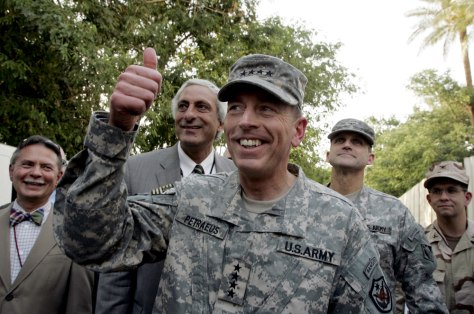
A few more paces down the digital road and you encounter a sullen looking woman holding a dog leash, the collar attached to a man lying nude on the floor of a prison. Your digital tour guide explains: “An unfortunate picture was taken. Luckily, the bad apple was punished and military honor was restored.” Fair enough. Soon, a digital General David Petraeus strides forward and shoots you another thumbs-up. (It looks as if they just put a new cyber-skin over the President Bush avatar to save money.) “He surged his way to victory and the mission was accomplished again,” you hear over strains of the National Anthem and a chorus of “hooahs.”

Past is Prologue


Admittedly, we humans are lousy at predicting the future, so don’t count on any of this coming to pass: no eye implants, no voices beamed into your head, no Amazooglebook. None of it. Except, maybe, that Iraq War timeline. If the present is any guide, government-sanctioned, counterfeit history is in your future.

Let me explain…

In 2012, the Pentagon kicked off a 13-year program to commemorate the 50th anniversary of the Vietnam War, complete with a sprawling website that includes a “history and education” component. Billed as a “public service” provided by the Department of Defense, the United States of America Vietnam War Commemoration site boasts of its “resources for teachers and students in the grades 7-12” and includes a selection of official government documents, all of them produced from 1943-1954; that is, only during the earliest stages of modern U.S. involvement in what was then called Indochina.

The Vietnam War Commemoration’s educational aspirations, however, extend beyond students. “The goal of the History and Education effort,” according to the site, “is to provide the American public with historically accurate materials and interactive experiences that will help Americans better understand and appreciate the service of our Vietnam War veterans and the history of U.S. involvement in the Vietnam War.” To that end, the United States of America Vietnam War Commemoration offers an interactive historical timeline.

By far the largest and most impressive offering on the site, the timeline spans 70 interactive pages with 830 individual entries that take a viewer from 1833 to 1976. The entries run the gamut from tales of daring and sacrifice from the official citations of Medal of Honor recipients to short offerings about changes of command. There are even couple-of-sentence accounts of relatively minor operations -- like a December 20, 1969, sweep in Binh Duong Province by elements of the 1st Infantry Division, which captured 12 of 18 members of a North Vietnamese intelligence unit and 2,000 documents that “proved how much information the enemy had about American operations.”

It’s an eclectic mix, but give credit where it’s due: the digital chronology does mention casualties from the oft-forgotten first U.S. attack on Vietnam (an 1845 naval shelling of the city we now know as Danang). For the next 131 years, however, mention of Vietnamese dead and wounded is, to put the matter as politely as possible, in short supply. Flawed history, though, isn’t.

History is Bunk


Take the August 2, 1964, “Gulf of Tonkin Incident.” It was a key moment of American escalation and, by the looks of the Pentagon’s historical timeline, just what President Lyndon Johnson made it out to be when he went on television to inform the American people of “open aggression” on the part of North Vietnam. “The USS Maddox was attacked by North Vietnamese gunboats in the Gulf of Tonkin,” reads the entry. A later one mentions “U.S. Naval Vessels being fired upon by North Vietnamese on two separate occassions [sic].” Case closed. Or is it?

Click here to see a larger version


The official story, the one that kicked off a cycle of U.S. military escalations that led to millions of casualties in Indochina, went like this: the USS Maddox, a destroyer, was innocently sailing through the Gulf of Tonkin when it was attacked by North Vietnamese torpedo boats on August 2, 1964. President Lyndon Johnson, showing great restraint, refused to respond militarily. Two nights later, the North Vietnamese attacked again, targeting the Maddox and the USS Turner Joy and prompting the president to take to the airways to announce that "renewed hostile actions against United States ships on the high seas in the Gulf of Tonkin have today required me to order the military forces of the United States to take action in reply." Johnson sought and Congress quickly passed the Gulf of Tonkin Resolution -- giving the president carte blanche to repeatedly intensify the war in the years to come.

But as it turned out, there was nothing innocent about those U.S. ships in the Gulf of Tonkin (as the President had implied). A claim of two separate attacks on U.S. Navy ships turned out to be untrue and the congressional resolution had not been drafted in the wake of the supposed attacks, but had been written months before, in anticipation of an opportune incident. In addition, the single attack by those torpedo boats occurred in the wake of a maritime raid on the North Vietnamese coast -- part of a covert program of attacks that Johnson had approved months earlier.

After reviewing the history of the incident, it seemed to me that the timeline was on distinctly shaky ground, but I decided to get a second opinion and went to the man who wrote the book on the subject, Edwin Moïse, author of Tonkin Gulf and the Escalation of the Vietnam War. He did me not one, but two better. He also pointed out apparent errors in the July 11, 1964, entry, “Joint Chiefs of Staff Unveiled ‘94 Target List,’” and criticized the August 4, 1964, entry, which offers nothing more than a title: “Two U.S. Aircraft Downed.”

“I think this is simply false,” he told me by email. “I am not aware of any U.S. aircraft downed that day and I think I would know.” These planes, he suspected, were actually lost the following day while flying missions “in retaliation for the (imaginary) second Tonkin Gulf Incident on August 4th.” The August 2nd Tonkin Gulf entry, he added, was “not quite accurate” either and was only “marginally useful” insofar as it was “close enough to the truth to allow readers to go looking for more information.”

With that in mind, I turned to Fredrik Logevall, winner of the 2013 Pulitzer Prize for History for his book Embers of War: The Fall of an Empire and the Making of America's Vietnam and author of Choosing War: The Lost Chance for Peace and the Escalation of War in Vietnam, a landmark study of American policymaking on Vietnam from 1963 to 1965. When it came to the Commemoration’s take on the Gulf of Tonkin Incident, he told me that “some context for this entry is sorely needed.”

“There's little doubt in my mind that the administration entered the month of August [1964] looking for a pretext to flex a little muscle in Vietnam,” he added. “Finally, it should be said the administration misrepresented what occurred in the Gulf, particularly with respect to the alleged second attack on August 4th, which evidence even at the time showed almost certainly never happened.”

None of this essential context can, of course, be found anywhere in the timeline. Still, everyone makes mistakes, so I meandered through the Pentagon’s chronology looking at other key entries.

Soon, I found the one dealing with My Lai.

On March 15, 1968, members of the 23rd Infantry Division’s Charlie Company, 1st Battalion, 20th Infantry, were briefed by their commanding officer, Captain Ernest Medina, ahead of an operation in an area they knew as “Pinkville.” As unit member Harry Stanley recalled, Medina “ordered us to ‘kill everything in the village.’” Infantryman Salvatore LaMartina remembered Medina’s words only slightly differently: they were to “kill everything that breathed.” What stuck in artillery forward observer James Flynn’s mind was a question one of the other soldiers asked: “Are we supposed to kill women and children?” And Medina’s reply: “Kill everything that moves.”

The next morning, roughly 100 soldiers were flown by helicopter to the outskirts of a small Vietnamese hamlet called My Lai in South Vietnam’s Quang Ngai Province and followed Medina’s orders to a T. Over a period of four hours, the Americans methodically slaughtered more than 500 Vietnamese civilians. Along the way, they also raped women and young girls, mutilated the dead, systematically burned homes, and fouled the area’s drinking water. It took a year and a half for a cover-up that extended from soldiers in the field to generals at the top of the division to unravel -- thanks in large measure to veterans Ron Ridenhour and Ron Haberle and crack investigative reporter Seymour Hersh.

Click here to see a larger version


The military took great pains to contain the fallout from the My Lai revelations, offering basement-level estimates of the death toll and focusing its attention on Lieutenant William Calley, the lowest ranking officer who could conceivably shoulder the blame, while also burying other atrocity allegations, deep-sixing inquiries, classifying documents, and obstructing investigations in order to cast My Lai as a one-off aberration. In their meticulously researched 1992 book Four Hours at My Lai, Michael Bilton and Kevin Sim write:

“What was first a ‘massacre’ quickly became a ‘tragedy’ and was then referred to as an ‘incident.’ General [William R.] Peers, whose exhaustive inquiry into the events at My Lai remains the best source for what really happened there, was warned by his superiors not to use the word ‘massacre’ at the press conference held on the publication of his report [in 1970].”

More than 40 years later, the Department of Defense is still operating from the same playbook. The Vietnam War Commemoration’s interactive timeline refers to My Lai as an “incident” not a massacre, the death toll is listed at “more than 200” instead of more than 500, and it singles out only Lieutenant Calley (who certainly had plenty of blood on his hands) as if the deaths of all those Vietnamese civilians, carried out by dozens of men at the behest of higher command, could be the fault of just one junior officer.

Given the Pentagon’s take on the My Lai massacre, I was hardly surprised by the one-sentence timeline entry on Operation Speedy Express, which says little more than that the six-month operation in the Mekong Delta “yield[ed] an enemy body count of 11,000.” This has long been the military’s official position, but the Defense Department knows full well that it isn’t the whole story.

Click here to see a larger version


In the early 1970s, a veteran who served in that operation sent a letter to the Pentagon (and then followed up with letters to other top Army generals) blowing the whistle on the systematic use of heavy firepower on populated areas which resulted in what he called a “My Lai each month.” His allegations were bolstered by those of U.S. advisors and Vietnamese sources, as well as by an internal report commissioned by the Army's acting general counsel, endorsing the whistleblower’s contention that an obsession with what was called “the body count” likely led to civilian deaths. The veteran’s shocking allegations were, however, kept secret for decades and a nascent inquiry into them was suppressed.

A later Newsweek investigation would conclude that as many as 5,000 civilians were killed during Operation Speedy Express. And a hush-hush internal military report, commissioned in the wake of the Newsweek story, suggested that the magazine had offered a low-end estimate. The document -- also kept secret and then buried for decades -- concluded:

“While there appears to be no means of determining the precise number of civilian casualties incurred by U.S. forces during Operation Speedy Express, it would appear that the extent of these casualties was in fact substantial, and that a fairly solid case can be constructed to show that civilian casualties may have amounted to several thousand (between 5,000 and 7,000).”

Despite these findings, which have -- in recent years -- been aired in publications from the Nation to the Washington Post, the Vietnam War Commemoration ignores even the military’s own estimate that as many as 60% of those killed in the operation may have been innocents.

Keep scrolling through the timeline and additional examples of dubious history regularly present themselves. Take March 15, 1969: “President Nixon ordered a B-52 strike on enemy bases in Cambodia. The first strike was made on 17 March and initiated a fourteen month bombing campaign labeled Operation Menu,” reads the entry. Next to it, there’s a picture of Nixon holding a press conference to announce the missions and point out the targets. Pretty cut and dried, right? Maybe not.

Click here to see a larger version


Operation Menu was a coldly titled collection of B-52 bomber raids against suspected Vietnamese enemy “base areas” -- given the codenames "Breakfast," "Lunch," "Snack," "Dinner," "Dessert," and "Supper." As William Shawcross demonstrated in Sideshow: Kissinger, Nixon, and the Destruction of Cambodia, it was kept secret from the American people, Congress, and even some top military brass via a conspiracy of silence, phony cover stories, the burning of documents, coded messages, and a dual bookkeeping system that logged the strikes as occurring in South Vietnam, not Cambodia. Not exactly the kind of thing presidents tend to talk about on TV. (Even the Nixon Presidential Library and Museum’s timeline describes the attacks as “secret bombings.”) The image in the Commemoration timeline is actually from an April 30, 1970 press conference in which Nixon announced the “incursion” of U.S. and South Vietnamese forces into Cambodia. It would take until August 1973, more than four years after it began, for the president to admit to the clandestine bombing campaign.

The covert attacks on Cambodia eventually became the basis for the first motion to impeach Nixon, and a resulting investigation revealed documents that proved the president himself had ordered its cover-up. The motion was voted down due to political considerations -- in favor of articles of impeachment for the Watergate crimes and abuse of power, including wiretaps that resulted from the cover-up of the secret bombing -- but 10 members of Congress who backed the motion filed a dissenting view that read, in part:

“It is difficult to imagine Presidential misconduct more dangerously in violation of our constitutional form of government than Mr. Nixon’s decision secretly and unilaterally to order the use of American military power against another nation, and to deceive and mislead the Congress about this action."

Given all of this, it’s reasonable to ask whether the timeline entry didn’t warrant a few additional facts, slightly more context, and, perhaps, a photo that doesn’t deceive the audience.

So I did just that.

In August 2013, I tried contacting the Vietnam War Commemoration Office to get some answers about the timeline. When asked about the entries for My Lai and Speedy Express, a spokesperson from the office said that they were written by an individual who no longer worked there, so no one could address specific questions. Next, I aired my concerns about the timeline to M.J. Jadick, chief of strategic communications for the U.S. Vietnam War Commemoration, and then followed up by email. I asked eight pointed questions about the entries on the Gulf of Tonkin Incident, My Lai, Speedy Express, Operation Menu, and other problematic information as well, and I didn’t exactly pull punches. “It seems to me,” I wrote her, “that some timeline entries are lacking pertinent information, are watered-down, misleading, and in some cases grossly disingenuous... The sheer number of examples suggests that this is something more than accidental.”

Jadick answered none of my questions. “Our timeline is a work in progress and will continue to be reviewed accordingly,” she responded. “I have forwarded your concerns to our Branch Chief for History and Education for review.” When I checked back four months later on the results of that review, new procedures were indeed in place -- for media queries! Now, all of them were being forwarded to Lieutenant Colonel Tom Crosson at the Office of the Secretary of Defense.

Crosson? The name rang a bell.

In August, while writing an article for the BBC, I had contacted Lieutenant Colonel Crosson for comment about evidence of U.S. atrocities and Vietnamese civilian suffering -- much of it from long-classified U.S. military records -- that I present in my book, Kill Anything That Moves: The Real American War in Vietnam. Although decades had passed since the end of the conflict, he expressed doubt that it was possible for the military to provide an official statement in “a timely manner.”

Not much has changed since then.

My follow-up request for answers to months-old questions was forwarded to Crosson in early December. A couple weeks later, I contacted him looking for a comment. More than a month has passed and I’m still waiting for an answer to any of the questions I first posed in August.

Welcome to 2053


In a presidential proclamation kicking off the 50th anniversary commemoration of the Vietnam War, President Barack Obama distilled the conflict down to troops slogging “through jungles and rice paddies... fighting heroically to protect the ideals we hold dear as Americans.” He talked of “patriots” and “heroes,” “courage” and “valor.” He said the war was “a chapter in our nation's history that must never be forgotten.”

A few days later, in a speech at the Vietnam War Memorial in Washington, D.C., Obama continued praising Vietnam veterans, lauding their “sacrifices” and “courage,” their “valor,” “patriotism,” and “honor.” He welcomed them home and commended them for helping “build the America that we love and that we cherish.” He told the veterans present, “You earned your place among the greatest generations.” Obama even gave a passing nod to the civilian toll “not just in Vietnam, but in all wars,” even if he then followed it up with some eyebrow-raising lines. “We hate war,” he intoned, though a history of almost constant warfare and overseas military interventions suggests otherwise. “When we fight,” he continued, “we do so to protect ourselves because it's necessary.” The tacit suggestion being that, somehow, barefoot Vietnamese guerrillas seeking national reunification also had designs on the United States.

“The task of telling your story continues,” Obama told the Vietnam veterans present on the National Mall. “[A] central part of this 50th anniversary will be to tell your story as it should have been told all along. It’s another chance to set the record straight.”

Setting the record straight seems, however, to be the last intention of the United States of America Vietnam War Commemoration. When I called with my questions last August, the Commemoration’s M.J. Jadick said, “This is something you should be able to get an answer for.” Yet for six months, government officials have failed to provide me with any answers about the creation of their timeline, about its seeming lack of adequate context, about entries that are at best insufficient and, at worst, dishonest, or just plain wrong. And in that same period, none of the obvious errors and obfuscations I pointed out has been changed in any way.

The United States of America Vietnam War Commemoration website asserts that its “content will not contain misleading information or unsubstantiated claims,” but instead be “evaluated for fairness and acceptability as being in the best interest of the public.” The site goes on to claim that it will “provide the American public with historically accurate materials and interactive experiences,” but the timeline suggests other motives at play.

You don’t need cybernetic eye implants and immersive propaganda portals to alter history. You don’t need a digital David Petraeus or a President Bush avatar to distract you from the truth. You don’t need to wait decades to have disinformation beamed into your head. You just need a constant stream of misleading information, half truths, and fictions to be promoted, pushed, and peddled until they are accepted as fact.

Welcome to 2053. Mission accomplished.

Nick Turse is the managing editor of TomDispatch.com and a fellow at the Nation Institute. An award-winning journalist, his work has appeared in the New York Times, the Los Angeles Times, the Nation, on the BBC, and regularly at TomDispatch. He is the author most recently of the New York Times bestseller Kill Anything That Moves: The Real American War in Vietnam (just out in paperback). You can catch his conversation with Bill Moyers about that book by clicking here.

Follow TomDispatch on Twitter and join us on Facebook or Tumblr. Check out the newest Dispatch Book, Ann Jones’s They Were Soldiers: How the Wounded Return From America’s Wars -- The Untold Story.

Copyright 2014 Nick Turse