Thursday, July 10, 2014

Hour 25 for America: Living the Jack Bauer Legacy


The 25th Hour: Still Living With Jack Bauer in a Terrified New American World

by Rebecca Gordon  - TomDispatch

Once upon a time, if a character on TV or in a movie tortured someone, it was a sure sign that he was a bad guy. Now, the torturers are the all-American heroes. From 24 to Zero Dark Thirty, it’s been the good guys who wielded the pliers and the waterboards. We’re not only living in a post-9/11 world, we’re stuck with Jack Bauer in the 25th hour.

In 2002, Cofer Black, the former Director of the CIA’s Counterterrorism Center, told a Senate committee, “All I want to say is that there was ‘before’ 9/11 and ‘after’ 9/11. After 9/11 the gloves come off.” 
He wanted them to understand that Americans now live in a changed world, where, from the point of view of the national security state, anything goes. It was, as he and various top officials in the Bush administration saw it, a dangerous place in which terrorists might be lurking in any airport security line and who knew where else.
Tomgram: Rebecca Gordon, A Nation of Cowards?

It sounded like the beginning of a bad joke: a CIA agent and a U.S. Special Operations commando walked into a barbershop in Sana...

That’s the capital of Yemen in case you didn’t remember and not the sort of place where armed Americans usually wander out alone just to get a haircut. Here’s what we know about the rest of this mysterious tale that surfaced in the U.S. media in early May (only to disappear again shortly thereafter): according to unnamed “American officials,” two armed Yemeni civilians entered that barbershop with the intention of “kidnapping” the Americans, who shot and killed them and were then “whisked” out of the country with the approval of the Yemeni government.

For today, set aside the mystery of what in the world was actually going on in that barbershop and just consider the fact that when “they” do it to “us,” there’s no question about what word to use. It’s kidnapping, plain and simple. When we do it to “them” (even when the they turn out to be innocent of any terror crimes), it’s got a far fancier and more comfortable name: “rendition” or “extraordinary rendition.” When they bust into a barbershop in a tony district in the capital city of Yemen, no question what they have in mind. When we do it in Milan, Benghazi, Tripoli, or other major cities, sometimes with the collusion of the local police, sometimes with the help of the local government, sometimes with no locals at all, we’re just “rendering” our victims to “justice.”

The CIA in particular and more recently U.S. special operators have made global kidnappings -- oops, renditions -- a regular beat since 9/11. A kind of rampage, actually. As it happens, whatever itcan’t do these days, the “sole superpower” still has the ability to make the global rules to its own liking. So when we wield the “R” word, it couldn’t be more “legal” or at least, as U.S. experts will testify, the only reasonable way to go. Of course, when others wield the “K” word, can there be any question of the nastiness or illegality of their acts? Here’s a guarantee: not a chance. Any judge-jury-and-executioner-rolled-into-one approach to the world (as with, for instance, the CIA's drone assassination campaigns) is an ugly way to go and will look even uglier when other countries adopt the latest version of the American Way. As with torture (oops, sorry again, “enhanced interrogation techniques”), making global kidnapping your loud and proud way of life is a dangerous path to take, long term, no matter how bad the bad guys are that you may be rendering to justice.

Rebecca Gordon, author of Mainstreaming Torture, a new book on the American way of enhanced interrogation techniques, is here to remind us not only of those facts, but of an even uglier one. While the Obama administration washed its hands of torture (global assassination campaigns being its claim to fame), its top officials didn’t think it worth the bother to dismantle the elaborate torture system created in the Bush years, which means that, with another flick of the switch somewhere down the line, off we'll go again. Tom

The 25th Hour: Still Living With Jack Bauer in a Terrified New American World

by Rebecca Gordon 

Dark-skinned foreigners promoting disturbing religions were driven to destroy us because, as President George W. Bush said more than once, “they hate our freedoms.” It was "them or us." In such a frightening new world, we were assured, our survival depended in part on brave men and women willing to break precedent and torture some of our enemies for information that would save civilization itself. As part of a new American creed, we learned that torture was the price of security.

These were the ruling fantasies of the era, onscreen and off. But didn’t that sorry phase of our national life end when Bush and his vice president Dick Cheney departed? Wasn’t it over once Barack Obama entered the Oval Office and issued an executive order closing the CIA black sites that the Bush administration had set up across the planet, forbidding what had euphemistically come to be called “enhanced interrogation techniques?” As it happens, no. Though it’s seldom commented upon, the infrastructure for, the capacity for, and the personnel to staff a system of institutionalized state torture remain in place, ready to bloom like a desert plant in a rain shower the next time fear shakes the United States.

There are several important reasons why the resurgence of torture remains a possibility in post-Bush America:

* Torture did not necessarily end when Obama took office.

* We have never had a full accounting of all the torture programs in the “war on terror.”

* Not one of the senior government officials responsible for activities that amounted to war crimes has been held accountable, nor were any of the actual torturers ever brought to court.

Torture Did Not Necessarily End When Obama Took Office


The president’s executive order directed the CIA to close its detention centers “as expeditiously as possible” and not to open any new ones. No such orders were given, however, to the Joint Special Operations Command (JSOC), a clandestine force composed of elite fighters from several branches of the U.S. armed forces. JSOC had run its own secret detention centers in Iraq. At Camp Nama, interrogations took place in the ominously named “Black Room.” According to the New York Times, the camp’s chilling motto was “no blood, no foul.” JSOC is presently deployed on several continents, including Africa, where gathering “intelligence” forms an important part of its duties.

The president’s executive order still permits “rendition” -- the transfer of a terror suspect to another country for interrogation, which in the Bush years meant to the prisons of regimes notorious for torture. It does, however, impose some constraints on the practice. Such “transfers” must be approved by a special committee composed of the director of national intelligence, the secretary of defense, the secretary of state, the secretary of homeland security, the director of the Central Intelligence Agency, and the chairman of the Joint Chiefs of Staff. It is to be chaired by the attorney general. The committee must not “transfer... individuals to other nations to face torture or otherwise for the purpose, or with the effect, of undermining or circumventing the commitments or obligations of the United States to ensure the humane treatment of individuals in its custody or control.”

This last constraint, however, has been in place at least since 1994, when the Senate ratified the U.N. Convention against Torture and Other Cruel, Inhuman, and Degrading Treatment. That did not prevent the rendition of people like Maher Arar, an innocent Canadian citizen sent by the United States to Syria, where he endured 10 months of torture in an underground cell. Nor did it save Binyam Mohammed, whose Moroccan jailers sliced his chest and penis with a scalpel -- once a month for 18 months, according to British human rights lawyer Andy Worthington.

Nor has the CIA itself been prepared to end all its torture programs. In his confirmation hearings, Obama’s first CIA director Leon Panetta told members of Congress that “if the approved techniques were ‘not sufficient’ to get a detainee to divulge details he was suspected of knowing about an imminent attack, he would ask for ‘additional authority’ to use other methods.” It is, however, unlikely that such “other methods” could be brought to bear on the spur of the moment. To do so, you need an infrastructure and trained personnel. You need to be ready, with skills honed.

Torture, though by another name, still goes on in the American prison complex at Guantánamo Bay, Cuba. President Obama came into office promising to close Guantánamo within a year. It’s a promise he repeats occasionally, but the prison is still open, and some detainees are still being held indefinitely. Those who use the only instrument they have to resist their hellish limbo -- a hunger strike -- are strapped into chairs and force-fed. In case you think such “feeding” is a humanitarian act, Guantánamo prisoner Samir Naji al Hasan Moqbel described the experience in a New York Times op-ed in April 2013:

“I will never forget the first time they passed the feeding tube up my nose. I can’t describe how painful it is to be force-fed this way. As it was thrust in, it made me feel like throwing up. I wanted to vomit, but I couldn’t. There was agony in my chest, throat, and stomach. I had never experienced such pain before. I would not wish this cruel punishment upon anyone.”

The U.S. has a long history of involvement with torture -- from its war in the Philippines at the dawn of the twentieth century on. It has also, as in Latin America in the 1960s, trained torturers serving other regimes. But until 9/11 top officials in this country had never publicly approved of torture. Whatever might happen behind closed doors (or in training sessions provided by the School of the Americas, for example), in public, everyone -- government officials, the press, and the public -- agreed that torture was wrong.

That consensus no longer exists today. After 9/11 those “gloves” came off. Waterboarding prisoners who might have information about a plot that could threaten us was a “no brainer” for Vice President Dick Cheney, and he wasn’t alone. In those years, torture, always called “enhanced interrogation techniques” (a phrase the media quickly picked up), became a commonplace, even celebrated, feature of our new landscape. Will it remain that way?

We Have Never Had a Full Accounting of All the Torture Programs Used in the “War on Terror”


Thanks to the work of persistent reporters, we now know many pieces of the torture puzzle, but we still have nothing like a complete, coherent narrative. And if we don’t know just what happened in those torture years, we are unlikely to be able to dismantle the existing infrastructure, which means we won’t be able to keep it from happening again.

In addition, the accounts of journalists and historians are not sufficient, as they don’t bear any government imprimatur. They are not “the official story.” They do not represent an attempt on the part of the government, and hence the nation, to come fully to grips with this past. An official account of what happened could, however, lay the groundwork for a national consensus against the future use of torture.

Forty years ago, congressional investigations of the CIA’s Phoenix Program (in which tens of thousands of Viet Cong were tortured and murdered) resulted in some new constraints on the Agency’s activities. President Gerald Ford issued an executive order prohibiting the CIA from engaging in “political assassinations” or experimenting with drugs on human subjects. President Jimmy Carter amended that order to prohibit assassination in general. These edicts, combined with the oversight provided by the House and Senate Intelligence Committees, were supposed to rein in the CIA’s most egregious acts.

Nevertheless, we now know that a rejuvenated CIA has run a full-scale torture program, kidnapped terror suspects off global streets, and still oversees drone assassination campaigns in Pakistan and Yemen. In addition, it continues to resist Congressional oversight of its torture activities. As yet, the Agency, tasked with “vetting” a 6,000-page report on its “interrogation methods” prepared by the Senate Intelligence Committee, has refused to allow the release of any part of the account. Even Dianne Feinstein, the committee’s chair, often considered the “senator from national security,” was moved to offer an extraordinary denunciation on the floor of the Senate of the CIA’s interference with committee computers.

Recently, the Washington Post reported some leaked details from the report the committee has been struggling unsuccessfully to get released, including information on a previously undocumented form of CIA torture: shoving a prisoner’s head into a tub of ice water or pouring that water all over a person’s body. (Immersion in cold water is a torture method I first came across in 1984 when interviewing a Nicaraguan who had been kidnapped and tortured by U.S.-backed and -trained Contra guerrillas.)

We don’t have anything like the full story of the CIA’s involvement in torture, and the CIA is only one agency within a larger complex of agencies, military and civilian. We can’t dismantle what we can’t see.

None of the High Government Officials Responsible for Activities That Amount to War Crimes Has Been Held Accountable; Nor Have Any of the Actual CIA Torturers

When it comes to torture, President Obama has argued that “nothing will be gained by spending our time and energy laying blame for the past,” but this is simply not true. One thing that could be gained would be a public consensus that the United States should never again engage in torture. Another might be agreement that officials who are likely guilty of war crimes should not be allowed to act with impunity and then left free to spend their post-government years writing memoirs or painting themselves bathing.

Retired Major General Antonio Taguba, whose military career was cut short by his report on U.S. abuses at Abu Ghraib prison in Iraq, wrote in the preface to a June 2008 report by Physicians for Human Rights, “After years of disclosures by government investigations, media accounts, and reports from human rights organizations, there is no longer any doubt as to whether the current administration has committed war crimes. The only question that remains to be answered is whether those who ordered the use of torture will be held to account.”

Years later, with a different administration in its second term, this question has been answered. They will not. Nor will the actual CIA torturers, since the Obama Justice Department has dismissed all cases involving their brutal interrogations, even two that resulted in the deaths of prisoners.

This is not to say that no one has been sent to prison because of the CIA’s torture programs. Former CIA analyst John Kariakou is presently serving 30 months in federal prison for revealing the name of a covert CIA operative, while blowing the whistle on the Agency’s torture operations. From his prison cell, he has called for a special prosecutor to bring the architects of the torture program to justice.

Living in a Cowardly New World


The post-9/11 United States is no brave new world, but a terrified one. We are constantly reminded of the dangers we face and encouraged to believe that torture will keep us safe. Americans have evidently seen just enough -- between revelations of fact and fictional representations -- to become habituated to the idea that torture is a necessary cost of safety. Indeed, polls show that Americans are more supportive of using torture today than they were at the height of the “war on terror.”

In these years, “safety” and “security” have become primary national concerns. It’s almost as if we believe that if enough data is collected, enough “really bad guys” are tortured into giving up “actionable intelligence,” we ourselves will never die. There is a word for people whose first concern is always for their own safety and who will therefore permit anything to be done in their name as long as it keeps them secure. Such people are sometimes called cowards.

If this terrified new worldview holds, and if the structure for a torture system remains in place and unpunished, the next time fear rises, the torture will begin anew.

Rebecca Gordon is the author of Mainstreaming Torture: Ethical Approaches in the Post-9/11 United States (Oxford University Press). She teaches in the philosophy department at the University of San Francisco. She has also spent several decades working in a variety of national and international movements for peace and justice, and is a member of the War Times/Tiempo de Guerras collective. You can contact her through the Mainstreaming Torture website.

Follow TomDispatch on Twitter and join us on Facebook and Tumblr. Check out the newest Dispatch Book, Rebecca Solnit's Men Explain Things to Me.

Copyright 2014 Rebecca Gordon

Watching Ukraine's War from the Calm of Crimea

From Simferopol, Crimea, reflections on the war in eastern Ukraine

by Roger Annis  - A Socialist in Canada

July 10, 2014 Simferopol, Crimea —Yesterday, I spent the afternoon walking through central Simferopol, the administrative capital city of Crimea. You may know Crimea as the former region of Ukraine that recently voted to join the Russian Federation. It was a warm and sunny day with a strong breeze blowing.

I get the impression that I’m the only tourist in town. I kept my ears acutely tuned all day to the sound of a foreign-language conversation. ничего (nothing). 
 
I visited the busy train station out of interest and also out of hope of spotting a visitor to whom I could talk. No luck there, either. You see, I don’t speak Russian and I am keen to learn more about Crimea. What’s the living situation here for ordinary people? How do they feel about the tumultuous events of recent months, including the secession from Ukraine? What is that building here, that monument over there? And so on.

Ah well. I do have a get-together today with a socialist who is living here in political exile from Ukraine. I’m really looking forward to that.

Central Simferopol is very pleasant. Lots of tree lined streets with shops and cafes. Many of the downtown streets are closed to traffic and given over to street-level cafes (with overhead protection from the rain and sun). There are lots of squares. It’s not a wealthy, west European look. Just modest and nice. There is a river running through the center of the city with nice parkland along each bank.

There are several important war monuments. The visitor to here should know that he/she is walking on hallowed ground.


Monument in central Simferopol to the 
Nazi invasion and occupation of WW2

Crimea was the scene of terrible, bloody fighting following the catastrophic German invasion of the Soviet Union on June 22, 1941. It suffered several years of ruthless, Nazi occupation until it was liberated in the summer of 1944. The main war monument that I saw had a dozen or so marble slabs with, I think, the names of the regiments of the Red Army that fought against the invasion and then later drove the occupiers out.

Yes, I know that the Soviet Union at the time of the War was saddled with the Stalin regime. Stalin’s purging of the leading cadre of the Red Army prior to the outbreak of war and its blunders leading up to the German invasion and immediately afterward cost very dearly.


Anti-fascist guerillas in Crimea during the 
Nazi occupation of World War Two

 But I recall the citation of a German general by historian David Stahel in his monumental, 2009 book Operation Barbarossa and Germany’s defeat in the East:“The Russian soldier fights not out of fear, rather for an idea. He does not want to return to the Tsarist time.” (See my brief summary of Stahel’s book and related material, including Stahel’s 2012 book Kiev 1941, here on my website.)

I believe it was the main administrative building of Crimea that I was viewing. It had a half dozen or so unarmed soldiers at its large entrance. I wanted stroll up and ask them how they think matters are going, but it was unlikely they would know English. When I get home, I think I may study Russian language just in case I should find myself back in this part of the world. It’s a shame to come all this distance and not be able to communicate with most people.

There is a lot of bus service in the city. I would have expected to see some kind of light rail tram through the downtown as well, but no. As in Moscow, there are lots of cars, most very modern. Once one leaves the city center, things break down a little. It’s noticeable that the sidewalks are not kept up. Also, there is zero recycling of anything. There must be a large mountain of a landfill somewhere near.

Darned if the people living here do not look startlingly attractive and radiant. Smartly dressed. Lots of socializing going on day and evening. The one thing that one does not see in the center of the city is the Tatar population. They make up some ten per cent of Crimea. No doubt there are Tatar neighbourhoods in the city. I know there is a mosque near to my hotel because there is a recorded call to prayer that broadcasts several times per evening.

The cost of traveling around here is quite reasonable. Food and drink in the stores cost half that of Canada. Today, for example, I bought the following supper for $3 at a nearby supermarket: a baguette, a hunk of cheese, a large serving of coleslaw (very popular here), and three tomatoes. I bought a beer for half a Canadian price. I expect that restaurant meals are similarly half the comparable price in Canada. And no GST! (I know, taxes will be built into prices someway.)

Hotels are rather cheap comparatively. I’m paying $110 for a very nice, central hotel, including a very big breakfast that is enough to see me through until supper. (I got lucky for next week in Moscow, finding a highrise hotel with good breakfast for $90 per night, five metro stops from Red Square.)

Television channels on the hotel room television include news channels from Ukraine. I don’t understand the language, but the images paint a clear picture of the news being presented—a relentless propaganda barrage of the horrors of the “terrorists” in eastern Ukraine that the government and heroic (fascist) militias are attacking and whose cities they are bombing. Geez, and here I am thinking the CBC is bad!

I met one North American here in Simferopol. My eye caught the ‘Air Canada’ tag on his luggage and I introduced myself. He has been living here for 20 years. Judging by his accent, I think he was American by origin. He voiced his frustration about the political situation. Overnight, in March, he said, the country in which he was living changed over for another. The day before our conversation, he attempted to make his first visit to Ukraine by train since the changeover. He discovered at the train station that the new, Russian authorities require an exit visa for visitors to Ukraine. I don’t know why he didn’t think of checking beforehand what, if any, travel regulations had changed. It seems not unreasonable that Russia would have an interest in knowing who is traveling to and from a country that is now a very brazen, hostile neighbour. While he complained bitterly to me, I found his explanation that he was able to obtain his exit visa within 24 hours to be less than convincing evidence that the new authorities in Crimea are unreasonable and intolerant.

One of the things that strikes me here are the visible gaps in applied Russian technology. The country has a space program and a presumably modern military. But all the electronics and appliances that I am seeing are imported, including cell phones. The televisions, refrigerators and air conditioners in the hotels are all Chinese or Korean. All the bicycles (!) I’ve seen (not very many on the streets) are imported.

The country is awash in automobiles; it is now the largest market in Europe of auto sales. Yet there isn’t a single Russian company that manufactures autos. (Lada ceased production in 2012. There are truck manufacturers.) There is now lots of auto assembly and related parts industries in Russia, due to the government insisting that companies wanting to sell cars in Russia also locate assembly work here. But to compare, whereas Russia manufactures only half the number of vehicles sold, Canada manufactures one third more automobiles than are sold (though that proportion is in steady decline as auto manufacturers move to the low wage countries or to the low wage states in the southern U.S.). Some European countries with a fraction of Russia’s population have ownership of auto firms or robust design and manufacturing.

All this strikes me that Russia resembles more a country that is a hewer of well-priced natural resources than an ‘imperialist’ powerhouse as is claimed by mainstream media, Stephen Harper and by some on the political left. (See my article last month on the subject of Russia as an ‘imperialist’country or not.)

The Ukraine army and its allied rightist and fascist militias are moving in to assert control of the city and region of Slavyansk in Donetsk region following the strategic withdrawal of self defense fighters earlier this week. We will get similar scenes again of angry residents demanding to know what the army and militias are doing there. They want nothing to do with Kiev’s right wing, austerity agenda or the army it is sending in to enforce that. But this time the army and militias are not leaving anytime soon.

When scenes such as in this video below happened several months ago (May 5), the militias responded by assaulting and killing protesting citizens. People were threatened, arrested, or worse. Many, many videos were made showing terrible scenes. The most odious of all was the massacre by fascists of more than 40 antifascist protesters in Odessa on May 2. This was the whole origin of the armed uprising in Donetsk and Luhansk, which led to the plebiscites and declarations of autonomy (or independence in the minds of many) in May. Let us hope that international solidarity action in the weeks ahead can forestall a worsening of this ruthless war against southeast Ukraine by the governing regime in Kyiv.


Most people in Crimea are watching the events in Ukraine and breathing a sigh of relief. ‘Thank goodness that is not happening here; we made our distance from Ukraine in the nick of time.’ 
 

Categories: International, Ukraine, Crimea, Russia: articles by Roger Annis / 
 

Wednesday, July 09, 2014

A Pipeline to Ukraine: Connecting the Wars of Central Asia to a Western Coup

Pushing Ukraine to the Brink

by Mike Whitney - CounterPunch

“The unipolar world model has failed. People everywhere have shown their desire to choose their own destiny, preserve their own cultural identity, and oppose the West’s attempts at military, financial, political and ideological domination.”  -  Vladimir Putin

“While the human politics of the crisis in Ukraine garner all the headlines, it is the gas politics that in many ways lies at the heart of the conflict.”  - Eric Draitser, Waging war against Russia, one pipeline at a time, RT

What does a pipeline in Afghanistan have to do with the crisis in Ukraine?

Everything. It reveals the commercial interests that drive US policy. Just as the War in Afghanistan was largely fought to facilitate the transfer of natural gas from Turkmenistan to the Arabian Sea, so too, Washington engineered the bloody coup in Kiev to cut off energy supplies from Russia to Europe to facilitate the US pivot to Asia.

This is why policymakers in Washington are reasonably satisfied with the outcome of the war in Afghanistan despite the fact that none of the stated goals were achieved. Afghanistan is not a functioning democracy with a strong central government, drug trafficking has not been eradicated, women haven’t been liberated, and the infrastructure and school systems are worse than they were before the war. By every objective standard the war was a failure. But, of course, the stated goals were just public relations blather anyway. They don’t mean anything. What matters is gas, namely the vast untapped reserves in Turkmenistan that could be extracted by privately-owned US corporations who would use their authority to control the growth of US competitors or would-be rivals like China. That’s what the war was all about. The gas is going to be transported via a pipeline from Turkmenistan, across Afghanistan, Pakistan and India to the Arabian sea, eschewing Russian and Iranian territory. The completion of the so called TAPI pipeline will undermine the development of an Iranian pipeline, thus sabotaging the efforts of a US adversary.

The TAPI pipeline illustrates how Washington is aggressively securing the assets it needs to maintain its dominance for the foreseeable future. Now, check this out from The Express Tribune, July 5:

“Officials of Pakistan, India, Afghanistan and Turkmenistan are set to meet in Ashgabat next week to push ahead with a planned transnational gas pipeline connecting the four countries and reach a settlement on the award of the multi-billion-dollar project to US companies.

“The US is pushing the four countries to grant the lucrative pipeline contract to its energy giants. Two US firms – Chevron and ExxonMobil – are in the race to become consortium leaders, win the project and finance the laying of the pipeline,” a senior government official said while talking to The Express Tribune.

Washington has been lobbying for the gas supply project, called Turkmenistan, Afghanistan, Pakistan and India (Tapi) pipeline, terming it an ideal scheme to tackle energy shortages in Pakistan. On the other side, it pressed Islamabad to shelve the Iran-Pakistan gas pipeline because of a nuclear standoff with Tehran…

According to officials, Petroleum and Natural Resources Minister Shahid Khaqan Abbasi will lead a delegation at the meeting of the TAPI pipeline steering committee on July 8 in Ashgabat.

…At present, bid documents are being prepared in consultation with the Asian Development Bank, which is playing the role of transaction adviser. The documents will be given to the two companies only for taking part in the tender.

Chevron is lobbying in India, Pakistan and Afghanistan to clinch a deal, backed by the US State Department. However, other companies could also become part of the consortium that will be led either by Chevron or ExxonMobil.” (TAPI pipeline: Officials to finalise contract award in Ashgabat next week, The Express Tribune)

So the pipeline plan is finally moving forward and, as the article notes, “The documents will be given to the two companies only for taking part in the tender.”

Nice, eh? So the State Department applies a little muscle and “Voila”, Chevron and Exxon clinch the deal. How’s that for a free market?

And who do you think is going to protect that 1,000 mile stretch of pipeline through hostile Taliban-controlled Afghanistan?

Why US troops, of course, which is why US military bases are conveniently located up an down the pipeline route. Coincidence?

Not on your life. Operation “Enduring Freedom” is a bigger hoax than the threadbare war on terror.

So let’s not kid ourselves. The war had nothing to do with liberating women or bringing democracy to the unwashed masses. It was all about power politics and geostrategic maneuvering; stealing resources, trouncing potential rivals, and beefing up profits for the voracious oil giants. Who doesn’t know that already? Here’s more background from the Wall Street Journal:

“Earlier this month, President Obama sent a letter to (Turkmenistan) President Berdimuhamedow emphasizing a common interest in helping develop Afghanistan and expressing Mr. Obama’s support for TAPI and his desire for a major U.S. firm to construct it.

…Progress on TAPI will also jump-start many of the other trans-Afghan transport projects—including roads and railroads—that are at the heart of America’s “New Silk Road Strategy” for the Afghan economy.

The White House should understand that if TAPI isn’t built, neither U.S. nor U.N. sanctions will prevent Pakistan from building a pipeline from Iran.” (The Pipeline That Could Keep the Peace in Afghanistan, Wall Street Journal)

Can you see what’s going on? Afghanistan, which is central to Washington’s pivot strategy, is going to be used for military bases, resource extraction and transportation. That’s it. There’s not going to be any reconstruction or nation building. The US doesn’t do that anymore. This is the stripped-down, no-frills, 21st century imperialism. “No nation for you, buddy. Just give us your gas and off we’ll go.” That’s how the system works now. It’s alot like Iraq –the biggest hellhole on earth–where “oil production has surged to its highest level in over 30 years”. (according to the Wall Street Journal) And who’s raking in the profits on that oil windfall?

Why the oil giants, of course. (ExxonMobil, BP and Shell) Maybe that’s why you never read about what a terrible mistake the war was. Because for the people who count, it really wasn’t a mistake at all. In fact, it all worked out pretty well.

Of course, the US will support the appearance of democracy in Kabul, but the government won’t have any real power beyond the capital. It never did anyway. (Locals jokingly called Karzai the “mayor of Kabul”) As for the rest of the country; it will be ruled by warlords as it has been since the invasion in 2001. (Remember the Northern Alliance? Hate to break the news, but they’re all bloodthirsty, misogynist warlords who were reinstated by Rumsfeld and Co.)

This is the new anarchic “Mad Max” template Washington is applying wherever it intervenes. The intention is to dissolve the nation-state in order to remove any obstacle to resource extraction, which is why failed states are popping up wherever the US sticks its big nose. It’s all by design. Chaos is the objective. Simply put: It’s easier to steal whatever one wants when there’s no center of power to resist.

This is why political leaders in Europe are so worried, because they don’t like the idea of sharing a border with Somalia, which is exactly what Ukraine is going to look like when the US is done with it.

In Ukraine, the US is using a divide and conquer strategy to pit the EU against trading partner Moscow. The State Department and CIA helped to topple Ukraine’s elected President Viktor Yanukovych and install a US stooge in Kiev who was ordered to cut off the flow of Russian gas to the EU and lure Putin into a protracted guerilla war in Ukraine. The bigwigs in Washington figured that, with some provocation, Putin would react the same way he did when Georgia invaded South Ossetia in 2006. But, so far, Putin has resisted the temptation to get involved which is why new puppet president Petro Poroshenko has gone all “Jackie Chan” and stepped up the provocations by pummeling east Ukraine mercilessly. It’s just a way of goading Putin into sending in the tanks.

But here’s the odd part: Washington doesn’t have a back-up plan. It’s obvious by the way Poroshenko keeps doing the same thing over and over again expecting a different result. That demonstrates that there’s no Plan B. Either Poroshenko lures Putin across the border and into the conflict, or the neocon plan falls apart, which it will if they can’t demonize Putin as a “dangerous aggressor” who can’t be trusted as a business partner.

So all Putin has to do is sit-tight and he wins, mainly because the EU needs Moscow’s gas. If energy supplies are terminated or drastically reduced, prices will rise, the EU will slide back into recession, and Washington will take the blame. So Washington has a very small window to draw Putin into the fray, which is why we should expect another false flag incident on a much larger scale than the fire in Odessa. Washington is going to have to do something really big and make it look like it was Moscow’s doing. Otherwise, their pivot plan is going to hit a brick wall. Here’s a tidbit readers might have missed in the Sofia News Agency’s novinite site:

“Ukraine’s Parliament adopted .. a bill under which up to 49% of the country’s gas pipeline network could be sold to foreign investors. This could pave the way for US or EU companies, which have eyed Ukrainian gas transportation system over the last months.

…Prime Minister Arseniy Yatsenyuk was earlier quoted as saying that the bill would allow Kiev to “attract European and American partners to the exploitation and modernization of Ukraine’s gas transportation,” in a situation on Ukraine’s energy market he described as “super-critical”. Critics of the bill have repeatedly pointed the West has long been interest in Ukraine’s pipelines, with some seeing in the Ukrainian revolution a means to get access to the system. (Ukraine allowed to sell up to 49% of gas pipeline system, novinite.com)

Boy, you got to hand it to the Obama throng. They really know how to pick their coup-leaders, don’t they? These puppets have only been in office for a couple months and they’re already giving away the farm.

And, such a deal! US corporations will be able to buy up nearly half of a pipeline that moves 60 percent of the gas that flows from Russia to Europe. That’s what you call a tollbooth, my friend; and US companies will be in just the right spot to gouge Moscow for every drop of natural gas that transits those pipelines. And gouge they will too, you can bet on it.

Is that why the State Department cooked up this loony putsch, so their fatcat, freeloading friends could rake in more dough?

This also explains why the Obama crowd is trying to torpedo Russia’s other big pipeline project called Southstream. Southstream is a good deal for Europe and Russia. On the one hand, it would greatly enhance the EU’s energy security, and on the other, it will provide needed revenues for Russia so they can continue to modernize, upgrade their dilapidated infrastructure, and improve standards of living. But “the proposed pipeline (which) would snake about 2,400 kilometers, or roughly 1,500 miles, from southern Russia via the Black Sea to Bulgaria, Serbia, Hungary and ultimately Austria. (and) could handle about 60 billion cubic meters of natural gas a year, enough to allow Russian exports to Europe to largely bypass Ukraine” (New York Times) The proposed pipeline further undermines Washington’s pivot strategy, so Obama, the State Department and powerful US senators (Ron Johnson, John McCain, and Chris Murphy) are doing everything in their power to torpedo the project.

“What gives Vladimir Putin his power and control is his oil and gas reserves and West and Eastern Europe’s dependence on them,” Senator Johnson said in an interview. “We need to break up his stranglehold on energy supplies. We need to bust up that monopoly.” (New York Times)

What a bunch of baloney. Putin doesn’t have a monopoly on gas. Russia only provides 30 percent of the gas the EU uses every year. And Putin isn’t blackmailing anyone either. Countries in the EU can either buy Russian gas or not buy it. It’s up to them. No one has a gun to their heads. And Gazprom’s prices are competitive too, sometimes well-below market rates which has been the case for Ukraine for years, until crackpot politicians started sticking their thumb in Putin’s eye at every opportunity; until they decided that that they didn’t have to pay their bills anymore because, well, because Washington told them not to pay their bills. That’s why.

Ukraine is in the mess it’s in today for one reason, because they decided to follow Washington’s advice and shoot themselves in both feet. Their leaders thought that was a good idea. So now the country is broken, penniless and riven by social unrest. Regrettably, there’s no cure for stupidity.

The neocon geniuses apparently believe that if they sabotage Southstream and nail down 49 percent ownership of Ukraine’s pipeline infrastructure, then the vast majority of Russian gas will have to flow through Ukrainian pipelines. They think that this will give them greater control over Moscow. But there’s a glitch to this plan which analyst Jeffrey Mankoff pointed out in an article titled “Can Ukraine Use Its Gas Pipelines to Threaten Russia?”. Here’s what he said:

“The biggest problem with this approach is a cut in gas supplies creates real risks for the European economy… In fact, Kyiv’s efforts to siphon off Russian gas destined to Europe to offset the impact of a Russian cutoff in January 2009 provide a window onto why manipulating gas supplies is a risky strategy for Ukraine. Moscow responded to the siphoning by halting all gas sales through Ukraine for a couple of weeks, leaving much of eastern and southern Europe literally out in the cold. European leaders reacted angrily, blaming both Moscow and Kyiv for the disruption and demanding that they sort out their problems. While the EU response would likely be somewhat more sympathetic to Ukraine today, Kyiv’s very vulnerability and need for outside financial support makes incurring European anger by manipulating gas supplies very risky.” (Can Ukraine Use Its Gas Pipelines to Threaten Russia, two paragraphs)

The funny thing about gas is that, when you stop paying the bills, they turn the heat off. Is that hard to understand?

So, yes, the State Department crystal-gazers and their corporate-racketeer friends might think they have Putin by the shorthairs by buying up Ukraine’s pipelines, but the guy who owns the gas (Gazprom) is still in the drivers seat. And he’s going to do what’s in the best interests of himself and his shareholders. Someone should explain to John Kerry that that’s just how capitalism works.

Washington’s policy in Ukraine is such a mess, it really makes one wonder about the competence of the people who come up with these wacko ideas. Did the brainiacs who concocted this plan really think they’d be able to set up camp between two major trading partners, turn off the gas, reduce a vital transit country into an Iraq-type basketcase, and start calling the shots for everyone in the region?

It’s crazy.

Europe and Russia are a perfect fit. Europe needs gas to heat its homes and run its machinery. Russia has gas to sell and needs the money to strengthen its economy. It’s a win-win situation. What Europe and Russia don’t need is the United States. In fact, the US is the problem. As long as US meddling persists, there’s going to be social unrest, division, and war. It’s that simple. So the goal should be to undermine Washington’s ability to conduct these destabilizing operations and force US policymakers to mind their own freaking business. That means there should be a concerted effort to abandon the dollar, ditch US Treasuries, jettison the petrodollar system, and force the US to become a responsible citizen that complies with International law.

It won’t happen overnight, but it will happen, mainly because everyone is sick and tired of all the troublemaking.

Mike Whitney lives in Washington state. He is a contributor to Hopeless: Barack Obama and the Politics of Illusion (AK Press). Hopeless is also available in a Kindle edition. He can be reached at fergiewhitney@msn.com.

9/11 Trial: Guantánamo's Dark Farce Continues

The 9/11 Trial at Guantánamo: The Dark Farce Continues 

by Andy Worthington

I wrote the following article for the “Close Guantánamo” website, which I established in January 2012 with US attorney Tom Wilner. Please join us – just an email address is required to be counted amongst those opposed to the ongoing existence of Guantánamo, and to receive updates of our activities by email.

In two articles — this one and another to follow soon — I’ll be providing updates about the military commissions at Guantánamo, the system of trials that the Bush administration dragged from the US history books in November 2001 with the intention of trying, convicting and executing alleged terrorists without the safeguards provided in federal court trials, and without the normal prohibitions against the use of information derived through torture.

Notoriously, the first version of the commissions revived by the Bush administration collapsed in June 2006, when, in Hamdan v. Rumsfeld, the Supreme Court ruled that the commission system lacked “the power to proceed because its structures and procedures violate both the Uniform Code of Military Justice and the four Geneva Conventions signed in 1949.”

Nevertheless, Congress subsequently revived the commissions, in the fall of 2006, and, although President Obama briefly suspended them when he took office in 2009, they were revived by Congress for a second time in the fall of 2009.

Despite this, just eight cases have been decided since the “war on terror” began — three under George W. Bush (David Hicks in March 2007, Salim Hamdan in August 2008 and Ali Hamza al-Bahlul in November 2008) and five under Barack Obama (Ibrahim al-Qosi in July 2010, Omar Khadr in October 2010, Noor Uthman Muhammed in February 2011, Majid Khan in February 2012 and Ahmed al-Darbi in February 2014). Of the eight, six involved plea deals, and what credibility the commissions had was shattered when the only two convictions that involved actual trials — those of Salim Hamdan and Ali Hamza al-Bahlul — were overturned on appeal in October 2012 and January 2013 on the basis that the war crimes for which they were convicted were not internationally recognized and had been invented by Congress. Further information about all these cases can be found in an article I put together in March, entitled, “The Full List of Prisoners Charged in the Military Commissions at Guantánamo.”

The government appealed in the case of Ali Hamza al-Bahlul, and a hearing took place last October, although no ruling has yet been taken by the court. However, the Hamdan and al-Bahlul rulings have already led to the government abandoning plans to proceed with any trials other than the ones currently taking place — for Khalid Sheikh Mohammed and four other men accused of involvement in the 9/11 attacks; for Abd al-Rahim al-Nashiri, accused of masterminding the attack on the USS Cole in 2000; and for Abd al-Hadi al-Iraqi, one of the last men to arrive at Guantánamo, in April 2007.

All of these men were held in CIA “black sites” before their transfer to Guantánamo, where, as I explained in my last update about the commissions in March, “they were subjected to torture — which, of course, makes a fair and open trial improbable, and has led to a protracted game of cat and mouse as the government tries to suppress all mention of torture, while the defense teams try to expose it.”

In this article, I’ll provide updates on the 9/11 trial, and in a second article to follow I will look at developments in the case of Abd al-Rahim al-Nashiri and the arraignment of Abd al-Hadi al-Iraqi.

Hearings generally take place every three months or so, and in 2013 defense lawyers in the 9/11 trial spent much of their time challenging a protective order, issued in December 2012 by the chief judge of the commissions, Col. James L. Pohl, accepting calls by prosecutors for material provided to the defense (through the process known as “discovery”) to be subjected to a protective order, because it “contains information that, if disseminated without authority, could pose a threat to public safety and national security and could implicate the privacy interests of the Accused and third parties.”

As I explained in October 2013:

[L]awyers for the prisoners argue that the protective order violates the UN Convention Against Torture, specifically through Judge Pohl’s acceptance, as Katherine Hawkins [a lawyer and researcher] put it, that “the defendants’ ‘observations and experiences’ of torture at CIA black sites are classified.” The men’s lawyers point out that the ban “violates the Convention Against Torture’s requirement that victims of torture have ‘a right to complain’ to authorities in the countries where they are tortured, and makes the commission into ‘a co-conspirator in hiding evidence of war crimes.’”

In December, at the last hearing of the year, Ramzi bin al-Shibh, one of the five alleged 9/11 co-conspirators, “was ejected twice from the courtroom for interruptions — in the first instance shouting, ‘This is torture! You have to stop the sleep deprivation and the noises,’” as I explained in an article in March. I added, “This led to questions about his mental competency, but these had not been addressed by January 31 this year, because he refused to talk to a mental health board whose members told the judge that they therefore didn’t know if he was fit to stand trial.” As a result, Judge Pohl was obliged to put off the next round of hearings, scheduled for February, and these did not take place until April, when bin al-Shibh’s competency was once more under scrutiny.

The strange case of the FBI investigation into the 9/11 defense team


However, bin al-Shibh’s mental state was almost immediately overshadowed by what appeared to be a fresh scandal, when, on April 14, defense lawyers “accused the FBI in open court of trying to turn a defense team security officer into a secret informant,” as the Miami Herald described it, prompting Judge Pohl to immediately call for a recess.

Jim Harrington, bin al-Shibh’s civilian defense attorney, said that two FBI agents had visited the home of his team’s Defense Security Officer, seeking information about who had provided media outlets with a statement produced by Khalid Sheikh Mohammed that had surfaced in January.

Defense Security Officers, who work for outside contractors, “have Top Secret security clearances,” as the Miami Herald put it, and are assigned to “guide team members, both lawyers and analysts, on what information should be blacked out in court filings — and what information can be released as unclassified.”

Jim Harrington noted that, when approached by the FBI, the Defense Security Officer — who, he said, had subsequently been suspended from the case — was made to “sign a non-disclosure agreement that appeared to draw him into a continuing informant relationship.”

In an emergency defense motion, lawyers stated, “Apparently as part of its litigation strategy,the government has created what appears to be a confidential informant relationship with a member of Mr. bin al Shibh’s defense team, and interrogated him about the activities of all defense teams. The implications of this intrusion into the defense camp are staggering. The most immediate implication, however, is that all defense teams have a potential conflict of interest between their loyalty to their clients and their interest in demonstrating their innocence to FBI investigators.”

On April 15, Judge Pohl, brushing aside the bin al-Shibh competency question by stating that he was “competent until somebody argued otherwise” (in the Miami Herald‘s words), “ordered everyone working for the 9/11 defense teams to notify their lead lawyer if US government agencies, including the FBI, had contacted them,” and “also sought a proposal from defense lawyers of what evidence he should gather, which people he should question.” When asked if he knew about the investigation, the chief prosecutor, Army Brig. Gen. Mark Martins, said, “No, we were not.”

Bizarrely, it transpired that the statement by KSM wasn’t even regarded as case evidence, and had been declared unclassified by the CIA, although an emergency prosecution filing at the end of February revealed that “prosecutors treated two copies as court evidence after defense lawyers handed them the document” in December.

On April 17, Brig. Gen. Martins announced that Justice Department lawyer Fernando Campoamor-Sánchez had been appointed as Special Trial Counsel, and was given until April 21 “to explain to the judge, in a ‘full factual submission,’ what he [had] been able to discover about what the FBI [was] doing.”

For his part, Judge Pohl acknowledged what appeared to be an FBI investigation. “Right now,” he said, “it appears from the state of the current record” that “there is some type of investigation by the FBI into Mr. Mohammad’s team.”

On April 21, Campoamor-Sánchez confirmed that the FBI was conducting an investigation that was related to the 9/11 trial, but was unrelated to the release of KSM’s statement. In a nine-page filing to the court, he wrote, as the Miami Herald described it, that the government “specifically kept Sept. 11 trial prosecutors in the dark” about what he described as a “preliminary investigation.”

The Herald added that the filing “does not make clear what the FBI is investigating.” Instead, Campoamor-Sánchez stated that he had given the judge “a second, classified document” in which he described “the nature of the actual FBI Preliminary Investigation being conducted.” He added that any wider disclosure would “jeopardize an ongoing FBI criminal investigation,” and explained in a footnote that the trigger for apreliminary investigation was “[a]ny ‘allegation or information’ indicative of possible criminal activity or threats to the national security.”

Campoamor-Sánchez asked Judge Pohl for an additional 30 days to find out more about the investigation, and the judge agreed, adjourned the proceedings until June. When the court reconvened on June 16, Campoamor-Sánchez confidently stated that “there is not any informant or mole in the defense camp,” adding that the FBI’s activity “created no conflict of interest because the agents weren’t investigating defense attorneys, only questioning their support staff.” He also stated that the defense lawyers “should trust in the prosecution argument supported by a sworn FBI affidavit that the investigation that kicked off the controversy by questioning defense team members was closed.”

The defense lawyers were not entirely reassured. “I do have a reasonable fear. I am trimming my sails. I am pulling my punches,” David Nevin, one of Khalid Sheikh Mohammed’s lawyers, told the judge. The lawyers explained that they had uncovered four separate episodes of the FBI questioning staff members, as part of two investigations which they were now being asked to believe were closed, even though they had only found out about them because the man questioned in April, Dante James, the classification specialist on the Bin al-Shibh team, had told them about it. The others, as the Miami Herald explained, were “a linguist on the team of the alleged mastermind, Khalid Sheik[h] Mohammed, in January 2013,” and, in November, “two former federal law enforcement officers working as civilian investigators” on the teams of Ramzi bin al-Shibh and Mustafa al-Hawsawi.

While the majority of the defense lawyers told Judge Pohl that uncovering the FBI investigation had created “suspicion and uncertainty in the 9/11 defense teams,” one lawyer, Walter Ruiz, said he had found no conflict of interest. Ruiz represents Mustafa al-Hawsawi, a Saudi captured with KSM in Pakistan in March 2003, who is accused of providing financial assistance and organizing travel arrangements for some of the 9/11 hijackers, and he explained that, although one of the two civilian investigators questioned by the FBI was his civilian investigator, Thomas Gilhool, “he had discussed what the FBI had done with both Gilhool and Hawsawi and concluded that, for his part, no conflict of interest exists.”

Furthermore, he and his client were seeking a separate trial because al-Hawsawi is “not interested in more delays.” Ruiz said that a separate trial would “let him more swiftly litigate several issues,” in particular the conditions at Camp 7, where the “high-value detainees” are held. He called it “pseudo isolation, which in long-term detention is sometimes considered torture.” He also criticized the lack of family contact and what he described as the inadequate provision of religious facilities, and called the manner in which the men have been held “tremendously embarrassing to our armed forces.”

What will be the impact of the Senate torture report on the 9/11 trial?


While the circumstances in which the FBI investigation was discovered cast another shadow on the credibility of the commissions, as well as providing another delay of many months in the seemingly interminable pre-trial hearings, it was not the only problem to surface in the last few months.

On April 2, James Connell, one of the lawyers for Ali Abd al-Aziz Ali (aka Ammar al-Baluchi), one of the five alleged 9/11 co-conspirators, was “trying to get a copy of the secret Senate report on CIA interrogations that has caused a bitter rift between the agency and Congress,” as the Miami Herald described it. Connell explained that “the report and related documents contain information about the torture of his client.” The 6,300-page report, commissioned by the Senate Committee on Intelligence, took four years to complete and was delivered to the committee in December 2012, but it has not yet been released, as all the parties involved — and particularly the CIA — argue about how much of it should remain classified.

Connell’s efforts have so far yielded no results, but on May 22 the Miami Herald reported that his interest in the torture report, and its repercussions for the 9/11 trial, were shared by Sen. Carl Levin (D-Mich.), the chair of the powerful Senate Armed Services Committee, and Sen. Dianne Feinstein (D-Calif.), the chair of the Senate Intelligence Committee.

In a letter to President Obama, dated January 6, they wrote, “We write to urge that you direct all appropriate action to address the ongoing delay in the military commission trial of Khalid Shaykh Mohammad [sic] (KSM) and four other detainees being prosecuted at Guantánamo in connection with the 9/11 terrorist attacks.” They added, “Much of the delay is related to the continued classification of the information concerning the now defunct CIA Detention Interrogation Program.”

As will be discussed in detail in my forthcoming second article providing updates about the military commissions, on April 17 Judge Pohl ordered the CIA to provide details of the “black site” detention — “names, dates and places” — to Abd al-Rahim al-Nashiri’s lawyers. The judge explained that the lawyers “are entitled to the information to prepare Nashiri’s defense.” Khalid Sheikh Mohammed’s lawyers have asked Judge Pohl to do the same in their client’s case, but progress is slow, as the CIA is still resisting Judge Pohl’s order in al-Nashiri’s case.

However, the lawyers’ concerns were echoed by Sens. Levin and Feinstein in their letter, in which they stated that it was urgent that the relevant information is declassified, because “the delay is further undermining the reputation of the military commissions with the American public and our friends and allies overseas.” They added, “The continued classification of information also interferes with our country’s long-delayed, but important efforts to publicly shine a light on the misguided CIA program you rightfully ended almost five years ago.”

The senators also said that if the administration did not resolve these issues, the 9/11 trial should be moved to a federal court — where, of course, it was supposed to take place, after an announcement by Attorney General Eric Holder in November 2009, until critics began a backlash and President Obama backed down.

In a letter dated February 10, White House Counsel Kathryn Ruemmler responded by stating that President Obama shares the senators’ commitment to “facilitat[e] the prosecution of those charged in connection with the 9/11″ attacks, but added that “declassification decisions, even with respect to historical legacy programs, are fact-based and must be made with the utmost sensitivity to our national security.”

Ruemmler also noted that the president and CIA director John Brennan “are committed to working with you and others on your respective committees to ensure that information regarding the RDI [rendition, detention and interrogation] program is declassified, consistent with our national security interests.”

Accurately, I believe, the Miami Herald described the Levin-Feinstein letter as “the latest turn in what’s erupted into an extraordinary behind-the-scenes battle between the CIA and its overseers in Congress over the Senate Intelligence Committee’s $40 million investigation into the interrogation program,” although the White House’s careful response showed only that the brakes are still on regarding the report’s eventual release.

And in the meantime, at Guantánamo, justice, in the cases of Khalid Sheikh Mohammed and the four other men accused of involvement in the 9/11 attacks, appears as elusive as ever.


Andy Worthington is a freelance investigative journalist, activist, author, photographer and film-maker. He is the co-founder of the “Close Guantánamo” campaign, and the author of The Guantánamo Files: The Stories of the 774 Detainees in America’s Illegal Prison (published by Pluto Press, distributed by Macmillan in the US, and available from Amazon — click on the following for the US and the UK) and of two other books: Stonehenge: Celebration and Subversion and The Battle of the Beanfield. He is also the co-director (with Polly Nash) of the documentary film, “Outside the Law: Stories from Guantánamo” (available on DVD here – or here for the US).

To receive new articles in your inbox, please subscribe to Andy’s RSS feed — and he can also be found on Facebook (and here), Twitter, Flickr and YouTube. Also see the six-part definitive Guantánamo prisoner list, and “The Complete Guantánamo Files,” an ongoing, 70-part, million-word series drawing on files released by WikiLeaks in April 2011. Also see the definitive Guantánamo habeas list, the full military commissions list, and the chronological list of all Andy’s articles.

Please also consider joining the “Close Guantánamo” campaign, and, if you appreciate Andy’s work, feel free to make a donation.
- See more at: http://www.andyworthington.co.uk/2014/07/09/the-911-trial-at-guantanamo-the-dark-farce-continues/#sthash.pAutox4e.dpuf

DN!: Inside Assange’s Embassy Refuge

Exclusive: DN! Goes Inside Assange’s Embassy Refuge to Talk WikiLeaks, Snowden and Winning Freedom

by Democracy Now!

In a Democracy Now! special, we go inside the Ecuadorian embassy in London to interview Wikileaks founder Julian Assange. He has been holed up there for more than two years, having received political asylum. He faces investigations in both Sweden and the United States.


In the U.S., a secret grand jury is investigating WikiLeaks for its role in publishing a trove of leaked documents about the Iraq and Afghanistan wars, as well as classified State Department cables. In Sweden, Assange is wanted for questioning on allegations of sexual misconduct, though no charges have been filed.

Late last week, there was the first break in the latter case in two years, when a Swedish court announced it would hold a hearing on July 16 about a request by his lawyers for prosecutors to hand over new evidence and withdraw the arrest warrant. In the first of a two-part interview, Assange discusses his new legal bid in Sweden, the ongoing grand jury probe in the United States, and WikiLeaks’ efforts to assist National Security Agency whistleblower Edward Snowden.

Bombing Hospitals in Gaza: Israel Takes A Page from Göring's Book

Honouring the Dead, Advocating for the Living

by Eva Bartlett - In Gaza

[Editor's note: I've removed photographs from this report; not because of their graphic and gruesome content, but due to copyright. See In Gaza link above for complete report. - Ape] 

The sheer genocidal power of these bombs being criminally dropped on Palestinian homes and hospitals is horrific. “Strategic strikes” my ass.

The Zionists continue to bomb all over Gaza. I’m not there, my heart is and I wish I were…but there are some great Palestinian and international journalists, activists and bloggers keeping the info and photos coming out of Gaza.

First, the list of the martyred, as of earlier today. Surely and sadly it will be longer by now. The murdered are 53 now, according to Ma’an News, but at time of publishing the number was 41.

Relatives of Killed Palestinian Hatem Abu Salem, 28, arrive at the al-shifa hospital in Gaza City, following an Israeli air strike, on July 9, 2014. (Photo: AFP – Mahmud Hams)

Al Akhbar reported:

The Gaza health ministry has released the names and ages of 41 Palestinians killed so far in the besieged strip since Israel began its relentless assault early Tuesday. Among those killed, 13 were aged 16 or younger. The youngest victim, 18-month-old Mohammed Malakiyeh, was killed along with his 27-year-old mother. The oldest victim, 80-year-old Naifeh Farjallah, was killed in an air strike on the town of Moghraqa, southwest of Gaza City.

The single deadliest strike killed eight people Tuesday in southern Gaza when Israel bombed the Hamad family home.

Tuesday, July 8:
1. Mohammed Sha’aban, 24, was killed in a bombing of his car in Gaza City.
2. Ahmad Sha’aban, 30, died in the same bombing.
3. Khadir al-Bashiliki, 45, died in the same bombing.
4. Rashad Yaseen, 27, was killed in a bombing of the Nusseirat refugee camp in central Gaza.
5. Riad Mohammed Kawareh, 50, was killed in a bombing of his family’s home in Khan Younis.
6. Seraj Ayad Abed al-A’al, 8, was wounded in the same bombing and succumbed to his injuries on Tuesday evening.
7. Mohammed Ayman Ashour, 15, died in the same bombing.
8. Bakr Mohammed Joudah, 22, died in the same bombing.
9. Ammar Mohammed Joudah, 26, died in the same bombing.
10. Hussein Yousef Kawareh, 13, died in the same bombing.
11. Mohammed Ibrahim Kawareh, 50, died in the same bombing.
12. Bassim Salim Kawareh, 10, died in the same bombing.
13. Mousa Habib, 16, from Gaza City’s al-Shujaiyah neighborhood, was killed along with his 22-year old cousin while the pair were riding a motorcycle.
14. Mohammed Habib, 22, was killed with Mousa Habib.
15. Sakr Aysh al-Ajouri, 22, was killed in an attack on Jabaliyah, in northern Gaza.
16. Ahmad Na’el Mehdi, 16, from Gaza City’s Sheikh Radwan neighborhood, was killed in a bombing that wounded two of his friends.
17. Hafiz Mohammed Hamad, 30, an Islamic Jihad commander, was killed in the bombing of his home in Beit Hanoun, along with five of his family members.
18. Ibrahim Mohammed Hamad, 26, died in the same bombing.
19. Mehdi Mohammed Hamad, 46, died in the same bombing.
20. Fawzia Khalil Hamad, 62, died in the same bombing.
21. Dunia Mehdi Hamad, 16, died in the same bombing.
22. Suha Hamad, 25, died in the same bombing.
23. Suleiman Salman Abu Soaween, 22

Wednesday, July 9:
24. Abdelhadi Jamaat al-Sufi, 24, was killed in a bombing near the Rafah crossing.
25. Naifeh Farjallah, 80, was killed in an airstrike on the town of Moghraqa, southwest of Gaza City.
26. Abdelnasser Abu Kweek, 60, was killed in the bombing of Gaza’s central governorate along with his son.
27. Khaled Abu Kweek, 31, Abdelnasser Abu Kweek’s son, was killed in the same bombing.
28. Amir Areef, 13, died in a bombing in Sha’af.
29. Mohammed Malkiyeh, one and a half years old, died in a bombing along with his mother and a young man.
30. Amniyeh Malkiyeh, 27, Mohammed Malkiyeh’s mother, died in the same bombing.
31. Hatem Abu Salem, 28, died in the same bombing.
32. Mohammed Khaled al-Nimri, 22
33. Sahar Hamdan, 40, died in the bombing of her home in Beit Hanoun.
34. Ibrahim Masri, 14, Sahar Hamdan’s son, was killed in the same bombing.
35. Unknown
36. Sumoud al-Nawasra, a mother, was killed in a bombing along with her two children.
37. Mohammed Khalaf al-Nawasra, 4, arrived at the hospital “in shreds.”
38. Nidal Khalaf al-Nawasra, a child of unreported age, died along with Mohammed and Sumoud.
39. Salah Awwad al-Nawasra, was killed in the same bombing. His body was found under the rubble of the house.
40. Amal Youssef Abdel Ghafour
41. Ranim Jawde Abdel Ghafour, a young girl


Palestinian resistance ARE fighting back, as one would. But their rockets can never match the arsenal the Zionist regime possesses, nor do they have any military vehicles (tanks, apaches, war planes, war ships, drones). It’s an unfair fight, as usual, as is the history of occupied Palestine.

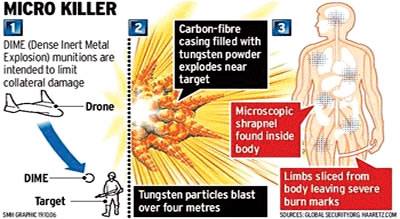
For example, Israel using banned weapons in Gaza: Medical sources:

Palestinian Health Ministry spokesman Ashraf al-Qodra said the bodies of most victims had been incinerated, while others had been completely torn apart.

He said Israel was deploying weapons that destroy the bodies of their victims, noting that a preliminary survey of victims’ bodies revealed the horrific nature of the weapons being used in Israel’s ongoing onslaught on Gaza.

“Israel used internationally-banned weapons in its two previous wars on Gaza,” al-Qodra told Anadolu Agency. “The same weapons are being used now.”

Eyewitnesses, meanwhile, have reported that Israeli airstrikes had incinerated the bodies of Palestinians who happened to be near targeted sites.

Israeli warplanes, they added, were using missiles that destroy their victims’ bodies, often cutting them to pieces.

Photos showed Palestinians whose limbs had been blown off and others whose bodies looked as if they had been subject to chemical attack.


Further imbalance: Israel destroys 55 Gaza homes in 2 days:


Fifty-five Palestinian homes have been leveled in a series of Israeli airstrikes across the Gaza Strip over the past two days, the Gaza Interior Ministry said Wednesday.

It added in a statement that Israel had launched around 500 strikes in the last 48 hours, some 85 percent of which had targeted Gaza’s energy and communications infrastructure.

Adding to the imbalance, the corporate media is parroting the Zionists’ lies about security. And the Zionists continue with their tactic of dehumanizing Palestinians. Al Akhbar’s Israel deploys dehumanizing rhetoric to justify mass assault on Palestinians notes:

As Israeli forces began their assault on the Gaza Strip, Israel’s leaders and media ramped up a rhetoric offensive, using dehumanizing discourse to garner support for deadly military action in the besieged Palestinian territory.

Despite the intensity of the Israeli assault on Gaza, Israel’s politicians are framing the military operation as one they entered against their will.

“We are not eager for battle, but the security of our citizens and children takes precedence over all else,” Israeli Prime Minister Benjamin Netanyahu said on Tuesday.

Israel, its leaders would have you believe, is reluctantly entering an open conflict out of a sense of duty, once again indulging in the self-victimizing rhetoric that all Israeli military actions are defensive or retaliatory.

Neither Yaalon, Deri or Danon have acknowledged the human cost of such actions on Gaza, an enclave already suffering because of the crushing Israeli siege and already struggling with fuel and electricity shortages. Nor did they mention the loss of civilian life which is the inevitable consequence of wide military actions in such a densely populated territory….

Haidar Eid gave the following excellent interview:

Free MP3 download: Dr. Haider Eid live from Gaza – 09 July 2014.mp3

Global Post shared what most media will not: These are the images from Gaza that are too graphic for many US news outlets to publish

Human misery is hard to look at. But it’s one way to understand the true cost of warfare.

The father of Palestinian baby Ranim al-Gafur carries her body during a funeral ceremony for Ranim and her mother, Amal, on July 9, 2014 after they were both killed today in an Israeli air strike in the town of Khan Yunis in the southern Gaza Strip. (SAID KHATIB/AFP/Getty Images)

A dead Palestinian child, Mohammed Malaka, 2, is brought to the morgue at the al-Shifa hospital in Gaza City, follwoing an Israeli air strike on July 9, 2014. (MAHMUD HAMS/AFP/Getty Images)

A Palestinian looks at the body of a boy killed in an Israeli air strike at a morgue in the al-Shifa hospital in Gaza City, on July 9, 2014. (MAHMUD HAMS/AFP/Getty Images)

Wounded children are brought into the the al-Shifa hospital in Gaza City on July 9, 2014 following an Israeli air strike. (MOHAMMED ABED/AFP/Getty Images)

A Palestinian paramedic shows the remains of four people from the same family after their home was targeted during an Israeli air strike on July 8, 2014 in the Gaza Strip town of Khan Yunis. In the worst strike, a missile slammed into a house in the southern part of the city killing seven people, among them two teenagers, and wounding 25, emergency services spokesman Ashraf al-Qudra told AFP. Witnesses said an Israeli drone fired a warning flare, prompting relatives and neighbors to gather at the house as a human shield. But shortly afterwards, an F-16 warplane fired a missile that leveled the building. (THOMAS COEX/AFP/Getty Images)

My young photographer friend from one of my Gaza families shares the terror of his family, trying to survive these criminal attacks. The shrieking of children (and adults) is taking place in homes throughout Gaza. July 9, 2014, Jaber Badwan, Deir al Balah.

Muath Humaid-Gaza @MuathHumaid

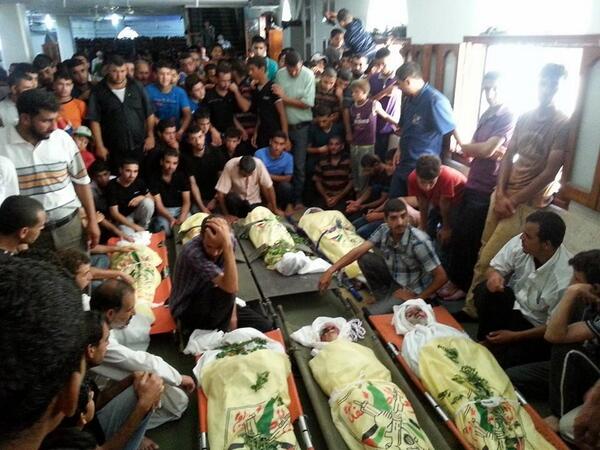
shared the below photo, which he wrote were members of the Kawareh family, praying in a Khan Younis mosque for their dead.


Vanessa Beeley shared this Palestinian photographer’s photo of “Kanaan Hamad, the only survivor in his family after the Israeli occupation warplanes attacked his home, killing his parents and siblings”:


Medical Aid for Palestine notes:

Today, with air attacks intensifying, the future of Gaza looks even bleaker. For the last seven years, its 1.7 million residents have been living under the crushing weight of Israel’s illegal blockade. Gaza’s economy has been devastated. Basics like electricity and drinkable water are limited and costly. The health infrastructure is struggling to cope. And now, attacks by Israeli forces are now putting the health system under enormous additional pressure.

In Gaza today, the list of zero-stock medicines (essential medicines with less than a month’s supply) now stands at a shocking 139 items. That’s almost a third of all essential medicines. As for medical equipment like breathing tubes, almost half – 400 items – are in dangerously short supply. 

But it’s crucial to recall that Syria is undergoing Zionist-backed (Saudi, US, NATO, Turkish…) terrorism, and has all but fallen out of the news.

Press TV reported today on the latest ISIS slaughter of Syrian civilians:

Foreign-backed militants have brutally slaughtered at least 14 Syrian civilians in an attack on a village in Hama countryside, security sources say.

Syrian local security officials said on Wednesday that the victims include seven men and seven women executed in the village of Khatab in the volatile region.

“An armed terrorist group infiltrated the village of Khatab at dawn and committed a massacre among the civilian residents, killing 14 of them,” Syrian state television quoted a senior security official as saying.

Some local residents say there were also children among the dead.

Al-Qaeda-affiliated groups such as the ISIL cult have been also behind many of the deadly bomb attacks targeting both civilians and government institutions across Syria over the past three years.

Perle Whitewash of NeoCon Record on Iraq

Obama’s Failure and Richard Perle’s Whitewashing of the Iraq War

by Ramzy Baroud - PalestineChronicle.com

As Iraq stands on the verge of a complete breakdown into mini sectarian states, former leading neoconservative and Iraq war advocate Richard Perle made a sudden appearance on Newsmax TV. His statements in the interview were yet another testament to the intellectual degeneration of a group that had once promised a ‘new Middle East’, only to destabilize the region with violent consequences that continue to reverberate until this day.

The Islamic State of Iraq and the Levant (ISIL), which didn’t exist at the time of the US invasion of Iraq in 2003, has seized large swathes of Syria and, along with a brewing Sunni rebellion, stands in control of large chunks of western, northern and central Iraq.

At the time of the invasion, Perle was one of the leading so-called intellectuals that was known for his strong support of right-wing Israeli parties and his particular closeness to Israeli Prime Minister Benjamin Netanyahu. He served as an advisor to the Netanyahu election campaign in the mid 1990’s, and, along with other leading neocons, made Israeli security - read regional domination - a top American priority.

Perle is in no mood to accept any responsibility of Iraq’s protracted tragedy, a behavior that mirrors that of the administration of US President Barak Obama.

As for Perle’s new line of logic, he seems to feel that if you criticize the neocons, you are, well, more or less, an anti-Semite. Although the line is quite useful in the lexicon of Israel’s defenders, Perle’s use of the tactic reflects a level of unprecedented desperation.

Perle said the term ‘neoconservative,’ is “often used to describe Jewish Americans because, as it happens, some of the original thinkers whose ideas have now been characterized by this general term 'neoconservative' were in fact Jewish, and it often carries conspiratorial tones on the part of people who throw the term around.”

One could in fact agree, except that the former assistant secretary of defense is now a fellow at the American Enterprise Institute, which served as a major lobby platform for Israeli interests, and is also one of the major organizations behind the failed Iraq war strategy.

But Perle’s smokescreen of the implied accusation of anti-Semitism could hardly hide the big fib he was about to impart: The neocons “were not doing it (the war and occupation of Iraq) to bring democracy to Iraq, we were not doing it .. on behalf of any other government (meaning Israel). We believed the intelligence that was available at the time that the CIA and other intelligence organizations . . . that Saddam (Hussein) had weapons of mass destruction and there was a danger after 9/11 that he would share those weapons.”

Perle, who was known for his nickname ‘Prince of Darkness’, is slyly presenting himself as an innocent, if not gullible average American who too was misled by false intelligence. But it was not the first time that Perle, along with his neoconservative peers, disowned their horrific record in Iraq.

Writing in Vanity Fair in November 5, 2006, under the title ‘Neo Culpa’, David Rose caught up with Perle together with other neocon enthusiasts as they were starting to repudiate the failed policies of George W. Bush, which until then they had championed.

In 2006, the Iraq war was taking a terrible toll. “At the end of the day, you have to hold the president responsible,” he told Vanity Fair when the calamity was becoming irrefutable. Although Perle’s views were quote rosy and optimistic just before and soon after the US invasion incited a sectarian civil war.

“Iraq is a very good candidate for democratic reform,” he was quoted earlier as saying. Iraq “won’t be Westminster overnight, but the great democracies of the world didn’t achieve the full, rich structure of democratic governance overnight. The Iraqis have a decent chance of succeeding.”

But that ‘decent chance’ at success will never be achieved through the barrel of a gun and no self-respecting intellectual would argue otherwise. Hundreds of thousands of Iraqis lost their lives and a whole generation was raised in the embrace of death and humiliation as the Prince of Darkness was giving interviews from fancy hotels. Now, he is back, hopefully briefly, crying foul and anti-Semitism.

What is equally appalling is that neocon thinking is also consistent with the philosophy of American foreign policy makers in the Obama administration as well. Not only is Obama failing to accept even a level of moral responsibility over the current plight of Iraqis, but it is haggling to achieve some political gains from Iraq’s misery. Hundreds of US troops have been ordered back to Iraq to ‘assess’ the fighting capabilities of the Iraqi army, and a cautious attempt at intervention is building up slowly in Washington.

Interventionism is once more permeating American foreign policy thinking; this time around, however, it is ‘soft’ intervention, although it is laden with the same kind of language and misleading references. It seems that the American government has learned so very little since the last botched effort, championed by Perle’s neocons at remaking the Middle East to its liking.

On June 26, the White House asked Congress for $1.5 billion to bolster ‘stability’ in Syria’s neighbors - Jordan, Iraq, Lebanon and Turkey. A third of that amount will be dedicated to train ‘moderate’ Syrian rebels for the purpose of fighting the Syrian army and its allies on one hand, and on the other, holding back the growing influence of militants from ISIL who are also in control of large parts of Iraq.

Considering the level of complexity in the Syrian battleground, and the predictable splinters within existing groups, it’s difficult to imagine that the $500 million would lead to anything but greater instability in Syria and neighboring countries including those who are part of the proposed US Regional Stabilization Initiative, for which the funds are requested.

It is reported that the administration was pressured by Republican Senator John McCain and others. But the reading of the Middle East by McCain has been as erroneous as that of the former leading intellectuals of the neoconservative movement. McCain is as discredited as the rest, but the recent gains of ISIL left the US administration with difficult choices: intervention (which proved to be a complete disaster in the past) or non-intervention (which would leave the pro-US camp in the Middle East vulnerable).

The US seems to be opting for neither option, but ‘soft’ intervention: military and financial support of some groups and forging, even if temporary, alliances with others including Iran.

Despite its attempt to exert pressure and demonstrate its relevance, the collapse of US foreign policy is unmistakable and proves to be, at times, meddling for the sake of asserting its relevance, and nothing more.

Considering the multiple crises created by the US in Iraq in past years, no one, not even the supposedly level-headed Obama, can make any difference without a clear and decided shift in US foreign policy, which is yet to actualize.

Such clarity and decidedness would have to be predicated on a level of moral responsibility and legal accountability for the numerous war crimes committed in Iraq. The roots of today’s war was implanted by that of the original sin, the invasion of a sovereign country, promoted by the likes of Richard Perle, and now manipulated for temporary gains by the Obama administration.

Ramzy Baroud is the Managing Editor of Middle East Eye. Baroud is an internationally-syndicated columnist, a media consultant, an author and the founder of PalestineChronicle.com. His latest book is My Father Was a Freedom Fighter: Gaza’s Untold Story (Pluto Press, London).