Tuesday, September 08, 2015

Gorilla Radio with Chris Cook, Chalmers Johnson, Ingmar Lee, Janine Bandcroft Sept. 9, 2015

This Week on GR

by C. L. Cook - Gorilla-Radio.com


Fourteen years after the infamous date to be commemorated later this week, everything and little has changed. The toddlers of 2001 are now readying to begin college and university studies, never having known a World without a War on Terror.

And what has been accomplished, save the annihilation of several middle eastern countries, and the rendering of those country's citizens by their millions into a desperate diaspora the likes of which has not been seen since the last century's greatest war? Is the World a better place for any but the ethnic cleansers and war profiteers?

Listen. Hear.

While watching the refugee crisis unfold in Europe, blowback, a term steeped in spook-speak comes to mind. Describing the unintended consequence of actions or policies, 'Blowback' is also the title of the late former CIA analyst, University of California, San Diego professor emeritus, and author Chalmers Johnson's tour de force trilogy on American empire.

I spoke to Chalmers half-way back to the day "that changed everything" in 2001.

Chalmers Johnson in the first half.

And; betrayal, disloyalty, faithlessness, infidelity, duplicity, dirty tricks, deception, chicanery, backstabbing, double-dealing, and untrustworthiness; yes, it's poll time again! As well as perfect descriptors of every election season, that string of invective is also Google's partial list, (and who better would know?) of synonyms for treachery, and what could be more treacherous than falsely leading the people to believe the law is protecting the environment they live in from catastrophic harm? But that is just the case here in British Columbia, where successive governments have perpetuated the myth of an oil tanker moratorium in the Salish Sea.

Ingmar Lee is a long-time ecology defender whose latest campaign is to stop the "Treacherous Traffic of the 10,000 Ton Texas Tankers" currently endangering the entirety of BC's coastal environment. Ingmar will be in Victoria speaking to the secretive oil trafficker's activities and the dangers they pose. He'll be at the Sitka Café, at 570 Yates St. tonight at 5pm.

Ingmar Lee, red-lighting the 10,000 Ton Texas Tanker in the second half.

And; Victoria Street Newz publisher emeritus and CFUV Radio broadcaster, Janine Bandcroft will be here at the bottom of the hour to bring us up to speed with some of what's good to do in and around our town, and beyond, in the coming week. But first, Chalmers Johnson and empire's blowback.


Chris Cook hosts Gorilla Radio, airing live every Monday, 5-6pm Pacific Time. In Victoria at 101.9FM, and on the internet at: http://cfuv.uvic.ca.  He also serves as a contributing editor to the web news site, http://www.pacificfreepress.com. Check out the GR blog at: http://gorillaradioblog.blogspot.ca/
G-Radio is dedicated to social justice, the environment, community, and providing a forum for people and issues not covered in the corporate media.

Flavius Then and Now: Britain's Remote Control Assassins

Operation Flavius and the Killer Cameron

by Craig Murray

Exactly twenty years ago the European Court of Human Rights found that the British Government had acted illegally in shooting dead three IRA members in Gibraltar, even though the court accepted that the government had a genuine belief that they were planning a bombing attack. Indeed the court accepted the victims were terrorists, and refused compensation to their families on those grounds. But the court refused to accept there was no possibility of foiling the plot through methods other than summary execution.

In the light of the decision that Operation Flavius contravened Article 2 of the European Convention on Human Rights, it is difficult to understand how the government can claim its killing of British men in Syria, with no trial, is anything other than murder. I personally find it difficult to imagine technically how men journeying in a car in Syria were imminently able to instantly wreak havoc in the UK so that it was impossible to prevent by any method other than their execution without trial. 
 
The level of certainty required for that decision would involve sufficient knowledge of what was to happen in the UK to stop it here. If there was vagueness about what was actually to happen in the UK, there cannot have been the certainty about the threat claimed. It is a logical impasse.

Frankly in twenty years of experience working with British security services their level of accuracy (remember Iraqi WMD) was never that good. And everybody is fortunately now deeply sceptical about the continual claims by the security services that there are thousands of dedicated Islamic terrorists in the UK conducting hundreds of plots every year, and yet miraculously never actually managing to kill anybody.

Just in case anybody had not worked out yet that the Guardian is a disgraceful neo-con rag, it has an article by its “legal correspondent” Joshua Rozenberg, married to the even more rabid Zionist militarist Melanie Phillips (who still believes the Iraqi WMD exist, hidden in the bed of the Euphrates). Rozenberg assures us it is absolutely legal for the British government to kill us without trial if it wants. He even suggests the murdered Mr Khan would not object:  

“If he was waging war on British troops and civilians, he can hardly complain the UK’s armed forces were one step ahead of him.”

Astonishingly for a lawyer, the disgraceful Rozenberg does not seem to notice that the opening “if” is rather important. “If Mr Jones was engaged in insurance fraud, he can hardly complain at being banged up for twenty years”, so according to Mr Rozenberg we can dispense with all that nonsense about trials and evidence and just take the government’s word for it. Not to mention that the government has now instituted summary execution without trial in a country that does not even have the death penalty.

As I have argued, it is not unusual for British people to go to fight abroad. There were British citizens in the Israeli Defence Forces participating in the massacre of Palestinian civilians in Gaza last year. Our neo-con governments of both blue and red Tories have positively encouraged the mercenary companies Executive Outcomes/Sandline/Aegis of Tony Buckingham and Tim Spicer. There are Britons fighting now in the Ukraine. We started by positively encouraging factions in the Syrian civil war, with the Saudis and CIA arming and training them and some of those factions helped constitute ISIL. There is no evidence at all that Islamic State had any interest in attacks in the UK until we started to attack it. (That is not to say it is not a very bad organisation and did not commit actions against UK citizens in its “Caliphate area”. But it did not threaten the UK).

For the government to claim the right to kill British people through sci-fi execution, based on highly unreliable secret intelligence and a secret declaration of legality, is so shocking I find it difficult to believe it is happening even as I type the words. Are we so cowed as to accept this? 
 

Fourteen Years of Fear: Improbable Present, Impossible Future

Mantra for 9/11 - Fourteen Years Later, Improbable World

by Tom Engelhardt  - American Empire Project


Fourteen years later and do you even believe it? Did we actually live it? Are we still living it? And how improbable is that?

Fourteen years of wars, interventions, assassinations, torture, kidnappings, black sites, the growth of the American national security state to monumental proportions, and the spread of Islamic extremism across much of the Greater Middle East and Africa.

Fourteen years of astronomical expense, bombing campaigns galore, and a military-first foreign policy of repeated defeats, disappointments, and disasters.

Fourteen years of a culture of fear in America, of endless alarms and warnings, as well as dire predictions of terrorist attacks. Fourteen years of the burial of American democracy (or rather its recreation as a billionaire’s playground and a source of spectacle and entertainment but not governance). Fourteen years of the spread of secrecy, the classification of every document in sight, the fierce prosecution of whistleblowers, and a faith-based urge to keep Americans “secure” by leaving them in the dark about what their government is doing. Fourteen years of the demobilization of the citizenry. Fourteen years of the rise of the warrior corporation, the transformation of war and intelligence gathering into profit-making activities, and the flocking of countless private contractors to the Pentagon, the NSA, the CIA, and too many other parts of the national security state to keep track of. Fourteen years of our wars coming home in the form of PTSD, the militarization of the police, and the spread of war-zone technology like drones and stingrays to the “homeland.” Fourteen years of that un-American word “homeland.” Fourteen years of the expansion of surveillance of every kind and of the development of a global surveillance system whose reach -- from foreign leaders to tribal groups in the backlands of the planet -- would have stunned those running the totalitarian states of the twentieth century. Fourteen years of the financial starvation of America’s infrastructure and still not a single mile of high-speed rail built anywhere in the country. Fourteen years in which to launch Afghan War 2.0, Iraq Wars 2.0 and 3.0, and Syria War 1.0. Fourteen years, that is, of the improbable made probable.

Fourteen years later, thanks a heap, Osama bin Laden. With a small number of supporters, $400,000-$500,000, and 19 suicidal hijackers, most of them Saudis, you pulled off a geopolitical magic trick of the first order. Think of it as wizardry from the theater of darkness. In the process, you did “change everything” or at least enough of everything to matter. Or rather, you goaded us into doing what you had neither the resources nor the ability to do. So let’s give credit where it’s due. Psychologically speaking, the 9/11 attacks represented precision targeting of a kind American leaders would only dream of in the years to follow. I have no idea how, but you clearly understood us so much better than we understood you or, for that matter, ourselves. You knew just which buttons of ours to push so that we would essentially carry out the rest of your plan for you. While you sat back and waited in Abbottabad, we followed the blueprints for your dreams and desires as if you had planned it and, in the process, made the world a significantly different (and significantly grimmer) place.


Fourteen years later, we don’t even grasp what we did


Fourteen years later, the improbability of it all still staggers the imagination, starting with those vast shards of the World Trade Center in downtown Manhattan, the real-world equivalent of the Statue of Liberty sticking out of the sand in the original Planet of the Apes. With lower Manhattan still burning and the air acrid with destruction, they seemed like evidence of a culture that had undergone its own apocalyptic moment and come out the other side unrecognizably transformed. To believe the coverage of the time, Americans had experienced Pearl Harbor and Hiroshima combined. We were planet Earth's ultimate victims and downtown New York was “Ground Zero,” a phrase previously reserved for places where nuclear explosions had occurred. We were instantly the world’s greatest victim and greatest survivor, and it was taken for granted that the world’s most fulfilling sense of revenge would be ours. 9/11 came to be seen as an assault on everything innocent and good and triumphant about us, the ultimate they-hate-our-freedoms moment and, Osama, it worked. You spooked this country into 14 years of giving any dumb or horrifying act or idea or law or intrusion into our lives or curtailment of our rights a get-out-of-jail-free pass. You loosed not just your dogs of war, but ours, which was exactly what you needed to bring chaos to the Muslim world.

Fourteen years later, let me remind you of just how totally improbable 9/11 was and how ragingly clueless we all were on that day. George W. Bush (and cohorts) couldn’t even take it in when, on August 6, 2001, the president was given a daily intelligence briefing titled “Bin Laden determined to strike in U.S.” The NSA, the CIA, and the FBI, which had many of the pieces of the bin Laden puzzle in their hands, still couldn’t imagine it. And believe me, even when it was happening, I could hardly grasp it. I was doing exercises in my bedroom with the TV going when I first heard the news of a plane hitting the World Trade Center and saw the initial shots of a smoking tower. And I remember my immediate thought: just like the B-25 that almost took out the Empire State Building back in 1945. Terrorists bringing down the World Trade Center? Please. Al-Qaeda? You must be kidding. Later, when two planes had struck in New York and another had taken out part of the Pentagon, and it was obvious that it wasn’t an accident, I had an even more ludicrous thought. It occurred to me that the unexpected vulnerability of Americans living in a land largely protected from the chaos so much of the world experiences might open us up to the pain of others in a new way. Dream on. All it opened us up to was bringing pain to others.

Fourteen years later, don’t you still find it improbable that George W. Bush and company used those murderous acts and the nearly 3,000 resulting deaths as an excuse to try to make the world theirs? It took them no time at all to decide to launch a “Global War on Terror” in up to 60 countries. It took them next to no time to begin dreaming of the establishment of a future Pax Americana in the Middle East, followed by the sort of global imperium that had previously been conjured up only by cackling bad guys in James Bond films. Don’t you find it strange, looking back, just how quickly 9/11 set their brains aflame? Don’t you find it curious that the Bush administration’s top officials were quite so infatuated by the U.S. military? Doesn’t it still strike you as odd that they had such blind faith in that military's supposedly limitless powers to do essentially anything and be “the greatest force for human liberation the world has ever known”? Don’t you still find it eerie that, amid the wreckage of the Pentagon, the initial orders our secretary of defense gave his aides were to come up with plans for striking Iraq, even though he was already convinced that al-Qaeda had launched the attack? ("'Go massive,' an aide’s notes quote him as saying. 'Sweep it all up. Things related and not.'") Don’t you think “and not” sums up the era to come? Don’t you find it curious that, in the rubble of those towers, plans not just to pay Osama bin Laden back, but to turn Afghanistan, Iraq, and possibly Iran -- “Everyone wants to go to Baghdad. Real men want to go to Tehran” -- into American protectorates were already being imagined?

Fourteen years later, how probable was it that the country then universally considered the planet’s “sole superpower,” openly challenged only by tiny numbers of jihadist extremists, with a military better funded than the next 10 to 13 forces combined (most of whom were allies anyway), and whose technological skills were, as they say, to die for would win no wars, defeat no enemies, and successfully complete no occupations? What were the odds? If, on September 12, 2001, someone had given you half-reasonable odds on a U.S. military winning streak in the Greater Middle East, don’t tell me you wouldn’t have slapped some money on the table.

Fourteen years later, don’t you find it improbable that the U.S. military has been unable to extricate itself from Iraq and Afghanistan, its two major wars of this century, despite having officially left one of those countries in 2011 (only to head back again in the late summer of 2014) and having endlessly announced the conclusion of its operations in the other (only to ratchet them up again)?

Fourteen years later, don’t you find it improbable that Washington’s post-9/11 policies in the Middle East helped lead to the establishment of the Islamic State’s “caliphate” in parts of fractured Iraq and Syria and to a movement of almost unparalleled extremism that has successfully “franchised” itself out from Libya to Nigeria to Afghanistan? If, on September 12, 2001, you had predicted such a possibility, who wouldn’t have thought you mad?

Fourteen years later, don’t you find it improbable that the U.S. has gone into the business of robotic assassination big time; that (despite Watergate-era legal prohibitions on such acts), we are now the Terminators of Planet Earth, not its John Connors; that the president is openly and proudly an assassin-in-chief with his own global “kill list”; that we have endlessly targeted the backlands of the planet with our (Grim) Reaper and Predator (thank you Hollywood!) drones armed with Hellfire missiles; and that Washington has regularly knocked off women and children while searching for militant leaders and their generic followers? And don’t you find it odd that all of this has been done in the name of wiping out the terrorists and their movements, despite the fact that wherever our drones strike, those movements seem to gain in strength and power?

Fourteen years later, don’t you find it improbable that our “war on terror” has so regularly devolved into a war of and for terror; that our methods, including the targeted killings of numerous leaders and “lieutenants” of militant groups have visibly promoted, not blunted, the spread of Islamic extremism; and that, despite this, Washington has generally not recalibrated its actions in any meaningful way?

Fourteen years later, isn’t it possible to think of 9/11 as a mass grave into which significant aspects of American life as we knew it have been shoveled? Of course, the changes that came, especially those reinforcing the most oppressive aspects of state power, didn’t arrive out of the blue like those hijacked planes. Who, after all, could dismiss the size and power of the national security state and the military-industrial complex before those 19 men with box cutters arrived on the scene? Who could deny that, packed into the Patriot Act (passed largely unread by Congress in October 2001) was a wish list of pre-9/11 law enforcement and right-wing hobbyhorses? Who could deny that the top officials of the Bush administration and their neocon supporters had long been thinking about how to leverage “U.S. military supremacy” into a Pax Americana-style new world order or that they had been dreaming of “a new Pearl Harbor” which might speed up the process? It was, however, only thanks to Osama bin Laden, that they -- and we -- were shuttled into the most improbable of all centuries, the twenty-first.

Fourteen years later, the 9/11 attacks and the thousands of innocents killed represent international criminality and immorality of the first order. On that, Americans are clear, but -- most improbable of all -- no one in Washington has yet taken the slightest responsibility for blowing a hole through the Middle East, loosing mayhem across significant swathes of the planet, or helping release the forces that would create the first true terrorist state of modern history; nor has anyone in any official capacity taken responsibility for creating the conditions that led to the deaths of hundreds of thousands, possibly a million or more people, turned many in the Greater Middle East into internal or external refugees, destroyed nations, and brought unbelievable pain to countless human beings. In these years, no act -- not of torture, nor murder, nor the illegal offshore imprisonment of innocent people, nor death delivered from the air or the ground, nor the slaughter of wedding parties, nor the killing of children -- has blunted the sense among Americans that we live in an “exceptional” and “indispensable” country of staggering goodness and innocence.

Fourteen years later, how improbable is that?

Tom Engelhardt is a co-founder of the American Empire Project and the author of The United States of Fear as well as a history of the Cold War, The End of Victory Culture. He is a fellow of the Nation Institute and runs TomDispatch.com. His latest book is Shadow Government: Surveillance, Secret Wars, and a Global Security State in a Single-Superpower World.

Copyright 2015 Tom Engelhardt

From Cradle to Grave: Western War Policy's Logical Conclusion

Turning the Cradle of Civilization into Its Graveyard

by Diana Johnstone - CounterPunch


Paris - This Monday, September 7, seven Syrian citizens go to court in Paris to pursue their civil suit against French Foreign Minister Laurent Fabius. The five men and two women all lost family members and close friends in massacres by armed rebels supported by Fabius in word and deed. They are asking for one euro of symbolic damages.

In the end the suit will almost surely be thrown out. The September 7 hearing is on an appeal against an earlier ruling that the courts cannot judge acts of the government in this case, even if the complaint is founded. And yet this futile lawsuit makes a crucial point that Western politicians and media would much prefer to ignore.

Western leaders share major responsibility for making much of the world unfit for normal human habitation. And so far, they are getting away with it. The massive refugee crisis swamping Europe is just the beginning of the troubles that these unscrupulous leaders have brought on their own countries.

Laurent Fabius can fairly be called a French neoconservative. His alignment with Israeli policies is seen in the fact that he was the most reluctant of the foreign ministers involved in the Iranian nuclear negotiations to agree to the final settlement.

He has been one of the most gung-ho advocates of regime change in Syria, a country long on the neocon hit list for its Arab nationalism and support for the Palestinian cause.

The Syrian plaintiffs note that:

  • On May 29, 2012, Fabius declared that France would intervene against the Syrian regime.
  • On August 17, 2012, Fabius declared that Syrian President Bashar el Assad “did not deserve to be alive on earth”.
  • On December 14, 2012, speaking out against the Obama administration decision to designate the Al Nusra Front as a terrorist group, Fabius objected that the Al Nusra Front was “doing a good job on the ground”.
  • On March 13, 2013, Fabius announced that France and Britain were going to deliver arms to the rebels.

As a group, the plaintiffs maintain that by his declarations, Foreign Minister Fabius stirred up civil war in Syria and encouraged armed rebel attacks against the existing government. Individually, each of the plaintiffs lost family members and close friends in armed attacks and massacres carried out by the al Nusra militia allied rebel groups.

Israel’s Ghastly Twin: the “Islamic State”


Under U.S. leadership and Israeli influence, French political leaders have championed “regime change” in Libya and Syria on the tacit assumption that civil war would be better for the people of those countries than living under a “dictatorship”. In practice, however, most people can get along better without a vote than without a roof over their heads. Or without their heads.

It is hardly surprising that the carefully filmed and diffused videos of “Islamic State” (IS) disciplinary methods have caused panic among people living in their path of conquest.

War causes people to become refugees. Western media pay close attention to refugees only when they like the “story”. Huge attention was paid to Kosovo Albanians fleeing temporarily from the 1999 NATO war against the Serbs, because those refugees could be described as victims of Serbian “ethnic cleansing” and thus as justification of the NATO war itself.

But no such media concern was aroused over the much greater number of refugees who fled from the 2003 United States invasion of Iraq and have never returned. Over a million Iraqi refugees fled into Syria, where they were well received.

The situation in the Middle East is critical. Armed by leftover U.S. military equipment in Iraq, enriched by illicit oil sales, its ranks swollen by young Jihadis from all over the world, the Islamic State threatens the people of Lebanon and Jordan, already struggling to take care of masses of refugees from Palestine, Iraq and now Syria. Fear of the decapitating Islamic fanatics is inciting more and more people to risk everything in order to get to safety in Europe.

The Islamic State is truly the horrible enemy caricature of the “Jewish State”, another political entity based on an exclusive religious identity. Like Israel it has no clearly defined borders, but with a vastly larger potential demographic base.

The only force that can stop the Islamic State from expanding its fanatic rule over all of Mesopotamia and beyond is the Syrian State led by Bashar al Assad. The choice is not between Assad and “Western democracy”. The choice is between Assad and the Islamic State. But Western leaders have still not fully dropped their demented cry: “Assad must go!”

Refugees, Migrants and Terrorists


The results of this madness are washing up on the shores of the Mediterranean. Images and sentiment have replaced thinking about causes and effects. One photo of a drowned toddler causes a media and political uproar. Are people surprised? Didn’t they know that toddlers were being torn to pieces by U.S. bombing of Iraq, by U.S. drones in Afghanistan, Pakistan, Yemen? What about the toddlers obliterated by NATO’s war to “free Libya” from its “dictator”?

The current refugee crisis in Europe is the inevitable, foreseeable, predicted result of Western policy in the Middle East and North Africa. Gaddafi’s Libya was the wall that kept hundreds of thousands of Africans from migrating illegally to Europe, not only by police methods but even more effectively by offering them development at home and decently paid jobs in Libya. Now Libya is the source both of economic migrants and of refugees from Libya itself, as well as from other lands of desperation. In order to weaken Sudan, the United States (and Susan Rice in particular) championed creation of the new country of South Sudan, which is not a country at all but the scene of rival massacres driving more and more fugitives toward unwelcoming countries.

The famous photo of little Aylan drowned in the Mediterranean is used very largely to make Europeans feel guilty. The leaders should indeed feel guilty – and not least the rich egomaniac Bernard-Henri LĂ©vy, who prides himself on having talked the French government of Nicolas Sarkozy into starting war against Libya, where, he claimed, there were no Islamic extremists, but only pro-Westerners yearning for democracy. Thanks to NATO, Islamic extremists have since run roughshod over the whole country.

German Chancellor Angela Merkel has agreed to take in eight hundred thousand Syrian refugees. This is admirable on humanitarian grounds. Germany is economically strong and demographically weak; with its gradually shrinking population, middle class Syrians, many of them terrified Christians, may seem to be a welcome addition to the population. But it deepens political divisions within Germany and in Europe.

This is particularly the case in the new EU countries of Eastern Europe. Starting with Hungary, their leaders are making it clear that those countries are above all concerned with their ethnic identity, and don’t want to take in a lot of people who don’t speak their language. Unlike countries of Western Europe, the Eastern European tier of ethnic states have no tradition of taking in immigrants and no ideological attachment to the Western human rights ideology. In Eastern Europe, “human rights” sounded good to use against Russia and the Soviet Union, but stops there.

The Greek crisis already put heavy strains on the unity of the European Union. For the first time, many people are questioning the whole idea. The crisis showed that there is no real sense of solidarity between the peoples of Europe; when it comes to the crunch, Germans are Germans and Greeks are Greeks, and “European” is an abstraction. The refugee crisis is showing new cracks in “European unity”.

Most of Europe today is suffering from massive unemployment, especially the Southern countries where refugees first land: Greece, Italy, Spain. European Union economic policies, already strangling Greece, do not favor job creation for hundreds of thousands of newcomers. Even professionally qualified refugees will find it difficult or impossible to get around rules protecting their professions in host countries. Most jobs they manage to get will probably be low level and illegal, undercutting wages and working conditions in the host countries.

Moreover, it is impossible in the present mass movement of people to distinguish “refugees” from economic “migrants” – that is, from men simply seeking better work opportunities. The EU today has little to offer then, and resentment of this unsought immigration is certain to improve the political fortunes of the nationalist right.

There is another reason that many European citizens feel less than enthusiastic about welcoming hundreds of thousands of unknown foreigners into their communities. The Islamic State has openly boasted of sending terrorists into Europe among the refugees, with the clear intention of committing violent acts to destabilize the West. Of course, the threat of terrorism is being used cynically by governments to enforce police state measures, but that does not mean that the threat of terrorism is unreal. Unfortunately, it exists – thanks very largely to the policies of those very same Western governments.

The refugee crisis should be seen as the warning signal that the United States and its NATO allies – especially Britain and France – are bringing the world to a state of chaos that is going to keep spreading and that is approaching a point of no return. It is quick and easy to break things. Putting them back together may be impossible. Civilization itself may be more fragile than it seems.


Diana Johnstone is the author of Fools’ Crusade: Yugoslavia, NATO, and Western Delusions. Her new book, Queen of Chaos: the Misadventures of Hillary Clinton, will be published by CounterPunch in September 2015. She can be reached at diana.johnstone@wanadoo.fr

Unist'ot'en Eviction of Pipeline Interlopers

Unist'ot'en holds the line despite RCMP and Big Oil threats

by Wildcoast.ca

Only about eight weeks of "pipeline season" remain before the snow comes and the surveyors are shut out of Northern British Columbia. We're seeking drivers, volunteers, and sponsors to maintain Unist'ot'en Camp checkpoints until November.

The camp has been on high alert for the past two weeks. On Wednesday August 26, a pipeline crew called the police when they came to one of the Unist'ot'en checkpoints east of Kitimat and people there wouldn't give them permission to drive through. Video here.

The police arrived at Unist'ot'en the next day to investigate the complaint. They made threats of arrest but left without incident. We had reports of more than a hundred RCMP camped out in hotels in nearby towns.

On Friday morning, after Grand Chief Stewart Phillip of the Union of BC Indian Chiefs met with the RCMP, he told media a police raid was "definitely going to come down." That hit the headlines everywhere and dozens of people put their lives on hold and went north.

That evening, the RCMP issued a statement calling the reports on social media and elsewhere "inaccurate." It claimed the police are neutral and focused on keeping the peace.

High-level meetings followed with the Unist'ot'en hereditary chiefs, their lawyers, the Assembly of First Nations, and the Wet'suwet'en elected chiefs. But the RCMP did not back down, and another pipeline crew tried to drive into Unis'tot'en territory on September 5.

We can't confirm whether the police have left the area. We're still preparing to respond to a confrontation. @Unist'ot'enCamp and @M_Tol are sending news from the camp regularly, and lawyers are standing by in case this ends up in the courts.

Get caught up on this story in our recent newsletters and stay tuned for more developments.
Allies and sponsors answer the call

Volunteers can get info on how to join the camp and share their skills and good energy. Peaceful people of any age are welcome to join in solidarity.

Unist'ot'en and the Law


Unist'ot'en Camp is a reoccupation of traditional territory outside of reserve and treaty lands in northern British Columbia, Canada. The courts have ruled that they have indigenous title to their lands, and the authorities may have trouble proving they can evict the camp.

The government should consider the merits of the Unist'ot'en Declaration, released last week, that addresses their rights and responsibilities on their land.

Another factor police and pipeline crews should assess is the letter the BC Civil Liberties Association sent to the RCMP in August, explaining the position of indigenous people on unceded land.

Unist'ot'en Camp has allies around the world. Please support the legal fund or contribute directly to the camp today.

Be a sponsor for the ones who are doing solidarity work year-round. Because we give back.


Thank you for being part of this movement to defend land and water


VIC FAN is celebrating its ninth year on Vancouver Island, Coast Salish and Nuu-chah-nulth territory. Big cheers to everyone who took part in our victories!

WildCoast and Forest Action Network are 100% home-grown and volunteer-led.

Our projects are the Caravan to Unis'tot'en Camp, the House of Solidarity, supporting the Secwepemc Women Warriors, and the Eco Warriors Legal Defence Fund.

You can contact us anytime.


Keep the spirit!

Toxic Traps: From Supermax to Superfund

Toxic Traps: Environmental Hazards Threaten Two Federal Supermax Prisons

by Laura L. Cepero - Solitary Watch


A Solitary Watch investigation into the sites of the federal government’s two “supermax” facilities—the first open for two decades, the second slated to open soon—reveals a number of possible serious environmental hazards.

AUSP Thomson, Illinois. 

The prisons, ADX Florence in Colorado and AUSP Thomson in Illinois, are built to hold men in extreme solitary confinement. This practice has roused increasing controversy in recent years, due to the psychological and physical damage caused by extreme isolation and sensory deprivation. Yet the impact of underlying environmental hazards on individuals locked down in small cells has never been adequately explored.

With rising concerns over environmental justice and the prison-industrial complex, some advocacy groups are questioning why prisoners are not taken into consideration when the Environmental Protection Agency (EPA) approves environmental permits. The Human Rights Defense Center’s (HRDC) Prison Ecology Project and 92 other organizations, including Solitary Watch, drafted a letter to the EPA’s Office of Environmental Justice, arguing that because incarceration “fall[s] into a category of poverty discrimination policies which almost exclusively impact poor communities, with a disproportionate impact on poor communities of color,” federal prisons should be more thoroughly evaluated before permits are approved.

The Prison Ecology Project, which is designed “to map the intersections of mass incarceration and environmental degradation,” spurred this investigation into the Federal Bureau of Prisons’ two supermax facilities, designed to hold people for 23 to 24 hours a day, with no escape from potential environmental toxins and little possibility of safe evacuation.

Already Rife With Controversy


Thomson Correctional Center has been the subject of controversy since its inception. When the prison’s construction by the State of Illinois was first planned, the Savanna Army Depot Activity (SVDA) was slated for its location. However, due to concerns that the facility would be sited too close to the Mississippi River, the construction site was moved 15.4 miles southwest to Thomson. Although construction was completed in November of 2001, Thomson remained vacant until 2006, due to state budget constraints and labor union opposition to closing other state prisons in favor of Thomson.

More controversy surface in late 2009, when President Obama issued a presidential memorandum ordering the Department of Justice (DOJ) and Department of Defense (DOD) to begin arranging for the federal purchase of Thomson as part of a plan to close the Guantánamo Bay Detention Camp and to transfer its detainees to American soil. While citizens of the Village of Thomson welcomed the decision, funding for the transfer of detainees was ultimately blocked by Congress.

Three years later in 2012, Senator Dick Durbin (D-IL) announced that the BOP would be purchasing the facility in order to address overcrowding in other federal prisons; currently, there are no plans to house Guantánamo detainees there, as doing so is now prohibited by law. A report issued by the Government Accountability Office (GAO) in August of 2014 indicated plans by the BOP to move “some of the most dangerous” people currently incarcerated in Special Management Units (SMUs) to Administrative United States Penitentiary (AUSP) Thomson—AUSP being the new designation for the federal supermax prison. New minimum security prisoners, who will help service the facility, were expected to arrive at the facility as early as July of 2015.

Widely considered America’s toughest federal prison, ADX Florence—officially designated as the United States Penitentiary, Administrative Maximum Facility—is located near the high desert town of Florence, Colorado. Nicknamed the “Alcatraz of the Rockies,” the Federal Correctional Complex, Florence (FCC Florence), which includes ADX Florence, opened in late 1994. The supermax facility is best known for housing men convicted of terrorist activities and organized crime leaders, as well as high-profile individuals, those considered high escape risks, and those with a history of violent acts committed against correctional officers and other prisoners. The approximately 400 men incarcerated at ADX typically spend 23 hours a day in solitary confinement. There have been numerous controversies involving ADX Florence, including reports of force-feeding, hunger strikes, and abuse of individuals suffering from mental illness.


Environmental (In)justice in Illinois


It is difficult to assess the environmental condition of the Thomson facility because no Environmental Impact Statement (EIS) was ever issued. As required by the National Environmental Policy Act (NEPA), an EIS must be submitted whenever an action by a federal agency “significantly [affects] the quality of the human environment.” Because Thomson was initially operated by the Illinois Department of Corrections (IDOC), an EIS was not required prior to construction. However, an Environmental Audit was conducted by the BOP in 2010 during the federal acquisition process. The audit indicated that the environment would only suffer negligible damage should the BOP acquire and renovate the prison; as such, the BOP determined that no EIS was required.

While the environment may not be at risk from the prison, its inhabitants, as well as prison staff, may be at risk from the environment. In fact, the original choice for the facility’s location, the Savanna Army Depot, is a Superfund site—a polluted location requiring long-term cleanup of environmental and health hazards, as per the Comprehensive Environmental Response, Compensation, and Liability Act (CERCLA) of 1980. While in operation, parts of SVDA were used for the demolition and burning of obsolete ordinance, as well as for waste disposal (i.e. landfills). According to the EPA, the soil is contaminated with metals, pesticides, explosives, lead-based paint chips, and polycyclic aromatic hydrocarbons (PAHs); the groundwater is contaminated with various pesticides, explosives, solvents, and petroleum-related contaminants; surface water and sediments are contaminated with various explosives, PAHs, and metals. The contaminated areas include the Old Burning Ground (OBG), Open Burn/Open Detonation (OB/OD) area, the 75 mm/155 mm High Explosive (HE) Range Fans, the Grenade Burial Area, and the Sites 15 and 33 disposal areas – Munitions and Explosives of Concern/Unexploded Ordnance (MEC/UXO). In 1991, remedial investigation found 73 areas of potential concern, 41 of which required additional investigation. After being selected for Base Realignment and Closure (BRAC), assessments in 1995 found 200 additional areas of concern.

In addition to normal operations, the U.S. Department of Agriculture (USDA) disposed an estimated 800 to 1,000 tons of 4,6-dinitro-o-cresol at the site in 1952. The contamination was cleaned up in 2002, according to an annual report by the Illinois Environmental Protection Agency (IEPA). The Army also issued a remedial investigation report for 24 sites in the developed “lower post” area. Several of these sites are source areas of solvent, fuel, and metals-related contamination that affects local groundwater and has possible discharge points in the Apple River and the Mississippi River. The report also stated that geophysical surveys indicated over a thousand metallic anomalies in a 380-acre area.

Another potential concern for Thomson is the operation of a number of coal plants within a 15-mile radius of the prison. The Archer Daniels Midland Company Coal Plant is about 11.6 miles southwest of the Thomson facility, across the Mississippi River in Clinton, Iowa. According to Sourcewatch, the Clinton Cogeneration Plant, as it’s also known, emitted approximately 499,781 tons of carbon monoxide in 2008, as well as 5,287 tons of sulfur dioxide (53.99 pounds per megawatt hour) and 5,003 tons of nitrogen oxide in 2002. The Archer Daniels plant sits in the southwest corner of Clinton’s industrial area, which stretches northeast along the Mississippi River and contains a significant number of Brownfield sites—land previously used for industrial or commercial purposes that may have been contaminated with hazardous waste or pollution. The Interstate Power and Light Company Coal Plant, also known as the Milton Kapp Generating Station, approximately 13 miles southwest of the Thomson facility, is also across the river near Clinton. Sourcewatch lists the plant’s emissions of over approximately 888,017 tons of carbon monoxide, 2,706 tons of sulfur dioxide, and 525 tons of nitrogen oxide in 2008. This particular plant also has a number of coal ash dumps surrounding it.

Finally, the proximity of two nuclear power plants that are within a 50-mile radius facility may also provide a potential environmental concern. The Quad Cities Generating Station is about 19.7 miles southwest in Cordova, Illinois, and the Exelon-Byron Generating Station is about 42.8 miles to the east in Byron. In fact, some cited the nuclear power plants to a facility that would be housing suspected terrorists as an argument against transferring GITMO detainees to Thomson.

Nuclear power plants near Thomson could be at risk of natural disaster, such as flooding and earthquakes. Flooding could be of concern, being that the Quad Cities plant is less than a mile from the Mississippi River and that the Exelon-Byron plant is a little over 2 miles away from Rock River, a tributary of the Mississippi. In addition, there may also be a potential earthquake risk for the nuclear power plants. Based on 2008 estimates, the Quad City plant has a 1 in 37,037 chance of earthquake, which is an increase in risk of 93% from the 1989 estimate of 1 in 71,429. Exelon-Byron has a 1 in 172,414 chance of earthquake, up 753% from the 1989 estimate of 1 in 1,470,588.

The type of reactor used at nuclear power plants could also pose potential risks. Some scientists suggest Boiling Water Reactors (BWRs), like the one at the Fukushima Daiichi power plant, do not protect against the release of radiation during a severe nuclear accident as effectively as Pressurized Water Reactors (PWRs). The Quad Cities power plant also has a BWR. Additionally, the age of the reactor can also pose a risk factor. The Nuclear Regulatory Commission (NRC) has approved re-licensing of several nuclear power reactors for 60 years of operation, despite the fact that nuclear reactors are designed to operate for 40 years, prompting objections from environmental groups.

As mandated by the NRC, both the Quad Cities and Exelon-Byron plants have evacuation plans of a 10-mile radius, which do not reach Thomson. However, in light of the Fukushima nuclear disaster, which had a contamination radius of 100 kilometers (just over 62 miles), the NRC has made recommendations of expanding evacuation zones to 50 miles. A Freedom of Information Act (FOIA) request has been made by Solitary Watch to the BOP in regards to an evacuation plans for those incarcerated at Thomson. In response, the BOP assigned Solitary Watch’s public records request as “complex,” meaning that the agency may take up to nine months to provide requested documents.

Supermax Near a Superfund Site


Like Thomson, ADX Florence is also located in close proximity to a Superfund site. The community Lincoln Park was contaminated by the Cotter Uranium Processing Facility, a uranium mine approximately 6.3 miles northwest of the prison. Unlike Thomson, however, an EIS was indeed issued for ADX Florence. The EIS for Florence found no potential risks for Fremont County, but again, such statements consider how the prison would affect the environment, not how the environment would affect the prison, its inhabitants, and its employees. A FOIA request has also been made for the full text of the EIS.

The uranium mine, located located less than a mile south of the residential community of Lincoln Park, produced uranium oxide (yellowcake), vanadium, and molybdenum from 1958 to 1979. In 1965, a flood caused the unlined impoundments—where tailings and other wastes were discharged—to overflow into Sand Creek, which flows into the Arkansas River. In 1972, the Fremont County Ditch was built to prevent water from Sand Creek from flowing into the Arkansas, which flows southeast towards the city of Florence. During the irrigation season, the ditch regularly overflows into the river, which was the water supply source for the City of Florence when ADX Florence was constructed. Although the BOP expressed concerned in 1989 that the prison’s water supply may have to be rerouted in the future due to pollution, a water quality report shows that the Arkansas still remained a source for the city’s water supply as late as 2013.

The State of Colorado sued the Cotter Corporation in 1983 for damages to natural resources and clean-up of the contamination. The uranium mine and the Lincoln Park residential area was declared a Superfund site the following year. According to the EPA, waste from the mine had seeped into the groundwater and contaminated local wells. Contaminants included molybdenum, uranium, uranium daughter products (radium, radon gas, and polonium), selenium, and sulfate. Between 1980 and 1986, there were over 70 leaks reported at the Cotter mine. The State of Colorado commissioned an investigation in 1986, which concluded that drainage from the Cotter mine spilled into the Fremont ditch, resulting in elevated levels of molybdenum, arsenic, lead, and other contaminants. By the time that Cotter suspended operations in 1987, the mine had accumulated approximately 3.5 million tons of radioactive tailings, which were stored over 135 acres near Cañon City and Florence.

The water pollution in the area may seem alarming, but it does not end there. The Cotter Corporation estimates that more than 19.9 tons of radioactive dust were emitted into the air during each year that the mine was in operation. Being that ADX Florence lies directly in Cotter’s secondary wind pattern, the prison and its inhabitants are subject to gusts of radium, uranium, and thorium.

The state lawsuit against Cotter was settled in 1988; the company agreed to clean up the site at its own expense. In 1994, another lawsuit was settled, with a federal jury awarding $80,000. In 2014, just as the cleanup was being completed, a broken pipe on the site leaked 20,000 gallons of uranium-laced waste. This was the fourth spill in four years; just six months earlier, 4,000-9,000 gallons of contaminated water was spilled from the now-defunct Cotter mine. More cleanup is planned in the future, but is not expected to begin for another couple of years.

With evidence of contamination, the question of health hazards arises. According to the EPA, while the average daily intake of uranium from food ranges from 0.07 to 1.1 micrograms per day, people who live near uranium facilities may have increased exposure to the chemical agent. A 2014 assessment conducted by the Agency for Toxic Substances and Disease Registry (ATSDR), an agency within the Public Health Service division of the U.S. Department of Health and Human Services, states that when uranium is ingested, a small amount is absorbed into the bones, kidneys, and soft tissue, where it remains for years. In the case of chronic ingestion of uranium-contaminated drinking water, kidney retention of the chemical agent increases rapidly in the first two weeks. After approximately one hundred days of ingestion, the amount present in the kidney is approximately 3 percent of the amount ingested. After 25 years of chronic ingestion, the kidney retention of uranium reaches approximately 6.6 percent of the daily intake. Long-term chronic intake of uranium isotopes in food, water, and/or air can lead to cancer (primarily bone sarcoma), liver damage, kidney disease, and/or gout-like symptoms, such as pain, swelling, inflammation, and deformities of the joints.

According to a 2014 report conducted by Cotter’s consultant, groundwater uranium levels at the Lincoln Park well “were the highest recorded for this location,” exceeding the health standard of 30 parts per billion. Additionally, the ATSDR report concluded that well water in Lincoln Park contained elevated levels of molybdenum and uranium, resulting in a past, present, and future public health concern. The ATSDR report also estimated that if an adult in Lincoln Park drank 2 liters (8.5 cups) of uranium-contaminated water per day for 25 years or longer, the maximum daily ingestion would result in an estimated uranium concentration above the level found to cause harm in humans. It is unclear as to whether or not these levels of contamination are present around the site of ADX Florence, as an EPA assessment was never conducted.

Of course, these environmental hazards are not limited to individuals incarcerated at correctional facilities either. With a planned staff of 850 to 900 at Thomson and a staff of over 300 at ADX Florence, correctional employees are also subject to any potential health hazards at each facility. Additionally, the families of prisoners, especially children, may be adversely affected.

AUSP Thomson and ADX Florence are not the only correctional facilities with public health concerns. In its letter to the EPA, HRDC cites numerous examples of environmental hazards associated with jails and prisons nationwide, including the devastation of the Orleans Parish Prison in Louisiana in the aftermath of Hurricane Katrina, flooding in the Escambria County Jail in Florida, chemical spills near the South Central Regional Jail in West Virginia, toxic waste landfills near Rikers Island in New York, coal ash dumps near the State Correctional Institute-Fayette in Pennsylvania, valley fever at Avenal State Prison and Pleasant Valley State Prison in California, the construction of Victorville Federal Correctional Complex on a military Superfund site also in California, among others.

Laura L. Cepero received a Master of Arts degree in History from the University of Central Florida. She completed this article while working as a Reporter/Researcher for Solitary Watch.

Down by Default: Oil Price Goes Titanic

The Default Next Move For Oil Is Downwards, And Here's Why 

by Martin Tillier - Oilprice.com


As traders, investors and pundits, we all like to think that what we do is akin to a science. We believe that by working harder and being smarter we can give ourselves an edge, that enough research will reveal to us the next move, either a long term trend or an intraday blip on a chart, and that we can profit from that knowledge.

Usually, especially over longer time spans, we are correct in that assumption. Sometimes, however, no amount of fundamental or technical analysis will help.

Over the last week or so we have seen some violent swings in the price of oil, swings that in many ways defy logic.

At times like these we have to rely on the art, rather than science, of trading and reading markets. That is not to say that traders and investors at home should be simply making wild guesses, it is just that right now, the oil markets are trading on factors other than the fundamental influences that we are used to. It is hard to chart fear and panic.

Panic may seem like a strong word to many, but having been a denizen of a dealing room for most of my working life I can assure you that that is what many have been feeling. The level of overreaction that we have been seeing to every scrap of news over the last couple of weeks is hard to justify in any other way. It is at times like this that some degree of basic technical analysis, a simple identification of support and resistance, becomes all we have to fall back on. To that extent the science of reading these markets is still intact, but once the significant levels have been identified, assessing in what way they are significant is more of an art.

In terms of the benchmark U.S. oil, West Texas Intermediate (WTI), at least now we have some parameters to work in. The drop halted at around $37 and the surge back up that followed itself turned around at just below $50, so, for now at least, that marks the new range. If we accept that, then anybody with even the most basic knowledge of trading will know that, at current levels in the high $40s, a bias towards a short position offers a better risk reward ratio with a closer, logical stop loss level. There are, moreover, a few more subtle, psychological factors amongst market participants that make it most likely that the next move will be downwards and therefore that a short bias is preferable to long.

First and foremost, once new, significant levels have been found, re-testing them is almost irresistible to traders and, in historic terms, the lows of the current range are much more significant than the highs. That traders want to see what happens if they get to a seemingly arbitrary level again may seem like a ridiculous reason for a market that affects the livelihood of millions and the wealth of many nations to move, but such concerns won't bother floor traders or hedge fund managers. For them, pushing back below $40 is more of an intellectual exercise than anything and if it can be forced there and the level breaks, large fortunes can be made.

Of course, all of this goes out of the window if there is a significant shift in fundamentals, either on the demand or supply side. If decent Chinese economic data is released, for example, or if OPEC announces real production cuts, or if the U.S. rig count drops drastically, then traders' games won't matter at all, oil will be headed higher. Until there is any major news, though, it is a question of anticipating what that news will be, or rather the tone of it. Given what has happened since the middle of last year you cannot blame traders for making the assumption that, on balance, any news is more likely to be negative for oil than positive.

It seems, therefore, that all other things being equal, the default path for WTI in the short term is back downwards, to have another crack at the high $30s. There is no real fundamental reason why that should be the case. If anything recent data suggest that when all is said and done, oil trading below where it was in the depths of the last recession is not justified. A recovery at least to around $60 must come soon.

Fundamental, scientific analysis like that doesn't matter at the moment though; what matters is the art of reading the collective mind of the market, and from that perspective oil looks destined for one more push down before sanity returns.

Martin Tillier has recently started a mentorship program for a small group of motivated Oilprice subscribers, find out more here.

Monday, September 07, 2015

Reaping the Dragon's Teeth: How the Neo-Cons Have Destabilized the World

How Neocons Destabilized Europe

by Robert Parry - Consortium News


September 7, 2015

The refugee chaos that is now pushing deep into Europe – dramatized by gut-wrenching photos of Syrian toddler Aylan Kurdi whose body washed up on a beach in Turkey – started with the cavalier ambitions of American neocons and their liberal-interventionist sidekicks who planned to remake the Middle East and other parts of the world through “regime change.”

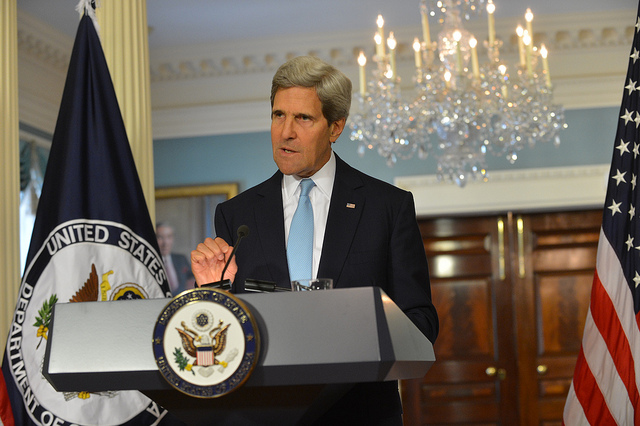
U.S. Secretary of State John Kerry on Aug. 30, 2013, 
claims to have proof that the Syrian government was
responsible for a chemical weapons attack on Aug. 21, 
but that evidence failed to materialize or was later 
discredited. [State Department photo]

Instead of the promised wonders of “democracy promotion” and “human rights,” what these “anti-realists” have accomplished is to spread death, destruction and destabilization across the Middle East and parts of Africa and now into Ukraine and the heart of Europe. Yet, since these neocon forces still control the Official Narrative, their explanations get top billing – such as that there hasn’t been enough “regime change.”

For instance, The Washington Post’s neocon editorial page editor Fred Hiatt on Monday blamed “realists” for the cascading catastrophes. Hiatt castigated them and President Barack Obama for not intervening more aggressively in Syria to depose President Bashar al-Assad, a longtime neocon target for “regime change.”

But the truth is that this accelerating spread of human suffering can be traced back directly to the unchecked influence of the neocons and their liberal fellow-travelers who have resisted political compromise and, in the case of Syria, blocked any realistic efforts to work out a power-sharing agreement between Assad and his political opponents, those who are not terrorists.

In early 2014, the neocons and liberal hawks sabotaged Syrian peace talks in Geneva by blocking Iran’s participation and turning the peace conference into a one-sided shouting match where U.S.-funded opposition leaders yelled at Assad’s representatives who then went home. All the while, the Post’s editors and their friends kept egging Obama to start bombing Assad’s forces.

The madness of this neocon approach grew more obvious in the summer of 2014 when the Islamic State, an Al Qaeda spinoff which had been slaughtering suspected pro-government people in Syria, expanded its bloody campaign of beheadings back into Iraq where this hyper-brutal movement first emerged as “Al Qaeda in Iraq” in response to the 2003 U.S. invasion.

It should have been clear by mid-2014 that if the neocons had gotten their way and Obama had conducted a massive U.S. bombing campaign to devastate Assad’s military, the black flag of Sunni terrorism might well be flying above the Syrian capital of Damascus while its streets would run red with blood.

But now a year later, the likes of Hiatt still have not absorbed that lesson — and the spreading chaos from neocon strategies is destabilizing Europe. As shocking and disturbing as that is, none of it should have come as much of a surprise, since the neocons have always brought chaos and dislocations in their wake.

When I first encountered the neocons in the 1980s, they had been given Central America to play with. President Ronald Reagan had credentialed many of them, bringing into the U.S. government neocon luminaries such as Elliott Abrams and Robert Kagan. But Reagan mostly kept them out of the big-power realms: the Mideast and Europe.

Those strategic areas went to the “adults,” people like James Baker, George Shultz, Philip Habib and Brent Scowcroft. The poor Central Americans, as they tried to shed generations of repression and backwardness imposed by brutal right-wing oligarchies, faced U.S. neocon ideologues who unleashed death squads and even genocide against peasants, students and workers.

The result – not surprisingly – was a flood of refugees, especially from El Salvador and Guatemala, northward to the United States. The neocon “success” in the 1980s, crushing progressive social movements and reinforcing the oligarchic controls, left most countries of Central America in the grip of corrupt regimes and crime syndicates, periodically driving more waves of what Reagan called “feet people” through Mexico to the southern U.S. border.

Messing Up the Mideast


But the neocons weren’t satisfied sitting at the kids’ table. Even during the Reagan administration, they tried to squeeze themselves among the “adults” at the grown-ups’ table. For instance, neocons, such as Robert McFarlane and Paul Wolfowitz, pushed Israel-friendly policies toward Iran, which the Israelis then saw as a counterweight to Iraq. That strategy led eventually to the Iran-Contra Affair, the worst scandal of the Reagan administration. [See Consortiumnews.com’s “When Israel /Neocons Favored Iran.”]

However, the right-wing and mainstream U.S. media never liked the complex Iran-Contra story and thus exposure of the many levels of the scandal’s criminality was avoided. Democrats also preferred compromise to confrontation. So, most of the key neocons survived the Iran-Contra fallout, leaving their ranks still firmly in place for the next phase of their rise to power.

In the 1990s, the neocons built up a well-funded infrastructure of think tanks and media outlets, benefiting from both the largesse of military contractors donating to think tanks and government-funded operations like the National Endowment for Democracy, headed by neocon Carl Gershman.

The neocons gained more political momentum from the U.S. military might displayed during the Persian Gulf War of 1990-91. Many Americans began to see war as fun, almost like a video game in which “enemy” forces get obliterated from afar. On TV news shows, tough-talking pundits were all the rage. If you wanted to be taken seriously, you couldn’t go wrong taking the most macho position, what I sometimes call the “er-er-er” growling effect.

Combined with the collapse of the Soviet Union in 1991, the notion that U.S. military supremacy was unmatched and unchallengeable gave rise to neocon theories about turning “diplomacy” into nothing more than the delivery of U.S. ultimatums. In the Middle East, that was a view shared by Israeli hardliners, who had grown tired of negotiating with the Palestinians and other Arabs.

Instead of talk, there would be “regime change” for any government that would not fall into line. This strategy was articulated in 1996 when a group of American neocons, including Richard Perle and Douglas Feith, went to work for Benjamin Netanyahu’s campaign in Israel and compiled a strategy paper, called “A Clean Break: A New Strategy for Securing the Realm.”

Iraq was first on the neocon hit list, but next came Syria and Iran. The overriding idea was that once the regimes assisting the Palestinians and Hezbollah were removed or neutralized, then Israel could dictate peace terms to the Palestinians who would have no choice but to accept what was on the table.

In 1998, the neocon Project for the New American Century, founded by neocons Robert Kagan and William Kristol, called for a U.S. invasion of Iraq, but President Bill Clinton balked at something that extreme. The situation changed, however, when President George W. Bush took office and the 9/11 attacks terrified and infuriated the American public.

Suddenly, the neocons had a Commander-in-Chief who agreed with the need to eliminate Iraq’s Saddam Hussein – and Americans were easily persuaded although Iraq and Hussein had nothing to do with 9/11. [See Consortiumnews.com’s “The Mysterious Why of the Iraq War.”]

The Death of ‘Realism’


The 2003 Iraq invasion sounded the death knell for foreign policy “realism” in Official Washington. Aging or dead, the old adult voices were silent or ignored. From Congress and the Executive Branch to the think tanks and the mainstream news media, almost all the “opinion leaders” were neocons and many liberals fell into line behind Bush’s case for war.

And, even though the Iraq War “group think” was almost entirely wrong, both on the WMD justifications for war and the “cakewalk” expectations for remaking Iraq, almost no one who promoted the fiasco suffered punishment for either the illegality of the invasion or the absence of sanity in promoting such a harebrained scheme.

Instead of negative repercussions, the Iraq War backers – the neocons and their liberal-hawk accomplices – essentially solidified their control over U.S. foreign policy and the major news media. From The New York Times and The Washington Post to the Brookings Institution and the American Enterprise Institute, the “regime change” agenda continued to hold sway.

It didn’t even matter when the sectarian warfare unleashed in Iraq left hundreds of thousands dead, displaced millions and gave rise to Al Qaeda’s ruthless Iraq affiliate. Not even the 2008 election of Barack Obama, an Iraq War opponent, changed this overall dynamic.

Rather than standing up to this new foreign policy establishment, Obama bowed to it, retaining key players from President Bush’s national security team, such as Defense Secretary Robert Gates and General David Petraeus, and by hiring hawkish Democrats, including Sen. Hillary Clinton, who became Secretary of State, and Samantha Power at the National Security Council.

Thus, the cult of “regime change” did not just survive the Iraq disaster; it thrived. Whenever a difficult foreign problem emerged, the go-to solution was still “regime change,” accompanied by the usual demonizing of a targeted leader, support for the “democratic opposition” and calls for military intervention. President Obama, arguably a “closet realist,” found himself as the foot-dragger-in-chief as he reluctantly was pulled along on one “regime change” crusade after another.

In 2011, for instance, Secretary of State Clinton and National Security Council aide Power persuaded Obama to join with some hot-for-war European leaders to achieve “regime change” in Libya, where Muammar Gaddafi had gone on the offensive against groups in eastern Libya that he identified as Islamic terrorists.

But Clinton and Power saw the case as a test for their theories of “humanitarian warfare” – or “regime change” to remove a “bad guy” like Gaddafi from power. Obama soon signed on and, with the U.S. military providing crucial technological support, a devastating bombing campaign destroyed Gaddafi’s army, drove him from Tripoli, and ultimately led to his torture-murder.

‘We Came, We Saw, He Died’


Secretary Clinton scurried to secure credit for this “regime change.” According to one email chain in August 2011, her longtime friend and personal adviser Sidney Blumenthal praised the bombing campaign to destroy Gaddafi’s army and hailed the dictator’s impending ouster.

“First, brava! This is a historic moment and you will be credited for realizing it,” Blumenthal wrote on Aug. 22, 2011. “When Qaddafi himself is finally removed, you should of course make a public statement before the cameras wherever you are, even in the driveway of your vacation home. … You must go on camera. You must establish yourself in the historical record at this moment. … The most important phrase is: ‘successful strategy.’”

Clinton forwarded Blumenthal’s advice to Jake Sullivan, a close State Department aide. “Pls read below,” she wrote. “Sid makes a good case for what I should say, but it’s premised on being said after Q[addafi] goes, which will make it more dramatic. That’s my hesitancy, since I’m not sure how many chances I’ll get.”

Sullivan responded, saying “it might make sense for you to do an op-ed to run right after he falls, making this point. … You can reinforce the op-ed in all your appearances, but it makes sense to lay down something definitive, almost like the Clinton Doctrine.”

However, when Gaddafi abandoned Tripoli that day, President Obama seized the moment to make a triumphant announcement. Clinton’s opportunity to highlight her joy at the Libyan “regime change” had to wait until Oct. 20, 2011, when Gaddafi was captured, tortured and murdered.

In a TV interview, Clinton celebrated the news when it appeared on her cell phone and paraphrased Julius Caesar’s famous line after Roman forces achieved a resounding victory in 46 B.C. and he declared, “veni, vidi, vici” – “I came, I saw, I conquered.” Clinton’s reprise of Caesar’s boast went: “We came; we saw; he died.” She then laughed and clapped her hands.

Presumably, the “Clinton Doctrine” would have been a policy of “liberal interventionism” to achieve “regime change” in countries where there is some crisis in which the leader seeks to put down an internal security threat and where the United States objects to the action.

But the problem with Clinton’s boasting about the “Clinton Doctrine” was that the Libyan adventure quickly turned sour with the Islamic terrorists, whom Gaddafi had warned about, seizing wide swaths of territory and turning it into another Iraq-like badlands.

On Sept. 11, 2012, this reality hit home when the U.S. consulate in Benghazi was overrun and U.S. Ambassador Christopher Stevens and three other American diplomatic personnel were killed. It turned out that Gaddafi wasn’t entirely wrong about the nature of his opposition.

Eventually, the extremist violence in Libya grew so out of control that the United States and European countries abandoned their embassies in Tripoli. Since then, Islamic State terrorists have begun decapitating Coptic Christians on Libyan beaches and slaughtering other “heretics.” Amid the anarchy, Libya has become a route for desperate migrants seeking passage across the Mediterranean to Europe.

A War on Assad


Parallel to the “regime change” in Libya was a similar enterprise in Syria in which the neocons and liberal interventionists pressed for the overthrow of President Bashar al-Assad, whose government in 2011 cracked down on what had quickly become a violent rebellion led by extremist elements, though the Western propaganda portrayed the opposition as “moderate” and “peaceful.”

For the first years of the Syrian civil war, the pretense remained that these “moderate” rebels were facing unjustified repression and the only answer was “regime change” in Damascus. Assad’s claim that the opposition included many Islamic extremists was largely dismissed as were Gaddafi’s alarms in Libya.

On Aug. 21, 2013, a sarin gas attack outside Damascus killed hundreds of civilians and the U.S. State Department and the mainstream news media immediately blamed Assad’s forces amid demands for military retaliation against the Syrian army.

Despite doubts within the U.S. intelligence community about Assad’s responsibility for the sarin attack, which some analysts saw instead as a provocation by anti-Assad terrorists, the clamor from Official Washington’s neocons and liberal interventionists for war was intense and any doubts were brushed aside.

But President Obama, aware of the uncertainty within the U.S. intelligence community, held back from a military strike and eventually worked out a deal, brokered by Russian President Vladimir Putin, in which Assad agreed to surrender his entire chemical-weapons arsenal while still denying any role in the sarin attack.

Though the case pinning the sarin attack on the Syrian government eventually fell apart – with evidence pointing to a “false flag” operation by Sunni radicals to trick the United States into intervening on their side – Official Washington’s “group think” refused to reconsider the initial rush to judgment. In Monday’s column, Hiatt still references Assad’s “savagery of chemical weapons.”

Any suggestion that the only realistic option in Syria is a power-sharing compromise that would include Assad – who is viewed as the protector of Syria’s Christian, Shiite and Alawite minorities – is rejected out of hand with the slogan, “Assad must go!”

The neocons have created a conventional wisdom which holds that the Syrian crisis would have been prevented if only Obama had followed the neocons’ 2011 prescription of another U.S. intervention to force another “regime change.” Yet, the far more likely outcome would have been either another indefinite and bloody U.S. military occupation of Syria or the black flag of Islamic terrorism flying over Damascus.

Get Putin


Another villain who emerged from the 2013 failure to bomb Syria was Russian President Putin, who infuriated the neocons by his work with Obama on Syria’s surrender of its chemical weapons and who further annoyed the neocons by helping to get the Iranians to negotiate seriously on constraining their nuclear program. Despite the “regime change” disasters in Iraq and Libya, the neocons wanted to wave the “regime change” wand again over Syria and Iran.

Putin got his comeuppance when U.S. neocons, including NED President Carl Gershman and Assistant Secretary of State for European Affairs Victoria Nuland (Robert Kagan’s wife), helped orchestrate a “regime change” in Ukraine on Feb. 22, 2014, overthrowing elected President Viktor Yanukovych and putting in a fiercely anti-Russian regime on Russia’s border.

As thrilled as the neocons were with their “victory” in Kiev and their success in demonizing Putin in the mainstream U.S. news media, Ukraine followed the now-predictable post-regime-change descent into a vicious civil war. Western Ukrainians waged a brutal “anti-terrorist operation” against ethnic Russians in the east who resisted the U.S.-backed coup.

Thousands of Ukrainians died and millions were displaced as Ukraine’s national economy teetered toward collapse. Yet, the neocons and their liberal-hawk friends again showed their propaganda skills by pinning the blame for everything on “Russian aggression” and Putin.

Though Obama was apparently caught off-guard by the Ukrainian “regime change,” he soon joined in denouncing Putin and Russia. The European Union also got behind U.S.-demanded sanctions against Russia despite the harm those sanctions also inflicted on Europe’s already shaky economy. Europe’s stability is now under additional strain because of the flows of refugees from the war zones of the Middle East.

A Dozen Years of Chaos


So, we can now look at the consequences and costs of the past dozen years under the spell of neocon/liberal-hawk “regime change” strategies. According to many estimates, the death toll in Iraq, Syria and Libya has exceeded one million with several million more refugees flooding into – and stretching the resources – of fragile Mideast countries.

Hundreds of thousands of other refugees and migrants have fled to Europe, putting major strains on the Continent’s social structures already stressed by the severe recession that followed the 2008 Wall Street crash. Even without the refugee crisis, Greece and other southern European countries would be struggling to meet their citizens’ needs.

Stepping back for a moment and assessing the full impact of neoconservative policies, you might be amazed at how widely they have spread chaos across a large swath of the globe. Who would have thought that the neocons would have succeeded in destabilizing not only the Mideast but Europe as well.

And, as Europe struggles, the export markets of China are squeezed, spreading economic instability to that crucial economy and, with its market shocks, the reverberations rumbling back to the United States, too.

We now see the human tragedies of neocon/liberal-hawk ideologies captured in the suffering of the Syrians and other refugees flooding Europe and the death of children drowning as their desperate families flee the chaos created by “regime change.” But will the neocon/liberal-hawk grip on Official Washington finally be broken? Will a debate even be allowed about the dangers of “regime change” prescriptions in the future?

Not if the likes of The Washington Post’s Fred Hiatt have anything to say about it. The truth is that Hiatt and other neocons retain their dominance of the mainstream U.S. news media, so all that one can expect from the various MSM outlets is more neocon propaganda, blaming the chaos not on their policy of “regime change” but on the failure to undertake even more “regime change.”

The one hope is that many Americans will not be fooled this time and that a belated “realism” will finally return to U.S. geopolitical strategies that will look for obtainable compromises to restore some political order to places such as Syria, Libya and Ukraine. Rather than more and more tough-guy/gal confrontations, maybe there will finally be some serious efforts at reconciliation.

But the other reality is that the interventionist forces have rooted themselves deeply in Official Washington, inside NATO, within the mainstream news media and even in European institutions. It will not be easy to rid the world of the grave dangers created by neocon policies.

Investigative reporter Robert Parry broke many of the Iran-Contra stories for The Associated Press and Newsweek in the 1980s. You can buy his latest book, America’s Stolen Narrative, either in print here or as an e-book (from Amazon and barnesandnoble.com). You also can order Robert Parry’s trilogy on the Bush Family and its connections to various right-wing operatives for only $34. The trilogy includes America’s Stolen Narrative. For details on this offer, click here.