Wednesday, March 23, 2016

Stealing Arizona: Taking a Page from the Bush Electoral Playbook

Stolen primary in Arizona? Questioning Hillary’s Tuesday Win in the Grand Canyon State Amid Widespread Evidence of Voter Suppression

by Dave Lindorff  - This Can't Be Happening


March 23, 2016

uselectionatlas.org
It sure looks like there was some voter fraud committed in the Democratic primary in Arizona on Tuesday.

The race ended up officially with Hillary Clinton getting 58% of the votes, a total of 235,667. Bernie Sanders got 40% and a total of 163,368. Half of that vote total came from the state’s overwhelmingly biggest city, Phoenix, pop. 1.5 million. In Maricopa County, which is where Phoenix is situated, the vote was Clinton 127,000, Sanders 87,000 -- exactly the same 58%/40% split as the statewide vote.

But Phoenix, a Democratic city in a Republican county, like most places, has a Democratic machine that is working in lock-step with the Democratic National Committee and the Hillary Clinton campaign.

So it is disturbing to learn that numerous types of voter disenfranchisement occurred in the Arizona vote, across the state and especially in Phoenix.

According to a publication called The Horn, published in Arizona, many registered Democratic voters came to their polling station, only to be told that they were listed as independent, not as Democrat, and thus could not vote, as Arizona has a closed primary for both parties. Those who complained were given provisional ballots, but there has been no report on how many of those provisional ballots, if any, were counted in arriving at last night’s result of a Hillary 14% win. The decision on whether to count provisional ballots is made by local voter registrars.

But that’s not all. A news site called AZCentral.com reported that before the primary, a decision was made to cut the metro area’s usual 200 polling stations down to just 60, allegedly as a “cost-saving” measure and because a flood of advance mail ballots had led voting election officials to guess that the number of physical voters using polling stations would be down (an odd assumption, since higher than usual advance balloting by mail is usually a sign of increased voter interest in an election). Phoenix itself ended up with only 12 working polling stations, with the other 48 spread out around the metro area’s various municipalities, usually two polling stations per city.

By way of comparison, in the 2012 primary, Maricopa County had 200 polling places for 300,000 voters. This year it had 60 polling places for an estimated 800,000 voters.

AZCentral quotes angry voters as saying that they had never before had to wait longer than 15 minutes to vote in an election, but in this case, many people ended up waiting three hours or more, and many no doubt gave up -- especially because the media reported Clinton the winner shortly after polls closed at 7 pm, based upon exit polling. According to one report, some voters at one polling station in downtown Phoenix didn’t get to cast a ballot in the Democratic primary until after midnight.

Many of the closed polling stations were reportedly in heavily Latino neighborhoods.

The state Democratic party said it would investigate any voter complaints, but given top officials’ backing for Clinton, it doesn’t seem likely anything will come of that, especially anything that would reverse the results.

While there is no solid evidence of Clinton campaign involvement in the primary election mess in Arizona, it is not the first time results in a state primary or caucus have been raised this year, and each time, it’s a state where Clinton ended up winning. In three of the other cases -- Iowa, Nevada and Massachusetts -- the results were not expected to favor Clinton, and there was evidence to doubt those results.

In Iowa, recall, where Clinton won by a fraction of a percent, the a win in a handful of other districts that had ended in a tie would have reversed the result. But in Iowa, the rules call for a coin toss to settle a caucus tie. Coins were tossed in all six of those precincts, and -- surprise! -- Clinton’s campaign won all six. That, mathematicians say, has a probability of happening of just one in 64, or 1.6%.

In Massachusetts, where Clinton won by one percent of the vote, there are questions being asked because she won in Boston, famously a college town with a youthful population that is demonstrably pro-Sanders. Yet exit polls, which are generally quite accurate predictors of actual balloting, because people are being asked how they voted as they leave a polling station, suggested Sanders had won by close to 10%.

The problem is that in Boston, voting is done by electronic machine, and there is no paper record kept of those votes. Meanwhile, oddly, Sanders won in the western part of the state where paper ballots were used, which, of course, can be recounted easily if there are any questions.

Finally, in Nevada, also narrowly won by Clinton, there were charges that Clinton operatives were illegally present in caucuses in Las Vegas, wearing the T-shirts of members of the Nurses‘ Union, which had endorsed Sanders nationally. What they were doing there -- perhaps voting in the caucuses? -- isn’t clear, but it is suspicious.

The whole thing reeks of corruption, and is only likely to get worse if Sanders now starts really racking up big wins, as he did Tuesday in Utah and Idaho, both won by about 80% to 20% by Bernie.

At this point the Sanders campaign should stop playing nice, and instead begin demanding recounts of close races like Iowa and Massachusetts, and using some of its campaign cash to bring lawsuits in states where there is evidence of voter suppression or fraud.

I shudder to think what we’re going to see happen in my own state of Pennsylvania, where elections are a cesspool of corruption, suppression and fraud even in a good year.

Killing Narratives: Five Years of Talking Syrians to Death

How Narratives Killed the Syrian People

by Sharmine Narwani - RT


March 24, 2016

On March 23, 2011, at the very start of what we now call the ‘Syrian conflict,’ two young men - Sa’er Yahya Merhej and Habeel Anis Dayoub - were gunned down in the southern Syrian city of Daraa. Merhej and Dayoub were neither civilians, nor were they in opposition to the government of Syrian President Bashar al-Assad.

They were two regular soldiers in the ranks of the Syrian Arab Army (SAA).

Shot by unknown gunmen, Merhej and Dayoub were the first of eighty-eight soldiers killed throughout Syria in the first month of this conflict– in Daraa, Latakia, Douma, Banyas, Homs, Moadamiyah, Idlib, Harasta, Suweida, Talkalakh and the suburbs of Damascus.

According to the UN’s Independent International Commission of Inquiry on Syria, the combined death toll for Syrian government forces was 2,569 by March 2012, the first year of the conflict. At that time, the UN’s total casualty count for all victims of political violence in Syria was 5,000.

These numbers paint an entirely different picture of events in Syria. This was decidedly not the conflict we were reading about in our headlines – if anything, the ‘parity’ in deaths on both sides even suggests that the government used ‘proportionate’ force in thwarting the violence.

But Merhej and Dayoub’s deaths were ignored. Not a single Western media headline told their story – or that of the other dead soldiers. These deaths simply didn’t line up with the Western ‘narrative’ of the Arab uprisings and did not conform to the policy objectives of Western governments.

For American policymakers, the “Arab Spring” provided a unique opportunity to unseat the governments of adversary states in the Middle East. Syria, the most important Arab member of the Iran-led ‘Resistance Axis,’ was target number one.

To create regime-change in Syria, the themes of the “Arab Spring” needed to be employed opportunistically - and so Syrians needed to die.

The “dictator” simply had to “kill his own people” - and the rest would follow.

How words kill


Four key narratives were spun ad nauseam in every mainstream Western media outlet, beginning in March 2011 and gaining steam in the coming months.

  • The Dictator is killing his “own people.”
  • The protests are “peaceful.”
  • The opposition is “unarmed.”
  • This is a “popular revolution.”

Pro-Western governments in Tunisia and Egypt had just been ousted in rapid succession in the previous two months – and so the ‘framework’ of Arab Spring-style, grass roots-powered regime-change existed in the regional psyche. These four carefully framed ‘narratives’ that had gained meaning in Tunisia and Egypt, were now prepped and loaded to delegitimize and undermine any government at which they were lobbed.

But to employ them to their full potential in Syria, Syrians had to take to the streets in significant numbers and civilians had to die at the hands of brutal security forces. The rest could be spun into a “revolution” via the vast array of foreign and regional media outlets committed to this “Arab Spring” discourse.

Protests, however, did not kick off in Syria the way they had in Tunisia and Egypt. In those first few months, we saw gatherings that mostly numbered in the hundreds – sometimes in the thousands - to express varies degrees of political discontent. Most of these gatherings followed a pattern of incitement from Wahhabi-influenced mosques during Friday’s prayers, or after local killings that would move angry crowds to congregate at public funerals.

A member of a prominent Daraa family explained to me that there was some confusion over who was killing people in his city – the government or “hidden parties.” He explains that, at the time, Daraa’s citizens were of two minds: “One was that the regime is shooting more people to stop them and warn them to finish their protests and stop gathering. The other opinion was that hidden militias want this to continue, because if there are no funerals, there is no reason for people to gather.”

With the benefit of hindsight, let’s look at these Syria narratives five years into the conflict:

We know now that several thousand Syrian security forces were killed in the first year, beginning March 23, 2011. We therefore also know that the opposition was “armed” from the start of the conflict. We have visual evidence of gunmen entering Syria across the Lebanese border in April and May 2011. We know from the testimonies of impartial observers that gunmen were targeting civilians in acts of terrorism and that “protests” were not all “peaceful”.

The Arab League mission conducted a month-long investigation inside Syria in late 2011 and reported:

“In Homs, Idlib and Hama, the observer mission witnessed acts of violence being committed against government forces and civilians that resulted in several deaths and injuries. Examples of those acts include the bombing of a civilian bus, killing eight persons and injuring others, including women and children, and the bombing of a train carrying diesel oil. In another incident in Homs, a police bus was blown up, killing two police officers. A fuel pipeline and some small bridges were also bombed.”

Longtime Syrian resident and Dutch priest Father Frans van der Lugt, who was killed in Homs in April 2014, wrote in January 2012:

“From the start the protest movements were not purely peaceful. From the start I saw armed demonstrators marching along in the protests, who began to shoot at the police first. Very often the violence of the security forces has been a reaction to the brutal violence of the armed rebels.”

A few months earlier, in September 2011, he had observed:

“From the start there has been the problem of the armed groups, which are also part of the opposition…The opposition on the street is much stronger than any other opposition. And this opposition is armed and frequently employs brutality and violence, only in order then to blame the government.”

Furthermore, we also now know that whatever Syria was, it was no “popular revolution.” The Syrian army has remained intact, even after blanket media coverage of mass defections. Hundreds of thousands of Syrians continued to march in unreported demonstrations in support of the president. The state’s institutions and government and business elite have largely remained loyal to Assad. Minority groups – Alawites, Christians, Kurds, Druze, Shia, and the Baath Party, which is majority Sunni - did not join the opposition against the government. And the major urban areas and population centers remain under the state’s umbrella, with few exceptions.

A genuine “revolution,” after all, does not have operation rooms in Jordan and Turkey. Nor is a “popular” revolution financed, armed and assisted by Qatar, Saudi Arabia, the US, UK and France.

Sowing “Narratives” for geopolitical gain


The 2010 US military’s Special Forces Unconventional Warfare manual states:

“The intent of US [Unconventional Warfare] UW efforts is to exploit a hostile power’s political, military, economic, and psychological vulnerabilities by developing and sustaining resistance forces to accomplish US strategic objectives…For the foreseeable future, US forces will predominantly engage in irregular warfare (IW) operations.”

A secret 2006 US State Department cable reveals that Assad’s government was in a stronger position domestically and regionally than in recent years, and suggests ways to weaken it: “The following provides our summary of potential vulnerabilities and possible means to exploit them…” This is followed by a list of “vulnerabilities” – political, economic, ethnic, sectarian, military, psychological – and recommended “actions” on how to “exploit” them.

This is important. US unconventional warfare doctrine posits that populations of adversary states usually have active minorities that respectively oppose and support their government, but for a “resistance movement” to succeed, it must sway the perceptions of the large “uncommitted middle population” to turn on their leaders. Says the manual (and I borrow liberally here from a previous article of mine):

To turn the “uncommitted middle population” into supporting insurgency, UW recommends the “creation of atmosphere of wider discontent through propaganda and political and psychological efforts to discredit the government.”

As conflict escalates, so should the “intensification of propaganda; psychological preparation of the population for rebellion.”

First, there should be local and national “agitation” – the organization of boycotts, strikes, and other efforts to suggest public discontent. Then, the “infiltration of foreign organizers and advisors and foreign propaganda, material, money, weapons and equipment.”

The next level of operations would be to establish “national front organizations [i.e. the Syrian National Council] and liberation movements [i.e. the Free Syrian Army]” that would move larger segments of the population toward accepting “increased political violence and sabotage” – and encourage the mentoring of “individuals or groups that conduct acts of sabotage in urban centers.”

I wrote about foreign-backed irregular warfare strategies being employed in Syria one year into the crisis – when the overwhelming media narratives were still all about the “dictator killing his own people,” protests being “peaceful,” the opposition mostly “unarmed,” the “revolution wildly “popular,” and thousands of “civilians” being targeted exclusively by state security forces.

Were these narratives all manufactured? Were the images we saw all staged? Or was it only necessary to fabricate some things - because the “perception” of the vast middle population, once shaped, would create its own natural momentum toward regime change?

And what do we, in the region, do with this startling new information about how wars are conducted against us - using our own populations as foot soldiers for foreign agendas?

Create our own “game”


Two can play at this narratives game.

The first lesson learned is that ideas and objectives can be crafted, framed finessed and employed to great efficacy.

The second take-away is that we need to establish more independent media and information distribution channels to disseminate our own value propositions far and wide.

Western governments can rely on a ridiculously sycophantic army of Western and regional journalists to blast us with their propaganda day and night. We don’t need to match them in numbers or outlets – we can also employ strategies to deter their disinformation campaigns. Western journalists who repeatedly publish false, inaccurate and harmful information that endanger lives must be barred from the region.

These are not journalists – I prefer to call them media combatants – and they do not deserve the liberties accorded to actual media professionals. If these Western journalists had, in the first year of the Syrian conflict, questioned the premises of any of the four narratives listed above, would 250,000-plus Syrians be dead today? Would Syria be destroyed and 12 million Syrians made homeless? Would ISIS even exist?

Free speech? No thank you – not if we have to die for someone else’s national security objectives.

Syria changed the world. It brought the Russians and Chinese (BRICS) into the fray and changed the global order from a unipolar one to a multilateral one - overnight. And it created common cause between a group of key states in the region that now form the backbone of a rising ‘Security Arc’ from the Levant to the Persian Gulf. We now have immense opportunities to re-craft the world and the Middle East in our own vision. New borders? We will draw them from inside the region. Terrorists? We will defeat them ourselves. NGOs? We will create our own, with our own nationals and our own agendas. Pipelines? We will decide where they are laid.

But let's start building those new narratives before the 'Other' comes in to fill the void.

A word of caution. The worst thing we can do is to waste our time rejecting foreign narratives. That just makes us the 'rejectionists' in their game. And it gives their game life. What we need to do is create our own game - a rich vocabulary of homegrown narratives - one that defines ourselves, our history and aspirations, based on our own political, economic and social realities. Let the 'Other' reject our version, let them become the 'rejectionists' in our game… and give it life.

Sharmine Narwani is a commentator and analyst of Middle East geopolitics. She is a former senior associate at St. Antony's College, Oxford University and has a master’s degree in International Relations from Columbia University. Sharmine has written commentary for a wide array of publications, including Al Akhbar English, the New York Times, the Guardian, Asia Times Online, Salon.com, USA Today, the Huffington Post, Al Jazeera English, BRICS Post and others. You can follow her on Twitter at @snarwani 

Tuesday, March 22, 2016

Trump's Foreign Policy - Real or Set Up?

NATO’s RAGE: Trump Questions America’s Role in ‘Nation-Building’ – Talks of Restoring Russian Ties

by Shawn Helton - 21st Century Wire 


March 22, 2016

GOP presidential frontrunner Donald Trump unveiled his noninterventionist platform to The Washington Post‘s editorial board and in the process – questioned America’s relationship with the North Atlantic Treaty Organization…

‘NO TO NATO?’ – Trump and Washington Post Publisher Fred Ryan, after a meeting with the news agency’s editorial board this past Monday. (Photo link WashingtonPost)

In a recent Washington Post article entitled “Trump questions need for NATO, outlines noninterventionist foreign policy,” Donald Trump outlined America’s need for a ‘light foot-print’ in the world and that the nation should focus rebuilding at home. Here’s a passage from the Post where the Manhattan based businessman explained his foreign policy position on NATO:

“I do think it’s a different world today, and I don’t think we should be nation-building anymore,” Trump said. “I think it’s proven not to work, and we have a different country than we did then. We have $19 trillion in debt. We’re sitting, probably, on a bubble. And it’s a bubble that if it breaks, it’s going to be very nasty. I just think we have to rebuild our country.”

“We certainly can’t afford to do this anymore,” Trump said, adding later, “NATO is costing us a fortune, and yes, we’re protecting Europe with NATO, but we’re spending a lot of money.”

Also during the meeting, Trump listed members of his foreign policy team chaired by Sen. Jeff Sessions, who is providing foreign policy advice and planning. Other foreign policy advisors also listed, included Keith Kellogg, Carter Page, George Papadopoulos, Walid Phares and Joseph E. Schmitz.

In a heavy-handed article published at the Daily Beast, Trump appears to have a mixed bag of former high level advisors that have a fairly extensive political pedigree, along with some who are relatively unknown in top security, and one former retired Army General Michael Flynn, who is also in favor of restoring relations with Russia:

“One other Trump adviser had previously been reported. Retired Army Gen. Michael Flynn had told The Daily Beast that he “met informally” with Trump. Flynn was pushed out of his post as the director of the Defense Intelligence Agency and has since spoken out publicly about the need for the U.S. to forge closer ties with Russia.” 


‘POLICY CONTROL’ – Trump addressed Middle East foreign policy at AIPAC. (Photo link jta)

After meeting with the Post, Trump spoke to AIPAC, putting an emphasis on Palestine to ‘come to the table’ in their ages old conflict with Israel. Trump’s redirection from ‘neutrality’ could perhaps be seen more as a political strategy for the GOP frontrunner, as a way to gain an edge coming into the last few months of the nomination process.

No stranger to the media manipulation playground, Trump arguably appeared to be light-footed on Israel for the Israeli lobby because he sees a larger goal internationally. In fact, prior to addressing AIPAC, the often maligned and embattled mogul Trump, spoke with RT‘s Caleb Maupin about restoring relations between the US, Russia and throughout the world:

“I want a better relationship with everybody. And with Russia, yeah,” he said. “If we can get along with Russia, that’s very good.”

“If Russia wants to spend millions of dollars a day dropping bombs on ISIS, I’m OK with that,” he said, referring to the Islamic State terror group. “Some people don’t like it. They say ‘No, no, that’s our job.’ It’s not our job. Let Russia… if they want to do that, I’m all for it.”

“I want to get along with all countries. And we will.”

This past week here at 21WIRE, we discussed how Trump’s populist appeal is shaking up his warhawk rivals, as the mogul has marched towards the 2016 Republican nomination even in the face of outside political agitation and constant media attacks.

In an article entitled “HAWKISH DOVE: The Enigma of Donald Trump in Volatile Race to the White House,” we emphasized that it’s Trump’s anti-globalist view that has him in the ‘hot seat’ with Washington and other embedded political strategists from both the right and left:

“Trump’s noninterventionist outlook on the Middle East and his diplomatic approach to Israel and Palestine, as well as his strong position on free trade deals such as the TPP and TTIP, have all contributed to placing the outspoken candidate on the political chopping block.”

Over the past month, Trump has been pressed again on matters concerning the Middle East and his response has been surprisingly diplomatic by outlining a more noninterventionist platform.

Trump’s open condemnation of the Bush administration for the Iraq war and the Obama White House for the destruction of Libya, has resonated across the board for voters on both sides of the political spectrum, as the well-known magnate has asserted that 2003’s invasion in Iraq and the blitzkrieg in Libya via NATO members in 2011, is further evidence of failed US foreign policy throughout the world.

Recently, 21WIRE‘s Patrick Henningsen, weighed in on the curious relationship between policy think-tanks and the various humanitarian NGO’s that are often the drivers of foreign policy in an article entitled “Smart Power & The Human Rights Industrial Complex,” published at the UK Column. The well researched piece outlined the collusion between various humanitarian groups, NGO’s and the many ‘agents of influence’ affiliated with the military industrial complex. Here’s a passage from the UK Column article:

“Shaping western public perception and opinion on major international issues is essential if major world powers are to realise their foreign policy goals. Not surprisingly, we can see that many of the public positions taken by NGOs are exactly aligned with western foreign policy.

In the Balkans War of the 1990’s, human rights groups supported partitioning. In the Ukraine in 2014 and with both Syria and Yemen in 2016 they supported regime change. In each instance NGOs function as a public relations extension to a United Nations western member Security Council bloc, namely the US, UK and France. This collusion is manifest throughout the upper echelons of these organizations whose streamlined agenda conforms through a lucrative revolving door which exists between a cartel of western NGOs, government and media.”

Over the past two decades in particular, the public has witnessed perpetual preemptive war planning, along with growing ‘kinetic military action’ guided by NATO and Western multinational and transnational interests expanding the nation building process the world over.

In essence, humanitarian intervention, is the carefully crafted illusion of globalization.

In an article entitled “5 threats Trump poses, and 6 plans to stop him,” by the Pulitzer nominated journalist Jon Rappoport, the Trump’s political rise has directly correlated with his ability to reach the average American concerning the future of the economy:

“This Globalist agenda is the real third rail of politics, and Trump is not only stepping on it, he’s licking his fingers and putting his hand on the electricity and living (so far) to tell the tale. Once again, he doesn’t appear to care.

Is he for real? Is he a fake? Regardless, he’s talking about what is supposed to remain hidden, and he’s clicking with people all over the country who have lost their jobs to the insane trade policy of the Rockefeller forces.
This is verboten. This can’t happen. But it is happening.

And he isn’t going into a long song and dance about the theory of Globalism. He’s keeping it tight and simple. He’s keeping it emotional. He’s actually speaking a real language real people can understand and want to understand. In other words, he’s committing a grave crime.

He’s telling people their jobs and money and prosperity have been stolen and he’s going to get them back.”

With just a few months away before the GOP convention, and in the aftermath of the highly suspicious attacks in Brussels (NATO’s headquarters), look for policy insiders and the press to continue their campaign to quell the rise of Trump…

Gorilla Radio with Chris Cook, Franz Gigl, Ingmar Lee, Janine Bandcroft March 24, 2016

This Week on GR

by C.L. Cook - Gorilla-Radio.com


March 23, 2016 


The plans have been in place for a long time, but looking across any of southern Vancouver Island's straits now, it's clear to see the industrialization of the Salish Sea has arrived.

The sharp increase in tanker and freighter traffic though is not only effecting Victoria and Sidney, gateway to the Strait of Juan de Fuca and the open Pacific beyond; up the island, between Gabriola Island and the Sunshine Coast, there's a scheme in play to make of the foreshore there an overflow parking lot of sorts to relieve Vancouver's lengthening line of backed-up freighters.

Franz Gigl is with Gabriolans Against Freighter Anchorage, or (GAFA), an Island-based group behind the AnchorRage campaign opposing Pacific Pilotage Authority plans to create five anchorages for coal and other commodities freighters off the picturesque Gulf Island.

Listen. Hear.

Franz Gigl in the first half.

And; it's not only the straits of the southern end of the island experiencing the negative effects of industry's hyperactivity; just off Campbell River, in the Johnstone Strait, the Ocean Eagle, a barge-hauling tug ran aground last week. It seems so far, yet another fortunate near-miss for the northern reaches of the island, with the Ocean Eagle reportedly not spilling its load of fuel and/or "general cargo" into the environment. Last August a fuel barge was run aground in Surge Narrows, its 60,000 litre load of fuel narrowly avoiding being spilled into the straits.

Ingmar Lee created and maintains the Facebook site, 10,000 Ton Tanker, the only sustained media effort to bring attention to regular foreign oil tanker traffic within BC's supposed tanker moratorium area. A long-time BC-based environmental activist, Lee is campaigning to address the maritime risks going unaddressed along the province's Inside Passage.

Ingmar Lee and what the Ocean Eagle's hard landing at Chatham Point tells us about the way BC manages its waterways in the second half.

And; Victoria Street Newz publisher emeritus and CFUV Radio broadcaster, Janine Bandcroft will join us at the bottom of the hour to bring us news of some of the good things coming to the streets of our town, and beyond, in the coming week. But first, Franz Gigl and Gabriola's rage against the maritime machine.

Chris Cook hosts Gorilla Radio, airing live every Wednesday, 1-2pm Pacific Time. In Victoria at 101.9FM, and on the internet at: http://cfuv.uvic.ca.  He also serves as a contributing editor to the web news site, http://www.pacificfreepress.com. Check out the GR blog at: http://gorillaradioblog.blogspot.ca/
G-Radio is dedicated to social justice, the environment, community, and providing a forum for people and issues not covered in the corporate media.

Memories of Sackville Street: Ireland's Easter Rebellion One Century On

A Terrible Beauty: Remembering Ireland’s Easter Rebellion

by Conn Hallinan - CounterPunch


March 22, 2016

Standing on the front steps of Dublin’s general post office a century ago, the poet Padraig Pearse announced the Poblacht na hEireann — the “Irish republic.” He was reading from a proclamation, the ink barely dry, of a provisional Irish government declaring its independence from British rule. It was just after noon on March 24, 1916, the opening scene in a drama that would mix tragedy and triumph, the twin heralds of Irish history.
Sackville Street (now O’Connell), Dublin
after the Rising

It’s a hundred years since some 750 men and women threw up barricades and seized key locations in downtown Dublin. They would be joined by maybe 1,000 more. In six days it would be over, the post office in flames, the streets blackened by shell fire, and the rebellion’s leaders on their way to face firing squads against the walls of Kilmainham Jail.

And yet the failure of the Easter Rebellion would eventually become one of the most important events in Irish history — a “failure” that would reverberate worldwide and be mirrored by colonial uprisings almost half a century later.

Colonial Parallels


Anniversaries — particularly centennials — are equal parts myth and memory, and drawing lessons from them is always a tricky business. Yet while 1916 is not 2016, there are parallels, pieces of the story that overlap and dovetail in the Europe of then with the Europe of today.

Europe in 1916 was a world at war. The lamps, as the expression goes, had gone out in August 1914, and the continent was wrapped in barbed wire and steeped in almost inconceivable death and destruction. Shortly after the last Irish rebel was shot, the British launched the battle of the Somme. More than 20,000 would die in the first hour of that battle. By the end, there would be more than a million casualties on both sides.

Europe is still at war, in some ways retracing the footsteps of a colonial world supposedly long gone. Britain is fighting its fourth war in Afghanistan. Italian special forces are stalking Islamists in their former colony Libya. French warplanes are bombing their old stomping grounds in Syria and chasing down Tuaregs in Mali.

And Europe is also at war with itself. Barbed wire is once again being unrolled, not to make killing zones out of the no man’s land between trenches, but to block the floods of refugees generated by European — and American — armies and proxies in Afghanistan, Iraq, Yemen, Somalia, and Syria.

In many ways, the colonial chickens are coming home to roost.

The British and French between them secretly sliced up the Middle East in 1916, using religion and ethnicity to divide and conquer the region. Instability was built in.

Indeed, that was the whole idea: There would never be enough Frenchmen or Englishmen to rule the Levant, but with Shiites, Sunnis, and Christians busily trying to tear out one another’s throats, they wouldn’t notice the well dressed bankers on the sidelines — “tut tutting” the lack of civilized behavior and counting their money.

The Irish of 1916 understood that gambit — after all, they were its first victims.

Ireland was a colony long before the great powers divided up the rest of the world in the 18th and 19th centuries, and the strategies that kept the island poor, backward, and profitable were transplanted elsewhere. Religious divisions kept India largely docile. Tribal and religious divisions made it possible to rule Nigeria. Ethnic conflict short-circuited resistance in Kenya and South Africa. Division by sect worked well in Syria, Lebanon, and Iraq.

Ireland was the great laboratory of colonialism where the English experimented with ways to keep a grip over the population. Culture, religion, language, and kinship were all grist for the mill. And when all else failed, Ireland was a short sail across the Irish Sea: Kill all the lab rats and start anew.

Discovering Nationalism


The fact that the English had been in Ireland for 747 years by 1916 was relevant.

The Irish call the occupation “the long sorrow,” and it had made them a bit bonkers. Picking a fight in the middle of a war with one of the most powerful empires in human history doesn’t seem like a terribly rational thing to do — and in truth, there were many Irish who agreed it was a doomed endeavor.

The European left denounced the Easter rising, mostly because they couldn’t make much sense of it. What was a disciplined Marxist intellectual and trade union leader like James Connolly doing taking up arms with mystic nationalists like Padraig Pearse and Joseph Mary Plunkett? One of the few radicals to get it was V.I. Lenin, who called criticism of the rebellion “monstrously pedantic.”

What both Connolly and Lenin understood was that the uprising reflected a society profoundly distorted by colonialism. Unlike many other parts of Europe, in Ireland different classes and viewpoints could find common ground precisely because they had one similar experience: No matter what their education, no matter what their resources, in the end they were Irish, and treated in every way as inferior by their overlords.

Most of the European left was suspicious of nationalism in general because it blurred the lines between oppressed and oppressors and undermined their analysis that class was the great fault line. But as the world would discover half a century later, nationalism could also be an ideology that united the many against the few.

In the end, it would create its own problems and raise up its own monsters. But for the vast majority of the colonial world, nationalism was an essential ingredient of national liberation.

The Free Civilizations


The Easter rebellion wasn’t the first anti-colonial uprising. The American threw off the English in 1783; the Greeks drove out the Turks in 1832. India’s great Sepoy rebellion almost succeeded in driving the British out of the sub-continent in 1857. There were others as well.

But there was a special drama to the idea of a revolution in the heart of an empire, and it was that drama more than the act itself that drew the world’s attention. The Times of London blamed the Easter rising for the 1919 unrest in India, where the British army massacred 380 Sikh civilians at Amritsar. How the Irish were responsible for this, the Times never bothered to explain.

But the Irish saw the connection, if somewhat differently. Roger Casement, a leader of the 1916 rebellion who was executed for treason in August of that year, said that the cause of Ireland was also the cause of India, because the Easter rebels were fighting “to join again the free civilizations of the earth.”

As a rising it was a failure, in part because the entire affair was carried out in secret. Probably no more than a dozen or so people knew that it was going to happen. When the Irish Volunteer Force and the Irish Citizens Army marched up to the post office, most of the passersby — including the English ones — thought it was just the “boys” out having a little fun by provoking the authorities again.

But secrets don’t make for successful revolutions. The plotters imagined that their example would fire the whole of Ireland, but by the time most of the Irish had found out about it, it was over.

Compared to other uprisings, it wasn’t even an overly bloody affair. There were about 3,000 casualties and 485 deaths, many of them civilians. Of the combatants, the British lost 151 and the rebels 83 — including the 16 executed in the coming weeks. It devastated a square mile of downtown Dublin, and when British troops marched the rebels through the streets after their surrender, crowds spit on the rebels.

But as the firing squads did their work day after day, the sentiment began to shift.

Connolly was so badly wounded he could not stand, so they tied him to a chair and shot him. The authorities also refused to release the executed leaders to their families, burying them in quicklime instead. Some 3,439 men and 79 women were arrested and imprisoned. Almost 2,000 were sent to internment camps, and 98 were given death sentences. Another 100 received long prison sentences.

None of this went done well with the public, and the authorities were forced to call off more executions. Plus, the idea of an “Irish republic” wasn’t going to go away, no matter how many people were shot, hanged or imprisoned.

A Blood Sacrifice


The Easter rising was certainly an awkward affair. Pearse called it a “blood sacrifice,” which sounded uncomfortably close to the Catholic proverb that “The blood of the martyrs is the seat of the church.”

And yet, that is the nature of things like the Easter rising. The year 1916 churned up all of the ideologies, divisions, and prejudices that colonialism had crafted over hundreds of years, making for some very odd bedfellows. Those who dreamed of re-constituting the ancient kingdom of Meath manned barricades with students of Karl Marx. Illiterate tenant farmers took up arms with Countess Markievicz, who counseled women to “leave your jewels in the bank and buy a revolver.”

Many of those divisions remain.

There will be at least two celebrations of the Easter rising. The establishment parties — Fine Gael, Fianna Fail, and the Labor Party — have organized events leading up to the main commemoration March 27. Sinn Fein, representing the bulk of the Irish left, will have its own celebration. Several small splinter groups will present their own particular story of the Easter rising.

And if you want to be part of it, you can go on the Internet and buy a “genuine” Easter Rebellion T-shirt from “Eire Apparent.” Everything is for sale, even revolution.

In some ways, 1916 was about Ireland and its long, strange history. But 1916 is also about the willingness of human beings to resist, sometimes against almost hopeless odds. There is nothing special or uniquely Irish about that.

In the short run, the Easter rebellion led to the executions of people who might have prevented the 1922-1923 civil war between republicans and nationalists that followed the establishment of the Irish Free State in 1921. The Free State was independent and self-governing, but still part of the empire, while the British had lopped off Northern Ireland to keep as their own. Ireland didn’t become truly independent until 1937.

In the long run, however, the Easter rising made continued British rule in Ireland impossible. In that sense, Pearse was right: The blood sacrifice had worked.

The New Colonialism


Does the centennial mean anything for today’s Europe? It may.

Like the Europe of 1916, the Europe of 2016 is dominated by a few at the expense of the many. The colonialism of empires has been replaced by the colonialism of banks and finance.

The British occupation impoverished the Irish, but they weren’t so very different from today’s Greeks, Spanish, and Portuguese — and yes, Irish — who’ve seen their living standards degraded and their young exported, all to “repay” banks from which they never borrowed anything. Do most Europeans really control their lives today any more than the Irish did in 1916?

How different is today’s “troika” — the European Central Bank, the European Commission, and the International Monetary Fund — from Whitehall in 1916? The latter came uninvited into Ireland; the former dominates the economic and political life of the European Union.

In his poem, “Easter Week 1916,” the poet William Butler Yeats called the rising the birth of “a terrible beauty.” And so it was.

But Pearse’s oration at the graveside of the old Fenian warrior Jeremiah O’Donovan Rossa may be more relevant: “I say to the masters of my people, beware. Beware of the thing that is coming. Beware of the risen people who shall take what yea would not give.”

Conn Hallinan can be read at dispatchesfromtheedgeblog.wordpress.com

This Is a Progressive Alternative? Sanders on Israel

Sanders Outlines Middle East Policy

by Bernie Sanders

I was invited along with other presidential candidates to be at the AIPAC conference in Washington, but obviously I could not make it because we are here.

The issues that AIPAC is dealing with are very important issues and I wanted to give the same speech here as I would have given if we were at that conference.

Let me begin by saying that I think I am probably the only candidate for president who has personal ties with Israel. I spent a number of months there when I was a young man on a kibbutz, so I know a little bit about Israel.

Clearly, the United States and Israel are united by historical ties. We are united by culture. We are united by our values, including a deep commitment to democratic principles, civil rights and the rule of law.

Israel is one of America’s closest allies, and we – as a nation – are committed not just to guaranteeing Israel’s survival, but also to make sure that its people have a right to live in peace and security.

To my mind, as friends – long term friends with Israel – we are obligated to speak the truth as we see it. That is what real friendship demands, especially in difficult times.

Our disagreements will come and go, and we must weather them constructively.

But it is important among friends to be honest and truthful about differences that we may have.

America and Israel have faced great challenges together. We have supported each other, and we will continue to do just that as we face a very daunting challenge and that is the Israeli-Palestinian conflict.

I am here to tell the American people that, if elected president, I will work tirelessly to advance the cause of peace as a partner and as a friend to Israel.

But to be successful, we have also got to be a friend not only to Israel, but to the Palestinian people, where in Gaza unemployment today is 44 percent and we have there a poverty rate which is almost as high.

So when we talk about Israel and Palestinian areas, it is important to understand that today there is a whole lot of among Palestinians and that cannot be ignored. You can’t have good policy that results in peace if you ignore one side.

The road toward peace will be difficult. Wonderful people, well-intentioned people have tried decade after decade to achieve that and it will not be easy. I cannot tell you exactly how it will look – I do not believe anyone can – but I firmly believe that the only prospect for peace is the successful negotiation of a two-state solution.

The first step in that road ahead is to set the stage for resuming the peace process through direct negotiations.

Progress is never made unless people are prepared to sit down and talk to each other. This is no small thing. It means building confidence on both sides, offering some signs of good faith, and then proceeding to talks when conditions permit them to be constructive. Again, this is not easy, but that is the direction we’ve got to go.

This will require compromises on both sides, but I believe it can be done. I believe that Israel, the Palestinians, and the international community can, must, and will rise to the ocassion and do what needs to be done to achieve a lasting peace in a region of the world that has seen so much war, so much conflict and so much suffering.

Peace will require the unconditional recognition by all people of Israel’s right to exist. It will require an end to attacks of all kinds against Israel.

Peace will require that organizations like Hamas and Hezbollah renounce their efforts to undermine the security of Israel. It will require the entire world to recognize Israel.

Peace has to mean security for every Israeli from violence and terrorism.

But peace also means security for every Palestinian. It means achieving self-determination, civil rights, and economic well-being for the Palestinian people.

Peace will mean ending what amounts to the occupation of Palestinian territory, establishing mutually agreed upon borders, and pulling back settlements in the West Bank, just as Israel did in Gaza – once considered an unthinkable move on Israel’s part.

That is why I join much of the international community, including the U.S. State Department and European Union, in voicing my concern that Israel’s recent expropriation of an additional 579 acres of land in the West Bank undermines the peace process and, ultimately, Israeli security as well.

It is absurd for elements within the Netanyahu government to suggest that building more settlements in the West Bank is the appropriate response to the most recent violence. It is also not acceptable that the Netanyahu government decided to withhold hundreds of millions of Shekels in tax revenue from the Palestinians, which it is supposed to collect on their behalf.

But, by the same token, it is also unacceptable for President Abbas to call for the abrogation of the Oslo Agreement when the goal should be the ending of violence.

Peace will also mean ending the economic blockade of Gaza. And it will mean a sustainable and equitable distribution of precious water resources so that Israel and Palestine can both thrive as neighbors.

Right now, Israel controls 80 percent of the water reserves in the West Bank. Inadequate water supply has contributed to the degradation and desertification of Palestinian land. A lasting a peace will have to recognize Palestinians are entitled to control their own lives and there is nothing human life needs more than water.

Peace will require strict adherence by both sides to the tenets of international humanitarian law. This includes Israeli ending disproportionate responses to being attacked – even though any attack on Israel is unacceptable.

We recently saw a dramatic example of just how important this concept is. In 2014, the decades-old conflict escalated once more as Israel launched a major military campaign against Hamas in the Gaza Strip. The Israeli offensive came after weeks of indiscriminate rocket fire into its territory and the kidnapping of Israeli citizens.

Of course, I strongly object to Hamas’ long held position that Israel does not have the right to exist – that is unacceptable. Of course, I strongly condemn indiscriminate rocket fire by Hamas into Israeli territory, and Hamas’ use of civilian neighborhoods to launch those attacks. I condemn the fact that Hamas diverted funds and materials for much-needed construction projects designed to improve the quality of life of the Palestinian people, and instead used those funds to construct a network of tunnels for military purposes.

However, let me also be very clear: I – along with many supporters of Israel – spoke out strongly against the Israeli counter attacks that killed nearly 1,500 civilians and wounded thousands more. I condemned the bombing of hospitals, schools and refugee camps.

Today, Gaza is still largely in ruins. The international community must come together to help Gaza recover. That doesn’t mean rebuilding factories that produce bombs and missiles – but it does mean rebuilding schools, homes and hospitals that are vital to the future of the Palestinian people.

These are difficult subjects. They are hard to talk about both for many Americans and for Israelis. I recognize that, but it is clear to me that the path toward peace will require tapping into our shared humanity to make hard but just decisions.

Nobody can tell you when peace will be achieved between Israel and the Palestinians. No one knows the exact order that compromises will have to be made to reach a viable two-state solution. But as we undertake that work together, the United States will continue its unwavering commitment to the safety of Israeli citizens and the country of Israel.

Let me just say a word about an overall agenda for the Middle East.

Of course, beyond the Palestinian question, Israel finds itself in the midst of a region in severe upheaval.

First, the so-called Islamic State – ISIS – threatens the security of the entire region and beyond, including our own country and our allies. Secretary of State Kerry was right to say that ISIS is committing genocide, and there is no doubt in my mind that the United States must continue to participate in an international coalition to destroy this barbaric organization.

While obviously much needs to be done, so far our effort has had some important progress, as airstrikes have degraded ISIS’ military capacity, and the group has lost more than 20 percent of its territory in the past year.

So we are making some progress.

But we are entering a difficult period in the campaign against ISIS.

The government in Baghdad has yet to achieve a sustainable political order that unites Iraq’s various ethnic and sectarian factions, which has limited its ability to sustain military victories against ISIS. Unless there is a united government, it’s going to be hard to be effective in destroying ISIS.

More inclusive, stable governance in Iraq will be vital to inflict a lasting defeat on ISIS. Otherwise, ISIS could regain its influence or another, similar organization may spring up in its place.

In Syria, the challenges are even more difficult. The fractured nature of the civil war there has often diluted the fight against ISIS – exemplified by the Russian airstrikes that prioritized hitting anti-Assad fighters rather than ISIS. And, just like in Iraq, ISIS cannot be defeated until the groups that take territory from ISIS can responsibly govern the areas they take back. Ultimately, this will require a political framework for all of Syria.

The U.S. must also play a greater role disrupting the financing of ISIS and efforts on the Internet to turn disaffected youth into a new generation of terrorists.

While the U.S. has an important role to play in defeating ISIS, that struggle must be led by the Muslim countries themselves on the ground. I agree with King Abdullah of Jordan who a number of months ago that what is going on there right now is nothing less than a battle for the soul of Islam and the only people who will effectively destroy ISIS there will be Muslim troops on the ground.

So what we need is a coalition of those countries.

Now, I am not suggesting that Saudi Arabia or any other states in the region invade other countries, nor unilaterally intervene in conflicts driven in part by sectarian tensions.

What I am saying is that the major powers in the region – especially the Gulf States – have to take greater responsibility for the future of the Middle East and the defeat of ISIS.

What I am saying is that countries like Qatar – which intends to spend up to $200 billion to host the 2022 World Cup – Qatar which per capita is the wealthiest nation in the world – Qatar can do more to contribute to the fight Against ISIS. If they are prepared to spend $200 billion for a soccer tournament, then they have got to spend a lot spend a lot more against a barbaric organization.

What I am also saying is that other countries in the region – like Saudi Arabia, which has the 4th largest defense budget in the world – has to dedicate itself more fully to the destruction of ISIS, instead of other military adventures like the one it is pursuing right now in Yemen.

And keep in mind that while ISIS is obviously a dangerous and formidable enemy, ISIS has only 30,000 fighters on the ground. So when we ask the nations in the region to stand up to do more against ISIS – nations in the region which have millions of men and women under arms – we know it is surely within their capability to destroy ISIS.

Now the United States has every right in the world to insist on these points. Remember – I want everybody to remember – that not so many years ago it was the United States and our troops that reinstalled the royal family in Kuwait after Saddam Hussein’s invasion in 1990. We put these people back on the throne. Now they have the obligation to work with us and other countries to destroy ISIS.

The very wealthy – and some of these countries are extraordinarily wealthy from oil money or gas money – these very wealthy and powerful nations in the region can no longer expect the United States to do their work for them. Uncle Sam cannot and should not do it all. We are not the policeman of the world.

As we continue a strongly coordinated effort against ISIS, the United States and other western nations should be supportive of efforts to fight ISIS and al-Qaeda. But it is the countries in the region that have to stand up against these violently extremist and brutal organizations.

Now I realize that given the geopolitics of the region this is not going to be easy. I realize that there are very strong and historical disagreements between different countries in the region about how ISIS should be dealt with.

I realize different countries have different priorities. But we can help set the agenda and mobilize stronger collective action to defeat ISIS in a lasting way.

Bottom line is the countries in the region – countries which by the way are most threatened by ISIS – they’re going to have to come together, they’re going to have to work out their compromises, they are going to have to lead the effort with the support of the United States and other major powers in destroying ISIS.

Another major challenge in the region, of course, is the Syrian Civil War itself – one of the worst humanitarian disasters in recent history.

After five years of brutal conflict, the only solution in Syria will be, in my view, a negotiated political settlement. Those who advocate for stronger military involvement by the U.S. to oust Assad from power have not paid close enough attention to history. That would simply prolong the war and increase the chaos in Syria, not end it.

In other words, we all recognize that Assad is a brutal dictator. But I think that our priorities right now have got to be destroy ISIS, work out a political settlement with Russia and Iran to get Assad out of power.

I applaud Secretary Kerry and the Obama administration for negotiating a partial ceasefire between the Assad regime and most opposition forces. The ceasefire shows the value of American-led diplomacy, rather than escalating violence. It may not seem like a lot, but it is. Diplomacy in this instance has had some real success.

Let me also say what I think most Americans now understand, that for a great military power like the United States it is easy to use a war to remove a tyrant from power, but it is much more difficult to comprehend the day after that tyrant is removed from power and a political vacuum occurs.

All of us know what has occurred in Iraq. We got rid of Saddam Hussein, a brutal, brutal murderer and a tyrant. And yet we created massive instability in that region which led to the creation of ISIS. I am very proud to have been one of the members in Congress to vote against that disastrous war.

And the situation is not totally dissimilar from what has happened in Libya. We got rid of a terrible dictator there, Colonel Gaddafi, but right now chaos has erupted and ISIS now has a foothold in that area.

Bottom line is that regime change for a major power like us is not hard. But understanding what happens afterward is something that always has got to be taken into consideration.

In my view, the military option for a powerful nation like ours – the most powerful nation in the world – should always be on the table. That’s why we have the most powerful military in the world. But it should always be the last resort not the first resort.

Another major challenge in the region is Iran, which routinely destabilizes the Middle East and threatens the security of Israel.

Now, I think all of us agree that Iran must not be able to acquire a nuclear weapon. That would just destabilize the entire region and create disastrous consequences.

Where we may disagree is how to achieve that goal. I personally strongly supported the nuclear deal with the United States, France, China, Germany, Russia, the United Kingdom and Iran because I believe it is the best hope to prevent Iran from developing a nuclear weapon.

I want to thank the Obama administration for doing a very good job under very, very difficult circumstances.

I believe we have an obligation to pursue diplomatic solutions before resorting to military intervention.

You know it is very easy for politicians to go before the people and talk about how tough we are, and we want to wipe out everybody else. But I think if we have learned anything from history is that we pursue every diplomatic option before we resort to military intervention.

And interestingly enough, more often than not, diplomacy can achieve goals that military intervention cannot achieve. And that is why I supported the sanctions that brought Iran to the negotiating table and allowed us to reach an agreement.

But let me tell you what I firmly believe. The bottom line is this: if successfully implemented – and I think it can be – the nuclear deal will prevent Iran from obtaining a nuclear weapon. And preventing Iran from getting the bomb makes the world a safer place.

Does the agreement achieve everything I would like? Of course not.

But to my mind, it is far better than the path we were on with Iran developing nuclear weapons and the potential for military intervention by the United States and Israel growing greater by the day.

I do not accept the idea that the “pro-Israel” position was to oppose the deal.
Preventing Iran from getting a nuclear weapon will strengthen not only the United States’ security, but Israel’s security as well.

And I am not alone in that idea. While Prime Minister Netanyahu is vocally opposed to the accord, his is hardly a consensus opinion in Israel and it’s important that everyone understand that. Dozens of former security officials, including retired Army generals and chiefs of the Shin Bet and Mossad intelligence agencies support the agreement. Netanyahu may not, but many others in Israel do.

But let me be clear: if Iran does not live up to the agreement, we should re-impose sanctions and all options are back on the table.

Moreover, the deal does not mean we let Iran’s aggressive acts go unchecked. The world must stand united in condemning Iran’s recent ballistic missile tests as well as its continued support for terrorism through groups like Hezbollah.

Going forward, I believe we need a longer-term vision for dealing with Iran that balances two important objectives.

  • First, we must counter the destabilizing behavior of Iran’s leaders.
  • But secondly we must also leave the door open to more diplomacy to encourage Iranian moderates and the segments of the Iranian people – especially the younger generations – who want a better relationship with the West. While only a small step in the right direction, I was heartened by the results of the recent parliamentary elections in which Iranian voters elected moderates in what was, in part, a referendum on the nuclear deal.

I know that some say there is just no dealing with Iran – in any way at all – for the foreseeable future. And that is the position of some. After all, Iran is in a competition with Saudi Arabia and its allies for influences over that region.

But a more balanced approach toward Iran that serves our national security interests should hardly be a radical idea. We have serious concerns about the nature of the Iranian government, but we have to honest enough, and sometimes we are not, to admit that Saudi Arabia – a repressive regime in its own right – is hardly an example of Jeffersonian democracy.

Balancing firmness with willingness to engage with diplomacy in dealing with Iran will not be easy. But it is the wisest course of action to help improve the long-term prospects of stability and peace in the Middle East – and to keep us safe.

Lastly, these are but some – not all – of the major issues where the interests of Israel intersect with those of the United States. I would address these issues and challenges as I would most issues and that is by having an honest discussion and by bringing people together.

The truth is there are good people on both sides who want peace, And the other truth is there despots and liars on both sides who benefit from continued antagonism.

I would conclude by saying there has a disturbing trend among some of the Republicans in this presidential election that take a very, very different approach. And their approach I think would be a disaster for this country. The Republican front-runner, Donald Trump, suggested limiting immigration according to religion and creating a national database based on religion – something unprecedented in our country’s history.

Now this would not only go against everything we stand for as a nation, but also – in terms of our relationship to the rest of the world – it would be a disaster.

Let me just conclude by saying this: the issues that I’ve discussed today are not going to be easily solved.

Everybody knows that. But I think the United States has the opportunity, as the the most powerful nation on earth, to play an extraordinary role in trying to bring to people together – to try to put together coalitions in the region to destroy ISIS.

And that is a responsibility that I, if elected president, would accept in a very, very serious way. We have seen too many wars, too much killing, too much suffering. And let us all together – people of good faith – do everything we can to finally, finally bring peace and stability to that region.

Thank you all very much.

Monday, March 21, 2016

Fukushima: A Little Radiation Never Killed Anyone

Fukushima Radiation: A Killer

by Robert Hunziker - Dissident Voice


March 21st, 2016


The cocksure pro-nuclear crowd has trumpeted Fukushima as an example of Mother Nature taking lives because of an earthquake and tsunami; whereas, the power plant accident proves nuclear power can withstand the worst without unnecessary death and illness. All of the deaths (16,000) were the fault of Mother Nature, not radiation.

After all, it’s only one year ago that science journalist George Johnson’s article, “When Radiation Isn’t the Real Risk,” appeared in the New York Times, September 21, 2015: “This spring, four years after the nuclear accident at Fukushima, a small group of scientists met in Tokyo to evaluate the deadly aftermath.”

“No one has been killed or sickened by the radiation — a point confirmed last month by the International Atomic Energy Agency. Even among Fukushima workers, the number of additional cancer cases in coming years is expected to be so low as to be undetectable, a blip impossible to discern against the statistical background noise (Johnson).”

A statement worth remembering.

The article goes on to say:

“But about 1,600 people died from the stress of the evacuation— one that some scientists believe was not justified by the relatively moderate radiation levels at the Japanese nuclear plant (Johnson).” 

Oh, please, I am gagging here!

Illness and Death


But people in the streets and on the ground in Japan tell a different story about the risks of radiation. They talk about illnesses and death. Maybe radiation illnesses and deaths are relegated to “behind the curtain” cover-ups because when one looks behind the curtain, an image of death and rampant illness is revealed, thus exposing the failure of a nation to come to grips with the brutal truth.

“Today, the radiation at the Fukushima plant is still so powerful it has proven impossible to get into its bowels to find and remove the extremely dangerous blobs of melted fuel rods, weighing hundreds of tonnes. Five robots sent into the reactors have failed to return.”1 

It’s killing robots!

“It is extremely difficult to access the inside of the nuclear plant,” Naohiro Masuda, TEPCO’s Head of Decommissioning said in an interview.
“The biggest obstacle is the radiation.”2

But, the referenced NYT article claims: “…people died from the stress of the evacuation— one that some scientists believe was not justified by the relatively moderate radiation levels at the Japanese nuclear plant.”

Somebody is confused. Either TEPCO’s Head of Decommissioning or the NYT article is wrong. They cannot both be correct — impossible.

As far as that goes, TEPCO itself has reported few radiation illnesses and no radiation-caused deaths, but suppose it’s not their responsibility in the first instance, as layers of contractors and subcontractors employ workers to clean up the toxic mess. If “subcontractor workers die” from radiation exposure, so what?

According to sources in Japan, death is in the air, to wit:

The ashes of half a dozen unidentified laborers ended up at a Buddhist temple in this town just north of the crippled Fukushima nuclear plant. Some of the dead men had no papers, others left no emergency contacts. Their names could not be confirmed and no family members had been tracked down to claim their remains.

They were simply labeled “decontamination troops” — unknown soldiers in Japan’s massive cleanup campaign to make Fukushima livable again five years after radiation poisoned the fertile countryside… Hideaki Kinoshita, a Buddhist monk… keeps the unidentified laborers’ ashes at his temple, in wooden boxes and wrapped in white cloth.

The men were among the 26,000 workers — many in their 50s and 60s from the margins of society with no special skills or close family ties — tasked with removing the contaminated topsoil and stuffing it into tens of thousands of black bags lining the fields and roads. They wipe off roofs, clean out gutters and chop down trees in a seemingly endless routine… Coming from across Japan to do a dirty, risky and undesirable job, the workers make up the very bottom of the nation’s murky, caste-like subcontractor system long criticized for labor violations.3

Maybe local Japanese officials cannot identify some of the radiation-scared remains or workers, but these same officials are great at monitoring Associated Press journalists: “Officials keep close tabs on journalists. Minutes after chatting with some workers in Minamisoma, Associated Press journalists received a call from a city official warning them not to talk to decontamination crews.”4

Here is part of an interview with Katsutaka Idogawa, former mayor of Futaba (Fukushima Prefecture).5

(This was reported prior to the aforementioned NYT George Johnson article):

SS: The United Nations report on the radiation fallout from Fukushima says no radiation-related deaths or acute diseases have been observed among the workers and general public exposed – so it’s not that dangerous after all? Or is there not enough information available to make proper assessments? What do you think?

KI: This report is completely false. The report was made by a representative of Japan – Professor Hayano. Representing Japan, he lied to the whole world. When I was mayor, I knew many people who died from a heart attack, and then there were many people in Fukushima who died suddenly, even among young people. It’s a real shame that the authorities hide the truth from the whole world, from the UN. We need to admit that actually many people are dying. We are not allowed to say that, but TEPCO employees also are dying. But they keep mum about it.

Mako Oshidori, (whose interview in Germany occurred a year before the aforementioned NYT article), director of Free Press Corporation/Japan, investigated several unreported worker deaths (yes, deaths), and interviewed a former nurse who quit TEPCO:

I would like to talk about my interview of a nurse who used to work at the Fukushima Daiichi Nuclear Power Plant (NPP) after the accident… He quit his job with TEPCO in 2013, and that’s when I interviewed him… As of now, there are multiple NPP workers that have died, but only the ones who died on the job are reported publicly. Some of them have died suddenly while off work, for instance, during the weekend or in their sleep, but none of their deaths are reported. Not only that, they are not included in the worker death count. For example, there are some workers who quit the job after a lot of radiation exposure… and end up dying a month later, but none of these deaths are either reported, or included in the death toll. This is the reality of the NPP workers (Oshidori).

During her interview, Ms. Oshidori commented:

There is one thing that really surprised me here in Europe. It’s the fact that people here think Japan is a very democratic and free country.

Mako’s full interview “The Hidden Truth about Fukushima” is found here

Alas, two hundred U.S. sailors of the USS Ronald Reagan have a pending lawsuit against TEPCO et al claiming that they are already experiencing leukemia, ulcers, gall bladder removals, brain cancer, brain tumors, testicular cancer, dysfunctional uterine bleeding, thyroid illness, stomach ailments and other complaints extremely unusual in such young adults. One sailor has already died from radiation complications.

Among the plaintiffs is a sailor who was pregnant during the mission. Her baby was born with multiple genetic mutations.

The sailors participated in “Operation Tomodachi,” providing humanitarian relief after the March 11th, 2011 Fukushima disaster based upon assurances that radiation levels were okay. According to plaintiffs’ attorneys, more sailors are in the process of coming on board as the tempest of nuclear radiation’s latent effects finally erupts through the ranks (it can take several years for the “accumulation effect” of radiation to show up as cancer. Nevertheless, several U.S. sailors are already showing symptoms.)

The sailors’ lawsuit was initiated well before the aforementioned NYT article by Mr. Johnson. In fact, an article entitled “Judge: Sailors’ Class-Action Suite Can Proceed Over Alleged Radiation Exposure” appeared in Stars and Stripes, October 30, 2014, a good 12 months before the aforementioned NYT article.

“Bonner, and fellow attorney for the sailors Paul Garner, said additional plaintiffs are continuing to come forward with ‘serious ailments from radiation,’ according to a statement released by the legal team.

Hmm, it appears there is confusion within the ranks about the effects of radiation. Indeed, if radiation is killing, which it is according to multiple sources within Japan, then hiding the fact is insidiously disrespectful to Fukushima workers and Japanese citizens as well as hoodwinking the world community; it’s almost criminal. Sure, Tokyo is holding the Olympics in 2020, and the country needs to put its best foot forward, but don’t hide, conceal, avoid an extraordinarily toxic scenario from prospective Olympic attendees. That’s putting the worst foot forward.

To top it off (and this really stinks), the Abe administration enacted a laughable secrecy law that threatens 10-years prison time for “breathing the wrong way,” well not quite that severe but certainly in that spirit.

Still, when considering the risks of exporting toxic food, poisoning sea water, and spewing toxins into surrounding cities, villages, and countryside, and with people dropping dead, isn’t it incumbent upon the government to level with society about the risks of deathly radiation?

Robert Hunziker (MA, economic history, DePaul University) is a freelance writer and environmental journalist whose articles have been translated into foreign languages and appeared in over 50 journals, magazines, and sites worldwide. He can be contacted at: rlhunziker@gmail.com.
Read other articles by Robert.

Sheldrick and Funakoshi, “Fukushima’s Ground Zero: No Place for Man or Robot,” Reuters, March 11, 2016. []
Ibid. []
Mari Yamaguchi, “Fukushima ‘Decontamination Troops’ Often Exploited, Shunned”, AP and ABC News, Minamisoma, Japan, March 10, 2016. []
Yamaguchi: Ibid []

“Fukushima Disaster: Tokyo Hides Truth as Children Die, Become Ill from Radiation – Ex-Mayor”, RT, April 21, 2014. []

DFO Document Release Reveals a Marine Mammal Massacre in Clayoquot Sound

Marine mammal massacre in Clayoquot Sound

by Clayoquot Action

 
21 March 2016

Tofino - Norwegian-owned Cermaq Canada conducted a marine mammal massacre in Clayoquot Sound last December. The federal Department of Fisheries and Oceans (DFO) recently released their Authorized Marine Mammal Control Activities data, showing that between October and December 2015, fifteen California Sea Lions were shot by Cermaq at their Binns Island salmon farm. The wildlife was threatening farmed fish in Cermaq’s open-net pen facility.

Binns Island is located in Herbert Arm, close to the Nuu-chah-nulth First Nations village of Ahousat, in the Clayoquot Sound UNESCO Biosphere Reserve on the west coast of Vancouver Island BC. The salmon farm in Herbert Arm is on the migration route of wild salmon from the Moyeha River, which has been protected in BC’s oldest provincial park since 1910. Salmon runs in this pristine valley are in serious decline, despite the abundance of habitat. There are currently 20 salmon farm sites in Clayoquot Sound.

The feedlot in operation at Binns Island was originally intended for installation at Yaakswiis in September 2015. That installation was blockaded by members of Ahousaht First Nations, until their leaders requested that Cermaq remove the farm, stating “As long as there are Ahousaht people alive, there will never be a salmon farm at Yaakswiis”.

According to a statement on Cermaq Canada’s website, there was a large group of sea lions in the vicinity of Binns Island when smolts intended for Yaakswiis were installed there in November 2015. The sea lions were able to breach the farm’s predator fence and also the perimeter jump fence. In order to protect their farmed fish, Cermaq killed 15 animals, which were then disposed of.

“Killing marine mammals in a UNESCO Biosphere Reserve which is renowned for wildlife viewing is wrong—it’s time for Cermaq to remove their salmon farms from Clayoquot Sound” said Bonny Glambeck of Clayoquot Action, adding;
“While in Norway this winter we learned that the industry there is in a state of crisis due to uncontrollable outbreaks of sea lice and disease, and escapes. The Norwegian model of open-net pen salmon farming is not working in Norway, and should never have been allowed in British Columbia”.

The Binns Island site had been fallowed from 2012 through to 2015—currents in the inlet are too weak to flush away large volumes of feces and uneaten food pellets. Cermaq applied for a new Herbert Arm license in 2014, close to Binns Island. Cermaq’s Herbert application was rejected by DFO because of low current flows, which make that location inappropriate for salmon farming.

-30-

For immediate release

For more info contact:
Bonny Glambeck
bonny@clayoquotaction.org

Map of Clayoquot salmon farms:
http://clayoquotaction.org/wp-content/uploads/2016/01/Map-of-Fish-Farms-Clayoquot-Sound.jpg

An Academic Exercise in Denial: Palestine's History of Dispossession Erased

Censoring Palestinian Maps

by Lawrence Davidson  - Consortium News


March 20, 2016

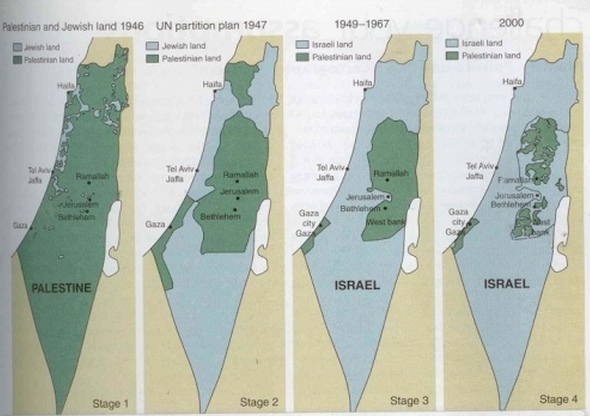
When Zionists denounced a text book with maps showing historical Palestine, McGraw-Hill quickly caved, even destroying the copies in inventory, a victory for ideological censorship, writes Lawrence Davidson.

The Palestinian maps that came under criticism

What is the difference between a textbook publisher giving into pressure from Christian fundamentalists seeking to censor the teaching of evolution, and a publisher giving into Zionists seeking to censor awareness of the ethnic cleansing of Palestine?

[See complete article at Consortium News here.]

Neither phenomenon is a matter of opinion or perspective.


One act of censorship denies facts established by scientific research. The other denies the documented violation of international law (for instance, the Fourth Geneva Convention) and multiple United Nations resolutions. So the answer to the question just asked is – there is no difference.

In early March 2016, executives at McGraw-Hill took the extreme step of withdrawing from the market a published text, Global Politics: Engaging a Complex World, and then proceeded to destroy all the remaining books held in inventory. (Did they burn them?)

Global Politics, which had been on the market since 2012, was a text designed by its authors to “offer students a number of lenses through which to view the world around them.”

Why did McGraw-Hill do this?

Heritage Designation Sought for Vancouver Island's Endangered Rivers

Conservation Group Calls For New Heritage River Designation and a Rivers Foundation for Vancouver Island

by VICCS


March 21, 2016

CEDAR – "Our Island rivers are rich in heritage, and vital to our future," states the letter to AVICC from a Vancouver Island conservation society.

"It's World Water Day on March 22nd, and it's been 15 years since a Heritage River was designated in the province of British Columbia. We're asking the Association of Vancouver Island and Coastal Communities to consider the heritage, cultural, economic and natural values that Islanders enjoy ...and to establish a new Island initiative to recognize and protect Vancouver Island rivers."

"We received a polite refusal from BC's Environment Minister Mary Polak last fall," notes VICCS president Laurie Gourlay, "on the 20th anniversary of the BC Heritage Rivers System, suggesting there were no plans to revisit or nominate additional BC Heritage Rivers."

"We see no reason why the old BC and Canadian Heritage River terms and mandate cannot be adapted to meet Vancouver Island's present needs, and the public interest in our rivers and watersheds," states Gourlay.

The letter raises attention to the hotter and drier summers the Island is experiencing as a result of climate change, suggesting that appreciation of the Island's streams and rivers has soared as the benefits and importance to the environment as well as our cities, towns and communities becomes increasingly clear.

"Canada's 150th birthday in 2017 again reminds us of the early explorer's travel by canoe and ship which led to the development of our country," Gourlay writes. "And our coastal First Nations look back 5500 years and more upon salmon-rich rivers that provided transportation, spiritual rewards and sustainable livelihoods."

VICCS is requesting that the BC Heritage Rivers process be the basis for Vancouver Island Heritage River' nominations, and that funds be invested to establish a Vancouver Island Rivers Foundation.

VICCS letter is addressed to AVICC as they represent local Island governments, and are affiliated with the BC Union of Municipalities. VICCS is requesting that AVICC receive their request as a late addition for consideration at their upcoming AGM in Nanaimo, and has been copied to Premier Christy Clark, Opposition Leader John Horgan and Green Party Leader Andrew Weaver, asking for all-Party support in the Legislature.

VICCS ends their request by offering to help establish a Vancouver Island Rivers Foundation, suggesting that "the Nanaimo River is an excellent candidate for consideration under a Vancouver Island Heritage Rivers process ...and we'd be pleased to tour AVICC delegates along one of the Island's great rivers when they're here in April."

- 30 -


For Immediate Release

For more information:
Laurie Gourlay
President, VICCS


Vancouver Island & Coast Conservation Society,
Box 333, Cedar, B.C., V9X 1W1

(viccs@shaw.ca)
www.viccs.vcn.bc.ca/