Thursday, June 08, 2017

Who's Left to Oppose Trudeau Militarism?

The left needs to oppose Trudeau's military spending

by Yves Engler - Rabble.ca


June 8, 2017

It's no wonder the Trudeau government has moved to ramp up military outlays. Even "left" commentators/ politicians are calling for increased spending on Canada's ecologically and socially destructive war machine.

Yesterday Defence Minister Harjit Sajjan announced a 70 per cent increase in military spending over the next decade.

Canada's new defence policy includes a significant increase in lethal fighter jets and secretive special forces, as well as enhancing offensive cyber-attack capabilities and purchasing armed drones.


Photo: Adam Scotti/PMO 

A Globe and Mail story about the defence policy yesterday quoted David Perry, an analyst with the unabashedly militarist Canadian Global Affairs Institute, and UBC professor Michael Byers, who has been described as the "angry academic voice of Canadian foreign policy" to denote his purportedly critical stance.

In the story titled "Canada's new defence spending must come quickly, experts say," the paper reported that "Byers said the Forces are currently in a state of 'extreme crisis,' with the Royal Canadian Navy running out of functioning ships and the Royal Canadian Air Force still years away from getting its new fleet of fighter jets. 'The government has inherited a badly broken Canadian Forces and it clearly has a monumental task ahead that is only beginning,' he said."

Despite his affiliation with a peace organization, Byers supports increased military spending. The Rideau Institute board member has repeatedly expressed support for Canada's war machine.

In 2015 the UBC professor published Smart Defence: A Plan for Rebuilding Canada's Military which begins:

"Canada is a significant country. With the world's 11th-largest economy, second-largest landmass and longest coastline, one could expect it to have a well-equipped and capable military.
However, most of this country's major military hardware is old, degraded, unreliable and often unavailable. When the Harper government came to power in 2006, it pledged to rebuild Canada's military. But for nine long years, it has failed to deliver on most of its promises, from new armoured trucks and supply ships to fighter jets and search-and-rescue planes."

The Rideau Institute/Canadian Centre for Policy Alternatives report was partly an attack against the Stephan Harper government's supposed lack of military commitment. In Smart Defence, Byers writes,

"Prime Minister Stephen Harper has reduced defence spending to just 1.0 percent of GDP -- the lowest level in Canadian history."

Byers has long called for increased military spending. In a chapter in Living with Uncle: Canada-U.S. relations in an age of Empire, edited by then CCPA leaders Bruce Campbell and Ed Finn, Byers notes that "the defence budget, roughly 1.2 per cent of GDP, is a bit low by comparable standards."

He describes writing a 2004 paper for NDP defence critic Bill Blakey that called for a $2-3 billion per year increase in military spending. "A defence budget increase," it noted, "essentially repairs some of the damage that was done by a decade and a half of neglect." But, the military budget was $15 billion and represented 10 per cent of federal government outlays at the time.

A former NDP candidate and adviser to Tom Mulcair, Byers' position is similar to that of the social democratic party's leadership.

After the federal budget in March the NDP leader criticized the Liberals for not spending enough on the military. "Canadians have every right to be concerned," Mulcair said.

"We are in desperate need of new ships for our Navy, we're in desperate need of new fighter aircraft for our Air Force, and there's no way that with the type of budget we've seen here that they're going to be getting them."

The NDP has staunchly defended Canadian militarism in recent years. During the 2011 and 2015 federal elections the party explicitly supported the Harper government's large military budget. In 2011 party leader Jack Layton promised to "maintain the current planned levels of defence spending commitments" and the 2015 NDP platform said the party would "meet our military commitments by maintaining Department of National Defence budget allocations."

In addition to backing budget allocations, the NDP has criticized base closures and aggressively promoted the National Shipbuilding Procurement Strategy, a $60-billion effort to expand the combat fleet over three decades (over its lifespan the cost is expected to top $100 billion).

I'm yet to come across a formal party statement about yesterday's announcement. What do those currently vying for NDP leadership think of the Trudeau's new defence policy and how will they respond?

May Plays to Her Base: A Racist Scaremonger with Contempt for the Law

On Eve of Election, Theresa May Returns to Her Default Position, That of a Grubby Racist Scaremonger with Contempt for the Law

by Andy Worthington


7.6.17

Please support my work as a reader-funded investigative journalist and commentator – and watch my band The Four Fathers playing ‘Stand Down Theresa’, a cover of The Beat’s classic protest song, ‘Stand Down Margaret.’


It was all going so well until Saturday. As I explained in my article, The Spectacular and Unforeseen Collapse of Theresa May and the Tories, Theresa May’s campaign was collapsing, after her arrogant belief that holding a General Election — despite repeatedly promising not to do so — would enable her to increase her majority and wipe out the Labour Party. She forgot, too, that although she spoke about securing a greater majority to strengthen her hand in Brexit negotiations, her Brexit position was one of total paralysis.

She refused — and still refuses — to discuss anything about Brexit with anyone, in an increasingly transparent effort to disguise the fact that her amateurish government of deluded Brexiteers has no idea what they are doing, has made no real effort to recruit the people necessary to deal with negotiations (for what will, if it goes ahead, be the biggest bureaucratic task in history), and knows that it will be an economic disaster the like of which has never been seen. (It’s also worth noting that her claim that securing an increased majority will assist in her negotiations was a lie in any case, as her electoral majority has no bearing whatsoever on EU negotiations).

With Brexit off the cards, people’s attention turned, instead, to domestic policies, and as the relentless negative reporting — or complete absence of reporting — about Jeremy Corbyn gave way to an election campaign in which he was allowed to speak and to get his message across, it began to resonate with the British people in significant numbers, as those brutally silenced by Theresa May after Brexit — an evidently large number of the 16.1 million people who voted Remain, but were told to shut up after the referendum result — were finally given back their voice.

That enabled us not only to vent our frustration and fury about the insanity of Brexit, its unleashing of horrendous waves of racism and xenophobia, and the Tory Party’s evident drift to the far right to embrace this tide of filth, but also about the dreadful state of austerity in the UK, inflicted by theTories since first returning to power in 2010, through a relentless assault on the poor, the unemployed and the disabled, and the Tories’ undisguised ambitions to totally destroy the state provision of almost all services, including the NHS.

To add to this, May’s manifesto was a disaster, containing a proposal to fleece old people of all but the last £100,000 of their assets if they require care in later life — a proposal that may have made sense economically, but that was, frankly, insane to introduce unprovoked in a manifesto, and which generated a furiously hostile response from voters and the media, in huge numbers, that took her completely by surprise.

She then performed a clumsy U-turn on what the media had dubbed the “dementia tax,” and the damage was done. Voters like nothing more than confidence in a leader, and she was anything but, avoiding people with extraordinary determination, and ill at ease when she did have to meet anyone. Her coldness and cruelty started losing her support from the very people who were supposed to be safety in the bag — old Tory voters — while Corbyn’s message of old-fashioned state intervention to protect vital services and create jobs began sounding more and more attractive. Corbyn also grew noticeably in confidence, and it was significant that Labour’s plans had been costed, and that they secure mainstream support from economists — most recently, Joseph Stiglitz, who endorsed Corbyn in an article in today’s Guardian entitled, Austerity has strangled Britain. Only Labour will consign it to history.

And then came Saturday’s terrorist attacks in London, and suddenly the decline of May and the rise of Corbyn was disrupted. Amidst the sickening loss of life caused by deluded extremists — manipulated by cynical cowardly figures who send the confused and pliable to to do their dirty work, and who want nothing more than to provoke increasingly harsh authoritarian responses to their atrocities in the west, to further their desire for a clash of civilisations — May hoped for a sudden boost in her fortunes, although that was not so easily achieved.

Corbyn responded well to the attacks (as he did after the recent attacks in Manchester), and as did Sadiq Khan, the Labour Mayor. Khan also won a war of words — and principles — with Donald Trump, who shamefully got involved on Twitter, while May sounded opportunistic to many when, after insisting on a 24-hour break in campaigning, she used her opportunity to address the nation to propose a raft of new policies instead of merely sympathising with the victims, condemning the perpetrators, thanking the emergency services, and leaving with her dignity intact.

There was no bounce for May in the polls after Saturday’s attacks, although her declining fortunes seemed to have been arrested, but what is most worrying is the way in which she has since elaborated on the authoritarian nonsense she first came up with on Monday morning, a return to her favourite territory: the bleak, paranoid, authoritarian and relentlessly racist position she took when she was home secretary for six long and wretched years before her accidental rise to Prime Minister last July, as I reported at length in an article at the time, As Theresa May Becomes Prime Minister, A Look Back at Her Authoritarianism, Islamophobia and Harshness on Immigration.

in her speech, May said “enough is enough” and claimed that there had been “far too much tolerance of extremism” — a comment that doesn’t even make sense. Fortunately, there was sweeping condemnation of the inappropriate politicisation of her presentation, and, crucially, of her misguided policies, however much right-wingers lapped it up. Check out Theresa May, you know that ‘enough is enough’ is just not enough, a column for Middle East Eye by Peter Oborne, a Conservative commentator of largely unparalleled intelligence and insight, and Theresa May’s ‘enough is enough’ risks making the extremist threat worse, a column in the Guardian by Richard Barrett, a former director of global counter-terrorism at MI6.

In an editorial, The Guardian view on Theresa May’s plans on terror: they are wrong, the Guardian’s editors tore into May as she deserved.

Theresa May’s “enough is enough” speech is an attempt to reshape dramatically Britain’s policy to thwart terror after murderous attacks. Mrs May gave her most explicit pitch today to policing thoughts rather than acts. This is a bad idea. It rests on a strategy to counter ideology rather than one that counters terrorism. It penalises people for holding unspoken beliefs and promotes a form of thoughtcrime. Such a move would end up with Britain losing the fight against terrorism in a legal minefield of dogma and piety.

The editorial added:

Mrs May wants us to believe that we face a threat from doctrines that do not espouse violence but somehow mutate into terror by contingency. The conclusion of her speech is that a non-violent person who harbours anti-British, extremist thoughts – to be defined presumably by a future parliament – could be blacklisted, maybe even criminalised. This is a leap away from current policy, although Mrs May has been heading in this direction for years. It should worry us all. What of animal rights, ecological defence or anti-arms-trade activists who do not subscribe to violent belief systems when criminal acts – sometimes amounting to terror – have been carried out in their name? Will they be banned too?

Crucially, the Guardian’s editors also made reference to the situation in 1974, when draconian emergency powers were introduced, which, though intended to be temporary, became permanent, and undermined the UK as a nation with due respect for the rule of law — something that Theresa May, alarmingly, seems enthusiastic to emulate.

As the Guardian’s editorial concluded:

Have we learned nothing from our own history? Listening to the prime minister speak from outside Downing Street, it is troubling to conclude that we have not. The wickedness that saw ordinary Londoners enjoying a night out mown down in the street and stabbed in bars must not mean we trade too much liberty for security. More than four decades ago in October 1974, a terrorist bombing saw people lose their lives and scores injured within a week of a general election. A few months later MPs voted for the Prevention of Terrorism Act, containing emergency “temporary” powers so draconian they needed to be renewed yearly. What were meant to be crisis measures became permanent. Current legislation reproduces much of the earlier problematic law, along with more intrusive powers. The aim of terror is to scare us into changing the nature of our democracy. Promoting sweeping new measures with alacrity in response to terrorist acts is no way to proceed. Politicians should steer public sentiment on matters of national security. But they should do so in an atmosphere becalmed by reasoned debate; not in the frenzy of the final days of a general election.

Today, Theresa May stepped up her damaging rhetoric, in a particular effort to regain control of the narrative after days in which she has come under sustained scrutiny and criticism of her well-publicised cuts to police budgets — including her extraordinary appearance at a police conference when she told the police to stop crying wolf regarding their claims need for increased funding — and the criticism she has also faced for suppressing a report into Saudi links to terrorism.

The Guardian’s article, May: I’ll rip up human rights laws that impede new terror legislation, reported that “she was looking at how to make it easier to deport foreign terror suspects and how to increase controls on extremists where it is thought they present a threat but there is not enough evidence to prosecute them,” both alarming proposals, but proposals that anyone with respect for the law has come to expect from Theresa May.

As home secretary, she was obsessed — no other word will suffice — with deporting foreign terror suspects, even though the UN Convention Against Torture and the European Convention on Human Rights — to which we and all countries that claim to be civilised have signed up — prohibits returning any foreign national to a country where they face the risk of torture or other ill-treatment, and even though legal experts have repeatedly explained that, if someone has done something wrong, then they should be put on trial in the countries that offered them a new home. For further information, see my articles, If Abu Qatada is Guilty of Crimes, Why Not Prosecute Him in the UK? and Abu Qatada’s Release in Jordan Discredits Tory Hysteria About the Need to Dismiss Human Rights Law.

In addition, I am also particularly alarmed by proposals to “increase controls on extremists where it is thought they present a threat but there is not enough evidence to prosecute them,” as that feeds into the horrendous and discredited situation that the US under George W. Bush got itself into at Guantánamo, where, two presidencies later, people are still held because they are regarded as a threat but insufficient evidence exists to put them on trial.

That is always — always — a slippery slope towards a disturbing form of authoritarianism, but that is exactly what Theresa May wants, and what she stands for. She was a wretched, dismal and dangerous home secretary, but seems only to have brought her paranoid, undemocratic and racist baggage with her to Downing Street, placing it now at the heart of her empty worldview, as her colleagues continue to cause untold damage via the “hard Brexit” madness, and the entrenchment of austerity as the permanent driver of Tory policy, inflicting permanent and very deliberate damage on as many people as possible who do not have the luxury of being rich.

May’s authoritarianism frightens me more than anything else about her, as it is from such darkness that fascism can arise, but I continue to despair at her and her party’s obsession with as damaging a Brexit as possible, and to be appalled by the cruelty of never-ending austerity, and I fervently hope that the Tories lose tomorrow, with, preferably, Labour and the SNP having to form a government together, in which resistance to “hard Brexit” will be of paramount importance — hopefully, to the extent that it will eventually be derailed before it destroys us.


Andy Worthington is a freelance investigative journalist, activist, author, photographer, film-maker and singer-songwriter (the lead singer and main songwriter for the London-based band The Four Fathers, whose debut album ‘Love and War’ and EP ‘Fighting Injustice’ are available here to download or on CD via Bandcamp).

He is the co-founder of the Close Guantánamo campaign (and the Countdown to Close Guantánamo initiative, launched in January 2016), the co-director of We Stand With Shaker, which called for the release from Guantánamo of Shaker Aamer, the last British resident in the prison (finally freed on October 30, 2015), and the author of The Guantánamo Files: The Stories of the 774 Detainees in America’s Illegal Prison (published by Pluto Press, distributed by the University of Chicago Press in the US, and available from Amazon, including a Kindle edition — click on the following for the US and the UK) and of two other books: Stonehenge: Celebration and Subversion and The Battle of the Beanfield. He is also the co-director (with Polly Nash) of the documentary film, “Outside the Law: Stories from Guantánamo” (available on DVD here — or here for the US).

To receive new articles in your inbox, please subscribe to Andy’s RSS feed — and he can also be found on Facebook (and here), Twitter, Flickr and YouTube. Also see the six-part definitive Guantánamo prisoner list, and The Complete Guantánamo Files, an ongoing, 70-part, million-word series drawing on files released by WikiLeaks in April 2011. Also see the definitive Guantánamo habeas list, the full military commissions list, and the chronological list of all Andy’s articles.

Please also consider joining the Close Guantánamo campaign, and, if you appreciate Andy’s work, feel free to make a donation.

Wednesday, June 07, 2017

A Hideous "Morality" on Display: May and the Precarious Future of Human Rights Law in Britain

Design Fault: Counterterrorism’s Egregious Failures Don’t Faze Our Leaders 

by Chris Floyd - Empire Burlesque


4 June 2017  

I think anyone who takes an objective view of the abysmal record of failure on the part of the official who as Home Secretary and Prime Minister has been in charge of UK counterterrorism policy for many years must agree with the declaration of Theresa May following the London attacks: "enough is enough."

Well said, Mrs. May. We must repudiate these failed policies and all those who have pushed them, of whatever party or ideological stripe.

On both the micro level of singular acts of terrorism by individuals and the macro level of geopolitical strategy -- such as the close alliance with the sectarian Saudi tyrants who have been the primary purveyors of Islamic extremism around the world for decades -- the UK's "counterterrorism" policies have been egregious, atrocious failures.

This includes the decisions by May and other government officials to run "ratlines" of radicalized Britons in and out of Libya and Syria -- and back -- in order to carry out cynical geopolitical agendas of regime change and domination. (Among these UK backed agents of destabilization, of course, was the recent suicide bomber in Manchester.)

I certainly agree that we have had "enough" of these wretchedly counterproductive policies, and the inhumane, ruthless power gaming that lies behind them. To continue with these policies -- or even worse, to "double down" on them in some witless, blunderbuss way -- guarantees there will be an unending series of incidents such as the one in London Saturday night. This might suit the military-industrial-surveillance complex that is devouring the societies of the UK and the US, where war and terror and fear have become vast engines of profit and power for private companies and governments alike. But it will be, as it has been, ruinous and deadly for the peace and prosperity of the citizens these governments purport to serve.

In this century alone, the US and UK have helped destroy two largely secular, multicultural regimes that had stood as bulwarks against the kind of Islamic extremism peddled by our allies, Saudi Arabia: Iraq and Libya. A third such country, Syria, has been the target of an ongoing regime change war in which the West and Saudis are openly backing al Qaeda allies and other extremists. This bipartisan policy of fostering extremism for geopolitical ends was also used in Afghanistan, where a thoroughly secular regime was overthrown by Islamic extremists armed, paid and organized by the US, UK, Saudi Arabia and Pakistan.

This is not to praise those regimes, but to speak in the terms our leaders themselves have adopted: that Islamic terrorism is the primary threat to our civilization and thus counterterrorism is an overarching priority. If countering Islamic extremism is your priority, then supporting Islamic terrorists in Afghanistan, Iraq, Syria and Libya is, to put it mildly, the wrong policy. If it is your priority to combat Islamic extremism which threatens to radicalize citizens of your own country, then giving massive, continuous, unquestioning support to the brutal tyrants who have exported extremist Islam all over the world for decades is, to put it mildly, the wrong policy. If it is your priority to defend your civilization from radical Islamic extremism, then launching war after war after war in Islamic countries with secular governments — and aiding extremist militias in those countries, like al Qaeda, al Nusra, ISIS, and the Libyan Islamic Fighting Group, founded in the 1990s with support from the West to launch terrorist attacks against the Gadafy regime — are, to put it mildly, the wrong policies. If it is your overarching priority to prevent the spread of hatred, radicalization and revenge, then committing mass murder in drone strikes on villages, weddings, farmers and children is, to put it mildly, the wrong policy.

Viewing all this history, and viewing the actual, visible record of officials like Theresa May (and her bipartisan UK predecessors and US counterparts) on counterterrorism, we are left with only two possible conclusions. One, that all of these highly educated, accomplished and successful individuals — across the range of party affiliations — are dithering, blithering idiots, incapable of recognizing the clear, manifest, repeated failure of their counterterrorism policies, year after year after year. Or two, that quelling and countering terrorism is NOT actually an overarching priority for our leaders; that they know full well these policies lead to more extremism, more terrorism — as their own intelligence services have repeatedly told them — but carry on with them just the same.

Therefore we are left with a further conclusion, which I’ve noted before, but which becomes clearer and clearer with each new terrorist attack and each new doubling-down on the same failed policies by the West: for our leaders, for those on the commanding heights of our bipartisan power structures, the game is worth the candle. The pursuit of their geopolitical power-game agendas means more to them — much, much more — than the lives and well-being and security of their own citizens. If there is no change in these broader policies, no change in the inhuman, inhumane agenda of domination, then no amount of tinkering with “Prevent” programs on the local level — much less even more authoritarian repression on the national level — will stop the outbreak of sickening evils like the London killings.

Until more people recognize the fact that our own governments have been absolutely crucial to the rise and spread of violent Islamic extremism — both directly, in their alliance with Saudi Arabia, and in the many, many instances of their arming and abetting Islamic terrorists; and indirectly, in carrying out policies which they KNOW will produce radicalized extremists — then we will not even begin to address the problem, much less start to solve it. And this includes recognizing —and questioning — the agendas of our elites as well, to ask why their barbaric quest for dominance and control over others is worth the lives of our sons and daughters, our fathers and mothers, our brothers and sisters, as well as the lives of the countless innocents they kill, year after year, in foreign lands.

This is the world our leaders have created with their deliberately chosen policies, in full knowledge of the consequences. Until we recognize this — until we say “enough is enough” to these policies and alliances and covert collusions and brutal agendas that stoke the fires of extremism — there will be no end to this madness. It will only grow worse.

Trudeau Soldiers Up: 70% Canadian Military Budget Increase Announced

More soldiers, ships and planes for military in Liberal defence plan

by Murray Brewster - CBC.ca


Jun 07, 2017 

Long-range plan calls for a boost in spending and a larger continent of regular and reservist troops

The Liberal government's new defence policy lays out a plan to increase the defence budget by 70 per cent over the next decade to $32.7 billion.

It is a mixture of new and previously committed cash.

The long-anticipated review calls for a slight increase in the size of the military — both regular and reserve forces.

There will also be a modest increase in the size of the special forces.

Defence Minister Harjit Sajjan and Transport Minister Marc Garneau are announcing details of the plan during a news conference.


The announcement comes on the heels of Foreign Affairs Minister Chrystia Freeland's address to Parliament Tuesday, which among other things laid out the case for a bigger defence budget.

Sajjan called the military an "indispensable tool" of Canada's foreign policy.

Under pressure


"If we are serious about Canada's role in the world, then we have to be serious about funding our military," he said at the news conference.
"And we are."

The Liberal government has been under pressure, notably from the Donald Trump administration, to increase defence spending to meet the NATO benchmark standard of two per cent of the gross domestic product.

The military alliance has pegged Canada's contribution at roughly .98 per cent, but the new policy says Canada has been under-reporting its numbers and is now counting expenditures like direct payments to veterans and the cost of administering defence program at both treasury board and public works.

Freeland says Canada will step up to lead on world stage
More doubt cast over Super Hornet purchase
Defence review to invest more in troops than weaponry
Heat turned up over promise of lifetime pension

Sajjan said Canada is a NATO leader and strong multilateral player that will work with allies for more effective conflict prevention and containment.

"We have much to offer the cause of global peace, stability and prosperity. Doing our part is the right thing to do, and it is also in our best interests," he said.

Sajjan said troops are at "the heart" of the defence policy, and personnel have a "solemn commitment" from military, civilian and political leadership to ensure they are cared for and equipped to do the tasks they are called on to do.

Before Sajjan's announcement, NDP Leader Tom Mulcair said increased spending for Canada's military, veterans and international aid is long overdue.

3 oceans


"We're the only country in the world that fronts on three oceans, and yet we've got a navy right now that is woefully under-equipped, and the procurement process that's been put in place will not allow us to fill that gap in a predictable horizon," he said.

The Liberals' plan outlines myriad new equipment purchases.

It also reveals for the first time how many warships and fighter jets the government intends to buy in order to replace existing fleets.

The government intends to fund the construction of 15 advanced warships to eventually replace the current patrol frigates in a program that is already underway.

The air force will get 88 new fighter jets to replace the aging CF-18s — up from the 65 jets the former Conservative government had planned to buy.

The number is significant because the Liberal government has insisted it has not had enough fighters to meet its NORAD and NATO commitments at the same time.

Fighter jet questions


It had planned to buy 18 Boeing Super Hornets as an interim measure, but the defence policy makes no reference to that and simply says the existing squadrons will be replaced through an open competition.

Senior government officials, speaking at a background briefing, signalled that the Super Hornet program is still under consideration, but could not provide any data on costs.

The Liberal government is involved in a separate trade dispute with Boeing, something that has put the future of the interim fleet purchase in question.

Among its new equipment, the defence policy says the air force will also get armed drones for surveillance and combat and replacements for their nearly four-decade old CP-140 Aurora surveillance planes.

The military will get more cyber operators who will have the authorization — under government supervision — to conduct online disruption operations against potential threats.

The policy signals that Canada will not join the U.S. ballistic missile defence program, but it will participate in the refurbishment of the North Warning System under the umbrella of NORAD.

Over a decade ago, the Liberal government of Paul Martin decided not to take part in the controversial missile defence program.

Since then both Senate and House of Commons defence committees have recommended the government reconsider.

Interestingly, the defence policy review recommends modernizing the existing submarine fleet and sailing them until 2040, rather than buying new ones.

Media Mechanics: Dissecting CNN Stagecraft Coverage of London Bridge Attack

#FakeNews CNN Caught Staging ‘Astroturf’ Muslim Protest After London Bridge Attacks

by 21wire 


June 5, 2017

On numerous occasions 21WIRE has exposed the tradecraft of the Cable News Network (CNN), showing how they craft propaganda for different purposes, and always to further a social engineering or geopolitical agenda.

The following is a video shot a day after the London Bridge Attacks, where it appears that CNN has been caught staging a fake demonstration-protest using London Bridge as the backdrop.

Notice the near full film crew present including standby props, set dressers, lighting and make-up staff – all working to stage this fake scene for CNN claiming it’s really happening “on the streets here in London.”

Note the presenter stating on camera here that you are meant to be witnessing “a spontaneous peace group” who are “laying flowers on the street.”

The narrative being crafted here by media producers is designed to depict a ‘British Muslim backlash against the terror attack,’ and ‘Muslims showing solidarity with victims of terror.’ While these sentiments may be very genuine and real in Muslim communities across the UK, the scene itself being produced by the mainstream media – complete with signage, the actors – is a complete fabrication.

Regardless, the mainstream media are still attempting to pass this Astroturf production off as some sort of ‘grassroots street demonstration’ when in fact it’s entirely contrived. It’s possible that footage from this fake event was also used by the BBC as well.

WATCH: 


.

READ MORE LONDON BRIDGE NEWS AT: 21st Century Wire London Bridge Files

SUPPORT 21WIRE – SUBSCRIBE & BECOME A MEMBER @21WIRE.TV


We are a North American and European-based, grass-roots, independent blog offering geopolitical news and media analysis, working with an array of volunteer contributors who write and help to analyse news and opinion from around the world.

Failed Gold Mine Company Appeals SLAPP Suit Loss

Wilderness Committee in court defending libel appeal Taseko Mines Ltd. appeals landmark libel decision loss in 2016

by Wilderness Committee


June 7, 2017

 VANCOUVER - The Wilderness Committee is back in court this week as Taseko Mines Ltd. appeals a BC Supreme Court decision that rejected its libel suit against the organization.


Teztan Biny/Fish Lake site of proposed mine

The mining company launched the action in 2012 challenging communications published by the environmental group on their website as libelous. The Wilderness Committee was educating the public on the risks of Taseko’s proposed New Prosperity gold-copper mine which is located in Tsilhqot'in Nation territory, west of Williams Lake BC.

"It is unfortunate that we are required to return to court after successfully defending ourselves against these accusations,” said Joe Foy, National Campaign Director for the Wilderness Committee.

"We are hoping that Taseko’s court loss will be upheld and that the right of all Canadians' to speak their mind – even against large companies - will be reaffirmed."

In his January 2016 ruling dismissing Taseko’s claims, Justice Gordon Funt ruled in favour of the Wilderness Committee, and in addition awarded special costs to the organization because Taseko had continued to pursue punitive damages long after it had become apparent that their claim had no merit.

Lawyer Dan Burnett successfully defended the Wilderness Committee against Taseko's action and will represent the organization in court again. “The claim was patently non-meritorious from the start” states the written argument filed by Burnett.

“The right of fair comment is one of the essential elements that make up our freedom of speech.”

This lawsuit is also seen by some as a strategic lawsuit against public participation (SLAPP suit).

BC once had anti-SLAPP legislation, but in 2001 the provincial government under Liberal leader Gordon Campbell struck down the law stating it was not needed.

"I believe this court action was launched as an attempt to stop us from writing or speaking out about Taseko's terrible mine proposal," said Foy.

"I am hopeful that the incoming GreenNDP provincial government will re-introduce legislation prohibiting SLAPP suits."

The court proceedings will be webcast live by the BC Court of Appeal on Wednesday and Thursday.

–30– 

For Immediate Release - June 7, 2017
For more information, please contact:

Joe Foy | National Campaign Director, Wilderness Committee
joe@wildernesscommittee.org


Additional Media Resources
WEBCAST: Taseko Mines Limited v. Western Canada Wilderness Committee

Caracas Oligarchy's Dirty War on the Press Goes International

Venezuelan Opposition Threatens To Lynch American Journalist Abby Martin

by Whitney Webb - MintPress News

June 5, 2017

The right-wing opposition of Venezuela has been caught endorsing and committing violent acts multiple times, despite claiming to be “peaceful.” Their latest targets include two U.S. journalists who have been threatened with lynching for their reporting on the ongoing chaos in Venezuela.

CHILE — The U.S.-backed right-wing opposition in Venezuela is consistently described as “peaceful,” protesting non-violently against the leftist regime of Venezuelan President Nicolás Maduro, who mainstream media throughout the Americas and the world consider an autocrat, or dictator who is hell-bent on accumulating more power.

However, the Venezuelan opposition has proven themselves to be anything but peaceful, especially in recent weeks. Late last month, a mob of around 40 opposition protesters were caught on video beating 21-year-old Orlando José Figuera, then dousing him with gasoline and lighting him on fire after he was accused of being a “Chavista infiltrator.”

While the young man suffered first- and second-degree burns on more than half of his body and survived more than six knife wounds to the stomach, the U.S. and its allies in Latin America have remained silent.
 
Now, two independent U.S. journalists have been threatened with a similar fate after traveling to Venezuela to report on the protests: Abby Martin and Mike Prysner of the Telesur-affiliated Empire Files, a documentary and interview video series. Although the Empire Files is hosted on Telesur, the program is independently produced by Prysner and Martin.

The pair has traveled through Venezuela’s capital, talking to eyewitnesses.

Martin wears protective gear, including a helmet as a measure against
the violence that has rocked the city in recent years.

The trouble began when influential members of the opposition, including José Carrasquero, accused the pair of infiltrating protests to gather intelligence for the Venezuelan government. Soon similar accusations spread throughout the opposition’s leadership, leading opposition sympathizers to call for violence.

Journalists who work for elite-owned media and are sympathetic to the opposition, such as Manuel Malaver, also repeated baseless accusations against Martin and Prysner.


 Twitter users who identified themselves as members of the Venezuelan opposition 
– namely @nyoli05 and @mrsmalkovich – called for the pair to be burned alive. 


More calls to violence soon followed, with others calling for Martin and Prysner to be lynched.

Martin and Prysner have received support from Telesur, as well as Venezuelan Minister of Information and Communication Ernesto Villegas. Telesur promised to investigate the threats made against the pair.

Venezuelan journalists have been targeted as well, including Elizabeth Ostos of El Pitazo, who was attacked by protesters on the Francisco Fajardo highway in Caracas while reporting.

The allegedly peaceful Venezuelan opposition has been a major recipient of U.S. aid. After former Venezuelan President Hugo Chávez was elected in 1998, the U.S. gave between $50 to $60 million to the nation’s right-wing opposition. Such donations have grown in recent years, with former President Barack Obama sending $5 million to the Venezuelan opposition in 2014 to “support political competition-building efforts.”

A Senate bill recently introduced by Sen. Marco Rubio (R-FL) would give the opposition an additional $20 million if passed.

As Roberto Lovato, a journalist who covers the drug war and social movements in Latin America, told Vice News:

“There’s absolutely some organic movement against the government. […] But if you don’t factor in the millions of dollars that’s been spent on destabilizing the government and prop up opposition leaders, it’s not the whole story.”

However, if the Venezuelan opposition continues to call for the deaths of journalists and continues to employ violent tactics, the narrative may become harder to control, despite their – and their benefactors – best efforts.

Whitney Webb is a MintPress contributor who has written for several news organizations in both English and Spanish; her stories have been featured on ZeroHedge, the Anti-Media, 21st Century Wire, and True Activist among others - she currently resides in Southern Chile.
More articles by Whitney Webb

Now We Dare Hope: Corbyn Train a Momentum Monster

Sticking Your Neck-and-Neck Out

by W Stephen Gilbert - Off Guardian


June 7, 2017

Now we dare to hope. If the rain isn’t too relentless on Thursday…If the Momentum activists do their stuff and all those who’ve volunteered to phone voters with the free-to-use app do so…If whatever low stunts have been pulled by The Sun, the Daily Mail, The Times and The Daily Telegraph on Thursday morning can be laughed off…If nobody has a seriously damaging last-minute gaffe…And if the ever-unreliable opinion polls are a day or two behind the trend…

Who imagined that this was possible seven weeks ago? Well, I did. Jeremy Corbyn’s galvanising candour and cool have worked miracles before. We saw it last year and the year before. Alone among Tories, Ken Clarke warned of its power two years ago. But a sense of righteous entitlement has misled smarter people than Theresa May.

She never credited the possibility of failure


If he becomes Prime Minister on Friday or after a week or two of haggling or after a second election in the autumn, it will be Corbyn’s triumph way beyond anyone else’s. He would never claim it like that but we may do so on his behalf. He has shown that speaking truth to power and sticking to your principles – and, in some cases, making a shrewd choice between conflicting principles (say, backing Trident for now because Labour’s policies are decided democratically) – resonates with voters, especially those too young to acquire thick layers of cynicism.

It’s hard to see that May can survive. Even if she manages to push up the Tory majority by a few seats, it’s not what she called the election for. Her credibility has fallen substantially and those with whom she would be negotiating in Brussels have seen how unsteady under fire she is. The Conservative Party is too ruthless and professional an outfit to neglect clearing up the mess that the campaign has made and the sacrifice of May would be the very least gesture towards a beginning.

In the Labour Party, there will be calls for Corbyn’s head in any circumstance short of a decisive victory. Even with a hung parliament, the nay-sayers will grumble that the party would have done better with another leader. This is idle, of course. The argument that another leader would have been more popular means that the massive opinion poll lead that May enjoyed when she called the election would not have obtained. In that case, she would not have risked the election and she would still be in power.

Corbyn has – uniquely in political history – parlayed a huge media-created under-estimation into a potentially winning hand. He’s done it by sheer force of personality. If there were another fortnight to go, we might well be confidently anticipating a Labour landslide.

Think how extraordinary this turn-around has been. Changes of government almost always come about because the governing party is widely seen to be exhausted, corrupt, bereft of ideas or a combination thereof. Think of 1951, 1964, 1979, 1997, 2010. It’s rare for opposition parties to scale the ramparts and displace a settled administration; 1945 may be the only precedent in living memory.

The curious passage of the 1970s is sui generis. Wilson unexpectedly lost the 1970 election. Heath was doomed from the start and called the 1974 election on an issue he was never going to win. Wilson sought an improved majority in the October but he and then Jim Callaghan were kept on a very tight leash (a majority of three, then the Lib-Lab pact) for the remainder of the term. Otherwise, oppositions that seem vaguely competent are only preferred over governments that have lost the plot.

It would be too partisan to suggest that the Tories’ time was undeniably up, despite the sorry record of May’s tenure. But the negotiations with the EU might well have damaged May rather more than anything hitherto. Her hubris in contemplating her supposedly unique ability to emerge triumphant from those negotiations has certainly tempted the electorate to view her with scorn and doubt.

But Corbyn was battling an extraordinary wall of contempt and suspicion. The Tory press is remorseless in its unscrupulous blackguarding of Labour leaders – it’s hard to imagine that Owen Smith would now be leading his troops up the hill to a potential victory if he had prevailed in the leadership contest only last September; he would have been destroyed by the press.

Tony Blair is unique in the friendly coverage he received and that was because he was imagined (wrongly as it turned out) to be less EU-enthusiastic than John Major and because he constantly assured the press barons that his government would do nothing to lessen their favourable tax positions. Don’t imagine that Rupert Murdoch invites a Labour man to be his child’s godfather if he suspects that man may not be in his pocket.

Besides the press, the BBC has had to be shamed into covering all parties with more objectivity. Fortunately, as the ‘story’ that the BBC reporters perceived has shifted from a coronation to a comedy of errors, so May’s vulnerability has been not only impossible to disguise but a self-selecting series of headlines. When the BBC’s completed coverage comes to be studied, though, there will surely be questions about the amount of time given to UKIP and its noisy leader, compared to that afforded to the Greens (who after all have a re-contesting MP) or indeed the Liberal Democrats.

And then there was the nature of the support given to Corbyn by his party. No democratically elected party leader has ever been so systematically undermined by his own parliamentarians, let alone one whose (reiterated) mandate was the most emphatic any party leader has ever enjoyed. All those Labour members elected on Thursday should get down on their knees and thank Corbyn for saving their jobs.

It would be reassuring to feel able to expect that what may be the government backbenches will both begin and remain supportive and generous. I shan’t hold my breath, though. As is always observed about changes of government, the real hard battles start now.

W Stephen Gilbert is the author of Jeremy Corbyn – Accidental Hero and wrote the chapter on Labour in Tactical Reading – A Snappy Guide to the Snap General Election, both published by Eyewear

Corbyn in Front: May May Lose

Jeremy Corbyn and Theresa May Neck-and-Neck in Final Stretch of UK Election: Standing against 'War on Terror' and austerity proves popular

by Dave Lindorff - This Can't Be Happening


June 7, 2017

This article was written for Salon Magazine [1]


A funny thing is happening on the way to the June 8 snap election in the United Kingdom. Despite two vicious terror attacks apparently inspired by ISIS — the Manchester Arena bombing that killed at least 22 people, many of them children, and another on the iconic London Bridge that killed seven and left 22 critically injured — polls suggest that British voters aren’t fleeing in panic to the current Conservative Prime Minister, Theresa May.
Some polls have British PM Theresa
May tied with Labour challenger Jeremy
Corbyn in tomorrow's snap election.[2]

In fact, contrary to all expectations, they continue to swing toward May’s hard-left Labour Party opponent, Jeremy Corbyn, with the latest poll showing the two parties neck-and-neck.

May launched her campaign on on April 18. With polls showing her party anywhere from 15 to 20 points up on Corbyn and Labour at the time, and the favorability gap between her and Corbyn even wider, she hoped for a blowout victory that would boost the Tories’ position in Parliament to a record level.

But since then she and the Conservatives have been watching their support crumble as Corbyn’s has grown. Now many British news organizations are talking about a Tory “collapse.”

It’s now being suggested, even in the right-leaning media, that when the votes are counted Thursday evening, Britain could face an unexpected and murky situation... There could conceivably be a “hung Parliament,” where no party has enough members of parliament to form a majority government.

If the Tory collapse continues through Thursday, Labour, which earlier appeared doomed, could come out ahead in the popular vote as well as the parliamentary seat count. It’s even possible — although admittedly unlikely — that Corbyn, once written off as a hapless relic of the past, could win outright and become Britain’s most left-wing prime minister since at least Harold Wilson in the 1960s.

For the rest of this article, which appears in today's 

Salon magazine, please click here.


Links:

[1] http://salon.com
[2] http://www.salon.com/2017/06/07/power-to-the-young-people-jeremy-corbyn-theresa-may-suddenly-neck-and-neck-in-british-election-shocker/

Dam Desperation: Clark's Site C Gambit

Dam Desperation: Clark's Site C Gambit

compiled by Ken Boon - PVLA


June 7, 2017

Horgan said he stood by his commitment to an independent review. He finished the second version by proposing Clark recall the legislature immediately to face a confidence vote “if you are truly concerned about this timeline.”

Responding to Clark’s letter of response with a letter of his own, Weaver accused the Liberal government of proceeding with “the costliest public works project in B.C. history without adequately analysing its economic viability.”

“Your government is turning a significant capital project that potentially poses massive economic risks to British Columbians, into a political debate rather than one informed by evidence and supported by independent analysis,” the Green leader wrote.

Weaver asked Clark for supporting evidence to her claims that delaying the relocation of two homes would cost B.C. Hydro ratepayers an estimated $600 million.

http://vancouversun.com/news/local-news/christy-clark-letter-fires-back-at-b-c-ndp-and-green-position-on-site-c

The man who chaired the original Site C review says the Premier’s claim of a delay costing $600-million is “preposterous.”

As far as leaving the landowners where they are, Dr. Harry Swain says the road could go elsewhere.

As for the claim of the project nearing the point of no return, he says determining that requires information that’s not been made public.

“It depends on the wording of contracts, which have been kept confidential nobody knows, outside of BC Hydro, I suppose the Premier’s office, just what contracts have been and what kind of break clauses they may contain.”

Swain maintains, as he has for some time, that ending construction would be a good idea.

He says we don’t need it, there is no demand for the power, and when we do need power there are much cheaper ways to produce it.

http://www.cknw.com/2017/06/06/b-c-premier-pens-letter-warning-against-site-c-delays

He said the full BCUC review would take three months, but he would seek an “interim report” from the commission within six weeks.

Green party Leader Andrew Weaver said the promised six-week turnaround was enough to convince him to prop up a Horgan-led minority government, and the NDP-Green alliance is expected to topple Clark’s Liberals when the legislature resumes sitting this month.

http://theprovince.com/news/bc-politics/mike-smyth-would-horgan-and-weaver-really-fire-2200-site-c-workers

However, only 648 of those workers were Peace River Regional District primary residents, which works out to 36%. Since February, when there were 749 PRRD residents employed as contractors, that number has fallen by 101 in the span of two months.

https://energeticcity.ca/2017/06/site-c-employment-statistics-show-drop-local-workers-two-straight-months/


Peace Valley Landowner Assoc.
Ken Boon, President
SS#2, Site 12, Comp 19
Fort St. John, BC V1J 4M7

Email address: pvla@xplornet.com

Facebook page: https://www.facebook.com/peacevalleylandownerassoc
Website: http://www.peacevalleyland.com/


War of words breaks out over Clark letter to NDP, Greens over costs of Site C delays  

by Stephanie Ip - Vancouver Sun

June 6, 2017

Premier Christy Clark has given the B.C. NDP and the B.C. Greens four days to decide whether or not they’ll request the government to issue a “tools down” order to workers and halt the construction of the $9-billion Site C dam.

That June 10 deadline came in a pair of nearly identical letters sent by Clark to NDP Leader John Horgan and Green Leader Andrew Weaver to defend her party’s decision to approve the project and to warn of what she suggests could be a $600-million, one-year delay in the project’s timeline.

Clark’s letter follows one sent by Horgan last week to Jessica McDonald, head of B.C. Hydro. In his letter, Horgan had put forward a request for the Crown corporation to hold off on finalizing any deals without a penalty-free cancellation clause.

Both Horgan and Weaver have opposed the Site C project, and it was one of several issues that brought together the two parties when striking a four-year power-sharing deal.

The Site C dam site is seen along the Peace River in Fort St. John on April 18. JONATHAN HAYWARD / THE CANADIAN PRESS

Construction on the project would continue while a proposed B.C. Utilities Commission review of the project is underway, Horgan has suggested. However, Clark’s letter notes the project will likely “progress past the ‘point of no return'” before such a review is completed.

Clark’s letter to Horgan begins: “I appreciate being copied on your correspondence to B.C. Hydro CEO Jessica McDonald with respect to current and future planned activities on the Site C Clean Energy Project in Northeast British Columbia.”

“The construction and completion of Site C represents a generational opportunity to provide British Columbia with another stable, long-term asset that can provide electricity for the next 100 years and further reduce B.C.’s greenhouse gas emissions,” she writes.

Clark goes on to detail how a “project of this size and scale” must stick to a strict timeline or risk a $600-million one-year delay.

At issue is the relocation of two homes that allow for scheduled road and bridge construction that will enable river diversion to begin in the fall of September 2019, when water levels are at their lowest. Any delay, according to Clark, would mean river diversion would have to wait for the next low-flow period in September 2020.

Related: NDP Leader John Horgan calls on BC Hydro not to finalize Site C contracts

“As such, I wish to inform you that the requests contained in your letter are not without consequences to the construction schedule and ultimately have financial ramifications to ratepayers,” the letter continues.

Clark also notes the decision on whether or not to proceed would be needed by June 15 to keep the project on track.

“Given the above information and the short timeframe in which to decide how to proceed, I am seeking the opinions of you and Mr. Weaver no later than June 10th.”

Clark’s letter ends by asking both Horgan and Weaver to respond with specific responses on whether or not the pair will continue to push for a delay on the relocation of the two homes, and whether or not they want government to issue a “tools down” order to the more than 2,000 workers currently building the Site C dam.

The NDP replied later in the afternoon but sent two letters, an “administrative error” they later claimed. The first version was shorter and uses more combative language. Later, a longer, but somewhat less confrontational letter was sent to Clark, as well as to the media. The NDP said they asked Clark’s office to ignore the first version of the letter, which was leaked to the media.

Apparently there are 2 letters from @jjhorgan to @christyclarkbc on Site C – the one he actually sent her, and a revised one NDP made public pic.twitter.com/Srod0GxmQ3

— Rob Shaw (@robshaw_vansun) June 6, 2017

Horgan replied initially with a short letter, saying he “was surprised to receive your response to my letter to the CEO of B.C. Hydro.

“Given your record of mis-statements and errors, it is impossible to trust anything you say regarding the Site C project schedules and cost. We will not allow British Columbians to be hit with higher Hydro rates due to your mismanagement of this project. Our request stands.”

Horgan ended by saying the NDP stood by its commitment for an independent review “to determine if it is in the best interests of British Columbians.”

In the second version, Horgan expressed “surprise” — as he did in the first version — before saying said Clark made “unsupported claims” in her letter to Horgan “about additional costs associated with asking B.C. Hydro not to sign major contracts until a new government takes office.”

He then went on to say British Columbians’ Hydro bills had gone up 87 per cent under the Liberals. He said the requests about Hydro holding off from signing new contracts in his letter last week were “because I will not allow British Columbians to be hit with even higher Hydro rates due to your mismanagement of this project.”

Like in the first version, Horgan said he stood by his commitment to an independent review. He finished the second version by proposing Clark recall the legislature immediately to face a confidence vote “if you are truly concerned about this timeline.”

Responding to Clark’s letter of response with a letter of his own, Weaver accused the Liberal government of proceeding with “the costliest public works project in B.C. history without adequately analysing its economic viability.”

“Your government is turning a significant capital project that potentially poses massive economic risks to British Columbians, into a political debate rather than one informed by evidence and supported by independent analysis,” the Green leader wrote.

Weaver asked Clark for supporting evidence to her claims that delaying the relocation of two homes would cost B.C. Hydro ratepayers an estimated $600 million.

— with files from Scott Brown and Patrick Johnston

Tuesday, June 06, 2017

Jeremy in Charge: Can Corbyn Win?

UK Election Polls: Can Corbyn Win?

by TRNN


June 6, 2017

Opinion polls for the June 8 UK General Election indicate an increasingly tight race between Labour and Conservatives, but most still give Conservative Theresa May an advantage, despite May's weaknesses as Prime Minister, says Real Media's Thomas Barlow.


Thomas Barlow is a journalist and organiser, and the senior editor of the UK-based Real Media. Thomas was formerly a festival organiser and music promoter. He has been a life long activist, particularly dedicated to environmentalism and anti-fascism. 

Leaked NSA Russia Hacking Report Precedes Comey Senate Intelligence Committee Testimony Nicely

Top-Secret NSA Report Details Russian Hacking Effort Days Before 2016 Election

by Matthew Cole, Richard Esposito,

Sam Biddle, Ryan Grim - The Intercept


June 5 2017

Russian military intelligence executed a cyberattack on at least one U.S. voting software supplier and sent spear-phishing emails to more than 100 local election officials just days before last November’s presidential election, according to a highly classified intelligence report obtained by The Intercept.

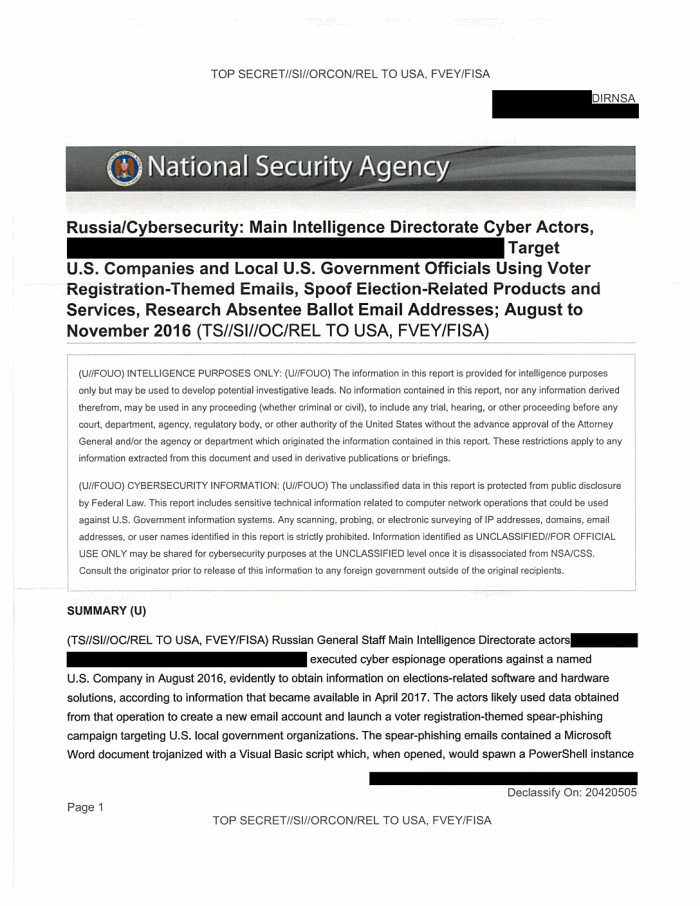
The top-secret National Security Agency document, which was provided anonymously to The Intercept and independently authenticated, analyzes intelligence very recently acquired by the agency about a months-long Russian intelligence cyber effort against elements of the U.S. election and voting infrastructure.

The report, dated May 5, 2017, is the most detailed U.S. government account of Russian interference in the election that has yet come to light.

While the document provides a rare window into the NSA’s understanding of the mechanics of Russian hacking, it does not show the underlying “raw” intelligence on which the analysis is based. A U.S. intelligence officer who declined to be identified cautioned against drawing too big a conclusion from the document because a single analysis is not necessarily definitive.

The report indicates that Russian hacking may have penetrated further into U.S. voting systems than was previously understood. It states unequivocally in its summary statement that it was Russian military intelligence, specifically the Russian General Staff Main Intelligence Directorate, or GRU, that conducted the cyber attacks described in the document:


Russian General Staff Main Intelligence Directorate actors … executed cyber espionage operations against a named U.S. company in August 2016, evidently to obtain information on elections-related software and hardware solutions. … The actors likely used data obtained from that operation to … launch a voter registration-themed spear-phishing campaign targeting U.S. local government organizations.

This NSA summary judgment is sharply at odds with Russian President Vladimir Putin’s denial last week that Russia had interfered in foreign elections: “We never engaged in that on a state level, and have no intention of doing so.” Putin, who had previously issued blanket denials that any such Russian meddling occurred, for the first time floated the possibility that freelance Russian hackers with “patriotic leanings” may have been responsible. The NSA report, on the contrary, displays no doubt that the cyber assault was carried out by the GRU.

The NSA analysis does not draw conclusions about whether the interference had any effect on the election’s outcome and concedes that much remains unknown about the extent of the hackers’ accomplishments. However, the report raises the possibility that Russian hacking may have breached at least some elements of the voting system, with disconcertingly uncertain results.

The NSA and the Office of the Director of National Intelligence were both contacted for this article. Officials requested that we not publish or report on the top secret document and declined to comment on it. When informed that we intended to go ahead with this story, the NSA requested a number of redactions. The Intercept agreed to some of the redaction requests after determining that the disclosure of that material was not clearly in the public interest.

The report adds significant new detail to the picture that emerged from the unclassified intelligence assessment about Russian election meddling released by the Obama administration in January. The January assessment presented the U.S. intelligence community’s conclusions but omitted many specifics, citing concerns about disclosing sensitive sources and methods. The assessment concluded with high confidence that the Kremlin ordered an extensive, multi-pronged propaganda effort “to undermine public faith in the US democratic process, denigrate Secretary Clinton, and harm her electability and potential presidency.”

That review did not attempt to assess what effect the Russian efforts had on the election, despite the fact that “Russian intelligence obtained and maintained access to elements of multiple US state or local electoral boards.” According to the Department of Homeland Security, the assessment reported reassuringly, “the types of systems we observed Russian actors targeting or compromising are not involved in vote tallying.”

The NSA has now learned, however, that Russian government hackers, part of a team with a “cyber espionage mandate specifically directed at U.S. and foreign elections,” focused on parts of the system directly connected to the voter registration process, including a private sector manufacturer of devices that maintain and verify the voter rolls. Some of the company’s devices are advertised as having wireless internet and Bluetooth connectivity, which could have provided an ideal staging point for further malicious actions.


Attached to the secret NSA report is an overview chart detailing
the Russian government’s spear-phishing operation, apparently
missing a second page that was not provided to The Intercept.
Graphic: NSA


The Spear-Phishing Attack


As described by the classified NSA report, the Russian plan was simple: pose as an e-voting vendor and trick local government employees into opening Microsoft Word documents invisibly tainted with potent malware that could give hackers full control over the infected computers.

But in order to dupe the local officials, the hackers needed access to an election software vendor’s internal systems to put together a convincing disguise. So on August 24, 2016, the Russian hackers sent spoofed emails purporting to be from Google to employees of an unnamed U.S. election software company, according to the NSA report. Although the document does not directly identify the company in question, it contains references to a product made by VR Systems, a Florida-based vendor of electronic voting services and equipment whose products are used in eight states.

The spear-phishing email contained a link directing the employees to a malicious, faux-Google website that would request their login credentials and then hand them over to the hackers. The NSA identified seven “potential victims” at the company. While malicious emails targeting three of the potential victims were rejected by an email server, at least one of the employee accounts was likely compromised, the agency concluded. The NSA notes in its report that it is “unknown whether the aforementioned spear-phishing deployment successfully compromised all the intended victims, and what potential data from the victim could have been exfiltrated.”

VR Systems declined to respond to a request for comment on the specific hacking operation outlined in the NSA document. Chief Operating Officer Ben Martin replied by email to The Intercept’s request for comment with the following statement:

Phishing and spear-phishing are not uncommon in our industry. We regularly participate in cyber alliances with state officials and members of the law enforcement community in an effort to address these types of threats. We have policies and procedures in effect to protect our customers and our company.

Although the NSA report indicates that VR Systems was targeted only with login-stealing trickery, rather than computer-controlling malware, this isn’t necessarily a reassuring sign. Jake Williams, founder of computer security firm Rendition Infosec and formerly of the NSA’s Tailored Access Operations hacking team, said stolen logins can be even more dangerous than an infected computer. “I’ll take credentials most days over malware,” he said, since an employee’s login information can be used to penetrate “corporate VPNs, email, or cloud services,” allowing access to internal corporate data. The risk is particularly heightened given how common it is to use the same password for multiple services. Phishing, as the name implies, doesn’t require everyone to take the bait in order to be a success — though Williams stressed that hackers “never want just one” set of stolen credentials.


A detail from a top-secret NSA report on a Russian military
intelligence operation targeting the U.S. election infrastructure.
Image: NSA


In any event, the hackers apparently got what they needed. Two months later, on October 27, they set up an “operational” Gmail account designed to appear as if it belonged to an employee at VR Systems, and used documents obtained from the previous operation to launch a second spear-phishing operation “targeting U.S. local government organizations.” These emails contained a Microsoft Word document that had been “trojanized” so that when it was opened it would send out a beacon to the “malicious infrastructure” set up by the hackers.

The NSA assessed that this phase of the spear-fishing operation was likely launched on either October 31 or November 1 and sent spear-fishing emails to 122 email addresses “associated with named local government organizations,” probably to officials “involved in the management of voter registration systems.” The emails contained Microsoft Word attachments purporting to be benign documentation for VR Systems’ EViD voter database product line, but which were in reality maliciously embedded with automated software commands that are triggered instantly and invisibly when the user opens the document. These particular weaponized files used PowerShell, a Microsoft scripting language designed for system administrators and installed by default on Windows computers, allowing vast control over a system’s settings and functions.

If opened, the files “very likely” would have instructed the infected computer to begin downloading in the background a second package of malware from a remote server also controlled by the hackers, which the secret report says could have provided attackers with “persistent access” to the computer or the ability to “survey the victims for items of interest.” Essentially, the weaponized Word document quietly unlocks and opens a target’s back door, allowing virtually any cocktail of malware to be subsequently delivered automatically.

According to Williams, if this type of attack were successful, the perpetrator would possess “unlimited” capacity for siphoning away items of interest. “Once the user opens up that email [attachment],” Williams explained, “the attacker has all the same capabilities that the user does.” Vikram Thakur, a senior research manager at Symantec’s Security Response Team, told The Intercept that in cases like this the “quantity of exfiltrated data is only limited by the controls put in place by network administrators.”

Data theft of this variety is typically encrypted, meaning anyone observing an infected network wouldn’t be able to see what exactly was being removed but should certainly be able to tell something was afoot, Williams added. Overall, the method is one of “medium sophistication,” Williams said, one that “practically any hacker can pull off.”

The NSA, however, is uncertain about the results of the attack, according to the report. “It is unknown,” the NSA notes, “whether the aforementioned spear-phishing deployment successfully compromised the intended victims, and what potential data could have been accessed by the cyber actor.”

The FBI would not comment about whether it is pursuing a criminal investigation into the cyber attack on VR Systems.

At a December press conference, President Obama said that he told Russian President Vladimir Putin in September not to hack the U.S. election infrastructure.

“What I was concerned about in particular was making sure [the DNC hack] wasn’t compounded by potential hacking that could hamper vote counting, affect the actual election process itself,” Obama said. 
“So in early September, when I saw President Putin in China, I felt that the most effective way to ensure that that didn’t happen was to talk to him directly and tell him to cut it out and there were going to be serious consequences if he didn’t. And in fact we did not see further tampering of the election process.”

Yet the NSA has now found that the tampering continued. “The fact that this is occurring in October is troubling,” said one senior law enforcement official with significant cyber expertise. “In August 2016 warnings went out from the FBI and DHS to those agencies. This was not a surprise. This was not hard to defend against. But you needed a commitment of budget and attention.”

The NSA document briefly describes two other election-related Russian hacking operations. In one, Russian military hackers created an email account pretending to be another U.S. election company, referred to in the document as U.S. company 2, from which they sent fake test emails offering “election-related products and services.” The agency was unable to determine whether there was any targeting using this account.

In a third Russian operation, the same group of hackers sent test emails to addresses at the American Samoa Election Office, presumably to determine whether those accounts existed before launching another phishing attack. It is unclear what the effort achieved, but the NSA assessed that the Russians appeared intent on “mimicking a legitimate absentee ballot-related service provider.” The report does not indicate why the Russians targeted the tiny Pacific islands, a U.S. territory with no electoral votes to contribute to the election.

An Alluring Target


Getting attention and a budget commitment to election security requires solving a political riddle. “The problem we have is that voting security doesn’t matter until something happens, and then after something happens, there’s a group of people who don’t want the security, because whatever happened, happened in their favor,” said Bruce Schneier, a cybersecurity expert at Harvard’s Berkman Center who has written frequently about the security vulnerabilities of U.S. election systems. “That makes it a very hard security problem, unlike your bank account.”

Schneier said the attack, as described by the NSA, is standard hacking procedure. “Credential-stealing, spear-phishing — this is how it’s done,” he said.

“Once you get a beachhead, then you try to figure out how to go elsewhere.”

All of this means that it is critical to understand just how integral VR Systems is to our election system, and what exactly the implications of this breach are for the integrity of the result.

VR Systems doesn’t sell the actual touchscreen machines used to cast a vote, but rather the software and devices that verify and catalogue who’s permitted to vote when they show up on Election Day or for early voting. Companies like VR are “very important” because “a functioning registration system is central to American elections,” explained Lawrence Norden, deputy director of the Brennan Center for Justice at the NYU School of Law.

Vendors like VR are also particularly sensitive, according to Norden, because local election offices “are often unlikely to have many or even any IT staff,” meaning “a vendor like this will also provide most of the IT assistance, including the work related to programming and cyber security”—not the kind of people you want unwittingly compromised by a hostile nation state.

According to its website, VR Systems has contracts in eight states: California, Florida, Illinois, Indiana, New York, North Carolina, Virginia, and West Virginia.

Pamela Smith, president of election integrity watchdog Verified Voting, agreed that even if VR Systems doesn’t facilitate the actual casting of votes, it could make an alluring target for anyone hoping to disrupt the vote.

“If someone has access to a state voter database, they can take malicious action by modifying or removing information,” she said.

“This could affect whether someone has the ability to cast a regular ballot, or be required to cast a ‘provisional’ ballot — which would mean it has to be checked for their eligibility before it is included in the vote, and it may mean the voter has to jump through certain hoops such as proving their information to the election official before their eligibility is affirmed.”

Mark Graff, a digital security consultant and former chief cybersecurity officer at Lawrence Livermore National Lab, described such a hypothetical tactic as “effectively a denial of service attack” against would-be voters. But a more worrying prospect, according to Graff, is that hackers would target a company like VR Systems to get closer to the actual tabulation of the vote. An attempt to directly break into or alter the actual voting machines would be more conspicuous and considerably riskier than compromising an adjacent, less visible part of the voting system, like voter registration databases, in the hope that one is networked to the other.

Sure enough, VR Systems advertises the fact that its EViD computer polling station equipment line is connected to the internet, and that on Election Day “a voter’s voting history is transmitted immediately to the county database” on a continuous basis. A computer attack can thus spread quickly and invisibly through networked components of a system like germs through a handshake.

According to Alex Halderman, director of the University of Michigan Center for Computer Security and Society and an electronic voting expert, one of the main concerns in the scenario described by the NSA document is the likelihood that the officials setting up the electronic poll books are the same people doing the pre-programming of the voting machines.

The actual voting machines aren’t going to be networked to something like VR Systems’ EViD, but they do receive manual updates and configuration from people at the local or state level who could be responsible for both. If those were the people targeted by the GRU malware, the implications are troubling.

“Usually at the county level there’s going to be some company that does the pre-election programming of the voting machines,” Halderman told The Intercept.

“I would worry about whether an attacker who could compromise the poll book vendor might be able to use software updates that the vendor distributes to also infect the election management system that programs the voting machines themselves,” he added. 

“Once you do that, you can cause the voting machine to create fraudulent counts.”

According to Schneier, a major prize in breaching VR Systems would be the ability to gather enough information to effectively execute spoof attacks against election officials themselves. Coming with the imprimatur of the election board’s main contractor, a fake email looks that much more authentic.


A detail from a top-secret NSA report on a Russian military
intelligence operation targeting the U.S. election infrastructure.
Image: NSA


Such a breach could also serve as its own base from which to launch disruptions. One U.S. intelligence official conceded that the Russian operation outlined by the NSA — targeting voter registration software — could potentially have disrupted voting in the locations where VR Systems’ products were being used. And a compromised election poll book system can do more than cause chaos on Election Day, said Halderman.

“You could even do that preferentially in areas for voters that are likely to vote for a certain candidate and thereby have a partisan effect.”

Using this method to target a U.S. presidential election, the Russian approach faces a challenge in the decentralized federal election system, where processes differ not merely state to state but often county to county. And meanwhile, the Electoral College makes it difficult to predict where efforts should be concentrated.

“Hacking an election is hard, not because of technology — that’s surprisingly easy — but it’s hard to know what’s going to be effective,” said Schneier.

“If you look at the last few elections, 2000 was decided in Florida, 2004 in Ohio, the most recent election in a couple counties in Michigan and Pennsylvania, so deciding exactly where to hack is really hard to know.”

But the system’s decentralization is also a vulnerability. There is no strong central government oversight of the election process or the acquisition of voting hardware or software. Likewise, voter registration, maintenance of voter rolls, and vote counting lack any effective national oversight. There is no single authority with the responsibility for safeguarding elections. Christian Hilland, a spokesperson for the FEC, told The Intercept that “the Federal Election Commission does not have jurisdiction over voting matters as well as software and hardware in connection with casting votes. You may want to check with the Election Assistance Commission.”

Checking with the EAC is also less than confidence inspiring. The commission was created in 2002 as the congressional reaction to the vote-counting debacle of 2000. The EAC notes online that it “is charged with serving as a national clearinghouse of information on election administration. EAC also accredits testing laboratories and certifies voting systems,” but it is a backwater commission with no real authority. Click on the link about certifying voting systems and it leads you to a dead page.

If there were a central U.S. election authority, it might have launched an investigation into what happened in Durham, North Carolina, on Election Day. The registration system malfunctioned at a number of polling locations, causing chaos and long lines, which triggered election officials to switch to paper ballots and extend voting later into the evening.

Durham’s voter rolls were run by VR Systems — the same firm that was compromised by the Russian hack, according to the NSA document.

Local officials said that a hack was not the cause of the disruption. “The N.C. State Board of Elections did not experience any suspicious activity during the 2016 election outside of what this agency experiences at other times. Any potential risks or vulnerabilities are being monitored, and this agency works with the Department of Homeland Security and the N.C. Department of Information Technology to help mitigate any potential risks,” said Patrick Gannon, a spokesperson for the North Carolina board of elections.

George McCue, deputy director of the Durham County board of elections, also said that VR Systems’ software was not the issue. “There was some investigation there, essentially no evidence came out of it indicating there was any problem with the product,” he said.

“It appears to be user errors at different points in the process, between the setup of the computers and the poll workers using them.”

All of this taken together ratchets up the stakes of the ongoing investigations into collusion between the Trump campaign and Russian operatives, which promises to soak up more national attention this week as fired FBI Director James Comey appears before Congress to testify. If collusion can ultimately be demonstrated — a big if at this point — then the assistance on Russia’s part went beyond allegedly hacking email to serve a propaganda campaign, and bled into an attack on U.S. election infrastructure itself.

Whatever the investigation into the Trump campaign concludes, however, it pales in comparison to the threat posed to the legitimacy of U.S. elections if the infrastructure itself can’t be secured. The NSA conclusion “demonstrates that countries are looking at specific tactics for election manipulation, and we need to be vigilant in defense,” said Schneier.

“Elections do two things: one choose the winner, and two, they convince the loser. To the extent the elections are vulnerable to hacking, we risk the legitimacy of the voting process, even if there is no actual hacking at the time.”

Throughout history, the transfer of power has been the moment of greatest weakness for societies, leading to untold bloodshed. The peaceful transfer of power is one of the greatest innovations of democracy.

“It’s not just that [an election] has to be fair, it has to be demonstrably fair, so that the loser says, ‘Yep, I lost fair and square.’ If you can’t do that, you’re screwed,” said Schneier.
“They’ll tear themselves apart if they’re convinced it’s not accurate.”